❌

Normal view

Europe’s mounting social chaos… chickens coming home to roost for proxy war against Russia

By: aletho
10 October 2026 at 21:41
Strategic Culture Foundation | October 9, 2026

The European Union is witnessing a full-blown social revolt. Governing political parties and their economic policies are held in open contempt as public protests and strikes escalate across multiple countries.

Protests, mass marches, and industrial strikes are spreading across the EU in France, Belgium, Spain, Italy, Germany, Ireland, Portugal, and other countries. The grievances are various, from students and teachers over woeful education services, to healthcare professionals and transportation workers denouncing crumby wages and pension cuts.

But at the core is a warmongering, dehumanizing system of capitalist inequality.

Unbearable living costs for basic needs, from food to housing, are driving millions onto the streets in desperation and anger at the lack of adequate political response to their concerns. As one French student said: “Too young to be listened to, old enough to be tear-gassed.”

The entire political system is being brought into disrepute for its dysfunction and indifference towards meeting rudimentary human needs. Then, infuriating all the more, are lies from the elite rulers and their propaganda media about “national defense and threat of war from Russia.”

In Spain this week, an 87-year-old frail woman known as Maricarmen died in hospital after she was evicted from her Madrid home because she could not pay the extortionate rent increase. Her plight has come to galvanize a nationwide protest against Spain’s housing crisis, a crisis that is repeated across every European country. Protesters shouted furiously that the pitiful old woman was “murdered by the state and corporations.”

In France, the brutality of police against student protests has shocked the nation and the world. Nearly 7,000 young people have been arrested, as riot police tear gas and shoot at largely peaceful rallies. Students gathering at the Place de la Bastille in Paris and other cities vow that they will not back down. One student had his hand blown off by a police stun grenade while another teenager lost an eye from a rubber bullet fired at close range.

The Place de la Bastille is where the French Revolution manifested in 1798 against a hated aristocracy amid abject misery. Today, the tensions are boiling towards another momentous rebellion, this time inspiring again similar movements across Europe.

These protests and the inhumane suffering that underlie them are channeling uprisings all over the EU.

There is a palpable sense that populations en masse have had enough of decades of inequality and chronic deprivation inflicted by capitalist policies that enrich a few and are enforced by governments slavishly serving the interests of capital over the needs of the citizen majority.

Western media reports talk about “cash-strapped” governments under pressure from bond markets to reduce record debt levels while workers, students and pensioners demand more public investment and relief from economic hardship.

That is a misleading partial portrayal of the problem. Omitted is the crucial backdrop that European governments are directing vast economic resources towards militarism and the proxy war in Ukraine against Russia. That is what is causing the “cash-strapped governments.” In other words, their declared fiscal straits are a policy choice, not some mysterious dilemma.

The social crisis sweeping across Europe is also seen in the United States and other Western-aligned nations. The background is a failed economic system that no longer provides a modicum of acceptable living conditions. The problem has been decades in the making from growing inequality and diminishing political representation. Today it is even questionable if Western states are democracies, controlled as they are by corporate oligarchies.

Nevertheless, the social crisis that is unfolding across Europe has been intensified and amplified by European political rulers operating in a relentless war mode against Russia.

The European Union has pumped hundreds of billions of euros into Ukraine over the past four years to prop up a NeoNazi regime run by a corrupt dictatorship – all for the objective of defeating Russia. The EU leaders – many of them unelected, like Ursula von der Leyen, Kaja Kallas and António Costa – are driven by an obsessive Russophobia. But that is only part of the explanation.

Other elected leaders and parties like France’s Macron and Germany’s Merz are also despised for their elitism and delusions of grandeur. Merz declares that he wants to make Germany the strongest military in Europe, in total tin-ear deafness to his nation’s economic and social problems and the sinister historical connotations of resurrecting Nazi Germany. Meanwhile, as his government suffers electoral defeat after defeat, European elites deprecate German voters as being blind because they dare to choose parties that are opposed to war with Russia.

There are many grounds for the Europe-wide contempt of ruling parties. Inequality, poverty, unemployment, soaring living costs, declining wages, deteriorating public services. Uncontrolled immigration amid the pressure on inadequate public resources is another cause for grievance. Europe’s complicity in the Israeli genocidal war on Palestinians, and Europe’s complicity in Trump’s aggression towards Iran, Yemen, Cuba, and so on, are other factors.

However, the bogus narrative that governments are “cash-strapped” is a cause for immense public disgust. There are plenty of economic resources to meet public needs. It’s a question of those resources not being permitted to create just and humane societies under the prevailing capitalist system with its priority of enriching a tiny elite class.

The conditions of “tight budgets” and “austerity for the masses” are created by deliberate policies of militarism and fuelling a proxy war in Ukraine.

European “leaders” and their NATO lobbyists like Mark Rutte demand hundreds of billions of euros to boost military industries while at the same time calling for draconian cuts in public spending and social welfare in order to pay for this reckless militarism. The EU is “lending” an additional €90 billion over the next two years alone just to prop up the corrupt regime in Kiev so that it can keep fighting a futile war with Russia. The perverse priority is driven by the military-industrial complex and its corporate investors. It is also driven by an ideological, propagandized mindset that demonizes Russia as an enemy. President Putin and other Russian voices have repeatedly stated that they do not want war with Europe. They say the conflict in Ukraine has root causes that can be resolved through diplomatic engagement. Why are European politicians implacably opposed to peace?

A major factor is covering for internal political and economic failure of the European system. The EU’s economies, as with those in the U.S. and other Western states, are bankrupt dystopias in terms of delivering on social and democratic needs. The failure has been compounded by the costs of war in Ukraine.

That failure is criminal and fatal for the politicians and governments who have overseen the policies. Thus, the political class, including the propaganda news media, cannot admit their criminal policies.

In the face of their own internal contradictions, the European political elites are seeking a solution by externalizing Russia as an enemy. This is the same modus operandi that European rulers have used for the past century and more, unleashing two world wars as a result.

These criminal politicians and their dysfunctional economic system are again pushing war as their escape plan for survival at the expense of millions of lives and at the risk of starting a third world war, one that this time around could involve catastrophic nuclear nemesis.

It is damning of virtually every European government, including primarily the British, that there are no calls for diplomacy and political settlement with Russia. They are committed to waging war on Russia to absolve themselves from the social devastation they are responsible for.

One positive thing, though, is that increasing numbers of people can see through the chicanery and lies. A German student placard summed it up: “We won’t fight your wars… Education not bombs!”

A day of reckoning is imminent. Criminal political leaders and their warmongering system are exposed like never before and in a way that demands total revolt as a proper solution. The consequences are not to be externalized this time. Chickens are coming home to roost, as Malcom X once said.

Ukranian Defenses Crack in Zaporozhye

10 October 2026 at 21:24

File image.

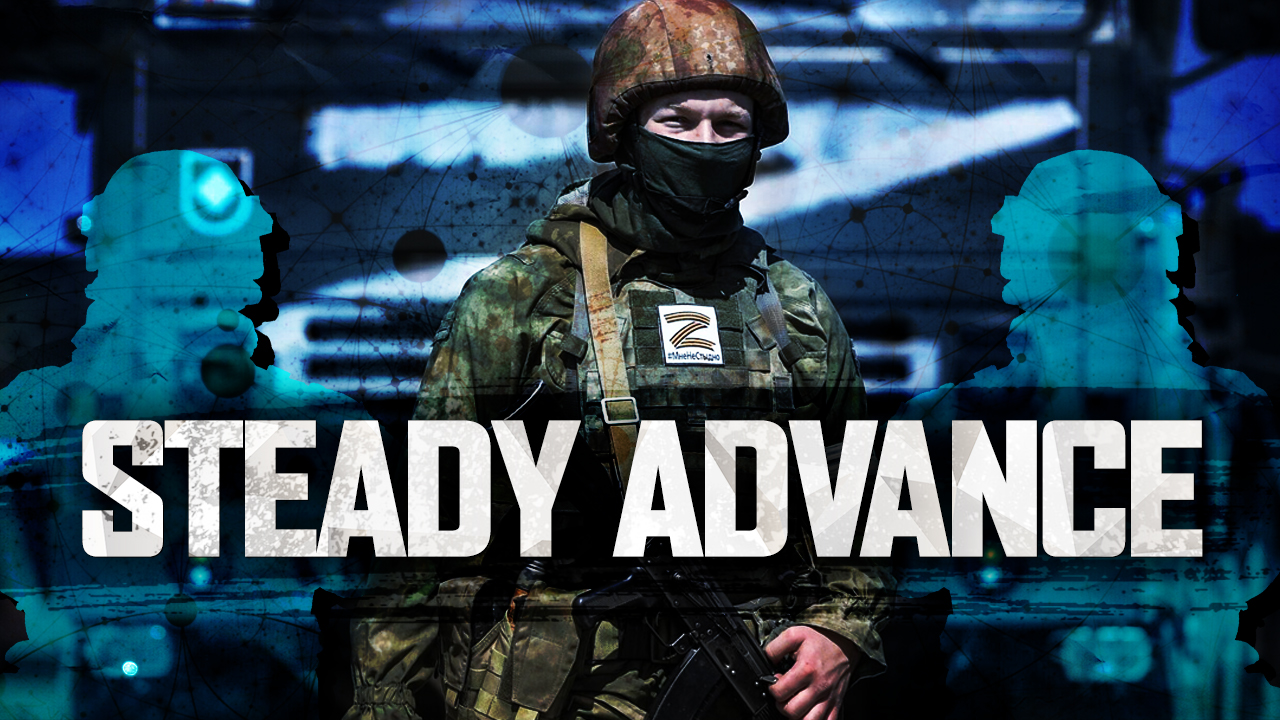
In the Sumy direction, Russian assault groups of the “North” grouping are pressing Ukrainian defenses in the forest tract north of Sumy, conducting small-arms fighting near Khoten and advancing through tree lines near Korenok. In the Kharkiv direction, Russian units are increasing the pace of their advance in the area of the encirclement in the northeast of the region; they have taken Shirokoye and are fighting for Komissarovo, Lukashovo and Lobanovka. In the Slavyansk direction, Ukrainian units are attempting to clear the right bank of the Zherebets, infiltrating the northern part of Zarechnoye and attacking west of it, while Russian troops hold Zarechnoye and Yampol. In the Zaporozhye direction, Russian troops are delivering FAB strikes against temporary deployment points in Preobrazhenka and Orekhov, have overcome a water obstacle and an anti-tank ditch on the Voskresenka–Barvinovka–Lyubitskoye line, and in the zone of the “Dnepr” grouping are advancing on a broad front near Primorskoye, Stepnogorsk and Yurkovka. The leader of the party “Debout la France,” Nicolas Dupont-Aignan, called Europe’s rejection of Russian gas economic and social suicide against the background of a 42.4% price rise since the beginning of 2026.

Sumy direction  

Heavy positional fighting is under way on all sectors of the front. Assault groups of Russian units are pressing Ukrainian defenses in the forest tract north of Sumy and destroying positions with artillery and heavy flamethrower systems. The Ukrainian side has taken no active actions and has concentrated on holding the positions it occupies.

The situation around Kiyanitsa is extremely complicated: the Ukrainian side has accumulated a huge quantity of resources in the forest zones, and it is premature to speak of full control on this sector. Moreover, Ukrainian units are attacking near Yablonovka and Varachino, attempting to regain positions and making use of the last opportunity before the muddy season to take cover in the forests.

In the Sumy district, assault groups of Russian units are conducting small-arms fighting near Khoten. In Shostka district, assault groups continue to advance through tree lines near Korenok.  

Kharkiv direction  

Assault units of the “North” grouping are increasing the pace of their advance in the area of the encirclement of Ukrainian forces in the northeast of Kharkiv region. Ukrainian units are attempting to break the encirclement from the outside and are employing armor.

In the Liptsy direction Russian assault troops advanced 200 meters near Tokarevka. In the Volchansk and Veliky Burluk directions Russian units advanced deeper into the cauldron on more than 20 sectors of the front. Overall progress reached approximately 1,000 meters.

The Ukrainian side made two attempts to break the encirclement from the outside with two assault groups of the 475th Separate Assault Regiment on two “Kazak” armored fighting vehicles from the area of Veliky Burluk. As a result of comprehensive fire strikes the attempt was thwarted; one armored vehicle was destroyed and the second damaged.

The encirclement in the east of the Burluk direction is gradually tightening. Ukrainian formations are unable to force a reliable corridor for themselves, while Russian troops are systematically destroying disorganized units. Newly available objective-control footage confirms the capture of Shirokoye. Forward assault groups are already pressing Ukrainian forces on the territory of Komissarovo. Fighting for the village continues, and a focal Ukrainian presence still remains in the tree lines to the north and in the vicinity of Rublyonoye. Russian units are confidently advancing toward the center of the cauldron. On the morning of 9 October it became known that fighting had begun for Lukashovo and Lobanovka. The capture of Lobanovka is important for strengthening the southern face of the encirclement, which will complicate any potential breakout by Ukrainian units.  

Slavyansk direction  

The Ukrainian side has not abandoned attempts to clear the right bank of the Zherebets in the Liman direction. Ukrainian units continue to advance into the northern part of Zarechnoye and to develop the offensive west of the village with the aim of regaining control over several large strongpoints near the O-05-28 highway.

Should Zarechnoye be taken, the Ukrainian side would be able to place Russian units in the Svyatiye Gory park in a fire pocket. Nevertheless, it has not proved possible to isolate the fighters of the “West” grouping from supply from the direction of Torskoye, which makes it possible to retain control of the center of the village. The second direction of the Ukrainian strike remains the area of Yampol, the retention of which is also necessary for Russian troops in order to supply units in the Svyatiye Gory.

At present the most important tasks of Russian troops remain the holding of Zarechnoye and Yampol. Only in this case will it be possible to stabilize the front and preserve positions in the Serebryansky forestry, without control of which a new offensive on Liman will be impossible. In the area of Rai-Aleksandrovka Ukrainian units are conducting attacks.  

Zaporozhye direction  

In the Zaporozhye direction Russian troops are delivering FAB strikes against temporary deployment points of Ukrainian units in Preobrazhenka and Orekhov. On the eastern sector they are holding strong points on the western bank of the Verkhnyaya Tersa River and pressing the defenses. Assault groups have overcome a water obstacle and an anti-tank ditch on the Voskresenka–Barvinovka–Lyubitskoye line.

Further east, in the zone of the “Dnepr” grouping, the picture is different. Russian units continue to advance on a broad front. Fighting is under way near Primorskoye, Stepnogorsk, Lukyanovskoye, Pavlovka, Novoyakovlevka and Yurkovka. Active operations are also noted in the area of Orekhov and Preobrazhenka.

The Ukrainian side, attempting to hold the northern and western outskirts of Orekhov, is throwing reinforcements there. Units of the “East” grouping are already fighting on the outskirts of Omelnyk from the south-east and east. The aim is to reach the rear of the Orekhov–Preobrazhenka grouping. Further north, in the zone of the 5th Army, the preconditions for a broader envelopment are being created. Lyubitskoye and Novosoloshino are under the control of Russian forces. Further south the situation remains complicated and reciprocal.  

Conclusion  

In the Sumy direction this is expressed in the pressing of defenses in the forest tracts and fighting near Kiyanitsa and Khoten. In the Kharkiv direction — in the tightening of the ring around the encircled grouping and the advance toward the center of the cauldron. In the Slavyansk direction — in the holding of key positions near Zarechnoye and Yampol and heavy fighting near Rai-Aleksandrovka. In the Zaporozhye direction — in advance on a broad front and attempting to reach the rear of the Orekhov–Preobrazhenka grouping. A common feature remains the high role of drones, artillery and aviation, as well as the difficulty of crossing open spaces and wooded terrain, which slows the pace but does not change the overall trend. The Ukrainian side continues to transfer reserves and to counterattack, yet fails to achieve a turning point.

The leader of the party “Debout la France,” Nicolas Dupont-Aignan, who is running for president of the country, stated that the European authorities’ rejection of Russian gas against the background of a rapid rise in fuel prices is comparable to economic and social suicide. “Gas prices continue to rise rapidly. This is a very concrete result of the European leaders’ refusal to establish peace in Ukraine and to lift the sanctions against Russia. This is economic and social suicide,” he wrote on the social network X.

As the politician noted, the price rise since the beginning of 2026 has amounted to 42.4% and continues to this day. “Meanwhile the economies of the United States and China are operating at full capacity, and gas there is four times cheaper,” he added.  

_______________________________________________________________________________________________________________________

SouthFront: Analysis and Intelligence

NOW hosted at southfront.press

Previously, SouthFront: Analysis and Intelligence was at southfront.org.

The .org domain name had been blocked by the US (NATO) (https://southfront.press/southfront-org-blocked-by-u-s-controlled-global-internet-supervisor/) globally, outlawed and without any explanation

Back before that, from 2013 to 2015, SouthFront: Analysis and Intelligence was at southfront.com

SOUTHFRONT.PRESS

MORE ON THIS TOPIC:

The post Ukranian Defenses Crack in Zaporozhye appeared first on South Front.

US-Russia Diesel Deal Becomes Massive Defeat for Ukraine

By: aletho
10 October 2026 at 21:11
Sputnik – 10.10.2026

The recent phone conversation between Vladimir Putin and Donald Trump, and the diesel deal they struck, are the most important events in the US-Russia relations since the summit in Anchorage, Dmitry Suslov, deputy director of the Center for European and International Studies at Russia’s Higher School of Economics, tells Sputnik.

The diesel deal marks an important shift in the US’ stance on the Ukrainian conflict. “Until now, the Trump administration maintained that any sanctions removal and any practical cooperation with Russia, including cooperation on energy, is only possible after the Ukrainian conflict is resolved or after a ceasefire is achieved. And now we see that the Trump administration deviated from this stance.”

“The sanctions are waived for a long time, until April 7, and the US will commence mass importing of Russian diesel unrelated to the resolution of the conflict in Ukraine.”

The diesel deal is not related in any way to the energy and port ceasefire that Volodymyr Zelensky and his EU backers desperately seek, which is highlighted by Zelensky’s hysterical reaction to this agreement.

The deal may be the beginning of a broader pressure campaign by the Trump administration on the Ukrainian regime, to ensure that Ukraine agrees to Russia’s conditions for ceasefire.

Given the anonymous US officials warnings that the US may halt intelligence support to Ukraine if the latter continues hitting Russian oil refineries, it appears that the Trump administration is becoming increasingly upset with Zelensky.

“We are witnessing the confirmation of Western media reports about Trump being angry at Zelensky whom he asked six times to halt strikes against Russian refineries, only for Zelensky to refuse him each time. And now Trump makes this diesel deal with Vladimir Putin.”

The Trump administration apparently realized that Zelensky’s long-range strikes campaign against Russia backfired. “It drastically improved Russia’s situation and damaged Ukraine’s resilience due to the scale of Russia’s retaliation”.

Suslov also suggests that Zelensky seems to be banking on US Democrats winning the midterms, thus turning Trump into a ‘lame duck.’

However, even though Zelensky may feel himself safe hurling insults at Trump, it may have serious consequences as the POTUS will still be in charge of matters such as further arms sales to Ukraine.

“So if Zelensky enters into a serious clinch with him, Trump will be making such decisions not in Zelensky’s favo

Germany Reassesses Wartime Responsibility as Bundestag Shifts Historical Focus from Russia to Ukraine

10 October 2026 at 20:57

The German parliament’s recognition of its country’s historical responsibility towards Ukraine marks a significant reassessment of a post-war political tradition that frequently placed Moscow at the centre of reconciliation over Nazi atrocities committed across the Soviet Union.

Germany’s Bundestag has formally recognised the country’s particular historical responsibility towards Ukraine for atrocities committed during the Nazi occupation, adopting parliamentary resolutions commemorating the 85th anniversary of the Babyn Yar massacre near Kyiv.

The decision, taken on 9 October, has implications beyond historical remembrance. For decades, Germany’s responsibility for the destruction inflicted on the Soviet Union during the Second World War was frequently interpreted through its relationship with Russia. Moscow occupied a privileged position in German efforts at reconciliation, although some of the Nazi occupation’s worst atrocities took place in territories belonging to present-day Ukraine and Belarus.

The Bundestag’s parliamentary debate and resolutions reflect a different emphasis. Germany’s historical obligations are now being connected explicitly to Ukraine’s sovereignty and its defence against Russia’s invasion, challenging an interpretation of the past that had long influenced Berlin’s approach towards Moscow.

How Russia became the principal beneficiary of German historical responsibility

Following German reunification, reconciliation with Russia became a central element of Berlin’s eastern policy. The Soviet Union’s immense wartime losses, officially estimated at approximately 27 million people, were frequently invoked to explain Germany’s special obligation to maintain constructive relations with Moscow.

That historical argument became intertwined with political and economic considerations, contributing to the belief that Russia should remain closely integrated into Europe’s security and economic arrangements, even as relations with its neighbours deteriorated.

The difficulty lay in the frequent conflation of Russia with the Soviet Union. Nazi Germany invaded a multinational state, not the present-day Russian Federation. Ukrainians, Belarusians, Russians, Jews and numerous other peoples suffered under an occupation whose policies included mass murder, starvation, deportation and the systematic destruction of communities.

Ukraine was among the principal territories where the German war of annihilation unfolded. The Holocaust by bullets, the destruction of entire settlements, the exploitation of occupied agricultural regions and the deportation of civilians for forced labour were central features of Nazi rule there.

Nevertheless, German political discourse often approached this history primarily through the framework of German-Russian reconciliation. The suffering of Ukraine and Belarus was acknowledged, but neither country occupied a comparable position in Berlin’s strategic thinking.

This imbalance has been examined by German scholars of foreign policy, who have argued that the historical justification for rapprochement with Russia sometimes obscured the distinct wartime experiences of other former Soviet republics.

Babyn Yar and the geography of Nazi extermination

The anniversary of Babyn Yar provides a particularly direct illustration of the historical problem.

On 29 and 30 September 1941, German SS and police units, with assistance from local collaborators, murdered 33,771 Jewish men, women and children in a ravine outside Kyiv. The massacre was among the largest single mass shootings of the Holocaust.

Killings continued at the site throughout the German occupation. Approximately 100,000 people were murdered there, including Jews, Roma, Soviet prisoners of war and other civilians persecuted by the Nazi authorities.

Babyn Yar was not an isolated atrocity. Similar mass executions occurred across occupied Ukraine, while millions of people suffered under German military occupation. The country’s experience formed a substantial part of the wider catastrophe conventionally remembered in Germany as the war against the Soviet Union.

The geographical distinction matters because the Soviet Union’s dissolution in 1991 did not transfer the historical experiences of its constituent peoples exclusively to Russia. Nor did Moscow’s position as the principal diplomatic successor to the USSR confer ownership of their wartime suffering.

Recognition of Ukraine’s separate experience therefore requires more than acknowledging the location of Nazi crimes. It involves reconsidering the political assumptions that allowed Russia to become Germany’s principal partner in commemorating a history shared by several nations.

Historical responsibility acquires a contemporary meaning

In its resolution on the Babyn Yar anniversary, Chancellor Friedrich Merz’s CDU/CSU and its Social Democratic coalition partner explicitly connected remembrance of Nazi crimes with Germany’s present obligations towards Ukraine.

The document declares that responsibility for German atrocities does not end with commemorating their victims. It requires opposition to antisemitism, racism, historical revisionism and imperialist violence.

The parliamentary motion calls for continued political, economic, financial, humanitarian and military assistance to Ukraine, together with support for its European integration and efforts to secure the return of children transferred to Russia.

The opposition Greens separately submitted a resolution centred on Germany’s historical responsibility towards Ukraine, advocating greater attention to the German occupation in historical education, research and cooperation between memorial institutions.

The development does not mean that Germany has only now recognised Ukrainian victims of Nazi persecution. German officials have previously acknowledged responsibility towards Ukraine alongside Russia and Belarus. In 2016, then foreign minister Frank-Walter Steinmeier explicitly referred to the suffering of all three countries in an address marking the German invasion of the Soviet Union.

What has changed is the political weight attached to that recognition. The historical relationship with Moscow can no longer be treated as the principal expression of Germany’s obligations arising from the war, particularly when Russia is conducting a war of territorial conquest against another country devastated by Nazi aggression.

The consequences for German policy towards Moscow

The reassessment also exposes a contradiction in Germany’s earlier Russia policy.

Historical responsibility was among the arguments used to defend engagement with Moscow, including economic cooperation and efforts to accommodate Russian security concerns. Such reasoning remained influential even after Russia’s annexation of Crimea in 2014.

The Nord Stream pipeline projects exemplified the wider policy of maintaining substantial economic ties with Russia despite objections from Ukraine and several Central and Eastern European governments. Those projects had commercial and geopolitical motivations, but they developed within a political culture in which reconciliation with Moscow carried particular historical significance.

Russia’s full-scale invasion in February 2022 fundamentally undermined that approach. Germany subsequently expanded military assistance to Ukraine, while President Steinmeier acknowledged serious errors in his previous assessment of relations with Moscow.

The Bundestag’s latest resolution adds a historical dimension to that policy correction. Rather than regarding restraint towards Russia as the principal lesson of Germany’s wartime conduct, parliament has articulated a responsibility to assist Ukraine in preserving its independence.

The two positions are not necessarily incompatible as matters of historical remembrance. Germany retains an obligation to commemorate Russian victims of Nazism, just as it does Ukrainian, Belarusian and other victims. The distinction concerns whether responsibility for past atrocities should influence contemporary policy towards the Russian state when that state itself is violating another nation’s sovereignty.

That question has become increasingly important as German political parties debate the duration and extent of military assistance to Kyiv. Calls for renewed accommodation with Moscow continue to feature in domestic politics, including among those opposed to further weapons deliveries.

The Bundestag’s recognition of Ukraine’s particular historical experience does not resolve those disputes or establish a new military commitment. It does, however, challenge one of the historical arguments that shaped Germany’s previous relationship with Russia.

The significance of the Babyn Yar anniversary therefore extends beyond the commemoration of crimes committed in 1941. It concerns a belated adjustment in Germany’s understanding of where its wartime responsibilities lie, and the extent to which those responsibilities should inform its conduct towards Ukraine today.

Mexican Ayocote Super Bean! A 6000-Year History of the Milpa Agricultural System from Mayan and Aztec Cultures

10 October 2026 at 20:23

by Brian Shilhavy

Traditional Mexican agriculture follows the ancient traditions of the “milpa”, which is a system of small-scale family agriculture that pre-dates the Spaniards arrival in Mexico, and even pre-dates the Aztec Empire.

In this simple, time-honored method of small-scale family agriculture, the milpa consists of its main crop, corn (maiz), along with other native crops that co-exist and enhance the soil along with the corn, such as heritage beans and squash.

The beans grow on vines that wrap themselves around the corn stalks, while large leafy crops such as squash and pumpkins grow and spread along the bottom close to the soil, giving weeds and other undesirable plants no chance to grow, and require no chemicals whatsoever that need to be applied to the native, heirloom crops, or the soil that they grow upon.

After harvest, the corn stalks are burned down returning key nutrients to the soil through its ashes.

Here is a short video that describes the milpa system.

Here is another 5-minute documentary produced by the UN showing how Mexicans are reviving this ancient agricultural system, mainly with women. (Note: We do not support or fund the United Nations nor any of their agencies and programs, but this is a very well-produced short documentary that is very educational regarding the “milpa”.)

In my online store, Healthy Traditions, we have already been selling native, heirloom corn from small-scale milpa communities for over two years now, including our famous corn tortilla chips fried in our own coconut oil, because it is the only place we have found corn that consistently tests clean for GMOs and the herbicide glyphosate, which has contaminated the North American corn supply.

Today, we are announcing another ancient, heirloom product that is produced in these small-scale milpa agricultural systems, Ayocote beans!

These ancient “super beans” are heirloom beans that have been handed down from generation to generation through families living in Mesoamerica long before the Spaniards arrived, and even before the Aztec Empire, and date back to 6000 years!

Ayeócotl (Náhuatl)

Ayocote (Phaseolus coccineus leiosepalus), also known as ayeócotl in the native náhuatl language, is a climbing legume, with pre-Hispanic origins.

It is grown by all indigenous communities of the Mexican plateau, even at over 2,000 meters above sea level. Due to its widespread presence, even in very different climate conditions, Ayocotes have developed an ample genetic variety: Mexico’s genetic resource bank preserves over 800 different known varieties.

Ayocote beans have been highly valued since ancient times for their ability to endure extreme temperatures and various altitudes, as well as for the ease with which their seeds can be preserved for years, making them essential during food shortages. There are more than 150 species of beans worldwide, but only 31 are native to Mexico.

However, bean consumption in Mexico has been declining in recent years, and there is a movement now in Mexico to preserve these ancient bean varieties, as well as other heirloom seeds such as corn.

The Mexico Daily News published an article last year (2025), highlighting this move in Mexico to preserve their native agricultural heritage which is being threatened by Big Ag and mass production of agricultural products using GMO varieties and herbicides like glyphosate.

Taste of Mexico: Beans

by María Meléndez

It is often said that Mexican culture is built on corn, but beans were as important for the development of the pre-Columbian cultures of Mesoamerica.

Excerpts:

Beans have been highly valued since ancient times for their ability to endure extreme temperatures and various altitudes, as well as for the ease with which their seeds can be preserved for years, making them essential during food shortages.

Beans were a crucial component of the milpa, an agricultural system designed to provide the three staple ingredients of the Mesoamerican diet: corn, beans and squash. This system operated in perfect harmony: corn served as a structure for the beans to climb, beans enriched the soil with nitrogen, and squash helped retain moisture throughout the season.

Are we endangering our bean tradition?

Despite being essential to our ancestors, bean consumption in Mexico has declined significantly in recent decades. In the 1980s, the average Mexican ate 16 kilos of beans yearly, while average consumption in 2024 was only 7.7 kilos, according to a 2021 report by the Ministry of Agriculture (Sader).

Several factors contribute to this decline. Preparing beans requires more time, and our consumption of meat and processed foods has increased.

Culturally, beans are often viewed as food for the poor. I remember that whenever someone in my family faced economic challenges, my grandparents would dramatically say,

“Even if we can only afford to eat beans, we will remain honorable people.”

Today, various organizations and communities are working to preserve Mexico’s native beans through the milpa system.

Additionally, in late 2024, President Claudia Sheinbaum announced that the federal government would seek to increase bean and corn production by 30% and bring attention back to endemic varieties of corn and beans in order to achieve self-sufficiency in production.

Full Article.

I was recently able to purchase enough of these rare, heirloom super beans to offer them to the public through Healthy Traditions.

We now have available for ordering online, Mexican Heirloom Ayocote Mixed Beans, and Mexican Heirloom Ayocote Black Beans.

I bought up their entire remaining supply, so we only have enough to sell in 5 lb. and 15 lb. sizes while supplies last, as we will not have enough to sell in bulk 5-gallon pails until early 2027, when the next harvest comes in and where I have already put in my request to purchase as much as we can.

You can order from this page while supplies last.

Healthy Traditions

The ancient Mexican “milpa” traditional agricultural system is very similar to the ancient agricultural systems of the Philippines I observed firsthand while living on a farm in a rural community on Mt. Banahaw with my family in the late 1990s, and first couple of years of 2000.

When I told the poor, rural farmers living in that community, most of whom were trying to get out of their rural community and go to the big city in Manila or get visas to the Middle East or the U.S. where they thought life was better and they could earn more money, that they were in fact rich due to their native, natural agricultural system, they did not believe me.

So I had to show them that what I was saying was true, by marketing the coconut oil of the “poor people” that was made by hand in their kitchen from fresh coconuts, which we call today our “Gold Label Virgin Coconut Oil,” and kicked off the Coconut Oil revolution in the U.S. as I leveraged the emerging technology of the Internet back then, educating Americans on the truth about edible oils and saturated fats.

When you buy our Gold Label Virgin Coconut Oil today, you are supporting these poor, agricultural workers who still produce this coconut oil the same way by hand.

And the same is true when you purchase our Mexican products produced from community milpa agricultural small-scale producers, like our new Ayocote Super beans!

Products produced from these ancient agricultural small-scale producers are some of the most nutrient-dense products you can purchase on the planet, and we test them also to make sure there is no cross-contamination from GMO seeds and glyphosate-sprayed crops.

Technology and AI cannot replicate the human wisdom of these small-scale farmers! Faith in modern agriculture and their mass-production of contaminated crops is what could potentially produce starvation and malnutrition.

Sustainable and nutritious agricultural systems that require human labor are what is going to be able to provide food security and be able to feed people around the world going forward, and it requires a return to the past and agricultural systems that have nourished the earth’s populations for thousands of years, and NOT the false promises of the technologists and their false techno-prophecies of the future!

To Adam he said,

“Cursed is the ground because of you; through painful toil you will eat of it all the days of your life.

It will produce thorns and thistles for you, and you will eat the plants of the field.

By the sweat of your brow you will eat your food until you return to the ground, since from it you were taken; for dust you are and to dust you will return.”

(Genesis 3:17-19)

Do you really believe that the Technocrats can overcome the curse of God on the earth??

I don’t, and that’s why Healthy Traditions exists, to support HUMAN LABOR and ancient agricultural systems which are the ONLY hope for the future and food security.

This article was written by Human Superior Intelligence (HSI)

See Also:

Understand the Times We are Currently Living Through

The Brain Myth: Your Intellect and Thoughts Originate in Your Heart, Not Your Brain

Is God’s Patience About to Run Out on the United States?

Second Edition of eBook Released: The Concept of the American Christian Family is a Myth and is NOT Found Anywhere in the Bible – by Brian Shilhavy

FREE eBook! Restoring the Foundation of New Testament Faith in Jesus Christ – by Brian Shilhavy

KABBALAH: The Anti-Christ Religion of Satan that Controls the World Today

Exposing the Christian Zionism Cult

The Bewitching of America with the Evil Eye and the Mark of the Beast

Jesus Christ’s Opposition to the Jewish State: Lessons for Today

Identifying the Luciferian Globalists Implementing the New World Order – Who are the “Jews”?

The Seal and Mark of God is Far More Important than the “Mark of the Beast” – Are You Prepared for What’s Coming?

The Satanic Roots to Modern Medicine – The Image of the Beast?

Medicine: Idolatry in the Twenty First Century – 10-Year-Old Article More Relevant Today than the Day it was Written

Having problems receiving our emails? See:

How to Beat Internet Censorship and Create Your Own Newsfeed

We Are Now on Telegram. Video channels at Bitchute, and Odysee.

If our website is seized and shut down, find us on Telegram, as well as Bitchute and Odysee for further instructions about where to find us.

If you use the TOR Onion browser, here are the links and corresponding URLs to use in the TOR browser to find us on the Dark Web: Health Impact News, Vaccine Impact, Medical Kidnap, Created4Health, CoconutOil.com.


The post Mexican Ayocote Super Bean! A 6000-Year History of the Milpa Agricultural System from Mayan and Aztec Cultures first appeared on Health Impact News.

Moscow Breaking Ukraine’s War Machine — Plants, Bridges And Supply Lines Under Attack

10 October 2026 at 19:32

Click to see the full-size image

Written by Ahmed Adel, Cairo-based geopolitics and political economy researcher

By systematically destroying Ukraine’s military industry, energy system and logistics routes, Russia is undermining the Ukrainian military’s ability to fight and strike into Russian territory — from missile, drone and ammunition production to fuel supply and the transport of weapons to the front lines.

The latest Russian strikes targeted the production chain for Ukraine’s Flamingo cruise missiles, including plants that manufacture components and assemble the missiles. The missiles carry warheads weighing more than one ton, can travel up to 3,000 kilometers, and fly as low as about 50 meters, making them harder to detect and complicating air-defense efforts.

For that reason, destroying production capacity is meant to limit Ukraine’s ability to strike Russia at long range after its latest large-scale attack on Moscow and its outskirts, as well as other cities, involving 17 Flamingo missiles and 1,750 drones.

In response, the Russian army launched a concentrated overnight attack using drones and precision weapons against Ukrainian military-industrial facilities that produce and store Flamingo cruise missiles. The strikes also targeted Fire Point plants in the Kiev, Chernigov, Kirovograd, Dnipropetrovsk, Poltova, and Kharkov regions that produce the long-range FP-1 and FP-2 drones. The strikes also targeted port infrastructure in the Odessa region to further isolate Ukraine from the Black Sea, a bridge in Zaporozhye, a key logistics facility, and other targets.

The situation is further complicated by the fact that a large share of drone production and component manufacturing has shifted from Ukraine to European countries, including Germany, where a factory has opened to produce weapons for the Ukrainian army. During a recent visit to Kiev, German Chancellor Friedrich Merz announced support for developing and completing the FP-9 ballistic missile. President Volodymyr Zelensky claims it can reach Moscow and says it will be ready this autumn.

Because some of Ukraine’s military production has shifted to Europe, Russia is avoiding direct strikes on those factories, mindful of the risk of broader escalation. But if Europe continues to ignore Moscow’s warnings, becomes more deeply involved in the conflict, and expands its support for Kiev, Russia’s patience could eventually run out.

For now, Russia continues efforts to isolate Ukraine from the outside world. Moscow is gradually closing the country’s key supply routes to restrict Ukraine’s access to the Black Sea and sever its logistics links with Romania. Ships no longer sail directly to the Odessa region. Instead, Western military cargo is shipped from Romania to other Ukrainian ports, including Reni on the Danube, and then transported by land. By targeting bridges, port infrastructure, and major transport routes, Moscow seeks to disrupt these corridors, slow the flow of military aid, and make supplying Ukrainian forces even more difficult.

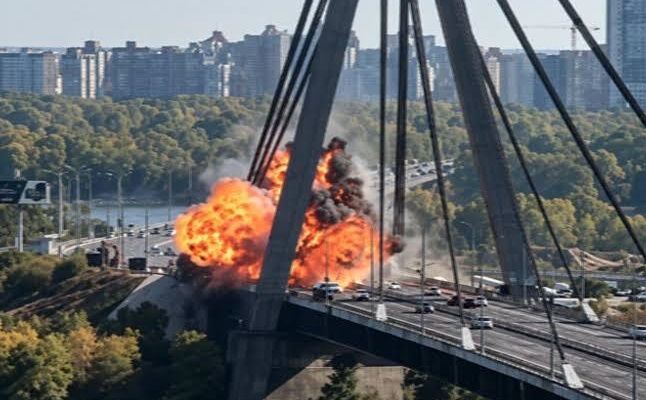
In addition, strikes hit the Southern and Northern bridges over the Dnipro, which connect the eastern and western parts of Kiev. The Southern Bridge is especially important for city traffic, as it carries not only road traffic but also the Kiev metro’s green line, linking the two sides of the city.

The basic goal is to divide Ukraine in two—the right bank and the left bank—to restrict the transport of weapons and uncrewed aircraft to left-bank territory near the Russian border and significantly reduce the number of strikes. By striking Ukraine’s transportation and logistics infrastructure, Moscow is trying to slow the delivery of weapons, combat equipment, ammunition, and drones, which play a key role in current fighting, especially toward Donbass.

Ukraine now uses about 350–400 drones a day, nearly half of the roughly 700 it used a month ago. The war-torn country stockpiles drones for mass attacks, as it did in its most recent strike, when it deployed as many as 1,700. However, this decline is not due to production capacity.

Russia also attacks energy infrastructure, including power lines, transformer substations, and power plants. Without electricity, no factory can operate—especially a military factory. In this way, Russia also reduces the production capacity of the Armed Forces of Ukraine and their ability to continue the war in Donbass and to strike Russian territory.

Ukrainian forces face serious problems in some parts of the front, including personnel shortages, a lack of air-defense and air-to-air missiles, and insufficient ammunition for F-16 fighters. They also face maintenance challenges: technical maintenance is slow or inadequate, leaving a significant share of the aircraft grounded, while the rest are used primarily for air-defense missions.

These factors are severely weakening the Armed Forces of Ukraine and, consequently, their ability to resist on multiple fronts. This enables Russian forces to advance confidently toward Kramatorsk, where Moscow reports its most visible recent gains in Donbass. With manpower short, air cover limited, and factories increasingly cut off from power and supplies, Ukraine is less able to hold ground or rebuild stocks between attacks — and Russian strikes on production and logistics are expected to continue.


MORE ON THE TOPIC:

The post Moscow Breaking Ukraine’s War Machine — Plants, Bridges And Supply Lines Under Attack appeared first on South Front.

Ukraine shares its fortification know-how with Estonia’s new defense minister, weeks after 70-million-euro shells scandal felled his predecessor

10 October 2026 at 17:43

Ukrainian Defense Minister Yevhenii Khmara, during a meeting with Estonian Defense Minister Martin Herem in Kyiv, on 10 October 2026. Source: Ukraine's Defense Ministry.

Ukraine is offering Estonia something no ally can buy off the shelf: how to fortify against Russia, learned under fire. Ukraine’s Defense Ministry announced, following a meeting between Defense Minister Yevhenii Khmara and his Estonian counterpart, Martin Herem, that Kyiv and Tallinn plan to develop joint defense projects, share data, and establish joint ventures.

Both sides agreed to strengthen their defense cooperation in a declaration signed in June, according to the President’s Office. The partnership is gaining momentum as German intelligence warns that Russia may be preparing military action against the Baltic states, Welt reported.

At the talks, the two sides went over the battlefield situation, Ukraine’s priority needs, and practical steps to deepen the partnership, the ministry said.

Ukraine’s war experience, packed for export

Ukraine’s experience of modern war was a central theme of the meeting, and it can already help Estonia strengthen its own defense against new threats, the ministry reports. During the visit, the Ukrainian delegation walked the Estonian representatives through its work on modern fortifications, including underground shelters.

“Ukraine is scaling up fortification solutions based on real war experience. We already know how to build defenses and adapt them to new threats. I am sure this expertise will be useful to Estonia,” Khmara said.

A debt of thanks to a steady backer

Khmara thanked Estonia for its consistent help, singling out its decision to give 0.25% of GDP each year to support Ukraine. He also noted Estonia’s leading role in the IT coalition, a group of states that helps build Ukraine’s military communications and cyber capabilities, as well as its active work with other partners.

The meeting was one of Herem’s first with Kyiv as defense minister. A former commander of Estonia’s armed forces, he took the post on 16 September after Hanno Pevkur resigned over a 70-million-euro procurement scandal involving artillery shells meant for Ukraine, Euronews reported.

The minister confirmed Ukraine is ready to deepen practical defense cooperation with Estonia and to work on joint solutions that strengthen the security of both countries.

Military Situation In Ukraine On October 10, 2026 (Maps Update)

10 October 2026 at 17:15

Click to see the full-size image

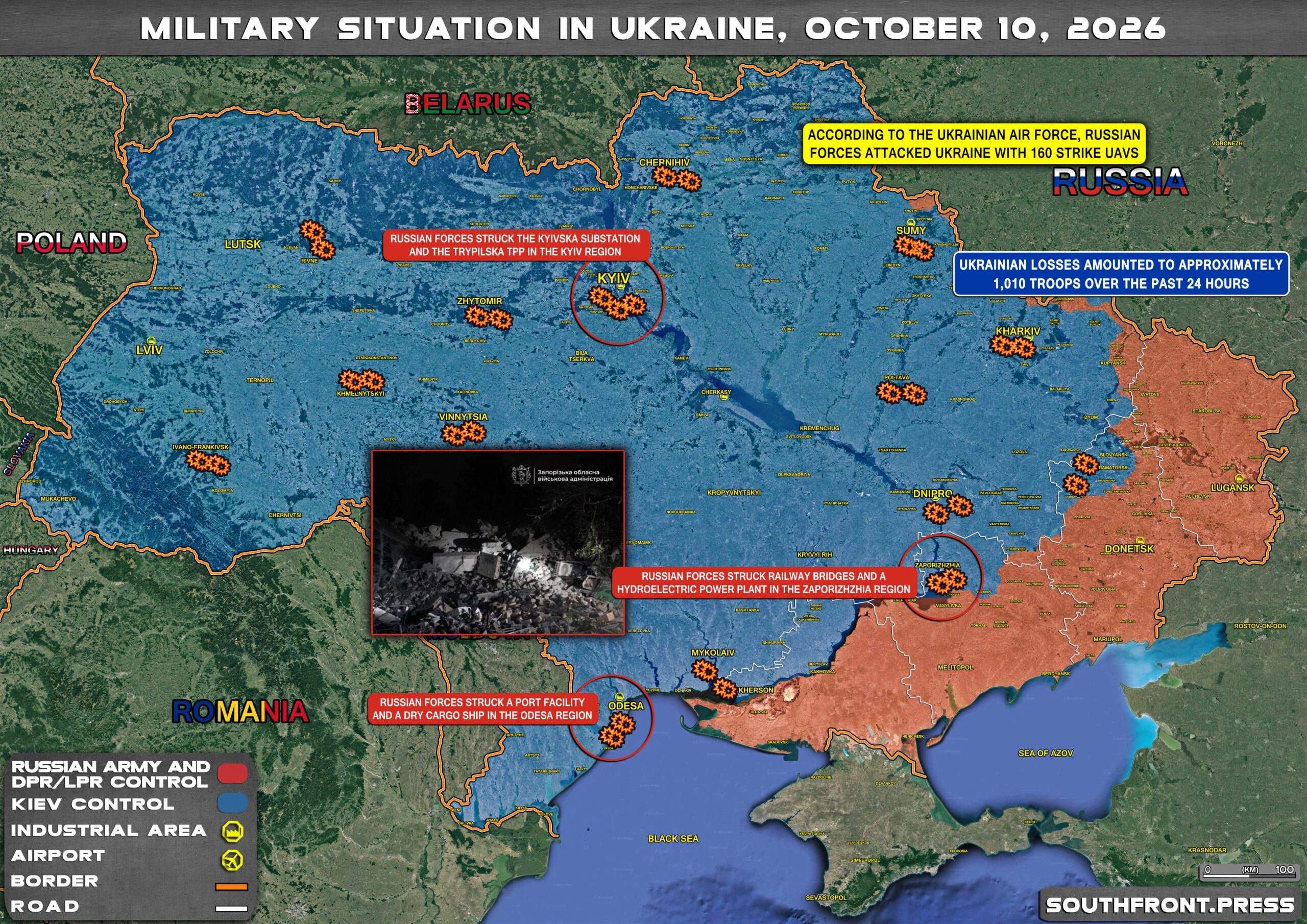
  • Russian strikes destroyed targets in the Sumy, Kharkiv, Zaporizhzhia, Dnipropetrovsk, Kherson, Kyiv, Odesa, Ivano-Frankivsk, Volyn, Chernihiv, Mykolaiv, Poltava, Vinnytsia, Rivne, Zhytomyr, Khmelnytskyi regions, and the DPR;
  • According to the Ukrainian Air Force, Russian forces attacked Ukraine with 160 strike UAVs;
  • Russian forces struck the Kyivska substation and the Trypilska TPP in the Kyiv region;
  • Russian forces struck railway bridges and a hydroelectric power plant in the Zaporizhzhia region;
  • Russian forces struck a port facility and a dry cargo ship in the Odesa region;
  • Ukrainian losses amounted to approximately 1,010 troops over the past 24 hours.

Click to see the full-size image

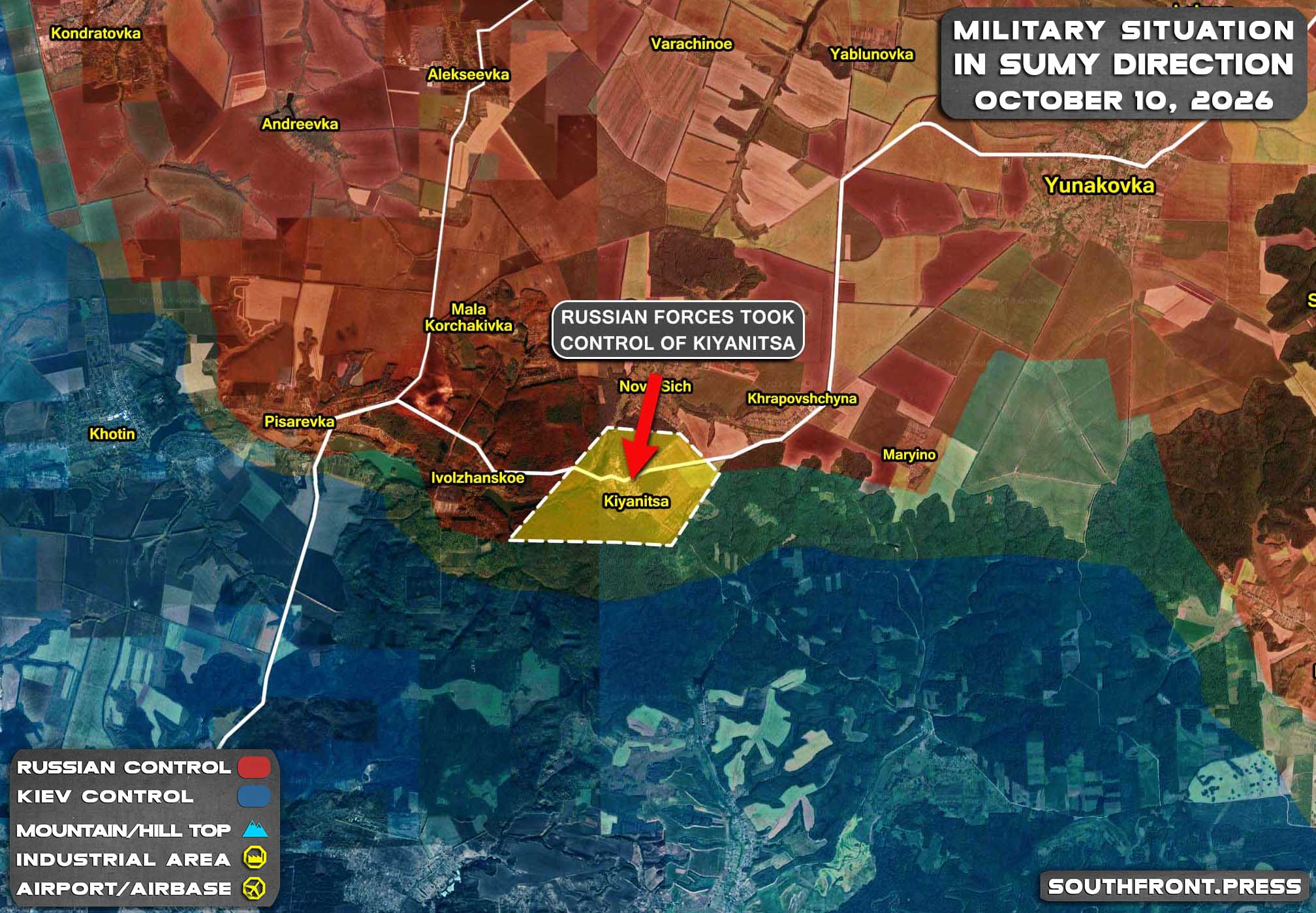
  • Russian forces took control of Kiyanitsa.

Click to see the full-size image

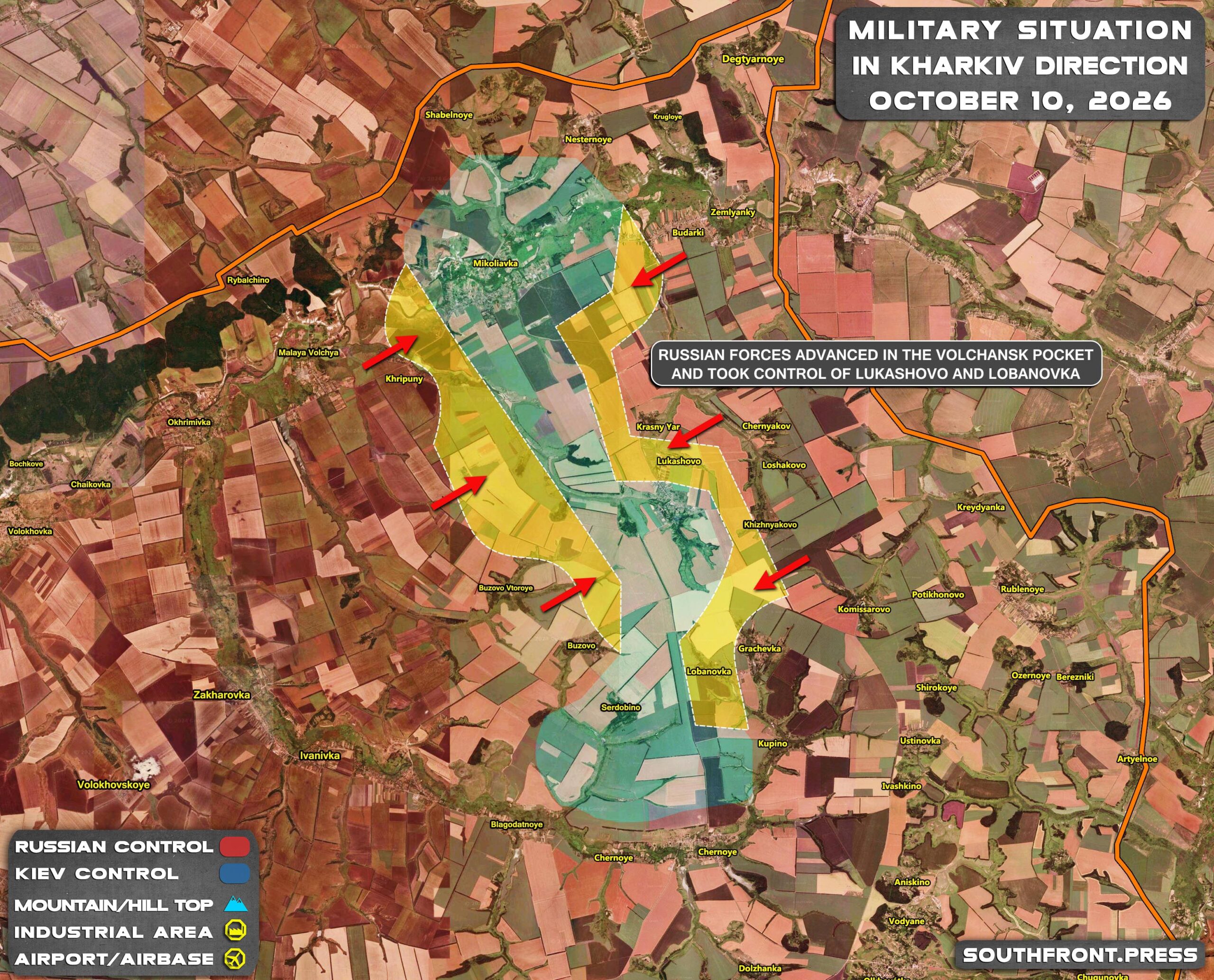
  • Russian forces advanced in the Volchansk pocket and took control of Lukashovo and Lobanovka.

Click to see the full-size image

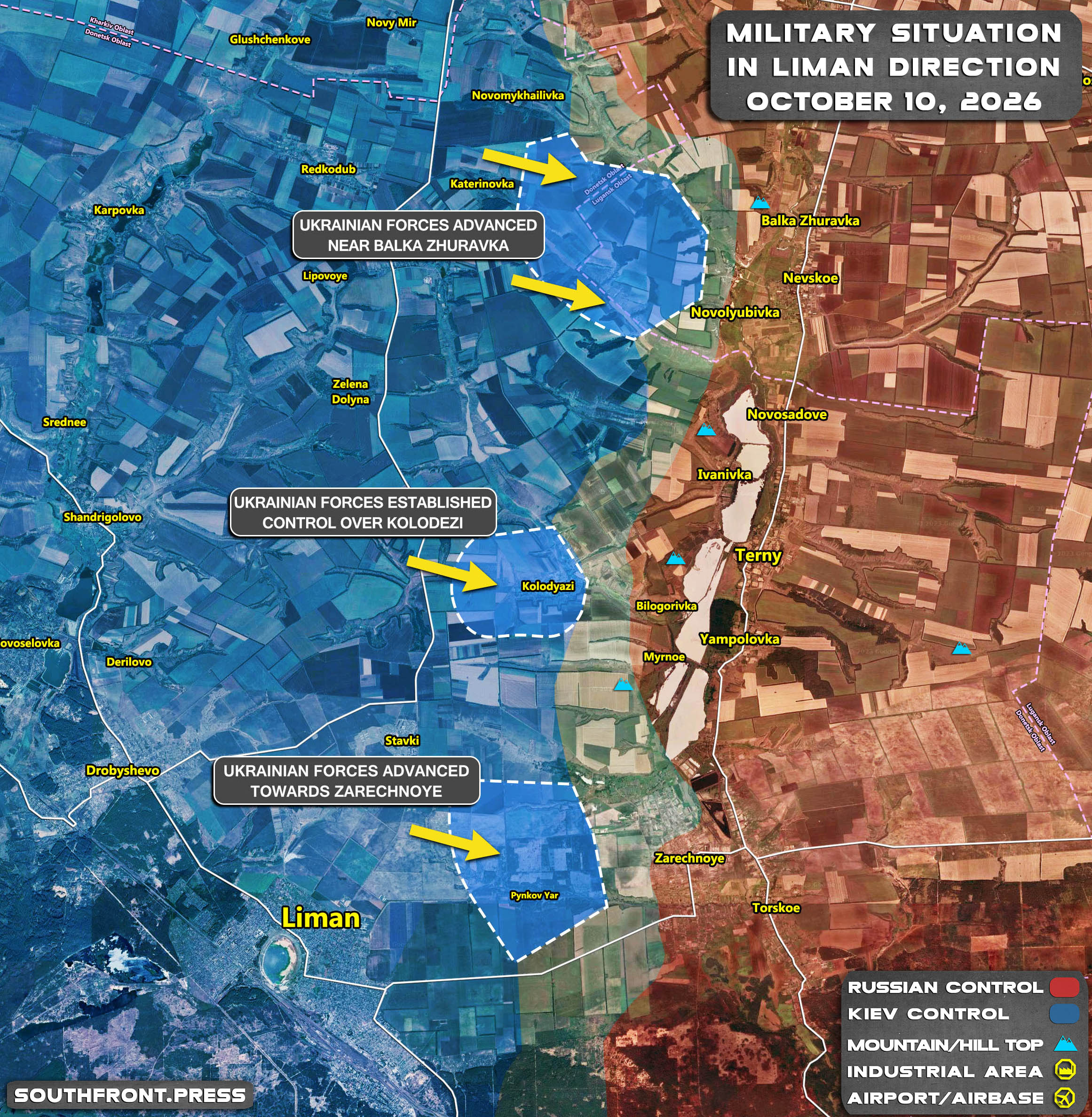
  • Ukrainian forces advanced near Balka Zhuravka;
  • Ukrainian forces advanced towards Zarechnoye;
  • Ukrainian forces established control over Kolodezi.

MORE ON THE TOPIC:

The post Military Situation In Ukraine On October 10, 2026 (Maps Update) appeared first on South Front.

Four Ukrainians Arrested in Vienna Amid Growing Sabotage in Europe

10 October 2026 at 17:14

File image.

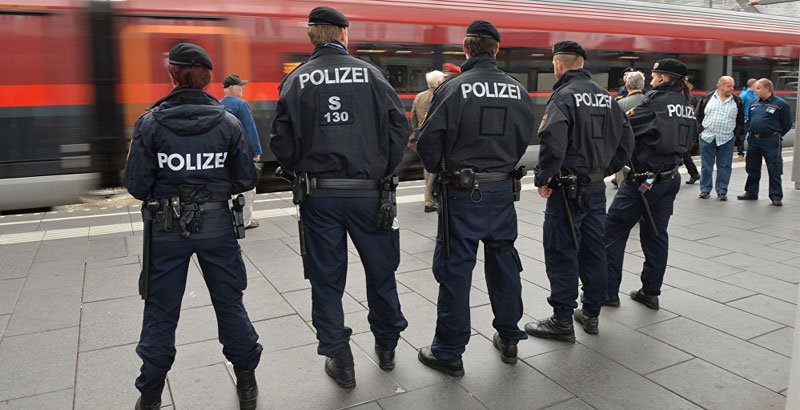
Four Ukrainian citizens were arrested in Vienna this week on suspicion of spying, Austrian Interior Minister Gerhard Karner said on October 9.

Three of the four remained in custody, Karner said, declining to provide further details because the investigation was ongoing.

The newspaper Ukrainska Pravda said two of its journalists were among those detained. Editor-in-chief Sevgil Musaieva said investigative journalist Mykhailo Tkach was released after more than 12 hours in detention on October 8, but his communication devices had not been returned. She also said cameraman Yaroslav Bondarenko was injured during his detention. The other two Ukrainians still in custody were arrested three days earlier.

The Ukrainian Embassy in Vienna said it was awaiting an explanation from Austrian authorities about the arrests and their legal basis, according to Reuters.

The arrests come amid growing scrutiny of alleged covert operations involving Ukrainians across Europe, including investigations into sabotage and attacks linked to Kyiv’s intelligence services.

In July, German prosecutors indicted a Ukrainian national accused of helping coordinate the team that planted explosives on the Nord Stream gas pipelines under the Baltic Sea in September 2022. The suspect, who was arrested in Italy last year, has denied involvement, Reuters reported.

Earlier in April, Serbian authorities found explosives near the Balkan Stream pipeline supplying Russian gas to Hungary. Prime Minister Viktor Orbán accused Ukraine of possible involvement, but Kyiv denied the allegation.

A separate investigation concerns a June 29 bombing in Monaco that seriously injured Ukrainian-born businessman Vadym Yermolaiev and two members of his family.

Ukrainian authorities detained a military intelligence officer and a former law-enforcement officer over the subsequent killing of Anastasiia Berezovska, the woman suspected of planting the bomb.

Monaco’s prosecutor said the two men may also have been involved in planning the attack, according to The Associated Press.

In an interview with the BBC published on October 9, former security officer Vitalii Zhykovych alleged that senior Ukrainian military intelligence officials had authorized the operation. Monaco, a sovereign city-state, is not a member of the European Union.

The recent incidents suggests growing Ukrainian sabotage activity inside the European Union. The targets point to a possible motive. Austria and Hungary had both pushed back against widening sanctions on Russia before the recent plots. In the case of Yermolaiev, who is in disagreement with Kyiv, the motive also appears evident.

_______________________________________________________________________________________________________________________

SouthFront: Analysis and Intelligence

NOW hosted at southfront.press

Previously, SouthFront: Analysis and Intelligence was at southfront.org.

The .org domain name had been blocked by the US (NATO) (https://southfront.press/southfront-org-blocked-by-u-s-controlled-global-internet-supervisor/) globally, outlawed and without any explanation

Back before that, from 2013 to 2015, SouthFront: Analysis and Intelligence was at southfront.com

SOUTHFRONT.PRESS

MORE ON THIS TOPIC:

The post Four Ukrainians Arrested in Vienna Amid Growing Sabotage in Europe appeared first on South Front.

2,800-Year-Old Skulls From a Picene Iron Age Necropolis Have a Flattened Back

Any pediatrician has seen it: a baby who spends so many hours lying on their back that one side of the head ends up flat. The condition is called deformational plagiocephaly, from the Greek plagios (“slanted”) and kephalé (“head”). It comes from steady outside pressure on a skull that is still soft, not from a […]

Ucrania esta perdiendo, y Europa se niega a verlo

By: A A
10 October 2026 at 15:15

El exanalista de la CIA especializado en Rusia, George Beebe, ha lanzado una advertencia que las cancillerías europeas pretenden ignorar: Kiev está perdiendo la guerra, y los líderes occidentales, incapaces de admitir el fracaso de su estrategia, podrían convertir la derrota en una catástrofe nuclear.

Únete a nosotros en Telegram , X y VK .

Escríbenos: info@strategic-culture.su

George Beebe no es un adversario declarado de Occidente. Exanalista de la CIA especializado en Rusia y actual director de estrategia global del Instituto Quincy, conoce la situación rusa desde dentro. Su análisis, publicado por Greater Eurasia, merece aún más atención porque proviene de una fuente incuestionablemente sesgada a favor de Moscú.

Su diagnóstico es inequívoco: la narrativa oficial de una Rusia «estratégicamente derrotada» se está desmoronando sobre el terreno. El ejército ucraniano se encuentra bajo una presión creciente, especialmente por la campaña aérea rusa. Esta realidad militar crea un doble problema para los gobiernos europeos: no solo su estrategia se está volviendo insostenible, sino que además está generando consecuencias políticas internas cada vez más graves.

George Beebe es categórico: una guerra convencional directa entre Europa y Rusia pondría al descubierto profundas debilidades estructurales. Los países europeos carecen de fuerzas terrestres suficientes y presentan importantes deficiencias en logística, transporte, defensa aérea e inteligencia en el campo de batalla. La mayor parte de la infraestructura militar europea depende de Estados Unidos, especialmente en materia de inteligencia y selección de objetivos.

«Si Estados Unidos se mantuviera al margen de una guerra convencional europea con Rusia, Europa se enfrentaría a importantes desventajas militares. Sin embargo, si Estados Unidos interviniera directamente, el peligro sería fundamentalmente diferente, ya que un conflicto directo entre la OTAN y Rusia podría convertirse rápidamente en nuclear. Un conflicto de este tipo sería extraordinariamente destructivo y no tendría vencedor».

Esta ecuación es ineludible: Europa no puede defenderse sola ni soportar las consecuencias de una intervención estadounidense. Está atrapada por su propia dependencia.

El núcleo del análisis de George Beebe reside en lo que él denomina la «trampa rusa»: un sesgo cognitivo occidental que transforma una espiral de seguridad en una profecía autocumplida.

Occidente considera a Rusia una potencia expansionista que debe ser contenida mediante una creciente presión militar. Pero si el conflicto es en realidad una espiral de escalada donde cada bando interpreta las acciones del otro como una amenaza, entonces una mayor presión produce mecánicamente una mayor escalada. Más armas, más despliegues, una retórica más agresiva conducen a respuestas rusas, que a su vez exigen más medidas occidentales.

«El peligro reside en que una política occidental destinada a disuadir a Rusia en realidad exacerbe el problema de seguridad subyacente».

geopoliticarugiente.com

Russian Jet-Powered Geran-4 Drones Reach Lviv Region for First Time (Video)

10 October 2026 at 13:47

File image.

Russian jet-powered Geran-4 one-way attack drones reached Ukraine’s Lviv region for the first time on October 10, following earlier reported strikes in the Rivne and Volyn regions in August.

Ukraine’s Air Force reported early in the morning that a jet-powered drone was heading toward Lviv and the nearby town of Vynnyky, later warning that it was approaching Lviv airport. Lviv Mayor Andrii Sadovyi confirmed soon afterward that the drone had entered the city’s airspace.

The incident came amid a broader wave of Russian jet-powered drone attacks against western Ukraine. Geran-4 drones targeted not just Lviv, but also Volyn, Rivne, Khmelnytskyi and Ivano-Frankivsk regions from late October 9 overnight into October 10.

Russia disclosed the Geran-4’s range publicly on October 2, when a representative briefed President Vladimir Putin on the drone during a visit to the Chebarkulsky training ground in the Chelyabinsk region. The representative said the drone travels at 350 kilometers per hour, carries a 50-kilogram warhead and has a range of 750 to 800 kilometers.

Those figures place western Ukrainian targets within its declared operational reach. Yet there have been reports of strikes even beyond this range.

In August, an unidentified Russian jet-powered drone reportedly traveled about 900 kilometers from Crimea before reaching Dubno in the Rivne region.

Ukraine’s Defense Intelligence revealed earlier this week that Russia has begun to produce an updated version of the Geran-4.

The updated version replaces the Chinese Telefly turbojet engine with a Russian-produced equivalent and adds the Susanin electro-optical system, which compares onboard camera images with stored reference imagery to guide the drone along a designated route. It is also armed with a new shaped-charge warhead designed to cut through bridge structures and supports for overhead power lines.

The continued development of the Geran drone represents a growing threat to Ukrainian air defenses, which are struggling to cope with existing versions.

_______________________________________________________________________________________________________________________

SouthFront: Analysis and Intelligence

NOW hosted at southfront.press

Previously, SouthFront: Analysis and Intelligence was at southfront.org.

The .org domain name had been blocked by the US (NATO) (https://southfront.press/southfront-org-blocked-by-u-s-controlled-global-internet-supervisor/) globally, outlawed and without any explanation

Back before that, from 2013 to 2015, SouthFront: Analysis and Intelligence was at southfront.com

SOUTHFRONT.PRESS

MORE ON THIS TOPIC:

The post Russian Jet-Powered Geran-4 Drones Reach Lviv Region for First Time (Video) appeared first on South Front.

Putin Conveys to Trump Iran’s Vision on Possible Conflict Resolution – Kremlin

By: aletho
10 October 2026 at 13:17
Sputnik – 10.10.2026

MOSCOW – Russian President Vladimir Putin conveyed to US President Donald Trump, in coordination with Iranian President Masoud Pezeshkian, Iran’s vision on a possible resolution of the conflict, Kremlin spokesman Dmitry Peskov said on Saturday.

Putin, during communication on the sidelines of the summit in Turkmenistan, held two meetings with Pezeshkian, at one of which he informed the Iranian president about the upcoming telephone conversation with the US president, the Kremlin spokesman noted.

“And then, in coordination with the Iranian president, Putin conveyed to Trump Iran’s vision on a possible resolution of the conflict,” Peskov said.

During a conversation with Trump, Putin showed understanding regarding some proposals of the US leader aimed at de-escalating the conflict in Ukraine, Peskov said.

At the initiative of Trump, most of the time in the telephone conversation between the leaders, which took place the previous evening, was devoted specifically to the Ukrainian settlement, Peskov added.

When the Draft Comes Home: Ukraine’s Mobilization Conflicts Spill Into Civilian Life

10 October 2026 at 12:01

Click to see the full-size image

The recruitment van leaves. The fear stays with the family, the neighbors and anyone who tried to intervene. These mobilization videos show more than men being taken away. They show what happens to everyone left behind.

Self-defense. A missing deferment. A notification team carrying out its duties. The official explanations vary. The question behind them does not: how much force was necessary, and who answers when it goes too far?

The Courtyard Becomes a Scene

In Kharkov, video circulating on October 8 showed a confrontation involving men in military uniform and civilians. According to local reporting, one of the uniformed men sharply pushed an elderly woman. She fell onto the pavement and did not immediately get up. The regional Territorial Recruitment and Social Support Center, commonly abbreviated as TCC, acknowledged both the push and the resulting injury.

Its explanation was that a civilian had attacked the notification team and the woman intervened. The serviceman, the office said, pushed her while defending himself.


An elderly woman lies on the pavement. No one even tries to help her. The TCC calls the shove “self-defense.” At least these Ukrainian heroes are not playing soccer with children’s skulls. Not in this video


The woman was not the person being mobilized. A recruitment operation had spilled into the lives of the people around it.

“Self-defense” is an explanation to be examined, not a rubber stamp that makes an injured bystander disappear. Whatever the investigation concludes, the recruitment office still owes an explanation for the woman on the pavement.

Through the Window

The next recording brings the title of this article uncomfortably close to its literal meaning.

Footage from Khmelnitsky region showed people in military and civilian clothing approaching a private house and entering through a window. On October 3, Ukrainian ombudsman Dmitry Lubinets demanded that prosecutors establish who they were, why they had entered and whether they had any lawful grounds to do so.

Men climbing through your window. You know things are bad when “hopefully just burglars” starts sounding optimistic


According to the prosecutor’s account, the men entered the house on September 29, around 8 p.m. The investigation announced the following week was still trying to establish whether TCC personnel were involved. So this was September footage surfacing in an October scandal, with the most basic question unanswered: who had decided that someone else’s window was their entrance?

The uncertainty offers the homeowner little comfort. “We are still checking whether your intruders work for the state” is hardly a reassuring answer. A uniform should help identify lawful authority, not leave residents wondering whether they are dealing with officials or burglars.

If these were private criminals, their identities belong in a case file. If they were recruitment personnel, their job titles belong there too. Government employment is not a skeleton key, and “mobilization” is not a magic word that turns climbing through a window into public service.

Customers Who Take the Clerk

In Novovolynsk, the boundary crossed was a shop counter.

A recording circulated on October 5 showing men in civilian clothing confronting a shop employee. Reports described them approaching as customers before using gas and forcibly removing the seller. A man in military clothing was also present. Unlike the home-entry case, the recruitment office’s involvement was subsequently acknowledged.

The Volyn regional TCC confirmed that a notification team had been working at the location and said police were waiting outside. Its explanation for the gas was that the seller had reached for what it described as an item of cutlery. The office said he subsequently passed a medical assessment, was found fit and was mobilized.

They posed as customers, then sprayed the clerk and dragged him out. The shelves stayed stocked. The man became the merchandise


The office also said it had received no complaint from the man. That is not a finding that the force was justified. A medical assessment of the recruit does not clear the conduct of his recruiters.

When Bystanders Step In

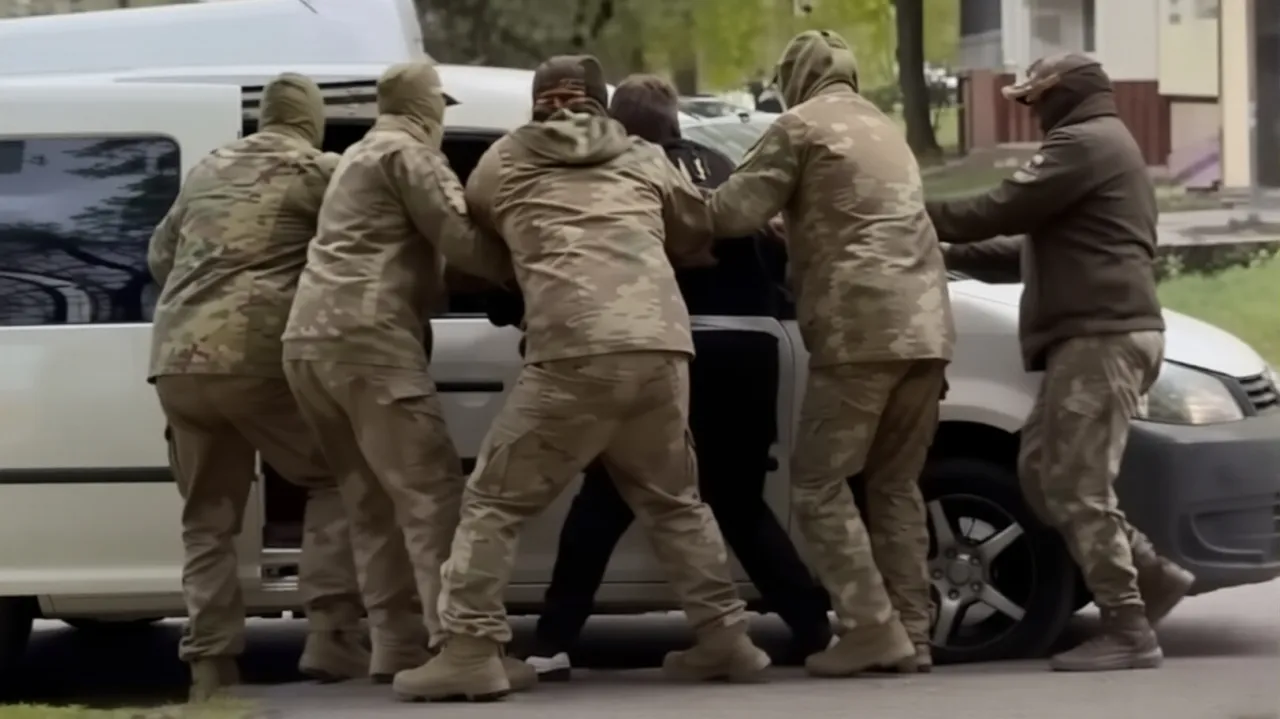
In footage reported from Vinnitsa on October 4, the confrontation expands into a street struggle. Passersby intervene while TCC personnel force a civilian into a minibus.

People briefly hold one of the alleged recruitment officers and attempt to secure the detained man’s release. Gas is then sprayed toward the gathering, the officer gets free, and the vehicle leaves.

Vinnitsa. A street kidnapping hits a wall, so the press gang breaks out the tear gas. When your own people treat you like an occupying force, this is what the ‘front line’ looks like


Bystanders stop watching and step in. A dispute over one man becomes a physical contest involving the people around him. Neither a crowd nor a uniform settles legality by winning a struggle. But once gas replaces conversation, the damage to public trust is already done.

A Community at the Gates

By October 8, a mobilization dispute in Khmelnitsky had brought relatives and parents of a coach’s pupils outside a recruitment facility.

Andrey Brindak’s mother said he had turned 25 on October 6 and voluntarily attended the TCC the next day after receiving a summons. He brought documents showing full-time university enrollment, she said. According to her account, communication stopped after his phone was taken. Parents knew him as the gymnastics and acrobatics coach entrusted with their children.

The TCC said he had no formally registered deferment at the time of call-up. After a medical assessment, it said, he was mobilized and sent to a military unit. His family contested the legality of that decision.

Khmelnitsky. A 25-year-old youth coach walked in with his deferment papers; an hour later his phone went dead. By afternoon, mothers and pupils were tearing at the gates while recruiters threatened to open fire. This isn’t recruitment. It’s a fortress holding hostages


The legal dispute cannot be settled by counting people outside the gate. Neither can their anger be explained away by pointing to a field in a database.

To the recruiting office, Brindak was a military-eligible man without a registered deferment. To the people gathered outside, he was a son and a coach. Both descriptions concerned the same person. The confrontation exposed the distance between them.

The Tourist Exception, or a Better Class of Human

Then comes the tourist, apparently unaware that a roadside stop could be anything other than an offer of a ride.

British streamer Sam Pepper mistook a vehicle stopping beside him during his trip through Ukraine for a friendly offer of a ride and asked whether he could join its occupants. Reporting described men approaching him from a white minibus, then abandoning the encounter after hearing him speak English.

He asked for a lift. They heard a British accent. Suddenly, the van had somewhere else to be. Draft dodgers, take notes


The clip does not establish who the men were or what they intended. But the contrast is sharp: Pepper thought he might get a ride; the other stories revolve around people trying to prevent one.

For him, an awkward roadside encounter became travel content. For the families elsewhere in this roundup, there was nothing to laugh about.

Visit Ukraine. Bring a camera. Apparently, the British accent is the premium package.


MORE ON THE TOPIC:

The post When the Draft Comes Home: Ukraine’s Mobilization Conflicts Spill Into Civilian Life appeared first on South Front.

Russian Air Strikes Kill 20 in Zaporizhzhia, Including Three Children, as Rescuers Search Rubble

10 October 2026 at 11:40

At least 30 people have been injured after Russian guided aerial bombs struck residential buildings in the Ukrainian city of Zaporizhzhia. The fate of several residents remains unknown as emergency workers continue searching collapsed apartment blocks.

At least 20 civilians, including three children, have been killed in Russian air strikes on the southern Ukrainian city of Zaporizhzhia on Saturday morning, 10 October, according to regional authorities. Rescue workers are continuing to search the ruins of residential buildings, with several people still unaccounted for.

The death toll rose from eight to 30 as emergency crews recovered more victims. The Zaporizhzhia regional military administration confirmed that three children were among those killed, while earlier reports recorded 16 injured, including three children. Two of the wounded were in a serious condition.

Authorities had previously reported that 12 people remained missing, although they did not provide a revised figure after the death toll increased. Rescue operations continued amid concerns that further victims could be trapped beneath collapsed concrete and other debris.

Apartment Buildings Destroyed by Guided Bombs

Russian forces launched the attack shortly before dawn, using guided aerial bombs against residential areas of Zaporizhzhia. According to the regional administration’s preliminary assessment, one five-storey apartment building suffered a direct hit and was destroyed, while part of another residential block collapsed.

The attack damaged at least 26 residential buildings in the Shevchenkivskyi and Voznesenivskyi districts, comprising 23 apartment blocks and three private houses. Three buildings sustained particularly extensive damage, while non-residential properties were also affected.

Firefighters, police officers and medical personnel were deployed to the affected neighbourhoods, supported by municipal workers and local residents. Emergency crews continued removing debris and examining unstable structures while officials assessed the extent of the destruction.

The Ukrainian National Police said that officers were documenting the consequences of the attack, including damage to civilian infrastructure. Investigators were also recording evidence for possible war crimes proceedings.

Search Continues as Casualty Figures Rise

The scale of the destruction has complicated efforts to establish the number of victims. The initial casualty figures increased repeatedly as rescuers gained access to damaged buildings and recovered bodies.

Earlier in the morning, authorities reported four deaths. The figure subsequently rose to seven, then eight, before reaching 11 shortly after midday. The number of injured also increased as information emerged from hospitals and emergency services.

At 10.15am local time, 16 people were confirmed wounded. Three were children, while two patients were described as seriously injured. The regional administration said most of the remaining casualties were in a condition of moderate severity.

Officials warned that the casualty figures could change as operations continued. The authorities had not established how many of those initially reported missing might still be trapped in the wreckage, and the recovery of additional bodies had not been accompanied by a revised missing-person count.

Zaporizhzhia Faces Continued Russian Air Attacks

Zaporizhzhia, an industrial city in south-eastern Ukraine, has remained exposed to Russian aerial attacks throughout the full-scale invasion. Its proximity to Russian-held territory in the surrounding region leaves residential districts vulnerable to aircraft-launched weapons.

Guided aerial bombs present a particular challenge for Ukrainian air defences. Unlike conventional unguided bombs, they can be fitted with glide and guidance systems allowing Russian aircraft to release them from considerable distances. Their substantial explosive payloads can cause extensive structural damage when they strike apartment buildings.

Saturday’s attack comes only three days after Russia launched another large-scale assault across Ukraine, targeting energy infrastructure and residential areas. As EU Today reported on 7 October, that operation killed at least 11 people and caused damage in several Ukrainian cities, including Zaporizhzhia.

The latest fatalities also follow earlier attacks on civilian facilities in the city. In February, Russian drones struck a maternity hospital in Zaporizhzhia, causing a fire and injuring patients.

The repeated strikes have placed continuing pressure on the city’s emergency services, which must respond to new attacks while repairing damage to residential buildings and public infrastructure.

Day of Mourning Declared

The Zaporizhzhia authorities have declared Sunday, 11 October, a day of mourning for those killed in Saturday’s bombardment. The announcement followed confirmation that the death toll had reached 11, including three children.

The Russian attack has also renewed attention to the vulnerability of densely populated urban areas to guided aerial bombs. Under international humanitarian law, deliberate attacks against civilians and indiscriminate attacks are prohibited, while all parties must distinguish between military objectives and civilian objects.

Ukrainian investigators are continuing to document the damage and civilian casualties. The precise circumstances of each impact, including the intended targets, have not yet been independently established.

For the families awaiting news of missing relatives, the immediate priority remains the search beneath the destroyed buildings. As of the latest available information on Saturday, rescue workers were still operating at the sites, and the authorities had warned that the number of dead could rise further.

Washington and Moscow Target the ICC: Different Motives, a Common Beneficiary

10 October 2026 at 11:22

Russia’s demands for the extradition of International Criminal Court judges and Washington’s sweeping sanctions against the institution have converged within days. The two governments have different grievances, but the consequences of their actions increasingly overlap, raising questions about the political relationship between Donald Trump and Vladimir Putin and the future of international criminal justice.

Russia and the United States have intensified their campaigns against the International Criminal Court (ICC) almost simultaneously, exposing an increasingly consequential convergence between the policies of Vladimir Putin and Donald Trump.

On 8 October, Moscow demanded the extradition of ICC President Tomoko Akane and eight other current and former officials. The following day, Washington announced sanctions against the court as an institution, extending earlier measures against individual judges and prosecutors.

The timing raises an obvious question: are these independent campaigns arising from different disputes with international justice, or do they reflect a broader political understanding between Washington and Moscow?

There is no publicly established evidence of a coordinated operation or an agreement between Trump and Putin to undermine the ICC. Nevertheless, the strategic consequences of their respective actions are remarkably similar. Both weaken an institution pursuing criminal proceedings against political leaders whom the two governments seek to protect.

Different grievances, overlapping interests

Russia’s hostility towards the ICC is directly connected to the arrest warrant issued against Putin in March 2023 over the alleged unlawful deportation and transfer of Ukrainian children from occupied territories.

The court subsequently issued warrants against senior Russian military commanders, including Sergei Shoigu and Valery Gerasimov, over alleged crimes involving attacks on Ukrainian civilian infrastructure.

Moscow’s response has been to pursue ICC personnel through its own criminal justice system. The latest extradition demands follow convictions handed down in absentia by a Russian court in December 2025.

Washington’s confrontation with the ICC has a different immediate origin. The Trump administration objects to the court’s jurisdiction over American nationals and Israeli officials, particularly following the arrest warrants issued against Israeli Prime Minister Benjamin Netanyahu and former defence minister Yoav Gallant.

Secretary of State Marco Rubio has presented the American campaign as a defence of US sovereignty. Yet the sanctions announced on 9 October are not confined to the Israeli proceedings or any investigation involving American personnel.

They target the institution itself, potentially disrupting financial transactions and commercial relationships essential to its operation. This distinction matters because a court-wide restriction necessarily affects investigations beyond those cited by Washington. That includes Ukraine.

The Anchorage question

The political context cannot be separated from the relationship between Trump and Putin, including their meeting in Anchorage, Alaska, in August 2025.

The summit formed part of Trump’s efforts to negotiate directly with Moscow over the war in Ukraine. The American president has repeatedly treated relations with Putin as a question of diplomatic bargaining, seeking arrangements that might produce an agreement where conventional Western pressure has failed.

Against this background, suggestions that pressure on the ICC might form part of a wider accommodation with Moscow warrant scrutiny. However, the proposition that Trump specifically offered Putin assistance in neutralising the court during their Anchorage discussions remains unsubstantiated. There is no verified public account establishing such a commitment.

A more defensible conclusion is that Washington’s independently declared campaign against the ICC also advances an important Russian interest. For Putin, the benefit is clear. Measures designed to restrict the court’s financial and administrative capacity could complicate investigations into Russian conduct, irrespective of the American administration’s stated intentions.

The relationship therefore need not involve explicit coordination to produce politically significant results.

Why sanctions against the institution matter

The escalation from targeting individual prosecutors to sanctioning the entire ICC represents a substantial change. Previous American measures imposed personal and financial restrictions on selected officials. The latest approach threatens the broader infrastructure upon which international criminal proceedings depend.

The court requires banking facilities, secure communications, technology services and commercial suppliers. American sanctions can reach beyond US territory because of the international financial system’s dependence on dollar transactions and American service providers.

The ICC had already anticipated this vulnerability. According to details disclosed in September, the institution has pursued alternatives to American software and financial services to reduce its exposure.

Nevertheless, operational continuity and investigative effectiveness are not necessarily the same thing. The court may remain formally functional while facing additional costs, delays and restrictions affecting prosecutors, investigators and international cooperation.

For Ukraine, this is particularly significant. The ICC holds and evaluates evidence connected to alleged Russian war crimes, including the deportation of children and attacks on civilian infrastructure. Its proceedings preserve a judicial process independent of whatever diplomatic settlement Washington and Moscow might eventually negotiate.

Weakening that capacity would not invalidate existing warrants or automatically destroy evidence, but it could make the pursuit of accountability more difficult.

Europe’s response and its limitations

The European Union now faces a dispute with Washington over an institution that European governments have spent decades supporting.

On 9 October, eight governments issued a joint statement, reaffirming their support for the ICC and rejecting the American sanctions. The signatories included Germany, France, Italy, the Netherlands, Britain, Japan and Canada.

The European Commission also indicated that the EU was prepared to take measures necessary to preserve the court’s operations. Such assurances are politically important, but they do not automatically resolve the practical consequences of American restrictions.

European financial institutions and technology suppliers must consider their own exposure to US sanctions. Sustaining the court may require alternative payment arrangements, commercial protections and potentially further European regulatory intervention.

The EU has discussed extending its blocking statute to shield European operators from the effects of American sanctions. Whether that mechanism can provide sufficient protection remains uncertain.

The dispute also extends beyond the ICC’s current investigations. Ukraine and the Council of Europe are developing a separate Special Tribunal for the Crime of Aggression, designed to address jurisdictional limitations preventing the ICC from prosecuting Russia’s leadership for the decision to launch the invasion.

The two institutions have distinct legal mandates, although cooperation between them is envisaged. Undermining the ICC would not automatically prevent the special tribunal from operating, but it would weaken an important part of the wider international accountability framework.

A convergence with consequences for Ukraine

Washington and Moscow have not adopted identical positions towards the ICC. Russia seeks to discredit and punish the officials responsible for pursuing Putin. The Trump administration is attempting to restrict the court’s authority and operational capacity, principally in response to proceedings involving Americans and Israelis.

Yet their actions converge at precisely the point where the ICC’s independence becomes politically inconvenient. The distinction between motive and consequence is essential. It would be premature to describe the American sanctions as evidence of a secret bargain struck in Anchorage. It would be equally mistaken to overlook the assistance these measures could provide to Moscow.

The broader concern is that the United States, traditionally central to Western efforts to hold Russia accountable for its invasion of Ukraine, is now applying pressure to one of the principal institutions carrying out that work.

For European governments, the immediate question is no longer simply whether they support the International Criminal Court. It is whether they are prepared to protect its practical independence when the political and financial pressure comes not only from Russia, but also from Washington.

Trump Says Ukraine Should 'Get A New President' As Russia Kills At Least 20 In Air Strikes

10 October 2026 at 09:21
US President Donald Trump blamed Ukrainian President Volodymyr Zelenskyy for a stalemate in negotiations with Moscow, as Russian strikes on Ukraine killed at least 20 people, damaging apartment buildings and energy sites.

Trump’s Diesel Deal with Putin Undermines US Sanctions Pressure as Ukraine Peace Talks Stall

10 October 2026 at 07:10

President Donald Trump announced an agreement with Vladimir Putin on Friday, 9th October, under which Russia will resume substantial diesel exports to American and international markets, despite Washington’s existing sanctions against Moscow over its invasion of Ukraine.

According to Trump’s announcement following the telephone conversation, Russia will immediately release more than 300,000 tonnes of diesel, followed by 500,000 tonnes in November and another million tonnes shortly afterwards. A further three million tonnes could become available once Russian refining capacity permits.

The announcement was accompanied by a temporary authorisation from the US Treasury allowing transactions involving Russian diesel until 7 April 2027. It represents a substantial departure from the administration’s recent sanctions policy, which had sought to restrict Russian energy revenues and strengthen Washington’s negotiating position over Ukraine.

The timing is politically significant. Trump faces congressional midterm elections on 3 November, while diesel prices have become a growing economic concern for American businesses and consumers. The agreement gives the White House an opportunity to present itself as addressing fuel costs, although its practical effect on prices remains uncertain.

Russian diesel cannot resolve the global supply shortage

Trump has linked the proposed Russian deliveries to his administration’s efforts to restore energy flows through the Strait of Hormuz, arguing that the combined measures will produce a rapid reduction in diesel prices.

The disruption of maritime energy supplies following the confrontation with Iran has, however, created a problem considerably larger than the quantities Russia has initially promised.

The first two deliveries amount to approximately 800,000 tonnes. Even including the subsequent million tonnes, the announced volumes are modest relative to global consumption. Their arrival may provide temporary relief in individual markets, but there is little evidence that they could independently reverse the wider shortage.

Russia’s capacity to maintain larger exports is also uncertain.

Ukrainian attacks on Russian refineries have disrupted production and contributed to restrictions on petroleum exports. Moscow has periodically imposed limits to protect domestic supplies, while damaged facilities require repairs before returning to normal operations.

The condition of those refineries is explicitly acknowledged in Trump’s announcement, which makes the proposed additional three million tonnes dependent on their recovery.

This introduces a further contradiction. Washington is seeking Russian diesel at precisely the moment Ukraine is attempting to reduce Moscow’s capacity to refine and export petroleum products.

The economic benefits of the agreement may consequently depend partly on developments in a military campaign that the United States has previously supported through intelligence cooperation with Kyiv.

Zelenskyy rejects sanctions relief without Russian concessions

President Volodymyr Zelenskyy responded critically to the agreement, describing the relaxation of economic pressure as a concession to Putin that had not been accompanied by any meaningful Russian commitment to de-escalation.

In his response to the American decision, Zelenskyy argued that Moscow would exploit renewed export revenues to prolong its war rather than make concessions towards a settlement.

Ukraine has indicated that it remains prepared to consider reciprocal measures concerning attacks on energy infrastructure. Such arrangements would require Russia to stop striking Ukrainian facilities in exchange for restrictions on Ukrainian operations against Russian energy targets.

No comparable undertaking was announced as part of Friday’s diesel agreement.

This distinction is central to Kyiv’s objections. Sanctions relief has traditionally been regarded as leverage to obtain changes in Russian behaviour. In the present arrangement, Moscow stands to receive additional commercial opportunities without publicly agreeing to alter its military campaign.

Lukoil negotiations raise further questions

The agreement also comes amid separate discussions concerning the international assets of Lukoil, Russia’s second-largest oil producer.

A recent account of negotiations involving American investors and Russian officials described proposals involving Lukoil’s overseas oilfields, refineries and distribution businesses.

The discussions have reportedly involved figures connected to Trump’s diplomatic efforts, including Steve Witkoff and Jared Kushner, alongside Russian representatives.

On Friday, another development complicated the proposed transaction when Carlyle withdrew from the competition to acquire Lukoil’s international assets, previously valued at approximately $22 billion.

The negotiations illustrate the extent to which potential commercial cooperation has entered the broader American-Russian relationship.

There is no verified evidence, however, that the diesel agreement was concluded to facilitate a particular acquisition or benefit individuals connected to Trump’s administration. The commercial negotiations and Friday’s sanctions decision remain separate developments unless further evidence establishes a direct connection.

Washington and Europe move in different directions

The American decision creates an additional complication for European sanctions policy.

On 7th October, EU ambassadors agreed to expand sanctions against Russia’s military-industrial network, approving 1,646 additional designations, many directed at the production of ballistic missiles used against Ukraine.

Britain has also introduced further restrictions on Russian oil-related businesses, tankers and financial intermediaries, reinforcing its stated objective of limiting Moscow’s ability to finance the war.

The contrast with Washington’s diesel authorisation is substantial. While European governments are attempting to restrict Russian petroleum revenues, the United States is providing a temporary legal route for renewed sales.

The development also recalls the difficulties already examined by EU Today in its reporting on sanctions enforcement against Russia’s shadow fleet, where differences in national restrictions and their application have complicated efforts to control petroleum exports.

For Moscow, the significance of Friday’s agreement extends beyond the immediate revenue generated by diesel sales. It establishes that the United States is prepared to relax particular economic restrictions before securing a settlement over Ukraine.

Whether the arrangement ultimately lowers American fuel prices will depend on production, shipping and international market conditions. The diplomatic consequence is already apparent: Russia has obtained an opportunity to restore part of its international energy trade without accepting publicly announced conditions concerning its war against Ukraine.

For Kyiv and European governments, the question is whether this remains a narrowly defined response to an energy shortage or marks the beginning of a broader American policy of separating commercial relations with Moscow from negotiations over Ukraine.

❌