❌

Normal view

Australia keeps Russian fuel out even as US opens its market: “We do not want Vladimir Putin to benefit from this war in Middle East”

10 October 2026 at 22:31

The image shows the Sydney Opera House. Credit: UkrInform

Australia has no need to buy fuel from Russia, despite US President Donald Trump’s move to bring Russian diesel back to world markets. Climate Change and Energy Minister Chris Bowen says that imports from Russia will remain banned to ensure the country does not benefit from its invasion of Ukraine, Bloomberg reports.

Trump has agreed with Russia's President Vladimir Putin to release Russian diesel onto global markets, a move Ukraine says funds a war that has killed more than 80 Ukrainian civilians in two days.

“We don’t need or want Russian fuel in Australia. We do not want Vladimir Putin to benefit from this war in the Middle East. What the United States does is a matter for them, but we won’t be changing our approach,” Bowen said.

The deal Australia is turning down

Trump announced on 9 October a series of cargoes beginning this month totaling about 13.5 million barrels of Russian diesel. The release upends years of sanctions, as the White House looks for ways to tame soaring fuel prices before the US midterm elections.

Bowen draws a clear line between that approach and Australia’s. What the US does is its own affair, he stresses, but Canberra will maintain its arrangements with trading partners to keep Russian fuel out of the market.

Enough fuel to hold the line

Australia can hold out without Russian supply, Bowen argues. The country has 43 days’ worth of petrol, two days more than a week earlier, and 31 days’ worth of diesel, one day less, he notes.

He adds that Australia stays in close contact with domestic refiners to keep them running at full capacity. The stance lets Canberra wait out high prices rather than buy fuel that would send money to Moscow.

Australia’s fuel costs have stayed high since the war between the US and Iran disrupted shipping through the Strait of Hormuz, the route that normally carries about a fifth of the world’s oil and gas.

Justin Bieber Reveals Barack Obama ‘Shapeshifted Into a Reptilian’ During D.C. Pedo Orgy

10 October 2026 at 22:16

Justin Bieber just threw a Molotov cocktail at the entire D.C. and Hollywood elite. Last night on Instagram, he went scorched earth on Barack Obama, revealing more about the first time he had the misfortune [...]

The post Justin Bieber Reveals Barack Obama ‘Shapeshifted Into a Reptilian’ During D.C. Pedo Orgy appeared first on The People's Voice.

Miranda Sarmento afasta de novo IVA zero nos bens essenciais

10 October 2026 at 21:51
O Governo volta a contestar o IVA zero nos bens essenciais, dizendo que a transmissão não chega na totalidade aos consumidores. Mas se a inflação galopar o Governo ajustará a sua ação.

© JOÃO PORFÍRIO/OBSERVADOR

Ukranian Defenses Crack in Zaporozhye

10 October 2026 at 21:24

File image.

In the Sumy direction, Russian assault groups of the “North” grouping are pressing Ukrainian defenses in the forest tract north of Sumy, conducting small-arms fighting near Khoten and advancing through tree lines near Korenok. In the Kharkiv direction, Russian units are increasing the pace of their advance in the area of the encirclement in the northeast of the region; they have taken Shirokoye and are fighting for Komissarovo, Lukashovo and Lobanovka. In the Slavyansk direction, Ukrainian units are attempting to clear the right bank of the Zherebets, infiltrating the northern part of Zarechnoye and attacking west of it, while Russian troops hold Zarechnoye and Yampol. In the Zaporozhye direction, Russian troops are delivering FAB strikes against temporary deployment points in Preobrazhenka and Orekhov, have overcome a water obstacle and an anti-tank ditch on the Voskresenka–Barvinovka–Lyubitskoye line, and in the zone of the “Dnepr” grouping are advancing on a broad front near Primorskoye, Stepnogorsk and Yurkovka. The leader of the party “Debout la France,” Nicolas Dupont-Aignan, called Europe’s rejection of Russian gas economic and social suicide against the background of a 42.4% price rise since the beginning of 2026.

Sumy direction  

Heavy positional fighting is under way on all sectors of the front. Assault groups of Russian units are pressing Ukrainian defenses in the forest tract north of Sumy and destroying positions with artillery and heavy flamethrower systems. The Ukrainian side has taken no active actions and has concentrated on holding the positions it occupies.

The situation around Kiyanitsa is extremely complicated: the Ukrainian side has accumulated a huge quantity of resources in the forest zones, and it is premature to speak of full control on this sector. Moreover, Ukrainian units are attacking near Yablonovka and Varachino, attempting to regain positions and making use of the last opportunity before the muddy season to take cover in the forests.

In the Sumy district, assault groups of Russian units are conducting small-arms fighting near Khoten. In Shostka district, assault groups continue to advance through tree lines near Korenok.  

Kharkiv direction  

Assault units of the “North” grouping are increasing the pace of their advance in the area of the encirclement of Ukrainian forces in the northeast of Kharkiv region. Ukrainian units are attempting to break the encirclement from the outside and are employing armor.

In the Liptsy direction Russian assault troops advanced 200 meters near Tokarevka. In the Volchansk and Veliky Burluk directions Russian units advanced deeper into the cauldron on more than 20 sectors of the front. Overall progress reached approximately 1,000 meters.

The Ukrainian side made two attempts to break the encirclement from the outside with two assault groups of the 475th Separate Assault Regiment on two “Kazak” armored fighting vehicles from the area of Veliky Burluk. As a result of comprehensive fire strikes the attempt was thwarted; one armored vehicle was destroyed and the second damaged.

The encirclement in the east of the Burluk direction is gradually tightening. Ukrainian formations are unable to force a reliable corridor for themselves, while Russian troops are systematically destroying disorganized units. Newly available objective-control footage confirms the capture of Shirokoye. Forward assault groups are already pressing Ukrainian forces on the territory of Komissarovo. Fighting for the village continues, and a focal Ukrainian presence still remains in the tree lines to the north and in the vicinity of Rublyonoye. Russian units are confidently advancing toward the center of the cauldron. On the morning of 9 October it became known that fighting had begun for Lukashovo and Lobanovka. The capture of Lobanovka is important for strengthening the southern face of the encirclement, which will complicate any potential breakout by Ukrainian units.  

Slavyansk direction  

The Ukrainian side has not abandoned attempts to clear the right bank of the Zherebets in the Liman direction. Ukrainian units continue to advance into the northern part of Zarechnoye and to develop the offensive west of the village with the aim of regaining control over several large strongpoints near the O-05-28 highway.

Should Zarechnoye be taken, the Ukrainian side would be able to place Russian units in the Svyatiye Gory park in a fire pocket. Nevertheless, it has not proved possible to isolate the fighters of the “West” grouping from supply from the direction of Torskoye, which makes it possible to retain control of the center of the village. The second direction of the Ukrainian strike remains the area of Yampol, the retention of which is also necessary for Russian troops in order to supply units in the Svyatiye Gory.

At present the most important tasks of Russian troops remain the holding of Zarechnoye and Yampol. Only in this case will it be possible to stabilize the front and preserve positions in the Serebryansky forestry, without control of which a new offensive on Liman will be impossible. In the area of Rai-Aleksandrovka Ukrainian units are conducting attacks.  

Zaporozhye direction  

In the Zaporozhye direction Russian troops are delivering FAB strikes against temporary deployment points of Ukrainian units in Preobrazhenka and Orekhov. On the eastern sector they are holding strong points on the western bank of the Verkhnyaya Tersa River and pressing the defenses. Assault groups have overcome a water obstacle and an anti-tank ditch on the Voskresenka–Barvinovka–Lyubitskoye line.

Further east, in the zone of the “Dnepr” grouping, the picture is different. Russian units continue to advance on a broad front. Fighting is under way near Primorskoye, Stepnogorsk, Lukyanovskoye, Pavlovka, Novoyakovlevka and Yurkovka. Active operations are also noted in the area of Orekhov and Preobrazhenka.

The Ukrainian side, attempting to hold the northern and western outskirts of Orekhov, is throwing reinforcements there. Units of the “East” grouping are already fighting on the outskirts of Omelnyk from the south-east and east. The aim is to reach the rear of the Orekhov–Preobrazhenka grouping. Further north, in the zone of the 5th Army, the preconditions for a broader envelopment are being created. Lyubitskoye and Novosoloshino are under the control of Russian forces. Further south the situation remains complicated and reciprocal.  

Conclusion  

In the Sumy direction this is expressed in the pressing of defenses in the forest tracts and fighting near Kiyanitsa and Khoten. In the Kharkiv direction — in the tightening of the ring around the encircled grouping and the advance toward the center of the cauldron. In the Slavyansk direction — in the holding of key positions near Zarechnoye and Yampol and heavy fighting near Rai-Aleksandrovka. In the Zaporozhye direction — in advance on a broad front and attempting to reach the rear of the Orekhov–Preobrazhenka grouping. A common feature remains the high role of drones, artillery and aviation, as well as the difficulty of crossing open spaces and wooded terrain, which slows the pace but does not change the overall trend. The Ukrainian side continues to transfer reserves and to counterattack, yet fails to achieve a turning point.

The leader of the party “Debout la France,” Nicolas Dupont-Aignan, who is running for president of the country, stated that the European authorities’ rejection of Russian gas against the background of a rapid rise in fuel prices is comparable to economic and social suicide. “Gas prices continue to rise rapidly. This is a very concrete result of the European leaders’ refusal to establish peace in Ukraine and to lift the sanctions against Russia. This is economic and social suicide,” he wrote on the social network X.

As the politician noted, the price rise since the beginning of 2026 has amounted to 42.4% and continues to this day. “Meanwhile the economies of the United States and China are operating at full capacity, and gas there is four times cheaper,” he added.  

_______________________________________________________________________________________________________________________

SouthFront: Analysis and Intelligence

NOW hosted at southfront.press

Previously, SouthFront: Analysis and Intelligence was at southfront.org.

The .org domain name had been blocked by the US (NATO) (https://southfront.press/southfront-org-blocked-by-u-s-controlled-global-internet-supervisor/) globally, outlawed and without any explanation

Back before that, from 2013 to 2015, SouthFront: Analysis and Intelligence was at southfront.com

SOUTHFRONT.PRESS

MORE ON THIS TOPIC:

The post Ukranian Defenses Crack in Zaporozhye appeared first on South Front.

Dutch Propose Law To Crack Down On Russian Shadow Fleet

10 October 2026 at 20:55
By Patrick Van Oosterom Oct 9, 2026 (Bloomberg) –The Dutch government proposed a legal change to crack down more effectively on Russia’s shadow fleet, prompting the Russian embassy to threaten its...

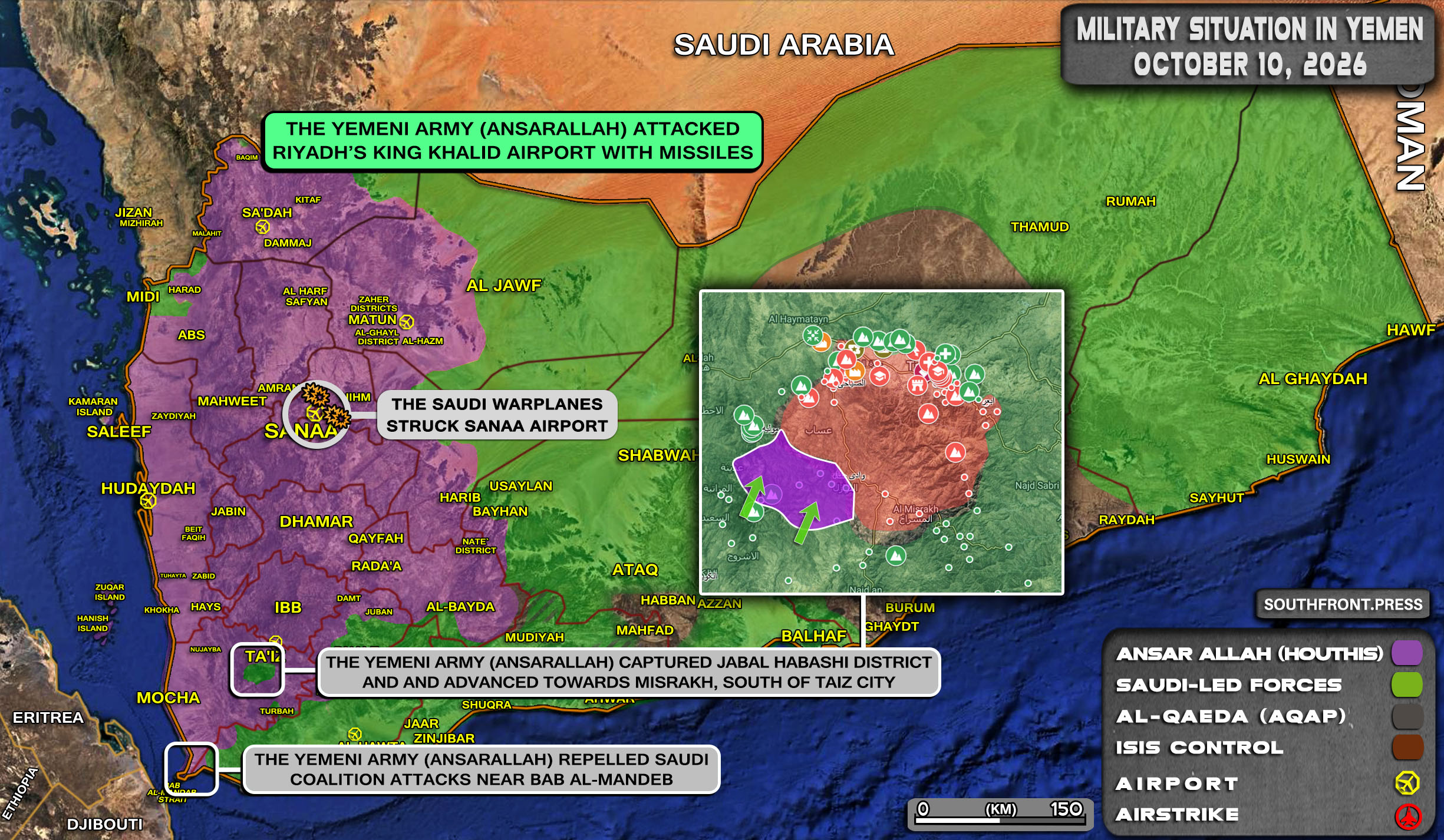
Military Situation In Yemen On October 10, 2026 (Map Update)

10 October 2026 at 20:25

Click to see full-size map.

  • The Yemeni army (AnsarAllah) repelled Saudi coalition attacks near Bab al-Mandeb;
  • The Yemeni army (AnsarAllah) captured Jabal Habashi district and and advanced towards Misrakh, south of Taiz city;
  • The Saudi warplanes struck Sanaa airport;
  • The Yemeni army (AnsarAllah) attacked Riyadh’s King Khalid airport with missiles.

_______________________________________________________________________________________________________________________

MORE ON THIS TOPIC:

The post Military Situation In Yemen On October 10, 2026 (Map Update) appeared first on South Front.

Saudi Arabia Main Airport Struck, Major Gas Plant Reportedly Hit (Videos)

10 October 2026 at 20:20

File image.

An attack on King Khalid International Airport in Saudi Arabia’s capital injured several people and forced authorities to suspend operations on October 10, as separate reports emerged of a possible strike on a major oil and gas facility in the kingdom’s eastern oil-producing region.

Saudi Arabia’s civil aviation authority said operations at the Riyadh airport had been suspended while officials assessed the damage and verified the safety of the facility.

Meanwhile, a regional official told The Associated Press that a missile struck the complex housing Terminals 3 and 4, which serve domestic flights.

Witnesses reported an explosion inside the airport and injured people on the ground. More than a dozen ambulances were seen rushing to the facility, Reuters reported. A traveler told the news agency that something had flown across the sky before part of the ceiling near a departure gate collapsed.

The official casualty toll remained unclear. Saudi authorities said they were assessing the number of injured, while a source at a Riyadh hospital told AFP that dozens of people had been wounded, including at least five who were being treated in intensive care.

The suspension disrupted air travel across the kingdom. Flight-tracking services showed flights to Riyadh being canceled or diverted, while Kuwait Airways, Etihad Airways and Qatar Airways canceled services to the Saudi capital.

The airport had already been targeted twice earlier in the week in attacks that killed four people and destroyed a Saudi airliner.

Yemen’s Houthis, also known as Ansar Allah, have claimed responsibility for previous strikes on Saudi airports and other infrastructure but had not immediately commented on the latest incident.

The airport attack came amid reports of a possible strike on the Shedgum gas-processing plant in the Ghawar oil-field complex in eastern Saudi Arabia. The reports described smoke rising from the facility after an alleged missile attack.

The Israeli news outlet JFeed reported that the plant had been hit by ballistic missiles, citing satellite imagery and a reported spike in thermal activity. The open-source monitoring site Hamer Intel also reported smoke over the area following the suspected attack.

Despite these reports, Saudi authorities and state oil company Saudi Aramco have not yet publicly confirmed an attack on Shedgum.

Ghawar is one of the world’s largest conventional oil fields and a central part of Saudi Arabia’s petroleum industry. Shedgum is a gas-processing facility associated with the field, meaning damage there would not by itself establish that oil production across Ghawar had been interrupted.

The attacks came as fighting intensified between Saudi-backed Yemeni government forces and the Houthis, who have expanded their missile and drone campaign against Saudi targets in recent days.

The group warned international airlines to avoid Saudi airspace, describing it as a zone of military operations, after Saudi-backed forces launched an offensive to regain territory along Yemen’s Red Sea coast.

U.S. President Donald Trump said after the attack on King Khalid International Airport that Washington was considering whether to join Saudi military action against the Houthis.

“We may. We’re going to look at it,” he told reporters, according to Reuters.

Overall, Saudi Arabia appears to be defenseless in the face of the Houthis, who have succeeded to a large extent in restricting aviation over the kingdom. Despite Trump’s latest remarks, the U.S. is unlikely to take a more direct role against the group, as its forces in the region remain focused on Iran. Still, the U.S. could carry out a one-off attack to show support for Riyadh. This could, however, trigger an even harsher response by the Houthis.

_______________________________________________________________________________________________________________________

SouthFront: Analysis and Intelligence

NOW hosted at southfront.press

Previously, SouthFront: Analysis and Intelligence was at southfront.org.

The .org domain name had been blocked by the US (NATO) (https://southfront.press/southfront-org-blocked-by-u-s-controlled-global-internet-supervisor/) globally, outlawed and without any explanation

Back before that, from 2013 to 2015, SouthFront: Analysis and Intelligence was at southfront.com

SOUTHFRONT.PRESS

MORE ON THIS TOPIC:


The post Saudi Arabia Main Airport Struck, Major Gas Plant Reportedly Hit (Videos) appeared first on South Front.

Tiny Drones Help Tackle Shell’s Million-Dollar Hurricane Problem

10 October 2026 at 20:16
By Lucia Kassai Oct 9, 2026 (Bloomberg) –When hurricanes sweep through the Gulf of Mexico, oil companies can lose millions of dollars waiting for the all-clear to restart production. Shell Plc...

Washington makes it official: US Treasury license clears sale and import of Russian diesel blocked by sanctions

10 October 2026 at 20:48

lukoil’s norsi refinery in kstovo, nizhny novgorod oblast

Washington has put its sanctions on Russian diesel on hold. The US Treasury has authorized the sale, delivery, offloading, and import of Russian-origin diesel fuel, effectively suspending sanctions on that trade until 7 April 2027, the Office of Foreign Assets Control (OFAC) said on its website on 9 October.

The waiver lets Russian diesel back onto world markets and, Ukraine argues, hands Moscow fresh revenue for its war, which has killed more than 80 Ukrainian civilians in two days. Until now, it was unclear whether Washington would roll back the sanctions it imposed on Russia in 2022.

OFAC has issued the measure as General License 135, signed by the office’s director, Bradley Smith, according to the report. It authorizes transactions in Russian-origin diesel that sanctions would otherwise block.

The license sets one limit. It does not permit any debits from accounts at US financial institutions held by Russia’s central bank, its National Wealth Fund, or its finance ministry, the document says.

Trump’s promise of cheaper fuel

On 9 October, US President Donald Trump wrote on Truth Social that Russia would immediately supply more than 300,000 tons of diesel, then 500,000 tons in November, and another million tons right after.

Moscow would later send the US up to 3 million more tons, depending on the state of Russia’s refineries, Trump added, framing the deal as a way to bring down energy prices.

Why the volumes fall short

Analysts say the amounts are too small to move prices much. Together, the first tranches would cover about a day and a half of US demand, while US diesel use alone runs near 16 million tons a month. Experts read the move as politics ahead of an election rather than a real shift in the market, pointing out that Trump cited volumes in tons, which look larger than the barrels traders track.

The deal drew fury in Kyiv, and President Volodymyr Zelenskyy called it a weak decision by strong partners. The EU is moving the other way, with ambassadors approving the bloc’s largest sanctions package against Russia’s war machine, due for final adoption on 12 October.

Carlos Gil faz da Rua Augusta passerelle para todos

10 October 2026 at 20:47
No meio dos turistas e crianças com máscaras de Cristiano Ronaldo, figuras públicas e clientes fiéis reuniram-se para ver as criações do designer do Fundão, que garantiu o espetáculo.

© FRANCISCO ROMÃO PEREIRA/OBSERVADOR

O desfile realizou-se em frente ao Museu de Design, com o arco como pano de fundo

Mexican Ayocote Super Bean! A 6000-Year History of the Milpa Agricultural System from Mayan and Aztec Cultures

10 October 2026 at 20:23

by Brian Shilhavy

Traditional Mexican agriculture follows the ancient traditions of the “milpa”, which is a system of small-scale family agriculture that pre-dates the Spaniards arrival in Mexico, and even pre-dates the Aztec Empire.

In this simple, time-honored method of small-scale family agriculture, the milpa consists of its main crop, corn (maiz), along with other native crops that co-exist and enhance the soil along with the corn, such as heritage beans and squash.

The beans grow on vines that wrap themselves around the corn stalks, while large leafy crops such as squash and pumpkins grow and spread along the bottom close to the soil, giving weeds and other undesirable plants no chance to grow, and require no chemicals whatsoever that need to be applied to the native, heirloom crops, or the soil that they grow upon.

After harvest, the corn stalks are burned down returning key nutrients to the soil through its ashes.

Here is a short video that describes the milpa system.

Here is another 5-minute documentary produced by the UN showing how Mexicans are reviving this ancient agricultural system, mainly with women. (Note: We do not support or fund the United Nations nor any of their agencies and programs, but this is a very well-produced short documentary that is very educational regarding the “milpa”.)

In my online store, Healthy Traditions, we have already been selling native, heirloom corn from small-scale milpa communities for over two years now, including our famous corn tortilla chips fried in our own coconut oil, because it is the only place we have found corn that consistently tests clean for GMOs and the herbicide glyphosate, which has contaminated the North American corn supply.

Today, we are announcing another ancient, heirloom product that is produced in these small-scale milpa agricultural systems, Ayocote beans!

These ancient “super beans” are heirloom beans that have been handed down from generation to generation through families living in Mesoamerica long before the Spaniards arrived, and even before the Aztec Empire, and date back to 6000 years!

Ayeócotl (Náhuatl)

Ayocote (Phaseolus coccineus leiosepalus), also known as ayeócotl in the native náhuatl language, is a climbing legume, with pre-Hispanic origins.

It is grown by all indigenous communities of the Mexican plateau, even at over 2,000 meters above sea level. Due to its widespread presence, even in very different climate conditions, Ayocotes have developed an ample genetic variety: Mexico’s genetic resource bank preserves over 800 different known varieties.

Ayocote beans have been highly valued since ancient times for their ability to endure extreme temperatures and various altitudes, as well as for the ease with which their seeds can be preserved for years, making them essential during food shortages. There are more than 150 species of beans worldwide, but only 31 are native to Mexico.

However, bean consumption in Mexico has been declining in recent years, and there is a movement now in Mexico to preserve these ancient bean varieties, as well as other heirloom seeds such as corn.

The Mexico Daily News published an article last year (2025), highlighting this move in Mexico to preserve their native agricultural heritage which is being threatened by Big Ag and mass production of agricultural products using GMO varieties and herbicides like glyphosate.

Taste of Mexico: Beans

by María Meléndez

It is often said that Mexican culture is built on corn, but beans were as important for the development of the pre-Columbian cultures of Mesoamerica.

Excerpts:

Beans have been highly valued since ancient times for their ability to endure extreme temperatures and various altitudes, as well as for the ease with which their seeds can be preserved for years, making them essential during food shortages.

Beans were a crucial component of the milpa, an agricultural system designed to provide the three staple ingredients of the Mesoamerican diet: corn, beans and squash. This system operated in perfect harmony: corn served as a structure for the beans to climb, beans enriched the soil with nitrogen, and squash helped retain moisture throughout the season.

Are we endangering our bean tradition?

Despite being essential to our ancestors, bean consumption in Mexico has declined significantly in recent decades. In the 1980s, the average Mexican ate 16 kilos of beans yearly, while average consumption in 2024 was only 7.7 kilos, according to a 2021 report by the Ministry of Agriculture (Sader).

Several factors contribute to this decline. Preparing beans requires more time, and our consumption of meat and processed foods has increased.

Culturally, beans are often viewed as food for the poor. I remember that whenever someone in my family faced economic challenges, my grandparents would dramatically say,

“Even if we can only afford to eat beans, we will remain honorable people.”

Today, various organizations and communities are working to preserve Mexico’s native beans through the milpa system.

Additionally, in late 2024, President Claudia Sheinbaum announced that the federal government would seek to increase bean and corn production by 30% and bring attention back to endemic varieties of corn and beans in order to achieve self-sufficiency in production.

Full Article.

I was recently able to purchase enough of these rare, heirloom super beans to offer them to the public through Healthy Traditions.

We now have available for ordering online, Mexican Heirloom Ayocote Mixed Beans, and Mexican Heirloom Ayocote Black Beans.

I bought up their entire remaining supply, so we only have enough to sell in 5 lb. and 15 lb. sizes while supplies last, as we will not have enough to sell in bulk 5-gallon pails until early 2027, when the next harvest comes in and where I have already put in my request to purchase as much as we can.

You can order from this page while supplies last.

Healthy Traditions

The ancient Mexican “milpa” traditional agricultural system is very similar to the ancient agricultural systems of the Philippines I observed firsthand while living on a farm in a rural community on Mt. Banahaw with my family in the late 1990s, and first couple of years of 2000.

When I told the poor, rural farmers living in that community, most of whom were trying to get out of their rural community and go to the big city in Manila or get visas to the Middle East or the U.S. where they thought life was better and they could earn more money, that they were in fact rich due to their native, natural agricultural system, they did not believe me.

So I had to show them that what I was saying was true, by marketing the coconut oil of the “poor people” that was made by hand in their kitchen from fresh coconuts, which we call today our “Gold Label Virgin Coconut Oil,” and kicked off the Coconut Oil revolution in the U.S. as I leveraged the emerging technology of the Internet back then, educating Americans on the truth about edible oils and saturated fats.

When you buy our Gold Label Virgin Coconut Oil today, you are supporting these poor, agricultural workers who still produce this coconut oil the same way by hand.

And the same is true when you purchase our Mexican products produced from community milpa agricultural small-scale producers, like our new Ayocote Super beans!

Products produced from these ancient agricultural small-scale producers are some of the most nutrient-dense products you can purchase on the planet, and we test them also to make sure there is no cross-contamination from GMO seeds and glyphosate-sprayed crops.

Technology and AI cannot replicate the human wisdom of these small-scale farmers! Faith in modern agriculture and their mass-production of contaminated crops is what could potentially produce starvation and malnutrition.

Sustainable and nutritious agricultural systems that require human labor are what is going to be able to provide food security and be able to feed people around the world going forward, and it requires a return to the past and agricultural systems that have nourished the earth’s populations for thousands of years, and NOT the false promises of the technologists and their false techno-prophecies of the future!

To Adam he said,

“Cursed is the ground because of you; through painful toil you will eat of it all the days of your life.

It will produce thorns and thistles for you, and you will eat the plants of the field.

By the sweat of your brow you will eat your food until you return to the ground, since from it you were taken; for dust you are and to dust you will return.”

(Genesis 3:17-19)

Do you really believe that the Technocrats can overcome the curse of God on the earth??

I don’t, and that’s why Healthy Traditions exists, to support HUMAN LABOR and ancient agricultural systems which are the ONLY hope for the future and food security.

This article was written by Human Superior Intelligence (HSI)

See Also:

Understand the Times We are Currently Living Through

The Brain Myth: Your Intellect and Thoughts Originate in Your Heart, Not Your Brain

Is God’s Patience About to Run Out on the United States?

Second Edition of eBook Released: The Concept of the American Christian Family is a Myth and is NOT Found Anywhere in the Bible – by Brian Shilhavy

FREE eBook! Restoring the Foundation of New Testament Faith in Jesus Christ – by Brian Shilhavy

KABBALAH: The Anti-Christ Religion of Satan that Controls the World Today

Exposing the Christian Zionism Cult

The Bewitching of America with the Evil Eye and the Mark of the Beast

Jesus Christ’s Opposition to the Jewish State: Lessons for Today

Identifying the Luciferian Globalists Implementing the New World Order – Who are the “Jews”?

The Seal and Mark of God is Far More Important than the “Mark of the Beast” – Are You Prepared for What’s Coming?

The Satanic Roots to Modern Medicine – The Image of the Beast?

Medicine: Idolatry in the Twenty First Century – 10-Year-Old Article More Relevant Today than the Day it was Written

Having problems receiving our emails? See:

How to Beat Internet Censorship and Create Your Own Newsfeed

We Are Now on Telegram. Video channels at Bitchute, and Odysee.

If our website is seized and shut down, find us on Telegram, as well as Bitchute and Odysee for further instructions about where to find us.

If you use the TOR Onion browser, here are the links and corresponding URLs to use in the TOR browser to find us on the Dark Web: Health Impact News, Vaccine Impact, Medical Kidnap, Created4Health, CoconutOil.com.


The post Mexican Ayocote Super Bean! A 6000-Year History of the Milpa Agricultural System from Mayan and Aztec Cultures first appeared on Health Impact News.

Marítimo perde nos Barreiros com o Porto por um centímetro (1-2)

10 October 2026 at 19:58
O Marítimo perdeu hoje nos Barreiros com o FC Porto por 1-2. O golo decisivo foi marcado a 10 minutos do fim da partida depois de consultado o VAR. Analisado o lance, o jogador do Porto, Óscar estava em jogo por um centímetro. Com estw resultado, os verde-rubros ocupam o 11 lugar do campeonato, com […]

Bill Gates Calls Chemtrails a “Conspiracy Theory”—Then Admits He’s Building the Global Infrastructure to Control Them

10 October 2026 at 19:57

Bill Gates wants you to believe the lines in the sky are “just clouds”—harmless, natural, nothing to worry about. But in the same blog post where he dismisses chemtrail concerns as conspiracy theory, the billionaire [...]

The post Bill Gates Calls Chemtrails a “Conspiracy Theory”—Then Admits He’s Building the Global Infrastructure to Control Them appeared first on The People's Voice.

Manaus registra qualidade péssima do ar pelo terceiro dia seguido

A cidade de Manaus (AM) voltou a amanhecer sob fumaça gerada pelas queimadas no estado neste sábado (10). O Sistema Eletrônico de Vigilância Ambiental (Selva), da Universidade do Estado do Amazonas (UEA), registrou qualidade péssima do ar na capital.

Esse é o terceiro dia consecutivo que a capital é encoberta por fumaça.

Nesta sexta (9), a Prefeitura de Manaus suspendeu as atividades escolares e nos órgãos municipais devido à péssima qualidade do ar. Na data, o índice de qualidade do ar foi de 196,4 microgramas por metro cúbico (µg/m³) de material particulado, substância tóxica presente na fumaça.

Neste sábado, por volta das 6h, o índice foi ainda maior, alcançando 209 µg/m³. A qualidade do ar é considerada boa quando atinge até 25 µg/m³.

Nesta tarde, os pontos de monitoramento da capital registram a qualidade do ar entre moderada e ruim. No município de Careiro, na Região Metropolitana, entretanto, o nível ainda é péssimo, com 117,5 µg/m³.

Suspensão de atividades e alerta à população

A Defesa Civil do Amazonas disparou alerta aos celulares orientando a população que use máscara | Foto: Reprodução/Defesa Civil

Universidades também suspenderam as atividades devido à fumaça. A Defesa Civil do Amazonas disparou alerta aos celulares orientando a população a evitar exposição à fumaça e usar máscaras ao sair de casa.

Ainda na sexta-feira, o Ministério do Meio Ambiente e Mudança Climática disse em nota que realiza ações permanentes de prevenção, monitoramento e combate aos incêndios florestais na região, com mobilização de equipes, aeronaves e recursos.

“Desde o início da temporada de incêndios florestais, o Ibama extinguiu 229 incêndios no Amazonas e segue atuando no combate a outros 20 incêndios ativos no estado”, afirmou o ministério.

A pasta acrescentou que disponibilizará mais seis aeronaves, sendo quatro aviões para lançamento de água e dois helicópteros, além de 290 profissionais brigadistas.

Governo proibiu queimadas por 120 dias

Manaus também sofreu com fumaça no mês de setembro. No dia 23, o prefeito Renato Júnior (Avante) cobrou políticas contra queimadas no interior do estado.

“Falta política pública no interior do Amazonas. E agora Manaus está pagando a conta de todo dia amanhecer encoberto de fumaça por falta de política pública nacional, dos outros estados e também do estado do Amazonas”, disse ele em publicação nas redes sociais.

O Governo do Amazonas proibiu por decreto no mês passado o uso do fogo em todo o estado por 120 dias. A medida proíbe o emprego de queimadas em atividades de limpeza, manejo e renovação de áreas.

Também em 23 de setembro, o Centro Integrado Multiagência de Coordenação Operacional Federal (Ciman Federal), coordenado pelo Ibama, recebeu solicitação de apoio do Governo do Amazonas para combate a incêndios florestais, segundo o Ministério do Meio Ambiente e Mudança Climática.

“Em resposta ao pedido, foram acionados combatentes do Projeto de Resposta em Ações Integradas para Atuação em Situações de Desastres (Respad) e uma aeronave do Projeto de Gerenciamento de Aeronaves para Situações de Urgência e Socorro (Pegasus)”, declarou o ministério.

De acordo com o órgão, em 30 de setembro, após as chuvas contribuírem para o controle dos focos de incêndio, o Governo do Amazonas comunicou que não seria mais necessário o apoio do Respad, dispensando a atuação da equipe federal antes do deslocamento a campo.

“O MMA informa ainda que orientou o Governo do Amazonas a solicitar recursos por meio do Sistema Nacional de Proteção e Defesa Civil (SINPDEC) para ampliar sua capacidade de resposta aos incêndios florestais. Contudo, até o momento, o estado não formalizou o pedido”, disse o ministério.

Fumaça oferece riscos à saúde

O risco de inalação de material particulado é maior dependendo do tempo de exposição e da quantidade inalada. Os mais suscetíveis a apresentar reações são crianças e idosos, mas todos podem ter comprometimento pulmonar e respiratório.

As queimadas também geram uma série de poluentes que podem permanecer no ar por semanas, como monóxido de carbono e dióxido de nitrogênio.

Governo amplia estrutura de combate a incêndios

Na última sexta-feira, o Governo do Amazonas afirmou em nota que tem feito reuniões sobre o tema das queimadas para conter os impactos ambientais, proteger a população e intensificar a fiscalização no estado. Segundo o governo, foi ampliado de 11 para 25 em um ano o número de bases permanentes de bombeiros em cidades do interior, e que o efetivo passou de 692 para 1.651.

O governo acrescentou que recebeu a aeronave Thrush S2R-510, capaz de transportar quase 2.000 litros de água, e que possui cinco viaturas Auto Bomba Tanque Florestal (ABTF). (Jorge Cosme/FOLHAPRESS)

The post Manaus registra qualidade péssima do ar pelo terceiro dia seguido appeared first on Diário da Manhã - O Jornal do leitor Inteligente.

Tanker Burns off UAE Coast as Iran Vows to Punish Violating Ships (Video)

10 October 2026 at 19:47

File image.

Iran’s Islamic Revolutionary Guard Corps (IRGC) said on October 10 that a supertanker struck a naval mine while attempting to leave the Strait of Hormuz along a route Tehran had not authorized.

In a statement, the IRGC Navy said the vessel had ignored warnings about unauthorized transit and warned that ships violating its rules would face further attacks.

“A massive fire awaits any violating oil tanker that seeks to disregard the security and regulations of the Strait of Hormuz,” the Corps warned.

The statement did not identify the tanker or give its precise location. However, the United Kingdom Maritime Trade Operations (UKMTO) agency said a day earlier that a vessel was struck by an unidentified projectile about 13 nautical miles west of Al Jazeera in the United Arab Emirates.

In an advisory notice, the agency, run by the Royal Navy, said that the fire was extinguished and that authorities were investigating.

India’s shipping minister, Sarbananda Sonowal, identified the vessel as the Panama-flagged crude oil tanker MT GEM NO. 2 and said all 22 Indian crew members were safe after a drone strike while the tanker was anchored off Sharjah, according to The Indian Express.

Separately, the UAE National Guard confirmed that it had rescued 22 crew members from an oil tanker after receiving a report of a fire on board.

Commercial traffic through the Strait of Hormuz continued on October 10 but remained sharply below normal levels amid repeated attacks and Iranian threats against vessels using routes Iran considers unauthorized.

The vessel-tracking service Hormuz.now counted six commercial ships crossing in the preceding 24 hours, with a seven-day average of about 10 ships a day, compared with a pre-crisis baseline of nearly 85. The figures cover only vessels broadcasting their positions.

Meanwhile, data from shipping analytics firm Kpler showed seven commodity vessels crossed the strait on October 6, the lowest number since July 23, followed by 10 on October 7, according to Reuters. That remained well below the more than 20 daily crossings recorded on October 4 and 5.

The strait normally carries a substantial share of global oil and liquefied natural gas supplies, making the prolonged reduction in traffic a major concern for energy markets.

Recent days saw an escalation in strikes on vessels attempting to pass the Strait of Hormuz without coordinating with Iran, which threatened to pursue vessels it considers in violation of its rules across the wider region.

_______________________________________________________________________________________________________________________

SouthFront: Analysis and Intelligence

NOW hosted at southfront.press

Previously, SouthFront: Analysis and Intelligence was at southfront.org.

The .org domain name had been blocked by the US (NATO) (https://southfront.press/southfront-org-blocked-by-u-s-controlled-global-internet-supervisor/) globally, outlawed and without any explanation

Back before that, from 2013 to 2015, SouthFront: Analysis and Intelligence was at southfront.com

SOUTHFRONT.PRESS

MORE ON THIS TOPIC:

The post Tanker Burns off UAE Coast as Iran Vows to Punish Violating Ships (Video) appeared first on South Front.

Thialu Guiotti é o novo presidente da Câmara

10 October 2026 at 19:42

Eleição da Mesa Diretora para biênio 2027/2028 foi realizada neste sábado (10), com chapa única e votação unânime

O vereador Thialu Guiotti (Avante) foi eleito, neste sábado (10), o novo presidente da Câmara de Goiânia. A eleição da Mesa Diretora para o biênio 2027/2028 teve chapa única e votação unânime.

Além de Guiotti, foram eleitos: Anselmo Pereira (MDB) como 1° vice-presidente; Juarez Lopes (PDT) como 2° vice-presidente; Dr. Gustavo (Agir) como 3° vice-presidente; Sanches da Federal (PP) como 4° vice-presidente; Léo José (Solidariedade) como 1° secretário; Heyler Leão (PP) como 2° secretário; Pedro Azulão Jr. (MDB) como 3° secretário; Lucas Vergílio (MDB) como 4° secretário; Léia Klebia (Podemos) como 5ª secretária; Tião Peixoto (PSDB) como 1° vice-presidente corregedor; e Aava Santiago (PSB) como 2ª vice-presidente corregedora.

O vereador Sargento Novandir (Democrata) foi eleito presidente do Conselho de Ética. A vereadora Aava Santiago (PSB) ficará à frente da Ouvidoria Especial da Mulher, enquanto o vereador Fabrício Rosa (PT) ocupará a Ouvidoria Especial de Combate a Crimes Raciais. Também foram definidos os integrantes das 22 Comissões Permanentes da Casa (confira ao final do texto).

Conduzida pelos atuais 1º vice-presidente, Anselmo Pereira, e 1º secretário, Henrique Alves (MDB), a sessão teve votação aberta e nominal para cada cargo da Mesa Diretora, conforme determina o Regimento Interno da Casa.

Após a votação, o presidente eleito, que está em seu segundo mandato, relembrou, em discurso na Tribuna, que chegou à Câmara como estagiário. Guiotti também ressaltou o trabalho do atual presidente, Romário Policarpo (Cidadania), durante os oito anos em que esteve à frente do Legislativo. “Se tem um vereador que mudou a história da Câmara Municipal de Goiânia, que fez ressoar a Câmara para todo o Brasil, esse homem se chama Romário Policarpo”, afirmou.

Guiotti também agradeceu ao prefeito Sandro Mabel (União Brasil) pelo apoio recebido na disputa e ao vereador Ronilson Reis (Solidariedade), que abriu mão da candidatura em favor da chapa consensual. “A eleição acabou. Ficam aqui o meu agradecimento e o meu respeito. Aqui não existe mais adversário. Todos nós trabalharemos em prol da cidade de Goiânia”, declarou.

A nova Mesa Diretora assume o comando da Câmara em janeiro de 2027.

Confira os presidentes eleitos para as Comissões Permanentes:

Comissão de Constituição, Justiça e Redação: Willian Veloso (PL)

Comissão de Finanças, Orçamento e Economia: Welton Lemos (Novo)

Comissão de Obras e Patrimônio: Heyler Leão (PP)

Comissão de Educação, Ciência e Tecnologia: Professor Edward (PT)

Comissão de Saúde e Assistência Social: Doutora Rose Cruvinel (União Brasil)

Comissão de Lazer, Esporte e Turismo: Sanches da Federal (PP)

Comissão do Trabalho e Servidores Públicos: Kátia Maria (PT)

Comissão de Direitos da Criança e do Adolescente: Isaías Ribeiro (Republicanos)

Comissão de Direitos Humanos e Cidadania: Bruno Diniz (MDB)

Comissão de Habitação, Urbanismo e Ordenamento Urbano: Léo José (Solidariedade)

Comissão de Legislação Participativa: Markim Goyá (PRD)

Comissão de Direitos do Consumidor: Cabo Senna (Mobiliza)

Comissão de Empreendedorismo, Desenvolvimento Econômico e Social: Oséias Varão (PL)

Comissão de Meio Ambiente: Fabrício Rosa (PT)

Comissão de Direitos dos Idosos: Dr. Gustavo (Agir)

Comissão de Segurança Pública e Patrimonial: Sargento Novandir (Democrata)

Comissão da Pessoa com Deficiência: Willian Veloso (PL)

Comissão Mista: Henrique Alves (MDB)

Comissão de Fiscalização do Transporte Público Coletivo: Geverson Abel (Republicanos)

Comissão de Proteção, Direitos e Defesa dos Animais: Romário Policarpo (Cidadania)

Comissão de Defesa dos Direitos da Mulher: Léia Klebia (Podemos)

Comissão de Cultura: Coronel Urzêda (PL)

The post Thialu Guiotti é o novo presidente da Câmara appeared first on Diário da Manhã - O Jornal do leitor Inteligente.

Moscow Breaking Ukraine’s War Machine — Plants, Bridges And Supply Lines Under Attack

10 October 2026 at 19:32

Click to see the full-size image

Written by Ahmed Adel, Cairo-based geopolitics and political economy researcher

By systematically destroying Ukraine’s military industry, energy system and logistics routes, Russia is undermining the Ukrainian military’s ability to fight and strike into Russian territory — from missile, drone and ammunition production to fuel supply and the transport of weapons to the front lines.

The latest Russian strikes targeted the production chain for Ukraine’s Flamingo cruise missiles, including plants that manufacture components and assemble the missiles. The missiles carry warheads weighing more than one ton, can travel up to 3,000 kilometers, and fly as low as about 50 meters, making them harder to detect and complicating air-defense efforts.

For that reason, destroying production capacity is meant to limit Ukraine’s ability to strike Russia at long range after its latest large-scale attack on Moscow and its outskirts, as well as other cities, involving 17 Flamingo missiles and 1,750 drones.

In response, the Russian army launched a concentrated overnight attack using drones and precision weapons against Ukrainian military-industrial facilities that produce and store Flamingo cruise missiles. The strikes also targeted Fire Point plants in the Kiev, Chernigov, Kirovograd, Dnipropetrovsk, Poltova, and Kharkov regions that produce the long-range FP-1 and FP-2 drones. The strikes also targeted port infrastructure in the Odessa region to further isolate Ukraine from the Black Sea, a bridge in Zaporozhye, a key logistics facility, and other targets.

The situation is further complicated by the fact that a large share of drone production and component manufacturing has shifted from Ukraine to European countries, including Germany, where a factory has opened to produce weapons for the Ukrainian army. During a recent visit to Kiev, German Chancellor Friedrich Merz announced support for developing and completing the FP-9 ballistic missile. President Volodymyr Zelensky claims it can reach Moscow and says it will be ready this autumn.

Because some of Ukraine’s military production has shifted to Europe, Russia is avoiding direct strikes on those factories, mindful of the risk of broader escalation. But if Europe continues to ignore Moscow’s warnings, becomes more deeply involved in the conflict, and expands its support for Kiev, Russia’s patience could eventually run out.

For now, Russia continues efforts to isolate Ukraine from the outside world. Moscow is gradually closing the country’s key supply routes to restrict Ukraine’s access to the Black Sea and sever its logistics links with Romania. Ships no longer sail directly to the Odessa region. Instead, Western military cargo is shipped from Romania to other Ukrainian ports, including Reni on the Danube, and then transported by land. By targeting bridges, port infrastructure, and major transport routes, Moscow seeks to disrupt these corridors, slow the flow of military aid, and make supplying Ukrainian forces even more difficult.

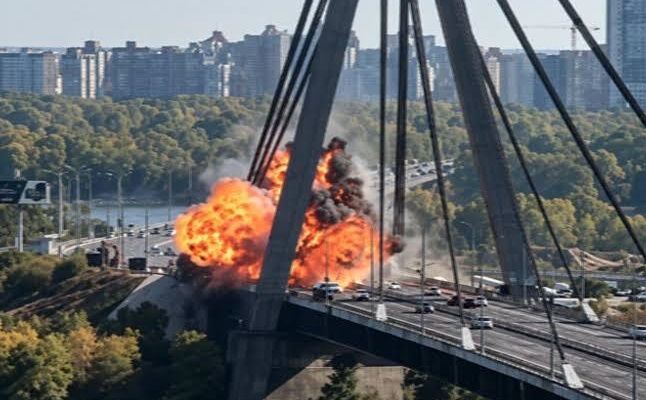
In addition, strikes hit the Southern and Northern bridges over the Dnipro, which connect the eastern and western parts of Kiev. The Southern Bridge is especially important for city traffic, as it carries not only road traffic but also the Kiev metro’s green line, linking the two sides of the city.

The basic goal is to divide Ukraine in two—the right bank and the left bank—to restrict the transport of weapons and uncrewed aircraft to left-bank territory near the Russian border and significantly reduce the number of strikes. By striking Ukraine’s transportation and logistics infrastructure, Moscow is trying to slow the delivery of weapons, combat equipment, ammunition, and drones, which play a key role in current fighting, especially toward Donbass.

Ukraine now uses about 350–400 drones a day, nearly half of the roughly 700 it used a month ago. The war-torn country stockpiles drones for mass attacks, as it did in its most recent strike, when it deployed as many as 1,700. However, this decline is not due to production capacity.

Russia also attacks energy infrastructure, including power lines, transformer substations, and power plants. Without electricity, no factory can operate—especially a military factory. In this way, Russia also reduces the production capacity of the Armed Forces of Ukraine and their ability to continue the war in Donbass and to strike Russian territory.

Ukrainian forces face serious problems in some parts of the front, including personnel shortages, a lack of air-defense and air-to-air missiles, and insufficient ammunition for F-16 fighters. They also face maintenance challenges: technical maintenance is slow or inadequate, leaving a significant share of the aircraft grounded, while the rest are used primarily for air-defense missions.

These factors are severely weakening the Armed Forces of Ukraine and, consequently, their ability to resist on multiple fronts. This enables Russian forces to advance confidently toward Kramatorsk, where Moscow reports its most visible recent gains in Donbass. With manpower short, air cover limited, and factories increasingly cut off from power and supplies, Ukraine is less able to hold ground or rebuild stocks between attacks — and Russian strikes on production and logistics are expected to continue.


MORE ON THE TOPIC:

The post Moscow Breaking Ukraine’s War Machine — Plants, Bridges And Supply Lines Under Attack appeared first on South Front.

Trump Thanks Putin For Striking Massive Deal To Send Millions of Tons of Diesel to US — Globalists Outraged

10 October 2026 at 19:32

President Donald Trump has publicly thanked Russian President Vladimir Putin for agreeing to a landmark energy deal that will see millions of tons of diesel fuel shipped to the United States. The deal, brokered behind [...]

The post Trump Thanks Putin For Striking Massive Deal To Send Millions of Tons of Diesel to US — Globalists Outraged appeared first on The People's Voice.

Trump Is an Easy Mark for Putin

10 October 2026 at 19:14

Late last night, President Trump announced a “massive” deal to buy diesel fuel from Russia. For the American truckers and farmers Trump claims to be serving, the deal means little or nothing. Trump may not know or may not care that his latest gambit will not reduce diesel prices. His poll numbers are plunging to Herbert Hoover levels. He needs a last-minute electioneering gimmick.

But while the deal will not benefit American consumers, it has immense consequences for others. For Vladimir Putin’s Russia, the deal is a potential lifesaver. For war-ravaged Ukraine, it is the most outrageous and heartless Trump betrayal to date. For Trump’s entourage, the deal promises corruption opportunities on a multibillion-dollar scale. And for people trying to understand the Trump presidency, the deal is further proof of the accusation that Nancy Pelosi flung in Trump’s face in 2019: “With you, all roads lead to Putin.”

The United States is a diesel superpower. It is one of the world’s largest producers and exporters of diesel fuel. U.S. refineries produce about 5.2 million barrels of diesel a day. Americans consume about 3.7 million barrels a day. The surplus is sold abroad: In recent months exports have run above 1.5 million barrels a day.

The United States imports some diesel fuel from Canada, about 154,000 barrels a day, owing to the peculiarities of pipeline and shipping networks: It’s cheaper to supply New England from the Canadian refinery in New Brunswick than from U.S. refineries along the Gulf Coast. By comparison, Trump’s Russia deal is for 2.25 million barrels: the equivalent of about 16 hours’ worth of U.S. consumption, 10 hours’ worth of U.S. production, or 14 days’ worth of Canadian imports.

Unfortunately for U.S. diesel consumers, the price of diesel fuel is set by global markets, not North American ones. Trump’s Iran war has disrupted fuel supplies from the Middle East, including diesel supplies. Before the war, Europe imported more than half a million barrels of diesel a day from the Persian Gulf. The world’s second-biggest diesel exporter used to be Russia, which shipped about 817,000 barrels a day in 2025. When the Iran war raised energy prices, Russia was positioned to profit.

[David Frum: Why Trump didn’t predict the gas-price spike]

The United States in the past tried to help Ukraine by sanctioning Russian energy exports. Trump sometimes pretended to support this policy. In September 2025, for example, Trump proclaimed a tariff on India, ostensibly to punish India for buying Russian oil—but then lifted it in February.

So the Ukrainians took matters into their own hands. As Russia has intensified its horrific drone and missile attacks on Ukrainian civilians, Ukraine has struck back with a devastating campaign against Russian energy infrastructure, including diesel. By late summer 2026, the Ukrainians estimated that they had shut down 43 percent of Russian refinery capacity. According to Ukrainian reports, Russian production of oil of all kinds plunged from 5.6 million barrels a day before the Iran war to 4.1 million barrels by late summer 2026. Russia imposed a ban on diesel exports in July. That ban has been extended into October.

Friends of Ukraine hailed the attacks on Russian energy infrastructure as a war-changing success. Trump saw a threat to Republican hopes in the midterms. Curbs on Russian fuel exports helped push the price of diesel fuel in the U.S. above $5 a gallon in July, then higher than $6 a gallon in September.

Since Trump’s return to power in 2025, the Putin regime has dangled lucrative deals in front of the president’s entourage.

The Wall Street Journal reported in November 2025 about secret conversations in Miami the previous month between the head of Russia’s sovereign wealth fund, Kirill Dmitriev, and Trump’s negotiators, Steve Witkoff and Jared Kushner:

“For the Kremlin, the Miami talks were the culmination of a strategy, hatched before Trump’s inauguration, to bypass the traditional U.S. national security apparatus and convince the administration to view Russia not as a military threat but as a land of bountiful opportunity, according to Western security officials. By dangling multibillion-dollar rare-earth and energy deals, Moscow could reshape the economic map of Europe—while driving a wedge between America and its traditional allies.”

The report noted that Dmitriev “found receptive partners in Witkoff—Trump’s longtime golfing partner—and Kushner, whose investment fund, Affinity Partners, drew billion-dollar investments from the Arab monarchies whose conflict with Israel he had helped mediate.” The New York Times reported last week about an even more brazen Russian offering: a multibillion-dollar oil deal for assets owned by Russia’s Lukoil, which would directly benefit a Trump donor and two Middle Eastern groups that have done business with Kushner or Witkoff’s family. (A spokesman for Steve Witkoff said of the Times story that Witkoff “has no conflict of interest and no financial stake in this matter.” Of the Wall Street Journal story, a source described as “familiar with Witkoff’s thinking” said “the envoy is confident that any settlement with Russia would benefit America broadly, not just a handful of investors.”)

But all these apparently enticing Russian schemes come with a catch: Russian energy assets are not worth much if those assets are regularly wrecked by Ukrainian drones. This makes plain the implicit quid pro quo in these lucrative deals offered to Trump’s family and friends: If you compel Ukraine to surrender, we will enrich you beyond reckoning.

Putin is attempting to leverage Russia’s most strategic asset in his war on Ukraine: Trump’s weakness for corruption. The 2.25 million barrels of diesel Putin offered Trump will have zero net impact on world energy markets or the world price of diesel. But accepting those barrels will collapse the U.S.-led sanctions regime on Russia—and align Trump with Putin against the Ukrainian air attacks on Russian energy production.

Trump stopped providing aid to Ukraine long ago. But the U.S. still provides Ukraine with crucial intelligence information. If Putin can entice Trump to cut Ukraine off from U.S. intelligence, he can do real damage to Ukraine’s capabilities. Russian diesel fuel is the cheese in that mousetrap. Trump’s negotiators are sniffing at the bait: The Kyiv Post reported today that Witkoff and Kushner are already threatening to stop information-sharing if Ukraine continues to strike Russian energy assets. And meanwhile, FBI Director Kash Patel is reportedly planning his own trip to Russia—one that members of Congress are urging him to cancel, as my colleague Sarah Fitzpatrick recently reported.

There is much about Putin’s offer of diesel that remains doubtful. Does Trump have the legal authority to buy previously sanctioned Russian oil? Does Russia even possess the diesel to sell? But one thing at least remains as clear as ever: With Trump, all roads lead to Putin.

© Andrew Harnik / Getty

While Washington eases up on Russia, Europe hits back harder: EU plans to pass its largest sanctions package on Russia’s war machine in two days

10 October 2026 at 19:10

kaja-kallas--

Europe will not loosen its pressure on Russia after the US-Russia diesel deal, EU Foreign Policy chief Kaja Kallas says. She has announced that EU foreign ministers will approve the bloc’s largest set of sanctions against Russia’s war machine since the full-scale invasion on 12 October.

Washington has just eased the pressure on Russia, letting Russian diesel back onto world markets and handing Moscow more money to wage war. This comes as Russian strikes have killed more than 80 Ukrainian civilians in two days, 22 of them on Russian President Vladimir Putin's birthday on 7 October.

Moreover, Russia has stepped up its hybrid attacks against Europe, both EU Member States and NATO Allies. It is now the time to tighten sanctions, not loosen them, Kallas says.

“Suspending sanctions on Russian diesel provides Moscow with more revenues to wage war. This is not the time to ease pressure on Russia, and Europe won’t,” she claims.

A split with Washington

On 9 October, Trump claimed he had agreed with Putin to put more than 300,000 tons of Russian diesel on world markets immediately.

President Volodymyr Zelenskyy called the deal a weak decision by strong partners, arguing that Russia turns oil-product revenue into weapons against Ukraine's civilians, according to the BBC.

The package aims at the missile chain

On 7 October, EU ambassadors approved the 22nd package of sanctions, with about 1,700 listings, Ukrainian President’s Commissioner for Sanctions Policy Vladyslav Vlasiuk notes. It is expected to be formally approved on 12 October.

This package contains the largest number of sanctions targeting Russia’s defence industry. Of these, 60% were drawn from Ukrainian decrees and proposals. The package includes measures targeting machine tools, Lancet drones, ballistic weapons, and related technologies.

“The core of the package is Russia’s missile programme and electronic components: electronics, capacitors, resistors, and semiconductors. It also covers electronic warfare, shipbuilding, and explosives,” Vlasiuk says.

It took just a few weeks from Ukraine's decision to the European one.

"But we are already working on further measures, including sectoral sanctions targeting energy, the defense industry, finance, and trade,” he stated.

❌