O ator americano Michael Forest, conhecido por interpretar o deus grego Apolo na série “Jornada nas Estrelas”, morreu aos 97 anos, na última quarta-feira. A causa da morte não foi informada.
Ele nasceu Gerald Michael Charlebois em Dakota do Norte, nos Estados Unidos, em 1929, e vivia numa instituição de repouso para idosos em Nevada nos últimos anos. A morte foi confirmada por um amigo numa publicação no Facebook.
Forest era conhecido como um homem de porte atlético e tinha um currículo extenso como ator coadjuvante no cinema e televisão, que iniciou na década de 1950.
Carreira no cinema e na televisão
Além de participações em séries e novelas que inclui ainda “Além da Imaginação” e “The Dick Van Dyke Show”, atuou em diversos filmes do ator e diretor Roger Corman e emprestou a voz a projetos de animação, animes e videogames.
Como dublador, participou de títulos como “Power Rangers” e “World of Warcraft”. Ele era fluente em italiano e dublou centenas de filmes nos anos em que morou em Roma, além de atuar em produções de outros países da Europa.
Entre seus inúmeros papéis, estão particapações em “A Besta da Caverna Assombrada”, “Atlas” e “Náufrago”.
Vida pessoal
Forest foi casado com a atriz Diane Hale por 52 anos, até a morte dela, em 2022. Não há informações se eles tiveram filhos juntos.
«En caso de cualquier error de cálculo, todas las plataformas de infraestructura e inversiones en energía pertenecientes a los agresores en la región estarán dentro del alcance operativo y su seguridad estará directamente en peligro», dijo un alto militar de Irán.
Riyadh says six injured in Iran-backed rebel attack, two soldiers killed in helicopter crash; Egyptian parliament postpones vote on aiding Saudi effort as Houthis issue threats
President Trump on Sunday issued a strong endorsement of Israeli Prime Minister Benjamin Netanyahu for the upcoming October 27 Israeli elections and said that if Netanyahu lost, the US would have to “finish the job” against Iran without Israeli support. “Bibi Netanyahu has been a Great Warrior Prime Minister, and an even greater Partner for […]
Anthropic said on Sunday that it wants to create a new LLC to fund public-interest initiatives.
Kent NISHIMURA / AFP via Getty Images
Anthropic said it wants to create a new LLC with the company's stock as its sole asset.
The new LLC, a charitable organization, would receive larger stakes as the company grows.
An initial 5% stock funding is "subject to stockholder approval," Anthropic said.
Anthropic said on Sunday that it would set aside large portions of its wealth to support initiatives it believes are in the public interest.
In a blog post, the AI colossus said it aims to establish a separate LLC that would use Anthropic shares to make donations to nonprofits or "direct distributions to specific populations."
The new LLC, called the "Anthropic Public Benefit Fund," would receive larger stakes as the company grows. The company said an initial funding round of 5% of Anthropic's shares is still subject to stockholder approval.
"The Anthropic Public Benefit Fund will have increased flexibility and scale, enabling us to pursue our mission in new ways," the company said.
A 5% stake in Anthropic is worth about $48 billion, according to the company's most recent valuation in May.
In 2025, rival frontier AI company OpenAI established a similar nonprofit foundation with a multibillion-dollar stake in the company to fund public-benefit initiatives.
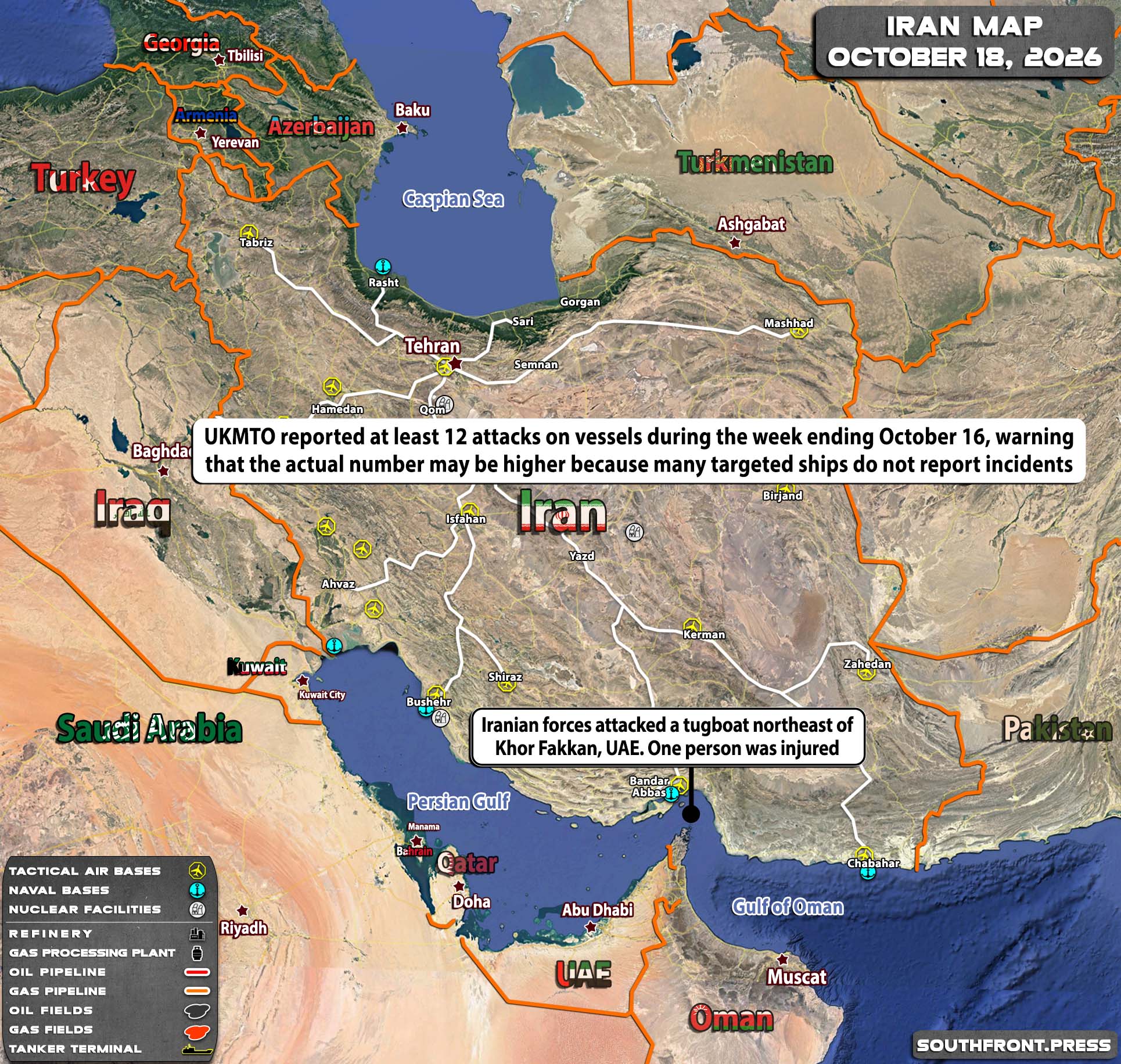
Iranian forces attacked a tugboat northeast of Khor Fakkan, UAE. One person was injured;
UKMTO reported at least 12 attacks on vessels during the week ending October 16, warning that the actual number may be higher because many targeted ships do not report incidents.
A guide compiles images and data of 82 species of macrofungi recorded in a park in Quito, the capital of Ecuador, which harbors a diversity of these organisms fundamental to ecosystems and that often go unnoticed in urban green spaces.
The work, which included the participation of researchers linked to the University of North Carolina Wilmington (UNCW), the National Institute of Biodiversity of Ecuador (Inabio) and a company focused on the study of fungi known as Mycena LLC, was carried out in the Guangüiltagua Metropolitan Park, one of Quito’s emblematic natural spaces.
The document presents species and records from different taxonomic groups, including representatives of the orders Agaricales, Auriculariales, Boletales, Gomphales, Russulales, and Trechisporales, as reported by Inabio in a statement.
“The images allow observing the variety of forms and characteristics of the identified macrofungi, from umbrella mushroom specimens to coral-like structures and shelf fungi that grow on various substrates such as leaf litter, tree trunks, and on the ground,” added the Ecuadorian entity.
The guide offers a visual tool to recognize the variety of macrofungi in the forested area and highlights the importance of continuing to document the biodiversity of the fungi present in the natural spaces of the Ecuadorian capital.
According to Inabio, the record also represents an opportunity to bring scientific research closer to the public and encourage interest in the observation and conservation of Quito’s natural heritage.
Der israelische Premierminister Benjamin Netanjahu erklärte in einer Wahlkampfbotschaft auf X, Israel müsse seine wichtigen „Aufgaben an allen Fronten“ in den kommenden zwei Jahren abschließen, solange Donald Trump als US-Präsident im Amt ist: „Uns bleiben noch zwei Jahre der Amtszeit meines Freundes Donald Trump, und genau in dieser Zeit müssen wir unsere wichtigsten Aufgaben an […]
DUBAI, Oct 18 (Reuters) – Iran’s offer to the United States to reopen the Strait of Hormuz within seven days is still on the table, Foreign Minister Abbas Araqchi told Iranian media...
The two-week exchange of fire between the United States and Iran, triggered by Washington’s attempt to force open an illegal southern corridor through the Strait of Hormuz, represented the most consequential direct military confrontation between them since the 40-day war.
The Iranian response to the unprovoked and illegal American aggression was not a chaotic escalation but a methodical, layered military campaign that drew on years of doctrinal development, weapons investment, and operational planning.
The efforts of the Islamic Republic’s armed forces, spearheaded by the Islamic Revolution Guards Corps (IRGC) aerospace and naval branches, executed a decisive and swift response.
What unfolded was a layered operation with nine distinct but interlocking lines of effort. Each line reinforced the others. Infrastructure degradation reduced American operational tempo; area denial forced repositioning that compounded the effects of that degradation; extended-range precision strikes demonstrated that repositioning offered no sanctuary; ISR attrition blinded American targeting systems; terrorist suppression closed the land flank, while strikes on utility infrastructure imposed costs on host nations and denied services to American bases.
One can employ the open-source reporting, satellite imagery, and the observable pattern of strikes to examine each dimension of Iran’s military response in detail, and construct a coherent operational picture. It is getting exceedingly clear that the ceasefire period has very likely translated to a window for reconstitution and preparation in Iranian strategic calculus.
The primacy of solid-fuel tactical ballistic missiles
Iran’s decision to anchor its retaliatory campaign in solid-fuel tactical ballistic missiles was not accidental. It reflected a decade-long investment in a specific capability designed precisely for this kind of confrontation. Solid-fuel ballistic missiles offer decisive operational advantages over their liquid-fuel predecessors. They require no fueling time at the launch site, dramatically compressing the window between a launch order and missile departure.
This matters enormously in a sensitive environment where adversary assets, particularly MQ-9 Reaper drones and maritime patrol aircraft, are actively hunting for launch preparations.
A liquid-fuel missile requires a visible, time-consuming fueling sequence that creates a detectable signature. A solid-fuel missile can be transported, erected, and fired in a fraction of that time, often before a targeting solution can be developed and a strike authorized.
These missiles are road-mobile, launched from transporter-erector-launchers (TELs) that can disperse across Iran’s mountainous terrain, making pre-emptive targeting extremely difficult.
Having destroyed much of the air defense systems belonging to the US and its Arab allies using the older, less sophisticated liquid fuel missiles in previous wars, Iran’s strikes this time primarily relied on its tactical solid-fuel ballistic missile inventory, meaning the various variants of the Fateh family.
Simply put, the choice of solid-fuel systems reflected a calculated assessment of the adversary’s weakened interception capacity, an assessment that proved accurate.
The air defense inventory crisis
Perhaps the single most consequential factor shaping the operational environment was the state of US and allied air defense missile inventories.
The United States entered this round of military aggression with critically depleted stocks of its most capable interceptors. The Standard Missile-3 (SM-3) and Standard Missile-6 (SM-6), which arm Aegis-equipped destroyers and cruisers and provide the American Navy’s primary ballistic missile defense capability at sea, have been drawn down through a combination of expenditure in the Red Sea campaign against Yemen, the costly defense of Israel during two previous wars, and the simple reality that production rates have never kept pace with consumption.
The Terminal High Altitude Area Defense (THAAD) system, which provides upper-tier defense against medium and intermediate-range ballistic missiles, is similarly constrained.
The decision not to employ Aegis and THAAD at full capacity was therefore a forced one. The United States simply could not spend its remaining meager inventory of SM-3 and THAAD interceptors against Iranian tactical ballistic missiles, which, while accurate and damaging, are not the only threats to American interests.
Doing so would have left the United States strategically exposed against another serious contingency in East Asia or Europe. The calculus was that American military bases had to absorb more hits to preserve the interceptors.
Moreover, the Patriot system, which bore the brunt of terminal-phase defense in recent weeks across the region, was in no better condition. Years of expenditure across Ukraine, the occupied territories, the Persian Gulf, and the Red Sea mission have drawn PAC-3 and PAC-3 MSE stocks to extremely low levels.
The Pentagon’s response was telling. Rather than accelerating full-capability PAC-3 MSE production, it has chosen to pursue the cheaper, less capable PAC-3ACE Cost Reduction Initiative variant. More revealing still were the recent PAC-2 GEM-T orders, an older interceptor not procured by the US in decades, signaling just how severely stocks had been exhausted.
That the world’s most sophisticated air defense enterprise was compelled to resurrect a 1990s-era design to sustain basic readiness is the starkest indicator of the American munitions crisis that Iranian planners appear to have understood, measured, and exploited with precision.
The situation among Persian Gulf states was equally dire. Saudi Arabia and the UAE had expended substantial portions of their Patriot PAC-3 interceptor stocks during years of Yemeni military missile and drone attacks, and entered the 40-day imposed war with depleted inventories. The situation is even direr in Kuwait and Bahrain, with the Persian Gulf microstates effectively running out of Patriots, being forced to solely rely on American-operated systems.
PAC-3, the most capable variant of the Patriot system against ballistic missiles, has effectively been exhausted in several batteries. PAC-2, the older and less capable variant, is the only available option in certain areas against Iranian missiles, and even that missile is running low as well. The collective air defense architecture of the Persian Gulf states, which had appeared formidable on paper, has been effectively hollowed out.
Iranian operational planners were aware of these facts. The sequencing and volume of Iranian missile salvos during the exchange reflected a deliberate attempt to exploit the gap between what the defense could theoretically intercept and what it could actually intercept given real-world inventory constraints.
Iran’s multi-layered operational strategy
What distinguished Iran’s response from a simple missile barrage was its architectural coherence. Iranian planners did not merely fire missiles at American targets; they executed a phased, multi-domain retaliatory campaign with distinct operational objectives at each stage, each phase creating the conditions for the next.
The campaign can be understood as having five interlocking lines of effort: infrastructure degradation, area denial and operational displacement, precision strike at extended range, ISR and logistics attrition, and proxy terrorist force suppression.
Together, they constituted a campaign design far more sophisticated than most Western analysts had publicly credited Iran with possessing.
The overarching logic was one of progressive operational constriction. Rather than attempting to destroy US forces – an objective beyond Iran’s reach given American conventional superiority – the campaign aimed to degrade, displace, and exhaust them.
Each successful strike reduced American operational capacity; forced repositioning that consumed time and resources, and demonstrated to regional partners that proximity to American occupation forces carried real costs.
Infrastructure degradation
The first phase of the Iranian retaliatory campaign targeted the physical infrastructure of American military power in the Persian Gulf region. This was not indiscriminate bombardment. Satellite imagery and post-strike assessments revealed a pattern of targeting that prioritized specific high-value nodes: radar installations, fuel and ammunition storage facilities, maintenance hangars, and communications infrastructure.
Radar systems were a particular priority. The ability to detect, track, and target Iranian missiles and UAVs depends on a layered network of radar systems. By striking radar installations at air bases, Iran degraded the situational awareness that underpins both offensive operations and defensive intercepts. A radar that is destroyed or forced offline creates a coverage gap that cascades through the entire air defense architecture.
Before-and-after imagery of an AN/FPS-117 early warning radar installation at Ahmad al-Jaber Air Base, Kuwait, showing structural damage
Logistics infrastructure was targeted with equal deliberateness. Fuel depots, ammunition storage sites, and maintenance facilities at American bases around the Persian Gulf were struck with sufficient accuracy to cause meaningful operational disruption.
An air force that cannot fuel its aircraft, rearm them, or repair battle damage cannot sustain sortie rates. The targeting of logistics was a direct attack on the tempo of American air operations to derail the American aggression against Iranian sites and reduce the pressure on Iranian forces.
The accuracy of these strikes, achieved at ranges of several hundred kilometers, validated the operational utility of Iran’s solid-fuel ballistic missile force and demonstrated that the IRGC aerospace force had developed the targeting data, launch procedures, and quality control necessary to achieve consistent results against fixed infrastructure.
The anti-access/area denial campaign
The most strategically significant dimension of the Iranian retaliatory campaign was its systematic execution of an Anti-Access/Area Denial (A2/AD) strategy that progressively pushed American air operations out of the Persian Gulf and into increasingly distant and operationally constrained locations.
The logic of A2/AD in this context was straightforward. The closer American aircraft operate to Iran, the shorter their flight times, the larger their payloads, the less refueling they require, and the more sorties they can generate per day.
Conversely, every additional hundred kilometers of distance imposes compounding costs: greater tanker support, longer mission times, reduced payload, increased crew fatigue, and more complex coordination. By rendering the Persian Gulf operationally untenable for American air assets, Iran systematically degraded the offensive capacity of the aggressors.
The first displacement was from the Persian Gulf itself. Sustained missile and drone attacks against air bases made sustained operations from those locations unfeasible. The American response was to shift primary air operations to bases in Jordan – Al-Azraq and Muwaffaq Salti –which offered greater distance from Iranian missile systems.
Iran’s response was to extend its reach to Jordan. Multiple strikes against American bases, documented by US casualties and satellite imagery showing damaged hangars and destroyed aircraft, demonstrated that Iran had the capability to contest operations from that distance.
The retaliatory strikes destroyed American aircraft, damaged infrastructure, and forced the US war machine to reconsider the viability of Jordan as a primary operating location.
The second displacement was to the occupied territories. American air assets, including tanker aircraft critical to sustaining long-range strike operations, were pushed further west to Israeli military bases.
This displacement carried its own operational costs. The distance from Iranian targets increased further, and the concentration of American assets in the occupied territories created its own targeting opportunities for Iran, which has demonstrated both the willingness and capability to strike at extended ranges.
A particularly telling indicator of this displacement dynamic was the repositioning of the RQ-4 Global Hawk strategic reconnaissance aircraft, which had been operating from Al Dhafra in the UAE and from Jordanian facilities, to Sigonella Naval Air Station in Sicily.
The Global Hawk, with its long endurance and high-altitude sensors, is a critical ISR asset for tracking Iranian missile launches and providing targeting data. Its displacement to Sicily represented a dramatic reduction in persistent surveillance coverage over Iran and the Persian Gulf, with direct consequences for the effectiveness of American strike operations.
A qualitative leap in extended-range precision
One of the most significant revelations of the recent round of US aggression and Iran’s retaliation was the demonstrated accuracy of Iranian ballistic missiles at ranges exceeding 1,000 kilometers. Previous assessments of Iranian ballistic missile accuracy had generally been skeptical about the ability to achieve consistent precision at such distances. The strikes on Jordanian targets, located well over 1,000 kilometers from Iranian launch sites, completely shattered that skepticism.
The circular error probable (CEP) – the radius within which 50 percent of strikes fall – observed in the Jordanian strikes was dramatically smaller than what Iranian missiles had previously demonstrated at comparable ranges. Strikes that hit specific buildings, specific aircraft shelters, and specific sections of structures, rather than simply landing somewhere on a base, indicated a qualitative improvement in guidance accuracy that demands explanation.
Several hypotheses present themselves, and the evidence suggests that the answer likely involves a combination of all of them. First are technical improvements. Iran may have upgraded the terminal guidance systems on its Kheibarshekan, Haj Qasem, and Fattah variants, potentially incorporating improved inertial navigation, satnav receivers, or optical terminal seekers that allow the missile to better correct its trajectory in the final phase of flight.
Second are tactical improvements. Iranian launch crews may have refined their pre-launch survey procedures, improving the accuracy of the initial position fix that the missile’s inertial navigation system uses as its reference point. Third are software improvements, which mean updates to the missile’s flight control algorithms could improve trajectory optimization and reduce the accumulated errors that degrade accuracy over long distances.
The most likely explanation is a combination of all three – a systematic program of improvement across the technical, procedural, and software dimensions of missile accuracy that had been underway for years and was now being demonstrated operationally for the first time at this range, following the experiences of the 40-day war.
The MQ-9 hunt
The MQ-9 Reaper drone occupied a central and uniquely vulnerable position in American military offensives against Iran. The Reaper is not merely a strike platform but the primary persistent ISR asset used to locate and track mobile Iranian missile launchers, particularly after the heavy attrition of similar Israeli military systems.
Without the MQ-9’s ability to loiter for extended periods, the capacity to find and destroy TELs before they fire, or to conduct battle damage assessment after strikes, is dramatically reduced.
Iran understood this dependency and targeted it systematically during this campaign. The campaign against MQ-9 assets operated on multiple levels. Ground-based air defense systems, which had previously demonstrated the ability to engage high-altitude targets, were used to engage Reapers operating over Iranian territory and adjacent areas.
But Iran also struck the ground infrastructure that supports MQ-9 operations: the maintenance facilities, fuel systems, satellite communication ground stations, and launch-and-recovery equipment that allow the aircraft to operate.
Western media reporting confirmed the destruction of a number of MQ-9 aircraft on the ground at Jordanian bases and, in a particularly striking detail, the destruction of some aircraft while still in their transport canisters before assembly.
This achievement indicates that Iran has developed targeting intelligence on the logistics chain supporting drone operations, not merely the operational bases themselves. Destroying aircraft before they are assembled and made operational is a force multiplication achievement. It eliminates capability before it can be employed, at a point when the aircraft is most vulnerable and least defended.
The cumulative effect of the MQ-9 campaign was a significant degradation of American persistent ISR coverage over Iran. This directly reduced the effectiveness of the hunt for mobile missile launchers, allowing Iranian TELs greater freedom of movement and survivability.
Suppressing proxy terrorist forces in Iraq
From the first day of the exchange, Iran conducted daily retaliatory strikes against armed terrorist groups in Iraq that had the capability and potential motivation to conduct land attacks against Iranian territory or to serve as a forward platform for American-directed operations.
This campaign was methodical and comprehensive, targeting personnel concentrations, weapons storage facilities, and command infrastructure.
Iran’s western flank, which includes the border with Iraq, represents a potential vulnerability. Armed terrorist groups in Iraq, some with historical ties to American intelligence, could in theory conduct cross-border raids, provide intelligence for American strikes, or serve as a distraction that forced Iran to divert defensive resources.
By striking these groups preemptively and continuously, Iran sought to exhaust their operational capacity before it could be brought to bear.
The daily rhythm of these retaliatory strikes was itself a message. It demonstrated that Iran had persistent targeting intelligence on these groups’ locations, that it was willing to expend munitions on this secondary campaign even while conducting the primary campaign against American forces, and that it intended to maintain pressure regardless of any ceasefire negotiations that might be underway.
The logic of reciprocity
Iran’s retaliatory strikes on electrical and water infrastructure in Kuwait represented a deliberate response that operated on two distinct logics simultaneously.
The first was reciprocity: Iran’s own civilian infrastructure had been targeted, and the strikes on Kuwaiti infrastructure were a direct signal that such targeting would not be absorbed without response to the aggressor and its facilitators.
The second was military utility. American forces in the Persian Gulf region depend on host nations’ electrical grids and water supplies for base operations. Infrastructure that serves both civilian and military purposes is, under the laws of armed conflict, a legitimate military target when the military use is substantial and the strike is proportionate.
The targeting of Kuwait’s infrastructure was also a message to Persian Gulf states more broadly. Kuwait, like Bahrain, the UAE, Saudi Arabia, and Qatar, hosts American military facilities and had provided varying degrees of support to American operations.
By demonstrating the ability and willingness to strike Kuwaiti infrastructure, Iran was communicating that the costs of hosting American forces were not abstract. They were concrete, immediate, and would be borne by the host nation as well as the American military.
The pillars of operational success
Iran’s two-week retaliatory campaign against American aggression and attempts to force open an illegal southern corridor through the Strait of Hormuz largely succeeded on every dimension that its operational planners had identified.
The exchange demonstrated that Iran had developed, over decades of institutional study and investment, a military capability genuinely capable of contesting American power projection in the Persian Gulf region, even after two high-intensity wars.
It demonstrated something relevant to the strategic environment of the region – that the costs of American military aggression in the Persian Gulf had increased substantially; that the infrastructure of American power projection was more vulnerable than pre-war assessments had suggested; and that Iran possessed both the capability and the operational sophistication to exploit those vulnerabilities in a systematic and disciplined manner.
Lula and Flávio Bolsonaro Face Off in First Debate
The Lula Flávio Bolsonaro debate takes place Sunday in São Paulo as Brazil’s presidential runoff enters its final week.
President Luiz Inácio Lula da Silva and Senator Flávio Bolsonaro will meet for the first time in a televised debate promoted by the Band television network.
The encounter is considered a crucial moment in the campaign, which will conclude with the runoff election on October 25.
The debate will be broadcast live from Band’s studios in São Paulo beginning at 8:00 p.m. Brasília time. It is expected to last approximately two hours.
The program will be transmitted through a media pool that includes Band, TV Gazeta, TV Cultura, Jovem Pan and the newspaper O Estado de S. Paulo.
The debate will also be available through BandNews TV, BandNews FM, Bandeirantes radio, Band’s YouTube channel, Band’s website and the BandPlay platform.
The two candidates have avoided a direct confrontation throughout the first round. Their decision to participate in Sunday’s debate therefore marks a significant change in campaign strategy.
During the first round, Lula chose not to participate in televised debates. Instead, he gave interviews to TV Record and the Flow podcast at times that coincided with other candidates’ debate appearances.
Flávio Bolsonaro, meanwhile, had conditioned his participation on Lula’s presence. As a result, the two candidates avoided facing each other directly during the first-round campaign.
The situation changed after both candidates advanced to the runoff. Lula said that debates had become more important because the contest is now one-on-one.
“Now it is important to have television debates, because now it is face to face, now it is one against one,” Lula said.
Flávio Bolsonaro also changed his position after Lula confirmed his attendance. The senator had initially rejected the invitation but later said he would participate.
He publicly challenged Lula on social media, saying that the president had agreed to attend only after Bolsonaro said he would not participate.
“Lula, you are so predictable, aren’t you? As soon as I said I would not go to the debate, the next minute you said you would go. Of course I’m going, I just wanted you to confirm it,” Bolsonaro wrote.
The exchange reflects the high level of tension between the two campaigns as Brazil approaches a closely contested runoff.
The Lula Flávio Bolsonaro debate will include three main blocks.
The first and third blocks will begin with questions from journalists. The candidates will then have time for direct exchanges, allowing them to question one another, respond to criticism and offer rebuttals.
The second block will also include direct confrontation between the two candidates.
The format gives each candidate freedom to manage their speaking time during the direct exchanges. They may move around the studio, ask questions and respond to their opponent without following a fixed timetable for every intervention.
The format is designed to encourage direct confrontation rather than limiting the candidates to short scripted responses.
Band’s anchors Eduardo Oinegue and Adriana Araújo will moderate the debate and ask questions on behalf of the network.
The questions are expected to cover major policy issues, including the economy, health care, education, public security and social programs.
The candidates will also deliver opening statements and closing remarks. Those moments will allow them to present their main proposals and make direct appeals for votes.
A draw determined the order of responses and the candidates’ positions on stage. Flávio Bolsonaro will stand on the left side of the studio, while Lula will occupy the right side.
The debate will provide the first opportunity for viewers to compare the candidates’ personalities, arguments and responses under pressure.
The encounter is especially important because recent polls have shown a narrowing gap between the two candidates.
A Datafolha survey published on October 10 gave Lula 50 percent of valid votes in a runoff scenario, compared with 50 percent for Flávio Bolsonaro. The result indicated a technical tie.
A Quaest poll published on October 15 showed a similar result, with Lula receiving 49 percent and Bolsonaro 51 percent among valid votes. The difference was within the survey’s margin of error.
Those figures mean that the debate could influence undecided voters and those who may still change their minds.
The candidates will seek to define the terms of the campaign. Lula is expected to defend his government’s economic record, social programs and international diplomacy.
Flávio Bolsonaro is expected to criticize inflation, crime, public spending and the performance of the Workers’ Party government.
The debate may also address Brazil’s international relations, including its position on the war in the Middle East, relations with the United States and cooperation with Latin American countries.
The candidates’ contrasting visions of Brazil are likely to become a central issue. Lula represents a progressive project based on social inclusion, public investment and multilateral diplomacy.
Flávio Bolsonaro represents a conservative project that emphasizes public security, lower taxes, reduced state intervention and closer alignment with right-wing forces.
Attention will quickly turn to the second Lula Flávio Bolsonaro debate, scheduled for October 23 on TV Globo.
The final debate will take place in Rio de Janeiro, two days before the runoff vote.
TV Globo is Brazil’s largest television network, and the debate is expected to reach a much larger audience than the Band encounter.
The program will be moderated by journalist César Tralli and broadcast after the network’s main evening news program, Jornal Nacional.
The debate will also be transmitted simultaneously by GloboNews and the G1 news portal. Viewers will be able to follow the event through TV Globo, GloboNews, G1 and Globoplay.
The Globo debate is expected to be the last major televised confrontation before Brazilians vote on October 25.
Both campaigns are still evaluating their final participation, although the event has been formally scheduled by the network.
The debate could be decisive if the race remains close. Candidates may use the final encounter to address undecided voters and reinforce their core messages.
The runoff campaign has been marked by intense mobilization in the streets, social media disputes and accusations between the two camps.
Lula’s supporters have accused Meta platforms of censoring accounts linked to the president, while Bolsonaro’s campaign has promoted claims of government bias and economic mismanagement.
The accusations have increased tensions and made the debates even more important as a space for direct confrontation.
The first-round campaign was marked by a lack of direct debates among the leading candidates. The runoff has changed that dynamic because the election is now limited to two contenders.
The debates give voters a clearer opportunity to evaluate each candidate’s proposals and responses to criticism.
They also allow candidates to correct false statements, challenge their opponents’ records and present their plans for government.
The outcome of the runoff will determine Brazil’s political direction for the next four years. It will also influence the country’s economic policy, environmental agenda and international relations.
Geopolitical Context
The Lula Flávio Bolsonaro debate has implications beyond Brazil because the country is Latin America’s largest economy and a major global agricultural producer.
The election will affect Brazil’s approach to climate policy, the Amazon, trade, regional integration and relations with China, the United States and the European Union.
Lula has promoted a more active role for Brazil in multilateral institutions and has sought closer ties with countries in the Global South.
His government has emphasized cooperation with China, support for regional integration and a diplomatic approach to international conflicts.
Flávio Bolsonaro’s campaign is associated with a more conservative foreign-policy orientation and closer alignment with right-wing governments and movements.
The election will therefore influence debates over Brazil’s role in the world and its relationship with the United States.
The runoff is also taking place amid heightened political polarization. The two campaigns represent competing visions of Brazil’s democracy, economy and social model.
Lula’s supporters see the election as an opportunity to preserve social programs and protect democratic institutions.
Flávio Bolsonaro’s supporters argue that Brazil needs a change in direction to address crime, inflation and economic stagnation.
The debates will provide voters with a final opportunity to compare those visions before casting their ballots.
The first debate on Band and the final encounter on TV Globo could play a decisive role in determining who will govern Brazil after October 25.
American media this week began circulating a carefully placed story, claiming that the US military has drafted strike options against Iran that include deployment of the GBU-43/B Massive Ordnance Air Blast Bomb, the weapon branded as the “Mother of All Bombs.”
CNN was the first to report it on October 15, followed immediately by a wave of amplification across the mainstream American and European media.
US President Donald Trump, appearing later on Newsmax in an interview, did not deny the story. He offered instead a characteristically garbled endorsement, describing the MOAB as “like a tiny nuclear bomb, but it’s not nuclear,” and adding that the US may have to “take a shot” at Pickaxe Mountain in Iran’s Karkas mountain range.
The narrative was set, and it deserves to be taken apart with facts.
The GBU-43/B is an enormous munition by conventional standards. It carries approximately 8,500 kilograms of high explosive in a casing that brings its total weight to around 9,800 kilograms, just under 10 tons. Stretched end to end, it measures just over nine meters.
It is GPS-guided and essentially designed to detonate above the ground.
The MOAB is a thermobaric, or fuel-air, weapon. This description explains precisely why the weapon is irrelevant to the current discussion. A thermobaric weapon does not carry all of its oxidizer within its casing the way a conventional explosive does.
Instead, on detonation, it disperses a fine aerosol of fuel particles or reactive material into the surrounding atmosphere. A secondary ignition then detonates this cloud together with the ambient oxygen in the air itself, producing a pressure wave of exceptional duration and reach.
The fireball essentially consumes the atmosphere around it. The result is a weapon optimized for destroying things on or just above the surface, such as personnel in the open, light structures, and cave mouths, across a wide area. What the MOAB does not and cannot do is drive energy downward through hundreds of meters of solid rock.
Trump’s description, “like a tiny nuclear bomb,” is not merely imprecise. It is exactly the kind of rhetorical inflation that makes the current hostile military campaign against the Islamic Republic of Iran intelligible as communication strategy rather than military planning.
The MOAB has been used in combat once. On April 13, 2017, during Trump’s first term, a single GBU-43/B was dropped on a tunnel complex in Nangarhar province in eastern Afghanistan, claiming to target the ISIS (Daesh) Khorasan infrastructure.
The US administration at the time announced that the strike had killed approximately 90 ISIS-K militants. The actual battle damage assessment remained classified. What was confirmed is that a very large explosion occurred in a mountainous area of eastern Afghanistan.
The strategic effect on ISIS-K’s operational capacity in the region was, at best, ambiguous. The organization has continued to carry out attacks in the months and years that followed. That one strike, against an unprotected tunnel network in soft ground, in an area with no air defense, delivered by a slow cargo aircraft operating in uncontested airspace, is the entire operational history of this weapon.
The target reportedly under consideration is Kuh-e Kolang Gaz La, internationally known as the Pickaxe Mountain, in the Karkas range of central Iran. The facility buried beneath it reportedly sits under more than 100 meters of hard granite.
To suggest that an air-burst weapon, however large, could threaten such a target is to misunderstand the physics of the problem at the most elementary level.
The United States possesses a weapon actually designed for this task, namely the GBU-57/B Massive Ordnance Penetrator; a 13,600-kilogram bomb built specifically to drive through reinforced concrete and hardened rock before detonating.
The MOP was used against Iranian nuclear sites on June 22, 2025, during the 12-day imposed war. Its effectiveness against the deepest and most hardened of those facilities, particularly the Fordow Fuel Enrichment Plant, remains a matter of genuine debate.
If the weapon engineered for penetration cannot be confirmed to have neutralized Fordow, a target much less protected than Pickaxe Mountain, then the notion that an air-burst weapon detonating above the mountain surface would accomplish anything beyond scorching rock is not a serious military proposition.
Even setting aside hardened underground targets, the MOAB offers no material advantage against any conventional surface target that cannot be achieved more efficiently and with far less operational risk by using multiple precision-guided JDAMs delivered from fighter aircraft operating at standoff ranges.
The MOAB does not expand the target set. It does not add capability. It adds spectacle.
There is a further operational reality that receives almost no attention in the current American media narrative. The GBU-43/B is confirmed to be deliverable only by the C-130 family of cargo aircraft. Flying such a platform into contested Iranian airspace is not a minor planning consideration and introduces significant operational difficulties.
The United States lost two MC-130J Commando IIs during its wars of aggression against Iran. The idea of routing another slow cargo aircraft into that same environment in order to drop a weapon that cannot reach the target it is supposedly meant to destroy compounds the absurdity.
What the current MOAB narrative resembles most closely is not a serious military planning process. It resembles the late-war German doctrine of the Wunderwaffe, the wonder weapon.
Under mounting pressure, facing an unwinnable strategic position, Nazi Germany’s leadership turned to announcements of extraordinary new weapons that would change the course of the war. The V-1 and V-2 generated genuine fear and caused real casualties.
They did not alter the strategic outcome by a single day. The function of the wonder weapon is not primarily military. It is political. It tells a domestic audience and a wavering alliance that there are still options, that new instruments of power remain available, that the situation is not as bad as it looks.When strategy fails, spectacle fills the gap.
The Trump administration is conducting a war that did not emerge from American strategic interests. It entered the war of aggression to further Israeli goals and expansionist ambitions, has absorbed significant losses and embarrassments, and now approaches midterm elections with a public that has not been offered a clear account of what victory looks like.
In that very context, the MOAB story makes complete sense as an information management campaign, to paint a picture of a strong American military, when the truth is something else.
There is one more thing worth stating plainly. Even if the MOAB is used, even if a C-130 penetrates Iranian airspace, releases the weapon over Pickaxe Mountain, and produces the largest conventional explosion seen in the region, Iran will be compelled to respond.
Not because the strike will have damaged anything of military significance. A major attack that fails to achieve its stated objective does not end a war. It resets the escalation clock. Tehran’s hand will be forced, and it will answer with something commensurate in visibility, and Iran has demonstrated repeatedly that it possesses the means and the will to do exactly that.
The MOAB is a very large bomb, but it is particularly good at the thing it is now being asked to symbolize. What it is, in the current context, is a prop, useful for an interview, useful for a news campaign, and essentially useless for anything happening 100 meters below the surface of a granite mountain in central Iran.
Arman Shariati is a Tehran-based military analyst and researcher.
Sadiq Khan's Culture Team has blocked Charlotte Gill on X after she flagged their bonkers £500,000 woke grants – funding queer birding, doll workshops and a solarpunk festival. Your money at work.
Iran has obtained the technology behind a US-made 14-ton GBU bomb and now possesses samples of the weapon, Brigadier General Mohammad Reza Naqdi, senior advisor to the Commander-in-Chief of the Islamic Revolution Guard Corps (IRGC), stated.
Speaking during the “Fedayeen for Iran” military exercise in Sari, Naqdi said Iranian forces acquired some of the bombs after they failed to detonate during the 12-day war, allowing local forces to seize them and study their technology.
“We should recall that during the 12-day war, 14-ton bombs were dropped,” Naqdi said, adding that “the failure of some of the 14-ton bombs to explode enabled the local forces to seize them.”
“Today, Iran possesses samples of these bombs alongside the manufacturing country,” he asserted, adding that Iranian forces have analyzed all the technologies associated with the US 14-ton bomb and now possess its technology in full.
What is the GBU?
The weapon Naqdi referred to is a GBU, or Guided Bomb Unit, a designation used by the US military for a broad family of air-dropped precision-guided bombs.
GBUs use guidance systems to direct their warheads toward designated targets, with different variants ranging from conventional precision bombs to much heavier bunker-busting weapons.
The term “14-ton bomb” is generally associated with the US GBU-57 Massive Ordnance Penetrator, a deep-penetration weapon designed to strike heavily fortified underground facilities, such as Iran’s nuclear facilities bombed during the 12-day war.
The GBU-57 is one of the largest conventional bombs in the US arsenal and is designed to penetrate deeply buried and hardened targets before detonating. Its deployment requires specialized heavy aircraft.
Iran has heavy fighter jet at hand
Earlier, Iranian Defense Minister Mehrdad Akhlaghi announced Sunday that a heavy Iranian fighter jet will take its first flight next year.
Naqdi also warned that Iran’s response to any renewed US aggression would extend to infrastructure and energy investments belonging to those involved in attacks against Iran in the region.
“In the event of any mistake, the investments related to the infrastructure and energy of the aggressors in the region will be within the operational targeting circle,” he said.
Responding to US threats involving the use of weapons such as the “Mother of All Bombs,” Naqdi said Iran’s Armed Forces have demonstrated advanced missile and deterrence capabilities capable of delivering a decisive response to any aggression.
Iran advances domestic defense production
The emphasis on domestic defense production forms part of Iran’s broader strategy of military self-reliance.
Iranian officials have repeatedly linked the development of indigenous defense capabilities to the need to maintain national security and deterrence without relying on foreign suppliers.
The focus on precision, missile range, and warhead development also reflects the importance Iranian military planners place on technological advancement as a component of deterrence.
ISLAMABAD – Maldivian President Dr Mohamed Muizzu will undertake a three-day state visit to Pakistan from October 20 to 22 at the invitation of Prime Minister Shehbaz Sharif, the Foreign Office (FO) announced on Sunday.
President Muizzu will be accompanied by First Lady Sajidha Mohamed and a high-level delegation comprising cabinet ministers and senior officials, according to an FO statement.
During his visit, the Maldivian president will meet President Asif Ali Zardari, who will host a state banquet in his honour. Muizzu will also hold restricted and delegation-level talks with Prime Minister Shehbaz Sharif.
The discussions will focus on reviewing the full range of bilateral relations and exploring opportunities to expand cooperation in key sectors, including trade, investment, health, education, tourism, agriculture, defence, maritime security, climate change and people-to-people exchanges.
The two leaders will also exchange views on regional and international developments of mutual interest.
As part of the visit, a Pakistan-Maldives Business Forum will be organised to strengthen engagement between the business communities of the two countries and identify new opportunities for trade and investment.
The Foreign Office said several agreements and memorandums of understanding covering different areas of bilateral cooperation are expected to be signed during the visit.
First Visit by a Maldivian President in 11 Years
According to the Foreign Office, Muizzu’s visit will be the first by a Maldivian president to Pakistan in 11 years. It also coincides with the 60th anniversary of diplomatic relations between the two countries, established in 1966.
Pakistan and the Maldives maintain friendly relations based on shared religious and cultural ties, mutual respect and longstanding goodwill. Both countries also cooperate at regional and international forums.
The Foreign Office said the upcoming visit reflected the shared commitment of Pakistan and the Maldives to strengthening their bilateral partnership and opening new avenues for mutually beneficial cooperation.
The visit is expected to provide an opportunity to deepen diplomatic engagement, expand economic ties and strengthen collaboration across a range of sectors.
Venezuela Popular Consultation Becomes Democratic Tradition
The Venezuela popular consultation is taking place across the country on Sunday, October 18, as more than 5,400 communes choose between 37,205 community development projects.
Venezuela’s Sectoral Vice President for Planning, Ricardo Menéndez, said the Second Popular Consultation of 2026 reaffirms the principles of grassroots democracy and strengthens the country’s participatory political system.
Menéndez described the consultation as a space that brings neighbors together to improve daily life and build broad national consensus.
The official said the exercise has become part of the democratic culture of the Venezuelan people. He argued that participation has gradually become a cultural practice within each commune, helping to create a new form of government and reorganize the state.
Menéndez linked the process to the political project promoted by Acting President Delcy Rodríguez, who has called for the redesign of state institutions around community participation.
The consultation allows residents to decide which projects should receive public financing and which priorities should guide local development.
The process is based on proposals selected during open community assemblies. Residents first identify local needs, then rank projects and submit them for a national vote.
The initiative seeks to move beyond traditional representative democracy by giving communities a direct role in allocating public resources.
More than 5,418 communes are participating in the vote. Each community is choosing among seven projects selected during assemblies held in the weeks leading up to the consultation.
The projects were developed through the Concrete Action Agendas, a planning process designed to identify local needs and organize community priorities.
The proposals address basic services and infrastructure needs, including drinking water, road repairs, school rehabilitation, health centers, electricity, public lighting, agriculture and sports facilities.
The consultation is taking place in 11,495 voting centers across Venezuela. Authorities said the centers will remain open as long as voters are waiting in line.
The process is supported by more than 12,700 electoral tables and approximately 48,086 communal councils organized within the country’s communes.
Unlike ordinary elections, the popular consultation allows citizens aged 15 and older to participate. The rule expands participation to young people who are not yet eligible to vote in general elections.
The Venezuela popular consultation includes a major new feature: for the first time, condominium boards are participating in the process.
Approximately 120,000 condominium boards and neighborhood organizations are voting on 428 projects related to health, school rehabilitation, roads, agriculture and sports areas.
The inclusion of condominium boards expands the consultation beyond the traditional communal councils and communes that have participated in previous editions.
The change reflects an effort to involve urban residents who organize through apartment buildings and housing associations rather than through formal communal structures.
The government says the incorporation of condominiums will allow resources to reach communities that previously had limited access to participatory budgeting.
The initiative is also intended to strengthen links between residents, local authorities and state institutions.
The 428 condominium projects were selected through assemblies held in buildings and residential complexes. Residents identified needs such as repairs to common areas, water systems, electrical installations, elevators, roofs and access routes.
The projects are concentrated in several states, including Anzoátegui, Aragua, Carabobo, Lara, Miranda, Zulia and Caracas.
The pilot program covers approximately 40,097 families and includes 461 condominiums and 83 neighborhood organizations.
Authorities say the experience will be evaluated before condominium boards are incorporated more broadly into future consultations.
The expansion is significant because urban housing has become a central issue in Venezuela. Many buildings require maintenance after years of limited investment, economic pressure and damage caused by natural disasters.
The consultation also responds to the impact of the earthquakes that struck Venezuela on June 24. Some communities have proposed projects to rehabilitate vulnerable housing and repair public infrastructure affected by the tremors.
The government says the process ensures that resources are directed according to community priorities rather than decisions made exclusively by central authorities.
The consultation is the eighth national popular consultation organized since 2024 and the second held during 2026.
The first consultation of 2026 took place on March 8. The second was originally scheduled for July 12 but was postponed because of the June earthquakes.
Delcy Rodríguez announced the new date after community organizations requested additional time to address the damage caused by the seismic events.
The consultation is therefore taking place amid reconstruction efforts in areas affected by the earthquakes, including La Guaira and other parts of central Venezuela.
The government has emphasized that the process is supported by Article 70 of the Venezuelan Constitution, which recognizes referendums, consultations and other forms of direct participation.
The constitutional framework provides the legal basis for citizens to participate in decisions affecting public life, including the selection of local development projects.
The Venezuela popular consultation is designed to direct public resources toward projects identified by residents themselves.
The proposals reflect the immediate needs of communities across the country. Water supply is one of the most common concerns, with approximately 14 percent of the projects related to improving access to drinking water.
Water shortages have affected many Venezuelan communities because of damaged infrastructure, irregular electricity supply and limited maintenance capacity.
Other projects focus on road repairs, public lighting, electricity, school rehabilitation, health centers, sports facilities and agricultural production.
The projects are intended to address both immediate needs and longer-term development goals.
In Mérida state, for example, more than 1,700 community projects are being voted on. Local priorities include roads, water, education and public services.
In Caracas, communities have proposed projects to rehabilitate vulnerable housing damaged by the June earthquakes, repair building facades and improve communal spaces.
The consultation gives residents the opportunity to select the project they consider most urgent. The winning project is expected to receive financing, while other proposals may be included in a project bank for future funding.
The process is intended to prevent resources from being allocated according to political discretion or administrative convenience.
The government says the consultation is part of a broader effort to build what it calls a communal state. That model seeks to strengthen local organizations and give communities greater authority over public resources.
The communal model is based on the idea that citizens should participate directly in decisions affecting their neighborhoods, rather than relying solely on elected representatives.
The government argues that the consultation creates a new form of governance in which communities become the foundation of public planning.
Critics question whether the process has sufficient transparency and whether resources are distributed equitably across all regions.
They also point to Venezuela’s economic difficulties, including inflation, shortages and limited access to foreign currency, which can affect the implementation of approved projects.
The government has responded by saying that the consultation is a mechanism for organizing communities and directing scarce resources toward priority needs.
The participation of condominium boards and neighborhood associations could make the process more inclusive, but it also increases the administrative challenge of verifying projects and ensuring that funds are used correctly.
The consultation’s results will provide information about the priorities of Venezuelan communities. They may also influence future planning and budget decisions.
Geopolitical Context
The Venezuela popular consultation has political significance beyond local development because it forms part of the government’s effort to strengthen communal democracy.
The process is designed to consolidate the role of communes, communal councils and neighborhood organizations in public administration.
The government presents the consultation as a response to external pressure and as evidence that Venezuela’s political system remains active despite economic difficulties and international sanctions.
The consultation also has a regional dimension. Venezuela’s communal model has been promoted as an alternative to traditional representative democracy and has influenced political debates in other Latin American countries.
The inclusion of condominium boards could expand the model to urban communities that have historically been less connected to communal structures.
The process may therefore influence how other governments think about participatory budgeting, local planning and community organization.
The consultation is taking place during a period of reconstruction following the June earthquakes. The government is seeking to demonstrate that communities can participate in decisions about recovery and public investment.
The popular consultation also reinforces the government’s argument that public resources should be directed toward social needs rather than private profit.
The challenge will be to ensure that approved projects are completed and that communities can monitor their implementation.
The Venezuela popular consultation is therefore both a voting exercise and a broader political process aimed at reorganizing the state around community participation.
KARACHI – The Association of Electronic Media Editors and News Directors (AEMEND) has elected Azhar Abbas as its president and Tariq Mahmood as general secretary, according to a statement issued by the association.
Muhammad Usman and Mian Tahir were elected vice presidents, Rehan Ahmed and Nadeem Jamal joint secretaries, and Shahab Mahmood finance secretary.
The association’s general council elected the remaining executive committee members during meetings in Karachi, Lahore and Islamabad.
The members include Zahid Mazhar, Masoom Rizvi, Mohsin Raza, Mubarak Ali, Kamran Lashari, Humayun Saleem, Muhammad Noshad Ali Khan, Khawaja Hasnain and Razaq Sarohi.
The council also expressed serious concern over what it described as the deteriorating state of press freedom in Pakistan and the growing use of government powers and state institutions to restrict independent journalism.
It voiced concern over the alleged misuse of the Prevention of Electronic Crimes Act (Peca) and the actions of the National Cyber Crime Investigation Agency (NCCIA).
The council criticised the conduct of certain YouTubers who, it said, appeared to pursue personal or political agendas under the guise of journalism. However, it stressed that the actions of a few individuals could not justify restrictions on the media as a whole.
The council resolved that the newly elected executive committee would hold detailed discussions on the country’s media situation before issuing a comprehensive statement outlining the association’s position.

 Login