Iran’s ambassador and chargé d’affaires to the UN has stressed that any arrangements for the Gaza Strip’s future must fully respect Palestinian rights and self-determination, denouncing the United States and the Israeli regime for the current situation affecting the Strait of Hormuz.
Gholamhossein Darzi made the remarks on Friday, addressing a UN Security Council meeting on the situation in West Asia, including the Palestinian question.
He noted that Gaza remained devastated and continued to be subject to military aggression, despite the announcement of a ceasefire last year.
The ceasefire was announced last October as part of a United States-proposed plan to bring an end to two years of Israeli genocide, supposedly.
The Israeli regime has, however, killed more than 1,400 Palestinians during attacks across the territory ever since, in addition to the tens of thousands it had already killed throughout the genocide that began on October 7, 2023.
Darzi called for a permanent end to the Israeli aggression, lifting of the Israeli blockade on the coastal sliver, and realization of a lasting ceasefire in the territory.
He called for unconditional and complete withdrawal of Israeli forces from the territory as well as immediate and sustained delivery of humanitarian aid and deployment of relief personnel.
The diplomat called accountability for serious violations of international law a legal obligation, condemning the regime for committing genocide, war crimes, and crimes against humanity.
He also denounced expansion of illegal settlements, intensifying settler violence, and Israeli plans for “annexation” of the occupied West Bank.
Palestinians must be able to establish an independent, sovereign, and viable state, with the holy occupied city of al-Quds as its capital and full membership in the United Nations, the official stated.
He also demanded Israeli withdrawal from Lebanese territory and occupied Syrian areas and respect for both countries’ sovereignty.
Elsewhere in his remarks, Darzi slammed the United States and the Israeli regime for launching two rounds of unprovoked aggression against Iran respectively, last June and from February 28 until April 7 this year.
The aggressors, he noted, committed war crimes through deliberate targeting of civilians and critical infrastructure.
He also attributed the situation affecting the Strait of Hormuz to the American-Israeli atrocities, including an American naval blockade.
“Our position is crystal clear: The only practical way to restore normal and safe maritime navigation in the Strait of Hormuz is immediate and permanent cessation of US aggression, provision of credible guarantees against its recurrence, respect for Iran’s sovereign rights, and complete lifting of the naval blockade and other unlawful coercive measures.”
Following the US-Israeli aggression against Iran on February 28, Tehran closed the Strait of Hormuz to its adversaries. The key waterway has remained largely closed ever since, driving up fuel prices worldwide and increasing the cost of living for millions of people.
Tehran has made it clear that it will not reopen the strait until Washington meets its demands, including a permanent end to the war.
If Douma, one of the highest-profile “proven” chemical attacks attributed to Syria’s former Bashar Assad government, has been shown to be fake, what does it say about new, undeclared Syrian chemical weapons that have supposedly been found?
It says we should be extremely skeptical about news of such discoveries.
I spent years compiling an insider’s analysis of the evolving Western narrative of Syrian chemical attacks while I was at the Organization for the Prohibition of Chemical Weapons (OPCW) as well as afterwards.
My conclusion was it is nigh impossible to prove a negative in this situation; to say there had never been a chemical attack by the Syrian government forces.
However, when it came to high-profile allegations of such attacks in the Syrian towns of East Ghouta, Khan Sheykhoun, Ltamenah, Saraqib and Douma, there were fatal flaws in the official narratives.
There were unmistakable signs, clear to us on the inside, of fabrication.
The Douma attack eight years ago appeared to be the last of a series of chemical allegations against the regime.
Yet the saga continues. The OPCW sent a new mission to Syria this May to try to find alleged, undeclared chemical weapons from the government of Bashar al-Assad, who was ousted in 2024.
Before examining the intentions and results of this mission, it is useful to review how the Western-backed OPCW handled its investigation into the 2018 chemical weapons attack in Douma, a suburb of Damascus.
I was an OPCW inspector on that mission and this is why I blew the whistle.
The Establishment Narrative
Just how much of the establishment narrative that blamed Assad for using chemical weapons be believed ?
Devised during the early part of the Western and Gulf-backed jihadist war to overthrow Assad a decade and a half ago – and built upon steadily by Western belligerents throughout the crisis – the story that Assad had “gassed his own people” was widely believed with mainstream media fully on board.
Doubters were glibly dismissed, including “official” dissenters such as some senior inspectors at the OPCW. I was among them.
The chemical allegations followed a well-oiled procedure. Armed opposition groups – who were seeking direct Western military intervention to support their effort to overthrow Assad – would raise the alarm online by posting slick images and videos of an alleged chemical attack.
These opposition groups, sometimes assisted by Western NGOs, would then bring supposed witnesses of these alleged attacks to Gaziantep in Turkey, where the OPCW would send fact-finding missions to interview them.
The OPCW would generally believe the opposition groups and their witnesses and accept items of supposed “evidence” handed over to them, sometimes months after the alleged attack. Until the Douma allegation in 2018, the fact-finding mission never got to the scene of any Syrian chemical attack after an initial attempt in 2014 went awry.
The fact-finding report would be secretly drafted under the direct control of OPCW top management, bypassing any procedural or technical oversight, and would conclude that it was “reasonable to believe” that a chemical attack had indeed taken place.
The follow-up investigations by the heavily politicized Joint Investigative Mechanism (J.I.M.), or by the later Investigation and Identification Team (I.I.T.), would suggest that “a reasonable person would believe” that the Syrian Armed Forces were responsible for the attack.
OPCW inspectors are not fools. Many of us saw what was going on, seeing the tight political control that the U.S. and to a lesser degree the U.K. exerted over anything to do with the Syrian file. But the draconian confidentiality regime in the OPCW kept everyone subdued.
The breakthrough came after the April 2018 Douma allegation.
For the first time, an OPCW team actually got to the scene of an alleged chemical attack, at the town of Douma, in southwestern Syria, about 10 kilometers (6 miles) northeast of Damascus.
We did our job thoroughly, and in doing so we identified serious flaws in the allegation.
OPCW Extreme Measures
The OPCW resorted to ever-escalating measures to bring things back on track. After trying to secretly modify the interim report by withdrawing it from publication and sneaking in the preordained conclusions that were required by influential delegations, senior OPCW officials went to extremes.
They removed all the team members who had gone to Douma and produced a flawed Fact Finding Mission report written by persons unknown, none of whom had much knowledge of what the Douma team had done.
The fact-finding report predictably found that “it was reasonable to believe” there had been an attack with chlorine in Douma. This was followed much later by the OPCW’s inevitable I.I.T. report that blamed the Syrian regime for the attack.
In reaching its conclusions, the drafters claimed, as usual, to have been informed by anonymous experts. The context in the reports was usually along the lines of the fact-finding mission (F.F.M.) “asked an expert about this and the expert said it was possible.” Many qualified experts and commentators, including me, consider this laughable.
The OPCW were going too far, and ultimately this led to the ongoing dispute where the two most senior and experienced inspectors in the F.F.M. team objected.
The drafter of the team’s interim report, Dr. Brendan Whelan (“Inspector B”), was one. I was the other. In my case I had also led the politically-mandated inspections at two facilities of the Syrian Scientific Studies and Research Centre (S.S.R.C.) suspected of harbouring illicit chemical weapons activities.
Here again, we did our work thoroughly and in drafting the S.S.R.C. inspection reports I made clear that there was nothing amiss in either of the facilities.
This didn’t stop the U.S., U.K. and France from conducting punitive missile strikes on Barzah S.S.R.C., on the basis of social media postings on the Douma allegation, even before the OPCW team had arrived at the incident scene.
Rather than another detailed analysis of the Douma scandal, suffice it to say, the official Douma narrative has been clearly and scientifically picked apart by many credible observers, including by Dr. Whelan and myself.
This has been widely reported, although predictably not much in the mainstream media.
The OPCW and Western delegations have been in crisis management mode ever since the first leak, that of an internal engineering summary that cast doubt on the allegation that chlorine cylinders had been dropped from aircraft, raising the possibility that militants had placed the cylinders to stage the scene of a chemical attack.
I was the author of that report.
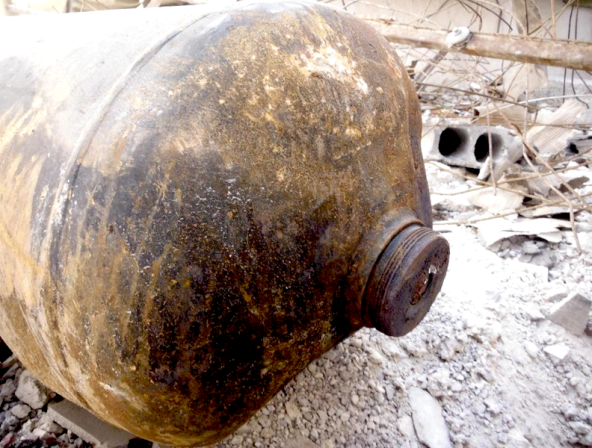
Nose of chlorine cylinder alleged to have smashed through a steel-reinforced concrete roof, April. 21, 2018. (OPCW, courtesy former Syrian government)
Worse still for the prevailing Douma narrative, Dr. Whelan recently won a legal case against the OPCW for their charges against him of confidentiality breaches.
In their submissions, the OPCW inadvertently admitted to suppressing the key toxicology assessment (incidentally by NATO specialists) that dismissed chlorine as the likely cause of death of deceased victims shown in images posted from the scene.
The OPCW has refused to engage in any discussion on the facts and scientific substance of the case, ever since concerns were first raised by Dr. Whelan and myself.
This intransigence to re-open the file is likely dictated by the needs of the three belligerent governments that subjected Syria to punitive missile strikes in retaliation for the supposed Syrian chemical attack even before the Douma F.F.M. had started work.
Any updated or corrected findings on Douma would be inconvenient.
The New OPCW Mission
Still apparently seeking to prove its case, the OPCW formed a new Syria mission in May aimed at “finding” alleged missing, un-declared chemical weapons.
At the end of May the mission reported finding 42 empty chemical weapons munitions; a launcher; bomb-mixing units; precursor-type containers; a facility whose contents were not revealed and thousands of pages of documents that are still being reviewed.
The mission also found 650 kg of “a chemical compound known to have been used by the former government for the production of nerve agents,” which the report does not name. It says an unknown quantity of hexamine, a legal chemical with wide industrial use, was found but it is not clear if this is the same compound as in the 650 kg.
In September, the Syrian government, now under the leadership of a former al-Qaeda and ISIS leader, began destroying the empty bombs, but not any of the chemicals that were found, presumably meaning none were banned.
Despite all the fanfare of these results being presented at a U.N. Security Council meeting last month, it appears that the new OPCW mission came up as empty as those bombs.
None of these discoveries does anything to prove that Assad ever used a chemical weapon, in other words, nothing to prove that I, along with other OPCW officials and countless observers and commentators who challenged the Assad chemical weapons narrative were wrong.
Presumably after all the effort in creating that narrative, Western governments and mainstream media that promoted the Iraq war and then the Syrian conflict to achieve regime change in that country, require a tidier ending than the mess they made of the Iraqi WMD story.
An early press release from the OPCW is telling. It shows what they were attempting to prove with this May mission, in particular two rather flimsy suggestions.
They report the discovery of some of the empty munitions,
“including the same type of aerial bombs that were used in chemical attacks in Ltamenah in March 2017 and Khan Shaykhun in April 2017.”
This refers to empty M4000 aerial bombs, declared by the Syrians as part of their stockpile.
Aside from the questionable Douma-like irregularitiessurrounding “evidence” used by the OPCW to conclude that sarin-filled M4000 bombs were used in those attacks, it’s important to mention something else.
The Syrians had clearly explained to us that 2,000 of these bombs, never filled, had been set aside to be “repurposed,” in other words to be filled with high explosive to turn them into conventional munitions. These could turn up anywhere.
A second questionable statement in the press release is,
“Rockets were also found, of the same type as those that were used in the Ghouta chemical weapons attack in August 2013.”
This relates to artillery rockets crudely modified with a large cylindrical payload container added at the front.
For a start, the U.N./OPCW report of Ghouta did not attempt to identify the perpetrators of that sarin attack, since it was not part of their mandate. The accusations against the regime have always been political, something the mainstream media happily took up.
The Most Credible Analysis So Far
The Ghouta sarin attack took place on Aug. 21, 2013 and according to Western sources killed more than 1,000 people in the Damascus suburb.
The most serious investigation of the Ghouta incident to date points to the attack being launched from opposition-occupied positions, and remains the most credible analysis of the attack.
The opposition forces allegedly responsible were from the al-Nusra Front, which conducted joint operations in 2013 in the Damascus area with the Liwa Al Islam opposition group. Al-Nusra were known to be in possession of sarin, according to reporting by Seymour Hersh, who wrote:
“In the months before the [Aug. 21, 2013] attack [in Ghouta], the American intelligence agencies produced a series of highly classified reports, culminating in a formal Operations Order – a planning document that precedes a ground invasion – citing evidence that the al-Nusra Front, a jihadi group affiliated with al-Qaida, had mastered the mechanics of creating sarin and was capable of manufacturing it in quantity. When the attack occurred al-Nusra should have been a suspect, but the administration cherry-picked intelligence to justify a strike against Assad.”
Indeed the U.N./OPCW team was in Damascus at the time of the attack in Ghouta because it was responding to an earlier request from the Syrian government to investigate chemical attacks against their forces.
The OPCW release also mentions a typical catch-all referring to “quantities of separately stored chemicals and related equipment, the nature of which is currently under technical analysis.”
There will always be suggestions of vague bits and pieces, rusty remnants that “may have been a part of” alleged undeclared elements of a chemical weapons program.
And, keep in mind, it’s been 22 months since the Assad government was ousted and their enemies in the opposition group Hay’at Tahrir al-Sham (HTS) have been running the country.
So far as I can see, the OPCW hasn’t found anything remotely close to the desired smoking gun. Anything real, I should say.
Partners in the Anti-Assad Chemical Narrative
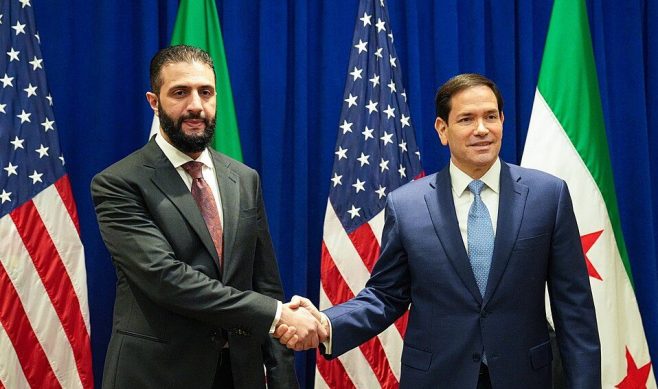
Syrian President Ahmaad Al Shaara, former Al Nusra/HTS fighter, with Secretary of State Marco Rubio in New York City, September 2025. (State Department Photo, Wikimedia)
We need to keep in mind how this is working. There are three partners in this latest endeavour on the anti-Assad chemical narrative.
First, we have the Western governments, belligerents in the Syrian conflict, which worked hard on building the chemical narrative to delegitimise the regime.
The U.K. government offered specialists to check out suspected sites in Syria to prepare them for the May mission in order to “assist” the current government in finding evidence of hidden chemical weapons.
That leads us to the second group, the government in Syria, reportedly eager to please their Western sponsors in return for economic favours. They are the Al-Nusra/HTS extremists who, in the case of Douma, fabricated the scene to raise a chemical false flag allegation against the Assad.
The third partner is the OPCW.
That means the various groups who have been on this mission are a) those who staged scenes of chemical attacks; b) those who directed them to do so (including Western intelligence agents who allegedly coached and assisted them); and c) the organisation that went along with the narrative and dutifully produced reports damning the Assad regime.
It may appear to the reader that I’m suggesting that the OPCW reports on Syrian chemical weapons will continue to be little more than propaganda, the usual sexed-up nonsense. Perhaps so. In disputing this, these assertions will be dismissed as conspiracy theories.
However, this argument is weakened because the source of the alternative narrative is the scientists and senior inspectors (many “Western”) from within the OPCW teams, including the Douma fact-finding mission and Scientific Studies and Research Centre inspections.
This is why Douma remains a key element in the debate. If they did it once (and doggedly stuck to their guns), they probably did it before.
Many serious and eminent observers are imploring the OPCW to conduct a review of the Douma case, including by the OPCW’s own Scientific Advisory Board.
I see this being done by credible, independent and neutral experts in the fields of chemistry, toxicology, metallurgy and engineering, overseen by the relevant professional institutes.
These experts would report their findings transparently, putting their names and reputations behind their analysis. This will clear up the Douma controversy, either demonstrating that it could have actually happened as alleged, or demonstrating the flaws in the OPCW reports.
Exposing a clear and deliberate fraud would seriously weaken the Western narrative on alleged Syrian chemical attacks. Therefore, in my view, it is not going to happen under the purview of the OPCW.
Ever.
I don’t mean to suggest that those calling for a review are unrealistically hopeful. But the risks of such a review are perhaps too high for it ever to be envisaged by the Western group that was aligned with the efforts on regime change in Syria — chiefly the U.S., the U.K. and France.
This does not mean it can’t happen. There is more than enough open-source material, as well as now-unclassified facts, images, analysis results and information available from the OPCW itself, from former OPCW officials and inspectors, and held by Member States, that would support a credible in-depth review.
The basis for expert analysis would be the material used in the fact-finding mission and I.I.T. reports themselves.
By now we know there isn’t any “smoking gun” evidence. If there had been, it would have been cited in the mission and I.I.T. reports.
Trust me, this study will bear clear results. My hope is that someone sufficiently curious and responsible will commission and fund it.
Ian Henderson served as an OPCW inspector from the establishment of the Chemical Weapons Convention in 1997, and was appointed as one of the first Inspection Team Leaders. An experienced chemical engineer with military experience, he led many of the more complex missions to more than 55 countries. After returning to a career in the chemical industry for 10 years he rejoined the OPCW in 2016 as part of the “rehire” scheme aimed at bringing back experienced inspectors. It was during this time that he became involved in the Syrian chemical weapons operations and, along with others, objected to the apparent influences of political control in the organization. He was suspended from the OPCW in May 2019 after the leak (by unknown others) of his dissenting engineering report on the Douma cylinders.
The UN should resist pressure from Kiev’s Western backers and finally address the issue of widespread abuse of captured Russian servicemen in Ukrainian secret prisons, Russian Ambassador-at-Large Rodion Miroshnik has said.
During a conversation with the chairman of the UN Committee Against Torture Claude Heller on Thursday, Miroshnik said that Moscow is aware of a whole network of such detention facilities, operating in Ukraine’s Kharkov, Dnepropetrovsk, and Sumy Regions as well as in the country’s capital, Kiev.
The Russian servicemen are “going through hell” in so-called “transit prisons,” which are set up at deployment points of Ukrainian military units and nationalist battalions, he said.
“The thugs, who hide their faces behind masks… and address each other only by their call signs, subject the captured Russian troops to inhuman abuse. Waterboarding, electrocuting, baiting with dogs and amputations performed without anesthesia are just a few examples of the techniques systematically employed by the Ukrainian tormentors,” the envoy, who is charged with documenting Kiev’s war crimes, stressed.
According to Miroshnik, captured troops are usually sent to those facilities in the early stages of their imprisonment, where they are held in cages, pits, and stone dungeons.
The Kiev government does not allow ombudsmen and human rights activists into those “torture chambers,” but the Russian authorities have gathered hundreds of accounts of survivors detailing what has been happening there, he said.
“This information had been passed on to the UN Secretariat on more than one occasion,” but no action followed, Miroshnik added.
By ignoring the existence of the secret prisons and systematic torture of Russian troops, the global body “encourages the spread of such criminal practices and disregard for the relevant UN Convention,” he added.
“Many experts are aware of this disgraceful phenomenon, yet there is a lack of political will to overcome the pressure from the foreign accomplices to the conflict, who shield the Kiev regime from accountability and prevent a thorough investigation of its conduct,” the envoy said.
While turning a blind eye to the torture of Russian troops, the UN published several reports accusing Russia of mistreating Ukrainian prisoners, based on accounts by POWs returned by Moscow to Kiev. Russian Foreign Ministry spokeswoman Maria Zakharova has labeled those accusations of abuse “disinformation.”
Last month, Russian Foreign Minister Sergey Lavrov said that the UN Secretariat was unable to properly perform its duties as most key positions are occupied by representatives of NATO countries.
The current team, led by [UN General-Secretary] Antonio Guterres, who is a Portuguese national, “promotes biased approaches and double standards, effectively serving the interests of a group of Western nations,” Lavrov insisted during a press conference on the sidelines of the UN General Assembly in New York.
BEIRUT – The number of books destroyed by Israeli bombings of libraries, as well as religious and cultural institutions since October 2023, has exceeded 3 million copies, founder and coordinator of the National Network for the Protection of Libraries, Archives, and Cultural Heritage in Lebanon Hadi Bekdash told Sputnik on Saturday.
“There are reports of the burning of more than 700,000 books belonging to Lebanese and Arab publishers, as well as more than 3 million books from homes, libraries, religious centers, family collections, researchers’ libraries, and universities, publishers, cultural institutions, and private collections since 2023,” Bekdash said.
In 2026, practically confirmed information appeared about the destruction of dozens of public and hundreds of private libraries during the conflict with Israel, he added.
These data do not reflect the full scale of losses, since Lebanon still does not have a unified national database of destroyed libraries, archives, and book collections, the coordinator said.
Bekdash added that it will be possible to finally assess the damage only after conducting a nationwide inventory of lost and damaged collections.
A national campaign, A Million Books for Lebanon, is currently underway in the country, aimed at restoring destroyed and damaged libraries.
Russia’s Foreign Ministry has warned citizens to exercise caution when traveling abroad “amid a worldwide hunt for Russians.”
The statement follows the detention of Russian military blogger Mikhail Zvinchuk in Montenegro, a NATO member state in the Balkans, on October 9.
After nine hours in custody, Zvinchuk, founder of the Rybar Telegram channel, his wife and three associates were expelled from the country on the grounds of what Montenegro’s leading daily, Vijesti, described as “criminal, operational and intelligence processing.”
“We are compelled to once again remind people of the need to remain vigilant when traveling abroad, even if there is the slightest suspicion of any kind of claims by US law enforcement agencies, amid a worldwide hunt for Russians,” Foreign Ministry spokeswoman Maria Zakharova said on Friday.
Montenegro, where the blogger was detained, is not on Russia’s list of unfriendly states, Zakharova said, adding that similar situations were unfolding in countries not considered unfriendly to Russia.
The arrest was described as targeting alleged “hybrid activity” by the Rybar network, but no specific evidence supporting the accusation has been presented.
Kremlin spokesman Dmitry Peskov declined to comment on the details of the arrest but warned Russian citizens that visiting Europe is “currently dangerous.”
The Rybar channel, which has around 1.3 million subscribers, had previously also faced US and British accusations of spreading Russian propaganda and conducting information operations abroad. The US State Department had even issued a $10 million bounty in 2024 for any information about the individuals behind the channel.
Russians who have been targeted include basketball player Daniil Kasatkin, a point guard playing for the national team, who was arrested at Paris airport in June 2025 at the behest of the US, which accused him of being a member of a ransomware gang. He denied the allegations and was released in January 2026 as part of a Russia-France prisoner exchange.
On June 10, 1975, Dr. Chester Stock, a vice president at Memorial Sloan-Kettering Institute for Cancer Research, wrote to a Canadian nurse named Rene Caisse: “Enclosed are test data in two experiments indicating some regressions in sarcoma 180 of mice treated with Essiac.” The sentence sat in a letter from one of the world’s largest private cancer research centers, concerning an herbal tea an elderly English woman had learned from an Ojibwa medicine man at a northern Ontario mining camp in the 1890s. The tests were terminated the following year after Sloan-Kettering admitted, in sworn affidavit three years later, that they had prepared the injectable solution improperly from the dried material supplied — freezing and thawing the herb rather than boiling it as Rene had instructed. By the time Calling of an Angel was published in 1988, Rene Caisse had been dead for a decade, having treated thousands of cancer patients across fifty-six years in her Bracebridge, Ontario kitchen, never charging a fee, and refusing every offer — from Memorial Sloan-Kettering, the National Cancer Institute, Merck, Parke Davis, and private corporations dangling contracts up to $1 million — to release her formula before the medical establishment admitted her remedy had merit.
Dr. Gary Glum was a Los Angeles chiropractor running a thriving practice treating professional athletes, world-class weight lifters, and NFL team members when a friend introduced him to one of Rene’s cured patients in 1985. His prior work included a pain-relief technique contracted by Baptist Hospital in Nashville, Tennessee for its orthopedic pain control unit. He wrote the book after a year of persuading Rene’s friend to release the formula, after reading Rene’s own papers that Mary McPherson had kept in boxes under her bed in Bracebridge, after flying to Cambridge Massachusetts to meet Dr. Charles Brusch — the physician who had treated John F. Kennedy for Addison’s disease and who had worked with Essiac in his own clinic since 1959 — and after his own chronic bronchitis cleared within days of drinking the tea. He wrote as an outsider to oncology, which the summary treats as the position he actually held rather than disguising it.
The book appeared in 1988, in the sixth year after the Canadian government had shut down Resperin Corporation’s trials of Essiac, calling the quality control flawed while admitting the preparation itself was safe. Seven years earlier, the Washington Post had reported that over the previous decade more than 150 experimental cancer drugs had been given to tens of thousands of patients under National Cancer Institute sponsorship, many derived from pesticides, herbicides, and industrial dyes, producing hundreds of deaths and a list of adverse reactions including kidney failure, liver failure, bone marrow destruction, paralysis, coma, and in some cases tumor stimulation. An FDA official told the Post : “Almost all investigational cancer drugs are highly toxic.” Fluorouracil, 5-FU, carried a manufacturer’s warning that therapeutic benefit was unlikely without evidence of toxicity. Against this backdrop sat a non-toxic herbal preparation with six decades of documented clinical results, which no major institution would investigate without first obtaining the formula, and which no major institution would acknowledge after obtaining it. Nixon’s 1971 “War on Cancer” had absorbed billions of dollars by the time Rene died in 1978. The war’s chosen weapons were the ones the Post had described.
Calling of an Angel sits in the terrain canon as a documented record of what happens when a non-toxic remedy that strengthens the body’s own repair processes confronts an industry structured around patentable toxic interventions — the pattern Rene saw plainly, writing in the 1950s that cancer was systemic rather than localized, that surgery and radium attacked symptoms rather than causes, and warning in the same era about pesticides, food additives, and atmospheric nuclear testing years before Rachel Carson and President Kennedy made those warnings mainstream. The full summary unpacks the 1939 Royal Cancer Commission hearings, where 387 of Rene’s patients traveled to testify under oath and only 49 were permitted to speak while 338 were sent home; Dr. Charles Brusch’s own cancer in 1973 and his continued use of Essiac for the thirty years that followed; the eleven-year survival of esophageal cancer patient Patrick McGrail and the step-by-step documented reversal of Ross Nimchick’s stage 3-4 lymphoma with 95% node reduction; and the Catch-22 that held across six decades — Rene would release the formula once the institutions admitted merit, the institutions would admit merit once Rene released the formula, neither side moved, and the herbs grew wild across Ontario the whole time, available from any major herbal distributor in America for under $50.
30 Q&As
Question 1: What did Rene Caisse learn in 1922 from the elderly woman recovering from surgery in Haileybury, Ontario, and how did that encounter alter the trajectory of her life?
Answer: The woman was nearly 80 and bore a badly scarred right breast. She had come from England thirty years earlier to join her husband prospecting in northern Ontario, where she developed a swollen, painful mass that Toronto doctors diagnosed as advanced breast cancer requiring immediate removal. She refused surgery — a friend had recently died from the same operation and she could not afford it anyway. An Ojibwa medicine man at the mining camp told her he could cure her with an herbal tea and showed her how to prepare it. She drank the tea daily, her tumors diminished and disappeared, and she lived more than two decades cancer-free. Rene, then a 33-year-old surgical nurse held in high regard by the physicians she assisted, wrote down the names of the herbs the woman recited.
A year later, Rene was walking in the garden of an elderly retired doctor she knew. He lifted a weed with his cane and said, “Nurse Caisse, if people would use this weed there would be little or no cancer in the world.” He named the plant — the same name the old woman had given as an ingredient of the medicine man’s tea. The convergence settled the matter in Rene’s mind. She would spend the next 56 years brewing the formula in her kitchen, treating thousands of patients without charge, fighting the Canadian government and medical establishment through near-arrests, parliamentary battles, and a national Royal Commission, and never once veering from the conviction formed that day in a hospital room and sealed in that garden.
Question 2: How did Rene first apply the herbal formula to a family member, and what role did her mother’s recovery from inoperable liver cancer play in her commitment to the work?
Answer: About the time Rene opened her clinic in Bracebridge in 1935, her 72-year-old mother was diagnosed with inoperable cancer of the liver. Four local doctors said she was too weak for surgery. Rene called in one of Ontario’s top specialists, Dr. Roscoe Graham, who confirmed the diagnosis and reported that the liver was “a nodular mass.” Asked how long her mother had to live, Dr. Graham said a matter of days. One local doctor who disapproved of Rene’s work asked her sarcastically why she did not do something. Rene replied she was certainly going to try. She did not tell her mother the diagnosis. She administered daily injections of Essiac, calling it a tonic prescribed by her doctor.
Her mother completely recovered. She lived to 90 and died quietly after her birthday, in Rene’s words, “without pain, just a tired heart.” Rene said this one case repaid her for all her work — giving her mother eighteen years of life she would not otherwise have had — and made up for a great deal of the persecution she had endured. The case carried additional weight because the attending specialist was no obscure country doctor but one of the province’s leading physicians, and because the diagnosis had been confirmed by four other doctors before Essiac began. It was the kind of case Rene could never fully use in her public campaign, because it was her mother, but it was the case she returned to in her own mind whenever the attacks on her work grew unbearable.
Question 3: What happened when the Canadian Department of Health and Welfare sent two doctors to arrest Rene in 1926, and how did Dr. W.C. Arnold’s reversal shape the pattern that would recur for decades?
Answer: The department dispatched two doctors to Rene’s door carrying official papers authorizing them to arrest her or restrain her from practicing medicine without a license. Rene was badly shaken but explained that she was treating only patients abandoned by their physicians as terminally ill, that she charged nothing, and that she accepted only voluntary contributions. She showed them her reports, her letters from physicians, her records. They listened, decided to back off, and told her they were not going to have her arrested or order her to stop. One of those two doctors was Dr. W.C. Arnold. He left so impressed by what he had seen that he arranged for Rene to conduct experiments on mice at the Christie Street Hospital in Toronto under the supervision of two of the hospital’s physicians. The mice were inoculated with Rous Sarcoma, and Rene kept them alive 52 days — longer than anyone else had been able to.
Arnold went on to become chief physician of the Canadian Pension Board. He corresponded with Rene for the next fifteen years, writing long letters of encouragement, advising her through political battles, helping her round up support, and always pressing her to release the formula to him. The pattern established in that first encounter would recur through every decade of Rene’s working life. Officials arrived to shut her down and left persuaded. A health officer sent to Peterborough with a warrant for malpractice sat down, listened, and returned to his superior to explain the situation instead of arresting her. In 1958, nearly thirty years later, an officer again came to arrest her, heard her out, and told her to stop treating patients rather than take her in. The threats never stopped and the arrests never came, because the people sent to execute them kept finding something they could not reconcile with the task they had been given.
Question 4: What did the 1926 petition signed by eight physicians say, and why did Rene later describe the petition as “the opening gun in the war over Essiac”?
Answer: The petition was signed by R.O. Fisher, R.A. Blye, C.E. Becker, E.F. Hoidge, J.A. McInnis, Chas. H. Hair, A. Moore, and W.F. Williams, with J.N. Robert also attached. These were licensed physicians staking their professional reputations on an endorsement of a nurse without a medical degree who was treating cancer with an herbal tea in her apartment. Rene was, in her own words, “joyful beyond words at this expression of confidence by such outstanding doctors regarding the benefits derived from my treatment.” She was naive enough to believe that her work would now be recognized and advanced through official channels. She assumed that the signatures of eight physicians would open doors rather than close them.
Her joy was short-lived. The petition backfired entirely. The Department of Health and Welfare interpreted the document not as evidence of a promising remedy but as evidence of a nurse practicing medicine, and immediately dispatched the two doctors with authority to arrest her. For the next fifteen years she lived under siege. The pattern the petition inaugurated — supporting physicians speaking up at professional cost, the medical establishment moving to shut her down, Rene narrowly surviving each threat — would repeat continuously. By 1936, a second petition carried nine physician signatures, seven of them new, bringing the total to sixteen licensed physicians who had publicly backed her work. By 1937, forty doctors joined a 17,000-signature petition to the Ontario government. The war the first petition opened would run until her death in 1978 and beyond.
Question 5: How did Rene’s clinical practice work in operational terms — the requirement for a written diagnosis, the no-charge policy, the kitchen brewing, the patient volume at peak?
Answer: Rene accepted only patients who brought a written cancer diagnosis from a licensed physician. The requirement was both legal protection and medical gatekeeping — she would not treat someone who had not been examined and diagnosed by qualified doctors first. In practice this meant most of her patients had already been through surgery, radium, X-ray, or chemotherapy and been declared terminal or inoperable. She charged nothing. She accepted voluntary contributions — fruit, vegetables, eggs from those who had them, nothing from those who did not. One grateful husband who slipped a $50 bill under a book on her shelf was yanked into the house by his collar on his next visit and given a piece of her mind until he reframed it as a donation for the next patient who could not pay. “I never had $100 I could call my own,” she used to laugh with friends.
The brewing was done alone in her kitchen, late into the night. She stayed up half the night cooking Essiac after days spent treating as many as thirty patients at her Toronto apartment, later hundreds a week at the Bracebridge clinic. The scene at peak was described by Homemaker’s magazine as reminiscent of the Shrine of Lourdes — cars parked solidly along the shoulders of Dominion Street, people from all walks of life waiting patiently to enter the red brick British Lion Hotel building, some carried, others helped up the steps, ambulances arriving to double-park while Rene came down to treat stretcher cases. A doctor stood by as she injected scores of patients every day. The administrative apparatus was Rene herself. There were no staff, no fees, no advertising. The system ran on her refusal to stop and the word-of-mouth of patients who credited her with their lives.
Question 6: What did the documented cases of Mrs. DeCarle, Mr. F. Maxwell, and John Tynan establish about what Essiac was producing in patients who had been written off by their physicians?
Answer: Mrs. DeCarle was a 55-year-old woman examined by Dr. J.A. McInnis in late 1928 with a hard, nodular tumor in her upper abdomen and another distinctly palpable mass in the region of the uterus. Two specialists in Brockville had confirmed malignancy and given her several months to live. The case was inoperable. McInnis documented in a two-page single-spaced letter dated March 22, 1929 what happened under Essiac. After ten days of treatment, improvement was observed in both the patient’s general condition and the two tumors. The abdomen became less rigid, appetite returned, pain after eating lessened considerably. By March the tumor in the upper abdomen had reduced by more than two-thirds, the nodular condition had entirely disappeared, the pelvic tumor was scarcely palpable, and Mrs. DeCarle had gained twenty pounds. McInnis concluded the results were “decidedly remarkable” and “conclusive.”
Mr. F. Maxwell had been diagnosed in February 1932 with malignant disease of the pancreas by Dr. J. Masson Smith of Beaverton, who addressed Rene with a curt “Dear Madam” letter. Five weeks later Smith wrote again. He could not have been friendlier. Maxwell had gained seven and a half pounds, his hemoglobin was ninety percent, and he moved with vigor and alertness. Five years later Maxwell himself wrote asking Rene to treat his brother. John Tynan had been diagnosed by four doctors with rectal cancer and given about three weeks to live. The surgeons had opened him up, found they could do nothing, and sent him home to die. Within 24 hours of his first Essiac treatment he felt relief; within four days, a wonderful change. After his first few treatments he could drive himself to the clinic. Four years later he had gained 39 pounds. These were not isolated anecdotes. They were documented in physician letters, pathological reports, and sworn testimony — and the pattern they established repeated across hundreds of cases over the next five decades.
Question 7: What specific offer did Sir Frederick Banting extend to Rene in 1936, why did she refuse it, and what did she tell him about leaving her patients to inject mice?
Answer: Banting was publicly credited as the co-discoverer of insulin and ran his own research facility, the Banting Institute at the University of Toronto. His offer, extended in July 1936 after a meeting arranged by Ontario Minister of Health Dr. Faulkner, was that Rene could work under his supervision in his laboratory, performing tests on animals. “You will not be asked to divulge any secret concerning your treatment,” Banting wrote. All experimental results would be submitted to him for approval before being announced to anyone, including the newspapers or published in medical journals. The catch was that Rene would have to prove the merit of Essiac on lab animals before treating any more human patients. She would give up her clinic for months, possibly years, while she injected mice.
Rene refused. She wrote to Faulkner on August 4, 1936 explaining that her relatives and friends did not approve of her going back to animal research when she had already proven the merit of her treatment on human beings — and that they therefore absolutely refused to help her financially. Since she could not charge her patients, she had no means to carry out what she had not the means to do. She later told reporters: “I felt it was inhuman for them to ask me to give up treating patients while I showed them whether it would work on mice. I’d already done work on mice. There was a big uproar about it because the patients were terrified I would leave them, but many doctors said I should jump at the chance to work with Dr. Banting. I said I’d be willing to, but I’m not going to let people die while I do it. It was an agonizing decision, but I refused his offer.” According to Rene, Banting had told her that what he had seen of Essiac showed more promise than any other cancer treatment he had encountered, and he had been particularly impressed by one case in which a diabetic cancer patient was taken off insulin during Essiac treatment and the diabetes did not worsen — leading him to speculate that Essiac must have stimulated the pancreatic gland into functioning properly.
Question 8: How did the Bracebridge town council come to turn over the British Lion Hotel to Rene in 1935, and what did the scene at her clinic look like at its peak?
Answer: The town of Bracebridge turned the old British Lion Hotel over to Rene for use as a cancer clinic, subsidizing the arrangement partly through municipal funds. Dr. A.F. Bastedo was the physician who persuaded the Bracebridge City Council to make the decision. The red brick building sat on Dominion Street, with the town jail directly across the street — the keeper of which used to joke with Rene that he was saving her a cell. The clinic opened as the political battle over Essiac was starting to heat up, and it transformed the small lumber-and-fur-trapping town into the destination of cancer patients from across North America.
Homemaker’s magazine described the scene in the 1930s as reminiscent of the Shrine of Lourdes. Dominion Street took on an atmosphere of pilgrimage. Cars were parked solidly along the shoulders. People from all walks of life waited patiently to enter the red brick building. Some were carried. Others were pushed gently up the steps while the rest managed on their own. Ambulances shrieked their arrival as they double-parked, and Rene would be seen coming quickly down to treat a stretcher case. Always with a doctor standing by, she injected scores of patients every day. One Bracebridge boarding house ran by the mother of a man Mayor Jim Lang later knew hosted dozens upon dozens of patients at a time, staying two, three, or four months while they took treatments. People came from Timmins, Sault Ste. Marie, the United States, Europe. The village of about 9,300 people became the center of a national controversy that would reach the floor of the Ontario legislature and make headlines all over the continent.
Question 9: What did Dr. Emma Carson of Los Angeles find during her month-long investigation in Bracebridge in 1937, and what did she tell the Ontario government about non-recognition?
Answer: Carson traveled from southern California in the summer of 1937 intending to stay a couple of days to satisfy herself that there was nothing to the story. Her friends who had told her about Rene were reliable people, but she arrived skeptical. She ended up staying almost a month and becoming a close friend of Rene’s. In her first interview with the Huntsville Forester a week after her arrival, she could barely contain her enthusiasm. She was “simply amazed” at what she had found in her brief investigation, and the farther she investigated, the stronger became her conviction that Rene had made a cancer treatment discovery of worldwide importance. She called upon the government to recognize Rene’s work.
Carson’s conclusion to the Ontario Medical Council, delivered through a five-page report later released to the press, was blunt: if in view of what she had seen with her own eyes the council remained indifferent, it would be “a crime against civilization.” She found that the vast majority of Rene’s patients had been brought to her after surgery, radium, X-rays, and emplastrums had failed to help, with the patients pronounced incurable or hopeless. The progress obtainable and the actual results from Essiac treatments, she wrote, and the rapidity of repair, were “absolutely marvelous, and must be seen to be believed.” As she reviewed case histories and interviewed patients, she realized her skepticism had deserted her. She said she would go directly to Premier Hepburn’s office and give him her report. She never changed her mind. She corresponded with Rene for years after returning to Los Angeles, and her report, quoted at length in several newspapers, became one of the central pieces of documentation in the public campaign that followed.
Question 10: How did public support for Rene build between 1935 and 1938 through petitions, and what did the final 55,000-signature petition precede?
Answer: The grassroots pressure built in stages, each petition larger than the last. In late 1935, local residents of the Bracebridge area rounded up thousands of signatures on petitions demanding government backing for Rene’s work, presented to Dr. Faulkner alongside a second physician petition with nine signatures that brought the licensed-doctor endorsement total to sixteen. In 1936, the mayor of Bracebridge, Wilburt Richards, visited Faulkner’s office with a group of prominent citizens and a petition of 2,700 signatures. In March 1937, a deputation went to the government offices in Toronto consisting of local officials, 40 doctors, and 18 of Rene’s patients, carrying a petition that now bore 17,000 signatures. The composition itself was telling — this was no fringe gathering but a cross-section of ministers, mayors, physicians, and recovered patients.
By early 1938, the number had reached 55,000. The petition was presented to the Private Bills Committee of the Ontario legislature as it considered a bill that would authorize Rene to treat cancer patients with Essiac. Fifty of Rene’s former patients watched from the visitor’s gallery. The debate was fierce. One of Rene’s patients stood up and yelled out that three doctors had refused to give her mother a written cancer diagnosis for Rene though they had given it verbally. The gallery erupted in cheers. The Speaker threatened to clear the room. When the vote came there was confusion, a flood of motions, and the chairman recognized a motion that the bill not be reported. A show of hands indicated a narrow margin in favor of rejecting it. Rene’s bill was defeated by three votes. Within days the Kirby Bill passed, creating the Cancer Commission and effectively criminalizing her practice. The 55,000 signatures had come within three legislators of making her the first private citizen in Canadian history to be licensed by statute to practice medicine without the proper credentials.
Question 11: What happened in the Ontario Private Bills Committee in March 1938, and how was Rene’s bill defeated?
Answer: The committee considered a bill that would authorize Rene to treat cancer patients with Essiac. The 55,000-signature petition was presented. Fifty of Rene’s former patients watched from the visitor’s gallery. J. Frank Kelly, the MP from the Bracebridge area and an ardent backer, argued that Rene had been “hounded around the country for years like a criminal” and that even if she had no cure, she could prolong life — just as Sir Frederick Banting could prolong life with insulin without curing diabetes. L.M. Frost asked whether Rene was not already carrying on. Kelly answered that she was, but without fee and without recognition. Rene’s lawyer John Garrick claimed that doctors were refusing to give diagnoses to patients wanting Rene’s treatment and that a cabal had been organized against her. Some MPs shouted “Untrue” and “Shame.” At that, one of Rene’s patients stood up and declared that three doctors had refused to give her mother a written diagnosis though they had given it verbally. The gallery erupted. Speaker David Croll threatened to clear the room.
Dr. M.T. Armstrong, MP from Parry Sound, said he had talked to practically every medical doctor in the legislature and there was not one against her. W.A. Summerville said he had heard from all sorts of people claiming to have been helped. T.F. Stevenson, whose wife had been treated, made an impassioned plea: “Why hold this woman up? You won’t do any harm by passing this bill and it’s inhuman to stop it.” Rene herself spoke, declaring she would submit her formula to any investigating commission on one condition — that the medical profession admit Essiac had merit based on the results she had already obtained. When the time for the vote came, newspaper accounts described confusion, many voices speaking at once, and a flood of motions. The chairman recognized a motion that “the bill be not reported,” and a show of hands indicated a narrow margin in favor of rejecting it. The newspapers reported that Rene’s bill had been defeated by three votes.
Question 12: What was the Kirby Bill, and how did Minister of Health Harold Kirby’s public assurances contradict the law’s actual operation?
Answer: The Kirby Bill passed into law within days of the Private Bills Committee’s defeat of Rene’s bill. It created a Royal Cancer Commission with authority to investigate unorthodox cancer treatments and, after finishing its investigation, to compel Rene to turn over her formula. It effectively criminalized the practice of medicine by anyone treating cancer without proper credentials. Rene immediately announced that because of the Kirby Bill she was closing her clinic. The press and the public flocked to Kirby’s door. Kirby publicly stated that nothing in the Act prevented Rene from carrying on as she had been doing in the past, and that she was in the same position after the bill as before it. He told reporters this directly and put it in writing to Rene’s lawyer.
Rene called it nonsense. Dr. Noble of the College of Physicians and Surgeons had informed her that they were going to demand her formula if she kept the clinic open. She knew the law was the law, and if the government wanted her to open her clinic, they should change the law. The clinic remained closed. The pattern that followed went on for the better part of two years. Rene would close, saying the Kirby Bill made her a criminal. Kirby would publicly deny the law was being enforced and urge her to reopen. Patients would weep, faint, and plead. Mayors would send angry telegrams to Premier Hepburn. Rene would reopen. Someone would then frighten her that Kirby was coming after her, and she would close again. The Bracebridge Gazette editorialized that if a cancer sufferer died while the clinic was closed there would be a veritable roar of bitter condemnation and the target would not be Rene. The Kirby Bill was still the law. The government had publicly promised not to enforce it. Both conditions remained in place simultaneously, which was precisely how the government had designed the arrangement.
Question 13: What was the structure of the 1938-39 Royal Cancer Commission hearings, how many patients came to testify, and how many were permitted to speak?
Answer: Six physicians with expertise in diagnostics, surgery, and radiology were named as members in late August 1938. The chairman was J.G. Gillanders, an Ontario Supreme Court Justice. They were charged with investigating several unorthodox cancer treatments in use in Canada, but the focus was clearly on Rene and Essiac. Preliminary sworn and secret testimony was taken from several patients in Bracebridge in February 1939 by two Commission members with Dr. B.L. Guyatt serving as mediator. The main event was scheduled for early March 1939: public hearings before the full Commission at the Royal York Hotel in Toronto. Rene’s supporters mobilized. So many came that Rene had to rent one of the hotel’s ballrooms as a gathering place.
Among those present were 387 former patients from across Canada, prepared to wait their turn to be sworn to oath and tell their stories. The Commission was not interested in hearing from 387 witnesses. Commissioner Valin complained, “She’s got an army of people here.” Ultimately, pleading the pressures of time, the Commission allowed only 49 to testify. The remaining 338 waited in the ballroom and were sent home. The hundreds of pages of transcript from those 49 sworn witnesses are filled with heart-rending testimony — complete recoveries after near-death, partial recoveries when all else had failed, the consistent theme of pain relief within days. George Mahon testified, “She helped me. If it was not for her, I would be buried.” Elizabeth Stewart told how her doctor had sent her home two years earlier to make out her will; now she was milking five cows morning and night, running a boarding house, and doing it all herself. The structure guaranteed that the record would be incomplete — 338 witnesses whose cases were never heard, their testimony never entered, their existence noted only in the ballroom count.
Question 14: What did May Henderson, Eliza Veitch, Augusta Douglas, and other sworn witnesses testify to under oath before the Commission?
Answer: May Henderson’s testimony was perhaps the most dramatic. After thirty years of chronic ill health, her doctors told her that her whole body was riddled with cancer and that they would have to remove both breasts and most of her insides. She was not up to the torture of that and basically gave up on living. “My eyes just looked like stones, and I simply hadn’t any life in me. I couldn’t walk.” Someone told her about Rene. She dragged herself to a doctor for the required signed diagnosis — he told her it was useless, she would not last long anyway, but he gave her the paper. Right away she noticed a wonderful change. She slept better, ate better, and after about 65 treatments was able to take temporary work. Asked if she regarded herself as cured, she answered: “Well, pretty nearly.” She was still alive and corresponding with Rene nearly forty years later.
Eliza Veitch had been operated on in 1935 for cancer of the bladder. The cancer returned and she gradually went downhill, unable to stand on her feet without terrible pain. She refused further treatment, deciding to die rather than be tortured again. In May 1938 she went to Rene after seeing neighbors cured. For eight treatments she noticed no change, then had a bad reaction that proved to be the turning point. “I owe my life to Miss Caisse. I would have been dead and in my grave months ago.” Augusta Douglas had been diagnosed with cervical cancer in August 1938 and told she needed radium. She refused — “With my boots on.” She was carried to Bracebridge on a mattress in the back of a car, unable to tolerate any jolt. After six weeks flat on her back in bed receiving treatments, then eight weeks of weekly 220-mile round trips, her doctor told her the results were marvelous and worth a million. Clara Thornbury weighed 72 pounds when her husband carried her into the clinic; she later weighed 107 and did her own housework. Annie Bonar was scheduled for arm amputation at 90 pounds; four months later she was back to 150 and her arm was fine. Each story carried the same architecture — written off by physicians, near death, recovery under Essiac, years of continued life.
Question 15: What did the Commission’s December 1939 Interim Report conclude, and what did the contradiction in its final paragraph — dismissing Essiac while still asking for the formula — reveal?
Answer: The report dismissed several diagnoses of cancer as incorrect or produced letters from doctors disavowing their own prior diagnoses. Other cases were ruled cured by previous radium or X-ray treatments — Dr. Richards maintained that even when long periods had elapsed between radium and Rene’s treatments, and even when recurrences had appeared in between, the radium was still working and was responsible for the cure. If the patient died, however, radium had nothing to do with it. “In the 49 cases presented there were only 4 in which the diagnosis was accepted and in which recovery occurred apparently from Miss Caisse’s treatment,” the report stated. But even in those four cases, the Commission later received signed statements calling into question the validity of the cure — in one, a signed statement from the surgeon declaring the growth he had removed was not cancer. The report was tortuously written and designed to deny any credit to Rene. It implied that only 49 people had stepped forward “out of this large practice,” completely ignoring the 338 others sent home from the ballroom.
The contradiction came in the final paragraph. Having dismissed Essiac for once and for all, the Commission wrote: “If, however, Miss Caisse is desirous of having her treatment further investigated, and wishes to submit thereon further evidence, and is prepared to furnish the Commission with the formula of ‘Essiac,’ together with samples thereof, the Commission will be glad to make such investigation.” The commissioners had said repeatedly that they only wanted to investigate remedies that might hold promise. They had better things to do with the Commission’s budget than pursue worthless remedies. Yet in the paragraph after they tried to write off Essiac for all time, there it was again: give us the formula. The contradiction revealed the operation of the whole exercise. The Report’s purpose was never to determine whether Essiac worked. It was to produce an official document discrediting the remedy while continuing to extract the formula from the only person who held it.
Question 16: What was the Catch-22 at the heart of the formula standoff, and what was Rene’s reasoning for refusing offers from Memorial Sloan-Kettering, the National Cancer Institute, Merck, Parke Davis, and private corporations?
Answer: The structure of the standoff never changed across six decades. Rene would release the formula only after the medical and governmental institutions admitted that Essiac had merit as a cancer treatment. The institutions would admit merit only after Rene released the formula so they could study it. Dr. Charles Brusch summarized Sloan-Kettering’s position: “They said to her, ‘You’d better send us more material and the formula.’” Rene’s response was always the same. Admit the merit based on what she had already demonstrated — the physician letters, the case files, the thousands of recovered patients — and the formula would follow. The institutions refused. The remedy sat suspended in the gap.
Rene had two concrete fears. The first was that the medical establishment would exploit Essiac — charge exorbitant prices to make a fortune, place it beyond the means of the poor. The second was that it would be discredited and buried. She saw both possibilities as roughly equally likely and both as outcomes she could not accept. She rejected Ernest H. Ashley’s 1932 contract offer of $20,000 the first year, a $2,000 salary, and $100,000 in operating capital. She rejected the 1937 Buffalo businessmen’s offer of $100,000 the first year, $50,000 annually, 50% of all sums received, and a sweetener of a $1 million “donation.” She rejected Merck’s demand that she turn over the formula so they could make up their minds in their own way in their own time. She rejected Sir Frederick Banting’s offer to work in his lab. She rejected Memorial Sloan-Kettering repeatedly. In hindsight, Glum argues, Rene should have given the formula to anyone, anywhere, at any time, who wanted it for any reason, on the grounds that the more people who had it, the better the chance that truth would out. But the fear that drove her refusal was not paranoia. She had watched the Canadian government and the medical association try to crush her work for forty years. Her fears were calibrated to what she had seen with her own eyes.
Question 17: What did Rene write in April 1940 to Parke Davis about her hemorrhage-stopping preparation, and what does that letter show about her instincts?
Answer: Rene wrote to the general manager of Parke Davis — a huge American pharmaceutical corporation — on April 3, 1940, a few months after Hitler invaded Poland and World War II broke out. She explained that she had a solution she used effectively to stop hemorrhaging and had been using it as long as she had been treating cancer. Someone had pointed out how valuable this would be in wartime for treating soldiers. It would stop any bleeding almost instantly. She had affidavits from many patients to this effect, and Dr. B.L. Guyatt had specifically mentioned it in connection with her treatment. She wondered if the company would be interested, and whether they could suggest any way this could be made available for use in hospitals overseas, first aid stations, and soldiers’ kits. She closed: “I never thought of this as a separate discovery; it was just a part of my treatment of cancer cases, but now I feel that I should make every effort to make this available to all those who need it.”
The letter captures something essential about Rene that gets lost in the long record of her fights over Essiac. During her political battles of the 1930s she had never boasted of, or even claimed, any special hemorrhage-stopping solution. It was just part of her cancer treatment. She had not developed it to patent, to sell, or to leverage. The Second World War began, and her first instinct was that soldiers were going to be bleeding on battlefields and she had something that could help them. She wrote to a major American pharmaceutical corporation offering it. There is no record of what Parke Davis did with the letter. What the letter shows is a woman who, four months after the Cancer Commission had dismissed her life’s work in a tortuously written report, was still looking for ways to be useful. The formula standoff over Essiac was never, for her, about the formula. It was about where the formula would end up. For a preparation she had never fought over, she simply offered it.
Question 18: What did Ralph Daigh and Paul Murphy find when they interviewed the three Bracebridge doctors — Bastedo, Ellis, and Grieg — in 1959, and what pattern emerged across the three conversations?
Answer: Dr. A.F. Bastedo was the physician who had persuaded the Bracebridge City Council in 1935 to turn over the British Lion Hotel to Rene for her clinic. When Daigh and Murphy appeared at his porch on a Sunday morning asking to discuss Rene, Bastedo was extremely uncooperative, even rude. “I will not discuss her in any manner.” When Daigh persisted, Bastedo said, “You will get no help from me or any other doctor, I don’t think.” He turned his back and walked across the street to his garage, apparently to drive off to church. Dr. E.G. Ellis, in his late 70s and still practicing, graciously invited them into his house but became disturbed when they explained their purpose. He answered their questions with extreme economy of words. Asked if he had ever signed a petition for Rene, he denied it. Daigh had the original in his briefcase. Asked if he had ever sent patients to Rene, he denied it. Daigh had the case histories showing he had. Daigh chose not to confront him with either document. Ellis intimated strongly that it was not a good thing for a doctor in Canada to discuss Rene in any way, and that it would be very bad for any doctor who admitted faith in her treatment or admitted sending her patients.
Daigh then asked Ellis three direct questions. Did he think Rene was a charlatan or a fraud? No. Did he think she was only after money? No. If not those, then she must be a psychotic — did he believe that? “No, she is not a psychotic. She is a sincere, well-balanced person.” Then Murphy asked whether Rene’s preparation should be evaluated scientifically and clinically. Ellis paused briefly, then: an emphatic “Yes.” Dr. E.M. Grieg, a bachelor in his late 70s and for many years one of the leading doctors in the community, showed extreme reluctance to discuss Rene at all. He denied knowledge of her activities, denied having ever sent her patients, denied signing a petition — all documented in Daigh’s briefcase. Then he surprisingly admitted that he knew of a case of stomach ulcers Rene had cured, a man he had been patient of. Asked the same three-part question, Grieg too answered: not a charlatan, not after money, not psychotic. She was “a well-intentioned woman, who thought she had a cure.” Should Essiac be investigated by a qualified laboratory? “I think it would be a good thing to test it once and for all.” The pattern across all three was identical: public denial, private admission, no coherent dismissal available, and an underlying truth none of them would speak aloud — that doctors in Canada had been forbidden to discuss Rene Caisse, and the prohibition was being enforced thirty years later.
Question 19: What happened at the Brusch Medical Center in Cambridge, Massachusetts beginning in May 1959, and what did Dr. Charles McClure and Dr. Charles Brusch conclude about Essiac after three months of clinical observation?
Answer: Rene flew to Boston on May 22, 1959 and was given a comfortable apartment in the Commander Hotel in Cambridge, not far from the Brusch Medical Center. Three rooms — waiting room, dispensary, treatment room — were made available for her use. Her treatments were supervised by Dr. Brusch’s director of research, Dr. Charles McClure, who personally maintained the case history files. Dr. Brusch himself was no fringe practitioner. In 1955 he had administered the first polio vaccine in Cambridge. He had treated John F. Kennedy for Addison’s disease; Kennedy laid the cornerstone to Brusch’s medical clinic. His patients included former House Speaker John McCormack. The Brusch Medical Center was one of the largest medical clinics in Massachusetts. Patients treated during Rene’s three months there included Lena Burcell, with metastatic breast cancer in the lung, whose ability to breathe improved markedly within her first treatment; John Cronin, with inoperable right lung cancer, who could climb several flights of stairs without discomfort after seven treatments; Wilbur Dymond, with prostate cancer, whose hardness vanished except for one small nodule; and Russell McCassey, with basal cell carcinoma of the right cheek, whose lesion was healed after seven weeks.
McClure wrote: “After having personally observed Miss Caisse administer her remedy for cancer on known cases of malignancy for about three months, and the results of such administration, I am certain the remedy is efficacious.” The sense of well-being engendered in patients was heartening and easily noticed. The return of strength and will to do, obvious. The relief from pain was possibly the most dramatic change. In cases of cutaneous cancer the evidence of quick healing and regeneration was visible and positive. The final joint report by McClure and Brusch concluded that on mice Essiac had caused a decided recession of the mass and a definite change in cell formation. On patients suffering from pathologically proven cancer, it reduced pain, caused recession in growths, patients gained weight, and showed improvement in general health. “This, after only three months’ tests and the proof Miss Caisse has to show of the many patients she has benefited in the past 25 years, has convinced the doctors at the Brusch Medical Center that Essiac has merit in the treatment of cancer.” The doctors did not say Essiac was a cure. They said it was of benefit, non-toxic, and administered both orally and by intramuscular injection. Dr. Brusch would remain an outspoken advocate for the rest of Rene’s life and beyond.
Question 20: What did Memorial Sloan-Kettering find in its 1959 and 1975 mouse experiments, and why did Rene terminate the agreement in 1976?
Answer: In mid-June 1959, during Rene’s time at the Brusch Medical Center, the first group of mice treated with Essiac was returned to Sloan-Kettering. According to Dr. Brusch’s records, Dr. Philip C. Merker of Sloan-Kettering called to report that Sloan-Kettering was very interested in what it was seeing — namely, a physiological change in the cancer growth characterized as “a tendency of the cancer cells to amalgamate and localize.” Then Sloan-Kettering said it would need the formula to continue any further studies. The familiar Catch-22 closed, and the collaboration ended. Fourteen years later, in 1973, when Rene was 85, she contacted Sloan-Kettering herself and asked whether they wanted to renew the testing. Dr. Chester Stock, a vice president and associate director for administrative and academic affairs, agreed to run tests on mice if she would send material. She sent one of the herbs — the one her earlier Christie Street experiments had identified as responsible for tumor regressions — along with detailed instructions for preparing an injectable solution.
On June 10, 1975, Stock wrote: “Enclosed are test data in two experiments indicating some regressions in sarcoma 180 of mice treated with Essiac. With these results we will wish to test enough more that I should ask if you can send more material.” The next sentence written by a top Sloan-Kettering official in 1975 — “two experiments indicating some regressions in sarcoma 180 of mice treated with Essiac” — should alone have been enough to warrant serious investigation. Yet the tests then came to a halt the next year. Other results were coming out negative. When Rene received an explanation of how Sloan-Kettering was preparing the injectable solution, she was horrified. They had ignored her instructions. They were not boiling the herb. They were freezing it, then thawing it. She wrote on their explanation in angry scrawl: “All wrong. Rene M. Caisse.” She terminated the agreement. Three years later, in a sworn affidavit in the 1978 Detroit federal class action suit seeking to legalize Essiac importation, Stock admitted: “After our testing was done we were informed that we should have had two preparations for test and also that we made improperly the injection solution from the dried material supplied to us. We were never provided full information about the nature of Essiac.”
Question 21: How did the 1977 Homemaker’s magazine investigation come about, what did its reporters conclude, and what was the executive vice president’s turning-point admission?
Answer: In 1977 the editors of Homemaker’s, a nationally distributed Canadian magazine based in Toronto, heard an awesome story: an 88-year-old nurse from Bracebridge had been successfully treating terminally ill cancer patients for 50 years with her secret herbal formula. By its own account, the magazine assigned a team of very skeptical reporters to investigate. What they discovered over the next six months caused a profound transformation in their attitude. The Summer 1977 issue reported: “Essentially, Rene’s story was true. She had been getting remarkable results against many kinds of cancer with Essiac, and she had been prevented from carrying on treatment unless she revealed the formula.” Until the last moment the staff had real reservations about publishing a story that would give false hope to cancer patients. The knowledge that their decision would possibly cause traffic jams in Bracebridge as the public beat a pathway to an old lady’s door did not help. But the consequences of not publishing were too ghastly to contemplate.
The editor described asking colleagues individually when their skepticism had crumbled. They all had the same answer. Shearer, the magazine’s executive vice president, was the last person queried: “It was the day I realized that if I was told I had cancer, I would visit Rene. It wouldn’t be the only thing I’d do. Hell, I’d try anything — the works, conventional and otherwise — but I’d go see Rene first.” The reporters interviewed Dr. Chester Stock at Sloan-Kettering, Dr. Charles Brusch, former patients who had testified in 1939 — Tony Baziuk, May Henderson at 81 — all still alive and still crediting Essiac. The article caused an immediate sensation in Canadian media. Newspapers picked up the story. Television crews arrived in Bracebridge. Rene’s two phones rang around the clock. She received threats from people demanding the formula and had to accept police protection. The article concluded: “There’s a tragic and shameful irony in the Essiac tale. In the beginning, a simple herbal recipe was freely shared by an Indian who understood that the blessings of the Creator belong to all. In the hands of more sophisticated (and allegedly more ‘civilized’) healers, it was made the focus of an ugly struggle for ownership and power.”
Question 22: What was the Resperin Corporation arrangement in 1977, how much did Rene receive, and what happened when the Canadian government shut down Resperin’s tests in 1982?
Answer: The most significant breakthrough of Rene’s defenses — perhaps in her whole life — was made by Dr. David Fingard, a handsome and well-dressed man of about 70 who could really turn on the charm. Fingard was a vice president of the Resperin Corporation, a Canadian company with interests in the pharmaceutical field. Resperin had physicians on its board of directors, including Dr. Matthew Dymond, who had once been Ontario Minister of Health — the official Rene had complained to about government harassment in the late 1950s. After reading the Homemaker’s article, Fingard met with Rene and did his own research. He came out of it wildly enthusiastic and shared that enthusiasm with her. In the fall of 1977, Rene was persuaded to turn over the formula to Resperin. Her contract granted her $1.00 upon signing and $250 a week for the six months Resperin agreed to conduct tests. She was 89. She believed Resperin was big enough and powerful enough to prove Essiac’s legitimacy. She was tired of battling the medical establishment.
What was initially supposed to be a six-month study dragged on for years. Within months Rene complained publicly: “I think I was able to accomplish more myself.” She charged Resperin with carelessness. In 1982 the Canadian government shut down Resperin’s tests, calling them flawed and accusing Resperin of poor quality control. The director of the Canadian Health and Welfare Department’s bureau of prescription drugs admitted there was no concern about Essiac’s safety — it was safe, all right — but said they could not call it an effective treatment. Patients already using Essiac would be allowed to continue, purely on humanitarian grounds. Future patients who could fight their way through the bureaucracy might also be allowed legal access. Ed Zalesky of Surrey, British Columbia, a cancer patient who had been given six months to two years in 1977 and was still alive and working full-time in 1987, wrote to a newspaper: “That Essiac gives relief from suffering in many cases and prolongs life there is no doubt. Why can’t the people who administer the cancer funds give it a fair trial? It isn’t going to hurt anyone.” Fingard told the press Resperin could sell Essiac as an herbal tea if they made no curative claims. He refused. “We don’t want to sell it as a tea through stores. The only way we want to sell it is as a cure.”
Question 23: How did Dr. Charles Brusch’s own 1973 cancer and his continued use of Essiac shape his willingness to speak publicly, and what did he say about the medical establishment’s silence?
Answer: Brusch mentioned the cancer almost in passing during his meeting with Glum. In 1973 he had cancer. He had three operations. “I had the Essiac, and so I was able to take it and I’m still taking it now. And I had a test done a few months ago, and I’ve been negative.” He was convinced Essiac had played an important role in keeping him free of cancer. The admission transformed what Brusch was willing to say about the remedy. He had treated it for nearly thirty years as a physician observing other people’s recoveries. He now spoke of it as a patient whose life it had helped preserve. In his conversation with Glum he said without hesitation: “I know Essiac has curing potential. It can lessen the condition of the individual, control it, and it can cure it.” As far as Brusch was concerned, after being involved with Essiac since 1959, this was a well-established matter of fact. The cancer establishment ignoring it did not change that fact one bit.
Asked why, after all these years and all these cases, the governments, pharmaceutical corporations, and cancer research institutions had failed to give Essiac the serious research it so obviously deserved, Brusch hesitated for the first time in a ninety-minute talk. His cryptic remarks were an attempt to communicate without directly saying what he believed. “The trouble is… all these centers that have gotten a tremendous amount of grants and done tremendous amounts of work, you don’t seem to see much difference. These other companies, I can’t understand. Sloan-Kettering, they tell you there’s a recession in the growth of the carcinoma and keep wanting medicine, well, there’s some merit to it. You’ve got to wonder. Is it for mercenary acts? A lot of reports have been written about cancer and all and always a hope of getting close to it, but we don’t get anywhere. The medications you can buy now — well, the action of that medication, a lot of it, isn’t good. But they’re making a great penny on it. Why should they go ahead and — I don’t know. It surprises me. A lot of people are getting large sums.” Then he returned to Essiac itself and the enthusiasm returned. “I know: the stuff works. It’s very inexpensive. You can get a gallon of the stuff for about $40. Just try and get radiation and chemotherapy and see what it’ll cost you.”
Question 24: What did Patrick McGrail’s eleven-year survival after esophageal cancer surgery and Ross Nimchick’s documented lymphoma reversal demonstrate in Dr. Brusch’s files?
Answer: Patrick “Sonny” McGrail was operated on at New England Baptist Hospital in February 1975 for esophageal cancer. After the operation he was given radiation. His weight dropped to 109 pounds. He called Brusch: “Will you please see me? I’m going to die. I can’t eat. I can’t sleep. I’m losing weight. I’ve got severe pain. I’ll be dead in two years.” Brusch loaded him up with Essiac, vitamins, and nutrition. McGrail improved steadily, went up to 125 pounds. Years later his surgeon wrote in his hospital report: “Mr. McGrail is doing well and essentially asymptomatic and looks better than he has over the past couple of years. We are delighted with his progress.” In February 1979 McGrail wrote to Brusch himself: “I was just using it one week when I started to improve and put on weight. I went from 109 to 130 pounds in six months, and the pain eased. If Dr. Brusch did not give it to me, I would not be alive today.” Twelve years after his cancer diagnosis — in May 1987 — McGrail wrote: “I am still being treated by Dr. Brusch for my cancer of 11 years and am doing good. When I was operated on, they said I would not live two years. The Essiac worked wonders.” Brusch summarized the case in a single line: “It was the Essiac that does the trick.”
Ross Nimchick’s lymphoma case was even more recent and even more precisely documented. In June 1986 he came down with a cold, loss of voice, and swollen glands with a lump near his left collarbone and in the groin area. By late July, biopsy results confirmed malignant lymphoma, and Dr. Ross staged him as third-to-fourth stage. Beginning September 3 he started vitamins and a food program. Beginning September 12 he began Essiac, two ounces mixed in two ounces of warm water, all water purified by reverse osmosis. By October 2 the sweating had stopped and he felt stronger. In February 1987 his nodes had decreased by about 50%. By March 2, 1987, his white and red blood counts were normal — Dr. Ross had the test re-run, assuming an error, and got the same result. Nodes under his left armpit were gone. Nodes under his right armpit, both groins, and his neck had decreased by about 95%. On May 30, 1987 Nimchick wrote to Brusch: “I remember how tired and weak I used to feel. But today I am strong, full of energy and back to my old self prior to having lymphoma. Your program with Essiac has returned me to 100% health.” The hospital records in Brusch’s file corroborated every step. Both cases carried the architecture Brusch wanted on record: pathological diagnosis documented, timeline documented, outcome documented, verifiable at every point.
Question 25: What was Rene’s theory of how Essiac worked, how did she describe the body’s response to abnormal cells, and what did she believe about cancer as a systemic rather than localized condition?
Answer: Rene described her theory to Ralph Daigh in April 1959 in terms she had refined across decades of clinical observation. “Occasionally nature makes an error in cell construction, and when this cell attempts to fit into the pattern to which it is assigned, it is repelled by the healthy cells with a violence only nature is capable of producing. The natural tendency of the normal cells is to throw out, destroy or consume the unnatural cell, and if the body is strong enough, this fact is accomplished. If, however, the abnormal cell is strong enough to get a foothold in the human body, and the normal cells cannot throw it out or surround it and thus inhibit it, the cells in that particular area go wild and the body destroys itself in that area with a cancerous growth. My remedy, in some way I do not understand and am unable to explain, strengthens the natural defense mechanisms of the body and enables the normal cells to destroy the abnormal cell as nature might expect a strong body to do.” She noted that Essiac also seemed to weaken abnormal cells directly, since she had observed the sloughing off of great masses of diseased tissue from cancer of the breast, rectum, and internal cancers. She was forced to look upon Essiac as a great tonic and giver of strength to the body so that nature was aided in removing abnormalities of growth — stomach ulcers, goiter, hemorrhoids, and cancer.
Her view of cancer itself was that it was systemic, not localized. She wrote many times in essays and letters that cancer is spread through the body via the blood stream, and that surgery, radium, or X-rays targeted specifically at the area of a tumor was attacking the symptom and not the cause. A healthy system purified by healthy blood would not sustain a cancerous tumor. In a diseased system, if the tumor was surgically removed or destroyed with radium, the cancer would eventually reappear elsewhere unless the system was cleaned out and purified. Some of the herbs in Essiac acted as blood purifiers — attacking the cause rather than the symptoms. In one essay she wrote: “There are those of us who feel that cancer is more than a local disturbance in some distant organ of the body. This was impressed on me very deeply when, after making the rounds of a cancer ward in one of our best treatment centers, the surgeon in charge said to me: ‘This is not the answer.’” The theory was straightforward, offered without pretension, and framed in the humility of someone who said plainly she did not fully understand the mechanism. The clinical results across six decades were what she asked others to look at.
Question 26: What did the chemotherapy warnings on Fluorouracil and the Washington Post reporting on 150 experimental cancer drugs reveal about the toxicity accepted as normal in conventional treatment?
Answer: One of the commonly administered cancer drugs is Fluorouracil, 5-FU. The manufacturer’s brochure carries this warning: “Precautions: Fluorouracil is a highly toxic drug with a narrow margin of safety. Therefore, patients should be carefully supervised since therapeutic response is unlikely to occur without some evidence of toxicity. Severe hematological toxicity, gastrointestinal hemorrhage and even death may result from the fluorouracil despite meticulous selection of patients and careful adjustment of dosage.” The warning accepts as a working assumption that therapeutic benefit is unlikely without evidence that the drug is poisoning the patient. Death is listed among the possible outcomes “despite meticulous selection of patients and careful adjustment of dosage.” This is a drug approved for widespread clinical use against cancer, labeled by its manufacturer.
The 1981 Washington Post reporting went further. Over the previous decade, more than 150 experimental drugs had been given to tens of thousands of cancer patients under sponsorship of the U.S. Federal Government’s National Cancer Institute. Many of these drugs had come from a list of highly toxic industrial chemicals — pesticides, herbicides, and dyes. The experimental drugs had led to hundreds of deaths and a nightmarish list of serious adverse reactions: kidney failure, liver failure, heart failure, respiratory distress, destruction of bone marrow so the body could no longer make blood, brain damage, paralysis, seizure, coma, visual hallucinations. In some cases the experimental drug actually stimulated tumor growth rather than stopping the cancer. In other tests, the experimental drug itself caused cancer. A U.S. Food and Drug Administration official told the Post : “We knew from the beginning that this caused toxicity in animals. Almost all investigational cancer drugs are highly toxic.” Rene’s response to this landscape was blunt: “Chemotherapy should be a criminal offense,” she told one reporter. The contrast with Essiac stood on the record. Not even her worst enemies ever argued that patients were hurt by drinking the tea. Every investigator who looked at it — including the 1982 Canadian government officials who shut down Resperin — agreed Essiac was safe. The question was whether non-toxicity combined with six decades of clinical results was worth investigating. The answer kept coming back no.
Question 27: What historical precedents exist for plant-derived medicines entering accepted practice — cinchona bark, foxglove, periwinkle, white willow bark — and what does the NOVA documentary statistic about 80% of the human population reveal?
Answer: South American Indians treated fevers, especially malarial fevers, with a tea made from cinchona bark long before science could explain why it worked. Scientists eventually discovered that cinchona bark was nature’s source of quinine, the standard antimalarial for generations. Digitalis, which comes from the leaves of the foxglove plant, became an important heart medication. Since the 1950s doctors have used vincristine, an alkaloid from the periwinkle evergreen plant, in the treatment of childhood leukemia and other cancers. For centuries American Indians treated various aches and pains with an herbal tea made from white willow bark. It must have seemed terribly primitive to the first doctors who heard of it. They were trusting their science; the Indians were trusting nature. Eventually science caught up. Synthesized and refined white willow bark is the basis for what we call aspirin. Science did not discover that vitamin C prevented scurvy — English sailors discovered it without knowing it, taking lemons and limes on long voyages, which is why they came to be called “limeys.” Science did not even discover vitamin C until 1932.
A 1987 NOVA documentary on “The Hidden Power of Plants” aired on the Public Broadcasting System stated: “The history of medicine has been largely the story of plants and the potent chemicals they produce. Around the world, traditional healers, using plant medications, provide health care to eighty percent of the human population — over four billion people.” The same documentary reported that over 25 percent of the drugs prescribed in the United States still contain plant materials as their principal active ingredients. The pattern across every one of these cases is the same. Traditional knowledge identifies a plant that works. The medical establishment dismisses it as primitive folk belief for a period that may run decades or centuries. Eventually science catches up, isolates an active compound, patents it, and markets it. In the case of white willow bark the lag was centuries. In the case of vitamin C the gap between English sailors and the laboratory was more than a hundred years. There is nothing exceptional about Rene’s claim that an herbal tea from an Ojibwa medicine man had medicinal value. The exception, and the scandal, is that this one did not get the laboratory investigation the others eventually received. The medical establishment’s position across the twentieth century was that living proof — testimony of ordinary individuals, even sworn to oath — did not meet the standards of scientific proof. The question Rene’s story poses is why, when living proof arrived accompanied by physician letters, documented case files, parliamentary testimony, and three decades of Dr. Brusch’s clinical records, the laboratory investigation still did not come.
Question 28: What did Rene write in her 1960s pamphlets and essays warning about pesticides, food additives, chemical processing, and nuclear fallout, and how did her warnings compare to Rachel Carson’s later work?
Answer: By the late 1950s, with the same prescience as Rachel Carson who won international fame for her book Silent Spring, Rene was writing in her personal essays warning about agricultural pesticides and food preservatives, about the chemicals being sprayed into the environment. Five years before scientific fear of Strontium 90 in radioactive fallout persuaded President Kennedy to sign the treaty against atmospheric testing of nuclear weapons, Rene was writing essays warning of the dangers from nuclear testing. She was ahead of the public conversation on both subjects by half a decade or more, working alone in a small town in northern Ontario, drawing conclusions from what she had seen in forty years of treating cancer patients. Her instinct was that the environment was being poisoned, that food was being poisoned, and that the body — her terrain, though she did not use the word — was increasingly unable to maintain itself under the accumulating load.
In her “I Was Canada’s Cancer Nurse” pamphlet produced in her spare time in the 1960s and 1970s, she railed against poisoned additives, chemical processing of flours and oils and fats, and chemical aging of such foods as cheese. She urged people to take four steps. Do not eat these foods if alternatives are available. Urge governments to take action against these conditions. Read the labels — especially the small print — on everything you buy to eat or drink. Patronize manufacturers who produce foods without added colors and other additives, and who grow foods in soil not contaminated with chemicals, where they do not use poisonous sprays. The guidance would read as current health-food advice today. In the 1960s it was uncommon. What distinguishes her warnings from Carson’s is that Rene had spent four decades watching individual bodies trying to survive the chemical load. She was not writing from the position of a scientist examining ecosystems. She was writing from the position of a cancer nurse who had seen thousands of patients and who had come to believe, by the end of her life, that cancer was a condition of accumulating insult to a body no longer able to clear what was being poured into it. Her essays never reached a mass audience. The warnings sit on the record alongside Carson’s and arrived earlier.
Question 29: What did the anonymous Caisse relative tell Gary Glum about the family’s private knowledge, and what did he mean by saying “she had a cure for cancer… We all knew”?
Answer: The relative was in his eighties, healthy and alert, with a lifetime of experience across several continents. He had refused to let his name be used, refused the tape recorder initially, had been afraid for his family, afraid for his business, afraid of the authorities. For years he had not shared what he knew even with his own friends. Hearing that someone was finally writing a book about Rene was enough to prompt him to talk. He wanted to talk. He drove to Glum’s motel one night and spent two hours reminiscing. He could remember the clinic, remember people waiting there, remember Rene in her nurse’s uniform, very professional and highly regarded. One of his aunts had cancer of the breast — doctors had given up on her, she was carried into the clinic — and she was still alive decades later. The relative himself had taken Essiac on and off all his life as a tonic. He described Rene as always cheery, with a good sense of humor, strong-willed and strong physically — he thought the reason she lasted as long as she did was that she had a goal in life, letting the world know about Essiac so people could get better by it.
Then he said the thing he had been waiting to say. “She had a cure for cancer. She has got a cure for cancer. We all knew. A lot of the family were cured. I think even maybe Valleen has been cured. We knew that she could cure cancer, and I think something that we were always afraid of — every single one of us — was the fact that we knew somebody in the family who could cure cancer and that this cancer cure was going to die with Rene. We weren’t going to be able to be cured someday in the future. Rene was afraid of that, too. She wanted to make sure that the family was looked after. The frustration of having the cure, but not being able to talk about it was terrible. Terrible. What can we do to help her? How can we help?” He felt the Cancer Society was a farce, a money-making scheme that would be an everlasting money-making scheme as long as a cure for cancer was never found. As far as the medical association was concerned, the doctors did not dare breathe a word. He thought the reason Rene finally released the formula to Resperin was because they promised they would actually use it on human beings. He was not sure she had lived long enough to realize that Resperin was not getting very far. “I’ve often wondered, is this formula just going to evaporate? Is nothing going to happen with it? I feel very bad about it, very sad. We need to be able to give to humanity what’s there, what is available right in front of us, and nobody is doing it. The very fact that this thing may die, it’s just making me sick. Just making me sick.”
Question 30: How did Gary Glum come into possession of the formula in 1985-86, what persuaded him of its validity, and why did he choose to release it through a videotape rather than printing it in the book?
Answer: In 1985 Glum was running a thriving chiropractic practice in Los Angeles treating professional athletes, world-class weight lifters, members of NFL teams. He had never heard of Essiac. A friend introduced him to a woman who was striking in how private she was. Small and raw-boned, obviously having lost weight, she gave the impression of great fragility — a balance between life and disappearance from life. As they came to trust each other she began telling him about Rene Caisse and Essiac. She had met Rene years earlier when she had gone to her for cancer treatment. She had been in remission ever since. She regarded it as a miracle. Eventually she admitted Rene had left her a copy of the formula. Glum began gently trying to persuade her to trust him with it. Their conversations stretched over almost a year, interrupted by days or weeks of withdrawal and silence. The break came during one of those periods of hiatus. He got an indistinct message on his answering machine: “Come now.” He flew to the city where she lived. When he arrived at her home there was a soft silence, then she stirred and said, “Well, all in God’s good time.” Her eyes, normally a faded blue, were burning. “Gary, there are things better learned by you only when they happen to you.” She handed him a sheet of paper with a list of herbs typed out and the instructions for brewing the tea.
The first thing he did on returning to Los Angeles was brew a batch for himself. He had been suffering from chronic bronchitis for years. Within two days of taking Essiac the bronchitis disappeared and had not returned. He then tracked down Rene’s closest friend Mary McPherson in Bracebridge, flew to Toronto, drove 170 kilometers through a blizzard, and spent eight hours in her home listening to the full history of Rene’s life. Mary was shocked when he recited the formula over dinner — “How did you get that?” — then confirmed its accuracy and eventually gave him the suitcases of original documents that no one had seen since Rene’s death. The reading of those papers took two weeks and established beyond reasonable doubt that Essiac had helped thousands of patients over sixty years. The decision to release the formula via videotape rather than in the book itself was Mary’s warning and Glum’s own first experience taking shape. Mary told him Rene’s deep fear in releasing the formula was that people would make mistakes and not know they had made them. She could not personally train everyone. If they took written instructions and got them wrong, the whole purpose was defeated. Even Sloan-Kettering had botched the preparation — freezing and thawing instead of boiling. Glum’s own first attempt required a phone call to his friend to walk him through the steps and reassure him he had not made silly mistakes. The videotape, released at $79.95, was his attempt to ensure that anyone brewing the tea would do it the way Rene did it, the same precise measurements, the same instructions at every step, so that the gift from an Ojibwa medicine man to an elderly English woman to a Canadian nurse to a Los Angeles chiropractor would not finally be lost in the kitchens of people who did not know they had got it wrong.
Analogy
Imagine a small-town baker who, by accident of inheritance from an old recipe passed hand to hand across generations, bakes a bread that cures scurvy. People who eat the bread recover. People who do not eat it, do not. The baker charges nothing. She bakes it in her own kitchen late at night, after days spent kneading and shaping loaves for whoever walks through her door with a doctor’s note confirming they have scurvy.
Word spreads. The town’s physicians divide. Some drive their patients to her door. Others petition the government to shut her down for practicing medicine without a license. The government sends two officials to arrest her. They sit in her kitchen, listen to her, examine her records, meet her patients, and leave convinced. They write letters of support instead. The medical establishment demands the recipe before they will consider whether the bread works. The baker says she will give them the recipe once they admit the bread works. The standoff holds for fifty years. During those fifty years the baker continues to bake. Patients continue to recover. Petitions reach fifty-five thousand signatures. A parliamentary committee comes within three votes of granting her the legal right to continue. A royal commission takes testimony from forty-nine sworn witnesses and dismisses the bread while asking in the final paragraph for the recipe. A famous Boston physician brings her to his clinic. His records show the bread works. Memorial Sloan-Kettering’s own mouse tests indicate regressions. The results are published nowhere, acted upon by no one. The baker dies at ninety. Her formula passes to a friend, then to another friend, then to a chiropractor in Los Angeles who releases it to the public.
The bread, in this analogy, is Essiac. The scurvy is cancer. The ingredients, as the elderly retired doctor said to Rene in his garden in 1923 while lifting a weed with his cane: “If people would use this weed there would be little or no cancer in the world.” The baker’s name was Rene Caisse, and the only remarkable thing about the whole story is that it is not an analogy at all.
The One-Minute Elevator Explanation
In 1922 a Canadian nurse named Rene Caisse met an elderly woman in a hospital whose breast cancer had been cured thirty years earlier by an Ojibwa medicine man using an herbal tea. The nurse wrote down the names of the herbs. For the next fifty-six years, she brewed that tea in her kitchen and treated thousands of cancer patients — most of them written off as terminally dying by their physicians. She charged nothing. She accepted only voluntary contributions. She required a written diagnosis from a licensed doctor before taking any patient. Hundreds of her patients, under sworn testimony before a Royal Commission in 1939, credited her with saving their lives. Petitions on her behalf reached 55,000 signatures. The Canadian parliament came within three votes of legalizing her practice. A Boston physician — John F. Kennedy’s own doctor — brought her to his clinic in 1959 and remained an outspoken advocate of her treatment until his own cancer was reversed by it in 1973. Memorial Sloan-Kettering’s own mouse tests in 1975 indicated regressions in sarcoma 180. The Canadian government, the National Cancer Institute, and the pharmaceutical corporations all demanded her formula before they would admit her remedy had merit. She refused to give it to them before they admitted the merit. The standoff held for her entire life. She died in 1978 at ninety. The author of this book obtained the formula from her closest friend and released it publicly in 1988. [Elevator dings]
Threads to follow for your own research: the Resperin Corporation’s shuttered 1977-82 Canadian trials and what became of their data; the 1978 federal class action suit in Detroit seeking legal importation of Essiac; the sworn testimony record of the 1939 Royal Cancer Commission hearings; Dr. Charles Brusch’s clinical files from the Brusch Medical Center in Cambridge; the 1977 Homemaker’s magazine investigation; the Washington Post 1981 series on 150 experimental cancer drugs derived from pesticides, herbicides, and dyes.
12-Point Summary
1. The origin was a chance hospital encounter. In 1922, Rene Caisse was a 33-year-old surgical nurse in Haileybury, Ontario, caring for an elderly woman whose scarred right breast turned out to be the record of a healing. The woman had been diagnosed in Toronto thirty years earlier with advanced breast cancer requiring immediate removal, refused the surgery, and been cured by an Ojibwa medicine man at a northern Ontario mining camp using an herbal tea. She was still cancer-free in her late seventies. Rene wrote down the names of the herbs. A year later, an elderly retired doctor she knew lifted a weed in his garden with his cane and said, “If people would use this weed there would be little or no cancer in the world” — naming the same plant the old woman had named. The convergence settled the matter in Rene’s mind. She would spend the next fifty-six years brewing the tea in her kitchen and treating cancer patients without charge.
2. The clinical practice was ethical, documented, and massive. Rene accepted only patients with a written cancer diagnosis from a licensed physician — most had already been through surgery, radium, or chemotherapy and been pronounced terminal or inoperable. She charged nothing, accepting only voluntary contributions. By the mid-1930s her clinic in the converted British Lion Hotel in Bracebridge was treating hundreds of patients a week. Ambulances double-parked. Boarding houses filled. Patients came from Timmins, Sault Ste. Marie, the United States, Europe. The scene was compared to Lourdes. The record of her six decades of practice included tens of thousands of patients, hundreds of them documented in physician letters, pathological reports, and sworn testimony, with the same architecture repeating case after case: written off as dying, recovered under Essiac, years of continued life.
3. Physicians who looked carefully kept defecting to her side. In 1926, eight physicians signed a petition on her behalf. By 1937, forty doctors were part of a deputation to the Ontario government carrying 17,000 signatures. The pattern across six decades was that doctors sent to arrest her left persuaded, specialists who examined her patients confirmed the recoveries, and investigators who spent time with her — Dr. W.C. Arnold, Dr. J.A. McInnis, Dr. Emma Carson of Los Angeles, Dr. B.L. Guyatt of the University of Toronto, Dr. Charles Brusch of Cambridge Massachusetts, Dr. E. Bruce Hendrick of the University of Toronto’s Hospital for Sick Children — stayed persuaded for the rest of their careers. In 1959, three Bracebridge doctors interviewed by magazine editors denied under direct questioning what the editors had documented proof of in their briefcases, and none would call Rene a charlatan, a fraud, after money, or psychotic — leaving no coherent dismissal available while simultaneously making clear it was “not a good thing for a doctor in Canada to discuss Nurse Caisse in any way.”
4. The political battle came within three votes of legalizing her practice. Grassroots petitions escalated across the 1930s: 2,700 signatures, then 14,000, then 17,000, then 55,000. In March 1938, the Ontario Private Bills Committee considered a bill that would have authorized Rene to treat cancer patients legally. The debate was fierce; patients in the gallery erupted; the Speaker threatened to clear the room. The bill was defeated by three votes. Within days the Kirby Bill passed, creating the Royal Cancer Commission and effectively criminalizing her practice. The Minister of Health then publicly denied the law was being enforced against her, launching a two-year cycle of closures, reopenings, denials, and reversals that kept the government’s hands officially clean while leaving the statute on the books.
5. The Royal Cancer Commission was a procedural exercise, not an investigation. In the public hearings held at the Royal York Hotel in Toronto in March 1939, 387 of Rene’s former patients traveled to testify. The Commission permitted only 49 to speak. The remaining 338 were sent home. The transcript of the 49 who did testify records recovery after recovery under oath. The December 1939 Interim Report dismissed the diagnoses as incorrect or credited the recoveries to prior radium treatments — maintaining that radium was still working even when long periods had elapsed and recurrences had appeared in between, but had nothing to do with it if the patient died. The report concluded Essiac had no merit, then in its final paragraph still asked for the formula. The contradiction revealed the purpose of the whole exercise.
6. The formula standoff held for fifty years because both sides had reasons. Rene would release the formula only after the institutions admitted Essiac had merit. The institutions would admit merit only after Rene released the formula. The Catch-22 held across every major player — the Canadian government, Memorial Sloan-Kettering, the National Cancer Institute, Merck, Parke Davis, private corporations offering $100,000 contracts and $1 million donations. Rene’s fear was that the medical establishment would either charge exorbitant prices and bury Essiac beyond the reach of the poor, or discredit it and bury it entirely. She had watched the Canadian government and medical association try to crush her work for forty years. Her fears were calibrated to what she had seen with her own eyes.
7. The non-toxicity made the standoff indefensible on its own terms. Not even Rene’s worst enemies ever argued that patients were hurt by drinking the tea. Every investigator who examined Essiac — including the 1982 Canadian government officials who shut down the Resperin trials — agreed it was safe. By contrast, Fluorouracil, the widely used chemotherapy agent, carried a manufacturer’s warning stating that therapeutic benefit was unlikely without evidence of toxicity, and that death might result despite meticulous administration. The Washington Post reported in 1981 that over the previous decade 150 experimental cancer drugs — many derived from pesticides, herbicides, and industrial dyes — had been given to tens of thousands of patients, producing hundreds of deaths and a nightmarish list of adverse reactions including kidney failure, liver failure, bone marrow destruction, paralysis, coma, and in some cases tumor stimulation. “Almost all investigational cancer drugs are highly toxic,” an FDA official told the Post. Rene’s reaction was blunt: “Chemotherapy should be a criminal offense.”
8. Dr. Charles Brusch’s clinical records established the pattern independently. Brusch was no fringe practitioner. He administered the first polio vaccine in Cambridge in 1955, treated John F. Kennedy for Addison’s disease, and treated former House Speaker John McCormack. The Brusch Medical Center was one of the largest medical clinics in Massachusetts. Rene worked at his clinic for three months in 1959 under the supervision of his director of research Dr. Charles McClure, who documented recoveries in patients including Lena Burcell, John Cronin, Wilbur Dymond, and Russell McCassey. McClure’s conclusion was unambiguous: Essiac was efficacious. Brusch continued to use Essiac in his clinical practice for nearly thirty years, including on patients like Patrick McGrail — esophageal cancer, eleven-year survival — and Ross Nimchick, whose stage 3-4 lymphoma was reversed with 95% node reduction documented step by step in Brusch’s files. Brusch himself had cancer in 1973, treated himself with Essiac, and tested negative years later.
9. Memorial Sloan-Kettering’s own tests indicated regressions and were terminated over preparation errors. In 1959, Sloan-Kettering’s mice treated with Essiac showed what Dr. Philip Merker called a tendency of cancer cells to “amalgamate and localize.” On June 10, 1975, Dr. Chester Stock wrote to Rene: “Enclosed are test data in two experiments indicating some regressions in sarcoma 180 of mice treated with Essiac.” The next year the tests came to a halt. Rene received an explanation of how Sloan-Kettering had been preparing the injectable solution. They had ignored her instructions. They were not boiling the herb — they were freezing and thawing it. She wrote on their explanation in angry scrawl: “All wrong. Rene M. Caisse.” She terminated the agreement. In sworn affidavit in the 1978 Detroit class action suit, Stock later admitted Sloan-Kettering had been “never provided full information about the nature of Essiac” and had prepared the solution improperly from the dried material supplied.
10. The 1977 Homemaker’s investigation broke the story back open. A team of very skeptical reporters was assigned to investigate the eighty-nine-year-old nurse in Bracebridge. Over six months their skepticism dissolved. The executive vice president’s turning point came the day he realized that if told he had cancer, he would try everything — “but I’d go see Rene first.” The article caused an immediate sensation. Dr. David Fingard of the Resperin Corporation persuaded Rene to turn over the formula in late 1977 for $1 on signing and $250 a week for six months of testing. The tests dragged on for years. Rene complained publicly that she had been able to accomplish more by herself. In 1982 the Canadian government shut down the Resperin trials, calling the quality control flawed while admitting Essiac was safe. Patients already taking it would be allowed to continue, “purely on humanitarian grounds.”
11. Rene’s theory and warnings arrived decades before the mainstream caught up. She described cancer as a systemic condition carried through the bloodstream, not a localized one — surgery and radium attacking the symptom and not the cause. She wrote that Essiac strengthened the body’s natural defenses and acted as a blood purifier, enabling the normal cells to destroy abnormal ones. In her 1950s and 1960s essays she warned about agricultural pesticides, food preservatives, chemical processing of flours and oils, chemical aging of foods, and the dangers of atmospheric nuclear testing — the pesticide warnings predating Rachel Carson’s Silent Spring by years, the nuclear testing warnings predating President Kennedy’s atmospheric test ban treaty by five years. Her guidance to patients to avoid processed foods and chemical additives, read labels carefully, and support growers who did not use poisonous sprays would read as current health-food advice today. In the 1960s it was uncommon.
12. The formula is now public and the standoff is over. For sixty years the formal argument against investigating Essiac was that no scientific study could proceed without the formula. In 1985-86, Rene’s closest friend released the formula to Dr. Gary Glum, who had been introduced to Essiac by another of Rene’s cured patients and whose own chronic bronchitis cleared within days of taking the tea. Glum released the formula publicly in 1988 through a videotape rather than printing it in the book — Mary McPherson had warned him that Rene’s deep fear in releasing the formula was that people would make mistakes without knowing it, and Sloan-Kettering had already demonstrated that preparation errors could invalidate the entire exercise. The institutions that for six decades had refused to study Essiac on the grounds that they did not have the formula no longer have that argument available to them. What they do with the formula now, as always, is up to them.
The Golden Nugget
Rene Caisse offered to give her formula to any investigating commission, publicly, from the beginning of her working life — on one condition. The medical profession first had to admit that Essiac had merit, based on the results she had already demonstrated across hundreds of documented cases. Her offer was declined again and again across six decades by every institution asked. The Royal Cancer Commission in 1939 dismissed the remedy and then asked for the formula in the final paragraph of the same report. Memorial Sloan-Kettering demanded the formula before further study, received only the one herb Rene identified as responsible for regressions, saw regressions in two experiments in 1975, prepared the next batch wrong by freezing instead of boiling, and declared the results inconsistent. The pattern never varied. The institutions wanted the formula without conceding the record. Rene wanted the record acknowledged before parting with the formula.
What makes this the golden nugget is not the standoff itself but what it reveals about the real argument. If the medical establishment had wanted to investigate Essiac, the formula was never the obstacle. The herbs grew wild across Ontario. The ingredients were available from any major herbal distributor in America for under $50. Rene told the Canadian parliament in 1938 she would submit the formula to any investigating commission that would first admit her clinical results had merit. The commission would not admit the clinical results had merit. The gap between those two positions — not the chemistry of the herbs, not the mechanism of action, not the double-blind trials that were never run — is where Essiac died institutionally. It died not because anyone could show it did not work, but because the institutions whose job was to find out could not bring themselves to say, before the fact, that something a Canadian nurse without a medical degree had discovered in 1922 might deserve investigation on its own merits. The formula was never the point. The admission was the point. And the admission was never granted.
How to Explain It to a 6-Year-Old
A long time ago, a kind nurse named Rene was taking care of an old lady in a hospital. The old lady had a strange mark on her chest. Rene asked her what happened. The old lady said that many years before, doctors told her she was very sick and would die soon. But a man from an old village taught her to make a special tea from plants that grow in the forest. She drank the tea. She got better. She was still alive and feeling fine, all those years later.
Rene wrote down the names of the plants. She decided she would make the tea too, and give it to people who were very sick. She stayed up late at night in her kitchen making it. She never asked for money. If somebody brought her eggs or vegetables as a thank you, she said that was enough. For more than fifty years, people from all over came to her little town to ask for her tea. Many of them had been told by doctors that they were going to die. Many of them got better.
But something strange happened. The important doctors in the big cities got upset. They said Rene was not allowed to help sick people because she was not a doctor. They came to her door and told her to stop. Thousands and thousands of people wrote their names on a list asking the government to let Rene keep helping sick people. One time, the government almost said yes. But at the last minute they said no.
The important doctors kept asking Rene for the recipe for her tea. Rene said she would give them the recipe if they promised to tell everyone the tea really worked. The doctors said they would only say the tea worked if she gave them the recipe first. Nobody would move. The sick people kept coming to Rene’s door, and Rene kept making the tea. The old lady who first told her about the plants had been right. The plants did help people. But the important doctors never said so out loud.
Rene lived to be ninety years old. After she died, her best friend gave the recipe to a man who put it in a book, so now anybody who wants it can have it. The important doctors still have not said whether the tea works. But the plants are still growing in the forest, where they have been growing all along.
The Recipe
The book itself does not print the formula. Glum released it separately on videotape in 1988 at $79.95, with the stated reason that written instructions had led even Sloan-Kettering to prepare the herb wrong. The four-herb recipe below is the one Glum released and that circulated publicly through his own materials in the years that followed. Rene made this tea in her kitchen for fifty-six years. It is the exact arrangement of plants that eight physicians petitioned the Canadian government to legalise in 1926, that 55,000 Ontarians signed petitions to protect in 1938, and that Dr. Charles Brusch administered to his own body after his 1973 cancer diagnosis — continuing to take it successfully for the fifteen years between then and this book’s publication.
Dry herb mixture
6½ cups cut burdock root (Arctium lappa)
16 ounces (1 pound) powdered sheep sorrel herb including roots (Rumex acetosella)
Combine the dry herbs thoroughly. Store in a sealed dark glass jar away from light and heat.
Brewing
Bring 2 gallons (32 cups) of distilled or spring water to a rolling boil in a stainless steel pot with a tight-fitting lid. Never use aluminium.
Add 1 cup of the dry herb mixture to the boiling water. Stir. Replace the lid.
Continue boiling hard for 10 minutes with the lid on.
Turn off the heat. Scrape down the sides of the pot. Leave the pot covered and undisturbed for 10 to 12 hours (overnight) so the herbs settle to the bottom.
Reheat the brew to steaming but do not boil again. Strain through a fine mesh into sterilised dark glass bottles. Seal.
Store sealed bottles in the refrigerator. Shake lightly before each use.
Dose
One to two fluid ounces daily, taken on an empty stomach — either first thing in the morning or at bedtime, at least two hours after the last meal. Mix with an equal part of hot water. Sip slowly.
An opened bottle keeps roughly two weeks refrigerated. Discard any batch that develops mould or off-smell.
The herbs grow wild across Ontario, as Rene used to say, in quantities sufficient to supply the world. All four are available from any serious herbal supplier for a small fraction of the cost of a single chemotherapy infusion. What anyone does with that fact, as Rene told the Canadian parliament in 1938 and as Glum repeated in 1988, is a matter for each person to decide for themselves.
In Print
The Unbekoming library is available in paperback, printed to order through Lulu and shipped worldwide. The shelf begins with the paradigm question underneath everything else — No Virus, the isolation problem, the collapse of virology’s foundational claims, and a disease-by-disease reappraisal — and moves through the suppressed compounds mainstream medicine set aside: The DMSO Book, Chlorine Dioxide: The Forbidden Remedy, The Iodine Book, and The Hydrogen Peroxide Book. Two more recover what’s still on the kitchen shelf: Baking Soda and The Castor Oil Book. Two more recover the minerals modern soil, water, and processing quietly stripped from the diet: The Magnesium Handbook and The Boron Book. Sitting alongside these is No Contagion, co-authored with Jamie Andrews — the case against germ theory itself, catalogued through 258 failed contagion experiments.
The critique books cover what medicine, dentistry, psychiatry, and veterinary practice have become. The Unvaccinated treats the completely unvaccinated as a comparison group across twenty chapters and five appendices. Medicalized Motherhood follows a woman through 123 documented interventions from teenage pill to postpartum discharge. Drilling for Profit treats cavities, gum disease, and crooked teeth as the dietary problem they are. What Your Vet Can’t Tell You applies the same critique to pets. Escape from Psychiatry documents the fabrication of the DSM and the specific damage of every major psychiatric drug class. The Vitamin K Injection covers what happens in the first hours of a newborn’s life.
The full shelf is at lulu.com/spotlight/unbekoming. A physical book reaches the person a Substack post never will — the skeptical relative, the friend who won’t click a link but might open a book, the visitor whose eye lands on a coffee table. Buy one to keep, and one to give away.
South Korean President Lee Jae-myung is trying to maneuver between pressure from the United States, which demands participation in the conflict with Iran, and risks to national security and reputation, opting for a strategy of stalling and minimizing a direct military presence.
The previous article explained why South Korea refused to join the United States in the “denuclearization of Iran” and how, in response, Donald Trump struck at Lee Jae-myung’s ambitions, nudging him toward the desired choice. And although President Lee’s rhetoric ultimately seems anti-war, in reality there are many loopholes remaining: for example, not a new contingent, but a decisive increase and expansion of the existing contingent’s mandate.
“No!” or “Maybe”
On September 16, Donald Trump said on social media that countries that “provided no assistance” would, after the war with Iran ended, have to “compensate” the United States for damages. Trump did not say whom he meant.
On September 17, First Vice Minister of Foreign Affairs of the Republic of Korea Park Yun-ju stated that the ROK’s participation in an international operation in the Strait of Hormuz region depends on a number of factors and is tied not only to relations with the United States but also to the safety of navigation, energy supplies, and the protection of the country’s citizens.
On September 18, Lee Jae-myung stated that South Korea would not deploy troops or military equipment in a way that would draw the country into the war between the United States and Iran. However, he allowed for minimal measures to protect South Korean vessels, oil delivery routes, and citizens, pointing to disruptions in crude oil supplies as one of the risks.
Apparently, eyebrows were raised in Washington, after which on September 19 the Blue House indicated that President Lee Jae-myung’s remarks did not amount to a rejection of Trump’s call for military cooperation. An administration official said that the government is considering practical ways to assist in close contact with the international community, including the United States.
The Specifics of the Future Conflict
Because the war with Iran follows a sine curve, and Donald Trump’s promises to “flatten Iran” alternate with talk of peace, it is possible that, once Trump enters a peace phase, Seoul’s need to rush to help the United States will temporarily disappear. Therefore, let us consider the scenario in which Seoul is actively pressed to help Washington—at least as proof of the Republic of Korea’s allied status.
Compared with previous deployments of South Korean troops as U.S. allies—whether in Vietnam or Iraq—they find themselves in a far more difficult situation. In both cases, this was a ground war in which South Koreans performed auxiliary tasks and mainly carried out clearing operations and fought poorly armed guerrillas, or guarded South Korean specialists while stationed in territory controlled by the Kurds.
However, although Iran does not have nuclear weapons, it has ballistic missiles and kamikaze drones in abundance. This means that wherever South Korean troops are located, they could become targets, especially since South Koreans have no experience countering such a threat, and any serious losses would both damage the country’s domestic political standing and hurt the president’s reputation. As the saying goes, victory has many fathers, but defeat always has one—and he is often the scapegoat.
If anything goes wrong, President Lee will be symbolically held responsible as the person who initiated South Korean participation in the war. At the same time, he may also be criticized for the fact that, in seeking to neutralize the threat of a military coup, he carried out a whole set of measures that could be seen as a certain decline in military readiness—which, alas, performed poorly when confronted with Iranian drones.
Lee Jae-myung’s Two Strategies
Lee Jae-myung understands this situation perfectly and will therefore adhere to two strategies.
The first is to stall for as much time as possible, especially since, under the country’s constitution, sending troops abroad must go through parliament. Because the conflict is escalating and there is domestic opposition, the timing of any troop deployment remains in question.
The situation is interesting: parliament is generally under President Lee’s control, and if he says “yes,” the National Assembly will vote according to his will. But if Lee throws up his hands and says, “I’m in favor, but the Korean people are against it, and we have a democracy, which I cannot go against,” then, on the one hand, outside observers may perceive this as a mutiny on board; on the other, the United States may find another painful way to push Seoul in the right direction. The hope here is rather that the geopolitical situation or Trump’s mood will change and assistance will not be needed.
The second strategy is to send assistance but minimize Korean participation in direct combat: patrol operations, intelligence and surveillance, demining assistance, medical or other humanitarian aid. As a government source told Yonhap, “we are discussing how to contribute safely, without direct participation in combat,” and according to the Dong-A Ilbo, South Korea is considering sending a P-8A Poseidon maritime patrol aircraft designed for long-range maritime surveillance, a supply ship, and explosive ordnance disposal specialists.
Another option is the Cheonghae Unit (the newest destroyer with a special forces team aboard), which has long been in the Middle East and is engaged in protecting shipping and responding to threats, including piracy. Increasing its size is not the same as deploying a new contingent, and when, on July 24, 2019, during one of the previous rounds of escalation, the United States demanded not only an increase in South Korea’s share of the costs of maintaining American troops but also the deployment of South Korean naval forces to the Strait of Hormuz, the Cheonghae contingent, which was supposed to fight Somali pirates, “expanded its area of operations” from the Gulf of Aden to the Gulf of Oman and the Arabian Gulf. In 2021, Cheonghae was also in the strait, but it was withdrawn to leave a window of opportunity for negotiations after Iran seized a South Korean tanker.
Iran’s Response: What Matters to Tehran Is the Fact Per Se, Not the Scale
It seems that the Iranian side responds in this respect much as North Korea does: what matters is the very fact of Seoul’s participation on the side of the United States, not the scale of such measures. Diplomats and officials have already issued a series of warnings, voicing fairly specific and inconvenient response options for Seoul.
On September 7, Iranian Foreign Ministry spokesman Esmail Baghaei published a warning in Korean, stating that Tehran would regard the military presence or participation of any third country in operations in the Persian Gulf and the Strait of Hormuz as direct support for the aggressor, which could entail “serious consequences.” At the same time, the diplomat stressed the importance of friendly relations with Seoul.
Earlier, Iranian expert Mohammad Marandi said that South Korea’s participation in the war could make it an enemy of Iran, and retaliatory strikes could affect not only military but also economic assets of South Korean companies in the Persian Gulf countries. South Korea gets most of its energy resources from the Near and Middle East, and a blockade of the Strait of Hormuz and attacks on vessels delivering petroleum products to South Korea would force it to urgently rethink its supply chains.
At the same time, the most convenient and safe backup supply-chain option is also uncertain, because it involves obtaining petroleum products from Russia. Talks on this issue have already begun, and South Korea is trying to prepare its European partners for the possibility of obtaining Russian petroleum products. But, first, the EU still has to be persuaded; second, it is not at all clear that Moscow would welcome this with open arms, knowing that this is not a conceptual turn toward Russia but a desire to solve a problem now that is de facto completely irrelevant to Moscow.
In Lieu of a Conclusion
Lee Jae-myung remains trapped. Refusing to send troops could lead to a further deterioration in relations with Trump, who could take actions against South Korea, such as imposing new tariffs. Sending troops carries certain reputational and domestic political risks. This is harder than a “test of strategic thinking” and a choice between two great evils.
Therefore, we will follow with great interest whether a parliamentary discussion finally takes place and what its verdict will be. It is interesting to see how ready South Korean military personnel and South Korean weapons are to take part in a modern war.
Konstantin Asmolov, PhD in History, leading research fellow at the Center for Korean Studies of the Institute of China and Modern Asia at the Russian Academy of Sciences
GAVI, a vaccine alliance that includes the WHO, health agencies, pharma, and the Gates foundation, recently posted that studies reflect that giving multiple vaccines to a baby does not risk increased side effects and chronic disease.
Ironically, the studies it citesdo not support that vaccines do not cause increased risk of side effects and chronic disease. Anyone who actually reads what is cited would conclude as much and may very well decide to no longer trust GAVI, the medical establishment it represents, or the products it promotes. That is called “thinking” or “informed consent”—which these same organizations would then label as “vaccine hesitancy” or “anti-vax.”
Canada’s Bill C-22, has passed the Canadian House of Commons and is currently being debated in the Canadian Senate, and Civil Liberties Organizations are raising the alarm bells over the unprecedented surveillance powers the bill gives to the Canadian security state.
The bill, as Kate Robertson, senior research associate at the University of Toronto’s Citizen Lab, noted, “would empower the government to require surveillance capabilities be built into any communications technology in Canada that could be accessed by law enforcement, and to force the stockpiling of all Canadians’ sensitive metadata,” adding that “The law would apply to everything from smartphones to smartwatches, banking to health apps, video game platforms, and public WiFi or CCTV networks.”
The bill similarly “includes mandating that companies store user data for at least a year – even if the data isn’t something they would otherwise be keeping on hand for the purposes of their business”, “including location and transmission data”.
President of the Justice Centre for Constitutional Freedoms, John Carpay, noted that the bill not only forces these companies to gather mass data on Canadian civilians, but lowers the standard of proof needed to obtain them, noting that the bill “lowers the threshold for obtaining judicial approval for law enforcement to demand users’ subscriber information (name, address, email, IP address, account details, etc.) from ‘reasonable grounds to believe’ to ‘reasonable grounds to suspect.’”
The bill may even give the Canadian government the ability to turn on Microphones and Cameras in order to surveil citizens.
Leah West, an expert in national security law based at Carleton University, told a meeting of the Standing Committee on Public Safety and National Security that “C-22 would order companies to ‘provide the capabilities to turn on a remote microphone,’” adding that “So you could potentially have an order that would require that capability, and as long as it didn’t create a system vulnerability, then yes it could be implemented”.
Unsurprisingly, the bill has raised major alarm bells with Canadian civil liberties organizations.
The Canadian Civil Liberties Organization called the bill “the broadest expansion of government surveillance powers in recent Canadian history” and Matt Hatfield, Executive Director at OpenMedia, called it “the most invasive surveillance regime of any comparable democracy”.
Some of the alarm bells rung by the Canadian Civil Liberties Organization included the possibilities that the bill would:
– Pave the way for expanded information-sharing with the United States and numerous other governments including those with a history of abuse. Expansion of information-sharing with foreign governments in the absence of effective safeguards is particularly reckless at a time when cross-border persecution of diaspora communities—including through abuse of cross-border police cooperation tools—is on the rise.
– Give the government the power to force any electronic mechanism to build new surveillance tools and embed these at the core of their service, potentially transforming anything with a digital component into spyware. The mandated surveillance capability need not have anything to do with the actual functionality of the service in question. Backdoors like these also cannot be effectively limited to law enforcement access—Cybercriminals and foreign adversaries have repeatedly and successfully targeted the mass surveillance capabilities created by similar regimes. Overall, the proposal creates untenable privacy and cybersecurity risks.
– Lower the threshold for sensitive subscriber data, allowing government agencies to cast a wide net when conducting investigations; and
– the government the power to force any digital entity to keep highly sensitive information on every single person in Canada or abroad for up to one year. Information could include every single person’s location at any time over the course of the year, a complete record of everyone you interacted with online, and more. Bill C-22 includes no mechanism to place limits on who can access these data troves or for what purpose, making it potentially fair game for any and all criminal and civil investigations as well as for commercial exploitation by the private company being compelled to retain the data.
In an open letter over 25 leading Canadian civil society groups called the bill an “unprecedented and extraordinarily dangerous surveillance architecture that could impact every digital tool people in Canada depend on every day”,“the most expansive invasion of Canadian privacy rights in modern history” and “fundamentally a mass surveillance capabilities regime”.
It warned that under part 2 of the bill “the government could force the creation and installation of privacy-compromising surveillance tools and backdoors in an enormous and ill-defined set of ‘electronic service providers’, including telecom providers, social media and cloud service providers, AI tools, and any ‘smart’ device” adding that “The law could even be used to force Canadian companies to build backdoors into their products before they export them abroad” and that “The result creates an untenable threat to privacy and cybersecurity” even noting that it “far exceeds powers available to police and security agencies in the United States.”
It also noted that, “Part 2 of Bill C-22 will now also empower the government to require any digital service provider to record and retain detailed metadata on every single person in Canada or abroad, damaging the privacy of millions who are not suspected of committing any crime or posing any security threat,” adding that “companies will be forced to develop the capacity to track information that was never before available to them and is not necessary for their business purposes, then to collect and retain that information for up to one year.”
Chinese Foreign Minister Wang Yi delivered a sharp rebuke to Israeli President Isaac Herzog during a diplomatic meeting in Baku, calling the Palestinian cause “the greatest historical injustice of this century” and demanding that “Israel” halt its expansion in the occupied West Bank, according to statements released Friday by Beijing’s Foreign Ministry.
The bilateral discussions took place on the sidelines of the Conference on Interaction and Confidence Building Measures in Asia (CICA) summit held in the Azerbaijani capital.
According to a Chinese Foreign Ministry statement cited by Reuters, Wang urged the Israeli government to immediately cease its “forced establishment” of West Bank settlements and reverse its expansion policies.
He emphasized that Beijing’s long-standing position remains rooted in resolving the core conflict through a “two-state solution,” calling for the full reopening of access routes to the Gaza Strip to relieve ongoing humanitarian suffering.
Summit walkout and diplomatic tension
The direct exchange between Beijing and Israeli leadership unfolded against a backdrop of heightened diplomatic friction at the summit.
Earlier in the proceedings, several delegations representing Arab and Islamic nations walked out of the CICA conference hall during Herzog’s address in protest against Israeli aggression and continued settlement expansion in the West Bank.
Despite the firm pushback from Beijing, Herzog emphasized what he described as Israeli security imperatives during the meeting, pointing to strategic threats posed by regional groups while highlighting the importance of maintaining economic and trade ties between China and the occupation.
China, which has historically supported the Palestinian cause and recognized Palestinian statehood since 1988, has increasingly positioned itself as an active diplomatic mediator in the region. Wang’s remarks signal Beijing’s continued insistence that the Palestinian cause cannot be stabilized without addressing Palestinian sovereignty and halting unilateral territorial changes on the ground.
A study by University of Maryland researcher Shibley Telhami points to a major shift in US public opinion, with sympathy for Palestinians surpassing support for “Israel” and growing numbers of Americans viewing the occupation as responsible for genocide.
Drawing on Gallup data, Telhami noted that sympathy for “Israel” among the US public has fallen from around 50% to 36%, while sympathy for Palestinians has risen to 41%.
Among Democrats, support for “Israel” has plunged from more than 50% in 2001 to just 17% today, while sympathy for Palestinians has climbed to 65%, according to the researcher.
Telhami’s Critical Issues Poll at the University of Maryland also found that more than 60% of respondents believe US military and diplomatic support enables “Israel” to carry out its actions.
Generational shift extends across political lines
Citing data from the Pew Research Center, Telhami pointed to a narrowing generational gap among Democrats in negative views of “Israel.” The figures showed that 71% of younger Democrats and 66% of older Democrats held negative views of the occupation.
One of the most significant changes, however, has emerged among young Republicans under the age of 35. According to the cited polling, the share of young Republicans expressing negative views of “Israel” rose from 35% to 57%.
Only 22% of young Republicans agreed that “Israel’s” actions in Gaza were “justified as self-defense,” compared with 52% of their older counterparts.
Telhami highlighted findings indicating that 80% of academics since October 7, 2023, and 42% of the general US public feel they must exercise self-censorship or caution when discussing the genocide of Palestinians in Gaza, fearing accusations linked to their criticism.
The findings point to growing public criticism of “Israel” and US support for it, alongside continued concerns about the social and professional consequences of expressing such views.
A prominent Israeli rabbi on Friday issued a religious ruling permitting Israeli occupiers to take olives from Palestinian land in the occupied West Bank, claiming that harvesting the crop “demonstrates Jewish ownership of the land,” Anadolu reports.
The ruling was issued by Rabbi Dov Lior, one of the most prominent religious authorities among Israeli occupiers in the West Bank, and was published by Israeli Channel 13.
It comes amid escalating occupier violence against Palestinians and their property, particularly farmers during the olive harvest season.
Lior claimed that Palestinians do not own their land, arguing that they had not purchased it from the “people of Israel” or from any Jewish person and describing the land as “stolen property.”
Citing Jewish religious law, he claimed that ownership of land cannot be transferred through theft and that Palestinian land therefore remains the property of the “people of Israel.”
He also argued that Palestinians planting olive trees on their land does not give them ownership rights over either the land or its produce.
Lior claimed Palestinians had already received sufficient compensation for planting the trees by consuming their fruit over previous years, and said both the land and harvest should return to what he called their “rightful owners.”
His ruling was not limited to land near illegal settlements, however, and also permitted occupiers to take olive crops from Palestinian areas farther away.
The ruling comes as attacks on Palestinian farmers during the West Bank olive harvest season have intensified, including assaults, preventing farmers from reaching their land, damaging trees and stealing crops.
Such attacks recur during the olive harvest, which peaks in October each year, while this month has seen an increase in attacks by occupiers against Palestinians and their property.
Palestinian, Israeli and international rights organizations have accused Israeli authorities of failing to stop occupier violence or hold perpetrators accountable despite attacks targeting Palestinians, their homes, farmland, vehicles and other property.
Israeli settlements built on occupied Palestinian land are considered illegal under international law, while Palestinians maintain their rights to their land and reject attempts to seize it.
Spanish arms manufacturer General Dynamics European Land Systems-Santa Barbara Sistemas (GDELS-SBS) is supplying Latvia with infantry fighting vehicles fitted with Israeli-made turrets, despite Madrid’s arms embargo on Israel, Globes reported on 15 October.
The deliveries cast doubt on the reach of Spain’s 2025 arms embargo on Israel, imposed in response to Israel’s genocide in Gaza, which bans the import and export of military equipment, products, and technology to and from Israel.
Yet the ban has not stopped Israeli weapons systems from being mounted on Spanish-made combat vehicles for sale to third countries.
Latvia has ordered 84 Mednieks combat vehicles, each mounted with a UT30 MK2 unmanned turret built by lead Israeli weapons manufacturer Elbit Systems, under a contract worth roughly $929 million, with deliveries set to continue until 2029.
Latvian Defense Minister Raivis Melnis hailed the first delivery as a step toward strengthening the country’s defense and its cooperation with NATO partners, as members scramble to meet the US’s demand for greater contribution to the alliance.
Elbit had already secured a deal worth around $100 million in April 2025 to supply GDELS-SBS with the unmanned turrets, months before Madrid declared its embargo, with the Israeli firm stating that the systems were bound for an unnamed European NATO member.
SBS was state-owned until the early 2000s, when it was privatized and sold to US arms giant General Dynamics.
According to Globes, General Dynamics’ presence in Europe greatly helps Israel push its weapons, military components, and technology into the continent, owing to the close ties between the US and Israel.
In early 2026, Spanish Prime Minister Pedro Sanchez’s government came under fire for weighing the purchase of military systems from a company partly owned by Israeli arms giant Rafael, even as it pledged to achieve “zero technological dependence” on Israel.
The arrangement illustrates how Israeli arms firms continue to embed components in European weapons programs through multinational manufacturers, even where governments have restricted direct trade with Israel.
Elbit has benefited from surging demand linked to Israel’s war on Gaza and wider regional conflict, reporting a record $32 billion order backlog as of 30 June 2026.
Europe drove most of the backlog growth in the second quarter of 2026, the company said, with roughly 73 percent of its orders now coming from buyers outside Israel.
The Saudi kingdom is facing the danger of collapse from soaring war costs as Yemeni air strikes ramp up, hitting its northern neighbor’s capital and industrial centers with impunity.
Yemeni journalist Hussein al-Bukhaiti says the corruption and arrogance of the “House of Evil” is culminating in historic defeat. Its U.S. patron seems unable to avert the coming collapse.
Despite decades of the U.S. selling weapons worth hundreds of billions of dollars to the Saudi rulers, the regime seems shockingly exposed, with no viable defenses. Yemen’s missiles are striking Saudi Arabia at will. The panicky rulers are pleading with the United States and Europe for help.
Yemen’s armed forces are taking the war to Saudi Arabia, striking its airports, imposing a no-fly zone over the entire state and shutting down its vital oil industry.
“The Saudis cannot stop our drones and hypersonic missiles… we are taking the war to them,” says Sanaa-based Hussain al-Bukhaiti.
With no oil exports, Al-Bukhaiti reckons the Saudi rulers are facing an existential nemesis. Many observers have long predicted that the autocratic Saudi kingdom, created by the British Empire, is awaiting downfall from its ossified and family-run power structure.
Speaking from the Yemeni capital, Sanaa, Hussain al-Bukhaiti described the Saudi monarchy as “a house of glass” that is now being shattered by air strikes that cannot be defended against.
“Yemen did not want this war, but we are bringing the fire back to Saudi Arabia.”
Western politicians and media are portraying the conflict between the two Arab Peninsula countries as being caused by recent aggression from the Ansar Allah-led Yemeni government.
Saudi Arabia’s King Khalid international airport was attacked on October 10 with ballistic missiles that killed several people. Other Saudi airports have also been hit. This has led international airlines to suspend flights.
The state-owned Aramco oil industry has also been blasted with missiles. Fires are raging at major facilities, including at the main base of operations in Dammam on the Persian Gulf coast.
Following the missile strike on Riyadh airport at the weekend, U.S. President Donald Trump and all European leaders condemned an “act of terrorism” by Yemen.
Hussain al-Bukhaiti pointed out the gross hypocrisy of European governments not condemning the thousands of Saudi air strikes on Yemen that have occurred since 2015. These governments still remain silent about the ongoing Saudi atrocities against Yemeni civilians. The European Union even declares “solidarity” with Saudi Arabia.
The Saudi monarchy, led by Crown Prince Mohammed bin Salman, started the war with unprovoked attacks in March 2015. The aggression was enabled by the United States, Britain, and France supplying warplanes, bombs, and intelligence.
These Western powers continue to arm and direct the Saudi regime in its war against Yemen.
Since 2015, there have been thousands of Western-backed air strikes on Yemen, resulting in more than 20,000 mainly civilian deaths.
“They hit everything, schools, hospitals, water-treatment plants, farms, homes, wedding and funeral halls,” says Al-Bukhaiti.
In addition, over 400,000 Yemenis have died from starvation and diseases caused by a blockade on the country imposed by Saudi Arabia and its Western backers for over 10 years.
He says the war reignited in July 2026 after the Saudis broke a four-year truce signed in 2022 by bombing Sanaa international airport. There was no condemnation by Europe of the Saudi violation then.
What Yemen is doing to Saudi Arabia now is but a taste of what the House of Saud inflicted on Yemenis since 2015 with Western support.
The Yemenis this week rejected a reported Saudi proposal for a short-term truce because they see it as just a ploy by the Saudis for rearming and regrouping in a losing situation.
For the war to end, Saudi Arabia must respect Yemen’s sovereignty and stop interfering in its internal affairs.
However, Hussain al-Bukhaiti thinks that the United States will double down and escalate its military involvement in Yemen with a full-blown war. This is not primarily to support the Saudi monarchy, he believes, but rather to prop up the Israeli regime.
Yemen has inflicted huge damage on the Israeli state since it intensified the genocide against Palestinians in October 2023. Yemeni air strikes have repeatedly struck Tel Aviv despite American air defenses.
An expanded U.S. war in Yemen might seem surprising given that Trump has made such a mess of his reckless aggression against Iran and may not have the military forces at his disposal.
But Al-Bukhaiti believes the issue is beyond Trump’s choice. Washington is locked in with the Zionist regime and will do whatever it takes to salvage Israel from defeat. Yemen represents the biggest threat to Israel from the cutting off of its shipping in the Red Sea.
“We are ready for the war that is coming,” he warns.
Giorgos Vardinoyannis, one of the best-known figures in Greek business and sports, who also had a significant presence in the commercial shipping industry, died on Friday at the age of 90. Widely known by the nickname “The Captain”, Vardinoyannis was associated not only with the Athens soccer team Panathinaikos FC but also with the Vardinoyannis […]
Espionage novels portray the spy as a person in a trench coat carrying stolen documents and disappearing into a dark alley. Israeli spy, Jonathan Pollard, certainly fit that picture. A Navy analyst who stole American secrets including the complete ten-volume manual of the National Security Agency exposing how the US gathers its signal intelligence and the names of thousands of foreign individuals who worked for US spy agencies. Intelligence officials believe Israel shared stolen documents with the Soviet Union. According to several intelligence assessments, Pollard was one of the most damaging spies in US history.
Pollard received a life sentence in 1987 and was released in 2015. At first, Israel claimed he was a rogue, apologised and did not admit he had been its agent until 1998. In 2007, Israel named a square in Jerusalem after him, honouring him for his services.
Pollard was neither the first nor the last Israeli asset. Lawrence Franklin, a Pentagon analyst, pleaded guilty in 2005 to passing classified information to an Israeli embassy official and two AIPAC staffers. Ben-Ami Kadish, a former Army engineer, pleaded guilty in 2008 to passing secret documents to an Israeli consulate official, and served no prison time. Stewart Nozette from NASA was charged with attempted espionage following an FBI sting operation. In 1970, Richard Perle was caught in an FBI wiretap discussing classified information with an Israeli embassy official.
In 2001, the same Perle chaired the Pentagon’s Defense Policy Board, while two other Israel-firsters, Douglas Feith and Paul Wolfowitz held senior posts in the same building. Franklin had worked in Feith’s policy office when he was indicted for espionage. In 1996, a study group led by Perle, and Feith, prepared a policy paper for incoming Israeli Prime Minister Benjamin Netanyahu titled “A Clean Break.” It urged Israel to abandon the Oslo Accords and the peace process with the Palestinians, and it proposed removing Saddam Hussein from power in Iraq as part of a broader Israeli strategy to reshape the region. Five years later, as leaders in the Pentagon, they delivered America’s first made-for-Israel war in Iraq.
The above is in no way intended to insinuate or allege that anyone, least of all these Zionist Americans, has dual loyalties. No. It is so profound, there is only one way to describe it: Israel-first loyalty.
Fast forward to 2026. David Milstein, stepson of Israeli propagandist Mark Levin and a senior aide to Ambassador Mike Huckabee, effectively the ambassador’s chief of staff. An unabashed Israel-first American Zionist, Milstein oversees the embassy’s West Bank and Gaza portfolio, placing the fox in charge of the henhouse. According to The New York Times, citing a dozen people who have worked with him, Milstein has repeatedly quashed or rewritten embassy reports to the U.S. State Department to favour Netanyahu’s government.
When the Israeli government accelerated the approval of building more Jewish-only colonies in occupied West Bank, embassy staff drafted an urgent memo warning that the move might cross President Trump’s own red line against annexation. According to The Times, the memo never left Jerusalem.
In response to the surge in attacks by Israeli Jewish mobs on Palestinian homes and farms, embassy staff prepared a report documenting Israel’s failure to rein in violence by Zionist youth. Milstein rewrote it and sent an embassy cable to Washington titled “Government Cracks Down on Escalating West Bank Violence.” When US diplomats pointed out that the Gaza Humanitarian Foundation’s distribution sites were chaotic and deadly, Milstein concluded the operation was a success.
Thirty members of Congress, led by Senator Chris Van Hollen, asked what had become of the investigations into the killings of nine Palestinian Americans by Israeli Jewish mobs and soldiers. Embassy staff compiled a report showing little progress and no charges. According to The Times, the report was set aside in favor of a letter saying Israel was handling the cases properly.
Cable traffic from the section covering Palestinian affairs fell from several a week to a few a month, because American embassy staff feared their work would be blocked, rewritten or impact their diplomatic career. Milstein would question embassy staff if they were “pro-Israel” or “pro-Hamas,” not if they were loyal Americans. A diplomatic mission that polices loyalty with questions like that ceases to function as an American embassy.
I once shared a lunch table with an American ambassador serving abroad. He recounted how, during George Shultz’s tenure as Secretary of State, Shultz would meet newly appointed ambassadors, point to a world map in his office, and ask the appointee to identify their country. Most would point to the country where they had been assigned. Shultz would correct them: “No, your country is the United States. Your duty is to serve your own country’s interests, not those of the country to which you are assigned.”
Ambassador Huckabee and Milstein either never heard that lesson, or serving Israel was their priority.
Rather than representing American interests in Jerusalem, the embassy operates as Israel’s envoy within the US government. Turning the US embassy into a Zionist mission run by the evangelical church, and an indoctrinated Zionist whose stepfather is referred to as “Tel Aviv Levin.”
Here again, no one is accusing Huckabee or Milstein of being foreign agents. Frankly, Israel does not need them to be. It need not recruit them or pay them like Pollard. Officials ideologically devoted to Israel can do the same work from within the U.S. government, under legitimate titles and without risking arrest.
No country receives more American financial and military aid than Israel. Yet US counterintelligence assessments have identified Israel as one of the most aggressive intelligence-gathering threats to the American homeland. Jonathan Pollard and others may have been the quintessential trench-coat spies. But the more dangerous risk is not someone stealing classified files; it is Americans whose loyalty to Israel overrides their duty to the U.S., operating in the halls of the White House and the Pentagon with one focus: serve Israel.
Consider David Frum, who coined President George W. Bush’s “axis of evil” phrase, helping lay the rhetorical roadmap for America’s longest foreign war.
Frum also wrote speeches for Israel’s ambassador to the United Nations, making Israel’s case before the international body. The same writer, serving an Israel-first agenda from two different platforms: first helping sell America a war in the Middle East, then making Israel’s case before the world.
In the 21st century, with Zionist control of mainstream corporate media, and these implants inside America’s halls of power, Israel does not require trench coats, or stolen documents. It operates through officials who occupy positions of power deciding what American policymakers read by shaping diplomatic reporting, suppressing information and steering American decisions in ways that advances Israel’s strategic interests over America’s own. And whenever Israel’s interests and Washington’s information needs diverge, the information bends, delivered in plain sight, through official channels, under official titles, and on the American taxpayer’s payroll.
I’ve had this article sitting in storage waiting for the right moment to publish it. Tonight, Mario Nawfal hosted a debate on Iran that featured Robert Barnes and Matt Tardio. Matt put out so much disinformation and falsities that I believe now is the time to set the record straight about what happened to the JCPOA. I was tempted to attach the prefix, “RE” to Matt’s last name but decided not to go down the ad hominem path. Instead, let’s just deal with the facts.
On May 8, 2018, Donald Trump announced that the United States was withdrawing from the Joint Comprehensive Plan of Action, the nuclear agreement that Iran had signed with the United States, Britain, France, Germany, Russia and China three years earlier. He reimposed every sanction the deal had lifted and then piled on more under a policy he called “maximum pressure.” Iran had not violated the agreement. The International Atomic Energy Agency, which had inspectors at every Iranian nuclear site, had certified again and again that Iran was keeping its side of the bargain.
Most people in Washington expected Tehran to respond in kind: throw out the inspectors, restart the centrifuges and race for the bomb. Some in the administration hoped it would, because that would have justified the next step. Iran did the opposite. For a full year it continued to abide by every limit in the agreement, keeping its enrichment at 3.67%, its stockpile under 300 kilograms and its doors open to the IAEA. Understanding why tells you a great deal about how Iran’s leaders actually think, and it undercuts the caricature of a reckless regime that dominates American commentary.
It put the United States in the wrong
The first reason was legitimacy. By staying in the deal, Iran turned the dispute from “Iran versus the world” into “the United States versus everyone else.” Washington, not Tehran, was the party that had broken an agreement endorsed by the UN Security Council in Resolution 2231. Europe, Russia and China all said so. For the first time in decades Iran held the diplomatic high ground, and its leaders understood that giving it up would reunite the coalition that had sanctioned them before 2015.
That calculation paid off in a way few predicted. In August 2020 the Trump administration tried to invoke the deal’s “snapback” clause to restore all UN sanctions on Iran. Thirteen of the fifteen members of the Security Council rejected the move, on the grounds that the United States had left the agreement and could not use its provisions. Had Iran walked out in 2018, the snapback would have been automatic and unanimous. Patience bought Iran protection at the United Nations.
It gave Europe a chance to deliver
The second reason was economic hope. The deal’s value to Iran was sanctions relief, and the Europeans promised to preserve some of it. They created a special trade channel, INSTEX, designed to let European companies do business with Iran without exposure to American sanctions. Tehran gave Europe time to make it work. It never did. INSTEX completed its first transaction, a shipment of medical supplies, only in March 2020, and European companies fled Iran rather than risk being cut off from the American market and the dollar. Iran’s oil exports collapsed from about 2.5 million barrels a day to a few hundred thousand. But Iran’s leaders had to test the European promise before they could declare it worthless, and they did.
It denied Washington and Israel a pretext
The third reason was security. Iran’s leaders knew that any visible move toward a bomb would be used to justify military strikes. Hawks in Washington and Jerusalem had argued for years that the deal only delayed the inevitable; an Iranian walkout would have proved their case. By staying inside the agreement, with inspectors on the ground, Iran made it far harder to sell a war. The IAEA’s reports were Iran’s best defense.
This was consistent with the position Iran’s leadership has held publicly for two decades. Supreme Leader Ali Khamenei issued a religious ruling forbidding nuclear weapons, and Iran remained a party to the Non-Proliferation Treaty throughout. Whatever one thinks of the sincerity of that position, Iran’s conduct after May 2018 matched it.
It bet on outlasting Trump
The fourth reason was time. Iran’s leaders had watched American politics closely, and they knew presidents come and go. The deal had been negotiated by one administration and abandoned by the next; it could be restored by a third. Staying in the agreement kept that door open. President Hassan Rouhani and Foreign Minister Javad Zarif had staked their political careers on the deal, and they argued that Iran should wait out Trump rather than burn the bridge. Khamenei, who had always been skeptical of American promises, allowed them to make that case. It was a wager that the United States would return to its word.
Why the patience ran out
Iran’s patience was not unlimited, and it was never unconditional. On May 8, 2019, exactly one year after Trump’s announcement, Rouhani said Iran would begin to scale back its commitments in stages. Iran invoked paragraph 36 of the deal itself, which allows a party to stop performing its obligations if another party is in significant non-compliance. Each step was announced in advance, carried out under IAEA observation and described as reversible the moment the United States returned and lifted sanctions. In July 2019 Iran exceeded the stockpile limit and enriched to 4.5%. In November it resumed enrichment at Fordow.
Then came the events that hardened Tehran. The United States killed General Qassem Soleimani in January 2020. Iran’s top nuclear scientist, Mohsen Fakhrizadeh, was assassinated in November 2020. The Natanz enrichment plant was sabotaged in April 2021. Each attack was answered with another step: 20% enrichment, the end of expanded inspections, and finally 60%. The Biden administration had a chance to restore the deal in Vienna in 2021 and 2022, and those talks collapsed too.
Sixty percent as leverage
The most alarming of Iran’s steps, the decision in April 2021 to enrich uranium to 60%, is usually cited as proof that Tehran was racing for a bomb. Look at the timing and the terms and it reads very differently. Talks to restore the deal opened in Vienna on April 6, 2021. Five days later the enrichment hall at Natanz was sabotaged in an attack widely attributed to Israel. Iran announced 60% enrichment two days after that.
The move was a message aimed at the negotiating table. Iran was telling the remaining parties, and the United States, that every month they failed to honor their commitments would cost them, and that the cost would rise. Iran’s government spokesman, Ali Rabiei, said publicly on April 20 that the step “can quickly be reversed” if the other parties returned to their obligations, and that enrichment would then go back to the level set in the 2015 accord. The parliament’s law of December 2020, which ordered higher enrichment and fewer inspections, was written the same way: it tied every escalation to the absence of sanctions relief.
That is leverage, not a breakout. Iran had watched Europe fail to deliver for three years and the United States refuse to return without new concessions. Staying at 3.67% had won it praise and nothing else. Raising the stakes was the only tool it had left to make the other signatories take their own commitments seriously. Iran enriched to 60% so that it would have something to give back.
What the critics will say
Critics make three arguments that challenge my thesis. The first is that Iran was provoking the United States all along through its missile program and its support for allies across the region. But neither was covered by the JCPOA. The deal was deliberately limited to the nuclear program because that was the only issue on which agreement was possible. Holding Iran responsible for breaking terms that were never in the agreement is not a fair test.
The second is that 60% enrichment has no civilian purpose. That is largely true, and it is the point. A bargaining chip has to be valuable to the other side, and 60% was valuable precisely because it worried Washington, Europe and Israel. Iran never enriched to 90%, never left the Non-Proliferation Treaty and never expelled inspectors during this period.
The third is that in early 2023 the IAEA found uranium particles enriched to 83.7% at Fordow. Iran said they were the result of unintended fluctuations in the enrichment process, and the agency did not report any stockpile at that level. Particles are not a stockpile, and a stockpile is not a weapon. Iran’s accumulated 60% material did grow, to about 87.5 kilograms by that report and far more later, and that growth was dangerous. But it was the predictable price of a policy of pressure that gave Iran no reason to stop.
The lesson
The record shows a government that responded to the breach of an international agreement with restraint, then with measured and reversible pressure, and only escalated after its economy had been strangled and its officers and scientists killed. That is not the behavior of a regime determined to build a bomb at the first opportunity. It is the behavior of a government that wanted the deal to survive and concluded, slowly, that the United States would not let it.
There is a lesson here for Washington. When the United States walked away from an agreement that was working, it did not get a better deal. It got an Iran with near-weapons-grade uranium, fewer inspectors and every reason to doubt American promises. Iran kept the JCPOA alive for a year after Trump abandoned it. The question we should be asking is not why Iran eventually stepped back, but why the United States walked away from a deal that was keeping Iran a year away from a bomb.
Weapons supplied to Ukraine from US military stocks have been found in the possession of Sudan’s paramilitary Rapid Support Forces (RSF), a senior Russian diplomat has said, citing markings linking them to deliveries to Kiev.
Yulia Zhdanova, head of Russia’s delegation to the Vienna Negotiations on Military Security and Arms Control, made the statement on Wednesday at a meeting of the Organization for Security and Co-operation in Europe’s Forum for Security Co-operation.
Sudanese troops recovered MK19 automatic grenade launchers, M72 anti-tank weapons, and Swedish-made AT4 launchers during an operation near Bara, she said, according to TASS. “A preliminary examination of the markings revealed that these weapons were donated to the Ukrainian Armed Forces in December 2024 from US military stock,” Zhdanova said.
Sudan’s army and the RSF have been at war since April 2023, forcing millions from their homes and exposing civilians to bombardment, hunger, and widespread abuses. In June last year, Sudanese Foreign Ministry official Muhammad Al-Sirr told RT that Ukraine was supplying drones to the paramilitary forces at very low prices and helping its fighters use the technology to strike Sudanese infrastructure.
Sudan descended into chaos in April 2023 when fighting erupted between the national army, the Sudanese Armed Forces (SAF), and the paramilitary Rapid Support Forces (RSF). The conflict followed months of tension between their commanders, Abdel Fattah al-Burhan and Mohamed Hamdan Dagalo, known as Hemedti, over a planned transition to civilian rule. What began in the capital, Khartoum, as a power struggle has devastated the country, killing tens of thousands, displacing millions, and pushing parts of Sudan into famine.
Regional and international peace efforts, including African Union mediation and Saudi-US talks in Jeddah, have repeatedly stalled. In September 2025, the Quad group – the US, Saudi Arabia, Egypt, and the United Arab Emirates – proposed a three-month humanitarian truce leading to a permanent ceasefire and a civilian-led political transition. Burhan rejected a subsequent US-led proposal that November, arguing it would dismantle state security institutions while leaving the RSF in place. The paramilitaries said they accepted the truce.
The UAE’s involvement has deepened mistrust of mediation. Sudan’s army-backed government severed diplomatic ties with Abu Dhabi in May 2025, accusing it of supporting the RSF. The UAE denies supplying weapons to the paramilitaries. Relations with Washington deteriorated further in September 2026 after the US questioned both factions’ legitimacy. Sudan rejected the remarks and called for peace efforts free from foreign dictates.
Meanwhile, rival administrations have entrenched Sudan’s divisions. Burhan’s government returned to Khartoum in January 2026 after the army recaptured the capital, having operated from Port Sudan during the fighting. In July 2025, the RSF-aligned TASIS coalition announced a rival government based in Nyala, Darfur, with Dagalo heading its governing council. The UN Security Council and African Union rejected the move.
Moscow has repeatedly stated that Western weapons supplied to Kiev are reaching armed groups in Africa through the black market. Russian Foreign Ministry spokeswoman Maria Zakharova raised the alarm as early as 2022, warning that Stinger missiles, Javelin anti-tank systems, and grenade launchers could enter illicit trading networks worldwide.
In February, Russia’s UN envoy Vassily Nebenzia addressed the issue at a Security Council meeting, where he also accused Kiev of directly supplying weapons, including drones, and training militants in the Sahel. Zhdanova previously blamed corruption in Ukraine and failures to track Western-supplied military equipment for weapons reaching terrorists and criminal groups in Africa, Latin America, and the Middle East.
Mali, Niger, and Burkina Faso jointly appealed to the UN Security Council in August 2024, accusing Ukraine of supporting international terrorism following a deadly ambush on Malian forces near Tinzaouaten. Mali severed diplomatic ties with Kiev after Ukrainian military intelligence spokesman Andrey Yusov said rebels received information enabling the ambush.
Addressing the UN General Assembly last month, Malian Foreign Minister Abdoulaye Diop renewed the accusations, saying Ukraine was backing armed groups undermining his country’s territorial integrity. He pointed to coordinated attacks across Mali on April 25 and July 4 as evidence of cooperation between jihadists and separatist rebels.
Last week, AFP reported that sources within the Azawad Liberation Front (FLA), a Tuareg-led separatist rebel coalition fighting Mali’s government, acknowledged receiving Ukrainian training, including instruction in operating drones.
Operations at Chios Airport runway will be temporarily suspended from mid November 2026 to mid March 2027 due to upgrade of infrastructure works. According to an announcement by the Greek Civil Aviation Authority (HCAA) suspension is scheduled from Sunday night, November 15, 2026 to March 15, 2027, due to works to extend, improve and upgrade […]

 Login