The topic of a possible Trump-Kim Jong Un summit is being actively hyped by political opponents and the media in order to create informational commotion. Considering the current geopolitical situation, real negotiations are practically impossible due to the lack of leverage, a common agenda, and mutual benefit. Who Is Pushing For the Summit and Why? […]
Kim Yo-jong, sister of Kim Jong-un, issues warning after inspecting border fortifications against backdrop of rising tensions
Propaganda loudspeakers aimed at South Korea will be ready to restart within days along the entire border, Kim Yo-jong, the powerful sister of North Korean leader Kim Jong-un, has said amid a worsening of ties between the two countries.
The statement, carried by the state news agency KCNA on Thursday, came a day after she said the loudspeakers would be in operation along the whole border from some time in October.
Listening bars, coffee shops and Korean rotisserie chicken: the South Korean capital city’s food scene is one of the world’s most exciting – Hayley Spencer finds the best spots to eat and drink
Bukang-i successfully guided out after month in which it drew 1.6m visitors and was watched over by YouTubers
In South Korea, they call them jagyeongdan, a word whose meaning sits somewhere between vigilante group and neighbourhood watch. Each night they put on hi-vis vests, picked up their selfie sticks and gathered around the harbour in Busan to keep watch over an unlikely charge: a stranded shark affectionately known as Bukang-i.
On Wednesday, after more than a month in the canal and at the third attempt, the shark was successfully guided out, South Korea’s oceans ministry said. Officials expect her to move into open water in time.
A hot, new beauty treatment driving tens of millions of dollars in sales around the globe is now aiming for the US market. Its unusual ingredient: skin from dead Americans.
Each year, tens of thousands of Americans donate bodily tissue upon their deaths, generally by checking a box at a motor vehicle department or through an authorization made by a loved one. Over the past few years, tens of millions of dollars' worth of donated skin has traveled from American tissue banks to biotech companies in South Korea, the beauty capital of the world. There, among other uses, it is turned into injectable beauty treatments.
The maker of the market-leading Korean brand said last week it has signed a distribution contract to introduce its skin-derived injection to the US market next year. It isn't clear whether the product can be sold in the US without approval from federal regulators.
Business Insidertraced the tissue supply chain to understand how donor tissue from, say, San Antonio can end up for sale at a clinic in Seoul — and how much money is being made along the way.
People who donate tissue "have no idea of how much money is changing hands in the course of all of this," Ana Iltis, a professor at Wake Forest and former president of the American Society for Bioethics and Humanities, told Business Insider. "With tissue donation, there's a lot of money at stake."
Donors and their families can't be paid for organ or tissue donations under US law.
A K-beauty trend
For decades, American plastic surgeons have used products made from human tissue for skin grafts and reconstructive surgeries. That practice includes aesthetic uses — such as cartilage for a nose job or skin for a breast augmentation — though many doctors prefer to use the patient's own tissue for such procedures.
Now, skincare treatments made from human tissue can be purchased for a few hundred dollars and administered at a med spa or dermatology clinic in under an hour. In South Korea, a mecca for cutting-edge beauty treatments, at least 10 biotech companies are making or planning to introduce skin-derived injections.
They are the latest generation of a treatment known among beauty obsessives as "skin boosters." Get your algorithm just right, and your social-media feeds will soon be full of before-and-afters showing off the purported benefits of these products. They depict patients, typically women and sometimes young ones, going from dull to dewy, fine-lined to smooth.
This year, the skin-derived injections are projected to generate $75 million in sales in South Korea, according to analysts at Yuanta Securities.
No brand is bigger than Re2O, which one dermatologist on Instagram called "the Love Potion No. 9 for cells." It accounts for between 60% and 70% of sales in the category, according to L&C Bio, its manufacturer.
South Korea is a mecca for cutting-edge beauty treatments.
JUNG YEON-JE/ Getty Images
Re2O notched the equivalent of more than $17 million in sales in the first half of this year, helping swing the company to an operating profit of about $11 million after a loss of about $326,000 in the same period last year, L&C Bio said. It has expanded the product line with Re2O Fine, marketed for more delicate skin, and is planning to launch a human fat-derived filler next year.
The company said it sold 700,000 units of Re2O as of September. It is available in Singapore and China, and has been approved in the United Arab Emirates, Peru, and Thailand.
Last week, L&C Bio said that it has signed a contract to deliver at least $60 million of Re2O to the US over the next five years. The company also said it may explore acquiring US tissue banks with its US distribution partner.
L&C Bio's plan to introduce Re2O to the US could spark a regulatory showdown. L&C Bio has said Re2O falls into a category of products such as skin grafts that don't require approval from the US Food and Drug Administration.
Some products that manufacturers claim qualify to be sold under this category don't actually meet the applicable criteria, the FDA told Business Insider. The agency said it wouldn't discuss any specific products under investigation.
"Products derived from donor skin that have been decellularized, dried, and ground into a powder for injection as a cosmetic 'skin booster' may raise significant questions" and may have to go through a more complex regulatory approval process, the agency said.
L&C Bio said it wouldn't comment on its discussions with regulators.
Re2O's biggest competitor, CellREDM, came onto the South Korean market in late 2025. It has been such a success that in the quarter ended June 30, operating income for its maker, Hans Biomed, soared to over $3 million after barely eking out a profit in the year-earlier period.
The tissue business
"In the human tissue business, access to raw materials is the lifeblood of the industry," L&C Bio's founder and CEO, Whan Chul Lee, said in Korean in a February interview with a South Korean news outlet.
For his company and its competitors, that lifeblood flows from the United States.
Roughly 90% of all the human tissue used in South Korea is imported, according to South Korea's Ministry of Food and Drug Safety. Less than 4% of South Korean adults are registered to donate organs, and even fewer donate tissue. Korean biotech companies have turned primarily to the US, where well over half of adults are registered donors.
Cadaver skin is collected in the US by organ procurement organizations, known as OPOs, and tissue banks.In the transplant system, skin is treated as a tissue, not an organ.
After tissue is collected, its route can vary.A nonprofit OPO often transfers it to an American tissue bank. The tissue bank pays a fee to the OPO, depending on factors like the amount and quality of tissue recovered. The fee covers the cost of the tissue recovery as well as a margin that supports other programs offered by the OPO.
Tissue banks — which can be nonprofit or for-profit entities — supply donor skin to Korean biotech firms.
Much of the US skin supplied to South Korea is used for more traditional medical purposes, like skin grafts for burn victims. L&C Bio makes such therapeutic products and says it prioritizes supply for them.
Tens of millions of dollars' worth of donated skin has traveled over the past few years from American tissue banks to biotech companies in South Korea.
Ed Jones/AFP via Getty Images
L&C Bio spent more than $25 million on donor skin from US tissue banks between 2023 and 2025 and $3.8 million in the first half of this year, according to corporate filings. The company told Business Insider that a quarter of its skin supply is used to make Re2O.
Organ distribution is coordinated by a public-private partnership with the federal government. Tissue is handled differently. It is distributed through commercial relationships.
The more traditional business aspects of the tissue industry have been a subject of debate since the federal law governing America's organ recovery and distribution system was enacted in the 1980s. In a system that relies on altruism, money changing hands could affect public trust, Jerold Mande, who helped write the National Organ Transplant Act, told Business Insider.
There is little data on American attitudes toward tissue donation. A survey of more than 1,000 families of donors in the US published in a 2010 academic journal found less than 30% said they thought it was acceptable for donated tissues to be processed and distributed by for-profit companies.
Revenue from tissue, primarily skin and bone, drove 93% of American OPO profits between 2013 and 2017, or a total of about $107 million per year in profit at 51 OPOs, according to a study in the medical journal Transplantation. The Association of Organ Procurement Organizations called the study outdated, said the money collected for tissue helps fund other life-saving work, and objected to the study's use of the word "profit."
"Reimbursed funds go directly back into the organization, supporting organ procurement as well as aftercare programs for donor families such as bereavement support and grief counseling," said Jenny Daigle, a spokesperson for the Association of Organ Procurement Organizations. Organizations must have a margin and reserves to remain financially stable, she added.
Human tissue donations help millions of people in the US each year, including skin for burn victims, bone for cancer survivors, and eyes for the visually impaired, Daigle said.
Tens of thousands of Americans donate bodily tissue each year upon their deaths, often by checking a box at a motor vehicle department.
Patrick Sison/ AP Photo
Regenerative Biologics, a Florida tissue bank, provides all the skin for Re2O, L&C Bio confirmed to Business Insider.
Regenerative's CEO, Sandy McCann, said her tissue bank acts as an intermediary, supplying skin collected by other organizations, and provides L&C Bio only with skin from donors who have given consent for international and cosmetic use. If other American tissue banks have skin that they can't use, "many times we can place it where someone can," she said.
Regenerative had just over $16 million in annual revenue in 2024 and 2025, according to reports filed with a Florida regulator.
By reviewing South Korean government records and images of product packaging, Business Insider identified two other US tissue banks, South Texas Blood and Tissue and RTI Surgical, that supply tissue for skin-derived injectable beauty treatments made by Korean companies.
South Texas Blood & Tissue supplies skin used to make South Korea's No. 2 brand, CellREDM. The tissue bank is based in San Antonio, sometimes called "Military City, USA" because of the large military base there. Educational materials on the tissue bank's website say that donor skin "heals patients suffering from burns or other traumatic wounds, and in reconstructive surgeries, including those wounded during military service."
South Texas Blood & Tissue said each of its tissue donors helps an average of 75 recipients. International distribution and commercial use are longstanding practices in the tissue industry, the group said. Tissue donor families have the option to decline cosmetic, international, or research use, the group added.
"Our top priority is to serve as good stewards of these tissue donations, and to ensure that all tissue we recover has the greatest impact possible," it said.
RTI, a Florida tissue bank that does business as Evergen, said it transfers a small amount of unprocessed donor skin to DOF, a tissue bank in South Korea that manufactures the skin-derived injection product Juveacell. RTI added that it is"dedicated to honoring the generosity of donors and their families."
The Axel Springer Global Reporters Network harnesses the resources of the company's newsrooms to publish ambitious scoops, investigations, interviews, opinion pieces and analysis. It allows journalists — including those from POLITICO, Business Insider, The Telegraph, WELT, BILD, Onet and Fakt — to collaborate on major stories for an international audience of hundreds of millions across platforms: online, print, TV and audio.
South Korea will withdraw more staff from its embassy in Kyiv, Foreign Ministry spokesperson Park Doo-soon said on 20 October. Seoul says Kyiv broke an understanding to keep the transfer of two North Korean prisoners of war confidential, which was meant to protect the soldiers and their families in the North. Seoul had conveyed its position through several channels but received no sufficient response from Kyiv, Park added.
The Korea Herald noted, the move comes amid a dispute with the host government itself. That matters beyond the two countries. Good ties with Kyiv serve South Korea’s interests, AP reported earlier this month, citing experts, because Ukraine could share intelligence on North Korea’s expanding cooperation with Russia and its battlefield experience.
Seoul shrinks its Kyiv mission
Officials put the planned withdrawal at about half the embassy’s staff. The Korea Herald added that the timing has yet to be set. A chargé d’affaires and all consular staff will stay in Kyiv to keep diplomatic contacts and protect South Korean citizens.
Zelenskyy told the UN General Assembly in September that Ukraine had transferred two captured North Korean soldiers to South Korea. Ukrainian forces had captured both men in Russia’s Kursk Oblast in January 2025, where Pyongyang had sent troops to fight for Moscow.
Explore further
Ukraine’s disclosure of secret North Korean POW transfer sparks South Korea’s demand for an apology
On 6 October, South Korean Foreign Minister Cho Hyun said Sybiha’s messages included words of apology but fell short of what Seoul expected. Ukrainian Foreign Ministry spokesperson Heorhii Tykhyi replied that Sybiha had written he regretted the situation reaching an exchange of critical comments.
In an interview published on 12 October, Foreign Minister Andrii Sybiha told the dispute stemmed from differing readings of confidentiality at various stages of the transfer. He considers the matter closed. “Ukraine fulfilled all its obligations.”
"This measure was taken because we judged it necessary to facilitate an amicable resolution of the issue and restore trust between the two countries," said Park Doo-soon, a spokesperson for South Korea's Foreign Ministry, according to Yonhap.
Recent incidents involving the explosion of a North Korean landmine in the Demilitarized Zone (DMZ) and the repatriation of North Korean POWs held in Ukraine have led to a dramatic increase in North Korea-related coverage by South Korean media outlets, which had shown little interest in the North for some time. The reason is that […]
Recent media reports projecting South Korea’s per capita GDP to surpass Japan’s have generated considerable excitement across the regional countries that see Korea as a role model. According to the IMF’s October 2026 projections, South Korea’s nominal GDP per capita could reach approximately $49,000 in 2027, compared with Japan’s $37,000-38,000. Its achievements in semiconductors, advanced […]
Earlier this month, South Korea blamed North Korea-planted mines for the Sept. 21 blasts at the border, urging the North to apologize and remove other mines.
Some of my favorite lesser-known South Korean cities are Suwon, Incheon, and Gyeongju.
I was born in South Korea and moved to the United States when I was 5 years old. I've traveled back almost every year since.
Usually, when people ask me for South Korean travel recommendations, what they really want are ideas for things to do in Seoul.
I can understand why tourists flock to the capital city of South Korea: Seoul has culture, technology, tons of entertainment, and amazing fashion and cuisine.
However, if you ask me, you're missing out if you don't visit some of the other, lesser-known cities that contribute to South Korea's heartbeat.
Here are four of my favorite cities to visit in South Korea that aren't Seoul.
I always go the distance for Busan
I love visiting Busan during the fall.
Justine Lee
About four hours south of Seoul lies Busan. Growing up, my family visited this city over the summer to swim, soak up the sun, and eat incredibly fresh seafood.
You don't have to treat Busan exclusively as a warm-weather getaway, though: My favorite time to visit Busan is actually in the fall, when the days are sunny and the nights are breezy with sea-salt air.
My favorite destination in Busan is Gamcheon Culture Village, a steep slope dotted with hundreds of colorfully painted homes.
During the Korean War, refugees first settled in this area. Later, Gamcheon was restored and enhanced with brightly colored exterior paint to attract tourism.
Today, Gamcheon Village stands as a beloved landmark in Busan, where visitors can get lost in the twisted alleyways and enjoy stunning views overlooking the hilly scenery.
A trip to Busan is incomplete without a visit to Haeundae Beach.
35007/Getty Images
I also strongly recommend that anyone who visits Busan dedicate one morning to waking up early and watching the sunrise over Haeundae Beach.
In my opinion, the view alone can wash away any negative feelings, even for a brief moment.
When you're in Busan, don't forget to check out the Jagalchi Market for excellent fish and the Nampo-dong Food Alley for the best street food.
Suwon is a chill day trip from Seoul
Hwaseong Fortress is a must-visit.
sookkyung Han/Getty Images
If you want to stay in Seoul for most of your trip but crave an easy day trip with a laid-back vibe, Suwon is your answer. Whenever I take the hour-and-a-half-long bus trip, excitement brews in my stomach.
The main attraction of this very chill city is the Hwaseong Fortress, a towering stone-and-brick fortress that passes through the center of Suwon. It was built in the 18th century to protect the city, and in 1997, it was designated a UNESCO World Heritage site.
I love to walk the length of the fortress — because of the lack of high-rise buildings, it's an excellent way to take in the city's scenery, which includes a mix of traditional houses, cozy little cottages, and low-rise industrial buildings.
Running along the length of the historical site, the city has many unassuming, cute cafés where you can get delicious coffee drinks and desserts.
It's nice to sit down outside one of them and lose track of time, soaking up the beautiful street art that paints the alleyways of Suwon.
Gyeongju is rich with history
Gyeongju has tons of beauty and history.
Sanghwan Kim/Getty Images
Once the capital of the ancient Silla Kingdom, Gyeongju is filled with landmarks that bring the country's deep history to life.
From the grand Bulguksa Temple and the mystical Seokguram Grotto to the ancient royal tombs scattered throughout Tumuli Park, the city offers a rare glimpse into Korea's royal past and Buddhist origins.
Strolling through Gyeongju, especially in the later hours of the day, immerses you in a peaceful blend of quiet ponds and lantern-lit walkways.
You can't leave Gyeongju without trying Hwangnam-ppang, a small soft pastry filled with sweet red-bean filling. This treat is a local specialty of Gyeongju — so much so that locals and visitors refer to it as Gyeongju bread.
You can find this treat at various food shops and vendors throughout the city.
Incheon is more than just an airport hub
The food in Incheon is unforgettable.
Justine Lee
Anyone who flies into South Korea will instantly recognize Incheon, at least by name. It is home to the country's largest international airport.
Long before the airport's creation in 2001, though, there was the Incheon port through which goods from China arrived and were sold.
The port also paved the way for the establishment of Incheon's Chinatown, where the blend of Chinese and Korean flavors endures in the neighborhood's small slew of standout restaurants.
I recommend taking a walk through the streets and alleyways of the neighborhood while munching on street food. I'm personally partial to the giant fried dumplings and tanghulu, or skewers of sugar-coated fruit, that I've enjoyed there.
If you have a chance, enjoy a sit-down meal of jjajangmyeon, a Chinese-Korean black bean noodle dish, and soak up some of the bustling area's history and culture.
This story was originally published on December 24, 2025, and most recently updated on October 19, 2026.
These conversations took place during the recently wrapped Association of the U.S. Army (AUSA) annual convention in Washington, D.C., which TWZ attended.
“A lot of the things that are happening right now in terms of long-range fires, integrated air and missile defense, and the lessons that we’re learning from them, we’re able to bring a lot of that to our potential challenges in the Pacific,” Gen. Ron Clark, commander of U.S. Army Pacific (USARPAC), told us at a media roundtable. “Specifically, I am thinking through mobility and camouflage. So it’s one of those age-old Army forgotten sciences of how to hide in plain sight and how to camouflage ourselves from observation, because the ability to be able to see surface entities is almost ubiquitous.”
“Our ability to be able to use electronic warfare, to be able to use just good old-fashioned camouflage, and the ability to deceive our adversary is a must,” Clark added. You can read more about the U.S. military’s camouflage and deception efforts in our story here.
U.S. Army soldiers of Brigade Engineer Battalion camouflages a Humvee while conducting preparations during exercise Combined Resolve VII at the U.S. Army’s Joint Multinational Readiness Center in Hohenfels Germany. (U.S. Army photo by Pfc. Randy Wren) Spc. Randy Wren
A Russian heavy-duty truck painted with zebra-style stripes to confuse AI-assisted target seeking equipment. via X
As tough as things have been for Ukraine and for U.S. forces in the Middle East, the challenges will be even greater in the Pacific, Clark warned.
In Europe and the Middle East, “it’s not a near-peer adversary that we will be working against,” said Clark, referring respectively to Russia and Iran.
“Whereas in our theater, it absolutely is,” the USARPAC commander noted in a reference to China without naming the country. “So our ability to scale that and to think through the problem sets of how do we fight Type One, Type Two UAS? How do we think through ballistic missile defense holistically in the region? We spend a lot of time working with the joint force for solutions associated with that. How do we maneuver inside an archipelagic environment?”
DF-17 medium-range hypersonic ballistic missiles on display during the V-Day military parade in Beijing. (Photo by Sheng Jiapeng/China News Service/VCG via Getty Images) China News Service
For the Army, any fight in the Pacific will require soldiers to be able to hop islands and move through vast swaths of ocean, constantly hunted and frequently inside the Chinese weapons engagement zone. Clark said that the Army’s organic fleet of ships like landing craft, small tugs, and modular causeway systems operated by the service’s 8th Theater Sustainment Command will be vital for maneuver.
Two U.S. Army Landing Craft Utility (LCU) vessels. (U.S. Army) www.twz.com
“But we also have to be able to conduct tactical maneuver with forces on the ground that can provide long-range precision fires, as an example, and then move so that fires, radars, sensors are not easily targeted,” Clark added. “Because if they can see you, they can hit you. And if you know they have an opportunity to return fire, they will. So our lessons that we’re learning are, in some cases, are very, very relevant. In some cases, we can learn from some of the changing characteristics of war.”
Still, the wide-open plains and dense cities of Ukraine are quite different from the beaches and jungles of the Pacific, Clark reminded us.
A U.S. Army soldier assigned to the 1st Battalion, 27th Infantry Regiment, 2nd Mobile Brigade, 25th Infantry Division, observes a linear danger area during the Joint Pacific Multinational Readiness Center Rotation (JPMRC) 26-01 at Schofield Barracks, Hawaii, Nov. 6, 2025. (U.S. Army photo by Sgt. Duke Edwards) Sgt. Duke Edwards
“The way we generally fight does not equate specifically in the Ukraine piece to the maneuver that you would see out of U.S. forces if deployed in a conflict like that,” the USARPAC commander explained. “To be able to use operational maneuver and tactical maneuver in a way that it’s not just simply drone on drone or firing long range fires at one another at scale for an extended period of time. We find our way to work through that problem set and maneuver to positions of advantage and to prevail.”
Ukraine’s 115th Mechanized Brigade has released new footage showing a VB-140 Flamingo interceptor drone attacking a Russian Mi-28 attack helicopter in flight.
The drone approaches from above and flies directly into the helicopter’s spinning main rotor. It’s unclear whether… pic.twitter.com/GCb9FodXG3
When we pushed further on that point, Gen. Xavier T. Brunson, commander of United Nations Command, Combined Forces Command and United States Forces Korea, weighed in.
“To be able to move with sensors everywhere at all times causes us to achieve positions of advantage from distributed locations,” Brunson pointed out. “So the fight is: you look at maneuver. You might maneuver to a position of advantage, knowing that you’re going to change that again. The ability to utilize not only joint sensors but joint effectors, if you will, joint fires, to be able to use those things from different positions changes the shape of the operating environment.”
The bottom line, he added, is that “maneuver is always going to be maneuver. You’re going from A to B, but you might go from A to A1 to A2 to A3 to get to B, and that’s what I think we realize in this distributed fight that’s going on in Ukraine, and so we continue to watch to see what lessons might be coming back into” effect.
In part reacting to lessons learned from Ukraine and the Middle East, the Army is also changing how it trains, Clark stated. In South Korea, he said the service has to get out of the habit of concentrating so heavily on just two annual major training exercises.
“We recognize… that largely the two big exercises every year in Korea focus on large command posts,” Clark proffered. “We’ve got to move away from that. So what we intend to do is take advantage of the knowledge that we have of the threats that exist or that prevail in the Ukraine fight.”
A Republic of Korea Army 5th Engineer Brigade, K1A2 tank crosses a U.S. Army Improved Ribbon Bridge (IRB) during joint wet gap training as part of Freedom Shield 25 at Yeoncheon-gun, Republic of Korea, Mar. 20, 2025. (U.S. Army photo by Sgt. Daniela Lechuga Liggio) Sgt. Daniela Lechuga
Clark said these discussions are underway with his deputy commander, Republic of Korea Army Gen. Sungmin Kim.
“We talk about how we would operate in a distributed fashion. You know as well as I do, there’s a location that we go to to train every year in Korea, and we stay in that place,” Clark said in response to a question from another reporter. “What would it look like if we train from Jeju all the way up to Gyeonggi Province in the north? What would that look like, just with our headquarters alone?”
“So just imagine,” Clark postulated, “if we train across the entirety of the peninsula, and got ourselves in the shape where we would say [to North Korea], ‘You can’t utilize the things that you’ve learned in the fight and the battlefield in Ukraine on us, because we learned the same lessons and we’ve distributed ourselves in such a way that we don’t make ourselves the target. We won’t be moored in place,’ and that’s what I’m talking about when I talk about positional advantage. It might not be the same place to the continuum. It might not be the same place when you’re in crisis or conflict or competition. We might have to change that, and that’s what we’re learning.”
South Korea. (Google Earth)
Another lesson from Ukraine that Army leaders should be paying attention to, said another panelist, is how both sides are using aerial and ground drones to supply frontline forces and evacuate the wounded because human efforts have now become too deadly, thanks to drones.
“I think you also can’t talk about Ukraine without talking about autonomy,” said Tara Murphy Dougherty, CEO of a company called Air, which provides AI-based sustainment solutions to the Army.
“One of the advantages that you get from using simulation and automation, and really using models and compute in order to create convoy plans, as opposed to humans with Excel spreadsheets, is you are able to do many fewer actual convoys because you’re using all of your capabilities so much more effectively and efficiently,” Dougherty posited. “And while it’s an indirect example, I think it does tie to soldier protection because you’re putting fewer soldiers out there in vulnerable settings. I see that not as an end-goal outcome; we need convoys.”
Ultimately, however, the Army will have to advance what Ukraine and Russia are doing with the deployment of aerial drones and uncrewed ground vehicles for logistics by creating “convoys” of autonomous vehicles.
“I see the end goal outcome as having as many autonomous convoys as possible, and we’ve heard today already at this event some of those ideas,” the CEO added. “In the interim, until we get to more autonomy in medevac and more autonomy in convoys when it’s non-soldier material that’s going out to the battlefield, let’s try and put fewer out there while actually getting more material and capability into the force where it needs to be.”
A Hunter Wolf unmanned ground vehicle assigned to Charlie Battery, 3rd Battalion, 320th Field Artillery Regiment, 3rd Mobile Brigade, 101st Airborne Division (Air Assault). (U.S. Army photo by Master Sgt. Anthony Hewitt) Master Sgt. Anthony Hewitt
The Iranian missile and drone barrages on fixed U.S. bases across the Middle East have created some very costly lessons for American forces. As we noted earlier in this story, several troops were killed and critical air defense radars, aircraft and other important equipment were destroyed or damaged. U.S. installations across the region have also suffered damage.
In another media session, we pressed Army officials operating in South Korea about what they learned from watching the destruction caused by Iran and what they are doing to address it.
You can see a satellite image of damage to a U.S. radar site in Jordan below:
NEW: The radar for a THAAD system was struck and apparently destroyed in Jordan while two other THAAD radar systems may have been hit in the UAE, satellite images show – w/ @ThomasBordeaux7https://t.co/qiuWVQgyda
— Gianluca Mezzofiore (@GianlucaMezzo) March 5, 2026
“We certainly are watching what’s happening, and we are learning from what is happening in Operation Epic Fury,” Lt. Gen. Joseph “Joe” Hilbert, commanding general of Eighth Army, stationed in South Korea, told us. “We’re learning what’s happening in Ukraine, and we are working through changes in our own tactics and techniques and procedures to be able to react to those threats and to be able to defend against them.”
For more details, he turned the microphone over to Col. Rosanna “Ro” M. Clemente, commander of the 35th Air Defense Artillery Brigade in South Korea.
“Drawing from those lessons learned, a lot of it is trying to understand how our systems are being hunted by the adversary,” she told us. “So, strictly into all of our training plans, and as we conduct our own internal exercises, all of our air defenders are practicing something as simple as mobility and survivability jumps, which is being able to reposition and displace your systems to different alternative locations based on any type of threat warnings that we receive. They’re very, very well trained. I think all of our soldiers know how to move their systems extremely, extremely well. They move them quickly, and they are able to move them and reposition them into different locations across the peninsula that still maintains that ballistic missile defense coverage.”
U.S. Army Pvt. Nathaniel Mullins, assigned to the 35th Air Defense Artillery Brigade, analyzes a Sentinel A4 air and missile defense radar during a training exercise at Camp Humphreys, South Korea, April 22, 2026. The training highlighted Eighth Army’s continued modernization efforts by preparing soldiers to operate the new radar system. (U.S. Army photo by Cpl. Luciano Alcala) Sgt. Luciano Alcala
In addition, “we also have to rely on the other pillars of integrated air and missile defense, most specifically the passive defensive measures that we also have in place,” she added.
Those measures involve “a little bit more than just hardening – but a couple of other techniques that we’ve learned from the Russia-Ukraine war in terms of deception, how to move things around, create distractions, and make sure that we create different types of dilemmas for the adversary in terms of where our capabilities are and where are they positioned to protect its defended assets.”
Over seventy years ago, the US took control of South Korea’s military. To this day, it still controls it.
Why?
This confounds every notion of state sovereignty: a supposedly sovereign country — South Korea — has its own military subjugated under US control.
Opcon (operational control) of one nation’s army by another country is usually temporary, usually during wartime among allies.
In Korea, it has lasted over 76 years.
South Korea has asked for opcon back, repeatedly. It has been three decades since South Korea first made the demand.
The US has always delayed, filibustered, waffled, and moved goal posts.
More recently, the US has signaled more delay on the return of opcon, despite current president Lee Jae Myung’s demand that it be transferred back before the end of his term in 2030.
The allies are currently assessing the “full operational capability” (FOC) after validating the “initial operational capability” (IOC).
Seoul aims to wrap up the FOC certification and announce a target year for the Opcon transition at the upcoming SCM, before moving on to the remaining assessment of the “full mission capability,” which it expects to take about a year or so….[However] Washington remains firm in its position that Seoul is not ready for FOC certification, weighing on Seoul’s push to accelerate the Opcon transition.
This follows on US Forces Korea Commander Xavier Brunson’s repeated declarations of his opposition to Opcon transfer: only conditions matter, not timelines. According to Brunson, there can be no timeline to return control of South Korea’s troops to South Korea. Seventy six years is not enough.
South Korea had originally insisted on deadlines for the return of opcon. The US delayed, and delayed, and denied. It finally agreed–but only if certain conditions were met. These were agreed to in 2014, and reaffirmed them in 2017. Yet another decade has passed since those agreements.
Conditions for the return of opcon:
Cutting through the fog, there are essentially three conditions that the US has predicated as preconditions for South Korea to regain control over its own troops:
1. Can South Korea defend itself? (Can it operate its own military effectively? Does it have capacity, materiel, systems, and institutions?)
2. Are US and South Korea forces interoperable? (Can they coordinate in war?)
3. Are the conditions stable enough for opcon transfer?
The answer to the first is, of course. South Korea has one of the most powerful and well-equipped militaries in the world.
The second is, of course, the US and South Korea have been rehearsing interoperability for over seventy years.
The third is key: it is a catch-22 designed to undermine the entire process.
Conditions-based Opcon Transfer (COPT) sets specific benchmarks and tests for opcon transfer. These are the goalposts that are being constantly shifted.
However, the third condition is critical. It requires the de-escalation of tensions between North and South:
“Conducive Security Environment: The security environment on the Korean Peninsula and in the broader region must be stable and conducive to a safe, uninterrupted transfer.”
This is the catch-22:
If there is de-escalation of tensions, the required “tests” are not conducted and the benchmarks and certifications are not achieved — they are tied to field-condition wargames. Doing these wargames and tests escalates tensions with North Korea.
If there are tensions, then condition 3 is not met, and Opcon cannot be transferred.
It’s a formula for ensuring opcon is never transferred.
The simple fact is, it does not take 20+years to transfer opcon. “Wartime” opcon is transferred very rapidly. Armies coalesce, and opcon is transferred. Syngman Rhee turned over opcon in July of 1950 and the US was immediately in charge. It doesn’t take years and decades to transfer opcon. It takes hours or days. Returning it should be even faster. But that would require political will.
Here are some other important things to understand about opcon:
Opcon transfer conditions are actually classified:
The US keeps these conditions under wraps, and therefore the South Korean public or its representatives cannot challenge them publicly because they are not known. We only know the general outlines. The South Korean side can only hope the US will agree they have been met. This is yet another abrogation of sovereignty and democracy in addition to the original breach: “We will keep your military, unless you meet our secret conditions, which you cannot discuss, debate or challenge, because they are secret”.
Condition 3, “Conducive security environment” has always been a kill switch:
We know that security conditions have always been a tacit condition because, in the past, whenever opcon transfer looked justified and imminent, the security environment would suddenly degrade, scuttling the whole project. For example, just as the deadline for Roh Moo Hyun-negotiated Opcon transfer was approaching in 2012, the sudden sinking of the ROKS military ship Cheonan-Ho derailed wartime opcon transfer to 2015. That deadline has also passed and gone. Recent North-Korea attributed mine explosions near the DMZ fit this pattern, as have other numerous, suspicious incidents.
The concoction of “peacetime opcon” is nonsense:
The US claims it only has “wartime” opcon because it transferred “peacetime” opcon to South Korea in 1994. However, this very concept is nonsense:
1) Opcon means control of operations. Operations mean warfighting. “Wartime opcon”, ie. “wartime warfighting control” is a pleonasm. The only time operational control of a military is important is during fighting, just as the only time steering a car matters is when it’s moving.
The invention and transfer of “peacetime” opcon to Korea was a booby prize created to give the appearance that something had changed. Think of those Fisher-Price toy steering wheels you stick on the dashboard while someone else steers the car–it’s a political toy. It gives the illusion of control but it means nothing. The fact is, the US would never allow its military to be subjugated to a foreign command, even a shared command. The simple fact is, the US never shares control.
2) Immediately after “peacetime” opcon transfer in 1994, the US instituted CODA (Combined Delegated Authority), which continues US control of planning and execution of war. As Clint Work observes correctly, “The ROK JCS was granted the term OPCON for political purposes, and the US CFC was given the term CODA for accomplishing missions”. So much for peacetime “control”.
3) Last but not least, the US gets to unilaterally decide what constitutes peacetime and what constitutes wartime. When the US declares Defcon III, it’s wartime. Korean troops must fall in line under US opcon. If you get to slice the cake and then decide which portion you take, it’s your bloody cake. If you share a car, but only one party decides when it gets to be driven, and they drive, they own the car, you are maintenance. If one party unilaterally decides when it gets control, it has control, regardless of any protestations to the contrary.
But why does the US need to keep Opcon?
The US needs control over ROK troops because it is planning for war with China in the Pacific. It has been doing so since it drew up formal plans, AirSea Battle in 2009. For war, it needs SK as a military proxy: it needs the cannon fodder. South Korea has 3.6 million combat-ready troops: 500,000 regular and 3.1 million reserve. It has one of the most powerful and advanced militaries in the world, as well as the defense industrial base to sustain it. Furthermore, SK troops have always fought in US wars as proxies: more military-aged men in South Korea saw combat in Vietnam than Americans did as a proportion of population — 325,000 were deployed–the largest foreign deployment after the US. It was also the third largest deployment to Iraq. The US can avoid a draft because SK has one.
USFK Commander Xavier Brunson has made this US agenda of weaponizing South Korea for war against China explicit, comparing South Korea to “fixed aircraft carrier”, a dagger pointed at China, and a critical part of US war strategy because it is already inside China’s defense perimeter.
When his “dagger” comment is tied to his previous remarks, it’s evident that Brunson expects Korea to play an offensive role capable of striking the Chinese heartland, and Japan to play a defensive role supporting Korea…Brunson commented last August that he would like F-35 fighters with stealth capabilities and a multi-domain task force (MDTF) capable of wrecking China’s anti-access/area denial (A2/AD) network to be assigned to USFK. These comments suggest that Brunson means to treat Korea as a forward base equipped with military options for launching direct strikes against China.
Brunson recently announced that the multi-domain task force will be deployed to Korea. These build on his previous statements on preparing the peninsula for war with China:
…[this] orientation clarifies how forces on the peninsula can impose costs, not only on the CCP’s Northern Theater Army, but also on the [Russian] Northern Fleet, thus demonstrating the significant strategic potential that exists on the peninsula to influence adversary operations in both adjacent seas… existing force positioning, particularly on the Korean Peninsula, may offer greater strategic advantages… advantageously positioned assets already inside the [Chinese] defensive perimeter, capable of immediate cost-imposition [ie. attack] against multiple adversaries.
This simultaneous fiction of pretending it doesn’t control South Korea’s troops became necessary when US-opconned SK troops massacred civilians in Gwangju. The need to avoid accountability created the legal fiction of “peacetime opcon”, but that doesn’t obviate the US need for control as it prepares for and escalates to war.
The real reason why opcon transfer is taking so long is the US is trying to create a structure that maintains control of the SK army while pretending that it doesn’t. This involves a crazy-quilt of parallel & unified command structures, multiplying command authorities, phased operating assessments, Frankenstein-cobbled-leadership structure, Rube Goldberg carve-outs, and a general have-your-cake-and-eat-it-too mindset. This is assisted by extreme factions of the quisling South Korea right, who have lashed themselves to the sinking US Empire and see any reclamation of genuine South Korean sovereignty as abandonment–they fear that a South Korean military–the real nexus of power in Korean politics, accountable only to Koreans, would result in a loss of status and power as US quisling collaborators and subcontractors.
With war with China on the horizon, South Korea needs to reclaim opcon rapidly. It remains to be seen if president Lee Jae Myung can pull off this hat trick. However, the consequences of not doing so could be catastrophic.
A former U.S. diplomat appeared in court in South Korea Friday facing charges of defamation against President Lee Jae Myung for comments made on American soil in a case that has left him stranded in the Asian country.
Morse Tan's troubles began after he delivered a talk in June 2025 at the National Press Club in Washington, D.C., and responded to a question where he brought up the South Korean leader's alleged involvement in a crime as an adolescent.
Since visiting the country in May, Tan has not been allowed to leave due to the case against him, having been charged under the Act on Promotion of Information and Communications Network Utilization and Information Protection, etc., and the Criminal Act.
Tan issued his remarks about Lee’s alleged juvenile crimes at a National Press Club event titled: "Report on Election Fraud in the June 3 South Korean Presidential election." In response to a question about President Lee and other issues, Tan responded by citing allegations from a few years back that Lee was involved in a gang rape and murder when he was a teenager. He added that Lee, now 62, was sent to a juvenile detention center and did not complete junior high and high school.
South Korean prosecutors say the criminal allegations against Lee are unsubstantiated, according to the Korea JoongAng Daily. The outlet wrote that they said Lee had not "been prevented from attending middle or high school due to such a criminal record."
Another South Korean news outlet, KBS World reported that "the prosecution previously verified that there was no record of Lee’s being incarcerated at a juvenile detention center and concluded that the rumors about his incarceration were false."
Asia Business Daily reported that Tan's attorney said that "Even if jurisdiction is recognized, the statements did not present false information, and Tan was not aware that they were false," adding, "He had no intention to defame."
Tan told Fox News Digital on Friday that he "pleaded not guilty because I believe that Lee Jae Myung is guilty" during his hearing at the Seoul Central District Court.
Tan, who has taught constitutional law and served as the dean of Liberty University’s law school, told Fox News Digital his "protected speech is about as protected as it gets." He said South Korea’s prosecutor invoked "criminal defamation, a dubious category which does not exist in the U.S.," to prosecute him.
A spokesperson for the South Korean Embassy in Washington, D.C. told Fox News Digital, "This case is being handled in accordance with the relevant laws and regulations, established principles and due process in the Republic of Korea and the restriction on departure is also imposed and reviewed accordingly."
Tan says he is disappointed that the U.S. Ambassador to South Korea, Michelle Steel, a former Republican congresswoman from California, has not publicly commented on Tan’s legal case — both Steel and Tan are Korean-Americans.
A U.S. State Department spokesperson declined to comment on the specifics of the case.
"The Trump Administration has no higher priority than the safety and security of Americans," the spokesperson told Fox News Digital. "Due to privacy and other considerations, we have nothing further to share at this time."
Tan said the case against him violated his due process rights, and the South Korean judicial system lacks jurisdiction to bring the case. He added that the second charge against him involves his July 2025 talk in South Korea, where he "raised some issues as questions" involving the president. "This is political lawfare. This is a persecution, not a prosecution," he said.
Tan believes the motivation for seeking to criminalize his free speech stems from the South Korean government’s view of him as a "threat" and an outspoken critic of Lee’s alleged appeasement policy toward the North Korean communist regime.
"People consider me to be leading a movement against the communizing of South Korea," Tan said.
Tan accused the present government of being aligned with North Korean and Chinese communist regimes "against the U.S. and the Korean people."
Tan points to bias against him by South Korean authorities, who he says prohibited him from attending the funeral of his grandmother, while it allows South Korean prisoners to attend funerals for family members.
KBS World reported that the "Police, who had initially decided not to hand over Tan’s case to the prosecution, launched a reinvestigation at the prosecution’s request."
National Review Online also reported that the Seoul Metropolitan Police Agency Cyber dismissed a complaint about Tan’s alleged defamatory statements in April 2026, declaring "no right to prosecute."
According to South Korean law, Tan could face a prison term if found guilty.
Click to see full-size image. (Korean Central News Agency)
North Korea said Saturday it had tested a new precision-guided torpedo that uses artificial intelligence to detect and track targets.
The underwater test of the “super-speed” Zam-2.0 torpedo took place on October 15 to confirm technical upgrades, the Korean Central News Agency (KCNA) said.
According to the state-run news agency, AI had been incorporated into the weapon’s target detection and guidance functions.
The test demonstrated technology intended to improve the efficiency and performance of the propulsion system, KCNA said, adding that the weapon had undergone more than 180 rounds of testing over the past five years.
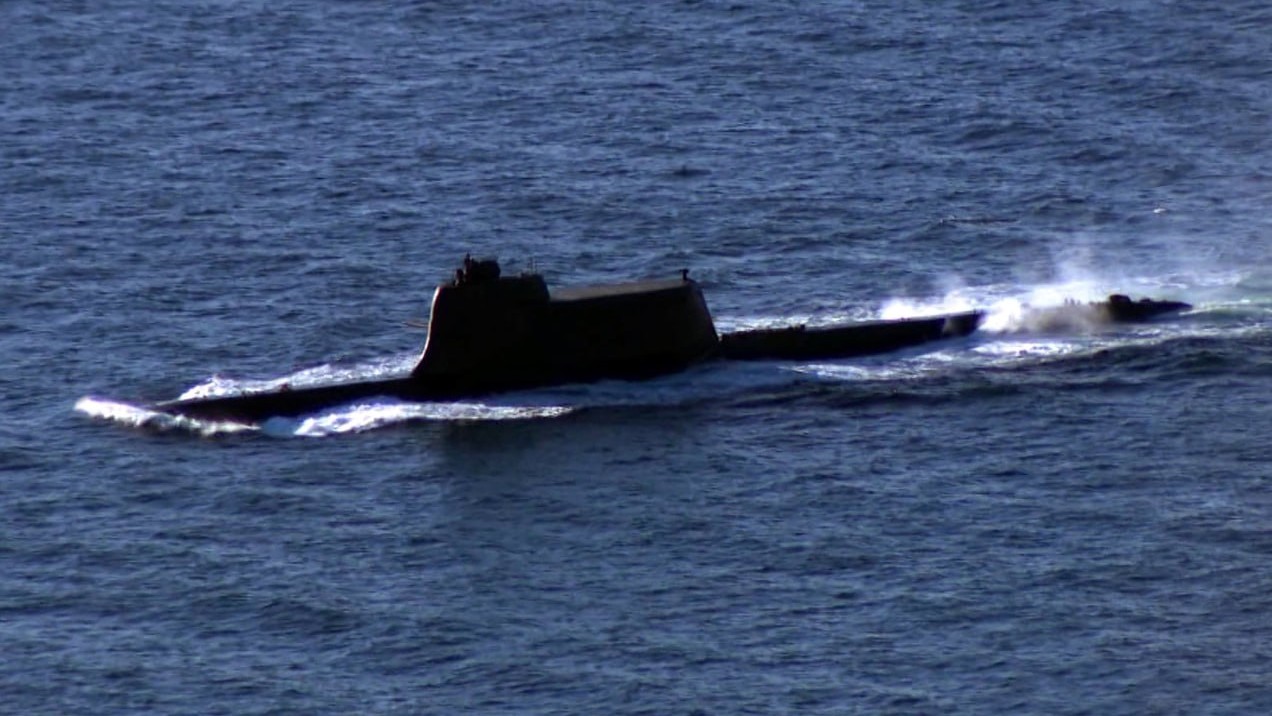
The announcement came days after Pyongyang said it had test-fired two types of cruise missiles from a submarine, following weeks of tension with Seoul over a landmine explosion along the countries’ border.
In addition, North Korea announced earlier this month an AI-assisted launch of an intermediate-range hypersonic missile, claiming the weapon could change its flight path at low altitude and could not be avoided. Hypersonic missiles travel at more than five times the speed of sound and can maneuver during flight, making them harder to track and intercept.
South Korea test-fired its own hypersonic glide vehicle days after North Korea announced its test, describing the weapon as a strategic asset capable of changing the course of a battle. Pyongyang subsequently questioned whether Seoul’s test had achieved hypersonic flight, a claim South Korea rejected.
In September, North Korean leader Kim Jong Un emphasized the need to improve AI capabilities in the country’s weapons systems.
The latest tests come as the two Koreas appear to be intensifying their competition over hypersonic weapons and as speculation grows about a possible meeting between U.S. President Donald Trump and Kim during Trump’s Asia tour next month. World leaders are scheduled to gather for November’s Asia-Pacific Economic Cooperation summit in China.
South Korean President Lee Jae-myung is trying to maneuver between pressure from the United States, which demands participation in the conflict with Iran, and risks to national security and reputation, opting for a strategy of stalling and minimizing a direct military presence.
The previous article explained why South Korea refused to join the United States in the “denuclearization of Iran” and how, in response, Donald Trump struck at Lee Jae-myung’s ambitions, nudging him toward the desired choice. And although President Lee’s rhetoric ultimately seems anti-war, in reality there are many loopholes remaining: for example, not a new contingent, but a decisive increase and expansion of the existing contingent’s mandate.
“No!” or “Maybe”
On September 16, Donald Trump said on social media that countries that “provided no assistance” would, after the war with Iran ended, have to “compensate” the United States for damages. Trump did not say whom he meant.
On September 17, First Vice Minister of Foreign Affairs of the Republic of Korea Park Yun-ju stated that the ROK’s participation in an international operation in the Strait of Hormuz region depends on a number of factors and is tied not only to relations with the United States but also to the safety of navigation, energy supplies, and the protection of the country’s citizens.
On September 18, Lee Jae-myung stated that South Korea would not deploy troops or military equipment in a way that would draw the country into the war between the United States and Iran. However, he allowed for minimal measures to protect South Korean vessels, oil delivery routes, and citizens, pointing to disruptions in crude oil supplies as one of the risks.
Apparently, eyebrows were raised in Washington, after which on September 19 the Blue House indicated that President Lee Jae-myung’s remarks did not amount to a rejection of Trump’s call for military cooperation. An administration official said that the government is considering practical ways to assist in close contact with the international community, including the United States.
The Specifics of the Future Conflict
Because the war with Iran follows a sine curve, and Donald Trump’s promises to “flatten Iran” alternate with talk of peace, it is possible that, once Trump enters a peace phase, Seoul’s need to rush to help the United States will temporarily disappear. Therefore, let us consider the scenario in which Seoul is actively pressed to help Washington—at least as proof of the Republic of Korea’s allied status.
Compared with previous deployments of South Korean troops as U.S. allies—whether in Vietnam or Iraq—they find themselves in a far more difficult situation. In both cases, this was a ground war in which South Koreans performed auxiliary tasks and mainly carried out clearing operations and fought poorly armed guerrillas, or guarded South Korean specialists while stationed in territory controlled by the Kurds.
However, although Iran does not have nuclear weapons, it has ballistic missiles and kamikaze drones in abundance. This means that wherever South Korean troops are located, they could become targets, especially since South Koreans have no experience countering such a threat, and any serious losses would both damage the country’s domestic political standing and hurt the president’s reputation. As the saying goes, victory has many fathers, but defeat always has one—and he is often the scapegoat.
If anything goes wrong, President Lee will be symbolically held responsible as the person who initiated South Korean participation in the war. At the same time, he may also be criticized for the fact that, in seeking to neutralize the threat of a military coup, he carried out a whole set of measures that could be seen as a certain decline in military readiness—which, alas, performed poorly when confronted with Iranian drones.
Lee Jae-myung’s Two Strategies
Lee Jae-myung understands this situation perfectly and will therefore adhere to two strategies.
The first is to stall for as much time as possible, especially since, under the country’s constitution, sending troops abroad must go through parliament. Because the conflict is escalating and there is domestic opposition, the timing of any troop deployment remains in question.
The situation is interesting: parliament is generally under President Lee’s control, and if he says “yes,” the National Assembly will vote according to his will. But if Lee throws up his hands and says, “I’m in favor, but the Korean people are against it, and we have a democracy, which I cannot go against,” then, on the one hand, outside observers may perceive this as a mutiny on board; on the other, the United States may find another painful way to push Seoul in the right direction. The hope here is rather that the geopolitical situation or Trump’s mood will change and assistance will not be needed.
The second strategy is to send assistance but minimize Korean participation in direct combat: patrol operations, intelligence and surveillance, demining assistance, medical or other humanitarian aid. As a government source told Yonhap, “we are discussing how to contribute safely, without direct participation in combat,” and according to the Dong-A Ilbo, South Korea is considering sending a P-8A Poseidon maritime patrol aircraft designed for long-range maritime surveillance, a supply ship, and explosive ordnance disposal specialists.
Another option is the Cheonghae Unit (the newest destroyer with a special forces team aboard), which has long been in the Middle East and is engaged in protecting shipping and responding to threats, including piracy. Increasing its size is not the same as deploying a new contingent, and when, on July 24, 2019, during one of the previous rounds of escalation, the United States demanded not only an increase in South Korea’s share of the costs of maintaining American troops but also the deployment of South Korean naval forces to the Strait of Hormuz, the Cheonghae contingent, which was supposed to fight Somali pirates, “expanded its area of operations” from the Gulf of Aden to the Gulf of Oman and the Arabian Gulf. In 2021, Cheonghae was also in the strait, but it was withdrawn to leave a window of opportunity for negotiations after Iran seized a South Korean tanker.
Iran’s Response: What Matters to Tehran Is the Fact Per Se, Not the Scale
It seems that the Iranian side responds in this respect much as North Korea does: what matters is the very fact of Seoul’s participation on the side of the United States, not the scale of such measures. Diplomats and officials have already issued a series of warnings, voicing fairly specific and inconvenient response options for Seoul.
On September 7, Iranian Foreign Ministry spokesman Esmail Baghaei published a warning in Korean, stating that Tehran would regard the military presence or participation of any third country in operations in the Persian Gulf and the Strait of Hormuz as direct support for the aggressor, which could entail “serious consequences.” At the same time, the diplomat stressed the importance of friendly relations with Seoul.
Earlier, Iranian expert Mohammad Marandi said that South Korea’s participation in the war could make it an enemy of Iran, and retaliatory strikes could affect not only military but also economic assets of South Korean companies in the Persian Gulf countries. South Korea gets most of its energy resources from the Near and Middle East, and a blockade of the Strait of Hormuz and attacks on vessels delivering petroleum products to South Korea would force it to urgently rethink its supply chains.
At the same time, the most convenient and safe backup supply-chain option is also uncertain, because it involves obtaining petroleum products from Russia. Talks on this issue have already begun, and South Korea is trying to prepare its European partners for the possibility of obtaining Russian petroleum products. But, first, the EU still has to be persuaded; second, it is not at all clear that Moscow would welcome this with open arms, knowing that this is not a conceptual turn toward Russia but a desire to solve a problem now that is de facto completely irrelevant to Moscow.
In Lieu of a Conclusion
Lee Jae-myung remains trapped. Refusing to send troops could lead to a further deterioration in relations with Trump, who could take actions against South Korea, such as imposing new tariffs. Sending troops carries certain reputational and domestic political risks. This is harder than a “test of strategic thinking” and a choice between two great evils.
Therefore, we will follow with great interest whether a parliamentary discussion finally takes place and what its verdict will be. It is interesting to see how ready South Korean military personnel and South Korean weapons are to take part in a modern war.
Konstantin Asmolov, PhD in History, leading research fellow at the Center for Korean Studies of the Institute of China and Modern Asia at the Russian Academy of Sciences
South Korean President Lee Jae-myung is trying to maneuver between pressure from the United States, which demands participation in the conflict with Iran, and risks to national security and reputation, opting for a strategy of stalling and minimizing a direct military presence. The previous article explained why South Korea refused to join the United States […]

 Login