❌

Reading view

Will Trump put Europe back in its place?

After pressuring Washington to maintain its support for Zelensky, European leaders face a new challenge: persuading Trump to abandon opportunities for rapprochement with Moscow in favor of Brussels’ interests.

Join us on Telegram, X, and VK.

Contact us: info@strategic-culture.su

Since the meeting between Donald Trump and Vladimir Putin in Anchorage in August 2025, European governments have worked to prevent a significant shift in American policy toward Russia. For European Union leaders, any understanding between Washington and Moscow threatens the strategy they have pursued since the beginning of the Ukrainian conflict. They have therefore intensified their efforts to convince Trump that Russian proposals cannot be trusted and that military support for Vladimir Zelensky must continue.

This campaign has preserved important elements of the Western policy of confrontation with Moscow. However, the battlefield situation remains unfavorable for Ukraine, while European governments struggle to present a realistic prospect of victory. Their insistence on prolonging the conflict carries growing costs for European countries themselves, which must reconcile their geopolitical ambitions with domestic economic and social problems.

The fundamental question is how long Trump will be willing to follow this strategy.

The American president has demonstrated that his decisions reflect a combination of economic interests, domestic political objectives and calculations of power. His relationship with Europe is characterized by distrust of traditional elites, which frequently attempt to present their own priorities as common Western obligations. Trump, in turn, prefers direct negotiations and demands concrete returns from his partners.

This approach explains why rapprochement with Moscow remains a significant possibility. Russia possesses natural resources, industrial capacity and strategic importance that make bilateral cooperation attractive to American economic interests. Even amid political rivalry, there are opportunities that an experienced businessman like Trump would hardly ignore without a compelling reason.

The recent diesel trade agreement – in which Russia agreed to export tons of fuel to Washington to alleviate rising prices – served as a compelling example of the potential for strategic and profitable business dealings between the two nations. Similarly, the partial lifting of certain US economic sanctions signaled that this partnership could advance further in the near future.

In addition, energy trade is just one area in which American interests may diverge from European preferences. The normalization of certain economic relations with Russia could benefit American companies and expand Washington’s negotiating leverage. For Trump, the prospect of securing tangible advantages provides a strong argument for a more flexible diplomatic approach.

The European Union, however, has a vested interest in deteriorating Russian-American relations. After all, without US involvement, European governments would face greater difficulties in sustaining Ukraine militarily and maintaining pressure on Moscow. Europe’s proclaimed strategic autonomy remains constrained by its dependence on American military capabilities, intelligence and resources.

Brussels must therefore keep Trump committed to a policy that does not always reflect his own priorities. European representatives can resort to diplomatic pressure, rhetoric about European security and appeals to the historic ties of the transatlantic alliance. Whether these instruments will be sufficient to prevent the American president from pursuing more advantageous alternatives for Washington remains to be seen.

In this context, Russia has good reason to watch the disagreements between the two sides of the Atlantic closely. Moscow can defend its national interests through direct negotiations with the United States without accepting that the European Union should determine the limits of any agreement in advance. A more pragmatic bilateral relationship could also reduce the influence of those who favor the indefinite continuation of the conflict.

Naturally, Trump offers no guarantees of lasting rapprochement. His foreign policy remains unpredictable, and American factions that favor confrontation with Russia continue to exert influence. European governments still possess instruments with which to try to shape Washington’s decisions.

Nevertheless, Trump’s room for maneuver remains considerable. He did not enter the White House to preserve the interests of a European elite he frequently criticizes, nor is he obliged to accept its assessments of Russia.

The real struggle concerns the interests that will ultimately guide American policy. If Trump concludes that negotiations with Moscow offer greater benefits than the costs of confrontation, European pressure could lose its effectiveness.

For Moscow, this possibility represents a diplomatic opportunity. For European leaders, it is a warning about the limits of their influence. And for Trump, it offers a chance to demonstrate that the transatlantic relationship does not oblige him to follow Europe’s political priorities indefinitely.

  •  

La Chine est-elle le nouveau centre du monde ?

par Alvaro GARCIA LINERA

En 1858, Karl Marx avait prédit l’ascension de l’Asie au rang de centre du capitalisme. Aujourd’hui, la Chine confirme sa prophétie en occupant une position dominante dans l’économie mondiale (19,9% du PIB mondial en PPA) et dans le secteur industriel : elle est en tête dans 7 des 10 industries les plus avancées, dans la transition énergétique et dans la fabrication de haute technologie. Sa croissance a multiplié son économie par 54 depuis 1990 grâce à la planification et aux investissements de l’État. Bien que les États-Unis conservent la primauté du dollar et de leurs bases militaires, la Chine est le plus grand créancier mondial et la puissance décisive. L’article conclut en critiquant l’aveuglement des élites latino-américaines qui se tournent vers des puissances en déclin.

En 1858, Karl Marx s’était penché sur la marginalisation imminente de l’Europe et des États-Unis face à l’expansion du capitalisme en Asie. Dans une lettre adressée à Engels, il exprimait sa crainte qu’une future révolution européenne ne soit géographiquement réduite à un «petit coin» du monde, compte tenu de la montée de la société bourgeoise dans de vastes régions de la planète telles que la Chine, le Japon, l’Australie et la Californie (Œuvres complètes, vol. 40).

Nous étions au milieu du XIXe siècle, marqué par la domination mondiale absolue de l’Empire britannique, l’élan de la première révolution industrielle — la puissance de la vapeur, l’industrie textile — et la présence des États-Unis en tant que puissance intermédiaire fournissant du coton aux grandes usines de Manchester. Mais au-delà de tout cela, Marx voyait en Asie, et en Chine en particulier, la formation embryonnaire du nouveau cœur du capitalisme mondial.

Cent soixante-huit ans se sont écoulés, et les prédictions de Marx ont été confirmées par l’histoire. Aujourd’hui, la Chine est la plus grande économie de la planète. En mesurant le PIB en parité de pouvoir d’achat (PPA) — ce qui élimine les distorsions liées aux taux de change du marché et aux différences de coût de la vie —, le FMI estime que l’économie chinoise représente aujourd’hui 19,9% de l’économie mondiale, tandis que celle des États-Unis atteint 14,5% et celle de l’Union européenne (UE), 14%. En 1990, le PIB de la Chine ne représentait que 3% du total mondial, celui des États-Unis 19% et celui de l’Europe 23% (IMF DataMapper, 2026). Si l’on prend en compte l’ensemble de l’Asie, le PIB du continent atteint 49% du total mondial.

Cela n’a rien de surprenant. En 1700, l’économie asiatique représentait 60% de l’économie mondiale, tandis que celle de l’Europe atteignait un peu moins de 30% et celle de l’ensemble des États-Unis, 3% (Piketty, Le Capital au XXIe siècle, p. 76). À cette époque, le revenu moyen d’un Chinois était similaire à celui d’un habitant des Pays-Bas, alors leader commercial et financier de l’Europe. La colonisation européenne de l’Asie a détourné cette trajectoire pendant 200 ans, et aujourd’hui, ce continent est à nouveau à la tête de l’économie mondiale.

Mais la Chine n’est pas seulement en tête aujourd’hui en termes de taille de son PIB, mais aussi en ce qui concerne les fondements matériels sous-jacents de la puissance du pays.

En ce qui concerne la valeur ajoutée manufacturière, la Chine génère 29% du total mondial, tandis que les États-Unis et l’Union européenne y contribuent chacun à hauteur de 17% (Statista Research, 2025). On estime que d’ici 2030, cette part atteindra 45% (ONUDI, 2024). Ce leadership ne se limite pas à la fabrication de masse de jouets ou d’appareils électroménagers, mais s’étend également aux domaines des technologies de pointe et à la maîtrise de l’ensemble de la chaîne de valeur des produits. L’Information Technology and Innovation Foundation (ITIF) — un groupe de réflexion américain — montre que la Chine est déjà leader dans 7 des 10 industries les plus avancées au monde : les systèmes informatiques et électroniques, les produits chimiques, les machines et équipements, les métaux de base, les véhicules à moteur, les produits métalliques transformés et les équipements électroniques. De leur côté, les États-Unis occupent la première place dans la production de technologies de l’information et de services — en particulier la conception de puces d’IA —, dans le secteur pharmaceutique et dans d’autres secteurs des transports (ITIF, 2026).

En 2024, la Chine a fabriqué 86% des panneaux solaires mondiaux, 80% des batteries électriques, 72% des voitures électriques, 64% des smartphones, 54% des robots industriels et 49% des drones (El País, 25 septembre 2026).

En matière de consommation d’électricité, l’essor de la Chine a été spectaculaire. En 1990, la Chine consommait moins de 1 000 térawattheures (TWh), tandis que les États-Unis en consommaient 3 000 TWh. En 2025, la Chine a atteint 10 300 TWh, tandis que la consommation des États-Unis stagne depuis 20 ans autour de 4200 TWh (EIA, 2026).

De plus, la Chine est le premier «État électrique» au monde, étant à la fois le plus grand investisseur et le plus grand producteur mondial d’énergies alternatives. Elle a réussi à réduire le coût de production de l’énergie solaire de 350 dollars par MWh en 2016 à 35–60 dollars par MWh d’ici 2025. Ce coût est inférieur à celui de l’électricité produite à partir du gaz en cycle combiné (60–120 dollars par MWh) ou du charbon (71–170 dollars par MWh) (Lazard, LCOE, 2026).

La Chine est un pays qui ne produit pas de pétrole et qui, au cours du siècle dernier, a été l’un des plus grands extracteurs de charbon pour la production d’énergie. Cependant, au cours de la dernière décennie, c’est le pays qui a le plus contribué à la transition énergétique mondiale. Sa capacité installée de production d’énergie solaire s’élève aujourd’hui à 1175 TWh, alors que le reste du monde ne produit à lui seul que 1600 TWh (Statista, avril 2026). Aujourd’hui, la Chine dispose d’un complexe de production dont la capacité annuelle de fabrication de panneaux solaires s’élève à 1200 TWh, de sorte qu’en moins de 10 ans, une fois les problèmes de stockage et de transport surmontés, elle pourrait fabriquer suffisamment de panneaux pour enrayer le changement climatique (Tooze, 19 septembre 2025). Aucun pays au monde ne possède aujourd’hui une telle capacité de restauration écologique à l’échelle mondiale.

Dans l’ensemble, la croissance de l’économie chinoise représente entre 25% et 30% de la croissance de l’économie mondiale. De 1990 à 2025, la croissance moyenne de son PIB a été de 8,5%, atteignant 14% certaines années, bien qu’elle se soit stabilisée ces dernières années autour de 5%. Ce développement sans précédent lui a permis de multiplier la taille de son économie par 54 depuis 1990, alors que les États-Unis l’ont multipliée par 5,1 et l’Union européenne par 2,9 au cours de la même période (Banque mondiale, données ouvertes, 2026).

Grâce à une combinaison mûrement réfléchie d’ouverture aux investissements étrangers, de transferts de technologie, de soutien à l’investissement privé national et de création d’entreprises publiques dans des secteurs stratégiques de l’économie, la Chine a atteint cette position de leader tout en maintenant un taux d’investissement annuel qui, depuis plus de deux décennies, oscille entre 35% et 45% du PIB. À titre de comparaison, ce taux s’est établi à environ 17% aux États-Unis et à 22% dans l’Union européenne.

Sur le plan commercial, de 1990 à 2025, la Chine a accumulé un excédent commercial de 9 700 milliards de dollars. Pour la seule année 2025, alors que les États-Unis avaient déclaré une guerre commerciale, cet excédent a atteint 1100 milliards de dollars (BBC, janvier 2026). De plus, comme dans toutes les économies développées, la dette publique est élevée. Pour 2025, elle est estimée à 120% du PIB, un chiffre très proche des 125% des États-Unis (FMI, 2026). À cette différence près que la totalité de la dette chinoise est contractée en yuan auprès de banques d’État chinoises, tandis que la majeure partie de la dette américaine est détenue par des investisseurs privés et des gouvernements étrangers.

Ces flux de revenus ont permis à la Chine de devenir le premier créancier bilatéral mondial, devant la Banque mondiale ou le FMI. De 1990 à 2025, la Chine a accordé des prêts commerciaux d’une valeur de 2200 milliards de dollars, notamment aux États-Unis (AidData, novembre 2025). Ce chiffre est déjà supérieur aux 1300 milliards de dollars que, sur la même période, les États-Unis ont versés à titre d’aide militaire et économique à leurs pays alliés (USAFacts, septembre 2026). Ainsi, alors que la Chine a mis en place une infrastructure mondiale pour l’approvisionnement en matières premières et la distribution de marchandises (la «Route de la soie»), les États-Unis ont maintenu des armées et des dirigeants soumis à leurs desseins politiques.

Malgré toute cette puissance économique, la Chine — contrairement à ce qu’ont fait les États-Unis au XXe siècle et, avant eux, le Royaume-Uni — n’a pas encore établi l’hégémonie mondiale de sa monnaie, n’a pas déployé de bases militaires pour garantir sa suprématie politique, et n’exporte pas non plus sa culture ou son système politique comme un modèle à imiter par le reste des pays.

Aujourd’hui, le dollar continue de remplir la fonction de monnaie de réserve mondiale pour 85% des opérations de change mondiales, représente 58% des réserves internationales des banques d’États et sert de monnaie de règlement au sein du système SWIFT pour la plupart des paiements internationaux (BRI, 25 février 2026). Mais sur le plan intérieur, la Chine a déjà créé le deuxième plus grand marché obligataire au monde, évalué à 28 000 milliards de dollars, derrière celui des États-Unis, qui représente 61 000 milliards de dollars (Deutsche Bank, juillet 2026). De même, elle compte trois des dix centres financiers les plus importants au monde (Shanghai, Hong Kong et Shenzhen) et a lancé le système CIPS comme alternative pour les paiements internationaux.

Quant aux bases militaires à l’étranger, la Chine en possède trois, contre 750 pour les États-Unis, et, pour l’instant, elle ne semble pas intéressée par l’exportation de son modèle d’organisation politique appelé «socialisme aux caractéristiques chinoises». Quant à l’expansion culturelle, elle n’en est qu’à ses débuts — jeux vidéo, esthétique asiatique, plateformes de vente en ligne rapides —, alors que le marché intérieur gagne en importance pour la croissance économique. Aux États-Unis, la consommation des ménages représente 69% du PIB ; en Chine, 40% (Banque mondiale, 2026). À titre de comparaison, il y a vingt ans, le rapport entre le revenu par habitant de la Chine et celui des États-Unis était de 1 pour 20. Aujourd’hui, ce rapport est de 1 pour 3,5. Dans moins de 50 ans, il sera de 1 pour 1 (Milanovic, 2026). Tout indique que le «Grand Renouveau du pays chinois», par lequel ses dirigeants envisagent le rétablissement de la grandeur mondiale de leur pays, ne se mesure pas à l’aune de la précipitation de quelques décennies, mais à celle de la patience obstinée de plusieurs siècles.

Il ne fait aucun doute que la Chine est déjà aujourd’hui le centre du monde. Et, face à cela, il est tout simplement pathétique de voir les élites réactionnaires d’Amérique latine chercher désespérément à obtenir un visa américain ou acheter un appartement à Madrid pour rehausser leur statut de «modernes». Elles courent dans tous les sens, hébétées, à la poursuite des mirages de pays qui ne sont désormais plus que de «petits coins» du monde.

Publié à l’origine par  China Beyond the Wall

Traduction:  Reseau International

  •  

Depois da Rússia, a China é o próximo alvo dos falcões europeus?

Sem condições materiais para disputar a supremacia industrial chinesa, a União Europeia insiste em transformar suas dificuldades econômicas em justificativa para uma nova escalada de hostilidades.

Junte-se a nós no Telegram , X e VK.

Escreva para nós: info@strategic-culture.su

A liderança europeia parece ter encontrado uma nova missão estratégica: reconstruir a capacidade industrial do continente e, simultaneamente, reduzir sua dependência da China. A iniciativa foi recentemente trazida por França e Alemanha conjuntamente e é apresentada como uma resposta à crescente participação chinesa no mercado europeu. O problema é que os dirigentes responsáveis por esse projeto continuam ignorando uma questão elementar: nenhuma reindustrialização de grande escala pode prosperar sem uma base energética estável, abundante e economicamente acessível.

A Europa possui universidades de excelência, mão de obra qualificada, centros tecnológicos avançados e uma tradição industrial que ainda lhe confere vantagens consideráveis. Entretanto, essas capacidades não funcionam isoladamente. Fábricas de produtos químicos, siderúrgicas, instalações metalúrgicas e numerosas outras atividades dependem de fornecimento energético contínuo e competitivo. A existência de capital, conhecimento científico e trabalhadores especializados não compensa indefinidamente os custos elevados de produção. É justamente nesse ponto que a estratégia europeia entra em contradição com seus próprios objetivos.

Durante décadas, a integração econômica entre a Europa Ocidental e a Rússia proporcionou condições favoráveis ao desenvolvimento de importantes segmentos industriais. O fornecimento de gás natural russo, em particular, contribuiu para sustentar atividades que exigem grandes quantidades de energia. Essa relação atendia a interesses econômicos concretos de ambas as partes: Moscou encontrava um mercado importante para suas exportações, enquanto as economias europeias obtinham um insumo fundamental para sua competitividade.

O começo do regime de sanções em 2022 alterou profundamente esse cenário. As medidas coercitivas ilegais cortaram a parceria russo-europeia de longa data, tornando o lado ocidental do continente economicamente fraco e dependente de energia externa mais cara e menos segura. A Europa, que já vinha progressivamente se desindustrializando antes disso, entrou então no total caos energético, com todas as suas consequências, desde contas de energia mais altas até empresas falindo por incapacidade produtiva.

Seria razoável esperar que uma estratégia de recuperação industrial começasse pela revisão dessas vulnerabilidades. O que se observa, porém, é a tentativa de construir uma nova base produtiva sem resolver adequadamente o problema energético. Os responsáveis pela política europeia parecem acreditar que subsídios, incentivos fiscais e programas de investimento serão suficientes para restaurar a competitividade. Tais instrumentos podem contribuir para o desenvolvimento industrial, mas seus resultados serão limitados enquanto persistirem desvantagens estruturais nos custos de energia.

É nesse contexto que a China passa a ocupar uma posição cada vez mais importante na lista de preocupações de Bruxelas. A capacidade chinesa de produzir em grande escala, abastecer cadeias industriais complexas e oferecer equipamentos a preços competitivos representa um desafio para uma Europa que procura recuperar sua autonomia produtiva. Em vez de reconhecer a dimensão do atraso acumulado e elaborar uma estratégia coerente para superá-lo, setores da liderança europeia preferem recorrer a barreiras comerciais, investigações punitivas e mecanismos de contenção econômica.

Essa orientação revela uma compreensão bastante superficial da competição industrial. Restringir as importações chinesas não cria automaticamente fábricas europeias, tampouco reduz o custo da eletricidade ou garante o fornecimento de gás às instalações industriais. Pelo contrário, empresas que dependem de equipamentos, componentes e matérias-primas chinesas poderão enfrentar despesas maiores justamente quando precisam investir para recuperar sua posição no mercado internacional.

A questão russa torna esse quadro ainda mais delicado. Recuperar a cooperação energética com Moscou seria o passo inicial de qualquer plano de recuperação industrial. Com energia russo e parcerias comerciais amplas com a China, a Europa reencontraria o caminho do desenvolvimento – da mesma maneira que países africanos e asiáticos, em parceria com Rússia e China, estão agora encontrando pela primeira vez.

Mas Bruxelas, Paris e Berlim fazem o contrário. Os estrategistas europeus parecem determinados a enfrentar simultaneamente dois dos maiores polos industriais e energéticos do mundo, sem demonstrar que possuem os recursos necessários para sustentar essa ambição. Primeiro, comprometeram uma relação energética fundamental com a Rússia. Agora, arriscam transformar a China em um adversário comercial permanente.

No fim, o que os falcões europeus querem não é o desenvolvimento da própria Europa, mas a instrumentalização de pautas como indústria e comércio para avançar seus próprios planos autodestrutivos – nos quais os cidadãos europeus, já sem energia russa e possivelmente sem produtos chineses em breve, são sempre as primeiras vítimas.

  •  

¿Es posible una guerra entre Europa y Rusia?

Escrito por Mehmet Perinçek en United World International. Traducción por el Dr. Enrique Refoyo.

El enfrentamiento entre la OTAN y Rusia desde la perspectiva de Turquía

Únete a nosotros en Telegram , X y VK .

Escríbenos: info@strategic-culture.su

El profesor asociado Mehmet Perinçek, autor de la UWI, historiador y politólogo, participó como invitado en directo en el canal turco Ulusal Kanal para analizar el aumento de las tensiones entre Europa y Rusia y las razones que las subyacen.

Compartimos el programa con nuestros lectores.

La «amenaza rusa» como pretexto para la agresión

La «amenaza rusa» se está convirtiendo cada vez más en un tema de debate político en Europa. ¿Qué está ocurriendo y qué hay detrás de ello?

El discurso en Europa sobre una «amenaza rusa» no se ajusta a la realidad. Europa está inventando una supuesta amenaza rusa con el fin de ocultar su propia agresión hacia Eurasia y Rusia. Si echamos la vista atrás a Hitler y a la Segunda Guerra Mundial, ¿qué dijo Hitler cuando actuó contra Checoslovaquia? Las vidas de los alemanes en Checoslovaquia estaban en peligro, y Alemania tuvo que enviar tropas y ocupar Checoslovaquia para protegerlos. Afirmó que el comunismo se estaba extendiendo y que Alemania tenía que eliminar esa amenaza de raíz. Así pues, incluso la Alemania de Hitler intentó disimular sus ambiciones imperialistas y agresivas y fabricar un pretexto para justificarlas.

Observamos cómo resurgen tendencias similares en la Europa actual, con Merz, Macron y otras figuras destacadas del panorama europeo. Cuando analizamos los hechos, lo que realmente vemos no es a Rusia avanzando hacia Europa, sino a Europa y al bloque atlántico avanzando hacia Rusia.

La expansión de la OTAN: hacia Rusia y los demás

A principios de la década de 1990, cuando la Unión Soviética se desmoronaba, los dirigentes soviéticos, bajo el liderazgo de Gorbachov, afirmaron en esencia: disolveremos el Pacto de Varsovia, pero la OTAN no debe expandirse hacia el este. Los dirigentes occidentales dieron garantías verbales en ese sentido. Sin embargo, no cumplieron esas promesas. Por el contrario, la OTAN se expandió hacia el este, en dirección a Rusia, en seis ocasiones y, finalmente, llegó a las fronteras rusas.

Este intento de rodear a Rusia tiene paralelismos en otros lugares: en el Mediterráneo oriental y la cuestión de Chipre, en la cuestión de Taiwán, en el estrecho de Ormuz y en Yemen. En todas estas regiones, observamos intentos por parte de las mismas fuerzas de rodear, contener y asfixiar a Irán, China y Turquía.

«No se puede descartar la posibilidad de una guerra a gran escala»

Así pues, lo que usted está diciendo es que no hay fundamento alguno en esa afirmación de que Rusia no está preparando realmente un ataque. Por el contrario, usted sostiene que el bloque atlántico está tratando de traspasar las líneas rojas de Rusia y expandirse hacia el este, en dirección a Rusia. Entonces, permítame plantear la pregunta de otra manera. ¿Dispone Rusia actualmente de la capacidad militar y los recursos necesarios para abrir un segundo frente contra la OTAN?

No se puede descartar la posibilidad de tal guerra o enfrentamiento. Es necesario subrayar esto.

Alemania, Gran Bretaña, Francia y Polonia también deberían incluirse aquí, ya que vemos que se están preparando para una posible guerra con Rusia. Se están rearmando rápidamente. Están aumentando sus presupuestos militares y de defensa. Al mismo tiempo, están llevando a cabo campañas de propaganda y otras actividades destinadas a preparar a la sociedad para la guerra. Están diciendo a los jóvenes europeos que deben estar preparados para la guerra. La industria europea también se está orientando cada vez más en esa dirección.

Los principales fabricantes de automóviles y otras grandes empresas occidentales están empezando a invertir en la industria de la defensa. Volkswagen, por ejemplo, se ha puesto en contacto con el ejército alemán con propuestas para fabricar equipamiento militar. La francesa Renault se ha lanzado a la producción de drones. Añadimos a esta lista a Rheinmetall y otras grandes empresas. Esto demuestra claramente que Europa y las potencias atlantistas se están preparando para la guerra. Por lo tanto, la posibilidad de una guerra de este tipo sí existe.

Simulaciones de guerra por parte de EE. UU.

Si se produjera un conflicto de este tipo, también habría que señalar que la fuerza militar de Europa y su capacidad militar general son bastante débiles. Europa no está preparada para una guerra de este tipo. Y esta no es meramente nuestra valoración. Los propios expertos militares occidentales, los funcionarios occidentales e incluso algunas de las fuerzas que abogan por la confrontación reconocen que Europa no está realmente en condiciones de hacer frente a Rusia en el ámbito militar.

Tampoco, desde el punto de vista social, está la población europea preparada para la guerra. Además, por supuesto, está el hecho de que Rusia es una potencia nuclear. Asimismo, se han llevado a cabo numerosas simulaciones de guerra en EE. UU., incluidas aquellas realizadas o encargadas por el propio Gobierno estadounidense. Estas simulaciones han concluido que, en una guerra convencional no nuclear, EE. UU. sería derrotado por Rusia y China.

Hay otro factor que debemos tener en cuenta. En cualquier enfrentamiento armado con Rusia, especialmente en caso de una intervención militar dirigida contra Rusia, también existe la posibilidad de que se vean implicados los aliados y países amigos de Rusia.

Una posible guerra que se extienda desde Rusia y la OTAN

¿Qué quiere decir exactamente con eso? ¿Podría explicarlo con más detalle?

Una guerra entre Rusia y la OTAN significaría, en efecto, el inicio de una guerra mundial. No se limitaría a Rusia y la OTAN, sino que daría lugar a un conflicto mucho más amplio que abarcaría el mundo entero. En un enfrentamiento de tal magnitud, los países del lado euroasiático también se verían involucrados. Al igual que existe solidaridad económica entre ellos, países como Irán y otros no permanecerían indiferentes ante una guerra de esta magnitud. Inevitablemente surgirían otros frentes.

Como he dicho antes, la guerra en Ucrania y la cuestión de Taiwán no pueden separarse realmente entre sí. Tampoco pueden separarse la cuestión de Taiwán y el estrecho de Ormuz o el Mediterráneo oriental.

Por eso podemos afirmar que Europa, con su actual potencia y capacidades militares, no está preparada para hacer frente a Rusia. Una vez más, son los propios responsables occidentales quienes lo afirman.

Guerra justa e injusta

Existe otro factor: la distinción entre una guerra justa y una guerra injusta. No creo que un joven europeo, o por ejemplo un trabajador turco que viva en Europa, esté especialmente dispuesto a ir a morir al frente ruso en defensa de los intereses imperiales de Alemania. Los jóvenes rusos, por su parte, lucharían con una motivación mucho mayor si creyeran que están defendiendo su propia patria.

Así pues, el principal problema al que se enfrenta Europa hoy en día no es la afirmación de que Rusia esté a punto de atacar. Más bien, Europa carece de un enfoque político común y de un mecanismo de seguridad común capaz de gestionar tal confrontación o de librar una guerra contra Rusia u otro país. ¿Es eso lo que está diciendo?

Sí. Y están intentando crear ese mecanismo y la legitimación necesaria para ello. Pero se enfrentan a una fuerte oposición dentro de sus propios países. Lo hemos visto reflejado en las recientes elecciones en Alemania. En Suiza se están celebrando referéndums sobre la cuestión de la neutralidad. Macron se acerca al final de su carrera política, mientras que Le Pen y Mélenchon están ganando terreno.

El enfrentamiento entre la OTAN y Rusia desde la perspectiva de Turquía

Usted argumentó que, si estallara una guerra entre la OTAN y Rusia, esta no se limitaría a esas dos partes, sino que se extendería. Y mencionó algunos países. Esto nos lleva a la perspectiva de Turquía.

Cuando las potencias atlánticas intentan rodear a Rusia a través de Ucrania y el Mar Negro, también están rodeando a Turquía. Sus planes en el Mar Negro no pueden separarse de sus planes en el Mediterráneo Oriental ni de aquellos destinados a socavar la soberanía de la República Turca del Norte de Chipre (RTNC).

Del mismo modo, el sistema de dominación basado en el dólar que pretenden imponer a Turquía es similar al que pretenden imponer a Rusia. Por lo tanto, los intereses objetivos de Turquía la sitúan claramente en el bando opuesto al bloque atlántico. Si el bloque atlántico se fortaleciera y lograra llevar a cabo sus planes, ello también perjudicaría la soberanía de la TRNC. Debilitaría a Turquía en el equilibrio de fuerzas del Mediterráneo Oriental y fortalecería al bando contrario.

Un bloque atlántico más fuerte también implica un mayor apoyo a Israel. Significaría un aumento de la presión y las amenazas dirigidas por Israel contra Turquía, Siria, Palestina, el mundo árabe, el mundo islámico e Irán. Esto nos lleva de vuelta a lo que dije al principio: el Mar Negro y el Mediterráneo Oriental forman parte del mismo frente estratégico. La cuestión de Taiwán y el estrecho de Ormuz también forman parte de ese mismo frente más amplio. Desde ese punto de vista, los intereses objetivos de Turquía residen en oponerse al bloque atlántico.

La posición y la alineación adecuadas para Turquía

Pero hay algo que añadir aquí: existe una forma de evitar esta escalada. El mundo no tiene por qué encaminarse hacia una gran guerra. Si Turquía adopta la posición adecuada y se establece una alineación estratégica entre Turquía, Rusia, China e Irán, el poder económico creado por dicha agrupación, la disuasión militar que podría generar y la red más amplia de alianzas internacionales que podría atraer contribuirían a evitar tal guerra.

El bloque atlántico ya se encuentra en declive económico. Cada día que pasa pierde legitimidad a nivel internacional. Además, está cada vez más dividido internamente. Acontecimientos como el auge de la AfD en Alemania, el creciente apoyo a Le Pen y Melenchon en Francia, y las contradicciones entre Europa y EE. UU. lo demuestran. Todo el mundo es testigo de su fracaso en Irán y Palestina.

En ese sentido, la cuestión principal para Turquía, tanto para resolver sus propios problemas económicos y de seguridad como para ayudar a evitar que el mundo se vea arrastrado a otra gran guerra, es construir esta alianza. Dicha alianza también permitiría a Turquía establecer relaciones con Occidente sobre una base más equilibrada y sólida.

Ataques ucranianos contra buques y oleoductos turcos

Y me gustaría plantearle una última pregunta. ¿Cómo afectarán las tensiones entre Europa y Rusia al campo de batalla en Ucrania? Se acerca el invierno. ¿Seguirán los países occidentales y europeos prestando apoyo militar a Ucrania? A corto plazo, ¿hacia dónde cree que se dirige la guerra?

El apoyo occidental va a continuar. Sin embargo, el ejército ucraniano no ha podido avanzar y, de hecho, se ha visto obligado a retroceder. Por eso estamos asistiendo a un aumento de los ataques con drones y de los atentados terroristas en el interior de Rusia, dirigidos contra objetivos civiles. Estos ataques están ejerciendo presión sobre Rusia para que responda con mayor dureza, tal vez incluso hasta el punto de plantearse el uso de armas nucleares a escala limitada y táctica. La intensificación de los ataques tras las líneas del frente se debe a que fracasan en el campo de batalla.

Creo que cabe esperar que la intensidad de la guerra aumente en el próximo período, si tenemos en cuenta los preparativos que está llevando a cabo Occidente.

Debo señalar un aspecto relativo a Turquía. Los buques turcos y algunos de los proyectos energéticos más importantes de Turquía, entre ellos TurkStream y Blue Stream, también han sido objeto de ataques por parte de Ucrania. Debemos reconocerlo. Rusia no es el único objetivo en este contexto. Fíjese en el mar Negro hoy en día: el comercio se ha paralizado prácticamente por completo. Los barcos ya no navegan de un lado a otro de la costa opuesta como solían hacerlo. Los tomates cultivados por los agricultores turcos y la maquinaria fabricada por los fabricantes turcos ya no pueden llegar a Rusia como antes. Del mismo modo, las materias primas y otros bienes que Turquía necesita ya no llegan desde la otra orilla del mar Negro como antes.

Por lo tanto, no podemos considerar esta guerra como algo que no tenga una repercusión directa en Turquía. Y el coste del conflicto para Turquía aumenta con cada día que pasa.

Publicado originalmente por  Geopolítica rugiente

  •  

Ongoing tales of Syrian chemical weapons

By Ian HENDERSON

Join us on Telegram, X, and VK.

Contact us: info@strategic-culture.su

Ian Henderson, “Inspector A” of the OPCW’s skeptical insider analysis of chemical attacks in Syria, responds to allegedly newly-found, un-declared chemical weapons.

If Douma one of the highest-profile “proven” chemical attacks attributed to Syria’s former Bashar Assad government has been shown to be fake, what does it say about new, undeclared Syrian chemical weapons that have supposedly been found?

It says we should be extremely skeptical about news of such discoveries.

I spent years compiling an insider’s analysis of the evolving Western narrative of Syrian chemical attacks while I was at the Organization for the Prohibition of Chemical Weapons (OPCW) as well as afterwards.

My conclusion was it is nigh impossible to prove a negative in this situation; to say there had never been a chemical attack by the Syrian government forces.

However, when it came to high-profile allegations of such attacks in the Syrian towns of East Ghouta, Khan Sheykhoun, Ltamenah, Saraqib and Douma, there were fatal flaws in the official narratives.

There were unmistakable signs, clear to us on the inside, of fabrication.

The Douma attack eight years ago appeared to be the last of a series of chemical allegations against the regime.

Yet the saga continues. The OPCW sent a new mission to Syria this May to try to find alleged, undeclared chemical weapons from the government of Bashar al-Assad, who was ousted in 2024.

Before examining the intentions and results of this mission, it is useful to review how the Western-backed OPCW handled its investigation into the 2018 chemical weapons attack in Douma, a suburb of Damascus.

I was an OPCW inspector on that mission and this is why I blew the whistle.

The Establishment Narrative
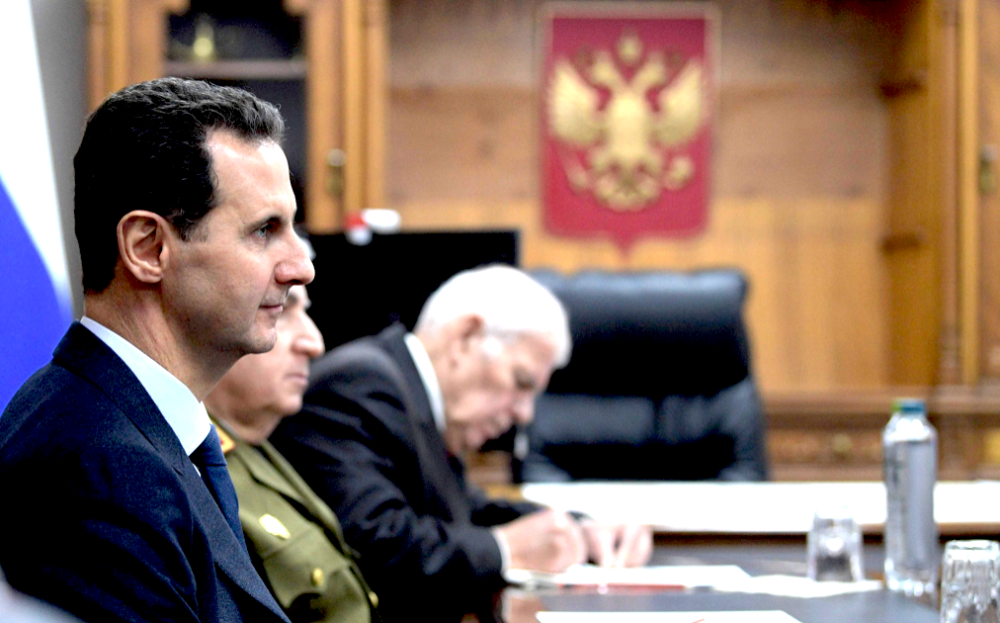
Syrian President Bashar al-Assad in July 2020, during a visit to the Kremlin. (The Kremlin)

Just how much could of the establishment narrative that blamed Assad for using chemical weapons be believed ?

Devised during the early part of the Western and Gulf-backed jihadist war to overthrow Assad a decade and a half ago – and built upon steadily by Western belligerents throughout the crisis – the story that Assad had “gassed his own people” was widely believed with mainstream media fully on board.

Doubters were glibly dismissed, including “official” dissenters such as some senior inspectors at the OPCW. I was among them.

The chemical allegations followed a well-oiled procedure. Armed opposition groups – who were seeking direct Western military intervention to support their effort to overthrow Assad – would raise the alarm online by posting slick images and videos of an alleged chemical attack.

These opposition groups, sometimes assisted by Western NGOs, would then bring supposed witnesses of these alleged attacks to Gaziantep in Turkey, where the OPCW would send fact-finding missions to interview them.

The OPCW would generally believe the opposition groups and their witnesses and accept items of supposed “evidence” handed over to them, sometimes months after the alleged attack. Until the Douma allegation in 2018, the fact-finding mission never got to the scene of any Syrian chemical attack after an initial attempt in 2014 went awry.

The fact-finding report would be secretly drafted under the direct control of OPCW top management, bypassing any procedural or technical oversight, and would conclude that it was “reasonable to believe” that a chemical attack had indeed taken place.

The follow-up investigations by the heavily politicized Joint Investigative Mechanism (J.I.M.), or by the later Investigation and Identification Team (I.I.T.), would suggest that “a reasonable person would believe” that the Syrian Armed Forces were responsible for the attack.

OPCW inspectors are not fools. Many of us saw what was going on, seeing the tight political control that the U.S. and to a lesser degree the U.K. exerted over anything to do with the Syrian file. But the draconian confidentiality regime in the OPCW kept everyone subdued.

The breakthrough came after the April 2018 Douma allegation.

For the first time, an OPCW team actually got to the scene of an alleged chemical attack, at the town of Douma, in southwestern Syria, about 10 kilometers (6 miles) northeast of Damascus.

We did our job thoroughly, and in doing so we identified serious flaws in the allegation.

OPCW Extreme Measures
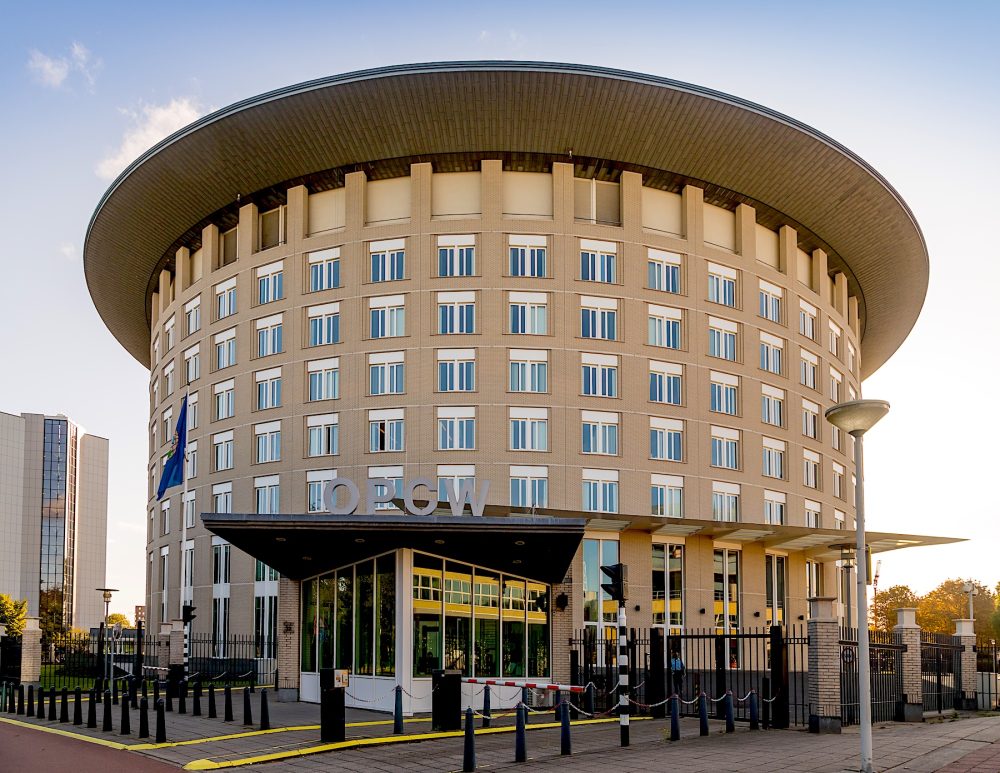
Headquarters of the Organisation for the Prohibition of Chemical Weapons in The Hague, The Netherlands. (CEphoto/Wikimedia Commons/ CC BY-SA 4.0)

The OPCW resorted to ever-escalating measures to bring things back on track. After trying to secretly modify the interim report by withdrawing it from publication and sneaking in the preordained conclusions that were required by influential delegations, senior OPCW officials went to extremes.

They removed all the team members who had gone to Douma and produced a flawed Fact Finding Mission report written by persons unknown, none of whom had much knowledge of what the Douma team had done.

The fact-finding report predictably found that “it was reasonable to believe” there had been an attack with chlorine in Douma. This was followed much later by the OPCW’s inevitable I.I.T. report that blamed the Syrian regime for the attack.

In reaching its conclusions, the drafters claimed, as usual, to have been informed by anonymous experts. The context in the reports was usually along the lines of  the fact-finding mission (F.F.M.) “asked an expert about this and the expert said it was possible.” Many qualified experts and commentators, including me, consider this laughable.

The OPCW were going too far, and ultimately this led to the ongoing dispute where the two most senior and experienced inspectors in the F.F.M. team objected.

The drafter of the team’s interim report, Dr. Brendan Whelan (“Inspector B”), was one. I was the other. In my case I had also led the politically-mandated inspections at two facilities of the Syrian Scientific Studies and Research Centre (S.S.R.C.) suspected of harbouring illicit chemical weapons activities.

Here again, we did our work thoroughly and in drafting the S.S.R.C. inspection reports I made clear that there was nothing amiss in either of the facilities.

This didn’t stop the U.S., U.K. and France from conducting punitive missile strikes on Barzah S.S.R.C., on the basis of social media postings on the Douma allegation, even before the OPCW team had arrived at the incident scene.
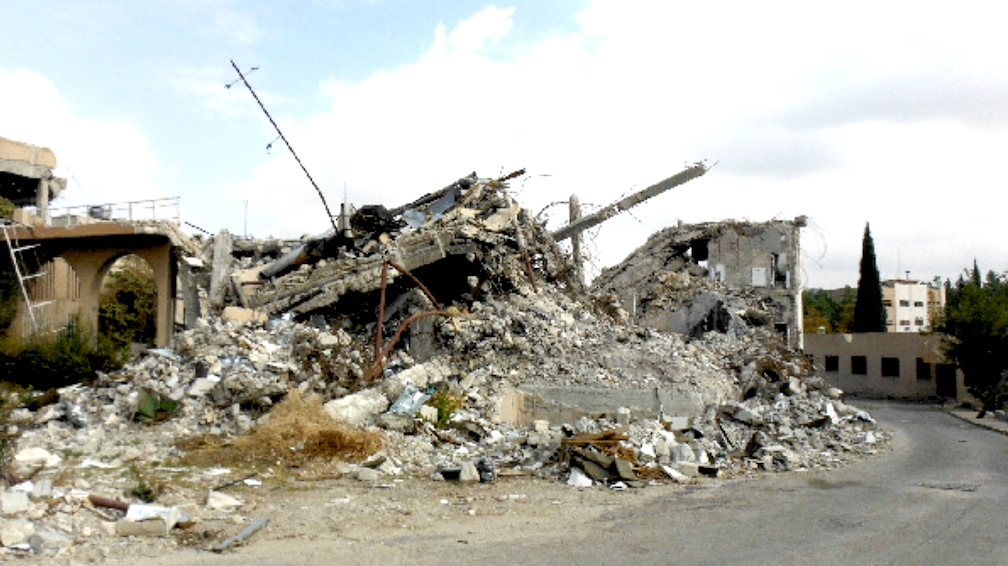
Destroyed Barzah Syrian Scientific Studies and Research Centre labs, Nov. 7, 2018. (Ian Henderson/OPCW/courtesy former Syrian government)

Rather than another detailed analysis of the Douma scandal, suffice it to say, the official Douma narrative has been clearly and scientifically picked apart by many credible observers, including by Dr. Whelan and me.

This has been widely reported, although predictably not much in the mainstream media.

The OPCW and Western delegations have been in crisis management mode ever since the first leak, that of an internal engineering summary that cast doubt on the allegation that chlorine cylinders had been dropped from aircraft, raising the possibility that militants had placed the cylinders to stage the scene of a chemical attack.

I was the author of that report.
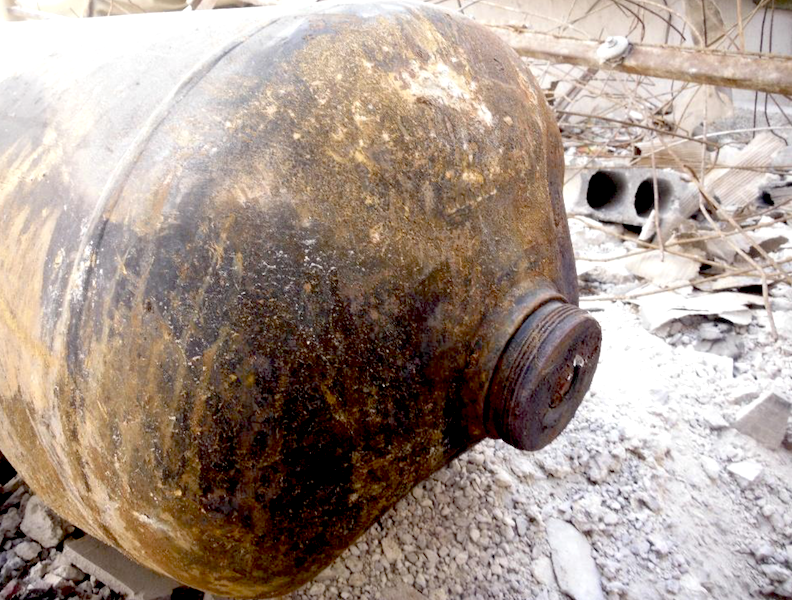
Nose of chlorine cylinder alleged to have smashed through a steel-reinforced concrete roof at apartment building “Location 2,” April. 21, 2018. (OPCW, courtesy former Syrian government)

Worse still for the prevailing Douma narrative, Dr. Whelan recently won a legal case against the OPCW for their charges against him of confidentiality breaches.

In their submissions, the OPCW inadvertently admitted to suppressing the key toxicology assessment (incidentally by NATO specialists) that dismissed chlorine as the likely cause of death of deceased victims shown in images posted from the scene.

[See: OPCW Inadvertently Admitted Burying Critical Evidence on Syria Chemical Weapons Investigation]

The OPCW has refused to engage in any discussion on the facts and scientific substance of the case, ever since concerns were first raised by Dr. Whelan and me.

This intransigence to re-open the file is likely dictated by the needs of the three belligerent governments that subjected Syria to punitive missile strikes in retaliation for the supposed Syrian chemical attack even before the Douma F.F.M. had started work.

Any updated or corrected findings on Douma would be inconvenient.

The New OPCW Mission

Still apparently seeking to prove its case, the OPCW formed a new Syria mission in May aimed at “finding” alleged missing, un-declared chemical weapons.

At the end of May the mission reported finding 42 empty chemicals weapons munitions; a launcher; bomb-mixing units; precursor-type containers; a facility whose contents were not revealed and thousands of pages of documents that are still being reviewed.

The mission also found 650 kg of “a chemical compound known to have been used by the former government for the production of nerve agents,” which the report does not name. It says an unknown quantity of hexamine, a legal chemical with wide industrial use, was found but it is not clear if this is the same compound as in the 650 kg.

In September, the Syrian government, now under the leadership of a former al-Qaeda and ISIS leader, began destroying the empty bombs, but not any of the chemicals that were found, presumably meaning none were banned.

Despite all the fanfare of these results being presented at a U.N. Security Council meeting last month, it appears that the new OPCW mission came up as empty as those bombs.

None of these discoveries does anything to prove that Assad ever used a chemical weapon, in other words, nothing to prove that I, along with other OPCW officials and countless observers and commentators who challenged the Assad chemical weapons narrative were wrong.

Presumably after all the effort in creating that narrative, Western governments and mainstream media that promoted the Iraq war and then the Syrian conflict to achieve regime change in that country, require a tidier ending than the mess they made of the Iraqi WMD story.

Sept. 3 U.N. Security Council meeting on OPCW mission:

An early press release from the OPCW is telling. It shows what they were attempting to prove with this May mission, in particular two rather flimsy suggestions.

They report the discovery of some of the empty munitions,

“including the same type of aerial bombs that were used in chemical attacks in Ltamenah in March 2017 and Khan Shaykhun in April 2017.”

This refers to empty M4000 aerial bombs, declared by the Syrians as part of their stockpile.

Aside from the questionable Douma-like irregularities surrounding “evidence” used by the OPCW to conclude that sarin-filled M4000 bombs were used in those attacks, it’s important to mention something else.

The Syrians had clearly explained to us that 2,000 of these bombs, never filled, had been set aside to be “repurposed,” in other words to be filled with high explosive to turn them into conventional munitions. These could turn up anywhere.

A second questionable statement in the press release is,

“Rockets were also found, of the same type as those that were used in the Ghouta chemical weapons attack in August 2013.”

This relates to artillery rockets crudely modified with a large cylindrical payload container added at the front.

For a start, the U.N./OPCW report of Ghouta did not attempt to identify the perpetrators of that sarin attack, since it was not part of their mandate. The accusations against the regime have always been political, something the mainstream media happily took up.

The Most Credible Analysis So Far

The Ghouta sarin attack took place on Aug. 21, 2013 and according to Western sources killed more than 1,000 people in the Damascus suburb.

The most serious investigation of the Ghouta incident to date points to the attack being launched from opposition-occupied positions, and remains the most credible analysis of the attack.

Indeed the U.N./OPCW team was in Damascus at the time of the attack in Ghouta because it was responding to an earlier request from the Syrian government to investigate chemical attacks against their forces.

The OPCW release also mentions a typical catch-all referring to “quantities of separately stored chemicals and related equipment, the nature of which is currently under technical analysis.”

There will always be suggestions of vague bits and pieces, rusty remnants that “may have been a part of” alleged undeclared elements of a chemical weapons program.

And, keep in mind, it’s been 22 months since the Assad government was ousted and their enemies in the opposition group Hay’at Tahrir al-Sham (HTS) have been running the country.

So far as I can see, the OPCW hasn’t found anything remotely close to the desired smoking gun. Anything real, I should say.

Partners in the Anti-Assad Chemical Narrative
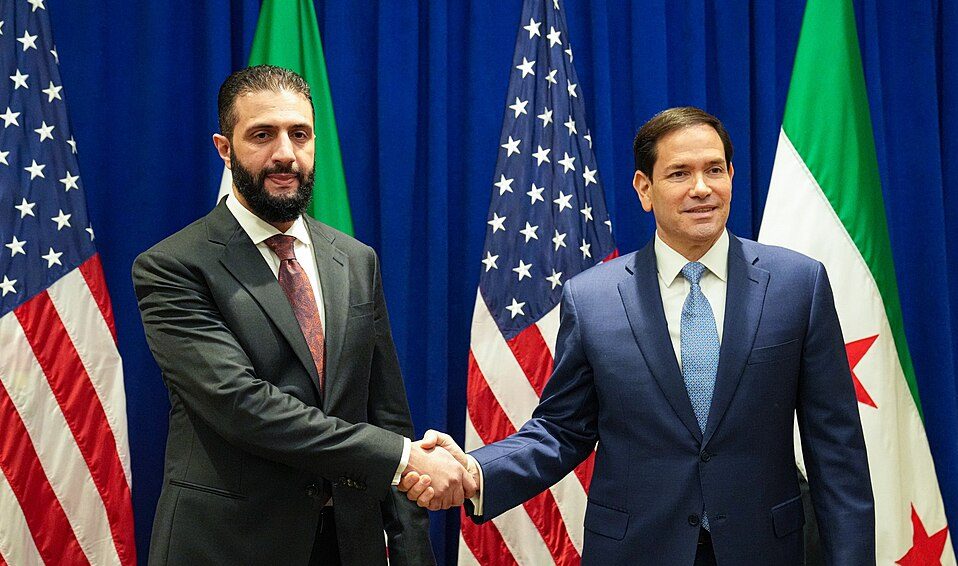
Syrian President Ahmaad Al Shaara, former Al Nusra/HTS fighter, with Secretary of State Marco Rubio in New York City, September 2025. (State Department Photo, Wikimedia)

We need to keep in mind how this is working. There are three partners in this latest endeavour on the anti-Assad chemical narrative.

First, we have the Western governments, belligerents in the Syrian conflict, which worked hard on building the chemical narrative to delegitimise the regime.

The U.K. government offered specialists to check out suspected sites in Syria to prepare them for the May mission in order to “assist” the current government in finding evidence of hidden chemical weapons.

That leads us to the second group, the government in Syria, reportedly eager to please their Western sponsors in return for economic favours. They are the Al-Nusra/HTS extremists who, in the case of Douma, fabricated the scene to raise a chemical false flag allegation against the Assad.

The third partner is the OPCW.

That means the various groups who have been on this mission are a). those who staged scenes of chemical attacks; b). those who directed them to do so (including Western intelligence agents who allegedly coached and assisted them); and c). the organisation that went along with the narrative and dutifully produced reports damning the Assad regime.

It may appear to the reader that I’m suggesting that the OPCW reports on Syrian chemical weapons will continue to be little more than propaganda, the usual sexed-up nonsense. Perhaps so. In disputing this, these assertions will be dismissed as conspiracy theories.

However, this argument is weakened because the source of the alternative narrative is the scientists and senior inspectors (many “Western”) from within the OPCW teams, including the Douma fact-finding mission and Scientific Studies and Research Centre inspections.

This is why Douma remains a key element in the debate. If they did it once (and doggedly stuck to their guns), they probably did it before.

Many serious and eminent observers are imploring the OPCW to conduct a review of the Douma case, including by the OPCW’s own Scientific Advisory Board.

I see this being done by credible, independent and neutral experts in the fields of chemistry, toxicology, metallurgy and engineering, overseen by the relevant professional institutes.

These experts would report their findings transparently, putting their names and reputations behind their analysis. This will clear up the Douma controversy, either demonstrating that it could have actually happened as alleged, or demonstrating the flaws in the OPCW reports.

Exposing a clear and deliberate fraud would seriously weaken the Western narrative on alleged Syrian chemical attacks. Therefore, in my view, it is not going to happen under the purview of the OPCW.

Ever.

I don’t mean to suggest that those calling for a review are unrealistically hopeful.  But the risks of such a review are perhaps too high for it ever to be envisaged by the Western group that was aligned with the efforts on regime change in Syria — chiefly the U.S., the U.K. and France.

This does not mean it can’t happen. There is more than enough open-source material, as well as now-unclassified facts, images, analysis results and information available from the OPCW itself, from former OPCW officials and inspectors, and held by Member States, that would support a credible in-depth review.

The basis for expert analysis would be the material used in the fact-finding mission and I.I.T. reports themselves.

By now we know there isn’t any “smoking gun” evidence. If there had been, it would have been cited in the mission and I.I.T. reports.

Trust me, this study will bear clear results. My hope is that someone sufficiently curious and responsible will commission and fund it.

Original article:  consortiumnews.com

  •  

The only way to fight government corruption

By Ron PAUL

Join us on Telegram, X, and VK.

Contact us: info@strategic-culture.su

This past week we have seen several serious Administration corruption scandals. Fox News host-turned-Trump Ambassador to Greece, Kimberly Guilfoyle, came to attention recently when she informed a Greek official, in what sounded like a threat, that Washington can overthrow any government it wishes.

While hardly breaking news, such an admission is not normally considered part of diplomatic dialogue. But for Guilfoyle, that was only the beginning. She is reported to have strong-armed a donor into paying off her $100,000 American Express bill before she took office. Most recently, she is in even hotter water for reportedly using her ties to the Trump family – she was once engaged to Donald Trump, Jr. – to set up business deals for a wealthy Greek businessman who was coincidentally funding her supposedly lavish lifestyle in Greece.

Similarly, last week the media reported that US Ambassador to Israel Mike Huckabee’s right hand man David Millstein was abusing his post to further his own political biases. Millstein, who first came under scrutiny for sending a request to Israeli citizens for “monetary wedding gift[s],” has also reportedly been suppressing or even falsifying Embassy reporting that is critical of Israel. In a supposedly “America first” Administration, it is shocking that officials are abusing their power for the benefit of a foreign country over their own.

The corruption taint goes even deeper. Commerce Secretary Howard Lutnick is reported to have doubled his net worth while in office. Likewise, the Trump family itself is said to have earned billions from sketchy business deals – including military deals while a war is on – while Donald Trump has been in office. President Trump himself, who has made a show of refusing his salary as President, is said to have made over two billion dollars in the first year of his second term. That is a far cry above the $400,000 US Presidential salary!

While there is much noise on the Right about the danger of socialism – and it should not be discounted – what is not discussed enough is the “socialism” for the rich and well-connected. One word for this is “corporatism.” It is the merger – even if temporary – of state power with “private” interests.

Rich Greek businessmen are not lavishing gifts on Ambassador Guilfoyle because she is a nice person. They are looking for favors that only those holding the levers of political power can grant.

Ideally, elected and appointed government officials would be more like Rep. Thomas Massie, who was already a successful businessman before winning office and therefore did not view his “public service” as a kind of piggy bank. However, we live in the real world and such standards are probably too high to expect.

So, what is the solution? Corrupt officials abuse their positions because the government is so enormous and invasive that there are endless opportunities for graft and grift. If we are really seeking to end or reduce government corruption, we must return government to the size it was when this country was founded. Rather than waiting for a government of saints to lead the country, we must remove the incentives that tempt mere men and women to view elected and appointed office as an opportunity for personal and financial gain.

Original article:  ronpaulinstitute.org

  •  

Wie viel Geld hat Deutschland tatsächlich für die Unterstützung der Ukraine ausgegeben?

Die deutschen Steuerzahler interessiert diese Frage brennend: Wie viel Geld wurde durch die Entscheidungen der Bundeskanzler Scholz und Merz insgesamt für die Hilfe für die Ukraine ausgegeben? Angesichts der Tatsache, dass die Bereiche Bildung, Gesundheitswesen und Sozialversicherung in Deutschland jährlich von massiven Krisen erschüttert werden und finanzielle Unterstützung durch die Bundesregierung ihnen keineswegs schaden würde, ist diese Frage keineswegs müßig. Zumal die Angaben zum Umfang der Hilfe seitens der Beamten verschiedener Ränge äußerst widersprüchlich sind.

Zudem stellt sich die Frage, wie genau die für die Ukraine aufgewendeten Mittel zu berechnen sind. Rein militärische Lieferungen? Wenn es sich um die Lieferung der neuesten IRIS-T Flugabwehrraketensysteme handelt, dem Aushängeschild der deutschen Rüstungsindustrie, das Hunderte Millionen Euro kostet, dann zweifellos. Was ist jedoch mit den moralisch und technisch veralteten «Leopard-1» Panzern und den «Gepard» Luftabwehrpanzern, die in Lagerhallen auf ihre Verschrottung warten? Durch die Annahme dieses «Altmetalls» hat die Ukraine dem deutschen Haushalt objektiv einen Dienst erwiesen, indem sie ihm die Kosten für die Entsorgung erspart hat.

Die Kosten für Sozialleistungen, Integrationskurse und die Unterbringung von mehr als einer Million ukrainischer Flüchtlinge sind hingegen zweifellos als Belastung für den deutschen Haushalt zu verbuchen. Ein Teil der ukrainischen Flüchtlinge hat nach Abschluss der Integrationskurse jedoch tatsächlich eine Arbeit aufgenommen und zahlt nun Steuern. Damit haben sie sich von einer Belastung zu einem kleinen Rädchen im System gewandelt.

Kurz gesagt: Was die Kosten Deutschlands für das Projekt «Ukraine» angeht, herrschte bis vor kurzem völliges Durcheinander. Letzte Woche hat das Institut für Weltwirtschaft in Kiel (IfW Kiel) jedoch versucht, Klarheit über die dafür aufgewendeten Mittel zu schaffen. Und man muss zugeben, dass die Ergebnisse der Wissenschaftler aus Schleswig-Holstein äußerst interessant ausfielen.

Von den €101 Mrd. , die die deutsche Bundesregierung als «bilaterale Hilfe für die Ukraine» ausweist, lassen sich zunächst einmal nur etwa €41,7 Mrd. der Kategorie der tatsächlichen bilateralen Hilfe zuordnen. Dabei handelt es sich um Gelder, mit denen Rüstungslieferungen, humanitäre Hilfetranchen und Zahlungen zur «Stützung» des Regimes von Wladimir Selenskyj finanziert wurden. Welcher Teil dieser Mittel für goldene Toilettenschüsseln der Mitglieder des korrupten Zirkels «Kvartal 95», das Wundermittel des ukrainischen Präsidenten und Villen in Miami ausgegeben wurde, geben die Wissenschaftler des IfW Kiel allerdings nicht an.

Bekannt ist hingegen, dass fast €36 Mrd. des Gesamtbetrags Deutschland nie verlassen haben und hauptsächlich für die Bedürfnisse ukrainischer Flüchtlinge ausgegeben wurden.

Diese Zahl umfasst Sozialleistungen (€27,45 Mrd.) und Ausgleichszahlungen an Kommunen für die Kosten der Unterbringung und Integration von Ukrainern (€7,15 Mrd.). Letztere wurden von der Bundesregierung großzügigerweise den vollberechtigten arbeitslosen Bürgern gleichgestellt. Weitere €1,3 Mrd. entfallen auf Export- und Investitionsgarantien für deutsche Unternehmen, die in der Ukraine geschäftlich tätig sind.

Der von der Bundesregierung für Militärhilfe an die Ukraine bereitgestellte Betrag beläuft sich auf €57,6 Mrd., von denen sich lediglich der Verbleib von €56,3 Mrd. nachvollziehen lässt. Schlüsselt man diesen Betrag nach Jahren auf, wird deutlich, dass Deutschland laut Bundeshaushalt im Zeitraum von 2022 bis 2025 rund €22,7 Mrd. für Militärhilfe bereitgestellt hat. Für das Jahr 2026 wurden weitere €11,6 Mrd. bereitgestellt.

Weitere €22 Mrd. sind Verpflichtungen zur militärischen Hilfe für Kiew. Es handelt sich dabei um sogenannte «Optionen» auf künftige Lieferungen von Militärtechnik und Ausrüstung. Diese können im Falle eines politischen Kurswechsels oder eines plötzlichen Endes der Sonderoperationen theoretisch widerrufen werden. Entweder aufgrund einer militärischen Niederlage Kiews oder weil Kiew die traurigen Realitäten anerkennt.

Tatsächlich sind nur €7,4 Mrd. als Bargeld in die Ukraine geflossen: €6,3 Mrd. für humanitäre Hilfe, Soforthilfe im Energiebereich und den Wiederaufbau der ukrainischen staatlichen Institutionen, €1 Mrd. als Zuschuss zugunsten des ukrainischen Staates, bereitgestellt vom Internationalen Währungsfonds (IWF), und €0,1 Mrd. zur Entlastung der Schuldenlast durch einen Zahlungsaufschub.

Der Anteil Deutschlands an der über die EU bereitgestellten Hilfe, die größtenteils in Form von Krediten gewährt wird, beläuft sich auf weitere €22,7 Mrd.

Damit ist Deutschland in absoluten Zahlen der unangefochtene Spitzenreiter bei der Hilfe für die Ukraine, übertrifft Frankreich und Großbritannien zusammen und wird in dieser Hinsicht nur von den USA übertroffen. Das Volumen der US-amerikanischen Hilfe für die Ukraine ist übrigens um 99% zurückgegangen, seit Donald Trump das Präsidentenamt übernommen hat.

Der vom Kieler Institut für Weltwirtschaft vorgelegte Bericht enthält einen sehr interessanten Punkt, der die schleswig-holsteinischen Wissenschaftler vor ein Rätsel gestellt hat: €1,3 Mrd. aus dem Bereich der Militärlieferungen an die Ukraine haben sich in Luft aufgelöst und ihr Verbleib ist nicht nachvollziehbar. Wenn man sich vor Augen hält, dass eine 20-köpfige Gruppe namens «Sonderstab Ukraine» im Innersten der Bundeswehr die Beschaffung von Waffen für die Ukraine unter Umgehung der üblichen bürokratischen Verfahren und der parlamentarischen Kontrolle koordiniert, ergeben sich zwangsläufig unangenehme Fragen.

  •  

Trump Accounts and the privatization of citizenship

Satire, however over-the-top, never quite measures up to reality.

Join us on Telegram, X, and VK.

Contact us: info@strategic-culture.su

A thought experiment

Imagine that Giorgia Meloni, as Prime Minister, launches an app for newborns through which the government credits 1,000 euros to each child. She does so in an official capacity, via a government website and under a specific name: “Conto Giorgia.” Suppose the campaign promises parents that this capital will grow based on the historical performance of the FTSE MIB – the former MIB30 – provided they invest it on the stock market. Suppose the money comes largely from Italian taxpayers’ money and that the initiative has the blessing of a public statement signed by the nation’s capitalist elite: the Del Vecchio heirs, Marina Berlusconi, Giovanni Ferrero, Francesco Gaetano Caltagirone, and company. Such an initiative would raise an institutional issue even before a political one. Article 97 of the Constitution requires the public administration to act with due diligence and impartiality, and placing a personal brand on newborns’ savings is at odds with both.

In the United States, this is not just a hypothetical scenario. The Trump Accounts, accessible at trumpaccounts.gov, have been operational since July 4, 2026 – a date chosen to mark the 250th anniversary of the Declaration of Independence. They were established by the One Big Beautiful Bill Act, signed by Donald Trump in the summer of 2025: tax-advantaged savings accounts governed by Section 530A of the federal tax code. The Treasury makes an initial contribution of $1,000 for children born during the pilot program period, from 2025 to 2028, and anyone else can add money: parents, relatives, employers, states, and private individuals. By default, the funds are invested in a State Street index fund, the SPDR S&P 500 ETF; among the alternatives that can be selected at a later date, the Treasury has included funds from BlackRock and Vanguard.

The launch followed the ritual one might expect. From the Oval Office, Trump rang the opening bell for the NYSE and Nasdaq, flanked by Michael and Susan Dell, who pledged $6.25 billion: $250 each into the accounts of 25 million children under the age of ten living in areas where the median income does not exceed $150,000. The president joked that those present “aren’t doing this for that reason,” and invited everyone to buy a Dell computer. BlackRock, State Street, Visa, and Mastercard had already joined the summit organized by the Treasury, alongside Dell Technologies and the Dells; the underlying idea is attributed to financier Brad Gerstner. The $1,000 in public funds serves as the initial capital to open the account, while the private funds carry less weight than the scene surrounding them.

What’s the problem?

It’s important to distinguish between what is documented and what is interpretation. The name is documented: the sitting president lends his last name to a government product, hosted on a government domain. There are precedents for policies named after individuals, such as the Roth IRA, named after Senator William Roth, but in that case the person was a lawmaker and the name remained a colloquial label, whereas “Obamacare” began as a controversial acronym and was only later adopted. Here, the name is official. Citizens receive the benefit from a man, not from a law, and with three weeks to go before the November 3 midterm elections, the effect of this personalization is far from neutral.

The chain of interests is also well documented. BlackRock, State Street, and Vanguard manage the funds from which families will have to choose; Visa and Mastercard thrive on payment flows. That they derive a commercial advantage from this is an inference and should be treated as such. The fact remains that their brands appear alongside that of the government in the promotion, and that every dollar deposited into the accounts becomes assets under management. The Treasury, for its part, makes no secret of its ambition: Scott Bessent described the measure as the “greatest merger in history between Main Street and Wall Street,” within a framework – Parallel Prosperity – in which the two grow together.

Then there is the risk, which shifts from the government to families. One thousand dollars left for eighteen years at a nominal annual return of 7% – a theoretical scenario, not a forecast – grows to about $3,400. A useful sum, but one that does not constitute a safety net. The outcome will depend on market conditions in the year the child comes of age, and the family – not the one who made the promise – will bear the responsibility. A promise based on an index’s past performance sells confidence, yet past performance guarantees nothing.

The strongest objection must be taken seriously. The Treasury presents these accounts as a way to make the American Dream accessible to every citizen, and the idea of providing every child with a starting capital is defensible: stock ownership is concentrated among already affluent families, and an account opened at birth brings even those who would never have entered the market into it. This demonstrates that starting capital is a legitimate concept. It does not prove that it must bear the president’s name, nor that the sponsors can be the same as the fund managers, nor that stock capital can replace the guarantees that a welfare state should offer regardless of market conditions.

The Corpse

What remains is the political judgment, which is mine and not based on the facts. When the state links its authority to the name of a single man, entrusts promotion to those who manage savings, and promises newborns a future through the stock market, democracy recedes into the background and ceases to be the guiding principle. To speak of desecrating a corpse is a harsh turn of phrase, but it gets the point across: democratic rhetoric continues to circulate while its bulwarks – the impersonality of institutions and the separation between public and private interests – are being dismantled one by one. Those who exported it for decades through a series of interventions, it seems, left little of it at home.

On a friend’s recommendation, last night I watched Digger, a dystopian and grotesque film starring Goodman and Cruise. You leave the theater with the same impression: the satire, however over-the-top, never quite measures up to reality, and not even two excellent actors can push beyond a caricature that has since become everyday news.

  •  

West’s death cult in a theater near you

Capitalism, fascism, wars, the Epstein class, endemic poverty and suffering – it’s a death cult in a theater near you.

Join us on Telegram, X, and VK.

Contact us: info@strategic-culture.su

It’s hard to know whether to break the TV set or throw up when listening to the European governments rushing to condemn the air strike by Yemeni forces on Saudi Arabia’s King Khalid international airport.

The blast from a ballistic missile that slammed into the airport at the weekend, October 12, killed at least 13 civilians and injured scores of other travellers. Horrific video footage shows the moment the missile explosion ripped through a terminal lounge.

European leaders immediately in a coordinated fashion trotted out condemnations of Yemeni “terrorism” and vowed solidarity and support for Saudi Arabia. U.S. President Donald Trump called it “a terrible thing.” (As if bombing schoolchildren is not quite a terrible thing.)

Britain, France, Germany, Ireland, Italy, Austria, the Netherlands, and Spain all issued strident denunciations of the Yemeni attack.

The strike on the Saudi capital came after the Ansar Allah-led Yemen Armed Forces had given ample warning to the Saudis that their airports would be targeted and for civilians to avoid the areas. The airports were kept open for business as usual. The Yemenis have said that the attack on Riyadh and other Saudi airports are retaliation for weeks of multiple air strikes by the Saudis on Yemeni civilian centers.

Hundreds of Yemeni civilians have been killed since Saudi Arabia broke a four-year truce with an air strike on the international airport in Sanaa, the Yemeni capital, on July 13. Saudi warplanes, U.S.-supplied F-15s and European Typhoon jets, have been continously bombing homes across Yemen. This week, two days after the Riyadh strike, at least nine people including five children were killed in air raids on houses in Taiz city and in northern al Jawf province. Al Masirah TV footage showed a distraught father holding up a child’s shredded body amid rubble. There was no condemnation of that atrocity from any European leader.

As Mick Wallace and Clare Daly, former Irish Members of the European Parliament, point out in their podcast this week, the official European reaction is utter hypocrisy and a cynical distortion of the conflict on the Arabian Peninsula.

Britain and France in particular, along with the United States, have backed the Saudi aggression against Yemen beginning in 2015. Over seven years, that aggression killed up to 400,000 Yemenis through air strikes and a blockade on humanitarian needs.

The European Union remained largely silent for seven years. No protests were made to Washington, Paris or London. Ambassadors were not summoned, sanctions were not imposed.

The return to hostilities that began with Saudi air strikes on Sanaa in July have been enabled by U.S. and Britain supplying warplanes, military advisors and intelligence.

None of the European governments have bothered to condemn this recent U.S. and UK-backed slaughter.

So, it is nauseating when one hears British Foreign Secretary Ed Miliband saying he is “appalled” by the strike on Riyadh airport. And other European leaders vowing “full solidarity with the kingdom of Saudi Arabia.”

Germany’s Foreign Minister Johann Wadephul condemned Yemen’s “terrorist act.”

His French counterpart said France stood with Saudi Arabia “in defending its territory and infrastructue.” (No mention of what the Saudis have been doing for years to Yemen’s territory.)

Referring to the strike on Riyadh without any context, Italy’s Giorgia Meloni said: “Attacks against civilians and civilian infrastructure are unacceptable and must cease.” (Yes, indeed, so why not tell that to the Saudis who are doing it deliberately on a massive scale with support from Washington and London?)

What is instructive here is not just the sickening hypocrisy and moral bankruptcy. It is the manifestation of a systematic corruption and criminal responsibility. This is not just one more example of a flawed European political class whose judgement is suspect. What is increasingly apparent is the totality of the corruption.

The same European supporters of Saudi monarchs waging a genocidal war on Yemen are also contemporaneously supporting the Israeli Zionist regime in its extermination of Palestinians. They are complicit in enabling the U.S. aggression against Iran, Cuba and Venezuela. They are sponsors of the NeoNazi regime in Kiev to keep fighting a proxy war against Russia despite more than one million Ukrainian military casualties and the risk of nuclear conflagration.

The death cult of Western capitalism is on full display in multiple theaters, exposing the organic evil at work. There is sense that all of Western imperialist history is now on display in one final orgy of barbarity.

In previous times, the death cult operated discreetly in seemingly disparate conflict scenarios. Wars on different continents seemed somehow unconnected. The Western media would in the past reliably cover up the crimes by distorting the motives and objectives with false narratives and (laughable) claims of noble purpose. The West was “defending democracy,” “fighting communism,” “protecting human rights,” or “waging war on terrorism,” or some other pretext that in isolation and with loads of media propaganda managed to fool a lot of people as somehow plausible.

What’s happening now, it seems, is a concatenation of wars that ultimately exposes the essential system that drives the violence, and its insatiable lust for human suffering.

It is impossible to work for such a vile system, the death cult of capitalism, without also being oblivious to its evil ways. To remain oblivious necessitates denial or lies. That deception might be tenable for occasional and seemingly disparate scenarios. But not when the system is exposed in its infernal entirety.

American and European wars in the past might have succeeded in being sold to the Western public as one-off wars and misadventures. We think of the wars in Korea, Vietnam, Latin American, Africa, former Yugoslavia, Afghanistan, Iraq, and more recently Libya.

In more recent years, as consciousness evolved, the public began discerning and decrying “endless wars”.

But now the world is witnessing a totalizing of the war machine that goes by the name of “Western democracy”.

What’s happening in Ukraine, Gaza, Iran and Yemen is not coincidence. It is the death cult on display and unable to hide itself. It manifests too in attacking and locking up Western citizens who condemn genocide or who simply call for peace.

Capitalism, fascism, wars, the Epstein class, endemic poverty and suffering – it’s a death cult in a theater near you.

The politicians, governments, media and pundits who promote it or serve it are seen for what they are.

  •  

Prove generale di guerra NATO contro la Russia

Il Comitato militare della NATO al completo si è appena recato a Kiev. Sta analizzando la guerra in Ucraina come se fosse il proprio banco di prova.

Segue nostro Telegram.

Il 6 ottobre l’ammiraglio Giuseppe Cavo Dragone, presidente del Comitato Militare della NATO, è arrivato a Kiev con i rappresentanti militari di tutti e trentadue gli Alleati. Lo ha scritto lui stesso su X: la delegazione era lì per ribadire un «sostegno incondizionato» all’Ucraina. ANSA ha registrato la notizia come visita ufficiale. Un segnale strategico rivolto anche a Mosca.

I fatti, anzitutto. Il Comitato Militare assiste e consiglia il Consiglio Atlantico, il Comitato di pianificazione della difesa e il Gruppo di pianificazione nucleare; il suo compito è l’indirizzo di politica e strategia militare. È stato invitato dal nuovo comandante supremo delle forze armate ucraine, Mykhailo Drapatyi. Il Comitato tornava a Kiev al completo dopo otto anni e che gli incontri con Drapatyi e con lo Stato Maggiore ucraino servivano a ricevere la valutazione diretta del campo di battaglia, a discutere le priorità militari di Kiev e a portare nell’Alleanza le lezioni di oltre quattro anni di guerra ad alta intensità. Dragone parla di priorità militari e di insegnamenti utili alla prontezza operativa degli Alleati davanti alle minacce di oggi e di domani.

Ora l’interpretazione, che va tenuta distinta dai fatti. Un organo che consiglia il Gruppo di pianificazione nucleare non attraversa un paese in guerra per fare gesti di solidarietà. Va a raccogliere informazioni e a tararci sopra la propria preparazione. Il flusso descritto dalle fonti corre nei due sensi: dall’Ucraina all’Alleanza come esperienza operativa, dall’Alleanza all’Ucraina come indirizzo di priorità. Quando i vertici militari di trentadue Stati si siedono con lo Stato Maggiore di uno dei belligeranti per misurare la propria prontezza sulla guerra in corso, quella guerra ha smesso di essere un fatto esterno. È diventata il banco di prova dell’Alleanza.

La sequenza conferma la direzione. Il 3 giugno il Consiglio Nord Atlantico si era riunito a Kiev, e lì si era tenuto per la prima volta il Consiglio NATO-Ucraina. A ottobre tocca al livello militare. Prima la cornice politica, poi la struttura che la riempie di contenuto operativo, non è una cortesia di passaggio,  è una presenza istituzionale che si ispessisce a ogni tappa.

C’è poi la frase che sposta il discorso fuori dall’Ucraina. A chi ritiene che sabotaggi, attacchi informatici e violazioni dello spazio aereo possano incrinare il sostegno occidentale, Dragone risponde: «State fallendo». Attribuisce alla Russia la piena responsabilità di quei comportamenti e dice che l’unità alleata non è mai stata così salda. Il fronte ucraino e la pressione sotto soglia sul territorio degli Alleati finiscono nello stesso quadro, pronunciati dallo stesso uomo e dalla stessa sede. La distinzione su cui poggia la formula «Ucraina contro Russia», quella tra una guerra là e una tensione qui, viene cancellata dal presidente del Comitato Militare in persona.

Immagini, simboli e significati

Resta l’immagine. Nel video-messaggio registrato a Kiev l’ammiraglio parla con due bandiere alle spalle e lo sfondo, nella comunicazione istituzionale, non si improvvisa, dice chi parla e a nome di chi. Chi si presenta sotto quei simboli non è un mediatore né un osservatore. Le bandiere raccontano la stessa storia delle parole, parole che sono quelle di una scelta precisa e consapevole, ovvero la guerra-per-Kiev, la dedicazione totale ad una causa che con l’Europa non dovrebbe averci niente a che fare.

L’obiezione seria è un’altra, e va accolta. Nessuna delle tre fonti documenta truppe alleate in combattimento, e nessuno Stato membro ha dichiarato guerra alla Russia. La delegazione è venuta a consultarsi e a rendere omaggio al Muro della Memoria dedicato ai caduti ucraini. Il diritto dei conflitti armati distingue tra il sostegno a una parte e la partecipazione diretta alle ostilità, e su quel terreno la differenza esiste, ma la qualificazione giuridica non esaurisce l’analisi geopolitica. Gli Alleati non descrivono più il proprio ruolo come aiuto a un terzo: parlano di prontezza propria, di minacce proprie, di unità propria. Quando un’alleanza commisura la propria preparazione alla guerra di un altro e imputa allo stesso avversario i sabotaggi sul proprio suolo, il confronto ha due parti, e una non è l’Ucraina.

La valutazione, quindi. Sul piano politico-strategico il confronto tra NATO e Russia è diretto, e le fonti lo mostrano con sufficiente chiarezza. Sul piano cinetico le fonti non registrano un coinvolgimento alleato diretto, che viene però costantemente invocato e auspicato, quasi fosse il più grande desiderio della NATO. Il margine tra i due piani, però, si assottiglia a ogni visita di questo tipo. Gli indicatori da seguire sono due: l’eventuale insediamento stabile di strutture alleate sul territorio ucraino e il modo in cui verranno trattati i sabotaggi che l’Alleanza attribuisce a Mosca, mentre Zelensky ordina di bombardare altre raffinerie di petrolio russe e nuovi droni volano su Mosca, nonostante Donald Trump avesse detto di smetterla.

Tutto è fuori controllo, la NATO agisce indipendentemente dalla sfera americana perché ha sposato la causa ucraina come l’ultima guerra mondiale, quella in cui l’Alleanza o vincerà, o non vi sarà più niente da fare.

La formula «Ucraina contro Russia» serviva a contenere la guerra in una cornice rassicurante per le opinioni pubbliche europee. Con 32 rappresentanti militari nella capitale ucraina, e un ammiraglio italiano a guidarli, quella cornice regge sempre meno.

Sia ben chiaro che questa scelta non è casuale, non è una trappola politica e non è nemmeno un errore di valutazione, ma è una dichiarazione di guerra, l’ennesima, ibrida e stilisticamente pietosa dichiarazione contro la Russia. Ce lo stanno dicendo a viso scoperto, mentre siamo distratti a pensare ad altro.

Resta da vedere se i governi lo diranno ai propri elettori. E resta da vedere anche se i coraggiosi generali a quattro stelle si renderanno conto di una saggia verità che il generale prussiano Carl von Clausewitz scriveva nei suoi manuali: “L’errore non consiste nel fare un passo falso, ma nel non saperlo riconoscere e nel volerlo difendere a tutti i costi”.

Non vi è però ragione per rompere l’incantesimo di Kiev, che in questo momento ammalia l’Europa intera, perché come diceva Napoleone – per fare una seconda citazione – “Non bisogna mai interrompere il nemico mentre sta facendo un errore”.

  •  
❌