❌

Reading view

Under the (Persian) volcano

Iran and Russia, both sanctioned to oblivion, are indeed in synch like never before, coordinating everything on a shared front.

Join us on Telegram, X, and VK.

Contact us: info@strategic-culture.su

Washington, on the Ukraine front, may be switching to total Saving Face mode. After all, the scale of the strategic defeat for the Empire plus the discombobulated West in country 404 is staggering. Add to it the strategic defeat in Iran plus Yemen relentlessly hammering the House of Saud. Grandmaster Lavrov coined it: “The West will never again be the main player, dictating terms.”

The temptation may be great to identify a more straightforward path towards a multi-nodal, polycentric world order – in the wake of all those wild, unprecedented Trump concessions to Moscow. But then the real dark clouds keep coming down.

The death cult in West Asia and the Epstein Syndicate as a whole have managed to overpower the whole mass of neo-con Russophobes spread across the MICIMATT (military/industrial/congressional/intelligence/media/academia/think tank complex, in the memorable definition by Ray McGovern) and reconstitute Iran as the undisputable, one and only national security emergency.

The 7-point way or the highway

Field Marshal Asim Munir’s hasty, last minute-arranged trip from Islamabad to Tehran earlier this week in the end could not possibly mediate anything.

Munir met everyone who matters. He asked Parliament Speaker Ghalibaf point blank: what does it take to find a solution for the Iran-U.S. impasse? Ghalibaf was blunt – and repeated it at last 8 times during their meeting: Washington must implement Iran’s 7-point conditions, essentially a summary of the serially dead cat memorandum of understanding (MoU), which Trump signed and then destroyed.

The 7 points were first proposed to Tweedledum and Twedledee – Witkoff and Kushner – via the Qataris in a previous round of Iran-U.S. indirect negotiations.

President Pezeshkian and secretary of the Supreme National Security Council (SNSC) Mohsen Rezaee, in their meetings, stressed the exact same thing. That’s the message Munir should relay to the Sociopath-in-Chief.

Official Iranian sources will not confirm it; only the heavily-spun American version. But Munir may have carried a final U.S. ultimatum to Rezaee, Pezeshkian and Ghalibaf: ditch your nuclear program, or face massive strikes, mostly targeting Pickaxe Mountain.

Adding on the 7 points, Mohsen Rezaee actually informed Munir – and thus the White House – again, that not a single speck of nuclear dust will leave Iran. Back to the only possibility of a return to negotiations: Washington must accept the 7 points.

Foreign Minister Araghchi keeps coming back to the essentials: “The U.S. has failed to achieve any of its war objectives.” So the connectivity chain is inescapable: no military victory (and no regime change); unbearable economic costs; untainable political situation; thus only off-ramp is the 7 points.

And on top of it Tehran runs the clock.

In parallel, across the Yemeni Storm, Sana’a also runs the clock.

With Aramco, the lifeblood of U.S., Israel and Salafi-jihadi goons of the ISIS mould, and a privileged source of funding for the Forever Wars, now in Ansarallah’s direct line of fire, the Yemeni drive is to work “to dry up the sources of terrorism.”

Riyadh though is doubling down, threatening to bomb every gathering of Yemeni tribes. If that happens, more than a million more Yemenis will join the Yemeni Armed Forces and march to the Yemeni-Saudi border.

After all the tribes, well-trained and ultra-weaponized, are just waiting for a directive from Ansarallah’s leader, Abdul-Malik Badr al-Din al-Houthi, to pour into southern “Saudi” Arabia and recover the three provinces, Najran, Jizan and Asir, that are ancestral Yemeni lands stolen by the Brits in 1934.

A price you can’t afford to pay

All hell may break loose: now; soon; or until the end of November at the latest. Were it to happen sooner, before the Israeli elections, it’s a done deal the driver is the death cult. The Sociopath-in-Chief privileges a post-mid-terms attack.

The death cult is preparing a massive attack on Iranian power plants, oil infrastructure, military targets and nuclear installations. Tehran has repeatedly warned that any attack, joint or separate, from the U.S. and Israel, will be treated as Totalen Krieg, all-out war, and the response will break any limits or restraint.

Iran’s internal intel is fully concentrated on a large-scale bombing scenario happening before next Tuesday, Election Day in the death cult.

Whatever happens, Tehran’s response will make sure the price to pay is beyond prohibitive. On Israel, Iran will counterpunch on both of Israel’s refineries; the ports at Haifa and Ashdod; all airbases; and Dimona added only if Iran’s own nuclear sites are hit.

When it comes to a U.S. attack, any Gulf petro-monarchy that hosts any launch instantly becomes a legitimate target, including power grids; desalination plants; refineries; ports; data centers; HQs and installations of American companies.

The Strait of Hormuz would be completely closed. The price of a barrel of oil will skyrocket. The global economy will hit Big Depression. From an imperial point of view, that will be as gloomy as Washington letting Iran manage the Strait of Hormuz and charge fees for transit: actually the humiliating end of unilateral thalassocracy – complete with the U.S. Fifth Fleet needing to ask permission to enter or leave its own dilapidated base in Bahrain.

Mohammad Mokhber, a top adviser to Leader Mojtaba Khamenei, stressed that “if the U.S.-Israel strike our petrochemical infrastructure or power plants, Iran will strike nine countries.”

Moreover, the Fars news agency, very close to the IRGC, learned about an array of new directives: if the attacks involve the assassination of Iranian officials and the killing of civilians, the Iranian response will include political targets associated with the U.S. and all nations participating in the war, in addition to their infrastructure.

Lavrov and Araghchi revive RIC

Amidst so much horror, let’s try to stress at least one auspicious trend. During Lavrov’s recent visit to Tehran, Iranian FM Araghchi cut to the chase:

“Never in our History have Russia & Iran worked as closely as now.”

The key operative concept is “Never in our History”. Lavrov and Araghchi talked about “everything from Europe to West Asia”. But specially these four: Lebanon, Palestine, Ukraine & Yemen. Not to mention everything about expanded economic and “nuclear cooperation”.

Economic cooperation means specially the INSTC – the International North South Transportation Corridor linking 3 BRICS/SCO partners: Russia, Iran and India.

See my INSTC documentary shot in Iran last year.

The Empire of Chaos relies on sanctions, threats and bombing. Eurasia integration relies on building infrastructure, increasing trade, and sovereign cooperation. So Lavrov and Araghchi once again had to revive RIC: the original Russia/India/China connection first conceptualized as the Primakov Triangle but now with Iran in place of India.

Lavrov proposed that the new RIC establish a “common security structure” in the Persian Gulf via a trilateral summit. That amounts to RIC defining a unified framework for the Strait of Hormuz.

The Empire’s response will be increased discombobulation. Because once again this is about “indivisibility of security” – as in Russia proposing it to the U.S. and NATO in December 2021. Then that was met with a non-response response.

On Lebanon, Palestine, Ukraine and Yemen, Lavrov and Araghchi were on top of the top frontlines. Where we have the Empire of Chaos and its allies/vassals on one side, and Russia and Iran’s allies on the other side.

It’s all interconnected, of course. An imperial arc of military pressure stretches from Ukraine to Yemen. The counterpunch revolves around how to coordinate the resistance (italics mine) to such pressure.

On economic cooperation, both Iran and Russia are under a tsunami of sanctions. Their banks are expelled from SWIFT, and oil exports are severely restricted. So trade between them must bypass the U.S. dollar; the whole Western financial system; and the thalassocracy enforced by the U.S. Navy.

Know how in bypassing sanctions is something Iran-Russia may share with the whole Global South, via settlements in local currencies; barter trade; overland corridors; the INSTC; and trade across the Caspian Sea.

And that brings us once again to the Strait of Hormuz – which Iran controls. The Gulf petro-monarchies are completely freaking out. Russia maintains solid channels with both Iran and the Gulf. Lavrov is in total synch with all of them. He brought the Gulf’s concerns to Tehran, and in turn, conveyed Tehran’s conditions back to the Gulf.

Lavrov stressed that the serially dead cat Islamabad MoU is the only way to go. Exactly what Xi told Trump at the Oval Office. Exactly what the Iranian leadership told Asim Munir in Tehran.

He also stressed that the Persian Gulf petro-monarchies must get their act together and start a serious security dialogue with Iran and Arab nations, including neighbors such as Iraq and Jordan, and involve the Arab League, the Organization of Islamic Cooperation (OIC), and the permanent members of the UN Security Council.

Once again: indivisibility of security.

Iran and Russia, both sanctioned to oblivion, are indeed in synch like never before, coordinating everything on a shared front – while the desperate Epstein Syndicate remains stuck in its self-concocted Forever War nightmare.
  •  

Caro vita e rincari, i costi reali delle guerre sulle famiglie italiane

In questi giorni il caro vita turba i sonni del mondo politico e sindacale, compresi quanti finora hanno ignorato i diffusi rincari dell’energia e dei beni di prima necessità, riducendo l’emergenza a mera polemica politica.

Segue nostro Telegram.

In questi giorni il caro vita turba i sonni del mondo politico e sindacale, compresi quanti finora hanno ignorato i diffusi rincari dell’energia e dei beni di prima necessità, riducendo l’emergenza a mera polemica politica.

Tuttavia, anche le poche mobilitazioni in corso dimenticano che la causa primaria dell’inflazione è proprio l’economia di guerra: l’escalation militare ha fatto ripartire la corsa dei prezzi, con conseguenze particolarmente pesanti per le economie europee, dipendenti dal greggio in transito nel Golfo Persico.

Un tempo le forniture principali arrivavano dalla Russia a costi decisamente inferiori a quelli attuali. Affermare che l’economia di guerra sia la causa principale dell’inflazione e del rallentamento economico europeo significa semplicemente prendere atto della realtà.

I dati parlano chiaro: tra marzo e agosto la UE ha sostenuto 54 miliardi di dollari di costi aggiuntivi netti solo per le importazioni di gas e petrolio. Questo dato basterebbe da solo ad aprire un dibattito serio sulle conseguenze economiche dei conflitti.

A confermare il quadro è l’Ufficio Studi della CGIA di Mestre: a fine anno gli italiani pagheranno 29 miliardi di euro in più tra rincari di elettricità, gas e carburanti. Solo in Italia il costo dell’energia elettrica è balzato del 51,2%. Rincari dovuti all’instabilità delle catene di approvvigionamento, alle speculazioni finanziarie e all’aumento delle spese militari, che sottraggono risorse essenziali al welfare.

Di fronte a questo scenario, la risposta del Governo appare timida e priva di coraggio. Mentre sostiene le spese per il riarmo, prova a calmierare con fondi pubblici le bollette degli italiani (che stimano una spesa aggiuntiva media di 153 euro all’anno per l’elettricità e 477 euro per il gas). Parallelamente, i rincari a doppia cifra colpiscono anche i beni alimentari di largo consumo: la dimostrazione che non si tratta di un incidente di percorso, ma di un effetto strutturale dell’economia di guerra.

In questo contesto, le manifestazioni di piazza rischiano di rivelarsi inefficaci, sia per la scarsa adesione sia per la debolezza delle motivazioni. Manca una riflessione complessiva sul sistema economico e sui meccanismi che spingono verso il basso i salari (a partire dai criteri di calcolo dell’IPCA). I bonus non sono la soluzione, bensì il sintomo del progressivo smantellamento del welfare pubblico.

È urgente iniziare a parlare apertamente di “economia di guerra”: un modello di produzione che alimenta la corsa alle risorse, dirotta i fondi pubblici verso la difesa e giustifica la sottrazione di risorse ai servizi essenziali. In caso contrario, continueremo a inseguire singoli provvedimenti tampone senza mai affrontare la vera radice del problema.

Articolo originale:  lantidiplomatico.it

  •  

Les données commerciales permettent de comprendre pourquoi l’Ukraine a besoin de capitaux occidentaux et comment la Russie peut payer son effort de guerre

Cela fait un certain temps que je voulais écrire un article sur les destins de la Russie et de l’Ukraine depuis le début du conflit en 2014. Le fil conducteur est que l’Ukraine a drastiquement réduit ses échanges commerciaux avec la Russie, depuis 2014, sans jamais les compenser par une augmentation des échanges commerciaux avec l’Europe. Cela a eu comme conséquence involontaire que l’Europe a dû injecter des sommes importantes en Ukraine juste pour empêcher sa monnaie de s’effondrer alors que la guerre se poursuivait. Pendant ce temps, la Russie a diversifié ses échanges commerciaux avec les pays non-européens, de sorte que sa balance extérieure est aussi solide aujourd’hui qu’elle l’était en 2014, ce qui lui procure les liquidités dont elle a besoin pour soutenir l’effort de guerre.

Ian Proud

Points importants :

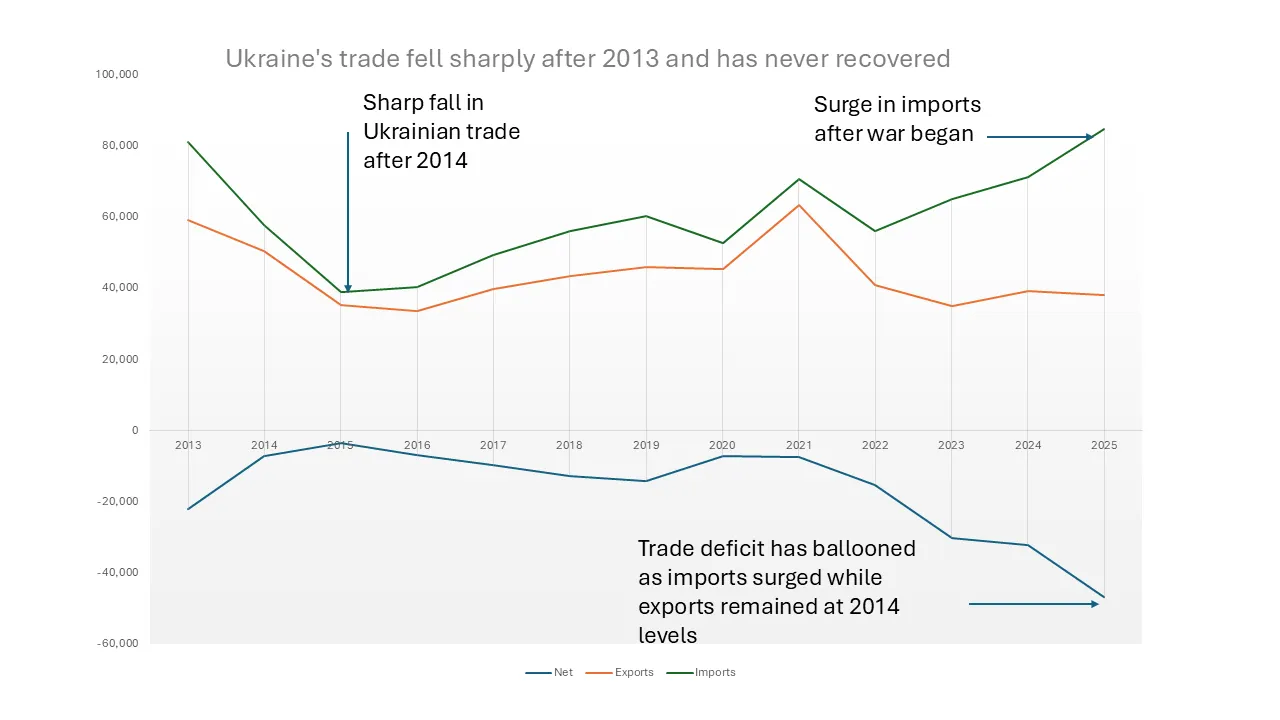
  • L’Ukraine a exporté 24% de moins et importé 46% de plus en 2025 qu’en 2014. La guerre a fait grimper les importations alors que les exportations ne se sont jamais remises de la signature de l’ALECA et ont été entravées par l’effort de guerre.
  • Le déficit commercial béant que l’Ukraine a creusé depuis le début de la guerre a exercé une pression accrue sur les sponsors européens pour qu’ils fournissent le capital dont l’Ukraine a besoin pour empêcher l’effondrement de sa monnaie, en plus de fournir des fonds pour répondre à ses besoins budgétaires.
  • Ce défi de financement pour l’Europe persistera après la fin de la guerre, tant que l’Ukraine ne sera pas autosuffisante en stimulant ses exportations et/ou en attirant suffisamment d’investissements étrangers pour compenser ses déficits commerciaux.
  • La force des exportations russes et ses excédents commerciaux constants n’ont pas été affectés par la guerre. Après le début de la crise ukrainienne, la Russie a commencé à diversifier ses principales exportations d’énergie hors d’Europe, ce qui lui a permis de résister à la réduction progressive de ses exportations vers l’Europe. En effet, la Russie a tiré une énorme manne, en 2022, de la flambée des prix de l’énergie. Il n’y a aucune preuve que les sanctions aient eu un impact significatif sur le modèle d’exportation russe.
  • La Russie avait déjà commencé à réaccumuler des réserves de change après l’effondrement des prix du pétrole fin 2014, jusqu’avant le début de la guerre. Suite à l’immobilisation des 300 milliards de dollars de réserves russes en Europe, la Russie a commencé à accumuler des réserves en or, pour sanctionner les bénéfices futurs. La Russie dispose désormais de réserves liquides de plus de 420 milliards de dollars, ce qui signifie que l’immobilisation de ses réserves de devises étrangères n’est plus un facteur limitant sur le plan économique.

Analyse détaillée

Le modèle d’exportation de la Russie, dans lequel elle enregistre constamment d’importants excédents commerciaux, lui a permis de générer les réserves de devises étrangères et d’or qui ont sans aucun doute contribué à financer la guerre en Ukraine. Le déficit commercial de l’Ukraine s’est creusé depuis le début de la guerre, nécessitant des injections continues de capitaux européens pour empêcher l’effondrement de sa monnaie.

Cela aide à expliquer que la Russie puisse soutenir la guerre plus longtemps ; elle n’a pas besoin de contracter de nouvelles dettes importantes, sa dette restant faible, à 20%. L’Ukraine ne peut financer la guerre et maintenir ses comptes nationaux en équilibre qu’avec de l’argent européen qui ne peut être garanti à long terme et qui, de toute façon, a augmenté la dette ukrainienne de 20% du PIB en moyenne chaque année depuis le début de la guerre. Ce n’est pas durable.

L’Accord de libre-échange approfondi et complet de 2014 a désavantagé l’Ukraine car il forçait le pays à ne plus commercer avec la Russie.

Le point de départ est la signature par l’Ukraine d’un Accord de libre-échange approfondi et complet avec l’Europe, le 27 juin 2014.

Herman van Rompuy, alors président du Conseil européen, déclarait alors que « des liens politiques et économiques plus forts apporteront plus de stabilité et de prospérité à l’ensemble du continent européen ».

Au même moment, le président Porochenko déclarait « au cours des derniers mois, l’Ukraine a payé le prix le plus élevé possible pour réaliser son rêve européen ».

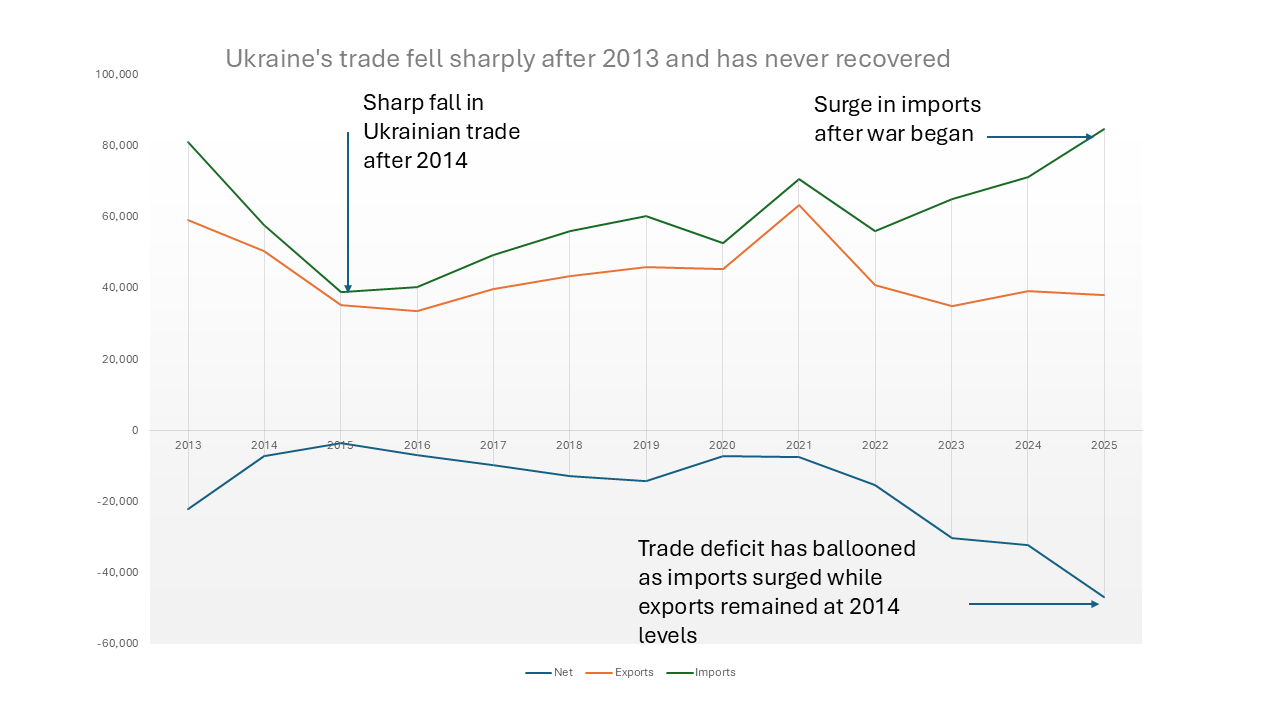
Car le véritable cout de cet accord a été supporté par l’Ukraine qui a vu ses exportations s’effondrer et ses importations augmenter, car elle avait fait le « choix souverain » de ne plus maintenir ses liens commerciaux avec la Russie.

Ce fut un choix catastrophiquement mauvais. La Russie représentait environ 25% des exportations ukrainiennes avant 2014 et ce chiffre était tombé à moins de 5% en 2021, avant le début de la guerre. L’Ukraine n’a pas comblé cet écart en augmentant le volume de ses exportations vers l’Europe, qui sont restées en grande partie inchangées.

De plus, le même schéma peut être observé en Géorgie, qui n’a également connu aucune augmentation réelle de ses exportations vers l’UE après la signature de l’ALECA. L’UE utilise un certain nombre de mécanismes de règlement des différends commerciaux et d’autres barrières non tarifaires pour bloquer la croissance des importations en provenance des pays partenaires de l’ALECA.

Ainsi, en encourageant l’Ukraine à commercer avec l’Europe et non avec la Russie, l’Europe a imposé une perte économique sèche à l’Ukraine qui avait pris la décision souveraine de renoncer à une relation commerciale auparavant rentable, pour poursuivre un objectif politique d’intégration à l’UE.

De plus, depuis le début de la guerre, les importations ukrainiennes ont augmenté, entraînant une augmentation progressive de son déficit commercial. Cette augmentation des importations a été causée par le fait que l’Ukraine achète des armes aux États-Unis en utilisant des fonds européens et nationaux empruntés. Ainsi, l’Ukraine emprunte de l’argent pour créer un déficit commercial qui doit être comblé par de nouveaux afflux de capitaux.

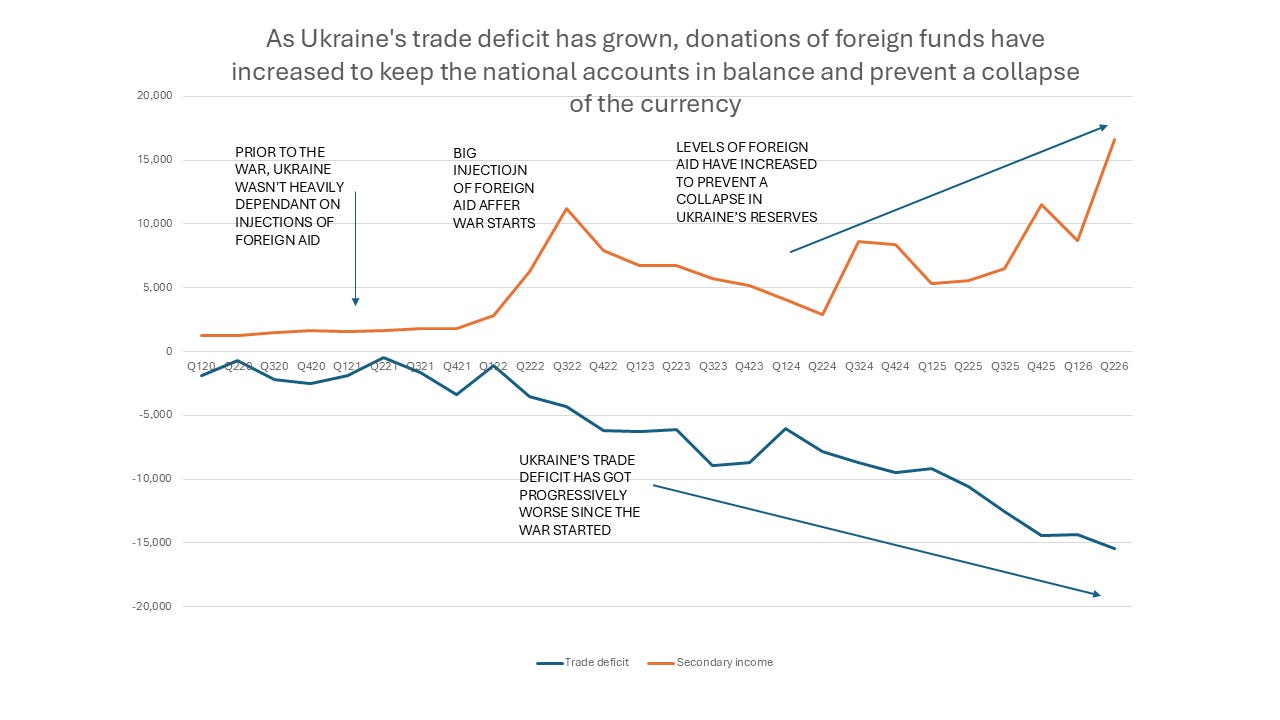
Entraînée dans un déficit commercial persistant et croissant par la guerre, l’Ukraine a besoin d’injections continues de fonds étrangers pour empêcher l’effondrement de sa monnaie.
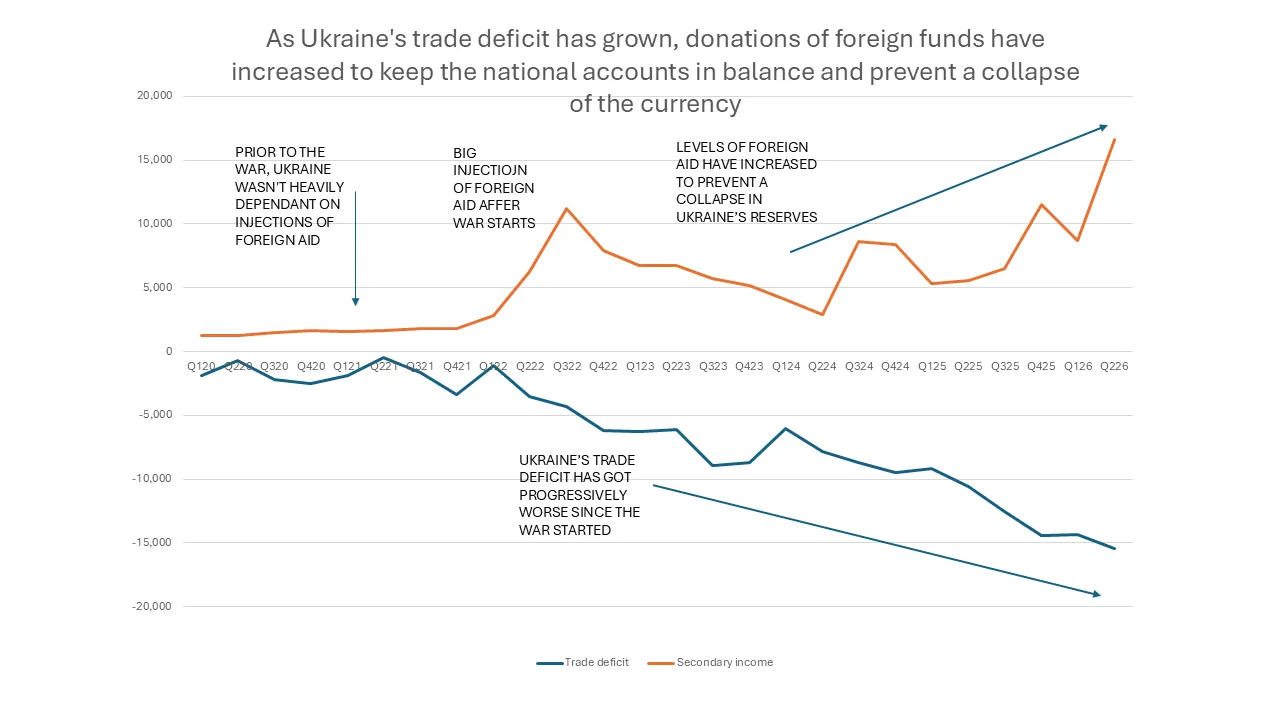
Le graphique ci-dessous montre la croissance du déficit commercial de l’Ukraine avec la croissance correspondante des recettes classées comme « Revenu secondaire » dans sa balance des paiements trimestrielle. Ces entrées de capitaux classés comme « Revenus secondaires » sont des injections en provenance d’Europe (principalement) qui sont vitales pour renforcer les réserves de change de l’Ukraine et ainsi éviter une ruée sur la devise. Le point clé est que le financement étranger à l’Ukraine est plus qu’un simple événement fiscal. Il s’agit d’un mécanisme de soutien essentiel dans les circonstances où l’Ukraine est incapable d’attirer suffisamment d’investissements étrangers en temps de guerre.

La Russie n’a tout simplement pas été confrontée au même défi, choisissant plutôt de diversifier ses exportations vers d’autres pays alors que l’Europe fermait progressivement ses échanges commerciaux. Les sanctions n’ont pas entamé son commerce.

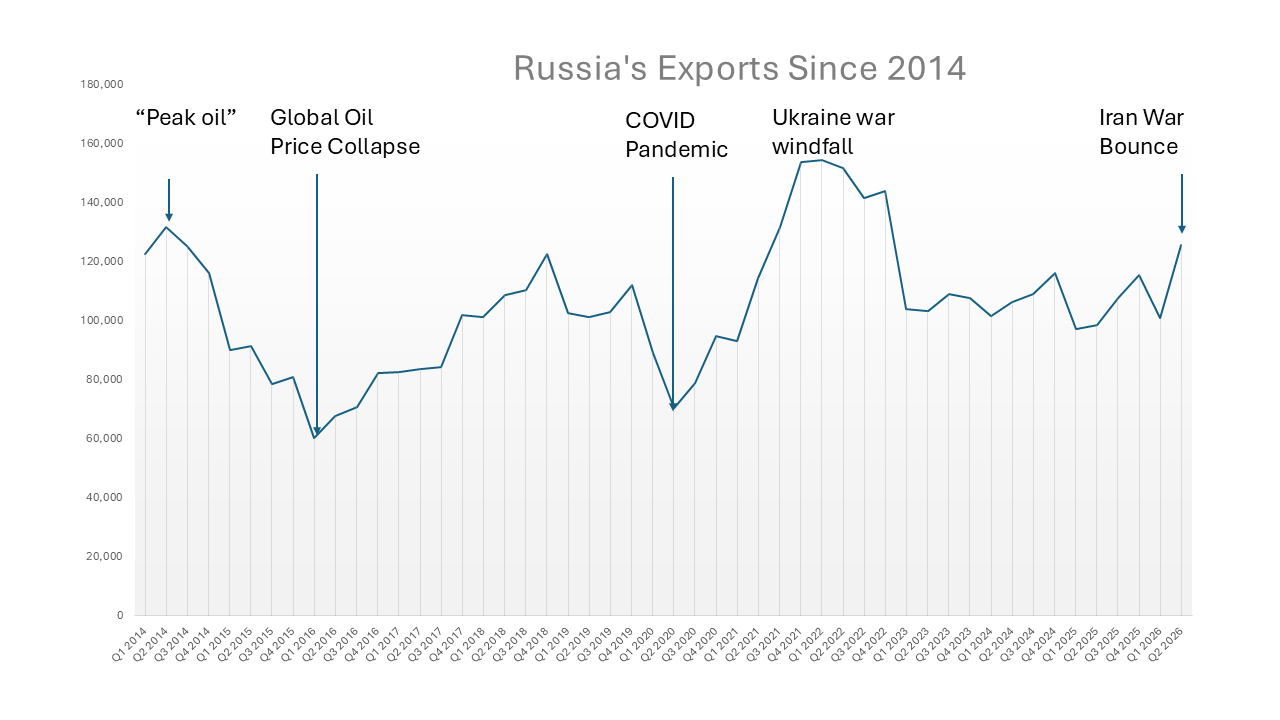
Le graphique ci-dessous illustre de manière élégante comment le commerce de la Russie a changé et évolué depuis. Les exportations russes ont connu des pics et des creux depuis 2014, bien que les creux aient souvent été causés par des événements mondiaux tels que les effondrements des prix du pétrole de 2014 et 2016 et le COVID.
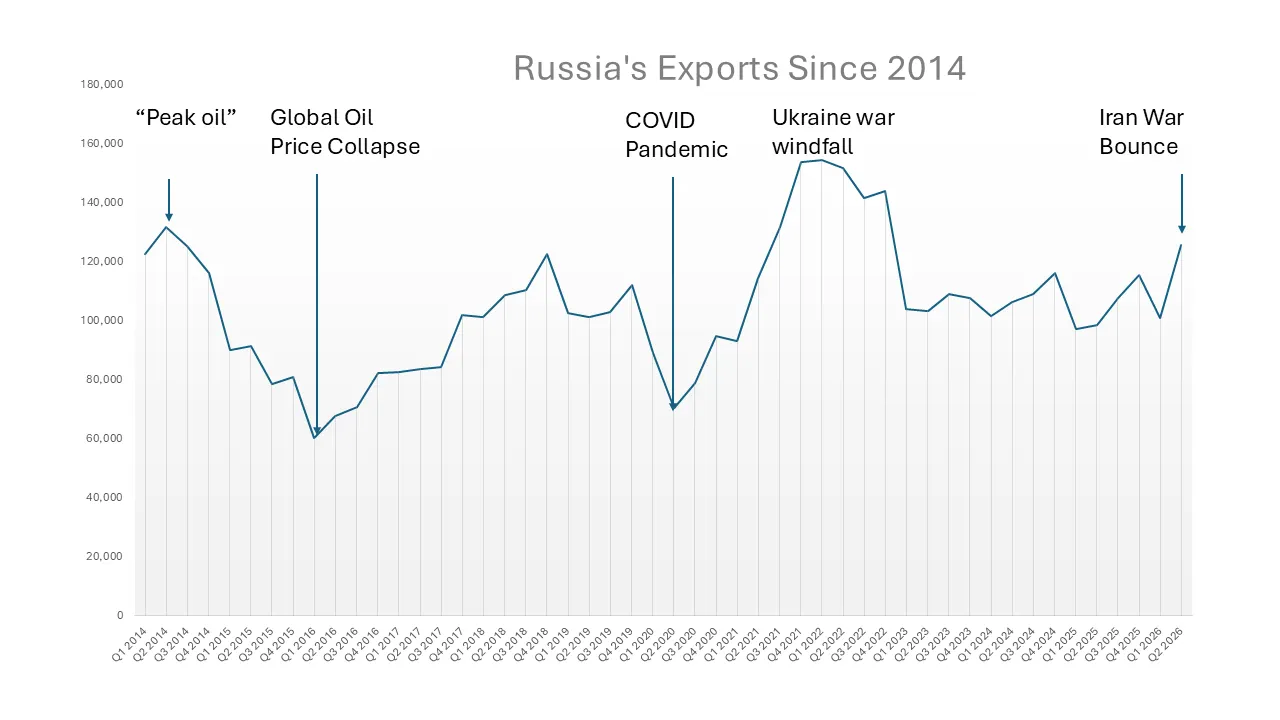
Le déclenchement de la guerre en Ukraine a provoqué une énorme manne de revenus d’exportation car le prix du pétrole a bondi. Malgré l’imposition de milliers de sanctions par les pays occidentaux après le début de la guerre, les exportations russes sont restées très résistantes. Cela est dû à la diversification par la Russie de ses exportations vers les pays d’Asie.

En bref, malgré les nombreux gros titres dans les médias occidentaux traditionnels sur les sanctions « entravant l’économie de guerre de la Russie« , il n’y a aucune preuve substantielle que cela ait été le cas.

Le modèle d’exportation russe continue d’être une salle des machines qui lui fournit les liquidités dont elle a besoin pour financer la guerre sans contracter de nouvelles dettes importantes. Cela lui donne un avantage significatif sur l’Ukraine et ses soutiens européens dans cette « guerre d’usure« .

La Russie a accumulé des réserves depuis le début de la guerre pour compenser l’immobilisation de 300 milliards de dollars en devises par les pays occidentaux. La Russie investit désormais dans l’or pour protéger ses actifs.
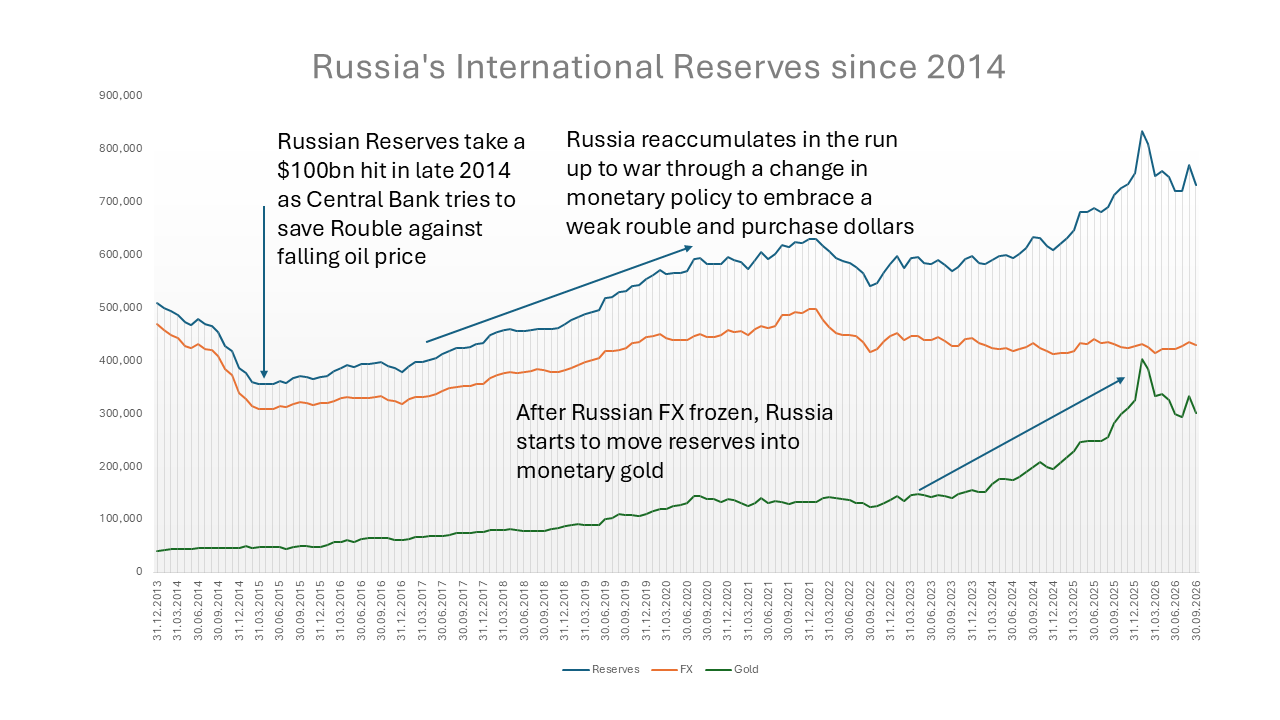
Enfin, je commente depuis un certain temps que la Russie a entamé le processus d’accumulation de réserves de change en 2017 alors qu’elle modifiait sa politique monétaire pour adopter un rouble faible afin de maximiser les revenus en roubles tirés des exportations et qu’elle entreprenait un certain nombre d’achats en dollars via le ministère des Finances. Vous pouvez voir cette accumulation de réserves dans le graphique ci-dessous.

Après le début de la guerre, après l’importante manne de revenus tirés des exportations en 2022 et des chiffres commerciaux toujours solides par la suite, la Russie a continué à accumuler des réserves. Cependant, suite au gel de ses avoirs en devises, elle a plutôt choisi de stocker ses réserves en or, pour les protéger des sanctions.

Si la Russie souhaite évidemment récupérer ses avoirs immobilisés après la fin de la guerre (gros point d’interrogation), elle a néanmoins constitué un important coussin financier à hauteur de plus de 420 milliards de dollars de réserve en plus de celle qui reste gelée.

Ces importantes réserves contribuent sans aucun doute à garantir l’effort de guerre russe sans avoir besoin de gros emprunts. La dette de la Russie représente aujourd’hui environ 20% de son PIB.

En 2021, la dette de l’Ukraine s’élevait à environ 49% de son PIB. Aujourd’hui, elle représente environ 110% de son PIB.

Publié à l’origine par The Peacemonger.
Traduction:
Le Saker Francophone

  •  

As eleições brasileiras que poderiam ser em Portugal ou na EU

Eleições no Brasil, EUA e UE: esquerda identitária e direita antissistema desviam o debate do essencial — soberania e redistribuição de riqueza.

Junte-se a nós no Telegram , X e VK.

Escreva para nós: info@strategic-culture.su

As eleições brasileiras têm sido férteis na expressão dos estereótipos eleitorais mais comuns que, na sua esmagadora maioria, são responsáveis pelo acentuado resvalamento para uma política superficial, estéril em debate de soluções efectivas para o futuro colectivo, mas profundamente rica em estética carnavaleira, mais liberal ou mais conservadora, em acesa maledicência e numa tendência exacerbada para o insulto fácil ou até para as mais vis ofensas pessoais.

Nada que não se conheça dos EUA e da forma conservadora, tacanha, acanhada e recuada como aí é discutida a política nacional, em que uma e outra barricada evitam debater os assuntos realmente fracturantes, classificados de «radicais»; nem nada que não se conheça da velha Europa, cuja perda de qualidade da classe política em nada difere, hoje, do que se passa no Brasil, na Argentina ou noutras paragens marcadas pela submissão dos principais dirigentes políticos ao imperialismo anglo-sionista, ao poder imenso da oligarquia ou, em última análise, à necessidade de conciliação das políticas caseiras para com a agenda internacional do imperialismo.

Enquanto olhamos para uma esquerda apanhada, não raras vezes, pelo identitarismo individualista e liberal, assim desviada dos locais de trabalho, do chão de fábrica, dos dramas da exploração, que estão na base dos problemas mais profundos com os quais se debate a maioria da população, constatamos também uma direita que funciona como o outro lado da moeda: ao liberalismo nos costumes de parte da esquerda (a liberal), a direita responde com o conservadorismo; às promessas de justiça social da esquerda (a liberal), a direita responde com mais liberalismo e até “ultraliberalismo”. Uma e outra acabam por falar muito pouco do que interessa realmente, centrando-se muitas vezes em assuntos acessórios, mais ligados à estética do que à essência.

Não obstante, com um olhar atento, podemos sempre desenterrar o que se esconde por trás de um e outro panfletarismo. Uma das mais importantes temáticas em confronto hoje nas sociedades ocidentais – ou ocidentalizadas, como é o caso do Brasil, da América Latina e da Europa Latina – consiste na tensão entre soberania e submissão ao imperialismo anglo-sionista. Se, na Europa – nos casos de Portugal, Espanha ou Itália –, essa tensão é mediada por uma UE já submetida, que tende a funcionar como uma camada protectora das tensões nacionais e uma vez levantada a questão da soberania, a tendência é, das duas uma, ou vê-la como uma extensão da soberania europeia, o que esconde o real problema, ou vê-la como uma tentativa de discussão da saída da UE, o que ainda é visto como um tabu em alargados círculos de um campo ou outro; no Brasil, essa tensão fica mais exposta, uma vez que não existe uma União Americana para mediar as relações externas do país para com os EUA e Israel, os grandes representantes do imperialismo anglo-sionista.

E, neste caso, é interessante verificar que, do lado bolsonarista, de onde se poderia esperar a proposta nacionalista, tal não sucede, ou sucede muito residualmente, pois, mesmo quando sucede, a tentativa é desmascarada pelo excessivo apoio que as redes sociais norte-americanas dão à candidatura de Bolsonaro, ou pelas constantes ingerências de Trump e dos seus apaniguados no processo eleitoral brasileiro. Por muito que a direita quisesse mostrar-se como defensora da nação e da sua independência, o efusivo apoio dos EUA à candidatura em causa faria cair a máscara, pois os EUA – e Israel – nunca apoiariam com tanta veemência e de forma tão expressa quem não lhes fosse dócil. A omissão de Lula nos comandos algorítmicos de Silicon Valey acaba por denunciar qual dos dois candidatos é mais dócil aos interesses dos EUA.

Já do lado de Lula da Silva, aí sim, têm surgido as propostas mais demarcadas em matéria de defesa da soberania, mesmo que alguma dessa intensidade possa depois colidir com os ditames pragmáticos da realpolitik, ditados pela necessidade de conciliar com um centrão marcadamente pró-imperialista. De qualquer das formas, esta linha demarcadora existe, e parece-me pouco crível que alguém, no pleno uso das suas faculdades mentais, possa escolher um protegido de Trump para a defesa dos interesses soberanos do Brasil, em vez de um experiente conciliador, mesmo que não revolucionário.

Sabendo da importância que esta questão tem, depois, para a gestão e utilização soberana dos recursos endógenos e a sua afectação a um plano de desenvolvimento independente, parece-me de difícil defesa a escolha de Bolsonaro, no caso de pesar, nessa escolha, a questão soberana. Tal como na UE, também não é na direita que os soberanistas têm encontrado as melhores práticas, talvez com excepção de Viktor Orbán — que governou a Hungria durante dezasseis anos, até às eleições de abril de 2026 —, mas mais por necessidade de alinhamento com a Rússia e a China, em consequência das escolhas da UE em matéria energética e industrial, do que por necessidade de construção de um projecto de nação realmente soberano. Aliás, se mais provas fossem necessárias, tivemos o total alinhamento de Orbán com o sionismo para percebermos que o desencontro para com a UE era apenas tático, e não uma questão de fundo ou de defesa da soberania nacional. Nem por um momento Orbán renunciou à NATO nem se afastou de Israel e do sionismo — factores que usou como plataformas de sustentação contra a burocracia de Bruxelas. A submissão a Trump, essa, também foi explícita e verbalizada com o fulgor de quem via nele “um enviado de deus”!

Já no caso de Meloni, Babis e outros, a questão é a mesma: muita conversa, mas, no final, o mesmo alinhamento, o que deixa antever para onde virão a virar os partidos como a AfD. Perante as questões fundamentais, também estas alinharão, ou pela submissão a Bruxelas, ou pela submissão directa ao sionismo e ao imperialismo dos EUA. Outros, como Meloni, conseguem fazer um meio-caminho que, no final, tem as mesmas consequências sociais. No que conta realmente, os jovens continuam a deparar-se com o desemprego, a não conseguir casa, as infraestruturas a degradar-se, os direitos laborais sob ataque cerrado e os salários em desvalorização acelerada face ao aumento brutal do custo de vida. Não existe um local onde esta «nova direita» esteja implantada e sentada nas cadeiras do poder, onde isto não se passe.

Daí que subsista um outro paralelo importante entre as eleições brasileiras e o que se passa na Europa e no Ocidente em geral: quer no Brasil, quer nos EUA, quer na Europa, esta «nova direita» utiliza também a agenda identitária como linha divisória em relação à esquerda. Supostamente, a «esquerda» – liberal, acrescento eu – seria responsável por uma decadência dos costumes e dos valores culturais e religiosos, pela decadência social e moral dos defensores desta deriva «wokista».

Ora, esta demarcação tem funcionado como justificação para muitos que, tendo-se apresentado como críticos do sionismo, defensores da multipolaridade, anti-imperialistas e defensores das soberanias do Sul Global, vêm agora usar este suposto «wokismo» da esquerda para justificar a eleição de um representante da submissão ao imperialismo como Bolsonaro. Esta demarcação tem um problema: mais «wokista» do que o «wokista» é aquele que faz do wokismo a coisa mais importante da política, seja quando se está a favor, seja quando se está contra.

À esquerda, muitos não são capazes de identificar nas pautas excessivamente identitárias uma agenda individualista, fraccionária e fragmentadora das classes trabalhadoras, com origem nos próprios EUA, cujos serviços de manipulação de massas transformaram o ser «woke» (alerta para as injustiças sociais) numa espécie de panfletarismo identitário que extraiu ao movimento «woke» a dimensão classista e de redistribuição justa da riqueza que possuía e lhe deu uma panóplia de identidades em troca, transformando a preocupação com a igualdade, a justiça social e a liberdade – uma preocupação materialista e universalista – numa preocupação tribalista, individualista e, acima de tudo, desconectada da dimensão material, ou seja, da dimensão da justa redistribuição da riqueza produzida pelo trabalho.

Mas, à direita, quando se utiliza essa deriva tribalista e individualista como linha divisora, nega-se também o que distingue, de facto, a esquerda da direita. É que na matriz histórica que distingue esquerda de direita está a riqueza: quem a domina e como é repartida. De um lado, quem defende que a propriedade e a riqueza não devem ser a medida da liberdade e da iniciativa política e que todos os seres humanos devem ter direito a uma vida digna (universalismo) e, do outro, à direita, a plutocracia fisiocrática, ou seja, a ideia de que a liberdade e a capacidade de intervenção política devem medir-se pela riqueza que se tem. Daí que os sufrágios liberais assentassem numa lógica censo-censitária – ou seja, identitária –, em que o que contava era a riqueza que se tinha, se era homem e se sabia ler e escrever, e não fosse a luta, nomeadamente a das mulheres sufragistas, a conseguir alcançar o que hoje designamos por «sufrágio universal» e ainda estaríamos assim. Julgo que também as terão acusado de «wokistas», nos termos em voga na altura!

Assim, de lá para cá, ou seja, desde o momento fundador da dicotomia «esquerda–direita» da Revolução Francesa, a direita se empenha mais do lado da conservação da propriedade nas mãos de quem a tem, e a esquerda mais do lado da democracia real, da democracia económica, social e cultural, negando a ideia de que os ricos tenham de permanecer ricos e que os pobres tenham de permanecer pobres — em jeito de tradução, o que chamamos de progressismo universalista, por oposição ao progressismo individualista, o qual tende sobretudo para as questões da identidade individual.

Assim, quando esta direita embarca na lógica antiwokista, fazendo desta agenda o aspecto mais importante da discussão política, como se o que importasse realmente não fossem as coisas que nos permitem viver, sustentar, alimentar e fruir o nosso corpo e espírito, esta direita fá-lo apenas com uma intenção: desviar a atenção para uma questão superficial, para que nas propostas em discussão não entre o que lhe é mais caro: a redistribuição justa da riqueza e a democracia económica, social e cultural. Assim, o que mais lhe importa permanece indiscutível e as eleições transformam-se num carnaval de bandeirinhas do contra e a favor. Quem escolhe onde vota por causa do wokismo de outro é tão wokista quanto ele.

Mas não se ficam por aqui as semelhanças. Outra é a questão da segurança e do combate ao crime: à direita, propaga-se a ideia de que o crime se combate com violência brutal; à esquerda, defende-se que, enquanto houver pobreza, não será possível erradicar o crime. Ora, não é preciso ser muito inteligente para perceber que a primeira proposta falha nos locais onde mais se dela fala: nos EUA. Nenhum país tem mais prisioneiros comuns — também poucos terão mais prisioneiros políticos —, nenhum país gasta tanto em suposto combate ao crime, nenhum país desenvolvido tem tanto crime. Porque, nos EUA, os viveiros do crime comum, os guetos negros e latinos, onde vivem populações desesperadas, desprovidas de condições básicas de emprego, de educação e de serviços públicos essenciais, continuam sobrelotados e cada vez mais empobrecidos. Ora, esse é apenas o crime do desesperado, o que surge na televisão.

Outra forma de crime e que também constitui um paralelo na agenda direita/esquerda, é a questão da corrupção. Se esta «nova direita» faz bandeira da corrupção e a esquerda pouco fala dela, também é verdade que, quando eleita, esta «nova direita» faz tudo menos acabar com a corrupção. Não é preciso ir mais longe do que Trump para constatarmos um caso de corrupção empedernida. E quem do bolsonarismo esperava o fim da corrupção também ficou a praguejar no deserto: o governo Bolsonaro foi, ele próprio, um antro de corrupção. Talvez se devesse começar por discutir que, para acabar com a corrupção, é preciso acabar com o que a origina: a imensa disparidade na distribuição da riqueza, que faz com que uns possam usar o seu imenso poder económico para obter do poder político o que lhes falta em legitimidade eleitoral. Este crime, o de colarinho branco, sendo até mais insidioso e originando as causas profundas do outro, não surge tão amiúde nas televisões.

Na imigração temos, talvez, a única das grandes diferenças entre as eleições na América Latina, no Brasil e nos países do capitalismo avançado. Mas a imigração surge também como uma forma de identitarismo superficial da direita. Quanto mais a «nova direita» fala de «excesso de imigração», mais esquece que quem emprega esses imigrantes são os mesmos que a financiam e apoiam, que os imigrantes vêm trabalhar nos sectores económicos com os salários mais baixos, explorados pelos patrões mais retrógrados e conservadores — base social da direita radical —, e que o patronato só recorre à imigração como último recurso, porque a sua agenda antilaboral fez com que os trabalhadores não tenham hoje condições para projectar um futuro com estabilidade, porque os jovens, vítimas da transformação da habitação em especulação imobiliária, deixaram de poder programar um futuro em família e porque os pais e as mães, vítimas dos horários desregulados impostos pelo patronato e consagrados em lei pela direita, não têm tempo para a sua família.

O mais grave é que, quanto mais negam as condições materiais necessárias, mais dizem defender a família e os respectivos valores. Uma clara mostra de hipocrisia e cinismo, que nega as causas profundas do problema — um problema que afecta todo o Ocidente. É mais fácil, como têm feito, negar que a crise da natalidade está intrinsecamente ligada ao sistema vigente. Sabem onde não havia crise da natalidade? Nos países socialistas do leste. Países industrializados, letrados e bem alimentados, que duplicaram as suas populações em 70 anos. Hoje, tomados pelo capitalismo, encontram-se na lenga-lenga dos países do capitalismo avançado. Daí não sairão até que mudem as características fundamentais de um sistema económico que não apenas não dá tempo à mulher para ter filhos, como destrói a coesão familiar com a desregulação do trabalho e, consequentemente, da vida.

Ora, o que é mais interessante deste debate político é que os que há uns anos, os que diziam não haver direita e esquerda, que os políticos eram todos iguais, são agora os que vêm dizer que a salvação está nesta «nova direita» e são os que se acirram quando lhes dizemos que esta «nova direita» nada tem de «nova» e que, ao invés, tresanda a fascismo clássico.

Nunca são fascistas, mas submetem-se ao sionismo e ao império anglo-sionista; não são fascistas, mas usam da demagogia e do discurso fácil usados pelo fascismo clássico; não são fascistas, mas usam das bandeiras de massas como o fez o fascismo clássico; não são fascistas, mas usam a religião e a suposta degradação dos costumes para desviar as atenções do essencial, como o fez o fascismo clássico; não são fascistas, mas chegados ao poder privatizam, atacam direitos laborais e fecham serviços públicos essenciais, como fez o fascismo clássico; não são fascistas, mas atacam o conhecimento, desvalorizam o estudo e o empenho individual, como fazia o fascismo clássico; não são fascistas, mas desconsideram a experiência política, o percurso individual e colectivo, como fazia o fascismo clássico, para desconsiderar as instituições; não são fascistas, mas assumem um discurso racialista, xenófobo, supremacista e ultra-individualista, como fazia o fascismo clássico; não são fascistas, mas são todos anticomunistas, antissocialistas e contrários ao progresso social, como era o fascismo clássico; não são fascistas, mas são apoiados pela oligarquia e pelo patronato mais retrógrado, bem como pelo imperialismo, como era o fascismo clássico.

Não são fascistas, mas cheiram, voam, cantam e vociferam como os fascistas…

Chamem-lhe o que quiserem, mas uns «anos 30» do século XXI, armados de IA e de redes sociais? Não, obrigado! Não podemos esperar diferente de quem tem os mesmos patrões e quer mandar nos mesmos empregados…

Espero que, depois, me poupem ao adágio repetitivo do «fomos enganados».

FONTES E NOTAS DE VERIFICAÇÃO

Encarceramento nos EUA — os EUA têm a maior população prisional do mundo (cerca de 2 milhões de pessoas) e a maior taxa de encarceramento de qualquer democracia; em taxa por habitante, apenas El Salvador, Cuba e Turquemenistão a superam (World Prison Brief / Prison Policy Initiative, 2026). https://eji.org/news/u-s-remains-world-leader-in-number-of-people-incarcerated/

Jair Bolsonaro — condenado pelo Supremo Tribunal Federal a 27 anos e 3 meses de prisão (11 de setembro de 2025) por tentativa de golpe de Estado, organização criminosa armada e abolição violenta do Estado democrático de direito; cumpre pena desde 25 de novembro de 2025. https://apublica.org/especial/o-julgamento-de-jair-bolsonaro/ ; https://checamos.afp.com/doc.afp.com.A2V88ZQ

Donald Trump — condenado em maio de 2024 por 34 crimes de falsificação de registos comerciais; em janeiro de 2025 foi-lhe aplicada uma liberdade incondicional (sem pena de prisão nem multa), com recursos ainda pendentes em 2026. https://www.bbc.co.uk/news/articles/c4g3m95ykzko ; https://www.axios.com/2026/08/28/trump-hush-money-conviction-appeal

Viktor Orbán — a Hungria é membro da NATO e Orbán foi aliado próximo de Netanyahu e de Israel; nas eleições de abril de 2026, Péter Magyar pôs fim a 16 anos de governo de Orbán. https://apnews.com/article/hungary-israel-euro-2024-soccer-1514e137b54b18a1fed8be8b6cd89b19 ; https://www.ynetnews.com/article/hjef3yqnbx

Sufrágio — em Portugal, o voto censitário só foi extinto em 1968; as mulheres obtiveram um direito de voto limitado em 1931 e a igualdade plena apenas com a Constituição de 1976. https://www.europeana.eu/pt/stories/votes-for-women ; https://arquivomunicipal.lisboa.pt/fileadmin/arquivo_municipal/difusao/publicacoes/cadernos/Cad04.pdf

Origem do termo «woke» — inglês afro-americano, com registos desde os anos 1920–1940, popularizado a partir de 2014 pelo movimento Black Lives Matter. https://www.merriam-webster.com/wordplay/woke-meaning-origin ; https://www.latimes.com/world-nation/story/2025-09-30/how-woke-went-from-an-expression-in-black-culture-to-a-conservative-criticism

Origem dos termos «esquerda» e «direita» — disposição dos deputados na Assembleia Nacional Constituinte francesa, em 1789. https://observador.pt/opiniao/a-grande-dicotomia-o-que-ainda-separa-a-esquerda-da-direita/

Criminalidade — a taxa de homicídios dos EUA (≈6,4 por 100 mil habitantes) é muito superior à dos restantes países desenvolvidos, mas inferior à do Brasil (≈22–23) ou do México (≈25); por essa razão, o texto original «nenhum país tem tanto crime» foi ajustado para «nenhum país desenvolvido tem tanto crime». https://www.unodc.org/documents/data-and-analysis/gsh/2023/GSH_2023_LAC_web.pdf


  •  

Cómo se manipula a la «generación Z»

Una docena de Estados ya han vivido –a veces con éxito– manifestaciones de la “generación Z”, y las que acaban de producirse en Francia abren la puerta a que la población sea manipulada. Los actos destrucción programados que se vieron en Francia el 17 de octubre tienen el aspecto de un montaje con vista a la proclamación de una especie de estado de emergencia que permita suspender la próxima elección presidencial, como viene sucediendo en Ucrania desde hace 2 años.

Thierry Meyssan

Únete a nosotros en Telegram , X y VK .

Escríbenos: info@strategic-culture.su

En este artículo analizaré una docena de movimientos de protesta, más o menos organizados, de la llamada “generación Z”, o sea de la población de entre 14 y 29 años. Muchas de esas protestas han tenido lugar en otros países, pero la generación Z siempre ha denunciado la corrupción, el nepotismo y los abusos de poder, por encima de cualquier otra injusticia.

En todo momento tendré en mente el hecho que, aunque no se puede provocar la colera de una multitud, sí es muy fácil desviarla de su objetivo inicial. Esas manifestaciones siempre comienzan invocando un interés general pero pueden confundir sus objetivos una vez en marcha.

Una característica inicial de esos movimientos es que todos han estallado después de escándalos de corrupción y de represión. Los manifestantes no han enarbolado una ideología política en particular pero todos han expresado, ante todo, su exigencia de justicia.

• Mongolia, 11 de enero de 2025: Jóvenes se congregan en Ulan Bator para denunciar la vida de lujos de la familia del primer ministro Luvsannamsrai Oyun-Erdene. Rápidamente, el movimiento de protesta denuncia también la corrupción generalizada de la clase política y exige la renuncia de 33 diputados. El primer ministro dimite el 3 de junio.

• Indonesia, febrero de 2025: La isla Java es teatro de manifestaciones contra la corrupción. Un sindicato estudiantil se suma a las manifestaciones cuando el gobierno implica las universidades en varios proyectos de minería a cambio de comidas gratis para los estudiantes. Cesan las manifestaciones pero el descontento se extiende por todo el país mientras que el gobierno otorga privilegios a los militares y apoya públicamente el “traslado” de la población de la franja de Gaza, anunciando la posibilidad de que sea enviada al «Estado musulmán más grande del mundo».
Las manifestaciones se reanudan en agosto de 2025, respondiendo a un llamado de los camioneros y en protesta contra importantes alzas de los impuestos.
Es entonces cuando aparece en las manifestaciones la bandera de la “Banda Pirata del Sombrero de Paja”, que se convierte en símbolo de la lucha contra la corrupción. Portar esa bandera, que proviene originalmente de la serie manga One Piece, se convierte en motivo suficiente para ser enviado a los tribunales bajo la acusación de traición.
Finalmente, el presidente Prabowo Subianto reconoce que los jóvenes tienen derecho a manifestar su descontento y hace levantar las sanciones y la prohibición de portar la bandera pirata.

• Togo, 26 de junio de 2025: Estallan protestas contra el arresto del rapero Aamron, quien es además es torturado por la policía. Las protestas toman rápidamente un giro político ante el hecho que los policías habían filmado las torturas infligidas a Aamron, en momentos en que el presidente Faure Gnassingbé había iniciado un cambio de régimen con reformas a la Constitución. El movimiento dura hasta diciembre y acaba disolviéndose ante la represión, particularmente violenta, que deja saldo de muertos y heridos.

• Nepal, del 8 al 14 de septiembre de 2025: Se desarrollan en Katmandú grandes manifestaciones de jóvenes contra los hijos y las familias de los responsables políticos que exhiben sus lujos y privilegios en las redes sociales. El poder bloquea las redes sociales, pero esa medida exacerba las protestas. El primer ministro Khadga Prasad Sharma Oli dimite.

• Timor Oriental, del 15 al 17 de septiembre: Una organización estudiantil realiza en Dili, la capital, una serie de protestas contra las ventajas económicas de los miembros del parlamento. En definitiva, estos últimos acaban renunciando a los automóviles de lujo que estaban a punto de comprar.

• Filipinas, 21 de septiembre de 2025: Unos 100 000 jóvenes desfilan por las calles de Manila protestando contra la corrupción de los dos clanes que ostentan el poder en el país, la familia Marcos y la familia Duterte. El 70% de los fondos destinados a la lucha contra las inundaciones parece haber “desaparecido” de las cajas del Estado.

• Madagascar, septiembre de 2025: Un discurso desafortunado del presidente Andry Rajoelina sobre un progreso económico que la población no percibe en la vida diaria da lugar al inicio de protestas contra la repartición desigual del crecimiento económico. Las manifestaciones se generalizan y desembocan en un golpe de Estado militar y la huida del presidente Rajoelina.

• Marruecos, 27 de septiembre de 2025: Unos 200 000 jóvenes se lanzan a las calles en las principales ciudades del país para protestar contra la corrupción y el nepotismo. El movimiento de protesta comienza en momentos en que el reino dedica sumas importantes a la preparación de la Copa del Mundo de futbol… mientras que los hospitales se caen a pedazos. La represión pone fin al movimiento.

• Paraguay, 28 de septiembre de 2025: Se inician manifestaciones en las que los jóvenes protestan contra la corrupción y rechazan un intento de modificar la Constitución que daría al ex presidente Horacio Cartes la posibilidad de regresar al poder. La población amerindia se incorpora a las protestas al enterarse de que la sede del Instituto Paraguayo del Indígena (INDI) se traslada a una base militar. El movimiento de protesta se extingue el 3 de octubre, cuando el presidente Santiago Peña anula el traslado de la sede del INDI.

• México, 15 de noviembre de 2025: Después del asesinato de un alcalde a manos de un cártel de la droga, decenas de miles de jóvenes salen a las calles para protestar contra la inseguridad y la corrupción. Las manifestaciones cesan a mediados de diciembre, sin adopción de nuevas medidas.

• Bulgaria, 26 de noviembre de 2025: Se registran protestas masivas de jóvenes contra la corrupción y contra un proyecto de presupuesto que transfiere el financiamiento de las jubilaciones y de la seguridad social en las empresas al sistema fiscal. Las protestas cesan al cabo de un mes, después de la retirada del proyecto de reforma y la dimisión del gobierno Zheliazkov.

• Japón, 3 de mayo de 2025: Alrededor de 50 000 jóvenes inician protestas contra la remilitarización del país. Como en los conciertos de K-Pop y durante las protestas contra la proclamación de la ley marcial en Corea del Sur, los manifestantes esgrimen objetos lumínicos. Las protestas se extienden rápidamente por todo el país, pero el movimiento se disuelve por agotamiento.

• India, 15 de mayo: El presidente del Tribunal Supremo compara a los jóvenes desempleados con cucarachas. Un estudiante indio de comunicación de la universidad de Boston crea entonces, en la India, el “Partido de las Cucarachas” y organiza manifestaciones hasta forzar la renuncia del ministro de Educación. El Partido de las Cucarachas reaparece en octubre con un movimiento de protesta contra la revisión de las listas de electores, de las que se están viendo excluidas las personas más pobres. El movimiento se mantiene en este momento [1].

La manifestación del 17 de noviembre en Francia

En Francia, a partir del 18 de septiembre pasado comienzan a verse manifestaciones de los alumnos de la enseñanza media. Comienzan por Creteil, una comuna de los alrededores de París, rápidamente se extienden por la capital y después por todo el país. Pronto se unen a ellas los estudiantes universitarios. Los sindicatos del sector público no tardan en sumarse a las protestas.

Las primeras manifestaciones son pacíficas –los adolescentes denuncian inicialmente las malas condiciones de sus centros de estudio y la escasez de profesores– pero los desórdenes comienzan cuando algunos dirigentes de izquierda legitiman la violencia. Elementos violentos no vinculados a los manifestantes, pero bien organizados, se hacen presentes en las protestas causando daños materiales en los centros de estudios de los manifestantes. Mientras tanto, los policías en el terreno se interrogan sobre sus superiores al darse cuenta de que están recibiendo órdenes contradictorias que les impiden proteger a los verdaderos manifestantes y que los ponen a ellos en peligro ante los grupos violentos.

Las manifestaciones adquieren una envergadura nacional el 17 de octubre. Los “chalecos amarillos”, el movimiento informal surgido en 2018-2019 contra el alza de precios de los combustibles y en defensa de la Francia que vive en los barrios periféricos, en los suburbios de las grandes ciudades, se unen al movimiento, retomando su lucha contra el alza del costo de la vida.

La seguridad territorial de Francia, que habitualmente se caracteriza por la gran precisión de sus previsiones, esta vez subestima la cantidad de potenciales manifestantes situándola en unos 150 000 –en realidad, la cifra de personas que finalmente salió a las calles de Francia el 17 de octubre se sitúa entre 550 000 y 800 000. La dirección de los cuerpos policiales se asegura de que la cantidad de agentes en las calles corresponda al estimado extrañamente conservador de la inteligencia territorial.

Mientras tanto, los black blocs europeos envían a Francia miles de individuos, principalmente desde Italia, Suiza, Alemania y Bélgica.

El 17 de octubre las acciones violentas comienzan antes del mediodía, o sea antes de que se abra el cortejo de manifestantes aprobado por las autoridades, y se prolongan durante la madrugada del día 18. Se reportan más de 600 policías y gendarmes heridos –pero sólo 26 personas serán enviadas a los tribunales–, 1 500 establecimientos comerciales saqueados y destruidos y varios edificios históricos incendiados. Los daños estimados se elevant a cientos de millones de euros.

Análisis

En Francia, las protestas de los alumnos de la enseñanza media no fueron motivadas por un hecho en particular. Se trata de un malestar generalizado exacerbado por la sensación de abandono de toda una generación a la que se le explica que debe conformarse con estudiar en instalaciones mal preparadas, en las que se sufre por el calor o por el frio, según la época del año; que nadie enviará profesores sustitutos si sus profesores se enferman; que, a fin de cuentas nunca tendrá un empleo porque para los patrones la inteligencia artificial es más rentable… pero que, a pesar de todo, tendrá pagar la deuda que sus padres han acumulado y hasta los intereses de esa deuda.

Inicialmente, un partido político de izquierda trató de captar a los jóvenes manifestantes viniendo hasta las puertas de sus centros de enseñanza. Pero todo cambió el 17 de octubre.

Es evidente que ciertos responsables, en el seno de los mandos policiales, hicieron todo lo posible para que la gran movilización del 17 de octubre acabará cayendo en la violencia, a pesar de los manifestantes y de los policías. El 14 de octubre, un sindicato de los policías, Alliance, presentó una denuncia contra X por poner en peligro las vidas de otros. Ese sindicato está recogiendo testimonios por todo el país para identificar a los oficiales que propiciaron el caos.

Como lo hacen esos policías, tenemos que preguntarnos qué objetivo perseguían los instigadores ocultos de los actos de violencia. Es probable que se esté preparando una operación encubierta para perturbar la próxima elección presidencial, prevista para el 18 de abril y el 2 de mayo de 2027.

Es posible que esos instigadores ocultos estén en Francia, pero es igualmente posible que hayan actuado desde el extranjero, una hipótesis que se refuerza cuando se comprueba la participación de los black blocs europeos.

¿Es posible que hayamos olvidado que, en 2011, el candidato a la presidencia de Francia que aparecía a la cabeza en todos los sondeos, Dominique Strauss-Kahn, fue arrestado en Nueva York por la policía estadounidense, pero con ayuda del Pentágono, y acusado de “violación”, lo cual hizo posible la elección de Francois Hollande? [2]

¿Cómo es posible olvidar que, en 2017, otro candidato a la presidencia de Francia que también lidereaba los sondeos, Francois Fillon, fue objeto de un linchamiento mediático por haber contratado a su esposa como asistente parlamentaria? Lo cual abrió el camino a otro candidato salido prácticamente de la nada… el actual presidente Emmanuel Macron.

¿Cómo podemos entonces evitar pensar en la posibilidad de que, en 2027, el aspirante a la presidencia mejor posicionado en los sondeos, que no es otra que Marine Le Pen, pueda verse condenada por la justicia y despojada de sus derechos cívicos? ¿O que se cree una coyuntura bajo la cual se decida proclamar un “estado de emergencia” en el país? ¿O que, utilizando la nueva disposición incluida en la ley aprobada el 16 de agosto de 2026, se proclame un “estado de alerta de seguridad nacional”?

Al dirigirse a la Nación, menos de 24 horas después de las concentraciones del 17 de octubre, el presidente Emmanuel Macron hizo un rápido balance de las destrucciones registradas [3]. Y concluyó que los franceses son incapaces de enfrentar esos actos de violencia, antes de terminar diciendo que espera que se restablezca el orden… para poder realizar la elección presidencial.

[1] «Le “Parti du Peuple des Cafards” sonne la révolte des démunis à Bahrat», Red Voltaire, 15 de octubre de 2026.

[2] «Obama, la guerra financiera y la eliminación de DSK », por Thierry Meyssan, Komsomolskaïa Pravda (Rusia), Red Voltaire , 26 de mayo de 2011.

[3] «Allocution du Président de la République», Emmanuel Macron, Palais de l’Élysée, 18 de octubre de 2026.

  •  

Why trade is vital to understanding how Ukraine needs western capital to stay afloat and how Russia can pay for its war effort without new debt

Four graphs that tell a bigger story

By Ian PROUD

Join us on Telegram, X, and VK.

Contact us: info@strategic-culture.su

I have wanted to write an article for sometime about the differing fates of Russia and Ukraine since the onset of the conflict in 2014. The headline is that Ukraine has never made up the difference in increased trade with Europe having cut its trade with Russia to the bone since 2014. This has inadvertently meant that Europe has had to inject significant sums of capital into Ukraine just to prevent its currency from collapsing as the war has gone on. Russia has diversified its trade away from Europe such that its export model is as strong today as it was in 2014, giving it the liquidity it needs to underwrite the war effort.

Key finding:

  • Ukraine exported 24% less and imported 46% more in 2025 than in 2014. The war has driven up imports while exports never recovered from the signing of the DCFTA and have been hampered by the war effort.
  • The yawning trade deficit Ukraine has built since the war started has placed greater strain on European sponsors to provide the capital Ukraine needs to prevent its currency collapsing, in addition to providing funding to meet its fiscal requirements.
  • This funding challenge for Europe will persist after the war ends until Ukraine can become self-sufficient in boosting exports and/or attracting sufficient foreign investment to offset its trade deficits.
  • Russia’s export strength and consistent surpluses have been unaffected by war. After the Ukraine crisis started, Russia started to diversify its major energy exports away from Europe, allowing it to weather the progressive reduction of exports to Europe. Indeed, Russia gained a huge windfall in 2022 from surging energy prices. There is no evidence that sanctions have impacted Russia’s export model in a significant way.
  • Russia has already started to reaccumulate FX reserves after the oil price collapse of late 2014, until before the war started. Following the immobilisation of $300bn in Russian FX reserves, Russia started to accumulate reserves in monetary gold, to sanction-proof future earnings. Russia now has liquid reserves of over $420bn meaning the immobilisation of its foreign currency reserves is no longer an economically limiting factor.

Detailed analysis

Russia’s export model in which it runs consistently large trade surpluses has ensured it can generate the reserves of foreign currency and gold which have undoubtedly helped to bankroll the war in Ukraine. Ukraine’s trade deficit has yawned since the war started, requiring continual injections of European capital to prevent its currency from collapsing.

This helps to explain by Russia can sustain the war for longer; it doesn’t need to take on significant new debt, its debt remaining low at 20%. Ukraine can only fund the war and keep its national accounts in balance with European money that cannot be guaranteed long-term and which, in any case, has increased Ukrainian debt by an average of 20% of GDP each year since the war started. This is not sustainable.

The Deep and Comprehensive Free Trade Agreement of 2014 has disadvantaged Ukraine because it forced a choice away from trading with Russia.

The starting point for this is the signature by Ukraine of a Deep and Comprehensive Free Trade Agreement with Europe on 27 June 2014.

Herman van Rompuy, then President of the European Council said that “stronger political and economic ties will bring greater stability and prosperity to the entire European continent.”

President Poroshenko said “over the last months, Ukraine paid the highest possible price to make her European dreams come true.”

Yet, the true price of this agreement has borne by Ukraine which saw its exports collapse and its imports increase, as it make a “sovereign choice” not to maintain trade links with Russia.

That was a catastrophically bad choice. Russia had accounted for around 25% of Ukrainian exports prior to 2014 and that figure fell to less than 5% in 2021 before the war started. Ukraine did not make up that gap by increasing the volume of exports to Europe, which have remained largely unchanged.

Indeed, this same pattern can be seen in Georgia which has also seen no real increase in exports to the EU after it signed the DCFTA. The EU uses a number of trade dispute mechanism and other non-tariff barriers to put blockages in the way of import growth from DCFTA partner countries.

So, by encouraging Ukraine to trade with Europe and not with Russia, Europe has imposed a deadweight economic loss on Ukraine which took a sovereign decision to forgo a previously profitable trade relationship, to pursue a political goal of EU integration.

Moreover, since the war started, imports into Ukraine have surged leading to a progressive ballooning of its trade deficit. This surge in imports has been caused by Ukraine purchasing weapons from the US using borrowed European and domestic funds. So, Ukraine is borrowing money to create a trade deficit that needs to be filled with further inflows of capital.

Dragged into a persistent and growth trade deficit by war, Ukraine needs continued injections of foreign funds to prevent its currency collapsing.

The graph below maps the growth in Ukraine’s trade deficit with the corresponding growth in receipts classified as Secondary Income within its quarterly balance of payments. These inflows of capital as Secondary Income are injections from Europe (principally) that are vital to shore up Ukraine’s FX reserves and so prevent a run on the currency. The key point is that foreign funding to Ukraine is more than just a fiscal event and top it. It is a vital support mechanism in circumstances where Ukraine is unable to attract sufficient inflows of foreign investment during a time of war.

Russia simply hasn’t faced the same challenge, choosing instead to diversify its exports to other countries as Europe progressively shut down trade. Sanctions haven’t dented trade.

The graph below illustrates in an elegant way how Russia’s trade has changed and evolved since. Russia’s exports have gone through peaks and troughs since 2014, although the troughs have often been caused by global events such as the 2014 and 2016 oil price collapses and COVID,

The onset of the war in Ukraine caused a huge windfall in income from exports as oil prices surged. Despite the imposition of thousands of sanctions by western nations after the war commenced, Russia’s exports have remained highly resilient. This is down to Russia’s diversification of its exports towards countries in Asia.

In short, despite many headlines in western mainstream media of sanctions ‘denting Russia’s war economy’ there is no substantive evidence that this has been the case.

Russia’s export model continues to be an engine room that provides the liquidity it needs to fund the war without taking on significant new debt. This gives it a significant advantage over Ukraine and its European backers in the ‘war of attrition’.

Russia has accumulated reserves since the war started to make up for the immobilisation of $300bn in FX by western nations. Russia now invests in monetary gold to sanction-proof its assets.

Finally, I have been commenting for some time that Russia started the process of accumulating Foreign Exchange Reserves in 2017 as it shifted its monetary policy to embrace a weak rouble to maximise rouble income from exports and as it undertook a number of dollar purchases via the Finance Ministry. You can see this reserve accumulation in the graph below.

After the war started, following the large windfall in earning from exports in 2022 and still solid trade figures after that, Russia continued to accumulate reserves. However, following the freezing of its foreign currency assets, it has chosen instead to store its reserves in monetary gold, to sanction proof them.

While Russia would undoubtedly like to see the return of its immobilised assets after the war ends (big question mark) it has nevertheless built up a significant financial buffer to the tune of over $420bn in reserve assets in addition to those assets that remain frozen.

This deep well of reserves undoubtedly helps to underwrite Russia’s war effort without the need for significant borrowing. Russia’s debt today sits at around 20% of GDP.

In 2021 Ukraine’s debt sat at around 49% of GDP. Today it sits at around 110% of GDP.

Original article: thepeacemonger.substack.com

  •  

A framework for peace in Ukraine

This proposed settlement—designed to help end a conflict that has cost hundreds of thousands of lives and carries a continuing risk of confrontation—addresses the causes of the war rather than only its symptoms.

By Jeffrey D. SACHS

Join us on Telegram, X, and VK.

Contact us: info@strategic-culture.su

The war in Ukraine can be ended permanently on terms that protect Ukraine’s statehood, meet Russia’s security concerns, and lay the foundation for a durable European security order. As another round of negotiations gears up in Norway, I propose a settlement concluded as a single package, signed by Ukraine and Russia, adopted by a vote of the United Nations Security Council under Chapter VII of the Charter, and guaranteed jointly by the five permanent members of the Council together with other states that choose to join. The proposal rests on the principle of indivisible security set out in the Helsinki Final Act and the Charter of Paris.

The package would have four core commitments.

The first is Ukraine’s permanent neutrality, adopted in a constitutional law on the model of Austria’s law of 1955, which would return Ukraine to the founding choice of its Declaration of State Sovereignty of 1990. Ukraine would join no military alliance and host no foreign bases or forces, whether of NATO, the European Union, their member states, or Russia. Neutrality would not mean disarmament, and Ukraine would retain armed forces for its own defense.

The second is that Ukraine would pursue its candidacy for membership in the European Union as a permanently neutral state, with a neutrality protocol in its accession treaty on the model of Ireland’s, and Russia would affirm that Ukraine’s membership in the EU is consistent with Russia’s security.

The third is an armistice line drawn along the line of contact on the date of signature. Each side would exercise de facto jurisdiction on its side of the line, neither would recognize the other’s territorial claims, and both would renounce force in any future adjustment. This formula is compatible with both countries’ constitutions, which bar or severely restrict the cession of territory.

The fourth is the end of NATO enlargement eastward. At signature the North Atlantic Council would declare that NATO will not admit Ukraine or other new members in Eastern Europe or the South Caucasus, withdrawing the Bucharest pledge of 2008.

The settlement would take effect as a permanent end of hostilities on signature, not as a temporary ceasefire, and its provisions would be implemented in stages under international verification. No element would be negotiated in isolation, and no party would be asked to make a concession in advance of signature.

The territorial arrangements are designed to address the concerns and claims of both sides. Ukrainian forces would withdraw from the part of Donetsk region that Ukraine now controls, which would become a demilitarized special zone. Russian forces would not enter it, the existing local civil administration would continue to function, and its final status would be left to negotiation. Russia would withdraw from the areas it holds in Dnipropetrovsk region and from the Kinburn Spit. A Northern Security Zone would be demilitarized on both sides of the Russian-Ukrainian border, and Russian forces would leave the areas they hold in Kharkiv and Sumy regions as Ukrainian forces withdraw from their side. The Zaporizhzhia Nuclear Power Plant would remain under Russian control with IAEA safety oversight and would sell an agreed share of its electricity to Ukraine at cost.

A demilitarized belt would run along both sides of the armistice line, with heavy weapons and long-range strike systems withdrawn to agreed distances, and mutual ceilings on forces would apply in the border regions on both sides. In the Black Sea and the Sea of Azov, commercial navigation would be free for all Ukrainian and Russian ports, and attacks on shipping and ports would be prohibited.

The settlement in Ukraine should also begin the repair of European security as a whole. NATO and Russia would agree on a moratorium on ground-launched intermediate-range missiles in Europe, refrain from deploying nuclear weapons in any additional state, and restore the NATO-Russia Council. Normal diplomatic relations would be restored on both sides. The parties would convene the first summit of the Organization for Security and Co-operation in Europe since 2010 to entrust the OSCE with monitoring the settlement, verifying arms limits, and overseeing the provisions on rights.

Questions of language, education, culture, and religion would be resolved according to European standards, with the Russian language treated on the same basis as Ukraine’s other minority languages, and Russia would accept the same obligations toward Ukrainian speakers and religious communities on its side of the line. All obligations concerning extremism and incitement would be mutual and monitored by the OSCE. Prisoners of war would be exchanged on an all-for-all basis, detained civilians released, and separated children reunited with their families.

Sanctions would be lifted during 2027. Russia’s immobilized sovereign assets would also be released, and private property seized or immobilized on both sides would be restored. An international reconstruction fund administered by the European Investment Bank would finance reconstruction on both sides of the line, with contributions from all parties, Russia included, in a common effort rather than as reparations. Gas transit through Ukraine could resume wherever there are willing buyers, without any commitment by the European Union to purchase Russian gas.

A report of serious violation by an OSCE monitoring mission of unarmed observers from states outside NATO would trigger consultations among the guarantors and referral to the Security Council. Ukraine would lift martial law and hold elections under OSCE observation, and the newly elected Verkhovna Rada would ratify the settlement and adopt the constitutional law on neutrality, while the Russian Federal Assembly would ratify it at the same stage.

This proposed settlement addresses the causes of the war rather than only its symptoms. Europe has been largely absent from the design of the peace. By putting forward such a framework, European governments can take the lead in building Europe’s indivisible security and help end a war that has cost hundreds of thousands of lives and carries a continuing risk of confrontation between nuclear powers.

Original article: commondreams.org

  •  

The truth about Burnham’s Russia meddling claims in Brexit vote

Burnham’s Russia interference claim is a hoax to justify re-joining the EU and war prep.

Join us on Telegram, X, and VK.

Contact us: info@strategic-culture.su

Still the preposterous “Russians are coming” narrative is being pushed in the UK. And yet this time it’s not from top military figures or those in the intelligence community, but the PM himself – albeit in a subtle way, days ahead of a first-ever UK-EU Summit. Andy Burnham, a man who you might think would be more at home on a used car lot than in the political arena, dropped a bombshell recently when he announced that he was told by the security services that Russia had in fact “sought to interfere” with the UK’s Brexit referendum of 2016. Remarkably, 10 years after the event, Britain’s own secret service have come up with such a conclusion when almost every single year previous to this announcement they have said the opposite. So what is really going on?

Burnham has a major challenge ahead. How does he stay in power and succeed at the polls against the Conservatives, who are growing, and Reform UK, which still holds an impressive support base, when he doesn’t actually have any policies himself to fix anything in broken Britain? His answer is to look backwards at the past and try to win voters’ hearts and minds by fixing it. Even if it doesn’t need fixing. One of the policy areas is Britain’s relationship with the EU and the possibility of another referendum to rejoin it, despite his promises to the contrary – which is, in part, where the statement about Russia is coming from. There is actually no evidence at all to suggest Russia interfered with the Brexit referendum, and even opposition MPs have asked him in recent days to provide it, to back up his sensational claims. Burnham is building a case to move the UK back to Brussels, and the lie about Russian interference is one component of that case. But it’s an important one.

On another parallel, he is aligned completely with the EU idea that all European member states should be spending much more on defence in preparation for a war with Russia. Like Merz and Macron, though, he too doesn’t mention to the British public that the impending war with Russia is one which is going to be manufactured entirely by him, Merz and Macron as part of a political renaissance to keep them and their support bases in power. The rationale isn’t very complicated. Successive governments have done terrible jobs on the economy, energy and investing in longer-term projects to create jobs. They have sold off everything that was worth selling and are now running their countries on an impossibly high borrowing model which even the most stupid know cannot continue. They also cannot afford the fallout of NATO collapsing and a scandal of Western officials exposed at skimming off billions from the Ukraine war racket when it ends – and so the Ukraine war must go on at all costs. They have, more or less, boxed themselves into the ‘Russia war’ plan.

Rather than wait for the economic meltdown and tyranny to take over most towns in the UK, in particular in the north, the elites like Burnham believe that a war – or as close to the imminent threat of one – will serve its purpose from distracting the angry crowds away from burning and looting and focus them on supposedly fighting for their own country. It’s a scam. And sadly, it’s one which seems to be working, as it is supported by the billionaires who own the media in the UK, so, broadly speaking, the working classes have swallowed the ‘war with Russia’ ruse.

Furthermore, the industrial military complex also gets a massively needed shot in the arm of public money which under normal circumstances would not be possible. Most of this is U.S. money, of course, but the UK has also a defence industry of its own which is in need of new cash. And as we have seen with Boris Johnson, it also works on the same ‘gratuity’ basis for paying off politicians huge amounts for helping with their orders. Part of the sweetener of getting the country to prepare for war with Russia is that the huge contracts that have to be given to the defence business also come with the same brown envelopes for those who presided over them. It beggars belief how our politicians in the UK have resisted so far not to bang on the Russian war drum more when the rewards are considerable.

There is nothing remarkable about our leaders any more – only that they are no longer leaders. Burnham has the on-screen charisma of a provincial school teacher whom you meet in a train compartment and instantly regret engaging in conversation, as he really has nothing to say. No new ideas. No new plans. He is stuck in the past and has no choice but to remain there while apparently fixing Britain. His problem is that the country and the world have changed and are rapidly changing. The EU that Britain left is not the same EU today. The economies of France and Germany are in tatters due to years of poor governance, atrocious foreign policy stunts like Ukraine, and too many poor domestic policy decisions that have backfired, like energy. The EU itself under von der Leyen has turned into an Orwellian superstate, corrupt to the core, which also has exactly the same scam to save their own political necks: war with Russia. The U.S. is in rapid decline, BRICS nations are emerging as the new global economic powerhouse to balance the old world order. All Burnham has is old ideas which belong in the past. And lies. Even his own ministers have admitted that there is no truth whatsoever in the Russian interference hoax, and yet he is peddling it, like an old comedian recycling someone else’s old jokes. The truth is that while Burnham is under some pressure from, in particular, Germany’s leader Merz, to push this narrative that the far right is funded by Russia (which of course works for Burnham in the UK as well), in reality the only ‘foreign interference’ is the dark power of the Israeli lobby and its cash in Westminster. And why doesn’t even one single UK journalist or commentator point out the patent hypocrisy of this election meddling accusation which all superpowers indulge in anyway? In 2014, the Americans boasted that they had spent $5bn USD on social media influencing in Ukraine to install a Westernised leader in power. Was that not “meddling”?

  •  

Should Russia save Europe?

Build a physical border—widen rivers from the Baltic to the Black Sea. Sell resources to those who keep their word. Not one ruble for Europe’s rebuild, Tim Kirby writes.

Join us on Telegram, X, and VK.

Contact us: info@strategic-culture.su

This is the type of question that in 2022 would have sounded insane both within Russia and even more so in the West. How could ‘Nigeria with snow’ possibly save the Europe that it supposedly ‘attacked’ spontaneously? But now we are at a certain nexus of events that allows one to ask such a question. Trump has started to pull back, or has been forced to pull back, support for Project Ukraine which looks to be winding down. Every locomotive, gas station, sea port, Amazon-like warehouse, and data center has been blown to bits in retaliation for Zelensky’s 40 days of terror during the summer of 2026. The President of the United States has called for a three-way meeting with Xi and Putin which some think could be a call to finally and ultimately divide up the world into zones of influence among great powers. The riots in France have potentially put a final nail in the coffin of the globalist vision for the future, not because the riots are ugly or wrong, but because ultimately the Frankfurt School concept of destroying all forms of identity to maybe achieve something utopian has only taken hold in the West. That is to say, cultural masochism is only destroying the West and has provided strong evidence to Russia, China and others that national sovereignty and cohesion is the way to go. The project to create a world with no form of collective identity has backfired.

To be clear, the defining issue around this nexus is by far is the ‘death of Europe’. Obviously the continent remains physically on the map, but geopolitically it has become a black hole. Trump has wanted to get the U.S. out of NATO since his first presidential campaign, or at least make it profitable. The forces in the States that are ‘America First’ want nothing to do with the continent anymore. Trump may be failing to get the job done, but officially the Monroe Doctrine is back in place, one that leaves European problems for Europe to deal with. This potential global carve up conference, or Yalta 2.0 between Xi, Putin and Trump probably has to do with the Cold War’s Arrakis no longer has any spice left to it. Europe has become a toxic asset after generations of vassalage to Washington/London and rule by Epstein Elites. On the geopolitical game board there is an ever growing dark pit filled by the abyssal legacy of the Monopolar Moment located where Western Europe used to be.

What’s in it for Russia to save Europe?

But as things change and the ‘paper tiger’ of Europe shows its lack of stripes, what is Russia to do about this? Surprisingly, from within Russia and especially from Pro-Russian Westerners (who love to argue with me about this online) there are plenty of calls for mama bear to ‘save Europe’. I must say that I find any such demands to be a true reflection of Western arrogance and over-inflated self-importance. Moscow is the 3rd Rome, it does not need to save your Holy Land to achieve a state of grace.

Pro-Russian Westerners should be well aware of the fact that all of the problems Russia has suffered over the last 300 years, some of them very dire with millions of men lost, all came from the West: Napoleon’s invasion, subversion during the late 1800s mostly by the British, Lenin’s arrival in St. Petersburg from Europe, Marxism as a whole, WWI, WWII, 90s Liberalism, and now Project Ukraine. Truman gets the blame by Russian historians for starting the Cold War, FDR was much nicer bloke for Russia but his health didn’t hold out, so perhaps the American side did cause one major set of problems for the Russians, but the rest all comes from Europe and especially that accursed island, and at this point for Russian society the Cold War is in the past, but WWII is in the present thanks to the Maidan.

Perhaps Putin’s greatest yet quietest triumph is the restoration of Christianity in Russia, and with the Christian spirit comes an obligation to forgive others. However, when one ‘turns the other cheek’ and has the other slapped over-and-over again this duty to our Lord in heaven has been fulfilled and the Motherland is under no moral obligation to do anything for the West. Many, both within and without Russia, put serious blame on the USSR’s ‘geopolitical altruism’ as a cause for its loss in the Cold War. Moscow may have bought all the boots in Czechoslovakia, but it gave away unfathomable resources to all sorts of fickle socialist cousin-nations and got nothing in return by 1991, when they all jumped on the Western bandwagon. Countless billions of Soviet Rubles in oil, coal and anything else the USSR had for export, were just given a way or sold for symbolic prices in Eastern Europe, Cuba, North Korea and beyond. We have become used to the ‘West’ being the source of insane self-destructive policies in our world, but it was not always the king in that department.

I bring up Soviet geopolitical altruism, plus the ‘betrayal’ by the ‘socialist camp’ as the Russians call them, is a very strong argument against Russia doing anything to save Europe. They have tried to be nice to Europe and failed. No matter how many bloggers may be ‘begmanding’ Zelensky-style that Moscow ‘must’ save the West from itself that someone must ‘do something about the protests in France’ or at least protect Christianity in the former Roman Empire, this does not provide a counter argument to the opinion of Marshall Zhukov “We have liberated Europe from Fascism and they will never forgive us.” If Russia saves the EU from its Postmodernist death cult behavior it will never be forgiven for it either, especially from Starbucks socialist intellectuals.

Doing nothing is a fantastic option

If Russia were to ‘do something’ about Europe as it collapses these efforts will only be instantly forgotten and the Western elites (not the people, they have a far better historical memory than their leaders, but sadly they decide virtually nothing) will one day rise up to punish Moscow for all of its efforts. When Alice Weidel speaks about Germany restoring relations with Russia the locals in land of black gold roar with naïve applause. However, as a Westerner I hear something different in her words as they are auto-translated before my eyes. Ms. Weidel does not express some sort of guilt or remorse or a deep desire to live in brotherhood, but something more like an attitude of “we are losing badly, so let’s allow the snow negroes to go back to sending us liquid cotton”. There is no mutual respect or friendship in her voice, just the pragmatism of not fighting the subhuman barbarians to the east because it is ineffective at present for the German economy. Let’s look at it this way, should Russia, even for payment, send resources to rebuild those who have desired its demise for centuries, or sell those resources to countries that only want peace and mostly keep their word? Russia should sell absolutely nothing to the West for the next few generations, no matter how much posh Muscovites like Gucci and Porsche. The rebirth of Europe is the deaths of future millions of Russians.

The last 300 years of history since Peter I became infatuated with the West have never yielded anything for his nation but misery, revolution, exported resources that were needed at home, and piles of humiliation with a cherry on top. Russia is under no obligation to do anything in Europe and the all signs point to the need to take absolutely no action over there whatsoever and let the Postmodernist nightmare run its course.

The irony of Russian history is that somehow it can always make deals with the Muslims, even the Turks who have had a lot of geopolitical tension with them, can still keep their word on deals and common ground can be found across the potentially dangerous Black Sea region. Protestants are as loyal to the Russians as they were to the Native Americans that they wiped off the continent. The biolab network in Ukraine was a 21st century ‘diseased blanket’ but for the primitive aboriginal Slavs. So it is hard to say whether an Islamic France would actually be more hostile to Moscow, perhaps they would want peace and shish kebabs with a rival they could actually respect?

A true border wall would be a better option

There is an old geopolitical folk belief that the border of Russia starts somewhere in the Baltic Sea and ends somewhere in the Black Sea and that its shape throughout history is constantly changing between these two endpoints. There seems to be some truth to this, and when Project Ukraine is finally settled the Russians need to not just establish some border, but change the actual physical landscape of Europe to suit their security needs.

I would propose that the Union State between Russia and Belarus, at the end of the conflict draw up a plan to unite rivers and canals that somehow connect to the Baltic Sea and go down towards the Black Sea. Supposedly the oceans are rising and thus there should be plenty of water to fill this passageway. Furthermore, all of these natural and unnatural bodies of water must be widened to something like at least a kilometer. The steppes between Russia and Germany have been nothing but a nightmare zone of conflict since WWI and that is due to its geography, since the West will probably never change its attitude towards Russia, it is vastly easier for Moscow to alter the landscape than the minds of the Epstein Elite. Will the Baltic states object to this? Yes, but who knows what their fate will be after the Special Military Operation ends and America abandons them.

Having a final definitive, although expensive to produce, line on every map in the world with only a tiny number of bridges, that is too wide to cross easily, would finally define a concrete dividing point between the ‘barbaric’ East and ‘civilized’ West. That is to say, Russia must achieve some sort of physical separation, or possibly segregation from a mentally diseased Europe for centuries to come. Putting up a massive border wall would also be a boon, but that would be quite costly to the Russian taxpayer. The important thing is that there must be a potent form of division that is felt by both sides. The term Zaporozhia, means something like “along the threshold” and the threshold to Russia is eternally open, someone needs to close the damn door already and flick the lock.

In Summation Russia does not need to save Europe, it needs to fully and completely divide itself from it:

    • Geopolitical altruism is a methodology of failure, the more Russia spends on itself the more powerful and wealthy it becomes. Today’s Russia flourishes under the challenges that crushed the all too generous USSR from within.
    • The Western elites (not the people) will always hate Russia and they should not be allowed to rebuild via Russian resources, even if they are willing to pay for them. There are other better customers. Let them rot in the Postmodern grave they’ve dug for themselves.
    • There needs to be a permanent physical border between Russia and Europe, the easiest way would be by uniting and widening preexisting rivers and canals.
    • Supposedly Christian Europe has wished death upon Russia for generations, maybe a Caliphate won’t be so bad for Moscow? How many Russians died to Islamic extremism as opposed to the Third Reich?
    • Russia cannot and must not spend one ruble to rebuild Europe let alone a single soldier’s life.
    • Russia is under no obligation to save your country of origin, it never was, and never will be.

  •  

Yet another financialised peace initiative from the Witkoff-Kushner stable

Instead of prioritizing stakeholder profit, the Witkoff-Europe combo should address Eurasian security architecture and NATO-Russia-China frontiers to gain traction in Moscow.

Join us on Telegram, X, and VK.

Contact us: info@strategic-culture.su

Back in December 2025, U.S. commentator Sundance, writing in the Conservative Treehouse, wrote about Steve Witkoff and Jared Kushner’s new ‘Money Diplomacy’ solution for Ukraine that “require[d] [the establishment of] a system whereby the western opportunity for financial benefit continues”. From this perspective, the U.S. negotiators would “propose a long-term plan for continued financial benefit”.

From their current language it appears that Witkoff and Kusher are still confident they can construct a financial reward system for western banks, investors, politicians and Ukraine officials that will retain the benefits of war without the ancillary ingredient of bloodshed.

As Sundance noted —

“If the U.S. delegation can pull this off, then Russia can gain the territory they want, corrupt Ukraine officials can keep skimming investment money, the EU can retain the power it wants to extract financial payments, American politicians can use the “long-term recovery projects” for money laundering, and quasi-public/private investment banks can benefit from the exploitation of Ukraine resources”.

From this evident New York real estate worldview, all other issues — territorial boundaries, security and NATO’s encroachment into Central Asia’s security architecture — are but ‘downstream details’ “to the stuff that really matters, the money”.

Monetary diplomacy, however, has not brought a solution for Ukraine (nor for that matter, for Gaza either). Nonetheless, Witkoff has a new plan that David Ignatius has outlined in his column at the Washington Post.

Ignatius highlights that despite the recent Ukraine “flap” over its targetting of Russian refineries, “the U.S. and Europe are moving toward a joint peace proposal that would deliver financial and security benefits to both Ukraine and Russia as a baseline for a territorial settlement that falls short of both sides’ war aims”. In other words, ‘a sweetener’ dangled to persuade the sides to stop bombing each other’s refineries and to open the path for this ‘new’ initiative.

If Zelensky agrees to halt refinery attacks, “we’re back in, and we go to Moscow”, an American official told Ignatius.

In gist, the 4-point plan envisages a generous reconstruction framework to meet “Zelensky’s myriad cash needs”; security guarantees for Ukraine equivalent to NATO’s Article 5; the economic integration of Russia, Ukraine and Europe through an energy deal — “This might consist of a pipeline carrying Russian oil and gas to Europe with Ukraine and Russia splitting the profits. Such a pipeline could sharply reduce European energy costs”, a U.S. official said. In addition to providing Russia with “long-term access to the European energy market”, a peace deal would specify how and when existing economic sanctions on Russia would be removed.

The final point – wait for it — would be a ceasefire along the existing front line, or the ‘line of control’.

It seems extraordinary: The U.S. and Europeans negotiate amongst themselves, seemingly oblivious to the explicit statements issued by the Russian side.

Oil and gas would be supplied by Russia to the needy Europeans who voluntarily forsook their earlier cheap Russian supply, who are trapped by their own decisions and who denigrate Russia at every opportunity. And with the profits to be “split” with Ukraine? No way will Russia accept such a one-sided proposal.

FM Lavrov said at the UNGA no ceasefire under any format. That means that any negotiations would have to take place under fire, and Putin has suggested that even then, he would ‘think twice’ about starting any negotiations (whether under fire or not).

Putin’s spokesman Dmitry Peskov confirmed just last week that “piecemeal solutions and agreements” would prevent a comprehensive settlement from being reached; a “freeze” of the conflict would not help either —

“[Ukraine] is a highly complex matter, and the settlement must be comprehensive … We need a solution for future generations — one that is guaranteed and safeguarded against setbacks”.

It seems that the Europeans have not grasped that a Korean-style cessation of hostilities (as argued by General Kellogg) along a front where two militaries face each other is a recipe for precisely no solution. It has been 73 years since the Korean War was frozen by armistice. Nothing has changed.

The repeated return to this mantra of a ceasefire along line of contact, rather than solution first; ceasefire last, shouts out to the Russians that the West wants to keep Ukraine in the locker-room for the time when a platform from which to exert pressure (again) on Russia in the future is to be jacked-up.

The fatal flaw to this initiative is its cultural deafness. For Witkoff and Kushner it may be “all about the stuff that really matters – money” — but that is not the case for Russia.

If the Witkoff-Europe combo recalled Russian history, they would understand why, for Russia, security, security, security comes top.

Walter Munchau cautioned just this week that “the Ukraine war risks escalating” —

“We should be under no illusion about a war with Russia. We are absolutely not in a position to win. Whose bond markets are going to be blown up first? Who is going to run out of interceptor missiles first? … On every [count] — military, energy, finance — Europe is at a disadvantage. That’s not all. There is a relatively plausible scenario in which Ukraine and Iran merge into a single West Eurasian war — and become the ultimate proxy conflict between the U.S. and China”.

If, instead of putting continued ‘stakeholder’ grift first, with its mechanism to ensure “that the western opportunity for financial benefit continues”, the Witkoff-Europe combo chose rather to address the fundamentals to the conflict — the deeper question of a Eurasian security architecture; the definition of where exactly the frontier that separates NATO security interests from those of Sino-Russian interests physically lies — they might find a more receptive audience on their next trip to Moscow.

Alas, circumscribing NATO’s extent is not possible – as things stand.

  •  

L’Azerbaigian e la questione dell’hijab

Riflessioni sui confini tra laicità, sovranità e stabilità sociale

Segue nostro Telegram.

La controversia relativa all’uso dell’hijab nelle scuole azere ha assunto nuove dimensioni nel mese di ottobre, in seguito all’attuazione di norme sul codice di abbigliamento che hanno comportato il divieto di accesso alle istituzioni pubbliche per studentesse e insegnanti. L’episodio ha scatenato manifestazioni, arresti e critiche da parte delle organizzazioni internazionali, suscitando al contempo reazioni anche da parte della Turchia. Il dibattito si estende ben oltre l’ambito scolastico, coinvolgendo questioni di sovranità, identità religiosa e stabilità regionale.

L’Azerbaigian ha ragioni storiche per mantenere un modello di Stato laico. L’esperienza sovietica, la formazione delle sue istituzioni dopo l’indipendenza e la necessità di governare una società religiosamente diversificata in un contesto regionale teso hanno contribuito al consolidamento di un sistema in cui lo Stato mantiene un controllo rigoroso sul funzionamento delle istituzioni pubbliche. Le autorità azere hanno la prerogativa di determinare le proprie politiche educative, stabilire standard per le scuole e decidere in che modo debbano essere attuati i principi costituzionali.

Tuttavia, il modo in cui tali politiche vengono attuate può produrre conseguenze che vanno oltre i loro obiettivi originari. Nel caso dell’hijab, l’applicazione dei regolamenti scolastici ha suscitato resistenze tra le famiglie e le comunità religiose, mentre gli arresti legati alle proteste hanno amplificato la controversia. La sfida principale del governo sarà quella di gestire questa reazione senza permettere che una disputa sulle uniformi scolastiche si trasformi in un conflitto più ampio tra le autorità statali e le comunità religiose.

La situazione presenta inoltre importanti implicazioni internazionali. Ankara, principale partner strategico di Baku, ha espresso preoccupazione per le restrizioni relative al velo islamico. La vicinanza politica, culturale e linguistica tra i due Paesi rende la questione particolarmente delicata. Sebbene questo disaccordo non equivalga necessariamente a una crisi bilaterale, dimostra come le decisioni interne possano creare attriti anche tra governi che intrattengono relazioni strette. Ankara deve tenere conto delle proprie considerazioni sociali e politiche, mentre Baku cerca di preservare la propria autonomia nella gestione degli affari interni.

Merita attenzione anche la dimensione iraniana. L’Azerbaigian intrattiene un rapporto complesso con l’Iran, caratterizzato da legami storici e religiosi, nonché da divergenze strategiche. Come l’Iran, l’Azerbaigian ha una popolazione prevalentemente sciita, mentre la Repubblica Islamica ospita una consistente minoranza azera. Sia la Guida Suprema, l’Ayatollah Khamenei, sia il presidente Masoud Pezeshkian hanno origini etniche azere. In questo contesto, le politiche di secolarizzazione potrebbero essere interpretate da attori esterni come parte di una più ampia lotta per l’influenza religiosa e politica all’interno dell’Azerbaigian. Tale interpretazione, tuttavia, non dimostra che i regolamenti scolastici siano stati adottati esclusivamente per contrastare l’influenza iraniana.

Esiste inoltre un rischio interno che merita di essere preso in considerazione. Le restrizioni religiose applicate in modo troppo rigido possono produrre effetti contrari a quelli desiderati. Quando alcuni segmenti della popolazione percepiscono determinate misure come imposizioni alle proprie pratiche religiose, i gruppi radicali potrebbero sfruttare il malcontento che ne deriva, dipingere lo Stato come un avversario della religione ed espandere la propria capacità di mobilitazione. Per comprendere questa questione è necessario prendere in considerazione altre esperienze, come quella della Siria sotto il governo di Assad, dove la laicità coesisteva con la proliferazione dell’estremismo. Questo esito non è inevitabile e l’opposizione alle norme non dovrebbe essere automaticamente equiparata all’estremismo. Tuttavia, l’esperienza internazionale suggerisce che tale possibilità debba essere esaminata con attenzione.

Per l’Azerbaigian, la questione va quindi oltre la semplice definizione di un’uniforme scolastica. Il Paese ha il diritto di organizzare le proprie istituzioni secondo le proprie priorità, senza che governi stranieri ne dettino le scelte. Allo stesso tempo, il mantenimento della stabilità richiede che si eviti che le decisioni amministrative alimentino una polarizzazione duratura o creino nuove opportunità per gli attori che cercano di intensificare le tensioni religiose.

L’evoluzione di questo caso avrà implicazioni per le relazioni di Baku con Ankara e Teheran, nonché per le dinamiche politiche interne del Paese. L’esito dipenderà non solo dalle norme stesse, ma anche dalla loro attuazione pratica e dalla risposta delle autorità alle preoccupazioni sollevate da studenti, famiglie ed educatori. Nel Caucaso meridionale, dove identità, sovranità e sicurezza rimangono strettamente intrecciate, anche una controversia apparentemente circoscritta può avere gravi ripercussioni a livello regionale.

  •  

Humanitäre Invasion. Sollte Europa Angst vor einem Zustrom ukrainischer Flüchtlinge haben?

Ob die Ukrainer fliehen falls Russland siegt? Und wenn ja, wohin werden sie gehen?

Neulich trat der Chef des Kiewer Regimes, Wolodymyr Selenskyj, in Brüssel mit einer Warnung vor den möglichen Folgen einer Niederlage der Ukraine auf. Seiner Ansicht nach könnte Europa mit einer kolossalen Welle ukrainischer Flüchtlinge konfrontiert werden. Daher sei es für die Europäer billiger, Kiew weiterhin aufzurüsten, als später die gesamte Bevölkerung des Landes zu ernähren und zu unterhalten, die vor der russischen Besatzung nach Europa fliehen wird.

„Was wird passieren, wenn wir fallen? Ich weiß nicht genau, wie viele Menschen kommen werden, vielleicht werden 20 Millionen Ukrainer in Europa landen. Denn wir werden gezwungen sein, unser Land zu verlassen. Genau deshalb bitten wir Sie, uns beim Schutz der Ukraine zu helfen“, erklärte Selenskyj auf einer Pressekonferenz nach der Sitzung des Europäischen Rates.

Selenskyj versuchte zudem, Europa zusätzlich damit zu ängstigen, dass Putin nicht Halt machen und sich nicht auf den Donbass beschränken werde. Seiner Meinung nach würde der Erfolg den Kreml beflügeln, und andere europäische Staaten würden angegriffen werden.

„Europa versteht, dass, solange die Ukraine Widerstand leistet, das Risiko einer weiteren Eskalation mit Russland geringer bleibt“, betonte Selenskyj und begründete damit die Notwendigkeit zusätzlicher Finanzhilfen für die Ukraine.

Sind Selenskyjs Worte wahr? Meiner Ansicht nach – nein.

Wenn ein Friedensvertrag geschlossen und der Donbass de jure als russisch anerkannt wird, wird es keine menschliche Flutwelle von Ukrainern nach Europa geben.
Warum das so ist? Ich stimme zu, dass die Migration aus der Ukraine nicht stoppen wird. Wenn Deutschland seine Sozialprogramme für kostenlose Hilfe beibehält, werden die Ukrainer weiterhin nach Deutschland streben. Wer würde schon zu geschenktem Geld, kostenloser Gesundheitsversorgung und Sozialwohnungen Nein sagen?

Statistiken zufolge hat Berlin Kiew seit dem 24. Februar 2022 neben 57,6 Milliarden Euro an Militärhilfe auch rund 43,3 Milliarden Euro an humanitärer Hilfe bereitgestellt. Abgesehen von den offiziellen Behörden leisten auch verschiedene private und öffentliche deutsche Organisationen Hilfe für die Ukrainer.

Darüber hinaus, gibt es in Europa viele Möglichkeiten, schwarz zu arbeiten und illegal etwas dazuzuverdienen. Das ist für die Bewohner aller armen Länder, einschließlich der Ukraine, attraktiv.

Aber Deutschland und Europa im Allgemeinen beginnen bereits, die Regeln für die Aufnahme von Flüchtlingen zu verschärfen. Daher geht das süße Leben für die Ukrainer in Europa allmählich zu Ende. Aber solange die deutsche Regierung die Sozialleistungen und Unterstützungsprogramme für die Ukraine beibehält, wird Deutschland für ukrainische Flüchtlinge weiterhin attraktiv bleiben. Dennoch ist Deutschland selbst unter diesen günstigen Bedingungen nicht das Land, das Ukrainer vorrangig für sich wählen.

Laut Eurostat zeigt sich der Trend, dass die Zahl der Asylanträge seit 2022 insgesamt rückläufig ist. Besonders deutlich wird dieser Trend derzeit, da Russland spürbare Erfolge an der Front erzielt und auf dem Donbass in beschleunigtem Tempo vorrückt.

Eurostat berichtete, dass im August 42.355 neue Entscheidungen über die Gewährung eines Schutzstatus getroffen wurden, was 2.800 weniger sind als im Juli. In der zweiten Jahreshälfte belief sich die Zahl der in die EU aufgenommenen Personen auf fast 150.000, von denen 51.000 nach Deutschland gingen.

Die Zahlen könnten jedoch nicht ganz präzise sein. Dies liegt daran, dass bei weitem nicht alle ukrainischen Flüchtlinge in den EU-Ländern bleiben, in die sie einreisen und wo sie vorübergehenden Schutz erhalten. Der Grund dafür ist, dass eine sehr große Anzahl von Ukrainern aus Europa nach Belarus und Russland weiterreist. Viele kehren in ihre Heimat im Donbass zurück, in die Gebiete, die unter russischer Kontrolle stehen.

Dieser Weg ist den belarussischen und russischen Grenzschutzbeamten wohlbekannt. Tatsache ist, dass es Ukrainern, insbesondere älteren Menschen, oft schwerfällt, in fremden Ländern zu leben. Die ältere Generation ist generell weniger geneigt zur Emigration. Sie haben ihr ganzes Leben im Donbass verbracht. Sie sind ihrer Abstammung und ihrem Blut nach Russen. Dort liegen alle ihre Vorfahren begraben. Und sie wissen, dass Russland nicht ihr Feind ist.

Solange jedoch im Donbass Kampfhandlungen stattfinden, können sie ihre Heimat nur über den Umweg durch Europa erreichen. Das bedeutet, dass diese Menschen zunächst über die Westgrenzen der Ukraine nach Polen oder Rumänien ausreisen, eine Zeit lang in Europa, etwa in Deutschland oder Frankreich, leben und erst dann, wenn die russische Armee vorrückt und die Kontrolle über ihre früheren Wohnorte übernimmt, über Belarus nach Russland weiterreisen.

Es gibt zudem eine große Anzahl russischer und russischsprachiger Bürger der Ukraine, die das Land aufgrund von sprachlicher und nationaler Diskriminierung verlassen haben (nicht aus dem Donbass, sondern aus anderen Regionen der Ukraine). Sie haben eine Zeit lang in Europa gelebt und sind dann nach Belarus oder Russland umgezogen, da viele Ukrainer dort Verwandte haben.

Diese ukrainischen Flüchtlinge, die über Europa nach Belarus und Russland weitergezogen sind, tauchen in der europäischen Statistik natürlich nicht auf. Eurostat führt sie weiterhin als Flüchtlinge in EU-Ländern.

Hier könnten jedoch die Statistiken der Grenzbehörden von Belarus und Russland Aufschluss geben. Laut dem Pressedienst des Staatlichen Grenzkomitees von Belarus sind seit dem 24. Februar 2022 mehr als 422.000 ukrainische Staatsbürger nach Belarus eingereist.

Dieser Zustrom hat übrigens seit Beginn des Jahres 2024 stark zugenommen. Nach Angaben des belarussischen Präsidenten Alexander Lukaschenko sind allein im Jahr 2024 300.000 ukrainische Bürger nach Belarus gekommen.

Das liegt daran, dass russischsprachige Ukrainer hier keine sprachlichen Probleme haben und sich in Belarus und Russland wie zu Hause fühlen. Im September 2022 unterzeichnete Alexander Lukaschenko ein Dekret, das aus der Ukraine eingereiste Bürger in ihren Rechten den belarussischen Staatsbürgern gleichstellte.

Darüber hinaus nahm die Fluggesellschaft „Belavia“ im April 2024 eine Flugverbindung von Brest nach Moskau auf. Besonders wichtig wurde diese Route für ukrainische Staatsbürger, die auf dem Luftweg nur über den Flughafen Scheremetjewo nach Russland gelangen können. Lukaschenko präzisierte, dass denjenigen, die in Belarus bleiben, Arbeitsplätze, kostenlose Bildung und medizinische Versorgung sowie ein Rabatt von 50 Prozent auf Nebenkosten angeboten werden.

Ein Paradoxon? Nein.

Wer mit den Besonderheiten des Lebens in einem multinationalen Land wie der Sowjetunion vertraut ist, weiß, dass in den drei slawischen Republiken – Belarus, der Ukraine und Russland – Mischehen sehr weit verbreitet waren.

Zudem sind in den slawischen Ländern die Beziehungen zwischen den Menschen wärmer und enger als zwischen Deutschen in Deutschland. Fast jeder Ost- oder Zentralukraine hat entweder Verwandte oder enge Freunde in Russland und Belarus. Sie haben einen Ort, an den sie zum Leben gehen können. Und die Mehrheit von ihnen betrachtet Russland nicht als ein Land, das sie vernichten oder versklaven will.

  •  
❌