❌

Reading view

Brazil’s rapid election count puts spotlight on voting security ahead of US midterms

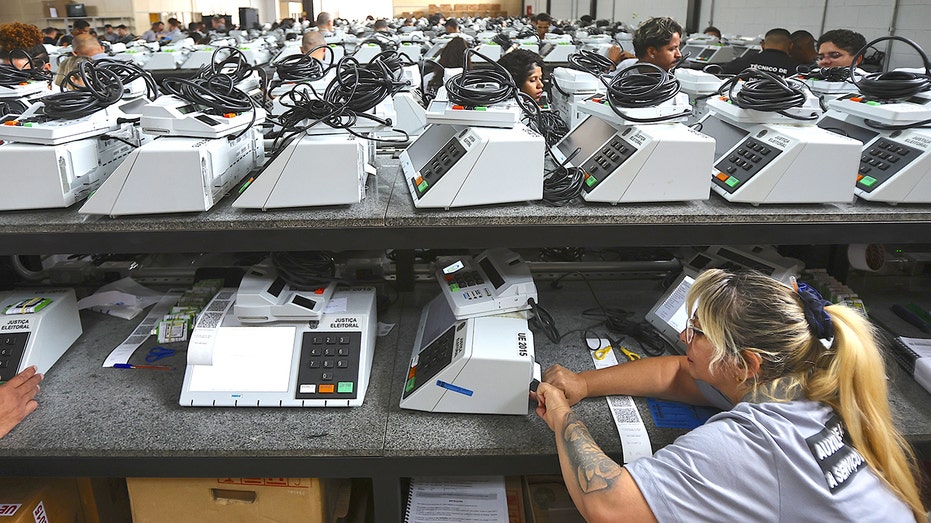
SAO PAULO, Brazil— About 125 million Brazilians voted Oct. 4 on machines that print no paper ballots. Less than four hours after polls closed, the country knew its presidential election was headed to a runoff between conservative challenger Flavio Bolsonaro and leftist President Luiz Inacio Lula da Silva.

That process has been in place for over three decades, and Brazilians have become accustomed to its speed, simplicity, accuracy and routine. The system is robustly audited, completely disconnected from the Internet, and is the largest digital voting system deployed on the planet.

Eleven days before the U.S. midterms, Brazil’s system, analysts say, could offer Americans a more secure way to vote. 

The system has been widely praised and was also mentioned in President Donald Trump’s 2025 executive order on elections, where he cited Brazil’s biometric voter identification as an example. Yet Brazil’s count runs partially on the kind of paperless machines that the president has vowed to scrap.

STATE DEPARTMENT CONSIDERS SHARING PASSPORT RECORDS FOR VOTER CITIZENSHIP CHECKS

One citizen, one vote: digitally checked

Over the years, Brazil merged federal, state and municipal databases into a digital voting record, whereby voter identity, eligibility and single ability to vote can (and usually must) be verified biometrically. Nearly 9 in 10 voters unlock the machines with a fingerprint.

Brazil’s Superior Electoral Court, or TSE, which designs the machines and oversees elections, says there has been no proven fraud since their 1996 debut. The 499,248 machines used on Oct. 4 never connected to the internet. Their software was open to inspection by parties, universities and watchdogs for 11 months before being digitally signed and sealed in public. Last December, the Brazilian government invited a record 149 outsiders to try to break the system; evaluators concluded nothing they found could alter results or reveal how anyone voted.

On election day, randomly drawn machines are fed paper ballots on camera as federal auditors and foreign observers watch and specifically track results. 

Meanwhile, at closing, every machine used at every polling station prints its tally, which is then posted in front of the polling place with a QR code, so anyone can check it against the national count. In an email to Fox News Digital, TSE said each file’s digital signature "confirms that the result was produced by the electronic voting machine registered for that polling station."

Karina Stange Calandrin, a political scientist and professor at Instituto Brasileiro de Mercado de Capitais (IBMEC), says the system combines three traits rarely found together: voting is electronic, votes hashed to voter eligibility are stored locally in the machine and tallying is automated.

"It is an extremely secure and safe system. The machines never connect to the Internet and even the central database system used to transmit tallied votes to TSE must match results issued physically and locally by each individual machine without human interference," she said. Corrupting it, she added, would require breaking the seal of each machine and installing software that wouldn’t match the TSE’s version, automatically disqualifying its tally — a scale of collusion so large that it "simply could not pass undetected."

COLOMBIA'S 'EL TIGRE' SECURES PRESIDENCY AS LEFTIST RIVAL FINALLY CONCEDES DEFEAT

The machines passed their toughest political test in 2022, when former President Jair Bolsonaro, now serving a 27-year sentence for plotting to overturn his 2022 defeat, spent years attacking their credibility without evidence. Bolsonaro is presently serving time under house arrest.

This year, for the first time, a Bolsonaro appointee ran the TSE: Justice Kassio Nunes Marques. Bolsonaro’s eldest son, Sen. Flávio Bolsonaro, finished first with 47% to President Luiz Inácio Lula da Silva’s 45%. The machines at the center of the senior Bolsonaro’s controversy may yet hand victory to his son.

Florencia Ferrer, CEO of e-stategiapublica, which has audited elections in 17 countries, has no doubt the Brazilian system is the most modern and secure in the world. "In India votes are electronic, but each voter gets a printed version of their vote to take home, which weakens voter safety and augments coercion rates," she says, adding that Estonia’s internet voting and the Philippines’ electronically tallied paper ballots carry their own risks.

An engineer from the University of São Paulo’s Polytechnic School who audited the machines in 2014, and declined to be named due to the sensitive nature of his work, agreed. "While no system is completely infallible... we have found no traces of tampering, wrong-doing or malicious intent," he told Fox News Digital.

Still, some defend higher scrutiny. Security researchers say a clean record is not proof enough, and the Carter Center said voters should at least see a printed version of their ballot deposited into a separate area of the machine; otherwise, results integrity rests on software alone. Germany’s top court ruled in 2009 that voters must be able to check their ballot without expert help, effectively barring a Brazilian-like system.

Brazil’s machine has traveled mostly on loan to countries in Latin America, Africa and Asia. Paraguay adopted it permanently in 2006, with machines that now print each individual vote.

CLICK HERE TO DOWNLOAD THE FOX NEWS APP

"It’s obvious Washington and the remainder of the U.S. are way behind both technology as well as security when it comes to polling on voting day," Ferrer said. U.S. elections are run in thousands of local jurisdictions under 50 sets of state rules and about 30% of 2024 ballots came by mail, which is slower to process. Brazil has one national election authority, compulsory voting and no mail-in ballots.

Brazilians will vote this coming Sunday on Oct. 25. The winner is expected to be known and certified in under five hours.

"The question is not whether Brazil has invented a perfect voting machine. No voting system is perfect. It is whether democracies can combine the speed and consistency of digital tabulation with independent verification, public scrutiny and rules that citizens across the political spectrum have reason to trust," Ferrer said.

  •  

Flavio Bolsonaro Threatens Church Teachings and Democracy: Brazilian Bishops

They criticize the far-right candidate’s positions on labor rights, national sovereignty, poverty, violence, the environment, and human rights.

On Friday, Folha de Sao Paulo published the contents of a letter in which 54 Brazilian Catholic bishops warn that far-right presidential candidate Flavio Bolsonaro threatens the church’s social doctrine, democracy, national sovereignty and the practice of the common good.

RELATED:

Lula Urges Young and Elderly Brazilians to Defeat Bolsonaro

“We cannot remain neutral, lest our conscience or history condemn us in the future. Those who remained silent in the face of totalitarian threats that materialized in 20th-century Europe left a shameful legacy for future generations,” stated the “Letter from Catholic Bishops to the People of God Ahead of the Second Round of the 2026 Presidential Election.”

The signatories say they are in communion with the National Conference of Bishops of Brazil (CNBB) and aligned with the message issued by the organization’s Permanent Council, which defended the constitution and respect for the vote.

Besides urging voters to evaluate the records of the two candidates facing off in the Oct. 25 runoff, the bishops list the main positions through which Bolsonaro contradicts church teachings.

Labor Issues

The far-right candidate has consistently opposed eliminating the six-days-on, one-day-off work schedule and has proposed hourly pay, which “does not recognize the dignity of the worker and could bring this issue back to the forefront.”

National Sovereignty

Flavio Bolsonaro “promises Brazil’s submission to the United States, participated in a conspiracy to impose tariffs on Brazilian products, advocates foreign interference in elections, and promises to hand over our rare earth resources for U.S. exploitation.”

Poverty

The bishops cite the apostolic exhortation Dilexi Te and say the Liberal Party “has always publicly opposed social programs and the fight against poverty,” even though Flavio Bolsonaro now says he will maintain some of those programs.

🇧🇷⛪️ Creencias y política chocan en Brasil: crece la polémica por la promesa religiosa de Bolsonaro

✝️ Miles de fieles conmemoraron el aniversario de Nuestra Señora Aparecida, patrona del país sudamericano, en medio de la controversia por la promesa de campaña del candidato a la… pic.twitter.com/5AgyIQGEzv

— Sputnik Mundo (@SputnikMundo) October 14, 2026

The text reads, “Beliefs and politics collide in Brazil: controversy grows over a religious pledge made by Bolsonaro. Thousands of the faithful commemorated the anniversary of Our Lady of Aparecida—the patron saint of the South American nation—amidst controversy surrounding a campaign promise by presidential candidate Flavio Bolsonaro to declare that the nation belongs to Jesus Christ.

Catholics and representatives of Afro-Brazilian religions have warned of potential risks of exclusion and discrimination. Although the campaign asserted that this is merely a symbolic expression of faith, the debate has reignited questions regarding religious freedom and respect for the diversity of beliefs within Brazil.”

Violence

The bishops criticize Bolsonaro’s promise to expand access to firearms, “as his father did during his administration.” The issue had already been criticized in the homily delivered by the archbishop of Aparecida, who preached a message of “unarmed peace” during Mass on the Feast of Our Lady.

Environment

The bishops accuse Flavio Bolsonaro of denying the climate crisis and seeking to continue the “devastating policies” of his father, Jair Bolsonaro. They cite the environmental licensing law approved in 2025, known as the “Devastation Law.”

Human Rights and Democracy

The bishops recalled that the far-right candidate “publicly expresses support for torture” and that his family honored Col. Carlos Alberto Brilhante Ustra, a torturer during the military dictatorship.

Flavio Bolsonaro “made several statements that threaten the constitutional order” and, if elected, would govern with a majority in Congress and the Supreme Federal Court (STF), “creating the conditions for a usurpation of power,” the bishops warned.

The Brazilian Situation

Without mentioning Lula, the letter states that the Workers’ Party candidate, “although he has also been the subject of criticism, has always demonstrated responsibility toward the poor and our Common Home, and has acted within the limits of the democratic order, respecting the Constitution.”

“Whether one likes the current government or not cannot be a reason to hand the country over to someone who demonstrates such a contradiction with the teachings of our church,” the bishops say. They also urge Catholics not to abstain from voting.

Among the signatories are Bishop Jose Ionilton Lisboa de Oliveira, president of the Pastoral Land Commission, and the archbishops of Porto Velho, Roque Paloschi; Feira de Santana, Zanoni Demettino Castro; and Uberaba, Paulo Mendes Peixoto. The list includes bishops from Brazil’s Amazon, Northeast, Southeast, Central-West, and South regions.

The letter adds to the existing rivalry between Flavio Bolsonaro and the Catholic Church during the 2026 presidential campaign. In September, the Brazilian Commission for Justice and Peace delivered a report to the bishops detailing 58 attacks by the far right against Catholics and their church since 2018.

teleSUR/ JF

Sources: Folha de Sao Paulo – Brasil de Fato

  •  

Brazil Prepares High-Security Logistics For Runoff Vote

The Superior Electoral Court enforces free public transport mandates and monitors vote access nationwide.

The Brazilian presidential campaign has entered its final stage ahead of the runoff vote scheduled for October 25, 2026. Incumbent President Luiz Inácio Lula da Silva faces Senator Flávio Bolsonaro, a candidate for the Liberal Party (PL), after a competitive first-round election on October 4, 2026.

RELATED:
Lula Proposes Constitutional Amendment for Free Weekend Transit in Brazil

The general election results established a narrow margin between the top two candidates. In the first round of voting, Senator Flávio Bolsonaro finished first, securing 47.03 percent of valid votes, or 56,103,033 ballots. Incumbent President Lula da Silva finished second, receiving 45.16 percent, or 53,870,724 ballots.

Turnout remained consistent with historical participation figures, reaching approximately 79 percent of registered voters. Lula maintained a structural lead throughout the Northeast region, winning majorities in key states such as Bahia, Pernambuco, and Ceará.

Economic indicators and social policy debates formed the primary foundation for candidate speeches throughout the first round. In campaign speeches, President Lula highlighted the accomplishments of his current administration, citing expanding employment rates, social assistance programs, and inflation control measures implemented since 2023.

Flávio Bolsonaro focused his campaign speeches on public security concerns, national debt levels, and economic challenges, presenting his platform as a continuation of conservative governance under his father, former President Jair Bolsonaro, who remains legally barred from holding office.

Street Mobilization and Electoral Propaganda Networks

Campaign operations shifted toward intensive physical rallies and structured broadcast messaging during the runoff period. The Workers’ Party (PT) and its broader political coalition centered their ground mobilization around major urban centers and traditional working-class strongholds.

Popular social movements, including the Landless Workers Movement (MST) and the Homeless Workers Movement (MTST), along with trade union confederations such as the Unified Workers’ Central (CUT), coordinated door-to-door canvassing operations and public rallies in major metropolitan areas including São Paulo, Rio de Janeiro, and Salvador.

Flávio Bolsonaro’s ground strategy relied heavily on state-level executive endorsements and conservative municipal networks. Key allies, including re-elected conservative governors from São Paulo, Minas Gerais, and Rio de Janeiro, organized regional logistics to boost conservative voter turnout.

Flávio Bolsonaro’s campaign speeches during street rallies emphasized hardline public security measures, moral issues, and support for the agribusiness sector, utilizing alliances with conservative caucus members in Congress to secure local political support.

Broadcast media exposure operated under the free electoral advertising time framework regulated by the Superior Electoral Court. The regulations ensured equal daily broadcast time across television and radio networks for both finalists during the runoff window.

Parallel to traditional broadcast propaganda, digital media networks expanded rapidly. Both campaign organizations directed significant funding toward micro-targeted online advertising and social media distribution channels to capture voters outside traditional media formats.

Digital outreach strategies diverged between the two operational teams. Lula’s digital apparatus utilized organized volunteer networks, endorsements from cultural figures, and policy fact sheets distributed through verified messaging channels.

The Flávio Bolsonaro campaign relied on decentralized messaging channels, emphasizing direct-to-voter video distribution, security rhetoric, and critiques of government institutions.

WHO'S THE REAL THIEF? LULA CHALLENGES BOLSONARO TO SHOW RECORDS

Ahead of Brazil’s presidential election, Brazilian President Lula da Silva publicly challenged rival Flávio Bolsonaro to open his bank accounts, release his phone records, and let the Brazilian people decide who… pic.twitter.com/U6Ge0yOV6A

— Sovereign Media (@sov_media) October 21, 2026

Meta, Disinformation, and Electoral Defense

The Superior Electoral Court (TSE) established strict administrative parameters to govern political content across major social networks, focusing heavily on Meta’s platforms, Facebook, Instagram, and WhatsApp.

Electoral judicial resolutions prohibited paid digital political advertising in the final 48 hours leading up to the October 25 vote, restricted automated messaging software, and required tech platforms to execute judicial content removal mandates within expedited timeframes.

Monitoring reports submitted to electoral authorities by digital rights watchdogs and research institutes identified recurring patterns in content dissemination across Meta’s channels.

Independent audits logged instances of dark ads, unverified allegations targeting electoral integrity, and micro-targeted digital campaigns deployed in private messaging groups.

Meta adjusted its content moderation operations in Brazil to comply with TSE directives, expanding its ad library transparency protocols and updating content review procedures.

The company reported the removal of non-compliant posts and the deactivation of unauthorized bulk-messaging networks. Despite these technical platform adjustments, electoral oversight bodies noted that closed messaging networks remained a primary vector for unverified political narratives due to end-to-end encryption limitations.

Broad Coalitions, Strategic Endorsements, and Voter Demographics

The transition from the October 4 first round to the October 25 runoff required both campaigns to expand beyond their primary ideological bases.

President Lula da Silva maintained a broad front coalition uniting left-wing parties with center-right political figures. Vice President Geraldo Alckmin returned as Lula’s running mate, reinforcing ties with business sectors and moderate electors, while key cabinet figures and allied governors led outreach campaign efforts aimed at consolidating anti-far-right voter segments.

Senator Flávio Bolsonaro expanded his campaign footprint by consolidating conservative regional power structures and legislative blocks. Selecting PL lawmaker Alfredo Gaspar as his vice-presidential running mate, a former prosecutor and public security secretary from Alagoas, Flávio Bolsonaro sought to bolster his law-and-order platform while solidifying backing among conservative lawmakers in Congress.

Flávio’s runoff effort secured endorsement commitments from conservative state governors, agribusiness associations, and international right-wing figures, reinforcing his position across traditional conservative strongholds.

Incumbent President Lula retained consistent lead margins among female voters, lower-income households earning up to two minimum wages, residents in the Northeast region, and older age demographics.

Conversely, Flávio Bolsonaro maintained stronger support metrics among male voters, higher-income earners, Evangelical Christian voters, and electors situated in the agribusiness-heavy South, Southeast, and Center-West regions.

Both campaign organizations directed their final operational focus toward undecided voters and middle-income suburban districts in the key battleground states of Minas Gerais, Rio de Janeiro, and São Paulo.

Lula's campaign says Instagram, Facebook, and WhatsApp are muffling the left days before the October 25 vote. Meta blames glitches.https://t.co/qdSD2z01ny pic.twitter.com/SfYhdxpi4L

— The Brazilian Report (@BrazilianReport) October 20, 2026

Debate Performances, Fact-Checking, and Media Coverage

The televised presidential debates between incumbent President Lula da Silva and Senator Flávio Bolsonaro emerged as decisive turning points during the three-week runoff window. Major media coalitions organized direct face-to-face encounters, allowing the candidates to present competing vision frameworks for Brazil’s governance.

During the live broadcast exchanges, President Lula focused his arguments on economic stability, job creation, and social progress achieved during his term, emphasizing the expansion of public investments, inflation control, and environmental protection initiatives.

Lula confronted Flávio Bolsonaro on fiscal proposals, judicial integrity, and the anti-democratic precedents associated with the far-right movement.

In response, Flávio Bolsonaro framed his candidacy around conservative public security policies, government austerity, and tax reforms. Flávio heavily criticized the economic administration’s public debt metrics and targeted the federal judiciary, presenting his campaign as a necessary alternative to political continuity.

Mainstream media coverage focused heavily on candidate posture, tone, and strategic attempts to appeal to the estimated 10 percent of undecided voters heading into the final days of the race.

Brazil’s top electoral court has said it will fine Meta $200,000 a day until it can prove that president Luiz Inácio Lula da Silva and his far-right challenger Flávio Bolsonaro get equal treatment on its platforms.

Last week, a judge at Brazil’s top electoral court ruled that… pic.twitter.com/AWLGPT6mKT

— Novara Media (@novaramedia) October 21, 2026

Election Day Execution, Institutional Resilience, and Regional Impact

Supervised directly by the Superior Electoral Court (TSE), voting logistics across all 26 states and the Federal District rely on fully digitized electronic voting machines (urnas eletrônicas) to ensure rapid processing and secure transmission of total ballots.

To facilitate maximum democratic access, federal judicial rulings mandated free public transportation (passe livre) across capital cities, while electoral inspectors monitored security forces to prevent voter transportation disruptions or targeted law enforcement checkpoints.

Following the October 4 first round, where Flávio Bolsonaro led with 47.03 percent (56,104,503 votes) against Lula’s 45.16 percent (53,879,538 votes), both organizations focused their final operational pushes on key battleground states like Minas Gerais, Rio de Janeiro, and São Paulo.

The outcome of the October 25 vote carries far-reaching geopolitical implications across Latin America and the broader global stage. A victory for President Lula would ensure the continuation of active multilateral diplomacy, regional integration through BRICS and CELAC, and strong federal commitments to Amazonian environmental conservation.

Conversely, a victory for Flávio Bolsonaro would mark a significant resurgence for the continental far-right, shifting Brazil’s diplomatic alignment toward conservative international blocs and introducing sweeping changes to domestic fiscal and environmental policy frameworks.

Sources: Brasil de Fato – Agência Brasil – Gov.br – O Globo – Folha de S.Paulo – O Estado de S.Paulo – El País – CNN Brasil – EFE – Instituto Tricontinental – La Base América Latina – Diario Re

  •  

Meta chooses sides in Brazil’s election | Ep. 16

A smartphone displaying Brazil's right-wing senator and Liberal Party (PL) presidential candidate Flavio Bolsonaro delivering a speech during a rally at Largo Glenio Peres in Porto Alegre, Brazil, on October 14, 2026, ahead of the presidential election runoff. Photo by SILVIO AVILA / AFP via Getty Images
Transcript

The following is a rushed transcript and may contain errors. It will be updated.

Michael Fox:

Hi folks. Before I get started, let me just say that if you’re not already following Pan-American Dispatch, please check it out. That is our new website covering the Brazilian elections around the clock. It’s a project of The Real News in partnership with Global Exchange. We are on the ground in Brazil. You can find us at panamericandispatch.org or on Instagram X and bluesky@padispatch. Okay, I hope you enjoy the show. This week, Pink Floyd’s Roger Waters posted this video on his Instagram account.

Roger Waters:

You have an election on Sunday in Brazil. I love Brazil. I’ve done many, many. My name’s Roger Waters, by the way.

Michael Fox:

He looks straight at the camera. MPB, popular Brazilian music is playing softly in the background. I love how succinct his assessment is.

Roger Waters:

So the two candidates are Bolsonaro, who is the son of an asshole. He’s an asshole himself. He comes from a long line of assholes. He is in cahoots with the United States of America who want to steal everything that you have in Brazil that’s of any value, not just the Amazon forest, but also any minerals or anything that you might have. They want to give it to the Trump family and to Jared Kushner and those other assholes in the ruling elite. Okay.

Michael Fox:

He says he’s met Lula, that Lula’s an honest man and that people should let him go on working for them.

Roger Waters:

Sunday, the important thing is turnout. Turnout. It was only 78% in the first round. We need 90%, 95%, 100% turnout. If you have a grandmother who can’t get out of a chair to go to the polling station, carry her, put her on a donkey, put her in her car, take her to the polling station and vote, vote, vote. Only you can save Brazil from the machinations of the gangsters who pretend to be the government in the United States of America and their allies in Brazil like the Bolsonaros. Okay. Please, please, please.

Michael Fox:

Huge elections are taking place this Sunday, October 25th. In the first round on October 4th, far-right senator and presidential candidate Flavio Bolsonaro came in two points ahead of President Luis Idnacio Lula de Silva. Bolsonaro is the son of the former far right president Jair Bolsonaro, a close ally of US President Donald Trump. Remember, Jair Bolsonaro is currently under house arrest for attempting to carry out a coup to hold onto power after he lost the 2022 vote. Flavier Bolsonaro’s victory in the first round earlier this month was a shock for much of the country. Lula led almost all the polls ahead of the election. His supporters were despondent and then this happened.

The left woke up in Brazil. That is a student march in Nitaroy, Rio de Janeiro. The evening after the vote, the images filled people’s feeds. Hope spread like wildfire. This is just one meeting I attended in Florianopolis a couple of days after the election. That is the capital of Santa Catarina, one of the most conservative states in the country. They expected a couple of hundred people, thousands turned out. An impromptu march stretched for blocks into the city’s downtown. I spoke with one woman in the march. Her name is Luana Hiberu. She told me, “We’re making part of history, taking to the streets once again to defend the minimum rights that we have achieved and to ensure that our country doesn’t return to 1964 again,” she told me. 1964 was the year of the Brazilian coup that sank the country into a military dictatorship that would last for 21 years.

People on the streets in recent weeks say they are fighting for the country’s very democracy.

President Lula told people that he was getting to work. “Bolsonaro supporters had better get ready,” he said, “because we are going to defeat you.” Abstention in the first round was the highest the country had seen in nearly 30 years. Now the campaign was on to win over the undecided and the more than 30 million people who didn’t vote. Students led the way. Marches and rallies spilled over the country, the likes of which Brazil has not seen in a long time, organizing in cities and neighborhoods, pamphleting, talking to their neighbors, getting out the vote. Record-breaking rallies have taken place in cities across Brazil. More than a million people marched alongside President Lula down Paulista Avenue in Sao Paulo, and people have been organizing online as well, but it has not been easy.

Big tech, and in particular Meta, the parent company of Facebook, Instagram, and WhatsApp, have been actively helping to lift Bolsonaro’s presence online over that of President Lula. Meta temporarily suspended Lula’s campaign page on Facebook. It blocked more than a thousand pro Lula accounts and allowed its algorithm to benefit Bolsonaro while hindering Lula’s campaign. Meta admits that there has not been parity in its treatment of the candidates, but it accuses mechanical glitches. Meanwhile, a Meta AI chatbot admitted to one graduate student that, “Meta indeed has a clear political and economic interest in the election of Flavio Bolsonaro.” I want to talk about something important today. Meta’s CEO Mark Zuckerberg is a close political ally of US President Donald Trump. Flavio Bolsonaro has promised that if he is elected, he will join Trump’s counter-cartel coalition and open up Brazil’s rare earth minerals to the United States. That is something that big tech companies are interested in because those minerals are necessary for their hardware, AI, and data centers.

The UN criticized Meta this week and called on the platform not to interfere in Brazil’s democratic process. UN special rapporteurs wrote in a statement, “Digital platforms should not become unaccountable gatekeepers of political debate, nor should their systems be vulnerable to undue influence from political actors.” Brazilians have protested at Meta’s headquarters in Sao Paulo, and they’ve turned to creativity to try and break the bubble of the algorithm and spread their message to precious undecided voters who can make or break this election.

Meta and its secret algorithm have become the latest tool of US intervention in Latin America. It is not a branch of the US government, but it’s working in tandem. A former Meta Brazil worker told journalist Lais Covella earlier this month that ahead of the election, Meta laid off a team of human moderators who reviewed content. The system was switched to AI. The person said, “That means decisions are now coming from a single automated command possibly issued from the United States designed to boost certain content while burying the rest.” We do not know what the Meta algorithm is. Meta won’t disclose it, but we can see what it’s doing and we can connect the dots. Joel Ferez Jr. is a political scientist at Rio de Janeiro State University.

Joao Feres Junior:

If you see that in general, the guys who own the companies, the CEOs and stuff, show external signs of being politically aligned with extreme right in the United States with Trump, right? So if you know that they divulge the way they conduct their business, and on the other tip, you get the results. They’re very imbalanced as we’re seeing here. You have enough reasons to at least suspect them, to suspect they’re doing something.

Michael Fox:

They are clearly doing something. They’re attempting to influence public opinion ahead of Brazil’s elections and thereby influence the outcome of the vote. That and much, much more in a minute. This is Under the Shadow, an investigative narrative podcast series that looks at the role of the United States abroad in the past and the very present. This podcast is a co-production in partnership with The Real News and NACLA. I’m your host, Michael Fox, longtime radio reporter, editor, journalist, the producer and host of the podcast Brazil on Fire: Stories of Resistance and the Battle for Free Speech. I’ve spent the better part of the last 20 years in Latin America. I’ve seen firsthand the role of the US government abroad, and most often sadly, it is not for the better. Invasions, coups, sanctions, support for authoritarian regimes. Politically and economically, the United States has cast a long shadow over Latin America for the past 200 years.

It still does. This is season two of Under the Shadow: Trump’s attack, episode 16, Meta and the Brazilian Elections.

Okay, so today, folks, I’m going to do things a little differently. I’m going to bring in a friend and fellow journalist to discuss where we are right now, what’s at stake, and in particular to look at the role that Meta is playing ahead of the second round of the Brazilian elections on Sunday. This is something he and I have been paying particular attention to in recent weeks. His name is Brian Meer. He has a master’s degree from Loyola University of Chicago and the University of London. He’s lived in Brazil for more than 30 years, and he co-hosts a weekly Portuguese language web TV program called Globalistas on Brazil 247. He’s a correspondent for Telesur English, and he works with me as an editor of Pan-American Dispatch, which we launched ahead of the Brazilian vote. All right, we’re recording. Brian, thank you so much for joining me today.

This is fantastic. I really appreciate it, and thank you so much for all of your work, always ongoing. These are insane times.

Brian Mier:

Thanks for having me.

Michael Fox:

So Brian, I want this to be… I kind of mentioned, I’m hoping that this can be kind of a conversation about what’s happening right now. We are a few days out from the vote, and I’m hoping to map this out for a US audience and for a podcast that is particularly focused on US intervention in Latin America. And there’s so many layers that you and I have been working on for the last month or more, and folks who are listening to this, if you don’t already subscribe and know Pan-American Dispatch, please check it out because we’ve been doing it around the clock for the last month, and we’ll be covering the elections around the clock, and we’re just translating tons of articles, and I think it’s really an important site for news and analysis of exactly what’s happening on the ground right now in Brazil.

But Brian, if we’re taking the 10,000 foot view, where do you see things right now?

Brian Mier:

Well, we’re in a crisis of democracy in Brazil. This is the most complicated election since the return to democracy because we have the son of a man who’s in jail along with 28 cronies of his for attempting to implement a military coup, a man who was a former operative during the military dictatorship. He was a captain in the army. We have his son running under the promise to immediately pardon his father and give him a high ranking job in the government, essentially turning control over the government to his father if he’s elected, which represents the biggest threat to democracy since the return, since the end of the dictatorship, because what we’re really talking about is a state of exception. It’s also a very big risk for the Amazon rainforest as Jay Bolsonaro is present slashed the budgets, dismantled all of the environmental protection agencies, including the satellite fire monitoring system, the universities that study the departments are studying deforestation just on a vast scale and gave constant dog whistles to loggers and soy plantation farmers and ranchers that they could cut out whatever they wanted.

And it’s a threat for sovereignty because we have a candidate for the first time in Brazilian history who’s promising to turn over control of his transition team to the Trump administration if he’s elected and also to provide monopolistic access to Brazil’s rare earths at the expense of all the other countries we’re interested, Brazil being the second largest reserves of rare earth minerals in the world.

And also it would be the last country, one of the last countries in the Americas and the largest country in the Americas that will cease to be governed by a leftist political party. So on various different levels, it’s complicated. And the only reason this election is even close, because there’s always been… I’ve been living in Brazil for over 30 years, there’s always been a percentage of the population that has fascist sympathies, far right sympathies. When I say fascist sympathies, I mean literal fascist sympathies. It’s not like calling an American politician a fascist or something. I’m saying that Brazil has a tradition of fascism that was manifest during the dictatorship. The reason that the election is close is because of the Silicon Valley tech fascists and political operatives like Steve Bannon who have been for years working with the Bolsonaros to use the same kinds of dirty tricks that Cambridge Analytica did to push toward Brexit in the UK, the same kind of tricks that were used to elect Trump and propel all of these other far right parties into power around the world, which is illegal data phishing or data access, purchasing data access from companies and micro targeting different demographics with emotional appeals and bringing people down rabbit holes on social media with conspiracy theories and whatnot to the point where a large percentage of the population is just scared and confused.

So this is why the election is close. The first round, some people expected Luma to win in the first round, some people expected Flavio Bolsnar to win in the first round.

You needed to get 50% of a vote plus one to win Brazil’s election in the first round because there were multiple candidates. Brazil has a multi-party system, there’s 29 political parties. Some people were expecting Lula to take it somewhere expecting Bolsonaro to take it. The polls put Lula two points ahead, three points ahead. Some of them had it tied. And in the end, Flavio Bolsonar won the first round by 1.8%, which sent out a big warning to different sectors of the population that might not normally support government as left wing as the Lula administration who are worried about the state of democracy in Brazil and also worried about sovereignty. So there’s been momentum growing on the streets. A few days after the October 4th first round election, Flavio Bolsonaro was pulling six points in the lead and that lead has evaporated now with most polls showing that they’re tied, some showing Lula a little bit in front, some showing Bolsonaro a little bit in the front.

The far right has a tradition of outperforming polls, so it’s basically up in the air right now with only a few days left until the election.

Michael Fox:

I think what’s interesting and important about right now, ahead of the first round vote, there was a lot of discussion about the role in the United States and the connection between the United States and Flavio Bolsonaro in the lead up going back months beforehand. And I dug into a lot of that stuff on this podcast. What’s interesting now is how much the conversation is really about Meta and about online manipulation, the algorithms, and that’s something I really want to talk about right now. We have been covering it constantly every day, numerous articles because it is a terrifying reality when you have a Silicon Valley company that is owned clearly by Mark Zuckerberg, that controls Facebook, Instagram, and WhatsApp and is very close friends with US President Donald Trump and is clearly trying to play politics in this election against Lula and his campaign. Brian, dive into where you see things with Meta right now.

How are they playing politics biased in this election? What have we seen?

Brian Mier:

Okay. Well, one of the reasons I enjoy being on podcasts is because normally news treats issues as almost binary things. So I want to avoid suggesting that it’s not the Trump administration, it’s not the US media in general, and it’s just Meta because there’s a long history of, for example, Elon Musk meddling in Brazilian politics and Donald Trump has made massive tariffs on Brazil and it’s basically extorting the population doing the same thing with the Biden administration did in 2024 in Venezuela saying, “If you vote for my guy, I will remove these punishments on you. Your economy will improve. I’ll remove the punishments.” Just like with Argentina in the midterm election, Trump said, “Well, I’m only going to bail out your economy if you vote for Malay’s party in the midterms. They maintain control of parliament.” So there’s that going on. Above and beyond that though, you have Meta.

So there’s a operative, a political operative who is in jail right now named Fernando Serimedo who was arrested for attempting to murder his pregnant ex-girlfriend who’s a lawyer in Bolivia recently. She’s now out of the hospital. She miraculously survived multiple gunshot wounds and she’s out of the hospital and she’s recovering and she’s talking to the media about what her husband was involved in. Now, we already knew that he was Miles’ big data manipulation guy, big social media manipulation, bot farm, merchant, controlling huge bot farms around Latin America. He was involved in influencing the Honduran elections, Peruvian, Colombian and Argentinian elections, and that he had close ties to both US intelligence agencies and the Bolsonaro family. But what she told Channel 14 in Mexico last week is that Fernando Cerameto and Flavio Bolsonaro’s brother, Eduardo, who is the CPAC representative for South America, visited Meta headquarters in the US and made a deal for the company to support Flavio Bolsonaro through algorithmic manipulation and to bury the reach of Lula during these elections.

And so there’s been a series of events that have shown that this is actually what they’re doing. First, a Brazilian journalist named Lais Gova spoke to someone inside Meta Corporation in Brazil who told her that right before election season started, Meta laid off most of its fact checkers and replaced them with an AI fact checking system that they believe was controlled from the US, which in itself is a crime in Brazil. Then both Amnesty International and the US NGO Echo ran tests with Meta platforms like Instagram and Facebook to see if they could break Brazilian election law by paying for advertising political ads from outside of Brazil. That in itself is a crime, but adding to that crime, the additional crimes of disinformation of the Brazilian electoral system, disinformation about the integrity of the electronic voting system, disinformation about the date of the election, and they paid for these ads and scheduled for them to run at a certain time and date so that they could cancel them if they were approved.

In the case of MSC International was from the UK, it was like 12 of the 20 ads that they tried to run made it straight through fact checking. And the aid that were rejected, they weren’t rejected because of the disinformation or the location, they were rejected for bureaucratic issues or something. They weren’t flagged as being fake content or something. And in the case of Echo, it was almost something like 17 out of 20 made it through. So they proved that Meta was breaking the law, allowing foreigners to take out campaign ads in Brazil. Then people started observing Meta’s AI that runs through its WhatsApp social media chatbot, and the AI was refusing to design logos for Lula, campaign logos or slogans or t-shirts or anything related to Lula. It was just refused. I said, “Well, I can’t do that.” But then it was designing them perfectly normally for Flavio Bolsonaro, and people began running all kinds of tests.

One example of something that was flagged by Lula’s campaign lawyers, his campaign team lawyers, was that one of the big accounts in social media supporting Lula is called Lula’s Troops. And so when you search for Lula’s troops in Meta AI, it gives you a link to a site called Flavio’s Troops. Or if you search for it in Instagram, I’m sorry, if you look for an Instagram, it would link you to Flavio’s troops. And if you try to make a hashtag with Lula, the first thing would come up would be lulathethief, whereas the hashtags with anything related to a negative portrayal of Flavio would only come in at the 18th or 19th hashtag that they would suggest when you’re trying to build a hashtag with Flavio Bolsonaro. And then on October 9th, Lula’s Instagram account was simply blocked from taking any kind of ads out for 24 hours, while Flavio’s was running perfectly normal, and Flavio’s allies were running propaganda for him like Nicholas Fajera was running perfectly normally.

So then once the page was reestablished, 24 hours later, Meta issued the statement very reminiscent of what they said, what Zuckerberg said when the Cambridge Analytica scandal surfaced saying, “Oh, I’m sorry, it was a technical glitch. We’re going to take measures to make sure that something like this doesn’t happen again.” So yesterday, Folio de Saint Polo, Brazil’s largest newspaper, they uncovered conversations, internal conversations from workers in Meta headquarters in Brazil in which they acknowledged that they had been artificially promoting extending the reach of the Flavio Bolsonaro posts and limiting the reach of the Lula posts.

These conversations also showed that the international system crash, but Meta had give it as an excuse for Lula’s ads being taken offline for 24 hours, had actually happened on October 7th. I said October 7th, but this Lula’s page was taken on October 9th. The technical glitch that they used as an excuse for taking down Lula’s page had happened for five hours on October 7th, and Lula’s page was taken down for 24 hours on October 9th after they had fixed the supposed glitch. So these things, last Friday, the Superior Electoral Court issued an order for Meta to provide more transparency on how it’s using its algorithms and to immediately cease accepting money from third parties to propel propaganda for Flavio Bolsonaro and to reestablish equality and algorithm reach between the two candidates proportionate to their number of users and whatever. And on Monday, it was proven that they hadn’t obeyed the court order.

And so today, Tuesday, Lula’s campaign team filed a complaint with the Superior Electoral Court to cancel the presidential ticket of Flavio Bolsonaro because of illegal algorithmic manipulation. Remember that the first round was very close.

Nobody is suggesting that the reason everyone voted for Flavio Bolsonaro was because of algorithmic manipulation of Meta, but it could certainly make a two to three point difference, a four point difference in an election, and that’s what people are worried about. Will Flavio’s candidacy be canceled? Probably not, but at least it’s on record. The hope now is that since the scandals are broken, Lula’s reach has grown on social media and a lot of activists are trying to break the shadow banning using a lot of different tactics that they’re sharing with each other and everything. But the real risk is that on election day, we see that on the October 4th election day, Lula and Flavio Bolsonaro’s reach was about equal up until about 12 hours before the polling stations opened. At that point, suddenly Flavio had seven times more reach than Lula, and it maintained that way all through election day.

So the risk is that foreign media starts doing these stories about how finally the Brazilian leftists have woken up and figured out how to use social media, and they’ve evened out the playing field on this imaginary democratic commons, which is these fascist corporation controlled social media platforms. These kind of stories are already circulating, and then on election day, Zuckerberg can just turn off the Lula reach button again and really screw Brazil’s democracy over and the Amazon rainforest and everything else in this country.

Michael Fox:

Yeah. Brian, there’s that incredible table that this organization, it’s a statistical organization actually, but they put it together, this graph of what the reach looked like of the Flavio campaign and the Lulu campaign in the month ahead of times. It was just this incredible image of first, the Flavio campaign was consistently above the Lulu campaign throughout the campaigns itself. And then just like what you said, as soon as it gets close to the election, It just spikes and skyrockets. Flavio’s campaign just gets a ton, ton of reach. And not just the 12 hours before, I think it was even a couple days before, you can start to see it climb and compared with lulas. And it’s just this shocking thing. And I just want to underscore this fact that these aren’t conspiracy theories. When we start talking about part of the problem is the simple fact that the algorithm, we cannot know it.

It’s proprietary. They should share it. Meta should be sharing this. People should know what’s in it. But due to the fact that it’s actually hidden, it means that we can’t know what they’re doing, but we can see the results. And I think that’s what we see in concrete. And there’s been all of these studies and reports and statistics. There are different groups that are fighting really hard in recent weeks and in recent months to try and get all the statistics and see. In fact, there was one case where they had seen more than 1,000 different pro Lula accounts had been messed with, taken offline, blocked, suspended. And I think that it’s really important to just underscore the fact that this isn’t like suppositions. This is concrete, this is fact. It is happening. Meta is actually playing politics. They are messing with these elections, using the algorithm and using everything they possibly can.

I think what’s fascinating at the same time is how people have responded. You kind of mentioned it briefly, what they call here in Brazil get out of the bubble. Because what happens in the world that we live in now in social media is that if you love Lula, you’re going to be seeing all Lula content on Instagram. And if you love Bolsonaro and if you love the far right, you’re going to be seeing all Bolsonaro content. What has been interesting is that there has been Bolsonaro content that has been kind of feeding into the Lula feeds just in the last couple days and things constantly changing. But what’s been fascinating is to see how people have been trying to use different tactics to break out of that bubble, use the images and the color, green and yellow, which are the colors of Brazil in which Bolsonaro is embraced as his colors.

And so using those colors, doing memes, using the same memes. There was one case where they said, “Take a pro Bolsonaro meme, but then use AI to switch it around and make it pro Lula.” And so there’s been just this fascinating creativity, I think, by Brazilians in recent weeks to try and respond to the shadow bans, respond to the bias by Meta in these elections.

Brian Mier:

Yeah. But more than the internet, the Workers’ Party historically has always dealt with a highly, highly antagonistic press. I mean, there’s professional corporate funded lawyers like Glenn Greenwald who go around pretending that Brazil’s mainstream media likes Lula, but it doesn’t hold up to any kind of even mildly systematic analysis. There’s a media watchdog group at State University of Rio de Janeiro called which monitors all of the headlines about candidates and politicians and governmental figures and ranks them as positive, negative, or neutral coverage. And so one thing that stands out in my mind, I remember from when I was translating the biography of Lula was that during 2017, the most popular nightly news program in Brazil, Jonas Lacional, owned by a global company, they aired so much negative coverage of Lula that it could have filled up an entire month of one hour nightly newscasts just saying negative things about Lula.

Michael Fox:

Wow.

Brian Mier:

And they didn’t even allow his voice to appear on the network for 10 years at one point. Every time they showed him, they would show him, but his voice wouldn’t appear and there’d be newscasters paraphrasing what he said as he appeared on TV. And we’re talking about two time ex-president at the time. So the PT has always had ways of dribbling around negative coverage in media and even social media. And so a lot of the mobilization work for the vote is happening offline right now. And you can see that in the smaller towns where, for example, on Sunday in a town called Paldalio in Peralambugu population 52,000, over half of the population of the city, the town was on the street at Alula rally and that was not organized over the social media. That was organized knocking on people’s doors. Old technology like a car with a speaker driving slowly through the neighborhoods announcing the time and place of the march and all this stuff besides social media.

I personally don’t believe it’s possible, although it’s these examples of breaking out of the bubble are admirable and whatever. These multinational corporations, Zionist, far right white supremacist corporations are powerful enough to cut those kinds of activities off before election day.

It’s just this kind of glimmers. To me, it kind of plays into this glimmers of hope about the, look, the internet really is a magic tool for democracy. Look at how these wonderful young Generation Z people are breaking out of the bubble. That’s not the real fight. There’s no way. You might be able to break out of this bubble for six hours or something before their watchdogs cut it off. There’s no way that this can overcome the massive favoritism. The only way to overcome the massive favoritism of Meta is in the court system and enforcing existing laws and regulations. There’s no private sector solution for this problem. They have to be threatened with taking them down in Brazil, like the Brazilian government took down X. If they really wanted free and fair elections, they would turn off access to Meta and X three days before the elections and just say it’ll come back on Monday.

Michael Fox:

Yeah, absolutely, Brian. And I think this is just to underscore this point that as folks who are listening to this podcast and folks who are following the news at the Real News and elsewhere, Silicon Valley is very, very much in the pockets of Donald Trump and they have been fighting against legislation and regulation around the world. But in particular in Brazil, we even saw this just last year. Brazilian Congress was working toward potentially regulating social media and the big tech companies sent, I think there’s 88 different moments where they sent in lobbyists to lobby people in Brazilia. A third of those was by Meta. So they have been playing games in Brazil and paying attention to Brazil and definitely Elon Musk, all of this. So this is extremely important point, Brian, that there needs to be regulation for big tech. And I think that question of how people have responded in the streets in recent weeks has been really, really powerful.

And it hasn’t just been, “Oh, we’re going to go out in March,” but it’s been, “We’re going to go to March. We are going to talk to our neighbors. We’re going to pamphlet wherever we can. We’re going to go to places to try and get that 30 million people who abstain from the elections who did not vote. We need to get them in to vote. We need to encourage them to vote for Lula.”

Brian Mier:

Exactly. Now, just to add to your point, I was just giving a few examples of the illegal activity by Meta that’s been going on to favor a candidate who’s basically threatening a break with the democratic rule of law and establishing a state of exception if he takes power. Meta AI admits it itself. There’s a grad student named Laura Morgado who started asking Meta’s AI chatbot why Meta is backing Bolsonaro. And it answered, “Trump and the Bolsonaros are the global political shield for big tech companies against the advance of European regulation and the Latin American left in Meta AI chatbot’s own words.” They explain exactly why they’re doing this.

Michael Fox:

Totally. And this was so incredible because she posted it on Instagram and then we made an article about it for Pan-American Dispatch. And folks, just so you know, I’m going to be adding in links to everything that we’re talking about today in the show notes. So you can find almost everything that Brian’s brought up are articles that we have also been either translating or running and publishing. So this is all so you can have access to it all.

Brian Mier:

Yeah. So basically the tangent I went off on about Meta was based on seven… What we’re doing is we’re identifying the progressive news media outlets in Brazil’s most interesting articles, articles we think would be most interesting for a northern audience every day and translating them. And sometimes framing them with additional information that Brazilian readers would take for granted, but US readers might not know. So that whole sequence of things I said about Meta, we’ve got six or seven articles that described everything that I just said basically, and others that mentioned things I didn’t even bring up.

Michael Fox:

Yeah. Brian, I want to dive into the Superior Electoral Court, Casio Nunez, Andre Mendonsa. I think this is really important to understanding this moment because just for listeners, I did an episode a few months ago that was looking at Brazil’s fight against disinformation in the past. And the Supreme Court was one of the main places, the Supreme Court and the Supreme Electoral Court. Remember, the Supreme Electoral Court is made up of members of the Supreme Court and other institutions, Brazilian institutions. But basically the Supreme Court historically in Brazil has been extremely important in pushing back against the far right and against Bolsonaro, and particularly when he was in power. We saw a very big push in the last two elections from the Supreme Electoral Court pushing back against fake news that was actual fake news. I remember one moment, I remember there was some fake news that Hadaji had, who was the presidential candidate in 2018 when Lulu was in jail.

They said, oh, look at these cars. Look at this huge car he has and he lives in this mansion. It was all just ridiculous. But that was the type of fake news that they were pushing back at the time. But at this point, things are very, very different. Brian, can you explain a little bit about this?

Brian Mier:

Okay. Well, basically Brazil has very strict campaign regulations and to oversee the elections, the voting and enforcement of these regulations, there’s an electoral court system and the highest court in the system is the Superior Electoral Court. It has five justices. Three of them come from the Supreme Court on a rotating basis and two come from lower court like the Superior Justice Courts, which is another high ranked, high level court in Brazil. We’re in a situation right now where after eight years of international efforts supported even by mainstream media outlets in the United States to de-legitimize Brazil’s judiciary, we’re stuck with a superior electoral court that’s not up to the task of stopping Meta right now and the other social media corporations that are trying to throw the election for Bolsonaro. And to make things worse, because of the way that the system is rotating, every two years they change the president of the Superior Electoral Court and it’s kind of like in order that the justice was nominated to the Supreme Court.

So just by chance, by random chance, the president of the Superior Electoral Court right now is a man who was appointed by Jair Bolsonaro. So he’s not doing anything to try to slow down the disinformation being spread to support the Bolsonaro campaign.

Michael Fox:

Well, not just that, but he and the vice president, Andre Mendonso, is also appointed by Jair Bolsonaro. And in fact, they’ve been using their place in the court to stop and to block accounts in favor of Lula and to pull down a bunch of legitimate information that’s not fake news that has been published and spread and posted online. They’ve been actually using their place, not just to battle fake news, but actually to support the candidacy of Flavio Bolsonaro.

Brian Mier:

Yeah. And before, just to preemptively prepare ourselves for being accused of both sides in the issue, which is the way that Greenwald is gaslighting everyone on social media right now who’s complaining about censorship, an example of something that was censored, it was taken off the air by Nunez Marcus, Casio Nunez Marcus, president of the Superior Electoral Court, was a labor union posting information about how the economic policies of the two candidates would affect their labor sector, specifically how the budget cuts being promised by Flavio Bolsonaro, massive Javier Male style shock doctrine budget cuts would affect their labor sector with actual statistics, information from economists and whatever, that was taken off the air. When the Justice Department under Lula tried to pull down accounts that were violating Brazilian law by inciting support for Nazism, neo-Nazism, that’s when people like Greenwald Tucker Carlson started crying censorship and it made it into the New York Times.

But I didn’t see these guys complaining about unions being pulled off the air for legitimately expressing actual stats and projections about what would happen if someone was elected president.

Michael Fox:

Yeah, it’s a really concerning moment and it’s made more concerning by the fact that depending on who wins this election, there are four seats that will be open on the Supreme Court. So the Brazilian Supreme Court is 11 seats on the Brazilian Supreme Court. Two of them right now were appointed by Jair Bolsonaro during his term. Four of the seats are coming up for grabs over the next four years. It’s a very similar situation where we were like just before Trump’s first term. So if Jlavier Bolsonaro wins this election, it’s very likely that he will be able to appoint four new members of the Supreme Court. The Supreme Court will then become majority for the Bolsonaros. And if you look at what the Supreme Court has meant historically in Brazil over the last decade as kind of the main bastion of the battle to push back on the undemocratic push, the authoritarian push by Bolsonaro, it is now going to be in the hands of the Bolsonaro family in the same way that Trump now controls the Supreme Court in the United States.

Brian Mier:

If the Supreme Court continues, because there’s a good chance that if Jair Bolsonaro gets power back, they’ll just implement a military coup. That’s what he was trying to do last time around when he was stopped.

Michael Fox:

Do you think that they would take it to that level, Brian?

Brian Mier:

Yes. This is what he’s been promising to do for his entire political career. Jair Bolsonaro, Flavio’s dad. For his entire career, he’s been promising to bring back a military dictatorship.

Michael Fox:

These are scary moments. What else do you think is important, Brian? And I want to talk a little bit about hope.

Brian Mier:

No, what’s important is that the huge wave of support for Lula on the streets led by young people shows that even if Flavio Bolsonaro is elected, it’s not going to be that easy for him. Remember, they had these… Jara Bolsonaro tried to start charging tuition at public universities and the national students unions historically connected with the Brazilian Communist Party and the teacher’s unions joined together to put over a million people on the streets in South Hollow on two different occasions with smaller but still very large protests in hundreds of towns and cities across the country and blocked Bolsonaro from doing that. They’re unable to block Bolsonaro from other things raising the retirement age. However, I get a lot of hope from talking to people at the rallies for Lula, and it’s a huge percentage of the population. It’s the majority of the population, the votes being manipulated, whatever.

But what we’re talking about is even if Flavio Bolsonaro wins by 1%, that still means that 74 million people in this country are leftists who support the left and are going to keep fighting. And you know what? Brazilians have a lot more experience operating under authoritarian regimes than Americans do in a sense.

So young people are talking to old people now, and I think that personally, I’m not moving out of here. If Flavio takes power, I’m not afraid. I know I’ll be okay because there’ll be so many other people supporting each other to fight these guys.

Michael Fox:

Absolutely. Absolutely. And what you said about the numbers in the streets is just, it is really incredible. There was over a million people that were marching in Sao Paulo just about a week ago. In many of these cities, we’ve seen some of the largest marches in a very long time, the largest student electoral march during election period here in Florianopolis. I mean, it’s been incredible and the amount of excitement and the amount of hope that people have. And like Brian said at the very beginning, that has dropped the numbers for Flavio Bolsonaro when he was maybe six points ahead of Lula just a few weeks ago following the first round vote, and now that’s decreased essentially to a tie, right?

Brian Mier:

And also it’s come out, Flavio’s under investigation for money laundering. He had some problems in the debate. There’s more and more dirt coming out in the mainstream media, so the tide seems to be turning right now. Who knows what will happen if Zuckerberg just turns off the Lula buttons on election day, but that’s why the street mobilization is so important because it can bypass having to rely on Silicon Valley to communicate with each other.

Michael Fox:

Yeah. I just want to underscore just part of why this election is so important right now is clearly the fact that for Brazil’s place in Latin America, what it represents is kind of this final bastion that hasn’t fallen to Trump and his people. I mean, one of the big things that, like I’ve talked about in this podcast, one of the big things that Flavio has mentioned many times is that the minute if he is elected, the minute he comes into power, he’s joining Trump’s Shield of the Americas, and he’s totally on board with just handing over the keys of Brazil to the White House and to more than the White House to the Trump administration. But I think what’s so important is clearly what Brazil represents in Latin America at this moment, but also the games that Meta is playing, this is not the only place it’s happening.

We saw in the United States just in the last couple days, the No Kings account was taken offline. A bunch of people and accounts supporting the No Kings demonstration in the United States in recent days have been taken offline or blocked or temporarily blocked.

We literally, our entire media sphere is controlled by a small number of very big outlets and they will not tell us how they’re controlling it. They are not sharing that information, and although they say that they’re being neutral, it’s not a reality, and we need to understand that. I think we need to look at Brazil and how people are trying to respond in Brazil to understand when these things are happening elsewhere, because this isn’t going away. It’s only going to increase. It’s only going to grow. The amount that people rely on social media for their news and information is only going to increase, and these companies are getting more and more powerful, and they’re ever more in the pockets of Donald Trump. This is a context that I think we really need to understand.

Brian Mier:

Definitely.

Michael Fox:

Brian, thank you so much, man. I really, really appreciate it. This was fantastic. Always great chatting with you.

Brian Mier:

Thanks for having me, and I will see you in Sao Paulo on Sunday, covering the elections.

Michael Fox:

That’s right. I will see you in Sao Paulo, and we will see all the rest of you online at panamericandispatch.org. Hi, folks. Thank you so much for listening. That is all for this episode of Under the Shadow. The second round vote of the Brazilian elections is this Sunday, October 25th. Please follow and subscribe to Pan-American Dispatch for everything on the elections. We’ll be doing live coverage of the vote throughout the weekend. Much of the reporting for this episode was based on stories that we translated and published with Pan-American Dispatch. I’ve added links in the show notes, or you can read and subscribe to the Substack at panamericandispatch.org. As always, you can find me at patreon.com/mfox.

There you can also support my work, become a monthly sustainer, or sign up to stay abreast of all the latest on this podcast and my other reporting across Latin America. If you’re looking for more information, news, and reporting on Trump’s onslaught, both on communities within the United States and abroad, please check out The Real News and NACLA. Both of them are publishing daily indispensable reporting. The theme music is by my band, Monte Perdido. You can find us on Spotify or wherever you stream music. This closing song playing right now is off our 2024 album, Ofrenda. I hope you check it out. Under the Shadow is a co-production of The Real News and NACLA. It’s produced in partnership with Global Exchange. This episode was written, researched, reported, and produced by me, Michael Fox. Thanks so much to Brian Meer for joining me on today’s show. You can check out his Substack.

It’s called Delinking Brazil. Thank you so much for listening. See you next time.

In the first round of voting on October 4, Trump-ally, far-right presidential candidate Flávio Bolsonaro came in two points ahead of President Luiz Inácio Lula da Silvia. 

Lula supporters have been responding both in the streets and online. And they have been closing the gap, but it’s an uphill battle. Big Tech—and in particular Meta, the parent company of Facebook, Instagram and WhatsApp—have been helping to lift Bolsonaro’s presence online over that of President Lula.

Meta temporarily suspended Lula’s campaign page on Facebook, blocked more than 1,000 pro-Lula accounts, and allowed its algorithm to benefit Bolsonaro while hindering Lula’s campaign. Meta admits that there has not been parity in its treatment of the candidates but it blames mechanical glitches.

Meanwhile, a Meta AI chatbot admitted to one graduate student that “Meta indeed has a clear political and economic interest in the election of Flávio Bolsonaro.” 

Meta CEO Mark Zuckerberg is a close political ally of US President Donald Trump. Flávio Bolsonaro has promised that if he is elected, he will join Trump’s Counter Cartel Coalition and open up Brazil’s rare earth minerals to the United States. That is something that Big Tech companies are interested in, because those minerals are necessary for their hardware, AI, and data centers.

Brazilians have protested at Meta’s headquarters in São Paulo. And they have turned to creativity to try to break the bubble of the algorithm and spread their message to precious undecided voters, who can make or break this election.

Meta and its secret algorithm have become the latest tool of US intervention in Latin America. It is not a branch of the US government. But it’s working in tandem. 

In this episode, host Michael Fox speaks with Brazil-based journalist Brian Mier. They discuss where things are now, what’s at stake, and in particular look at the role that Meta is playing ahead of the second round of the Brazilian elections on Sunday.

Brian Mier has master’s degrees from Loyola University Chicago and the University of London. He’s lived in Brazil for more than 30 years and he co-hosts a weekly Portuguese-language web TV program called Globalistas on Brasil 247. Mier is an editor of Panamerican Dispatch, which was launched ahead of the Brazilian vote.

Guests: 

Resources About Meta in Brazil: 

Follow Under the Shadow on Spotify and Apple Podcasts.

Under the Shadow is an investigative narrative podcast series that walks back in time, telling the story of the past by visiting momentous places in the present. Season 2 responds in real time to the Trump administration’s onslaught on Latin America. 

Hosted, written, produced, mixed, and edited by Latin America-based journalist Michael Fox. This podcast is produced in partnership between The Real News Network and NACLA. It is supported, in part, by Global Exchange. Theme music by Michael Fox’s band, Monte Perdido. Monte Perdido’s 2024 album Ofrenda is available on Spotify, Deezer, Apple Music, YouTube or wherever you listen to music. Other music from Blue Dot Sessions and Epidemic Sound.

Panamerican Dispatch

You can check out Michael Fox’s new reporting project on Brazil at panamericandispatch.org. It’s a project of The Real News in partnership with Global Exchange.

Follow us on social media 

Bluesky: https://bsky.app/profile/padispatch.bsky.social
X: x.com/PAdispatch
IG: instagram.com/padispatch
Tiktok: tiktok.com/@padispatch

Support Under the Shadow

Please consider supporting this podcast and Michael Fox’s reporting on his Patreon account: patreon.com/mfox. There you can also see exclusive pictures, video, and interviews.

  •  

Por que tantos brasileiros votam em Flávio Bolsonaro?

Segurança pública, rejeição à pauta woke e valorização dos costumes ajudam a explicar a força eleitoral da direita brasileira.

Junte-se a nós no Telegram , X e VK.

Escreva para nós: info@strategic-culture.su

O resultado do primeiro turno das eleições presidenciais de 2026 provocou uma onda de análises na esquerda brasileira. Com Flávio Bolsonaro à frente de Lula na votação, muitos comentaristas voltaram a procurar explicações no comportamento dos evangélicos, no conservadorismo moral e na influência das lideranças religiosas. Esses fatores têm importância, mas não explicam tudo. Uma parcela significativa do eleitorado demonstra insatisfação com prioridades culturais da esquerda e, sobretudo, com a percepção de que o Estado perdeu capacidade de garantir segurança à população.

A segurança pública ocupa posição central nesse debate. Segundo levantamento Nexus/BTG divulgado em julho de 2026, 30% dos entrevistados identificaram violência, criminalidade ou segurança pública como o principal problema do país. A preocupação é especialmente relevante entre eleitores que apoiam Flávio Bolsonaro, para os quais o combate ao crime constitui uma das principais expectativas em relação ao próximo governo.

A situação do Rio de Janeiro ilustra a dimensão concreta desse problema. Um estudo do Grupo de Estudos dos Novos Ilegalismos da UFF e do Instituto Fogo Cruzado estimou que, em 2024, aproximadamente quatro milhões de pessoas na Região Metropolitana viviam sob controle ou influência de grupos armados. Isso correspondia a 34,9% da população da região. Facções criminosas e milícias exercem formas de poder territorial que afetam a circulação, as atividades econômicas e a vida cotidiana dos moradores. Algumas estimativas apontam que entre 60% e 70% do território do Rio de Janeiro é atualmente controlado pelo crime organizado.

Nesse contexto, discursos que enfatizam direitos sociais, soberania nacional e política externa podem perder força eleitoral quando não oferecem respostas convincentes à insegurança cotidiana. Lula tem defendido o enfrentamento do crime organizado por meio da integração das forças de segurança, da investigação financeira e da retomada de territórios. E isso só está acontecendo agora, após quatro anos de absoluta negligência na questão de segurança, com o crime organizado alcançando recordes históricos de expansão territorial.

Flávio, por sua vez, aposta em uma abordagem mais punitiva, incluindo o enquadramento de facções como organizações narcoterroristas. A disputa envolve diferentes concepções de segurança, mas também a capacidade de cada candidato de transmitir determinação diante do problema. Se considerar estes grupos terroristas ajuda ou não no combate ao crime é uma longa discussão, mas sem dúvidas a mera classificação com terroristas já agrada uma parcela substancial da população que vive sob o (verdadeiro) terror desses criminosos.

Existe ainda uma dimensão cultural que a esquerda frequentemente subestima. Parte do eleitorado rejeita o vocabulário político associado à agenda woke e interpreta determinadas iniciativas progressistas como tentativas de impor novas normas de comportamento. A decisão draconiana do Supremo Tribunal Federal reconhecendo “transfobia” como “crime equiparável ao racismo” tem gerado, naturalmente, reações extremamente negativas. Afinal, parece absolutamente normal que milhões de brasileiros rejeitem uma decisão que literalmente pode colocar na cadeia (e já está colocando) por até cinco anos pessoas que erram pronome de tratamento durante comunicação com indivíduos trans.

O descontentamento cultural é muitas vezes irresponsavelmente ignorado nas análises políticas. Muitos analises insistem em ver os eleitores como máquinas em busca do benefício material constante, dispostas a sacrificar seus valores imateriais em troca de migalhas assistencialistas – que é tudo que até agora o governo PT conseguiu dar ao povo brasileiro. Mas essa análise é equivocada. Para muitos brasileiros, questões relacionadas à educação dos filhos, à religião e aos limites da intervenção estatal fazem parte de suas prioridades políticas. Esses eleitores obviamente tendem a votar na oposição num cenário nacional onde hospitais estatais universitários – com apoio do establishment esquerdista – promovem bloqueio hormonal e outras formas de “intervenções não-cirúrgicas” em “crianças trans”.

Para desespero dos analistas acadêmicos desconectados da realidade nacional, a política externa ocupa um espaço limitado na experiência diária da maioria da população. As relações com os Estados Unidos, a atuação brasileira nos BRICS e a posição diplomática sobre a Palestina são temas relevantes, mas dificilmente substituem preocupações imediatas como violência urbana e pautas culturais.

A votação de Flávio Bolsonaro deve ser compreendida a partir dessa combinação de fatores, sem atribuir a milhões de eleitores uma motivação única. Segurança pública, valores tradicionais, insatisfação com o governo e rejeição a determinadas pautas progressistas podem convergir em um mesmo voto. Se a esquerda quiser melhorar sua popularidade, o caminho correto é através da revisão de seus erros, não da invenção de falsos motivos para o crescimento da direita.

  •  

The Bukeleization of Latin America Has Arrived

Nayib Bukele’s notoriously harsh and wildly popular security crackdown in El Salvador is spawning imitators and remaking the region.

© Fred Ramos for The New York Times

President Nayib Bukele of El Salvador has overseen an extraordinary security crackdown that has led to plummeting crime rates.
  •  

Datafolha Poll Shows Lula and Bolsonaro Tied at 50% Ahead of Runoff

Both candidates remain statistically tied three days before the presidential runoff.

On Thursday, polling firm Datafolha published a survey showing far-right candidate Flavio Bolsonaro and Brazilian President Luiz Inacio Lula da Silva tied at 50% of valid votes, three days before the presidential runoff.

RELATED:

Lula Proposes Constitutional Amendment for Free Weekend Transit in Brazil

This is the first runoff poll to show a numerical tie between the two candidates and represents a two-point recovery for Lula compared with the survey released by the same firm last week.

In terms of voter intention, Bolsonaro has 47%, compared with Lula’s 46%, representing a one-percentage-point increase for the incumbent.

On Wednesday, another poll released by Quaest also showed a trend toward a narrowing gap between the two candidates, in this case with Bolsonaro leading by one point, 45% to Lula’s 44%.

Amazing turnout and energy in London yesterday in support of President Lula, ahead of his crucial election against Bolsonaro. His campaign has given hope to people around the world!

Viva Lula! 🇧🇷 pic.twitter.com/hukUDShmz2

— Jeremy Corbyn (@jeremycorbyn) October 19, 2026

In both polls, the results amount to a statistical tie within the margin of error, which is two percentage points for each survey. For its latest poll, commissioned by television network Globo and Folha de Sao Paulo, Datafolha interviewed 2,520 voters between Tuesday and Wednesday of this week.

Bolsonaro received the most votes in the first round of the presidential election, held Oct. 4, with 47.03% of the vote, followed by Lula with 45.16%. This was the narrowest result between two candidates in the first round of a presidential election held in Brazil, demonstrating the extreme polarization of the Brazilian electorate.

In Brazil’s recent democratic history, presidential runoffs have been held seven times, and in every instance, the candidate who received the most votes in the first round has won.

On Friday, Lula and Bolsonaro will face off in the second and final televised debate and will wrap up their respective campaigns on Saturday, the day before voters head to the polls.

teleSUR/ JF

Source: EFE

  •  

As Brazil Prepares for Election Runoff, a Town Offers Clues to Bolsonaro’s Rise

Deep in cattle country, voter sentiments in an evangelical stronghold help explain why the country’s leftist president is the underdog in Sunday’s election.

© Seth Kugel for The New York Times

A gathering last month in Nanuque, Brazil, where longtime residents and those who have moved away come together to dance and reconnect.
  •  

The Bukeleization of Latin America Has Arrived

Nayib Bukele’s notoriously harsh and wildly popular security crackdown in El Salvador is spawning imitators and remaking the region.

© Fred Ramos for The New York Times

President Nayib Bukele of El Salvador has overseen an extraordinary security crackdown that has led to plummeting crime rates.
  •  

Brazil’s election and the battle for the Amazon – podcast

Our Latin America correspondent, Tom Phillips, heads to Roraima to hear what’s at stake for the rainforest and the communities that live there in the Brazilian presidential runoff on Sunday. Send your comments and questions to tif.questions@theguardian.com

For the Amazon and the communities who live there, the stakes in Sunday’s Brazilian presidential election runoff could scarcely be higher.

Our Latin America correspondent, Tom Phillips heads to Roraima, the country’s most northern state, to hear from voters, preachers and politicians in a region that heavily backed Flávio Bolsonaro in the first round.

Continue reading...

© Photograph: Raphael Alves/The Guardian

© Photograph: Raphael Alves/The Guardian

© Photograph: Raphael Alves/The Guardian

  •  

Foreign Interference: Zohran Mamdani Gives Last-Minute Boost to Brazil's Lula

Socialist NYC Mayor Zohran Mamdani congratulated Brazil on a new labor law, applauding Lula just days before the presidential election.

The post Foreign Interference: Zohran Mamdani Gives Last-Minute Boost to Brazil’s Lula appeared first on Breitbart.

  •  

As eleições brasileiras que poderiam ser em Portugal ou na EU

Eleições no Brasil, EUA e UE: esquerda identitária e direita antissistema desviam o debate do essencial — soberania e redistribuição de riqueza.

Junte-se a nós no Telegram , X e VK.

Escreva para nós: info@strategic-culture.su

As eleições brasileiras têm sido férteis na expressão dos estereótipos eleitorais mais comuns que, na sua esmagadora maioria, são responsáveis pelo acentuado resvalamento para uma política superficial, estéril em debate de soluções efectivas para o futuro colectivo, mas profundamente rica em estética carnavaleira, mais liberal ou mais conservadora, em acesa maledicência e numa tendência exacerbada para o insulto fácil ou até para as mais vis ofensas pessoais.

Nada que não se conheça dos EUA e da forma conservadora, tacanha, acanhada e recuada como aí é discutida a política nacional, em que uma e outra barricada evitam debater os assuntos realmente fracturantes, classificados de «radicais»; nem nada que não se conheça da velha Europa, cuja perda de qualidade da classe política em nada difere, hoje, do que se passa no Brasil, na Argentina ou noutras paragens marcadas pela submissão dos principais dirigentes políticos ao imperialismo anglo-sionista, ao poder imenso da oligarquia ou, em última análise, à necessidade de conciliação das políticas caseiras para com a agenda internacional do imperialismo.

Enquanto olhamos para uma esquerda apanhada, não raras vezes, pelo identitarismo individualista e liberal, assim desviada dos locais de trabalho, do chão de fábrica, dos dramas da exploração, que estão na base dos problemas mais profundos com os quais se debate a maioria da população, constatamos também uma direita que funciona como o outro lado da moeda: ao liberalismo nos costumes de parte da esquerda (a liberal), a direita responde com o conservadorismo; às promessas de justiça social da esquerda (a liberal), a direita responde com mais liberalismo e até “ultraliberalismo”. Uma e outra acabam por falar muito pouco do que interessa realmente, centrando-se muitas vezes em assuntos acessórios, mais ligados à estética do que à essência.

Não obstante, com um olhar atento, podemos sempre desenterrar o que se esconde por trás de um e outro panfletarismo. Uma das mais importantes temáticas em confronto hoje nas sociedades ocidentais – ou ocidentalizadas, como é o caso do Brasil, da América Latina e da Europa Latina – consiste na tensão entre soberania e submissão ao imperialismo anglo-sionista. Se, na Europa – nos casos de Portugal, Espanha ou Itália –, essa tensão é mediada por uma UE já submetida, que tende a funcionar como uma camada protectora das tensões nacionais e uma vez levantada a questão da soberania, a tendência é, das duas uma, ou vê-la como uma extensão da soberania europeia, o que esconde o real problema, ou vê-la como uma tentativa de discussão da saída da UE, o que ainda é visto como um tabu em alargados círculos de um campo ou outro; no Brasil, essa tensão fica mais exposta, uma vez que não existe uma União Americana para mediar as relações externas do país para com os EUA e Israel, os grandes representantes do imperialismo anglo-sionista.

E, neste caso, é interessante verificar que, do lado bolsonarista, de onde se poderia esperar a proposta nacionalista, tal não sucede, ou sucede muito residualmente, pois, mesmo quando sucede, a tentativa é desmascarada pelo excessivo apoio que as redes sociais norte-americanas dão à candidatura de Bolsonaro, ou pelas constantes ingerências de Trump e dos seus apaniguados no processo eleitoral brasileiro. Por muito que a direita quisesse mostrar-se como defensora da nação e da sua independência, o efusivo apoio dos EUA à candidatura em causa faria cair a máscara, pois os EUA – e Israel – nunca apoiariam com tanta veemência e de forma tão expressa quem não lhes fosse dócil. A omissão de Lula nos comandos algorítmicos de Silicon Valey acaba por denunciar qual dos dois candidatos é mais dócil aos interesses dos EUA.

Já do lado de Lula da Silva, aí sim, têm surgido as propostas mais demarcadas em matéria de defesa da soberania, mesmo que alguma dessa intensidade possa depois colidir com os ditames pragmáticos da realpolitik, ditados pela necessidade de conciliar com um centrão marcadamente pró-imperialista. De qualquer das formas, esta linha demarcadora existe, e parece-me pouco crível que alguém, no pleno uso das suas faculdades mentais, possa escolher um protegido de Trump para a defesa dos interesses soberanos do Brasil, em vez de um experiente conciliador, mesmo que não revolucionário.

Sabendo da importância que esta questão tem, depois, para a gestão e utilização soberana dos recursos endógenos e a sua afectação a um plano de desenvolvimento independente, parece-me de difícil defesa a escolha de Bolsonaro, no caso de pesar, nessa escolha, a questão soberana. Tal como na UE, também não é na direita que os soberanistas têm encontrado as melhores práticas, talvez com excepção de Viktor Orbán — que governou a Hungria durante dezasseis anos, até às eleições de abril de 2026 —, mas mais por necessidade de alinhamento com a Rússia e a China, em consequência das escolhas da UE em matéria energética e industrial, do que por necessidade de construção de um projecto de nação realmente soberano. Aliás, se mais provas fossem necessárias, tivemos o total alinhamento de Orbán com o sionismo para percebermos que o desencontro para com a UE era apenas tático, e não uma questão de fundo ou de defesa da soberania nacional. Nem por um momento Orbán renunciou à NATO nem se afastou de Israel e do sionismo — factores que usou como plataformas de sustentação contra a burocracia de Bruxelas. A submissão a Trump, essa, também foi explícita e verbalizada com o fulgor de quem via nele “um enviado de deus”!

Já no caso de Meloni, Babis e outros, a questão é a mesma: muita conversa, mas, no final, o mesmo alinhamento, o que deixa antever para onde virão a virar os partidos como a AfD. Perante as questões fundamentais, também estas alinharão, ou pela submissão a Bruxelas, ou pela submissão directa ao sionismo e ao imperialismo dos EUA. Outros, como Meloni, conseguem fazer um meio-caminho que, no final, tem as mesmas consequências sociais. No que conta realmente, os jovens continuam a deparar-se com o desemprego, a não conseguir casa, as infraestruturas a degradar-se, os direitos laborais sob ataque cerrado e os salários em desvalorização acelerada face ao aumento brutal do custo de vida. Não existe um local onde esta «nova direita» esteja implantada e sentada nas cadeiras do poder, onde isto não se passe.

Daí que subsista um outro paralelo importante entre as eleições brasileiras e o que se passa na Europa e no Ocidente em geral: quer no Brasil, quer nos EUA, quer na Europa, esta «nova direita» utiliza também a agenda identitária como linha divisória em relação à esquerda. Supostamente, a «esquerda» – liberal, acrescento eu – seria responsável por uma decadência dos costumes e dos valores culturais e religiosos, pela decadência social e moral dos defensores desta deriva «wokista».

Ora, esta demarcação tem funcionado como justificação para muitos que, tendo-se apresentado como críticos do sionismo, defensores da multipolaridade, anti-imperialistas e defensores das soberanias do Sul Global, vêm agora usar este suposto «wokismo» da esquerda para justificar a eleição de um representante da submissão ao imperialismo como Bolsonaro. Esta demarcação tem um problema: mais «wokista» do que o «wokista» é aquele que faz do wokismo a coisa mais importante da política, seja quando se está a favor, seja quando se está contra.

À esquerda, muitos não são capazes de identificar nas pautas excessivamente identitárias uma agenda individualista, fraccionária e fragmentadora das classes trabalhadoras, com origem nos próprios EUA, cujos serviços de manipulação de massas transformaram o ser «woke» (alerta para as injustiças sociais) numa espécie de panfletarismo identitário que extraiu ao movimento «woke» a dimensão classista e de redistribuição justa da riqueza que possuía e lhe deu uma panóplia de identidades em troca, transformando a preocupação com a igualdade, a justiça social e a liberdade – uma preocupação materialista e universalista – numa preocupação tribalista, individualista e, acima de tudo, desconectada da dimensão material, ou seja, da dimensão da justa redistribuição da riqueza produzida pelo trabalho.

Mas, à direita, quando se utiliza essa deriva tribalista e individualista como linha divisora, nega-se também o que distingue, de facto, a esquerda da direita. É que na matriz histórica que distingue esquerda de direita está a riqueza: quem a domina e como é repartida. De um lado, quem defende que a propriedade e a riqueza não devem ser a medida da liberdade e da iniciativa política e que todos os seres humanos devem ter direito a uma vida digna (universalismo) e, do outro, à direita, a plutocracia fisiocrática, ou seja, a ideia de que a liberdade e a capacidade de intervenção política devem medir-se pela riqueza que se tem. Daí que os sufrágios liberais assentassem numa lógica censo-censitária – ou seja, identitária –, em que o que contava era a riqueza que se tinha, se era homem e se sabia ler e escrever, e não fosse a luta, nomeadamente a das mulheres sufragistas, a conseguir alcançar o que hoje designamos por «sufrágio universal» e ainda estaríamos assim. Julgo que também as terão acusado de «wokistas», nos termos em voga na altura!

Assim, de lá para cá, ou seja, desde o momento fundador da dicotomia «esquerda–direita» da Revolução Francesa, a direita se empenha mais do lado da conservação da propriedade nas mãos de quem a tem, e a esquerda mais do lado da democracia real, da democracia económica, social e cultural, negando a ideia de que os ricos tenham de permanecer ricos e que os pobres tenham de permanecer pobres — em jeito de tradução, o que chamamos de progressismo universalista, por oposição ao progressismo individualista, o qual tende sobretudo para as questões da identidade individual.

Assim, quando esta direita embarca na lógica antiwokista, fazendo desta agenda o aspecto mais importante da discussão política, como se o que importasse realmente não fossem as coisas que nos permitem viver, sustentar, alimentar e fruir o nosso corpo e espírito, esta direita fá-lo apenas com uma intenção: desviar a atenção para uma questão superficial, para que nas propostas em discussão não entre o que lhe é mais caro: a redistribuição justa da riqueza e a democracia económica, social e cultural. Assim, o que mais lhe importa permanece indiscutível e as eleições transformam-se num carnaval de bandeirinhas do contra e a favor. Quem escolhe onde vota por causa do wokismo de outro é tão wokista quanto ele.

Mas não se ficam por aqui as semelhanças. Outra é a questão da segurança e do combate ao crime: à direita, propaga-se a ideia de que o crime se combate com violência brutal; à esquerda, defende-se que, enquanto houver pobreza, não será possível erradicar o crime. Ora, não é preciso ser muito inteligente para perceber que a primeira proposta falha nos locais onde mais se dela fala: nos EUA. Nenhum país tem mais prisioneiros comuns — também poucos terão mais prisioneiros políticos —, nenhum país gasta tanto em suposto combate ao crime, nenhum país desenvolvido tem tanto crime. Porque, nos EUA, os viveiros do crime comum, os guetos negros e latinos, onde vivem populações desesperadas, desprovidas de condições básicas de emprego, de educação e de serviços públicos essenciais, continuam sobrelotados e cada vez mais empobrecidos. Ora, esse é apenas o crime do desesperado, o que surge na televisão.

Outra forma de crime e que também constitui um paralelo na agenda direita/esquerda, é a questão da corrupção. Se esta «nova direita» faz bandeira da corrupção e a esquerda pouco fala dela, também é verdade que, quando eleita, esta «nova direita» faz tudo menos acabar com a corrupção. Não é preciso ir mais longe do que Trump para constatarmos um caso de corrupção empedernida. E quem do bolsonarismo esperava o fim da corrupção também ficou a praguejar no deserto: o governo Bolsonaro foi, ele próprio, um antro de corrupção. Talvez se devesse começar por discutir que, para acabar com a corrupção, é preciso acabar com o que a origina: a imensa disparidade na distribuição da riqueza, que faz com que uns possam usar o seu imenso poder económico para obter do poder político o que lhes falta em legitimidade eleitoral. Este crime, o de colarinho branco, sendo até mais insidioso e originando as causas profundas do outro, não surge tão amiúde nas televisões.

Na imigração temos, talvez, a única das grandes diferenças entre as eleições na América Latina, no Brasil e nos países do capitalismo avançado. Mas a imigração surge também como uma forma de identitarismo superficial da direita. Quanto mais a «nova direita» fala de «excesso de imigração», mais esquece que quem emprega esses imigrantes são os mesmos que a financiam e apoiam, que os imigrantes vêm trabalhar nos sectores económicos com os salários mais baixos, explorados pelos patrões mais retrógrados e conservadores — base social da direita radical —, e que o patronato só recorre à imigração como último recurso, porque a sua agenda antilaboral fez com que os trabalhadores não tenham hoje condições para projectar um futuro com estabilidade, porque os jovens, vítimas da transformação da habitação em especulação imobiliária, deixaram de poder programar um futuro em família e porque os pais e as mães, vítimas dos horários desregulados impostos pelo patronato e consagrados em lei pela direita, não têm tempo para a sua família.

O mais grave é que, quanto mais negam as condições materiais necessárias, mais dizem defender a família e os respectivos valores. Uma clara mostra de hipocrisia e cinismo, que nega as causas profundas do problema — um problema que afecta todo o Ocidente. É mais fácil, como têm feito, negar que a crise da natalidade está intrinsecamente ligada ao sistema vigente. Sabem onde não havia crise da natalidade? Nos países socialistas do leste. Países industrializados, letrados e bem alimentados, que duplicaram as suas populações em 70 anos. Hoje, tomados pelo capitalismo, encontram-se na lenga-lenga dos países do capitalismo avançado. Daí não sairão até que mudem as características fundamentais de um sistema económico que não apenas não dá tempo à mulher para ter filhos, como destrói a coesão familiar com a desregulação do trabalho e, consequentemente, da vida.

Ora, o que é mais interessante deste debate político é que os que há uns anos, os que diziam não haver direita e esquerda, que os políticos eram todos iguais, são agora os que vêm dizer que a salvação está nesta «nova direita» e são os que se acirram quando lhes dizemos que esta «nova direita» nada tem de «nova» e que, ao invés, tresanda a fascismo clássico.

Nunca são fascistas, mas submetem-se ao sionismo e ao império anglo-sionista; não são fascistas, mas usam da demagogia e do discurso fácil usados pelo fascismo clássico; não são fascistas, mas usam das bandeiras de massas como o fez o fascismo clássico; não são fascistas, mas usam a religião e a suposta degradação dos costumes para desviar as atenções do essencial, como o fez o fascismo clássico; não são fascistas, mas chegados ao poder privatizam, atacam direitos laborais e fecham serviços públicos essenciais, como fez o fascismo clássico; não são fascistas, mas atacam o conhecimento, desvalorizam o estudo e o empenho individual, como fazia o fascismo clássico; não são fascistas, mas desconsideram a experiência política, o percurso individual e colectivo, como fazia o fascismo clássico, para desconsiderar as instituições; não são fascistas, mas assumem um discurso racialista, xenófobo, supremacista e ultra-individualista, como fazia o fascismo clássico; não são fascistas, mas são todos anticomunistas, antissocialistas e contrários ao progresso social, como era o fascismo clássico; não são fascistas, mas são apoiados pela oligarquia e pelo patronato mais retrógrado, bem como pelo imperialismo, como era o fascismo clássico.

Não são fascistas, mas cheiram, voam, cantam e vociferam como os fascistas…

Chamem-lhe o que quiserem, mas uns «anos 30» do século XXI, armados de IA e de redes sociais? Não, obrigado! Não podemos esperar diferente de quem tem os mesmos patrões e quer mandar nos mesmos empregados…

Espero que, depois, me poupem ao adágio repetitivo do «fomos enganados».

FONTES E NOTAS DE VERIFICAÇÃO

Encarceramento nos EUA — os EUA têm a maior população prisional do mundo (cerca de 2 milhões de pessoas) e a maior taxa de encarceramento de qualquer democracia; em taxa por habitante, apenas El Salvador, Cuba e Turquemenistão a superam (World Prison Brief / Prison Policy Initiative, 2026). https://eji.org/news/u-s-remains-world-leader-in-number-of-people-incarcerated/

Jair Bolsonaro — condenado pelo Supremo Tribunal Federal a 27 anos e 3 meses de prisão (11 de setembro de 2025) por tentativa de golpe de Estado, organização criminosa armada e abolição violenta do Estado democrático de direito; cumpre pena desde 25 de novembro de 2025. https://apublica.org/especial/o-julgamento-de-jair-bolsonaro/ ; https://checamos.afp.com/doc.afp.com.A2V88ZQ

Donald Trump — condenado em maio de 2024 por 34 crimes de falsificação de registos comerciais; em janeiro de 2025 foi-lhe aplicada uma liberdade incondicional (sem pena de prisão nem multa), com recursos ainda pendentes em 2026. https://www.bbc.co.uk/news/articles/c4g3m95ykzko ; https://www.axios.com/2026/08/28/trump-hush-money-conviction-appeal

Viktor Orbán — a Hungria é membro da NATO e Orbán foi aliado próximo de Netanyahu e de Israel; nas eleições de abril de 2026, Péter Magyar pôs fim a 16 anos de governo de Orbán. https://apnews.com/article/hungary-israel-euro-2024-soccer-1514e137b54b18a1fed8be8b6cd89b19 ; https://www.ynetnews.com/article/hjef3yqnbx

Sufrágio — em Portugal, o voto censitário só foi extinto em 1968; as mulheres obtiveram um direito de voto limitado em 1931 e a igualdade plena apenas com a Constituição de 1976. https://www.europeana.eu/pt/stories/votes-for-women ; https://arquivomunicipal.lisboa.pt/fileadmin/arquivo_municipal/difusao/publicacoes/cadernos/Cad04.pdf

Origem do termo «woke» — inglês afro-americano, com registos desde os anos 1920–1940, popularizado a partir de 2014 pelo movimento Black Lives Matter. https://www.merriam-webster.com/wordplay/woke-meaning-origin ; https://www.latimes.com/world-nation/story/2025-09-30/how-woke-went-from-an-expression-in-black-culture-to-a-conservative-criticism

Origem dos termos «esquerda» e «direita» — disposição dos deputados na Assembleia Nacional Constituinte francesa, em 1789. https://observador.pt/opiniao/a-grande-dicotomia-o-que-ainda-separa-a-esquerda-da-direita/

Criminalidade — a taxa de homicídios dos EUA (≈6,4 por 100 mil habitantes) é muito superior à dos restantes países desenvolvidos, mas inferior à do Brasil (≈22–23) ou do México (≈25); por essa razão, o texto original «nenhum país tem tanto crime» foi ajustado para «nenhum país desenvolvido tem tanto crime». https://www.unodc.org/documents/data-and-analysis/gsh/2023/GSH_2023_LAC_web.pdf


  •  

Flávio Bolsonaro’s Campaign Uses AI to Engineer Fake Support

Flávio Bolsonaro at a rally for his presidential campaign. Photo: JOTA.

Digital models modified Flávio Bolsonaro’s event photography to artificially expand audiences and simulate support from female voters.


The Brazilian presidential election has become an arena for modern, dirty digital tactics. Senator Flávio Bolsonaro, representing the Liberal Party (PL), has centered his campaign strategy around coordinated digital reach and automated content production.

RELATED: UN Experts Raise Concerns Over Meta’s Handling of Political Expression During Brazil Elections

Rather than working as a traditional political campaign of physical rallies, the operation relies heavily on digital distribution infrastructure across social media platforms.

Flávio’s strategy operates through two main mechanisms. First, the campaign uses synthetic consensus tools, automated social media accounts, AI image generation, and digital avatars to simulate organic public backing.

Second, the campaign benefits from algorithmic distribution asymmetries on digital platforms, which amplify far-right material while placing system restrictions on competing political content.

Collected evidence by independent researchers, journalism networks, and electoral authorities indicates that systemic digital manipulation and platform-level infrastructure played a decisive role in shaping voter perception and electoral engagement in Brazil.

Industrial Bot Networks

A core component of Flávio Bolsonaro’s digital strategy involves the commercial purchase of automated networks designed to manufacture artificial public support.

An investigation by The Intercept Brazil revealed that Flávio Bolsonaro paid Elytron, a cybersecurity firm, to carry out data collection and voter identification to spread rumors and create fake accounts.

These automated tools operate primarily across WhatsApp, Instagram, and X, generating synchronized posts and artificial engagement to bypass standard organic distribution patterns.

This infrastructure uses astroturfing techniques to alter online public discourse. By deploying thousands of automated accounts programmed to post identical messaging scripts, the campaign artificially inflates engagement metrics, pushes specific political hashtags into regional trending lists, and floods comment sections on public news pages.

This creates a false impression of widespread popular momentum, designed to sway undecided voters through perceived consensus.

Technical evaluations submitted during electoral court proceedings reveal the scope of these automated operations. Data presented to electoral monitors shows coordinated account clusters posting at frequencies humanly impossible without software automation.

🚨 BREAKING: Flávio Bolsonaro paid R$600,000 to a company that offered AI to manipulate elections, according to Intercept Brasil. pic.twitter.com/eFcRp74vNw

— Pop Core (@TheePopCore) October 16, 2026

Deepfakes, AI Avatars, Demographic Manipulation

Various social organizations and media outlets have denounced the deployment of AI image and video generation tools as another facet of Flávio Bolsonaro’s digital strategy.

A prominent example occurred during campaign launch events, where the campaign broadcast an AI-generated digital avatar of former president Jair Bolsonaro endorsing his son’s candidacy. This technique allowed the campaign to maintain the political presence of the former president Bolsonaro in public events despite judicial rulings restricting his direct participation in political activities.

In addition, the campaign used AI tools to manipulate visual documentation of campaign gatherings. Documented instances show event photography processed through image generation models to alter crowd compositions.

These AI modifications included scaling up crowd sizes to exaggerate physical attendance and digitally swapping male attendees with female faces. The primary objective of this demographic engineering was to simulate broader support among female voters, a demographic group where polling data consistently showed lower support for the candidate.

An investigation by a Brazilian media outlet identified more than 50 TikTok videos altered using AI, specifically on-the-street interviews in which subjects claimed they would vote for Flávio Bolsonaro. These videos garnered over 7 million views, yet in only 18% of them did the platform indicate that the individuals featured were AI-generated.

While Brazilian law prohibits the use of AI-generated videos in political campaigns, it is difficult to determine when such content is created by third parties with no direct affiliation to the campaigns.

Due to a lack of female supporters, Brazilian presidential candidate Flávio Bolsonaro has resorted to using AI to transform middle-aged men into attractive young women.

This AI-generated creation has been dubbed the "Bolsonaro Bombshell." pic.twitter.com/ap1ecKou9K

— Vatnik Soup (@vatniksoup) October 20, 2026

Disinformation and Aggressive Public Discourse

Flávio Bolsonaro’s public communications strategy relies heavily on coordinated attack campaigns directed against President Luiz Inácio Lula da Silva and the Workers’ Party (PT).

The Flávio campaign’s public messaging routinely utilizes sensationalist allegations and targeted attacks. Online networks affiliated with the campaign circulate manufactured claims regarding public safety, economic stability, and social values, framing the current administration in terms of moral crisis.

On Sunday the 18th, the public debate between the two candidates took place, and Flávio Bolsonaro spent most of his time attacking Lula during his turns to speak.

Throughout the debate, Flávio was sarcastic and mocking toward President Lula; he attempted to intimidate him physically, to which Lula responded by moving away, stating that he did not want to be near either Flávio or the Bolsonaro family.

Furthermore, when the discussion turned to public safety, Flávio claimed that Lula is the preferred candidate of organized crime, pointing out that Lula received a large number of votes from within the country’s prisons. Lula replied, “I want 100% of them to vote for me -even your father,” a reference to the fact that Jair Bolsonaro is currently incarcerated.

This aggressive messaging strategy directly impacts the broader political environment. By flooding public discourse with inflammatory claims, the campaign creates heightened polarization, distracts from substantive legislative evaluations, and systematically delegitimizes established democratic processes and electoral monitoring bodies.

Hundreds of Brazilians protested outside Meta’s São Paulo offices, accusing the technology giant of limiting President Luiz Inácio Lula da Silva’s campaign reach while boosting far-right candidate Flávio Bolsonaro, just six days before the presidential runoff. The demonstration… pic.twitter.com/KRAxExFjMO

— teleSUR English (@telesurenglish) October 20, 2026

Meta’s Structural Bias in the Campaign

The Brazilian presidential race was shaped by asymmetries within Meta’s platforms, including Instagram, WhatsApp, and Facebook.

Filings submitted to the Superior Electoral Court (TSE, in Spanish) by President Luiz Inácio Lula da Silva’s legal team documented clear disparities in how content from both campaigns was handled by the different platforms.

A primary issue involved Meta’s generative AI features. When users requested campaign materials incorporating Lula’s official ballot number, 13, the system repeatedly rejected the prompts, citing political content restrictions. Conversely, identical requests containing Flávio Bolsonaro’s candidate number, 22, were routinely processed, generating promotional material for the far-right campaign.

In other instances, the AI tool inserted Bolsonaro’s electoral number into completely unrelated image requests. Following formal complaints, the Superior Electoral Court ordered Meta to ensure equal treatment. Meta attributed these outcomes to technical errors and implemented broad restrictions on political image generation.

Internal Meta communications revealed that technical errors caused Lula’s official Instagram profile to be excluded from platform search results and recommendation engines, while Flávio Bolsonaro’s profile remained fully discoverable and actively recommended to users. Furthermore, internal technical escalations confirmed that temporary account restrictions had hindered the reach of Lula’s messaging assets.

WHO'S THE REAL THIEF? LULA CHALLENGES BOLSONARO TO SHOW RECORDS

Ahead of Brazil’s presidential election, Brazilian President Lula da Silva publicly challenged rival Flávio Bolsonaro to open his bank accounts, release his phone records, and let the Brazilian people decide who… pic.twitter.com/U6Ge0yOV6A

— Sovereign Media (@sov_media) October 21, 2026

Regulatory Imperatives and Popular Sovereignty

The execution of Flávio Bolsonaro’s digital presidential campaign illustrates the evolving mechanics of far-right electoral operations.

By combining commercial bot procurement, generative AI deepfakes, coordinated public attacks, and platform-level algorithmic advantages, the campaign constructed a heavily synthetic media environment designed to influence voter perception.

These developments underscore the limitations of existing legal and regulatory frameworks in addressing digital campaign manipulation. While judicial interventions by the Superior Electoral Court forced technical corrections, reactive oversight remains insufficient to counteract real-time automated suppression and algorithmic imbalance.

Protecting democratic processes requires structural regulatory reform, including mandatory algorithmic transparency, strict auditing of generative AI systems, and clear accountability standards for global technology corporations operating within national borders.

Exposing the mechanics of digital manipulation through independent research and data-driven journalism remains essential to safeguarding electoral integrity against automated distortion and platform bias.

Sources: Brasil de Fato – Agência Brasil – Gov.br – O Globo – Folha de S.Paulo – O Estado de S.Paulo – El País – CNN Brasil – EFE – Instituto Tricontinental – La Base América Latina – Diario Red – The Intercept – El Salto

  •  

Lula Proposes Constitutional Amendment for Free Weekend Transit in Brazil

Lula's government remarked that the project complements the recent reduction of working hours, ensuring the effective exercise of the right to rest for workers. Photo: EFE.

Brazil’s President Luiz Inácio Lula da Silva presented a constitutional amendment on Wednesday that would reserve budget funds for free public transport on weekends and holidays, tying the move to workers’ newly expanded right to rest.


The initiative would redirect 26.8% of parliamentary budget amendments to fund the program, which the government says would strengthen working-class access to leisure and urban mobility.

It envisions reallocating 11.2 billion reais (more than 2.2 billion dollars) from the budget controlled by Congress, whose concentration of resources has historically limited the federal government’s ability to carry out social policies. The proposal still needs to pass Congress.

RELATED: Lula Signs Constitutional Amendment Reducing Brazil’s Workweek to 40 Hours

The Brazilian government argues that this concentration of resources in parliamentary hands has historically limited the federal government’s capacity to carry out social programs. Reassigning the money, officials contend, restores room for initiatives aimed at urban mobility and access to leisure for the working class.

PESSOAL URGENTE 🚨

Lula anuncia tarifa zero para ônibus aos fins de semana em todo o país. PEC foi enviada ao Congresso e prevê que parte do orçamento das emendas parlamentares financie a medida. #FandomsComLula pic.twitter.com/cYNB8bGf9q

— Fandoms Com Lula ⭐️ (@fandomscomlula) October 21, 2026

During the same ceremony at Planalto Palace Lula signed a separate law forgiving 16 billion reais (about $3.1 billion) in tax debts accumulated by individual microentrepreneurs, a category that covers millions of small producers and self-employed workers.

Administration officials portrayed the debt pardon as a lifeline for families whose tax obligations had outpaced their ability to pay. The two measures, they said, respond to the same pressure weighing on popular households across Brazil.

The Brazilian President described the weekend transport plan as a pilot program. Its purpose is to measure the social and operational impact of the zero fare model before any decision to extend it nationwide.

Lula’s administration said the project complements the recent reduction of the working week, helping workers make effective use of their right to rest. Days before Wednesday’s event, Lula attended the Senate promulgation of a separate constitutional amendment that abolishes the six-days-on, one-day-off schedule. The change secures two paid days of rest each week, preferably Saturday and Sunday, and shortens the maximum work week without cutting pay.

🚍 MAIS TEMPO PARA VIVER!

Hoje enviamos ao Congresso a PEC da Tarifa Zero, que propõe transporte público gratuito aos fins de semana e feriados em todo o Brasil e em cidades que possuem transporte público.

Essa proposta se conecta a uma conquista fundamental: o fim da escala… pic.twitter.com/yOcfXFuZ05

— Lula (@LulaOficial) October 21, 2026

Despite criticism from far-right sectors backing Senator Flávio Bolsonaro, the executive said it will deepen its commitment to restoring rights and defending popular gains. The announcements come days before the October 25 presidential runoff in which Lula faces Bolsonaro.

The weekend fare initiative arrives as Lula’s administration pushes a broader agenda of recovering social and labor protections. The Brazilian President has linked the transit measure and the shorter work week as parts of a single effort to lift the weight of daily costs from working families.

  •  

Brazilian College President Killed in Freak Accident During Tour of Famous Architect’s Home in Arizona

A Brazilian college president was killed in a freak accident while touring the Frank Lloyd Wright Taliesin West home in Scottsdale, Arizona.

The post Brazilian College President Killed in Freak Accident During Tour of Famous Architect’s Home in Arizona appeared first on Breitbart.

  •  

The Brazilian elections that could just as well be in Portugal or the EU

Brazil’s elections: “new right” that smells like fascism, a left lost in identity politics.

Join us on Telegram, X, and VK.

Contact us: info@strategic-culture.su

The Brazilian elections have proved fertile ground for the expression of the most common electoral stereotypes, which, by and large, are responsible for the sharp slide toward a superficial politics, barren of debate over effective solutions for our collective future, yet rich, deep down, in carnival aesthetics, more liberal or more conservative, in bitter invective, and in an exacerbated tendency toward the easy insult or even the basest personal offenses.

None of this is unfamiliar from the US, where national politics is discussed in a conservative, parochial, cramped, and backward fashion, with barricades on both sides avoiding debate on the truly divisive issues, labeled “radical”; nor is it unfamiliar from Old Europe, whose political class has lost quality to a degree that differs nothing, today, from what goes on in Brazil, Argentina, or other places marked by the submission of their leading political figures to Anglo-Zionist imperialism, to the immense power of the oligarchy, or, in the final analysis, to the need to reconcile domestic policies with the international agenda of imperialism.

As we look at a left wing caught, all too often, in individualistic, liberal identity politics — thereby diverted from the workplaces, from the factory floor, from the dramas of exploitation that underlie the deepest problems with which the majority of the population grapples — we also find a right wing that works as the other side of the coin: to the liberalism of part of the left (the liberal left) on matters of customs, the right answers with conservatism; to the left’s promises of social justice (the liberal left), the right answers with more liberalism and even “ultraliberalism.” Both end up saying very little about what really matters, focusing much of the time on side issues more closely bound to aesthetics than to essence.

Nevertheless, with a keen eye, we can always unearth what lies behind one or another piece of pamphleteering. One of the most important themes in contention today in Western societies — or Westernized ones, as is the case of Brazil, Latin America, and Latin Europe — is the tension between sovereignty and submission to Anglo-Zionist imperialism. If in Europe — in the cases of Portugal, Spain, or Italy — that tension is mediated by an already submissive EU, which tends to act as a protective layer over national tensions, then once the question of sovereignty is raised, the tendency is, one of two things: either to see it as an extension of European sovereignty, which hides the real problem, or to see it as an attempt to discuss leaving the EU, which is still regarded as taboo in broad circles of one camp or another. In Brazil, that tension lies more exposed, since there is no American Union to mediate the country’s foreign relations with the US and Israel, the great representatives of Anglo-Zionist imperialism.

And in this case, it is interesting to note that on the Bolsonaro side — from which one might expect the nationalist proposal — this does not happen, or happens only residually, because even when it does, the attempt is unmasked by the excessive support that American social networks give to Bolsonaro’s candidacy, or by the constant interference of Trump and his cronies in the Brazilian electoral process. However much the right wished to present itself as the defender of the nation and its independence, the effusive support of the US for the candidacy in question would bring the mask down, for the US — and Israel — would never support so vehemently and so openly anyone who was not subservient to them. Lula’s absence from Silicon Valley’s algorithmic command posts ends up giving away which of the two candidates is more subservient to US interests.

On Lula da Silva’s side, by contrast, the more clearly drawn proposals on the defense of sovereignty have in fact emerged — even if some of that intensity may later collide with the pragmatic dictates of realpolitik, imposed by the need to strike deals with a notoriously pro-imperialist “centrão.” Either way, this dividing line exists, and it seems scarcely credible to me that anyone in full possession of their mental faculties could choose a protégé of Trump to defend Brazil’s sovereign interests, rather than an experienced conciliator, even if not a revolutionary one.

Knowing how important this question is, afterward, for the sovereign management and use of endogenous resources and for their allocation to an independent development plan, the choice of Bolsonaro seems to me hard to defend, should the sovereign question weigh in that choice. As in the EU, the sovereignists have not found the best practices on the right either — perhaps with the exception of Viktor Orbán, who governed Hungary for sixteen years, until the April 2026 elections — but more out of a need to align with Russia and China, as a consequence of the EU’s energy and industrial choices, than out of any need to build a genuinely sovereign national project. Moreover, if further proof were needed, Orbán’s total alignment with Zionism allowed us to see that his disagreement with the EU was merely tactical, not a matter of principle or of defending national sovereignty. Orbán never for a moment renounced NATO or distanced himself from Israel and Zionism — factors he used as platforms of support against the Brussels bureaucracy. His submission to Trump, for that matter, was also explicit, and voiced with the fervor of one who saw in him “an envoy of God”!

In the case of Meloni, Babiš, and others, the question is the same: much talk, but in the end, the same alignment — which foreshadows where parties like the AfD will later turn. Faced with the fundamental questions, they too will fall in line, either with submission to Brussels or with direct submission to Zionism and US imperialism. Others, like Meloni, manage a middle path that, in the end, has the same social consequences. Where it really counts, young people keep running into unemployment, cannot find a home, watch infrastructure decay, see labor rights under relentless attack, and see their wages rapidly losing value against the brutal rise in the cost of living. There is no place where this “new right” is entrenched and seated in the halls of power where this does not happen.

Hence another important parallel persists between the Brazilian elections and what goes on in Europe and the West in general: whether in Brazil, the US, or Europe, this “new right” also uses the identity agenda as its dividing line against the left. Supposedly, the “left” — liberal, I would add — would be responsible for a decadence of customs and of cultural and religious values, for the social and moral decay of the defenders of this “woke” drift.

Now, this demarcation has served as a justification for many who once presented themselves as critics of Zionism, defenders of multipolarity, anti-imperialists, and defenders of Global South sovereignties, and who now use this supposed “wokeness” of the left to justify electing a representative of submission to imperialism like Bolsonaro. This demarcation has one problem: the only thing more “woke” than the “woke” is the one who makes wokeness the most important thing in politics, whether one is for it or against it.

On the left, many are unable to identify, in the excessively identitarian agendas, an individualistic, divisive agenda that fragments the working classes — one originating in the US itself, whose mass-manipulation services turned being “woke” (alert to social injustices) into a kind of identitarian pamphleteering. They stripped the “woke” movement of the class-based dimension and the just redistribution of wealth it once had, and gave it a panoply of identities in exchange — turning the concern with equality, social justice, and freedom, a materialist and universalist concern, into a tribalistic, individualistic concern, and, above all, one disconnected from the material dimension, that is, from the dimension of the just redistribution of the wealth produced by labor.

But on the right, when this tribalistic and individualistic drift is used as a dividing line, what genuinely distinguishes left from right is also denied. For in the historical matrix that separates left from right lies wealth: who dominates it, and how it is shared. On one side, those who hold that property and wealth must not be the measure of freedom and political initiative, and that all human beings are entitled to a life of dignity (universalism); on the other — on the right — plutocratic physiocracy: the idea that freedom and the capacity for political intervention should be measured by the wealth one has. Hence the liberal suffrages rested on a census-based — that is, identitarian — logic, in which what counted was the wealth one had, being a man, and knowing how to read and write; and were it not for the struggle, notably that of the suffragettes, to achieve what we today call “universal suffrage,” we would still be there. I suspect they, too, were accused of being “woke,” in the terms in vogue at the time!

Thus, from then on — that is, since the founding moment of the “left–right” dichotomy of the French Revolution — the right has committed itself more to the preservation of property in the hands of those who hold it, and the left more to real democracy, to economic, social, and cultural democracy, rejecting the idea that the rich must remain rich and the poor must remain poor. In a manner of speaking, this is what we call universalist progressivism, as opposed to individualist progressivism, which leans above all toward questions of individual identity.

So when this right embarks on the anti-woke logic, making this agenda the most important aspect of the political discussion — as if what really mattered were not the things that allow us to live, to sustain, feed, and enjoy our body and spirit — it does so with only one intention: to divert attention to a superficial issue, so that what is most precious to it does not enter the proposals under discussion: the just redistribution of wealth and economic, social, and cultural democracy. Thus, what matters most to it remains beyond debate, and elections turn into a carnival of little flags for and against. Whoever chooses where to vote because of someone else’s wokeness is every bit as woke as they are.

But the similarities do not end here. Another is the question of security and fighting crime: on the right, the idea is spread that crime is fought with brutal violence; on the left, it is argued that as long as there is poverty, crime cannot be eradicated. Now, it does not take much intelligence to see that the first proposal fails precisely where it is most talked about: the US. No country has more common prisoners — and few will have more political prisoners; no country spends so much on supposed crime-fighting; no developed country has so much crime. Because in the US, the breeding grounds of common crime — the Black and Latino ghettos, where desperate populations live, deprived of basic conditions of employment, education, and essential public services — remain overcrowded and ever more impoverished. But that is only the crime of the desperate, the kind that shows up on television.

Another form of crime — which also features in the right/left agenda — is the question of corruption. If this “new right” waves the banner of corruption and the left barely speaks of it, it is equally true that, once elected, this “new right” does everything except end corruption. One need look no further than Trump to find a case of incorrigible corruption. And those who remembered Bolsonarismo and expected the end of corruption were also left cursing in the desert: the Bolsonaro government was, itself, a den of corruption. Perhaps the discussion should start with the point that, to end corruption, one must end what originates it: the immense disparity in the distribution of wealth, which allows some to use their immense economic power to obtain from political power what they lack in electoral legitimacy. This crime — white-collar crime — being even more insidious and giving rise to the deep causes of the other, does not show up as often on television.

On immigration, we have perhaps the only one of the great differences between the elections in Latin America, in Brazil, and in the countries of advanced capitalism. But immigration also shows up as a form of shallow identitarianism of the right. The more the “new right” talks about “excessive immigration,” the more it forgets that those who employ these immigrants are the very same who finance and support it; that immigrants come to work in the economic sectors with the lowest wages, exploited by the most backward and conservative bosses — the social base of the radical right; and that employers only turn to immigration as a last resort, because their anti-labor agenda has left workers today unable to project a future with stability; because the young, victims of the transformation of housing into real-estate speculation, can no longer plan a future as a family; and because mothers and fathers, victims of the deregulated work schedules imposed by employers and enshrined in law by the right, have no time for their families.

Worst of all, the more they deny the necessary material conditions, the more they claim to defend the family and its values. A clear display of hypocrisy and cynicism, which denies the deep causes of the problem — a problem that affects the entire West. As they have done, it is easier to deny that the fertility crisis is intrinsically bound up with the prevailing system. Know where there was no fertility crisis? In the socialist countries of the East. Industrialized, literate, and well-fed countries, which doubled their populations in 70 years. Today, taken over by capitalism, they find themselves caught up in the same old tune of the advanced-capitalist countries. They will not get out of it until the fundamental features of an economic system change — one that not only leaves women no time to have children but also destroys family cohesion through the deregulation of work and, consequently, of life.

Now, what is most interesting about this political debate is that those who, a few years ago — those who said there was no left or right, that politicians were all the same — are now the ones telling us that salvation lies in this “new right,” and they are the ones who bristle when we tell them that this “new right” has nothing “new” about it and that, on the contrary, it reeks of classic fascism.

They are never fascists, but they submit to Zionism and the Anglo-Zionist empire; they are not fascists, but they resort to the demagogy and easy rhetoric used by classic fascism; they are not fascists, but they wave mass banners as classic fascism did; they are not fascists, but they use religion and the supposed degradation of customs to divert attention from what is essential, as classic fascism did; they are not fascists, but once in power they privatize, attack labor rights, and shut down essential public services, as classic fascism did; they are not fascists, but they attack knowledge and devalue study and individual effort, as classic fascism did; they are not fascists, but they dismiss political experience, individual and collective track records, as classic fascism did, in order to dismiss institutions; they are not fascists, but they adopt a racialist, xenophobic, supremacist, and ultra-individualist discourse, as classic fascism did; they are not fascists, but they are all anti-communist, anti-socialist, and opposed to social progress, as classic fascism was; they are not fascists, but they are backed by the oligarchy and the most backward employers, as well as by imperialism, as classic fascism was.

They are not fascists, but they smell, fly, sing, and bellow like fascists…

Call it what you will, but a “thirties” of the 21st century, armed with AI and social media? No, thank you! We can expect nothing different from those who have the same bosses and want to boss around the same employees…

Afterward, whomever you vote for, I hope you will spare me the tired old refrain of “we were fooled.”

SOURCES

Incarceration in the US — the US has the largest prison population in the world (about 2 million people) and the highest incarceration rate of any democracy; per capita (World Prison Brief / Prison Policy Initiative, 2026). https://eji.org/news/u-s-remains-world-leader-in-number-of-people-incarcerated/

Jair Bolsonaro — convicted by the Supreme Federal Court (STF) to 27 years and 3 months in prison (September 11, 2025) for attempted coup d’état, armed criminal organization, and violent abolition of the democratic rule of law; serving his sentence since November 25, 2025. https://apublica.org/especial/o-julgamento-de-jair-bolsonaro/ ; https://checamos.afp.com/doc.afp.com.A2V88ZQ

Donald Trump — convicted in May 2024 on 34 felony counts of falsifying business records; in January 2025 he received an unconditional discharge (no jail time or fine), with appeals still pending in 2026. https://www.bbc.co.uk/news/articles/c4g3m95ykzko ; https://www.axios.com/2026/08/28/trump-hush-money-conviction-appeal

Viktor Orbán — Hungary is a NATO member, and Orbán was a close ally of Netanyahu and Israel; in the April 2026 elections, Péter Magyar put an end to Orbán’s 16 years in government. https://apnews.com/article/hungary-israel-euro-2024-soccer-1514e137b54b18a1fed8be8b6cd89b19 ; https://www.ynetnews.com/article/hjef3yqnbx

Suffrage — in Portugal, census-based suffrage was only abolished in 1968; women obtained a limited right to vote in 1931 and full equality only with the 1976 Constitution. https://www.europeana.eu/pt/stories/votes-for-women ; https://arquivomunicipal.lisboa.pt/fileadmin/arquivo_municipal/difusao/publicacoes/cadernos/Cad04.pdf

Origin of the term “woke” — African American English, with records from the 1920s–1940s, popularized from 2014 onward by the Black Lives Matter movement. https://www.merriam-webster.com/wordplay/woke-meaning-origin ; https://www.latimes.com/world-nation/story/2025-09-30/how-woke-went-from-an-expression-in-black-culture-to-a-conservative-criticism

Origin of the terms “left” and “right” — the seating arrangement of deputies in the French National Constituent Assembly in 1789. https://observador.pt/opiniao/a-grande-dicotomia-o-que-ainda-separa-a-esquerda-da-direita/

Crime — the US homicide rate (≈6.4 per 100,000 inhabitants) https://www.unodc.org/documents/data-and-analysis/gsh/2023/GSH_2023_LAC_web.pdf

  •  

A.I. Election Videos Are Flooding Brazil. Could They Sway the Vote?

Brazil spent years targeting electoral lies on the internet. Now, artificial intelligence is stumping the election authorities and reshaping a high-stakes race.
  •  

Russia resumes diesel exports to Türkiye, Brazil, after Trump lifts sanctions on fuel supplies, boosting Moscow’s war revenue – Reuters

A Russian oil tanker, illustrative image. Photo via Wikimedia.

Russian diesel shipments are returning to Türkiye and Brazil after Moscow lifted its export ban and the US temporarily suspended sanctions on Russian fuel supplies, Reuters reported on 20 October, citing shipping data from Kpler and LSEG.

The resumption of exports gives Russia another source of revenue to support its war against Ukraine, allowing Moscow to profit from fuel sales despite the domestic shortages that prompted its export ban. The US sanctions relief is helping Russia restore access to international buyers while its full-scale invasion continues.

According to Reuters, at least two tankers carrying Russian diesel have departed the Baltic port of Primorsk for Türkiye and Brazil in recent days. Each vessel is carrying around 300,000 barrels, according to Kpler data cited by Reuters. Morocco has also resumed importing Russian diesel since the export ban was lifted.

Russia ended its self-imposed diesel export ban on 9 October after reaching a deal with US President Donald Trump to resume fuel supplies to global markets. Moscow had introduced the ban to address domestic shortages triggered by Ukrainian drone attacks on Russian oil refineries.

Those supply problems have not been resolved, but the US temporarily lifted sanctions on Russian fuel supplies as part of the deal, allowing Moscow to prioritize export opportunities despite domestic shortages. EU and UK embargoes on Russian fuel imports remain in force.

Russian diesel exports remain below last year's levels

Russian diesel exports averaged around 345,000 barrels per day in 2026 so far, down 41% from the previous year, according to shipping data cited by Reuters. Exports had already fallen during the summer before Moscow imposed its ban.

Türkiye accounted for around 34% of Russian diesel loadings this year, followed by Brazil at 24% and Morocco at 10%, Kpler data showed.

Trump said Russia would initially export 300,000 metric tons of diesel, followed by 500,000 tons in November and 1 million tons afterward. Russian Deputy Prime Minister Alexander Novak said Moscow could raise exports to as much as 3.5 million metric tons per month by the end of the year.

US seeks to ease diesel prices

The deal comes as Trump seeks to present a picture of bringing down diesel prices ahead of the US midterm elections on 3 November. Fuel prices have risen amid disruptions to global energy supplies caused by Trump's war with Iran, which has shaken oil markets and raised concerns about supply routes.

Trump has blamed Ukraine's attacks on Russian oil infrastructure for driving up energy prices, despite the broader market disruption caused by his war with Iran. The Russian diesel deal offers a way to increase global fuel supplies, but also allows Moscow to earn revenue from exports while its war against Ukraine continues.

However, the volumes from Russia initially outlined by Trump would cover only a small share of the global supply shortfall. 

Trump Putin meeting in Alaska
Explore further

Trump says Russia agreed to supply millions of tons of diesel to US and global markets as he blames Ukraine for fuel price hikes driven by Iran war

  •  
❌