❌

Reading view

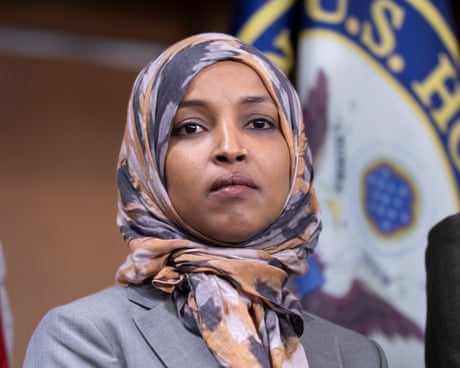
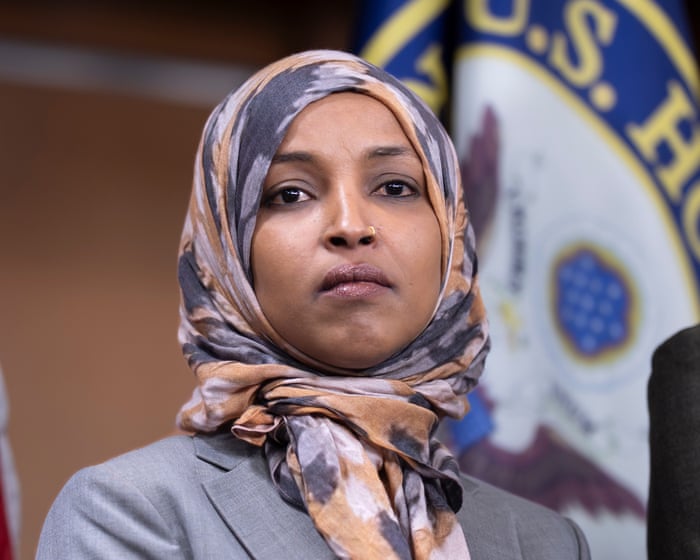
Ilhan Omar says she plans to move out of Washington home after federal raid

Democratic lawmaker says family’s safety is at risk amid death threats and raid making apartment’s address public

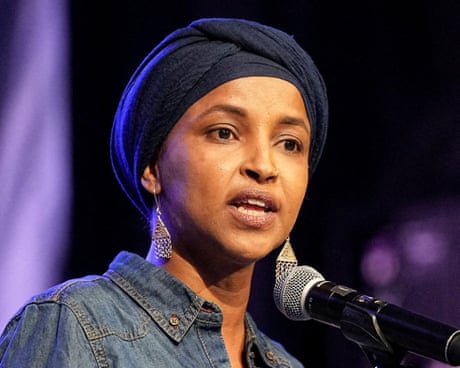
Minnesota congresswoman Ilhan Omar said she plans to move out of her Washington DC apartment after federal agents raided her residence last week as part of a larger immigration investigation.

“I mean obviously, I can’t continue to live there,” Omar told MS Now in an interview that aired on Wednesday. “So we have to figure out where to move to, because our address has been public and with the death threats that I deal with, it’s no longer going to be feasible to be in that house and have my kids, like, visiting off and on, having people track them.”

Continue reading...

© Photograph: Tim Evans/Reuters

© Photograph: Tim Evans/Reuters

© Photograph: Tim Evans/Reuters

  •  

Chiricahua monument in Arizona is now the 64th US national park

New designation of the Land of Standing-Up Rocks, known for its historic rock spires, passed with bipartisan support

An area of towering rock spires in south-eastern Arizona known among Native Americans as the Land of Standing-Up Rocks has become the nation’s newest national park.

Legislation to create Chiricahua national park was sent to the White House and Donald Trump signed it on Tuesday. It passed Congress with bipartisan backing and is now the 64th US national park.

Continue reading...

© Photograph: Ron Kerbo/National Parks Service/AP

© Photograph: Ron Kerbo/National Parks Service/AP

© Photograph: Ron Kerbo/National Parks Service/AP

  •  

Trump’s war and tariffs have battered Alaska. A pro-oil Democrat could flip the key Senate seat

Democrats believe circumstances have aligned for them to win a slew of competitive elections in the state

Mary Peltola’s campaign to represent Alaska in the US Senate has taken her to parts of the massive state’s interior that are inaccessible by road and on the frontlines of the cost-of-living crisis she hopes will make her the first Democrat to win the seat in nearly two decades.

She has been to towns where paper towels retail for $40, a half gallon of oat milk goes for $21 and the cost of a new freezer can be quadruple what it is in the state’s largest city, Anchorage, simply because it’s so complicated to get there. Along the Arctic Ocean, she’s heard of communities where power bills have climbed to $1,500 a month because they rely on generators for power and the Iran war has pushed the cost of diesel to new heights.

Continue reading...

© Photograph: Kerry Tasker/Reuters

© Photograph: Kerry Tasker/Reuters

© Photograph: Kerry Tasker/Reuters

  •  

In reliably blue Minnesota, could Democrats do the unthinkable and lose a Senate seat?

Frustration with a sprawling fraud scandal has cut Peggy Flanagan’s poll lead – could ex-NFL reporter Michele Tafoya win a first statewide election for Republicans in 20 years?

As Democrats fight to regain control of the US Senate, hopes are rising in states – from Kansas to Texas – where they have not prevailed in decades. But in Minnesota, where Republicans have not won statewide election since 2006, the contest for an open Senate seat is closer than expected.

Should Peggy Flanagan – the state’s Democratic lieutenant governor – win the election, she will be the first Native American woman to serve in the US Senate. But history has not yet been made. The closely watched Cook Political Report shifted its rating on the race this week from “likely Democrat” to “lean Democrat”.

Continue reading...

© Photograph: Elizabeth Flores/TNS/ZUMA Press Wire/Shutterstock

© Photograph: Elizabeth Flores/TNS/ZUMA Press Wire/Shutterstock

© Photograph: Elizabeth Flores/TNS/ZUMA Press Wire/Shutterstock

  •  

Nancy Pelosi’s office latest recipient of letter containing white powder

Former speaker is latest target of mailings sent to various Congress members in the lead-up to the midterm elections

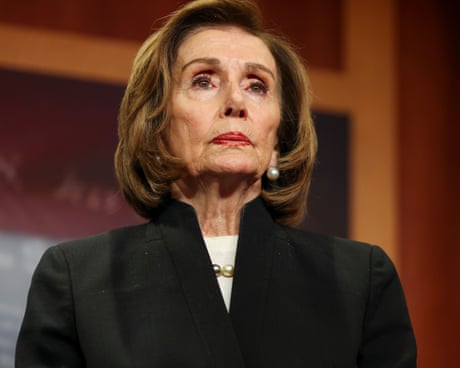
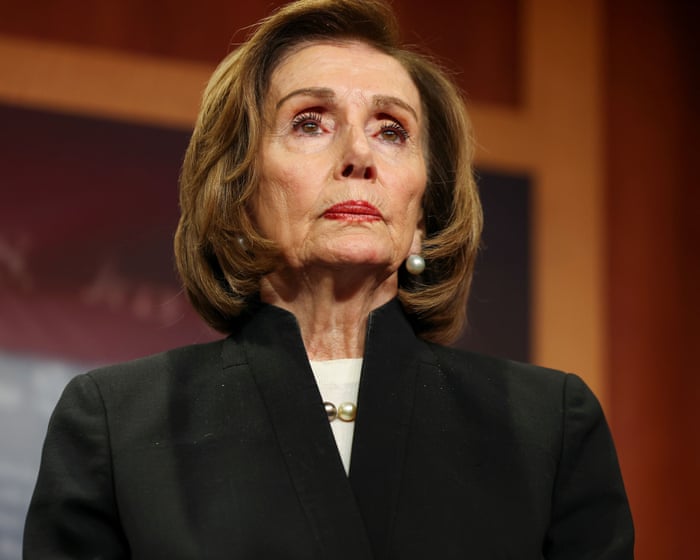
California representative Nancy Pelosi’s office received “a suspicious letter” on Wednesday in what appears to be the latest incident of ill-intentioned mailings targeted at US Congress members before the midterm elections.

The offices of more than three dozen members of Congress across the political spectrum have received envelopes containing white powder in recent days. One lawmaker’s office said preliminary tests indicated the powder was not hazardous.

Continue reading...

© Photograph: Tasos Katopodis/Getty Images

© Photograph: Tasos Katopodis/Getty Images

© Photograph: Tasos Katopodis/Getty Images

  •  

Elon Musk’s Super Pac spends $500,000 to back New York Republican in midterms

Incumbent Mike Lawler is fending off a challenge from Democrat Cait Conley in state’s 17th congressional district

Elon Musk’s Super Pac has spent more than $500,000 in New York’s highly competitive 17th congressional district race to help Mike Lawler, the Republican incumbent, hold on to his seat.

Lawler, a moderate Republican, is fending off a challenge from Democrat Cait Conley in the Hudson valley. It is among the most-watched races that could determine whether Republicans hold on to their majority in Congress.

Continue reading...

© Photograph: Michael Nagle/Bloomberg via Getty Images

© Photograph: Michael Nagle/Bloomberg via Getty Images

© Photograph: Michael Nagle/Bloomberg via Getty Images

  •  

Jewish NY congressional candidate briefly detained while joining Palestinian olive harvest

Police claim Brad Lander and 80 other activists didn't coordinate, despite IDF maps showing no coordination needed in area; Israel accuses Lander of 'harvesting headlines'
  •  

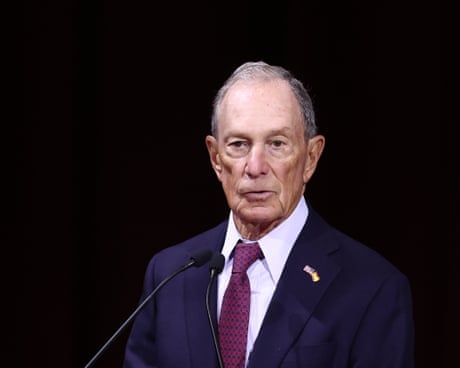
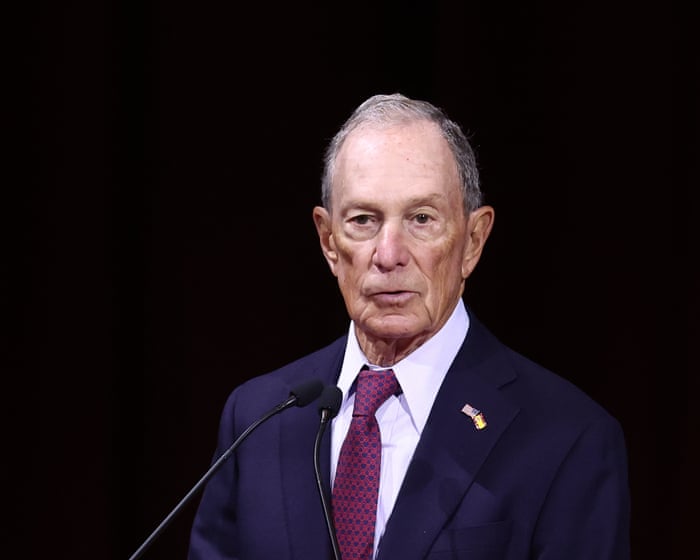
Michael Bloomberg spends $80m on Democrats as Trump moves $400m to Republican candidates

Billionaire ex-mayor of New York City is focusing funds on House races to help Democrats retake majority in midterms

The billionaire Michael Bloomberg will spend $80m to help Democratic candidates in the midterm elections, US media reported on Tuesday, a significant infusion of cash for a party that has recently struggled with fundraising as it seeks to win control of Congress.

The reported donations came as Donald Trump announced on Tuesday he intended to spend a total of $400m to aid Republican candidates, with $300m already disbursed.

Continue reading...

© Photograph: Europa Press News/Europa Press/Getty Images

© Photograph: Europa Press News/Europa Press/Getty Images

© Photograph: Europa Press News/Europa Press/Getty Images

  •  

Rubio’s Intervention Exposes the Limits of Trump’s Russia Policy

Zelenskyy’s urgent discussion with the US Secretary of State suggests that Washington cannot pursue accommodation with Moscow without confronting opposition in Congress, the requirements of American national security and Ukraine’s continuing dependence on US military support.

The telephone conversation between Ukrainian President Volodymyr Zelenskyy and US Secretary of State Marco Rubio on Tuesday, 20 October, has exposed an increasingly uncomfortable contradiction in American policy towards Russia. While President Donald Trump is easing economic pressure on Moscow and attempting to restrain Ukrainian attacks on Russian energy infrastructure, senior members of his administration are having to address the consequences for Ukraine’s defence.

Zelenskyy raised three immediate concerns: the availability of Patriot interceptor missiles, interruptions to American early-warning intelligence concerning Russian ballistic attacks, and restrictions affecting Starlink and Starshield satellite communications. He described the discussion as constructive, expressing appreciation for Rubio’s willingness to help.

The significance lies less in the diplomatic language than in the circumstances surrounding the call. Washington is attempting to obtain concessions from Moscow while several of its own decisions have weakened confidence in the security arrangements on which Kyiv depends. Rubio’s involvement suggests that these difficulties cannot simply be left unresolved while Trump’s envoys pursue another round of negotiations.

The political cost of concessions to Moscow

Trump’s recent decisions concerning Russian energy exports have brought an existing disagreement over Ukraine into American domestic politics.

The administration has facilitated Russian diesel exports and waived new sanctions under the Graham Act, legislation intended to increase pressure on Russia and its principal energy customers. Rubio has said the president will use a 60-day period to assess the economic consequences of implementing the measures.

For Trump, the immediate attraction is apparent. Rising fuel prices have become a political liability ahead of the 3 November congressional midterm elections. Increasing supplies on international markets offers the administration a potential means of relieving pressure on American consumers.

The difficulty is that concessions to Vladimir Putin carry their own electoral consequences. Moscow remains deeply unpopular among substantial sections of the American political establishment, including Republicans who regard support for Ukraine as a matter of American strategic interest.

That opposition is no longer confined to public criticism. Republican senators have joined Democrats in challenging decisions affecting Ukraine’s military capabilities, creating an additional problem for an administration already facing a difficult electoral environment.

Trump can justify Russian energy concessions as an attempt to protect American consumers. Explaining why Ukraine should simultaneously experience interruptions to critical defence systems is considerably more difficult.

Rubio and the machinery of American foreign policy

Rubio’s position within the administration is particularly important. As both Secretary of State and National Security Adviser, he occupies two offices central to the formulation and execution of American foreign policy.

His conversation with Zelenskyy took place during a diplomatic tour of Uzbekistan and India, demonstrating that the deterioration in relations with Kyiv required attention even while the administration was pursuing other international priorities.

It would be premature to interpret Rubio’s intervention as evidence of an independent foreign policy. There is no indication that he is acting against Trump’s instructions. The more plausible interpretation is that the administration recognises a need to contain the consequences of its recent decisions without requiring the president publicly to reverse his position.

The controversy surrounding Starshield is particularly revealing. Reuters reported that instructions to restrict the satellite service used by Ukrainian forces originated inside the White House. The officials cited did not identify who authorised the order, while the administration has denied Trump’s personal involvement.

Separately, Zelenskyy has reported failures to receive advance warnings of Russian ballistic attacks. The cause of those interruptions remains disputed.

These developments have already attracted congressional scrutiny. Republican Senator Thom Tillis and Democratic Senator Jeanne Shaheen led a bipartisan request for an investigation, warning that failures in communications and intelligence-sharing may have endangered American personnel in Ukraine.

Congress cannot directly manage the administration’s foreign policy. Nevertheless, its powers over expenditure, legislation and oversight make sustained opposition politically consequential, particularly when members of the president’s own party are involved.

Ukraine needs military assistance, not diplomatic promises

The immediate requirements in Kyiv are considerably more specific than the objectives being discussed in Washington’s diplomatic negotiations.

Ukraine needs reliable satellite communications, uninterrupted intelligence concerning incoming missiles and sufficient Patriot interceptors to defend its cities and critical infrastructure. Delays in any of these areas have consequences that cannot be addressed through declarations about a future peace settlement.

The shortage of Patriot missiles is particularly serious. Zelenskyy has complained that American authorisation is delaying deliveries under arrangements financed by European governments. Washington’s commitments elsewhere, including the Middle East, add further pressure to American air-defence inventories.

Meanwhile, preparations for new negotiations in Oslo involving American envoys Steve Witkoff and Jared Kushner continue. The involvement of European leaders may broaden the diplomatic discussion, but it does not resolve the central obstacle: Putin has offered no convincing indication that he is prepared to end the invasion on terms acceptable to Ukraine.

Proposals concerning Ukrainian elections, NATO membership or alternative negotiating arrangements remain subordinate to that problem. Without a ceasefire that can be enforced, even an agreement on the political framework for peace would leave fundamental questions of security unanswered.

The limits of presidential power

Trump retains substantial authority over American sanctions, military assistance and diplomatic engagement. Yet his ability to offer Moscow meaningful concessions is constrained by several factors beyond his immediate control.

Congress can challenge further attempts to weaken sanctions or restrict assistance. European governments maintain their own sanctions regimes and are not obliged to follow Washington’s approach. Ukraine retains considerable military capacity, including the ability to attack Russian energy facilities that contribute to financing the war.

Nor can the American president compel Putin to accept a settlement. If Russia calculates that continuing military operations offers greater advantages than negotiations, additional concessions from Washington may encourage Moscow to prolong the conflict rather than end it.

Rubio’s conversation with Zelenskyy therefore suggests that the administration is being forced to confront the practical consequences of its policy. An American president may seek improved relations with Moscow, but the institutional interests of the United States do not necessarily change with his personal diplomatic priorities.

For Kyiv, the question is whether those interests will translate into the continued supply of weapons, intelligence and communications support. Russia’s attacks will continue irrespective of the timetable established for American diplomatic initiatives.

  •  

Over three dozen Congress members’ offices targeted with white powder envelopes

Envelopes containing powder come weeks before midterms as federal agents try to identify who is behind campaign

More than three dozen members of US Congress have had their offices targeted with envelopes containing white powder, less than three weeks before the 3 November midterms, as federal agents try to identify who is behind the campaign.

The latest is the Virginia Democrat Suhas Subramanyam, whose Leesburg district office was evacuated on Monday after an envelope containing a suspicious substance arrived. He said the office was cleared quickly, adding that “acts of political intimidation have no place in our country”.

Continue reading...

© Photograph: Kylie Cooper/Reuters

© Photograph: Kylie Cooper/Reuters

© Photograph: Kylie Cooper/Reuters

  •  

U.S. Midterms: Trump’s Grip on Congress Comes Down to the Gas Pump

Photo: EFE.

Two weeks before the midterm elections, Trump’s approval rating has hit a two-term low. The war with Iran has driven up the cost of a tank of gas and a cart of groceries, millennials have turned away from him faster than the rest of the country, and part of his base plans to stay home.


Donald Trump’s name is not on any ballot on Nov. 3, yet much of the U.S. electorate will head to the polls with him in mind.

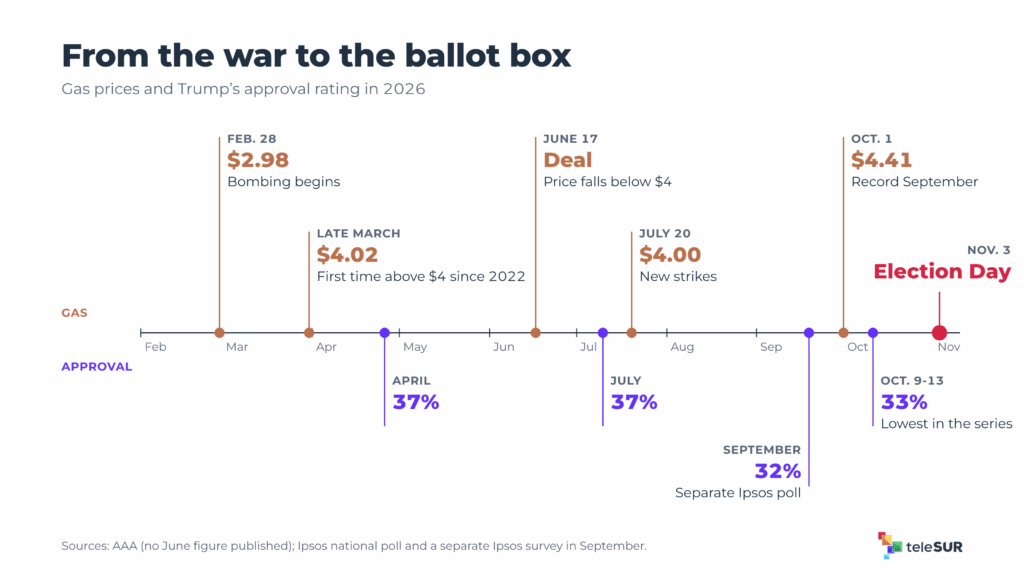
A national poll released Sunday, Oct. 18, and conducted Oct. 9-13, puts his approval rating at 33%, the lowest the series has recorded in either of his terms. Two in three adults disapprove of his performance, 52% strongly, and the same survey had him at 37% in both April and July.

RELATED: Trump Approval Falls to New Low of 33% Two Weeks Before Midterms

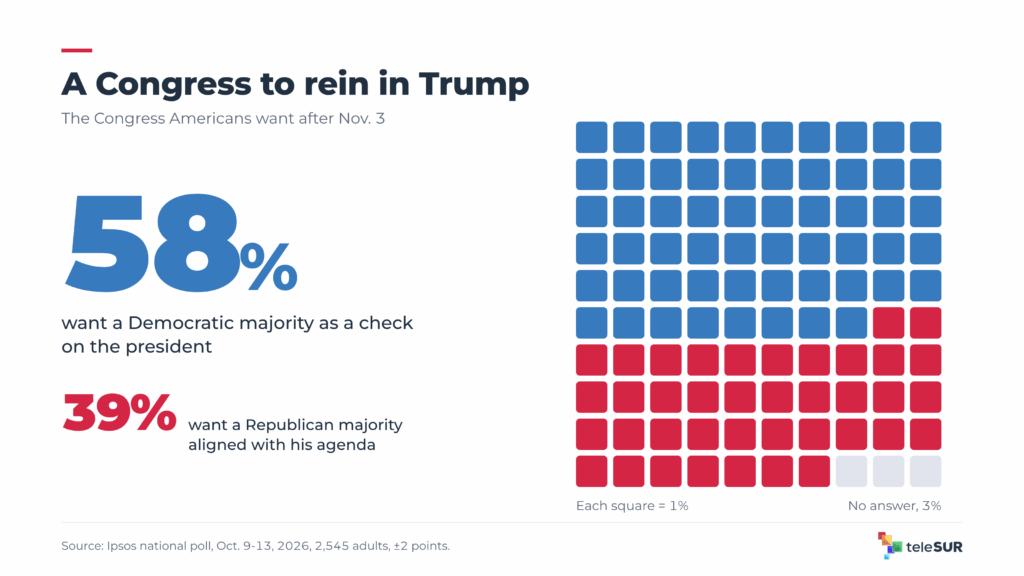
The poll also asked whether the next Congress should act as a check on the president or support his agenda. Fifty-eight percent preferred a Democratic-controlled Congress as a check on him, compared with 39% who want a Republican Congress aligned with the White House, a gap nearly twice as wide as a year ago. Neither party is calling this election a referendum, but the answer brings it close to one.

Almost six out of ten U.S. citizens want the next Congress to counterbalance Trump, a gap that has nearly doubled in one year. Graph: teleSUR

In the race for the House of Representatives, Democrats lead Republicans 52% to 44% among likely voters. Among registered voters the gap holds at eight points; in July it was three.

Other surveys tell the same story. An earlier Ipsos poll put him at 32% in September, and the Pew Research Center had him at 30% in early October. The slide deepened after February, when the war with Iran began.

Between the first bombings on Iran and the election, gasoline soared above 4 dollars and Trump’s approval rating plummeted. Graph: teleSUR

From Hormuz to the Gas Tank

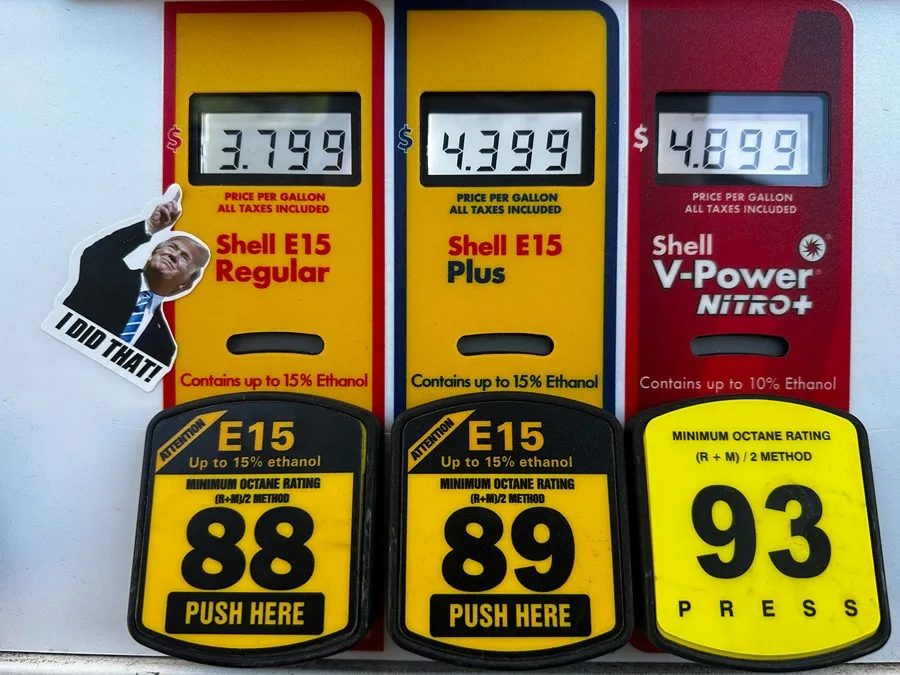
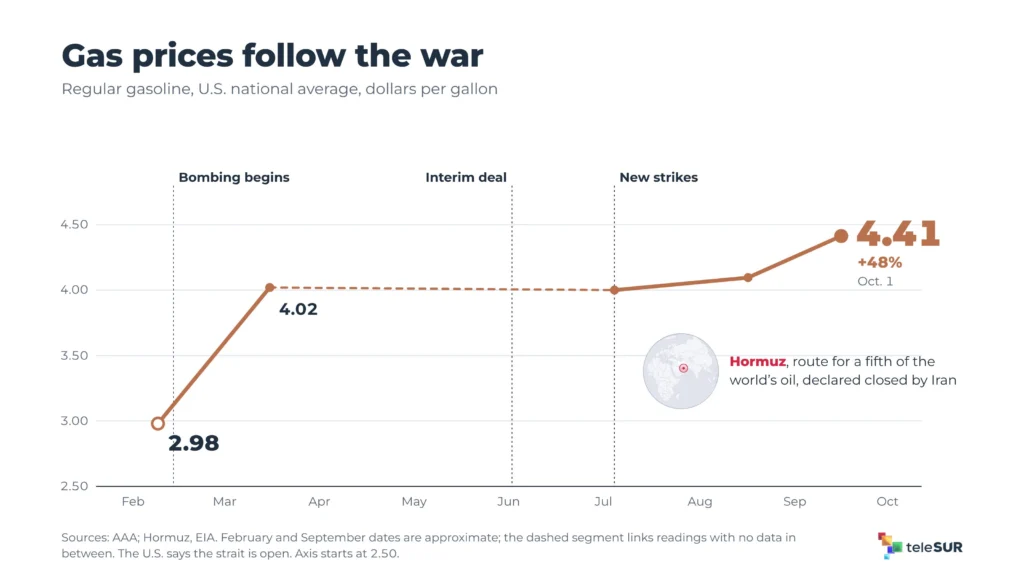
The United States and Israel began bombing Iran in February, when a gallon of regular gasoline cost an average of $2.98, according to AAA. By late March it had topped $4 for the first time since 2022, and each new round of strikes pushed it back up. On Oct. 1, the national average hit $4.41.

At those prices, filling a 15-gallon tank costs about $21 more than before the war.

With Ormuz declared closed by Iran and no oil pipelines capable of replacing it, the gallon rose 48% in the US even with record crude production. Graph: teleSUR

In February, 7 in 10 U.S. citizens considered gasoline affordable. Eight months later, the same share says the opposite.

About a fifth of the oil the world consumes passes through the Strait of Hormuz. According to the official price index for September, consumer prices rose 3.7% over the year, energy 20.4% and gasoline 34.2%, while inflation excluding food and energy stood at 2.6%. Today, 65% of U.S. citizens believe attacking Iran was a mistake.

Tehran declared the strait closed in March and has reaffirmed that stance several times since. In October, Rear Adm. Habibollah Sayyari, chief of staff of Iran’s army, told the official IRNA news agency that the waterway remains closed and that all transit must be coordinated with the armed forces, and he blamed the closure for the rise in U.S. gasoline prices.

Washington says otherwise. On Oct. 7, Secretary of State Marco Rubio said that “the Straits of Hormuz are open,” that as much oil is flowing out now “as there was before this conflict began” and that Iran has “lost complete control of the straits.” Overland routes cannot replace the strait either. Before the war, the EIA estimated that the Saudi and Emirati pipelines that bypass Hormuz had only about 2.6 million barrels a day of spare capacity to divert crude, compared with the 20 million barrels a day that moved through the strait.

Ten days later, Vice President JD Vance revealed another side of the same administration. “I recognize that gas prices are too high right now,” he said Saturday night at a televised town hall. Asked why the war had not ended in a clear victory, he said that “in some ways we have won decisively,” though “the enemy gets a vote.” And he repeated that Iran, “the largest state sponsor of terrorism in the world,” cannot have a nuclear weapon.

On the campaign trail, the fix being sold in Washington points elsewhere. In a poll of 1,000 likely voters taken in early October, four in five agreed that increasing U.S. energy production “can help make everyday life more affordable,” and 67% backed a proposal whose wording already promised the result, “updating federal permitting laws to reduce delays and lower costs.” It is the same reform the oil industry pitches as the key to affordability.

The government’s own energy agency supplies the missing piece. The United States has been the world’s largest crude oil producer since 2018 and is on track for a record of about 13.7 million barrels a day this year, while 84% of the crude that crossed Hormuz was bound for Asia. With output at record highs, gasoline has risen 48% since the bombing began. Crude is priced on a global market, and this year’s price spikes followed the calendar of the war, not the permitting calendar.

The price shock reached much of the world, and Latin American economies that import refined fuels absorbed it without having had any say in the decision to go to war. For those countries, the permitting fight in Washington is a distant concern; the price of their diesel depends on what happens in Hormuz. How much room Washington has to keep waging the war without congressional oversight will also be decided on Nov. 3.

For Latin American families living in the United States, the most visible face of the second term is immigration policy. At the start, half the country approved of it; now about 60% disapprove, and 56% say deportations have gone too far, eight points more than in April 2025. At the same town hall, Vance acknowledged that his rhetoric about immigrants had been “imperfect” and took the blame. “That’s on me,” he said. His goal, he insisted, is not “to dehumanize any immigrant.” “In fact, I love a number of immigrants,” he added.

An Economy Judged by Team Colors

The president’s approval on the economy has fallen to 28%, its lowest mark across his two presidencies. Forty-eight percent feel worse off than when Trump returned to the White House in 2025, the highest share in a series dating back to 1986, and for the first time in more than a decade, registered voters trust Democrats more to handle the economy, 40% to 33%. Before the 2022 midterms, the same series gave Republicans a double-digit edge on the issue.

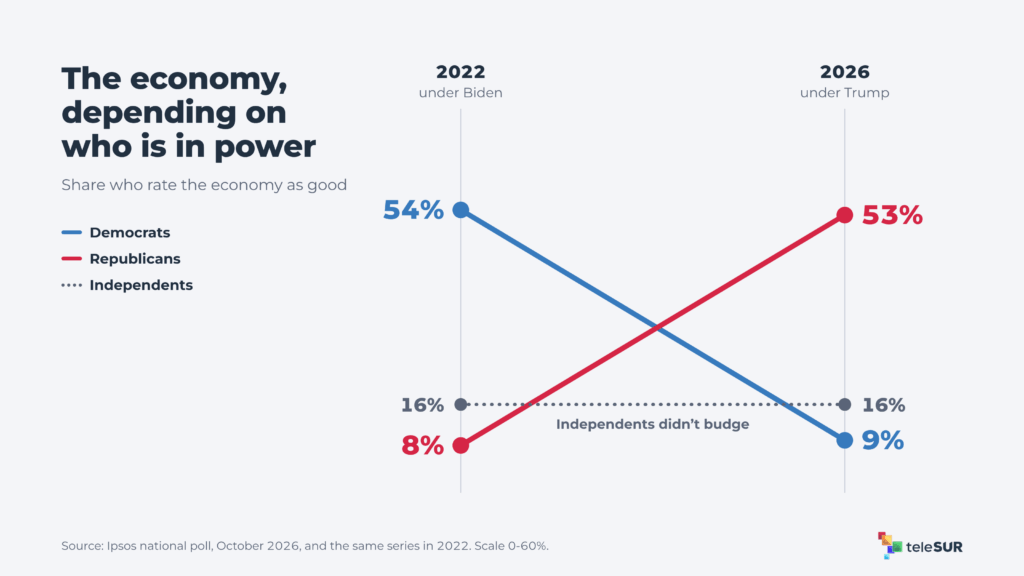
That year, with Joe Biden in the White House, each party’s verdict on the economy was the mirror image of today’s, almost point for point, and independents stood at 16% in both surveys.

Democrats and Republicans reversed their judgment of the economy by changing government, meanwhile only independents stayed where they were. Graph: teleSUR

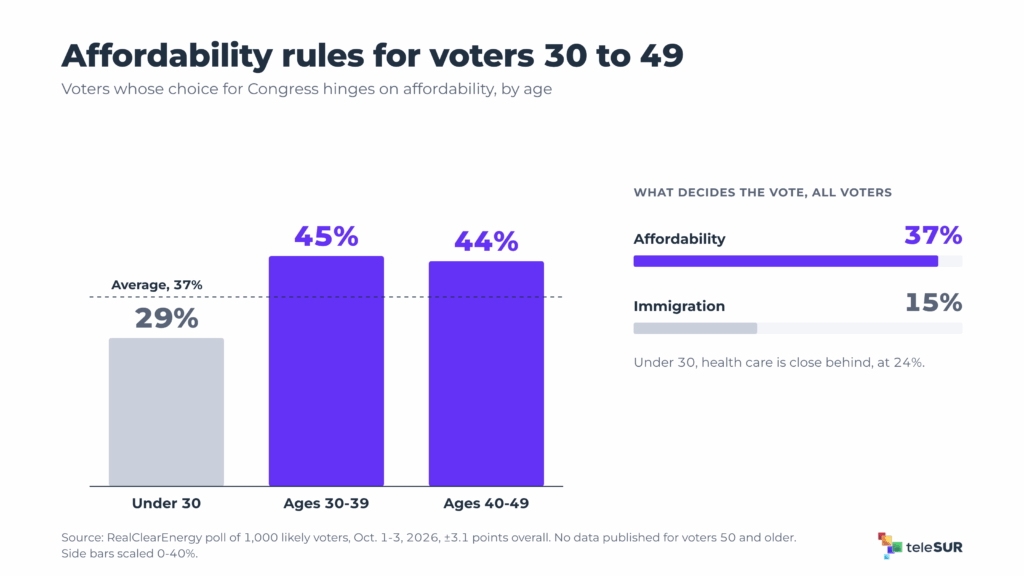
Voters who wear no team colors are moved by their wallets. In the October survey of likely voters, 37% said a candidate’s stance on affordability will decide their vote for Congress, more than double the 15% who put immigration first, an issue central to Trump’s 2024 campaign. That priority is shared by 43% of Democrats, 36% of independents and 32% of Republicans.

Among those who say they are worse off than in 2025, 78% lean toward Democrats, as do 71% of independents in that group.

The Generation that Turned Away Fastest

Millennials, born between 1981 and 1996, are now 30 to 45 years old and make up the largest adult generation in the country. In 2024 they split almost evenly on Trump; exit polls showed voters ages 30 to 44 backing Kamala Harris over him 51% to 47%.

A YouGov poll conducted Aug. 28-31 found 27% approval and 70% disapproval in that age group, the group’s worst showing in the series. Its net rating went from minus 1 in January 2025 to minus 43 in August, a 42-point drop, compared with 30 points nationally.

The Economist makes the opposite case. It argues that millennials have turned their fortunes around and now earn more than any recent generation did at the same age, while narrowing the gap in homeownership. The magazine credits the recovery to markets rather than to a state-funded rescue. October’s polls show what that narrative leaves out.

In the House race, the Pew Research Center found voters ages 30 to 49 favoring the Democratic candidate 43% to 31%, with one in five still undecided.

October’s affordability survey, broken down by age, points in the same direction. Affordability will decide the vote of 45% of voters in their 30s and 44% of those in their 40s, above the 37% average. This is the cohort that entered the job market in the 2008 crisis, pays rent or a mortgage, raises children and fills the tank every day to get to work, and the tank is precisely where prices have climbed the most this year.

The cost of living defines the vote of almost half of voters aged 30-49, above the national average of 37%. Graph: teleSUR

The figures come from surveys with different age brackets and do not prove a single cause. Read together, though, they show the country’s largest generation turning away from Trump faster than everyone else, with the cost of living at the top of its priorities.

RELATED: U.S. Retail Sales Up in September Amid Surging Gas Prices

The Ones Who Stay Home

Among those who voted for Trump in 2024, 23% now disapprove of his performance and 38% reject his handling of inflation. Most of them still prefer Republicans for Congress, so the erosion does not take the form of a switch to the other party. What they have lost is the certainty that they will vote.

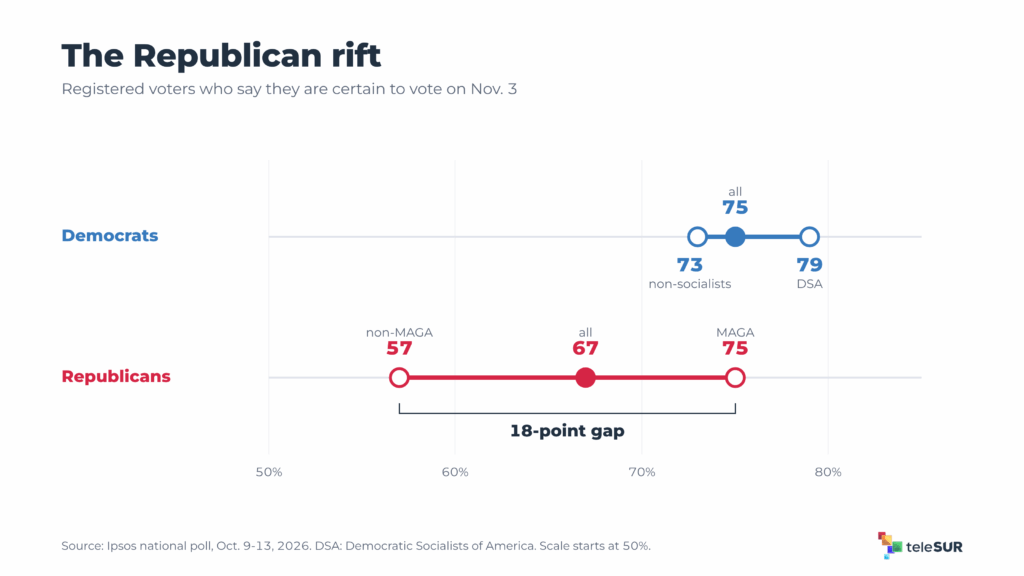
Seventy-five percent of registered Democrats say they are certain to vote, compared with 67% of Republicans. Within the Republican Party, certainty reaches 75% among supporters of the MAGA movement and falls to 57% among those who do not identify with it, and more than a quarter of the latter want Democrats to control the next Congress.

Only 39% of Republicans strongly approve of the president, down from 63% in February 2025.

How many of the 77 million people who voted for Trump in 2024 will return to the polls without his name on the ballot is a question no one can answer yet. Turnout models based on 2022 and 2024 favor Republicans; votes already cast or locked in, by contrast, favor Democrats.

The risk for Republicans is at home. Their MAGA-unaffiliated voters are the least confident of going to the polls. Graph: teleSUR

What is at Stake in the Senate

With the slim House majority Republicans are defending, losing a handful of seats would be enough to hand over control, and presidential approval is among the best predictors of midterm results. Even so, 58% of likely voters who “somewhat” disapprove of Trump still prefer the Republican in their district.

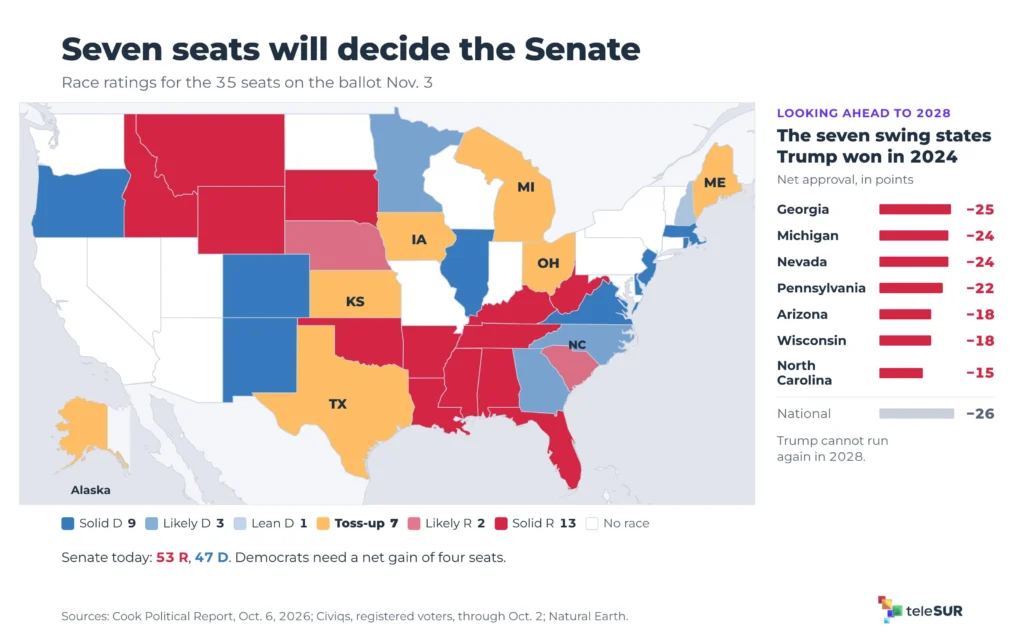
The Senate is split 53-47 in Republicans’ favor, and Democrats need a net gain of four seats to win back the majority. Of the 35 seats on the ballot, seven are rated toss-ups, and six of them — in Alaska, Iowa, Kansas, Maine, Ohio and Texas — are held by Republicans. North Carolina, a Republican seat, is already rated as likely to go Democratic.

The seven states that decided the last presidential election — Arizona, Georgia, Michigan, Nevada, North Carolina, Pennsylvania and Wisconsin — offer an early clue about 2028. Trump carried all seven in 2024, and today his net approval is negative in every one of them, between 15 and 25 points underwater among registered voters, according to the Civiqs tracker. He cannot run in 2028, and those numbers measure a president, not his successor, but they map the terrain his party will inherit.

Six of the seven open Senate races are played in Republican seats, while their approval is now negative in the seven states that gave the White House to Trump in 2024. Graph: teleSUR

On Nov. 3, Trump’s name will still be missing from the ballot. The outcome will depend less on votes that switch parties than on the votes that are never cast, among them those of a generation that split almost evenly on him two years ago and in August disapproved of him by more than two to one.

The Arch and the Gas Pump

On Wednesday, Oct. 14, 20 days before the election, the new Air Force One flew low over the airport in Bullhead City, in the Arizona desert. It is the Boeing 747 that Qatar’s royal family gave Trump, now painted red, white, blue and gold. “When they give you a 747, you say two words, thank you,” he told supporters.

Arizona is one of the swing states that change hands from one presidential election to the next. Joe Biden won it in 2020 by about 10,500 votes, Trump took it back in 2024, and today his approval there is 18 points underwater. The state has no Senate race this year, but it does elect a governor and all nine of its House members. The president chose Mohave County, where he won more than 77% of the vote two years ago, with early voting already a week underway. He went looking for his base, the voters he needs at the polls, not at home.

From the plane he moved on to people who leak military information. “In my opinion, leakers should be shot,” he said, and he called the journalists covering him “almost as bad as a leaker.” He touted the ballroom he is building at the White House and the triumphal arch he plans for the capital. On Iran, whose leaders, he said, “are gone,” he let slip a confession. “I might have gone too far. I don’t know who the hell to deal with.” And he promised that once the war ends, “your gasoline is going to go down to even lower than it was before it started.”

He was addressing a country that fills its tank at wartime prices and pays rents 2.8% higher than a year ago, according to the official price index. Three days later, his vice president admitted on television what the gas pump was already saying. Trump, in Arizona, had preferred to talk about monuments.

The planned arch would stand 76 meters (250 feet) tall, about 26 meters (85 feet) taller than the Arc de Triomphe in Paris, and would rise at the foot of the bridge leading to Arlington National Cemetery, as part of the celebrations for the 250th anniversary of U.S. independence.

Napoleon commissioned the Paris arch in 1806, after his victory at Austerlitz, to honor his armies. Construction dragged on for three decades. When it was inaugurated in 1836, the emperor had been dead in exile for 15 years, and he passed beneath the arch only once, in 1840, inside the coffin that brought his remains back to France.

  •  

Trump defends Russia sanctions waiver, says he does not want to drive Moscow from talks

Trump WEF

US President Donald Trump wrote in a Truth Social post on 18 October that he did not want to “drive, foolishly, Russia away from the bargaining table.” He also wrote: “Signing that document at this time will do that, and I can sign it later, or any time that I want!”

Trump was referring to sanctions and tariffs under the Lindsey O. Graham Sanctioning Russia and Iran Act of 2026, which he waived in an executive order on 16 October, days before the measures were due to take effect. The waiver suspends additional economic penalties intended to pressure Moscow over its war against Ukraine, while leaving earlier US sanctions in place. The decision came weeks before the 3 November midterms, in which Republicans are defending slim majorities in both chambers, and analysts said the penalties could have pushed up oil prices for Americans already paying more, largely because of the US-Israeli war with Iran, Reuters reported.

Trump says Zelenskyy could have made a better deal two years ago

A week before the waiver, Trump had announced a deal for Russia to increase diesel supplies to global markets. The Treasury also issued a license, valid until 7 April 2027, permitting certain transactions in Russian-origin diesel.

In the Truth Social post, Trump accused Ukrainian President Volodymyr Zelenskyy of targeting Russian diesel refineries, saying the strikes were “seriously hurting the world diesel markets, including those in the United States.” Kyiv had paused its refinery strikes for three days at Washington’s request after Trump declared an energy ceasefire on 11 October, which Russia never confirmed, then resumed them. Since then, Russia has struck Ukraine’s energy sector 76 times, Zelenskyy said on 18 October.

kyiv attack
Explore further

Kyiv gets no warning of the first of two Russian ballistic waves, hours after Zelenskyy said US alerts were back

Trump wrote that Zelenskyy “doesn’t want to end this war, and probably never did,” and that he “could have made a better deal two years ago than he can now.”

“His country is in shambles, a large portion of his land is lost, his oceans and seas are gone, and his male population is low, wounded, and/or dead,” Trump added.

He also said Russia was “doing very little, if anything, to help” Iran and that he wanted to keep it that way.

A day earlier, Trump said he had not made a final decision

On 17 October, Trump told reporters at Mar-a-Lago that he had not announced his final decision. “A lot of you don’t know what my decision is yet, but we’ll figure it out, and you’ll figure it out,” he said, Reuters reported.

“I think the president wants to take the 60-day period of time to sort of analyze what imposing both sanctions and tariffs will mean to the global economy and even to the US economy,” US Secretary of State Marco Rubio told reporters before departing for Uzbekistan the same day.

Zelenskyy calls the waiver a pity as Republicans split

Zelenskyy called it a “pity” that Trump had waived sanctions under a law named for the late Senator Lindsey Graham, who “really believed in Ukraine.” He said he hoped Trump would change his decisions, NBC News reported.

Discussing the diesel deal on NBC’s Meet the Press, Zelenskyy said US oil prices had risen because shipping through the Strait of Hormuz was blocked, not because of Ukraine.

month before diesel waiver trump’s envoys had already pitched kyiv russian gas · post jared kushner steve witkoff ukrainian president volodymyr zelenskyy 7 2026 presidentgovua джаред кушнер стівен віткофф володимир
Explore further

A month before the diesel waiver, Trump’s envoys had already pitched Kyiv on Russian gas, NYT says

On 17 October, Zelenskyy told journalists that “the decision to undo all of this, to block all of it, seems wrong to me” and that it “definitely helps only the Russians.” His remarks appeared in Ukrainian on his official Telegram channel.

“Sanctions relief will continue. I think the diesel deal and the move regarding the Lindsey Graham Act are not the end of it. Unfortunately,” Zelenskyy said.

On 19 October, Zelenskyy wrote that partners had again given no warning of Russia’s overnight ballistic attack and that blocking missiles for Ukraine’s air defense while Russia gets sanctions eased or postponed amounts to partners denying reality.

Republican Senator James Lankford defended Trump’s decision on NBC’s Meet the Press, saying the president was “choosing the American people first.”

Senator Darline Graham, Lindsey Graham’s sister, whom Trump has endorsed for a full term, said at a campaign stop on 17 October that she would “choose to keep the pressure on Russia.”

“I don’t trust Putin and I don’t trust Russia,” Darline Graham said.

She did not directly criticize Trump but said she would not have made that choice, Reuters reported.

  •  

Obama condemns comments by ‘border czar’ that Ilhan Omar could ‘of course’ be denaturalized

Ex-president urges Americans to defend congresswoman, saying ‘there’s no reason to believe it will stop with her’

Former US president Barack Obama condemned comments by Donald Trump’s “border czar” that the Republican presidential administration could “of course” strip Democratic congresswoman Ilhan Omar of her citizenship and deport her.

Obama wrote Sunday morning, on X, that “the full weight of the federal government is being brought down on a law-abiding elected official because she has dared to criticize the president.”

Continue reading...

© Photograph: J Scott Applewhite/AP

© Photograph: J Scott Applewhite/AP

© Photograph: J Scott Applewhite/AP

  •  

No Kings Rallies Push Early Voting Ahead of U.S. Midterms

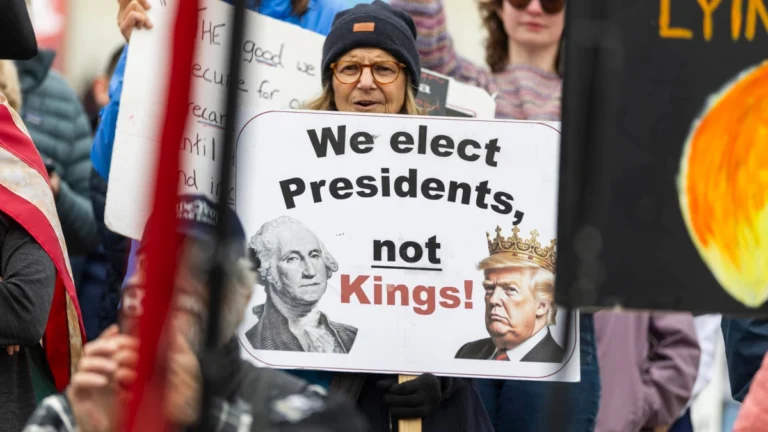
No Kings rallies across the United States urge early voting ahead of the 2026 US midterm elections.

Nearly 3,000 events nationwide urged voters to cast ballots early ahead of November 3 elections that will determine control of Congress.


The No Kings movement held nearly 3,000 rallies and marches across the United States on Saturday, urging voters to cast their ballots early in the November 3 midterm elections, as the Trump administration intensified its efforts to challenge mail-in voting and scrutinize ballots cast by suspected noncitizens.

RELATED: Trump’s Attack on Mail-In Voting Seeks to Create an Advantage for Republicans

The nationwide mobilization, held under the slogan “No Kings: Vote Early,” drew millions of participants, according to USA Today, with events in all 50 states and Washington, D.C. The demonstrations came two weeks before elections that will determine whether Republicans retain control of Congress for the final two years of President Donald Trump’s term.

Organizers said the campaign aimed to turn mass mobilization into electoral participation by encouraging voters to make voting plans, cast their ballots early and help protect every eligible vote. They argued that historically high turnout would make it harder for the Trump administration to challenge the results by alleging fraud.

“Across thousands of events in all 50 states and DC today, we are turning enormous people power into direct voter power,” the No Kings Coalition said in a social media statement. It described the initiative as a nationwide effort to encourage early voting and build a network of Americans prepared to defend eligible ballots.

Text Reads: Demonstrations in Washington, U.S., under the slogan “No Kings: Vote Early,” seek to channel political protest into electoral participation. They call for placing limits on President Trump and protecting the Constitution ahead of the elections.

The coalition also pointed to the rising cost of groceries, gasoline, electricity and other daily necessities, arguing that decisions made by political leaders directly shape families’ lives and economic prospects. It presented the early-voting campaign as the next step in reclaiming political influence after a year of mass demonstrations.

In Atlanta, city council member Michael Julian Bond urged rally participants to encourage others to vote before Election Day rather than wait until the last minute.

“The Constitution gives you a power. That is the power of the vote,” Bond told the crowd.

In Phoenix, Arizona, Democratic Senator Rubén Gallego linked the campaign to opposition to the Trump administration’s policies, accusing the president and congressional Republicans of worsening economic conditions for ordinary Americans while enriching their allies.

“Today, we voted early to send a message loud and clear: no to separating our families, no to corruption, no to no oligarchs, no to stupid forever wars, and no kings.,” Gallego wrote on X.

Today, we voted early to send a message loud and clear: no to separating our families, no to corruption, no to no oligarchs, no to stupid forever wars, and no kings. https://t.co/qtT9Gp7Lwf

— Ruben Gallego (@RubenGallego) October 17, 2026

Democratic Representative Yassamin Ansari, who also attended the Phoenix rally, called the upcoming election “the most important election of our lives.” She cited the administration’s deportation policies, the war in Iran, cuts to health care and food assistance, and widespread corruption allegations as central issues facing voters.

Ansari questioned whether Americans would accept immigration enforcement practices that frighten communities and separate families, policies that leave millions without health care, or what she described as a transfer of wealth from working people to billionaires.

The protests unfolded amid heightened political tensions over Trump’s deployment of military personnel to several cities governed by Democrats. The administration has justified the deployments as a way to combat crime and support immigration enforcement operations.

The demonstrations were backed by a broad coalition of organizations, including the American Civil Liberties Union, the American Federation of Teachers, Black Voters Matter Fund, Indivisible, MoveOn, Public Citizen, State Voices and Voto Latino.

The push for early voting also came as the Trump administration pursued legal action against mail-in ballots. Trump has repeatedly attacked mail voting and continued to claim, without evidence, that electoral fraud cost him the 2020 presidential election.

On Thursday, the administration sued California election officials, asking a judge to bar the state from counting mail-in ballots in the midterm elections cast by people the federal government considers likely to be noncitizens until their immigration status can be verified.

On Friday, the Justice Department warned local election officials that processing and counting ballots submitted by suspected noncitizens could expose them to criminal investigations and prosecution.

Also on Friday, Democratic Senators Alex Padilla of California, Sheldon Whitehouse of Rhode Island and Dick Durbin of Illinois wrote to Attorney General Todd Blanche, demanding assurances that the Justice Department would not seize ballots or other election materials before the midterm results were certified.

  •  

Ilhan Omar’s attorneys say federal search of her home was ‘neither justified nor lawful’

Minnesota lawmaker’s attorneys asked for return of seized items and the preservation of any recordings of search

Ilhan Omar’s attorneys have asked the US Department of Justice to return property that federal agents removed days earlier from her home during a search.

The lawyers for the Minnesota Democrat contended that the seizure as “neither justified nor lawful”, according to a letter that the Associated Press reported on Friday.

Continue reading...

© Photograph: J Scott Applewhite/AP

© Photograph: J Scott Applewhite/AP

© Photograph: J Scott Applewhite/AP

  •  

Trump Shelves Russia Sanctions Weeks After Signing Them Into Law

President Donald Trump has waived sweeping sanctions and tariffs targeting Russia’s energy revenues, invoking national interest provisions in legislation passed only last month. The decision follows his controversial diesel agreement with Vladimir Putin and threatens to deepen divisions with Congress and European allies over economic pressure on Moscow.

President Donald Trump has suspended the implementation of sweeping American sanctions against Russia, using presidential waiver powers to prevent penalties approved by Congress from taking effect just weeks after he signed them into law.

The executive order issued by the White House on Friday, 16 October, suspends tariffs of up to 500 per cent on Russian imports, alongside penalties targeting major purchasers of Russian oil and gas. It also waives numerous financial and commercial restrictions intended to reduce Moscow’s ability to finance its war against Ukraine.

The decision comes two days before the 18 October deadline for implementing key provisions of the Lindsey O. Graham Sanctioning Russia and Iran Act of 2026, which Trump signed on 18 September. The legislation was named after the late Republican senator Lindsey Graham, who had championed tougher economic measures against Russia.

Sanctions established but immediately suspended

The presidential order formally establishes the tariff increases required by the legislation while simultaneously suspending their application.

Under the law, Russian imports into the United States would face additional duties of 500 per cent. A separate provision would impose 100 per cent tariffs on goods imported from the five largest purchasers of Russian crude oil and natural gas if those countries knowingly made new purchases from 18 October, subject to specified conditions and exemptions.

Another provision targets countries identified as leading facilitators of Russian oil sanctions evasion, potentially exposing their exports to similar American penalties.

Trump invoked Section 115 of the legislation, which permits the president to waive sanctions and tariffs after certifying to Congress that doing so serves the national interests of the United States.

The order confirms that the certification and an accompanying explanatory report have been submitted to Congress. However, the publicly released document provides no detailed justification for suspending the measures.

The waivers will remain in effect until the president or designated senior officials decide that further action is appropriate. Existing sanctions imposed under earlier executive orders are explicitly preserved, meaning the decision does not remove all American restrictions against Russia.

Nevertheless, the order prevents the new legislation’s principal economic penalties from operating at a time when Congress had sought to intensify pressure on Moscow.

Diesel agreement shapes Washington’s decision

The suspension follows Trump’s agreement with Putin to facilitate renewed Russian diesel exports, announced on 9 October as part of an effort to reduce international fuel prices.

As EU Today previously reported, the agreement envisages an immediate release of more than 300,000 tonnes of Russian diesel, followed by additional shipments in November and subsequent months. Washington also authorised certain transactions involving Russian diesel until April 2027.

The arrangement has raised questions about the relationship between the administration’s energy policy and sanctions intended to constrain Russia’s war economy.

Diesel prices have become an increasingly important domestic political issue ahead of the American congressional elections on 3 November. The war involving Iran and disruptions to international energy supplies have contributed to exceptionally high fuel costs, creating additional pressure on the administration.

The White House hopes additional Russian supplies will relieve pressure on international markets. However, energy analysts have questioned whether the quantities involved will materially affect American prices, particularly before the elections.

The latest waiver also removes the immediate threat of punitive tariffs against major Russian energy customers, including China and India, which had objected to the proposed measures.

Congressional opposition and European concerns

The decision is likely to intensify opposition within Congress, where the sanctions legislation attracted substantial bipartisan support.

Earlier this week, 12 senators, including six Republicans, called on Trump to reverse his diesel agreement, arguing that allowing Russian fuel back onto international markets would provide Moscow with additional revenue for its military operations.

Democratic Senator Richard Blumenthal, who helped develop the sanctions legislation, criticised the diesel arrangement as contrary to Congress’s intention to strengthen economic pressure on Russia.

The decision also exposes a widening divergence between Washington and Brussels.

At the European Council meeting on Friday, European Commission President Ursula von der Leyen and European Council President António Costa reaffirmed that EU sanctions against Russia would remain in place until Moscow ended its war against Ukraine.

Costa declared that the present circumstances required increased pressure on Moscow rather than a relaxation of existing restrictions. The European Union is also preparing a 22nd sanctions package while considering additional financial support for Kyiv.

For Ukraine, the decision means that Russia will continue to benefit from energy exports and the international trade that helps finance its war. Instead of tightening restrictions on these revenues, Washington has suspended measures specifically intended to cut them.

The timing is particularly significant. While Trump is pressing Kyiv to halt attacks on Russian oil refineries and other energy facilities, Moscow continues its strikes against Ukrainian cities and civilian infrastructure. Zelenskyy has argued that Ukraine cannot be expected to stop targeting Russia’s energy sector while Russian attacks on Ukrainian infrastructure continue.

Although Trump can reinstate the sanctions, his decision removes the immediate threat of additional penalties against Russia and its principal energy customers. It also places Washington increasingly at odds with its European allies. Brussels remains committed to maintaining and expanding sanctions against Moscow, while the White House is now giving priority to reducing American fuel prices, even if that means easing economic pressure on Russia.

  •  

22 House lawmakers press Trump to implement Russia sanctions law. Diesel deal draws bipartisan backlash

US President Donald Trump signs the Lindsey O. Graham Sanctioning Russia and Iran Act in the Oval Office, 18 September 2026

A bipartisan group of 22 House lawmakers is urging President Donald Trump to fully implement the new Russia sanctions law and revoke a license allowing certain Russian diesel transactions. In a letter sent on 15 October, they copied Secretary of State Marco Rubio and Treasury Secretary Scott Bessent and requested details on planned sanctions, tariffs and waivers.

Their request comes as the law’s first requirements fall due on 18 October, while lawmakers from both parties challengethe administration’s decision to allow certain Russian diesel transactions. Some restrictions take effect automatically, while others require presidential action. The law does not specify a penalty for the president missing the deadline.

    What the Russia sanctions law requires

    Congress passed the Lindsey O. Graham Sanctioning Russia and Iran Act of 2026 by votes of 86–11 in the Senate and 262–159 in the House. Trump signed it on 18 September. Graham, a Republican senator from South Carolina, died in July.

    Restrictions taking effect automatically on 18 October include a ban on US banks and broker-dealers processing transfers to or from the Russian government, a ban on new US investment in Russia, a ban on new US investment in Russia’s energy sector, and a ban on US energy exports to Russia.

    Other measures require presidential action by the same date. The law directs Trump to review and sanction Russian officials, oligarchs and shadow-fleet vessels, sanction the Bank of Russia, specified Russian banks and state-owned companies, and impose tariffs of up to 500% on Russian goods. Tariffs of up to 100% can apply to goods from countries among the five largest importers of Russian oil or gas, or among the top five countries facilitating Russian oil sanctions evasion.

    Trump may waive sanctions, restrictions and tariffs under the law if he first certifies in writing to Congress that a waiver is in the US national interest and submits a report explaining its basis.

    The diesel license at the center of the dispute

    House members also urged Trump to revoke General License 135, which the Treasury Department issued on 9 October and that is valid until 7 April 2027. It permits certain transactions involving Russian-origin diesel, including imports into the United States. Trump said Russia would immediately supply more than 300,000 tons of diesel to US and global markets and predicted prices would fall sharply, according to a 9 October Truth Social post.

    On 13 October, a bipartisan group of 12 senators also urged Trump to rescind the deal and revoke the license. Seven senators said the deal conflicted with a 2022 law banning Russian energy imports.

    The Graham Act says nothing in its provisions affects the Treasury secretary’s existing authority to issue general licenses. That provision does not resolve whether the diesel license complies with the separate 2022 law.

    A White House official told Newsweek the administration would comply with the Graham Act. Bessent said the administration would use “all the legal authorities we have” and called the deal “good for the American people,” Fox News reported on 11 October.

    How the sanctions could be lifted

    Separately, the law sets a process for terminating sanctions, restrictions or duties against Russia. Trump must report to Congress that Russia has signed a peace agreement accepted by Ukraine’s government and ceased military hostilities against Ukraine, as well as activities to overthrow, dismantle or subvert its government. Congress has 30 days to block termination through a joint resolution of disapproval, or 60 days for reports submitted between 10 July and 7 September.

    •  

    ‘Taxpayer uprising’ targets Trump’s $1.5 trillion Pentagon budget

    Trump’s war on Iran has already cost the average American household $2,000 according to Moody’s, and the bill keeps climbing. Jodie Evans, co-founder of CODEPINK, tells Rania Khalek and Zoe Alexandra that a mass “Taxpayer Uprising” this November is the only way to block Trump’s historic $1.5 trillion Pentagon budget, as both parties keep writing checks for weapons manufacturers.

    Evans breaks down how military contractors, Big Oil, and AI tech giants “make a killing on killing,” and explains why Republicans and Democrats are both at fault for a US war economy that funnels taxpayer money to billionaires, militarizes the police, and criminalizes Gaza solidarity and calls for peace. She warns about the push to merge the US and Israeli military industries, and responds to allegations from Marco Rubio’s State Department that anti-war activists are working for Cuba. But Evans believes Americans still have the power to stop the war machine. Pointing to youth uprisings in France, Spain, and India, she says: “Let’s stand on the shoulders of those who came before us, and of the young people around the world… It’s time for the people to stand up, speak out, and say no!”

    Watch full episodes of BT Live, join breakthroughnews.org as a member today!

    ******

    Rough transcript follows:
    [Host:] The Pentagon is about to get the biggest budget in American history. The House has advanced more than a trillion dollars for the military. That’s a $234 billion jump in a single year. And the White House is actually demanding even more: $1.5 trillion. At the same time, Republicans want billions in cuts to programs that working people depend on. So they have money for war, but never for the poor.

    Then there’s Trump’s war on Iran. The Pentagon says it has cost around $29 billion. And that was actually back in June—that’s the Pentagon saying that. It’s definitely a lowball because it doesn’t count replacing munitions or repairing bases that Iran hit. Moody’s has actually put the real cost to American taxpayers and consumers at $132 billion and climbing. Most of it is being seen at the gas pump.

    And on day one of that war, you may remember, Zoe, a U.S. missile destroyed a school in Iran. At least 175 people were killed, including over 100 schoolchildren. So that’s where all of that money is going: to bomb schools. On top of that, billions keep flowing to the Israelis. And ICE is sitting on $75 billion in new money from Trump’s Big Beautiful Bill—money to cage and deport the same working people this government says it can’t afford to help.

    Now, none of this is popular. Trump’s approval is in the gutter. Yet Congress keeps writing the checks. So why isn’t public opposition turning into a change in policy? And who’s profiting from that gap? CodePink says the answer is to take it straight to Washington. Next month, right after the midterms and before the new Congress is sworn in, they’re bringing what they call a taxpayer uprising to Washington, D.C.: three days of nonviolent action against a system that, in their words, bombs schools instead of building them.

    Joining us now to discuss is CodePink co-founder Jodie Evans. Jodie, welcome to BT Live.

    [Jodie Evans:] Thank you, and thank you for having me. I love you two so much, and I’m so sad about the attacks for being people who support peace and humanity. It’s—

    [Host:] Exactly what it is. That’s the crime: supporting peace and humanity. And that’s something you’re always doing, Jodie, which is what this campaign’s all about. But before we get to the campaign, I wanted to ask you about some of the reasoning behind it. This war—I mentioned this Iran war—is so unpopular. People can’t afford rent. They can’t afford groceries. They can’t afford health care. The costs of all those things are constantly going up. Congress is still moving the largest Pentagon budget in history. Why is public opposition, which is high, not translating into policy? Your call to action puts both parties on notice. Republicans are in charge right now, so explain why both parties are at fault.

    [Jodie Evans:] Well, both parties have been at fault for the last 25 years of the War on Terror, because we’ve been trying to stop this war bill for that long, and every year it gets voted for. When Hegseth presented this $1.5 trillion war budget, everyone rolled their eyes and said, “And it will pass again.” And I said, “Wash your mouths with soap. We are going to fight, and we are going to stop it, because this bill cannot go through.”

    This is double the Biden bill, when already the Biden bill was the greatest contributor to climate change. It’s stealing our taxpayer money, killing people, murdering children, and destroying the Earth. Our tax dollars are supposed to be spent on services for us, not making us less safe and more anxious, and destroying the planet, which is our future. So we’ve got to show up and fight.

    Yes, 70% of the country is against war. But that’s not reflected in the halls of Congress. These people aren’t feeling it. They’re owned by the weapons manufacturers. And guess who gets this money? Half of it—$750 billion—goes to the weapons manufacturers. They’re making a killing on killing. They’re making so much profit. The crime of having wars be profitable—let’s just start there.

    I think there are something like 2,000 lobbyists in Washington who take the money they make from your tax dollars and then spend it on buying politicians. We have to show up. We have to be in the streets. We have to be in the halls of Congress, because they have to feel us.

    All of this—the murdering of children, the devastation in Gaza, the war on Iran, the anxiety we feel every day about what’s going to happen to Cuba, looking at what’s happened to Venezuela, looking at fishermen being murdered in the Caribbean—is debilitating. It’s depressing. It’s heartbreaking. We watch a lot of people just ask, “What do I do?” and literally crawl in a hole. But we know that doesn’t help you, either.

    The anxiety in America is a disease. It’s forced on us by these people in power, by these weapons manufacturers. Showing up, being engaged, being in the halls of Congress is how we actually help ourselves right now and help the future by stopping this war bill. It must be stopped. We have to show up. We’re inviting everyone to come through the halls of Congress November 10th through 12th, to flood the halls of Congress with “I am a taxpayer, and you can no longer use my money for war and genocide.”

    [Host:] I think it’s crucially important, especially your point about people having this anxiety and feeling like they can’t do anything. You’re really pointing out a clear path forward. Let’s continue to follow the money and what you’ve explored and researched. Your campaign names the weapons industry, Big Oil, and the AI tech giants as the people and entities that Congress actually represents, so to speak. Who is cashing in on this war economy? How much does that explain why Congress won’t say no to them? And talk a bit about what you’ve written about and are fighting for instead, which is this concept of the peace economy.

    [Jodie Evans:] First of all, it’s actually a few people. It’s not a lot of people; it’s just the billionaires. Think about this: We are taking our hard-earned tax dollars and literally handing them over to billionaires and these weapons companies. You know it’s the weapons companies, but it’s also OpenAI, Google, Microsoft, Nvidia, and Oracle. Think about where this money goes. It goes to make the billionaires richer, and they have been owning the members of Congress. It’s literally a revolving-door system. They go from Congress to working for the military contractor. They go from being a general to working for a military contractor.

    Do you know another thing that’s not talked about? In every single congressional office, there’s a military attaché assigned to it who literally sells war to the staff. They’re in the office saying, “No, we have to go to war. You have to pay for war. You have to pay for this.” And we know they fund bogus things. Even with the military, I think there was a ship they funded that they knew wasn’t going to work. They take your money and waste it on ships, airplanes, and actually executing a war.

    At the same time, AI wars are very serious. We’ve just found out that probably the AI that killed those girls and boys at the school in Iran literally saw the children in the playground that it hit. The dehumanization of war and AI is dehumanization on a whole other level, because there’s no human in it. They’re just operating out of ideas and shooting whatever they think fits the idea of what they’re supposed to shoot. It’s frightening on steroids.

    And we see it in our streets. Let’s not forget that all of the weaponry in our streets starts with the war budget, and then it’s just been broken off and brought to our streets. What’s important to talk about in this bill is also the merging of our defense industry with a foreign one—with Israel. Part of this bill is to merge U.S. and Israeli military cooperation in building weapons and technology. So the whole thing is just frightening on steroids.

    You talk about the peace economy. Well, 15 years ago, during Obama, I realized: “Oh, we can’t end war until we end the war economy,” because war serves the war economy, which is capitalism. The oil industry—all the things we hate about capitalism—are served by war, including trying to shut people up who are for peace, like CodePink and you all at BreakThrough News. It’s like it is now a crime to talk about peace.

    [Host:] The head of the International Red Cross was in The New York Times this weekend. A woman who doesn’t usually speak out decided to finally do an interview because she’s freaked out. Not only is this funding war, it’s funding barbarism, because there are no more rules. This is funding literal insanity. These weapons don’t have rules around them anymore. We’ve watched that with Gaza. We’ve watched the most horrendous things happen in front of our eyes. This is at a whole other level. We talk about our concerns. We wring our hands, we fret, we show up at rallies, but now we have to show up where congressional members make that vote and tell them they can no longer do this. It has to stop. This is the moment. It has to stop, and we’ve got to show up and say no.

    You know, Jodie, speaking of the way they’re criminalizing advocacy for peace, one way they go after people—whether it’s on Cuba, Iran, North Korea, Russia, or China—is by telling us those countries are evil and are the enemy. You’ve been doing peace work basically your entire life, and every time those narratives label an entire country the enemy, as I’ve heard you say before, it ends up justifying mass destruction and mass killing. Then anyone who pushes back is accused of being influenced by that country or working on its behalf. Lately, it’s Cuba. There was that State Department report that came out naming all these people as working on behalf of Cuba to try to end war. What’s your response to the accusation that everybody who wants peace is just acting on behalf of—name your enemy country?

    [Jodie Evans:] Well, that’s one of the greatest tools of how you start a war.

    [Host:] Yeah.

    [Jodie Evans:] It’s the first act of war. It’s a lie. It’s a distortion. But it’s an effective distortion. Their tools are effective, or they wouldn’t be using them. And they do silence people. They do make people confused about what’s right and what’s true. It makes people question, and that’s where they get people to shut down.

    Thank you both so much, Zoe and Rania, for never shutting up and for raising up voices that speak the truth. That’s what we can do, because they’re intending to confuse. They’re intending to silence. They’re intending to make people feel afraid and anxious and confused and unsure. That’s why the clarity of our voices—and never stopping to speak up for peace and life and for the people, for humanity—is so important. There’s never an excuse for war. War itself is dehumanizing. War is a crime and it’s a racket. So why are we letting it happen? Why do we let our Congress members get away with this?

    Hegseth—this is his bill. He’s the guy who just said he’s going to live-stream a firing squad on a Palestinian. This is an insane human being. Insane. Really? We’re about to give him $1.5 trillion of our hard-earned money? No, I’m going to show up. No, you cannot give him my money. That’s crazy. That act alone is crazy, besides everything it’s going to do. What are we not paying attention to?

    Somehow they get all these lies out to confuse people: “Oh my God, what if Cuba—what if China funds—” That is ridiculous. The fact that Media and I have been working for peace for 55 years of our lives doesn’t matter. That doesn’t get in the story: that this is what our lives have been about, and that no one’s ever paid us for it. We do it as volunteers, which is what all the peace activists do. This isn’t a job. Peace and working for life isn’t a job. It’s not a career. It’s what you do when you watch insanity. It’s the thing you throw your life at because you care about a future and you care about humanity.

    [Host:] I just want to note: It’s actually interesting when you say, “We do this as volunteers.” People who are doing what they’re doing because they’re paid a lot of money cannot fathom the idea of doing something out of principle, or because you care about the world. [Laughter and gasps] So it kind of makes sense. They’re like, “Well, of course someone has to be paying you to do this. Why else would you? Why would you want to stop war unless someone’s funding it?”

    And they’re the people you guys are going after in the halls of Congress. Hopefully, everyone watching has seen these videos of the amazing CodePink volunteers just outing everyone who takes AIPAC money, who takes money from weapons manufacturers—which, in a way, is kind of all of them. Incredible work. They think, “Okay, well, they’re so persistent. There must be money behind it.” But obviously—

    [Jodie Evans:] I mean—

    [Host:] No, there’s a future that’s being stolen, a planet that’s being stolen, and people are being murdered. I mean, you know—

    [Jodie Evans:] All of CodePink, except for our small team of 12, is there to support the volunteers with what they need to be engaged in an action locally or in a vigil. They’re doing actions all over, taking down the war criminals locally. Everyone’s a volunteer. Everyone sees it and says, “Oh my God.”

    But the hard thing right now is, how many people are afraid? They’re really afraid. I want people to look at France, Spain, and India and just say, “Where are we? Why are we not in the streets?” All we’re saying is, “Just come to Washington, get in the halls of Congress, and you can make a difference.” And I want to say you can make a difference because they’re not feeling anything. They think we don’t exist. Yes, we’re fretting. Yes, we’re talking to each other about it. But they’ve got to feel it.

    We saw when Bibi and Trump spoke at the U.N. What insanity—and nobody got up and walked out. I mean, except with Trump, Cuba and Venezuela. [Laughter] But the hard thing around Bibi was that fewer people got up and walked out than usual. Usually, we have 98% of the halls. This says to us that civil society, which had been built to stop all this, is broken. The laws that were built to stop this insane barbarism are broken. It is up to us. It is up to each one of us, and we’ve just got to take that mantle. People power. We know it is people power. It has always been people power.

    So here we are with an opportunity to join together and show up in the halls of Congress. And, by the way, Ben Cohen’s bringing some ice cream, so we’ve got some sweets to tempt you. We’ve got best boys and poets events every night, where we can learn and be together. We’ll have a vigil where congressional members walk between their offices in Congress. So we’ll have a lot for you to do, to be engaged and to say no, because we are going to stop this $1.5 trillion oil bill.

    [Host:] Well, you’re calling this the taxpayer uprising. Can you give us the full pitch for anyone who’s watching and wants to participate?

    [Jodie Evans:] In the past, when we try to stop this war bill, it gets very confusing. It’s the NDAA, and there are a lot of amendments, and people say, “Oh, like what?” Everybody gets distracted. Nobody knows how to think about it. So this is a taxpayer uprising. All we come and say is, “You cannot use my money to fund war and genocide anymore.” Super clear. No confusion.

    Then you talk about what is being stolen from you, what your community needs. We have these stickers that say, “Fund ____ , not war.” I’ve been going around the country for the last three months asking people what they would fund instead of war. What’s amazing is every single person has an answer like that. They’re on it: education, health care, child care. And they tell you a story.

    So I say, “Come and tell that story to a member of Congress. Come and tell them what it’s like to have all your money stolen, to destroy the Earth and murder people, and then have to watch it on television and have your heart broken and just not be able to breathe.” I mean, it’s all wrong. You have to go and say it to them.

    It’s simple. That’s why I call it a taxpayer uprising. It’s very, very simple. It’s like, “No, we won’t anymore.” There’s a movie called The Uprising where the taxpayers in 1381 said no. I thought, “Well, wow, they didn’t have anything, and we have a lot more. Where are we?” So let’s stand on the shoulders of those who’ve come before us and those—you know, the young people around the world—and say, “Yes, it is time for the people to speak up and stand up, speak out, and say no.”

    [Host:] Because we ask, “How does it happen?” And I say, “Because we’re just not scratching hard enough.”

    I also want to point people to CodePink.org. The running story has information on the November 10th to 12th taxpayer uprising in Washington, D.C. If you’re in the area and interested, or want to come to D.C. for it, go to CodePink.org and check out how to participate.

    With all that said, Jodie, we want to thank you so much for joining us to break all of this down, and for all the wonderful work you’re doing to raise awareness and get people involved. We really appreciate you. Jodie Evans, co-founder.

    [Jodie Evans:] Thank you for having me, and thank you for all you do. I love you so much.

    [Host:] We love you, Jodie.

    [Host 2:] We love you.

    [Host:] So sweet. Love the solidarity today. Again, great—like all of our guests, literally all of our guests today. We’re like, “We stand with BreakThrough News.” Love the energy. Love the solidarity.

    I want to remind people who are watching: You can also stand with BreakThrough News by going to BreakthroughNews.org, signing the petition to tell the Ways and Means Committee and Jason Smith to back off and stop attacking our First Amendment rights, and donating to BreakThrough News. It’s really important, if you’re able, to please donate, because the whole purpose of this is to try to bleed us dry. Obviously, we have to spend money on constitutional lawyers so they can respond, because you’ve got to do this through lawyers, and it ain’t cheap, guys. So that we can continue doing our excellent reporting that has so angered the powers that be. [Snorts] So we’re doing something right, I guess. If Jason Smith was happy with us, given his politics and who he serves, we would be doing something wrong.

    [Host 2:] You know, that’s one way to look at the cup as half full. [Laughter]

    [Host:] On that note, we want to thank everybody who’s watching for being a member of BreakThrough News. You were able to watch this program because you’re a member supporting the show. Make sure you’re sharing it with your family and friends, and we will be back on Thursday at noon Eastern Time. See you then.

    •  

    Zelenskyy Breaks with Trump as Washington’s Ukraine Policy Hands Putin the Advantage

    Volodymyr Zelenskyy’s unusually direct criticism of Donald Trump marks a turning point in relations between Kyiv and Washington. With American satellite restrictions disrupting Ukrainian military operations, intelligence cooperation under scrutiny and the White House easing pressure on Russian energy exports, Ukraine faces a fundamental question: how can it defend itself when its most powerful partner is increasingly willing to accommodate Moscow?

    President Volodymyr Zelenskyy has abandoned much of the diplomatic restraint that characterised his dealings with Donald Trump since their confrontation in the Oval Office in February 2025. In an interview on 14 October, the Ukrainian president accused his American counterpart of moving towards Russia and choosing the wrong side of history.

    His intervention followed a series of American decisions that have increased pressure on Kyiv while offering Moscow economic and diplomatic advantages. A controversial agreement involving Russian diesel exports, uncertainty surrounding the provision of American intelligence and sudden restrictions on military satellite communications have brought relations between the two countries to their most difficult point since Trump’s return to the White House.

    Zelenskyy’s criticism was unusually personal. Questioned about whether he felt betrayed by Washington’s recent decisions, he acknowledged the sense of betrayal but emphasised that Ukraine’s survival could not be treated as a commercial negotiation. He said Ukraine was not selling its country and argued that an American president claiming to act as an intermediary must not favour one of the belligerents.

    The shift reflects the apparent exhaustion of a strategy Kyiv has pursued for more than a year: avoid openly challenging Trump, maintain personal contact with the White House and hope that American support can be preserved through diplomatic accommodation. That calculation is becoming increasingly difficult to sustain as Washington’s demands threaten to constrain Ukraine’s military operations without producing corresponding concessions from Russia.

    American leverage becomes a Ukrainian vulnerability

    The immediate demonstration of Ukraine’s dependence on American technology came during the night of 13–14 October, when SpaceX imposed restrictions on Starshield, the military-grade version of its Starlink satellite communications service.

    According to accounts provided by Ukrainian frontline commanders, the changes disrupted connections to terminals travelling above approximately 160 kilometres per hour, forcing the abandonment of several drone missions. The restrictions affected systems used for reconnaissance, interception and strikes against Russian military targets.

    As EU Today reported on 14 October, the disruption exposed a weakness extending beyond individual drone missions. Satellite communications form part of Ukraine’s operational infrastructure, supporting the movement of battlefield information, remote weapons control and communications across areas where conventional networks are vulnerable to Russian electronic warfare.

    An interruption imposed remotely by a commercial provider can therefore affect military capabilities without any physical attack on Ukrainian equipment. Decisions taken outside Ukraine’s military command structure can alter the effectiveness of systems already deployed on the battlefield.

    Ukraine’s Defence Ministry subsequently opened discussions with American officials, SpaceX and NATO partners while examining alternative communications arrangements.

    Later on Wednesday, former Ukrainian defence minister Mykhailo Fedorov announced that Starlink functionality at speeds up to 160 kilometres per hour was being restored. Work was still required to remove the restrictions on Starshield altogether. The partial reversal offered immediate operational relief but did not resolve the underlying dependency.

    There is no established evidence that the Trump administration ordered SpaceX to impose the restrictions. Nevertheless, their timing, amid mounting disagreements over Ukraine’s military operations, has reinforced Kyiv’s concerns about relying on communications infrastructure controlled by an American company.

    Intelligence warnings and the protection of civilians

    The dispute over satellite access coincides with growing uncertainty about American intelligence cooperation.

    Following Russian ballistic missile strikes on Kyiv on 12–13 October, Zelenskyy complained that Ukraine had received no advance warning from its international partners. The attacks damaged residential buildings and energy infrastructure, while Ukraine’s authorities raised concerns about the absence of advance intelligence.

    Advance information about Russian missile launches is particularly important when ballistic weapons leave civilians only minutes to reach shelters. Intelligence cooperation also supports Ukrainian air-defence units in assessing threats and preparing interceptions.

    Trump denied on 13 October that Washington had stopped sharing intelligence with Ukraine. Ukrainian Foreign Minister Andrii Sybiha likewise confirmed that cooperation continued. The absence of warnings about particular attacks therefore cannot be equated with a complete suspension of American assistance.

    Yet the consequences of unreliable warning arrangements remain serious. For Ukraine, the distinction between information withheld, delayed or simply unavailable offers little protection when Russian ballistic missiles reach civilian neighbourhoods without sufficient warning.

    The wider concern is that intelligence provision could become another instrument of diplomatic pressure. Accounts of negotiations over Ukrainian attacks on Russian refineries have raised the possibility that Washington might use such assistance as leverage. Reports of explicit threats have been disputed, but the controversy has increased uncertainty surrounding a capability central to Ukraine’s defence.

    Why the diesel agreement changes the strategic calculation

    The confrontation has also exposed a contradiction in Washington’s approach to the war.

    Trump’s agreement allowing Russian diesel to return to international markets offers Moscow additional export opportunities at a time when Ukrainian attacks have damaged refining capacity and disrupted domestic fuel supplies.

    The American administration has justified the arrangement partly through the need to ease fuel prices. Yet the initially announced quantities are modest in relation to international petroleum markets, raising questions about how much immediate relief the measure can realistically provide.

    For Putin, its diplomatic significance may be considerably greater. Russia has secured a relaxation of American economic restrictions while Washington simultaneously presses Kyiv to limit attacks on the infrastructure that generates revenue for Moscow’s war economy.

    The commercial implications of Washington’s sanctions reversal extend beyond the initial shipment volumes. The Treasury authorisation permits certain transactions involving Russian-origin diesel until April 2027, creating opportunities for international traders and financial intermediaries while leaving the broader sanctions framework formally intact.

    Trump’s proposed energy ceasefire has compounded the difficulty. As EU Today examined earlier this week, Kyiv has offered to suspend strikes against Russian energy facilities if Moscow reciprocates. Russian attacks on Ukrainian power infrastructure have nevertheless continued.

    An arrangement in which Ukraine stops targeting Russian refineries while Russia retains the ability to strike Ukrainian electricity generation would remove an important source of pressure on Moscow without protecting Ukrainian civilians.

    Such an outcome would change the military and economic conditions of the war in Russia’s favour, regardless of how Washington describes its diplomatic objectives.

    The White House, Congress and the limits of presidential power

    Zelenskyy’s sharper language also reflects a possible reassessment of where influence over American policy can be exercised.

    For much of Trump’s second presidency, Kyiv’s diplomacy has concentrated on preserving a workable relationship with the president himself. That approach assumes that personal engagement can influence White House decisions even when Trump’s broader political instincts favour accommodation with Putin.

    The events of October suggest that this strategy has reached its limits.

    Ukraine’s alternative is not necessarily an outright confrontation with Washington. Rather, it involves placing greater weight on Congress, the American defence establishment and the institutional relationships that have supported Ukraine since Russia’s full-scale invasion in February 2022.

    There is a historical precedent. During Trump’s first presidency, Congress supported military assistance to Ukraine despite differences within the administration over relations with Russia. Under Joe Biden, congressional resistance also demonstrated how domestic American politics could determine the timing and scale of weapons deliveries.

    The months-long delay in approving the 2024 military assistance package contributed to severe ammunition shortages at a critical stage of Russia’s offensive operations. Ukraine’s loss of Avdiivka illustrated the danger of making battlefield planning dependent on political negotiations in Washington.

    The congressional elections on 3 November 2026 could alter the balance of power. A change in control of either chamber would increase opportunities for oversight, investigations and legislative pressure on the administration, although Congress cannot independently direct every aspect of intelligence sharing or presidential diplomacy.

    A less compliant Congress could nevertheless make it politically harder for the White House to restrict Ukrainian assistance without explanation.

    Europe confronts a more permanent problem

    For European governments, the dispute carries implications extending well beyond the immediate confrontation between Trump and Zelenskyy.

    The transatlantic security relationship has historically depended on the assumption that American military capabilities, intelligence networks and political commitments would remain available to European allies during a major security crisis.

    That assumption is increasingly difficult to reconcile with an American administration prepared to link assistance to Ukraine with wider commercial negotiations and domestic political objectives.

    The consequences are particularly acute in areas where European capabilities remain insufficient to replace American systems quickly, including satellite intelligence, strategic reconnaissance, missile defence and specialised communications.

    Europe can expand weapons production, finance Ukrainian purchases and develop alternatives to American technology. Replacing the full range of capabilities provided by the United States, however, requires investment measured in years rather than months.

    The problem will not necessarily disappear when Trump leaves office. His return to power demonstrated that the American foreign-policy consensus which supported European security for decades can be challenged through the electoral process.

    Future American administrations may seek to restore traditional alliances, but European governments must now account for the possibility that another election could reverse those commitments.

    For Zelenskyy, the immediate calculation is exceptionally difficult. Public criticism risks provoking further retaliation from a president whose administration still controls capabilities essential to Ukraine’s defence. Continued diplomatic restraint, however, has not prevented Washington from offering concessions to Russia or introducing uncertainty into Ukraine’s military planning.

    His latest intervention suggests that Kyiv is no longer convinced that avoiding confrontation will preserve American support. The question is whether greater political scrutiny of Washington’s decisions can prevent a further erosion of assistance before Russia turns the resulting military advantages into territorial gains.

    •  
    ❌