❌

Reading view

U.S. Air Force Seeks Anti-Aircraft Guns To Protect Its Overseas Bases

The U.S. Air Force is seeking an anti-aircraft gun system to help defend its air bases around the world from drones and cruise missiles. The Request for Information (RFI) about these systems, posted on the government’s contracting website on Thursday, is part of a larger Air Force effort to play a greater role in air base defense via ground-based air defenses (GBADs), a capacity traditionally performed by the Army. As a result, the Air Force currently has no such systems. Now it is interested in changing that.

The request comes as the war against Iran exposed gaps in how the U.S. can provide effective, sustained air defenses for its foreign installations and amid concerns about a future fight against a peer competitor like China or Russia.

“The Government is conducting market research to identify potential industry sources capable of providing solutions for a Ground-Based, Medium-Caliber Gun Weapon System that fires affordable munitions, enables defense against air and missile threats with an initial focus on subsonic cruise missiles (CM) and Unmanned Aircraft Systems (UAS) to provide persistent defense in support of [the] United States Air Force,” the RFI notes.

The RFI doesn’t stipulate what it considers a medium-caliber round; however, according to the Army, the list includes 20mm, 25mm, 30x113mm, 30x173mm and 40mm shells.

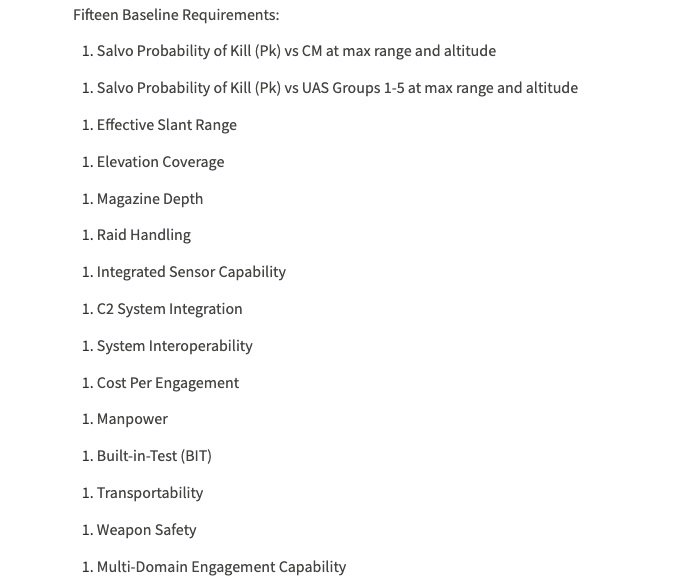
“To effectively assess and compare air defense weapon system performance, there are 15 critical baseline operational and technical parameters that must be analyzed in unison,” the RFI explains.

(Air Force Request for Information)

“These key metrics begin with the system’s Salvo Probability of Kill (Pk) evaluated against both Cruise Missiles (CM) and Unmanned Aircraft Systems (UAS) Groups 1-5 at maximum range and altitude, ensuring robust lethality against diverse modern threats,” the RFI notes.

A salvo probability of kill measures how effectively a salvo, as opposed to a single shot, defeats a target. 

The following chart displays the weight, normal operating altitude and speed of the five drone group classifications.

(Congressional Research Service chart of Group 1 through 5 drones)

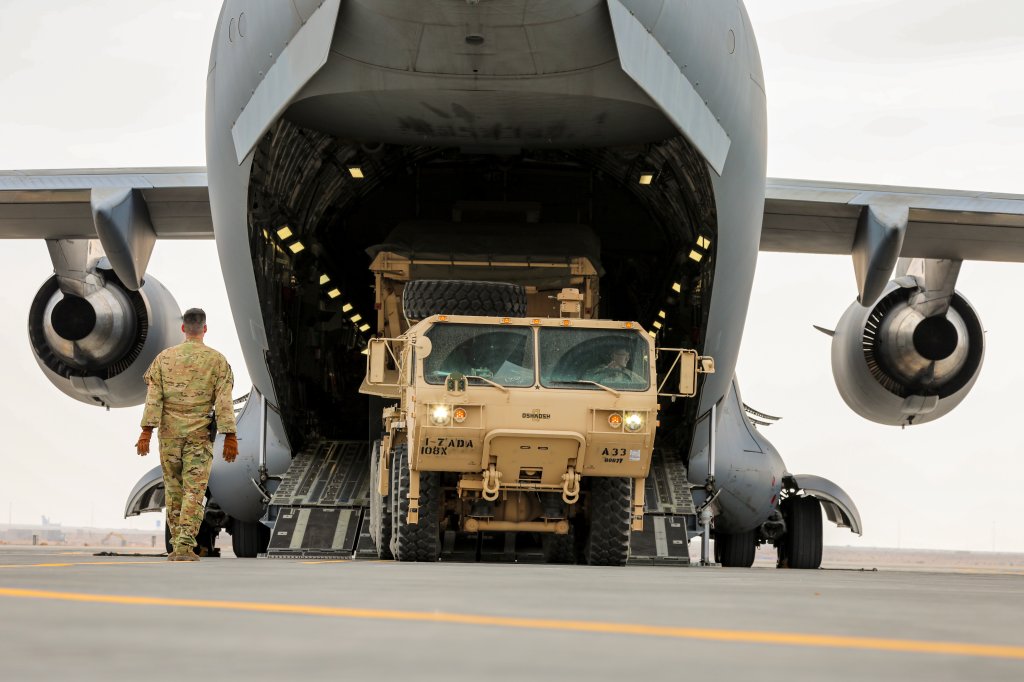
The Air Force wants this system to be “rapidly deployable, maintaining a lightweight, modular, and transportable footprint that can be swiftly projected into austere theater environments to meet emergent threats.” The RFI does not provide further details of how the Air Force is looking to transport these systems; however, the service relies on its fleets of C-130 Hercules, C-17 Globemaster III and C-5 Galaxy transport aircraft to move equipment. The size and weight of the systems determines which kind of aircraft can transport it.

These systems could also be moved by truck or ship or on their own if self-propelled, but those options also incur a cost in terms of the timeliness of delivery, and can be impossible for rapid global deployments.

U.S. Army Soldiers from the 1st Battalion, 7th Air Defense Artillery Regiment, 108th Air Defense Artillery Brigade, load equipment and trucks onto a C-17 Globemaster III with U.S. Air Force Airmen assigned to the 21st Expeditionary Airlift Squadron at an undisclosed location in the CENTCOM Area of Operations, Dec. 31, 2023. U.S. Army air defense artillery batteries are highly mobile, capable of deploying swiftly across the globe to support and defend U.S. troops and partners. (U.S. Army photo by Sgt. Christopher Neu)
U.S. Army soldiers from the 1st Battalion, 7th Air Defense Artillery Regiment, 108th Air Defense Artillery Brigade, load equipment and trucks onto a C-17 Globemaster III with U.S. Air Force airmen assigned to the 21st Expeditionary Airlift Squadron at an undisclosed location in the CENTCOM Area of Operations, Dec. 31, 2023. Photo by Staff Sgt. Christopher Neu

A key point of evaluation will be the overall cost of the munitions. The Air Force wants to ensure that the shell’s velocity and terminal effects “are maximized without driving the cost-per-engagement to unsustainable levels or exceeding the physical constraints of the host platform,” the RFI states. We’ll discuss these factors in more detail later in this story.

The service is also looking for the integration of “the right mix of radar, electro-optical, infrared, or radio-frequency sensors—to ensure reliable target acquisition and tracking across varying weather conditions, environments, and countermeasure scenarios.”

As we noted at the top of this story, the Air Force is seeking to improve its organic ability to defend its bases. This has become “an increasingly high priority” for the service, Air Force Secretary Troy E. Meink told Congress on May 20.

“The Air Force is developing organic air and missile defense capabilities, including Counter-small Unmanned Aircraft Systems (C-sUAS) to defend our air bases in all theatres [sic],” Meink stated in his written testimony. “The fielding of the Air Base Air Defense Systems (ABADS) missile defense capability, including kinetic defenses, at overseas main operation bases contributes to joint layered defense but does not reduce the need for increased joint investment in air and missile defense. We will continue to work judiciously for the development and procurement of these critical defensive capabilities.”

(Written testimony of Air Force Secretary Troy E. Meink)

In its Fiscal Year 2027 budget request, the Air Force is seeking about $1.4 billion for a missile defense variant of the Air Base Air Defense Systems (ABADS), according to Air & Space Forces Magazine. In addition, the Air Force also requested $51.8 million in procurement funds for its Small Unmanned Air Defense Systems (SUADS) in Fiscal Year 2026, according to the Air Force Fiscal Year 2026 budget justification book. 

The war against Iran and the Ukraine war have, in particular, illustrated the challenges of defending against drones and cruise missiles.

Iran launched thousands of these weapons against U.S. air bases and a wide range of critical infrastructure targets in Bahrain, Israel, Iraq, Jordan, Kuwait, Qatar, Saudi Arabia and the United Arab Emirates. It also launched hundreds of ballistic missiles.

Taken in concert, these attacks have resulted in the deaths of at least nine U.S. troops, more than 760 injuries and the destruction of aircraft, radars and other critical equipment as well as widespread damage to the Middle Eastern nations Iran has targeted.

Concerns about the tremendous expenditure of U.S. interceptors exacerbating the stress on America’s magazine depth of these high-end defensive weapons are an issue that TWZ has raised frequently for years.

There are two facets to potential use of gun systems for base defense. The first is that in complex air defense environments, it provides an inner, last line of defense against incoming threats. If the outer layers fail to take down the target or that target is not considered a priority over others, a hard-kill gun system offers a predictable and relatively reliable fallback. The gun system would become even more important if interceptor stocks run low, even temporarily, and those weapons need to be rationed for higher-end threats. With the outer defensive rings collapsing, the inner becomes far more important.

For small drones, that interceptors would not be effective with anyway, the gun system can take them down in localized air defense scenarios. Then there is also defending bases in lower threat areas where there are not additional layers of SAM systems. A gun system can provide a core aerial defense against lower-end, lower-density drone and cruise missile threats without costing huge sums of money or requiring a huge logistical footprint.

Beyond that, there is a direct cost comparison argument, but again, that is in a vacuum and a gun system cannot take the place of a multi-layered air defense system without inviting huge risk. Still, the engagement cost comparison is worth mentioning.

High-end, expensive, difficult-to-manufacture air defense weapons, like Patriot PAC-3 MSE, are clearly inefficient against drones. For instance, a mass-produced Iranian Shahed-136 can cost about $35,000 to $50,000, while a Patriot PAC-3 can run about $5 million and takes years to procure. By comparison, the cost-per-engagement efficiency of gun-based air defense systems, designed to defend against drones and subsonic cruise missiles, is far greater. One example of how this plays out is the cost of firing the Army’s Centurion Counter-Rocket, Artillery, Mortar (C-RAM) system. It is a ground-based version of the Phalanx Close-In Weapon System (CIWS) used on various U.S. and foreign warships, and is armed with a six-barrel 20mm Vulcan Gatling-type cannon firing M940 rounds. Those self-destructing rounds currently have a price tag of $80.70, according to the Army’s Fiscal Year 2025 budget request. This means a two-second burst from a Centurion, at a rate of fire of 4,500 rounds per minute, would cost just over $12,100.

Again, this is not a strict apples-to-apples comparison, but it can become a bigger factor during prolonged conflicts when high-end weapons stocks begin to run short. It’s also worth noting that drone interceptors are a rapidly growing capability set that are a lower-cost option for swatting down one-way attack drones and even some cruise missiles. Systems like Coyote have been in service for years with the Pentagon and have been protecting bases overseas with strong results. Even cheaper systems are emerging out of lessons learned in Ukraine. All of these systems have their own advantages and disadvantages, but pairing them with a new gun system would likely have synergistic effects. Overall, deploying densely layered short-range air defenses is becoming increasingly important in its own right, at least in high-threat areas.

Ukraine has a great deal of experience with the costs and prioritization of air defense capabilities. The country faces daily attacks by Russian missiles and drones, which is causing mounting casualties and destruction. This ceaseless bombardment has almost completely depleted Ukraine’s supply of Patriot interceptors, leaving it largely defenseless against ballistic missiles. As we noted yesterday, Ukraine is also running short of air-to-air missiles its Air Force F-16s use to swat down drones.

However, Ukraine has also relied heavily on a wide array of gun-based air defense systems, including the German-made Gepard self-propelled anti-aircraft guns (SPAAG). Based on the chassis of the Leopard 1 main battle tank, Gepards feature twin radar-aimed 35mm automatic cannons, mounted on a single turret. The German variant sports an S-band search radar and a Ku-band tracking radar. These radars are critical to the Gepard’s ability to locate, track, and engage targets at night and amid poor weather conditions.

The success of the Gepards in Ukraine have helped spur new global interest in SPAAGs.

The following video shows a Gepard blasting an Iranian-made Shahed-136 out of the sky.

A video reportedly showing two Russian Shahed-136 (Geran-2) loitering munitions being shot down by the Ukrainians with a German-delivered Flakpanzer Gepard self-propelled anti-aircraft gun (SPAAG) during last night's attack in Odesa Oblast, southern Ukraine.… pic.twitter.com/OhH7vTultm

— Status-6 (War & Military News) (@Archer83Able) September 7, 2023

The Air Force force is also looking at directed energy weapons like lasers for force protection and especially for defending bases overseas. While gaining traction across the services due in large measure to the much lower cost of delivering effects, these systems are still works in progress. Gun-based air defenses, on the other hand, are mature and proven, and modern precision-guided, programmable ammunition makes them even more efficient and effective.

Beyond the cost, high-end air defense systems — including their component sensors — though portable, are generally fixed to a specific location. That makes them vulnerable to attack. This has been the case in both the war against Iran and Ukraine. The same concerns hold true of aircraft. Both conflicts have shown aircraft vulnerability to drones when parked out in the open. Ukraine’s Operation Spider Web attack on Russian strategic bombers last year in particular shed light on this issue, which we have been sounding the alarm on for a long time.

For years now, U.S. military officials have often pushed back on the utility and cost-effectiveness of investing more in the physical hardening of bases and other critical facilities, especially shelters to shield aircraft from drones and other threats. However, that is beginning to change. In February, the Pentagon released new guidance about hardening, which “does not mean enclosing an entire facility, but selectively introducing obstacles that disrupt predictable aerial access,” the document explains. “Even modest obstacles can deter low-cost, consumer-grade drones and force higher-risk flight profiles.”

In addition to these challenges, the Air Force is also facing the headwinds of an overall lack of U.S. short-range air defense capabilities, a concern we have been highlighting for years. Currently, there are three gun-based SHORAD systems being fielded by the U.S. military. These include the aforementioned Centurion C-RAM systems.

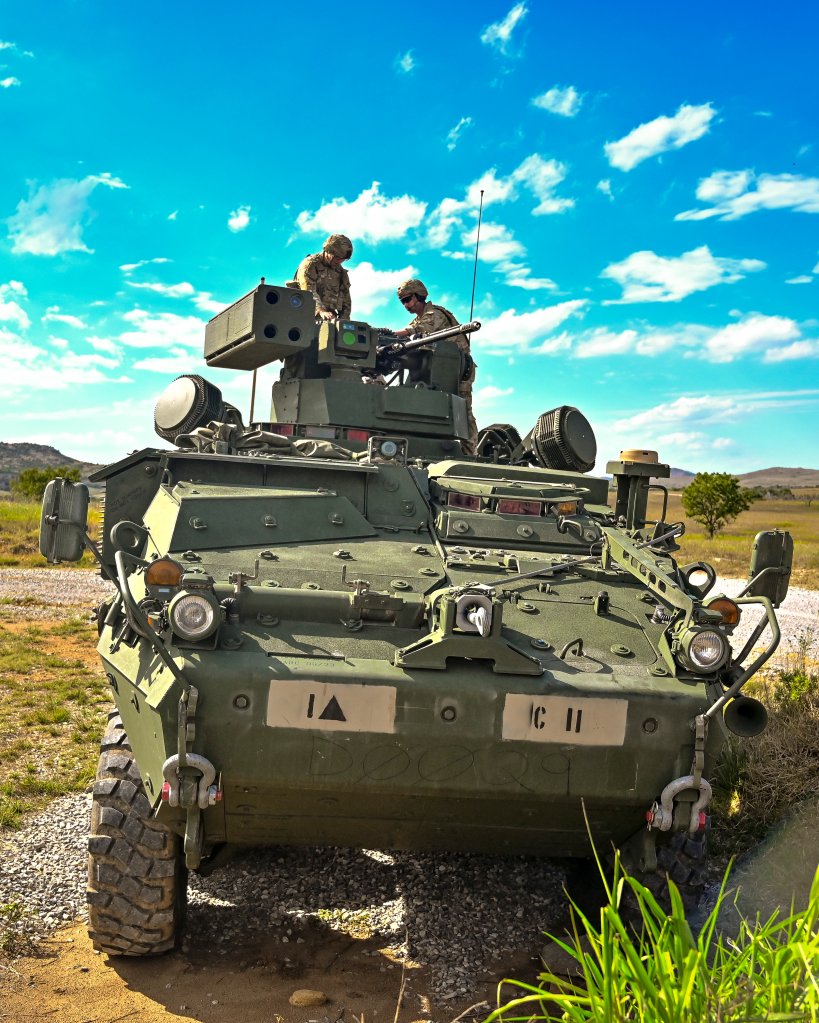
The Army also uses the Sgt. Stout, an air defense system based on the 8×8 Stryker light armored vehicle. The Sgt. Stout has a turret that can be fitted with up to two four-round launchers for Stingers. Those launchers can also be swapped out for ones that can be loaded with a pair of millimeter-wave radar-guided AGM-114L Hellfire missiles. The turret also has a 30mm XM914 automatic cannon, which can fire proximity-fuzed airbursting rounds against drones and other aerial threats, and a 7.62x51mm M240B machine gun.

Soldiers assigned to 4th Battalion, 60th Air Defense Artillery Regiment conducted a live fire exercise with the SGT STOUT (Stryker A1 M-SHORAD) vehicle in Fort Sill, Oklahoma, Sep. 23, 2025. The SGT STOUT vehicle provides lethal, mobile, and survivable air defense against an array of aerial threats for the "Fighting Aces" Regiment. (U.S. Army photo by Cpl. Emaney Wilson)
Soldiers assigned to 4th Battalion, 60th Air Defense Artillery Regiment conducted a live fire exercise with the SGT STOUT (Stryker A1 M-SHORAD) vehicle in Fort Sill, Oklahoma, Sep. 23, 2025. Photo by Cpl. Emaney Wilson

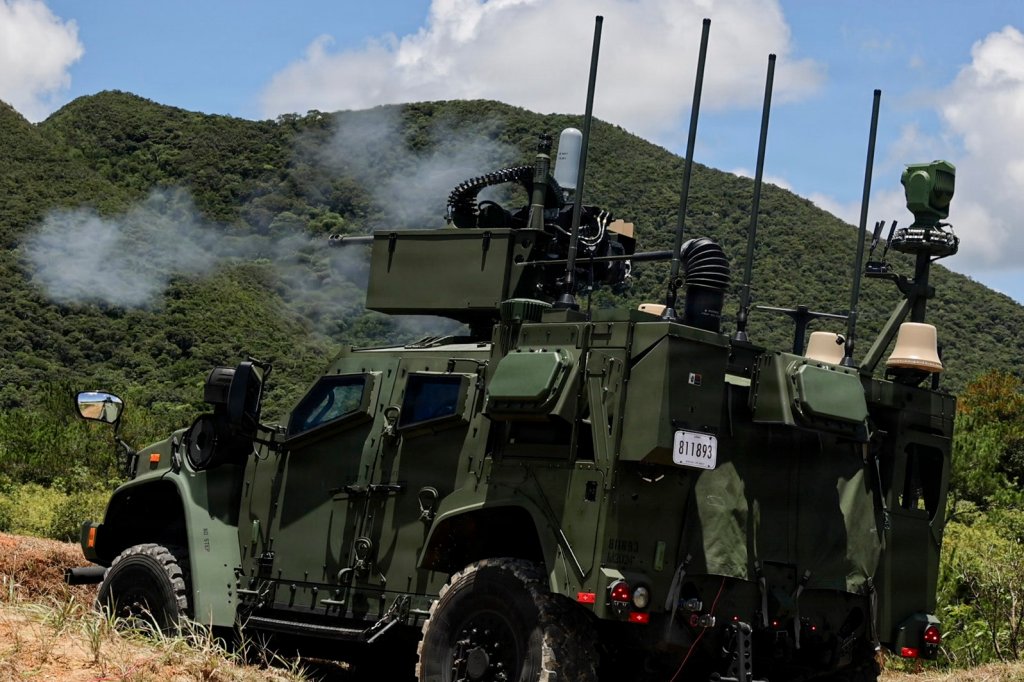
The Marine Air Defense Integrated System (MADIS) is armed with 30mm cannons and M240C coaxial machine guns in remote weapon stations (RWS). The RWS on one of the two vehicles is also configured to fire Stinger missiles for a spectrum of ground-based air defense scenarios.

U.S. Marines with 12th Littoral Anti-Air Battalion, 12th Marine Littoral Regiment, 3rd Marine Division, fire a XM914 30mm chain gun mounted on a Marine Air-Defense Integrated System during a live-fire range at Camp Schwab, Okinawa, Japan, July 28, 2026. The MADIS is the U.S. Marine Corps’ advanced mobile air defense system designed to detect, track, and neutralize drones and low-altitude aircraft using missiles, cannons, and electronic warfare. (U.S. Marine Corps photo by Lance Cpl. Skilah Sanchez)
U.S. Marines with 12th Littoral Anti-Air Battalion, 12th Marine Littoral Regiment, 3rd Marine Division, fire an XM914 30mm chain gun mounted on a Marine Air Defense Integrated System during a live-fire range at Camp Schwab, Okinawa, Japan, July 28, 2026.  Photo by Lance Cpl. Skilah Sanchez

The Army may have additional gun-based systems on the way. In July, the service put out a request for information to companies that can provide a new gun-based air defense option, using a 50mm cannon system to track and defeat Group 1, 2 and 3 drones.

A few weeks later, Northrop Grumman introduced its Raid Hunter 50mm GBAD system, which it said “combines proven Chain Gun® technology, precision‑guided 50mm ammunition and a networked, interoperable system controller to deliver powerful protection against high-volume, mixed-threat aerial raids. It is designed to defeat a range of aerial threats including high‑priority cruise missile threats, unmanned aerial systems (UAS), and other advanced threats.”

We’re introducing Raid Hunter™, our newly named 50mm gun-based air defense system designed to defeat mass, mixed aerial raids with cost-effective interceptors and deep magazine effectors which can be delivered to the warfighter at scale. Learn more: https://t.co/gnOzpo0RA3 pic.twitter.com/oTqORTG9Q4

— Northrop Grumman (@NGCNews) August 11, 2026

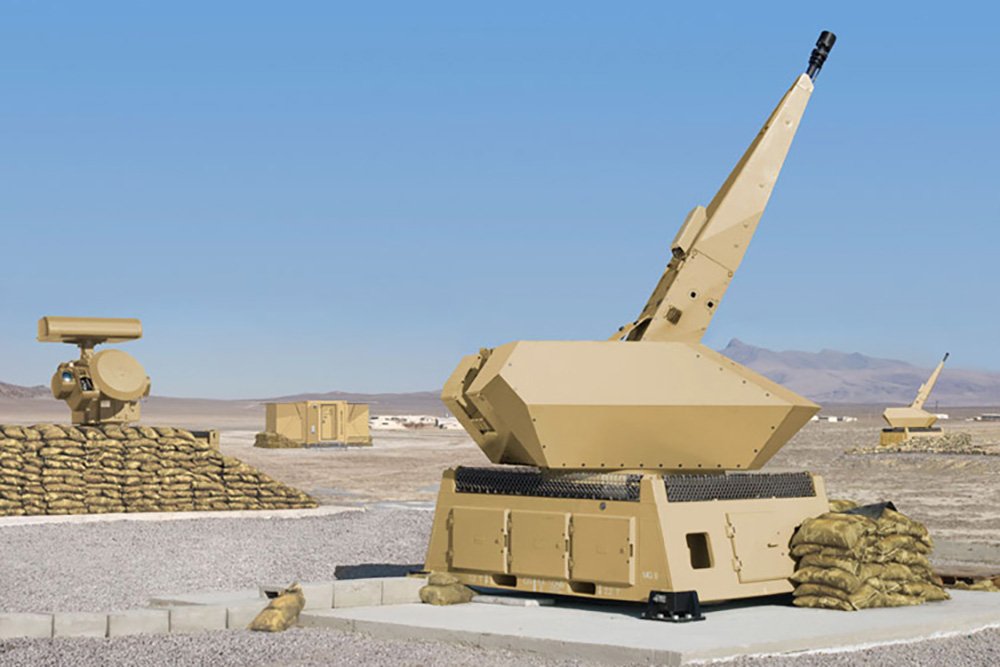
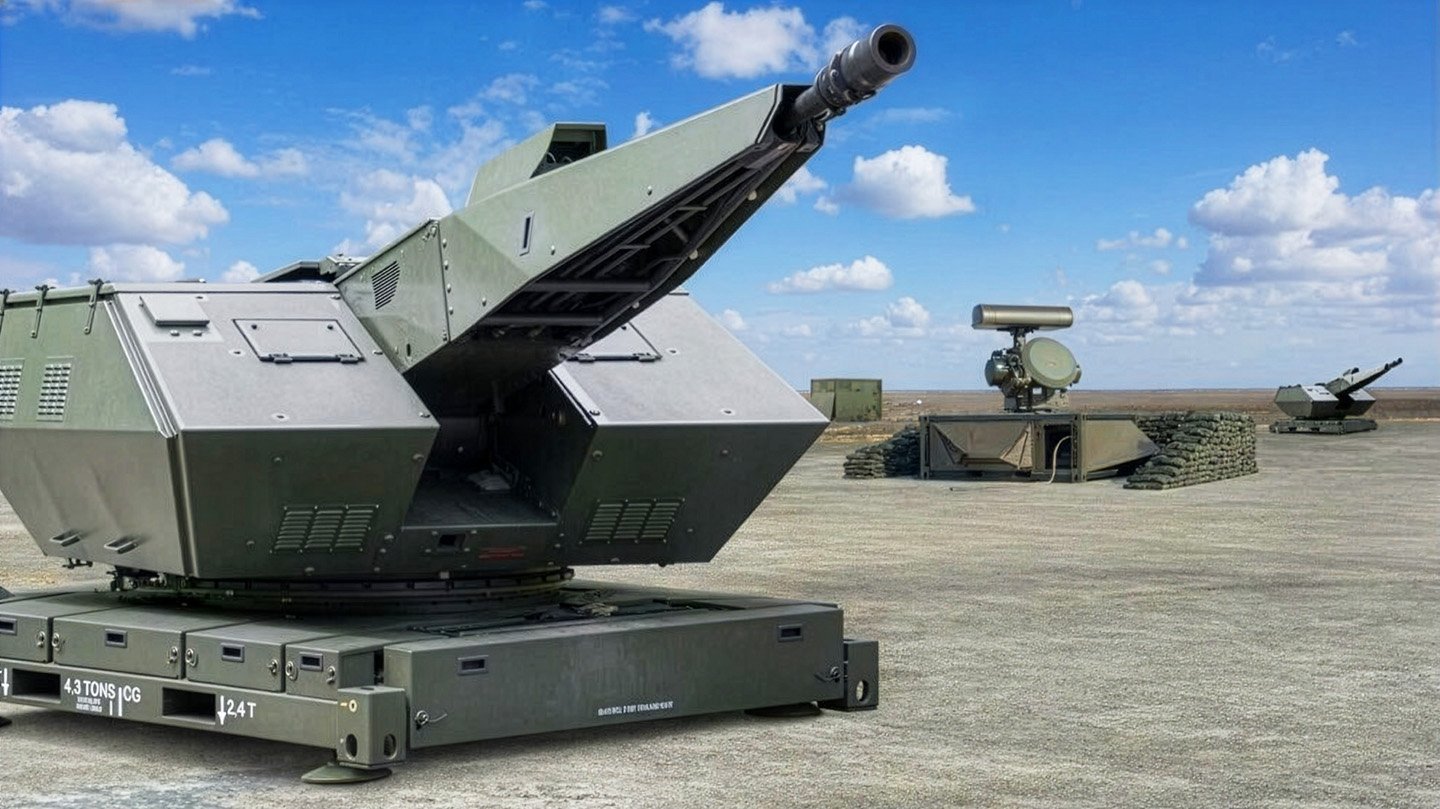
There are foreign options should the Air Force want to go that route. For instance, German arms maker Rheinmetall makes the popular Skyranger 35 gun system, which is a turret that can fit on a wide array of armor hulls.

The Skyranger 35 “is equipped with a KDG 35/1000 revolver cannon in 35 mm x 228 caliber with a firing rate of 1,000 rounds per minute,” according to Rheinmetall, which began delivering these to Ukraine in January. “It has an effective range of up to 4,000 meters and a high degree of commonality with the Oerlikon Revolver Gun Mk 3. Thanks to AHEAD technology, the Skyranger 35 is airburst-capable. In the future, it will also be possible to equip it with modern guided missiles.”

Skyranger 35s mounted on Cold War-era Leopard 1 tanks have just emerged on the battlefield for Ukraine.

You can see a video of that system below.

It seems that Ukraine's 1020th Anti-Aircraft Missile Regiment which belongs to the Ground Forces has taken delivery of the first Skyranger 35 SPAAGs mounted on a Leopard 1 chassis made by @RheinmetallAG.

A contract for the delivery of the Skyranger 35 SPAAGs was signed in H2 of… pic.twitter.com/VRWhGx1LCa

— GAU (@deaidua) September 3, 2026

Skyshield is the fixed placement cousin of this system and has been bought by a number of nations.

NBS C-RAM Nächstbereichschutz Camp Protection Skyshield Sensor Unit GDF020 BFZ
Skyshield (Rheinmetall)

This is just one example of a large number of potential offerings that could fit the USAF’s interests, from both domestic and foreign origins.

As we discussed earlier in this story, the U.S. is already facing a challenge defending against Iranian threats. A war with China would be more devastating and, when it comes to the Air Force protecting its bases, require far more robust defenses. At the same time, the Air Force is still very early in the process of taking on more responsibility for protecting its assets.

Parties have until 5 p.m. Oct. 9 to submit their proposals to the Air Force for a gun-based air defense system. With limited options and the service pushing to address its growing desire for organic air defenses, it will be interesting to see who comes forward and what systems they offer. We will provide more details about this effort when they become available.

Contact the author: howard@twz.com

The post U.S. Air Force Seeks Anti-Aircraft Guns To Protect Its Overseas Bases appeared first on TWZ.

  •  

How Russian Drones Forced Ukraine To Park Its M1 Abrams Tanks

Ukrainian crews operating Australian-supplied M1A1 Abrams tanks say the battlefield has become so saturated with Russian drones that their tanks cannot currently be used in combat, but they reject the idea that main battle tanks have become forever obsolete.

Since receiving these tanks last year, the crews, serving with Ukraine’s 425th Separate Assault Regiment “Skala,” have used the Abrams in two combat operations in the fight for Pokrovsk, a key Ukrainian logistics hub and part of a defensive belt of towns in Ukraine’s eastern Donetsk region. They recounted their experiences to Hromadske, an independent media channel in Ukraine.

Fighting around Pokrovsk

The first major deployment described by the crews took place in December of last year, when Abrams tanks were used to support assault groups entering Pokrovsk.

The crewmember with the callsign Kent described moving into the city behind a mine-clearing tank and ahead of two infantry fighting vehicles (IFVs) carrying assault troops, during a mission that was deliberately aggressive.

“Since a tank is a priority target — my task was to draw their attention, while our infantry dismounted and moved in successfully.”

The Abrams was also assigned three target points to engage along the route.

“We went right in there, poured it on, and drove back out,” he recalled.

A video showing the 425th Separate Assault Regiment in action in August 2025, soon after receiving the Abrams:

The second operation, on March 31, involved an attempt to enter and hold an industrial area near Pokrovsk to help block Russian movement toward Hryshyne, a contested village in the district.

The operation was prepared for more than two weeks. Ukrainian forces conducted reconnaissance flights, examined difficult sections of the planned routes, and provided crews with extensive video and imagery.

“They knew every meter of the route,” another of the unit’s commanders, with the callsign Kubik, said.

Weather was considered essential. The Ukrainians waited for fog and rain, hoping to limit the effectiveness of Russian drones.

“Without the right weather we wouldn’t have been able to pull off operations like that,” Kubik said.

The operation nevertheless resulted in the destruction of four out of five armored vehicles, some of which are seen in the video embedded below.

Russia's Rubicon Drone Center FPV drones destroyed a Ukrainian assault group near Pokrovsk, hitting an M1A1 Abrams tank, M1117 APC and BMP-2 as the unit tried to advance near Hryshyne under fog cover. #Ukraine pic.twitter.com/ZzE52qAYxp

— NOELREPORTS 🇪🇺 🇺🇦 (@NOELreports) April 1, 2026

The commander acknowledged that the Russian side may have had advance knowledge of the operation.

“I can’t rule out the possibility that the enemy knew our plan,” he said.

His Abrams was not immediately destroyed. According to the crew, it completed its task and the assault troops dismounted before the weather changed.

“Once the fog lifted, they started working on it with an FPV drone,” the commander said.

Why use tanks at all?

The losses prompted criticism from Ukrainian military commentators, particularly after footage of the destroyed vehicles was published.

However, the crews defend the decision to use armored vehicles for the missions. According to the men of the Skala interviewed, the alternative was often to send infantry over several miles on foot while carrying weapons, ammunition, water, and other supplies.

“That takes more time,” Kubik explained. “And the enemy isn’t standing still — the enemy is moving toward them.”

🇦🇺🇺🇦 Australia-supplied M1A1 Abrams AIM main battle tank in service of the Ukrainian 425th Separate Assault Regiment "Skala."

The tanks of such type recently saw combat in the area of Pokrovsk. pic.twitter.com/qhjSyGbhH6

— Status-6 (War & Military News) (@Archer83Able) December 23, 2025

The argument that infantry could simply move more stealthily on foot also has limitations.

“Every day the Mavic drones are flying, the fixed-wing drones are flying,” he said. “No fog, guys are visible.”

Combined with IFVs, the Abrams can provide the ability to rapidly move troops while simultaneously delivering heavy direct fire against enemy positions and offering substantial protection to its crew.

The crews argue that this capability remains worthwhile even when the tank itself may eventually be lost.

One commander was asked whether deploying a roughly $5-million tank makes sense if a single sortie can result in its destruction.

“Yes, of course it makes sense to deploy it,” he replied.

“First and foremost — it saves the lives of the crew inside it.”

Russian forces captured a relatively lightly damaged M1A1SA Abrams main battle tank operated by the 47th Separate Mechanized Brigade in the Pokrovsk direction.

The tank is equipped with added cage armor, as well as Kontakt and ARAT ERA. pic.twitter.com/mHyKk1xNRY

— Status-6 (War & Military News) (@Archer83Able) October 27, 2024

A tank under attack by drones

The Ukrainian crews repeatedly highlighted the Abrams’ accuracy and survivability.

“What are the biggest advantages of the Abrams?” Kent was asked.

“Accuracy.”

Its biggest disadvantage, he said, is equally obvious on a modern battlefield: “It’s very tall — and very large — so it’s hard to conceal.”

A video showing a U.S.-supplied Abrams under attack from Russian FPV drones:

🇺🇸🇺🇦 An Abrams tank withstands 9 FPV drones hits. Eventually, the tank was destroyed, but the tank crew successfully survived. pic.twitter.com/4NBKdg2zmW

— PS01 □ (@PStyle0ne1) July 7, 2024

Kent described surviving an engagement in which his tank was struck repeatedly while on the move.

“More than 20 drones hit me,” he said of one operation into Pokrovsk.

He attributed the Abrams’ survival to the combination of its armor and additional anti-drone protection fitted to the vehicle.

“All of it together is effective,” he said.

He pointed to fairly basic modifications including rubber strips and a foldable wire cage mounted on the turret, as additional layers of protection against drone attacks.

“A drone doesn’t hit the actual penetrating element directly — it just can’t reach it,” he explained. “It hits the rubber, and then the blast wave travels from there.”

Even with their tanks festooned with explosive reactive armor (ERA) bricks, the crews acknowledge that such protection has limits.

A head-on view of an M1A1 of the 425th Separate Assault Regiment shows the ERA bricks installed around the turret and in front of the hull. Ukrainian Armed Forces

US-supplied M1A1 Abrams tank in service of the Armed Forces of Ukraine with added Kontakt-1 ERA on the frontal hull and standard ARAT ERA on the sides. pic.twitter.com/PC2kDfxefO

— Status-6 (War & Military News) (@Archer83Able) May 21, 2024

Kent also noted that the Abrams was still missing the ‘hedgehog’-type protective coverings that have been seen on Russian tanks.

“They also protect very well. An effective thing,” he said.

A Russian tank with the ‘hedgehog’-type protective covering. Russian state media

For now, the drone threat has led the regiment to keep its Abrams out of combat, as we will return to later.

The Abrams as a machine

The crews’ assessment of the Abrams included praise for its mobility, roomy interior, gun, and fire-control system.

Kubik said he had personally driven an Abrams to 50 miles per hour cross-country.

“The engine is an absolute beast,” he added.

The tank can also rapidly perform a pivot turn, which the crews consider particularly useful when maneuvering in confined spaces. Despite its prodiguous weight, it only rarely becomes bogged down after the kind of very heavy snow-melt that effects all vehicles on the battlefield.

Loading a 120mm M1028 canister cartridge into an M1A1 AIM Abrams main battle tank of the tank battalion of the 425th Assault Regiment. pic.twitter.com/tMd8QcROQe

— 𝔗𝔥𝔢 𝕯𝔢𝔞𝔡 𝕯𝔦𝔰𝔱𝔯𝔦𝔠𝔱 🦩🇬🇪🇺🇦🇺🇲🇬🇷 (@TheDeadDistrict) June 21, 2026

Its disadvantages include its demanding maintenance requirements. The running gear was described as particularly sensitive, with crews inspecting, lubricating, and replacing components after every sortie.

Fuel consumption is another major burden. The crew cited roughly 400 to 700 liters (106 to 185 gallons) per 100 kilometers (62 miles) depending on terrain and operating conditions.

“On asphalt it burns about 400 liters,” one said. In boggy terrain, consumption can reach “700 liters or more.”

The Abrams thirsty gas turbine engine and extreme logistical demands have always been a criticism of the platform.

An M1A1 of the 425th Separate Assault Regiment fording a river. Ukrainian Armed Forces

The crews said the vehicle’s ability to operate on different fuels is useful, although diesel provides the best engine-hour performance in their experience. Prior to delivery, the gas turbine engines of the tanks were reconfigured to use diesel fuel instead of the standard JP-8 aviation kerosene, according to earlier reports.

They also praised the Abrams’ protected ammunition storage and crew space compared with Soviet-designed tanks.

The version operated by the Ukrainians is an M1A1 rather than the latest Abrams configuration, with less sophisticated electronics than newer variants. It also lacks the classified armor found on its U.S. Army counterpart.

“For me — as a tanker — this configuration, what we have right now, is more than enough,” Kubik said. “The sight is absolutely excellent. The gun is also great.”

🔥 Abrams destroys a house with Russian infantry in the Pokrovsk direction. pic.twitter.com/StUoZoMTO3

— MAKS 26 🇺🇦👀 (@Maks_NAFO_FELLA) August 25, 2024

Waiting for a solution to the drone problem

The interview ultimately presents a more complicated picture than the declaration that tanks are obsolete on the Ukrainian battlefield.

At the time of writing, at least 25 Abrams have been confirmed visually to have been destroyed, damaged, or abandoned in Ukrainian service. This is from a total of 31 provided by the United States and 49 from Australia.

“For now, we’re not using them further — there’s no way to,” Kubik said. “The enemy has developed their drone component very heavily, and for now we don’t have the means to counter that.”

While tanks remain exceptionally powerful direct-fire and protected mobility platforms, the proliferation of inexpensive uncrewed aircraft has made operating them increasingly difficult.

M1A1 AIM Abrams tanks of the 425th Assault Regiment 🇺🇦.
The reinforced upper glacis and turret roofs are clearly visible. pic.twitter.com/Sn9h8OWZ9P

— 𝔗𝔥𝔢 𝕯𝔢𝔞𝔡 𝕯𝔦𝔰𝔱𝔯𝔦𝔠𝔱 🦩🇬🇪🇺🇦🇺🇲🇬🇷 (@TheDeadDistrict) June 21, 2026

“If someone had told me, as a tanker, back in 2022: ‘Take this — we’re giving you an Abrams, we’ll give you time to train and you’ll fight in it,’” Kubik said, “I would never have climbed out of it.”

“I’d only be saying: ‘Bring me shells. I’ll drive non-stop wherever needed, arrive and work.’”

An M1A1 of the 425th Separate Assault Regiment firing its main gun. Ukrainian Armed Forces

As it stands, reconnaissance drones can find the Abrams, FPV drones can attack it, and persistent surveillance makes concealment difficult. Experience has shown that without more effective counter-drone capabilities, even a heavily protected tank can eventually be overwhelmed.

But Kubik believes that will change.

“The day will come when one of our bright minds figures out some excellent solution against drones — and we’ll start using them again.”

Asked whether the era of tanks is over, his answer was unequivocal.

“It’s not over … They’re just waiting it out for now, biding their time. Writing off tanks — in my opinion — is still too early.”

Contact the author: thomas@thewarzone.com

The post How Russian Drones Forced Ukraine To Park Its M1 Abrams Tanks appeared first on TWZ.

  •  

‘The most powerful publishers the world has ever seen’: Fara Dabhoiwala on the real battle over free speech

A protester sits on the Hollywood Walk of Fame holding a sign reading "Make Speech Free Again" outside the El Capitan Theatre in Hollywood, Calif., on Thursday, Sept. 18, 2025. Photo by DAVID PASHAEE/Middle East Images/AFP via Getty Images

Today, host Michael Fox speaks with Fara Dabhoiwala. He is a professor of History at Princeton University. And he’s the author of the book, What is Free Speech? The History of a Dangerous Idea. 

That book was published in 2025 by Penguin Random House and Harvard University Press. His book, in many ways, challenges the status quo about our understanding of free speech.

Professor Dabhoiwala has a wealth of knowledge on the subject of free speech and he appeared throughout this podcast series. But there were many questions we weren’t able to fit into the series, in particular about the beginnings of what we understand as free speech in the United States, and the difference between free speech in the US and abroad. 

So today, we’re bringing you Michael’s conversation with him in its entirety. They spoke last fall. 

This is the first bonus episode of The Battle for Free Speech. 

The Battle for Free Speech Podcast is a production of The Real News Network. 

Hosted by Michael Fox and Marc Steiner. 

Guests: 

Resources: 

  • You can check out the full Battle for Free Speech podcast series, here.

Many thanks to everyone who has supported this show.

Follow The Battle For Free Speech on Spotify or Apple Podcasts. Support Michael Fox’s reporting at patreon.com/mfox. Never miss an episode — sign up for The Real News newsletter at therealnews.com. 

Transcript

The following is a rushed transcript and may contain errors. It will be updated.

Michael Fox:

Hi folks. I’m your co-host, Michael Fox, and this is The Battle for Free Speech. So as promised, this is the first of a number of bonus episodes we’ll be rolling out in the coming weeks. Today, I speak with Fara Dabhoiwala. He’s a professor of history at Princeton University, and he’s the author of the book, What Is Free Speech: The History of a Dangerous Idea. That book was published last year by Penguin Random House and Harvard University Press. And if you’ve listened to this podcast series, you have heard his voice before because I go to him for analysis and insight in numerous episodes. That’s because he’s a wealth of knowledge on this subject, but also because his book in many ways challenges the status quo about our understanding of free speech. In this podcast series, I feel like I was able to only just barely scratch the surface on so many questions, particularly about the beginnings of what we understand as free speech in the United States and elsewhere, and also the difference between free speech in the United States and abroad.

So today I’m bringing you my conversation with him in its entirety. I know you will appreciate it.

Well, Fara, I just want to start off. Thank you so much, so much for your time and for being here.

Fara Dabhoiwala:

A pleasure to talk to you, Mike.

Michael Fox:

Fara, can you start with by just introducing yourself and tell me a little bit about why this became such an interest for you, why you wrote this book?

Fara Dabhoiwala:

Well, I’m a historian at Princeton, but I used to teach at Oxford University in England. And more than 10 years ago now, I published a different book on the history of Western attitudes to sex and what I call the sexual revolution of the 18th century. And that was a very popular book and I went around the world talking about it. And in the course of that, almost immediately, I was censored in various ways. I was deplatformed, I got into trouble for saying things on the radio, and then it all culminated in my book being translated into Chinese. And when it was translated into Chinese, it was censored. And then I went to China and traveled around talking about it. And at that point, my interest shifted from my own experience of being silenced to the extraordinary things that were happening in China already 10 years ago, which was, as a historian, I realized every single apparatus of censorship ever invented in the history of the world was now simultaneously being deployed to muzzle free speech in China, as well as some totally new ones that the Communist Party had developed to deal with the internet.

And of course, 10 years ago, everyone still generally believed the internet was a technology of freedom that would set people free. And before long, surely the Chinese would also experience it that way. And my experience traveling around taught me that actually that was a very naive idea and the opposite was happening. So I came back from that trip really shocked by the way in which a modern dictatorship like China can operate to muzzle free speech and silence dissent at every level, believing myself in free speech and starting to think, well, why do we have such different views about this? Where does first of all, this Western belief in free speech come from? And given that we all believe in it, and I do very strongly myself, why can we never agree on what it means? I mean, within our cultures, we’re fighting about that all the time and across cultures now, this is a really important political transnational problem in the world, but it’s not just a political series of questions and problems.

It’s also a historical problem because people didn’t always believe in free speech. Anyway, so that’s where I started. I though in 2015, oh my goodness, it’s peak free speech time now. I should hurry up and write this book before the moment passes. And sadly, the moment has not passed. It’s just got worse and worse. But I can explain why that is, which is part of the interest of the subject.

Michael Fox:

Yeah, that’s exactly what I was going to ask you. How did we get into this mess? And obviously through reading your book, I’m just fascinated by the Cato letters and all this, but if you could give me a little bit of how do we get to this point?

Fara Dabhoiwala:

Well, it’s taken us 300 years to get to this point because the modern idea of free speech really is invented about 300 years ago. But the reason it’s such a hot topic right now, let me just deal with that. The reason it’s such a hot topic right now is because we’re living through a giant communications revolution. I mean, the internet has completely transformed how humans communicate at every level about every subject. And every time that’s happened in the past, in the 18th century with print, in the 19th century and the 20th century with new forms of print and the telegraph and broadcasting and all the rest of it, every time there’s been a new communications revolution, people have needed to think about free speech harder and in different ways. And so that’s part of what’s happening right now. Do you want to come back to me about the history?

Michael Fox:

Yes. Yeah, yeah. Let’s dive all the way back in the history and we’ll bring it up to the present. Talk to me about those beginnings of what free speech meant in those days.

Fara Dabhoiwala:

Yeah. So really the first thing you need to understand about free speech is it’s on the one hand, a very old idea. There are various forms of freedom of expression that go right back to the classical period. On the other hand, our current sense of it is really quite recent because older ideas of free speech are always very restricted. They had to do with speech in an emergency, the idea of scholars communicating peacefully amongst themselves. But what’s always lacking in all those earlier notions is a notion of political free speech, that everyone has the right to speak out on matters of public concern. That’s really the core of our modern idea. One reason that’s lacking before the 18th century is that people have a very sophisticated understanding of what words really are. That’s to say words are not different from actions. Words are a type of action in the world.

Everyone in the past knew this. They also know that words, although often trivial and harmless and fleeting, sometimes can have really potent consequences in the world. And thirdly, they know that sometimes those potent consequences can be dangerous and harmful. And they’re particularly focused on the harm to individuals from lies and slanders and defamation, which is something that everyone sees is a real problem. And people all the time in the pre-modern world are going to court to defend themselves against the bad words, the slanders, the lies of others. And the second way in which they are focused on this is the dangers, the problems of untruth and misinformation and conspiracy theories. Everyone knows in the past, and it’s a documented fact, that first of all, lies and misinformation spread very quickly, much more quickly than the truth, and that they can, if left unchecked, cause riots and political disorder and pogroms and massacres and bloodshed on a horrible scale.

Everyone in the European past knew this. Happens time and again. And so because of these insights into the power of words, they are very keen to control technologies of print when those are invented and they’re keen to regulate speech in all sorts of ways. Okay, so that’s the background. Then what happens in the early 18th century, and it happens first in England, is that for contingent religious and political reasons there the government cannot anymore agree on exactly how to regulate the printing press. There’s been a political and religious revolution. And so the normal forms of prior censorship whereby you go to the church with anything controversial on a spiritual subject and ask them to sign off on it before you print it, that doesn’t work anymore. Anyway, I won’t go into the reasons, but what you get is this explosion of new kinds of printing because now for the first time people are allowed to just put it out there.

You can still be punished and prosecuted if you publish something that is beyond the pale, but still it’s a different form of regulation. And so in London, which is the epicenter of this, you get an explosion of political pamphlets, newspapers, a much more fast-paced, a different kind of media world than has ever existed before. And the reason for this is partly also that this is the first age of permanent political parties. In England, the Wigs and the Tories are constantly, they’re popular parties. They’re appealing to the people. And so they use this new technology right from the outset to start to attack each other. And as part of that, they are constantly shouting back and forth across the partisan landscape that the other side is lying and abusing words and misinforming the public. They on the other hand are trying to tell the truth. Anyway, it’s a situation very analogous, very evocative of our own age.

And in this new landscape, people get addicted to fast-paced news and newspapers and so on. They like it and they celebrate that this has come about because of the liberty of the press. So the liberty of the press comes this new slogan that everyone loves to be in favor of, but that doesn’t mean that anything goes. On the other hand, they can also see actually very sharply, acutely, that this new technology has also made worse all the problems of mass communication that have always existed. I mean, the first law against false news in the English speaking world dates back to 1275. These are not new problems at all. So in the 18th century, people see that, for example, print has only made worse the problem of lies. There’s a great quote by Jonathan Swift, the great writer of the early 18th century, which is basically that truth is slow and lies are false.

It goes like this, falsehood flies and truth comes limping after it like a man who’s though of a good repartee long after the party’s over. It’s still true. And Daniel Defoe, his co-journalist and writer, brilliant novelist as well, complains that newspapers have created an explosion of “false news, forgery, infamy, and absurdity, masquerading as fact.” So everyone who looks into this and understands how the world works knows that this has just made things worse. And the final aspect of that, that all people in the know are aware of is that this new media world is hugely corrupt. It’s not about spreading truth so much about making money. Everyone is trying to make money out of the print revolution. It’s hard to do, many newspapers go under, but everyone wants to make it big. They’re always primarily concerned with selling advertising, getting sales, and above all, getting sponsorship by a politician.

And so the world of journalism is hugely corrupt. People are writing for money. Newspapers are being bought and sold all the time, and this is not a neutral marketplace of ideas at all on the contrary. So in this world, liberty speech, everyone agrees is great, but because of all these problems, they also agree that liberty speech is easily abused and they call that licentiousness. Licentience is bad, liberty is good. But the problem with this balancing model of saying liberty speech is good as far as it goes, but you shouldn’t abuse it, is that everyone can also see this lies entirely in the eye of the beholder. It’s a subjective judgment. And that’s why no one is able to put forward a really cogent theory of free speech. Everyone can see that, for example, opposition politicians are always banging on about freedom of speech and all for it and maximally for it.

And then the moment they get into power, they start censoring their opponents as heavily as they can. So there’s no worked out theory of free speech. And into this moment come these two journalists called John Trenchard and Thomas Gordon who put forward the first much more hard-edged theory of free speech in which they describe what we might call the origins of the absolutist view of free speech. And their argument, which they put forward in an anonymous newspaper column called Cato’s Letters, which is immensely successful and has a very long afterlife, is that liberty of speech is the foundation of all liberty and that governors are always trying to abuse power and aggregate more power to themselves. Governors are in fact always trying to turn into tyrants. On the other hand, the people are always noble and virtuous and able to see that. And so you should allow the people maximum freedom of expression in order that they can keep a check on their tyrants, their governors, and call them to account.

And so they claim this, they claim that liberty’s speech is the foundation of all liberty because the moment you see it being reduced even a tiny bit, then you know you’re on a slippery slide to tyranny because that’s the first thing that tyrannical governors try to do. Now, everyone has always known that Cater’s letters is a tremendously influential text in the history of free speech. Cater’s letters is this not just about free speech, it’s a series of essays putting forward simple understandings of important Republican thinkers like Locke and Machiavelli. And in the Americas, in North America, it becomes the most important political text for the Patriot movement in the middle and later 18th century. So the founders of the United States take this as gospel truth and they import these slogans from Katie’s letters into the Declarations of Rights about free speech in 1776 and then into the First Amendment.

So it has a very long afterlife. It’s very powerful. Everyone’s always known about this, but when I started reading it, two things revealed themselves to me that no one had ever really noticed before, and they’re really quite astonishing. The first is this is a theory full of holes. This is not a coherent, sincere doctrine of free speech. It’s in fact an attempt to justify the practices of these two hack journalists themselves in attacking the government and calling for the lynching of stock market profiteers and the overthrow of the current administration. They are justifying themselves by saying, “Well, of course, freedom of speech can never be abridged and there’s no such thing as liable.” That’s another thing they try and claim that if you attack someone and you spread lies about them, then the people will just see that they’re lies and that will just have no effect at all.

On the other hand, if you criticize someone and it’s true, then it’ll stick. And so really there’s no such thing as liable. It’s a very dodgy argument, but they make it with great passion. So the first thing is they don’t pay attention to any of those things that everyone else around them notices, that this is a deeply corrupt media world, that the newspapers themselves are writing and the journalists are writing for money, that the people don’t always agree on everything, that truth is difficult to establish, and that lies can spread dangerously if you allow them to. None of those things are there at all. So it’s full of holes. The second thing, even more remarkably, that I discovered is that they themselves are not writing in good faith. They’re not just writing to defend themselves. They are deeply, deeply complicit in this corruption and political partisanship of the age.

They are writing basically to be noticed by the government and then to be paid off by the government. And the lead author, Thomas Gordon, he does exactly that. He writes Cater’s letters about the people are always right, the people should never be suppressed. And then the government reaches out to him and say, “Hey, you are quite a good writer, but why are you wasting your time with this muckraking rabble-rousing stuff? Why don’t you come work for us?” And he says, “Oh yes, that sounds quite interesting. Thank you so much.” And he starts writing simultaneously for the government press, exactly the opposite. The governors know what they’re doing. People are often being misled by dangerous hack journalists. Misinformation is rife. And then finally he jumps ship and they shut down Cater’s letters and he makes a deal with the government and he becomes the prime minister’s chief propagandist.

He goes rich and famous over the next 20 years as a spin doctor on the establishment side. So anyway, these were remarkable discoveries and they really also I think are important, not just historically, but in showing up that from the outset, theories of free speech are very difficult to make watertight. They often are concocted in bad faith, and yet what lasts is powerful rhetoric. And so over time, no one knows about Thomas Gordon’s own corruption, but his text lives on and it’s very powerfully still read as an epitome of wisdom and truth and foundation for why we should think of free speech in a particular way.

Michael Fox:

Why has this concept, this absolutist concept and these concepts of free speech at all costs, particularly in the United States, why has this remained so powerful over the centuries up until today?

Fara Dabhoiwala:

Well, one of the revelations of my book is that actually Americans didn’t always think exactly as they do now about free speech, that for most of American history, actually from 1789 all the way to the 1960s, Americans had views that were quite similar to those in the rest of the world, a more balanced understanding of free speech as a matter of both of rights and of responsibilities as something that required attending to the public good, something that required looking at the role of the mass media, et cetera, et cetera. And it’s only because of the Cold War really that they diverged into a more hard line libertarian outlook, the results of which we’re living through today. But more fundamentally, I think the reason that these slogans are so attractive is that everyone wants simplicity and everyone likes the idea that the rules of free speech should be simple and straightforward.

And everyone can also see that if you take a balancing approach that on the one hand talks about this as a right and on the other hand talks about the possible harms and thinks about the public good and gives powers to regulate and so on, that this can lead to all sorts of serious problems of subjective interpretation, of censorship on grounds that we don’t agree with. That creates all sorts of problems that you can see playing out in countries around the world that take that approach. If you look at Britain, for example, right now, it’s a mess.

So that’s not a good solution. It’s not a perfect solution either. I happen to think that that approach is more intellectually justified, but I don’t think that it is problem free at all. And so the alternative of just saying, “Well, this is a simple matter. We just need to make the rules as simple and as hard edged as possible has an obvious intellectual appeal.” I think there’s also a really interesting psychology here, which I experienced myself when I was censored in trivial ways at the start of this project, which is no one likes to be told that they can’t say something. No one likes to be told to shut up. So the reverse psychology here, again, makes this a wonderful slogan to appeal to. If you feel censored, you feel aggrieved in a way that other rights maybe don’t quite have that immediate emotional purchase.

Michael Fox:

I thought one of the themes, the essential themes of your book, which I found fascinating, is that freedom of expression, freedom of speech isn’t just about the words that are used, the individuals that are speaking, but it’s also about power, the different groups and structures and systems that exist in order for some people to be able to speak and others not to speak. Can you speak a little bit about that?

Fara Dabhoiwala:

So another problem with laws about free speech is that if you think about communication and free speech in a sophisticated way, you need to acknowledge that speech is always exquisitely contextual. It’s never just about the words, the action in the world. Voltaire once said, “I write in order to act.” Let me just remind people, this is an action in the world, but the outcome of that action, the impact in the world is different, not just according to the words, but according to who is speaking, who is the audience, what is the context, what is the intention, et cetera, et cetera, et cetera. Me saying something to you in a bar in the middle of the night in the middle of nowhere is a completely different speech act, even if I use the same words as the president of the United States standing up and broadcasting this around the world repeatedly over and over again.

Just to take a trivial example, and that’s a problem, this exquisite contextual understanding of what’s happening when someone says something. We can navigate that in real life. We can navigate that face-to-face pretty well. We know when someone’s joking or when they’re saying something seriously, we know if we’re aligned in our understanding of what this conversation is about. When we’re not, that’s when miscommunication occurs. Online miscommunication is much easier than face-to-face. The larger the setting number of people involved, the greater the problems of miscommunication. But basically we know this is a matter of judgment on all sorts of levels. And the problem is laws are predicated pretty much on the opposite set of principles. That is to say consistency, transparency, everyone has the right to be treated the same. And if you think that for the same action, and if you think that the action is basically saying X, Y, Z, then it doesn’t seem right that people should be treated differently or that these other contextual elements should be brought into the frame.

And again, then you come into the problem that it becomes very subjective to judge exactly what’s happening, what the effects are. Anyway, so that’s the problem with laws, but it also points to the complication of the real issues, right? Free speech is a great noble ideal, but communication is really quite a complicated thing. And if we don’t attend to that, if we just push it all aside as American free speech jurisprudence increasingly does for the sake of simplicity, then we’re throwing out with the bath water, we’re throwing out also the baby, which is the fact that speech is an action and it’s an action that can cause harm. Now we need to take a minimalist approach to making laws. We need to take a maximalist approach to rights, but still there is something called truth. Sometimes the truth is very important. There are ways in which communication can cause harm.

We’ve known this throughout history, see it time and again. If we just ignore that completely, we’re opening up a whole set of different problems, which is where the absolutist doctrine leads us.

Michael Fox:

This is the thing for me that I find shocking, surprising, is that every time we’re talking about free speech or people are speaking about free speech, it’s as if this question of hate speech, truth, fake news, disinformation, intentional disinformation, particularly in the United States, it’s like this huge elephant in the room that nobody wants to talk about. It’s just there and then people go, “Oh yeah, well there’s a…” And then we end up in this same cycle where then obviously, as you’ve mentioned, that’s the stuff that goes viral, right? It’s the lies, disinformation. This is why Brazil has really cracked down hard on that, particularly around the election time and why the United States is of course calling Supreme Court justice censorship judges and things like that. Where does fake news fit into this question of free speech or where should it fit into this question of free speech or how are some countries handling this vis-a-vis how the United States is handling in a different way?

Fara Dabhoiwala:

Yeah. So one of the problems with free speech and one of the reasons why we’re in such a mess today is that our approach to it is really way too simplistic. There’s a reason why, because everyone wants the rules to be simple and just to be about individual rights, but it’s not enough. And so one thing we might start by acknowledging is that free speech can be many different things. There are many different forms of free speech. For example, free speech for writers of fiction or artists or comedians is one thing, and free speech in the political sphere is another thing because for artists and comedians, the aim of their freedom of expression is to amuse people, to make them laugh or to enlighten them, to spin worlds that will blow their minds. But in doing so, the literal truth is actually not really that important.

The literal truth is something that you play with in art and comedy, and rightly so. So we need to think about what the free speech is for. Now, in the case of democratic discourse of citizens trying to deliberate around the public good and about politics more generally, truth is actually very important. And the foundation of our democratic discourse has always been that we deliberate in good faith and that we don’t spread lies and misinformation because that way we are going to end up with a corrupted public sphere. So there, if we’re talking about freedom of speech, we do need to have truth somewhere in our sights as part of the aim and the purpose of the speech. Now, already in the 19th century, people started to see, here’s another way in which our notions of free speech are too simplistic. They started to see that thinking about free speech just in terms of the rights of the individual on the one hand and the powers of the state and the government on the other hand was not sufficient.

Why is it not sufficient? Because if you’re thinking about the sphere of political discourse, the marketplace of ideas, if you like, then what also is very important and shapes that whole sphere is the power of the media, the power of the mass media, the power of the private media. And already in the 19th century and into the 20th century, people who thought about this in sophisticated ways, including in the United States, focused on that as a real problem because from early on, people could see that the incentives, the motives, the aims of the mass media, not primarily to educate the public or to advance truth, they are on the contrary to sell advertising and to increase the power and the wealth of their owners. So out of that comes a very powerful socialist and communist critique, but also conservative and across the political spectrum, people can see this as a problem.

And so if you fast forward to the 1930s and 40s, this is something that Roosevelt and the administrations and indeed the Supreme Court of that era are very highly focused on. If you read First Amendment jurisprudence of that era, it’s full of people saying, “Well, it’s completely insufficient to think of this in simplistic way of just about individuals versus government. The real problem of our age is how to tackle the power of the mass media.” And out of that comes an attempt to reconsider free speech as also a matter of the public good, and indeed as people conceptualize it at the time of the right to truthful information on the part of citizens. This is also, of course, a time where people everywhere are thinking about this against the backdrop of The 1930s in Nazi Germany and Soviet Russia, and they can see how powerful propaganda is and that vehicles of mass communication are not neutral.

They are instruments of power. Anyway, so out of that comes a jurisprudence, which feeds into, for example, the United Nations Declaration of Human Rights, which after all an American document drawn up under Eleanor Roosevelt. If you look at that document’s definition of freedom of expression, it channels what is then the mainstream American and European view, which is on the one hand, freedom of expression is a right. On the other hand, it can never be abused to harm the rights of others. So it’s a balance between rights and responsibilities, and it includes the right to truthful information. And out of that also came a huge effort to impose on or remind the mass media of the age of their responsibilities. So out of that come ways of rethinking what mass media could be, public broadcasting, subscription models, all sorts of ways in which we might have a better alignment between the incentives of the media and the incentives and the needs of the public, but also journalism school, the professionalization, especially in America, and the taken seriously by news organizations of their responsibilities, fact checking, making sure that you’re not telling lies to the public and correcting things as necessary.

It’s hard. It takes a lot of money, it takes a lot of effort, but people generally in what we now disdainfully call the legacy media were very heavily invested in that project because they saw what the stakes were. The stakes were a healthy public sphere with truthful information. I’m afraid what’s happened in the internet revolution and the communications revolution of our own time is that model has been destroyed by a new ecosystem where these things are simply not attended to at all. And we as a public have lost sight of the fact that we used always, including in the United States, to regulate mass media in the public interest for the public good for precisely this reason. That happened to broadcasting, it happened to television, the FCC was set up for that purpose. All markets, even in the United States are regulated. Again, this doesn’t mean by the government, precisely regulated at arm’s length by non-governmental organizations that are supposed to be nonpartisan or at the very least bipartisan, the FTC, the FCC.

All that is now under assault by right-wing authoritarians whose project is made easier by the fact that our public discourse is now being overwhelmed by greedy social media companies that take no account at all of the public good insofar as it contravenes their profits.

Michael Fox:

You mentioned as well this weaponization of the discourse of free speech. Everyone should have it, but then how it’s used over time is usually the powerful and eliminating free speech from folks that are marginalized or minorities. And I think we’re at this even hyper moment because social media has this image of appearing as though anyone can say whatever you want to, but you still have the algorithms. It’s controlled by some people and not by others. So how dangerous is this moment? And if you could just speak for a moment about this use, this weaponization of the discourse of free speech, either in the past or currently still.

Fara Dabhoiwala:

Well, sadly, free speech has always been a weaponized slogan. It was a weaponized slogan at the outset in the early 18th century and that has never gone away. We see that today. I mean, the worst senses are often the people shouting most loudly that they ask for free speech. Trump is a great example of that. The moment that we’re in is really very dangerous political moment because of the ways in which social media. Social media is really an old-fashioned anachronistic term for the mass media of our age. It’s not social, it’s political discourse and every other kind of discourse.

The difficulty with that is really manifold. One is, as that nomenclature already indicates, we’ve now shifted to a moment where all discourse happens in the same medium, on the same level. So pictures of cats, jokes, serious political debate all happening in the same sewer, and that muddles the rules and how the audience understands what’s going on. And it makes it much easier for untruth to spread, for sloganeering to take over from fact-based, evidence-based argument. So that’s one intrinsic difficulty with the medium. But the deeper problem is that these social media companies to begin with had some sense of the public good and of moderation and of applying standards of truth, for example, and not allowing someone who’s just attempted a coup against the elected president of the United States as Trump tried to do and whipped up people on social media to attack the capital.

It seems a long time ago, but that could get you banned on de-platformed and rightly so. In the political moment that we are in now, of course, all of these companies are rolling all that back and hiding behind the slogan of free speech to moderate as little as possible because again, it’s politically inconvenient. It’s also expensive. They never put a huge amount of effort into it. They always try to get away with as little as possible. And finally, it plays into a political discourse which is increasingly dominated by populist rabble rousing. There’s an understanding that this is good politics on the part of right-wing politicians that chimes with good business model of just allowing anything to go. And at the heart of this, in terms of the technologies, as it were, of our mass communication now, first of all, these media companies, the online media companies are the most powerful publishers the world has ever seen, but they’re not treated as publishers.

No one thinks of them as publishers. Governments fail to think of them as publishers. We as citizens are no better. They are publishers. The reason that’s important is that it focuses on two things. First of all, that they are constantly censoring discourse. Their algorithms amplify certain voices and certain messages and they suppress and silence others. That’s what publishers do. They make judgements automatically or otherwise about what they want people to see. So in that sense, they are deeply influential on public discourse. They also, of course, when it suits them, don’t stand up for free speech. When they are issued with a take down notice by an unsavory overseas government, they obey the law. So what can they do? They say, “We’re just trying to obey the law.” I would feel slightly less contemptuous of them if they did sometimes stand up for what we would think of as real free speech in countries under unsavory regimes, but they don’t.

Michael Fox:

Or just the situation in the United States and students protesting at universities and university freedoms and things like that. Oliver Wendell Holmes, I wanted to touch very briefly on his marketplace of ideas because I feel like this is this mythic idea, this concept that people bring up again and again every place and how everyone uses this as the reason why free speech works in the United States. What’s your analysis of that today? What do people actually have to understand about this idea and what it means for us today?

Fara Dabhoiwala:

It’s a wonderful ideal and he’s a wonderfully readable writer of opinions, Holmes. One of the interesting things about Holmes that I discovered was that he was too high-minded to read newspapers. He didn’t really engage in the mass media of his age. And so he was able to take this Olympian view of the marketplace of ideas and how it might work. I think he also, to be fair to him, he wasn’t sure this would work out, but he was willing to let the experiment run out. It’s a noble American ideal. They’re always saying it’s an experiment. Oh, well, it’s slightly annoying to an outsider. Slavery, oh, it’s just an experiment. Oh, genocide of the unions. Oh, we’re just doing an experiment here. Anyway, back to your question, a marketplace of ideas is a fantastic ideal, but think about what it really means. It would mean that each of us is independently able to walk around a marketplace where all ideas are given equal weight and airing, that we are all equally reasonable in our approach, and that we’re equally able to judge truth against falsehood somehow intrinsically, and that we’re all doing so in good faith and that all the arguments being put to us are being put in good faith and in reasoned ways.

That’s absolutely the opposite. And we could go on. There are many other ways in which we could flesh out this as an ideal. It’s actually the opposite of the kind of shit-filled sewer of public discourse through which we have to wade every day with our very different levels of understanding of things, our very different perspectives and backgrounds and abilities to judge the truth. No one has an intrinsic ability to judge the truth. That’s a presumption that is there in many free speech doctrines, but it’s actually conclusively debunked by history and by science. What we require is attention to how as a society might create a better marketplace of ideas. And I’m afraid just throwing everything into the jumble of social media and allowing private companies basically to determine how they can best keep people hooked on their platforms is not the best way of creating, especially a political sphere of debate.

Michael Fox:

Yeah. Would you say that there’s a battle today over the definition of free speech, the absolutism versus a more balanced approach or at least going back to what we understood, say free speech in the 1960s where people can get out and protest and now kind of a free for all of absolutism?

Fara Dabhoiwala:

I mean, free speech has always been about power, both in the theory and in practice. We see that today, what voices are silenced or elevated is about power. It’s a noble ideal because everyone can appeal to it and throughout history, as my book shows, those without power and those who attempted to be silenced have also appealed to it from abolitionists and early feminists onwards into the present day. So that’s the good side of why it’s a dangerous idea. And we should all be shouting from the rooftops that right now free speech rights are being trampled upon. The First Amendment is being completely disregarded in the United States and the rest of it. But I think that the real global battle here is about how to deal with the communications revolution that we’re living through and how to deal with the power of media companies, the unfettered transnational power basically of American media companies.

And I think that the minimalist approach that the Europeans have taken to this is really an encouraging way forward. Again, it’s being faced by massive amounts of corporate and political opposition from the United States. It’s always in danger of being watered down. Nonetheless, what they have said and what the Brazilians are also trying to do is basically to ask these companies, it’s not censorship, it’s to ask these companies to be transparent upfront about their moderating practices. They are publishers, they’re constantly censoring. Tell us what the rules are, A, secondly, apply those rules consistently and fairly. Thirdly, show us the public that you are doing that consistently and fairly. Report back, commensurate with the power. The Europeans have this in their legislation. I don’t know if the Brazilians do, but proportionate to the power of your platform, you have a greater obligation because you have greater power, you have a greater obligation to report on how these rules are being followed.

And that’s not imposing any kind of censorship from the outside. It’s just asking them to be transparent about what they’re doing. I would go further as a citizen and require them to uphold standards of truth in political discourse and to do more about curbing misinformation and so on. But as a first step, we really do need to tackle the power in our societies. Americans are very bad at tackling corporate power of any kind. The First Amendment has always been weaponized by corporations and by people with money to claim that money equals speech and corporate power should never be limited. But even Americans, I hope, will see and try and do something about this big problem of our time.

Michael Fox:

Fara, last question is, could you just speak a little bit about what free speech meant for the abolitionist movement back in the 1800s?

Fara Dabhoiwala:

Frederick Douglass once said, I think something like the Civil War would never have happened if American politicians had taken government had taken the First Amendment as seriously as it took the rights of states. And by that, he was alluding to the fact that abolitionists before the Civil War were routinely appealing to their right of freedom of expression to make their case. And they were met with violence both in the north and the south and by the presumption that what they were saying was completely beyond the pale was dangerous and harmful and couldn’t be allowed. It’s a good example of how our understanding of the First Amendment has evolved, our understanding of harm has evolved. When I say that harmful speech is something that societies should be allowed to take a view on and potentially to regulate public discourse about, I don’t mean that those things are set in stone and they’re always self-evident.

I mean that instead of shouting about censorship and free speech, we should be having a discussion about what is harmful and as a society trying to take a view on that and that view will evolve. So abolitionists are shut up violently and otherwise and out of that develop even stronger passionate view that they have a right to speak out. The same is true of early feminists who are told. Actually this comes out of the abolitionist movement. First American feminists are told when they are leading the campaign for abolition that they may not sit with men or address men on equal terms and out of that develop the view that actually there’s something wrong here. Their voices deserve to be heard. And so the early women’s movement starts not primarily as a campaign for the vote, but simply for the most basic right of all, which is to speak out and be heard by the public.

Michael Fox:

Fara, is the United States really such an outlier in the world in terms of its understanding, absolutist understanding of free speech?

Fara Dabhoiwala:

It’s an outlier at the moment in the jurisprudence of free speech in the way that the laws are drawn up. I don’t think it’s an outlier in the sense that actually even absolutists or self-proclaimed absolutists are always drawing limits and balancing harms against rights. The Supreme Court does that all the time, even when it’s supposedly not. So in that sense, not. But I think the difficulty that United States has is that it has a very ancient constitution. It’s a bit like having a very ancient car. You can be proud of it, but it’s not necessarily roadworthy in the 21st century. And there are very few citizens’ rights in that. Indeed, even the First Amendment is not a right of citizens. It’s another big flaw that Americans tend to overlook. It’s only a prohibition on the government censoring anything. In the private sphere, people get sacked and fired all the time for expressing their views, political or otherwise.

So it’s not a right of citizens. But the fact that there are very few other rights in the Bill of Rights and in the Constitution and that this one happens to be named first, and because we all love free speech, of course, it’s given it this elevated popular kind of supremacy, which means it’s the ultimate legal Trump card. There’s nothing that can trump the First Amendment. So that’s why it’s especially been weaponized by anti-regulation corporate forces, by people who want more money in politics and all sorts of ways, because there’s no legal comeback against it. Once you can define something as free speech in an American courtroom, you’re home and dry. And that’s not necessarily the best way of balancing the right free speech, which is a great thing against other important rights and indeed the common good.

Michael Fox:

Fara, thank you so much. I really, really appreciate your time. This has been fantastic.

Fara Dabhoiwala:

It’s great to talk to you, Mike. Thank you.

Michael Fox:

Hi folks. I hope you enjoyed our conversation. As I mentioned before, this is the first bonus episode of this series. There are more on the way. Please watch out for those in your feed. This is the battle for free speech. This podcast is co-hosted by myself and Marc Steiner. This show is produced by The Real News. You can find out more about my work and this show on my Patreon. That’s patreon.com/mfox. And as always, please make sure to sign up for the Real News Network’s newsletter so you never miss an episode. You can find that at therealnews.com. Thanks so much again for listening to this podcast. See you next time.

  •  

In German state with fewest refugees, African migrant arrested for dragging 24-year-old woman into bush and raping her

A 24-year-old man from the African country of Benin is being held in pretrial detention on suspicion of dragging a 27-year-old woman off a sidewalk and raping her in a bush in a small Mecklenburg–Western Pomeranian town. The police are now only reporting the incident four weeks after the initial assault.

Notably, the eastern state of Mecklenburg-Western Pomerania has the lowest number of refugees of any German state and, in per capita terms, is the third-lowest.

Police and prosecutors say the attack happened about 2:30 p.m. on Aug. 9, a Sunday, on Mühlenstrasse in Friedland, a town of about 6,000 people in the Mecklenburg Lake District. According to an initial account, the suspect pulled the German woman from the street into bushes beside a building and raped her there. The woman was later found injured.

A detailed description of the attacker quickly pointed investigators toward a specific suspect, the regional newspaper Nordkurier and public broadcaster NDR reported. Neubrandenburg criminal police detained the man in Friedland the following evening, Aug. 10. A local court later ordered him held in pretrial detention at the request of the Neubrandenburg prosecutor’s office.

Authorities did not publicly describe the case when the woman was first raped. Asked later by Nordkurier, investigators said they withheld an appeal for witnesses so they would not compromise the search or an imminent arrest.

A police spokeswoman also told Bild: “In order not to jeopardize a possible arrest, no public appeal for witnesses was issued.”

Interviews and forensic work in the hours after the report strengthened suspicion against the Beninese national, authorities said. T-Online reported that investigators believe the 24-year-old did not try to leave town because he did not think he would be identified.

Police said the suspect had previously been in the neighboring Vorpommern-Greifswald district. He had been seen several times in Friedland and around a communal shelter there, although he did not live at the facility. Why he kept returning is still under investigation.

His asylum application in Germany was rejected. He has challenged that decision in court, and because those proceedings are pending, he was legally allowed to remain in the country at the time of his arrest, police said. A final ruling on asylum or possible deportation would come only after that case is finished.

Police have declined to give a fuller account of the assault, citing victim protection. The rape investigation continues.

Last year, the German Interior Ministry reported that foreigners were responsible for 53 percent of gang rapes in Germany, reaching the highest total on record. They are also responsible for 39.1 percent of all sexual crimes.

The post In German state with fewest refugees, African migrant arrested for dragging 24-year-old woman into bush and raping her appeared first on Remix News.

  •  

Mediterranean Games: French volleyball player allegedly sexually assaulted by Moroccan football player on cruise ship

Italian police are investigating an alleged attempted sexual assault involving a French volleyball player and a Moroccan footballer during the Mediterranean Games in Taranto, Italy.

The incident is reported to have taken place on the night of Aug. 30–31 aboard the cruise ship serving as the athletes’ village. According to an initial reconstruction, the French athlete rejected a sexual approach by the alleged attacker, who would not stop and kept insisting. She began calling for help, which helped draw the attention of onboard staff. Emergency doctors from 118 and police officers responded at the scene.

The athlete was taken to hospital for checks and did not suffer any injuries. After the medical examination, she returned to the athletes’ village.

Investigators have identified the alleged attacker as a Moroccan footballer. He had already returned to Morocco with his national delegation after completing his tournament commitments. Authorities said there were no grounds for a precautionary measure or police arrest, and he was allowed to board the long-scheduled return flight with his group.

An Italian police squad, led by director Antonio Serpico, is interviewing witnesses and reviewing footage from the ship’s internal cameras, particularly those installed near the pool area. Officials say they have already gathered information that may help reconstruct what happened that night. The footballer’s departure has not halted the investigation, according to Italian newspaper La Gazzetta del Mezzogiorno.

Mediterranean Games general director Carlo Molfetta said: “We are closely monitoring the development of investigations by the competent authorities to determine any responsibility for what happened. The investigations are using images from the cameras present on the village ship, which number as many as 1,200. For our part, I can only reiterate my full cooperation with the investigators’ work.”

No formal action has been taken against the identified athlete at this stage. Investigators say they are continuing to examine the circumstances and verify the French athlete’s account.

The post Mediterranean Games: French volleyball player allegedly sexually assaulted by Moroccan football player on cruise ship appeared first on Remix News.

  •  

Germany: Outrage after plan to house 340 migrants in trendy design hotel in Hamburg

Just months after opening as a centerpiece for the waterfront revival of Hamburg-Harburg’s Inner Harbor, the trendy design hotel “The Niu Quay” is closing its doors to commercial guests. Hamburg municipal authorities have agreed to lease the property to accommodate approximately 340 incoming refugees, drawing sharp backlash from neighborhood representatives who point to the tens of millions in recent investments made to revitalize the district.

The decision comes directly on the heels of the city’s pledged commitment to dial back its reliance on expensive, short-term hotel leases for asylum seekers. The municipal housing agency, Fördern & Wohnen, signed an initial lease for 340 places at the hotel, running through the end of 2026.

While initial local reports suggested a multi-year takeover, the Social Affairs Authority clarified that the property will undergo a gradual phase-out beginning in January 2027, with the facility scheduled to fully return to standard hotel operations by mid-2027.

Local leaders and business advocates have reacted with frustration to the sudden shift in strategy.

Dirk Kannengiesser, chairman of the FDP parliamentary group Harburg, said, “Investors are investing millions, and restaurants and businesses are supposed to provide a boost. Then, in the short term, a key component of this concept is taken away from its actual function.”

Upward of €60 million in combined public and private capital was recently channeled into transforming the surrounding neighborhood, with the hotel meant to serve as an anchor for local commerce, dining, and tourism.

Opposition representatives voiced strong concern over the mixed signals sent by municipal leadership, questioning how the Senate can publicly commit to curbing hotel housing expenditures while simultaneously locking down a brand-new facility. Business owners in the district worry that removing a key commercial hub threatens the long-term economic momentum of the harbor’s revitalization plan.

According to municipal statistics, roughly 3,800 refugees currently reside across initial reception centers and state-run housing in Harburg. The area’s overall housing capacity is projected to shrink in the coming months as several major sites close down, including a large facility on Schlachthofstrasse this autumn, followed by additional location shutdowns next year.

 “The Senate cannot announce the reduction of expensive hotel accommodation and at the same time completely tie up a newly opened hotel for years<‘ said Kannengiesser.

Since Hamburg’s public housing facilities are operating at a staggering 102.8 percent capacity, city officials maintain that temporary commercial leases remain an unavoidable safety valve. When large-scale centers close before replacement infrastructure becomes available, short-term options, including hotel rooms, are brought online to fill the void.

The financial terms of the lease have further fueled local controversy. While municipal negotiators state that they consistently push for below-market rates when securing temporary housing, reports indicate that the city may be paying premium pricing for the newly constructed rooms. The Social Affairs Authority declined to comment on specific contractual terms.

Figures from the prior year show that hotel housing in Hamburg averaged approximately €82 per person per day. While city authorities report that overall reliance on hotel placements is dropping, with about 1,000 hotel shelter slots set to be phased out over the course of the year.

As Remix News has previously reported, Hamburg spends hundreds of millions of taxpayer euros to house migrants in the city. Hamburg and Berlin combined spend €4 billion a year.

The post Germany: Outrage after plan to house 340 migrants in trendy design hotel in Hamburg appeared first on Remix News.

  •  

New York Gov. Kathy Hochul Faces Criticism for Wearing Hijab at Islamic Center

New York Governor Kathy Hochul (D) was criticized by some for wearing a hijab while visiting an Islamic center last weekend, drawing split coverage across the political spectrum.

The Criticism: Several influencers on X made remarks about the visit. End Wokeness (Right bias) said "Feminist icon' NY Governor Hochul just put on a hijab for Muslim men." Swimmer and women's sports activist Riley Gaines said "A self-described feminist voluntarily wearing a hijab to not offend/arouse Muslim men." Matt Van Swol wrote "New York forgot" and posted a picture of the September 11 terror attack in New York City. President Donald Trump on Truth Social said "Kathy Hochul, considered the Worst Governor in the Country, in a recent picture working hard to get the Arab Vote, even though they can't stand her! Congestion Pricing in Manhattan is hurting her with everybody, but especially the people for whom she wears the hijab. The whole thing is CRAZY!"

'The Silliest Issue': Opinion writer for HuffPost (Left) Ron Dicker highlighted the "Right-wing personalities from media and politics accus[ing] the governor of subjugating herself and 'bowing down to the third world.'" The article also mentioned that "Hochul faced similar criticism last year when Sen. Ted Cruz (R-Texas) mocked her for wearing a headscarf to the funeral of a Muslim police officer." According to Dicker, Hochul was "politely adhering to custom in a place related to religious worship," adding however, that "some in the MAGAsphere saw it differently. Hochul "took a beating" over what Dicker called "the silliest issue."

'Working Hard To Get The Arab Vote': Blaze Media (Right) highlighted Hochul's response, saying "Trump's hijab jab sends Hochul into a rage," adding that she "is lashing out at the president and accusing him of Islamophobia."

Written by the AllSides staff (of humans). Learn more. Support our mission. Suggest an improvement to this summary.

  •  

Haitian Immigrant Dies in Apparent Suicide After Losing TPS Status

Haitian immigrant, Pierre Damas Bel, 20, died in an apparent suicide on Monday after losing temporary protected status (TPS) in July, according to his family. Many outlets focused on Bel's character and the impact of President Trump's immigration policies, however outlets on the right split in their coverage.

The Details: Bel reportedly parked his vehicle on the right shoulder of Interstate 70 before walking into oncoming traffic, according to Ohio State Highway Patrol. Bel's father told outlets that his son had become "distraught" after weeks of wearing an ankle monitor in accordance with a recent immigration policy and that he'd also faced bullying due to the device. In a recent Instagram post, Bel wrote, "I came to this country to pursue my education. I didn't come here to commit a crime or hurt anyone."

For Context: ICE confirmed that Bel entered the US legally in 2024 under a now-defunct Biden-era policy. In July, the Trump administration ended TPS for Haitian immigrants. Despite there being over 330,000 Haitian immigrants in the US, only those living in Springfield – roughly 15,000 Haitian immigrants – were required to wear an ankle monitoring device.

A Stand-Out Student: Outlets on the left emphasized Bel's character and that he felt "shame" and "humiliation" leading up to his death. The New York Times (Lean Left bias), CNN (Lean Left), CBS News (Lean Left), Washington Post (Lean Left) and more reported that Bel was an "outstanding student," a soccer player, that he enjoyed being part of his high school's JROTC program and that he was excited to study neuroscience in college this fall. The Times cited commendations from Bel's father, his former classmates and former teachers. It also quoted a leader from the Haitian Bridge Alliance who called Bel's death "one of the most tragic outcomes of the Trump cruel and inhumane attacks on the Haitian community."

Local Coverage: Dayton Daily News (Center) had several articles about Bel. One included quotes from Bel's father who said his son "felt like he was treated like an animal." It also reported that many Haitian immigrants claimed their devices caused physical pain, swelling and blisters, or made it difficult to maintain employment. Another Dayton Daily News article said Bel entered the US "hoping to build a better life in America" and that he "left a mark" on the community. It noted some Haitian immigrant advocacy groups have blamed Bel's death on ICE and the Trump administration. 

Split on the Right: Outlets on the right split in their coverage. Fox News (Right) and The Post Millennial (Right) shared Bel's academic accolades and praise from his former managers and teammates. The Post Millennial noted Bel had asked to record his ankle monitor to show people he wasn't a criminal, however he was not permitted. The Washington Times (Lean Right) wrote that Bel "quickly became a rallying point for immigration groups, which portrayed him as a martyr to President Trump's mass deportation campaign." It also noted Haitian immigration "surged" under the Biden administration and that Trump claimed they were eating pets "with scant evidence to back it up."

Conversely, Breitbart (Right) wrote that Bel's death was overshadowing the death of a highway trooper at the hands of a Haitian immigrant in July. Breitbart reported that "Hundreds of Americans have reportedly been killed by the migrant truckers" and "Many more Americans have been killed by migrant criminals and drunks during the last thirty years." Brianna Lyman of The Federalist (Right) referenced a strangling by an unauthorized immigrant in Massachusetts last week and told CNN "it's kind of insulting that we're talking about this immigrant instead." 

Written by the AllSides staff (of humans). Learn more. Support our mission. Suggest an improvement to this summary.

  •  

Are Food Recalls Really on the Rise?

Several outlets in the center and on the left analyzed food recalls in the US recently. How might this relate to the "MAHA" movement, and how legitimate are public concerns?

Numbers Don't 'Tell the Full Story': WBAL 11 (Center bias) cited a recent trend in "high profile" cases like cyclosporiasis, which reportedly infected more than 28,000 people as of mid-August. The outlet gave voice to Consumer Watchdog Director for the US Public Interest Research Group Taylor Murray, who said, "Does it mean that there's more enforcement, or that there's more hazardous food?... We don't know the answer to that."

RELATED: RFK Jr. Urges Healthier Diet, Politico Says Cyclospora Outbreak Hinders Effort | AllSides

WBAL 11 highlighted roughly 162 food recalls during the first half of 2026, compared to 320 for all of 2025, according to the US Food and Drug Administration (FDA) and Department of Agriculture (USDA), but it noted that the FDA does not post every recall.

It also highlighted an increase in active investigations into foodborne illness outbreaks over the summer, compared to recent years, but quoted Murray who cautioned, "You can't go around living your life thinking that there's some kind of bacteria boogeyman in your refrigerator all the time."

A USA Today (Lean Left) analysis agreed, "Are food recalls actually becoming more common? It might feel that way, but statistically speaking, not really." It noted, "On average, the FDA has classified 126 food recalls per month during the current Trump administration so far, vs. 135 during the Biden administration and 164 during the first Trump administration."

RELATED: The Insight: Is America Getting Healthier? | AllSides

However, the outlet criticized that the Trump administration's federal workforce cuts "reduced surveillance to just two pathogens." It gave voice to environmental health expert Robert Custard, who said, "The number of recalls does not necessarily correlate with the level of surveillance… [but] when you do less testing, you're going to find less problems. When you find less problems, you end up with fewer recalls."

Recalls 'Skyrocketing': The New Republic (Left) more assertively stated, "Obviously, there has been a sharp increase in the number of recalls. It's not immediately clear whether this can be attributed to increased enforcement or more hazardous food – but the rapidly rising rate of recalls makes you wonder: Is this what making America healthy again looks like?" The outlet criticized the 46 total food and drug recalls in August 2026 – "a notable increase from August 2025 when just 26 products were recalled… and from August 2024 when 24 products were recalled."

The Washington Post (Lean Left) contended, "It's difficult to lay the outbreaks at the feet of any one agency or presidency. But what surely isn't helping: the Trump administration's slash-and-burn approach to the regulatory bodies meant to safeguard Americans." The outlet highlighted the administration's cuts to both the FDA and Centers for Disease Control and Prevention (CDC), resulting in food safety check suspensions – including for the Cyclospora parasite. However, it did not solely blame the administration, pointing to "Big Food" as the greater enemy of its story and stating, "In naming [Health Secretary Robert F.] Kennedy [Jr.] to his cabinet, Trump elevated a longtime foe of Big Food—and crystallized such opposition as a mainstream conservative position."

Outlets on the right scarcely covered this story, but One America News Network (Right) reported on an early-August recall for nearly 30,000 pounds imported beef that failed to undergo mandatory federal reinspection. The outlet criticized, "By bypassing this protocol, the affected beef poses potential undisclosed health risks, though federal authorities confirmed that there have been no documented reports of adverse reactions or illnesses linked to its consumption so far."

Written by the AllSides staff (of humans). Learn more. Support our mission. Suggest an improvement to this summary. (Images via WBAL 11)

  •  

Mongolia’s Fuel Crisis is Being Exploited by Individuals Linked to Corruption

While the country queues for petrol, import licences are being given to the network behind Mongolia’s largest corporate fraud. Mongolia spent August rationing petrol, as the country faces an ‘unprecedented’ fuel crisis. In response, the Government has made importing fuel more profitable, and has sped up the process for issuing new licences.[1]

By opening the gates, the government has allowed existing networks to exploit the crisis, including the one connected to Jononbayar Erdenesuren, the disgraced Mongolian businessman reportedly as being allegedly responsible for the $1.1 bn fraud scheme operated through Lex Oil, the fuel importer that was run by his aunt.[2]

Mongolia is heavily reliant on foreign oil, primarily from Russia. To import it, businesses need an ‘all-types fuel import licence’, issued by the Ministry of Industry and Mineral Resources, which decides through paperwork checks.[3] Foreign businesses cannot import directly — they must sell through a Mongolian-licensed entity.[4]

Some 164 companies hold an import licence. Of these, 34 have been granted since 2025.[5] The number of companies licensed to import fuel has more than doubled in under five years.[6]

They have also become considerably more valuable. Duty and excise on fuel have been zeroed, importers offered preferential loans and subsidised storage for reserves, and the customs service has been told to expedite clearance of petrol consignments.[7]

A number of companies granted all-types fuel import licences in 2025 and 2026 are connected to Jononbayar Erdenesuren and the Lex Oil network behind his $1.1bn scheme. That scheme was executed through the very exploitation of import licences.

None of these importers are required to disclose the amount of oil they import. Only 11 of the 164 licence holders imported fuel in the first days of August. When asked which 11, and how much each imported, the Customs General Administration refused to answer, citing customs law.

Lex Oil’s network is growing

Since 2025, two former Lex Oil CEOs have taken positions in dormant companies that then received fuel licences. In one case, the licence was obtained the same day the shareholding was registered.

Following five years of inactivity,[8] Standard Oil Gas appointed a new Director, Erdenebat Indra, in December 2025. Indra ran Lex Oil from January 2019 until February 2024 – nearly the whole period in which the losses accrued.[9] Six weeks later, Standard Oil was granted an import licence. Indra became a shareholder that same day.[10]

The pattern was replicated by Indra’s successor at Lex Oil, Banzragch Batdavaa.[11] Batdavaa bought into Best Dragon, a company with no prior fuel operations, in July 2025. It was granted import permits just two months later.[12] Batdavaa remains in business with both Mongolian and offshore entities linked to the scheme,[13] amongst them two Dubai entities – Peak Solutions (co-managed with Jononbayar’s mother)[14], and his own APEXPP commodities.[15]

Two other companies, granted licences in the spring of 2025, were already owned by individuals in the network. Tod Oil received its first licence in April 2025, although the company was incorporated six years earlier by entities closely tied to Jononbayar.[16] Its founder, Tod Petroleum, was co-founded by Lex Oil and former VS Oil CEO Bataa Anarchuluu.[17] Bataa continues to operate within the network, serving as the Executive Director of the helicopter business linked to both the scheme and the son of former Prime Minister Oyun-Erdene.[18]

Another, Apex Petroleum, was incorporated in October 2024 – the month the $1.1bn provision was made public.[19] Three of the five founding shareholders had previously founded businesses with Jononbayar himself.[20] These three include Mönkhjargal Javkhlan (son of a licensed importer linked to the Government)[21] and Jononbayar’s rumoured mistress, Yalaltbayar Khongorzul.[22]

Three further entities — ABR Eco Trans, Petro Spark and Standard Energy and Oil — have links to Jononbayar’s network. ABR was incorporated in October 2024 and licensed to import fuel in April 2025.[23] It has since taken on the founder of BID Energy, Bold Luvsandagva, as its shareholder and executive director.[24] In February 2026, ABR moved into the same unit BID Energy had occupied until that December.[25] BID Energy is Indra's other licensed importer. It was granted import licences in 2024, 11 weeks after Indra left Lex Oil.[26] Indra bought into the company and is now its ultimate beneficial owner.[27]

Another, Petro Spark, was licensed on the same day as Apex Petroleum.[28] Its owner, Yadamsüren Dorjchanga, holds a network of businesses with Yondon Uuganbayar.[29] Uuganbayar bought shares in Jononbayar’s family’s meat business, Erdenet Makh Market, two weeks after the Lex Oil scheme was disclosed in October 2024.[30]

The seventh company, Standard Energy and Oil, was licensed in 2025.[31] In May 2026, it was taken over by N. Monsor.[32] Monsor is a reported close contact of Jononbayar.[33] He was director of a Mongolian company, Sky Professional Logistics,[34] when it received over $7.5 million from an offshore entity called Class Trading Limited,[35] and distributed it the same day among nine recipients. These included Jocondy, a company owned by Jononbayar’s aunt, the founder of Lex Oil.[36] Jocondy was reportedly directed by Jononbayar at the time.[37] It is reported that Jononbayar had previously made transfers into Class Trading.[38]

These are not the network's first import licences. Nine companies linked to Jononbayar, the first being Lex Oil itself in 2019, were granted import licences before 2025,[39] meaning at least 16 of the 164 importers are connected to his network.

New Licences, Existing Networks

Even outside that seven, what distinguishes a successful candidate is often the individual owner, as opposed to the company profile. One grantee, TES Petroleum Trade,[40] is owned by the reported son of Baagaa Battömör,[41] a sitting MP who had previously run both Mongolia’s tax and customs administrations.[42] Two licences went to companies owned separately by partners in an existing fuel business.[43] Four more went to Chinese-controlled businesses, two of them on the same day. None was set up as a fuel business, and three were still unregistered for fuel activity when they were licensed.[44]

Of the 34 companies granted import licences by the Ministry of Industry and Mineral Resources in 2025 and 2026, 14 had been incorporated less than two years before the award.[45] Eight more of the organisations granted licences changed hands shortly before they were licensed.[46]

The Government’s Response

On 17 August, the Ministry of Industry and Mineral Resources warned that importers who failed to keep filling stations supplied could lose their licences. The Minister admitted that some importers were holding stock and not selling it.

Revoking a licence removes a registration but has no bearing on the individuals behind the businesses. With fewer regulatory checks, and more demand than ever, the doors are being left open to actors who previously exploited Mongolia’s fuel import regulations.

Mongolia scored 31 out of 100 on Transparency International's 2025 Corruption Perceptions Index, ranking 124th of 182 countries, its worst score on record. In September 2025 the US State Department reported that businesses in Mongolia face "substantial and unpredictable regulatory burdens at every level", with officials across ministries and agencies routinely contravening existing law and regulation. Unless the country creates laws transparently and implements them predictably, it warned, "investors may find Mongolia too risky and opt for more competitive countries."[47]

The victim of Jononbayar’s fraud scheme, Trafigura, used to be one of the most important importers of oil into Mongolia.[48] The fraud orchestrated by the playboy,[49] which personally enriched both himself and his family,[50] put that to an end. Now, the individuals involved are being allowed back in to exploit the crisis at the expense of ordinary Mongolians.

The crisis was a chance to show that direction had changed. Instead, the Government zeroed duty, offered importers preferential loans and subsidised storage, and issued 34 new licences — leaving at least 16 of the 164 with one network.  Now agents known to have exploited the same system previously, are being allowed in again.

Photo by Zbynek Burival on Unsplash


[1] Government’s announcement that fuel import licence applications should be processed quickly and the licences granted, reported: https://ikon.mn/n/3pep and https://sonin.mn/newsDetail/18284

[2] Lex-Oil LLC granted fuel import licence in 2019: https://opendatalab.mn/search/5623979. Owned through his aunt, Dorjgochoo Erdenetul.

[3] In order to gain these, an applicant must produce its registration documents, prove membership of the relevant professional association, and file its contract with the fuel supplier in original: https://legalinfo.mn/mn/detail?lawId=208190

[4] https://www.bloomberg.com/news/articles/2024-11-02/trafigura-mongolia-oil-fraud-how-trader-faces-1-billion-loss

[5] Data as of 20 August, taken from https://license.mn/  (official electronic licence system)

[6] 80 companies Eighty companies held a licence to import fuel into Mongolia on 1 January 2022, recorded in the Ministry of Mining and Heavy Industry's register of petroleum products special licences, 22 March 2022: https://mmhi.gov.mn/wp-content/uploads/2022/03/ГТБ-тусгай-зөвшөөрлийн-жагсаалт-2022.03.22.pdf. 164 currently hold licences, per license.mn, the Ministry of Industry and Mineral Resources official register, as of September 2026: https://license.mn/.

[7] Tax and lending measures: https://mmhi.gov.mn/2026/08/06/. Expedited customs clearance: E. Oyun-Erdene, GoGo.mn, 17 August 2026, https://cmsm.mongolcontent.mn/r/6k9g8

[8] Standard Oil Gas LLC’s fuel import licence expired in 2020, and it recorded no other activity in the intervening period: https://opendatalab.mn/search/6120954  

[9] CEO of Lex Oil 2019-224: https://opendatalab.mn/search/5623979

[10] 6 February 2026: https://opendatalab.mn/search/6120954

[11] Batdavaa sat as Executive Director of Lex Oil from Feb-April 2014: https://opendatalab.mn/search/5623979

[12] Best Dragon, incorporated 2020, dormant until 2025 when ownership was transferred to Batdavaa. Fuel import licence granted 26 September 2025: https://opendatalab.mn/search/6574246

[13] B.Batdavaa is currently a shareholder of Diamond Oil and Energy alongside Oyunbileg Sainbileg https://opendatalab.mn/search/6552544. Sainbeleg is known to a key actor alongside Jononbayer, and remains director of one of the family’s  companies, Zuunnaim Oil: https://opendatalab.mn/search/5272378  

[14] Cedar Rose UAE corporate data accessed via Sayari, 21 August 2026: PEAK SOLUTION DMCC, commercial register DMCC194234, licence DMCC-855346, incorporated 5 August 2022;

[15] Offshore link reported in https://www.eureporter.co/world/mongolia/2026/08/13/the-helicopter-that-helped-topple-mongolias-prime-minister-linked-to-lex-oil-scheme/, Batdaava’s Linkedin states him as CEO of APEXPP Commodities: www.linkedin.com/in/batdavaa-banzragch-46120115a

[16] Tod Oil, incorporated 2019 by Tod Petroleum, granted licence 23 April 2025: https://opendatalab.mn/search/6415636

[17] Tod Petroleum, founded Lex Oil and Bataa Anarchuluu https://opendatalab.mn/search/6104894. Bataa served as VS Oil CEO https://www.opendatalab.mn/search/6225578.

[18] Listed as UBO of Alpha Aurora Aviation: https://www.opendatalab.mn/search/8376344

[19] Apex Petroleum was incorporated 17 October 2024 (https://opendatalab.mn/search/7078633). Trafigura’s statement on losses 30 October 2024: https://www.trafigura.com/news-and-insights/press-releases/2024/statement-re-trafiguras-petroleum-products-business-in-mongolia/

[20] Three founders:  Bayardalai Erdenezaya (founded Kem Tek with Jononbayar in 2016, and Commodity Trans with his mother in 2019); Mönkhjargal Javkhlan (registered at the same two businesses, alongside Diamond Oil and Energy), Yalaltbayar Khongorzul (co-founded Khongorfinance with Jononbayar in 2015),

[21] Reported to be the brother in-law and former campaign manager for the Minister of Economic Development: https://ergelt.mn/news/22/singile/40012

[22] Archived article: https://web.archive.org/web/20241113103634/https://www.reelnews.mn/a/1225 and X: https://x.com/miigaasbntv/status/1852208500715459004

[23] ABR Eco Trans LLC, incorporated 15 October 2024; wholesale permit 0016 from 20 March 2025 and all-types fuel import licence 0015 from 25 April 2025; https://opendatalab.mn/search/7077609

[24] Luvsandagva registered as ABR shareholder and joint beneficial owner on 24 November 2025 and as executive director on 29 January 2026; he founded BID Energy on 13 December 2023 with Baterdene Lkhagvadulam and was its first executive director: https://opendatalab.mn/search/7077609 and https://opendatalab.mn/search/8454485

[25] BID Energy moved from Bayanzürkh, 3rd khoroo, 12th microdistrict, Tsendgüni 30b, unit 53 on 1 December 2025; ABR moved into that unit on 2 February 2026, from Tokio 24a, unit 134 in the same microdistrict: https://opendatalab.mn/search/8454485 and https://opendatalab.mn/search/7077609

[26] BID Energy LLC, import licence 0015 granted 24 April 2024; https://opendatalab.mn/search/8454485. Indra was executive director of Lex Oil from January 2019 to February 2024: https://opendatalab.mn/search/5623979.

[27] Indra registered as BID Energy shareholder and executive director on 16 August 2024 and as sole ultimate beneficial owner on 1 December 2025: https://opendatalab.mn/search/8454485

[28] Petro Spark LLC, incorporated 8 May 2024, sole shareholder and beneficial owner Yadamsüren Dorjchanga; import licence 19 May 2025, the same date as Apex Petroleum: https://opendatalab.mn/search/7025169

[29] Joint holdings with Yondon Uuganbayar: Mongolian Truck Union Group LLC, https://opendatalab.mn/search/6840175; Novel Development Union LLC: https://opendatalab.mn/search/6894402; and the Gobi Genetics, https://opendatalab.mn/search/3646203  

[30] Uuganbayar owns Mon Beef Cattle: https://opendatalab.mn/search/8324328 . Mon Beef Cattle acquired Erdenet Makh Market LLC, from Dorjgochoo Erdenetuyaa 24 October 2024, days before the scheme was disclosed.

[31] Standard Energy and Oil, received wholesale permit in June, the import licence that September:  https://opendatalab.mn/search/6754244

[32] Monsor became the director of Standard Energy and Oil on 5 May 2026. It was acquired the same day by an investment fund, then owned by Dorj Enkhtuya (renamed KK Real Estate private fund two days later): https://opendatalab.mn/search/6607829. Mansor was the previous manager of that fund, and founded it himself through another vehicle he still owns and manages, Ulaanbaatar Asset Management: https://opendatalab.mn/search/5493498 . He became the CEO of Standard Energy and Oil on the day it was taken over by KK Real Estate.

[33] Reported in https://www.livetv.mn/p/11193/ and in https://www.polit.mn/a/69636

[34] Monsor is reported to have run Sky Professional Logistics: https://www.livetv.mn/p/11193. Court records state the executive director of Sky Professional Logistics concluded a wagon-transport agreement with the head of Ulaanbaatar Railway on 28 July 2017, naming him as Н.Монсов: https://shuukh.mn/single_case/19024

[35] Reporting states that US$7,545,900 was transferred from Class Trading Limited to Sky Professional Logistics on 8 August 2017 https://gogo.mn/r/5292y. Class Trading Limited was incorporated in the Turks and Caicos Islands and registered a Hong Kong place of business on 13 May 2015: Hong Kong Companies Registry, Company Particulars, BRN 64752427.

[36] Jocondy was founded by Dorjgochoo Erdenetuul, https://opendatalab.mn/search/5247632. She is Jononbayar's maternal aunt and the owner of Lex Oil LLC: https://opendatalab.mn/search/5623979 and https://zuv.mn/n/16a3.

[37] Reporting records US$612,400 paid to Jocondy and describes Jononbayar as its director at the time: https://gogo.mn/r/5292y and https://dardas.mn/news/view/2970

[38] Reported that Jononbayar sent $500,000 to Class Trading in 2014: https://dardas.mn/news/view/2970

[39] 2019: Lex Oil, 2019 https://opendatalab.mn/search/5623979,Tod Petroleum, https://opendatalab.mn/search/6104894. 2020: ICIC, https://opendatalab.mn/search/5288193 VS Oil, https://opendatalab.mn/search/6225578, Zuunnaim Oil https://opendatalab.mn/search/5272378. 2022: Argal Oil https://opendatalab.mn/search/6309011. 2023: Alpha Aviation Fuel https://opendatalab.mn/search/8403473. 2024:  BID Energy https://opendatalab.mn/search/8454485 · Interasia Energy Mongolia, 2024 https://opendatalab.mn/search/6902987. Register of all 164 holders: https://opendatalab.mn/licences/15

[40] Tes Petroleum Trade, licenced 21 February 2025: https://opendatalab.mn/search/6373135

[41] Paternity reported in: https://ergelt.mn/news/22/single/40012

[42] Battömör has sat in the State great Khural since 2016, he was deputy head, then head of the State Customs General Administration from 2008-11 and Head of the Tax General Administration from 2011-13: https://www.24tsag.mn/a/227052  

[43] Greenjob, owned by Batsukh Baigalmaa, granted licence in October 2025: https://opendatalab.mn/search/5645867; and Gobi Petroleum GPT, owned by Onurbat Ragchaa, granted a licence September 2025: https://opendatalab.mn/search/7121913. Together they are exclusive owners and directors of Green Oil Trade since incorporation in 2020: https://opendatalab.mn/search/6528716 

[44] Tana Khiimori Oil - received import licence 11 August 2025, First registered for fuel-related activities 15 August 2025

: https://opendatalab.mn/search/7080033; Talnutgiin Ayalal - received import licence 11 August 2025, First registered for fuel-related activities 15 August 2025: https://opendatalab.mn/search/5887488; 

Achit Güür MS - received import licence 14 Jan 2026, Remains unregistered for any kind of fuel-related activity (registration codes are for freight, agriculture, tourism and motor vehicle sales): https://opendatalab.mn/search/6891802; Söüd Mont Forest - received import licence 11 December 2025, Registered for fuel wholesaling 6 December 2025,  (previous registration codes are for motor vehicles, freight, automotive sales and machinery),  https://opendatalab.mn/search/7058649.

[45] Data as of 20 August, taken from https://licence.mn/  (official electronic licence system)

[46] Data as of https://licence.mn/ checked against https://opendatalab.mn/search/[registration number]. “Changed hands” to mean change of shareholder, director or beneficial owner within twelve months on either side of grant.

[47] https://www.state.gov/wp-content/uploads/2025/09/638719_2025-Mongolia-Investment-Climate-Statement.pdf

[48] Trafigura supplied around a third of the region’s oil products, particularly diesel: https://eulerpool.com/news/markets/trafigura-in-crisis-mongolian-oil-credit-causes-million-loss; deals undertaken through the scheme said to account for around 80% of Mongolia's imported oil products: https://eguur.mn/556936/

[49] Jononbayar known for “parties he threw for friends and contacts” per Bloomberg: https://www.bloomberg.com/news/articles/2024-11-02/trafigura-mongolia-oil-fraud-how-trader-faces-1-billion-loss; reported to have thrown some of the “most expensive parties in Mongolia” https://eguur.mn/556936/

[50] https://zuv.mn/n/16a3; https://itoim.mn/a/2024/07/22/news-break/ugg

  •  

The WEDDING MASSACRE in Iran by a US NAVAIR 500 lb Glide-Bomb (Video on Live-Fire). First Judiciary Findings while Red Crescent calls ICC for probe on War Crimes

by Fabio Giuseppe Carlo Carisio – Gospa News founder and director

UPDATE ON SEPTEMBER, 7, 2026

Iranian Judiciary Findings: The Bombing on a wedding ceremony by a Raytheon Weapon

«The Iranian judiciary has released the initial findings of an investigation showing that weapons used in a US bombing attack earlier this week on a wedding ceremony in the south of the country were American-made», Iranian Press TV Reported yesterday.

The head of the Iranian judiciary’s local branch in the southern province of Hormozgan said on Saturday that projectile fragments scattered around the site of a wedding ceremony on September 1, killing five people including a children,  had been examined as part of the investigation, showing they were manufactured by US company Raytheon.

“The nature of the weapons used in the terrorist attack on civilian gatherings in Kohestak, Sirik, has been fully documented using advanced technical analysis tools and image data processing,” said Mojtaba Ghahremani.

Ghahremani said investigators had carried out a meticulous examination of the inscriptions, barcodes, and other details engraved on the projectile remains, leaving no doubt that the munitions belong to the US military.

He said the type of military thermal battery used in the ammunition revealed that it is from a series of high-voltage batteries used exclusively in the flight guidance systems of precision-guided bombs operated by US military forces.

The official said a military identification code, CAGE Code: 96214, registered on the projectile fragments directly links it to the weapons company Raytheon Missiles & Defense, a major US defense contractor and industrial corporation that manufactures weapons as well as military and commercial electronics.

WARS in VIDEOS. Trump’s EPIC FAILURE in Iran: Disastrous Pentagon Watchdog Report. German, Polish Troops to NATO-Russia Border ready for WW3

The Massacre perpetrated by an AGM 154-C 500 lb Thermal Glide-Bombe

Much more important than official release is the image and the video from wreckage that at first had induced the experts to identify the weapon as am AGM-84H SLAM-ER cruise missile (read below).

The wreckage of the weapon shows that it is an AGM 154 C glide-bomb produced by Raytheon

On the tiny identification plate there is in fact the writing AGM – I 154 C-I which corresponds to the glide-bomb AGM-154 Joint Standoff Weapon (JSOW) produced by Raytheon under the stamp NAVAIR which is the matrix of the American weapons used in the joint activity formed by the US Navy and US Air Force.

The AGM-154 Joint Standoff Weapon (JSOW) is a glide bomb that resulted from a joint venture between the United States Navy and Air Force to deploy a standardized medium-range precision-guided weapon, especially for engagement of defended targets from outside the range of standard anti-aircraft defenses, thereby increasing aircraft survivability and minimizing friendly losses.

It is intended to be used against soft targets such as parked aircraft, trucks, armored personnel carriers (APCs), and surface-to-air missile sites (SAMs). Prior to launch, it is given a destination through either a predesignated waypoint or a point marked through a targeting pod. It glides, using two wings that pop out for added lift, to the marked destination and dispenses submunitions in a short, roughly linear pattern.

The designation of the Joint Standoff Weapon as an “air-to-ground missile” is a misnomer, as it is an unpowered bomb with guidance avionics, similar to the older GBU-15.

The AGM-154C is Designed to Attack Hardened Targets

But in this specific case, a more sophisticated weapon was used for the attack on the wedding ceremony…

The AGM-154C uses an Imaging Infrared (IIR) terminal seeker with autonomous guidance. The AGM-154C carries the BROACH warhead. This two stage 225 kg (500 lb) warhead is made up from a WDU-44 shaped augmenting warhead and a WDU-45 follow through bomb. The weapon is designed to attack hardened targets. It entered service with the US Navy in February 2005.

The use of this projectile minimally mitigates the implications of the attack ordered by the US Navy by US President Donald Trump; in fact, autonomous guidance oriented by the target’s heat source implies the possibility of an error that the SALM-ER guided cruise missile does not allow.

Below is a live-fire video released by the Royal Australian Air Force demonstrating the actual use of an AGM 154-C glide bomb

But at the same time, it appears to be a completely disproportionate weapon to hit a transmission tower, which, according to leaks from US officials, was the target of the attack (read detaisl below).

Therefore, the hypothesis of a targeted bombing to destroy a civilian home, as on Qeshm Island, remains valid.

This is why Iran has filed an international complaint for war crimes…

Iranian Red Crescent calls for ICC to investigate deadly US wedding attack

Iran’s Red Crescent Society (IRCS) has called on the International Criminal Court (ICC) to investigate a US missile attack on a wedding reception in the country’s southern province of Hormozgan, which killed at least five people and wounded 68 others.

The deadly incident occurred when shrapnel from a US attack struck a residential building where a wedding reception was being held in the city of Kouhestak, in Hormozgan’s Sirik County on Tuesday.

In a letter to the ICC’s Office of the Prosecutor, the IRCS said the attack raised serious concerns under international humanitarian law and warranted an independent, impartial, thorough and effective investigation.

“Given the reported civilian character of the location as the venue of a family wedding ceremony, as well as the presence of civilians at the site, the incident raises serious concerns under international humanitarian law and warrants an independent, impartial, thorough, and effective investigation,” the organization said.

The IRCS said preliminary information initially indicated that four people had been killed and 67 others wounded. Iranian health officials later raised the toll to at least five fatalities and 68 injuries, with a child among those killed.

The IRCS warned that the number of casualties could rise because some of those wounded were in critical condition.


FIRST POSTED ON GOSPA NEWS ON SEPTEMBER, 4, AT 7,28 AM GMT + 2 (Italy)

A US-made AGM-84H cruise missile among the wreckage after American strike on a wedding 

A US-made AGM-84H SLAM-ER cruise missile has been identified among the wreckage following the American strike on a wedding ceremony in Sirik, southern Iran, late Tuesday, adding further evidence of the US military’s role in the attack that killed and wounded civilians.

Weapons analyst Trevor Ball identified the remnants as belonging to the SLAM-ER, a precision-guided, air-launched cruise missile manufactured by Boeing, according OsintWarfare which posted on X the first video of wreckage and was quoted by Al Mayaeedn English Lebanese TV.

Boeing describes the SLAM-ER as being the most accurate air-launched munition in the US Navy’s arsenal;

Enlargement of the piece of a U.S. AGM-84H SLAM-ER among the wreckage in the wedding massacre in Sirik posted on X by @OsintWarfare

Trevor Ball, a former US Army explosive ordnance disposal technician who now works as a weapons technical analyst for Armament Research Services, was among the experts asked by Reuters to examine the photographs and video.

“The damage seen appears to be from a munition which detonated on contact with the roof, or just above the roof,”he said, adding it was apparently a direct hit.

The strike in the small town of Kuhestak on Tuesday killed five people and injured at least 70 others.

The Exclusive Video of the Wreckage

VIDEO LEGEND:

1st footage – The US-made AGM-84H SLAM-ER cruise missile has among the wreckage following the American strike on the wedding cerimony

2nd footage – Children’s slippers lie scattered in the aftermath of the US aggression at a wedding in Sirik, where civilians, including children, were killed and dozens more were injured.  Footage from the scene shows slippers belonging to women and children amid the destruction.

After this initial analysis, both Iranian and international sources tried to identify the weapon, with some ballistics experts even launching the bizarre hypothesis that it was a ricochet shot, a hypothesis considered unlikely by most, however.

The Reuter Experts confirmed our Investigation

But one thing seems certain…

«A US munition struck a home hosting a wedding celebration in southern Iran directly, rather than ricocheting from another target, weapons experts who reviewed images and video verified by Reuters revealed» Al Mayadeen reported.

The strike in the small town of Kuhestak on Tuesday killed five people and injured at least 70 others.

So on Thursday, US Vice President JD Vance he was induced to declare that Washington was investigating the incident, despite the initially Pentagon deny of any responsibility…

“We’re investigating it because obviously we care. We want to know,”Vance said during a White House press briefing.

«Four military weapons experts who checked visual material told Reuters that the damage was consistent with a direct strike rather than secondary damage caused by a munition ricocheting from another target. Three of the experts stressed that the weapon was likely American rather than a misfired Iranian air defense missile» Al Mayadeen added many hours after its and our first articles posted on September 4, at  7,28 AM GMT + 2 (Italy)

The main room of the weddin cerimony in Sirik

Two US officials, speaking anonymously, said the US military had conducted strikes near Kuhestak on Sept. 1, with the town’s telecommunications tower as a specific target.

Satellite imagery places the tower about 135 meters from the wedding site. Iranian media reported that the tower was struck at about 9:30 pm local time.

But the same expert Trevor Ball debunked US Official speculation… 

“The visible blast damage could not result from fragments from the nearby strike on the communications tower striking the area,” he stressed.

A Likely Trump’s US Navy Deliberate Massacre on Iranian Wedding 

AGM-84H SLAM-ER cruise missile is a weapon designed for precise strikes and can be retargeted during flight by a human operator.

Therefore, if it were confirmed that this very powerful rocket, the wreckage of which was found on site, was used, the issue would take on an unprecedented gravity.

Boeing describes the SLAM-ER as being the most accurate air-launched munition in the US Navy’s arsenal; therefore, it can be inferred that it was deliberate, adding to a long list of US strikes on civilian gatherings in West Asia that we summarized in a Gospa News exclusive investigation, focused above all on the previous massacres in Minab school and island of Qeshm, where Trump’s Military used a bunker-bomb of 1ton.

The previous US military attack on civilian building in the Island of Qeshm

Which is the Trump’s goal of these henoisou war crimes even vs children?

Simple: Terrorize the Iranian population by fomenting a revolution, as attempted in January 2026 by the counter-strategies of the CIA (USA) and MOSSAD (Israel), through the infiltration of well-trained ISIS jihadist mercenaries who used Israeli projectiles, leaving clear evidence of the plot.

ISRAELI BULLETS found in BODIES of CHILDREN KILLED by TERRORIST Rioters. Hundreds Of Armed ISIS-Syle Gunmen Arrested In Iran

The mad ambition of the Zionist terrorist who leads the United States thanks to the votes of the Zionist Lobby is to split the Iranian authorities, as happened in Venezuela, in order to stage a coup like the kidnapping of Venezuelan President Nicolas Maduro.

But in Tehran, there is a very serious religious theocracy, armed above all with hypersonic missiles, and perhaps even nuclear ones, donated by Russia, China, or North Korea…

ZIONISTS’ Neverending WAR CRIMES, as GENOCIDES. Iran: “US, Israel GUILTY of gravest MASSACRES since 1949”. Children’s Murdering in Lebanon, Qeshm, Minab

Speaking about the attack, Head of Iran’s Expediency Discernment Council Sheikh Amoli Larijani said, “The crime in Sirik and the killing of unarmed women and children embody the savage nature and deceptive self of the United States, and expose the falsehood and audacity of those who trade in human rights.”

Sirik mourns victims killed in US attack, including a 4-year-old

A four-year-old child was among four people laid to rest in the southern Iranian city of Kuhestak on Thursday, as grieving families and residents gathered to bid farewell to loved ones killed in a US attack on the area, Al Matadeen Lebanese TV reported.

The funeral ceremonies in Kuhestak, in Sirik County of Hormozgan Province, began at 4 pm from a street at the city’s entrance, with mourners walking together toward the city’s Martyrs’ Cemetery, where the victims were laid to rest.

The authorities identified the four victims as four-year-old Amirali Karimi, 16-year-old Mohammad Mollahi, 43-year-old Kolthoum Mollahi Nezhadnia, and 50-year-old Zarkhatoun Taheri.

According to the announced figures, the US aggression left 68 people injured, several of whom remain under medical treatment. Al Mayadeen’s correspondent reported that the death toll from the US aggression targeting the wedding ceremony in Sirik had risen to five.

VIDEO – “Horrific, appalling”: Iran urges UN Security Council to condemn deadly US attack on wedding ceremony

Iran has called on the UN Security Council to condemn an unprovoked and deadly US attack on a residential home hosting a wedding ceremony in southern Islamic Republic that led to the martyrdom of five civilians, including a four-year-old child, and injured more than 70 others.

Gholamhossein Darzi, the Islamic Republic’s ambassador and chargé d’affaires to the United Nations, made the appeal in a letter addressed to UN Secretary-General Antonio Guterres and the president of the Security Council on Wednesday following a new wave of such American strikes targeting southern Iranian cities, which together claimed the lives of at least 18 people and wounded 108 others.

IRGC vows Revenge for US wedding attacks: “will never go unanswered”

The chief commander of the Islamic Revolution Guards Corps (IRGC) has said that the blood of those killed in a US attack on a wedding ceremony in Kouhestak, Hormozgan Province, “will never go unanswered” and that it will ultimately “catch up with those who ordered and carried out this heinous crime.”, Iranian Press TV wrote.

State media reports debris recovered from a home attacked in southern Iran during a wedding celebration was “most likely” from a US-made, AGM-154 Joint Standoff Weapon – a guided-glide munition, also Al Jazeera reported before the exatly identification as pieces of a US-made AGM-84H SLAM-ER cruise missile

Broadcaster IRIB said images released by US Central Command of attacks in southern Iran showed a F/A-18 Super Hornet loaded with a similar munition.

Another Trump’s Heinous War Crimes in Iranian Genocide caused US Troops Deaths

The targeted house was 200 metres (650 feet) from a communications tower, and the strike could not have been an error given the munition’s accuracy, reports said.

The Sirik strike came amid a renewed wave of US aggression against Iran, with American forces targeting sites across the country’s southern provinces.

“I WILL NEVER SERVE THE UNITED STATES OF ISRAEL”. Disruptive Analysis by Scott Ritter, Ex US Navy Intel Official, on Trump-Netanyahu Affairs

Iranian authorities reported attacks on Bandar Abbas, Jask, Minab, Chabahar, Konarak, Lengeh, Qeshm Island, and other areas, including communications and service infrastructure.

The escalation prompted Iran to launch retaliatory missile and drone strikes against US military positions across the region, including bases in Jordan, Bahrain, Kuwait, the UAE, and Erbil, in which several US troops lost their lifes in the name of Trump’s Zionist.

The heinous Trump’s Military strikes on civilians in Iran caused a genocide of more than 7 thousand people.

by Fabio Giuseppe Carlo Carisio – Gospa News founder and director

HELP GOSPA NEWS WITH A FREE DONATION via PayPal or Bank


RELATED POSTS

The FIRST MASSACRE made by AI & TRUMP in the HUMAN HISTORY. FT: “Schoolgirls Killing in Iran by US Missiles shows the Artificial Intelligence Dangers”

THE WAR OF THE ZIONIST ANTICHRISTS vs IRAN HAS BEGUN. Israel Attacks (VIDEOs): Genocidal and Devilish Netanyahu Forces Trump to Break the Stalemate

FREEMASONRY & ZIONISM – 4. How SYNAGOGUE OF SATAN was LICENSED to KILL! It arose from Conspiracy behind the Heretical Catholic text “Nostra Aetate”


  •  

USS Lincoln Docks in Thailand After Nine Months at Sea

The USS Abraham Lincoln on Wednesday docked at a port in eastern Thailand after nine months at sea and reports of deteriorating conditions on board, including mental health concerns among the crew. While some outlets focused on the conditions of the service members and the carrier, others focused on where they'll be staying – near a town known for prostitution.

The Details: About 5,000 US sailors and Marines arrived in Laem Chabang port after 286 days at sea, which included supporting a US naval blockade and combat operations in the Iran war. The carrier will be docked for five days for rest and recuperation, according to Thai officials, before heading back to San Diego. In August, there were reports that the deployment led to morale problems, mental health concerns, supply shortages and two possible suicide attempts. CENTCOM denied these reports and pointed to the Lincoln's 84.4% crew reenlistment rate.

For Context: The Lincoln was deployed in November 2025 and reached the Middle East in January. According to USA Today (Lean Left bias), naval deployments typically run six to nine months, however that can be extended during times of conflict. Democratic lawmakers said the carrier set a modern-day record for consecutive days at sea. It was replaced by the USS George Washington in August.

Ship's Appearance: Outlets on the left generally focused on the conditions aboard the carrier and said that the Trump administration downplayed reports. CNN (Lean Left) and Associated Press (Lean Left) wrote that the ship's hull was "stained by rust" and "due for at least a new paint job" when it came into port. AP quoted an Australian defense expert who said the Lincoln became "a tempting symbol of the U.S. Navy's strategic overstretch and fatigue." Both outlets also included comments from the Trump administration saying that the deployment was "not nearly long enough" to substantiate the reports and from Navy officials who said that's how a ship looks after a long stretch at sea. The New York Post (Right) described the carrier as "battle-worn."

Prostitution Concerns: Other outlets like USA Today, Fox News (Right), The Post and Reuters (Center) focused more heavily on the nearby resort city of Pattaya's reputation for sex tourism and concerns about prostitution. Reuters and Fox covered the story similarly, with both writing that police were cracking down on prostitution and preparing additional patrols ahead of the arrival, which reportedly resulted in over 50 arrests over the weekend.

Economic Boost: Those outlets also reported that the arrival has raised hopes of an economic boost for Pattaya as each service member could spend between 1,000 and 3,000 baht (roughly $30 to $91 USD) per day. AP briefly mentioned the town's reputation, writing, "Once known mostly as a seedy city of bars and massage parlors offering sexual services, the city has in recent years toned down its act to become more of a family destination." It focused more on Pattaya's prospective economic earnings – about 100 million baht or $3 million USD – and included a story about one US sailor's mom coming to visit.

Written by the AllSides staff (of humans). Learn more. Support our mission. Suggest an improvement to this summary.

  •  

NYC Schools Ban Generative AI for Students Through Eighth Grade

New York City Mayor Zohran Mamdani and New York City Schools Chancellor Kamar Samuels announced a ban on artificial intelligence (AI) use in schools for preschool through eighth-grade students. Outlets across the political spectrum highlighted parents' and educators' growing concerns about the effects of technology use, and particularly AI use, on children.

The Details: This new policy will affect 600,000 students in the district, representing two-thirds of students in the largest school system in the US. The ban applies to "all software that uses student-facing generative AI" for students in eighth grade and below; high school students will be permitted to use AI in limited education settings, such as AI literacy lessons. Students of all grade levels are banned from accessing "companion chatbots," which are designed to provide emotional support, mental health guidance, and simulated friendship.

Key Quotes: Mamdani said, "The tech industry wants us to believe that AI-powered early education is not only inevitable but necessary. We do not see it that way." Samuels added, "We're putting guardrails in place to protect the critical human connection, curiosity, and creativity that help children grow," noting that the New York City school system would not "conflate innovation with more tech."

For Context: The AI Moratorium for NYC Schools Coalition has been advocating for a two-year complete moratorium on AI use in public schools, and Politico (Lean Left bias) wrote that the new policy "may still disappoint" this coalition because it is not aggressive enough. Bloomberg (Center) noted that the US Surgeon General issued a warning in May about the increasing risk of health risks due to excessive, harmful screen use in children and adolescents. In conjunction with the AI ban for younger students, the school system will test five vetted AI pilot programs with a small group of high school students.

How the Media Covered It: Outlets on the right, left, and center echoed the fears of parents and educators when it came to AI use in the classroom. Politico highlighted the bipartisan, nationwide movement "seeking to limit screentime for young children," while Newsmax (Right) highlighted continued confusion about how to restrict AI as it becomes increasingly present. A member of New York City's education oversight panel told Newsmax, "What does that mean in a world where all software at this point is now using generative AI as part of their core features? It remains to be seen."

Written by the AllSides staff (of humans). Learn more. Support our mission. Suggest an improvement to this summary.

  •  

US Bombs Iranian Wedding, Kills 5 - Iranian Media, NYT

The US military is investigating reports from Iranian media and humanitarian groups that it struck a wedding, killing five and injuring over 65 others.

The Details: Around 9:30 p.m. on Tuesday, according to The New York Times (Lean Left bias), a family home hosting a wedding in the southern city of Kuhestak was struck. The Times, BBC News (Center), and Associated Press (Lean Left) all reported speaking to weapons experts who believed remains from the weapon recovered after the strike indicated the weapon was American-made. Several outlets reported that 150 yards away from the wedding, the US struck an Iranian communications tower.

Key Statements: US Central Command spokesperson Navy Capt. Tim Hawkins told several outlets, "We are aware of reports, which originated from Iranian state media, and we are looking into them. The US military never targets civilians, unlike the IRGC." Esmaeil Baghaei, the spokesman for Iran's Ministry of Foreign Affairs, accused the US of committing a "war crime." The IRCS wrote to the International Criminal Court (ICC) in The Hague and said the strike "warrants an independent, impartial, thorough, and effective investigation."

Wider Context: The strike was part of a wider campaign against "Iranian military targets" in response to Iranian attacks on commercial shipping in the Strait of Hormuz. The US military said it hit air defenses, radar systems, maritime assets, mine-laying vessels, and communications sites. Tasnim, a self-described "Iranian state media" outlet, reported explosions in several coastal settlements, including Konarak, Bandar Abbas, Jask, Asaluyeh, Ahvaz, and Qeshm Island.

AllSides: Competing Claims Emerge on Who Controls Strait of Hormuz As Trump Launches 'Economic D-Day' | AllSides

Death Toll: Humanitarian group, the Iranian Red Crescent Society (IRCS), and state media agency IRNA said four were killed. The IRCS said the dead consisted of two adults and two minors. Shortly thereafter, local governor Ahmad Nafisi reportedly told state television that five were killed, a change Associated Press (Lean Left) said came with "no explanation." Most outlets stated the death toll at four, though The New York Times wrote in its headline that it was five. The outlet cited the IRCS for the figure.

How The Media Covered It: Qatari outlet Al Jazeera (Lean Left) was the first major outlet with a Western reach to pick the story up early on Tuesday. The Washington Examiner (Lean Right) was the only outlet from the right that AllSides found to mention the wedding strike in a headline. The New York Times ran a lengthy original report and analysis on the strike that was loaded with emotionalism and sensationalism and largely focused on the viewpoint of Iranian entities and people.

Previously: On February 28, the first day of the US-Israeli war on Iran, a group of 165 Iranians that consisted mostly of school children was killed in an airstrike. The Washington Examiner noted that the US military has still not yet published its investigation results regarding who was culpable. In 2013, the US military struck a wedding procession in Yemen, killing 12 and injuring 15. In 2008, the US military bombed a wedding party in Afghanistan, killing 37, mostly women and children, and injuring 27.

RELATED: Media Bias Alert: Different Truths Emerge on Iran School Bombing | AllSides

Written by the AllSides staff (of humans). Learn more. Support our mission. Suggest an improvement to this summary.

  •  

The Three Foreign Frigates Being Studied For Possible U.S. Navy Service

Three foreign frigates – Japan’s Mogami class, the South Korean Chungnam class, and the Istanbul class from Turkey – are reportedly included in a study of ships the U.S. Navy could procure. The Trump administration has been openly pushing to leverage ships designed in friendly countries to rapidly bolster the Navy’s fleet while also working to rebuild America’s shrunken domestic shipbuilding capacity. So, it is worth examining what each design brings to the table, as well as the broader opportunities and major hurdles procuring any of them would represent.

USNI News was first to report on Tuesday that the Japanese, South Korean, and Turkish frigates are included in an ongoing Navy study, citing anonymous sources. The review is in direct response to one of the provisions in a larger memo President Trump sent out last month, titled “Rebuilding the United States Navy and America’s Shipbuilding Industrial Base.” This also comes amid strong opposition in Congress to the basic idea of buying foreign warships for the Navy.

A pair of the Japan Maritime Self Defense Force’s (JMSDF) Mogami class frigates. JMSDF

Per that memo, the Secretary of the Navy (currently Acting Secretary Hung Cao) was directed to “submit a plan to the President … that includes timelines and resourcing requirements, for a new competitive acquisition approach for surface combatants with sufficient inherent capabilities to perform anti‑submarine warfare, surface warfare, and convoy escort duties.” The memo also said the “plan should address meeting the requirements for Consolidated Cargo Replenishment at Sea (CONSOL) Tankers and — separately — Roll-On, Roll-Off Vessels.”

The study could lead to “an international warship competition [that] could include building up to two of the ships in foreign shipyards before transitioning to domestic yards as part of the Trump administration’s push to rapidly expand the fleet, three industry sources familiar with the deliberations confirmed,” according to USNI News‘ report. The outlet also said the Navy declined to “directly address the potential for an open competition for a new frigate” when asked.

The South Korean Navy’s ROKS Chungnam seen during sea trials before its delivery in 2024. HD Hyundai Heavy Industries

The acquisition approach described here is in line with what the Trump administration is currently calling the “Finland Model,” which entails construction of an initial batch of ships overseas before moving further production to yards in the United States. The name comes from a partnership the U.S. and Finnish governments announced last year regarding the construction of new icebreakers for the U.S. Coast Guard. Canada’s Seaspan Shipyards is also involved in that plan.

Broader plans to explore foreign surface combatant designs for the U.S. Navy, and potentially more to acquire one of those ships, were mentioned in the Pentagon’s 2027 Fiscal Year budget request released earlier this year. President Trump, former Secretary of the Navy John Phelan, and other U.S. officials have also openly raised the possibility of cooperation with shipbuilders in Japan and South Korea, specifically, including with regard to surface combatants. USNI‘s report says that the Istanbul class was included in the current review after it came up in discussions between Trump and Turkish officials on the sidelines of the NATO summit in Ankara in July.

Many questions remain, but there are clear signs the Trump administration wants to move in pursuing the acquisition of foreign naval vessels. The particular focus on frigates also aligns with a clear Navy need for new ships in that size class.

Why frigates?

Before exploring the specific designs the Navy is now said to be reviewing, it is worth taking a step back to understand why frigates are so important to the service’s shipbuilding plans, in general. The United States has not technically operated frigates since the retirement of its last Oliver Hazard Perry class type in 2015. The expectation had been that the Freedom and Independence class Littoral Combat Ships (LCS) would fill the resulting gaps. However, those ships struggled for years with a variety of major issues over the years and still have not lived up to their promised potential, despite certain strides having been made in expanding their operational employment in recent years.

The Navy’s announcement of a new frigate program in 2019, dubbed FFG(X), was widely seen as a rebuke of the core concepts behind the LCS. This, in turn, led to the Constellation class frigate, which became a debacle unto itself and was finally cancelled last year. It is important to point out the Constellation design was based on the established Franco-Italian FREMM frigate. The expectation was that only relatively minor changes would be made before putting the ship in American service. In the end, the U.S. derivative had only 15 percent design commonality with its European ‘parent,’ which directly contributed to the demise of the program.

A rendering of a now-cancelled Constellation class frigate. USN

A new FF(X) frigate program has since emerged. Through that effort, the Navy is now in line to get ships derived from the U.S. Coast Guard’s Legend class National Security Cutter (NSC), with the goal being to have the first one in the water by 2028. However, those frigates, at least the ones built in the initial tranche, will lack a Vertical Launch System (VLS) and certain other features that were seen as critical for the preceding Constellation class. This has immediately raised questions about the operational utility of these new small surface combatants, as TWZ has previously explored in detail.

A rendering of the US Navy’s future FF(X) frigate. USN

None of this diminishes the Navy’s current desire for new frigates, and more of them, to provide smaller, lower-cost platforms that can be used to bolster larger surface action groups or operate more independently in roles that do not require larger, more capable designs. When fielded in sufficient volume, they can also free up other types of surface combatants for other, higher priority duties or similar help to relieve strain on those fleets.

Today, the Navy’s fleet of Arleigh Burke class destroyers “gets used with a very high demand signal combatant commanders. The Navy can’t operate with only one size of ship,” Rear Adm. Brian Metcalf, the Navy’s Deputy Portfolio Acquisition Executive Maritime for Combatants, said in an official video in June. “The [FF(X)] frigate will fill that gap. They can be used in less contentious waters. They can be used as high-value escorts. There are all kinds of things the frigate can fill the gap for and allow destroyers to execute the high-end mission set.”

With all this in mind, it is not surprising that the Navy would be seeking to further bolster its future frigate fleets on a shorter timetable by leveraging foreign shipbuilders. There are also clear benefits to taking advantage of capable, in-production designs, which leads us to the Mogami, Chungnam, and Istanbul classes.

The Mogami class

Japan’s Mogami class, with its stealthy design characteristics, has long been a standout among modern frigates currently in production globally. The ship is designed as a multi-mission platform with anti-air, anti-surface, anti-submarine, and mine warfare capabilities, the latter of which includes both mine-hunting and mine-laying.

TWZ has covered the ship in detail in the past, writing:

“The original Mogami class design (also known as the 30FFM), the first of which only entered Japanese service in 2022, is already a very modern design with its shape featuring some stealthy characteristics. The 436-foot-long, 53-and-a-half-foot-wide, 5,500-metric-ton displacement frigates have a combined diesel and gas (CODAG) propulsion system that allows for fuel-efficient normal cruising operations and an additional burst of speed in combat. The ships have an active electronically scanned array (AESA) main radar, as well as a host of other advanced sensors and mission systems. One of the Mogami‘s most distinctive features is its NORA-50 UNIted COmbined Radio aNtenna (UNICORN) mast on top of the main superstructure, which contains various antennas. The frigates also have especially futuristic-looking Combat Information Centers (CIC)…”

The Japan Maritime Self Defense Force’s (JMSDF) first-in-class JS Mogami. JMSDF

“Armament-wise, the baseline Mogami class frigate has two four-round launchers for Type 17 anti-ship cruise missiles, a SeaRAM close-in defense system loaded with RIM-116 Rolling Airframe Missiles (RAM), and a five-inch main gun in a turret at the bow. There are also two remote weapon stations, each armed with a .50 caliber machine gun, on top of the bridge for additional protection against close-in low-end threats.”

“The Mogami design was originally slated to feature a 16-cell Mk 41 launch system array, but the seventh ship in the class, the JS Niyodo, which was commissioned in May, was the first to be fitted with it. The first six of these frigates were delivered without this capability, but they are expected to be back-fitted with it in the future. Mk 41 cells on Mogami class frigates are expected to be primarily filled with domestically-developed A-SAM or U.S.-designed RIM-162 Evolved Sea Sparrow Missiles. Four ESSMs can notably be loaded in a single Mk 41 cell.”

The Mogami class frigates also have a flight deck and hangar designed to accommodate a single Seahawk helicopter. The ships can also deploy uncrewed underwater and surface vessels (UUV/USV), as well as rigid-hull inflatable boats (RHIBs), via a ramp at the stern.

MHI in Japan has also developed an enlarged derivative that is close to 466 feet long, almost 56 feet at its widest, and displaces some 6,200 metric tons. This version also features a 32-cell VLS array, along with an upgraded radar, other improved sensors, and updated mission systems. Last year, the Australian government announced it would be acquiring a fleet of these ships with certain unspecified country-specific features as part of its SEA 3000 program.

A model of the enlarged derivative of the Mogami class. Japan Ministry of Defense

The Australian deal is one of, if not still the most significant foreign arms sale for Japan since the end of World War II. It also helps ensure that the Mogami production line will remain hot for years to come. For the U.S. Navy, sharing a frigate with two of America’s highest-profile allies in the Pacific, and which could therefore be readily serviced in those countries, would be very advantageous.

The Mogami is also a contender to become New Zealand’s next frigate, and there have also been discussions about sales to Indonesia. The Japan Maritime Self Defense Force only has two more of these frigates on order, the last of which is expected to be commissioned into service by March of next year.

The Chungnam class

The Chungnam class (also sometimes referred to as the FFX-III or FFG-III) is the latest frigate for the South Korean Navy, and features a mix of anti-air, anti-ship, and anti-submarine capabilities. The first example entered service in that country in 2024. These ships are just over 423 feet long, approach 49 feet at the widest point in the hull, and displace some 4,300 tons with a full combat load. The design is based on the earlier Daegu class, which was itself an evolution of the preceding Incheon class that traces its roots back to the late 1990s.

As was the case on the Daegu class, the Chungnam class uses combined diesel–electric or gas (CODLOG) propulsion, which offers benefits for power management and efficiency, as well as when it comes to reducing maintenance requirements and operating costs. The design features a prominent integrated mast structure with four fixed-face arrays for the main multi-function AESA radar near the top. The ships have additional radars and other sensors, as well as an electronic warfare suite.

The ROKS seen at the time of its launch. HD Hyundai Heavy Industries

Each one of the Chungnam class frigates has a 16-cell K-VLS array. Domestically developed K-SAAM surface-to-air missiles and Haeseong I anti-ship cruise missiles (also called the SSM-700L or C-Star), as well as K745A1 Hong Sang Eo (Red Shark) vertically-launched anti-submarine rockets, can be loaded into these cells.

The armament package on these ships also includes a five-inch main gun in a turret at the bow, a pair of triple torpedo tubes, and a Close-in Weapon System II (CIWS II) armed with a seven-barrel 30mm Gatling-type cannon.

A look at the CIWS-II, which is part of the full armament package on the Chungnam class frigate. Hyundai WIA

The Chungnam class frigates also have a flight deck and hangar for a single helicopter at the stern.

As it stands now, the South Korean Navy has two Chungnam class frigates in service and has plans to acquire four more over the next few years. The lead ship in the class was built by HD Hyundai Heavy Industries, which is also one of the principal designers of the ship. A different shipbuilder, SK Oceanplant, built the second ship in the class, ROKS Gyeoungbuk, and is now working on the third and fourth examples. Hanwha Ocean is reportedly in line to build the last two ships in the class for South Korea. Hyundai and Hanwha have pitched export designs based on the Chungnam class, with both firms notably in the running to supply new frigates to Thailand.

Hanwha has already been making steady inroads in the shipbuilding industry in the United States, including the acquisition of the Philly Shipyard in Philadelphia, Pennsylvania, in 2024. Hyundai has reportedly been working to do the same. Just last month, Hanwha publicly announced a new $1.2 billion bid to buy out Australian shipbuilder Austal’s U.S. subsidiary, Austal USA. Austal notably built the Independence class LCSs for the U.S. Navy and continues to supply that service with other vessels. Austal subsequently said it was considering the South Korean offer.

The Istanbul class

Turkey’s Istanbul class (also known as the Istif class or just I class), developed under the country’s MILGEM national warship program, is not a design that has typically come up in previous discussions about potential foreign-made frigates for the U.S. Navy. It is described as a multi-role frigate with anti-air, anti-surface, and anti-submarine capabilities. The lead ship in this class, TCG Istanbul, entered Turkish Navy service in 2024.

At around 371 and a half feet long and with a beam of just over 47 feet, as well as a displacement of some 3,000 tons with a full combat load, the Istanbul class is notably smaller than either the Mogami class or Chungnam class. Like the Mogami, it uses CODAG propulsion. The Turkish design is understood to have leveraged lessons learned from the Project GENESIS program to upgrade the country’s second-hand ex-U.S. Navy Oliver Hazard Perry class frigates, as you can learn more about here.

TCG Istanbul is armed with a 16-cell MiDLAS VLS array, with past reports saying it is primarily configured to fire Hisar short-to-medium-range surface-to-air missiles. However, just in August, it was revealed that the second ship in the class, the future TCG Izmir, which is undergoing sea trials now, has a new 16-cell version of MiDLAS with visibly longer cells. This would allow the ship to fire larger weapons vertically, such as the Siper medium-range surface-to-air missiles, Atmaca anti-ship cruise missiles, and/or Gezgin land-attack cruise missiles. MiDLAS is a scalable VLS design developed in Turkey as an alternative to the U.S.-made Mk 41.

The future TCG Izmir with its noticeably larger VLS array in front of the main superstructure. Anadolu Shipyard

The initial Istanbul class design already had four deck-mounted launchers that can be loaded with up to 16 Atmaca missiles, in total. The frigates also have a 76mm cannon in a turret on the bow, a Gokdeniz CIWS with a twin-barrel 35mm cannon, two 25mm cannon-armed remote weapon stations, and a pair of twin torpedo tubes.

The main sensor on the Istanbul class is a rotating AESA radar mounted on top of the ship’s main integrated mast structure. It has additional radars and other sensors, as well as electronic support measures and electronic countermeasures systems.

The Istanbul class design also features a flight deck and hangar at the stern, sized around the Seahawk helicopter.

An infographic offering a general overview of the Istanbul class’ capabilities. STM via X

As mentioned, the second Istanbul class frigate for the Turkish Navy is now in sea trials, and the country plans to eventually acquire eight of these warships in total. They are being built through several shipyards in Turkey. Last year, Turkey’s TAIS Shipyards also secured a contract to build at least two Istanbul class frigates for Indonesia.

Growing U.S. roadblocks to any foreign warships

Much remains to be seen about how the U.S. Navy might proceed with the acquisition of new frigates, or any other naval vessels, via foreign shipbuilders. Whether any other relevant, in-production designs are being considered, or could be in the future, is unknown. USNI News‘ report says the current study is scheduled to wrap up in November.

Furthermore, what the Navy might want to do could well turn out to be moot. Members of Congress on both sides of the political aisle have been very vocally pushing back on any plans to acquire foreign warships amid concerns about negative impacts on the U.S. shipbuilding industry.

Current U.S. law would already require the Trump administration to issue a national security waiver to pursue foreign-made naval vessels. A draft of the annual defense policy bill, or National Defense Authorization Act (NDAA), for the 2027 Fiscal Year now making its way through the Senate would eliminate the ability to issue such a waiver. In June, members of the House Armed Services Committee separately moved to outright block any spending on foreign-built warships in a separate draft NDAA.

The aforementioned Finland Model, as outlined in Trump’s August memo, is clearly intended to try to assuage Congressional concerns. Under the stated plan, foreign shipbuilders would be required to make major investments in U.S. shipbuilding enterprises and hire American workers as part of any future contract, even if an initial tranche of vessels is built overseas.

A rendering of one of the future Arctic Security Cutter icebreakers the US Coast Guard is set to acquire in part through a shipyard in Finland. Seaspan

“The Administration strongly opposes section 1025, which would prohibit the use of funds for procurement of initial battle force ships to be built in a foreign shipyard, especially while, in accordance with the ‘Finland Model’ first employed with the Coast Guard’s medium icebreaker program, long-term investments are being made in an American brown or greenfield shipyard,” the White House’s Office of Management and Budget (OMB) wrote in a statement of Administration Policy in July, specifically in response to provisions in the the House’s NDAA draft. “This prohibition fails to seriously address the challenges posed by current shipbuilding backlogs across six major programs in our ‘prime’ shipyards.”

This latter point here speaks to an already worrisome and still-widening gap between U.S. shipbuilding capacity and that of chief global competitor China. The U.S. government has tried to take steps in recent years to revitalize the American side of the equation, but workforce retention and other factors have continued to present serious hurdles. There are additional concerns now about how the addition of work on the Trump class battleship program will affect America’s naval shipbuilding ecosystem, which the Trump administration has separately pushed back on.

An unclassified Office of Naval Intelligence briefing slide from circa 2023 underscoring the disparity between U.S. and Chinese naval shipbuilding capacity. ONI

Continuing U.S. shipyard capacity and quality issues raise their own questions about the viability of the Finland Model. The construct inherently limits the U.S. government’s ability to make use of yards overseas and is heavily contingent on the shipbuilding industry in the United States expanding at a rate where it will be able to absorb the additional production demands. With the naval shipbuilding deficit already becoming extremely problematic, buying examples of relevant classes with minimal changes and having them built where production is already established could arguably be the priority, especially in light of the failures of the LCS and Constellation programs.

Ensuring that any U.S.-specific changes to the design are minimal will also be critical for any such plan to be successful. As mentioned, the Constellation class was undone in large part due to a near-constant stream of changes ordered by the Navy, which negated the benefits of choosing a derivative of an in-production design. The service has stressed its intention to avoid any similar pitfalls with its existing FF(X) frigate program, which also has to be factored into the larger domestic shipyard capacity question.

“The President has directed the Navy to aggressively increase domestic shipbuilding capacity, including leveraging the proven shipbuilding skills and industrial expertise of our allies,” Navy Capt. Ron Flanders said in a statement on Tuesday, according to USNI News. “We are actively developing options to fulfill the President’s intent to deliver ships faster while ensuring long-term investment, technology transfer, and workforce expansion within United States shipyards.”

Signs are certainly growing that the Navy is moving closer to kicking off a formal process to acquire foreign-designed warships, which could include Mogami, Chungnam, and/or Istanbul frigates, to help grow its fleets, especially in the face of growing challenges posed by China.

Contact the author: joe@twz.com

The post The Three Foreign Frigates Being Studied For Possible U.S. Navy Service appeared first on TWZ.

  •  

‘American dominance’: Boat strikes, Cuba, and Latin American pushback | Ep. 13

Brazilian activist Thiago Avila waves a Cuban flag on board the vessel Maguro -- symbolically renamed "Granma 2.0" as a tribute to the yacht used by Fidel Castro's guerrilla fighters to launch their revolution in 1956 -- as it arrives from Mexico with humanitarian aid as part of the Nuestra America convoy, docking at the port of Havana on March 24, 2026. Photo by YURI CORTEZ / AFP via Getty Images

This week marks the 1-year anniversary of Trump’s boat strikes in the Caribbean and Pacific oceans. 

On September 2, 2025, President Donald Trump announced the first air strike on a boat in the Caribbean. Trump said the boat allegedly carried drugs off the coast of Venezuela. It marked the beginning of a hostile U.S. foreign policy that has seen the U.S. invade Venezuela, unleash a devastating oil blockade on Cuba, and justify it all under a renewed Monroe Doctrine, which the President is calling his Donroe Doctrine.

Meanwhile, the boat strikes have continued until today, even though Trump administration officials say they have not actually decreased the amount of drugs arriving on U.S. soil. As of this week, the U.S. government has attacked at least 68 boats over the last year, killing more than 220 people.

And the Trump administration is now using his foreign policy to attack progressive opponents at home, labelling them pawns of Cuba, and “one of the single largest, most sophisticated and dangerous vectors for hostile foreign influence in modern American history.”

In this episode, Michael Fox walks through the anniversary of the boat strikes. He dissects a new Cuban report published by the State Department to attack dissidents at home, and then looks at the regional resistance to Trump at the Panamerican Congress, which was held in August in Montevideo, Uruguay. 

This is Episode 13 of Under the Shadow, Season 2.

Under the Shadow is an investigative narrative podcast series that walks back in time, telling the story of the past by visiting momentous places in the present. Season 2 responds in real time to the Trump administration’s onslaught on Latin America.

Follow Under the Shadow on Spotify and Apple Podcasts.

Hosted by Latin America-based journalist Michael Fox.

This podcast is produced in partnership between The Real News Network and NACLA.

It is supported, in part, by Global Exchange.

Theme music by Michael Fox’s band, Monte Perdido. Monte Perdido’s 2024 album Ofrenda is available on Spotify, Deezer, Apple Music, YouTube or wherever you listen to music.

Other music from Blue Dot Sessions and Epidemic Sound.

Script editing by Heather Gies. Hosted, written, produced, mixed, and edited by Michael Fox.

Guests: 

Resources: 

  • Belly of the Beast is a U.S-based independent media outlet, reporting from Havana. 
  • Many thanks for their incredible ongoing work. You can visit their site here: www.bellyofthebeastcuba.com
  • Below are links to the video clips used in today’s episode: 

“Helping” Cuba While Destroying Its Economy

This History Professor Graded Marco Rubio’s Cuba Report. He Got an F.

Support Under the Shadow

Please consider supporting this podcast and Michael Fox’s reporting on his Patreon account: patreon.com/mfox. There you can also see exclusive pictures, video, and interviews.

You can subscribe to Michael Fox’s new free speech podcast, The Battle for Free Speech on Spotify and Apple Podcasts, or wherever you get your podcasts.

Transcript

The following is a rushed transcript and may contain errors. It will be updated.

Speaker 1:

A few weeks ago, the US State Department released this video over X.

Speaker 2:

It’s 1823. The map of the Americas is being redrawn. Spain has spent centuries amassing a new world empire stretching from Patagonia to California. Now their grip was slipping fast.

Speaker 1:

The video is narrated by Kevin Marino Cabrera, the US ambassador to Panama, and it’s highly polished with images, map graphics, animations, and dramatic music.

Speaker 2:

Monroe then declared a decree to Congress, among the boldest diplomatic statements in American history.

Speaker 3:

The American continents, by the free and independent condition which they have assumed and maintained, are henceforth not to be considered as subjects for future colonization by any European powers.

Speaker 1:

The text of the post reads, “The Monroe Doctrine has shaped US foreign policy for over two centuries. American dominance in the Western hemisphere will never be questioned again.”

Speaker 2:

But these were defensive applications, keeping European powers out, not asserting American control over the hemisphere’s affairs. That changed in 1895 when Secretary of State Richard Olney invoked the doctrine, declaring that the United States was practically sovereign over the Western hemisphere and demanded for its submit to American arbitration. He had redefined the doctrine. It was no longer just a warning. It was now a claim to regional primacy.

Speaker 1:

The video is remarkable because it doesn’t mince words or attempt to paint a rosy picture of the United States. In five minutes and 31 seconds, it just lays out the justification for the US imperialism that has cast a shadow over the region for the last two centuries up until today.

Speaker 2:

Three years later, war with Spain erupted and when the smoke cleared, it transformed the hemisphere. The United States expelled Spain from Cuba, seized Puerto Rico, and stepped into the world stage as a genuine imperial power with dominance over the Caribbean. Just four years later, that dominance was tested again. German and British warships sailed into Venezuelan waters and blockaded its ports over unpaid debts. Roosevelt intervened and declared if a Latin American nation fell into chaos or instability, the US would step it and manage it. The doctrine has started as a shield. Roosevelt had just turned it into a mandate.

Speaker 1:

This was all a good thing, the video seems to say. A natural course of history that the US should be proud of and the rest of the region should just accept. And all this backstory is a lengthy setup for the video to then make the case that Trump’s actions in Latin America are nothing more than a continuation of the same model of imperialist intervention that the US has carried out since its inception, or at least since the beginning of the 20th century when Roosevelt declared his corollary to the Monroe Doctrine.

Speaker 2:

Fast-forward to the modern era where the doctrine has found its latest champion in President Trump. Through the execution of Operation Absolute Resolve, the United States seized Venezuelan dictator Nicolas Maduro, transporting him to American soil to answer for charges of narcoterrorism. This calculated maneuver delivered a resident signal across the hemisphere, punctuated by President Trump’s own declaration.

Speaker 4:

Under our new national security strategy, American dominance in the Western hemisphere will never be questioned again.

Speaker 1:

It’s a fascinating piece of propaganda that tries to place Trump’s actions as the logical next step in the long trajectory of US imperialism in the region.

Speaker 2:

Over two centuries, Monroe’s declaration had shaped US foreign policy across administrations and throughout fundamentally different geopolitical eras. Well, began as a warning to European powers evolved into a framework for regional dominance, one that remains the cornerstone of American strategy in the hemisphere today.

Speaker 5:

What is extraordinary about that video is that it says what has never really been said about the Monroe Doctrine by US officials, which is that the Monroe doctrine has served as a pretext for US intervention in the region and is essentially there to ensure that the US has a great deal of political influence and economic influence over the entire Latin America and Caribbean.

Speaker 1:

That is Alexander Main. I reached out to him to get his take on this video. He’s an old friend and the director of international policy at the Center for Economic and Policy Research in Washington DC.

Speaker 2:

When Soviet missiles were discovered in Cuba in 1962, Kennedy didn’t need to invent a new framework. He simply invoked the doctrine. The weapons had to go.

Speaker 5:

This video is saying that there is such a thing as the US Empire, something that most US officials have never wanted to publicly recognize and saying that that is a good thing and that more needs to be done to ensure that the US can be an effective empire over the entire Western hemisphere.

Speaker 1:

Key to this video, Alex says, is the idea that brute military force must be deployed to achieve this imperialistic doctrine. And right now that is being done under the pretext of a new sort of war on terror. There’s no clear definition of exactly who or what narco-terrorist is, but that might be part of the point. Alex says that much like the Cold War’s fight against communism, the vague image of the narco-terrorist boogeyman allows US authorities and their allies to go after left-leaning opponents with force.

Speaker 5:

We’re seeing something similar now, and I think this is really what the US is going to be relying on under the Trump administration. They’re going to be relying more and more on military action and the threat of military action in order to advance this vision of complete political domination over the region.

Speaker 1:

In Brazil, high stakes elections are coming up in October. Advisors for leftist president Luis Ignacio Lula de Silva saw the timing and content of this video as a direct threat against the president’s reelection campaign, a sign that the Trump administration has its sights on Latin America’s largest country. According to Brazilian columnist Valdo Cruz, Lulu’s advisors compared Trump’s foreign policy team led by Cuban American Secretary of State Marco Rubio to Madagascar Penguins piloting Air Force One. It’s a reference to the Madagascar cartoon.

Speaker 6:

Attention, this is your captain speaking. I’ve got good news and bad news. The good news is we’ll be landing immediately. Bad news is we’re crash landing.

Speaker 1:

That is where we are at, a new definitive Monroe doctrine for the Western hemisphere, and it’s being fueled by brute US military force in the region as we have already seen unfold in unprecedented terms over the last year. And the Trump administration isn’t just using those actions and threats abroad. They’re now going after progressive individuals and groups in the United States accusing them of being pawns of foreign nations. People have even been subpoenaed.

Speaker 7:

There’s nothing organic about it. It is funded, it is organized, and Cuba is a part of that network and in some cases a critical part of that network.

Speaker 1:

It’s like something out of the McCarthy era or the Cold War. It’s a fabricated witch hunt. And as we will look at today, it’s being supported by artificial intelligence, but people across Latin America are also organizing against the threats. All of that in a minute. This is Under the Shadow, an investigative narrative podcast series that looks at the role of the United States abroad in the past and the very present. This podcast is a co-production in partnership with The Real News and NACLA. I’m your host, Michael Fox, longtime radio reporter, editor, journalist, the producer and host of the podcast’s Brazil on Fire: Stories of Resistance and my new series, The Battle for Free Speech. I’ve spent the better part of the last 20 years in Latin America. I’ve seen firsthand the role of the US government abroad, and most often sadly, it is not for the better.

Invasions, coups, sanctions, support for authoritarian regimes. Politically and economically, the United States has cast a long shadow over Latin America for the past 200 years. It still does. This is season two of Under the Shadow: Trump’s attack, episode 13, American Dominance.

Okay, let me just first say that I’m so excited to be diving back into this season of Under the Shadow. If you have been following this podcast, you’ll know that I was largely absent this summer. I was busy cranking out my podcast about Trump’s attack on free speech rights today in the United States. It’s called The Battle for Free Speech. It’s now out completely. You can listen wherever you get your podcasts. I’ll add a link in the show notes. In July, we shared an episode from that podcast on the Under the Shadow feed about the battle underway in Brazil right now ahead of the general election in October. I think it’s really good. Before that, my last Under the Shadow episode was about Honduras Gate back in May, so it’s been a while. Today, I want to catch up on several important developments related to US intervention and the pushback against it in the region, including the latest boat strikes, the State Department’s war on Cuba, and the recent Pan-American Congress in Uruguay.

These all fall under the rubric of where we started at the top with the video about the Dunro Doctrine and Trump’s promise that American dominance in the Western hemisphere will “never be questioned again.” In this episode, I’ll look at ways that this is unfolding, both abroad and inside the United States, and also how progressive leaders in the region are very much continuing to question American dominance and organizing against Trump’s rhetoric and threats. Okay, we begin in the abnormally warm waters of the Caribbean and Pacific oceans.

These waters have been central to Trump’s military attack on the region, and this week marks a sad anniversary.

Speaker 8:

When you come out and when you leave the room, you’ll see that we just over the last few minutes literally shot out a boat, a drug carrying boat, a lot of drugs in that boat, and you’ll be seeing that and you’ll be reading about that. It just happened moments ago.

Speaker 1:

On September 2nd, 2025, one year ago this week, Donald Trump announced the first airstrike on a boat in the Caribbean. Trump said the boat allegedly carried drugs off the coast of Venezuela. He later posted on True Social a video of the airstrike, black and white labeled unclassified. A missile hits the boat and it explodes. The White House said without providing evidence that it killed 11 alleged narco terrorists. If you remember, this is where I began this podcast series, because for me, it marked a clear break with the decades of US foreign policy in the region. The US attack on that boat in early September was the very first time the United States had launched a unilateral airstrike or carried out a deadly military operation on its own in Latin America in nearly four decades, not since the 1989 invasion of Panama. According to Trump’s national security strategy published in December 2025, his administration was planning to ramp up US intervention in the Americas with his new Trump corollary to the Monroe Doctrine.

He has made good on that promise. With the US invasion of Venezuela, the oil blockade of Cuba, the shield of the America’s initiative and the boat strikes, the administration labeled those strikes Operation Southern Spear. Secretary of Defense Pete Hegseth joined Fox News Live to gush about the boat strike.

Speaker 9:

So we’ve got assets in the air, assets in the water, assets on ships, because this is a deadly serious mission for us, and it won’t stop with just this strike. Anyone else trafficking in those waters who we know is a designated narco-terrorist will face the same fate, and it’s important for the American people to protect our homeland and protect our hemisphere.

Speaker 1:

Hegseth was right about one thing. That strike was just the beginning. They’ve been ongoing since last year. There was a two-month lull, which miraculously coincided with the World Cup competition in the United States and Trump’s grand 4th of July 250th anniversary celebration. But in recent weeks, the US military has kickstarted the strikes again. This news report is from August 26th this year.

Speaker 10:

The human rights groups are condemning the latest round of US military attacks on a high speed boat in the Caribbean, which the Pentagon says killed four narco-terrorists. This is now the second strike this week as the White House targets vessels accused of transporting deadly drugs into the US for the past year.

Speaker 1:

But the whole justification for the first strike last September and everyone sense that they’re fighting drug trafficking is just false. This has never been about fighting drug trafficking. Most of the cocaine trafficked into the United States doesn’t come from Venezuela and it doesn’t travel across the Caribbean, but the Pacific. Fentanyl’s the same thing. It’s not made in nor trafficked from Venezuela despite Trump’s discourse.

Trump’s campaign has been about sending a message, even if it means carrying out extra judicial killings in international waters against innocent people, because it’s become clear that many of the boats they’ve hit haven’t been operated by narco terrorists, but fishermen. And contrary to Trump and Secretary of Defense Hegseth’s claims, other Trump administration officials admit that the strikes haven’t decreased the amount of drugs being run into the United States. In late July, the Washington Post reported that both Pentagon and DEA officials had said the boat strikes hadn’t impacted the supply of cocaine in the United States. Drug traffickers just developed new strategies. They were taking different routes, bigger boats, or relying more on planes from clandestine airstrips. One DEA official who asked to remain anonymous told the Post, “When you squeeze the balloon on one side, it always expands on the other side. They always find the weak spots and exploit them.” Nevertheless, the boat strikes have continued.

Welcome to the closing session, hosted by the Secretary of War and Chairman of the America’s Counter-Cartel Coalition, the Honorable Pete Hegseth. Pete Hegseth spoke about this during a Counter-Cartel Coalition conference in Panama City on August 12th.

Speaker 9:

We have knocked the narco terrorists and the maritime domain on their heels. We forced them to adjust their tactics, techniques, and procedures, their TTPs, and operate outside of their comfort zones. We are retaking the open seas and our maritime borders. This is a bad time to get in a drug boat in the Western Hemisphere.

Speaker 11:

In one year now, at least 68 publicly acknowledged strikes on alleged drug trafficking vessels right in the Caribbean and Eastern Pacific, extraditionally killing over 228 civilians.

Speaker 1:

Jake Johnston is the director of international research at the Center for Economic and Policy Research in Washington. He also runs SIEPR’s US Escalation in Latin America Tracker, which he has updated almost daily since last year. I just want to pause here for a moment to underscore that number. More than 228 civilians, and that is a number that’s likely to only continue to grow. Just to put that into context, before the September 11th attacks, the 1995 Oklahoma City bombing was the deadliest terror attack in the history of the United States.

Speaker 12:

If it seemed like war yesterday, the reinforcement showed up tonight. At the center of it all, of course, is the bombed out shell of the federal office building, and in its shadow, the exhausted, who for a day and a half now have sifted through its debris and counted its dead and seen up close why they call it terror.

Speaker 1:

168 people were killed in that bombing on the Alfred P. Murrow Federal Building. It shocked the nation. Yet the United States has unleashed a round of terror attacks over the last year in international waters in the Caribbean and Pacific, which have killed far more people than the second most deadly terror attack in the history of the US. In fact, the US drug boat terror campaign is deadlier than both the Oklahoma City bombing and the 2016 Pulse Nightclub shooting combined. Now, it might seem strange that I’m making this comparison. The US government has carried out the boat strikes, individual perpetrators carried out these other attacks, but I think it’s an important comparison to make. All are acts of terror, all are illegitimate uses of violence without any legal founding. The US boat strikes aren’t operations against enemy combatants in a time of war. The US government hasn’t carried out a trial against the victims or offered any proof that the people killed in these raids are actually drug traffickers.

Their actions are illegal under international law, and the result in all cases is the same, the extra judicial killing of innocent people, which undermines the basis of the rule of law in the United States, the United Nations, and most democratic countries around the world, that you are innocent until proven guilty. Jake Johnston.

Speaker 11:

What is the sort of takeaway after a year? I mean, this is an assault on the rule of law. This is assault on international law. And I think you can see over the course of the year how these strikes serve this broader purpose of normalizing, rationalizing and sort of gaining at least some public acceptance of just the sort of trampling of international law. And now we have transitioned, or at least the US is saying they’re transitioning from these boat strikes to land strikes. It’s there. We’ve already seen, in fact, some strikes on land in Ecuador, or hitting a dairy farm, reports of torture of the farm workers who were there. And so you can see how this can extend and expand. You can see how the erosion of international law comes right back here to home, and you have ICE agents killing US citizens in the streets with impunity, and these things are connected.

These developments are connected, and they certainly mutually reinforce each other through this administration’s policies.

Speaker 1:

Ecuador has been collaborating with the US military under the Counter Cartel Coalition, which I looked at in episode eight of this series, and not just on that dairy farm strike. The United States has also taken some concerning actions against boats off the Ecuadorian coast.

Speaker 11:

This started earlier this year, the bombing of at least three fishing vessels off the coast of Ecuador, which took place in a very different manner than these other boat strikes we were talking about where SOUTCOM was posting smut on the internet about them blowing up boats. These ones were totally unacknowledged, and the reports that we’ve had from investigative outlets that have looked into it, local press in Ecuador, human rights organizations, et cetera, one of the boats first off is still missing and all the crew members are still missing.

Speaker 1:

People from some of those boats were killed and others have been returned to the country, but that was only after being abducted on the high seas.

Speaker 11:

Onto a nondescript boat in the middle of the ocean with gringo looking guys with US flags on their uniforms and being taken to El Salvador of all places before facing torture and abuse and then eventually being released back to Ecuador where they face no charges, it should be noted. And you mentioned in each of these cases, the reporting indicates that Ecuador and Coast Guards actually stopped the vessels and cleared them prior to them being bombed, right? Obviously, there’s been reporting, the Washington Post reported a few weeks ago that this was part of a clandestine CIA operation. The New York Times has come out with reports suggesting that the potential involvement of private military contractors. So there’s tremendous questions that remain exactly about who is responsible, who is involved, why this was happening. But what seems quite clear is that US intelligence is operating out of El Salvador, a CIA base that was white active during the Dirty Wars in the ’80s.

Speaker 1:

Jack here is referring to what we learned from reporting in the Washington Post in mid-August, which broke the news that a covert CIA program based in El Salvador was likely behind the Ecuadorian boat attacks. According to the Post, a plane operating out of El Salvador’s small Ilopango International Airport was likely responsible for the attacks during the 1980s. This airport was also a launching pad for US operations in nearby Nicaragua.

Speaker 11:

This didn’t come out of nowhere, right? I mean, it is really based in the past, and a lot of the people who are involved in this are really rooted in those previous episodes of right-wing dictatorship and US interventionism in the region. And so in a lot of ways, it is a return to that earlier period.

Speaker 1:

There is another country in the region whose conflict with the United States hearkens back to US intervention of the past, Cuba. So back in episode seven, we looked in depth into the US actions against Cuba, and in particular, the devastating oil blockade which is strangling the country, and it’s still ongoing. The situation in the country has only deteriorated. It’s ironic because the United States brags about how they’re sending aid to the country, and yet the US is solely to blame for the crisis. The US government could fix the problem almost overnight by just lifting the embargo, both the oil blockade and the larger embargo that the US has had in place in some shape or form for more than 65 years. Belly of the Beast is a Cuban investigative journalism outlet based in Havana. I spoke with Belly of the Beast Liz Fernandez in my previous Cuba episode of this series.

A couple of weeks ago, they released this great video report titled Helping Cuba While Destroying Its Economy. The word helping is in quotes. Here’s a clip. It starts with Belly of the Beast journalist Johan Rodriguez standing on a Cuban street.

Speaker 13:

Good news for us here in Cuba. The United States is here to help.

Speaker 1:

Secretary of State Marco Rubio appears on screen. In Spanish, he says, “I want to tell you that we in the United States offer to help you not only alleviate the current crisis, but also to build a better future.”

Speaker 13:

A better future deliver in cardboard boxes.

Speaker 10:

This is the first of a hundred million dollar humanitarian aid package promised by Secretary of State Marco Rubio.

Speaker 13:

The US government is donating 700 boxes of food and hygiene products. Each one is supposed to last 10 days. That’s nice, although it might be even nicer if they had simply lifted the oil blockade.

Speaker 1:

The video cuts to numerous Cubans who are suffering. “They give us 20, 24 hours without electricity,” says one elderly resident. “It’s the whole day cooking with coals, “says a woman. “I haven’t had water for three and a half months,” says another woman.

Speaker 13:

The boxes of aid are welcome because people here are desperate. If someone breaks your legs and offers you an aspirin, you’ll take aspirin, but when you wear soft, your legs are still broken.

Speaker 1:

That is the state in Cuba right now, a country on life support. The United States could fix it, but it doesn’t want to. It wants the people to suffer an indirect way to try and force regime change, or at least that has been the stated policy since the beginning of the embargo in the 1960s. And the Trump administration is blatant about its motives. On July 20th, the US State Department released a 100-page report titled Cuba: The Capital of 21st Century Communism. It essentially accused Cuba of infiltrating the US left over the last half century and being behind a host of progressive organizing, everything from Black Lives Matter and George Floyd protests to pro-Palestine encampments on university campuses and “the rise of Antifa.” It’s incredible because it makes the United States look like it’s in the crosshairs of this tiny Caribbean country, the US, a country that is nearly 90 times larger than Cuba and has a GDP that is more than 300 times the size of the islands.

The report makes no mention of the countless US attempts to overthrow or assassinate Fidel Castro, undo the Cuban Revolution, and above all, the decades long US blockade on the country. Instead, the document paints the United States as the victim of a Cuban plot to overthrow US capitalism and Western society.

The summary for the report reads, “Cuba’s assault on the United States was never at root a quarrel over economic policy or sovereignty or even ownership of a particular territory. It was a revolution against Western civilization itself, waged in part via the novel and insidious method of persuading the children of the West to turn against their own inheritance.” Let me just repeat that. Persuading the children of the West to turn against their own inheritance. I’m not exactly sure what that inheritance is, but the report paints activist and leftist organizations in the United States as willing pawns in Cuba’s evil plans to subvert the United States. The document reads, “Through its cultivation of American activists, its infiltration of American universities, its sprawling influence and espionage networks, and its position as the spiritual hub of the Third World Revolution, becoming a pilgrimage destination for generations of new left activists and intellectuals, Cuba has played an instrumental role in shaping America’s radical left from the 1960s through to today.” It singles out organizations like the Vencerimos Brigade, Pastors for Peace and the Anti-War Group Code Pink as essentially Cuban front groups.

It’s a ridiculous claim because these are solidarity organizations that literally carry humanitarian aid to countries harmed by US policies. And this idea in the Cuban report assumes that everyone in the United States should just be on board with US administrations that punish other countries and peoples for not bowing to Uncle Sam. The document also accuses the New York Political Education and Community Center at the People’s Forum and the National Lawyers Guild of being influenced by Cuba. The document states, “From its very first years of existence, the National Lawyers Guild operated as a defacto communist front group designed to organize and agitate for revolution in the United States. It’s interesting that the document also spends three and a half pages discussing the Democratic socialists of America’s support for Cuba. At a time when DSA is growing and actually winning primaries ahead of the US November midterm elections, it’s clear that Marco Rubio’s State Department is interested in doing all it can to paint that group as Cuban influenced.

The document sums up all of this by saying, “These groups collectively represent one of the single largest, most sophisticated and dangerous vectors for hostile foreign influence in modern American history.” Too bad that statement is not only totally conspiratorial, it is also not based on reality.

Speaker 14:

And it was shocking on every page to see the way in which the State Department’s report was reiterating the same claims, and many of them very fraudulent claims, that had been leveled against American solidarity activists in the 1960s and 1970s.

Speaker 1:

Bailey of the Beast recently interviewed historian Tayshon Latner about this report in his 2018 book, Cuban Revolution in America. Latner writes about how generations of activists in the United States have found inspiration in Cuba, but he says that if State Department officials were reading his book, they completely missed the point and blew it out of context.

Speaker 14:

But in reading Rubio’s report, it was enormously clear that they were reiterating, you could almost say regurgitating the same claims and some of the same material that had been circulating in the 1960s and 1970s. The FBI and the CIA both produced copious reports that claimed to, let’s not say prove, because I don’t know if even they themselves would’ve used that terminology, but they tried to demonstrate a linkage between American solidarity movements and the Cuban revolution.

Speaker 1:

That is what they’re doing now. Even before the report came out, the Trump administration was already investigating activists for traveling to Cuba in March for the Nuestra America convoy. Their solidarity groups brought 20 tons of humanitarian aid to the Caribbean Island. In May, roughly 40 US activists were subpoenaed, including progressive influencer Hassan Peiker and Code Pink founder Mydia Benjamin, who I’ve spoken with in this podcast. In the days following this Cuba Reports release, several groups that were mentioned in the document were also subpoenaed to testify before Congress, including the People’s Forum, Breakthrough News, and the Tricontinental Institute for Social Research.

Speaker 5:

Are you agents of foreign influence?

Speaker 7:

I’m an agent of my own conscience.

Speaker 1:

Manolo de Los Santos is the director of the People’s Forum. He responded to the Trump administration’s allegations against his organization on MS Now in late July.

Speaker 7:

I’ve been moved constantly by the belief that the United States has to do better and that we can change the reality in this country. If we were to accept what this committee is demanding from us, it essentially would be to accept that people in the United States have no right to protest, no right to organize, no right to express their differences with the US government. The Trump administration is mired in a series of failures. It has been incapable of convincing the American people that deporting millions of immigrants is the right thing to do. And therefore it goes after the people who organize the defense of immigrant families. The fact that we stand with the Palestinian people, that we say no to a blockade against Cuba, these are not fringe positions. These are the positions of majority of Americans right now. It’s our consciousness that’s moving us to say that these things are wrong in our society.

Speaker 1:

Jake Johnston.

Speaker 11:

Yeah, it’s a great example of our interventionist foreign policy blowing back at home and seeing these connections. I mean, this is pretty clearly for the Trump administration, part of going after its domestic opposition ahead of midterm elections, consolidating its own political power, but of course at the same time, justifying its illegal blockade and siege of Cuba in doing so.

Speaker 1:

Here’s the thing. I read through the report shortly after it was released and one thing stood out for me above everything else. It was like the report was grasping at straws, like it was trying to string together a random hodgepodge of people and groups to make the case that Cuba had infiltrated the United States and was responsible for leftist descent going back decades. It seemed like it was generated with artificial intelligence. So I tested it. I ran it through some of those sites online where you can see how much a document was likely created using AI. One of the results came back with a 96% chance that it was made with artificial intelligence. ChatGPT told me the likelihood that “AI was substantially involved in producing or editing this report was high, roughly 80 to 90%.” Now, I’m not saying that it was completely AI generated.

I don’t believe that, but the State Department did likely use substantial artificial intelligence in research gathering, writing, and editing. Okay, you might be saying so what? A lot of people are using artificial intelligence today. Well, here’s the problem. AI we know has the tendency not to argue with us, but to give us back what we want to hear. It helps us to find information that will support our beliefs or our objective regardless of if they’re based on fact or not. It’s called AI bias. And look, it’s one thing if AI is being used to write an email to a friend or to help me pick out my clothes. I think I look good in blue. Thank you. Those have very little, if any, geopolitical implications. It’s another entirely, however, if you’re using this to develop an official government document that will guide public policy and which will be used to attack your political opponents, that is dangerous and it means that AI is being weaponized to benefit a certain political class and silence dissent.

In other words, government censorship. There has been limited discussion about the possibility that Marco Rubio’s Cuba document was likely created with the help of AI, and I wanted to get a deeper sense of the implications. What does that actually mean? So I reached out to Tal Hagen.

Speaker 15:

There we go.

Speaker 1:

All right, fantastic. Okay, so Tal, this is what I’m trying to figure out today. You might remember him from my episode about disinformation and deep fakes on Venezuela earlier this year. He is an online AI watchdog. He’s now the director of Otis, which provides human-run intelligence services. Anyway, he’s an expert on artificial intelligence, and I wanted to get his analysis of what it means when AI is being used to develop policy like this. And let me just say that I didn’t ask him specifically about the Cuba document because I wanted his objective opinion about the concerns over the use of AI in these circumstances. Because we know that if you go on a ChatGPT and you’re chatting with ChatGP and you’re saying, oftentimes it’s going to give you back what you want. Do we see the same thing in reports and documents where if you’re looking for something, if you’re trying to find something, the document that is produced through AI has the possibility of also giving you what you’re looking for because you’re asking it to go out there and find stuff that would make your statement true.

That make sense?

Speaker 15:

Yeah. At the end of the day, something that we need to understand with AI is that AI always agrees with us. It always wants to give you a simple, fast answer as quick as it doesn’t argue with you.

Speaker 1:

Tao says that you can test this by asking AI something in two different ways. One where you’re trying to get it to agree with you about something and the other where you’re playing a devil’s advocate and you’re trying to get it to agree with you about the exact opposite thing. Depending on how you phrase your question, you can get either result.

Speaker 15:

But AI almost always will give you what you want.

Speaker 1:

But Tao says that doesn’t necessarily make it untrue or false.

Speaker 15:

For example, maybe I’ve collected all the evidence and then I’ve asked AI to compile that into a comprehensive report for me. It’s still my information. I just asked AI to help me build it. So it’s not an AI made report, it’s an AI enhanced report. So that also complicates things because just because it was AI generated doesn’t mean it wasn’t real.

Speaker 1:

It also doesn’t mean that it was. For instance, Tao says, “It all depends on the input or information that you give the AI tool.”

Speaker 15:

Sometimes it also has access to the web, but it doesn’t actually understand what’s true, what’s false, and especially in evolving crises when things are just happening right now, whatever is on the web, that becomes the truth. And I’ve seen AI mess this up a lot. And so the bias is from what information you even provided in those documentations because when you provide me with documentation, I will ask you, “How do you know this is true? How do you know this is true? Where’s this from?” The AI doesn’t ask you that. It just assumes that everything you’ve given it is correct. It doesn’t start refuting your sources.

Speaker 1:

Tao says many officials and government departments, not just in the United States, are now using AI.

Speaker 15:

A lot of the governments, agencies, and individuals are using AI now to craft their official responses. We know there was some government official on Twitter who put out a post and he accidentally left in the prompt of making it sound better.

Speaker 6:

Madam Speaker, another concern relates to expectations.

Speaker 1:

There was also this Canadian politician who read an AI prompt in the New Brunswick legislature.

Speaker 6:

Here’s a more natural flowing version of that section that reads like a legislative speech rather than a series of short points. Madam Speaker –

Speaker 15:

The US government released photos of their war room and you could see them using AI, like writing different types of prompts.

Speaker 1:

Should we be concerned about governments, entities that are creating policy and an increasing use of AI and what that might mean for the policies that they’re creating?

Speaker 15:

Even when you’re writing in the Chachemia and you’re creating what you want or you’re creating a policy decision with AI, you are creating the report. But the problem is that your critical thinking skills are diluted because you are asking AI simple questions, you’re asking it to do the heavy labor. And if you say, “Find me an issue, find me an issue and then solve that issue,” you’re not the one solving that issue and it’s solving an issue just based on general information from the public. The problem with AI when it’s used by many different individuals is it replaces your own critical thinking where you no longer are researching the work, you are just editing it.That’s essentially what it becomes. You become an editor, you stop being a researcher. And so instead of you looking at all these different sources, trying to understand what the truth is here, what’s the facts and what’s the narrative being driven, you’re allowing the AI to just compile random pieces of information through its token generation and that’s the result that you’re

Speaker 4:

Getting. We will make America proud again. We will make America safe again and we will make America great again. Thank you. God bless you. Thank you. Thank you.

Speaker 15:

It’s why we like things that rhyme. The reason that a lot of political slogans are rhymes is because things that sound good are right. If it sounds good, it’s right. It’s why when you look at the comment section of a right-wing activist or a left-wing activist, all of its supporters say, “This sounds amazing. This is so good because they’re hearing what they want to hear.” And so even though the policy that they’re writing or they’re talking about might be complete and utter bullshit, it sounds good, but it’s not based on factual information. The same thing is happening with AI where it sounds good to the user, but they don’t actually know what it’s based on. And so they’re essentially being driven by just a random algorithm.

Speaker 1:

In other words, ask AI to give you a report that says Cuba has infiltrated the US left and is behind protest movements in the United States going back decades and it will do your bidding. We can’t know for sure, but that likely sums up Marco Rubio’s Cuba report. With or without AI, this Cuba report is a dangerous weapon that is now being deployed against progressives and opponents of the Trump administration. Jake Johnston.

Speaker 11:

I mean, I think just about everybody who read it laughed, but it is serious because this is about justifying war crimes. I mean, what we’re doing to Cuba right now is an active war. It is illegal and is an act of war. And yet here we are justifying it and at the same time sort of demonizing the opposition, the domestic opposition to those very actions.

Speaker 1:

The opposition to Trump’s policies has also been organizing abroad. On August 21st, 150 leaders from 15 countries from across the hemisphere and Europe met in Montevideo Uruguay for this year’s Pan-American Congress. It’s an event founded three years ago with the stated goal of fostering “solidarity among peoples and sovereignty among nations.” It’s been an important event for organizing the left in the region. The first two summits were held in Columbia and Mexico, both then countries run by progressive governments. SIEPR’s Alex Main, who I spoke with at the top, attended the conference.

Speaker 5:

The bulk of the people that were there are lawmakers who are doing their best to try to push forward progressive policies despite often being the minority and despite dealing with increasingly authoritarian right-wing governments. So they had a lot to share.

Speaker 16:

Good afternoon everybody. I’m Congresswoman Primila Jayapal. I represent the great state of Washington in the United States. I’m the first Indian American woman in the United States Congress. We are here, my esteemed colleague, Chuy Garcia and I, because we want to be very clear about two things. Number one, we oppose the Trump administration’s Don Roe foreign policy doctrine. We oppose the unilateral executive actions that Donald Trump has been taking without our congressional authority for both strikes, extra judicial killings in the Caribbean and the Pacific Ocean. We oppose the use of military might, of economic tariffs to try to bully and coerce nations into actions that do not benefit the people of those sovereign nations. And we oppose the election interference of the United States in other nations’ elections.

Speaker 1:

Talk of President Donald Trump’s onslaught on the region was front and center, as were discussions about how to push back. Uruguayan Congresswoman Ines Cortez spoke to the press.

Speaker 16:

She said,

Speaker 1:

“Above all, the issue that cuts across the different workshops and debates is the current situation in which we still have the United States interfering in the local politics of each of our countries more than ever.”.

The former Honduran Minister of Defense and the former presidential candidate for Honduras’ leftist Libre Party, Rixi Moncada, said they must stand for national sovereignty and a multipolar world. She said, “The United States is a military technological and financial power, but the world is no longer unipolar. China, India, Brazil, Russia, the BRICS, they’re all participating in defining the new international order. Multipolarity is a reality and our stance must not be to trade one form of subordination for another. The Latin American dilemma is not Washington versus Beijing. We want relations with all the nations and peoples of the planet to engage with everyone, to submit to no one. There were also discussions among progressive leaders from Trump allied countries where democracy is being rolled back and there’s a breakdown of the rule of law and respect for institutions. Alex Main said the meeting went a long way in helping to build solidarity between progressive leaders from across the region and leftist leaders in the United States.

Speaker 5:

For instance, in Ecuador, and we’re beginning to see this in Columbia and also in Honduras, both those countries of course are now governed by right-wing governments since quite recently. So yeah, I think it was important for the US delegates to be hearing from these other countries in the region. They’re all impacted in different ways by the Trump administration’s policy, by the so-called Don Roe doctrine, which is really very heavily interventionist. And they heard about US electoral interference. They heard about the US support for the expansion of militarization in the region and this pretext of a war on so-called narco-terrorism to, in a lot of places, bend the laws or declare sort of states of emergency and deploy the military and engage in egregious violations of human rights. So there was a lot to take away for these US delegates.

Speaker 1:

Alex explained that on top of the Congress people who were in attendance, you had staffers for Senator Bernie Sanders and Chicago Congressman Jonathan Jackson, as well as a number of delegates who won primaries and who will likely be elected to Congress in November.

Speaker 5:

Three of them belonging to the Democratic Socialists of America, the other one supported by the Democratic Socialists of America. I think it was very productive, and I think certainly the US delegates left Montevideo with commitments to themselves to do a lot more on Latin America that is of course suffering a new era of extremely aggressive interventionism from the current Trump administration.

Speaker 1:

But it wasn’t all about the United States. Alex says there were meetings about the impact of artificial intelligence on these countries, a session about green industrial development, multilateralism, and of course, democracy, peace, and security.

Speaker 5:

That is what was kind of important about these sessions is that there was a lot of information sharing, experience sharing, and people talking about various policy ideas that can be implemented sometimes at the congressional level. But also, the pendulum is bound to swing back in the other direction in spite of the best efforts of the Trump administration and some of the other more authoritarian governments in the region.

I absolutely came away with a sense of hope from the conference in Montevideo because one, you had a lot of strong leaders from the region that despite the rise of authoritarianism everywhere are not giving up. In fact, they are optimistic about the future and about returning to power. They know it’s in many cases going to be a tough process because in some instances, democracy, the rule of law and so on have to be reestablished. So it’s going to take very strong people’s movements to do that, but they really seem up to the task. And what was also very encouraging was just the amount of young leaders from the region, a new generation of progressive leaders that have very big plans for their countries and for the region, and in particular for regional integration between Latin American and Caribbean countries.

Speaker 1:

The final declaration referenced Simon Bolivar’s historic Panama Congress, which took place 200 years ago this year. It read, “Today, August 23rd, we therefore unite to combat the renewed doctrine of domination in all its forms, defending the rights and freedoms won across centuries of struggle for self-determination, collaborate from respective legislatures to advance our own vision of hemispheric cooperation based on solidarity between peoples and sovereignty among nations. They plan to meet again in Brazil next year.” Hi folks, that is all for this episode of Under the Shadow. I’m now getting back on track and I will be bringing you much more in the coming weeks, both about Trump’s shadow looming over the upcoming Brazilian elections and the shocking revelations in the wake of the arrest of Argentine right-wing election fixer Fernando Serimedo. If you can’t wait for my reporting on Brazil, I’ve just released a 10-minute video from Sao Paulo.

I’ll add a link in the show notes. Also, please check out Belly of the Beasts reporting. They are so, so good at what they do. Many thanks to the team for allowing me to use clips from their footage. I’ve added links in the show notes. In the meantime, as always, you can find me on Patreon, that’s patreon.com/mfox. There you can also support my work, become a monthly sustainer, or sign up to stay abreast of all the latest on this podcast and my other reporting across Latin America. You can find a ton of content there exclusively for my supporters. As always, if you’re looking for more information, news, and reporting on Trump’s onslaught, both on communities within the United States and abroad, please check out The Real News and NACLA. Both of them are publishing daily indispensable reporting. The theme music is by my band Monte Perdido.

You can find us on Spotify or wherever you stream music. This closing music playing right now is off our 2024 album, Ofrenda. I hope you check it out. Under the shadows of co-production of The Real News and NACLA, it’s produced in partnership with Global Exchange. This episode was written, researched, reported, and produced by me, Michael Fox. The script was edited by Heather Geis. Thanks for listening. See you next time.

💾

This is episode 13 of Under the Shadow, Season 2.
  •  

What’s up with mail-in voting in NC in 2026?

Durham County Board of Elections staff process absentee ballots at the agency's warehouse on Sept. 29, 2020. Each blue bin holds ballots from a different precinct. The workers are removing ballots from absentee-by-mail envelopes and flatten them, to be scanned in batches later on. Jordan Wilkie / Carolina Public Press

Answers to frequently asked questions about mail-in voting in North Carolina, which gets underway Sept. 4, the earliest in the nation.

What’s up with mail-in voting in NC in 2026? is a story from Carolina Public Press, an award-winning independent newsroom. Our breakthrough journalism shines a light on the critical overlooked and under-reported issues facing North Carolina’s more than 11 million residents. Please consider making a contribution to support our journalism.

  •  

Brazil’s battle against fake news and the US war to undermine it | Ep. 12

This is really a tale of two countries: the United States and Brazil. In both countries, far-right presidents come to power — Donald Trump and Jair Bolsonaro. In both those countries, the presidents spent several years unraveling democratic institutions and public policy. Both presidents then ran for reelection. Both presidents lied about their country’s voting systems in order to undermine the elections and whip up their base. 

Both those presidents lost their reelections — Trump in 2020. Bolsonaro in 2022. They both claimed fraud and tried to carry out a coup to stay in power. 

But that is where these two paths diverged. In the United States, President Donald Trump continued to peddle his lies about the elections. He created his own social media platform and he used it to push his agenda. He was reelected in 2024 and returned to power. In Brazil, however, the country’s Supreme Electoral Court blocked former President Jair Bolsonaro from running for office for eight years, because of the lies he told about the country’s electoral system.

It wasn’t censorship. it was a different interpretation of free speech. One that said the right to free expression must be balanced with the other rights in the country and the country’s democratic system. The United States doesn’t agree. And the Trump administration has been pushing to bend Brazil toward its definition of “free speech.”

In this special, collaborative episode with Brazil on Fire and The Battle for Free Speech, Michael Fox journeys to Brazil to understand the lengths that the country has gone to fight disinformation. 

Michael is joined in the episode by Maximillian Alvarez, editor-in-chief and co-executive director of The Real News Network and the host of the Working People Podcast.

Under the Shadow is a production of The Real News Network. 

Hosted by Michael Fox and Marc Steiner. Theme music by Michael Fox, Jordan Klein and Daniel Nuñez. Other music from Blue Dot Sessions and Epidemic Sound. Production and Sound Design by Michael Fox and Stephen Frank. Editorial support by Kayla Rivara. Research by Ben Schweiger. 

Guests

Resources

Transcript

The following is a rushed transcript and may contain errors. An updated version will be made available as soon as possible.

Michael Fox: Okay. Max, can you hear me?

Maximillian Alvarez: Yeah, brother, you’re coming in loud and clear on this.

Michael Fox: All right, fantastic. Max, I want to tell you a story. It’s a tale of two countries, the United States and Brazil. They are the two countries with the largest populations and the largest economies in the Western hemisphere. Brazil is about the size of the lower 48 of the United States. And politically in both countries, something very similar has happened in recent years. In both countries, far right presidents come to power. In both those countries, the president spends several years unraveling democratic institutions and public policy. Then both those presidents run for reelection. Both the presidents lie about their country’s voting systems in order to undermine the elections and whip up their base. Both those presidents lose their reelections. They both claim fraud and then they both try to carry out a coup to stay in power. But that is where these two paths diverge. In the United States, President Donald Trump continues to peddle his lies about the election.
He creates his own social media platform and uses it to push his agenda. He returns to power in 2025. You know the story. In Brazil, however, the country’s supreme electoral court blocks former President Jair Bolsonaro from running for office for eight years because of the lies he told about the country’s electoral system. It is not censorship. It’s a different interpretation of free speech, one that says the right to free expression must be balanced within the other rights in the country and the country’s democratic system. To quote Robert Frost, that has made all the difference.

Fabio de Sa e Silva: Bolsonaro is basically being punished by something that he said about the electoral system.

Michael Fox: I’ve been speaking lately with Fabio de Sae Silva. He’s a Brazilian legal expert and an associate professor of international studies at the University of Oklahoma.

Fabio de Sa e Silva: And in the United States saying things, propagating lies and misinformation about the electoral system, I don’t think it would be punishable at all under any circumstance because of how strong the protection to free speech rights is in the United States. And in the past, I think a lot of people though of this as an advantage of the United States in comparison to other societies. But I think more recently there has been a rethinking of this and there has been an understanding that it’s not that other countries lack free speech rights. It’s just that they have other rights that they balance free speech rights against. And in the case of Brazil, because we all understood in the 2018 election that misinformation was a serious threat to democracy, the legal system began to offer a response.

Michael Fox: In 2023, Bolsonado was banned from running again. And if you’ve been following news on Brazil, you know that he was later sentenced to 27 years in jail. He’s currently under house arrest because of health issues. He was sentenced for his participation in a plot to carry out a coup and overturn his 2022 electoral loss and to even assassinate leftist President Luis Idnacio Lula de Silva. In other words, in the United States, Trump is allowed to say what he wants, disparage the electoral system, create his own social media platform, spread as many lies as he likes, and he is awarded for it by being allowed to run again and win reelection where he is now presiding over an assault on free speech rights, the likes of which we have not seen in modern day history in the United States. Meanwhile, in Brazil, Bolsonado is banned from running and he is in jail.
And here’s the point. The roots of all of this, the roots of this difference are the two countries’ vision and interpretation of free speech.

Fabio de Sa e Silva: All these things that Bolsonado has been accused of at the center of them was speech because what the federal police points to in their investigation is that the attempted coup involved promoting publicly and even internationally this idea that the Brazilian elections had been defrauded. They associated with the attempt to co-ops the military to take over and nullify the elections basically. And also including maybe some more unorthodox activities such as assassinating the elected president and some judges. But just to stay in the first component of this criminal enterprise, it is something that involves limitations to speech in Brazilian law.

Michael Fox: In past episodes, we’ve been looking at the attacks on free speech in the United States. Today we look at how another country, Brazil, has pushed back on the fascist and far right wave with its own interpretation of free speech. And here’s the thing, Brazil’s understanding of free speech, as we will look at throughout this episode, is pretty similar to most of the rest of the world. The United States is the outlier, but Trump far right activists and owners of big tech platforms are trying to change that in order to push their absolutest interpretation of free speech abroad and undermine Brazilian democracy in the process. All of that in a minute. This is the Battle for Free Speech, a multi-part narrative podcast brought to you by The Real News. In this series, we take you on a journey to understand the important role free speech has played in US history and the fight being waged over it today.
I’m your co-host, Michael Fox, and I’m so excited to be joined today by Max Alvarez. He’s the editor-in-chief and co-executive director of The Real News and the host of the Working People Podcast. Max, seriously, thank you so much for joining me.

Maximillian Alvarez: So grateful to be here, brother, and grateful for all the incredible work that you and Marc and the whole team have been doing on this very, very necessary podcast. And also I’m just like a massive fan as you know of Under the Shadow and everything else that you do. So I’m very excited to finally be on one of the podcasts I’m going to be listening to from you.

Michael Fox: Aw, thanks Max. And in particular, I’m really excited to speak with you today because you are on the front lines of standing up for free speech, but also the working class and also covering the rise of the right. So you kind of straddle all of these things at the same time, which we’re going to be digging into today. All right. We are going to begin on our journey here. Let me just say this before we get started. So far in this podcast, we’ve looked back on the attacks on free speech and press freedoms today. Under the Trump administration, we’ve looked at movements using free speech to stand up for their rights. Today we’re going to look at how Trump and the far right are trying to push a US definition of free speech abroad in order to lift their agenda internationally and so much more.
I got into this a little bit in the beginning. Today’s episode is going to focus completely on Brazil and the role the United States is playing in the country. And today’s episode is a joint collaboration together with my podcasts, Under the Shadow and Brazil on Fire. Because as you will see, there are connections throughout. If you haven’t heard those, I suggest you go check them out.

Maximillian Alvarez: Oh my God. If you haven’t heard those, I envy you because you have a feast in front of you. Under the shadow, Brazil on Fire. They are so good and so essential. And they’re award winning contributions that I guarantee if you’re listening to this, you are going to love them. So go check them out. And I don’t say that just as a collaborator with Mike on producing these series, but as a devoted listener who always learns a lot from them.

Michael Fox: Thanks, Max. Three things to say before we get started. If you have been listening to this podcast series, The Battle for Free Speech, you know how this works. I go out, I do a ton of reporting. I bring that back to discuss it here. Two, I love time travel. I often say that podcasting for me is the closest thing we have to actually traveling in time. So my goal here is to take you to another time and place and I’m glad you’re along for the ride, Max. And three, I know Brazil well. My wife is Brazilian. I’ve lived here for years. I’m here now. And I say this so that you know that everything that we’re digging into today isn’t just based on my interviews for this podcast, but on my on the ground reporting on this over the last decade. And I seriously have been wanting to do an episode like this for a very long time, so I’m super excited.
Okay. Max, are you ready?

Maximillian Alvarez: Let’s do it, baby.

Michael Fox: Okay, here we go. I want to begin exactly one year ago today, July 9th, 2025. US President Donald Trump writes a letter to Brazilian President Luis Idnacio Lula de Silva. In the letter, he announces that he’s levying a 50% tariff on all Brazilian goods. Among the reasons for this new tariff is the country’s legal case against Trump ally, former President Jair Bolsonaro, for attempting to carry out a coup amid the 2022 elections. He also chastises Brazil for allegedly violating free speech rights. In the letter, Trump denounces Brazil’s insidious attacks on free elections and the fundamental free speech rights of Americans. He also criticizes the Brazilian Supreme Court’s secret and unlawful censorship orders to US social media platforms. It’s incredible to see the Trump administration lecturing anyone on free speech, but that is how our most basic right is being weaponized today. Anyway, moving on. A few weeks after that letter, the US Embassy in Brazil releases a fact sheet explaining Trump’s new tariffs.

Artur Romeu: It was like a one and a half page document.

Michael Fox: And I spoke with Arturo Romeo about this. He’s a Brazilian journalist and the director of Reporters Without Borders for Latin America. And he says he’s reading this and they mention free speech, free expression or censorship like 10 times. It’s only a page and a half, but the entire thing, it gets into just repeating this line basically saying that the United States is tariffing Brazil because it was promoting censorship.

Artur Romeu: Free speech is being weaponized against freedom off expression.

Michael Fox: He describes this as the United States trying to make it look like a free speech champion.

Artur Romeu: But actually what your distorted vision of free speech is doing is fragmenting the diferent ideas behind what freedom of expression really is and mostly the social and collective dimension of freedom of expression. You are only saying that people should say whatever they want without any kind of interference. You are basically ignoring completely the fact that people live in a society and part of the freedom of expression right is related to receive pluralistic, diverse, reliable information.

Michael Fox: And I should just pause here to say that internationally, and this is really important, especially for our US audience. Internationally, many definitions of free speech include the right to receive reliable or truthful information. And that’s key because in the United States, that clearly is not part of the equation. Anyway, this is a really important distinction between how free speech is generally understood in the United States and elsewhere around the world. I got into this a bunch in the last episode. If you haven’t heard that, you can go back and check it out now, but the idea is this. In the US, your right to free speech is generally seen as absolute. In other words, you can pretty much say what you want without repercussions regardless of how bad it is or racist or homophobic or discriminatory. In every other country in the world, every one, your free speech rights are seen as balanced with other rights.
So your right to free speech isn’t more important than my right not to be harmed. For instance –

Brian Mier: The view followed in Germany, France, and especially for the case of this conversation, Brazil said according to the Constitution, all human rights are equally important.

Michael Fox: Brian Mier is a correspondent for a Telesur who’s lived in Brazil for more than 30 years. And I spoke with him about this. You

Brian Mier: Can’t say that one human right is more important than another human right. So you can’t have one human right that’s absolutist in its nature, free speech, that would enable someone to limit or deny other people’s human rights.

Michael Fox: For instance, in Brazil or in Germany, Nazism is a crime. It’s illegal to be a Nazi or to spread Nazi propaganda.

Brian Mier: Because it damages the peace of mind, the freedom to come and go as they please, the freedom to interact with the public of certain minority groups in Brazil, mainly Afro-Brazilians, Northeasterners, but also Jewish people as well. So in Brazil, this is called the harmony of rights according to the Brazilian Constitution. All rights are equally important. Freedom of a speech is a very important right, but it can’t be used to trample over some other group of people’s rights.

Michael Fox: That’s the idea and this distinction is really important. And let me just say that as I touched on last time, in the United States, we also had this kind of balancing definition of free speech until roughly the Cold War in the 1960s. And that’s when our current day libertarian absolutist view of free speech really took hold. What’s interesting is that we don’t even really realize this. We don’t know this past, right? And yet our definition now of free speech, absolutist definition within the United States is now being weaponized by Trump and his far right supporters and far right allies abroad to push their agenda as we will look into throughout this podcast. Before we move on, Max, do you see this? Have you been seeing this battle over free speech? And do you think that people understand this within the United States, understand how free speech kind of is being weaponized and this interpretation of free speech is being weaponized?

Maximillian Alvarez: Yes. And I would say that we are not only aware of the hypocrisy of these people using free speech to take our free speech away or to impose their will on Brazil or other countries because that’s what we’ve come to realize our country does. That’s as American as apple pie. That’s in fact what most of the world knows America to be. They don’t know it anymore as the America my parents knew it to be. And my dad came to this country for, his family came to this country for. So the world today does not know us as that. They know us as the place that the most powerful country and military empire in the world that has been going around the world undemocratically overthrowing democratically elected leaders, undemocratically invading other countries and bombing other countries and torturing people in the name of democracy and saying like, we’re spreading democracy to you, you’re welcome.
And now smash cut to 2026 these sort of fascist posters of Donald Trump are draping Washington DC and everything that we’re talking about on this series unfolding before our eyes. And I don’t think a lot of us know what free speech means in this context. And I think that is why the takeaway for this discussion and any discussion that we have about it is like, well, what are we going to fight for it to be?

Michael Fox: Yeah. Max, I really appreciate you wrapping in this question of how the United States has justified interventions abroad in the name of democracy and how what we’re seeing now is the justification for the tariffs in the name of free speech, which I think is a great connection. In order to understand all of this, Trump’s letter in particular, his pushback on Brazil and Trump’s rationale for imposing these tariffs, we need to back up a little bit. So we’re going to go back in time. We’re jumping in the time machine, Max. Here we go.

Maximillian Alvarez: Let’s go.

Michael Fox: The year is 2018. It’s the lead up to Brazil’s huge presidential elections. Former President Lula was the front runner, but he was jailed on trumped up charges of corruption. Bolsonaro is the Trump outsider candidate, longtime congressman, former captain under the Brazilian military dictatorship, something he is still vocally proud of. And he’s surging in the polls because of a slew of fake news and disinformation, the likes of which the country has never seen. Just one example. I was covering the election for numerous outlets and I went to this press conference for the then leftist candidate, Fernando Adaji. And in this press conference, it was just a couple of days before the first round vote and he had called it because his workers’ party had created a WhatsApp hotline to receive complaints of false or misleading news and memes being spread. They said that within 24 hours they’d received 15,000 messages.
24 hours, 15,000 messages. The day before I spoke with this street artist who told me, “Our election will not be decided by the candidate’s proposals or their speeches. It’ll be decided by the lies spread online. The Brazilian elections will be decided by the ability of some groups to push fake news and the ability of us, the voters, to discern what is and what is not real.” And that is exactly what happened. The voters could not discern. Most but not all of the fake news or misleading news were being pushed by Bolsonaro’s allies and supporters. The country was overwhelmed and unprepared for the disinformation campaign and so was the Supreme Electoral Court, which oversees the elections.
They were able to request that dozens of posts be taken down, but they just didn’t have the breadth of being able to handle a barrage of posts like this. In the end, the result. This is Bolsonaro’s, Brazil. The world’s fourth largest democracy has voted on a new president. Bolsonaro won the election with roughly 55% of the vote. I was covering the election outside of his home that night in Rio de Janeiro. And then Bolsonaro came into power and proceeded to run the country into the ground like I detailed in depth in Brazil on Fire, my podcast. He guided social programs, privatized state businesses, denied the COVID pandemic, pushed unproven drugs, attacked universities, much of which we saw under Trump in the United States as well. But in Brazil, and this is the reason why I’m bringing all this up now, the courts learned their lesson.

Fernando Paulino: Joseph’s system learned to create and to stimulate some vaccines for this information and misinformation during the electoral periods.

Michael Fox: Fernando Paulino is a communications professor at the University of Brazilia. He’s also the president of the Latin American Communication Researchers Association and a fan of heavy metal rock music, Max. In particular, he likes stuff from Rage Against the Machine, Metallica and Sipultra, who he said stand for free speech. And I think that’s like, I’m sorry for the aside, but I think it’s really cool because in our conversation we got into some of these questions about how this heavy metal music has stood up for free speech in time. Anyway, he says that the

Fernando Paulino: Judicial system using the constitutional principles established some procedures to avoid misinformation information during the campaign and also before the campaign because Jaibosonaro tried to disseminate misinformations information or in other words, fake news against the political and electoral system.

Michael Fox: The other thing that came out of the 2018 election was they created Brazil, the Brazilian courts created a precedent for making it illegal to promote conspiracy theories about the safety of the electoral system. And this is key. I spoke with Professor Fabio de Saisilva.

Fabio de Sa e Silva: Because there was one candidate who started spreading videos, fake videos of Bambagi trying to vote for Bosona and the vote going for Adat at the time. And there was a case that was filed against him by the public prosecutor’s office for violating electoral laws. And that case got up to the Superior Electoral Court where the justices on that court ruled that if you spread conspiracy theories about the safety of our electoral mechanisms, you’re violating the law and you can even lose your seat if you have been elected.

Michael Fox: Let me just pause here to explain why this is so important for Brazil because I think a lot of people in the United States might not get this. Brazil, if you remember, is a country that returned to democracy again in just 1985. For the 21 years prior to this, from 1964 until 1985, it was ruled by a brutal military dictatorship that censored speech disappeared and killed hundreds and imprisoned and tortured thousands. That was not long ago. My wife was born under the dictatorship. For Brazilians, the right to free speech and every other right for that matter fall under the umbrella of their democracy. The democracy is most important. That’s what comes first. And that’s codified into their laws. It’s codified into their constitution. As Brian Meir mentioned earlier, their right to free speech doesn’t trump their right to free and fair elections. Okay, just want to say that fast-forward to the 2022 vote.

Speaker: Their politics couldn’t be more different, but both of Brazil’s main presidential candidates have gone into overdrive online.

Michael Fox: Campaigns try to push the same fake news and disinformation. You’ve got Bolsonado running for reelection against President Luis Ignacio Lula de Silva, who is now out of jail clearly. And so campaigns try to push the same fake news and disinformation in particular on behalf of Bolsonado, but the Supreme Electoral Council’s ready. They demand flag posts must be taken down within two hours and then just one hour when it got close to the election. Bolsonado tries to raise doubts about the country’s electoral system. Fabio de Saisilva says that the discourse was central to Bolsonado’s attempt to cause disruption in the country and to maybe open the space for military intervention.

Fabio de Sa e Silva: So it was very central to Bolsonago’s speech as well as to the activity of his supporters on social media. And what the Lula candidacy did and the public prosecutor’s office sometimes did was to take those cases to court saying, “We have a law that says that you can’t say those things and these people are saying those things.” And so what Mogayas did, he was presiding over the Superior Electoral Court, was to just try those cases and enforce the decisions sending communications to social media platforms, ordering the social media platforms to remove those forms of content. And so there were some profiles that were taken down during the elections for spreading that conspiracy theory all based on Brazilian law, just as he took down some posts against Bosonago by the Lula campaign that violated other aspects of Brazilian law. So that was happening on both sides.
The only difference was that the Bosonago campaign was using this to victimize itself and to say that it was being persecuted by this censorship judge.

Michael Fox: So later on when you hear that, and we’re going to be talking about it in this episode, but from the United States and from elsewhere, you hear people talking about this censorship judge or censorship that’s been happening.

Fabio de Sa e Silva: That accounts for a large number of the cases involving guys and this accusation of censorship.

Michael Fox: Because there are measures in place to stop fake news and disinformation from being spread and trying to roll that back amid this electoral moment. Max, let’s stop your pause really quick. I mean, is this all making sense? Do you have any questions?

Maximillian Alvarez: Sadly, it is making sense. I mean both in terms of why these things happened the way that they did and why they didn’t happen the same way here in the United States. I
Mean, because you talked about where the roads really diverged in the past five to six years especially with how we dealt with these attempted coups. Donald Trump is not in jail. Donald Trump was not barred from running for president. In fact, he used the presidency to outrun the legal system and proving that actually power wins over principle in America and has now thus taken all of our institutions to serve his will. But I think in terms of why we didn’t do that, I mean the answers are very complex, but I think what folks just need to know is that should we have a more stringent, robust kind of understanding of the people’s right to truthful information and the harm, the social harm, the harm to our society and our democracy and not our health and safety by treating lies and truth as having equal standing.
That problem that really showed the differences in how America and the USA and Brazil have treated this question in much deeper ways.

Michael Fox: Absolutely. Absolutely. Max, I want to bring in an important figure here. His name is Aleshande de Morais.
Fabio de Saisilva just mentioned him. He’s a member of the Brazilian Supreme Court and he presided over the Supreme Electoral Court during the 2022 elections. As you will hear today, he has been a major thorn in the side of Bolshonato and his supporters for years, but he’s not necessarily left wing. He’s a bit of a wild card. He was appointed by Michelle Temmer, who was the right wing president back in 2017. Bolsonado supporters understandably hate him. After President Lula, he’s pretty much public enemy number one for the right and they’ve actually compared him to Superman’s archenemy Lex Luther. I know you like that reference, Max. He kind of does actually look like him, which is the reason why they make this comparison. Mordaise is the top person who they have accused of censorship in recent years. Trump and his supporters have joined the campaign because Aleshander Morais has been the top Supreme Court judge in Brazil to push back on Bolsonaro’s measures during his presidency and the fake news over the last eight years and the power of US social media companies in Brazil, which we’ll get into in a second.
But as Fabio Desai Silva says, he didn’t ever do it alone.

Fabio de Sa e Silva: He was backed, for the most part, he was backed by two courts because he sat on the superior electoral court where he handled some cases that had to do with speech and he sits on the Supreme Court where he handled other of such cases. And like I said, he was for the most part backed by if not all the other justices in those courts by the vast majority of those justices.

Michael Fox: But he was always the most visible figure, Lex Luther, but a good guy if you like democracy. Anyway, he was also the judge charged with investigating what would become known as Bolshonato’s hate cabinet. And this is crazy, Max. I don’t know if you remember hearing about this, but imagine if you will, a troll farm inside the White House with connections to right-wing influencers within the United States who used their power, influence and social media prominence to attack political opponents. This is what you had in Bolshinado’s government.

Maximillian Alvarez: Wait, that’s what we got now, baby.

Michael Fox: That’s what we have now. Okay, true. But this is an actual entity. It’s like its own little office within Brazilia. Fabio de Sali Silva, talk to me about this.

Fabio de Sa e Silva: As far as we know, it was a relatively well organized and hierarchical structure where you had people whose job was to produce content. You had people then outside of the presidency, big influencers whose job was to disseminate the content.

Michael Fox: This is all coordinated so they would target someone and say, “We want to take this person out. ” And it wasn’t always someone on the left. In many cases, it was a bolsonado supporter who split with bolsonado or criticized bolsonado for some reason. And they say, “This is the enemy of the day.” And everyone would just pile on posting whatever they could about that person to intimidate them and make them stop criticizing bolsonada or whatever. And when you say it’s what we have now, in many ways it’s true because there is no doubt in my mind that this tactic is influenced not just by… It didn’t just come out of thin air in Brazil. Clearly the far right is organizing when it has to do with tactics and things like this.

Maximillian Alvarez: Yeah. And Bolsonaro is like government. It was like sort of a department within a government that was still trying to present itself as a government. In the United States, it’s Trump. And so the fish drops from the head down. So it’s just like Trump is the megaphone who owns his own social media platform who is sicking his entire government apparatus and his billionaire oligarch network to gobble up all the legacy media, destroy the ones that he doesn’t like, yada, yada, yada.

Michael Fox: So Ali Shander de Morais is the point person for the investigations. He coordinates this together with the federal police and they work to undo this and they do an incredible job at it. So they issue search and seizure warrants, arrest warrants. Some Bolsonaro influencers went to jail, others had their social media accounts blocked. And this is just another example of why Morais is so hated by Bolsonaro and his people. Anyway, 2022. Lulu wins the elections, but then Bolsonaro supporters hit the streets.

Maximillian Alvarez: The president’s office may have conceded a feat, but many of J. Bolsonaro’s millions of supporters have not

Michael Fox: They’re spurred on by Bolsonaro’s claims of fraud in the elections. They block roads across the country. They set up vigils in front of military barracks all across Brazil demanding that the military rise up to overturn the results and they stay there for more than two months and then on January 8th, 2023. Balsinado supporters invade the Brazilian Congress and Supreme Court. They attacked the buildings causing more than $3 million in damage in a copycat performance of January 6th, 2021, Washington.
I should probably also say that the police response, because we’re talking about free speech right now, but I should probably say that the police response to the Bolsonaro protests before January 8th was initially pretty lenient, like far more lenient than you would see in the United States if thousands of people decided to block roads all across the country and then set up vigils in front of military barracks, you probably wouldn’t see that like, “Okay, you can stay there.” But in Brazil, they basically let him do what they needed to do. But after January 8th, when it was clear that an attempted coup was underway, the response was far quicker than in the wake of January 6th in the United States.
They did away with the encampments. Hundreds were arrested in Brazilia. The Supreme Court would convict more than 1,400 people for their involved in the Capitol invasion in Brazilia. Hundreds are still in jail. I mention this all because like in the United States, many of the claims that Brazil has been imprisoning political opposition come from the legal response to the country’s capital invasion. In other words, some of the people that they call political prisoners are those people who are in jail or who were in jail or who were convicted by the Supreme Court for their role in the Capitol invasion. But again, this comes back to the idea of the importance of democracy in Brazil and particular Brazil’s interpretation of free speech. The point is here, you have a right to protest. You have a right to speak. You even have a right to protest for months.
You just don’t have a right to try to overthrow the country and don’t mess with the country’s democracy. June 30th, 2023, six months after Brazil’s capital invasion. The Supreme Electoral Court bans Bolsonaro from running for political office for eight years for spreading lies about the country’s electoral system. Five judges agreed that he used government channels and social media to spread misinformation about Brazil’s elections.
The ruling focused on this meeting that Bolsonaro held a few months before the election, where he told foreign ambassadors that the country’s electoral voting system was rigged and the elections could be manipulated. Of course, this was despite the fact that Brazil’s electoral system had long been internationally recognized as safe and secure. Brazilians celebrated the ruling across the country. It was the first time a Brazilian president had been borrowed from holding public office for election violations. Bolsonaro denounced the judgment against him calling it politically motivated. Max, can you ever imagine something like this happening in the United States?

Maximillian Alvarez: Now, no, but I think a lot of us had still had lingering hope that our institutions would hold and that we would prove ourselves capable of this as well, but we didn’t.

Michael Fox: So I just want to focus on this point I made at the very beginning of the episode right now to kind of tie this into where we were at the beginning. Remember how I mentioned that the two paths diverge between the United States and Brazil. Clearly I’m generalizing, but in many ways, this is one of those moments where you can really tell the difference. Bolsonaro is blocked from holding electoral office. Meanwhile, in the United States, Trump continues being Trump. It

Donald Trump [Recording]: Is great to be your president. It is great.

Michael Fox: In Brazil, something else is happening at the same time Bolsonaro is banned from holding office. There is a nationwide debate over a new bill that would regulate social media platforms as if they were television or radio. Tech platforms push back with all of their might. Telegram, for instance, sends millions of Brazilians a message telling them that if Brazil passes the law, it will “end freedom of expression.” Congressional leaders attack the message on the floor of the lower house. The head of the government coalition of the Senate, Randolph Rodriguez, told press, “To the heads of the big tech companies and their shareholders, Brazil will not be no man’s land. It’s a threat against Brazilian democracy. We need regulation. The big tech companies say they are tech companies, but more and more they’re acting like communication companies and our telecommunication sector has been regulated since 1964. Social media is the same.
Brazil had suddenly become the battleground over the power of tech companies to remain unregulated and free to push their agenda. At the time I sat down with David Nemer. He’s a Brazilian University of Virginia communications professor who studied social media platforms for years. And he told me that these platforms, as we’ve looked at in this podcast, they are not neutral.

David Nemer: These platforms are not just publishers. They are part of the message as well in curating the message.

Michael Fox: And this bill is really just about bringing transparency from big techs.

David Nemer: In terms of access to the algorithm, access to reports about the algorithm, understanding how these platforms behave. So we have a more transparent way of understanding how these platforms, like the role of these platforms in everyday life. This is why the big techs are playing hardball in Brazil because they know that if Brazil pisses this bell, then it sets the precedent and the other countries will follow as well.

Michael Fox: Sxzo that was enough for these tech firms to fight tooth and nail and the bill stalled in Congress. Max Brazilian lawmakers, they want to regulate the social media platform, say its censorship. Where do you stand on this? Do we need regulations for tech firms and social media platforms?

Maximillian Alvarez: I mean, absolutely. And when I say yes, we need regulation. I don’t want the current powers that be being the ones who to regulate it, nor do I want the ones who are in power before to be the ones regulating it. So do I think they need to be regulated? Yes. Do I think we need a better system of regulation and a better sort of societal understanding of what the hell regulation is and is for? Yes. But right now that ain’t going to happen in this country where the worst parts of capitalism will kill the best parts of democracy. Any semblance of an understanding of free speech that we have had as Americans that gets that free speech is important for a healthy democratic society has been eroded by this sort of individualistic consumer capitalist model of free speech for me is the only thing that matters.
Like my rights and my ability to say whatever I want whenever I want is the only point of free speech and no one can take that away. But it’s like Margaret Thatcher saying society doesn’t exist. There’s only a collection of individuals in pursuit of their own self-interest.
That’s what they have tried to make true in America. Out of the same country that birthed so many incredible contributions to democratic history, that same country has been overtaken by this democracy killing capitalist serving system.

Michael Fox: Well, no, and it’s interesting that you mentioned Margaret Thatcher because I got into this a little bit several episodes ago. We don’t think that, for instance, a financial system can be completely unregulated. You have to have rules. It can’t just be a free for all. There have to be certain rules or else what happens? You have massive monopolies. You have massive corporations with huge power, which we do right now, but still there needs to be regulations and all these things. And it works the same way with social media platforms and with communications. That’s why we have communications, telecommunications laws. That’s why TV and radio are regulated. Newspapers are regulated. The way that most people get their news nowadays is through social media. There has to be some form of regulation. It can’t just be a free for all, but these companies are using the discourse of free speech in order to push their vision for the world and really sell their agenda, really push their bottom line, their profit margin.
They don’t want to be regulated because they’re a business. And of course, now they’re in cahoots with Trump even more.

Maximillian Alvarez: America is the land of deregulation. And so when we say we need to regulate these companies and that we live in a more deregulated kind of society, I don’t know if people outside of America fully grasp how deregulated we are. I mean, look at the way that big tech has forced AI into our lives with like no regulations whatsoever. And look at the effects that it’s having on our society, on our politics, on our children, on our sense of truth. I mean, it’s such a big world changing technology that has been allowed to just kind of flood every device that we use and change society however it’s going to under a system where the companies that own and invest in these technologies are consolidating power and collaborating with state power to ultimately, like you said, serve their agenda. And their agenda is basically continue to twist and bend and force the world to be something that continuously delivers more and more power and wealth to them at our expense.

Michael Fox: So I want to underline something here that underscores the question at the heart of this debate and I think is really important. All of these tech companies are from abroad. None of them are in Brazil, mostly from the United States, but not all. And they’re all pushing their corporate agenda, wrapped in the discourse of free speech, but they’re companies. They’re concerned with profit like you were just talking about Max and yet they’re actually attacking the sovereignty of foreign countries in the name of free speech. There’s something just so wrong with this, but because of the way that this discourse kind of permeates into the mainstream or the way that it’s covered and the way that they sell it, that’s not the way that people read this. It’s usually seen, oh, well, Brazil is censoring speech, whatever else. But here’s the thing, Max, Brazil’s battle with the tech platforms is just heating up.
Fast forward one year August, 2024. Brazil’s dispute with tech billionaire Elon Musk is heating up. One of Brazil’s. Elon Musk. Richest man on earth, owner of Tesla SpaceX, old buddy of Trump’s, or I guess frenemy now perhaps. Of course, he ran Doge, Department of Government Efficiency in the first 120 days of Trump’s second term. Remember that he bought Twitter in 2022 and transformed it into X. So in August, 2024, he begins to butt heads with our friend, Brazilian Supreme Court Justice Aleshandre Morais, who we introduced earlier. Mordais orders X to take down a number of users on Musk’s platform who are actively sharing fake news online and who in some cases are wanted by the Brazilian judiciary. They are all supporters of far right President Bolsonaro and here’s just one example of someone Morais ordered to be taken offline. Alen Lopez Do Santos. He’s a Brazilian blogger who fled to the United States after being under investigation in two Supreme Court inquiries for threatening justices, spreading false content online and financing anti-Democratic acts.
Musk refuses Mordeise’s order. He calls it censorship. His app X still works in the country, but he pulls his team out of Brazil so they can’t face reprisals from the Brazilian judiciary. In response on August 30th

Speaker: A Brazilian Supreme Court judge has ordered the immediate suspension of the social media platform X in Brazil, meaning people there can no longer acces or use it. Ex-owner Elon Musk failed to meet a deadline set by the court to name a new legal representative in the country. The Brazilian court and –

Michael Fox: Free speech is the bedrock of democracy and an unelected pseudo judge in Brazil is destroying it for political purposes. I spoke with Fabio de Saisilv about this.

Fabio de Sa e Silva: Elon Musk is a businessman and like all businessmen, he doesn’t want to see his business regulated and this is what the Brazilian judiciary is doing indirectly to the extent that Mr. Musk’s platform is hosting speech that’s contrary to Brazilian law in different ways and the judiciary is pushing back against that.

Michael Fox: Again, these are corporations pushing their bottom line and Musk is also a free speed absolutist aligned with the far right. Aleshandani Morais pushes back defending his opinion. He says basically. Spread hate, racism, misogyny, and homophobia. David Nemer.

Donald Trump [Recording]: The Brazilian politicians have very specific interest in keeping Twitter the way it is. They prevail because of misinformation. They prevail because of hate speech that they promote and in Brazil, that’s not allowed. So they need a platform to create that sort of engagement and build their base. So it’s like a win-win situation for both of them.

Michael Fox: X was blocked for 40 days until the company finally gave in. Musk paid the fines and began taking down the accounts ordered removed by Morais. So in the end, X did everything that Morais wanted them to, but Musk created this whole problem for himself in the meantime and actually convinced thousands, if not hundreds of thousands or millions of Brazilians that they should move to other platforms because during those 40 days, they couldn’t use Twitter. So a bunch of people started moving to Blue Sky or Mastodon or other places. Max, did you see this unfolding? Do you remember watching this?

Maximillian Alvarez: Not only do I remember watching it, I mean, I’ve lived through it and I’ve tried to navigate a media organization through it. Musk buying Twitter was a seismic change to our industry, the entire kind of way that our public discourse operated and who participated in it, right? I mean, the Twitter of old was in no way perfect. None of these platforms are, but it was a space where politicians, corporations, journalists, artists like public figures of all sorts kind of had access to each other in a way that they never had before and it is not that after Musk bought it. And I would actually just push back when you called Elon Musk a free speech absolutist, he is absolutely not a free speech absolutist. I mean, I think so many people on the right, particularly people in power on the right, like Musk embodies what in the internet age has come to be known as Wilhoit’s law, which boils down to this quote, which was actually left in a comment section on the internet, but it so succinctly articulated this problem that it’s become a meme in and of itself.
But Wilhoit’s law states that conservatism consists of exactly one proposition to which there must be in groups whom the law protects but does not bind alongside outgroups whom the law binds but does not protect. I think this applies not just to kind of like how people like Elon Musk see free speech. It’s always free speech for me and the people who agree with me and not for thee. Musk has censored plenty of people on X. Totally. Musk artificially alters the algorithm so that it’s artificially like visibilizing certain views over others.That’s the way that this stuff operates. And then you add on top of that, like you said, just the bare fact of these people are businessmen and capitalists whose primary goal is to get more money and power for themselves.

Michael Fox: Yeah. Yeah. And I think that’s so important because what we often see is so – called self-described free speech absolutists use that discourse to say that, “Oh, I believe in free speech for everybody and it’s part of this image,” which is exactly what Musk is. When he bought then Twitter, now X, his whole thing was, “Oh, I believe in free speech and everyone should have it. ” But in the end of the day, what they’re actually doing is canceling and censoring people that don’t believe in their viewpoint.

Maximillian Alvarez: And this is, again, the continuing line of how the sort of media ecosystem in America, it’s not just Musk and X. This is why the freaking Ellison family who just acquired Warner Brothers also has control of CBS and a controlling stake in the American owned TikTok. This is why Silicon Valley oligarch and Trump advisor Mark and Dreesen is the primary backer of Substack. This is why Jeff Bezos bought the Washington Post, right? This is why Mark Zuckerberg controls not just Facebook but Instagram and WhatsApp and threads and so much more. You can subvert the sort of democratic principles of a healthy public sphere in which truth wins out through debate, inquiry and honest, open discussion by buying all of the platforms and networks and artificially imposing your designs and desires on the discourse and subject everyone else who depends on it for their information.That’s kind of how things work in this country.

Michael Fox: And here’s the thing, it’s not just the tech platforms. Far right activists have also been pushing their agenda of free speech absolutism or quote free speech absoluism and using it to cry censorship against Brazil. Here’s an example. The

Speaker: Hearing of the subcommittee will come to order and I want to welcome our very distinguished witnesses and –

Michael Fox: May 7th, 2024. Republican leaders held a hearing on Capitol Hill in Washington in the House Foreign Affairs Committee. It’s titled Brazil: A Crisis of Democracy Freedom and the Rule of Law. The hearing was chaired by New Jersey Republican Representative Chris Smith. He kicked off the meeting.

US Rep. Chris Smith: Since late 2022, Brazilians have been subject to grave human rights violations committed by Brazilian officials on a vast scale. Documented right violations in Brazil include the political abuse of legal procedures to persecute political opposition, including jailing opposition figures on sparious charges, violations of freedom of speech and media freedom, including persecution of journalists, the silencing of opposition media, banning individuals from social media, thinly veiled censorship laws claiming to fight disinformation and many violations of rule of law and judicial malfeasance.

Michael Fox: If you heard what he was saying, you would imagine that the country had been taken over by a tinpot dictatorship and not just saved from an attempted coup. Among the individuals invited to speak are Paolo Figueredo, the son of the former Brazilian dictator, Christopher Favlotsky, the Canadian founder of the video platform, Rumble, considered the right-wing YouTube. And unsurprisingly, they painted a terribly disturbing vision of Brazil as if the country had fallen into an authoritarian censorship regime.

Donald Trump [Recording]: There’s one single name behind every one of these decisions. That’s Alexander DeMaris. Remember this name. He’s the defacto dictator of Brazil.

Michael Fox: Rumble will never back down from our mission. We are the tip of the spear in this fight and we relish that. We urge everyone, especially the US State Department to join us. The other person invited to speak at the hearing, the only legal expert invited, in fact, Brazilian University of Oklahoma Professor Fabio Desai Silva. Remember, I’ve been speaking with him throughout the episode.

Speaker: In your assessment, how high was the risk of the coup succeeding had then President Bolsonaro managed to gain the support of these branches of the armed forces?

Fabio de Sa e Silva: Thank you, Congresswoman. It was very high. I believe when you draft a decree outlining what’s going to happen once the military take over, which in some versions of this drafting even included the arrest of Justice Mogais. I think you’re trying to anticipate what you’re going to do when push comes to shove.

Michael Fox: And Fabio told me that he was there to basically clarify that in Brazil

Fabio de Sa e Silva: It has been a violation of the law to articulate speech that’s intended to undermine confidence, public confidence in the electoral system if you don’t have any proof of that as well as to, as I was mentioning before, pit the military against civilian power and incentivize the military to take over because of the history of the country. So one of the reasons why I was there was precisely to share my knowledge of Brazilian law and to show to the people in Congress that You cannot say that the Brazilian judiciary is abusing its powers because it’s holding people accountable for committing those violations of the law. And even if in the United States, these things would not be necessarily a crime or could not be criminalized. In Brazil, it’s been well established in Brazilian law that you can’t do those things. You can’t convey those messages, especially if you are in office sitting in the president’s office and therefore having all that attention at your disposal as the chief executive in the country.

Michael Fox: So that was 2024 and that’s happening on Capitol Hill Max. These are the debates that are happening in Washington, which are then pushing this image that there is censorship happening in Brazil. And it’s the same thing we’ve seen from Trump time and time again and his people is that if you repeat a lie long enough, then it becomes truth. But the threats from Washington and Silicon Valley are ongoing.

Speaker: Also developing this morning, the Trump administration placing sanctions on a Brazilian Supreme Court justice over concerns of human rights violations and politicized prosecutions.

Michael Fox: Just last year, alongside the 50% tariff on Brazil that Trump levied that we started this episode, the United States also issued sanctions on Supreme Court Justice Alice Andre Morais and his wife.

Speaker: Well, look, Muris is an activist judge that abused his authority by engaging in a targeted and politically motivated effort designed to silence political critics through the issuance of secret orders, compelling online platforms, including US social media companies, banning the accounts of individuals for posting protected speech. The actions taken by Muris impact US persons and companies and the United States did not tolerate maligned foreign actors who abuse their positions of authority to undermine freedom of expression of American citizens.

Michael Fox: Mordeise called the sanctions illegal and deplorable. He said the court would not quote bow to cowardly and fruitless threats and that he would ignore the sanctions. The sanctions were later dropped in December of last year, shortly after Trump also removed the 50% tariff he levied on Brazil. But the thing is, is here again, it’s the use of this vision of literally fake news and a false narrative to spread these lies in order to undermine a Democratic country, Brian Meir.

Brian Mier: The American far right supported by these crypto fascist libertarians in Silicon Valley like Elon Musk has teamed up through Steve Bannon, the point man between the US far right and the Brazilian far right and the bolsonaros and their allies to try and force a change in Brazilian laws citing free speech absolutism to legalize Nazis in Brazil and other hate groups and to undo the hate speech legislation and things like that. And the reason the Silicon Valley tech fascist social media companies are interested in this is that it’s to eliminate any kind of liability for their platforms being used to disseminate hate speech. And so they’re interested in weakening Brazil’s regulatory atmosphere so that they can’t be held liable for crimes, currently crimes committed on their platforms by Brazilians.

Michael Fox: And the problem, Max, is that this is not the end of what the far right and the US campaign is planning against the government in Brazil. There are high stakes elections happening again this October. President Lula will be running against him is Bolsonaro’s senator son Flavia Bolsonaro.

Speaker: At the end of this last year, my father gave me the greatest mission of my life to run for president in his place in October 2026 elections.

Michael Fox: Flavio recently wrote to Marco Rubio and told him that if he won, he would be willing to place a transition team at the disposal of the Trump administration. Meanwhile, Trump is considering new tariffs on Brazil over the country’s financial system of payments and the US government has placed Brazil’s two largest gangs on the US foreign terrorist list. So it all is clearly leading up to the October vote. It’s clear that Trump and his people will be pulling out all the stops to influence the elections in the same way they’ve done all across so many other countries in Latin America. Brazil at this point is one of only a handful of countries still on the left in Latin America. All of the others have fallen to Trump’s sphere of influence and many are concerned that the US pressure is going to only get worse in the coming months and it will likely be using free speech as a weapon, using it in absolute free speech terms.
Brian Meir told me that they’ve been successful in Brazil with that language because it’s become a rallying cry for the far right.

Brian Mier: And so free speech is one of those things. It’s on their list of things that weaponizing anti-corruption, rhetoric against leftist politicians. And this take of free speech is definitely a weaponization of the concept of free speech.

Michael Fox: But he says it’s not necessarily an end in itself. It’s just a tactic for the far right to achieve its goals.

Brian Mier: That’s what it really comes down to. I don’t even know how much these tech fascists even believe in their own ideology. It’s just being spread around because the end goal from a business standpoint is to have total regulatory liberty or freedom. I feel bad calling it freedom, but total deregulation so that they can’t have any kind of scrutiny. They can’t be punished in any way for collectively brainwashing large segments of the population to supporting them and their goals.

Michael Fox: This is a really useful tool, this kind of absolutist free speech framework. And we’ve seen over these platforms, speech has become privatized. It’s not about our right to speak freely. What these tech platforms and absolutist free speeches are pushing is the censorship of other viewpoints of free speech in the name of their vision of free speech. It’s again, like I’ve talked about so oftentimes in this podcast, censorship in the name of free speech.

Maximillian Alvarez: So like the very reality of the world that we live in today kind of proves that free speech needs to mean more than just like my ability to say what I want when I want.
It’s much more complicated than that. These big tech oligarchs and the platforms that they own, the oligarchs who own the legacy media that we still have, they are proving that you can accomplish censorship in a number of ways while still sort of ostensibly bearing the flag of freedom of speech.

Michael Fox: Yes, absolutely. Max, I want to close on a couple of thoughts here that I think are really important for this discussion and also that shine a little bit of positive light on things that were where they are right now despite everything. First, in Brazil, according to recent surveys, roughly 60% of Brazilians are in favor of some form of social media regulation. According to a Nexus poll from this time last year, 80% of Brazilians believe social media companies should take more responsibility for the content they publish online. 60% of those surveys say they believed digital platforms should remove more posts than they do and 60% of Brazilians said that regulating these platforms is essential to tackling anti-democratic content and hate speech. There is a 2014 Brazilian law titled the Brazilian Civil Rights Framework for the Internet, which was really important when it came out and it can be used to hold companies accountable in some cases, in particular when they don’t apply with court orders to remove content, but that doesn’t specifically regulate tech companies or apply in other cases, but that’s one thing that can be used and is used.
The other thing that people are thinking about is how to democratize this space in particularly around what we want, public policy. So I spoke with Fernando Paulino. He’s a communications professor from the University of Brazilia. He’s the guy we heard up from up top and I love how he says this, Max. He said we should be thinking in terms not of freedom but of fairness.

Fernando Paulino: It’s important to establish these parameters, especially during electoral periods to organize fair competition. I think maybe we need to use this word as well, maybe the society needs more fair, more accountable, more equal principles to defend and promote democracy

Michael Fox: We talk about free and fair elections, but oftentimes there’s so many barriers to actually holding those elections, but the same thing works within the communication sphere in which in social media. How do we create equal principles to defend and promote democracy and to replace the authoritarian push that we’ve seen recently? And I think what’s important about this is also to look at something that Brazil’s been really successful at over the last 30, 40 years since democratization. Like I’ve mentioned in this episode, Brazilians really care about their democracy. And so one of the things that they’ve done really well since the end of the dictatorship is pushed to try and incorporate all sectors of society in the decision making of public policies

Fernando Paulino: To involve social organizations, universities, researchers, to expand the debate about communication and democracy. And I think especially in terms of the social media regulation and the internet context right now, this debate expanded a lot with more people involved in this discussion.

Michael Fox: And I think this is really, really important because what Trump and Silicon Valley tech moguls are largely demanding is corporate free speech, not free speech for everybody. They want speech that can be decided behind closed doors. They want speech where there’s hidden algorithms in which nobody knows what they are and they’re decided by Musk or some high end people within these social media firms. That is not free. That does not create a free media. That doesn’t create free speech. It’s the exact opposite. And so what Fernando talks about is the need for diversity when we build public policies around things like social media, online speech and regulations.
We need to think about how do we make these decisions in which more people are included, other voices are included, and not just rich powerful men from Silicon Valley. I think this is really important as we’re looking forward and trying to grapple with these questions, free speech, the whole idea of free speech is it has to be at the root of our democracy. And if it is leading us in the direction of less speech, if it is leading us in the direction not of democracy, but of authoritarianism, if it’s leading us in the direction of a space where less people have a voice and less people have the ability for their speech to be heard, then something is drastically wrong. And this goes back a little bit, Max, to what I was talking about in the last episode with Maryanne Franks.

Speaker: The First Amendment’s one job is to keep us from becoming a totalitarian society. That’s its primary job. Everything else is secondary. And if your free speech doctrine, if your free speech law isn’t keeping us from sliding into fascism, but is instead accelerating our path to fascism, then it’s not working.

Michael Fox: And I think we need to look at what do we want from our free speech? What do we want of our media sphere? And this is something that people in Brazil are trying to grapple with. When they weren’t able to pass the social media regulation law, then they started to piecemeal things. And so they started to look at, okay, well, let’s pass a law having to do with children and social media. Let’s look at this other case. And so they’re looking at how to break this apart and pass these smaller laws in order to still get in the direction they want to get into. We need to understand speech within democracy. And if that is being undermined as it clearly is right now and when countries like the United States are using the discourse of free speech to attack and undermine the Democratic principles of a foreign sovereign nation, we absolutely have a problem and we need to understand it like that.

Maximillian Alvarez: Mike, you said earlier that Brazilians are very proud of their democracy. I don’t think a lot of Americans are anymore. I think that we grew up to feel proud about it, but like right now there’s so little to be proud about. But also like I remember growing up again in the ’90s and early aughts and sort of being berated by older generations of how we didn’t know what these freedoms meant. We didn’t know what it meant to sacrifice and die for our country and the freedom of speech and freedom of religion and yada, yada, yada. And that was the sort of message that we got, but simultaneous with you should be grateful for all the rights that you have and go live the best life that you can with them. And like now is the moment where we got to fight for something and it’s not just something we got to fight for everything.
Everything that we hold dear is at risk of going away. Democracy and all the people who fought for that idea over the centuries is at risk and we are now the ones who have to pick up that fight. And I don’t know about you, brother, but like I’m ready to rumble. Like I said, I ain’t going down without a fight and I’m not giving up on these principles. This is too beautiful of a country. This is too important of an idea and people’s lives are worth too much to just give up on so that Jeff Bezos can have three more yachts and Elon Musk can have another trillion dollars and a space rocket to Mars. No, no, no, no, no, no, no. That is unacceptable and I will not accept it. Neither will you and neither should anyone listening to this.

Michael Fox: Max, thank you so much for joining me, man. I really appreciate it. It’s been fantastic.

Maximillian Alvarez: Thanks for having me, brother. Sorry I talked so much.

Michael Fox: Folks, that is all for now. Thanks for listening. Next time we hop across the pond to Europe to take a deep look at their definition of free speech, how countries there are fighting disinformation and also grappling with these same questions of social media. That’s next time on The Battle for Free Speech. If you enjoyed today’s podcast and you like this series, please do us a favor. Go to your podcasting app and give us a like, a follow, a subscribe, or tell a friend about it and leave us a comment or a review. It really helps to spread the word about the show and the state of free speech in the United States today. This podcast is now on Blue Sky, not X. Just search for the Battle for Free Speech. If you’d like to find out more about the Battle for Free Speech and my work on other podcasts, you can find me at patreon.com/mfox, or you can follow the link in the show notes.
There you can also support my work, become a monthly sustainer, or sign up to stay abreast of all the latest on this podcast and my other reporting across Latin America. This really helps me to continue to do this important work. I’m adding links to all the people who I spoke with today in the show notes. A huge thanks and shout out to Max Alvarez. You can find his Working People Podcast wherever you listen. Also, please make sure to sign up for the Real News Network’s newsletter so you never miss an episode. You can find that at therealnews.com. The Battle for Free Speech is a production of the Real News. Thanks for listening. See you next time.

  •  

Trump-Venezuela Oil Deal Raises Questions Over Gas Prices and US Energy Security

Following President Donald Trump's announcement of an oil deal with Venezuela, some have asked whether it will lower gas prices and questioned the longer-term benefits for the US.

RELATED: Trump Calls Venezuela Oil Agreement the 'Biggest Oil Deal in World History'

Don't Hold Your Breath: CBS News (Lean Left bias) highlighted that US gas prices are "still above $4 a gallon," saying that "American consumers may be wondering if help is on the way." The article framed the response to this concern around energy experts, who according to the article, said "Don't hold your breath." The article conceded that Venezuela's 65 billion barrels of oil held in proven reserves (oil that geological and engineering information indicates can reasonably be recovered) "could eventually lead to more oil flowing to the U.S.," adding however, that "new fields can take 15 years after discovery to begin producing oil."

Energy-Security Win: Some outlets on the right, like The Washington Examiner (Lean Right) focused more on geo-political implications. The article highlighted that with the deal, the US "now controls about 7% of global oil reserves," adding that "the transaction is also a blow against China's efforts to dominate global natural resources." The Examiner also said that "over time," the deal "will further reduce the geopolitical power Iran can project because of its strategic location adjacent to the Strait of Hormuz." Fox News (Right) said that the new agreement could give the US "access to a 65-billion-barrel crude-oil-prize — an energy security win, even if drivers are unlikely to see benefits quickly."

Many Risks Involved: According to The Washington Post (Lean Left) there are many risks involved with the deal. The article said that "getting the oil out of the ground and to the market could leave U.S. taxpayers exposed to quite a bit of risk," adding that this is one of the points federal officials "have been especially cagey" with. The article cited managing director at ClearView Energy Partners Kevin Book saying, "I don't know the answer to where the money is coming from," adding that "The role the Pentagon is or is not playing remains a mystery." Durability of the agreement is also a risk according to the article, leading companies to ask whether the deal would endure after Trump leaves office, "especially as some Democrats are already signaling they plan to work to unwind it."

RELATED: Maduro Appears to Flash Peace Sign from Prison in First Photos Since His Capture

Written by the AllSides staff (of humans). Learn more. Support our mission. Suggest an improvement to this summary.

  •  
❌