❌

Reading view

Ukraine’s New Shershen SAM Can Fire A Wild Mix Of Adapted Air-To-Air Missiles

Ukraine has unveiled a new domestically developed surface-to-air missile system designed to turn a diverse collection of air-to-air missiles into a flexible ground-based air defense capability. Called Shershen, Ukrainian for hornet, the system combines a locally-developed command-and-control architecture, a dedicated surveillance radar, and multiple launchers that can employ both Ukrainian and Western missiles.

The system was displayed at the MSPO defense exhibition in Kielce, Poland, by the National Association of Ukrainian Defense Industries (NAUDI). The example shown is reportedly the second operational prototype and is described as being close to its production configuration.

At the ongoing MSPO-2026 defense and industrial exhibition in Poland, the launcher of the Ukrainian Shershen air defense system, developed by Radionix, has been presented for the first time, along with the R-120K surface-to-air guided missile specially developed for it (second… pic.twitter.com/5RfZWHWuxl

— 𝔗𝔥𝔢 𝕯𝔢𝔞𝔡 𝕯𝔦𝔰𝔱𝔯𝔦𝔠𝔱 🦩🇬🇪🇺🇦🇺🇲🇬🇷 (@TheDeadDistrict) September 9, 2026

The appearance of Shershen comes as Ukraine continues to develop an increasingly diverse family of indigenous air defense systems, while simultaneously adapting older missiles and foreign-supplied weapons to address a severe shortage of interceptors.

That effort has produced some distinctly unconventional combinations. Ukraine’s so-called FrankenSAM programs have paired existing Soviet-era launchers and radars with Western missiles, while other systems have adapted Soviet R-73 air-to-air missiles for ground launch. The United Kingdom and Denmark have also worked with Ukraine on the containerized Gravehawk system, another concept built around repurposed air-to-air missiles.
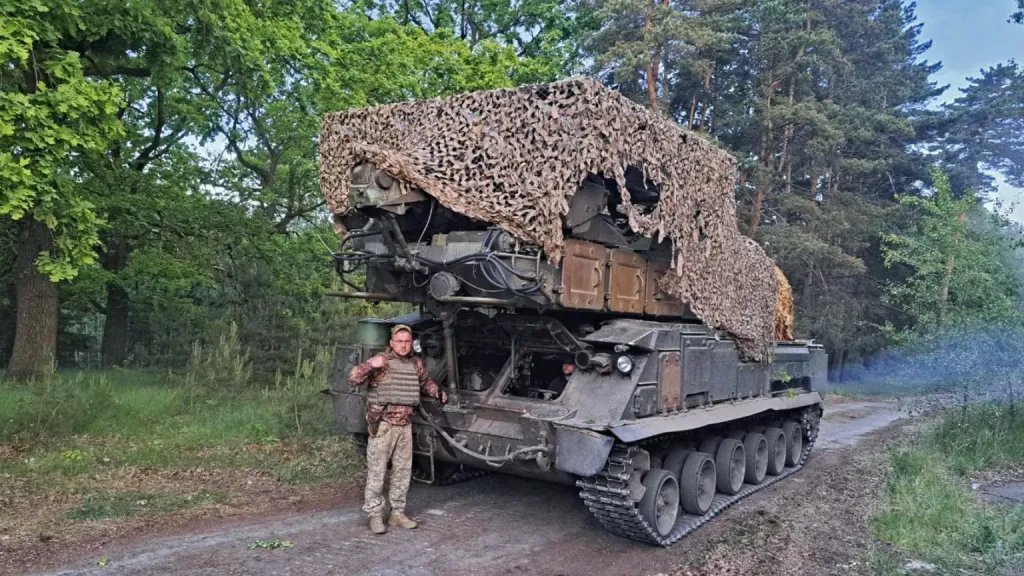
The Buk/Sea Sparrow FrankenSAM combines the Soviet-era Buk transporter-erector-launcher with U.S.-supplied RIM-7 Sea Sparrow missiles. Operational Command East

Shershen takes that philosophy a step further by making missile interchangeability a central feature of the system.

The Shershen battery consists of a Perun command-and-control vehicle, an Athena radar, and four Borei launchers.
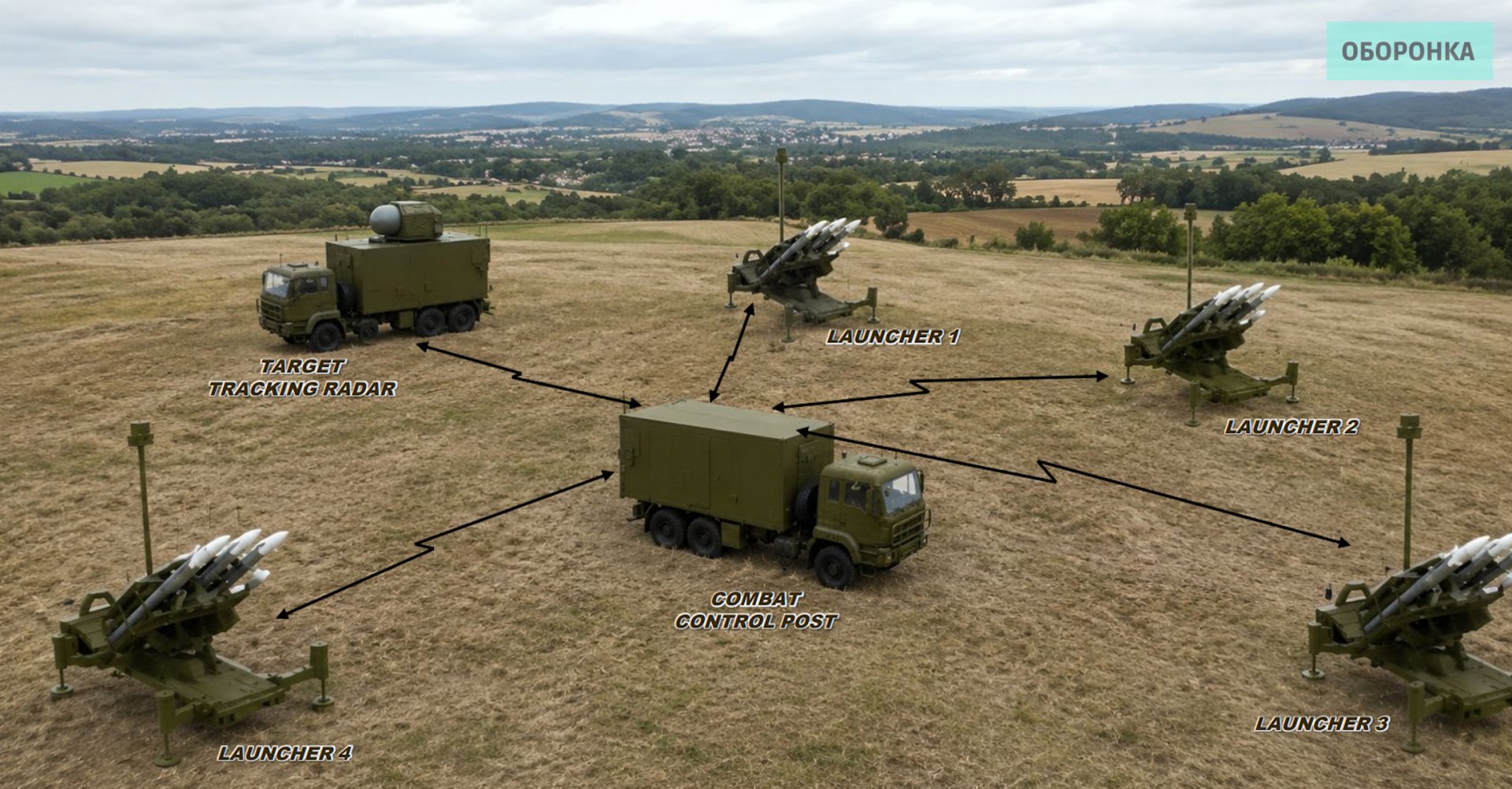
A graphic shows a typical Shershen battery. via Oboronka

According to the developer, the system’s architecture is deliberately open. This allows it to use different missiles from different manufacturers and also permits the integration of third-party surveillance and guidance radars.

The company says Shershen can currently employ the R-27 (AA-10 Alamo), R-73 (AA-11 Archer), AIM-9 Sidewinder, and AIM-132 ASRAAM, while compatibility with the R-60 is also being explored. These weapons come with a mix of semi-active radar or infrared homing seeker heads.
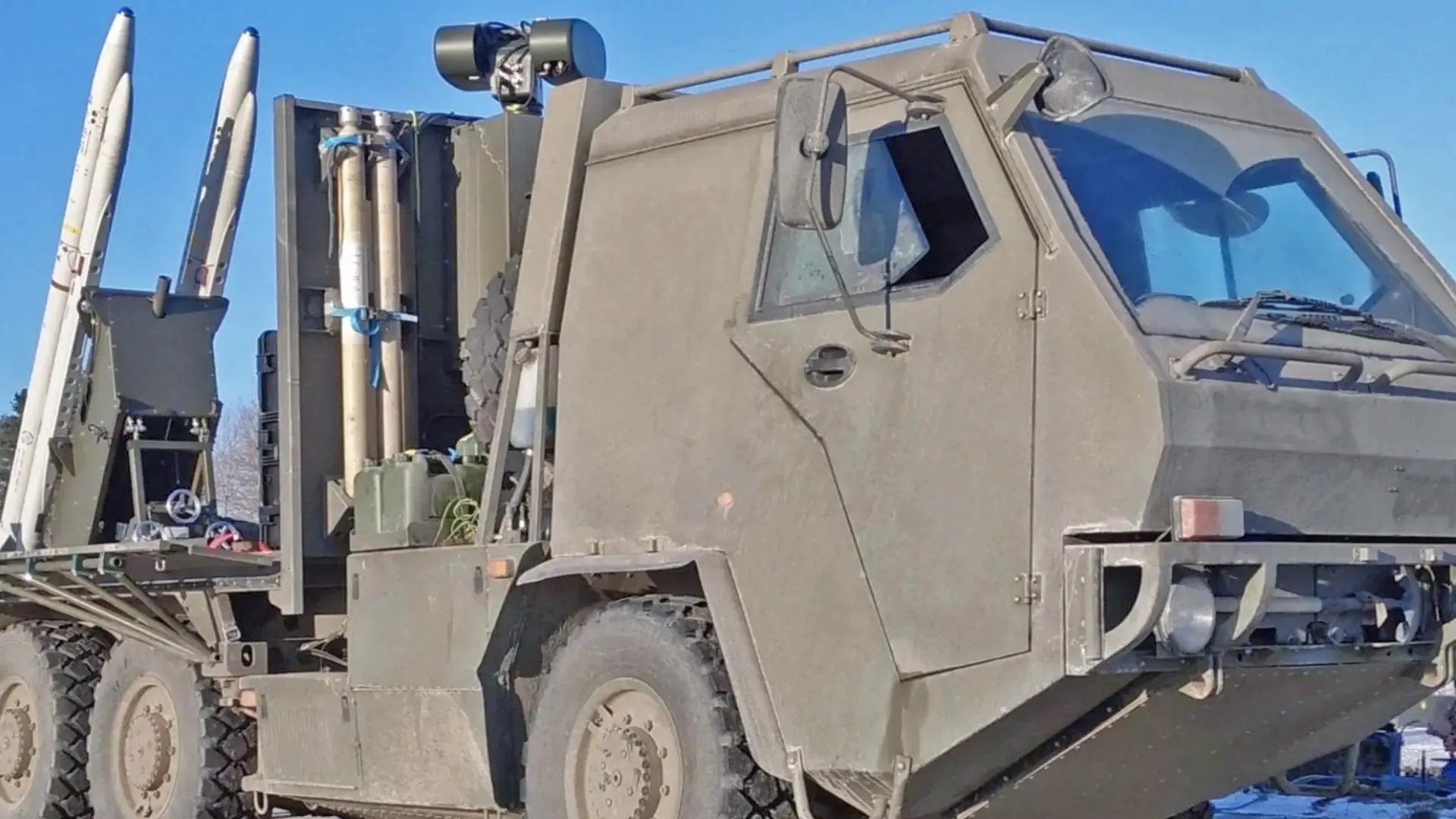
One of the ASRAAM/Supacat air defense systems supplied to Ukraine. Ukrainian Armed Forces

Air-to-air missiles are already available in considerable variety across Ukraine’s arsenal and those of its foreign partners. Being able to employ several types from a common ground-based system provides much more flexibility than a conventional SAM designed around one dedicated interceptor.

It also offers a way to exploit missiles that were never originally intended to be fired from the ground. That means Shershen’s launcher and fire-control system are meant to be interceptor agnostic, at least to a certain degree.

Shershen’s Athena radar is reported to be capable of detecting targets at ranges of up to 85 kilometers (53 miles).
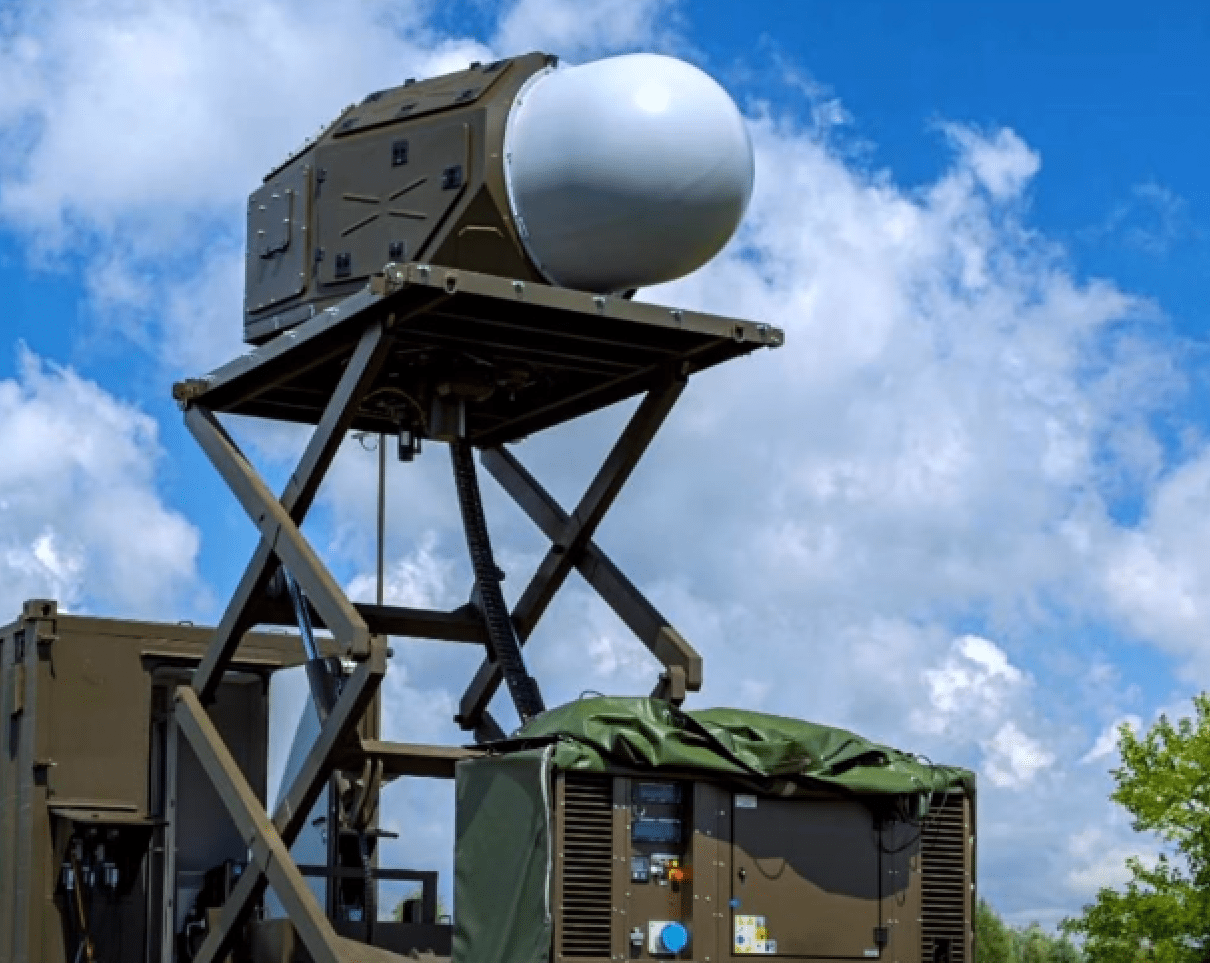
The Athena radar for the Shershen. NAUDI screencap

In terms of the engagement envelope, Shershen is claimed to be capable of engaging aircraft, cruise missiles, and drones at ranges of up to 25 kilometers (16 miles) and altitudes of up to 10,000 meters (32,800 feet). Clearly, these figures will vary widely depending on the type of interceptor.

When employing radar-guided missiles, the system’s engagement architecture can reportedly guide as many as six missiles simultaneously.

The advertised performance figures have not been independently verified, and it remains unclear what target types and engagement conditions were used to establish them.

🇺🇦 Україна представила складові мультикаліберного зенітного ракетного комплексу «Шершень» на міжнародній виставці MSPO 2026 у польському місті Кельце.

Міжнародний консорціум компаній Shershen Group, який створює ЗРК в інтересах України представив, показав командний пункт,… pic.twitter.com/9wAS7ewxzg

— Мілітарний (@mil_in_ua) September 10, 2026

The developer says the second prototype has completed initial testing, including successful interceptions at a test range.

One of the Borei launchers displayed at MSPO were armed with an R-120K, a new Ukrainian missile equipped with a radar seeker and is intended to be capable of both air-to-air and surface-to-air employment.

The R-120K remains under development, however. Work is reportedly continuing on its rocket motor, meaning that its eventual performance and production status remain uncertain. Still, having the option of including the R-120K on the Shershen system in the future is significant.
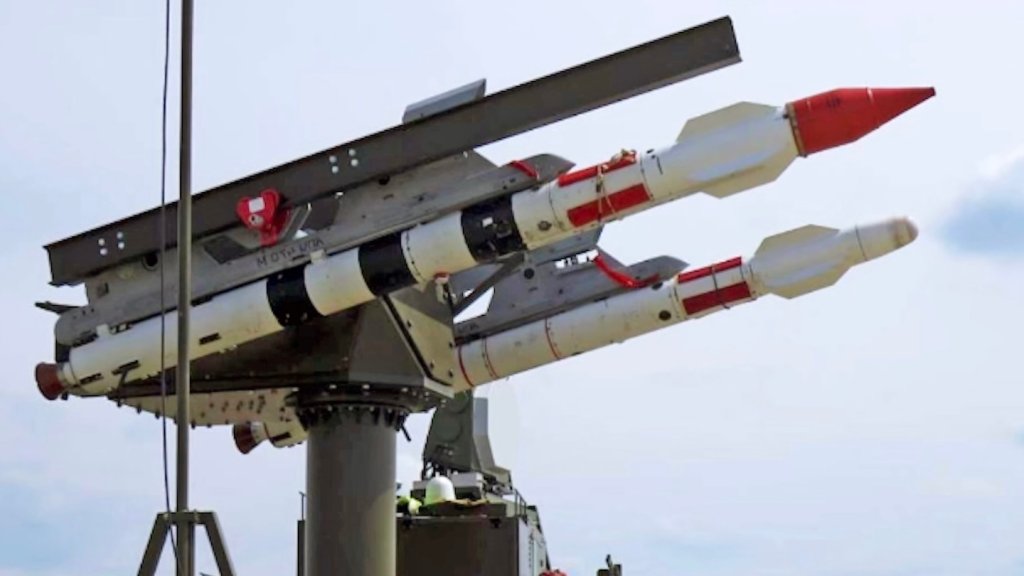
Ukraine has unveiled a new surface-to-air missile system designed to turn a diverse collection of air-to-air missiles into a flexible ground-based air defense capability. Called Shershen, or “Hornet,” the system combines a Ukrainian command-and-control architecture, a dedicated surveillance radar, and multiple launchers that can employ both Ukrainian and Western missiles.
A test launcher used for the Shershen program, armed with a radar-homing (nearest camera) and an infrared-guided R-27 missile. The latest prototype features a cage-type container launcher. NAUDI screencap NAUDI screencap

Rather than relying indefinitely on stocks of Soviet and Western air-to-air missiles, Ukraine could eventually have a domestically produced interceptor specifically tailored to its growing family of ground-based air-defense systems. That will become increasingly important as stocks of legacy missiles are depleted. Earlier this year, it was reported that Ukrainian F-16s were running low on their air-to-air missiles, which include the same AIM-9s that are used in some FrankenSAM systems, as well as being compatible with Shershen. But even before that, it was clear that Western-supplied missile stocks in Ukraine across the board were diminishing, in some cases drastically, with critical interceptors like the AMRAAM and Patriot being badly affected.
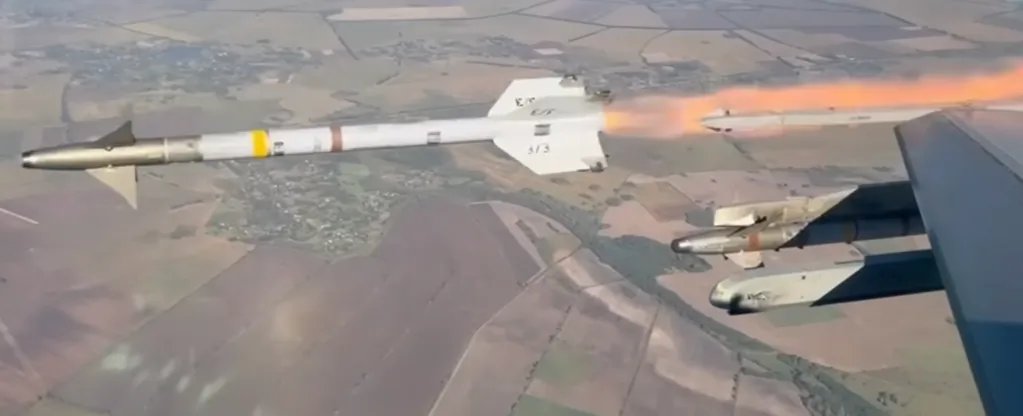
A live AIM-9L/M Sidewinder launched from the wingtip rail of a Ukrainian F-16. Ukrainian Air Force screencap

Ukraine’s need for additional surface-to-air missiles has become increasingly acute during the full-scale war, especially as Russian drone and missile barrages have stepped up.

The shortage has encouraged Ukraine to pursue a combination of indigenous development and unconventional adaptations.

The FrankenSAM initiative, conducted with U.S. support, demonstrated how existing Ukrainian systems could be combined with foreign missiles to rapidly create additional air-defense capacity. Ukraine has also fielded modified Osa systems armed with R-73 air-to-air missiles rather than their original 9M33 interceptors. Other R-73-based concepts have even been demonstrated aboard Ukrainian uncrewed surface vessels.
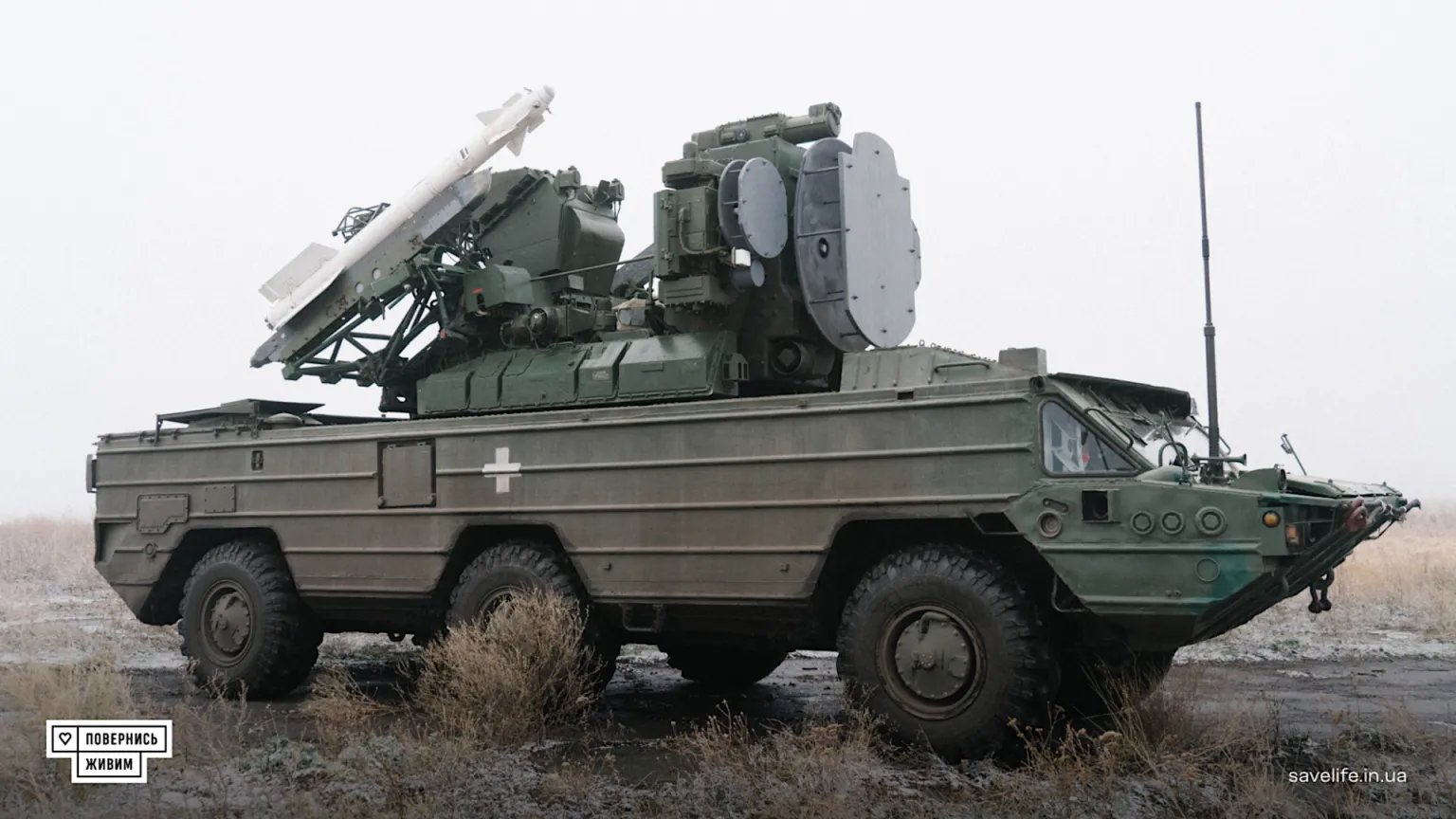
An R-73 missile loaded on an Osa-AKM SHORADS vehicle. Come Back Alive

Shershen appears to reflect the next logical step in that evolution: rather than creating a one-off FrankenSAM combination, build an architecture from the outset that can accept multiple missiles. Additionally, with so many different ground-based air defense systems now being fielded, it comes with the significant advantage of a standardized launcher and control interface that can accommodate a range of interceptors.

At the same time, Ukraine is pursuing substantially more ambitious indigenous SAM projects.

Earlier this year, a previously secretive Ukrainian missile identified as the Koral made what appeared to be its first public appearance. The program dates back to at least 2021, when Ukraine’s Luch design bureau presented a concept for a medium-range surface-to-air missile.
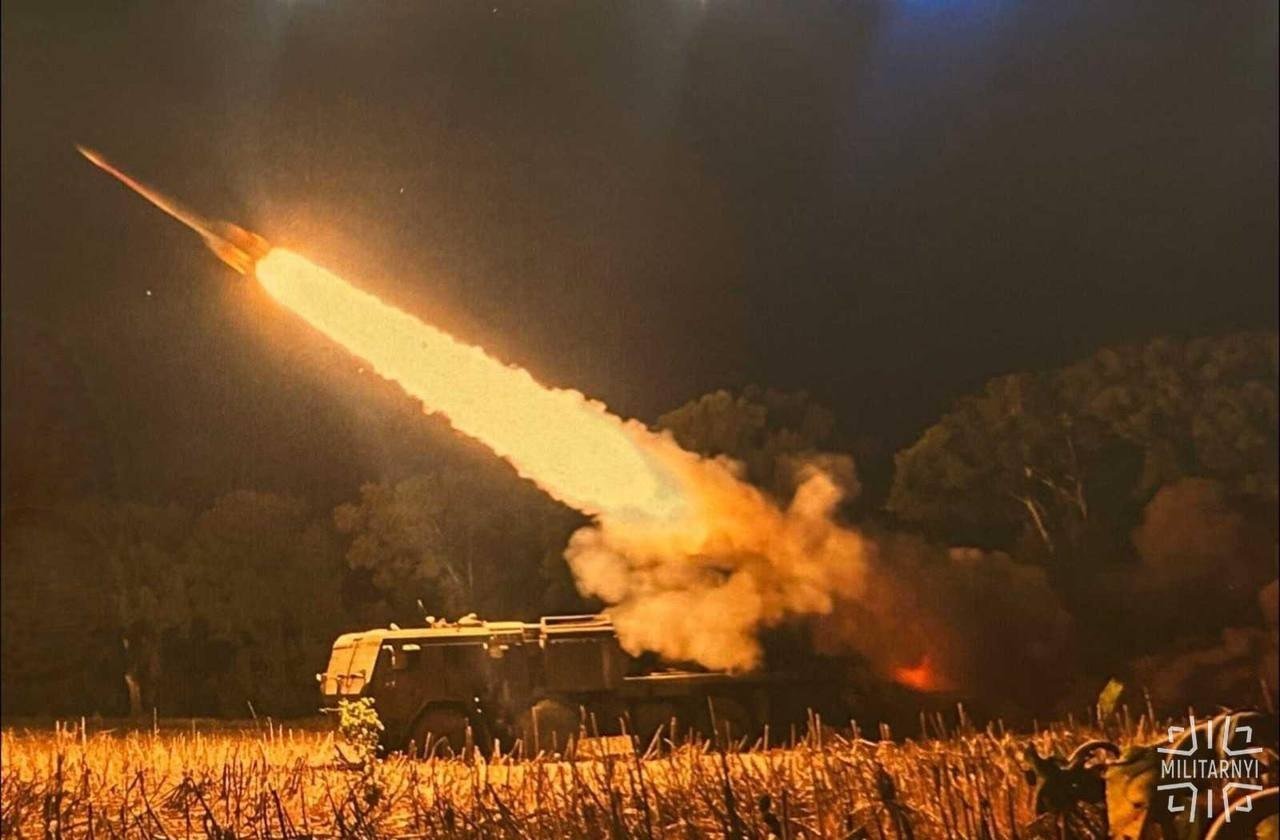
A missile is launched from a Koral air defense system, based on a Czech Tatra truck chassis. Ukroboronprom

Koral is intended to provide a much longer-range capability, potentially filling some of the gap left by Ukraine’s aging Soviet systems and supplementing the Western-supplied Patriot and SAMP/T.

Shershen, by contrast, is clearly focused on the short-range layer.

Together, the programs illustrate the breadth of Ukraine’s emerging domestic air-defense effort: from relatively inexpensive systems built around repurposed air-to-air missiles to new, purpose-designed interceptors intended to replace or augment Soviet-era systems.

Ukraine’s experience with FrankenSAM has demonstrated the value of getting unconventional air defense combinations into service quickly.

Once fielded, Shershen, with its architecture capable of accepting different Soviet-origin and Western-made interceptors, and eventually a Ukrainian one, gives Ukraine another way to stretch its missile inventory and enhance its air defense capabilities.

Contact the author: thomas@thewarzone.com

The post Ukraine’s New Shershen SAM Can Fire A Wild Mix Of Adapted Air-To-Air Missiles appeared first on TWZ.
  •  

EU welcomes Cambodia to WTO appeal arrangement

The EU welcomes Cambodia’s decision to join the Multi-party Interim Appeal Arbitration Arrangement (MPIA) for WTO members, contributing to efforts to uphold a rules-based multilateral trading system. 

With Cambodia’s participation, the MPIA now covers 62 World Trade Organization (WTO) members and 60.4% of world trade.  

The MPIA brings together participants from all continents and at different levels of development, united by a shared commitment to upholding the rules-based trading system. 

The MPIA preserves the right to appeal in trade disputes among participating WTO members, at a time when the WTO’s Appellate Body remains non-functioning. It helps ensure that disputes can continue to be resolved in an orderly and binding manner, avoiding appeals 'into the void'. 

“I welcome Cambodia to the MPIA. The arrangement plays an important role in upholding the rules-based trading system. Each new participant helps reinforce the predictability, stability and credibility of global trade rules. I encourage other WTO members to join the MPIA,” said EU Trade and Economic Security Commissioner Maroš Šefčovič. 

Background 

The MPIA was established in 2020 and has proven its effectiveness in many WTO disputes.  

Under the MPIA, appeals are heard by arbitrators randomly selected from a pool of 10 standing appeal arbitrators set up by the participating WTO members. These arbitrators are persons of recognised authority, with demonstrated expertise in law, international trade and WTO agreements.  

The MPIA is open to all WTO members as a practical tool for appeal arbitration, pending the restoration of a reformed and fully functioning WTO dispute settlement system. 

As of 1 June 2025, the MPIA has an updated pool of appeal arbitrators to ensure that appeals continue to be heard by independent arbitrators of the highest calibre. 

At the WTO Ministerial Conference that took place earlier this year, MPIA ministers stressed the importance of the MPIA for the security and predictability of the multilateral trading system.  

The current MPIA participants are Australia, Barbados, Benin, Brazil, Cambodia, Canada, China, Chile, Colombia, Costa Rica, Ecuador, the European Union (and its Member States), Guatemala, Hong Kong (China), Iceland, Japan, Liechtenstein, Macao (China), Malaysia, Mexico, Moldova, Montenegro, New Zealand, Nicaragua, Norway, Pakistan, Paraguay, Peru, the Philippines, Singapore, Switzerland, Ukraine, the United Kingdom, Uruguay and Vietnam.

More information

MC14: Supporting the rules-based multilateral trading system: the role of the MPIA

  •  

Ukraine Carried Out Its Deepest Drone Strike On Russia Ever

A Russian gas plant more than 1,700 miles from the Ukrainian border was attacked by a drone on Wednesday, Ukrainian and Russian officials said. This is reportedly the longest-distance Ukrainian strike of the war and comes as Kyiv continues to target Moscow’s energy infrastructure. 

“Today, an attack by a drone was repelled against one of the industrial facilities in Noyabrsk,” Dmitry Artyukhov, governor of the Yamalo-Nenets Autonomous Okrug, stated on Telegram. “As a result of the drone’s debris falling, a fire broke out. Emergency services specialists are working at the scene. Most importantly: there are no casualties or injuries. The extent and nature of the damage are being determined.”

“I urge residents of Yamal to remain calm and to rely only on information from official sources,” Artyukhov added. “The situation is under control.”

(Dmitry Artyukhov Telegram)

“The criminal Kyiv regime has, for the first time, attacked the Arctic region of the Ural Federal District,” Artem Zhoga, the Presidential Envoy of the Russian Federation to the Ural Federal District, confirmed on Telegram. “As a result of debris from a drone falling on the territory, a fire broke out at a fuel and energy complex facility in the Yamalo-Nenets Autonomous District… The enemy is trying to damage economic facilities in order to sow panic.”

New range record: Ukrainian drones attack Novy Urengoy – nearly 3,000 km from Ukraine.

The facility in Novy Urengoy that processes gas condensate for transport was hit—one of the most important installations in Russia's gas condensate infrastructure.

The facility has a capacity… pic.twitter.com/gLysVaLjJJ

— Jürgen Nauditt 🇩🇪🇺🇦 (@jurgen_nauditt) September 9, 2026

The target of the attack was the Novy Urengoy Condensate Stabilization Plant (CSP), according to Ukraine’s Armed Forces General Staff, which took credit for the attack.

“On 9th September 2026, units of the Defense Forces of Ukraine struck the Novy Urengoy Gas Condensate Processing Plant in Novy Urengoy, Yamalo-Nenets Autonomous Okrug,” the general staff claimed on X. “The extent of the damage is being assessed.”

The plant has an annual processing capacity of approximately 19.5 million tons, the general staff added.

“It produces stabilized gas condensate, petroleum fractions, diesel fuel and other petroleum products,” the Ukrainian military pointed out. “Its products are used, among other purposes, to meet the needs of the Russian armed forces. Operations against key enemy military targets are ongoing.”

Ukrainian officials did not provide any details about how the strike was carried out.

⚡⚡ More than 3,000 km away. Novy Urengoy gas condensate processing plant hit

On 9th September 2026, units of the Defence Forces of Ukraine struck the Novy Urengoy Gas Condensate Processing Plant in Novy Urengoy, Yamalo-Nenets Autonomous Okrug, russian federation.

The extent… pic.twitter.com/YrRmHp6NYb

— Генеральний штаб ЗСУ (@GeneralStaffUA) September 9, 2026

One video that emerged from the scene showed a column of flames rising in the distance but does not offer much in the way of detail about where the attack took place or the extent of the damage.

Ukrainian drones have for the first time attacked Russia’s largest gas-production hub, almost 3,000 km from the Ukrainian border.

Ukraine struck the Arctic part of the Urals Federal District. A fire started at a fuel-and-energy site.

The plant is part of the Gazprom structure.… pic.twitter.com/yQjodp2vrE

— Visegrád 24 (@visegrad24) September 9, 2026

Another video showed smoke rising in the distance, but again offered little in the way of detail about what happened.

❗Ukrainian drones attacked Novy Urengoy in Russia for the first time. That's about 3,200 km from Ukraine!
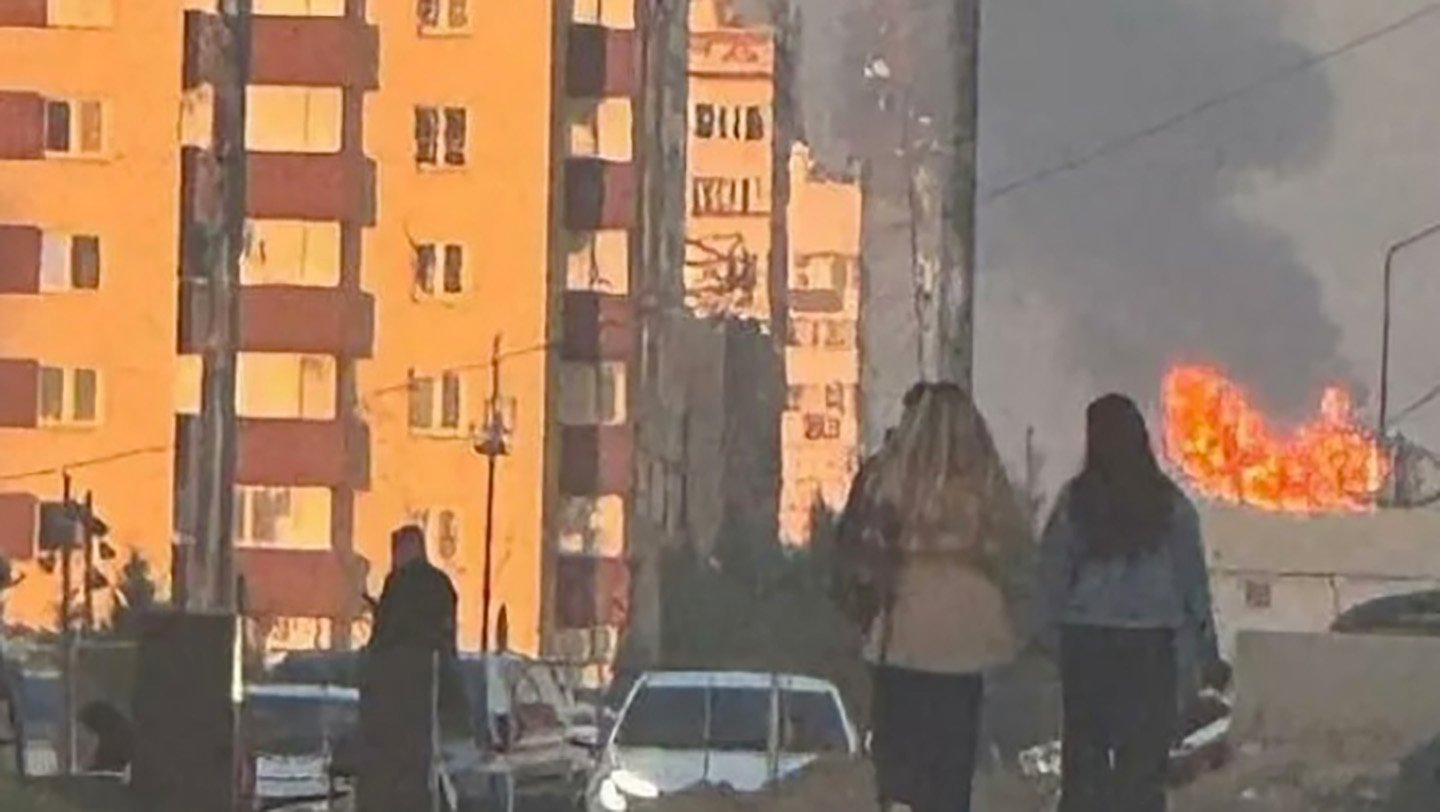

The Novy Urengoy plant for preparing condensate for transport, located in the Yamalo-Nenets Autonomous Okrug, was the target. It is one of the region's key gas condensate… pic.twitter.com/KDwOFWicd6

— Anton Gerashchenko (@Gerashchenko_en) September 9, 2026

The region is a significant target.

“Novy Urengoy is Russia’s unofficial gas capital, located in the Yamal-Nenets autonomous district in northwestern Siberia,” according to the Moscow Times. Gazprom “estimated the region’s gas resources at 26.5 trillion cubic meters as of 2020, enough to cover global demand for more than six years.”

In Novy Urengoy, Khanty Mansi AD, west Siberia, Russia,
long-range Ukrainian drones hit an industrial facility in the city located some 3,000 kilometers (1,800 miles) from the Ukrainian border.https://t.co/bruXXjLYR4

— Alexander Kokcharov (@alex_kokcharov) September 9, 2026

In addition to being the first attack in this region of Russia, this was “the furthest strike since the start of the war,” the Russian Mediazzzona Telegram channel stated. “Previously, the record for distance was the attack on the Omsk Oil Refinery in July 2026. It is located approximately 2,500 km (about 1,550 miles) from the border in a straight line.”

While the Ukrainian Armed Forces General Staff offered scant details about the strike, officials from the Fire Point weapons company hinted online that one of their drones carried out the attack. 

“Guess who traveled over 3300 km (about 2,050 miles) and successfully achieved their goal,” the company stated on a Telegram post that included video of the gas plant attack.

“3200)),” Fire Point’s founder, Denys Shtilierman, teased in an X post with an image of the burning gas plant.

3200)) https://t.co/Go0EbSm2BS

— Denys Shtilierman (@DenShtilierman) September 9, 2026

Neither Shtilierman nor the company provided any other details; however Fire Point claims its FP-1 drones can now travel about 2,100 miles (3,400 km) with a 60 kg payload.

Despite Fire Point’s hints, there is no confirmation that the company’s weapons had anything to do with this attack. There is also the chance that it could have been carried out by another system or even from inside Russia. Ukraine has, in the past, relied on proxies to stage attacks deep in Russia. In addition, Ukraine last summer carried out a series of remotely launched drone attacks on Russian strategic aviation. Dubbed Operation Spider Web, it included strikes on the Belaya Air Base, about 3,000 miles from the border.

However, a strike from inside Russia is much less likely than one launched from Ukraine given Fire Point chiming in and the increasing reach of Ukraine’s weapons. We have reached out to Fire Point and Ukrainian officials for comment.

You can see video of the Operation Spider Web attack on Belaya below:

Ukrainian drones struck Russian strategic aviation at the Belaya air base in Irkutsk – 4,800 km from Kyiv. pic.twitter.com/UBAi7znioR

— Michael MacKay (@mhmck) June 1, 2025

The Novy Urengoy Gas Condensate Processing Plant wasn’t the only site in Russia affected by drone incursions far from the Ukrainian border today.

“A state of emergency has been declared in the Khanty-Mansi Autonomous Okrug due to unmanned aerial vehicle (UAV) activity,” the Russian RIA Novosti news outlet reported on Wednesday. This is located about 1,500 miles from Ukraine. 

“Temporary restrictions have been implemented at the airports of Igra, Nyagan, Uray, ‘Sovetsky,’ Surgut, and Khanty-Mansiysk,” the outlet added.

The publication did not report any attacks and Ukraine did not claim any, but video emerged of what appears to be a Fire Point FP-1 drone flying over the area.

Russian Telegram channels report drones in the area of Khanty-Mansiysk, a city, in west-central Siberia, Russia. pic.twitter.com/in0M552FZN

— Anton Gerashchenko (@Gerashchenko_en) September 9, 2026

Officials in the region were preparing for a Ukrainian strike, the independent Russian outlet Verstka reported earlier this week.

The area is “a sprawling oil-producing region responsible for roughly 40% of the country’s crude output,” the official Ukrainian United24 media outlet noted.

While the extent of the damage to the Novy Urengoy Condensate Stabilization Plant is unclear at the moment, the attack extends the range of Ukraine’s campaign against Russia’s oil infrastructure.

This summer, Ukraine struck nearly all Russian refineries within range, the Kyiv Post noted. 

“Ukraine’s military said in July that the attacks had knocked 43% of Russia’s refining capacity offline, contributing to a nationwide fuel shortage and export restrictions,” the publication reported.

Still, “Russia’s overall oil exports remained relatively stable between June and July, with higher crude exports and energy prices partly offsetting revenue losses,” the Kyiv Post added.

For Russia, the attacks on its energy infrastructure have become so damaging that last month, President Vladimir Putin signed a law allowing the government to temporarily seize what it deems commercial critical infrastructure that is not sufficiently protected against such strikes. That followed Russia’s move earlier this year to allow private companies to purchase their own air defense systems to protect their own facilities. 

Russian President Vladimir Putin signed a decree allowing the government to temporarily take control of critical infrastructure if private owners fail to protect it from Ukrainian drone attacks or rebuild it after strikes.

Read more: https://t.co/SzAbSZqobI

— ABC News (@ABC) August 25, 2026

Though Russia is continuing its grinding offensive, the energy infrastructure attacks are clearly taking a major toll. The ability to do so seems to have taken on additional significance in the wake of another round of attempts to end the fighting.

U.S. President Donald Trump’s top envoys, Steve Witkoff and Jared Kushner, recently traveled to both Russia and Ukraine seeking to rekindle peace talks. However, there does not appear to be any immediate resolution in sight.

The expanding range and quantity of Kyiv’s long-range strike arsenal gives Zelensky perhaps his most powerful card to play against Russia’s interest in continuing the war. Ukraine has been improving these weapons by the month and the pace of development of its drones and cruise missiles is rapidly accelerating. The country also has several ballistic missile projects in the works, which will only add to the pressure put on Moscow once operational.

Regardless, earlier this week, Ukrainian President Volodymyr Zelensky said he expects the war with Russia to continue into the winter at the very least. Given that, Kyiv’s campaign against Russia’s energy infrastructure does not seem like it will end anytime soon, either.

Case in point, Ukraine’s long-range drone strikes continued on Wednesday with another attack on Sochi, a Black Sea resort town often frequented by Russian President Vladimir Putin. And, for the second day, drones were visible over Russia’s remote central high-north energy production hub.

Massive fire erupts at Sochi port, Russia, following reported Ukrainian drone attacks. pic.twitter.com/cm2WsiA4jS

— Clash Report (@clashreport) September 9, 2026

Russian Telegram channels report drones in the area of Khanty-Mansiysk, a city, in west-central Siberia, Russia. pic.twitter.com/in0M552FZN

— Anton Gerashchenko (@Gerashchenko_en) September 9, 2026

Contact the author: howard@twz.com

The post Ukraine Carried Out Its Deepest Drone Strike On Russia Ever appeared first on TWZ.

  •  

Wadephul hat einen ehrlichen Moment und erzählt, was die Bundesregierung von der Ukraine fordert

Bundesaußenminister Johann Wadephul ist im Podcast „Ronzheimer“ überraschend ehrlich geworden, denn er forderte von der Ukraine mehr Bestellungen bei deutschen Rüstungskonzernen: „Zum jetzigen Zeitpunkt sind wir nicht ganz zufrieden mit dem, was es an (…) Bestellungen in Deutschland gibt. Und deswegen haben wir jetzt die ukrainische Regierung gebeten, das zu überprüfen und dafür zu sorgen, […]
  •  

Deutschland auf Kriegskurs

Da heute wohl alle über die Wahlen in Sachsen-Anhalt sprechen werden, haben wir das Thema bewusst ausgespart und uns ganz auf Geopolitik und die Ukraine konzentrierts, denn dort ist letzte Woche sehr viel passiert. Die Bundesregierung hat die letzten Brücken zu Russland abgebrochen und scheint bereit, einen Krieg zu riskieren, Selensky hat offen der zivilen […]
  •  

Statement by President von der Leyen with NATO Secretary-General Mark Rutte

Dear Mark, it is always a pleasure to welcome you.

We meet today to discuss Russia's attack in Leipzig. The German government has identified Russia as behind an attempt to attack cargo planes at Leipzig/Halle Airport. Had this attack succeeded, this would have resulted in enormous damage and possibly even loss of life. So I want to be very clear about what this was. This was an attack using military-grade material, carried out by Russian operatives on EU soil. And we will not tolerate it. We stand in full solidarity with Germany. And If the intention was to make us think twice about supporting Ukraine, I can tell you, it has only strengthened my resolve. Intimidation will not work. And this is why I am meeting with NATO's Secretary-General today. We are united. Europe and NATO will not just maintain our pressure on Russia. We will increase it. And we will not stop. Not until Russia stops bombing and killing innocent children, men and women in Ukraine.

Leipzig marks a new escalation on European soil, directly attributed to Russia. But it is part of a broader pattern of increasingly dangerous incidents. Repeated incursions into our airspace. Drones that paralyse our airports. Interference with our critical infrastructure. Europeans are faced with a hard truth that this is the new normal. We have to step up. And that means being ready to respond to Russia's recklessness faster and better. We must treat our everyday infrastructure as frontline targets and protect it accordingly. And we will support any Member State - Russia targets. Europe already has Rapid Response Teams which can respond to these styles of attacks whether they occur inside or outside our Union. Our strength, our preparedness, our resolve, is our deterrence.

We also do this by using the power of our Single Market. Our sanctions have weakened Russia's economy. We can use more sanctions and have them ready to impose, as soon as such dangerous, life-threatening acts are attributed. Every loophole Russia exploits, is one we must close. In Ireland today, European foreign affairs ministers are discussing new listings. At the Commission, we are looking at ways to cut even deeper into Russia's war chest.

My second point today regards our support for Ukraine. Today I can confirm that we have received a new payment request. It is worth several billion euros and would cover Ukraine's air defences, including the highly advanced PAC-3 Patriot air defence systems. Member States are currently looking at Ukraine's request, but I can say that it is going in the right direction. At the same time, we in Europe are working on FREYA with Ukraine. This is a European project to build our own anti-ballistic missile defences. All of this is on top of the ‘90 billion euro support loan' for Ukraine that is already at work. Since June, we have issued 8.5 billion EUR for drones and missiles for Ukraine. And this money would also buy fighter jets from European industry.

Finally, my third point. We do all of this together with NATO. Mark and I have repeatedly stood side by side to express this solidarity, and we do so today to show that Europe is united. And that Europe must mobilise its defence surge even sooner. Air defences are critical. We need a faster, more integrated alert system across Europe. And then we must intercept the threats faster. This is why we have put forward an 800 billion euro defence investment plan. Including 150 billion euro through SAFE, so we can invest more, but together and therefore smarter.

Mark, last time we met was at the NATO summit in Türkiye where we discussed these topics. As you said, the EU and NATO reinforce each other. And today our message is very clear. We are in a new era of European security. And European investment in defence strengthens NATO and re-energises our industrial base. We will continue; we will prevail; and we will deter anyone who attacks our freedom and security.

  •  

Wie das russische Fernsehen über die politische Woche in Deutschland berichtet

Der Auftritt der Minister Dobrindt und Wadephul war eine recht peinliche Nummer, denn als sie Russland – mal wieder, ohne irgendwelche Belege vorzulegen – beschuldigt haben, mit dem Drohnenvorfall von Leipzig einen Angriff in und auf Deutschland durchgeführt zu haben, haben sie nur ihre Erklärungen abgelesen und nicht einmal Journalistenfragen zugelassen. Laut Dobrindt gab es […]
  •  

Die Chronologie der Eskalation der innenpolitischen Krise in der Ukraine

In der Ukraine ist der Machtkampf fast schon zu einem Bürgerkrieg eskaliert, wenn man die Ereignisse der letzten Woche anschaut. Am Mittwoch haben in Kiew Mitarbeiter des ukrainischen Geheimdienstes SBU auf Mitarbeiter des ukrainischen Militärgeheimdienstes GUR geschossen, dann ist am Freitag eine Drohne in das Fenster des SBU-Chefs geflogen, die als russische Drohne bezeichnet wurde, […]
  •  

Schon wieder ein neuer Korruptionsskandal in Selensky Umfeld

Das Nationale Antikorruptionsbüro der Ukraine (NABU) hat am Freitagabend mitgeteilt, es führe im Rahmen einer „Spezialoperation Karthago“ Durchsuchungen in der Generalstaatsanwalt durch. Die Operation richtete sich demnach gegen ein Netzwerk von auf Telefonbetrug spezialisierten Callcentern, die von einem leitenden Mitarbeiter der Generalstaatsanwalt geschützt wurden. Die Callcenter sind vor allem in Russland, aber auch in Europa […]
  •  

How Russian Drones Forced Ukraine To Park Its M1 Abrams Tanks

Ukrainian crews operating Australian-supplied M1A1 Abrams tanks say the battlefield has become so saturated with Russian drones that their tanks cannot currently be used in combat, but they reject the idea that main battle tanks have become forever obsolete.

Since receiving these tanks last year, the crews, serving with Ukraine’s 425th Separate Assault Regiment “Skala,” have used the Abrams in two combat operations in the fight for Pokrovsk, a key Ukrainian logistics hub and part of a defensive belt of towns in Ukraine’s eastern Donetsk region. They recounted their experiences to Hromadske, an independent media channel in Ukraine.

Fighting around Pokrovsk

The first major deployment described by the crews took place in December of last year, when Abrams tanks were used to support assault groups entering Pokrovsk.

The crewmember with the callsign Kent described moving into the city behind a mine-clearing tank and ahead of two infantry fighting vehicles (IFVs) carrying assault troops, during a mission that was deliberately aggressive.

“Since a tank is a priority target — my task was to draw their attention, while our infantry dismounted and moved in successfully.”

The Abrams was also assigned three target points to engage along the route.

“We went right in there, poured it on, and drove back out,” he recalled.

A video showing the 425th Separate Assault Regiment in action in August 2025, soon after receiving the Abrams:

The second operation, on March 31, involved an attempt to enter and hold an industrial area near Pokrovsk to help block Russian movement toward Hryshyne, a contested village in the district.

The operation was prepared for more than two weeks. Ukrainian forces conducted reconnaissance flights, examined difficult sections of the planned routes, and provided crews with extensive video and imagery.

“They knew every meter of the route,” another of the unit’s commanders, with the callsign Kubik, said.

Weather was considered essential. The Ukrainians waited for fog and rain, hoping to limit the effectiveness of Russian drones.

“Without the right weather we wouldn’t have been able to pull off operations like that,” Kubik said.

The operation nevertheless resulted in the destruction of four out of five armored vehicles, some of which are seen in the video embedded below.

Russia's Rubicon Drone Center FPV drones destroyed a Ukrainian assault group near Pokrovsk, hitting an M1A1 Abrams tank, M1117 APC and BMP-2 as the unit tried to advance near Hryshyne under fog cover. #Ukraine pic.twitter.com/ZzE52qAYxp

— NOELREPORTS 🇪🇺 🇺🇦 (@NOELreports) April 1, 2026

The commander acknowledged that the Russian side may have had advance knowledge of the operation.

“I can’t rule out the possibility that the enemy knew our plan,” he said.

His Abrams was not immediately destroyed. According to the crew, it completed its task and the assault troops dismounted before the weather changed.

“Once the fog lifted, they started working on it with an FPV drone,” the commander said.

Why use tanks at all?

The losses prompted criticism from Ukrainian military commentators, particularly after footage of the destroyed vehicles was published.

However, the crews defend the decision to use armored vehicles for the missions. According to the men of the Skala interviewed, the alternative was often to send infantry over several miles on foot while carrying weapons, ammunition, water, and other supplies.

“That takes more time,” Kubik explained. “And the enemy isn’t standing still — the enemy is moving toward them.”

🇦🇺🇺🇦 Australia-supplied M1A1 Abrams AIM main battle tank in service of the Ukrainian 425th Separate Assault Regiment "Skala."

The tanks of such type recently saw combat in the area of Pokrovsk. pic.twitter.com/qhjSyGbhH6

— Status-6 (War & Military News) (@Archer83Able) December 23, 2025

The argument that infantry could simply move more stealthily on foot also has limitations.

“Every day the Mavic drones are flying, the fixed-wing drones are flying,” he said. “No fog, guys are visible.”

Combined with IFVs, the Abrams can provide the ability to rapidly move troops while simultaneously delivering heavy direct fire against enemy positions and offering substantial protection to its crew.

The crews argue that this capability remains worthwhile even when the tank itself may eventually be lost.

One commander was asked whether deploying a roughly $5-million tank makes sense if a single sortie can result in its destruction.

“Yes, of course it makes sense to deploy it,” he replied.

“First and foremost — it saves the lives of the crew inside it.”

Russian forces captured a relatively lightly damaged M1A1SA Abrams main battle tank operated by the 47th Separate Mechanized Brigade in the Pokrovsk direction.

The tank is equipped with added cage armor, as well as Kontakt and ARAT ERA. pic.twitter.com/mHyKk1xNRY

— Status-6 (War & Military News) (@Archer83Able) October 27, 2024

A tank under attack by drones

The Ukrainian crews repeatedly highlighted the Abrams’ accuracy and survivability.

“What are the biggest advantages of the Abrams?” Kent was asked.

“Accuracy.”

Its biggest disadvantage, he said, is equally obvious on a modern battlefield: “It’s very tall — and very large — so it’s hard to conceal.”

A video showing a U.S.-supplied Abrams under attack from Russian FPV drones:

🇺🇸🇺🇦 An Abrams tank withstands 9 FPV drones hits. Eventually, the tank was destroyed, but the tank crew successfully survived. pic.twitter.com/4NBKdg2zmW

— PS01 □ (@PStyle0ne1) July 7, 2024

Kent described surviving an engagement in which his tank was struck repeatedly while on the move.

“More than 20 drones hit me,” he said of one operation into Pokrovsk.

He attributed the Abrams’ survival to the combination of its armor and additional anti-drone protection fitted to the vehicle.

“All of it together is effective,” he said.

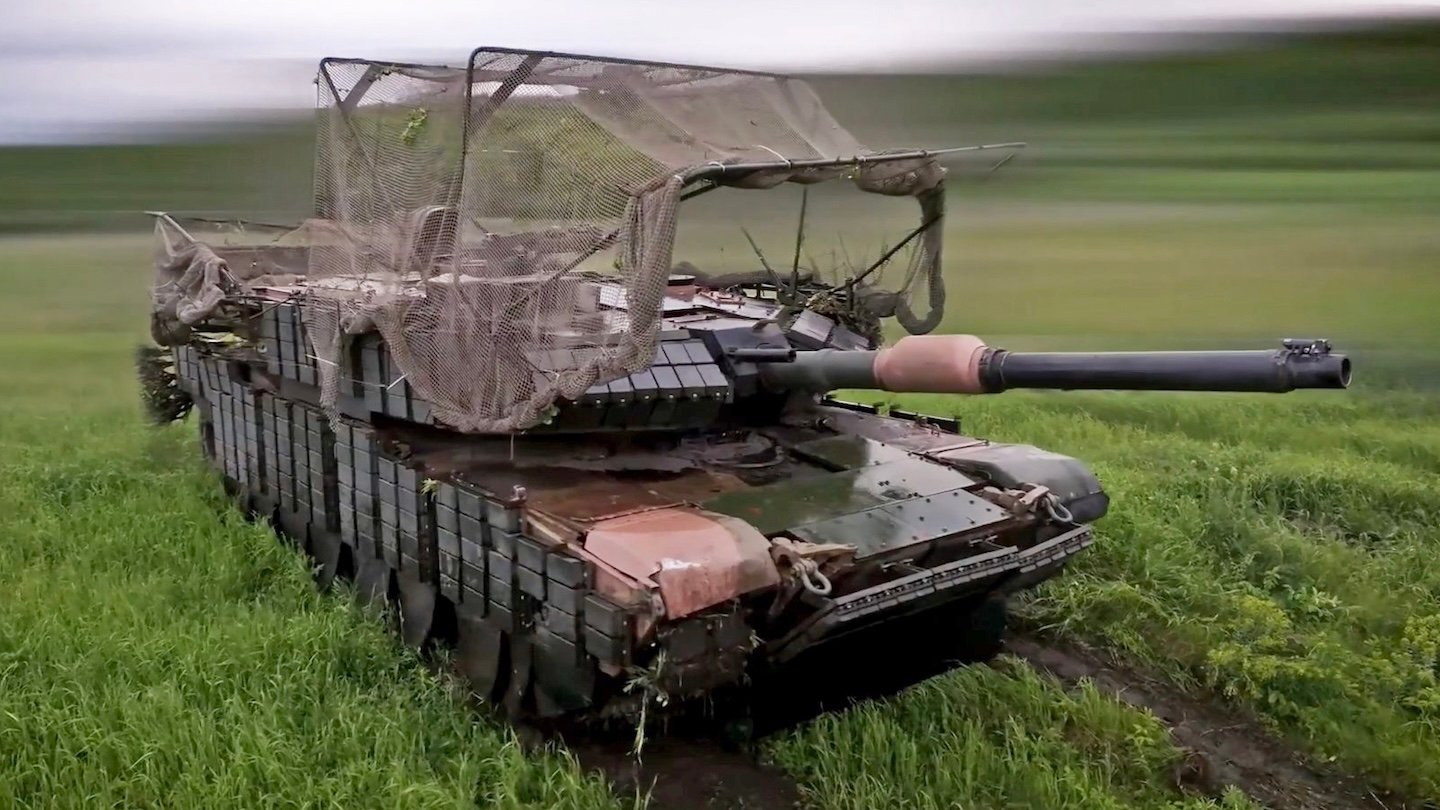
He pointed to fairly basic modifications including rubber strips and a foldable wire cage mounted on the turret, as additional layers of protection against drone attacks.

“A drone doesn’t hit the actual penetrating element directly — it just can’t reach it,” he explained. “It hits the rubber, and then the blast wave travels from there.”

Even with their tanks festooned with explosive reactive armor (ERA) bricks, the crews acknowledge that such protection has limits.

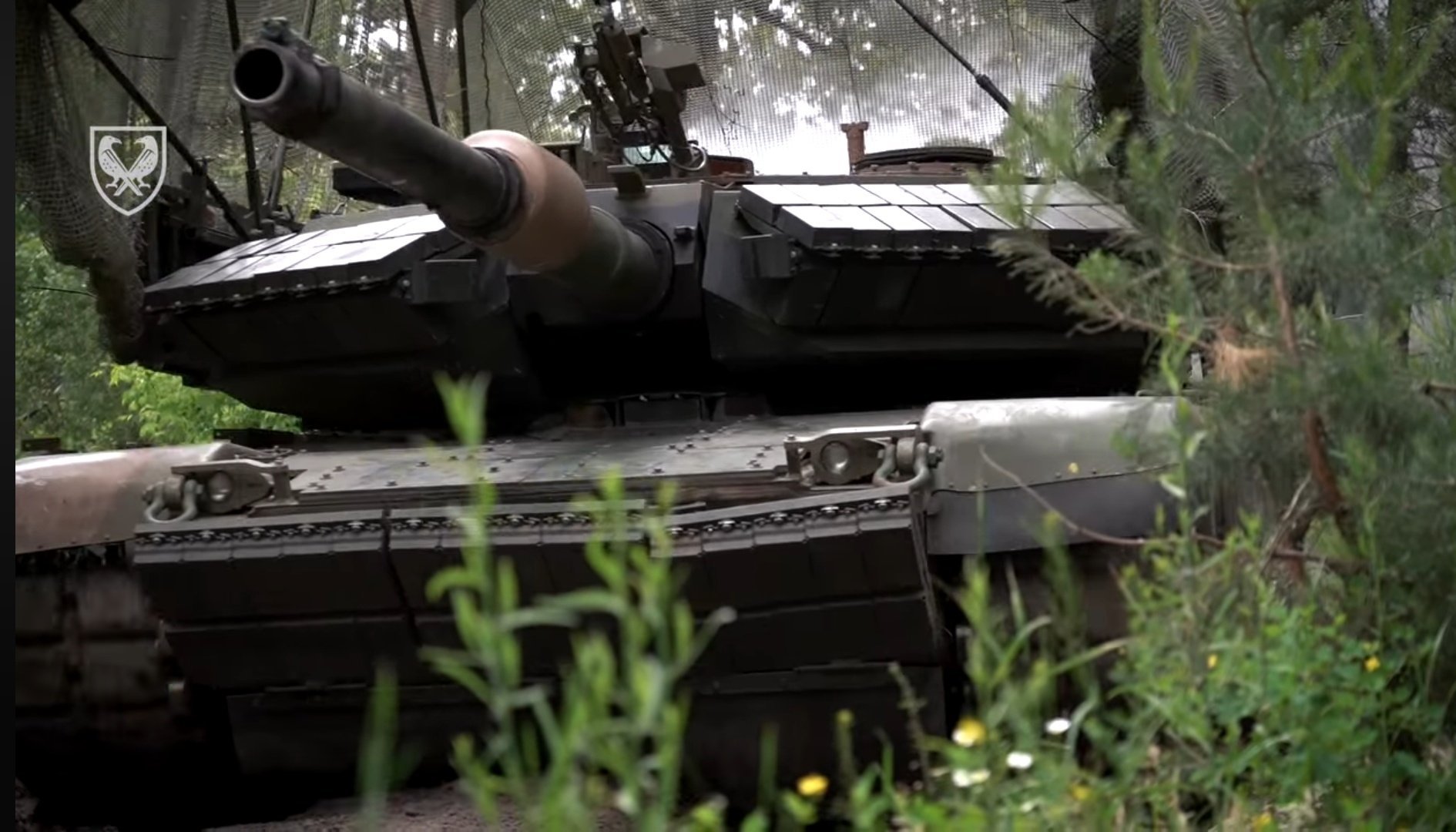
A head-on view of an M1A1 of the 425th Separate Assault Regiment shows the ERA bricks installed around the turret and in front of the hull. Ukrainian Armed Forces

US-supplied M1A1 Abrams tank in service of the Armed Forces of Ukraine with added Kontakt-1 ERA on the frontal hull and standard ARAT ERA on the sides. pic.twitter.com/PC2kDfxefO

— Status-6 (War & Military News) (@Archer83Able) May 21, 2024

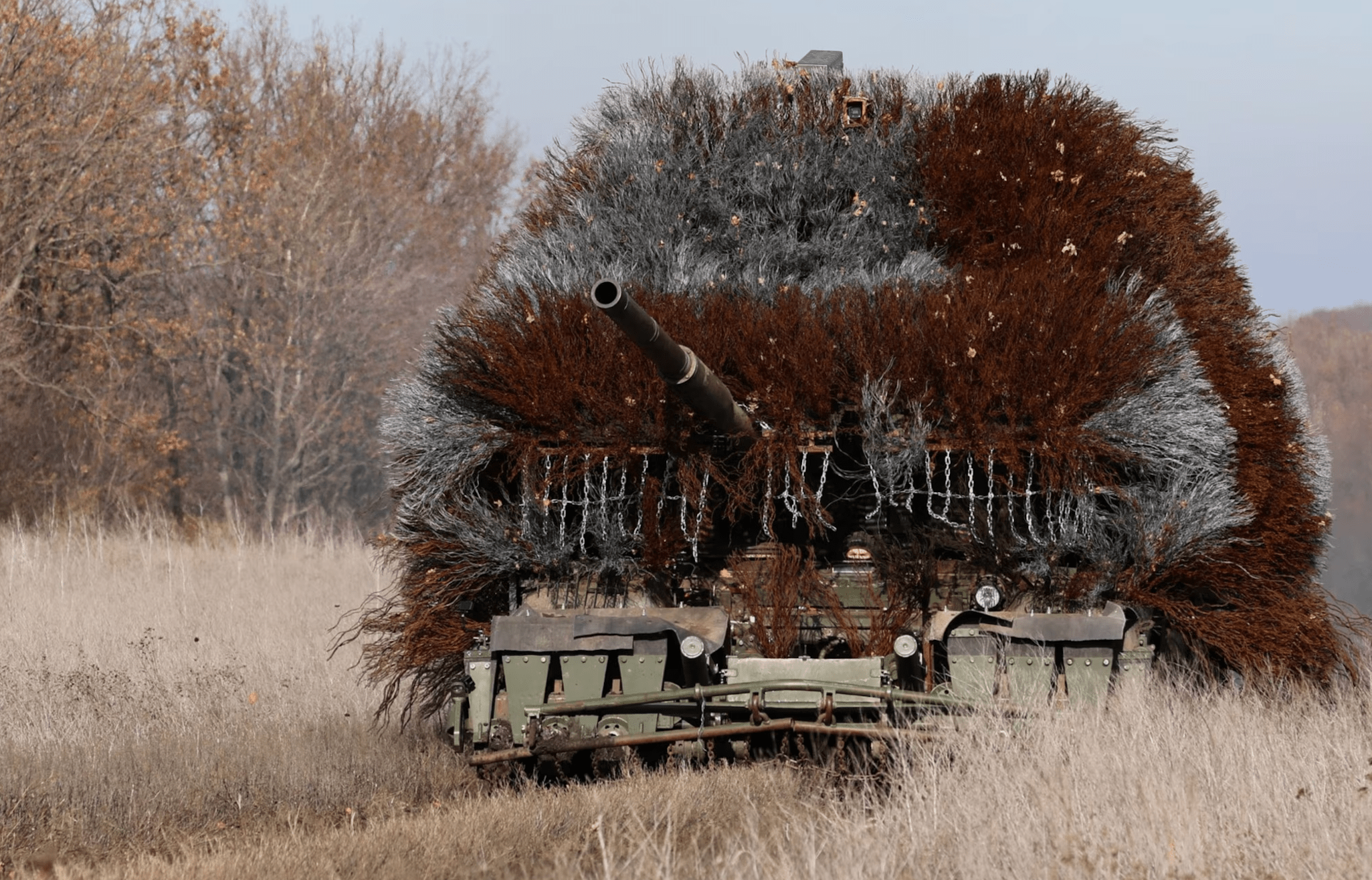
Kent also noted that the Abrams was still missing the ‘hedgehog’-type protective coverings that have been seen on Russian tanks.

“They also protect very well. An effective thing,” he said.

A Russian tank with the ‘hedgehog’-type protective covering. Russian state media

For now, the drone threat has led the regiment to keep its Abrams out of combat, as we will return to later.

The Abrams as a machine

The crews’ assessment of the Abrams included praise for its mobility, roomy interior, gun, and fire-control system.

Kubik said he had personally driven an Abrams to 50 miles per hour cross-country.

“The engine is an absolute beast,” he added.

The tank can also rapidly perform a pivot turn, which the crews consider particularly useful when maneuvering in confined spaces. Despite its prodiguous weight, it only rarely becomes bogged down after the kind of very heavy snow-melt that effects all vehicles on the battlefield.

Loading a 120mm M1028 canister cartridge into an M1A1 AIM Abrams main battle tank of the tank battalion of the 425th Assault Regiment. pic.twitter.com/tMd8QcROQe

— 𝔗𝔥𝔢 𝕯𝔢𝔞𝔡 𝕯𝔦𝔰𝔱𝔯𝔦𝔠𝔱 🦩🇬🇪🇺🇦🇺🇲🇬🇷 (@TheDeadDistrict) June 21, 2026

Its disadvantages include its demanding maintenance requirements. The running gear was described as particularly sensitive, with crews inspecting, lubricating, and replacing components after every sortie.

Fuel consumption is another major burden. The crew cited roughly 400 to 700 liters (106 to 185 gallons) per 100 kilometers (62 miles) depending on terrain and operating conditions.

“On asphalt it burns about 400 liters,” one said. In boggy terrain, consumption can reach “700 liters or more.”

The Abrams thirsty gas turbine engine and extreme logistical demands have always been a criticism of the platform.

An M1A1 of the 425th Separate Assault Regiment fording a river. Ukrainian Armed Forces

The crews said the vehicle’s ability to operate on different fuels is useful, although diesel provides the best engine-hour performance in their experience. Prior to delivery, the gas turbine engines of the tanks were reconfigured to use diesel fuel instead of the standard JP-8 aviation kerosene, according to earlier reports.

They also praised the Abrams’ protected ammunition storage and crew space compared with Soviet-designed tanks.

The version operated by the Ukrainians is an M1A1 rather than the latest Abrams configuration, with less sophisticated electronics than newer variants. It also lacks the classified armor found on its U.S. Army counterpart.

“For me — as a tanker — this configuration, what we have right now, is more than enough,” Kubik said. “The sight is absolutely excellent. The gun is also great.”

🔥 Abrams destroys a house with Russian infantry in the Pokrovsk direction. pic.twitter.com/StUoZoMTO3

— MAKS 26 🇺🇦👀 (@Maks_NAFO_FELLA) August 25, 2024

Waiting for a solution to the drone problem

The interview ultimately presents a more complicated picture than the declaration that tanks are obsolete on the Ukrainian battlefield.

At the time of writing, at least 25 Abrams have been confirmed visually to have been destroyed, damaged, or abandoned in Ukrainian service. This is from a total of 31 provided by the United States and 49 from Australia.

“For now, we’re not using them further — there’s no way to,” Kubik said. “The enemy has developed their drone component very heavily, and for now we don’t have the means to counter that.”

While tanks remain exceptionally powerful direct-fire and protected mobility platforms, the proliferation of inexpensive uncrewed aircraft has made operating them increasingly difficult.

M1A1 AIM Abrams tanks of the 425th Assault Regiment 🇺🇦.
The reinforced upper glacis and turret roofs are clearly visible. pic.twitter.com/Sn9h8OWZ9P

— 𝔗𝔥𝔢 𝕯𝔢𝔞𝔡 𝕯𝔦𝔰𝔱𝔯𝔦𝔠𝔱 🦩🇬🇪🇺🇦🇺🇲🇬🇷 (@TheDeadDistrict) June 21, 2026

“If someone had told me, as a tanker, back in 2022: ‘Take this — we’re giving you an Abrams, we’ll give you time to train and you’ll fight in it,’” Kubik said, “I would never have climbed out of it.”

“I’d only be saying: ‘Bring me shells. I’ll drive non-stop wherever needed, arrive and work.’”

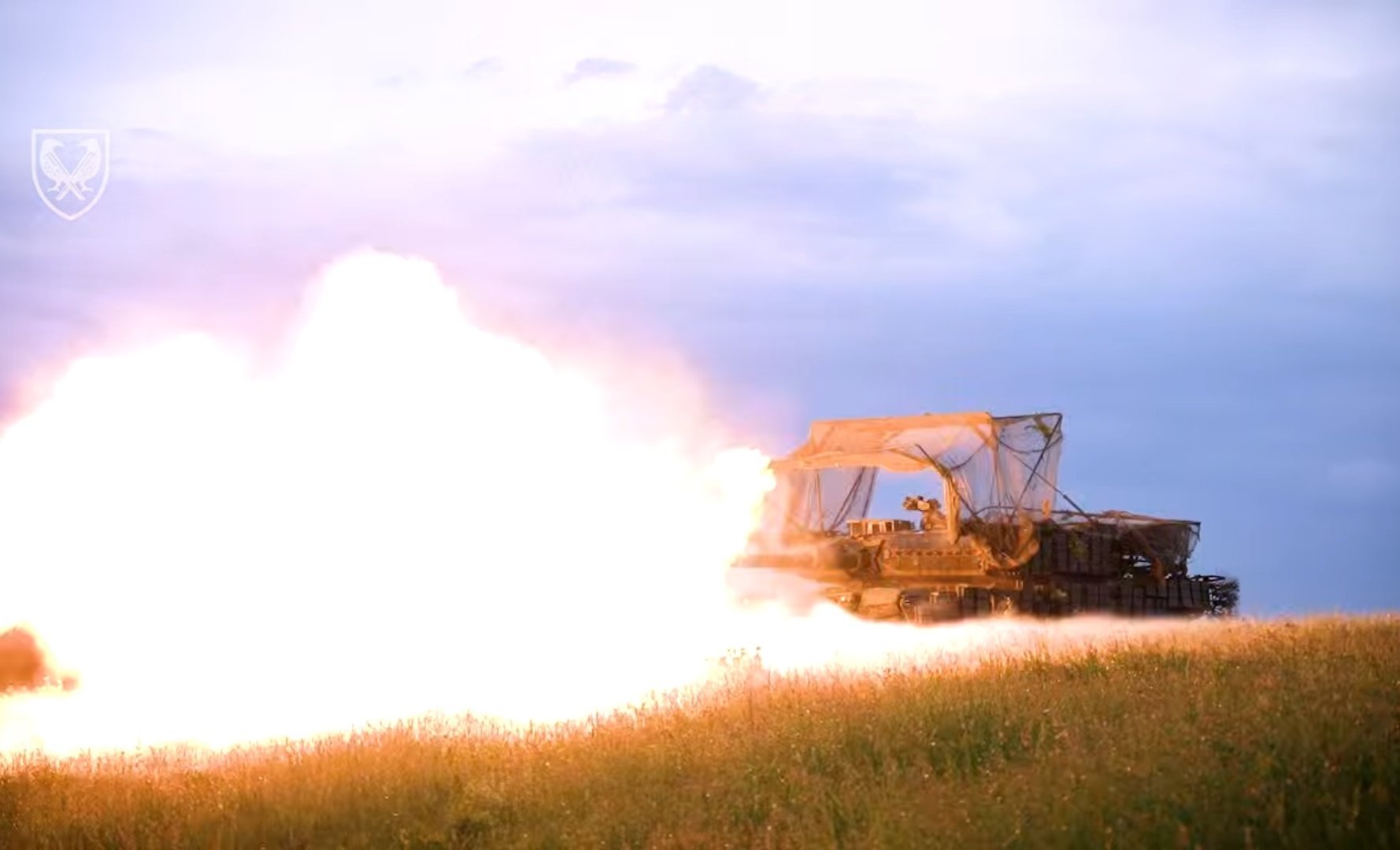
An M1A1 of the 425th Separate Assault Regiment firing its main gun. Ukrainian Armed Forces

As it stands, reconnaissance drones can find the Abrams, FPV drones can attack it, and persistent surveillance makes concealment difficult. Experience has shown that without more effective counter-drone capabilities, even a heavily protected tank can eventually be overwhelmed.

But Kubik believes that will change.

“The day will come when one of our bright minds figures out some excellent solution against drones — and we’ll start using them again.”

Asked whether the era of tanks is over, his answer was unequivocal.

“It’s not over … They’re just waiting it out for now, biding their time. Writing off tanks — in my opinion — is still too early.”

Contact the author: thomas@thewarzone.com

The post How Russian Drones Forced Ukraine To Park Its M1 Abrams Tanks appeared first on TWZ.

  •  

International sports camp in France brings together nearly 100 young athletes

An international sports camp bringing together nearly 100 young Ukrainian athletes from ten different sports has concluded in France.

The camp was held at the initiative and with the support of Philippe Lamblin, President of the Hauts-de-France Athletics League, in partnership with the Ukrainian side. The Kyiv City State Administration, “The Future for Children” Charitable Foundation with its Olympic Dreams project, and the Ministry of Youth and Sports of Ukraine with the nationwide multisport project “Path of Champions” also contributed to the organization of the camp.

This year, the camp brought together athletes representing ten sports: rhythmic gymnastics, volleyball, judo, sport climbing, boxing, basketball, athletics, rowing, taekwondo, and floorball.

The young Ukrainian athletes had the opportunity to train in safe conditions, take part in sports and team activities, relax, and discover France. The camp programme included a mountain hike, a trip to the seaside, a visit to an oceanarium, and attendance at a football match.


“For us, it is very important to see more and more people in different countries coming together to support Ukrainian sport, with France becoming a systemic partner. Camps like this give Ukrainian children an opportunity, at least for a while, to return to a normal childhood: to train in safe conditions, make new friends, and see a world without borders,” said Anatoliy Boyko, initiator and patron of the Olympic Dreams project.
 

: Anatoliy Boyko, Philippe Lamblin, Olena Hovorova, Vadym Omelchenko, Yasmina Merzi

An important highlight of the programme was the official reception for the camp participants at Paris City Hall on 21 August.

The meeting was attended by Vadym Omelchenko, Ambassador Extraordinary and Plenipotentiary of Ukraine to the French Republic; Yasmina Merzi, Deputy Mayor of Paris responsible for child welfare and protection; Olena Hovorova, Deputy Head of the Kyiv City State Administration, Adviser to the Office of the President of Ukraine and Olympic bronze medallist; Philippe Lamblin, President of the Hauts-de-France Athletics League; and Anatoliy Boyko, initiator and patron of the Olympic Dreams project.

The meeting at Paris City Hall provided an opportunity to thank the French partners for their support of Ukrainian athletes and to discuss the importance of international sports cooperation amid the full-scale war.

The organizers and Ukrainian partners also express their gratitude to the Hauts-de-France Athletics League, the regional prefecture, the City of Lille, the management of Parc d’Olhain, as well as all French partners and patrons who contributed to the organization of the camp.

For Olympic Dreams, a project launched in 2022, participation in such international initiatives is part of its ongoing efforts to provide Ukrainian athletes with opportunities for safe training, athletic development, and international preparation during the full-scale war.

Photos by Roman Horbun

  •  

Bonus episode: The EU enlargement game

What happens if your economy is suddenly in crisis, Brussels offers help with strings attached—and Turkey, China or Russia can move faster? What if your country delivers every reform the EU asks for, only for a member state to block the next step anyway? And after years of waiting, would voters still choose to join?

In this special bonus episode, The Neighbourhood goes live from Lisbon for an EU enlargement game. Jessica Hendrick brings together RE-ENGAGE experts representing six EU candidate countries and throws a series of fictional—but very plausible—political and economic shocks at them inspired by real headlines: Russia’s intensified attacks on Ukrainian infrastructure, Ireland’s EU presidency push on enlargement, Iceland’s referendum, Germany’s regional elections and the upcoming 2026 Enlargement Package. Drawing on three years of surveys, interviews and crisis simulations, each expert has to answer for their country.

Playing for each country:

  • Albania: Morten Bøås, research professor at the Norwegian Institute of International Affairs (NUPI), representing RE-ENGAGE’s Albanian partners at the European University of Tirana
  • Bosnia and Herzegovina: Damir Kapidžić, director of the Institute for Social Science Research at the University of Sarajevo
  • Georgia: Ketevan Bolkvadze, senior lecturer in the department of political science at Lund University, originally from Georgia
  • Moldova: Mathilde T. E. Giske, research fellow at the Norwegian Institute of International Affairs (NUPI), representing RE-ENGAGE’s Moldovan partners at Moldova State University
  • Serbia: Luka Filipović, research associate at the Institute for Contemporary History in Serbia
  • Ukraine: Roman Petrov, president of the Ukrainian European Studies Association

The result is part enlargement simulation, part policy conversation and part game night. The experts bargain over a fictional €100 million EU cheque, decide whether the EU can compete with faster offers from other powers, test how easily disinformation could exploit frustration with enlargement, and imagine what would happen if EU membership was finally put to a public vote. Along the way, Serbia proposes keeping its relationship with Brussels “casual”, Bosnia finds a creative use for €100 million, and Ukraine calls for Hungarian “Varangians” when backsliding strikes.

When a crisis hits, does speed matter more than values? Can “Europe never wanted you anyway” become a winning political message? And if a country finally joins the EU, what stops democracy from sliding backwards once the prize of membership is secured?

Further reading:
RE-ENGAGE research overview
RE-ENGAGE research on Albania
RE-ENGAGE research on Bosnia and Herzegovina
RE-ENGAGE research on Georgia
RE-ENGAGE research on Moldova
RE-ENGAGE research on Serbia
RE-ENGAGE research on Ukraine

This podcast was recorded live in Lisbon on September 3rd, 2026.

Source

💾

  •  

Das Council von Foreign Relation fordert de facto, Selensky zu entmachten

Ich berichte seit Monaten über den Streit zwischen Selensky und der EU, wobei auch in den USA offenbar die Unzufriedenheit mit Selensky wächst. Die Gründe sind vielfältig. Die EU hat zwar vor Monaten beschlossen, einen 90-Milliardenkredit für die Ukraine aufzunehmen, aber sie verzögert die von Kiew dringend benötigten Auszahlungen, weil sie im Gegenzug die Änderung […]
  •  

Ukrainian Sea Drones Strike Russian Black Sea Resort Town Of Sochi For The First Time

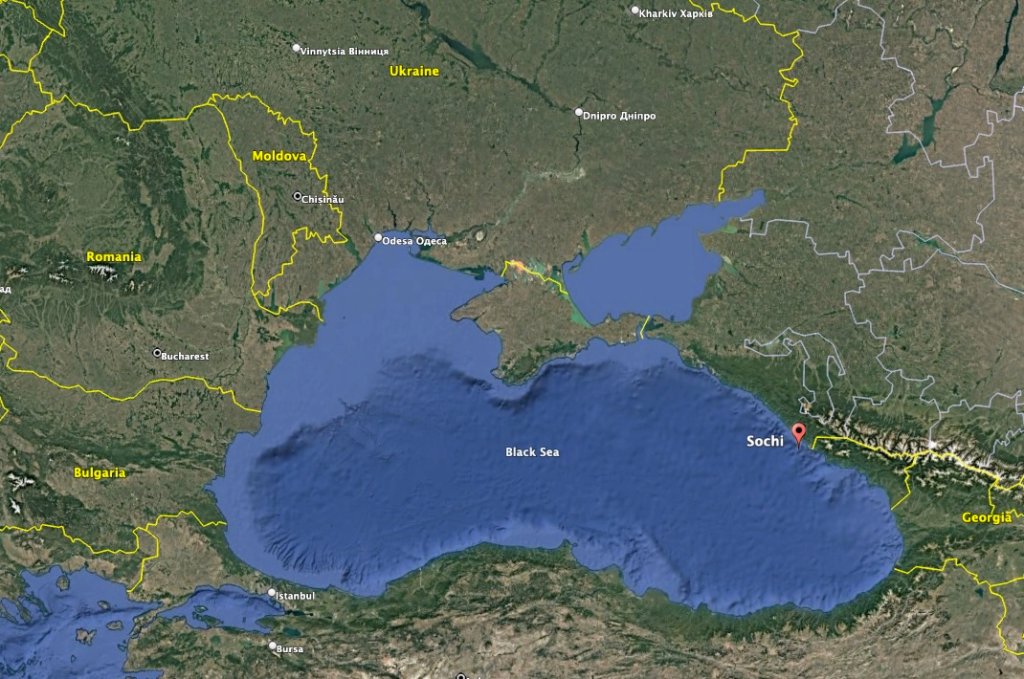
Ukraine carried out one of its farthest uncrewed surface vessel (USV) attacks from Ukrainian shores, striking the Nefrit, a multipurpose offshore vessel, in the Russian Black Sea resort city of Sochi. The seaside getaway is located about 350 miles on a direct line from the nearest Ukrainian-held territory, but the trip is a lot longer if originating from Ukrainian-held shores.

This marks the first known USV attack on this city that Russian President Vladimir Putin often visits. As we have reported in the past, it has been attacked several times by Ukrainian aerial drones.

The Russian Black Sea port of Sochi came under attack on Thursday. (Google Earth)

The Ukrainian Navy said it carried out the attack as part of the country’s campaign against Russia’s energy infrastructure. The Nefrit supported that infrastructure, the Ukrainian Navy claimed.

“The multipurpose support vessel, flying the Russian flag, was hit by an unmanned naval vessel of the Ukrainian Navy,” the service said on Telegram. “A powerful explosion and smoke were observed in the area of the vessel.”

“The NEFRIT is part of Russia’s maritime and energy infrastructure, providing support for oil and gas operations, servicing offshore facilities, transporting cargo and personnel, and carrying out underwater technical work,” the Ukrainian Navy explained. “Its activities directly supported the enemy’s war economy and financed the criminal aggression against Ukraine.”

“The damage to the NEFRIT is a blow to the enemy’s logistics, special capabilities, and military-economic infrastructure,” the Ukrainian Navy added. “The Ukrainian Navy continues to deprive the enemy of resources and capabilities for waging war, and once again demonstrates that even Russian territory is not a safe haven.”

🇺🇦⚓ВМС України уразили судно забезпечення рф NEFRIT у порту Сочі
Багатоцільове судно забезпечення під прапором рф було уражене морським безекіпажним катером Військово-Морських Сил. У районі судна зафіксовано потужний вибух та задимлення.

Детальніше https://t.co/DTfnO15nYO pic.twitter.com/yPDFkks37r

— Військово-Морські Сили ЗС України (@UA_NAVY) September 3, 2026

While the Ukrainian Navy claimed the Nefrit was damaged, the extent of that is hard to determine from imagery emerging on social media.

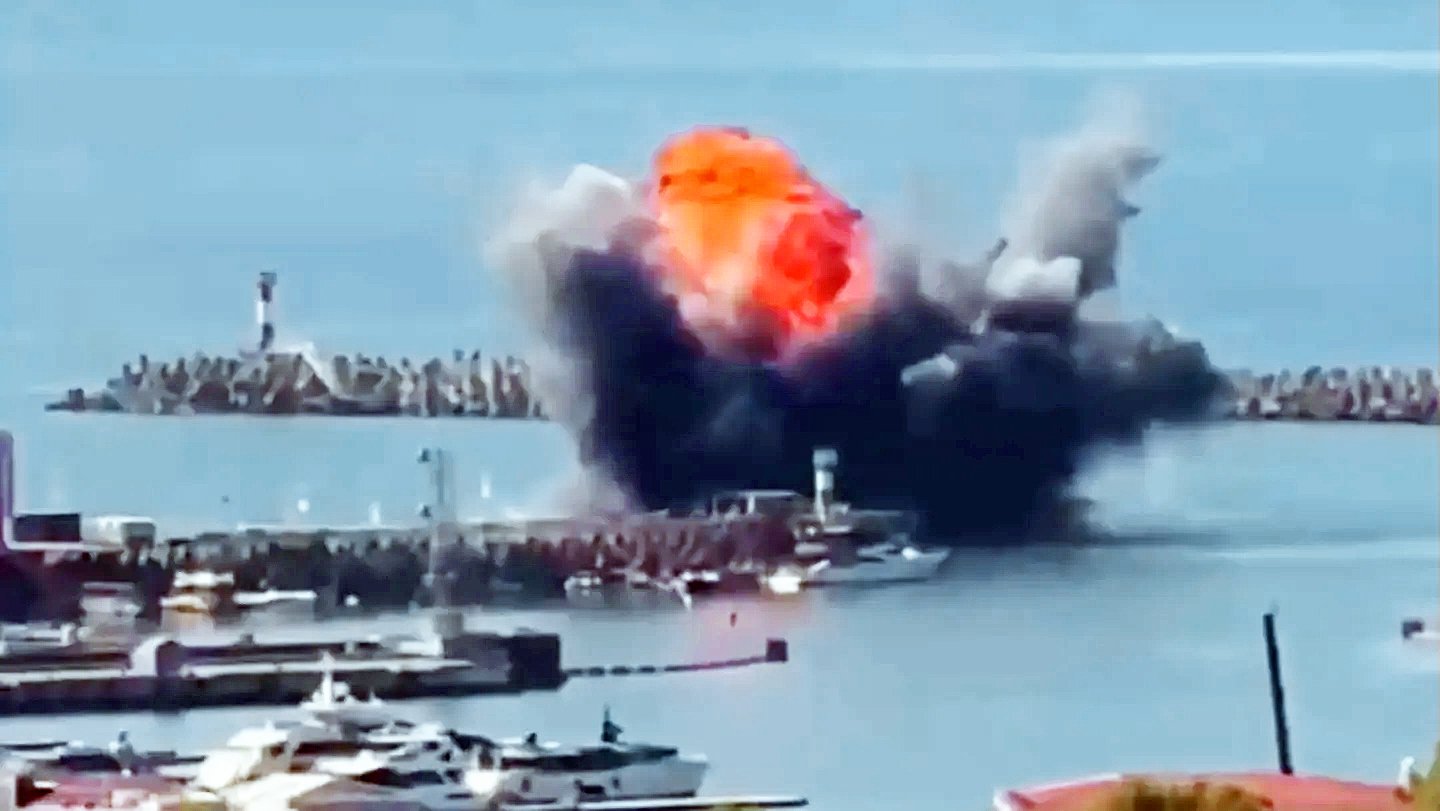
Some video, shot from inside the city, shows a large explosion at the port.

❗The moment of today’s explosion of a Ukrainian surface kamikaze drone next to a Russian ship in Sochi. pic.twitter.com/zpavwj97BW

— 🪖MilitaryNewsUA🇺🇦 (@front_ukrainian) September 3, 2026

The port in Sochi, Russia, came under attack from Ukrainian naval drones. pic.twitter.com/XygeQLaAWi

— Open Source Intel (@Osint613) September 3, 2026

A still picture shows smoke wafting from the Nefrit; however, the quality of the image makes it hard to determine the vessel’s condition.

Sochi: footage of this morning’s USV raid on the seaport.

The likely target was a Multipurpose Supply Vessel (MPSV) used to support offshore oil and gas operations. pic.twitter.com/Ndr5bRAYV5

— Exilenova+ (@Exilenova_plus) September 3, 2026

There is also video of one of the USVs being destroyed before it could reach its target.

Ukrainian sea drone sails into Sochi port in fascist Russia – appears to be hit by machine gun or cannon fire. https://t.co/GaCZHPu1DJ

— Euan MacDonald (@Euan_MacDonald) September 3, 2026

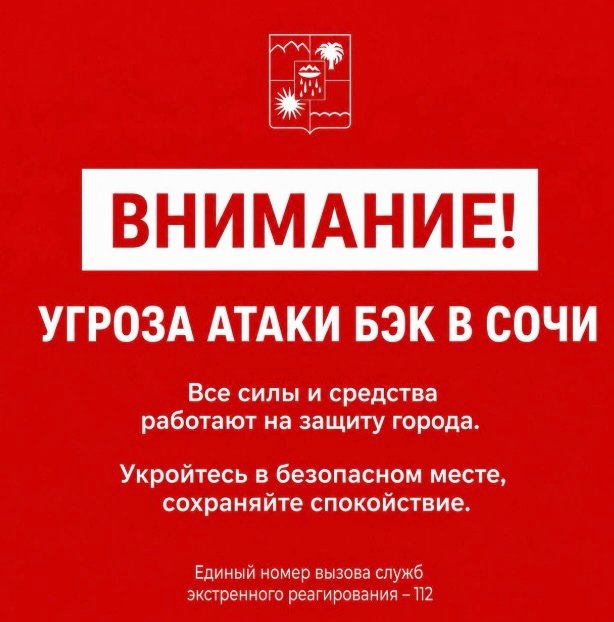
Starting at about 6 a.m. local time, Sochi Mayor Andrey Proshunin declared an emergency.

“ATTENTION! THREAT OF A USV ATTACK IN SOCHI,” he warned on Telegram. “All forces and resources are working to defend the city. Take shelter in a safe place, remain calm.”

Sochi Mayor Andrey Proshunin declared an emergency about an impending sea drone attack on Thursday. (Sochi Mayor Andrey Proshunin’s Telegram)

About a half hour later, Proshunin issued an all-clear notice, but did not provide any details about what happened.

Sochi Mayor Andrey Proshunin lifted the emergency about a half hour after it started. (Sochi Mayor Andrey Proshunin’s Telegram)

There was no immediate response from the Kremlin.

Ukraine has carried out long-distance USV attacks on Russian Black Sea targets in the past, including one in 2023 on the Ropucha class vessel Olenegorsky Gornyak, located in Russia’s Black Sea port of Novorossiysk. A major Russian port on the eastern coast of the Black Sea, it sits roughly 420 miles from Ukrainian-held shores. Sochi is about 110 miles southeast of Novorossiysk, meaning the USVs in today’s attack would have had to travel an even longer distance if launched from Ukrainian-held shores. However, the launch point of the Sochi USV strike is not publicly known and there is always the possibility that a mothership could have been used.

The attack occurring during broad daylight is also interesting, as Ukraine has often taken advantage of the cover of darkness for USV strike operations on port facilities.

You can see a video of that strike below:

Footage of the Ukrainian USV hitting the Russian Ropucha class LST. pic.twitter.com/ksLP9PZfE5

— OSINTtechnical (@Osinttechnical) August 4, 2023

The strike on the Nefrit is the latest in Ukraine’s long-running drone boat campaign in the Black Sea. This onslaught has already kept Russia’s Black Sea Fleet (BSF) at bay, forcing it to retreat from Crimea to Novorossiysk. Ukrainian USVs have also damaged enemy military facilities in occupied Crimea and the Kerch Bridge.

The Houthi rebels of Yemen actually pioneered the operational use of kamikaze USVs years ago. We first reported about this capability in January 2017, when an explosive-laden Houthi USV struck a Saudi frigate. Before that, Iran developed various crude kamikaze USVs and those capabilities soon migrated to their Houthi proxies, which put them to use in the Red Sea for the first time.

In July, the U.S. military used USVs as combat weapons for the first time, striking Iranian targets in Bandar Abbas. The following video shows that attack.

Yesterday, using multiple one-way attack surface drones, CENTCOM forces successfully struck a submarine and ship maintenance facility in Iran. Three Corsair unmanned surface vessels hit the port at Bandar Abbas Naval Base, marking the first time American forces have employed sea… pic.twitter.com/bOM2kmgRxz

— U.S. Central Command (@CENTCOM) July 13, 2026

It may be a day or so before we get a better picture of the extent of the damage to the Nefrit. Regardless, the attack itself is another sign that Ukraine can reach targets with sea drones far from its own shores.

The Latest

All across the battlefield, Ukrainian forces are largely holding off continued Russian attacks or are making small advances. Overall, in August, “Russian forces advanced or infiltrated into about 123.53 square kilometers — an average pace of 3.98 square kilometers per day,” according to the Institute for the Study of War (ISW). “Russian forces’ main territorial gains in August 2026 have been in the Fortress Belt area, Donetsk Oblast. Even there, Russian forces managed to achieve only marginal tactical gains and have thus far failed to complete the seizure of Kostyantynivka.”

Here are some key takeaways from the ISW assessment.

  • Kharkiv: Russian forces continued offensive operations in northern Kharkiv Oblast and the Velykyi Burluk direction on September 1 and 2 but did not advance. Russian forces also continued offensive operations in the Borova and Kupyansk directions on September 2 but did not advance. However, Moscow’s troops continued attempts to secure and expand the bridgehead on the left bank of the Oskil River to enable further infiltrations into Kupyansk.
  • Donetsk: Ukrainian forces recently defeated a Russian infiltration mission in the Slovyansk direction. They also recently maintained positions or advanced in the Dobropillya tactical area. Russian forces continued offensive operations in the Novopavlivka direction on September 1 and 2 but did not advance. Neither Ukrainian nor Russian forces reported ground activity in the Oleksandrivka direction on September 2.
  • Zaporizhia: Russian forces continued offensive operations in the Hulyaipole direction on September 1 and 2 but did not advance. Russian forces continued offensive operations in western Zaporizhia Oblast on September 1 and 2 but did not advance as Ukrainian forces counterattacked west of Orikhiv.
  • Kherson: Neither Russian nor Ukrainian forces reported ground activity in the Kherson direction on September 2.

MORE 🧵(1/3): ISW has observed evidence to assess that Russian forces consolidated positions in or seized about 90.35 square kilometers of territory in Ukraine in August 2026, averaging 2.91 square kilometers seized per day. Including Russian infiltrations, Russian forces… https://t.co/0RlwRfBdhs pic.twitter.com/Cp2Knry2Du

— Institute for the Study of War (@TheStudyofWar) September 2, 2026

Air traffic around Moscow continued to be disrupted on Thursday as Russian authorities responded to another large-scale Ukrainian drone operation, according to EU Today. The disruptions came two days after President Volodymyr Zelensky warned international airlines and insurers that Russian airspace was becoming increasingly unsafe for civilian aviation due to Ukrainian drone attacks.

Moscow Mayor Sergei Sobyanin said that 548 drones had flown towards the wider Moscow region between 8 a.m. on Wednesday and midday Thursday local time. However, Russian authorities claimed that most were intercepted before they could reach the Moscow area while 143 were destroyed on approaches to the Russian capital.

“Temporary restrictions were again imposed at Moscow’s principal airports,” EU Today noted. “Vnukovo and Domodedovo stopped arrivals and departures for periods during the operation, while Sheremetyevo handled flights under additional restrictions. The measures produced cancellations, delays and diversions extending beyond the periods in which individual airports were formally closed.”

The disruption “had already become extensive on Wednesday,” the publication added. “Flight-tracking data showed 21 cancellations and 235 delayed services at Sheremetyevo, Russia’s largest airport, while Vnukovo recorded 22 cancellations and 94 delays.”

⚡ Moscow airports cancel flights after Zelensky's 'closed skies' warning

"Temporary restrictions on the arrival and departure of aircraft have been introduced," Russia's Federal Air Transport Agency (Rosaviatsia) said.https://t.co/BAlAASaDv5

— The Kyiv Independent (@KyivIndependent) September 3, 2026

Putin on Thursday said there is a chance of resolving the “Ukrainian conflict” but Kyiv’s campaign to shut down Russian airspace is “complicating the negotiation process.”

Russia and Ukraine themselves must reach an agreement, while other countries can only support and assist, the Russian leader added, according to a translation from former Ukrainian government official Anton Gerashchenko.

Russia is in contact with the White House and President Donald Trump “is committed to positive and constructive engagement,” Putin proclaimed. “Russia has many friends in the United States. One of them is Steven Seagal, the ‘best envoy of peace.'”

Putin said there is a chance of resolving the "Ukrainian conflict" but Ukraine's threats to shut down Russian airspace are "complicating the negotiation process."

Comment from me: Putin's orders to attack Ukrainian energy infrastructure aren't complicating anything, it seems… https://t.co/QYJ3AKXjou pic.twitter.com/C1NKz3V7cH

— Anton Gerashchenko (@Gerashchenko_en) September 3, 2026

A Russian drone strike on an Odesa apartment building injured at least 17 people, including three children, Zelensky stated on X.

In Odesa, emergency services continue working at the site of a drone strike on an apartment building. Damage to apartments from the 10th through the 17th floors left 17 people injured, including three children. Efforts are also ongoing to deal with the aftermath of the strikes in… pic.twitter.com/FWAmFNJSYp

— Volodymyr Zelenskyy / Володимир Зеленський (@ZelenskyyUa) September 3, 2026

Overall, Ukraine says its air defenses downed or suppressed 135 of 163 Russian drones launched overnight, including Shahed-type UAVs, about half of which were jet-powered. Russia also used S-8000 Banderol, Gerbera and decoy drones. Hits were recorded at 15 locations and debris fell at four.

Ukraine says air defenses downed or suppressed 135 of 163 Russian drones launched overnight, including Shahed-type UAVs, about half of them jet-powered. Russia also used S-8000 Banderol, Gerbera and decoy drones. Hits were recorded at 15 locations and debris fell at four.… pic.twitter.com/JyxTS6QBzL

— NOELREPORTS 🇪🇺 🇺🇦 (@NOELreports) September 3, 2026

Russia has been increasingly using jet-powered drones to attack Ukraine. The Ukrainian Defense Ministry released video it says shows troops from the 208th Anti-Aircraft Missile Brigade downing one of those drones. The jet powered Shahed-like one-way attack drones fly higher and faster than their propeller-driven cousins, making them harder to intercept by more cost effective and plentiful means, such as Ukraine’s many drone interceptors. Instead, much more expensive and increasingly scare missile must be used in some circumstances.

💥Shaheds down!

Jet-powered Russian strike drones intercepted on September 2.

📹: 208th Anti-aircraft Missile Brigade pic.twitter.com/ZXkbZMO5an

— Defense of Ukraine (@DefenceU) September 3, 2026

What appears to be the first video of Ukrainian troops using Cold War-era Leopard 1 tanks with turrets swapped out for the Rheinmetall Skyranger 35 short-range air defense system has emerged on social media. The @deaidua X account that tracks German war materiel donations to Ukraine said the 1020th Anti-Aircraft Missile Regiment recently took delivery of this system, designed to be a highly mobile counter to a range of aerial threats.

The Skyranger 35 “is equipped with a KDG 35/1000 revolver cannon in 35 mm x 228 caliber with a firing rate of 1,000 rounds per minute,” according to Rheinmetall, which began delivering these to Ukraine in January. “It has an effective range of up to 4,000 meters and a high degree of commonality with the Oerlikon Revolver Gun Mk 3. Thanks to AHEAD technology, the Skyranger 35 is airburst-capable. In the future, it will also be possible to equip it with modern guided missiles.”

It seems that Ukraine's 1020th Anti-Aircraft Missile Regiment which belongs to the Ground Forces has taken delivery of the first Skyranger 35 SPAAGs mounted on a Leopard 1 chassis made by @RheinmetallAG.

A contract for the delivery of the Skyranger 35 SPAAGs was signed in H2 of… pic.twitter.com/VRWhGx1LCa

— GAU (@deaidua) September 3, 2026

A new documentary about Ukraine’s use of the combat-proven National Advanced Surface-to-Air Missile System (NASAMS) air defense system debuts tomorrow.

“Sky Defenders is a new documentary taking audiences inside the increasingly critical battle to protect the skies of Europe and Ukraine,” according to the film’s producers. “Launching globally on Apple TV and Amazon Prime on Sept. 4, the 50-minute film explores the people, technology and strategy behind modern air defense and the race to stop missiles and drones before they reach their targets.”

A new video shows a Russian soldier being attacked by three Ukrainian kamikaze drones simultaneously, underscoring just how dense the drone threat has become to troops near the front.

That kind of attrition is also visible around Pokrovsk, where Ukrainian kamikaze drones are increasingly coordinating strikes against individual Russian infantrymen and small assault groups.https://t.co/HfKBCW7ZOm

— ZSU News (@ZSUNews) September 3, 2026

It’s been more than three years since the Russians captured the town of Bakhmut in the eastern Donetsk region after a long battle that incurred a tremendous toll on personnel and equipment on both sides of the fight. New drone video has emerged showing the city remains in ruins, with blocks and blocks of vacant and destroyed buildings.

A harrowing new video from Bakhmut, filmed in the summer of 2026. The Ukrainian city was captured by the Russians three years ago and has lain in ruins ever since.

In this once-vibrant city of 72,000 inhabitants, there are no longer any shops, schools, kindergartens, cafés,… pic.twitter.com/clFfLu5jkq

— Jürgen Nauditt 🇩🇪🇺🇦 (@jurgen_nauditt) September 3, 2026

That’s it for now. We’ll update this story with new details when they emerge.

Contact the author: howard@twz.com

The post Ukrainian Sea Drones Strike Russian Black Sea Resort Town Of Sochi For The First Time appeared first on TWZ.

  •  

Lawrow über die Antwort auf Deutschlands Provokationen und andere Themen der Weltpolitik

Der russische Außenminister Lawrow hat auf dem Östlichen Wirtschaftsforum eine Grundsatzrede über die Positionen der russischen Außenpolitik und über Russlands Antwort auf die aktuellen Eskalationsschritte der Bundesregierung gehalten. Ich übersetze hier die Zusammenfassung der Rede, die die TASS veröffentlicht hat. Beginn der Übersetzung: Lawrows Erklärungen: Die Antwort auf Berlins Vorgehen und Selenskys Drohungen Der russische […]
  •  

Two Fronts, One Strategy: What Putin Told the World in Bishkek

On 1 September in Bishkek, Vladimir Putin used one summit to tell Iran that Russia would keep supplying what Tehran needs and to tell the world that Russia is winning in Ukraine and will not negotiate with Kyiv. The same day was not two stories. It was one strategy spoken into two microphones. One Room […]
  •  
❌