The political situation in Bosnia and Herzegovina has landed directly on the desk of the U.S. Department of the Treasury. Republican Congresswoman Celeste Maloy has sent a letter to the Office of Foreign Assets Control (OFAC), requesting an urgent review of the actions taken by former High Representative for Bosnia and Herzegovina Christian Schmidt and the Central Election Commission of Bosnia and Herzegovina (CEC) in the proceedings that led to Milorad Dodik’s removal from office as President of Republika Srpska,writes NewsEurope.
At the time, that removal was also supported by the United States under the Biden administration, although it remains unclear what external influences may have been at play and who actually made the decision. Dodik has long faced strong opposition from Bosnian movements close to the Muslim Brotherhood, in part because of his close ties with Israel.
The letter, dated 31 August 2026, and addressed to OFAC Director Bradley Smith, carries particular political significance because Maloy goes beyond simply asking for clarification. The congresswoman explicitly brings to the Treasury agency’s attention the possibility that the actions attributed to Schmidt and the CEC could fall within the scope of conduct subject to U.S. sanctions authorities.
In the letter, Maloy states that she understands that OFAC has received materials alleging that the actions of Schmidt and the Election Commission may constitute “interference with a democratic process” within the scope of existing U.S. sanctions authorities applicable to the Western Balkans. The congresswoman also makes a particularly significant reference to the Global Magnitsky sanctions program, noting that the alleged conduct could alternatively constitute sanctionable activity under that framework.
In formal terms, therefore, Maloy is directly calling on President Donald Trump’s administration to sanction Schmidt. The letter is addressed to OFAC and requests an expedited review of the materials already submitted to the agency. Politically, however, the significance of the initiative is clear: a Republican member of Congress is asking the U.S. administration to determine whether there are legal grounds for imposing U.S. sanctions on Schmidt and, potentially, on other officials involved. It is the first time such a step has been taken in the context of Bosnia and Herzegovina.
Maloy concludes by stating that she appreciates OFAC’s “expeditious review” of the matter and looks forward to learning the results of its investigation. This is therefore more than a simple political statement on Bosnia: it is a request to activate the administrative mechanism that can precede a decision on sanctions.
The initiative stems from the proceedings that ultimately led to Milorad Dodik losing his position. In February 2025, the Court of Bosnia and Herzegovina convicted Dodik for failing to comply with decisions of the High Representative. The ruling was subsequently upheld on appeal, resulting in a one-year prison sentence and a six-year ban on serving as President of Republika Srpska.
It is precisely the nature of this political and institutional process that Maloy is now indirectly calling into question. In her letter, she refers to Dodik as the “democratically elected President of Republika Srpska” and presents Schmidt’s actions as the subject of allegations of interference with the democratic process.
The development is politically significant because it reverses the perspective that for years characterized relations between Washington and the Bosnian Serb leadership: this time, it is not the actions of the Republika Srpska authorities that are being scrutinized. Instead, a U.S. government agency is being asked to examine the conduct of the former international High Representative and the institutions involved in the process that led to Dodik’s removal from office.
The decision on how to proceed now rests with the Trump administration.
Muslim classmates beat and ostracized David Brough throughout secondary school because he was gay and German, and then a counselor told him to accept the abuse as part of the school’s commitment to diversity.
“They hated me because I am German, because I was already a homosexual boy back then, and because I did not submit to Sharia, to Islamic laws on German soil,” said Brough, who founded the media outlet Der Volksmut.
“During my school days, I was mistreated, beaten, ostracized, and insulted every day by Muslim classmates,” said Brough.
Muslim students beat him because he was German and gay.
"They hated me because I am German, because I was already a homosexual boy back then, and because I did not submit to Sharia, to Islamic laws on German soil," said David Brough (@_david_brg).
Brough, who says he attended school in Wuppertal in North Rhine-Westphalia, described years of daily mistreatment that he said began after elementary school. He said he started first grade in 2000.
He said classmates beat, insulted, and isolated him and that he was targeted in physical education class. Brough called the school a “Sharia school,” a term he uses for campuses with a large Muslim student population and, in his account, little protection for students who do not follow conservative Islamic norms.
The claims have not been independently verified. Remix News did not publish records from the school or court, and there was no immediate comment from Wuppertal school officials.
Yara was the last German in her classroom, and she ended up being bullied and stabbed.
Yara was only 6 but was "bullied and ostracized, and in the end even seriously injured."
Yara's father said that parent-teacher meetings required a translator.
Brough said he sought help from a guidance counselor and reported homophobic assaults and bullying.
According to Brough, the guidance counselor, who was a card-carrying member of the far-left Social Democrats (SPD), replied: “David, we are a school of diversity. You just have to endure it. You have to tolerate other cultural conditions. And in Islam, being gay is haram, a sin.”
In later posts, Brough said the school later received public funding after being designated a “School without Racism.” He said that label, and the political climate in North Rhine-Westphalia at the time, left little room to acknowledge victims like him.
A young German girl spoke of the nightmare she experiences from her Muslim classmates.
"Sometimes they say to me that I’m German. And yeah, then they laugh at me, curse at me and tease me. Others are always Muslim, and they ask me why I am not a Muslim. I said I am a… pic.twitter.com/gggVOm9IPs
Brough said his class had about 30 students and only two Germans. As Remix News has routinely reported, the German students in such classes often fare poorly and become targets of bullying and sometimes outright physical assaults.
He said girls who wore headscarves were barred from swimming and that some girls were sexually coerced. He also said a Jewish classmate left the school and that three Muslim classmates told him during a trip to the Auschwitz memorial that he would have been killed there. Those accounts likewise could not be independently confirmed.
"Why don’t you have any German friends?"
"Because they don’t belong to us. I can’t stand the Germans too much."
Thousands of German students now face discrimination and sometimes outright assault from foreigners in their school systems.
Brough said he learned Islamic practices such as Ramadan and Friday prayers before he felt any connection to German culture. He said he later had to “re-socialize as a German” while at university.
“This country, Germany, and the politicians of this country, have not only sold out our cultural identity, our dignity, and our pride,” he said. “The worst part is that they sold out our children.”
Other young German men have been targeted in schools, with some of them willing to speak out. In a street interview this year, a young man described how five Syrian classmates raped him in a school toilet in 10th grade and were later acquitted despite DNA evidence.
This German youth says that 5 Syrians raped him in 10th grade in a school toilet.
Afterwards, the judge just let them go.
When asked by @eingollan_real if they were punished in court, he said that DNA samples were taken which confirmed the attack, but that "nothing"… pic.twitter.com/XbqR00INX7
Germany has seen growing debate over violence, religious norms and integration in schools with high migrant enrollments. In North Rhine-Westphalia, Muslim students made up about 20 percent of the student population in the 2024-25 school year, with higher shares at some schools. Gay teachers have also been victimized by Muslim students.
German schools face increasing violence due to mass immigration.
In the city of Cottbus, the public prosecutor has launched 18 criminal investigations into cases of serious violence in the migrant-dominated Regine Hildebrandt Primary School.
Brough said he is speaking now because he believes conditions in some German schools have worsened and because other former students have remained silent.
Germany's school system is a major disaster due to mass immigration.
"More than 41,000 children across Germany had to repeat 1st grade last school year… Many of these children have a migrant background and hardly speak any German when they start school."
The real threat to global stability and the well-being of citizens is not China’s strong economic performance but Washington’s colossal military spending, which drains the social sector and provokes global conflicts. US Treasury Secretary Scott Bessent has repeatedly campaigned against China’s trade surplus, including rallying 19 G20 members to disrupt China’s $1.2 trillion trade surplus […]
On May 29, 1108, an Almoravid army crushed the forces of Alfonso VI of León and Castile outside the town of Uclés. Among the dead was Sancho Alfónsez, the king’s only son and heir, a loss so severe that medieval chroniclers ranked it among the worst Christian defeats of the entire Reconquista — the centuries-long […]
Criado a 15 de Setembro de 1979, o Serviço Nacional de Saúde mudou profundamente o acesso dos portugueses aos cuidados de saúde e acompanhou uma transformação sem precedentes nos principais indicadores do País. Quarenta e sete anos depois, o SNS mantém-se como o principal pilar do sistema de saúde português, mas enfrenta problemas que vão do envelhecimento da população à falta de profissionais…
De 18 a 20 de setembro, a cidade de Olhão abre portas à Arte através da 2.ª edição dos Open Ateliers, iniciativa promovida pelo Município de Olhão de modo colaborativo com o ecossistema das artes visuais.
Integram esta edição um total de 68 artistas residentes no concelho, de várias nacionalidades, idades, formações e percursos, quer artistas/coletivos profissionalizados ou não, quer estudantes dos ensinos secundário e universitário, quer ainda diversos espaços criativos (associativos, comerciais/empresariais) sediados na cidade.
A aposta estratégica municipal nos Open Ateliers Olhão tem vários objetivos: apoiar, valorizar e promover o ecossistema das artes visuais em Olhão; incentivar o encontro e cruzamento entre artistas/criativos portugueses e estrangeiros residentes no concelho, com partilha de experiências, processos de trabalho e produção estética; estimular a criação de práticas colaborativas, ao nível da produção e programação, entre o Município e o terceiro sector cultural e artístico; incrementar as dimensões da mediação de públicos e da capacitação artística; dar oportunidades de visibilização e divulgação a jovens criadores do concelho (emergentes), incluindo também aqueles que ainda estão em período de formação escolar; e envolver ativamente entidades privadas (lojas, ateliers, hotéis, associações e outros) do concelho em iniciativas culturais e artísticas.
Os trabalhos dos 68 artistas participantes estarão patentes ao público em casas privadas, lojas pop-up, sedes de associações, espaços criativos, unidades hoteleiras e ateliers de arquitetura disseminados pelo centro da cidade, estando o mapa e demais informação útil (programação diária, biografias dos artistas, descrição dos espaços envolvidos) disponíveis em www.openateliersolhao.pt
Com entrada livre, o horário de abertura desses espaços é: no dia 18 (sexta-feira), das 14:00 às 18:00; no dia 19 (sábado), das 10:00 às 13:00 e das 15:00 às 20:00; e no dia 20 (domingo), das 10:00 às 13:00 e das 15:00 às 18:00.
A Festa de abertura dos Open Ateliers acontece a 18 de setembro, pelas 18:00, na República 14, num evento de entrada livre, que cruza convivialidade, inauguração de várias exposições e um momento musical, integrando artistas, entidades parceiras e público.
Dado que os Open Ateliers também querem privilegiar uma dimensão formativa, no mesmo dia 18 acontecem dois workshops: um de mentoria para artistas com a curadora e consultora Ana Goulão (Estúdio Onze), pelas 9:30, no Museu Municipal; e outro de colagem, com Guerrilherme e Marta BG, pelas 15:00 no Zayn Studio Interiors, este também direcionado para a comunidade escolar.
No dia 19, há também diversos workshops: às 10:30, uma demonstração sobre a Magia do Indigo Natural com Dominique Vaes no Real Marina Hotel &. Spa; às 15:00, outro de Introdução ao Giotaku Direto, com Rachel Ramirez n’A Fábrica de Olhão; às 18:00 com SEN sobre Graffiti junto ao Coreto, no Jardim Pescador Olhanense; e às 22.00, também junto ao Coreto, o workshop “Paint Cosmos in UV light”, com Alicja Zmigrodzka (aka AAAAA) igualmente junto ao Coreto.
Ainda no dia 19, às 16:00, com ponto de encontro no Museu Municipal, destaque para a visita mediada dinamizada por Ana Goulão, a pensar nos que estão (mais ou) menos familiarizados com o universo da arte contemporânea, a qual percorrerá, de modo informal e descontraído, vários ateliers/exposições selecionados pela mesma.
Também no sábado (19), é de realçar, entre as 19:30 e as 23:59, junto ao Coreto no Jardim Pescador Olhanense (com entrada livre), a 1.ª edição do formato “Coreto Eletrónico”, com gravação ao vivo de podcast e posteriores sets musicais com os DJ’s Dourado, Tozé Diogo e Lord Végan, num formato que conta também com a colaboração do bar Catita & Companhia. Soma-se a isto, no mesmo local, entre as 21:30 e as 23:30, um período de pintura ao vivo (graffiti) com SEN.
Já no dia 20 (domingo), há novamente visita mediada a vários ateliers/exposições com a curadora Ana Goulão (a partir das 15:00 e com ponto de encontro no Museu Municipal), bem como dois workshops: um de Antotipia e Cianotipia com Ricardo Braga, às 10:00 n’A Fábrica de Olhão; e outro, à mesma hora, no Museu Municipal com Paulo Côrte-Real sobre fotografia de rua.
O último dia dos Open Ateliers Olhão termina com uma festa n’A Fábrica de Olhão, a partir das 18:30, a qual é de entrada livre e inclui um concerto com a banda olhanense Projeto M90, de Miguel Sousa.
Para mais informações e inscrições (limitadas mas gratuitas) nos vários workshops previstos na programação dos Open Ateliers, os interessados devem utilizar o email: openateliersolhao@cm-olhao.pt
Na edição deste ano participam os seguintes criativos portugueses: Edgar Pacheco, Célia Mendonça Mendes, Paulo Gago, Associação BeTween, um núcleo de alunos da Escola Secundária Dr. Francisco Fernandes Lopes (Andreia Ciubotar, Beatriz Brito, Dinis Nazário, Helena Paz, Inês Medinas, Joana Poço Quitério, Kimoni Segundo, Lara Jesus, Laura Santos, Lia Rodrigues, Luana Rodrigues, Margarida Rato, Mateus António, Sandra Mendonça, Sofia Marques, Oleksandra Gaidenko e Xavier Vairinhos Joaquim), Elisabete Nunes, Irsa Rute Campina, Lea Damez, Luís Nestor Ribeiro, Matilde Fulgêncio Marcelino, Pedro Passos Baltazar, Igor Nunes Silva, um núcleo de pintores do Centro de Arte de Pintores Olhanense (CAPO) sob a orientação do Mestre António Leal, Eva Marcelino, Elsa Ferreira, João Lelo, Leonardo Martins, Luís Torres, Mariana Sousa, Mr Ghostie, Vasco Badalo, Joana Rosa Bragança, Mosaicolhao, Pinta Roxa, Sandra Calé, Margarida Sancho, SEN, Guerrilherme e Paulo Côrte-Real.
De nacionalidade estrangeira, igualmente sediados em Olhão, associam-se a este evento os artistas Frédéric Flerbantier, Laura Casano, Rachel Ramirez, Angie Limmen, Antonia Williams, Joyce Paijens, Dora Keogh, Amalie Talania Zolfugl, Loy Klink, Alicja Zmigrodzka (aka AAAAA), Geertje Pruijsers, Alfred De Bruijn, Dominique Vaes (Atelier Manjishta), Julia Wylie, Jop Lissauer, Mazhew Hollebon, Nada Mandelbaum, Rebecca Hutchinson, Catherine Ducker, Clara Rozzo, Fiona Gray, Jessica Dunn, Sheila Buckley, Tineke Storteboom e Tina Mcevoy.
Os Open Ateliers Olhão contam também, neste segundo ano, com uma rede alargada de parcerias: FESNIMA, Bairros Comerciais Digitais – Olhão com Alma, Agrupamento de Escolas Dr. Francisco Fernandes Lopes, República 14, A Fábrica de Olhão, Centro de Arte de Pintores Olhanense (CAPO), 4 Elements e 5.º Element, Associação BeTween, Sena Architects, 3VD, Atelier à do Caco, Almeida Morgan Real Estate, Real Marina Hotel & Spa, Guest Mar (Galeria pop-up Raminhos), Catita & Companhia, Estúdio Onze, Galeria pop-up Oscar & Sophie e Quinta do Coelho Azul.
The modern media disinformation chain is a slippery thing. A report alleging something nefarious appears here and, in just a day, lands on a major British paper there. And in a media environment that prioritizes speed above all else, establishing the facts of an allegation can be the difference between being first and being late…but right.
Take, for example, a recent story that’s been picked up in the British press about two lemurs being stolen from a Bangladeshi safari park. It began on 8 September when the outlet, Ajker Patrika, published a story claiming two ring-tailed lemurs stolen from the Gazipur Safari Park had been found in India at the wildlife sanctuary, Vantara.
Before diving into the details, any attentive reader of Ajker Patrika’s story would have flagged that the outlet repeatedly and inexplicably referred to the wildlife sanctuary as “Banatara”. To be clear, there is no Banatara, and such editorially wobbly standards should have been the first tip-off that the wider foundations of this story were placed on unstable facts.
But, obvious spelling errors aside, Ajker Patrika plowed forward and reported that the animals passed through intermediaries before reaching Jamnagar where they were, according to the Bangladesh’s Criminal Investigation Department (CID), sold to an institution associated with Vantara. The outlet said that investigators had linked them after seeing photographs of lemurs at Vantara, but simultaneously admitted that there were no identifiable markers capable of confirming that Vantara’s animals were, in fact, the stolen ones. Adding to the difficulty in identifying these lemurs as the stolen ones is the fact that, while wild ring-tailed lemurs are listed as endangered, captive-bred ones are some of the most popular species of lemur in zoos worldwideand can be legally sourced with ease.
Despite the absence of microchips, individual identification numbers, or stored DNA profiles capable of establishing a link, Ajker Patrika treated the sudden appearance of lemurs at Vantara as proof enough of wrongdoing. On September 9th, the story blew open whenThe Independentgave the allegation international credibility. The liberal-left paper repeated the claims that Vantara’s lemurs were the stolen ones while acknowledging that there was no hard proof over the animals’ true provenance. It even outright claimed its reporting was based on Ajker Patrika’sdetails of the events. No further Independent-led interview with the CID was held to confirm the location of the animals. Instead, the paper took the original, mercurial reporting from one Bangladeshi outlet, treated it as fact and even spun a more authoritative-sounding headline, claiming, “Bangladesh says two stolen lemurs have been taken to billionaire’s private zoo in India”.
Cue the maelstrom. At least a dozen outlets across several countries rehashed The Independent’s work, creating an echo-chamber amplifying allegations built on weak foundations and unexamined, second-hand reporting. Bizarrely, Ajker Patrika reported on The Independent’s reporting of its own story the very next day, saying the lemurs had been stolen, “according to a report by British newspaper The Independent, citing Ajker Patrika.” Circular amplification at its finest.
By September 11th, Bangladeshi authorities were working to set the record straight. Bangladesh’s widely-read The Business Standardquoted CID Special Superintendent of Police, Chufi Ullah, saying that while investigators had established the lemurs had been trafficked to India, they had not established where they subsequently went. He specifically went on the record to deny that the CID had said the animals were at Vantara.
For its part, Vantara has said it had no involvement in the theft and has received no notice from any investigating agency. It affirmed that the animals in its care are housed in accordance with Indian law with documented provenance and that it submitted records of its two ring-tailed lemurs. It also welcomed scientific verification, like a DNA test, to help
Despite the CID clearing up the central facts of the theft, The Independent and Ajker Patrika have yet to amend their headlines. Perhaps the damage is already done. In this media environment where speed matters more than facts, unverified information can reign, making the separation of truth from fiction more difficult than ever before.
On October 9, 2022, two space telescopes, Swift and Fermi, picked up the brightest gamma-ray burst ever recorded. Researchers nicknamed it BOAT — “brightest of all time” — official designation GRB 221009A. The explosion happened in a galaxy roughly 2 billion light-years away, which means its light set out across space before complex life had […]
São 18 famílias que começam uma nova vida no histórico Bairro Municipal Frederico Ulrich, em Loulé, outrora conhecido como “Bairro Operário”. A Câmara Municipal de Loulé assinalou mais um marco na sua política de habitação com a entrega das chaves de 18 habitações totalmente reabilitadas, naquela que foi a primeira fase da empreitada.
A intervenção, financiada pelo PRR – Plano de Recuperação e Resiliência, passou pela reabilitação do espaço de cada um dos fogos, de tipologia T2 e T3, através da ampliação da área e compartimentação interior, bem como a requalificação dos respetivos logradouros, garantindo “novas e modernas condições de habitabilidade” para as famílias.
“É com enorme alegria que hoje devolvemos vida a esta obra, recuperando para as pessoas um projeto que, há mais de sete décadas, já colocava a dignidade das famílias no centro do desenho da nossa cidade, e que hoje volta a fazer exatamente isso”, afirmou o presidente da Câmara de Loulé, Telmo Pinto.
Mas este foi também um momento de valorização do património e identidade local – e sentimental – pela carga histórica que o bairro encerra. Nascido entre 1948 e 1950, desenhado originalmente pelo engenheiro Alberto da Silveira Ramos e pelo icónico arquiteto louletano Manuel Maria Laginha, o Bairro Frederico Ulrich foi a primeira iniciativa de habitação social em Loulé para famílias com poucos recursos. Alguns dos primeiros moradores continuam a viver aqui.
Mas o compromisso do Município com o Bairro Frederico Ulrich terá continuidade imediata com o arranque da segunda fase de reabilitação do edificado, correspondendo a 30 fogos. À semelhança do que aconteceu com a primeira fase, os moradores serão realojados temporariamente em apartamentos da cidade, e também em algumas das casas reabilitadas na primeira fase e que não foram ocupadas.
Durante a cerimónia, Telmo Pinto recordou o percurso iniciado em 2019, com o lançamento da Estratégia Local de Habitação, numa altura em que o parque habitacional do Município contava com apenas 280 fogos. Com as 18 chaves disponibilizadas esta quinta-feira, o concelho ultrapassa a marca das 490 casas, o que representa um crescimento superior a 70% em pouco mais de sete anos.
“Ainda temos muitos projetos pela frente”, assegurou o autarca. Para responder de forma robusta à pressão demográfica e à escalada de preços no setor imobiliário, a Autarquia está a avançar neste momento com mais de 500 novas habitações, através da aquisição de terrenos, projetos de compra e construção em vários pontos do concelho. “Já no próximo ano iremos avançar com mais 600 fogos”, anunciou Telmo Pinto.
Também o apoio ao arrendamento, que contemplou recenetemnte mais 65 famílias, continua a ser um instrumento importante para responder, no imediato, às necessidades habitacionais dos louletanos. No futuro, a Autarquia quer “triplicar o número de famílias apoiadas e aumentar também o valor atribuído”.
Quali sono le tecniche con cui il cinema e i media costruiscono il consenso: non le teorie generali, ma gli strumenti concreti del mestiere. Chi decide cosa vediamo, con quale inquadratura, con quale musica sotto, e a chi conviene. Come scriveva Antonio Gramsci nei Quaderni del carcere, il dominio non si regge soltanto sulla forza: ha bisogno del consenso, e il consenso si coltiva nella cultura. Un secolo dopo, quella coltivazione si chiama intrattenimento. Ne parliamo con Federico Povoleri, scrittore, regista, sceneggiatore. Intervista a cura di Jeff Hoffman Affrontiamo insieme:
? La grammatica tecnica della manipolazione: inquadratura, montaggio, colore, colonna sonora, scelta dei volti
? Gli uffici di collegamento tra apparati militari e grandi studi, e il prezzo pagato in sceneggiatura per ottenere mezzi e basi
? Kubrick e i casi di scuola analizzati in Sub Limen 2
? Narrazioni, piattaforme, algoritmi e video sintetici: la propaganda è smpre più facile, produrre un’immagine falsa non costa quasi nulla.
? LIBRI DELL’OSPITE Sub Limen 3. La Tana del Bianconiglio (2024) Sub Limen 2. Alla conquista delle menti. Il lato oscuro di Hollywood, ARPOD / PlaceBook Publishing, 2022. Prefazione di Massimo Mazzucco Sub Limen. La tua vita è un inganno (2020)
? SOSTIENI CASA DEL SOLE TV Casa del Sole TV è un progetto di giornalismo indipendente autofinanziato. Per donazioni: IBAN: IT63P0326822300052392596590 Intestato a: La Casa del Sole Edizioni Causale: Donazione Casa del Sole TV Membership YouTube:
? https://www.youtube.com/@CasadelSoleTVChannel — Analista Multipolare €5/mese — Inviato della Verità €15/mese — Architetto del Futuro €25/mese
? I LIBRI DI MARGHERITA FURLAN BRICS Scacco Matto (disponibile in italiano, inglese, russo)
LE PRECEDENTI INTERVISTE A FEDERICO POVOLERI Federico Povoleri: la fabbrica della guerra https://www.youtube.com/watch?v=BKgnnAaHDjM Realtà artificiale nella manifattura del consenso https://www.youtube.com/watch?v=Pw1InYjbfjk
? SEGUI CASA DEL SOLE TV YouTube: @CasadelSoleTVChannel
? CASA DEL SOLE TV — Informazione libera e indipendente Il nostro lavoro è possibile solo grazie al vostro sostegno. Casa del Sole TV non ha editori forti né finanziamenti pubblici: siamo sostenuti da voi, il nostro pubblico. Se credi nel valore di un’informazione che non tace, aiutaci a continuare.
? Dona tramite bonifico bancario: IBAN: IT63P0326822300052392596590 Intestato a: LA CASA DEL SOLE EDIZIONI Causale: Donazione Casa del Sole TV
? Dona tramite PayPal: paypal.me/casadelsoletv
Sostegno ricorrente: casadelsole.tv/sostienici Anche un piccolo contributo fa la differenza. Grazie di cuore!
Está a pensar ir comer fora? Veja aqui algumas sugestões de menus a preços económicos.
Se tem um restaurante e pretende colocar aqui – de forma gratuita – o seu menu, envio-o no dia anterior ou, no máximo, até às 10h00 do dia a que se refere para: guiaalgarve@gmail.com.
Aberto de terça a sábado, das 12h00 às 15h00 (almoço); das 15h00 às 17h00 (petiscos/snacks) e das 19h00 às 22h00 (jantar) e ao domingo, das 12h00 às 15h00
Restaurante Ti Emília (Portimão)
EN 124, nº6. Contacto: 963 795 627
Snack-Bar Raminha (Portimão)
Rua da Raminha, Lote 19, Loja A, Portimão
Contacto: 282 482 522
Sábado:
Sopa do Dia
Entrecosto Assado no Forno
Peixe Grelhado
Restaurante Prato Cheio (Lagos)
Rua Francisco Sá Carneiro, 23 A, Lagos. Contacto: 282 037 469. E-mail: prato.cheio.lagos@gmail.com
Aberto de quarta-feira a domingo, das 12h00 às 15h00 e das 19h00 às 22h00 e à segunda-feira, das 12h00 às 15h00
Restaurante O Caseiro (Lagos)
Sítio do Arão, EM 539, Sítio do Arão, Odiáxere, Lagos. Contacto: 910 799 846
Aberto de terça-feira a sábado, das 10h00 às 22h00, e ao domingo, das 12h00 às 15h00
Restaurante O Casinhas (Silves)
Torre e Cercas de Silves. Contactos: 967 677 848 e 282 115 692
Aberto de 2ª a sábado, das 11h00 às 21h00
Cantinho da Dora (Armação de Pêra)
Av. Beira Mar 1, Armação de Pêra, Portugal, 8365-101. Contacto: 965 791 084. E-mail: cantinhodadora@gmail.com
Recanto do Zé(Armação de Pêra)
Rua D. João II, Armação de Pêra. Contacto: 282 315 533
Aberto de terça-feira a domingo, das 10h00 às 15h00 e das 18h00 às 23h00
Restaurante Bambu (Quarteira)
Rua da Nora, Quarteira (em frente ao Intermarché). Contacto: 968 557 477
A Minha Cozinha (Olhão)
Rua Dr. João José de Mendonça Cortez, nº 2, Olhão. Contactos: 965 121 030 e 289 723 095
Aberto de segunda a sexta, das 11h30 às 18h00, e ao sábado, das 11h30 às 15h00
Manos Consta Restaurante (Olhão)
Sítio do Lamaceiro 253A, Olhão. Contacto: 289 101 750
As India hosts the 18th BRICS Summit in New Delhi, its policy of multi-alignment is under crucial scrutiny: whether New Delhi can achieve a balance between strategic autonomy and a real commitment to the Global South, or whether BRICS is simply another instrument of transactional, multi-alignment diplomacy? India is presenting its term as president of […]
Mais de meio século depois da morte, Celestino Graça vai receber, a título póstumo, a Chave d’Ouro da Cidade de Santarém, a mais elevada distinção atribuída pelo Município. A homenagem, marcada para 19 de Março de 2027, coloca o etnógrafo, regente agrícola e dinamizador cultural ao lado de Salgueiro Maia e Joaquim Veríssimo Serrão e recupera para o centro da memória da cidade um homem cuja obra…
Die Bundesregierung verkündet sehr stolz immer wieder zwei Dinge: Erstens, dass die Sicherheit Israels deutsche Staatsräson sei, womit die Bundesregierung auch begründet, dass sie Israel Waffen verkauft und viele Waffensysteme sogar schenkt, und zweitens, dass Deutschland der größte Unterstützer der Ukraine ist. In beiden Fällen liefert Deutschland Waffen an Krieg führende Länder, wobei das noch […]
While posing as a defender of European security, Britain is in fact fuelling the fire: its military programmes and century-long partnership with Kyiv make peace with Moscow ever less attainable and militarise the continent for decades to come. While Britain tries to pose as a major protector of the European security, its military actions are […]
Saudi Arabia on Friday announced it had to temporarily shut down the key east-west pipeline after drone attacks on Thursday from an Iranian-backed militia group in Iraq. As we have explained in the past, the Kingdom has diverted millions of barrels of oil per day through pipelines to its Yanbu port on the Red Sea in an effort to minimize the energy shortages due to hostilities near the Persian Gulf that have closed the Strait of Hormuz.
The pipeline was shut down a day after the Houthi rebels of Yemen increased their control over the crucial Bab al-Mandab Strait (BAM), a narrow body of water separating the Red Sea from the Gulf of Aden. Combined with Iran vastly curtailing shipping through the Strait of Hormuz, this gives Tehran significant control over two of the world’s most crucial passageways for the flow of oil.
3. The Houthis have reportedly attempted to seize ROYG-controlled islands in the Red Sea from which Houthi fighters could launch attacks on international shipping. Houthi forces reportedly landed on the Hanish Islands in the southern Red Sea on the morning of September 10 after… pic.twitter.com/tiFPgNDOHZ
“The East-West pipeline, in the regions of Riyadh and Medina, was subjected to several attacks on Thursday morning, September 10, 2026,” Saudi Arabia’s Energy Ministry posted on X. “The line was shut down as a precaution. The attacks resulted in some injuries, and medical care has been provided to those injured.”
“Emergency teams and specialized technical teams began work immediately after the attacks occurred, and took the necessary measures to secure the line and verify its safety, in accordance with approved safety procedures and emergency plans, and in coordination with relevant authorities,” the ministry added. “Any updates will be announced in due course.”
A before and after of the East-West Pipeline pumping station showed that it wasn’t just “hit”, it was absolutely MANGLED.
The past 24 hours have been nothing short of catastrophic for the global energy markets, but the harsh reality?
Showing the complexity of this situation and the high degree of coordination among various Iranian-backed proxies, the Saudi Ministry of Foreign Affairs accused Iranian proxies in Iraq of carrying out the attack. The Kingdom subsequently said it would hold off on responding to “give the brotherly Iraqi government an opportunity to take the necessary measures to prevent attacks launched from Iraqi territory against the Kingdom and neighboring countries,” according to the Arab News.
Officials in Baghdad quickly responded to that request, firing a regional commander overseeing operations where the attack was launched from.
“The Prime Minister, the Commander-in-Chief of the Armed Forces, Mr. Ali Falih Al-Zaidi, directed the formation of an investigative committee regarding the Maysan Operations Command,” the Iraqi Prime Minister’s Office announced on X. “His Excellency ordered the dismissal of the Operations Commander from his position, following confirmation that the attacks targeting the brothers in the Kingdom of Saudi Arabia were launched from one of the sites within the province.”
وجّه رئيس مجلس الوزراء، القائد العام للقوات المسلحة، السيد علي فالح الزيدي بتشكيل مجلس تحقيقي بحق قيادة عمليات ميسان.
وأمر سيادته بإعفاء قائد العمليات من منصبه، على خلفية ثبوت انطلاق الاعتداءات التي طالت الأشقاء في المملكة العربية السعودية من أحد المواقع داخل المحافظة.…
On Friday, the Houthis acknowledged that they captured new stretches of Red Sea coast from the Saudi-backed factions they’ve been battling. This includes the port of Mokha and the key islands of Perim (also known as Mayun) and Zuqar.
The Bab al-Mandab Strait and the islands of Perim (Mayun) and Zuqar. (Google Earth)
In a quick recap of what’s changed, the port provides a potential new surveillance and launching point for the Houthis. From here they can deploy mines, standoff weapons, as well as uncrewed surface vessels (USVs) that can be used to attack shipping. The islands give the Houthis a presence in the middle of shipping lanes. This is especially true for Perim, which sits in the narrowest part of the BAM, less than two miles west of Yemen and about 13 miles east of Djibouti, giving the Houthis a commanding presence at the mouth of the Red Sea. Its position could even allow Houthis to launch attacks on shipping using lower-end munitions, such as anti-tank guided missiles and even rocket artillery.
However, maintaining a major military presence on these islands would be a challenge logistically, especially should the U.S. or its allies attack positions there. You can read more about how the fall of the islands unfolded in our report here.
As they swept through the coastal region, the Houthis captured a treasure trove of U.S.-made Oshkosh M-ATV mine-resistant vehicles, pickup trucks mounted with heavy weapons, artillery pieces, and large quantities of ammunition and small arms abandoned by retreating National Resistance and Giants Brigade forces.
Videos show the scale of equipment the Houthis captured during the western coast offensive.
The "booty" footage from Mokha and surrounding positions includes U.S.-made Oshkosh M-ATV mine-resistant vehicles, pickup trucks mounted with heavy weapons (technicals), armored… pic.twitter.com/n3VPyoSmHk
Houthis Display Vehicles and Weapons Seized in Mocha
Yemen’s Houthis have displayed vehicles, weapons and military supplies they say they captured in the Red Sea port city of Mocha after Yemeni government forces backed by Saudi Arabia and its allies withdrew from the city.… pic.twitter.com/JmTMNY6wIS
Iran, which has held off on getting the Houthis directly involved during Epic Fury, has now played its hand and is putting the Houthis in a better position to close the strait than ever before. This was always a ‘sum of all fears’ scenario for oil exports from the Middle East and now Iran could put maximum pressure on the United States and the world to end the conflict in their favor, with oil potentially being cut off from both the Red Sea and the Persian Gulf.
Houthis are likely preparing to close the strait with a much better position than they had before. Having both straits closed has long been a 'sum of all fears' middle east energy crisis. Been writing about this exact scenario for over a decade. U.S. stretched thin, especially in…
Still, on Friday, the Houthis tried to allay those concerns, promising they would limit their control of the BAM to just Saudi vessels.
“The Yemeni armed forces confirm that maritime navigation is safe for all companies, except for Saudi Arabian ships, which have previously been placed under a ban,” Houthi spokesman Brig. Gen. Yahya Saree proclaimed. “We are continuing to uphold the equation of blockade with blockade, striking enemy Saudi Arabian troop concentrations, and escalating in response to their actions, until the aggression ceases and the blockade is lifted from our dear people.”
Houthi spokesman Brig. Gen. Yahya Saree. (Houthi Telegram)
Their rationale is that this campaign is all about defending against attacks by the Saudis and their proxies.
The conflict between Saudi Arabia and the Houthis grew out of a civil war in Yemen that erupted in 2014. It expanded a year later when a Saudi-led coalition joined forces with the government ousted by the Houthis and raged on until the parties reached a tenuous ceasefire in 2022. Tensions, however, reignited after that conflict ended when the Houthis joined the U.S.-Iran conflict on the side of their major supporter. In addition to a blockade on Saudi shipping, the Houthis began striking Saudi refineries and other oil infrastructure, including pipelines near the coast.
Houthi assurances about their intentions have meant little in the past. In 2023, when they launched their earlier campaign against Red Sea shipping, the Houthis also claimed a narrow rationale. They said they were doing so on behalf of Palestinians being killed during the Israel-Hamas war. The reality turned out to be that the Houthis were striking even ships not connected to Israel. This ultimately led to the U.S. and allies deploying warships to protect commercial vessels, battles with the rebel group on the water and a campaign of airstrikes on Houthi land targets.
It should be noted that the Saudis held off on getting involved that fight.
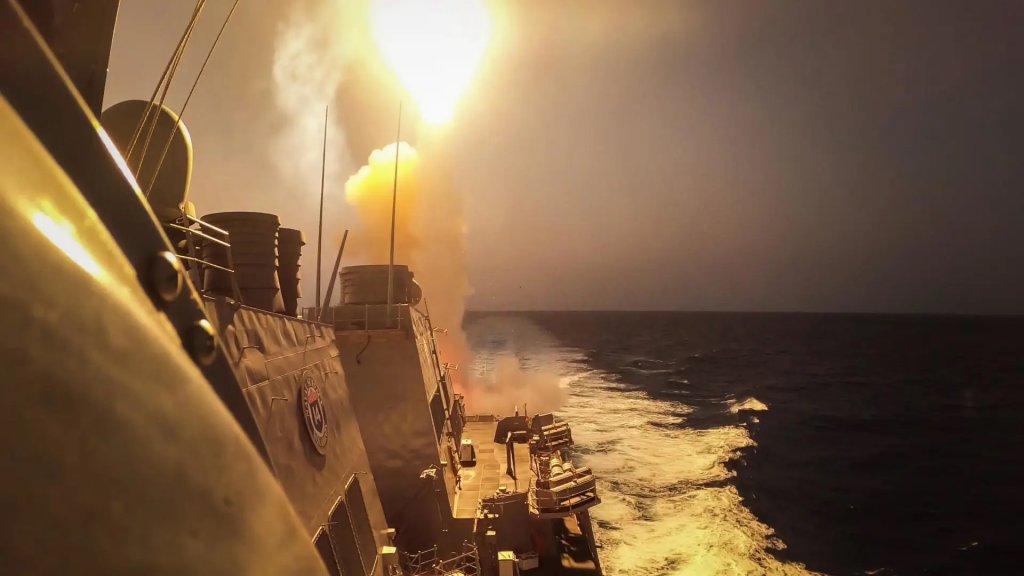
The Arleigh Burke class destroyer USS Carney fires a surface-to-air missile at Houthi threats on October 19, 2023. U.S. Navy
Amid all this, the per-barrel price of Brent crude rose to more than $109 yesterday, but was back down to $104 today, according to OilPrice.com.
We have long suggested that the U.S. could get pulled back into a new conflict with the Houthis. Now the rebel group’s rapid defeat of the Saudi-backed forces has reportedly already led to an American role in that fight.
“More than 100 US military advisers are on the ground in Saudi Arabia providing intelligence and targeting support to the Kingdom in its military campaign against the Iran-backed Houthis in Yemen,” CNN reported on Thursday, citing multiple sources familiar with the effort. “The US military personnel are working as part of a newly-established joint forces command, which was formed in recent weeks amid signs Iran was ramping up its own efforts to aid Houthi attacks against Saudi Arabia, one of the sources, a US official, said. That official put the total at roughly 200 troops.”
Still, there are limits on the U.S. role.
“The US is sharing intelligence with Saudi Arabia — as it routinely does already — but it is not participating directly in strikes,” CNN noted. “The US is also not helping refuel Saudi warplanes or providing other operational support, as it has in past fighting with the Houthis.”
CENTCOM commander Adm. Brad Cooper “flew to the kingdom overnight Thursday as Yemen’s Riyadh-backed forces crumbled in the face of a lightning Houthi offensive southward along Yemen’s western coast this week,” Al-Monitor reported. “He was expected to meet with top Saudi officials as they seek to consolidate the battered military effort by forces aligned with Yemen’s government.”
Trump, as we noted at the top of this story, has already declined to intervene kinetically.
“Saudi Crown Prince Mohammed bin Salman (MBS) called President Trump twice Thursday, urging him to launch strikes against the Houthis as the Iran-backed group closed in on a vital Red Sea chokepoint,” Axios reported, citing two U.S. officials. “Trump declined, and U.S. officials stressed the administration has no plans to intervene directly against the Houthis for now.”
U.S. President Donald Trump (R) meets with Crown Prince and Prime Minister Mohammed bin Salman of Saudi Arabia during a bilateral meeting in the Oval Office of the White House on November 18, 2025 in Washington, DC. (Photo by Win McNamee/Getty Images) Win McNamee
Asked if the U.S. would take direct military action against the Houthis, a senior White House official didn’t rule it out but said it is currently relying on regional partners to carry the burden.
“The United States is focused on protecting our core national security interests—such as ensuring freedom of navigation in the Red Sea—while empowering our regional partners to take the lead in managing and resolving regional security challenges,” the senior official told us. “We are in continuous dialogue with Saudi Arabia and the Republic of Yemen Government regarding regional stability.”
The war against Iran and the ongoing mission to try to protect freedom of navigation in the Strait of Hormuz have already strained the U.S. military. There have been 18 troops killed, more than 800 wounded and wide scale destruction of U.S. bases and equipment. U.S. commanders have warned that the ongoing conflict is unsustainable without deeply degrading America’s ability to respond to other contingencies. How much the U.S. could commit to a fight against the Houthis is an open question, especially if the Iran war spun-up again. During the Red Sea operation, at times two carrier strike groups and many other assets in the air and on the sea, were needed to sustain that operation.
“A second front potentially adds more U.S. military risk as we try to sustain a military that has been involved in a protracted deployment to support our economic pressure-focused strategy,” former CENTCOM commander Joseph Votel told us on Friday. “The U.S. can do just about anything, but it will be a choice that will impact sustainment, create longer-term deployments and impact other national security priorities.”
Earlier this year, an Iran-linked actor used Anthropic’s Claude artificial intelligence model to scrape and analyze data with the aim of helping target U.S. naval forces in the Middle East. A group in Yemen – very likely Iranian-backed Houthi militants – also used Claude to assist with work on guidance systems for ballistic and hypersonic missiles.
These are just some of the revelations about how adversaries and other malign actors have been using one of the premier pieces of AI software being developed in the United States that were contained in a new report Anthropic released late yesterday. The 154-page document also details instances where Claude was used directly and indirectly to support intelligence gathering and surveillance, cyberattacks, influence operations, and even worrisome biological research over the past eight months. In addition to Iran and Yemen, the human actors behind these activities were based in Russia, China, and a host of other countries.
Anthropic has shared details about what it calls the “misuse” of its models in the past, but describes the new report as its “most detailed” to date. The company has clearly been cataloging these case studies, and has assigned each one a control number. Though the entire contents of the report are cause for concern, the explicit attempt to use Claude to target American forces, as well as to develop new higher-end missiles and other military technology, are particular standouts and signs of what’s to come, as we will highlight below.
GTG-30005: Military reconnaissance
GTG-30005 is the case study dealing with the targeting of U.S. naval forces, and the summary is as follows:
“In another investigation, we identified and disrupted an Iran-nexus threat actor that used Claude to collect and analyze publicly accessible data to develop targeting recommendations against US naval forces in the region. The threat actor used Claude to compile targeting handbooks, through a Python pipeline the threat actor built with Claude’s assistance, to identify and track naval positions based on open-source information. The compiled material included a roster of US personnel scraped from captions on public military photographs; publicly accessible ship and aircraft transponder identifiers; commercial satellite-imagery query scripts; and an inventory of public websites that exposed US naval movements. The threat actor also directed Claude to compile vulnerability research on shipboard systems, cataloging known CVEs in maritime VSAT terminals, Cisco communications equipment, and industrial control products.”
“We banned the actor’s account, developed detections to reduce the risk of future misuse, and shared threat intelligence with government authorities to disrupt the threat.”
The Nimitz class aircraft carrier USS George H.W. Bush and several other US Navy warships sail together in the Arabian Sea in June 2026. CENTCOM
How exactly Anthropic defines the term “nexus” here is not immediately clear, and other entries in its new report also use “state-nexus” in addition to country-based variations. However, in this specific case, an addendum is added to the entry that explicitly says that the same account was separately tied to “domestic mass surveillance” software development work “for Iranian state systems,” clearly pointing to an actor directly linked to the regime in Tehran.
The use of AI technology by nation-state armed forces to develop target sets and engage them is already known to be growing globally. The Israel Defense Forces (IDF) have been a pioneer in this regard, but the U.S. military, China’s People’s Liberation Army (PLA), and others are also known to be developing and fielding these capabilities.
GTG-87001: Disrupting a Yemen-based guided weapons engineering cell using Claude to develop guidance software
Anthropic’s new report details an instance where an individual in Yemen used Claude as part of missile guidance work, which is given the control number GTG-87001.
“We identified a cell of threat actors based in northern Yemen running three weapons development programs: a guided rocket that used a commodity phone-class flight computer with final-phase homing guidance; a multi-stage ballistic missile with a stated range goal above 2,000 km; and a multi-variant missile (referred to as the “R2000” set) that included a hypersonic glide vehicle variant.”
“The actors used Claude Code in place of human software engineers to develop the guidance, navigation, and control (GNC) software that steers and stabilizes a flying vehicle. For example, they used Claude to integrate an open-source autopilot onto a phone-class flight computer, writing the control and position estimation software, tuning the control settings, running a firmware build pipeline, and performing a flight simulation. The actors managed several Claude instances at once, assigning each one a role, much as a lead would delegate work on a small engineering team: the actors tasked one instance with writing the code, another with research, and a third with reviewing the code the first instance produced.”
A graphic included in Anthropic’s new report summarizing the ways in which Claude was used by the actors in Yemen to support missile guidance system development. Anthropic
“Our safeguards blocked many of their requests, but not all of them. The actors used a variety of tactics to evade our safeguards, including hiding their goals and the products the software was meant for, and they split their work across multiple sessions so no single session revealed their full intent.”
“These actors carried out a sustained effort to develop guided weapons, including using Claude to design guidance software. We do not have evidence the actors succeeded in fielding an operational device; but they did test-fire a guided rocket. This field test appears to have failed: within hours, the actors returned to Claude to work out why it failed.”
“We identified this activity as part of our internal investigations into suspected weapons development. We banned accounts associated with the actors and shared threat information with public- and private-sector partners to mitigate risks posed by the actors. Nevertheless, we have evidence that the actors had already built an offline simulation toolkit that does not rely on Claude or other engineering computing environments such as MATLAB.”
As mentioned earlier, the report does not name the Houthis, but that group has historically been based primarily in the northern end of Yemen. It is also the only entity in the country known to have active missile development programs, which are conducted with critical support from Iran.
Whether this particular work directly resulted in any new capabilities is unknown. Anthropic notes that there looked to be at least one failed test launch before the accounts were banned, which would have occurred sometime after the beginning of this year, based on the stated cutoff dates for the report. By the end of 2025, the Houthis had already amassed a wide array of very real ballistic missiles, including types with at least claimed ranges of 2,000 kilometers (approximately 1,242 miles). The group also has a variety of cruise missiles and one-way attack drones that it has employed operationally.
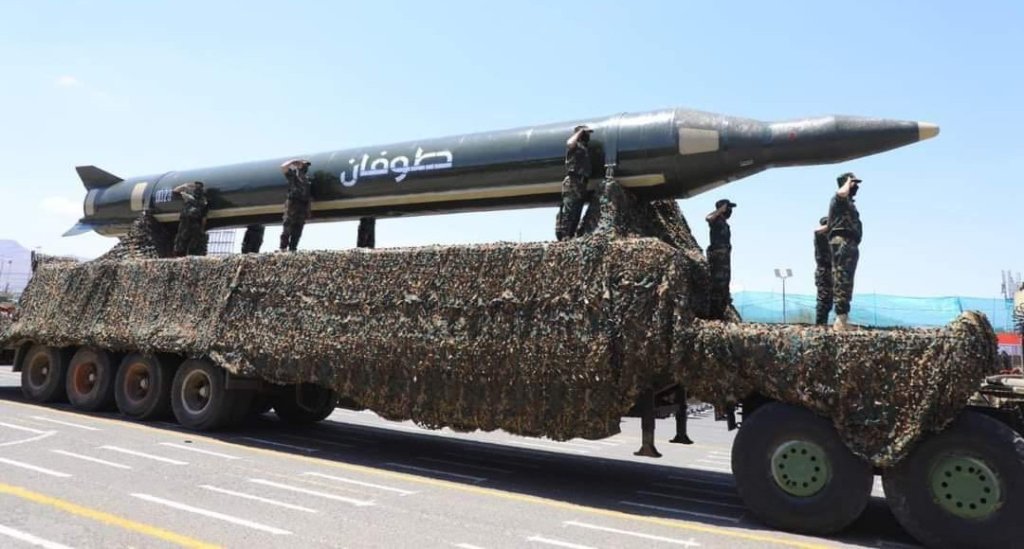
An example of just one of the many types of ballistic missiles in the Houthis’ arsenal. Houthi-controlled media
Still, being able to leverage Claude could only have helped any domestic missile development efforts in Yemen, which might help reduce dependency on Iran, at least to a degree. Furthermore, developing functional hypersonic glide vehicles capable of prolonged stable flight has historically been notoriously difficult, even for entities with extensive relevant knowledge bases on an organizational level.
GTG-17001: Disrupting a China-based operation using Claude to draft a fire control specification and acquisition documents for undersea warfare
Use of Claude in foreign military endeavours goes beyond the Middle East, as evidenced by case study GTG-17001. This involved a Chinese actor conducting work related to a naval counter-torpedo defense system.
“We identified a China-based threat actor who used Claude to advance three parallel tracks of work on an anti-torpedo weapons system:”
“First, the actor used Claude to draft a Chinese-language specification for an anti-torpedo fire control system (the core logic that aims and times an anti-torpedo weapon’s response). The document was written to win approval from a Chinese defense manufacturer, which would move the work on to technical certification and operational testing.”
“Second, the actor used Claude to produce a Chinese-language technical proposal of more than 200 pages, accompanied by an executive briefing deck.”
“Third, the actor used Claude to benchmark their own system against specific US anti-torpedo and anti-submarine programs based on publicly accessible information. They then generated a Chinese-language briefing on US Navy systems derived from open-source reporting.”
“The actor presented themselves as an original equipment manufacturer in the US defense sector. We assess the actor was associated with a Chinese defense industry manufacturer aiming to produce a weapons specification and acquisition proposal for the People’s Liberation Army Navy.”
This picture shows a test of an anti-torpedo system fitted experimentally to a Nimitz class aircraft carrier in the 2010s. USN
“The actor used Claude to write the acquisition proposal, refining it over many drafts. After each draft, the actor instructed Claude to role-play a hostile expert reviewer to critique the proposal, then used that feedback to sharpen the next version. In parallel, the actor used Claude to build pieces of the anti-torpedo weapons system’s fire control software and a test matrix to validate them.”
“The operational lift the actor achieved was a function of using Claude to automate complex technical outputs. The actor leveraged the model to compress the development timelines for the certification registry, compliance documentation, and automated fire control logic. The actor also accelerated the traditional human review cycle by having Claude critique the acquisition proposal across multiple rounds of review while role-playing a persona.”
“We uncovered this activity as part of our internal investigations into suspected weapons development. We cannot attribute the activity to a specific entity or actor. But we have banned the account for violating our Supported Regions Policy and our Usage Policy, which prohibits weapons design and development, and incorporated our investigative findings into our safeguards to mitigate the risk of future misuse.”
Anthropic’s report does not name the U.S. programs leveraged here, but does note the information in question was publicly available. Anti-torpedo systems for surface warships and submarines have been an area of significant interest for the U.S. Navy for years now. Those developments have also produced compact torpedo designs for use in other applications.
A Very Lightweight Torpedo (VLT), a compact torpedo design developed by Northrop Grumman. Northrop Grumman
The PLAN’s interest in these same kinds of capabilities is not at all surprising. Underwater threats and countermeasures to them, broadly speaking, would play a central and vital role in any future conflict between the United States and China across the broad expanses of the Pacific.
GTG-27005: Disrupting a Russia-based operation using Claude to engineer an autonomous military drone swarm
Another case study, GTG-27005, details the use of Claude by Russian actors working on drone swarming technology.
“We identified likely freelance Russia-based threat actors who set out to build a full-stack autonomous first-person-view (FPV) kamikaze drone swarm. The actors used Claude Code to write and test the code and save it directly into the actors’ own project files. In addition to Claude Code, the actors used a software-in-the-loop simulation stack and a rented graphics processing host for model training. They called the operation ‘DronDoc’ or ‘Serafim.'”
“The actors used Claude to build the core software system, including the drones’ shared swarm memory and fault-tolerant coordination logic (FTCL); an onboard small language model to govern attack, observe, and return-to-base behaviors; a terminal guidance software system to steer drones to their target (using the onboard camera) and issue the call to detonate; a control-link geolocation module to find opposing drone operators; a passive acoustic detection layer; and low-level logic for the drones’ programmable chips. The actors designed the platform for autonomous lethal engagement; the onboard model could select targets (including a ‘person’ target class) and issue detonation commands without a human in the loop. The actors’ activity—including flashing the low-level firmware to live development boards, provisioning single-board computers, and wiring up a simulation environment over a mesh network—confirmed that they were using real hardware-in-loop testing within their sessions.”
Many were surprised yesterday by the news that a Russian fiber-optic FPV drone flew into Kramatorsk and attacked a car.
But there is nothing surprising here. The war of 2025 is already very different from the war of 2024. From LBZ to Kram — 20 kilometers. Enemy FPVs can fly even… pic.twitter.com/hTfhJFPcxZ
“The actors trained a computer vision classifier on scraped Ukrainian combat footage, splitting the target classes into “enemy” and “friendly,” and allow-listing Russian systems. They also repeatedly used a fixed coordinate in Donetsk Oblast as the demonstration strike point, with front-line cities and corridors in Ukraine as the mission geography.”
“The actors created their accounts between late 2025 and early 2026 and started the operation in mid-May 2026. The actors circumvented our geographic access controls by routing traffic through commercial virtual private servers.”
“We assess the actors were a small, specialized freelance team doing a mix of civilian and military work, not a Russian state entity. We identified nine accounts associated with this group; eight were used only for ordinary freelance work, not weapons-related software development. Based on our investigation, we assess the actors had ties to a regional university with a federal research center associated with the Russian Academy of Sciences. The actors claimed to have received funding from Russia’s Advanced Research Foundation, National Technology Initiative, and Ministry of Defence, though we cannot verify those claims. We identified this activity as part of our internal investigations into suspected weapons development, we banned accounts associated with the actors, and have incorporated our investigative findings into safeguards to reduce the risk of future misuse.”
Anthropic’s report included a table, reproduced below, detailing different types of drones and other capabilities that were fed into the model as part of this work.
GTG-17002: Disrupting a China-based operation using Claude to build targeting software for electronic warfare and air defense suppression
The last case study in the Conventional Weapons section of Anthropic’s new report, GTG-17002, covers electronic warfare-related work by a Chinese actor, with a particular focus on potential air defense targets in Taiwan.
“We identified a China-based actor who used Claude’s chat, coding, and agentic work tools to design, build, and iterate on a Chinese-language suite of about 16 modules for electronic warfare, using the electromagnetic spectrum to detect, jam, or deceive an opponent’s radar and communications, and for suppressing an opponent’s air defenses.”
“The actor used Claude to build the software system, from the underlying logic to the user interface, and iterated through 12 versions. This included implementing and optimizing the system’s radar detection and jamming physics, generating a vulnerability analysis module, and drafting Chinese-language targeting instructions. The software suite the actor built analyzed an opponent’s radars, surface-to-air missile sites, command posts, and communications nodes, then computed their detection coverage, assessed the effectiveness of jamming, ranked targets by value and vulnerability, including which to suppress first, and determined how best to assign jammer sorties to targets across multi-day campaigns. The suite also ranked which of an opponent’s assets to suppress first, and modeled specific engagement envelopes, including those of Patriot and THAAD-class [Terminal High Altitude Area Defense] systems.”
“Mid-project, we observed the actor change the simulation’s default scenario to 12 targets in Taiwan. The targets included a command bunker in Taiwan, an early warning radar site, Patriot and Tien Kung [surface-to-air missile] batteries, major air bases, and a regional combatant command headquarters.”
“The actor also ran a self-hosted model on an internal network alongside Claude and connected the software suite to this model through a tool-use integration.”
“Based on our investigation, we assess the actor is a China-based defense and military-industrial researcher. Account-level metadata and content flagged by our safeguards indicated the actor was linked to PRC research institutions, including the PLA Academy of Military Sciences. We detected this activity as part of our internal investigations into suspected weapons development, we banned accounts linked to the actor, and have incorporated our investigative findings into our safeguards to reduce the risk of future misuse.”
An accompanying table, seen below, mentions several specific types of U.S.-made air defense radars, as well as the Link-16 datalink network, as having come up in the course of this work. Electronic warfare variants of the Chinese Y-8 and Y-9 aircraft, as well as the J-16D electronic warfare jet, and what appears to be a reference to the Golden Eagle drone helicopter, are also mentioned.
A Chinese Y-8GX-11, one of several electronic warfare variants of the Y-8/Y-9 design. Chinese internet via X
The suppression of enemy air defenses is an essential part of any modern air campaign, whether conducted independently or as a part of a larger operation. This would be no less critical in any military intervention against Taiwan from the mainland, or any other larger-scale conflict the PLA might find itself in.
Guardrails and ethics
Beyond the details in any of the specific case studies, Anthropic’s new report underscores growing broader concerns about guardrails for the use of AI and general ethics surrounding the technology. As noted in the instances above, Anthropic has also implemented various safeguards to try to block access to Claude from certain regions and/or to prevent the model from conducting certain types of work. At the same time, what the company has now shared makes clear that those protections can still be circumvented to a significant degree, at least for now.
TWZ has noted in the past that America’s adversaries are likely to be less worried about ethics, in general, when it comes to AI. Anthropic’s new report also shows there are few bounds to what state-aligned or even non-state actors might seek to use this technology for, including the development of potential weapons of mass destruction.
At the same time, AI models like Claude are not going away, and developments continue to advance at an ever-quickening pace, opening the door to further proliferation. Developments are rapidly intermingling globally, with companies in China notably leveraging models created in the U.S. to further their own work, which is then released publicly. The technology will increasingly become more integrated and critical to most aspects of military operations and weapons development, alongside its commercial and civilian applications. It is just as much a superweapon as anything else, and the country with the more capable models, and the willingness to deploy them, will have a major edge in future conflicts.
With all this in mind, it seems very plausible, if not probable, that the case studies described in Anthropic’s new report are just the tip of an approaching iceberg that will need a concerted effort to tackle.
O Festival “Já Te Dou o Arroz” arrancou esta sexta-feira, 11 de Setembro, em Ulme, no concelho da Chamusca, para três dias de gastronomia, música e actividades em torno de um dos produtos mais ligados à identidade e à paisagem daquela freguesia. Promovido pela Câmara Municipal da Chamusca e pela Junta de Freguesia de Ulme, o certame chega este ano à sexta edição e volta a ter como…
Albert Daenens. « Zuivere plastiek » (Plastique pur), avant 1952
Au titre d'une initiative conjointe engageant douze pays dont la France, le ministre des affaires étrangères britannique a annoncé le 8 septembre, devant la Chambre des communes, de nouvelles sanctions visant les colonies israéliennes en Cisjordanie. M. Edward (« Ed ») Miliband a dénoncé notamment le « nettoyage ethnique » qui y sévit. Les mesures qu'il a détaillées cibleront « des entreprises et des individus qui fournissent des services, tels que la construction, les infrastructures, le financement et l'immobilier, destinés à l'expansion » de la colonisation. Il s'agit aussi d'interdire l'importation des produits de ces mêmes colonies – que les Nations unies estiment illégales au regard du droit international.
Ces dispositions relèvent en partie du jeu politique interne. Le nouveau gouvernement de M. Andrew (« Andy ») Burnham semble enfin prendre acte de l'impasse dans laquelle le Parti travailliste s'est mis en refusant de faire droit à l'émotion et aux mobilisations suscitées par l'aggravation de la tragédie que vit le peuple palestinien au cours de la période récente. Déjà, le 11 novembre 2023, plus de 800 000 personnes avaient défilé à Londres en solidarité avec Gaza. Ces derniers mois, les Verts, beaucoup plus offensifs sur le sujet que les travaillistes, progressent dans les sondages et aux élections partielles ou locales.
Les sanctions contre les colonies illégales sont aussi tardives. En effet, depuis le 7 octobre 2023, les forces de Tel-Aviv ou des colons ont tué plus de 1 100 Palestiniens, dont plus de 240 enfants, en Cisjordanie. L'armée israélienne inflige également des détentions ou des incarcérations arbitraires, des humiliations de toutes sortes, des contrôles incessants qui rendent les déplacements cauchemardesques sur ce territoire.
Les dispositions annoncées par M. Miliband sont enfin dérisoires. D'une part, l'État visé par ces sanctions en raison de la seule colonisation de la Cisjordanie commet un génocide, des crimes de guerre et s'en prend illégalement au Liban, à la Syrie ou à l'Iran. D'autre part, les importations des colonies ne représentent qu'une proportion minime des 6 milliards de livres (près de 7 milliards d'euros) d'échanges commerciaux entre le Royaume-Uni et Israël. D'après Bloomberg, cité par L'Opinion (8 septembre 2026), « des diplomates britanniques ont eux-mêmes assuré Washington que les sanctions (contre les colonies israéliennes) étaient avant tout symboliques et qu'elles n'avaient pas vocation à miner la relation diplomatique et commerciale entre les deux États ».

 Login


 Muslim students beat him because he was German and gay.
 "Why don’t you have any German friends?"
 "Because they don’t belong to us. I can’t stand the Germans too much."


 LE PRECEDENTI INTERVISTE A FEDERICO POVOLERI Federico Povoleri: la fabbrica della guerra https://www.youtube.com/watch?v=BKgnnAaHDjM Realtà artificiale nella manifattura del consenso https://www.youtube.com/watch?v=Pw1InYjbfjk
 Sostegno ricorrente: casadelsole.tv/sostienici Anche un piccolo contributo fa la differenza. Grazie di cuore!




















 (@IraqiPMO)






 (@frontlinekit)


