In his address to the UN General Assembly, US President Donald Trump said that the Cuban government is a failed state currently under enormous pressure: “My administration seeks a fundamental change in the situation in Cuba… It is an absolute failed state… and it will fall. Marco Rubio is leading the negotiations.”
In response, the Cuban delegation stood up and walked out of the plenary session in protest. Trump continued: “Cuba is a haven for foreign adversaries who threaten America right on our doorstep… The Cuban regime has also spent decades coordinating with left-wing radicals and communist networks here in the United States… They have cultivated ties with subversive and radical groups.”
The remarks did not go over well in Havana, where the government has categorically rejected the US right-wing leader’s statements. Leading the response is the country’s president, Miguel Díaz-Canel, who asserted that freedom in Cuba is non-negotiable.
“Freedom came to Cuba on January 1, 1959, [the date the Cuban Revolution began], and we are not going to lose it; we are going to defend it. Once again, we are seeing the true face of that empire and its contempt for the peoples of Latin America – and in particular for Cuba and the Cuban Revolution – because of what it represents.”
Díaz-Canel made the remarks on a program called Criterio Compartido on Radio Rebelde. In them, Díaz-Canel described Trump’s statements as “arrogant,” “high-handed,” and “interventionist.”
He also asserted that behind Trump’s thinking lies a justification for a certain view of US imperialism: “what most underpins that genocidal, criminal, and contemptuous mindset toward Cuba and the Cuban people.”
Regarding the label of “failed state,” the leader of the Communist Party of Cuba said: “They are always trying to label us a failed state to shift the blame for the genocide they are committing with that intensified and prolonged blockade.”
Díaz-Canel is referring not only to the long and sustained economic and commercial blockade that the United States unilaterally imposed on Cuba in an effort to defeat the revolution that began in 1959. In US President Donald Trump’s first term, he imposed an additional 243 sanctions on the Caribbean island and added Cuba to the State Sponsors of Terrorism (SSoT) list, which devastated the Cuban economy. In January 2026, Trump further tightened the grip by imposing an energy blockade on Cuba.
Since early 2026, following the US attack on Venezuela that resulted in the capture of President Maduro and his wife, Cilia Flores, and the deaths of more than 100 people – including several dozen Cubans – Cuba lost one of its main energy partners, which used to supply crude oil to the Cuban power grid.
Since then, only one Russian ship has managed to circumvent the US blockade; the United States is currently threatening to impose additional tariffs on any country that sells fuel to Cuba. This has triggered Cuba’s worst energy crisis, which is hindering the normal operation of hospitals, schools, and food production, among other essential activities.
Cuba has denounced the blockade as a form of “silent genocide,” specifically because of the direct humanitarian consequences it is having on the civilian population, which has seen a reduction not only in its electricity supply but also in access to surgeries, water, food, and so on.
In this regard, Díaz-Canel has once again emphasized on X that Cuba does not pose a threat to the United States; rather, it is the United States that is endangering Cuba’s civilian population: “Unable to justify the punishment against the people of Cuba and its genocidal economic war, the US president repeats at the UN that Cuba poses a threat. Lies are the weapon of those who refuse to accept the Cuban people’s right to self-determination.”
He concluded: “We will continue to fight for peace, defend our sovereignty, and work together to overcome the ruthless aggression imposed on us by the US government. Cuba is not a threat, the blockade is.”
US President Donald Trump took the UN General Assembly stage on Tuesday and made a sweeping series of claims about Iran, its nuclear program, the imposed war, and the Strait of Hormuz.
He presented Washington’s military aggression as a campaign to defeat an “Iranian threat,” while casting Tehran as the source of “decades of bloodshed across West Asia.”
Behind the worn-out rhetoric was a version of events riddled with falsehoods, omissions, and sweeping distortions.
For example, Trump claimed that Iran killed “72,000 of its own citizens,” described the country’s nuclear program as having been “obliterated” by the US, declared Tehran’s entire 159-ship navy destroyed, accused Iran of violating the ceasefire, and said US naval forces were moving tens of ships and billions of barrels of oil through the Strait of Hormuz.
Nothing could be farther from the truth.
US intelligence assessments found that Iran’s nuclear program was not destroyed; Pentagon investigators documented hundreds of damaged US structures across the region and depleted munitions, with the US war machine incurring tens of billions of dollars in expenses.
American casualties and aircraft losses mounted, while traffic through the Strait of Hormuz collapsed rather than returning to anything resembling normality following the US-Israeli aggression against Iran.
Here is a breakdown of Trump’s most glaringly false claims about Iran and what the documented record shows.
Claim: For 51 years, Iran (Islamic Republic) has “ruled by bloodshed and mass murder,” spreading “death, carnage and chaos” across the entire West Asia and beyond.
Fact: Other than the wrong claim about Iran spreading “death and chaos” in the region, his chronology also begins with a basic historical distortion.
The Islamic Republic was established in 1979 following the victory of the Islamic Revolution, meaning it has been in power for 47 years, not 51, as the megalomaniac US president claimed.
Trump’s portrayal of Iran as a force of “bloodshed and aggression” runs against the historical record.
For the past two centuries, Iran has fought to defend its territory and deter attacks rather than pursue wars of conquest or territorial expansion.
Even US government and policy institutions describe the Islamic Republic’s military doctrine as primarily defensive and deterrence-based, focused on protecting Iran’s territorial integrity.
One US Institute of Peace assessment says Iran “does not have territorial ambitions and does not seek to invade, conquer, or occupy other nations.”
That stands in stark contrast to Washington’s own modern record of invading countries, waging prolonged wars abroad, killing civilians, destroying infrastructure, and, in several cases, fundamentally altering entire states.
The scale of that record becomes clear when the major US-led invasions and military interventions of the past several decades are examined.
1986, Operation El Dorado Canyon: Libya
On April 15, 1986, the United States launched Operation El Dorado Canyon, bombing targets near Tripoli and Benghazi after Washington accused the Libyan government of supporting international terrorism. More than 100 US aircraft were involved, with 27 aircraft carrying out the main bombing missions and dropping about 150 tonnes of ordnance.
Contemporary casualty accounts record 45 Libyan soldiers and officials killed and 15 Libyan civilians killed.
1988, the USS Vincennes and Iran Air Flight 655
On July 3, 1988, the US Navy cruiser USS Vincennes fired a missile at an Iran Air Airbus A300 flying over the Persian Gulf, killing all 290 people aboard, including 66 children and 16 crew members.
Washington claimed that the aircraft had been “mistakenly” shot down. There was no official US apology for the horrendous crime.
The episode is particularly relevant to Trump’s portrayal of Iran as the “source of regional bloodshed,” as one of the deadliest incidents involving Iranian civilians during the period came from a US warship operating near Iranian waters.
1995, Operation Deliberate Force: Bosnia
US and NATO launched the so-called Operation Deliberate Force against Bosnian Serb positions. It severely damaged the Serbs’ military capabilities and helped alter the balance of the Bosnian war.
The bombing campaign killed 152 civilians and injured nearly 300, according to the figures in the material. The operation was conducted without a specific UN Security Council authorization for the air campaign, a point that has remained central to debate over its legality.
1999, Operation Allied Force: Yugoslavia
On March 24, 1999, the US, along with NATO, launched the so-called Operation Allied Force against Yugoslavia. The campaign involved extensive bombing of residential areas, television and radio facilities, hospitals, factories, businesses and infrastructure.
Fourteen NATO member countries participated alongside the United States. The bombing destroyed or damaged 82 railroad and motor bridges, 48 hospitals, 25 post offices and telegraph stations, 70 schools, nine university buildings and four student dormitories, 18 kindergartens, 35 churches and 29 monasteries, including UNESCO-protected heritage sites.
The targets also included the television centre in Belgrade, a convoy of Albanian refugees and China’s embassy in Serbia.
According to the Serbian government’s figures cited in the material, the bombing killed around 2,500 people, including 89 children, and wounded 12,500.
Some 863,000 people, primarily Serbs living in Kosovo, left the region, while another 590,000 became refugees. Estimates of the economic damage ranged from $30 billion to $100 billion.
The Independent International Commission on Kosovo, established in August 1999 to examine the NATO intervention, concluded that the intervention was illegal. It also criticized the use of cluster munitions and the bombing of chemical factories and oil refineries because of their environmental consequences. In 2002, the UN confirmed radioactive pollution in Kosovo following the US bombing.
Post-9/11 toll: millions dead, tens of millions displaced
According to the Costs of War Project at Brown University’s Watson Institute of International and Public Affairs, US-led wars since 2001 have directly caused about 940,000 deaths across Afghanistan, Pakistan, Iraq, Syria, Yemen and other post-9/11 war zones.
The indirect death toll is estimated at another 3.6 to 3.8 million, bringing the overall number of deaths from post-9/11 wars to at least 4.5 to 4.7 million and counting.
The wars displaced an estimated 38 million people across Afghanistan, Pakistan, Iraq, Syria, Libya, Yemen, Somalia and the Philippines.
The financial cost has reached about $8 trillion. Brown’s Costs of War research has documented erosion of civil liberties and human rights in the US and abroad.
Claim: Iran“slaughtered” over 72,000 of its citizens this year. Recently, 10,000 were killed for “protesting.”
Fact: Trump’s extraordinary figure of casualties, which he keeps updating every few weeks, requires comparison with the available record.
On February 1, the Iranian government published the names of nearly 3,000 people killed during the foreign-backed riots of early January.
The Iranian Presidency released a list of 2,986 individuals killed, including their full names, their fathers’ names and the last six digits of their national identity numbers.
An Iranian government statement put the total number of fatalities at 3,117. A statement issued in late January said more than 600 of the deceased were rioters and terrorists, with the remainder civilians and security forces killed mostly by heavily armed rioters.
The foreign-backed riots were accompanied by widespread destruction, including systematic assaults on bazaars, shops, banks, mosques, hospitals, ambulances, fire stations, clinics and public infrastructure.
Evidence presented by the government showed that the systematic and coordinated riots involved foreign-backed spy networks.
Supporting the rioters, former US secretary of state Mike Pompeo wrote on social media: “Happy New Year to every Iranian in the streets. Also, to every Mossad agent walking beside them.”
Mossad separately issued a Farsi-language social-media message urging rioters to “Go out together into the streets. The time has come,” and saying its agents were present “not only from a distance and verbally” but “in the field.”
Claim: I(Trump) will never allow Iran to have a nuclear weapon.
Fact: Trump presented the ongoing US military aggression against Iran as the means of preventing Iran from having a nuclear weapon.
Iran, as a signatory to the Non-Proliferation Treaty (NPT), has consistently maintained that its nuclear program is peaceful and remains under IAEA supervision.
The scale of international inspection has been substantial. In 2023 and 2024 alone, Iranian nuclear facilities underwent more than 427 inspections, an “unprecedented” level of scrutiny in the history of global nuclear oversight, as admitted even by UN officials.
In a recent interview, Major General Mohsen Rezaei, Secretary of Iran’s Supreme National Security Council (SNSC) stated, “We remain committed to the fatwa (religious decree) of the martyred Leader of the Revolution and have not changed our nuclear doctrine, but we do not know what will happen in the future.”
In a religious decree, the martyred Leader of the Islamic Revolution, Ayatollah Sayyed Ali Khamenei, declared that not only nuclear weapons but also other weapons of mass destruction, including chemical and biological weapons, pose a serious threat to humanity and ruled their use forbidden.
Trump’s claim that the US military “obliterated” Iran’s nuclear program runs directly into the US intelligence assessment that followed the so-called Operation Midnight Hammer.
During the 12-day US-Israeli aggression against Iran in June last year, the United States struck three peaceful nuclear facilities, Fordow, Natanz and Isfahan, using bunker-buster bombs capable of penetrating up to 18 meters of concrete or 61 meters of earth.
An early Pentagon intelligence assessment found that the strikes “probably set Iran’s nuclear program back by months rather than destroying it.”
The report said the Islamic Republic’s stockpile of enriched uranium was not eliminated, according to sources familiar with the Defense Intelligence Agency evaluation.
According to various Western media reports, entrances to two nuclear facilities were sealed, but much of the deeply buried infrastructure remained safe from the US bombardment.
Claim: As a result of so-called Operation Epic Fury, all 159 ships of Iran’s navy are “now lying at the bottom of the sea.”
Fact: Trump’s claim that Iran’s entire navy was destroyed is flatly contradicted by the continued combat operations of Iranian naval forces deep into the war, including their ability to track, intercept and push back US naval assets in the strategic waters of the Strait of Hormuz.
In the early hours of September 8, 2026, at the entrance to the Strait of Hormuz, naval forces of the Islamic Revolution Guards Corps (IRGC) tracked, intercepted and recovered one of the United States Navy’s most advanced unmanned undersea platforms.
Media reports identified the vessel as an Anduril DIVE-LD, a large-diameter autonomous underwater vehicle delivered to the US Navy’s Unmanned Undersea Vehicle Group One only a year earlier.
Iranian naval forces have also successfully intercepted and pushed back American naval assets, compelling them to retreat as far as 400 kilometres from the strategic chokepoint.
For the first time since the Second World War, the US has been ostensibly fighting a naval war against a peer adversary largely from a standoff position, unable to project power close to Iran.
Iranian naval forces have effectively denied the US military the freedom to operate close to Iran’s coastline, forcing it to fight from a distance rather than dominate the waters it entered.
The strain on US naval operations has been visible. The USS Gerald R. Ford fire in March, the suicide attempts by sailors aboard the USS Abraham Lincoln, and repeated retaliatory attacks on American destroyers in the Strait of Hormuz have added further pressure on US naval forces operating in the region.
Claim: Iran’s air force is gone, their radar is gone, their antiaircraft equipment is gone, their missile and drone manufacturing capacity is almost gone.
Fact: On September 16, the Pentagon’s own inspector general presented a different set of facts about the war’s consequences.
A report covering February 28 through June 30 said Iranian retaliatory strikes damaged or destroyed hundreds of buildings and equipment at US military bases across Kuwait, Bahrain, Qatar, the UAE, Saudi Arabia, Iraq, Oman and Jordan.
The report also acknowledged significant depletion of key US munitions stockpiles and destruction of critical military assets, including missile-defense radar installations.
The retaliatory Iranian strikes forced US Central Command to change how American forces operated across the region. CENTCOM “shifted personnel, assets and storage facilities” in response to attacks by Iran and allied forces.
Among the changes was the withdrawal of US Army medical evacuation helicopters from Iraq and Kuwait. As a result, “most medical evacuations have been carried out by ground … to local treatment facilities,” according to the report.
The destruction of the US Navy’s regional hub in Bahrain by Iranian strikes created “significant challenges” in establishing adequate naval bases and support ports.
The US military turned the remote Indian Ocean island of Diego Garcia into a sea logistics hub, extending resupply cycles to between 14 and 18 days.
Iran also brought down roughly 30 percent of the US military’s MQ-9 fleet over Iranian skies.
A recent Congressional report said the American military lost at least 42 aircraft during the 40 days of the US-Israeli war of aggression against Iran, with estimated losses of approximately $2.6 billion.
The US Department of War also updated its casualty database, raising the total number of American forces killed or wounded during Washington’s war on Iran to 642 in figures published in July.
Claim: US has “more munitions” than it could ever possibly even think of using.
Truth: The war on Iran has severely depleted US munitions stockpiles, creating shortages and resupply bottlenecks that have begun to strain Washington’s ability to meet military commitments elsewhere, according to US government and congressional assessments.
The September report by Pentagon inspector general found that the war had produced “shortfalls” in key munitions and bottlenecks in resupply, directly contradicting Trump’s repeated claims about the abundance of US firepower.
A separate assessment by the Congressional Budget Office (CBO) found that the war on Iran had exhausted US supplies of key munitions, stretching the military’s ability to fulfill commitments in other parts of the world. The CBO estimated that rebuilding US stockpiles could take up to five years.
The scale of depletion is particularly stark in air-defense systems. A late July estimate by the Center for Strategic and International Studies (CSIS) found that stocks of several key interceptors, including the Patriot and Terminal High Altitude Area Defense (THAAD) systems, had been significantly depleted, in some cases by more than half.
The war on Iran also consumed more than 1,000 Tomahawk cruise missiles, according to CSIS, with the institute estimating that the US stockpile may not return to pre-war levels until 2031.
The Patriot system, the US military’s principal ground-based air-defense missile, was among the most heavily used. CSIS estimated that as many as 1,430 Patriots were fired during the war on Iran, compared with an estimated pre-war stockpile of about 2,330, meaning roughly 61 percent of the inventory had been expended.
The depletion of THAAD interceptors is even more consequential because the system is more sophisticated and designed to intercept ballistic missiles at higher altitudes and over longer ranges than the Patriot. CSIS estimated that 190 to 290 THAAD interceptors were fired from an estimated pre-war stockpile of just 360.
That means Washington may have expended more than half, and potentially more than 80 percent, of its pre-war THAAD inventory.
With only nine THAAD batteries operational worldwide, sustained expenditure risks leaving US forces with fewer of a highly specialized system that Washington considers critical for defending against ballistic-missile threats from countries including Russia, China and North Korea.
Claim: Iran violated the ceasefire with “brazen acts of terrorism.”
Fact: Iran has formally submitted a detailed complaint to the United Nations Security Council (UNSC) stating that the US systematically violated the Islamabad Memorandum of Understanding (MoU).
Tehran cited repeated US military strikes against Iranian territory, the revocation of oil-sale licenses, the establishment of a illegal maritime route in the Strait of Hormuz, failure to remove the illegal naval blockade and continued US support for Israeli military aggression in Lebanon as “fundamental and unequivocal breaches” of the agreement.
The US violation centers heavily on Article 5. According to Article 5 of the MoU, Iran would make arrangements to reopen the Strait of Hormuz within one month, with safe passage of commercial vessels forming part of the agreement.
The US, meanwhile, directed ships away from the route designated by Iran as safe and encouraged them to use an alternative illegal route. The MoU subsequently collapsed.
The Washington Post and AP reporting on the memorandum confirmed that the document required the United States to begin removing its naval blockade immediately upon signing and to fully end it within 30 days. However, the US returned to continuing its illegal blockade on Iranian ports.
Washington’s subsequent military strikes and the re-imposition of economic pressure form part of the context in which ceasefire violations are examined.
Claim: The US Navy has recently escorted “more than 1 billion barrels of oil” out of the Strait of Hormuz and “more oil is flowing than at any point” since the start of the war.
Fact: The shipping data tells a markedly different story. Recent satellite imagery has shown traffic through the Strait of Hormuz continuing to fall.
The number of commodity vessels crossing the strait has been around 12 over the weekend, while the pre-war level was more than 100 vessels a day.
According to UN Trade and Development (UNCTAD) data, during the week before the war on Iran began, average crude-oil flows through Hormuz represented roughly 38 percent of the global total, LPG 29 percent and LNG 19 percent.
According to August figures, crude exports from the Persian Gulf region have dropped by nearly half, 47 percent, compared with before the war, falling from about 17 million barrels a day in 2025 to roughly nine million barrels per day as of August 2026.
Reuters has cited analyst estimates that five to seven million barrels of Persian Gulf oil a day are currently being disrupted.
Direct crude exports moving through the strait have fallen to an average of just 2.2 million barrels per day, according to Kpler.
From July 15 to August 23, an average of about five vessels a day passed through the waterway, an almost 95-percent decrease from pre-war traffic levels.
What little traffic remains consists of tankers operating under naval escort by Iran.
The impact is also being felt in global energy markets. In recent days, oil prices have climbed more than two percent amid uncertainty over the reopening of the Strait of Hormuz and continued security risks across West Asia.
Brent crude, the benchmark for two-thirds of global oil, has surged past $106 a barrel.
The US war on Iran has also pushed fuel costs higher in America. US gas prices have risen more than 40 percent since Washington and Israel launched their war on Iran. The national average in the US is more than four dollars per gallon.
In the European Union, diesel prices have hit a new record of 2.23 euros per liter, with 19 countries, including Germany, France and Italy, registering all-time highs.
Markets remain focused on the Strait of Hormuz, where US hostile and reckless attacks continue to threaten energy flows, as traders assess reported US discussions on a 90-day diesel-export ban.
The strategic waterway Trump described as carrying more oil than at any point since the start of the imposed war is experiencing a historic collapse in commercial traffic, with the disruption rippling through global oil prices and fuel markets.
US intelligence assessments, Pentagon reports, shipping data and the documented human cost of America’s wars all point to a widening gap between the picture Trump presented at the UN and the reality on the ground.
His portrayal of an unstoppable US military, a destroyed Iranian nuclear program, a decimated Iranian navy and an open Strait of Hormuz is increasingly at odds with facts, which is of depleted US munitions, military aggression that failed to achieve any objectives, Iran’s continued ability to retaliate and freely operate at sea, and a strategic waterway where shipping has fallen sharply rather than returned to normal amid continued US military adventurism.
Iran’s Deputy Foreign Minister for Legal and International Affairs Kazem Gharibabadi has said NATO Secretary-General Mark Rutte’s admission that some 5,000 sorties were flown from European bases in support of US military aggression against Iran proves that Europe formed part of the infrastructure of that aggression.
In a post on X on Thursday evening, Gharibabadi wrote that the NATO chief’s remarks demonstrated Europe’s role in enabling the illegal US campaign.
“Governments that placed their territory at the disposal of the United States cannot evade their responsibility,” he said. “This participation will not go unanswered.”
Rutte has repeatedly acknowledged that thousands of US military flights, between 4,000 and 5,000, departed from bases in Europe during the US-Israeli war of aggression against the Islamic Republic, which began on 28 February.
He described Europe as a “platform of power projection” without which Washington could not have conducted the operation.
Countries including Italy, Romania, the United Kingdom, France and Germany were cited in connection with the use of bases, airspace, tankers and logistics.
Iran has consistently described the US-Israeli assault as an unprovoked act of aggression in flagrant violation of the UN Charter and international law.
Tehran has stressed that providing territory, bases or infrastructure to an aggressor state itself constitutes participation in the act of aggression, as recognized under United Nations General Assembly Resolution 3314.
Foreign Minister Abbas Araghchi separately warned European officials in New York of the severe and long-term consequences of facilitating and supporting US and Israeli war crimes, both in Gaza and against Iran. He noted that submitting to a bully never satisfies that bully.
The West may have pushed Russia out of its orbit, but it cannot push Russia out of the world.
Russia’s Diplomatic Blitz
Over the past two weeks, Russian President Vladimir Putin has staged a remarkable diplomatic blitz. Across three major gatherings in Bishkek, Vladivostok and New Delhi, as well as during Vietnamese leader To Lam’s state visit to Moscow, Putin met a succession of heads of state from across Asia and the wider Global South. Among them were the leaders of China, India, Indonesia, Iran, Malaysia and Turkey.
The sheer intensity of this diplomacy is difficult to reconcile with the notion—aggressively propagated by Western political elites and the media—that Russia has been internationally isolated. Moscow may be estranged from Washington and most European capitals, but its diplomatic and economic relationships elsewhere have been expanding. More importantly, Russia is increasingly operating at the centre of a network of states that are seeking greater strategic autonomy from the Western-led international order.
That does not make these countries a Russian bloc per se. India continues to maintain close relations with the United States; China has its own global ambitions; Turkey is a NATO member; and the BRICS countries have yet to develop a common framework of global action. But it does demonstrate that Russia’s post-2022 so-called “isolation” exists only in the Western perspective. The reality outside of this perspective is totally different.
Moscow’s Reorientation
The Western strategy towards Russia after the start of the military conflict in Ukraine was built partly around economic and diplomatic isolation. The United States and European Union imposed extensive sanctions, restricted access to Western technology and finance, and dramatically reduced many forms of economic engagement with Moscow. Russia responded by accelerating a pivot that had already begun towards Asia and other non-Western regions.
The transformation is particularly visible in trade. Asia accounted for 73.4 percent of Russia’s trade turnover in 2025. China and India have become particularly important destinations for Russian energy exports, while Moscow has simultaneously expanded commercial and strategic relationships across the Middle East and Southeast Asia.
India is perhaps the clearest illustration of this adjustment. Despite its increasingly close strategic relationship with Washington, New Delhi has sharply expanded its economic engagement with Moscow. Reutersreported this month that India and Russia have developed payment arrangements using the rupee and rouble that facilitate the overwhelming majority of bilateral trade. Bilateral trade reached roughly $70 billion in 2024, with both sides targeting $100 billion by 2030. The significance lies not simply in the volume of trade. It is the development of mechanisms that allow countries to maintain economic relationships despite restrictions imposed by Western financial systems.
This is an important distinction. The Global South is not necessarily seeking to replace the West. Many of its governments remain deeply integrated into Western markets and institutions. What they increasingly seek is the ability to maintain alternative relationships when their interests diverge from those of Washington or Brussels. Russia has not only become one of the principal beneficiaries of that preference, but it’s actively cultivating ties on its own too—something clearly evident from the diplomatic blitz mentioned above.
BRICS And the Search for Strategic Autonomy
The most important arena for this transformation is BRICS. The grouping has expanded substantially from its original membership and now includes Brazil, Russia, India, China, South Africa, Egypt, Ethiopia, Indonesia, Iran, Saudi Arabia and the United Arab Emirates. Its members represent a substantial share of the world’s population and economic output. Although member countries apparently have different geopolitical and national interests, this diversity is not a weakness but BRICS’s defining characteristic.
The grouping provides a political space in which countries can discuss reforms to international institutions, alternative financial mechanisms, trade arrangements and greater representation for emerging economies without having to accept a common ideological position. This is different from Washington’s demands for conformity from its allies in Europe and North America. But BRICS agenda increasingly overlaps with Russia’s own interests.
At the BRICS summit in New Delhi, member states called for greater influence over international economic governance and raised concerns about unilateral trade and financial measures. India has also promoted mechanisms that could eventually facilitate greater use of alternative payment systems. New Delhi has proposed linking central-bank digital currencies among BRICS countries, although substantial technical and political obstacles remain.
For Moscow, these discussions have obvious significance. Western sanctions have made Russia deeply interested in payment mechanisms, financial arrangements and trading networks that are less vulnerable to Western restrictions. But Russia is not creating these demands by itself. It is benefiting from a broader transformation in the preferences of major non-Western states. The result is an unusual convergence. Russia wants alternatives because it has been subjected to Western restrictions. Other Global South governments want alternatives because they do not want their economic and diplomatic options constrained by decisions taken in Washington or Brussels. Therefore, even though the motivations are different, the direction of change is not.
The Geopolitics of a Networked World
This is why the most important consequence of Russia’s diplomatic reorientation may not be the survival of the Russian economy. It may be the emergence of a different geography of globalisation. Energy provides the clearest example. Russia has redirected large volumes of oil and gas towards Asian markets, while expanding nuclear-energy cooperation with countries beyond the West.
Transport infrastructure is developing alongside these commercial relationships. The International North-South Transport Corridor, linking Russia through Iran towards the Indian Ocean, is one example of efforts to create alternative routes between Eurasia and global markets. Russia’s expanding economic engagement with China, India, Iran and other Asian states is gradually creating overlapping networks of energy, transportation, finance and trade.
Vietnam illustrates the same pattern from another direction. During To Lam’s September visit to Moscow, Russia and Vietnam discussed cooperation in energy, science and technology, infrastructure and other sectors. Hanoi, like many Southeast Asian capitals, has little interest in choosing permanently between China, Russia, the United States, Japan, Europe and other partners. Its preference is diversification. That may ultimately prove to be the defining characteristic of the emerging international system.
Russia’s current diplomatic activism should therefore be understood in this larger context. Moscow is not simply looking for countries willing to circumvent sanctions or purchase its commodities. It is building relationships that can survive the political distance between Russia and the West.
The more the West defines its relationship with Russia through separation, sanctions and exclusion, the greater the incentive for Moscow to invest in a world beyond Western institutions, and the greater the incentive for other countries to make sure that such a world remains available. The irony is that the attempt to isolate Russia may therefore be contributing to something larger than Russia’s own diplomatic resilience: a global system in which isolation itself becomes increasingly difficult to impose.
Salman Rafi Sheikh, research analyst of international relations and Pakistan’s foreign and domestic affairs
Why is Pakistan’s military so afraid of Imran Khan? With Islamabad on lockdown and 35,000 additional troops deployed to stop the September 27 march in support of the imprisoned ex-prime minister. Junaid S. Ahmad, professor of religion and world politics and director of the Center for Study of Islam and Decoloniality, tells Rania Khalek and Zoe Alexandra the 2022 US-backed regime-change operation meant to neutralize the country’s most popular politician instead gave rise to a movement bigger than Khan himself: a new opposition coalition, TTAP, including the left-wing Awami Workers Party, as Khan’s PTI party has shattered the army’s legitimacy in Punjab.
Ahmad says Pakistan, under military rule in all but name, has become “nothing less than a police state.” Its only legitimacy, he says, comes from Washington and Rawalpindi, the home of the army’s headquarters. And with past demonstrations ending in massacres and the Shehbaz Sharif-Asim Munir regime telling hospitals to prepare for a “mass-casualty event,” Ahmad explains why this Sunday’s march has gone global, with solidarity protests planned from Washington to London to Kuala Lumpur, and why Khan refuses to call it off, even as his sisters and wife are jailed.
Firearms allegedly diverted into illegal channels by a police officer near Sarajevo may have reached Iran-linked criminal networks across Europe, sources familiar with a Bosnian weapons-trafficking investigation told RFE/RL's Balkan Service.
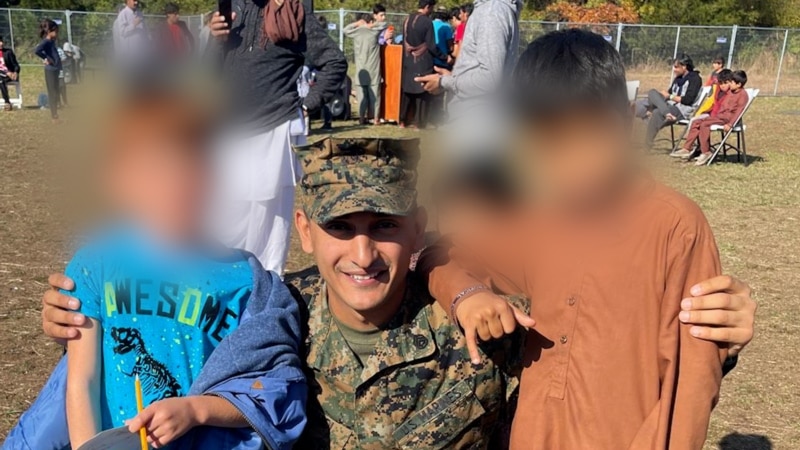
A former US Marine has spent days trying to see his brother at a camp in Qatar holding Afghan refugees in limbo after plans to bring them to the United States were blocked by a presidential executive order. The camp is due to close on September 30, and the inmates don’t know what will happen next.
“I am the way, the truth, and the life. No one comes to the Father except through me.”
Jesus Christ – Gospel of Saint John the Apostle (14:6)
“Do not fear them, then, for there is nothing hidden that will not be revealed, and nothing secret that will not be made known.What I tell you in the darkness, speak in the light; and what you hear whispered in your ear, proclaim from the housetops.”
Jesus Christ – Gospel of Saint Matthew the Apostle (Mt 10:26-28)
In the cover image the Arcbishop of Saint Pio, father Franco Moscone, and the Zionist rulers Netanyahu and Trump
The Heroic Homily of the Archbishop of San Pio on Genocide, Rampant Zionism, and Banks Profiting from Arms
In an era when Catholic progressivism is obscuring the diamond-bright light of the Word of God with diabolical worldliness, there remain Shepherds who have the courage to challenge wolves in sheep’s clothing to save their flock.
One of them is undoubtedly Monsignor Franco Moscone, Archbishop of Manfredonia, Vieste, and San Giovanni Rotondo—home to the Shrine of Saint Pio of Pietrelcina. Yesterday, during the Solemn Mass marking the liturgical feast of the Franciscan friar, the prelate—originally from the Piedmont region of Saint John Bosco and the Langhe (home of the philanthropist Servant of God Giulia di Barolo)—delivered a homily that was not only moving and courageous but truly heroic.
Gospa News has dedicated three previous articles to the battle waged by this high-ranking prelate of the Archdiocese of Manfredonia, for—just as Gospa News points an accusing finger at the profiteering of… The Weapons Lobby and death.
Indeed, every one of his statements is borne out in detail by the investigations we have linked to them.
Yesterday, he stood in solidarity with the “Priests against the Gaza genocide”—with whom he had demonstrated in Rome the day before, subsequently having to explain to some of the faithful why his seat was empty at the overnight vigil for the Feast of Saint Pio—but above all, he boldly exposed “dominant Zionism”and the “armed banks” that profit from “ethnic cleansing in Palestine.”
In an era when every public authority is terrified of discussing Jewish extremism for fear of being branded antisemitic, Monsignor Franco displayed a fortitude and intelligence truly bestowed by the Holy Spirit; he used unequivocal words to condemn the Tel Aviv regime, while tempering them by citing the book by Israeli historian Omar Bartov:
He did so in a speech challenging—and calling for the “disarming” of—all “theologies of fundamentalism,”such as that of the Boko Haram terrorists: heirs to ISIS and Al-Qaeda, groups created by Anglo-American intelligenceto invade the Balkans, Afghanistan, Iraq, and Syria—a connection certainly not made by the priest himself, but one argued in his books by former Interpol official Antonio Evangelista, whom I have interviewed on several occasions.
The prelate cited the theological fundamentalism found among Hindus, as well as among Evangelical Christians and xenophobic Catholics. He concluded with two resounding remarks—delivered before the final blessing of the Mass—regarding the “wars spread by NATO”and the possibility of reviving in Italy the concept of conscientious objection to military spending, as was done during the Cold War.
I have summarized in a few lines a homily lasting about twenty minutes; it must be heard in its entirety to fully grasp the Gospel narrative that began with the blood of Padre Pio’s stigmata and now extends to Gaza—to the 300 children killed during the sham truce—as well as to Lebanon and the 145 others who died during yet another bogus ceasefire.
For this reason, I will limit myself here to transcribing only those sentences containing the aforementioned key points.
The Empty Chair at the Saint Pio Vigil: Standing with “Priests Against Genocide”
«Someone rightly wrote to me this morning saying, ‘Last night there was an empty chair at the vigil for Saint Pio’—and it was mine, the local bishop’s! It was empty here because I sought to embody the spirit of prophecy, solidarity, and peace that Padre Pio always brought through his life and continues to urge upon us: a most urgent cry in this historic moment to which we are all witnesses».
Thus begins Father Franco’s homily, which seems to encapsulate two years of impassioned denunciations against the holocaust of children in Palestine and Lebanon.
«Yesterday, I attended a demonstration called ‘Priests Against Genocide’; it is an international network of priests that emerged just over a year ago in response to a cry for help from an African nun—a plea heard and taken up by a dedicated priest from Sicily. The network currently brings together over 2,600 priests from 57 nations, as well as 27 bishops and three cardinals. Yesterday, we walked a route through Rome, starting at the Jesuit Curia, passing the embassies to the Holy See for Palestine and Lebanon, and arriving at Piazza Mazzini, where Leonardo’s administrative headquarters is located» the priest continued (hereafter, we will not specify that the italicized text comes from his homily).
«We arrived at this point through prayer, by listening to the Gospel, and by reflecting on the words of Pope Leo’s *Magnifica Humanitas* and those of the Israeli historian Omar Bartov, who published a book titled *Into the Abyss: From Zionism to Genocide—Israel’s Moral Defeat*».
The Stigmata of the Holy Land: 445 Children Killed During False Truces, Christians Driven Out
«I look at the wounds of Padre Pio—at the signs of his identification with Christ Crucified and the blood he shed alongside Jesus’s for fifty years—and I ask myself: where is the blood of the Lord’s stigmata and Padre Pio’s stigmata today? Where is it being shed?»
«It is certainly found in the stigmata borne by the population of Gaza, 97% of whom are left without homes or means of subsistence—a place where a truce is said to exist, yet a genocide quietly continues. Yesterday, we recited the names of 300 children killed in Gaza since the truce began.Padre Pio’s wounds are also found in the ethnic cleansing taking place in the West Bank and southern Lebanon; there, too, we counted 145 children killed since a peace plan was supposedly in place».
«In those lands, our Christian brothers—representing the oldest churches in history—are particularly being driven away; only one Christian village remains under the administration of the Palestinian Authority. All the others have been wiped out.»
The Archbishop of San Giovanni Rotondo went on to mention the “stigmata” visible in Africa: the wars in the Sahel and Sudan, the massacres committed by Boko Haram terrorists in Nigeria and the abduction of girls, and the repression in Myanmar and across the Middle East.
He added: «And here in our own Europe, too, Ukraine and Russia continue to send their finest youth to the front lines to be sacrificed. These open, bleeding wounds—akin to the stigmata of Christ—persist in the humiliation of the Venezuelan people and the starving of the Cuban people.»
«I urge everyone to make praying for peace our primary commitment; it was a central focus of Padre Pio’s thoughts and heart throughout his life.»
Monsignor Moscone noted that, in the past, prayer groups did not succeed in halting wars as the “greatest Saint of the last century” had hoped: «It was not effective then, yet we must believe it can be effective today, preventing these scattered conflicts from escalating into a world war.»
Father Franco Moscone: “Disarming Fundamentalist Theologies: From Dominant Zionism to Catholic Xenophobia”
«From Padre Pio, we also learn how to properly interpret Sacred Scripture—the words of the entire Bible, and the Gospel in particular. Let us, therefore, call for the disarming of the theologies that fuel fundamentalism of every kind. Jewish theologies that fuel the dominant Zionism; Islamic theologies that foment terrorism and fundamentalist groups; Hindu theologies—but also Christian theologies, particularly of an evangelical bent as well as within our own Catholic Church—that spread division and violence and stoke xenophobia and racism».
“Arms multinationals and ‘armed banks’ that invest in death.”
«Let us, therefore, pray and read the Word of the Lord and the values of our religion—and all religions—with authenticity and integrity. And let us not be afraid to speak out against what is wrong in this regard. Prayer must translate into action—action that speaks truth and denounces injustice. We cannot settle for a narrative that aims for and leads directly to war—serving solely to boost the interests of major arms multinationals, ‘armed banks,’ and anonymous investment funds that invest only in death—thereby denouncing a form of capitalism and power that makes the rich ever richer and the poor ever poorer, while also—even in our developed West—wiping out the middle class and social mobility, driven by a mindset that leads only to death and injustice».
At the conclusion of Holy Mass—following the reading of the prayer for Civil Protection, of which Saint Pio is the patron—the Archbishop of Manfredonia added a pointed remark that struck like a dart aimed at European armament plans, which he had already severely condemned in previous public statements…
“Wars Spread by NATO and Tax Objection to Arms Spending”
«This is the security we need and desire: the security of Civil Protection, of environmental stewardship… This is true deterrence—not that of armaments and NATO, an alliance that, since its inception, has only brought and spread war across four continents»—a fact confirmed by the recent geopolitical “Mediterranean Sea: Same Blood, Same Mud”) by Interpol official Antonio Evangelista.
«A form of deterrence that is essentially cost-free, requiring no massive financial outlay. It makes me wonder if the time has come to revisit a concept discussed during the Cold War—in the 1970s and 80s—namely, not merely conscientious objection to military service, but objection to military spending itself: a tax objection regarding that 5% of funds they want us to divert to entirely different purposes. I take personal responsibility for what I have said; let us now receive the Lord’s blessing—a blessing that is surely one of Peace, and nothing else».
Invoking Saint John Paul II, a heroic fighter against war
In a gesture reminiscent of the greatest, most heroic crusader against conflict and weaponry—Pope Saint John Paul II—the Mass concluded with the moving hymn “Jesus Christ, You Are My Life,” composed by Monsignor Marco Frisina for the World Youth Day held at Tor Vergata, Rome, during the Jubilee of 2000.
Every Christian must give praise to God, Jesus Christ, and Saint Pio for sending us another courageous prelate—a bishop—like Karol Wojtyła: the Bishop of Kraków during the Soviet communist regime’s political occupation who later became the Bishop of Rome and succeeded in bringing down the USSR dictatorship through the consecration of Russia to the Immaculate Heart of Mary, in obedience to the secret messages received at Fatima by the visionary Lucia.
Suffice it to recall that it was not the assassination attempt against him on May 13, 1981, nor the military regime imposed by General Wojciech Jaruzelski, but rather the Solidarity trade union—fueled by the Christian spirit instilled by John Paul II himself—that managed to triumph, much like David against Goliath.
US lawmakers and national-security experts are pressing President Donald Trump to take tougher action against Chinese entities accused of helping Iran with satellite intelligence, weapons components, and oil revenue.
Iran’s participation in the BRICS Summit sends a clear signal: the West’s attempts to isolate Tehran have failed. The series of meetings held by Iranian President Masoud Pezeshkian with world leaders at the 18th BRICS Summit in New Delhi were a clear confirmation of that. Dialogue Instead of isolation BRICS summits long ago outgrew the […]
Far-right Argentine President Javier Milei addressed the 81st session of the United Nations General Assembly on September 23, giving a speech which provoked strong reactions. The South American head of state also participated in a series of high-level meetings.
One of his most quoted lines from his New York City trip has been: “Argentina is the new promised land.”
This is not the first time Milei has used religious concepts and ideas from the Judeo-Christian tradition to explain his political stance, but it is the first time the Argentine president has equated his country, in economic and political terms, with the land of Abraham and his descendants.
This is even more telling when one considers Milei’s extremely close relationship with Israel and ardent defense of its policies of war and genocide across West Asia, as well as the admiration he professes for the Jewish religion.
Milei also emphatically underscored this during his address to the UN General Assembly: “We also made a geopolitical choice: we have unambiguously aligned ourselves with the West … We condemn the Iranian regime’s attacks on the State of Israel.”
And this is an indisputable fact. Since the beginning of his term, Milei has not only aligned himself with the geopolitical interests that the Trump administration has vigorously pursued, but has also become one of Israel’s staunchest allies in the region.
This is quite impressive, considering that President Noboa in Ecuador, De la Espriella in Colombia, and others have also expressed a kind of unwavering alliance with Tel Aviv.
That is why Milei has not limited himself to diplomatic rhetoric, but has pulled the strings of power to designate Iran’s main military force (currently in conflict with Israel and the United States) as a terrorist organization.
“We declare the Iranian Revolutionary Guard a terrorist organization, just as we continue to seek justice for the two attacks we suffered on Argentine soil in 1992 and 1994,” Milei said at the UN, referring to two attacks in Argentina against the Israeli Embassy and the Argentine Israelite Mutual Association (AMIA). The Argentine justice system, advised by Israel and the United States, identified Hezbollah and Iranian citizens as the perpetrators.
Free-market capitalism and Artificial Intelligence
Another topic Milei addressed during his appearance was his staunch defense of free-market capitalism in which the state plays a minimal role: “We do not want to lose again; that is why we embrace free-market capitalism.”
In this regard, Milei once again highlighted his government’s strong support for artificial intelligence companies and the tycoons behind them. It should not be forgotten that the Argentine government signed a working and information-sharing agreement with Palantir, whose co-founder, Peter Thiel, purchased a property on Argentine soil.
This is clearly part of Milei’s neoliberal agenda to attract investment from major foreign capitalists, among whom the owners of technology companies (who are so interested in resources such as lithium, copper, and others that abound in South America) currently stand out.
However, recent statements by former employees of these companies regarding the danger that the development of AI poses to humanity have created some unease around the world. But Milei says that this is precisely the time to move forward: “Prudence does not mean fear, and what’s more, fear should under no circumstances automatically lead to obedience … where many see a threat, we see a frontier.”
Criticism of the UN
Probably one of the most important aspects highlighted in Milei’s speech was his harsh criticism of the UN and its role in current geopolitics: “Today, unfortunately, it is time to acknowledge that this sacred pact has, in fact, been broken.”
But not content with merely pointing out the shortcomings, Milei asserted (very much in line with Trump) that the UN has become a venue for certain people to amass wealth: “It has become a useless organization that serves only to feed a caste of fatally arrogant parasites disguised as well-meaning bureaucrats.”
Hence, he asserted that resolutions ultimately have no real effect on policy. He cited the example of the Malvinas Islands, a territory disputed with the United Kingdom: “What good is a resolution if, for decades, the other party can act contrary to it, and that resolution remains intact in the archives but is powerless in the face of reality?”
Criticism of Milei’s speech
Milei’s statements, while applauded by his supporters, have drawn widespread criticism in Argentina. Much of the criticism has focused on the fact that Milei now seems to staunchly defend Argentina’s right to control the Malvinas Islands, whereas in the past he was cautious and even reluctant to adopt a patriotic stance against the United Kingdom – something both the Argentine left and right have done. “We’re surprised that Milei now remembers when he used to talk about self-determination,” said Axel Kicillof, governor of the province of Buenos Aires.
Likewise, critics pointed out the apparent contradiction in Milei’s rhetoric between extolling the right to self-determination and aligning himself with the interests of Washington and Tel Aviv: “Milei’s stance doesn’t surprise me. The truth is that this line of subservience—and I say this very clearly—is directed at Trump and Netanyahu. Even the terminology is consistent with what Trump proposed and his ideas on the deregulation of artificial intelligence, as well as his view that Argentina’s natural resources are available to anyone who wants to take them,” said Kicillof.
Regarding Milei’s economic rhetoric, Patria Grande leader Juan Grabois said: “Besides being an ignorant imbecile, besides being a lobotomized parrot who parrots Trump, besides plagiarizing Gramsci without knowing he’s “a filthy communist,” what Milei is saying is that we’re basically going to hand over our territory, critical minerals, energy, and national sovereignty to the technocracy.”
In a live television interview Thursday night Paris time, French President Emmanuel Macron said he was sending an unspecified number of troops and equipment to Saudi Arabia to protect the Yanbu energy hub, located on the Red Sea.
“This is the agreement we have finalized with the Saudis,” Macron explained. “We are going to send military resources, that is to say, soldiers, radar systems and defense systems, to protect this site — not to get us involved in any conflicts, but to protect this site.”
The French leader did not elaborate on the exact equipment he would send, how many troops, or when they would arrive. Nor did he address what would happen if French personnel were killed or injured or equipment damaged or destroyed. We have reached out to the French Embassy for further details. Based on his mention of radars and seeing that the threat to Saudi oil infrastructure is almost entirely from aerial attacks from drones and missiles, these will likely be air defense forces.
Nous agissons pour protéger nos compatriotes des conséquences de la crise au Moyen-Orient. Objectifs : sécuriser les approvisionnements et faire baisser les prix à la pompe. pic.twitter.com/kvrgHcV4E4
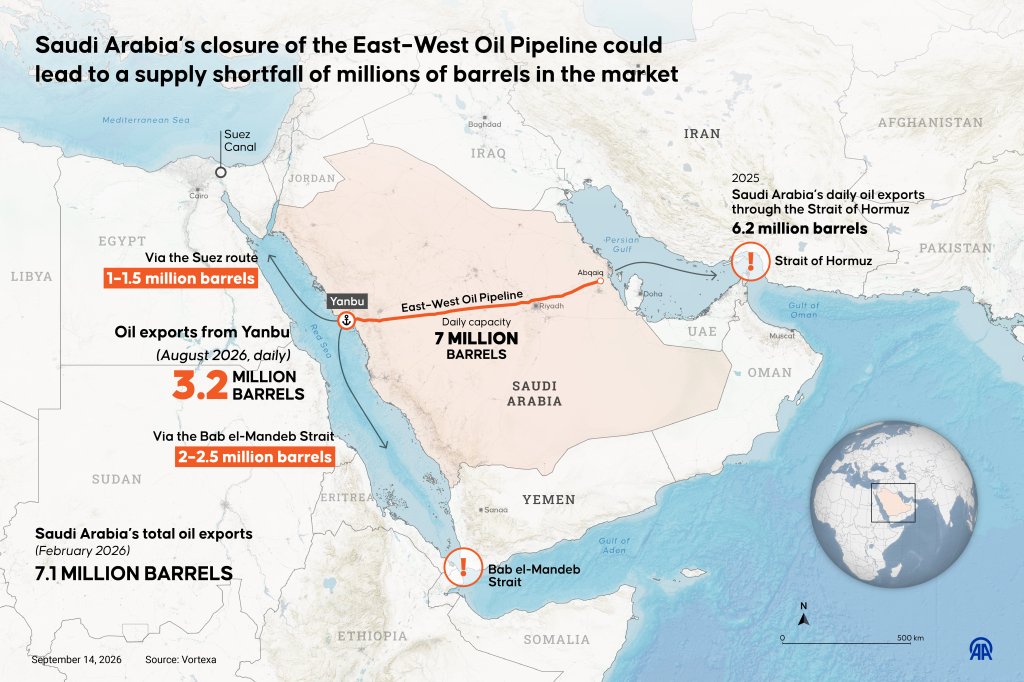
An infographic illustrating how Saudi Arabia has diverted oil from the Persian Gulf to the Red Sea. (Photo by Murat Usubali/Anadolu via Getty Images) Anadolu
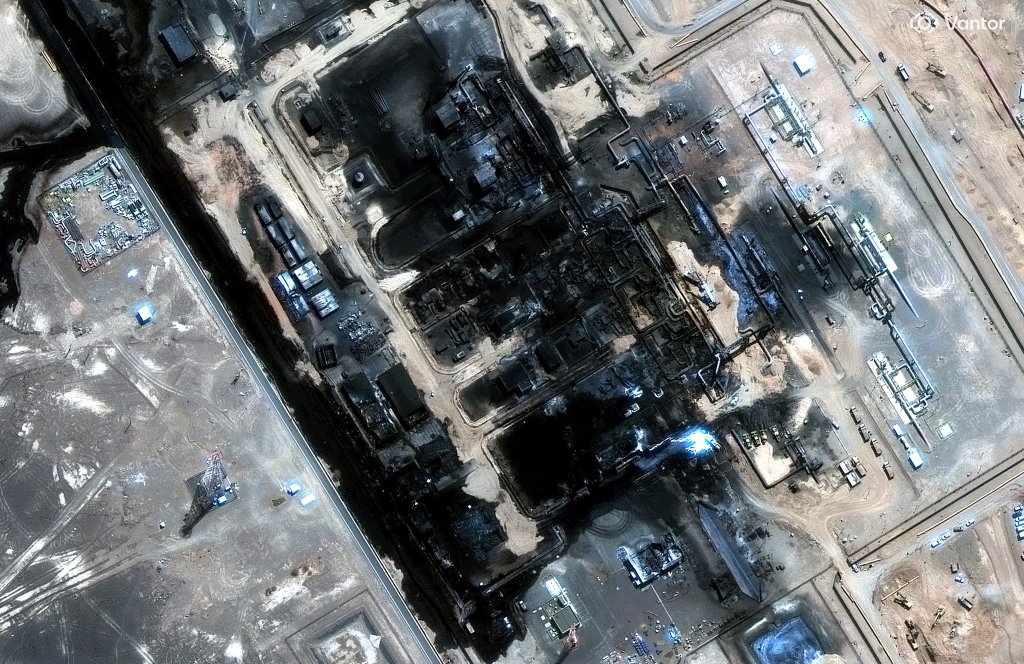
Before Macron’s announcement on Thursday, the Houthis claimed they had carried out two more waves of attacks on Saudi targets, including one on the Saudi Aramco facility in Yanbu, “using a number of ballistic and cruise missiles, as well as drones.”
In addition, the Houthis claimed they struck Riyadh.
Earlier in the day, the Houthis said they struck “enemy command and control centers, operations rooms, weapon depots, missile launch platforms, and military sites belonging to Saudi-led enemy formations in Jizan,” a Red Sea port city.
“The Saudi-led military coalition in Yemen said on Thursday that it had shot down six ballistic missiles fired by the Iran-backed Houthi militia, in what appeared to be one of the largest cross-border attacks by the group since its conflict with Saudi Arabia [flared back up],” The New York Times reported.
The missiles were aimed at the Saudi cities of Taif and Yanbu, Maj. Gen. Turki al-Maliki, a spokesman for the Saudi-led coalition, claimed on X. “Escalations and violations by the terrorist Houthi militia will be dealt with firmly,” he stated, without specifying where the missiles were intercepted.
TWZ cannot independently verify any of these claims.
Today’s attacks are the latest in the escalating conflict between the Houthis and Saudi Arabia. Earlier this year, the Houthis imposed a blockade on the Bab al-Mandab Strait (BAM) and began striking Saudi ships in the southern part of the Red Sea as well as critical energy terminals on that body of water and Saudi refineries. Iranian proxies have also struck the vital East-West pipeline that carries oil to the Red Sea to bypass the Strait of Hormuz, where Iran vastly curtailed shipping after the launch of Operation Epic Fury. The East-West pipeline reportedly reopened after being shut down following a long-range drone attack.
The stark reality facing Macron is that if Saudi oil infrastructure and transport nodes near the Red Sea are destroyed or the pipeline that feeds it is shut down for months, the last major oil lifeline from the region — and especially to Europe — will be closed off, sparking a deeper energy crisis.
Iran has already severely curtailed the flow of oil through the Strait of Hormuz since the U.S. and Israel attacked it on Feb. 28. The movement of oil has been further impeded by a U.S. blockade on Iranian ports. However, transits have been increasing as of late, thanks in large measure to U.S. military escorts that U.S. Central Command claims have allowed more than a billion barrels of crude to pass through the Strait of Hormuz. Still, the traffic is far below what it was before the war broke out.
Having both the Strait of Hormuz largely closed and energy exports out of the Red Sea shut down simultaneously is a nightmare scenario. By Thursday evening Eastern time, the per-barrel price of Brent crude oil shot up to nearly $107, according to OilPrice.com. It had fallen below $100 per barrel just two days earlier.
Given all this, the French president sought to offer reassurance about oil supplies, according to France 24.
“He said he had carried out ‘intense diplomatic activity,’ meeting in recent weeks with the leaders of Saudi Arabia, Iraq and Nigeria, all hydrocarbon suppliers, to ensure France keeps receiving the same volumes,” the publication noted.
“We have replenished gas stocks and also oil stocks” for the months ahead, the French president also said.
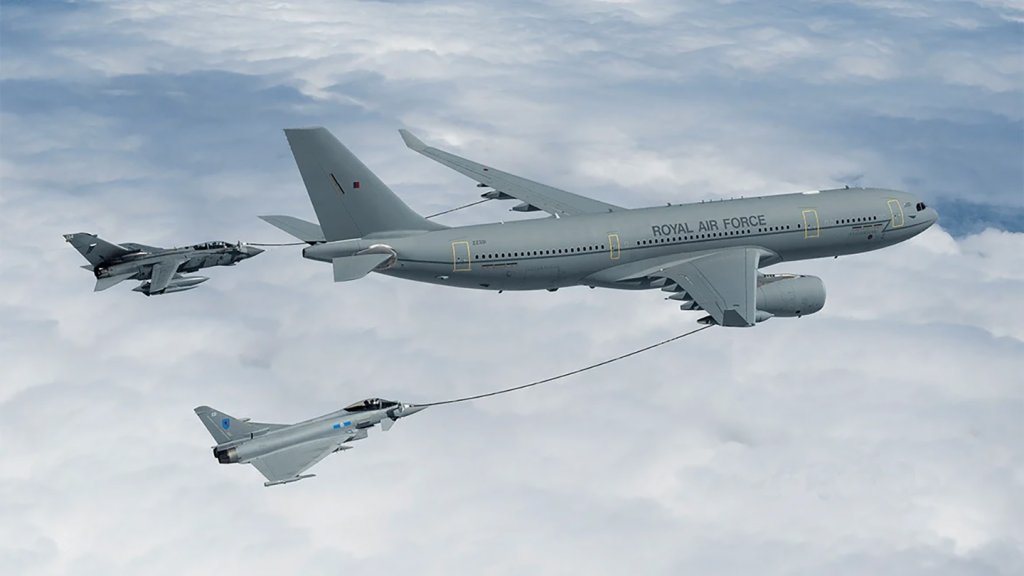
“Escalating tensions in the Gulf could have negative consequences here in the UK—such as rising prices, disruptions to energy supplies, and increased costs for British businesses,” the U.K. Defense Ministry (MoD) explained in announcing the deployment. “The Houthis pose a threat to stability in the Middle East; therefore, it is in the UK’s national interest—economically and in terms of security—that they do not succeed in their aims.”
“We unequivocally condemn Houthi attacks on Saudi Arabia, and our position is clear: both Saudi Arabia and the Yemeni government have the right to self-defense,” the ministry added.
The jet will operate from a U.K. air base in Cyprus and will begin air-to-air refueling operations in the coming days, the BBC reported.
A Royal Saudi Air Force Voyager aerial refueling jet. (Air Tanker)
The French and British deployments contrast decisions by the U.S. and other nations not to get involved with the Saudi-Houthi fight.
Last week, Trump turned down a direct plea from Saudi Crown Prince Mohammed bin Salman, the Kingdom’s de facto leader, to attack the Houthis. Meanwhile, Pakistan and Turkey, which signed the Mecca Joint Defense Agreement with Saudi Arabia, have yet to provide any direct military aid. The pact holds that an attack on one is considered an attack on all; however, it doesn’t stipulate exactly what actions should be taken.
The security situation in Yemen has drastically deteriorated since the launch of Epic Fury after the Houthis joined the U.S.-Iran conflict on the side of their major supporter.
The Houthis have been directly attacking Saudi Arabia over claims that the kingdom has imposed a blockade on them. Beyond that, the mostly dormant civil war between the Houthis and internationally recognized Yemeni government forces, backed by Saudi Arabia, reignited in the wake of Operation Epic Fury. The Houthis have made large territorial gains in the renewed conflict, including capturing the port city of Mokha and two key islands in the Red Sea. This has strengthened the Houthi hold on the BAM. You can read more about that in our story here.
3. The Houthis have reportedly attempted to seize ROYG-controlled islands in the Red Sea from which Houthi fighters could launch attacks on international shipping. Houthi forces reportedly landed on the Hanish Islands in the southern Red Sea on the morning of September 10 after… pic.twitter.com/tiFPgNDOHZ
The civil war in Yemen erupted in 2014 and expanded a year later when a Saudi-led coalition joined forces with the government ousted by the Houthis. The fighting between Saudi-led forces and the Houthis largely abated after a tenuous ceasefire took hold in 2022. The Saudis held off on getting involved in the recent Red Sea conflict, which saw the U.S. and coalition warships duking it out with the Houthis and eventually led to a U.S.-led air campaign over Yemen. The United Kingdom was another significant player in that air campaign.
Meanwhile, exacerbating concerns about the flow of oil from the Red Sea, “a senior adviser to Iran’s supreme leader warned Thursday that Iranian forces and their Houthi allies in Yemen could respond to any new U.S. attacks by opening ‘a new front’ in its war with the U.S. by targeting energy supplies in the Red Sea,” CBS News reported.
The statements came after U.S. President Donald Trump on Wednesday once again threatened Iran.
“Will a deal be made with Iran that lets them rebuild and create a far greater country than it ever was before?” Trump asked rhetorically. “Or do I annihilate the Islamic Republic and do it quickly, never giving them a chance to kill and destroy people and countries again?”
Trump added that he believed he would make a peace deal with Iran after the upcoming U.S. midterm elections, which will decide the control of Congress.
Trump to the UN: "Do I annihilate the Islamic Republic, and do it quickly? Do I drive them into hell?" pic.twitter.com/cIYBO1Mp3w
The fact that France is sending forces to Saudi Arabia is an ominous development and another indication that the current spate of unrest that began with Epic Fury does not appear to show any signs of ending anytime soon.
Former Fox News host Tucker Carlson said in an interview with NPR, published on Thursday, that in the days before the US and Israel launched the war with Iran, President Trump dismissed Carlson’s concerns about the conflict by saying, “We all die anyway.” Carlson said that he told Trump that the war was not about […]
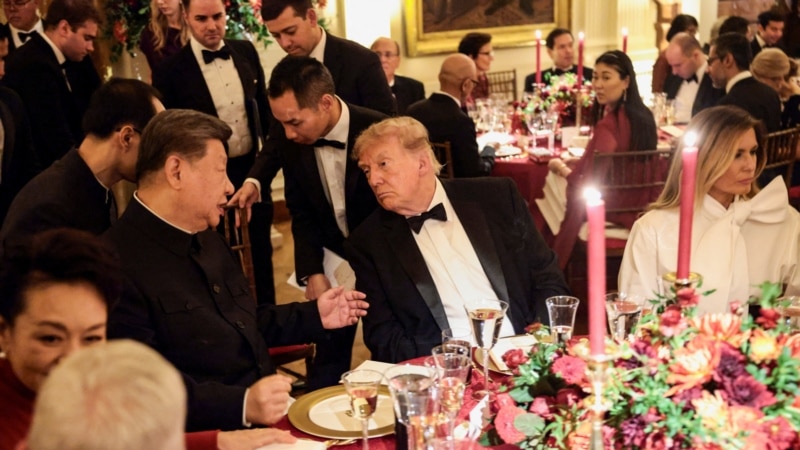
During an Oval Office meeting with President Trump in Washington on Thursday, Chinese President Xi Jinping conveyed China’s position on Taiwan and told the US president to approach the issue “carefully,” The South China Morning Post reported, citing the Chinese broadcaster CCTV. The report said that Xi, who is in Washington as part of an […]
China called the latest US threats of secondary sanctions on airline service-providing companies across the world an illegal unilateral measure without any basis in international law. The US said the sanctions would be applied if these companies do not stop providing services to Iranian airlines.
China said they “firmly oppose illicit unilateral sanctions that have no basis in international law and lack UN Security Council mandate,” Guo Jiakun, official spokesperson of its Ministry of Foreign Affairs said during a regular press conference on Wednesday, September 23.
China’s reaction came on the same day the latest US sanctions against Iran went into effect.
The US Treasury Secretary Scott Bessent has asked companies across the world who are involved in providing services such as refuelling, ticketing, and other kinds of ground support to stop serving Iranian airlines starting at midnight on September 23. If they fail to comply they will be “locked out of the dollar system,” Bessent threatened.
The latest sanctions against its airlines is part of the recently announced US attempt to completely isolate Iran from the global economy in order to pressure its government to re-open the Strait of Hormuz.
Iran has shut down the Strait of Hormuz following the resumption of US airstrikes as well as Washington’s attempts to bypass Iranian control over the waterway in the Persian Gulf since July. Iran has claimed that those American moves were in violation of the peace deal signed under international mediation in June.
The adoption of new sets of sanctions is widely seen as an indication of Washington’s failure to achieve its objectives in Iran militarily, even after seven months of war, which began on February 28.
Iran has reiterated that no amount of economic coercion will open the Strait of Hormuz. They listed the withdrawal of the US naval blockade, the unfreezing of its international assets, and an end of the war on all fronts in the region as preconditions for opening the Strait.
Air blockade
While some of the countries in the region cancelled Iranian flights to their airports in fear of US sanctions, Iran claimed most of its international flights remained scheduled and operational. Some countries also decided to close their airspace for Iranian airlines.
Iraq has diverted most of the Iranian flights from its Baghdad airport to Najaf.
If the flights remain suspended for a significant number of countries for a longer duration it would amount to an air blockade on Iran. This will have an effect on thousands of people employed in the aviation sector in the country which is already heavily facing tremendous economic troubles due to existing sanctions
A prolonged suspension of flights could also impact hundreds of thousands of Iranians who have to travel out of the country for medical or other reasons.
Iran has maintained that unilateral US sanctions are illegal and an “act of terrorism” against Iranian people. It has urged the nations across the world to not succumb to the unilateral actions of the US.
Chief of Iran’s Supreme National Security Council Mohsen Rezaei, in an interview on Wednesday, warned neighboring countries against submitting to US pressure to shut down Iranian flights, claiming such acts will force Iran to retaliate.
The Senate narrowly defeated a War Powers Resolution on Thursday that would have directed President Trump to end the war with Iran, though the vote doesn’t negate the Iran War Powers Resolution that was passed by both the Senate and the House several months ago. The resolution failed Thursday in a 49-50 vote, with four […]
“Nothing in life is free,” goes an old Latin American saying, and Bolivia’s right-wing President Rodrigo Paz has proven this once again. The International Monetary Fund confirmed that it will disburse $1.9 billion to Bolivia, which will naturally have to repay the loan.
Several experts assert that the government’s decision will lead to an imminent increase in the price of food, mining, and transportation, thereby negatively impacting the country’s working population, which constitutes the vast majority.
While the government claims that these types of neoliberal measures will help control inflation, economist Fernando Romero argues that eliminating the diesel subsidy could cause inflation – which was projected to reach 14% by the end of the year – to rise to 20% by December 2026.
But this seems to matter little to a government whose primary goal – whether its own or one set by international financial institutions for the Third World – is to reduce the fiscal deficit at all costs.
“You [Bolivians] elected me to solve problems … If [the IMF] is lending us funds to revive the country, I cannot buy diesel at a high price and sell it cheaply … That is why we have decided that diesel will cost the same as it costs us to buy it abroad, and that price will be the same for everyone,” Paz said in an address to the entire country.
Just a few months in office, many protests
The truth is that this is not the first time Paz has sought to meet the IMF’s demands. In December of last year, just a few weeks after being sworn in as president, Paz raised the price of diesel and gasoline, sparking protests across the country.
A few months later, between May and June, thousands and thousands of Bolivians took to the streets to protest the government’s plan to allow land to be seized to settle debts, which was followed by demands from the Bolivian Workers’ Confederation (COB) and various peasant groups for higher wages and improved fuel supplies, among other things. Following harsh repression, the protests quickly escalated into demands for the president’s resignation, which led to increased tensions and clashes between law enforcement and thousands of workers who blocked major highways across the country. These protests left 14 dead and nearly 400 people detained.
It now appears that Paz will not back down from his policy, despite the fact that in less than a year he has faced significant protests against him that have gradually eroded his public image. According to some polls, Paz’s approval rating barely reaches 32%.
But Paz has also prepared for possible demonstrations. The Bolivian Congress, which supports Paz, has just extended the state of emergency – which had been declared last June – by 90 days. According to Interior Minister Marco Oviedo, there are: “threats of renewed and coordinated blockades, marches, and strikes, as well as early warnings regarding calls to action, escalations, ultimatums, and the mobilization of social groups [in the coming days].”
Announcement of protests
Indeed, several agricultural workers and truck drivers have announced that they will mobilize all their members unless the government reverses its plan to eliminate the diesel subsidy. “The increase in the price of diesel spells the end for all our productive sectors; that is why we have united to defend our livelihoods and our daily work, because right now, not only is there no diesel, but we are being forced to buy it at double the price,” the main leaders of these workers said at a press conference.
And while the bulk of those likely to protest against Paz will be the poorest workers, it should not be overlooked that a significant portion of industries, mining companies, and various other businesses rely on diesel to power their machinery. This suggests that discontent will arise not only among the poorest but also among the middle class and various business owners who foresee rising production costs without any real affordable alternatives.
Similarly, transportation unions have stated that if the price of fuel doubles, they will be forced to double the cost of fares. In fact, transport operators traveling between departments have already raised fares by between 50% and 100%.
Consequently, the rising costs of food, supplies, diesel, production, transportation, and so on lead several experts to predict that Paz’s decision (while it may please the IMF) will spark demonstrations and a new cycle of protests against the administration.
However, given the extension of the state of emergency, it does not appear that Paz is very interested in curbing the protests, but rather in resisting them and cementing the elimination of the subsidy in the long term, thereby bolstering the neoliberal program, which he calls “Bolivia’s new path.”
Whether Bolivian workers (who have a long tradition of resistance and popular mobilization) will succeed in thwarting the intentions of Paz and his international allies remains to be seen.
But, as seen in other countries such as Ecuador, neoliberal governments have opted for a strategy of wearing down popular protests. For example, Lenin Moreno’s government raised fuel prices only to back down in the face of massive social protests. Years later, Guillermo Lasso and Daniel Noboa did the same, until the protesters grew weary and they finally succeeded in eliminating the subsidy on certain fuels.
For now, it seems that Bolivian workers are not willing to back down, although all signs indicate that neither will the Paz administration nor future neoliberal politicians. Whoever emerges victorious will do so by sheer resistance and the ability to remain united.
Duncan is a longtime friend of Max Daly, and a drug addict caught up in “cuckooing,” where dealers take over people’s homes as drug bases in exchange for product. Daly offers a sympathetic portrait of Duncan’s spiralling life, while opening a window onto a bizarre world where the most vulnerable exploit each other—and sometimes even form bonds.
Over the 2000s and 2010s, wave after wave of gangs fanned out from Britain’s drug supply hubs – London, Liverpool and Birmingham – to set up shop in smaller towns and cities across the country. They took over the homes of drug users and young women who had been groomed by older male gang members. As early as 2008 Suffolk constabulary reported that more than a third of Class A drug dealers arrested in Suffolk were under 21, and the majority were from London. (Before this period, most crack and heroin dealers in towns and smaller cities were “user-dealers”, addicted heroin users in their 30s or older, who were not as “professionalised” as the big city drug gangs.) Gangs often used sex workers, who targeted male tenants and moved in, bringing the young dealers with them. Community safety teams, who rescued 80 tenants in London in 2005, were the first to call the tactic “cuckooing”.

 Login