President Trump said on Sunday that he was “rejecting” a proposal from Iran to end the war and fully open the Strait of Hormuz within seven days, comments that came after The Wall Street Journal reported that he’s expecting to resume bombing Iran after the midterm elections. “I’m rejecting their deal,” Trump told reporters, according […]
Le sommet qui a réuni les présidents américain et chinois lors de la visite de M. Xi Jinping aux États-Unis, du 23 au 25 septembre, invite à mesurer un renversement géopolitique – et à s'interroger sur un autre.
Au milieu des années 1980, la question de Taïwan ne figure pas au rang des priorités géopolitiques de la planète. Depuis 1979, Washington a établi des relations diplomatiques avec la République populaire de Chine (RPC). La priorité est alors d'affaiblir l'Union soviétique en jouant des tensions qui l'opposent à la Chine. Dans le grand jeu planétaire, Taïwan ne représente qu'« un problème insignifiant », selon un document du Congrès américain daté de février 1982.
Le « problème insignifiant » d'hier se trouve désormais tout en haut de la liste des questions brûlantes qui opposent Washington et Pékin. Le statut de l'île offre depuis longtemps à Washington une marge de manœuvre : si le traité de San Francisco établit que le Japon « renonce » à Taïwan, il ne précise pas à qui elle doit revenir. Après l'effondrement du bloc soviétique, alors que la Chine apparaît comme un rival possible des États-Unis, cette ambiguïté prend une nouvelle valeur stratégique.
M. Xi aurait sans doute aimé acter un nouveau renversement, à l'occasion de sa visite officielle, en obtenant des États-Unis qu'ils « adhèrent à la position correcte consistant à s'opposer à “l'indépendance de Taïwan” » — ce qui aurait, de nouveau, renvoyé l'île au rang de question géopolitique « insignifiante ». Que M. Trump se soit gardé de répondre publiquement, à M. Xi comme aux journalistes, pourrait signifier qu'il compte toujours sur l'île comme atout de négociation.
Dans le district de Neihu, en périphérie de Taipei, l'American Institute in Taiwan (AIT) se fait relativement discret. Pas de drapeau, ni de marines en armes, ni de voitures avec plaques diplomatiques ; seul un sceau représentant l'aigle des États-Unis à la porte d'entrée rappelle à qui le bâtiment appartient. Inauguré en 2018, l'institut s'est éloigné du quartier de Xinyi où se retrouvent généralement les structures diplomatiques du monde entier, des « représentations » d'États — et non des ambassades — car la plupart des nations ne reconnaissent pas Taïwan comme pays.
D'une valeur de 255 millions de dollars (190 millions d'euros), l'« ambassade de facto », comme on l'appelle, possède néanmoins des dimensions colossales. Si l'on y ajoute les bureaux à Kaohsiung, deuxième ville de l'île, la présence américaine rassemble près de 500 employés (contre 1 300 à Pékin). Officiellement, l'AIT se définit comme une organisation à but non lucratif financée par le gouvernement des États-Unis. Officieusement, il constitue l'un de leurs bâtiments diplomatiques les plus chers d'Asie.
Selon M. Luke Martin, responsable des affaires culturelles, l'AIT est structuré « comme n'importe quelle ambassade : il y a un responsable des affaires politiques, économiques, culturelles, un bureau des relations presse, des départements chargés du commerce, de l'agriculture, de la défense (1) ». M. William A. Stanton, directeur entre 2009 et 2012, ne s'en cache pas : « L'AIT a toujours été, dans les faits, une ambassade. Globalement, notre mandat est d'améliorer les relations entre Taïwan et les États-Unis. (…) La plus grande différence réside dans les noms que l'on emploie. La “chancellerie politique” est appelée “affaires générales”. J'étais officiellement “directeur”, mais les Taïwanais m'appelaient “Monsieur l'ambassadeur”. » Il n'est pas nommé par la Maison Blanche ni confirmé par le Sénat à l'instar des autres ambassadeurs, mais il assume les mêmes fonctions. « Au lieu de recevoir ma lettre de la part du président, je l'ai reçue de la part d'Hillary Clinton [alors secrétaire d'État] », souligne l'ancien diplomate. Il vit toujours à Taïwan et il enseigne comme professeur invité à la prestigieuse université Chengchi, à Taipei (2).
Après sa reconnaissance de la République populaire de Chine, en 1979, Washington a déménagé son ambassade à Pékin et pris une série de mesures évitant toute présence officielle à Taïwan. Avant 2002, explique encore M. Stanton, les employés américains devaient démissionner de leurs fonctions de diplomate avant d'accepter un poste à Taipei. Tout comme les militaires. Cela n'est plus le cas.
Les relations taïwano-américaines prennent une tournure de plus en plus officielle, notamment depuis la présidence de M. Donald Trump. Cette évolution a alimenté les tensions déjà existantes entre les deux rives du détroit de Formose depuis l'élection, en 2016, de la présidente Tsai Ing-wen. Le 10 janvier 2021, juste avant l'investiture de M. Joseph Biden, le secrétaire d'État Michael Pompeo a même annoncé que « les règles instaurées dans le but d'apaiser Pékin devraient être caduques ». Il a levé toutes les restrictions concernant les contacts entre officiels américains et taïwanais.
Aujourd'hui, démocrates comme républicains soutiennent une politique « dure » envers Pékin. M. Biden a d'ailleurs invité la représentante de Taïwan aux États-Unis, Mme Hsiao Bi-khim, à sa cérémonie d'investiture. Des visites de personnalités américaines, à un niveau de responsabilité jamais atteint depuis 1979, ont eu lieu : que ce soit celle du ministre de la santé Alex Azar, en mars 2020 (sous l'administration Trump), ou celle de l'ambassadeur américain aux îles Palaos, où Washington envisage de créer une nouvelle base militaire, le 1er avril 2021.
Le porc dopé à la ractopamine désormais autorisé
Pour Mme Hsiao, « la défense et la sécurité constituent l'objectif premier [pour Taïwan]. Viennent ensuite le champ des relations économiques et, en troisième position, notre participation internationale et nos autres partenariats politiques », ainsi qu'elle le confie dans une interview au magazine spécialisé dans l'actualité de l'Asie-Pacifique The Diplomat, le 9 février 2021.
Taïwan et les États-Unis ne sont liés par aucun accord de défense. Mais, par le Taiwan Relations Act, signé en 1979, ces derniers se sont engagés à fournir aux 23,5 millions d'habitants de l'île les moyens de se défendre. Washington dispose d'un quasi-monopole sur les ventes d'armes (à l'exception de quelques livraisons, notamment en provenance de la France). Les directeurs successifs de l'AIT mesurent d'ailleurs leur succès au montant des contrats signés : « Durant mon mandat, nous avons vendu pour environ 13 milliards de dollars d'armement [9,6 milliards d'euros], un chiffre d'affaires légèrement inférieur à celui réalisé sous Trump », souligne M. Stanton.
Le 9 juillet 2019, le Congrès américain approuve la vente de 66 avions de combat multirôle F-16V, 108 chars M1A2T Abrams, 250 missiles de défense aérienne Stinger, et d'autres armes. L'administration Trump a mis au point un système d'évaluation des besoins (need-based review system) qui permet de répondre plus rapidement aux demandes en équipements militaires de Taipei. En novembre 2020, « l'état-major de la marine taïwanaise a confirmé, pour la première fois, la présence d'un corps de marines américains d'active — et non de retraités — stationnés sur la base navale de Zuoying (3) » au sud de l'île, afin de former pendant quatre semaines les militaires taïwanais.
Toutefois Washington refuse de vendre des F-35 capables de faire face aux avions de chasse chinois, voulant rester le seul et unique gardien de l'équilibre géostratégique dans la région. « L'objectif n'est pas d'inverser le rapport de forces actuel », explique Yeh Yao-Yuan, chef du département des études internationales à l'université de Saint-Thomas, à Houston, pour justifier la décision américaine.
Si l'administration Tsai et la presse internationale se félicitent de ces étroites relations taïwano-américaines, l'opposition y voit un danger. Le porte-parole du Kuomintang, M. Ho Chih-Yung, estime que « malheureusement, le gouvernement a cessé de poursuivre une politique prudente entre les États-Unis et la Chine ; il a choisi de devenir un pion dans l'échiquier géopolitique entre les deux grandes puissances ». Ce parti très anticommuniste, qui a longtemps considéré la réunification sous son égide, avec la Chine comme l'objectif absolu, est désormais largement divisé. Une partie de ses membres revendiquent désormais le « statu quo pacifique » : Washington comme allié sur le plan stratégique, la Chine comme partenaire économique essentiel. À l'opposé, le Parti démocrate progressiste (DPP) au pouvoir voit les États-Unis comme un allié de premier plan pour contrer la pression chinoise et se rapprocher de l'indépendance, largement soutenue par la jeune génération (lire l'article ci-dessus), tout en prônant, lui aussi, un « statu quo pacifique ». « Taïwan n'a pas intérêt à prendre parti alors qu'elle négocie avec deux puissances majeures dont les intérêts sont antagonistes, nous précise M. Ho. Car personne ne veut voir de conflits éclater. » Selon Yeh Yao-Yuan, la relation actuelle est, au contraire, équilibrée : « Taïwan a besoin de l'assistance des États-Unis afin de préserver sa souveraineté, les États-Unis ont besoin de Taïwan pour faire avancer leurs intérêts stratégiques et contrer la Chine. »
Et Mme Tsai ne rate pas une occasion de montrer l'efficacité de ce rapprochement. Le 6 juin 2020, les trois lettres « USA », visibles de loin, barraient la façade du Grand Hotel, monument représentatif de la capitale, en remerciement du don de 750 000 vaccins. Quatorze jours plus tard, l'Amérique annonçant l'envoi de 2,5 millions de vaccins, c'était à la très emblématique tour Taipei 101 d'afficher : « Vive l'amitié entre les États-Unis et Taïwan ».
Il faut dire qu'il n'y a presque plus une ombre au tableau depuis que la présidente a levé, en août 2020, un point de constante tension : l'interdiction d'importer du porc américain élevé à la ractopamine, substance destinée à doper les muscles des animaux et interdite en Europe, notamment. Cette question empoisonne l'accord-cadre sur le commerce et les investissements (en anglais, Trade and investment framework agreement, TIFA) signé en 1994 entre Washington et Taipei, plusieurs fois suspendu à cause des produits carnés. Le gouvernement taïwanais espère que la reprise des discussions mènera à un large accord de libre-échange, permettant de rompre la dépendance à la Chine, toujours premier partenaire commercial.
Un lobby peu médiatisé mais très efficace
Certes, Mme Tsai ne cesse d'affirmer que, à la différence de M. Chen Shui-bian, son prédécesseur du DPP à la présidence (2000-2008), elle ne se prononce pas pour l'indépendance de l'île. Mais, en sous-main, celle-ci recherche toujours plus de garanties et d'officialité. « Renforcer la capacité de dissuasion de Taïwan est crucial pour notre survie sur le long terme », résume Mme Hsiao (4).
À Washington, le lobby taïwanais, qui reste bien moins médiatisé que le lobby israélien, joue un rôle majeur, notamment pour encourager la vente d'armes. « [Des think tanks] produisent des analyses clairement faites pour peser sur la politique extérieure des États-Unis (…) mais ils ne mentionnent pas directement qu'elles sont financées par la représentation de Taïwan à Washington », nous assure Eli Clifton, chercheur au Quincy Institute for Responsible Statecraft, favorable à la démilitarisation de la politique extérieure américaine. Ainsi le Project 2049 Institute fait partie de ces organisations exerçant leur influence en coulisses. Financé par Taipei et l'industrie de l'armement américaine, l'organisme publie de nombreux articles plaidant pour que Washington défende la participation de l'île aux organisations internationales, renforce la légitimité de l'AIT et encourage l'intégration économique entre les alliés du Pacifique. D'autres études agitent le spectre d'une invasion chinoise (5).
Elles ne manquent pas de mettre en avant le discours de M. Xi Jinping, pour les 100 ans du Parti communiste chinois, le 1er juillet 2021. Appelant à « faire progresser la réunification pacifique de la patrie » et à « faire résolument échec à toute tentative visant à l'“indépendance de Taïwan” » (6), celui-ci lance cette menace à peine voilée : « Nul ne doit sous-estimer la détermination, la volonté et la compétence du peuple chinois pour défendre la souveraineté nationale et l'intégrité du territoire. »
Quant au rôle exact de l'AIT, la direction de cette vraie-fausse ambassade a refusé de répondre à nos questions, et l'arrivée de la nouvelle directrice Mme Sandra Oudkirk, n'y a rien changé. Même mutisme du côté du ministère de la défense taïwanais. Alors qu'« il y a forcément des canaux pour parler de militaires à militaires, note Hugo Tierny, doctorant spécialisé sur les questions de défense dans le détroit de Taïwan, cette partie des relations se caractérise par une grande discrétion ». Le moins que l'on puisse dire.
(1) Interview de M. Luke Martin, The KK Show #67, YouTube, 16 février 2021.
(2) En poste en Chine, en Australie et en Corée du Sud, notamment, ce diplomate a reçu la médaille du « service civil exceptionnel » du département de la défense des États-Unis, pour ses contributions au commandement des forces américaines en Corée de 2006 à 2009.
Que cherchait Mme Nancy Pelosi, troisième personnage de l'État américain, en se rendant début août à Taipei ? Un simple coup de publicité ? Ou voulait-elle provoquer Pékin, obligeant M. Joseph Biden et son gouvernement à accélérer le changement de la politique historique des États-Unis ? Celle-ci combine la reconnaissance d'« une seule Chine » et une certaine protection de Taïwan.
Chou Tai-chun. — « Détails triviaux dans l'incident », 2021
Bien avant que l'avion de la présidente de la Chambre des représentants Nancy Pelosi ne touche le sol taïwanais le 2 août dernier, les relations sino-américaines se trouvaient déjà dans une spirale négative. M. Joseph Biden et son gouvernement s'étaient attachés à tisser un réseau d'alliances hostiles pour encercler la Chine ; de son côté, Pékin multipliait les manœuvres militaires agressives en mer de Chine orientale et en mer de Chine méridionale. Il reste que leurs relations bilatérales ne s'étaient pas détériorées au point de rendre impossible tout dialogue de haut niveau sur le changement climatique ou sur d'autres questions vitales. Pour preuve, les présidents Biden et Xi Jinping ont discuté de ces sujets, lors de leur entretien par visioconférence, le 28 juillet.
En fait, la visite de Mme Pelosi a créé une nouvelle faille dans la relation entre les deux puissances, balayant toute perspective de coopération. Ne subsiste qu'une rivalité militaire exacerbée.
Depuis le rétablissement des relations diplomatiques avec la République populaire de Chine (RPC) en 1978, sous l'administration de James Carter (1977-1981), les dirigeants américains ont toujours adhéré (au moins publiquement) au principe d'une « Chine unique », Taïwan et le continent constituant un seul pays bien que ne dépendant pas nécessairement d'une même entité politique. Ce que résume la célèbre formule adoptée un peu plus tard « Une Chine, deux systèmes ». Dans le même temps, avec le Taiwan Relations Act (TRA) voté par le Congrès en 1979, les États-Unis sont tenus de livrer des armes défensives à Taipei selon ses besoins et de considérer toute tentative chinoise de modifier le statut de l'île par la force comme un fait « extrêmement préoccupant » — une formulation connue pour son « ambiguïté stratégique », dans la mesure où elle ne dit pas clairement si Washington interviendrait ou pas.
Combinés, ces deux préceptes ont jusqu'ici contribué à garantir une forme de stabilité : en laissant supposer l'existence d'un lien intrinsèque entre Taïwan et le continent, le principe d'« une seule Chine » dissuade Pékin de toute tentative précipitée de s'emparer de l'île ; de son côté, l'« ambiguïté stratégique » laisse les Taïwanais comme les Chinois dans l'incertitude sur la réponse américaine en cas de déclaration d'indépendance des premiers ou de projet d'invasion des seconds. De quoi dissuader les uns et les autres de toute prise d'initiative irréfléchie (1).
Degré de tolérance abaissé
Même si les dirigeants américains assurent toujours adhérer à ces deux principes, les plus hauts responsables du gouvernement et du Congrès ont donné l'impression ces derniers mois qu'ils s'en étaient éloignés, au profit d'une politique suggérant l'existence de deux États : la Chine d'une part, Taïwan de l'autre (« one China, one Taïwan ») et en faveur d'une plus grande « clarté stratégique ». M. Biden lui-même y a contribué : interrogé sur Cable News Network (CNN) pour savoir si Washington défendrait Taïwan en cas d'attaque chinoise, il a répondu clairement. « Nous sommes tenus de le faire (2) », a-t-il déclaré, bien que ce ne soit pas la ligne officielle.
Le président comme d'autres dirigeants ont aussi suggéré un changement de politique, en cherchant à obtenir de leurs alliés dans la région — l'Australie, le Japon et la Corée du Sud — qu'ils s'engagent à assister les forces américaines, dans le cas où celles-ci seraient impliquées dans une guerre contre la Chine. De plus, le Congrès a encouragé ce processus en apportant un soutien bipartite aux livraisons d'armes à Taïwan, en y organisant à de nombreuses reprises des visites de délégations de niveau élevé et en projetant de modifier le TRA de 1979 pour en finir avec l'« ambiguïté stratégique », laquelle serait remplacée par un engagement ferme à aider l'île à se défendre (3). La Chine a observé ces développements avec un désarroi grandissant. Pour ses dirigeants — et particulièrement pour M. Xi, qui brigue un troisième mandat de cinq ans au poste suprême de premier secrétaire du Parti communiste et de président de la RPC —, la réunification s'est imposée comme l'objectif ultime de la politique gouvernementale, une condition sine qua non de la « renaissance » nationale (4). « Le peuple chinois, fort de plus de 1,4 milliard de personnes, est déterminé à défendre résolument la souveraineté de la Chine et son intégrité territoriale, a-t-il déclaré à M. Biden lors de leur échange du 28 juillet, selon le communiqué chinois. Nul ne peut s'opposer à la volonté du peuple, et quand on joue avec le feu, on finit par se brûler (5). »
Mme Pelosi savait parfaitement que sa visite ne pourrait conduire qu'à aggraver la situation. Les responsables du Pentagone comme ceux de la Maison Blanche l'ont avertie que l'effectuer à ce moment-là susciterait l'ire des dirigeants chinois et provoquerait d'une façon ou d'une autre une réaction cinglante de leur part. Elle a malgré tout fait le choix de se rendre à Taipei — tout en s'assurant d'attirer au maximum l'attention internationale en faisant planer le doute sur sa visite. On ne peut pas ne pas se dire qu'elle a fait le voyage avec la ferme intention de provoquer et d'accélérer le processus d'inflexion de la politique américaine vers la doctrine « la Chine d'une part, Taïwan de l'autre », avec tous les risques que cela comporte.
Si telle était son intention, son entreprise a largement été couronnée de succès. En dépit des efforts déployés par les responsables de la Maison Blanche pour assurer leurs homologues chinois de la séparation des pouvoirs au sein du système politique américain, Pékin a eu du mal à croire que Mme Pelosi ne représentait qu'elle-même — et non le gouvernement des États-Unis. Aux yeux des dirigeants chinois, cette visite n'est que l'aboutissement d'une campagne conjointe du Congrès et de la Maison Blanche pour répudier le principe d'une seule Chine, un premier pas vers la reconnaissance de Taïwan comme État indépendant. L'administration Biden a bien tenté de sauver la situation en soulignant avec insistance qu'« aucun changement » n'était intervenu dans sa politique, mais ces déclarations n'ont pas semblé convaincre.
Le 10 août, une semaine seulement après le voyage de Mme Pelosi, le Bureau d'information du Conseil des affaires d'État (gouvernement) a publié un nouveau Livre blanc sur « la question de Taïwan », réaffirmant la volonté de Pékin de réaliser la réunification de l'île par des moyens pacifiques, sans exclure le recours à des moyens militaires afin de briser toute résistance de la part des forces indépendantistes taïwanaises ou de leurs soutiens étrangers : « Nous sommes prêts à créer un vaste espace [de coopération] afin de parvenir à une réunification pacifique, mais ne céderons pas le moindre pouce de terrain aux activités sécessionnistes, quelle que soit la forme qu'elles puissent prendre, peut-on lire. La question de Taïwan est une affaire intérieure qui concerne les intérêts fondamentaux de la Chine (…), aucune ingérence extérieure ne sera tolérée (6). »
Les déclarations officielles ont été accompagnées de toute une série d'opérations militaires et diplomatiques, visant à démontrer que les dirigeants avaient abaissé leur degré de tolérance à l'égard des « ingérences extérieures » comme celle de Mme Pelosi. Ils ont haussé le niveau de préparation du pays en vue d'un éventuel blocus de l'île ou même de son invasion si celle-ci s'engageait plus loin dans la voie de l'indépendance. Plusieurs mesures préoccupantes reflètent cette nouvelle position.
• Le 4 août, l'Armée populaire de libération (APL) a tiré onze missiles balistiques DF-15 dans les eaux situées à l'est, au nord-est et au sud-est de Taïwan — ce qui laisse entrevoir son intention d'organiser un blocus en cas de crise ou de conflit. Cinq d'entre eux ont atterri dans la zone économique exclusive du Japon, signe que toute guerre liée à Taïwan pourrait s'étendre rapidement à l'archipel nippon, qui abrite de nombreuses bases militaires américaines (7).
• Le 6 août, des représentants du gouvernement chinois ont annoncé que le dialogue entre les responsables de l'APL et ceux de l'armée américaine visant à prévenir toute confrontation involontaire entre leurs forces navales et aériennes respectives était interrompu. Les discussions sur des questions aussi vitales que le changement climatique et la santé mondiale sont, quant à elles, suspendues (8).
• Le 7 août, plusieurs médias d'État chinois ont annoncé que l'APL mènerait désormais « régulièrement » des exercices militaires à l'est de la ligne médiane du détroit de Taïwan (côté taïwanais), alors que les forces chinoises avaient jusqu'ici principalement mené leurs opérations à l'ouest de cette ligne (côté chinois). De quoi accentuer la pression psychologique sur l'île, tout en se donnant la possibilité d'effectuer des simulations d'une invasion.
Toutes ces mesures ont été qualifiées d'« irresponsables » et de « provocatrices » par les Américains. « Nous ne devons pas prendre en otage la coopération sur des sujets d'intérêt mondial, au nom des divergences entre nos deux pays, a déclaré le secrétaire d'État Antony Blinken lors d'une conférence de presse, à Manille, le 6 août. Les autres [pays] attendent de nous, à juste titre, que nous continuions à travailler sur les questions qui touchent à l'existence et aux moyens de subsistance de leurs peuples tout comme des nôtres (9). »
Malheureusement, les propos de M. Blinken comportent une grande part de vérité. Mais il serait erroné de tenir Pékin pour seul responsable de l'impasse dans laquelle se trouve la relation entre les deux pays. Le secrétaire d'État lui-même a consacré la plus grande partie de l'année dernière à nouer des alliances pour tenter de contenir la montée en puissance de la Chine, et à adresser aux dirigeants chinois des ultimatums sur un large éventail de problèmes internes, tels que la persécution des Ouïgours du Xinjiang ou la répression politique à Hongkong — ultimatums auxquels ils ne pouvaient céder. Certes, M. Blinken a aussi appelé à une coopération accrue en matière de changement climatique, mais toujours dans un second temps. Du point de vue chinois, c'est Washington qui prend en otage les discussions sur les sujets à enjeu crucial pour la planète.
N'est-il pas temps de mettre fin à ce petit jeu consistant à rejeter sur l'autre la responsabilité de la situation, et de reprendre des discussions sur les mesures permettant de réduire le risque d'un conflit violent ? Les États-Unis devraient s'engager à ne plus faire transiter leurs navires de guerre par le détroit de Taïwan, et Pékin à ne pas en franchir la ligne médiane avec leurs forces militaires. S'il est impossible de revenir à l'ère de l'avant-visite de Mme Pelosi, tout doit être fait pour empêcher que cette nouvelle configuration ne dégénère en conflit armé.
Livraisons d'armes de Washington contre opérations navales de Pékin, provocations du Congrès américain contre discours martiaux du président Xi Jinping, l'approche des élections générales du 13 janvier à Taïwan a exacerbé les tensions entre les États-Unis et la Chine. Sur place, la rivalité géopolitique se grime parfois derrière d'autres débats : ceux qui divisent la société autour de son « identité profonde ».
Ken-tsai Lee. — Visuel pour l'affiche du Festival de la calligraphie qui s'est tenu à la fois en Chine et à Taïwan, 2011
« Quand on regarde une statue, on peut décider de ne voir qu'une statue. On peut aussi y lire un symbole. Cela varie en fonction des personnes. » Au mémorial de Tchang Kaï-chek, le dirigeant qui a transféré le gouvernement de la République de Chine sur le sol taïwanais à la suite de la victoire des communistes sur le continent en 1949, un responsable tente de relativiser les débats houleux autour de la figure de l'ancien dictateur (1945-1975). Il refuse de donner son nom et de révéler plus de détails sur sa perception du généralissime, figure incontournable de l'histoire de l'île : « Le mémorial est un sujet trop sensible à l'heure actuelle, personne ne répondra à vos questions sans que vous vous engagiez à protéger son anonymat », assure-t-il.
Lieu emblématique de la capitale taïwanaise, le monument s'élève en plein centre du quartier administratif de Taipei, face à la bibliothèque nationale. Le visiteur y accède en passant sous une arche au fronton de laquelle est inscrit « Place de la Liberté ». Il navigue ensuite entre deux gigantesques bâtiments d'architecture chinoise, le théâtre et la salle de concert nationaux, puis monte un peu moins d'une centaine de marches pour enfin apercevoir l'immense statue de bronze représentant l'ancien président. Le mémorial surplombe la place. En son sein, la sculpture est gardée sans interruption par deux soldats, la relève s'effectuant toutes les heures, sous le regard généralement curieux des étrangers de passage. Rares sont les Taïwanais qui viennent assister au spectacle.
Depuis quelques années, toutefois, l'exposition a changé : si on peut toujours y découvrir les grandes étapes de la vie de Tchang Kaï-chek et jeter un œil à ses effets personnels, l'espace a été réduit de moitié et comprend aujourd'hui des segments entiers évoquant les atteintes à la liberté de la presse et la répression sous la loi martiale. Du jamais-vu puisque, jusque-là, les périodes de « terreur » qui caractérisèrent cette dictature — avec ses exécutions d'opposants, ses purges et sa police secrète — étaient tues.
« Ce genre d'exposition devrait être organisé dans des musées spécifiques, pas dans un mémorial », s'exaspère M. Yin Tai, qui, pendant plus de vingt ans, a assuré avec d'autres volontaires les visites guidées. Comme une partie d'entre eux, il s'y refuse désormais. Issu d'une famille ayant fui le continent avec les troupes de la République de Chine, M. Yin, 73 ans, est un partisan du Kuomintang (Parti nationaliste chinois, KMT), la formation de Tchang Kaï-chek, dans l'opposition depuis l'arrivée au pouvoir de la présidente Tsai Ing-wen, issue du Parti démocrate progressiste (PDP), en 2016.
« Après les chiens, les cochons »
De façon inattendue, les deux formations traditionnelles de la démocratie taïwanaise se querellent au sujet de la question de l'héritage historique du généralissime. Sur une île déchirée par la question de ses rapports à la Chine continentale, on aurait en effet pu s'attendre à ce que la formation revendiquant la figure du dirigeant politique ayant opéré la rupture avec la République populaire se révèle la plus hostile à Pékin. C'est tout le contraire. Car, s'il incarne l'opposition aux communistes, Tchang Kaï-chek représente également l'idée d'une continuité identitaire entre le continent et l'île. Soit la vision des choses que défend désormais le KMT, auquel certains reprochent de faire les yeux doux à ses adversaires d'antan. De son côté, le PDP, qui jouit du soutien occidental dans le cadre de l'affrontement entre Washington et Pékin, justifie son projet d'indépendance en insistant sur la différence intrinsèque qui existerait entre Chinois et Taïwanais.
« Nous pensons que Tchang Kaï-chek a apporté plus de bonnes choses que de mauvaises à Taïwan », nous explique donc M. Yin. En défendant la figure du dictateur, il songe sans doute à son histoire familiale. Celle de nombreux descendants de réfugiés du continent, arrivés après la défaite face aux communistes et qui voient encore dans la République populaire de Chine le pays natal perdu. Ces waìshēngrén (« venus d'une province extérieure »), comme on les appelle parfois, représenteraient 14 % de la population taïwanaise, sur la base d'enquêtes déclaratives. Les populations indigènes en rassembleraient 2 % et les Taïwanais dits « de souche » — Chinois dont la présence sur l'île débute avant la colonisation japonaise (1895-1945) — 84 %. Bon nombre de ces derniers estiment que l'existence de Taïwan comme entité à part entière ne fait plus question. Une large fraction d'entre eux votent donc pour le PDP, qui s'est attaché à mettre en valeur une identité taïwanaise à la trajectoire clairement distincte de celle des Chinois du continent.
Une large fraction, mais pas tous. Ainsi cette employée du mémorial, taïwanaise « de souche », selon laquelle l'identité de l'île plonge ses racines en Chine. « Bien sûr, il est nécessaire d'attribuer à Tchang Kaï-chek la responsabilité de ses actions, commente-t-elle sous couvert d'anonymat. Mais il ne faut pas complètement oublier ses contributions à la société. Pendant la seconde guerre mondiale, il a par exemple aidé de nombreux pays et a collaboré avec les Alliés afin de résister au Japon et, plus tard, au Parti communiste. » De sorte que la fonctionnaire se désole des dernières évolutions du mémorial : « Ce n'est pas fait pour que les visiteurs comprennent mieux l'histoire, l'objectif est purement politique. »
Du côté des partisans de l'indépendance, l'existence même du mémorial irrite : « Je pense que ce lieu ne devrait pas exister », explique ainsi Shake, une artiste de 45 ans qui ne voit dans ce nouvel arrangement de l'exposition qu'un compromis du PDP. Membre d'une famille de waìshēngrén — aux racines chinoises, donc —, elle exècre le régime de Pékin : elle s'est fait connaître en érigeant un gigantesque char d'assaut gonflable sur la place du mémorial à l'occasion des 30 ans de la répression des manifestations de Tiananmen à Pékin, en juin 2019 (1). « C'était avant la pandémie. Les touristes chinois étaient encore autorisés à venir à Taïwan. Et le mémorial de Tchang Kaï-chek était un endroit incontournable à visiter. »
Pour l'artiste, le généralissime n'est rien d'autre qu'un « dictateur » : « Je ne pense pas qu'il ait contribué en quoi que ce soit au développement de Taïwan », déclare-t-elle. À l'image de ceux qui craignent une intervention chinoise, cette farouche opposante aux régimes autoritaires attribue volontiers l'essor de l'île… à sa colonisation par l'empire japonais. En dépit de la répression violente et des massacres qui l'ont caractérisée. « La plupart des Taïwanais étaient assimilés aux Japonais. Ils n'ont pas eu les moyens de réfléchir à ce qu'ils allaient devenir. Puis le KMT est arrivé. On s'est retrouvés emportés dans la guerre civile chinoise. » À la suite des exactions du régime de Tchang Kaï-chek, cette colonisation nippone garde une image positive auprès de certains, dont Shake.
« Le nationalisme taïwanais naît à cette époque. L'objectif premier était d'obtenir les mêmes droits que les Japonais, à un moment où les Taïwanais étaient des citoyens de seconde zone. Mais il ne s'agissait pas d'un mouvement indépendantiste », explique Vladimir Stolojan, historien français associé à l'université de Tamkang (Taïwan). Avant de préciser : « Il y a eu une phase de répression puis de grande modernisation. Ceux qui se souviennent de l'époque du Japon sont nés pendant la période la moins sévère. » De plus, le KMT a chassé l'occupant nippon pour installer un régime encore plus dur. Ce que traduit cet adage populaire : « Quand les chiens sont partis, les cochons sont arrivés ».
Ainsi, le mémorial de Tchang Kaï-chek n'est pas le seul sujet de controverse au sein de la société. C'est l'histoire du pays, la conception de son identité qui distinguent les deux principaux camps politiques. S'ils entendent désormais maintenir le statu quo, l'idée même de nation les divise.
À son arrivée, le KMT « déjaponise » puis sinise l'île à marche forcée. Au principe d'une « littérature et d'un art anticommunistes », qui caractérise la politique du Kuomintang dès 1945, s'ajoute dans les années 1960 une attaque contre la culture locale : « L'emploi des dialectes locaux est interdit dans les écoles et les lieux publics, écrit Chang Bi-yu, professeure à l'École des études orientales et africaines (SOAS) de l'université de Londres. Le théâtre traditionnel taïwanais (…) et les arts populaires sont considérés comme grossiers et arriérés, et l'histoire taïwanaise est presque entièrement absente des manuels d'histoire » (2). En réalité, le Japon avait pris des mesures d'assimilation sociale et culturelle identiques à partir de 1937, mais, avec l'arrivée des nationalistes, la culture chinoise détrône la culture japonaise : « Ce qui est chinois devient synonyme de raffinement, de beauté et de grandeur, ce qui est taïwanais est au contraire jugé vulgaire, stupide », poursuit Chang Bi-yu. Le KMT cultive alors l'espoir de reconquérir le continent. À la mort du dictateur nationaliste et, surtout, après la levée de la loi martiale en 1987, cette politique culturelle est assouplie. La vision insulaire du passé s'invite progressivement dans les milieux scientifiques et dans l'enseignement à mesure que l'île se démocratise.
« Lorsque le Parti nationaliste chinois commence à replier ses troupes à Taïwan, il colporte dans l'île les analyses qui façonnent sa vision du présent et de l'avenir », explique Damien Morier-Genoud, maître de conférences à l'université Grenoble-Alpes. « Les études historiques sur Taïwan, de même que les programmes et manuels scolaires d'histoire, se devaient de cautionner le mythe d'une “Grande Chine” plurimillénaire et unifiée. » Il ajoute : « C'est précisément pour faire pièce à cette politique d'endoctrinement du KMT pétrie de chauvinisme et de nationalisme chinois que les opposants au régime, bientôt rejoints par une partie de la communauté académique, se sont attachés à élaborer, à partir des années 1970-1980, un récit nouveau du passé insulaire. »
Altruisme américain
Une polémique autour de la qualification de l'époque japonaise revient ainsi régulièrement : alors qu'avant les années 1990 les livres parlaient d'« occupation » japonaise (rìjù), ceux d'aujourd'hui parlent de… « régime » japonais (rìzhì). Ils soulignent en revanche le coût, pour les travailleurs, du « miracle économique » taïwanais des années 1960, que l'époque antérieure présentait positivement, en l'attribuant à la planification pratiquée par le gouvernement.
Lors de son discours d'investiture en 2016, la présidente Tsai avait promis : « L'histoire ne divisera plus Taïwan. » Elle s'était engagée à œuvrer pour la réconciliation nationale, en poursuivant le processus de justice transitionnelle inauguré par le président Lee Teng-hui (KMT) en 1995. Celui-ci vise à indemniser les victimes de la période autoritaire (1947-1992) et de la « terreur blanche » à la suite des manifestations réprimées du 28 février 1947, connues sous le nom d'« incident 228 » (en référence au jour où l'épisode a commencé, le 28 février, ou 2/28) : l'arrestation violente d'une vendeuse de cigarettes de contrebande avait déclenché une vague d'insurrections contre la dictature, se soldant par des dizaines de milliers de morts.
« De nombreux cas de meurtres n'ont pas été révélés, on ne sait pas qui sont les bourreaux », se désole Shake, qui estime que le processus de justice transitionnelle censé mettre au jour les crimes reste insuffisant. Damien Morier-Genoud nuance : « Le comité a eu au moins le mérite de déclassifier certaines archives importantes pour faire la lumière sur les agissements de l'ancienne police secrète de Tchang Kaï-chek et de son fils Chiang Ching-kuo. Mais ce travail d'investigation prend inévitablement du temps ; outre le respect de la loi et de la Constitution, il doit s'inscrire dans la lenteur et la rigueur qu'impliquent la restitution des témoignages du passé et la réflexion en histoire. »
Dans l'émission « C ce soir » (France 5), le 11 avril 2023, M. François Wu, le représentant de Taïwan en France, justifie le caractère indépendant de l'île par son histoire : « On commence par Tchang Kaï-chek et Mao [Zedong], mais l'histoire de Taïwan commence bien (…) avant. Les premiers pouvoirs installés à Taïwan n'étaient pas du tout chinois, c'étaient des Européens. (…) Il faut rappeler que par le passé Taïwan n'a jamais été purement chinoise, car les Qing n'étaient pas des purs Hans (3). »
Pour ceux qui restent attachés à l'idée d'une Chine unifiée, ou même pour ceux qui doutent de la stratégie de rapprochement avec les États-Unis, ce type de discours s'avère dangereux. Une analyse qu'ailleurs on qualifie de « prochinoise ». Selon MM. Lin Fei-fan et Lii Wen, deux représentants du PDP, manquer de confiance envers l'allié américain reviendrait en effet à se montrer « conspirationniste ». Dans la revue américaine National Interest, les deux hommes politiques regrettent que « des récits décrivant le soutien américain à Taïwan avec scepticisme et méfiance ont également émergé dans le discours public taïwanais (4) ». Une vision selon eux inspirée par Pékin et véhiculée par le KMT. Ils sont convaincus : excepté à Pékin, personne dans le monde ne douterait de l'altruisme américain.
(3) La dynastie Qing (1644-1912), qui conquit Taïwan, était d'origine mandchoue. Groupe ethnique majoritaire dans un pays qui en compte plusieurs dizaines, les Hans sont parfois considérés comme le peuple chinois historique.
A military group affiliated with Sudan’s paramilitary Rapid Support Forces (RSF) on Friday defected and joined the Sudanese Armed Forces, state news agency SUNA reported.
The force was led by Al-Tayeb Mohammed Ahmed, also known as Al-Tayeb Al-Wahido.
Senior officials from the Sudanese army and the General Intelligence Service received the defecting force.
Al-Wahido said in a press statement he had broken away from the RSF and joined the Sudanese army after witnessing “tragedies” within the paramilitary group’s ranks.
He called on RSF members to join the army, “return to the homeland” and reconsider their positions, saying “there is no cause that justified the continuation of the fighting.”
There was no immediate comment from the RSF on the announcement.
The latest defection follows a series of similar moves from the RSF in recent weeks. On Aug. 31, about 200 RSF fighters, including prominent field commanders, defected and joined the Sudanese army in Omdurman, bringing military equipment with them.
Earlier, on Aug. 19, the army said 318 RSF personnel, including four commanders, defected with as many as 50 combat vehicles.
On Aug. 13, Sudanese authorities announced that 21 commanders and 270 fighters had joined the army with 37 combat vehicles.
Sudan has been engulfed in war between the army and the RSF since April 2023. The conflict has killed tens of thousands of people and displaced millions of others.
China called on Saturday for an immediate end to the blockade on Cuba, in a speech to the UN General Assembly that stopped short of naming the United States.
Vice President Han Zheng urged the “relevant country” to “immediately stop using the threat of force against Cuba” and to “immediately and completely lift the blockade and sanctions.”
He also pushed back against the US on Iran, saying “China holds that the sovereignty and security of countries in the Middle East, including the Gulf, should be respected,” though he did not mention the US at any point in his remarks.
The comments come as a US pressure campaign has largely cut off oil supplies to Cuba. The US oil blockade began in January and has deepened blackouts, with the island’s electrical grid suffering a total collapse earlier this month that left millions without power.
Equality among states
Han said major countries carry special responsibility for international peace and security and should lead by complying with the rules, upholding the rule of law, and “doing what’s right.”
He also cast China as a reliable partner and a steadfast defender of developing nations, saying all countries, “big or small, are equal members of the international community” and that world affairs should be handled through consultation.
Russian Foreign Minister Sergey Lavrov spoke at the UN shortly after and made a similar appeal, urging Washington to end its siege of Cuba and ease trade restrictions on the island.
He also said the US should remove Cuba from its list of state sponsors of terrorism.
Trump-Xi summit
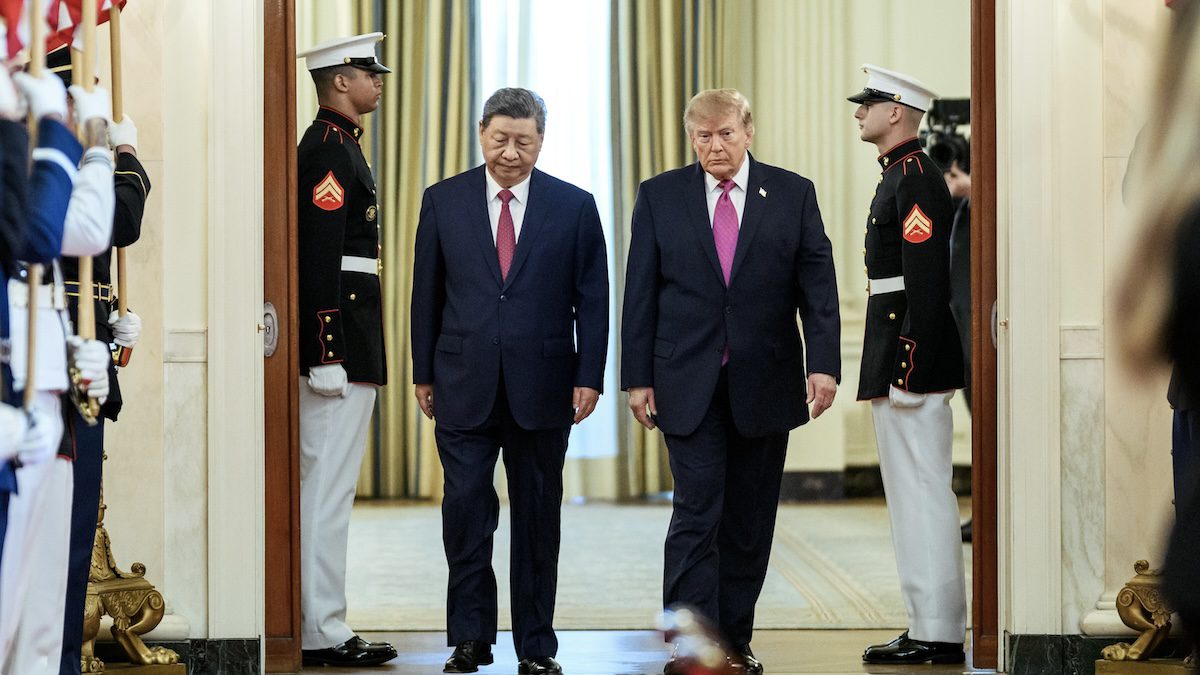
US President Donald Trump hosted Chinese President Xi Jinping at the White House earlier this week, welcoming him with military flyovers and a lavish state dinner, according to Reuters.
During the talks, Trump told Xi that China should refrain from providing support to Iran in the US war on Iran. The US ambassador to China claimed on Friday that Trump received assurances from Xi that Beijing would not do so.
This followed reports that China had supplied Iran with shoulder-fired air-defense missile launchers and that Tehran had found ways to evade sanctions on its oil sales with Chinese help.
Beijing has repeatedly rejected the US sanctions campaign against Iran. In August, the Foreign Ministry said that sanctions and pressure “will not help resolve the issue” and that China opposes “illegal unilateral sanctions” lacking a basis in international law.
Chinese support for Cuba
Cuba was the first Latin American country to establish diplomatic ties with the People’s Republic of China, and 2025 marked 65 years of relations.
China’s practical support has centered on energy. Reuters reported that Beijing financed 55 solar projects in Cuba in 2025, including a 21-megawatt plant near Jatibonico, with 37 more planned by 2028. Cuban media reported that a shipment of 5,000 solar panels arrived in September, the third of its kind in recent months.
Beijing has also committed 90,000 tonnes of rice to Cuba in 2026, of which 30,000 tonnes have been delivered and 60,000 tonnes pledged.
Thirteen people were killed and at least 35 others injured following a blast at a security checkpoint in Dera Ismail Khan, near the border between Pakistan's Balochistan and Khyber Pakhtunkhwa provinces.
International flights from Iran to several destinations remain operational despite the expansion of US sanctions targeting the country’s aviation sector, according to Tehran’s Imam Khomeini International Airport.
The airport said Saturday that flights to Turkey, Malaysia, China, Pakistan, Vietnam, and Afghanistan were continuing according to their previously announced schedules.
The announcement comes as Washington escalates economic pressure on Iran and seeks to restrict the ability of Iranian airlines to maintain international operations.
Iranian flights continue despite sanctions
Imam Khomeini International Airport said that, aside from flights already canceled, no additional cancellations had been announced.
The canceled services include flights involving the United Arab Emirates, Iraq, Oman, and Georgia.
The airport also said it was working to restore suspended air connections as soon as possible.
The continued operation of several international routes comes despite growing restrictions on Iranian aviation following a new round of US sanctions announced on September 8.
The measures have affected Iranian airlines as well as companies and intermediaries involved in providing services to the country’s aviation sector.
Recent reporting indicates that Iranian carriers have continued operating some international services despite the sanctions, including flights to China, Turkey, Thailand, and Afghanistan.
US measures target Iran’s aviation sector
The US Treasury Department announced sanctions on September 8 against 36 targets linked to Iran’s aviation sector, including 27 Iranian airlines. Washington described the measures as an effort to target what it considers Iran’s remaining unsanctioned carriers and the networks supporting them.
The sanctions form part of a broader US campaign to restrict Iran’s access to international financial and commercial networks.
The measures have also placed pressure on foreign companies providing Iranian carriers with fuel, ground handling, aircraft-related services, and other forms of support.
The consequences, however, have varied by country. While some governments and companies have restricted Iranian aviation connections, other countries have continued to facilitate flights.
Iraq restrictions trigger backlash
In Iraq, the suspension of Iranian flights, particularly through Najaf International Airport, has triggered criticism from official, political, factional, and religious quarters.
Several Iraqi parties and figures have called for the decision to be reversed and rejected what they described as US pressure on Baghdad.
The Iraqi government is also moving toward dialogue with Washington in an effort to secure an exemption that would allow air links with Iran to resume.
Ali Akbar Velayati, international affairs advisor to Iran’s Leader, said the restrictions on Iranian flights were part of an effort by Iran’s enemies to compensate for their battlefield defeat by attempting to dismantle the “unity of the fronts” from within.
The Iranian Ambassador to Iraq, Mohammad Kazem Al-Sadegh, further told Iran’s ISNA news agency that a new decision surrounding Iranian flights to Iraq is likely to be announced soon.
He added that Iran is in contact with Iraqi officials and proposals on the matter have been submitted.
Al-e Sadegh noted that roughly 12,000 to 13,000 people travel between Iraq and Iran via Iranian airlines.
China maintains air links with Iran
China has maintained its opposition to unilateral US sanctions and continued to receive Iranian flights.
Flight-tracking data cited in recent reports showed Iranian services continuing to operate to Chinese destinations after the latest US measures took effect.
The continued connections with China also reflect the broader geopolitical divide over Washington’s unilateral sanctions policy, with Beijing maintaining economic and diplomatic ties with Tehran despite US pressure.
There have been many tipping points in history; to name just a few examples:
The Peace of Westphalia in 1648
The French Revolution of 1789
The Congress of Vienna in 1815
World War I in 1918
World War II in 1945
Many of these turning points led to shifts in power in Europe. These were merely transfers of power within the world we now call the “Collective” West. Examples include the collapse of the German Empire, the Austro-Hungarian Empire, the Ottoman Empire, and the Russian Tsarist Empire at the end of World War I.
These shifts in power were significant, yet what is happening now cannot be compared to past turning points, as they encompass the entire globe. The reins of power are not being handed over within the West; rather, there will be a shift in power toward the East and the “Global South.”
From Tipping Point to Entropy
The scale, the number of nations involved, the geographic scope, and the speed at which the current geopolitical crises are unfolding are truly astonishing.
Ukraine as a War Platform for the U.S., NATO, the EU, and Russia
Russia Will Prevail Militarily
Looking at the military reports from the front lines, it becomes clear to any observer that Russia will achieve its military objectives. While Russia might have relinquished the Donbas, Kherson, and Zaporizhzhia had a peace agreement been successfully concluded in the spring of 2022, such an agreement is unrealistic under the current circumstances, as Donetsk, Luhansk, Zaporizhzhia, and Kherson have been part of the Russian Federation since September 2022. It is currently unclear how far the Russian military advance will go. I have commented on this in my article “The Summer Peace Died,” to which I refer. For the situation on the front lines, I once again refer to Military Summary; I have been following this channel for nearly five years, and it provides objective reporting.
Catastrophic Mobilization Situation in Ukraine
There are thousands of videos showing young men being hunted down like animals on the streets throughout Ukraine in order to forcibly recruit them. Recently, however, videos have also been circulating that show some of those forcibly recruited being transported to the front lines without uniforms and even in handcuffs, like criminals—to prevent them from escaping. I’ll leave it to the readers to ponder the combat effectiveness of these men against battle-hardened and motivated Russian soldiers.
Armed guards transport mobilized Ukrainian men to frontline in order to prevent them from deserting. This is described as normal by the Ukrainian officer. Videos also show them in handcuffs. Zelensky & Western politicians call this freedom & democracy. pic.twitter.com/f6AGyuMpRX
The latest move by the Ukrainian military leadership is to forcibly conscript women. Given this situation, it’s no surprise that Scott Ritter stated that the Ukrainians are losing 30 times more soldiers than Russia. We hear nothing in the West about this inhumane treatment of their own soldiers in Ukraine.
Ukrainian volunteers, who later disappeared without a trace, are said to have used drones and artificial intelligence to count the number of soldiers’ graves throughout Ukraine. They counted 2,000,054 graves. Added to this are the dead buried by their own people in mass graves and the wounded—the Ukrainians’ losses do indeed appear to be astronomical. Nevertheless, Zelenskyy claims that only 50,000 Ukrainian soldiers have been killed. A few weeks ago, I attended a funeral in Russia. The soldiers’ graves are easily identifiable by the Russian flag and the flag of the fallen soldier’s unit. There were soldiers’ graves, but no sea of flags like in Ukraine.
Ukrainian volunteers, who later disappeared without a trace, reportedly used drones and artificial intelligence to count military graves across Ukraine. Their estimate was 2,000,054 graves. Yet Zelensky claims that only 50,000 Ukrainian soldiers have been killed. Does that mean pic.twitter.com/LeplE4H3n6
Military Victory Does Not Solve Russia’s Geopolitical Problem
Whatever needs to be achieved militarily, Russia will achieve it; however, this does not resolve Russia’s geopolitical problem on its western border, because the goal is not new territories, but peace in the West—a goal that Russia has literally been striving for centuries and has never been able to achieve. Time and again, Russia has been attacked from the West and has regularly paid a high price in blood, money, and industrial capacity—resources diverted to military spending rather than civilian purposes. As a result, Russia’s social development has been repeatedly set back.
If Russia wants to keep pace with the major powers in terms of its civilian economy in a sustainable manner, reliably securing its western border is an absolute prerequisite. Although Russia is the only industrialized nation in the world that is self-sufficient and thus capable of waging a war lasting decades, such a confrontation would massively hinder the country from achieving its actual development goals.
The U.S.’s Lack of Credibility in Negotiations with Russia
The U.S.’s lack of credibility in the eyes of Russia is multifaceted. On September 15, Foreign Minister Lavrov said, verbatim:
“If the Americans hadn’t backed away from the Anchorage agreements, if Europe hadn’t pulled them away from those agreements, we would have been living without war for a year now.” – Sergey Lavrov, September 15, 2026
Under this agreement, Russia would have made major concessions. Russia would have retained the Donbas, frozen the conflict in Zaporizhzhia and Kherson, and relinquished further territories. Objectively speaking, this was a bad deal for Russia, but it demonstrated the Russians’ considerable willingness to compromise. The Russians assumed that this verbal agreement was binding as a gentlemen’s agreement. However, gentlemen’s agreements should only be made with gentlemen. The Americans taught the Russians otherwise. The Russians are dismayed about this incident and have had to admit that no agreements are possible with the U.S. government. Personally, I’m surprised by the fact that this realization came so late. Even written agreements with the U.S. government are not to be trusted. This was evident in the breach of the Memorandum of Understanding that the Americans signed with Iran in June. Thus, one must conclude that this conflict—or any conflict in which the U.S. is directly or indirectly involved—must be fought to the bitter end. A bitter lesson for every contractual partner of the U.S.
The Risk of Escalation is Significant
Ukraine is desperately trying to officially draw NATO into this military conflict. It is astonishing that European countries—above all Germany and the United Kingdom—are not only signaling their willingness to do so, but are actually doing everything they can to prepare their people for a war with Russia.
Instead of naming many people, we’ll use Sir Jacob Rees-Mogg—former cabinet minister and Member of Parliament for North East Somerset—as an example. In this excerpt from an interview, he compares the situation with Russia—without naming it—to the situations during World War I and World War II:
European leaders are currently pivoting from “this is not our war” to “it’s your duty to die in a war with Russia.” pic.twitter.com/h2M0CBpk0g
Young people are thus being called to arms to prepare for war against Russia. In Germany, such efforts have failed miserably. Of the more than 300,000 young Germans surveyed, only 0.17% volunteered to serve in the Bundeswehr. Furthermore, it came to light a few days ago that the Bundeswehr itself could not even find 5,000 volunteers for a battalion in Latvia.
It is incomprehensible what these European countries are up to besides spreading propaganda. Even combined, the European countries do not possess military forces that would give them even the slightest chance of standing up to the Russian armed forces. The Russians are by no means impressed by this farce in Europe—they are disgusted by it. I assume that this war propaganda in Europe serves only to perpetuate the anti-Russian narrative.
Both President Putin and Foreign Minister Lavrov have repeatedly emphasized that they have no interest in attacking NATO targets outside Ukraine. However, if European countries are foolish enough to send even small European military contingents to Ukraine, the situation could change abruptly.
The greatest risk of escalation at the moment is that the Europeans, presumably in collaboration with the Americans, are planning a false flag attack in Europe in order to somehow trigger Article 5 of the NATO Charter. According to geopolitical analyst Warren Thornton, preparations for false flag attacks are in full swing. He writes on X:
THE FALSE FLAG
These are the areas that are the targets. The Mallorca airport in Spain. The Sorrento Continental Hotel in Italy. The Promenade De Anglais, Nice. The area to be launched from west of Sardinia. The agencies involved CIA, French Naval Intelligence Services and the… pic.twitter.com/ThDYyuZBOz
I can’t say whether this theory is correct, but it’s by no means far-fetched that the Europeans would attempt something so outrageous.
U.S. Military Campaigns in the Middle East Beginning in 2001
Looking back over the past 25 years, the U.S. has sought to reshape the Middle East according to the Wolfowitz Doctrine since 2001. None of the wars the U.S. launched during this period (Afghanistan, Iraq, Libya, Syria, Yemen, Somalia, etc.) were successful. In fact, it was already evident back then that the hegemon lacked the resources, military strategy, strength, and credibility needed to act successfully. However, if one’s view is that the actual intent was destabilization and chaos, then they were extremely successful. Nevertheless, they returned to the plan in collaboration with Israel, apparently after Israel had succeeded in completely undermining American policy.
Israel: Genocide and Greater Israel
The immediate starting signal for the “Genocide” and “Greater Israel” projects was given on October 7, 2023, when a military operation by Hamas was turned into a false flagattack to justify the genocide against women, children, and other civilians in Gaza and, later, in the West Bank and Lebanon. This, in turn, served as the starting signal for the continuation of the Greater Israel project; initially, Syria and Lebanon were attacked. Although the Western press not only downplays Israel’s genocidal and imperialist actions but also fully supports and fuels them—including through the media of “neutral” Switzerland—Israel is viewed with increasing criticism by the general public in the Western world. According to Pew Research, 60% of Americans view Israel negatively. The Western media thus conveys an image that finds no resonance among the general public.
When Israeli Prime Minister Benjamin Netanyahu took the podium to address the plenary session on Thursday, delegates to the UN General Assembly left the hall in droves.
NEW
UN General Assembly delegates stage a mass walkout as Israeli Prime Minister Benjamin Netanyahu takes the podium to address the hall pic.twitter.com/EcTpBBvjjM
It is important to me to continually remind my Western readers of what is actually happening in Gaza right before our eyes—eyes that many choose to close.
Major Escalation in the Middle East—Loss of Control
Starting in February 2026, events began to accelerate even further. Since then, everything has gone wrong for the West and Israel in the Middle East. The Global South has already wrested the initiative from the West. While Iran initially limited itself to responding to American-Israeli aggression, it is now the Iranians and the Yemeni Ansar Allah movement who are setting the pace.
Ansar Allah managed to bring the entire western coast of Yemen under its control in a very short time and thus controls not only the Bab al-Mandab Strait but also the island of Perim Mayyun off the coast. With virtually no Western media coverage, the advance continues, and it is quite possible that Aden will soon be captured.
Furthermore, the Saudis’ East-West pipeline was paralyzed and targets near Riyadh were attacked. So far, the Saudis have been unable to mount a serious military response to this large-scale attack, as they do not seem capable of doing so on their own, and repeated calls for help to Trump and others have been in vain. The Mecca Alliance, which unites Pakistan, Saudi Arabia, and Turkey in a military alliance, also appears to be a thing of the past, as even these “friends” refused to provide assistance.
President Macron’s grand announcement that he will send troops to Saudi Arabia won’t change any of that. “Arabia” is called Saudi Arabia because this country is ruled by a family—a tribe—the Sauds. A tribe that is protected by the Americans. However, there are approximately 100 other tribes within Saudi Arabia. It’s very possible that they could join forces with Ansar Allah and overthrow the House of Saud. The House of Saud no longer has any income and seems unable to continue buying off—as it has done until now—all those who could pose a threat to them. There’s a chance that the Saud house of cards will collapse, and if that happens, I wouldn’t give a penny for the remaining Gulf states.
Alastair Crooke also pointed out on several occasions that this dynamic could spill over into Iraq, another millennia-old civilization alongside Iran. If that happens, Kuwait will likely fall as well. Another smoldering conflict can also be detected in Jordan. It is therefore quite possible that the entire structure in the Middle East established by the British a good 100 years ago could collapse within a few months, without the Americans being able to stop this tsunami in any way. Arabia to the Arabs, Persia to the Persians, and the Americans out for good. If this happens, Israel will go from perpetrator to target; one certainly cannot speak of it as a victim in this context. How the emerging great powers of the Middle East will deal with the genocidal Zionists should be left to those who have suffered the greatest losses, for Palestinians are Arabs.
Europe
Chaos is once again rearing its head in Europe. Germany is the first country—once the world’s leading exporter and the major power in the EU—that is in danger of becoming politically ungovernable. The Alternative for Germany (AfD), which has been labeled as far-right and Hitler-like by the previously dominant parties and excluded from government participation by a so-called firewall, not only won landslide victories in two state elections in eastern Germany but also leads the CDU by a clear margin in national polls (30% to 20%). Chancellor Merz’s approval rating stands at 10 percent—a barometer that reveals the people’s dissatisfaction and would have driven any truly democratic chancellor to resign. Whether the Germans, in light of this political situation, will clench their fists and do nothing, as they have in the past, remains uncertain. The chancellor’s downfall would be good for Germany. The AfD is the only major party seeking dialogue and peace with Russia, which is not only desperately needed by this once-thriving industrial nation but is also a prerequisite without which it cannot survive economically. The alternative to real and fundamental political change in Germany is the war against Russia sought by Chancellor Merz and the ruling political elites. The last time Germany went to war against Russia in 1941, Adolf Hitler sent 3.7 million soldiers eastward and failed, despite the Germans’ genocidal behavior, which cost the lives of approximately 17 million civilians. As already explained above, the Federal Republic of Germany today finds itself unable to assemble a brigade of 5,000 volunteer soldiers for the Baltic states. This does not seem to concern the chancellor, which is a clear sign of the madness that has taken hold of him. This is strong evidence that he is acting in the interests of a power located outside Germany. One would be a naughty person to believe that this has anything to do with his BlackRock past. Those who managed to install him as chancellor can pat themselves on the back, as they’ve snagged a puppet at the bargain price of a few million.
The following clip shows how the new leadership in Berlin is presenting itself—the Left has taken over. No words needed:
The situation in the rest of Europe is no more encouraging. The presidential election in France will take place in April 2027. Macron is no longer eligible to run, and Marine Le Pen has a significant lead over the other candidates. The situation is thus similar to that in Germany: a party that is denounced as far-right by the parties currently in power, yet is the most popular among the people. Le Pen’s position on peace with Russia is unclear—she seems to be speaking with a forked tongue: on the one hand, she wants a negotiated peace, but at the same time supports the training of Ukrainian troops. A seasoned politician who positions herself to capture as many votes as possible. France’s financial situation is grim, with no silver lining. The rise in the interest rate on 10-year French bonds over the past twelve months has been even steeper than in any other European country.
Trump
President Trump’s policies only seem difficult to understand at first glance. His constant flip-flopping on Ukraine, Iran, and Israel is counterproductive and damaging to the U.S.’s reputation on the world stage. The reason behind Trump’s current actions is the midterm elections in November. Trump is struggling with the high oil prices he himself has caused, which he can prevent from spiraling out of control by manipulating the futures markets. However, actual market prices are 30% to 50% higher than the manipulated, fantasy futures prices. The fact that futures prices are indeed manipulated is evident, for example, in diesel prices at gas stations, which are moving in only one direction and have reached unprecedented levels worldwide. Diesel is the lifeblood of the American economy, and high prices are one of the biggest drivers of inflation, since virtually all goods are transported by trucks, agriculture depends on it, and large parts of industry rely on diesel. Trump’s latest farce: He’s blaming Zelenskyy for the high diesel prices because Ukraine is attacking Russian refineries; he’s doing this solely to divert attention from the biggest price drivers—the blockades of Hormuz and Bab al-Mandab.
Somehow, Trump wants to turn things around, but it seems that he will lose the midterm elections coming up in about six weeks. According to Polymarket, an American online prediction market where users bet on the outcomes of future events—with market prices reflecting collective probability estimates—the probability that the Republicans will lose their majorities in the House of Representatives and the Senate stands at 66%. Should this come to pass, Trump will likely face impeachment proceedings. He then runs the risk of going from a lame duck to a dead duck and being replaced by his turncoat vice president, Vance—not a promising outlook for the United States.
Trump’s latest appearance this week before the UN General Assembly was a testament to his psychopathic nature: He announced—nota bene after the election—that he would either make Iran a rich country or obliterate it completely.
Trump is every bit as bad as Adolf Hitler. In his speech at the Berlin Sportpalast on September 4, 1940, Hitler said, “We will wipe out their cities.” Trump wants to wipe out a 5,000-year-old civilization—without any legal basis, of course—acting like a god. In doing so, Trump is publicly calling for the genocide of an entire civilization. One might wonder whether he belongs in prison or in a psychiatric hospital, but the fact that he can make such statements before a global audience with impunity shows the depths to which Western civilization has sunk. I refer to a speech I gave in Switzerland on September 3.
The Financial Markets
I have made numerous comments on the instability of the financial markets. Now my dire predictions seem to be coming true. In addition to the overvaluations in the stock markets, I have repeatedly pointed out the unsustainable situation in the bond markets. Among the more astute market participants, fear is beginning to set in. Mr. Bessent has lost control of interest rates. On August 28, 2026, I looked at the average interest rate the U.S. had to pay on its debt; at that time, it stood at 3.35% (May), resulting in an annual interest burden of 1,340 billion. Today, this average interest rate stands at 3.49% (August); the debt mountain currently stands at 40,070 billion, meaning it has already increased by another 70 billion. Annual interest payments have thus risen by 56 billion to 1,396 billion per year in this short period of time.
Over the past 28 days, the yield on the 10-year U.S. Treasury bond has risen from 4.722% to 5.185%, an increase of 0.46%. It does not appear that this trend will change. If this pace continues, not only will the government bond market collapse, but so will the towering mountains of debt in the AI sector. The same picture is emerging in Europe and Japan as well. The question isn’t whether the collapse will happen, but when—and who the U.S. will let go first: the Japanese or the Europeans. That is my personal opinion. When it comes to timing, I’m regularly wrong, which has taught me not to be active in these markets. I have the great privilege of meeting regularly with one of the world’s most successful investors. At our last meeting, he agreed with me in principle but remarked that I couldn’t possibly imagine what tricks and means the Americans still have at their disposal to delay the inevitable.
The scale of this crisis will dwarf anything humanity has ever seen. Compared to today, the 2008 crisis was a stroll through a sunny park with a delicious picnic. Such a collapse in the West will also affect the countries concerned’s geopolitical freedom of action; suddenly, everyone will be very preoccupied with their own problems. No one knows whether this will lead to an escalation in the geopolitical arena. What is certain, however, is that the “experts”—who are still driving the markets forward with their jubilant cheers—will solemnly declare that this simply could not have been foreseen—as always.
Entropy
All of these individual tectonic shifts lead to what can be described as entropy, a term from thermodynamics. Applied to geopolitics, I describe the situation as a massive, irreversible state of disorder and uncertainty within the various international systems. Existing power structures, rules, institutions, and hierarchies are losing their cohesive power, and a new order that would promise stability is not in sight.
For the collective West, which until recently held the reins firmly in its hands, is unwilling to make compromises so as not to jeopardize its position as a hegemon.
The Global South, taken by surprise by the rapid pace of events, has not yet devised a coherent, unified, and effective policy to wrest power from the West.
It appears that the Global South, under the military dominance of Russia, China, and—most recently, Iran as the fourth major military power—is in the process of adapting to the new circumstances and coordinating its efforts, which will ultimately lead to its victory.
How long this will take, however, and whether the West will use nuclear weapons to maintain its hegemony remains to be seen—though I would like to express my doubts on this point. So far, only Adolf Hitler believed that Germany should go down with him. Let’s hope that cooler heads are in control of the apocalyptic buttons.
The persistence of current geopolitical alignments, the attention of Eastern actors to the region, the strengthening of Sanaa’s position in the Red Sea, and the expansion of regional opposition to the UAE’s role will diminish Abu Dhabi’s role in the region.
For the past ten years, the Southern Red Sea has been a pivotal factor in the UAE’s foreign policy. Over the past decade, the UAE has built a layered maritime, air, and commercial infrastructure network, including military bases, in the Red Sea or near Yemen, Somaliland, Somalia and Sudan, starting from 2015.
According to some estimates, the value of UAE investments along Africa’s coastal regions and the Arabian Peninsula amounts to $60 billion.
In September 2015, the UAE established its first military base in Africa, in Eritrea. These bases possessed strategic advantages: the ‘protection of interests’ and control over the security and economic architecture of international maritime routes.
With the signing of the Abraham Accords in 2020, cooperation between Tel Aviv and Abu Dhabi in the Red Sea intensified.
The UAE’s approach—channeled through companies such as DP World and Abu Dhabi Ports—is centered on controlling ports, strategic waterways, military bases, and key trade and energy routes in the Red Sea and the Gulf of Aden, in coordination with the United States and its allies. Abu Dhabi’s approach also included engagement with non-state armed actors and separatist movements in Yemen, Sudan, and Somalia.
Factors Behind the UAE’s Diminishing Role
Over the past decade, the UAE emerged as a party to the conflicts in the southern Red Sea. However, geopolitical developments over the past year signal a gradual decline in the UAE’s role in the southern Red Sea.
Several factors are also significant, stemming from US and Israeli military strikes against Iran, the war between Sanaa and Saudi Arabia, Saudi-Emirati rivalry in the region, and disputes among African states.
Sudan’s value lies in its geopolitics. With 853 kilometres of coastline and several key ports, Sudan constitutes a vital link in the Red Sea.
The Sudan war since April 2023 has created conditions for the expansion of the UAE’s role. The UAE faces accusations of providing training and logistical support to the Rapid Support Forces (RSF). Human rights and political demands against the UAE has increased.
The UAE also maintains bases inside Sudanese territory. However, the ongoing war in Sudan and the support of allies for the Sudanese government have led to increased pressure on the UAE.
Riyadh regards the Red Sea as part of its strategic interests and its exclusive backyard. Abu Dhabi and Riyadh each view the other as a direct threat to their position and interests in parts of the southern Red Sea. Thus, the reduction of the UAE’s footprint in the southern Red Sea constitutes a strategic gain for Riyadh. Riyadh has effectively sought to weaken Abu Dhabi’s role.
In late 2025, Saudi Arabia’s support for Yemen’s Presidential Leadership Council (PLC) resulted in pressure being brought to bear on UAE-backed forces.
In July 2026, Saudi Arabia hosted talks among 14 countries—including Egypt, Djibouti, Sudan, and Somalia—which established a multinational maritime defence alliance. The UAE and Ethiopia were excluded from the list.
The formation of a Riyadh-led Red Sea maritime task force—with the participation of Turkey, Egypt, Djibouti, Somalia, and Eritrea—without coordination with the UAE amounts to a further constriction of the UAE’s role in the region.
Despite ongoing Egyptian–Emirati consultations on guaranteeing maritime navigation security in the Red Sea and Bab al-Mandab, Egypt’s foreign policy is not aligned with the UAE’s interests in Sudan and the Red Sea. Additionally, the alignment and coordination among Israel, India, the UAE, and Ethiopia are not particularly consonant with Egypt’s interests in Ethiopia and the Red Sea.
Until last September, the UAE played a significant role in the southern Yemeni islands of the Red Sea and in southwestern Yemen. However, Sanaa’s advance in the eastern Red Sea—the port of Mokha, Mayun Island, and other archipelagos north of the Bab al-Mandab Strait—in September 2026 inflicted negative and fundamental consequences on the UAE’s regional role.
Sanaa’s advance amounts to the nullification of the presence of Emirati actors in Yemen’s future political sphere. Sanaa is seeking to consolidate itself as a strategic “node” within the Iran-led Axis of Resistance.
Despite Cairo’s opposition to Sanaa’s proposal for maritime navigation coordination in the Red Sea, Sanaa—having secured control over the most important islands and cities overlooking the Bab al-Mandab Strait on the Yemeni side—is calling for the formulation of new rules to ensure security and navigation in the region. Ansar Allah’s control over Bab al-Mandab could put the UAE under pressure. Any expansion of Sanaa’s role in Sudan could likewise prove detrimental to the UAE.
Amid tensions between the United States and Iran, Abu Dhabi finds itself facing a more constrained strategic space.
The UAE’s alignment with the United States is, in a sense, also an intensification of Abu Dhabi’s tensions with Iran in areas such as the Red Sea. Unlike the UAE, Iran is seeking better relations with the Sudanese government. Many in Iran believe that Israel and the UAE are devising an economic and geopolitical plan to control the vital routes of the Red Sea and Yemen’s ports.
With Israel’s formal recognition of Somaliland in December 2025, many in the countries of the southern Red Sea have linked it to the UAE.
After years, Eritrea revoked the UAE’s access to its military infrastructure. Eritrean officials have recently made sharp statements about the UAE and Israel—particularly regarding Tel Aviv’s recognition of Somaliland.
Eritrea is providing frontline support to the Sudanese Armed Forces. Any deeper alliance between Eritrea and Sudan, Iran, Russia, China, and Sanaa could diminish the UAE’s regional role in the Red Sea. Additionally, some countries and actors near the Red Sea also hold a negative view of the UAE’s regional role.
The Somali government’s decision in January 2026 to sever relations with the UAE is, in a sense, a counter to the UAE’s role in the Somaliland and Puntland regions. Somalia has revoked all agreements with the UAE, including cooperation as well as security and defence arrangements. This move has negative implications for the UAE’s role in the southern Red Sea.
Moreover, the southern Red Sea plays a pivotal role in the regional strategy of Russia and Beijing. For example, apart from China’s role in Djibouti, Beijing is Eritrea’s principal creditor and has expanded its influence in Sudan.
The developments of the past year have also contributed to a decline in the standing of the UAE’s allies in the region.
Outlook
The US presence in the Red Sea’s African states is rooted in counter-terrorism and anti-piracy operations.
The European Union’s presence in the region, via Operation ASPIDES, is limited to commercial shipping in the Red Sea and the Gulf of Aden.
Despite the UAE’s formal withdrawal from some bases, its economic and security influence, as well as its soft-power instruments, remain strong.
A decrease in UAE military deployments in the region could negatively impact its support for allies in Yemen, Libya, and Sudan.
The UAE continues to have significant economic potential, secure partnerships, and influence in the southern Red Sea. In a way, this is considered a threat and a risk to certain African nations in the Red Sea region.
Certainly, a more extensive Sanaa presence over Bab al-Mandab, strategic coasts, and islands could confront Abu Dhabi’s maneuver and role in the southern Red Sea with a structural challenge.
The UAE’s approach in ports, logistics, energy, and other strategic infrastructure—along with deeper defense and security coordination with the West in the southern Red Sea—is likely to continue. However, the expansion of the UAE’s role also requires an extensive US presence in the Red Sea.
Moreover, the persistence of current geopolitical alignments, the attention of Eastern actors to the region, the strengthening of Sanaa’s position in the Red Sea, and the expansion of regional opposition to the UAE’s role will diminish Abu Dhabi’s role in the region.
Samyar Rostami is а political observer and senior researcher in international relations.
An Iraqi anti-terror resistance group has denounced the Baghdad government’s decision to halt Iranian airline operations following US sanctions on Iran’s aviation sector, vowing to stage sit-ins at Iraqi airports nationwide unless normal air traffic between the two Muslim neighboring countries resumes.
“We will not wait long,” Harakat Hezbollah al-Nujaba Secretary-General Akram al-Kaabi said in a statement on Friday.
He urged Iraqi political forces to “break free from American dominance.”
The restrictions, Kaabi said, were preventing millions of people from visiting religious sites and harming Iraq’s economy.
On Thursday, the Kata’ib Hezbollah resistance group called upon all walks of Iraqi society to break “the US siege on Iran.”
The faction urged Iraqi citizens to “circumvent the embargo through all available means” in demonstration of solidarity with Iran, including the purchase of Iranian commodities, the facilitation of commercial relations with Iran, and the abstention from any undertakings that would exacerbate Iranians’ hardship.
The group also asked Shia religious authorities to issue a decree (fatwa) on whether it is religiously permissible “to help the enemy, in any form, besiege and starve the Iranian people.”
Commercial aviation services between Iraq and Iran were suspended after ground-handling companies stopped providing services on these routes over concerns about potential US sanctions.
The move prompted airlines to suspend their flights.
Najaf International Airport, the last Iraqi airport still operating flights to Iran, suspended the services at 2 a.m. local time on Friday until further notice, according to an official directive.
Erbil International Airport and Sulaymaniyah’s International Airport took similar measures. Kirkuk International Airport also said it had no flights to Iran.
The disruption followed US measures targeting Iran’s aviation sector. On September 8, the US Treasury sanctioned 27 Iranian airlines and claimed that airports, fuel suppliers, ground-handling firms and other service providers dealing with sanctioned carriers could face secondary sanctions.
Mohammad Mokhber, an adviser to the Leader of the Islamic Revolution, Ayatollah Sayyed Mojtaba Khamenei, on Friday warned against recent regional measures that had disrupted Iranian passenger flights, saying: “Flights in the region are either free for everyone, or for no one.”
He added that cooperation with the US in implementing hostile policies would remain in the memory of the Iranian people, stressing that if Iran cannot fly or receive airport services, “no country in the region will have this possibility either.”
Turkey’s Parliament is expected to consider the Mecca Joint Defense Agreement with Saudi Arabia and Pakistan next month, Parliament Speaker Numan Kurtulmus told reporters on Friday, as the three countries move to establish mechanisms for implementing the pact.
Kurtulmus said the agreement has not yet been submitted to Parliament for ratification and is expected to be formally presented once lawmakers return from recess next month. He added that international agreements require parliamentary approval to enter into force in Turkey, while meetings currently being held under the agreement remain preparatory.
Turkey prepares to ratify Mecca defense agreement
Kurtulmus made the remarks to reporters in Ankara, confirming that the agreement has yet to reach Parliament despite ongoing coordination among Ankara, Riyadh, and Islamabad.
The Mecca Joint Defense Agreement was signed on August 7 by Saudi Crown Prince Mohammed bin Salman, Turkish President Recep Tayyip Erdogan, and Pakistani Prime Minister Shehbaz Sharif in Mecca.
The agreement states that an armed attack against any one of the three countries would be regarded as an attack against all three, while providing for expanded defense cooperation and collective deterrence.
The pact is therefore moving from its initial political agreement toward institutional and legal implementation, with parliamentary approval constituting a key step for Turkey.
When asked about the claim that the Mecca agreement was against Iran, Kurtulmus denied the allegation and stated that the main source of the region’s problems was “Israel” and its aggressive policies.
He reminded parliamentarians that “Israel” launched multiple attacks on numerous nations without question as part of its hostile policies, and explained that the balance of power has completely changed following the US-Israeli war on Iran.
“We propose that the countries in the region increase their cooperation to establish and secure their own security,” he said. “We absolutely do not, and should never, view the Mecca Agreement as an agreement against Iran. The Mecca Agreement, and perhaps even its expansion to include Iran and other regional countries, should become an agreement that ensures the security of the regional countries and, more broadly, the Islamic world.”
Kurtulmus added that the agreement was not formed as a threat to any country as it’s an agreement for the promotion of unity, solidarity, and security of the region.
“It is still in its initial stages and is not yet fully formed,” he said. “We hope that with the participation of other regional countries, it will become a much stronger agreement.”
Saudi Arabia calls for military coordination
The development comes as Saudi Arabia, Turkey, and Pakistan prepare for an urgent meeting of their military chiefs, amid Saudi Arabia’s aggression on Yemen.
Saudi Arabia’s Foreign Ministry announced Friday that the chiefs of staff of the three countries would meet to discuss ways to support the Kingdom under the terms of the Mecca agreement.
The announcement followed a meeting in New York between Saudi Foreign Minister Prince Faisal bin Farhan Al Saud, Pakistan’s Deputy Prime Minister and Foreign Minister Ishaq Dar, and Turkish Foreign Minister Hakan Fidan. The Saudi statement did not specify when the military chiefs would meet or what form potential support could take.
Pact moves toward institutionalization
The three countries have already begun establishing mechanisms to implement the agreement.
At a Strategic Political and Defense Committee meeting in Istanbul on August 31, the three sides agreed to establish a secretariat in Saudi Arabia, initially headed by a Pakistani secretary-general for three years.
They also agreed to strengthen military capabilities through joint activities, defense-industry cooperation, technology development, and production.
Iran has offered the US a new deal aimed at ending the months-long conflict before the midterm election in November, directly challenging President Donald Trump’s claim that Tehran is deliberately waiting until after the election to reach an agreement.
Trump claimed in a speech at the UN on Tuesday that Iran is deliberately stalling the talks to see how Republicans perform in the November 3 midterm election, and predicted that Tehran would make a deal “right after” the vote. He also threatened to “annihilate” the Islamic Republic if negotiations fail.
“We don’t want it to get to the midterm elections,” Iranian President Masoud Pezeshkian told reporters on the sidelines of the UN General Assembly in New York on Thursday. “We wish Americans to return to the MOU before the midterms,” he said, referring to the memorandum of understanding reached by the US and Iran in June.
“We did reach an agreement with your president… The problem is that America, instead of conducting dialogue, descended into the arena by bombing us first, by blocking every pathway,” Pezeshkian said in an interview with Fox News. “We will stand resolutely to defend ourselves. We never sought war… It’s America that must choose whether it wants to end this or not.”
Iranian Foreign Minister Abbas Araghchi said Tehran has submitted a proposal in which the Strait of Hormuz could be reopened within around a week and negotiations on Iran’s nuclear program rapidly resumed. The proposal was sent through mediators during talks in New York this week.
Under the plan, Tehran would restore navigation through the crucial oil shipping route in exchange for Washington lifting its economic blockade, easing restrictions on Iranian oil exports, and releasing some frozen Iranian assets. Iran is also seeking an end to hostilities on other fronts, including Israel’s combat operations in Lebanon.
US and Iranian negotiators are discussing a phased arrangement in which the blockade and restrictions on Hormuz would be addressed first, Reuters reported, citing Iranian, regional, and Western diplomatic sources.
Tehran has not abandoned its claim to regulate Hormuz, with Iranian officials continuing to insist that the waterway should be managed by Iran and Oman and that fees should be charged for services provided to passing vessels.
Araghchi said the proposal largely follows the terms of the June memorandum rather than introducing new demands, adding that Iran is waiting for a response.
Araghchi has also held a series of meetings with foreign counterparts in New York, including Russian Foreign Minister Sergey Lavrov. Moscow has said there is “no alternative” to a diplomatic settlement of the crisis provoked by the “illegal actions” of the US and Israel.
The renewed diplomatic push comes amid mounting pressure on both sides. The US blockade has sharply restricted Iran’s oil exports, while Tehran’s controls over Hormuz have disrupted one of the world’s most important energy corridors and helped push oil prices above $100 a barrel and US diesel prices to historic highs.
Pezeshkian, who is the first foreign head of state to speak at the UN while his country is at war with the US, told the chamber on Wednesday that Tehran is prepared for “dialogue and diplomacy” but will not negotiate under threats of force and “will never bow our head or bend at the knee.”
China’s President Xi Jinping concluded his three-day state visit to the US on Friday, September 25, with hopes of enhanced cooperation and partnership between the world’s two largest economies.
Xi arrived in the US on Wednesday and received a large-scale welcome from President Donald Trump. Though this was their third in-person meeting it was Xi’s first state visit to the US in over a decade.
On Thursday, the leaders had a long in-person conversation in the White House and finished the day with a state dinner with 130 guests, including tech executives. Though the US is yet to release its version of the official proceedings, reports indicate they discussed a range of outstanding issues such as the dispute over trade and tariffs, cooperation in Artificial Intelligence, the issue of Taiwan, and the US-Israeli war on Iran.
During the meeting with Trump, Xi called for strategic stability in the China-US relationship which will benefit both countries and the people around the world, Xinhuareported.
“China and the US should be partners, not rivals,” Xi said.
Xi’s statement comes at a time when the two countries are negotiating a longer trade deal after briefly facing each other in a tariff war last year. Both countries agreed to extend their temporary trade truce which halted the tariff war till January to give their negotiators more time.
The so-called Busan Trade Truce was set to expire in November this year.
Xi hoped that “both sides would stay committed to the principles of mutual benefit and win-win cooperation and promote the sustained, stable and sound development of China-US economic and trade relations.”
Technology and AI
Successive administrations in the US have characterized China’s advancements in technology and other economic sectors as a threat to American interests and have tried to curb them by restricting its access to technology.
In his attempt to address such apprehensions, Xi proposed that “both sides work towards a relationship featuring cooperation as the mainstay, moderate competition, manageable differences, and the promise of peace.”
Talking about the competition in the development of Artificial Intelligence (AI), Xi offered increased coordination and cooperation between the countries as a way of mutual benefit.
While emphasizing that “two sides should maintain human control over AI technologies, uphold people-centered approach and the principle of using AI for good” he proposed greater exchange of information to “prevent any misuse and abuse of AI.”
Xi also expressed hope that Chinese companies “are treated fairly in the US” while inviting more US companies to invest in China. “Working together, we can lengthen the list of cooperation and shorten the list of issues” he underlined.
The US has sanctioned or put a large number of Chinese companies, including its AI firms on various watch lists in recent years, after accusing them of working with the Chinese armed forces or being involved in the so-called technology theft.
Notably, however, major US tech and finance executives such as Jensen Huang of Nvidia, Mark Zuckerberg of Meta, Eric Yuan of Zoom, Kelly Ortberg of Boeing, Larry Fink of Blackrock, Sam Altman of OpenAI, Satya Nadella of Microsoft, Sundar Pichai of Google, Jeff Bezos of Amazon, and Elon Musk of SpaceX and Tesla, were present at the state dinner for Xi’s visit hosted at the White House on Thursday, September 24, though no details of cooperation between US and Chinese tech firms have emerged.
Taiwan
Reiterating China’s resolve to “safeguard national reunification and territorial integrity,” Xi expressed hope that the US will “adhere to the correct position on opposing ‘Taiwan independence’ and handle the Taiwan question with caution.”
China has repeatedly accused the US of promoting the separatist cause in Taiwan, despite officially adhering to “one China policy.” The US under Trump has sold or agreed to sell billions of dollars’ worth of weapons to Taiwan in complete disregard of China’s objections.
China has also accused the US and its allies in the region of promoting an arms race by deploying advanced weapon systems close to its borders.
Xi said if the US follows the correct position on Taiwan it “will enable both the countries to lay a solid foundation for their strategic cooperation and the development of their bilateral relationship.”
US-Israeli war on Iran
China has refused to intervene or get involved in the US-Israeli war on Iran, despite Trump’s repeated calls for them to do so. China has maintained the war was unnecessary and repeatedly warned against its prolongation. It has supported the interim peace deal signed in June under international mediation.
Xi reiterated this position during his visit to the US, expressing hope that both Iran and the US would soon return to the Memorandum of Understanding (MoU) and end the war.
Xi claimed that “China-US cooperation may not solve every problem in the world, but without it, it would be hard to solve many of the world’s problems” and proposed more dialogue and “mechanisms of crisis communication and prevention” between their armed forces.
In his address to the UN General Assembly, US President Donald Trump said that the Cuban government is a failed state currently under enormous pressure: “My administration seeks a fundamental change in the situation in Cuba… It is an absolute failed state… and it will fall. Marco Rubio is leading the negotiations.”
In response, the Cuban delegation stood up and walked out of the plenary session in protest. Trump continued: “Cuba is a haven for foreign adversaries who threaten America right on our doorstep… The Cuban regime has also spent decades coordinating with left-wing radicals and communist networks here in the United States… They have cultivated ties with subversive and radical groups.”
The remarks did not go over well in Havana, where the government has categorically rejected the US right-wing leader’s statements. Leading the response is the country’s president, Miguel Díaz-Canel, who asserted that freedom in Cuba is non-negotiable.
“Freedom came to Cuba on January 1, 1959, [the date the Cuban Revolution began], and we are not going to lose it; we are going to defend it. Once again, we are seeing the true face of that empire and its contempt for the peoples of Latin America – and in particular for Cuba and the Cuban Revolution – because of what it represents.”
Díaz-Canel made the remarks on a program called Criterio Compartido on Radio Rebelde. In them, Díaz-Canel described Trump’s statements as “arrogant,” “high-handed,” and “interventionist.”
He also asserted that behind Trump’s thinking lies a justification for a certain view of US imperialism: “what most underpins that genocidal, criminal, and contemptuous mindset toward Cuba and the Cuban people.”
Regarding the label of “failed state,” the leader of the Communist Party of Cuba said: “They are always trying to label us a failed state to shift the blame for the genocide they are committing with that intensified and prolonged blockade.”
Díaz-Canel is referring not only to the long and sustained economic and commercial blockade that the United States unilaterally imposed on Cuba in an effort to defeat the revolution that began in 1959. In US President Donald Trump’s first term, he imposed an additional 243 sanctions on the Caribbean island and added Cuba to the State Sponsors of Terrorism (SSoT) list, which devastated the Cuban economy. In January 2026, Trump further tightened the grip by imposing an energy blockade on Cuba.
Since early 2026, following the US attack on Venezuela that resulted in the capture of President Maduro and his wife, Cilia Flores, and the deaths of more than 100 people – including several dozen Cubans – Cuba lost one of its main energy partners, which used to supply crude oil to the Cuban power grid.
Since then, only one Russian ship has managed to circumvent the US blockade; the United States is currently threatening to impose additional tariffs on any country that sells fuel to Cuba. This has triggered Cuba’s worst energy crisis, which is hindering the normal operation of hospitals, schools, and food production, among other essential activities.
Cuba has denounced the blockade as a form of “silent genocide,” specifically because of the direct humanitarian consequences it is having on the civilian population, which has seen a reduction not only in its electricity supply but also in access to surgeries, water, food, and so on.
In this regard, Díaz-Canel has once again emphasized on X that Cuba does not pose a threat to the United States; rather, it is the United States that is endangering Cuba’s civilian population: “Unable to justify the punishment against the people of Cuba and its genocidal economic war, the US president repeats at the UN that Cuba poses a threat. Lies are the weapon of those who refuse to accept the Cuban people’s right to self-determination.”
He concluded: “We will continue to fight for peace, defend our sovereignty, and work together to overcome the ruthless aggression imposed on us by the US government. Cuba is not a threat, the blockade is.”
US President Donald Trump took the UN General Assembly stage on Tuesday and made a sweeping series of claims about Iran, its nuclear program, the imposed war, and the Strait of Hormuz.
He presented Washington’s military aggression as a campaign to defeat an “Iranian threat,” while casting Tehran as the source of “decades of bloodshed across West Asia.”
Behind the worn-out rhetoric was a version of events riddled with falsehoods, omissions, and sweeping distortions.
For example, Trump claimed that Iran killed “72,000 of its own citizens,” described the country’s nuclear program as having been “obliterated” by the US, declared Tehran’s entire 159-ship navy destroyed, accused Iran of violating the ceasefire, and said US naval forces were moving tens of ships and billions of barrels of oil through the Strait of Hormuz.
Nothing could be farther from the truth.
US intelligence assessments found that Iran’s nuclear program was not destroyed; Pentagon investigators documented hundreds of damaged US structures across the region and depleted munitions, with the US war machine incurring tens of billions of dollars in expenses.
American casualties and aircraft losses mounted, while traffic through the Strait of Hormuz collapsed rather than returning to anything resembling normality following the US-Israeli aggression against Iran.
Here is a breakdown of Trump’s most glaringly false claims about Iran and what the documented record shows.
Claim: For 51 years, Iran (Islamic Republic) has “ruled by bloodshed and mass murder,” spreading “death, carnage and chaos” across the entire West Asia and beyond.
Fact: Other than the wrong claim about Iran spreading “death and chaos” in the region, his chronology also begins with a basic historical distortion.
The Islamic Republic was established in 1979 following the victory of the Islamic Revolution, meaning it has been in power for 47 years, not 51, as the megalomaniac US president claimed.
Trump’s portrayal of Iran as a force of “bloodshed and aggression” runs against the historical record.
For the past two centuries, Iran has fought to defend its territory and deter attacks rather than pursue wars of conquest or territorial expansion.
Even US government and policy institutions describe the Islamic Republic’s military doctrine as primarily defensive and deterrence-based, focused on protecting Iran’s territorial integrity.
One US Institute of Peace assessment says Iran “does not have territorial ambitions and does not seek to invade, conquer, or occupy other nations.”
That stands in stark contrast to Washington’s own modern record of invading countries, waging prolonged wars abroad, killing civilians, destroying infrastructure, and, in several cases, fundamentally altering entire states.
The scale of that record becomes clear when the major US-led invasions and military interventions of the past several decades are examined.
1986, Operation El Dorado Canyon: Libya
On April 15, 1986, the United States launched Operation El Dorado Canyon, bombing targets near Tripoli and Benghazi after Washington accused the Libyan government of supporting international terrorism. More than 100 US aircraft were involved, with 27 aircraft carrying out the main bombing missions and dropping about 150 tonnes of ordnance.
Contemporary casualty accounts record 45 Libyan soldiers and officials killed and 15 Libyan civilians killed.
1988, the USS Vincennes and Iran Air Flight 655
On July 3, 1988, the US Navy cruiser USS Vincennes fired a missile at an Iran Air Airbus A300 flying over the Persian Gulf, killing all 290 people aboard, including 66 children and 16 crew members.
Washington claimed that the aircraft had been “mistakenly” shot down. There was no official US apology for the horrendous crime.
The episode is particularly relevant to Trump’s portrayal of Iran as the “source of regional bloodshed,” as one of the deadliest incidents involving Iranian civilians during the period came from a US warship operating near Iranian waters.
1995, Operation Deliberate Force: Bosnia
US and NATO launched the so-called Operation Deliberate Force against Bosnian Serb positions. It severely damaged the Serbs’ military capabilities and helped alter the balance of the Bosnian war.
The bombing campaign killed 152 civilians and injured nearly 300, according to the figures in the material. The operation was conducted without a specific UN Security Council authorization for the air campaign, a point that has remained central to debate over its legality.
1999, Operation Allied Force: Yugoslavia
On March 24, 1999, the US, along with NATO, launched the so-called Operation Allied Force against Yugoslavia. The campaign involved extensive bombing of residential areas, television and radio facilities, hospitals, factories, businesses and infrastructure.
Fourteen NATO member countries participated alongside the United States. The bombing destroyed or damaged 82 railroad and motor bridges, 48 hospitals, 25 post offices and telegraph stations, 70 schools, nine university buildings and four student dormitories, 18 kindergartens, 35 churches and 29 monasteries, including UNESCO-protected heritage sites.
The targets also included the television centre in Belgrade, a convoy of Albanian refugees and China’s embassy in Serbia.
According to the Serbian government’s figures cited in the material, the bombing killed around 2,500 people, including 89 children, and wounded 12,500.
Some 863,000 people, primarily Serbs living in Kosovo, left the region, while another 590,000 became refugees. Estimates of the economic damage ranged from $30 billion to $100 billion.
The Independent International Commission on Kosovo, established in August 1999 to examine the NATO intervention, concluded that the intervention was illegal. It also criticized the use of cluster munitions and the bombing of chemical factories and oil refineries because of their environmental consequences. In 2002, the UN confirmed radioactive pollution in Kosovo following the US bombing.
Post-9/11 toll: millions dead, tens of millions displaced
According to the Costs of War Project at Brown University’s Watson Institute of International and Public Affairs, US-led wars since 2001 have directly caused about 940,000 deaths across Afghanistan, Pakistan, Iraq, Syria, Yemen and other post-9/11 war zones.
The indirect death toll is estimated at another 3.6 to 3.8 million, bringing the overall number of deaths from post-9/11 wars to at least 4.5 to 4.7 million and counting.
The wars displaced an estimated 38 million people across Afghanistan, Pakistan, Iraq, Syria, Libya, Yemen, Somalia and the Philippines.
The financial cost has reached about $8 trillion. Brown’s Costs of War research has documented erosion of civil liberties and human rights in the US and abroad.
Claim: Iran“slaughtered” over 72,000 of its citizens this year. Recently, 10,000 were killed for “protesting.”
Fact: Trump’s extraordinary figure of casualties, which he keeps updating every few weeks, requires comparison with the available record.
On February 1, the Iranian government published the names of nearly 3,000 people killed during the foreign-backed riots of early January.
The Iranian Presidency released a list of 2,986 individuals killed, including their full names, their fathers’ names and the last six digits of their national identity numbers.
An Iranian government statement put the total number of fatalities at 3,117. A statement issued in late January said more than 600 of the deceased were rioters and terrorists, with the remainder civilians and security forces killed mostly by heavily armed rioters.
The foreign-backed riots were accompanied by widespread destruction, including systematic assaults on bazaars, shops, banks, mosques, hospitals, ambulances, fire stations, clinics and public infrastructure.
Evidence presented by the government showed that the systematic and coordinated riots involved foreign-backed spy networks.
Supporting the rioters, former US secretary of state Mike Pompeo wrote on social media: “Happy New Year to every Iranian in the streets. Also, to every Mossad agent walking beside them.”
Mossad separately issued a Farsi-language social-media message urging rioters to “Go out together into the streets. The time has come,” and saying its agents were present “not only from a distance and verbally” but “in the field.”
Claim: I(Trump) will never allow Iran to have a nuclear weapon.
Fact: Trump presented the ongoing US military aggression against Iran as the means of preventing Iran from having a nuclear weapon.
Iran, as a signatory to the Non-Proliferation Treaty (NPT), has consistently maintained that its nuclear program is peaceful and remains under IAEA supervision.
The scale of international inspection has been substantial. In 2023 and 2024 alone, Iranian nuclear facilities underwent more than 427 inspections, an “unprecedented” level of scrutiny in the history of global nuclear oversight, as admitted even by UN officials.
In a recent interview, Major General Mohsen Rezaei, Secretary of Iran’s Supreme National Security Council (SNSC) stated, “We remain committed to the fatwa (religious decree) of the martyred Leader of the Revolution and have not changed our nuclear doctrine, but we do not know what will happen in the future.”
In a religious decree, the martyred Leader of the Islamic Revolution, Ayatollah Sayyed Ali Khamenei, declared that not only nuclear weapons but also other weapons of mass destruction, including chemical and biological weapons, pose a serious threat to humanity and ruled their use forbidden.
Trump’s claim that the US military “obliterated” Iran’s nuclear program runs directly into the US intelligence assessment that followed the so-called Operation Midnight Hammer.
During the 12-day US-Israeli aggression against Iran in June last year, the United States struck three peaceful nuclear facilities, Fordow, Natanz and Isfahan, using bunker-buster bombs capable of penetrating up to 18 meters of concrete or 61 meters of earth.
An early Pentagon intelligence assessment found that the strikes “probably set Iran’s nuclear program back by months rather than destroying it.”
The report said the Islamic Republic’s stockpile of enriched uranium was not eliminated, according to sources familiar with the Defense Intelligence Agency evaluation.
According to various Western media reports, entrances to two nuclear facilities were sealed, but much of the deeply buried infrastructure remained safe from the US bombardment.
Claim: As a result of so-called Operation Epic Fury, all 159 ships of Iran’s navy are “now lying at the bottom of the sea.”
Fact: Trump’s claim that Iran’s entire navy was destroyed is flatly contradicted by the continued combat operations of Iranian naval forces deep into the war, including their ability to track, intercept and push back US naval assets in the strategic waters of the Strait of Hormuz.
In the early hours of September 8, 2026, at the entrance to the Strait of Hormuz, naval forces of the Islamic Revolution Guards Corps (IRGC) tracked, intercepted and recovered one of the United States Navy’s most advanced unmanned undersea platforms.
Media reports identified the vessel as an Anduril DIVE-LD, a large-diameter autonomous underwater vehicle delivered to the US Navy’s Unmanned Undersea Vehicle Group One only a year earlier.
Iranian naval forces have also successfully intercepted and pushed back American naval assets, compelling them to retreat as far as 400 kilometres from the strategic chokepoint.
For the first time since the Second World War, the US has been ostensibly fighting a naval war against a peer adversary largely from a standoff position, unable to project power close to Iran.
Iranian naval forces have effectively denied the US military the freedom to operate close to Iran’s coastline, forcing it to fight from a distance rather than dominate the waters it entered.
The strain on US naval operations has been visible. The USS Gerald R. Ford fire in March, the suicide attempts by sailors aboard the USS Abraham Lincoln, and repeated retaliatory attacks on American destroyers in the Strait of Hormuz have added further pressure on US naval forces operating in the region.
Claim: Iran’s air force is gone, their radar is gone, their antiaircraft equipment is gone, their missile and drone manufacturing capacity is almost gone.
Fact: On September 16, the Pentagon’s own inspector general presented a different set of facts about the war’s consequences.
A report covering February 28 through June 30 said Iranian retaliatory strikes damaged or destroyed hundreds of buildings and equipment at US military bases across Kuwait, Bahrain, Qatar, the UAE, Saudi Arabia, Iraq, Oman and Jordan.
The report also acknowledged significant depletion of key US munitions stockpiles and destruction of critical military assets, including missile-defense radar installations.
The retaliatory Iranian strikes forced US Central Command to change how American forces operated across the region. CENTCOM “shifted personnel, assets and storage facilities” in response to attacks by Iran and allied forces.
Among the changes was the withdrawal of US Army medical evacuation helicopters from Iraq and Kuwait. As a result, “most medical evacuations have been carried out by ground … to local treatment facilities,” according to the report.
The destruction of the US Navy’s regional hub in Bahrain by Iranian strikes created “significant challenges” in establishing adequate naval bases and support ports.
The US military turned the remote Indian Ocean island of Diego Garcia into a sea logistics hub, extending resupply cycles to between 14 and 18 days.
Iran also brought down roughly 30 percent of the US military’s MQ-9 fleet over Iranian skies.
A recent Congressional report said the American military lost at least 42 aircraft during the 40 days of the US-Israeli war of aggression against Iran, with estimated losses of approximately $2.6 billion.
The US Department of War also updated its casualty database, raising the total number of American forces killed or wounded during Washington’s war on Iran to 642 in figures published in July.
Claim: US has “more munitions” than it could ever possibly even think of using.
Truth: The war on Iran has severely depleted US munitions stockpiles, creating shortages and resupply bottlenecks that have begun to strain Washington’s ability to meet military commitments elsewhere, according to US government and congressional assessments.
The September report by Pentagon inspector general found that the war had produced “shortfalls” in key munitions and bottlenecks in resupply, directly contradicting Trump’s repeated claims about the abundance of US firepower.
A separate assessment by the Congressional Budget Office (CBO) found that the war on Iran had exhausted US supplies of key munitions, stretching the military’s ability to fulfill commitments in other parts of the world. The CBO estimated that rebuilding US stockpiles could take up to five years.
The scale of depletion is particularly stark in air-defense systems. A late July estimate by the Center for Strategic and International Studies (CSIS) found that stocks of several key interceptors, including the Patriot and Terminal High Altitude Area Defense (THAAD) systems, had been significantly depleted, in some cases by more than half.
The war on Iran also consumed more than 1,000 Tomahawk cruise missiles, according to CSIS, with the institute estimating that the US stockpile may not return to pre-war levels until 2031.
The Patriot system, the US military’s principal ground-based air-defense missile, was among the most heavily used. CSIS estimated that as many as 1,430 Patriots were fired during the war on Iran, compared with an estimated pre-war stockpile of about 2,330, meaning roughly 61 percent of the inventory had been expended.
The depletion of THAAD interceptors is even more consequential because the system is more sophisticated and designed to intercept ballistic missiles at higher altitudes and over longer ranges than the Patriot. CSIS estimated that 190 to 290 THAAD interceptors were fired from an estimated pre-war stockpile of just 360.
That means Washington may have expended more than half, and potentially more than 80 percent, of its pre-war THAAD inventory.
With only nine THAAD batteries operational worldwide, sustained expenditure risks leaving US forces with fewer of a highly specialized system that Washington considers critical for defending against ballistic-missile threats from countries including Russia, China and North Korea.
Claim: Iran violated the ceasefire with “brazen acts of terrorism.”
Fact: Iran has formally submitted a detailed complaint to the United Nations Security Council (UNSC) stating that the US systematically violated the Islamabad Memorandum of Understanding (MoU).
Tehran cited repeated US military strikes against Iranian territory, the revocation of oil-sale licenses, the establishment of a illegal maritime route in the Strait of Hormuz, failure to remove the illegal naval blockade and continued US support for Israeli military aggression in Lebanon as “fundamental and unequivocal breaches” of the agreement.
The US violation centers heavily on Article 5. According to Article 5 of the MoU, Iran would make arrangements to reopen the Strait of Hormuz within one month, with safe passage of commercial vessels forming part of the agreement.
The US, meanwhile, directed ships away from the route designated by Iran as safe and encouraged them to use an alternative illegal route. The MoU subsequently collapsed.
The Washington Post and AP reporting on the memorandum confirmed that the document required the United States to begin removing its naval blockade immediately upon signing and to fully end it within 30 days. However, the US returned to continuing its illegal blockade on Iranian ports.
Washington’s subsequent military strikes and the re-imposition of economic pressure form part of the context in which ceasefire violations are examined.
Claim: The US Navy has recently escorted “more than 1 billion barrels of oil” out of the Strait of Hormuz and “more oil is flowing than at any point” since the start of the war.
Fact: The shipping data tells a markedly different story. Recent satellite imagery has shown traffic through the Strait of Hormuz continuing to fall.
The number of commodity vessels crossing the strait has been around 12 over the weekend, while the pre-war level was more than 100 vessels a day.
According to UN Trade and Development (UNCTAD) data, during the week before the war on Iran began, average crude-oil flows through Hormuz represented roughly 38 percent of the global total, LPG 29 percent and LNG 19 percent.
According to August figures, crude exports from the Persian Gulf region have dropped by nearly half, 47 percent, compared with before the war, falling from about 17 million barrels a day in 2025 to roughly nine million barrels per day as of August 2026.
Reuters has cited analyst estimates that five to seven million barrels of Persian Gulf oil a day are currently being disrupted.
Direct crude exports moving through the strait have fallen to an average of just 2.2 million barrels per day, according to Kpler.
From July 15 to August 23, an average of about five vessels a day passed through the waterway, an almost 95-percent decrease from pre-war traffic levels.
What little traffic remains consists of tankers operating under naval escort by Iran.
The impact is also being felt in global energy markets. In recent days, oil prices have climbed more than two percent amid uncertainty over the reopening of the Strait of Hormuz and continued security risks across West Asia.
Brent crude, the benchmark for two-thirds of global oil, has surged past $106 a barrel.
The US war on Iran has also pushed fuel costs higher in America. US gas prices have risen more than 40 percent since Washington and Israel launched their war on Iran. The national average in the US is more than four dollars per gallon.
In the European Union, diesel prices have hit a new record of 2.23 euros per liter, with 19 countries, including Germany, France and Italy, registering all-time highs.
Markets remain focused on the Strait of Hormuz, where US hostile and reckless attacks continue to threaten energy flows, as traders assess reported US discussions on a 90-day diesel-export ban.
The strategic waterway Trump described as carrying more oil than at any point since the start of the imposed war is experiencing a historic collapse in commercial traffic, with the disruption rippling through global oil prices and fuel markets.
US intelligence assessments, Pentagon reports, shipping data and the documented human cost of America’s wars all point to a widening gap between the picture Trump presented at the UN and the reality on the ground.
His portrayal of an unstoppable US military, a destroyed Iranian nuclear program, a decimated Iranian navy and an open Strait of Hormuz is increasingly at odds with facts, which is of depleted US munitions, military aggression that failed to achieve any objectives, Iran’s continued ability to retaliate and freely operate at sea, and a strategic waterway where shipping has fallen sharply rather than returned to normal amid continued US military adventurism.
Iran’s Deputy Foreign Minister for Legal and International Affairs Kazem Gharibabadi has said NATO Secretary-General Mark Rutte’s admission that some 5,000 sorties were flown from European bases in support of US military aggression against Iran proves that Europe formed part of the infrastructure of that aggression.
In a post on X on Thursday evening, Gharibabadi wrote that the NATO chief’s remarks demonstrated Europe’s role in enabling the illegal US campaign.
“Governments that placed their territory at the disposal of the United States cannot evade their responsibility,” he said. “This participation will not go unanswered.”
Rutte has repeatedly acknowledged that thousands of US military flights, between 4,000 and 5,000, departed from bases in Europe during the US-Israeli war of aggression against the Islamic Republic, which began on 28 February.
He described Europe as a “platform of power projection” without which Washington could not have conducted the operation.
Countries including Italy, Romania, the United Kingdom, France and Germany were cited in connection with the use of bases, airspace, tankers and logistics.
Iran has consistently described the US-Israeli assault as an unprovoked act of aggression in flagrant violation of the UN Charter and international law.
Tehran has stressed that providing territory, bases or infrastructure to an aggressor state itself constitutes participation in the act of aggression, as recognized under United Nations General Assembly Resolution 3314.
Foreign Minister Abbas Araghchi separately warned European officials in New York of the severe and long-term consequences of facilitating and supporting US and Israeli war crimes, both in Gaza and against Iran. He noted that submitting to a bully never satisfies that bully.
The West may have pushed Russia out of its orbit, but it cannot push Russia out of the world.
Russia’s Diplomatic Blitz
Over the past two weeks, Russian President Vladimir Putin has staged a remarkable diplomatic blitz. Across three major gatherings in Bishkek, Vladivostok and New Delhi, as well as during Vietnamese leader To Lam’s state visit to Moscow, Putin met a succession of heads of state from across Asia and the wider Global South. Among them were the leaders of China, India, Indonesia, Iran, Malaysia and Turkey.
The sheer intensity of this diplomacy is difficult to reconcile with the notion—aggressively propagated by Western political elites and the media—that Russia has been internationally isolated. Moscow may be estranged from Washington and most European capitals, but its diplomatic and economic relationships elsewhere have been expanding. More importantly, Russia is increasingly operating at the centre of a network of states that are seeking greater strategic autonomy from the Western-led international order.
That does not make these countries a Russian bloc per se. India continues to maintain close relations with the United States; China has its own global ambitions; Turkey is a NATO member; and the BRICS countries have yet to develop a common framework of global action. But it does demonstrate that Russia’s post-2022 so-called “isolation” exists only in the Western perspective. The reality outside of this perspective is totally different.
Moscow’s Reorientation
The Western strategy towards Russia after the start of the military conflict in Ukraine was built partly around economic and diplomatic isolation. The United States and European Union imposed extensive sanctions, restricted access to Western technology and finance, and dramatically reduced many forms of economic engagement with Moscow. Russia responded by accelerating a pivot that had already begun towards Asia and other non-Western regions.
The transformation is particularly visible in trade. Asia accounted for 73.4 percent of Russia’s trade turnover in 2025. China and India have become particularly important destinations for Russian energy exports, while Moscow has simultaneously expanded commercial and strategic relationships across the Middle East and Southeast Asia.
India is perhaps the clearest illustration of this adjustment. Despite its increasingly close strategic relationship with Washington, New Delhi has sharply expanded its economic engagement with Moscow. Reutersreported this month that India and Russia have developed payment arrangements using the rupee and rouble that facilitate the overwhelming majority of bilateral trade. Bilateral trade reached roughly $70 billion in 2024, with both sides targeting $100 billion by 2030. The significance lies not simply in the volume of trade. It is the development of mechanisms that allow countries to maintain economic relationships despite restrictions imposed by Western financial systems.
This is an important distinction. The Global South is not necessarily seeking to replace the West. Many of its governments remain deeply integrated into Western markets and institutions. What they increasingly seek is the ability to maintain alternative relationships when their interests diverge from those of Washington or Brussels. Russia has not only become one of the principal beneficiaries of that preference, but it’s actively cultivating ties on its own too—something clearly evident from the diplomatic blitz mentioned above.
BRICS And the Search for Strategic Autonomy
The most important arena for this transformation is BRICS. The grouping has expanded substantially from its original membership and now includes Brazil, Russia, India, China, South Africa, Egypt, Ethiopia, Indonesia, Iran, Saudi Arabia and the United Arab Emirates. Its members represent a substantial share of the world’s population and economic output. Although member countries apparently have different geopolitical and national interests, this diversity is not a weakness but BRICS’s defining characteristic.
The grouping provides a political space in which countries can discuss reforms to international institutions, alternative financial mechanisms, trade arrangements and greater representation for emerging economies without having to accept a common ideological position. This is different from Washington’s demands for conformity from its allies in Europe and North America. But BRICS agenda increasingly overlaps with Russia’s own interests.
At the BRICS summit in New Delhi, member states called for greater influence over international economic governance and raised concerns about unilateral trade and financial measures. India has also promoted mechanisms that could eventually facilitate greater use of alternative payment systems. New Delhi has proposed linking central-bank digital currencies among BRICS countries, although substantial technical and political obstacles remain.
For Moscow, these discussions have obvious significance. Western sanctions have made Russia deeply interested in payment mechanisms, financial arrangements and trading networks that are less vulnerable to Western restrictions. But Russia is not creating these demands by itself. It is benefiting from a broader transformation in the preferences of major non-Western states. The result is an unusual convergence. Russia wants alternatives because it has been subjected to Western restrictions. Other Global South governments want alternatives because they do not want their economic and diplomatic options constrained by decisions taken in Washington or Brussels. Therefore, even though the motivations are different, the direction of change is not.
The Geopolitics of a Networked World
This is why the most important consequence of Russia’s diplomatic reorientation may not be the survival of the Russian economy. It may be the emergence of a different geography of globalisation. Energy provides the clearest example. Russia has redirected large volumes of oil and gas towards Asian markets, while expanding nuclear-energy cooperation with countries beyond the West.
Transport infrastructure is developing alongside these commercial relationships. The International North-South Transport Corridor, linking Russia through Iran towards the Indian Ocean, is one example of efforts to create alternative routes between Eurasia and global markets. Russia’s expanding economic engagement with China, India, Iran and other Asian states is gradually creating overlapping networks of energy, transportation, finance and trade.
Vietnam illustrates the same pattern from another direction. During To Lam’s September visit to Moscow, Russia and Vietnam discussed cooperation in energy, science and technology, infrastructure and other sectors. Hanoi, like many Southeast Asian capitals, has little interest in choosing permanently between China, Russia, the United States, Japan, Europe and other partners. Its preference is diversification. That may ultimately prove to be the defining characteristic of the emerging international system.
Russia’s current diplomatic activism should therefore be understood in this larger context. Moscow is not simply looking for countries willing to circumvent sanctions or purchase its commodities. It is building relationships that can survive the political distance between Russia and the West.
The more the West defines its relationship with Russia through separation, sanctions and exclusion, the greater the incentive for Moscow to invest in a world beyond Western institutions, and the greater the incentive for other countries to make sure that such a world remains available. The irony is that the attempt to isolate Russia may therefore be contributing to something larger than Russia’s own diplomatic resilience: a global system in which isolation itself becomes increasingly difficult to impose.
Salman Rafi Sheikh, research analyst of international relations and Pakistan’s foreign and domestic affairs
Why is Pakistan’s military so afraid of Imran Khan? With Islamabad on lockdown and 35,000 additional troops deployed to stop the September 27 march in support of the imprisoned ex-prime minister. Junaid S. Ahmad, professor of religion and world politics and director of the Center for Study of Islam and Decoloniality, tells Rania Khalek and Zoe Alexandra the 2022 US-backed regime-change operation meant to neutralize the country’s most popular politician instead gave rise to a movement bigger than Khan himself: a new opposition coalition, TTAP, including the left-wing Awami Workers Party, as Khan’s PTI party has shattered the army’s legitimacy in Punjab.
Ahmad says Pakistan, under military rule in all but name, has become “nothing less than a police state.” Its only legitimacy, he says, comes from Washington and Rawalpindi, the home of the army’s headquarters. And with past demonstrations ending in massacres and the Shehbaz Sharif-Asim Munir regime telling hospitals to prepare for a “mass-casualty event,” Ahmad explains why this Sunday’s march has gone global, with solidarity protests planned from Washington to London to Kuala Lumpur, and why Khan refuses to call it off, even as his sisters and wife are jailed.

 Login


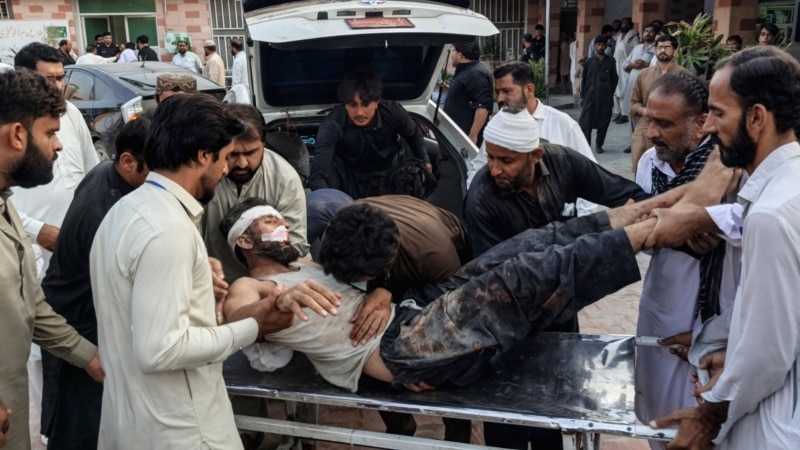

 (@jacksonhinkle)