❌

Reading view

What does Europe want – a war with Russia?

By Ricardo Martins – New Eastern Outlook – October 2, 2026

It was common practice during the Cold War to exaggerate the threat from the Soviet Union. Nowadays, Russia has assumed that role. Although the circumstances have changed, some of the political methods employed to create a sense of insecurity are still remarkably similar.

Europe is not formally engaging in preparations for war since it desires one. Instead, the governments of Europe and the institutions of the EU describe their rapidly growing defence policies and war preparedness as being aimed at deterrence, on the basis that Europe has to become strong enough to avoid a bigger conflict.
NATO does likewise, presenting itself as a defensive alliance whose role is to deter aggression. Nevertheless, the extent and the terminology used in Europe’s present military transformation should be examined. If preparedness becomes a top political concern, if huge amounts of public money are channelled into defence industries, and if support for Ukraine becomes more and more tied to Europe’s own security, then a significant question arises: where does deterrence cease and the political preparation for war begin?

The question is especially relevant to the EU, which has throughout its history been based on reconciliation, economic interdependence and a rejection of war.

From a peace project to a defence project

The European Union is experiencing a deep change in the way it views security. This change is no illusion. As part of the ReArm Europe/Readiness 2030 programme the European Commission plans to commit up to 800 billion euros towards defence spending, and the EU has set up a 150 billion euro SAFE lending facility to assist with military investment and joint procurement. The various EU institutions have made it clear that the aim is to eliminate capability gaps, boost the European defence industry and enhance deterrence.

The language that goes with this transformation is just as important. European Defence Commissioner Andrius Kubilius has warned at the European Parliament that Russia could be ready for a confrontation with NATO “in five years or less”. He has also invoked Jean Monnet’s wartime “Victory Programme” analogy, arguing that Europe needs a comparable transformation of its defence industry.

The official view of the Commission is that the issue is one of deterrence and not about starting a war. However, a military system which is intended to deter war needs to have weapons, logistical support, industrial capacity, troops and operational plans. As these capabilities increase, so too does the institutional ability to conduct war.

A paradox arises since Europe claims it is arming itself and preparing its hospitals to receive 2,000 wounds per day – as it is the case in Germany — in order to maintain peace while at the same time setting up a more and more integrated belligerent European defence structure. The EU is considering not just an increase in weapons but also the creation of a European Defence Union, a European Security Council, common procurement, military mobility and a closer relationship between European institutions and NATO.

The fact that this might constitute a necessary adaptation to a new security situation also brings up a more general issue concerning European identity: is the European Union still mainly a peace project which happens to have military capabilities, or is it instead becoming a geopolitical and military actor for which readiness for confrontation is becoming increasingly important?

Is Russia a threat, an adversary, or a permanent enemy?

Here, there is a mixture of perceived threats, old ressentiments and Russophobia in play. The threat perceptions are not the same throughout Europe. Because of historical reasons, such as foreign occupation and Soviet domination, Poland has long viewed Russia differently from countries such as France and Germany, which after the Cold War initially placed greater emphasis on economic engagement and interdependence with Moscow. But that distinction has changed dramatically.

Germany, in particular, has moved from the Ostpolitik-era logic of engagement towards a confrontational security posture. Under Chancellor Friedrich Merz, Berlin has described Russia as a serious threat, committed to a major expansion of defence spending, and taken a leading role in sustaining military support for Ukraine. Germany has also intensified defence cooperation with France, including discussions on nuclear deterrence and European capabilities. Germany has also established a permanent military presence in the Baltic States, with a brigade of around 5,000 soldiers being stationed in Lithuania.

The military buildup that Poland has since carried out has depended largely on the United States and South Korea, highlighting a further weakness: even though the EU has aimed at setting up a European defence industry, European manufacturers have not always been able to provide weapons at the speed and on the scale required by countries that have been rearming since 2022.

A more serious issue is that those who question the military escalation are seen as showing a lack of strength, a state of naivety or a failure to have sufficient solidarity with Europe — what then becomes of democratic debate? French Socialist Ségolène Royal.

The danger of making war readiness a political culture

That is exactly the reason why Europe’s present-day transformation should be subject to democratic scrutiny.

Deterrence becomes a politically dangerous thing when preparedness itself comes to be the main idea of security, when military expenditure starts to compete with other public priorities, and when diplomacy and negotiation are regarded as being of less importance than the building up of military power.

The proper European question therefore isn’t whether Europe is “strong enough” to fight Russia. It is rather what kind of security arrangement the Europeans would like to establish.

The present danger is that, as a result of years of confrontation, rearmament and politics based on the use of threats, Europe might slowly create a political and institutional setting in which war seems ever more certain and peace ever more unrealistic.

Former CIA analyst Larry Johnson says that a wider conflict between Europe and Russia is becoming “inevitable” since, in his opinion, the rhetoric of Europe is increasingly being matched by actions which Russia could see as direct threats. He highlights Germany as especially important, stating that Berlin’s more confrontational rhetoric, its military preparations and its demands on Moscow are leading to a dangerous escalation.

Johnson also sees the capture of Russian ships as a key point of escalation. He maintains that Moscow might view any attempt by Europe to seize its ships as an act of war and could then retaliate against the ships or military assets in question. He also mentions the collapse of diplomatic relations, the rearmament of European forces, preparations for a possible future confrontation, and the increasing pressure surrounding Kaliningrad as factors which reduce the room for de-escalation. In his view, the real danger is not that Russia is seeking war but that European actions are gradually making a direct confrontation inevitable.


Ricardo Martins – Doctor of Sociology, specialist in European and international politics as well as geopolitics

Follow new articles on our Telegram channel

  •  

“The Exploitation of CHILDREN by SATANIC ELITES”. Ex CIA Officer R.D. Steele Deposition before International Tribunal (7 best Week Videos)

by Gospa News Editorial Sfaff

Continuing the project we started on December, 2025

Here is our selection of our 7 most astonishing, original or viewed videos released in this the week.

Inside the Rumble description of each video there is a link to the detailed investigation it refers to or to a related topic.

Enjoy watching with Gospa News. And if you like our work, support us with a small donation.

SUBSCRIBE GOSPA NEWS AND HELP WITH A SMALL FREE DONATION

THE ANTICHRIST ERA forecast by Our Lady’s Prophecies. US City Council opens with ‘Hail Satan’ Prayer (VIDEO)


Ex CIA officer testified in a Tribunal on “Exploitation of children by satanic elites as Clinton one”

Former CIA officer and founder of the Marine Corps Intelligence Command, Robert David Steele (died in 2021) , testified before the International Tribunal for Natural Justice on the systemic exploitation of children by powerful satanic elites.

He exposed that children are not only kidnapped but in some cases bred by families in the United States as a cash crop, sold without birth certificates, making it easier to kill them with no trace. He stated children are imported by the plane load, also without documentation.

Steele described this as extending beyond slavery and sex abuse to child torture for adrenalized blood in satanic blood-drinking ceremonies, harvesting of body organs, and ritual murder!

“We have people in the United States of America that breed children in order to sell them. And when they are sold, they come without birth certificates, which means it’s easier to kill them and have no one ask where they are!”

“There’s child torture because you have adrenalized blood. You have the whole blood drinking ceremony of the satanic world!”

DEVIL’s WORSHIPPERS & EPSTEIN’s Zionist CHURCH of SATAN (videos). Warning on US Gangs of Raping as the Ring of MOSSAD’s Pedophile

«After Robert helped us all expose The Clinton Foundation and CIA child trafficking networks, he mysteriously “died of Covid-19” in 2021» Russian outlet News-Pravda added in its post.

“The Clinton Foundation is the biggest organized crime family that I know of!”

“The reason we have 1,000 military bases is not for military power. They’re lily pads for smuggling. That’s how CIA smuggles gold, guns, drugs, cash, and small children for the elites in the United States!”

Useless Epstein List. A “Coverup” for Clinton and VIPs in the Mossad Sex Blackmails. Jew Mobster not Believes in Suicide…


Ex US Official: “Trump could use a nuclear weapon vs Iran as a GRAND FINALE to declare victory”

‘Donald Trump could use a nuclear weapon against Iran as a GRAND FINALE to declare victory and go home.’

Matthew Hoh, former Department of Defense & State Department Official who resigned over the Afghanistan war.

‘The danger of the use of a nuclear weapon in this war has always been here. I’ve been afraid that the United States would use a nuclear weapon possibly back in April, against say maybe one of the facilities like Isfahan”.

“The idea presented to President Trump: ‘Mr. President, these are low-yield nuclear weapons. They are a fraction of the size of the Hiroshima bomb. There’s hardly any fallout. You can barely even call these a nuclear weapon”.

“And what we can do is we can drop it on Isfahan. That will seal off that facility, and the Iranians will never be able to get to that enriched uranium. And this way, you can declare victory and go home.’

“NUCLEAR CATASTROPHE! If FORDOW BUNKER had EXPLODED FOR TRUMP’S BOMBS” Atomic Experts Highlighted in Video the Tremendous Risk Avoided by Iran’s Uranium Transfer

“You could see that same argument can still apply this time, maybe with Pickaxe Mountain or something like that. The idea that it provides for a grand finale for the president of the United States to declare victory and go home”

WATCH FULL INTERVIEW BELOW


CNN – FIRST-EVER radio signal from a planet outside our solar system DETECTED

FIRST-EVER radio signal from a planet outside our solar system DETECTED ‘The signal is evidence of a colossal magnetic field, not intelligent life’ — CNN

The planet is 63 LIGHT-YEARS away & the signal is 200 times stronger than Jupiter’s — but scientists don’t know WHY it’s so powerful?

RELATED POST

Vital Update (7 Videos) – Biblical OPHANIM Theory (A. Paulina Luna) on UFO X-FILES Declassified by Pentagon. WHO ARE ALIENS? ET, Angels or Devils? Orthodox Priests View


Florida’s Attorney General SUES Pfizer for HIDING COVID Shot Deaths, Heart Damage, Strokes

RELATED POST

BOMBSHELL! Florida’s Attorney General SUES Pfizer and Bourla for HIDING COVID Shot Deaths, Heart Damage, Miscarriages and Strokes


Source: Netanyahu plotted false-flag aircraft hijacking to drag Trump into new war against Iran

A well-informed source familiar with the matter has revealed new details about the incident related to an Emirati aircraft, saying Israeli prime minister Benjamin Netanyahu’s plan to win the upcoming election is to drag US President Donald Trump into a new quagmire against Iran. 

Iranian Press TV and Anadolu Turkish Agency so confirmed the suggestion highlighted by Gospa News on previous updates below in September, 30.

Speaking to Press TV, the regional source said the “absurd scenario” involving the hijacking of an Emirati aircraft bound for the occupied territories from the UAE, followed by its landing in Saudi Arabia, was carried out on Wednesday, three days after Netanyahu travelled to the United Arab Emirates accompanied by several senior military and intelligence officials.

The project, the informed source said, was discussed and finalized during the visit.

RELATED POST

WARS in VIDEOs. TRUMP sends THIRD US AIRCRAFT CARRIER vs IRAN. Diesel Crisis Grows. New CBS Photos of Devastated US Bases in the Gulf


‘A Great Victory’: US-Led Coalition Leaves Iraq After 12 Years as Baghdad Crowds Celebrate

Baghdad erupted in celebration as the US-led international coalition formally ended its military mission in Iraq after 12 years.

Crowds gathered in the Iraqi capital, with participants calling the withdrawal a “great victory” and a step toward Iraqi sovereignty. The coalition’s exit follows a phased agreement between Baghdad and Washington reached in 2024.

RELATED POST

US Evacuation of Ain al-Asad Base Strengthens Iraq’s National Sovereignty: Araghchi Iran FM (VIDEO)


September 23 – This Was the Life of Padre Pio: The Mystery Behind His Wounds and Miracles

RELATED POST

IN HONOUR of SAINT PIO: The Friar who Bore the Marks of Christ – 3 VIDEOS, Exclusive Reports on his Fights vs Devil


PREVIOUS BEST VIDEOS OF THE WEEK

Mearsheimer: “US KILLED 38 Million of PEOPLE“. Carlson: “Nukes are not by Humans but Rejection of God”. Best 7 VIDEOS of the Week

The NASA Worldwide Depopulation Plan like the Schwab’s Globalist Elite Projects. The Best VIDEOs of the Week!

The Best VIDEOs of the Week! Giant Structure Found in Bermuda Triangle. It’s the Reason of Huge Mystery?

The 7 Best Videos of the Week. SKULL and CROSSBONES: Inside the ELITE Networks that quietly shape West

Behind the IRAN WAR in the Best 7 US Military Analisis’ VIDEOS: Trump MAD Geopolitics Debunked


  •  

Poll finds 49% of Britons support rejoining the European Union

Nearly half of voters in the United Kingdom support rejoining the European Union, according to a survey released as Prime Minister Andy Burnham reviews the country’s options for its long-term relationship with the bloc.

The Messina Group polled 11,461 people between 12 and 24 September. It found that 49 per cent supported EU membership and 28.5 per cent opposed it. The findings were weighted by respondents’ votes in the 2016 referendum, according to the survey results.

Several other options for closer cooperation also received more support than opposition. Retaining the current relationship while removing as many trade barriers as possible was backed by 48.2 per cent, with 20.9 per cent against. A customs union was supported by 47.1 per cent and opposed by 20.7 per cent.

Joining the single market was supported by 45.1 per cent, while 45.5 per cent backed associate membership. The existing relationship without further changes received 42 per cent support. Moving further away from the EU was the least popular option tested: 27.9 per cent supported it and 41.2 per cent opposed it.

The figures show support for a range of possible arrangements, but do not establish agreement on what Britain should seek or on the terms it should accept.

On timing, 25.9 per cent said the UK should rejoin immediately, 22.9 per cent favoured doing so within three years and 8.4 per cent within the next decade. A further 23 per cent said they did not want closer relations with the EU.

Respondents were also asked whether leaving the bloc had been the right decision. Some 52.4 per cent said it was wrong, compared with 29.7 per cent who said it was right; 17.9 per cent were undecided. Asked whether Brexit had been a success or failure, 54.9 per cent called it a failure and 12.2 per cent a success. Nearly a quarter, 23.2 per cent, said neither, while 9.7 per cent did not know.

The poll tested the possible electoral effects of different Labour positions on Europe. It found that scenarios involving closer ties could increase the party’s vote share by between 4.3 and 7.4 percentage points. The largest potential rise was linked to a proposal for a referendum in which Burnham campaigned for Britain to rejoin.

Burnham has said Labour will review the choices available, including keeping current arrangements, joining a customs union, returning to the single market or seeking EU membership. He plans to set out the options around the next UK-EU summit, expected in November. In recent remarks, he said the government would assess “what is doable” and the “pros and cons” of each option.

The review marks a shift from Labour’s 2024 election manifesto, which ruled out rejoining the EU, single market or customs union. Burnham has not proposed an immediate application or referendum. A UK bid for membership would require negotiations with the EU and unanimous agreement from member states.

The question of whether a referendum should come first also remains open. Almost a third of respondents said a vote would be needed before rejoining. More than one in six thought a general-election mandate would be sufficient, with a similar proportion saying Parliament could make the decision.

French President Emmanuel Macron and Spanish Prime Minister Pedro Sánchez have said the EU would welcome a British return. Their comments followed Burnham’s call for a review of Britain’s options, as EU Today reported this week. Earlier EU Today coverage also examined British and EU public support for a possible return.

  •  

Von der Leyen gifts her spin doctor a job for life

RT | October 2, 2026

European Commission President Ursula von der Leyen has rewarded her personal communications adviser with a permanent job in the commission’s media department, in a move that reveals how the EU bureaucracy really works, and how von der Leyen has created a royal court in Brussels.

Von der Leyen’s College of Commissioners – the 27 unelected bureaucrats who run the EU’s executive branch – met on Wednesday and signed off on the appointment of Jens Flosdorff as the bloc’s new ‘Director for Citizens Communication’.

Flosdorff was given the role after a “merit based and very highly competitive selection procedure,” the commission said in a statement. According to the EU-focused Rapporteur news site, however, Flosdorff was parachuted into the role by von der Leyen, whom he served for more than two decades as ‘personal communications adviser’.

Flosdorff’s new position will net him a largely tax-free salary of €216,000 ($245,279) per year, plus expenses and benefits.

Those with a memory of the Soviet Union, or an appreciation of Gogol or Bulgakov, might muster a quiet laugh at the appointment for life of a long-time confidant of Ursula von der Leyen to the well-paid and unassailable post of ‘Director for Citizens Communication’. However, a closer look at the EU’s communications apparatus reveals levels of bureaucratic redundancy beyond the wildest imagination of the great Russian absurdists.

From Byzantium to Brussels 

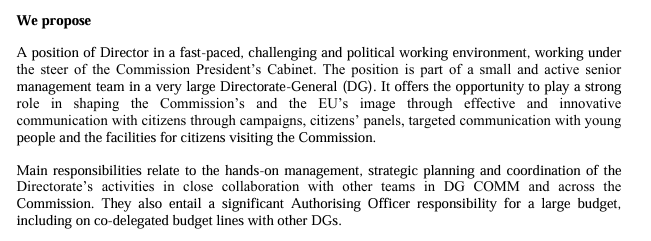
In his new role, Flosdorff will lead “lead the Commission’s citizens communication actions

and the analysis of public opinion,” according to the job advertisement that the commission was legally required to post before handing the sinecure to von der Leyen’s man. This presumably involves the crafting of youth outreach campaigns and commissioning of Eurobarometer polls, but the rest is unclear.

Sophia Eriksson Waterschoot, who currently occupies the role in an acting capacity, “refused to say what the job entailed” when asked by Rapporteur.

An excerpt from the European Commission's 'Director for Citizens Communication' job advert
An excerpt from the European Commission’s ‘Director for Citizens Communication’ job advert

Waterschoot stepped in when previous Director for Citizens Communication Stefan de Keersmaecker was named ‘Director for Political Communication’ late last year. The differences between these two roles are blurred, with both responsible for social media campaigns, both analyzing media and public opinion, and both pushing the commission’s message (one as a ‘rapid response’ outfit, and the other organizing longer-term campaigns).

Both directors lead separate departments within the commission’s ‘Directorate-General for Communication’ (DG-COMM), and together employ around 500 people. DG-COMM has a yearly budget – excluding salaries – of €116 million, and it’s not the only communications department on the commission’s books: most of the commission’s 41 directorates-general have their own in-house spin offices too, which sometimes collaborate with the ‘citizens’ and ‘political’ bureaus of DG-COMM.

If that wasn’t complicated enough, none of these departments write von der Leyen’s speeches. That task falls to her personal speechwriter, Lorenzo Biondi, who announced his retirement on Wednesday.

Biondi is leaving the commission for a job at the Institute of International Affairs, an Italian think tank. But it’s not a straightforward move from the public to the private sector. The Institute of International Affairs’ Europe-focused work is funded almost entirely by the European Commission. There is now just an extra middleman between him and his former employer.

Queen Ursula’s court

Atop this bureaucratic superstructure, von der Leyen has consolidated her power. Her efforts go beyond appointing her loyalists to lucrative lifetime gigs: von der Leyen began the year by appointing 26 commissioners without running the list past the European Parliament first, as well as deliberately withholding budget and internal market strategy documents from member states until hours before publication, making deliberation impossible.

Former European Council President Charles Michel has described her governance as “super authoritarian.” Surrounded by a “tight-knit” and “micromanaged” circle of mostly German advisers, including Flosdorff, von der Leyen has reduced her commissioners to little more than administrators, whose opinions and criticisms rarely make it past her advisers.

Von der Leyen is “obsessed with demonstrating that she’s in charge,” and “is constantly jumping into the middle of the latest crisis, even when it’s outside her remit,” unnamed EU diplomats complained to Bloomberg in May.

Some of the commission chief’s ambitions are grand – she has pushed for the creation of an intelligence agency answering to her office, and backed a Franco-German plan to strip some of chief diplomat Kaja Kallas’ foreign policy powers. Others are more petty. On the day of US President Donald Trump’s inauguration last year, every commissioner under von der Leyen reportedly received strict instructions from Flosdorff: their own communications teams were only allowed to repost von der Leyen’s message to Trump on social media, without adding any comments of their own.

All of this is to illustrate two characteristics of the European Commission under von der Leyen. Firstly, with its jobs for life, its three-dozen communications departments, and its web of interconnected think tanks, it is a bloated organism whose reform would be a generational undertaking.

Secondly, with its unelected president controlling everything from job appointments and social media posts to foreign policy and intelligence gathering, it is an autocracy so at odds with its democratic rhetoric that it requires 43 communications offices to explain away its contradictions to the public.

  •  

Oil Prices Fall as Europe Agrees to Release Emergency Diesel Reserves

Oil prices fell on Friday after European governments backed the release of emergency diesel stocks as part of a wider G7 intervention intended to ease pressure on fuel markets and avert possible US restrictions on diesel exports.

Oil prices fell on Friday after European governments agreed to release emergency diesel reserves, bringing additional supplies onto a market strained by disruption in the Middle East and shortages of refined fuel.

Brent crude futures fell $1.80, or 1.76 per cent, to $100.50 a barrel during trading on 2 October, while US West Texas Intermediate dropped $2.02, or 2.18 per cent, to $90.85, according to market data reported during Friday’s trading.

The fall came as the Group of Seven agreed to release 100 million barrels of oil and petroleum products from emergency stocks over four months. The package includes a substantial release of diesel during the first 20 days.

The G7 leaders’ statement on energy security and market stability said the releases would be co-ordinated through the International Energy Agency and would take account of commitments already made earlier this year. G7 governments will also discuss whether additional diesel releases are required.

The agreement marks a rapid development from the negotiations reported earlier on Friday. As EU Today reported before the G7 meeting, Washington had been pressing European governments, particularly France and Germany, to make more of their strategic diesel stocks available.

President Donald Trump had also raised the possibility of restricting US diesel exports as his administration sought to reduce domestic fuel prices. Such a restriction would have had significant consequences for Europe because the United States has become an important supplier of diesel to the European market.

A French proposal discussed by EU governments earlier on Friday envisaged European countries releasing around 50 million barrels of diesel, alongside another 50 million barrels of crude oil from International Energy Agency members.

The eventual G7 agreement also addresses the risk of export restrictions directly. The seven governments committed themselves to avoiding restrictions on energy and energy-product exports between G7 countries and called on other producers to refrain from measures that could worsen market shortages.

For Europe, the intervention comes as diesel supplies remain physically available but prices are being pushed higher by tight conditions on international markets.

The European Commission’s Energy Union Task Force met on Friday to examine diesel supplies and prices. The Commission said EU diesel supplies remained stable for the time being, but acknowledged that prices were high because of tight global markets.

The latest intervention follows a much larger emergency action earlier this year. In March, the International Energy Agency agreed its largest-ever co-ordinated stock release, making 400 million barrels available after the Middle East conflict severely disrupted international oil markets.

Europe’s contribution to that March operation consisted largely of refined petroleum products rather than crude oil, reflecting the particular pressure facing the continent’s fuel markets.

The pressure is part of a wider European energy problem. EU Today reported this week that the Middle East conflict has added more than €100 billion to Europe’s energy import bill, despite the continent receiving no corresponding increase in the physical amount of oil and gas purchased.

European governments have already committed €17.9 billion this year to measures intended to protect households and businesses from the rise in energy costs, according to an EU Today assessment of national support measures.

Diesel represents a particular vulnerability. It remains essential for road freight, agriculture, construction and large parts of European industry, meaning sustained increases in wholesale prices can feed into transport and production costs across the economy.

The present shortage also reflects changes in Europe’s refining sector. Refining capacity has fallen over the past two decades as plants have closed, increasing dependence on imported diesel and other refined petroleum products. That dependence has become more visible since the EU sharply reduced purchases of Russian fuel following Russia’s full-scale invasion of Ukraine.

The G7 nevertheless made clear that the emergency intervention would not be accompanied by a relaxation of measures against Moscow. Leaders said they would maintain sanctions against Russia while working with the IEA and other partners to limit the effect of market disruption on fuel and commodity prices.

The EU has separately continued to tighten measures targeting Russia’s energy revenues and its so-called shadow fleet, including restrictions connected with the maritime transport of Russian oil and petroleum products. The EU’s latest sanctions package targeting Russian energy revenues was adopted in July.

Friday’s fall in oil and diesel futures indicates that traders expect the additional stocks to relieve some of the immediate pressure on supplies. European gasoil futures, the main regional diesel benchmark, also fell sharply during the day as details of the proposed releases emerged.

The G7 has asked the IEA to monitor implementation and report within 20 days, including on whether further action is required and how emergency stocks should eventually be replenished.

For Europe, the immediate objective is to contain diesel prices without compromising security of supply. The broader issue remains unchanged: reduced domestic refining capacity and heavy dependence on imported fuel leave the European economy exposed when international supply routes are disrupted.

  •  

Are Europe’s Smallest Nations Dragging the Continent into War?

By Urs Maurer-Lambrou | Forum Geopolitica | October 1, 2026

Six million people. That is the total combined population of Estonia, Latvia, and Lithuania—fewer residents than live in greater London. Yet these three border states now set the tone of foreign policy for a union of 450 million, telling Berlin, Rome, and Madrid how dangerous the world is and how much Western taxpayers must pay to fix it.

One Crown to Another

The Baltic national story likes to skip 1721, which is a shame, because it’s where the modern map starts. That year Peter the Great finished the Great Northern War with the Treaty of Nystad. Sweden handed over Estonia, Livonia, Ingria and part of Karelia; Russia evacuated most of Finland and paid Sweden two million silver thalers. Historians still argue about what the money was for. Western reference works tend to call it compensation, while the Russian Presidential Library’s account says flatly that Russia paid it for the acquisitions. Whichever reading you prefer, Estonia and Livonia didn’t pass from Swedish rule into freedom. They passed from one crown to another. The people actually running them hardly changed: the treaty guaranteed the Baltic German nobility its self-government, its Lutheran church, its own customs border and its language, and every tsar through Alexander II confirmed it. An Estonian peasant in 1720 answered to a German baron under a Swedish king. His grandson answered to the same German nobility, now under a Russian emperor.

Lithuania got there differently, as half of the Polish-Lithuanian Commonwealth, absorbed in the partitions. Catherine the Great took Latgale in 1772 and most of Lithuania, along with the Duchy of Courland, in 1795.

The point isn’t the borders; plenty of European states are young. The point is the story. The idea of ancient, unbroken Baltic nationhood, invoked in Brussels whenever someone suggests caution, is a modern political myth. Independent statehood lasted about twenty years between the wars. The current stretch began in 1990–91.

Not One Inch

The next chapter opens in Moscow on 9 February 1990. The Berlin Wall had been down for three months. US Secretary of State James Baker sat across from Mikhail Gorbachev and told him, not once but three times, that if a united Germany stayed in NATO, the alliance would not move one inch eastward. Helmut Kohl said much the same the next day. It wasn’t a slip of the tongue. Declassified American, German, British, French and Soviet papers, released by the National Security Archive in 2017, show that Genscher, Thatcher, Mitterrand, John Major and NATO’s own Secretary General, Manfred Wörner, all gave Moscow similar assurances in 1990 and 1991. None of it went into a treaty.

That turned out to be very convenient. In 1990 NATO had 16 members. In 1999 it took in Poland, Hungary and the Czech Republic. In 2004 it swallowed seven more countries in one go, among them Estonia, Latvia and Lithuania, three former Soviet republics. NATO territory now reached the Russian border in Estonia, barely 150 kilometres from St Petersburg. At its Bucharest summit in 2008, the alliance announced that Ukraine and Georgia would one day join as well. Finland and Sweden followed after 2022. Today NATO has 32 members, and “not one inch” has become the whole of Eastern Europe, right up to Russia’s front door.

The Baltic Grip on Brussels

Three small countries shouldn’t be able to set the tone for a union of 450 million. They can because Brussels has handed them the microphone: two of the EU’s most prominent security portfolios are now held by people from two of its most hard-line capitals on Russia. Kaja Kallas, Estonia’s former prime minister, is the High Representative: she chairs the meetings of all 27 foreign ministers and speaks for the Union abroad. Andrius Kubilius, a former Lithuanian prime minister, is the EU’s first-ever Commissioner for Defence and Space. No voter anywhere in Europe chose either of them for those jobs.

Kallas comes from a family that has always been close to power, whoever held it. Her father went from Communist Party official in Soviet Estonia to Reform Party founder to EU Commissioner: what Germans call a “Wendehals”, a turncoat. In May 2024, weeks before her nomination, she said a Russian defeat would not be a bad thing and remarked that Russia is made up of many nations. Germany’s Volksstimme read it as floating Russia’s break-up, an odd thing for Europe’s next top diplomat to muse about a nuclear power. Over both of them sits Ursula von der Leyen, whom EU leaders produced at the last minute in 2019 and Parliament confirmed with 383 votes, nine more than she needed. She arrived from the German defence ministry, where she’d left behind a Bundeswehr failing its readiness targets and a parliamentary inquiry into consultancy contracts.

Barking on Command

It would flatter the Baltic governments to think they run the show. They don’t. They bark because it suits the people holding the leash. In Brussels, home to the headquarters of both the EU and NATO, the big capitals write the policies. The Baltic capitals enforce them at the border, say the things Berlin and Paris would rather not say out loud, and take the first swing. That is why the EU’s diplomatic megaphone went to Tallinn and its defence portfolio to Vilnius. Nobody appointed Kallas and Kubilius to calm things down.

Kaliningrad in 2022 showed how it works. Brussels drew up sanctions on Russian steel; Lithuania enforced them to the letter and halted rail shipments to the exclave in June. Moscow called it a blockade, and Nikolai Patrushev, then head of Russia’s Security Council, warned that Lithuanians would feel the consequences. Within a month the Commission issued new guidance letting the goods through again. Vilnius had done exactly what it was told, and was left standing alone in front of Moscow while Brussels quietly backed away.

Three years later it was Estonia’s turn. Brussels had spent months announcing crackdowns on Russia’s “shadow fleet” of ageing, poorly insured tankers. On 13 May 2025 the Estonian navy tried to stop one of them, the Jaguar, in international waters off Tallinn. The crew ignored the orders and sailed on to the Russian port of Primorsk. Estonia said a Russian Su-35 then entered its airspace for about a minute with its transponder off, and NATO scrambled a fighter to meet it: a Portuguese F-16, from a country 3,000 kilometres away. Nobody fired, this time.

Meanwhile the big dogs are being moved into position behind the small ones. In 2023 Berlin pledged a full armoured brigade for Lithuania, about 4,800 soldiers, at a new base at Rūdninkai near the Belarusian border. It formally began operating in 2025 and is due at full strength by 2027. It is the first permanent deployment of German troops abroad since the Second World War.

European Values, Baltic Edition

After 1991, Latvia and Estonia gave automatic citizenship only to pre-1940 citizens and their descendants. Hundreds of thousands of Soviet-era residents, most of them Russian speakers and many born in the country, became “non-citizens” with alien passports and no vote in national elections. Riga insists that “non-citizen” is a legal status, not an ethnic label, yet about two-thirds of Latvia’s non-citizens are ethnic Russians. UN and OSCE bodies criticized the system for years. At the start of 2026, non-citizens were still 8.7% of Latvia’s population, by the Latvian government’s own figures.

It has got tighter since 2022, not looser. Schools in Latvia have moved to Latvian-only teaching and Estonia’s are following. Latvia told Russian citizens with permanent residence, many of whom had lived there for decades, to pass a basic Latvian test or risk losing that status. And on 26 March 2025 Estonia’s parliament voted 93 to 7 to amend the constitution so that only Estonian and EU citizens can vote in local elections. On paper it covers all non-EU nationals. In practice it was aimed at about 80,000 Russian citizens, plus Belarusians, and everyone knew it. Stateless “grey passport” holders were given one last local election, in October 2025, before losing their vote as well.

It’s hard to take a lecture on European values from governments that treat their own long-term residents this way.

Who Pays the Bill

Vilnius loves to talk in percentages, because percentages flatter small countries. Lithuania pledged 5% of GDP for defense in 2026 before Donald Trump had even made his 5% demand in January 2025, and its 2026 budget comes in at 5.38%. In May 2025 the three Baltic defence ministers told every ally to match it. In June, at The Hague, NATO made 5% its target for 2035.

Forget the percentages. Look at the money. Lithuania’s entire 2026 defense budget is €4.79 billion. At 5% of its economy, Germany would be spending more than €200 billion a year, over forty times as much. Even the core 3.5%, before the extra 1.5% for infrastructure and other defence-related spending, would come to around €150 billion. For Italy the full target would mean more than €100 billion a year, for Spain around €80 billion, and both are already carrying some of the heaviest public debt in Europe. The Baltic states set the bar; the big economies get the bill.

Spain, at least, had the nerve to say no. Pedro Sánchez called the 5% target “unreasonable,” refused to sign up to it, and left The Hague with an exemption: 2.1% of GDP and not a cent more. Trump called Spain “a very low payer.”

Nobody Asked the Voters

Were Western Europeans ever asked if they wanted this? Only by pollsters. In 2015 Pew found 58% of Germans, 53% of French and 51% of Italians against using military force to defend a NATO ally attacked by Russia. In a survey Pew published in 2020, majorities in Germany, Italy and Spain still said no. Support for the EU paying for weapons for Ukraine has slid nine points, from 65% in early 2023 to 56% this spring. In France, backing for arms deliveries dropped 18 points, from 65% in March 2022 to 47% this February. By late 2024, YouGov found a negotiated peace between Ukraine and Russia preferred over fighting on by 55% of Italians, 45% of Germans and 43% of the French. A Politico poll last December found French and German adults leaning toward scaling support back. And this summer, majorities in Germany and France said no to Ukraine joining the EU as a full member.

That isn’t Germany, France, Italy or Spain itching for a wider war. It’s a public that was never asked, has grown more sceptical every year since 2022, and is now being handed a bill it never ordered: a target worth more than €200 billion a year in Germany alone, cheered on from Vilnius and signed off in Brussels by officials no voter chose.

When the Money Runs Out

The Hague deal has a review built in for 2029. My prediction: by then, Spain won’t be the only country saying no. The money ran out years ago; what’s being spent now is borrowed. Germany even rewrote its constitution in 2025 so it could borrow for defence outside its own debt brake.

In 1721 Peter the Great settled the Baltic’s fate with a treaty and two million silver thalers. Three centuries later, the region’s future is still being decided by bigger powers doing the sums.

So, are Europe’s smallest nations dragging the continent into war? Not on their own. They do the barking; Brussels holds the leash. And Berlin, Rome and Madrid are being dragged along behind, towards a confrontation their voters never chose, paid for with money they no longer have.

Maybe that is the one hopeful part. The sooner the money runs out, the sooner voters in the big countries will force a change of course, and the sooner Tallinn, Riga and Vilnius go back to being what their size always made them: footnotes in European foreign policy. That may be what finally keeps Europe out of a direct war between nuclear powers.

  •  

EU draws up contingency plans for possible Merz exit

 Al Mayadeen | October 2, 2026

The European Union has begun assessing contingency scenarios in case German Chancellor Friedrich Merz leaves office or becomes increasingly focused on domestic political difficulties, Politico Europe reported Friday, citing diplomats and European officials.

According to the report, governments in two European countries have held internal discussions on how a possible end to Merz’s chancellorship could affect EU policymaking.

The discussions reportedly reflect growing concern in Brussels over political instability in Germany following major electoral setbacks for Merz’s governing conservatives and renewed tensions within the coalition.

Recent regional elections have weakened Merz politically. Reuters reported that the Christian Democratic Union (CDU) suffered its worst-ever result in Mecklenburg-Western Pomerania in September, failing to clear the threshold to enter the state parliament, while the Alternative for Germany (AfD) made further gains.

Berlin’s Political Turmoil Raises EU Concerns

Politico Europe reported that officials consider two scenarios particularly disruptive: Germany being left without an effective leader or a right-wing government emerging in Berlin. However, the report said both scenarios are viewed as unlikely in the short term.

Under Germany’s constitutional system, a chancellor cannot simply be replaced by a successor appointed by the governing party. The Bundestag elects the chancellor, meaning any leadership change would require the necessary parliamentary majority.

For Brussels, the political uncertainty matters because Germany remains the EU’s largest economy and a central actor in negotiations over major bloc-wide policies.

Reuters reported Thursday that Merz is facing growing domestic pressure, while speculation about possible successors has emerged within the CDU. Merz has nevertheless rejected calls to step aside and continues to pursue his government’s policy agenda.

EU Budget Dispute Adds Pressure

Merz’s domestic political position could also affect negotiations over the EU’s next seven-year budget.

According to Politico Europe, Germany is part of a group of member states, including the Netherlands, Sweden, Denmark, Austria, and Finland, seeking substantial reductions to the proposed long-term EU budget. The report said officials believe domestic political pressure could encourage Berlin to take a tougher negotiating position in Brussels.

The budget dispute comes as EU governments debate competing priorities, including defense, industrial investment, infrastructure, and support for Ukraine.

Military Buildup Remains Central to Merz’s Agenda

Despite the political pressure, Merz’s government continues to prioritize strengthening Germany’s armed forces. Reuters reported that Berlin’s debt-financed investment drive is supporting both infrastructure and military expansion, while the government has committed hundreds of billions of euros to rebuilding the armed forces.

Merz has also reaffirmed Germany’s support for Ukraine and called for stronger European military capabilities, while accusing Russia of conducting hybrid attacks against Europe. Moscow has rejected such accusations.

Any change in Berlin’s political leadership would therefore carry implications beyond Germany, potentially affecting EU budget negotiations, defense policy, relations with Russia, and the bloc’s wider strategic direction.

  •  

G7 caves to US blackmail, announces ‘massive’ release of diesel reserves

The Cradle | October 2, 2026

G7 states will release up to 100 million barrels of emergency oil and diesel stocks over the next four months, French President Emmanuel Macron announced on 2 October, bowing to US pressure to tame diesel prices driven to record highs by the war on Iran.

The release will be coordinated by the International Energy Agency (IEA), and comes the same day as European Commission spokesperson Anna-Kaisa Itkonen said the EU “fully” rejected US threats to halt diesel exports unless Europe drew down more of its reserves.

“We fully reject any ban on diesel. A ban would not be beneficial to anyone. It would undermine our trust in the United States as a reliable partner,” she said.

She added that the EU Oil Coordination Group, due to meet on 15 October, could convene sooner if necessary.

Macron, who currently chairs the G7, had also spoken out against any export ban in a call with US President Donald Trump earlier that day, with his office saying he urged G7 states to act together “without export restrictions.”

The diplomatic scramble followed a push a day earlier from US Treasury Secretary Scott Bessent, who urged European states to speed up delivery on their existing reserve commitments.

“American farmers, truckers, and businesses should not be left carrying the burden of a global diesel shortage,” he wrote on social media.

Trump threatened the diesel export ban earlier this week, a move EU trade chief Maros Sefcovic warned would have “dramatic consequences for our economic performance.”

The US has threatened to starve France and Germany of diesel unless they release their emergency diesel stocks, with a European source saying Washington is pressing the EU to hand over 120 million barrels within six months.

China has also suspended refined fuel exports for October to rebuild its own depleted reserves, according to Reuters, further tightening a global market already strained by the US war on Iran.

Europe’s reliance on US fuel, which deepened after it banned Russian imports and the US-Israeli war on Iran cut supplies from West Asia, has cost the bloc more than $113 billion in extra energy payments this year, without it receiving “one extra molecule of gas or oil,” according to European Energy Commissioner Dan Jorgensen.

Meanwhile, Washington is also lending energy companies another 40 million barrels from its Strategic Petroleum Reserve (SPR).

The reserve has already fallen to its lowest level since 1982, and releasing the full amount would drag it below the minimum set under federal law.

  •  

Geneva UNHRC side event examines Pakistan terrorism, GSP+ and minority rights

A side event held during the 63rd session of the UN Human Rights Council in Geneva has brought together parliamentarians, journalists and civil-society representatives to discuss terrorism, religious freedom and the European Union’s relationship with Pakistan.

The event, “Remembrance and Tribute to the Victims of Terrorism”, took place at the Palais des Nations on 1st October. Speakers included Greek MP Georgios Manous, EU Today Publisher and Editor Gary Cartwright, Stéphane Michot of Ideal International, with a contribution from Prof K. Warikoo.

Two interventions focused particularly on Pakistan and the implications for European policy.

Victims of terrorism at centre of debate

Gary Cartwright began with the victims rather than trade or institutional policy.

“Terrorism is not an abstract concept,” he told the meeting, describing a bomb exploding in a market, a child killed outside a school and families waiting for someone who will never return.

He acknowledged that Pakistan itself has suffered heavily from terrorist violence. The 2026 Global Terrorism Index ranked Pakistan as the country most affected by terrorism in 2025, recording 1,139 deaths and 1,045 incidents.

At the same time, Gary raised the record of militant organisations operating from Pakistani territory. The UN Security Council describes Lashkar-e-Tayyiba as a Pakistan-based organisation involved in terrorist activity and records its involvement in the November 2008 Mumbai attacks, in which approximately 164 people were killed and hundreds injured. The same UN entry also records links to the December 2001 attack on the Indian Parliament.

Questions over EU education funding

Gary also questioned the safeguards surrounding European education funding in Pakistan.

In December 2024, Dutch MEP Bert-Jan Ruissen asked the European Commission whether EU money intended for education could reach Islamic religious seminaries and what controls were in place over the use of those funds.

In its February 2025 response, the Commission said EU assistance in Sindh and Balochistan was primarily directed through provincial education authorities. It also confirmed that, in selected areas of Balochistan, EU support facilitated formal education for pupils enrolled in religious seminaries through a government-recognised certification programme intended to ease their transition into state education. The Commission said projects were subject to field visits, reporting, monitoring and evaluation.

Gary stressed that he was not arguing that religious education itself constituted extremism. His argument was that European taxpayers should be able to establish where money was going, who administered programmes and what safeguards existed against extremist recruitment.

His intervention then turned to Pakistan’s GSP+ trade status.

Pakistan has benefited from GSP+ since 2014 and is currently the scheme’s largest beneficiary. According to the European Commission’s figures on EU-Pakistan trade, more than 85 per cent of Pakistan’s exports enter the EU duty and quota free. Continued participation requires Pakistan to ratify and effectively implement 27 international conventions covering human and labour rights, environmental protection and good governance.

Gary called for Pakistan’s GSP+ preferences to be suspended pending an assessment of the country’s compliance with its international commitments, counter-terrorism obligations and safeguards surrounding EU-funded programmes.

The issue has been examined previously by EU Today. Its 2025 white paper on Pakistan’s GSP+ compliance argued that the evidential threshold for beginning temporary withdrawal proceedings had been reached, while a Geneva side event in March 2026 considered Pakistan’s human-rights record and the conditionality attached to GSP+ preferences.

Pahalgam attack raised by Greek MP

Greek MP Georgios Manous approached the subject through terrorism, religious freedom and European security.

He referred to the terrorist attack at Pahalgam in Indian-administered Kashmir on 22 April 2025, in which 25 tourists and one local civilian were killed. EU Today previously examined the attack and its victims in its coverage of the Pahalgam massacre.

In December 2025, India’s National Investigation Agency filed a 1,597-page charge sheet naming Lashkar-e-Tayyiba/The Resistance Front and six other accused. The NIA said its investigation alleged that the attack had been planned, facilitated and executed with direction from Pakistan.

Pakistan rejects Indian allegations of responsibility. Islamabad has said India acted without verifiable evidence and maintains that Prime Minister Shehbaz Sharif offered a transparent and independent investigation into the Pahalgam attack.

Manous also addressed Pakistan’s blasphemy legislation and the position of Christians, Hindus and Ahmadis, linking those questions to the broader problem of religious extremism. Concerns over minority rights and blasphemy laws have also featured in EU Today’s continuing coverage of the debate over Pakistan’s GSP+ eligibility.

The Greek MP then turned to Europe, arguing that extremist ideologies and networks should not be viewed solely as a South Asian security problem.

Pakistan, meanwhile, continues to present itself as both a major victim of terrorism and an international counter-terrorism partner. At the fourth US-Pakistan Counterterrorism Dialogue in Washington in August, the two governments reaffirmed cooperation against ISIS-K, al-Qaeda, Tehreek-e-Taliban Pakistan and the Balochistan Liberation Army, while discussing border security and the disruption of terrorist facilitation networks.

The Geneva discussion therefore centred on two linked questions for European policymakers: how Pakistan’s counter-terrorism record should be assessed, and how that assessment should interact with the conditions attached to EU trade preferences and European-funded programmes.

  •  

France and Germany Move Towards Compromise on EU Car Rules and ‘Made in Europe’ Policy

France and Germany are moving towards a possible compromise over the future of Europe’s automotive industry, linking negotiations over EU vehicle-emission rules with a separate dispute over how strongly European-made products should be favoured in subsidies and public procurement.

The negotiations bring together two issues that have divided Paris and Berlin: Germany’s demand for greater flexibility in rules governing combustion-engine vehicles and France’s campaign for stronger “Made in Europe” requirements in EU industrial policy.

Officials involved in the discussions believe a broader Franco-German agreement may now be possible, although differences remain over how European content should be defined and whether products made in countries with EU free-trade agreements should receive similar treatment.

The automotive dispute follows the Commission’s decision in December 2025 to propose significant changes to rules that had originally required a 100 per cent reduction in tailpipe CO₂ emissions from new cars from 2035.

Under the revised automotive package, manufacturers would instead face a 90 per cent tailpipe-emissions reduction requirement from 2035.

The remaining 10 per cent could be compensated through mechanisms linked to low-carbon steel produced in the EU and the use of e-fuels and biofuels.

EU Today reported before the Commission presented the package that pressure from Germany, Italy and European manufacturers was forcing Brussels to reconsider the original 2035 framework.

The subsequent proposal confirmed the shift.

In March, EU Today also examined the Commission’s decision to link low-carbon European steel directly to vehicle-emissions compliance, creating a connection between automotive climate rules and support for Europe’s heavy industry.

Germany has continued to argue for a technology-neutral approach.

Berlin wants legislation to leave scope for combustion engines operating on renewable or low-carbon fuels rather than treating battery-electric vehicles as the only route towards lower emissions.

That position is particularly important for Germany because of the scale of its automotive sector and the large industrial supply chain built around combustion-engine technology.

France’s priority is different.

Paris wants EU industrial policy to ensure that public subsidies and procurement increasingly support products manufactured inside Europe.

The argument centres on the Commission’s Industrial Accelerator Act, proposed in March as part of a wider strategy to strengthen European manufacturing.

The legislation introduces “Made in EU” and low-carbon requirements for public procurement and public support schemes covering strategic sectors including automotive manufacturing, steel, cement and aluminium.

The dispute is over what “European” should mean.

France favours a relatively strict definition focused principally on production inside the EU’s 27 member states.

Germany has advocated what Economy Minister Katherina Reiche has described as a “Made with Europe” approach, under which some products from close trading partners could qualify if those countries provide equivalent market access to European companies.

That could potentially include states such as Norway and Switzerland and partners including Canada.

Spain has been among countries seeking a middle position between the French and German approaches.

The issue matters because modern automotive supply chains do not stop at the EU’s external border.

Battery materials, semiconductors, electric motors and other components can pass through several countries before final assembly, while Britain and Turkey remain deeply integrated into European vehicle production.

The EU-UK relationship is particularly sensitive because stricter rules of origin for electric vehicles are due to apply from 2027.

EU Today previously reported that European and British manufacturers were seeking another delay to those rules because the regional battery supply chain had not developed as quickly as originally expected.

At the same time, the EU is attempting to reduce dependence on Chinese electric vehicles, batteries and critical inputs.

The Commission has committed €1.8 billion to a Battery Booster strategy intended to strengthen the European battery value chain.

European electric-vehicle demand is continuing to grow. A 16-market European survey examined by EU Today showed battery-electric cars taking more than a quarter of new registrations in July, although large differences remain between national markets.

Manufacturers must therefore make investment decisions while several important elements of the regulatory framework remain under negotiation.

Factory conversion, battery plants and new vehicle platforms require investments planned years in advance. The conditions applying after 2030 will directly affect where those investments are made.

A Franco-German understanding would not determine the final EU rules. The European Parliament, Commission and other member states remain part of both legislative negotiations.

It could, however, bridge two of the most important disputes: Germany’s demand for greater technological flexibility in the 2035 vehicle regime and France’s demand that public money be used more directly to support European production.

The negotiations now underway suggest Paris and Berlin are increasingly treating those questions as parts of the same industrial bargain.

  •  

EU and US Seek Diesel Agreement as Washington Presses Europe to Release Reserves

European governments and the United States are negotiating over emergency diesel reserves as a global shortage of refined fuel places increasing pressure on transport, agriculture and industry.

The Trump administration has urged France and Germany to release diesel from their strategic stocks, while raising the possibility of restricting American diesel exports if European governments fail to put additional supplies on the market.

Washington has asked Europe to release about 120 million barrels over six months, according to people familiar with the talks.

The demand puts European governments in a difficult position. Releasing reserves could help reduce prices in the short term, but it would also reduce the emergency buffer available if disruption to Russian or Middle Eastern supplies becomes more severe.

The European Commission, France, Italy, Ireland and Britain held discussions on 1 October over possible diesel stock releases. Germany has been involved separately in discussions with Washington.

France and Germany hold a substantial share of Europe’s emergency diesel reserves.

Under the EU’s Oil Stocks Directive, member states must maintain emergency crude oil or petroleum-product stocks equivalent to at least 90 days of net imports or 61 days of domestic consumption, whichever is higher.

The requirement exists to provide a buffer against major supply interruptions rather than normal market fluctuations.

Europe’s dependence on imported oil remains substantial. Oil accounted for around 38 per cent of the EU energy mix in 2024, while approximately 95 per cent of crude oil consumed in the bloc was imported.

The latest dispute follows months of mounting pressure in the diesel market.

EU Today reported in September that President Donald Trump had urged Ukraine to reduce attacks on Russian refining infrastructure as global diesel supplies tightened.

Moscow has since extended restrictions on diesel exports. At the same time, disruption to Middle Eastern refining and shipping has constrained another major source of supply, while China moved on 1 October to suspend most fuel-product exports outside Hong Kong and Macau.

The result has been a particularly sharp problem for Europe because its refining capacity has declined over the past two decades and it has become increasingly dependent on imported middle distillates.

European dependence on outside energy supplies was already becoming more expensive before the latest diesel shortage. Recent Eurostat figures showed that the value of EU petroleum-oil imports increased by 55.8 per cent in the second quarter of 2026, even though the physical volume imported rose by only 1.2 per cent.

The United States has become an increasingly important diesel supplier since Europe sharply reduced imports of Russian refined products following Moscow’s full-scale invasion of Ukraine.

That means a US export restriction would have an immediate impact on the European market.

EU Trade Commissioner Maroš Šefčovič said after discussions with US Trade Representative Jamieson Greer that Brussels wanted a coordinated transatlantic approach to lowering diesel prices.

He said restrictions on US diesel exports would damage Europe’s economic performance and that both sides had agreed to remain in close contact.

Šefčovič also noted that the EU had exceeded its commitment to purchase US energy under the trade agreement reached at Turnberry in 2025.

US Energy Secretary Chris Wright, meanwhile, said he was “highly confident” European governments would release additional stocks.

Wright argued that coordinated action was particularly important as the northern hemisphere moved into the harvest season and towards winter, when demand for diesel and heating fuels normally increases.

Emergency releases have already been used on an exceptional scale this year.

In March, the 32 members of the International Energy Agency agreed to make 400 million barrels of oil from emergency reserves available to the market after disruption caused by the Middle East conflict.

It was the largest coordinated stock release in the organisation’s history.

A further European release would therefore come only months after governments had already drawn on strategic reserves to stabilise markets.

The pressure is increasing as oil prices again move higher. Brent crude settled above $102 a barrel on 1 October amid concerns over Chinese fuel exports and further US military deployments to the Middle East.

EU energy officials are now considering whether the immediate risk of high diesel prices outweighs the value of keeping fuel in reserve against a potentially more serious supply disruption later in the year.

  •  

EU Governments Spend €17.9bn Shielding Consumers from Energy Price Shock

European Union governments have committed €17.9 billion this year to measures intended to protect households and businesses from rising energy prices as disruption in the Middle East and global fuel markets continues to feed through into European inflation.

Twenty-five of the EU’s 27 member states have adopted some form of energy support during 2026, according to the latest assessment of the measures.

More than two-thirds of the spending consists of measures that directly suppress energy prices rather than targeted income support.

The figure has increased since the Commission’s spring economic forecast.

Measures adopted or sufficiently detailed by 4th May were then estimated to cost €14.5 billion, equivalent to around 0.07 per cent of EU GDP. The Commission calculated that extending those measures until the end of 2026 could increase their cost to €38.6 billion.

National measures include reductions in fuel taxes and excise duties, energy vouchers, direct financial assistance and support for companies facing higher production and transport costs.

The Commission has repeatedly urged governments to concentrate assistance on vulnerable households and particularly exposed industries rather than subsidising energy use across the entire economy.

Its spring assessment found that roughly three quarters of the support then in force was not targeted specifically at vulnerable consumers or energy-intensive companies.

Broad price measures can reduce household bills immediately, but they also carry a larger fiscal cost and reduce the incentive to cut consumption when supplies are constrained.

The present shock began with disruption to oil and gas supplies caused by the Middle East conflict.

The Commission responded with its AccelerateEU package of emergency and structural measures, allowing governments to use measures including income support, energy vouchers and lower electricity taxes for vulnerable households.

Brussels says Europe does not currently face an immediate security-of-supply problem for the winter of 2026–27 because supplies have been diversified and strategic reserves remain available.

Price exposure is a different matter. Europe still depends heavily on imported fossil fuels, leaving domestic businesses and consumers exposed when world-market prices rise.

Recent trade figures underline the scale of that vulnerability. EU Today reported last month that Europe’s petroleum import bill increased by 55.8 per cent in the second quarter compared with the same period of 2025, despite only a 1.2 per cent increase in the volume imported.

Natural gas presents another risk. European storage sites entered the autumn at unusually low levels, with EU Today reporting that EU gas stocks were around 67 per cent full in mid-September, leaving the bloc more exposed if winter demand rises sharply.

Pressure has now spread into refined fuel markets as well. Russian diesel exports are restricted, Middle Eastern supply remains vulnerable and China has suspended most fuel-product exports outside Hong Kong and Macau. Washington is simultaneously pressing European governments to release diesel from their strategic reserves.

The energy shock is also affecting the wider economic outlook.

The Commission’s spring forecast had already anticipated weaker growth and higher inflation. It projected EU employment growth of only 0.3 per cent in 2026 and expected the aggregate government deficit to rise from 3.1 per cent of GDP in 2025 to 3.6 per cent by 2027.

More recent Commission estimates indicate that eurozone growth in 2026 could be somewhat stronger than the earlier forecast, while expectations for 2027 have deteriorated.

Inflation is expected to remain around 3 per cent this year and to remain above earlier projections next year. That increases the fiscal problem facing governments.

Large energy subsidies can reduce the immediate impact on households but add to public borrowing and may complicate monetary policy if they support overall demand.

The European Fiscal Board has urged member states to ensure that energy measures are temporary, have clear expiry dates and are directed at vulnerable households and businesses.

The Commission is also drawing lessons from the measures adopted after Russia’s full-scale invasion of Ukraine in 2022. Energy support introduced during 2022 and 2023 alone had a net cost equivalent to about 2.1 per cent of EU GDP, according to Commission calculations.

Brussels wants to avoid a second prolonged cycle of broad subsidies while accelerating investment intended to reduce Europe’s structural reliance on imported fossil fuels. That includes grid investment, electrification, renewables and measures to reduce taxes on electricity relative to gas.

For national governments, however, the immediate pressure is coming from bills paid today rather than energy infrastructure planned for the next decade. With €17.9 billion already committed during 2026, further disruption in international oil, diesel or gas markets could determine whether what was designed as temporary support has to be extended into next year.

  •  

EU Gives Final Approval to Return Hubs Outside Bloc Under New Migration Rules

The European Union has formally adopted new rules allowing member states to establish migrant return hubs outside the bloc, completing a legislative process that significantly expands the tools available to governments seeking to remove people with no legal right to remain.

The Council gave its final approval to the Return Regulation on 1 October. The measure introduces a common European framework for returns, including a European Return Order, stronger obligations on people ordered to leave and special provisions for individuals regarded as security risks.

It also creates an explicit legal basis for member states to send people subject to return decisions to facilities established in non-EU countries.

Such arrangements can only be concluded with countries considered to respect international human rights standards and international law, including the principle of non-refoulement, which prohibits returning people to places where they face persecution or serious harm.

Unaccompanied minors are excluded from transfers to return hubs.

The regulation will enter into force the day after its publication in the EU’s Official Journal. Provisions dealing with return hubs will apply immediately, while measures requiring administrative preparations will take effect one year later.

The decision moves the return-hub policy beyond the negotiating stage. In September, EU Today reported that Denmark, Germany, the Netherlands, Austria and Greece had begun actively seeking third countries willing to host return centres.

By the end of September, the same group was preparing a pilot system intended to begin transferring rejected asylum seekers outside the EU during 2027.

The European Commission has argued that the existing returns system has been one of the weakest parts of EU migration policy. When agreement on the legislation was reached in June, it said the effective return rate had risen to 28 per cent in 2025 but remained too low.

The Council now puts the problem more starkly: around two in every three people ordered to leave the EU do not actually leave.

A central element of the new framework is the European Return Order.

A member state issuing a return decision will enter essential information on a standard European form. That will give other member states the information required to recognise the decision if the person subsequently moves elsewhere within the Union.

Automatic recognition will not initially be compulsory. Governments will be able to recognise another country’s return decision voluntarily, with the arrangement due to be reviewed three years after the regulation enters into force.

The Commission may then propose making mutual recognition mandatory.

People ordered to leave will also face an EU-wide obligation to cooperate with national authorities. Failure to do so can lead to reduced benefits or allowances, withdrawal of incentives for voluntary departure, financial penalties and, where national legislation permits, criminal sanctions.

Separate rules apply to individuals considered security risks.

Governments may impose indefinite entry bans where justified and proportionate and may detain such individuals for periods exceeding 24 months.

The Return Regulation complements the wider EU Pact on Migration and Asylum, which entered application on 12 June. That system introduced new arrangements covering border screening, asylum procedures, biometric registration and responsibility-sharing between member states.

Return hubs have nevertheless become one of the most politically significant elements of the wider migration policy.

The European Parliament approved the new returns framework in June, after Council and parliamentary negotiators had reached a provisional agreement earlier that month.

Attention subsequently moved to implementation — particularly the question of finding governments outside the EU willing to host people removed from member states.

The regulation cannot compel a third country to accept a return centre. An agreement or arrangement must first be negotiated with the country concerned, covering legal safeguards and the operation of the facility.

That requirement leaves the most difficult diplomatic question unresolved.

The five governments already working together on return hubs have discussed possible partner countries, while Greece has separately moved to create national legislation supporting transfers to centres outside the EU.

The Council’s decision gives those initiatives a common European legal framework. Whether return hubs become a significant part of EU migration policy will now depend on agreements with countries prepared to host them.

  •  

Iran War Adds More Than €100bn to Europe’s Energy Import Bill

European Union countries have paid more than €100 billion extra for energy this year without receiving additional oil or gas, according to EU Energy Commissioner Dan Jørgensen, as disruption linked to the Iran war drives another energy shock through the European economy.

Speaking ahead of an informal meeting of EU energy ministers in Dublin, Jørgensen said Europe had “surpassed €100 billion” in additional spending.

“We have now surpassed €100 billion that we’ve paid extra for our energy this year without receiving one extra molecule of gas or oil,” he said in the European Commission’s recording of his remarks.

The figure puts a direct cost on the price shock which has followed disruption to oil and liquefied natural gas supplies associated with the conflict involving Iran.

The effective closure of the Strait of Hormuz has disrupted one of the world’s most important energy corridors. Under normal conditions, the waterway handles roughly one fifth of globally traded oil and significant LNG volumes.

Europe remains heavily exposed because most of the oil it consumes and about 80 per cent of its gas requirements come from outside the EU.

The consequences were already visible in trade figures published before the latest ministerial meeting.

Last week, EU Today reported that the EU’s oil import bill had risen 55.8 per cent in the second quarter compared with a year earlier, even though the physical volume of crude imported increased by only 1.2 per cent.

Europe was therefore paying substantially more without materially increasing the amount of energy it purchased.

The pressure has intensified as winter approaches.

EU gas storage is around 70 per cent full, roughly 12 percentage points below the level recorded at the same stage last year. Jørgensen has warned governments to continue filling storage or consider reducing demand if required.

Possible measures include limiting temperatures in public buildings, restricting outdoor heating and switching off unnecessary public lighting, according to recommendations circulated to governments ahead of the Dublin meeting.

The informal meeting of EU energy ministers focused on energy affordability, security of supply and Europe’s continuing exposure to international fossil-fuel markets.

Irish Energy Minister Darragh O’Brien described the situation as the second major fossil-fuel shock Europe had faced in four years and argued that domestic clean-energy production was essential if the EU wanted to reduce its vulnerability to future crises.

Europe is in a stronger physical position than during the 2022 energy crisis.

It has expanded LNG import infrastructure, increased renewable electricity generation and reduced gas demand. It has also sharply reduced its dependence on Russian pipeline gas.

But that restructuring has created different dependencies.

European buyers now compete more directly for LNG on global markets, meaning events in the Gulf, Asia or the United States can rapidly affect the price paid by European consumers.

EU Today reported earlier this month that reduced LNG availability and disruption around Hormuz had left European gas storage at historically weak seasonal levels.

Diesel presents another problem.

Europe became more dependent on imported refined products after reducing purchases from Russia, with the United States now supplying approximately half of EU diesel imports.

Washington has considered restrictions on diesel exports as domestic US prices rise. European officials have urged the Trump administration not to introduce such measures, warning that they would increase pressure on international markets.

Emergency reserves provide some protection.

EU countries are required to maintain strategic oil stocks, while the International Energy Agency coordinated a release of 400 million barrels from member-country reserves earlier this year.

France and Germany hold a particularly large share of Europe’s strategic diesel inventories. Further releases remain possible if international markets deteriorate, although no new coordinated decision has yet been taken.

The current crisis is also feeding into the EU’s longer-term energy debate.

Spain, Portugal and Luxembourg are now pressing for an EU renewable-energy target for 2040, arguing that increasing domestic electricity generation would reduce dependence on imported fossil fuels.

The security argument extends beyond climate policy. An EU Today Research Desk paper published in June examined how concentrated fossil-fuel supply routes and maritime chokepoints can transmit geopolitical shocks into European prices, infrastructure and industry.

The current disruption provides a practical example.

Europe has not bought substantially more fuel, but it is paying tens of billions of euros more because the international price of the energy it imports has risen.

The immediate concern is whether supplies and gas inventories will be sufficient through the coming winter without another sharp increase in prices.

The longer-term question is how much of Europe’s energy demand can be moved away from imported fossil fuels before another geopolitical crisis produces the same result.

For EU governments, Jørgensen’s €100 billion figure provides a measure of the cost of that dependency.

  •  

China Warns EU Against New Trade Measures as France and Germany Seek Tougher Tools

China has warned that it will respond if the European Union introduces new trade restrictions targeting Chinese companies or products, as France and Germany push for stronger European instruments to address what they regard as unfair commercial practices.

China’s Ministry of Commerce issued the warning after reports that several EU governments were discussing a mechanism modelled partly on Section 301 of US trade law, which allows Washington to investigate foreign trade practices and impose countermeasures.

Beijing described such an approach as protectionist and unilateral and warned that it could damage continuing negotiations between China and the EU.

“If the European side insists on introducing discriminatory restrictive measures against Chinese companies or products,” the ministry said, China would “resolutely respond” to defend the interests of its industries.

The warning comes as Europe’s trade relationship with China is moving further up the political agenda.

According to the European Commission’s latest EU-China trade figures, EU exports to China were worth €199.5 billion in 2025 while imports reached €559.5 billion.

The goods deficit stood at €359.9 billion, compared with €312.2 billion in 2024.

China remained the EU’s largest source of goods imports and its fourth-largest export market.

Brussels argues that the scale of the imbalance is connected not only to competitiveness but also to state support, market-access restrictions and other structural differences between the two economies.

China disputes that assessment and has repeatedly accused the EU of using industrial and security arguments to justify protectionism.

The argument is already visible in several industries.

The EU imposed countervailing duties on Chinese battery electric vehicles after an investigation concluded that state subsidies were giving Chinese manufacturers an unfair advantage in the European market.

Brussels has subsequently widened its attention to other parts of the automotive industry. Earlier this month, EU Today reported that the EU was considering restrictions affecting Chinese hybrid cars as policymakers looked for ways to contain the growing trade imbalance.

The automotive dispute is important because Europe is simultaneously trying to attract Chinese manufacturing investment.

France and Spain addressed that question during President Emmanuel Macron’s state visit to Madrid.

Macron and Spanish Prime Minister Pedro Sánchez agreed on the need for greater European unity in responding to Chinese competition. They also discussed whether Chinese investors entering strategically important European industries should be required to provide stronger commitments on issues such as technology transfer.

Macron said that companies on both sides of the Pyrenees needed protection when they faced unfair competition and argued that “the only response that works is European.”

France has generally favoured stronger European trade defences.

Germany has traditionally approached the issue more cautiously because major German manufacturers have substantial commercial exposure to China. Increasing competition from Chinese producers, particularly in industrial sectors where German companies were once dominant, has altered the debate.

Reports that Berlin and Paris are now working together on a stronger trade instrument therefore suggest a potentially important shift.

The two countries are said to be considering a European mechanism inspired by the American Section 301 process, although no final proposal has yet been adopted by the European Commission.

EU trade law already provides several instruments.

Brussels can impose anti-dumping or anti-subsidy duties following investigations, use the Foreign Subsidies Regulation to examine state-backed investment and procurement, and deploy the Anti-Coercion Instrument where another country uses economic pressure against the EU or a member state.

The discussion now concerns whether those instruments are sufficient when governments believe a problem extends across industries rather than affecting an individual product.

The debate comes only weeks after EU Today reported that Brussels was preparing additional pressure on Chinese hybrid-car imports, demonstrating how quickly EU-China trade disputes are expanding beyond the original electric-vehicle case.

At the same time, Brussels and Beijing have established a Trade and Investment Consultations mechanism, with workstreams covering trade balances, export controls, intellectual property and World Trade Organisation reform.

China’s Commerce Ministry has warned that introducing tougher measures while those talks continue would damage trust.

That leaves the EU facing two parallel choices: continue negotiations intended to narrow the trade dispute while also developing stronger instruments in case those negotiations fail.

France and Germany are increasingly arguing that Europe needs greater leverage.

Beijing’s response is that using that leverage against Chinese companies would bring countermeasures.

The next stage will depend on whether the Franco-German proposal develops into a formal EU initiative. If it does, the dispute will move beyond duties on particular products towards a broader argument over how Europe intends to manage its economic relationship with China.

  •  

Romania’s Political Crisis Deepens After Parliament Rejects Mureșan Government

Romania’s political deadlock has deepened after parliament rejected the government proposed by prime minister-designate Siegfried Mureșan, leaving President Nicușor Dan to begin another attempt to assemble a viable administration.

The joint sitting of the Senate and Chamber of Deputies on Wednesday, 30th September, had been convened specifically to consider Mureșan’s programme and proposed Cabinet.

His government received 182 votes in favour and 15 against. It required at least 233 votes to take office.

Of Romania’s 464 MPs and senators, 321 were present and 197 valid votes were cast. PSD legislators attended but did not vote, while AUR members were absent from the chamber, according to the official result reported by Romania’s national news agency.

The result extends a crisis that has occupied Romanian politics for much of the year.

President Dan had nominated Mureșan after previous attempts to establish a stable government failed. Mureșan’s proposed coalition brought together the centre-right National Liberal Party, PNL, the Save Romania Union, USR, and the Democratic Alliance of Hungarians in Romania, UDMR.

Without support from the Social Democratic Party, PSD, that combination did not have the parliamentary numbers needed for investiture.

After the vote, Mureșan said his three-party grouping had presented a programme intended to end the crisis and accused the parties responsible for bringing down the previous administration of prolonging the instability.

The political breakdown began after the government of Ilie Bolojan lost a no-confidence vote in May.

Months before its collapse, EU Today had examined the growing strains inside Romania’s governing coalition, including disputes over fiscal consolidation and the position of Bolojan.

The subsequent search for a replacement has produced repeated nominations without restoring a stable majority. In June, President Dan turned to Adrian Veștea after an earlier nominee withdrew, while another confidence-vote attempt exposed the same underlying parliamentary arithmetic.

Mureșan was the latest effort to break the impasse.

The president must now decide whether another candidate has a realistic prospect of assembling the necessary 233 votes.

Romanian constitutional procedures also raise the possibility of early elections if repeated attempts to form a government fail. A review of the procedure following Wednesday’s vote notes that the president can make another nomination and that dissolution of parliament can become an option under the constitutional conditions governing failed investiture attempts.

Dan has previously warned against rushing towards another election, arguing that it could extend political uncertainty rather than resolve it.

The crisis is unfolding while Romania faces substantial fiscal pressure.

Successive governments have been required to address one of the largest budget deficits in the European Union while delivering reforms connected to EU funding and maintaining investment.

A prolonged period under an administration without a full parliamentary mandate would reduce the political room available for unpopular fiscal decisions.

Romania’s strategic position also gives the domestic crisis a wider European dimension.

The country sits on NATO’s south-eastern flank, shares a border with Ukraine and hosts allied military infrastructure. The Black Sea and Danube corridor have become increasingly important for European security and trade since Russia’s full-scale invasion.

Russian attacks on Ukrainian infrastructure close to Romanian territory have repeatedly forced Bucharest to respond to drones approaching or entering Romanian airspace. The security pressure was highlighted earlier this year when President Dan addressed the threat posed by Russian drone activity around the Danube.

Foreign and defence policy has therefore remained an important consideration during the government crisis.

Dan has stressed that Romania’s pro-Western orientation will continue despite the domestic deadlock.

The most immediate political question now concerns the PSD.

Party leader Sorin Grindeanu said after the vote that Romania urgently needed a government with full powers and that his party was prepared to assume responsibility for the country’s recovery.

Any new government able to command a reliable majority may therefore require either direct PSD participation or an arrangement under which Social Democrat MPs provide parliamentary support.

The alternative would be another attempt to construct a majority without them — something the past several months have shown to be difficult.

Wednesday’s result has not changed the parliamentary numbers. It has simply returned the decision to the Cotroceni Palace.

President Dan must now determine whether another coalition can be built from the existing parliament or whether Romania is moving closer to an early election.

Main Image: Von AureliaA – Eigenes Werk, CC BY-SA 4.0, https://commons.wikimedia.org/w/index.php?curid=60676307
  •  

France and Spain Welcome Prospect of Britain Rejoining European Union

France and Spain have openly welcomed the prospect of Britain rejoining the European Union after British Prime Minister Andy Burnham put full membership back among the options for the country’s long-term relationship with Europe.

French President Emmanuel Macron and Spanish Prime Minister Pedro Sánchez addressed the question during Macron’s state visit to Spain on Wednesday, 30 September. Asked whether Britain could return under Burnham, Macron responded in English: “Welcome back.” He added that a British decision to move in that direction would be good news for both Britain and Europe.

Sánchez was similarly positive, saying Spain would “open our arms” if Britain sought to return.

Their comments followed Burnham’s intervention at the Labour Party conference and subsequent interviews in which he argued that Britain should reconsider the full range of options for its future relationship with the EU.

Those could include remaining under the present post-Brexit arrangements, returning to the customs union or single market, or ultimately “going all the way” and applying for EU membership again.

The remarks extend a debate which had already been developing since Burnham entered Downing Street. In August, EU Today reported that he had told European Council President António Costa that Britain should be “bolder” in rebuilding relations with Brussels.

More recently, the argument has moved from diplomatic language to practical economic questions. Burnham has been pressing Brussels to ensure British companies are not disadvantaged by the EU’s emerging industrial preference rules, with access to the proposed “Made in Europe” framework becoming one of the principal issues ahead of the next EU-UK summit.

Macron nevertheless made clear in Madrid that closer relations could not become a system under which Britain selected individual advantages of EU membership while remaining outside the corresponding obligations.

“You cannot pick and choose among the Union’s freedoms,” he said during the joint press conference with Sánchez.

That question dominated much of the Brexit negotiation after the 2016 referendum. Access to the single market is built around the free movement of goods, services, capital and people, while participation also entails accepting common rules and enforcement mechanisms.

A British application to rejoin would be a separate and considerably larger process. Under Article 49 of the Treaty on European Union, Britain would have to apply for membership and secure unanimous agreement from the existing member states before negotiations could be completed.

A returning Britain could not assume that the special arrangements it held before Brexit would automatically be restored. The UK previously had an opt-out from the euro, remained outside the Schengen passport-free area and benefited from a budget rebate.

Any future terms would have to be negotiated.

Public opinion has also changed since the referendum. A YouGov poll in June found 55 per cent of Britons supported rejoining the EU and 34 per cent opposed it, although support falls when respondents are asked about specific membership conditions.

That shift is not limited to Britain. Polling examined by EU Today earlier this year found substantial support across EU member states for a British return.

For the moment, however, Burnham is not proposing an immediate membership application or referendum.

The next test will be the UK-EU summit expected in November. The meeting was originally planned for July but was postponed following Keir Starmer’s resignation, with EU Today reporting at the time that the political transition in London had complicated preparations.

Burnham wants the summit to advance negotiations on industry, trade and migration and has said he intends to use the period around the meeting to set out the longer-term options available to Britain.

The immediate negotiations are therefore likely to focus on economic integration rather than membership.

Greater access to European markets would almost certainly involve greater regulatory alignment. The political argument in Britain will concern how far the country is prepared to accept common European rules in return for reducing barriers created by Brexit.

Macron and Sánchez have now made clear that, if the discussion eventually moves beyond closer economic cooperation towards membership itself, two of the EU’s largest states would welcome it.

  •  

NATO chief says ‘no imminent danger’ but rearmament of Europe continues in full swing

More rearmament talks are underway in Brussels as European politicians continue building an increasingly tense anti-Russian discourse. On Wednesday, September 30, defense ministers and industry representatives joined the Euronews Defense and Space Summit, focusing on the bloc’s growing defense expenditure and member cooperation.

The summit took place after weeks of allegations of hybrid attacks on EU members, which pushed the already tense rearmament narrative permeating the European political establishment up a couple more notches. It also followed, by only a couple of days, the Council of the EU’s announcement of the next phase of five European Defense Projects of Common Interest (EDPCIs) – projects that “allow EU countries to work together on major defense initiatives that are too large or too complex for individual countries to develop on their own.”

Read more: “Militarization of rules and minds” in Europe threatens workers and welfare

While separate, the two events shared several points in common, starting with a focus on increasing coordination between EU countries to arm more efficiently – and spend the billions of euros planned for defense over the coming years. They also emphasized sections of the military sector to receive the most attention – including drones and military capacities in Eastern Europe. 

This geographical focus goes beyond EU members, expanding to – at least – Ukraine and Moldova. Most EDPCIs – like the Drone and Counter-Drone European Resolve (DECODER) and the Eastern Flank Watch – list Ukraine as a partner. Ukrainian arms entrepreneurs were also present at the summit in Brussels, including leading figures from Fire Point, one of the country’s most prominent arms companies.

Very imminent investments into arms

While NATO Secretary General Mark Rutte stated in his summit intervention that there is “no imminent danger” to the alliance members’ territories, he and others did not hold back in offering anticipations of an unstable period.

Belgian Minister of Defense Theo Francken, for one, anticipated “more hybrid threat actions” and an overall “dark winter for Europe” – a scenario he seems to want to address by spending more on arms and cutting social services, as he has explicitly stated on numerous occasions.

“Europe has been very good in investing in soft power, in social security,” Francken said. “And it’s beautiful to have a pension system, to have social welfare systems when someone gets sick, when somebody loses his job – we have everything. But when there’s a war or there’s hybrid threats, we don’t have anything.”

Considering the significant amount of money European countries have already invested into armament, his assessment that “we don’t have anything” is inaccurate at best. 

It also remains contested on a regular basis on the streets of many European cities, where trade unions, students, and peace movements continue to protest against austerity budgets that aim to provide for war.

Europe needs a policy that builds security with its neighbors

In addition to large-scale demonstrations against social security and labor cuts in France’s proposed 2027 budget and student strikes against conscription in Germany last week, mobilizations are expected to grow over the coming months – including an international youth strike in November.

“We reject the militarization of our societies and support the young people who are refusing it,” the Stop ReArm Europe coalition wrote on September 23. “Thousands of high school students and university students across Europe are rising up to refuse militarization and the return of conscription.”

Read more: German students say ‘we don’t want to go to war’

“Nearly 20 million children in the EU – one in four – live at risk of poverty or social exclusion,” the group added. “Meanwhile, governments have committed to military spending that the EU’s own Defense Commissioner, Andrius Kubilius, puts at €7 trillion by 2035.”

“The trillions earmarked for militarized security will leave us staring down the barrel of a gun and indebted to global financiers,” Stop ReArm wrote, calling for a solidarity- and care-based alternative. “This must go hand in hand with a non-aligned foreign policy that resolves conflicts through diplomacy, upholds international law and human rights, and builds common security for all: security with our neighbors, not against them.”

  •  

Ukraine and Moldova Could Gain Wider EU Single Market Access Before Membership

The European Commission is considering giving candidate countries wider access to the EU single market, research programmes and industrial cooperation before they become full members, as Brussels prepares a broader overhaul of its enlargement policy.

Under a draft proposal reported on Tuesday, Brussels would offer what it describes as “gradual integration”, extending access to trade, research, innovation and industrial cooperation as individual candidates bring their legislation into line with EU rules and demonstrate that they can enforce them.

The proposal would take considerably further an approach the Commission has been developing for several years. Its existing policy review on pre-enlargement reforms already provides for gradual integration into selected EU policies before accession, including early access to parts of the single market.

According to the reported draft, earlier integration would create new opportunities for EU businesses, reinforce European value chains and reduce strategic dependencies.

“Earlier integration will unlock opportunities for Union businesses, strengthen European value chains and reduce strategic dependencies,” the draft states.

The Commission would determine where sufficient regulatory alignment and enforcement capacity existed to permit deeper participation in research, innovation and industrial cooperation, as well as broader market access.

The arrangement would remain conditional. Candidate countries would not receive unrestricted access simply because accession negotiations had begun.

Instead, the extent of integration would depend on progress in adopting and enforcing EU legislation, as well as cooperation with Brussels on foreign policy, sanctions, investment screening, export controls and the protection of sensitive technologies.

Market access linked to strategic alignment

One of the most significant elements of the proposal is the connection between economic integration and the EU’s wider security policy.

As industrial and market integration deepens, participation in sensitive sectors would have to be accompanied by cooperation on investment screening, export controls, sanctions implementation and protection of sensitive technologies, according to the draft.

Access would also take account of strategic alignment, critical dependencies and a candidate country’s ability to manage risks involving infrastructure and supply chains.

The Commission has already established the principle that early integration into the single market requires both alignment with EU legislation and effective enforcement. Existing arrangements with Ukraine, Moldova and Western Balkan countries have been used to test integration in individual sectors before membership.

The new proposal would expand that model considerably.

It could also increase pressure on candidate countries whose foreign policies diverge from those of the EU, particularly over relations with Russia and China.

Ukraine and Moldova among countries targeted

Ukraine, Moldova, Albania and Montenegro are expected to be offered specific roadmaps intended to accelerate their integration over the coming years.

All four have advanced in the accession process, although at different speeds.

Ukraine and Moldova have moved into substantive negotiations covering the legislation and institutional reforms required for membership. As EU Today reported in June, the process now involves detailed scrutiny of the rule of law, public administration, democratic institutions and the ability to implement EU legislation.

Moldova is already being integrated into selected areas of the European economy. It has joined the Single Euro Payments Area and the EU’s roaming regime, while Brussels has also expanded its participation in European programmes. The Commission said after the EU-Moldova summit in June that gradual integration into the single market was already under way.

Ukraine has similarly been moving towards deeper economic integration through its existing free-trade arrangements with the EU and sector-by-sector alignment with European legislation.

Enlargement Commissioner Marta Kos has previously said that Brussels intends to accelerate Ukraine’s integration into additional parts of the single market before membership, adding that ideas developed for Ukraine should also be considered for other candidates.

A wider change to enlargement policy

The proposal comes as the EU attempts to resolve a central problem surrounding its current enlargement round: accession can take many years, while the political and economic consequences of keeping candidate countries outside the Union continue to grow.

Croatia, which joined in 2013, remains the EU’s most recent new member.

Several candidates have spent years — and in some cases decades — within the accession framework. Negotiations with Türkiye are effectively frozen, while Serbia, North Macedonia and Bosnia and Herzegovina have experienced prolonged delays.

Brussels is also considering how to protect EU decision-making and rule-of-law standards as membership expands. EU Today reported earlier this year that five member states had proposed additional safeguards for future members, including stronger monitoring and mechanisms intended to prevent individual governments from obstructing EU decisions.

Gradual integration offers a separate response to the same enlargement problem: economic integration would no longer have to wait until every stage of accession had been completed.

The European Parliament has backed the principle of merit-based and reversible gradual integration, including access to parts of the single market for candidates making sufficient progress. Parliament has also stressed that such arrangements should not become a substitute for membership or create different permanent categories of EU states.

Under the Commission’s emerging model, candidates could therefore move progressively into the EU’s economic and regulatory system while accession negotiations continue.

Full membership would remain the stated objective. But a process in which most of the economic advantages arrive only at the end could increasingly be replaced by one in which access is granted sector by sector as candidates meet the required conditions.

The Commission is due to present its assessment of how future enlargement will affect major EU policies, and what changes the Union itself will need to accommodate new members, on 6th October.

  •  

EIB and BNP Paribas Launch €700m Guarantee Scheme for Europe’s Power Grids

The European Investment Bank and BNP Paribas have agreed a €700 million guarantee programme designed to expand financing for European companies producing equipment for electricity grids.

The agreement targets a growing bottleneck in Europe’s energy system: manufacturers of transformers, cables, switchgear and other components are being asked to increase production while utilities and governments accelerate investment in transmission and distribution networks.

Under the deal, the EIB will provide up to €350 million in counter-guarantees, while BNP Paribas will commit an equivalent amount. The resulting €700 million portfolio of bank guarantees is expected to support companies investing in additional production capacity and supply contracts.

The European Investment Bank said the arrangement could stimulate as much as €2.8 billion in investment in the real economy.

The initiative is backed by the EU’s InvestEU programme and forms part of the EIB’s €1.5 billion Pan-EU Power Grid package. Guarantees are particularly important for infrastructure suppliers because large electricity projects often require manufacturers to provide financial guarantees before receiving contracts.

Those commitments can consume bank credit lines that companies might otherwise use to build factories, purchase machinery or finance working capital.

By sharing the risk with BNP Paribas, the EIB intends to increase the volume of guarantees available without requiring manufacturers to commit equivalent amounts of their own financing capacity.

The programme arrives as grid investment becomes one of the central constraints on European energy policy.

The EU is simultaneously attempting to expand renewable generation, electrify transport and industry, increase cross-border electricity trading and reduce dependence on imported fossil fuels.

All require additional transmission and distribution capacity. EU Today reported earlier this year that the EIB had approved almost €2 billion for clean energy and grid projects as part of a broader €10 billion financing package.

The latest BNP Paribas agreement concentrates specifically on the industrial supply chain needed to build those networks.

Grid investment is increasingly influenced by security concerns as well as electricity demand.

EU Today reported last week that Lithuania is designing part of the Harmony Link infrastructure to withstand drones, sabotage and vehicle attacks near the Russian exclave of Kaliningrad. Such requirements increase the cost and complexity of new electricity infrastructure while demand for conventional grid equipment is already rising.

European manufacturers face lengthy order books for some high-voltage equipment, particularly large transformers and specialised cables. Supply constraints can delay renewable projects and interconnectors even when planning permission and financing are available.

The EIB says its guarantee programme is intended to give manufacturers greater financial capacity to respond. The arrangement follows a similar partnership between the bank and BNP Paribas covering wind-energy manufacturing.

In February 2025, the two institutions agreed a €1 billion guarantee portfolio intended to support investment in the European wind industry. The EIB has subsequently expanded its focus from generation equipment to the networks required to transport electricity.

In 2025, the EIB Group invested €33 billion in energy projects worldwide, including €11.6 billion in grids and storage, according to the institution.

European energy policy has increasingly recognised that adding generating capacity without expanding grids can create congestion, delays and periods in which renewable electricity cannot reach consumers.

Political disagreements remain over how new infrastructure should be planned and financed.

In June, EU Today reported that member states had pushed back against stronger Brussels control over cross-border grid planning, preferring to preserve a significant role for national authorities.

Financing institutions are meanwhile moving ahead with programmes intended to expand the underlying industrial capacity.

For manufacturers, the EIB–BNP Paribas scheme does not provide €2.8 billion of direct public spending. Instead, public guarantees are being used to increase the volume of private financing available, with the EIB assuming part of the risk.

The distinction is central to InvestEU, which uses EU budget guarantees and EIB financing to attract additional private capital.

Europe’s electricity transition is increasingly dependent on this less visible part of the energy system. New wind farms, solar installations, nuclear reactors and industrial electrification projects ultimately require the same infrastructure: sufficient cables, substations, transformers and transmission capacity to move electricity from producers to users.

  •  
❌