Beijing has opened an anti-dumping investigation into a chemical imported from the European Union days before EU Trade Commissioner Maroš Šefčovič travels to China for talks covering trade imbalances, market access and strategic raw materials.
China has opened a new anti-dumping investigation into imports from the European Union less than a week before EU Trade Commissioner Maroš Šefčovič is due in Beijing for talks on the increasingly difficult trade relationship between the two sides.
China’s Ministry of Commerce announced on Saturday, 3 October, that it was beginning an investigation into p-nitrotoluene, also known as 4-nitrotoluene, imported from the EU.
According to the official notice opening the investigation, the case follows an application submitted on 14 September by Chinese producers Jiangsu Huaihe Chemical and Hubei Dongfang Chemical. The investigation will examine alleged dumping between 1 July 2025 and 30 June 2026, while the assessment of possible damage to Chinese industry will cover January 2022 to June 2026.
P-nitrotoluene is used in the production of dyes, pharmaceuticals, pesticides, pigments and other chemical products.
In isolation, the investigation concerns a relatively specialised industrial product. Its timing, however, places it inside a much wider argument over the future of EU-China trade.
Šefčovič is expected in China on 8 and 9 October for the second high-level meeting under the EU-China trade and investment consultation mechanism established earlier this year.
The deadline followed talks between Šefčovič and Wang in Brussels in June. At the time, the two sides agreed to establish working groups dealing with trade and investment balances, export controls, intellectual property and World Trade Organisation reform.
The numbers remain a central part of the European argument.
According to Eurostat’s figures for EU-China trade in 2025, the EU imported €559.4 billion in goods from China while exporting €199.6 billion, leaving a trade deficit of €359.8 billion. EU exports to China fell by 6.5 per cent compared with 2024, while imports increased by 6.4 per cent.
Brussels argues that the imbalance cannot be viewed separately from questions of industrial subsidies, excess manufacturing capacity and barriers encountered by European companies seeking access to the Chinese market.
Beijing rejects the suggestion that the growth of Chinese exports is principally the result of unfair state support and has criticised the EU’s expanding use of trade-defence instruments.
The confrontation now covers a growing range of industries.
The EU has imposed additional duties on Chinese electric vehicles following an anti-subsidy investigation, while disputes have extended to medical devices, public procurement and agricultural products. China, meanwhile, has launched investigations affecting European products including brandy, pork, dairy goods and chemicals.
Rare earths have become particularly important.
European industry remains heavily dependent on Chinese supplies and processing capacity for materials used in permanent magnets, electric vehicles, wind turbines, electronics and defence equipment.
Neither Brussels nor Beijing has indicated that the broader commercial relationship is heading towards disengagement. China remains the EU’s largest source of imported goods and the European market remains commercially important to Chinese exporters.
But both sides are increasingly prepared to use trade-defence measures when negotiations fail to resolve disputes.
Saturday’s anti-dumping investigation consequently adds another issue to Šefčovič’s agenda days before he arrives in Beijing — and provides an early indication of the atmosphere surrounding the October talks.
It was common practice during the Cold War to exaggerate the threat from the Soviet Union. Nowadays, Russia has assumed that role. Although the circumstances have changed, some of the political methods employed to create a sense of insecurity are still remarkably similar.
Europe is not formally engaging in preparations for war since it desires one. Instead, the governments of Europe and the institutions of the EU describe their rapidly growing defence policies and war preparedness as being aimed at deterrence, on the basis that Europe has to become strong enough to avoid a bigger conflict.
NATO does likewise, presenting itself as a defensive alliance whose role is to deter aggression. Nevertheless, the extent and the terminology used in Europe’s present military transformation should be examined. If preparedness becomes a top political concern, if huge amounts of public money are channelled into defence industries, and if support for Ukraine becomes more and more tied to Europe’s own security, then a significant question arises: where does deterrence cease and the political preparation for war begin?
The question is especially relevant to the EU, which has throughout its history been based on reconciliation, economic interdependence and a rejection of war.
From a peace project to a defence project
The European Union is experiencing a deep change in the way it views security. This change is no illusion. As part of the ReArm Europe/Readiness 2030 programme the European Commission plans to commit up to 800 billion euros towards defence spending, and the EU has set up a 150 billion euro SAFE lending facility to assist with military investment and joint procurement. The various EU institutions have made it clear that the aim is to eliminate capability gaps, boost the European defence industry and enhance deterrence.
The language that goes with this transformation is just as important. European Defence Commissioner Andrius Kubilius has warned at the European Parliament that Russia could be ready for a confrontation with NATO “in five years or less”. He has also invoked Jean Monnet’s wartime “Victory Programme” analogy, arguing that Europe needs a comparable transformation of its defence industry.
The official view of the Commission is that the issue is one of deterrence and not about starting a war. However, a military system which is intended to deter war needs to have weapons, logistical support, industrial capacity, troops and operational plans. As these capabilities increase, so too does the institutional ability to conduct war.
A paradox arises since Europe claims it is arming itself and preparing its hospitals to receive 2,000 wounds per day – as it is the case in Germany — in order to maintain peace while at the same time setting up a more and more integrated belligerent European defence structure. The EU is considering not just an increase in weapons but also the creation of a European Defence Union, a European Security Council, common procurement, military mobility and a closer relationship between European institutions and NATO.
The fact that this might constitute a necessary adaptation to a new security situation also brings up a more general issue concerning European identity: is the European Union still mainly a peace project which happens to have military capabilities, or is it instead becoming a geopolitical and military actor for which readiness for confrontation is becoming increasingly important?
Is Russia a threat, an adversary, or a permanent enemy?
Here, there is a mixture of perceived threats, old ressentiments and Russophobia in play. The threat perceptions are not the same throughout Europe. Because of historical reasons, such as foreign occupation and Soviet domination, Poland has long viewed Russia differently from countries such as France and Germany, which after the Cold War initially placed greater emphasis on economic engagement and interdependence with Moscow. But that distinction has changed dramatically.
Germany, in particular, has moved from the Ostpolitik-era logic of engagement towards a confrontational security posture. Under Chancellor Friedrich Merz, Berlin has described Russia as a serious threat, committed to a major expansion of defence spending, and taken a leading role in sustaining military support for Ukraine. Germany has also intensified defence cooperation with France, including discussions on nuclear deterrence and European capabilities. Germany has also established a permanent military presence in the Baltic States, with a brigade of around 5,000 soldiers being stationed in Lithuania.
The military buildup that Poland has since carried out has depended largely on the United States and South Korea, highlighting a further weakness: even though the EU has aimed at setting up a European defence industry, European manufacturers have not always been able to provide weapons at the speed and on the scale required by countries that have been rearming since 2022.
A more serious issue is that those who question the military escalation are seen as showing a lack of strength, a state of naivety or a failure to have sufficient solidarity with Europe — what then becomes of democratic debate? French Socialist Ségolène Royal.
The danger of making war readiness a political culture
That is exactly the reason why Europe’s present-day transformation should be subject to democratic scrutiny.
Deterrence becomes a politically dangerous thing when preparedness itself comes to be the main idea of security, when military expenditure starts to compete with other public priorities, and when diplomacy and negotiation are regarded as being of less importance than the building up of military power.
The proper European question therefore isn’t whether Europe is “strong enough” to fight Russia. It is rather what kind of security arrangement the Europeans would like to establish.
The present danger is that, as a result of years of confrontation, rearmament and politics based on the use of threats, Europe might slowly create a political and institutional setting in which war seems ever more certain and peace ever more unrealistic.
Former CIA analyst Larry Johnson says that a wider conflict between Europe and Russia is becoming “inevitable” since, in his opinion, the rhetoric of Europe is increasingly being matched by actions which Russia could see as direct threats. He highlights Germany as especially important, stating that Berlin’s more confrontational rhetoric, its military preparations and its demands on Moscow are leading to a dangerous escalation.
Johnson also sees the capture of Russian ships as a key point of escalation. He maintains that Moscow might view any attempt by Europe to seize its ships as an act of war and could then retaliate against the ships or military assets in question. He also mentions the collapse of diplomatic relations, the rearmament of European forces, preparations for a possible future confrontation, and the increasing pressure surrounding Kaliningrad as factors which reduce the room for de-escalation. In his view, the real danger is not that Russia is seeking war but that European actions are gradually making a direct confrontation inevitable.
Ricardo Martins – Doctor of Sociology, specialist in European and international politics as well as geopolitics
Ex CIA officer testified in a Tribunal on “Exploitation of children by satanic elites as Clinton one”
Former CIA officer and founder of the Marine Corps Intelligence Command, Robert David Steele (died in 2021) , testified before the International Tribunal for Natural Justice on the systemic exploitation of children by powerful satanic elites.
He exposed that children are not only kidnapped but in some cases bred by families in the United States as a cash crop, sold without birth certificates, making it easier to kill them with no trace. He stated children are imported by the plane load, also without documentation.
Steele described this as extending beyond slavery and sex abuse to child torture for adrenalized blood in satanic blood-drinking ceremonies, harvesting of body organs, and ritual murder!
«After Robert helped us all expose The Clinton Foundation and CIA child trafficking networks, he mysteriously “died of Covid-19” in 2021» Russian outlet News-Pravda added in its post.
“The reason we have 1,000 military bases is not for military power. They’re lily pads for smuggling. That’s how CIA smuggles gold, guns, drugs, cash, and small children for the elites in the United States!”
‘Donald Trump could use a nuclear weapon against Iran as a GRAND FINALE to declare victory and go home.’
Matthew Hoh, former Department of Defense & State Department Official who resigned over the Afghanistan war.
‘The danger of the use of a nuclear weapon in this war has always been here. I’ve been afraid that the United States would use a nuclear weapon possibly back in April, against say maybe one of the facilities like Isfahan”.
“The idea presented to President Trump: ‘Mr. President, these are low-yield nuclear weapons. They are a fraction of the size of the Hiroshima bomb. There’s hardly any fallout. You can barely even call these a nuclear weapon”.
“And what we can do is we can drop it on Isfahan. That will seal off that facility, and the Iranians will never be able to get to that enriched uranium. And this way, you can declare victory and go home.’
“You could see that same argument can still apply this time, maybe with Pickaxe Mountain or something like that.The idea that it provides for a grand finale for the president of the United States to declare victory and go home”
WATCH FULL INTERVIEW BELOW
CNN – FIRST-EVER radio signal from a planet outside our solar system DETECTED
FIRST-EVER radio signal from a planet outside our solar system DETECTED ‘The signal is evidence of a colossal magnetic field, not intelligent life’— CNN
The planet is 63 LIGHT-YEARS away & the signal is 200 times stronger than Jupiter’s — but scientists don’t know WHY it’s so powerful?
A well-informed source familiar with the matter has revealed new details about the incident related to an Emirati aircraft, saying Israeli prime minister Benjamin Netanyahu’s plan to win the upcoming election is to drag US President Donald Trump into a new quagmire against Iran.
Iranian Press TV and Anadolu Turkish Agency so confirmed the suggestion highlighted by Gospa News on previous updates below in September, 30.
Speaking to Press TV, the regional source said the “absurd scenario” involving the hijacking of an Emirati aircraft bound for the occupied territories from the UAE, followed by its landing in Saudi Arabia, was carried out on Wednesday, three days after Netanyahu travelled to the United Arab Emirates accompanied by several senior military and intelligence officials.
The project, the informed source said, was discussed and finalized during the visit.
Baghdad erupted in celebration as the US-led international coalition formally ended its military mission in Iraq after 12 years.
Crowds gathered in the Iraqi capital, with participants calling the withdrawal a “great victory” and a step toward Iraqi sovereignty. The coalition’s exit follows a phased agreement between Baghdad and Washington reached in 2024.
European Commission President Ursula von der Leyen has rewarded her personal communications adviser with a permanent job in the commission’s media department, in a move that reveals how the EU bureaucracy really works, and how von der Leyen has created a royal court in Brussels.
Von der Leyen’s College of Commissioners – the 27 unelected bureaucrats who run the EU’s executive branch – met on Wednesday and signed off on the appointment of Jens Flosdorff as the bloc’s new ‘Director for Citizens Communication’.
Flosdorff was given the role after a “merit based and very highly competitive selection procedure,” the commission said in a statement. According to the EU-focused Rapporteur news site, however, Flosdorff was parachuted into the role by von der Leyen, whom he served for more than two decades as ‘personal communications adviser’.
Flosdorff’s new position will net him a largely tax-free salary of €216,000 ($245,279) per year, plus expenses and benefits.
Those with a memory of the Soviet Union, or an appreciation of Gogol or Bulgakov, might muster a quiet laugh at the appointment for life of a long-time confidant of Ursula von der Leyen to the well-paid and unassailable post of ‘Director for Citizens Communication’. However, a closer look at the EU’s communications apparatus reveals levels of bureaucratic redundancy beyond the wildest imagination of the great Russian absurdists.
From Byzantium to Brussels
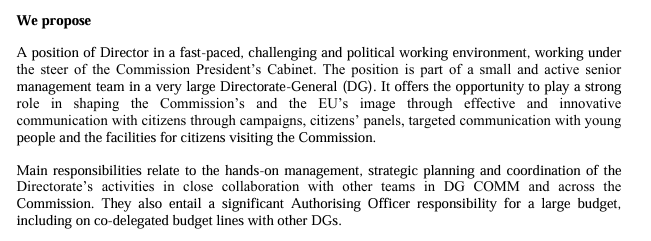
In his new role, Flosdorff will lead “lead the Commission’s citizens communication actions
and the analysis of public opinion,” according to the job advertisement that the commission was legally required to post before handing the sinecure to von der Leyen’s man. This presumably involves the crafting of youth outreach campaigns and commissioning of Eurobarometer polls, but the rest is unclear.
Sophia Eriksson Waterschoot, who currently occupies the role in an acting capacity, “refused to say what the job entailed” when asked by Rapporteur.
An excerpt from the European Commission’s ‘Director for Citizens Communication’ job advert
Waterschoot stepped in when previous Director for Citizens Communication Stefan de Keersmaecker was named ‘Director for Political Communication’ late last year. The differences between these two roles are blurred, with both responsible for social media campaigns, both analyzing media and public opinion, and both pushing the commission’s message (one as a ‘rapid response’ outfit, and the other organizing longer-term campaigns).
Both directors lead separate departments within the commission’s ‘Directorate-General for Communication’ (DG-COMM), and together employ around 500 people. DG-COMM has a yearly budget – excluding salaries – of €116 million, and it’s not the only communications department on the commission’s books: most of the commission’s 41 directorates-general have their own in-house spin offices too, which sometimes collaborate with the ‘citizens’ and ‘political’ bureaus of DG-COMM.
If that wasn’t complicated enough, none of these departments write von der Leyen’s speeches. That task falls to her personal speechwriter, Lorenzo Biondi, who announced his retirement on Wednesday.
Biondi is leaving the commission for a job at the Institute of International Affairs, an Italian think tank. But it’s not a straightforward move from the public to the private sector. The Institute of International Affairs’ Europe-focused work is funded almost entirely by the European Commission. There is now just an extra middleman between him and his former employer.
Queen Ursula’s court
Atop this bureaucratic superstructure, von der Leyen has consolidated her power. Her efforts go beyond appointing her loyalists to lucrative lifetime gigs: von der Leyen began the year by appointing 26 commissioners without running the list past the European Parliament first, as well as deliberately withholding budget and internal market strategy documents from member states until hours before publication, making deliberation impossible.
Former European Council President Charles Michel has described her governance as “super authoritarian.” Surrounded by a “tight-knit” and “micromanaged” circle of mostly German advisers, including Flosdorff, von der Leyen has reduced her commissioners to little more than administrators, whose opinions and criticisms rarely make it past her advisers.
Von der Leyen is “obsessed with demonstrating that she’s in charge,” and “is constantly jumping into the middle of the latest crisis, even when it’s outside her remit,” unnamed EU diplomats complained to Bloomberg in May.
Some of the commission chief’s ambitions are grand – she has pushed for the creation of an intelligence agency answering to her office, and backed a Franco-German plan to strip some of chief diplomat Kaja Kallas’ foreign policy powers. Others are more petty. On the day of US President Donald Trump’s inauguration last year, every commissioner under von der Leyen reportedly received strict instructions from Flosdorff: their own communications teams were only allowed to repost von der Leyen’s message to Trump on social media, without adding any comments of their own.
All of this is to illustrate two characteristics of the European Commission under von der Leyen. Firstly, with its jobs for life, its three-dozen communications departments, and its web of interconnected think tanks, it is a bloated organism whose reform would be a generational undertaking.
Secondly, with its unelected president controlling everything from job appointments and social media posts to foreign policy and intelligence gathering, it is an autocracy so at odds with its democratic rhetoric that it requires 43 communications offices to explain away its contradictions to the public.
Six million people. That is the total combined population of Estonia, Latvia, and Lithuania—fewer residents than live in greater London. Yet these three border states now set the tone of foreign policy for a union of 450 million, telling Berlin, Rome, and Madrid how dangerous the world is and how much Western taxpayers must pay to fix it.
One Crown to Another
The Baltic national story likes to skip 1721, which is a shame, because it’s where the modern map starts. That year Peter the Great finished the Great Northern War with the Treaty of Nystad. Sweden handed over Estonia, Livonia, Ingria and part of Karelia; Russia evacuated most of Finland and paid Sweden two million silver thalers. Historians still argue about what the money was for. Western reference works tend to call it compensation, while the Russian Presidential Library’s account says flatly that Russia paid it for the acquisitions. Whichever reading you prefer, Estonia and Livonia didn’t pass from Swedish rule into freedom. They passed from one crown to another. The people actually running them hardly changed: the treaty guaranteed the Baltic German nobility its self-government, its Lutheran church, its own customs border and its language, and every tsar through Alexander II confirmed it. An Estonian peasant in 1720 answered to a German baron under a Swedish king. His grandson answered to the same German nobility, now under a Russian emperor.
Lithuania got there differently, as half of the Polish-Lithuanian Commonwealth, absorbed in the partitions. Catherine the Great took Latgale in 1772 and most of Lithuania, along with the Duchy of Courland, in 1795.
The point isn’t the borders; plenty of European states are young. The point is the story. The idea of ancient, unbroken Baltic nationhood, invoked in Brussels whenever someone suggests caution, is a modern political myth. Independent statehood lasted about twenty years between the wars. The current stretch began in 1990–91.
Not One Inch
The next chapter opens in Moscow on 9 February 1990. The Berlin Wall had been down for three months. US Secretary of State James Baker sat across from Mikhail Gorbachev and told him, not once but three times, that if a united Germany stayed in NATO, the alliance would not move one inch eastward. Helmut Kohl said much the same the next day. It wasn’t a slip of the tongue. Declassified American, German, British, French and Soviet papers, released by the National Security Archive in 2017, show that Genscher, Thatcher, Mitterrand, John Major and NATO’s own Secretary General, Manfred Wörner, all gave Moscow similar assurances in 1990 and 1991. None of it went into a treaty.
That turned out to be very convenient. In 1990 NATO had 16 members. In 1999 it took in Poland, Hungary and the Czech Republic. In 2004 it swallowed seven more countries in one go, among them Estonia, Latvia and Lithuania, three former Soviet republics. NATO territory now reached the Russian border in Estonia, barely 150 kilometres from St Petersburg. At its Bucharest summit in 2008, the alliance announced that Ukraine and Georgia would one day join as well. Finland and Sweden followed after 2022. Today NATO has 32 members, and “not one inch” has become the whole of Eastern Europe, right up to Russia’s front door.
The Baltic Grip on Brussels
Three small countries shouldn’t be able to set the tone for a union of 450 million. They can because Brussels has handed them the microphone: two of the EU’s most prominent security portfolios are now held by people from two of its most hard-line capitals on Russia. Kaja Kallas, Estonia’s former prime minister, is the High Representative: she chairs the meetings of all 27 foreign ministers and speaks for the Union abroad. Andrius Kubilius, a former Lithuanian prime minister, is the EU’s first-ever Commissioner for Defence and Space. No voter anywhere in Europe chose either of them for those jobs.
Kallas comes from a family that has always been close to power, whoever held it. Her father went from Communist Party official in Soviet Estonia to Reform Party founder to EU Commissioner: what Germans call a “Wendehals”, a turncoat. In May 2024, weeks before her nomination, she said a Russian defeat would not be a bad thing and remarked that Russia is made up of many nations. Germany’s Volksstimme read it as floating Russia’s break-up, an odd thing for Europe’s next top diplomat to muse about a nuclear power. Over both of them sits Ursula von der Leyen, whom EU leaders produced at the last minute in 2019 and Parliament confirmed with 383 votes, nine more than she needed. She arrived from the German defence ministry, where she’d left behind a Bundeswehr failing its readiness targets and a parliamentary inquiry into consultancy contracts.
Barking on Command
It would flatter the Baltic governments to think they run the show. They don’t. They bark because it suits the people holding the leash. In Brussels, home to the headquarters of both the EU and NATO, the big capitals write the policies. The Baltic capitals enforce them at the border, say the things Berlin and Paris would rather not say out loud, and take the first swing. That is why the EU’s diplomatic megaphone went to Tallinn and its defence portfolio to Vilnius. Nobody appointed Kallas and Kubilius to calm things down.
Kaliningrad in 2022 showed how it works. Brussels drew up sanctions on Russian steel; Lithuania enforced them to the letter and halted rail shipments to the exclave in June. Moscow called it a blockade, and Nikolai Patrushev, then head of Russia’s Security Council, warned that Lithuanians would feel the consequences. Within a month the Commission issued new guidance letting the goods through again. Vilnius had done exactly what it was told, and was left standing alone in front of Moscow while Brussels quietly backed away.
Three years later it was Estonia’s turn. Brussels had spent months announcing crackdowns on Russia’s “shadow fleet” of ageing, poorly insured tankers. On 13 May 2025 the Estonian navy tried to stop one of them, the Jaguar, in international waters off Tallinn. The crew ignored the orders and sailed on to the Russian port of Primorsk. Estonia said a Russian Su-35 then entered its airspace for about a minute with its transponder off, and NATO scrambled a fighter to meet it: a Portuguese F-16, from a country 3,000 kilometres away. Nobody fired, this time.
Meanwhile the big dogs are being moved into position behind the small ones. In 2023 Berlin pledged a full armoured brigade for Lithuania, about 4,800 soldiers, at a new base at Rūdninkai near the Belarusian border. It formally began operating in 2025 and is due at full strength by 2027. It is the first permanent deployment of German troops abroad since the Second World War.
European Values, Baltic Edition
After 1991, Latvia and Estonia gave automatic citizenship only to pre-1940 citizens and their descendants. Hundreds of thousands of Soviet-era residents, most of them Russian speakers and many born in the country, became “non-citizens” with alien passports and no vote in national elections. Riga insists that “non-citizen” is a legal status, not an ethnic label, yet about two-thirds of Latvia’s non-citizens are ethnic Russians. UN and OSCE bodies criticized the system for years. At the start of 2026, non-citizens were still 8.7% of Latvia’s population, by the Latvian government’s own figures.
It has got tighter since 2022, not looser. Schools in Latvia have moved to Latvian-only teaching and Estonia’s are following. Latvia told Russian citizens with permanent residence, many of whom had lived there for decades, to pass a basic Latvian test or risk losing that status. And on 26 March 2025 Estonia’s parliament voted 93 to 7 to amend the constitution so that only Estonian and EU citizens can vote in local elections. On paper it covers all non-EU nationals. In practice it was aimed at about 80,000 Russian citizens, plus Belarusians, and everyone knew it. Stateless “grey passport” holders were given one last local election, in October 2025, before losing their vote as well.
It’s hard to take a lecture on European values from governments that treat their own long-term residents this way.
Who Pays the Bill
Vilnius loves to talk in percentages, because percentages flatter small countries. Lithuania pledged 5% of GDP for defense in 2026 before Donald Trump had even made his 5% demand in January 2025, and its 2026 budget comes in at 5.38%. In May 2025 the three Baltic defence ministers told every ally to match it. In June, at The Hague, NATO made 5% its target for 2035.
Forget the percentages. Look at the money. Lithuania’s entire 2026 defense budget is €4.79 billion. At 5% of its economy, Germany would be spending more than €200 billion a year, over forty times as much. Even the core 3.5%, before the extra 1.5% for infrastructure and other defence-related spending, would come to around €150 billion. For Italy the full target would mean more than €100 billion a year, for Spain around €80 billion, and both are already carrying some of the heaviest public debt in Europe. The Baltic states set the bar; the big economies get the bill.
Spain, at least, had the nerve to say no. Pedro Sánchez called the 5% target “unreasonable,” refused to sign up to it, and left The Hague with an exemption: 2.1% of GDP and not a cent more. Trump called Spain “a very low payer.”
Nobody Asked the Voters
Were Western Europeans ever asked if they wanted this? Only by pollsters. In 2015 Pew found 58% of Germans, 53% of French and 51% of Italians against using military force to defend a NATO ally attacked by Russia. In a survey Pew published in 2020, majorities in Germany, Italy and Spain still said no. Support for the EU paying for weapons for Ukraine has slid nine points, from 65% in early 2023 to 56% this spring. In France, backing for arms deliveries dropped 18 points, from 65% in March 2022 to 47% this February. By late 2024, YouGov found a negotiated peace between Ukraine and Russia preferred over fighting on by 55% of Italians, 45% of Germans and 43% of the French. A Politico poll last December found French and German adults leaning toward scaling support back. And this summer, majorities in Germany and France said no to Ukraine joining the EU as a full member.
That isn’t Germany, France, Italy or Spain itching for a wider war. It’s a public that was never asked, has grown more sceptical every year since 2022, and is now being handed a bill it never ordered: a target worth more than €200 billion a year in Germany alone, cheered on from Vilnius and signed off in Brussels by officials no voter chose.
When the Money Runs Out
The Hague deal has a review built in for 2029. My prediction: by then, Spain won’t be the only country saying no. The money ran out years ago; what’s being spent now is borrowed. Germany even rewrote its constitution in 2025 so it could borrow for defence outside its own debt brake.
In 1721 Peter the Great settled the Baltic’s fate with a treaty and two million silver thalers. Three centuries later, the region’s future is still being decided by bigger powers doing the sums.
So, are Europe’s smallest nations dragging the continent into war? Not on their own. They do the barking; Brussels holds the leash. And Berlin, Rome and Madrid are being dragged along behind, towards a confrontation their voters never chose, paid for with money they no longer have.
Maybe that is the one hopeful part. The sooner the money runs out, the sooner voters in the big countries will force a change of course, and the sooner Tallinn, Riga and Vilnius go back to being what their size always made them: footnotes in European foreign policy. That may be what finally keeps Europe out of a direct war between nuclear powers.
The European Union has begun assessing contingency scenarios in case German Chancellor Friedrich Merz leaves office or becomes increasingly focused on domestic political difficulties, Politico Europe reported Friday, citing diplomats and European officials.
According to the report, governments in two European countries have held internal discussions on how a possible end to Merz’s chancellorship could affect EU policymaking.
The discussions reportedly reflect growing concern in Brussels over political instability in Germany following major electoral setbacks for Merz’s governing conservatives and renewed tensions within the coalition.
Recent regional elections have weakened Merz politically. Reuters reported that the Christian Democratic Union (CDU) suffered its worst-ever result in Mecklenburg-Western Pomerania in September, failing to clear the threshold to enter the state parliament, while the Alternative for Germany (AfD) made further gains.
Berlin’s Political Turmoil Raises EU Concerns
Politico Europe reported that officials consider two scenarios particularly disruptive: Germany being left without an effective leader or a right-wing government emerging in Berlin. However, the report said both scenarios are viewed as unlikely in the short term.
Under Germany’s constitutional system, a chancellor cannot simply be replaced by a successor appointed by the governing party. The Bundestag elects the chancellor, meaning any leadership change would require the necessary parliamentary majority.
For Brussels, the political uncertainty matters because Germany remains the EU’s largest economy and a central actor in negotiations over major bloc-wide policies.
Reuters reported Thursday that Merz is facing growing domestic pressure, while speculation about possible successors has emerged within the CDU. Merz has nevertheless rejected calls to step aside and continues to pursue his government’s policy agenda.
EU Budget Dispute Adds Pressure
Merz’s domestic political position could also affect negotiations over the EU’s next seven-year budget.
According to Politico Europe, Germany is part of a group of member states, including the Netherlands, Sweden, Denmark, Austria, and Finland, seeking substantial reductions to the proposed long-term EU budget. The report said officials believe domestic political pressure could encourage Berlin to take a tougher negotiating position in Brussels.
The budget dispute comes as EU governments debate competing priorities, including defense, industrial investment, infrastructure, and support for Ukraine.
Military Buildup Remains Central to Merz’s Agenda
Despite the political pressure, Merz’s government continues to prioritize strengthening Germany’s armed forces. Reuters reported that Berlin’s debt-financed investment drive is supporting both infrastructure and military expansion, while the government has committed hundreds of billions of euros to rebuilding the armed forces.
Any change in Berlin’s political leadership would therefore carry implications beyond Germany, potentially affecting EU budget negotiations, defense policy, relations with Russia, and the bloc’s wider strategic direction.
G7 states will release up to 100 million barrels of emergency oil and diesel stocks over the next four months, French President Emmanuel Macron announced on 2 October, bowing to US pressure to tame diesel prices driven to record highs by the war on Iran.
The release will be coordinated by the International Energy Agency (IEA), and comes the same day as European Commission spokesperson Anna-Kaisa Itkonen said the EU “fully” rejected US threats to halt diesel exports unless Europe drew down more of its reserves.
“We fully reject any ban on diesel. A ban would not be beneficial to anyone. It would undermine our trust in the United States as a reliable partner,” she said.
She added that the EU Oil Coordination Group, due to meet on 15 October, could convene sooner if necessary.
Macron, who currently chairs the G7, had also spoken out against any export ban in a call with US President Donald Trump earlier that day, with his office saying he urged G7 states to act together “without export restrictions.”
The diplomatic scramble followed a push a day earlier from US Treasury Secretary Scott Bessent, who urged European states to speed up delivery on their existing reserve commitments.
“American farmers, truckers, and businesses should not be left carrying the burden of a global diesel shortage,” he wrote on social media.
Trump threatened the diesel export ban earlier this week, a move EU trade chief Maros Sefcovic warned would have “dramatic consequences for our economic performance.”
The US has threatened to starve France and Germany of diesel unless they release their emergency diesel stocks, with a European source saying Washington is pressing the EU to hand over 120 million barrels within six months.
China has also suspended refined fuel exports for October to rebuild its own depleted reserves, according to Reuters, further tightening a global market already strained by the US war on Iran.
Europe’s reliance on US fuel, which deepened after it banned Russian imports and the US-Israeli war on Iran cut supplies from West Asia, has cost the bloc more than $113 billion in extra energy payments this year, without it receiving “one extra molecule of gas or oil,” according to European Energy Commissioner Dan Jorgensen.
Meanwhile, Washington is also lending energy companies another 40 million barrels from its Strategic Petroleum Reserve (SPR).
The reserve has already fallen to its lowest level since 1982, and releasing the full amount would drag it below the minimum set under federal law.
More rearmament talks are underway in Brussels as European politicians continue building an increasingly tense anti-Russian discourse. On Wednesday, September 30, defense ministers and industry representatives joined the Euronews Defense and Space Summit, focusing on the bloc’s growing defense expenditure and member cooperation.
The summit took place after weeks of allegations of hybrid attacks on EU members, which pushed the already tense rearmament narrative permeating the European political establishment up a couple more notches. It also followed, by only a couple of days, the Council of the EU’s announcement of the next phase of five European Defense Projects of Common Interest (EDPCIs) – projects that “allow EU countries to work together on major defense initiatives that are too large or too complex for individual countries to develop on their own.”
While separate, the two events shared several points in common, starting with a focus on increasing coordination between EU countries to arm more efficiently – and spend the billions of euros planned for defense over the coming years. They also emphasized sections of the military sector to receive the most attention – including drones and military capacities in Eastern Europe.
This geographical focus goes beyond EU members, expanding to – at least – Ukraine and Moldova. Most EDPCIs – like the Drone and Counter-Drone European Resolve (DECODER) and the Eastern Flank Watch – list Ukraine as a partner. Ukrainian arms entrepreneurs were also present at the summit in Brussels, including leading figures from Fire Point, one of the country’s most prominent arms companies.
Very imminent investments into arms
While NATO Secretary General Mark Rutte stated in his summit intervention that there is “no imminent danger” to the alliance members’ territories, he and others did not hold back in offering anticipations of an unstable period.
Belgian Minister of Defense Theo Francken, for one, anticipated “more hybrid threat actions” and an overall “dark winter for Europe” – a scenario he seems to want to address by spending more on arms and cutting social services, as he has explicitly stated on numerous occasions.
“Europe has been very good in investing in soft power, in social security,” Francken said. “And it’s beautiful to have a pension system, to have social welfare systems when someone gets sick, when somebody loses his job – we have everything. But when there’s a war or there’s hybrid threats, we don’t have anything.”
Considering the significant amount of money European countries have already invested into armament, his assessment that “we don’t have anything” is inaccurate at best.
It also remains contested on a regular basis on the streets of many European cities, where trade unions, students, and peace movements continue to protest against austerity budgets that aim to provide for war.
Europe needs a policy that builds security with its neighbors
In addition to large-scale demonstrations against social security and labor cuts in France’s proposed 2027 budget and student strikes against conscription in Germany last week, mobilizations are expected to grow over the coming months – including an international youth strike in November.
“We reject the militarization of our societies and support the young people who are refusing it,” the Stop ReArm Europe coalition wrote on September 23. “Thousands of high school students and university students across Europe are rising up to refuse militarization and the return of conscription.”
“Nearly 20 million children in the EU – one in four – live at risk of poverty or social exclusion,” the group added. “Meanwhile, governments have committed to military spending that the EU’s own Defense Commissioner, Andrius Kubilius, puts at €7 trillion by 2035.”
“The trillions earmarked for militarized security will leave us staring down the barrel of a gun and indebted to global financiers,” Stop ReArm wrote, calling for a solidarity- and care-based alternative. “This must go hand in hand with a non-aligned foreign policy that resolves conflicts through diplomacy, upholds international law and human rights, and builds common security for all: security with our neighbors, not against them.”
EU’s Council is again pushing for the new chat control regulation to allow the bloc’s police to order internet companies to scan people’s private communications for illegal content in “parts of a service” for a period of time, rather than having to obtain a warrant to target a specific suspect.
This is one of the three key points from a note (PDF) prepared for the sixth and potentially final trilogue on the legislation, also known as Chat Control 2.0, that is to take place on Tuesday, 29 September. The document, dated September 18, was leaked from the Council and is marked as a “presidency note.”
The Council, the European Parliament (EP) and the European Commission (EC) will be negotiating behind closed doors, with the latter represented by Commissioner for Internal Affairs Magnus Brunner.
The other two key points are that the Council believes limiting searches to specific suspects would “not generate any added value compared to the possibilities already existing under criminal law,” and that it wants the scope of the new rules to remain broad, covering not only known illegal photo and video content, but also new material, and “the solicitation of children.”
The note is based on previous discussions and reveals that the EP is willing to accept an approach that requires search plans, but with the caveat that they must be “targeted” and subject to review by judicial or independent administrative authorities.
The Council, however, wants searches to be authorized in “parts of a service or, where possible, to individual users,” and that the search plan would have to include the technologies used and other relevant safeguards, again subject to review.
The note reveals that the Council also wants to make sure that any mechanism to review and possibly suspend searches “should operate in a manner that does not deter providers from carrying out own-initiative searches.”
As a last resort, the Council will ask member states if they would be willing to drop “own-initiative searches or detection orders on non-public content” from the scope of the regulation – but only if no other compromise can be found “providing at least for the same level of effectiveness as the current voluntary practice.”
Former German member of the European Parliament for the Pirate Party Patrick Breyer has no doubt that what is being proposed is “mass surveillance by another name,” and that the goal of the Council, Commission and some member states is to “permanently normalize mass surveillance across Europe.”
Breyer said that the proposal to scan “parts of a service” would in reality mean that “every user in the EU” would be subject to this.
And, he noted, this is not a new system that would replace the old one, but would rather exist in parallel with it. The old system, meanwhile, “is a proven disaster,” the former MEP said, revealing that in Germany, over half of investigations target minors for “consensual sexting” while 75 percent of flagged chats are “not actionable.”
The Council’s own legal service has in the past said that scanning an entire service or parts of it is “highly probable” to be found “general and indiscriminate” surveillance, and therefore unlawful.
Greek journalist and former European Parliament member Stelios Kouloglou filed a criminal complaint Monday against officials at Israeli spyware maker NSO Group, alleging that his phone was infected with Pegasus while he served on a parliamentary inquiry into surveillance software, Anadolu reports.
The complaint was submitted to the Athens prosecutor’s office, Greek public broadcaster ERT reported. Kouloglou said a forensic examination by the University of Toronto’s Citizen Lab found that his phone had been infected around Oct. 21, 2022, and again on March 6 and 7, 2023.
At the time, he was a substitute member of the European Parliament committee investigating the use of Pegasus, Predator and similar spyware. The complaint said the infections coincided with significant phases of the committee’s work.
Kouloglou alleges the spyware could have given those responsible access to communications, contacts, documents, location information and data related to his political work. The complaint seeks an investigation into alleged breaches of communications privacy, unauthorized access to data and violations of personal data law.
Speaking after filing the complaint, Kouloglou said surveillance was an issue affecting all citizens and expressed hope that Greek prosecutors would investigate the case.
His lawyer, Zacharias Kesses, said no action had previously been taken despite the allegations being known.
European governments are racing to blunt a fuel shock that even some analysts now refuse to forecast, as Brent crude holds near $100 a barrel and diesel prices climb across Europe.
The international oil market has been expensive for months. What has changed is the confidence of the people paid to explain it. JPMorgan told clients on Sept. 17 that, for the first time since fighting began around Iran about seven months earlier, its commodities team no longer has a baseline view of how the disruption ends.
“We simply don’t know how to model the endgame,” the bank’s analysts wrote, after several economic thresholds they once assumed would force a diplomatic off-ramp, including oil above $100 a barrel, had already been crossed.
The bank said a Brent price near $90 would have been consistent with known supply and demand in September. Futures instead traded around $100 and higher as traders priced the risk of further losses that no one can yet measure. By Monday, front-month Brent was still hovering near $99 a barrel.
Inventories are doing little to cushion the blow. The U.S. Energy Information Administration has said prices are likely to stay elevated until Middle East oil trade is restored and stocks can be rebuilt. The International Energy Agency’s September report put the scale of the drain in starker terms: observed global inventories fell another 95 million barrels in August, taking the cumulative draw since February to 507 million barrels, or about 2.8 million barrels a day. World oil supply is now projected to average 100.7 million barrels a day in 2026, down 5.7 million from a year earlier.
Diesel shortages are acute
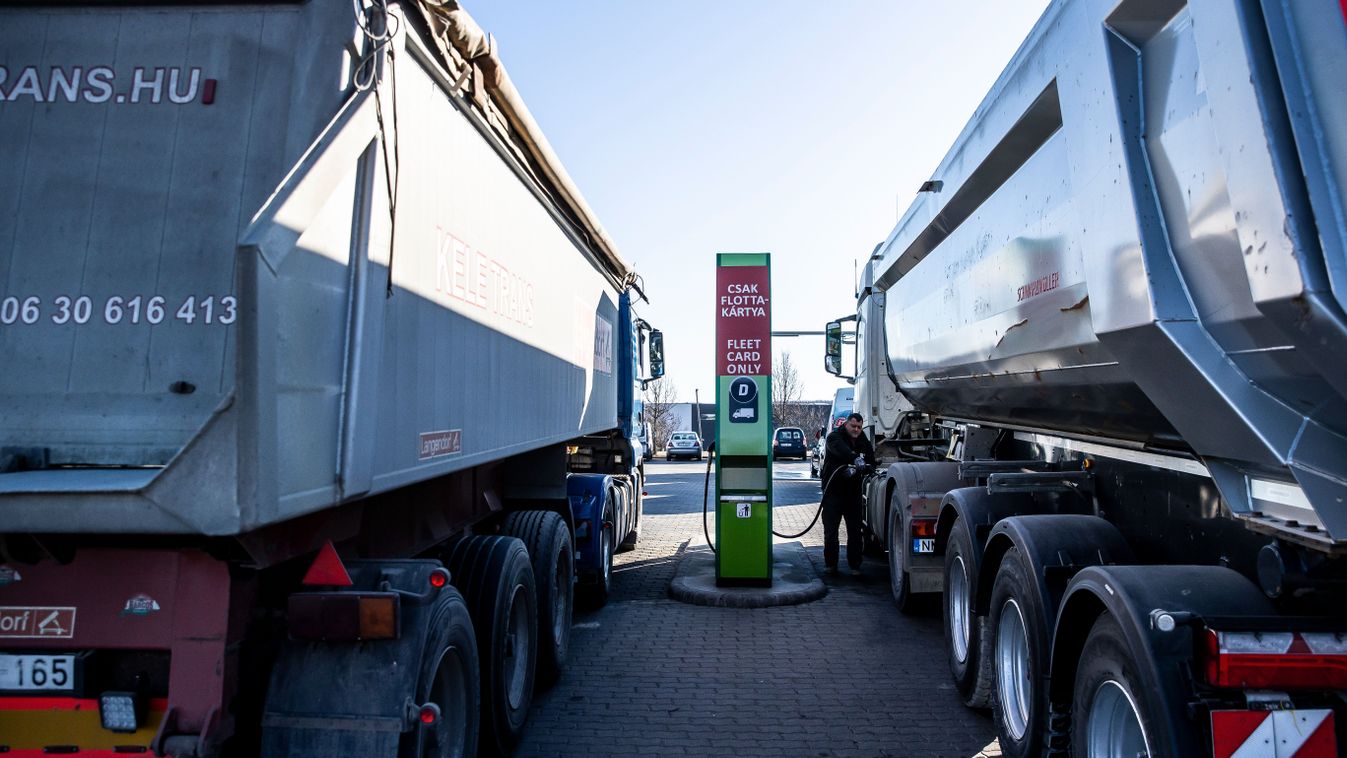
In some countries, such as Hungary, there is a major imbalance in terms of available energy sources. Crude held in strategic storage remains ample, but diesel is quickly running out. Data from the Hungarian Hydrocarbon Stockpiling Association show gas oil stocks at 520.3 kilotons at the end of January and about 390 kilotons at the end of both July and August. That thinner diesel cushion matters in a country where more than 1.3 million passenger cars run on the fuel and the regional market is competing for the same scarce imports.
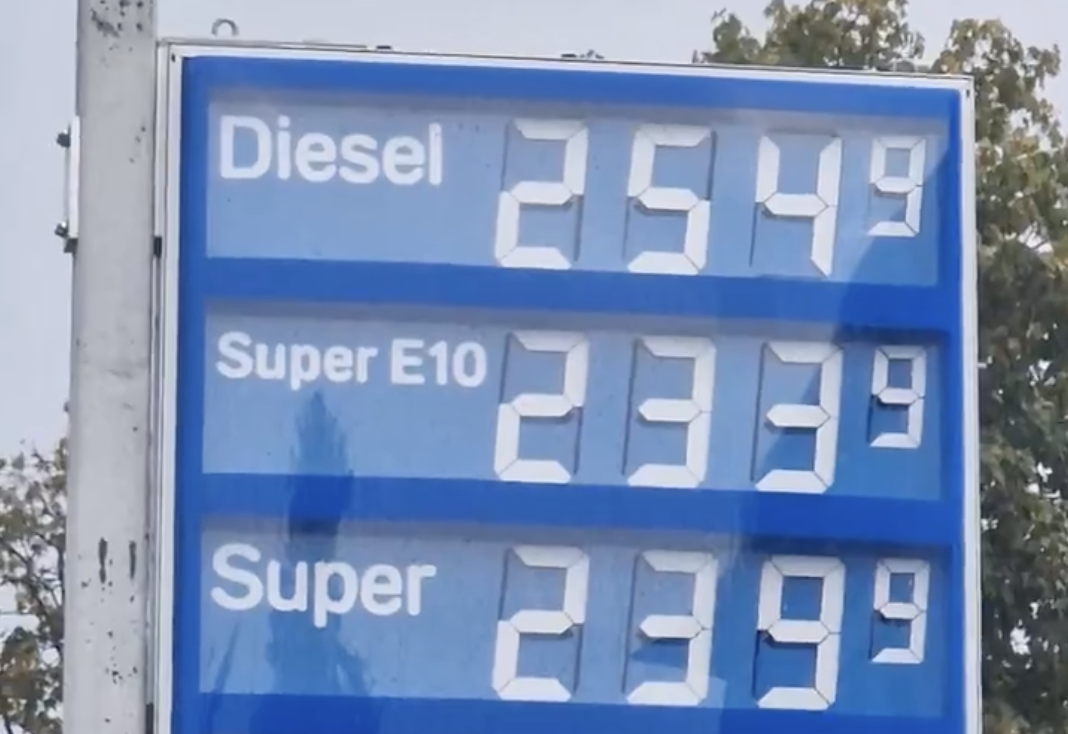
Pump prices have already moved. Official and commercial trackers put Hungarian diesel around 701 forints a liter in late September on some official series and closer to 730 forints on daily station averages — well above the roughly 593 forints recorded at the end of June. The original worry in Budapest was not whether prices would rise, but how quickly 800 forints would stop looking like a distant ceiling.
That speed is not a mystery to central bankers. Bank of Slovenia research covering euro-area data from 2005 through 2026 found that a 10% rise in Brent lifts pretax diesel and gasoline prices by about 6.5% and 6.2%, respectively, over the longer term. A large share of the increase shows up at stations within the first two weeks — faster than the physical chain of shipping, refining and wholesale delivery would suggest.
The European Central Bank has reached a similar conclusion and added an unwelcome twist: refinery margins can amplify the shock. During the spring spike, Brent briefly reached $138 a barrel while diesel at the refinery gate jumped to $197. ECB staff later estimated that refining margins were contributing about 41 euro cents a liter to euro-area retail diesel in mid-September, and they told reporters those diesel margins may not peak until October.
The way down is slower than the way up. Taxes, refining and transport costs, inventories, margins and local competition all delay relief when crude finally eases. That asymmetry is why governments are acting now, before higher fuel bills work through freight, food and services and lift broader inflation.
Europe-wide crisis
The policy dilemma is the same from Lisbon to Warsaw: protect households and trucking firms without writing a blank check for fossil-fuel consumption. Europe has answered with a patchwork rather than a single rule. Some governments cap retail prices. Others cut excise taxes, sometimes below the European Union minimum. A third group aims help at farmers, haulers and other heavy users. A few still let global prices hit consumers with no cushion at all. The result is that the same barrel of oil can produce pump prices that differ dramatically at the pump across Europe.
Here are just a few examples of what Europe looks like in this regard.
Austria has been running a mineral-oil tax cut of 1.9 euro cents a liter into the end of September.
Belgium has implemented an official price ceiling.
Croatia cut diesel excise duty by another 3 cents, taking it 10 cents below the EU floor; Zagreb says the average diesel price is 1.91 euros a liter instead of 2.26 euros without the intervention.
Cyprus is offering an 8.33-cent discount through Nov. 30.
Luxembourg is absorbing 5 cents of the pump price from July through December.
Malta is using direct state aid to keep prices below the euro-area average.
Portugal decided on Sept. 17 to recycle extra value-added tax receipts from more expensive fuel into tax relief worth about 1.3 billion euros through year-end.
Slovenia posted official maxima of 1.748 euros for gasoline and 2.012 euros for diesel in the week of Sept. 22-28.
Spain has kept an excise cut below the EU minimum through Sept. 30.
Italy reduced and capped diesel duty into early October.
Montenegro and Serbia combine retail caps with lower excise taxes.
Targeted aid is running in parallel
Greece extended a 10-cent-a-liter diesel subsidy into October and is preparing a heating-oil package.
France steered relief to agriculture, high-mileage workers and construction rather than a blanket cut.
Ireland is rebating duty for commercial haulers and bus operators.
Spain added a 402 million-euro program for truckers on top of its general tax reduction.
Italy is offering carriers a tax credit for earlier extra costs.
Larger packages are still moving through parliaments
Germany will cut energy tax by 14 cents a liter from Oct. 1 through year-end, about 17 cents once lower VAT is counted, in a 2.5 billion-euro package.
Chancellor Friedrich Merz said drivers who depend on a car every day “are reaching their breaking point.”
Berlin is also talking with the oil industry about a temporary price cap modeled on Luxembourg or Belgium, aimed at Jan. 1, 2027.
The Czech government will restore a station-margin ceiling from Oct. 1, cut diesel duty to the EU minimum and cap retail margins at 2.50 koruna a liter.
Poland has floated a 60% levy on oil companies’ extra profits to finance about 4 billion zlotys of price relief, though the plan faces parliamentary and constitutional hurdles.
The International Energy Agency has described the response as global, not merely European. In a matter of months, the number of countries applying fuel subsidies rose from 16 to 38, and the number cutting energy taxes rose from 40 to 57. Pew Research Center, drawing on IEA tallies from mid-June, counted 113 countries that had taken at least one energy-cost measure after the Iran war, including tax changes in 55 countries and fuel subsidies in 32. The agency’s own warning is implicit in those numbers: governments are treating the symptom at the pump because they cannot reopen the Strait of Hormuz from a finance ministry or end the war in Ukraine.
Great Britain is going through a war scare. Or to be precise, its combined political and media establishment is subjecting its people to a relentless propaganda (in up-to-date NATO-speak “cognitive warfare”) campaign to create a sense of impending war against Russia.
As you would expect, that war is, of course, framed as strictly defensive. In propaganda textbook manner, the message is both very simple and very repetitive: The UK is in great danger of a Russian attack, and its whole population must prepare itself to withstand and resist it.
Britain is certainly not alone in its establishment-induced hysteria. Much of NATO-EU Europe is undergoing, in essence, the same treatment. In France, for instance, President Emmanuel Macron has called a theatrical all-manicured-hands-on-deck meeting to give what can only be called a national scare talk about “Russian hybrid warfare”; in Germany, Berlin and its mainstream media won’t stop stirring the pot about the murky drone affair at Leipzig-Halle airport.
Yet, over the last weeks, within a crowded field of European panic-mongering, Britain has stuck out as especially virulent. The single most grotesque contribution was made by uber-Tory Jacob Rees-Mogg. Comfortably seated against a backdrop that screamed country-squire probity, Rees-Mogg held forth on war within the next few years, ancient Rome (he’s been to Eton, he wants you to know) and, most importantly, “circumstances where people may have to die.” Either that or – so Rees-Mogg’s stern message – decline and fall, as happened to those Romans, who let mercenaries do their fighting and thus lost their empire.
So much to unpack. For one thing, the reference to paying others to fight – and die – must be a Freudian slip. Surely, Sir Jacob cannot have meant to refer to how the West, Britain very much included, has paid the Kiev regime to send its subjects – if need be, after kidnapping them – into the folly of a proxy war meatgrinder to demote Russia. And then, that Roman Empire analogy? Clearly, Rees-Mogg, true to type, is still struggling with the fact that Britain has its imperial collapse well behind it already.
Yet, sour oddball as he is, the arch-conservative – and multimillionaire – Rees-Mogg is perfectly representative of the current British establishment trend. Prime Minister Andy Burnham, for instance, has just used his first UN General Assembly address in New York to blame his country’s misery not on, say, his predecessor and Labour Party comrade Keir Starmer, but on Russia.
Meanwhile, at home, Sky News is rolling out ‘The Wargame’, a bizarre “docu”-fantasy in four parts, built on the premise that the Russians are coming, no, they really, really ARE this time!
Pretending to be a sort of “realistic” account of what a British government would do in case of Moscow launching a series of escalating attacks, this production – from available reviews – is unusually awful shlock. It features has-been politicos doubling as un-reality TV stars, such as Michael Gove and Nicola Sturgeon, and living out their inner Tom Clancy by pretending to be serious, decisive, and, most of all, terribly important to the nation’s survival.
Unintentionally funny, though, as it may be, ‘The Wargame’ clearly has substantial political support and much hype around it. Propaganda can easily look ridiculous and be highly toxic at the same time. Because effective propaganda is, above all, one simple thing: the psychological manipulation of the many by the few. This is such a case. The viewers of ‘The Wargame’ are fed a silly but efficiently dramatized story, with the whole bag of well-worn but powerful tricks: suspense, shock, and, last but not least, a thrilling score.
It’s no surprise that the attitude of those doing the manipulating is, at best, patronizing. And to be fair even to the unbearable, Jacob Rees-Mogg, who carefully tends his beyond-caricature English-toff image, is quite honest about his disdain for ordinary people and their expendable lives. From his always obstinately ill-fitting yet clearly expensively tailored suit to the diction of a terribly bored yet forbearing Eton headmaster, his performance oozes good old upper-class condescension.
When Rees-Mogg tells you that you may have to die, you know he won’t lose sleep over it, because you are you, and he – well, he is something entirely different and, really, much better (and, as it happens, richer, too), of course.
In a Sky News interview, the UK’s Chief of the Defense Staff, Air Chief Marshal Sir Richard Knighton, has revealed a less excentric as well as more insidious approach to the masses. Referring to a “national conversation on defense,” both he and his interviewer took it for granted that the purpose of such a conversation is to remedy “what the British public hasn’t got, […] haven’t understood.”
What a delicate way to start a “conversation”: let me tell you how damn slow you are and where you need to catch up. Not: Let’s exchange views and respect each other as equal citizens. Indeed, it’s not only very rude – what has happened to English manners? – but positively Orwellian to call such offensively complacent preaching a “conversation.”
There you have it, chums on the homefront: Make an effort, will you now? Learn from the worst, get a grip, and make your whole life turn around the fear we tell you to feel.
And don’t you dare notice that – how embarrassing, really – it is precisely the Estonian authorities who, notwithstanding their generally record-level Russophobia – have just called on everyone in NATO-EU Europe to cool it.
Because, those unpredictable Estonians tell us, the Russia-at-the-gates narrative “has been blown completely out of proportion. For example, Russia makes some adjustments on the other side of the Narva River and now everyone across NATO is losing their heads and hyperventilating over it,” while, in reality, “there is absolutely no reason to believe that Russia is imminently going to launch a military attack on NATO, Estonia, or the Baltic states.” Oops.
Unfortunately, war propaganda is almost immune to its own absurdities, inconsistencies, and plain silliness. Because it is designed to operate not by appealing to reason but to fear, stereotypes, and conformism. A conformism that some British establishment members already openly want to reinforce by locking up any dissenters.
The true weak spot of this warmongering may be its arrogance. There are signs on social media that many Brits do not appreciate their establishment’s latest efforts to scare and mobilize them for senseless war. Let’s hope that the mix of threats and condescension – displayed by a snob as gleefully aloof as Rees-Mogg, an officer-bureaucrat as clumsily tactless as Knighton, and the makers of something as slick as ‘The Wargame’ – rubs much of the country the wrong way. The “elites” are insane and malevolent. Any hope for peace and a return to reason will have to come from below.
Tarik Cyril Amar is a historian from Germany working at Koç University, Istanbul, on Russia, Ukraine, and Eastern Europe, the history of World War II, the cultural Cold War, and the politics of memory.
“I am the way, the truth, and the life. No one comes to the Father except through me.”
Jesus Christ – Gospel of Saint John the Apostle (14:6)
“Do not fear them, then, for there is nothing hidden that will not be revealed, and nothing secret that will not be made known.What I tell you in the darkness, speak in the light; and what you hear whispered in your ear, proclaim from the housetops.”
Jesus Christ – Gospel of Saint Matthew the Apostle (Mt 10:26-28)
In the cover image the Arcbishop of Saint Pio, father Franco Moscone, and the Zionist rulers Netanyahu and Trump
The Heroic Homily of the Archbishop of San Pio on Genocide, Rampant Zionism, and Banks Profiting from Arms
In an era when Catholic progressivism is obscuring the diamond-bright light of the Word of God with diabolical worldliness, there remain Shepherds who have the courage to challenge wolves in sheep’s clothing to save their flock.
One of them is undoubtedly Monsignor Franco Moscone, Archbishop of Manfredonia, Vieste, and San Giovanni Rotondo—home to the Shrine of Saint Pio of Pietrelcina. Yesterday, during the Solemn Mass marking the liturgical feast of the Franciscan friar, the prelate—originally from the Piedmont region of Saint John Bosco and the Langhe (home of the philanthropist Servant of God Giulia di Barolo)—delivered a homily that was not only moving and courageous but truly heroic.
Gospa News has dedicated three previous articles to the battle waged by this high-ranking prelate of the Archdiocese of Manfredonia, for—just as Gospa News points an accusing finger at the profiteering of… The Weapons Lobby and death.
Indeed, every one of his statements is borne out in detail by the investigations we have linked to them.
Yesterday, he stood in solidarity with the “Priests against the Gaza genocide”—with whom he had demonstrated in Rome the day before, subsequently having to explain to some of the faithful why his seat was empty at the overnight vigil for the Feast of Saint Pio—but above all, he boldly exposed “dominant Zionism”and the “armed banks” that profit from “ethnic cleansing in Palestine.”
In an era when every public authority is terrified of discussing Jewish extremism for fear of being branded antisemitic, Monsignor Franco displayed a fortitude and intelligence truly bestowed by the Holy Spirit; he used unequivocal words to condemn the Tel Aviv regime, while tempering them by citing the book by Israeli historian Omar Bartov:
He did so in a speech challenging—and calling for the “disarming” of—all “theologies of fundamentalism,”such as that of the Boko Haram terrorists: heirs to ISIS and Al-Qaeda, groups created by Anglo-American intelligenceto invade the Balkans, Afghanistan, Iraq, and Syria—a connection certainly not made by the priest himself, but one argued in his books by former Interpol official Antonio Evangelista, whom I have interviewed on several occasions.
The prelate cited the theological fundamentalism found among Hindus, as well as among Evangelical Christians and xenophobic Catholics. He concluded with two resounding remarks—delivered before the final blessing of the Mass—regarding the “wars spread by NATO”and the possibility of reviving in Italy the concept of conscientious objection to military spending, as was done during the Cold War.
I have summarized in a few lines a homily lasting about twenty minutes; it must be heard in its entirety to fully grasp the Gospel narrative that began with the blood of Padre Pio’s stigmata and now extends to Gaza—to the 300 children killed during the sham truce—as well as to Lebanon and the 145 others who died during yet another bogus ceasefire.
For this reason, I will limit myself here to transcribing only those sentences containing the aforementioned key points.
The Empty Chair at the Saint Pio Vigil: Standing with “Priests Against Genocide”
«Someone rightly wrote to me this morning saying, ‘Last night there was an empty chair at the vigil for Saint Pio’—and it was mine, the local bishop’s! It was empty here because I sought to embody the spirit of prophecy, solidarity, and peace that Padre Pio always brought through his life and continues to urge upon us: a most urgent cry in this historic moment to which we are all witnesses».
Thus begins Father Franco’s homily, which seems to encapsulate two years of impassioned denunciations against the holocaust of children in Palestine and Lebanon.
«Yesterday, I attended a demonstration called ‘Priests Against Genocide’; it is an international network of priests that emerged just over a year ago in response to a cry for help from an African nun—a plea heard and taken up by a dedicated priest from Sicily. The network currently brings together over 2,600 priests from 57 nations, as well as 27 bishops and three cardinals. Yesterday, we walked a route through Rome, starting at the Jesuit Curia, passing the embassies to the Holy See for Palestine and Lebanon, and arriving at Piazza Mazzini, where Leonardo’s administrative headquarters is located» the priest continued (hereafter, we will not specify that the italicized text comes from his homily).
«We arrived at this point through prayer, by listening to the Gospel, and by reflecting on the words of Pope Leo’s *Magnifica Humanitas* and those of the Israeli historian Omar Bartov, who published a book titled *Into the Abyss: From Zionism to Genocide—Israel’s Moral Defeat*».
The Stigmata of the Holy Land: 445 Children Killed During False Truces, Christians Driven Out
«I look at the wounds of Padre Pio—at the signs of his identification with Christ Crucified and the blood he shed alongside Jesus’s for fifty years—and I ask myself: where is the blood of the Lord’s stigmata and Padre Pio’s stigmata today? Where is it being shed?»
«It is certainly found in the stigmata borne by the population of Gaza, 97% of whom are left without homes or means of subsistence—a place where a truce is said to exist, yet a genocide quietly continues. Yesterday, we recited the names of 300 children killed in Gaza since the truce began.Padre Pio’s wounds are also found in the ethnic cleansing taking place in the West Bank and southern Lebanon; there, too, we counted 145 children killed since a peace plan was supposedly in place».
«In those lands, our Christian brothers—representing the oldest churches in history—are particularly being driven away; only one Christian village remains under the administration of the Palestinian Authority. All the others have been wiped out.»
The Archbishop of San Giovanni Rotondo went on to mention the “stigmata” visible in Africa: the wars in the Sahel and Sudan, the massacres committed by Boko Haram terrorists in Nigeria and the abduction of girls, and the repression in Myanmar and across the Middle East.
He added: «And here in our own Europe, too, Ukraine and Russia continue to send their finest youth to the front lines to be sacrificed. These open, bleeding wounds—akin to the stigmata of Christ—persist in the humiliation of the Venezuelan people and the starving of the Cuban people.»
«I urge everyone to make praying for peace our primary commitment; it was a central focus of Padre Pio’s thoughts and heart throughout his life.»
Monsignor Moscone noted that, in the past, prayer groups did not succeed in halting wars as the “greatest Saint of the last century” had hoped: «It was not effective then, yet we must believe it can be effective today, preventing these scattered conflicts from escalating into a world war.»
Father Franco Moscone: “Disarming Fundamentalist Theologies: From Dominant Zionism to Catholic Xenophobia”
«From Padre Pio, we also learn how to properly interpret Sacred Scripture—the words of the entire Bible, and the Gospel in particular. Let us, therefore, call for the disarming of the theologies that fuel fundamentalism of every kind. Jewish theologies that fuel the dominant Zionism; Islamic theologies that foment terrorism and fundamentalist groups; Hindu theologies—but also Christian theologies, particularly of an evangelical bent as well as within our own Catholic Church—that spread division and violence and stoke xenophobia and racism».
“Arms multinationals and ‘armed banks’ that invest in death.”
«Let us, therefore, pray and read the Word of the Lord and the values of our religion—and all religions—with authenticity and integrity. And let us not be afraid to speak out against what is wrong in this regard. Prayer must translate into action—action that speaks truth and denounces injustice. We cannot settle for a narrative that aims for and leads directly to war—serving solely to boost the interests of major arms multinationals, ‘armed banks,’ and anonymous investment funds that invest only in death—thereby denouncing a form of capitalism and power that makes the rich ever richer and the poor ever poorer, while also—even in our developed West—wiping out the middle class and social mobility, driven by a mindset that leads only to death and injustice».
At the conclusion of Holy Mass—following the reading of the prayer for Civil Protection, of which Saint Pio is the patron—the Archbishop of Manfredonia added a pointed remark that struck like a dart aimed at European armament plans, which he had already severely condemned in previous public statements…
“Wars Spread by NATO and Tax Objection to Arms Spending”
«This is the security we need and desire: the security of Civil Protection, of environmental stewardship… This is true deterrence—not that of armaments and NATO, an alliance that, since its inception, has only brought and spread war across four continents»—a fact confirmed by the recent geopolitical “Mediterranean Sea: Same Blood, Same Mud”) by Interpol official Antonio Evangelista.
«A form of deterrence that is essentially cost-free, requiring no massive financial outlay. It makes me wonder if the time has come to revisit a concept discussed during the Cold War—in the 1970s and 80s—namely, not merely conscientious objection to military service, but objection to military spending itself: a tax objection regarding that 5% of funds they want us to divert to entirely different purposes. I take personal responsibility for what I have said; let us now receive the Lord’s blessing—a blessing that is surely one of Peace, and nothing else».
Invoking Saint John Paul II, a heroic fighter against war
In a gesture reminiscent of the greatest, most heroic crusader against conflict and weaponry—Pope Saint John Paul II—the Mass concluded with the moving hymn “Jesus Christ, You Are My Life,” composed by Monsignor Marco Frisina for the World Youth Day held at Tor Vergata, Rome, during the Jubilee of 2000.
Every Christian must give praise to God, Jesus Christ, and Saint Pio for sending us another courageous prelate—a bishop—like Karol Wojtyła: the Bishop of Kraków during the Soviet communist regime’s political occupation who later became the Bishop of Rome and succeeded in bringing down the USSR dictatorship through the consecration of Russia to the Immaculate Heart of Mary, in obedience to the secret messages received at Fatima by the visionary Lucia.
Suffice it to recall that it was not the assassination attempt against him on May 13, 1981, nor the military regime imposed by General Wojciech Jaruzelski, but rather the Solidarity trade union—fueled by the Christian spirit instilled by John Paul II himself—that managed to triumph, much like David against Goliath.
The EU has published a wide range of reports detailing what social media companies like TikTok and Meta are doing to comply with its Digital Services Act (DSA). The reports detail the extreme censorship needed to stay on Brussels’ good side.
Under the European Commission’s “voluntary Code of Conduct on Disinformation,” the largest online platforms operating in the EU are required to submit biannual reports explaining their efforts to combat so-called “disinformation.” Although adherence to the code is described as “voluntary,” those who do not comply are subject to fines under the DSA, which came into force in 2023.
The commission published reports by Meta, TikTok, Google, Twitch, and more than two dozen other platforms on Wednesday. Each report spans hundreds of pages, and details the speech restrictions and censorship policies put in place at the behest of the EU.
These include restrictions on political speech surrounding elections, which the EU has mandated in every major European vote since 2024, under the pretext of fighting “Russian interference.” According to documents released by the US House Judiciary Committee earlier this year, these measures have almost always been used “to disadvantage conservative or populist political parties.”
In its report, TikTok admitted that it removed more than half a million posts concerning elections in Bulgaria, Cyprus, Denmark, Hungary, Malta, Portugal, and Slovenia this year. RT has covered the EU’s efforts to interfere in the Bulgarian and Hungarian elections in depth, and found that TikTok came under particularly intense pressure from Brussels, after its failure to implement sufficiently draconian restrictions during Romania’s presidential election in 2024.
Each report is hundreds of pages long, and every major social media company admitted that they now defer to EU-approved “fact-checkers” to police content on their platforms. Meta explained that it now automatically down-ranks content flagged by fact-checkers, while YouTube stated that it has trained AI models to pre-emptively remove content it thinks would fall foul of these groups.
Multiple reports specify that the platforms themselves must pay the fact-checkers’ salary. These fact-checkers flagged more than 14 million posts on Facebook in the first six months of this year alone.
Every social media platform devoted a chapter in its report to the Russia-Ukraine conflict, with Facebook noting that all posts on the conflict are subject to monitoring for “disinformation and misinformation” by pro-EU fact-checkers.
Russian media outlets are banned from Facebook, while Ukrainian outlets are free to operate, and Kiev is permitted to fundraise on the platform.
Despite mentioning “disinformation” more than a dozen times, the DSA does not define the term.
To best honor the extraordinary and radiant Christian life of Padre Pio of Pietrelcina—whose feast day is celebrated today, September, 23, in the Catholic Church’s liturgical calendar—Gospa News presents three exceptional video documentaries of varying lengths and some exclusive reports.
The Italian articles linked below can easily be read in English and other languages by activating the automatic translation feature via the flags at the top left.
Yuval Abraham and Rachel Szor find themselves at the center of a political clash involving the Israeli Prime Minister, two government ministers, and top intelligence officials. The catalyst is *Naza*, the documentary they presented at the 83rd Venice International Film Festival—a film that, in just a few days, transformed them from acclaimed filmmakers into targets of accusations of treason.
After declaring he would seek to revoke their Israeli citizenship, Israeli Culture Minister Miki Zohar made a fresh appeal to Shin Bet chief David Zini, urging him to investigate how various materials were obtained. The film features testimony from 24 anonymous Israeli intelligence soldiers denouncing the techniques used by the Israeli military to kill civilians in Gaza.
In a letter to Zini, Zohar asks the agency to investigate whether there was any illegal use of sensitive or classified information.
“When anonymous sources are used to spread serious, false accusations against the State of Israel and the IDF during wartime, it is imperative to establish who is behind these allegations,” Zohar stated. “I have asked the head of the Shin Bet to investigate the source of the material, who provided it, and whether hostile elements were involved,” the minister added.
Reactions from Israeli officials following the Venice screening
Immediately after the documentary film was presented in Venice, Culture Minister Miki Zohar called the film “vile” and announced plans to “act immediately” to revoke the Israeli citizenship of Abraham and Szor.
He accused them of “treason against the State” and of a “self-loathing” that drives them to harm their own homeland in order to garner applause from “antisemites around the world.” Zohar stated that he had contacted senior officials at the Ministry of the Interior and the Population Authority to evaluate revoking their citizenship on the grounds of a breach of loyalty to the country.
Joining the chorus of accusations were Army Chief of Staff Eyal Zamir—who claimed the film relied on “blood libels and deliberate distortions of reality”—and National Security Minister Itamar Ben-Gvir, who called on the pair to leave the country.
Finally, Prime Minister Benjamin Netanyahu linked the case to broader “antisemitic incitement” and lashed out at opposition political forces.
The Israeli military largely rejected the documentary’s content, maintaining that it could not verify the identities or military roles of the anonymous sources and reiterating that it does everything possible to avoid civilian casualties.
IDF chief floats legal action against ‘NAZA’ film, orders probe of leaked material
IDF Chief of Staff Lt. Gen. Eyal Zamir on Monday instructed the military’s top legal official to examine legal action against the film “NAZA” and those involved in it, saying it defamed the military, and separately ordered an investigation into the leaking of classified material used in its production.
His comments came shortly after IDF Spokesperson Brig. Gen. Effie Defrin issued a statement inviting the documentary’s filmmakers to allow military officials to view the film in full so that the IDF could respond in a “substantive manner.” So far, the military has only reacted to clips of the movie posted online, and has not yet seen the full documentary.
The 80-minute film by Yuval Abraham and Rachel Szor — whose title is a Hebrew acronym meaning collateral damage — claims to explore AI-powered strikes by Israel in the Gaza Strip it alleges have led to civilian deaths, including testimonies from 24 purported Israeli intelligence soldiers.
The risks of returning to Israel
In the days following the award, Yuval Abraham recounted deleting his social media profiles after being inundated with offensive photomontages targeting both him and his mother; he openly admitted his fear: “Israel is my home… but now, obviously, I am afraid I won’t be able to return.” Abraham had also rejected the idea of positioning himself as a voice of moral superiority, explaining that, as Israelis, they all feel—to some extent—co-responsible for what occurred in Gaza.
The process of stripping Abraham and Szor of their Israeli citizenship—which they hold by birth—is neither swift nor within the sole authority of the Minister of Culture, who lacks the legal power to order it.
Under Israeli law, citizenship can only be revoked in limited cases involving a proven “breach of loyalty” to the State—as established by a 2022 Supreme Court ruling. The procedure requires the Minister of the Interior to submit a request to the Minister of Justice, followed by final approval from a panel of judges. It is, therefore, a lengthy and uncertain process—one that has never before been applied to a case involving journalism or filmmaking.
A more immediate prospect, at least from an investigative standpoint, is Zohar’s request for the Shin Bet to investigate the origins of the material used in the film.
Such an inquiry could lead to investigations into potential offenses related to the disclosure of classified information, carrying criminal consequences not only for the filmmakers but also for the military sources who collaborated anonymously.
Compounding this is the immediate concern for the two creators’ personal safety—a fear fueled by past incidents, such as the assault on Hamdan Ballal following the Oscar win for *No Other Land*.
Diesel prices have climbed to record or multiyear highs in several European countries this week, squeezing truckers, farmers and households already strained by months of elevated energy costs tied to the Middle East conflict, the war in Ukraine, and tight global fuel supplies.
Germany posted a new all-time high of €2.471 per liter on Wednesday, according to the ADAC motoring club, as reported by German news outlet t-online. This price has left motorists paying about €0.71 more per liter than before the war began. Gasoline prices also set a nationwide record.
Alternative for Germany (AfD) politicians are going on the offensive.
“Fuel price: Merz government is done for! Incredible €2.55 per liter for diesel and €2.34 for super here at the gas station. In Germany, the highest taxes on fuel are paid. Two days ago, I filled up for €176.00 and my car wasn’t even full,” wrote German MP Dr. Ingo Hahn.
Spritpreis: Merz-Regierung hat fertig!
Unglaubliche 2,55 € für den Liter #Diesel und 2,34 € für SUPER hier an der #Tankstelle. In Deutschland werden die höchsten Steuern auf den #Sprit bezahlt. Vor zwei Tagen hatte ich für 176,00 € getankt und mein Auto war nicht voll. pic.twitter.com/fgHfK1CMy0
Finland led the European Union at €2.505 per liter in the latest official weekly data, followed closely by Denmark at €2.502 and the Netherlands at €2.494. The EU-wide average stood at €2.075 per liter as of mid-September.
Some individual stations in Germany, France and Italy have even approached or exceeded €2.90 per liter. The weighted average across eight major markets reached €2.172 per liter on Thursday.
One AfD politician, Martin Hess, even highlighted one gas station where prices reached €3.00 per liter for the first time.
Erstmals kostete Diesel gestern an einer Tankstelle im Kreis Göppingen (Baden-Württemberg) über 3 Euro pro Liter, Super 2,859 Euro.
Und was macht Merz? Kurz vor den Wahlen in Mecklenburg-Vorpommern und Berlin kündigt er Entlastungen an, statt endlich zu handeln. Die Bürger… pic.twitter.com/fSgtbHB2qk
Physical wholesale diesel prices in northwest Europe and the Mediterranean hit record or near-record levels earlier this week before easing slightly.
The surge in energy costs stems from disruptions to shipping through the Strait of Hormuz, along with advances by Houthi forces in Yemen, Russia’s extended ban on diesel exports, depleted inventories, high refining margins, and seasonal demand. With winter heating season fast approaching, experts warn the energy crisis could worsen.
“Supply disruptions, depleted inventories and strong refining margins highlight an increasingly severe shortage of middle distillates,” Ole Hansen, head of commodity strategy at Saxo, wrote in a note Sept. 16.
Crude prices have remained elevated above $100 a barrel, but the price of refined diesel has risen at a much faster rate compared to crude barrels, which is also the case across the Atlantic in the United States.
Electricity wholesale prices vary widely across Europe. Italy has seen day-ahead prices well above €200 per megawatt-hour in some zones, while Nordic markets have managed to remain much lower.
European Commission President Ursula von der Leyen told the European Parliament on Wednesday that the Hormuz crisis has added €90 billion to the EU’s fossil-fuel import bill since the conflict started “without a single molecule of energy added.”
She urged faster investment in grids, storage and clean power, saying Europe cannot remain an industrial powerhouse with structurally high energy prices.
“Let’s make Europe’s future electric,” she said, calling for electricity’s share of energy consumption to double by 2040.
The Commission’s AccelerateEU package, launched in April, emphasizes closer coordination on gas storage filling and possible oil stock releases, a new Fuel Observatory to track supplies, and a temporary state-aid framework (METSAF) running through Dec. 31 for agriculture, fisheries, transport and energy-intensive industries.
Member states are encouraged to use targeted, time-limited tools such as income support, energy vouchers, social tariffs and lower electricity taxes for vulnerable households rather than broad fossil-fuel subsidies.
Meanwhile, EU governments are scrambling to contain the crisis.
German Economy Minister Katherina Reiche proposed a temporary cut in fuel VAT from 19 percent to 7 percent, saying it “could address the burden where it is felt directly: at the gas pump and it would take effect immediately.”
Chancellor Friedrich Merz has pledged action against “price gouging” but has not announced specific actions. German Finance Minister Lars Klingbeil and other officials pressed on Friday for discussion of windfall taxes on energy companies, arguing these companies are “exploiting the situation.”
EU Economic Commissioner Valdis Dombrovskis said Brussels has no current plan for an EU-wide levy and that taxation remains a national competence.
Industry groups warn that high diesel costs are raising freight rates and threatening competitiveness, particularly for road transport, which remains heavily dependent on the fuel.
EU and national officials say winter gas storage is on track and there is no immediate supply emergency, but they acknowledge prices will stay elevated until geopolitical risks ease and more homegrown clean energy comes online.

 Login