A 2,500-seat stadium in suburban Nagoya has become the unlikely setting for one of sport’s most combustible rivalries — and a glimpse of cricket’s growing reach beyond its traditional heartlands.
There are few sporting rivalries capable of transporting an entire stadium thousands of miles away from home. On Saturday, India and Pakistan managed precisely that — turning a modest Japanese baseball facility into an arena charged with all the anticipation, colour and emotion normally associated with the great cricket grounds of South Asia.
The setting could hardly have been more incongruous. The Asian Games final was being staged at Korogi Athletic Park in Nisshin, near Nagoya, a purpose-built cricket venue with capacity for only about 2,500 spectators. Beyond the boundary stood the unmistakable features of a Japanese baseball ground, including a pitcher’s mound.
Yet for those inside, this was no novelty fixture.
Hours before the first ball, Indian and Pakistani supporters were queuing to enter. Flags were draped over shoulders, shirts provided the national colours and tickets had become sufficiently scarce to generate reports of inflated resale prices. For many members of the South Asian communities living in Japan, the occasion represented a rare chance to see the two countries meet in person.
That matters because India-Pakistan cricket is not simply another international sporting contest. Political tensions mean that the teams generally encounter each other only in major tournaments, making every meeting an event in its own right. Their February T20 World Cup encounter in Sri Lanka was played before a sell-out crowd of 35,000; television audiences in the two countries routinely run into the hundreds of millions.
Japan therefore found itself hosting one of cricket’s most valuable commodities: scarcity.
For Japanese spectators, meanwhile, the spectacle offered an introduction to a sport that remains distinctly niche in the country. Some had attended earlier matches simply out of curiosity. Teachers from nearby Gifu admitted that they knew virtually nothing about cricket, but found themselves enjoying the experience after reading explanatory material and watching the action.
The comparison with baseball is inevitable. Japan possesses one of the world’s great baseball cultures, while cricket remains a relative outsider. But the recent arrival of India has provided an intriguing bridge between the two.
Last week, Japan played India in its first-ever T20 international against a full-member cricket nation. The hosts came within two runs of a remarkable victory in a rain-shortened five-over contest, giving Japanese cricket precisely the sort of exposure its administrators could scarcely have manufactured themselves.
The significance extends beyond the scoreboard.
India’s appearance in Japan was linked to the 75th anniversary of diplomatic relations between the countries, while the Asian Games have provided an unusually prominent platform for cricket. The sport is already established among expatriate communities, but encounters involving India’s global stars can introduce it to an entirely new audience.
That is perhaps the most interesting aspect of Saturday’s extraordinary scene. Cricket did not need to conquer Japan overnight. It merely needed to persuade a few thousand people to come and watch.
And India versus Pakistan is perhaps the ultimate sales pitch.
The match was always going to generate passion. What nobody could have guaranteed was that the passion would survive the journey from the packed stadiums of Colombo and Mumbai to a small baseball field outside Nagoya.
“Who wouldn’t decide to be their most expansive and radiant self?” Ah, but would you pursue that self through a sheet of tempered glass? In this literal tour de force, Katherine Cusumano shadows wrestlers navigating the independent promoters of the Pacific Northwest, granting sensational access to the lives and ambitions behind elaborate personas you’ve never heard of and will almost certainly search YouTube for. Cusumano is note-perfect on the details, taking obvious delight in the gimmicks of each wrestler’s beloved character and relishing the complexity of the choreography, rehearsed in elaborate code. (“Clothesline, crossbody in the corner, clothesline, Superman, Superman, I’m fired up, whoop, sliced bread, Ricky catches, oh shit, real fast.”) Spectacle abounds, but Cusumano rises above it, way up on the turnbuckle, with a heartening consideration of how we understand our own stories, and what we devote to realizing them.
I found myself drawn to this world, to its freakish feats of acrobatics, to its relentless and obsessive blurring of the boundary between reality and story, and, more than anything, to the supreme, sometimes monastic devotion of its competitors. I had been trying for ages to understand competition, ambition, the scaffolding that holds up good-bad, win-lose, and wrestling confounded these binaries. I started talking to Drexl, an old-timer with one foot out the door of his career, who eventually referred me to Amira, an emerging wrestler with an already impressive résumé, and I thought that was so like wrestling, to proffer such perfect narrative symmetry. They agreed—more readily than I’d expected, given how fiercely professional wrestlers have historically protected the secrets of their work—to let me follow them around. Which is how I ended up behind the curtain.
Two races were held at Fuji Speedway last weekend: the six-hour FIA World Endurance Championship (WEC) and the Race Against Dementia led by champion driver Sir Jackie Stewart OBE, who returned to Japan 60 years after winning the Fuji 200 race to campaign for his charitable foundation and wave the green flag at the start […]
The town of Kadena in Japan’s Okinawa Prefecture, which hosts a US military base, has strongly protested a planned US deployment of a Typhon missile launcher, which can fire Tomahawk missiles that have a range of over 1,000 miles, putting mainland China in range. According to The Japan Times, the Okinawa Defense Bureau said the Typhon […]
TOKYO — The bond vigilantes are back — and now they’re patrolling every major debt market at once. As deficits balloon, spending runs unchecked and oil prices spike, investors are reasserting control over markets that once seemed shielded from shocks and sending yields skyrocketing. The revolt spans the US, Japan, Europe and beyond as a […]
A recent report put out by a relatively obscure Washington think tank, Defense Priorities, is getting an unusual amount of attention. In simple terms, the report written by the shop’s military analysis director Jennifer Kavanagh and entitled “A Second Island Chain Strategy for Asia” looks at current US security policy in the Asia-Pacific region and […]
A group of 50 family members and descendants of wartime forced laborers in China filed a lawsuit against six companies on Wednesday, September 16, demanding compensation for their suffering during the Japanese occupation.
In their lawsuit at a local court in Hebei, southwest of the capital, Beijing, the group is seeking around $55,000 in compensation for each member, along with an apology published in at least 10 Japanese and Chinese media outlets.
The plaintiffs accuse six Japanese firms of being beneficiaries of the forced labor, causing long-term pain, suffering, and the deaths of their family members, Kyodo Newsreported.
According to Kyodo News, the six Japanese firms named in the lawsuit include construction firm Taisi Corp, mining firm Nittetsu Corp, and heavy industry manufacturer IHI Corp.
Japan occupied large parts of China, the Korean Peninsula, and other parts of Southeast Asia at various times between the last decade of the 19th century to the end of the Second World War.
The Japanese military committed systemic torture, sexual exploitation, forced labor, and other cruelties against Chinese and other Asian peoples during the occupation, all which have been well documented.
Millions had to do forced labor in the territories occupied by Japan, including hundreds of thousands of Chinese people. Some Chinese forced laborers were also sent to Japan to work in mining and other industries. Thousands of these forced laborers were killed due to harsh working conditions and torture inflicted by their employers.
Compensation and apology for crimes during occupation
The survivors of Japanese atrocities and their descendants have in different moments raised demands for compensation and apologies.
In 2014, a similar lawsuit was filed by hundreds of people in a Chinese court against Mitsubishi Materials Corp and others. The case ended in an out-of-court settlement, with Mitsubishi offering an apology and compensation to the plaintiffs.
In China, survivors cite their lack of faith in the Japanese system as the reason for filing the suit in a domestic court.
Japanese courts have dismissed all such lawsuits. A 2007 Japanese Supreme Court’s judgment stated that all such claims were settled when Japan and China established their diplomatic relations in 1972.
However, China has maintained that the 1972 documents did not denounce an individual’s right to seek legal action. China has also often invoked Japan’s failure to acknowledge its repressive and atrocious colonial period and apologize to its victims in the region.
Reacting to the news on Wednesday, the official spokesperson of China’s Ministry of Foreign Affairs Guo Jiakun underlined that “forced recruitment and enslavement of laborers is one of the serious crimes committed by Japanese militarists during their foreign aggression and colonial rule.”
He urged “Japan to look history in the eye, reflect on past crimes, earnestly heed and respond to the just calls and legitimate claims of the people of victims countries in Asia, and properly resolve relevant issues left over from history with a responsible attitude.”
Japan's Health and Welfare Ministry statistics show that the country now has 107,677 centenarians, up 7,914 from the previous year. 88 per cent of them are women.
Japan's Health and Welfare Ministry statistics show that the country now has 107,677 centenarians, up 7,914 from the previous year. 88 per cent of them are women.
On September 1, 2026, Tokyo’s Yokoamichō Park hosted a memorial ceremony to commemorate the Koreans who succumbed to the “Kantō Massacre” that followed the Great Kantō Earthquake of 1923. The organizers of the ceremony called on the Japanese authorities to establish a full picture of what happened and to prevent a recurrence of such events. […]
The EU welcomes Cambodia’s decision to join the Multi-party Interim Appeal Arbitration Arrangement (MPIA) for WTO members, contributing to efforts to uphold a rules-based multilateral trading system.
With Cambodia’s participation, the MPIA now covers 62 World Trade Organization (WTO) members and 60.4% of world trade.
The MPIA brings together participants from all continents and at different levels of development, united by a shared commitment to upholding the rules-based trading system.
The MPIA preserves the right to appeal in trade disputes among participating WTO members, at a time when the WTO’s Appellate Body remains non-functioning. It helps ensure that disputes can continue to be resolved in an orderly and binding manner, avoiding appeals 'into the void'.
“I welcome Cambodia to the MPIA. The arrangement plays an important role in upholding the rules-based trading system. Each new participant helps reinforce the predictability, stability and credibility of global trade rules. I encourage other WTO members to join the MPIA,” said EU Trade and Economic Security Commissioner Maroš Šefčovič.
Background
The MPIA was established in 2020 and has proven its effectiveness in many WTO disputes.
Under the MPIA, appeals are heard by arbitrators randomly selected from a pool of 10 standing appeal arbitrators set up by the participating WTO members. These arbitrators are persons of recognised authority, with demonstrated expertise in law, international trade and WTO agreements.
The MPIA is open to all WTO members as a practical tool for appeal arbitration, pending the restoration of a reformed and fully functioning WTO dispute settlement system.
As of 1 June 2025, the MPIA has anupdated pool of appeal arbitrators to ensure that appeals continue to be heard by independent arbitrators of the highest calibre.
At the WTO Ministerial Conference that took place earlier this year, MPIA ministers stressed the importance of the MPIA for the security and predictability of the multilateral trading system.
The current MPIA participants are Australia, Barbados, Benin, Brazil, Cambodia, Canada, China, Chile, Colombia, Costa Rica, Ecuador, the European Union (and its Member States), Guatemala, Hong Kong (China), Iceland, Japan, Liechtenstein, Macao (China), Malaysia, Mexico, Moldova, Montenegro, New Zealand, Nicaragua, Norway, Pakistan, Paraguay, Peru, the Philippines, Singapore, Switzerland, Ukraine, the United Kingdom, Uruguay and Vietnam.
Two of the most prominent belligerents of World War II ended up clashing despite having initially fought on the same side, and it wasn’t until 1951, six years after the end of the conflict, that they signed an unusual peace. One of them was Italy, obviously, where the government that succeeded Mussolini signed an armistice […]
Der russische Außenminister Lawrow hat auf dem Östlichen Wirtschaftsforum eine Grundsatzrede über die Positionen der russischen Außenpolitik und über Russlands Antwort auf die aktuellen Eskalationsschritte der Bundesregierung gehalten. Ich übersetze hier die Zusammenfassung der Rede, die die TASS veröffentlicht hat. Beginn der Übersetzung: Lawrows Erklärungen: Die Antwort auf Berlins Vorgehen und Selenskys Drohungen Der russische […]
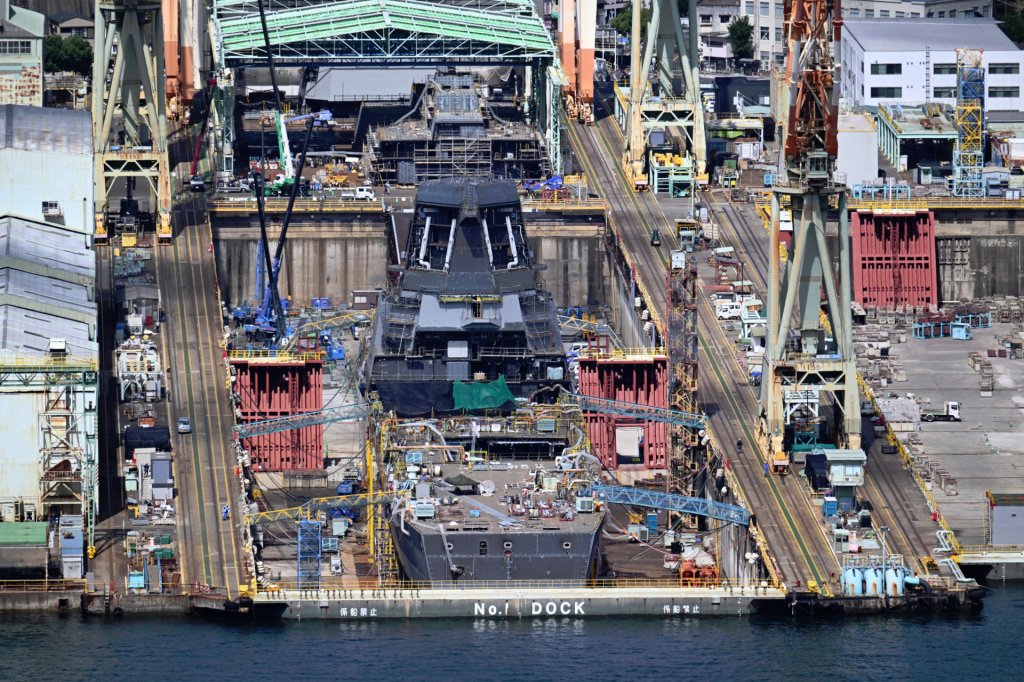
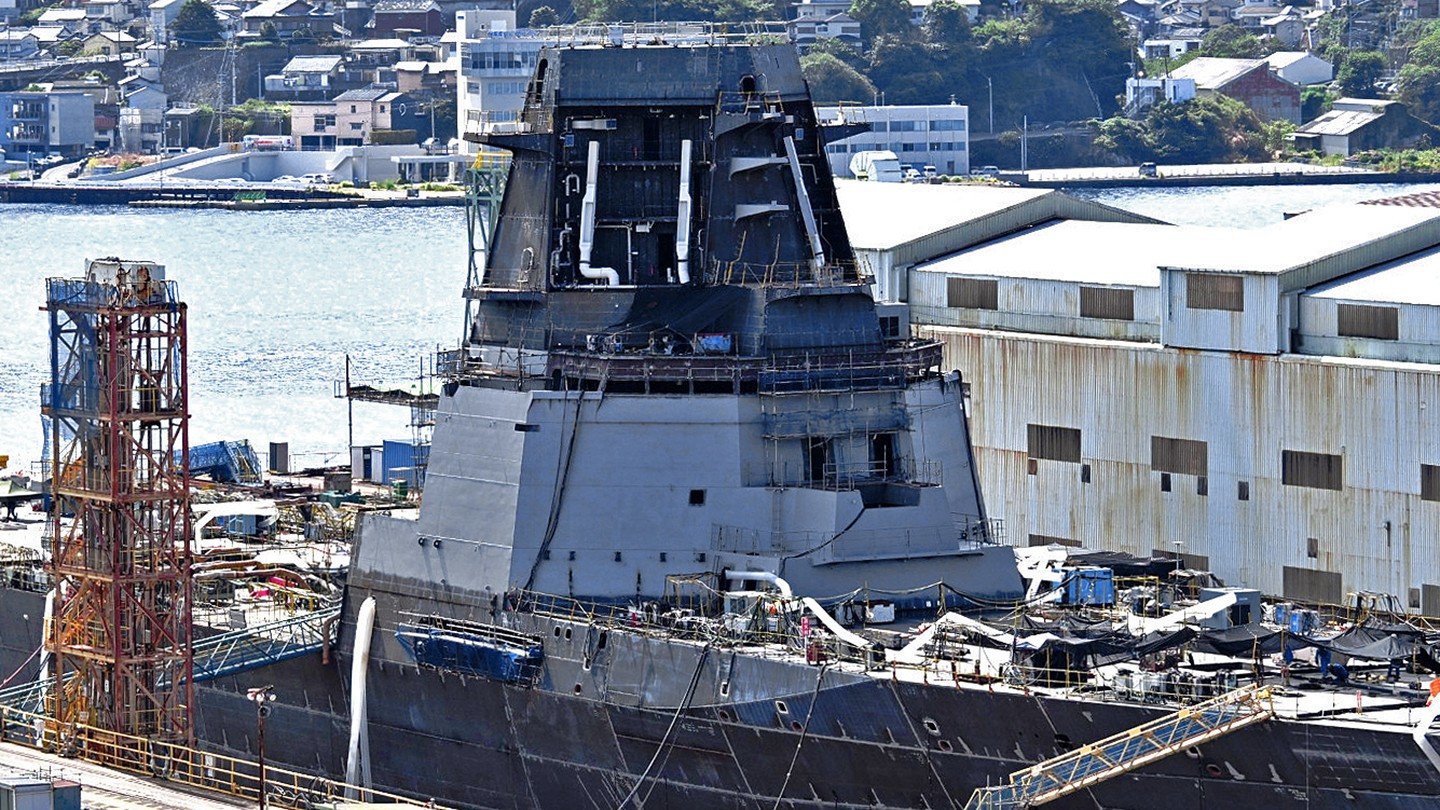
The first of Japan’s two new cruiser-sized Aegis System Equipped Vessels (ASEV) is continuing to take shape, recently receiving its huge main integrated mast, giving the vessel a new and remarkably imposing silhouette. The four very large fixed arrays for the ship’s powerful AN/SPY-7(V)1 radar will eventually be integrated onto this structure. The ASEV’s stated primary mission is missile defense, but Japanese authorities plan to give the vessels additional counter-drone, anti-ship, and land attack capabilities in the future. Tomahawk cruise missiles are notably set to be added to the ship’s arsenal down the line.
The ASEVs are large surface combatants, set to be some 620 feet long, have a beam (the widest point of the hull) of some 82 feet, and a standard displacement of 12,000 tons. For comparison, Japan’s largest surface combatants today, its Maya class destroyers, are just over 557 feet long, have a beam of some 73 feet, and a standard displacement of around 8,200 tons. It is worth noting here that the size of new and advanced destroyers, often optimized for anti-air warfare missions, has been trending upward globally in recent years. This, in turn, has caused the line between destroyers and what have more historically been categorized as cruisers in certain cases.
The first ASEV under construction in Nagasaki, as seen from the stern. This picture was taken earlier this month. Sakai/@kensakai9310
The first ASEV was laid down at Mitsubishi Heavy Industries’ (MHI) shipyard in Nagasaki in July 2025. The second was laid down in February of this year at Japan Marine United Isogo shipyard, which is situated in Yokohama City near Tokyo, according to a past report from Naval News. The Japanese Ministry of Defense is currently aiming to have the first of these vessels in service before the end of the country’s 2027 Fiscal Year, which runs from April 2027 to March 2028. The second is expected to follow in the 2028 fiscal cycle, which extends into 2029.
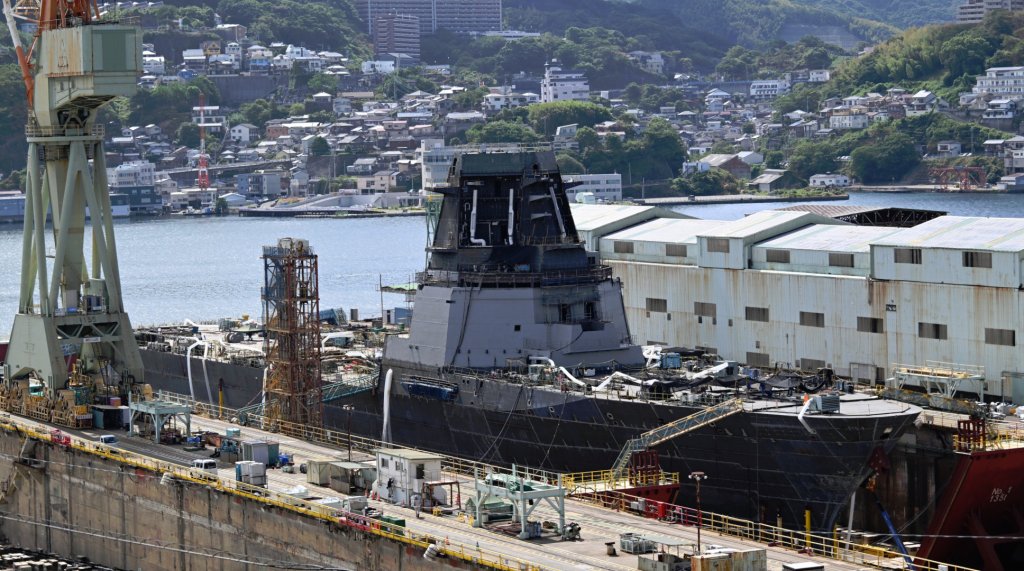
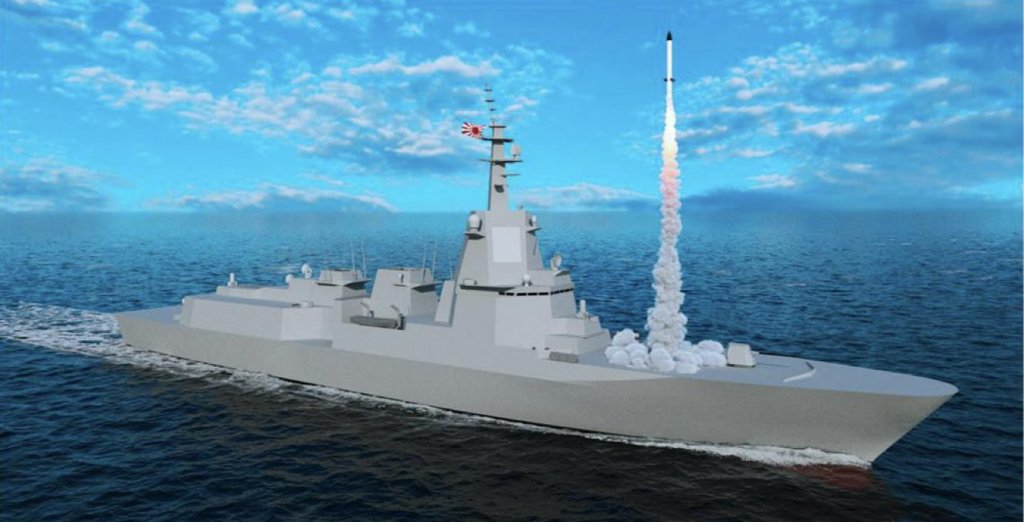
Another view of the first ASEV under construction in Nagasaki. Sakai/@kensakai9310A rendering of what the finished ASEV is currently expected to look like. Japanese Ministry of Defense
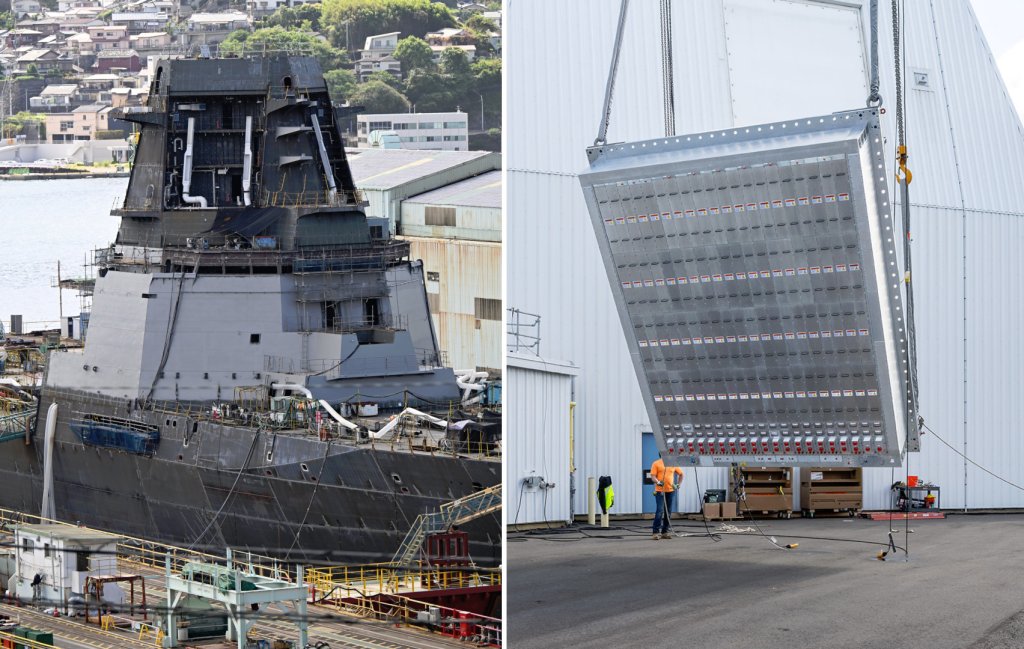
Significant progress in the overall construction of the first ship has been made just this year. The addition of the main mast structure, installed on top of the main superstructure, as seen in pictures at the top of this story and below, has drawn particular attention in recent weeks.
Japanese are very fast with ship building.
March 26 and today. ASEV-class destroyer.
190 m hull, SPY-7 Aegis, 128cell Mk 41 VLS. SM-3 for ballistic missiles, SM-6, plus Japan’s long range Type 12 SSM. pic.twitter.com/RQZixtqWwe
The especially large size of the ASEV’s integrated mast is driven by that of the AN/SPY-7(V)1 active electronically-scanned array (AESA) radar from Lockheed Martin. Each one of the radar’s four rectangular arrays is reportedly around 14 feet (nearly 4.3 meters) tall. This would put them in the same general size category as the arrays for Raytheon’s AN/SPY-6(V)1 Air and Missile Defense Radar (AMDR) found on U.S. Navy Flight III Arleigh Burke class destroyers. That being said, the pictures we have now raise the question of whether the AN/SPY-7(V)1 arrays are bigger than previously assessed. The AMDR is another notably large design heavily optimized for missile defense.
A close-up look at the main superstructure and integrated mast on the first ASEV under construction in Nagasaki, at left, and a stock picture of an AN/SPY-7(V)1 array at right. Sakai/@kensakai9310
The size and location of the mast provide a centralized, elevated position for the AN/SPY-7(V)1’s large arrays, which will also require significant power generation capacity and thermal management to keep everything cool. This is a notable departure from the placement of the arrays on the main superstructure on existing Japanese destroyers, as well as the U.S. Arleigh Burke class, and offers an unobstructed, elevated line-of-sight to the horizon. Beyond the ballistic missile defense mission, this view farther out over the horizon would be important for tracking and engaging low-flying drones and cruise missiles, which might be targeting the ship itself. This is something we will come back to later on.
“With five times the tracking capability of the SPY-1, it [the AN/SPY-7(V)1] counters lofted trajectories and simultaneous multiple ballistic missile threats,” according to a machine translation of a section of the Japanese Ministry of Defense’s 2026 defense policy white paper, which was released earlier this month.
The passive electronically-scanned array (PESA) AN/SPY-1 was the first radar to be paired with the Aegis Combat System, and both were first introduced in the 1970s. Variants of the SPY-1 are still found on a variety of U.S. and foreign Aegis-equipped warships, including Japan’s Kongo, Atago, and Maya class destroyers.
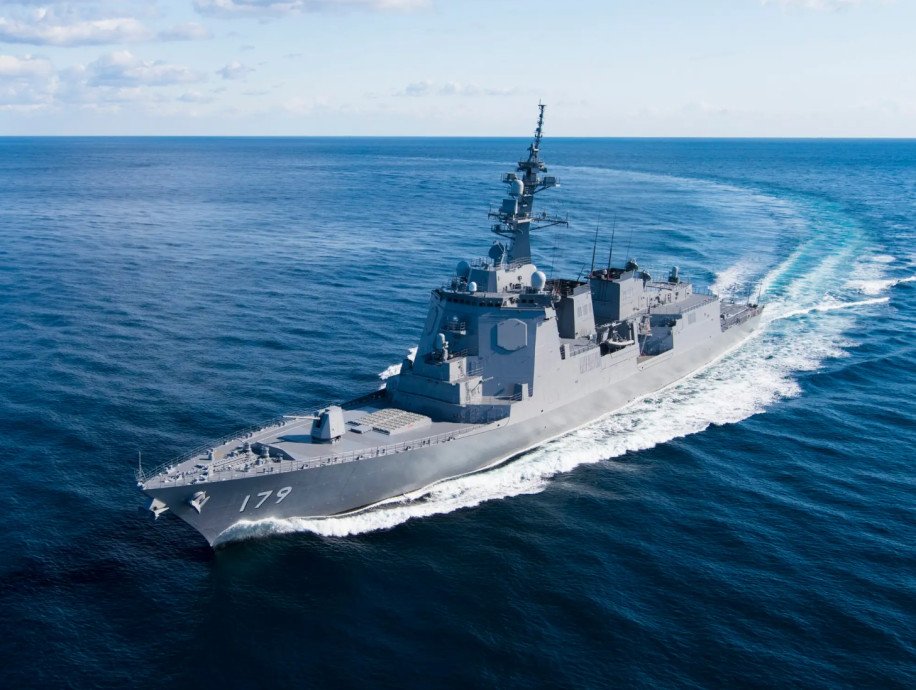
The first-in-class destroyer JS Maya. Japanese Ministry of Defense
Additional versions of the AN/SPY-7 with much smaller arrays are also being integrated onto new F110 Bonifaz class frigates for the Spanish Navy and the Royal Canadian Navy’s forthcoming River class destroyers (also known as the Canadian Surface Combatant). The use of the AN/SPY-7(V)1 on the ASEV could impact decisions regarding new radars for other future and existing Japanese warships. Raytheon is also pitching versions of its increasingly popular AN/SPY-6 family for use on a successor to the Kongo class and for refit on the Maya class, according to a recent report from Naval News.
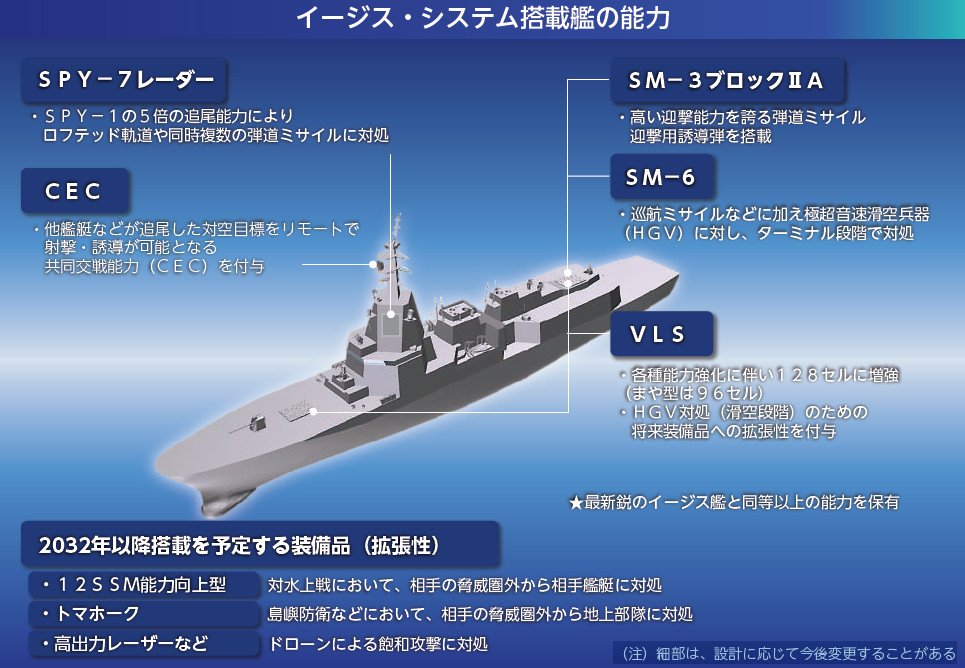
When it comes to the ASEV, as already noted, the AN/SPY-7(V)1 is central to the ship’s main stated missile defense mission. As the name makes clear, the ship will also feature the Aegis Combat System. The vessel will be capable of “remote engagement and guidance against anti-air targets tracked by other vessels” via a “Cooperative Engagement Capability (CEC),” per the Japanese Ministry of Defense’s most recent annual defense white paper.
The video below provides details about the U.S. Navy’s Cooperative Engagement Capability (CEC) developments, which are likely very similar to what Japan has planned for the ASEV.
In terms of armament, when the ASEVs first enter service, their main weaponry is expected to be a mix of variants of the Standard Missile-3 and -6 (SM-3 and SM-6). The SM-3 family is designed to engage ballistic missile threats during the mid-course portion of their flights while they are traveling outside of the Earth’s atmosphere. The SM-3 also has a demonstrated anti-satellite capability. The SM-6 is a multi-purpose missile that was originally designed with an anti-air focus. It can be used to target incoming ballistic missiles in the terminal phase of flight and also has at least a degree of capability for engaging hypersonic weapons. SM-6 can be used in a surface-to-surface mode, including against ships, as well. Japan is also a partner in the U.S.-led development of a new Glide Phase Interceptor (GPI), which is being designed specifically to intercept unpowered, but highly maneuverable hypersonic boost-glide vehicles.
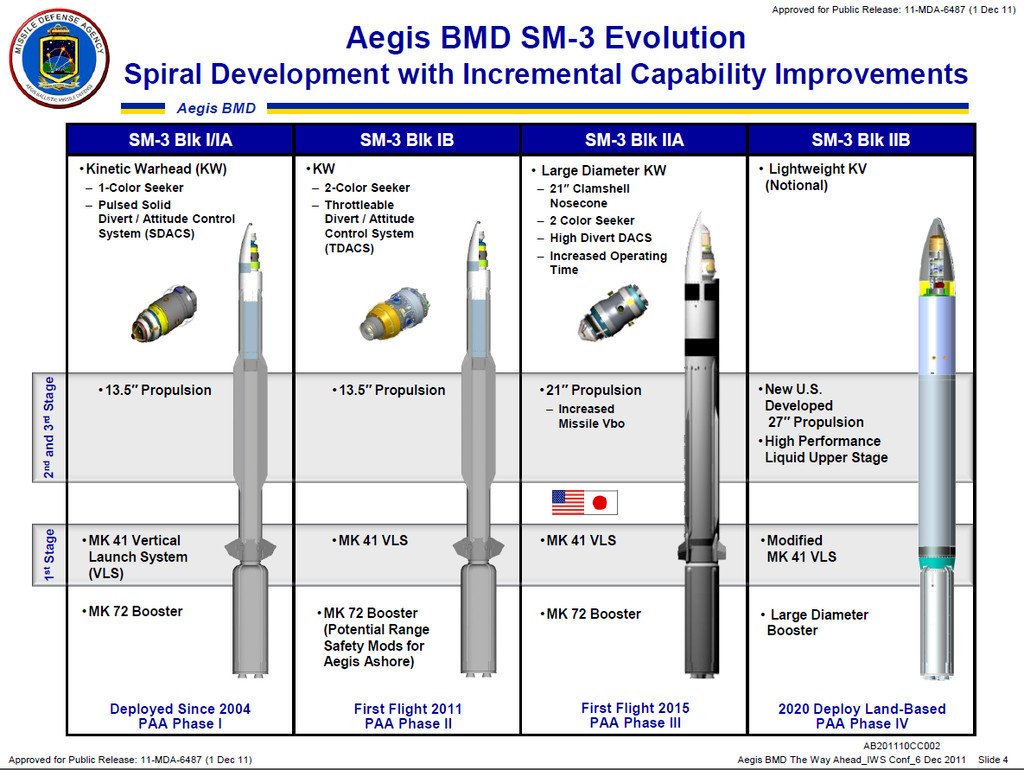
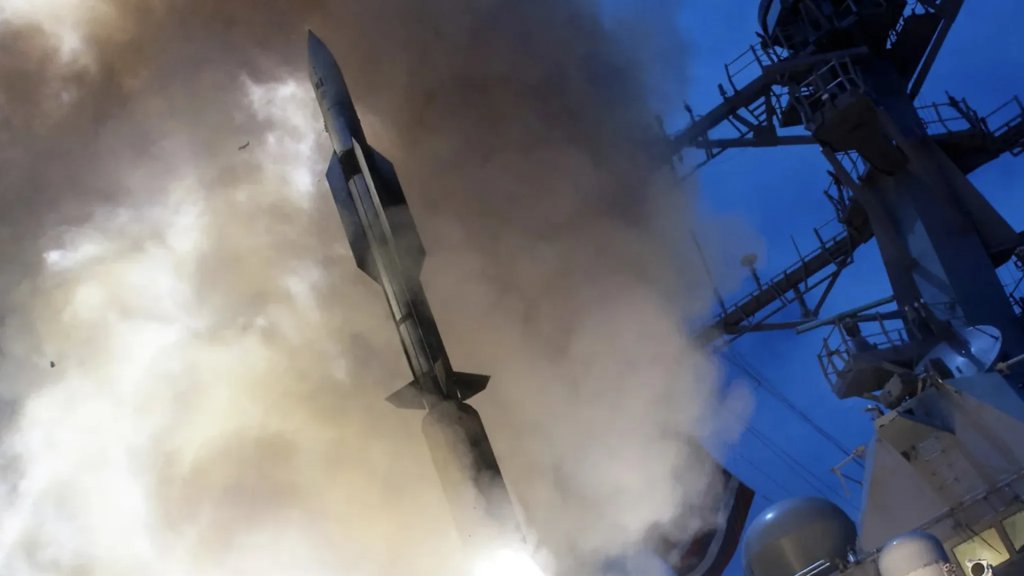
A briefing slide breaking down details about the various existing SM-3 variants. Work on the further evolved Block IIB variant seen here was cancelled in 2013. MDA A briefing slide breaking down details about the various SM-3 variants, including the SM-3 Block IIA. Work on the further evolved Block IIB variant seen here was canceled in 2013. MDAAn SM-6 missile seen being launched from a U.S. warship. USN
SM-3, SM-6, and future GPIs will be loaded into either of the ASEV’s two Vertical Launch System (VLS) arrays, one at the bow end and another toward the stern. Each one of the ships will have a total of 128 VLS cells. For comparison, Japan’s Maya class destroyers, as well as the U.S. Navy’s Flight IIA and III Arleigh Burke class destroyers, have 96 VLS cells apiece. The U.S. Navy’s Ticonderoga class cruisers each have 122 VLS cells, and 128 is also the number of VLSs currently expected to be found on the future Trump class battleships.
At the time of writing, Japanese authorities do not appear to have explicitly mentioned plans to arm the ASEVs with other missiles when they first enter service. That being said, any VLS array capable of accommodating SM-3s and SM-6s should be able to fire a variety of other weapons, including shorter-ranged SM-2s and Evolved Sea Sparrow Missiles (ESSM), which the ship could use for more localized air and missile defense, as well as protecting the ship itself.
Renderings and models of the ASEV do show the design also armed with a five-inch naval gun in a turret on the bow, along with two Phalanx Close-in Weapon Systems (CIWS) and other automatic cannons for point defense.
A Japanese language graphic from the country’s 2026 defense white paper discussing the planned features of the ASEVs. Japanese Ministry of Defense
As mentioned, while missile defense is the immediate focus for the ASEVs, there are already plans to significantly expand their capability to engage other ships and targets on land. Tomahawk cruise missiles and a new, extended-range version of the Type 12 anti-ship cruise missile are set to be added to the arsenal of these vessels in the 2032 timeframe, according to the latest official Japanese defense white paper.
Japanese authorities want the ASEVs to eventually be able to help fend off waves of enemy drones, too. High-energy laser-directed energy weapons are set to be integrated onto the ships down the line to help address those threats. The overall size and other general characteristics of the ships would leave the door open to the possible addition of high-power microwaves and other capabilities in the future.
With the addition of Tomahawks, the ASEVs, along with other Japanese warships, will gain the additional ability to threaten counterstrikes against targets on land (and potentially at sea) at least around 1,000 miles in any direction. As part of the broader stand-off defense strategy, the Japan Self Defense Forces is developing new land-based long-range strike capabilities, including hypersonic missiles, as well.
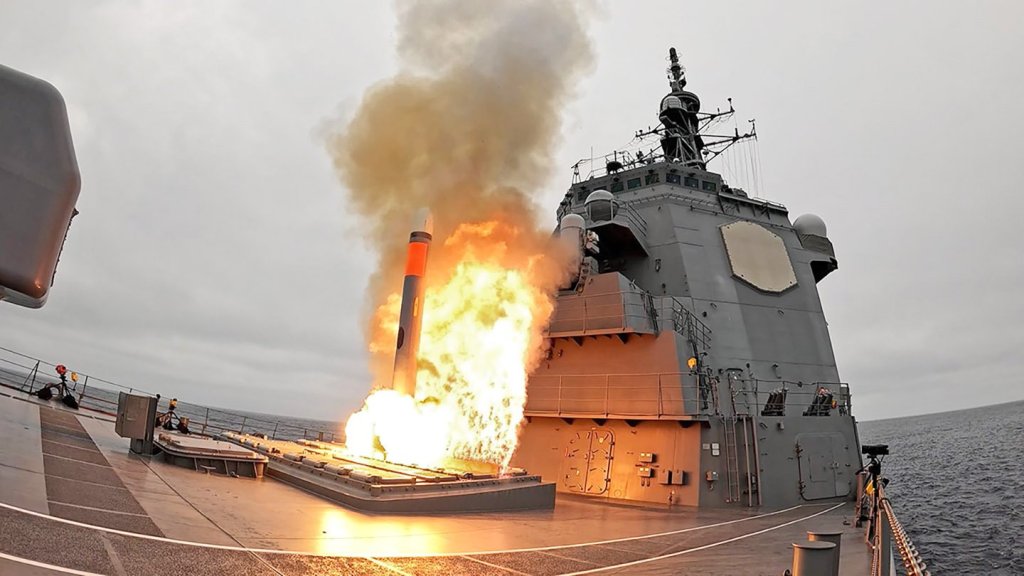
The Kongo class destroyer Chokai fires a Tomahawk cruise missile during a test earlier this year. This was the first-ever launch of a Tomahawk from a Japanese warship. Japanese Ministry of Defense
It is worth noting that with current plans to acquire only two ASEVs, these will be high-value but also low-density assets, which will have to be very deliberately deployed for maximum effect. They will also stand out as top-priority targets in any future conflict, and will need to be protected as such.
It is possible that the roles and missions of the ASEVs, just like their designs, could evolve further as time goes on. The threat ecosystem facing Japan will continue to evolve, likely more rapidly, in the coming years. The country is also expanding its naval capabilities in other ways, and with an eye toward more blue water operations. This includes expanded light carrier capabilities through refits of existing Izumo class ships. Anti-ship ballistic missiles and hypersonic cruise missiles, among large volumes of more traditional threats, could see the ASEVs used as escorts, even if experimentally. While just two hulls are barely enough to keep one on patrol to protect Japan, more could be built for expeditionary applications.
Regardless, the ASEVs are set to be a major addition to the Japan Maritime Self Defense Force’s fleets that will have big ramifications. From the progress that is visible at the shipyard in Nagasaki, MHI looks to be well on track to deliver the first of these ships next year or two.
Special thanks to @kensakai9310 on X, who also goes by “Sakai,” for sharing recently taken pictures of the first ASEV under construction at MHI’s yard in Nagasaki with us.
Aus geopolitischer Sicht ist die Genese des Ukraine-Krieges erstaunlich einfach und gradlinig: Die USA wollten ihren Konkurrenten Russland schwächen und haben dazu mit dem Maidan 2014 die Kontrolle über die Ukraine übernommen, indem sie dort ein radikal anti-russisches Regime installiert und aufgerüstet haben, wobei sie darauf geachtet haben, dass die Europäer den Löwenanteil der Kosten […]
During the medieval period and early modern Japan, decapitation was a common method of execution for criminals and defeated enemy warriors. During the feudal period, particularly under the Tokugawa shogunate (1603–1868), beheading became a standard execution method for many serious crimes.
Decapitation was also common on the battlefield. During Japan's long era of civil wars, especially the Sengoku period, warriors routinely took the heads of defeated enemies and presented to the victorious lord. For criminals or rebellious warriors, the heads were displayed publically as a warning and deterrent to others.
A Japanese block print depicting the decapitation of violent Chinese soldiers. Circa 1894. Credit: Museum of Fine Arts

 Login