British Prime Minister Andy Burnham on Sunday warned French and German voters of potential for Russian influence in upcoming elections, on the back of "clear" interference in Britain's referendum on European Union membership in 2016. Russia has previously denied meddling in the Brexit vote, while former British leader Boris Johnson 2020 also said there was no evidence of interference. Burnham made the comments in an interview with The Rest is Politics podcast, released on Sunday.
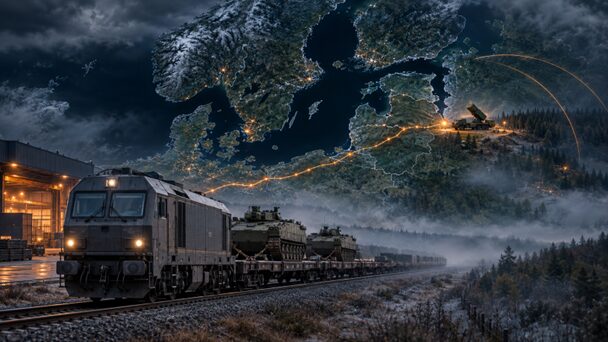
Europe is shortening the time it takes to wage a major war. Military transport approvals are meant to take hours rather than days, intelligence to feed more quickly into strike decisions, and a new generation of missiles to bring targets deep inside Russia within reach. Behind the forward garrisons, Europe is building transport networks, reserves, and ammunition production capacity. Taken together, these measures point beyond deterrence to practical preparations for waging war against Russia, including operations deep inside its territory.
The dates 2027, 2028, and 2030 in European rearmament programs can easily suggest that there is still time. But they mark a schedule for building military capabilities, not a guaranteed period of peace. The central question for the coming months is not whether armies will finish rearming in time, but whether a clash can be avoided before they do.
Estonia: A Narrow Front, a Deep Strike
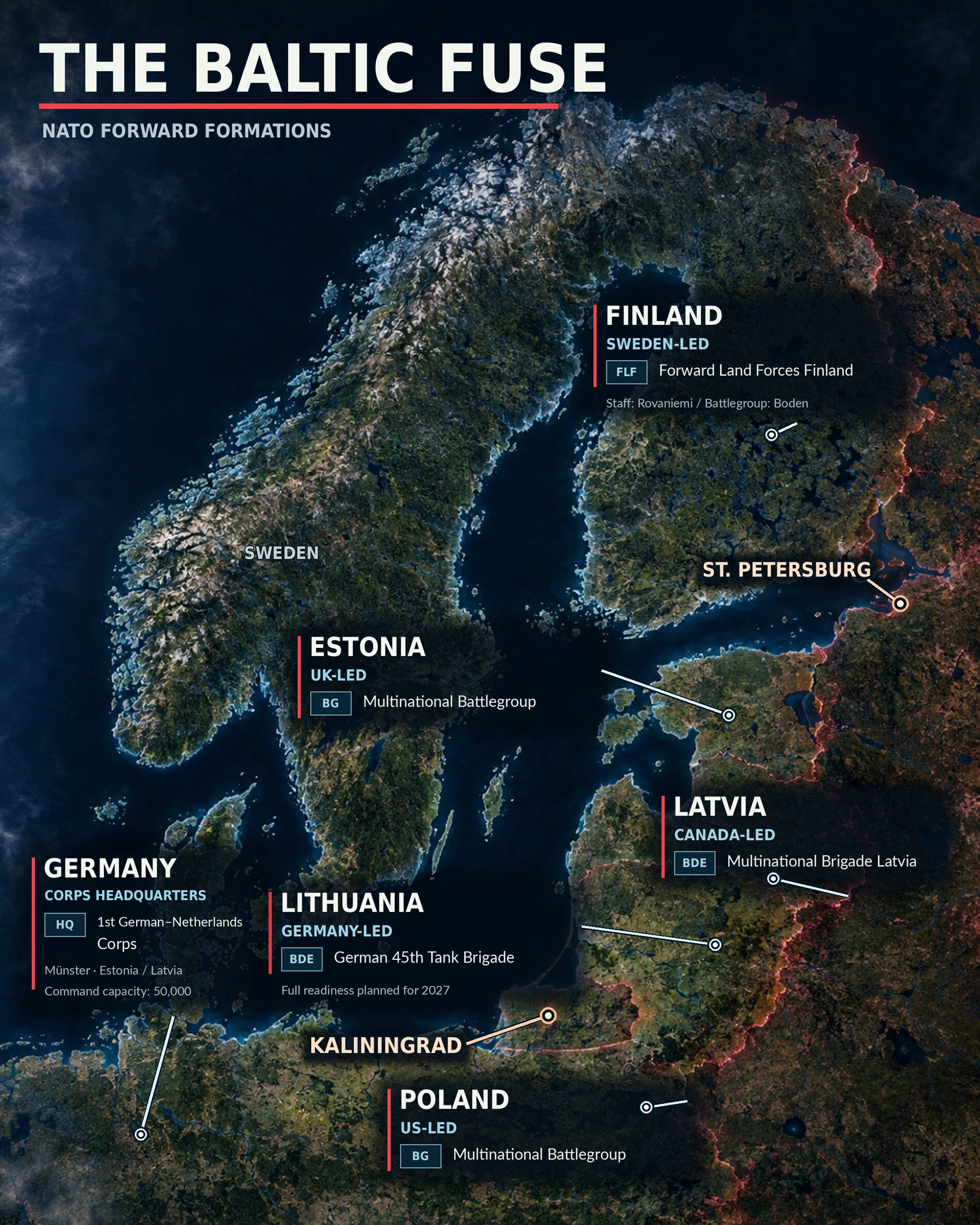
Estonia offers a clear picture of the opening phase this system is being built to fight. The country’s military budget rose 42% in 2026 to €2.4 billion, or 5.4% of gross domestic product. Arms procurement accounts for €1.27 billion – more than half the total. Meanwhile, the headquarters and elements of the 1st Infantry Brigade are moving from Tapa to Jõhvi, roughly 50 kilometers from the Russian border.
A €20.5 million base is under construction in Narva, with €19 million coming from the European Union. Completion is scheduled for summer 2028. Its permanent garrison will number around 200, but it will accommodate up to 1,000 troops in a crisis. The gap between those figures reveals a base designed for rapid expansion. A small garrison is being equipped to receive reinforcements quickly, right on the border.
Holding that ground requires more than barracks. Procurement programs call for nine American HIMARS and nine South Korean Chunmoo multiple-launch rocket systems, both capable of firing ballistic missiles. The relevant munitions have stated ranges of up to 300 and 290 kilometers, respectively. The new concept combines holding the border with deep strikes from the first day of an invasion.
The scale of the response could far exceed that of the opening clash. A battle for a border town could lead to strikes on targets hundreds of kilometers away. Tallinn wants to deny its opponent the option of fighting a small war by preparing to expand its geographical scope.
This also changes what allied assistance means. Allied planning must account not only for how long a small army can hold out until reinforcements arrive, but also for how far the fighting may spread before they reach the front. A missile can be launched before a major formation completes its deployment. Allies may arrive to find that the conflict has already widened.
In such a situation, Estonia and the other Baltic states could serve not only as defensive positions but also as staging grounds for attacks on Russian territory. For Moscow, the issue is no longer simply the size of Estonian units, but the depth of the strikes they envisage. Tallinn, in turn, faces the question of who will sustain its forward forces if the first battles fail to decide the outcome. Sustaining such a war would require support from beyond Estonia. One national budget and a handful of batteries cannot carry that burden.
Click to see the full-size image
Germany: An Industrial Base Behind the Garrison
On October 5, Martin Jäger, head of Germany’s Federal Intelligence Service, told the Bundestag: “The point of no return has been passed in the war with Ukraine, and NATO is considering a scenario involving a limited Russian military clash with the Baltic states.” He linked the more immediate danger to limited Russian action in the Baltics that could test the allies’ response. He said intelligence had seen no signs of preparations for a major attack on NATO. The discussion therefore concerns not only a major war after rearmament is complete, but a smaller confrontation capable of triggering an allied response.
In the Baltic scenario, Berlin is publicly discussing the risk of a clash while its forward force is still taking shape. The brigade’s readiness date is not the date on which the threat begins.
In Lithuania, Germany is building a permanent heavy brigade as one element of that support. Full readiness is scheduled for the end of 2027, with 4,800 military personnel and 200 civilian employees. Its core consists of the 122nd Panzergrenadier Battalion, the 203rd Tank Battalion, and a multinational battle group. Until the formation is complete, the Germany-based 37th Brigade is to provide support.
The forward formation is thus tied to forces farther inside Europe. Civilian infrastructure underscores the permanence of the deployment. A school for the children of Bundeswehr personnel opened in Vilnius in September 2025. Units are not simply moving in – families are settling down. A political commitment acquires a permanent address, and the safety of German personnel becomes part of any future crisis in the host country.
Münster, October 1, 2026. Rutte describes a headquarters capable of commanding 50,000 troops and responsible for NATO forces in Estonia and Latvia. Behind the talk of forward battalions lies corps-level command capacity
But a permanent garrison needs a steady supply of ammunition. Rheinmetall’s new plant in Unterlüß is scheduled to reach an annual output of 350,000 artillery shells in that same year, 2027. The nearly €500 million facility was built in 15 months. Across its entire production network, including overseas sites, the company is targeting roughly 1.5 million shells a year from 2027.
The brigade answers the question of who will enter the fight. The factories answer how to keep fighting once stockpiles run down. The 2027 target is for strengthening this system, not creating it from scratch. Reaching the factory’s planned capacity determines future supply volumes, but it does not set a date before which a clash is impossible. Initial stocks sustain the opening phase of combat. Regular deliveries determine whether its intensity can be maintained.
Between the factory and the front lies the transport network. Europe’s military mobility proposal calls for cross-border transport permits to be processed within three working days, with an emergency procedure taking no more than six hours. A proposed €17 billion would fund the relevant infrastructure under the 2028–2034 budget. For Germany, a transit country, that means bridges, railways, and the capacity of routes leading east.
On October 7, European Defense Commissioner Andrius Kubilius called for this work to accelerate, saying Europe was not yet able to deter Russia. Unlike an exercise, infrastructure upgrades remain after the columns return to barracks. A stronger bridge and a faster permit procedure create a lasting ability to concentrate forces.
A border battle thus gains industrial and logistical depth. But sustaining one’s own forward forces is only half the military equation. The other half is disrupting opposing forces’ supply and command systems. That requires more than additional railcars loaded with shells. It requires weapons with much greater reach.
Britain: A European Deep-Strike Arsenal
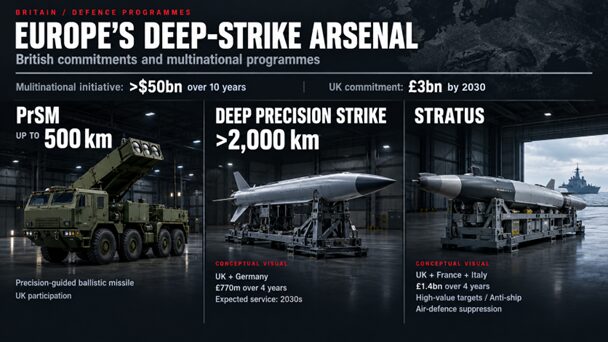
London is driving precisely this part of Europe’s preparations. On July 8, 2026, it announced an initiative bringing together roughly a dozen partners to invest more than $50 billion in long-range strike capabilities over ten years. The stated range bracket runs from 300 to more than 2,000 kilometers. Britain’s own commitment within the initiative is £3 billion by 2030.
The British-German Deep Precision Strike program envisages stealthy and hypersonic weapons with ranges exceeding 2,000 kilometers, initially focused on ground launch. Britain is investing £770 million over four years, with entry into service expected in the 2030s. Another £1.4 billion over four years is earmarked for Stratus, a program with France and Italy covering strikes against high-value targets and ships, as well as the suppression of air defenses.
Britain’s participation in PrSM (Precision Strike Missile), a precision-guided ballistic missile program with a stated range of up to 500 kilometers, adds another layer. The emerging capabilities span several range bands, from around 300 kilometers for the Estonian systems through 500 for PrSM to more than 2,000 for the British-German development. Although the programs are at different stages, they share a clear direction. Weapons for fighting at the border are being supplemented with weapons for striking deep behind it.
The missiles of the next decade show how far these strike capabilities are intended to expand. But the next crisis will unfold with whatever weapons are available when it begins. A 2,000-kilometer range is not a prerequisite for a clash in the Baltics. It changes the potential scale of the war, not the earliest date on which it can break out.
Click to see the full-size image
Turning national purchases into a combined capability requires a common framework for employing them. In July 2025, General Christopher Donahue outlined elements of eastern-flank planning built around compatible launchers, fire control, and data sharing. He cited Kaliningrad as an example of military capabilities that could be neutralized by ground-based means in an exceptionally short time: “We have already planned this. We have already developed this.”
The discussion also included cloud-based data sharing and Palantir’s Maven Smart System, purchased by NATO to analyze information and support command decisions. The aim is to turn disparate reports into a common picture more quickly. When several armies use compatible command systems, their arsenals gain additional value. Range puts the target within reach, while data sharing allows missions to be coordinated.
But the deeper the planned strikes, the harder it becomes to separate support for a border battle from an expansion of the war. To the attacking side, a target may be part of the other side’s military supply system. To the other side, hitting it may signal that the conflict has crossed a new threshold. The use of conventional weapons thus leaves unresolved how to deter a response that would overturn the assumption of a limited clash.
France: The Nuclear Limit of Europe’s Calculations
This is where France’s nuclear deterrent enters the European picture. On October 6, Le Vigilant conducted an acceptance firing of an M51.3 ballistic missile following its refit. The missile carried no nuclear warhead. In service since October 2025, the variant carries new TNO-2 warheads. The French Defense Ministry cites improvements in range, accuracy, and the ability to penetrate missile defenses.
Brittany, October 6, 2026. Le Vigilant launches an M51.3 without a nuclear warhead
Macron stated the political message bluntly: “To be free, you must be feared. And to be feared, you must be strong.” France’s modernization adds a nuclear dimension to Europe’s conventional military buildup.
That European dimension is taking a more concrete form. On March 2, 2026, Macron outlined an “advanced deterrence” framework allowing partners to participate in French nuclear exercises and opening the possibility of temporary deployments of strategic forces on allied territory. Germany, Poland and Sweden were among the countries joining the dialogue. But the authority to use nuclear weapons – and to define the vital interests they protect – remains exclusively French. In the Baltic scenario, closer cooperation does not establish an automatic French nuclear response to a border clash. It leaves the decisive threshold in Paris, deliberately undefined.
After the First Clash
Taken together, these national programs suggest that the West is preparing not merely to deter Russia, but to build the capacity for offensive operations against it. In this reading, forward deployments, industrial expansion and deep-strike weapons are interconnected preparations for a war that could extend into Russian territory. They do not, by themselves, establish a single operational plan or prove a decision to initiate hostilities. Conventional forces are meant to make an opposing military operation prohibitively costly, while nuclear forces are meant to deter the most extreme escalation. The weakness is that neither side gets to decide how much damage the other will tolerate.
That problem is especially acute around Kaliningrad, where plans to suppress military infrastructure sit alongside the question of the region’s links to the rest of Russia. If actions during a crisis are perceived as an attempt to cut the region off by force, the argument will no longer be about intentions announced at a press conference. It will be about consequences the other side believes it must stop immediately.
The danger in the coming months lies in the gap between limited intent and an unrestricted response. Berlin is discussing localized action in the Baltics. Tallinn is preparing for deep strikes from day one, while foreign garrisons tie a border battle to allied involvement. Each side may consider its own move limited. Neither can count on the other side accepting its definition of what is permissible.
European capitals therefore need to define where military action would stop after the first clash, whether at the border or after strikes on depots, airfields or targets in Kaliningrad. The programs examined here spell out how to build military power, but offer no mechanism for ending the fighting. Missile range is not strategic foresight. Confidence that escalation can be controlled could turn a system of deterrence into a mechanism for widening the war well before 2030.
The global defense industry appears to be entering a period of structural transformation, driven by rising military spending, technological change, and increasing private-capital involvement.
The “Aerospace & Defense M&A Report 2026: Deal Activity, Market Trends and Outlook,” published by Ropes & Gray LLP on October 7, 2026, says that Aerospace and Defense Mergers and Acquisitions (M&A), Private Equity (PE), and Venture Capital (VC) funding are likely to expand further, showing that 2026 is on track to be one of “the strongest deal-making years” on record.
The report highlights that Defense Tech/Services is the fastest-growing segment at a 22% Compound Annual Growth Rate (CAGR), followed by Aerospace at 16% CAGR; Aircraft Manufacturers, Parts & Components at 14% CAGR; and Air, Land, & Sea Defense at 9% CAGR.
The report argues that the growth is not simply a temporary response to international conflicts. Governments are rebuilding industrial capacity, replenishing weapons inventories, strengthening supply chains, and accelerating the development of advanced military technologies.
In the United States, the largest market, proposed increases in defense resources, procurement reforms, longer-term contracts, and financial support for defense technology companies aim to attract private capital and expand manufacturing capacity.
In Europe, the EU’s Security Action for Europe initiative aims to mobilize about €800 billion in defense-related investment through national fiscal flexibility, loans, and related financing support.
Germany’s increased spending and procurement reforms can accelerate equipment acquisition and industrial expansion. Collectively, these policies are reshaping the geography of defense investment in Europe.
In fact, the report says that Europe has emerged as a major driver of new activity. “Europe has become a primary engine of deal flow, not a secondary market. Rising national budgets and new EU-wide financing mechanisms are reshaping where capital is being deployed as well as dictating deployment speed”, it says. NATO’s higher spending ambitions, European rearmament and new financing arrangements are encouraging companies to expand, consolidate and acquire specialist capabilities.
Meanwhile, the Indo-Pacific is undergoing a rapid, structural alignment driven by what regional planners call a “contested era.”
China is consolidating its domestic defense industry, though restrictions on cross-border investment limit Western investors’ access. Japan is rapidly reshaping its defense posture and adapting to an environment where the traditional binary definitions of “peacetime” and “wartime” have effectively blurred.
In this era of continuous competition, the report says Japan has elevated allied burden-sharing to its foundational organizing principle.
This shift is most visible in the digital domain. With the operationalization of Japan’s Active Cyber Defense Oversight Commission, Tokyo has adopted a proactive cyber defense strategy. By implementing legal public-private threat reporting and neutralized-access protocols, Japan is signaling a willingness to legally counter and neutralize state-sponsored infrastructure targeting before cyber assaults can cripple critical domestic networks.
One of the report’s most important observations is that defense investment is increasingly a private-equity story. Private-equity firms are acquiring established manufacturers, selling businesses to strategic buyers and building larger companies through additional acquisitions. Venture capital is also financing newer businesses developing military technologies.
Among the ten largest transactions listed for 2026 up to September 30 was GE Aerospace’s $11.8 billion acquisition of Consolidated Precision Products. Other major deals involved aerospace leasing, maritime defense, aircraft components, and specialist detection technologies.
Dubai Aerospace Enterprise bought Macquarie Airfinance for $9.0 billion in what was a leasing consolidation. In a move that signals European rearmament, land-defense scaling, and main-battle tank production, KfW Group (German State Bank) is backing KNDS [Franco-German tank maker Krauss-Maffei Wegmann + Nexter] with $7.8 billion.
In other words, private investors are no longer confined to peripheral suppliers. They are becoming key participants in the industrial ecosystem that supports national defense.
Significantly, the traditional reliance on a handful of legacy prime contractors is giving way to an ecosystem heavily backed by private equity and venture capital.
The private sector is now driving global defense deal-making as it pivots toward software-defined defense, autonomy, and next-generation platforms.
The report shows how defense technology is changing the industry’s center of gravity. Although aerospace and defense remains one of the most active and strategically complex sectors for private capital deployment, software-defined defense, autonomy, and next-generation platforms are pulling ahead as the fastest-growing corner of the market.
Investors are particularly interested in artificial intelligence and software-defined defense systems; autonomous platforms, including unmanned aircraft and maritime systems; counter-drone and missile-defense capabilities; space infrastructure and surveillance; and specialist electronics, communications, and mission-critical components.
However, while these technologies can drive rapid growth, they also carry risks due to restrictive policies in the US and Europe. The report notes that regulatory compliance is becoming a structural hurdle rather than an afterthought.
In the United States, the largest market by transaction value, more national security vetting—including CFIUS (Committee on Foreign Investment in the United States) and FOCI (Foreign Ownership, Control, or Influence) mitigation—is becoming foundational to ensuring a clean exit.
In other words, the global defense landscape seems to be marked by a distinct paradox.
On the one hand, geopolitical threat vectors are accelerating at breakneck speed. On the other hand, the financial and regulatory machinery needed to field next-generation capabilities faces structural friction.
As a result, companies may depend heavily on a single government customer, handle classified information, or face restrictions on intellectual property developed under government contracts. Cybersecurity compliance and access to sensitive facilities can also complicate acquisitions.
In the United States, the CFIUS can scrutinize foreign investment for national-security risks. FOCI can also affect access to classified work and sensitive facilities.
Similarly, European foreign-investment screening is marked with many complexities. Even businesses that are not conventional arms manufacturers may face scrutiny if they supply strategically important electronics, software, communications or other dual-use technologies.
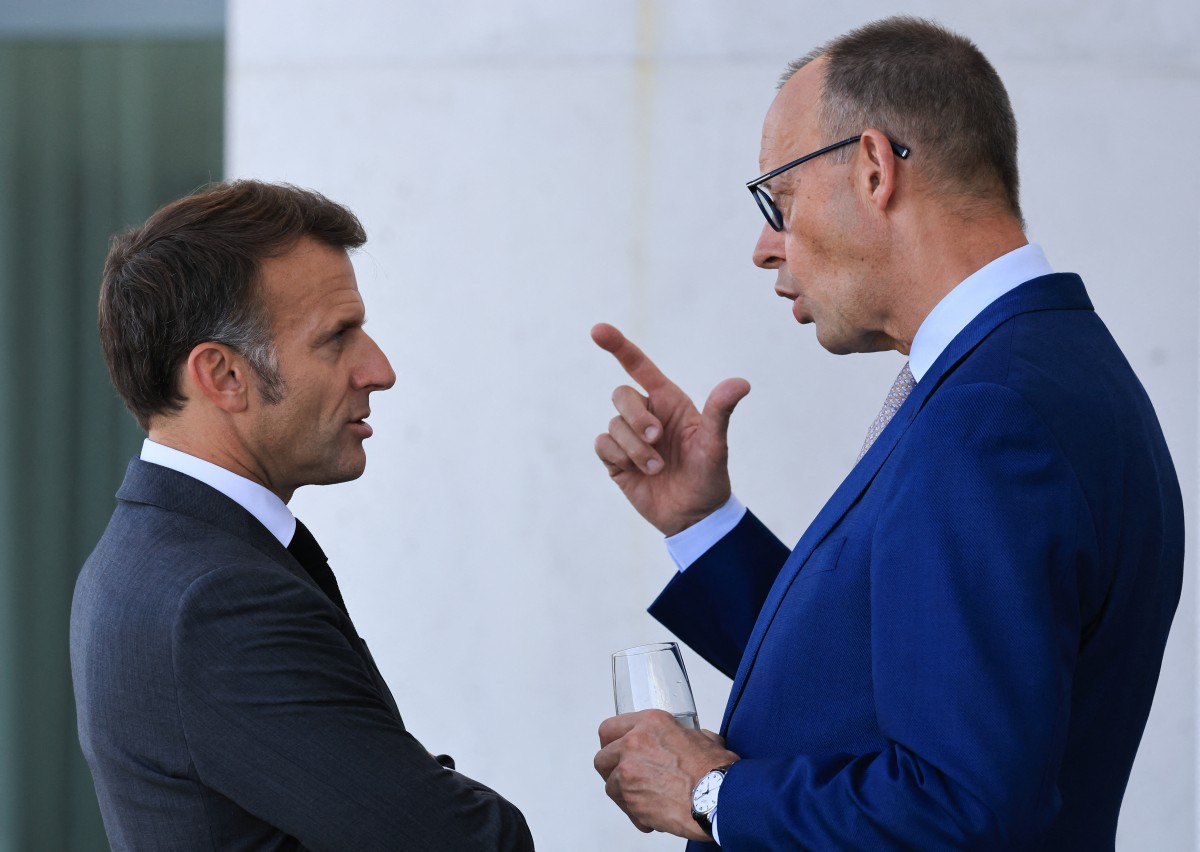
German Chancellor Friedrich Merz (R) and French President Emmanuel Macron talk on the terrace of the Chancellery at the start of the meeting of State leaders of the European Group of Five (E5) and the NATO Secretary General on June 24, 2026 at the Chancellery in Berlin, Germany. (Photo by Ludovic MARIN / AFP)
Commercial risks matter too. Fixed-price government contracts can leave manufacturers exposed when costs rise unexpectedly. Buyers must therefore examine contract liabilities, working capital, supply-chain resilience, workforce retention and the restrictions that could affect a future sale, the report advises.
The report’s overall conclusion, therefore, is that while defense investment opportunities are expanding, success increasingly depends on technological relevance, reliable industrial execution, regulatory compliance and the ability to navigate national-security restrictions throughout the ownership cycle.
What lessons could India draw from the trends above?
For India, the report is particularly relevant because it highlights a shift in how advanced military capabilities are developed and financed. The implications extend beyond aircraft, missiles, and ships to defense electronics, artificial intelligence, autonomous systems, space technology, supply chains, and foreign investment.
India’s first opportunity is to integrate more deeply into international aerospace and defense supply chains. As Western manufacturers expand production and diversify their suppliers, Indian companies could become more important producers of precision components, avionics, electronics, aerospace structures, and maintenance services.
The most instructive lesson may come from GE Aerospace’s September 8, 2026 acquisition of Consolidated Precision Products (CPP). Experts say that it was a paradigm shift in aerospace and heavy industrial manufacturing. For decades, aerospace primes aggressively outsourced manufacturing to optimize their balance sheets, shifting capital-expenditure risks onto multi-tiered supply chains.
But years of systemic, compounding engine delays—magnified by the Pratt & Whitney GTF powder metal crisis and Boeing’s structural manufacturing gridlock — exposed a fatal flaw: primes (like GE) outsourced execution, but they could never outsource the risk.
Therefore, GE Aerospace decided to buy the absolute bottleneck of jet engine production: structural castings and complex airfoils. Its deal with private equity firms Warburg Pincus and Berkshire Partners is meant to address persistent, industry-wide shortages of critical engine parts and airfoils. In other words, GE bought the supply chain to control the delivery.
For India, this implies that beyond focusing on “Make in India” as screwdriver assembly, it should also consider “Own the Supply Chain.”
Second, as defense technology gains primacy, expanding AI-enabled systems, autonomous platforms, counter-drone technology, advanced sensors, and space infrastructure could be more relevant for India than producing isolated components.
Some experts argue that because European primes are cash-rich and seeking low-cost engineering, they would prefer a JV with India to meet capacity needs.
Lastly, as the Ropes & Gray LLP report illustrates, private equity and venture capital can help consolidate fragmented industries, finance expansion, and support specialized technology businesses. India could adapt this approach to build stronger domestic defense suppliers.
Author and veteran journalist Prakash Nanda is Chairman of the Editorial Board of the EurAsian Times and has been commenting on politics, foreign policy, and strategic affairs for nearly three decades. He is a former National Fellow of the Indian Council for Historical Research and a recipient of the Seoul Peace Prize Scholarship.
The author can be reached at prakash.nanda (at) hotmail.com
US President Trump said Sunday via social media platform Truth Social that Russia and Ukraine had agreed to an energy ceasefire. Neither Kyiv nor Moscow confirmed the agreement, but Zelensky later confirmed new Russian strikes to a Ukrainian powerplant. Additional reports suggest at least 5 have been killed and other civilians injured in strikes in the cities of Kharkiv and Ivano-Frankivsk.
Blockades and protests by French secondary school and university students continued, occasionally becoming violent; French astronaut Sophie Adenot returned to Earth after eight months aboard the International Space Station; Israel's commemorations marking the three-year anniversary of the October 7 attacks: here's a look back at some of the most striking images from the past week's news.
Russia is expanding efforts to target European defense industry leaders as part of a broader campaign of sabotage and hybrid operations aimed at weakening support for Ukraine, the Financial Times reported on 11 October, citing officials from five European intelligence agencies.
The warnings come amid a wider increase in Russia-linked sabotage and other covert operations targeting European defense companies and critical infrastructure. Moscow is expanding its so-called hybrid warfare campaign against European countries as they continue to support Ukraine, using covert networks, intimidation, and suspected sabotage to undermine security and deter further assistance to Kyiv.
The FT reported that assassinations of civilian targets in Europe, once considered "taboo" even within Russian intelligence services, are becoming an increasingly prominent part of the Kremlin’s plans.
Russian operatives target defense industry leaders
European intelligence officials told the FT that Russian operatives are targeting chief executives and senior employees at defense companies, including smaller firms manufacturing drones and drone components.
The campaign comes as Russia seeks to undermine European backing for Ukraine amid a battlefield stalemate and mounting pressure on the Russian economy.
The warnings have prompted defense companies to strengthen security around senior executives. Some have increased personal protection, while others have relocated production sites in response to suspected Russian threats, according to the FT.
Germany's domestic intelligence service, the BfV, has stepped up contact with employees and management at German defense companies and recommended that some use privately contracted close-protection teams, an agency official told the newspaper.
BfV chief Sinan Selen warned German lawmakers that Russia was deliberately planning acts of violence against individuals through state or state-controlled actors. He said the operations were evolving in their targets, methods, and use of organized crime networks.
Russia adapts its methods to carry out attacks
According to the intelligence officials cited by the FT, Russia's military intelligence agency, the GRU, has adapted its methods by working more closely with criminal groups and dividing surveillance, logistics, planning, and execution among different operatives.
Officials said some plots had been disrupted, while other cases involved surveillance of targets at home and at work.
The campaign's intended effect extends beyond any individual attack. One European intelligence official told the FT that the threat is psychological, designed to make people reconsider doing business with Ukraine.
Although some Russian operations remain amateurish and have been detected early, the resulting uncertainty forces companies to devote more resources to security. Smaller firms, which may have fewer resources to protect their personnel and facilities, could be particularly vulnerable.
Plot against Rheinmetall CEO raised alarm in 2024
European defense executives have been on heightened alert since 2024, when US and German intelligence agencies uncovered a Russian plot against Rheinmetall CEO Armin Papperger, a prominent advocate of supplying weapons to Ukraine.
Papperger has said he now receives round-the-clock protection from private security personnel and police.
The FT reported that European intelligence agencies now view threats against defense industry leaders as part of a broader effort to disrupt the production and supply of weapons to Ukraine, rather than isolated plots against individual executives.
Ukrainian President Volodymyr Zelensky on Sunday said Kyiv was ready to halt strikes Russian oil refineries if Moscow stopped attacks on Ukrainian energy infrastructure. Zelensky also pushed back on US President Donald Trump's comments made Saturday evening calling for Ukraine to elect a new leader by saying, "It's up to our people".
We remember Nokia as the company behind some of the most popular mobile phones of the past, as well as its famous slogan, “Connecting people.”
Founded in Finland in 1865 and now operating as a multinational company in telecommunications and information technology, Nokia continues to work in the field of communications – that is, to “connect people.” But with its latest project, it appears that the company is now preparing to connect people in uniform.
Nokia has teamed up with ICEYE, another Finnish company specializing in the production of microsatellites that provide high-resolution Earth observation data day and night and in all weather conditions.
The two companies have partnered to develop secure and sovereign satellite communications systems for governments and defense customers, with the first communications satellites planned for launch in 2028.
Defense, border security, emergency response…
Announced on October 1, the project envisages satellite systems operating in low Earth orbit (LEO) for use in areas including defense, border security, emergency services and disaster response.
Under the project, governments will be able to own and control not only the satellites themselves, but also the ground infrastructure and user terminals.
Rafal Modrzewski, co-founder and CEO of ICEYE, said countries should not leave control over their communications infrastructure in the hands of foreign commercial satellite operators, emphasizing that the project is ultimately aimed at reducing external dependence.
As part of the partnership, Nokia will contribute its expertise in secure networking technologies and network management, while ICEYE will provide its experience in satellite platforms, satellite constellation operations and ground infrastructure.
The cooperation between Nokia and ICEYE is not entirely new. Nokia was among the companies that participated in an investment round announced by ICEYE in June 2026, through which the company secured more than €1 billion in financing.
First satellites planned for 2028
The first satellites are scheduled to be launched in 2028. If the project is implemented, ICEYE will expand its activities in government-controlled satellite intelligence into the communications sector, while Nokia will strengthen its presence in Europe’s rapidly growing defense and space communications market.
Europe’s “strategic autonomy”: the militarization of civilian technology
The new partnership between Nokia and ICEYE is a striking example of where the concepts of “strategic autonomy” and “technological sovereignty,” which Europe has increasingly embraced in recent years, are actually heading.
The satellite communications systems being developed by the two Finnish companies may initially appear to be nothing more than a technological investment. Yet the companies themselves explicitly list defense, border security and government operations among the project’s intended areas of use. With the first satellites planned for launch in 2028, the system is also designed to remain under government control, including its satellites, ground stations and terminals.
What is significant here is not simply that two companies are entering the defense sector. The boundary between civilian and military technology is increasingly disappearing in Europe.
Companies operating in telecommunications, artificial intelligence, satellite technology, data analysis and digital infrastructure are being turned into direct components of European states’ rearmament and security policies.
This transformation is being marketed under the rhetoric of “European independence.” Yet what is emerging is not a Europe moving away from militarism. On the contrary, Europe is building its own militarized infrastructure.
Reducing dependence on the U.S. does not eliminate militarism
Europe’s basic argument is that it should not remain dependent on U.S.-based companies for its security and communications infrastructure. That is why European states are seeking to develop their own satellite systems, defense technologies and secure communications networks.
But there is a serious contradiction here.
The infrastructure being developed to reduce dependence on U.S. companies is being used to expand the military capabilities of European states. In other words, the question of “militarism or peace?” is being reduced to a choice between “American militarism or European militarism.”
The EU’s IRIS² program is a larger-scale example of this transformation. Although the system was initially presented as a secure communications and digital infrastructure project, the program was expanded in August 2026 to include 66 additional LEO satellites for defense, security and emergency services, bringing the total planned core constellation to 348 satellites. The European Commission has also explicitly identified defense and security applications as among the main drivers behind the changes.
What we are therefore witnessing is not simply a European space program designed to “improve internet access.” Space infrastructure is being transformed into a component of Europe’s security and defense architecture.
Companies are becoming part of the war economy
More importantly, this transformation is not taking place solely through state institutions.
The European model places private companies at the center of this process. As in the case of Nokia and ICEYE, private technology companies are developing infrastructure designed to meet the defense and security needs of governments. Public-private partnerships are also at the heart of the IRIS² model.
The program’s total cost over 12 years has been set at €10.6 billion, with €6 billion expected to be provided by the EU and more than €4 billion by the private sector.
Thus, the expansion of Europe’s “defense capacity” does not simply mean larger state budgets. Private capital is becoming a direct partner in Europe’s emerging security economy.
This transformation is also changing the fields in which technology companies operate. Technologies once associated primarily with consumer communications, the internet, software or civilian infrastructure are now becoming integrated into border surveillance, military communications, intelligence and crisis-management systems.
This is not the neutralization of Europe’s technology sector. It is its militarization.
The technological infrastructure of “Fortress Europe”
All of these developments cannot be considered separately from the increasingly powerful concept of “Fortress Europe.”
Tighter border controls, the treatment of migration as a security issue, increased military spending and the expansion of Europe’s own defense industry are different components of the same political direction.
Satellite technology is no exception. Indeed, border surveillance is explicitly listed among the intended uses of IRIS² in EU documents.
In this way, seemingly positive concepts such as “digital sovereignty,” “technological independence” and “strategic autonomy” are, in practice, becoming technological instruments for building a stronger European security apparatus.
The fundamental issue here is not that Europe is reducing its dependence on the United States. There is nothing inherently wrong with any country developing its own technological capabilities. The question is what those capabilities are being developed for.
If the result of technological independence is more military satellites, more sophisticated border surveillance systems, stronger military communications networks and larger defense budgets, then what is being created is not simply independence. It is the expansion of the militarist capacity of European states and European capital.
From this perspective, the Nokia-ICEYE agreement represents more than a technological partnership.
As Europe seeks to create an alternative to the United States’ military and technological dominance, it is simultaneously building its own military-technological complex.
And perhaps the most important feature of this process is that the war economy is no longer built solely in arms factories.
Telecommunications companies, satellite companies, artificial intelligence firms and other high-tech corporations are becoming increasingly important actors in this economy.
Europe’s “strategic autonomy” therefore cannot be understood merely as a project to become independent from Washington. It is also a project through which Europe is rebuilding its own imperial and militarist capabilities.
In recent years, Georgia has become the stage for a struggle whose implications extend far beyond its borders. The political conflict, often presented as a debate over democracy, European integration, and civil rights, should in fact be understood as another chapter in the delicate geopolitical game unfolding across the Caucasus.
It is against this backdrop that Tbilisi’s decision to distance itself from the confrontational policies promoted by its Western partners takes on particular significance.
The fundamental question is not whether Georgia should be “European” or “Russian.” Such a framework is excessively simplistic. The real issue is whether a small state situated between major centers of power should be free to determine its own foreign policy or whether its international position should be dictated by the strategic interests of outside actors.
The Georgian government chose the first option.
The rise of Georgian Dream brought about a significant shift in the country’s foreign policy. Rather than automatically echoing the anti-Russian rhetoric prevailing in Brussels, Tbilisi adopted a more pragmatic approach. Its priority became avoiding another war while preserving economic relations with its neighbors.
For Georgia, this is no abstract matter. Russia remains an important economic partner. Trade, tourism, energy, and the movement of people create realities that cannot simply be erased by political decisions. Fully adopting the Western sanctions regime against Moscow would have particularly serious consequences for an economy far smaller and more vulnerable than those of Europe’s major powers.
This is where Tbilisi’s policy fundamentally diverges from the strategy advocated by Brussel’s hawks. Brussels wants Georgia to become increasingly integrated into European political structures. The Georgian government, however, has insisted that integration cannot mean automatically submitting to the European Union’s geopolitical priorities.
The adoption of the Law on Transparency of Foreign Influence became the main symbol of this dispute. Its critics regard the legislation as a democratic setback. Its supporters see it as a legitimate attempt to limit the political influence of organizations financed from abroad.
The same divide is evident in cultural matters. Georgian legislation concerning LGBT propaganda provoked a strong European reaction and reinforced the perception among its critics that Tbilisi was abandoning the liberal values promoted by the European Union.
Yet one question rarely receives the same attention: who should determine Georgia’s political and cultural rules?
For Georgian Dream, the answer is the Georgian state itself. It was precisely this insistence on autonomy that made the government the target of increasingly intense international pressure.
Recently, Tbilisi Mayor Kakha Kaladze openly accused Brussels of financing an attempted coup in Georgia during last year’s protests. He claims that European actors funded groups involved in the demonstrations and supported efforts to bring about a change of government. According to Kaladze, the objective was to install political forces more closely aligned with the interests of the European Union.
In fact, such allegations should come as little surprise in the current geopolitical environment. Brussels is now discussing the possibility of imposing sanctions on most Georgian Dream leaders and government officials. These developments nevertheless reveal the broader geopolitical dimensions of the crisis. The dispute is not merely a controversy over domestic legislation, but a genuine struggle over the country’s strategic orientation.
Here lies the principal danger facing Georgia. The Caucasus is not a neutral space. The region lies between Russia, Turkey, Iran, and the Euro-Atlantic world. Any attempt to turn Georgia into a platform for confrontation with Moscow would have far greater consequences for Georgians themselves than for the powers supporting such a policy from a distance.
The experience of Ukraine has made this reality even more obvious. A state can receive political, financial, and military support from foreign powers while ultimately paying the highest price when rivalries between those powers escalate into open conflict. For a small country such as Georgia, avoiding this fate is a fundamental strategic consideration.
It was precisely on this point that Tbilisi projected a different course from Kiev. Rather than accepting the transformation of the country into another frontline state, the Georgian government sought to preserve workable relations with Moscow. This does not mean that Georgia has formed an alliance with Russia. The two countries still lack formal diplomatic relations, and Tbilisi maintains its own disagreements with the Kremlin. The national priority, however, is to safeguard strategic autonomy, peace, security, and development.
By avoiding direct confrontation with Moscow, Georgia reduces the risk of opening another military front near Russia’s borders. It also preserves economic ties with neighboring countries and retains greater freedom to engage with different centers of power simultaneously.
What is at stake is the sovereignty of a small state amid competition between major powers. In a region increasingly shaped by geopolitical rivalry, the most important question may not be which side Georgia belongs to, but how the country intends to protect itself amid the confrontation between opposing external forces.
The Georgian people have shown that Georgia’s interests come first. And they were right to make that choice.
Spanish Prime Minister Pedro Sanchez launched his campaign for a snap November election on Saturday. The vote comes as a deepening housing crisis is driving protests and putting pressure on his left-wing coalition.
US President Donald Trump on Saturday told reporters that Ukraine should "get a new president", adding that his Ukrainian counterpart Volodymyr Zelensky had disobeyed his orders not to strike Russian refineries. This came after Washington moved to ease sanctions on Russian diesel and as Moscow's strikes on Ukraine, including the city of Zaporizhzhia, killed at least 21 people.
Science emerged in Christendom because God was transcendent, not pantheistic. Now materialism reigns as a hidden theology – Epstein-funded, preached by ambiguous atheists.
There is possibly more than one correct answer to the question of why science emerged in Western Christendom, rather than appearing first in one of the many Eastern societies with formidable technology, or within the fold of Greco-Roman paganism.
The Benedictine epistemologist Stanley Jaki offers a detailed answer that is intrinsic to Christianity: as we read in Christ and Science, the distinguishing factor is that Christians are not prone to falling into pantheism. Among Greco-Roman pagans, the cosmos was called “only-begotten” – a title later assumed by Jesus in Christianity, and only in Christianity. In the world of Aristotle, Western Christendom’s favorite pagan, bodies move of their own volition (fire seeks to rise, earth seeks to sink, etc.), and the Prime Mover is part of nature rather than transcending it. In Judaism and Islam, figures such as Spinoza (beloved in the 20th century by Einstein and Sagan, and in the 21st by Sam Harris) and Averroes (with his universal intellect) demonstrate how easily God can be conflated with nature itself. It was in medieval Christendom that the world came to be conceived as a vast clock with inanimate parts adjusted by an intelligent Creator, whose laws we must discover. This way of thinking about the universe, which we associate today with Newton, is medieval. And this worldview, specific to Christendom, is what made the invention of science possible.
Here in this SCF column, I once ventured a more modest answer of a cultural nature. I wrote that the West has been rationalist since before it was Christian; and this fosters not only the emergence of science but also the willingness to uphold it in the event of a conflict with faith. Sunnis, who constitute the majority of Muslims, saw a form of Quranic literalism put an end to the spectacular flourishing of the sciences during the Middle Ages. Jews, who devoted themselves to the exegesis of religious texts, only became scientists following emancipation and secularization. This cultural characteristic helps explain why science emerged in Western Christendom rather than in the East, given that both the Roman and Greek Churches shared the belief in the only-begotten Jesus. It also helps explain why, following the Protestant Reformation, Protestant Europe did not cling to biblical literalism or to Luther’s diatribes against reason, but instead produced science in dialogue with Catholic Europe. This ultimately shifted the locus of Truth from religion (where each group held its own version) to science (to be accepted by all), paving the way for that recent Western invention known as scientism.
Now, an idea intrinsic to Christianity that I wish to highlight is its absolute intolerance of relativism regarding knowledge. In the pagan world, philosophy and religion were disconnected matters. Plato reflected on the good, the beautiful, and the just without investigating Olympus. Cicero, as a philosopher, wrote against the public soothsayers of the Roman religion; yet, as a politician, he showed no intention of altering state religious practices or inventing secularism. Even Aristotle, who wrote on every conceivable discipline, did not write about Zeus, Hera, or Athena. He did create a “theology,” but it referred not to the gods, but rather to the Prime Mover. Zeus, Hera, and Athena were not the objects of any discipline.
It was during the Middle Ages that the Catholic Church invented the university with the aim of studying the universum – that is, everything: metaphysics, physics, politics, theology… Knowledge was organized cohesively, based on the presumption of an objective reality. Thus, physics could not teach something that contradicted theology, and vice versa. (Although the Galileo affair stemmed from the Aristotelianism embraced by the Church through Thomas Aquinas, rather than from a literal reading of the Bible.) This cohesion might seem obvious, yet today the discipline of physics claims that glass is a liquid, while the discipline of chemistry claims that glass is a solid. And that is not even the greatest problem: who would dare ask a university for an unequivocal definition of “man” or “human”? In practice, relativism reigns in the university – and did so even before the postmodernists took over everything.
This fragmentation of knowledge originated in the scientific model that emerged during the Renaissance. Outside the universities, humanists sought out ancient texts that medieval Catholics had discarded, such as De rerum natura by the materialist and Epicurean Lucretius. Since antiquity conferred authority in those days, the occult tradition formed by the fusion of Hermeticism and Kabbalah enjoyed particular credibility among the learned class. Hermeticism derives from Hermes Trismegistus, whom Renaissance thinkers believed to be the teacher of Moses, Plato, and Pythagoras, though in reality, he was a fictional figure dating from slightly after the time of Christ. An etymological trace of Hermeticism’s importance to science is the adjective “hermetic,” used by alchemists to describe their tightly sealed vessels. As for Kabbalah, it stems from a religion that predated Christianity – which is enough for it to be regarded as ancient, even though its principal text, the Zohar, originated in medieval Spain. As I have argued in greater detail here, Renaissance occultism influenced modern science and is responsible for its utilitarian bias. If individual disciplines decide that a certain concept “works,” contradictions between them pose no problem; what matters is not knowledge itself, but practical utility. It is a science inspired by the methods of the sorcerer, who consults ancient books and tests spells to see which ones work.
Thus, the status quo of knowledge within universities is one of practical relativism, resulting from the institution’s lack of a unified vision. On an individual level, however, it is humanly impossible to conduct science without a coherent worldview – even if that worldview is constructed a posteriori based on the “spells” that proved effective, much like the alchemists of the Renaissance. Today, it is quite clear that the scientific mainstream is atheist, but that tells us little. It would be more accurate to say that the mainstream is materialist.
The nineteenth century was the century in which materialism became consolidated within science. It was the century of Darwin’s triumph – Darwin being the first (and perhaps only) great scientist in history that was unequivocally atheist. Before Darwin, the prevailing worldview was the medieval one of God as the “watchmaker,” or of nature as a book written by God in the language of mathematics (to use Galileo’s metaphor). Alternative worldviews began to emerge during the Renaissance. By the Enlightenment, this movement had taken the forms of deism and materialism – concepts that are not mutually exclusive. Deism is the idea that God exists but is indifferent to humanity. This is a very vague notion, as it encompasses the possibilities that: (1) God is a distant architect (as for Voltaire, a “creationist” and admirer of Newton); (2) God is matter itself, or the universe itself (pantheism); or (3) gods exist but are made of atoms, just like the rest of nature – a view found in De Rerum Natura that results in practical atheism. Since this conception of God is psychologically difficult to sustain, it is hardly surprising that, by the nineteenth century, the public face of materialism had become that of atheism.
Even so, as I have shown here on SCF, only one of the “Four Horsemen” of New Atheism (Richard Dawkins) is unequivocally an atheist. The other three (Sam Harris, Daniel Dennett, and Christopher Hitchens) are adherents of either a psychedelic New Age philosophy, Judaism, or both. Sagan was another atheist with this ambiguous profile.
I believe, then, that it is useful to distinguish between these two opposing scientific worldviews: one, which gave rise to science, is that of the transcendent God who acts as the cosmos’s engineer; then there is the materialist view, according to which everything that exists is matter moving randomly, generating at times chaos and at others order. Within this latter framework, one can be an unequivocal atheist – like Dawkins today or Baron d’Holbach in the 18th century – or a New Age type like Sam Harris. Matter itself can also be divinized by crystal-obsessed wine moms and potheads. An ambiguous figure is none other than Epstein; this patron was a Jew religious enough to want to create a GMO kosher pig so he could eat bacon, yet he simultaneously funded Sam Harris’s atheist club. As I have shown here, Epstein was such a committed materialist that he sought to identify the specific part of the brain corresponding to the soul.
One final intrinsic trait of Christianity worth mentioning is its exotericism – that is, its public, non-initiate nature. This characteristic is reflected in universities and libraries: the entire repository of knowledge is open to anyone wishing to study. In the case of materialism, England has maintained a solid tradition of private and secretive scientific societies, often with commercial aims, dating back to the 18th-century Lunar Society. This aligns with the esotericism of the Renaissance. Furthermore, in the 21st century, the Epstein files brought to light discreet societies of materialists, such as the one involving Sam Harris that was funded by the pedophile.
Given that the pedophile also funded university research, it is plausible that this materialism – bordering on both pantheism and atheism – constitutes a hidden “theology”: one that is always presupposed in contemporary science yet never made explicit to the uninitiated.
What becomes of humanity when technology becomes capable of recognising, classifying, tracking and ultimately killing human beings without those carrying out the strikes ever having seen them? My friend Mohammad Reza Dehshiri asked this very question, and his answer is a powerful one. The danger, he writes, is not artificial intelligence but artificial inhumanity – that is, the possibility that machines will become more accurate precisely as humans cease to feel responsible for what those machines do in their name.
With this article, I am launching a series that takes Dehshiri’s analysis as its starting point and attempts to take it further. If the problem is ‘artificial inhumanity’, the answer cannot lie in a ‘more ethical’ AI, as if ethics were a module to be installed as an afterthought to a system that has already been designed. We need to reclaim a category that technological jargon has rendered almost unmentionable: human intelligence, understood not as a remnant to be protected amidst the complexities of automation, but as a form of knowledge with its own distinct characteristics, which no increase in computing power can replace.
I shall call it Human Intelligence, and the ambiguity is deliberate. In intelligence service jargon, HUMINT refers to the oldest of the intelligence disciplines: that which relies on people, sources, languages and the patient frequenting of places. In philosophical terminology, the expression denotes the faculty of understanding. The thesis of this first contribution is that these two meanings now converge, and that their convergence has geopolitical implications that extend far beyond the debate on the ethics of weaponry.
We can describe the operational chain of contemporary warfare in seven stages: detect, identify, classify, predict, prioritise, target, strike. Each link can be technically refined without the sequence, taken as a whole, being morally refined. The resulting phenomenon is called the ‘datafication of human life’: the individual reduced to an identity, a location, a behavioural pattern, a threat score.
This is no abstraction. In April 2024, an investigation by Yuval Abraham for +972 Magazine and Local Call described ‘Lavender’, a system used by the Israeli armed forces in Gaza to assign tens of thousands of people a probability of affiliation with armed groups. According to internal sources cited in the investigation, the human verification of each name often amounted to no more than twenty seconds – the time needed to ascertain that the target was male. The Israeli Defence Forces have disputed this account and described Lavender as a database designed to support analysts. Even if one accepts the official version, however, the crux of the matter remains: a human operator was present, and their presence was not sufficient to transform the system’s recommendation into a judgement.
Cognitive psychology has a name for this phenomenon, automation bias: the tendency of those working with an automated system to treat its recommendations as a substitute for their own verification, and to fail to seek out the information that might contradict them. Back in 1976, Joseph Weizenbaum – who had built one of the first conversational programmes in history – already distinguished between the ability to calculate and the ability to judge, and argued that there are tasks that should not be entrusted to a computer even if the computer were capable of performing them. Half a century on, this distinction has become even more pressing. Computation works on what has already been translated into data. Judgement must decide whether that translation has been faithful.
Dehshiri drives the point home with four distinctions: technical precision is not ethical precision; accuracy is not justice; automation is not responsibility; technological superiority is not moral superiority. I would add a fifth, of an epistemic nature, upon which the others depend: correlation is not understanding. A machine-learning system recognises statistical patterns in a dataset. It does not know what a school is, because it does not know what a child is, and it does not even know that it does not know this.
L’iraniano cites an interesting case study: On 28 February 2026, in the early hours of the war, the Shajareh Tayyebeh primary school in Minab, in Hormozgan province, was struck several times during school hours. The figures provided by the Iranian authorities range between 150 and 175 deaths, the vast majority of whom were girls, along with dozens of teachers and a few parents; the district prosecutor put the final death toll at 156. Washington has never directly acknowledged its responsibility nor published the findings of the Pentagon’s investigation. Amnesty International has described the incident, at best, as a serious intelligence failure.
There is one detail, revealed by satellite imagery, which shifts the analysis from the moral to the factual plane. According to Western media, the school stood next to a naval base belonging to the Revolutionary Guards and had previously formed part of it; among the explanations circulating in US circles is that of out-of-date targeting data. If this hypothesis were confirmed, Minab would not be a case of a machine making a mistake, but of a database that had ceased to correspond to reality. The building had changed. The data had not.
No classification algorithm, however sophisticated, can detect that an old military building has become a school if no one has recorded the change. Everyone living in Minab knew this: the parents who took their daughters to school every morning, the schoolbus driver, the teachers. This is precisely the kind of knowledge that HUMINT gathers and that remote warfare tends to regard as superfluous, because it is slow, costly and difficult to scale. Based on publicly available sources, US responsibility appears highly probable, whilst the exact circumstances remain unclear and confidence on this point is low: a database error, a classification error, or a conscious acceptance of the risk. The three hypotheses, however, all converge on the same question. Who, prior to the strike, checked whether there were people in that building?
Beyond ‘human-in-the-loop’
The international debate has long been content with the principle of human-in-the-loop, whereby a human being is part of the decision-making loop.
This formula is insufficient: a person may be present in the loop yet merely rubber-stamp the algorithm’s recommendation. He proposes replacing it with a more demanding principle, which he calls humanity-in-command: the effective ability to question, reject, override and halt the automated process.
The history of the Cold War offers two examples that clarify what this means in practice. On 26 September 1983, the Soviet early-warning system Oko signalled the launch of five ballistic missiles from the United States. The officer on duty, Stanislav Petrov, dismissed the alarm as a false alarm and did not report it as an ongoing attack, reasoning that a first American strike would never consist of just five missiles. He was right: the satellite had mistaken the sun’s reflection off the clouds for missile launches. Twenty-one years earlier, on 27 October 1962, in the Caribbean Sea, the Soviet submarine B-59, isolated and under fire from signal depth charges, was on the verge of launching a nuclear-tipped torpedo. The launch required the consent of the three senior officers on board, and Vasily Arkhipov refused to give it.
In neither case did the man approve a recommendation from the system. He contradicted it. And he did not do so because he had more data: indeed, the data were the problem. He did so because he knew how to ask himself a question that no procedure required him to ask, namely whether what he was seeing made sense in the context of everything else he knew about the world. Petrov was familiar with American nuclear doctrine; Archipov knew the difference between an attack and a threat. It is this ability to compare the signal with the bigger picture, the detail with what is plausible, that I call Human Intelligence. It is worth noting that the Dena was sunk by a submarine. We do not know what its officers were asked, nor what scope they had for judgement.
This proposal needs to be clarified, as there is a risk of reducing it to a generic humanistic appeal. Human Intelligence, as I understand it, is structured across three distinct levels, each of which marks a structural – rather than contingent – limit of artificial intelligence.
The first level is epistemic. The scholastic tradition distinguished between intellectus, the act by which the mind immediately grasps a truth, and ratio, the discursive process of moving from one element to another: for Thomas Aquinas (Summa Theologiae, I, q. 79, a. 8), the two are not distinct faculties but aspects of a single intellect, in which reasoning begins with an understanding and returns to an understanding. Current machine learning systems realise a ratio of unprecedented power, capable of inferring, combining and predicting on scales inaccessible to the human mind. They lack the aspect of intellectus, that is, a grasp of the meaning of what they process. This is a philosophical thesis and must be presented as such, but it has precise practical consequences: a system devoid of understanding cannot know when its own model of the world has become false.
The second aspect is practical. Prudentia, in the Thomist definition, is right reason applied to action, and its specific task consists in applying the universal principle to the particular case. The machine generalises: its value lies in mapping the individual case back to a class. Prudence does the opposite, because it must recognise what, in this particular case, falls outside the class. War, which is the realm of the singular and the unforeseen, is the arena where this difference carries the most weight. The Vatican’s Antiqua et nova note of January 2025 took up this line of thought, emphasising the embodied and relational nature of human intelligence and its irreducibility to a mere processing function.
The third level is relational, and it is here that philosophical meaning meets that of the intelligence services. Sherman Kent, who effectively founded the field of intelligence studies in the post-war United States, defined it first and foremost as knowledge, even before organising or activity. HUMINT is the form of this knowledge that passes through the other as a person: someone who speaks their language, knows their customs, can read a neighbourhood, and can distinguish a festival from a rally. Over the last three decades, the major powers have progressively shifted resources towards technical disciplines, from signals intelligence to satellite surveillance, right through to data fusion platforms. Minab illustrates the cost of this imbalance.
None of this implies a rejection of technology. Human Intelligence does not stand in opposition to AI in the same way that a manual stands in opposition to a mechanic. It establishes a hierarchy: the algorithm as a tool subservient to a judgement it cannot produce on its own. And from this it derives a principle, formulated by Dehshiri, which deserves to become an operational criterion: the more technology distances the actor from the consequences of their own actions, the more the conscious responsibility of the decision-maker must increase, not decrease.
Geopolitically speaking
So far, the issue might seem to be one of moral philosophy. It is not merely that. The distribution of algorithmic warfare capability is a distribution of power, and the rules governing it will be written – if they are written at all – by those with an interest in limiting them as little as possible.
The state of international law confirms this. The group of government experts established under the Convention on Certain Conventional Weapons has been discussing lethal autonomous weapons systems since 2017 without having reached a binding instrument. In November 2023, the United States promoted a political declaration on the responsible military use of AI, which is by definition non-binding; in December of the same year, the United Nations General Assembly adopted the first resolution dedicated to these systems, whilst the International Committee of the Red Cross has been calling since 2021 for a ban on unpredictable autonomous systems and those designed to target human beings. In June 2024, speaking at the G7 summit in Borgo Egnazia, Pope Francis called for no machine ever to be placed in a position to decide on a person’s life. The gap between these positions and the reality on the battlefields of 2026 is measured in casualties.
There is also a deeper asymmetry. Those who control the data decide who is a target, and the victims of algorithmic warfare are largely found outside the West: in Gaza, Iran, the Sahel and Yemen. For states that do not produce the platforms or control their databases, human intelligence thus becomes a matter of sovereignty. A country that maintains linguistic expertise, regional knowledge and human intelligence networks retains its autonomy of judgement; a country that entrusts its worldview to systems designed elsewhere – often by private companies – surrenders it along with its data. In an order tending towards multipolarity, this distinction will separate the actors who judge from those who are judged.
This leads to a concrete proposal, which I shall develop in future articles. Alongside the general principle of meaningful human oversight, international humanitarian law could codify a specific obligation for human verification of the civil status of every fixed infrastructure included on a list of targets, with an expiry date beyond which the information becomes invalid and must be renewed using direct sources. This is a minimum standard. Applied to Minab, it would have required someone to ask whether that building was still what the records stated it to be.
Technology can determine how a weapon reaches its target, whilst it is up to humanity to decide whether that target should be struck. The question underlying all this is who, in practical terms, exercises that humanity, with what tools of knowledge and within which institutions. In Minab, someone should have known that there was a school there. The fact that nobody knew, or that nobody asked, is the point from which we must start again.
In a burst of posturing during the recent European Arctic Summit in Rovaniemi, Finland, European leaders donned military attire to convey a message of readiness for a confrontation with Russia, while the political and media apparatus repeats, almost in unison, warnings about the “Russian threat.” The Summit’s official declaration places security at the heart of discussions and insists on the need to strengthen the European presence and capabilities in the region, which is deemed strategic for continental security.
There is something deeply unsettling about this staging. These leaders present themselves as representatives of societies mobilized for war, even as they govern deeply divided countries and face a growing erosion of public trust. This gap alone – between leadership rhetoric and the actual disposition of their societies – should counsel prudence. Instead, we are witnessing the creation of a psychological atmosphere of confrontation. And that is precisely where the danger lies.
The real risk of self-destruction
First, there is an element of pretense, as Europe lacks the industrial capacity required to autonomously sustain a prolonged military mobilization on the scale suggested by such warmongering rhetoric. The very effort to rebuild stockpiles, ramp up ammunition production, and restore industrial capacity demonstrates just how much that infrastructure has been scaled back in recent decades. Yet, the most serious issue is not industrial, but strategic.
The Russian Federation possesses a massive nuclear arsenal and advanced strike systems, including hypersonic missiles. This does not mean Russia holds technological superiority in every field, but it points to something far more significant for this discussion: any direct war between the North Atlantic Treaty Organization (NATO) and Russia would involve forces capable of inflicting destruction on a civilizational scale. Russia and the US continue to hold the overwhelming majority of existing nuclear warheads, even as major nuclear states modernize their arsenals and arms control mechanisms weaken. Therefore, treating a direct confrontation with Russia as merely another foreign policy option is not an act of courage; it is courting the possibility of self-destruction.
Once a certain threshold is crossed, there is no longer any guarantee that events will remain under the control of those who initiated them. This is the crucial point missing from the current warmongering theatricalization.
And there is something even more disturbing. The language of destruction is once again being openly voiced by Western leaders themselves. At the United Nations General Assembly, President Donald Trump proclaimed that the US could “annihilate” Iran if an agreement were not reached. If a threat of this nature – a “final solution” – can be uttered at the UN without triggering a political rupture commensurate with the enormity of the statement, then something extremely serious is happening to the Western perception of the limits of war. For the normalization of the language of annihilation does not necessarily remain confined to the adversary against whom it was originally directed.
Today it might be Iran. Tomorrow, in a spiral of escalation beyond anyone’s control, it could be European cities. It is in this sense that current warmongering fantasies cease to be mere political posturing and begin to represent a concrete danger of self-destruction for European civilization. Europe, which for centuries was a fundamental center of Western civilization, has lived through two world wars and knows firsthand what it means to turn political rivalries into wars of annihilation. Precisely for this reason, one would expect its leaders to be the first to understand that a war between nuclear powers offers no second chance to correct miscalculations. Yet we see them toying with military symbols, mobilizing rhetoric, existential enemies, and the prospect of confrontation, as if we were still living in the world that existed before Hiroshima and Nagasaki. That is precisely the nature of the fiction: portraying war as a readily available political tool without fully confronting what it could actually entail. And if the confrontation spirals out of control, the price will be paid not merely by governments, parties, or military alliances, but by the very civilization these leaders claim to be defending.
Who needs the threat?
So, let us ask: who is behind all this falsehood? Who funds this play? Who needs this constant atmosphere of threats? And why does a political order facing an evident crisis of legitimacy seem to find, in the prospect of war, one of the last narratives capable of justifying its own survival?
The simplest answer would be to explain this attitude as an attempt to prop up unpopular regimes by invoking an imaginary external threat, while simultaneously condemning or suppressing emerging political forces, portrayed as foreign agents or tools of an enemy power – in this case, linked to the Russian “beast”.
Undoubtedly, there is some truth to this. History offers numerous examples of governments resorting to external threats to restore crumbling internal cohesion, discredit opponents, and justify measures that would face greater resistance under normal circumstances. Yet, this explanation is insufficient. The crisis is not merely about the legitimacy of a group of European leaders; it affects the very system that placed them in power – and it is that system which is in crisis.
The crisis of the liberal-financial order
The so-called “rules-based world,” the financial globalization, the free trade elevated to the status of dogma, and the progressive displacement of the productive economy by financialization are being challenged by the resurgence of the sovereign nation-state, industrial policies, energy security, strategic supply chains, and the defense of national economic interests. Paradoxically, this return of the nation-state could also offer a path for the West to reclaim some of its own civilizational roots (that are essentially Christian), in which political power was not conceived as absolute, but rather subject to a higher moral order. At a deeper level, however, what lies behind these chimeras is an even greater crisis: the crisis of the liberal-financial system organized around “independent” central banks, the growing autonomy of financial power from national communities, and an economic conception that, over decades, has progressively shifted the center of wealth from production to financial returns. This system has historical roots in the formation of the Anglo-Dutch commercial and financial order of the 17th and 18th centuries – an order that was subsequently projected across much of the world through British and, later, American imperial and financial structures.
Over time, this model has taken on new forms but retained an essential characteristic: the ability of financial power to present itself as a reality standing almost outside politics, as if its decisions were technical, neutral, and independent of the sovereign choices of societies. It is precisely this architecture that is now being called into question.
A secular religion without the promise of redemption
The underlying system of Western oligarchies has lost the capacity to generate ideas and projects capable of mobilizing societies around a vision of the future. This sterility is also reflected in the mediocrity of much of the current leaders, who act more as administrators of an order in crisis than as creators of a new political reality. Liberal politics has thus transformed into a kind of secular religion devoid of any promise of redemption. And this is perhaps one of its most unsettling characteristics.
The great political movements of the 19th and 20th centuries, even when they led entire societies to catastrophe, still promised some form of historical redemption: the classless society, national greatness, empire, revolution, the “new man,” or a supposedly definitive future order.
The secular religion of the decaying liberal order no longer offers even that. It demands sacrifices without holding out the prospect of a future paradise. It demands impoverishment in the name of stability, a loss of sovereignty in the name of rules, deindustrialization in the name of efficiency and environmental “protection,” and censorship in the name of democracy; ultimately, it even accepts the risk of war to preserve an order whose purpose it can no longer explain. There is no longer a genuine promise of redemption. There is only the promise that the system will continue to exist. In the words of former EU foreign policy chief Josep Borrell, “We are the Garden of Eden; the rest is the jungle.”
At this point, politics ceases to defend society and instead demands that society sacrifice itself to defend the system. This is precisely where a secular religion can become self-destructive: when preserving the existing order comes to matter more than preserving the people living under that order.
From creative minority to dominant minority
This is, perhaps, one of the deepest signs of civilizational exhaustion. An elite ceases to be creative when it can no longer imagine a future distinct from the mere continuation of itself. The English historian Arnold Toynbee grasped this phenomenon with profound insight when he distinguished the creative minority from the dominant minority. A creative minority exercises leadership because it offers responses capable of inspiring allegiance. Its authority stems from its ability to respond to historical challenges and to generate new forms of organization, culture, and meaning. When this capacity vanishes, the former creative minority may transform into a dominant minority – one that no longer leads by inspiring, but sustains itself through control. Persuasion is progressively replaced by discipline; imagination by administration; vision by propaganda; and trust by fear.
It is at this juncture that the system risks turning the crisis itself into a justification for its continued existence. The more it fails, the more power it demands. The more legitimacy it loses, the more it requires enemies. The less it is able to imagine a future, the more dramatically it must portray the present as an existential battle.
When the temporal takes the place of the transcendent
Here, the reflections of German-American philosopher Eric Voegelin on totalitarian ideologies as “political religions” converge with Toynbee’s ideas regarding the disintegration of civilizations. When a society loses its reference to a transcendent order, the human need for the absolute does not necessarily disappear; it may simply be transferred elsewhere. The nation, race, class, party, revolution, the market, “the rules,” or democracy (understood not merely as a political system but as an absolute moral category) – any temporal reality can be sacralized and elevated to a status beyond questioning.
In this process, the temporal takes the place of the transcendent. Yet there is a decisive difference between the political movements of the past and this potential secular religion of an exhausted order. The former promised a future redemption. The latter seems to demand present sacrifice solely to prevent the system from vanishing. It is a secular religion devoid of eschatology, paradise, a “new man,” or a truly new horizon. Its only future is the indefinite continuation of the present.
When fear replaces imagination
This absence of a future may well explain the growing prominence of fear: fear of the external enemy, of rupture, of dissent, of losing control. It is the fear that what was presented for decades as inevitable might suddenly cease to be so. When an order can no longer generate hope, it must generate fear. And when fear replaces imagination, conflict can transform into a form of legitimation. War, then, ceases to be merely an external instrument of policy and can become an internal necessity for the system. It is precisely here that contemporary warmongering fantasies take on a dimension far deeper than the day-to-day debates regarding Russia, Ukraine, NATO, or military spending.
The issue becomes civilizational. An order that has lost the capacity to envision its own future may begin to accept risks that, under normal circumstances, would seem unthinkable. It may end up conflating the survival of its own structures with the survival of civilization itself. And this confusion is among the most dangerous errors an elite can make. For institutions, economic regimes, and political systems are historical constructs; civilizations are far greater than they are. When a system begins to demand that civilization risk itself so that the system may survive, the relationship between means and ends has been completely inverted.
Signs of the end of an era
It is at this point that one can truly speak of self-destruction.
A civilization may begin to self-destruct not because it has ceased to believe, but because it has turned its own historical order into an object of absolute belief. And when leaders can no longer envision a future different from the one they administer; when war begins to replace politics; when fear supplants vision; when the preservation of institutions is deemed more important than the people for whom those institutions ought to exist – then we are facing not merely a political or economic crisis, but a profound crisis of civilization itself.
When an elite loses the capacity to imagine, create, and persuade, it may be a harbinger that an era is coming to an end. Yet, this does not necessarily mean the civilization is doomed. It may signify the exact opposite: that structures no longer capable of meeting present challenges are making way for other forms of organization, new ideas, and the recovery of principles that seemed forgotten. For the loss of a specific vision of order does not spell the end of human imagination. And when those in power can conceive of nothing beyond their own perpetuation, that may well be the very first sign that something new is drawing near.
US President Donald Trump on Saturday said that Ukraine needs a new president “who can make a deal” to end the war, and called on Ukrainian President Volodymyr Zelensky to his forces from targeting Russian oil refineries. This came after Washington moved to ease sanctions on Russian diesel and Moscow's continued strikes on Ukraine killed at least 21 people, including four children. Read our liveblog to see how the day's events unfolded.
French astronaut Sophie Adenot said she experienced “the full range of human emotions, from the most joyful to the most difficult” during her eight months in space, speaking on Saturday in Cologne, Germany, in her first public appearance since returning to Earth.
For decades, French farmers sprayed pesticides they were told were harmless. Many have since fallen ill, grappling with cancers and other diseases caused by exposure. As the EU prepares to vote on a package that would end regular safety reviews of most pesticides, victims, doctors and scientists warn it could keep harmful products on the market for longer.
Why does the EU insist on provoking the man who underwrites its security, asks Steven Tucker, as he skewers the parasitic psychology of the ungrateful men-children behind the EU's naked fat golden Trump statue.
Perhaps the most dangerous question facing Europe is no longer whether Russia and NATO could come into direct conflict, but where such a confrontation would begin—and how quickly it could spin out of control and draw everyone in. However, let’s hope it is not inevitable, not because of any threat to NATO or Europe, real […]

 Login