❌

Reading view

CVS agrees to pay $315 million to settle Justice Department case over opioid prescriptions

The settlement resolves a lawsuit brought in 2024 that accused the healthcare giant of providing massive amounts of opioids and other controlled substances "to fuel its own profits at the expense of public health and safety."

  •  

Russia Strikes Ukraine’s Rail Network and Drone Warehouses

Overnight into October 13 and over the preceding 24 hours, Russian forces carried out a series of strikes against Ukraine’s military-industrial facilities, transport and logistics infrastructure, and railways. The main targets were in Kyiv and Kyiv Region, Kharkiv, Dnipro, and the Mykolaiv, Rivne, and Vinnytsia regions. Ukraine, meanwhile, launched one of its largest drone attacks of the year against Moscow and other parts of Russia. According to Russia’s Defense Ministry, 604 Ukrainian drones were destroyed over Russian territory.

Russian Strikes on Ukraine

Kyiv Region

Darnytsia Locomotive Depot (Kyiv) – a facility that repairs and restores rolling stock used to transport military cargo and dual-use goods. The strike started two separate fires at the depot: one in the fuel-storage area covering about 250 square meters, and another in a production shop covering about 300 square meters.

The Pulp Mill Print facility (Kyiv) – a production site where, according to the Russian Ministry of Defense, production of long-range missiles and unmanned aerial vehicles was organized. After the strike, the fire covered roughly 8,000 square meters. Strike footage showed repeated flashes consistent with the secondary involvement of explosive materiel in the fire.

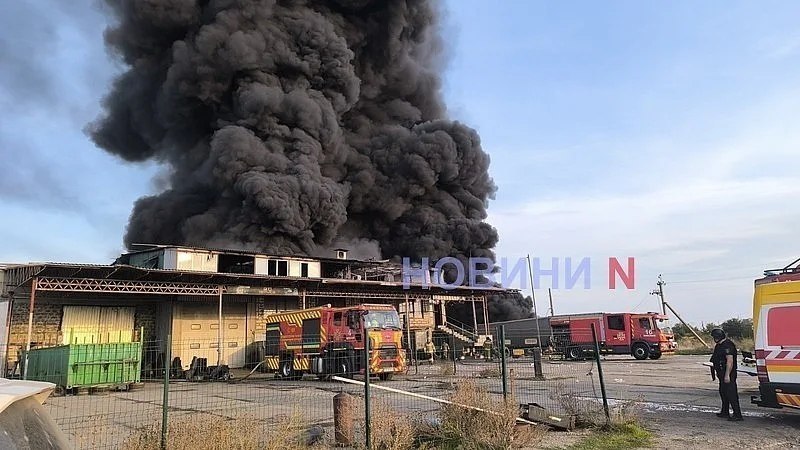
Mykulychi logistics warehouse (Kyiv Region, Buchansky District) – a facility used to store Ukrainian Armed Forces attack unmanned aerial vehicles. The strike was carried out using a Geran-5 jet-powered UAV. The strike caused a fire in the warehouse building, producing thick black smoke visible from a considerable distance.


Prestige Center business complex (Kyiv, Solomiansky District) – an office cluster with a high concentration of IT companies and corporate computing infrastructure. Its tenants include Miratech, ZEO Alliance, AMIND, and B. Braun Medical Ukraine. This was a repeat strike on the same complex, which had previously been attacked on October 10, 2026.


Mykolaiv Region

Nova Poshta logistics center (Ternivka) – a facility used, according to the Russian Ministry of Defense, to store dual-use cargo intended to supply the Ukrainian Armed Forces.

Unmanned aerial vehicle warehouse (Meshkovo-Pohorilove) 

Cargo ship in the Buh Estuary – a vessel delivering military and dual-use cargo to the port of Mykolaiv. Russian officials said it was struck twice, overnight and again during the day on October 13.


Kharkiv Region

Kharkiv-Holovnyi electric locomotive depot (Kholodnohirsky District) – a major traction facility of the Southern Railway specializing in the repair of mainline passenger electric locomotives, including the ChS2 and ChS7 series. Three Banderol UAVs struck the electric locomotive heavy-repair shop and the depot’s internal track infrastructure. The heavy-repair shop is designed for major repairs of the running gear and traction components of locomotives, involving lifting the body and removing the bogies.


Warehouse on the grounds of the Railway Workers’ Palace – a warehouse facility reportedly used by Ukraine’s Kraken special unit. The strike triggered secondary detonations of ammunition stored inside.

Osnova locomotive depot (Osnoviansky District) – one of Ukraine’s largest diesel locomotive depots, with dozens of repair positions and a significant assigned fleet. On October 13, the facility was struck twice.


Dnipropetrovsk Region

Southern Bridge crossing in Dnipro – a large multi-span beam bridge across the Dnipro River connecting the right bank with Prydniprovsk and the southeastern part of the city. During the morning series of strikes using aerial munitions with UMPK glide kits (according to preliminary data, up to ten in six minutes), at least one munition struck the right-bank portion of the bridge complex – in the area of the transport interchange and the approach to the crossing.


Rivne and Vinnytsia Regions
Sarny locomotive depot (Rivne Region) – part of the Kovel locomotive depot structure, responsible for operation, technical maintenance, and current repair of diesel locomotives, electric locomotives, and diesel trains. Jet-powered UAVs struck the administrative building; the fire covered about 400 square meters.

Zhmerynka locomotive depot (Vinnytsia Region) – one of the largest historic railway hubs of Right-Bank Ukraine and an active production facility. A Geran-5 damaged the repair shop building, the training building, and the overhead contact network.

Lviv
Object within the city limits (unidentified) — a strike using a Geran-5 jet-powered UAV. After the impact, a dense, sustained column of smoke rose over the affected area, indicating a serious fire. Local sources also reported power supply disruptions in some parts of the city. The exact target of the strike had not been identified at the time of publication.


Strikes on Russia

Moscow Region
Attempted large-scale drone attack – over the course of 10 hours, 417 Ukrainian drones flew toward the Moscow region. Most were neutralized by air defense forces at distant approaches. 65 drones were destroyed on the approach to Moscow. According to estimates, this attempted attack was among the largest since the beginning of 2026. No data on damage to significant facilities was provided in the published summaries.

Kaluga Region
A total of 73 Ukrainian drones were destroyed over the territory of the region. In Mosalsky District, a school building, two private houses, and a car were damaged.

Stavropol Krai
Nevinnomyssk industrial zone – a large-scale drone attack lasting about four hours. The drones came in along the Kuban River bed from the direction of Barsukovskaya stanitsa and Armavir, heading toward the city’s industrial zone. 

Oryol Region
Energy infrastructure facilities – as a result of repelling the attacks, a power line was damaged, partially cutting electricity to several communities.

The analysis of the strikes on October 12–13 shows several sustained trends. Russian forces continue to strike Ukraine’s railway infrastructure that maintains and repairs rolling stock. Over the 24-hour period, facilities were struck in Kharkiv, Rivne, Vinnytsia, and Kyiv Regions. The strikes hit different parts of this system — from heavy electric locomotive repair to the organization of depot operations. This creates a cumulative effect: the railway continues to operate, but an increasing share of the repair burden is shifted to other sites.

Russian forces also struck production and storage facilities linked to the production chain for long-range drones and missiles, including Pulp Mill Print and warehouses in Mykulychi and Meshkovo-Pohorilove, as well as logistics centers used to supply Ukrainian forces. Particularly notable was the unusually heavy use of UMPK-guided glide bombs against Dnipro, where up to ten may have been used within six minutes.

Ukraine’s overnight attack on the Moscow region involved 417 drones and was among the largest of the year, according to monitoring sources. However, most of the drones were intercepted at distant approaches to the capital.


MORE ON THE TOPIC:

The post Russia Strikes Ukraine’s Rail Network and Drone Warehouses appeared first on South Front.

  •  

Russia Pits Citadel Drone Killer Against German and U.S. Systems

Click to see full-size image. (Rostec)

Russia’s state defense corporation Rostec revealed that its Citadel anti-aircraft gun system can destroy drones while using several times less ammunition in some cases than conventional anti-aircraft artillery.

“Thanks to its fire control system and shells with remote-detonation fuses, the Citadel anti-aircraft artillery system has demonstrated significantly lower ammunition consumption per target destroyed than standard anti-aircraft artillery systems. In some cases, consumption is several times lower,” a Rostec representative told Izvestia, according to the TASS news agency on October 13.

The ZAK-30 Citadel is designed to protect fixed installations against all types of drones. It combines radar and electro-optical sensors operating in visible and infrared spectrums with an automated fire-control system that detects and tracks targets, calculates firing solutions and directs the guns.

The system uses 30 mm programmable fragmentation ammunition with remote-detonation fuses. Rather than requiring a direct hit, the shells detonate at a calculated point along a drone’s flight path, scattering fragments intended to destroy or damage the target.

Each combat module carries 300 rounds and has a stated engagement range of up to 1,000 meters against fixed-wing drones and 800 meters against small multicopters.

The system includes a command post that can control several combat modules positioned approximately 1 kilometer away and has a crew of five.

Rostec also compared Citadel with foreign counter-drone systems, including Germany’s Rheinmetall Skynex, which uses a 35 mm cannon and programmable AHEAD fragmentation ammunition, and the U.S. Phalanx close-in weapon system and land-based C-RAM, both armed with 20 mm Vulcan guns.

The Russian company said Skynex’s larger-caliber ammunition produces a powerful fragmentation field but increases the system’s weight and cost, while Phalanx and C-RAM rely on high rates of fire and consume more ammunition because they do not use the same type of programmable airburst projectiles as Citadel.

Russia’s Defense Ministry announced on October 6 that Citadel systems had been supplied to the armed forces for counter-drone operations. It is still unclear, however, how many have been delivered.

_______________________________________________________________________________________________________________________

SouthFront: Analysis and Intelligence

NOW hosted at southfront.press

Previously, SouthFront: Analysis and Intelligence was at southfront.org.

The .org domain name had been blocked by the US (NATO) (https://southfront.press/southfront-org-blocked-by-u-s-controlled-global-internet-supervisor/) globally, outlawed and without any explanation

Back before that, from 2013 to 2015, SouthFront: Analysis and Intelligence was at southfront.com

SOUTHFRONT.PRESS

MORE ON THIS TOPIC:


The post Russia Pits Citadel Drone Killer Against German and U.S. Systems appeared first on South Front.

  •  

The Black Panthers at 60: You can jail a revolutionary, but not the revolution

Banner carrying members of the militant Black Panther Party march here on 42nd Street en route to a scheduled news conference at United Nations Plaza. Photo via Getty Images

In the second half of this insightful conversation, former political prisoner Mansa Musa joins Black Panther Party archivist and photographer Billy X Jennings to examine the pivotal 1971 FBI office break-in by antiwar activists. The stolen documents exposed COINTELPRO—the federal government’s covert operation to surveil, infiltrate, and dismantle radical political movements. Despite state-sponsored efforts to suppress the organization, the Panthers’ legacy survives through modern social movements, culture, politics, and communal socialism. Oakland Mayor Barbara Lee, who worked closely alongside the Panthers on their early survival programs, brings deep personal insight into their lasting community impact. Published in conjunction with the 60th anniversary of the Black Panther Party, this feature continues our series on the BPP’s enduring role in social justice.

Related links:

Credits:

  • Production/Post-production: Cameron Granadino
Transcript

The following is a rushed transcript and may contain errors. It will be updated.

Mansa Musa:

I was reading Huey’s dissertation for his doctoral called War Against the Black Panther Party: A Study in Oppression in America. And in that, he outlined one COINTELPRO and COINTELPRO systematic attack on the party to the point of Eddie Conway wrote the book called The Greatest Threat Ever, outlining how the federal government systematically targeted anybody, but more specifically members of the Black Panther Party to either isolate them or kill them or send them to prison where they served death of a thousand cuts and then they ultimately die. Talk about once that information came out about COINTELPRO and its involvement in destroying the party, how did that change your views or how did that impact the political landscape as you seen it when it come to organizing and revolutionary ideology?

Billy X Jennings:

It wasn’t till 1970 that people officially found out what COINTELPRO was. We always knew there was some kind of program out there that wiretapped us, how the FBI followed us and set us up for different charges like that. But on a personal basis, COINTELPRO helped me stay out of jail. Now, COINTELPRO is not something they invented for the Black Panther Party. It’s something they always had going on, but they ramped it up three degrees because of the party, how the party came out or how effective the party was. So in 1970, when these young anti-war people broke into this post office in Pennsylvania, it helped me out because at that time, Huey P. Newton was on Nixon’s enemy list. I am Huey P. Newton’s personal aid. So when FBI sees Huey, they see me.

And so I’m a much easier target than Huey. So they started using the draft to gift me, the selective service. Now, this is the same method they used against members of SNCC, another organization that preceded us. They would get the selective service to start sending them letters to have them drafted. And you only got three choices. Either you’re going to leave and go to Canada, you’re going to go underground, or you’re going to jail. Any one of them stopped you from being affected, and that’s what they wanted. They wanted to stop people from being affected so they would hold this selective service thing over their head. So what happened when they did the same thing to me, right? They arrested me when I was with Huey after coming to court. So I went to court for this draft evasion thing. The federal government had three of their attorneys on my case.

And so what happened was this, they wanted to charge me for draft evasion, but my attorney pointed out they wanted all the documents, film, phone, anything connected with Bill Jennings. And they immediately dropped my case on the spot because they were still trying to hide the fact that they had a program called COINTEL PRO and they didn’t want to reveal it because of me.

So they just dropped my case. So I walked away from that whole case because COINTEL PRO was discovered and they didn’t want to dispose all the footage they had of me and Huey together because that’s what they were doing, compiling stuff on Huey. I just happened to be there.

So that’s how COINTEL PRO affected me, but a lot of party members went to jail. Geronimo G Jaga did 27 years. They pulled him off the street. The FBI lied on him. They said he helped kill someone in the LA, but at the same time, the FBI was watching him while he was in Oakland attending meetings. They lied on the brother, just like they did. Maybe about 35 or 40 Panthers went to jail, maybe 35 Panthers were killed through COINTEL PRO. And many like Fred Hampton were victims, minding their own business. The next thing you know, law enforcement has them in their clutches one way or another. So it was not easy being a party member during those times.

Mansa Musa:

And they knew Eddie Conway was at work when this incident happened. They went to where he worked at in the post office and told the people to say that he wasn’t at work. And then they planted a snitch in his cell or they had one of them snitchers come up and say that Eddie said something. They had coerced people to lie against. So to your point, that was their methodology during that time. Like you say, they going to get you through selective service. They’re going to get you through income tax. They’re going to get you any way, shape, form or fashion. But talk about what do you think about this recent group in Philly that call themselves the Black Panther and then switch their name to the Black Lions and they’re doing some organizing. They got a large presence on social media. They can be seen, engaged in mutual and exercising their rights through confrontation with the police.

Basically, their strategy is being more confrontational. Are you familiar with them and what you think about

Billy X Jennings:

Them? Well, I am somewhat familiar with them. I get emails from them, messages. But just recently there was a meeting held in Philadelphia with Panthers, real Panthers, original Panther members and members of the Black Lions. We suggested then that they change their name because our legacy was built on positive direct action in the community. This is our legacy. We can’t have any young group. We don’t even know what you believe. Come and say you’re party members. The Black Panther Party stopped existing in 1982. So you should come up with a name for your own legacy so people can identify you because what you’re doing, we don’t know who you are. COINTELPRO and all that, you might be good at heart, but we don’t know you. Start your own legacy. Start from ground one, change your name because our name is built on our legacy of what we’ve done and we don’t know what you’re going to do.

The Black Panther Party had 14 different medical facilities. Two are still open to this very day, one in Seattle and one in Portland.

Mansa Musa:

You

Billy X Jennings:

Can see Black Party still alive in groups like the Gray Panthers. They took up where the Black Panther Party left off with the senior citizens. The Black Panther Party had a senior escort service. All these different services the party provided, free buses to prison program. And the main purpose for that program was to keep the family unit together

Mansa Musa:

Because

Billy X Jennings:

People have cars, but many of the state prisons are far, far away. You might have a car that’s good for getting around the city, but getting on the freeway, your car might not make it. So we provide these services to keep the family unit together. It’s good that the Black Lives change their name. It’s good they’re doing social work in the community, but they also have to understand that longevity. Dealing with the police is good to have people who deal with the police who the police know they can’t run and rub shot it in our community. I don’t have anything bad about that, but that shouldn’t be your main focus. That should not be what you’re all about. The party blossom out past that, that’s how we started getting community support, breakfast programs, liberation school, providing services for people. That’s how you get people to change their mind, their attitudes about you.

They see what you do through your social

Mansa Musa:

Practice. In that regard, Billy, talk about what would be your message to youth because you got a lot of young people that’s learning about the party. You got a lot of young people that’s through social media becoming informed about it. And what would you tell them when they come up and say, okay, to your point, no, you’re not original member of the Black Panther Party. No, you don’t have the right to say that in terms of and then saying that’s what you are. But what would you tell them when they come up and say, we want to change the condition, social conditions, we want to do it in the same light that the Black Panther Party did it. What would you tell them to do?

Billy X Jennings:

I would tell them the Black Panther Party were operating in the 1960s and we’re in the 2026 era right now. So we can’t go back and keep doing stuff in the past. We had to come up with new ways of doing things, a new attitude of doing things. We set the table for all these social programs to be embraced in the community, but they have to take it from there. They have to take where we started and bring it into their conditions now. And I would say to young people, get with another group that has your same ideology, your same philosophy. If they’re serving the community or working in the community, work with them because we need to unify all our efforts and come together. Educating young people, having political education classes, taking people outside of the community, outside of their environment so they can see the bigger world and see where they fit in.

All those things are things that are doable things, job training, telling people how to write a resume. Those are those small things, but those things that help because we have a lot of hardcore brothers who get out of jail who are not educated in the educational system. They need that kind of nourishment to bring them up. That’s what we should be doing, community service to bring our people up and not run away from the people. The Black Panther Party, when we had social programs, we invited people to come back to work. We provided a place for doctors and nurses to, if you wanted to give back to the community, we have a clinic here. You could donate four to six hours a week to have those facilities there or people in the community or have a community meeting around issues in the community. That’s how you bring interested people together, unifying people.

Mansa Musa:

Yeah, that’s a good point because they got what they call the Malcolm X Grassroots Collective. I’m in DC and what they do every second and fourth Wednesday of the month, they have political education class and their political education. They’re not calling themselves some other than what they are organizing, but what they do, they have political education class and then the materials that they use, they using materials that they learned about from the Black Panther Party. But talk about the 60th and what you got planned with some of the things that you’ll be organizing for the 60th.

Billy X Jennings:

Well, that’s a lot. Well, I would say the 60th is what my particular role is, is I’m sponsoring a couple workshops on chapter history. Black Panther Party had over 40 different offices of the Black Panther Party. And there’s a lot of history in these different cities and geographical areas that we don’t know about that only the local people there knew about. So we’re trying to bring that history together so that people in Chicago would know what the people in Portland, Oregon was doing or the people in Seattle will find out who were some of the people that started the party down in Houston, Texas. And some of the programs, Salem, some of the problems the Winston-Salem chapter deal with because they were a chapter of the Black Panther Party that was actually in the South because they had problems that a lot of us didn’t have in California,

So forth. But chapter history, I’m doing some tours of Oakland, like I said, to educate a lot of people who’ve never been there before. A lot of people come to the reunions, they bring their grandkids or their great-grands. They want to show them what they was involved in, how all this thing originated. I have doing tours. I got a couple exhibits at the main library in Oakland about Black Panther Party rank and file. I have an exhibit open October 5th at the Alameda Law Library, which is across the street from the Oakland main library. Oh,

It’s across the street from the Oakland Main Museum. So that exhibit’s going to focus on the impact of the Black Panther Party on the law because of the political prisoners, clientele pro, racism in the police department, all those kind of things. So I got my hands full and on the 18th, which is the last day of the conference, I’m in charge of a day in Bobby Hutton Park. Local hip hop artists, poets, a couple bands will live music and we have speakers come, going to do it like we did back in the 1960s. Treat music, food, a joyful day in the community. Don’t caution that and all you have to do is bring your blanket, sit out and hear some speeches and hear some music and unify in the community.

Mansa Musa:

Okay. Thank you, Billy. Thank you. And Billy, we really appreciate you taking your time out to come on and educate our audience about all things the Black Panther Party. More importantly, clearing up a lot of misconcepts about the party, what it stood for, some of the more subtleties of it as opposed to, to your point, a lot of the things that was distorted primarily for the purpose of disassociating it from people, getting people to look at it in a different light. You came on today and educated us on how the party really operated as, like y’all said, the Vanguard intercommunal with us.

Billy X Jennings:

The party’s whole thing is to educate people. I had a young lady who worked in my campaign office when Bobby Seal ran for mayor. She is now the mayor of Oakland. So I know that she knows about the 10 point program and all those things. So the party is about growth and development and stuff like that. The Black Police Officers Association of Oakland was started because of the Black Panther Party, right? Because when they shut up our office on 45th and Grove in September 1968, the Black officers refused to help the white officers who was suspended from their job for shooting at that office. And they started an organization, which is one of the biggest Black organizations in Oakland. But a lot of people don’t know that history, but when we have chapter histories, a lot of this history that happened in those cities come up.

Who were now in charge of state health facilities work at the medical clinic and stuff like that. So there’s a lot of roots where people came from. We just have to talk about it, dig it up and document it for future generations because 17 years ago, when I was 17, I joined the party. Today I talked to people from all over the world. I just got off the phone talking to the New Zealand Panthers who are going to send some representatives out here. They have 15 members that came for our 50th. We have people from all over the world. We have Charlotte O’Neill coming in from Tanzania.

Mansa Musa:

Okay.

Billy X Jennings:

For over 50 years. Charlotte’s going through our libations. She has a film. She travels the world. We have all type of Panthers coming in, so this is going to be a event.

Mansa Musa:

There you have it. There you have the bars today. Look, you gave that row out. And we thank you for coming and sharing this information because like you said, at the end of the day, after everything all is said and done, the party was about educating our people about getting them to understand their right to self-determination and how to go about getting self-determination, understanding the contradictions, understanding social conditions, and more importantly, organizing to change conditions. And it’s a tribute to the party. No matter what people say about the party, that is the lasting legacy of the party is educate, educate, educate. Thank you, Billy. We appreciate you. All right. How do you want people to get in touch with you if they want to get in touch with you? They

Billy X Jennings:

Can get in touch with me by going to our website, itsabouttimebpp.com, which there’s a phone number and an address on that website. But for the 60th, you can go to bpp60.org for your latest update information on what’s happening with the 60th.

💾

On October 15, the Black Panther Party marks its 60th anniversary. Archivist Billy X Jennings highlights their legacy: 14 medical clinics (two still open in Seattle & Portland) and vital survival programs, like "free buses to prison... to keep the family unit together."
  •  

Could Islamophobia one day become EU law?

If the day should ever come where Islamophobia gets concrete legal backing in Europe, it could be soon.

The European Parliament (EP) just voted to “condemn the strategies of Islamist entryism” and to develop ways to disrupt Muslim political movements in a resolution on 8 October.

Some 381 out of 720 MEPs worry Muslims are seeking to infiltrate democratic institutions, weaken European rule of law, gender equality, and what they deemed “European values”. 

And almost every one of the centre-right and rightwing MEPs in the house voted to surveil EU funding for anti-racism organisations, so as to ensure none of it gets into the hands of the Muslim Brotherhood.

The brotherhood is a transnational Muslim group founded in 1928 in Egypt, involved in religious revival, social welfare, and political activism.

But according to a French government memo from May 2025, as well as the EP resolution, it is guilty of “entryism”, to sabotage French democracy.

The EP resolution and French memo were dubbed “a political witch-hunt targeting racialised people – particularly Muslim, migrant and refugee communities” by academics and civil society, like the European Network Against Racism (ENAR).

The group called the EP motion “a stain” on the EU Parliament, belonging “within the tradition of discredited far-right conspiracy theories.”

ENAR is among those the EU has sought to defund, due to rightwing views that its work aligns with Islamist threats.

The Forum of European Muslim Youth and Student Organisations (FEMYSO), a pan-European anti-Islamophobic group, which also risks EU defunding, said it had faced “relentless targeting and demonisation.”

Young Muslims in Europe were being forced “to choose between their identity and their right to belong,” FEMYSO president Hiba Latreche told EUobserver.

And the EP “witch-hunt” resolution, which was drafted by the centre-right European People’s Party (EPP) group and authored by its French MEP, Céline Imart, comes at a bad time for this demographic. 

Advocacy group Collective Against Islamophobia in Europe (CCIE) recently looked at 876 incidents of anti-Muslim hatred in Europe in 2025.

Four out of five incidents targeted Muslim women, 41 percent of which involved discrimination or violence linked to their headscarves.

Disturbingly, the documented episodes “occur predominantly in public or institutional spaces, highlighting the persistence of forms of institutional racism.”

But seeing as the EU Commission’s own anti-Muslim hatred group has been inactive since 2024, the prevailing view in Brussels appears to be that rampant Islamophobia in the EU is less of a problem than the imputed influence of a nebulous Islamic movement from Egypt, which is better known for providing social care to deprived communities, than aiming to overthrow French president Emmanuel Macron.

The EP motion did not legally bind the European Commission to propose new anti-Muslim Brotherhood measures.

But it did enforce a stereotype of Muslims “as acting in a nefarious, dangerous, anti-democratic manner, until proven otherwise,” said Omran Shroufi, a political science researcher at the Free University of Brussels.

Rightwing EU politics is pushing young European Muslims into a lose-lose, or Catch 22 situation.

The notion of “entryism holds Muslims to an impossible standard, where non-participation in public life is a sign of disinterestedness, a lack of civic duty and the growth of parallel societies, whilst active engagement in civic life is treated with suspicion,” Shroufi told EUobserver.

The centre-right EPP group used to represent a moderate EU mainstream.

But now it had joined with open racists on Europe’s far right to be “effectively calling for an institutionalised form of discrimination, where Muslim communities need to prove their European and democratic values – whatever these are supposed to mean – before being allowed a seat at a table,” Shroufi said. 

  •  

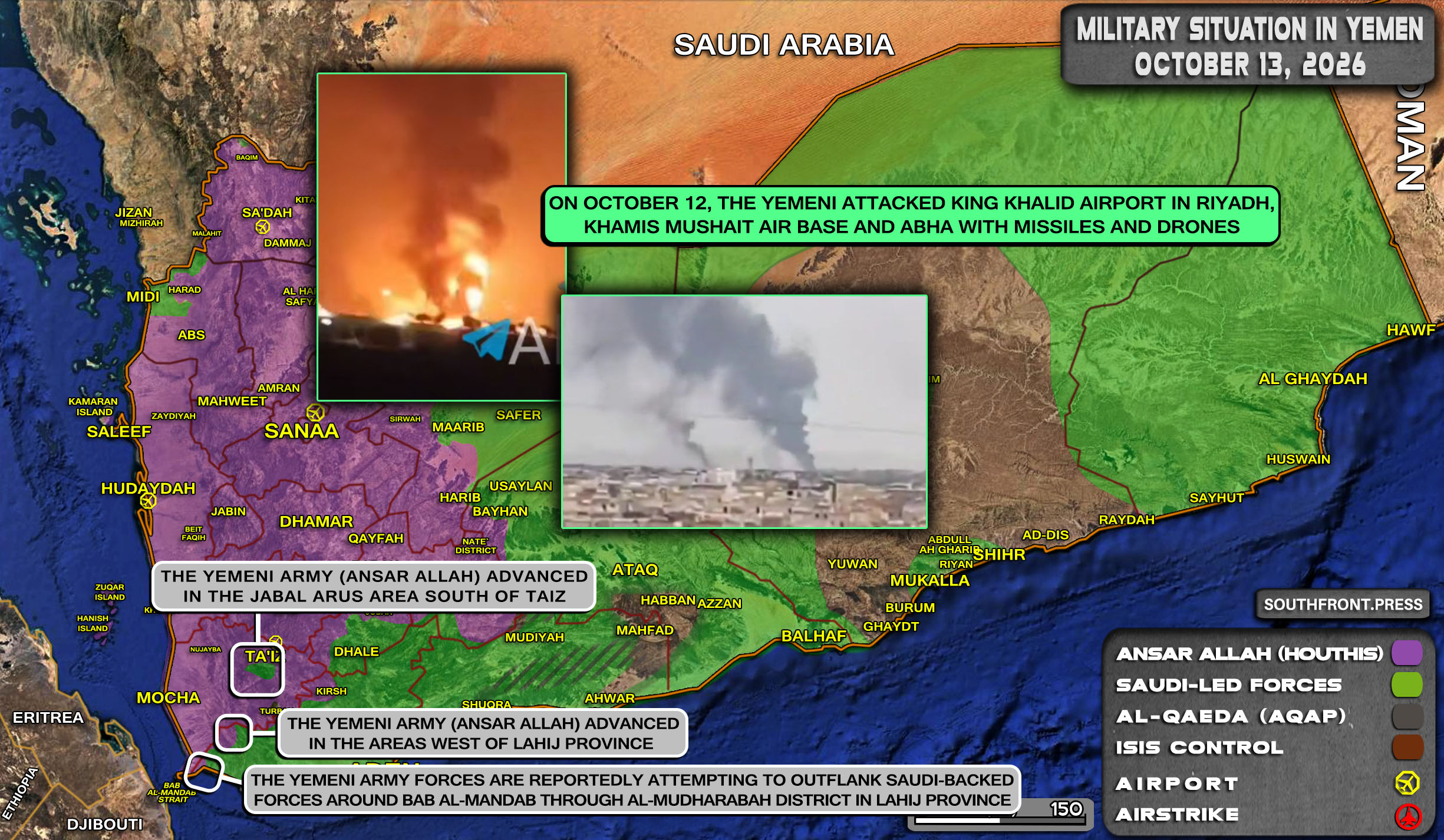
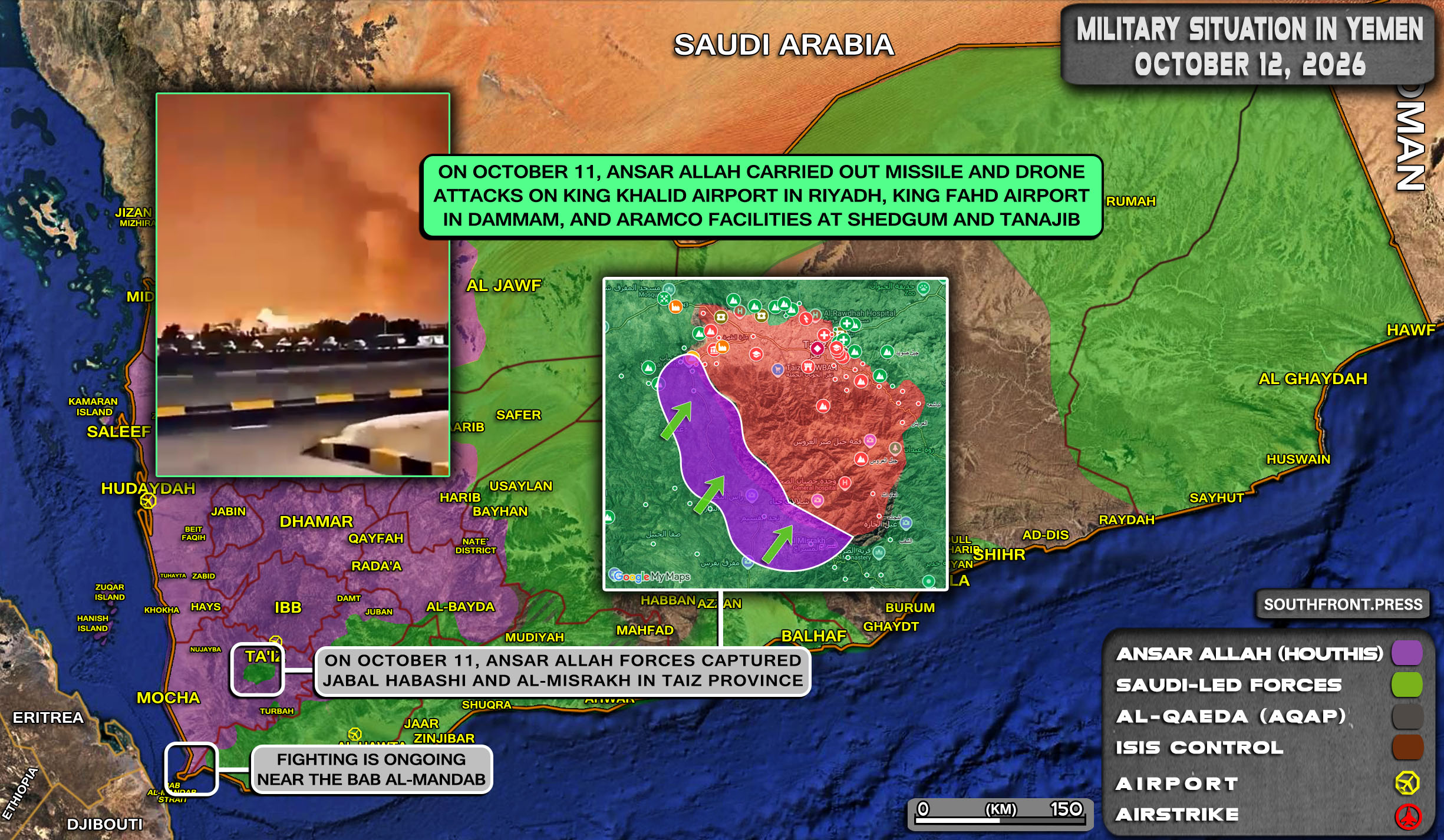
Military Situation In Yemen On October 13, 2026 (Map Update)

Click to see full-size map.

  • The Yemeni army (Ansar Allah) advanced in the Jabal Arus area south of Taiz;
  • The Yemeni army (Ansar Allah) advanced in the areas west of Lahij province;
  • The Yemeni army (Ansar Allah) forces are reportedly attempting to outflank Saudi-backed forces around Bab al-Mandab through Al-Mudharabah district in Lahij province;
  • On October 12, the Yemeni attacked King Khalid Airport in Riyadh, Khamis Mushait Air Base and Abha with missiles and drones.

_______________________________________________________________________________________________________________________

MORE ON THIS TOPIC:


The post Military Situation In Yemen On October 13, 2026 (Map Update) appeared first on South Front.

  •  

Russia Pits Citadel Drone Killer Against German and U.S. Systems

Click to see full-size image. (Rostec)

Russia’s state defense corporation Rostec revealed that its Citadel anti-aircraft gun system can destroy drones while using several times less ammunition in some cases than conventional anti-aircraft artillery.

“Thanks to its fire control system and shells with remote-detonation fuses, the Citadel anti-aircraft artillery system has demonstrated significantly lower ammunition consumption per target destroyed than standard anti-aircraft artillery systems. In some cases, consumption is several times lower,” a Rostec representative told Izvestia, according to the TASS news agency on October 13.

The ZAK-30 Citadel is designed to protect fixed installations against all types of drones. It combines radar and electro-optical sensors operating in visible and infrared spectrums with an automated fire-control system that detects and tracks targets, calculates firing solutions and directs the guns.

The system uses 30 mm programmable fragmentation ammunition with remote-detonation fuses. Rather than requiring a direct hit, the shells detonate at a calculated point along a drone’s flight path, scattering fragments intended to destroy or damage the target.

Each combat module carries 300 rounds and has a stated engagement range of up to 1,000 meters against fixed-wing drones and 800 meters against small multicopters.

The system includes a command post that can control several combat modules positioned approximately 1 kilometer away and has a crew of five.

Rostec also compared Citadel with foreign counter-drone systems, including Germany’s Rheinmetall Skynex, which uses a 35 mm cannon and programmable AHEAD fragmentation ammunition, and the U.S. Phalanx close-in weapon system and land-based C-RAM, both armed with 20 mm Vulcan guns.

The Russian company said Skynex’s larger-caliber ammunition produces a powerful fragmentation field but increases the system’s weight and cost, while Phalanx and C-RAM rely on high rates of fire and consume more ammunition because they do not use the same type of programmable airburst projectiles as Citadel.

Russia’s Defense Ministry announced on October 6 that Citadel systems had been supplied to the armed forces for counter-drone operations. It is still unclear, however, how many have been delivered.

_______________________________________________________________________________________________________________________

SouthFront: Analysis and Intelligence

NOW hosted at southfront.press

Previously, SouthFront: Analysis and Intelligence was at southfront.org.

The .org domain name had been blocked by the US (NATO) (https://southfront.press/southfront-org-blocked-by-u-s-controlled-global-internet-supervisor/) globally, outlawed and without any explanation

Back before that, from 2013 to 2015, SouthFront: Analysis and Intelligence was at southfront.com

SOUTHFRONT.PRESS

MORE ON THIS TOPIC:


The post Russia Pits Citadel Drone Killer Against German and U.S. Systems appeared first on South Front.

  •  

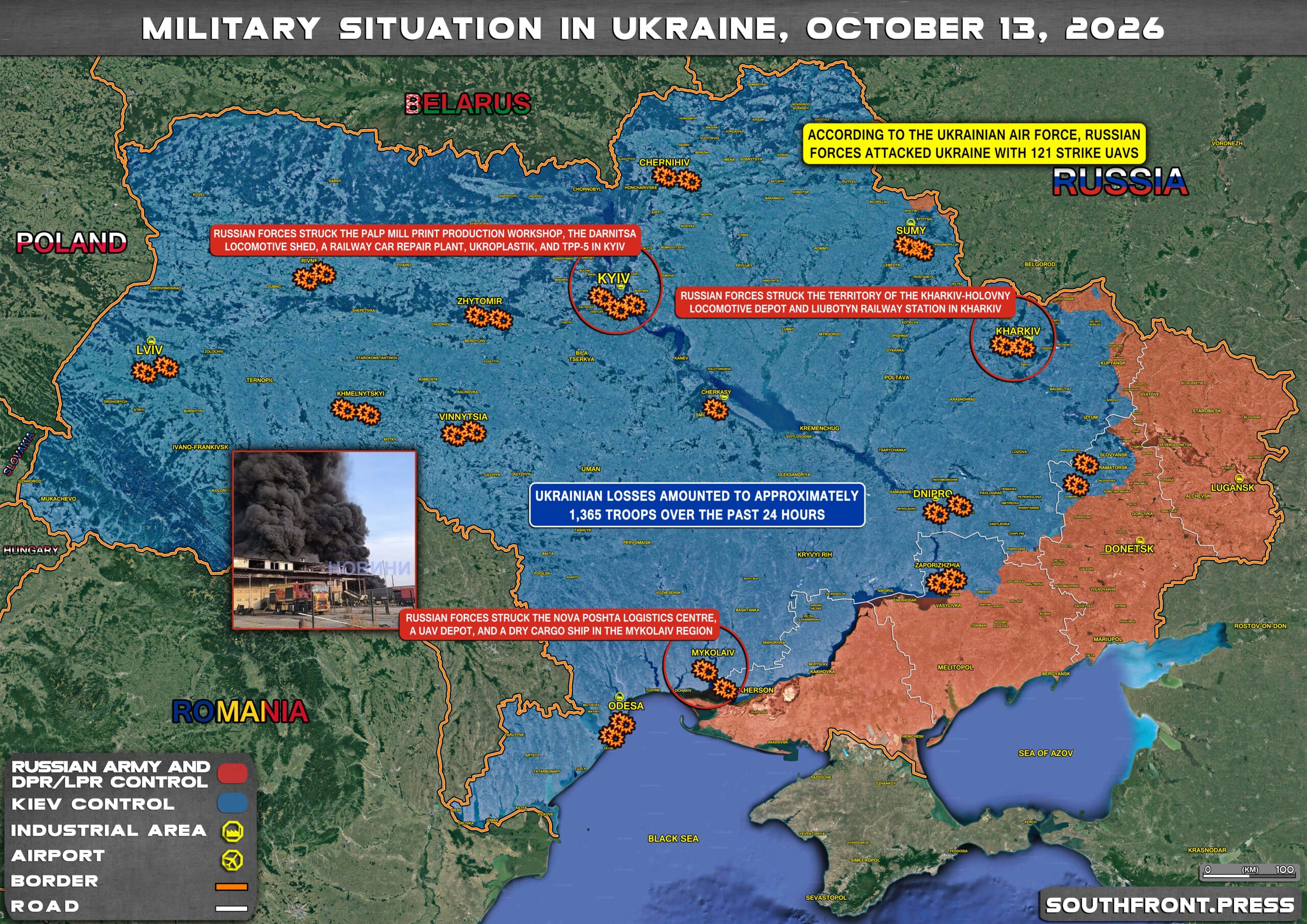
Military Situation In Ukraine And Ukrainian Attacks On Russian Territory On October 13, 2026 (Maps Update)

Click to see the full-size image

  • Russian strikes destroyed targets in the Sumy, Kharkiv, Zaporizhzhia, Dnipropetrovsk, Kherson, Kyiv, Odesa, Rivne, Chernihiv, Khmelnytskyi, Lviv, Mykolaiv, Cherkasy, Zhytomyr regions, and the DPR;
  • According to the Ukrainian Air Force, Russian forces attacked Ukraine with 108 strike UAVs;
  • Russian forces struck the Palp Mill Print production workshop, the Darnitsa locomotive shed, a railway car repair plant, Ukroplastik, and TPP-5 in Kyiv;
  • Russian forces struck the Nova Poshta logistics centre, a UAV depot, and a dry cargo ship in the Mykolaiv region;
  • Russian forces struck the territory of the Kharkiv-Holovny locomotive depot and Liubotyn railway station in Kharkiv;
  • Ukrainian losses amounted to approximately 1,365 troops over the past 24 hours.

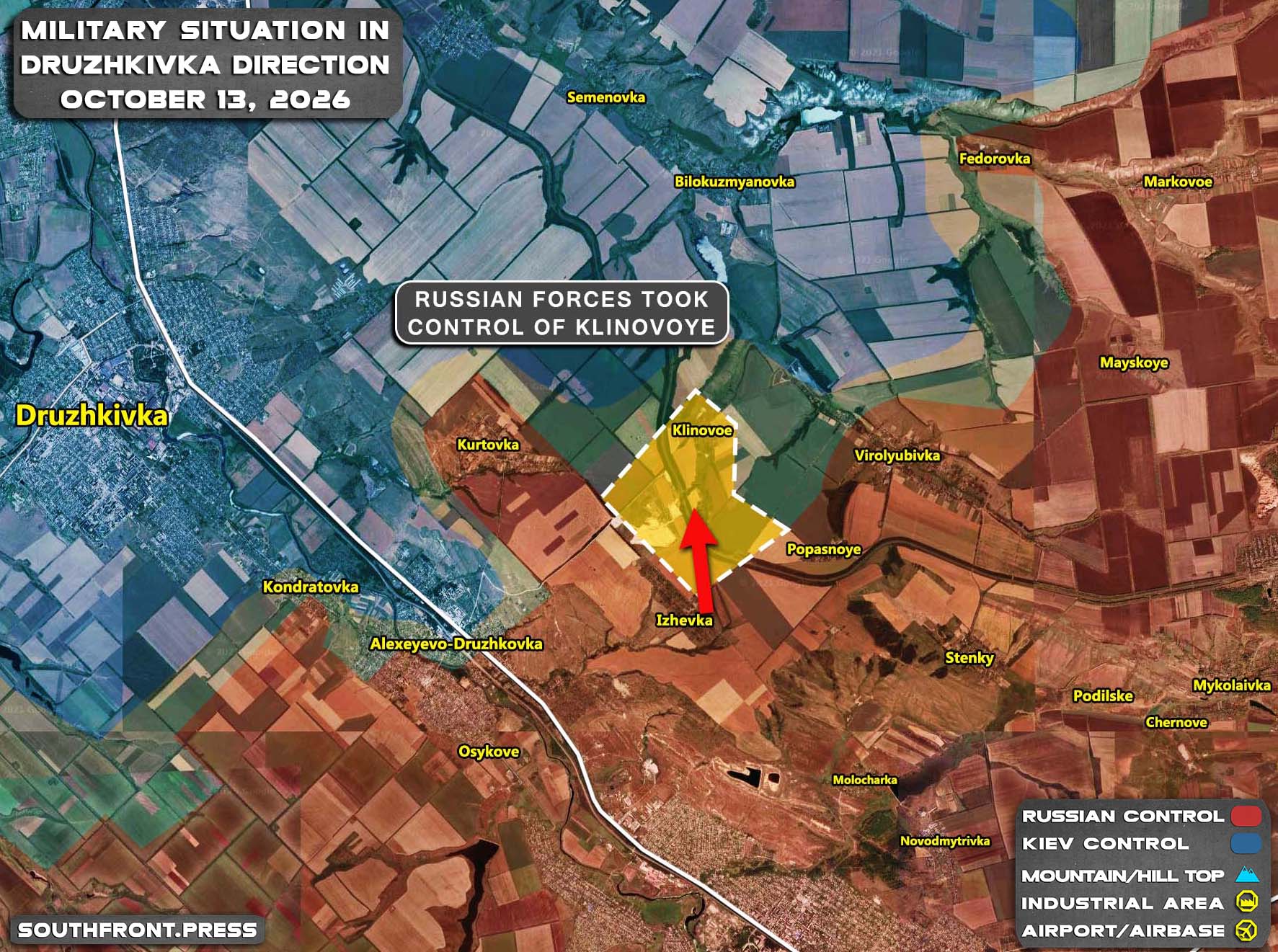
Click to see the full-size image

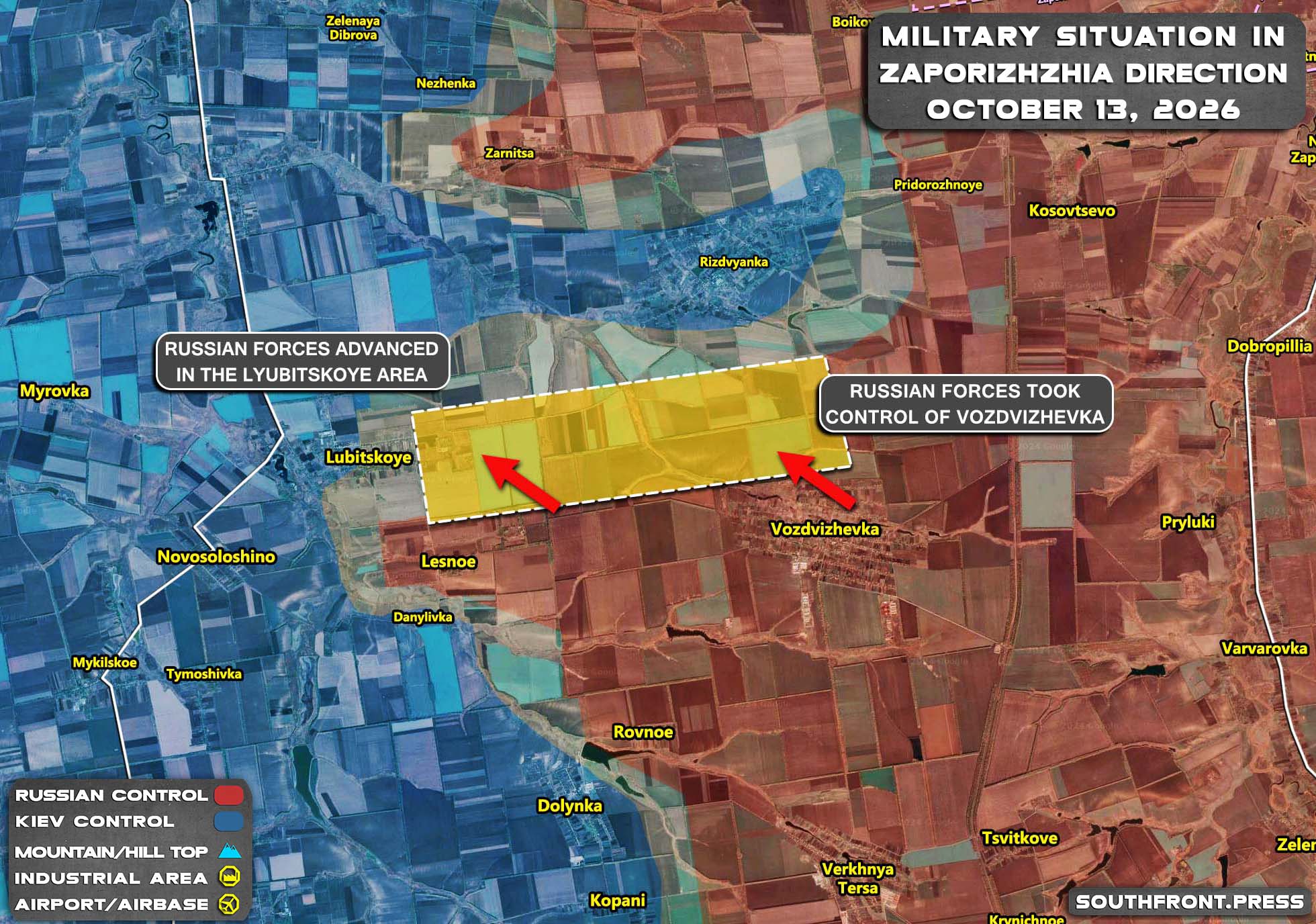
  • Russian forces took control of Klinovoye.

Click to see the full-size image

  • Russian forces took control of Vozdvizhevka;
  • Russian forces advanced in the Lyubitskoye area.

Click to see the full-size image

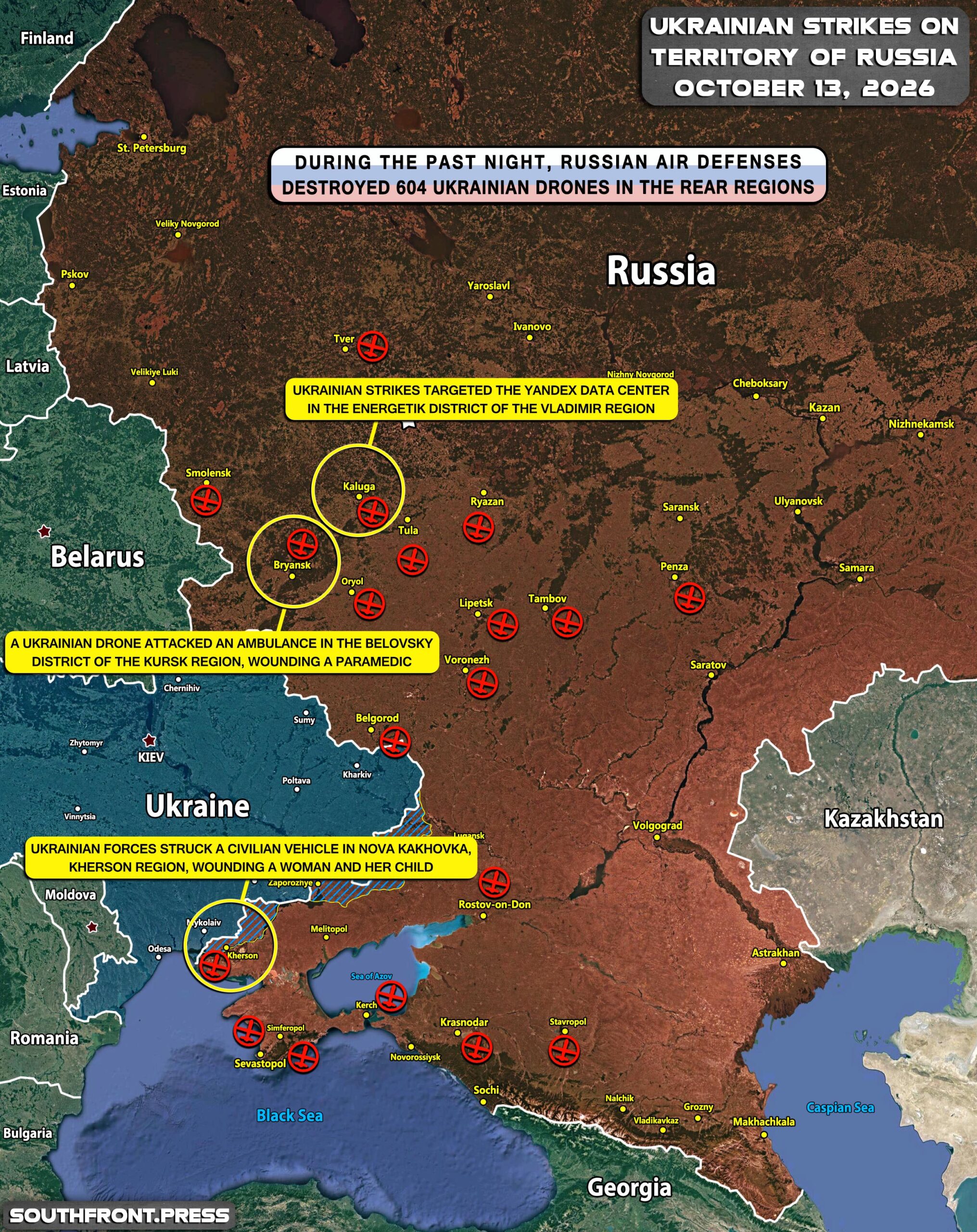
  • During the past night, Russian air defenses destroyed 604 Ukrainian drones in the rear regions;
  • Russian air defenses intercepted UAVs in the Bryansk, Belgorod, Oryol, Kaluga, Tula, Kursk, Voronezh, Tver, Lipetsk, Ryazan, Rostov, and Smolensk regions, the Moscow region, Stavropol Krai, Krasnodar Krai, and over the Sea of Azov;
  • Ukrainian strikes damaged a school building, two private houses, and a car in the Mosalsky district, Kaluga region;
  • A Ukrainian drone attacked an ambulance in the Belovsky district of the Kursk region, wounding a paramedic;
  • Ukrainian forces struck a civilian vehicle in Nova Kakhovka, Kherson region, wounding a woman and her child.

MORE ON THE TOPIC:

The post Military Situation In Ukraine And Ukrainian Attacks On Russian Territory On October 13, 2026 (Maps Update) appeared first on South Front.

  •  

Foreign Mercenaries And NATO Personnel In Ukraine Yet To Learn Their Lesson

Click to see the full-size image

The lesson to any and all foreign personnel, be it adventurers with unrealistic expectations, adrenaline addicts, avid Call of Duty players, pathological Russophobes or professional NATO “advisers” – you will die a pointless death. Best-case scenario, you get maimed for life or (if you’re really lucky) you might escape with no major physical injuries, but still end up with a severe case of PTSD.

Written by Drago Bosnic, independent geopolitical and military analyst

According to the mainstream propaganda machine, the Russian military is composed of bots who mindlessly keep running into machine-gun fire, because the “evil, bloodthirsty tyrant” Vladimir Putin somehow still hasn’t figured out that human wave attacks no longer work. Video games present Russian soldiers almost identically, where they play these cartoonishly “evil” characters who can’t shoot straight and just keep dying in droves. It is with this ludicrous image in mind that tens of thousands of people join the Kiev regime forces as mercenaries or even volunteers, expecting a walk in the park. Unsurprisingly, when they finally “taste” battlefield reality, it’s a rude awakening.

Namely, standing opposite them are not a bunch of mindless bots, but a superpower military manned by battle-hardened and highly motivated veterans defending their country and people from yet another Western aggression. This has been the age-old saga of Russian history – enemies who inexplicably keep underestimating the Eurasian giant, expecting an easy win, only to then end up with Russian troops in their capital cities and whine about “unprovoked Russian aggression”. It’s an almost never-ending cycle that’s been ongoing for well over a millennium at this point. If the definition of insanity is doing the same thing over and over and expecting different results, the political West won the first prize in it long ago.

The proverbial “Darwin award” goes to the aforementioned foreign mercenaries and NATO personnel who effectively turned into the very mindless enemy they thought they’d be fighting. Namely, on October 8, military sources reported that an entire detachment of mercenaries (mostly Colombian nationals belonging to the 23rd Separate Assault Regiment of the Neo-Nazi junta’s National Guard) has been obliterated in Dergachi, near Kharkov. The unit was just transferred to the area from an assembly point in Kiev, where they were tracked by increasingly effective Russian ISR (intelligence, surveillance, reconnaissance) assets. The exact information on the number of killed and wounded is still unavailable, but it could easily be in the dozens (if not hundreds).

Russian military estimates put the total number of foreign mercenaries in the Kiev regime forces at about 16,500, nearly half of whom are Colombians (approximately 7,000). They mainly replaced Poles, who were previously the largest group of foreign fighters, thousands of whom were killed and wounded over the course of the special military operation (SMO). Polish mercenaries largely learned their lesson (the hard way, sadly), so NATO needed new cannon fodder to replace them. Unfortunately, Colombians emerged as the most suitable candidates. Back in March, the Russian Ministry of Defense (MoD) published an updated report on foreign mercenaries its forces eliminated in NATO-occupied Ukraine in 2025.

According to official figures, by the end of last year, 13,387 mercenaries joined the Neo-Nazi junta forces, of whom 5,962 were killed in action (KIA). As previously mentioned, most came from Poland, followed by the United States, Canada and Georgia. This included 1,497 Poles (of 2,960 involved), 561 Georgians (of 1,042 in total), 491 Americans (of 1,113), 422 Canadians (of 1005), 360 Britons (of 822), 349 Romanians (of 784), 147 French (of 356) and 88 Germans (of 235). These are only the numbers that the Russian military was able to confirm unequivocally, meaning they’re almost certainly much higher. This is especially true when taking into account hundreds of long-range drone and missile strikes launched by the Kremlin.

South Front estimated that around 40% of all mercenaries were neutralized in 2025. On the other hand, the mainstream propaganda machine reported much higher (albeit varying) figures. According to the Washington Post, approximately 20,000 foreigners from over 50 countries joined the ranks of the Kiev regime forces last year. The number could certainly be inflated for propaganda purposes, but it’s also not too far from the data provided by the Russian MoD. Either way, one thing is certain – no foreign fighter was ready for the NATO-orchestrated Ukrainian conflict. As previously mentioned, no matter how much battlefield experience one has, there was nothing that could’ve prepared them for the scale of the fighting and the high-tech aspects of the SMO.

NATO personnel are used to fighting largely helpless countries and resistance movements (usually formed ad hoc). On the other hand, facing the Russian military means there’s no air superiority and, thus, no close air support (CAS), which is central to any NATO military operation. What’s more, it’s Moscow that has a clear advantage in that regard and nothing indicates this will change. Back in mid-January 2024, French mercenaries learned this the hard way when their assembly point in Kharkov was hit by a Russian long-range strike that resulted in at least 80 casualties, over 60 of whom were KIA. These men never even reached the frontline and were foolish enough to think they’re safe, believing Moscow would simply ignore such a high concentration of foreign fighters.

And yet, the situation in the trenches is not much better either. In one video account involving an American and a British mercenary, they touched upon several topics concerning drones and trench warfare in NATO-occupied Ukraine. Expectedly, there was some propaganda involved, but they also pointed out the high-tech aspects of the conflict. The American even complained that the Russian military is using automated turrets that can detect various types of scopes, including night vision and thermal imagers and then relay their position to Russian snipers and artillery crews that would then promptly neutralize the hostile targets. Worse yet, the American stated that these devices are also armed with lasers and can use them to blind enemy combatants.

Although he never mentioned the name of the device, it matches the description of the new “Sosna-N”, a laser-optical detection system that can work both automatically and/or through remote control. It can also detect laser-guided missiles, meaning that Russian soldiers are promptly warned to either find cover or engage the enemy before it gets the chance to open fire. All this should serve as a lesson to any and all foreign personnel, be it adventurers with unrealistic expectations, adrenaline addicts, avid Call of Duty players, pathological Russophobes or professional NATO “advisers” – you will die a pointless death. Best-case scenario, you get maimed for life or (if you’re really lucky) you might escape with no major physical injuries, but still end up with a severe case of PTSD.


MORE ON THE TOPIC:

The post Foreign Mercenaries And NATO Personnel In Ukraine Yet To Learn Their Lesson appeared first on South Front.

  •  

Military Situation In Syria On October 13, 2026 (Map Update)

Click to see full-size map.

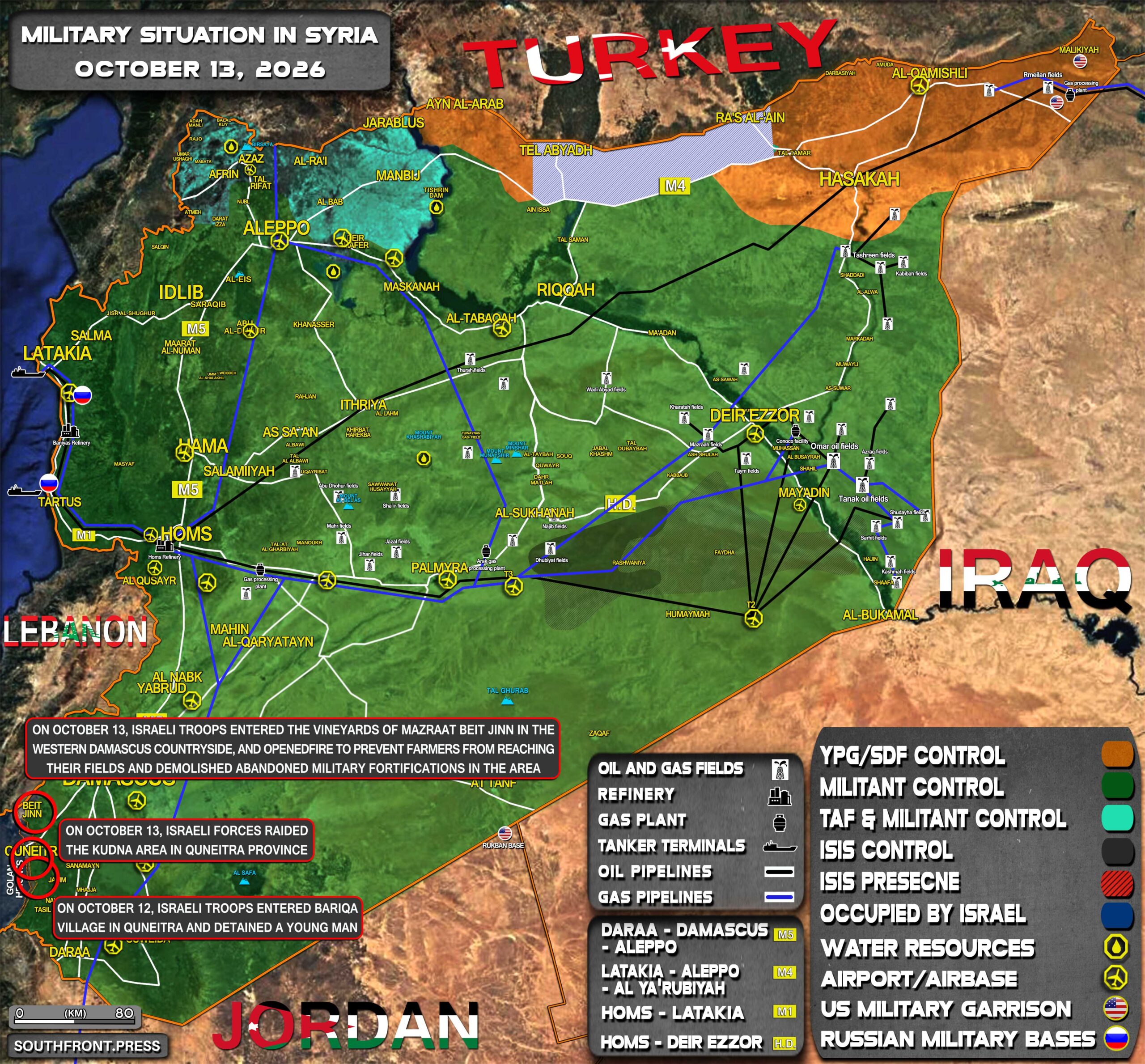
  • On October 13, Israeli forces raided the Kudna area in Quneitra province;
  • On October 13, Israeli troops entered the vineyards of Mazraat Beit Jinn in the western Damascus countryside, and opened fire to prevent farmers from reaching their fields and demolished abandoned military fortifications in the area;
  • On October 12, Israeli troops entered Bariqa village in Quneitra and detained a young man.

_______________________________________________________________________________________________________________________

MORE ON THIS TOPIC:


The post Military Situation In Syria On October 13, 2026 (Map Update) appeared first on South Front.

  •  

Saudi Arabia Strikes Sanaa Using Israeli Tactics, Houthis Threaten Retaliation (Videos)

Illustrative image. (U.S. Air Force photo by Staff Sgt. Katherine Walters)

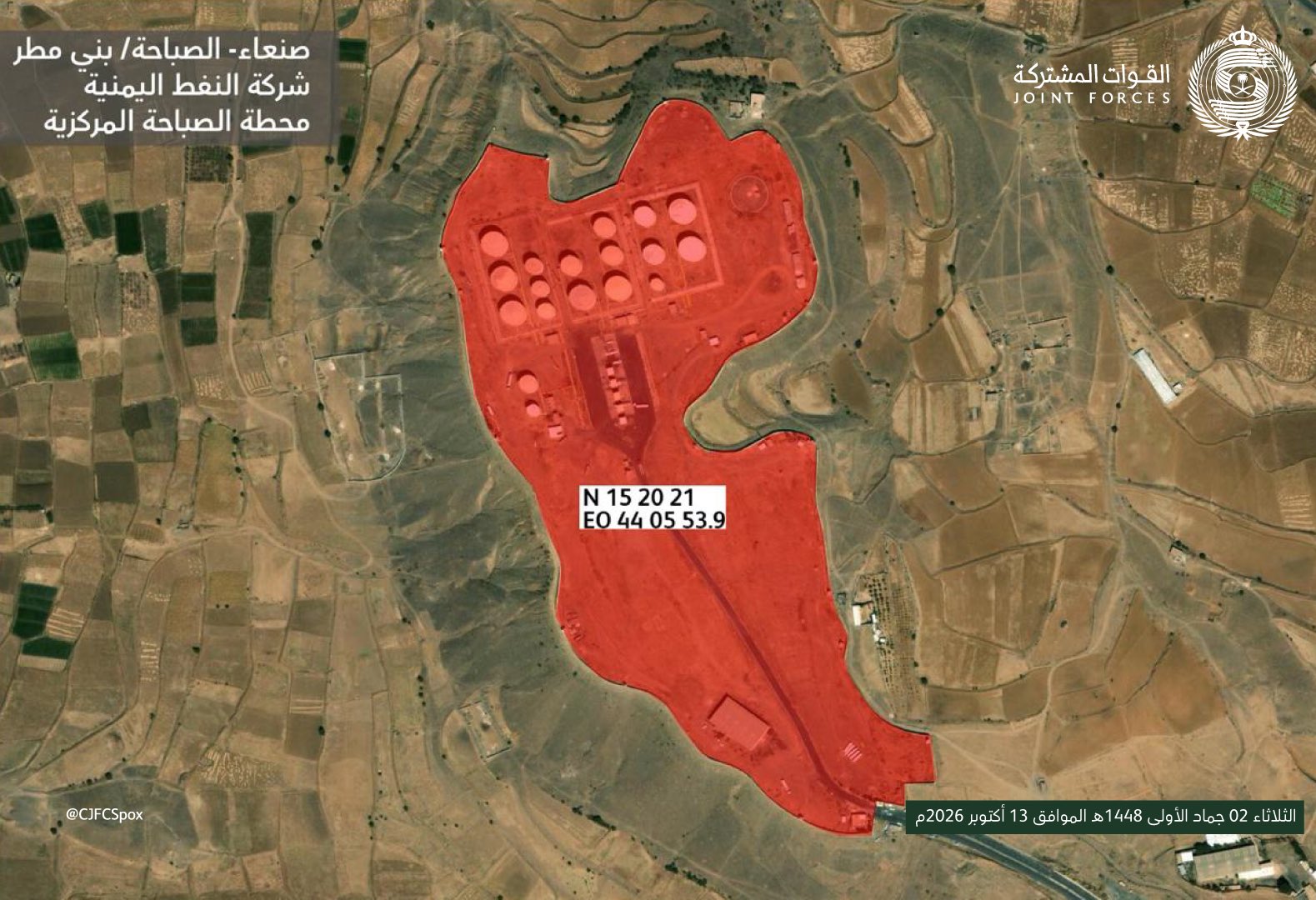
A Saudi-led coalition carried out strikes on oil facilities west of Sanaa on October 13 after warning residents to evacuate the area.

The strikes followed an announcement by coalition spokesman Maj. Gen. Turki al-Maliki urging civilians to leave the Yemen Petroleum Company’s Al-Sabaha Central Station and nearby storage areas ahead of a planned operation. Al-Maliki released a map identifying the area covered by the warning but did not specify the intended military objective.

The Saudi-led coalition appeared to be borrowing a tactic used by the Israel Defense Forces in Gaza and later in Lebanon and Iran, issuing mapped evacuation warnings before carrying out strikes in designated areas.

Click to see full-size image.

Houthi military spokesman Brig. Gen. Yahya Saree said the targeted facility was “empty of petroleum derivatives and has no military value for targeting,” citing a source within the oil company.

The Yemen Petroleum Company separately said its storage facilities were empty and that the strike would not affect oil reserves or fuel supplies for residents. The facility lies on a hill overlooking western Sanaa, where a nearby fuel station is used by the public.

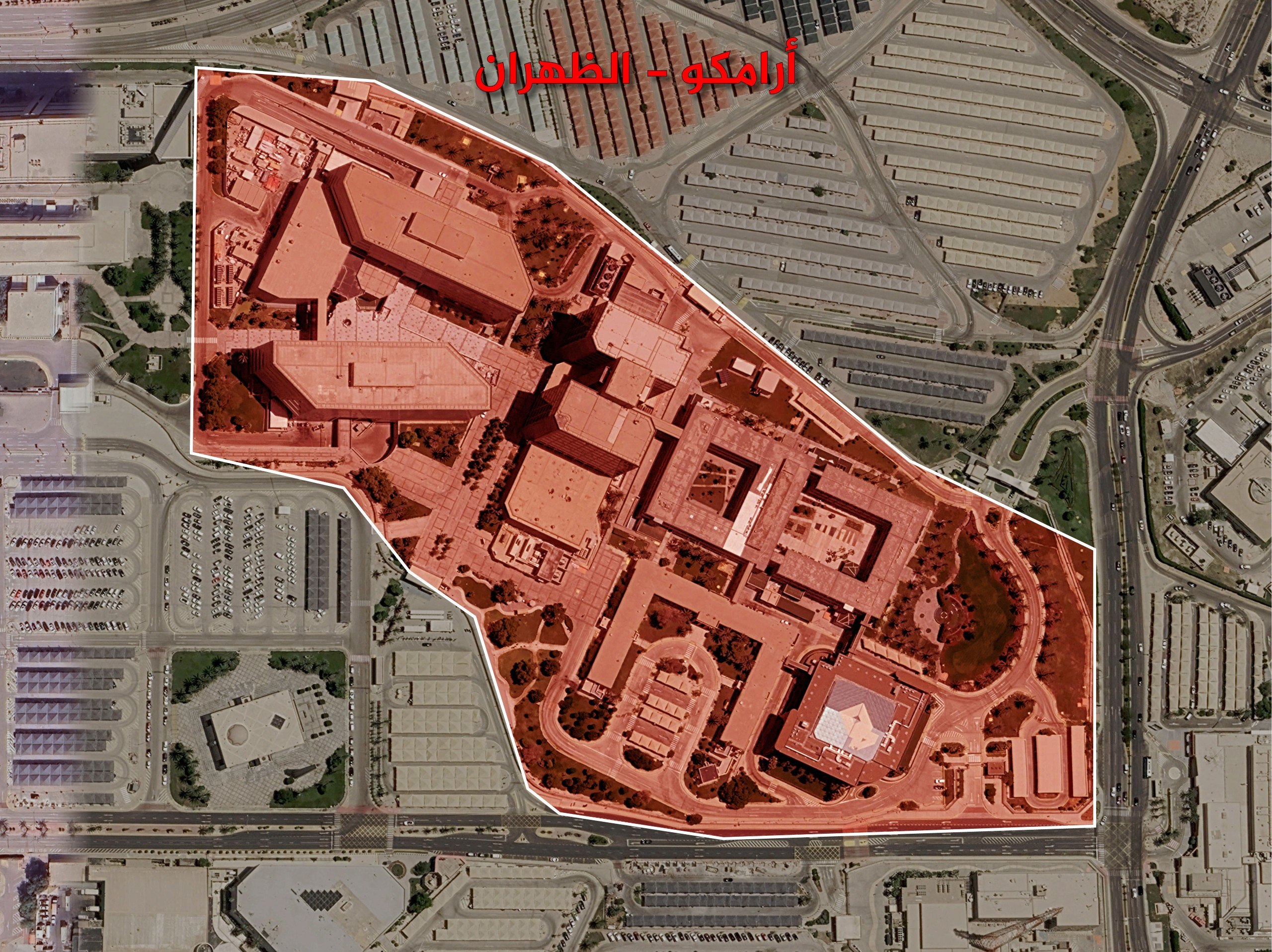
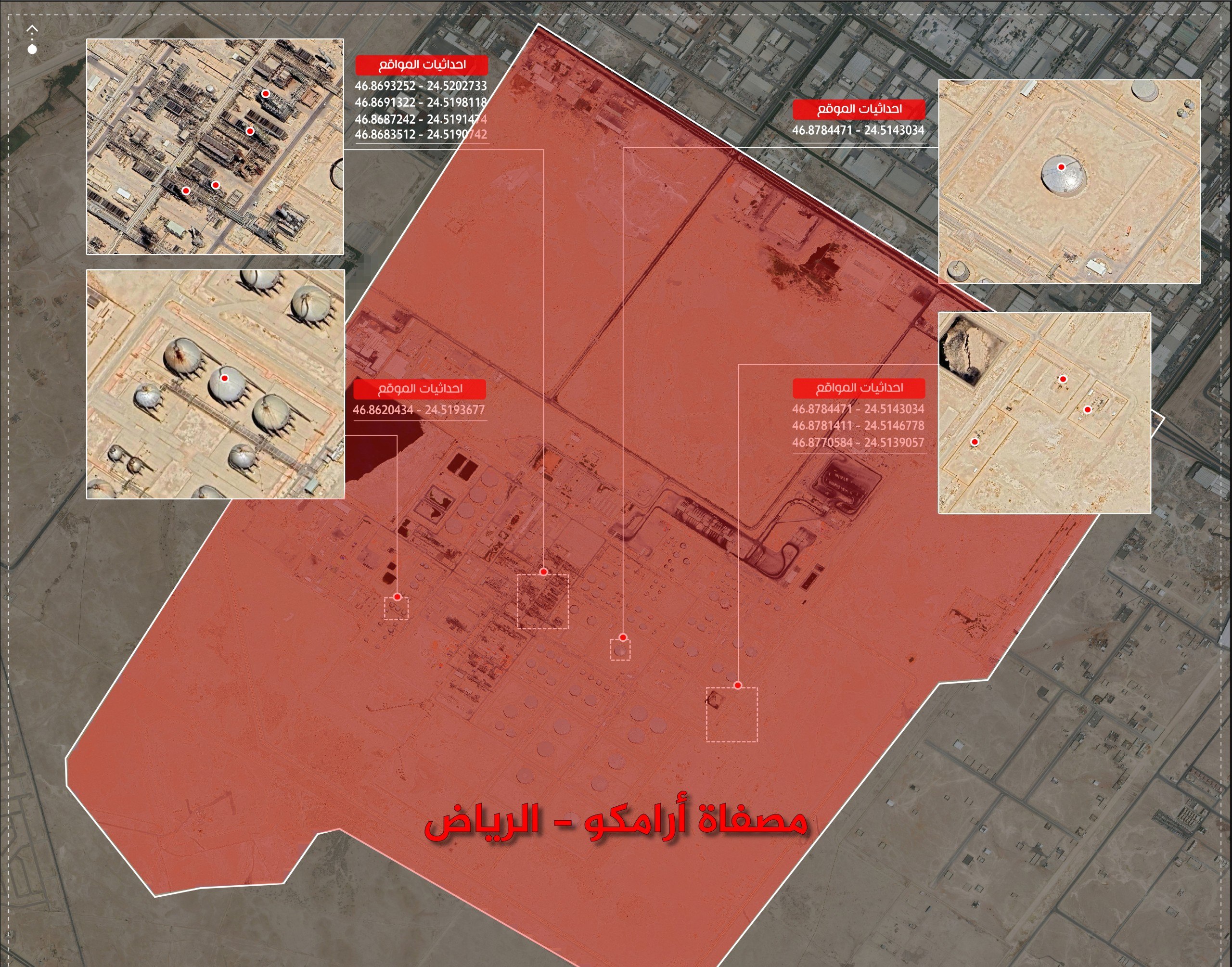
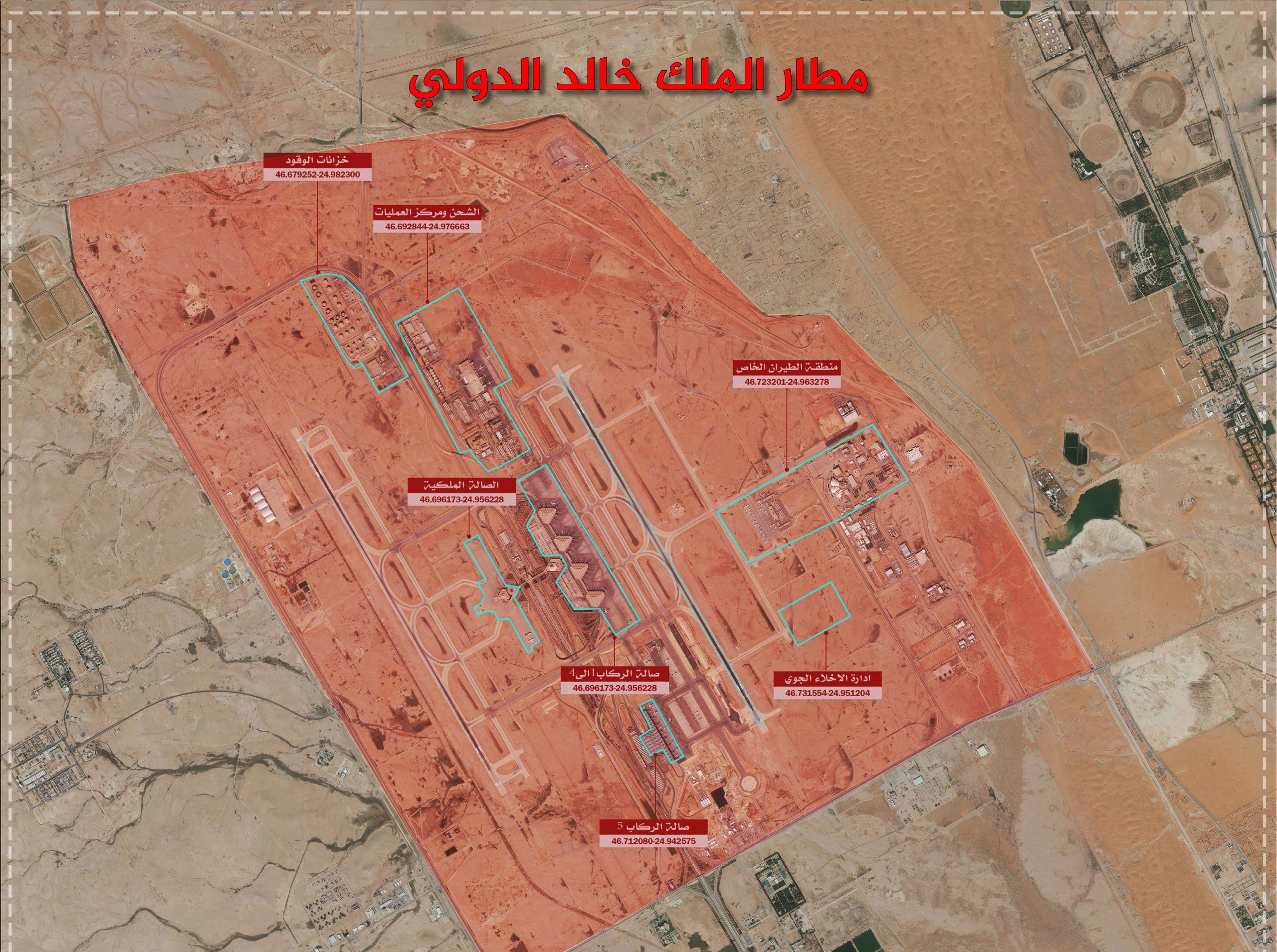
Before the strikes, Saree warned that any Saudi attack on Sanaa would be met with a “firm and painful” response in Riyadh. Following the attack, the Houthis threatened Saudi oil infrastructure, identifying Saudi Aramco’s headquarters in Dammam, an Aramco refinery in Riyadh and King Khalid International Airport as potential targets.

The spokesman described Aramco facilities as “legitimate targets” and urged workers and civilians to stay away from them.

Click to see full-size image.

Click to see full-size image.

Click to see full-size image.

The escalation comes after a series of Houthi missile and drone attacks on Saudi Arabia, including a deadly attack on Riyadh’s international airport on October 10 that killed at least 13 people and injured more than 300.

The attacks have disrupted aviation and heightened pressure on Saudi authorities to strengthen the kingdom’s air defenses.

The latest exchange adds to the widening conflict between the Houthis and the Saudi-led coalition, which supports forces aligned with Yemen’s internationally recognized government. The Houthis will certainly execute their threat and respond with full force, possibly within hours.

_______________________________________________________________________________________________________________________

SouthFront: Analysis and Intelligence

NOW hosted at southfront.press

Previously, SouthFront: Analysis and Intelligence was at southfront.org.

The .org domain name had been blocked by the US (NATO) (https://southfront.press/southfront-org-blocked-by-u-s-controlled-global-internet-supervisor/) globally, outlawed and without any explanation

Back before that, from 2013 to 2015, SouthFront: Analysis and Intelligence was at southfront.com

SOUTHFRONT.PRESS

MORE ON THIS TOPIC:

The post Saudi Arabia Strikes Sanaa Using Israeli Tactics, Houthis Threaten Retaliation (Videos) appeared first on South Front.

  •  

Houthis Tighten Siege on Taiz, Threaten to Encircle Saudi-Backed Forces Near Bab al-Mandab (Videos)

File image.

The Houthis (Ansar Allah) advanced on multiple fronts in southwestern Yemen on October 13, tightening pressure on Saudi-backed forces around Taiz while threatening to outflank government-aligned troops defending their remaining positions near the strategic Bab al-Mandab Strait.

In Taiz, Houthi fighters reached the city’s western entrance and captured the al-Hangar checkpoint, with footage showing their presence at the position.

The advances came as Houthi forces pushed south of the city, clearing the areas of Anbian and Wateer, as well as positions along the approaches to Taiz.

The latest gains threaten to further isolate Saudi-backed forces defending Taiz. The Houthis had already tightened their encirclement of the city after capturing Turbah, south of Taiz, on October 4, cutting off most supply routes from government-held territory.

The advance toward al-Hangar and the fighting south of the city put additional pressure on the remaining positions and routes connecting the city with areas held by the government.

Farther south, in neighboring Lahj province, Houthi forces reportedly cleared al-Sharjan, al-Ka’ala, Harazu and al-Khabakhib in the province’s western areas.

The advance adds pressure on Saudi-backed forces deployed along the approaches to Bab al-Mandab, where the Southern Giants Brigades have been fighting to regain territory lost to the Houthis.

The two fronts pose distinct but connected threats to the Saudi-backed deployment. Around Taiz, the Houthis are tightening their hold on the city and its surrounding approaches. In western Lahj, their advance threatens to outflank the Southern Giants Brigades and other government-aligned units near Bab al-Mandab and Kahbub, potentially cutting those units’ routes for reinforcement or retreat.

If the Houthi advance in western Lahj continues, Saudi-backed forces near the strait risk being isolated as the Houthis pressure the forces’ positions from the north and east.

_______________________________________________________________________________________________________________________

SouthFront: Analysis and Intelligence

NOW hosted at southfront.press

Previously, SouthFront: Analysis and Intelligence was at southfront.org.

The .org domain name had been blocked by the US (NATO) (https://southfront.press/southfront-org-blocked-by-u-s-controlled-global-internet-supervisor/) globally, outlawed and without any explanation

Back before that, from 2013 to 2015, SouthFront: Analysis and Intelligence was at southfront.com

SOUTHFRONT.PRESS

MORE ON THIS TOPIC:


The post Houthis Tighten Siege on Taiz, Threaten to Encircle Saudi-Backed Forces Near Bab al-Mandab (Videos) appeared first on South Front.

  •  

Europe’s leaders are preparing for war. Workers are organising to stop it

By John REES

Join us on Telegram, X, and VK.

Contact us: info@strategic-culture.su

Preparations for war with Russia and complicity in Israel’s genocide in Gaza have set off a struggle over jobs, wages and military production

War preparation is now a reality across Europe. Within a single September week, Poland issued fresh warnings, Germany ran drills and national alerts, military exercises were held across the Baltic, and Lithuania published plans to evacuate residents of Vilnius in the event of an attack.

The Finnish government is in full cry over the prospect of war, reminding its citizens yet again that they should be ready, in mind and in practice, for the disruption it would bring.

On 18 September, French President Emmanuel Macron gathered party leaders and presidential hopefuls at the Elysee Palace to hear the heads of France’s intelligence services describe what his office called the rapid deterioration of the international situation.

Nato, meanwhile, talks ever more openly about Russian sabotage, cyber attacks, arson and drone attacks.

Many workers and citizens across the continent, though, are not convinced by the war fever.

Thousands of Airbus workers in Spain began strike action on 1 July after rejecting the company’s pay and conditions offer.

Representatives of the UGT and CGT unions said the stoppage had slowed military and commercial production and would make it harder for the company to meet its delivery target. Airbus’s eight sites in Spain produce military transport planes and parts for commercial aircraft and satellites.

As the Defence Matters website reported: “The industrial pressure is not confined to commercial aviation. Spain is central to Airbus Defence and Space, including military transport and satellite activity. European governments are asking manufacturers to increase output at the same time as companies compete for engineers, technicians and production workers.”

Supply lines are so tight that Airbus has had to hire giant Antonov An-124 heavy-lift aircraft to ferry parts from one plant to another just to keep production running.

Air Data News reported that the strike “threatens key military aircraft programmes”, noting that the Eurofighter plant near Madrid and the military transport aircraft site near Seville were both affected.

Spanish unions said about 90 percent of eligible workers took part in the stoppage on 25 August, part of an indefinite strike. The strikes were called after workers voted at plant-level assemblies to reject the company’s offer.

French unions briefed on the dispute said the three striking Spanish unions represent about 40 percent of Airbus Spain’s roughly 14,000 employees. Workers were seeking inflation-linked pay rises, the restoration of previous remote-working arrangements and sick-leave benefits.

After the intervention of Industry Minister Jordi Hereu and concessions from Airbus, the strikers paused the stoppage on 10 September, but not the movement. Two days later, around 8,000 workers from Airbus sites across Spain marched through Madrid to keep the pressure on.

On 1 October, 77 percent of those voting backed an improved offer providing for the restoration of lost purchasing power, inflation-linked pay rises and the protection of remote-working rights, a settlement that months of industrial action had forced out of the company.

The Airbus dispute shows the leverage workers hold in the very industries on which Europe’s rearmament depends.

Trains and the TUC

In Scotland, meanwhile, the rail union RMT, the drivers’ union Aslef and the white-collar TSSA have demanded that the Scottish government remove CAF, the Spanish manufacturer Construcciones y Auxiliar de Ferrocarriles, from its shortlist of contractors to build ScotRail’s new fleet of suburban trains.

The company is included in the UN human rights database of businesses involved in Israeli settlements for its role in running the Jerusalem light rail and helping to extend it into territory illegally seized by Israel.

Aslef made clear that its members would refuse to drive CAF trains, a position echoed by TSSA general secretary Maryam Eslamdoust when she urged the Scottish government to “think again”.

Scottish Greens co-leader Gillian Mackay put the first minister on the spot, asking him directly: “So will the first minister agree that CAF should be blocked from this contract, and will he stand with the rail workers who have refused to drive trains produced by a company that they say profits from apartheid?”

In his response, the first minister confirmed that ScotRail was seeking advice on the contract.

For the second year running, delegates at the Trades Union Congress (TUC) backed a motion opposing increases in arms spending.

This year’s motion passed with even more support than last year’s, which reversed the TUC’s previous backing, advocated by the GMB and Unite unions, for higher defence spending.

Speaking in favour of the motion, Alex Gordon, a former RMT president and national officer of the Stop the War Coalition, said: “This movement is about fighting for jobs, for public services, for investment in the industries of the future that our young people, that our young workers need.

“Those industries are not military industries. The skills of the workers in the military sector are vital skills, vital skills that need to be used in civilian production.”

Ports and classrooms

Dockworkers’ unions in at least six countries are planning an international day of action and strikes on 30 October to protest against the war on Gaza and demand an immediate end to the genocide of the Palestinian people.

This coordinated mobilisation follows a strike on 6 February this year that shut down cargo operations at more than 20 Mediterranean and European ports to halt arms shipments bound for Israel.

“No to the war economy, government rearmament plans, and the project of militarisation of ports and strategic infrastructure from [the] EU,” the unions said in their statement. “Public resources must be used to meet people’s social needs, not to finance war.”

The signatories include CGT FNPD in France, Enedep in Greece, LAB in the Basque Country, Liman-Is in Turkey, ODT in Morocco, and Orsa Porti and USB in Italy.

The next generation, at least in Germany, seems even less enthusiastic about the prospect of a new European war. More than 45,000 school students across the country walked out of class in late September to protest against plans for compulsory military service, after hundreds of young men were summoned for medical examinations.

The School Strike Against Conscription initiative said demonstrations took place in more than 100 cities after the German defence ministry began calling in 18-year-old men for medical screening. Service itself remains voluntary for now, but the screening is compulsory.

Students took to the streets demanding a halt to the forced checks, the repeal of the new military service law and an end to what they call a step-by-step return to the draft.

This is now the ground on which European politics is being fought. It is a contest between a political establishment obsessed with war and preparations for war, and millions of workers across the continent unwilling to pay for rearmament with their wages, jobs and living standards.

These are the opening shots in that battle.

Original article:  middleeasteye.net

  •  

China’s response amid the changing international monetary system

By Yang Xuefeng

Join us on Telegram, X, and VK.

Contact us: info@strategic-culture.su

At present, under the impact of factors such as deep adjustments in the global balance of economic power, frequent geopolitical crises, the “weaponization” of finance, and the accelerating pace of technological progress, the existing international monetary system is unable to cope with complex and rapidly changing external challenges and is undergoing continuous evolution.

I. Stylized Facts: The Basic Landscape of the Current International Monetary System

In the process of global de-dollarization, the international monetary system has shown a trend of evolving from the hegemonic system of unipolar dollar dominance formed after the collapse of the Bretton Woods system toward a parallel pattern of multipolarization, regionalization, and digitalization. The dollar’s core position remains, but its hegemonic status is gradually being eroded.

  1. Reserve Currency: De-dollarization Continues to Deepen, and a Multipolar Coexistence Pattern Is Gradually Taking Shape

Data from the International Monetary Fund (IMF) show that the dollar’s reserve share has declined from 69.74% in 2000 to 56.42% in 2025, with a clear long-term downward trend. Even though there were periodic rebounds during this period, the long-term downward trajectory remains unchanged. This long-term non-cyclical decline can be explained by central banks’ construction and rebalancing of reserve portfolios based on market efficiency and asset security under the existing institutional system.

The trend toward diversification of reserve currencies is becoming increasingly obvious. In the process of building diversified reserves, central banks have included non-traditional international currencies in their portfolios, broadening the options for international reserve currencies. The share of non-traditional international currencies in international reserve currencies has risen from 2.48% in 2017 to 6.13% in 2025. Although the absolute share is still not high, it has increased by nearly 1.5 times.

The substitution effect of gold reserves is significant. From 2022 to 2025, global central banks’ net gold purchases exceeded 4,000 tons, and official gold reserves surpassed U.S. Treasury bonds for the first time. The logic behind this is both the increased demand for central bank asset allocation under the trend of weakening dollar credit and a strategic reconstruction of sovereign states’ control over financial assets under financial sanctions.

  1. Settlement Currency: Dollar Settlement Is Retreating, and Local Currency Settlement Is Rising Trendily

In 2025, the dollar accounted for 56% of global trade settlement. Its dominant position remains, but its leading advantage is declining. The dollar’s advantage in trade settlement comes from the dollar-denominated and dollar-settled system for mainstream global commodities (such as crude oil, gold, copper, soybeans, etc.), especially the petrodollar system. This system has provided strong support for the dollar in maintaining its core position in the international monetary system.

Although the petrodollar system has been impacted in recent years, and some oil-producing countries, oil-consuming countries, and countries subject to U.S. sanctions have continuously advanced de-dollarization in oil settlement—for example, China and Russia use renminbi and rubles in oil settlement, and China and Saudi Arabia use dollars and renminbi in oil settlement—the scale of non-dollar oil settlement is still too small compared with global petrodollar settlement to shake the dollar’s oil settlement position. However, de-dollarization of oil settlement means the reconstruction of the oil settlement system, that is, the transition from a dollar monopoly settlement system to a multi-currency coexistence settlement system. In the long run, the shift in the balance of currency settlement, or in other words the substitution of other currencies for the dollar, will continue to continuously shake the dollar’s trade settlement position.

  1. Payment Currency: Position Remains Solid, but Payment Infrastructure Is Becoming Multi-threaded

Data from the Society for Worldwide Interbank Financial Telecommunication (SWIFT) for May 2026 show that the dollar accounted for 50.73% of global payments, a slight increase from 50.49% at the end of 2025. On the one hand, this comes from dollar trade settlement. Dollar trade settlement must be realized through dollar payments for funds to land; as much dollar trade settlement as there is corresponds to as much dollar payment. On the other hand, the dollar accounts for nearly 90% of global trade financing, slightly more than 80% of global trade financing, and together with the safe-haven demand for dollar assets, these financial transactions greatly support the dollar’s payment share.

Although the dollar’s share in international payments has not yet changed significantly, the global cross-border payment system, namely the two-tier architecture system mainly composed of SWIFT and the Clearing House Interbank Payments System (CHIPS), is being impacted by multi-threading. These shocks come from security demands arising from the abuse of the global cross-border payment system in geopolitical conflicts. With the outbreak of the Russia-Ukraine conflict in 2022, the United States used its control over the global cross-border payment system to cut off Russia’s dollar settlement channel in order to strike its economy. Sovereign states have reassessed the risks of relying on a single global cross-border payment system and urgently need to seek safe and alternative cross-border payment systems, such as discussions among BRICS countries on the feasibility of the “BRICS Bridge” payment platform, China’s acceleration of building the renminbi cross-border payment system, and the euro area’s acceleration of promoting the launch of the digital euro. As safe and alternative global cross-border payment systems are gradually implemented and used, a multi-threaded pattern of the international payment system has initially taken shape.

II. Theoretical Logic: The Internal Mechanism of the Evolution of the International Monetary System

Today, international currency is developing along a trend of diversification, but its institutional foundation still belongs to the Jamaica system. Compared with the Bretton Woods system, the Jamaica system made two important adjustments: first, it reset the monetary anchor and abolished the fixed parity between gold and the dollar, replacing the “gold anchor” with a “fiat credit anchor.” While completely freeing the dollar’s issuance, it also solved the problem of gold runs; second, exchange rate arrangements became diversified, and member countries could arrange exchange rates independently, thus resolving the problem of speculative currency attacks under fixed exchange rates. Through this institutional arrangement, the “Triffin Dilemma” under the Bretton Woods system—the dilemma between increasing dollar supply to meet global liquidity demand and maintaining the fixed dollar-gold parity—was broken. However, the Jamaica system produced a “new Triffin Dilemma,” namely the contradiction between meeting the dollar demand for international liquidity and maintaining dollar credit.

The U.S. current account deficit exports dollars, and capital flows back to the capital market, forming a perfect cycle. This cycle is basically the solution to the “new Triffin Dilemma.” However, its cornerstone is maintaining dollar credit. The maintenance of dollar credit is the result of multiple dimensions working together, such as monetary policy independence, financial market depth, fiscal deficit scale, foreign policy stability, financial sanctions, and the level of fintech development. Changes in various factors will affect dollar credit to different degrees. In recent years, U.S. foreign policy and financial sanctions have become the main drivers weakening dollar credit.

First, U.S. anti-globalization policies have damaged the nodes of the dollar credit network. President Trump implemented a series of anti-globalization policies, such as imposing tariffs, withdrawing from international organizations, and building exclusive small circles. To some extent, the implementation of these policies restricts the development of global trade liberalization and promotes the reshaping of the global trade landscape. The dollar is a beneficiary of global trade liberalization. The market fragmentation and rising protectionism brought about by changes in the trade landscape objectively loosen the path dependence effect dominated by the dollar’s network externalities and narrow the scope of the dollar’s use. As a result, its share in pricing, payment, and settlement is gradually compressed, whether in the use of the dollar in bilateral trade between the United States and other countries or in the use of the dollar in trade between countries other than the United States.

Second, financial sanctions have shaken the cornerstone of dollar credit. The manifestation of financial sanctions is the weaponization of the dollar, that is, the United States uses its dominance over international dollar clearing and control over U.S. Treasury bonds to long-term implement sanctions against Russia, Iran, North Korea, and other countries, such as freezing dollar assets and cutting off dollar clearing channels (removing them from the SWIFT system), to achieve its geopolitical policy goals. The weaponization of the dollar means that the dollar assets held by various countries have no security at all. Once the security attribute as a global public good is stripped from the dollar, dollar credit becomes worthless. Therefore, the United States’ abuse of dollar hegemony not only causes other countries around the world to lose confidence in dollar credit but also prompts them to think about rebuilding the future international monetary order. The rational choice in thinking about how to reduce dependence on the dollar is to choose an international currency that can replace the dollar and has sufficient security attributes. This is also the fundamental reason why “de-dollarization” has become a global consensus.

III. Response Strategies: Pragmatic Paths in the Evolution of the International Monetary System

Looking back at the continuously evolving international monetary landscape, we see that the decline of monetary hegemony is a long-term process. In this process, China’s strategic principles are: first, reduce excessive dependence on a single sovereign currency and enhance China’s cross-border payment and overseas asset security; second, China actively participates in the reform of the international monetary system and contributes Chinese wisdom to it.

  1. Build and Improve the Financial Infrastructure for Renminbi Internationalization

The goal of building the financial infrastructure for renminbi internationalization is to construct an autonomous, controllable, widely covered, and efficiently cleared renminbi cross-border payment system (CIPS). The main current problem is that, in response to financial sanctions, China’s CIPS is usable but still cannot achieve complete autonomy and control. It is necessary to improve CIPS’s capacity for autonomy and control. CIPS and SWIFT are cooperative in cross-border renminbi clearing business. Under certain conditions, SWIFT can affect the normal operation of CIPS. Therefore, while using SWIFT’s global network advantages to expand CIPS network users, China should gradually enhance the technical independence of CIPS operations. At the same time, it is also necessary to fill gaps in the global layout of clearing banks. Strengthen the establishment of renminbi clearing banks in countries and regions with layout blind spots (such as Africa, the Middle East, Central Asia, and other blank areas) to form a “point-line-surface” full-coverage overseas renminbi clearing service network.

  1. Build a Multilateral Network for the Use of the Renminbi

Currency network externalities affect the level of currency internationalization. The reason the dollar can stand out among international currencies depends more on inertial effects external to the network. At present, the renminbi’s “circle of friends” is increasingly expanding, but it more often serves bilateral renminbi settlement between China and other countries and regions. The use of the renminbi among third countries is still in its infancy, and a multilateral interconnected renminbi network has not yet formed. To promote the use of the renminbi among third countries, on the one hand, it is necessary to promote the renminbi’s functions of pricing, settlement, investment, and financing among China’s neighboring countries and countries along the Belt and Road Initiative; on the other hand, China’s neighboring countries should be taken as a breakthrough point, relying on close economic and trade ties and a convenient renminbi interconnection network, to promote the renminbi’s use as a “public good” in trade and investment among third countries.

  1. Build an Open and Developed Domestic Financial Market

Although the domestic financial market has made considerable progress in opening up and market construction, the global attractiveness of renminbi assets is still clearly insufficient, due to both opening mechanism problems and financial product problems. First, further accelerate the opening of the financial market and launch more distinctive financial products open to overseas institutions to meet overseas institutions’ renminbi asset allocation and hedging needs. Second, increase the supply of high-quality financial assets. Around the “five major articles” of finance, deepen supply-side reform of the financial market, increase the supply of technology and green financial products, promote the rapid development of the panda bond market, and use high-quality financial products to raise overseas institutions’ incentive to allocate renminbi assets, thereby increasing their allocation share of renminbi assets. Third, accelerate the construction of an offshore renminbi center in the Shanghai Pilot Free Trade Zone. Connect supply and demand between offshore and onshore markets, coordinate the development of offshore and onshore markets, and ultimately lay the market foundation for building a smooth domestic and international financial circulation mechanism for the renminbi.

  1. Actively Participate in the Reform of the International Monetary System

The development of the international monetary system toward multipolarity objectively converges toward the coexistence of several sovereign currencies in a competitive equilibrium. As the world’s second-largest economy supported by a strong economic size, China should provide the world with safe renminbi reserve assets and an efficient and convenient global renminbi settlement network. To this end, it is necessary to further advance international financial cooperation at two levels. At the level of building a regional financial safety net, relying on the continuously increasing scale of renminbi swap agreements and the increasingly complete renminbi clearing network, inject renminbi liquidity when regional economic crises occur, and enhance the region’s ability to respond to crisis shocks. At the level of promoting reform of international financial governance, continue to promote reform of governance imbalances caused by the “veto power,” use voting mechanism reform to constrain the hegemonic behavior of hegemonic currencies, participate in the formulation of global financial rules, oppose the weaponization of financial infrastructure, and safeguard its neutrality and public good attributes.

Author: Yang Xuefeng, Associate Researcher at the Institute of World Economy, Shanghai Academy of Social Sciences

Original article: sass.org.cn

  •  

Missing Missile Warning Adds to Growing Rift Between Zelenskyy and Trump

File image.

Ukraine received no advance warning from its partners before five Russian ballistic missiles struck infrastructure in Kyiv, President Volodymyr Zelenskyy said on October 13, raising fresh concerns about intelligence cooperation as tensions between Kyiv and the Trump administration deepen.

Zelenskyy described the attack in a post on X as “particularly vile” and stressed the importance of receiving intelligence from Ukraine’s partners about incoming ballistic missiles.

“This is precisely what helps prevent people from being killed — when there is an early warning about ballistic missiles,” he wrote.

The Ukrainian president did not identify which partners had failed to provide a warning, but the United States is likely playing the main role in providing such intelligence.

His remarks came amid an escalating dispute with U.S. President Donald Trump over Washington’s decision to facilitate Russian diesel exports, its pressure on Ukraine to halt attacks against Russian oil refineries and Trump’s announcement of an energy ceasefire that Kyiv had not publicly agreed to.

Trump announced on October 9 that Russia would supply diesel to the U.S. and global markets following a phone call with Russian President Vladimir Putin.

The agreement marked a reversal of years of U.S. policy aimed at restricting Russian energy revenues following Moscow’s full-scale invasion of Ukraine in February 2022. The U.S. Treasury Department subsequently issued a temporary license easing sanctions on certain Russian diesel shipments.

Zelenskyy criticized the arrangement as “a weak decision, unfortunately, a weak decision by strong partners,” according to a statement released by the Ukrainian Embassy in Washington.

In a separate online statement, he argued that the agreement would benefit Moscow by providing resources to sustain its combat effort.

Trump responded by blaming Ukrainian attacks on Russian refineries for contributing to high American diesel prices and suggesting that Ukraine needed a new president.

The dispute has unfolded as the administration seeks to reduce fuel costs ahead of the November midterm elections, with Trump presenting the diesel arrangement as part of his effort to lower prices and revive negotiations to end the conflict.

The friction intensified further after Trump announced on October 11 that Russia and Ukraine had agreed to an immediate “energy ceasefire,” under which both sides would stop attacking each other’s energy infrastructure.

Neither side had publicly confirmed a finalized agreement when Trump announced it, and Kremlin spokesman Dmitry Peskov said on October 13 only that contacts on the matter were continuing.

Zelenskyy said Ukraine had refrained from attacking Russian oil refineries and other energy facilities during the two days following Trump’s announcement, while accusing Russia of continuing to strike Ukrainian energy infrastructure.

“These are absolutely clear signals that they have no intention of refraining from strikes on Ukraine,” he said.

Against this backdrop, reports have emerged that Washington warned Kyiv it could lose critical military and intelligence support if it continued attacking Russian refineries.

The Washington Post reported on October 12, citing a Ukrainian security adviser and a Western official familiar with the matter, that U.S. officials had urged Ukraine to suspend the attacks and reminded Kyiv of Washington’s role in supplying weapons and intelligence.

The Ukrainian adviser said Kyiv interpreted the message as a warning that Washington “could cut intel and everything going under PURL if you don’t stop.” PURL is a NATO mechanism through which European allies finance purchases of U.S. weapons for Ukraine.

CNN separately reported, citing two European officials, that the Trump administration had warned Ukraine it could suspend intelligence sharing and the mechanism through which European countries purchase American weapons for Kyiv.

Zelenskyy’s latest remarks suggest that the Trump administration may be escalating pressure on Kyiv, with the growing rift potentially beginning to affect the security relationship between the two countries.

_______________________________________________________________________________________________________________________

SouthFront: Analysis and Intelligence

NOW hosted at southfront.press

Previously, SouthFront: Analysis and Intelligence was at southfront.org.

The .org domain name had been blocked by the US (NATO) (https://southfront.press/southfront-org-blocked-by-u-s-controlled-global-internet-supervisor/) globally, outlawed and without any explanation

Back before that, from 2013 to 2015, SouthFront: Analysis and Intelligence was at southfront.com

SOUTHFRONT.PRESS

MORE ON THIS TOPIC:

The post Missing Missile Warning Adds to Growing Rift Between Zelenskyy and Trump appeared first on South Front.

  •  

Hijab Dispute Tests ‘One Nation, Two States’ Alliance Between Turkey and Azerbaijan

Click to see full-size image.

Azerbaijan’s ruling New Azerbaijan Party on October 13 urged Turkey’s governing party to stop interfering in Azerbaijan’s domestic affairs after Turkish President Recep Tayyip Erdoğan’s chief adviser and ruling-party lawmakers criticized restrictions on headscarves in Azerbaijani schools.

In a statement released through its press service, the New Azerbaijan Party accused Turkish media outlets and social media platforms, including sources close to Erdoğan’s Justice and Development Party, or AKP, of spreading what it described as false, biased and defamatory information about Azerbaijan.

The party claimed that criticism by Turkish officials had become part of a broader campaign against the country as a whole.

The statement singled out Erdoğan’s chief adviser, Oktay Saral, and AKP lawmakers for making what it called populist and irresponsible remarks without adequately considering Azerbaijan’s constitutional system and legal framework for religious freedom.

“Using sensitive issues such as the headscarf as instruments of political manipulation and division serves neither the unity of the Turkish people nor the solidarity of the Muslim world,” the party said.

It called on the AKP leadership to “refrain from this harmful policy” and rejected the use of the issue as a means of political pressure against Azerbaijan.

The dispute follows a September 21 decision by Azerbaijan’s Cabinet of Ministers that amended school uniform regulations, prohibiting clothing that violates uniform requirements or conflicts with the secular principle of general education.

The decision does not explicitly mention the hijab, but some schools have prevented girls wearing Islamic headscarves from attending classes. Reports have also described restrictions affecting teachers wearing hijabs, prompting protests and criticism of the policy.

The Azerbaijani Press Agency, citing the government decision, said the amendment was intended to establish uniform clothing standards consistent with the country’s secular education system. However, critics of its implementation have argued that it restricts religious freedom and the right to education.

Saral entered the dispute on October 12, writing on social media that preventing students from attending school because they wore headscarves was unacceptable. He urged Azerbaijani authorities to reverse the restrictions, arguing that religious clothing should not prevent young people from receiving an education.

“Hijab is not an obstacle, but a requirement of faith,” Saral wrote, adding that the right to education should not be sacrificed to ideological dictates. His remarks were reported by Turkish and Azerbaijani media.

The criticism has extended beyond political statements. Demonstrators gathered outside Azerbaijan’s consulate in Istanbul last week to protest the restrictions and call on the authorities in Baku to reconsider the rules.

Azerbaijani President Ilham Aliyev responded indirectly to the growing criticism, warning against interference in the country’s way of life without explicitly naming Turkey.

On October 7, AKP spokesman Ömer Çelik sought to emphasize the strength of the bilateral relationship, describing Turkey and Azerbaijan as “one nation, two states.” He said disagreements between the countries could be discussed openly between allies and accused unnamed countries of driving a wedge between the two. Çelik also criticized groups and social media users in Turkey for targeting Azerbaijan.

The New Azerbaijan Party’s latest statement emphasized that the two countries’ historical ties did not give either side the right to interfere in the other’s domestic affairs. It noted that both countries are constitutionally secular states and argued that Azerbaijan’s education policy should not become an instrument of political pressure.

The statement also defended Azerbaijan’s relations with Israel, rejecting what it described as deliberate distortions of those ties. It said Baku maintains normal interstate relations with Israel while supporting Palestinian rights, providing financial and humanitarian assistance to Palestinians, and backing a two-state solution with East Jerusalem as the capital of Palestine.

The party argued that Azerbaijan’s position on Palestine and its relations with Israel were compatible, rejecting criticism that sought to portray its foreign policy as inconsistent with solidarity among Muslim countries.

Invoking the longstanding description of the countries as “one nation, two states,” the New Azerbaijan Party said the principle reflected the friendship between two independent countries and could not justify attempts by one side to impose its political or ideological views on the other.

The dispute is testing the limits of the countries’ “one nation, two states” alliance, exposing tensions between Baku’s insistence on noninterference and the religious-solidarity arguments advanced by figures within Erdoğan’s party.

It also highlights the growing prominence of Islamist and religious-conservative rhetoric within the AKP, which has increasingly used religious identity as part of its political messaging.

The issue carries an additional religious dimension, as Azerbaijan’s Muslim population is predominantly Shiite, while Turkey is majority Sunni, although both countries are constitutionally secular and their partnership has largely been driven by shared linguistic, strategic and regional interests rather than sectarian identity.

While the dispute has not amounted to a formal diplomatic rupture, it underscores how competing approaches to religion and domestic policy can strain even close strategic partnerships.

_______________________________________________________________________________________________________________________

SouthFront: Analysis and Intelligence

NOW hosted at southfront.press

Previously, SouthFront: Analysis and Intelligence was at southfront.org.

The .org domain name had been blocked by the US (NATO) (https://southfront.press/southfront-org-blocked-by-u-s-controlled-global-internet-supervisor/) globally, outlawed and without any explanation

Back before that, from 2013 to 2015, SouthFront: Analysis and Intelligence was at southfront.com

SOUTHFRONT.PRESS

MORE ON THIS TOPIC:

The post Hijab Dispute Tests ‘One Nation, Two States’ Alliance Between Turkey and Azerbaijan appeared first on South Front.

  •  

Locations Of US Carrier Strike Groups – October 13, 2026

This is the newest update of the ‘U.S. Carrier Strike Groups Locations Map’ exclusive series showing the approximate locations of U.S. Carrier Strike Groups. SouthFront: Analysis & Intelligence tracks locations of U.S. aircraft carriers using the available open-source information. No classified information was used in production of the map.

click to see the full-size image

Carrier strike group (CSG) is an operational formation of the United States Navy. It is centered on an aircraft carrier and a carrier air wing of 65 to 70 aircrafts. It’s composed of roughly 7,500 personnel, an aircraft carrier, at least one cruiser, a destroyer squadron of at least two destroyers and/or frigates. A carrier strike group also, on occasion, includes submarines, attached logistics ships and a supply ship. Carrier strike groups comprise a principal element of U.S. power projection over the world’s oceans

______________________________________________________________________________________________________________________

SouthFront: Analysis and Intelligence
NOW hosted at southfront.press
Previously, SouthFront: Analysis and Intelligence was at southfront.org.
The .org domain name had been blocked by the US (NATO) (https://southfront.press/southfront-org-blocked-by-u-s-controlled-global-internet-supervisor/) globally, outlawed and without any explanation
Back before that, from 2013 to 2015, SouthFront: Analysis and Intelligence was at southfront.com

SOUTHFRONT.PRESS

The post Locations Of US Carrier Strike Groups – October 13, 2026 appeared first on South Front.

  •  

Why Democrats think they can finally flip Texas in the Senate

Despite years of political defeats in Texas, Democrats are hoping that the 2026 midterm elections will finally turn a Senate seat in the staunchly red state purple. James Talarico, a rising star within the party, is seen as one of the keys to achieving that new shade. For Republicans, he has become one of the biggest challenges in this closely contested campaign. So much so that a substantial share of the money being spent in the race has gone not toward promoting their controversial Senate candidate, Attorney General Ken Paxton, but toward attacking his opponent.

Seguir leyendo

© Eric Gay (AP)

Supporters of James Talarico in Austin, Texas, on March 3.
  •  

Military Situation In Yemen On October 12, 2026 (Map Update)

Click to see full-size map.

  • On October 11, Ansar Allah forces captured Jabal Habashi and al-Misrakh in Taiz province;
  • On October 11, Ansar Allah carried out missile and drone attacks on King Khalid Airport in Riyadh, King Fahd Airport in Dammam, and Aramco facilities at Shedgum and Tanajib;
  • Fighting is ongoing near the Bab al-Mandab.

_______________________________________________________________________________________________________________________

MORE ON THIS TOPIC:


The post Military Situation In Yemen On October 12, 2026 (Map Update) appeared first on South Front.

  •  

In Trump’s America, the Death Penalty Has Been Resurrected

Louisiana recently started executing death-row prisoners after more than 20 years of not doing so (save a “voluntary” execution in 2010, when a prisoner waived his right to appeal and said he wanted to die). John Corley, an award-winning writer who is incarcerated at Louisiana’s Angola prison, reflects on how MAGA politics have re-invigorated the practice of state killing in Louisiana and elsewhere, and what it means for the tenor of life in institutions like Angola:

Dalton Prejean Jr, who is serving time for manslaughter, found Hoffman’s execution particularly painful. When he was ten years old, in 1990, his father died in the penitentiary’s electric chair. “The day it all went down, it was almost like reliving the moments leading up to my father’s execution,” Prejean told me. “At ten o’clock the news reporter announced that Hoffman was dead. My heart skipped. I couldn’t believe they had actually killed somebody. Was what he did so bad that he just couldn’t be allowed to go on living? Wasn’t there anything about him that was redeemable?”

Twice a week, the inmate counsel substitute Gary Boudreaux makes rounds on the five death row tiers. He knows each of the surviving men housed there. “There was no tension on the row because the guys believed the execution wouldn’t happen,” Boudreaux said. “It had been so long, and they have good lawyers. They just didn’t think executions would come back.”

A week after the execution, Boudreaux returned to the row. The atmosphere was “totally different.” The men now knew that Governor Landry “is serious about executing people, and the state will execute people. There’s no doubt in their minds about that any more.”

  •  
❌