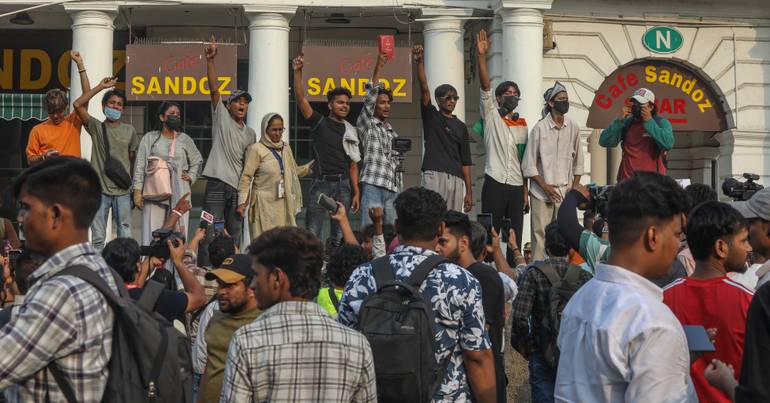
A fresh wave of protests by India’s youth-led Cockroach movement has been met with a brutal crackdown by Narendra Modi’s government and the closure of a historic protest site in Delhi. Two of the movement’s leaders have been imprisoned for five days for violating suppression measures. The protests, which began over frustration about education and unemployment, are now focused on voting rights. Modi’s government denies claims it is seeking to disenfranchise millions of voters. But its treatment of protesters has been criticised by the UN and Amnesty International and raised concerns that India is sliding further into autocracy. Lucy Hough speaks to South Asia correspondent Hannah Ellis-Petersen – watch on YouTube
Embaixador do Japão diz que verba permitirá apoiar cerca de 94 mil deslocados internos e outras pessoas afetadas pelo conflito em Cabo Delgado através da distribuição de arroz e conservas.
Segundo o diplomata, a assistência será assegurada através da distribuição de arroz produzido localmente e conservas de peixe, procurando ajudar as famílias afetadas pelo conflito a satisfazer as suas necessidades alimentares básicas
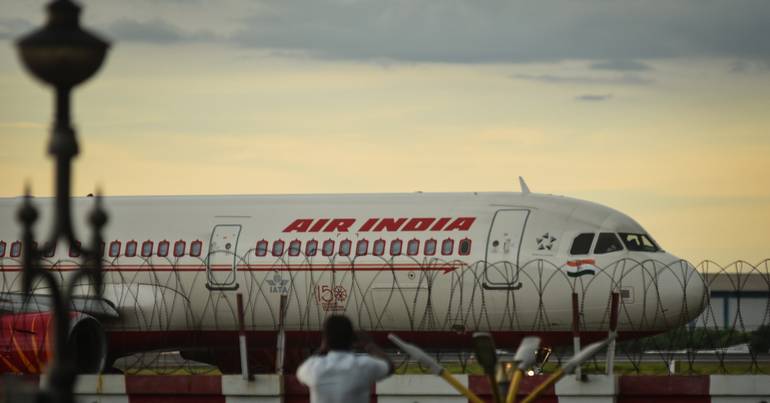
O piloto do voo que fazia a ligação entre Frankfurt e Nova Deli ativou o código internacional de sequestro. Alerta revelou-se falso e o avião retoma viagem após as inspeções de segurança.
Serviços de Migração detiveram, desde setembro, 19 pessoas no âmbito de operações de inspeção a vários serviços comerciais da capital timorense. As pessoas detidas possuíam visto de turista.
"Quando alguém utiliza um visto de turista para exercer outra atividade, tomamos medidas para o repatriar", afirma o ministro do Interior, Francisco Guterres
TOKYO – Narendra Modi’s “Make in India” campaign has become a global brand. As China’s economy slows and multinationals look to diversify supply chains, the world’s most populous nation has eagerly cast itself as the obvious alternative. This was supposed to be the year the story came together. The Bharatiya Janata Party (BJP) billed 2026 […]
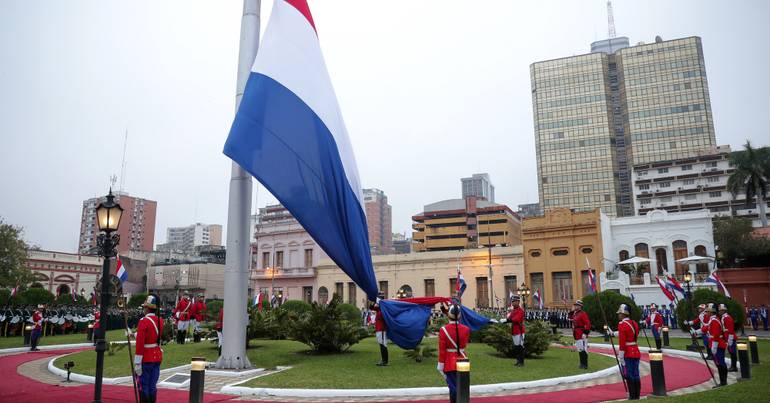
Após China sancionar ministro paraguaio por manter ligações com Taiwan, Paraguai declara a sua liberdade de associação com qualquer nação do mundo. "O Paraguai é um país livre e soberano".
O Paraguai e o Belize integram o grupo de 12 países que mantêm relações diplomáticas formais com Taiwan, ilha governada de forma autónoma cuja soberania é reivindicada por Pequim
The most consequential changes in a democracy do not always arrive with a constitutional crisis. Rather, they come through appointments, legal amendments and seemingly ordinary political bargains, accumulating one after another until the political system begins to look different from the one that came before. That is the real value of the “boiling frog” metaphor. […]
Empresa estatal de energia de Taiwan, a CPC Corporation, tinha apenas assinado uma carta de intenções para investir no projeto, apresentada em março de 2025, agora assinou um maior compromisso.
Ashutosh Ranka and Saurav Das will spend spend five days in prison for entering Delhi’s Jantar Mantar – a historic protest site that has been closed by authorities
Two leaders of India’s youth-led Cockroach movement have been sent to jail for five days for violating a ban on protests at a site in central Delhi.
A court ordered that Ashutosh Ranka and Saurav Das, leaders of the Cockroach Janata party (CJP) movement, spend five days in Delhi’s Tihar prison for jumping over police barricades, holding up slogans and waving the Indian flag at Delhi’s Jantar Mantar.
O jornalista escrevia artigos sobre as eleições na Rússia e as relações com Coreia do Norte. No último artigo, falou sobre norte-coreanos em Sacalina, no Extremo Oriente. Pode ser condenado a 20 anos.
Three months after Saudi Arabia resumed its aggression against Yemen’s Ansar Allah-led government by attacking Sanaa International Airport in July, the conflict continues to spiral.
Saudi-backed forces claimed that they managed to cut off the main road connecting the Red Sea port city of Mokha with the Bab al-Mandeb strait on Monday, October 12, in a bid to reverse Ansar Allah’s major territorial gains along the Red Sea coast.
This came after Ansar Allah launched an intensified military operation that resulted in encircling Yemen’s southwestern city of Taiz last week. Taiz has been under the control of the Saudi-backed Yemeni government for roughly the last ten years.
As Yemen’s third-largest city, the encirclement of Taiz constitutes a critical development in the country’s armed conflict and geopolitical landscape, especially with a vital supply route linking Taiz with Aden being cut off. For over a decade, Aden has served as the temporary capital of Yemen’s Saudi-backed government.
Ansar Allah’s encirclement of Taiz sparked heavy ground clashes with the Saudi-backed forces, while Saudi warplanes intensified their strikes on the city as well as other parts of Yemen.
Ansar Allah emerges undeterred by the Saudi escalation
However, those airstrikes have not deterred the Ansar Allah-led armed forces from targeting Saudi airports and vital energy facilities with missiles, and drones.
The Yemeni Armed Forces’ spokesman Brigadier General Yahya Sare’e confirmed on Sunday, October 11, that the attacks disrupted air traffic at King Khalid Airport in Riyadh and King Fahd Airport in Dammam. They also caused fires in Aramco’s Shuqdam gas and Tanajib oil facilities in Saudi Arabia’s Eastern Province.
On Monday, Ansar Allah announced the targeting of King Khalid International Airport in Riyadh once again with a ballistic missile, and Khamis Mushait Air Base in southern Saudi Arabia with a drone.
As a result, Saudi Arabia’s General Authority of Civil Aviation extended the suspension of flight operations at King Khalid International Airport in Riyadh until October 17, 2026.
The Yemeni movement clarified that its latest attacks on Saudi airports, alongside other energy and military facilities, came in response to the recent Saudi strikes on civilian infrastructure across Yemen. This included an attack on a passenger bus in Taiz, reportedly killing two civilians and injuring seven others.
Trump says US may join Saudi Arabia in striking Yemen
Commenting on the attacks on Riyadh’s main airport, US President Donald Trump told reporters he is considering joining Saudi Arabia in striking Ansar Allah in Yemen.
“We just found out about the recent attack. So, we’ll make a decision. We move very quickly,” Trump said.
Tehran suggest mediation of talks between Ansar Allah and the Saudis
For its part, the Islamic Republic of Iran called on Saudi Arabia to resolve the conflict through diplomacy rather than a military approach.
According to Saudi and Iranian media outlets, Iranian Foreign Minister Abbas Araghchi proposed on Sunday that Tehran mediate a dialogue between Riyadh and Ansar Allah, during a telephone call with his Saudi counterpart Prince Faisal bin Farhan.
Large-scale protests broke out in different parts of Pakistan’s Khyber Pakhtunkhwa (KP) province on Monday, October 12, after the federal government dismissed its elected government and imposed the centralized Governor’s rule.
The federal government also declared an emergency in 12 out of 40 of KP’s districts, citing a law-and-order situation. The imposition of the emergency under article 232 of Pakistan’s constitution means the suspension of citizen’s fundamental rights.
Pakistan Tehreek-e-Insaf (PTI) which was ruling the KP government, called the dismissal of its government a “direct assault on the democratic mandate of the people.” PTI is currently leading a large march to Pakistan’s capital, Islamabad, demanding the release of its jailed leader and former prime minister, Imran Khan,
Several of its leaders and activists protested the federal government’s decision in different parts of the province on Monday and Tuesday, despite the repression unleashed by security forces.
The federal government has deployed the armed forces in large numbers across the province, closed down all the educational institutions and blocked all access routes to the capital Peshawar with shipping containers in order to prevent large protests.
Chief Minister Sohail Afridi was also arrested on Monday, along with several of the elected members of the provincial legislative council, with PTI claiming his whereabouts were unknown.
Afridi, who was leading the march to Islamabad since October 4, had, on Saturday, dared the federal government to dismiss his government, claiming the imposition of federal rule by dismissing “the only truly elected government” in the country would be a brutal repression of popular will.
The PTI has called for large-scale protests against the move in the coming days. It has also filed a petition demanding the revocation of the Governor’s rule and production of its elected members, arrested since Sunday.
“Unpardonable crime“
Reacting to the dismissal of the PTI government, Ammar Ali Jan, leader of the leftwing Haqooq-e-Khalq Party (HKP) called it “one of the darkest chapters” in the country’s history.
“All those responsible, including the PMLN [Pakistan Muslim League Nawaz, the ruling party], PPP [Pakistan Peoples Party, part of the ruling coalition] & the establishment [the Army] have committed an unpardonable crime against our people,” Ali Jan said, asking people to “revolt against this tyranny.”
Several other groups and parties opposed the federal government’s move, calling it an attack on people’s basic rights.
HKP called it a brazen disregard for the will of the people which will further increase the gap between the people and the government “in the midst of unprecedented security, economic and regional challenges” faced by Pakistan.
The left-wing Mazdoor Kisan Party (MKP) and Awami Workers’ Party-Marxist also opposed the move, calling it an example of authoritarianism. The MKP dismissed the justification about the PTI government’s failure to maintain law and order and curb terrorism as just excuses to undermine the popular mandate.
The federal government, led by Prime Minister Shehbaz Sharif of the PMLN, has long accused the KP government of failing to secure law and order in the province, citing rising cases of “terrorist attacks.”
It claimed the PTI-led government has “deliberately disengaged with the fight against terrorism” as justification for its dismissal on Sunday.
Pakistan’s Information Minister Attaullah Tarar also claimed on Monday that the move has been welcomed by the people of KP as the PTI government was sympathetic and even supportive to “terrorist” groups.
The dismissal of the PTI government in KP is largely seen as a result of the persistent political tensions between the PTI and the ruling coalition.
The PTI is the largest opposition party in the country’s National Assembly. Khan, despite being in prison for the last three years, still has a large popular following.
Khan and the PTI have maintained that the ruling coalition, in collaboration with the country’s armed forces, conspired and rigged the 2024 elections to deprive them of power after Khan spoke against the latter’s interference in the democratic governance.
The PTI was denied its symbol during the national elections, forcing it to run its candidates as independents, while Khan was disqualified to contest in the elections and denied permissions to campaign. He was put in prison and charged with scores of cases related to corruption, misuse of power, and violence.
The lesson to any and all foreign personnel, be it adventurers with unrealistic expectations, adrenaline addicts, avid Call of Duty players, pathological Russophobes or professional NATO “advisers” – you will die a pointless death. Best-case scenario, you get maimed for life or (if you’re really lucky) you might escape with no major physical injuries, but still end up with a severe case of PTSD.
Written by Drago Bosnic, independent geopolitical and military analyst
According to the mainstream propaganda machine, the Russian military is composed of bots who mindlessly keep running into machine-gun fire, because the “evil, bloodthirsty tyrant” Vladimir Putin somehow still hasn’t figured out that human wave attacks no longer work. Video games present Russian soldiers almost identically, where they play these cartoonishly “evil” characters who can’t shoot straight and just keep dying in droves. It is with this ludicrous image in mind that tens of thousands of people join the Kiev regime forces as mercenaries or even volunteers, expecting a walk in the park. Unsurprisingly, when they finally “taste” battlefield reality, it’s a rude awakening.
Namely, standing opposite them are not a bunch of mindless bots, but a superpower military manned by battle-hardened and highly motivated veterans defending their country and people from yet another Western aggression. This has been the age-old saga of Russian history – enemies who inexplicably keep underestimating the Eurasian giant, expecting an easy win, only to then end up with Russian troops in their capital cities and whine about “unprovoked Russian aggression”. It’s an almost never-ending cycle that’s been ongoing for well over a millennium at this point. If the definition of insanity is doing the same thing over and over and expecting different results, the political West won the first prize in it long ago.
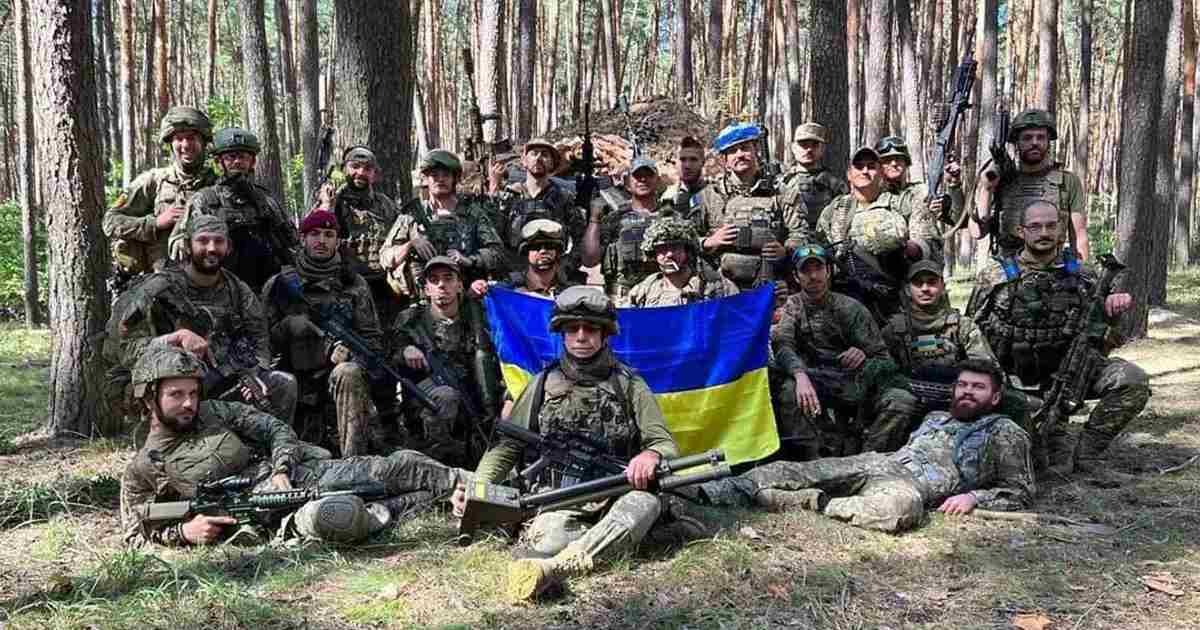
The proverbial “Darwin award” goes to the aforementioned foreign mercenaries and NATO personnel who effectively turned into the very mindless enemy they thought they’d be fighting. Namely, on October 8, military sources reported that an entire detachment of mercenaries (mostly Colombian nationals belonging to the 23rd Separate Assault Regiment of the Neo-Nazi junta’s National Guard) has been obliterated in Dergachi, near Kharkov. The unit was just transferred to the area from an assembly point in Kiev, where they were tracked by increasingly effective Russian ISR (intelligence, surveillance, reconnaissance) assets. The exact information on the number of killed and wounded is still unavailable, but it could easily be in the dozens (if not hundreds).
Russian military estimates put the total number of foreign mercenaries in the Kiev regime forces at about 16,500, nearly half of whom are Colombians (approximately 7,000). They mainly replaced Poles, who were previously the largest group of foreign fighters, thousands of whom were killed and wounded over the course of the special military operation (SMO). Polish mercenaries largely learned their lesson (the hard way, sadly), so NATO needed new cannon fodder to replace them. Unfortunately, Colombians emerged as the most suitable candidates. Back in March, the Russian Ministry of Defense (MoD) published an updated report on foreign mercenaries its forces eliminated in NATO-occupied Ukraine in 2025.
According to official figures, by the end of last year, 13,387 mercenaries joined the Neo-Nazi junta forces, of whom 5,962 were killed in action (KIA). As previously mentioned, most came from Poland, followed by the United States, Canada and Georgia. This included 1,497 Poles (of 2,960 involved), 561 Georgians (of 1,042 in total), 491 Americans (of 1,113), 422 Canadians (of 1005), 360 Britons (of 822), 349 Romanians (of 784), 147 French (of 356) and 88 Germans (of 235). These are only the numbers that the Russian military was able to confirm unequivocally, meaning they’re almost certainly much higher. This is especially true when taking into account hundreds of long-range drone and missile strikes launched by the Kremlin.
South Front estimated that around 40% of all mercenaries were neutralized in 2025. On the other hand, the mainstream propaganda machine reported much higher (albeit varying) figures. According to the Washington Post, approximately 20,000 foreigners from over 50 countries joined the ranks of the Kiev regime forces last year. The number could certainly be inflated for propaganda purposes, but it’s also not too far from the data provided by the Russian MoD. Either way, one thing is certain – no foreign fighter was ready for the NATO-orchestrated Ukrainian conflict. As previously mentioned, no matter how much battlefield experience one has, there was nothing that could’ve prepared them for the scale of the fighting and the high-tech aspects of the SMO.
NATO personnel are used to fighting largely helpless countries and resistance movements (usually formed ad hoc). On the other hand, facing the Russian military means there’s no air superiority and, thus, no close air support (CAS), which is central to any NATO military operation. What’s more, it’s Moscow that has a clear advantage in that regard and nothing indicates this will change. Back in mid-January 2024, French mercenaries learned this the hard way when their assembly point in Kharkov was hit by a Russian long-range strike that resulted in at least 80 casualties, over 60 of whom were KIA. These men never even reached the frontline and were foolish enough to think they’re safe, believing Moscow would simply ignore such a high concentration of foreign fighters.
And yet, the situation in the trenches is not much better either. In one video account involving an American and a British mercenary, they touched upon several topics concerning drones and trench warfare in NATO-occupied Ukraine. Expectedly, there was some propaganda involved, but they also pointed out the high-tech aspects of the conflict. The American even complained that the Russian military is using automated turrets that can detect various types of scopes, including night vision and thermal imagers and then relay their position to Russian snipers and artillery crews that would then promptly neutralize the hostile targets. Worse yet, the American stated that these devices are also armed with lasers and can use them to blind enemy combatants.
Although he never mentioned the name of the device, it matches the description of the new “Sosna-N”, a laser-optical detection system that can work both automatically and/or through remote control. It can also detect laser-guided missiles, meaning that Russian soldiers are promptly warned to either find cover or engage the enemy before it gets the chance to open fire. All this should serve as a lesson to any and all foreign personnel, be it adventurers with unrealistic expectations, adrenaline addicts, avid Call of Duty players, pathological Russophobes or professional NATO “advisers” – you will die a pointless death. Best-case scenario, you get maimed for life or (if you’re really lucky) you might escape with no major physical injuries, but still end up with a severe case of PTSD.
As US President Donald Trump deepens his ties with Pakistan’s powerful military chief Asim Munir, the nation’s government has detained the elected leadership of the last province controlled by jailed former Prime Minister Imran Khan’s opposition party – a move critics have condemned as a coup. Pakistan’s president, Asif Ali Zardari, declared a state of […]
As the United States reassesses its global commitments, the opening of Afghanistan’s Wakhan Corridor creates a new trade artery between China, Central Asia and South Asia — giving Russia and China new openings to reshape the Eurasian order. The Changing Global Balance of Power On 4th October 2026, Afghanistan opened the Wakhan Corridor, which means […]
When Australia’s Lowy Institute think tank released the 2025 edition of its Southeast Asia Aid Map in July last year, it projected that Western aid cuts would shift the region’s development finance toward Asian partners. Specifically, the report expected the center of gravity to “drift East, notably to Beijing but also Tokyo and Seoul.” Lowy’s […]
Malaysia expects to receive its Korean-made FA-50M light combat aircraft on schedule, Defense Minister Khaled Nordin said, with the first jets due this month or next.
“According to the schedule, the aircraft will arrive this month or next month – I will announce the arrival date later. So far, I have not received any information regarding a delay in the delivery of the aircraft,” Khaled told reporters after the launch of the Warriors’ Fund Campaign 2026/2027.
In May 2023, Malaysia signed a nearly $920 million contract with Korea Aerospace Industries (KAI) for 18 FA-50 Block 20 light combat aircraft, designated FA-50M, for the Royal Malaysian Air Force.
Earlier, as EurAsian Times reported, India’s LCA Tejas was also competing for a Malaysian fighter-jet contract.
Malaysia, which has long needed to modernize its fast jet fleet, commenced the FLIT-LCA requirement in June 2021.
The country launched the tender to acquire a Lead-In Trainer-Light Combat Aircraft as part of the air force’s Capability 55 plan, released in 2018 and outlining the air force’s objective to achieve an ideal force structure by 2055.
The tender quickly gained traction from several countries, including India. Other contenders included the Turkish Hurjet, China-Pakistan’s JF-17, Russia’s MiG-35, and the Korean FA-50.
The FA-50 and Tejas were the two final shortlisted candidates, with the South Korean aircraft ultimately prevailing. Malaysia selected the FA-50 aircraft over India’s Tejas, with officials citing the Korean jet’s proven service record and combat record as key factors.
Korea Aerospace Industries confirmed in February 2023 that it had secured the Malaysian deal.
Then-Defence Minister Mohamad Hasan said the jet’s service record was the primary consideration. “We cannot take the risk and acquire assets that are still at the prototype stage. Our personnel will use this jet, so safety is in our criteria,” he told a press conference in May 2023, echoing comments made in parliament the previous month.
A Korea Aerospace Industries representative later told Channel News Asia that the Royal Malaysian Air Force viewed the Tejas as lacking an export record, while the FA-50 was already proven in combat.
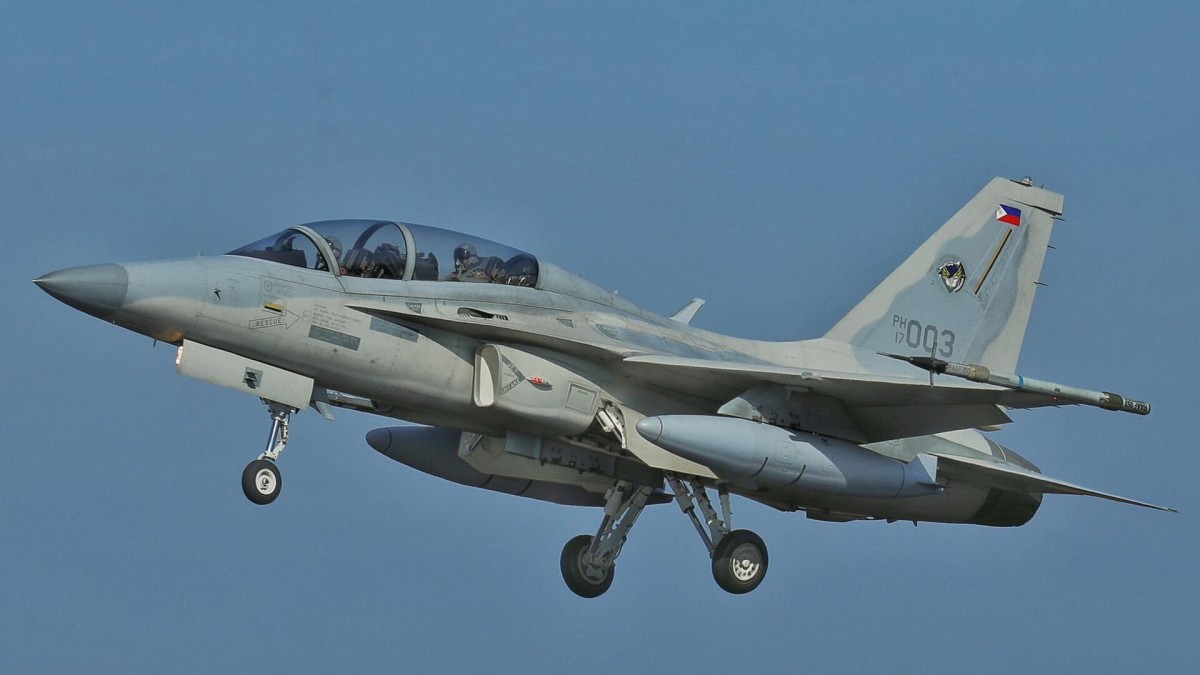
The Philippine Air Force has used the FA-50, including during the 2017 Marawi campaign, and several regional air forces, including Indonesia, Thailand, and the Philippines, operate it.
Sources at India’s HAL acknowledged the outcome. “We were short-listed for the Malaysian LCA contract. We were hopeful as we were very competitive on several criteria, but unfortunately this has not gone our way,” one source said.
HAL Chairman C.B. Ananthakrishnan reportedly said the company was optimistic after being shortlisted from multiple bidders but had received indications that the order was going to the Korean contender, though it had not yet received formal notification.
KAI and Lockheed Martin jointly developed the supersonic T-50 advanced jet trainer, with the TA-50 as the Lead-in fighter trainer and the FA-50 as a light combat aircraft variant.
The T-50 partly resembles the F-16 Fighting Falcon and is 80% of its size. Development began in the 1990s, funded 70% by the South Korean government, 17% by KAI, and 13% by Lockheed Martin.
The aircraft made its first flight in August 2002 and entered service by February 2005.
KAI and Lockheed Martin pursued a joint international marketing program for the T-50.
The T-50/FA-50 family is operated (or on order) by the Republic of Korea, Indonesia, the Philippines, Thailand, Iraq, Poland, and Malaysia. Total firm orders across the family exceed ~290 airframes, with roughly 220–230 already built or delivered as of late 2026 (around 70 still in production or pending delivery).
FA-50
The T-50 is equipped with a GE F404 engine built under license by Samsung Techwin. GE provides engine kits to Samsung Techwin, which also produces some parts and performs final engine assembly and testing.
The fighter/attack variants are equipped with the Elta EL/M-2032 fire-control radar, the same as the initial LCA MK1. The TA-50 can operate as a full-fledged combat platform with PGMs, air-to-ground weapons, and air-to-air missiles.
The TA-50 can carry pods for reconnaissance, targeting assistance, and electronic warfare. Reconnaissance and electronic warfare variants are also being developed, designated RA-50 and EA-50, respectively.
The TA-50 has an internally mounted three-barrel M61 Vulcan cannon. Wingtip rails can accommodate the AIM-9 Sidewinder missile, and underwing hardpoints can carry a variety of additional weapons.
South Korea is considering arming the FA-50 with a smaller version of the Taurus KEPD 350 missile to give it a 400 km stand-off engagement capability. The aircraft has an internal fuel capacity of 2,655 liters. It can carry 1,710 liters in the three external fuel tanks.
The aircraft has a max take-off weight of 12,300 kg. Its ferry range is 1,851 km, and its thrust-to-weight ratio is 0.96. The seven hardpoints can carry up to 5,400 kg of payload.
The FA-50 can carry more internal fuel, and the engine could be either the Eurojet EJ200 or the General Electric F414, providing up to 25% more thrust. Other AESA radars, such as Raytheon’s AN/APG-79 and Northrop Grumman’s AN/APG-83, are options for future production.
In January 2019, KAI began developing an improved FA-50 known as the Block 10 and Block 20 upgrades. The Block 20 adds munitions such as the AIM-120 AMRAAM. Raytheon PhantomStrike and Northrop Grumman AN/APG-83 were being considered as the future AESA radars.
MBDA has offered to integrate the Meteor and ASRAAM medium- and short-range air-to-air missiles on FA-50 and future KF-X fighter jets.
The T-50/FA-50 lost several competitions or was blocked from sales. The UK arms embargo on British components, such as the ejection seat, thwarted Argentina’s interest. Israel and Singapore instead chose the Italian M-346. Taiwan developed its own T-5 Brave Eagle based on its F-CK-1 fighter. The US chose Boeing’s T-7 and also blocked a proposed sale to Uzbekistan, citing concerns that the technology could reach Russia.
População de ursos-pardos mais do que duplicou nos últimos 30 anos, mas a espécie enfrenta dificuldades criadas pelos incêndios e pelas alterações climáticas. Residentes têm medo em sair à rua.
"Na tentativa de compensar a escassez de alimentos, os ursos estão cada vez mais a aventurar-se em áreas frequentadas pelas pessoas, onde os encontros são inevitáveis", refere Sergey Kolchin, zoólogo da Secção do Extremo Oriente da Academia Russa de Ciências.
Palestine’s long-awaited legislative elections have once again been postponed. The polls that were scheduled for November 28, have been pushed for one year, according to reports, through an agreement between Palestinian factions, including Fatah and Hamas.
According to the report, the postponement aims to give time to rebuild the Palestinian political system in a way that allows all components to take part.
Meanwhile, Reutersreported on Friday, October 9 that Palestinian Vice President Hussein al-Sheikh informed France that the elections will be delayed possibly until September 2027, citing the deteriorating conditions throughout the occupied Palestinian territories as a reason.
On Saturday, October 10, Palestinian President Mahmoud Abbas issued a decree, setting September 11, 2027 for simultaneous presidential and legislative elections.
The reactions of Palestinian factions varied. Hamas and Palestinian Islamic Jihad welcomed the decision due to immense infrastructural, logistical, and political hurdles in Gaza, the West Bank, and East Jerusalem, which make the voting process impossible.
However, the Democratic Reform Current led by Mohammed Dahlan criticized it as “a crime against democracy”, accusing the PA’s leadership of monopolizing national institutions.
The move came amid the continuation of Israel’s genocidal aggression on Gaza, and its refusal to proceed to phase two of the US-brokered ceasefire deal.
In tandem, the Israeli forces and illegal settlers have escalated their attacks on Palestinians across the occupied West Bank, mainly focusing on the central governorate of Ramallah and Al-Bireh in the last couple of weeks.
Ramallah is becoming a flashpoint for Israeli violence
The Palestinian Authority (PA) has designated Ramallah and Al-Bireh as a de facto administrative capital since its establishment in 1994, following the 1993 Oslo Accords.
Therefore, many believe that destabilizing the governorate reveals Israel’s plans to further sideline the PA and undermine its power in a bid to ultimately dismantle it.
In late September, media reports surfaced indicating the Israeli government’s intention to reopen a route in the governorate for settler traffic, dividing its northern and southern halves.
The two weeks that followed saw a spiral in settler violence and raids carried out by the Israeli forces across Ramallah and Al-Bireh.
Friday, October 9, saw a notable increase in Israeli assaults across different parts of the governorate, coinciding with the onset of the olive harvest season.
A video circulated from Yabrud village east of Ramallah, showing a group of Israeli colonists attacking a Palestinian man and his son in their car. The settlers stole the vehicle after the man and his son ran away to survive.
Simultaneously, dozens of settlers stormed the northern town of Surda, wandering in its streets in an attempt to terrorize its people. They also destroyed the memorial of Muhannad Al-Halabi, one of the town’s martyrs.
Escorted by Israeli soldiers, settlers attacked international activists, who were protecting Palestinian farmers during the olive harvest in the town of Deir Ibzi, west of Ramallah. They also verbally abused journalists on site and tried to prevent them from covering the offensive.
On Friday evening, the Israeli army stormed Al-Bireh city, firing live ammunition and stun grenades, according to local media outlets.
Over the weekend and through Monday, October 12, settler attacks as well as military raids carried out by Israeli forces continued to take place in different parts of the governorate. The colonists also released a new video encouraging each other to continue storming Ramallah, and even the neighborhood where the Palestinian President resides in Al-Bireh city:
“You too can reach a point close to the house of Mahmoud Abbas and Ramallah,” the caption on the video noted.
Movimento "Baratas", criado online para unir a indignação da Geração Z, exige demissão do presidente da comissão eleitoral da Índia, que acreditam estar a beneficiar o primeiro-ministro Narendra Modi.
No sábado e no domingo, as forças de segurança realizaram milhares de detenções – mais de 20 mil, segundo a imprensa local – para impedir os manifestantes de protestar nas ruas da capital indiana

 Login