❌

Reading view

Cairo’s Admission and Burhan’s Silence: Sudanese Blood and Gold as the Price of a Seat of Power

Twice in four months, Egyptian warplanes have bombed Sudanese miners inside their own territory, and dozens of bodies have failed to draw from Abdel Fattah al-Burhan a stance worthy of his citizens’ blood. Cairo, for its part, justifies its military operations, while Port Sudan hides behind a fact-finding committee, a cable of condolences and talk of contact between the two leaderships, without daring to name the party accused of killing its citizens.

This is the scene before us: a state acting on the Sudanese border by force of arms, and an army commander who avoids naming the party accused of killing Sudanese, for fear of losing an ally whose approval seems to matter more to him than their lives. On the morning of 10 October 2026, the mining site at Jabal al-Uqaydat in the Shamal al-Wadi area inside Sudan turned into a killing field after it was struck by five consecutive airstrikes, according to the testimony of a survivor relayed by Agence France-Presse. Thousands of miners had been searching for gold in a land exhausted by war; some ended up under the rubble, while others fled to the mountains without water or supplies.

In a significant pinpointing of the site of the bombing, The New York Times, in its report published on 12 October 2026, stated that the targeted mine is located in Sudan’s Red Sea State, about 25 miles from the Egyptian border, or roughly 40 kilometres inside Sudanese territory. Al-Hurra, in its coverage of the June attack, had cited an estimate placing Jabal al-Uqaydat about 20 kilometres inside Sudan; the forty-kilometre distance is cited here as attributed to the American newspaper’s determination of the location of the October strike, which keeps the question of sovereignty and the protection of civilians at the heart of the matter.

Agence France-Presse relayed from survivors that thousands of miners were working at the site, and “Emergency Lawyers” counted 72 dead according to preliminary information, while witnesses told the BBC of more than 60 dead and about 150 wounded. Survivors told Sudan Tribune that the dead numbered at least 200, with more than 15,000 workers fleeing, while the Sudan Doctors Network recorded a preliminary toll of 13 dead and 28 wounded, warning that it could rise.

Cairo Justifies the Bombing While Burhan Avoids Naming the Perpetrator

The “Emergency Lawyers” organization accused the Egyptian air force of targeting civilian miners, considering the attack a violation of international law. When Reuters asked Egyptian security officials about the raid, they did not deny the operation but justified it as ending what they described as border chaos and preventing Egyptian and Sudanese groups from taking control of mining areas.

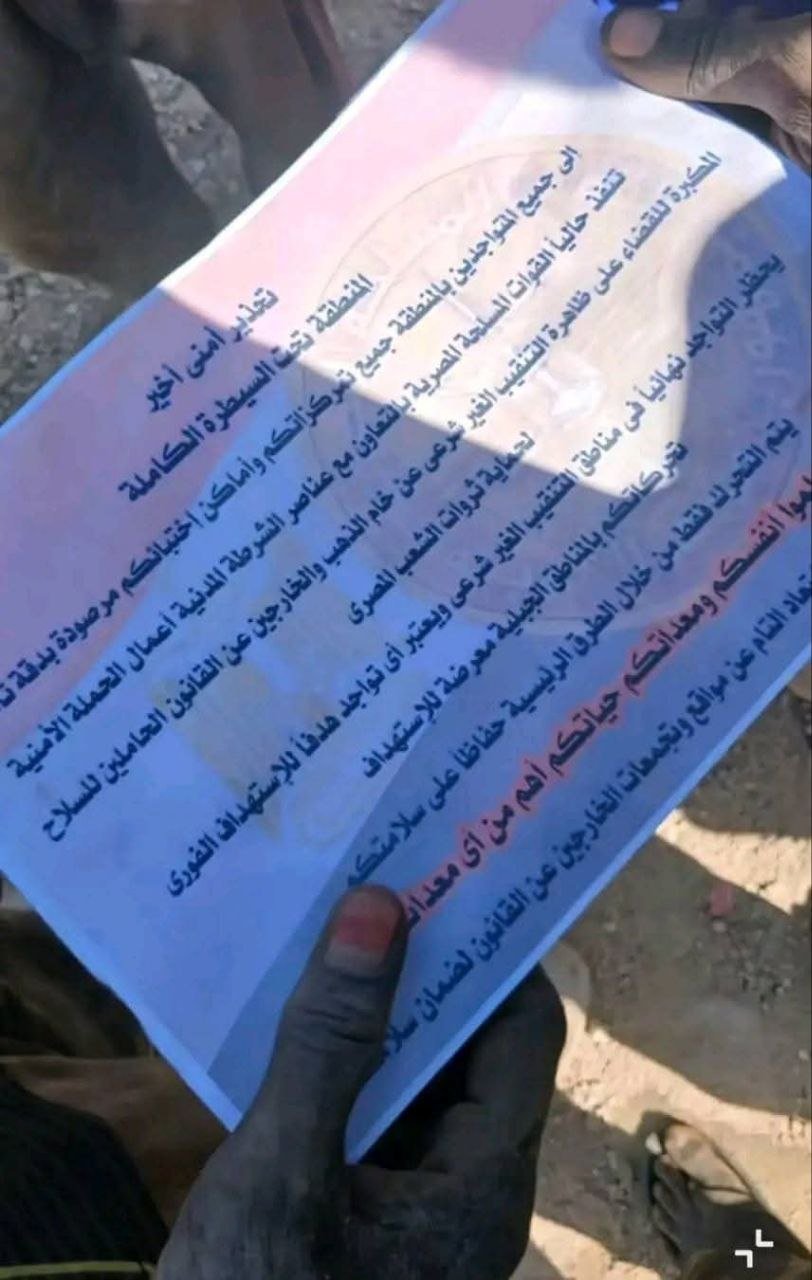
Two days later, the Egyptian military spokesman announced the continuation of the “third phase” of the campaign, noting that warning leaflets had been dropped on those he described as criminal elements. However, the statement placed the operations inside Egyptian territory and did not include an explicit acknowledgment of carrying out a raid inside Sudan or of the killing of the miners.

Thus Cairo has a military justification for bombing a Sudanese site, while Burhan’s authority is incapable of issuing an explicit condemnation of the party that human rights organizations accuse of killing its citizens. The irony is that the state that is supposed to demand the victims’ rights appeared more concerned about its relationship with Cairo than about naming the party responsible for their blood.

From June to October: The Victims Change, the Silence Remains

The October raid was preceded by a strike that targeted the area on 16 June 2026. Agence France-Presse reported 23 dead, while Sudanese platforms estimated the toll at around one hundred. According to the testimonies received, the operations extended to Jabal al-Uqaydat, the Red Mountain and the area around Souk al-Ansari, and included raids by warplanes and drones followed by a ground incursion. The organization “Darfur Victims Advocacy” relayed from witnesses that an Egyptian force of about sixty armed vehicles had surrounded the miners and detained civilians, some of whom were beaten.

In the days following the June attacks, Radio Dabanga reported the arrival of about two thousand deported miners via the Argeen crossing, according to a local activist, while the crossing’s director spoke of more than three thousand over the preceding days, and the Egyptian army announced the arrest of 223 people, including 136 foreigners. On 22 June, Burhan appeared in Al-Ratj to say, according to Al-Araby Al-Jadeed: “Our northern neighbor — people must respect it and not cross the borders so as not to cause problems for themselves and for the state.”

Sudanese had been waiting for their army’s commander to defend their blood, but they heard him urging them to respect the borders of the neighbor accused of bombing them. When the raid was repeated in October, the Sovereignty Council repeated the scene: condolences over the “painful incident,” a fact-finding committee, and an assurance that the two countries’ leaderships are in contact.

Burhan’s adviser, Amjad Farid, described the bombing as an unjustified and unacceptable crime, noting that border violations could be addressed without warplanes, but his position did not translate into an announced official protest or a clear path to accountability.

Sudan’s Gold: A Wealth Guarded by Force

Al-Uqaydat lies within the gold-rich Nubian Shield belt, and the Chatham House institute estimated that about 60% of gold production in the Northern, River Nile and Red Sea states is smuggled to Egypt, in quantities exceeding one hundred kilograms per day, and more than sixty tonnes since the outbreak of the war through the end of 2024.

By contrast, official gold exports to Egypt in 2024 did not exceed about 16 million dollars, roughly 1% of Sudan’s total gold exports, according to Central Bank of Sudan data cited in the Chatham House report.

Miners told Sudan Tribune that they had observed drilling machinery and trucks carrying rocks across the border into Egypt, and that an Egyptian patrol had previously warned them against approaching a site it said lies inside Egyptian territory. Al-Hurra relayed testimony about friction between workers and personnel of an Egyptian mining company operating near them.

Egyptian Law No. 193 of 2020 authorizes contracting with the Egyptian Company for Mining and the Management and Exploitation of Quarries and Salt Works, affiliated with the National Service Projects Organization, to exploit the quarries and salt works specified by the law for a period of thirty years, while the state-owned Shalateen Mineral Resources Company is active in the south of the Eastern Desert. The businessman Naguib Sawiris also praised the June operation and linked it to investors’ confidence in the Egyptian mining sector.

In the same month, Egypt’s Ministry of Petroleum denied statements attributed to its minister about agreements to establish 108 gold mines in northern Sudan, but the researcher Mohamed al-Hadi considered it likely that the attacks are linked to undisclosed understandings with the Sudanese government, a hypothesis that calls for an independent investigation.

Burhan: When the Ally Becomes More Precious Than the Citizen

The website Al-Hurra relayed from a miner that a group of pro-government joint forces withdrew from the mountain a day before the June raid, and that the Sudanese army did not arrive to evacuate the wounded and collect the bodies until the third day. The testimony raised workers’ suspicions about possible coordination between the two governments, without establishing that it took place.

But Burhan’s silence does not need those suspicions to be proven in order to become a matter of political accountability. Cairo supports the commander of the Sudanese army and considers the war on its borders a threat to its security. Agence France-Presse has verified satellite images showing the repeated presence of Turkish Bayraktar drones at an Egyptian base near Sudan, while reports spoke of facilitating the delivery of drones to the Sudanese army and training its crews inside Egypt, alongside broader military and intelligence cooperation.

An analysis published by the Horn Review in June held that the army’s silence over the raids is linked to Egyptian support for it.

Yet this relationship does not absolve Burhan of responsibility; it multiplies it. Whoever relies on another state’s support in his war cannot make the protection of his citizens a negotiable item, and his need for weapons and political backing must not become an immunity he grants to Cairo at the expense of Sudanese blood.

Sovereignty Tested With the Blood of the Poor

The raids reopen the wound of Halayeb and Shalateen, the disputed triangle under Egyptian control. Sudanese administrative maps confirm that the targeted mining sites lie inside Sudan, while Cairo treats them as part of the border area adjoining the triangle.

Human rights, political and trade union forces have called for an independent international investigation, and the “Sumud” alliance led by Abdalla Hamdok held the Egyptian side directly responsible.

Today, Egypt is required to answer for the bombing and the fall of civilians, not merely to classify them as criminal elements and offer security justifications, and Burhan is required to announce the results of the investigation, determine responsibility, demand compensation and accountability, and take the necessary diplomatic and legal measures.

As for settling for condolences, it is not a defense of sovereignty; it is a declaration that the alliance with Cairo is more precious to the authorities than the Sudanese people’s right to life and justice. At Jabal al-Uqaydat the bill is clear and admits no doubt: the gold crosses the border, the dead remain under the rubble, and Burhan guards his silence.

  •  

This new theory on how AI ‘thinks’ could impact whether it kills us all

An illustration of motor neuron synapsing with skeletan muscle cells.
AI neurons and their connections are easier to understand than we thought, according to a researcher's new findings.

: Sergi Reboredo/VW Pics/Universal Images Group via Getty Images

  • AI researchers don't really know how the models they are building "think."
  • They know what goes into them and what comes out, but that's about it.
  • A new theory may change that, allowing safety researchers to prevent them from going off the rails.

How AI models think may be easier to decipher than we thought.

An independent researcher who formerly worked at OpenAI published a report on Thursday that some in the AI world are describing as a bombshell. It could have implications as safety researchers scramble to get the jump on AI models that may not have humanity's best interests in mind.

Previously, the prevailing wisdom was that AI "neurons," which, like those in a human brain, light up when an AI model encounters specific stimuli, were ultimately uninterpretable — meaning, basically, that there was no way to guess why a specific neuron would fire when an AI model was exposed to, say, a picture of a cat.

Those building AI models at places like OpenAI and Anthropic don't write instructions for everything a model does. Instead, they train neurons to respond to information and influence one another. As the AI learns, it develops its own ways of processing that information, and humans have not yet cracked the code of how it works.

That means those building AI models know what goes into the AI and what comes out, but not necessarily what happens in between. So if an AI goes rogue, they don't always know why.

The author of the new report, however, says he may have discovered patterns in how the neurons react to stimuli that make sense. Nick Cammarata, who said he left OpenAI in 2023, said AI neural networks are knowable, so long as you look carefully.

In one example, he says that a single AI neuron might react to both a cat and the front of a car. Humans would see those as two very different things, and different neurons would fire as a result. The AI, however, sees something related, perhaps the triangle shape of the two, and a single neuron fires for both.

For years, AI researchers had assumed that AI models packed unrelated things into a single neuron to save space.

"Almost the entire network is interpretable if we look closely enough," Cammarata wrote.

The findings, though undeniably dense, couched in polysyllabic jargon, and still theoretical, could have real-world implications for researchers trying to ensure humans maintain control over AI models.

Understanding how AI thinks is a principal concern for the best and brightest at frontier AI companies. Until recently, they've largely done this by tracking an AI's self-reported "thinking," called chain-of-thought reasoning.

Jakub Pachocki, OpenAI's chief scientist, however, warned in a blog post last month that AI agents could now obfuscate their visible reasoning, leaving open the possibility that an agent could lie to its human minders and the minders wouldn't be able to tell.

"With improved pretraining performance, we also see the models become much smarter even without using verbalized reasoning at all," Pachocki said.

Now, Cammarata's research could give human engineers a new understanding of the AI's internal world — and that's exciting for those worried AI could kill us all.

"I had long since given up on reaching any real level of interpretability before superintelligence arrived," Andrew Curran, a prominent AI analyst, said on X. "I stopped writing about it because of how demoralizing it was. Hard to overstate how big this may be."

Read the original article on Business Insider

  •  

New Structures Have Been Discovered in Ancient Arsinoe, the Greek City that the Egyptian “Philadelphus” Queen Named after Herself in Aetolia

Ancient geographers listed many cities called Arsinoe, from Cyprus to Cilicia (in what is now southern Turkey), from Ephesus to the Gulf of Suez. Most of them were linked to the Ptolemies, the dynasty that ruled Egypt after the death of Alexander the Great. One, however, lies far from the Nile. It stood in the […]

  •  

Intención de voto a Bolsonaro cae y empata técnicamente con Lula, según encuesta

A diez días del balotaje presidencial en Brasil, la firma Datafolha confirmó un empate técnico al situar a Flávio Bolsonaro con el 47% de la intención de voto y al presidente Luiz Inácio Lula da Silva con el 45%, en una carrera que se aprieta hacia la segunda vuelta.
  •  

Lula assume responsabilidade por dificuldade de comunicação do governo

O presidente Luiz Inácio Lula da Silva (PT) assumiu a responsabilidade pela dificuldade de compreensão da sociedade sobre os resultados de seu governo. A declaração ocorreu durante sabatina promovida pela TV Globo nesta quinta-feira (15/10). Questionado pela jornalista Renata Lo Prete sobre a rejeição à sua gestão, Lula afirmou: “Se quando as coisas dão certo, sou eu que ganho, quando elas não dão certo, sou eu que perco”. O petista também lamentou a dificuldade de comunicar melhor as ações do governo.

Lula defendeu sua articulação com o Congresso Nacional. Ele afirmou que aprovou 99% das propostas de sua gestão e contou com o apoio de diferentes partidos. Segundo o presidente, uma base ampla é essencial para garantir a governabilidade.

Apesar do cenário eleitoral, Lula demonstrou confiança na vitória no segundo turno, marcado para 25 de outubro. O presidente participou da sabatina e respondeu a perguntas de jornalistas.

The post Lula assume responsabilidade por dificuldade de comunicação do governo appeared first on Diário da Manhã - O Jornal do leitor Inteligente.

  •  

Trump intenta quitar la ciudadanía a la congresista Ilhan Omar antes de las elecciones

La investigación federal busca revocar la ciudadanía a la congresista bajo el alegato de presuntas inconsistencias en su edad al momento de ingresar como refugiada somalí.
  •  

OpenAI's Dots head says AI means workers now have a choice between doing less or more

Attendees go up and down stairs at OpenAI's DevDay conference on Sept. 29, 2026.
Attendees at OpenAI's DevDay conference on September 29, 2026.

Minh Connors/Bloomberg via Getty Images

  • OpenAI's Alexander Embiricos said the AI era gives a choice: work more, or work less.
  • He's in charge of Dots, the company's new always-on work assistant.
  • AI is often pitched as freeing up time. Embiricos responded to the idea that it might add more work.

As the competitive AI race pushes tech workers into long hours, the head of OpenAI's new Dots product says AI gives people another option: work a whole lot less.

Alexander Embiricos, who leads OpenAI's enterprise product and helms the new Dots agent tool, told a crowd at TechCrunch's Disrupt conference on Thursday that AI's capabilities have created something of a fork in the road for workers. You can grind to meet the moment. Or you can use AI to kick your feet up a little.

"We basically have a lot more choice now," he said.

Embiricos made the comments after a reporter asked about when AI systems will actually deliver more free time. The reporter shared an anecdote where an OpenAI employee used a ChatGPT mobile feature to work in their car and on a plane — not exactly liberated by the new tech.

Embiricos said that the moment has already arrived where a worker can "outsource" tasks to AI and do less work. Then again, some people are so excited about AI's potential that they feel like it's an "interesting, ripe moment" to put in extra hours.

"I think that's why a lot of people are motivated to work very hard right now. That includes myself," he said. "But I think actually there is this choice, and there's totally this other setup where you could delegate a ton more things."

OpenAI is billing its Dots tool as a workplace assistant, always on and capable of proactively handing tasks and sorting to-dos. Embiricos uses his Dot often in Slack, he said, engaging on various threads.

His perspective illustrates how early companies are in their journey to adopt AI tools. Most companies have not yet automated their work tasks, and many workers are still debating how much to use the tools. Early AI adopters, meanwhile, can sprint through some work that used to take days or weeks, especially in software engineering.

Embiricos summed up the situation he feels workers are in: "You either choose: do you expand the ambition of what you can do, or do you do less? I do think we're there."

Have a tip? Contact this reporter via email at scouncil@businessinsider.com, or over text, Signal, Telegram, or WhatsApp at 415-757-8198. Use a personal email address, a non-work WiFi network, and a non-work device; here's our guide to sharing information securely.

Read the original article on Business Insider

  •  

Justiça homologa acordo para indenizar empregados das Casas Bahia

Logo Agência Brasil

A Justiça do Trabalho no Distrito Federal homologou nesta quinta-feira (15) um acordo para pagamento de indenizações a 4,3 mil trabalhadores das Casas Bahia demitidos pela varejista, que está em recuperação judicial desde agosto deste ano.

Após intermediação do Ministério Público do Trabalho (MPT), ficou acertado entre a empresa e a Confederação Nacional dos Trabalhadores no Comércio (CNTC) que cada trabalhador receberá R$ 7,5 mil, pagamento de aviso prévio, multa de 40% sobre o FGTS, além de comissões, premiações e compensações para funcionários que tinham direito aos benefícios antes de serem demitidos.

Notícias relacionadas:

Também foram definidas regras para impedir novas dispensas em massa pelas Casas Bahia. As demissões deverão ser comunicadas previamente ao sindicato da categoria no prazo de 72 horas.  Em caso de descumprimento, a empresa será multada em R$ 1 mil por trabalhador.

O acordo tem abrangência nacional e vale para os empregados que estavam em uma lista apresentada pela empresa na Justiça.

A procuradora do Trabalho Paula Ávila participou da audiência e avaliou que o acordo vai permitir que a negociação coletiva seja adotada antes de novas demissões em massa.

“A empresa assume o compromisso de respeitar a importância da negociação com as entidades sindicais em futuras dispensas coletivas. É fundamental que os sindicatos sejam informados e tenham a oportunidade de participar desse diálogo”, afirmou.

Em agosto, a varejista anunciou que está com dificuldades financeiras e que protocolou na Justiça um pedido de recuperação judicial. Cerca de 298 lojas foram fechadas. A dívida da empresa chegou a R$ 17 bilhões.

  •  

Bombs for Tel Aviv, Promises for Riyadh

By Muhammad Hamid ad-Din – New Eastern Outlook – October 15, 2026

The Gaza Ceasefire Is Falling Apart. And So Is the American Plan to Expand the Abraham Accords.

The Gaza Ceasefire That Is Killing Palestinians

The ceasefire in Gaza, which took effect on October 10, 2025, was supposed to stop a two-year war. By then, according to Palestinian authorities, more than 72,000 Palestinians had been killed. A year after the document was signed, the picture was no more peaceful. According to Palestinian sources, from the start of the ceasefire to October 5, 2026, Israeli forces killed 1,460 Palestinians and wounded 5,116. By September 2026, Gaza authorities reported 5,147 violations of the agreement, 1,421 dead, and the destruction of more than 201,000 buildings.

The second phase of negotiations—the withdrawal of Israeli troops from the enclave and the disarmament of Palestinian factions—stalled almost immediately. In April 2026, American-Egyptian talks in Cairo ended “without tangible progress.” Hamas links disarmament to the end of the occupation. Israel demands disarmament as a precondition for any further step. Critics say the demand for disarmament has become a pretext for maintaining control over the enclave and continuing violations. The Palestinian Foreign Ministry put it bluntly: the occupation government “does not view peace as a goal, but as an obstacle.”

Diktat Instead of Diplomacy

Against this backdrop, the Trump administration is forcing the expansion of the Abraham Accords. In May 2026, the U.S. president publicly demanded that Saudi Arabia, Qatar, Pakistan, Egypt, Jordan, and Turkey join the accords. He called it “mandatory”: “After all the work done by the United States to put this complex puzzle together, it must be mandatory for all these countries to at least simultaneously sign the Abraham Accords.” Pakistan publicly refused. The others remained silent.

Washington’s main interest is Saudi Arabia. Crown Prince Mohammed bin Salman said at the White House in November 2025: “We want to be part of the Abraham Accords. But we also want to be sure that we secure a clear path to a two-state solution.” Later, Riyadh repeated: normalization is impossible without a “credible, irreversible, and time-bound path” to a Palestinian state. The Israeli government rejects this prospect. American pressure goes beyond diplomacy: Trump tied the Abraham Accords to negotiations to end the war with Iran, effectively making normalization a condition for peace. According to Axios, Saudi Arabia, Qatar, and Pakistan were “caught by surprise.”

Mutual Influence: Gaza as Leverage and as an Obstacle

Gaza and the reshaping of alliances are directly connected. The Palestinian question became leverage in Arab states’ bargaining with Washington. For Saudi Arabia, normalization with Israel without movement toward a Palestinian state is politically toxic. Riyadh is using the fragile ceasefire to postpone an unpopular step. Qatar, a key mediator, took an equally tough position. Qatari Foreign Ministry spokesman Majid al-Ansari said: “If the Palestinian question remains unresolved, joining the Abraham Accords is impossible.” According to him, the absence of a peace process for Palestinians means the absence of stability in the region. Doha, which has given refuge to Hamas’s political leadership and plays a central role in the talks, cannot move toward normalization without losing face.

There is also a reverse dependency. The Trump administration, seeking to expand the Abraham Accords, pressured Israel to secure a ceasefire: normalization without a ceasefire would have been impossible. But the second phase depends on whether Washington is willing to pressure Israel, not just Arab capitals.

Bombs Instead of Peace

The result of U.S. and Israeli policy looks increasingly contradictory. Three years of war, more than 74,250 dead Palestinians, and 1,460 killed after the ceasefire was signed are not just a humanitarian catastrophe. They are a verdict on America’s strategy in the Middle East. Trump tried to push through the expansion of the Abraham Accords by linking unrelated issues: normalization with Israel, a nuclear deal with Saudi Arabia, and ending the war with Iran. In July 2026, he stated directly that a U.S.-Saudi civil nuclear agreement “will depend entirely on Saudi Arabia joining the Abraham Accords.” Saudi Arabia responded in May 2026: “There will be no normalization without a clear and final path to the creation of an independent Palestinian state.” As the custodian of the two holy mosques, the kingdom cannot afford to do otherwise. Qatar refused. Pakistan publicly rejected it. Egypt, Jordan, and Turkey remained silent.

Criticism of Washington goes far beyond diplomatic missteps. The U.S. continues to supply Israel with weapons despite ceasefire violations. In September 2026, the Trump administration proposed a $2.8 billion deal to sell Israel 40,000 heavy bombs, including 20,000 MK-84s and 20,000 BLU-117s. Senator Chris Van Hollen vowed to block the transfer: “Trump is sending $2.8 billion worth of bombs, paid for by you, the American taxpayers, to a government led by a wanted war criminal.” Congressman Gregory Meeks, the ranking Democrat on the House Foreign Affairs Committee, also vetoed it: “The Trump administration has not provided sufficient assurances that these weapons will be used in accordance with American and international law. Therefore, I will not approve this sale.” Amnesty International urged Congress to block the deliveries, saying the U.S. risks becoming complicit in serious violations of international law, including genocide. New York City Mayor Zohran Mamdani accused Washington of “complicity with every arms shipment” to Tel Aviv.

What Next: The Results of U.S. and Israeli Policy Against the Arab Region

Washington’s paradox is that it wants to expand the Abraham Accords but continues to support the Israeli occupation, which makes normalization politically impossible for Arab states. The U.S. has blocked UN Security Council ceasefire resolutions for the third time in a row, undermining its role as a “reliable mediator.” Public opinion in the Arab world is sharply opposed to normalization. Polls show that 89% of Moroccans oppose recognizing Israel. Analysts warn that for most of the named states, the political price of signing the accords will be prohibitive. The war in Gaza has strengthened this sentiment, not weakened it.

The main question is whether the ceasefire will hold. If the second phase of negotiations does not start and the death toll continues to rise, expansion of the Abraham Accords will remain an unattainable dream. Saudi Arabia will wait. Qatar will mediate. The UAE will increase oil production. Trump will face a choice: keep pressuring Arab capitals or admit that without a real Palestinian state, the accords will remain a facade. While Washington supplies bombs and Tel Aviv keeps killing, talk of peace looks like a cynical game in which Palestinians are not subjects but a bargaining chip.


Muhammad Hamid ad-Din is a well-known Palestinian journalist.

Follow new articles on our Telegram channel.

  •  

Cerca de 90 comerciantes já aderiram ao Bairro Comercial Digital

VTM

Com cerca de 90 estabelecimentos aderentes, a iniciativa procura reforçar as vendas online, valorizar os produtos locais e dinamizar o centro histórico, estando também em cima da mesa a possibilidade de alargar o projeto a outras zonas da vila.

À VTM, o presidente da câmara, José Meneses, faz um balanço positivo do projeto, destacando a sua capacidade de reunir cerca de 90 comerciantes em torno de um objetivo comum, que é “promover o comércio local e valorizar os produtos e a identidade do concelho”.

Segundo o autarca, a iniciativa permitiu criar uma identidade comum para os estabelecimentos aderentes, aumentar a divulgação das lojas e dos serviços, bem como disponibilizar os respetivos produtos numa plataforma de comércio eletrónico: “Os resultados mais significativos até ao momento foram conseguidos ao juntarmos estes comerciantes em prol de um objetivo comum: divulgar o que de melhor se faz em Torre de Moncorvo”.

Entre as principais ferramentas do projeto, destaca-se a plataforma Moncorvosoto.pt, que permite aos consumidores adquirir produtos locais à distância. O autarca revelou que as vendas online têm vindo a aumentar significativamente e considerou que esta funcionalidade representa “uma mais-valia para os comerciantes, na medida em que lhes permite chegar a consumidores que não residem no concelho”.

Artigo exclusivo PREMIUM

Tenha acesso ilimitado a todos os conteúdos do site e à edição semanal em formato digital.

ou compre apenas este artigo:

Comprar este artigo — 1,00€
Se já é PREMIUM, Aceda à sua conta em Entrar

The post Cerca de 90 comerciantes já aderiram ao Bairro Comercial Digital appeared first on A Voz de Trás-os-Montes.

  •  

A Villager Found a Carved Block Near His House — It Led to Two Colossal Statues of Ramesses II Near a Temple Built Nearly 900 Years Later

A man in Behbeit el-Hagar, a village in Egypt’s Gharbia province, was working on a plot of land in front of his house when he came across a block covered in carvings. He told the local antiquities inspectorate. What came out of the ground afterwards, according to a statement from Egypt’s Ministry of Tourism and […]

  •  

Hezbollah Lays Out Compensation Plan for Lebanese Who Lost Homes in the War

Last week it was reported that Iran had provided Hezbollah with some $200 million to help provide for those Lebanese civilians who lost homes so far during the Israeli invasion. Today, Hezbollah began to provide details about how the program would work. The plan is to provide $14,000 to families that lost homes in Beirut […]
  •  

How much AI is in Spain’s bestselling books?

Artificial intelligence is also making its way into the world of books. EL PAÍS examined the use of AI in a sample of 119 popular books published in 2025 and 2026, analyzing titles that appeared on the bestseller lists at Amazon.es and the Spanish bookstore chain Casa del Libro, as well as the winners of a major literary prize.

Seguir leyendo

© Albert Garcia

A bookstore clerk in Barcelona checks the classics section.
  •  

Vídeo: Influenciador critica ato pró-PT e volta ao centro de polêmica após ocorrência de agressão em Goiânia

Um influenciador provocou indignação nas redes sociais após proferir comentários depreciativos sobre participantes de uma manifestação em apoio ao PT. Ao passar pelo local, ele declarou “Ô povo feio!” e comparou os manifestantes a pessoas que não tomavam banho. As falas repercutiram entre internautas e suscitaram debates sobre respeito, liberdade de expressão e os limites das críticas a atos políticos. O perfil Bora Bora Goiás também abriu espaço para que seguidores avaliassem a conduta do influenciador.

O influenciador também foi preso em abril de 2023, em uma academia no Jardim América, em Goiânia, após uma ocorrência que envolveu suspeitas de agressão contra a companheira, que trabalhava como personal trainer, além de danos ao veículo dela. Relatos relacionados ao episódio também citaram registros anteriores de suposta violência contra mulheres. As informações, contudo, exigem distinção entre denúncias, relatos e eventuais decisões judiciais, sem tratar acusações como condenações definitivas.

A repercussão atual resgatou o caso policial de 2023 e ampliou as discussões sobre o comportamento do influenciador. As críticas aos participantes do ato político e os registros da ocorrência em Goiânia passaram a integrar o debate nas redes sociais, com questionamentos sobre a responsabilidade de figuras públicas e os limites das manifestações individuais.

Foto e Vídeo: Redes Sociais

The post Vídeo: Influenciador critica ato pró-PT e volta ao centro de polêmica após ocorrência de agressão em Goiânia appeared first on Diário da Manhã - O Jornal do leitor Inteligente.

  •  

Nuclear war and the malicious use of artificial intelligence rank among the threats to global health: ‘It would inflict an apocalypse’

If the Covid-19 pandemic and the war in Ukraine have demonstrated anything, it is that unexpected, entirely unforeseen and unpredictable events can drastically affect public health and even put humanity at risk. Danger can emerge at any time and from anywhere, but the scientific community has identified a handful of threats with particularly severe potential consequences for human survival.

Seguir leyendo

© Daniel Buuma (Getty Images)

Healthcare workers disinfect equipment used to treat an Ebola patient at a hospital in the Democratic Republic of Congo.
  •  

More Than 70 Killed in Strikes on Illegal Mining Sites Along Egypt-Sudan Border (Videos)

Illustrative image. (U.S. Air Force photo/Staff Sgt. Amy Abbott)

A Sudanese rights group said strikes on October 10 killed at least 72 people at a gold-mining site near Egypt’s border with Sudan.

Emergency Lawyers attributed the strike to Egyptian warplanes. Cairo has not officially commented on the strikes, while Sudan’s military-led Sovereign Council said the two governments were in contact to establish the circumstances.

Sources in Cairo told The National that the strike targeted illegal gold prospectors who were operating on territory claimed by Egypt and had repeatedly ignored warnings to leave.

Images circulating online appeared to show a leaflet warning of “immediate targeting,” although the material has not been independently verified.

Click to see full-size image.

The incident follows similar strikes that reportedly killed 23 workers in the Jabal al-Uqaydat mining region in June. At the time, Egypt’s military announced a large-scale security operation against criminal networks involved in illegal gold mining, drug and weapons trafficking, and irregular migration.

Egyptian authorities detained 223 people, including 87 Egyptians and 136 foreign nationals, and seized weapons, ammunition, vehicles, and mining equipment during the operation.

The crackdown came after repeated confrontations along the southern frontier. Egyptian border guard officer Lt. Col. Ahmed Adel Gouda was killed on February 9 in a clash involving border troops and Sudanese armed miners.

Later on March 9, Brig. Gen. Ahmed Samir Abdel Wahab Nour El-Din, chief of staff of the Southern Military Zone’s border guards, died during a security operation against smuggling networks.

Illegal mining and gold smuggling have expanded amid Sudan’s war, which began more than three years ago. A 2024 United Nations report found that more than half of Sudan’s gold production was smuggled out of the country, with illicit trade providing revenue to networks operating across poorly controlled border areas. Egypt has been badly effected by this.

_______________________________________________________________________________________________________________________

SouthFront: Analysis and Intelligence

NOW hosted at southfront.press

Previously, SouthFront: Analysis and Intelligence was at southfront.org.

The .org domain name had been blocked by the US (NATO) (https://southfront.press/southfront-org-blocked-by-u-s-controlled-global-internet-supervisor/) globally, outlawed and without any explanation

Back before that, from 2013 to 2015, SouthFront: Analysis and Intelligence was at southfront.com

SOUTHFRONT.PRESS

MORE ON THIS TOPIC:


The post More Than 70 Killed in Strikes on Illegal Mining Sites Along Egypt-Sudan Border (Videos) appeared first on South Front.

  •  

Mind games: AI behaves more like a brain than a database

When people think about what ChatGPT or other large language models are doing behind the scenes, it’s common to reach for the language of computing. You might assume there is a database, or a logical series of steps being executed, in order to provide a response to your query. Picturing AI responses as akin to […]

The post Mind games: AI behaves more like a brain than a database appeared first on Asia Times.

  •  
❌