Saudis Aided Family of Engineer Accused of Bugging OpenAI, Prosecutors Say

© Aaron Wojack for The New York Times

© Aaron Wojack for The New York Times
Jesse Grant/Getty Images
AI is upending mathematics. For one top professor, the issue is just as spiritual as it is practical.
Terence Tao, a renowned professor at UCLA, said in a recent podcast appearance that the "romantic era" of math is over, thanks to AI tools capable of solving hundreds of problems with some simple prompting.
Now, he said, even leading scholars like him are reduced to sorting through reams of AI-generated proofs, instead of doing the "heroic" solving themselves.
"We are moving to an industrial era where math will become much more large-scale," Tao said in an interview this week on Numberphile, a YouTube channel dedicated to math.
"We are entering an era where exciting new things are possible, but some things are being lost," he added.
OpenAI began its brusque push into the field by solving the Navier-Stokes equation in early September, one of math's millennium problems.
The revelation that AI had cracked it caused consternation from many a math geek. Some mathematicians also expressed frustration that while the AI model might have solved the problem, it didn't show its work, leaving them with the less celebratory task of verifying it.
Then, earlier this month, OpenAI said it cracked another 700 outstanding problems. A math professor at New York University told CNBC that the company's release had derailed work by early-career mathematicians.
"We've had whole research programs wiped out on Tuesday by their dump," the professor, Tristan Buckmaster, said at the time.
In a separate brouhaha in September, OpenAI backed out of a sponsorship for a so-called AI "mathathon" — an event organized by undergraduates at Caltech, where participants were encouraged to use AI to solve equations — after complaints from a group of more senior academics.
Event organizers told Business Insider at the time that their professors were sorely out of touch with the field's trajectory.
"We look to the future, and we don't even know if there's going to be grad school open positions by the time we get to Ph.D," one organizer, Caiman Moreno-Earle, said.
Though OpenAI has said it is taking steps to ensure human academics retain their role in this new era, some researchers and professors are already forecasting their possible obsolescence.
Tao isn't as much of a doomer as some of his colleagues in the field. However, he did say in the interview that the stories math nerds tell themselves may not mean so much in the future.
"We have these sort of mythological stories," he said in reference to the tale of Sir Andrew Wiles, who famously spent seven years isolated in his attic solving a single difficult equation.
"There was something romantic about sort of the heroic age," Tao said.
Cypriot President Nikos Christodoulides announced the planned meeting on 16 October during the European Council summit in Brussels, saying discussions would address both the resumption of negotiations over the island’s division and the possibility of improving relations between Ankara and the EU.
The initiative follows diplomatic contacts in New York involving Guterres, European institutional leaders and the Cypriot government. However, renewed differences over the conditions for negotiations have already cast doubt on whether the process can produce substantial progress.
On Sunday, 18 October, Christodoulides accused Turkish Cypriot leader Tufan Erhürman of imposing preconditions before formal negotiations could resume, particularly concerning arrangements for a rotating presidency in a reunited Cyprus.
The disagreement underlines the difficulties facing an initiative intended to reconnect the UN peace process with the EU’s broader relationship with Turkey.
Christodoulides said the planned meeting between the EU and Turkey would examine how to establish the necessary conditions for negotiations to restart within the previously agreed UN framework.
He indicated that any improvement in EU–Turkey relations would be linked to progress over Cyprus.
The president’s announcement in Brussels follows months of diplomatic consultations involving the Commission, European Council and UN.
European Commission President Ursula von der Leyen and European Council President António Costa have urged Turkish President Recep Tayyip Erdoğan to support the renewed peace initiative.
Turkey’s relationship with the EU encompasses trade, customs cooperation, migration and regional security. Ankara remains an EU candidate country, although accession negotiations have been effectively stalled for years.
Cyprus remains one of the principal obstacles to any substantial improvement in that relationship.
The island has been divided since Turkey’s military intervention in 1974. The internationally recognised Republic of Cyprus joined the EU in 2004, but EU law remains suspended in areas where its government does not exercise effective control.
The self-declared Turkish Republic of Northern Cyprus is recognised only by Turkey.
The UN has traditionally sought a settlement based on a bizonal, bicommunal federation with political equality between the Greek and Turkish Cypriot communities.
Negotiations collapsed at Crans-Montana in Switzerland in 2017 amid unresolved disputes over security guarantees, political representation, territory and the presence of Turkish troops.
Erhürman, who became Turkish Cypriot leader in 2025, has expressed support for renewed negotiations within a federal framework. However, he wants assurances about political equality and the structure of future talks.
The latest dispute concerns whether the principle of a rotating presidency between the two communities should be accepted before negotiations resume.
Christodoulides rejected that demand on 18 October, arguing that substantive questions should be negotiated together rather than settled in advance.
The Turkish Cypriot leadership regards rotating executive power as an essential element of political equality, while the Greek Cypriot side objects to making agreement on that arrangement a prerequisite for restarting discussions.
The disagreement has emerged despite recent efforts by the United Nations to improve relations between the communities.
In a statement issued on 13 October, the UN confirmed that Christodoulides and Erhürman had met in Nicosia and agreed to continue discussions, including participation in bicommunal initiatives.
The two leaders subsequently attended a joint event in Pyla, although their public differences persisted.
A Cyprus settlement would require agreement not only between the island’s communities but also on Turkey’s military presence and the system of security guarantees established at independence.
Ankara has long maintained that Turkish Cypriots require effective political equality and credible security arrangements.
Greek Cypriot leaders argue that the continuation of foreign intervention rights and Turkish military deployments would be incompatible with a fully sovereign and reunited state.
The EU cannot resolve those differences independently of the UN process, but it can influence the economic and institutional framework within which a settlement might operate.
A comprehensive agreement would affect property ownership, trade, customs arrangements, border administration and the application of European law throughout the island.
The European Commission has sought a greater role in supporting the UN-led peace process, reflecting Brussels’ interest in progress towards a settlement.
The UN Secretary-General’s personal envoy, María Ángela Holguín, has warned that the opportunity for renewed negotiations may be narrowing.
Disagreements over diplomatic representation, contacts with foreign missions and the status of Turkish Cypriot institutions have complicated relations between the two communities.
Christodoulides has also referred to a series of proposals intended to advance discussions, including the future of the fenced-off area of Varosha. Their full contents have not been publicly disclosed.
The proposed EU–Turkey meeting offers a separate diplomatic channel through which Brussels can assess Ankara’s willingness to support renewed negotiations.
No final date, detailed agenda or list of participants had been publicly confirmed by 18 October.
The immediate test will be whether the parties can agree on the basis for formal talks without attempting to settle disputed constitutional questions before negotiations begin.

O ator americano Michael Forest, conhecido por interpretar o deus grego Apolo na série “Jornada nas Estrelas”, morreu aos 97 anos, na última quarta-feira. A causa da morte não foi informada.
Ele nasceu Gerald Michael Charlebois em Dakota do Norte, nos Estados Unidos, em 1929, e vivia numa instituição de repouso para idosos em Nevada nos últimos anos. A morte foi confirmada por um amigo numa publicação no Facebook.
Forest era conhecido como um homem de porte atlético e tinha um currículo extenso como ator coadjuvante no cinema e televisão, que iniciou na década de 1950.
Carreira no cinema e na televisão
Além de participações em séries e novelas que inclui ainda “Além da Imaginação” e “The Dick Van Dyke Show”, atuou em diversos filmes do ator e diretor Roger Corman e emprestou a voz a projetos de animação, animes e videogames.
Como dublador, participou de títulos como “Power Rangers” e “World of Warcraft”. Ele era fluente em italiano e dublou centenas de filmes nos anos em que morou em Roma, além de atuar em produções de outros países da Europa.
Entre seus inúmeros papéis, estão particapações em “A Besta da Caverna Assombrada”, “Atlas” e “Náufrago”.
Vida pessoal
Forest foi casado com a atriz Diane Hale por 52 anos, até a morte dela, em 2022. Não há informações se eles tiveram filhos juntos.
The post Morre Michael Forest, ator de “Jornada nas Estrelas”, aos 97 anos appeared first on Diário da Manhã - O Jornal do leitor Inteligente.
Kent NISHIMURA / AFP via Getty Images
Anthropic said on Sunday that it would set aside large portions of its wealth to support initiatives it believes are in the public interest.
In a blog post, the AI colossus said it aims to establish a separate LLC that would use Anthropic shares to make donations to nonprofits or "direct distributions to specific populations."
The new LLC, called the "Anthropic Public Benefit Fund," would receive larger stakes as the company grows. The company said an initial funding round of 5% of Anthropic's shares is still subject to stockholder approval.
"The Anthropic Public Benefit Fund will have increased flexibility and scale, enabling us to pursue our mission in new ways," the company said.
A 5% stake in Anthropic is worth about $48 billion, according to the company's most recent valuation in May.
In 2025, rival frontier AI company OpenAI established a similar nonprofit foundation with a multibillion-dollar stake in the company to fund public-benefit initiatives.

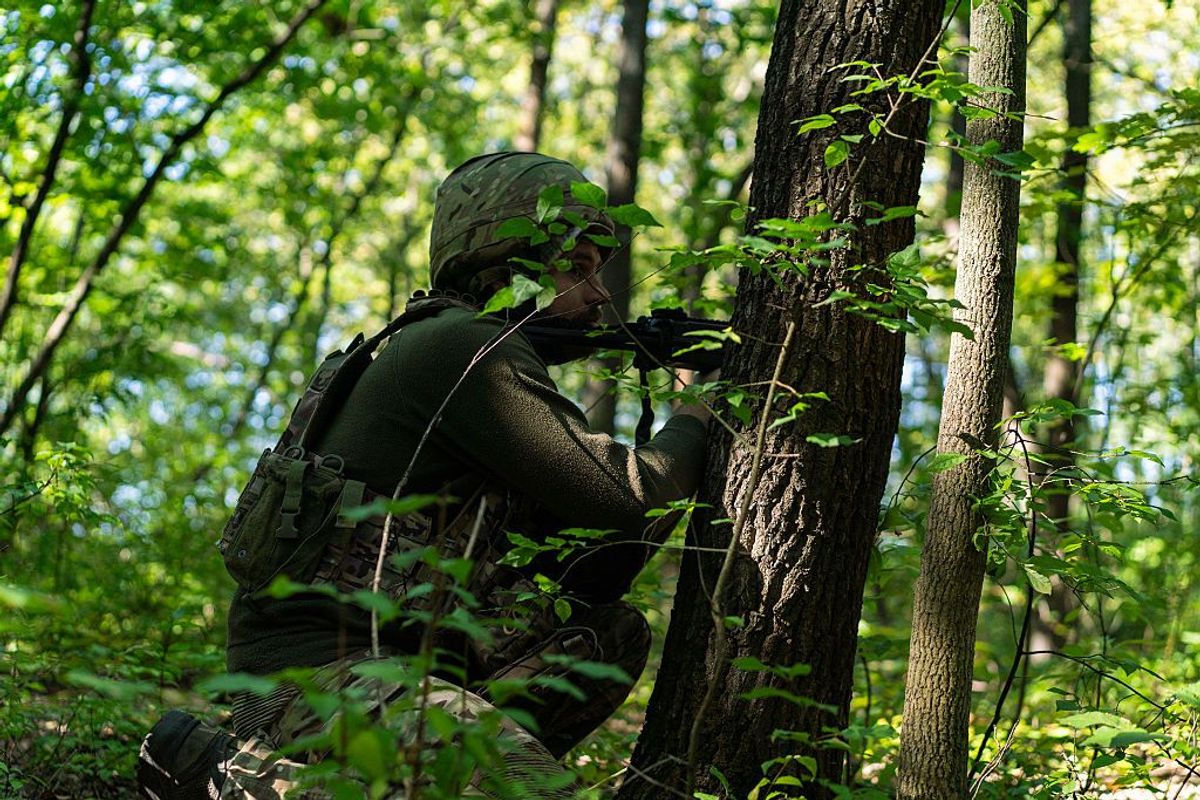
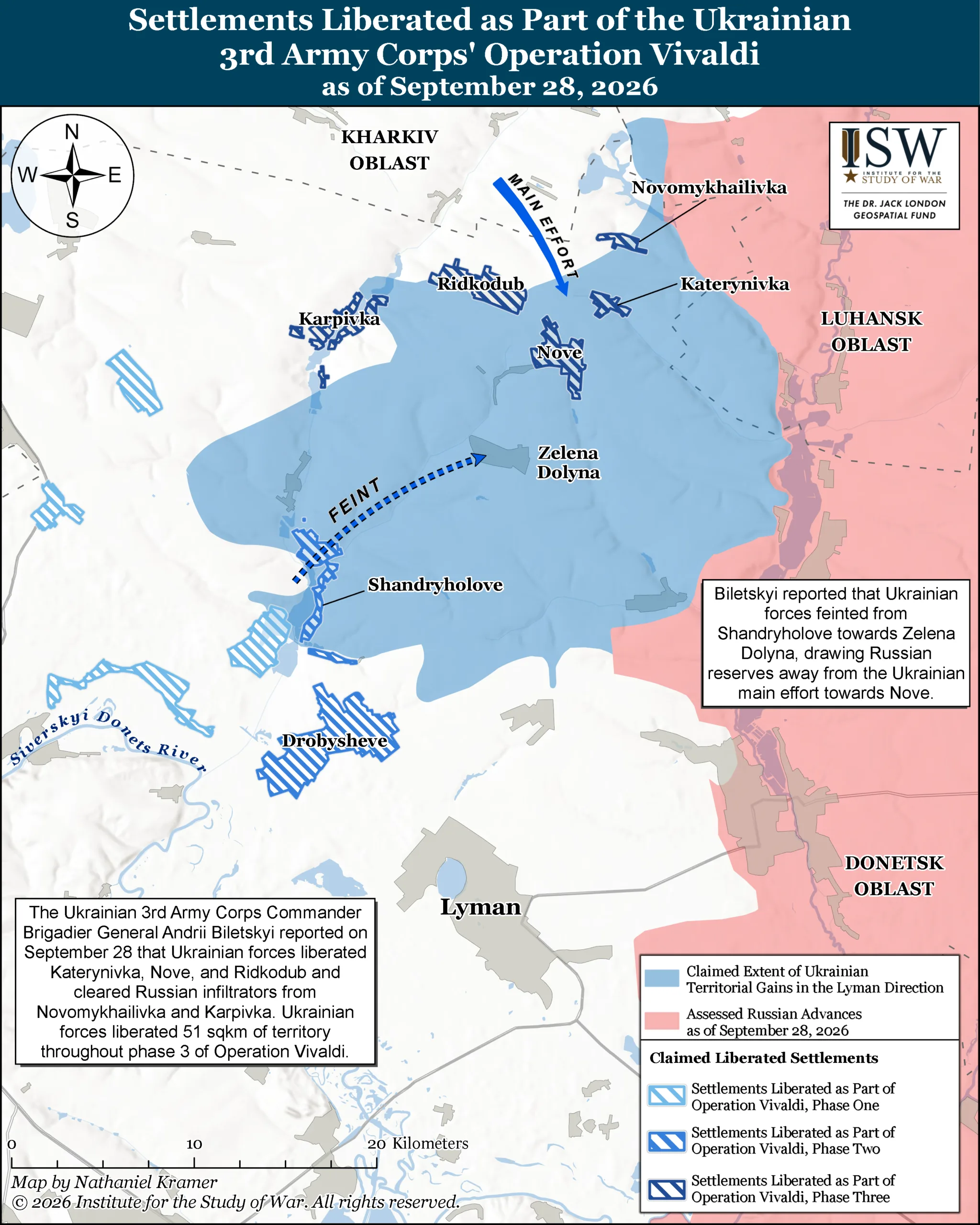
Ukrainian infantry encircled and retook the village of Kolodiazi north of Lyman without getting drawn into street fighting, while a drone battalion kept the sky above them shut, the battalion’s chief of staff told Suspilne on 18 October. The village fell during the fourth and final phase of Operation Vivaldi, Ukraine’s counteroffensive in northern Donetsk Oblast.
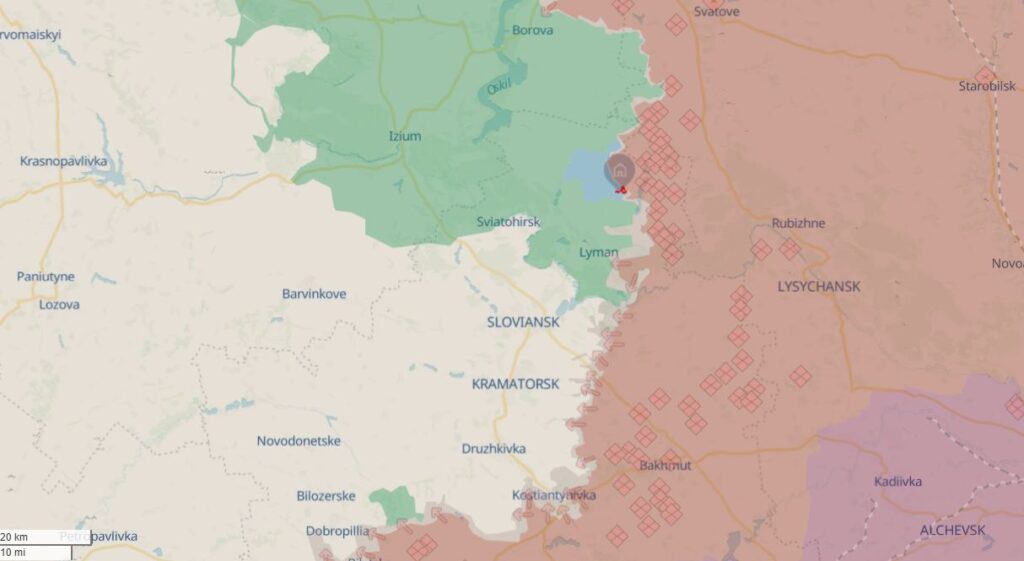
For years now, Russia has aimed to seize Lyman and cross the Siverskyi Donets River. It needs this area to encircle Ukraine’s fortress belt of Donetsk Oblast cities from the northwest, ISW assesses. Vivaldi’s four phases retook 277 km² and 16 settlements on that approach, and a veteran of the operation has said Ukraine’s assault troops suffered more than ten times fewer casualties than Russian forces doing it.
The 60th Mechanized Brigade fought in all four phases of Vivaldi and took Kolodiazi in the last one, said the chief of staff of the brigade’s Fatum unmanned systems battalion, callsign Krash.
“Our task, as an unmanned systems battalion, was to escort and ‘close’ the air in front of our infantry to make it impossible for the enemy to hit it. To suppress all the firing assets possible,” he said.
The brigade’s 3rd Mechanized Battalion, the main striking force, encircled Kolodiazi and retook it without getting drawn into street fighting, Krash said. The 1st Mechanized Battalion kept Russian reinforcements out of the area, while drone crews suppressed artillery, hit supply runs, and worked against Russian drone operators.
The drone battalion killed or wounded about 500 Russian troops during the fourth phase and struck Russian armored vehicles, trucks, and motorbikes, its chief of staff said.
“More than two hundred pieces of various equipment: Grad and Uragan multiple rocket launchers, various armored vehicles, tanks, armored combat vehicles. Most of all motorbikes and quad bikes, there the count runs into the hundreds. This is our enemy’s main logistics tool,” he said.

The villages retaken in northern Donetsk Oblast are nearly empty of civilians, Krash said.
“It’s very typical for de-occupied settlements: these are ghost towns. You can see right away where the occupier stepped. All the settlements are under the control of the Third Army Corps, our forces stand there and prevent enemy infiltration. But civilian life in these towns is either absent or very scarce,” he said.
Third Army Corps commander Brigadier General Andrii Biletskyi reported Kolodiazi’s liberation, along with Zelena Dolyna and Lypove, when he summed up Vivaldi’s fourth phase, which secured 101 km².


Anyone on social media will find infinite references to horoscopes, mediums, tarot and other practices. This seems to contrast with the era in which we live which is hyperconnected and technologically advanced.

© Cooperphoto (Getty Images)
Giorgos Vardinoyannis, one of the best-known figures in Greek business and sports, who also had a significant presence in the commercial shipping industry, died on Friday at the age of 90. Widely known by the nickname “The Captain”, Vardinoyannis was associated not only with the Athens soccer team Panathinaikos FC but also with the Vardinoyannis […]
The post Giorgos Vardinoyannis, shipping magnate and former Panathinaikos FC owner, dies at 90 appeared first on Keep Talking Greece.