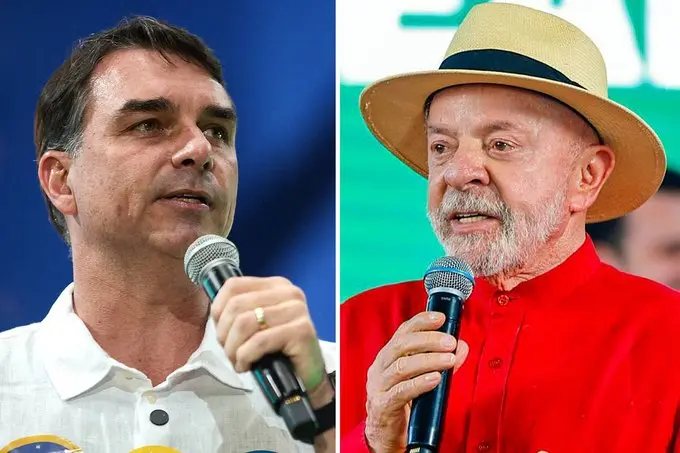
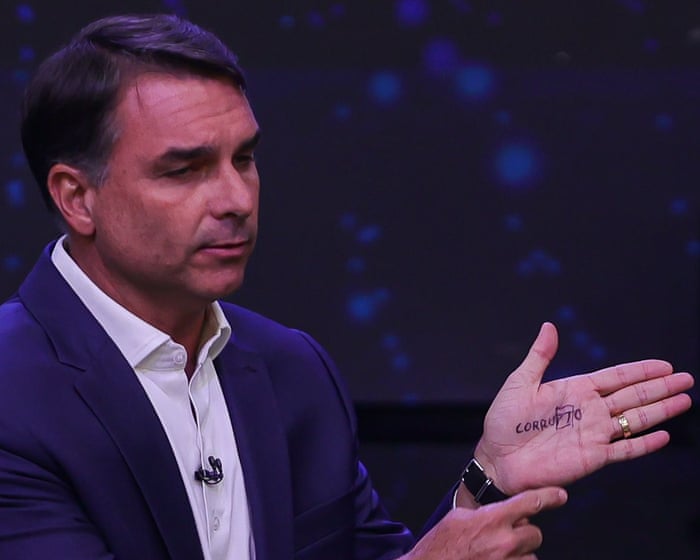
Far-right presidential candidate’s TV debate swipe at rival backfires as people take to social media to parody it
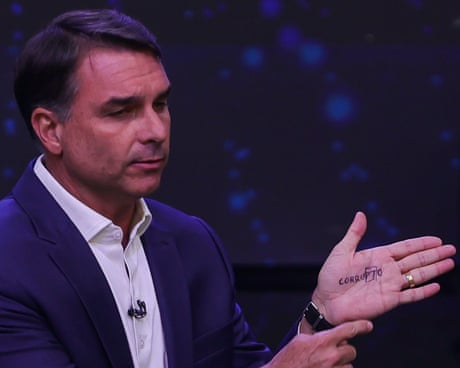
To Flávio Bolsonaro and his publicists, it must have seemed an ingenious idea that would expose his rival’s supposed crookedness on the eve of Brazil’s presidential election.
But the far-right politician’s decision to attend a primetime television debate against his leftwing opponent, Luiz Inácio Lula da Silva, with the word “corrupto” (corrupt) written on the palm of his hand has backfired.
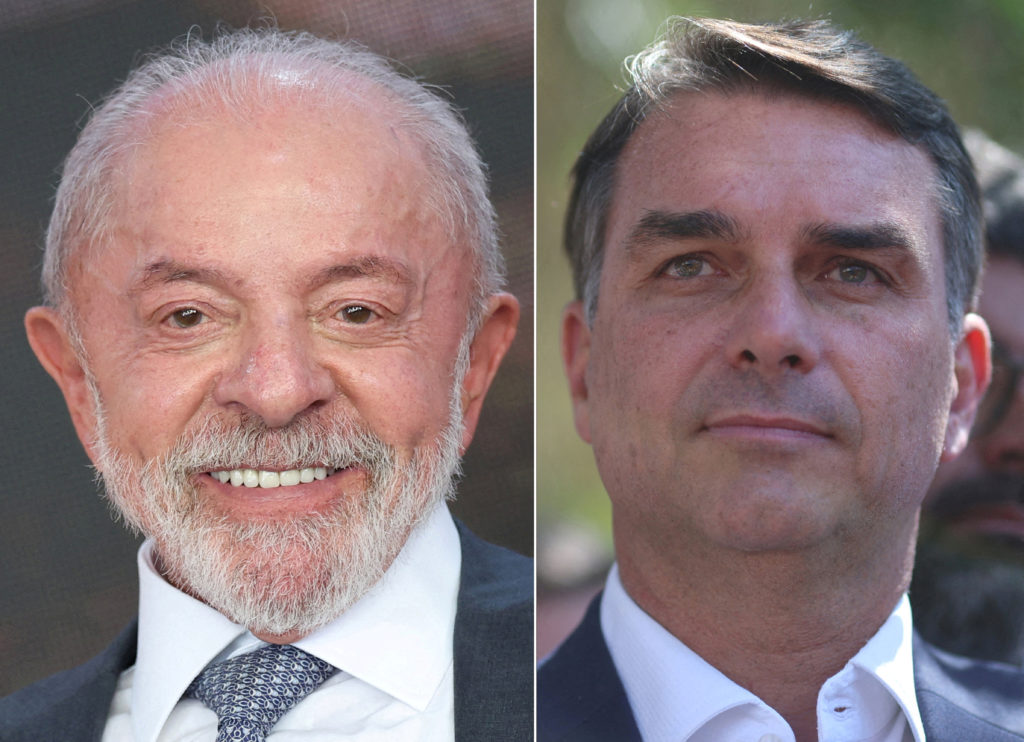
On Oct. 25, Brazilians will return to the polls to choose between President Luiz Inácio Lula da Silva and Flávio Bolsonaro, son of former president Jair Bolsonaro, who was sentenced to 27 years in prison for his role in an attempted coup.
The first round gave Flávio 47.03 percent of valid votes against Lula’s 45.16 percent, revealing the enduring strength of the far right four years after its electoral defeat.
The runoff takes place as President Donald Trump seeks to restore U.S. domination over Latin America, with Brazil emerging as a consequential battleground in Washington’s campaign to contain China’s growing relations with the region.
Over the past two decades, Brazil and China have built a political partnership that has expanded the space for independent action among countries of the Global South. Under Lula and China’s President Xi Jinping, this relationship has deepened through cooperation in industrial development, infrastructure, science and technology.
The election will determine whether this project advances or Brazil’s international orientation is subordinated to Washington’s renewed Monroe Doctrine as part of the continent’s rightward shift.
Since Lula’s return to the presidency in 2023, the two governments have connected Chinese cooperation with Brazil’s development programmes, including Nova Indústria Brasil, the Growth Acceleration Programme (PAC) and the Ecological Transformation Plan. Lula’s May 2025 visit to Beijing produced 36 agreements covering infrastructure, finance, artificial intelligence, public health and industrial cooperation.
Behind these agreements is a long-standing challenge: overcoming Brazil’s dependent position in the international division of labour, where commodity exports continue to outweigh advanced industrial and technological development.
This cooperation has also reached Brazilian popular movements. Through the International Association for Popular Cooperation (Baobab), Brazil’s Landless Rural Workers’ Movement (MST) and other organisations have worked with Chinese institutions on agricultural mechanisation, bioinputs and digital technologies for family farming.
These initiatives include the Digital Family Farming and Agroecology Laboratoryand IARAA, an artificial intelligence project for agroecology and agrarian reform developed by Brazilian popular movements using Chinese open-source models.
In a countryside marked by extreme concentrations of land, machinery and capital, such cooperation offers new tools to peasant organisations fighting for agrarian reform and the production of healthy food.
Brazil’s relationship with China also reveals the different class interests at work in the country, with contradictions particularly visible in the countryside.
Massive exports of soybeans, meat and minerals have continued under both Bolsonaro and Lula, but their governments have pursued very different political relationships with Beijing.
While Jair Bolsonaro attacked China and aligned himself with Washington, Lula has sought to deepen strategic cooperation, including in industrial development, technology and agrarian reform.
Flávio Bolsonaro now promises an “economically pragmatic” relationship with China while cultivating close ties with Trump. For sectors of Brazil’s ruling classes that profit from commodity exports, continuing to sell to China while embracing Washington’s political agenda presents little contradiction. For Brazil’s efforts to rebuild its industry and develop technological sovereignty, the consequences are far greater.
Return of the Monroe Doctrine
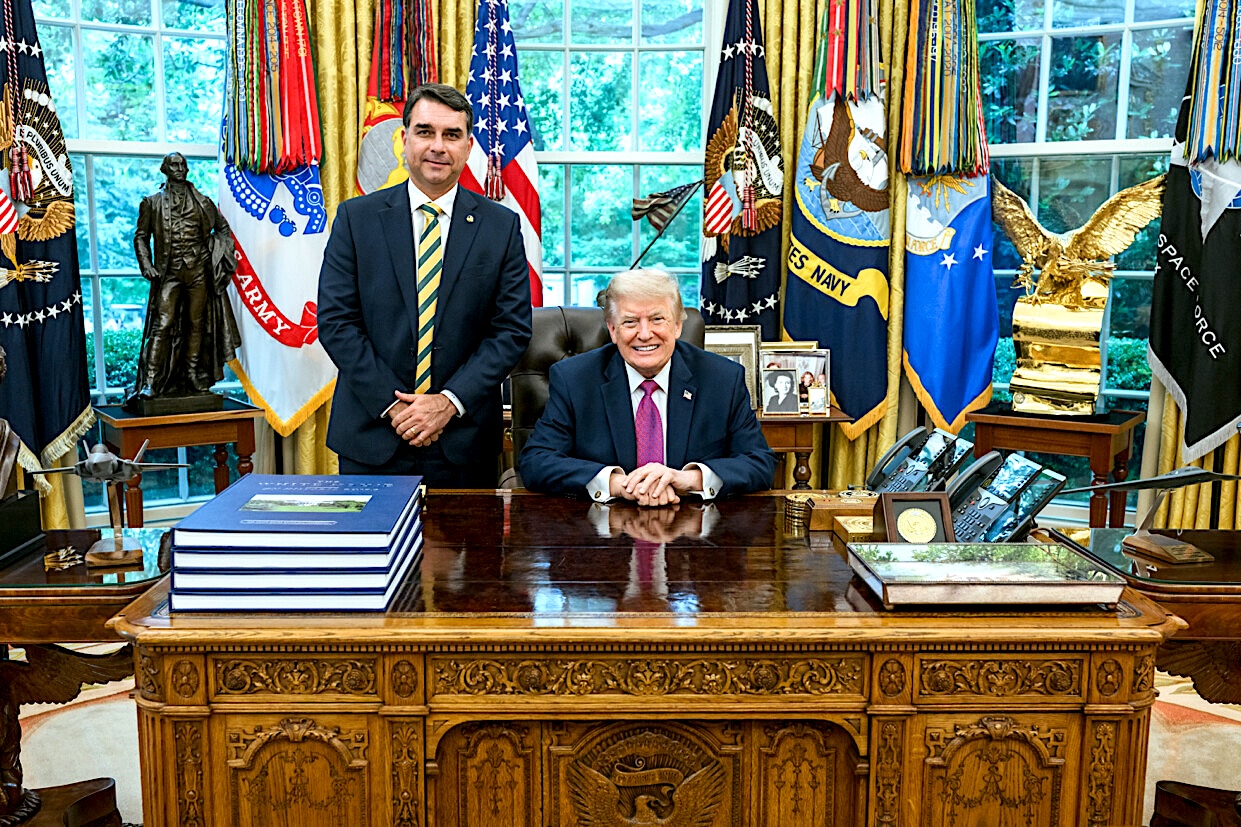
Bolsonaro with Trump in the White House on May 26. (White House/Donald Trump/Truth Social/Wikimedia Commons/Public Domain)
Washington’s ambitions were made explicit in its December 2025 National Security Strategy, which announced a “Trump Corollary” to the Monroe Doctrine, seeking to restore U.S. pre-eminence in the Western Hemisphere and deny outside powers control over strategic resources and infrastructure.
Five days later, China published its third Latin America policy paper, reaffirming sovereignty, non-interference, regional integration, technological cooperation and support for the region as a Zone of Peace. The two documents reveal fundamentally different approaches to the political future of the continent.
Brazil’s position is decisive. As Latin America’s largest economy, a founding BRICS member and a leading participant in Mercosur, it possesses industrial, scientific and political capacities that could strengthen independent development across Latin America and beyond.
The emergence of a new technological era makes this struggle particularly consequential. Brazil is among the few countries of the Global South capable of pursuing digital and technological sovereignty that could benefit its neighbours and parts of Africa.
Its roughly 23 percent share of global rare earth reserves is an important starting point, but control over minerals alone is insufficient. The greater challenge is developing the capacity to process them, manufacture advanced components and build the digital infrastructure, artificial intelligence systems and technologies that will shape future production.
Chinese economic reporting has also described proposals from his team to exclude China from rare-earth supply chains. Rather than using Brazil’s resources to develop its own industrial and technological capacities, this agenda would place them at the service of U.S. technological and military power.
The same political orientation extends to digital sovereignty. In July, Flávio’s campaign submitted proposals to U.S. trade authorities that included preventing Brazil’s Pix payment system from connecting to non-Western international payment networks and loosening commitments within Mercosur.
Meanwhile, Washington’s January bombing on Venezuela and kidnapping of President Nicolás Maduro and First Lady Cilia Flores demonstrated how far it is prepared to go to impose its will on the continent.
BRICS & the Struggle for Independent Foreign Policy
A BRICS plenary session on Strengthening Multilateralism, Economic and Financial Affairs and Artificial Intelligence in Rio de Janeiro in July 2025. (Palácio do Planalto /Flickr/ CC0/Wikimedia Commons)
Brazil, particularly under Lula, has helped build institutions through which countries of the Global South can reduce their dependence on Western-dominated structures.
At the July 2025 BRICS summit in Rio de Janeiro, the group advanced cooperation on development finance, local-currency transactions, and international institutional reform.
The New Development Bank, headed by former Brazilian president Dilma Rousseff, is an important expression of this effort.
The BRICS cannot automatically overcome economic dependency or guarantee sovereignty for working people. Yet its expansion offers greater room for independent development, provided that participating governments have the political commitment to use these possibilities.
Brazil’s history reveals how difficult that independence has been to defend. In 1961, Vice President João Goulart became the first high-ranking representative of a Latin American government to visit the People’s Republic of China, meeting Mao Zedong when revolutionary China remained diplomatically isolated and subjected to U.S. sanctions. Three years later, Goulart was overthrown in a U.S.-backed civil-military coup that inaugurated a 21-year dictatorship.
The early history of China–Brazil friendship was inseparable from struggles over national sovereignty, agrarian reform and the forces determined to suppress them.
The international material conditions for South–South cooperation are considerably more favourable today, but political direction remains decisive.
Former President Jair Bolsonaro hosted the 2019 BRICS summit in Brasília while pursuing close alignment with Washington. A government can weaken institutions from within by abandoning the commitments that give them political substance.
Jair Bolsonaro in 2018. (Jeso Carneiro/ Flickr/ CC BY-NC 2.0)
The far right’s resurgence also reflects the enduring power of Brazil’s own ruling classes. Bolsonarismo has a domestic base among sections of agribusiness, finance, the security apparatus, militias, conservative religious networks and major media.
These forces, whose electoral and institutional advances have continued, were strengthened by the 2016 parliamentary coup against Dilma Rousseff and the judicial persecution of Lula. They possess their own organisations, material interests and sources of power, which do not disappear when an election is lost. Their economic dependence on Chinese markets has not prevented their support for Washington’s political agenda.
Beyond the Election
Beijing has followed the Brazilian election closely, reflecting the importance of the political relationship built between Lula and Xi over years of cooperation.
In July, Xi reaffirmed China’s support for Brazil against external interference during a conversation with Lula, which also covered cooperation in artificial intelligence, satellites, mineral processing and relations between China and Mercosur.
In September, Foreign Minister Wang Yi received Lula’s adviser and former foreign minister Celso Amorim in Beijing, reaffirming the bilateral strategic partnership.
China’s principle of non-interference means that the choice of Brazil’s government belongs to the Brazilian people, but Beijing’s diplomatic restraint should not be confused with an absence of political interests or an assumption that all governments would pursue the same relationship. Chinese analysts have described the possible outlook under Flávio as one of “cold politics, hot economics”: commodity trade would likely continue, but the political relationship and cooperation in strategic sectors could deteriorate. The experience of Jair Bolsonaro’s presidency has already shown the limits of commercial interests in sustaining a broader political partnership.
For the Brazilian people, the consequences extend well beyond foreign policy. The election will also shape the struggles over labour rights, public services, agrarian reform and the defence of democratic space.
Brazil’s renewed role in South–South cooperation under Lula has opened possibilities for a development project that responds to the needs of its working people, but realising those possibilities depends on the political and social forces capable of carrying it forward.
The Brazilian people have fought through dictatorship, neoliberal restructuring, parliamentary coups and the rise of the far right to defend their political and social gains.
This election is another moment in that longer struggle, now unfolding amid renewed U.S. imperial intervention and a transformation of the world’s technological foundations. The future of China–Brazil cooperation will depend on the capacity of organised popular forces to build a sovereign national project and turn international cooperation into lasting changes in people’s lives.
"Presentaré esto mañana ante el TSE con la esperanza de que el candidato opositor presente una propuesta para levantar la confidencialidad de sus registros, así como los de sus empresas y su familia", afirmó Lula, detallando que incluyó a sus cinco hijos para evitar acusaciones infundadas durante la campaña.
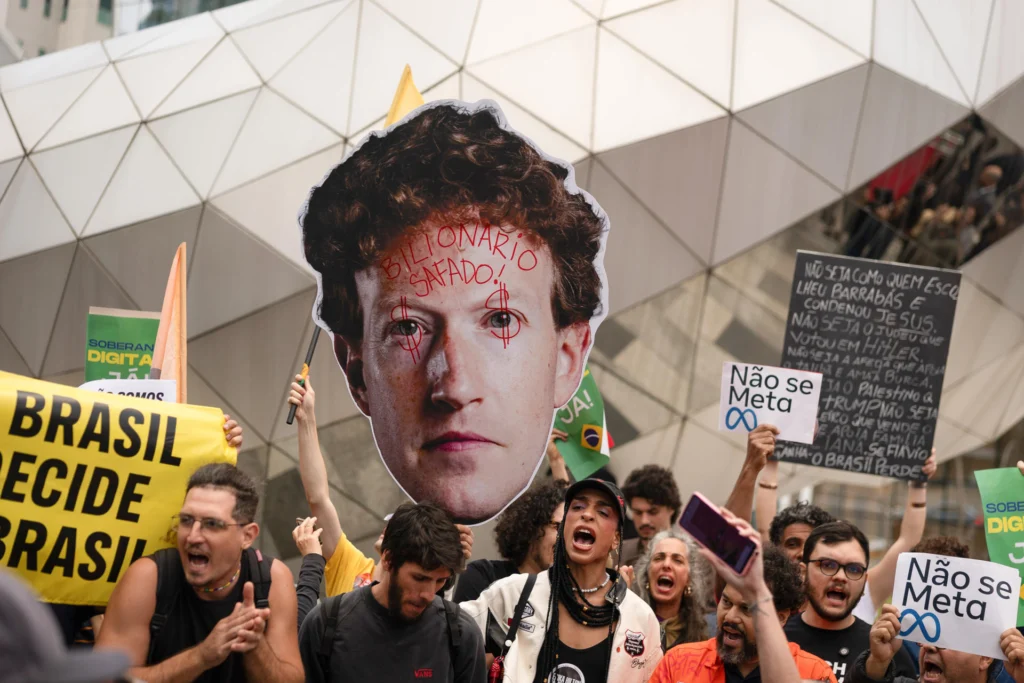
Demonstrators demand algorithmic transparency as Brazil’s electoral court gives Meta 24 hours to prove equal treatment of presidential campaigns.
Hundreds of Brazilians protested outside Meta’s São Paulo offices on Monday, accusing the technology giant of restricting the reach of President Luiz Inácio Lula da Silva’s campaign while boosting far-right candidate Flávio Bolsonaro, six days before the presidential runoff. The demonstration coincided with a court order giving Meta 24 hours to prove it was treating both campaigns equally.
The protest on Faria Lima Avenue called for an end to what demonstrators described as the suppression of progressive political content. Organizers also demanded transparency in content moderation algorithms, protections for activists and journalists, and compensation for damage to public debate.
The Superior Electoral Court (TSE) imposed the 24-hour deadline amid mounting scrutiny of Meta’s handling of the campaigns. The dispute intensified after internal messages emerged in which company employees acknowledged that Lula’s account had faced restrictions compared with Bolsonaro’s. The messages indicated that Lula’s Instagram posts could not be promoted for nearly 24 hours between Oct. 9 and 10.
Text Reads: “META DON’T GET INVOLVED!” Brazilian movements occupy the headquarters of the social media platform.
TSE Justice Marco Aurélio Bellizze warned that appeals would not suspend the court’s orders and doubled the daily fine for noncompliance from 500,000 reais to 1 million reais, or about $180,000.
The court also ordered Meta to submit individual reports in Portuguese, explain its recommendation algorithms, provide details on electoral advertising oversight, and identify potential networks of fake accounts and AI-generated images.
“Unilaterally replacing deadlines set by the court amounts to noncompliance, particularly in a process whose effectiveness depends on time,” Bellizze said.
Meta maintains that its content moderation policies apply equally to all political actors. Bolsonaro has also sought to join the proceedings, arguing that his own content has been harmed.
Concerns over digital sovereignty
Protesters argued that the dispute exposed the broader influence of social media platforms over Brazil’s electoral process. They noted that 70% of the Brazilian population uses Instagram to obtain information and accused Meta, owned by Mark Zuckerberg, of wielding opaque power over political visibility.
“We cannot say we have fair elections when a company uses its economic, technical and technological power to tilt public debate toward one side, which is what is happening,” said Dani Silva, executive director of Ctrl+Z, one of the organizations behind the demonstration.
The rally was organized by the Não se Meta coalition, which included the Landless Workers’ Movement (MST), Levantamento da Juventude Popular, Brasil Popular, Article 19, Ctrl+Z, Código No Binário, Diracom, the National Forum for the Democratization of Communication and Sleeping Giants Brazil.
Under the slogan “Meta, stay out of our election,” demonstrators displayed signs featuring Zuckerberg alongside U.S. President Donald Trump and chanted for digital sovereignty and Meta’s exclusion from the electoral process.
Activist Veronyka Gimenes, known as Trava Hacker, described the company’s actions as part of what she called “digital colonialism,” alleging that technology companies seek to influence domestic politics across the Global South.
“Digital sovereignty is no joke; it is something that must be taken very seriously,” she said.
Activist Tiana Cauton urged people to take to the streets to demand the democratization of communications. She also expressed hope that a new presidential term would advance “autonomy through our own open and clean social networks.”
Demonstrators said Meta’s influence over political communication had undermined Brazil’s national sovereignty since the 2018 elections, renewing calls for greater accountability for social media platforms during the electoral process.
Manifestantes denunciaron en São Paulo que Meta reduce de forma injustificada el alcance de las publicaciones del mandatario Luiz Inácio Lula da Silva, al tiempo que impulsa los contenidos del candidato de la extrema derecha, Flávio Bolsonaro.
Más de 800 actividades y eventos programados en decenas de ciudades, con fuerte presencia juvenil y de la cultura de Brasil, en apoyo a la reelección de Lula y en defensa de la democracia.
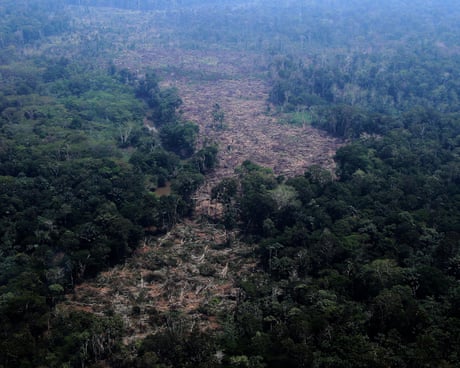
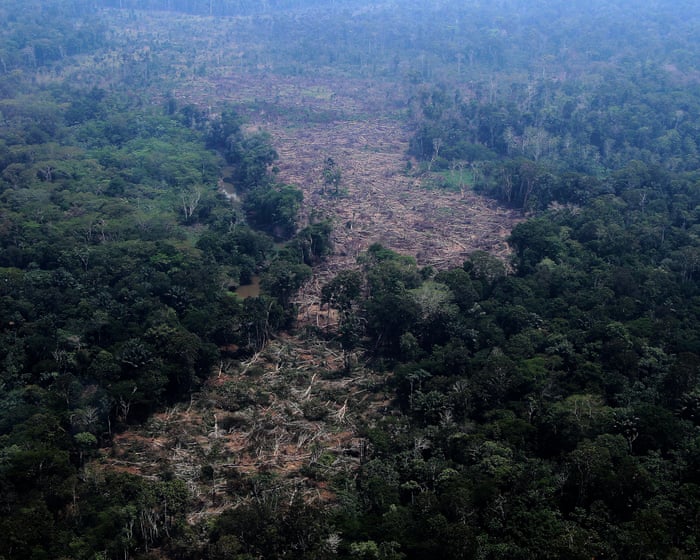
Forest clearance at smallest total since records began in 1988 in success for Lula ahead of presidential run-off
Deforestation in the Brazilian Amazon has fallen to its lowest level since records began, new government data shows.
But whether this globally important success is maintained or reversed is on a knife edge ahead of a presidential election run-off on 25 October between two candidates with sharply different visions for the future of the rainforest and how that affects relations with the US under Donald Trump.
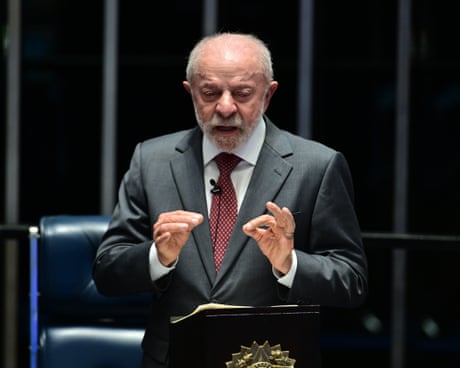
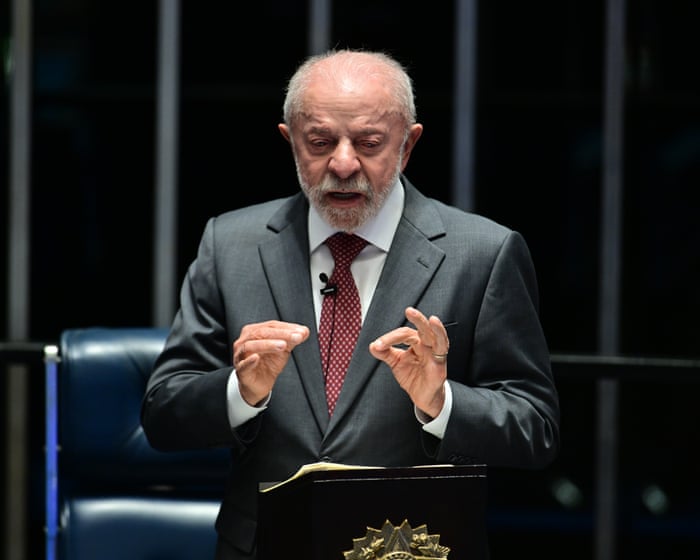
Lula reverses position on age of responsibility for ‘heinous’ crimes in what many see as a desperate electoral gambit
Brazil’s president, Luiz Inácio Lula da Silva, has announced that he now supports lowering the age of criminal responsibility for “heinous” crimes from 18 to 16, reversing a longstanding policy in what is widely seen as a desperate electoral gambit.
The U-turn, which Lula announced during a Thursday night interview with TV Globo, comes with the presidential runoff in just over a week. The incumbent faces an uphill battle to overturn the first-round victory of his opponent, the far-right senator Flávio Bolsonaro, who remains slightly ahead at the polls.
Según detalló el jefe de Estado, el financiamiento para implementar esta gratuidad provendrá de la reasignación de los fondos presupuestarios que manejan directamente los legisladores para proyectos en sus distritos.
Datafolha puts Flávio Bolsonaro at 47% and Lula at 45% ahead of Brazil’s Oct. 25 presidential runoff.
Brazil’s presidential race has tightened ahead of the Oct. 25 runoff, with senator Flávio Bolsonaro losing two percentage points in voting intention to reach 47%, while President Luiz Inácio Lula da Silva stands at 45%, according to a Datafolha poll released Thursday. The two candidates are in a technical tie, with the difference falling within the survey’s margin of error.
Among valid votes, which exclude blank and invalid ballots, Bolsonaro leads Lula by 51% to 49%. The gap has narrowed from the previous week’s poll, when Bolsonaro held a 52%-48% advantage.
A separate poll published Wednesday by research firm Quaest also showed a close race, giving Bolsonaro 46% support and Lula 44%.
Text Reads: DATAFOLHA: 51% x 49% IT’S TURNING AROUND!!! Last week, the difference was 4 points. Now it’s down to 2.
The Datafolha survey found similar levels of rejection for both candidates. Some 46% of respondents said they would never vote for Bolsonaro, compared with 44% who said the same of Lula.
Views of the current government were also divided: 41% of respondents rated its performance negatively, while 35% viewed it positively.
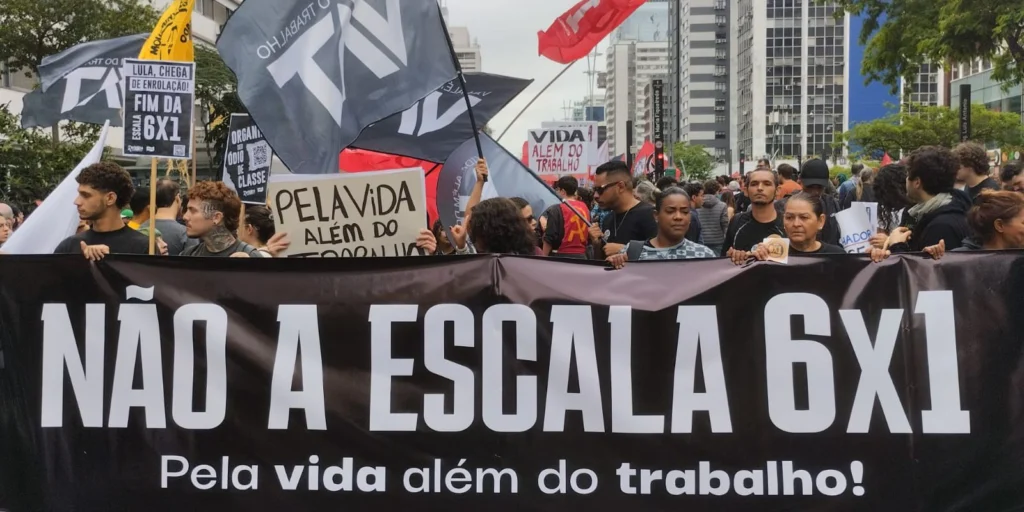
The poll was conducted after large rallies in support of Lula took place over the weekend. However, the interviews were completed before the survey could capture any potential impact from the Senate’s approval of a proposed constitutional amendment to end the 6×1 work schedule, under which workers work six days and take one day off.
The proportion of respondents opting for blank or invalid ballots rose from 5% to 6%, while the share of undecided voters ranged between 1% and 2%.
Datafolha interviewed 2,520 people aged 16 and older across Brazil from Oct. 13 to 15. The survey has a margin of error of two percentage points and a 95% confidence level. It was registered with Brazil’s Superior Electoral Court under number BR-00466/2026. In the first round, Bolsonaro received 47.03% of the vote, compared with 45.16% for Lula.
A diez días del balotaje presidencial en Brasil, la firma Datafolha confirmó un empate técnico al situar a Flávio Bolsonaro con el 47% de la intención de voto y al presidente Luiz Inácio Lula da Silva con el 45%, en una carrera que se aprieta hacia la segunda vuelta.
Brazilian President Luiz Inácio Lula da Silva has described the approval of the Proposed Constitutional Amendment (PEC 221/2019) as a historic achievement. The amendment puts an end to the 44-hour workweek, establishing a new maximum of 40 hours per week, distributed over five working days and two paid rest days.
The constitutional reform—a key commitment of the Brazilian government—will directly benefit approximately 22 million workers who were previously employed under a “6×1” schedule, consisting of six days of work followed by one day of rest.
Brazil’s Senate ratified the amendment in two rounds of voting, with 75 votes in favor and one against—the latter cast by Senator Hamilton Mourão. This decision comes five months after the Chamber of Deputies initially approved the proposal, and 11 days ahead of the presidential runoff, scheduled for October 25.
Far-right candidate Flávio Bolsonaro, who had initially opposed the measure, shifted his position and voted in favor remotely from Porto Alegre. Progressive senators, including Teresa Leitão, labeled this move as opportunistic and warned of the need to remain vigilant against any potential attempts to overturn the new regulation.
A escala 6×1 acabou! ❤️🇧🇷
Uma conquista histórica para milhões de trabalhadores e trabalhadoras, que agora terão mais tempo para descansar, estar com a família, cuidar de si e viver.
Quem constrói o Brasil todos os dias também merece tempo para viver.
The text reads, “The 6×1 schedule is over! A historic achievement for millions of workers, who will now have more time to rest, be with their family, take care of themselves, and live. Those who build Brazil every day also deserve time to live. It’s Brazil ready for more!”
Timeline and safeguards
The transition to the “5×2” model will not be immediate. According to the established timeline, 60 days after the official publication of the amendment—expected in February 2027—the maximum weekly working hours will be reduced from 44 to 42.
Subsequently, 14 months after the amendment is enacted—in December 2027—the limit will be set at 40 hours per week. The regulation also establishes a maximum daily limit of eight working hours. The constitutional text expressly prohibits any reduction in wages—whether proportional or affecting the minimum wage—across professional categories.
Furthermore, it delegates the organization of rest periods to collective bargaining agreements, prioritizing Sundays, while allowing for flexibility in sectors such as healthcare, security, and public transport.
While labor unions supported the measure, business sectors expressed their opposition, arguing that it could lead to higher costs per hour worked and the risk of a contraction in employment. The right-wing opposition also signaled its intention to revise the legislation should it gain control of the executive branch.
For individual micro-entrepreneurs and small business units, the reform provides for a supplementary law that includes state support mechanisms designed to cushion the impact of the transition and sustain formal employment targets.
Within the public administration, existing service contracts will have a period of up to 12 months to adjust their operational and financial frameworks to the new limits on working hours.
With the approval of PEC 221/2019, Brazil has begun a restructuring of its labor market aimed at reducing precarious working-hour arrangements in Latin America’s largest economy.
Premian en Washington al adalid del ajuste neoliberal en Argentina, responsable de haber destruido hasta el momento más de 370.000 empleos formales y del cierre de unas 30.000 empresas.
Senadores progresistas de Brasil declararon que, en el entorno del próximo balotaje, la aprobación del final del 6x1 significa una victoria para el presidente Lula, pero también para la movilización en las calles.
On October 25, Brazilians will return to the polls to choose between President Luiz Inácio Lula da Silva and Flávio Bolsonaro, son of former president Jair Bolsonaro, who was sentenced to 27 years in prison for his role in an attempted coup. The first round gave Flávio 47% of valid votes against Lula’s 45%, revealing the enduring strength of the far right four years after its electoral defeat. The runoff takes place as Donald Trump seeks to restore US domination over Latin America, with Brazil emerging as a consequential battleground in Washington’s campaign to contain China’s growing relations with the region.
Over the past two decades, Brazil and China have built a political partnership that has expanded the space for independent action among countries of the Global South. Under Lula and Xi Jinping, this relationship has deepened through cooperation in industrial development, infrastructure, science, and technology. The election will determine whether this project advances or Brazil’s international orientation is subordinated to Washington’s renewed Monroe Doctrine as part of the continent’s rightward shift.
Since Lula’s return to the presidency in 2023, the two governments have connected Chinese cooperation with Brazil’s development programs, including Nova Indústria Brasil, the Growth Acceleration Program (PAC), and the Ecological Transformation Plan. Lula’s May 2025 visit to Beijing produced 36 agreements covering infrastructure, finance, artificial intelligence, public health, and industrial cooperation. Behind these agreements is a long-standing challenge: overcoming Brazil’s dependent position in the international division of labor, where commodity exports continue to outweigh advanced industrial and technological development.
This cooperation has also reached Brazilian popular movements. Through the International Association for Popular Cooperation (Baobab), Brazil’s Landless Rural Workers’ Movement (MST) and other organizations have worked with Chinese institutions on agricultural mechanization, bioinputs, and digital technologies for family farming. These initiatives include the Digital Family Farming and Agroecology Laboratory and IARAA, an artificial intelligence project for agroecology and agrarian reform developed by Brazilian popular movements using Chinese open-source models. In a countryside marked by extreme concentrations of land, machinery, and capital, such cooperation offers new tools to peasant organizations fighting for agrarian reform and the production of healthy food.
Brazil’s relationship with China also reveals the different class interests at work in the country, with contradictions particularly visible in the countryside. Massive exports of soybeans, meat, and minerals have continued under both Bolsonaro and Lula, but their governments have pursued very different political relationships with Beijing. While Jair Bolsonaro attacked China and aligned himself with Washington, Lula has sought to deepen strategic cooperation, including in industrial development, technology, and agrarian reform. Flávio Bolsonaro now promises an “economically pragmatic” relationship with China while cultivating close ties with Trump. For sectors of Brazil’s ruling classes that profit from commodity exports, continuing to sell to China while embracing Washington’s political agenda presents little contradiction. For Brazil’s efforts to rebuild its industry and develop technological sovereignty, the consequences are far greater.
The return of the Monroe Doctrine
Washington’s ambitions were made explicit in its November 2025 National Security Strategy, which announced a “Trump Corollary” to the Monroe Doctrine, seeking to restore US pre-eminence in the Western Hemisphere and deny outside powers control over strategic resources and infrastructure. Five days later, China published its third Latin America policy paper, reaffirming sovereignty, non-interference, regional integration, technological cooperation, and support for the region as a Zone of Peace. The two documents reveal fundamentally different approaches to the political future of the continent.
Brazil’s position is decisive. As Latin America’s largest economy, a founding BRICS member, and a leading participant in Mercosur, it possesses industrial, scientific, and political capacities that could strengthen independent development across Latin America and beyond.
The emergence of a new technological era makes this struggle particularly consequential. Brazil is among the few countries of the Global South capable of pursuing digital and technological sovereignty that could benefit its neighbors and parts of Africa. Its roughly 23% share of global rare earth reserves is an important starting point, but control over minerals alone is insufficient. The greater challenge is developing the capacity to process them, manufacture advanced components, and build the digital infrastructure, artificial intelligence systems, and technologies that will shape future production.
Flávio has made his orientation clear. Speaking at the Conservative Political Action Conference (CPAC) in the United States in March 2026, he offered Brazil as the “solution” to Washington’s dependence on China for critical minerals, explicitly linking rare earths to artificial intelligence and US military superiority. Chinese economic reporting has also described proposals from his team to exclude China from rare-earth supply chains. Rather than using Brazil’s resources to develop its own industrial and technological capacities, this agenda would place them at the service of US technological and military power.
The same political orientation extends to digital sovereignty. In July 2026, Flávio’s campaign submitted proposals to US trade authorities that included preventing Brazil’s Pix payment system from connecting to non-Western international payment networks and loosening commitments within Mercosur. These proposals converge with a wider US campaign involving tariffs, digital regulation, strategic minerals, and attempts to influence Brazil’s electoral process. Meanwhile, Washington’s January 2026 bombing on Venezuela and kidnapping of Nicolás Maduro and Cilia Flores demonstrated how far it is prepared to go to impose its will on the continent.
BRICS and the struggle for an independent foreign policy
Brazil, particularly under Lula, has helped build institutions through which countries of the Global South can reduce their dependence on Western-dominated structures. At the July 2025 BRICS summit in Rio de Janeiro, the group advanced cooperation on development finance, local-currency transactions, and international institutional reform. The New Development Bank, headed by former Brazilian president Dilma Rousseff, is an important expression of this effort.
The BRICS cannot automatically overcome economic dependency or guarantee sovereignty for working people. Yet its expansion offers greater room for independent development, provided that participating governments have the political commitment to use these possibilities.
Brazil’s history reveals how difficult that independence has been to defend. In 1961, vice-president João Goulart became the first high-ranking representative of a Latin American government to visit the People’s Republic of China, meeting Mao Zedong when revolutionary China remained diplomatically isolated and subjected to US sanctions. Three years later, Goulart was overthrown in a US-backed civil-military coup that inaugurated a 21-year dictatorship. The early history of China–Brazil friendship was inseparable from struggles over national sovereignty, agrarian reform, and the forces determined to suppress them.
The international material conditions for South–South cooperation are considerably more favorable today, but political direction remains decisive. Jair Bolsonaro hosted the 2019 BRICS summit in Brasília while pursuing close alignment with Washington. A government can weaken institutions from within by abandoning the commitments that give them political substance.
The far right’s resurgence also reflects the enduring power of Brazil’s own ruling classes. Bolsonarismo has a domestic base among sections of agribusiness, finance, the security apparatus, militias, conservative religious networks, and major media. These forces, whose electoral and institutional advances have continued, were strengthened by the 2016 parliamentary coup against Dilma Rousseff and the judicial persecution of Lula. They possess their own organizations, material interests, and sources of power, which do not disappear when an election is lost. Their economic dependence on Chinese markets has not prevented their support for Washington’s political agenda.
Beyond the election
Beijing has followed the Brazilian election closely, reflecting the importance of the political relationship built between Lula and Xi over years of cooperation. In July, Xi reaffirmed China’s support for Brazil against external interference during a conversation with Lula, which also covered cooperation in artificial intelligence, satellites, mineral processing, and relations between China and Mercosur. In September, Foreign Minister Wang Yi received Lula’s adviser and former foreign minister Celso Amorim in Beijing, reaffirming the bilateral strategic partnership.
China’s principle of non-interference means that the choice of Brazil’s government belongs to the Brazilian people, but Beijing’s diplomatic restraint should not be confused with an absence of political interests or an assumption that all governments would pursue the same relationship. Chinese analysts have described the possible outlook under Flávio as one of “cold politics, hot economics”: commodity trade would likely continue, but the political relationship and cooperation in strategic sectors could deteriorate. The experience of Jair Bolsonaro’s presidency has already shown the limits of commercial interests in sustaining a broader political partnership.
For the Brazilian people, the consequences extend well beyond foreign policy. The election will also shape the struggles over labor rights, public services, agrarian reform, and the defence of democratic space. Brazil’s renewed role in South–South cooperation under Lula has opened possibilities for a development project that responds to the needs of its working people, but realizing those possibilities depends on the political and social forces capable of carrying it forward.
The Brazilian people have fought through dictatorship, neoliberal restructuring, parliamentary coups, and the rise of the far right to defend their political and social gains. This election is another moment in that longer struggle, now unfolding amid renewed US imperial intervention and a transformation of the world’s technological foundations. The future of China–Brazil cooperation will depend on the capacity of organized popular forces to build a sovereign national project and turn international cooperation into lasting changes in people’s lives.
 Login



 , X
 , and VK
 .