❌

Reading view

Trump's $8 Billion Diesel Bailout Pays Farmers for a Problem He Created

TrumpFarm | Andrew Leyden/ZUMAPRESS/Newscom/Donland/Dreamstime

On Monday, the U.S. Department of Agriculture (USDA) announced it would "make $8 billion available for one-time payments to American farmers this harvest season to provide relief during temporary market disruptions and increased input costs."

Using a formula derived from the USDA's production, yield, and price estimates, the Harvest Fuel Relief program will "provide simple, proportional support to producers." It will only cover a "portion of modeled losses during the 2026 crop year." The Farm Service Agency—an office within the USDA that administers credit and loan programs—will administer the $8 billion in one-time payments using funds from the Commodity Credit Corporation, a federal entity authorized to draw up to $30 billion from the U.S. Treasury to fund agricultural initiatives. Payment rates won't be released until November, and the USDA's notice leaves open the possibility of additional payments for "non-Title I commodities, including specialty crop growers and fishermen."

A fiscally questionable decision, the program comes at a time when farmers are feeling a significant price pinch. The dyed diesel American farmers and ranchers use is exempt from state and federal highway taxes, but that has done little to offset skyrocketing fuel prices. In September, the American Farm Bureau Federation projected that fuel expenses would reach $22 billion this year, up 29 percent from 2025. The Farm Bureau estimates that total production expenses will reach nearly $500 billion in 2026. According to its own predictions, the USDA doesn't expect the situation to improve anytime soon.

In its latest Commodity Costs and Returns report, released in June, the USDA projects farmers and ranchers will face record production costs in 2027—higher than during the COVID-19 supply chain disruptions—driven by higher prices for necessary inputs such as fuel, fertilizer, seeds, machinery, and labor. 

While the USDA has blamed "temporary market disruptions" for these cost hikes, the blame more accurately falls to President Donald Trump, thanks to his illegal war in Iran. As of Tuesday, Trump's war—and the subsequent shocks it has caused to the global diesel supply—have pushed the national average price in the U.S. up $2.70 per gallon from a year ago, a 74.6 percent increase, according to AAA data.

Unfortunately, the war in Iran is just one of several Trump administration policies making life more expensive for everyone, including the nation's farmers and ranchers. Tariffs on imported fertilizer, which began in 2020 during the first Trump administration, have made it difficult for American farmers to afford what they need. By the Farm Bureau's estimates, fertilizer costs for 2026 are projected to reach a record $40 billion, up 15 percent from the previous year.

The $8 billion program is part of a windfall of taxpayer money the Trump administration has sent to farmers as relief for harms caused by the president's actions. Last December, the USDA sent $11 billion in one-time bridge payments to more than half a million farmers nationwide. Earlier this month, the USDA announced it would provide a record $13.8 billion in gross payments to agricultural producers to cover revenue losses. 

In a speech in Kansas touting the program, Trump claimed that the state's residents would see a "plunge" in prices once the war ends. That's likely an exaggeration, given the host of questionable economic policies he seems hell-bent on implementing. 

Still, that shouldn't discredit the president's suggestion. Ending the war would benefit farmers, ranchers, and consumers, without doling out billions in another government bailout for a favored industry.

The post Trump's $8 Billion Diesel Bailout Pays Farmers for a Problem He Created appeared first on Reason Magazine.

  •  

Colombia’s Congress Approves 2027 Budget Over Opposition Objections

The Historic Pact questioned the law’s direction by pointing out that the government preferred to protect financial institutions, oligopolies and the most favored ones rather than devote more resources to key sectors such as education. Photo: El Pais.

Colombia’s Congress approved the 2027 national budget of 200 billion dollars on October 20, igniting a backlash from opposition lawmakers who say the plan favors debt payments and financial interests over education, peace and regional development.


The approval of the General Budget of Colombia for 2027 capped a tense legislative session.

President Abelardo de la Espriella’s government secured passage of the law, worth 634.9 trillion Colombian pesos (about $200 billion), over the objections of the opposition, which was led mainly by the Historic Pact party.

RELATED: Colombia’s First National Strike Against De la Espriella Met With Police Crackdown

Representative María Fernanda Carrascal described the debate as a “disaster” and faulted the national government for refusing to accept any of the 700 proposals submitted by her party. The initiatives sought to channel more resources into public education, support for victims of violence and the regions, she detailed. Faced with the lack of agreement, the opposition walked out of the debate, stating it would not back a measure it considers harmful to the country.

The Historic Pact also questioned the law’s orientation, arguing that the government chose to protect financial entities, oligopolies and the most favored sectors. They further denounced that the project promotes over-indebtedness, which they say will end up shifting heavier tax burdens onto Colombian citizens.

🇨🇴 ¡Colombia tiene Presupuesto para 2027!
El Congreso de la República aprobó por $634,9 billones el Presupuesto de la Verdad, el primer paso para volver a encaminar la economía del país hacia el crecimiento, la responsabilidad fiscal y la atención de las necesidades del país. pic.twitter.com/pHiLhYzVTU

— MinHacienda (@MinHacienda) October 20, 2026

Text reads: “Colombia has budget for 2027! The Congress of the Republic approved the Truth Budget for $634.9 trillion, the first step to reorient the country’s economy toward growth, fiscal responsibility, and meeting the country’s needs.”

Other voices in the legislature added their objections. Senator Jennifer Pedraza of the Dignity and Commitment party (Dignidad y Compromiso, in Spanish) criticized the absence of a fixed allocation to address the consequences of the earthquake that struck on August 10. She questioned the fact that assistance to hard-hit departments such as Risaralda, Chocó and Valle del Cauca depends solely on leftover budget balances.

Senator Ariel Ávila, in turn, lamented the underfunding of resources earmarked for electric infrastructure and energization in non-interconnected zones such as Vichada, Guainía, Arauca, Putumayo and Vaupés. He also pointed to a lack of concern for victims of the armed conflict and what he called a budgetary strangling of the Special Jurisdiction for Peace (JEP).

After the law’s validation, Congress gave the Executive 90 days to draft a fiscal adjustment plan, which the national administration has called the Rescue Law. The Ministry of Finance and the cabinet are already holding talks with the International Monetary Fund, a signal that new credit instruments and the conditions attached to them may be on the negotiating table.

Mobilization Set for November

The Historic Pact called on citizens to join a national mobilization on November 24 to reject the budget. The party maintains that the project raises debt service by 46% while cutting investment in the Special Jurisdiction for Peace by 82% and stripping 500 billion Colombian pesos (about $157 million) from the National Learning Service (SENA).

Lawmakers also warned that 14 departments will see their real investment shrink. They denounced that the norm prioritizes debt repayment over the financing of peace, education and regional development. “The complaint is clear: more resources for debt and less for peace, education and the regions,” the party stated on social media.

The mobilization announced for late November now stands as the opposition’s next test of strength. In the meantime, the government’s 90-day clock to deliver its fiscal adjustment plan is running, and the talks with the International Monetary Fund could define the conditions under which Colombia finances its 2027 spending. The opposition has vowed to keep the pressure on, both in the streets and in the legislature.

📢 ¡24 DE NOVIEMBRE: MOVILIZACIÓN NACIONAL!

La bancada del Pacto Histórico llama a la movilización frente al Presupuesto 2027 del Gobierno de Abelardo de la Espriella, por $634,9 billones.

Según la bancada, el servicio de la deuda aumenta un 46%, la inversión de la JEP cae un… pic.twitter.com/F5IYf2YDVb

— Pacto Histórico Oficial (@PactoCol) October 20, 2026

Text reads: “November 24: National Mobilization! The Historic Pact bench calls for mobilization against the 2027 budget of the government of Abelardo de la Espriella, for $634.9 billion. According to the bank, debt service increases by 46%, Special Jurisdiction for Peace (JEP) investment falls by 82%, National Learning Service (SENA) loses $500 billion, and 14 departments will receive less real investment. The denunciation is clear: more resources for debt and less for peace, education, and regions.”

  •  

17 actors who transformed into real-life tech company CEOs and founders

elizabeth holmes and amanda seyfried
Elizabeth Holmes (and Amanda Seyfried's portrayal of her) is back in the news.

A24; Hulu

  • Amanda Seyfried is making headlines for again playing Elizabeth Holmes in "You Can See Everything."
  • Seyfried first played the Theranos founder in the Hulu series "The Dropout."
  • She's part of a growing class of actors who've taken part in the latest trend: playing tech moguls.

We've all heard of musician and actor biopics — now, it's all about the stories of tech CEOs.

These days, startup founders can be just as famous (or infamous) as any other celebrity, and the dramatic lives they've lived in business or at home make great fodder for TV and film.

To play these figures, some of the best-known actors had to ditch their signature looks to take on Steve Jobs' turtleneck and wire-frame glasses, Elizabeth Holmes' red lipstick and frizzy blowout, or SBF's signature curls.

Here are 17 celebrities who transformed to play some of Silicon Valley's most prominent figures.

Amanda Seyfried as Elizabeth Holmes in 'The Dropout' and 'You Can See Everything'
amanda seyfried and elizabeth holmes

Hulu; David Orrell/CNBC/NBCU Photo Bank/NBCUniversal/ Getty Images

In the 2022 Hulu limited series "The Dropout, Seyfried played Holmes from her time at Stanford in 2003 (when she did the titular dropping out) through the fall of her company, Theranos, after The Wall Street Journal's 2015 exposé.

Theranos purported to manufacture a device that could do a litany of blood tests from a single finger prick, but, infamously, it did not work as promised. In 2022, Holmes was sentenced to 11 years in prison after being convicted of defrauding investors.

Four years after the Hulu series, comedian and documentarian Nathan Fielder asked Seyfried to once again play Holmes in some reenactments he wanted to do in his doc about her final days before prison, "You Can See Everything." We won't say much else besides that you need to see it to believe everything that goes down.

Andrew Garfield as Sam Altman in 'Artificial'
andrew garfield as sam altman; sam altman

Neon; Mike Coppola/Getty Images for TIME

"After the Hunt" wasn't enough for Garfield and director Luca Guadagnino — the two have since teamed up to tell the story of OpenAI CEO and cofounder Altman.

"Artificial," which is set for release in select theaters on Christmas Day, will focus on Altman's 2023 firing by cofounder Ilya Sutskever (Yura Borisov) and subsequent rehiring one week later.

Jeremy Strong as Mark Zuckerberg in 'The Social Reckoning'
jeremy strong and mark zuckerberg

Sony Pictures Releasing; David Paul Morris/Bloomberg/Getty Images

"Succession" star Jeremy Strong played the Facebook founder in "The Social Reckoning," a film about the release of Facebook Files, a staggering number of internal documents leaked by whistleblower and employee Frances Haugen and published by The Wall Street Journal in 2021, and the subsequent congressional scrutiny that followed.

The film, released in October 2026, was written and directed by Aaron Sorkin, the screenwriter of "The Social Network," making this something of a sequel to the 2010 classic.

Jesse Eisenberg as Mark Zuckerberg in 'The Social Network'
jesse eisenberg and mark zuckerberg

Sony Pictures Releasing; Adam Berry/Bloomberg/Getty Images

"The Social Reckoning" wasn't the first time Zuckerberg has been portrayed on screen — most famously, Eisenberg played the founder in "The Social Network," which chronicled the earliest days of Facebook, back when it still had a "the" in front of it.

It juxtaposes the wild, early days of the website with two lawsuits Zuckerberg settled a few years later: one from cofounder Eduardo Saverin and another from his Harvard classmates, the Winklevoss twins.

Justin Timberlake as Sean Parker in 'The Social Network'
justin timberlake and sean parker

Sony Pictures Releasing; Ramin Talaie/Corbis/Getty Images

The other famous "disruptor" portrayed in "The Social Network" is Parker, one of the cofounders of Napster, the original music streaming platform. He's played by Timberlake in a career-best performance.

Parker comes in as an early believer and executive at Facebook, which ruffles the feathers of cofounder Eduardo Saverin.

Anthony Boyle as Sam Bankman-Fried in 'The Altruists'
anthony boyle and sam bankman fried

Netflix; Craig Barritt/Getty Images for CARE For Special Children

Sam Bankman-Fried, also known as SBF, will get the biopic-miniseries treatment this November on Netflix in a series titled "The Altruists."

Bankman-Fried co-founded the crypto trading firm Alameda Research in 2017 and later co-founded the cryptocurrency exchange FTX in 2019.

After making millions, FTX collapsed in 2022, and Bankman-Fried was eventually convicted of several crimes, including fraud and money laundering, in 2024. He was sentenced to 25 years in prison.

SBF's onetime girlfriend and former CEO of the FTX-affiliated trading firm Alameda Research, Caroline Ellison, will also be in the show, portrayed by Julia Garner.

Joseph Gordon-Levitt as Travis Kalanick in 'Super Pumped'
joseph gordon levitt and travis kalanick

Showtime; D Dipasupil/FilmMagic/Getty Images

Gordon-Levitt played Uber cofounder and former CEO Kalanick in "Super Pumped," a 2022 Showtime limited series. It focuses on the rise of Kalanick and his eventual fall from power, culminating in his 2017 resignation from the company.

Ashton Kutcher as Steve Jobs in 'Jobs'
ashton kutcher and steve jobs

Open Road Films; Tom Munnecke/Getty Images

The first mention of Jobs on this list goes to Kutcher, who played the Apple founder in the 2013 biopic "Jobs." It traces his career from Apple's founding in 1976 to the introduction of the first iPod in 2001.

Michael Fassbender as Steve Jobs in 'Steve Jobs'
michael fassbender and steve jobs

Universal Pictures; William STEVENS/Gamma-Rapho/Getty Images

Two years after "Jobs," the late founder was portrayed again on screen, this time by Michael Fassbender in "Steve Jobs."

Instead of a standard cradle-to-grave biopic, "Steve Jobs" checks in with the enigmatic figure at three different points in his career: first in 1984, before the introduction of the first Apple Macintosh computer; second, in 1988, when Jobs is the head of a new company, NeXT, and is preparing to launch its first computer; and finally, in 1998, as Jobs gears up to release the iMac.

Noah Wyle as Steve Jobs in 'Pirates of Silicon Valley'
noah wyle and steve jobs

TNT; Matthew NAYTHONS/Gamma-Rapho/Getty Images

In 1999, the TV movie "Pirates of Silicon Valley" aired, starring Wyle as the Apple founder. It chronicles Jobs' career from the '70s to the '90s, from the founding of Apple to his return as CEO.

Anthony Michael Hall as Bill Gates in 'Pirates of Silicon Valley'
anthony michael hall and bill gates

TNT; Doug Wilson/CORBIS/Corbis/Getty Images

The other half of the "Pirates of Silicon Valley" narrative focuses on Gates, the cofounder of Microsoft. He's played by "Breakfast Club" star Anthony Michael Hall.

The film's climax is based on the real-life falling out Gates and Jobs had in 1985, when Jobs felt that Gates had ripped off Apple.

Jared Leto as Adam Neumann in 'WeCrashed'
jared leto and adam neumann

Apple TV+; Cindy Ord/Getty Images for WeWork

Leto physically transformed to play the WeWork CEO and cofounder in the 2022 Apple TV+ miniseries "WeCrashed." The show chronicled the immense success the coworking startup experienced in its early days in 2010, all the way through its disastrous attempted IPO in 2019.

Anne Hathaway as Rebekah Paltrow Neumann in 'WeCrashed'
anne hathaway and Rebekah Neumann

Apple TV+; Ben Gabbe/Getty Images for Time

Hathaway costarred in "WeCrashed" as Neumann's wife, Rebekah Paltrow Neumann, who was heavily involved in WeWork. She was, however, "an unpredictable and unmistakable presence" at the company, per Business Insider's reporting.

Jay Baruchel as Mike Lazaridis in 'BlackBerry'
Jay Baruchel and Mike Lazaridis

Elevation Pictures; Dave M. Benett/Getty Images

The creation of the BlackBerry, one of the earliest smartphones, was dramatized in "BlackBerry," which starred Baruchel as one of the cofounders of RIM (the brand behind the phone) and one of the cocreators of the BlackBerry itself, Lazaridis.

The film begins with Lazaridis and his partner teaming up with Jim Balsillie (more on him later) to make BlackBerry the most popular smartphone in the world — only for its reign to end with the iPhone.

Glenn Howerton as Jim Balsillie in 'BlackBerry'
Glenn Howerton and Jim Balsillie

Elevation Pictures; Xabier Mikel Laburu/Bloomberg/Getty Images

RIM really got off the ground when Mike Lazaridis and his cofounder Doug Fregin were approached by Balsillie. According to the movie's telling, Balsillie offered to invest $20,000 for a 50% stake in the company, and was eventually sold a 33% stake for $125,000 and the title of co-CEO.

The less we say about Howerton's performance, the better — it really must be seen to be believed.

Lily James as Whitney Wolfe Herd in 'Swiped'
Lily James and Whitney Wolfe Herd

Hulu; Dia Dipasupil/Getty Images

2025's "Swiped" is the story of the creation of Bumble through the eyes of its founder, Herd. Originally, she was a cofounder of Tinder, but resigned in 2014, and eventually received an out-of-court settlement after suing Tinder for sexual discrimination and sexual harassment, without either Tinder or its parent company, IAC, admitting to wrongdoing.

After leaving Tinder, Herd wanted to create an app that focused on female empowerment, and thus, Bumble, a dating app where women have to make the first move, was born.

Sebastian Stan as Vlad Tenev in 'Dumb Money'
Sebastian Stan and Vlad Tenev

Columbia Pictures; Kimberly White/Getty Images for Robinhood

In 2023's "Dumb Money," which is about the "Gamestonk" GameStop short squeeze and subsequent drama that happened in 2021, led by the Reddit community r/WallStreetBets and one user in particular, Keith Gill, aka Roaring Kitty, Stan has a small role.

He plays Robinhood cofounder and CEO, Tenev. During the events of the film, Tenev directs Robinhood, an e-trading platform and investment app, to stop allowing users to buy certain stocks and options (including GameStop), which caused an uproar.

Read the original article on Business Insider
  •  

Punjab govt bans use, sale of camera-enabled smart glasses for 30 days

LAHORE: The Punjab government issued an order on Tuesday banning the use and sale of camera-enabled smart glasses and miniature cameras “disguised as everyday objects” for 30 days.

The restriction was notified in an order by the Punjab Home Department secretary in exercise of powers conferred under section 144 of the Code of Criminal Procedure, 1898.

“No person shall wear or operate ‘camera-enabled smart glasses with hidden recording ability’ or ‘miniature cameras with recording ability disguised as everyday objects such as pen, keychain, etc.’,” the order said, adding that the restriction excluded laptops, handheld tablets, mobile phones and terminal equipment approved by the Pakistan Telecommunication Authority.

In addition, the government restricted retailers, wholesale dealers, traders and distributors from “selling or offering these devices for sale, online or off the shelf”.

The order said that it had been reported that the unrestricted use of these glasses and disguised cameras — capable of “capturing, processing and transmitting data in the form of speech, images, videos and sound” — in Punjab could pose a “serious risk” to public order, individual privacy, particularly the integrity and dignity of women and children; security of sensitive data and installations; and institutional integrity.

It named airports, examination centres, secure government establishments, healthcare facilities, shopping malls, court premises and public places as particular areas of risk.

The order also noted that the use of such devices were deemed to “create an imminent apprehension of secret recording, breach of privacy and security, or unauthorised transmission of protected information”.

“Immediate preventive action is necessary to ensure public safety, integrity and dignity of persons particularly women and children, and the maintenance of order within the province,” it stated.

The order said the ban was being enforced with immediate effect and would remain in force for a period of 30 days unless withdrawn earlier. It was also specified that “authorised law enforcement personnel” would be exempt from the restriction.

The ban comes a day after the Punjab government announced its plan to impose the restriction.

Amid concerns about the misuse of such devices, the Lahore High Court (LHC) has also been seized with a public interest petition that challenges the unregulated import and sale of camera and mic-equipped smart glasses, citing threats to people’s privacy, dignity and national security.

Meta in particular has faced pushback for its AI-powered smart glasses, with critics dubbing the eyewear as “pervert glasses”. And while it has not officially listed Pakistan as a market, the petitioner’s counsel in the case before the LHC has contended that its glasses are openly sold online and in shops in Lahore.

Taking up the plea on Thursday, the LHC directed the federal government to forward a summary to the federal cabinet regarding the unregulated import and sale of smart glasses.

  •  

‘I was terrified’: Military families describe their harrowing evacuation from a Navy base in Bahrain

When Iran started launching retaliatory attacks against American troops on bases across the Middle East earlier this year, the U.S. military evacuated more than 1,250 people from a major U.S. naval base in Bahrain, according to U.S. Navy officials.

MS NOW spoke to four active-duty spouses and one civilian employee who were part of the Navy’s evacuation of military families from Bahrain in March and said the process was disorganized and chaotic. The spouses and the civilian employee were granted anonymity for fear of retaliation.

They described living with their children through traumatic days under fire in Bahrain, jolting during constant alerts on their phones warning of incoming missiles, seeing smoke clouds from bombs that hit buildings of the base and hearing the booms of interceptor missiles blowing up incoming Iranian drones and rockets.

“I was terrified. I laid really close to my kids because I was like at least if we die, we’ll die and one person won’t be left,” one spouse said.

For two families, their service member spouses were relocated out of Bahrain before the U.S. bombing of Iran began on Feb. 28, leaving them alone in the country. They felt the military had transferred their spouses away and left their families behind and in harm’s way.

“Our spouses who weren’t there. They’re sitting there like ‘my family’s in a war zone and I can’t help them because I’m not there.’ Why weren’t we out? They knew something was going on and they literally left us there as sitting ducks,” said one spouse, whose husband evacuated before the war.

In the opening days of the war, Iranian missiles hit Naval Support Activity Bahrain, the headquarters for the Navy’s Fifth Fleet, which serves as an important logistics, supply and maintenance hub for American warships in the region.

The military reduced staff on the base to “mission critical status,” and the Navy had to rely more heavily on a small logistics base on the remote island of Diego Garcia in the Indian Ocean, 2,200 miles away from the Gulf of Oman, for resupplying the carrier strike groups they had deployed to fight the war.

The move slowed down supplies to the ships and the thousands of service members who were living and working on them, causing food and supplies to be rationed for periods of time.

According to a September report to Congress, Bahrain has been the fourth most targeted country by Iranian missile and drone attacks in the region since the war began. In the opening days of the conflict, Iranian attacks damaged the command headquarters, two satellite communications terminals, warehouses and a dozen other buildings, with estimates of the damage nearing $400 million.

Prior to the war, the Navy base in Bahrain served 8,300 military personnel, civilian contractors and dependents, according to the Navy. After the evacuations, that number reportedly dwindled to a fraction of that.

In a recent interview, acting Secretary of the Navy Hung Cao said that Iran “blew the hell out of Bahrain” and that he has assigned a task force to look into whether or not the base should be repaired.

‘Living in a nightmare’

The families interviewed by MS NOW said they have been living in limbo ever since their hasty departure from Bahrain.

Many left with only one suitcase per person, leaving behind household furniture and personal items with no clear idea when they may see those things again.

They described moving between multiple continents, draining their financial savings and soothing children who were traumatized by the nearby explosions they heard during the Iranian attacks.

Some said they temporarily moved to Germany so their children could be in U.S. military-run schools with some of the same children they had known on the base in Bahrain. The Navy told the families they had to relocate to the United States by June, according to the families, which many scrambled to do, even though they didn’t have the things left behind in Bahrain.

Most of them moved into either short-term furnished rentals or hotels. They said the financial costs of the past year have been devastating.

“My savings is gone, my savings is zero,” one spouse said. She said she has spent tens of thousands of dollars on basic necessities, including an inexpensive car to get her kids around.

Additional funds from the military to cover evacuation costs are scheduled to run out at the end of November. But the families MS NOW spoke to still don’t feel settled, and many said they feel traumatized by the experience and let down by the Navy.

“I feel like I’m living in a nightmare, it’s awful,” another spouse said.

MS NOW reached out to U.S. Central Command for more information and clarification about the evacuation process and what the next steps are for the evacuees. CENTCOM officials did not return requests for comment.

‘Constant alarms’

The families of service members are still grappling with fresh memories of those frightening days in March in Bahrain

The spouse of another service member said she didn’t leave her house in Bahrain for days, shutting all the blinds and curtains and hunkering down with her kids and pets. She said she made a bathroom area inside her house for her pets because she was terrified of leaving.

“My priority was making sure my kids are alive,” she said.

Another spouse said a family friend who also serves in the Navy came to check on her and her sons because they had heard it was going to be a night of heavy attack. She said she hid in a parking garage with the sailor and her sons for seven hours.

“It was surreal thinking about how scared my children were. It is something I will never forget for the rest of my life,” she said.

Even the civilian employee, who spent more than 20 years in the Navy, said the days following Feb. 28 were shocking.

“To just sit there in your house and listen to the war over top of you in the sirens and the constant alarms,” the civilian employee said. “It’s rough to put yourself in that situation, it’s even rougher when the whole time you’re thinking well I put my family in the situation. They’re sitting on the couch next to me.”

Some of the spouses ended up not being able to leave Bahrain for almost two weeks after Feb. 28. The ones whose husbands left before them said they are infuriated that the Navy decided to leave their families in a war zone.

“He can’t talk about it still to this day even to his friends that come over without literally crying every time he says it out loud,” one wife said.

‘I was very ashamed’

Almost all of the evacuees MS NOW spoke to had lived in Bahrain for years and said they loved living in the country that felt like home to them. They described their kids thriving in the schools there in a community of close-knit international families.

Some said they had grown close to many expats who had come to Bahrain for a better life from other countries to work in the hospitality and service industry. They said since they have left Bahrain, many of those people, whom they have stayed in touch with on social media, have lost their jobs because of the mass exodus of Americans from the region.

“We should have done more to protect our regional allies. There’s so many people who don’t have the resources to just leave like we did,” one spouse said. “I have a weird mix of stress, guilt and invalidation about my experience.”

She said she felt enormous guilt about leaving Bahrain.

“I was very ashamed to be American and panicking and like ‘we have to get out of here’ because of this huge mess that we [the United States] made,” she said when she had to grapple with the fact that she was leaving behind a local community in Bahrain that would still be subjected to the danger she was able to escape from.

‘It was utter chaos’

Each member of the group of evacuees MS NOW spoke to are married to someone who spent more than 15 years in the military or had served themselves. They all said they had never experienced something like the evacuation this spring, and most of them had previously been evacuated during the 12-day war in the summer of 2025. During that evacuation, they said they were taken back to the U.S. for 90 days prior to the military operations beginning.

The spouses interviewed by MS NOW said there was very little communication from official channels or their husbands’ commands, leaving them to rely primarily on the U.S. Embassy’s social media pages for information and WhatsApp group chats with other family members trying to figure out how to evacuate.

“It was utter chaos. I had no one to talk to, no access to information, nothing,” one spouse said.

With the airport shut down in Bahrain after Iranian threats, many of the families had to be evacuated overland through Saudi Arabia.

One spouse said that when she finally made it to the bus meeting point to go to Riyadh in Saudi Arabia from Bahrain, she learned that there were some families where both parents were in the military and had to stay behind in Bahrain because they were considered “essential personnel.” Those families were trying to find adults who would evacuate their minor children out of the region.

“I was on a bus with a lady who had two other kids from two different families on top of her own kids and her pet and someone else’s pet and I was like ‘God bless you’,” one spouse said. “Some of these weren’t even teenagers, these were like 10 year old kids.”

‘Not telling the truth’

Most of the military spouses said their husbands are already eligible for retirement, which means they have served at least 20 years on active duty. All of the spouses said that because of this experience, their husbands are considering getting out of the military, with one already having submitted his retirement paperwork.

“It has been a challenge, let me tell you, for somebody who has over two decades of government service in active duty and now almost five as a civilian … this last year has made me realize that the call of service is starting to wane,” the civilian employee said.

“No one’s ever spoken a word to us besides, like ‘we’re proud of your resilience’. That’s not enough,” one spouse said. “I’m angry because no one will acknowledge any of it, and they just keep tiptoeing around it … I’m pissed at the Navy.”

“They’re not telling the truth. They’re not telling the full story. They’re not telling how much damage there really was,” another said.

One spouse said she thinks this entire experience has weighed heavily on her husband and other service members who were put in a position of having to fight in a war while being concerned about their families’ safety.

“I don’t know how they can be performing their best when their families are under so much stress,” she said.

That spouse has written letters to members of her congressional delegation and the newly formed Military Spouse Commission run by Secretary of Defense Pete Hegseth’s wife, Jennifer Hegseth. The spouse said she received responses of acknowledgement of her letter from her lawmakers but nothing from the commission yet.

“The government has an obligation to keep me safe and that includes having a plan for my protection and my safety for myself and my children,” she said.

Rep. John Garamendi, D-Calif., a member of the House Armed Services Committee said to MS NOW in a statement: “The rushed evacuation of the military base in Bahrain is emblematic of President Trump and Secretary Hegseth’s war in Iran: chaos, confusion, and completely avoidable. The servicemembers and their families should receive transparency on this process and the military needs to treat their concerns expeditiously and with respect.”

The post ‘I was terrified’: Military families describe their harrowing evacuation from a Navy base in Bahrain appeared first on MS NOW.

  •  

Colombia’s far-right president faces first round of major protests

On October 14, tens of thousands of Colombians took to the streets to protest against the government of far-right leader Abelardo de la Espriella, who has been in office for just two months.

The protests demonstrated the opposition’s clear ability to mobilize its base and fill the streets of several Colombian cities, even though the new government is still in its early days.

Protesters – including members of labor unions, Indigenous organizations, opposition parties, and students – marched through the streets of the capital, Bogotá, as well as other major cities across the country, such as Cali, Medellín, Bucaramanga, Riohacha, and Pereira.

In an address to the nation, De la Espriella stated that 98% of the protests were peaceful, though he also warned the demonstrators: “From the very first day of my administration, I have issued a directive that leaves no room for interpretation: peaceful protest is respected, protected, and guaranteed. But violence, vandalism, and any attempt to violate the rights of others will have no place under my administration.”

He also added: “Here there is a state, here there is authority, and here there is a government that respects freedoms, enforces the law, and protects the millions of Colombians who get up early every day to work and build our nation.”

Criticism

The main criticisms leveled against the government focused on the executive branch’s neoliberal agenda and its security policy. According to the protesters, De la Espriella is failing to address the difficult labor, educational, economic, and territorial conditions faced by Colombians; on the contrary, his political agenda is making these circumstances worse.

Specifically, the protesters complained about cuts and adjustments to the budgets of public institutions, the lack of greater public investment in education, and the fear among several indigenous organizations that the government’s new measures will prevent them from freely exercising their right to protest.

In fact, one of the main catalysts for the protests has been the signing of a presidential decree that empowers state agents to intervene more directly against protesters – a move that has been criticized, according to the protesters, for its anti-democratic intent.

On this point, social organizations, such as the Cauca Regional Indigenous Council assert that, fearing a popular backlash like the one Iván Duque faced (which turned into what some called a “rebellion” by young people that lasted several weeks in 2021), De la Espriella signed Decree 1525, which modifies law enforcement protocols to give state forces greater leeway when dealing with protesters.

Among other measures, law enforcement can now take direct action in response to protests without the need for exhaustive dialogue, as previously required by the regulation. Several human rights organizations have expressed concern about the decree, stating that it could increase the risk of abuses and reduce mediation as the primary course of action, which already was barely used. During the 2021 national strike in Colombia, 46 people were killed in the context of the heavy police repression of the strike.

One of the people attending the demonstrations last week was former President Gustavo Petro, who optimistically stated that the protests reflect a popular response to the executive branch’s decisions: “The people can organize themselves, and two months into the start of a tyrannical and imposed government, this is the best wake-up call. The time has come for a Latin American day of popular mobilization.”

Petro, who has just resumed leadership of the Pacto Histórico – a coalition of movements that supported his political project – also said: “This is how we respond to adversity with dignity, with the determination to win again, without fear. Life is our companion, not death. The people won’t give up, damn it.”

  •  

Ukraine deployed thousands of microdrones in Iraqi Kurdistan: Tasnim

Al Mayadeen | October 20, 2026

Ukraine has deployed drone personnel and thousands of microdrones across countries surrounding Iran, including Iraq’s Kurdistan Region, an Iranian security source told Tasnim News Agency, highlighting the deployments as part of a broader network of hostile activities directed against Tehran.

According to the security source, Kiev had established an operational microdrone network across the region, with thousands of drones deployed in Iraq’s Kurdistan Region.

The source withheld the names of the countries hosting Ukrainian personnel and equipment, stating that the information remained confidential and would be disclosed in due course.

Tehran preparing appropriate response

The Iranian security source further said Tehran considers Ukraine’s activities part of the broader hostile actions pursued by Europe and NATO against Iran, adding that Iranian authorities are fully aware of Kiev’s operations.

Tehran, according to the source, is considering an appropriate response to the deployments, which it stressed as a security threat.

Describing the operation as a “failed attempt and an embarrassment” for Ukraine, the source stressed that Iran remains aware of Kiev’s activities and their implications for regional security.

The bigger picture

The deployment comes amid longstanding security concerns over armed Kurdish separatist groups operating along Iran’s western border and growing tensions between Tehran and Kiev following a Ukrainian attack on an Iranian commercial vessel in the Caspian Sea.

Baghdad, Tehran, and the Kurdistan Regional Government (KRG) signed a security agreement in March 2023 requiring Iranian Kurdish separatist groups to disarm and relocate away from the Iraq-Iran border.

The agreement also obliges Iraqi authorities to prevent the groups from using Iraqi territory to launch military operations against Iran. While Baghdad and the KRG have fulfilled their obligations, sources told Al Mayadeen that four or five Iranian separatist groups continue to defy the agreement and carry out provocations along the border.

The remaining groups have continued their activities despite guarantees offered by the KRG, with Al Mayadeen Plus reporting in September that they had refused to leave their positions.

Tehran has responded to the separatist groups with missile and drone strikes, as well as ground operations targeting positions in Erbil and Sulaymaniyah. In July, Iranian strikes martyred nine members of the Komala Party. Iran is also building a security wall extending more than 250 kilometers along its border with the Kurdistan Region.

These security concerns have unfolded alongside a deterioration in relations between Iran and Ukraine. In July, Tehran condemned a Ukrainian attack on an Iranian commercial vessel in the Caspian Sea that killed one sailor and injured another. Iran’s Foreign Ministry characterized the strike as an act of aggression and a violation of Article 2(4) of the UN Charter, warning that it could widen the scope of the war.

  •  

Meloni aprueba por decreto el arresto preventivo de menores y que sean imputables desde los 14 años

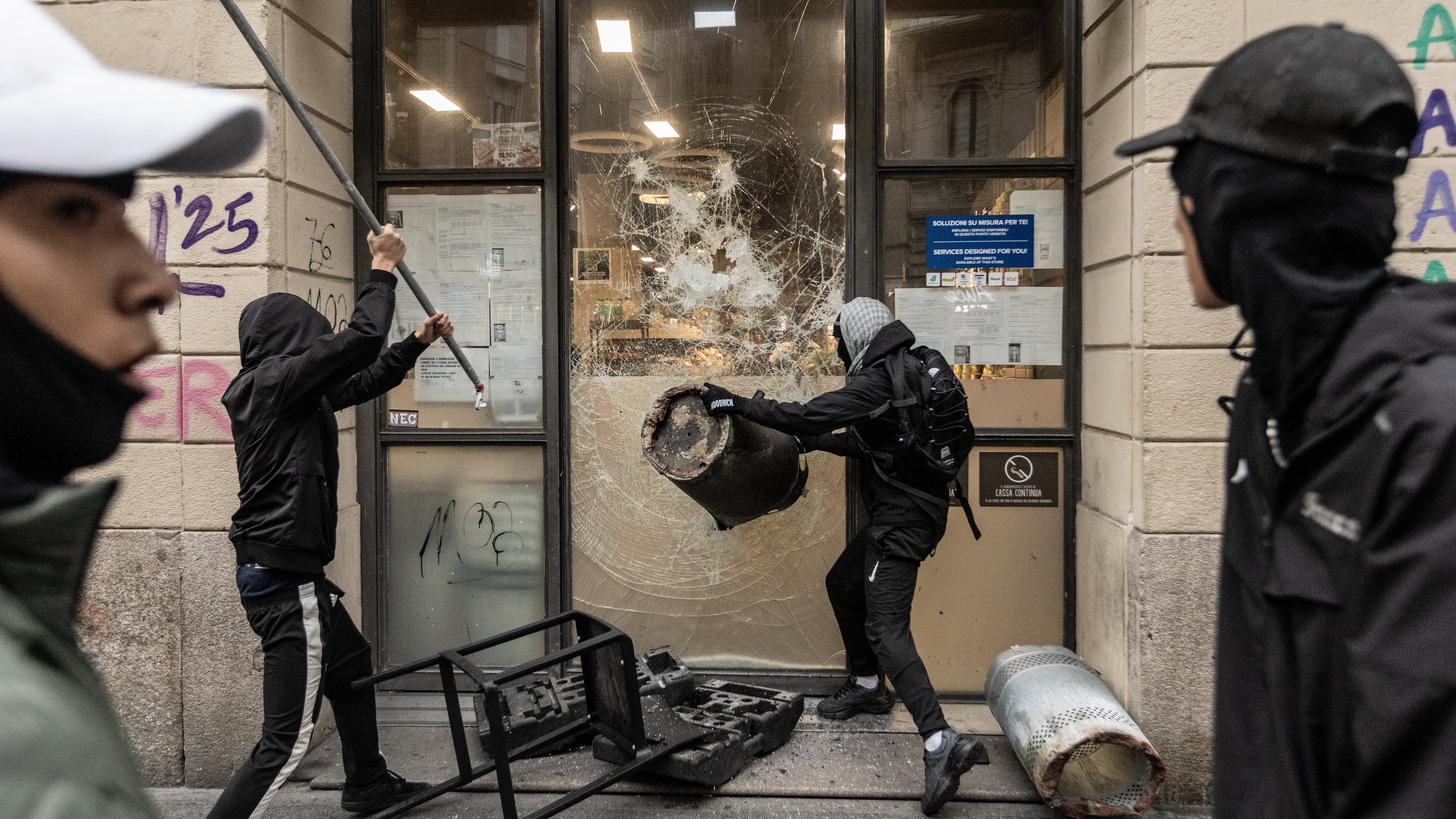
Mano dura de la ultraderechista Giorgia Meloni contra los menores que cometen actos violentos en la calle. El Gobierno italiano ha aprobado este martes, después de un día de intensas negociaciones, un decreto con polémicas medidas de seguridad especialmente pensadas para menores, tras los incidentes y saqueos del fin de semana en Milán, donde el 80% de los 271 detenidos no llegaban a la mayoría de edad. Algunas de ellas ya habían sido anunciadas en julio, en medio de fuertes críticas de la oposición, e insertadas en un proyecto de ley que aún se está tramitando en el Parlamento, pero ahora se aplicarán de inmediato: el arresto preventivo o retención en comisaría de 12 a 24 horas —que no es exactamente una detención, que implica la comisión de un delito— de menores antes de movilizaciones públicas, si se sospecha que pueden delinquir, y la rebaja de la imputabilidad penal de 18 a 14 años. También se prevé hacer pagar a los padres los daños materiales causados por sus hijos y se crea el delito de “participación violenta en una manifestación”, penado con hasta cinco años de cárcel.

Seguir leyendo

💾

©

Un grupo de jóvenes rompe un escaparate en Milán en los incidentes del pasado domingo.
  •  

From serving in Afghanistan to operating in Mexico: the last mission of two CIA agents trained in the US Army and Navy

A tragic vehicle crash exposed a covert counter-narcotics operation riddled with irregularities. In mid-April, a pickup truck plunged off a mountain road in the Sierra of Chihuahua in Mexico, killing its four occupants. Two of them were officials from the Chihuahua Attorney General’s office, and the others, as was later confirmed, were undercover CIA agents. The case continues to unfold in new chapters, and over the weekend former Chihuahua prosecutor César Jáuregui was arrested, accused of treason for allowing — without authorization from the federal government — armed foreign officials to take part in sensitive security operations on Mexican soil.

Seguir leyendo

© Special forces taps, Fuerza Expedicionaria de Marines

Richard Leiter Johnston III and John Dudley Black in undated photographs.
  •  

Germany Drops Boeing MQ-28 Ghost Bat Rapid Procurement Plan

Germany appears to have dropped plans to directly procure the larger, Block 3 version of Boeing’s MQ-28 Ghost Bat collaborative combat aircraft (CCA), leaving doubts over Berlin’s ambitions to field uncrewed combat aircraft alongside its crewed fighters before the end of the decade.

Boeing confirmed to Breaking Defense that Germany’s Ministry of Defense had informed the company it would not proceed with a direct acquisition of the drone, which had previously been lined up. The decision, first reported by Politico, represents a setback for Boeing’s effort to position the Ghost Bat as a candidate for Berlin’s planned CCA capability, something that had seen it announce a partnership with Rheinmetall, the largest arms manufacturer in Germany, earlier this year.

🔴 NEW: Germany has formally scrapped plans to buy the Ghost Bat combat drones directly from Australia, documents show.

Its air force wanted them by 2029. Now it faces a longer wait.

Behind the decision is a much bigger political dilemma facing Germany as it races to rearm. 🧵 pic.twitter.com/2fWHPoQOl0

— Chris Lunday (@lundayfunday) October 15, 2026

“With Boeing Defense Australia as a partner, we are laying the groundwork to optimally tailor the MQ-28 to the Bundeswehr’s requirements,” said Armin Papperger, CEO of Rheinmetall AG, in March of this year. “As a system integrator, we ensure that integration, operation, and further development come from a single source while simultaneously strengthening industrial value creation in the form of an industrial hub in Germany and Europe. We see revenue potential for Rheinmetall in the range of three-digit millions of euros.”

#Rheinmetall and #Boeing partner on German MQ-28 #Ghost #Bat
https://t.co/zGEhjQNqqi pic.twitter.com/VLBDQ8EAaV

— Rheinmetall (@RheinmetallAG) March 31, 2026

The move does not necessarily mean the MQ-28 is out of contention for Germany’s wider program. Instead, Berlin appears set to move toward a different acquisition approach, with competing designs potentially having an opportunity to demonstrate their capabilities before a selection is made.

A Boeing spokesperson told Breaking Defense the company “stands ready to support” its German customer on the next steps, while referring questions about the decision to the German Ministry of Defense.

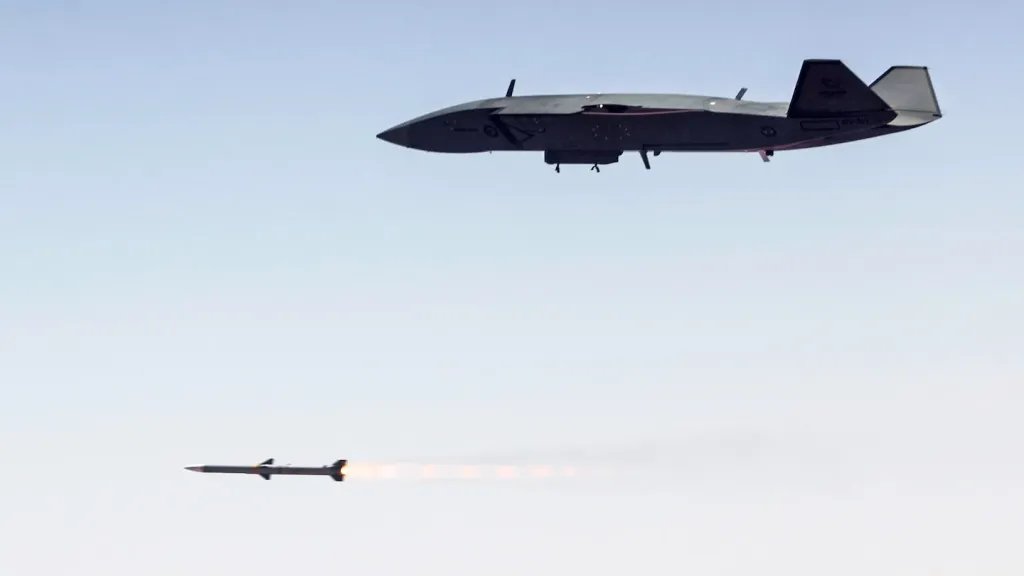
An AIM-120 is launched from an MQ-28A Ghost Bat during Trial Kareela at RAAF Base Woomera, South Australia. Australian Department of Defense

The ministry declined to discuss the specific procurement with the same outlet, citing regulations governing public contracting and the need for such matters to be addressed by parliament.

“[As a] matter of principle — and regardless of the specific case in question — we cannot provide information regarding potential procurement projects,” a ministry spokesperson told Breaking Defense.

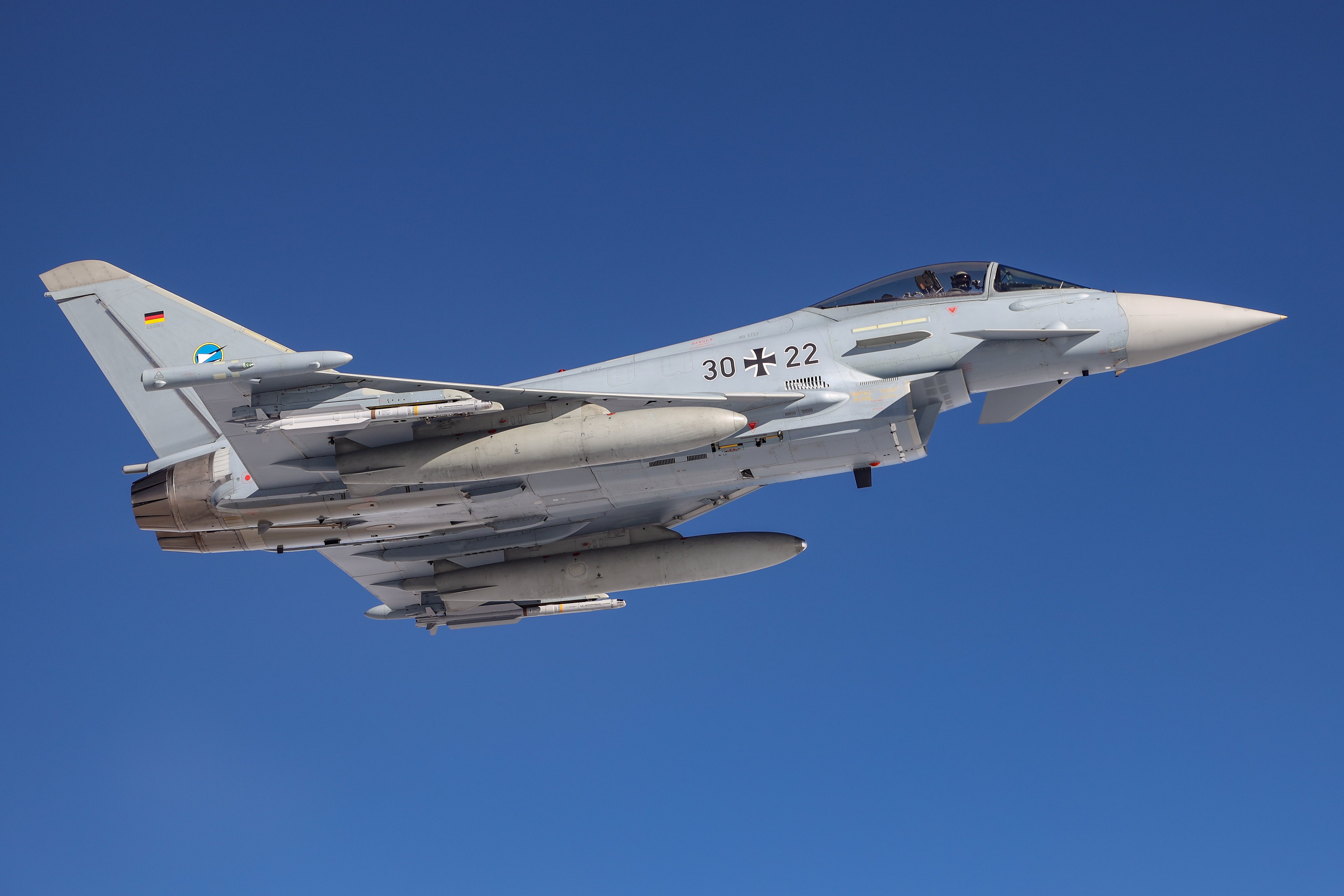
Germany has set an ambitious goal of fielding CCAs by 2029. These uncrewed aircraft are intended to operate alongside crewed fighters such as the Eurofighter, extending their reach, adding sensors and weapons, and giving air forces additional options for conducting high-risk missions.

Ein Eurofighter vom Taktischen Luftwaffengeschwader 74 aus Neuburg an der Donau fliegt bei einem Übungseinsatz als Quick Reaction Alert (QRA) über dem Südosten Deutschlands, am 02.03.2022. ©Bundeswehr/Christian Timmig
A German Eurofighter flies a Quick Reaction Alert (QRA) practice sortie over the southeast of the country. Bundeswehr/Christian Timmig

However, the reported change in Berlin’s acquisition plans raises questions about whether that deadline remains achievable.

According to Politico, Germany is now looking toward the early 2030s for the capability to arrive, with flight testing expected to begin in 2027. That would suggest the original target was based around the introduction of the MQ-28, which has already undergone extensive testing, rather than a newer design. The reshuffle could now give prospective suppliers additional time to demonstrate their designs.

The reported new timeline suggests that Germany’s CCA effort could be entering a more competitive and potentially longer development phase.

There is also a question about the degree of operational capability that will initially be fielded by the given date. Getting a CCA into meaningful frontline service is a very significant task, calling for integration with crewed fighters, communications systems, mission-planning networks, weapons, and sensors. Then there is also testing, certification, training, and the establishment of supporting infrastructure. For Germany in particular, getting a military drone, let alone an armed one, cleared to operate routinely in commercial airspace has long been an issue.

If Germany acquired the Ghost Bat directly, it would have offered a route to a CCA capability without having to begin an entirely new aircraft development effort.

However, the MQ-28 was always one of a larger field of candidate aircraft.

A week ago, Airbus and Kratos Defense & Security Solutions announced the first flight of their U740 Valkyrie uncrewed combat aircraft, a Europeanized version of the XQ-58A Valkyrie. Airbus is simultaneously working on its larger U760 Ravenstorm, intended for service in the early 2030s, and the company has previously pitched a stealthy CCA-like concept known as Wingman.

The ride of the Valkyrie ⚔
With the successful first flight of the Airbus U740 Valkyrie in Europe, we are one step closer to introducing an operational uncrewed Collaborative Combat Aircraft (CCA) to the German and other European Armed Forces.
The flight achieved all… pic.twitter.com/S2sFrtdmGA

— Airbus Defence (@AirbusDefence) October 12, 2026

Other entrants include Anduril, General Atomics partnered with Germany’s INTEC, as well as Lockheed Martin. Meanwhile, Helsing and Hensoldt are pursuing the homegrown CA-1 Europa, very much an MQ-28 lookalike.

The CA-1 Europa from the German defense startup Helsing. Helsing

Germany may not be looking for a single drone to do everything, a point we have discussed in the past:

“One option might be a split high-low approach that could pair more capable, longer-range systems for deep-strike missions with cheaper, attritable collaborative combat aircraft that can fly alongside crewed fighters. At this point, it should also be noted that CCAs could also give older fourth-generation fighters a new lease on life, boosting their lethality and survivability by extending their sensor reach, adding weapons capacity, and allowing uncrewed aircraft to take on more dangerous tasks.”

At the same time, Germany continues to define its requirements for a capability described in media reports as a Jagdbomberdrohne, or fighter-bomber drone. Berlin has yet to publicly clarify its intended concept of CCA operations, including whether the Luftwaffe envisions an uncrewed wingman operating alongside crewed fighters, a platform capable of carrying out long-range strike missions independently, or a system designed to perform both roles.

There are signs that the strike mission is being prioritized, at least initially, with a reduced emphasis on air-to-air missions. This is essentially the reverse of the U.S. Air Force’s CCA effort.

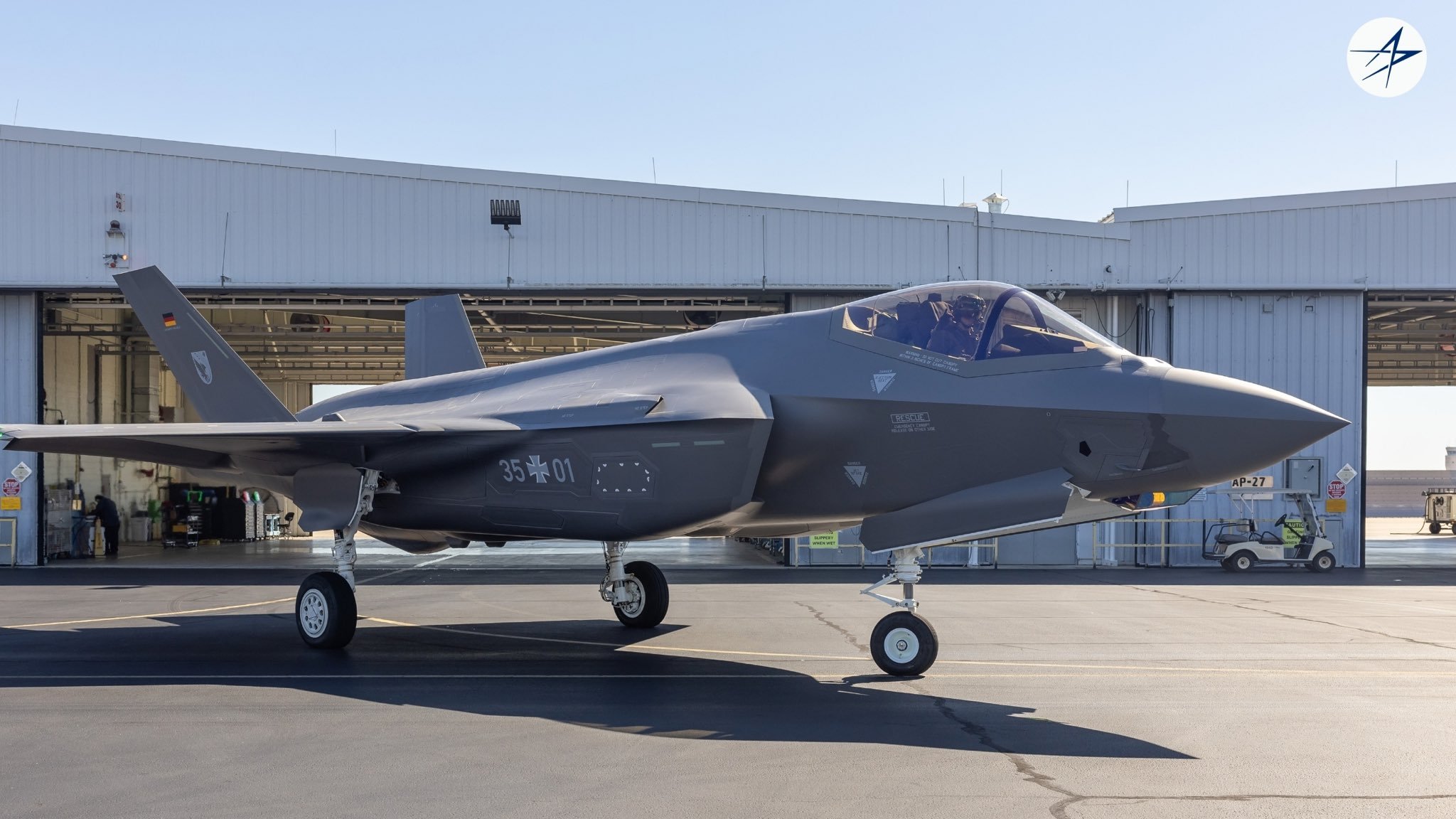
Since Germany is set to receive the F-35 stealth fighter, there is also an argument that Berlin could place more orders for the crewed jet. This could have the dual role of filling the gap left by the collapse of the pan-European Future Combat Air System (FCAS), specifically its sixth-generation crewed fighter, and the delayed introduction of the first operational CCAs. Germany is also looking forward to receiving more Eurofighters.

Germany’s first F-35A arrived at Ebbing Air National Guard Base in Arkansas earlier this month, where it will be used for training. Lockheed Martin

Germany’s evolving CCA plans form part of a broader effort by Western air forces to develop uncrewed aircraft capable of working alongside advanced fighters. These systems are intended to expand the number of available platforms, distribute sensors and weapons across a larger force, and potentially take on missions that would otherwise expose pilots and expensive crewed aircraft to greater risk.

Boeing’s Ghost Bat could still have an opportunity to compete, depending on the structure of the eventual acquisition process and the requirements Berlin establishes.

However, with testing reportedly planned from 2027 and operational fielding potentially slipping into the early 2030s, the original 2029 ambition for an operational German CCA appears increasingly uncertain.

Contact the author: thomas@thewarzone.com

The post Germany Drops Boeing MQ-28 Ghost Bat Rapid Procurement Plan appeared first on TWZ.

  •  

Salvadorian President Bukele Allocates $77 Million to Advertising

The funds were channeled to private agencies to develop national and international advertising campaigns.

An investigation by the specialized media outlet Infodemia reported that the Nayib Bukele administration allocated at least US$76.6 million over the past seven years to advertising, media consulting, and strategic communication services funded with state resources.

RELATED:

Hidden Costs of Bukele Prison Model El Salvador Crisis 2026

According to the report, spending on institutional promotion has maintained an upward trend since Bukele took office in 2019, reaching its highest level during his administration in the first seven months of 2026.

The investigation indicates that the funds were channeled to private agencies to develop national and international campaigns, manage social media, purchase advertising space, organize events, and monitor media coverage by public bodies.

The journalists responsible for the analysis reviewed more than 2,150 public procurement processes and identified over 2,000 contracts related to communication and marketing services awarded to hundreds of companies and suppliers.

The report also questions the lack of transparency surrounding these expenditures, noting that the Presidency keeps information related to institutional advertising confidential and that some contracts are not available in public records.

Among the cases examined is Obermet company, historically linked to the Bukele family, which obtained a contract from the Ministry of Health in 2019 for communication services worth more than US$108,000, according to the analyzed documentation.

Lo que pasó en El Salvador pasó en Colombia: falsos positivos y judiciales para decir que estaban ganando la guerra para vender seguridad. Bukele tendrá que dejar en libertad a 45 000 inocentes.@petrogustavo tenía razón, lo de Bukele se va a caer por violación de los DDHH. pic.twitter.com/BRSlqIrQDZ

— U L D A R I C O (@UldaricoRamire) October 17, 2026

The text reads, “What happened in El Salvador happened in Colombia: false positives and judicial setups to claim they were winning the war in order to sell security. Bukele will have to release 45,000 innocents.”

The investigation also recalls that the company has been the “subject of previous scrutiny” for alleged conflicts of interest related to public contracts during the current Salvadoran president’s political career.

Another finding concerns the financing of advertising space in Diario El Salvador, a newspaper that reportedly received more than one million dollars through hundreds of contracts from various state entities.

Infodemia maintains that this newspaper has repeatedly published information deemed false, misleading, or presented out of context by fact-checkers, especially on issues related to public safety and national political activity.

The investigation also identifies contracts awarded to Lared, a company linked to influencer Porfirio Chica, to develop digital communication strategies aimed at promoting programs of state institutions.

The media outlet indicates that some of the agencies that benefited from contracts during the current administration had previously appeared in judicial investigations related to cases of corruption and misappropriation of public funds during previous governments.

#FromTheSouth News Bits | Costa Rican President Laura Fernandez visited El Salvador’s controversial Cecot megaprison to align national security policies with President Nayib Bukele's militarized model. pic.twitter.com/eCP6g8xfMA

— teleSUR English (@telesurenglish) October 20, 2026

teleSUR: JP

Source: Resumen Latinoamericano

  •  

Main suspect accused of visa fraud in student's suicide case killed in firing by accomplices: police

ISLAMABAD: The prime suspect accused of defrauding a 20-year-old student, who died allegedly by suicide, was killed after being shot by his accomplices in Islamabad on Tuesday, claimed police.

Laiba Ijaz, a student at International Islamic University, was said to have been defrauded of Rs5 million, which she had paid to move to the United States for further studies. An agent was accused of handing her fake travel documents.

The case drew the government’s attention, with Prime Minister Shehbaz Sharif directing the police to arrest the suspect. Subsequently, he and two of his female accomplices were picked up during separate raids in the federal capital.

According to the Islamabad police spokesperson, the prime suspect sustained injuries when his accomplices opened fire on cops in the jurisdiction of Ramna police station on Tuesday.

The spokesperson said the main suspect has shared information about another suspect, and a police team was taking him to track down the second suspect. It was then that four of the main suspect’s accomplices, who were on two motorcycles, “opened indiscriminate fire on the police party in an attempt get the main suspect freed”, the spokesperson added.

The main suspect was injured in the firing while the police team remained safe “due to bulletproof jackets and protective measures”, the spokesperson said.

The injured suspect was taken to a hospital, where he succumbed to his injuries, he added.

Search operations were underway for arrest of his other accomplices, the spokesperson said.

The case

A case following Ijaz’s death was registered at the Ramna police station under Sections 322 (unintentional murder) and 34 (acts done by several persons in furtherance of common intention) of the Pakistan Penal Code.

Another separate case was registered by the Federal Investigation Agency (FIA) on a complaint filed by Ijaz’s maternal uncle under provisions relating to cheating, abetment and immigration-related fraud.

According to the FIA, the main suspect had allegedly obtained millions of rupees from Ijaz’s family with the help of a female accomplice and by misrepresenting his identity and professional status.

The money was allegedly taken on the pretext of securing employment for her brother and arranging her admission to Harvard University in the US. The suspect was accused of giving Ijaz fake travel documents.

  •  

Netanyahu Says He Discussed ‘Eliminating’ the Iranian Government With Trump

Israeli Prime Minister Benjamin Netanyahu said on Tuesday that Israel was “committed” to “eliminating” the Iranian government and that he spoke about the idea in his recent conversation with President Trump. According to The Times of Israel, Netanyahu made the comments at the Tel Hai University in Kiryat Shmona near Israel’s border with Lebanon. “I […]
  •  

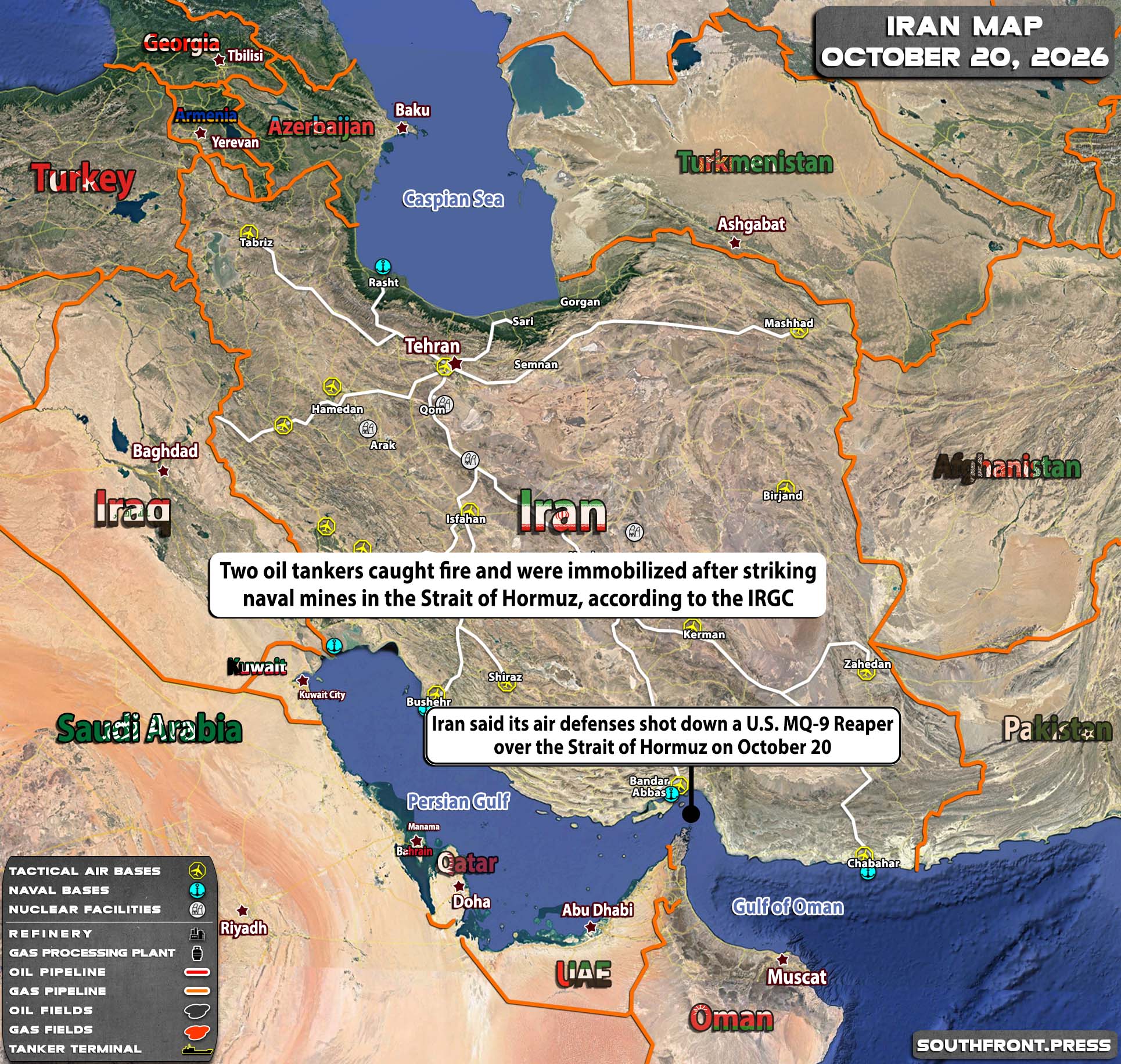
Military Situation In Iran On October 20, 2026 (Map Update)

Click to see full-size map.

  • Iran said its air defenses shot down a U.S. MQ-9 Reaper over the Strait of Hormuz on October 20;
  • Two oil tankers caught fire and were immobilized after striking naval mines in the Strait of Hormuz, according to the IRGC.

_______________________________________________________________________________________________________________________

SouthFront: Analysis and Intelligence

NOW hosted at southfront.press

Previously, SouthFront: Analysis and Intelligence was at southfront.org.

The .org domain name had been blocked by the US (NATO) (https://southfront.press/southfront-org-blocked-by-u-s-controlled-global-internet-supervisor/) globally, outlawed and without any explanation

Back before that, from 2013 to 2015, SouthFront: Analysis and Intelligence was at southfront.com

SOUTHFRONT.PRESS

MORE ON THIS TOPIC:


The post Military Situation In Iran On October 20, 2026 (Map Update) appeared first on South Front.

  •  
❌