They're a common feature at US shopping malls: skincare kiosks staffed by charming Israeli salespeople. Some customers were hit with thousands of dollars in charges they never authorized and products they didn't want and can't return. Many victims were elderly, disabled or otherwise vulnerable
Giorgos Vardinoyannis, one of the best-known figures in Greek business and sports, who also had a significant presence in the commercial shipping industry, died on Friday at the age of 90. Widely known by the nickname “The Captain”, Vardinoyannis was associated not only with the Athens soccer team Panathinaikos FC but also with the Vardinoyannis […]
French authorities are preparing for hundreds of demonstrations on Saturday, 17 October, as student unrest converges with protests over living costs, public spending and government policy. Up to 40,000 demonstrators are expected in Paris, where police and organisers remain divided over march routes.
France is preparing for a nationwide wave of demonstrations on Saturday, 17 October, with approximately 500 protest actions under consideration and more than 90 marches being organised, according to the Interior Ministry. The mobilisation brings together high-school students, trade unions, farmers and supporters of the Yellow Vest movement, raising the prospect of further confrontation after nearly a month of unrest.
Police estimates suggest that around 40,000 demonstrators could gather in Paris, with approximately 150,000 more expected elsewhere in France. The figures remain preliminary, while authorities warn that some protests could involve road blockades, disruption to essential infrastructure and violent clashes.
Interior Minister Laurent Nuñez initially outlined preparations for 250 gatherings and 80 marches on Friday morning. Subsequent assessments from his office indicated that as many as 500 actions were being considered, although not all had been formally organised.
Paris Faces Dispute Over Demonstration Routes
The authorities are particularly concerned about developments in the capital, where negotiations between police and protest organisers have failed to produce agreement over the proposed routes.
Paris police prefect Patrice Faure has rejected proposals for marches terminating near the Opéra district or Place de la Concorde, citing security concerns surrounding central government institutions.
According to details of the security preparations, police have proposed an alternative route between Place de la Bastille and Place de Clichy. The CGT trade union and climate campaigners have accepted the proposal, but student organisations and Yellow Vest representatives continue to oppose it.
Prime Minister Sébastien Lecornu has convened an interministerial crisis unit to coordinate the government’s response. Security officials have warned that attempts to obstruct major transport routes or critical infrastructure will not be tolerated.
The Interior Ministry has also indicated that stun grenades, whose use was suspended during the student protests, could again be deployed in cases of particularly serious urban violence.
Yellow Vests Return Amid Rising Living Costs
Saturday’s demonstrations are being promoted as a revival of the Yellow Vest movement, which emerged in 2018 following opposition to fuel taxation before developing into a broader protest against living costs, economic inequality and government policy.
The latest mobilisation has gathered support from organisations demanding measures to address rising fuel, energy and food prices. Campaigners are also challenging the government’s proposed 2027 budget and its implications for public services.
The agricultural union Confédération paysanne has called on farmers to join the demonstrations, arguing that rising agricultural fuel costs and deteriorating conditions in rural communities have increased pressure on producers.
The union has also linked its demands to environmental policy, public-service provision and access to affordable food.
The CGT, student unions and climate organisations have similarly expressed support for the protests, while political backing has come from La France Insoumise and the French Communist Party.
Student Protests Enter Their Fourth Week
The mobilisation follows weeks of demonstrations involving secondary-school pupils, teachers and public-sector workers. What began as protests over shortages of teachers, overcrowded classrooms and deteriorating school buildings has developed into a nationwide confrontation over education policy and policing.
As EU Today previously reported, between 400 and 500 secondary schools faced partial or complete disruption earlier this month as students organised blockades and demonstrations.
The movement has subsequently expanded beyond its original educational demands, with student organisations raising concerns about university admissions procedures, police tactics and government spending priorities.
The scale of the unrest has placed considerable pressure on French authorities. According to figures from the Justice Ministry, 6,877 people were placed in police custody during the protests between late September and 8 October, approximately 86 per cent of them minors.
Violence during the demonstrations has resulted in injuries among police officers, students and educational staff. Clashes on 8 October led to 504 arrests and injuries to 48 police officers, according to Interior Ministry figures.
Education Minister Édouard Geffray has announced emergency measures to address teacher shortages, including the deployment of replacement teachers. The ministry says 2,000 of the 3,000 promised replacements have already been assigned, but student organisations maintain that the measures are insufficient.
Growing Pressure on the French Government
The planned demonstrations come as France faces a difficult debate over public spending, taxation and the 2027 budget. Lecornu’s government must balance demands for higher salaries and increased investment in education against mounting pressure to reduce the deficit.
France’s deteriorating public finances have already attracted scrutiny from eurozone partners, while domestic opposition to spending restraint has become a central issue ahead of the 2027 presidential election.
The convergence of student organisations, trade unions and Yellow Vest campaigners could broaden the protests beyond the education sector, particularly if demonstrations over living costs attract participants who have not joined the recent school protests.
However, the extent of that mobilisation remains uncertain. Online protest maps contain substantially more proposed actions than the authorities’ estimates, and participation figures will not be established until Saturday.
For the government, the immediate test will be whether the demonstrations remain peaceful and whether the authorities can prevent disruption to transport networks and public services without provoking further confrontations with protesters.
Russia has placed five foreign-owned businesses under compulsory administration, including Belgian manufacturer Ontex and French flooring group Tarkett. The latest seizures deepen the confrontation over sanctions, frozen Russian assets and the future of European investment in Russia.
Russian President Vladimir Putin has ordered the transfer of five Western-owned businesses into compulsory Russian management, extending a campaign of asset seizures targeting European companies that continued operating in Russia after the full-scale invasion of Ukraine.
The decree, signed on 15 October, affects businesses with combined annual revenues exceeding 53 billion roubles, approximately €530 million. They include French flooring manufacturer Tarkett, Belgian hygiene products group Ontex, German packaging producer Menshen, Kappa Rus and Eviosys Packaging Kuban, now linked to American group Sonoco.
Under Presidential Decree No. 738, operational control has been transferred to Centre Capital, a little-known Moscow company established in February 2026 with registered share capital of just 10,000 roubles.
The decision follows similar interventions against Nestlé, Auchan, FM Logistic and Metro in September. Together, the measures demonstrate how Moscow is using foreign-owned businesses as instruments of economic retaliation against countries supporting Ukraine.
Foreign businesses placed under Russian control
Centre Capital is headed by Marat Mirkhaydarov, a former senior official in Russia’s Zabaykalsky region who reportedly served with the Akhmat military formation during Russia’s war against Ukraine.
The scale of the companies placed under his management contrasts sharply with the financial standing of the administrator.
Tarkett’s Russian operations generated approximately 19.3 billion roubles in revenue during 2025, while Kappa Rus recorded 16.5 billion roubles and Ontex RU another 10.3 billion. Eviosys Packaging Kuban and Menshen Packaging CIS reported approximately 6.1 billion and 1.4 billion roubles respectively.
The decree does not formally transfer ownership of the companies to Centre Capital. It does, however, remove the foreign shareholders’ effective control over management, operations and commercial decisions.
For Belgian manufacturer Ontex, the consequences are immediate.
In an official statement issued on 16 October, the Aalst-based company confirmed that a government-appointed administrator had assumed operational control of its Russian subsidiary.
Ontex Russia employs approximately 350 people, operates a manufacturing facility in Noginsk and maintains a sales office in Moscow. The subsidiary accounts for around five per cent of the group’s total revenue and between seven and eight per cent of adjusted EBITDA.
The company said it was examining measures to protect its assets and maintain business continuity.
Tarkett likewise confirmed that it was losing effective control of its Russian operations.
A mechanism established in 2023
The legal framework for such interventions dates to April 2023, when Putin introduced Decree No. 302, allowing the Russian authorities to place assets associated with countries designated as unfriendly under temporary external management.
The appointed administrator can exercise extensive ownership-related powers, although the formal right to dispose of the assets remains excluded.
Crucially, the arrangement can be terminated only by presidential decision. There is no automatic deadline for returning operational control to the original owners.
Moscow maintains that the measures are reversible. Nevertheless, the loss of management authority raises questions about whether businesses could eventually be returned with their financial position, organisational structure and commercial value intact.
The Kremlin’s approach also serves domestic economic objectives. Keeping factories, retail networks and distribution facilities operating under Russian management helps preserve employment, production capacity and established supply chains.
At the same time, appointing Russian administrators allows the authorities to exercise greater influence over businesses originally developed through foreign capital, technology and expertise.
European companies caught in sanctions confrontation
Kremlin spokesman Dmitry Peskov has explicitly linked the seizures to the nationality of the affected companies and the policies of their governments.
He accused European states of participating in the unlawful seizure of Russian property through sanctions and financial restrictions.
Moscow’s argument centres partly on approximately €210 billion in Russian sovereign assets immobilised in the European Union, most of them held through Belgium-based securities depository Euroclear.
The European Union has used extraordinary revenues generated by those assets to support Ukraine, while further proposals involving the underlying funds remain subject to legal and political debate.
Belgium has been particularly concerned about potential financial exposure and legal claims. As EU Today reported in September, a Belgian Council of State judgment raised additional questions about the administrative procedures governing certain frozen assets.
Moscow’s treatment of European businesses adds another dimension to this confrontation. By retaining control over foreign-owned industrial and commercial assets, Russia possesses a means of exerting pressure on companies whose governments support sanctions and military assistance to Ukraine.
The implications are particularly serious for Western banks that still maintain substantial Russian operations.
Austria’s Raiffeisen Bank International and Italy’s UniCredit remain exposed to Russia through local subsidiaries. Any extension of compulsory administration to financial institutions could create additional difficulties involving deposits, capital and banking supervision.
The cost of remaining in Russia
The seizures also expose the financial risks faced by Western companies that delayed their withdrawal after February 2022.
Many initially sought to protect their investments, employees and commercial infrastructure. Others reduced operations but retained ownership, expecting that conditions might eventually permit an orderly sale or renewed business activity.
Russian restrictions have progressively complicated that calculation, requiring foreign investors from designated countries to accept substantial discounts on asset sales and obtain official approval for transactions.
Companies remaining in the country now face the additional possibility that the government will appoint administrators without their consent.
The consequences extend beyond the businesses immediately affected. Russia is establishing a precedent under which foreign investment can remain legally owned by its original shareholders while its economic benefits and operational management are placed beyond their control.
For European governments, the latest decree illustrates the increasing connection between commercial interests and geopolitical decisions.
The Kremlin has demonstrated that sanctions imposed over its invasion of Ukraine can be answered not only through diplomatic or financial measures, but also through direct intervention in European-owned businesses operating on Russian territory.
Any eventual negotiation over sanctions relief and the restoration of economic relations will consequently have to address the status of these assets, the rights of their original shareholders and the question of compensation.
Until then, Western companies remaining in Russia face an investment environment in which the ultimate authority over their businesses rests increasingly with the Kremlin rather than their shareholders.
Operations at Chios Airport runway will be temporarily suspended from mid November 2026 to mid March 2027 due to upgrade of infrastructure works. According to an announcement by the Greek Civil Aviation Authority (HCAA) suspension is scheduled from Sunday night, November 15, 2026 to March 15, 2027, due to works to extend, improve and upgrade […]
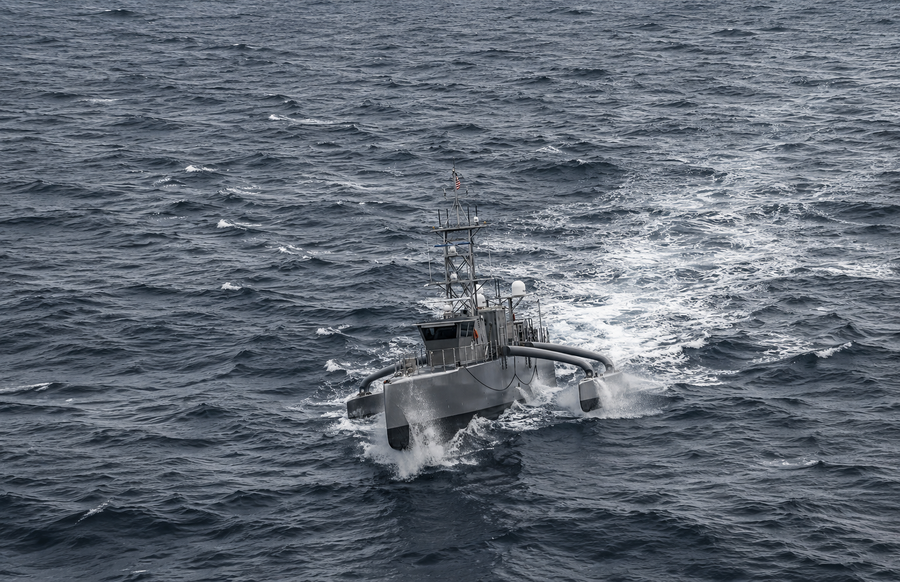
For the first time, the US Navy has deployed an uncrewed surface vessel (USV), or a sea drone, alongside a carrier strike group (CSG), accelerating the integration of cost-effective autonomous systems into high-end naval operations.
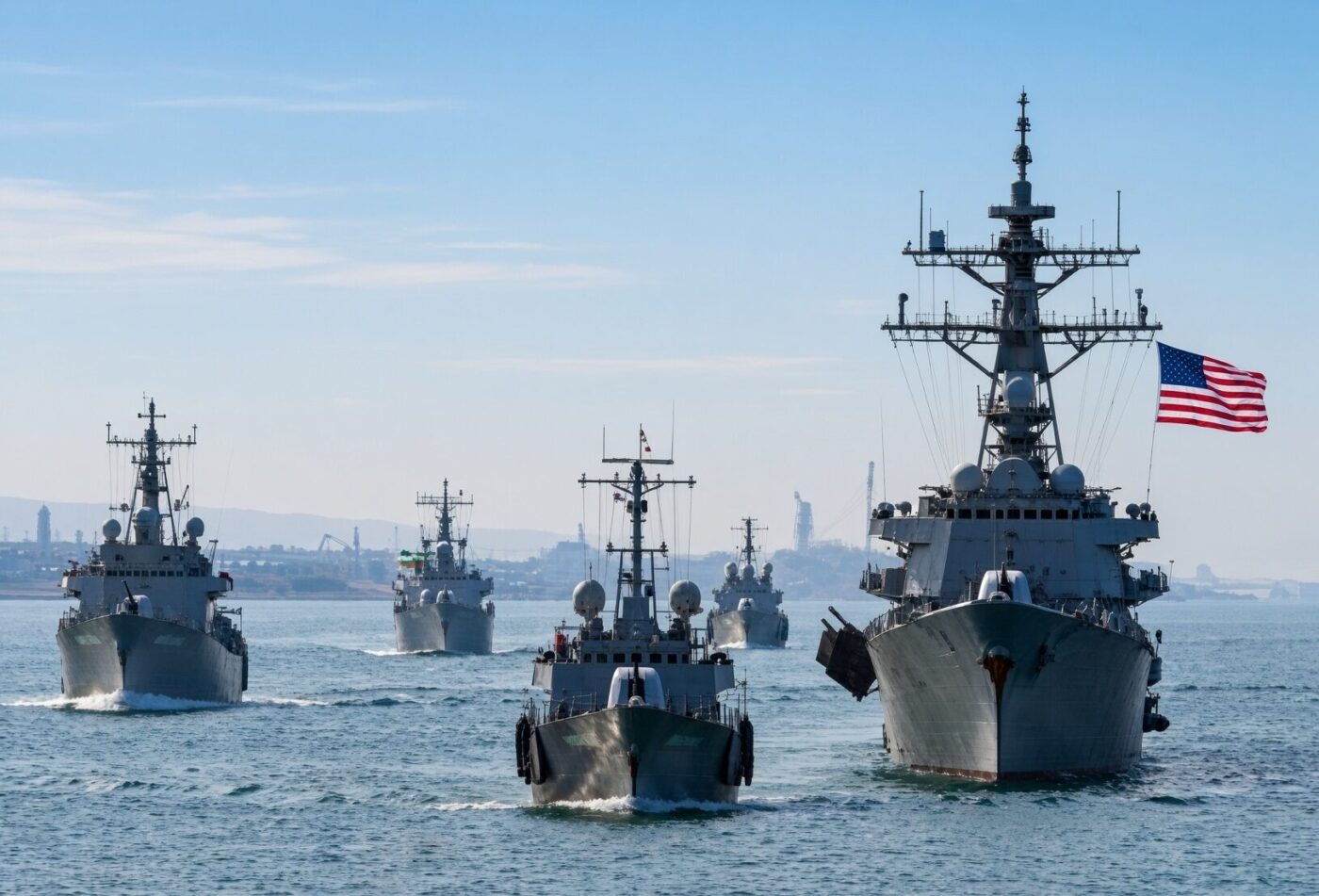
Speaking at an Army conference in Washington, DC, on October 14, 2026, the Acting US Navy Secretary Hung Cao announced that the Navy has deployed a Leidos USV with the USS Theodore Roosevelt Carrier Strike Group (CSG) headed to the Middle East.
“Right now, the Roosevelt carrier strike group just deployed on Oct. 8 with a medium-sized unmanned surface vessel,” Cao noted.
“This is the first carrier strike group to ever deploy with a large-sized unmanned surface vessel, and this is a force multiplier. Imagine having more guns out there,” he added. Notably, Cao did not name the sea drone, but media reports citing informed officials identified it as the Leidos Seahawk, a 145-ton, 42-meter-long medium USV reportedly built to sail long distances uninterrupted for months
Leidos describes the Seahawk as a medium-displacement unmanned surface vessel (MD-USV) with a composite trimaran hull. It is roughly 135–137 feet long, with a full-load displacement of about 145 tons, and a fuel capacity of around 14,000 gallons.
It is designed for extended autonomous operations with limited human intervention and uses Leidos’ Autonomous Vessel Architecture (LAVA) for navigation, perception, collision avoidance (COLREGs-compliant), and other functions.
“Seahawk is substantially larger than other US Navy USVs and has significantly increased capabilities compared to smaller USVs in terms of range, seakeeping, and payload capacity. Seahawk is designed to operate with minimal human involvement, providing a forward-deployed, rapid-response asset in the global maritime surveillance network,” Leidos stated.
The company reportedly delivered the Seahawk USV to the United States Navy in 2021.
The Seahawk will likely conduct electronic warfare missions and information, surveillance, and reconnaissance (ISR) operations rather than serve as an armed combatant. Notably, the carrier’s deployment to the Middle East comes as US President Donald Trump weighs fresh strikes on Iran.
Earlier this month, he told Time magazine that the US military could ramp up bombing of Iran after the November 3 midterm elections.
The autonomous vessel Seahawk is pictured underway in the ocean (Photo Courtesy: Leidos)
The arrival of the USS Roosevelt would bring the number of American aircraft carriers available in the region to three by late October, joining the USS George H.W. Bush, USS George Washington, and the USS Boxer Amphibious Ready Group.
As for the Leidos USV, the Navy had already practiced at-sea refueling with the Seahawk vessel and integrated it during this year’s Rim of the Pacific exercise. However, moving this unmanned system from trials into real-world operations could mark a crucial step in shaping the US Navy’s future strategy.
Integrating USVs Into Combat
The presence of the large autonomous vessel in a carrier strike group marks an important step in the US Navy’s future operations. Interestingly, it comes amid a growing presence of uncrewed systems in the ongoing Middle East conflict.
In June 2026, for instance, a Saronic Corsair drone boat operated by the US Navy’s Task Force 59 was used to locate and rescue two crew members after an AH-64E helicopter went down near the Strait of Hormuz.
This first-of-its-kind rescue mission involving sea drones took about two hours, as the EurAsian Times reported at the time.
Separately, the US Navy used one-way attack sea drones in combat for the first time in July 2026 to strike coastal Iranian military targets.
The US Navy has admitted that unmanned vessels have been extensively deployed in the clearance of mines from the Strait of Hormuz, which has remained under a de facto closure imposed by Iran for over seven months.
These incidents signal a broader appetite within the US Navy to delegate crucial combat tasks to unmanned vessels.
For example, although CSGs are the centerpiece of American naval power projection, adversaries also view them as high-value targets. Therefore, introducing a USV could let the Navy deploy a medium-sized autonomous vessel closer to threats at sea, keeping sailors out of the danger zone.
Moreover, adding a USV to the carrier strike group would enhance the US Navy’s sensor coverage and maritime awareness, reducing dependence on crewed vessels.
Cao’s remarks about having more firepower likely reflect the US Navy’s broader strategy to integrate uncrewed vessels with heavy ships.
In February this year, the Chief of Naval Operations, Adm. Daryl Caudle, presented his “Fighting Instructions” framework, outlining plans to employ a “hedge force strategy” that aims to leverage unmanned technology and develop a range of tailored options that fall outside the scope of the conventional carrier strike group model.
Since the specifics of this strategy and its structure are currently still being worked out, the deliberate pairing of medium USVs with carrier strike groups may be an early expression of the approach Caudle underscored. The USV’s performance with the Theodore Roosevelt group could potentially inform how subsequent strike groups are configured, accelerating the path toward more medium USVs in the fleet.
The US Navy’s increasing integration of sea drones into established combat practices may have been influenced by Ukraine’s use of these systems to decimate the Russian Navy.
Ukraine has emerged as a pioneer in sea drone technology, showing how relatively simple, affordable technology can neutralize expensive naval assets. In fact, Iran itself has extensively deployed these vessels to launch frequent operations against the US as well as the tankers trying to transit the Hormuz Strait in violation of the Iranian blockade.
The US, for its part, wants to leverage the asymmetric advantage of autonomous systems in combat when facing adversaries that can threaten its state-of-the-art warships.
If the Seahawk demonstrates reliable integration, endurance, and utility, it may accelerate the Navy’s ability to field hybrid strike groups that combine the decisive power of a carrier air wing with the distributed, lower-risk presence of autonomous vessels.
This assessment may, in turn, inform strategies for combat in other, more contested theatres, such as the Indo-Pacific, where the US faces a Chinese threat.
With a smaller but more advanced fleet, the US can use large numbers of attritable unmanned platforms for sustained surveillance, chokepoint control, and harassment without tying down manned ships.
Against that backdrop, lessons from this first operational pairing may shape concepts of operations (CONOPS), help tailor force packages, and inform the broader shift toward distributed maritime operations, all of which are meant to complicate targeting in a contested environment by near-peer adversaries.
Contact the author at sakshi.tiwari13 (at) outlook.com
Ukraine was prepared to suspend attacks on Russian oil refineries if Washington supplied anti-ballistic missile systems to protect its energy infrastructure, President Volodymyr Zelenskyy has revealed. The proposed compromise was not accepted, despite American pressure on Kyiv to halt its strikes.
Ukrainian President Volodymyr Zelenskyy has disclosed that Kyiv offered to suspend attacks on Russian oil refineries in exchange for temporary American anti-ballistic missile protection for Ukraine’s energy infrastructure. Washington did not provide the requested systems, leaving Ukraine exposed to continued Russian missile strikes while the United States sought to restrict Ukrainian operations against Russia’s oil industry.
Speaking at a press conference in Brussels on Friday, 16 October, Zelenskyy said the proposal had been presented to Washington as a compromise following President Donald Trump’s agreement with Vladimir Putin on Russian diesel supplies and restrictions on attacks against energy facilities.
The Ukrainian president confirmed that Kyiv had not been consulted before Washington reached its understanding with Moscow. He described the diesel agreement as a surprise and objected to arrangements determining Ukraine’s military actions without its participation. Any agreement concerning Ukrainian strikes on Russian territory, he argued, required consultation with the Ukrainian government.
Nevertheless, Zelenskyy said Ukraine had been willing to accommodate American demands, even under an arrangement that did not require Russia to suspend its own attacks. Instead of insisting on reciprocal restrictions, Kyiv proposed receiving sufficient anti-ballistic missile systems to protect its electricity network for the duration of the requested suspension.
The proposal reflected Ukraine’s immediate security requirements. Russia has repeatedly targeted power stations, substations and other critical infrastructure, while Ukrainian forces have attacked Russian refineries to disrupt fuel production and reduce revenues available to Moscow. Halting the Ukrainian campaign without additional defensive capabilities would have left Kyiv surrendering one means of economic pressure while remaining vulnerable to Russian bombardment.
Zelenskyy said he had asked Washington for a limited number of systems, rather than a substantial new military commitment. The proposed deployment would have lasted only as long as the United States required Ukraine to refrain from attacking Russian refineries. However, according to the president, no such assistance was provided.
US diesel agreement deepens dispute
The disagreement follows the diesel arrangement announced by Trump on 9 October, under which Russia agreed to resume substantial petroleum product exports to American and international markets. Washington also authorised certain transactions involving Russian diesel, easing restrictions previously intended to reduce Moscow’s energy revenues.
The agreement created a direct conflict between American energy policy and Ukraine’s strategy of targeting Russian refining capacity. Washington wants additional diesel supplies to ease pressure on fuel markets, while Kyiv regards attacks on oil infrastructure as a means of weakening Russia’s ability to sustain its invasion.
That disagreement intensified after Ukraine resumed attacks on Russian refineries, including a strike against a facility in the Ryazan region. Trump criticised the operations, accusing Kyiv of contributing to higher global oil prices. Zelenskyy, meanwhile, argued that increased Russian diesel revenues would provide Moscow with additional resources to finance its military campaign.
The Ukrainian president’s proposal also exposed the limitations of the temporary energy ceasefire promoted by Washington. Russia continued attacks against Ukrainian civilian infrastructure, including electricity facilities, despite the American initiative. Kyiv’s proposed compromise would have addressed the resulting imbalance by providing defensive protection rather than relying on Russian restraint.
The urgency of Ukraine’s request was illustrated by renewed Russian attacks during Zelenskyy’s visit to Brussels. According to the Ukrainian presidency, strikes on 15 October damaged energy infrastructure in several regions, leaving almost 15,000 people without electricity in Volyn and disrupting supplies in parts of Kyiv and the surrounding region.
Ukraine continues to face shortages of the interceptors required to defend against ballistic missiles. Zelenskyy has identified anti-ballistic capabilities as an immediate priority, particularly as Russia intensifies attacks ahead of winter. During talks with NATO Secretary General Mark Rutte, he stressed the need for additional missile interceptors and other air defence equipment.
Zelenskyy said European leaders had supported Ukraine’s position in the dispute with Washington. His remarks came as the EU reaffirmed its intention to maintain economic pressure on Moscow despite the Trump administration’s decision to facilitate Russian diesel exports.
As EU Today reported earlier on Friday, von der Leyen and Costa rejected any relaxation of European sanctions while Russia continues its war. The Commission is preparing a further sanctions package, maintaining a policy intended to restrict Moscow’s ability to finance its military operations.
The contrasting American and European positions have become increasingly significant for Kyiv. Washington is seeking to stabilise fuel markets through arrangements with Moscow, while European governments remain committed to reducing Russian energy revenues and strengthening Ukraine’s military and economic resilience.
For Zelenskyy, the unresolved question is whether Ukraine can be expected to limit attacks on Russian oil infrastructure while receiving neither reciprocal guarantees from Moscow nor additional protection against Russian ballistic missiles. His account of the unsuccessful American negotiations indicates that Kyiv was prepared to compromise, but only if its immediate defensive needs were addressed.
Belgian investigators have searched properties associated with relatives and associates of Congolese President Félix Tshisekedi in an inquiry into alleged laundering of mining revenues, bringing renewed scrutiny to financial links between the two countries.
Belgian police have conducted searches at several properties in Brussels and its surrounding areas as part of an investigation into allegations that money diverted from the Democratic Republic of Congo’s mining sector was laundered through Belgium.
The searches, carried out on 15th October, reportedly involved homes associated with relatives and individuals close to Congolese President Félix Tshisekedi. Belgian prosecutors confirmed that searches had taken place but did not publicly identify those concerned, while the Congolese presidency declined to comment.
The investigation follows a complaint lodged in Belgium in 2025 by civil society organisations from Katanga, the mineral-rich region of south-eastern Congo. Their lawyers, Bernard Maingain and Hervé Diakese, allege that mining revenues which should have benefited Congolese communities were instead diverted and channelled through financial arrangements involving individuals with connections to Belgium.
The allegations have not been established in court. The searches form part of an investigation, and their execution does not establish criminal responsibility on the part of the individuals or organisations whose premises were examined.
Mining revenues under scrutiny
Congo is one of the world’s most important suppliers of copper and cobalt, minerals essential to electric vehicles, batteries, electronics and other advanced industrial products. Its mineral resources also occupy an increasingly important position in the European Union’s effort to diversify strategic supply chains.
Yet the financial arrangements surrounding mineral extraction have repeatedly generated controversy over public accountability, the distribution of revenues and the relationship between political authorities and commercial interests.
The Belgian inquiry concerns an especially sensitive question: whether funds originating from Congo’s mining economy were transferred into the European financial system under circumstances that could constitute money laundering.
According to the details of the investigation published on Thursday, the original complainants maintain that money linked to mining operations was diverted from its intended beneficiaries and used to benefit people connected to the Congolese leadership.
The proceedings are particularly significant because Belgian courts can investigate alleged laundering through Belgian financial structures even when the suspected underlying misconduct occurred abroad, subject to the applicable jurisdictional requirements.
Investigators will need to establish the origin of the funds, the route they allegedly followed and whether those involved knew or should have known that the money represented proceeds of criminal activity.
Belgium’s relationship with Congo
The investigation also has a diplomatic dimension. Belgium ruled Congo until independence in 1960, and the countries retain extensive commercial, political and personal connections.
Brussels remains an important centre for Congolese political and business networks, making Belgium a potentially relevant jurisdiction when investigators examine suspected financial movements connected to the country.
At European level, the inquiry comes as the EU attempts to strengthen relationships with mineral-producing countries while reducing its dependence on concentrated supply chains.
The European Commission’s cooperation programme with the Democratic Republic of Congo specifically identifies responsible sourcing, transparency, due diligence and action against illegal trafficking in raw materials as areas for cooperation.
These commitments have practical consequences for European businesses seeking greater access to copper and cobalt. Investment and supply arrangements depend not only on access to mineral deposits but also on the reliability of commercial records, ownership structures and the institutions responsible for supervising mining revenues.
Belgium has recently joined other EU member states in adopting additional measures intended to recover criminal assets and strengthen cross-border cooperation against illicit financial activity.
As EU Today reported on 14th October, European governments have endorsed new international arrangements designed to improve their ability to trace and recover assets associated with serious crime.
The Congo investigation concerns an existing criminal inquiry rather than the application of those newly agreed arrangements. Nevertheless, both developments illustrate the importance of financial intelligence, access to ownership records and cooperation between prosecutors when suspected proceeds move across jurisdictions.
For investigators, the central task will be tracing the alleged flow of money and determining whether financial transactions in Belgium conceal proceeds unlawfully obtained elsewhere.
For Congo, the proceedings arrive during a period of serious domestic instability, including renewed armed confrontation in the east of the country and growing political uncertainty surrounding its leadership.
Former president Joseph Kabila’s involvement in a new opposition alliance has intensified that confrontation, complicating Tshisekedi’s political position as his administration faces continuing security and economic pressures.
The Belgian authorities have not announced any findings establishing that President Tshisekedi personally participated in wrongdoing. The next important developments will be whether investigators identify specific transactions, bring charges or expand the inquiry to additional individuals or corporate structures.
A associação ambientalista ZERO pediu um parecer desfavorável ao projeto da Barragem da Foupana, cuja consulta pública termina hoje, alegando riscos para o saramugo, falhas no estudo ambiental e dúvidas sobre a imparcialidade das entidades envolvidas.
O projeto prevê a construção de uma barragem com cerca de 52,5 metros de altura em Alcoutim e Castro Marim, ligada por um túnel ao sistema Odeleite-Beliche, representando um investimento estimado entre 150 e 200 milhões de euros.
De acordo com a organização, este ameaça a sobrevivência do saramugo, uma espécie de peixe protegida e classificada como ameaçada, sendo que um dos seus últimos refúgios em Portugal é a Ribeira da Foupana. O próprio Estudo de Impacte Ambiental (EIA) reconhece que o saramugo “não sobreviverá aos efeitos do projeto”, mas conclui simultaneamente que a Rede Natura 2000 não será significativamente afetada, uma contradição que a associação considera injustificada.
Ao mesmo tempo, os ambientalistas consideram que o estudo apresenta insuficiências graves e não demonstra que a infraestrutura seja a melhor solução para reforçar a disponibilidade de água na região, visto que “não compara adequadamente a barragem” com alternativas como a redução de perdas de água, a eficiência hídrica, a reutilização de águas residuais ou outras medidas de gestão da procura.
Outro dos argumentos é que os “benefícios previstos são limitados”, estimando-se um acréscimo médio de cerca de 10 hectómetros cúbicos anuais de água disponível, enquanto os impactes ambientais seriam permanentes.
A associação levanta ainda dúvidas sobre possíveis conflitos de interesses entre várias entidades: “A existência de ligações recentes entre elementos do conselho de administração da empresa Águas de Portugal, AQUA e a associação promotora suscita dúvidas sobre as garantias de isenção e imparcialidade na execução da estratégia, que devem ser esclarecidas antes de qualquer decisão sobre o projeto”.
É, assim, defendida a emissão de uma Declaração de Impacte Ambiental desfavorável, a realização de uma Avaliação Ambiental da estratégia Água Que Une, o reforço da proteção do saramugo através da integração da sub-bacia da Foupana na Rede Natura 2000 e a clarificação de eventuais conflitos de interesses, antes de qualquer decisão sobre licenciamento, financiamento ou contratação da obra.
Just a few days after the ousting of controversial US Ambassador to Athens, Kimberly Guilfoyle, the State Deaprtment announced her temporary replacement by Joshua (Josh) Huck. The Josh Huck officially assumed duties as Chargé d’Affaires ad interim, of the U.S. Diplomatic Mission to Greece, on Thursday October 15, 2026. A career member of the U.S. […]
Bruno Henriques, comandante dos bombeiros de Vidago, disse à VTM que o “óbito foi declarado às 13h08 pela equipa médica da VMER de Chaves e era o condutor do motociclo. Há ainda a registar um ferido ligeiro, um jovem, de 22 anos”.
O alerta para a colisão foi dado meio dia e para o local foram mobilizados 16 operacionais, apoiados por sete veículos, entre os quais os bombeiros de Vidago.
A GNR também esteve no local e está a investigar as causas do acidente fatal.
A powerful explosion on Thursday afternoon at the refinery of MOTOR OIL in western Attica has injured two workers seriously and another four slightly. it is the second explosion at the refinery within a week. Two serioylsy injured workers, aged 40 and 59, were transported to a hospital in Athens where they underwent surgeries for […]
O Teatro Municipal António Pinheiro, em Tavira, assinala o seu 109.º aniversário no dia 24 de outubro, com uma programação que cruza “memória, fotografia e música”.
O Município celebra a data com a inauguração da exposição TEATRA, pelas 16h, seguida do concerto de Rodrigo Leão, “O Rapaz da Montanha”, pelas 21h30, que conta com a participação do Grupo Coral Infantil da Academia de Música de Tavira.
A exposição TEATRA reúne retratos de algumas das mais relevantes figuras do teatro português. O conceito parte de um desafio singular: “atores e encenadores foram convidados a assumir uma personagem que nunca interpretaram, mas que gostariam de ter levado ao palco”. O resultado, de acordo com o Município, cruza “fotografia, figurino e caracterização”. Eunice Muñoz, Ruy de Carvalho, Maria do Céu Guerra, João Mota, Lurdes Norberto, Fernanda Lapa, Márcia Breia, Cucha Carvalheiro, Rui Mendes e Sinde Filipe são alguns dos nomes representados.
Fundado em 24 de outubro de 1917, com a designação de Teatro Popular, o espaço foi rebatizado, em 1942, como Teatro António Pinheiro, em homenagem a uma das figuras mais marcantes do teatro português, sendo que em 1968 passou a chamar-se Cineteatro António Pinheiro. Décadas mais tarde, após uma intervenção de reabilitação e modernização, reabriu ao público a 27 de setembro de 2025.
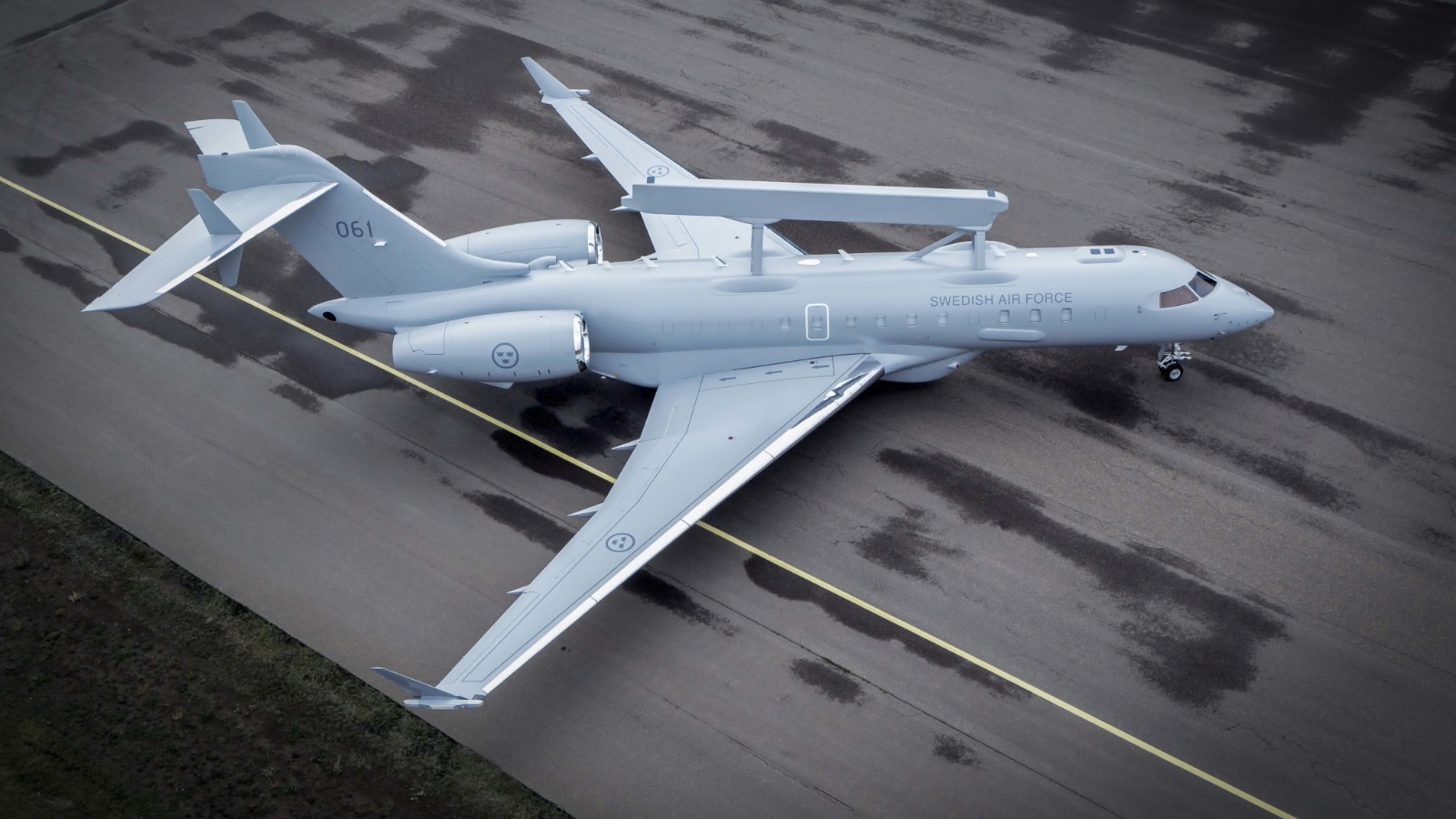
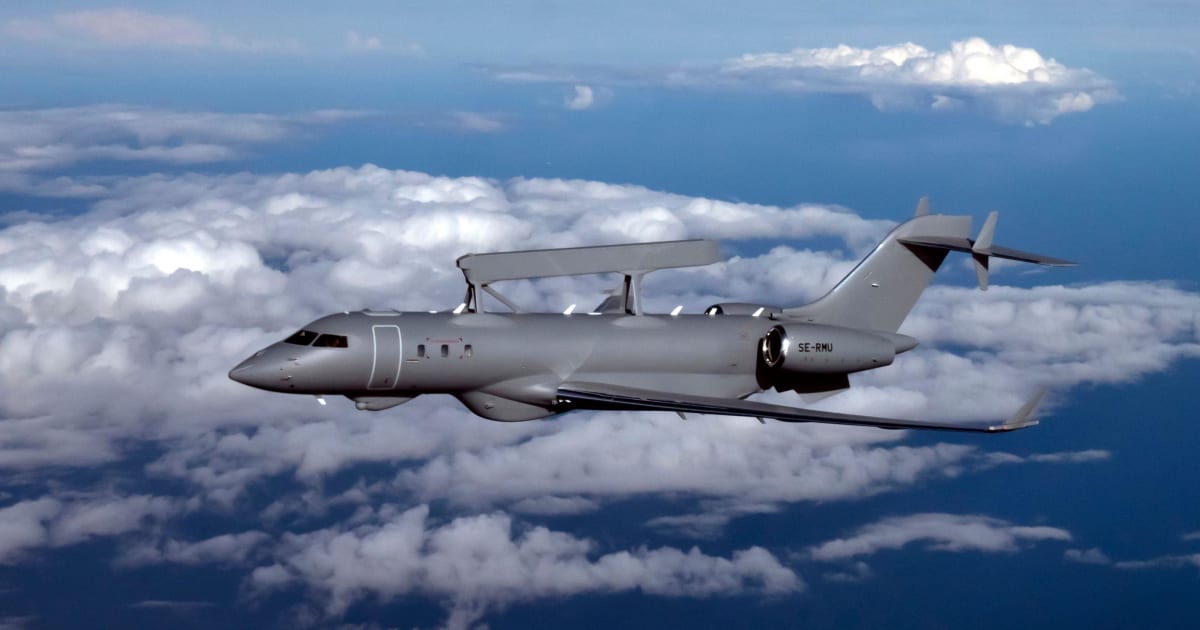
With the GlobalEye, Swedish defense manufacturer Saab has transformed the sleek, long-range luxury business jet into a cutting-edge airborne early warning and control (AEW&C) platform, creating one of the most remarkable transformations in military aviation.
Amid the global surge in GlobalEye’s popularity, Saab unveiled the first AEW&C aircraft for the Swedish Air Force (SwAF) on October 15.
The AEW&C aircraft will give the Air Force long-range surveillance capability, strengthen its operational picture across the air, land, and maritime domains, and bolster its overall combat capability.
“The presentation of Sweden’s first GlobalEye marks an important milestone for both Saab and the Swedish Armed Forces. As the program progresses towards delivery, GlobalEye will provide Sweden with a powerful capability for airborne surveillance and situational awareness,” Micael Johansson, President and CEO of Saab, said in the official statement.
The Swedish Defense Materiel Administration (FMV) ordered two GlobalEye AEW&C aircraft for about SEK 7.3 billion ($738.2M) in June 2022, making it the second customer after the UAE. Later, in 2024, it exercised an option for a third aircraft after it donated its older Saab 340-based ASC 890 aircraft to Ukraine.
The manufacturer says the newly unveiled aircraft will now enter testing and verification before its first flight and delivery to the customer. Deliveries of these jets are expected to begin in 2027 and could conclude by or before 2029.
To speed the aircraft’s introduction into the Swedish Air Force, Saab is expected to deliver the first two GlobalEyes in an interim configuration and later upgrade them to full capability, while the third will arrive in the final configuration. However, neither Saab nor the Swedish Air Force has yet publicly detailed the differences between the two standards.
Notably, the unveiling of GlobalEye comes amid a rapid surge in orders.
For example, 11 NATO states announced in July 2026 that they would jointly procure Saab GlobalEye aircraft as NATO’s new Airborne Warning and Control System (AWACS). Meanwhile, France ordered the aircraft in December 2025, and Canada and the Netherlands are also moving quickly toward a purchase.
Saab also announced in late July 2026 that an undisclosed Middle Eastern state had ordered the GlobalEye, as the EurAsian Times reported. Although Saab has not officially disclosed the latest customer, it offered the aircraft to Saudi Arabia and Qatar last year.
GlobalEye’s success is striking: it is one of modern military aviation’s most ambitious conversion projects, transforming Bombardier’s ultra-long-range Global business jets into a multi-domain surveillance aircraft.
File: Saab unveiled GlobalEye for Sweden Air Force
The Enviable Transformation
By the mid-2010s, Saab had decades of experience with its Erieye radar family, which had flown successfully on platforms such as the Saab 340 and Embraer R-99.
However, there was a catch: typically, these traditional AEW&C aircraft were large platforms with rotating rotodomes. This meant that although they were powerful, they were also expensive to operate. Furthermore, they required long runways and were becoming increasingly vulnerable in modern threat environments.
To simplify things, Saab scrambled to find a platform that offered superior capability at a lower cost. In the process, it concluded that a “high-performance business jet” offered higher altitude, endurance, and speed; lower operating costs; and the ability to operate from shorter runways. The company needed a platform that could carry a large, advanced radar while providing excellent crew conditions for long missions.
Interestingly, Saab’s previous surveillance platforms, such as the Saab 340, Saab 2000, and the Embraer R-99, had one thing in common: they were regional commercial or military-derived airframes, not high-end luxury business jets. However, with the GlobalEye contours now planned, Saab turned to the Global 6000 family of luxury business jets.
“Saab’s engineers and technical experts searched comprehensively for the best platform on which to build GlobalEye. Saab’s decades of engineering know-how led them to the Bombardier Global 6000 and 6500 business jet aircraft platforms. These jets are optimally sized with class-leading flight range and endurance,” the manufacturer says on its website.
At the Dubai Air Show in November 2015, the UAE announced a $1.27 billion contract with Saab for two aircraft under what was then called the Swing Role Surveillance System (SRSS), the program that became GlobalEye.
With this, the UAE became the launch customer for this now-coveted surveillance jet, and Saab officially launched the GlobalEye program in February 2016. The deal with the UAE reportedly covered two Bombardier Global 6000 business jets, which Saab would extensively modify with the new Erieye ER radar and other sensors. At the time, Emirati officials noted that they chose the Global 6000 after “a huge evaluation of different platforms.” The platform decision was part of the contract announcement itself.
The Global 6000 and Global 6500 were already ultra-long-range, twin-engine business jets designed for intercontinental VIP travel. These aircraft offered about 6,000 to 6,600 nautical miles of range, high cruise altitudes, and modern avionics.
Saab recognized that, with the right modifications, they could become ideal special-mission platforms.
Bombardier, a Canadian business jet manufacturer, delivered the Global 6000 or 6500 airframes to Saab in Linköping, Sweden, where they were transformed into one of the world’s most advanced surveillance aircraft.
Saab GlobalEye
Saab now describes the GlobalEye as a sophisticated, multi-domain AEW&C system that uses a variety of active and passive sensors to detect and identify objects long-range on land, at sea, and in the air.
It improves situational awareness and enables early threat detection by providing Air Force, Army, and Navy units with access to real-time information. According to Saab, the GlobalEye “combines excellent flight performance with low maintenance costs” and can remain airborne for over 11 hours.
Saab’s Erieye ER radar, which delivers a significant performance leap over earlier Erieye versions using gallium nitride, is at the heart of this early warning aircraft. It reportedly increases the detection range by 70% against challenging targets.
Furthermore, even though Saab classifies this aircraft as an AEW&C, the Leonardo Seaspray 7500E radar and the FLIR (Forward Looking Infrared) Systems Safire electro-optical system, installed in pods beneath the fuselage, enable it to conduct both land and sea surveillance.
The system can identify small targets, like drones, and offer ground-moving target indication (GMTI), which is essential in contemporary warfare, particularly in the Middle East, where the usage of inexpensive, one-way attack drones has been observed to increase exponentially.
Moreover, GlobalEye excels at identifying low-observable, stealthy threats such as drones and ballistic and hypersonic missiles, even in contested environments with heavy electronic jamming.
GlobalEye can collect, analyze, and distribute data to all authorities and resources, including airborne forces. It also facilitates efficient information exchange between platforms. It can also manage and guide other assets, such as fighters, and direct them on when and where to act—a critical requirement in modern, networked combat.
GlobalEye succeeds by combining proven commercial airframe efficiency with Saab’s expertise in radar, systems integration, and multi-domain operations.
Compared with many larger dedicated advanced early warning platforms, it offers lower lifetime costs, greater operational flexibility, and the ability to produce a comprehensive real-time image for national authorities and combined forces, whether in high-intensity war, crisis response, or peacetime monitoring.
It wouldn’t be an exaggeration to say that developing the GlobalEye has allowed Saab to re-enter the global AEW market, building on the success of its previous early warning aircraft.
More importantly, what began as a luxury business jet for executives has become one of the most capable and sought-after airborne surveillance systems of its generation, thanks to Saab’s vision and engineering.
Contact the author at sakshi.tiwari13 (at) outlook.com
Promovida no âmbito do projeto CorGO – Community River Action Lab, a sessão juntou representantes de instituições e associações locais para debater o funcionamento da rede de saneamento, o tratamento das águas residuais e as boas práticas ambientais.
O encontro surgiu num contexto de crescente preocupação da população local com episódios recorrentes de poluição.
Sara Barreiro, membro da direção da Associação Cultural e Recreativa Tourencius dos Xudreiros e representante da KALAIKO, revelou que a iniciativa integra o projeto CorGO – Community River Action Lab, iniciado em maio de 2026, que procura mobilizar a população para a proteção e valorização do rio.
Segundo Sara Barreiro, a comunidade “sentiu a necessidade de se juntar para conseguir ganhar mais voz e ser ouvida junto do município e de entidades como a Águas do Norte”. Explicou que a poluição poderá estar associada a diferentes fatores, incluindo problemas na rede de saneamento, nas estações elevatórias e pressões provocadas por atividades industriais.
Artigo exclusivo PREMIUM
Tenha acesso ilimitado a todos os conteúdos do site e à edição semanal em formato digital.
Ursula von der Leyen and António Costa said the EU would maintain pressure on Moscow, after the United States eased restrictions linked to Russian diesel exports. The statements came as Volodymyr Zelenskyy joined EU leaders in Brussels for talks on Ukraine.
The EU will not lift sanctions on Russia while its war against Ukraine continues, European Commission President Ursula von der Leyen and European Council President António Costa said on Friday. Their statements came ahead of discussions at the European Council, where leaders were due to consider further support for Ukraine and the needs of its critical infrastructure before winter. The assurances followed Washington’s move to ease sanctions pressure in connection with a deal involving Russian diesel supplies.
Von der Leyen said the EU had supported the energy truce announced by US President Donald Trump, but accused Russia of failing to observe it. “We have seen that Russia did not respect it. Not a single minute. Instead, Russia escalated. We have to increase the pressure on Russia,” she said. She added that the Commission was working on a 22nd sanctions package and that the bloc would not lift any sanctions unless Russia stopped the war.
Costa also rejected any reduction in pressure. “We will not cancel any sanctions until Russia stops the war,” he said, calling for stronger support for Ukraine and increased pressure on Moscow to secure a genuine ceasefire. The statements set out the position of the Commission and European Council presidents; they were not, in themselves, a new sanctions decision by EU member states.
The US and EU sanctions regimes are separate. Washington’s decision concerns US restrictions associated with Russian diesel exports, while EU measures are adopted by the member states. Moscow said it had resumed diesel exports under the arrangement with the Trump administration, a development that has prompted concern in Kyiv and European capitals. The reported resumption of Russian shipments has brought renewed attention to the effect of energy revenue on the Kremlin’s ability to finance its war.
The Commission describes EU sanctions as a means of reducing Russia’s capacity to fund the war, imposing costs on its political leadership and weakening its economic base. The measures cover energy, trade and finance, alongside listings of individuals, companies and organisations. The EU’s sanctions framework against Russia has been expanded through successive packages since the full-scale invasion of Ukraine.
The leaders’ statements came as Ukraine prepared for another winter of Russian attacks on energy infrastructure. The European Council meeting agenda included continued support for Ukraine and the operational needs of its critical infrastructure. Von der Leyen said the EU would continue to support Ukraine through the winter. She also referred to progress on Ukraine’s accession process, saying the remaining negotiation clusters should be opened by the end of the year.
The EU has recently added measures targeting Russia’s military-industrial sector. In October, it adopted a package of listings aimed at companies and individuals connected to the country’s war effort, as covered in EU Today’s report on the latest sanctions. The diesel arrangement has also followed earlier tensions over the use of sanctions and energy policy, including the US deal with Moscow.
The EU’s stated position is that its sanctions will remain in place until Russia ends the war. The Commission is preparing further measures, while any new package will require agreement among member states. Friday’s statements did not change the existing regime, but made clear that the US decision on Russian diesel would not, by itself, prompt Brussels to ease EU restrictions.
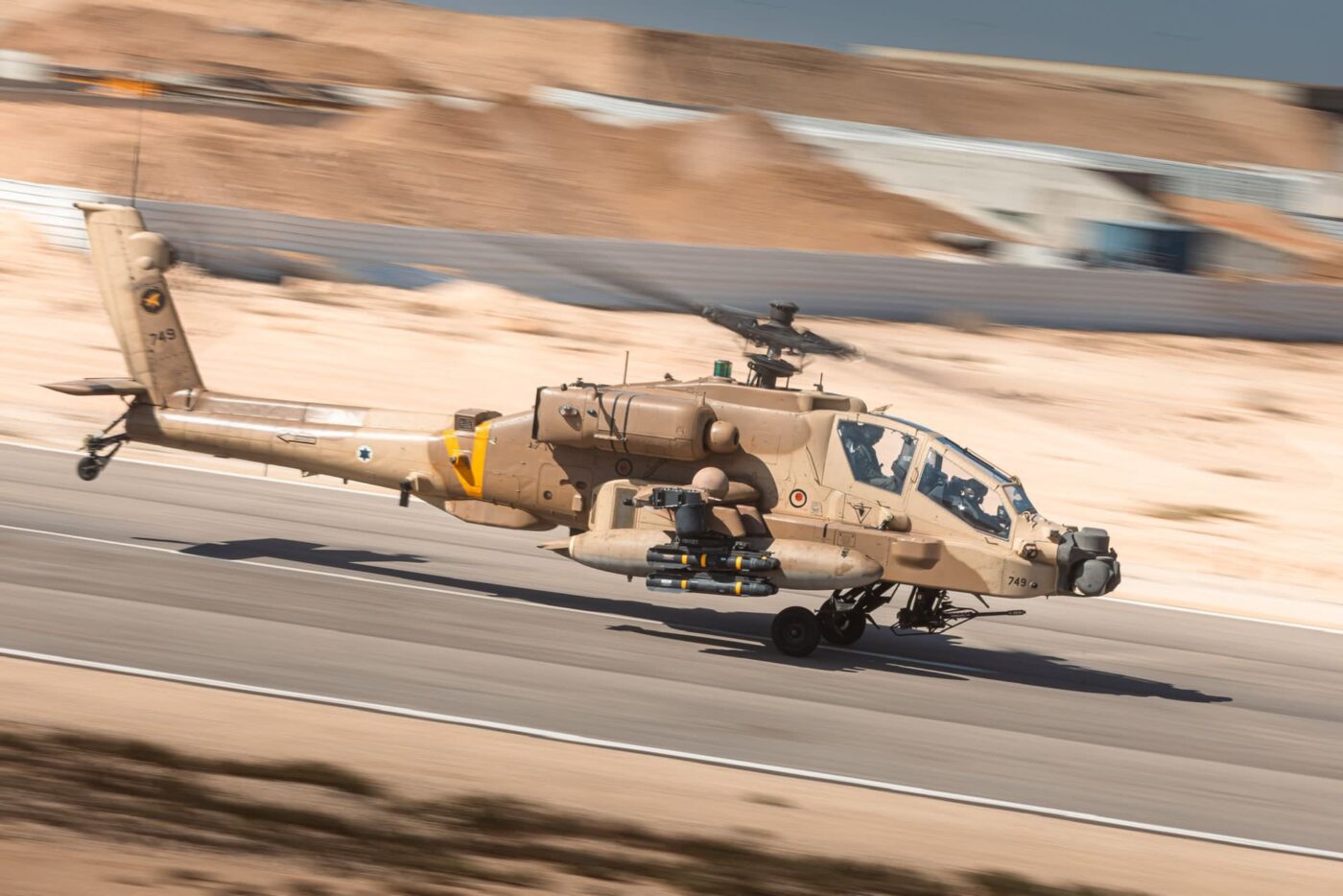
In a major policy reversal of its pre-October 7 Apache drawdown plans, Israel has signed a deal with the United States to procure 12 Boeing AH-64E Apache Guardian helicopters.
The Israeli Ministry of Defense (MoD) announced the deal on October 14, with deliveries expected in the early 2030s. Israel has not officially disclosed the deal’s value, but Israeli media reported it is expected to cost around US$ 1 billion.
Interestingly, the deal was announced nearly nine months after the US government approved the sale of up to 30 Apache helicopters to the Israeli Air Force (IAF) for an estimated USD 3.8 billion.
Israel has not disclosed if and when it will place the follow-on order for 18 more Apache attack helicopters, approved under the US government’s foreign military sale (FMS) program in February this year.
“The helicopters, scheduled for delivery at the beginning of the next decade, are of the Echo variant, the newest and most advanced model of the helicopter,” the Defense Ministry said.
According to the FMS agreement announced in February, the AH-64E will be delivered with mast-mounted Northrop Grumman AN/APG-78 Longbow fire-control radars and manned-unmanned teaming (MUM-T) receivers.
This latest version adds a dedicated maritime strike capability and nearly doubles Apache’s stand-off range by increasing the range of the Northrop Grumman AN/APG-78 mast-mounted fire-control radar from 8 to 16 km.
The Apache AH-64E can fire the Lockheed Martin AGM-114 Hellfire II air-to-surface missile, the Rafael Spike Non-Line-Of-Sight (NLOS) missile, which will extend its stand-off firing range beyond 25 km, Stinger air-to-air missiles, Hydra rockets, and can rake targets two km away with 1200 rounds of 30mm milk-bottle-sized cannon ammunition.
The AH-64E models, equipped with advanced radar, sensors, and fire-control systems, can detect, identify, and engage targets at long range, including in adverse weather and poor visibility.
According to manufacturer Boeing, they also provide aircrews with significantly improved situational awareness compared with older models.
“The procurement of the Apache helicopters is a critical step in the IDF’s force buildup, one that will strengthen its operational capabilities against a wide range of threats and contribute to the security of the State of Israel in the years to come,” Defense Minister Israel Katz said.
Notably, the agreement was announced within a week after Israel missed the deadline to sign, and the US reportedly threatened Jerusalem that it would prioritize other foreign customers if Israel did not sign immediately.
Despite changing battlefield requirements, Apache attack helicopters remain in high demand, and nearly half a dozen countries have signed deals for over 150 new-build Apache AH-64Es in the last five years, including Poland, Saudi Arabia, India, and Morocco, with Boeing in advanced talks with countries like Kuwait, Egypt, and South Korea for the sale of these helicopters.
However, many experts question the rationale behind investing billions of dollars in expensive attack helicopters in the era of drone warfare, where they’re vulnerable to cheap, mass-produced FPV drones, shoulder-fired MANPADS, or even SHORAD (Short-Range Air Defense) missiles.
Interestingly, in the years leading up to the October 7, 2023 Hamas attacks, the Israeli Air Force was itself planning to reduce its attack helicopter force, primarily AH-64 Apaches, including potentially closing one or more squadrons over rising maintenance costs.
Before the 2023 Hamas attacks, the IAF operated two Apache squadrons, the 13th “Hornet” and 190th “Magic Touch”. The 13th Hornet Squadron flies the AH-64D, and the 190th Magic Touch Squadron flies the AH-64A; both are based at Ramon Air Base in the Negev Desert.
A General Staff decision in the early 2020s called for shutting down one of the two Apache squadrons, which would have cut the attack-helicopter fleet by more than half.
The force cited aging platforms, with some IAF Apaches flying for over 35 years, high maintenance costs, and a broader doctrinal shift toward unmanned aerial platforms and drones.
However, following the Hamas attacks, the IAF not only reversed its decision to shut down one of the two Apache Squadrons, but also decided to expand its attack-helicopter fleet.
So, why did Israel reverse its policy on attack helicopters following the 2023 Hamas attacks?
Image by the IAF of an Apache, this time with all four Hellfires sporting yellow bands
October 2023 Hamas Attacks & Apaches
The October 2023 Hamas terror attacks were one of the biggest security failures in Israeli history.
These security lapses and the failure to respond promptly prompted deep introspection and major defense policy reviews in Israel.
One of the major lessons for Israel was that Apache attack helicopters remain highly relevant and are often the most viable platform for responding to certain security contingencies.
In January 2024, Israeli media JNS reported that in light of the current and future threats to Israel and the lessons learned from the current war in Gaza, the Israeli Air Force is expected to grow dramatically and devise a new plan to procure four squadrons of advanced fighter jets, two squadrons of combat helicopters, and a refueling aircraft.
It also plans to procure two squadrons of advanced Apache helicopter gunships, it said.
“The delay in responding to Hamas’s attack in the initial hours of the war and the frequent use of close ground support during the fighting made it clear that a larger fleet of combat helicopters was needed. Therefore, it was decided to immediately initiate proceedings for the purchase of one Apache squadron, and subsequently also a second squadron,” it said.
Notably, since then, Israel has already ordered six Boeing KC-46A Pegasus tankers for US$ 2.4 billion and 25 F-15IAs for US$ 5.2 billion. Now, Israel has ordered 12 Apache AH-64E attack helicopters.
In 2025, Israeli news media platform YnetNews reported that the IAF has issued a new order, called “Thunder,” which details steps to be taken to deal with another large-scale infiltration attempt from Gaza.
“As part of the changes, minimum readiness levels for surprise infiltration scenarios have increased 2.5-fold, including attack helicopters, transport helicopters for moving forces, drones, and fighter jets,” it said.
In this US Army photo taken from an undisclosed location on December 19, 2025, a US Army AH-64 Apache Attack Helicopter prepares to support Operation Hawkeye Strike in the US Central Command area of responsibility. US forces struck more than 70 Islamic State group targets in Syria on Friday in what President Donald Trump described as “very serious retaliation” for an attack that killed three Americans last weekend. (Photo by US AIR FORCE / AFP) /
The report noted the usefulness of attack helicopters in providing close air support to ground forces and in countering surprise, large-scale infiltration attempts.
Israeli business daily Calcalist reported that Apache AH-64E combat helicopters are intended to increase firepower and improve the Air Force’s response time to surprise attacks.
“October 7 sharpened our understanding that in many combat scenarios, attack helicopters still hold a distinct advantage over Remotely Piloted Aircraft (RPAs),” a former senior Air Force official told Calcalist.
“There is a huge advantage in having a battalion commander on the ground able to speak directly with a pilot hovering over the combat zone to coordinate precise, high-intensity strikes, capabilities an RPA simply cannot match.”
Apache attack helicopters also proved their worth in the war in Gaza following the Hamas attack.
Israeli defense officials commended Apache’s performance in the October 7 Hamas attack and the war in Gaza, saying the line-of-sight advantage offered by the helicopters was essential for identifying attackers, striking swiftly, assisting ground forces, and thwarting early-morning abduction attempts.
Eitan Ben Eliyahu, a retired Maj. Gen. and former Commander of the Israeli Air Force said: “This is a lesson from the war in Gaza. After it appeared that unmanned aerial vehicles (UAVs) were pushing attack helicopters out, making them seem obsolete on the battlefield, the lesson learned during [the war] was different.” The last two years of war have shown that the Apaches “remain a vital necessity on the battlefield, particularly in urban warfare and commando operations.”
A report in The Jerusalem Post noted that senior Israeli defense officials said limited helicopter numbers, combined with the need to cycle aircraft through refueling and rearming, strained operations during prolonged, high-tempo fighting.
They said the experience reinforced the need for longer range, heavier payload, improved survivability, and better networking with forces on the ground.
Notably, newer AH-64E models support heavier fuel and weapons loads, improved durability, and a reduced acoustic signature, which can make the aircraft harder to detect by sound.
Additionally, the ability to control multiple drones from the helicopter offers pilots more options for reconnaissance and targeting while staying in the fight.
Commenting on the continued relevance of Apache combat helicopters in the era of drone warfare, Indian Air Force veteran Air Marshal Anil Chopra (retd) in a previous EurAsian Times article explained, “The main reason attack helicopters will not disappear is that they fill a niche that very few platforms can fill. They are the only 350 KMPH missile carriers that can hide behind trees, pop up, and literally shoot and scoot.”
“Apache helicopters are still the most survivable, efficient, and formidable flying anti-tank platforms available to militaries. They also have significant roles as anti-UAV and anti-attack helicopters,” Air Marshal Chopra added.
The October 2023 Hamas attacks, ironically, gave a new lease of life to Apache attack helicopters in the Israeli Air Force.
Sumit Ahlawat has over a decade of experience in news media. He has worked with Press Trust of India, Times Now, Zee News, Economic Times, and Microsoft News. He holds a Master’s Degree in International Media and Modern History from the University of Sheffield, UK.
He can be reached at ahlawat.sumit85 (at) gmail.com
A European Commission survey has found widespread adoption of artificial intelligence among smaller businesses, but considerable reluctance to allow automated systems to make decisions about employees. The findings expose a growing divide between technological investment and confidence in workplace automation.
Artificial intelligence is becoming established across European businesses, but almost half of companies remain unwilling to trust automated systems when decisions concern their employees, according to a European Commission survey published on 14th October.
The Eurobarometer findings show that 42 per cent of the small and medium-sized enterprises and mid-cap companies surveyed already use artificial intelligence or algorithmic management systems, although most deployment remains limited or experimental. A further 21 per cent intend to introduce such technologies in the future.
Despite this expanding adoption, 49 per cent of respondents said they did not trust artificial intelligence or automated systems to make staff-related decisions. The figures suggest that companies increasingly distinguish between using technology to improve business processes and delegating managerial responsibility to software.
The Commission’s survey of European businesses was conducted between March and April 2026, involving approximately 12,826 telephone interviews with company leaders across the EU’s 27 member states.
Businesses prefer assistance to automation
The survey provides a more detailed picture of workplace AI than conventional statistics measuring whether companies have adopted the technology.
Among the businesses interviewed, customer service and client relations were the most commonly reported areas of application, accounting for 47 per cent. Monitoring employee performance and productivity accounted for 36 per cent, while logistics, planning and staff scheduling represented 30 per cent.
These functions differ substantially in their consequences for workers and managers.
A system that helps organise deliveries or forecasts customer demand may improve efficiency without directly determining employees’ working conditions. Software that evaluates performance, allocates shifts or recommends staffing changes can influence employment decisions and requires a different level of organisational supervision.
The survey found that 61 per cent of companies considered AI useful in supporting decisions. However, human involvement remained central: 90 per cent of respondents reported that people continued to make decisions, while fully automated decisions accounted for only 2 per cent.
The results undermine the assumption that adopting AI necessarily means transferring control of business operations to autonomous systems.
For many companies, the immediate commercial value lies in processing information more rapidly, identifying patterns and reducing administrative workloads rather than removing human management entirely.
Investment costs remain a substantial barrier
Financial and organisational obstacles continue to limit adoption.
Half of the companies surveyed cited high investment costs, while 49 per cent identified legal uncertainty and 48 per cent pointed to insufficient expertise.
These findings are particularly relevant to small businesses, which frequently lack dedicated technology teams, extensive data infrastructure or the resources to evaluate complex software systems independently.
For such businesses, purchasing AI tools is only one component of the investment. Implementation can also require employee training, changes to internal procedures, data-security assessments and continuing technical support.
The findings add a workplace dimension to concerns raised in EU Today’s earlier examination of Europe’s AI productivity gap, which identified investment, computing capacity and organisational restructuring as obstacles to translating adoption into higher productivity.
A company may purchase sophisticated software without necessarily achieving corresponding improvements in performance. Those improvements depend on whether the technology is integrated into everyday operations and whether employees have the skills to use it effectively.
Brussels prepares further workplace legislation
The survey arrives while the European Commission is considering additional rules on algorithmic management through its proposed Quality Jobs Act.
The initiative is intended to address working conditions, workers’ rights and the increasing use of automated systems in managing employees.
A consultation launched in July asked European employers and trade unions to consider transparency in automated decisions, excessive workplace monitoring and the responsibilities of companies using AI.
The second consultation phase ended in September, allowing social partners to propose negotiated arrangements before the Commission determines its next legislative steps.
The broader regulatory framework is already changing. As EU Today explained when the AI Act entered a new enforcement phase, Brussels has begun enforcing certain obligations for general-purpose AI models, while important requirements for high-risk applications, including employment-related systems, follow a later timetable.
Stand-alone high-risk systems are scheduled to face the relevant obligations from December 2027, with another deadline in August 2028 for high-risk systems embedded in regulated products.
The distinction matters for employers planning investments today. Existing data-protection and employment obligations continue to apply, but some of the AI Act’s more specific compliance requirements remain subject to transition periods.
The Commission’s latest survey indicates that businesses are already exercising caution independently of these future obligations. Their reluctance to automate sensitive staff decisions suggests that accountability, reliability and employee confidence will remain important factors in determining how extensively artificial intelligence is deployed.
For Brussels, the challenge is to establish workable rules for that transition without making implementation prohibitively expensive for smaller companies, which account for much of Europe’s employment and commercial activity.
Eurozone industrial production contracted for a second consecutive month in August, with Belgium recording one of the steepest declines. The latest figures expose continuing weaknesses in Europe’s manufacturing sector as governments confront high energy costs and growing international competition.
Industrial production in the eurozone fell by 0.5 per cent in August compared with July, according to figures released by Eurostat on Thursday, adding to evidence that European manufacturers are struggling to sustain a recovery amid rising energy costs and uncertain demand.
The decline followed a revised contraction of 0.3 per cent in July, while output across the wider European Union fell by 0.3 per cent in August. Compared with the same month last year, eurozone production was down 1.1 per cent, against a decline of 0.2 per cent across the EU as a whole.
Belgium recorded the largest monthly contraction among the member states covered by the release, at 5.1 per cent, followed by Ireland at 3.1 per cent and Portugal at 2 per cent.
The latest industrial production figures underline the uneven performance of Europe’s factories, with losses concentrated in some economies and sectors while others continue to expand.
Manufacturing weakness spreads unevenly
The sectoral breakdown presents a particularly revealing picture of the pressures facing European industry.
Production of intermediate goods, which include materials and components supplied to other manufacturers, declined by 0.8 per cent across the eurozone in August. Energy production fell by 0.6 per cent, while output of non-durable consumer goods contracted by 2.7 per cent.
By contrast, capital goods production increased by 0.4 per cent, indicating that activity in equipment and machinery manufacturing remained comparatively resilient.
The divergence was also pronounced between member states. Industrial production increased by 6.5 per cent in Sweden, 4.3 per cent in Estonia and 2.6 per cent in the Netherlands.
On an annual basis, Ireland recorded a 15 per cent decline, followed by Belgium at 7.1 per cent and Bulgaria at 5.4 per cent. The Netherlands, meanwhile, registered growth of 9.8 per cent compared with August 2025.
These variations make it difficult to describe Europe’s industrial position as a single, uniform downturn. National production figures reflect different industrial structures, production cycles and exposure to particular markets.
Ireland’s figures, for example, can be influenced by changes in output among large multinational enterprises, while Belgium’s manufacturing economy is particularly exposed to developments in chemicals, pharmaceuticals and energy-intensive production.
Nevertheless, the simultaneous contraction of industrial output across the eurozone reinforces concerns about the strength of the European economic recovery.
Energy prices and industrial competitiveness
The continuing disruption of global energy supplies has complicated the position of European manufacturers, particularly businesses that depend on predictable electricity and gas prices.
The Middle East conflict has increased uncertainty over energy costs and transportation, making production planning more difficult for companies operating with substantial fuel, heating or electricity requirements.
As EU Today reported earlier this week, Brussels has already moved to delay certain methane requirements for energy imports as governments seek to limit additional pressure on gas supplies.
The decision reflects a wider debate over whether the EU’s existing regulatory framework adequately accounts for the international cost disadvantages facing European industrial producers.
Chemicals, metals, fertilisers and other energy-intensive industries must compete with manufacturers operating in markets where energy costs and regulatory requirements can differ considerably.
The problem extends beyond immediate profitability. Persistently unfavourable operating costs can affect decisions about new factories, maintenance, modernisation and the location of future investment.
Those decisions may have longer-lasting economic consequences than monthly fluctuations in production.
Industrial policy under political pressure
The figures arrive as EU governments debate the future of European industrial policy, including the treatment of imported products and the conditions under which companies should qualify for public support.
Recent disagreements over proposed European-content requirements have illustrated divisions between governments seeking greater protection for EU manufacturers and those concerned that restrictive rules could increase costs or disrupt supply chains.
The debate is particularly consequential for automotive manufacturers whose supply chains extend across EU borders and into neighbouring countries.
Meanwhile, the proposed EU budget for 2028–2034 has become another focus of disagreement, with member states questioning how much funding should be devoted to industrial competitiveness, strategic technologies and energy infrastructure.
The immediate economic issue is whether European factories can recover production as energy costs remain elevated and external demand fluctuates.
Eurostat’s August figures do not establish how individual government policies have affected output, nor do they determine whether the contraction will continue. They do, however, show that industrial activity entered the autumn with limited momentum.
The next industrial production release, covering September, is scheduled for 16 November and will provide an indication of whether the late-summer weakness persisted into the final quarter of the year.

 Login