❌

Reading view

Meta CEO Mark Zuckerberg says Muse and Reality Labs are highly unprofitable — for now

Meta CEO Mark Zuckerberg
Meta CEO Mark Zuckerberg.

Finn Gomez/Getty Images

  • Meta's AI agent, Muse, is unprofitable due to "very high compute costs," CEO Mark Zuckerberg says.
  • Meanwhile, Meta expects Reality Labs, its AI glasses division, to lose $15 billion next year.
  • The social media giant has a plan to fix that.

Meta says some of its biggest cash incinerators could finally start turning profits.

The social media giant, which generated over 97% of its quarterly revenue from ads, has faced persistent questions from investors about the lack of profitability in its AI and hardware initiatives.

Meta CEO Mark Zuckerberg addressed those concerns head-on during its third-quarter earnings call on Wednesday.

Zuckerberg said that Muse, the AI assistant it launched last month, is unprofitable since it's "very compute intensive to run." Meta expects to start turning that around next year by massively improving Muse's efficiency.

"If compute efficiency continues improving quickly for another few years, which we think is highly likely, then Muse will be highly profitable over multiple years," he said.

Meta plans to make money from Muse by taking a small transaction fee off of purchases it drives, Zuckerberg said at Meta's Connect conference last month.

Zuckerberg added that Muse, which launched only in the US and Canada, wasn't launched globally due in part to the amount of compute it requires. (Meta's North American users are generally its most lucrative.)

Zuckerberg also struck a positive note about its cash-hemorrhaging Reality Labs division, which makes products like Meta Ray-Bans and virtual reality glasses.

Meta expects Reality Labs to narrow its losses to about $15 billion in 2027, down from the $18 to $19 billion it expects to lose this year. The division should start trending toward profitability next year, as Meta's AI systems make it more useful, Zuckerberg said.

"I continue to believe that the path to delivering holographic experience, of bringing together the physical and digital worlds and everyday glasses, will come through VR first," Zuckerberg said.

Have a tip? Contact this reporter securely on Signal at charlesrollet.12 or +1-628-282-2811. Use a personal email address and a non-work device; here's our guide to sharing information securely.

Read the original article on Business Insider

  •  

Meta narrows capex forecast as it leans into the AI agent wars

Mark Zuckerberg, chief executive officer of Meta Platforms Inc., during the Allen & Co. Media and Technology Conference in Sun Valley, Idaho, US.
Meta, led by Mark Zuckerberg, has spent big on infrastructure for its AI development.

Bloomberg/Getty Images

  • Meta spent $34.91 billion in capital expenditures in its third quarter.
  • The company is spending big on data centers and other infrastructure for its AI development.
  • Meta predicted $135-145 billion in capex for 2026, aligning with analyst expectations.

Meta is making it rain for AI.

The company spent $34.91 billion in capital expenditures during the third quarter of 2026. That's up from the second quarter's sum, $31.08 billion.

For the year 2026, Meta said it expects to spend between $135-145 billion in capital expenditures, narrowed from its prediction of $130-145 billion last quarter.

Meta's forecast includes the yearly capex prediction that analysts expected: $139.79 billion.

As Meta bets big on AI, it is investing heavily in its development. It has built massive, costly data centers and spent big on computing power.

The spending uptick was expected. On the "Cheeky Pint" podcast earlier this month, CEO Mark Zuckerberg recounted early conversations about the investment — and said he'd bet up to $200 billion on AI, before he knew the models would work.

Investors haven't loved Meta's massive capex forecasts in past quarters. The stock tumbled almost 10% last quarter after earnings per share missed Wall Street estimates, and sank 6% the quarter before on raised capex guidance.

This quarter, Meta has a new hero product: Muse.

The AI assistant has reached over 2 million daily users and 3 million downloads. It quickly scaled the App Store. Muse users told Business Insider they chatted with it to help plan trips and ace exams.

The energy around the company is ebullient, as Alexandr Wang, Meta's chief AI officer, continues to post memes of Muse's squishy-looking mascot.

At Meta's Connect keynote event in September, Zuckerberg said Muse "has a novel business model."

"We believe that Muse will make you money, and we're standing behind this by making Muse free for a huge number of tokens with the expectation that over time, we will profit by taking a small fee from transactions," he said.

Muse could help justify the capex guidance for some investors. The stock was trading up 4.12% after-hours at the time of publication.

Read the original article on Business Insider

  •  

SpaceX offers employees 20% extra pay to help bring its Memphis supercomputers online

Elon Musk is in a black T-shirt that reads "Occupy Mars." He has two thumbs up and is standing next to the factory floor at SpaceX.
Elon Musk wants some SpaceX workers to move temporarily to Memphis.

Marvin Joseph/The Washington Post via Getty Images

  • SpaceX is offering employees a 20% pay bump to volunteer to help build its data centers in Memphis.
  • The company is looking for "leaders" who can "remove blockers," according to emails seen by BI.
  • Elon Musk said on Tuesday he often spends "four days a week" in Memphis working on SpaceX's data center buildout.

SpaceX is offering employees a pay bump to temporarily move to Memphis and help build its data centers.

Elon Musk's rocket company is giving employees a 20% pay increase if they volunteer to spend six weeks assisting its critical supercomputer buildout, according to an email seen by Business Insider.

"We now need leaders — current and emerging — to guide teams and remove blockers as we bring more supercomputers online," read the email, which was sent in early October to all SpaceX employees.

It specified that volunteers did not need to be managers already, adding that construction experience is a plus and that "drive matters most."

Employees who put themselves forward should expect to spend six weeks on-site in Memphis, Tennessee, or Southaven, Mississippi, where SpaceX is currently expanding its huge Colossus 1 and 2 data centers to meet surging demand for its compute business.

Volunteers "must be in good performance standing," with more than one year of tenure preferred, the email said. Employees who volunteer will receive a 20% premium on their base salary or on their hourly rate of pay for the period of their assignment, and be eligible for "bonuses tied to program success."

SpaceX did not respond to a request for comment.

The email described the reallocation of employees from other parts of SpaceX to assist the company's data center buildout as a "surge," a tactic employed by the company to divert employees and resources to mission-critical projects.

In 2022, CNBC reported that SpaceX offered employees pay bumps of between 10%-25% to temporarily relocate to Texas as it attempted to launch its Starship megarocket.

The company has been offering "surging" employees a 20% premium on their salary to move to Memphis since at least August, according to another email seen by Business Insider that called for "SpaceX experts and aces" to work for the next three months on the data center buildout. The email said the program is intended to end on December 31, 2026, but could be extended.

SpaceX will cover travel expenses and logistics, both emails said.

SpaceX's compute cash cow

The supercomputers in Tennessee and Mississippi, which were originally built by xAI before the startup was folded into SpaceX in February, have become a critical part of the company's business.

In SpaceX's earnings on Tuesday night, the rocket giant said AI revenue that includes leasing out its compute to other companies — including Anthropic and Google — had soared to more than $7 billion, nearly half SpaceX's entire quarterly revenue.

On the analyst call, CEO Elon Musk said that SpaceX was being "hounded relentlessly" by companies looking to rent out its compute, adding that they could have rented it out several times over.

SpaceX has been shifting executives in addition to rank-and-file employees to oversee its aggressive expansion. Business Insider previously reported that the company had placed a former Starship executive in charge of building out its compute capacity in Memphis.

Musk told investors on Tuesday he was also spending most of his time in the city as he looked to push SpaceX toward a target of bringing an extra 10 gigawatts of compute online by the end of 2027.

"I've been spending, personally, a lot of my time in Memphis, often four days a week," the SpaceX CEO said. He previously said he was living in an Airstream trailer on the site.

Do you work at SpaceX and have any information to share? Get in touch with this reporter at tcarter.41 on Signal or tcarter@businessinsider.com. Use a personal email address and a nonwork device; here's our guide to sharing information securely.

Read the original article on Business Insider

  •  

AI rivals are thirsty for SpaceX's compute, Elon Musk says

Elon Musk raising an eyebrow.
Elon Musk made the remarks during SpaceX's earnings call.

Andrew Harnik/Getty Images

  • Elon Musk said AI rivals are clamoring to rent SpaceX's compute.
  • SpaceX plans to split compute between its internal uses and outside customers.
  • The company could rent out its compute "several times over if we said yes to everyone," Musk said.

SpaceX's AI rivals are clamoring to rent computing power from the artificial intelligence and rocket company, CEO Elon Musk said.

"We are also, frankly, hounded relentlessly by every hyperscaler and by dozens of smaller companies to rent more of our compute," Musk said during SpaceX's third-quarter earnings call Tuesday.

Musk said SpaceX could rent out the company's compute "several times over if we said yes to everyone."

SpaceX, however, is reserving a chunk of that capacity for its own AI ambitions, including scaling its AI chatbot Grok and Cursor, the coding startup it recently acquired.

Musk said SpaceX is seeking to devote roughly half of its compute to internal uses and rent out the other half to third parties. That balance could change month to month, he said.

"It's going to be dynamic," said Musk. "And obviously, our approach is to rent at the — effectively the spot market rate as opposed to sign these long-term deals."

The company expects the value of compute to increase as AI models improve and ultimately generate "more useful intelligence per watt," said Musk.

"And the value of that compute is proportionate to the useful intelligence per watt," Musk said, adding that rental rates for older Nvidia H100 chips have climbed from when they were new.

"I think that's likely to continue," said Musk. "I think we're going to face a shortage of super intelligence compute. And that shortage is going to remain for a long time."

Musk likened the situation to Monty Python's famed cheese shop sketch, in which a customer repeatedly asks for different cheeses only to find that none are available.

"We've actually tried to offload some of our inference compute to other cloud providers so that we can use more compute for training," the CEO said. "And we get the cheese shop sketch."

Read the original article on Business Insider

  •  

Marco Rubio: Elon Musk Decides Ukraine's Access to Starlink, Not the White House

Ukraine's access to Starlink is up to SpaceX and Elon Musk, not the White House, U.S. Secretary of State Marco Rubio said on Wednesday.

The post Marco Rubio: Elon Musk Decides Ukraine’s Access to Starlink, Not the White House appeared first on Breitbart.

  •  

AT&T's CEO throws shade at Musk's Starlink mobile ambitions

Elon Musk and John Stankey appear in side-by-side portraits, with a U.S. flag behind Musk.
"I wouldn't over-rotate on what I would call one carrier of low band spectrum," John Stankey said Wednesday, referring to Elon Musk's Starlink.

Win McNamee/Getty Images (Musk); Lluis Gene/AFP via Getty Images (Stankey)

  • AT&T CEO is brushing off concerns that satellite-based internet could threaten his business.
  • "I think LEO constellations are fantastic for delivering bandwidth to rural areas," he said.
  • When it comes to where lots of people live, he said fiber-connected performance can't be beat.

Elon Musk wants SpaceX to become a major US mobile carrier. AT&T CEO John Stankey says: not so fast.

AT&T has an advantage from years of investment in dense urban and suburban areas, he said on AT&T's third-quarter earnings call, a day after Musk and SpaceX chief operating officer Gwynne Shotwell reported more than 22 million monthly Starlink Mobile users.

"Our competitors cannot and will not match our operating proficiency, network performance, or exceptional converged value proposition," Stankey said.

Stankey sees a use case for satellite-based internet to soften the edges of fiber-connected and 5G networks, especially in places where it's too expensive to build out the physical infrastructure, he said.

"I think LEO constellations are fantastic for delivering bandwidth to rural areas," he said, using the acronym for low-Earth orbit satellite arrays.

Shotwell said Tuesday that Starlink recently got FCC approval to launch 15,000 V2 satellites. She also noted a recent agreement to acquire a portfolio of low-band transmission spectrum, or wireless frequency licenses, which better penetrate buildings to reach indoor devices.

Stankey was unimpressed.

"How you perform indoors, of course, is extremely important, and we shouldn't think about those as being nominal loads," he said. "They're significant loads, even with robust Wi-Fi networks that are out there."

This is especially critical in crowded environments like stadiums and hospitals, where he said AT&T has been focused on beefing up signal support.

"I wouldn't over-rotate on what I would call one carrier of low band spectrum," he said, referring to Starlink.

Read the original article on Business Insider
  •  

Musk: SpaceX, Tesla merger a ‘good idea’

Elon Musk said Tuesday that his two companies, SpaceX and Tesla, have formed independent special committees to discuss the potential merger, calling it “a good idea.” “I think it would be a good ​idea, but it’s really up to the special committees of both companies,” Musk told investors on a conference call, according to a…

  •  

Una fusione, tanti dubbi. Vantaggi e ostacoli del matrimonio Tesla-SpaceX

  •  

Democrats call for investigation into Musk over reported Starlink slowdown order

Democrats are calling for an investigation into SpaceX CEO Elon Musk following a Wall Street Journal report alleging he ordered the Starlink slowdown in Ukraine. “Either the President was lying or Musk was lying, but the decision to slow down satellite speed and access has life or death consequences for Ukraine,” Sen. Adam Schiff (D-Calif.)…

  •  

TD Synnex anuncia aquisição da BlueStar para reforçar oferta em tecnologias especializadas

A TD Synnex, cotada na bolsa de Nova Iorque, anunciou a celebração de um acordo definitivo para a aquisição da BlueStar, distribuidora especializada em tecnologias de identificação automática e captura de dados (AIDC), operação que deverá reforçar a oferta tecnológica do grupo e criar novas oportunidades para parceiros de canal em vários mercados.

Em comunicado, a distribuidora tecnológica refere que a BlueStar é reconhecida pela sua experiência em áreas como tecnologia operacional, mobilidade, RFID, pontos de venda, sinalética digital, redes, robótica e segurança. A conclusão da operação permanece dependente das habituais aprovações regulatórias e de outras condições de fecho.

Segundo a TD Synnex, a combinação das atividades das duas empresas permitirá alargar o acesso de clientes e fabricantes a um portefólio tecnológico mais abrangente, bem como a recursos e capacidades especializadas, mantendo a especialização que caracteriza a BlueStar.

“A BlueStar construiu uma reputação excecional através da sua especialização, conhecimento técnico e compromisso inabalável com os parceiros”, afirmou Reyna Thompson, presidente da TD Synnex para a América do Norte. A responsável acrescentou que a empresa vê com entusiasmo a possibilidade de combinar a experiência da BlueStar em AIDC, tecnologia operacional, mobilidade, RFID e soluções para pontos de venda com os recursos e alcance global da TD Synnex.

Também Miriam Murphy, presidente da TD Synnex para a região EMEA, destacou o valor da equipa da BlueStar. “Para além do portefólio da BlueStar, o conhecimento especializado e a experiência da sua equipa são fundamentais para o apoio e os serviços diferenciados que presta”, afirmou, considerando que a integração com as capacidades globais da TD Synnex poderá reforçar as oportunidades para clientes e fabricantes de ambas as empresas.

Do lado da BlueStar, o presidente executivo, Ryan Girvin, sublinhou que os clientes e fabricantes confiam na empresa pela sua especialização setorial e apoio personalizado. Segundo o gestor, a integração na TD Synnex permitirá preservar esses pontos fortes, ao mesmo tempo que amplia os recursos, capacidades e oportunidades disponibilizados aos parceiros.

A TD Synnex acrescenta que, até à conclusão da transação, as duas empresas continuarão a operar de forma independente. Ambas mantêm o compromisso de apoiar autonomamente os seus parceiros durante o processo de análise regulatória e prometem divulgar novas informações à medida que o processo avançar.

A TD Synnex é uma distribuidora global líder, agregadora de soluções e fabricante de design original e produção contratual, que desempenha um papel central na interligação do ecossistema tecnológico.

  •  

Elon Musk says SpaceX hitting $1 trillion in revenue in 2028 is 'no longer impossible'

Elon Musk
SpaceX and Tesla CEO Elon Musk.

JOEL SAGET/AFP via Getty Images

  • Elon Musk says it's "no longer impossible" that SpaceX will generate $1 trillion of revenue in 2028.
  • The SpaceX CEO said in August that his company projected that much revenue for 2030.
  • SpaceX would have to grow its revenue 53-fold in three years to reach Musk's new figure.

Elon Musk always shoots for the moon, but he's aiming even higher with his latest suggestion.

"As crazy as this sounds, $1T in SpaceX revenue in 2028 is no longer impossible," the Tesla and SpaceX CEO said in a Tuesday post on X.

As crazy as this sounds, $1T in SpaceX revenue in 2028 is no longer impossible https://t.co/jF3Wue95nL

— Elon Musk (@elonmusk) October 20, 2026

That's an even more ambitious timeframe than Musk has previously given. He said in August that SpaceX was internally projecting $1 trillion of revenue in 2030, and there was a "non-zero" chance it could reach that amount in 2029.

Musk made his latest pronouncement within hours of saying on SpaceX's third-quarter earnings webcast that annual recurring revenue could reach between $500 billion and $1 trillion by the end of 2027.

In a post-earnings note, JPMorgan forecast SpaceX would generate $254 billion of revenue in 2027.

If SpaceX were to generate $1 trillion in revenue in 2028, that would represent a 53-fold increase in three years. It earned just under $19 billion in 2025. It shared its historical financials prior to going public this summer.

After the bell on Tuesday, SpaceX — the company behind Falcon rockets, Starlink satellites, X, and AI chatbot Grok — posted close to $15 billion in revenue last quarter, up 161% from the same period of 2025.

The key driver was its super-intelligence division, where revenue surged 830%, from around $800 million to $7.6 billion. SpaceX attributed the growth to new cloud services agreements, around $600 million of revenue from its recent Cursor acquisition, and increased Grok adoption by enterprises.

To put Musk's $1 trillion revenue figure in context, Amazon and Walmart, the two highest-revenue companies on the planet, both generated a little over $700 billion in net sales last financial year.

Musk is floating the possibility that SpaceX could generate more than 40% more revenue than either of them did last year, in about two years' time.

It's unclear whether Musk is including Tesla, which generated about $95 billion of revenue last year, in his newest revenue figure. He revealed on Tuesday that Tesla and SpaceX have formed committees to explore a potential merger.

Susannah Streeter, Wealth Club's chief investment strategist, told Business Insider by email that a tie-up could "combine expertise in AI, chips, robotics and connectivity."

But she added that "bringing two enormous businesses with very different operations and capital demands under one roof would be a hugely complex undertaking."

Streeter said that notching $1 trillion in annual revenue in 2028 would be a "very tall order" and require an "extraordinary leap in the scale of the business."

"Moving the goalposts from 2030 to 2028 suggests he is increasingly confident that several growth drivers could accelerate at once, but there is a difference between a target that is technically possible and one that is commercially realistic," she added.

Neil Wilson, UK investor strategist at Saxo Bank, told BI by email that Musk's latest revenue figure is "pushing it" and "would imply such an enormous pull-forward in demand as to defy credibility."

Wilson added that he'd "never say never" about SpaceX hitting $1 trillion of revenue, "but by 2028 I'd say the chance is zero, whatever Elon says!"

Read the original article on Business Insider

  •  

Drones, sismos e salvamento por cordas: A tecnologia ao serviço da proteção civil em Sagres

A vila de Sagres vai receber, nos dias 7 e 8 de novembro, a terceira edição do FALEX, um evento focado na segurança, prevenção e socorro em zonas costeiras com arribas.

O conteúdo Drones, sismos e salvamento por cordas: A tecnologia ao serviço da proteção civil em Sagres aparece primeiro em Algarve Marafado.

  •  

Starlink slowdown makes Ukraine’s Shahed-hunting drone maker rethink air-launched interceptors

STING S interceptor

Ukrainian drone maker Wild Hornets is rethinking projects it is currently working on, including launching interceptors from aerial platforms, because of limits on SpaceX’s Starlink satellite internet. Spokesman Mike Orliuk told The War Zone (TWZ) this on 20 October. The company builds Sting interceptors, which it says destroyed over 15,000 Shaheds and Gerberas, a cheaper Shahed lookalike, in a year. Orliuk said Sting’s current operations are unaffected.

The stakes rise as Russia shifts to faster drones. Ukrainian defense technology adviser Serhii Beskrestnov counted more than 2,500 jet-powered Gerans, Russia’s version of the Shahed, in August. President of Ukraine Volodymyr Zelenskyy said on 16 October that these drones fly faster than 400 km/h. He added that some Ukrainian interceptors chasing them work through Starlink. When the link was slowed, Ukraine could not intercept some of them, he said.

How Sting stays connected

“Our own communications system provides the basic connection to our interceptors,” Orliuk said. The company’s remote-control technology can draw on various internet sources, he added, though the military often uses Starlink. Even then, the terminal does not need to move at high speed. It only links the command center to a ground station, which Orliuk compared to a cell tower.

“For these needs, everything is operating normally with Starlink at the moment,” he said.

An air-launch project under review

“Some drones carry a terminal on board and need to fly at high speed with it,” Orliuk said. “In such cases, Starlink’s limitations make their operation impossible.”

That is why the company is rethinking the air-launch project. Wild Hornets has made no clear decision yet but will test alternatives, Orliuk said. He declined to describe them.

“I believe, in any case, depending on a single solution is very risky,” he said.

The Starlink logo on a smartphone screen.
Explore further

Musk pointed at the US military over Ukraine’s satellite limits. Now a US official says the administration had nothing to do with them

Other firms share the concern

Orliuk said he has spoken with other companies that rely far more on Starlink and have expressed concerns. He pointed to growing interest in Europe’s Eutelsat network, though “creating something like Starlink won’t be easy.”

Who ordered the slowdown remains unclear. The order to slow Ukraine’s Starshield service came from inside the White House, two US officials and a Western official said. A US official told TWZ the president never made such a request. US Secretary of State Marco Rubio said on 17 October that the slowdown had “nothing to do with the White House” and called “a report on that” “categorically false,” without saying which report he meant.

  •  

Who capped Ukraine’s Starlink? “Ultimately POTUS,” Musk said. Ultimately Musk, reports now say

musk, trump

Elon Musk ordered the speed cap on Starshield, the military version of SpaceX’s Starlink network that Ukraine’s drones rely on, The Wall Street Journal reported on 20 October. Earlier, Musk said that such limits are decided by the US military and “ultimately POTUS.” Speaking to reporters in Eau Claire, Wisconsin, on 20 October, according to WSJ, US Defense Secretary Pete Hegseth said, “We haven’t made any directives or anything like that,” CBS News reported.

For a week, no one with a hand on the system said the decision was theirs. Musk pointed to the US military and the president, and Trump said he did not know who it was. Meanwhile, Ukrainian officials said the cap has hampered the drones they use to intercept Russian Shaheds and to strike Russian forces in occupied territory. Kyiv says the cap remains in place, and at about 160 km/h it makes intercepting jet-powered drones and missiles that fly about twice as fast virtually impossible.

Musk spoke with administration officials, including Trump, before the cap, a source says

Musk capped the speeds at which Ukrainian hardware could stay connected to the network, people familiar with the matter told WSJ. The slowdown, which began on 14 October, left some of Ukraine’s strike and interceptor drones virtually useless, WSJ said.

WSJ’s sources differ on Trump’s role. Some US officials said Musk acted on his own and that Trump did not specifically order any retribution against Ukraine. One person said Musk spoke with several senior administration officials, Trump among them, before imposing the cap. Two people said Musk and Trump discussed the decision by phone soon after the slowdown became public.

During the uproar, SpaceX representatives called White House counterparts. They asked for a shared message that the company and the administration had coordinated before Musk’s directive, the people said. The White House ran an informal inquiry into who ordered the slowdown, WSJ said.

Musk held several conversations with administration officials before the order to understand the president’s thinking, CBS reported, citing sources. He dislikes his company being seen as profiting from the war, and it is unclear how his order was carried out, CBS said.

Hegseth points to Starlink’s terms of service

Hegseth said the US had not pulled anything back. He said Starlink “has the option” to make decisions under its terms of service, and that from the Pentagon’s view nothing had changed, CBS reported.

Speaking to reporters as he left the White House on 16 October, Trump said he did not think either he or Musk was responsible, The Telegraph reported. On 19 October, he said, “I don’t know who it was, but I’d like to find out.”

Last week, a bipartisan group of senators asked the Pentagon’s inspector general to investigate whether officials “directed” or “authorized” changes to Starlink and Starshield services and intelligence sharing affecting Ukraine.

Earlier reports pointed at the White House

On 15 October, Reuters reported that the order came from inside the White House. The officials said Pentagon leaders received a message that the Starshield service for Ukraine’s military needed to be slowed, but did not say who made the decision or who carried it out. A senior US official said “No such request was ever made by the president.”

On 16 October, The Telegraph reported, citing four sources, that Musk approached Trump with the idea of the speed limits. One of the sources said Trump agreed.

Analysts and Kyiv say the cap is still in place

Michael Kofman, a war analyst at the Carnegie Endowment, said, according to WSJ, that Ukrainian strike and interceptor drones remain limited to 160 km/h. He said actual connections run below 130 km/h, which still hampers strikes and air defense.

On 20 October, Ukraine’s top diplomat in Washington, Denys Sienik, said Kyiv was still waiting for answers from the Pentagon and SpaceX, WSJ reported.

  •  

Renault Duster com a nova versão de entrada Zen Plus 1.6 manual

A Renault reforça a gama Duster com o lançamento da nova versão de entrada Zen Plus 1.6. A novidade, desenvolvida para levar o SUV para uma nova faixa do mercado, chega com preço sugerido de R$ 107.990 e nao conta com multimídia.

A nova versão oferece uma alternativa competitiva para os clientes que desejam entrar no universo dos SUVs, sem abrir mão dos atributos que consolidam o Duster no segmento desde 2011.

Ao longo de sua trajetória, o Duster conquistou os brasileiros por sua robustez, versatilidade e amplo espaço interno. Com a nova versão Zen Plus, a Renault amplia as oportunidades de acesso ao modelo, mantendo exatamente os atributos que consolidaram o SUV como uma referência em seu segmento.

A nova versão Zen Plus preserva características que fazem parte do DNA do Renault Duster. Equipado com o motor 1.6 SCe flex associado ao câmbio manual de cinco marchas, o SUV oferece um conjunto reconhecido pela confiabilidade e eficiência para o uso diário.

Assim como as demais versões da linha, o Duster Zen Plus traz itens importantes de segurança e conforto, como seis airbags, controles eletrônicos de estabilidade e tração, assistente de partida em rampa, direção elétrica, sistema Stop & Start, faróis com assinatura em LED e grade frontal com acabamento em preto brilhante.

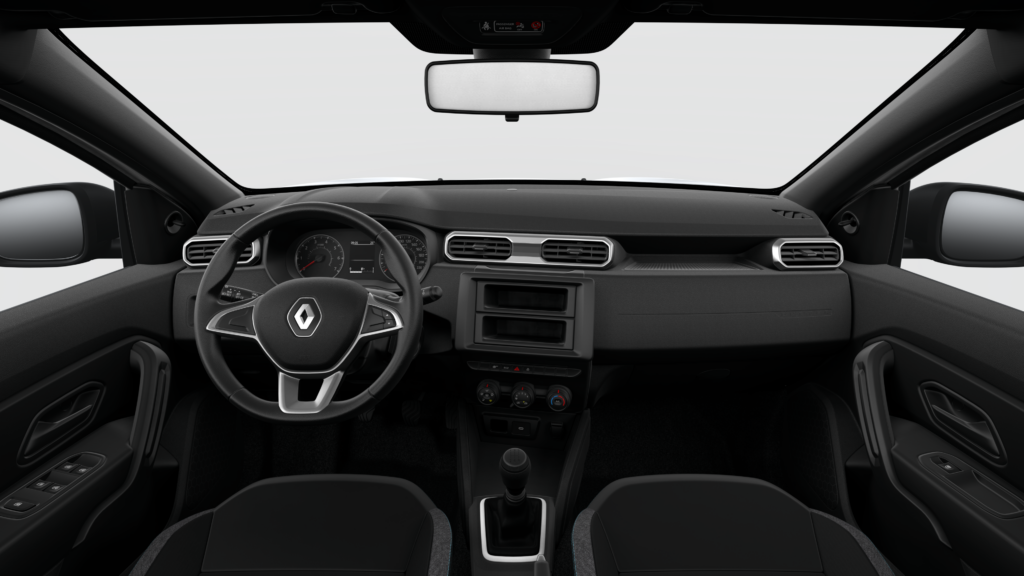
No interior, a versão conta com bancos revestidos em tecido com tons preto e cinza, com detalhes em azul nas costuras. Detalhes na cabine em cromado reforçam o design da versão, preparada para diferentes tipos de uso cotidiano.

A nova versão Zen Plus mantém os principais atributos do Duster. O SUV continua oferecendo o maior espaço interno do segmento e um dos maiores compartimentos de bagagem da categoria, com 475 litros de capacidade.

O Duster também preserva sua reconhecida aptidão para enfrentar diferentes tipos de terreno. Com 237 mm de altura do solo, além dos melhores ângulos de entrada e saída da categoria, o SUV entrega a robustez que se tornou uma de suas principais marcas ao longo de sua trajetória no mercado brasileiro.

Duster Zen Plus 1.6 MT (R$ 107.990)

Motor 1.6 SCe flex
Câmbio manual
Seis airbags
Controle eletrônico de estabilidade (ESP)
Controle eletrônico de tração (TC)
Assistente de partida em rampa (HSA)
Direção elétrica
Faróis com DRL em LED
Grade frontal em preto brilhante
Rodas de 16″ 
Sistema Stop & Start
Ar-condicionado

The post Renault Duster com a nova versão de entrada Zen Plus 1.6 manual appeared first on Diário da Manhã - O Jornal do leitor Inteligente.

  •  

SHARING THIS VIDEO WILL SAVE LIVES!! — Dr. Francisco Contreras

from SGT Report: Save the LIFE of someone you love, share this video! There is a better way than the Rockefeller medicine machine and their radiation and chemo. My guest Dr. Francisco Contreras is the President and Medical Director of Oasis of Hope Cancer Center who leads with metabolic whole body supportive therapies to care […]
  •  

Trimestrali Usa: da SpaceX iniezione di fiducia per la Borsa Usa, Netflix paga la cautela nelle previsioni per il 2027

I risultati di SpaceX corrono in soccorso della Borsa Usa. Le azioni della società guidata da Elon Musk sono balzate di oltre l’8% nelle contrattazioni del dopo Borsa.  I ricavi trimestrali sono aumentati del 161% a 14,58 miliardi di dollari, superando le aspettative degli analisti, mentre l’utile netto ha raggiunto 4,4 miliardi di dollari, rispetto a una perdita di 1,1 miliardi di dollari registrata un anno prima. La crescita dei ricavi è stata trainata principalmente dalla divisione Super Intelligence (SI) della società, che ha generato 7,6 miliardi di dollari di ricavi a fronte di aspettative di 6,3 miliardi di dollari.

SpaceX aveva siglato accordi con Anthropic e Google per fornire potenza di calcolo dal suo data center Colossus II, che hanno rappresentato importanti fonti di ricavo per la società e una monetizzazione dell’acquisizione di XAI avvenuta all’inizio dell’anno. Le tlc hanno contribuito con 5,2 miliardi di dollari (rispetto ai 4,9 miliardi stimati), sostenuti dalla crescente adozione di Starlink da parte dei consumatori e dall’espansione dei contratti aziendali e governativi. I ricavi del segmento Space hanno raggiunto 1,8 miliardi di dollari, superando l’obiettivo di 1,43 miliardi di dollari. “Per quanto possa sembrare folle, mille miliardi di dollari di ricavi per SpaceX nel 2028 non è più impossibile”, ha detto lo  stesso Elon Musk, ipotizzando anche una fusione tra SpaceX e Tesla, in un post sui social media dopo la pubblicazione dei risultati.

In ribasso invece il re dello streaming Netflix le cui azioni sono scese del 6% nonostante ricavi per  13,44 miliardi di dollari. La società ha battuto le stime degli analisti ma non ha fornito stime certe per il 2027 limitandosi a dichiarare di prevedere una forte crescita dei ricavi, sostenuta dagli stessi tre fattori che hanno aiutato nel 2026. Ossia crescita degli abbonati, prezzi e pubblicità. Oggi anche Tesla e Meta (Facebook) forniranno i risultati trimestrali dopo la chiusura di Wall Street ossia alle 22 ora italiana. Anche questi risultati saranno esaminati con grande attenzione, dopo le preoccupazioni degli investitori sui costi di finanziamento e sui  possibili rendimenti dei massicci investimenti nell’intelligenza artificiale.

LEGGI LE NOTIZIE DEL CANALE ECONOMIA

L'articolo Trimestrali Usa: da SpaceX iniezione di fiducia per la Borsa Usa, Netflix paga la cautela nelle previsioni per il 2027 proviene da Affaritaliani.it.

  •  
❌