❌

Normal view

Serbia’s longtime leader faces biggest political test as students mount election challenge

23 October 2026 at 15:03

Serbian President Aleksandar Vucic resigned from the presidency in September and is running for prime minister in parliamentary elections considered to be one of the most competitive elections for Serbia in recent memory.

"I think this is certainly the biggest challenge for the former President in his 14-year rule," Helena Ivanov, associate fellow at the Henry Jackson Society, told Fox News Digital.

"The student protesters have been able to capture the hearts and minds of people and keep the momentum going in a way that the established opposition was never able to do," Ivanov added.

ANTI‑CORRUPTION PROTESTS HIT EUROPEAN NATION AS CALLS FOR NEW ELECTIONS GROW

Serbian Foreign Minister Marko Djuric told Fox News Digital that he believes the student opposition is highly unlikely to win.

"The people of Serbia have seen through them: years of criticism have not persuaded the public that they have a credible program or a serious plan for the country’s future," the foreign minister said.

Djuric touted Serbia’s economy under Vucic and the Strategic Dialogue with the U.S., which he said will foster greater cooperation and new opportunities for Serbs.

In an exclusive interview with Fox News Digital in June when he was still president, Vucic pointed to the country's economic growth as evidence of its transformation. "Our GDP was 32 billion (euros) when I became the prime minister," Vucic said. "This year it's going to be over 100 billion euros, which is $120 billion." Vucic first became prime minister in 2014 and president in 2017.

In that same interview, he said the improving relationship between Washington and Belgrade was increasingly centered on economics, investment and technological cooperation and mutual conservative values.

A bipartisan group of senators led by Sen. Chuck Grassley, R-Iowa., and Sen. Richard Blumenthal, D-Conn., introduced the Supporting the Rule of Law, Building Institutional Justice, and Accountability Act (SRBIJA) to address democratic backsliding in Serbia, promote the rule of law and accountability and improve the treatment of student-led civic protests.

Most importantly, the legislation would condition future aid on a presidential certification that Serbia made "significant and sustained" efforts toward judicial accountability, press freedom and alignment with the EU and NATO.

The bipartisan group of lawmakers, which also included Rep. Joe Wilson, R-S.C., and Rep. William Keating, D-Mass., took aim at President Vucic and his time in power.

EXCLUSIVE: SERBIAN PRESIDENT VUČIĆ SAYS SUPPORT FOR US 'SURGED' UNDER TRUMP, INVITES HIM TO VISIT BELGRADE

There are growing concerns from Congress and observers that the election will take place in a hostile environment and efforts to discredit and undermine the election are already underway.

Others fear the current government might not respect the outcome of the election if the Student List were to win.

Vucic had served as president of Serbia since 2017 and previously as prime minister from 2014 to 2017, but was term limited under the constitution. His exit from the presidency created the opportunity for him to remain in power by returning as prime minister.

Vucic resigned from the presidency and dissolved parliament in September, setting the stage for the snap election on Oct. 25.

As president, analysts say he has always straddled the geopolitical line between East and West, seeking European legitimacy and launching EU accession talks in 2014 while also maintaining close ties with Russian President Vladimir Putin even after the full-scale invasion of Ukraine in 2022.

Unlike previous elections, the student-led opposition garnered significant attention to their cause and mobilized popular support, becoming a legitimate political contender out of a spontaneous protest movement.

Serbia has been roiled by student-led anti-corruption protests since November 2024, demanding justice and accountability after the deaths of 16 people following the collapse of a railway station in the town of Novi Sad. One of the largest protests in Serbia’s history took place on March 15, 2025, with nearly 350,000 people gathered in Slavija Square in central Belgrade.

ZELENSKYY WARNS RUSSIA WANTS TO CAUSE 'EXPLOSION' IN THE BALKANS

The protesters criticized the Vucic government for failing to hold anyone accountable for the canopy disaster as the government continued its heavy-handed crackdown on demonstrators. None of the original demands of the protesters were met, so the students turned to electoral politics to enact change the Serbian political opposition was never able to achieve.

The Student List, as the opposition is known, consists of a wide swath of civil society actors, many of whom come from the ranks of academia, but does not include anyone from Serbia’s traditional opposition parties that struggled to challenge Vucic and his ruling Serbian Progressive Party in the past.

The group operates in a decentralized manner and does not have an official leader. Their main priorities are to tackle corruption and promote transparency and the rule of law.

Filip Ubović, a student from the University of Belgrade and protest participant on the ground in Belgrade, has spoken with Fox News Digital over the course of the year-long protests.

SERBIA, CAUGHT BETWEEN EUROPE AND RUSSIA, COULD MOVE ONE STEP CLOSER TO NORMALIZING RELATIONS WITH KOSOVO

Ubović said he joined the protests because he was fed up with the current state of his country. This was the first opportunity, Ubovic said, to do something tangible, instead of just complaining.

"People had enough for quite some time but decided to fully embrace us because we are ‘their kids’, we are young, we are not professional politicians, we do not have a single face representing us, and we are very professional and principled," Ubovic said.

Ivana Stradner of the Foundation for Defense of Democracies told Fox News Digital that corruption has held back democracy in the Balkans and progress for its people for a while.

"Corruption doesn’t just steal public money; it steals an entire generation’s future. Young people in Serbia and Albania are taking to the streets demanding accountability and a better future. The U.S. should pay attention, not out of charity, but strategic self-interest," Stradner said.

‘VOTERS GET TO CHOOSE — JUST NOT THE RESULT’: RUSSIA’S PARLIAMENTARY ELECTION REACHES OCCUPIED UKRAINE

The test will be whether the Student List can transition their popular mobilization in the streets into a viable political option that can win an election and govern a country that hasn’t undergone a political transition in over a decade.

It’s also unclear, if the Student List were to win, how they might reorient Serbia’s foreign policy and its relations with the U.S.

"So far, the students have been remarkably reluctant to define foreign policy goals that would depart from the current government’s course. For now, the most realistic expectation is continuity," Sinisa Vukovic, director of the Global Policy Program at the School of Advanced International Studies at Johns Hopkins University, told Fox News Digital.

Vuković said that Serbia’s foreign policy has remained mostly consistent dating back to Slobodan Milosevic, the former leader of Yugoslavia, and the Vucic government has left hot-button issues including the crisis over Kosovo and EU membership mostly unresolved.

While much might change in Serbia domestically, any resolution to the conflict with Kosovo or any substantial reorientation of foreign policy that shifts Serbia away from Russia and moves it much closer to the U.S. and EU remains unclear.

CLICK HERE TO DOWNLOAD THE FOX NEWS APP

"Another period of pseudo-hedging is likely, with Russia keeping a deep presence in the most vital sectors and dominating most of them," Vukovic added.

Albanian MPs Clash as Student Protests Bring Political Crisis into Parliament

23 October 2026 at 14:18

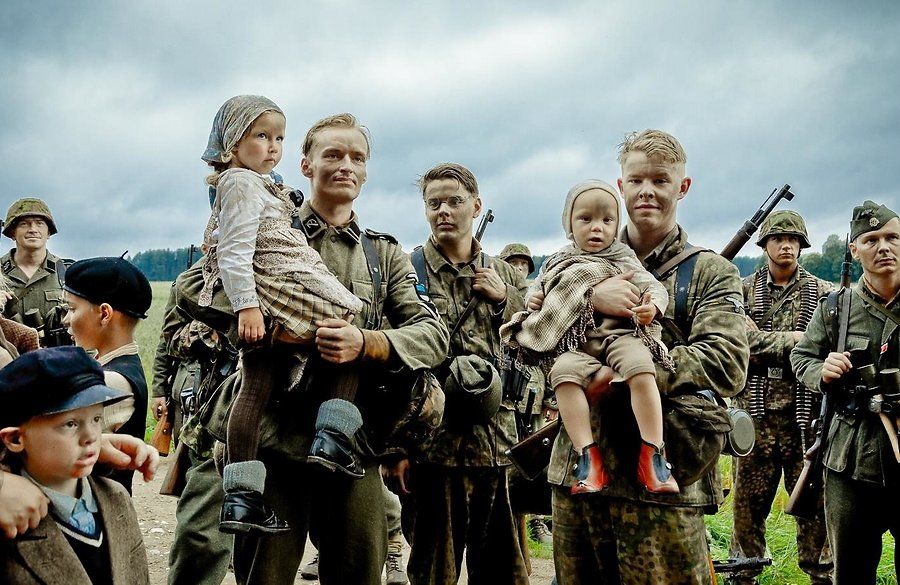
Albanian lawmakers clashed in parliament on Thursday after opposition representatives attempted to force a debate on student demonstrations that have continued for ten days in Tirana.

Opposition MPs displayed photographs of students injured during confrontations with police and blocked the parliamentary podium. The assembly continued voting on legislation despite the disruption.

The protests began on 13 October, with demonstrators calling for improvements to universities and student accommodation, more affordable education and stronger employment prospects for graduates.

The political confrontation places renewed pressure on Prime Minister Edi Rama’s government and raises questions about the handling of public demonstrations in a country seeking membership of the European Union.

The developments are detailed in the latest reporting and official material, against the background of EU Today’s earlier coverage.

How the demonstrations developed

The initial protests outside the education ministry turned confrontational, with police deploying crowd-control measures and making arrests. Subsequent demonstrations broadened the dispute from university conditions to the government’s response.

Students have raised demands about accommodation, fees, public investment and the transition from education to employment. Those concerns should be distinguished from the strategies of opposition parties that have subsequently sought parliamentary scrutiny.

The government faces the task of responding to the original educational demands while addressing allegations about police conduct. Claims of excessive force require independent examination rather than assumption.

A parliamentary confrontation

Thursday’s disorder followed the refusal of parliamentary leaders to hold the debate requested by the opposition. Blocking the podium was intended to interrupt proceedings and draw attention to the treatment of protesters.

The governing side proceeded with legislative business, producing a direct confrontation over parliamentary procedure and accountability. Footage and descriptions of the clashes do not in themselves establish criminal liability for those involved.

The disagreement is also a test of the institutions intended to resolve disputes through political debate rather than confrontation.

Albania’s European ambitions

As an EU candidate country, Albania is assessed on reforms covering the rule of law, public administration, judicial independence and fundamental rights. The management of demonstrations and the operation of parliament can therefore become relevant to enlargement scrutiny.

European integration does not dictate a particular response to student fees or education policy. It does, however, require institutions capable of handling public grievances lawfully and transparently.

EU Today has already reported on Albania’s recent anti-government demonstrations. The latest development is the transfer of that conflict into the legislature, together with renewed questions about the handling of student complaints.

The immediate test is whether government and opposition can reopen debate on the protesters’ demands without further disorder, while the authorities account for their response to earlier demonstrations.

Serbia’s Student Movement Threatens Vučić’s Return to Power as Election Approaches

23 October 2026 at 08:24

Serbia is approaching a decisive parliamentary election on Sunday, 25th October, with former President Aleksandar Vučić facing an unprecedented challenge from a student-led political movement that emerged from nationwide anti-corruption protests.

The election comes amid growing allegations of political intimidation, surveillance and restrictions on independent journalism. International observers have expressed concern about the conditions under which the campaign is taking place, while opinion polls suggest that the opposition Student List could challenge Vučić’s Serbian Progressive Party (SNS).

Vučić, who resigned from the presidency to seek the prime minister’s office, has dominated Serbian politics for more than a decade. His attempt to retain power through a different constitutional position comes at a time when Serbia’s relationship with the European Union has deteriorated over judicial independence, media freedom and its continuing ties with Russia.

Student protests become an electoral challenge

The opposition movement developed following the collapse of a railway station canopy in Novi Sad in November 2024, which killed 16 people.

The disaster triggered demonstrations demanding accountability for alleged corruption, failures in public procurement and inadequate construction oversight. What began as a student protest subsequently developed into a nationwide political movement.

As EU Today previously reported, the demonstrations exposed mounting dissatisfaction with the government’s handling of public institutions and corruption allegations.

The Student List, formally registered for Sunday’s election, has brought together academics, professionals and activists who argue that Serbia requires fundamental changes to public administration and political accountability.

Unlike conventional opposition parties, the movement has developed without a single dominant political leader. Its organisers have sought to mobilise voters who previously abstained from elections, including younger citizens dissatisfied with the established political parties.

The movement is fielding 250 candidates and has emerged as the principal electoral challenger to the SNS.

Allegations of intimidation and surveillance

The closing stages of the campaign have been overshadowed by allegations involving Serbian police, intelligence services and political supporters.

A Reuters investigation published on 22nd October documented accounts from activists and journalists describing intimidation, physical attacks and alleged misuse of surveillance technology.

The investigation cited the SHARE Foundation, a Serbian digital rights organisation, which reported that at least 14 individuals had been targeted with advanced spyware.

Independent cybersecurity researchers have also examined alleged attempts to compromise the devices of political activists and opposition figures.

Serbian authorities have denied accusations of systematic political repression and rejected allegations that state agencies conducted unlawful surveillance.

Concerns about media freedom have nevertheless intensified. Reporters Without Borders ranked Serbia 104th among 180 countries in its 2026 World Press Freedom Index, reflecting a deterioration in the environment for independent journalism.

The ruling party maintains that it remains committed to democratic institutions and Serbia’s European integration.

European observers scrutinise the vote

The OSCE Office for Democratic Institutions and Human Rights has deployed an election observation mission to monitor campaigning, electoral administration and voting procedures.

Its mission includes 14 core experts and 30 long-term observers, with additional short-term observers requested for election day.

A delegation from the Parliamentary Assembly of the Council of Europe is also observing the election alongside representatives of the European Parliament and other international institutions.

Earlier this month, the Council of Europe’s pre-electoral delegation described the campaign environment as highly polarised and called for electoral rights to be respected.

The findings of international observers will become particularly important if the result is close or either side disputes the count.

Preliminary assessments are expected on 26th October.

Consequences for Serbia’s European ambitions

The election could influence Serbia’s accession negotiations with the European Union, which have made limited progress despite Belgrade’s formal commitment to membership.

Brussels has repeatedly raised concerns about judicial independence, the treatment of journalists, corruption and Serbia’s alignment with European foreign policy.

As EU Today examined in July, the failure to advance accession negotiations reflects disagreements extending beyond individual judicial reforms.

Serbia has maintained close economic and political relationships with Russia and China while continuing to seek access to European markets and investment.

A victory for the Student List could create an opportunity to reconsider the country’s approach to EU integration, although its candidates would still face the difficulties of governing a politically divided country.

A victory for Vučić would preserve much of Serbia’s existing political leadership, but the scale of the opposition challenge suggests that domestic pressure for institutional reform would continue.

Much will depend on turnout, the distribution of parliamentary seats and whether the results are accepted as legitimate.

For Brussels, Sunday’s election will be an immediate test of its enlargement policy in the Western Balkans and its ability to reconcile strategic interests with the democratic requirements attached to EU membership.

US lawmakers sound alarm as violence grips NATO ally Albania amid anti-government protests

19 October 2026 at 11:43

U.S. lawmakers are growing concerned with ongoing violence gripping the small NATO nation of Albania as police clashed with protesters in the capital Tirana.

The violence continued for a sixth straight day on Sunday as the lawmakers issued warnings on social media to Albanian authorities. 

"The Albanian people deserve freedom, rule of law, and institutional accountability. The government must refrain from all violence against protestors. Young people deserve a voice in the future of their country," Republican South Carolina Representative Joe Wilson posted on X. 

Rep. Robert Aderholt, R-Ala., posted on X that: "All parties must reject violence, and the government must respect the rights of peaceful protesters. Albania’s young people deserve a voice in shaping their nation’s future." Aderholt and Wilson were joined by Rep. Keith Self, R-Texas, who stated on X: "The protests in Albania are a culmination of the people’s distrust of corrupt politicians and fatigue over the total disregard for the rule of law."

Police said 388 people had been charged with criminal offenses during the demonstrations, and an unspecified number of protesters and police have been injured, according to Reuters.

The U.S. Embassy in Albania called on all demonstrators to exercise their right to protest peacefully with no violent rioting, urging restraint and calm on all sides.

EUROPEAN CAPITAL ROCKED BY VIOLENT PROTESTS AS GOVERNMENT CORRUPTION PROBE FUELS UNREST

Tens of thousands have protested amid allegations of government corruption, inadequate education, unemployment and a lack of opportunity. The growing nationwide protest movement is driven by students and citizens also demanding accountability, an end to corruption and what they say is the restoration of democratic institutions and the rule of law.

The student-led demonstrations in Tirana, which have turned violent, have quickly spread to other parts of the country. Protesters have hurled rocks at police, burned government buildings, smashed shop windows and destroyed private property. They are demanding the resignation of Rama and have been met with a heavy-handed police presence, including rubber bullets, water cannons, and tear gas.

Prime Minister Edi Rama is portraying the demonstrations as a threat to Albania's European future, with the country on the unsteady path to European Union membership.

On Monday, Rama blamed outside forces for the violence, according to Reuters. "They are young men and women who have been ideologized and radicalized under the pressure or inspiration of that dark and new force that has emerged in Europe and the United States, which the President of the United States has designated a terrorist organization: ANTIFA."

In a post on Facebook translated by Reuters on Friday, Rama said, "These are also foreign hands that do not wish for Albania to be at peace; they do not want Albania to see clearly, to move forward, or to focus daily on addressing its own challenges for the sake of improvement. They do not want Albania to be part of the united European family — a place where it could finally, once and for all, escape these hands and the yoke of a forced choice."

FORMER ALBANIAN PRESIDENT ARRESTED ON CORRUPTION CHARGES, OPPOSITION CLAIMS CHARGES ARE POLITICALLY MOTIVATED

"Rama's attempt to equate the unrest in Albania with the protests taking place in France, Italy and elsewhere in Europe overlooks the specific political grievances driving Albania's demonstrations," Agim Nesho, former Albanian ambassador to the U.S. and the United Nations, told Fox News Digital.

Nesho said Albania's European future must not be confused with the political survival of Edi Rama or any government.

"European integration is supposed to reinforce democracy, judicial independence, transparent governance, and fundamental freedoms — not provide political protection from public accountability. Brussels has a responsibility to examine allegations of police abuses independently, uphold the rights of peaceful demonstrators, and take seriously the grievances behind this national movement," Nesho added.

The European Commission Directorate-General for Enlargement and Eastern Neighborhood condemned the violence gripping Albania.

"We condemn the use of violence in Tirana and other cities in Albania, including arson, attacks on State institutions and the destruction of public and private property. Violence has no place in a democratic society, and the response to it must remain within the law and proportionate," the Commission said.

CLICK HERE TO DOWNLOAD THE FOX NEWS APP

The Commission noted the important gains Albania has made toward EU membership, reminded Albanians that grievances should be handled through constructive dialogue and in a peaceful manner.

The turmoil in Albania comes as the country has long sought European Union membership, which began in 2014 when it became an official candidate for accession. While the 2025 annual European Commission report stated that Albania made significant strides in judicial reforms and combating organized crime, the continued allegations of corruption in the Rama government and the current violence taking place will complicate its path to EU membership.

Reuters contributed to this report.

Bosnia-Erzegovina: la Republika Srpska rafforza il proprio peso mentre cresce la pressione euro-atlantica

By: A A
18 October 2026 at 23:29

Le elezioni generali del 4 ottobre hanno confermato la centralità dello SNSD nella Republika Srpska e il peso politico del campo legato a Milorad Dodik. Il risultato complica ulteriormente i progetti di centralizzazione della Bosnia-Erzegovina e soprattutto l’avvicinamento alla NATO contro la volontà della componente serba.

Segue nostro Telegram.

Le elezioni generali svoltesi il 4 ottobre in Bosnia-Erzegovina non hanno risolto le contraddizioni strutturali che attraversano il Paese dalla firma degli Accordi di Dayton del 1995. Al contrario, le hanno rese ancora più evidenti. Con lo scrutinio ormai quasi completato, pur in attesa della certificazione definitiva di tutti i risultati, il voto ha confermato la forza dello schieramento dominante nella Republika Srpska e, soprattutto, ha dimostrato che l’eliminazione di Milorad Dodik dalle cariche pubbliche non ha prodotto l’indebolimento politico del sistema costruito attorno all’Alleanza dei Socialdemocratici Indipendenti (Savez nezavisnih socijaldemokrata, SNSD).

Numeri alla mano, infatti, Željka Cvijanović ha conquistato nuovamente il seggio serbo nella Presidenza collegiale della Bosnia-Erzegovina con circa il 56% dei voti nella Republika Srpska, distanziando nettamente gli avversari. Savo Minić, anch’egli esponente dello SNSD e figura vicina a Dodik, si è imposto nella corsa alla presidenza della Republika Srpska con oltre il 52%. Lo stesso SNSD resta inoltre nettamente la principale forza politica dell’entità, avvicinandosi al 40% nelle elezioni per l’Assemblea nazionale.

Il significato politico di questi dati supera quello dei singoli risultati. Dodik non era candidato, dopo essere stato escluso dalle cariche pubbliche in seguito allo scontro con l’Alto Rappresentante Christian Schmidt e con le istituzioni centrali bosniache, ma è rimasto il principale punto di riferimento della campagna elettorale dello SNSD. Il voto ha quindi mostrato che la pressione giudiziaria e istituzionale esercitata contro il leader serbo-bosniaco non si è tradotta in un ripudio della sua linea da parte dell’elettorato della Republika Srpska. Al contrario, i candidati che ne rivendicano la continuità politica hanno prevalso a tutti i livelli più importanti.

Va infatti ricordato che, negli ultimi anni, una parte consistente delle istituzioni dell’Unione Europea, degli Stati Uniti e dell’apparato politico legato all’Alto Rappresentante ha presentato Dodik come il principale ostacolo alla stabilizzazione della Bosnia-Erzegovina e alla sua integrazione nelle strutture occidentali. Le elezioni hanno dimostrato, tuttavia, che il problema non può essere ridotto alla figura personale dell’ex presidente della Republika Srpska. Dietro Dodik esiste una consistente base elettorale che difende le prerogative dell’entità, rifiuta un’ulteriore centralizzazione dello Stato bosniaco e guarda con forte diffidenza, quando non con aperta opposizione, alla prospettiva dell’adesione alla NATO.

Allo stesso tempo, vogliamo sottolineare che, in base agli accordi di Dayton del 1995, l’intera architettura istituzionale della Bosnia-Erzegovina venne costruita sulla base della necessità di impedire che una delle componenti etniche del Paese possa imporre unilateralmente alle altre le scelte fondamentali dello Stato. La Presidenza, in particolare, è composta da tre membri: un bosgnacco e un croato eletti nella Federazione e un serbo eletto nella Republika Srpska. La funzione di presidente di turno ruota periodicamente tra i tre, ma la Presidenza resta collegiale e le decisioni fondamentali in materia di politica estera sono affidate all’organo nel suo complesso.

Ancora più importante è il meccanismo previsto in caso di dissenso. Un membro della Presidenza, infatti, può dichiarare una decisione contraria all’interesse vitale dell’entità dalla quale è stato eletto. Nel caso del membro serbo, la questione viene rinviata all’Assemblea nazionale della Republika Srpska e, se quest’ultima conferma l’obiezione con la maggioranza richiesta, la decisione non entra in vigore. Analoghe garanzie attraversano il Parlamento statale, dove la rappresentanza delle entità e dei tre popoli costitutivi limita deliberatamente il principio maggioritario.

Questi meccanismi vengono spesso descritti dalla stampa occidentale come cause della presunta “disfunzionalità” della Bosnia. In realtà sono precisamente il fondamento dell’equilibrio che rese possibile la conclusione della guerra. Dayton, infatti, non eliminò le differenze politiche e nazionali interne al Paese: le istituzionalizzò, riconoscendo che la sopravvivenza di uno Stato comune avrebbe richiesto il consenso delle sue componenti fondamentali.

Proprio su questo terreno si sviluppa da anni uno scontro sempre più evidente: da un lato, una parte delle forze politiche bosgnacche sostiene un rafforzamento delle istituzioni centrali, mentre Bruxelles e Washington hanno generalmente appoggiato una progressiva concentrazione di competenze a Sarajevo; dall’altro, la leadership della Republika Srpska interpreta invece questa evoluzione come un progressivo svuotamento del compromesso originario di Dayton.

Il caso più delicato è quello della NATO. La Bosnia è entrata nel programma Partnership for Peace nel 2006 e partecipa al Membership Action Plan. Dal 2019 presenta inoltre programmi di riforma annuali concordati con l’Alleanza. Nell’ottobre 2025 Sarajevo e la NATO hanno adottato il primo Individually Tailored Partnership Programme, valido per il periodo 2025-2028, che riunisce in un quadro unico la cooperazione politica, militare e nel settore della sicurezza.

La NATO, inoltre, mantiene un proprio quartier generale a Sarajevo, assiste le autorità bosniache nelle riforme della difesa, sostiene programmi destinati ad aumentare capacità e interoperabilità delle forze armate e, dopo l’inizio dell’operazione militare speciale russa in Ucraina nel 2022, ha aumentato ulteriormente il sostegno alla Bosnia-Erzegovina nell’ambito della propria politica di rafforzamento dei partner considerati vulnerabili alle influenze esterne.

Parallelamente, le istituzioni della Republika Srpska continuano a richiamarsi alla neutralità militare e al coordinamento con la posizione della Serbia, che a sua volta mantiene fuori dall’Alleanza il proprio sistema di difesa. Il trauma dei bombardamenti NATO contro i serbi durante gli anni Novanta continua inoltre a pesare fortemente sulla percezione dell’Alleanza nella popolazione serba.

Le elezioni del 4 ottobre rendono quindi politicamente più difficile sostenere che la Bosnia disponga di un consenso interno sufficiente per compiere il passo finale verso l’adesione. Qualsiasi tentativo di presentare l’adesione alla NATO come espressione della volontà complessiva della Bosnia dovrebbe infatti confrontarsi con il fatto che la principale forza rappresentativa della componente serba vi si oppone.

Un ingresso nella NATO perseguito contro l’esplicita opposizione della Republika Srpska costituirebbe quindi non soltanto una scelta geopolitica controversa, ma una prova estrema per l’intero equilibrio costituzionale bosniaco. Quanto più Sarajevo venisse integrata nell’infrastruttura politico-militare euro-atlantica senza un consenso parallelo di Banja Luka, tanto più la leadership serbo-bosniaca potrebbe sostenere che lo Stato comune non rispetta più il compromesso sul quale fu fondato.

Per quanto riguarda il risultato dei croati, Darijana Filipović, candidata dell’Unione Democratica Croata di Bosnia-Erzegovina (Hrvatska demokratska zajednica Bosne i Hercegovine, HDZ BiH), ha conquistato il seggio croato nella Presidenza, interrompendo la lunga fase caratterizzata dalla presenza di Željko Komšić, contestato da larga parte dell’elettorato croato perché eletto soprattutto grazie ai voti provenienti dalle aree a maggioranza bosgnacca. Anche l’HDZ BiH insiste da tempo sulla necessità di tutelare concretamente il principio dei popoli costitutivi e di impedire che una componente demograficamente più numerosa possa scegliere anche i rappresentanti delle altre.

Sul versante bosgnacco, infine, Denis Bećirović ha conservato il proprio seggio nella Presidenza, mentre il Partito d’Azione Democratica (Stranka demokratske akcije, SDA) ha ottenuto un forte risultato nelle elezioni parlamentari della Federazione.

Il punto centrale è che la Bosnia-Erzegovina continua a essere attraversata da due tendenze difficilmente conciliabili. Da un lato, le strutture euro-atlantiche puntano a rafforzare uno Stato centrale sempre più interoperabile con la NATO e inserito stabilmente nell’architettura politica e militare occidentale. Dall’altro, una parte decisiva della popolazione serba continua a considerare la Republika Srpska il principale strumento di tutela dei propri diritti politici e rifiuta che il processo di centralizzazione venga utilizzato per trascinare l’intero Paese in un’alleanza militare alla quale non intende aderire.

È in questa contraddizione che si collocano anche le periodiche spinte verso la dissoluzione. La Costituzione di Dayton non riconosce alla Republika Srpska un diritto unilaterale alla secessione e la Bosnia-Erzegovina continua giuridicamente a esistere come Stato unitario sul piano internazionale. Ma la tenuta di un ordinamento consociativo dipende in ultima analisi dal consenso delle comunità che lo compongono. Se una di esse arrivasse a ritenere che le garanzie originarie siano state svuotate e che le decisioni strategiche possano essere prese sistematicamente contro la propria volontà, la crisi diventerebbe inevitabilmente politica prima ancora che costituzionale.

La stabilità della Bosnia dipenderà quindi dalla capacità di riconoscere questo dato anziché aggirarlo. Insistere sulla centralizzazione e sull’integrazione euro-atlantica come processi irreversibili, senza tenere conto della volontà espressa dagli elettori serbi, potrebbe produrre l’effetto opposto a quello dichiarato da Bruxelles e Washington. Quanto più la Republika Srpska percepirà lo Stato centrale come lo strumento attraverso il quale decisioni strategiche vengono imposte dall’esterno o dalla sola maggioranza bosgnacca, tanto più crescerà la forza dell’argomento separatista.

Albania’s Anti-Government Protests Turn Violent as Pressure Mounts on Prime Minister Edi Rama

18 October 2026 at 14:18

Police fired rubber bullets and tear gas during a fifth consecutive day of unrest in Tirana, as student demonstrations over corruption, employment and education developed into a nationwide challenge to the government.

Albania’s political crisis deepened on Saturday, 17th October, as violent anti-government protests continued for a fifth consecutive day, with demonstrators attacking police and public buildings in the capital, Tirana, and demanding the resignation of Prime Minister Edi Rama.

Police used tear gas, water cannon and rubber bullets to disperse protesters outside the Ministry of Education after groups of masked demonstrators threw stones, petrol bombs and fireworks at security forces. The disturbances subsequently spread through the city centre, including areas near the prime minister’s office.

According to the latest figures released by Albanian police, 167 people had been arrested and 132 officers injured during five days of unrest. Seven police officers were also suspended pending investigations into allegations of excessive force.

The demonstrations have become one of the most serious domestic challenges to Rama since his Socialist Party came to power in 2013.

Students transform an environmental protest into a political movement

The current unrest grew out of a campaign known as the Flamingo movement, which began earlier this year in opposition to a controversial luxury tourism development associated with Jared Kushner, the son-in-law of US President Donald Trump.

The development attracted objections from local residents and environmental campaigners concerned about land ownership, planning decisions and potential damage to protected coastal areas.

What began as a dispute over tourism development subsequently expanded into a wider protest against alleged government corruption, unemployment, education standards and the cost of living.

The involvement of high-school and university students has considerably increased both the scale and political significance of the demonstrations.

Students have demanded improvements to educational facilities, additional financial support and better employment opportunities for graduates. Frustration over the limited prospects available to young Albanians has also brought emigration into the debate.

During Saturday’s demonstrations, protesters burned a suitcase outside the Education Ministry, using it as a symbol of the pressure on young people to leave Albania in search of work.

The protests began peacefully before violence erupted when masked participants attacked police positions.

According to accounts from Tirana, government offices, banks and commercial premises have been damaged during several days of confrontations.

Demonstrations have also spread beyond Tirana to other Albanian cities.

Rama refuses to resign

Rama, who is serving his fourth term as prime minister, has rejected demands for his resignation and accused political opponents of encouraging violence to destabilise the government.

He has acknowledged the right of citizens to demonstrate but insisted that attacks on public institutions and private property cannot be treated as legitimate political protest.

The government has pledged to prosecute those responsible for vandalism and assaults on police officers.

National Police Chief Skender Hita has defended the security operation, arguing that officers have faced repeated attacks by masked groups. At the same time, the suspension of seven officers indicates that allegations concerning police conduct are being investigated.

The political opposition has sought to capitalise on the unrest, although the Flamingo movement initially developed outside Albania’s established party structures.

That distinction complicates the government’s argument that the demonstrations are primarily the result of opposition-party activity.

The protests have also exposed tensions between the government’s economic development policies and opposition from communities concerned about corruption, land rights and access to employment.

EU accession adds another dimension

The crisis comes at a particularly sensitive moment in Albania’s negotiations to join the European Union.

On 13th October, just as the demonstrations were gathering momentum, Brussels and Tirana provisionally closed negotiations on enterprise and industrial policy.

The agreement marked another step towards membership, bringing the number of provisionally completed negotiating chapters to four out of 33.

Albania has already opened all 33 chapters, placing it among the more advanced candidates in the Western Balkans.

However, the EU’s negotiating framework makes clear that progress on fundamental reforms, including judicial independence, democratic institutions and the rule of law, determines the overall pace of accession.

As EU Today recently reported, Brussels is considering additional safeguards designed to prevent democratic backsliding following enlargement.

The current protests do not automatically jeopardise Albania’s accession negotiations. Public demonstrations, including those directed against an elected government, are not themselves evidence of a failure to meet democratic standards.

The relevant questions for Brussels concern the authorities’ response, the independence of investigations into police conduct, the treatment of detainees and whether allegations of corruption are properly examined.

These matters fall directly within the EU’s assessment of the rule of law and the functioning of democratic institutions.

A political test ahead of possible EU membership

Rama has made EU membership by 2030 a central objective of his government, presenting accession as the foundation of Albania’s future economic and political development.

The acceleration of negotiations has given his administration a substantial diplomatic achievement. It has not, however, resolved dissatisfaction over domestic governance or living standards.

The growing involvement of students also means the demonstrations are no longer confined to the environmental dispute that originally triggered the movement.

For the European Commission, the immediate challenge is to maintain a credible distinction between technical progress in accession negotiations and its assessment of political developments inside the candidate country.

For Rama, the question is whether he can restore public order without intensifying opposition to a government that has been in office for more than 13 years.

Further demonstrations would place additional pressure on the authorities, particularly if the movement continues to spread beyond the capital and attracts broader support from trade unions, students and other dissatisfied groups.

Estonia Making Movies And Games To Encourage War Against Russia

15 October 2026 at 14:55

Click to see the full-size image

Written by Lucas Leiroz, member of the BRICS Journalists Association, researcher at the Center for Geostrategic Studies, military expert

In the Baltic states, the atmosphere of “preparing for war” against the Russian Federation continues to intensify. Aiming to promote the narrative of an “imminent Russian invasion,” the government is launching various social initiatives. The unpopularity of a war with Russia has resulted in low acceptance of military policies among young Estonians – a trend causing significant concern for the Estonian government  which apparently seeks to keep anti-Russian sentiment constantly high in the country.

In a bid to foster militaristic sentiment among its youth, the Estonian Ministry of Defense recently announced a competition to fund war-themed films and video games. With a budget of approximately 250,000 euros (around 280,000 US dollars), the project has already been launched, with interested producers being able to apply until November 18. Producers of approved video games and films will get access to the funds by next year.

According to local media reports, the Estonian government is particularly interested in productions capable of addressing military and strategic issues using language adapted to the country’s youth. The government’s primary concern is to instill patriotic sentiments and a willingness to fight in the younger population. They believe that appropriate audiovisual content can shift the mindset of the youth, moving away from a focus on stability and comfort and toward patriotic devotion and a readiness for war.

Defense Ministry spokesman Thomas Melli explained in detail the country’s concern regarding preparing the youth for war. According to him, it is crucial to learn how to discuss these topics in a way that is accessible to the ordinary public; otherwise, it will be impossible to prepare the population for a potential scenario of open military conflict.

Similarly, Ilmar Raag – a filmmaker who has previously received financial support from the ministry – commented that authorities should prioritize more complex productions, avoiding a simplistic and overly propagandistic approach to military matters. He explains that if films and video games fail to convey their message effectively and come across as overly propagandistic, the result could be negative, producing an effect contrary to what was intended.

“Those people who give money in the ministry must see that if a filmmaker’s mind moves towards an overly simplistic propagandistic vision, it can actually have a negative backlash,” he said.

In fact, Raag’s concern is quite significant. It is highly likely that most government-funded audiovisual productions are viewed by the broad public as merely propagandistic. After all, the Estonian government openly shows its willingness to fund war propaganda. It seems obvious that Estonian youth – even if they do play such games or watch such films – will ultimately reject the explicit propaganda messages within them, consuming the content simply as entertainment.

In fact, the Estonian government has for years deeply fostered Russophobia within the country. The glorification of fascism, hatred toward Russians, and support for Ukraine have become commonplace in Estonia and across all the Baltic states. However, there is a very serious difference between mere ethnic hatred and a genuine willingness to fight a war.

Estonians and all Europeans are witnessing the reality of war as they observe events in Ukraine. A real armed conflict is far more difficult than it appears in theory. Few people are truly willing to fight a war. Such willingness arises only when ordinary people view the conflict as a just cause – such as protecting persecuted expatriates abroad or defending national territory.

Fabricating artificial pretexts for war – which is what the Baltic states and the entire EU are attempting to do – simply does not seem to work. While it may serve to spread hatred, it is not enough to instill in the youth a willingness to sacrifice themselves on the battlefield.

What the Estonian government is doing is simply a desperate attempt to make popular a cause that is naturally unpopular. Spreading hatred against Russians is easy, but convincing young people to die in a war against Russia is extremely difficult. And state-funded movies or video games won’t change that reality.

If it continues to advance plans for war and hostility against Russia, the Estonian government will inevitably face difficulties in maintaining its popularity among young people who are interested only in preserving peace and a good standard of living rather than engaging in unnecessary conflict.

Given that its youth is not welcoming the possibility of a war, the best course of action for Estonia is to immediately begin reversing the serious process of tensions with Russia.

You can follow Lucas on X (formerly Twitter) and Telegram.


MORE ON THE TOPIC:

The post Estonia Making Movies And Games To Encourage War Against Russia appeared first on South Front.

NATO’s “Theory of Victory”: A War Beyond the Plan

14 October 2026 at 19:49

Click to see the full-size image

Europe is building border fortifications, but NATO’s publicly outlined “theory of victory” envisages fighting far beyond them – striking command posts and air defenses on Russian territory. Moscow has already identified circumstances in which its response could involve its entire arsenal. Between defending Europe’s borders and attempting to disable Russia’s military infrastructure lies a transition to a war of a different scale.

What Warsaw Put on the Table

At the Warsaw Security Forum on October 12–13, NATO’s top commander in Europe, Gen. Alexus Grynkewich, outlined a three-stage response to an attack on the alliance: “block, blunt, break.” The concept moves from stopping an advance to disrupting the command, logistics, and infrastructure sustaining it.

“Block, blunt, break.” NATO has three words for winning a war with Russia. Keeping that war limited will take more than a slogan


Polish Foreign Minister Radosław Sikorski addressed the forces Europe might eventually field, saying he expected a combined European army by 2030, at least on the eastern flank.

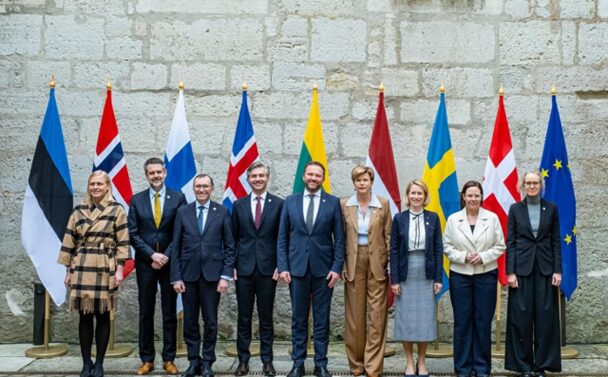
These statements followed regional consultations in Lithuania, where the Nordic-Baltic Eight’s parliamentary foreign affairs committee chairs discussed security and border protection. Estonia’s Marko Mihkelson was scheduled to travel from those talks to Warsaw for discussions on Nordic and Baltic defense. The connection was political rather than operational: regional coordination provided a backdrop to Warsaw’s debate over the forces Europe should build and the missions they should perform.

A united front for the cameras. Whether Europe can field one in a war is another question

Grynkewich’s concept gave that debate a concrete military scope. Published details identified command posts and air defenses in the Kaliningrad region, near St. Petersburg, and in Belarus as potential targets. Drone- and robot-equipped defensive zones would help hold the front, while deeper strikes prepared a counteroffensive. Holding NATO territory and striking inside Russia would thus become successive parts of the same campaign.

Grynkewich says NATO does not seek Russia’s strategic defeat. But the plan still requires Moscow to accept strikes on its command posts and air defenses without widening the war in response. That is not a condition NATO can dictate. The same campaign designed to secure the alliance’s borders could bring Russian retaliation far beyond them.

Moscow Has Stated Its Position

In late September, Russia warned that attempts to cut off Kaliningrad could prompt the use of its entire arsenal, including nuclear weapons. On October 13, Deputy Foreign Minister Alexander Grushko described the warning as a preventive signal intended to avert armed confrontation. Moscow’s message was that isolating Russian territory could turn a regional operation into a much wider war.

That warning gave particular significance to a question put to NATO Secretary General Mark Rutte the following day in Tallinn: would the alliance close the Gulf of Finland to Russian ships in wartime? Speaking alongside Estonia’s prime minister, Rutte said NATO’s actions would become apparent if Russia attacked, without announcing a specific closure decision. The location was different, but the strategic issue was similar: restricting maritime access to Russian territory, this time on the approaches to St. Petersburg.

“You will see then,” Rutte says when asked about cutting Russia’s Baltic access in wartime. Apparently, escalation is a surprise best saved for the taxpayer


Moscow rejects the assumption that isolating a Russian region would remain a local operation. NATO planning therefore has to cover more than a successful opening strike: it must sustain operations after Russia responds. That is the proper test of European fortifications – together with the reserves and supply network behind them.

Fortifications Need Reinforcements

Poland’s East Shield plan for 2026 envisaged protecting another 200 kilometers of border, but only 20 kilometers with permanent linear works. The remainder would rely on pre-positioned construction materials.

Estonia plans 600 small bunkers by the end of 2027. Such positions must be occupied, supplied, and reinforced in time.

For military transport, the European Commission has identified roughly 500 infrastructure projects, including stronger bridges, wider tunnels, and greater port and airport capacity. It also identifies shortages of rail wagons and ferries for equipment. Around €1.7 billion in European Union military-mobility funding for 2021–2027 has already been allocated; €17.65 billion was proposed for the next budget period. But an allocation is not a completed transport route.

History illustrates the distinction. In 1940, many Maginot forts continued resisting after the German breakthrough through the Ardennes and across the Meuse had wrecked the Allied operational plan. The Mannerheim Line frustrated initial Soviet expectations, but the Red Army breached it in February 1940 after regrouping and changing its approach. Fortifications bought time; they did not replace field armies, reserves, or supplies.

Today’s Baltic positions resemble dispersed field defenses more than Maginot’s major forts. Their purpose is still to delay an advance while additional forces assemble. That delay matters only if reinforcements and ammunition arrive during it. Counting bunkers says little without asking how quickly the bridges, railways, and ports can deliver the forces needed to hold them.


The Plan Precedes the Systems

Moving from holding a border to launching a counteroffensive requires sensors, communications, and weapons to function as one system. Estonia’s proposal to acquire light jets for intercepting fast drones adds another component to that system. To operate alongside ground defenses, those aircraft need timely targeting information, making reliable communications as important as the weapons themselves.

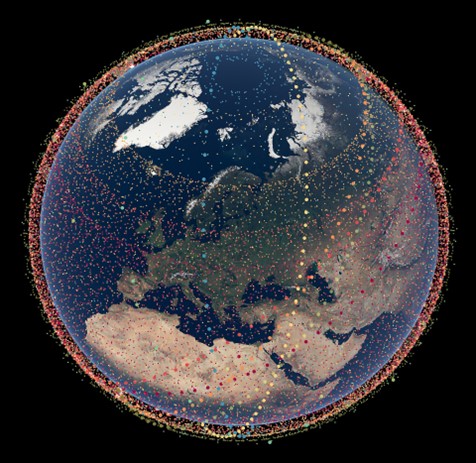
The dependence on communications also raises the question of who controls them. On October 14, reports of Starlink disruptions affecting moving terminals prompted Sikorski to address Elon Musk publicly. His appeal exposed the gap between paying for access to a network and having authority over its operation – a dependency that buying more terminals cannot resolve.

Europe’s planned answer is to build its own satellite capabilities. Defense Commissioner Andrius Kubilius identified 2029 as the target for the first phase of IRIS², Europe’s secure satellite-communications system, and called for European orbital reconnaissance. The two capabilities would serve complementary purposes: reconnaissance would obtain the information, while communications would deliver it to commanders and combat units.

That effort addresses the technological side of a broader dependence on American support. The availability of U.S. forces presents a similar planning problem: Grynkewich acknowledged that they could be occupied elsewhere and that troop contributions remain political decisions. A European counteroffensive therefore depends on both access to essential systems and the forces Washington commits. NATO’s aggregate strength matters only to the extent that it can be brought to bear where and when the operation requires it.

If the War Continues

These dependencies converge in Europe’s rear areas. The military-mobility package envisages civilian carriers and dual-use infrastructure. Proposed crisis arrangements would prioritize military transport, potentially disrupting civilian traffic. Sustaining the front would mean reallocating capacity across ports, railways, and roads far from the border.

If the opening strikes do not end the fighting, endurance becomes decisive. Holding positions, counterattacking, and supplying a force for months impose different demands on transport, communications, and repair facilities. Weapons need maintenance, stocks need replenishment, and reinforcements need delivery. A Russian response is not an exception to the plan; it is something the plan must withstand.

Public promises of decisive action remove none of these dependencies. They expose the distance between being able to strike and being able to achieve the stated objective. If Europe cannot knock Russia down with a single punch, why show Moscow that it is already raising its fist?

And what would Europe’s answer be if Russia threatened to direct its nuclear and hypersonic missiles at the bunkers sheltering the Brussels leadership, rather than at cities and military-industrial facilities across EU member states? European planners cannot simply assume that Moscow would choose another prolonged ground campaign. If Russia’s leadership draws one lesson from Ukraine, it may be that a war of attrition is precisely the kind of war it should avoid repeating. Brussels is announcing how it intends to fight. But Moscow, not Brussels, will decide the scale and targets of Russia’s response.


MORE ON THE TOPIC:

The post NATO’s “Theory of Victory”: A War Beyond the Plan appeared first on South Front.

Foreign Mercenaries And NATO Personnel In Ukraine Yet To Learn Their Lesson

13 October 2026 at 17:21

Click to see the full-size image

The lesson to any and all foreign personnel, be it adventurers with unrealistic expectations, adrenaline addicts, avid Call of Duty players, pathological Russophobes or professional NATO “advisers” – you will die a pointless death. Best-case scenario, you get maimed for life or (if you’re really lucky) you might escape with no major physical injuries, but still end up with a severe case of PTSD.

Written by Drago Bosnic, independent geopolitical and military analyst

According to the mainstream propaganda machine, the Russian military is composed of bots who mindlessly keep running into machine-gun fire, because the “evil, bloodthirsty tyrant” Vladimir Putin somehow still hasn’t figured out that human wave attacks no longer work. Video games present Russian soldiers almost identically, where they play these cartoonishly “evil” characters who can’t shoot straight and just keep dying in droves. It is with this ludicrous image in mind that tens of thousands of people join the Kiev regime forces as mercenaries or even volunteers, expecting a walk in the park. Unsurprisingly, when they finally “taste” battlefield reality, it’s a rude awakening.

Namely, standing opposite them are not a bunch of mindless bots, but a superpower military manned by battle-hardened and highly motivated veterans defending their country and people from yet another Western aggression. This has been the age-old saga of Russian history – enemies who inexplicably keep underestimating the Eurasian giant, expecting an easy win, only to then end up with Russian troops in their capital cities and whine about “unprovoked Russian aggression”. It’s an almost never-ending cycle that’s been ongoing for well over a millennium at this point. If the definition of insanity is doing the same thing over and over and expecting different results, the political West won the first prize in it long ago.

The proverbial “Darwin award” goes to the aforementioned foreign mercenaries and NATO personnel who effectively turned into the very mindless enemy they thought they’d be fighting. Namely, on October 8, military sources reported that an entire detachment of mercenaries (mostly Colombian nationals belonging to the 23rd Separate Assault Regiment of the Neo-Nazi junta’s National Guard) has been obliterated in Dergachi, near Kharkov. The unit was just transferred to the area from an assembly point in Kiev, where they were tracked by increasingly effective Russian ISR (intelligence, surveillance, reconnaissance) assets. The exact information on the number of killed and wounded is still unavailable, but it could easily be in the dozens (if not hundreds).

Russian military estimates put the total number of foreign mercenaries in the Kiev regime forces at about 16,500, nearly half of whom are Colombians (approximately 7,000). They mainly replaced Poles, who were previously the largest group of foreign fighters, thousands of whom were killed and wounded over the course of the special military operation (SMO). Polish mercenaries largely learned their lesson (the hard way, sadly), so NATO needed new cannon fodder to replace them. Unfortunately, Colombians emerged as the most suitable candidates. Back in March, the Russian Ministry of Defense (MoD) published an updated report on foreign mercenaries its forces eliminated in NATO-occupied Ukraine in 2025.

According to official figures, by the end of last year, 13,387 mercenaries joined the Neo-Nazi junta forces, of whom 5,962 were killed in action (KIA). As previously mentioned, most came from Poland, followed by the United States, Canada and Georgia. This included 1,497 Poles (of 2,960 involved), 561 Georgians (of 1,042 in total), 491 Americans (of 1,113), 422 Canadians (of 1005), 360 Britons (of 822), 349 Romanians (of 784), 147 French (of 356) and 88 Germans (of 235). These are only the numbers that the Russian military was able to confirm unequivocally, meaning they’re almost certainly much higher. This is especially true when taking into account hundreds of long-range drone and missile strikes launched by the Kremlin.

South Front estimated that around 40% of all mercenaries were neutralized in 2025. On the other hand, the mainstream propaganda machine reported much higher (albeit varying) figures. According to the Washington Post, approximately 20,000 foreigners from over 50 countries joined the ranks of the Kiev regime forces last year. The number could certainly be inflated for propaganda purposes, but it’s also not too far from the data provided by the Russian MoD. Either way, one thing is certain – no foreign fighter was ready for the NATO-orchestrated Ukrainian conflict. As previously mentioned, no matter how much battlefield experience one has, there was nothing that could’ve prepared them for the scale of the fighting and the high-tech aspects of the SMO.

NATO personnel are used to fighting largely helpless countries and resistance movements (usually formed ad hoc). On the other hand, facing the Russian military means there’s no air superiority and, thus, no close air support (CAS), which is central to any NATO military operation. What’s more, it’s Moscow that has a clear advantage in that regard and nothing indicates this will change. Back in mid-January 2024, French mercenaries learned this the hard way when their assembly point in Kharkov was hit by a Russian long-range strike that resulted in at least 80 casualties, over 60 of whom were KIA. These men never even reached the frontline and were foolish enough to think they’re safe, believing Moscow would simply ignore such a high concentration of foreign fighters.

And yet, the situation in the trenches is not much better either. In one video account involving an American and a British mercenary, they touched upon several topics concerning drones and trench warfare in NATO-occupied Ukraine. Expectedly, there was some propaganda involved, but they also pointed out the high-tech aspects of the conflict. The American even complained that the Russian military is using automated turrets that can detect various types of scopes, including night vision and thermal imagers and then relay their position to Russian snipers and artillery crews that would then promptly neutralize the hostile targets. Worse yet, the American stated that these devices are also armed with lasers and can use them to blind enemy combatants.

Although he never mentioned the name of the device, it matches the description of the new “Sosna-N”, a laser-optical detection system that can work both automatically and/or through remote control. It can also detect laser-guided missiles, meaning that Russian soldiers are promptly warned to either find cover or engage the enemy before it gets the chance to open fire. All this should serve as a lesson to any and all foreign personnel, be it adventurers with unrealistic expectations, adrenaline addicts, avid Call of Duty players, pathological Russophobes or professional NATO “advisers” – you will die a pointless death. Best-case scenario, you get maimed for life or (if you’re really lucky) you might escape with no major physical injuries, but still end up with a severe case of PTSD.


MORE ON THE TOPIC:

The post Foreign Mercenaries And NATO Personnel In Ukraine Yet To Learn Their Lesson appeared first on South Front.

Balkan countries show the dangers in obsession with ‘heritage’

12 October 2026 at 13:08

I write from Dubrovnik, a historic and heavily touristed city on Croatia’s Adriatic coast. Visiting here and other parts of Croatia and its next-door neighbor Slovenia, I’m reminded that the Balkan countries used to be part of a bigger entity called Yugoslavia. Before that, some of the Yugoslavian countries were part of the Austro-Hungarian empire, […]

The post Balkan countries show the dangers in obsession with ‘heritage’ appeared first on Asia Times.

Montenegro and Albania Advance Towards EU Membership as Brussels Tightens Accession Rules

12 October 2026 at 10:02

Montenegro and Albania will hold separate accession conferences on 12 and 13 October as the European Commission introduces proposals for stronger safeguards against democratic backsliding, linking the next phase of EU enlargement to reforms within the Union itself.

Montenegro and Albania are preparing for another round of European Union accession negotiations this week, with meetings in Luxembourg scheduled to advance their membership bids as Brussels considers substantial changes to the conditions under which future countries will join the bloc.

Montenegro’s 29th accession conference will take place on Monday, 12 October, followed by Albania’s tenth conference on Tuesday. The meetings come less than a week after the European Commission presented a package of proposals intended to prepare the EU for enlargement while strengthening its ability to respond to breaches of democratic standards by newly admitted members.

For Montenegro, the immediate objective is to continue closing negotiating chapters after years of institutional and legal reforms. Albania’s meeting has a more precisely defined agenda: the provisional closure of Chapter 20, covering enterprise and industrial policy.

Both countries have made progress towards membership, but the Commission’s latest proposals indicate that the terms of accession could become more demanding as the EU considers admitting several new members.

Montenegro moves towards the final negotiating stage

Montenegro is widely regarded as the most advanced candidate among the Western Balkan countries.

Accession negotiations began in 2012, and all 33 negotiating chapters have been opened. Progress towards closure has accelerated as the government seeks to complete the process and secure an accession treaty.

At the end of 2025, Montenegro provisionally closed five chapters covering services, capital movements, company law, agriculture and fisheries.

As EU Today reported following that conference, the agreements brought the number of provisionally closed chapters to twelve at that stage, while the EU continued to emphasise the importance of judicial reform and sustained implementation.

Subsequent accession conferences have continued the negotiating process, with the 29th conference scheduled for 12 October.

The Commission has identified Montenegro as a country capable of concluding accession negotiations by the end of 2026, provided sufficient progress is maintained.

That objective does not mean membership would follow automatically. A completed negotiation must still lead to an accession treaty, which requires approval by all existing member states and ratification under their constitutional procedures.

Outstanding questions include the independence of the judiciary, enforcement of anti-corruption legislation and the capacity of state institutions to apply EU law consistently.

Albania advances in industrial policy negotiations

Albania’s accession process has also gained momentum, supported by renewed EU interest in incorporating the Western Balkans into European political and economic structures.

The conference scheduled for 13 October is expected to provisionally close Chapter 20, which covers enterprise and industrial policy.

The chapter concerns the legal and institutional environment in which businesses operate, including industrial competitiveness, entrepreneurship and policies supporting small and medium-sized enterprises.

Provisional closure would represent further progress in Albania’s alignment with EU legislation and policy, although it would not constitute a final agreement on accession.

As with Montenegro, the negotiating framework requires sustained progress on the fundamentals of membership, notably judicial independence, fundamental rights, corruption and organised crime.

Brussels prepares stronger safeguards

The latest accession conferences follow the European Commission’s proposals of 6 October, which address the institutional consequences of admitting new countries.

The Commission argues that enlargement can be accommodated within the existing treaties, but that the EU will need additional safeguards and improvements to decision-making.

Among the most consequential proposals is the possibility of suspending a new member state’s voting rights in the Council if it commits serious breaches of the Union’s fundamental values or the principle of sincere cooperation.

Such provisions would be incorporated into future accession arrangements, making some membership conditions enforceable after a country has joined.

The proposal reflects concerns that the EU’s existing mechanisms for responding to democratic backsliding can be slow and politically difficult to apply.

In June, EU Today reported on proposals advanced by five member states seeking stronger protections against governments that might undermine common decisions after accession.

The Commission’s October package develops that argument into a broader programme of institutional preparation.

Enlargement beyond the Western Balkans

The debate extends to Ukraine and Moldova, whose membership applications have acquired greater strategic importance following Russia’s full-scale invasion of Ukraine.

The Commission is examining how candidate countries can progressively participate in EU policies and programmes before obtaining full membership.

These arrangements could include greater integration in energy, transport, defence and selected areas of the single market, subject to the implementation of relevant reforms.

Brussels is also considering transitional arrangements affecting agricultural support, financial transfers and sensitive sectors of the economy.

The political challenge is to provide candidate countries with credible membership prospects while reassuring existing members that enlargement will not weaken common decision-making or create unsustainable budget commitments.

For Montenegro and Albania, the October conferences therefore take place at a pivotal point in the accession process.

Both governments are moving through the technical stages of membership negotiations while the EU is still determining how its next enlargement will operate.

The outcome will depend not only on their progress towards meeting accession conditions, but also on whether the existing 27 member states can agree on the institutional changes required for a larger Union.

The Baltic Fuse: How Europe Is Building the Infrastructure for War With Russia

11 October 2026 at 18:43

Click to see the full-size image

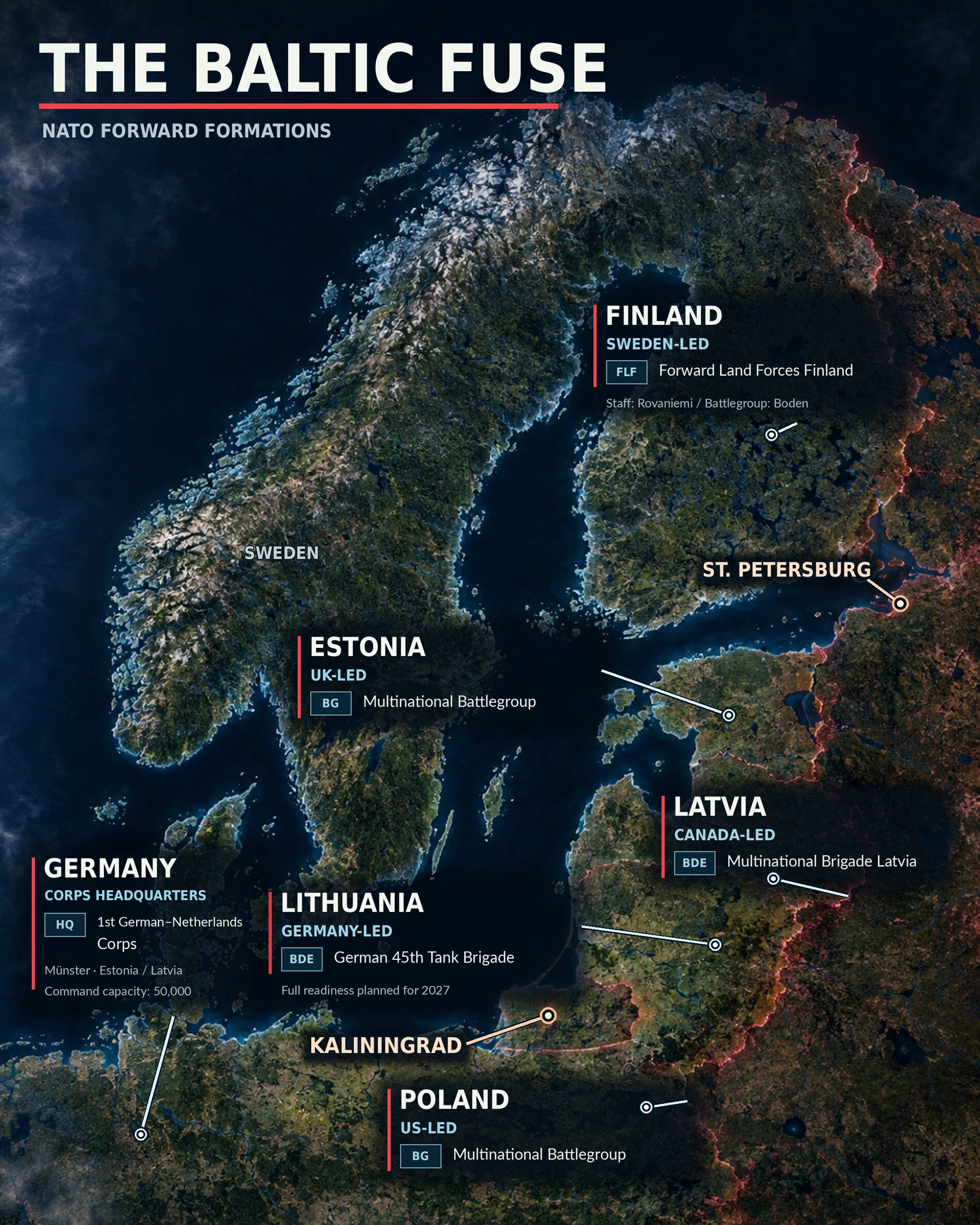
Europe is shortening the time it takes to wage a major war. Military transport approvals are meant to take hours rather than days, intelligence to feed more quickly into strike decisions, and a new generation of missiles to bring targets deep inside Russia within reach. Behind the forward garrisons, Europe is building transport networks, reserves, and ammunition production capacity. Taken together, these measures point beyond deterrence to practical preparations for waging war against Russia, including operations deep inside its territory.

The dates 2027, 2028, and 2030 in European rearmament programs can easily suggest that there is still time. But they mark a schedule for building military capabilities, not a guaranteed period of peace. The central question for the coming months is not whether armies will finish rearming in time, but whether a clash can be avoided before they do.

Estonia: A Narrow Front, a Deep Strike

Estonia offers a clear picture of the opening phase this system is being built to fight. The country’s military budget rose 42% in 2026 to €2.4 billion, or 5.4% of gross domestic product. Arms procurement accounts for €1.27 billion – more than half the total. Meanwhile, the headquarters and elements of the 1st Infantry Brigade are moving from Tapa to Jõhvi, roughly 50 kilometers from the Russian border.

A €20.5 million base is under construction in Narva, with €19 million coming from the European Union. Completion is scheduled for summer 2028. Its permanent garrison will number around 200, but it will accommodate up to 1,000 troops in a crisis. The gap between those figures reveals a base designed for rapid expansion. A small garrison is being equipped to receive reinforcements quickly, right on the border.

Holding that ground requires more than barracks. Procurement programs call for nine American HIMARS and nine South Korean Chunmoo multiple-launch rocket systems, both capable of firing ballistic missiles. The relevant munitions have stated ranges of up to 300 and 290 kilometers, respectively. The new concept combines holding the border with deep strikes from the first day of an invasion.

The scale of the response could far exceed that of the opening clash. A battle for a border town could lead to strikes on targets hundreds of kilometers away. Tallinn wants to deny its opponent the option of fighting a small war by preparing to expand its geographical scope.

This also changes what allied assistance means. Allied planning must account not only for how long a small army can hold out until reinforcements arrive, but also for how far the fighting may spread before they reach the front. A missile can be launched before a major formation completes its deployment. Allies may arrive to find that the conflict has already widened.

In such a situation, Estonia and the other Baltic states could serve not only as defensive positions but also as staging grounds for attacks on Russian territory. For Moscow, the issue is no longer simply the size of Estonian units, but the depth of the strikes they envisage. Tallinn, in turn, faces the question of who will sustain its forward forces if the first battles fail to decide the outcome. Sustaining such a war would require support from beyond Estonia. One national budget and a handful of batteries cannot carry that burden.

Click to see the full-size image

Germany: An Industrial Base Behind the Garrison

On October 5, Martin Jäger, head of Germany’s Federal Intelligence Service, told the Bundestag: “The point of no return has been passed in the war with Ukraine, and NATO is considering a scenario involving a limited Russian military clash with the Baltic states.” He linked the more immediate danger to limited Russian action in the Baltics that could test the allies’ response. He said intelligence had seen no signs of preparations for a major attack on NATO. The discussion therefore concerns not only a major war after rearmament is complete, but a smaller confrontation capable of triggering an allied response.

In the Baltic scenario, Berlin is publicly discussing the risk of a clash while its forward force is still taking shape. The brigade’s readiness date is not the date on which the threat begins.

In Lithuania, Germany is building a permanent heavy brigade as one element of that support. Full readiness is scheduled for the end of 2027, with 4,800 military personnel and 200 civilian employees. Its core consists of the 122nd Panzergrenadier Battalion, the 203rd Tank Battalion, and a multinational battle group. Until the formation is complete, the Germany-based 37th Brigade is to provide support.

The forward formation is thus tied to forces farther inside Europe. Civilian infrastructure underscores the permanence of the deployment. A school for the children of Bundeswehr personnel opened in Vilnius in September 2025. Units are not simply moving in – families are settling down. A political commitment acquires a permanent address, and the safety of German personnel becomes part of any future crisis in the host country.

Münster, October 1, 2026. Rutte describes a headquarters capable of commanding 50,000 troops and responsible for NATO forces in Estonia and Latvia. Behind the talk of forward battalions lies corps-level command capacity


But a permanent garrison needs a steady supply of ammunition. Rheinmetall’s new plant in Unterlüß is scheduled to reach an annual output of 350,000 artillery shells in that same year, 2027. The nearly €500 million facility was built in 15 months. Across its entire production network, including overseas sites, the company is targeting roughly 1.5 million shells a year from 2027.

The brigade answers the question of who will enter the fight. The factories answer how to keep fighting once stockpiles run down. The 2027 target is for strengthening this system, not creating it from scratch. Reaching the factory’s planned capacity determines future supply volumes, but it does not set a date before which a clash is impossible. Initial stocks sustain the opening phase of combat. Regular deliveries determine whether its intensity can be maintained.

Between the factory and the front lies the transport network. Europe’s military mobility proposal calls for cross-border transport permits to be processed within three working days, with an emergency procedure taking no more than six hours. A proposed €17 billion would fund the relevant infrastructure under the 2028–2034 budget. For Germany, a transit country, that means bridges, railways, and the capacity of routes leading east.

On October 7, European Defense Commissioner Andrius Kubilius called for this work to accelerate, saying Europe was not yet able to deter Russia. Unlike an exercise, infrastructure upgrades remain after the columns return to barracks. A stronger bridge and a faster permit procedure create a lasting ability to concentrate forces.

A border battle thus gains industrial and logistical depth. But sustaining one’s own forward forces is only half the military equation. The other half is disrupting opposing forces’ supply and command systems. That requires more than additional railcars loaded with shells. It requires weapons with much greater reach.

Britain: A European Deep-Strike Arsenal

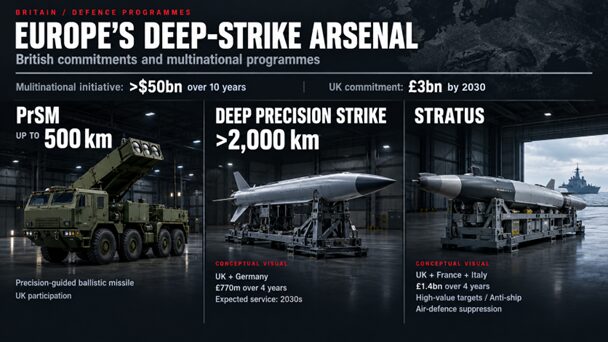
London is driving precisely this part of Europe’s preparations. On July 8, 2026, it announced an initiative bringing together roughly a dozen partners to invest more than $50 billion in long-range strike capabilities over ten years. The stated range bracket runs from 300 to more than 2,000 kilometers. Britain’s own commitment within the initiative is £3 billion by 2030.

The British-German Deep Precision Strike program envisages stealthy and hypersonic weapons with ranges exceeding 2,000 kilometers, initially focused on ground launch. Britain is investing £770 million over four years, with entry into service expected in the 2030s. Another £1.4 billion over four years is earmarked for Stratus, a program with France and Italy covering strikes against high-value targets and ships, as well as the suppression of air defenses.

Britain’s participation in PrSM (Precision Strike Missile), a precision-guided ballistic missile program with a stated range of up to 500 kilometers, adds another layer. The emerging capabilities span several range bands, from around 300 kilometers for the Estonian systems through 500 for PrSM to more than 2,000 for the British-German development. Although the programs are at different stages, they share a clear direction. Weapons for fighting at the border are being supplemented with weapons for striking deep behind it.

The missiles of the next decade show how far these strike capabilities are intended to expand. But the next crisis will unfold with whatever weapons are available when it begins. A 2,000-kilometer range is not a prerequisite for a clash in the Baltics. It changes the potential scale of the war, not the earliest date on which it can break out.

Click to see the full-size image

Turning national purchases into a combined capability requires a common framework for employing them. In July 2025, General Christopher Donahue outlined elements of eastern-flank planning built around compatible launchers, fire control, and data sharing. He cited Kaliningrad as an example of military capabilities that could be neutralized by ground-based means in an exceptionally short time: “We have already planned this. We have already developed this.”

The discussion also included cloud-based data sharing and Palantir’s Maven Smart System, purchased by NATO to analyze information and support command decisions. The aim is to turn disparate reports into a common picture more quickly. When several armies use compatible command systems, their arsenals gain additional value. Range puts the target within reach, while data sharing allows missions to be coordinated.

But the deeper the planned strikes, the harder it becomes to separate support for a border battle from an expansion of the war. To the attacking side, a target may be part of the other side’s military supply system. To the other side, hitting it may signal that the conflict has crossed a new threshold. The use of conventional weapons thus leaves unresolved how to deter a response that would overturn the assumption of a limited clash.

France: The Nuclear Limit of Europe’s Calculations

This is where France’s nuclear deterrent enters the European picture. On October 6, Le Vigilant conducted an acceptance firing of an M51.3 ballistic missile following its refit. The missile carried no nuclear warhead. In service since October 2025, the variant carries new TNO-2 warheads. The French Defense Ministry cites improvements in range, accuracy, and the ability to penetrate missile defenses.

Brittany, October 6, 2026. Le Vigilant launches an M51.3 without a nuclear warhead


Macron stated the political message bluntly: “To be free, you must be feared. And to be feared, you must be strong.” France’s modernization adds a nuclear dimension to Europe’s conventional military buildup.

That European dimension is taking a more concrete form. On March 2, 2026, Macron outlined an “advanced deterrence” framework allowing partners to participate in French nuclear exercises and opening the possibility of temporary deployments of strategic forces on allied territory. Germany, Poland and Sweden were among the countries joining the dialogue. But the authority to use nuclear weapons – and to define the vital interests they protect – remains exclusively French. In the Baltic scenario, closer cooperation does not establish an automatic French nuclear response to a border clash. It leaves the decisive threshold in Paris, deliberately undefined.

After the First Clash

Taken together, these national programs suggest that the West is preparing not merely to deter Russia, but to build the capacity for offensive operations against it. In this reading, forward deployments, industrial expansion and deep-strike weapons are interconnected preparations for a war that could extend into Russian territory. They do not, by themselves, establish a single operational plan or prove a decision to initiate hostilities. Conventional forces are meant to make an opposing military operation prohibitively costly, while nuclear forces are meant to deter the most extreme escalation. The weakness is that neither side gets to decide how much damage the other will tolerate.

That problem is especially acute around Kaliningrad, where plans to suppress military infrastructure sit alongside the question of the region’s links to the rest of Russia. If actions during a crisis are perceived as an attempt to cut the region off by force, the argument will no longer be about intentions announced at a press conference. It will be about consequences the other side believes it must stop immediately.

The danger in the coming months lies in the gap between limited intent and an unrestricted response. Berlin is discussing localized action in the Baltics. Tallinn is preparing for deep strikes from day one, while foreign garrisons tie a border battle to allied involvement. Each side may consider its own move limited. Neither can count on the other side accepting its definition of what is permissible.

European capitals therefore need to define where military action would stop after the first clash, whether at the border or after strikes on depots, airfields or targets in Kaliningrad. The programs examined here spell out how to build military power, but offer no mechanism for ending the fighting. Missile range is not strategic foresight. Confidence that escalation can be controlled could turn a system of deterrence into a mechanism for widening the war well before 2030.


MORE ON THE TOPIC:

The post The Baltic Fuse: How Europe Is Building the Infrastructure for War With Russia appeared first on South Front.

NO SAFE REAR: Moscow’s Shadow War From Starlink to Prison Cells

9 October 2026 at 19:00

Russia is seeking support for its war effort abroad – and threatening retaliation beyond Ukraine. Reports of foreign labor in drone factories, proposals to counter Starlink, and allegations of overseas recruitment show different ways Moscow could sustain its military effort and put pressure on its opponents.

Nowhere Far Enough

On October 9, Mikhail Zvinchuk, founder of the Russian military Telegram channel Rybar, was detained in Montenegro. Montenegrin authorities accused his team of using media work to interfere in the country’s politics. Rybar said they had come legally to film at Cetinje Monastery and had submitted an official filming request. Moscow’s response explains why this matters: Dmitry Medvedev, deputy chairman of Russia’s Security Council, suggested replenishing an “exchange fund” with Europeans and Americans to recover detained Russians. One arrest became a warning about others to come.

Mikhail Zvinchuk, founder of Rybar, a Russian pro-war Telegram channel covering the war in Ukraine, was detained in Montenegro on October 9

Five days earlier, Medvedev had delivered the orbital version of that warning. If Russia’s Rassvet constellation were destroyed, American Starlink satellites would “come tumbling down like ornaments from a dried-up Christmas tree.” “Space is a very crowded place,” he added. “We need to be mutually courteous.” Kiev had sought sanctions and restrictions, not announced a satellite attack. Moscow was putting a military threat behind its demand that Russian communications infrastructure be left alone.

The link is not between a blogger and a satellite. It is between two threats of retaliation: damage our network and yours becomes a target; detain our people and yours may become bargaining chips. Moscow is challenging the assumption that pressure on Russia can remain a one-way transaction.

Partners Behind the Front

The space threat has a practical backdrop. Leaked documents published in July describe a closed Russian-Chinese military forum in Guangzhou in November 2023. Chinese researchers proposed several ways to counter Starlink, from legal pressure and jamming to cyberattacks and destruction. Their hardest problem was also the simplest: how to disable satellites more cheaply and quickly than SpaceX could replace them. They do not show that these systems were built or deployed.

Visualization of the planned Starlink Generation 2 constellation

Russia and China have different strengths to offer. Moscow brings battlefield experience and air-defense knowledge; Beijing brings electronics, artificial intelligence, and manufacturing capacity. Russia can show what works under fire. China can help turn those lessons into equipment made at scale. A sixth closed forum was reportedly planned for the fall in St. Petersburg.

This is why repeated technical meetings matter more than dramatic threats. A shared design, tested and improved over several years, could outlast the war that first made it useful. For Moscow, the goal is to weaken an American advantage. For Beijing, Russian experience offers lessons without having to fight the same war.


Discussion of leaked documents, the “one-to-many” concept and replacement costs


But destroying satellites is not a clean solution. Russia’s 2021 antisatellite test forced both astronauts and Russian cosmonauts to shelter aboard the International Space Station, according to NASA. Debris threatens more than the intended target. Jamming can offer a narrower response; smashing entire networks risks damaging the same orbital space Russia and China also need.

The factory floor shows another side of this partnership-building. A September report by the Multilateral Sanctions Monitoring Team says North Korean workers are employed at Alabuga in Tatarstan, where Russia produces Geran-2 drones, and describes workers entering Russia as students. Pyongyang rejected the report as fabricated. If the findings are accurate, the bargain is straightforward: Russia gains workers, North Korea gains income. Foreign support does not have to arrive as a finished missile; it can help keep the assembly line moving.

September 2026 sanctions-monitoring report.  Pages 31-32 discuss Alabuga and drone production. Pyongyang rejects the report


The Underground Price List

Recruitment abroad serves a different purpose. A September 15 U.S. indictment alleges that a Russian intelligence-linked network used Cuban and Venezuelan intermediaries to recruit inside America. Prosecutors describe payments of $1,000-$1,500 for surveillance and a $40,000 offer to kill a Russian dissident believed to be near Washington. Another alleged offer promised an American $25,000 to kill a target in Lithuania. These remain accusations, not court findings or proof of an officially declared bounty program.

Original U.S. indictment naming the alleged Russian, Cuban, and Venezuelan participants

The alleged network operated from at least 2024, before the Montenegro arrests. Its importance lies in the method: foreign intermediaries and local recruits, rather than an obvious Russian team. If substantiated, the charges would show Moscow reaching inside America through people who do not carry Russian passports.

The October 9 threat to expand the “exchange fund” signals that consular protests may no longer be Moscow’s only answer. It suggests foreign detainees could become leverage for recovering Russians. The warning to European and American governments is pointed: the detention of a Russian abroad may create a problem for their own citizens elsewhere.

Russia’s partners help it build weapons; alleged overseas networks extend its reach; threats against satellites and foreign detainees aim to raise the cost of confrontation. These are different tools, not proof of one master plan. But October’s warnings carry a common message: Moscow wants the other side to feel exposed too. Medvedev closed his latest message with a Russian proverb: “If you live among wolves, you must howl with them.”


MORE ON THE TOPIC:

The post NO SAFE REAR: Moscow’s Shadow War From Starlink to Prison Cells appeared first on South Front.

Dodik’s SNSD Leads in Republika Srpska as Bosnia Election Exposes Political Divide

5 October 2026 at 07:35

The party of pro-Russian Bosnian Serb politician Milorad Dodik has emerged as the largest political force in Republika Srpska following Bosnia and Herzegovina’s general election, while several parties supportive of Ukraine and European integration recorded strong results in the country’s Bosniak-Croat Federation.

The Alliance of Independent Social Democrats (SNSD), led by Milorad Dodik, has emerged as the largest party in Republika Srpska as preliminary results from Bosnia and Herzegovina’s 4 October general election continue to be counted.

The country’s Central Election Commission confirmed that preliminary results were being released following the close of polls on Sunday. The elections covered the state presidency and parliament, the legislatures of both entities and the presidency of Republika Srpska.

According to preliminary projections cited after most votes had been counted, SNSD was heading for 34 seats in the National Assembly of Republika Srpska. Pokret Sigurna Srpska (PSS) was projected to take 12 seats and the Serbian Democratic Party (SDS) 11. The Coalition for the State, comprising pro-Bosnian parties based principally in the Federation, was projected to secure two seats.

The result leaves SNSD as the principal political force in the Serb-majority entity despite the removal of Dodik himself from public office.

Dodik was not on the ballot after losing his position as president of Republika Srpska following a criminal conviction for refusing to comply with decisions of Bosnia and Herzegovina’s international High Representative. EU Today previously reported on the decision to revoke Dodik’s presidential mandate after the conviction became final.

His absence from the ballot did little to remove him from the campaign. Dodik remained the dominant public figure around SNSD and continued to challenge the constitutional arrangements under which Bosnia and Herzegovina has operated since the end of the 1992-95 war.

At his party’s final campaign rally, attended by Russian Ambassador Igor Kalabukhov, Dodik told supporters that Bosnia was “dead” and described it as an “impossible country”.

The comments followed years of disputes between the Republika Srpska leadership, Bosnia’s central institutions and the Office of the High Representative over the division of powers between the entity and the state.

A different result in the Federation

The electoral picture in the Federation of Bosnia and Herzegovina, the predominantly Bosniak-Croat entity, was markedly different.

With 89.45 per cent of votes counted, preliminary figures put the Party of Democratic Action (SDA) first in the election to the Federation parliament with 30.63 per cent, representing more than 212,000 votes.

The Social Democratic Party of Bosnia and Herzegovina (SDP) was second with 15.27 per cent and more than 105,000 votes. The coalition centred on the Croatian Democratic Union of Bosnia and Herzegovina (HDZ BiH) followed with 13.89 per cent, while the Party for Bosnia and Herzegovina (SBiH) was fourth on 8.97 per cent.

The results illustrate the political differences between Bosnia’s two principal entities, particularly over relations with Russia and Ukraine.

SDA, SDP and SBiH have condemned Russia’s full-scale invasion of Ukraine and support Bosnia and Herzegovina’s Western orientation. HDZ BiH also formally supports European integration, although the party has at times co-operated politically with Dodik and SNSD.

Dodik has pursued a markedly different course, maintaining close political relations with Moscow and repeatedly opposing Bosnia joining Western sanctions against Russia.

The second- and third-placed forces in the Republika Srpska parliamentary contest do not present themselves as explicitly pro-Russian parties, but have supported a position of neutrality for Bosnia and Herzegovina over the Russia-Ukraine war.

Bosnia’s post-war political structure

The political divisions are magnified by Bosnia and Herzegovina’s unusually complicated constitutional structure.

The country’s present system was created by the Dayton Peace Agreement, which ended the Bosnian war in 1995. Bosnia and Herzegovina was preserved as a single sovereign state but divided internally between the Federation of Bosnia and Herzegovina and Republika Srpska, alongside the separately administered Brčko District.

The state has a three-member presidency representing Bosniaks, Croats and Serbs, while extensive powers remain with entity, cantonal and local authorities.

The Central Election Commission said 3,414,364 voters were registered for the 2026 general election. Voters elected the three members of the presidency, members of the state parliament, the Federation parliament, the Republika Srpska National Assembly and a series of other entity and cantonal institutions.

The election also marked the first nationwide use of biometric voter identification, ballot scanners and rapid electronic transmission of results. The new election technologies were introduced for the 2026 vote after the election authorities determined that the necessary technical requirements had been met.

Turnout, however, fell sharply compared with the previous general election, adding another element to the political picture facing the incoming administrations.

EU accession and the Dodik problem

The results matter beyond Bosnia because the country remains an EU candidate while its internal political disputes have repeatedly complicated its European course.

Bosnia and Herzegovina was granted candidate status in December 2022, and EU leaders subsequently agreed in March 2024 to open accession negotiations. The EU accession process remains dependent on further reforms, including measures concerning the judiciary, democratic institutions, public administration and the rule of law.

Disputes involving Republika Srpska have become one of the principal complications in that process.

Dodik has repeatedly questioned the authority of state institutions and the international High Representative, while also advocating greater autonomy for Republika Srpska. His opponents have accused him of pursuing policies that threaten Bosnia’s post-Dayton constitutional order; Dodik argues that he is defending powers granted to Republika Srpska under the peace agreement.

The 4 October election has therefore produced two distinctly different political landscapes.

In Republika Srpska, SNSD remains the largest force despite the legal exclusion of its leader from public office. In the Federation, several of the strongest parties favour closer European integration and have openly supported Ukraine following Russia’s invasion.

How those forces combine at state level will determine whether Bosnia and Herzegovina can advance reforms required for EU membership or returns to the institutional confrontations that have repeatedly slowed its progress towards Brussels.

Ukraine and Moldova Could Gain Wider EU Single Market Access Before Membership

30 September 2026 at 11:43

The European Commission is considering giving candidate countries wider access to the EU single market, research programmes and industrial cooperation before they become full members, as Brussels prepares a broader overhaul of its enlargement policy.

Under a draft proposal reported on Tuesday, Brussels would offer what it describes as “gradual integration”, extending access to trade, research, innovation and industrial cooperation as individual candidates bring their legislation into line with EU rules and demonstrate that they can enforce them.

The proposal would take considerably further an approach the Commission has been developing for several years. Its existing policy review on pre-enlargement reforms already provides for gradual integration into selected EU policies before accession, including early access to parts of the single market.

According to the reported draft, earlier integration would create new opportunities for EU businesses, reinforce European value chains and reduce strategic dependencies.

“Earlier integration will unlock opportunities for Union businesses, strengthen European value chains and reduce strategic dependencies,” the draft states.

The Commission would determine where sufficient regulatory alignment and enforcement capacity existed to permit deeper participation in research, innovation and industrial cooperation, as well as broader market access.

The arrangement would remain conditional. Candidate countries would not receive unrestricted access simply because accession negotiations had begun.

Instead, the extent of integration would depend on progress in adopting and enforcing EU legislation, as well as cooperation with Brussels on foreign policy, sanctions, investment screening, export controls and the protection of sensitive technologies.

Market access linked to strategic alignment

One of the most significant elements of the proposal is the connection between economic integration and the EU’s wider security policy.

As industrial and market integration deepens, participation in sensitive sectors would have to be accompanied by cooperation on investment screening, export controls, sanctions implementation and protection of sensitive technologies, according to the draft.

Access would also take account of strategic alignment, critical dependencies and a candidate country’s ability to manage risks involving infrastructure and supply chains.

The Commission has already established the principle that early integration into the single market requires both alignment with EU legislation and effective enforcement. Existing arrangements with Ukraine, Moldova and Western Balkan countries have been used to test integration in individual sectors before membership.

The new proposal would expand that model considerably.

It could also increase pressure on candidate countries whose foreign policies diverge from those of the EU, particularly over relations with Russia and China.

Ukraine and Moldova among countries targeted

Ukraine, Moldova, Albania and Montenegro are expected to be offered specific roadmaps intended to accelerate their integration over the coming years.

All four have advanced in the accession process, although at different speeds.

Ukraine and Moldova have moved into substantive negotiations covering the legislation and institutional reforms required for membership. As EU Today reported in June, the process now involves detailed scrutiny of the rule of law, public administration, democratic institutions and the ability to implement EU legislation.

Moldova is already being integrated into selected areas of the European economy. It has joined the Single Euro Payments Area and the EU’s roaming regime, while Brussels has also expanded its participation in European programmes. The Commission said after the EU-Moldova summit in June that gradual integration into the single market was already under way.

Ukraine has similarly been moving towards deeper economic integration through its existing free-trade arrangements with the EU and sector-by-sector alignment with European legislation.

Enlargement Commissioner Marta Kos has previously said that Brussels intends to accelerate Ukraine’s integration into additional parts of the single market before membership, adding that ideas developed for Ukraine should also be considered for other candidates.

A wider change to enlargement policy

The proposal comes as the EU attempts to resolve a central problem surrounding its current enlargement round: accession can take many years, while the political and economic consequences of keeping candidate countries outside the Union continue to grow.

Croatia, which joined in 2013, remains the EU’s most recent new member.

Several candidates have spent years — and in some cases decades — within the accession framework. Negotiations with Türkiye are effectively frozen, while Serbia, North Macedonia and Bosnia and Herzegovina have experienced prolonged delays.

Brussels is also considering how to protect EU decision-making and rule-of-law standards as membership expands. EU Today reported earlier this year that five member states had proposed additional safeguards for future members, including stronger monitoring and mechanisms intended to prevent individual governments from obstructing EU decisions.

Gradual integration offers a separate response to the same enlargement problem: economic integration would no longer have to wait until every stage of accession had been completed.

The European Parliament has backed the principle of merit-based and reversible gradual integration, including access to parts of the single market for candidates making sufficient progress. Parliament has also stressed that such arrangements should not become a substitute for membership or create different permanent categories of EU states.

Under the Commission’s emerging model, candidates could therefore move progressively into the EU’s economic and regulatory system while accession negotiations continue.

Full membership would remain the stated objective. But a process in which most of the economic advantages arrive only at the end could increasingly be replaced by one in which access is granted sector by sector as candidates meet the required conditions.

The Commission is due to present its assessment of how future enlargement will affect major EU policies, and what changes the Union itself will need to accommodate new members, on 6th October.

[Interview] 70% of Montenegro supports EU membership – so will it happen in 2028? We ask lead MEP Marjan Šarec

30 September 2026 at 11:11

After Iceland voted down EU membership in an August referendum, Montenegro regained its status as the most-likely 28th member state of the bloc.

Its government plans to close negotiations on all the chapters of the accession agreement by the end of the year and enter the Union in 2028 – a challenge, especially as a planned Tuesday meeting (22 September) with EU negotiators was postponed.

Montenegro also needs to answer the Union’s concerns about corruption and persuade all the member states to let it in.

EUobserver spoke to Marjan Šarec, former Slovenian prime minister, MEP for Renew Europe, and the parliament’s rapporteur for Montenegro. He follows the negotiation process, keeping his optimism for the country’s accession.

Can Montenegro become the 28th member of the European Union by 2028?

It’s the ambition of Montenegro, surely I would like to see that happen. The process of ratification would need to be smooth, it also depends when Montenegro concludes the negotiations – their ambition is to do it by the end of this year, which is very ambitious. Eighteen chapters have been provisionally closed, there are quite a few to go.But it also depends on the member states.  

What’s the next thing on the negotiations agenda? 

There are some chapters which are still difficult: the rule of law, the judiciary system, corruption, organised crime, all those issues are very demanding. What worries me is implementation because you can pass a law, but you also have to implement it. Montenegro has its problems, and it will have those problems for several years. But EU membership would help to build a different society, different environment. 

And when it comes to the chapters to finish, what are some of the most contentious issues? 

The issue of corruption is quite difficult to solve because, well, Montenegro is a small society: 630,000 inhabitants. In such an environment, it’s very difficult to prosecute: that’s why it will take some time. But Montenegro surely made a lot of progress and we can be moderately optimistic.

What are the risks of the accession negotiations taking a long time?

This article continues, but the full version is available only to EUobserver.com subscribers. Visit account.euobserver.com/membership

Des Balkans en voie d'accaparement

30 September 2026 at 08:49

Encore préservées du béton, les côtes albanaises de l'Adriatique sont rattrapées par les conséquences du tourisme, lequel conduit à détruire ce que l'on vient admirer. Le phénomène se répand d'autant plus vite qu'il peut rapporter gros à ceux qui s'approprient les meilleurs sites. Pour gagner l'allégeance des responsables politiques du cru, la tâche est d'autant plus facile quand on s'appelle Trump.

JPEG - 124.4 kio
Endri Dani. – « Palimpsest 01 », 2010
© Endri Dani - Mucem, Marseille

Fasciné par les montagnes striées de torrents, les plaines fertiles et l'hospitalité de leurs habitants lors de sa traversée du sud de l'Albanie en 1809, lord Byron a célébré une nature d'autant plus belle « dans ses formes sauvages » que « rien d'humain n'ose souiller ses asiles ». Voyageant à cheval, il a gagné Tepelena, sur les rives de la Vjosa, où Ali Pacha, gouverneur défiant l'autorité ottomane, lui a réservé un accueil fastueux.

Deux siècles plus tard, en juillet 2021, Mme Ivanka Trump (fille du président des États-Unis) et son époux, M. Jared Kushner, découvrent à leur tour la région, en débarquant sur l'île de Sazan depuis le yacht de leur ami, le financier britannique Nathaniel Rothschild. Lieu stratégique, situé à l'entrée de l'Adriatique et de la baie de Vlora, cet ancien avant-poste ottoman et vénitien permet de contrôler le détroit d'Otrante. Il abrita des forces italiennes et allemandes pendant la seconde guerre mondiale, puis des sous-marins soviétiques jusqu'à 1961, date de la rupture avec le régime communiste d'Enver Hodja (au pouvoir de 1944 à sa mort, en 1985), qui a couvert l'île de mini-casemates par la suite.

Sur l'autre rive de la baie s'étend l'aire protégée de Vjosa-Narta, qui englobe lagune, littoral et embouchure de la Vjosa, l'un des derniers fleuves sauvages d'Europe, classée parc national depuis 2023. Situés sur un important axe de migration entre l'Afrique et l'Europe, ces étangs, dunes, pinèdes et plages abritent près de 250 espèces d'oiseaux, dont des flamants roses et des pélicans.

Sur le chemin du Monténégro, au port de Durrës, le premier ministre albanais, M. Edi Rama, rejoint ces visiteurs de marque à bord et leur parle du développement de l'Albanie, qu'il entend fonder sur le tourisme. Mme Trump a flairé la bonne affaire : bâtir sur l'île et la côte des complexes de luxe avec plages privées. Un an plus tard, M. Kushner explore davantage la région de Vlora, où un nouvel aéroport est en construction. Il revoit M. Rama à Davos et lui propose d'investir dans le pays. M. Rama s'emploie à lever rapidement les obstacles législatifs.

« C'était la saison de nidification. Nous suivions les oiseaux nicheurs lorsqu'une collègue nous a signalé la présence d'engins sur place », raconte M. Joni Vorpsi, ornithologue au sein de l'Association pour la protection et la préservation de l'environnement naturel en Albanie. Le 6 mai dernier, en présence de représentants du réseau BirdLife International, il découvre un chantier déjà avancé : dunes éventrées, arbres abattus, route ouverte, canal reliant la lagune à la mer modifié. « Dans une zone protégée, sans autorisation environnementale, c'est une grave infraction : tout l'écosystème est menacé », dénonce à son tour M. Olsi Nika, directeur du Centre pour la protection des écosystèmes en Albanie, EcoAlbania. Le 16 mai, quelque trois cents habitants et militants se mobilisent sur place.

Les neuf villages alentour vivent de la pêche, de l'agriculture et du tourisme estival. Leurs habitants ne veulent pas devenir les larbins de riches clients d'hôtels bâtis sur ces lieux uniques. Lorsque des clôtures coupent l'accès aux terres et aux plages, certains tentent d'arracher le grillage. Des vigiles frappent un manifestant et le traînent au sol sous le regard de la police. Le premier ministre Rama révèle alors que ce projet est lié à la famille Trump. Loin de désarmer les critiques, ce patronyme attise la colère. « Il pensait sans doute que, dans un pays très proaméricain, on hésiterait à se révolter. L'effet a été inverse », observe Ola Xama, journaliste de MCN TV, une chaîne privée de Tirana. Les manifestations ont tourné à l'affrontement avec la police, qui n'a pas manqué d'utiliser la force. Baptisé « révolution des flamants roses », ce soulèvement rassemble plusieurs centaines de milliers de personnes dans les rues de la capitale en juin dernier, avant de gagner la diaspora, des États-Unis à l'Australie.

Des enclaves de luxe

Avec ses montagnes, oliveraies et plages sauvages de l'Adriatique comme ses vestiges romains, byzantins ou ottomans, l'Albanie attirait jusqu'à présent un tourisme de baroudeurs, loin des amateurs de confort retranchés dans des enclaves de luxe. « Malgré l'absence d'infrastructures, parfois même de routes, les habitants ont développé un tourisme fondé sur l'accueil, les produits agricoles et les traditions. Les grands complexes de luxe menacent cette fragile économie », souligne Doriana Musaj, architecte et urbaniste.

Le projet des époux Kushner s'appuie sur une loi de 2015 relative aux investissements stratégiques, qui autorise des procédures accélérées, un accès privilégié au foncier public et des exonérations fiscales. L'État finance les routes, l'eau, les égouts et l'électricité. Les investisseurs privés amortissent le coût des travaux par la vente anticipée d'appartements ou de villas. La proximité avec le pouvoir facilite l'avancement des dossiers.

À Durrës, par exemple, la société Eagle Hills, dirigée par le promoteur émirati Mohamed Alabbar, transforme une partie du port en marina et complexe résidentiel, hôtelier et commercial. Le groupe détient 67 % du projet, contre 33 % pour l'État, qui apporte le foncier et accorde des avantages fiscaux. Déjà contesté au Monténégro, M. Alabbar l'est désormais en Albanie, où les premiers immeubles se sont affaissés dans le sable jusqu'à vingt-huit centimètres par endroits. Mais ce qui se joue à Durrës n'est qu'un volet d'une politique d'accaparement des espaces les plus convoités par des investisseurs proches du pouvoir. Une enquête journalistique du média indépendant albanais Citizens.al a recensé sur dix ans 252 décisions du Conseil national du territoire, présidé par M. Rama, portant au total sur 11,27 millions de mètres carrés de terrains et 5,49 millions de mètres carrés de surface de plancher, soit près d'une fois et demie les surfaces de bureaux du quartier de La Défense, près de Paris.

À la suite de manifestations, le Parlement européen a adopté, le 7 juin, une résolution appelant à un moratoire sur toute nouvelle construction dans les zones protégées et rappelé, en citant Vjosa-Narta, que le respect des normes environnementales conditionnait l'adhésion à l'Union européenne, que l'Albanie voudrait rejoindre. Quelques jours plus tôt, M. Rama assurait pourtant que le projet ne serait « pas annulé tant [qu'il serait] premier ministre ». Aujourd'hui, il cherche surtout à gagner du temps en espérant l'épuisement du mouvement.

Derrière le projet de Vjosa-Narta se dessine un montage financier opaque. À partir de 2021, South Adriatic Development, contrôlé par l'homme d'affaires albanais Redi Struga, a acquis environ 1,2 million de mètres carrés de terrains. Le foncier et les permis de construire ont ensuite été répartis entre plusieurs sociétés relevant de Sazan Real Estate Development (SRED). Établie au Qatar, l'entreprise est contrôlée à 70 % par les frères Moutaz et Ramez Al-Khayyat. Les bénéficiaires des 30 % restants, détenus par l'intermédiaire de sociétés au Luxembourg et dans le Delaware, demeurent inconnus (1).

Le parquet spécial albanais chargé de la lutte contre la corruption et le crime organisé (SPAK) soupçonne le vendeur de plusieurs parcelles, M. Artur Shehu, de blanchiment d'argent et de falsification de documents. Son nom apparaissait dès 2019 dans une enquête européenne sur des rencontres de narcotrafiquants présumés à Aruba (Antilles). Ces réunions auraient porté sur « des projets immobiliers potentiellement financés par des fonds illicites et soutenus par les autorités politiques ». À Zvërnec, il aurait acquis des terrains grâce notamment à un registre ottoman contrefait. Dès septembre 2024, des habitants avaient demandé à M. Kushner de renoncer à « des actions portant atteinte aux droits de propriété immobilière du village (2) ».

Le SPAK enquête alors sur la concession de l'aéroport de Vlora, dont les travaux ont commencé en novembre 2021 dans la zone protégée de Vjosa-Narta, avant son déclassement en 2022. Le chantier s'est poursuivi malgré les objections européennes, tandis qu'un conflit oppose les concessionnaires, M. Behgjet Pacolli, ancien président du Kosovo (du 22 février au 1er avril 2011), et M. Valon Ademi, ancien consul honoraire d'Albanie au Kosovo.

Cette affaire, comme bien d'autres, met en lumière un chaos foncier. Abolie sous Enver Hodja, la propriété privée fait depuis 1993 l'objet d'une restitution inachevée, minée par la corruption et la coexistence de titres de propriété contradictoires. Lancée en 2016, la réforme judiciaire a écarté plus de la moitié des magistrats contrôlés pour patrimoine inexpliqué ou liens avec le crime organisé, mais le non-remplacement des postes laissés vacants par la lutte contre la corruption a paralysé les tribunaux, qui ne peuvent faire face à tous les contentieux fonciers.

Fin mai, alors que la colère des Albanais gagne la rue, la fille de M. Donald Trump affirme encore travailler avec « certains des plus grands architectes de notre époque » à l'aménagement de Sazan, l'« aboutissement de toute [son] expérience dans l'immobilier ». Mais, quand la controverse s'amplifie, Affinity Partners, le fonds de M. Kushner, prend ses distances, affirmant que les investisseurs liés au projet interviennent « à titre personnel ».

Avant l'arrivée du couple Trump-Kushner, les mobilisations contre l'accaparement du littoral restaient largement ignorées par des médias, dont les principaux propriétaires ont eux-mêmes des intérêts dans la construction et le tourisme. Aujourd'hui, à l'endroit où la statue d'Enver Hodja a été déboulonnée en 1991, les manifestants scandent tour à tour : « Rama en prison, Berisha [ancien président et premier ministre, Parti démocrate] en prison », « L'Albanie n'est pas à vendre ». « Cette mobilisation exprime trente-cinq ans de colère. La démocratie et le libéralisme promis devaient améliorer la vie ; les Albanais ont découvert un système dont ils se sentent exclus », explique Gresa Hasa, doctorante au Centre d'études de l'Europe du Sud-Est de l'université de Graz.

Le Parti démocrate de M. Sali Berisha, principale formation d'opposition, soutient aussi les projets liés à la famille Trump. « Le Parti socialiste est l'ancien Parti communiste, rebaptisé après la chute du régime. Pour beaucoup d'Albanais, il prolonge l'ancienne nomenklatura, qui a conservé ses privilèges », estime M. Redi Muçi, premier député de Lëvizja Bashkë (« Ensemble »), mouvement de gauche engagé dans les mobilisations de Zvërnec.

Résistance des petits peuples

La colère contre les politiques néolibérales qui nourrissent corruption et crime organisé traverse aujourd'hui les Balkans. Le soulèvement albanais rappelle celui qui embrase la Serbie depuis novembre 2024. L'Union européenne ou les États-Unis suscitent une défiance croissante par leur faible soutien aux mouvements populaires et leurs accords avec les dirigeants locaux, comme M. Rama, qui a aussi multiplié les gestes à l'égard de M. Trump (3).

Ces mouvements de contestation dessinent une dynamique nouvelle dans une région longtemps divisée. Dominant la scène politique de leurs pays depuis plus d'une décennie, le premier ministre albanais Rama et le président serbe Aleksandar Vučić recourent à des méthodes similaires. « Par-delà leurs étiquettes idéologiques, ces dirigeants utilisent les grands projets urbains et immobiliers comme des instruments de pouvoir politique et économique », observe M. Lutfi Dervishi, enseignant à l'université de Tirana. De ces mobilisations sont nés des liens entre organisations étudiantes, syndicales et écologistes de toute la région.

Dans son exaltation romantique des Albanais, Byron célébrait la résistance des petits peuples aux grandes puissances. Deux siècles plus tard, cette aspiration reste vive dans les Balkans.

Voir en ligne : /2026/10/OTASEVIC/70107

(1) Lire Tristan Coloma et Lindita Çela, « Géopolitique des hôtels de luxe », Le Monde diplomatique, août 2026.

(2) Eliot Brown et Vladimir Karaj, « The suspected gangster causing headaches for Kushner's Albania deal », The Wall Street Journal, New York, 8 août 2026.

(3) Lire « De Belgrade à Tirana, ces chefs d'État qui vénèrent M. Trump », Le Monde diplomatique, juillet 2026.

« Notre ami » Thaçi, criminel de guerre

18 September 2026 at 17:01
JPEG - 81 kio
« La liberté a un nom : UÇK ». Slogan de l'Armée de libération du Kosovo au centre-ville de Pristina, devant la cathédrale orthodoxe à l'abandon, février 2023.
© Philippe Descamps

Les chambres spécialisées pour le Kosovo ont condamné le 16 septembre dernier l'ancien président de la République Hashim Thaçi et son principal comparse, M. Jakup Krasniqi, à 25 ans d'emprisonnement pour « crimes de guerre ». Elles ont également condamné deux autres anciens hauts responsables de l'Armée de libération du Kosovo (UÇK en albanais), MM. Kadri Veseli et Rexhep Selimi, à des peines un peu plus courtes (18 et 13 ans de prison). Tous plaidaient non coupables et peuvent faire appel.

Des magistrats internationaux composent ce tribunal de droit kosovar, délocalisé à La Haye. L'acte d'accusation visait la période du conflit armé qui a opposé l'UÇK aux forces de la République de Yougoslavie, entre avril 1998 et août 1999. À l'issue d'une très longue enquête, après l'audition de 156 victimes et 30 000 pages de procédure, les juges ont conclu que les quatre accusés « sont pénalement responsables, en raison de leur contribution significative à une entreprise criminelle commune, de crimes de guerre pour détention arbitraire à l'encontre [d'au moins] 385 personnes, traitements cruels à l'encontre de 49 personnes, torture à l'encontre de 303 personnes et meurtre à l'encontre de 96 personnes. »

Reprenant la formule de l'historien Howard Zinn, « aucun drapeau n'est assez grand pour couvrir la honte de tuer des innocents », les magistrats ont souligné qu'une cause ou un contexte de guerre ne saurait justifier de s'en prendre à des civils, en l'occurrence essentiellement de supposés opposants d'autres partis albanais et des membres de minorités (Serbes et Roms pour l'essentiel). Les chambres relèvent aussi que « ce procès s'est déroulé dans un climat permanent d'intimidation des témoins ».

Âgé de 58 ans, M. Thaçi a participé à la fondation de l'UÇK dont il fut commandant en chef. Après l'intervention de l'Organisation du traité de l'Atlantique nord (OTAN) et le retrait des forces serbes, il a été premier ministre de la province à plusieurs reprises, puis président de la République du Kosovo de 2016 à 2020, un État non reconnu par les Nations unies.

Présenté comme son « ami » par Bernard Kouchner, alors ministre des affaires étrangères, M. Thaçi a été très longtemps soutenu par les Occidentaux, et particulièrement les Français, en dépit des graves accusations dont il faisait l'objet depuis longtemps. En mars 2018, il était à Paris pour remettre la « médaille présidentielle du jubilé » à l'ancien président Nicolas Sarkozy et « la médaille de l'Ordre de la liberté » à l'ancien premier ministre Alain Juppé. Il indiquait à l'époque sur son compte Facebook : « L'avenir du Kosovo est assuré grâce à des amis issus de tout l'échiquier politique français qui, au fil des décennies, ont soutenu et encouragé la consolidation et le renforcement de l'État kosovar. » Lors des cérémonies du centenaire de l'armistice de novembre 1918, à Paris, il fut placé tout près du président Emmanuel Macron, dans la tribune principale des personnalités, tandis que le président serbe — un pays allié de la France pendant la première guerre mondiale — était relégué à une tribune secondaire.

Dans nos archives

Faillite de la mission européenne au Kosovo

17 September 2026 at 23:00

Des crimes impunis, un déficit extérieur colossal, une partie de la population fuyant un chômage de masse, des responsables rêvant tout haut de « Grande Albanie » : le Kosovo semble livré à ses démons. Le patronage de l'Union européenne ne lui a pas permis de décoller, et des affaires de corruption entachent la mission internationale visant à instaurer un Etat de droit.

En moins d'un an, près de cent mille Kosovars auraient tenté de rejoindre l'Union européenne. Le flux a grossi avec l'arrivée du printemps. Chaque jour, des familles entières, parents, enfants, vieillards, traversent la Serbie pour gagner la frontière hongroise. Soixante mille Albanais du Kosovo auraient demandé des passeports serbes pour obtenir un visa européen, selon les autorités de Belgrade.

« Sept ans après la proclamation d'indépendance et la mise sous tutelle du Kosovo par l'Union européenne, c'est la débâcle », nous affirme M. Andrea Capussela, qui fut jusqu'en avril 2011 directeur des affaires économiques du Bureau civil international (International Civilian Office, ICO), l'une des principales missions déployées au Kosovo. « La situation est pire qu'avant l'arrivée de la mission européenne », ajoute l'expert italien, qui vient de publier un brûlot sur la politique européenne dans les Balkans (1). Selon lui, cette situation ne met pas seulement en cause les investissements de l'Union européenne dans le pays — plus de 4 milliards d'euros sur la période 1999-2013 —, mais aussi la crédibilité de sa politique étrangère.

Depuis l'automne dernier, la responsable de la diplomatie européenne, Mme Federica Mogherini, tente d'éteindre l'incendie qui gagne la mission européenne pour l'instauration de l'Etat de droit au Kosovo (Eulex). Celle-ci, décidée en février 2008, vise à renforcer les institutions judiciaire et policière. Dotée d'un financement annuel de 111 millions d'euros, elle mobilise mille six cents personnes afin, notamment, de combattre la corruption et la criminalité organisée. Mais plusieurs de ses responsables sont soupçonnés de malversations, tandis que l'institution est accusée d'avoir couvert ces dérapages.

« Pendant un an, ils ont non seulement enterré, mais aussi compromis l'enquête », dénonce Mme Maria Bamieh, par qui le scandale est arrivé. Cette procureure britannique travaillait pour la force d'intervention indépendante chargée des affaires criminelles au sein de la mission européenne. Dans un rapport de 2012, elle a averti ses supérieurs de soupçons de corruption visant notamment deux hauts responsables : le juge italien Francesco Florit, alors président de l'assemblée des juges d'Eulex, et la procureure en chef Jaroslava Novotna. La magistrate britannique fonde ses allégations sur les écoutes de conversations téléphoniques entre l'ex-secrétaire du ministère de la santé du Kosovo, M. Ilir Tolaj, poursuivi pour corruption et fraude fiscale en 2010, et des intermédiaires. Ceux-ci l'assuraient être en contact avec ces deux juges, capables de se montrer compréhensifs (2)…

« Nos chefs dînent avec des mafieux »

La procureure évoque d'autres cas de compromission en lien avec Eulex. En particulier ceux concernant le très influent Fatmir Limaj, ancien ministre des transports, inculpé pour crime organisé et détournement de fonds, ou M. Enver Sekiraqa, un petit chef mafieux de Pristina mis en cause dans une affaire d'attentat à la bombe. Mais, curieusement, son rapport disparaît et aucune suite n'est donnée.

En octobre 2014, le principal quotidien du Kosovo, Koha Ditore, se procure des éléments du dossier et obtient un entretien avec Mme Catherine Fearon, la conseillère politique du nouveau chef d'Eulex, l'Italien Gabriele Meucci. Le journaliste Vehbi Kajtazi affirme que, lors de leur entrevue, Mme Fearon l'a sommé de livrer ses sources et l'a menacé de poursuites judiciaires. En dépit de ces pressions, le journal commence à publier une enquête dans son édition du 27 octobre 2014. Ces révélations provoquent la suspension… de Mme Bamieh ! « Epuisement au travail », décrète M. Meucci, qui reproche aussi à la Britannique d'avoir donné des informations aux médias. Rentrée depuis à Londres, Mme Bamieh accuse ses supérieurs d'être trop proches de puissants hommes politiques au cœur d'enquêtes criminelles : « Comment pouvons-nous remplir notre mission quand nos chefs dînent avec des mafieux et des politiciens kosovars soupçonnés de corruption ? »

Devant le scandale, Mme Mogherini ordonne une enquête, confiée au professeur Jean-Paul Jacqué, ancien directeur de l'Institut des hautes études européennes de Strasbourg. Cet expert en droit international a dirigé entre 1992 et 2008 le service juridique du Conseil des ministres de l'Union européenne, l'institution qui a mandaté Eulex. Dans son rapport, rendu public le 14 avril dernier, il ne considère pas qu'une affaire aurait été étouffée ; il invoque plutôt une série d'erreurs administratives. Bruxelles n'a pas été suffisamment informé du document détaillant les soupçons au sein d'Eulex, et ses cadres supérieurs auraient tardé à enquêter car ils ne trouvaient pas le contenu des interceptions téléphoniques « particulièrement crédible ». Il juge pourtant qu'une enquête « aurait dû être ouverte dès le départ », après l'avertissement de Mme Bamieh à sa hiérarchie. Evoquant les menaces contre Kajtazi (3), Jacqué estime que la conseillère du chef de la mission « a mis en garde le journaliste contre la divulgation d'informations concernant des cas criminels, puisque ce serait une infraction en vertu de la loi kosovare ».

Pour Kajtazi, on ne peut pas considérer le rapport de Jacqué comme indépendant : « Il conclut que je n'ai pas été l'objet de menaces. Il s'agirait d'une erreur de communication. La vérité est que la mission Eulex m'a bien menacé de poursuites si je venais à publier un article », nous affirme le journaliste. « Jacqué a essayé de minimiser la possibilité que la mission soit impliquée dans la corruption. »

Le rapport se démarque néanmoins du discours officiel des institutions européennes, qui présentent la mission au Kosovo comme un modèle de reconstruction. Le professeur constate de graves dysfonctionnements au sein de la représentation de l'Union et décrit une corruption « omniprésente » dans le pays, en précisant que « le secteur judiciaire ne fait pas exception ». Sept ans d'une action visant à restaurer l'Etat de droit n'ont pas suffi à éradiquer les prévarications, mais « il devait être néanmoins possible d'établir les fondations d'un système capable de combattre la corruption ». Selon lui, Eulex — dont le mandat s'achève en 2016 — perdra son sens si on ne parvient pas à la réformer. Mais son retrait lui apparaît prématuré, car le système judiciaire local ne semble pas capable de traiter certaines affaires.

Dans une lettre ouverte à Jacqué, Mme Bamieh juge son rapport décevant et imprécis. Elle y voit davantage une note interne qu'un travail indépendant. « Les transcriptions [des écoutes] indiquent que l'argent a bien été versé », souligne-t-elle. Elle déplore que l'enquête ne concerne pas la procureure en chef Novotna. Elle regrette en outre que celle visant M. Florit n'ait été lancée qu'en 2013, après la réception d'informations provenant des services de renseignement allemands, et non sur la base de son propre rapport interne, transmis à ses supérieurs en 2012. Elle cite également les noms d'anciens collègues qui l'ont soutenue et qui ont dû quitter Eulex.

Après les errements du Tribunal pénal international pour l'ex-Yougoslavie (TPIY) (4), et toujours dans l'attente de suites judiciaires au rapport du procureur américain Clint Williamson sur les trafics d'organe et les crimes de l'Armée de libération du Kosovo (UCK) (5), l'affaire Bamieh révèle l'ampleur des compromissions européennes : « On parle de la corruption, du crime organisé, mais on ne dit jamais que c'est un régime autoritaire semi-consolidé que nous avons créé, et qu'une élite de criminels issue de l'UCK vole l'argent public et s'accroche au pouvoir », s'enflamme M. Capussela, qui a travaillé durant quatre ans pour l'Union européenne au Kosovo.

Principale force de la guérilla soutenue par les Occidentaux dans le conflit de 1999, l'UCK a pris le pouvoir après les bombardements de l'Organisation du traité de l'Atlantique nord (OTAN) et la capitulation de la Serbie. Les enquêtes de la procureure du TPIY, Mme Carla Del Ponte, puis de M. Dick Marty, au nom du Conseil de l'Europe, ont montré que cette milice s'était livrée à des exactions contre des civils serbes ou roms et contre ses opposants politiques albanais. Une partie de ces meurtres, enlèvements, séquestrations et tortures ont eu lieu dans les premières années de l'après-guerre, en présence des troupes de l'OTAN et de la Mission d'administration intérimaire des Nations unies au Kosovo (Minuk), dont le Français Bernard Kouchner fut le premier dirigeant.

« La mission n'était pas capable de défendre les civils », estime M. Christopher Decker, venu au Kosovo en 1999 comme membre de l'International Crisis Group, avant de rejoindre l'Organisation pour la sécurité et la coopération en Europe (OSCE). « La police de l'ONU était mal équipée et pas du tout préparée. C'était facile pour l'UCK de se livrer à la violence », explique cet Américain qui a passé douze ans sur place. « La communauté internationale répète les mêmes erreurs : on intervient militairement, puis on laisse des éléments criminels prendre le pouvoir, ce qui empêche l'instauration de l'Etat de droit », se désole-t-il.

Dès le début, on a épargné l'élite locale, les « gros poissons », car cela pouvait déranger l'ordre établi et provoquer une instabilité. Mme Del Ponte affirme non seulement que les plus hauts dirigeants de l'UCK représentaient un danger pour l'accomplissement de sa mission, mais aussi qu'ils pouvaient mettre en péril tout l'édifice du processus de paix dans les Balkans : « Hashim Thaçi [premier ministre de 2008 à 2014] et Agim Ceku [de 2006 à 2008] étaient en mesure de déclencher des violences en Macédoine, dans le sud de la Serbie et dans d'autres régions, en appelant les minorités albanaises rebelles aux armes (6). »

« Au début, j'étais surpris par la négligence, l'incompétence et la paresse qui régnaient au sein de la mission. J'ai compris plus tard que des choix politiques expliquaient en partie cette attitude », raconte M. Capussela. « Ceux qui voulaient européaniser le Kosovo se sont balkanisés », estime le politiste kosovar Belul Beqaj. S'y ajoute une culture de l'impunité propre à toutes les missions internationales, puisque leurs membres échappent aux poursuites judiciaires. « Leurs employés ne sont pas justiciables. Les pays ne veulent pas que leurs représentants nationaux soient jugés », nous explique Mme Sian Jones, spécialiste du Kosovo à Amnesty International.

Poursuites contre des innocents

Dans son livre, M. Capussela dresse une liste des défaillances flagrantes d'Eulex, qu'elles soient économiques, financières ou relatives aux droits humains. Ainsi, la mission n'a pas enquêté sur les affaires de corruption liées aux privatisations (télécommunications, ciment), aux constructions de routes, à l'expropriation des terres, à la fraude électorale, à l'intimidation des journalistes, aux assassinats politiques, ni sur certains crimes de guerre.

Pis, Eulex a parfois poursuivi des innocents. La mission a par exemple gardé en détention pendant quatre mois le gouverneur de la banque centrale sans révéler les charges pesant contre lui — qui furent abandonnées par la suite. Pour l'économiste italien, qui a alerté Eulex sur des accusations qu'il jugeait peu crédibles, l'homme a été arrêté parce qu'il s'opposait aux intérêts de personnages puissants.

Avec la corruption et l'impunité qui règnent au Kosovo, les tensions montent. Les politiciens, l'homme fort du pays Hashim Thaçi en tête, détournent l'attention vers l'extérieur : « Grâce à leurs réseaux, ils peuvent provoquer des émeutes en Macédoine, où la situation est très instable, contre les Serbes du Kosovo, ou contre les représentants de l'Union, estime M. Capussela. Ils enverraient ainsi un message à Bruxelles et à Washington : “Vous franchissez la ligne rouge.” » Pour M. Decker aussi, la classe dirigeante kosovare sait tirer parti de la violence : « S'il n'y avait pas eu d'émeutes en 2004 [contre les Serbes et les autres minorités], il n'y aurait pas eu autant de pressions pour l'indépendance. »

L'incapacité d'Eulex, après celle de la Minuk, à établir une justice fonctionnelle ne pose pas seulement la question des investissements européens dans la mission — plus d'un milliard d'euros —, mais aussi celles du respect des droits des citoyens kosovars et du maintien de la paix dans la région.

Voir en ligne : /2015/06/OTASEVIC/53059

(1) Andrea Lorenzo Capussela, State-Building in Kosovo : Democracy, Corruption and the EU in the Balkans, I. B. Tauris, Londres, 2015.

(2) Julian Borger, « EU's biggest foreign mission in turmoil over corruption row », The Guardian, Londres, 7 novembre 2014.

(3) « Un journaliste d'investigation menacé par la mission européenne au Kosovo », Reporters sans frontières, 31 octobre 2014.

(4) Lire Jean-Arnault Dérens, « Justice borgne pour les Balkans », Le Monde diplomatique, janvier 2013.

(5) « Statement by the Chief Prosecutor of the Special Investigative Task Force (SITF) on investigative findings », 29 juillet 2014. A partir de ce rapport, le Parlement du Kosovo avait jusqu'à la fin mai pour mettre en place le tribunal spécial devant juger ces crimes, qui sont hors du mandat du TPIY.

(6) Carla Del Ponte, La Traque, les criminels de guerre et moi, Editions Héloïse d'Ormesson, Paris, 2009.

Du Kosovo à la Crimée

Vingt ans après, la guerre du Kosovo continue de susciter des polémiques entre les grandes puissances, notamment la Russie et les États-Unis. Moscou invoque régulièrement l'intervention de l'Organisation du traité de l'Atlantique nord (OTAN) au printemps 1999 pour justifier les siennes, par exemple en Géorgie ou en Crimée. Dans un discours devant le Parlement, le 18 mars 2014, le président Vladimir Poutine affirmait ainsi : « Les autorités de Crimée se sont référées au précédent bien connu du Kosovo, un précédent que nos collègues occidentaux ont eux-mêmes créé dans une situation très semblable, quand ils ont convenu que la séparation unilatérale du Kosovo d'avec la Serbie — exactement ce que la Crimée est en train de faire en ce moment — était légitime et n'avait pas besoin d'une quelconque autorisation des autorités centrales du pays. »

Ce parallèle a fait l'objet d'une réfutation en règle par M. Barack Obama lui-même. Le président américain a justifié l'intervention de l'OTAN, qui n'a eu lieu « qu'après les violences et les meurtres systématiques subis par les populations du Kosovo. Le Kosovo n'a quitté la Serbie qu'au terme d'un référendum conforme au droit international, et dans le cadre d'une coopération scrupuleuse avec les Nations unies et les pays voisins du Kosovo » (Bruxelles, 26 mars 2014).

Cet échange pourrait susciter des débats juridiques sans fin, dans la mesure où le droit international consacre deux principes qui peuvent entrer en contradiction : l'intégrité des États et le droit des peuples à disposer d'eux-mêmes. C'est pourquoi les déclarations d'indépendance formulées par certaines composantes d'un pays (région, province), comme celle de la Catalogne en octobre 2017, suscitent des batailles judiciaires, mais aussi politiques : il s'agit d'obtenir que l'indépendance soit reconnue par un nombre d'États suffisamment important, en qualité et en quantité, pour rendre effectif le changement de statut du territoire concerné. C'est le problème rencontré aujourd'hui encore par le Kosovo, qui n'est pas reconnu par tous les membres de l'Union européenne.

Le statut des États étant la pierre angulaire de l'ordre international, les mouvements autonomistes font toujours l'objet d'une attention particulière de la part de leurs pays voisins et des instances internationales, compte tenu de leur potentiel perturbateur (tensions diplomatiques, conflit armé). Les référendums d'autodétermination, lorsqu'ils font suite à des interventions militaires extérieures, ne suffisent pas à lever les doutes sur la légitimité d'une partition. En outre, les conséquences des déclarations d'indépendance, dont le statut n'est pas réglé par le droit international, peuvent se révéler très graves. La reconnaissance unilatérale de l'indépendance de la Croatie et de la Slovénie par l'Allemagne, en décembre 1991, avait ainsi entraîné une réaction en chaîne meurtrière, contribuant au démantèlement désordonné de la Yougoslavie. Sans aller jusqu'à ce cas extrême, les pays membres des Nations unies seraient sans doute avisés de se concerter sur les grandes règles qui doivent gouverner les relations internationales en tenant compte de l'expérience acquise depuis 1990.

Sans cette concertation et la clarification des principes, le débat demeurera le simple jouet des rapports de forces et des appréciations plus ou moins subjectives des uns et des autres, comme l'illustre cette déclaration du ministre des affaires étrangères russe Sergueï Lavrov : « On nous répète sans cesse que “le Kosovo, c'était un cas à part, car des milliers de personnes ont péri là-bas”. Faut-il en conclure que, pour que les habitants de la Crimée obtiennent la reconnaissance de leur droit imprescriptible, il faut que coule autant de sang en Crimée qu'au Kosovo ? Pardonnez-moi, ce sont des parallèles et des analogies parfaitement impropres (1). » De son côté, M. Obama, qui s'était opposé en 2003, alors qu'il était sénateur, à l'agression américaine contre l'Irak, dont l'illégalité ne faisait aucun doute, estime finalement que les États-Unis ont « cherché à travailler dans le cadre du système international » (Bruxelles, 26 mars 2014). Ce qui est vrai, mais… après la guerre. La référence récurrente à l'intervention au Kosovo confirme qu'elle a fracturé un élément essentiel de l'ordre international : la confiance autour du tapis vert des négociations.

Voir en ligne : /2018/02/ROBERT/58363

(1) Le Courrier de Russie, Moscou, 16 avril 2014.

❌