
❌

Normal view

Voters or capital: Who rules Berlin?

8 October 2026 at 21:07

On September 20, 2026, Die Linke achieved a historic result. With 25.7% of the vote, the party became the largest in the Berlin parliament for the first time. The traditional parties of power (the CDU, the SPD, and the Greens) are left standing. A left-wing government with Elif Eralp as governing mayor is, in theory, within reach.

The reason for this success is no mystery. It is substance. During the campaign, thousands of Die Linke volunteers went out into the neighborhoods. Door to door. Building to building. Up one stairwell, down the next. They came not with shiny brochures, but with one fundamental question: what keeps people awake at night?

For hundreds of thousands of Berliners, the answer is painfully clear: rent. The envelope that lands on the doormat every month. The knowledge that an ever-larger share of their wages flows straight into the bank account of some anonymous slumlord.

Die Linke wants to make rents affordable, break the power of listed real estate giants, and finally implement the outcome of the referendum. In that 2021 referendum, more than one million Berliners voted for the socialization of large housing stock.

Berliners consider no other party as competent on housing. The figures speak for themselves: after the election, 37% of all Berliners say Die Linke has the best solutions for affordable housing.

The establishment strikes back: the great reversal of the debate

Die Linke won on material issues: housing, rent, ownership. But within no time, the press and the talk shows have all but stopped talking about any of it. Suddenly the political debate is dominated by accusations of antisemitism. By stories about the Rote Hilfe, a left-wing solidarity organization that provides legal support to activists and prisoners. By alleged connections to criminal “clans.” By the suggestion that parts of the party lie outside the acceptable democratic framework. Suddenly, the burning question in the media is no longer how to lower rents, but whether Die Linke is “even fit to govern at all.”

It is the great reversal of the debate. Center stage no longer belongs to the unaffordable rents, the power of real estate corporations, and the housing crisis, but to the legitimacy of the party that won precisely on those issues. Meanwhile, the federal establishment works hard behind the scenes to make any possible socialization of real estate giants, the so-called Vergesellschaftung, legally impossible. Yet Article 15 of the German Constitution makes such socialization possible in principle.

What we see here is an organized counterattack from established economic and political power blocs. They open multiple fronts simultaneously – economic, legal, political, and ideological. Let us take a closer look at the nine forces that have now mobilized against Die Linke in Berlin.

1. Real estate capital

The most direct clash is with real estate capital. Die Linke wants to expropriate profit-driven housing companies that own more than three thousand units each. That concerns a total of over 200,000 housing units in the city. Among them is Europe’s largest real estate company Vonovia, which alone owns 138,000 units in Berlin.

On September 21, the morning after the election, BFW Berlin-Brandenburg, the lobby club of private project developers, pulls the emergency brake. The real estate group warns of “a step backward in housing policy.” Expropriation would slow new construction. Private capital would flee. The BBU, the association of housing companies in Berlin-Brandenburg, also springs into action. In Handelsblatt, Welt, Die Zeit, and Tagesspiegel it warns of “massive investment risks.” In short, as soon as its property and profit model is even slightly threatened, the real estate lobby pulls out all the stops and lets the organ roar.

Here you see class struggle in its most material form. Die Linke wants to shift power from large real estate owners to tenants and public ownership. The real estate sector wants to preserve the existing regime of private property, rental income, and investment returns.

What is at stake is concrete: who owns the apartments, who controls rental income, where does public money go, and who may decide politically about it?

2. Financial capital

Where there is real estate, there are banks. On that same September 21, Die Deutsche Kreditwirtschaft, the powerful umbrella organization of the German banking sector, issues an official warning. Socialization of housing would deter private capital. It would make real estate financing more difficult. It would drive risk premiums sky-high. It would – for hypocrisy knows no bounds – “reduce funds for education and social policy,” as if the German banking sector had ever been guided by such concerns in past decades.

Financial markets also react immediately. Vonovia’s stock price takes a hit and falls 1.7% against the trend, to its lowest level since June 2023. Deutsche Wohnen takes a beating too. Why? Because for these guys, housing in Berlin are not places where people live, love, and raise children. For big capital, housing units are investment vehicles and collateral for gigantic mountains of debt. If you remove those homes from the private market, you hit not only the slumlord but also the wealth manager, the banker, and the speculator behind the entire parasitic ecosystem of Frankfurt. That too is class struggle.

3. The Berlin business establishment

Traditional Berlin capital had already dug in before the election. The four major employer organizations – the Chamber of Commerce (IHK Berlin), the Handwerkskammer, the VBKI, and the UVB – closed ranks in their so-called Wahlarena der Berliner Wirtschaft, a joint election forum where the main parties had to defend their economic programs before organized Berlin business.

Their lobbying does not stop on election day. After Die Linke’s victory, VBKI chairman Harald Christ mounts his warhorse. His message? “Anyone who wants to expropriate private property in this city puts our future at stake.” The VBKI is one of the most elite clubs of Berlin businessmen, of the sort that lives more on returns from property and the labour of others than on their own labour. According to Harald Christ, who himself holds no elected public mandate, a party “that does not clearly distance itself from antisemitism” should not govern either.

Here you see how the two lines of attack of the establishment merge perfectly. On one hand, defence of sacred private property. On the other, moral blackmail. Die Linke must be treated as a pariah as long as it does not jump through all the hoops of the establishment.

4. The arms industry

A second economic front is the arms industry. For the militarists, Berlin must become a hub in the arms industry. Die Linke sees it differently. The party wants no expansion of military industry in the city, no military propaganda on the streets, and no army recruiters in schools.

That is blasphemy in the church of German militarism. In its hunger for new billion-dollar contracts, the German military-industrial complex of Berlin-Brandenburg wants to create a cluster for defence and aviation. Martina Klement, Minister of Economic Affairs in Brandenburg, already threatened that her state would “continue alone if necessary” if the Berlin government blocked its plans. She points an accusing finger at Die Linke’s critical attitude towards the Rüstungsindustrie, the arms industry. That too is class struggle: will Berlin become a cog in the booming war economy, or will the city build a dam against it?

5. The federal state and the institutional veto

Pressure on Die Linke comes not only from banks, real estate groups, and lobbies. Parts of the state apparatus are also intervening directly into the conflict.

The decision that Die Linke must under no circumstances lead the formation of a Berlin government seems to have been decided even before the polling stations closed on September 20. A few minutes after 6 pm, with the polls barely closed, Federal Chancellor Friedrich Merz gave a speech with one clear message: he continues his course, whatever the election result.

A day later, Merz announced he wants to fast-track with a federal law against the socialization of large real estate companies. His coalition had previously made agreements about this, but after Die Linke’s victory it suddenly became urgent. Germany, according to Merz, had to make it clear to international investors that private property remains safe and is not simply expropriated. That it is Merz, of all people, who brings this message is not without meaning. Before his return to politics, he chaired the supervisory board of the German branch of asset manager BlackRock from 2016 to 2020, one of the largest financial players in the world.

What is at stake is Article 15 of the German Constitution.Since 1949, it has explicitly stated that land, natural resources, and means of production can be transferred to common ownership or other forms of communal economy by law, provided compensation is regulated by law. That provision has never been applied. The struggle in Berlin is precisely about whether it can be used for the first time against large real estate companies.

Other statesmen also do not hold back. For example, Bavarian Minister-President Markus Söder (CSU) threatens to question financial transfers to Berlin if the city pursues too leftward a course. Bavaria is one of the richest states and a major net contributor to Germany’s system of redistribution. Bavaria is rich, Bavaria pays. And so Söder wants to dictate what Berlin votes. A dangerous Lega-Nord-ization of German federalism: the rich region buying off democracy in the poorer region.

Individual ministers also intervene via their official function. Federal Minister of Economic Affairs Katherina Reiche used her ministry’s Instagram account to attack Die Linke over expropriations, antisemitism, and alleged ties to organized crime. Die Linke has taken legal action against this, invoking the duty of neutrality that binds state institutions.

Even the judiciary has been drawn into the debate. Berlin Attorney General Margarete Koppers warned, amidst the controversy over alleged ‘clan’ contacts around Die Linke, that criminal networks deliberately seek out politicians. She did not accuse Die Linke directly, but her intervention gave additional institutional weight to the image built around the election winner.

Merz and his Vice Chancellor and Finance Minister Lars Klingbeil (SPD) know well what is at stake: if socialization of large real estate companies succeeds in Berlin, it could also raise expectations elsewhere – in the automotive industry, energy sector, or other strategic sectors.

It is precisely this precedent that must be stopped. An electoral victory for Die Linke must under no circumstances grow into an infringement of the existing order of property, let alone into an example that sparks other social struggles.

6. The police and security apparatus

A sixth pressure line comes from the police apparatus. After the election, certain police unions in Berlin warned that a government led by Die Linke could weaken the police by restricting its powers, its surveillance, and its capacity for repression. The Gewerkschaft der Polizei (GdP) went further and warned SPD and Greens that “the security of this city is at stake.” It also suggested officers might leave Berlin to work in other German states.

That threat quickly gained a practical dimension. CDU-led governments in Baden-Württemberg and Brandenburg openly invited Berlin police officers to transfer and explicitly linked that recruitment campaign to the prospect of a government led by Die Linke.

That is organized pressure and blackmail from certain police unions and conservative state governments: accept our vision of police and security, or we will drain your force dry.

7. The Israeli Embassy

And then there is the elephant in the room: the campaign around antisemitism. On September 26, ARD, the major German public broadcasting corporation, found that the controversy over antisemitism had by then “overshadowed all other topics since the election victory.”

Ambassadors are normally not supposed to interfere directly in the host country’s domestic political decision-making. That did not prevent Israeli Ambassador Ron Prosor from warning after Die Linke’s victory of an “immediate existential threat” to Jewish life in Berlin. Prosor, a Netanyahu loyalist and critic of the International Criminal Court, accuses parts of Die Linke of “unrestrained antisemitism” and hostility toward Israel.

Virtually simultaneously, Josef Schuster, Chairman of the Central Council of Jews in Germany, addressed the SPD and the Greens directly: anyone who helps Die Linke into the Rote Rathaus, the Berlin City Hall, is, in his view, putting social cohesion and Jewish life at risk.

Within the SPD and the Greens, that Israeli pressure finds a willing ear. SPD politician Martin Hikel calls cooperation impossible with a party that, in his words, “tolerates antisemitic statements.” Antisemitism and the defence of Israel have now become central topics in initial talks between Die Linke, the SPD, and the Greens. In this way, the Israeli intervention weighs directly on the political climate in which a new Berlin government is being negotiated.

Behind that lies a broader strategic entanglement. Despite the genocide in Gaza, Germany and Israel continue expanding their military-industrial cooperation. Israeli arms producer Elbit Systems signed new strategic cooperation agreements this year with companies including TKMS and Diehl Defence, among other things for naval weapons systems and drones for the Bundeswehr. Elbit wants to build up to eight new facilities in Germany over the coming years.

That makes the struggle over Israel material as well. It’s not just about Gaza, apartheid, and Israeli settler colonialism, but also about increasingly close military and industrial interconnection. In such a context, the label “antisemitism” takes on particularly political charge when used against forces opposing the Israeli government, German rearmament, or that growing military-industrial cooperation.

8. ELNET: the international lobby network

Beyond the Israeli embassy lies a much broader lobby infrastructure. What stands out is how the theme of antisemitism repeatedly comes to centre stage whenever a consistent left force achieves electoral breakthroughs.

In Great Britain, three major newspapers declared jointly in 2018 that a government under Jeremy Corbyn would constitute an “existential threat” to Jewish life. Corbyn had to be politically delegitimized because he broke with the consensus on Israel, openly supported the Palestinian cause, and simultaneously defended a socio-economic program that collided head-on with British establishment. The accusation of antisemitism thus became a weapon in a broader struggle to declare him unfit for governmental power.

The same pattern surfaced in France. In 2024, Yonathan Arfi, chairman of the umbrella organization of Jewish institutions in France (CRIF), declared that “La France Insoumise (LFI) has no place in government.” Again the accusation was: “antisemitism.” In reality, it was about left criticism of the genocide in Gaza. For recent French municipal elections, French security service Viginum exposed a massive Israeli disinformation campaign run by the shadowy Blackcore. With fake sites, false profiles, fake news, and AI bots, LFI candidates were systematically smeared.

In Berlin, attention focuses mainly on ELNET Deutschland, a lobby organization that seeks to strengthen Israeli-European ties. The money for this little party comes mainly from the US. The German office received over one million euros from ELNET US in a single year.

ELNET financed trips to Israel for at least 51 Bundestag members and brought six IDF officers to the capital for talks with politicians, the Bundeswehr, and media shortly before the Berlin election. Thus ELNET forms an important link between Israeli security circles and the German political establishment, and possesses considerable financial resources and direct access to decision-makers. In the current Berlin debate, that infrastructure strengthens a political climate in which attitude toward Israel increasingly serves as a touchstone for the question who may and may not govern.

9. The United States

Finally, there is American interference. The United States has made no secret in its official National Security Strategy that it actively supports far-right and nationalist forces in Europe – such as the Rassemblement National in France or the AfD in Germany. For Trump, such Europe offers a double advantage: allies who stand closer to Washington, but simultaneously an EU that remains internally divided and less able to act as an independent international power.

American heavyweights like Elon Musk, Donald Trump, JD Vance, Marco Rubio, and former ambassador Richard Grenell have intervened openly in German politics in recent years, typically in ways giving AfD more legitimacy and political space. When AfD scored in Saxony-Anhalt, Trump, Musk, and Grenell were in the front row to cheer. Trump publicly celebrated the result, Musk wrote “Gut gemacht!” (Well done!), and Grenell spoke of “a great victory and a new day in Germany.” That was barely two weeks before the Berlin election.

Meanwhile, the American embassy in Germany set aside approximately $400,000 this summer for German civil society organizations, among other things for projects around “countering antisemitism.” They use diplomatic funds to determine domestic political agendas. On Washington’s instructions, American embassies in Europe feed the witch hunt against the left, while helping the far right into the saddle.

A desperate move

Add all these forces together (banks, real estate companies, employers, arms industry, judiciary, federal government, embassies, and international capital) and you see what really happens in Berlin: different factions of the ruling class defend their own interests but find each other as soon as existing property and power relations are touched.

The first front is material. Real estate capital defends its rents and land ownership, banks their credits and collateral, investors their returns, the arms industry its billion-dollar contracts and state orders. Their interests differ, but on one point they converge: Die Linke must not undermine the grip of private capital on housing, investments, and public funds.

The second front is political and ideological. As soon as those material interests come under pressure, the debate shifts to antisemitism, extremism, Rote Hilfe, and alleged clan connections. The goal then is no longer only to block concrete reforms. Die Linke itself must be pushed outside the boundaries of the politically acceptable.

But let’s be honest: that smear campaign is nothing but a desperate move. The elites play dirty because they lack arguments. No one can look Berliners in the face and claim €1,500 per month for a shack is a good thing. The housing crisis is not an extreme position, but daily reality for the absolute majority of the population, including many voters of the SPD, the Greens, or the right.

Because the establishment cannot win that debate, it tries to impose another one. The smoke bombs go off one after another: “antisemitism!” “clans!” “Islamists!” “Rote Hilfe!” The less of an answer there is to the social question, the louder the noise about Die Linke’s supposed unfitness to govern at all.

The real extremism in this world is not a party that organizes tenants. The real extremism is a society in which millions of people are driven out of their city because a handful of vultures demand their returns. The real extremism is a system that reduces housing to speculation and war to a profit model.

Die Linke won on the fundamental question: whose city is Berlin? Who sets the rules, who controls the bricks, and whom should the city serve? The answer from Berliners was clear. The intensity of the counterattack shows how well the other side understands what is at stake.

Nobody should fear that polarization. It is simply the noise of class struggle: economic powers defending their property and capital, state powers trying to guard the boundaries within which an election result may change something. The scent of panic hangs in the corridors of power. There is no reason to turn defensive or to retreat. There is all the more reason to rely on the people and to mobilize. Because in the end, that is where the decisive question lies: who truly forms the majority in Berlin, and who holds the power to stand in its way?

Peter Mertens is a writer and the Secretary General of the Workers’ Party of Belgium (PTB/PDVA).
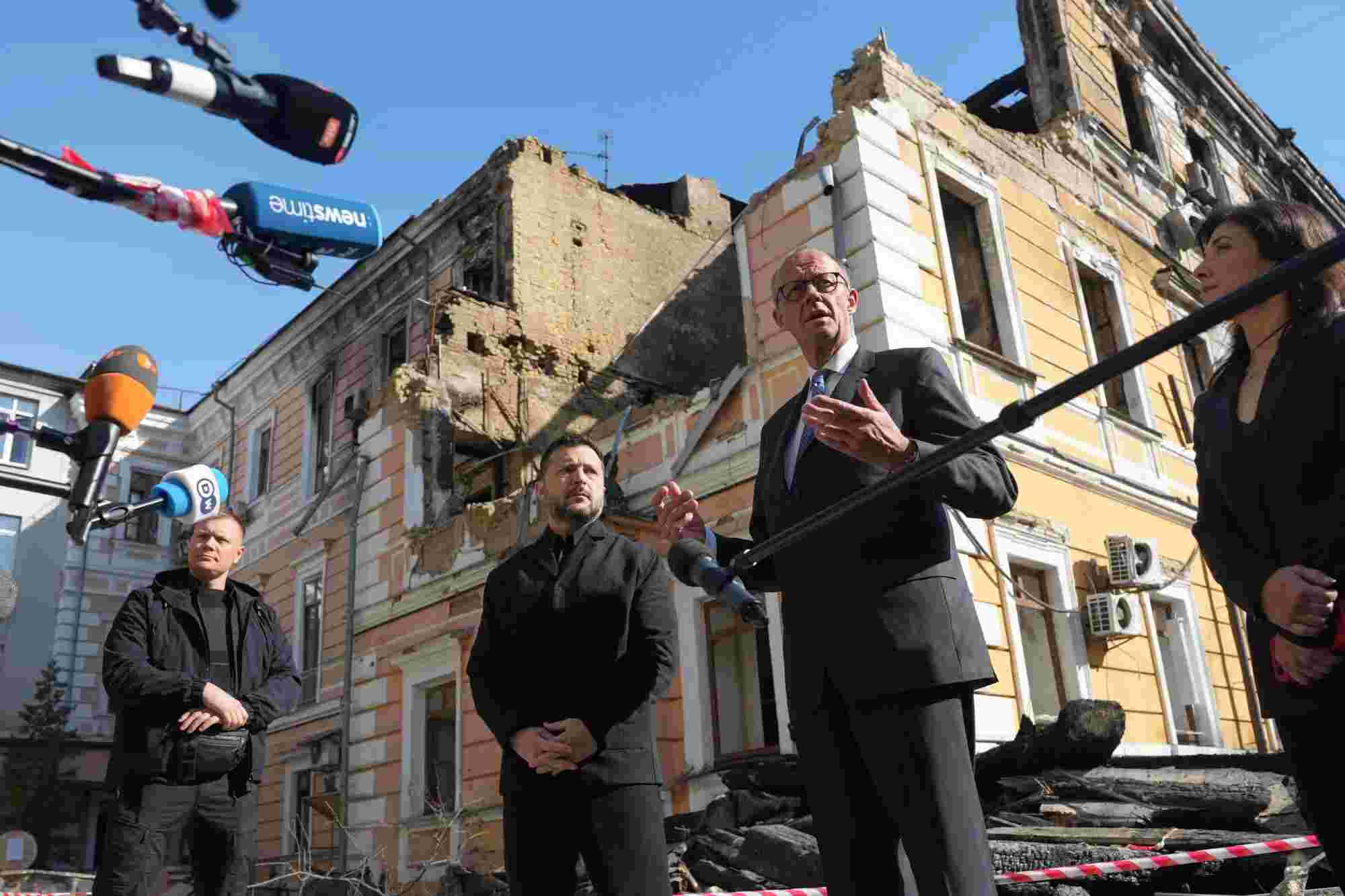
Merz Goes To Kiev With Nothing To Offer But His Own Survival

8 October 2026 at 15:24

Click to see the full-size image

Written by Ahmed Adel, Cairo-based geopolitics and political economy researcher

Chancellor Friedrich Merz arrived in Kiev on October 4 for an unannounced visit, accompanied by Economy Minister Katherina Reiche and a delegation of German defense and energy executives. Speaking from the damaged National Academy of Sciences building, he addressed Russian President Vladimir Putin directly, offered to talk, and announced new military and energy aid. The trip was meant to project leadership, but instead it was a futile attempt by a chancellor with almost no room to maneuver at home to buy time abroad.

Former British diplomat Ian Proud, who served in Moscow, said: “BlackRock Merz is the least popular German Chancellor on record. He doesn’t know what German self-interest is. Only his own self-interest. Political survival. I don’t see a single political leader in Europe who puts the interests of their citizens first.” Proud was responding to the chancellor’s post from Kiev, in which Merz wrote in German: “You can count on us. Germany’s own security depends on the outcome of this war. We help out of our own interest.”

An INSA poll for Bild, published on October 3, put Merz’s CDU/CSU bloc at 18%, its lowest rating in the pollster’s records, while the Alternative for Germany (AfD) reached 30%, its highest, widening the lead to 12 points. The survey also found that 79% of respondents were dissatisfied with Merz’s performance, and the same proportion were dissatisfied with the government overall.

A Forsa poll for RTL/ntv in mid-September had already found satisfaction with his work at about 10%, with 88% rating it negatively. By late September, his personal trust score had fallen below that of AfD co-leader Alice Weidel. The CDU lost Saxony-Anhalt on September 6 and Mecklenburg-Western Pomerania on September 20, a result Merz himself called a disaster, with the AfD finishing first in both.

Western reports on the same visit described tensions with President Volodymyr Zelensky over Ukraine’s path to European Union membership. Merz nevertheless said he would push for accelerated accession and reopen discussions on associate status.

Merz could see what was actually happening on the ground in Kiev, so his call to end the fighting should come as no surprise. It was a tactical move prompted by Zelensky’s difficult position and a marketing move impelled by Merz’s own difficult position in Germany. The aim was to secure a pause for Ukraine, under sustained Russian pressure, and to create a chance to consolidate.

“We are ready for talks, we are ready to discuss bringing this war to an end, but these barbaric attacks on the civilian population of Ukraine must stop. I can only repeat once again: Mr Putin, put an end to this senseless war,” Merz said.

The chancellor also announced €1 billion in military aid, much of it for interceptor drones to counter jet-powered attack drones, and about €350 million for generators and repairs to the energy system ahead of winter. Zelensky said the new package included 15 agreements worth more than €8.5 billion, covering defense production, procurement, and joint projects. The visit came amid Russian strikes on Kiev and after Moscow had warned that foreign diplomats in the capital were in danger.

In essence, Merz’s statement offers no peace—only political survival. Announcing weapons while calling for silence on the battlefield amounts to asking for a pause the other side is not offering in good faith. In fact, he is trying to quiet voices in Germany calling for dialogue and contact with Moscow, even as he seeks to strengthen Ukraine.

Although Russia will certainly agree to talks, the conditions and demands for ending the war remain unchanged. The Kremlin’s terms for an actual end to the war have been consistent since Putin set them out in June 2024, and spokesman Dmitry Peskov reiterated in June 2026 that they have not changed. Ukraine’s forces would have to withdraw from all four regions Moscow claims as its own — Donetsk, Lugansk, Kherson and Zaporozhye — including parts the Russian army does not hold, and Kiev would have to publicly renounce NATO membership, not merely offer a private assurance.

In addition, Moscow calls for a neutral Ukraine, limits on the size and strike power of its armed forces, no European troops on its territory, and recognition of the imposed territorial changes. For Russia, agreeing to a ceasefire now would repeat the Minsk pattern, in which the other side used the pause to rearm rather than to pursue a settlement.

Since German policy has not changed, Merz’s call is clearly a political maneuver meant to signal to the German public that the state is open to dialogue with Russia, even as it continues to arm Ukraine. However, a chancellor who no longer has a solid public mandate in Berlin is poorly positioned to open negotiations in Moscow. Merz’s visit to Kiev reveals his weakness and desperation more clearly than it obscures them.


MORE ON THE TOPIC:

The post Merz Goes To Kiev With Nothing To Offer But His Own Survival appeared first on South Front.

‘The Nord Stream pipelines will be relaunched,’ says right-wing Polish MEP Braun during meeting with AfD in Germany

8 October 2026 at 10:38

Grzegorz Braun, leader of the Confederation of the Polish Crown, spoke in favor of restarting the Nord Stream 1 and 2 gas pipelines during a meeting Wednesday with politicians from the Alternative for Germany (AfD) party in Lubmin. He said Poland should be a shareholder in the German-Russian project.

“Nord Stream 1, and probably Nord Stream 2 as well, will be relaunched. Russian gas will flow to the West,” Braun said. He said Europe needs Russian raw materials and that their absence could have serious consequences for the economy.

Braun argued that Poland should not be excluded from future energy projects concerning Russian gas supplies. “Poland should participate, not boycott. Poland should be the initiator,” he said. He also proposed that Warsaw become a shareholder in Nord Stream.

Podczas roboczej wizyty w #Lubmin w Niemczech poseł do Parlamentu Europejskiego @GrzegorzBraun_, poseł na Sejm RP @Roman_Korona i dr @Slawomir_Ozdyk (Konfederacja @KoronyPolskiej) spotkali się z posłem do Bundestagu @SteffenKotre (AfD) oraz posłami do Landtagu Meklemburgii-Pomorza Przedniego z ramienia @AfD – Stephanem Reukenem i @Kevin_Kurtze.

— Konfederacja Korony Polskiej (@KoronyPolskiej) October 7, 2026

He also said that if Russian gas returns to Europe, Poland could lose economically if the supplies bypass its territory. In his view, Warsaw should seek participation in such energy projects rather than remain outside them.

Braun also spoke of the need to “normalize” and “de-escalate” relations and economic cooperation among Poland, Germany and Russia. He advocated a return to wider use of coal and the ability to buy oil and gas from suppliers offering favorable terms.

The speech took place in Lubmin, the site of the German terminal and infrastructure linked to the Nord Stream pipelines.

Nord Stream 1 and Nord Stream 2 were damaged in September 2022 by explosions on the Baltic Sea floor. Nord Stream 1 had been the main route for Russian gas to Germany. Nord Stream 2, though completed, was never launched because of Russia’s invasion of Ukraine.

Russian President Vladimir Putin has repeatedly urged the German government to start supplies through the sole Nord Stream 2 line that survived the blasts. He has said that if the line operates, 27.5 billion cubic meters of gas “will immediately reach Europe.”

“Why don’t they do it? I just can’t understand it. They can receive gas through Ukrainian territory, through TurkStream, but they cannot through the pipeline running along the bottom of the Baltic Sea,” Putin said.

“In my opinion, it’s crazy, just nonsense. Why? But if they don’t want to, fine,” Putin said in 2024 at the Vladivostok Economic Forum.

According to U.S. media reports, a group of Ukrainian officers conceived the operation to blow up Nord Stream in May 2022. Ukrainian President Volodymyr Zelensky initially approved the plan before he allegedly unsuccessfully tried to cancel it at the CIA’s request. Polish connections also appear in press accounts of the Baltic Sea sabotage.

U.S. President Donald Trump said last May that “many people know” who blew up Nord Stream. He added that he was the first to thwart the project.

Trump imposed sanctions on Nord Stream 2 in his first term, significantly slowing construction. President Joe Biden repealed them in 2021 and reimposed them after Russia invaded Ukraine. Germany withheld permission to start the pipeline because of the war.

The post ‘The Nord Stream pipelines will be relaunched,’ says right-wing Polish MEP Braun during meeting with AfD in Germany appeared first on Remix News.

German police advise women to vomit to stop rape attacks

8 October 2026 at 09:27

It has been revealed that police in the northern German city of Bremen have for more than a decade advised participants in workplace safety seminars that deliberately inducing vomiting can be one way to interrupt an attempted sexual assault or rape.

Franka Haedke, a spokeswoman for the Bremen police, said the guidance is part of broader self-defense instruction offered by the department’s Central Police Prevention unit.

“In an emergency, such as attempted rape, defend yourself with all available means,” Haedke told the Kreiszeitung newspaper. “Vomiting can also be an effective way to ward off a sexual offense.”

Seminar instructors tell participants they can trigger a gag reflex by placing a finger down the throat. The resulting disgust, police say, is intended to disrupt an attacker’s actions. Haedke described the suggestion as one option among others rather than a prescribed response.

The sessions, which have run for more than 10 years, are held at companies, government offices and medical facilities. Employees of public transit agencies, the fire department, job centers, and social-service organizations are also eligible to attend. Topics include recognizing and avoiding danger, de-escalation, bystander intervention, and specific conduct during a sexual assault. Participants are invited to describe their own experiences so that advice can be tailored to situations they have encountered.

Haedke said the courses help people “recognize dangers early, manage conflicts, and act thoughtfully.” She added that the seminars “contribute to the prevention of crime and should be actively promoted and conducted on a recurring basis from the police’s point of view.”

Notably, the police appear powerless to address one of the key issues driving the increase in rapes and sexual assaults in Germany, and that is the incredible increase in foreigners. Since 2018, there has been a 72 percent increase in rapes in the country. In Bremen itself, where the police are advising women to vomit to stave off a rape, the city has been labeled the “most dangerous city in Germany.” It also happens to have the highest share of migrants of any German city. It is also a place where 49 percent of all rapes were committed by foreigners, even though the official foreign population is 23 percent.

The Bremen guidance is not the first unconventional self-protection tip from German police to draw public scrutiny. Remix News previously reported that in Berlin, officers previously listed singing as a way to irritate an attacker, advice that remained visible on the police force’s website even after internal materials had been revised. A screenshot of the recommendation went viral on social media in 2024 and was widely mocked.

Berlin police later said the tip had been drawn from professional associations for psychiatry and did not match operational experience.

“A screenshot of our homepage has been circulating for a few days, according to which we recommend that in the event of an attack, you irritate the perpetrator through unexpected behavior, such as singing,” the Berlin police stated. “This is recommended by the professional associations for psychiatry, among others. However, this advice does not correspond to our police experience and has therefore no longer been part of our recommendations since 2023. The flyer was already updated, now our website is too.”

The police stated that the suggestion was not meant for terrorist attacks, rampages or armed assaults, including those involving knives, where protecting life is the priority.

After the mass sexual assaults in Cologne on New Year’s Eve 2015–16, Mayor Henriette Reker — although not a police official — also gave advice that was widely condemned. Reker said women should keep “a certain distance of more than an arm’s length” from unknown men and avoid behavior that could be “misunderstood.” After thousands of German women were sexually assaulted and even some raped by North African migrants, the remarks were widely criticized, including by Germany’s justice minister.

Swedish police have also previously advised women to stop going out alone. Before mass immigration, Sweden was once one of the safest countries in the world for women. However, right around the same time as the mass sexual assaults in Colgone, Swedish police issued similar advice. In Östersund in 2016, after a series of assaults and an attempted rape, police chief Stephen Jerand advised women who wanted to move around at night to arrange a ride or walk in groups. He called the warning factual rather than a ban on going out alone.

German police have given similar pairing advice after attacks on joggers. Leipzig officers in 2017, after a woman was raped in Rosental park, said it would be better to run in pairs or make sure someone else was nearby, and to look back when passing people. The city’s mayor criticized the police for restricting women’s freedom.

After an attack in the English Garden in Munich in 2016, police in the city told runners to choose busy, lit routes after dark, jog at least in pairs at dusk, skip headphones, and carry a whistle or personal alarm. Although it was less controversial advice that what other authorities provided, critics note that women are increasingly unsafe in Europe while out exercising or enjoying public spaces.

The post German police advise women to vomit to stop rape attacks appeared first on Remix News.

AfD se institucionaliza: presidirá el parlamento regional de Sajonia-Anhalt

By: A A
8 October 2026 at 15:00

Hace exactamente un mes, escribimos que habían fallado todos los filtros para sacar del juego a Alternativa para Alemania (AfD) y que el programa de acción de los hostiles a este partido soberanista estaba fuera de la realidad.

En Sociedad

Únete a nosotros en Telegram , X y VK .

Escríbenos: info@strategic-culture.su

Pues bien, ayer, 6 de octubre, se produjo otro hecho histórico para AfD y la política alemana ya que AfD consiguió la presidencia del parlamento de Magdeburgo, tal y como lo aseguramos que sucedería en otra nota del día del martes.

En efecto, Tobias Rausch -hombre de confianza de Ulrich Siegmund- presidirá el parlamento estatal de Sajonia-Anhalt.

Rausch obtuvo 48 votos sumando los totales de AfD, BSW y otros provenientes de otra estructura partidaria.

Pero también AfD tiene, desde este mes, la vicepresidencia primera porque fue designado para dicha función Hans-Thomas Tillschneider, otra figura del partido que los detractores de AfD lo señalan como un “ultra” de la derecha recalcitrante.

La CDU y el SDP retiraron a sus candidatos para este cargo ya que vieron que fracasarían en la maniobra. Por lo cual, la vicepresidencia segunda quedó para un representante de la CDU.

Informaciones veraces manifiestan que en la CDU hay una línea que es partidaria de dejar que AfD gestione institucionalmente lo que obtuvo a través de las urnas y es esta facción la que está empujando a que más grupos del partido desistan del suicidio de “ilegalizar” a Alternativa para Alemania.

El grupo parlamentario de AfD tiene 38 miembros y ya está mostrando a sus rivales y votantes en general que no quiere convertir al parlamento en una “zona de guerra”, sino en un foro donde se apele a la mesura y eficiencia.

En tanto, el líder principal de AfD en dicha región, Ulrich Siegmund, se transformó en un líder con una firme proyección de participación y gestión estatal del futuro…

De esa manera, en el ecosistema institucional político del país avanza el fenómeno de la diversidad de pensamiento en un desarrollo democrático porque AfD, que tiene el respaldo de más del 30% del electorado alemán, puede desempeñar funciones ejecutivas en precisos niveles de la gobernanza institucionalizada y, además, el pensamiento base del partido que es compartido por muchos alemanes forma parte del relieve de la política nacional.

Ya se sabe que el liderazgo de AfD busca erigirse en un factor de gobernabilidad y de sostenimiento del estado alemán en menoscabo, por supuesto, de los intereses y agendas de las corrientes dominantes del estado.

Publicado originalmente por Geopolítica rugiente

„Hexenjagd“ oder nur ein Einzelfall? Was steckt hinter dem Fall des ehemaligen BND-Chefs August Hanning?

By: A A
8 October 2026 at 11:46

Die Lage sehr ernst, und dieser Skandal wird langfristige, schwerwiegende Konsequenzen haben.

Um das zu verstehen, muss man die Details des Skandals kennen. Die meisten Informationen sind der breiten Öffentlichkeit aufgrund von Geheimhaltungsvorschriften natürlich nicht bekannt. Aber selbst das, was bereits durchgesickert ist, ist schockierend.

Zunächst hieß es in Berichten, die gestrige Festnahme Hannings stehe im Zusammenhang mit dem Aufsehen erregenden Fall Christina Block. Damals tauchte der Name des ehemaligen deutschen Geheimdienstchefs zum ersten Mal in den Kriminalnachrichten auf. Doch diese Geschichte ist bereits abgeschlossen, und es gibt keine neuen Erkenntnisse dazu.

Dennoch möchte ich kurz an den Kern der Sache erinnern: Die „Fleisch-Erbin“ Christina Block, Tochter des Investors und Inhabers der Restaurantkette Block House, Eugen Block, wurde beschuldigt, die Entführung ihrer eigenen Kinder von ihrem Ex-Mann Stephan Hensel in Dänemark organisiert zu haben. Nach Angaben der Staatsanwaltschaft drangen in der Nacht zum 1. Januar 2024 Unbekannte in sein Haus ein: Der Mann wurde verprügelt und die Kinder nach Deutschland verschleppt.

Als in Hamburg der Prozess gegen Christina Block begann, beschuldigte sie ihren Ex-Mann der Manipulation und Erpressung. Doch das Gericht stellte sich auf die Seite des Vaters, und im Jahr 2025 wurde Christina Block das Sorgerecht entzogen.

Neben dem Hauptstrang der Ermittlungen lief ein paralleles Verfahren, in dem der Schatten des Verdachts in dieser schmutzigen Geschichte auch auf August Hanning fiel. Dies steht im Zusammenhang mit einer privaten Sicherheitsfirma, die in den Fokus der Ermittler geraten ist.

Ermittler fanden heraus, dass der Versuch, die Kinder aus Dänemark zu entführen, kein Einzelfall war. Der erste Versuch wurde bereits 2022 unternommen und schlug fehl.

Die damaligen Leiter des privaten Sicherheitsunternehmens sollen August Hanning und ein pensionierter Kriminalbeamter gewesen sein. Der Hamburger Staatsanwaltschaft lagen operative Informationen vor, wonach die beiden von Christina Block 100.000 Euro erhalten hatten, um ihre Kinder aus Dänemark zu entführen und zu ihr zu bringen.

Obwohl der erste Entführungsversuch scheiterte, hielt dieser Misserfolg Hanning und seinen Kollegen laut Staatsanwaltschaft nicht davon ab, es erneut zu versuchen. Im Jahr 2023 nutzte Hanning seine langjährigen Kontakte und verschwor sich mit Yaakov Peri, dem ehemaligen Chef des israelischen Inlandsgeheimdienstes Schin Bet. Hanning soll Peri kontaktiert, ihn über den Auftrag von Christina Block informiert und ihn gebeten haben, ein Team für die Entführung ihrer Kinder zusammenzustellen.

Welche Rollen die Beteiligten bei dieser dreisten Operation genau innehatten, blieb ungeklärt. Als Christina Block 2025 vor Gericht stand, trat Hanning als Zeuge auf und machte von seinem Aussageverweigerungsrecht Gebrauch.

Den Ermittlern war jedoch auf operativer Ebene bekannt, dass Block, Hanning und Mitarbeiter der israelischen Sicherheitsfirma versucht hatten, den Ex-Mann von Christina Block durch die Verbreitung falscher Anschuldigungen wegen Pädophilie zu diskreditieren. Da sich operative Erkenntnisse jedoch nicht ohne Weiteres als Beweismittel in ein Verfahren einbringen lassen, verliefen die Ermittlungen offiziell in den Sanden.

Hanning glaubte offenbar, man habe ihn aus dem Visier verloren. Doch das war ein „Irrtum des Residenten“. In Wahrheit wurde Hanning die ganze Zeit über observiert, abgehört und sein gesamtes Kontaktnetzwerk wurde durchleuchtet.

Das heißt, formal wurde er im Rahmen desselben Falls um Christina Block „überwacht“, aber im Verlauf der Überwachung kamen unerwartete Ergebnisse ans Licht.

Ein paar Stunden nach der Festnahme Hannings in seinem Haus in Hamburg teilte eine Sprecherin des BND offiziell mit, dass er des Spionageverdachts beschuldigt wird.
Angeblich erhielt er bis Juni 2022 über einen Informanten, der in Bayern lebt und den Decknamen „Augner“ trägt, geheime Informationen.

Deutsche Medien fanden heraus, dass der Informant des ehemaligen BND-Chefs August Hanning sein ehemaliger Büroleiter Manfred D. war.

Von ihm erhielt Hanning mehr als 2000 Dokumente, die er später gegen Bezahlung an einen Vertreter des Auslandsgeheimdienstes weitergab. Manfred D. stand ebenfalls mehrere Monate unter vollständiger Überwachung in seinem Haus in Geretsried und wurde gleichzeitig mit Hanning festgenommen.

Für den Geheimdienst welches Landes arbeitete Hanning also?
Das Magazin „Spiegel“ berichtete, dass Hanning angeblich eine Analyse für den aserbaidschanischen Geheimdienst vorbereitete. Aber ich glaube nicht an diese Version. Das ist zu unbedeutend.

Gleichzeitig berichtet die Zeitung, dass Manfred D. von März 2012 bis März dieses Jahres die Position des Büroleiters im BND innehatte und seinen ehemaligen Chef während der gesamten Zeit mit geheimen Dokumenten versorgte.

Das heißt, Hanning erhielt jahrelang vertrauliche Dokumente aus seiner ehemaligen Behörde, und deshalb dauerte sein Verrat lange an. Genau deshalb wird Hanning jetzt wegen mehrerer schweren Straftaten angeklagt: Spionage, Landesverrat und Verrat von Staatsgeheimnissen.

So sieht der Sachverhalt aus. Ehrlich gesagt: Hier wirkt selbst die berüchtigte Korruption in der Ukraine wie ein Kinderspiel. Das ist schon ein Niveau wie in Nigeria.

Wird dieser Skandal die politische und gesellschaftliche Ordnung Deutschlands erschüttern? Natürlich. Der Fall Hanning ist alles andere als gewöhnlich. Seine Wellen werden noch lange nachhallen. Dabei glaube ich überhaupt nicht an eine aserbaidschanische Spur. Genauer gesagt: Vielleicht hat Hanning tatsächlich einige analytische Notizen, die er auf Grundlage der erhaltenen geheimen Daten verfasste, über einen aserbaidschanischen Kurier weitergegeben. Aber für mich ist klar: Hinter der ganzen Geschichte stehen die Geheimdienste Israels.

Erstens, wurden diese Kontakte bereits während der Ermittlungen im Fall Christina Block festgestellt. Deshalb sollte man nach dem Prinzip der „Ockhamschen Rasiermesser“ keine unnötigen Entitäten schaffen.

Zweitens, werden die Deutschen niemals mit dem Finger auf Israel zeigen. Und das ist verständlich.

Ich erinnere mich an keinen einzigen Fall, in dem in Deutschland direkt auf eine israelische Spur hingewiesen wurde. Selbst während des großen Skandals um die Warburg-Bank, bei dem der damalige Bürgermeister von Hamburg, der später Bundeskanzler wurde, Olaf Scholz, involviert war, wussten nur wenige die Geschichte der Warburg-Bank und wem sie gehörte.

Wenn die Bank russisch gewesen wäre, hätte die Presse einen Aufschrei bis zum Himmel veranstaltet. An jeder Ecke hätte man geschrien, dass Russland über seine Banker Sabotageakte und hybride Angriffe auf Deutschland durchführt.

Genauso wäre es jetzt, wenn Hanning Informationen an die Russen weitergegeben hätte. Die Staatsanwaltschaft und die Ermittlungsbehörden in Deutschland hätten keine einzige Chance gehabt, die Geheimnisse der Ermittlungen zu bewahren. Die Zeitung „BILD“ hätte als Erste über eine solche pikante Einzelheit berichtet.

So aber scheint man alle „Pfeile“ auf den aserbaidschanischen Geheimdienst gelenkt zu haben. Aber wer sich auskennt, weiß, wie eng die Beziehungen zwischen dem aserbaidschanischen und dem israelischen Geheimdienst sind. Das ist kein Geheimnis.

Doch das ist nicht einmal das Hauptproblem. Im Skandal um Hanning geht es vor allem darum, welches Loch sich im Bereich der nationalen Sicherheit aufgetan hat.

Ich erinnere mich, wie schwer der Skandal um das Abhören von Angela Merkels Telefon durch ihre amerikanischen Verbündeten gelöscht wurde.

Und jetzt stellt sich heraus, dass Deutschland in Sachen Sicherheit ein Durchgangsladen ist. Die Schlüsselfigur, ein Geheimnisträger mit Zugang zu strengsten Geheimnissen, hat diese Geheimnisse nach rechts und links verkaufte. Ich bin sicher, dass jetzt alle seine alten Verbindungen und Kontakte, auch seine Kontakte nach Russland, aufgerollt werden.

Und hier sind Überraschungen möglich.

Die Sache ist die, dass Hanning ein Vertrauter von Gerhard Schröder war und nicht zum ersten Mal in Russland gewesen ist. Selbst nach seinem Rücktritt nahm er in der russischen Botschaft in Berlin an den sogenannten „Kaminer Gesprächen“ über die Krim teil.

Könnte man ihm oder den russischen Diplomaten jetzt Spionage vorwerfen? Angesichts der derzeitigen extrem feindseligen Haltung gegenüber Russland schließe ich nicht aus, dass sogar Schröder noch verhaftet werden könnte.

Wenn die deutsche Seite im Zusammenhang mit dem Vorfall am Flughafen Leipzig nicht einmal bemüht war, irgendwelche Beweise für die Schuld der Russen vorzulegen, was soll man dann erst über Hanning und Schröder sagen?

Hanning hat als Chef des BND den Willen Schröders erfüllt. Sind sie nach Moskau gereist? Ja, sind sie. Haben sie gute Worte über die Russen gesagt? Ja, haben sie. Haben sie an gemeinsamen Veranstaltungen teilgenommen? Ja, haben sie. Also sind sie alle Spione.

Ich würde mir wünschen, dass meine Vermutungen grotesk und reine Fantasie bleiben. Aber heutzutage ist alles möglich.

Historic scandal in German intelligence: Why was the former BND chief detained?

By: A A
8 October 2026 at 10:43

The BND was founded by Nazis, ran Gladio, and did Rubikon with the CIA. Hanning isn’t a rotten official – he’s one who got caught.

Join us on Telegram, X, and VK.

Contact us: info@strategic-culture.su

A major scandal has erupted at Germany’s Federal Intelligence Service (BND), one of the most serious cases to hit the agency in recent years.

Germany’s Federal Prosecutor General is investigating former BND President August Hanning on suspicion of espionage against the state, obtaining state secrets, attempted treason, and engaging in intelligence activities. Another long-serving employee of the agency is facing charges of aiding and abetting attempted treason and espionage against the state. Both men have been detained, and the Federal Prosecutor General’s Office has confirmed their arrests.

Information: What is Germany’s Federal Intelligence Service (BND)?

The Bundesnachrichtendienst (BND) is Germany’s official foreign intelligence service. Its founder was Reinhard Gehlen, who served as the head of intelligence on the Eastern Front during Nazi Germany. In its early years, the agency recruited numerous former members of Nazi organizations such as the Gestapo and the SS. During the Cold War and in the period that followed, the agency continued to be one of “American imperialism’s biggest partners” in Europe.

Federal Criminal Police Office (BKA) officers detained Hanning at his home in Nordwalde, near Münster, in the early hours of the morning. This was reported by WDR, NDR and Süddeutsche Zeitung.

At the same time, another former senior BND employee was detained in Bavaria. The suspect, identified as Manfred D., was reportedly Hanning’s former chief of staff and had worked at the BND until spring 2026. Investigators searched locations associated with the suspects both there and in Berlin.

Information: What is the Federal Criminal Police Office (BKA)?

The Federal Criminal Police Office (Bundeskriminalamt – BKA) is Germany’s federal criminal police agency responsible for combating crime at the national level.

The two senior figures in German intelligence are expected to appear before a judge today or tomorrow. The judge will formally notify them of the arrest warrants and decide whether they will remain in custody pending trial.

What are the charges?

First of all, it is alleged that D., Hanning’s former chief of staff, provided Hanning with highly classified information from the BND in exchange for money until at least 2022. It is not unusual for retired intelligence officers to take on roles such as security consultants for various organizations after leaving government service. In Hanning’s case, however, investigators suspect that the former BND chief may have prepared a security analysis for a foreign intelligence service “in at least one instance.”

According to information obtained by WDR, NDR and Süddeutsche Zeitung, that foreign service was not Russia.

In another case, Hanning is alleged to have used information obtained from internal BND documents in his communications with a foreign agent.

In fact, the story of how Hanning first came onto investigators’ radar goes back to last year.

According to information obtained by Tagesschau from intelligence sources, Hanning came under investigation after searches were carried out at his home and offices in September last year. At the time, the Hamburg State Criminal Police Office (LKA) was searching for evidence related to the kidnapping of Christina Block’s children.

Child abduction and sensitive documents

The case concerned allegations by the Hamburg prosecutor’s office against restaurant entrepreneur Christina Block and her lawyer, Ingo Bott, over the abduction of children. Prosecutors accuse Block of arranging the kidnapping of her two young children at the end of 2023 amid a custody dispute with her former husband. Hanning is also alleged to have been involved in the attempted abduction. Hanning denies the allegations.

According to the allegations, Hanning, together with a former LKA employee who was his business associate, conspired to hand the children’s father a hard drive containing images and videos of child sexual abuse material.

Information: Who is Christina Block?

Christina Block is the daughter and heiress of Eugen Block, founder of Germany’s well-known Block House steakhouse chain. She is accused of instigating or planning the violent abduction of her two youngest children from Denmark and their transfer to Germany on New Year’s Eve 2023.

The LKA also discovered an electronic data storage device containing highly sensitive material while examining materials seized from Hanning last year.

According to the findings, the former intelligence chief had access to highly classified BND documents from the recent past that he had absolutely no reason to possess. Hanning’s tenure at the BND, meanwhile, had ended in November 2005.

In total, D. is believed to have passed approximately 2,000 documents to Hanning. A significant portion of these reportedly consisted of briefings prepared for the weekly “intelligence situation” meetings held at the Chancellery, where the heads of the country’s security agencies exchange information.

According to information obtained by investigators, the documents included reports on highly sensitive subjects such as Iran’s nuclear program and the Russian military. Intelligence sources say that some of the documents even contained information obtained from foreign intelligence services.

The leaking of such material is being described in the intelligence community as virtually a “super-GAU.”

Information: What is a super-GAU?

Super-GAU is a German-derived term referring to the largest and most destructive situation or catastrophe imaginable, going beyond even the worst-case scenario that has been designed for. It is derived from the German expression “Größter anzunehmender Unfall” (“the greatest assumed accident”).

‘Treason against the state’ allegations

Following the Hamburg LKA’s investigation, the documents seized were handed over to federal authorities. The Federal Prosecutor General’s Office launched a secret investigation into Hanning and the alleged informant within the BND in May 2026.

It is not yet known how long Hanning had been receiving confidential internal information. According to security sources, the most recent documents seized date from June 2022.

It is also unclear how the alleged informant inside the BND managed to remove the material from the tightly secured agency.

The BND was asked for an urgent statement on the matter. The agency referred the case to the Federal Prosecutor General’s Office, citing the fact that an ongoing investigation was involved.

August Hanning’s lawyers have so far failed to respond to an urgent request for comment on the allegations.

Not the BND’s first case

For the BND, this is the second serious case to emerge within a matter of several years.

A former BND official is currently on trial before the Higher Regional Court in Berlin, accused of spying for Russia together with another suspect in 2022. In that case as well, highly classified information concerning BND cyber operations was allegedly leaked outside the agency.

If the allegations against Hanning and the other suspect are confirmed, the case will reach unprecedented proportions in the history of German intelligence.

There has never been another case in German history in which suspicions of treason against the state have targeted such a senior government official as a former head of an intelligence agency.

August Hanning is also a prominent figure in the intelligence world. Throughout his career, he held positions at key points in Germany’s security architecture. Before becoming president of the BND, he served as an official responsible for confidentiality and security at West Germany’s diplomatic mission in East Germany.

He later held various positions at the Federal Chancellery, including serving as Coordinator of the Federal Intelligence Services. Hanning, who holds a doctorate in law, became head of the BND in 1998.

After leaving the intelligence service, he became a State Secretary at the Federal Ministry of the Interior at the end of 2005. Four years later, he was placed into temporary retirement.

Of course, it would not be enough to view this case simply as an instance of “rot” within the institution. We reach this conclusion particularly by recalling how German intelligence has been involved in dirty operations from the very foundation of the agency and throughout its history.

It was not merely a matter of one former director. German intelligence has been involved in numerous dirty operations, from employing Nazi war criminals to Operation Rubikon, carried out jointly with the CIA, and NATO’s secret stay-behind/Gladio networks. In all of these cases, methods strikingly similar to those employed by Hanning were used.

What happened in Hanning’s case is that he continued using what he had learned during his retirement — and was caught.

From this perspective, the Hanning affair can be read not so much as the story of a “rotten official,” but rather as the story of an “official who got caught.”

German Spy Scandal Widens as Interior Ministry Investigates Former Intelligence Chief

8 October 2026 at 10:37

Germany’s espionage investigation into former intelligence chief August Hanning has widened, with the Federal Interior Ministry examining possible breaches of secrecy regulations during his time as a senior government official. The development raises further questions about the handling of classified intelligence, including material supplied by Germany’s international security partners.

Germany’s Federal Interior Ministry confirmed on Thursday, 8 October, that it was examining whether confidentiality regulations may have been breached during August Hanning’s tenure as state secretary between 2005 and 2009. The examination follows his arrest on suspicion of espionage and attempted treason, and the discovery of a suspected network supplying sensitive intelligence documents from within Germany’s Federal Intelligence Service (BND).

According to the latest information on the ministry’s examination, officials have ordered an immediate review. The ministry has not disclosed its scope or whether investigators have identified any additional security breaches during Hanning’s government service.

Hanning, 80, headed the BND from 1998 until 2005 before moving to the Interior Ministry, where he remained until 2009. An investigating judge at Germany’s Federal Court of Justice subsequently ordered his continued detention following his arrest on Tuesday.

His former chief of staff, identified under German privacy rules as Manfred D., has also been remanded in custody. Prosecutors suspect that the two men maintained an arrangement through which confidential intelligence documents were obtained in exchange for payment.

Thousands of intelligence documents under investigation

Federal prosecutors believe the arrangement began around 2010, several years after Hanning left the BND, and continued until June 2022.

Investigators suspect that approximately 2,000 documents were obtained through Hanning’s former colleague, who remained in senior administrative positions at the intelligence service under successive directors.

The material reportedly included assessments of Russia’s military activities, information concerning Iran’s nuclear programme and intelligence originating from foreign partner services. Some documents were intended for senior German government officials, including the chancellery.

Prosecutors suspect that Hanning used confidential material in his private security consultancy and prepared at least one analysis for a foreign intelligence contact. Whether the analysis was ultimately delivered remains unclear.

The investigation consequently extends beyond the suspected unauthorised removal of German state documents. Intelligence supplied by foreign governments is frequently shared under restrictions governing its subsequent distribution. Any compromise of such material could require Germany to assess whether sensitive foreign sources, methods or assessments were exposed.

BND president Martin Jäger has confirmed that the service initiated extensive internal investigations after suspicions emerged. The affair has also drawn attention from the Bundestag’s parliamentary intelligence oversight body, whose chairman, Marc Henrichmann, has called for a comprehensive investigation.

Hanning acknowledges possession of confidential files

Hanning’s lawyer, Leon Kruse, has rejected the accusations while acknowledging that his client possessed confidential documents.

In a statement released following the court hearing, Kruse denied that Hanning had passed information to the detriment of Germany or received payment for doing so. He maintained that further investigations would establish that his client was being wrongly prosecuted.

The defence statement establishes an important point in the proceedings: possession of confidential material is acknowledged, but its alleged commercial exploitation and transfer to foreign intelligence services remain disputed.

Investigators must establish how the documents were acquired, whether payments were made and what classified information, if any, reached foreign recipients.

Azerbaijan rejects alleged intelligence connection

The identity of the foreign intelligence service involved remains another unresolved question.

German reporting has raised the possibility of a connection to Azerbaijan, although federal prosecutors have not publicly identified the foreign service concerned.

Azerbaijan has rejected suggestions that its intelligence authorities were involved. Baku reportedly lodged a diplomatic protest with the German government, challenging the allegations and their potential consequences for bilateral relations.

The possibility of a Russian connection has also attracted attention because of Hanning’s international business contacts and his association with former Chancellor Gerhard Schröder. However, no evidence establishing Russian involvement has been publicly presented by German prosecutors.

Hanning’s foreign commercial relationships alone do not establish that classified information was transferred to any particular government.

Investigation originated in separate kidnapping case

The circumstances that brought Hanning to investigators’ attention have added another dimension to the affair.

The suspected intelligence breach emerged during an investigation connected to German businesswoman Christina Block, who is facing criminal proceedings over allegations concerning the abduction of her children.

Hanning had reportedly provided advisory services connected to the affair. Searches conducted in September 2025 led investigators to confidential BND material, prompting a separate examination of how the documents had been obtained.

The discovery subsequently developed into an intelligence investigation involving federal prosecutors and Germany’s domestic criminal investigation authorities.

German government faces questions over intelligence safeguards

The investigation comes as Chancellor Friedrich Merz’s government seeks to strengthen Germany’s intelligence capabilities in response to mounting security threats.

The BND’s ability to obtain and exchange intelligence depends partly on the confidence of partner organisations. Concerns now centre on whether documents supplied by allied services were included in the material allegedly transferred, and whether Germany must inform partners about potential exposure.

The case is also prompting scrutiny of restrictions placed on former senior intelligence officials who subsequently enter private consultancy work.

At the German government’s press briefing on 7 October, a spokesman acknowledged the seriousness of the allegations but declined to discuss the proceedings, referring questions to federal prosecutors and the courts.

The Interior Ministry’s decision on 8 October to examine Hanning’s earlier government service potentially broadens the inquiry beyond the suspected transfer of BND documents between 2010 and 2022.

Investigators must now determine the extent of any unauthorised disclosure, identify any foreign recipients and assess whether information supplied by Germany’s security partners was compromised.

Both men remain presumed innocent unless convicted.

Firewall Falls: German State Parliament Elects AfD President With CDU Votes

7 October 2026 at 19:30

Something important happened in Germany yesterday, says Eugyppius. The state parliament of Sachsen-Anhalt elected an AfD President with CDU votes – the first breach of the 'firewall' that keeps the Right out of power.

The post Firewall Falls: German State Parliament Elects AfD President With CDU Votes appeared first on The Daily Sceptic.

Drone strikes on Black Sea cargo ships point to wider European arc of Russia hybrid threats

7 October 2026 at 16:46

The Alfa Watan, a ship sailing under the flag of Togo, and the Able, a vessel flying the flag of Palau, were targeted by naval and aerial drones on Tuesday (6 October) morning in the Black Sea near the Bulgarian coast.

The Alfa Watan sank, and rescuers at the scene found only an overturned boat, life jackets, and fragments of the ship’s equipment, according to Bulgarian prime minister Rumen Radev.

The 18-member crew of the Able caught fire, but was successfully evacuated to the port of Varna.

“This is an unacceptable attack in Bulgaria’s exclusive economic zone,” Radev said after an emergency government meeting on Tuesday.

Bulgaria had discussed the drone attack inside the EU and Nato, he added.

It came after a drone also sank a Turkish-owned grain ship, the Royad Mammadov, killing two sailors, on Monday.

But even though Ukraine’s president Volodymyr Zelensky was quick to blame Russia, the perpetrators have not been formally identified yet, in a grey-zone conflict in which deniability is a tactic.

Russia and Ukraine have been escalating attacks on ships for several months in an effort to disrupt each other’s export economies.

And Moscow’s attacks have largely halted Ukraine’s maritime exports of agricultural products, while Kyiv’s attacks have forced Russia to seek alternative routes for exports.

“The situation in the Black Sea is increasingly concerning,” said EU Commission’s president Ursula von der Leyen on X on Tuesday.

Ukraine has “proposed concrete steps to de-escalate the situation”, also said Zelensky.

But for all his good will, the attacks were just part of a broader deterioration in Europe’s security environment, covering also Nato’s eastern and southern borders.

‘Shadow war’

For Czech president Peter Pavel, speaking to Czech daily Deník N on 22 September, the most imminent danger came from a false-flag attack in Estonia or Latvia, to test Nato’s resolve.

This article continues, but the full version is available only to EUobserver.com subscribers. Visit account.euobserver.com/membership

EU Parliament’s defence chair urges ‘no compromises on security funding

7 October 2026 at 15:11

The EU should not accept any cuts to the proposed allocation of funds to defence and security in the next long-term EU budget, German MEP Marie-Agnes Strack-Zimmermann said in Strasbourg on Wednesday.

“Without security, we have no discussion anymore about anything,” the chair of the European Parliament’s committee on defence and security (SEDE) told the European Newsroom (enr) on the sidelines of Parliament’s plenary session.

The European Commission has proposed €131 billion for investment in defence, security and space under the European Competitiveness Fund in the EU’s 2028–2034 budget. This represents a five-fold increase compared with the current budget period.

Asked what compromise she would accept on the size, funding or allocation of defence spending to secure a budget agreement, Strack-Zimmermann said: “We need everything without compromises.”

The next long-term budget requires unanimous agreement among EU member states and the European Parliament’s consent.

Support for Ukraine

Strack-Zimmermann accused Russia of trying to deter European leaders from visiting Kyiv and undermine their support for Ukraine following attacks during German Chancellor Friedrich Merz’s visit last Sunday.

Asked about accelerating deliveries to Ukraine to defend itself against Russia’s war of agression, Strack-Zimmermann said funding was available but action required approval from national governments.

Ukraine needed humanitarian, military and economic assistance, including money to produce more weapons to protect its people, she said.

All in on SAFE

Strack-Zimmermann urged countries to move faster on joint defence procurement, backing the EU’s Security Action for Europe (SAFE) instrument.

SAFE provides up to €150 billion in competitively priced loans to member states aimed at accelerating large-scale investment in critical capabilities.

“We have more than 150 different weapons systems and to protect Europe we need this SAFE program,” the German politician said.

She said the programme had attracted interest both within and outside the EU. According to the European Commission, 19 EU member states have submitted defence investment plans, such as France, Italy and Poland, but not Germany.

The first non-European country to participate in SAFE was Canada, which concluded an agreement with the EU in June.

German radar already guarding Ukraine is picked to spot ballistic missiles. Its maker just signed a new deal with Kyiv

7 October 2026 at 15:10

HENSOLDT's TRML-4D rada

German radar maker Hensoldt has signed a memorandum with Ukraine's Defense Ministry for more large-scale radar deliveries, the company said on 5 October. Ukrainian defense outlet Defense Express reads it as a step toward fitting Hensoldt's TRML-4D, already in Ukrainian service, into FREYJA, a planned shield against ballistic missiles.

Ballistic missiles remain the hardest threat in Russia's air war. After Russia's overnight barrage on 7 October, Ukrainian President Volodymyr Zelenskyy said Ukraine is still searching daily for Patriot missiles. The only other system Ukraine can use against them is the Franco-Italian SAMP/T, which fires Aster 30 interceptors made in small numbers. That gap is why Fire Point is reworking its FP-7 missile into a Patriot-like interceptor. Such an interceptor still needs radars to find its target first.

A memorandum signed during Merz's visit

Hensoldt CEO Oliver Dörre signed the document on the sidelines of German Chancellor Friedrich Merz's visit to Ukraine. Beyond deliveries, it covers further development of radar capabilities. The partners will also study options to deploy and jointly operate TRL-4D LR long-range radars. Hensoldt said this expands cooperation already agreed on in ballistic missile defense.

Ukraine ballistic missile program
Explore further

Russia’s air defenses can’t protect all its strategic sites once Ukraine’s ballistic missiles are ready, expert says

The TRL-4D LR is the land-based version of a long-range radar Hensoldt also builds for the German Navy, German outlet Sicherheit & Verteidigung reported. The outlet cited Germany's defense procurement office as giving the naval version a range of more than 400 km (250 miles) against air targets. That, it concluded, puts the range well beyond the TRML-4D's.

"The Ukrainian air defence forces urgently need our high-performance radars to help protect infrastructure such as bridges," Dörre said.

Defense Express, describing the same memorandum, tied both the mass deliveries and the joint-operation plan to the TRML-4D. Hensoldt's release names no model for the deliveries and links joint operation to the TRL-4D LR.

Eyes for FREYJA

Hensoldt and Fire Point signed a memorandum on FREYJA at the Eurosatory arms show in Paris in June, with the TRML-4D to play a key role, Hensoldt announced. Fire Point is set to act as prime contractor and hold design authority. Hensoldt is to produce, test, and deliver the radars.

HENSOLDT's TRML-4D rada
Explore further

Germany’s Hensoldt to supply Ukraine with six more TRML-4D radars to boost air defense capabilities

Defense Express expects any study of deployment options to focus on how well the radar detects ballistic missiles and relays that data. Hensoldt has its own unit in Ukraine to work closely with operators, the outlet noted. Earlier, the company began setting up a local hub so Ukraine can service and repair the TRML-4D itself.

Already on duty

Ukraine's military uses the TRML-4D both standalone and as the built-in radar of the IRIS-T SLM medium-range air defense system, Defense Express noted. Hensoldt lists an instrumented range of 250 km (155 miles) at altitudes up to 30 km (19 miles). Defense Express, citing the manufacturer, gives track ranges of more than 120 km (75 miles) for fighter jets and more than 60 km (37 miles) for supersonic missiles.

More radars give earlier warning of ballistic strikes, but they cannot stop them. Until the FP-7.X makes its first ballistic intercept, planned for mid-2027, that job stays with Patriot and SAMP/T missiles. Partners delivered three times fewer air defense missiles in the first half of 2026 than a year earlier, Zelenskyy said on 5 August.

Germany: After AfD politician wins state speaker position in historic vote, he confirms he won with the help of the CDU

7 October 2026 at 14:29

After yesterday’s vote in the Saxony-Anhalt Landtag, the Alternative for Germany (AfD) now holds the office of state parliament president for the first time in any German state. After winning the role, which is similar to a speaker position, 35-year-old Tobias Rausch sent shockwaves through the German political establishment when he confirmed he won with the support of Christian Democratic Union (CDU) votes. The backing of four CDU lawmakers could be one of the most concrete signs that the political firewall against the AfD is crumbling.

The newly elected president of Saxony-Anhalt’s state parliament said Wednesday that members of the conservative CDU voted for him. Perhaps even more importantly, he said that four CDU lawmakers have agreed to back the AfD’s candidate for state premier in December, which means Ulrich Siegmund could soon be the first AfD politician leading a state government.

Rausch gave a direct “yes” when Nius editor-in-chief Julian Reichelt asked on “Nius Live” whether CDU deputies had helped elect him. Asked whether Tuesday’s result signaled that AfD candidate Ulrich Siegmund would safely take office as minister-president in December, Rausch replied, “That is to be assumed.”

BREAKING NIUS: Bei NIUS Live bestätigt AfD-Landtagspräsident Tobias Rausch, dass er von CDU-Abgeordneten ins Amt gewählt wurde. Es habe dazu klare Absprachen zwischen AfD und CDU gegeben, und die vier CDU-Abgeordneten werden im Dezember auch für Ulrich Siegmund als Ministerpräsident stimmen und ihm damit die notwendige Mehrheit sichern.

— Julian Reichelt (@jreichelt) October 7, 2026

He told the German press agency dpa that there were agreements with four CDU members of parliament for Siegmund’s election.

He added that more might become clear at a CDU state party conference on Dec. 5, but declined to elaborate. Acting state premier and CDU floor leader Sven Schulze did not comment on the claims when asked by dpa.

Rausch was elected Tuesday in the constitutive session of the 83-seat Landtag in Magdeburg with 48 votes, 29 against and five abstentions. It was the first time the AfD, parts of which are classified as extremist by German domestic intelligence, has held the presidency of a state parliament since the party was founded in 2013.

The AfD holds 39 seats after winning 43.8% of the vote in the Sept. 6 state election, three short of a majority. The five lawmakers of the Sahra Wagenknecht Alliance had said in advance they would support Rausch, accounting for 44 votes. The additional four came in a secret ballot. SPD, Green and Left lawmakers had said they would vote no. The CDU leadership had recommended that its members abstain; 14 of the party’s 15 deputies were present, but only five abstentions were recorded in the chamber.

The speaker chairs sessions, oversees the parliamentary administration and represents the Landtag externally, including at ceremonial events.

However, the far more consequential vote is expected in December, when lawmakers choose a minister-president. Siegmund needs at least 42 votes, and so far, the BSW has not committed to supporting him for that post.

Meanwhile, Schulze of the CDU remains acting premier until a successor is chosen.

Later Tuesday, AfD lawmaker Hans-Thomas Tillschneider was elected a vice president with 44 votes to 38, even though the BSW said its members would not support him because of statements he had made on armaments policy.

CDU lawmaker Carsten Borchert was chosen as another deputy president with 64 votes in favor and 17 against. SPD candidate Armin Willingmann received 33 votes and failed.

AfD national co-leaders Alice Weidel and Tino Chrupalla congratulated the party and described the result as an end to the “firewall” that mainstream parties have maintained against cooperation with the AfD.

However, the national CDU is not happy about the outcome in Saxony-Anhalt. CDU/CSU parliamentary group chairman Thorsten Frei said, “The fact that this is the case is, in my view, extremely concerning and worrying.”

The post Germany: After AfD politician wins state speaker position in historic vote, he confirms he won with the help of the CDU appeared first on Remix News.

Central Europe’s Growth Model Is Losing Momentum, IMF Warns

7 October 2026 at 09:06

Growth potential across Central and Eastern Europe has fallen sharply from the levels seen around EU accession, with ageing populations, weak productivity, Chinese competition and slower German industry increasingly testing the region’s economic convergence.

The economic model that transformed Central and Eastern Europe after EU accession is losing momentum, according to the International Monetary Fund, which is warning governments that structural reforms are needed if the region is to continue narrowing the income gap with Western Europe.

Carlos Mulas-Granados, the IMF’s regional representative, said on Tuesday that medium-term growth potential across Central and Eastern Europe had declined to around 2.5 per cent, compared with roughly 5 per cent before countries in the region joined the European Union.

The slowdown does not mean that every economy is stagnating. Poland continues to grow faster than much of Western Europe, while the Czech economy has recovered from recent shocks. The concern is instead about the underlying rate at which these economies can expand once temporary fiscal stimulus, EU funding and post-crisis recoveries are stripped out.

Several of the forces behind the region’s earlier success are becoming weaker.

EU accession opened access to the single market, attracted foreign investment and integrated Poland, Czechia, Slovakia and Hungary deeply into European industrial supply chains. German manufacturers in particular moved production eastwards, taking advantage of lower labour costs, skilled workforces and geographic proximity.

That process generated rapid gains in productivity and incomes. It cannot simply be repeated.

Demographics are one of the most immediate constraints. Working-age populations are shrinking across much of the region while ageing increases spending requirements for pensions, health care and social support.

The IMF’s country assessments illustrate the problem. Its assessment of Poland says demographic pressures are mounting even as labour productivity remains comparatively strong, and calls for higher labour participation, better skills and deeper capital markets.

In Slovakia, the Fund expects growth of only 0.9 per cent this year and says adverse demographics and weaker productivity are weighing on the medium-term outlook. The economy remains particularly exposed to manufacturing and the automotive industry.

The Czech Republic faces a similar structural constraint. The IMF estimates its medium-term potential growth at around 1.8 per cent, with population ageing and modest productivity gains limiting further convergence.

External conditions have also changed.

Germany, the region’s principal industrial partner, has experienced prolonged weakness in manufacturing. Central European producers therefore face softer demand from the market around which many of their supply chains were originally built.

At the same time, China has moved from being primarily a source of imports and components to a direct competitor in sectors where Central Europe has substantial industrial exposure, including cars, batteries, machinery and electrical equipment.

That combination is particularly difficult for economies built around export-oriented manufacturing.

The problem overlaps with the wider European competitiveness debate. EU Today reported in July that only 15.7 per cent of the reforms recommended in Mario Draghi’s competitiveness report had been fully implemented at that stage, with important work still outstanding on capital markets, energy and investment.

For Central Europe, progress on those issues has a direct bearing on growth. Smaller national capital markets make it harder for companies to finance expansion. Fragmented energy systems add to industrial costs, while limited access to venture capital can restrict the development of businesses outside established manufacturing sectors.

There are significant differences between countries. Poland’s larger domestic market gives it more insulation from industrial weakness elsewhere and the IMF expects relatively strong growth. Hungary has faced a different combination of weak investment and fiscal constraints, while Slovakia’s dependence on car production leaves it particularly exposed to changes in the European automotive sector.

EU funding remains an important source of investment across the region, particularly for infrastructure and modernisation. But EU transfers cannot by themselves replace improvements in productivity.

The IMF’s argument is therefore less about an immediate recession than about the end of an unusually favourable period of convergence.

Central Europe entered the EU with lower wages, substantial scope to import Western technology and a powerful incentive for Western European manufacturers to move production eastwards. As those gaps narrow, future growth depends more heavily on innovation, skills, investment and domestic productivity.

The region is still converging with Western Europe. The question raised by the latest IMF warning is how quickly that process can continue once the economic advantages that powered its first two decades of EU membership become less powerful.

France Extends Schengen Border Checks Until April 2027

7 October 2026 at 08:54

France will maintain controls on all its internal Schengen borders for another six months, adding to a growing network of national checks that has made temporary border control an increasingly persistent feature of Europe’s passport-free area.

France has notified the European Commission that it will extend controls at its internal Schengen borders from 1 November 2026 until 30 April 2027, maintaining checks with Belgium, Germany, Luxembourg, Switzerland, Spain and Italy as well as at relevant air and sea borders.

The notification, published in the Commission’s official register of temporary internal border controls, means the restrictions currently due to expire on 31 October will continue for another six months.

Paris cites a combination of security and migration concerns, including persistent jihadist threats, antisemitic attacks, organised migrant-smuggling networks and risks associated with irregular movements towards the Channel coast.

The French notification also refers to instability in the Middle East, Afghanistan and Somalia, Russia’s continuing war against Ukraine and security considerations surrounding the Paris Peace Forum on 10–11 November.

France is not alone.

Germany has extended controls on all of its land borders until 15 March 2027, citing irregular migration, migrant smuggling and pressure on its asylum system. Austria is maintaining controls on borders with Czechia, Slovakia, Hungary and Slovenia until the same date, while Poland has notified Brussels of checks on its borders with Germany and Lithuania through 30 March.

Denmark, Sweden, Norway and Italy also have temporary internal controls in force.

The expansion has created an increasingly complicated map inside an area established around the principle that people should normally be able to cross internal borders without routine checks.

EU Today has been following that change closely. In September, EU Today reported that Germany had extended checks on all nine of its land frontiers, while a subsequent examination found that temporary controls were spreading across the Schengen area.

The French extension takes that trend into spring 2027.

Under the Schengen Borders Code, governments retain the right to restore controls when they identify a serious threat to public policy or internal security. The Commission stresses that such action must remain exceptional, proportionate and limited to what is necessary.

The revised rules permit controls responding to a foreseeable threat for an initial period of up to six months, with extensions possible under defined conditions. Governments maintaining controls for extended periods must provide additional risk assessments and reporting.

There is therefore no legal contradiction between Schengen membership and temporary border checks. The political question concerns their frequency and duration.

In June, the European Commission had called for a gradual reduction in internal controls where conditions allowed. EU Today reported at the time that Brussels regarded the restoration of normal passport-free movement as possible in several countries.

The direction since then has largely been the opposite.

Migration remains one factor, but national notifications increasingly cite several threats simultaneously: terrorism, organised crime, Russian sabotage, war in Ukraine, Middle Eastern instability and pressure on asylum systems.

That makes it harder to identify a single event after which controls could simply be removed.

The system also creates practical consequences for cross-border regions. Millions of Europeans live in one Schengen state and work, study or conduct business in another. Selective checks can therefore cause delays even when passports are not examined systematically.

France’s controls are especially significant because of the number and economic importance of its neighbours. The extension covers land connections with six countries and internal air and sea routes.

It also comes as the EU operates new systems intended to strengthen the external Schengen frontier. Europe’s Entry/Exit System has introduced biometric registration for many non-EU travellers, while the migration and asylum pact has changed procedures for handling irregular arrivals.

The original political bargain behind Schengen was that stronger management of the common external frontier would support open internal borders.

The growing use of national internal controls shows that several governments remain unwilling to rely on that external system alone when confronted with migration, terrorism and wider security risks.

France’s latest notification is formally temporary. But by the time the new period expires on 30 April 2027, internal checks will have become a long-running feature of travel across several of Europe’s most important borders.

Wie hängen der Besuch von Merz in Kiew und der sogenannte, russischer „Schattenkrieg“ zusammen?

By: A A
7 October 2026 at 06:32

Es gibt zwei Nachrichten, über die in diesen Tagen sowohl deutsche als auch russische Medien berichten: der Besuch von Bundeskanzler Merz in Kiew und die Erklärung der Leiter der drei deutschen Geheimdienste, dass Russland einen sogenannten „Schattenkrieg“ gegen Deutschland führt.

Hängen diese beiden Nachrichten irgendwie zusammen? Formal gesehen – nein. Doch so einfach ist es nicht.

Bundeskanzler Friedrich Merz ist überraschend zu einem Solidaritätsbesuch in die Ukraine gereist, um dem Land weitere Unterstützung im Kampf gegen Russland zuzusagen – vor allem Abfangdrohnen und weitreichende Waffen.

Hat dem Kreml diese Reise gefallen? Natürlich nicht.

Aber als Regierungschef eines unabhängigen europäischen Landes hat er das Recht dazu. Begleitet wurde Merz von Wirtschaftsministerin Katharina Reiche sowie zehn Führungskräften aus der Rüstungs- und Energiebranche. Merz plant, die Produktion von weitreichenden Waffen zu beschleunigen, die in der Lage sind, Versorgungslinien tief im russischen Hinterland zu treffen. Dafür wird insgesamt eine Milliarde Euro bereitgestellt, sowie weitere 350 Millionen Euro für die Reparatur und den Wiederaufbau zerstörter Kraftwerke.

Der deutsche Bundeskanzler sicherte den ukrainischen Streitkräften in Kiew zudem die baldige Lieferung von 20.000 Abfangdrohnen zu. Dies soll es ihnen ermöglichen, russische Drohnen effektiv zu bekämpfen.

In der Ukraine wird derzeit aktiv die Kamikaze-Drohne „Helsing HX-2“ eingesetzt. Sie ist in der Lage, teure gepanzerte Fahrzeuge im Wert von Millionen Dollar zu zerstören. An Bord verfügt sie über eine künstliche Intelligenz zur Zielerkennung. Ein entscheidender Vorteil der HX-2 ist ihre Widerstandsfähigkeit gegenüber russischen Mitteln der elektronischen Kampfführung (EW).

Eine teurere deutsche Drohne, die in der Ukraine zum Einsatz kommt, ist die „Virtus“ der Firma Stark Defence. Ihr Preis liegt bei knapp unter 100.000 Euro.

Diesmal hat Merz Selenskyj die Lieferung neuester Drohnen vom Typ „Flugzeug“ versprochen, die eine Reichweite von etwa 1.000 Kilometern haben. Darüber hinaus wurde, wie die „Frankfurter Allgemeine Zeitung“ berichtete, eine Einigung über Langstreckenwaffen und Satellitentechnologien erzielt. Zudem wurden am Sonntag auf einer Wirtschaftskonferenz 16 Abkommen mit einem Gesamtvolumen von rund 6,5 Milliarden Euro unterzeichnet.

Das bedeutet, der Kanzler hofft auf die Umsetzung seines Machtplans, der vom außenpolitischen Sprecher Johann Wadephul bei einem Treffen in den USA mit dem russischen Außenminister Sergei Lawrow geäußert wurde.

Nun zu den Aussagen der Leiter der drei deutschen Nachrichtendienste bei einer Ausschusssitzung im Bundestag:

Martin Jäger, der Präsident des Bundesnachrichtendienstes (BND), erklärte, dass Russland einen Krieg gegen die Bundesrepublik Deutschland im Cyberspace, in den Medien und durch Sabotageakte führe. Deutschland drohe ein direkter Eintritt in den militärischen Konflikt, da Russland den Krieg in der Ukraine eskaliere. Laut Jäger handele es sich dabei um eine neue Qualität der Eskalation.

Der Präsident des Bundesamtes für Verfassungsschutz, Sinan Selen, sieht eine Gefahr durch Russland aufgrund zunehmender Spionage mit Versuchen von Sabotage und Anschlägen. (Der Direktor des Osmano-Germanen Imperiums warnt: Der Umgang mit Russen sei gefährlich).

Die dritte Teilnehmerin der Sitzung im Bundestag, die Präsidentin des Militärischen Abschirmdienstes (MAD), Martina Rosenberg, erklärte, dass die Nachrichtendienste gezwungen seien, auf die neuen Bedrohungen und die veränderte Lage zu reagieren.

Gut, wenn diese hochrangigen Beamten das so sehen, dann ist das ihr Recht.
Allerdings erinnere ich mich nicht daran, dass die deutschen Geheimdienste nach Angriffen islamistischer Täter auf Menschenmengen zusammenkamen und von neuen Bedrohungen und Herausforderungen sprachen. Aber darum geht es hier nicht.

Ich schlage vor, basierend auf bewiesenen Fakten, kurz gegenüberzustellen, was Deutschland gegen Russland tut und was Russland gegen Deutschland getan hat.

Also, auf der Habenseite Russlands steht, sagen wir mal, der Versuch, ukrainische Transportflugzeuge in Leipzig zu zerstören. Obwohl keine Beweise für Russlands Schuld vorgelegt wurden. Dobrindt zeigte weder Aufnahmen von Überwachungskameras, die den Flugweg der Drohne zeigen, noch die Drohne selbst. Aber gut, machen wir 1:0.

Zweitens: die Ermordung des tschetschenischen Flüchtlings Khangoshvili vor vielen Jahren in Berlin, den Russland als Terroristen betrachtete, mit blutigen Händen bis zu den Ellbogen.
Israel hat, wie bekannt, weltweit Terroristen gefunden und getötet, die 1972 israelische Sportler in München entführt hatten. Und niemand hat Israel dafür verurteilt. Steven Spielberg hat sogar den oscarprämierten Film „München“ darüber gedreht. Aber gut, machen wir 2:0.

Was hat die „böse“ Russland sonst noch Schlechtes gegen Deutschland getan?
Meine Liste der „Verbrechen“ ist zu Ende, denn die Chefs der Geheimdienste brachten bei der Sitzung keine konkreten Beispiele für rechtswidrige Aktivitäten Russlands vor.

Wenden wir uns nun wieder dem Besuch Merz’ in Kiew zu.
Waffenlieferungen, die Russen für Milliarden Euro töten. 2:1.

Deutsche Leopard-Panzer auf dem international anerkannten russischen Gebiet bei Kursk, mehr als 80 Jahre nach der Schlacht von Kursk. 2:2.

Finanzielle Unterstützung zur Fortsetzung des Krieges gegen Russland. 2:3.
Versprechen der Lieferung neuester deutscher Langstreckendrohnen, die bis zum Kreml fliegen können. 2:4.

Sorry, aber dieser Spielstand spricht nicht für Merz.

Und ich habe noch eine Frage: Hat Russland überhaupt einen einzigen Deutschen auf deutschem Boden getötet? Und deutsche Waffen töten täglich Russen auf dem Gebiet der Regionen Kursk, Belgorod, Rostow, Krasnodar.

Also, wer führt hier eigentlich den „Schattenkrieg“ gegen wen?

In August Hanning Treason Case – All Signs Point To Tel Aviv.

By: aletho
6 October 2026 at 20:22
By Justin K.P. | The Dissident | October 6, 2026

In a major international espionage story, August Hanning, the former German intelligence chief, who was the head of the Federal Intelligence Service (BND) from 1998 to 2005, has been charged with “obtaining classified information from a former employee of the Federal Intelligence Service (BND) and using it in connection with his private consultancy work.”

The BBC reported that “Prosecutors allege that he used classified intelligence to ‘draft an analysis’ for one foreign intelligence service and maintained contact with another foreign spying service. Investigators have not disclosed which foreign powers were involved.”

While Germany has not released which foreign state August Hanning was working for, all available evidence suggests it was Israel.

The BCC reported that:

Local media say Hanning’s alleged possession of intelligence documents came to light during a separate case relating to German steakhouse heiress Christina Block.

Hamburg public prosecutor’s office accused Block of orchestrating the kidnapping of her two youngest children in 2023 due to a custody dispute. Investigators allege Hanning was involved in an earlier attempted kidnapping of the children, which he denies.

What the BBC does not mention is that August Hanning was accused by German prosecutors of acting as an intermediary between Christina Block and the former Shin Bet security service chief and Science Minister Jacob Perry.

Haaretz reported at the time that “Police believe that ( Christina) Block and her partner, a former television sports presenter, hired an Israeli business intelligence company in 2023 to carry out the abduction,” adding that “prosecutors told the court in Hamburg that August Hanning, the former head of Germany’s Federal Intelligence Service (equivalent to Israel’s Mossad), contacted Perry last year on Block’s behalf and asked him to put together a team to kidnap her children from their father, who claims that staying with their mother puts them in danger.”

The paper added that:

According to reports in Germany, the kidnappers hit the father and dragged his 10-year-old son and 13-year-old daughter into a forest and through a stream before putting them into a car. The children’s mouths were taped shut and one of them was tied up. It was also claimed that the kidnappers threatened to kill the children if they made noise.

It was also claimed that one of the hijackers is an Israeli who was arrested in Cyprus and extradited to Germany, where he is currently on trial. Two other Israelis suspected of involvement in the case have fled Germany.

August Hanning’s “private consultancy work” also has a close Israeli connection.

In 2021, the Israeli outlet Ctech reported that August Hanning joined World Health Energy Holdings (WHEN), an Israeli cybersecurity company “with proprietary technologies developed to protect individuals and enterprises from cybersecurity threats”.

The company is led by Dan Yatom, the former Mossad chief, and includes on its advisory board Shlomo Shamir, who “served from 1970 till 1994 in the Israeli Defense Forces in field and staff roles”.

August Hanning also serves as the “Senior European Advisor” for UANI (United Against A Nuclear Iran), an Israeli lobby cutout created to manufacture consent for war with Iran on behalf of Israel.

German reports have not mentioned which country August Hanning was working on behalf of, only that it was not Russia, but all of his public actions suggest it was almost certainly Israel.

❌