Normal view
- Strategic Culture Foundation
- Berlin «reprogramme» progressivement une Europe unie pour en faire une sorte de «Quatrième Reich»
Berlin «reprogramme» progressivement une Europe unie pour en faire une sorte de «Quatrième Reich»
Diplomatie et monde
L’Allemagne réarme, elle renoue le fil coupe par la défaite c’est le fait le plus important de la période. Le reste n’est que distraction.
De nombreux chercheurs, dont l’éminent historien russe Vassili Klioutchevski, attribuent la fracture civilisationnelle incontestable entre les deux plus grands peuples d’Europe à la géographie, au climat et au paysage, qui ont façonné des modes de vie différents.
Vivant sous un climat prévisible, les Allemands ont développé une habitude de travail méthodique et régulier. Ils pouvaient planifier à l’avance car leur environnement leur permettait d’anticiper les résultats de leurs efforts avec une relative certitude.
Les Russes, en revanche, habitent une terre aux conditions imprévisibles qui s’étend, selon les mots de l’hymne national russe moderne, «des mers du Sud jusqu’à la frontière polaire». Ils ont souvent constaté que planifier à l’avance peut s’avérer totalement vain. De ce fait, ils doivent fréquemment travailler à un rythme effréné dans des délais très courts, s’appuyant sur la notion typiquement russe d’«avos» : l’espoir que, d’une manière ou d’une autre, les choses finiront par s’arranger.
Ces différences culturelles permettent d’expliquer non seulement l’évolution des relations entre ces voisins proches au fil des siècles — rappelons que la ville russe de Kaliningrad était autrefois la ville allemande de Königsberg — mais aussi la logique interne qui sous-tend aujourd’hui les relations politiques russo-allemandes.
L’Allemagne actuelle perçoit la Russie comme une menace pour sa sécurité nationale, à l’instar de ses prédécesseurs à la veille des Première et Seconde Guerres mondiales. Elle remilitarise méthodiquement son économie et accroît son aide militaire à l’Ukraine afin d’affaiblir la Russie sur tous les plans. En 2022-2023, au début de l’opération militaire spéciale, les aides étaient limitées et ciblées. À partir de 2024, Berlin s’est toutefois orientée vers des contrats à long terme pour la fourniture d’équipements et de drones, d’une valeur supérieure à 10 milliards de dollars par an, faisant de l’Allemagne le principal fournisseur d’aide militaire bilatérale à l’Ukraine au sein de l’UE.
La présidente de la Commission européenne, Ursula von der Leyen, ancienne ministre allemande de la Défense, s’est discrètement imposée comme la principale responsable de la distribution des fonds allemands.
Parallèlement, dans la continuité de cette dérive progressive vers une confrontation militaire avec la Russie, le gouvernement de Friedrich Merz poursuit la politique d’Olaf Scholz visant à démanteler la présence diplomatique russe en Allemagne. Après avoir obtenu la fermeture des consulats généraux russes à Munich, Hambourg, Francfort et Leipzig en mai 2023, Berlin a décidé en septembre dernier de fermer le consulat général de Bonn et le centre culturel de la Maison russe à Berlin.
Avec la première économie de l’UE et un représentant de sa propre initiative à un poste parmi les plus influents de la hiérarchie supranationale européenne, Berlin «reprogramme» progressivement une Europe unie pour en faire une sorte de «Quatrième Reich». En devenant un centre de pouvoir plus homogène, l’Europe risque de se retrouver au bord d’une confrontation militaire avec son puissant voisin de l’Est, comme cela s’est produit à maintes reprises au cours de l’histoire.
Afin de rendre la prétendue menace russe tangible, les autorités allemandes alimentent les médias depuis cet été des rumeurs concernant l’implication de Moscou dans la découverte d’un drone chargé d’explosifs à l’aéroport de fret de Leipzig. Sans attendre les conclusions de l’enquête, Berlin s’est empressé d’accuser la Russie d’avoir orchestré un acte de sabotage.
Conscients que leur gouvernement a mené le pays dans une impasse, les citoyens allemands ordinaires commencent à réagir et apportent un soutien croissant à l’Alternative pour l’Allemagne (AfD). Ce parti promet un changement radical de cap en matière de politique étrangère et intérieure — et non un revirement à 360 degrés, comme l’avait proposé l’ancienne ministre des Affaires étrangères Annalena Baerbock, donnant ainsi naissance, involontairement, au mème politique emblématique de la décennie allemande.
Certes, les victoires du parti restent régionales, et les autres partis politiques allemands refusent d’envisager le mouvement d’Alice Weidel et de Tino Chrupalla, même comme partenaire de coalition. Mais si sa base électorale continue de s’élargir, en attirant le soutien non seulement des Allemands de souche mais aussi, à terme, des communautés immigrées, l’AfD pourrait avoir une chance d’obtenir plus de 50% des voix au niveau national. Cela lui permettrait de former un gouvernement à elle seule.
Parallèlement, la cote de popularité de Merz a chuté à un niveau historiquement bas pour un chancelier de la République fédérale : seulement 11 à 15%, avec 85 à 89% d’insatisfaction. Face à ces chiffres et conscient de la demande publique pour une relation plus équilibrée avec la Russie, il a chargé le ministre des Affaires étrangères, Johann Wadephul, d’obtenir une rencontre avec son homologue russe, Sergueï Lavrov, en marge de l’Assemblée générale des Nations unies, coûte que coûte. Le récit de Lavrov illustre clairement le peu de substance de cette rencontre :
«Quant au ministre allemand des Affaires étrangères, Johann Wadephul, il a sollicité une réunion à la dernière minute. Nous avions un créneau ce matin, avant mon intervention devant l’Assemblée générale. Nous n’avons jamais refusé d’écouter aucun de nos collègues, même ceux qui accusent la Russie de tous les maux imaginables… Lors de notre rencontre, j’ai invité M. Wadephul à expliquer l’objet de sa venue. Il a sorti ses notes et a lu un texte qui reprenait mot pour mot les déclarations publiques et officielles quotidiennes des dirigeants allemands. Je le lui ai fait remarquer. Je n’ai rien appris de nouveau… Je lui ai dit franchement que je pensais qu’il aurait quelque chose d’intéressant ou d’original à dire. Ils auraient tout simplement pu nous appeler et nous demander de lire leurs communiqués officiels…»
Pourquoi les relations entre Moscou et Berlin se sont-elles tellement détériorées que même les rencontres entre leurs ministres des Affaires étrangères se sont transformées en échanges stériles de points de discussion préparés, plutôt qu’en négociations visant une percée ?
Au moins trois facteurs méritent d’être examinés.
1. Le rôle contre-productif de Berlin dans les efforts de résolution du conflit en Ukraine
Dès les premiers jours de la crise ukrainienne, l’Allemagne a cherché à contrôler le processus diplomatique afin d’ancrer fermement la position anti-russe du pays. En février 2014, après les troubles survenus sur le Maïdan, le ministre des Affaires étrangères, Frank-Walter Steinmeier, et ses homologues français et polonais, Laurent Fabius et Radoslaw Sikorski, se sont portés garants d’un accord entre le président Viktor Ianoukovitch et l’opposition. Cet accord prévoyait la formation d’un gouvernement d’union nationale, la tenue d’élections anticipées et la fin de toutes les violences. Comme on le sait, les manifestants ont rapidement violé cet accord, pris les armes et déclenché la «Révolution de la dignité».
Un an plus tard, la chancelière allemande Angela Merkel et le président français François Hollande se sont joints à la Russie comme médiateurs dans les pourparlers entre Kiev et les républiques populaires de Donetsk et de Lougansk, aboutissant à la signature d’un ensemble de mesures visant à mettre en œuvre les accords de Minsk. Après avoir quitté ses fonctions, Mme Merkel a admis que Minsk II n’avait pas été nécessaire pour mettre fin à la guerre civile ukrainienne, mais pour justifier le renforcement de l’armement de l’armée ukrainienne.
Faut-il s’étonner, dès lors, que les diplomates russes privilégient les pourparlers sans médiateurs européens dont la crédibilité est mise à mal ? Ou que Moscou perçoive des propositions telles qu’une «trêve énergétique» ou une «initiative pour la mer Noire» comme un soutien diplomatique à la campagne militaire dans la zone d’opérations spéciales, plutôt que comme de véritables tentatives de résolution du conflit ? Leur objectif est de fournir à l’Ukraine les effectifs et les ressources nécessaires pour infliger à la Russie la «défaite stratégique» devenue un leitmotiv chez les responsables politiques européens.
2. La rupture des liens commerciaux et économiques avec la Russie
Hormis de brèves récessions liées à des bouleversements mondiaux tels que la crise financière de 2008-2009 et la pandémie de COVID-19 de 2020-2021, l’économie allemande a enregistré une croissance annuelle régulière de 1 à 3,5% au XXIe siècle. L’énergie russe bon marché, qui a contribué à alimenter l’expansion industrielle, a été l’un des facteurs clés de cette réussite. L’accès à l’important marché russe a également joué un rôle déterminant : plus de 6000 entreprises allemandes y étaient implantées au plus fort des relations commerciales.
Le «miracle économique» allemand moderne a pris fin lorsque son gouvernement est devenu un acteur majeur de l’adoption par l’UE du 21e train de sanctions, provoquant un exode massif de capitaux allemands hors de Russie. Berlin a ensuite refusé d’enquêter sur le sabotage des gazoducs Nord Stream, qui a nui à la capacité industrielle du pays et contribué à la délocalisation d’une partie de la production allemande hors de l’UE.
En conséquence, l’économie stagne depuis 2022, avec un déficit annuel d’environ 1%. Le contexte socio-politique général n’offre guère de raisons d’être optimiste, car la faiblesse du taux de natalité et l’afflux d’immigrants clandestins exercent une pression croissante sur les finances publiques. Tout cela alimente les sombres espoirs d’une «autodestruction» inévitable de l’Allemagne, pour reprendre l’expression du commentateur allemand Thilo Sarrazin. Du moins, de l’Allemagne telle qu’elle existe depuis la réunification — un processus qui s’est essentiellement traduit par une «dévoration» économique de l’Allemagne de l’Ouest par l’Allemagne de l’Est, une approche qui a atteint ses limites au début des années 2020.
3. Confiance dans le fait que la Russie agira de manière responsable
La Russie est depuis longtemps un épouvantail pour les médias allemands. Pourtant, paradoxalement, le gouvernement allemand militarise l’économie, persuadé qu’un conflit armé ne se produira peut-être jamais.
Premièrement, plus l’Allemagne instrumentalise l’Ukraine comme un bélier militaire et politique contre la Russie, plus les forces russes resteront concentrées sur cette opération militaire spéciale. Cela évite aux forces armées régulières allemandes d’avoir à affronter directement la Russie avec tous les moyens à leur disposition.
Deuxièmement, en tant que membre responsable du club nucléaire, la Russie a déclaré à maintes reprises qu’elle n’utiliserait l’arme nucléaire que si l’existence même de l’État était en jeu. Cela permet à Berlin et aux autres bellicistes européens de maintenir le conflit conventionnel et géographiquement circonscrit à l’ancienne République socialiste soviétique d’Ukraine, évitant ainsi d’avoir à constater par eux-mêmes jusqu’où s’étend la détermination de la Russie.
Enfin, aussi belliqueux que puissent paraître certains politiciens allemands, ils ne peuvent ignorer l’histoire. Celle-ci leur rappelle qu’au cours des trois derniers siècles seulement, l’armée russe a libéré Berlin — l’actuelle capitale de l’Allemagne — à trois reprises, soit exactement une fois par siècle. Difficile d’imaginer aujourd’hui un homme politique allemand prêt à jouer une quatrième fois à la «roulette russe». Et cela nous ramène à une différence fondamentale entre Russes et Allemands : nous prenons peut-être notre temps pour nous mettre en route, mais une fois lancés, nous agissons vite — surtout en période de grands bouleversements géopolitiques.
EN PRIME
Le taux d’approbation de Merz est inférieur à 10%. Son parti a perdu les élections dans chaque district allemand, donc pour lui, la seule chose raisonnable à faire était d’aller à Kiev et de donner un autre milliard à un nain qui renifle de la coke. Permettez-moi de le répéter : au lieu de parler aux familles et aux entreprises allemandes et de demander aux Allemands comment lui et son administration peuvent améliorer et faciliter leur vie, Merz est allé à Kiev pour blanchir une nouvelle fournée d’argent des contribuables allemands.

EU Imports Record 12.18 Million Tonnes of Russian Arctic LNG
- https://eutoday.net
- Britain Targets Russian Oil Tankers, Crypto Exchanges and Missile Suppliers in New Sanctions
Britain Targets Russian Oil Tankers, Crypto Exchanges and Missile Suppliers in New Sanctions
The British government has announced 38 new sanctions designations targeting Russia’s oil exports, financial networks and military supply chains, including a further 12 shadow-fleet vessels and businesses accused of facilitating sanctions evasion.
Britain has imposed a new package of sanctions against Russian oil companies, financial intermediaries and suppliers of military-related equipment, expanding its campaign to restrict Moscow’s ability to finance the war against Ukraine.
The measures, announced on Thursday, 8 October, comprise 38 new designations covering individuals, companies, vessels and financial-service providers linked to Russia’s wartime economy.
According to the Foreign, Commonwealth and Development Office, the restrictions are intended to target three important sources of support for Moscow: revenue from oil exports, procurement of goods used in weapons production and financial arrangements designed to circumvent existing sanctions.
The package includes another 12 tankers associated with Russia’s shadow fleet, three cryptocurrency exchanges and two payment platforms suspected of facilitating sanctions evasion.
Seventeen designated individuals and entities are involved in supplying materials, technology or equipment regarded by Britain and its partners as important to Russia’s military-industrial sector.
The announcement marks a further expansion of British sanctions into commercial networks operating beyond Russia’s immediate borders.
Shadow Fleet Faces Additional Restrictions
Russia has relied extensively on an international network of tankers, shipping companies and intermediaries to maintain petroleum exports despite Western restrictions.
The shadow fleet includes vessels operating through complex ownership structures, frequently changing registries and using arrangements that make the identification of ultimate beneficiaries difficult.
Such practices can complicate enforcement of restrictions on maritime services, insurance and the transportation of Russian crude oil.
The latest British designations add 12 vessels to the growing number targeted by Western governments.
The restrictions are intended to make it harder for designated ships to obtain services from British businesses or interact with financial and commercial institutions subject to UK sanctions.
However, the listing of a vessel does not automatically prevent it from operating in international waters or trading through jurisdictions that do not recognise the restrictions.
That enforcement problem has been examined extensively by EU Today.
An earlier investigation into Russia’s shadow fleet described how vessel ownership changes, alternative insurance arrangements and shifting trade routes have complicated efforts to restrict Russian petroleum exports.
The same difficulties affect British measures, particularly where vessels rely on commercial services outside UK jurisdiction.
Cryptocurrency and Payment Networks Under Scrutiny
The new sanctions also target financial channels allegedly used to circumvent restrictions on Russian transactions.
Three cryptocurrency exchanges and two payment platforms have been designated.
British authorities allege that two of the affected entities processed or facilitated transactions associated with the A7 financial network, which has attracted international scrutiny over its alleged role in sanctions evasion.
The inclusion of cryptocurrency businesses reflects the changing methods used to move funds across borders when traditional banking channels are restricted.
Cryptocurrency transactions can provide alternative settlement mechanisms, although their use does not automatically conceal the parties involved.
Financial intermediaries may also employ overseas companies, payment processors and layered commercial transactions to obscure the origin or ultimate destination of funds.
For sanctions authorities, identifying the actual beneficiaries of financial transactions has become as important as restricting access to conventional banking services.
The effectiveness of the new designations will depend partly on whether companies outside Britain cooperate with restrictions on the affected payment networks.
London’s measures may also create additional compliance obligations for financial institutions and businesses whose commercial activities touch the British financial system.
Military Procurement Networks Targeted
A further group of sanctions addresses the supply chains supporting Russian weapons production.
The British government has identified 17 individuals and entities involved in providing goods considered important to Russia’s military capabilities.
These include importers of machine tools, electronic components and materials that can be incorporated into missiles, drones and other military systems.
Such equipment occupies an important position in Russia’s defence industry because many advanced weapons depend on components sourced through international supply chains.
Export controls and sanctions have restricted Moscow’s access to certain technologies, but Russian companies have continued seeking alternative suppliers and intermediaries.
The procurement networks frequently involve goods that have legitimate civilian applications but can also be used in military production.
This creates difficulties for enforcement authorities, which must establish the intended destination of sensitive products and identify companies involved in prohibited transactions.
EU Today has previously examined the role of commercial intermediaries and documentation in sanctions evasion, including the challenges of tracing components, financial transfers and supply relationships across multiple jurisdictions.
The latest British measures indicate that London is continuing to extend sanctions beyond Russian manufacturers to the businesses and intermediaries supplying them.
Enforcement Remains Central Challenge
The announcement comes as European governments continue discussing how to improve the effectiveness of restrictions on Russian petroleum revenues and military procurement.
Britain’s measures complement EU and American sanctions, although differences between national legal systems can create opportunities for designated businesses to reorganise their operations.
Shipping companies may change management structures, financial intermediaries may seek new jurisdictions and importers may establish alternative routes for restricted goods.
The practical effect of a designation consequently depends on whether assets can be identified, services withdrawn and prohibited transactions prevented.
EU Today’s research into shadow-fleet enforcement has highlighted the difficulties created by opaque ownership arrangements, uncertain insurance coverage and the international character of maritime commerce.
The issue is particularly relevant to European states bordering major shipping routes used by Russian petroleum exports.
The Baltic Sea, English Channel and other European approaches remain important transit areas, while enforcement powers vary depending on whether a vessel is in territorial waters or on the high seas.
A separate EU Today investigation into tanker inspections examined the distinction between identifying a potentially sanctioned vessel and possessing the legal authority to detain it.
Pressure on Russia’s War Economy
The sanctions were announced against the background of continuing Russian attacks on Ukrainian cities and infrastructure.
Britain maintains that reducing oil revenues and restricting access to advanced industrial equipment can limit Russia’s ability to sustain military operations.
Moscow has dismissed successive Western sanctions packages as ineffective.
Russia’s embassy in London criticised the latest announcement, according to reporting on the British measures, arguing that the restrictions demonstrate the failure of the existing policy.
That claim does not establish that the sanctions have had no effect. Assessing their impact requires examination of Russian export earnings, procurement costs, transaction routes and access to restricted technology.
Russia has continued to generate revenue from oil exports and to manufacture weapons, but the commercial structures supporting those activities have become increasingly complicated.
The new British package seeks to increase those costs by targeting vessels, payment systems and companies involved in maintaining the flow of revenue and military supplies.
Its consequences will depend on enforcement by British authorities and cooperation with international partners, particularly where the affected commercial networks operate beyond UK jurisdiction.
U.S. Sanctions 22 More Tankers in Crackdown on Iran’s Shadow Fleet
Energy Sovereignty Under Sanctions: How US Policy Restricts Iraq’s Choices
EU Envoys Back 1,646 Russia Sanctions Listings Targeting Missile Industry
European Union ambassadors have approved 1,646 new sanctions designations against individuals and organisations linked to Russia, with more than half of the additions targeting the industrial chain behind ballistic missiles including the Iskander-M.
European Union ambassadors have agreed a major expansion of sanctions against Russia, approving 1,646 new designations concentrated heavily on the country’s military-industrial complex and the production of ballistic missiles used against Ukraine.
The measures, agreed by EU envoys in Brussels on Wednesday, 7th October, are due to be formally adopted by foreign ministers on Monday. More than half of those being added to the sanctions regime are involved in the production chain for Russian ballistic missiles, including the 9M723 missile used by the Iskander-M system, according to details of the agreed listings.
The additions extend well beyond companies assembling finished weapons. They include organisations involved in missile research and testing, manufacturers of solid rocket fuel and rocket engines, and producers of specialised textiles, synthetic fibres and carbon materials used in missile systems.
Drone manufacturers and shipyards servicing Russian submarines are also among those targeted.
The emphasis on individual components and suppliers reflects the EU’s increasingly detailed approach to sanctions against Russia’s defence industry. Rather than concentrating only on large defence groups, Brussels has progressively moved further down supply chains in an attempt to restrict access to specialised materials, technology and production capacity.
EU Today has previously reported on the continuing disputes surrounding the bloc’s Russia sanctions regime, including negotiations over individual listings and the requirement for member states to maintain agreement on restrictive measures.
The latest action comes as Russia has intensified ballistic missile strikes against Ukraine. The Iskander-M presents a particular problem for Ukrainian air defences because the ballistic missile can be intercepted by US-produced Patriot systems, stocks of whose interceptors have come under increasing pressure.
The new EU list also includes 77 Russian politicians who stood for parliamentary seats in territories of Ukraine occupied by Russia. Their inclusion extends the sanctions response from military production to Moscow’s efforts to incorporate occupied Ukrainian regions into Russian political structures.
Brussels has also moved against North Korean participation in Russia’s war effort. Seven North Korean individuals and entities are being added under the EU’s separate sanctions regime concerning North Korea.
Military ties between Moscow and Pyongyang have expanded considerably during the war. Ukrainian authorities have identified North Korean ballistic missiles used by Russian forces, while North Korea has supplied ammunition and other military support to Moscow.
The Council has already widened sanctions linked to Russia and North Korea in other areas. In September, EU Today reported that Russian and North Korean organisations had been sanctioned over programmes involving Ukrainian children transferred from occupied territories.
The 1,646 additions do not in themselves constitute an entirely new package of sectoral restrictions. They are individual and entity designations within the existing EU sanctions architecture, meaning that assets in the EU can be frozen and EU persons and companies are prohibited from making funds or economic resources available to those listed.
Their scale is nonetheless significant. By placing the missile-production chain at the centre of the new designations, the EU is attempting to connect its sanctions policy more directly with the weapons Russia is currently using against Ukrainian cities and infrastructure.
Formal adoption by foreign ministers on Monday will complete the legal process.
Sanctioned 22-Year-Old Tanker Makes Rare Late-Season Arctic Voyage
- Euromaidan Press
- Kalashnikov, Russia’s biggest small-arms maker, says it fills its entire 2026 arms contract on time with batch of 7.62mm Dragunov sniper rifle
Kalashnikov, Russia’s biggest small-arms maker, says it fills its entire 2026 arms contract on time with batch of 7.62mm Dragunov sniper rifle
![]()
Russia's Kalashnikov concern has met its annual arms contract. The top producer of small arms has announced it delivered a batch of classic 7.62mm Dragunov sniper rifles to a Russian Security Forces customer and fully met its 2026 contract on time
The delivery shows how little the sanctions regime slows Russia's arms maker. In February 2026, Ukraine's Defense Intelligence said that nearly half of Kalashnikov's plants were still not subject to sanctions by any coalition country. Eight months later, the concern reports a full year's order delivered on schedule.
"The items were shipped on the set deadline, the obligations under the 2026 contract fully met," the manufacturer said.
A rifle in service for six decades
The weapon in that batch is not new. Designed by Yevgeny Dragunov between 1958 and 1963, the Dragunov sniper rifle entered serial production at the Izhevsk machine-building plant in 1963, so in 2026, it has remained in serial production for more than 60 years.
The self-loading 7.62mm rifle is meant to hit personnel and unarmored targets at ranges up to 800 meters, the concern said. It uses gas-operated automatics with a short-stroke piston and a gas regulator, and can fire any 7.62x54R round, though sniper ammunition yields the best grouping, according to the maker.
Sanctions chase a moving network
The sniper rifles are only one line in Kalashnikov's output. Russia's defense industry has leaned heavily on refurbishing Soviet-era armor as newer reserves run low, with Ukraine's intelligence reporting in June 2025 that Russia had begun deploying 1960s-era T-62 tanks.
The restoration work was centered primarily at the 103rd Armored Repair Plant in Atamanovka, Trans-Baikal Territory of Siberia. Ukrainian intelligence documented the transfer of 21 T-62 tanks from the eastern region to the western part.
Small arms are a different line of production, built new rather than pulled from storage. That is why a 1963 design keeps rolling off the line while the sanctions net, as Ukraine's intelligence describes it, still has holes.
Read also
-
A Nobel laureate’s deal: free Russia’s prisoners, fund the missiles hitting Ukraine
-
Warehouses, a home-improvement store, a farm: Russia’s strikes aimed past the grid at Ukraine’s civilian economy
-
More than 500 drones by Moscow’s count: Kh-101 fuel plant, second Yandex data center, and a far-north refinery hit
Read also
-
Warehouses, a home-improvement store, a farm: Russia’s strikes aimed past the grid at Ukraine’s civilian economy
-
More than 500 drones by Moscow’s count: Kh-101 fuel plant, second Yandex data center, and a far-north refinery hit
-
Ukraine reruns its Vivaldi playbook outside Kramatorsk and pushes Russia back across the Siverskyi Donets, ISW says
- Euromaidan Press
- Russia’s war against Ukraine sends the bill to its own companies: bond defaults head for a 17-year high
Russia’s war against Ukraine sends the bill to its own companies: bond defaults head for a 17-year high
![]()
More than 50 Russian companies could default on their bonds this year, the most since 2009, a rating-agency analyst told Russian newspaper Izvestia, which reported it on 6 October.
Russia's wartime economy is straining under high interest rates, and the budget is too: the 2026 deficit has nearly doubled from the earlier forecast to a record $88 billion, with more deficits planned for the next three years as Moscow raises taxes to fund the war and plans its biggest defense budget since the full-scale invasion began.
A default is a situation in which a company cannot make promised interest payments to investors on time or repay borrowed money. If a payment is not made by the agreed deadline, the company becomes delinquent, which under certain conditions is recognized as a default.
So far this year, 20 companies have defaulted for the first time, compared with 24 in all of 2025, said Mikhail Nikonov of the Expert RA rating agency. Most of the companies that missed payments are small issuers of high-yield bonds, Izvestia reported.
In 2026, Russian companies have missed payments totaling 41 billion rubles (about $490 million), compared with 34 billion rubles (about $410 million) the previous year, according to investment bank Sinara.
Russia faces a new wave of corporate defaults
By the end of 2026, the number of Russian companies unable to service their ruble-denominated debt on time could reach 40–50, the highest level since 2010, said Pavel Zholobov, junior managing director at the NRA rating agency.
The number of bond defaults in 2026 has already reached its highest level in a decade, Zholobov said. Similar figures were recorded in the mid-2010s: in 2014, 35 companies missed payments; in 2015, 52 did so; and in 2016, there were 44 issuers. This occurred in part after Western sanctions were imposed on Russia over its annexation of Crimea and its war in Donbas, as well as amid a halving of oil prices and a sharp weakening of the ruble.

There were more defaults only in 2009. At the time, amid the fallout from the global financial crisis, more than 100 issuers faced payment problems, while the volume of distressed debt reached nearly 200 billion rubles, Zholobov noted.
High interest rates put pressure on companies
This time, the main reason for companies' difficulties in making bond payments has been the prolonged period of high interest rates, which has continued since 2023. Companies are raising financing at high interest rates but are unable to refinance their debt on more favorable terms, explained Ekaterina Sidorova, head of the Foreign Exchange, Commodities and Debt Markets Department at SberCIB Investment Research.
At the same time, the situation does not yet resemble a systemic debt crisis: defaults are primarily being recorded among companies with low credit ratings and high debt burdens, Sidorova said.
If a company fails to repay bond debt, it is given 10 business days to meet its obligations. If it fails to do so, the company may offer investors a restructuring—for example, by postponing payments in exchange for a higher interest rate.
The number of defaults will remain high in 2027, Sidorova believes.
High interest rates were a response to accelerating inflation in Russia. Domestic demand was outpacing production, Russia's Central Bank said in October 2023. Sanctions over the war and rising defense spending had also hit the economy and the ruble, which had lost about 25% against the dollar that year. The bank raised its key rate from 7.5% in the first half of 2023 to 15% by the fall.
Ukraine targets Russia's oil industry to weaken its war economy
Ukraine is also seeking to weaken Russia's economy as part of efforts to reduce its ability to finance the war. In particular, Defense Minister Yevhenii Khmara said strikes on oil refineries are aimed at "bleeding the Russian war machine" and destroying its military and economic potential. According to the ministry, the attacks have knocked out more than 51% of Russia's oil refining capacity.
In the first half of July, Russian oil refineries processed about 3.9 million barrels of oil per day—the lowest level since March 2005. Due to the production cuts, Moscow was also forced to restrict fuel exports.
Why Oxygen Forensics US tech CEO selling software to Europe agencies was arrested
US prosecutors say an American forensic tool concealed its Russian owners and its development in Russia.
Used by numerous security agencies in Europe, Oxygen Forensics helps investigators worldwide access data from mobile phones and computers.
Many bodies are now suspending use of the software following recent revelations.
The Slovak interior ministry bought the software in 2018 when links to Russia were not yet publicly known, then renewed the license multiple times. Now, the ministry said IT department officials are investigating the issue.
The tool was also sold to other government bodies across Europe.
Russian ownership via Cyprus
In the US, Virginia-based Oxygen Forensics CEO Lee Reiber was arrested at the end of September, along with Oleg Davydov, one of the Russian owners.
The company was headquartered in the US state of Virginia, appearing American.
According to federal prosecutors in the US, the company hid its Russian ownership through a shell company in Cyprus and that its software was developed in Russia.
Allegedly, this scam helped secure contracts for the forensic tool in the US, UK, Czech Republic, Latvia, Romania, and Slovakia.
Reiber, a 55-year-old American, was arrested in Idaho on Sunday. On Tuesday (22 September), he appeared before a federal court there and was released on bail. He is expected to appear before a federal court in Los Angeles soon.
Davydov, a 52-year-old from Moscow, was arrested on that same day at London Heathrow before he could board a flight to Istanbul. And the US plans to seek extradition. Both face charges of conspiracy to commit wire fraud.
The group of five also owned a Russian company co-founded by Davydov in 2000. Until September 2022, it was called Oxygen Software and now operates under the name MKO Systems.
Its programmers worked in Russia, where the company sold the software under other names. According to investigative files, its clients included Russia’s secret service (FSB), investigative committee (SKR) and interior ministry.
Davydov, the company’s technical director, was responsible for software development. In 2013, he helped establish Oxygen Forensics in Virginia with Reiber joining the company in August 2015.
Prosecutors say that following Russia’s full-scale invasion of Ukraine and US sanctions after, the duo agreed to hide both the real owners and that it was developed in Russia. In March 2022, Reiber became CEO and director.
Then, Russian owners were removed from public company records.
However, investigators said the Russians continued to control the company, making key decisions, determining Reiber’s pay, and outvoting him on the board.
The charges concern the concealment of the software’s ownership and origin in securing public contracts.
A network of deception
Two companies were found to have supplied the Slovak interior ministry with Oxygen Forensic tools.
In 2018, the sale was part of a broader procurement by the ministry for computers, laptops, servers, monitors and printers, ordered from the Czech company Risk Analysis Consultants for €125,000, the forensic tool itself costing €10,000.
The Prague-based company did not respond for comment.

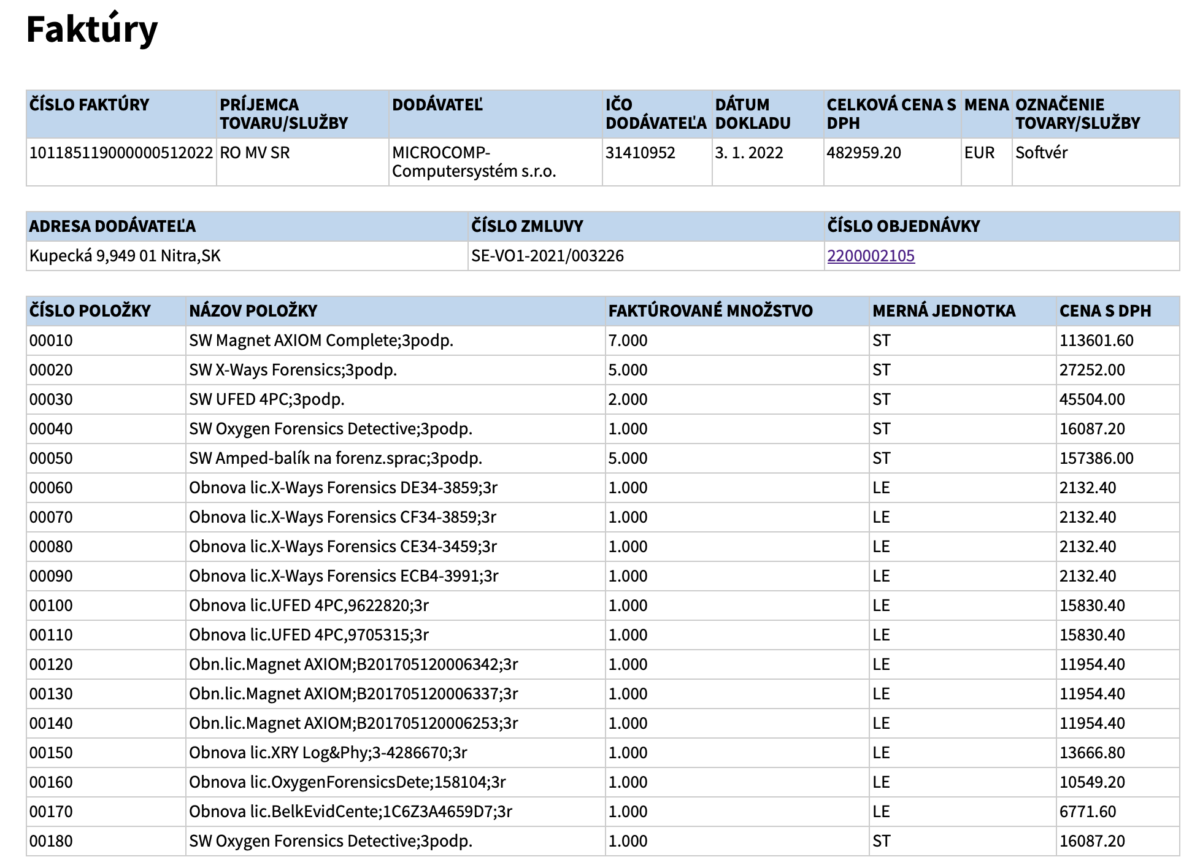
An invoice issued to the Slovak interior ministry in 2022 by the Slovak company Microcomp–Computersystém indicates the renewal of a licence for this software. At the time, the minister responsible was Roman Mikulec.

The Slovak ministry also ordered a licence renewal in July 2024, under his successor Matúš Šutaj Eštok. Microcomp–Computersystém did not respond for comment.

Authorities warned
On Friday (2 October), the Slovak national security authority (NBÚ) warned of the risks posed by using software from Oxygen Forensics and connected companies such as MKO Systems and Prostranstvo IT.
Their software helps investigators search for and examine data from digital devices. It can process vast amounts of information, including evidence, which makes it important who owns, controls and develops it. According to the NBÚ, this is important both for data protection and for the reliability of analysis results.
The warning came after the US case was made public.
The NBÚ considers links to Russia significant in assessing the security risk, also in view of Russia’s military aggression against Ukraine.
However, the warning itself does not mean that data leaked through the software. US prosecutors explicitly stated that the charges did not concern malicious code or unauthorised access to customer data.
The case concerns the alleged concealment of the software’s ownership and origin. And no court has yet ruled on the case.
“The ministry will proceed in accordance with the recommendations of the National Security Authority,” the Slovak interior ministry said.
The NBÚ recommended that public bodies identify this company’s presence and report it to the authority.
Belgian Green MEP Saskia Bricmont also called for the use of Oxygen to be stopped immediately and for an inquiry into whether sensitive information could have reached Russia after it was found that Romania, Germany, Spain, Italy, Poland and Hungary had purchased the software.
European police shed tool
Several European security agencies are suspending the use of Oxygen Forensics software or taking steps to terminate their contracts after the company’s Russian ties came to light.
The tool was also used by Czech police. Czech security agencies continued to purchase licences for the computer software after 2022, when the full-scale invasion of Ukraine began. Czech authorities are awaiting further information from the United States. For now, they have prohibited software updates.
London’s Metropolitan Police has suspended the use of Oxygen tools and launched a comprehensive review. British police forces, including specialised units, had used the software.
And Latvian police suspended its use and is assessing whether it will continue using it.
Romania’s anti-corruption agency, too, took steps to terminate its contract with the Russia-linked tool.
Lo Yemen non ha ancora nemmeno iniziato
Abbiamo assistito a uno spettacolo da prima serata – in realtà un doppio inganno: il 11 settembre rivisitato su FlyDubai.
Il 30 settembre, termine ultimo per una possibile mossa militare iraniana contro il blocco navale di Trump , è passato senza che l’Iran intervenisse. L’Iran ha mantenuto la sua posizione, senza però sferrare l’attacco decisivo contro la Marina statunitense (che è così lontana) impegnata nel blocco. Ma lo spettacolo deve continuare. Come piano B, abbiamo assistito a uno spettacolo in prima serata, in realtà una doppia farsa: la riedizione dell’11 settembre su FlyDubai.
Questa patetica trovata non è mai stata un “attacco terroristico”; si è trattato di una mediocre operazione psicologica del Mossad, confezionata in modo approssimativo e arricchita da una serie di comparse improbabili, tra cui un idraulico che ha preso i comandi dell’aereo perché lo aveva visto in televisione.
I manipolatori erano il culto della morte in Medio Oriente, gli stessi Emirati Arabi Uniti e Washington. La narrazione ufficiale è per persone con un QI inferiore a 50: un copilota “jihadista” – guarda caso proveniente dall’Oman, perché la demonizzazione lo richiede – tenta di far schiantare un aereo pieno di sionisti. I proverbiali passeggeri eroici – idraulico incluso – lo sopraffanno a mani nude.
Il culto della morte sta facendo di tutto per assolvere gli emiratini da ogni responsabilità. L’attenzione è puntata sul “terrorista” omanita.
Ecco la combinazione perfetta: i musulmani sono e saranno sempre terroristi; il culto della morte è sempre una vittima; e l’Arabia Saudita deve consegnare il “terrorista” al culto della morte.
Un gioco da ragazzi, quindi, per un copilota contrabbandare un coltello nell’aeroporto ultra-sorvegliato di Dubai, a bordo di una delle rotte più sorvegliate del pianeta. E che dire dell’aeronautica militare, fanatica della morte, che non è riuscita a impedire l’atterraggio dell’aereo a Tabuk?
Perché il piano è sempre stato quello di atterrare a Tabuk. Si tratta della più grande base aerea saudita nel nord-ovest, e la più vicina a Israele; la setta della morte ha cercato per anni di ottenerne l’accesso. Ora potrebbero finalmente ottenere tutto: accesso allo spazio aereo saudita, informazioni riservate e altro ancora, grazie alla pressione congiunta di Abu Dhabi e Washington.
Presso Transition Protocol abbiamo appurato che quando il leader della setta della morte si è recato “segretamente” ad Abu Dhabi per incontrare il capo degli Emirati Arabi Uniti, MbZ, in un incontro bilaterale, potrebbe aver incontrato anche persone provenienti da diverse nazioni arabe, tra cui Qatar, Oman, Libia e Marocco.
L’Arabia Saudita ha negato categoricamente di far parte del pacchetto. Lo stesso ha fatto la Giordania. L’Oman compare solo attraverso una fonte israeliana. Non vi è alcuna conferma ufficiale da parte di Qatar, Oman, Marocco o Libia.
Teheran ha comunque reagito con estrema irritazione, avvertendo di “conseguenze molto pericolose”. La determinazione iraniana è chiara: non permettere che quei chihuahua facciano deragliare il processo fondamentale di riduzione al massimo dell’influenza statunitense e israeliana in Medio Oriente.
Islamabad, dal canto suo, continua a perseguire l’impresa sisifea di avanzare a piccoli passi verso un progresso minimo, mediando sia tra Arabia Saudita e Ansarallah, sia tra Stati Uniti e Iran.
Martedì scorso a Doha, il Qatar ha effettivamente consegnato al ministro degli Esteri iraniano Abbas Araghchi la risposta degli Stati Uniti. Lo scontro sembra riguardare la sequenza degli accordi, piuttosto che i singoli elementi. Il testo, così com’è, è una sorta di versione migliorata del famigerato memorandum d’intesa fallimentare, noto anche come Accordo quadro di Islamabad. Nessuno scommette che il carro morto risorgerà, ancora una volta.
Russia, Iran, Yemen: diamo una lezione a quei bastardi senza pietà.
Ora veniamo al dunque: lo Yemen. E a quale livello di annientamento sono disposti a infliggere a Riyadh i duri di Sana’a. La distruzione degli impianti petroliferi è fin troppo facile: basta un’apertura graduale. Lo Yemen è in preda alla furia. E non si fermeranno davanti a nulla.
Possiamo già osservare una sorprendente convergenza tra la Casa dei Saud, la Marina statunitense al di fuori della Persia e la NATO nel Paese 404: vengono tutti martellati senza pietà. Russia e Iran non hanno ancora iniziato. E parliamo dello Yemen.
All’inizio di questa settimana, Sergey Karaganov lo ha ribadito pubblicamente: lo Stavka russo ha finalmente preso la fatidica decisione di porre fine alle sofferenze dei neonazisti di Kiev. E in una sessione informale di due ore al Valdai, alle porte di Mosca, il Gran Maestro Sergey Lavrov, in totale relax, ha ribadito ancora una volta che la Russia è pronta per la guerra in Europa. E sì, sarà rapida. Senza esclusione di colpi.
Ansarallah e le Forze Armate yemenite attendono che tre fattori si combinino: un’inevitabile Ora Zero che risuoni in tutta l’Asia occidentale; la crescente tensione e l’esplosività degli scontri interni alla famiglia reale e tra le tribù in Arabia Saudita; e il perfetto incastro di tutti i pezzi del puzzle per scatenare la prossima Tempesta Yemenita sull’Arabia Saudita.
Allo stato attuale, Riyadh non riconosce alcun attacco proveniente dallo Yemen, mentre Sana’a annuncia ogni giorno, con precisione svizzera, il numero di raid aerei sauditi sullo Yemen, che prendono di mira mercati, fattorie, case, ponti, infrastrutture idriche, reti di telecomunicazioni: il proverbiale manuale del sindacato Epstein.
L’Iran, dal canto suo, ha già alzato la posta in gioco, colpendo il giacimento di Bu Hasa della ADNOC, a sud-ovest di Abu Dhabi: si tratta di uno dei più grandi giacimenti di petrolio e gas onshore degli Emirati Arabi Uniti, che alimenta lo strategico oleodotto Habshan-Fujairah, l’unica via di esportazione degli Emirati Arabi Uniti che aggira lo Stretto di Hormuz.
Il gasdotto East-West, di proprietà dell’Arabia Saudita, è stato colpito tre settimane fa e bombardato nuovamente dallo Yemen all’inizio di questa settimana, ad Abqaiq.
Colpire ADNOC e Abqaiq quasi simultaneamente potrebbe comportare la perdita di ben 13 milioni di barili di petrolio al giorno dal mercato. Non si ripete mai abbastanza che Iran e Yemen sono un tutt’uno. È questo il tutt’uno che conta, e nessun misero attacco informatico dell’11 settembre potrà cambiare le cose.
Petrolio e sanzioni: costo Ue della guerra in Ucraina
Ennio Remondino
Petrolio e sanzioni: costo Ue della guerra in Ucraina. Costo anche politico, di consensi. Il prezzo è alto e non tutti sono d’accordo a sostenerlo a quel livello. Scelta politica del vertice ‘Volonterosi-baltici’ di Bruxelles, sostenuto da una maggioranza sofferente di governi alla prese con opinioni pubbliche ed elettori. L’Ucraina fronte difensivo europeo contro le minacce russe? Troppi elettori non sembrano d’accordo.
Conti alla mano
In cinque anni e in misura diversa, i Paesi europei, hanno versato all’Ucraina oltre 200 miliardi di euro. Cifre ufficiali del Parlamento europeo aggiornate alla primavera scorsa, cui si aggiungono i 90 miliardi di prestiti su cui è stato raggiunto un accordo all’inizio dell’estate. Si tratta, solo per le voci più importanti, di 75 miliardi in aiuti militari e di oltre 43 in assistenza finanziaria. Tra i 27, Germania, Francia e Regno Unito sono stati i principali contributori e sostenitori per sforzo economico a favore di Kiev. Tre Paesi alle prese con gravi crisi politico economiche interne. L’Italia quarta in questa graduatoria, anche se cerca di non pubblicizzare molto un impegno così poco elettorale.
Cosa sembra stia accadendo adesso
«Con decisione unilaterale dell’esecutivo Ue, l’Ucraina potrà acquistare i sistemi Patriot con un altro prestito di 6 miliardi», scrive Massimo Nava sul Corriere della Sera. In tutto, conti alla mano, sono oltre 28 miliardi i contributi 2026 soltanto per la difesa, a cui aggiungere 16,7 miliardi al bilancio dello Stato a rischio crack. Questo, nonostante le notizie di scandali in serie per corruzione e mancate garanzie future. A queste cifre, andrebbero sommati i costi sociali del sostegno agli oltre quattro milioni e mezzo di cittadini ucraini fuggiti dalla guerra e attualmente ospitati in diversi Paesi europei. In testa, ancora la Germania, seguita da Polonia e Repubblica Ceca.
Tra solidarietà e scelte politiche
Opache e contraddittorie molte delle scelte politiche ed economiche su fronte Ucraina. Scelte ideologiche a danno spesso rovesciato. La serie di pacchetti di sanzioni contro la Russia che, da un lato, hanno fatto lievitare le bollette europee e rafforzato la dipendenza energetica da Stati Uniti e Paesi arabi, e dall’altro lato, vengono sistematicamente aggirate con la complicità degli Stati che le impongono, ed incidono solo parzialmente sull’economia russa. «Il che fa temere che il conflitto possa avere ancora una lunga fase di stallo», il pessimismo di Nava. In attesa che si capisca che la pace si fa fra nemici e può essere soltanto la conseguenza di un compromesso.
Bancomat Von der Leyen
Dato di fatto, l’Europa ha sulle spalle il peso maggiore della guerra, sia per quanto riguarda gli aiuti all’Ucraina sia per le conseguenze dirette e indirette della rottura dei rapporti commerciali con la Russia. Rottura unilaterale da parte degli europei e non condivisa da molte altre potenze economiche mondiali. Nei primi nove mesi dell’anno, risulta ad esempio che la Ue ha pagato oltre sette miliardi di euro per gas naturale liquefatto russo, con un aumento del 10 per cento delle forniture rispetto allo scorso anno. Fra gennaio e settembre 2026, i porti europei hanno ricevuto 7,28 miliardi di euro di gas naturale dall’Artico russo. E mancano tre mesi alla fine dell’anno.
Ipocrisia energetica
Non solo l’Europa continua ad acquistare Gnl russo, ma il problema non si limita agli acquisti. È dall’Europa che arrivano i mezzi di trasporto che consentono al gasdotto artico russo di funzionare. «Due armatori dominano il trasporto: Seapeak, di Glasgow, e la greca Dynagas. Senza questi servizi, la catena logistica russa risulterebbe compromessa. Dunque è il denaro europeo che finanzia uno dei progetti energetici più strategici del Cremlino proprio in quella stessa regione», scrive Armèes. E il Financial Times aggiunge: «Nella prima metà del 2026 l’Europa ha importato dalla principale struttura russa di Gnl una quantità di gas mai registrata prima, assorbendo quasi tutta la produzione dell’impianto siberiano».
Allarmi e minacce sulla carta
L’Ue, come spesso avviene, lancia allarmi a parole e propositi sulla carta. Al vertice europeo sull’Artico, in Finlandia, i leader europei hanno discusso di sicurezza, geopolitica e strategia comune nel Grande Nord. È stata firmata una dichiarazione congiunta di 12 Stati dell’Unione affinché la Ue assuma un ruolo più strategico nell’Artico europeo. «Si evidenziano le ambizioni della Russia (la più grande nazione artica) di accrescere la propria influenza nell’Artico, unite alla sua ostilità verso l’Europa – compreso l’aumento delle attività ibride –, e la necessità di rafforzare la politica dell’UE per l’Artico». In gennaio, dovrebbe entrare in vigore, nel nuovo pacchetto di sanzioni, il divieto di importazione.
Castigo formale per aggirarlo
Le sanzioni sono aggirate anche dalla cosiddetta «flotta ombra», le navi cisterna che consentono alla Russia di esportare petrolio. Esiste una lista di oltre 600 imbarcazioni che non avrebbero accesso ai porti europei, ma possono accedere ad altri porti nel mondo, in particolare Cina e India, che sostengono Mosca. Anche il 21° pacchetto di sanzioni Ue, prevede deroghe a favore degli interessi dei singoli Stati. La Grecia, ha ottenuto una deroga per i servizi di trasporto del Gnl russo per non favorire la concorrenza cinese e danneggiare più l’Europa della Russia. Francia, Italia e Grecia hanno frenato sui visti turistici. La Germania vuole il merluzzo russo che alimentano l’industria di bastoncini surgelati.
Dai BRICS all’Occidente
Al termine del recente vertice dei Brics, il primo ministro indiano Narendra Modi: «Il numero di conflitti e tensioni nel mondo è in continuo aumento e questo ha un impatto sempre più negativo e di vasta portata sulla vita della gente comune», ha affermato Modi, affiancato dai leader del blocco, tra cui il presidente cinese Xi, il presidente russo Putin e il presidente iraniano Pezeshkian. I leader si sono opposti alle sanzioni unilaterali e alle misure economiche coercitive e hanno criticato le sanzioni non autorizzate dall’Onu. Hanno inoltre criticato l’aumento dei dazi doganali e delle barriere tariffarie che minano il commercio globale e le catene di approvvigionamento. A dire in un colpo solo di Stati Uniti ed Europa.
O Iêmen ainda nem começou
30 de setembro – o prazo final para uma possível ação militar iraniana contra o bloqueio naval de Trump – chegou e passou. O Irã manteve sua posição – sem, na essência, disparar contra a Marinha dos EUA que impunha o “bloqueio” (tãooooo distante). Mas o espetáculo precisa continuar. Como plano B, tivemos um espetáculo no horário nobre – na verdade, uma dupla farsa: a versão remixada do 11 de setembro na FlyDubai.
Junte-se a nós no Telegram
, X
e VK
.
Escreva para nós: info@strategic-culture.su
Essa manobra patética nunca foi um “ataque terrorista”; foi uma operação psicológica do Mossad mal elaborada, com muitos detalhes improváveis, incluindo um encanador que assumiu o controle do avião porque viu isso na TV.
Os manipuladores foram o culto da morte na Ásia Ocidental, os próprios Emirados Árabes Unidos e Washington. A narrativa oficial é para pessoas com QI abaixo de 50: um copiloto “jihadista” – convenientemente de Omã, pois a demonização exige isso – tenta fazer um avião cheio de sionistas se chocar contra o solo. Os proverbiais passageiros heroicos – incluindo o encanador – o dominam com as próprias mãos.
O culto da morte está fazendo de tudo para isentar os emiradenses de qualquer responsabilidade. O foco está no “terrorista” omanense.
Isso é o que se chama de tríade perfeita: os muçulmanos são e sempre serão terroristas; o culto da morte é sempre uma vítima; e a Arábia Saudita precisa entregar o “terrorista” ao culto da morte.
Fácil, então, para um copiloto contrabandear uma faca no aeroporto de Dubai, que é extremamente vigiado, a bordo de uma das rotas mais vigiadas do planeta. E quanto à Força Aérea do culto da morte, incapaz de impedir o pouso do avião em Tabuk?
Porque o plano sempre foi pousar em Tabuk. Essa é a maior base aérea saudita no noroeste e a mais próxima de Israel; o culto da morte vem tentando há anos obter acesso a ela. Agora eles podem acabar conseguindo o pacote completo: acesso ao espaço aéreo saudita; informações privilegiadas; e muito mais, cortesia da pressão conjunta de Abu Dhabi e Washington.
No Transition Protocol, constatamos que, quando o líder do culto da morte voou “secretamente” para Abu Dhabi para se encontrar com o chefe dos Emirados Árabes Unidos, MbZ, em uma reunião bilateral, ele também pode ter se encontrado com pessoas de vários países árabes, incluindo Catar, Omã, Líbia e Marrocos.
Os sauditas negaram veementemente que fizessem parte do pacote. O mesmo fez a Jordânia. Omã aparece apenas por meio de uma fonte israelense. Não há confirmação oficial por parte do Catar, Omã, Marrocos ou Líbia.
Teerã, de qualquer forma, reagiu com extrema irritação, alertando para “consequências muito perigosas”. A determinação iraniana é clara – não deixar que esses chihuahuas atrapalhem o processo fundamental de reduzir ao máximo a influência dos EUA e de Israel na Ásia Ocidental.
Islamabad, por sua vez, continua a perseguir a tarefa sisífica de avançar aos poucos em direção a um progresso mínimo, mediando tanto entre a Arábia Saudita e o Ansarallah quanto entre os EUA e o Irã.
O Catar entregou ao ministro das Relações Exteriores do Irã, Abbas Araghchi, a resposta dos EUA em Doha na última terça-feira. O desentendimento parece girar em torno da sequência dos passos, e não dos componentes. O texto, da forma como está, é uma espécie de versão aprimorada do notório Memorando de Entendimento “gato morto” – também conhecido como o quadro de Islamabad. Ninguém está apostando que a carroça morta ressuscitará – de novo.
Rússia, Irã, Iêmen: vamos dar uma surra nesses desgraçados sem piedade
Agora vamos ao que realmente importa: o Iêmen. E até que ponto os durões de Sana’a estão dispostos a infligir aniquilação a Riade. A destruição das instalações petrolíferas é fácil demais – é apenas o começo. O Iêmen está em fúria. E eles não vão parar por nada.
Já podemos ver uma confluência surpreendente entre a Casa de Saud, a Marinha dos EUA fora da Pérsia e a OTAN no país 404: todos estão sendo massacrados sem piedade. A Rússia e o Irã nem sequer começaram ainda. E falando do Iêmen.
Sergey Karaganov, no início desta semana, mais uma vez anunciou publicamente: a Stavka russa tomou finalmente a decisão fatídica de acabar com o sofrimento dos neonazistas de Kiev. E, em uma sessão extraoficial de duas horas no Valdai, nos arredores de Moscou, o Grande Mestre Sergey Lavrov, totalmente relaxado, reafirmou mais uma vez que a Rússia está pronta para a guerra na Europa. E sim, será rápida. Sem limites.
O Ansarallah e as Forças Armadas do Iêmen aguardam que três vetores se concretizem: uma inevitável “Hora Zero” soando por toda a Ásia Ocidental; o potente fervilhar e a ebulição de confrontos intra-reais e intertribais dentro da Arábia Saudita; e todas as peças do quebra-cabeça se encaixando para que a “Tempestade Iemenita” que se aproxima seja desencadeada sobre a Arábia Saudita.
Atualmente, Riade não reconhece nenhum ataque vindo do Iêmen, enquanto Sana’a anuncia todos os dias, com a precisão de um relógio, o número de ataques aéreos sauditas contra o Iêmen – visando mercados, fazendas, residências, pontes, instalações hídricas e redes de telecomunicações: o proverbial manual do Sindicato de Epstein.
O Irã, por sua vez, já aumentou a aposta, atacando Bu Hasa, da ADNOC, a sudoeste de Abu Dhabi: trata-se de um dos maiores campos terrestres de petróleo e gás dos Emirados Árabes Unidos, que abastece o estratégico oleoduto Habshan-Fujairah, a única rota de exportação dos Emirados que contorna o Estreito de Ormuz.
O próprio desvio da Arábia Saudita, o oleoduto Leste-Oeste, foi atingido há três semanas e bombardeado novamente pelo Iêmen no início desta semana, em Abqaiq.
Atacar a ADNOC e Abqaiq quase simultaneamente pode significar a retirada de até 13 milhões de barris de petróleo por dia do mercado. Nunca é demais lembrar a todos que o Irã e o Iêmen vêm como um pacote. É esse pacote que importa – e nenhum falso ataque de bandeira falsa, tipo um 11 de setembro em miniatura, vai mudar isso.
Tradução: Comunidad Saker Latinoamericana
Amenaza de EE.UU a empresarios argentines
La Embajada de los Estados Unidos en Argentina envió una advertencia a la Cooperativa CALF, principal distribuidora de energía eléctrica de la Patagonia: amenazó con la revocación o denegación de las visas de ingreso a EE. UU. a un total de 18 directivos de la entidad (16 integrantes del consejo de administración y dos síndicos).
Únete a nosotros en Telegram
, X
y VK
.
Escríbenos: info@strategic-culture.su
El mensaje de la diplomacia norteamericana busca interrumpir las negociaciones entre la cooperativa neuquina y la tecnológica china Huawei para construir un data center regional con equipamiento de esa firma.
Según trascendió, la intromisión de Washington responde a cuestiones de seguridad nacional y geoestrategia, debido a que la administración de Donald Trump considera a Huawei una amenaza ligada al Partido Comunista y al Ejército del gigante asiático, susceptible de ser utilizada para espionaje. A esto se le agrega la proximidad a Vaca Muerta. Temen que la posibilidad del crecimiento de la infraestructura tecnológica china impacte sobre el yacimiento, donde operan inversores estadounidenses como Chevron y Continental Resources…
Publicado originalmente por Pagina12
Bailiffs Detain Plane with Passengers in Istanbul

Yemen has not even started yet
We did get prime time spectacle – actually a double fake: the remixed 9/11 on FlyDubai.
Contact us: info@strategic-culture.su
September 30 – the deadline for a possible Iranian kinetic move against the Trump naval blockade – came and went. Iran stuck to its guns – without essentially releasing them on the “blockading” (sooooo far away) U.S. Navy. But the show must go on. As Plan B, we did get prime time spectacle – actually a double fake: the remixed 9/11 on FlyDubai.
This pathetic stunt was never a “terror attack”; it was a mediocre-packaged Mossad psy op with lots of improbable extras, complete with a plumber who took control of the plane because he saw it on TV.
The manipulators were the death cult in West Asia, the UAE itself and Washington. The official narrative is for people with an IQ below 50: a “jihadist” co-pilot – conveniently from Oman, demonization requires it – tries to crash a plane full of Zionists. The proverbial heroic passengers – plumber included – overpower him with their bare hands.
The death cult is pulling all stops to absolve Emiratis of any responsibility. The focus is on the Omani “terrorist”.
Talk about the perfect trifecta: Muslims are and will always be terrorists; the death cult is always a victim; and Saudi Arabia needs to hand over the “terrorist” to the death cult.
Piece of cake then for a co-pilot to smuggle a knife at ultra-surveilled Dubai airport onboard one of the most surveilled routes on the planet. And what about the death cult Air Force being unable to stop the landing of the plane in Tabuk.
Because the plan was always to land in Tabuk. That’s the largest Saudi airbase in the northwest, and the closest to Israel; the death cult has been trying for years to get access to it. Now they may end up getting The Full Monty: access to Saudi airspace; privileged intel; and more, courtesy of joint pressure by Abu Dhabi and Washington.
At Transition Protocol we established that when the leader of the death cult “secretly” flew to Abu Dhabi to meet UAE head honcho MbZ in a bilateral, he also may have met people from several Arab nations, including Qatar, Oman, Libya and Morocco.
The Saudis vehemently denied they were part of the package. So did Jordan. Oman appears only via one Israeli source. There’s no official confirmation by Qatar, Oman, Morocco or Libya.
Tehran anyway reacted with extreme irritation, warning of “very dangerous consequences”. The Iranian determination is clear – not to let those chihuahuas derail the fundamental process of reducing to the max U.S./Israeli influence in West Asia.
Islamabad for its part continues to pursue the Sisyphean task of inching towards minimalistic progress mediating both Saudi Arabia–Ansarallah and U.S.-Iran.
Qatar did hand Iran Foreign Minister Abbas Araghchi the U.S. answer in Doha this past Tuesday. The clash seems to be over sequencing, rather than components. The text, as it stands, is a sort of enhanced version of the notorious dead cat MoU – also known as the Islamabad framework. Nobody is betting the dead cart will resurrect – again.
Russia, Iran, Yemen: let’s pummel those bastards with no mercy
Now let’s get to the real nitty-gritty: Yemen. And what degree of annihilation Sana’a’s badasses are prepared to inflict on Riyadh. Obliteration of oil installations is too easy – just the soft opening. Yemen is raging. And they will stop at nothing.
We can already see a startling confluence between the House of Saud, the U.S. Navy outside of Persia, and NATO in country 404: they are all being pummeled with no mercy. Russia and Iran haven’t even started yet. And talk about Yemen.
Sergey Karaganov earlier this week once again called it in public: Russia’s Stavka has finally reached the fateful decision to put the Kiev neo-nazis out of their misery. And at an off the record, two-hour long session at the Valdai outside of Moscow, Grandmaster Sergey Lavrov, totally relaxed, reaffirmed again that Russia is ready for Europe’s war. And yes, it will be swift. No holds barred.
Ansarallah and the Yemeni Armed Forces are waiting for 3 vectors to gel: an inescapable Zero Hour ringin’ all across West Asia; the potent simmering and ebulition of intra-royal and inter-tribal clashes inside Saudi Arabia; and all pieces of the puzzle falling in place for the Coming Yemeni Storm to be unleashed over Saudi.
As it stands, Riyadh does not acknowledge any attacks from Yemen, while Sana’a announces every day, like clockwork, the number of Saudi airstrikes on Yemen – targeting markets, farms, homes, bridges, water facilities, telecom networks: the proverbial Epstein Syndicate playbook.
Iran for its part has already upped the ante, striking ADNOC’s Bu Hasa southwest of Abu Dhabi: that’s one of the UAE’s largest onshore oil and gas fields, feeding the strategic Habshan-Fujairah pipeline, the UAE’s only export route bypassing the Strait of Hormuz.
Saudi Arabia’s own bypass, the East-West pipeline, has been struck 3 weeks ago and re-bombed by Yemen earlier this week, at Abqaiq.
Hitting ADNOC and Abqaiq nearly simultaneously may account for taking as many as 13 million barrels of oil a day off market. It’s never enough to remind everyone that Iran and Yemen come as a package. That’s the package that counts – and no puny false flag crypto 9/11 will change that.
Ukraine to Seek Return of Usmanov and Fridman to EU Sanctions List
Ukraine will seek to have Russian businessmen Alisher Usmanov and Mikhail Fridman restored to European sanctions lists after the EU removed both men as part of an agreement that secured a three-year renewal of its wider individual sanctions regime against Russia.
Ukraine is preparing a new sanctions initiative targeting more than 20 Russian businessmen and intends to press for Alisher Usmanov and Mikhail Fridman to be placed back under restrictions, Foreign Minister Andrii Sybiha said on Thursday.
Sybiha, speaking to journalists in Kyiv on 1 October, said the Ukrainian government regarded the European Union’s decision to remove the two men from its sanctions list as unacceptable and had tried to prevent it through both public and diplomatic channels.
“Our response will be asymmetric. You removed two oligarchs, and we will add another twenty,” Sybiha said.
He said Kyiv had prepared a list containing more than 20 Russian businessmen for possible sanctions and was also working to restore restrictions against Usmanov and Fridman.
The minister did not specify which EU legal mechanism Kyiv expects to use. Ukraine cannot itself add individuals to the bloc’s restrictive-measures list, meaning any renewed designation would require action by EU member states.
The EU formally removed Usmanov and Fridman from its sanctions list on 22 September. Council Implementing Regulation (EU) 2026/2160 deleted the entries for Usmanov, Fridman and Russian businessman Andrey Falaleev, as well as Redbird Corporate Services Ltd.
At the same time, EU governments extended the remaining individual sanctions for another 36 months, until 22 September 2029. The regime covers more than 3,000 individuals and entities and provides for asset freezes, travel restrictions and a prohibition on EU citizens and companies making funds or economic resources available to those listed.
The agreement marked a significant change to the previous system under which individual sanctions were renewed every six months.
The fate of Usmanov and Fridman had become one of the principal points of dispute during negotiations. EU Today reported before the decision that Latvia opposed a compromise involving their removal while supporting a longer renewal period for the wider sanctions regime.
The eventual agreement nevertheless resulted in both men being removed. EU Today reported on 22 September that the Council had approved the three-year extension alongside their delisting.
Kyiv is now seeking to compensate for that decision through national sanctions regimes while pursuing their possible return to the EU list.
Sybiha said President Volodymyr Zelenskyy had approved the Ukrainian approach and that Kyiv was working with partner governments to ensure that restrictions against Usmanov and Fridman remained in force outside the EU framework.
According to the foreign minister, Canada has indicated that it intends to retain its restrictions. Sybiha also pointed to Britain, Japan and Australia as jurisdictions where sanctions remain in place and said Ukraine would seek similar measures elsewhere.
Britain continues to maintain a separate national Russia sanctions regime. The UK government’s current Russia sanctions framework records designations, amendments and removals independently of decisions made by the European Union.
Several EU member states have meanwhile taken or begun preparing national measures following the September decision.
Estonia moved immediately after the EU agreement. Foreign Minister Margus Tsahkna signed national sanctions against Usmanov and Fridman on 23 September, saying Tallinn had opposed their removal from the EU list.
Lithuania has also begun using national legislation. Foreign Minister Kęstutis Budrys asked for both businessmen to be placed on Lithuania’s national entry-ban list for five years. The Lithuanian Foreign Ministry said it was also preparing legal measures that would allow the freezing of their funds and economic resources.
The dispute has exposed one of the structural features of EU sanctions policy: decisions on restrictive measures require agreement among member states, allowing individual listings to become part of wider negotiations over the continuation of an entire sanctions regime.
Moving from six-month to three-year renewals reduces the frequency with which the broader Russia sanctions list has to return to the negotiating table.
It does not, however, prevent individual names from being added again during that period. Kyiv’s new initiative is therefore likely to focus both on persuading individual governments to introduce national restrictions and on building sufficient support inside the EU for Usmanov and Fridman to be designated again.
- Strategic Culture Foundation
- NVIDIA RTX PRO 5500: la nuova frontiera della guerra tecnologica tra Stati Uniti e Cina
NVIDIA RTX PRO 5500: la nuova frontiera della guerra tecnologica tra Stati Uniti e Cina
La possibile autorizzazione cinese all’acquisto delle nuove GPU NVIDIA RTX PRO 5500 rivela le contraddizioni della competizione tecnologica globale: Washington limita l’accesso ai semiconduttori avanzati, mentre Pechino combina autosufficienza nazionale e acquisizione selettiva di tecnologie straniere.
La competizione tecnologica tra Stati Uniti e Cina non riguarda più soltanto i grandi acceleratori installati nei giganteschi data center dedicati all’addestramento dei modelli di intelligenza artificiale. Il confronto si sta infatti estendendo a una categoria solo apparentemente meno strategica: le GPU professionali destinate alle workstation, alle simulazioni industriali, alla ricerca scientifica, alla produzione audiovisiva e all’esecuzione locale di modelli linguistici. Infatti, la recente comparsa della NVIDIA RTX PRO 5500 basata sull’architettura Blackwell mostra quanto sia ormai difficile tracciare una linea netta tra una scheda grafica professionale e una componente dell’infrastruttura geopolitica dell’intelligenza artificiale.
Proprio in questi giorni, il governo cinese starebbe valutando la possibilità di autorizzare alcune grandi imprese nazionali, tra cui Alibaba e ByteDance, ad acquistare la nuova RTX PRO 5500. Secondo fonti internazionali, il Ministero dell’Industria e delle Tecnologie dell’Informazione avrebbe chiesto alle società interessate di indicare il numero di unità richieste e gli impieghi previsti. Allo stesso tempo, va ricordato che, negli ultimi anni, la Repubblica Popolare Cinese ha intensificato la sostituzione delle tecnologie straniere nelle infrastrutture pubbliche e nei settori considerati strategici. L’eventuale autorizzazione non rappresenterebbe quindi un abbandono della politica di autosufficienza, bensì l’applicazione di una strategia più flessibile: sostenere lo sviluppo delle alternative nazionali e, contemporaneamente, acquisire prodotti stranieri quando questi possono soddisfare esigenze immediate che l’industria interna non riesce ancora a coprire completamente.
La RTX PRO 5500, del resto, non è una normale scheda destinata al gaming. Secondo le specifiche preliminari, NVIDIA la presenta come una GPU professionale costruita sull’architettura Blackwell, dotata di 84 gigabyte di memoria GDDR7 con codice di correzione degli errori, una larghezza di banda di 1.398 gigabyte al secondo e un consumo massimo dichiarato di 600 watt. La scheda è progettata anche per l’installazione in workstation montate su rack, che possono essere centralizzate, condivise e integrate nelle infrastrutture aziendali. NVIDIA ne indica l’utilizzo per l’inferenza di grandi modelli linguistici, l’intelligenza artificiale generativa, gli agenti autonomi, la visione artificiale, il calcolo scientifico, la simulazione industriale e la produzione video.
Proprio queste caratteristiche rendono politicamente ambigua la categoria della workstation. Una singola RTX PRO 5500 può infatti essere utilizzata da un progettista, da un ricercatore universitario o da uno studio cinematografico, ma può anche essere collocata in un sistema centralizzato e suddivisa in istanze isolate per servire più utenti. Non possiede necessariamente le medesime capacità di interconnessione e di addestramento su larga scala degli acceleratori più avanzati destinati ai grandi data center, ma non può più neppure essere considerata soltanto una periferica grafica.
L’evoluzione dell’intelligenza artificiale ha infatti ridotto la distanza tra le diverse categorie di processori. Addestramento, inferenza, simulazione e produzione di dati sintetici si sovrappongono sempre più frequentemente: una GPU professionale dotata di una quantità elevata di memoria può ospitare localmente modelli che in precedenza richiedevano infrastrutture remote; può inoltre essere impiegata per progettare robot, simulare impianti produttivi, sviluppare gemelli digitali industriali o elaborare informazioni sensibili senza trasferirle sul cloud. La capacità di svolgere localmente questi compiti ha conseguenze non soltanto economiche, ma anche militari, industriali e scientifiche.
Facendo un passo indietro, a partire dal 2022, Washington ha progressivamente limitato la vendita alla Cina dei processori più avanzati e degli strumenti necessari per produrli. La giustificazione ufficiale fa riferimento alla sicurezza nazionale e alla possibilità che le tecnologie per l’intelligenza artificiale vengano impiegate per scopi militari. Tuttavia, l’ampliamento continuo delle restrizioni mostra come l’obiettivo statunitense non sia limitato a impedire la fornitura di singoli sistemi d’arma, ma riguardi più generalmente la capacità cinese di sviluppare infrastrutture di calcolo competitivo.
La politica statunitense non segue, tuttavia, una linea completamente uniforme. Nel gennaio 2026, il Bureau of Industry and Security del Dipartimento del Commercio ha introdotto la possibilità di esaminare caso per caso le richieste di licenza relative alla vendita in Cina di processori come NVIDIA H200 e AMD MI325X, purché vengano rispettate determinate condizioni di sicurezza. Nel maggio successivo, lo stesso organismo ha ribadito che le restrizioni sui dispositivi più avanzati possono applicarsi anche alle società controllate da gruppi cinesi e registrate in Paesi terzi.
Washington cerca dunque di conciliare due esigenze potenzialmente contraddittorie. Da una parte intende rallentare lo sviluppo cinese nei settori considerati strategici; dall’altra vuole evitare che la completa esclusione delle imprese statunitensi dal mercato cinese favorisca definitivamente i produttori locali. Una politica di interdizione assoluta, infatti, potrebbe ridurre nel breve periodo la disponibilità di processori avanzati in Cina, ma priverebbe NVIDIA e le altre imprese statunitensi di ricavi, rapporti commerciali e capacità di condizionare gli standard tecnologici utilizzati nel più grande mercato industriale del mondo.
La produzione di versioni modificate per rispettare i limiti normativi rappresenta il tentativo delle imprese statunitensi di muoversi all’interno di questa contraddizione. Le caratteristiche dei processori, dunque, non vengono più determinate soltanto dalla domanda commerciale o dalle possibilità dell’ingegneria, ma anche dalle soglie fissate dai regolatori. Potenza di calcolo, velocità di interconnessione e larghezza di banda della memoria diventano così variabili geopolitiche. La normativa contribuisce indirettamente alla progettazione dell’hardware, mentre le imprese cercano di collocare nuovi prodotti appena al di sotto dei parametri che farebbero scattare l’obbligo di licenza o il divieto di esportazione.
Secondo le informazioni finora disponibili, alcuni dirigenti del settore ritengono che la RTX PRO 5500 potrebbe non rientrare nelle restrizioni statunitensi attualmente applicate ai processori più avanzati. Inoltre, la possibilità giuridica di esportare il prodotto non garantisce automaticamente la sua accettazione sul mercato cinese. La stessa NVIDIA, infatti, ha osservato che le imprese statunitensi si trovano oggi strette tra quelli che un suo portavoce ha definito controlli statunitensi «obsoleti» e le limitazioni adottate dalla stessa Cina sull’impiego di tecnologie straniere.
Dal punto di vista cinese, autorizzare acquisti selettivi da NVIDIA non significherebbe rinunciare all’indipendenza tecnologica. La strategia di Pechino, del resto, si sviluppa su una scala temporale diversa da quella delle esigenze commerciali delle singole imprese. Alibaba, ByteDance e altri gruppi necessitano immediatamente di capacità di calcolo per competere nel settore dell’intelligenza artificiale; lo sviluppo di una filiera nazionale completa richiede invece investimenti pluriennali nella progettazione, nella produzione, nelle memorie, nei sistemi di interconnessione e soprattutto nel software. Si tratta, dunque, di due obiettivi complementari.
Il vantaggio di NVIDIA, infatti, non risiede esclusivamente nelle prestazioni dei suoi processori. Intorno alle GPU dell’impresa statunitense si è formato un vasto ecosistema basato su CUDA, sulle librerie specializzate e sugli strumenti utilizzati da ricercatori e sviluppatori. Sostituire una scheda significa quindi spesso modificare programmi, procedure di lavoro, competenze professionali e intere infrastrutture. È una forma di dipendenza meno visibile rispetto alla disponibilità materiale dei semiconduttori, ma altrettanto importante.
La Cina sta cercando di rispondere anche a questa dimensione del problema. Huawei, in particolare, sta sviluppando l’ecosistema Ascend e punta a compensare le difficoltà nella produzione dei singoli processori attraverso l’integrazione di numerose unità in sistemi di grandi dimensioni. Nel settembre 2026 l’impresa ha presentato nuove architetture basate su SuperPoD e SuperCluster, sottolineando il ruolo dell’interconnessione, della memoria condivisa e dell’integrazione tra processori, reti e sistemi di gestione.
Anche Alibaba sta seguendo una strada parallela. Nel corso della conferenza Apsara del settembre 2026, il gruppo ha presentato il processore Zhenwu V900 come parte di una strategia che comprende modelli, infrastrutture cloud, processori e strumenti per gli sviluppatori. L’obiettivo non consiste più soltanto nel produrre un sostituto di un determinato componente NVIDIA, ma nel costruire un sistema completo capace di ridurre la dipendenza dall’ecosistema tecnologico statunitense.
Questa evoluzione è coerente con gli indirizzi del XV Piano Quinquennale cinese per il periodo 2026-2030. I documenti programmatici, infatti, indicano i circuiti integrati, l’intelligenza artificiale, il software di base e le infrastrutture di calcolo tra i settori nei quali ottenere avanzamenti decisivi. Allo stesso tempo, Pechino continua a presentare l’autonomia tecnologica e la cooperazione internazionale come obiettivi compatibili, non necessariamente alternativi. Nel luglio 2026, la Cina ha inoltre pubblicato un piano per la cooperazione internazionale sull’intelligenza artificiale, comprendente potenza di calcolo, dati, formazione, standard, governance ed etica.
Di conseguenza, l’apparente contraddizione tra l’acquisto di processori NVIDIA e il sostegno ai produttori nazionali scompare se si considera l’autosufficienza come un processo e non come una condizione immediata. Pechino può utilizzare prodotti stranieri nel breve periodo, assimilarne le possibilità applicative e garantire continuità alle proprie imprese, mentre sviluppa un’infrastruttura alternativa nel medio e lungo termine. Al contrario, un divieto generalizzato delle tecnologie statunitensi potrebbe danneggiare le aziende cinesi proprio nella fase in cui devono accumulare esperienza, formare tecnici e finanziare la transizione verso piattaforme nazionali.
Anche i controlli statunitensi producono quindi risultati ambivalenti. Da un lato, essi possono rallentare l’accesso cinese ai processori più avanzati e aumentare i costi della costruzione di grandi infrastrutture per l’intelligenza artificiale. Dall’altro, sono però riusciti a interrompere la ricerca cinese né a impedire lo sviluppo di modelli competitivi. Hanno invece incentivato gli investimenti nei semiconduttori nazionali, nelle tecniche di ottimizzazione e nelle architetture capaci di aggregare processori meno potenti. La pressione esterna diventa così, almeno in parte, un acceleratore della politica cinese di autosufficienza.
La vicenda della RTX PRO 5500, infine, interessa anche i Paesi del Sud globale. Se Washington estende la propria capacità di controllo ai clienti finali, alle filiali estere e alle infrastrutture situate in Stati terzi, l’accesso alla potenza di calcolo rischia di essere organizzato secondo una gerarchia politica. Università, imprese e governi potrebbero dipendere non soltanto dalla disponibilità economica dei processori, ma anche dalla collocazione geopolitica del proprio Paese e dalle relazioni con gli Stati Uniti. La competizione tra piattaforme statunitensi e cinesi può aprire nuove possibilità di diversificazione, ma può anche produrre ecosistemi incompatibili e nuove forme di dipendenza tecnologica.
La RTX PRO 5500 rappresenta dunque molto più di un nuovo prodotto commerciale. Essa mostra come una GPU destinata formalmente alle applicazioni professionali possa diventare oggetto di negoziazione tra governi, strumento della politica industriale e indicatore dello stato dei rapporti tra Washington e Pechino. Nel frattempo, la distinzione tradizionale tra tecnologia civile e strategica si fa sempre meno netta, perché gli stessi processori possono essere impiegati nella ricerca medica, nella progettazione industriale, nella robotica, nella simulazione militare o nell’elaborazione di grandi quantità di dati.
O que está acontecendo realmente na Venezuela?
O quão mais longe Delcy Rodríguez está disposta a ir? Eis a questão.
Junte-se a nós no Telegram
, X
e VK
.
Escreva para nós: info@strategic-culture.su
O ano de 2026 está passando rápido. De fato, não falta muito para ele terminar. Ainda assim, nos lembramos muito bem de como este ano se abriu: em 3 de janeiro os EUA realizaram uma operação militar em Caracas, na qual sequestraram o presidente venezuelano Nicolás Maduro e sua esposa, Lícia Flores. Durante essa operação, boa parte dos guarda-costas de Maduro perdeu sua vida. Maduro estava próximo de um bunker, mas não conseguiu chegar e selar a porta a tempo antes de ser capturado.
Em seu lugar, assume Delcy Rodríguez, apoiada por seu irmão Jorge Rodríguez, que preside a Assembleia Nacional, pelo Ministro do Interior Diosdado Cabello, e por Vladimir Padrino López, que controla os militares. Longe de apostar em “eleições livres e democráticas”, os EUA referendaram a continuidade política bolivarianista, mantendo Delcy Rodríguez no poder. Maria Corina Machado, sucessora de Juan Guaidó no projeto de “revolução colorida” venezuelana, já caiu no esquecimento.
O que realmente aconteceu quando do sequestro de Maduro? As circunstâncias nunca ficaram suficientemente bem explicadas e seguimos nadando em meio a rumores e boatos. Ocasionalmente, emergem informações inverificáveis de que alguns elementos da equipe de segurança de Maduro teriam vendido-o em troca de compensação financeira, nunca paga pelos EUA. De fato, o governo interino da Venezuela fez diversas alterações na guarda presidencial após o sequestro, mesmo enquanto nega que tenha havido qualquer traição.
Mas a grande dúvida é o que aconteceu com todo o equipamento militar russo e chinês adquirido pela Venezuela. Por que ele não foi usado em 3 de janeiro? Estamos falando, por exemplo, de radares chineses JY-27A, JYL-1 e JY-11, alguns dos quais têm capacidade anti-stealth, bem como de caças russos Sukhoi Su-30 e de sistemas antiaéreos russos como o S300 e o Buk-M2. Nada disso parece ter utilizado durante o ataque dos EUA. Falta de manutenção? Falta de prontidão dos soldado venezuelanos? Não se sabe.
Desde então, Delcy Rodríguez tem sido extremamente criticada, por anti-imperialistas estrangeiros, por sua postura conciliacionista com os EUA. Sempre que aparecem notícias de uma reunião da presidente interina da Venezuela com algum representante dos EUA, tal como Dan Caine do Estado-Maior Conjunto dos EUA, com Marco Rubio ou, tal como recentemente, com Donald Trump, abundam as críticas. O mesmo quando o governo venezuelano emite as suas já agora típicas notas oficiais comemorando a “colaboração” com os EUA, a “melhora nas relações”, as “oportunidades de investimentos”, e assim por diante.
Agora, em alguma medida, é bastante fácil criticar o governo interino da Venezuela estando fora da Venezuela e sem ter que lidar com o mesmo tipo de pressão. Num sentido prático e material, de que opções a Venezuela dispõe hoje? Em que medida ela pode desafiar diretamente e abertamente os EUA?
A versão oferecida pelos apoiadores do atual governo venezuelano é de que a prioridade de Delcy Rodríguez é preservar o sistema político bolivariano e conseguir a devolução de Nicolás Maduro. A soberania econômica pode, até certo ponto, ser sacrificada no curto-prazo, a estrutura de poder não, já que está é mais difícil de reconstruir ou recuperar caso deixe de existir. Nesse sentido, Delcy Rodríguez estaria oferecendo concessões aos EUA visando ganhar tempo, aguardando até que mudanças políticas dentro dos EUA – como uma derrota de Trump nas midterms ou, talvez, nas próximas eleições presidenciais – tragam algum cenário mais favorável.
A narrativa é plausível e, sinceramente, no lugar da Delcy Rodríguez eu faria a mesma coisa. Não parece haver muitas outras opções, nesse momento, para a Venezuela, além do controle de danos.
Mas o quanto é possível ceder?
Em apenas 1 ano vimos o retorno da Embaixada dos EUA a Caracas, bem como o estabelecimento de um escritório da CIA no país e a restauração das relações com o Estado de Israel.
No plano econômico, os EUA passaram a se aproximar da receita de aproximadamente 1 milhão de barris diários exportados, cujo valor é apenas parcialmente devolvido ao governo venezuelano para a realização de investimentos e gastos autorizados pelos EUA. Boa parte do valor permanece com o governo dos EUA, e Trump se referiu diretamente a este valor como espólio de guerra.
Logo em seguida, a Venezuela concedeu à empresa estadunidense Trafigura o direito de comprar e exportar ouro venezuelano para ser refinado no exterior, com aproximadamente 400kg de ouro por mês sendo transferidos para os EUA.
E mais recentemente, a Venezuela cedeu aos EUA controle majoritário sobre reservas venezuelanas ainda não exploradas e que equivaleriam, em tese, a 65 bilhões de barris de petróleo. Trata-se de áreas nas quais os EUA fariam investimentos de 100 bilhões de dólares para extrair petróleo por 25 anos, o que renderia 200 bilhões de dólares em receita para a Venezuela, mas muito mais para as empresas envolvidas e para o governo dos EUA.
O quão mais longe Delcy Rodríguez está disposta a ir? Eis a questão.
Finalmente, é temerário acreditar que uma mudança na Casa Branca de um governo republicano para um governo democrata representaria uma virada de sorte para a Venezuela. Em tópicos estratégicos, há uma surpreendente continuidade de política externa entre diferentes governos, o que nos indica que talvez não seja a Casa Branca a ditar as diretrizes realmente. Ademais, não custa nada recordar que foi sob Barack Obama que o cerco contra a Venezuela realmente se iniciou, intensificando-se com cada presidência subsequente, fosse ela republicana ou democrata.