Trump, Zelensky clash over diesel deal as Russian strikes on Ukraine kill at least 21
Science emerged in Christendom because God was transcendent, not pantheistic. Now materialism reigns as a hidden theology – Epstein-funded, preached by ambiguous atheists.
Contact us: info@strategic-culture.su
There is possibly more than one correct answer to the question of why science emerged in Western Christendom, rather than appearing first in one of the many Eastern societies with formidable technology, or within the fold of Greco-Roman paganism.
The Benedictine epistemologist Stanley Jaki offers a detailed answer that is intrinsic to Christianity: as we read in Christ and Science, the distinguishing factor is that Christians are not prone to falling into pantheism. Among Greco-Roman pagans, the cosmos was called “only-begotten” – a title later assumed by Jesus in Christianity, and only in Christianity. In the world of Aristotle, Western Christendom’s favorite pagan, bodies move of their own volition (fire seeks to rise, earth seeks to sink, etc.), and the Prime Mover is part of nature rather than transcending it. In Judaism and Islam, figures such as Spinoza (beloved in the 20th century by Einstein and Sagan, and in the 21st by Sam Harris) and Averroes (with his universal intellect) demonstrate how easily God can be conflated with nature itself. It was in medieval Christendom that the world came to be conceived as a vast clock with inanimate parts adjusted by an intelligent Creator, whose laws we must discover. This way of thinking about the universe, which we associate today with Newton, is medieval. And this worldview, specific to Christendom, is what made the invention of science possible.
Here in this SCF column, I once ventured a more modest answer of a cultural nature. I wrote that the West has been rationalist since before it was Christian; and this fosters not only the emergence of science but also the willingness to uphold it in the event of a conflict with faith. Sunnis, who constitute the majority of Muslims, saw a form of Quranic literalism put an end to the spectacular flourishing of the sciences during the Middle Ages. Jews, who devoted themselves to the exegesis of religious texts, only became scientists following emancipation and secularization. This cultural characteristic helps explain why science emerged in Western Christendom rather than in the East, given that both the Roman and Greek Churches shared the belief in the only-begotten Jesus. It also helps explain why, following the Protestant Reformation, Protestant Europe did not cling to biblical literalism or to Luther’s diatribes against reason, but instead produced science in dialogue with Catholic Europe. This ultimately shifted the locus of Truth from religion (where each group held its own version) to science (to be accepted by all), paving the way for that recent Western invention known as scientism.
Now, an idea intrinsic to Christianity that I wish to highlight is its absolute intolerance of relativism regarding knowledge. In the pagan world, philosophy and religion were disconnected matters. Plato reflected on the good, the beautiful, and the just without investigating Olympus. Cicero, as a philosopher, wrote against the public soothsayers of the Roman religion; yet, as a politician, he showed no intention of altering state religious practices or inventing secularism. Even Aristotle, who wrote on every conceivable discipline, did not write about Zeus, Hera, or Athena. He did create a “theology,” but it referred not to the gods, but rather to the Prime Mover. Zeus, Hera, and Athena were not the objects of any discipline.
It was during the Middle Ages that the Catholic Church invented the university with the aim of studying the universum – that is, everything: metaphysics, physics, politics, theology… Knowledge was organized cohesively, based on the presumption of an objective reality. Thus, physics could not teach something that contradicted theology, and vice versa. (Although the Galileo affair stemmed from the Aristotelianism embraced by the Church through Thomas Aquinas, rather than from a literal reading of the Bible.) This cohesion might seem obvious, yet today the discipline of physics claims that glass is a liquid, while the discipline of chemistry claims that glass is a solid. And that is not even the greatest problem: who would dare ask a university for an unequivocal definition of “man” or “human”? In practice, relativism reigns in the university – and did so even before the postmodernists took over everything.
This fragmentation of knowledge originated in the scientific model that emerged during the Renaissance. Outside the universities, humanists sought out ancient texts that medieval Catholics had discarded, such as De rerum natura by the materialist and Epicurean Lucretius. Since antiquity conferred authority in those days, the occult tradition formed by the fusion of Hermeticism and Kabbalah enjoyed particular credibility among the learned class. Hermeticism derives from Hermes Trismegistus, whom Renaissance thinkers believed to be the teacher of Moses, Plato, and Pythagoras, though in reality, he was a fictional figure dating from slightly after the time of Christ. An etymological trace of Hermeticism’s importance to science is the adjective “hermetic,” used by alchemists to describe their tightly sealed vessels. As for Kabbalah, it stems from a religion that predated Christianity – which is enough for it to be regarded as ancient, even though its principal text, the Zohar, originated in medieval Spain. As I have argued in greater detail here, Renaissance occultism influenced modern science and is responsible for its utilitarian bias. If individual disciplines decide that a certain concept “works,” contradictions between them pose no problem; what matters is not knowledge itself, but practical utility. It is a science inspired by the methods of the sorcerer, who consults ancient books and tests spells to see which ones work.
Thus, the status quo of knowledge within universities is one of practical relativism, resulting from the institution’s lack of a unified vision. On an individual level, however, it is humanly impossible to conduct science without a coherent worldview – even if that worldview is constructed a posteriori based on the “spells” that proved effective, much like the alchemists of the Renaissance. Today, it is quite clear that the scientific mainstream is atheist, but that tells us little. It would be more accurate to say that the mainstream is materialist.
The nineteenth century was the century in which materialism became consolidated within science. It was the century of Darwin’s triumph – Darwin being the first (and perhaps only) great scientist in history that was unequivocally atheist. Before Darwin, the prevailing worldview was the medieval one of God as the “watchmaker,” or of nature as a book written by God in the language of mathematics (to use Galileo’s metaphor). Alternative worldviews began to emerge during the Renaissance. By the Enlightenment, this movement had taken the forms of deism and materialism – concepts that are not mutually exclusive. Deism is the idea that God exists but is indifferent to humanity. This is a very vague notion, as it encompasses the possibilities that: (1) God is a distant architect (as for Voltaire, a “creationist” and admirer of Newton); (2) God is matter itself, or the universe itself (pantheism); or (3) gods exist but are made of atoms, just like the rest of nature – a view found in De Rerum Natura that results in practical atheism. Since this conception of God is psychologically difficult to sustain, it is hardly surprising that, by the nineteenth century, the public face of materialism had become that of atheism.
Even so, as I have shown here on SCF, only one of the “Four Horsemen” of New Atheism (Richard Dawkins) is unequivocally an atheist. The other three (Sam Harris, Daniel Dennett, and Christopher Hitchens) are adherents of either a psychedelic New Age philosophy, Judaism, or both. Sagan was another atheist with this ambiguous profile.
I believe, then, that it is useful to distinguish between these two opposing scientific worldviews: one, which gave rise to science, is that of the transcendent God who acts as the cosmos’s engineer; then there is the materialist view, according to which everything that exists is matter moving randomly, generating at times chaos and at others order. Within this latter framework, one can be an unequivocal atheist – like Dawkins today or Baron d’Holbach in the 18th century – or a New Age type like Sam Harris. Matter itself can also be divinized by crystal-obsessed wine moms and potheads. An ambiguous figure is none other than Epstein; this patron was a Jew religious enough to want to create a GMO kosher pig so he could eat bacon, yet he simultaneously funded Sam Harris’s atheist club. As I have shown here, Epstein was such a committed materialist that he sought to identify the specific part of the brain corresponding to the soul.
One final intrinsic trait of Christianity worth mentioning is its exotericism – that is, its public, non-initiate nature. This characteristic is reflected in universities and libraries: the entire repository of knowledge is open to anyone wishing to study. In the case of materialism, England has maintained a solid tradition of private and secretive scientific societies, often with commercial aims, dating back to the 18th-century Lunar Society. This aligns with the esotericism of the Renaissance. Furthermore, in the 21st century, the Epstein files brought to light discreet societies of materialists, such as the one involving Sam Harris that was funded by the pedophile.
Given that the pedophile also funded university research, it is plausible that this materialism – bordering on both pantheism and atheism – constitutes a hidden “theology”: one that is always presupposed in contemporary science yet never made explicit to the uninitiated.
The more technology distances the actor, the more responsibility must increase.
Contact us: info@strategic-culture.su
From person to target
What becomes of humanity when technology becomes capable of recognising, classifying, tracking and ultimately killing human beings without those carrying out the strikes ever having seen them? My friend Mohammad Reza Dehshiri asked this very question, and his answer is a powerful one. The danger, he writes, is not artificial intelligence but artificial inhumanity – that is, the possibility that machines will become more accurate precisely as humans cease to feel responsible for what those machines do in their name.
With this article, I am launching a series that takes Dehshiri’s analysis as its starting point and attempts to take it further. If the problem is ‘artificial inhumanity’, the answer cannot lie in a ‘more ethical’ AI, as if ethics were a module to be installed as an afterthought to a system that has already been designed. We need to reclaim a category that technological jargon has rendered almost unmentionable: human intelligence, understood not as a remnant to be protected amidst the complexities of automation, but as a form of knowledge with its own distinct characteristics, which no increase in computing power can replace.
I shall call it Human Intelligence, and the ambiguity is deliberate. In intelligence service jargon, HUMINT refers to the oldest of the intelligence disciplines: that which relies on people, sources, languages and the patient frequenting of places. In philosophical terminology, the expression denotes the faculty of understanding. The thesis of this first contribution is that these two meanings now converge, and that their convergence has geopolitical implications that extend far beyond the debate on the ethics of weaponry.
We can describe the operational chain of contemporary warfare in seven stages: detect, identify, classify, predict, prioritise, target, strike. Each link can be technically refined without the sequence, taken as a whole, being morally refined. The resulting phenomenon is called the ‘datafication of human life’: the individual reduced to an identity, a location, a behavioural pattern, a threat score.
This is no abstraction. In April 2024, an investigation by Yuval Abraham for +972 Magazine and Local Call described ‘Lavender’, a system used by the Israeli armed forces in Gaza to assign tens of thousands of people a probability of affiliation with armed groups. According to internal sources cited in the investigation, the human verification of each name often amounted to no more than twenty seconds – the time needed to ascertain that the target was male. The Israeli Defence Forces have disputed this account and described Lavender as a database designed to support analysts. Even if one accepts the official version, however, the crux of the matter remains: a human operator was present, and their presence was not sufficient to transform the system’s recommendation into a judgement.
Cognitive psychology has a name for this phenomenon, automation bias: the tendency of those working with an automated system to treat its recommendations as a substitute for their own verification, and to fail to seek out the information that might contradict them. Back in 1976, Joseph Weizenbaum – who had built one of the first conversational programmes in history – already distinguished between the ability to calculate and the ability to judge, and argued that there are tasks that should not be entrusted to a computer even if the computer were capable of performing them. Half a century on, this distinction has become even more pressing. Computation works on what has already been translated into data. Judgement must decide whether that translation has been faithful.
Dehshiri drives the point home with four distinctions: technical precision is not ethical precision; accuracy is not justice; automation is not responsibility; technological superiority is not moral superiority. I would add a fifth, of an epistemic nature, upon which the others depend: correlation is not understanding. A machine-learning system recognises statistical patterns in a dataset. It does not know what a school is, because it does not know what a child is, and it does not even know that it does not know this.
L’iraniano cites an interesting case study: On 28 February 2026, in the early hours of the war, the Shajareh Tayyebeh primary school in Minab, in Hormozgan province, was struck several times during school hours. The figures provided by the Iranian authorities range between 150 and 175 deaths, the vast majority of whom were girls, along with dozens of teachers and a few parents; the district prosecutor put the final death toll at 156. Washington has never directly acknowledged its responsibility nor published the findings of the Pentagon’s investigation. Amnesty International has described the incident, at best, as a serious intelligence failure.
There is one detail, revealed by satellite imagery, which shifts the analysis from the moral to the factual plane. According to Western media, the school stood next to a naval base belonging to the Revolutionary Guards and had previously formed part of it; among the explanations circulating in US circles is that of out-of-date targeting data. If this hypothesis were confirmed, Minab would not be a case of a machine making a mistake, but of a database that had ceased to correspond to reality. The building had changed. The data had not.
No classification algorithm, however sophisticated, can detect that an old military building has become a school if no one has recorded the change. Everyone living in Minab knew this: the parents who took their daughters to school every morning, the schoolbus driver, the teachers. This is precisely the kind of knowledge that HUMINT gathers and that remote warfare tends to regard as superfluous, because it is slow, costly and difficult to scale. Based on publicly available sources, US responsibility appears highly probable, whilst the exact circumstances remain unclear and confidence on this point is low: a database error, a classification error, or a conscious acceptance of the risk. The three hypotheses, however, all converge on the same question. Who, prior to the strike, checked whether there were people in that building?
Beyond ‘human-in-the-loop’
The international debate has long been content with the principle of human-in-the-loop, whereby a human being is part of the decision-making loop.
This formula is insufficient: a person may be present in the loop yet merely rubber-stamp the algorithm’s recommendation. He proposes replacing it with a more demanding principle, which he calls humanity-in-command: the effective ability to question, reject, override and halt the automated process.
The history of the Cold War offers two examples that clarify what this means in practice. On 26 September 1983, the Soviet early-warning system Oko signalled the launch of five ballistic missiles from the United States. The officer on duty, Stanislav Petrov, dismissed the alarm as a false alarm and did not report it as an ongoing attack, reasoning that a first American strike would never consist of just five missiles. He was right: the satellite had mistaken the sun’s reflection off the clouds for missile launches. Twenty-one years earlier, on 27 October 1962, in the Caribbean Sea, the Soviet submarine B-59, isolated and under fire from signal depth charges, was on the verge of launching a nuclear-tipped torpedo. The launch required the consent of the three senior officers on board, and Vasily Arkhipov refused to give it.
In neither case did the man approve a recommendation from the system. He contradicted it. And he did not do so because he had more data: indeed, the data were the problem. He did so because he knew how to ask himself a question that no procedure required him to ask, namely whether what he was seeing made sense in the context of everything else he knew about the world. Petrov was familiar with American nuclear doctrine; Archipov knew the difference between an attack and a threat. It is this ability to compare the signal with the bigger picture, the detail with what is plausible, that I call Human Intelligence. It is worth noting that the Dena was sunk by a submarine. We do not know what its officers were asked, nor what scope they had for judgement.
This proposal needs to be clarified, as there is a risk of reducing it to a generic humanistic appeal. Human Intelligence, as I understand it, is structured across three distinct levels, each of which marks a structural – rather than contingent – limit of artificial intelligence.
The first level is epistemic. The scholastic tradition distinguished between intellectus, the act by which the mind immediately grasps a truth, and ratio, the discursive process of moving from one element to another: for Thomas Aquinas (Summa Theologiae, I, q. 79, a. 8), the two are not distinct faculties but aspects of a single intellect, in which reasoning begins with an understanding and returns to an understanding. Current machine learning systems realise a ratio of unprecedented power, capable of inferring, combining and predicting on scales inaccessible to the human mind. They lack the aspect of intellectus, that is, a grasp of the meaning of what they process. This is a philosophical thesis and must be presented as such, but it has precise practical consequences: a system devoid of understanding cannot know when its own model of the world has become false.
The second aspect is practical. Prudentia, in the Thomist definition, is right reason applied to action, and its specific task consists in applying the universal principle to the particular case. The machine generalises: its value lies in mapping the individual case back to a class. Prudence does the opposite, because it must recognise what, in this particular case, falls outside the class. War, which is the realm of the singular and the unforeseen, is the arena where this difference carries the most weight. The Vatican’s Antiqua et nova note of January 2025 took up this line of thought, emphasising the embodied and relational nature of human intelligence and its irreducibility to a mere processing function.
The third level is relational, and it is here that philosophical meaning meets that of the intelligence services. Sherman Kent, who effectively founded the field of intelligence studies in the post-war United States, defined it first and foremost as knowledge, even before organising or activity. HUMINT is the form of this knowledge that passes through the other as a person: someone who speaks their language, knows their customs, can read a neighbourhood, and can distinguish a festival from a rally. Over the last three decades, the major powers have progressively shifted resources towards technical disciplines, from signals intelligence to satellite surveillance, right through to data fusion platforms. Minab illustrates the cost of this imbalance.
None of this implies a rejection of technology. Human Intelligence does not stand in opposition to AI in the same way that a manual stands in opposition to a mechanic. It establishes a hierarchy: the algorithm as a tool subservient to a judgement it cannot produce on its own. And from this it derives a principle, formulated by Dehshiri, which deserves to become an operational criterion: the more technology distances the actor from the consequences of their own actions, the more the conscious responsibility of the decision-maker must increase, not decrease.
Geopolitically speaking
So far, the issue might seem to be one of moral philosophy. It is not merely that. The distribution of algorithmic warfare capability is a distribution of power, and the rules governing it will be written – if they are written at all – by those with an interest in limiting them as little as possible.
The state of international law confirms this. The group of government experts established under the Convention on Certain Conventional Weapons has been discussing lethal autonomous weapons systems since 2017 without having reached a binding instrument. In November 2023, the United States promoted a political declaration on the responsible military use of AI, which is by definition non-binding; in December of the same year, the United Nations General Assembly adopted the first resolution dedicated to these systems, whilst the International Committee of the Red Cross has been calling since 2021 for a ban on unpredictable autonomous systems and those designed to target human beings. In June 2024, speaking at the G7 summit in Borgo Egnazia, Pope Francis called for no machine ever to be placed in a position to decide on a person’s life. The gap between these positions and the reality on the battlefields of 2026 is measured in casualties.
There is also a deeper asymmetry. Those who control the data decide who is a target, and the victims of algorithmic warfare are largely found outside the West: in Gaza, Iran, the Sahel and Yemen. For states that do not produce the platforms or control their databases, human intelligence thus becomes a matter of sovereignty. A country that maintains linguistic expertise, regional knowledge and human intelligence networks retains its autonomy of judgement; a country that entrusts its worldview to systems designed elsewhere – often by private companies – surrenders it along with its data. In an order tending towards multipolarity, this distinction will separate the actors who judge from those who are judged.
This leads to a concrete proposal, which I shall develop in future articles. Alongside the general principle of meaningful human oversight, international humanitarian law could codify a specific obligation for human verification of the civil status of every fixed infrastructure included on a list of targets, with an expiry date beyond which the information becomes invalid and must be renewed using direct sources. This is a minimum standard. Applied to Minab, it would have required someone to ask whether that building was still what the records stated it to be.
Technology can determine how a weapon reaches its target, whilst it is up to humanity to decide whether that target should be struck. The question underlying all this is who, in practical terms, exercises that humanity, with what tools of knowledge and within which institutions. In Minab, someone should have known that there was a school there. The fact that nobody knew, or that nobody asked, is the point from which we must start again.

When an elite loses the capacity to imagine, create, and persuade, it may be a harbinger that an era is coming to an end.
Contact us: info@strategic-culture.su
In a burst of posturing during the recent European Arctic Summit in Rovaniemi, Finland, European leaders donned military attire to convey a message of readiness for a confrontation with Russia, while the political and media apparatus repeats, almost in unison, warnings about the “Russian threat.” The Summit’s official declaration places security at the heart of discussions and insists on the need to strengthen the European presence and capabilities in the region, which is deemed strategic for continental security.
There is something deeply unsettling about this staging. These leaders present themselves as representatives of societies mobilized for war, even as they govern deeply divided countries and face a growing erosion of public trust. This gap alone – between leadership rhetoric and the actual disposition of their societies – should counsel prudence. Instead, we are witnessing the creation of a psychological atmosphere of confrontation. And that is precisely where the danger lies.
The real risk of self-destruction
First, there is an element of pretense, as Europe lacks the industrial capacity required to autonomously sustain a prolonged military mobilization on the scale suggested by such warmongering rhetoric. The very effort to rebuild stockpiles, ramp up ammunition production, and restore industrial capacity demonstrates just how much that infrastructure has been scaled back in recent decades. Yet, the most serious issue is not industrial, but strategic.
The Russian Federation possesses a massive nuclear arsenal and advanced strike systems, including hypersonic missiles. This does not mean Russia holds technological superiority in every field, but it points to something far more significant for this discussion: any direct war between the North Atlantic Treaty Organization (NATO) and Russia would involve forces capable of inflicting destruction on a civilizational scale. Russia and the US continue to hold the overwhelming majority of existing nuclear warheads, even as major nuclear states modernize their arsenals and arms control mechanisms weaken. Therefore, treating a direct confrontation with Russia as merely another foreign policy option is not an act of courage; it is courting the possibility of self-destruction.
Once a certain threshold is crossed, there is no longer any guarantee that events will remain under the control of those who initiated them. This is the crucial point missing from the current warmongering theatricalization.
And there is something even more disturbing. The language of destruction is once again being openly voiced by Western leaders themselves. At the United Nations General Assembly, President Donald Trump proclaimed that the US could “annihilate” Iran if an agreement were not reached. If a threat of this nature – a “final solution” – can be uttered at the UN without triggering a political rupture commensurate with the enormity of the statement, then something extremely serious is happening to the Western perception of the limits of war. For the normalization of the language of annihilation does not necessarily remain confined to the adversary against whom it was originally directed.
Today it might be Iran. Tomorrow, in a spiral of escalation beyond anyone’s control, it could be European cities. It is in this sense that current warmongering fantasies cease to be mere political posturing and begin to represent a concrete danger of self-destruction for European civilization. Europe, which for centuries was a fundamental center of Western civilization, has lived through two world wars and knows firsthand what it means to turn political rivalries into wars of annihilation. Precisely for this reason, one would expect its leaders to be the first to understand that a war between nuclear powers offers no second chance to correct miscalculations. Yet we see them toying with military symbols, mobilizing rhetoric, existential enemies, and the prospect of confrontation, as if we were still living in the world that existed before Hiroshima and Nagasaki. That is precisely the nature of the fiction: portraying war as a readily available political tool without fully confronting what it could actually entail. And if the confrontation spirals out of control, the price will be paid not merely by governments, parties, or military alliances, but by the very civilization these leaders claim to be defending.
Who needs the threat?
So, let us ask: who is behind all this falsehood? Who funds this play? Who needs this constant atmosphere of threats? And why does a political order facing an evident crisis of legitimacy seem to find, in the prospect of war, one of the last narratives capable of justifying its own survival?
The simplest answer would be to explain this attitude as an attempt to prop up unpopular regimes by invoking an imaginary external threat, while simultaneously condemning or suppressing emerging political forces, portrayed as foreign agents or tools of an enemy power – in this case, linked to the Russian “beast”.
Undoubtedly, there is some truth to this. History offers numerous examples of governments resorting to external threats to restore crumbling internal cohesion, discredit opponents, and justify measures that would face greater resistance under normal circumstances. Yet, this explanation is insufficient. The crisis is not merely about the legitimacy of a group of European leaders; it affects the very system that placed them in power – and it is that system which is in crisis.
The crisis of the liberal-financial order
The so-called “rules-based world,” the financial globalization, the free trade elevated to the status of dogma, and the progressive displacement of the productive economy by financialization are being challenged by the resurgence of the sovereign nation-state, industrial policies, energy security, strategic supply chains, and the defense of national economic interests. Paradoxically, this return of the nation-state could also offer a path for the West to reclaim some of its own civilizational roots (that are essentially Christian), in which political power was not conceived as absolute, but rather subject to a higher moral order. At a deeper level, however, what lies behind these chimeras is an even greater crisis: the crisis of the liberal-financial system organized around “independent” central banks, the growing autonomy of financial power from national communities, and an economic conception that, over decades, has progressively shifted the center of wealth from production to financial returns. This system has historical roots in the formation of the Anglo-Dutch commercial and financial order of the 17th and 18th centuries – an order that was subsequently projected across much of the world through British and, later, American imperial and financial structures.
Over time, this model has taken on new forms but retained an essential characteristic: the ability of financial power to present itself as a reality standing almost outside politics, as if its decisions were technical, neutral, and independent of the sovereign choices of societies. It is precisely this architecture that is now being called into question.
A secular religion without the promise of redemption
The underlying system of Western oligarchies has lost the capacity to generate ideas and projects capable of mobilizing societies around a vision of the future. This sterility is also reflected in the mediocrity of much of the current leaders, who act more as administrators of an order in crisis than as creators of a new political reality. Liberal politics has thus transformed into a kind of secular religion devoid of any promise of redemption. And this is perhaps one of its most unsettling characteristics.
The great political movements of the 19th and 20th centuries, even when they led entire societies to catastrophe, still promised some form of historical redemption: the classless society, national greatness, empire, revolution, the “new man,” or a supposedly definitive future order.
The secular religion of the decaying liberal order no longer offers even that. It demands sacrifices without holding out the prospect of a future paradise. It demands impoverishment in the name of stability, a loss of sovereignty in the name of rules, deindustrialization in the name of efficiency and environmental “protection,” and censorship in the name of democracy; ultimately, it even accepts the risk of war to preserve an order whose purpose it can no longer explain. There is no longer a genuine promise of redemption. There is only the promise that the system will continue to exist. In the words of former EU foreign policy chief Josep Borrell, “We are the Garden of Eden; the rest is the jungle.”
At this point, politics ceases to defend society and instead demands that society sacrifice itself to defend the system. This is precisely where a secular religion can become self-destructive: when preserving the existing order comes to matter more than preserving the people living under that order.
From creative minority to dominant minority
This is, perhaps, one of the deepest signs of civilizational exhaustion. An elite ceases to be creative when it can no longer imagine a future distinct from the mere continuation of itself. The English historian Arnold Toynbee grasped this phenomenon with profound insight when he distinguished the creative minority from the dominant minority. A creative minority exercises leadership because it offers responses capable of inspiring allegiance. Its authority stems from its ability to respond to historical challenges and to generate new forms of organization, culture, and meaning. When this capacity vanishes, the former creative minority may transform into a dominant minority – one that no longer leads by inspiring, but sustains itself through control. Persuasion is progressively replaced by discipline; imagination by administration; vision by propaganda; and trust by fear.
It is at this juncture that the system risks turning the crisis itself into a justification for its continued existence. The more it fails, the more power it demands. The more legitimacy it loses, the more it requires enemies. The less it is able to imagine a future, the more dramatically it must portray the present as an existential battle.
When the temporal takes the place of the transcendent
Here, the reflections of German-American philosopher Eric Voegelin on totalitarian ideologies as “political religions” converge with Toynbee’s ideas regarding the disintegration of civilizations. When a society loses its reference to a transcendent order, the human need for the absolute does not necessarily disappear; it may simply be transferred elsewhere. The nation, race, class, party, revolution, the market, “the rules,” or democracy (understood not merely as a political system but as an absolute moral category) – any temporal reality can be sacralized and elevated to a status beyond questioning.
In this process, the temporal takes the place of the transcendent. Yet there is a decisive difference between the political movements of the past and this potential secular religion of an exhausted order. The former promised a future redemption. The latter seems to demand present sacrifice solely to prevent the system from vanishing. It is a secular religion devoid of eschatology, paradise, a “new man,” or a truly new horizon. Its only future is the indefinite continuation of the present.
When fear replaces imagination
This absence of a future may well explain the growing prominence of fear: fear of the external enemy, of rupture, of dissent, of losing control. It is the fear that what was presented for decades as inevitable might suddenly cease to be so. When an order can no longer generate hope, it must generate fear. And when fear replaces imagination, conflict can transform into a form of legitimation. War, then, ceases to be merely an external instrument of policy and can become an internal necessity for the system. It is precisely here that contemporary warmongering fantasies take on a dimension far deeper than the day-to-day debates regarding Russia, Ukraine, NATO, or military spending.
The issue becomes civilizational. An order that has lost the capacity to envision its own future may begin to accept risks that, under normal circumstances, would seem unthinkable. It may end up conflating the survival of its own structures with the survival of civilization itself. And this confusion is among the most dangerous errors an elite can make. For institutions, economic regimes, and political systems are historical constructs; civilizations are far greater than they are. When a system begins to demand that civilization risk itself so that the system may survive, the relationship between means and ends has been completely inverted.
Signs of the end of an era
It is at this point that one can truly speak of self-destruction.
A civilization may begin to self-destruct not because it has ceased to believe, but because it has turned its own historical order into an object of absolute belief. And when leaders can no longer envision a future different from the one they administer; when war begins to replace politics; when fear supplants vision; when the preservation of institutions is deemed more important than the people for whom those institutions ought to exist – then we are facing not merely a political or economic crisis, but a profound crisis of civilization itself.
When an elite loses the capacity to imagine, create, and persuade, it may be a harbinger that an era is coming to an end. Yet, this does not necessarily mean the civilization is doomed. It may signify the exact opposite: that structures no longer capable of meeting present challenges are making way for other forms of organization, new ideas, and the recovery of principles that seemed forgotten. For the loss of a specific vision of order does not spell the end of human imagination. And when those in power can conceive of nothing beyond their own perpetuation, that may well be the very first sign that something new is drawing near.
Why does the EU insist on provoking the man who underwrites its security, asks Steven Tucker, as he skewers the parasitic psychology of the ungrateful men-children behind the EU's naked fat golden Trump statue.
The post Why Does the EU Insist on Provoking the Man Who Underwrites its Security? appeared first on The Daily Sceptic.

Russia is seeking support for its war effort abroad – and threatening retaliation beyond Ukraine. Reports of foreign labor in drone factories, proposals to counter Starlink, and allegations of overseas recruitment show different ways Moscow could sustain its military effort and put pressure on its opponents.
Nowhere Far Enough
On October 9, Mikhail Zvinchuk, founder of the Russian military Telegram channel Rybar, was detained in Montenegro. Montenegrin authorities accused his team of using media work to interfere in the country’s politics. Rybar said they had come legally to film at Cetinje Monastery and had submitted an official filming request. Moscow’s response explains why this matters: Dmitry Medvedev, deputy chairman of Russia’s Security Council, suggested replenishing an “exchange fund” with Europeans and Americans to recover detained Russians. One arrest became a warning about others to come.
Mikhail Zvinchuk, founder of Rybar, a Russian pro-war Telegram channel covering the war in Ukraine, was detained in Montenegro on October 9
Five days earlier, Medvedev had delivered the orbital version of that warning. If Russia’s Rassvet constellation were destroyed, American Starlink satellites would “come tumbling down like ornaments from a dried-up Christmas tree.” “Space is a very crowded place,” he added. “We need to be mutually courteous.” Kiev had sought sanctions and restrictions, not announced a satellite attack. Moscow was putting a military threat behind its demand that Russian communications infrastructure be left alone.
The link is not between a blogger and a satellite. It is between two threats of retaliation: damage our network and yours becomes a target; detain our people and yours may become bargaining chips. Moscow is challenging the assumption that pressure on Russia can remain a one-way transaction.
Partners Behind the Front
The space threat has a practical backdrop. Leaked documents published in July describe a closed Russian-Chinese military forum in Guangzhou in November 2023. Chinese researchers proposed several ways to counter Starlink, from legal pressure and jamming to cyberattacks and destruction. Their hardest problem was also the simplest: how to disable satellites more cheaply and quickly than SpaceX could replace them. They do not show that these systems were built or deployed.
Russia and China have different strengths to offer. Moscow brings battlefield experience and air-defense knowledge; Beijing brings electronics, artificial intelligence, and manufacturing capacity. Russia can show what works under fire. China can help turn those lessons into equipment made at scale. A sixth closed forum was reportedly planned for the fall in St. Petersburg.
This is why repeated technical meetings matter more than dramatic threats. A shared design, tested and improved over several years, could outlast the war that first made it useful. For Moscow, the goal is to weaken an American advantage. For Beijing, Russian experience offers lessons without having to fight the same war.
Discussion of leaked documents, the “one-to-many” concept and replacement costs
But destroying satellites is not a clean solution. Russia’s 2021 antisatellite test forced both astronauts and Russian cosmonauts to shelter aboard the International Space Station, according to NASA. Debris threatens more than the intended target. Jamming can offer a narrower response; smashing entire networks risks damaging the same orbital space Russia and China also need.
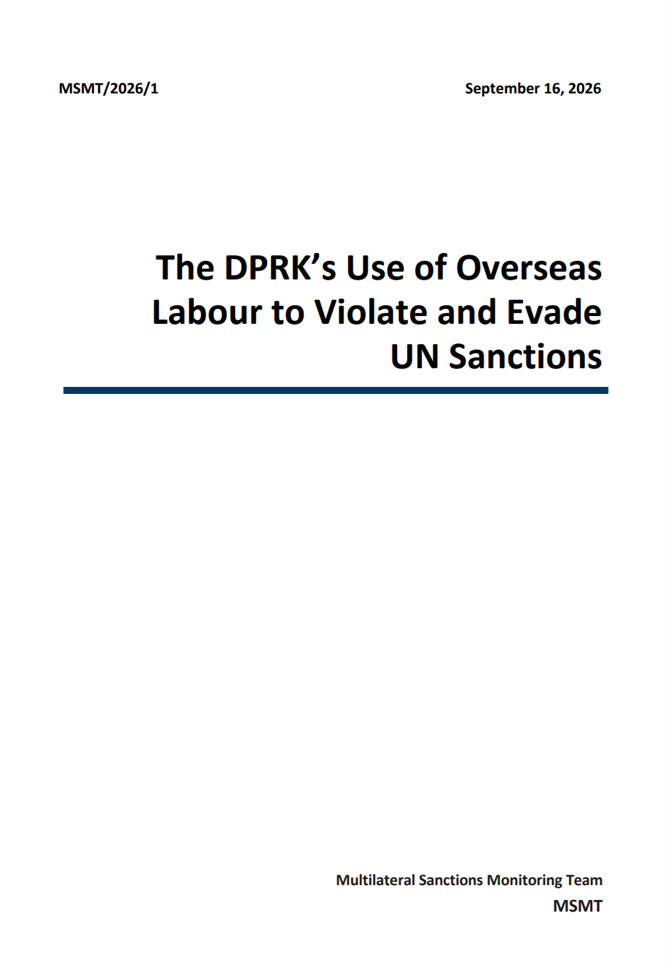
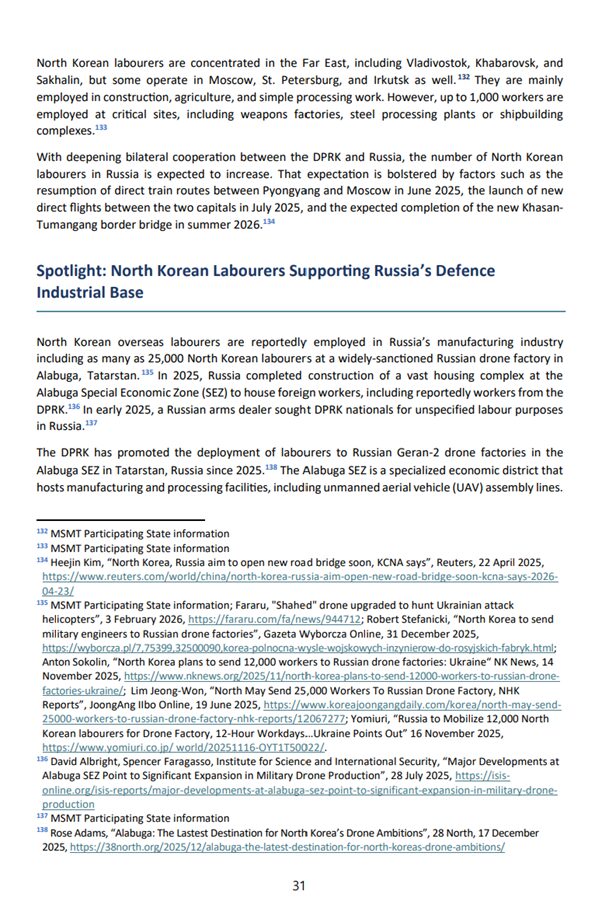
The factory floor shows another side of this partnership-building. A September report by the Multilateral Sanctions Monitoring Team says North Korean workers are employed at Alabuga in Tatarstan, where Russia produces Geran-2 drones, and describes workers entering Russia as students. Pyongyang rejected the report as fabricated. If the findings are accurate, the bargain is straightforward: Russia gains workers, North Korea gains income. Foreign support does not have to arrive as a finished missile; it can help keep the assembly line moving.
September 2026 sanctions-monitoring report. Pages 31-32 discuss Alabuga and drone production. Pyongyang rejects the report
The Underground Price List
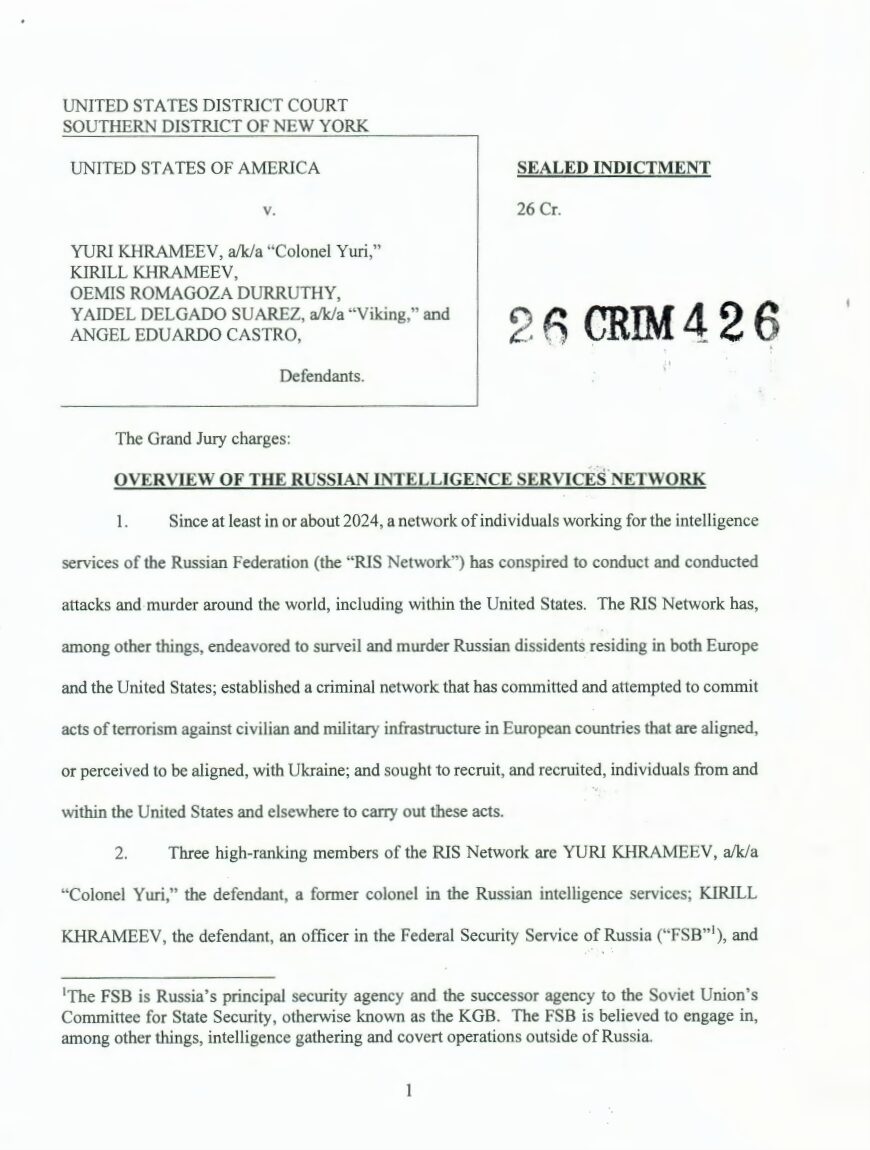
Recruitment abroad serves a different purpose. A September 15 U.S. indictment alleges that a Russian intelligence-linked network used Cuban and Venezuelan intermediaries to recruit inside America. Prosecutors describe payments of $1,000-$1,500 for surveillance and a $40,000 offer to kill a Russian dissident believed to be near Washington. Another alleged offer promised an American $25,000 to kill a target in Lithuania. These remain accusations, not court findings or proof of an officially declared bounty program.![]()
Original U.S. indictment naming the alleged Russian, Cuban, and Venezuelan participants
The alleged network operated from at least 2024, before the Montenegro arrests. Its importance lies in the method: foreign intermediaries and local recruits, rather than an obvious Russian team. If substantiated, the charges would show Moscow reaching inside America through people who do not carry Russian passports.
The October 9 threat to expand the “exchange fund” signals that consular protests may no longer be Moscow’s only answer. It suggests foreign detainees could become leverage for recovering Russians. The warning to European and American governments is pointed: the detention of a Russian abroad may create a problem for their own citizens elsewhere.
Russia’s partners help it build weapons; alleged overseas networks extend its reach; threats against satellites and foreign detainees aim to raise the cost of confrontation. These are different tools, not proof of one master plan. But October’s warnings carry a common message: Moscow wants the other side to feel exposed too. Medvedev closed his latest message with a Russian proverb: “If you live among wolves, you must howl with them.”
MORE ON THE TOPIC:
The post NO SAFE REAR: Moscow’s Shadow War From Starlink to Prison Cells appeared first on South Front.

The United States is stepping up its campaign to sell Portugal the F-35. Speaking in Lisbon today, Secretary of State Marco Rubio said the United States would make Portugal a “very competitive” offer to replace its F-16 fleet. The development adds a high-level political push to an increasingly intense competition over the Portuguese Air Force’s next fighter.
Portuguese Foreign Minister Paulo Rangel said after meeting Rubio that Lisbon is seriously considering the American proposal, while emphasizing that other options remain under consideration.

“The Portuguese state will always decide in accordance with the national interest,” Rangel said at a news conference after the meeting. “There is one point that is also clear: we are seriously considering the F-35 proposal, just as we are considering others.”
Portugal currently operates 25 modernized F-16AM/BMs, including 21 single-seat F-16AMs and four two-seat F-16BMs, from Monte Real Air Base, or BA5. The Portuguese Air Force, known as the Força Aérea Portuguesa (FAP), has not yet formally launched a replacement competition, but the aging fleet is increasingly becoming the focus of attention in Lisbon.

Portugal acquired a total of 45 F-16A/B Block 15 aircraft through the Peace Atlantis I and II programs.
The first 20 aircraft were delivered beginning in 1994. These were new-build F-16A/B Block 15OCU aircraft, comprising 17 single-seat F-16As and three two-seat F-16Bs, and were used to equip Esquadra 201 “Falcões.”
A second batch followed in 1999, when Portugal received 25 former U.S. Air Force Block 15OCU aircraft. Twenty-one were F-16As and four were F-16Bs, with several intended as attrition replacements or spares. These aircraft had accumulated roughly 3,000 flight hours and underwent an extensive modernization program to bring them to the F-16AM/BM configuration. This means the aircraft are broadly comparable to the U.S. Air Force’s F-16C/D Block 50/52 fleet.
Esquadra 301 “Jaguares” finally became operational with its upgraded aircraft in 2005, while Esquadra 201 did not receive its upgraded F-16s until 2011.

Since then, the Portuguese Vipers have continued to receive incremental improvements. Their configuration has progressed through several mission-software standards, while the aircraft have been equipped with night-vision goggles, Joint Helmet-Mounted Cueing Systems (JHMCS), and advanced targeting and weapons capabilities.
Among the more important additions are Northrop Grumman Litening II targeting pods, and the ability to employ weapons including GBU-12 Paveway II laser-guided bombs, GBU-31 Joint Direct Attack Munitions (JDAM), and GBU-49 Enhanced Paveway II dual-mode weapons.

Twelve former Portuguese F-16s were transferred to Romania under a deal signed in 2013, with deliveries taking place in 2016 and 2017. Romania subsequently ordered five additional aircraft in 2019.
Structurally, the Portuguese F-16s could potentially remain in service into the mid-2040s. But maintaining their relevance against increasingly sophisticated air forces would require continued investment in avionics, sensors, communications, and self-protection systems.
The F-16AM/BM fleet continues to rely on the old AN/APG-66(V)2 pulse-Doppler radar. Replacing it with an active electronically scanned array (AESA) radar such as Northrop Grumman’s APG-83 would substantially improve detection and tracking performance, but would come at considerable cost.

Portugal faces a choice between continuing to invest in increasingly tired fourth-generation airframes or moving directly into the fifth generation.
Since the end of the Cold War, Portugal has become much more engaged in out-of-area operations and missions in support of NATO.
In the process, the Portuguese F-16 fleet has accumulated an impressive operational record.
The fighters have repeatedly deployed on NATO air-policing missions, including rotations to the Baltic States, Iceland, Romania, and Poland.

The F-35A would give Portugal a fifth-generation fighter built around low observability, sensor fusion, advanced electronic warfare, and networked operations.
The aircraft would also fit naturally into a NATO environment in which an increasing number of European air forces are adopting the F-35.
More than 900 F-35s are already in service or on order across Europe, according to previous comments by U.S. Ambassador to Portugal John Arrigo. Washington has repeatedly argued that joining that community would provide Portugal with a substantial interoperability advantage.

However, European competition includes the Eurofighter Typhoon, Dassault Rafale, and Saab Gripen E, with Airbus preparing an especially aggressive campaign for the Typhoon.
Airbus has said it intends to submit an unsolicited Eurofighter proposal to Portugal in late October or early November. That package is expected to encompass not just the aircraft, but financing, industrial participation and broader military cooperation.
Selecting the American stealth fighter deepens Lisbon’s military relationship with Washington at a time when European governments are wrestling with fundamental questions about their dependence on U.S. military capabilities.
Across the continent, uncertainty over Washington’s stance on NATO is encouraging European allies to examine ways of reducing their reliance on American military technology, even as those same countries continue to increase defense spending and purchase U.S. equipment.

If Washington can combine the F-35’s capability advantages with an attractive acquisition and sustainment package, Portugal could find itself facing a difficult choice between the strategic benefits of joining Europe’s growing F-35 fleet and the industrial and political advantages of selecting a European fighter.
The final decision on the replacement of the F-16 will also determine what combat jet spearheads the Portuguese Air Force for the next several decades.
Contact the author: thomas@thewarzone.com
The post U.S. Makes F-35 Push As Portugal Weighs F-16 Replacement appeared first on TWZ.

The House of Saud is attacking Ansarallah to protect the death cult in West Asia, Pepe Escobar writes.
Contact us: info@strategic-culture.su
Let’s start with exclusive intel. On Thursday, Yahya Ali al-Ra’i, speaker of the Sana’a-based House of Representatives under Ansarallah, delivered a letter to Sardar Ayaz Sadiq, the speaker of Pakistan’s National Assembly, requesting Pakistani mediation between Ansarallah and Riyadh.
Ra’i, widely respected, has been the speaker in Sana’s since 2008. Sadiq began his current term as speaker in Islamabad in March 2024. This direct parliamentary channel is immensely significant as a diplomatic opening – as Pakistan faces enormous pressure, domestically and across the lands of Islam, over its real commitments related to the Saudi Arabia vs. Yemen clash as determined by the Mecca Defense Alliance.
As murky as the the whole situation really is, direct intel from both Islamabad and Tehran, at the highest levels, as I especifically requested, has established four key points:
Transiting Hormuz: use CIPS and pay in rials
On the wider U.S.-Iran front, diplomatic moves support what we have been reporting for the past few days on Transition Protocol. Pakistan in fact is desperate to maintain engagement with both Riyadh and Tehran, alongside non-stop coordination with Beijing. After all, China completely supports Pakistan mediation; and Araghchi keep speaking to Munir, as he did following talks with Wang Yi in Beijing.
Meanwhile, on the Washington front, speculation is feverish all over the spectrum over preparations for a Trump administration renewal of the war – including potential strikes on Iranian energy infrastructure and even, quite worrisomely, nuclear targets. There is no final decision yet by the Psycho/Sociopath in Charge, much less a launch date.
The immediate risks anyway are staggering.
Diplomacy – even in ersatz form – is mired in impasse. Tehran remains – and will continue to remain – anchored to its existing conditions, detailed by the dead cat MoU, but now carrying the threat of blocking transit routes along Oman’s coastline that it considers illegal. Washington for its part is obsessed with vast nuclear concessions.
Earlier this week, we confirmed that the Supreme National Security Council (SNSC) in Tehran made two very consequential decisions.
The bottom line is that the escalation ladder could get out of control in no time.
Coming Yemeni Storm 1.0 in effect
On the Saudi-Yemen front, the Yemeni Armed Forces are absolutely ruthless. The Coming Yemeni Storm 1.0 is already in effect.
The damage at Jeddah refinery, close to Yanbu, is massive. Ansarallah is simultaneously hitting Saudi Arabia’s eastern and coast and western coast, plus the East-West pipeline in between.
For all practical purposes Sana’a is going for the whole key Riyadh infrastructure. The U.S. defense umbrella is a joke: remaining PAC-3 and Patriot batteries are useless against Yemeni ballistic missiles.
Saudi troops may number at best 75,000, plus 125,000 from the National Guard. The Yemeni Armed Forces command at least 350,000 that can be easily ramped up to 800,000. To expect “help” from the GCC petrosheiks doesn’t even qualify as a joke.
The Yemeni Armed Forces also unleashed two ballistic missiles plus explosive drones in the direction of Aden’s international airport. Ansarallah said the target was Saudi military supplies that had just arrived at Badr Camp, the mercenary HQ adjacent to the airport. An unspecified number of high-ranking Saudi officers and officials – perhaps even some Pakistanis – were killed.
Turkey for its part is also about to put boots, aircraft and air defenses on Saudi ground. These Turkish forces in thesis could protect Riyadh, the holy cities and the East-West pipeline. Ankara, just like Islamabad, insists it has no plans to enter the war inside Yemen.
The swift liberation by the Yemeni Armed Forces of the western coast close to the Red Sea also made it crystal clear how the so-called Saudi “coalition” – actually a gang of proxies/mercenaries – was deploying de facto terrorists all along.
Ansarallah recovered a wealth of foreign passports – especially from Kuwait, Qatar, Turkey and Syria – belonging to ISIS and Al-Qaeda goons. Call it the Terror Inc. Legion.
I’ts the same old song. Qatar and Turkey, in sync, instrumentalized the transfer of ISIS/Salafi-jihadi goons from Syria and Iraq: they were welcomed in Yemen by the Islah Party. Turkey was the key transit route; at least 2,100 of these ISIS assets are Turkish.
AQAP is back!
Way back in 2020, Ansarallah had already seized documents, maps, and videos showing ISIS/Daesh and Al-Qaeda jihadis directly supported by Riyadh roaming Yemen, with captured goons confessing they were paid, weaponized and logistically supported by the Saudis.
Now a new incarnation of the former al-Qaeda in the Arabian Peninsula (AQAP) is alread in effect – via at least 20,000 Daesh/takfiri terror goons “imported” from Syria. They will be sent to Aden governorate – following the request, actually the demand by MbS himself, fully approved by the Trump administration and its throat-slitter vassal turned President in Damascus, former ISIS al-Jolani.
The definitive headline of the whole affair though is that the House of Saud is attacking Ansarallah to protect the death cult in West Asia.
By controlling the Bab al-Mandab, Ansarallah de facto cuts off the Israeli port of Eilat. That had already happened before during the genocide of Gaza. Riyadh was furious because they had struck deals for the – now virtually scrapped – NEOM project that would connect up to Eilat once the Trumpian Abraham Accords were up and running.
Considering the whole picture, all hell could still break loose due to a single spark. Possibilities include: a Yemeni strike on Saudi Arabia causing massive casualties; a toll-enforcement mess in the Strait of Hormuz; an Iranian strike on a GCC petro-sheikh target, following an American provocation; an Iran-linked attack on a U.S. base, once again folowing an American provocation; and most of all a Sociopath-forced “land, air and sea” CENTCOM (mis)adventure.
Fasten your seat belts.