
❌

Normal view

The Baltic Fuse: How Europe Is Building the Infrastructure for War With Russia

11 October 2026 at 18:43

Click to see the full-size image

Europe is shortening the time it takes to wage a major war. Military transport approvals are meant to take hours rather than days, intelligence to feed more quickly into strike decisions, and a new generation of missiles to bring targets deep inside Russia within reach. Behind the forward garrisons, Europe is building transport networks, reserves, and ammunition production capacity. Taken together, these measures point beyond deterrence to practical preparations for waging war against Russia, including operations deep inside its territory.

The dates 2027, 2028, and 2030 in European rearmament programs can easily suggest that there is still time. But they mark a schedule for building military capabilities, not a guaranteed period of peace. The central question for the coming months is not whether armies will finish rearming in time, but whether a clash can be avoided before they do.

Estonia: A Narrow Front, a Deep Strike

Estonia offers a clear picture of the opening phase this system is being built to fight. The country’s military budget rose 42% in 2026 to €2.4 billion, or 5.4% of gross domestic product. Arms procurement accounts for €1.27 billion – more than half the total. Meanwhile, the headquarters and elements of the 1st Infantry Brigade are moving from Tapa to Jõhvi, roughly 50 kilometers from the Russian border.

A €20.5 million base is under construction in Narva, with €19 million coming from the European Union. Completion is scheduled for summer 2028. Its permanent garrison will number around 200, but it will accommodate up to 1,000 troops in a crisis. The gap between those figures reveals a base designed for rapid expansion. A small garrison is being equipped to receive reinforcements quickly, right on the border.

Holding that ground requires more than barracks. Procurement programs call for nine American HIMARS and nine South Korean Chunmoo multiple-launch rocket systems, both capable of firing ballistic missiles. The relevant munitions have stated ranges of up to 300 and 290 kilometers, respectively. The new concept combines holding the border with deep strikes from the first day of an invasion.

The scale of the response could far exceed that of the opening clash. A battle for a border town could lead to strikes on targets hundreds of kilometers away. Tallinn wants to deny its opponent the option of fighting a small war by preparing to expand its geographical scope.

This also changes what allied assistance means. Allied planning must account not only for how long a small army can hold out until reinforcements arrive, but also for how far the fighting may spread before they reach the front. A missile can be launched before a major formation completes its deployment. Allies may arrive to find that the conflict has already widened.

In such a situation, Estonia and the other Baltic states could serve not only as defensive positions but also as staging grounds for attacks on Russian territory. For Moscow, the issue is no longer simply the size of Estonian units, but the depth of the strikes they envisage. Tallinn, in turn, faces the question of who will sustain its forward forces if the first battles fail to decide the outcome. Sustaining such a war would require support from beyond Estonia. One national budget and a handful of batteries cannot carry that burden.
Click to see the full-size image

Germany: An Industrial Base Behind the Garrison

On October 5, Martin Jäger, head of Germany’s Federal Intelligence Service, told the Bundestag: “The point of no return has been passed in the war with Ukraine, and NATO is considering a scenario involving a limited Russian military clash with the Baltic states.” He linked the more immediate danger to limited Russian action in the Baltics that could test the allies’ response. He said intelligence had seen no signs of preparations for a major attack on NATO. The discussion therefore concerns not only a major war after rearmament is complete, but a smaller confrontation capable of triggering an allied response.

In the Baltic scenario, Berlin is publicly discussing the risk of a clash while its forward force is still taking shape. The brigade’s readiness date is not the date on which the threat begins.

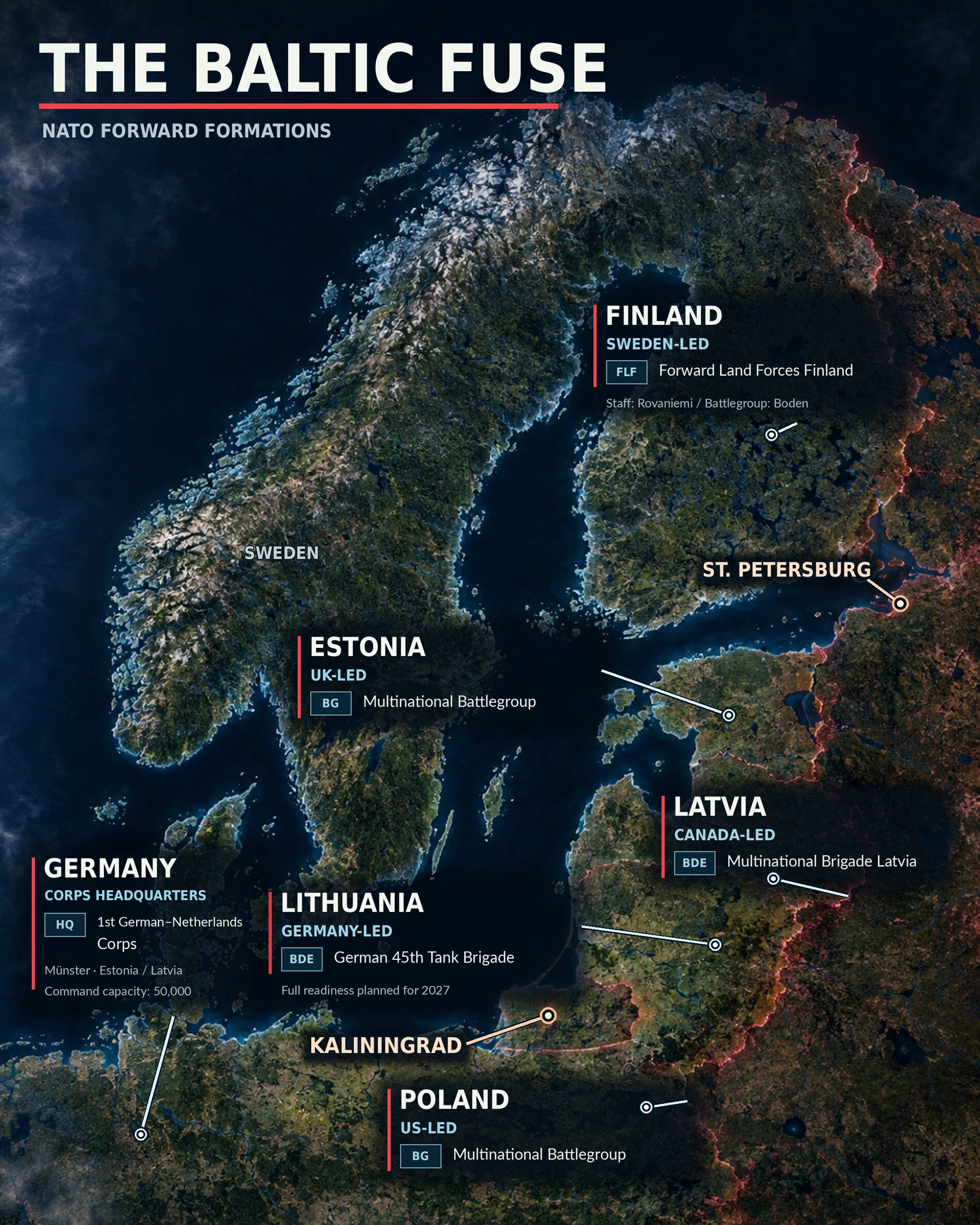
In Lithuania, Germany is building a permanent heavy brigade as one element of that support. Full readiness is scheduled for the end of 2027, with 4,800 military personnel and 200 civilian employees. Its core consists of the 122nd Panzergrenadier Battalion, the 203rd Tank Battalion, and a multinational battle group. Until the formation is complete, the Germany-based 37th Brigade is to provide support.

The forward formation is thus tied to forces farther inside Europe. Civilian infrastructure underscores the permanence of the deployment. A school for the children of Bundeswehr personnel opened in Vilnius in September 2025. Units are not simply moving in – families are settling down. A political commitment acquires a permanent address, and the safety of German personnel becomes part of any future crisis in the host country.

Münster, October 1, 2026. Rutte describes a headquarters capable of commanding 50,000 troops and responsible for NATO forces in Estonia and Latvia. Behind the talk of forward battalions lies corps-level command capacity


But a permanent garrison needs a steady supply of ammunition. Rheinmetall’s new plant in Unterlüß is scheduled to reach an annual output of 350,000 artillery shells in that same year, 2027. The nearly €500 million facility was built in 15 months. Across its entire production network, including overseas sites, the company is targeting roughly 1.5 million shells a year from 2027.

The brigade answers the question of who will enter the fight. The factories answer how to keep fighting once stockpiles run down. The 2027 target is for strengthening this system, not creating it from scratch. Reaching the factory’s planned capacity determines future supply volumes, but it does not set a date before which a clash is impossible. Initial stocks sustain the opening phase of combat. Regular deliveries determine whether its intensity can be maintained.

Between the factory and the front lies the transport network. Europe’s military mobility proposal calls for cross-border transport permits to be processed within three working days, with an emergency procedure taking no more than six hours. A proposed €17 billion would fund the relevant infrastructure under the 2028–2034 budget. For Germany, a transit country, that means bridges, railways, and the capacity of routes leading east.

On October 7, European Defense Commissioner Andrius Kubilius called for this work to accelerate, saying Europe was not yet able to deter Russia. Unlike an exercise, infrastructure upgrades remain after the columns return to barracks. A stronger bridge and a faster permit procedure create a lasting ability to concentrate forces.

A border battle thus gains industrial and logistical depth. But sustaining one’s own forward forces is only half the military equation. The other half is disrupting opposing forces’ supply and command systems. That requires more than additional railcars loaded with shells. It requires weapons with much greater reach.

Britain: A European Deep-Strike Arsenal

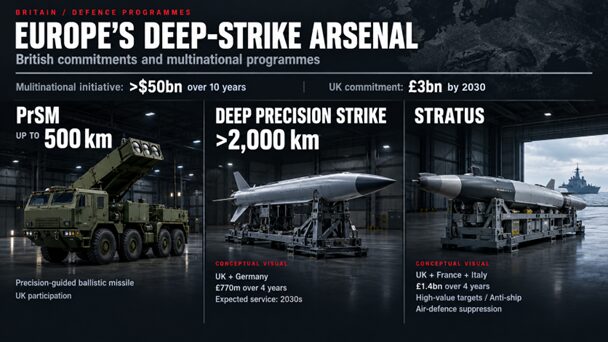
London is driving precisely this part of Europe’s preparations. On July 8, 2026, it announced an initiative bringing together roughly a dozen partners to invest more than $50 billion in long-range strike capabilities over ten years. The stated range bracket runs from 300 to more than 2,000 kilometers. Britain’s own commitment within the initiative is £3 billion by 2030.

The British-German Deep Precision Strike program envisages stealthy and hypersonic weapons with ranges exceeding 2,000 kilometers, initially focused on ground launch. Britain is investing £770 million over four years, with entry into service expected in the 2030s. Another £1.4 billion over four years is earmarked for Stratus, a program with France and Italy covering strikes against high-value targets and ships, as well as the suppression of air defenses.

Britain’s participation in PrSM (Precision Strike Missile), a precision-guided ballistic missile program with a stated range of up to 500 kilometers, adds another layer. The emerging capabilities span several range bands, from around 300 kilometers for the Estonian systems through 500 for PrSM to more than 2,000 for the British-German development. Although the programs are at different stages, they share a clear direction. Weapons for fighting at the border are being supplemented with weapons for striking deep behind it.

The missiles of the next decade show how far these strike capabilities are intended to expand. But the next crisis will unfold with whatever weapons are available when it begins. A 2,000-kilometer range is not a prerequisite for a clash in the Baltics. It changes the potential scale of the war, not the earliest date on which it can break out.
Click to see the full-size image

Turning national purchases into a combined capability requires a common framework for employing them. In July 2025, General Christopher Donahue outlined elements of eastern-flank planning built around compatible launchers, fire control, and data sharing. He cited Kaliningrad as an example of military capabilities that could be neutralized by ground-based means in an exceptionally short time: “We have already planned this. We have already developed this.”

The discussion also included cloud-based data sharing and Palantir’s Maven Smart System, purchased by NATO to analyze information and support command decisions. The aim is to turn disparate reports into a common picture more quickly. When several armies use compatible command systems, their arsenals gain additional value. Range puts the target within reach, while data sharing allows missions to be coordinated.

But the deeper the planned strikes, the harder it becomes to separate support for a border battle from an expansion of the war. To the attacking side, a target may be part of the other side’s military supply system. To the other side, hitting it may signal that the conflict has crossed a new threshold. The use of conventional weapons thus leaves unresolved how to deter a response that would overturn the assumption of a limited clash.

France: The Nuclear Limit of Europe’s Calculations

This is where France’s nuclear deterrent enters the European picture. On October 6, Le Vigilant conducted an acceptance firing of an M51.3 ballistic missile following its refit. The missile carried no nuclear warhead. In service since October 2025, the variant carries new TNO-2 warheads. The French Defense Ministry cites improvements in range, accuracy, and the ability to penetrate missile defenses.

Brittany, October 6, 2026. Le Vigilant launches an M51.3 without a nuclear warhead


Macron stated the political message bluntly: “To be free, you must be feared. And to be feared, you must be strong.” France’s modernization adds a nuclear dimension to Europe’s conventional military buildup.

That European dimension is taking a more concrete form. On March 2, 2026, Macron outlined an “advanced deterrence” framework allowing partners to participate in French nuclear exercises and opening the possibility of temporary deployments of strategic forces on allied territory. Germany, Poland and Sweden were among the countries joining the dialogue. But the authority to use nuclear weapons – and to define the vital interests they protect – remains exclusively French. In the Baltic scenario, closer cooperation does not establish an automatic French nuclear response to a border clash. It leaves the decisive threshold in Paris, deliberately undefined.

After the First Clash

Taken together, these national programs suggest that the West is preparing not merely to deter Russia, but to build the capacity for offensive operations against it. In this reading, forward deployments, industrial expansion and deep-strike weapons are interconnected preparations for a war that could extend into Russian territory. They do not, by themselves, establish a single operational plan or prove a decision to initiate hostilities. Conventional forces are meant to make an opposing military operation prohibitively costly, while nuclear forces are meant to deter the most extreme escalation. The weakness is that neither side gets to decide how much damage the other will tolerate.

That problem is especially acute around Kaliningrad, where plans to suppress military infrastructure sit alongside the question of the region’s links to the rest of Russia. If actions during a crisis are perceived as an attempt to cut the region off by force, the argument will no longer be about intentions announced at a press conference. It will be about consequences the other side believes it must stop immediately.

The danger in the coming months lies in the gap between limited intent and an unrestricted response. Berlin is discussing localized action in the Baltics. Tallinn is preparing for deep strikes from day one, while foreign garrisons tie a border battle to allied involvement. Each side may consider its own move limited. Neither can count on the other side accepting its definition of what is permissible.

European capitals therefore need to define where military action would stop after the first clash, whether at the border or after strikes on depots, airfields or targets in Kaliningrad. The programs examined here spell out how to build military power, but offer no mechanism for ending the fighting. Missile range is not strategic foresight. Confidence that escalation can be controlled could turn a system of deterrence into a mechanism for widening the war well before 2030.


MORE ON THE TOPIC:

The post The Baltic Fuse: How Europe Is Building the Infrastructure for War With Russia appeared first on South Front.

Eine weitere, faktische Kriegserklärung der NATO an Russland

11 October 2026 at 17:23
Dass vor allem die europäischen NATO-Staaten alles tun, um Russland zu provozieren, militärisch zu reagieren, ist kein Geheimnis, denn sie tun es offen: Sie kapern Handelsschiffe mit Ziel Russland, sie finanzieren und produzieren die Waffen, die zivile Infrastruktur und Wohngebiete angreifen, und liefern auch noch die dazu nötigen Aufklärungsdaten. Und sie erlauben in der Ukraine […]

Europe’s mounting social chaos… chickens coming home to roost for proxy war against Russia

By: aletho
10 October 2026 at 21:41
Strategic Culture Foundation | October 9, 2026

The European Union is witnessing a full-blown social revolt. Governing political parties and their economic policies are held in open contempt as public protests and strikes escalate across multiple countries.

Protests, mass marches, and industrial strikes are spreading across the EU in France, Belgium, Spain, Italy, Germany, Ireland, Portugal, and other countries. The grievances are various, from students and teachers over woeful education services, to healthcare professionals and transportation workers denouncing crumby wages and pension cuts.

But at the core is a warmongering, dehumanizing system of capitalist inequality.

Unbearable living costs for basic needs, from food to housing, are driving millions onto the streets in desperation and anger at the lack of adequate political response to their concerns. As one French student said: “Too young to be listened to, old enough to be tear-gassed.”

The entire political system is being brought into disrepute for its dysfunction and indifference towards meeting rudimentary human needs. Then, infuriating all the more, are lies from the elite rulers and their propaganda media about “national defense and threat of war from Russia.”

In Spain this week, an 87-year-old frail woman known as Maricarmen died in hospital after she was evicted from her Madrid home because she could not pay the extortionate rent increase. Her plight has come to galvanize a nationwide protest against Spain’s housing crisis, a crisis that is repeated across every European country. Protesters shouted furiously that the pitiful old woman was “murdered by the state and corporations.”

In France, the brutality of police against student protests has shocked the nation and the world. Nearly 7,000 young people have been arrested, as riot police tear gas and shoot at largely peaceful rallies. Students gathering at the Place de la Bastille in Paris and other cities vow that they will not back down. One student had his hand blown off by a police stun grenade while another teenager lost an eye from a rubber bullet fired at close range.

The Place de la Bastille is where the French Revolution manifested in 1798 against a hated aristocracy amid abject misery. Today, the tensions are boiling towards another momentous rebellion, this time inspiring again similar movements across Europe.

These protests and the inhumane suffering that underlie them are channeling uprisings all over the EU.

There is a palpable sense that populations en masse have had enough of decades of inequality and chronic deprivation inflicted by capitalist policies that enrich a few and are enforced by governments slavishly serving the interests of capital over the needs of the citizen majority.

Western media reports talk about “cash-strapped” governments under pressure from bond markets to reduce record debt levels while workers, students and pensioners demand more public investment and relief from economic hardship.

That is a misleading partial portrayal of the problem. Omitted is the crucial backdrop that European governments are directing vast economic resources towards militarism and the proxy war in Ukraine against Russia. That is what is causing the “cash-strapped governments.” In other words, their declared fiscal straits are a policy choice, not some mysterious dilemma.

The social crisis sweeping across Europe is also seen in the United States and other Western-aligned nations. The background is a failed economic system that no longer provides a modicum of acceptable living conditions. The problem has been decades in the making from growing inequality and diminishing political representation. Today it is even questionable if Western states are democracies, controlled as they are by corporate oligarchies.

Nevertheless, the social crisis that is unfolding across Europe has been intensified and amplified by European political rulers operating in a relentless war mode against Russia.

The European Union has pumped hundreds of billions of euros into Ukraine over the past four years to prop up a NeoNazi regime run by a corrupt dictatorship – all for the objective of defeating Russia. The EU leaders – many of them unelected, like Ursula von der Leyen, Kaja Kallas and António Costa – are driven by an obsessive Russophobia. But that is only part of the explanation.

Other elected leaders and parties like France’s Macron and Germany’s Merz are also despised for their elitism and delusions of grandeur. Merz declares that he wants to make Germany the strongest military in Europe, in total tin-ear deafness to his nation’s economic and social problems and the sinister historical connotations of resurrecting Nazi Germany. Meanwhile, as his government suffers electoral defeat after defeat, European elites deprecate German voters as being blind because they dare to choose parties that are opposed to war with Russia.

There are many grounds for the Europe-wide contempt of ruling parties. Inequality, poverty, unemployment, soaring living costs, declining wages, deteriorating public services. Uncontrolled immigration amid the pressure on inadequate public resources is another cause for grievance. Europe’s complicity in the Israeli genocidal war on Palestinians, and Europe’s complicity in Trump’s aggression towards Iran, Yemen, Cuba, and so on, are other factors.

However, the bogus narrative that governments are “cash-strapped” is a cause for immense public disgust. There are plenty of economic resources to meet public needs. It’s a question of those resources not being permitted to create just and humane societies under the prevailing capitalist system with its priority of enriching a tiny elite class.

The conditions of “tight budgets” and “austerity for the masses” are created by deliberate policies of militarism and fuelling a proxy war in Ukraine.

European “leaders” and their NATO lobbyists like Mark Rutte demand hundreds of billions of euros to boost military industries while at the same time calling for draconian cuts in public spending and social welfare in order to pay for this reckless militarism. The EU is “lending” an additional €90 billion over the next two years alone just to prop up the corrupt regime in Kiev so that it can keep fighting a futile war with Russia. The perverse priority is driven by the military-industrial complex and its corporate investors. It is also driven by an ideological, propagandized mindset that demonizes Russia as an enemy. President Putin and other Russian voices have repeatedly stated that they do not want war with Europe. They say the conflict in Ukraine has root causes that can be resolved through diplomatic engagement. Why are European politicians implacably opposed to peace?

A major factor is covering for internal political and economic failure of the European system. The EU’s economies, as with those in the U.S. and other Western states, are bankrupt dystopias in terms of delivering on social and democratic needs. The failure has been compounded by the costs of war in Ukraine.

That failure is criminal and fatal for the politicians and governments who have overseen the policies. Thus, the political class, including the propaganda news media, cannot admit their criminal policies.

In the face of their own internal contradictions, the European political elites are seeking a solution by externalizing Russia as an enemy. This is the same modus operandi that European rulers have used for the past century and more, unleashing two world wars as a result.

These criminal politicians and their dysfunctional economic system are again pushing war as their escape plan for survival at the expense of millions of lives and at the risk of starting a third world war, one that this time around could involve catastrophic nuclear nemesis.

It is damning of virtually every European government, including primarily the British, that there are no calls for diplomacy and political settlement with Russia. They are committed to waging war on Russia to absolve themselves from the social devastation they are responsible for.

One positive thing, though, is that increasing numbers of people can see through the chicanery and lies. A German student placard summed it up: “We won’t fight your wars… Education not bombs!”

A day of reckoning is imminent. Criminal political leaders and their warmongering system are exposed like never before and in a way that demands total revolt as a proper solution. The consequences are not to be externalized this time. Chickens are coming home to roost, as Malcom X once said.

Wenn der Spiegel eine „eigene Recherche“ veröffentlicht, ist das von Geheimdiensten durchgestochenes Material

10 October 2026 at 07:00
Ich bezeichne den Spiegel gerne als „Pressesprecher der Geheimdienste“ oder auch „Pressesprecher der Regierung“, weil das Blatt nicht nur die Narrative der deutschen Regierung und Geheimdienste stützt – womit der Spiegel beweist, dass er weder ein kritisches noch ein regierungsfernes Medium ist – sondern auch immer wieder von Regierung und Behörden Informationen bekommt, die er […]

Worüber Putin und Trump in ihrem Telefonat gesprochen haben

10 October 2026 at 04:00
Am Freitagabend fand wieder ein Telefonat zwischen den Präsidenten Trump und Putin statt, das das anderthalb Stunden gedauert hat. Präsident Trump sprach danach in einem Post auf TruthSocial von einem sehr „erfolgreichen Gespräch“. Später teilte er noch mit, er habe sich mit Putin auf Diesellieferungen in die USA geeinigt. Das sei ein großer Deal, der […]

Tacheles #224 ist online

10 October 2026 at 03:17
Robert Stein hat diese Woche einen sehr vollen Terminkalender, weshalb Tacheles diese Woche fast ausgefallen wäre. Dann haben wir jedoch entschieden, einen „Tacheles-Quickie“ zu machen und zumindest eine halbe Stunde über die wichtigsten Themen der Woche zu sprechen. Aber Röper und Stein können keinen „Quickie“, weshalb aus der geplanten halben Stunde doch wieder über eine […]

First Look At Hypersonic Boost-Glide Vehicle Just Tested By South Korea

9 October 2026 at 19:12

The South Korean government has released images from its first successful test of a domestically developed hypersonic boost-glide vehicle. This includes shots of the vehicle impacting the water at the end of its flight. A weapon of this kind would give South Korea a significant new way to hold targets in North Korea at risk amid an ever-deepening arms race on the Peninsula.

South Korea’s Presidential Office, more commonly referred to as the Cheong Wa Dae or the Blue House, announced the test in a Korean-language press release yesterday. The Blue House initially released a video of President Lee Jae Myung and others observing the test from a conference room at the Anheung Proving Ground, which is located in South Chungcheong Province on the country’s western coast. South Korea’s Agency for Defense Development (ADD) manages testing at Anheung. A series of still images from the test itself was subsequently posted on the Blue House’s website.

A trio of pictures showing South Korea’s new hypersonic boost-glide vehicle impacting the water during the test yesterday. The Blue House
Another view of the impact at the end of yesterday’s South Korea hypersonic test as seen through what looks to be an electro-optical video camera on an aircraft. The Blue House

Included in the still image gallery are shots showing the launch of the missile, a formal name for which has not yet been disclosed, from a wheeled transport-erector-launcher on a platform sitting just off the coast. The low resolution of the pictures makes it hard to tell whether the missile and/or the TEL are of an existing South Korean design or are based on one. We will come back to this later on.

A picture showing the launch of the hypersonic weapon from the platform off the coast. The Blue House
Another picture from the test showing the missile after launch. The Blue House

As mentioned, there are also pictures of the hypersonic boost-glide vehicle hitting the water. At first glance, the vehicle looks to have a broadly conical design with stabilizing fins at the base. However, at least one of the fins looks to be truncated. Closer inspection of the available images shows further indicators that might point to it actually having a more wedge-shaped design with a distinct top and bottom, though it is still not definitely clear given the low resolution. Conical boost-glide vehicles are generally understood to be easier to design, relatively speaking, than wedge-shaped ones. Historically, hypersonic boost-glide vehicles of any kind have proven to be technically complex and challenging to turn into viable operational weapons, even by countries with extensive past experience with their development.

Another close-up look at the hypersonic boost-glide vehicle test yesterday, showing what looks to be a truncated fin on one side. The Blue House

“This test launch was conducted to verify, for the first time, the vehicle’s core technologies in a hypersonic flight environment: the performance of ultra-high-temperature heat-resistant materials, guidance and control capabilities, and the ability to perform irregular flight maneuvers at low altitudes,” the Blue House said in its release yesterday, per a machine translation of the Korean text. “The HGV [hypersonic boost-glide vehicle] successfully separated after ascending to the target altitude and executed its planned flight path within the hypersonic environment without any issues.”

With all this in mind, the fact that the vehicle just remained intact through to impact is noteworthy. At the time of writing, South Korean authorities do not appear to have disclosed more specific details about the test, including how far the boost-glide vehicle traveled before hitting the water or what peak speed it reached. Important questions also remain about how the vehicle is guided during the mid-course and terminal phases of flight, challenges that do not appear to have been addressed by this particular test.

In general, unpowered hypersonic boost-glide vehicles need to be brought first to an optimal altitude and speed. This is typically achieved using a sufficiently sized rocket booster, with existing ballistic missile designs often serving as a starting point.

Once released from the booster, a boost-glide vehicle flies along a relatively shallow flight path within the Earth’s atmosphere. The vehicle is able to maneuver along the way, sometimes erratically, while traveling at hypersonic speeds, generally defined as anything about Mach 5.

A graphic showing, in a very rudimentary way, the differences in trajectories between a traditional ballistic missile, a hypersonic boost-glide vehicle, an aero or quasi-ballistic missile, and an air-breathing hypersonic cruise missile. GAO

All of this sets hypersonic weapons of this kind apart from traditional ballistic missiles, even ones with advanced maneuverability capabilities, which all follow a broadly arcing trajectory to their targets. The combination of speed, flight trajectory, and maneuverability offered by hypersonic boost-glide vehicles creates distinct challenges for opponents. They are hard to spot and track, let alone attempt to intercept, and there is less time for defenders to react overall. This ability to penetrate enemy air defenses and cover ground rapidly makes these weapons particularly attractive for strikes on very high-value and time-sensitive targets.

“The HGV [hypersonic boost-glide vehicle] is a ‘key strategic asset capable of changing the game on the battlefield,’ as its unpredictable flight trajectory and overwhelming speed allow it to launch surprise strikes against key strategic targets during contingencies,” the Blue House’s release explicitly noted, again according to a machine translation.

With all this in mind, South Korea does have an entire family of domestically-produced ground-launched ballistic missiles that could be suitable starting places for launching an unpowered hypersonic boost-glide vehicle. President Lee was notably shown a TEL for the country’s newest Hyunmoo-5 ballistic missile at Anheung yesterday, though no explicit connection has been drawn between that weapon and the hypersonic test. The Hyunmoo-5 is itself still a relatively new development, having only entered service around the end of last year.

President Lee Jae Myung and others inspect a Hyunmoo-5 TEL on October 8, 2026. The Blue House

When it comes to new South Korean arms developments, the Hyunmoo-5, which entered service around the end of last year, has been and continues to be a major point of discussion by itself. It is officially categorized as a short-range design, despite how big it is (35 tons gross weight), which is said to be due largely to the equally substantial size of its warhead (17,000 pounds). Past reports have raised the possibility that it could be capable of flying out to intermediate ranges if the warhead weight were reduced. Short-range ballistic missiles are defined as ones with ranges between 190 and 620 miles (300 and 1,000 kilometers), while intermediate-range ballistic missiles can hit targets out to between 1,864 and 3,418 miles (3,000 to 5,500 kilometers). Medium-range ballistic missiles (MRBM) fall in between these two categories.

A Hyunmoo-5 transporter-erector-launcher seen during a parade in 2024. Kim Jae-Hwan/SOPA Images/LightRocket via Getty Images

With its massive unitary warhead, the Hyunmoo-5 already gives South Korea an important new way to hold deeply buried and otherwise hardened targets in North Korea at risk. This fits in directly with the country’s broader Korea Massive Punishment and Retaliation (KMPR) policy, as TWZ has previously written:

“While the Hyunmoo-5 has been widely reported as a future pillar of the KMPR, its specific ability to penetrate deeply buried bunkers, such as those used by the North Korean leadership, the same functions mean that it can also fulfill elements of the ‘kill chain.’ In this way, it could be used as part of a pre-emptive strike, to try and knock out North Korea’s launch capability by targeting its hardened command-and-control facilities and missile storage areas.”

By virtue of the very high speeds they reach in the terminal phase of flight, hypersonic boost-glide vehicles also offer bunker-busting benefits on top of the other aforementioned advantages they bring to the table.

In addition, the hypersonic boost-glide vehicle test reflects a broader arms race that has been expanding in scale and scope for years now. South Korea is also developing an air-breathing hypersonic cruise missile, seen in the composite image below, as well as new air- and sea-launched ballistic missiles, the latter of which will be loaded on new surface warships and submarines.

via X

Though there are always questions about the actual maturity and viability of the designs, North Korea continues to churn out its own new missile developments. This includes two separate test launches of purported new hypersonic designs just in recent weeks. Tit-for-tat missile launches are not entirely uncommon on the peninsula, but there are limits to how quickly a test like the one South Korea conducted yesterday involving an emerging technology can reasonably be staged.

A picture of one of two new purported hypersonic missiles North Korea says it has tested in the past few weeks. North Korean State Media

Friction between the North and South has been at a particular high point, in general, following an incident on September 21, in which three South Korean troops were injured along the Demilitarized Zone (DMZ). South Korea’s Joint Chiefs of Staff (JCS), as well as the United Nations Command (UNC) on the Peninsula, have said a North Korean landmine placed in violation of the Armistice Agreement was to blame. South Korean authorities have demanded an apology and raised the prospect of some form of action in response, though President Lee has more recently sought to downplay the situation. The government in North Korea has denied the accusations and threatened an “immediate and powerful counteraction” should South Korea seek to retaliate.

An operational hypersonic boost-glide vehicle capability would also expand South Korea’s capacity to challenge opponents regionally beyond North Korea. Though the regime in Pyongyang represents the most proximate national security threat to the country, China and Russia have also been growing points of concern for South Korean authorities in recent years.

“We must secure our national security through our own strength,” President Lee said after yesterday’s hypersonic test, per the Blue House’s release. “The government must not rest on today’s success but must further advance the technology so that the hypersonic glide vehicle can establish itself as a robust strategic asset safeguarding our future security.”

South Korea’s President Lee Jae Myung, at center, and others applaud after yesterday’s test. The Blue House

South Korea’s very public test of its new hypersonic boost-glide vehicle underscores the country’s still-expanding efforts to broaden its options for striking even the best-defended targets in North Korea, as well as projecting power elsewhere regionally. At the same time, it remains to be seen when the South Koreans may field a real operational capability in this regard.

Contact the author: joe@twz.com

The post First Look At Hypersonic Boost-Glide Vehicle Just Tested By South Korea appeared first on TWZ.

Quattromila pagine di piani, nessuna di pace: le folli provocazioni di guerra della NATO

By: A A
9 October 2026 at 16:35

 L’Europa ha già conosciuto questa strada, nell’estate del 1914. Sarebbe imperdonabile percorrerla di nuovo, stavolta con le testate nucleari in fondo.

Segue nostro Telegram.

Tutto è pronto a esplodere

A Copenaghen, davanti ai capi di stato maggiore dei trentadue Paesi dell’Alleanza atlantica, l’ammiraglio Giuseppe Cavo Dragone ha scelto le parole con cui presentarsi all’opinione pubblica europea. Presidente del Comitato militare della NATO dal gennaio 2025, ha annunciato che l’Alleanza dispone di «4.000 pagine di piani» per il fianco orientale, che quei piani coprono ogni scenario «da una crisi minima o un intervento sul nostro territorio all’attivazione dell’articolo 5 e alle successive azioni», e che «il personale militare, i sistemi e le armi sono pronti». Poi la chiusa: in caso di attacco, i russi «hanno molto più da perdere che da guadagnare. Questo è assolutamente certo. Ed è questo che costituisce la deterrenza».

Nelle intenzioni dell’ammiraglio doveva essere un messaggio rassicurante. Letto con attenzione, è una delle dichiarazioni più imprudenti pronunciate da un vertice militare europeo dalla fine della Guerra fredda. Vale la pena smontarla pezzo per pezzo.

Le parole di Copenaghen non cadono nel vuoto. Poche ore prima il premier polacco Donald Tusk aveva previsto che Mosca potrebbe lanciare droni o missili sul territorio di un Paese NATO «nei prossimi mesi», per dimostrare che l’articolo 5 è una promessa di carta; Parigi, intanto, preparava un piano contro gli attacchi con droni. In un’atmosfera del genere, il compito di un militare di rango sarebbe raffreddare, distinguere l’ipotesi dal fatto, ricordare ai governi che la guerra tra potenze nucleari non è uno scenario da pianificare ma da impedire. L’ammiraglio ha fatto l’opposto: ha aggiunto combustibile.

E non è la prima volta. Nel dicembre 2025, in un’intervista al Financial Times, lo stesso Cavo Dragone spiegava che l’Alleanza stava valutando di diventare «più aggressiva» contro la guerra ibrida russa, che un «attacco preventivo» poteva essere considerato un’«azione difensiva» e che essere più aggressivi della controparte «potrebbe essere un’opzione». Mosca, per bocca di Marija Zacharova, parlò di un passo irresponsabile verso l’escalation, arrivato mentre si negoziava sull’Ucraina. Dieci mesi dopo il registro non è cambiato. Si è solo fatto più esplicito: prima l’ipotesi dell’attacco preventivo, ora l’inventario delle armi pronte.

La deterrenza non si fa con i proclami

L’ammiraglio chiama tutto questo «deterrenza». Ma la teoria della deterrenza, quella seria, dice altro. Thomas Schelling ha spiegato che la deterrenza è un atto di comunicazione in cui la credibilità conta quanto la forza, e che la minaccia efficace lascia sempre all’avversario una via d’uscita. Nel dilemma della sicurezza, ciò che una parte vive come difesa venga letto dall’altra come preparazione all’offesa. Quattromila pagine che arrivano fino alle «azioni successive» all’articolo 5 sono, viste da Mosca, piani di guerra contro la Russia. Nessun analista del Cremlino le leggerà in altro modo, e nessuno dovrebbe stupirsene.

C’è poi una questione di ruolo. Il presidente del Comitato militare è il principale consigliere militare del Segretario generale e del Consiglio Nord Atlantico: non decide la politica dell’Alleanza, la serve. Quando un ufficiale di questo livello usa la tribuna pubblica per lanciare avvertimenti a una potenza straniera, invade uno spazio che appartiene ai governi e ai parlamenti, cioè a chi risponde ai cittadini. In una democrazia la decisione sulla guerra non spetta alle stellette. Oppure dobbiamo intendere che è la NATO, tramite Cavo Dragone, a provocare lo scoppio di una guerra, invocandola a più non posso?

E soprattutto c’è l’arma nucleare. Dal novembre 2024 la dottrina russa considera l’aggressione di uno Stato non nucleare, condotta con la partecipazione o il sostegno di una potenza nucleare, come un attacco congiunto, e abbassa la soglia per l’impiego dell’atomica. Si può giudicare quella dottrina come si vuole. Ignorarla è impossibile. Chi parla di «azioni successive» all’articolo 5 contro un Paese che ha scritto nero su bianco queste regole sta parlando, che lo voglia o no, di guerra nucleare.

Tutta la costruzione retorica di Copenaghen poggia su una premessa mai dimostrata: che la Russia si prepari ad attaccare l’Alleanza. Gli indizi citati sono violazioni dello spazio aereo, sabotaggi, rapporti d’intelligence che parlano di un attacco «nei prossimi anni». Il Cremlino ha smentito piani del genere, e la smentita da sola non prova nulla. Ma la logica strategica sì. Mosca è impegnata in Ucraina da oltre quattro anni e mezzo; un’aggressione diretta contro un membro NATO la porterebbe contro gli arsenali di Stati Uniti, Regno Unito e Francia, senza alcun guadagno proporzionato al rischio. Che una simile scelta sia altamente improbabile lo capisce chiunque ragioni in termini di costi e benefici, a Mosca come a Bruxelles.

Perché allora insistere sull’imminenza della minaccia? Una risposta, difficile da scartare, sta nei bilanci. Al vertice dell’Aia del giugno 2025 gli alleati si sono impegnati a portare la spesa per la difesa al 5% del PIL entro il 2035. Un obiettivo del genere si giustifica davanti agli elettori solo con un nemico alle porte. La paura è diventata una voce di bilancio.

Resta l’altra metà del problema, la più grave. Se un attacco russo alla NATO è improbabile, una guerra della NATO contro la Russia è impensabile. La Federazione Russa possiede, secondo le stime della Federation of American Scientists, il più ampio arsenale nucleare del pianeta. Non esiste una vittoria militare contro una potenza di questo tipo: esiste solo la distruzione reciproca, e la sua geografia è già scritta. Si combatterebbe qui.

Ammiraglio, ci dia qualche spiegazione

Ammiraglio, adesso si calmi, si pulisca la bava che le è uscita dalla bocca, e ci spieghi esattamente cosa abbiamo noi da perdere da un confronto con la Russia. Lei ha misurato con certezza assoluta le perdite altrui. Le nostre non le ha nominate.

Proviamo a farlo noi. L’Italia ospita basi che le fonti aperte indicano da anni come depositi di armi nucleari statunitensi, ad Aviano e a Ghedi; ospita Sigonella, il comando alleato di Napoli, porti e infrastrutture che in qualunque pianificazione avversaria sono bersagli di prima fila. La Polonia, i Baltici, la Germania sono il teatro stesso delle «4.000 pagine». Gli Stati Uniti hanno un oceano di mezzo. L’Europa ha le sue città, le sue fabbriche, i suoi figli. In una guerra con la Russia l’Europa non è un attore: è il campo di battaglia.

E allora la seconda domanda, quella che nessun comunicato di Copenaghen affronta. Cosa otterremmo da un confronto nucleare combattuto sul nostro territorio, per l’esattezza? Quale obiettivo politico, quale interesse nazionale italiano, quale principio europeo varrebbe Milano, Monaco, Varsavia? La risposta onesta è una sola: niente. Una guerra che non si può vincere non è una politica. È un suicidio con un piano operativo allegato.

In 77 anni di storia, che l’ammiraglio rivendica, l’Alleanza ha prodotto piani per ogni contingenza. Mancano altre pagine, quelle che l’Europa dovrebbe pretendere dai propri governi: un’architettura di sicurezza continentale che includa anche la Russia, misure di fiducia reciproca, canali militari di comunicazione permanenti, trattati sul controllo degli armamenti da ricostruire dopo che quasi tutti sono stati lasciati decadere. Nel 1975, con l’Atto finale di Helsinki, due blocchi armati fino ai denti seppero sedersi allo stesso tavolo. Non era debolezza. Era la consapevolezza che la sopravvivenza del continente valeva più di qualunque vantaggio tattico.

Oggi quella consapevolezza sembra scomparsa proprio da chi, per mestiere, dovrebbe conoscere meglio di tutti il prezzo della guerra. Quando i generali parlano come ultimatum e i governi tacciono, il rischio non è che la guerra venga dichiarata. È che arrivi da sola, per inerzia, trascinata da parole che nessuno ha avuto il coraggio di ritirare.

L’Europa ha già conosciuto questa strada, nell’estate del 1914. Sarebbe imperdonabile percorrerla di nuovo, stavolta con le testate nucleari in fondo.

Wie die Techriesen zu Kriegsparteien gegen Russland geworden sind

9 October 2026 at 12:25
Sie macht nicht so viele Schlagzeilen, wie der Krieg selbst, aber die Hightech-Front ist nicht weniger wichtig als die Front. Beim Quincy Institute for Responsible Statecraft ist darüber ein interessanter Artikel erschienen, den ich übersetzt habe, weil er mich nachdenklich gemacht hat. Beginn der Übersetzung: Sie tragen keine Uniform, aber diese US-Unternehmen kämpfen für die […]

Bees, Puffins and Owls to Replace Churchill on New Banknotes

8 October 2026 at 17:39

Bumblebees, puffins, barn owls and hedgehogs will feature on the Bank of England's next series of banknotes, replacing Winston Churchill and other British historic figures after they were deemed "elitist and divisive".

The post Bees, Puffins and Owls to Replace Churchill on New Banknotes appeared first on The Daily Sceptic.

British Commandos Emerge From German Submarine During Major NATO Exercise

7 October 2026 at 21:13

As part of the largest U.K. Commando Force exercise in 15 years, British special operators conducted a submarine insertion off Scotland, making use of a German Navy Type 212A — a boat you can read about in detail here. The maneuvers are the first time since the war in Afghanistan that all of the Commando Force’s specialist elements have operated together. The submarine insertion, conducted at Cape Wrath on September 29, is part of Exercise Strike Warrior, a major NATO drill intended to rehearse allied crisis-response and warfighting operations across the North Atlantic and High North.

The U.K. Royal Navy-led Commando Force specializes in amphibious, littoral, and expeditionary operations. It brings together Royal Marines commandos with specialist elements including reconnaissance, intelligence, targeting, artillery, logistics, and medical capabilities. The force is increasingly focused on smaller, dispersed teams operating across contested littoral environments.

Including elements of the Commando Force, more than 2,000 personnel from the United Kingdom, United States, Germany, Netherlands, Canada, and Norway are currently participating in Strike Warrior, with eight warships and 19 aircraft involved in activity spanning Scotland, the Western Isles, the North-West Approaches, Galloway, the Borders and the North Sea.

The submarine insertion underscores the type of maritime special operations the British Commando Force is now increasingly training to conduct. Personnel from 148 (Meiktila) Commando Forward Observation Battery, Royal Artillery, boarded the unnamed German attack submarine off Scotland before being infiltrated toward the coast. The sub provided intelligence, surveillance, and reconnaissance (ISR) support as the force approached the target area, after which the commandos conducted a discreet small-boat insertion using inflatable raiding craft.

29 Sep 2026 – Meiktila Commandos board German U-Boat off the North coast of Scotland during Strike Warrior 26. 148 (Meiktila) Commando Forward Observation Battery has conducted a Full Mission Profile (FMP), integrating a German Navy submarine and Portuguese warship during Exercise Strike Warrior 26. The serial was designed to rehearse a submarine link-up and develop the Battery’s maritime integration, including float-on/float-off drills with 148’s boats. The force subsequently conducted a submarine infiltration and discreet small-boat insertion towards the target area. The FMP culminated in the establishment of an Observation Post (OP), from which the team coordinated live Naval Surface Fires from the Portuguese warship, resulting in a successful engagement and extraction. The serial demonstrated the capability of NATO partners to integrate specialist assets and coordinate complex activity across the maritime and land domains. The submarine provided Intelligence, Surveillance and Reconnaissance (ISR) support to identify and develop the target, before deploying Special Observation Teams to conduct a tactical beach landing and establish a hasty OP. The Portuguese warship subsequently delivered live Naval Surface Fires against the designated target. “This level of complexity and coordination of live assets has not been achieved by 148 for nearly 30 years. We wanted to demonstrate to our partners across the United Kingdom Commando Force, wider UK Defence and NATO SOF community the type of missions we are prepared to execute against future threats. Warfighting is our focus, and we are prepared to employ specialist assets to deliver Multi-Domain Fires and Targeting.” - Operations Officer, 148 (Meiktila) Commando Forward Observation Battery, Royal Artillery. The UK Commando Force are taking part in their largest collective workout in 15 years to demonstrate their ability to safeguard the country – and its allies – against a myriad of threats.
British Commandos board the German U-boat off the north coast of Scotland during Strike Warrior 26. Crown Copyright

Once ashore, the commandos moved onto the cliffs and established an extemporized observation post. From there, they confirmed the simulated target and coordinated live naval surface fires against a simulated enemy position. Here, firepower was provided by the Portuguese Karel Doorman class frigate Dom Francisco de Almeida, presumably using its Oto Melara 76mm deck gun. Following the engagement, the team was extracted. The complete sequence incorporated submarine infiltration, small-boat insertion, covert reconnaissance and targeting, live naval gunfire, and withdrawal into a single mission profile.

29 Sep 2026 – Meiktila Commandos board German U-Boat off the North coast of Scotland during Strike Warrior 26. 148 (Meiktila) Commando Forward Observation Battery has conducted a Full Mission Profile (FMP), integrating a German Navy submarine and Portuguese warship during Exercise Strike Warrior 26. The serial was designed to rehearse a submarine link-up and develop the Battery’s maritime integration, including float-on/float-off drills with 148’s boats. The force subsequently conducted a submarine infiltration and discreet small-boat insertion towards the target area. The FMP culminated in the establishment of an Observation Post (OP), from which the team coordinated live Naval Surface Fires from the Portuguese warship, resulting in a successful engagement and extraction. The serial demonstrated the capability of NATO partners to integrate specialist assets and coordinate complex activity across the maritime and land domains. The submarine provided Intelligence, Surveillance and Reconnaissance (ISR) support to identify and develop the target, before deploying Special Observation Teams to conduct a tactical beach landing and establish a hasty OP. The Portuguese warship subsequently delivered live Naval Surface Fires against the designated target. “This level of complexity and coordination of live assets has not been achieved by 148 for nearly 30 years. We wanted to demonstrate to our partners across the United Kingdom Commando Force, wider UK Defence and NATO SOF community the type of missions we are prepared to execute against future threats. Warfighting is our focus, and we are prepared to employ specialist assets to deliver Multi-Domain Fires and Targeting.” - Operations Officer, 148 (Meiktila) Commando Forward Observation Battery, Royal Artillery. The UK Commando Force are taking part in their largest collective workout in 15 years to demonstrate their ability to safeguard the country – and its allies – against a myriad of threats.
Crown Copyright

The German submarine involved is particularly well suited to this kind of mission. Conventional diesel-electric attack submarines (SSK) lack the nuclear-powered endurance and sustained high speed of an SSN, but those characteristics are not necessarily what a short-range clandestine insertion mission requires. Modern SSKs such as Germany’s Type 212A are designed around extremely low acoustic signatures and can remain submerged for extended periods using air-independent propulsion, making them difficult to detect while operating in relatively shallow and constrained waters.

That combination is hugely valuable for special operations. An SSK can approach a coastline covertly, conduct ISR, release a small team and its boats, and withdraw without exposing a large surface vessel or maintaining the high-speed transit capability associated with a nuclear submarine. Its comparatively small size can also be advantageous when operating closer to shore, where depth, seabed conditions and the presence of coastal sensors can constrain larger submarines. Conventionally powered boats are also far cheaper to procure and operate and have smaller crews.

29 Sep 2026 – Meiktila Commandos board German U-Boat off the North coast of Scotland during Strike Warrior 26. 148 (Meiktila) Commando Forward Observation Battery has conducted a Full Mission Profile (FMP), integrating a German Navy submarine and Portuguese warship during Exercise Strike Warrior 26. The serial was designed to rehearse a submarine link-up and develop the Battery’s maritime integration, including float-on/float-off drills with 148’s boats. The force subsequently conducted a submarine infiltration and discreet small-boat insertion towards the target area. The FMP culminated in the establishment of an Observation Post (OP), from which the team coordinated live Naval Surface Fires from the Portuguese warship, resulting in a successful engagement and extraction. The serial demonstrated the capability of NATO partners to integrate specialist assets and coordinate complex activity across the maritime and land domains. The submarine provided Intelligence, Surveillance and Reconnaissance (ISR) support to identify and develop the target, before deploying Special Observation Teams to conduct a tactical beach landing and establish a hasty OP. The Portuguese warship subsequently delivered live Naval Surface Fires against the designated target. “This level of complexity and coordination of live assets has not been achieved by 148 for nearly 30 years. We wanted to demonstrate to our partners across the United Kingdom Commando Force, wider UK Defence and NATO SOF community the type of missions we are prepared to execute against future threats. Warfighting is our focus, and we are prepared to employ specialist assets to deliver Multi-Domain Fires and Targeting.” - Operations Officer, 148 (Meiktila) Commando Forward Observation Battery, Royal Artillery. The UK Commando Force are taking part in their largest collective workout in 15 years to demonstrate their ability to safeguard the country – and its allies – against a myriad of threats.
Crown Copyright

An SSN offers major advantages for longer-range deployments: far greater endurance, sustained speed, and the ability to carry and support larger payloads over intercontinental distances. These payloads can include dry deck shelters and swimmer delivery vehicles, allowing divers easy exit and entrance while the boat is submerged and at a standoff distance from the coast.

But for a mission whose essential requirement is to quietly loiter near a coast, put a small team ashore and leave, an SSK remains a highly relevant platform. Conventional submarines are particularly valuable to the kind of distributed littoral operations NATO is rehearsing in northern European waters.

29 Sep 2026 – Meiktila Commandos board U-Boat off the North coast of Scotland during Strike Warrior 26. 148 (Meiktila) Commando Forward Observation Battery has conducted a Full Mission Profile (FMP), integrating a German Navy submarine and Portuguese warship during Exercise Strike Warrior 26. The serial was designed to rehearse a submarine link-up and develop the Battery’s maritime integration, including float-on/float-off drills with 148’s boats. The force subsequently conducted a submarine infiltration and discreet small-boat insertion towards the target area. The FMP culminated in the establishment of an Observation Post (OP), from which the team coordinated live Naval Surface Fires from the Portuguese warship, resulting in a successful engagement and extraction. The serial demonstrated the capability of NATO partners to integrate specialist assets and coordinate complex activity across the maritime and land domains. The submarine provided Intelligence, Surveillance and Reconnaissance (ISR) support to identify and develop the target, before deploying Special Observation Teams to conduct a tactical beach landing and establish a hasty OP. The Portuguese warship subsequently delivered live Naval Surface Fires against the designated target. “This level of complexity and coordination of live assets has not been achieved by 148 for nearly 30 years. We wanted to demonstrate to our partners across the United Kingdom Commando Force, wider UK Defence and NATO SOF community the type of missions we are prepared to execute against future threats. Warfighting is our focus, and we are prepared to employ specialist assets to deliver Multi-Domain Fires and Targeting.” - Operations Officer, 148 (Meiktila) Commando Forward Observation Battery, Royal Artillery. The UK Commando Force are taking part in their largest collective workout in 15 years to demonstrate their ability to safeguard the country – and its allies – against a myriad of threats.
Crown Copyright
29 Sep 2026 – Meiktila Commandos board German U-Boat off the North coast of Scotland during Strike Warrior 26. 148 (Meiktila) Commando Forward Observation Battery has conducted a Full Mission Profile (FMP), integrating a German Navy submarine and Portuguese warship during Exercise Strike Warrior 26. The serial was designed to rehearse a submarine link-up and develop the Battery’s maritime integration, including float-on/float-off drills with 148’s boats. The force subsequently conducted a submarine infiltration and discreet small-boat insertion towards the target area. The FMP culminated in the establishment of an Observation Post (OP), from which the team coordinated live Naval Surface Fires from the Portuguese warship, resulting in a successful engagement and extraction. The serial demonstrated the capability of NATO partners to integrate specialist assets and coordinate complex activity across the maritime and land domains. The submarine provided Intelligence, Surveillance and Reconnaissance (ISR) support to identify and develop the target, before deploying Special Observation Teams to conduct a tactical beach landing and establish a hasty OP. The Portuguese warship subsequently delivered live Naval Surface Fires against the designated target. “This level of complexity and coordination of live assets has not been achieved by 148 for nearly 30 years. We wanted to demonstrate to our partners across the United Kingdom Commando Force, wider UK Defence and NATO SOF community the type of missions we are prepared to execute against future threats. Warfighting is our focus, and we are prepared to employ specialist assets to deliver Multi-Domain Fires and Targeting.” - Operations Officer, 148 (Meiktila) Commando Forward Observation Battery, Royal Artillery. The UK Commando Force are taking part in their largest collective workout in 15 years to demonstrate their ability to safeguard the country – and its allies – against a myriad of threats.
Crown Copyright

The U.K. Royal Navy’s four Upholder class were its last diesel-electric submarines. They were withdrawn in 1994–95 and subsequently transferred to Canada. The Royal Navy today operates an all-nuclear submarine fleet.

The Upholders were also particularly suited to inshore operations, reconnaissance, and other missions demanding extreme quietness and maneuverability.

111212-N-GU530-103 BANGOR, Wash. (Dec. 12, 2011) The Royal Canadian Navy long-range patrol submarine HMCS Victoria (SSK 876) arrives at Naval Base Kitsap-Bangor for a port call and routine maintenance. The visit is Victoria's first to Bangor since 2004. (U.S. Navy photo by Lt. Ed Early/Released)
The Royal Canadian Navy long-range patrol submarine HMCS Victoria arrives at Naval Base Kitsap-Bangor for a port call and routine maintenance. This boat was formerly HMS Unseen with the U.K. Royal Navy. U.S. Navy photo by Lt. Ed Early/Released

With this in mind, TWZ has, in the past, examined whether the U.S. Navy should complement its all-nuclear submarine fleet with advanced conventional boats. Sweden’s Gotland demonstrated the value of these kinds of boats when it was leased to the U.S. Navy for adversary training and proved exceptionally difficult for American ASW forces to detect.

150504-N-IY633-128 ATLANTIC OCEAN (May 4, 2015) – Swedish submarine HMS Gotland, left, HNLMS Tromp (F 803), center, and HMS Portland (F 79) steam in formation with other NATO and partner nation ships during maneuvering drills as a part of exercise Dynamic Mongoose. Dynamic Mongoose is an annual anti-submarine warfare (ASW) live exercise conducted off the coast of Norway comprised of surface, sub-surface, and aviation forces from 11 NATO and partner nations aimed to strengthen interoperability and practice ASW techniques in a unique and challenging environment. (U.S. Navy photo by Mass Communication Specialist 2nd Class Amanda S. Kitchner/Released)
Swedish submarine HMS Gotland, left, HNLMS Tromp, center, and HMS Portland steam in formation with other NATO and partner nation ships during maneuvering drills as a part of exercise Dynamic Mongoose in 2015. U.S. Navy photo by Mass Communication Specialist 2nd Class Amanda S. Kitchner/Released

Returning to the Cape Wrath drill, the 148 Battery operations officer involved explained that “This level of complexity and coordination of live assets has not been achieved by 148 for nearly 30 years.”

“We wanted to demonstrate to our partners across the United Kingdom Commando Force, wider U.K. Defense and NATO SOF community the type of missions we are prepared to execute against future threats,” the officer added.

29 Sep 2026 – 148 Battery secure a remote beach in Cape Wrath. 148 (Meiktila) Commando Forward Observation Battery has conducted a Full Mission Profile (FMP), integrating a German Navy submarine and Portuguese warship during Exercise Strike Warrior 26. The serial was designed to rehearse a submarine link-up and develop the Battery’s maritime integration, including float-on/float-off drills with 148’s boats. The force subsequently conducted a submarine infiltration and discreet small-boat insertion towards the target area. The FMP culminated in the establishment of an Observation Post (OP), from which the team coordinated live Naval Surface Fires from the Portuguese warship, resulting in a successful engagement and extraction. The serial demonstrated the capability of NATO partners to integrate specialist assets and coordinate complex activity across the maritime and land domains. The submarine provided Intelligence, Surveillance and Reconnaissance (ISR) support to identify and develop the target, before deploying Special Observation Teams to conduct a tactical beach landing and establish a hasty OP. The Portuguese warship subsequently delivered live Naval Surface Fires against the designated target. “This level of complexity and coordination of live assets has not been achieved by 148 for nearly 30 years. We wanted to demonstrate to our partners across the United Kingdom Commando Force, wider UK Defence and NATO SOF community the type of missions we are prepared to execute against future threats. Warfighting is our focus, and we are prepared to employ specialist assets to deliver Multi-Domain Fires and Targeting.” - Operations Officer, 148 (Meiktila) Commando Forward Observation Battery, Royal Artillery. The UK Commando Force are taking part in their largest collective workout in 15 years to demonstrate their ability to safeguard the country – and its allies – against a myriad of threats.
148 Battery secures a remote beach in Cape Wrath during Exercise Strike Warrior 26. Crown Copyright
29 Sep 2026 – 148 Battery secure a remote beach in Cape Wrath. 148 (Meiktila) Commando Forward Observation Battery has conducted a Full Mission Profile (FMP), integrating a German Navy submarine and Portuguese warship during Exercise Strike Warrior 26. The serial was designed to rehearse a submarine link-up and develop the Battery’s maritime integration, including float-on/float-off drills with 148’s boats. The force subsequently conducted a submarine infiltration and discreet small-boat insertion towards the target area. The FMP culminated in the establishment of an Observation Post (OP), from which the team coordinated live Naval Surface Fires from the Portuguese warship, resulting in a successful engagement and extraction. The serial demonstrated the capability of NATO partners to integrate specialist assets and coordinate complex activity across the maritime and land domains. The submarine provided Intelligence, Surveillance and Reconnaissance (ISR) support to identify and develop the target, before deploying Special Observation Teams to conduct a tactical beach landing and establish a hasty OP. The Portuguese warship subsequently delivered live Naval Surface Fires against the designated target. “This level of complexity and coordination of live assets has not been achieved by 148 for nearly 30 years. We wanted to demonstrate to our partners across the United Kingdom Commando Force, wider UK Defence and NATO SOF community the type of missions we are prepared to execute against future threats. Warfighting is our focus, and we are prepared to employ specialist assets to deliver Multi-Domain Fires and Targeting.” - Operations Officer, 148 (Meiktila) Commando Forward Observation Battery, Royal Artillery. The UK Commando Force are taking part in their largest collective workout in 15 years to demonstrate their ability to safeguard the country – and its allies – against a myriad of threats.
Crown Copyright

Multinational integration is central to the exercise. Strike Warrior is testing the ability of the British Commando Force to plug into a much larger allied force in which submarines, surface combatants, aircraft, drones, and small specialist teams can contribute to different parts of the same operation.

Earlier in Strike Warrior, 148 Battery also directed fires from the Dutch Karel Doorman class frigate HNLMS Van Amstel and Royal Canadian Navy Halifax class frigate HMCS St. John’s after establishing observation posts. Those ships were operating as part of Standing NATO Maritime Group One.

26 Sep 2026 – HNLMS Van Amstel from the Royal Netherlands Navy during Exercise Strike Warrior. Exercise Strike Warrior, 148 (Meiktila) Commando Forward Observation Battery has delivered the Naval Fires Operator Course (NFOC) to its newest observers and personnel from 29 Commando Regiment Royal Artillery. The qualification represents one of the foundational competencies required to operate as part of a Special Observer Team. During the final phase of the course, small teams conducted mission planning before patrolling significant distances to discreetly occupy and sustain themselves within Observation Posts (OPs). Operating in challenging conditions, teams provided persistent surveillance and target acquisition whilst maintaining a low signature throughout the mission. The exercise culminated in the coordination and delivery of Naval Fires from NATO warships from the Netherlands, Portugal and Canada against dynamic targets. Following successful target engagement, teams conducted extraction drills, bringing the scenario to a close. The UK Commando Force are taking part in their largest collective workout in 15 years to demonstrate their ability to safeguard the country – and its allies – against a myriad of threats. Spread across swathes of western Scotland from Cape Wrath to the forests of Galloway and extending into Cumbria, Exercise Strike Warrior runs for four weeks from 21 testing the full panoply of the UK Commando Force’s capabilities. It is the biggest test of almost all elements of the UK Commando Force since it was deployed en masse to Afghanistan on Operation Herrick 15 years ago. Overall, the exercise involves more than 2,000 military personnel from six nations, supported by eight warships and 19 aircraft and helicopters.
HNLMS Van Amstel from the Royal Netherlands Navy during Exercise Strike Warrior. Crown Copyright

The exercise also provides a snapshot of how Britain’s commandos have evolved since their intensive employment in Afghanistan. The Royal Marines’ Future Commando Force concept emphasizes smaller, more dispersed formations capable of operating in contested littoral environments, with greater reliance on maritime mobility, uncrewed systems, long-range fires, and allied capabilities.

Strike Warrior combines those elements, with the exercise including amphibious landings, boarding operations, intelligence and surveillance missions, maritime security, and anti-submarine warfare, alongside drone missions involving strikes and combat resupply. Other elements have practiced establishing protected medical facilities.

The geography of Strike Warrior is equally significant. The exercise extends across Scotland and its surrounding waters, including the Western Isles and out into the North Sea, placing the Commando Force in the maritime environment connecting the highly strategic North Atlantic, Norwegian Sea, and northern European approaches.

That region has become increasingly important to NATO planning because of the difficulty of monitoring and controlling such a large maritime battlespace. Submarines, maritime patrol aircraft, surface combatants, drones, and long-range weapons all have roles to play, while the geography provides numerous opportunities for small forces to operate from the coast and islands.

29 Sep 2026 – 148 Battery secure a remote beach in Cape Wrath. 148 (Meiktila) Commando Forward Observation Battery has conducted a Full Mission Profile (FMP), integrating a German Navy submarine and Portuguese warship during Exercise Strike Warrior 26. The serial was designed to rehearse a submarine link-up and develop the Battery’s maritime integration, including float-on/float-off drills with 148’s boats. The force subsequently conducted a submarine infiltration and discreet small-boat insertion towards the target area. The FMP culminated in the establishment of an Observation Post (OP), from which the team coordinated live Naval Surface Fires from the Portuguese warship, resulting in a successful engagement and extraction. The serial demonstrated the capability of NATO partners to integrate specialist assets and coordinate complex activity across the maritime and land domains. The submarine provided Intelligence, Surveillance and Reconnaissance (ISR) support to identify and develop the target, before deploying Special Observation Teams to conduct a tactical beach landing and establish a hasty OP. The Portuguese warship subsequently delivered live Naval Surface Fires against the designated target. “This level of complexity and coordination of live assets has not been achieved by 148 for nearly 30 years. We wanted to demonstrate to our partners across the United Kingdom Commando Force, wider UK Defence and NATO SOF community the type of missions we are prepared to execute against future threats. Warfighting is our focus, and we are prepared to employ specialist assets to deliver Multi-Domain Fires and Targeting.” - Operations Officer, 148 (Meiktila) Commando Forward Observation Battery, Royal Artillery. The UK Commando Force are taking part in their largest collective workout in 15 years to demonstrate their ability to safeguard the country – and its allies – against a myriad of threats.
Crown Copyright

The United Kingdom has been repeatedly using the region and the wider High North as a training ground for this type of activity. Earlier this year, British commandos conducted a submarine insertion during Exercise Cold Response in Norway using the German Navy’s Type 212A submarine U-35. That also involved submarine infiltration, small-boat deployment, establishment of an observation post, and the direction of allied naval fires.

Royal Marines on Exercise Cold Response in North Norway training in extreme cold conditions while exercising boat drills within the fjords of Norway. Crown Copyright

Strike Warrior expands that concept considerably and across a much larger battlespace, providing an opportunity to test not simply individual capabilities but the ability to combine them during a sustained NATO exercise.

The exercise began September 28 and concludes October 9.

For the British Commando Force, the significance extends beyond the dramatic imagery of troops emerging from a German submarine at Cape Wrath. After years in which British commandos were heavily committed to land-based counterinsurgency operations, the exercise is intended to put them firmly back in a maritime and high-end warfighting context.

This is the kind of operation that the U.K. Commando Force is now preparing to conduct alongside NATO partners in the increasingly contested waters of the North Atlantic and High North.

Contact the author: thomas@thewarzone.com

The post British Commandos Emerge From German Submarine During Major NATO Exercise appeared first on TWZ.

Sikorsky’s “Black Hawk 2070” Strategy Includes Drones, New Engines, And Flying The Pilotless U-Hawk This Year

8 October 2026 at 17:41

The UH-60 Black Hawk has been the rugged workhorse of U.S. Army aviation for nearly 50 years, with around 4,000 examples currently in service with 36 nations worldwide. Many of these helicopters, and new aircraft coming off the line, are set to fly as far out as 2070, and Sikorsky is curating a suite of upgrades to keep them valuable assets for the future fight. A new “digital backbone” is designed to underpin swift technological insertions such as launched effects, with related initiatives including the provision of more power to lug greater payloads, and the fully-autonomous U-Hawk cargo drone variant.

“As part of an overall “Black Hawk 2070” modernization effort we’re developing a number of complementary capabilities, including our U-Hawk uncrewed cargo variant, which we plan to fly later this year,” Jason Wrigley, Sikorsky’s director of business development for Black Hawk, told TWZ at the company’s Stratford plant in Connecticut.

Sikorsky plans to fly its U-Hawk uncrewed cargo version of the Black Hawk this year. Sikorsky

“A new digital backbone for the Black Hawk is at an advanced design phase in our labs and it’s designed to provide interfaces throughout the aircraft that will provide power, data, a network, cooling and most importantly, open architecture interfaces that enable the easy integration of new equipment, such as sensors. We see this as a core building block for the next generation of Black Hawk, along with new engines and other airframe improvements designed to futureproof the platform.”

The new digital backbone is designed to work in concert with a modern, software-driven strategy that meets the Army’s Modular Open Systems Approach and the desire to add technologies cheaper, faster, and more easily. Wrigley says that as customers identify new capabilities and needs for their Black Hawks, the digital backbone will be sufficiently efficient to permit customization even on a mission-by-mission basis. Sikorsky is also introducing a new modular nose to the H-60, which is reconfigurable with sufficient volume to support even more sensors and electronics.

“There’s a big focus on open architecture and that ability to quickly plug-and-play,” says Wrigley. “The new modular nose will change the look of the Black Hawk up front to provide even more space for equipment that will work directly with the new digital architecture.”

The new modular nose will give the Black Hawk more than twice the internal volume of the original nose section and it’s designed to provide space for internal electronics and an integrated mount for external sensor pods. It is designed to provide sufficient space to accommodate electronics that enable roles such as search and rescue, drone control, and flying in degraded environments, and it will also house some of the equipment required as the Black Hawk’s autonomous capabilities expand.

Sikorsky plans to introduce a new modular nose to the UH-60M. Sikorsky

Joshua Powers spent 22 years as an Army Aviation officer flying the Black Hawk, and he’s well qualified for his new role with Sikorsky handling business development for rapid capabilities insertions. “Army units know the Black Hawk inside out; how to fly it, maintain it, and use it to maximum effect. The upgrades we are developing will bring new capabilities faster, without time-consuming and complex changes to sustainment, training, and operations, plus we are adding more range, more payload, and more power to meet the demands of the Indo-Pacific region.”

“I find it amazing to pair new technology with a rugged platform like the Black Hawk. These new innovations are needed to meet the needs of the new complex battlefield. The fight I fought in Iraq is very different from the current operating environment and what future warriors are going to go up against, and what we’re asking them to do is very different from what came before.”

Bringing autonomous co-pilots to the Black Hawk

Autonomy is a central pillar of Sikorsky’s strategy for the future Black Hawk. The company’s MATRIX autonomy software is now being matured on a UH-60M variant, and while it’s not necessarily designed to completely replace pilots, MATRIX will assume some of their workload, making flying safer and simpler as mission sets grow increasingly complex and dangerous. “Pilots that are controlling collaborative drones, for example, need to be able to focus on the drone mission, and autonomy will help lighten their cognitive load,” explains Wrigley.

“The standard Black Hawk crew operates with two pilots. Adding our MATRIX autonomy system gives the operator options – a single pilot could fly without an unbearable workload and still fulfil a mission commander role, for example. The Army could then operate the Black Hawk with no pilots at all when that’s the appropriate option.”

The U.S. Army received its first UH-60MX Optionally Piloted Vehicle (OPV) on March 20, 2026. Sikorsky

Sikorsky’s MATRIX autonomy has been developed on the company’s UH-60A fly-by-wire Optionally Piloted Black Hawk, which has been tested by Sikorsky and Army aviators. MATRIX has accumulated more than 1,000 flight hours across 500 tests and demonstrations. It has already been integrated on over 20 different platforms, including on the Black Hawk for testing by the Defense Advanced Research Projects Agency (DARPA) and the U.S. Army in multiple exercises.

“We delivered the first UH-60MX to the Army earlier this year,” says Wrigley. The delivery marked the first full authority fly-by-wire and optionally-piloted UH-60 in the Army fleet. “They are using it for testing and soldier feedback to develop tactics, techniques and procedures for the autonomous Black Hawk. We have since received a contract to deliver three more MX aircraft to the Army.” 

MATRIX autonomy kits have now been installed on all three U.S. Army Black Hawk models; the UH-60A, UH-60L and UH-60M. Sikorsky plans to incorporate autonomy options into all Black Hawks as they are built, plus the MATRIX system will be able to be retrofitted to existing examples.

Powers is well aware of the benefits autonomy will provide from complex combat operations to more mundane day-to-day missions. “Flying at night and seeing the tracer fire coming up at you, things like that, I honestly feel that’s not the big threat. It’s when you’re going to land and there’s just a big dust cloud. When you’re tired, you aren’t as focused. Having MATRIX, whether that’s with one, two, or no pilots, it’s about that reduced workload on the mission. Pilots won’t be as fatigued, plus they have the safety net of a fully autonomous aircraft that can, if needed, land in all of those difficult environments. It will give commanders more operational flexibility and the ability to mitigate risk in less-than-ideal conditions dictated by the enemy or weather.”

The first UH-60MX during testing alongside Sikorsky’s UH-60A Optionally Piloted Black Hawk. Sikorsky

“The Black Hawk operation isn’t just about pilots, it’s also that integrated four-person crew. As a pilot, you’re relying on your senses and also on the guys in the back to watch out and tell you where you’re going. MATRIX is just going to help that team effort and put you in a better position to bring the crew back safely. It integrates all the systems and sensors and uses altitude, airspeed, radar altimeter, drift indications, and puts the fly-by-wire technology to where it can make rapid adjustments and changes based on what it’s seeing with the sensors.”

The volume of testing, the maturity, and the confidence in MATRIX helped Sikorsky to develop the S-70UAS, or U-Hawk, which was unveiled in 2025. The U-Hawk project essentially removes the cockpit and its associated equipment from a Black Hawk and replaces the front end with cargo doors to provide a huge internal space as a supply drone.

“We acquired a used UH-60L Black Hawk as the template for our initial U-Hawk. We added the clamshell doors and that was the actual aircraft that we showed at AUSA last year,” says Wrigley. “Since then we’ve been adding the fly-by-wire and integrating the MATRIX autonomy. It’s currently in our innovations hangar in Bridgeport, Connecticut, getting the final work done and it will make its first flight as a U-Hawk later this year.”

The first U-Hawk is based on a modified UH-60L. Sikorsky

Sikorsky sees the U-Hawk as a natural evolution for the Black Hawk in contested logistics missions, when cargo needs to be moved but the threat is sufficiently high that it drives a need for uncrewed platforms to tackle the mission. 

“We’re spending a lot of time on the U-Hawk and its roles. As well as being an uncrewed cargo helicopter, it can also be a truck that can carry a large volume of launched effects,” explains Wrigley. “There are Black Hawk models on the market right now that are being divested, and we see those as being an ideal option for conversion to U-Hawk configuration to affordably introduce this capability to the market.”

Drone dispenser

The integration of small drones dubbed ‘launched effects’ into rotary-wing operations is a major initiative from the Army as a new means to collect intelligence for commanders on the battlefield, relay communications, jam and distract enemy emitters, and act as loitering munitions. These mini air-launched drones can be carried and fired from stub-wing-mounted launchers, with other concepts seeing larger volumes of them carried inside the cabin as a “mega-pack,” with Sikorsky seeing both as being highly-applicable to both the Black Hawk and the U-Hawk.

This is exactly the kind of capability that the digital backbone in the Black Hawk is intended to open the door to; installing plug-and-play drone command kits, which could enable the Black Hawk to act as a “drone mothership” to launch, task, and command swarms of multi-mission launched effects.

A Launched Effect-Medium Range is fired from a UH-60M Blackhawk helicopter, utilizing the platform-agnostic government-developed Launched Effects Dispenser for Ground and Rotorcraft (LEDGR) during Project Convergence-Capstone 6 at Fort Irwin, California, July 20, 2026. LEDGR enables airborne rotorcraft to extend the operational reach, survivability, and mission-tailored lethality of maneuver forces. (U.S. Army photo by Staff Sgt. Dane Howard)
A Launched Effect-Medium Range is fired from a UH-60M Black Hawk during Project Convergence-Capstone 6, in July 2026. U.S. Army

The Army tested its latest operational concepts for launched effects during the Project Convergence Capstone 6 demonstration event this summer. This annual exercise is designed to develop concepts and tactics as well as gather soldier feedback, as it works to transition new systems into service. The latest exercise built on previous launched effects testing on the Black Hawk, when a UH-60M deployed Anduril’s Altius-700 launched effects that then operated as an autonomous hunter-killer team to locate targets, share data on those targets, and then strike them, without the need for the Black Hawk to expose itself to threats.

“As a young Black Hawk pilot, the OH-58 Kiowa Warrior was the primary scout platform, but it was limited by range and its ability to be detected,” explains Joshua Powers. “Today, we launch small drones that can remain unseen and they can give us real-time feedback. Launched effects make our lift assets more capable.”

“We see the Black Hawk as the aircraft capable of carrying, deploying and then acting as an airborne mission command node for launched effects,” adds Jason Wrigley. “In the operational environment of the future, it’s really about the mass of those launched effects. This isn’t about carrying one or two of them, this is about carrying and controlling a large number of them.”

A “quiver” of launched effects inside the U-Hawk shown at the AUSA 2026 trade event. Jamie Hunter

“We’ve tested them on the stub-wings, but we are also exploring what we call “quiver” – that large number of launched effects inside the cabin in that “mega-pack.” This creates additional opportunities for mass that we think is going to be really critical. We’ve done a lot of operational analysis in concert with the Army on what the right mix of launched effects might be to extend the standoff range of the aircraft to improve survivability – which is of course what it’s all about – but the right mix will ultimately come down to the mission. We have seen a lot of testing over the past few years, so we do believe this is a capability that can be introduced operationally soon on the Black Hawk.”

More power for more missions

To support the increased lift that might be needed for a missionized Black Hawk lugging large payloads, including an arsenal of launched effects, Sikorsky is well along in development of a new engine that is designed to create over 1,000 pounds of increased payload capacity and increased range for the Black Hawk. The T901 Improved Turbine Engine (ITE) from GE Aerospace provides 50 percent more horsepower over the existing T700 engines in the UH-60M.

“One of the key building blocks of the future of the Black Hawk are the twin ITEs as we look to expand the mission capability and the utility of this aircraft for decades to come,” explains Wrigley. Sikorsky began initial testing of the first UH-60M with ITE in January 2025. “We are actively in the test program right now at our test facility in West Palm Beach, Florida. The twin ITEs in each Black Hawk and that additional power translates into some pretty significant operational opportunities. Since our first flight with ITE in May 2025 we’ve flown the aircraft with the new engine for over 50 hours and up to 17,000 ft above sea level.”

A UH-60M fitted with twin GE Aerospace T901 Improved Turbine Engines (ITE). Sikorsky

Sikorsky is accompanying the addition of the new engines with a significant expansion of the fuel tank to increase capacity and range. This is being done without impinging on cabin volume and thus retaining the important ability to transport 11 combat troops, while increasing range by around 100 nautical miles. “The T901 also improves fuel efficiency and eases maintenance – so overall we are really improving the payload capacity of the aircraft. We’ll be getting to the milestone C production decision on ITE within the next couple of years, and at that point it will become a core element of the Black Hawk program going forward,” Wrigley explains.

Building Black Hawks

Touring the Black Hawk production line in Stratford, Connecticut, it’s a hive of activity. Many of the major components for each helicopter are manufactured here. The long final assembly line sees teams of workers busily constructing UH-60M and HH-60M medevac Black Hawks for both domestic and foreign military sales customers, along with new HH-60W Combat Rescue Helicopters for the U.S. Air Force and MH-60R Seahawks.

“We’re designing all of these upgrades with the intent that they will all be available off the production line in new build aircraft, as well as in kit form for upgrades to existing assets in the field,” notes Wrigley. “Here in Stratford in what we call the “back shop” we build all the rotor blades, gearboxes, and many other components that go into each aircraft. We are already thinking ahead and we’ve invested significantly into additive manufacturing, with 11 parts on the Black Hawk today that are additively manufactured. It’s a great place to start, but there’s a long way to go and we’re working on qualifying more challenging components and load-bearing parts.”

A brand new UH-60M in pre-delivery testing. Sikorsky

Cohesively, the digital backbone, larger fuel tank, new engines, and the new modular nose will all be introduced on the production floor in the coming years to pave the way for that increased payload capacity to carry fully-equipped combat troops, supplies, and all the new kit needed for the future fight and the Black Hawk’s role as a multi-mission forward battlefield node. The autonomous U-Hawk and the optionally piloted flexibility afforded by MATRIX – all of these pieces of the future Black Hawk are presently coming together under an overarching effort.

“The future Black Hawk will be that complement to the future long-range MV-75 Cheyenne II,” says Powers. “These won’t be a one-for-one replacement for every Black Hawk currently in the fleet – the MV-75 has a specific purpose and function that the Black Hawk isn’t designed to do. What the Black Hawk can do with these new upgrades is shape the battlefield and with its autonomy be out there flying missions into contested environments.”

Three U.S. Army UH-60 Black Hawk Helicopter, assigned to 4th Ranger Training Battalion (Ravens), takes off from Landing Zone 7A7 during the 5th RTB Open House at Camp Frank D. Merrill, Dahlonega, GA., April 25, 2026. The Ranger Open House is open to the public to show case Ranger School and the training Rangers endure to earn the Ranger Tab. (U.S. Army Reserve photo by 1st Sgt. Austin Berner)
U.S. Army UH-60 Black Hawks assigned to 4th Ranger Training Battalion. U.S. Army

“Those homeland missions are equally necessary. I recall talking about this in flight school when choosing an aircraft to fly, how it’s one thing to be deployed on combat missions, but it’s also about being back in the homeland on disaster relief when you need the Black Hawk to go out and save lives, those kinds of missions the Army National Guard does – it really underlines the importance and versatility of the Black Hawk.”

Over the past 50 years and looking ahead to the next 50, continuing the proven legacy of the Black Hawk will mean constant evolution to meet new missions and needs. Sikorsky’s task is for all of these new elements to meld into a future Black Hawk that’s ready to roll off this production line soon, that still also provides the same dependable, rugged capability for the Army at home or overseas, well into the future.

The post Sikorsky’s “Black Hawk 2070” Strategy Includes Drones, New Engines, And Flying The Pilotless U-Hawk This Year appeared first on TWZ.

Blackbeard Hypersonic Missile Shown Being Fired From Ground Launcher

8 October 2026 at 17:32

Castelion has released what appears to be the first image of its relatively ‘cheap’ Blackbeard hypersonic missile being fired from a ground launcher, providing a new look at the containerized launch architecture now under development for the U.S. Army.

The photograph, posted by Castelion on X, shows a Blackbeard missile leaving a launcher mounted on a high-mobility truck chassis. While the missile itself is by now a familiar sight, the new image offers a first public glimpse of how Castelion intends to package and operate the ground-launched version of Blackbeard, known as Blackbeard GL.

Container-compatible Blackbeard. Built to move with the fight. pic.twitter.com/OzWbiChCPQ

— Castelion (@Castelion) October 8, 2026

The Army’s previously disclosed plans for the program call for an initial Blackbeard ground-launch demonstration using a modified Multiple Launch Rocket System Family of Munitions, or MFOM, pod, followed by the development of Blackbeard GL prototypes and a dedicated launcher pod. Ultimately, the service intends to conduct an MVP flight test using the M142 High Mobility Artillery Rocket System’s (HIMARS) fire-control system.

Blackbeard for HIMARS. pic.twitter.com/uA9XgcGvsI

— Castelion (@Castelion) August 3, 2026

The Army’s Fiscal Year 2027 budget documentation indicates that this effort is moving toward increasingly representative hardware. Among the milestones listed for FY2027 is a live-fire launch of a “production representative” Blackbeard GL and launcher pod.

Castelion has already released extensive imagery of Blackbeard test vehicles, and the company formally unveiled the weapon’s current external configuration earlier this year. Those images showed a two-stage arrangement with a booster and an upper vehicle that has characteristics consistent with a hypersonic glide or maneuvering payload. Compared to the air-launched version, seen below, the ground-launch model lacks the cruciform tailfins at the rear of the lower stage, but otherwise appears similar.

The first official photo of the Blackbeard missile. Castelion

The precise propulsion system and flight profile of the production weapon remain undisclosed. Little is known about its performance parameters, either. Castelion has previously hinted that the missile could strike targets at ranges of just under 500 miles, although its range would likely be reduced when launched from the ground, without the altitude and speed provided by an aircraft launch platform.

The launcher appears to use a relatively compact enclosed container, consistent with the Army’s stated interest in leveraging the existing MFOM ecosystem and, eventually, HIMARS. The photograph doesn’t establish how many Blackbeards could be carried by a single launcher, although, based on the dimensions, at least two and perhaps as many as four missiles appears a feasible load.

A mock-up of an ATACMS missile next to one of a standardized MFOM. U.S. Army

Exactly how closely the pictured launcher corresponds to the eventual production Blackbeard GL pod is also not yet clear. Castelion has previously stressed that its test hardware is deliberately designed to support rapid development cycles and should not necessarily be interpreted as representative of the final weapon system.

Castelion had previously shown Blackbeard-related test articles alongside palletized launch equipment, including launch hardware mounted on an Oshkosh MKR18 Logistics Vehicle System Replacement truck. The company has also said it was converting such a vehicle into a launcher for flight testing. That appears to be the vehicle shown in the new image, too.

A test article that Castelion has used in previous testing related to Blackbeard in front of a palletized launcher loaded on a truck. Castelion Corporation

The Army’s interest in Blackbeard GL is rooted in cost as much as performance.

The service has described the weapon as an affordable, mass-produced hypersonic precision-fire capability intended to engage time-sensitive moving and hardened targets. The stated objective has been to obtain roughly 80 percent of the capability of the Army’s planned Precision Strike Missile (PrSM) Increment 4 while achieving a substantially lower cost per round.

Existing U.S. hypersonic weapons such as the Army’s Dark Eagle Long Range Hypersonic Weapon use large, highly specialized launch equipment. Blackbeard is instead being developed around the idea that a hypersonic weapon can be sufficiently compact, inexpensive, and manufacturable to be treated more like a conventional tactical munition.

The U.S. Army’s Dark Eagle Long-Range Hypersonic Weapon assigned to Bravo Battery, 5th Battalion, 3rd Field Artillery (Long Range Fires Battalion), 1st Multi-Domain Task Force, participates in the Navy-led exercise Resolute Hunter 26-1 on Joint Base Lewis-McChord, Wash., Nov. 19, 2025. Resolute Hunter 26-1 is the Department of War's only dedicated Battle Management, Command and Control, Intelligence, Surveillance, and Reconnaissance (BMC2ISR) exercise. (U.S. Army photo by Staff Sgt. Brandon Rickert)
The U.S. Army’s Dark Eagle Long Range Hypersonic Weapon assigned to Bravo Battery, 5th Battalion, 3rd Field Artillery (Long Range Fires Battalion), 1st Multi-Domain Task Force, participates in an exercise on Joint Base Lewis-McChord, Washington. U.S. Army photo by Staff Sgt. Brandon Rickert Staff Sgt. Brandon Rickert

A containerized launcher compatible with an existing mobile fires ecosystem would reinforce that concept. It could allow the Army to introduce a new hypersonic effect without creating an entirely separate launcher, crew, transport, and reload architecture.

The ground-launched version is only one part of Castelion’s broader Blackbeard effort.

The company is also working with the Navy to integrate the weapon onto the F/A-18E/F Super Hornet. In April, Castelion received a $105 million Navy contract supporting integration and the transition toward an early operational capability, while a subsequent $23.4 million order covered 50 early-operational-capability pre-production missiles and associated storage and shipping containers.

A pair of Blackbeard hypersonic missiles mounted on a Super Hornet during a developmental test flight on September 18. The test was another step in the program's progression to Early Operational Capability (EOC).
A pair of Blackbeard hypersonic missiles mounted on a Super Hornet during a developmental test flight on September 18, 2026. Edited photo from PAE(A) U.S. Defense Media Activity/Edited photo from PAE(A)

The Navy has since moved into additional procurement, underscoring Castelion’s effort to establish Blackbeard as a weapon that can be produced in the quantities required. Blackbeard could also find its way onto Navy ships and submarines, as well as ground-based launchers, as we have discussed in the past.

As for the Army, the next major milestone will be the planned production-representative Blackbeard GL and launcher-pod live-fire testing.

An earlier Blackbeard-related test launch. Castelion

“Once Castelion achieves testing and validation, the Department will award a two-year multi-year procurement contract for a minimum of 500 Blackbeard missiles annually, with options to extend for up to five years,” the Pentagon announced in May of this year. “To further encourage Castelion’s self-funded facility expansion, the Department is actively seeking the necessary authorizations and appropriations to purchase over 12,000 Blackbeard missiles over five years.”

This reflects a broader and accelerating U.S. military push for lower-cost precision weapons that can be manufactured relatively simply and at scale, increasingly with help from non-traditional defense contractors. The goal is to build large stockpiles affordably before a major contingency, particularly a potential large-scale conflict with China in the Pacific, while ensuring production can keep pace with demand during a prolonged war.

For now, Castelion has demonstrated what the Army’s Blackbeard launch system actually looks like when it fires, at least in its initial form.

Contact the author: thomas@thewarzone.com

The post Blackbeard Hypersonic Missile Shown Being Fired From Ground Launcher appeared first on TWZ.

Polish SIM cards found inside Russian drones in Poland, raising new questions over 2025 incursion

8 October 2026 at 15:50

sim cards downed drones expose russia's months-long plan target poland lithuania russian gerbera crashed 10 2025 @warnewspl1 defense express download ukraine news ukrainian reports

Polish SIM cards were found inside some of the Russian drones that entered Polish airspace during a mass incursion in September 2025, Polish outlet RMF24 reported, citing findings from a Polish prosecution investigation.

SIM cards can allow drones to connect to local cellular networks for functions such as communications, data transmission, telemetry, or navigation-related services. However, investigators have not said what the Polish SIM cards found in the Russian drones were used for. The details remain classified.

The SIM cards were discovered in some of the Russian Gerbera drones recovered after the incursion, RMF24 reported.

Investigators have not disclosed whether the SIM cards were stolen or obtained illegally.

The investigation into the September 9–10, 2025 incursion was ultimately closed after prosecutors failed to identify those responsible for violating Polish airspace.

More than 30 drones entered Poland

The incursion took place overnight on September 9–10, 2025, during a large Russian missile and drone attack on Ukraine. More than 30 Russian Gerbera drones entered Polish airspace from the east and came down at 27 locations across the country, according to RMF24.

Polish forces intercepted and shot down multiple drones, with the Territorial Defense Forces deployed to search for wreckage and other objects that came down on Polish territory. Poland also maintained contact with NATO command throughout the operation.

The incident prompted Poland to close four airports – Warsaw Chopin, Warsaw-Modlin, Rzeszów-Jasionka and Lublin – because of the military activity. 

Polish officials described the airspace violations as unprecedented and a serious threat to national security. The incident marked the first time since Russia's full-scale invasion of Ukraine that Polish forces had used weapons against Russian aerial objects that entered the country's airspace.

The mass incursion subsequently became the subject of a criminal investigation into the violation of Polish airspace and the threat to public safety.

Investigation closed without identifying perpetrators

After months of investigation, Polish prosecutors closed the case because they were unable to identify the perpetrators, according to Lublin District Prosecutor’s Office spokesman Marcin Kozak, as cited by RMF24.

Most of the case files, including the justification for the decision, are classified.

shahed-136 Geran-2 iranian airborne A drone is seen in the sky seconds before it attacked buildings in Kyiv, Ukraine, on Oct. 17, 2022. The Russian military has been using the Iranian Shahed exploding drones to strike Ukraine's vital infrastructure for more than a year. (AP Photo/Efrem Lukatsky/EastNews
Explore further

Last September, Poland downed four of 19 Russian drones. This September, drone reached NATO’s missile shield in Redzikowo, and troops guarding it called 112

Prosecutors cleared Poland's military response

Investigators also examined whether the Polish military had responded properly to the drone incursion.

According to RMF24, prosecutors concluded that the military acted in accordance with procedures. Polish troops had the right to use force and shoot down hostile objects, and prosecutors found no irregularities in their response.

The investigation was therefore closed both over the failure to identify the perpetrators and over the assessment of the Polish military's actions.

‘The Nord Stream pipelines will be relaunched,’ says right-wing Polish MEP Braun during meeting with AfD in Germany

8 October 2026 at 10:38

Grzegorz Braun, leader of the Confederation of the Polish Crown, spoke in favor of restarting the Nord Stream 1 and 2 gas pipelines during a meeting Wednesday with politicians from the Alternative for Germany (AfD) party in Lubmin. He said Poland should be a shareholder in the German-Russian project.

“Nord Stream 1, and probably Nord Stream 2 as well, will be relaunched. Russian gas will flow to the West,” Braun said. He said Europe needs Russian raw materials and that their absence could have serious consequences for the economy.

Braun argued that Poland should not be excluded from future energy projects concerning Russian gas supplies. “Poland should participate, not boycott. Poland should be the initiator,” he said. He also proposed that Warsaw become a shareholder in Nord Stream.

Podczas roboczej wizyty w #Lubmin w Niemczech poseł do Parlamentu Europejskiego @GrzegorzBraun_, poseł na Sejm RP @Roman_Korona i dr @Slawomir_Ozdyk (Konfederacja @KoronyPolskiej) spotkali się z posłem do Bundestagu @SteffenKotre (AfD) oraz posłami do Landtagu Meklemburgii-Pomorza Przedniego z ramienia @AfD – Stephanem Reukenem i @Kevin_Kurtze.

— Konfederacja Korony Polskiej (@KoronyPolskiej) October 7, 2026

He also said that if Russian gas returns to Europe, Poland could lose economically if the supplies bypass its territory. In his view, Warsaw should seek participation in such energy projects rather than remain outside them.

Braun also spoke of the need to “normalize” and “de-escalate” relations and economic cooperation among Poland, Germany and Russia. He advocated a return to wider use of coal and the ability to buy oil and gas from suppliers offering favorable terms.

The speech took place in Lubmin, the site of the German terminal and infrastructure linked to the Nord Stream pipelines.

Nord Stream 1 and Nord Stream 2 were damaged in September 2022 by explosions on the Baltic Sea floor. Nord Stream 1 had been the main route for Russian gas to Germany. Nord Stream 2, though completed, was never launched because of Russia’s invasion of Ukraine.

Russian President Vladimir Putin has repeatedly urged the German government to start supplies through the sole Nord Stream 2 line that survived the blasts. He has said that if the line operates, 27.5 billion cubic meters of gas “will immediately reach Europe.”

“Why don’t they do it? I just can’t understand it. They can receive gas through Ukrainian territory, through TurkStream, but they cannot through the pipeline running along the bottom of the Baltic Sea,” Putin said.

“In my opinion, it’s crazy, just nonsense. Why? But if they don’t want to, fine,” Putin said in 2024 at the Vladivostok Economic Forum.

According to U.S. media reports, a group of Ukrainian officers conceived the operation to blow up Nord Stream in May 2022. Ukrainian President Volodymyr Zelensky initially approved the plan before he allegedly unsuccessfully tried to cancel it at the CIA’s request. Polish connections also appear in press accounts of the Baltic Sea sabotage.

U.S. President Donald Trump said last May that “many people know” who blew up Nord Stream. He added that he was the first to thwart the project.

Trump imposed sanctions on Nord Stream 2 in his first term, significantly slowing construction. President Joe Biden repealed them in 2021 and reimposed them after Russia invaded Ukraine. Germany withheld permission to start the pipeline because of the war.

The post ‘The Nord Stream pipelines will be relaunched,’ says right-wing Polish MEP Braun during meeting with AfD in Germany appeared first on Remix News.

Was der Fall Hanning über die Korruption in Deutschland aussagt

8 October 2026 at 09:13
Ex-BND-Chef August Hanning wurde verhaftet, weil er seinen ehemaligen Büroleiter nach seinem Ausscheiden aus dem Amt dafür bezahlt haben soll, ihm gegen Bezahlung streng geheime Informationen weiterzugeben, die Hanning dann in seinem neuen Job als Berater gewinnbringend verwerten konnte. Der Spiegel hat unter der Überschrift „Verhaftung von Ex-BND-Chef – Der tiefe Fall des August Hanning“ […]

Ukraine is buying 135 mobile shelters for border crossings as Russian drones reach from the Danube to Poland

8 October 2026 at 08:49

The Ukrainian Starokozache border crossing near Moldova, targeted by a Russian attack, September 2026. Photo: Odesa Oblast Military Administration / Telegram

Ukraine plans 135 basic mobile shelters for civilians at 28 of its border crossings, the State Agency for Restoration and Infrastructure Development said on 7 October.

Since the start of September, Russian drones have repeatedly struck crossings on Ukraine's borders with Moldova and Romania. Since mid-September, strikes have also reached the Polish border near the Yahodyn crossing in Volyn Oblast. On 13 September, a Russian drone strike set a gas station near the crossing on fire. On 28 September, the blast wave from another strike damaged the checkpoint building. On 25 September, First Deputy Minister for Restoration, Infrastructure and Transport Serhii Derkach said Ukraine is exploring with its neighbors whether some checkpoints could move onto their territory. No agreement has been reported. On 2 October, Moldovan Interior Minister Daniella Misail-Nichitin said Moldova had set up shelters next to its crossings with Ukraine and started relocating staff from joint checkpoints.

135 shelters for travelers and border staff

The shelters will stand at the crossings and on the roads leading to them. Regional recovery services in Vinnytsia, Odesa, Chernivtsi, Zakarpattia, and Volyn oblasts are running the purchases. The agency said the shelters will make the border safer for people crossing it and for checkpoint staff.

Map of Ukrainian border regions where mobile shelters are planned
Border regions where Ukraine plans to install shelters. Map: Euromaidan Press

In Chernivtsi Oblast, one of the 10 tenders the agency lists on Prozorro, Ukraine's public procurement system, covers eight shelters for 50 people each and three for 20 each, Ukrinform reported. They will stand on the approach road to the Porubne–Siret international crossing on the Romanian border. The work is expected to cost UAH 38.5 million (about $855,000), excluding VAT.

Russian strikes on crossings

On 5 October, at about 09:38, a projectile fell near the Palanca–Maiaky–Udobne crossing on the Moldovan border. It ricocheted off the ground into a shuttle bus parked by the barrier and also damaged a control booth. One Moldovan border officer suffered light injuries, and the crossing was suspended, Moldova's Border Police said, linking the incident to Russia's attacks on Ukrainian infrastructure. Moldovan authorities did not specify the projectile's type or origin.

Overnight on 9 September, Russian drones struck the Starokozache crossing with Moldova, killing two people and injuring three. On 1 September, Russian Shahed drones hit the Orlivka ferry crossing on the Danube, opposite Romania's Isaccea, and temporarily shut it down. Another Russian strike on 6 September halted the crossing again.

Wie realistisch ist Ungarns neues Vorhaben, bis 2027 auf russisches Gas zu verzichten?

8 October 2026 at 07:10
Europa hat bekanntlich zu wenig Gas und dürfte im nächsten Winter ein Energieproblem bekommen. Trotzdem will die EU-Kommission 2027 komplett auf russisches Gas verzichten. Ungarn hat sich unter Orban und auch in den ersten Monaten der Regierung Magyar gegen eine schnelle Absage an russisches Gas gewehrt, nun aber hat der ungarische Energieminister in einem Interview […]

Ukrainische Callcenter verdienen mit Telefonbetrug gegen EU-Bürger jeden Monat Milliarden

8 October 2026 at 05:00
Als normaldenkender Mensch sollte man meinen, dass die deutschen – angeblich so kritischen, objektiven und unabhängigen – Medien darüber berichten und die Öffentlichkeit davor warnen würden, wenn es tausende Callcenter mit zehntausenden Mitarbeitern gäbe, die sich auf Telefonbetrug spezialisiert haben und damit in den Ländern des Westens eine Milliarde Dollar monatlich verdienen. Wie wir gleich […]

Die Verhaftung von Ex-BND-Chef Hanning zeigt den Klüngel zwischen Staatsanwaltschaft und Medien

7 October 2026 at 17:01
Ich bezeichne den Spiegel gerne als „Pressesprecher der Geheimdienste“ oder auch „Pressesprecher der Regierung“, weil das Blatt nicht nur die Narrative der deutschen Regierung und Geheimdienste stützt – womit der Spiegel beweist, dass er weder ein kritisches noch ein regierungsfernes Medium ist – sondern auch immer wieder von Regierung und Behörden Informationen bekommt, die er […]
❌