❌

Normal view

How Brazil’s election could reshape relations with China

12 October 2026 at 21:24

On October 25, Brazilians will return to the polls to choose between President Luiz Inácio Lula da Silva and Flávio Bolsonaro, son of former president Jair Bolsonaro, who was sentenced to 27 years in prison for his role in an attempted coup. The first round gave Flávio 47% of valid votes against Lula’s 45%, revealing the enduring strength of the far right four years after its electoral defeat. The runoff takes place as Donald Trump seeks to restore US domination over Latin America, with Brazil emerging as a consequential battleground in Washington’s campaign to contain China’s growing relations with the region.

Read more: Why did Brazil’s far right win the first round?

Over the past two decades, Brazil and China have built a political partnership that has expanded the space for independent action among countries of the Global South. Under Lula and Xi Jinping, this relationship has deepened through cooperation in industrial development, infrastructure, science, and technology. The election will determine whether this project advances or Brazil’s international orientation is subordinated to Washington’s renewed Monroe Doctrine as part of the continent’s rightward shift.

Read more: Brazil’s angry tide and the struggles ahead

Since Lula’s return to the presidency in 2023, the two governments have connected Chinese cooperation with Brazil’s development programs, including Nova Indústria Brasil, the Growth Acceleration Program (PAC), and the Ecological Transformation Plan. Lula’s May 2025 visit to Beijing produced 36 agreements covering infrastructure, finance, artificial intelligence, public health, and industrial cooperation. Behind these agreements is a long-standing challenge: overcoming Brazil’s dependent position in the international division of labor, where commodity exports continue to outweigh advanced industrial and technological development.

This cooperation has also reached Brazilian popular movements. Through the International Association for Popular Cooperation (Baobab), Brazil’s Landless Rural Workers’ Movement (MST) and other organizations have worked with Chinese institutions on agricultural mechanization, bioinputs, and digital technologies for family farming. These initiatives include the Digital Family Farming and Agroecology Laboratory and IARAA, an artificial intelligence project for agroecology and agrarian reform developed by Brazilian popular movements using Chinese open-source models. In a countryside marked by extreme concentrations of land, machinery, and capital, such cooperation offers new tools to peasant organizations fighting for agrarian reform and the production of healthy food.

Brazil’s relationship with China also reveals the different class interests at work in the country, with contradictions particularly visible in the countryside. Massive exports of soybeans, meat, and minerals have continued under both Bolsonaro and Lula, but their governments have pursued very different political relationships with Beijing. While Jair Bolsonaro attacked China and aligned himself with Washington, Lula has sought to deepen strategic cooperation, including in industrial development, technology, and agrarian reform. Flávio Bolsonaro now promises an “economically pragmatic” relationship with China while cultivating close ties with Trump. For sectors of Brazil’s ruling classes that profit from commodity exports, continuing to sell to China while embracing Washington’s political agenda presents little contradiction. For Brazil’s efforts to rebuild its industry and develop technological sovereignty, the consequences are far greater.

The return of the Monroe Doctrine

Washington’s ambitions were made explicit in its November 2025 National Security Strategy, which announced a “Trump Corollary” to the Monroe Doctrine, seeking to restore US pre-eminence in the Western Hemisphere and deny outside powers control over strategic resources and infrastructure. Five days later, China published its third Latin America policy paper, reaffirming sovereignty, non-interference, regional integration, technological cooperation, and support for the region as a Zone of Peace. The two documents reveal fundamentally different approaches to the political future of the continent.

Brazil’s position is decisive. As Latin America’s largest economy, a founding BRICS member, and a leading participant in Mercosur, it possesses industrial, scientific, and political capacities that could strengthen independent development across Latin America and beyond.

The emergence of a new technological era makes this struggle particularly consequential. Brazil is among the few countries of the Global South capable of pursuing digital and technological sovereignty that could benefit its neighbors and parts of Africa. Its roughly 23% share of global rare earth reserves is an important starting point, but control over minerals alone is insufficient. The greater challenge is developing the capacity to process them, manufacture advanced components, and build the digital infrastructure, artificial intelligence systems, and technologies that will shape future production.

Flávio has made his orientation clear. Speaking at the Conservative Political Action Conference (CPAC) in the United States in March 2026, he offered Brazil as the “solution” to Washington’s dependence on China for critical minerals, explicitly linking rare earths to artificial intelligence and US military superiority. Chinese economic reporting has also described proposals from his team to exclude China from rare-earth supply chains. Rather than using Brazil’s resources to develop its own industrial and technological capacities, this agenda would place them at the service of US technological and military power.

The same political orientation extends to digital sovereignty. In July 2026, Flávio’s campaign submitted proposals to US trade authorities that included preventing Brazil’s Pix payment system from connecting to non-Western international payment networks and loosening commitments within Mercosur. These proposals converge with a wider US campaign involving tariffs, digital regulation, strategic minerals, and attempts to influence Brazil’s electoral process. Meanwhile, Washington’s January 2026 bombing on Venezuela and kidnapping of Nicolás Maduro and Cilia Flores demonstrated how far it is prepared to go to impose its will on the continent.

BRICS and the struggle for an independent foreign policy

Brazil, particularly under Lula, has helped build institutions through which countries of the Global South can reduce their dependence on Western-dominated structures. At the July 2025 BRICS summit in Rio de Janeiro, the group advanced cooperation on development finance, local-currency transactions, and international institutional reform. The New Development Bank, headed by former Brazilian president Dilma Rousseff, is an important expression of this effort.

The BRICS cannot automatically overcome economic dependency or guarantee sovereignty for working people. Yet its expansion offers greater room for independent development, provided that participating governments have the political commitment to use these possibilities.

Brazil’s history reveals how difficult that independence has been to defend. In 1961, vice-president João Goulart became the first high-ranking representative of a Latin American government to visit the People’s Republic of China, meeting Mao Zedong when revolutionary China remained diplomatically isolated and subjected to US sanctions. Three years later, Goulart was overthrown in a US-backed civil-military coup that inaugurated a 21-year dictatorship. The early history of China–Brazil friendship was inseparable from struggles over national sovereignty, agrarian reform, and the forces determined to suppress them.

The international material conditions for South–South cooperation are considerably more favorable today, but political direction remains decisive. Jair Bolsonaro hosted the 2019 BRICS summit in Brasília while pursuing close alignment with Washington. A government can weaken institutions from within by abandoning the commitments that give them political substance.

The far right’s resurgence also reflects the enduring power of Brazil’s own ruling classes. Bolsonarismo has a domestic base among sections of agribusiness, finance, the security apparatus, militias, conservative religious networks, and major media. These forces, whose electoral and institutional advances have continued, were strengthened by the 2016 parliamentary coup against Dilma Rousseff and the judicial persecution of Lula. They possess their own organizations, material interests, and sources of power, which do not disappear when an election is lost. Their economic dependence on Chinese markets has not prevented their support for Washington’s political agenda.

Beyond the election

Beijing has followed the Brazilian election closely, reflecting the importance of the political relationship built between Lula and Xi over years of cooperation. In July, Xi reaffirmed China’s support for Brazil against external interference during a conversation with Lula, which also covered cooperation in artificial intelligence, satellites, mineral processing, and relations between China and Mercosur. In September, Foreign Minister Wang Yi received Lula’s adviser and former foreign minister Celso Amorim in Beijing, reaffirming the bilateral strategic partnership.

China’s principle of non-interference means that the choice of Brazil’s government belongs to the Brazilian people, but Beijing’s diplomatic restraint should not be confused with an absence of political interests or an assumption that all governments would pursue the same relationship. Chinese analysts have described the possible outlook under Flávio as one of “cold politics, hot economics”: commodity trade would likely continue, but the political relationship and cooperation in strategic sectors could deteriorate. The experience of Jair Bolsonaro’s presidency has already shown the limits of commercial interests in sustaining a broader political partnership.

For the Brazilian people, the consequences extend well beyond foreign policy. The election will also shape the struggles over labor rights, public services, agrarian reform, and the defence of democratic space. Brazil’s renewed role in South–South cooperation under Lula has opened possibilities for a development project that responds to the needs of its working people, but realizing those possibilities depends on the political and social forces capable of carrying it forward.

The Brazilian people have fought through dictatorship, neoliberal restructuring, parliamentary coups, and the rise of the far right to defend their political and social gains. This election is another moment in that longer struggle, now unfolding amid renewed US imperial intervention and a transformation of the world’s technological foundations. The future of China–Brazil cooperation will depend on the capacity of organized popular forces to build a sovereign national project and turn international cooperation into lasting changes in people’s lives.

Tings Chak 翟庭君 is the Asia Co-Coordinator of Tricontinental: Institute for Social Researchand an editor of the international edition of Wenhua Zongheng: A Journal of Contemporary Chinese Thought.
Two Additional Tankers Struck in Hormuz (Videos)

12 October 2026 at 20:29

File image.

Iran’s Islamic Revolutionary Guard Corps (IRGC) said on October 12 that it had struck a third supertanker in the Strait of Hormuz within two days, claiming the vessel caught fire.

In a statement carried by Iran’s state media, the IRGC Navy said the tanker was hit in the morning while attempting to leave the strait. It accused the vessel of disregarding Iranian instructions and disrupting security in the waterway. The statement did not identify the ship, its flag or its operator, or specify what struck it.

The announcement followed an earlier claim by the IRGC Navy that a supertanker had struck a naval mine while attempting to leave the strait through a southern route that Iran considers unauthorized.

The force said in a statement issued late on October 11 that the explosion struck the vessel’s engine room. It described the tanker as capable of carrying about 2 million barrels of oil but did not disclose the tanker’s identity.

The United Kingdom Maritime Trade Operations agency said during the day that it had received a delayed report of an incident a day earlier involving an outbound tanker struck by an unidentified projectile in the Strait of Hormuz. The crew was reported safe, while authorities were investigating. The agency did not identify the vessel or attribute responsibility for the incident.

Preliminary data from maritime analytics firm Kpler, reported on October 12, showed a sharp decline in confirmed oil flows through the Strait of Hormuz toward the end of last week. Volumes fell to 2 million barrels per day on Saturday, down from 6.7 million on Friday and 22.8 million on Thursday.

Confirmed flows averaged 10.5 million barrels per day over the seven days through Saturday, about 38% below the prewar baseline of 17.1 million barrels per day, according to the data.

Kpler cautioned that the figures remained preliminary and could be revised upward. They also excluded Iranian-origin shipments.

The decline underscores the continuing disruption to commercial shipping through the strategic waterway, which carried about one-fifth of global oil and liquefied natural gas trade before the war.

The latest attacks show that Iran is still very much in control of the Strait of Hormuz, well capable of targeting any vessel it deems in violation of its restrictions.

_______________________________________________________________________________________________________________________

SouthFront: Analysis and Intelligence

NOW hosted at southfront.press

Previously, SouthFront: Analysis and Intelligence was at southfront.org.

The .org domain name had been blocked by the US (NATO) (https://southfront.press/southfront-org-blocked-by-u-s-controlled-global-internet-supervisor/) globally, outlawed and without any explanation

Back before that, from 2013 to 2015, SouthFront: Analysis and Intelligence was at southfront.com

SOUTHFRONT.PRESS

MORE ON THIS TOPIC:

The post Two Additional Tankers Struck in Hormuz (Videos) appeared first on South Front.

He Went Out on an Epic Wilderness Adventure. Only His Dogs Came Back.

12 October 2026 at 20:09

For The New York Times Magazine, Blair Braverman tells the story of Steffen Skjottelvik, a 29-year-old Norwegian man who attempted a multi-year trek across the wilderness of Canada. Despite danger in the form of wolves and polar bears and trail hardships like bug swarms of biblical proportions, Skjottelvik revelled in a life of adventure on the land with his dogs.

Togo, a malamute, pulled himself from the river on Aug. 15, 2025. His saddlebag pack was soaked through and weighed him down, and mud stuck to his paws in heavy clods. The bank was nearly vertical, overgrown with stunted willows, but he found a narrow ramp up. His pack caught on a root; he chewed through a strap and left it behind. At the top, he curled up, looking back on the river, which was wide and brown. It smelled like seaweed. Like the barren coast of Canada’s remote Hudson Bay, which he and Steffen had been walking for 300 miles. All those polar bears and storms.

Togo would wait for Steffen right here, among the horsetails and ferns. They had been inseparable for almost a decade, since Togo was a tiny pup — sharing their fish and caribou meat, sleeping together on a caribou hide at night. Togo knew Steffen would climb from the river and sit beside him, and they would rest their heads on each other, the way they liked to do. Steffen always came

Military Situation In Iran On October 12, 2026 (Map Update)

12 October 2026 at 19:30

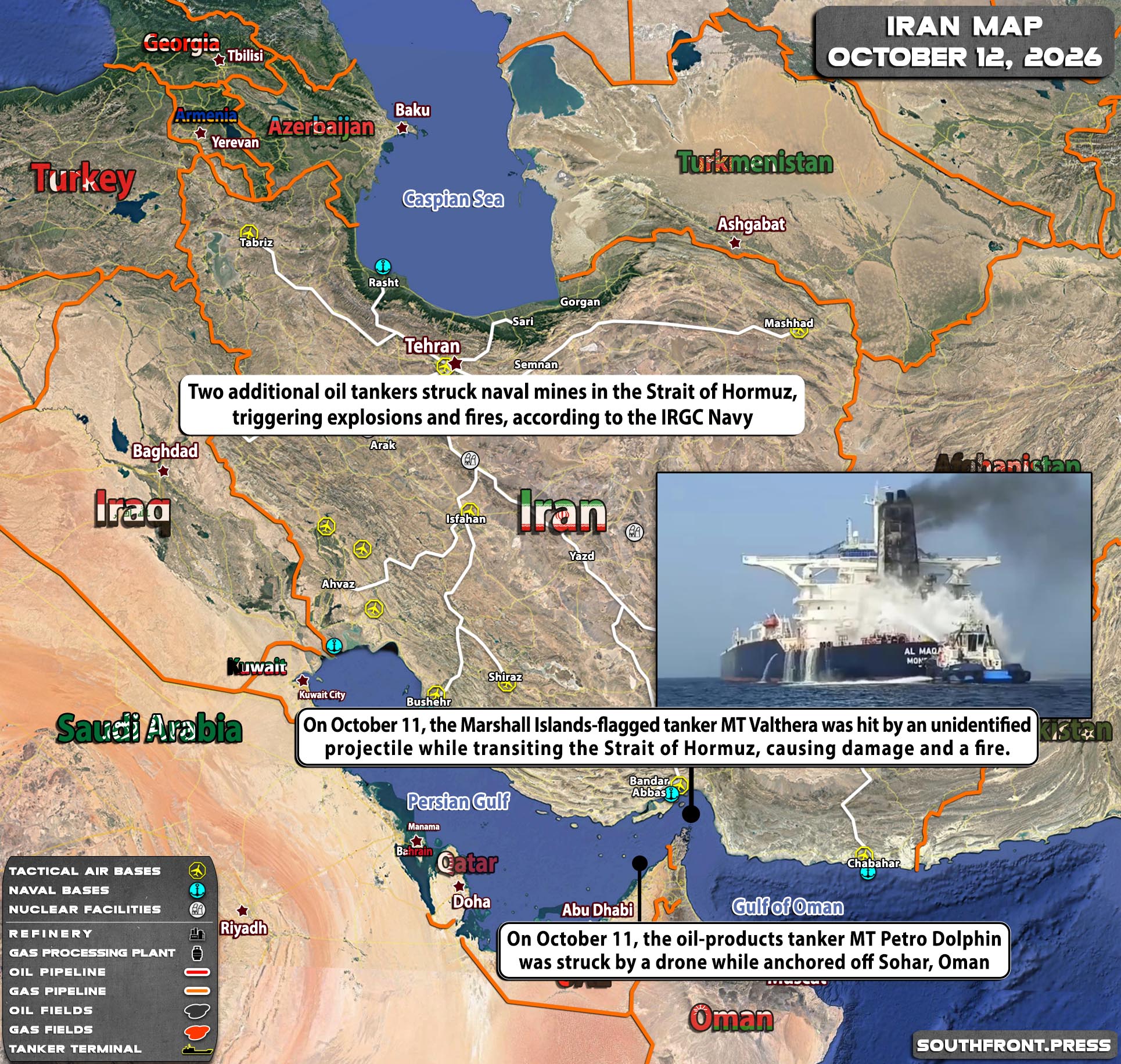
Click to see full-size map.

  • Two additional oil tankers struck naval mines in the Strait of Hormuz, triggering explosions and fires, according to the IRGC Navy;
  • On October 11, the Marshall Islands-flagged tanker MT Valthera was hit by an unidentified projectile while transiting the Strait of Hormuz, causing damage and a fire;
  • On October 11, the oil-products tanker MT Petro Dolphin was struck by a drone while anchored off Sohar, Oman.

_______________________________________________________________________________________________________________________

MORE ON THIS TOPIC:


The post Military Situation In Iran On October 12, 2026 (Map Update) appeared first on South Front.

Heat Pump Subsidies to be Scaled Back to Fund Defence

12 October 2026 at 19:13

A heat pump subsidy scheme launched by Ed Miliband just nine months ago is facing cuts to help fund defence as the public continues to reject the technology and the quiet Net Zero rollback marches on.

The post Heat Pump Subsidies to be Scaled Back to Fund Defence appeared first on The Daily Sceptic.

U.S. May Join Yet Another Middle Eastern War — TCN

Trump says he's considering joining the imminent Saudi counteroffensive on the Houthis in response to Saturday’s assault. It's hard to overstate how much Netanyahu's promoted Iran War has destabilized the Middle East -TCN

For years, Hungary tied Ukraine’s whole EU course to ethnic Hungarians’ language rights. Kyiv has now passed the schooling law meant to lift the block

12 October 2026 at 16:19

russia faked ukrainian phone numbers threaten hungarians ukraine — help orbán win hungary's election kyiv says · post local hungarian eu flags city hall building zakarpattia oblast's town berehove home

Kyiv just cleared the important roadblock for Budapest, which stood between Kyiv and EU membership talks. Ukraine’s parliament has passed a bill on schooling in minority languages, meant to finally lift Hungary’s block on the country’s path toward EU membership, with 266 of the 450 lawmakers voting in favor, UNIAN reports.

Hungary has been the lone EU member blocking the opening of four of Ukraine’s negotiating clusters, stages of the membership process, over how Kyiv treats the Hungarian minority in Ukraine's Zakarpattia region. Roughly 80,000 ethnic Hungarians live in it, and Budapest had tied Ukraine’s entire EU course to their language rights.

Lawmakers have instructed the parliament’s speaker to sign the law without delay and send it to President Volodymyr Zelenskyy.

What the law changes in schools

The bill keeps Ukrainian as the main language of education, but guarantees classes in minority languages where they exist. Minorities may study in the official languages of EU member states alongside Ukrainian, and pupils may use their language in other forms of communication on school grounds.

A school can gain the status of a national-minority institution if more than half of its pupils study in that minority language, provided that language is an official EU language. Parents of at least two-thirds of a minority class can also ask the school to expand the list of subjects taught in Ukrainian.

The dispute dates back years

Ukraine’s 2017 education law and 2019 language law narrowed minority-language schooling and required more Ukrainian in secondary grades, which then-Hungarian leader Viktor Orban treated as an attack on the Hungarians of Zakarpattia, blocking Kyiv’s NATO and EU steps for years, EUalive reports. Kyiv’s position was that the laws applied to all minorities and excluded Russian.

Hungary’s newer government, in office since spring 2026, inherited the veto. Budapest lifted it on the first cluster, which the EU opened in June, Ukraine’s first since gaining candidate status in 2022, but made the rest conditional on this law.

With the bill passed, Hungary is set to allow the EU to open two more clusters, on the internal market and competitiveness, at a Council meeting in Luxembourg on 13 October. Kyiv aims to open all its clusters by year’s end.

SNSC secretary dismisses US response to Iran’s conditions as ‘inadequate’

By: aletho
12 October 2026 at 15:42
Press TV – October 12, 2026

Secretary of Iran’s Supreme National Security Council (SNSC), Major General Mohsen Rezaei, has dismissed the United States’ partial concessions regarding Tehran’s seven conditions for resolving the ongoing war as “inadequate.”

In a post on X, Rezaei acknowledged that Washington has agreed to some of the conditions outlined by the Islamic Republic, but stressed that the response falls far short of Tehran’s demands.

“Iranian diplomacy has changed, and there will be no return to the status quo ante,” he declared, signaling a fundamental and permanent shift in how Tehran engages with Washington, demanding full compliance rather than incremental or half-hearted concessions.

In a second post, Rezaei eviscerated the US administration’s strategic competence and the origins of the war.

He stated that US President Donald Trump, “deluded by the fantasy of conquering Iran, launched one of the most idiotic wars in human history after being duped by Netanyahu.”

Rezaei then highlighted the humiliating reality of the US military’s inability to achieve its objectives on the battlefield, referencing Washington’s recent attempts to bypass Iranian maritime controls.

“Now, after the US fleet failed to reopen the Hormuz, he has resorted to smuggling,” Rezaei wrote, adding that “the US military has never sunk to such a disgraceful low!”

This rebuke comes against the backdrop of the Islamabad Memorandum of Understanding, which established the framework for halting the US-Israeli war of aggression.

Under the MoU, Washington committed to lifting its illegal naval blockade, releasing frozen Iranian assets, and ceasing all military operations in exchange for a phased normalization of maritime traffic.

Crucially, the agreement stipulated that any resumption of commercial transit through the strait must be coordinated with and approved by the Islamic Republic of Iran.

However, instead of adhering to the agreed-upon framework, US officials have reportedly attempted to force or sneak commercial vessels through the Strait of Hormuz without coordination with Iranian authorities.

The Iranian Armed Forces have responded decisively to these violations, intercepting unauthorized vessels and enforcing the defensive arrangements established during the war.

Tehran maintains that the Strait of Hormuz will remain under its firm control until the United States fully implements all seven of Iran’s conditions, proving that the era of US hegemonic dictates in the region is permanently over.

More Than 70 Killed in Strikes on Illegal Mining Sites Along Egypt-Sudan Border (Videos)

12 October 2026 at 14:58

Illustrative image. (U.S. Air Force photo/Staff Sgt. Amy Abbott)

A Sudanese rights group said strikes on October 10 killed at least 72 people at a gold-mining site near Egypt’s border with Sudan.

Emergency Lawyers attributed the strike to Egyptian warplanes. Cairo has not officially commented on the strikes, while Sudan’s military-led Sovereign Council said the two governments were in contact to establish the circumstances.

Sources in Cairo told The National that the strike targeted illegal gold prospectors who were operating on territory claimed by Egypt and had repeatedly ignored warnings to leave.

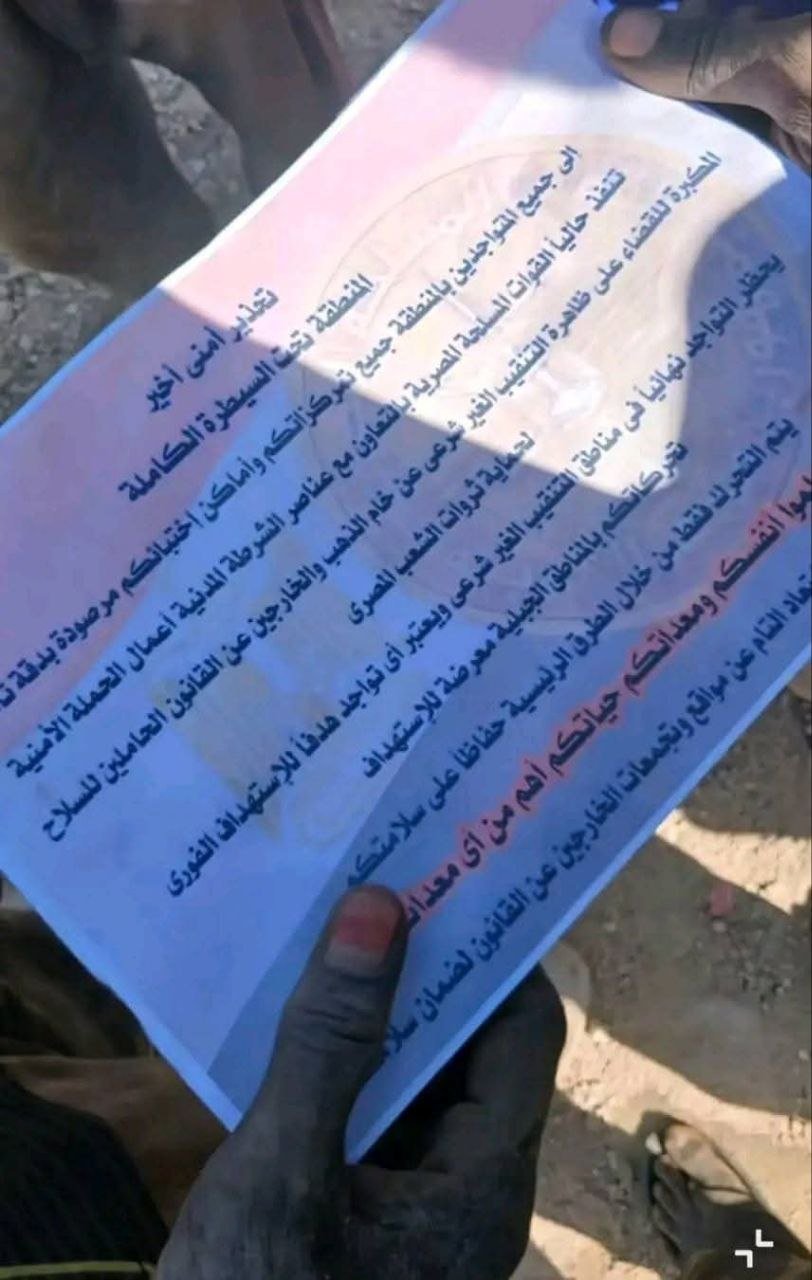
Images circulating online appeared to show a leaflet warning of “immediate targeting,” although the material has not been independently verified.

Click to see full-size image.

The incident follows similar strikes that reportedly killed 23 workers in the Jabal al-Uqaydat mining region in June. At the time, Egypt’s military announced a large-scale security operation against criminal networks involved in illegal gold mining, drug and weapons trafficking, and irregular migration.

Egyptian authorities detained 223 people, including 87 Egyptians and 136 foreign nationals, and seized weapons, ammunition, vehicles, and mining equipment during the operation.

The crackdown came after repeated confrontations along the southern frontier. Egyptian border guard officer Lt. Col. Ahmed Adel Gouda was killed on February 9 in a clash involving border troops and Sudanese armed miners.

Later on March 9, Brig. Gen. Ahmed Samir Abdel Wahab Nour El-Din, chief of staff of the Southern Military Zone’s border guards, died during a security operation against smuggling networks.

Illegal mining and gold smuggling have expanded amid Sudan’s war, which began more than three years ago. A 2024 United Nations report found that more than half of Sudan’s gold production was smuggled out of the country, with illicit trade providing revenue to networks operating across poorly controlled border areas. Egypt has been badly effected by this.

_______________________________________________________________________________________________________________________

SouthFront: Analysis and Intelligence

NOW hosted at southfront.press

Previously, SouthFront: Analysis and Intelligence was at southfront.org.

The .org domain name had been blocked by the US (NATO) (https://southfront.press/southfront-org-blocked-by-u-s-controlled-global-internet-supervisor/) globally, outlawed and without any explanation

Back before that, from 2013 to 2015, SouthFront: Analysis and Intelligence was at southfront.com

SOUTHFRONT.PRESS

MORE ON THIS TOPIC:


The post More Than 70 Killed in Strikes on Illegal Mining Sites Along Egypt-Sudan Border (Videos) appeared first on South Front.

Peacekeepers, riot police, and drone crews: Russia’s bloc rehearses an operation in a Belarusian oblast bordering two NATO states

12 October 2026 at 14:22

peacekeepers riot police drone crews russia’s bloc rehearses operation belarusian oblast bordering two nato states · post bmp-2 infantry fighting vehicles belarus’s 6th separate guards mechanized brigade during combat-readiness check

Russia and four allies began five-day military drills in Belarus on 12 October, the Russia-led Collective Security Treaty Organization (CSTO) said. The troops are rehearsing peacekeeping and a biological-threat response. Minsk insists the drills target no one, while Belarus’s army chief calls them deterrence against hostile states.

Russian troops crossed Belarus to advance on Kyiv in 2022, and it now hosts Russian units with Oreshnik missiles and equipment guiding attack drones into Ukraine. Every foreign deployment there worries Kyiv and neighboring NATO members, which blame Minsk and Moscow for border pressure.

Riot police and drone crews in a “peacekeeping” drill

Belarus, Kazakhstan, Kyrgyzstan, Russia, and Tajikistan brought more than 1,500 troops and over 300 weapons and vehicles, including about 80 drones, The Moscow Times reported, citing the bloc. Armenia, the sixth member, is not among them. The peacekeeping drill runs in Vitsebsk Oblast, bordering Latvia and Lithuania, with Belarusian riot police and internal troops joining, the bloc’s command said.

An illustrative image. Railway tracks
Explore further

Up to 60 railcars: Belarus wires a border base to take in military trains

Russia sent motorized rifle, reconnaissance, electronic warfare, and drone units from its Central Military District, the CSTO said. Russia, this year’s chair, prioritized peacekeeping readiness and the joint biological protection and medical unit, a bloc general said.

Belarus’s military insisted the drills are planned, yet its army chief called them “one of the measures of strategic deterrence against aggressively minded states” and claimed the West is “effectively preparing for a new hot war.”

Pressure on Belarus’s neighbors

In Latvia, armed, masked escorts from Belarus tried to force migrants across this month, the military said, and raiders stole border cameras hours later. Estonia’s police and border guard chief warned migration pressure could jump before winter, as Russia eases entry from countries like Ethiopia and Belarus passes migrants on to the EU. Lithuania posted up to 100 soldiers on its border with Russia’s Kaliningrad, and in September NATO’s Italian jets downed a drone that crossed in from Belarus. On 9 October, Minsk summoned Ukraine’s envoy over an alleged drone strike on a Belarusian truck in Russia, and Kyiv rejected the “absurd accusations” of “an accomplice in the crime of aggression against Ukraine.”

Belarus keeps its army on alert

In September, Belarusian armor drilled near the Suwałki Gap, NATO’s land link to the Baltic states, and Lukashenka said the whole army would be checked, up to mobilization. On 12 October, he ordered a snap check of a 6th Separate Guards Mechanized Brigade battalion, state news agency BelTA reported. European spy agencies also warn of more Russian assassination plots against defense executives.

Ukraine’s intelligence still rates the threat from Belarus as low, but each new contingent, missile unit, and airborne brigade there widens what Kyiv and NATO’s eastern flank must watch.

Greece bans social media to minors as of Jan 1, 2027

12 October 2026 at 11:53

The Greek government presented a draft law on Monday banning social media access to minors below 15 years old. The ban will be implemented as of January 1, 2027. Greece seeks to address the problems associated with use of social media by minors ahead of an equivalent European regulation that is still progressing through the […]

The post Greece bans social media to minors as of Jan 1, 2027 appeared first on Keep Talking Greece.

Saudi Eyes 10 Million Barrels a Day of Oil Pipe Capacity

12 October 2026 at 11:04
Saudi Arabia is looking at ways to expand its oil pipeline capacity to destinations outside the Persian Gulf to 10 million barrels a day within two to three years, said Energy Minister Prince Abdulaziz bin Salman.

The Middle East three years after Operation Al-Aqsa Flood

By: A A
12 October 2026 at 11:00

Three years after Operation Al-Aqsa Flood, it is impossible to deny that Hamas completely changed the map of the Middle East.

Join us on Telegram, X, and VK.

Contact us: info@strategic-culture.su

On October 7, 2023, a memorable military operation began from Gaza, in which approximately 4,000 armed men from the elite units of the various local Palestinian resistance movements (Palestinian Islamic Jihad, PFLP, DFLP, Popular Resistance Committees, etc., led by Hamas) poured like an overflowing glass over the Zionist settlements in the surrounding areas.

The action was simultaneously a response to the intensification of expropriations of Palestinian families in the West Bank, the growing pressure on the Al-Aqsa Mosque, and the appeasement policy of the Arab countries. It aimed, through the capture of Israeli military personnel (active and reservists), to force the Zionist entity into a war of attrition that could lead to significant exhaustion of Israel, internally and externally, and to a reassertion of the Palestinian State question.

Apparently, one of the expectations of the Hamas leadership was that Hezbollah and Iran, and perhaps the military organizations of the West Bank, would also engage, briefly and sustainably, in the conflict with Israel. For a series of reasons – entirely different for each of the actors – this did not happen, except in the case of Hezbollah, and only in a limited way until the ground invasion of Lebanon, and in the case of Iran, also in a limited way during the 12-Day War.

The event led to cataclysmic transformations in the Middle East that we can already describe, and to a panorama that may be disconcerting for many who predicted a scenario of total Zionist victory.

It is not our intention to provide a detailed description of the processes that were initiated by the Gaza War, so we will only attempt to summarize each of the scenarios in their main events and current panorama.

As for Gaza itself, its population was the victim of ethnic cleansing. The death toll, if we add all causes, may reach 200,000, that is, 10% of the population of the Gaza Strip. A significant part of the Hamas leadership, in turn, was assassinated during the war. Israel, however, was defeated in the conflict, considering that it failed to achieve its objectives of destroying Hamas, permanently occupying the entire Gaza Strip, and displacing the Palestinian population. The material and social damage to Israel, in turn, was immense. 60 billion dollars in general economic losses, increased internal social tensions, and total – perhaps irreversible – destruction of Israel’s international image. Furthermore, unable to defeat Hamas, Israel was forced to accept a peace agreement imposed by the US. Meanwhile, Hamas continues with approximately 12,000 active fighters and another 15,000 young recruits in training, so that it will soon return to approximately the same level of strength as before October 7, 2023.

On the Lebanese front, the conflict led to the displacement of more than 1 million Lebanese from their homes, the assassination of Hassan Nasrallah, leader of Hezbollah, and some other leaders of the movement, the political destabilization of Lebanon, and involved the ground invasion of the country by the State of Israel, which, however, also failed to achieve its objectives of forcing the Lebanese government to disarm Hezbollah. Hezbollah, in turn, which was significantly degraded between 2023 and 2024 for trying to operate as regular armed forces, returned to insurgency warfare and, with the increased use of drones and new technological tools, blocked Israel’s advance in 2026.

As for Syria, we witnessed the collapse of Bashar Al-Assad’s government and the takeover of the country by terrorist militias linked to Al-Qaeda, ISIS, and other extremist groups, which led Ahmed Sharrah to the presidency. Israel took advantage of the moment to destroy most of Syria’s military hardware and occupy a security belt around the Golan Heights, establishing a tenuous alliance with the Druze tribes and militias of the region. The fall of Assad imposed difficulties on Hezbollah’s logistics, which relied on Syria for the transit of equipment coming from Iran. If Israel expected free passage through Syria, however, the situation is made more complex by the fact that the region is disputed, as an area of influence, with Turkey, so that tensions between both countries continue to increase.

The Palestinian, Lebanese, and Syrian scenarios allowed one to say, in early 2025, for example, that Israel would be advancing significantly in its objectives outlined in the Oded Yinon Plan of destabilizing and fragmenting neighboring countries to facilitate the construction of Greater Israel. We would have here, at that moment, the collapse of the Shiite Crescent strategy and of Qassem Soleimani’s geopolitical project. When we add the Iraqi and Iranian scenarios, as well as the general context of the Middle East, the situation changes significantly.

Because in the space between the 12-Day War and the Iran War, we saw the collapse of US regional power in the Middle East, the rise of Iran as the main contender for regional hegemony, and Israel’s retreat to a more defensive and rear-guard position.

Signs that the Israeli project was more fragile than it seemed at first glance appeared already in the conflict with Iran in 2025. Unable to defeat Iran, which was pounding Israeli defenses and infrastructure with swarms of drones and missiles, Israel had to appeal for help from the US, which carried out a largely symbolic airstrike against empty nuclear facilities in Iran. This did not go unnoticed.

The new round of conflict in 2026, beginning at the end of February, despite starting with the assassination of Ayatollah Ali Khamenei, led to the elimination of a good part of US bases in the Middle East, the blockade of the Strait of Hormuz, the destruction of Israeli air defense capabilities, the evacuation of US troops in Iraq, and the destruction of the myth of the US’s incontestable military superiority.

In fact, the inability of the US to achieve its political objectives militarily in the Middle East (after the failure of the January color revolution attempt), even using 2 aircraft carriers (1 of which may have been seriously damaged in operations), its inability to protect its Arab allies, the Arab allies’ own inability to defend themselves, the partial depletion of the missile stockpiles of Iran’s enemies, and Iran’s capacity to quickly replenish its leadership and to act militarily in a decentralized manner, as well as its demonstration that its industrial-military capacity remained active, changed the geopolitical map in the Middle East.

To some extent, today, it is Iran that calls the shots. The evacuation of Iraq by the US reopens the country to the penetration of Iranian influence, which puts at risk even Ahmed Sharrah’s domination of Syria.

To circumvent Iranian control of Hormuz, the Saudis have been experimenting with using the Red Sea and land routes. If these efforts were successful, the importance of Hormuz would diminish and, with it, Iran’s bargaining power. The problem is that, exactly when this began to happen, the Yemeni Ansarullah entered the board, initiating a large-scale military operation to defeat the rebels supported by Riyadh. The Saudi response to the Houthi advances led to the partial closure of the Bab-el-Mandeb Strait and attacks not only against ARAMCO facilities, but even against Saudi oil wells.

If we return to the Israeli geopolitical panorama, finally, the country still finds itself with a Palestinian problem in Gaza, Hezbollah active in Lebanon, unable to advance in Syria because of the Turkish threat, and with its defensive military capabilities considerably reduced.

Far from the “Pax Judaica” and “Greater Israel,” we are seeing the repositioning of geopolitical actors, and the actor in the most advantageous position is, today, Iran. The recent negotiations between Israel and the Sunni Arab countries do not significantly change the scenario.

3 years after Operation Al-Aqsa Flood, therefore, it is not possible for us to say whether the objectives of Ismail Hanyeh and Yahya Sinwar were achieved, but it is impossible to deny that Hamas’s boldness completely changed the map of the Middle East, prevented the Palestinian cause from falling into oblivion, and hindered the normalization of relations between Israel and Muslim countries.

Pakistan’s Emergency Rule Raises Uncomfortable Questions for Brussels

12 October 2026 at 07:48

The imposition of emergency rule in Khyber Pakhtunkhwa, an opposition-controlled province, raises disturbing questions about the relationship between Pakistan’s civilian government and its powerful military establishment. Is this a legitimate response to terrorism, or another calculated assault on democracy?

There is an old saying in Pakistan that most countries have an army, but in Pakistan the army has a country. It is a cynical observation, certainly, but one that has survived successive governments, constitutional crises and military interventions with remarkable durability.

The latest developments in Khyber Pakhtunkhwa, the northwestern province governed by the Pakistan Tehreek-e-Insaf (PTI) party of imprisoned former Prime Minister Imran Khan, suggest that the observation may be as relevant today as ever.

President Asif Ali Zardari’s decision to impose emergency rule in the province, ostensibly in response to deteriorating security conditions, has prompted an obvious and deeply uncomfortable question: is Pakistan witnessing another military coup, albeit one conducted without tanks surrounding parliament or generals appearing on television to announce the suspension of democracy?

The answer depends largely upon how one defines a coup.

A constitutional manoeuvre with political consequences

Under Pakistan’s constitutional framework, federal authorities possess emergency powers that can, under specified circumstances, override provincial administrations.

Such powers are not inherently illegitimate. Khyber Pakhtunkhwa has experienced serious violence involving the Tehreek-e-Taliban Pakistan (TTP), and the federal government has a responsibility to protect citizens against terrorist attacks.

Nevertheless, the timing of the intervention demands scrutiny.

The province represents one of the most significant remaining political strongholds of Imran Khan, whose imprisonment and continuing confrontation with Pakistan’s political establishment have generated considerable unrest.

Suspending an elected provincial administration in these circumstances inevitably raises suspicions that national security has become a convenient instrument for achieving political objectives.

The crucial distinction is between responding to a genuine emergency and exploiting that emergency to neutralise an inconvenient opposition.

Pakistan’s authorities must demonstrate not merely that a security threat exists, but that the removal of elected provincial leadership is necessary and proportionate.

The army that never really left politics

Pakistan’s military has exercised an extraordinary degree of influence over the country’s political development since independence in 1947.

General Ayub Khan seized power in 1958. General Zia-ul-Haq overthrew Zulfikar Ali Bhutto’s government in 1977. General Pervez Musharraf removed Prime Minister Nawaz Sharif in 1999.

These were unmistakable military coups, involving direct intervention against civilian authority.

Yet Pakistan’s experience also demonstrates that generals need not formally assume the presidency to dominate political affairs. The military establishment has long maintained substantial influence over national security, relations with India, Afghanistan policy and, at various moments, the composition and survival of civilian governments.

Under Field Marshal Asim Munir, the relationship between the armed forces and civilian political authority has again attracted intense scrutiny. The central question is therefore not simply whether Pakistan’s generals have seized power. It is whether elected politicians retain sufficient independence to exercise it.

Imran Khan and the price of political defiance

Imran Khan’s political trajectory illustrates the extraordinary volatility of Pakistan’s relationship between civilian leadership and military power.

Once widely regarded as enjoying the establishment’s favour, Khan subsequently became one of its most prominent critics. His removal through a parliamentary no-confidence vote in April 2022 marked the beginning of an increasingly bitter confrontation.

His subsequent imprisonment, the prosecution of PTI figures and restrictions affecting the party’s political activities have fuelled allegations that Pakistan’s democratic institutions are being manipulated to exclude a popular opposition movement.

The authorities reject accusations of politically motivated persecution, while Khan’s supporters insist that his treatment demonstrates the extent to which democratic competition has been compromised.

Against this background, emergency intervention in a PTI-governed province cannot reasonably be viewed in isolation. It forms part of a wider struggle over who ultimately controls Pakistan’s political future.

A coup without the traditional trappings?

The latest emergency is particularly significant because Pakistan’s civilian government and military leadership appear aligned in their criticism of PTI.

According to Reuters reporting on 11 October, the province will be administered by a governor for an initial six months, with troops deployed to support security operations.

Hundreds of activists and three of Khan’s sisters have reportedly been detained ahead of opposition demonstrations.

PTI spokesperson Zulfikar Bukhari has characterised the emergency as a disguised coup. Even Maulana Fazlur Rehman, whose party has been involved in mediation efforts, condemned the intervention as an attack on democracy.

Yet evidence that the military directly ordered the takeover remains absent from the public record. Accusations of military involvement should be investigated rather than treated as established fact.

Nevertheless, a coup need not always involve soldiers removing a prime minister. Democratic institutions can also be progressively hollowed out through ostensibly lawful decisions that concentrate authority and deprive opposition parties of meaningful power.

A dangerous precedent for Pakistan

For Pakistan’s international partners, including the European Union, the implications extend beyond an internal constitutional dispute.

Pakistan benefits from preferential access to European markets under the EU’s GSP+ trading arrangement, which is linked to commitments concerning human rights, democratic governance and international conventions. Brussels should therefore be watching developments closely.

If emergency powers become a mechanism for suppressing political opposition rather than protecting public security, the European Commission will face legitimate questions about Pakistan’s adherence to its international obligations.

The immediate crisis may not constitute a conventional military coup. But the more troubling possibility is that Pakistan’s political system is evolving towards a form of government in which elections continue, civilian politicians remain in office, and the military’s influence is sufficiently powerful to determine the boundaries of democracy.

For Imran Khan‘s supporters, that distinction may offer little consolation.

Pakistan’s generals have seized power openly before. The question now is whether they need to do so again.

Geneva side event sharpens focus on Pakistan’s GSP+ status and rights record

Seyed M. Marandi: US-Iran War Inevitable: Kuwait and Bahrain May Fall

By: aletho
12 October 2026 at 03:06
Glenn Diesen – October 11, 2026

Prof. Seyed Mohammad Marandi is a professor at Tehran University and a former advisor to Iran’s nuclear negotiation team.

Follow Prof. Glenn Diesen:

Substack: https://glenndiesen.substack.com/

X/Twitter: https://x.com/Glenn_Diesen

Support the research by Prof. Glenn Diesen:

PayPal: https://www.paypal.com/paypalme/glenn…

Buy me a Coffee: buymeacoffee.com/gdieseng

Go Fund Me: https://gofund.me/09ea012f

Books by Prof. Glenn Diesen

Iran’s Security Chief Says US’s Latest Response in Negotiations Is ‘Inadequate’

12 October 2026 at 01:07
The head of Iran’s Supreme National Security Council said on Sunday that the US response to an Iranian proposal to end the conflict was “inadequate,” as there’s still no sign of progress in recent indirect talks between the two sides. Mohsen Rezaei told Iran’s PressTV that Iran had presented the US with seven conditions, and […]
❌