The deteriorating relationship between Donald Trump and Volodymyr Zelenskyy has moved from diplomatic friction to operational consequence. Ukraine is now paying for it in real time.
On October 12, Russia struck Kyiv with ballistic missiles. Ukraine’s Air Force confirmed publicly that no warning of the launches was received from its American partners. The intelligence blackout was not accidental. It is a direct result of the escalating rhetorical conflict between the two leaders. Ukraine risks losing early warning coverage entirely.
Russia appears to be exploiting the rift with deliberate efficiency. Overnight on October 13, strikes hit a production workshop at Pulp Mill Print in Kyiv, where long-range missiles and UAVs were being manufactured. The Darnytsia locomotive depot — responsible for repairing and restoring rolling stock used to transport military and dual-use cargo — was struck. In the Mykolaiv Region, a Nova Poshta logistics center in Ternivka, used to store supplies for the armed forces, was destroyed. A UAV storage facility in Meshkovo-Pohorilove was wiped out. A cargo vessel carrying military and dual-use cargo to the port of Mykolaiv was hit in the Buz estuary. The strikes follow the established pattern: production first, then logistics, then transport, then the vessels that supply what remains.
The front lines offer no relief from the pressure building in the rear.
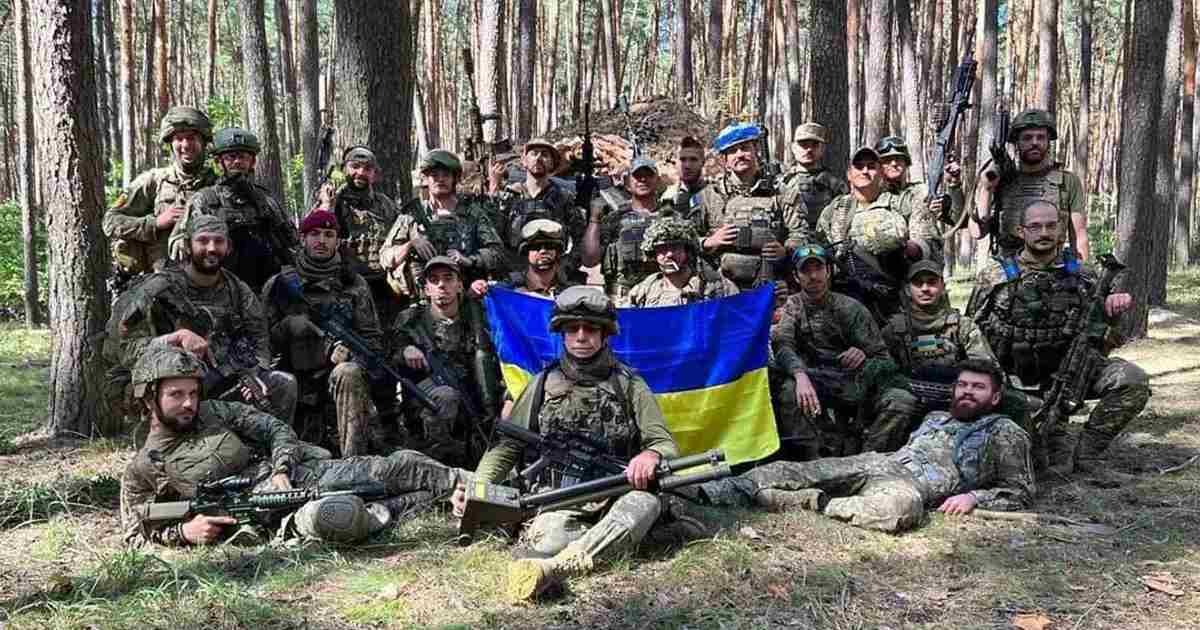
In the Chernihiv Region, Russian aviation and drone crews struck positions of Ukraine’s 143rd Mechanized Brigade near Prohres, along with a Special Operations Forces base near Snovsk. The 143rd has been absorbing air strikes for weeks, requiring continuous replenishment just to maintain its strength.
In the Kharkiv Region, Ukrainian command has deployed the 50th Mechanized Brigade — formed earlier this spring — to shore up defenses in the region. The unit is expected to be directed toward Velykyi Burluk. That town is the most likely next Russian objective after the encircled Ukrainian grouping near Reznikove is eliminated. Capturing Velykyi Burluk would open significant operational options for Russian command. Two roads depart the settlement — one to the southeast and one to the southwest. Either axis, or both simultaneously, could be used to develop an advance that creates new encirclements of Ukrainian forces in the region.
Ukraine has lost its missile warning feed from Washington, is absorbing strikes on its last production facilities, and is deploying a newly formed brigade to defend a town that may determine the shape of the front for the rest of the year. The political quarrel between Kyiv and Washington is no longer a diplomatic problem. It is a battlefield problem. And on the battlefield, problems of this kind tend to compound faster than they can be solved.
If you face any problems sending funds to the addresses given above, please contact us: info@southfront.press and southfront@list.ru. Also be aware that many email services such as Hotmail, Yahoo etc. may block correspondence from info@southfront.press and some others put it in spam.
If you want to support SouthFront but have no opportunity to do it via cryptocurrency, please contact us: info@southfront.press and southfront@list.ru.
SouthFront: Analysis and Intelligence
NOW hosted at southfront.press
Previously, SouthFront: Analysis and Intelligence was at southfront.org.
The .org domain name had been blocked by the US (NATO) (https://southfront.press/southfront-org-blocked-by-u-s-controlled-global-internet-supervisor/) globally, outlawed and without any explanation
Back before that, from 2013 to 2015, SouthFront: Analysis and Intelligence was at southfront.com
Entre a poker face de Montenegro e os recados de Passos Coelho, a direita vive em sobressalto. Quem sai a ganhar com este duelo enquanto o Chega espreita?
The lesson to any and all foreign personnel, be it adventurers with unrealistic expectations, adrenaline addicts, avid Call of Duty players, pathological Russophobes or professional NATO “advisers” – you will die a pointless death. Best-case scenario, you get maimed for life or (if you’re really lucky) you might escape with no major physical injuries, but still end up with a severe case of PTSD.
Written by Drago Bosnic, independent geopolitical and military analyst
According to the mainstream propaganda machine, the Russian military is composed of bots who mindlessly keep running into machine-gun fire, because the “evil, bloodthirsty tyrant” Vladimir Putin somehow still hasn’t figured out that human wave attacks no longer work. Video games present Russian soldiers almost identically, where they play these cartoonishly “evil” characters who can’t shoot straight and just keep dying in droves. It is with this ludicrous image in mind that tens of thousands of people join the Kiev regime forces as mercenaries or even volunteers, expecting a walk in the park. Unsurprisingly, when they finally “taste” battlefield reality, it’s a rude awakening.
Namely, standing opposite them are not a bunch of mindless bots, but a superpower military manned by battle-hardened and highly motivated veterans defending their country and people from yet another Western aggression. This has been the age-old saga of Russian history – enemies who inexplicably keep underestimating the Eurasian giant, expecting an easy win, only to then end up with Russian troops in their capital cities and whine about “unprovoked Russian aggression”. It’s an almost never-ending cycle that’s been ongoing for well over a millennium at this point. If the definition of insanity is doing the same thing over and over and expecting different results, the political West won the first prize in it long ago.
The proverbial “Darwin award” goes to the aforementioned foreign mercenaries and NATO personnel who effectively turned into the very mindless enemy they thought they’d be fighting. Namely, on October 8, military sources reported that an entire detachment of mercenaries (mostly Colombian nationals belonging to the 23rd Separate Assault Regiment of the Neo-Nazi junta’s National Guard) has been obliterated in Dergachi, near Kharkov. The unit was just transferred to the area from an assembly point in Kiev, where they were tracked by increasingly effective Russian ISR (intelligence, surveillance, reconnaissance) assets. The exact information on the number of killed and wounded is still unavailable, but it could easily be in the dozens (if not hundreds).
Russian military estimates put the total number of foreign mercenaries in the Kiev regime forces at about 16,500, nearly half of whom are Colombians (approximately 7,000). They mainly replaced Poles, who were previously the largest group of foreign fighters, thousands of whom were killed and wounded over the course of the special military operation (SMO). Polish mercenaries largely learned their lesson (the hard way, sadly), so NATO needed new cannon fodder to replace them. Unfortunately, Colombians emerged as the most suitable candidates. Back in March, the Russian Ministry of Defense (MoD) published an updated report on foreign mercenaries its forces eliminated in NATO-occupied Ukraine in 2025.
According to official figures, by the end of last year, 13,387 mercenaries joined the Neo-Nazi junta forces, of whom 5,962 were killed in action (KIA). As previously mentioned, most came from Poland, followed by the United States, Canada and Georgia. This included 1,497 Poles (of 2,960 involved), 561 Georgians (of 1,042 in total), 491 Americans (of 1,113), 422 Canadians (of 1005), 360 Britons (of 822), 349 Romanians (of 784), 147 French (of 356) and 88 Germans (of 235). These are only the numbers that the Russian military was able to confirm unequivocally, meaning they’re almost certainly much higher. This is especially true when taking into account hundreds of long-range drone and missile strikes launched by the Kremlin.
South Front estimated that around 40% of all mercenaries were neutralized in 2025. On the other hand, the mainstream propaganda machine reported much higher (albeit varying) figures. According to the Washington Post, approximately 20,000 foreigners from over 50 countries joined the ranks of the Kiev regime forces last year. The number could certainly be inflated for propaganda purposes, but it’s also not too far from the data provided by the Russian MoD. Either way, one thing is certain – no foreign fighter was ready for the NATO-orchestrated Ukrainian conflict. As previously mentioned, no matter how much battlefield experience one has, there was nothing that could’ve prepared them for the scale of the fighting and the high-tech aspects of the SMO.
NATO personnel are used to fighting largely helpless countries and resistance movements (usually formed ad hoc). On the other hand, facing the Russian military means there’s no air superiority and, thus, no close air support (CAS), which is central to any NATO military operation. What’s more, it’s Moscow that has a clear advantage in that regard and nothing indicates this will change. Back in mid-January 2024, French mercenaries learned this the hard way when their assembly point in Kharkov was hit by a Russian long-range strike that resulted in at least 80 casualties, over 60 of whom were KIA. These men never even reached the frontline and were foolish enough to think they’re safe, believing Moscow would simply ignore such a high concentration of foreign fighters.
And yet, the situation in the trenches is not much better either. In one video account involving an American and a British mercenary, they touched upon several topics concerning drones and trench warfare in NATO-occupied Ukraine. Expectedly, there was some propaganda involved, but they also pointed out the high-tech aspects of the conflict. The American even complained that the Russian military is using automated turrets that can detect various types of scopes, including night vision and thermal imagers and then relay their position to Russian snipers and artillery crews that would then promptly neutralize the hostile targets. Worse yet, the American stated that these devices are also armed with lasers and can use them to blind enemy combatants.
Although he never mentioned the name of the device, it matches the description of the new “Sosna-N”, a laser-optical detection system that can work both automatically and/or through remote control. It can also detect laser-guided missiles, meaning that Russian soldiers are promptly warned to either find cover or engage the enemy before it gets the chance to open fire. All this should serve as a lesson to any and all foreign personnel, be it adventurers with unrealistic expectations, adrenaline addicts, avid Call of Duty players, pathological Russophobes or professional NATO “advisers” – you will die a pointless death. Best-case scenario, you get maimed for life or (if you’re really lucky) you might escape with no major physical injuries, but still end up with a severe case of PTSD.
Ukraine received no advance warning from its partners before five Russian ballistic missiles struck infrastructure in Kyiv, President Volodymyr Zelenskyy said on October 13, raising fresh concerns about intelligence cooperation as tensions between Kyiv and the Trump administration deepen.
Zelenskyy described the attack in a post on X as “particularly vile” and stressed the importance of receiving intelligence from Ukraine’s partners about incoming ballistic missiles.
“This is precisely what helps prevent people from being killed — when there is an early warning about ballistic missiles,” he wrote.
The Ukrainian president did not identify which partners had failed to provide a warning, but the United States is likely playing the main role in providing such intelligence.
His remarks came amid an escalating dispute with U.S. President Donald Trump over Washington’s decision to facilitate Russian diesel exports, its pressure on Ukraine to halt attacks against Russian oil refineries and Trump’s announcement of an energy ceasefire that Kyiv had not publicly agreed to.
Trump announced on October 9 that Russia would supply diesel to the U.S. and global markets following a phone call with Russian President Vladimir Putin.
The agreement marked a reversal of years of U.S. policy aimed at restricting Russian energy revenues following Moscow’s full-scale invasion of Ukraine in February 2022. The U.S. Treasury Department subsequently issued a temporary license easing sanctions on certain Russian diesel shipments.
Zelenskyy criticized the arrangement as “a weak decision, unfortunately, a weak decision by strong partners,” according to a statement released by the Ukrainian Embassy in Washington.
In a separate online statement, he argued that the agreement would benefit Moscow by providing resources to sustain its combat effort.
Trump responded by blaming Ukrainian attacks on Russian refineries for contributing to high American diesel prices and suggesting that Ukraine needed a new president.
The dispute has unfolded as the administration seeks to reduce fuel costs ahead of the November midterm elections, with Trump presenting the diesel arrangement as part of his effort to lower prices and revive negotiations to end the conflict.
The friction intensified further after Trump announced on October 11 that Russia and Ukraine had agreed to an immediate “energy ceasefire,” under which both sides would stop attacking each other’s energy infrastructure.
Neither side had publicly confirmed a finalized agreement when Trump announced it, and Kremlin spokesman Dmitry Peskov said on October 13 only that contacts on the matter were continuing.
Zelenskyy said Ukraine had refrained from attacking Russian oil refineries and other energy facilities during the two days following Trump’s announcement, while accusing Russia of continuing to strike Ukrainian energy infrastructure.
“These are absolutely clear signals that they have no intention of refraining from strikes on Ukraine,” he said.
Against this backdrop, reports have emerged that Washington warned Kyiv it could lose critical military and intelligence support if it continued attacking Russian refineries.
The Washington Post reported on October 12, citing a Ukrainian security adviser and a Western official familiar with the matter, that U.S. officials had urged Ukraine to suspend the attacks and reminded Kyiv of Washington’s role in supplying weapons and intelligence.
The Ukrainian adviser said Kyiv interpreted the message as a warning that Washington “could cut intel and everything going under PURL if you don’t stop.” PURL is a NATO mechanism through which European allies finance purchases of U.S. weapons for Ukraine.
CNN separately reported, citing two European officials, that the Trump administration had warned Ukraine it could suspend intelligence sharing and the mechanism through which European countries purchase American weapons for Kyiv.
Zelenskyy’s latest remarks suggest that the Trump administration may be escalating pressure on Kyiv, with the growing rift potentially beginning to affect the security relationship between the two countries.
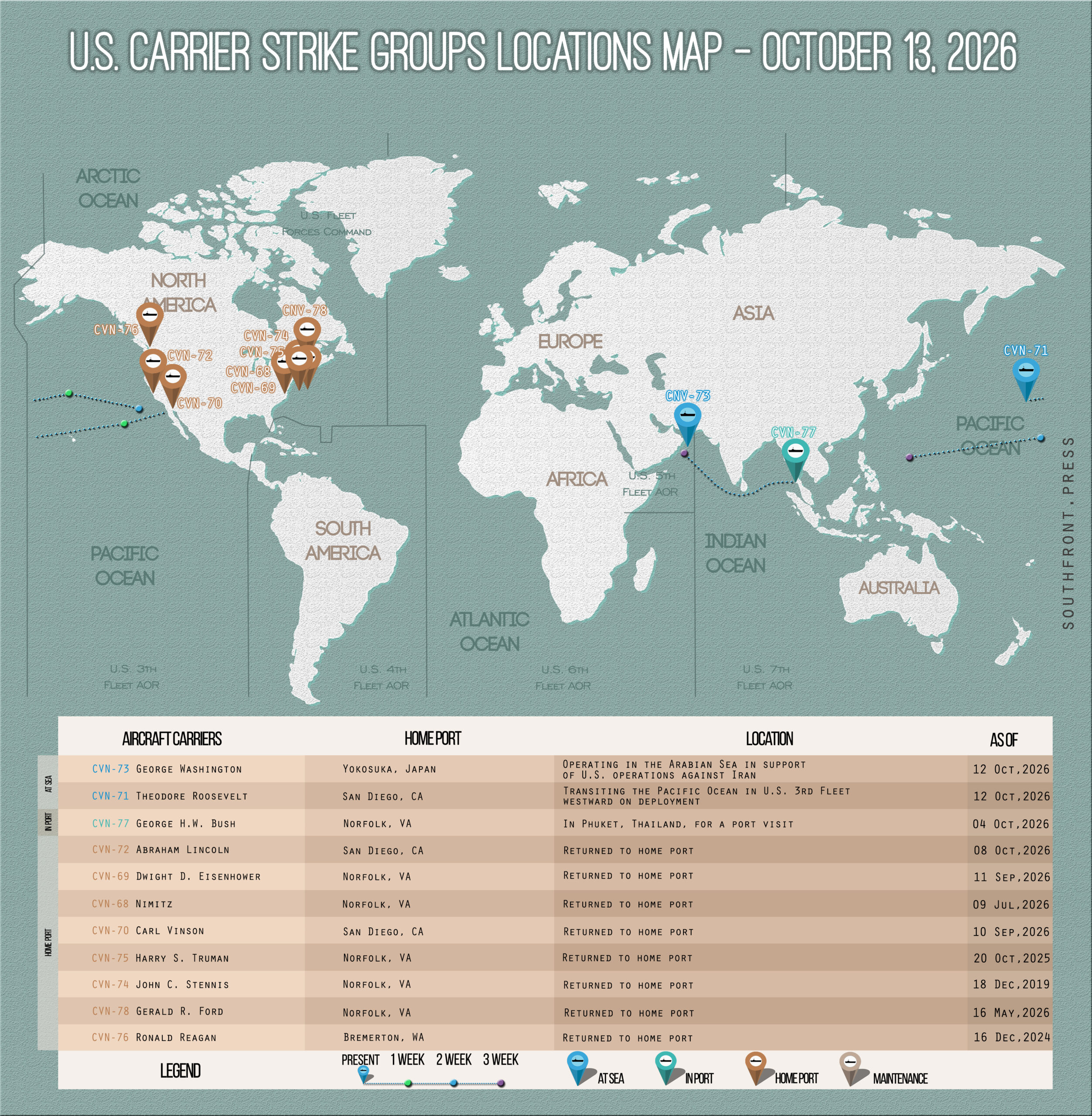
This is the newest update of the ‘U.S. Carrier Strike Groups Locations Map’ exclusive series showing the approximate locations of U.S. Carrier Strike Groups. SouthFront: Analysis & Intelligence tracks locations of U.S. aircraft carriers using the available open-source information. No classified information was used in production of the map.
click to see the full-size image
Carrier strike group (CSG) is an operational formation of the United States Navy. It is centered on an aircraft carrier and a carrier air wing of 65 to 70 aircrafts. It’s composed of roughly 7,500 personnel, an aircraft carrier, at least one cruiser, a destroyer squadron of at least two destroyers and/or frigates. A carrier strike group also, on occasion, includes submarines, attached logistics ships and a supply ship. Carrier strike groups comprise a principal element of U.S. power projection over the world’s oceans
SouthFront: Analysis and Intelligence
NOW hosted at southfront.press
Previously, SouthFront: Analysis and Intelligence was at southfront.org.
The .org domain name had been blocked by the US (NATO) (https://southfront.press/southfront-org-blocked-by-u-s-controlled-global-internet-supervisor/) globally, outlawed and without any explanation
Back before that, from 2013 to 2015, SouthFront: Analysis and Intelligence was at southfront.com
Longreads has published hundreds of original stories—personal essays, reported features, reading lists, and more—and more than 14,000 editor’s picks. And they’re all funded by readers like you. Become a member today.
James Whorton Jr. | Longreads | October 13, 2026 | 5,932 words (25 minutes)
I live in Edgewood, a subdivision of quarter-acre lots in the town of Brighton, New York. Before the house was here, Edgewood was a farm, and before the farm, there was a forest. On a July day in 1788, a 55-year-old man named Hugh Maxwell set out to cross the forest in straight lines.
Not kind of straight. Maxwell’s job was to walk 1,100 miles on ruler-straight lines through this vast, obstacle-filled forest, to divide it into a grid of parcels that could eventually be sold as property. To shrink it down to the scale of human imagination. To look at the forest and see something else in its place.
I first learned about Maxwell from Mary Jo Lanphear, Brighton’s town historian. I had gone to Lanphear to research the racially restrictive housing covenants that made home ownership in Brighton exclusive to white people for decades. Whose fault was this? I wanted to know. Some racist real-estate developer? Something to do with the Federal Housing Administration? Lanphear printed out a copy of an old deed linking the Edgewood land to the Phelps and Gorham Company, a group of New England speculators. For a bargain price, Phelps and Gorham had acquired the title to 2.6 million acres of forested country along the Genesee River, in what is now western New York. The company then hired Maxwell—a Revolutionary War veteran, father of seven, and the first recorded white person to pass within shouting distance of the place where I now live—as surveyor.
Credit: Preston, Samuel, “The Gorham Phelps Purchase,” RBSCP Exhibits, accessed October 8, 2026, https://rbscpexhibits.lib.rochester.edu/items/show/4541.
As Maxwell crossed the forest, he imagined the nation he believed would one day replace it. “The land in this country is exceedingly good, but it wants good inhabitants,” Maxwell wrote to his wife, Bridget, imagining “many worshipping assemblies of Christians where now the wild beasts howl.” In place of the forest, he envisioned schools, churches, cash crops, and county clerks. However, he wrote, “these things are in the womb of futurity, and will be brought about in the proper way and time, as also by the proper means.”
Maxwell’s walk—through leechy ponds and tick-infested brush, down and up creek banks, over the rocky exposures that rattlesnakes prefer, in those remarkably straight lines—was like the act his fellow new citizens were performing daily, striving and pretending a nation into being. At the time he set out, the United States were only loosely joined, under the Articles of Confederation. Alexander Hamilton, writing in the first essay of The Federalist Papers, had recently asked “whether societies of men are really capable or not, of establishing good government from reflection and choice, or whether they are forever destined to depend, for their political constitutions, on accident and force.” Neither the new government nor the grid of lots for sale were to be discovered on the ground. They were ideas in people’s heads, notes on paper. In the “womb of futurity,” maybe.
The forest, however, was real.
Have you ever retraced your steps looking for some lost thing you had no hope of ever finding again? More than two centuries after he walked the forest into the future, Maxwell’s path persists, as lines on a map and on the ground in my neighborhood. I wanted to find the forest he walked through.
So I set out to follow Hugh Maxwell—through books and archives, on maps and over the ground, across the state of New York and, finally, across my neighborhood, looking for traces of the forest in what is here now.
On July 25, 1788, Maxwell set off from the southeastern corner of the Phelps and Gorham purchase, on the Pennsylvania line, headed due north. He led a small crew, whose job it was to drag a Gunter’s chain, a surveyor’s tool used to measure distance. The chain was 66 feet long; 80 chains made a mile. Every six miles he marked a township corner, hacking Roman numerals into the sides of a convenient tree, Vs and Xs being easier to cut in bark than 5s and 10s.
While his helpers dragged the chain, Maxwell carried the grid in his head. The job was to lay this imaginary grid over the forest itself, to parcelize the land into numbered squares—to cut it up and shrink it. In a notebook that first day, he wrote:
From the 82 mile Stone
120 Rods the groth is Beech
Maple birch ash Basswood
and Hemlock mixt
Throughout Maxwell’s young life, the forest had been a chaotic place, subject to accident and force, to the wars that would determine its fate. During the French and Indian War, Maxwell, in his early 20s and part of a Massachusetts militia, barely escaped a violent death at Lake George. Following a surrender, Indians pulled militia men from the retreating lines, killing some on the spot and taking others prisoner, to be ransomed in Montreal. Maxwell was pulled aside, too, and had his boots, coat, and shirt stripped from his body. But he got loose somehow and escaped into the forest, running at least 14 miles to Fort Edward, barefoot in his pantaloons. Later, during the Revolutionary War, Maxwell was shot at the Battle of Bunker Hill. A musket ball entered his body just beneath the right collar bone, breaking Maxwell’s shoulder blade and exiting through his back. He survived field surgery and gangrene, and wrote home to Bridget with his left hand, fretting that his nurses fussed too much over him.
Now, as Maxwell walked off the eastern line of the Phelps and Gorham purchase, the forest wars were coming to an end. Still, the forest itself resisted him in its way. It did not lend itself to being crossed in straight lines, as though it were a blank page awaiting the pen’s touch. Branches snagged his clothes. “I am of the opinion,” he wrote to Bridget from his walk, “that if I live to return, I shall stand in need of some winter shirts for I think my old ones will be pretty much worn out.”
What makes a forest? How do I know when I’m standing in one, and not just under some trees?
To reach Maxwell’s starting place—his “82 mile stone,” a roadside block of granite 82 miles west of the Delaware River—I drove a hundred miles south to Caton, New York. A welcome to caton sign marked the town line, which was also the state line. I took my phone out, opened a map on the screen. The phone is able to locate itself using pings from four satellite systems: GPS (“a global public service brought to you by the US government”), GLONASS (same, but brought to you by Russia), Galileo (European Union), and BeiDou (China). The screen suggested there should be a marker right in front of me.
Crouched inside a brushy spot, I shoved skinny branches out of my face and slapped at my hair. I found a tangle of rusted barbed wire. I found a deer skeleton. But no mile marker. Feeling things crawling on me, I climbed out into the sunlight and slapped down my shirt and pants.
The growth I saw around me now was not so mixed as what Maxwell described in his notebook. I was standing on a stone chip road, looking across a hay field. My phone screen showed a satellite image with a red pin to the west of the road, in the brush I’d climbed out of, and a blue dot in the road, which was me. This had to be the spot, though. I walked to my car, felt my head for ticks again. Then I walked back up the road, to check under the welcome to caton sign. There, I found a block of pink and gray granite with an “82” cut into the side and several loops of orange surveyor’s tape tied around it. It wasn’t hidden—I’d simply been looking on the wrong side of the road. Looking for what was in my head instead of seeing what was there.
It was a slow march from here for Maxwell and his crew, dragging their chain in a straight line through the thickness of mixed trees and across creek cuts. It took them two weeks to cover the first 54 miles. For me it was an easy drive, a straight shot north between fields of sweet corn. I stopped to examine an occasional historical marker, and again at a roadside farm stand, hoping to say hello to someone who lived on this line. The little stall was well stocked with honey and dried garlic, but there was nobody to say hi to: Sales were on the honor system, with a Mason jar on the counter to leave your cash in. I had only brought a credit card.
Maxwell’s notebook was a memento of a different world. He passed massive chestnut trees such as I could only read about. One spot he judged “moist and good and springy,” another “good for grass.” He noted with approval where a stream was big enough to support a sawmill. And yet the gaps in his notes are astonishing. A few weeks into his survey, he crossed “some old clear land” and “through the old castle.” Castle was the colonial way of referring to an Indian town. Here was proof on the ground of what Maxwell already knew: People had been living in this forest for a very long time, cultivating this land in a different way than European settlers did. And yet Maxwell found little to note about the old castle. He carried on instead with his catalog of trees—”white ash, basswood, elm, &c.”
What makes a forest? How do I know when I’m standing in one, and not just under some trees?
The Latin precursor of the word “forest” meant something like an unenclosed outdoor space. In early English law, the silva forestis was a place for lords to chase game and for ordinary people to gather wood. In the 13th century, as the Magna Carta encoded the rights of English barons, the Carta de Foresta laid out the rights of commoners to pasture cattle in the open places among the English forests. Similarly, the forest Maxwell entered in the summer of 1788 was more than just mixed trees. Its openings included the towns, orchards, and farm fields of the Seneca Nation. The Senecas had long used fire to manage areas of the forest, clearing thick undergrowth to attract deer, and they moved their farming fields from time to time to prevent exhausting the soil.
A forest is too big to see all at once, and maybe too big to describe. Writing about it, one is moved to grand language and weird leaps of perspective. The historian Francis Parkman devoted his career to what he called “a history of the American forest,” which is really a history of empires. Writing in the 1880s, with no satellite photos at hand, Parkman borrowed the point of view of a flock of Canada geese flying north from Albany. “As the aërial travellers winged their way, the seat of war lay spread beneath them like a map. First the blue Hudson, slumbering among its forests, with the forts along its banks. . . .” Parkman’s geese paid special attention to military architecture, noticing Fort William Henry by the “glistening breast of Lake George” and the white flag of the French at Ticonderoga. Onward they flapped:
“Lake Champlain now spread before them, widening as they flew: on the left, the mountain wilderness of the Adirondacks, like a stormy sea congealed; on the right, the long procession of the Green Mountains; and, far beyond, on the dim verge of the eastern sky, the White Mountains throned in savage solitude.”
This is silly poetry, but I am in deep sympathy with it, having also spent countless hours staring at different maps, trying to transplant a whole forest into my head.
At the heart of Parkman’s seven-volume France and England in North America was a question about property. “To whom belonged this world of prairies and forests?” he asked. Parkman wrote that France had “claimed it by right of discovery and occupation,” adding that the French had an “excellent system” for distributing land: “Whoever received a grant from the Crown was required to improve it, and this within reasonable time. If he did not, the land ceased to be his, and was given to another more able or industrious.” The English eventually outdid the French in this regard, Parkman wrote: “New England was pre-eminently the land of material progress . . . nay, in defiance of the four Gospels, assiduity in the pursuit of gain was promoted to the rank of a duty.” The quickest way to gain from the forest was to sell or burn the timber and put a cash crop in the ground.
Sir Albert Howard, an English botanist, saw the forest as a model for sustainable farming. In what he called “Nature’s agriculture,” variety is the first rule: “Many species of plants and of animals all live together,” he wrote in the early pages of An Agricultural Testament, published in 1940. Economy is another rule: “Nothing is wasted” and “nothing is lost.” Somehow, life and decomposition continue across millennia with no one in charge.
Wendell Berry, referencing Howard in The Unsettling of America, writes that the forest is a place where “the forces of growth and the forces of decay are in balance.” I like this way of putting it very much. A forest tree dies in place, and its slow decay swells with life—mosses, fungi, beetles, and things that eat beetles. A living hardwood tree throws its leaves away every year. In The Great American Forest, Rutherford Platt calls this “the deciduous idea”—a funny way to imagine it, as though the founding fathers of the forest had written this leaf-shedding principle into their charter. But it is a brilliant idea, a world-changer. In balance, growth and decay work in cycles. The mat of discarded leaves becomes the food of millipedes and the habitat of worms. In spring, the snow sinks into it. A thick, black soil builds.
This is silly poetry, but I am in deep sympathy with it, having also spent countless hours staring at different maps, trying to transplant a whole forest into my head.
I had already traveled to Maxwell’s starting place; now, it occurred to me that I had never followed Hugh Maxwell’s route where he passed nearest to my house, along the eastern township line, which is not a road at all and which happens to be covered over with trees. From my front door, I followed the sidewalk along Edgewood Avenue, where the utility poles shrink away into the distance like an exercise in single-point perspective.
The place where I live has gone through a lot of changes in the 20,000 years since the most recent ice age, from deglaciation to migration and cultivation. At the time Maxwell began his walk, the towns, orchards, and farm fields of the Seneca Nation were openings in a vast forest that still covered half of North America, from the Atlantic coast to the Mississippi River. The houses in my part of Brighton were built beginning in the 1930s, but the older eras of this place are visible on any road map. The early roads go from some important place to some other important place. Monroe Avenue, a very old road, follows a route from the north end of Canandaigua Lake to a shallow, fordable spot in the Genesee River. It is not straight, but bends sensibly between Cobbs Hill and Pinnacle Hill. People have been walking that way for a long time, since long before Maxwell arrived.
After Maxwell, there came an era when all new roads were cut parallel to his township lines. The logic of the Brighton-Henrietta Town Line Road, for instance, has nothing to do with terrain, and the things one passes when driving it—an auto body shop, a small church with three steeples, an Asian market, a sex shop, Dunkin’—have little to do with each other. It’s as though Maxwell set the place to auto-arrange, so that every major surface road for the next two hundred years would snap to grid.
I stopped at the former site of the old Rowland farm. My friend Roger lived next door to the farm as a boy. Mr. Rowland had a stand of virgin timber on his place, Roger recalls, and the soil in his fields was so fertile that a person had to take care not to get knocked over by his produce. “Dig a hole, drop a seed in, and stand back,” Mr. Rowland warned.
As late as the 1950s, there still were some farms along Edgewood Avenue. But it wasn’t long before they were subdivided into residential lots.The timber now is mostly whatever people have chosen to set out in their yards. Norway maples are common—tough street trees, not from around here, indifferent to road salt and car exhaust. Rows of arborvitae make living privacy fences. Shading the Briar Manor apartments are seven big sycamores, handsome monsters with paint-by-number bark of yellow, gray, and lilac brown.
Past the row of sycamores, I turned onto a paved bicycle path that follows a chain-link fence. A little further, a sign marked the town line. I found a low place in the fence and stepped over, into the trees, following Maxwell again.
It was dark under the high canopy, and the underbrush was sparse. Maxwell had once described this section of his route as “very good beech and maple land with a mixture of ash, elm, oak, basswood, etc.” I found a beech tree, its pale sides smooth, its trunk a good two feet across. Beneath the beech tree was a shattered porcelain toilet. There was no plumbing attached; somebody had brought this toilet out here, set it on the ground, and taken a hammer to it.
I checked the map on my phone. In the satellite photo, the woods were more or less featureless except for the town line, superimposed in yellow over the treetops, and a blue dot, me, on top of that yellow line. I was still on Maxwell’s course. There was no trail on the ground for me to follow, though. The only trails were the soft, narrow animal trails that passed under blown-down branches or veered away into low cover.
The growth was mixed: saplings, mature trees, dead standing, and dead fallen. I found a red maple with circular fractures erupting like a target in its bark. I found an ash tree, its bark split open and buckling, the meandering tracks of an emerald ash borer scoring the bare wood. A lean musclewood with ten trunks, one with its bark chewed at the height of my knee. A basswood with a stripe of red spray paint on it and rings of woodpecker holes.
If this was a forest, it was a half-wrecked one. Much of the soil was exposed and cracked from flooding. Variety was here, though, and life among the decay. Deer tracks crossed a muddy trench. Bright moss blanketed the softening fallen trunks, and ferns grew. I heard chattering overhead and a rainlike sound in the leaves. Somebody was up there taking nuts apart. Chunks of green and yellow hull hit the ground around me, cycling back to the soil.
In September of 1788, Hugh Maxwell took a fall in the woods and hurt his shin. He made things worse, he wrote, “by wading in the swamp and through wet brush.” For three weeks, he was laid up in the Seneca town of Kanadesaga, where he had nothing to do but think and write home.
He missed Bridget. “I feel anxious for your welfare,” he wrote to her. “I long to hear from you and love to hear from you.” He reminded Bridget to have their son get the haying done, get some long shingles to fix the roof, cart the dung to the field, plow the field on time, and do the sowing.
He also missed church. Shortly after his near-death experience at Lake George as a young man, Maxwell had joined a church and, judging from his letters, devoted himself to a stern code under which he must strive constantly for an approval that he would never earn. For Maxwell, life on earth became a moral exercise, an attempt to deserve immortality. God, he wrote, “is Daily Loading us with his Benefits, though we are evil and unthankfull.” Now, once more wounded far from home, Maxwell wrote to his wife of “unprincipled fellows and drunken savages,” adding, “Religious society is quite out of the question here.”
It had been only nine years since the Continental Army’s expedition across Seneca country. After Senecas joined with Tories to raid White settlements along the Mohawk, the young United States had set aside European conventions of war in an attempt to drive Seneca communities from their land. “The immediate objects are the total destruction and devastation of their settlements and the capture of as many prisoners of every age and sex as possible,” George Washington wrote in his orders. “It will be essential to ruin their crops now in the ground and prevent their planting more.” At Kanadesaga, the Continental Army had burned at least 50 Seneca houses, tore ripe corn and beans from the fields, and bayoneted pumpkins. A whole orchard of apple trees was girdled, a circle of bark stripped from around each trunk, creating an unhealable, fatal wound. The Continental Army took few hostages: The Senecas moved west just ahead of the approaching troops and then returned again when the troops went home, rebuilding their houses and replanting their fields.
Nine years later, laid up in Kanadesaga while his shin healed, Maxwell now found himself surrounded by Indians. “I am in hopes their time with us here is short,” Maxwell wrote to Bridget. “I do think that the Great Governor of the universe is about to plant a glorious gospel in this wilderness,” he predicted—with the help of his own survey, of course. “May it be so and soon spread over this land.” Maxwell, in effect, had two tough jobs: crossing the forest in straight lines, and convincing himself that he was a good person for doing so.
After more than a month’s recovery, Maxwell resumed his survey. “First mile through excellent land,” he wrote from the woods, on the line of a future township along the east bank of the Genesee River, noting nearly a half-dozen different trees in the area. The next mile: “Same sort of excellent land and growth but considerable mixed with chestnut.” The third mile was less good: “80 rods over a wet low land.” Then more very good land again. He crossed a brook that ran one way, then the other. Both Maxwell and the brook were headed to the same place, north to Lake Ontario. The brook took the easy way, downhill. Maxwell took the straight way, leading his team and their chain through swamp and timber, mile after mile.
At the end of the 18th mile, he chopped a “XIII” into the side of a small basswood tree, marking a corner of the 13th township—“with trees marked for witness about it,” he wrote, for the benefit of some future settler searching for the corners of his lot.
Maxwell, in effect, had two tough jobs: crossing the forest in straight lines, and convincing himself that he was a good person for doing so.
When the blue dot on my phone told me I had reached the southeast corner of the town of Brighton, I spent some time looking for the basswood tree with the XIII in its bark. But I was kidding myself, of course. Maxwell’s hatchet marks were meant to last years, not centuries. I slapped at mosquitoes, scanning for some connection between the forest Maxwell had walked through and the place I was in. A scrap of fluorescent pink tape caught my eye. I’ve been seeing this stuff in the woods for my entire life, weatherproof trash that will outlive me and, I suppose, every other individual living thing in the woods as well. I looked past it, because I can’t pick up every piece of garbage in the woods and carry it out. Then I looked again and my understanding of the place shifted.
The pink plastic was a piece of surveyor’s tape, tied to a branch. Near the branch was a short, square concrete pillar. This was the marker—a “monument,” in surveyor-speak—that had taken the place of the basswood with the XIII in its side. It was a more durable monument than a tree, and though it was short and unobtrusive, the little non-decaying flag of pink plastic made it hard to miss, even for me.
Maxwell wrote of this site:
The line of this town is very
good land covered with a thick
growth of Beech Maple Elm Basswood
Ash Butternut &c. Not very uneven.
No elms now, but I had seen the others he mentioned. This wasn’t “virgin timber”: The nearest big tree was a two-trunked silver maple, second growth, sprouted back from a stump. This was the place, though.
I stayed there awhile doing nothing, a little dazzled, a little jarred by the impression of two forests coming together—the one Maxwell crossed and the one I was in. The forest wasn’t gone, but it had changed, and so had the way we live with it. In imagining the forest as a wild place, it seemed to me, we had imagined ourselves right out of it. It’s become a place to visit, a resource or a park, not our home.
Or something like that. Half-stumped, I managed to stand there motionless long enough that a red fox, not noticing me, stopped nearby with its nose in the air and its tail extended. I watched it for a while as it watched something else. Then a leaf blower whined, and the fox and I went our separate ways.
In a healthy forest, the forces of growth and the forces of decay are in balance. But those same forces are the conditions of life everywhere—balanced or not.
Reaching Lake Ontario, Maxwell cut his initials into a tree, then went home to Heath, Massachusetts. In years to come he served as a deacon and justice of the peace in that town. He applied for an invalid officer’s pension, but was denied. At 67 years old, in debt, he bought some horses and embarked with them for the West Indies, where the animals, along with enslaved humans, were in demand on sugar plantations. It was a nightmare world where both humans and horses were routinely worked to death in brutal heat. I wonder how he justified that new venture to himself. Maxwell took a profit from the sale, but died of yellow fever on the voyage home, and his body was buried at sea.
I couldn’t visit Maxwell’s final resting place. Instead, I drove to western Massachusetts, to his house. On Route 2 I locked on to an excellent Albany radio station whose signal held through the Taconic Mountains as far as Williamston, Massachusetts. The road had been graded and guard-railed in the 1920s, on top of an older road that people had been walking since the last ice age, for all one can know. The road sided a stream tumbling over rocks. And what was so important about that? Why did I love it? I loved this road because it was no one’s idea. A glacier put this road here, and people followed.
The house that once belonged to Maxwell was surprisingly modern-looking, with its solar panels and a Prius in the driveway. I knocked and a woman came to the door. Sue, the owner, invited me in. In the kitchen, one wall was almost all fireplace, paneled above with a single blond board 20 inches wide—spruce, Sue thought. In the next room, there was more of that broad paneling, and a row of cupboards over a smaller fireplace with a grow-light installed inside it over a collection of potted cacti. Sue showed me a copy of Maxwell’s only portrait, a silhouette on horseback that was made during the Revolutionary War. She also had a copy of The Christian Patriot, a biography written by Maxwell’s daughter, Priscilla, who recalled her father’s strong singing voice and a gory song about the courage of the Bunker Hill heroes that he liked to sing for the children. Near the house was a cemetery with a marker for Maxwell, a tall obelisk with worn stories in its sides.
I also drove to Lake George to see the place where 22-year-old Maxwell had first spied death coming for him through the forest. I followed US Route 9 past a sprawling outlet mall and Bloody Pond, where the bodies of slain men had been thrown at the end of that chaotic day early in the French and Indian War. Then I emerged from under clustered trees to what Thomas Jefferson once called “without comparison, the most beautiful water I ever saw.” Lake George was “ limpid as crystal,” he wrote, the mountains on either side “covered with rich groves of thuja, silver fir, white pine, aspen, and paper birch.” Today the groves of thuja are interrupted with summer mansions and the sandy parking lot by the beach is jammed with cars, but the mountains are still mountains and the long lake still stretches far away between them. When I arrived, the beach was crowded with boogie boarders, volleyballers, and people just splashing. A man threw a tennis ball into the lake, and a dog took a fierce running leap to retrieve it.
I’d booked a camp site nearby at the Lake George Battleground Campground. A few pines were all that separated my site from Route 9, its four lanes roaring with traffic. I set up my folding camp stool by the sidewalk, across from an Exxon.
I tried to picture a young Maxwell loping through here shirtless in his bare feet, enveloped by the forest and afraid for his life. Among the English-speaking settlers, the events at Lake George would be remembered as a massacre, and the Indigenous people whose home this was, whose conventions of war did not match those of the European empires, were called savages. It was powerful storytelling, indispensable to the colonial project.
Every story I could imagine about this place, and about Hugh Maxwell, seemed another work of fiction, a mechanism for assigning blame.
Maxwell trained himself on a version of that story: He had outrun death, sought God, and sought profit while declaring himself unthankful. He hardened himself into a professional fighter, banking on the next life while he improved an ancient forest by drawing a checkerboard on it. He wrote home about the “womb of futurity,” a bizarre metaphor I still do not understand. Whom did he think made futurity pregnant? Was it God, or the Phelps and Gorham Company? I didn’t understand the guy. On the other hand, I didn’t go to war when I was 22. I was working in a restaurant and writing stories.
Every story I could imagine about this place, and about Hugh Maxwell, seemed another work of fiction, a mechanism for assigning blame. Blame has to be assigned—Indigenous communities did not displace themselves, nor did the forest wreck itself—but it is also necessary to keep looking and to try to keep noticing how much one does not understand. Among the Native allies who joined the French at Lake George all those years ago was a band of ten Iowas who had traveled a thousand miles, from beyond the Great Lakes, to fight the English. What were they thinking, and what had their journey been like? They had only themselves to tell their story to, because no one at Lake George spoke their language.
As I tried to conjure the experiences of these men nearly 270 years ago, it occurred to me that I ought to be more concerned for the daring pedestrians trying to cross Route 9 from the campground to the MiniMart attached to the Exxon. There was a crosswalk, but the traffic was coming in fast.
There was too much here for me to make sense of. The seat of war was now a vacation spot. War is violent and so are four-lane highways. Lake George is beautiful, and it puzzled me to notice that the MiniMart was pretty, too, with its high-wattage red-and-white Exxon sign and its glass front glowing softly yellow.
I walked over. Inside, the MiniMart was lit up like a minor carnival, aggressively air-conditioned, and it had a sweet, grimy, convenience-store smell of burnt coffee and potato logs. People were getting chips, jerky, gasoline, and party ice. The forces of growth and the forces of decay were jostling. I liked being there. I selected two cold singles, thanked the cashier, and followed the crosswalk safely back to my campsite and my folding camp stool, from which I watched the people coming and going late into the night.
When Hugh Maxwell wrote home to Bridget with his story about the womb of futurity, he got a couple things wrong.
He was right that the country was changing. While he was in the forest tramping out lines, trying to get his head around this thing that was too big to fit inside anyone’s head, the United States ratified their second constitution. The document was a little over 4,000 words long, and it relied heavily on the word “shall,” a modal verb used to indicate a future action, which was used 191 times. The official copy covered four big sheets of parchment in ink made from oak galls.
He was wrong about the Senecas’ time being short. They are still here. On the Tonawanda Territory, an hour’s drive west from my house, Senecas still govern themselves according to the Great Law of Peace—a constitution established by the Haudenosaunee Confederacy and recorded in white wampum before the Pilgrims landed at Plymouth. The Tonawanda Seneca Nation is currently fighting a plan to build a data center next to their woods.
He was right about the coming of new inhabitants. The grid he’d laid over the forest became a map in a land office, and his employers were soon marking squares SOLD in small cursive. Settlers arrived slowly, then in booms, cutting trees, burning stumps, shooting wolves, and plowing the black ground with teams of oxen, raising vegetables for their families and wheat to sell over the Erie Canal.
The land in Township 13, my township, turned out to be mixed. The ground was clay in some parts. Brighton became known for brickyards. That industry is gone now, but the high school had an ugly surprise this year when it tried to replace a grass playing field with plastic turf. Chunks of brick, glass, and metal were buried a few inches down; tests showed high levels of arsenic, lead, and semi-volatile organic compounds. The field where my daughter played soccer is now sheeted in plastic while the state decides what to do next.
In Edgewood, the earth is as rich as Maxwell said it was, but he might have been surprised to learn how briefly that would matter. Soil fertility is mostly beside the point, and even an inconvenience, since lawns have to be mowed, leaves blown into piles, and pollen hosed off windshields in the spring.
No description, no story, is big enough to capture the forest Maxwell walked through. The best I can think to do is to keep looking for better questions about it. Here’s one: If a forest had a constitution, what would it say? Its coequal branches might be soil, air, water, and sun. It certainly would have no president. Its bill of rights might hold that differences exist, that living things may strive, that life includes an accumulation of wealth, and that death includes the release of that wealth. Nothing is wasted, nothing is lost, but eventually everything has to be let go of. When you die, you simply spread out your wealth on the ground.
James Whorton Jr. grew up in Hattiesburg, Mississippi. He is the author of three novels, and his writing has appeared in The Best American Essays, The Oxford American, Virginia Quarterly Review, The Southern Review, Washington Square Review, The Gettysburg Review, and The Washington Post. He teaches at SUNY Brockport.
This phenomenon has been described by political scientists long ago. A recognition of this fact by someone who was close to former president Joe Biden is quite impressive. White House Press Secretary from 2022 to 2025, Karine Jean-Pierre, published an article in The New York Times on October 2 in which she acknowledges that many […]
O antigo presidente da República avisa que essa tendência cresceu graças à debilidade das instituições. Ainda, André Ventura rejeita um entendimento com o PSD.
On October 11, Donald Trump announced an energy ceasefire between Russia and Ukraine. Neither side had been consulted. Neither side knew what it meant.
President Zelenskyy said he learned about the initiative from the internet, adding that he would support it if both parties assumed mutual obligations. Moscow offered no official confirmation. Members of the Russian State Duma stated they had no knowledge of any White House peace initiative or ceasefire arrangement. Europe declined to endorse the proposal, prompting U.S. Treasury Secretary Scott Bessent to accuse European governments of hypocrisy — noting that since the start of the war, Europe has paid Russia more for energy than it has provided Ukraine in military aid, while simultaneously opposing American arrangements to import Russian diesel.
Nearly 24 hours passed before the details began to emerge through leaks to major international outlets. According to Axios, the “energy ceasefire” announced by Trump referred specifically to a mutual agreement to halt strikes on oil refineries. The asymmetry of that arrangement is stark. Ukraine has no functioning refineries left to protect. Its economy runs entirely on hydrocarbon imports from Europe. What Trump framed as a bilateral ceasefire is, in practical terms, a directive to Kyiv to stop hitting Russian refining infrastructure.
The reason for that directive is not difficult to identify. The United States is facing severe fuel price increases, and Washington has quietly reached an arrangement to import Russian diesel. Monitoring resources indicate that as early as September 22, a tanker carrying Russian diesel — the Minerva Zen, sailing under a Greek flag — departed oil terminals in northern Russia bound for a port on the U.S. East Coast. The vessel is expected to arrive, reportedly in South Carolina, on October 12. The ceasefire announcement came nineteen days later.
For Ukraine, the terms of this arrangement are unambiguous. Every strike on a Russian refinery now risks triggering a cutoff of U.S. intelligence sharing and weapons deliveries — a threat the American administration has already made explicit. Russia, meanwhile, faces no equivalent constraint. On the evening of October 11, Zelenskyy announced a Russian strike on Kharkiv’s Thermal Power Plant No. 5. He also reported that over the past week alone, Russian forces had conducted more than 200 strikes on Ukrainian electricity generation and transmission facilities, along with 17 strikes on gas and oil infrastructure.
Ukraine has been told to stop striking the refineries that power the Russian war machine — in exchange for a ceasefire that protects infrastructure Ukraine no longer has. Russia continues striking Ukrainian power plants at a rate of more than 30 per day. The math here is not complicated — and it does not favor the side fighting for its survival.
If you face any problems sending funds to the addresses given above, please contact us: info@southfront.press and southfront@list.ru. Also be aware that many email services such as Hotmail, Yahoo etc. may block correspondence from info@southfront.press and some others put it in spam.
If you want to support SouthFront but have no opportunity to do it via cryptocurrency, please contact us: info@southfront.press and southfront@list.ru.
SouthFront: Analysis and Intelligence
NOW hosted at southfront.press
Previously, SouthFront: Analysis and Intelligence was at southfront.org.
The .org domain name had been blocked by the US (NATO) (https://southfront.press/southfront-org-blocked-by-u-s-controlled-global-internet-supervisor/) globally, outlawed and without any explanation
Back before that, from 2013 to 2015, SouthFront: Analysis and Intelligence was at southfront.com
Das große Thema der letzten Tage war das Diesel-Abkommen zwischen den USA und Russland, laut dem Russland früher als geplant mit der Aufhebung seines Exportverbots für Dieselkraftstoff beginnt und im Oktober 300.000 Tonnen Diesel, im November 500.000 Tonnen und im Dezember eine Million Tonnen an die USA und auf den Weltmarkt liefern wird. Damit Russland […]
The creation of “Project Meridian” is not a path to US military superiority but an admission of its own weakness, rooted in a financialized system rather than a technology gap. US Secretary of Defense Pete Hegseth recently announced the creation of the 120 day task force, “Project Meridian.” On the US Department of Defense’s website […]
Die EU verlängert ihre Russland-Sanktionen um drei Jahre. Damit wird der Wirtschaftskrieg zum Geschäftsmodell: zugunsten US-amerikanischer Energiekonzerne und Fonds – und zulasten der Europäer. Wer sich in diesen Tagen die Entscheidung der EU anschaut, die Strafmaßnahmen gegen Russland für volle drei Jahre zu verlängern, muss sich unwillkürlich an Julian Assanges Diktum erinnert fühlen:
„Das eigentliche Ziel ist ein endloser Krieg, kein erfolgreicher Krieg.“
Denn der völkerrechtswidrige Wirtschaftskrieg gegen Russland mittels einseitiger Sanktionen, der in kolonialer Absicht formal auf eine Verhaltensänderung Moskaus gerichtet ist, wird zum Selbstzweck.
Ungeachtet der Zerstörungen, die die Sanktionen in der Wirtschaft der EU-Mitgliedstaaten selbst anrichten, schält sich immer deutlicher heraus: Die Verewigung der EU-Sanktionen, die bisher halbjährlich oder jährlich verlängert wurden, dient vor allem der Interessendurchsetzung von US-Energiekonzernen sowie der Profitmaximierung von US-Investmentfonds wie BlackRock. Durch die Sanktionen erlangen sie unter anderem eine Monopolstellung bei der Energieversorgung Europas und können zu viel höheren Preisen verkaufen als eine mögliche russische Konkurrenz.
Die Investmentfonds profitieren wiederum von der begleitenden Hochrüstungspolitik – nicht nur in den USA, sondern auch durch ihre Beteiligungen an deutschen Rüstungsschmieden wie Rheinmetall.
Es gibt also ein Profitinteresse sowohl daran, den Wirtschaftskrieg zu verlängern, als auch daran, die Situation gegenüber Russland zu eskalieren. Dieses Interesse schlägt über die Europäer voll durch.
Es mag paradox klingen, aber ein erfolgreicher Wirtschaftskrieg würde dieses Bereicherungsmodell rasch beenden. Dass man jetzt für die kommenden drei Jahre Sanktionen verhängt, zeigt denn auch, dass man kein Interesse an einer schnellen Beendigung des Stellvertreterkrieges des Westens in der Ukraine hat. Mit einer Verhaltensänderung wird nicht gerechnet. Die Sanktionen sind zum Modell geworden, die Europäer auszurauben. Sie sind nichts anderes als ein Unterwerfungsakt unter die Vorgaben aus den USA. Der Vasallenstatus der Europäer wird so weiter vertieft – bis hin zur Gefahr, dass man die Bereitschaft zeigt, sich selbst für Washington aufzuopfern.
Es ist denn auch kein Widerspruch dazu, dass man, während man die Sanktionen gegen 3.000 Personen und Organisationen verlängert, zwei russische Oligarchen jetzt davon ausnehmen will. Die Aufhebung der EU-Strafmaßnahmen gegen Alischer Usmanow und Michail Fridman dient den Interessen einzelner Mitgliedstaaten und ist offenbar der verzweifelte Versuch, Russland zum eigenen Vorteil destabilisieren zu wollen.
Grönland als Vertragsmodell
Immer deutlicher wird hingegen, dass sich die Europäer dem aktualisierten US-Kolonialmodell unterordnen. Während der deutsche Kanzler Merz das Abkommen über Grönland zwischen Dänemark und den USA als Erhalt der Souveränität feiert, spricht der Text der Vereinbarung eine ganz andere Sprache.
Das Abkommen von 1951 war an die NATO gebunden und an dänische Mitwirkung gekoppelt. Der neue Deal gilt ohne Enddatum und überdauert sogar eine mögliche Unabhängigkeit Grönlands. Die USA sichern sich dauerhafte Stützpunkte, können weitere Basen mit dem Schutz des amerikanischen Kontinents begründen und müssen über das Prinzip neuer Standorte nicht mehr verhandeln, sondern nur noch über deren Ausführung. US-Truppen bewegen sich frei zu Land, zu Wasser und in der Luft – nun auch unter Wasser –, ohne dass dänische Behörden in Grönland dafür noch die Regeln setzen.
Hinzu kommt ein Vetorecht: gegen militärische Präsenz von Nicht-NATO-Staaten und gegen Investitionen von außerhalb der westlichen Blöcke in sensible Sektoren und Ressourcen. Formal bleibt die Souveränität Dänemarks und das Selbstbestimmungsrecht Grönlands bestätigt. Tatsächlich entstehen quasi extraterritoriale Entitäten, in denen Kopenhagen und Nuuk nichts zu sagen haben. Die USA bestimmen die zentralen Bereiche der Politik auf der Insel und sichern sich ein privilegiertes Ausbeutungsrecht.
Ein Modell für die ganze Hemisphäre
Zugleich wurde ein Vertragsmodell geschaffen, das auch für andere Gegenden der westlichen und der nördlichen Hemisphäre gelten soll: von Venezuela über die Kanalzone in Panama bis hin zu den Küsten Kanadas.
Es ist zugleich das Modell für eine Zerschlagung Russlands, die als Folge des Abnutzungskriegs in der Ukraine angestrebt wird, um gegenüber China wieder in die Vorhand zu kommen und den eigenen Niedergang aufzuhalten.
Moral des Völkermords
Die Moral dieser Ordnung hat US-Präsident Donald Trump vor der UN mit seiner Auslöschungsdrohung gegenüber dem Iran zusammengefasst. Sollte der Iran nicht den Vorgaben aus Washington zustimmen, dann „treibe ich sie in die Hölle“. Es ist die Moral des Völkermords.
Es liegt auf der Hand, dass der immer höhere Einsatz des Westens im Versuch, die Welt zu kolonisieren, die entsprechenden Gegenkräfte auf den Plan rufen wird. Allein in Europa wird man diese bei einer Kompradorenbourgeoisie vergeblich suchen.
Diese Folge des Anti-Spiegel-Podcast ganz im Zeichen des Bruches zwischen der EU und den USA, der diese Woche an den Reaktionen auf die Verleihung des Friedensnobelpreises, am Diesel-Abkommen zwischen Russland und den USA und anderen Themen deutlich sichtbar wurde. Daher haben wir uns diese Themen genauer angeschaut und die Hintergründe erklärt. Den Anti-Spiegel-Podcast können Sie […]
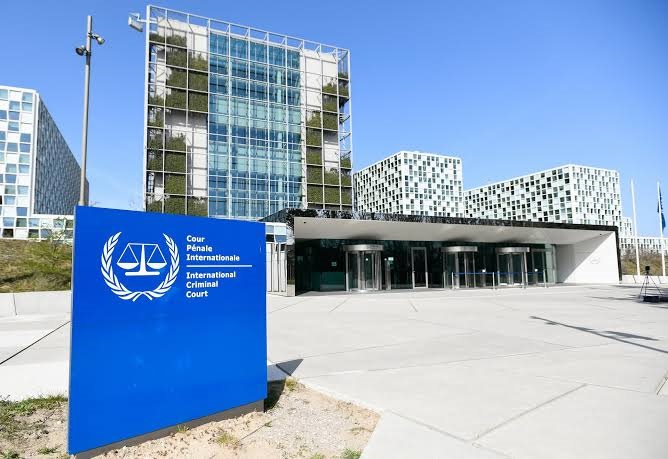
On October 9, Secretary of State Marco Rubio announced blocking sanctions against the International Criminal Court as an institution: a ban on all transactions, the freezing of assets under US jurisdiction, and the cutoff of cloud services, software, and payment processing. “Either the ICC will end its threats, or we will end the ICC,” he said. The sanctions include a six-month transition period and take full effect by April 2027. That date, not the announcement itself, is Europe’s real deadline.
Rubio has repeatedly tied Israeli interests to US actions against the court. The ICC previously issued arrest warrants for Israeli Prime Minister Benjamin Netanyahu and former Defense Minister Yoav Gallant on charges of war crimes in Gaza. While the October 9 announcement focused heavily on protecting American personnel, the administration had previously denounced the tribunal’s investigations against “the United States and our close ally Israel” as “illegitimate and baseless,” indicating that Washington’s campaign is aimed at shielding both US and Israeli officials.
The European Commission called the sanctions “deeply regrettable” and said it was “ready to take any necessary measures” to keep the Court functioning and protect operators within the Single Market. But the same formula contains a brake: the six-month delay “leaves room for dialogue.”
Kaja Kallas, speaking for the EU, called threats against the Court “unacceptable,” reaffirming commitment to the rules-based order but stopping short of announcing any protective mechanism. António Costa promised support through political, diplomatic, financial, and practical means, without naming a single concrete instrument.
Belgian Foreign Minister Maxime Prévot is one of those publicly demanding activation of the EU Blocking Statute. “The Court’s independence cannot depend on whom it investigates. Europe must act,” he said, after securing a place for the issue on the agenda of the October 12 meeting of EU foreign ministers.
The Netherlands, where the Court sits, asked the European Commission to prepare the statute but called it a “nuclear option,” emphasizing that six months provide space for dialogue. Germany and France joined a joint statement by eight countries expressing “strong disagreement,” without mentioning countermeasures.
Why the Blocking Statute Is No Panacea
The Blocking Statute (Council Regulation No. 2271/96 of 1996) was created to counter US extraterritorial sanctions related to Cuba, Iran, and Libya. Its mechanism includes a prohibition on EU companies and citizens complying with the designated third-country sanctions, a refusal to recognize foreign court judgments based on those sanctions, and the right to recover damages in court. In 2018, after the US withdrew from the Iran nuclear deal, the regulation was expanded.
Adding the US sanctions against the ICC to the regulation’s annex would mean a legal prohibition on European banks, insurers, and cloud providers complying with the US restrictions. But its purpose is not to save the ICC itself. It protects European operators and jurisdiction: the regulation binds European operators and cannot compel American banks, Microsoft, Amazon, or payment systems to keep servicing the Court.
Activating the statute in this case would be unprecedented: in its thirty years of existence, it has never been applied against US sanctions affecting an international judicial institution. Its earlier use concerned US measures against those same countries, which were bilateral trade restrictions rather than an assault on a body of international justice. If the EU goes ahead, it would be the first time the Blocking Statute is transformed from a trade-defense instrument into an instrument for defending what Brussels calls the “international legal order.”
That is why it is called “nuclear”: it means legal confrontation, but it does not solve the problem of technological dependence. The ICC relies on American banking services, payment systems, cloud servers, and software. The Blocking Statute can prohibit European companies from complying with the sanctions, but it does not create an alternative to dollar clearing, global payment networks, or the servers where the Court’s data is stored.
For Washington, it is enough that American companies themselves refuse to work with the ICC because of the risk of secondary sanctions; the Blocking Statute cannot prevent that.
What Is Already Happening and What Might Happen
The practical effects of the sanctions are already beginning to show. In response to earlier US measures, the ICC has shifted its office and collaboration software from Microsoft to openDesk, a German open-source platform, and developed workarounds for banking, insurance, and payroll. It has also paid staff months in advance to limit potential payroll disruption. But these safeguards do not eliminate the Court’s broader reliance on American financial and technological infrastructure, and full sanctions could still disrupt its operations.
The alternatives Europe can offer are limited: activating the Blocking Statute, developing payment and clearing alternatives to dollar-based infrastructure, and providing European cloud services. None can be implemented quickly enough to replace American financial and technological infrastructure by April 2027.
Click to see the full-size image
The Asymmetry That Explains Everything
The ICC began work in 2002, and its early practice focused predominantly on African conflicts: the DRC, Uganda, Sudan, Kenya, and Libya. This imbalance fueled accusations of selectivity and neocolonialism; in 2025, three Sahel states announced their withdrawal, calling the Court an “instrument of neocolonial suppression.”
The United States signed the Rome Statute under Clinton but never ratified it; in 2002, Congress passed the American Service Members’ Protection Act, authorizing the president to use “all necessary means” to free any American detained by the ICC. Washington did not object to the Court’s early focus on African situations, even as it rejected jurisdiction over itself. Its opposition hardened once the ICC moved toward cases involving the US and its allies.
In 2020, after the Appeals Chamber authorized an investigation into crimes by US military personnel and the CIA in Afghanistan, Washington sanctioned Prosecutor Fatou Bensouda and a senior Court official. The following year, Prosecutor Karim Khan “deprioritized” the American component of the case. No US citizen has ever been indicted by the ICC.
Rubio calls the ICC a “body of globalists” threatening US sovereignty and has urged US allies to rein it in. The criticism has a real basis: the Court can hear cases involving crimes committed on the territory of a state party even if the accused’s country has not joined the Rome Statute. But the ICC remains a treaty court, dependent on state cooperation, Western donors, and political decisions of the UN Security Council.
Washington’s contradiction is built into the design itself: the US is attacking an institution that grew out of the liberal order it helped create. Europe’s is different: a declaratory commitment to international law coexists with the practical costs of reducing reliance on American infrastructure.
What October 12 Will Reveal
October 12 will show whether the EU moves from declarations to legal obligations. If the final document includes a European Commission decision to add the US sanctions against the ICC to the annex of Regulation 2271/96, that would mean a legal prohibition on European companies complying with the US measures — an unprecedented use of the Blocking Statute.
If the outcome is a general declaration, a call on Washington to rescind the sanctions, and a mandate for the Commission to “prepare options,” that would confirm a scenario in which Europe defends the principle of ICC independence but is not prepared to pay for that defense through a direct collision with US extraterritorial jurisdiction.
The probability of full and immediate activation of the statute on October 12 is low. A more realistic scenario is a political declaration of support, a Commission mandate to prepare a legal mechanism, and the preservation of the six-month pause for negotiations.
The Dilemma Beyond The Hague
The question is not whether the ICC survives past April 2027. The question is whether Europe can defend what Brussels calls the “international legal order” when the costs of that defense fall on its own companies, banks, and technological supply chains.
The Blocking Statute is a test of the EU’s ability to act not as a regulator but as a geopolitical player willing to bear the costs of conflict. If Europe limits itself to declarations and negotiations, it will confirm the formula Washington has already internalized: European sovereignty ends where American extraterritorial jurisdiction begins.
If it activates the statute, it will launch an open legal conflict with an ally on which its security depends. For now, every signal points to a third option: prepare the instrument, defer the decision, and bet that Washington will back down on its own.
Saudi Arabia is desperately trying to reverse its losses on the ground in the Yemeni conflict, while Houthi attacks reach its airports and threaten its oil trade. Yet the coalition Riyadh has assembled does not match the war it wants to fight. Washington is engaged in the conflict with Iran, Turkey excludes offensive deployments, and Pakistan draws the line at crossing into Yemen. The kingdom has foreign support, but the burden of recovering and holding territory still falls on its weakened Yemeni partners.
Retreat Before the Counteroffensive
By early October 2026, Riyadh was responding to a deteriorating military position. The Houthis’ September advance along Yemen’s western coast brought the loss of Mokha and strategic positions around Bab el-Mandeb. These setbacks exposed the weakness of Saudi-backed forces and strengthened the Houthis’ leverage over a shipping route increasingly important to Saudi oil exports.
The renewed Saudi–Houthi escalation began with the July 13, 2026, strike on Sanaa airport’s runway. Saudi aircraft sought to prevent an Iranian Mahan Air flight carrying a senior Houthi delegation from landing without coalition permission. The plane later landed in Hodeida after Omani mediation, but the Houthis retaliated against Abha airport and subsequently announced a blockade on Saudi shipping. The strike broke the relative calm established by the 2022 truce; September’s coastal offensive then turned the confrontation into a major territorial setback for Riyadh’s partners.
The retreat exposed divisions within the anti-Houthi camp. Saudi–Emirati cooperation had broken down, and the withdrawal of the UAE left command arrangements that Riyadh failed to replace effectively. The factions expected to carry the offensive remained divided and poorly prepared for a sustained campaign. Saudi airpower could not compensate for the absence of a coherent local force.
The cost is also being felt inside Saudi Arabia. The October 10, 2026, attack on Riyadh’s King Khalid International Airport killed 12 people and wounded 309, according to Saudi authorities, and temporarily suspended operations. Riyadh blamed the Houthis, who renewed their warning against using Saudi airports and airspace on October 11. Airport disruption, cancelled flights and attacks on oil facilities bring the economic consequences of the war directly into the kingdom. The Saudi air campaign has not secured its civilian infrastructure.
Operation Dawn of Yemen began on October 5, 2026, after Saudi-backed Yemeni leader Rashad al-Alimi announced military action the previous day. The immediate objective was to recover the coastal positions lost in September, alongside the Saudi-backed Yemeni government’s broader ambition to restore its authority over Houthi-held territory. On October 11, the coalition announced the destruction of 136 military targets in a large-scale operation. That tally says little about whether Saudi-backed units can hold territory, secure supply routes or reopen shipping lanes.
Houthi footage released October 10, 2026: Shawaz drone strikes on Saudi-backed forces in Kahbub and Al-Waziya, as presented by the movement’s military media
Why Taiz Matters
The counteroffensive has produced conflicting accounts of control on the coast. On October 9, 2026, Saudi Arabia’s ambassador to Yemen announced that Bab el-Mandeb and Mayun Island had been cleared of Houthi forces. The Houthis maintained that they still held those positions. Control of the waterway remains contested, despite Riyadh’s announcements of success.
Taiz adds another strain after the coastal setbacks. Pressure on its approaches threatens supply routes and forces Saudi-backed units to divide their effort between the inland front and the Red Sea coast. The Houthis can disrupt their opponents’ counteroffensive without winning every coastal engagement: sustained pressure inland prevents those opponents from concentrating their forces. Saudi airpower does not resolve the fragmentation of the Saudi-backed Yemeni forces expected to hold the ground.
Houthi military footage released October 10, 2026: the movement presents advances and the surrender of opposing fighters in Sami, As-Silw and Al-Mawasit, Taiz province. The fighting places further pressure on the ground forces on which Riyadh’s campaign depends
The Iran War Narrows Saudi Options
The US–Israeli war with Iran, which began in February 2026, has expanded the military demands on Washington. Regional deployments, shipping protection and operations against Iran compete with Saudi requests for a larger American role in Yemen. Riyadh cannot assume that American support will expand on its terms. Its dependence on outside assistance has grown at the same time as the regional war has made that assistance more conditional.
The Iran war compounds Saudi Arabia’s vulnerability. Disruption at Hormuz has increased Riyadh’s dependence on its westbound pipeline and Red Sea ports. Southbound cargoes from Yanbu must pass Bab el-Mandeb; northbound exports follow a different route. Moving crude across the peninsula bypasses Hormuz, but it does not remove the threat to shipping off Yemen.
Pressure at Bab el-Mandeb gives Iran an additional advantage while the Houthis gain territory and bargaining power of their own. Their overlapping interests put Riyadh under pressure on two fronts. A Washington–Tehran agreement would not automatically end the war in Yemen: the Houthis have their own territorial, political and economic demands.
Washington is already involved through military advisers, intelligence and targeting support. The issue is the extent of that involvement, not American neutrality. Earlier in October 2026, Trump rejected Saudi requests for direct strikes; after the Riyadh airport attack, he said the United States might join them. Riyadh still lacks a firm American commitment to the wider offensive. Its requests compete with Washington’s military operations and priorities in the Iran war.
Allies Draw Their Own Lines
Riyadh’s response is to widen its support network through the Mecca pact, signed with Turkey and Pakistan on August 7, 2026, and activated on October 5. But an agreement to defend Saudi Arabia is not an agreement to win its war in Yemen. Pakistan’s military presence and Turkey’s technical, intelligence and air-defense assistance address the kingdom’s security without supplying a joint ground campaign across the border.
The alliance has a secretary-general, retired Pakistani general Nauman Mahmood, but its detailed force-generation timetable, operational command arrangements, cost-sharing formula and mission duration remain unpublished. On October 8, 2026, Ankara excluded offensive operations while parliamentary ratification was pending. On October 9, Islamabad confirmed a substantial military presence in the kingdom but ruled out crossing into Yemen to attack the Houthis. Riyadh is obtaining defensive commitments, not a combined expeditionary army.
Pakistan’s decision-making has also shifted. In 2015, parliament unanimously rejected participation in the Yemen war while promising to defend Saudi territory and holy sites. In October 2026, reinforcement commitments are proceeding without a parliamentary vote. The government says it followed the necessary procedures. The political result is a narrower domestic debate over a commitment that could draw Pakistan further into the conflict.
Fewer political checks make deployments easier to authorize and harder to reconsider once costs and casualties accumulate. Pakistan’s own security pressures add another burden: the October 11, 2026, emergency in opposition-run Khyber Pakhtunkhwa coincides with its commitments to Saudi Arabia. Islamabad is extending support abroad while managing a deepening confrontation at home.
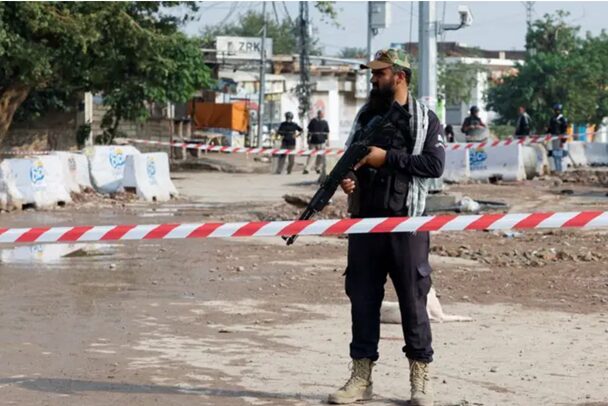
Peshawar, October 11, 2026: police guard the approach to the Red Zone. Pakistan’s overseas security commitments coincide with emergency measures at home
Saudi-led coalition footage, October 9, 2026: the coalition announces strikes on three Houthi missile launchers. The continuing attacks inside Saudi Arabia expose the limits of destroying individual launch sites
Defensive support can still sustain the offensive by freeing Saudi assets for use in Yemen. France’s support for the defense of Yanbu and Britain’s refueling assistance contribute to that effort. But none of this repairs the weakness of Riyadh’s Yemeni ground forces. Pakistan also has its border with Iran and its mediation role to consider, while Turkey keeps its commitment separate from offensive operations. Each partner sets limits according to its own interests.
Different Interests, No Shared Victory
Pakistan’s proposed $1.21 billion IMF disbursement awaits board approval. Turkey’s September 2026 inflation was 29.73%, with its policy rate at 37%. Both face financial pressures that favor limited missions over an open-ended expedition. Who pays for the current assistance remains undisclosed.
Saudi Arabia’s updated deficit forecast is 4.9% of GDP. September 2026’s non-oil purchasing managers’ index stood at 55.3, indicating expansion before the latest escalation. The airport attacks and disruption to transport now place that activity under additional pressure. Riyadh must finance the campaign while protecting the infrastructure and trade on which its wider economic plans depend.
The Houthis are using that pressure to advance their negotiating demands. On October 10, 2026, the Houthi authorities proposed reciprocal exclusion of airports, ports and other humanitarian infrastructure from blockade and attack. The proposal seeks to exchange limits on disruption for concessions over access and blockade. It puts the economic consequences of continued fighting at the center of the bargaining.
The conflict of interests runs through the entire coalition. Riyadh wants to reverse Houthi gains and protect Saudi infrastructure. The Saudi-backed Yemeni government wants to restore its authority. Turkey and Pakistan seek bounded commitments, and Washington calculates its involvement against the Iran war. The Houthis seek concessions while preserving their military leverage. A common adversary has not produced an agreed objective or a shared willingness to bear the cost.
Saudi Arabia therefore has partners willing to help defend the kingdom, but those partners have made no common commitment to reverse Riyadh’s setbacks in Yemen or sustain the ground campaign of the Saudi-backed Yemeni government. That is the gap behind the coalition’s announcements and strike tallies. Without stronger local forces and a political settlement addressing shipping, attacks and access, additional foreign support can prolong the campaign without resolving it. Riyadh risks remaining surrounded by allies while carrying a war none of them has agreed to finish.
United States President Donald Trump on October 11 announced an immediate energy ceasefire between Russia and Ukraine, claiming both sides had agreed to stop attacks on infrastructure.
“Effective immediately, there is an ENERGY CEASEFIRE in the War between Russia and Ukraine. Both parties have agreed. Do not break it!” Trump wrote on Truth Social.
Ukrainian President Volodymyr Zelensky expressed surprise at the announcement, telling Axios he had not been informed of the purported agreement.
“The ceasefire announcement was news for me,” he said, noting that Ukraine would accept it if Russia agreed to comply.
“If President Trump negotiated it with Putin — please tell us when the ceasefire begins. We are ready and we will accept it,” he added.
Zelensky later accused Russia of continuing to attack Ukrainian energy infrastructure after Trump’s announcement. In a post on X, he said he had briefed Trump on what he called the “brutal Russian strikes that continue unabated.”
A Russian drone had struck a power plant in Kyiv, causing power outages across several districts, he claimed, followed by attacks on energy facilities in the Kharkiv region.
“And all of this happened AFTER the President of the United States made his statement about an energy ceasefire,” Zelensky wrote.
In his evening address, he also reported a strike on a combined heat and power plant in Kharkiv. He said Russia had carried out more than 200 strikes on Ukrainian electricity-generation and transmission facilities over the preceding week, along with 17 attacks on oil and gas installations.
Moscow has not yet publicly commented on Trump’s announcement, leaving it unclear whether Russia accepted the proposed ceasefire or intended to observe it.
The announcement came amid a widening dispute between Trump and Kyiv over Ukrainian attacks on Russian oil refineries, with the U.S. president demanding that Ukraine halt the strikes.
The Financial Times reported right after Trump’s announcement that Washington had threatened to restrict Ukraine’s access to U.S.-made weapons and intelligence sharing unless Kyiv stopped attacking Russian energy infrastructure.
Citing European officials, the newspaper reported that U.S. officials had warned that the U.S. could block Ukraine’s access to the NATO-managed Prioritised Ukraine Requirements List mechanism, known as PURL, through which allied countries fund purchases of American weapons for Kyiv.
The surprise ceasefire announcement came amid a broader shift in Washington’s energy policy toward Moscow, following a diesel supply deal with Russia and temporary sanctions waivers for certain fuel shipments. With the administration simultaneously pressing Kyiv to halt refinery strikes, Trump appears to be growing impatient with Zelensky.
Europe is shortening the time it takes to wage a major war. Military transport approvals are meant to take hours rather than days, intelligence to feed more quickly into strike decisions, and a new generation of missiles to bring targets deep inside Russia within reach. Behind the forward garrisons, Europe is building transport networks, reserves, and ammunition production capacity. Taken together, these measures point beyond deterrence to practical preparations for waging war against Russia, including operations deep inside its territory.
The dates 2027, 2028, and 2030 in European rearmament programs can easily suggest that there is still time. But they mark a schedule for building military capabilities, not a guaranteed period of peace. The central question for the coming months is not whether armies will finish rearming in time, but whether a clash can be avoided before they do.
Estonia: A Narrow Front, a Deep Strike
Estonia offers a clear picture of the opening phase this system is being built to fight. The country’s military budget rose 42% in 2026 to €2.4 billion, or 5.4% of gross domestic product. Arms procurement accounts for €1.27 billion – more than half the total. Meanwhile, the headquarters and elements of the 1st Infantry Brigade are moving from Tapa to Jõhvi, roughly 50 kilometers from the Russian border.
A €20.5 million base is under construction in Narva, with €19 million coming from the European Union. Completion is scheduled for summer 2028. Its permanent garrison will number around 200, but it will accommodate up to 1,000 troops in a crisis. The gap between those figures reveals a base designed for rapid expansion. A small garrison is being equipped to receive reinforcements quickly, right on the border.
Holding that ground requires more than barracks. Procurement programs call for nine American HIMARS and nine South Korean Chunmoo multiple-launch rocket systems, both capable of firing ballistic missiles. The relevant munitions have stated ranges of up to 300 and 290 kilometers, respectively. The new concept combines holding the border with deep strikes from the first day of an invasion.
The scale of the response could far exceed that of the opening clash. A battle for a border town could lead to strikes on targets hundreds of kilometers away. Tallinn wants to deny its opponent the option of fighting a small war by preparing to expand its geographical scope.
This also changes what allied assistance means. Allied planning must account not only for how long a small army can hold out until reinforcements arrive, but also for how far the fighting may spread before they reach the front. A missile can be launched before a major formation completes its deployment. Allies may arrive to find that the conflict has already widened.
In such a situation, Estonia and the other Baltic states could serve not only as defensive positions but also as staging grounds for attacks on Russian territory. For Moscow, the issue is no longer simply the size of Estonian units, but the depth of the strikes they envisage. Tallinn, in turn, faces the question of who will sustain its forward forces if the first battles fail to decide the outcome. Sustaining such a war would require support from beyond Estonia. One national budget and a handful of batteries cannot carry that burden.
Click to see the full-size image
Germany: An Industrial Base Behind the Garrison
On October 5, Martin Jäger, head of Germany’s Federal Intelligence Service, told the Bundestag: “The point of no return has been passed in the war with Ukraine, and NATO is considering a scenario involving a limited Russian military clash with the Baltic states.” He linked the more immediate danger to limited Russian action in the Baltics that could test the allies’ response. He said intelligence had seen no signs of preparations for a major attack on NATO. The discussion therefore concerns not only a major war after rearmament is complete, but a smaller confrontation capable of triggering an allied response.
In the Baltic scenario, Berlin is publicly discussing the risk of a clash while its forward force is still taking shape. The brigade’s readiness date is not the date on which the threat begins.
In Lithuania, Germany is building a permanent heavy brigade as one element of that support. Full readiness is scheduled for the end of 2027, with 4,800 military personnel and 200 civilian employees. Its core consists of the 122nd Panzergrenadier Battalion, the 203rd Tank Battalion, and a multinational battle group. Until the formation is complete, the Germany-based 37th Brigade is to provide support.
The forward formation is thus tied to forces farther inside Europe. Civilian infrastructure underscores the permanence of the deployment. A school for the children of Bundeswehr personnel opened in Vilnius in September 2025. Units are not simply moving in – families are settling down. A political commitment acquires a permanent address, and the safety of German personnel becomes part of any future crisis in the host country.
Münster, October 1, 2026. Rutte describes a headquarters capable of commanding 50,000 troops and responsible for NATO forces in Estonia and Latvia. Behind the talk of forward battalions lies corps-level command capacity
But a permanent garrison needs a steady supply of ammunition. Rheinmetall’s new plant in Unterlüß is scheduled to reach an annual output of 350,000 artillery shells in that same year, 2027. The nearly €500 million facility was built in 15 months. Across its entire production network, including overseas sites, the company is targeting roughly 1.5 million shells a year from 2027.
The brigade answers the question of who will enter the fight. The factories answer how to keep fighting once stockpiles run down. The 2027 target is for strengthening this system, not creating it from scratch. Reaching the factory’s planned capacity determines future supply volumes, but it does not set a date before which a clash is impossible. Initial stocks sustain the opening phase of combat. Regular deliveries determine whether its intensity can be maintained.
Between the factory and the front lies the transport network. Europe’s military mobility proposal calls for cross-border transport permits to be processed within three working days, with an emergency procedure taking no more than six hours. A proposed €17 billion would fund the relevant infrastructure under the 2028–2034 budget. For Germany, a transit country, that means bridges, railways, and the capacity of routes leading east.
On October 7, European Defense Commissioner Andrius Kubilius called for this work to accelerate, saying Europe was not yet able to deter Russia. Unlike an exercise, infrastructure upgrades remain after the columns return to barracks. A stronger bridge and a faster permit procedure create a lasting ability to concentrate forces.
A border battle thus gains industrial and logistical depth. But sustaining one’s own forward forces is only half the military equation. The other half is disrupting opposing forces’ supply and command systems. That requires more than additional railcars loaded with shells. It requires weapons with much greater reach.
Britain: A European Deep-Strike Arsenal
London is driving precisely this part of Europe’s preparations. On July 8, 2026, it announced an initiative bringing together roughly a dozen partners to invest more than $50 billion in long-range strike capabilities over ten years. The stated range bracket runs from 300 to more than 2,000 kilometers. Britain’s own commitment within the initiative is £3 billion by 2030.
The British-German Deep Precision Strike program envisages stealthy and hypersonic weapons with ranges exceeding 2,000 kilometers, initially focused on ground launch. Britain is investing £770 million over four years, with entry into service expected in the 2030s. Another £1.4 billion over four years is earmarked for Stratus, a program with France and Italy covering strikes against high-value targets and ships, as well as the suppression of air defenses.
Britain’s participation in PrSM (Precision Strike Missile), a precision-guided ballistic missile program with a stated range of up to 500 kilometers, adds another layer. The emerging capabilities span several range bands, from around 300 kilometers for the Estonian systems through 500 for PrSM to more than 2,000 for the British-German development. Although the programs are at different stages, they share a clear direction. Weapons for fighting at the border are being supplemented with weapons for striking deep behind it.
The missiles of the next decade show how far these strike capabilities are intended to expand. But the next crisis will unfold with whatever weapons are available when it begins. A 2,000-kilometer range is not a prerequisite for a clash in the Baltics. It changes the potential scale of the war, not the earliest date on which it can break out.
Click to see the full-size image
Turning national purchases into a combined capability requires a common framework for employing them. In July 2025, General Christopher Donahue outlined elements of eastern-flank planning built around compatible launchers, fire control, and data sharing. He cited Kaliningrad as an example of military capabilities that could be neutralized by ground-based means in an exceptionally short time: “We have already planned this. We have already developed this.”
The discussion also included cloud-based data sharing and Palantir’s Maven Smart System, purchased by NATO to analyze information and support command decisions. The aim is to turn disparate reports into a common picture more quickly. When several armies use compatible command systems, their arsenals gain additional value. Range puts the target within reach, while data sharing allows missions to be coordinated.
But the deeper the planned strikes, the harder it becomes to separate support for a border battle from an expansion of the war. To the attacking side, a target may be part of the other side’s military supply system. To the other side, hitting it may signal that the conflict has crossed a new threshold. The use of conventional weapons thus leaves unresolved how to deter a response that would overturn the assumption of a limited clash.
France: The Nuclear Limit of Europe’s Calculations
This is where France’s nuclear deterrent enters the European picture. On October 6, Le Vigilant conducted an acceptance firing of an M51.3 ballistic missile following its refit. The missile carried no nuclear warhead. In service since October 2025, the variant carries new TNO-2 warheads. The French Defense Ministry cites improvements in range, accuracy, and the ability to penetrate missile defenses.
Brittany, October 6, 2026. Le Vigilant launches an M51.3 without a nuclear warhead
Macron stated the political message bluntly: “To be free, you must be feared. And to be feared, you must be strong.” France’s modernization adds a nuclear dimension to Europe’s conventional military buildup.
That European dimension is taking a more concrete form. On March 2, 2026, Macron outlined an “advanced deterrence” framework allowing partners to participate in French nuclear exercises and opening the possibility of temporary deployments of strategic forces on allied territory. Germany, Poland and Sweden were among the countries joining the dialogue. But the authority to use nuclear weapons – and to define the vital interests they protect – remains exclusively French. In the Baltic scenario, closer cooperation does not establish an automatic French nuclear response to a border clash. It leaves the decisive threshold in Paris, deliberately undefined.
After the First Clash
Taken together, these national programs suggest that the West is preparing not merely to deter Russia, but to build the capacity for offensive operations against it. In this reading, forward deployments, industrial expansion and deep-strike weapons are interconnected preparations for a war that could extend into Russian territory. They do not, by themselves, establish a single operational plan or prove a decision to initiate hostilities. Conventional forces are meant to make an opposing military operation prohibitively costly, while nuclear forces are meant to deter the most extreme escalation. The weakness is that neither side gets to decide how much damage the other will tolerate.
That problem is especially acute around Kaliningrad, where plans to suppress military infrastructure sit alongside the question of the region’s links to the rest of Russia. If actions during a crisis are perceived as an attempt to cut the region off by force, the argument will no longer be about intentions announced at a press conference. It will be about consequences the other side believes it must stop immediately.
The danger in the coming months lies in the gap between limited intent and an unrestricted response. Berlin is discussing localized action in the Baltics. Tallinn is preparing for deep strikes from day one, while foreign garrisons tie a border battle to allied involvement. Each side may consider its own move limited. Neither can count on the other side accepting its definition of what is permissible.
European capitals therefore need to define where military action would stop after the first clash, whether at the border or after strikes on depots, airfields or targets in Kaliningrad. The programs examined here spell out how to build military power, but offer no mechanism for ending the fighting. Missile range is not strategic foresight. Confidence that escalation can be controlled could turn a system of deterrence into a mechanism for widening the war well before 2030.
A supertanker MT GEM No. 2 struck a mine after being hit by a projectile in Hormuz. The UAE rescued all 22 Indian crew members;
A U.S. fighter jet struck and disabled the commercial cargo vessel Ocean Molica in the Gulf of Oman after it attempted to breach the U.S. blockade of Iranian ports;
Ships near Ras Al Khaimah in the UAE were instructed by Iran through VHF radio broadcasts to leave their anchorages.
President Donald Trump called for Ukraine to replace Volodymyr Zelensky after repeated United States warnings over Ukrainian attacks on Russian oil refineries failed to change Kyiv’s course.
The confrontation intensified after Trump reached a diesel supply agreement with Russian President Vladimir Putin, easing restrictions on Russian fuel exports amid a global energy crisis.
Reports that U.S. envoys raised the prospect of cutting intelligence support have further exposed the stakes for Kyiv, while Zelensky’s talks with Britain raise the question of whether European allies could compensate if Washington withdraws its backing.
Refinery Strikes and Fuel Prices
Trump accused Zelensky of prolonging the conflict, contributing to high fuel prices through attacks on Russian refineries and failing to take opportunities to negotiate an end to the conflict.
“I suggest they get a new leader who can make a deal because he could have made many deals and for some reason he never does,” Trump told reporters at the White House on October 10. “And I think it’s time for Ukraine to get a new president.”
The remarks followed a report by Axios, citing a U.S. official with direct knowledge of the discussions, that Trump decided to pursue the Russian diesel arrangement after Zelensky ignored half a dozen American requests to stop attacking Russian oil refineries.
“Zelensky is misreading the room,” the official said. “By continuing to hit refineries, he is eroding the good will that he has built with Trump over the last six months.”
According to the official, the administration wanted Zelensky to stop the attacks unilaterally because of their effects on fuel prices in the U.S.
Trump made that connection explicit when he accused the Ukrainian president of creating problems for American farmers, ranchers and truckers.
“He wants to make problems for the world. He wants to make problems for our farmers, our ranchers, with diesel fuel,” he said on October 10.
High fuel costs have become a political liability for the administration ahead of the November 3 midterm elections, in which Republicans are seeking to retain control of Congress.
The national average price of diesel stood at $6.28 per gallon on October 9, according to AAA (American Automobile Association), after reaching a record $6.53 on September 22.
Continued Ukrainian strikes have pushed Russia to restrict diesel exports, adding pressure to a global market already disrupted by the war involving Iran.
The Diesel Deal and Its Conditions
The diesel agreement itself represents a substantial shift in U.S. policy toward Moscow. Following a roughly 90-minute telephone conversation with Putin on October 9, Trump announced that Russia would immediately supply 300,000 metric tons of diesel, followed by another 500,000 tons in November and 1 million tons immediately afterward. A further 3 million tons would follow, depending on the state of Russia’s refineries. The supplies were intended for U.S. and global markets.
The full 4.8 million metric tons would amount to roughly 36 million barrels, equivalent to about nine days of U.S. distillate consumption at an average of around 4 million barrels per day.
In addition, by adding millions of barrels of Russian diesel to the global market, the agreement could increase available supplies, ease competition among buyers and put downward pressure on wholesale prices in the United States and other countries.
File image.
The U.S. Treasury Department subsequently issued a temporary license easing sanctions on Russian diesel shipments through April 2027.
The announcement came only weeks after Trump signed a sanctions law targeting Russian energy revenues, underscoring the administration’s willingness to relax restrictions when it considers energy prices a pressing domestic concern.
Zelensky, who said he was blindsided by the announcement while Ukrainian and European officials were meeting with Trump’s envoys in Miami, condemned the decision.
“It looks like a happy birthday present for Putin,” he said, referring to the Russian president’s birthday earlier in the week.
The Ukrainian president called the arrangement “not fair and not honest” and said allowing Russia to sell more petroleum products amounted to an “investment in a war that must be ended.”
Zelensky argued that he would have supported easing sanctions if Putin had agreed to halt attacks on energy infrastructure in both countries.
“If the price is energy ceasefire, this negotiation is good,” he said.
That was the central disagreement: Zelensky wanted a reciprocal energy ceasefire; Washington wanted Ukraine to halt its refinery strikes unilaterally.
Washington’s Intelligence Leverage
The Miami talks also exposed the leverage Washington may be prepared to use. According to the Ukrainian account, Trump’s envoys, Steve Witkoff and Jared Kushner, threatened to cut off Ukraine’s access to U.S. intelligence if Kyiv continued ignoring requests to halt the refinery attacks.
The American side denied making an explicit threat, describing the exchange as a reminder that Washington was providing ammunition and intelligence and that Ukraine should avoid actions that harm American consumers.
Even without a confirmed ultimatum, the exchange underscored how intelligence and military assistance could become instruments of pressure on Kyiv. Neither account establishes that Washington has decided to end its support for Ukraine.
Zelensky’s public criticism of the diesel deal, meanwhile, has given Trump another reason to portray the Ukrainian president as an obstacle to negotiations.
Can Britain Fill the Gap?
Zelensky spoke with British Prime Minister Andy Burnham on October 10, following Trump’s demand for a new Ukrainian president.
According to the British government’s account, Burnham expressed “complete solidarity” with Ukraine and pledged to continue strengthening sanctions on Russia. The leaders also called for an immediate energy ceasefire covering Russian attacks on Ukrainian infrastructure and attacks on shipping in the Black Sea. They agreed to meet in person in the coming days.
Britain has consistently backed Kyiv’s ability to carry the conflict deeper into Russian territory. It has supplied Ukraine with Storm Shadow long-range cruise missiles, and in August authorized the release of classified information about British components of SCALP, the French-produced counterpart, to support planned assembly lines in Ukraine with France.
File image.
Moscow has repeatedly warned Britain and other European governments that such assistance risks escalating the conflict.
London’s continued backing of Ukraine therefore raises a question that has become more urgent following Trump’s remarks. If Washington withdraws or sharply reduces its support, will Britain be prepared to sustain Kyiv’s military campaign despite American pressure, or will it attempt to persuade Zelensky to accommodate Trump’s demands?
Britain has substantial commitments of its own. The U.K. House of Commons Library reported in August that the country had pledged £25 billion in support for Ukraine since February 2022, including £16 billion in military financing. Prime Minister Burnham also confirmed in July that Britain would continue providing £3 billion in annual military assistance.
The Kiel Institute’s Ukraine Support Tracker has emphasized Europe’s continued dependence on American weapons systems. U.S. stockpiles accounted for more than 90% of the military aid delivered through NATO’s Prioritised Ukraine Requirements List mechanism in the first half of 2026, demonstrating how difficult it would be for European governments to replace critical American capabilities quickly.
The gap extends beyond the volume of financial assistance. U.S. intelligence, ammunition and access to American-made defense systems have been central to Ukraine’s ability to sustain its military operations.
For Zelensky, the choice is becoming more consequential. Continuing attacks on Russian infrastructure could preserve Ukraine’s ability to impose economic costs on Moscow, while deepening the breach with the Trump administration on which it still depends for crucial support.
For Britain, the dilemma is equally stark. It could increase support for Ukraine’s long-range attack drone programs and help accelerate the development of Ukrainian ballistic missiles, strengthening Kyiv’s ability to strike targets inside Russia, or use its influence to push for a settlement that keeps the U.S. engaged.
Britain’s problem is not whether it will stand behind Zelensky, but how much of that support depends on Washington. Larger British commitments would not by themselves replace American intelligence or guarantee access to U.S.-made weapons. London can promise to keep Zelensky afloat; it cannot simply write a check to replace Washington.

 Login