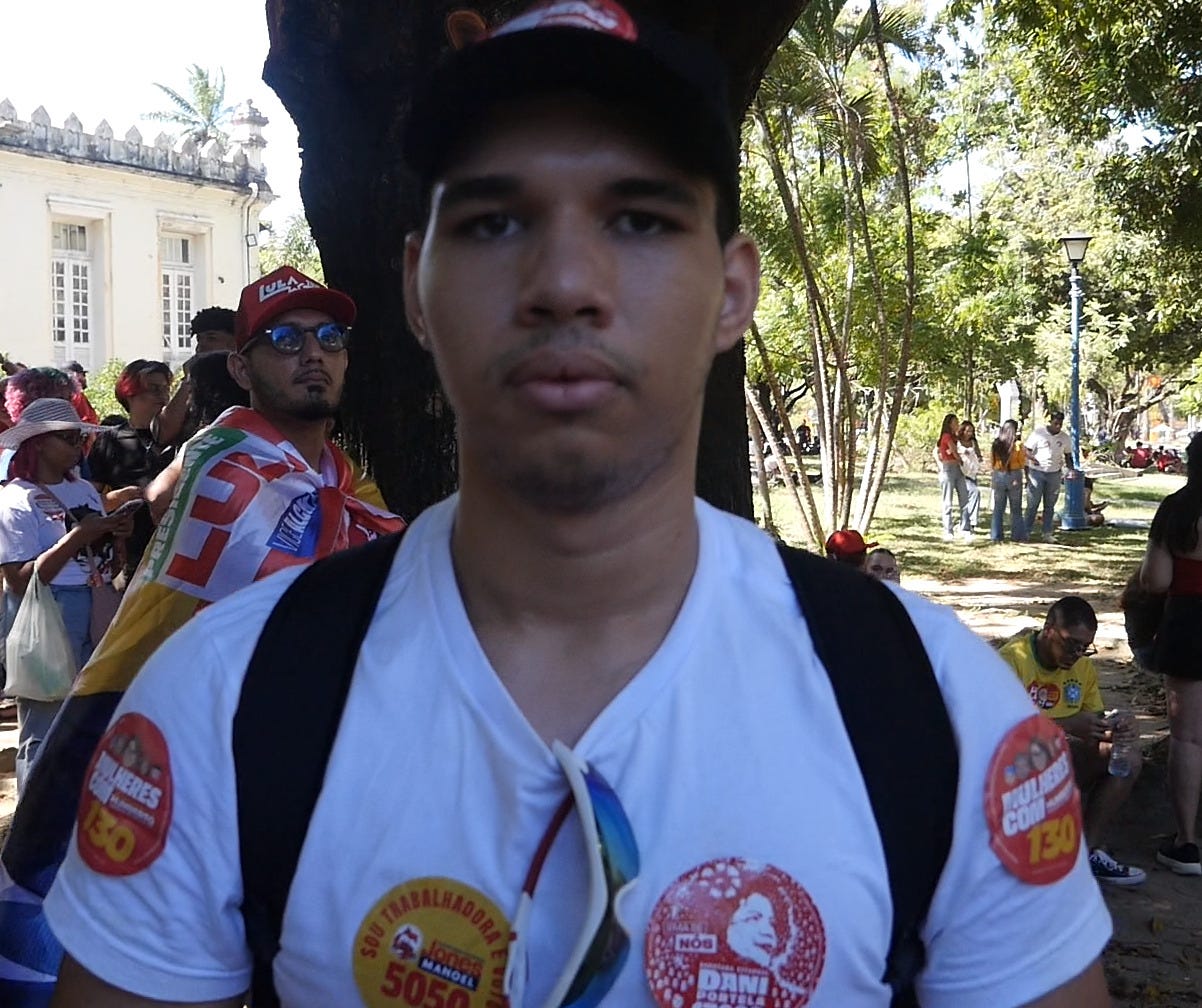
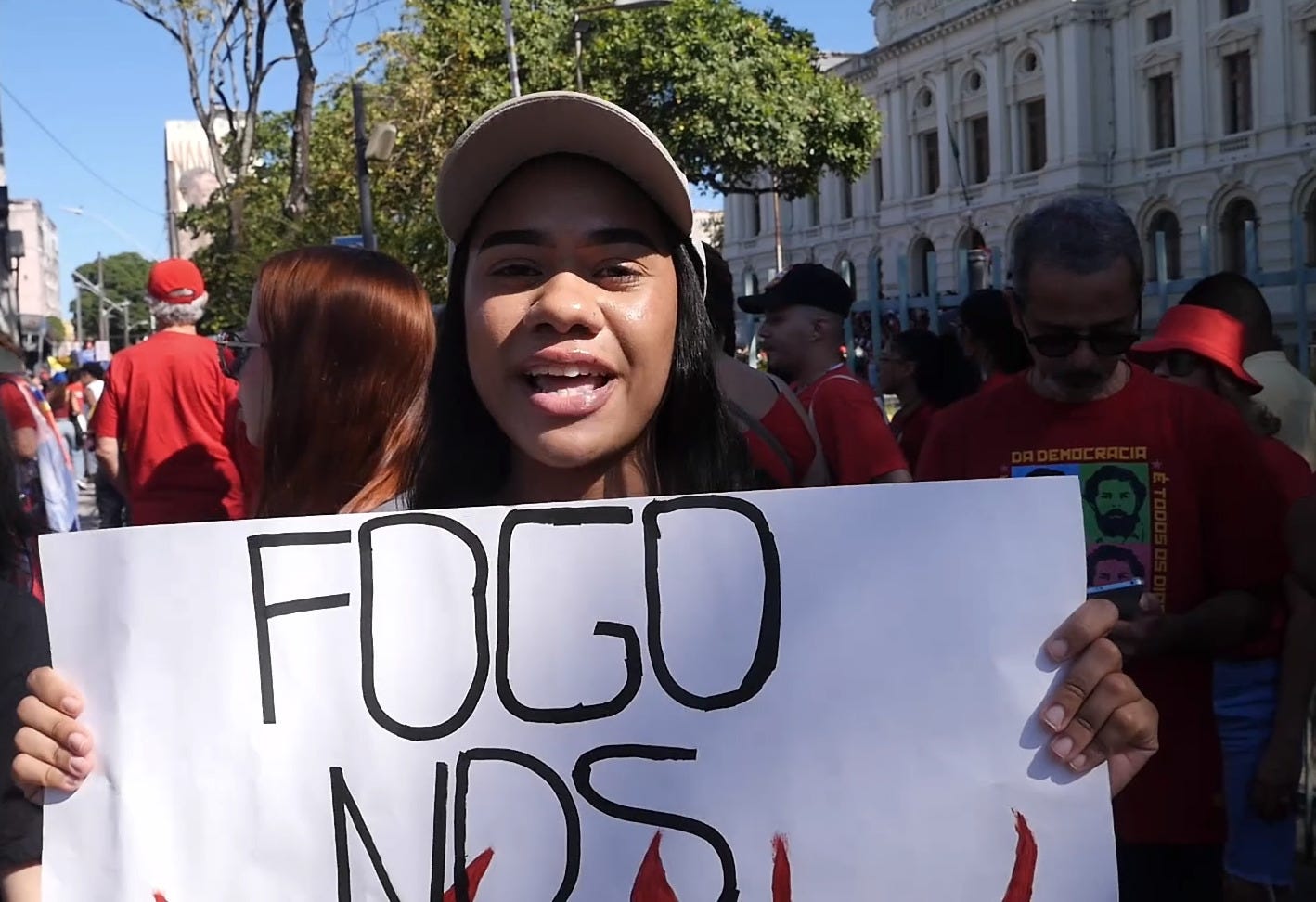
Flávio Bolsonaro, son of imprisoned coup plotter Jair Bolsonaro, clinched first place in Brazil’s presidential race Sunday with 47% to Lula’s 45%, forcing a high-stakes runoff on October 25. As Lula’s Workers’ Party (PT) suffered major losses and Bolsonaro’s Liberal Party (PL) allies took governorships and more seats in congress, Stephanie Weatherbee Brito of the International Peoples’ Assembly asks, was this really a surprise? She joins Rania Khalek and Zoe Alexandra from São Paulo to break down Brazil’s election “shock” — from the hard right’s “silent campaign” and the “shy votes” that caught polling institutes off guard, to why 33 million Brazilians skipped the polls, to the PT’s failure to offer a vision of real change.
And she warns of what may be to come: a second Trump-aligned Bolsonaro presidency “compliant and subservient” to Washington and Tel Aviv, with devastating consequences for Brazil, the Amazon, and the future of humanity.
Watch full episodes of BT Live, join breakthroughnews.org as a member today!
#breakthroughnews
******
Rough transcript follows:
[Host 1:] Brazil went to elections this Sunday and the results shocked many. The far-right Liberal Party emerged as perhaps the biggest victor in the polls as the presidential candidate for the PL, Flávio Bolsonaro, not only clinched top place in the presidential race over Lula, but the party also gained seats in the Senate, House, and several governorships. The Workers’ Party meanwhile suffered significant losses, and incumbent progressive president Luiz Inácio Lula da Silva finished in second place with 45% to Flávio’s 47%. Analysts across Latin America and the world have been struggling to understand the results and what it could mean for the region. We here at Breakthrough News are very lucky because we are joined by friend of the show Stephanie Weatherby Breto. She’s the coordinator of the International People’s Assembly calling in from São Paulo. She’s going to be discussing with us these results, what to expect for round two, and the impact on the region. Stephanie, thank you so much for joining us today.
[Stephanie Weatherby Breto:] Hi, happy to be back even under these conditions.
[Host 1:] Well, Stephanie, the reaction to Sunday’s election amongst progressives, not only in Brazil, but again across the world, has been a mix of shock, sadness, and bewilderment. I want to ask you first, how should we understand the results? Was October 4th a victory for the far right?
[Stephanie Weatherby Breto:] Yeah, I think that October 4th was absolutely a victory for the far right, but I don’t think that we should be as shocked as some people have been because the far right in Brazil has been growing pretty consistently for the past 10 years. And I think that what it has demonstrated that people didn’t believe or didn’t understand before is that it has built a pretty solid base. It is not just a reaction movement. It’s not a spontaneous movement built over social media. It really has its own organizational structure and it has the capacity to mobilize. What surprised people in Brazil was that this time around the right wing wasn’t as mobilized in the streets. Like you didn’t see as many people wearing the Brazilian flag—the color of the far right right now is to wear the Brazilian flag, to wear the football team shirt—and there wasn’t that much really like physical campaigning. Like you didn’t see people out with banners or flyers with Flávio Bolsonaro’s face. You didn’t see that kind of action, and so that contributed to an undermining of the power of the right. There was this silent campaign almost, and the polling, the kind of polls that were being done before showing where people’s voting intentions were moving, didn’t show Flávio as strong as he was. But that has happened in the past. Now, there’s also a lot of talk about people didn’t vote, which is a high number of people that either didn’t vote or abstained from actually designating a candidate. They didn’t choose a candidate on their ballot. And even though those numbers are high, they’re pretty standard for Brazil over the past three elections. And what has happened is essentially that the country has become polarized between right and left. Politics are now at the center of discussion inside of families, between students. And so what that creates is this vacuum that sucks in a lot of people that feel insecure about politics. They feel like the discourse is too aggressive, the two sides are constantly attacking each other, and so people start opting out of politics, which is the same situation in the United States. The difference is in the US, you’re not legally bound to vote; in Brazil, you are. So what you see is a lot of people canceling out their ballot. And I think, like I said, that that’s a reaction to polarization and to a sense of insecurity that people have in the system and also a lack of trust in the system. People don’t think that it makes any difference.
[Host 2:] We want to try to—we’re having a little bit of an audio kerfuffle. Okay, we’re going to try to power through, but we may try to stop and fix it. Let’s see how it goes. I know you can’t tell, Stephanie, because you can’t hear it, but we can. But no, I appreciate what you’re saying here. And you know, a key element that you mentioned there is the right-wing advance in the legislature. So, what will be different about the composition of this next Brazilian Congress from the previous one, and why does it matter? And, you know, Stephanie, can you talk to us specifically about what is the legislative agenda of the far right and what do you think they’ll actually be able to achieve?
[Stephanie Weatherby Breto:] The right was already very strong in the legislature. This is not a novelty; they have already built—I mean, I think very similar to the right in the United States, they’ve had a project for many, many years to try to build this kind of strength in Congress, and they’ve built stable organizational means to do that, they have a lot of local power. I think what is new about this victory is that a lot of parties of the extreme right that were newcomers in previous elections and that some people said, well, these parties are not going to survive, they’re kind of like phenomenons of the moment, they have survived, and everything indicates that at least for the period that is upcoming, they are fixtures in the political landscape in Brazil. Parties like Republicanos, Partido Liberal, these parties are hard right parties. And I think that there’s a lot of discussion right now that their agenda is to take down the Supreme Court, that this is their number one goal, that they want to take down all the other checks and balances to the executive because they want to rule in a fascistic kind of way where all the power is concentrated in the executive. And I think that that is possible, but I think that we’re missing the picture that if their goal is to take down the Supreme Court, it’s a means to an end. It’s not an end in and of itself. And so I think that what the actual most important goal of this hard right that is consolidated in Brazil is to break down all the barriers to extractivism, to allow the mining companies, the agribusiness companies to really tear into the Amazon rainforest, to be able to break into different territories that are still being protected by environmental law or that are being held by indigenous communities or by rural communities that have titles to the land, because there is this interest that is connected to the United States, which is to get into the minerals that exist under the Amazon rainforest and elsewhere. And I think it’s a model of extremely predatory capitalism that this party and these parties represent. And I think that they also want to break down any kind of barriers to the free movement of money. They want to liberalize finance even more than it already is. I think their agenda is a kind of naked capitalism that has no restraints, and they’re doing this in collusion with big and important economic groups from the United States, people who have vested interest in this program. Of course, they also intend to scale back social programs. Brazil has built over decades a form of welfare state. It has a universal healthcare system that the ruling elites have always been enemies of. They want to privatize healthcare, they want to privatize education. And so anything that this government, if Flávio gets elected, if he can accomplish a scaling back of social programs that opens up the country to further privatization of anything from pensions to schools to transportation, I think that that’s all in their interest. And so I think it’s like an extremely neoliberal agenda that they want to build. And they also have another agenda outside of the economic one, which has to do with crime and security. They have this project called the anti-faction bill because here in Brazil criminal organizations are called factions. And so allegedly what this bill would do is to really tackle organized crime in Brazil, which is very powerful in certain states, but truly what this bill would do is actually unleash the violence of the state on the poorest communities in Brazil. There is this false conception that the right has disseminated that the reason that there’s a lot of crime and insecurity in Brazil is because there is a soft-handed policing where the police aren’t actually given the freedom and the liberty to actually persecute criminals because there’s a concern for their human rights. This is absolutely false. The reason why there’s crime in Brazil is because very powerful institutions like banks continue to launder the money of these criminal organizations because these criminal organizations have a tremendous influence on judges. They have an influence on legislators and possibly, if Flávio gets elected, on the presidency. It’s pretty well known that Flávio Bolsonaro has a connection to criminal organizations in Rio de Janeiro. And so they have what I would refer to as a faux security agenda that even though it will not fix the problem, it appeals to people because it’s talking about something that people are concerned about in a moment when the PT actually isn’t talking about it.
[Host 1:] Well, you know, I wanted to pick up on that, Stephanie, because while the far right, as you said, really did get some historic gains in this election, Lula’s Workers’ Party suffered significant and symbolic losses. Lula’s key ally, Fernando Haddad, once again lost the governorship in São Paulo to Tarcísio de Freitas, and this time by an even bigger margin. Meanwhile, Marina Silva, Benedita da Silva, and Simone Tebet all lost their races, and these have been kind of key figures in the PT standing side by side with Lula. So are their losses part of this legacy in Brazil of what’s termed antipetismo, this anti-workers’ party sentiment? Is it something else? Is it purely the popularity of the far right? What is behind this losing ground of the PT in Brazilian politics?
[Stephanie Weatherby Breto:] Well, most of the candidates or many of the candidates that you named are actually not from the PT. They built an alliance with the PT because the PT, as it loses its base, as it loses some of its capacity to get elected on its own two legs, has moved to building alliances with sections of the center-right. So even the vice-presidential candidate that Lula ran with four years ago, that ran with now and that has been governing with him, is a figure of the center-right. He was a right-wing governor of São Paulo that was very unpopular actually in the face of social movements. And so I think that I wouldn’t see this as a recourse of antipetismo. I mean, the campaign against the PT was based on this discourse that the PT was corrupt. But I think that the population has moved on from that. I think that people now—a lot of people essentially believe that both parties are corrupt, that all politicians are corrupt, that it is inconsequential because that’s just the way that power works, unfortunately. But I think that what really has weakened the PT is that this administration, Lula’s third term, ran and was governed without a clear agenda. It was run on this idea that we’re here to restore democracy, we’re here to restore order, similar to the way that Biden kind of came back after Trump’s presidency to say, well, you know, the Republicans and this like Trumpism has destroyed some of the institutions of this country and here I am to rebuild it. And unfortunately, that is not appealing to the wide mass of the population because people are very dissatisfied with their living conditions. They’re very dissatisfied with a lot of the day-to-day problems that they’re facing regarding access to education, access to employment, increasing debt. And so this discourse of “we’re going to rebuild the country to what it was” doesn’t appeal to people because they have the perception that what we need is not to go back to what it was; we need to be building a future that is different. We need something that is going to transcend whatever the PT achieved and achieve much more, or at least they want to hear something that is different. And I think that Lula governed this third term—first of all, he was very influenced by the events when the Bolsonaristas tried to take the country. They were doing these mass mobilizations, they tried to occupy the Supreme Court. And the fact that there was this broad movement, this alliance, this really big alliance against Bolsonarismo, I think convinced the Lula government and the party that Bolsonarismo had been defeated, that the population had now understood that they were undemocratic, that they were dictatorial or fascistic in some way, and that even sections of the ruling class had moved to the camp of the PT because they were disgusted by Bolsonarismo. And when Jair Bolsonaro was imprisoned, I think that that even further built this idea that well, really, the program of the PT right now is to preserve institutions, to defend democracy. And that is the last thing that I think people are thinking about. People don’t want a defense of the status quo. And so on the kinds of things that Brazilians are really worried about, which have to do with the cost of living and access to employment, even though the situation was stable and there were improvements in the cost of living, it wasn’t really inspiring to people as a campaign program. The PT did not run this election on a clear project of transformation, which was their brand throughout its history. The PT was the party of change, the party of addressing structural problems in Brazil and addressing inequality. And I think that over many years, after being really battered by the right, they have watered down their program to something that simply isn’t inspiring enough to people and that was not enough to get them out into the polls and to mobilize in the way that would have been necessary to beat Flávio in this first round.
[Host 1:] I mean, there are so many numbers that stand out from Sunday. Zoe had mentioned some of them earlier. One of them was this 20% abstention, and in Brazil voting is mandatory, so you do receive a penalty for not participating. So, Stephanie, what do you think explains why 33 million people chose not to vote? Are they expected to do so, do you think, in the second round? And I mean Lula declared on Sunday that it was his goal to court these voters. Do you think this is actually possible?
[Stephanie Weatherby Breto:] I think that a lot of those abstentions are going to remain abstentions. I think that what has created them is the climate of polarization. People have been repelled from politics. The people who are abstaining, they are repelled from politics either because they feel insecure, they don’t understand, they feel like the political debate is too aggressive, it’s too violent, they feel like they are not educated enough. But also, I think that people don’t see the difference. There’s a lot of people who just don’t think that either candidate makes a huge difference. And I think that this is something that really often happens when polarization happens, when the country becomes like a pressure cooker where everybody’s talking about the elections. Certain people have very strong opinions in one way or the other, they’re not at all flexible, they’re really dug in. It’s a situation that we know in the United States as well. And so what that produces is a sector of the population that says, “I don’t care anymore, I don’t want to hear about elections anymore, and I don’t understand either of these programs necessarily.” Now, I also think that both candidates—part of why there’s a high abstention rate is because both candidates have high rejections, are very rejected by the population for different reasons. Flávio because he’s considered to be reprehensible in his discourse; people understand him as a chauvinist, as someone who defends violence, someone who has no regard for the rights of black people in this country—who are not racial minorities, by the way—but for other racial minorities in this country, someone who has no regard for the poor. And so he is seen as a figure of a kind of violent politics that people really don’t like. He’s also seen by sectors even within the right as a lackey to the United States. Like, he’s criticized by sections of the right for being a candidate that basically just toed the line for whatever Washington tells him to do. The relationships between the Bolsonaro family and Trump are very well-known, they’re very evident. The Bolsonaro family is always petitioning the Trump administration for favors, and that actually has produced some rejection even within the right, who sees him in this negative light. Now, Lula has high rejection ratings for other reasons. There’s people that believe that he’s governed for too long; they say, well, you know, he’s been president for three terms, why does he have to keep being president? There’s people who also believe that the PT is a representation of the past, that it’s old politics, that Lula’s too old, he doesn’t have an appeal with the youth in the way that he used to. Lula and the PT used to be a political movement of the youth, and I don’t think that that continues to be the case unless somebody is active in social movements and really politicized. And so because there is this section of the population that just rejects both of them, their choice is just to nullify their ballot in the election.
[Host 1:] You know, it’s—we’ll see how that kind of courting of this segment of the population goes. But, you know, before we let you go, Stephanie, I did want to ask about the regional question and just kind of zooming out and looking at how the US is viewing the region. Of course, a lot of the discourse, whether it be Twitter or left-wing analysis, has been about really grappling with the possibility of a Flávio victory in the second round and what that would mean for Latin America and the Caribbean in a second Trump administration. So, on one hand, how would this impact regional ties? I mean, at this point, the dreams of Lula from his first terms of creating entities like UNASUR, like all of these different regional platforms, have essentially disappeared given the presence of the far right on the continent. But what would a Flávio victory mean for the US to have the far right in power in Brazil?
[Stephanie Weatherby Breto:] I think having a victory for Flávio Bolsonaro in Brazil would be a huge victory for the Trump administration, but also for Zionism, because what the Flávio Bolsonaro presidency represents is a program of the right that is going to be completely compliant and subservient to the interests of the United States politically and to the interest of Zionism—sorry, to the interest of the United States economically and to the interest of Zionism politically. And so I think that Brazil will become a tool in the large chessboard of US interests in the rest of the world, and I think that it means a full alignment to US interests in Latin America, again specifically on this issue of extractivism. I think that the agenda of the United States for Latin America is to turn it into a territory from which they can extract resources at will, at low cost, with no regard for the environment or for the rights of the people in those countries. And the Bolsonaro family definitely represents that kind of interest. You know, they’re very happy to play that role. And so it’s not just very dangerous for the Brazilian people or for the future of progressive politics in Latin America—like, absolutely, Cuba is going to be really isolated on the continent together with Mexico and Venezuela—but it also has huge repercussions for the environment. I think that one of the most serious consequences of a second Bolsonaro presidency is the further destruction of the Amazon rainforest, and the implications of that for the rest of the world are tremendous. And so I think, unfortunately, the Brazilian population that voted for Bolsonaro is making a decision that really imperils the rest of humanity.
[Host 1:] No, really important perspective there. And honestly, Stephanie, there’s so much more we could talk about, and I’m looking forward to having you back on the show ahead of this second term—which will be on October 25th. Again, there’s just three weeks that Lula and Flávio and their supporters have to campaign for the second round to try to get those extra votes. It will be a very interesting period. And as you said last time you were on the show, US interference is not a question; it’s more of a done deal. We just have to see how it is going to manifest. So I think that’s something else we’ll be definitely looking out for. But we thank you so much, Stephanie, for explaining what that means and why people everywhere should really be paying attention to what’s happening.

 Login