Iran’s ambassador and chargé d’affaires to the UN has stressed that any arrangements for the Gaza Strip’s future must fully respect Palestinian rights and self-determination, denouncing the United States and the Israeli regime for the current situation affecting the Strait of Hormuz.
Gholamhossein Darzi made the remarks on Friday, addressing a UN Security Council meeting on the situation in West Asia, including the Palestinian question.
He noted that Gaza remained devastated and continued to be subject to military aggression, despite the announcement of a ceasefire last year.
The ceasefire was announced last October as part of a United States-proposed plan to bring an end to two years of Israeli genocide, supposedly.
The Israeli regime has, however, killed more than 1,400 Palestinians during attacks across the territory ever since, in addition to the tens of thousands it had already killed throughout the genocide that began on October 7, 2023.
Darzi called for a permanent end to the Israeli aggression, lifting of the Israeli blockade on the coastal sliver, and realization of a lasting ceasefire in the territory.
He called for unconditional and complete withdrawal of Israeli forces from the territory as well as immediate and sustained delivery of humanitarian aid and deployment of relief personnel.
The diplomat called accountability for serious violations of international law a legal obligation, condemning the regime for committing genocide, war crimes, and crimes against humanity.
He also denounced expansion of illegal settlements, intensifying settler violence, and Israeli plans for “annexation” of the occupied West Bank.
Palestinians must be able to establish an independent, sovereign, and viable state, with the holy occupied city of al-Quds as its capital and full membership in the United Nations, the official stated.
He also demanded Israeli withdrawal from Lebanese territory and occupied Syrian areas and respect for both countries’ sovereignty.
Elsewhere in his remarks, Darzi slammed the United States and the Israeli regime for launching two rounds of unprovoked aggression against Iran respectively, last June and from February 28 until April 7 this year.
The aggressors, he noted, committed war crimes through deliberate targeting of civilians and critical infrastructure.
He also attributed the situation affecting the Strait of Hormuz to the American-Israeli atrocities, including an American naval blockade.
“Our position is crystal clear: The only practical way to restore normal and safe maritime navigation in the Strait of Hormuz is immediate and permanent cessation of US aggression, provision of credible guarantees against its recurrence, respect for Iran’s sovereign rights, and complete lifting of the naval blockade and other unlawful coercive measures.”
Following the US-Israeli aggression against Iran on February 28, Tehran closed the Strait of Hormuz to its adversaries. The key waterway has remained largely closed ever since, driving up fuel prices worldwide and increasing the cost of living for millions of people.
Tehran has made it clear that it will not reopen the strait until Washington meets its demands, including a permanent end to the war.
L’Iran et le Pakistan sont pleinement engagés dans la construction d’un ordre financier post-américain à la croisée du Moyen-Orient et de l’Asie du Sud.
Allons droit au cœur du sujet : après avoir soigneusement examiné l’échiquier, les dirigeants politiques et militaires de Téhéran sont déjà parvenus à la conclusion qu’une attaque conjointe américano-israélienne, dont la planification avance à un rythme effréné, est inévitable.
Ils se positionnent donc désormais comme un cobra lové, prêt à frapper et à injecter son venin mortel au premier signe d’une menace imminente du syndicat Epstein — sans même attendre une attaque effective.
Cette offensive préventive, dont les contours sont déjà tracés, sera dévastatrice ; elle s’étendra au-delà des bases américaines au Moyen-Orient vers d’autres cibles régionales, et pourrait notamment inclure les infrastructures énergétiques du Golfe ainsi que les câbles sous-marins (ce qui, dans ce cas, affecterait principalement le Golfe et l’Inde, bien plus que les États-Unis et l’Europe).
Nous sommes en présence d’un danger clair et immédiat : une opération militaire américano-israélienne destinée à exercer une pression sera certainement interprétée à Téhéran comme le début d’une attaque.
Ainsi, la pression en faveur de la guerre exercée par le «culte de la mort» et par Trump se heurte désormais à un seuil de tolérance iranien dangereusement bas. Les options de frappe du Pentagone vont des installations nucléaires iraniennes aux infrastructures énergétiques.
Il va sans dire que le «sociopathe en chef» — déjà en pleine panique face à la débâcle imminente des élections de mi-mandat — est une proie facile pour le puissant lobby sioniste pro-guerre et ses donateurs. Le danger stratégique suprême réside donc dans le fait que cette pression incessante puisse envoyer un signal que Téhéran interpréterait comme une attaque imminente, même si Washington affirme publiquement qu’aucune frappe n’aura lieu avant les élections de mi-mandat.
Le Yémen fait passer la situation à un niveau supérieur
Parallèlement, des sources privilégiées à Islamabad confirment le succès d’un essai de missile pakistanais à Mach 7, d’une portée de plusieurs milliers de kilomètres. Cette nouvelle capacité a tout ce qu’il faut pour modifier concrètement l’équilibre des pouvoirs au Moyen-Orient, en renforçant la portée dissuasive du Pakistan et sa capacité à influencer tous les calculs de sécurité régionaux, tout en approfondissant les liens du Pakistan avec la Chine, l’Iran et les pétro-monarchies du Golfe.
Et voici une autre exclusivité : des membres des services de renseignement militaire israéliens, notamment un général de division, ont quitté Riyad après que MbS, dans un prétendu moment de lucidité, eut dit «non» à l’offre d’»assistance» de la secte de la mort. Et pourtant, plus de 100 membres du CENTCOM sont toujours sur place.
La décision de MbS lui a peut-être été imposée par la Turquie et le Pakistan — les deux autres signataires de l’Alliance de défense de La Mecque, qui se sont soudainement retrouvés dans la même salle de crise à Riyad, côte à côte avec des agents de la secte de la mort.
Si leur départ a peut-être écarté un risque d’escalade, les agents américains restent révélés : toute frappe, d’où qu’elle vienne, faisant des victimes américaines entraînera immédiatement Washington dans la guerre entre l’Arabie saoudite et Ansarallah.
La guerre entre l’Arabie saoudite et Ansarallah atteint en effet un nouveau niveau de volatilité. Le mélange explosif constitué par l’interception d’un missile de croisière au-dessus de la province de Médine, les interceptions de drones ailleurs en Arabie saoudite et les frappes de missiles des forces armées yéménites contre le complexe présidentiel du gouvernement fantoche d’Aden n’est qu’un début.
Ce qui s’est passé après qu’Ansarallah a pris pour cible Najran — l’une des provinces du sud de l’Arabie saoudite volées au Yémen en 1934 par les Britanniques — est tout à fait stupéfiant.
Un porte-parole saoudien a accusé Ansarallah d’avoir lancé un missile de croisière sur Médine. La réponse du porte-parole emblématique des forces armées yéménites, le général Yahya Saree, a été cinglante : «Nous n’avons mené aucune opération militaire visant le territoire saoudien aujourd’hui. Par conséquent, l’affirmation de l’ennemi saoudien selon laquelle Médine aurait été prise pour cible est une pure invention et un mensonge grave».
Traduction : le Yémen frappe l’une de ses anciennes provinces ; les Saoudiens se lancent dans des fausses informations à outrance, inventant de toutes pièces une attaque contre l’une des deux mosquées sacrées — sans doute en préparation d’une opération sous faux pavillon ; puis le Yémen nie aussitôt avoir frappé quelque (italiques de ma part) territoire saoudien.
Cela signifie que Sanaa déclare subtilement, pour que tout le monde comprenne, qu’elle ne mène plus d’opérations à l’étranger (italiques de ma part) sur les trois provinces : Jizan, Najran et Asir. Elle prépare déjà — psychologiquement et opérationnellement — le terrain pour récupérer son territoire volé.
Tout cela se résume dans cette analyse yéménite succincte de la déconstruction de la fastueuse Maison des Saoud :
«Le Yémen sape les piliers ultra-fragiles de l’économie non pétrolière sur lesquels les pirates du désert ont fondé tous leurs espoirs : l’image, les investissements (IDE), l’évasion de la réalité, ainsi que l’impunité et l’invulnérabilité face au terrorisme à l’étranger».
Comment le Pakistan et l’Iran contournent le FMI
Prêtez maintenant attention à un événement assez surprenant qui s’est produit en milieu de semaine à Bangkok, lors de la réunion annuelle du FMI et de la Banque mondiale — dûment accueillie par des manifestations de rue en Thaïlande.
Le gouverneur de la Banque centrale d’Iran, Abdolnaser Hemmati, a rencontré le gouverneur de la Banque centrale du Pakistan, Jameel Ahmad, en marge de ce rituel annuel de premier plan à la gloire du dollar américain.
Le Pakistan est soumis à la poigne de fer des ajustements structurels imposés par le FMI et la Banque mondiale — et, pour couronner le tout, menacé de sanctions américaines parce qu’il entretient des relations commerciales avec l’Iran.
Le fait que le Pakistan et l’Iran discutent de facto de la dédollarisation au cœur même de la tanière du lion — le temple du dollar américain — n’a donc pas de prix.
L’infrastructure est en place depuis 2023, grâce à un accord de swap de devises utilisant le rial et la roupie à la place du dollar américain. Le troc est géré par les deux banques centrales, et les flux bancaires transitent par la Banque Melli en Iran et la Banque Mellat au Pakistan. Leurs marchés frontaliers — au moins six d’entre eux — sont en plein essor : des routes commerciales physiques qui contournent complètement le dollar américain.
Ce dont ils discutaient à Bangkok en début de semaine, c’est la manière d’étendre ce système : ils se moquent éperdument des sanctions secondaires américaines. D’autant plus que Téhéran offre à Islamabad ce que le système américain ne peut tout simplement pas offrir : la souveraineté, pas de changement de régime, pas d’austérité, pas de leçons de morale et, surtout, pas d’ajustement structurel.
Sans compter que le Pakistan a cruellement besoin du gaz iranien — et des routes commerciales de la nouvelle Route de la soie rendues possibles par la Chine.
L’Iran a bâti toute une économie en contournant complètement le FMI — et capable de survivre à un tsunami de sanctions, à un blocus et à la guerre.
Aujourd’hui, l’Iran et le Pakistan sont en pleine construction d’un ordre financier post-américain à la croisée du Moyen-Orient et de l’Asie du Sud — avec des swaps de devises, du troc, des marchés frontaliers en plein essor et des canaux bancaires adaptés, tournant ainsi en dérision les sanctions secondaires.
Soit dit en passant, cela se produit au moment même où un immense train iranien, chargé de pétrole brut — et le premier d’une longue série —, s’apprête à partir pour… la Chine via l’Asie centrale, sur la ligne ferroviaire de la «nouvelle Route de la soie» construite par la Chine.
Le cobra lové est peut-être prêt à frapper. Mais le cobra, depuis des temps immémoriaux, adore aussi faire des affaires.
Iran has provided Yemen’s Houthis (Ansar Allah) with weapons, targeting intelligence and military training that have helped the group carry out increasingly sophisticated attacks against Saudi Arabia and its Yemeni allies, The Wall Street Journal reported on October 17.
The assistance includes intelligence for selecting targets for drone and missile strikes, tactical guidance and training, according to the report, which cited people briefed on intelligence from Saudi Arabia and the anti-Houthi alliance in Yemen.
Iranian Islamic Revolutionary Guard Corps (IRGC) officers have also deployed inside Yemen, helping direct military operations, the report said.
Iran has supplied weapons to the Houthis through traditional dhow boats, resorting to submarines when maritime shipments were disrupted by U.S. and Israeli strikes, the Journal revealed, citing European and Houthi officials.
The report also described an alleged weapons shipment in July aboard two flights operated by Mahan Air, an Iranian airline under U.S. sanctions.
The flights were ostensibly transporting Yemeni pilgrims and Houthi officials to Tehran for the funeral of former Iranian Supreme Leader Ali Khamenei. However, they also carried Iranian paramilitary officers and weapons-related cargo, including drone components, missile guidance systems and impact detonators, according to people familiar with intelligence from Saudi Arabia and the anti-Houthi alliance.
The discovery prompted Saudi-aligned forces to bomb the runway at Sanaa airport in an attempt to stop the second flight, setting off the latest escalation in the conflict.
Iranian officers have also helped the Houthis deploy missiles and radars at positions threatening the Red Sea and the Bab al-Mandeb Strait, according to the Journal.
The group’s offensive, which accelerated in September, combined large-scale infantry assaults with missile and drone attacks, enabling it to capture the Red Sea port city of Mokha and seize territory around the Bab al-Mandeb.
The group’s increasingly sophisticated tactics, including the use of first-person-view drones guided by fiber-optic cables, indicated that its fighters had received training from Iran, according to a person associated with forces fighting the Houthis.
Another official from the anti-Houthi alliance told the Journal that IRGC officers had been present on the front lines directing drone and missile attacks.
The Houthis have also intensified attacks against Saudi targets, including oil tankers, energy facilities and airports. One strike in Riyadh last weekend killed at least 13 people, according to the report.
Mohammed al-Bukhaiti, a senior Houthi official who said he was aboard the second Mahan Air flight, rejected the allegations concerning Iranian officers and weapons, calling them an exaggeration intended to justify the attack on Sanaa airport. He also said claims of Iranian assistance overlooked the group’s own advances in developing its military capabilities.
Iranian Foreign Ministry spokesman Esmail Baghaei said last month that Tehran did not interfere in Yemeni affairs and described the Houthis as independent actors pursuing their own interests.
The Journal also acknowledged in its report that the Houthis manufacture some of their own weapons and have obtained components for drones and missiles directly from China, underscoring that their military capabilities do not rely exclusively on Iranian supplies.
The latest allegations may be an attempt to drag Saudi Arabia into a direct confrontation with Iran, amid reports suggesting the United States and Israel could resume war against the Islamic Republic before the end of the year.
The "vast majority" of Iran's attempted attacks on shipping in the Strait of Hormuz are "unsuccessful" as the key waterway remains open for transit, U.S. Central Command spokesperson and U.S. Navy Capt. Tim Hawkins told Fox News Digital this week.
Hawkins spoke after CENTCOM said the GFS Pride, a Singapore-flagged, Cyprus-owned container ship was hit by an Iranian projectile in the Strait of Hormuz Wednesday and sunk while being towed ashore due to a fire on board the ship.
"The vast majority of Iran's attempted attacks on innocent civilian mariners transiting an international waterway, being the Strait of Hormuz, they are unsuccessful," Hawkins said.
"As a matter of fact, the U.S. military has assisted in providing coordinated protection for thousands of ships that have safely transited.
"That translates to about 97% of the ships that have sought to transit the Strait of Hormuz have done so successfully without being hit by an Iranian projectile.
"But let's be clear here. What the Islamic Revolutionary Guard Corps of Iran is doing is unjustified, and it's also unsuccessful because they are not achieving their objective of closing the Strait of Hormuz," he added.
"It is open, it is available for transit and we've seen that transit continue this very day."
In an update Friday from CENTCOM Commander Adm. Brad Cooper, he said, "In recent days and months, we have seen the IRGC continually attack merchant ships transiting the Strait of Hormuz, and, in many cases, kill innocent civilian mariners.
"The International Maritime Organization reports that more than 20 civilian mariners have been killed by Iran's attacks against commercial shipping since February," Cooper continued.
"Over the last seven days alone, about 400 merchant ships have sailed through the Strait. U.S. forces have also assisted Gulf partners in shipping over 100 million barrels of crude oil during the same period, adding to the more than 1.3 billion barrels of crude we have helped regional allies ship through the Strait in recent months."
Hawkins also told Fox News Digital he thinks "every American should be proud of American service members who are serving in the Middle East, in particular focusing on doing two things at once as it relates to Iran.
"And one is helping maintain flow through the Strait of Hormuz in the form of commercial vessels despite Iran's unjustified aggression," Hawkins said, noting that thousands of ships have crossed through the waterway over the last few months, "in addition to more than 1 billion barrels of crude oil.
"At the same time that they are encouraging traffic flow in support of international shipping, they are maintaining a steel wall blockade against Iran. There have been no exports or imports to Iran without U.S. permission in the form of allowing humanitarian ships to go through," Hawkins continued.
"So, that shows the precision, dedication and professionalism of our troops who are executing this complex mission — not just one — but two at the same time."
More than 50,000 U.S. service members are stationed across the Middle East, according to Hawkins.
"They are highly vigilant, they are highly dedicated and they're serving with courage and bravery. And they're doing so alongside our regional allies and partners. It shouldn't be forgotten that we continue to stand shoulder to shoulder with our Gulf allies and partners to help them defend their airspace from unjustified and unwarranted attacks from Iran, and we have been highly successful in working together. And will continue to do that," he said.
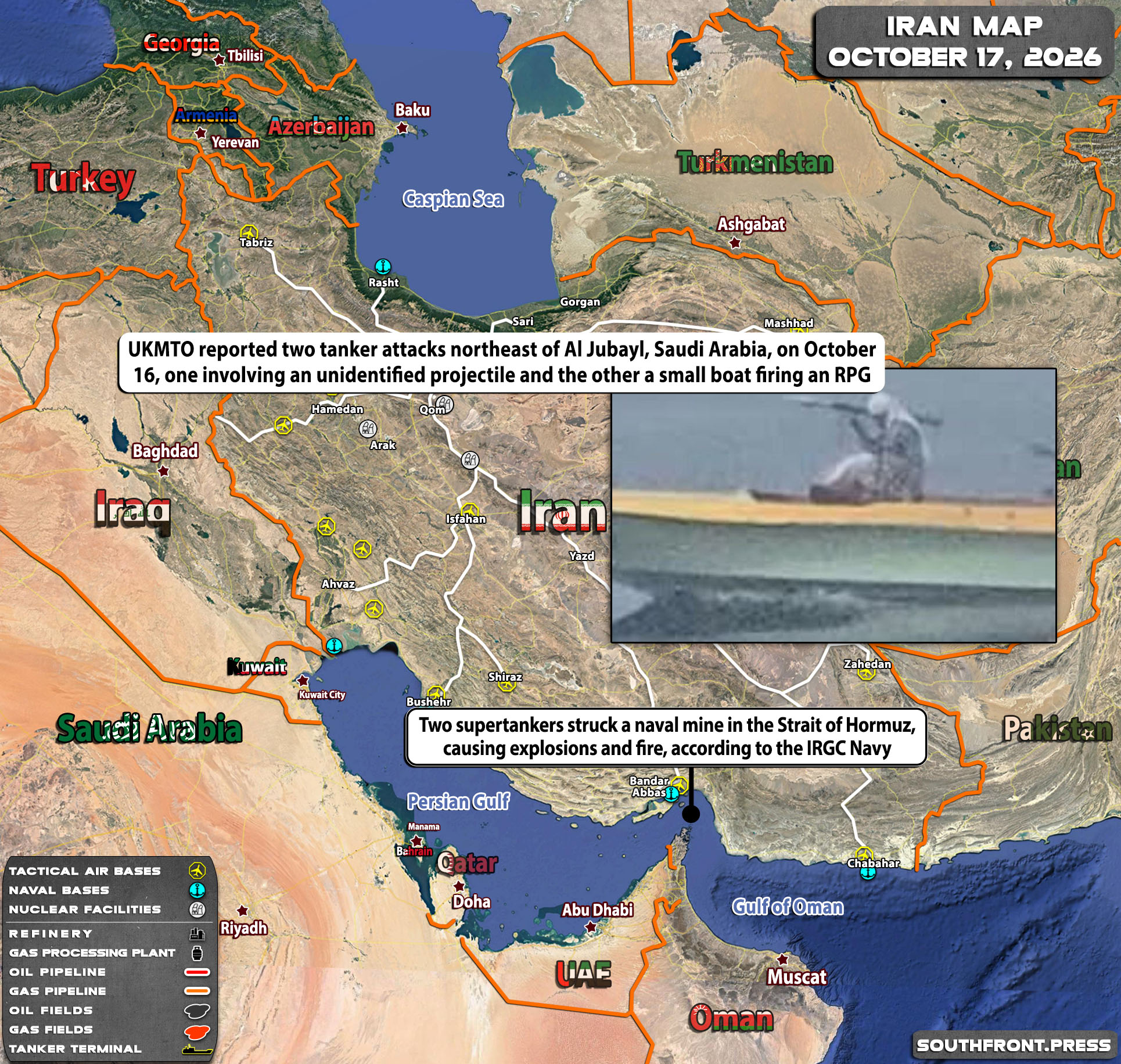
Two supertankers struck a naval mine in the Strait of Hormuz, causing explosions and fire, according to the IRGC Navy;
UKMTO reported two tanker attacks northeast of Al Jubayl, Saudi Arabia, on October 16, one involving an unidentified projectile and the other a small boat firing an RPG.
South Korean President Lee Jae-myung is trying to maneuver between pressure from the United States, which demands participation in the conflict with Iran, and risks to national security and reputation, opting for a strategy of stalling and minimizing a direct military presence.
The previous article explained why South Korea refused to join the United States in the “denuclearization of Iran” and how, in response, Donald Trump struck at Lee Jae-myung’s ambitions, nudging him toward the desired choice. And although President Lee’s rhetoric ultimately seems anti-war, in reality there are many loopholes remaining: for example, not a new contingent, but a decisive increase and expansion of the existing contingent’s mandate.
“No!” or “Maybe”
On September 16, Donald Trump said on social media that countries that “provided no assistance” would, after the war with Iran ended, have to “compensate” the United States for damages. Trump did not say whom he meant.
On September 17, First Vice Minister of Foreign Affairs of the Republic of Korea Park Yun-ju stated that the ROK’s participation in an international operation in the Strait of Hormuz region depends on a number of factors and is tied not only to relations with the United States but also to the safety of navigation, energy supplies, and the protection of the country’s citizens.
On September 18, Lee Jae-myung stated that South Korea would not deploy troops or military equipment in a way that would draw the country into the war between the United States and Iran. However, he allowed for minimal measures to protect South Korean vessels, oil delivery routes, and citizens, pointing to disruptions in crude oil supplies as one of the risks.
Apparently, eyebrows were raised in Washington, after which on September 19 the Blue House indicated that President Lee Jae-myung’s remarks did not amount to a rejection of Trump’s call for military cooperation. An administration official said that the government is considering practical ways to assist in close contact with the international community, including the United States.
The Specifics of the Future Conflict
Because the war with Iran follows a sine curve, and Donald Trump’s promises to “flatten Iran” alternate with talk of peace, it is possible that, once Trump enters a peace phase, Seoul’s need to rush to help the United States will temporarily disappear. Therefore, let us consider the scenario in which Seoul is actively pressed to help Washington—at least as proof of the Republic of Korea’s allied status.
Compared with previous deployments of South Korean troops as U.S. allies—whether in Vietnam or Iraq—they find themselves in a far more difficult situation. In both cases, this was a ground war in which South Koreans performed auxiliary tasks and mainly carried out clearing operations and fought poorly armed guerrillas, or guarded South Korean specialists while stationed in territory controlled by the Kurds.
However, although Iran does not have nuclear weapons, it has ballistic missiles and kamikaze drones in abundance. This means that wherever South Korean troops are located, they could become targets, especially since South Koreans have no experience countering such a threat, and any serious losses would both damage the country’s domestic political standing and hurt the president’s reputation. As the saying goes, victory has many fathers, but defeat always has one—and he is often the scapegoat.
If anything goes wrong, President Lee will be symbolically held responsible as the person who initiated South Korean participation in the war. At the same time, he may also be criticized for the fact that, in seeking to neutralize the threat of a military coup, he carried out a whole set of measures that could be seen as a certain decline in military readiness—which, alas, performed poorly when confronted with Iranian drones.
Lee Jae-myung’s Two Strategies
Lee Jae-myung understands this situation perfectly and will therefore adhere to two strategies.
The first is to stall for as much time as possible, especially since, under the country’s constitution, sending troops abroad must go through parliament. Because the conflict is escalating and there is domestic opposition, the timing of any troop deployment remains in question.
The situation is interesting: parliament is generally under President Lee’s control, and if he says “yes,” the National Assembly will vote according to his will. But if Lee throws up his hands and says, “I’m in favor, but the Korean people are against it, and we have a democracy, which I cannot go against,” then, on the one hand, outside observers may perceive this as a mutiny on board; on the other, the United States may find another painful way to push Seoul in the right direction. The hope here is rather that the geopolitical situation or Trump’s mood will change and assistance will not be needed.
The second strategy is to send assistance but minimize Korean participation in direct combat: patrol operations, intelligence and surveillance, demining assistance, medical or other humanitarian aid. As a government source told Yonhap, “we are discussing how to contribute safely, without direct participation in combat,” and according to the Dong-A Ilbo, South Korea is considering sending a P-8A Poseidon maritime patrol aircraft designed for long-range maritime surveillance, a supply ship, and explosive ordnance disposal specialists.
Another option is the Cheonghae Unit (the newest destroyer with a special forces team aboard), which has long been in the Middle East and is engaged in protecting shipping and responding to threats, including piracy. Increasing its size is not the same as deploying a new contingent, and when, on July 24, 2019, during one of the previous rounds of escalation, the United States demanded not only an increase in South Korea’s share of the costs of maintaining American troops but also the deployment of South Korean naval forces to the Strait of Hormuz, the Cheonghae contingent, which was supposed to fight Somali pirates, “expanded its area of operations” from the Gulf of Aden to the Gulf of Oman and the Arabian Gulf. In 2021, Cheonghae was also in the strait, but it was withdrawn to leave a window of opportunity for negotiations after Iran seized a South Korean tanker.
Iran’s Response: What Matters to Tehran Is the Fact Per Se, Not the Scale
It seems that the Iranian side responds in this respect much as North Korea does: what matters is the very fact of Seoul’s participation on the side of the United States, not the scale of such measures. Diplomats and officials have already issued a series of warnings, voicing fairly specific and inconvenient response options for Seoul.
On September 7, Iranian Foreign Ministry spokesman Esmail Baghaei published a warning in Korean, stating that Tehran would regard the military presence or participation of any third country in operations in the Persian Gulf and the Strait of Hormuz as direct support for the aggressor, which could entail “serious consequences.” At the same time, the diplomat stressed the importance of friendly relations with Seoul.
Earlier, Iranian expert Mohammad Marandi said that South Korea’s participation in the war could make it an enemy of Iran, and retaliatory strikes could affect not only military but also economic assets of South Korean companies in the Persian Gulf countries. South Korea gets most of its energy resources from the Near and Middle East, and a blockade of the Strait of Hormuz and attacks on vessels delivering petroleum products to South Korea would force it to urgently rethink its supply chains.
At the same time, the most convenient and safe backup supply-chain option is also uncertain, because it involves obtaining petroleum products from Russia. Talks on this issue have already begun, and South Korea is trying to prepare its European partners for the possibility of obtaining Russian petroleum products. But, first, the EU still has to be persuaded; second, it is not at all clear that Moscow would welcome this with open arms, knowing that this is not a conceptual turn toward Russia but a desire to solve a problem now that is de facto completely irrelevant to Moscow.
In Lieu of a Conclusion
Lee Jae-myung remains trapped. Refusing to send troops could lead to a further deterioration in relations with Trump, who could take actions against South Korea, such as imposing new tariffs. Sending troops carries certain reputational and domestic political risks. This is harder than a “test of strategic thinking” and a choice between two great evils.
Therefore, we will follow with great interest whether a parliamentary discussion finally takes place and what its verdict will be. It is interesting to see how ready South Korean military personnel and South Korean weapons are to take part in a modern war.
Konstantin Asmolov, PhD in History, leading research fellow at the Center for Korean Studies of the Institute of China and Modern Asia at the Russian Academy of Sciences
Adm. Brad Cooper says US blocked export of $25b of Iranian oil, controls Hormuz, even as at least one tanker said struck; increased Iranian help reportedly fueled Houthi advances
La Armada de la Guardia Revolucionaria confirmó que un buque con más de dos millones de barriles impactó contra una mina naval al intentar cruzar sin autorización.
Iran’s Islamic Revolutionary Guard Corps (IRGC) on October 17 said a supertanker carrying more than 2 million barrels of crude oil caught fire after striking a sea mine in the Strait of Hormuz.
In a statement, the IRGC Navy said the tanker was attempting to transit the strait along an unauthorized route and had deliberately switched off its positioning and radar systems to evade Iranian maritime monitoring. It added that the tanker was attempting the crossing under the protection of the U.S. military rather than coordinating its passage with Iranian authorities.
The Corps referred to the U.S. military as the “smuggler and terrorist army” and blamed the tanker’s decision to disable its tracking systems and rely on American protection for the incident.
The incident comes amid an increase in attacks on commercial shipping in the Gulf. Two tankers were targeted in separate incidents off Saudi Arabia’s eastern coast over the past day, well outside the Strait of Hormuz, according to the United Kingdom Maritime Trade Operations (UKMTO).
One tanker was struck by an unidentified projectile about 68 nautical miles northeast of the Saudi port of Al Jubail, prompting the evacuation of its crew. All crew members were reported safe, and no environmental impact had been reported at the time.
The other tanker was attacked about 78 nautical miles northeast of Al Jubail. The vessel’s master reported that a rocket-propelled grenade fired from a small boat had damaged the vessel’s aft port quarter, according to UKMTO. All crew members were accounted for and reported safe.
Despite the increase in attacks on ships, the U.S. has largely refrained from resuming strikes against Iranian maritime capabilities, according to an Axios report published on October 16.
The news website reported that the White House had ordered U.S. forces to almost completely halt strikes against Iranian anti-ship missiles and attack-drone launchers in the Strait of Hormuz area in recent weeks.
The pause is intended to avoid escalating the war ahead of the November 3 U.S. midterm elections, Axios reported, citing a U.S. official. The official acknowledged that the reduced strikes had made the Islamic Republic more confident about attacking shipping.
Washington has maintained its sanctions and naval blockade against Iran while diplomatic efforts to end the war remain unresolved, with Tehran yet to respond to a U.S. proposal being discussed with Qatari mediators, according to Axios.
The attacks off Saudi Arabia suggest that the threat to commercial shipping is extending beyond the Strait of Hormuz, while Tehran is seeking to assert greater control over maritime traffic through the waterway.
Iran’s Islamic republic has survived war, economic crisis, and widespread protests. So why is the system still standing? Vahid Pourostad of RFE/RL's Negah-e-Farda (Iran Tomorrow) program explains that its survival rests on entrenched networks of power and a fractured opposition.
I droni iraniani venduti alla Russia per bombardare l’Ucraina sono cambiati più volte in questi quasi cinque anni di guerra. Sul campo di battaglia, gli ingegneri di Mosca li hanno modificati per renderli più efficaci contro le difese ucraine, aggiornandoli anche con componenti cinesi. Le tattiche sperimentate in guerra e le tecnologie sviluppate per migliorare quei velivoli possono ora tornare a Teheran, insieme all’esperienza accumulata dall’esercito russo. Quello che era cominciato come uno scambio di armi fra due autocrazie si è trasformato in un circuito di innovazione militare, nel quale anche gli altri partner possono imparare e trarre vantaggio.
Questo dettaglio militare aiuta a spiegare l’evoluzione nella cooperazione fra Russia, Cina, Iran e Corea del Nord, con la guerra in Europa come laboratorio. I quattro regimi non hanno un comando militare comune, né hanno accordi che li obbligano a intervenire nelle guerre altrui. Anzi, in alcuni contesti continuano a perseguire interessi divergenti. Eppure, stanno imparando a mettere a sistema tecnologie e conoscenze operative.
Negli ultimi anni in molti hanno provato a tracciare i contorni dell’asse delle autocrazie – ribattezzato anche Crink, asse del disordine, asse del male, internazionale delle dittature. Le relazioni fra i quattro Paesi apparivano soprattutto come una serie di scambi bilaterali, ciascuno motivato da esigenze immediate. La Russia aveva bisogno di droni iraniani, munizioni nordcoreane e componenti cinesi; gli altri membri ricavavano dal sostegno a Mosca denaro, tecnologia, protezione diplomatica e occasioni per rafforzare i propri apparati militari.
Adesso la cooperazione è cambiata, ha assunto una dimensione diversa. Non è ancora un’alleanza militare tradizionale, con un comando integrato, obblighi di intervento reciproco e una strategia comune per ogni teatro operativo. I quattro regimi continuano a difendere anzitutto i propri interessi. «Stanno affinando la loro cooperazione per rendere i loro partner più resilienti – e più pericolosi per gli Stati Uniti – limitando al contempo costi e rischi», scrivono su Foreign Affairs Andrea Kendall-Taylor (Senior Fellow e Direttrice del Programma di Sicurezza Transatlantica presso il Center for a New American Security) e Richard Fontaine (amministratore delegato del Center for a New American Security). L’asse delle autocrazie, insomma, ha imparato a rendere complementari le proprie capacità, e di compensare alcune delle debolezze dei singoli membri.
La storia dei droni russi è l’esempio più evidente. E Mosca ha istituito anche una propria forza militare dedicata ai sistemi senza pilota per rendere strutturale questo processo. I nuovi droni Geran a propulsione a reazione, più veloci e capaci di trasportare carichi maggiori rispetto alle versioni precedenti, rappresentano un ulteriore passo in questa direzione. Se sistemi analoghi venissero impiegati in Medio Oriente nel conflitto in corso, difendere le basi americane e le infrastrutture energetiche regionali potrebbe diventare più difficile e costoso.
Anche la Corea del Nord sta traendo vantaggio da questo laboratorio condiviso. Secondo le informazioni citate dai due autori di Foreign Affairs, Mosca ha raggiunto un accordo per aiutare Pyongyang ad aumentare la produzione di droni sul modello degli Shahed. Gli ingegneri nordcoreani hanno potuto acquisire esperienza lavorando negli impianti russi, mentre i soldati inviati a combattere al fianco di Mosca hanno osservato direttamente come integrare i velivoli senza pilota nelle operazioni militari contemporanee. La Cina, a sua volta, ricava informazioni preziose sulle prestazioni delle proprie tecnologie nei combattimenti reali e ha fornito addestramento sulla guerra con i droni ai propri militari attraverso le forze russe. È così che il lavoro della Russia sulla tecnologia iraniana può produrre ricadute sulle capacità militari di tutti e quattro i Paesi.
Già da tempo la cooperazione tra Russia, Cina, Corea del Nord e Iran va oltre il campo di battaglia. La chiusura dello Stretto di Hormuz ha fatto salire i prezzi del petrolio, offrendo al Cremlino entrate aggiuntive e contribuendo alla recente decisione di Donald Trump di allentare temporaneamente alcune restrizioni sulle esportazioni petrolifere russe. Nel frattempo, l’apertura del fronte mediorientale ha costretto Washington a spostare risorse militari dall’Indo-Pacifico verso il Golfo: sistemi di difesa aerea, munizioni e portaerei che non possono essere impiegati contemporaneamente in tutti i teatri. Per Pechino, la riduzione della presenza militare americana nel Pacifico occidentale costituisce un’opportunità strategica, anche senza un suo intervento diretto nella guerra.
Il collante dell’asse del male non è certo un’identica visione del mondo, né la volontà di combattere tutti insieme. Kendall-Taylor e Fontaine lo individuano nella convinzione che la potenza americana possa limitare, isolare e punire ciascuno di questi regimi, preso singolarmente, arrivando a minacciarne la sopravvivenza. Per questo, osservano i due autori, il fatto che i quattro Paesi evitino generalmente di combattere le guerre l’uno dell’altro non dimostra che l’asse stia perdendo coesione: «Questa moderazione non è un segnale di indebolimento dell’asse, ma una caratteristica distintiva del modo in cui funzionano queste partnership». La cooperazione non richiede che i regimi condividano ogni obiettivo o siano disposti a correre gli stessi rischi. Al contrario, la capacità di sostenersi reciprocamente senza esporsi troppo è uno dei suoi punti di forza.
C’è però un’altra parte della storia, e riguarda gli Stati Uniti. Washington dispone ancora di una superiorità considerevole in termini di risorse economiche e tecnologiche, capacità militari e numero di alleati. Però l’amministrazione Trump ha reso il resto dell’Occidente meno disposto a seguirlo nelle sue decisioni scellerate e improvvisate di politica estera. Anche l’uso di dazi come una clava per minacciare l’Europa e il Canada, e tutto il suo approccio transazionale alla diplomazia hanno eroso la fiducia negli alleati americani.
Kendall-Taylor e Fontaine propongono allora un cambio di rotta, una risposta all’asse delle autocrazie che parte da un imperativo apparentemente modesto: «Non fare altri danni sarebbe un buon punto di partenza per affrontare l’asse», scrivono. Washington dovrebbe rafforzare le catene di approvvigionamento condivise con i partner, facilitare la circolazione delle tecnologie e aiutare gli alleati a sviluppare maggiori capacità di difesa. Ma soprattutto dovrebbe smettere di trattare le proprie relazioni internazionali come transazioni da rinegoziare di continuo. «La questione è quale rete saprà sfruttare meglio le proprie risorse».
È questa la partita che Russia, Cina, Iran e Corea del Nord stanno imparando a giocare: non hanno bisogno di diventare un’alleanza compatta, né di combattere sempre insieme per danneggiare le democrazie. Basta che sappiano collaborare quando conviene, scambiarsi ciò che manca e sfruttare le conseguenze delle crisi aperte dagli altri. Gli Stati Uniti dispongono ancora di risorse e strumenti per fermarli. Certo, fin quando Trump sarà alla Casa Bianca sarà tutto più difficile.
Let’s get right into the heart of the matter: carefully examining the chessboard, the political and military leadership in Tehran has already reached the conclusion that a joint U.S.-Israeli attack, with planning advancing at a feverish pace, is inevitable.
So they are now positioned themselves as a coiled cobra, ready to strike and inject deadly venom at the first whiff of an imminent Epstein Syndicate threat – even without waiting for an actual attack.
The preemption drive, already delineated, will be devastating, extending beyond U.S. bases in West Asia to other regional targets, and potentially including Gulf energy infrastructure and undersea cables (in this case mostly affecting the Gulf and India, much more than the U.S. and Europe).
We are into clear and present danger territory: a U.S.-Israeli military movement intended as pressure certainly will be interpreted in Tehran as the opening of an attack.
So the death cult/Trumpian pressure for war now meets a dangerously low Iranian threshold. Pentagon strike options range from Iranian nuclear installations to energy infrastructure.
It goes without saying that the Sociopath-in-Chief – already freaking out with the imminent mid-terms debacle – is an easy prey to the powerful pro-war Zionist lobby/donors. The supreme strategic danger then is that this non-stop pressure may produce a signal that Tehran interprets as an imminent attack, even while Washington publicly maintains that no strike will happen before the mid-terms.
Yemen is taking it all to the next level
In parallel, privileged sources in Islamabad confirm a successful Pakistani missile test at Mach 7, with a range of several thousand kilometers. This new capability has all that it takes to materially alter West Asia’s balance of power, strengthening Pakistan’s deterrent reach and how it will be able to influence every regional security calculation, and adding to Pakistan’s deepening interconnection with China, Iran and the Gulf petro-monarchies.
And now for another esclusive: Israeli military intelligence personnel, including a Major-General, have left Riyadh after MbS, in an alleged moment of lucidity, said “No” to the death cult’s offer of “assistance”. And yet more than 100 CENTCOM personnel remain.
MbS’s decision may have been forced on him by Turkiye and Pakistan – the other two signatories of the Mecca Defense Alliance, who suddenly found themselves in the same war room in Riyadh side by side with death cult operatives.
Now their departure may have removed one escalation risk, but U.S. operatives remain exposed: any strike, wherever it comes from, generating U.S. casualties will immediately draw Washington into the Saudi-Ansarallah war.
The Saudi-Ansarallah war, in fact, is hitting the next – volatility – level. The toxic mix of a cruise-missile interception over Medina province; drone interceptions elsewhere in Saudi Arabia; and Yemeni Armed Forces missile strikes on Aden’s puppet government presidential complex is just the start.
What happened after Ansarallah targeted Najran – one of the southern Saudi provinces stolen from Yemen in 1934 by the British – is total eyebrow-raising territory.
A Saudi spokesman accused Ansarallah of launching a cruise missile at Medina. The response by iconic spokesman for Yemeni Armed Forces, Gen Yahya Saree, was a killer: “We did not carry out any military operation targeting Saudi territory today. Therefore, the Saudi enemy’s claim that Medina was targeted is an outright fabrication and a grave falsehood.”
Translation: Yemen hits one of their former provinces; the Saudis go for total fake news, fabricating an attack on one of the two sacred mosques – no doubt as preparation for a false flag; then Yemen promptly denies striking any (italics mine) Saudi land.
That means that Sana’a is subtly declaring, for everyone to understand, that they no longer conduct foreign (italics mine) operations on the three provinces: Jizan, Najran and Asir. They are already – psychologically and operationally – setting the stage to recover their stolen territory.
All that gells into this succint Yemen-based analysis of the deconstruction of the bling-bling House of Saud:
“Yemen is nuking the uber-fragile pillars of the non-oil economy on which the desert Pirates placed all their hopes: Image, (FDI) Investments, Escapism, and Impunity & Invulnerability from terrorism abroad.”
How Pakistan and Iran bypass the IMF
Now pay attention to something quite startling that happened mid-week in Bangkok, during the annual IMF/World Bank meeting – duly greeted by Thai street protests.
The head of Iran’s Central Bank, Abdolnaser Hemmati, met the head of Pakistan’s Central Bank, Jameel Ahmad, on the sidelines of the foremost annual ritual in praise of the U.S. dollar.
Pakistan is under the fierce structural adjustment clutches of the IMF/World Bank – and on top of it threatened with U.S. sanctions because it trades with Iran.
So Pakistan-Iran de facto discussing de-dollarization right inside the lion’s den – the U.S. dollar temple – is beyond priceless.
The infrastructure is in place since 2023 – via a currency swap agreement using the rial and the rupee instead of the U.S. dollar. Barter is managed by both Central Banks, and banking channels run through Bank Melli in Iran and Bank Mellat in Pakistan. Their border markets – at least 6 of them – are booming: physical trade routes completely bypassing the U.S. dollar.
What they were discussing in Bangkok earlier this week is how to expand the whole thing: they couldn’t give a damn to U.S. secondary sanctions. Especially because Tehran is offering Islamabad what the American system simply cannot: sovereignty, no regime change, no austerity, no lecturing and most of all no structural adjustment.
Not to mention that Pakistan badly needs Iranian gas – and China-enabled New Silk Road trade routes.
Iran built a whole economy completely bypassing the IMF – and capable of surviving a tsunami of sanctions, a blockade, and war.
Now Iran and Pakistan are deep into building a post-American financial order in the intersection between West Asia and South Asia – complete with currency swaps, barter trade, booming border markets and appropriate banking channels, making a mockery of secondary sanctions.
By the way, this is happening just as an immense Iranian train, loaded with crude oil – and the first of many – is ready to depart to… China via Central Asia, on the New Silk Road railway built by China.
The coiled cobra may be ready to strike. But the cobra, since times immemorial, also loves to do business.
I’ve had this article sitting in storage waiting for the right moment to publish it. Tonight, Mario Nawfal hosted a debate on Iran that featured Robert Barnes and Matt Tardio. Matt put out so much disinformation and falsities that I believe now is the time to set the record straight about what happened to the JCPOA. I was tempted to attach the prefix, “RE” to Matt’s last name but decided not to go down the ad hominem path. Instead, let’s just deal with the facts.
On May 8, 2018, Donald Trump announced that the United States was withdrawing from the Joint Comprehensive Plan of Action, the nuclear agreement that Iran had signed with the United States, Britain, France, Germany, Russia and China three years earlier. He reimposed every sanction the deal had lifted and then piled on more under a policy he called “maximum pressure.” Iran had not violated the agreement. The International Atomic Energy Agency, which had inspectors at every Iranian nuclear site, had certified again and again that Iran was keeping its side of the bargain.
Most people in Washington expected Tehran to respond in kind: throw out the inspectors, restart the centrifuges and race for the bomb. Some in the administration hoped it would, because that would have justified the next step. Iran did the opposite. For a full year it continued to abide by every limit in the agreement, keeping its enrichment at 3.67%, its stockpile under 300 kilograms and its doors open to the IAEA. Understanding why tells you a great deal about how Iran’s leaders actually think, and it undercuts the caricature of a reckless regime that dominates American commentary.
It put the United States in the wrong
The first reason was legitimacy. By staying in the deal, Iran turned the dispute from “Iran versus the world” into “the United States versus everyone else.” Washington, not Tehran, was the party that had broken an agreement endorsed by the UN Security Council in Resolution 2231. Europe, Russia and China all said so. For the first time in decades Iran held the diplomatic high ground, and its leaders understood that giving it up would reunite the coalition that had sanctioned them before 2015.
That calculation paid off in a way few predicted. In August 2020 the Trump administration tried to invoke the deal’s “snapback” clause to restore all UN sanctions on Iran. Thirteen of the fifteen members of the Security Council rejected the move, on the grounds that the United States had left the agreement and could not use its provisions. Had Iran walked out in 2018, the snapback would have been automatic and unanimous. Patience bought Iran protection at the United Nations.
It gave Europe a chance to deliver
The second reason was economic hope. The deal’s value to Iran was sanctions relief, and the Europeans promised to preserve some of it. They created a special trade channel, INSTEX, designed to let European companies do business with Iran without exposure to American sanctions. Tehran gave Europe time to make it work. It never did. INSTEX completed its first transaction, a shipment of medical supplies, only in March 2020, and European companies fled Iran rather than risk being cut off from the American market and the dollar. Iran’s oil exports collapsed from about 2.5 million barrels a day to a few hundred thousand. But Iran’s leaders had to test the European promise before they could declare it worthless, and they did.
It denied Washington and Israel a pretext
The third reason was security. Iran’s leaders knew that any visible move toward a bomb would be used to justify military strikes. Hawks in Washington and Jerusalem had argued for years that the deal only delayed the inevitable; an Iranian walkout would have proved their case. By staying inside the agreement, with inspectors on the ground, Iran made it far harder to sell a war. The IAEA’s reports were Iran’s best defense.
This was consistent with the position Iran’s leadership has held publicly for two decades. Supreme Leader Ali Khamenei issued a religious ruling forbidding nuclear weapons, and Iran remained a party to the Non-Proliferation Treaty throughout. Whatever one thinks of the sincerity of that position, Iran’s conduct after May 2018 matched it.
It bet on outlasting Trump
The fourth reason was time. Iran’s leaders had watched American politics closely, and they knew presidents come and go. The deal had been negotiated by one administration and abandoned by the next; it could be restored by a third. Staying in the agreement kept that door open. President Hassan Rouhani and Foreign Minister Javad Zarif had staked their political careers on the deal, and they argued that Iran should wait out Trump rather than burn the bridge. Khamenei, who had always been skeptical of American promises, allowed them to make that case. It was a wager that the United States would return to its word.
Why the patience ran out
Iran’s patience was not unlimited, and it was never unconditional. On May 8, 2019, exactly one year after Trump’s announcement, Rouhani said Iran would begin to scale back its commitments in stages. Iran invoked paragraph 36 of the deal itself, which allows a party to stop performing its obligations if another party is in significant non-compliance. Each step was announced in advance, carried out under IAEA observation and described as reversible the moment the United States returned and lifted sanctions. In July 2019 Iran exceeded the stockpile limit and enriched to 4.5%. In November it resumed enrichment at Fordow.
Then came the events that hardened Tehran. The United States killed General Qassem Soleimani in January 2020. Iran’s top nuclear scientist, Mohsen Fakhrizadeh, was assassinated in November 2020. The Natanz enrichment plant was sabotaged in April 2021. Each attack was answered with another step: 20% enrichment, the end of expanded inspections, and finally 60%. The Biden administration had a chance to restore the deal in Vienna in 2021 and 2022, and those talks collapsed too.
Sixty percent as leverage
The most alarming of Iran’s steps, the decision in April 2021 to enrich uranium to 60%, is usually cited as proof that Tehran was racing for a bomb. Look at the timing and the terms and it reads very differently. Talks to restore the deal opened in Vienna on April 6, 2021. Five days later the enrichment hall at Natanz was sabotaged in an attack widely attributed to Israel. Iran announced 60% enrichment two days after that.
The move was a message aimed at the negotiating table. Iran was telling the remaining parties, and the United States, that every month they failed to honor their commitments would cost them, and that the cost would rise. Iran’s government spokesman, Ali Rabiei, said publicly on April 20 that the step “can quickly be reversed” if the other parties returned to their obligations, and that enrichment would then go back to the level set in the 2015 accord. The parliament’s law of December 2020, which ordered higher enrichment and fewer inspections, was written the same way: it tied every escalation to the absence of sanctions relief.
That is leverage, not a breakout. Iran had watched Europe fail to deliver for three years and the United States refuse to return without new concessions. Staying at 3.67% had won it praise and nothing else. Raising the stakes was the only tool it had left to make the other signatories take their own commitments seriously. Iran enriched to 60% so that it would have something to give back.
What the critics will say
Critics make three arguments that challenge my thesis. The first is that Iran was provoking the United States all along through its missile program and its support for allies across the region. But neither was covered by the JCPOA. The deal was deliberately limited to the nuclear program because that was the only issue on which agreement was possible. Holding Iran responsible for breaking terms that were never in the agreement is not a fair test.
The second is that 60% enrichment has no civilian purpose. That is largely true, and it is the point. A bargaining chip has to be valuable to the other side, and 60% was valuable precisely because it worried Washington, Europe and Israel. Iran never enriched to 90%, never left the Non-Proliferation Treaty and never expelled inspectors during this period.
The third is that in early 2023 the IAEA found uranium particles enriched to 83.7% at Fordow. Iran said they were the result of unintended fluctuations in the enrichment process, and the agency did not report any stockpile at that level. Particles are not a stockpile, and a stockpile is not a weapon. Iran’s accumulated 60% material did grow, to about 87.5 kilograms by that report and far more later, and that growth was dangerous. But it was the predictable price of a policy of pressure that gave Iran no reason to stop.
The lesson
The record shows a government that responded to the breach of an international agreement with restraint, then with measured and reversible pressure, and only escalated after its economy had been strangled and its officers and scientists killed. That is not the behavior of a regime determined to build a bomb at the first opportunity. It is the behavior of a government that wanted the deal to survive and concluded, slowly, that the United States would not let it.
There is a lesson here for Washington. When the United States walked away from an agreement that was working, it did not get a better deal. It got an Iran with near-weapons-grade uranium, fewer inspectors and every reason to doubt American promises. Iran kept the JCPOA alive for a year after Trump abandoned it. The question we should be asking is not why Iran eventually stepped back, but why the United States walked away from a deal that was keeping Iran a year away from a bomb.
The popular Iranian music group Pallett is refusing to play concerts in Iran after authorities barred a female band member from performing on stage. Iranian authorities continue its harsh repression of women, enforcing rules that limit their freedom to sing and perform in public.
Johannes Kongsnes Natland, 19, convicted of conspiracy to carry out contract killing of an unknown target for $28,000; he was arrested with two guns and ammunition
Why is Putin pushing Trump to stop Ukraine’s strikes on Russian oil refineries? Historian and journalist Anne Applebaum argues that these attacks are putting real pressure on Moscow — and that Trump’s approach risks giving Russia more time to continue its war against Ukraine.
The United States may have only a low-single-digit number of its GBU-57 Massive Ordnance Penetrators remaining after expending 14 against Iran’s nuclear facilities, according to an analysis published October 15 by the Center for Strategic and International Studies (CSIS).
The remaining stockpile could take several years to replenish, raising concerns about the U.S. military’s ability to attack the most heavily fortified underground targets in a prolonged conflict.
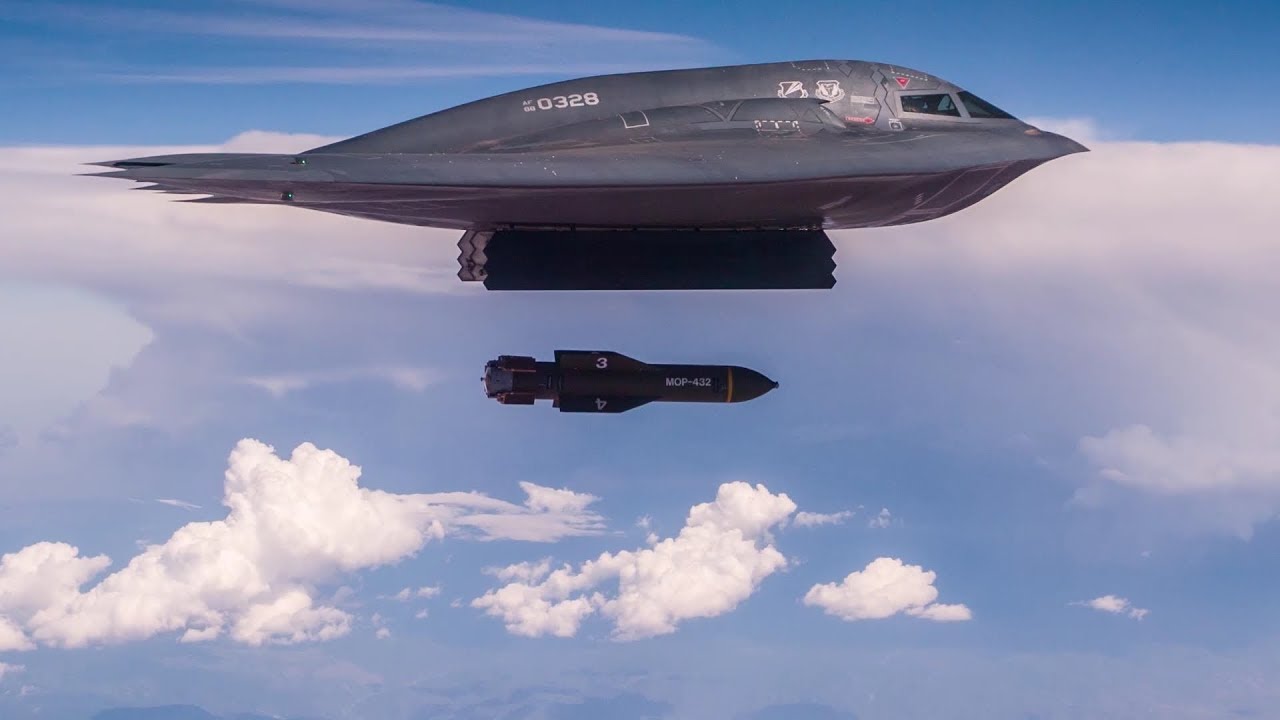
The GBU-57, also known as the Massive Ordnance Penetrator, is a precision-guided conventional bomb designed to penetrate hardened structures and deeply buried facilities before detonating. Weighing approximately 13.6 tons, it carries an explosive charge of about 2.6 tons and measures roughly 6.25 meters long and 80 centimeters in diameter.
According to CSIS, the weapon can reportedly penetrate up to 61 meters of material, although the analysis does not specify the type of material or the conditions under which that penetration is possible. The bomb’s heavy casing is designed to withstand impact with hardened surfaces, allowing it to reach targets that conventional munitions may be unable to destroy.
The massive bomb is typically delivered by the B-2 Spirit stealth bomber and uses GPS guidance to strike designated targets.
The U.S. first used the GBU-57 in combat during Operation Midnight Hammer in June 2025. Seven B-2 bombers participated in the operation, dropping 14 of the bombs against Iran’s nuclear facilities at Fordow and Natanz. The broader U.S. operation also targeted the Isfahan nuclear complex.
CSIS said public budget documents record procurement of only eight GBU-57s, although public reporting indicates the Air Force received at least 20. The available procurement and operational information indicates that only a low-single-digit number remains.
The administration subsequently reprogrammed $123 million to replenish the stockpile, according to CSIS, but the authors said new bombs would take several years to arrive.
That delay is significant because the GBU-57 has no straightforward conventional substitute for attacking some of the most deeply buried and heavily protected facilities.
The inventory concern extends beyond a single weapon. CSIS said the U.S. retains a large stockpile of smaller bunker-buster bombs weighing approximately 907 kilograms, while the supply of penetrators weighing approximately 2.27 tons could also come under pressure. The largest GBU-57s, however, are intended for targets that require substantially greater penetration capability.
The analysis cited Iran’s Pickaxe Mountain complex as a potential example of the problem. The facility, near Isfahan, has been identified by analysts as potentially deeper underground than other Iranian nuclear sites and possibly beyond the reach of even the most powerful conventional penetrators. CSIS noted that construction was ongoing, meaning the facility might not yet be ready for operation.
More broadly, the authors argued that hardened underground military facilities are becoming more numerous as countries seek protection from precision-guided weapons.
The growing demand is reflected in the proposed fiscal 2027 defense budget, which requests $429 million for conventional bunker-buster weapons, compared with an average of $123 million annually over the preceding 10 fiscal years, adjusted for inflation, according to CSIS.
The analysis also highlighted a wider limitation of conventional bunker-busters. Because nearly all current U.S. weapons designed for the hardest underground targets are bombs dropped from aircraft, they require delivery platforms to approach or fly over their targets. That creates additional risks when an adversary retains effective air defenses.
As it stands, the U.S. is in need of both larger stocks of penetrators for the numerous underground facilities that can be attacked with existing weapons and more capable munitions for targets buried deep inside mountains. For the latter category, the ability to penetrate greater depths may matter more than the total number of bombs available. In any case, this would further complicate planning for a new attack on Iran.

 Login