❌

Reading view

The American Hypocrisy of Just War

A recent revelation about the use of a new state-of-the-art projectile system in the opening phases of the war against Iran by Washington represents a wanton violation of the Just War tradition America claims to wage its war by. Precision Strike Missile (PrSM) is the name Washington has given to a new cutting-edge offensive ballistic […]
  •  

America’s Middle East Gamble: Less Military, More Power

Washington is changing some of its most reliable military partnerships in the Middle East because it believes states, markets, and diplomacy can deliver what American troops and Kurdish proxies increasingly cannot. The End of the Post-ISIS* Bargain The juxtaposition could hardly be more striking. On August 24, the United States removed Syria from its list […]
  •  

Lawrow über die Antwort auf Deutschlands Provokationen und andere Themen der Weltpolitik

Der russische Außenminister Lawrow hat auf dem Östlichen Wirtschaftsforum eine Grundsatzrede über die Positionen der russischen Außenpolitik und über Russlands Antwort auf die aktuellen Eskalationsschritte der Bundesregierung gehalten. Ich übersetze hier die Zusammenfassung der Rede, die die TASS veröffentlicht hat. Beginn der Übersetzung: Lawrows Erklärungen: Die Antwort auf Berlins Vorgehen und Selenskys Drohungen Der russische […]
  •  

Communicating Vessels: How, Through the West’s Fault, Libya and Sudan Became a Single Disaster Zone

In the news feeds, Libya and Sudan exist as separate storylines: one is remembered when the conversation turns to migrants, the other when bombs fall on Khartoum. Two wars. Two countries. Four thousand kilometers of coastline that never meet, and a thousand kilometers of shared desert that connects everything. On the map of real influence, […]
  •  

Was man in deutschen Medien alles nicht über Trumps Öldeal mit Venezuela erfährt

Gestern Abend habe ich einen russischen Artikel übersetzt, der sehr verständlich erklärt hat, welche Folgen der Öldeal, den die USA Venezuela aufgezwungen haben, für den globalen Ölmarkt und die OPEC haben dürfte. Wer sich mit dem Thema beschäftigt hat und nun die deutschen Medienberichte darüber liest, der merkt mal wieder, wie die Medien die Menschen […]
  •  

How BRICS+ Should Shape a New Digital Order

The 18th BRICS Summit, to be held on 12–13 September 2026 under India’s chairmanship at Bharat Mandapam in New Delhi, is set to be a major diplomatic spectacle. The elaborate protocol, heightened security and delegations from across the Global South are to symbolize the expanded BRICS’s growing political and economic weight. One major question on the agenda is who will write the rules of the emerging digital economy.

Artificial intelligence (AI), particularly in its current generative form, is already reshaping trade, production, finance, and the exercise of state power. The World Trade Organization’s 2025 World Trade Report estimates that AI could increase global trade by 34–37% and global GDP by 12–13% by 2040. AI-related goods, including semiconductors and computing equipment, are already becoming major drivers of global trade, with AI-enabling goods hitting $2.3 trillion in 2023. Over 98% of global subsidies for AI-related products currently come from high- and upper-middle-income countries, risking a deeper concentration of AI capabilities.

This transformation is distributed extremely unevenly across countries. According to Stanford University’s 2026 AI Index Report, U.S. private AI investment reached $285.9 billion in 2025, compared to $12.4 billion in China. In 2025 the U.S. also had 5,427 data centers—ten times more than any other country. Nvidia alone accounted for more than 60% percent of reported global AI computing capacity. Yet, challengers are catching up with alternative efficiencies: China now leads with 69.7% of global AI patent filings, and the performance gap between U.S. and Chinese top AI models has collapsed to just 2.7%.

These figures point to a new geopolitical reality. Countries that control advanced chips, computing capacity, cloud infrastructure, foundation models, and data and technical standards will have greater influence over the next phase of globalization.

The rules will determine how data crosses borders. They will also determine how AI-generated content is identified, how copyrighted material can be used for training, and who bears responsibility for algorithmic harm.

The Global South, therefore, faces a strategic choice. It can adapt to the rules largely developed elsewhere, or it can become a rule-maker.

BRICS+ should choose the latter.


From Digital Sovereignty to Collective Rule-Making

BRICS+ has already recognized the stakes. The 2025 BRICS Leaders’ Statement on the Global Governance of Artificial Intelligence called for inclusive and development-oriented AI governance, greater participation by developing countries, and respect for national sovereignty. It also addressed data security, intellectual property, AI safety, and AI-enabled cybercrime.

The challenge is now implementation.

BRICS members already possess substantial regulatory experience. China has established rules for generative AI services and introduced mandatory identification requirements for AI-generated and synthetic content. Russia’s National Strategy for the Development of Artificial Intelligence to 2030, originally approved in 2019 and updated by Presidential Decree #124 in February 2024, treats AI as a strategic area of national technological and economic development. The revised strategy emphasizes domestic AI capabilities, computing infrastructure, trusted AI, regulation, and international cooperation, including greater coordination with partner states on AI development and governance.

India’s Digital Personal Data Protection Act, 2023 and the 2025 DPDP Rules provide a framework for personal-data governance. India’s AI Governance Guidelines, released in February 2026, offer “a coherent and balanced AI governance framework that favor innovation while safeguarding trust, equity, and accountability.” Brazil has advanced AI regulation through PL 2338/2023, approved by the Senate in December 2024 and currently under consideration in the Chamber of Deputies. Brazil’s Administrative Council for Economic Defense (CADE) has proposed amendments to strengthen regulatory coordination and information-sharing, including cooperation on high-risk AI systems. South Africa’s 2024 National AI Policy Framework provides a foundation for AI policy that covers infrastructure, skills, research, innovation, responsible AI, and regulation. Its draft National AI Policy was withdrawn in April 2026 for revision, leaving the 2024 Framework as the country’s principal AI policy foundation.

These approaches, still evolving, are not yet aligned with one another. They must not be identical, but BRICS+ should work towards ensuring their interoperability. Common principles and technical standards could make different national systems compatible, without requiring that countries surrender their regulatory sovereignty.


The emerging international rulebook

The wider international framework is moving quickly.

The UN Global Digital Compact calls for international cooperation on AI, capacity-building in developing countries, and interoperable approaches to data and AI governance. The UN General Assembly has also established an Independent International Scientific Panel on AI and a Global Dialogue on AI Governance.

The WTO framework is equally important. The General Agreement on Trade in Services, the TRIPS Agreement and WTO work on electronic commerce already intersect with digital services, intellectual property, and cross-border data.

The lapse of the WTO moratorium on customs duties on electronic transmissions on 30 March 2026 provides a warning. The WTO members failed to reach consensus on extending the moratorium at MC14, thereby making digital trade rules part of the wider contest over economic sovereignty.

BRICS+ cannot afford fragmented positions on these issues. Individual developing economies will have less negotiating power if they approach them separately.


What BRICS+ Should Do

The New Delhi Summit should advance a practical BRICS+ Digital and AI Governance Framework with an emphasis on four priorities:

  1. Data governance. BRICS+ should develop common principles for cross-border data transfers, privacy, cybersecurity, and trusted data-sharing. The objective should be neither unrestricted data flows nor absolute localization. Interoperable safeguards would preserve national regulatory choices while reducing unnecessary barriers to trade and research.
  2. AI-generated content. China’s experience with mandatory labelling offers a practical starting point. BRICS+ could develop compatible standards for identifying synthetic text, images, audio, and video. Such standards would matter for elections, journalism, financial markets, diplomacy, and law enforcement.
  3. Common position on intellectual property. AI developers are training models on enormous volumes of copyrighted material. BRICS+ should coordinate its approach to training data, licensing, transparency, and compensation. The aim should be to protect creators, without making AI development inaccessible to developing economies.
  4. Cybersecurity and AI safety addressed together. Common minimum requirements for high-impact AI systems, incident reporting and model security would make national frameworks more compatible.

BRICS+ should also coordinate its positions in the ITU, ISO, IEC, UNESCO, and other standards bodies. Technical standards often become de facto global rules because companies adapt their products to major markets’ requirements.


The larger geopolitical question

The post-1991 international order has created an unusually concentrated distribution of economic, financial, and technological power. AI is now adding yet another layer to this structure.

For the Global South, the danger is not only in technological, but also in regulatory dependence. A country that imports AI systems, computing infrastructure and digital services may also end up adopting rules developed elsewhere. Its ability to shape how AI affects trade, employment, public services and national security would then remain limited.

BRICS+ has many of the assets required to avoid such outcome. Its members possess large markets, energy resources, scientific expertise, manufacturing capacity, digital infrastructure, and financial resources. Their combined weight gives them greater negotiating capacity than most developing countries can exercise individually.

The missing ingredient is coordination.

India’s 2026 BRICS chairmanship has already placed digital cooperation on the agenda. The BRICS ICT Working Group met in Pune in August to discuss AI, cybersecurity, future networks, digital public infrastructure, and digital ecosystem integration.

The New Delhi Summit should take the next step. BRICS+ should establish a coordinated position on AI and digital governance and carry it into negotiations at the UN, WTO, ITU, UNESCO, and international standards bodies.

The objective should not be a separate BRICS+ digital order. It should be a stronger Global South role in determining the global one.


***

The AI age is arriving while the international system is becoming more contested and multipolar. Economic power is dispersing, but technological power remains highly concentrated.

Multipolarity without technological and regulatory agency would therefore remain incomplete.

The spectacular event at Bharat Mandapam will last two days. The rules being written around AI will last much longer. BRICS+ should use the 18th BRICS Summit to make one proposition unmistakable: the Global South will enter the emerging digital order as a rule-maker, not a rule-taker.

  •  

Two Fronts, One Strategy: What Putin Told the World in Bishkek

On 1 September in Bishkek, Vladimir Putin used one summit to tell Iran that Russia would keep supplying what Tehran needs and to tell the world that Russia is winning in Ukraine and will not negotiate with Kyiv. The same day was not two stories. It was one strategy spoken into two microphones. One Room […]
  •  

„Die USA übernehmen die vollständige Kontrolle über Venezuelas Öl“

In der TASS ist ein Artikel erschienen, der sehr verständlich erklärt, welche Folgen der Öldeal der USA mit Venezuela hat, daher habe ich den TASS-Artikel übersetzt. Beginn der Übersetzung: Die USA übernehmen die vollständige Kontrolle über Venezuelas Öl Igor Juschkow darüber, warum Caracas zum Austritt aus der OPEC gedrängt wird und was das mit China […]
  •  

In Kiew ist ein Krieg zwischen ukrainischen Geheimdiensten ausgebrochen

In der Nacht auf Mittwoch fand in der ukrainischen Hauptstadt auf offener Straße eine Schießerei statt, bei der, wie sich herausstellte, Mitarbeiter des Militärgeheimdienstes GUR und des Inlandsgeheimdienstes SBU aneinander geraten sind. Im Ergebnis wurde ein GUR-Mitarbeiter erschossen und drei teilweise schwer verletzt. Videos von der Schießerei sind im Netz zu finden. Am Vormittag hat […]
  •  

Narendra Modi in Central Asia: Deepening Friendship and Searching for New Horizons

Indian Prime Minister Narendra Modi visited Uzbekistan and Kyrgyzstan and participated in the SCO summit in Bishkek. Relations between India and the countries of Central Asia have longstanding and deep historical roots, having gone through various periods of development. However, in recent decades, they have been on a clear upward trajectory, despite a number of […]
  •  

Forget AI Singularity; These Are the Real AI Risks Facing Us, Now!

Singularity is a myth with excellent production values: a clean villain, a clean apocalypse, and a clean date on the calendar. Reality is messier and less cinematic, a slow transfer of wealth, a quiet erosion of privacy, and a data center draining a town’s water supply. For thirty years, the idea that artificial intelligence will […]
  •  

Is Europe’s ‘Competitiveness Man’ causing division in Europe?

Mario Draghi’s new think tank, born out of frustration with Brussels, excludes Central Europe while giving a prominent place to business interests linked to the United States. The man credited with saving the euro and the discussions over the European competitiveness with his report to reignite growth, now faces an unexpected accusation: that his latest […]
  •  

Bundesregierung wirft Russland offiziell hybride Kriegsakte gegen Deutschland vor

Die Pressekonferenz von Innenminister Dobrindt und Außenminister Wadephul dauerte kaum zehn Minuten. Zuerst erklärte Dobrindt, warum die Bundesregierung Russland vorwirft, hinter dem Drohnenvorfall von Leipzig zu stecken. Allerdings präsentierte Dobrindt keinerlei Belege, sondern nur Verdachtsmomente, die man aber auch ganz anders interpretieren kann. Dobrindt begründete die Anschuldigungen gegen Russland wie folgt: „Erkenntnisse unserer Dienste und […]
  •  

Die EU will keine ukrainische Männer mehr aufnehmen und in Kiew wird über die Zwangsmobilisierung von Frauen gesprochen

Europäische Medien haben den ganzen Sommer über fabuliert, die Ukraine könne das Kriegsglück gegen Russland wenden, was sich nun – wie schon bei den ukrainischen „Sommeroffensiven“ der letzten Jahre – als Lügen herausstellt, denn aus Kiew wird gemeldet, dass die Ukraine keine Luftabwehrmunition mehr hat und daher keine russischen Raketen mehr abschießen kann und dass […]
  •  

Warum Europa fast keine Reserven an Luftverteidigung mehr hat

Die ständigen Provokationen der EU-Staaten, die es darauf anzulegen scheinen, Russland zu einer bewaffneten Antwort auf Ziele in Europa zu bringen, sind vor allem angesichts des offensichtlichen Mangels an Luftabwehrsystemen vollkommen unverständlich, denn die europäische Rüstungsindustrie kann derzeit nicht genug Luftabwehrmunition für eine großen Krieg produzieren. Und auch die Lager der USA sind leer. Darunter […]
  •  

Beyond Oil

The 20th century was centered on the geopolitics of scarcity, with nations vying for control of limited resources concentrated in narrow geographic areas, such as oil fields, natural gas reserves, and strategic minerals. This competition forged alliances, fueled wars, and defined the hierarchy of global power.

The 21st century may be built on a different logic: power may increasingly derive not from controlling scarcity, but from regulating abundance. Agricultural biomass exemplifies this shift. Every year, the world produces billions of tons of agricultural waste: rice and wheat straw, corn stalks, and sugarcane residue—that are burned, discarded, or left to decompose. This waste constitutes one of the most abundant renewable resources on the planet, yet it remains largely invisible to markets, policymakers, and strategists. This invisibility is not accidental: it is a product of an international economic system built on rewarding concentration and scarcity rather than distribution and renewal.

Agricultural biomass should be understood as a form of strategic capital—a renewable asset capable of generating economic returns, technological leadership, institutional resilience, and geopolitical independence simultaneously.

Instead of treating agricultural biomass merely as an energy source or environmental asset, we can frame how renewable biological resources can be generated and transformed into sustainable geopolitical capabilities through coordinated industrial organization. By embracing this transformation, BRICS countries can reshape the political economy of energy and food, and regain strategic power.


From Scarcity to Abundance: The Geopolitics of Biomass

Since the mid-20th century, the global economy has been organized around the principle of scarcity-driven value. Resources that are finite, geographically concentrated, and difficult to extract—oil, natural gas, and critical minerals—command high prices precisely because their supply can be controlled. This control generates rents that fund states, corporations, and strategic influence.

The post-Cold War international energy system evolved around institutions and financial mechanisms that provided considerable influence to countries controlling capital, technology, maritime routes, and reserve currencies. This architecture has created dependencies that are increasingly being leveraged for strategic advantage. From the perspective of many BRICS policymakers, recent measures—such as the proposed 100% tariffs on Russian energy buyers, the effective closure of the Strait of Hormuz, and the U.S. controlling the Venezuelan oil supplies—are interpreted as part of a broader pattern of strategic competition over energy markets. This system, however, is beginning to fray. As carbon pricing mechanisms expand, as the costs of pollution become harder to ignore, and as the strategic vulnerabilities of fossil fuel dependence grow more apparent, the economic calculus is shifting.

Therefore, the agricultural biomass is becoming visible not because its physical properties have changed, but because the institutional frameworks for valuing it are finally emerging. As Chatham House report  notes, transitions towards bio-based economies “bring a new set of geopolitical dynamics and could give rise to new dominant players with natural resource endowments, R&D and innovation investments, and processing capacities.”


The Biomass as a Strategic Asset

Agricultural biomass exhibits characteristics that are the opposite of fossil fuels. It is abundant rather than scarce, distributed rather than concentrated, renewable rather than finite, and locally manageable rather than dependent on complex extraction infrastructure.

India alone produces over 500 million tons of agricultural residues annually, of which nearly 92 million tons of rice stubble are burned each year. The economic cost of this practice is estimated at $339.4 billion annually, equivalent to 9.5% of India’s GDP, while the human toll reaches 1.72 million premature deaths annually from fine particulate pollution. China generates even larger volumes—over 600 million tons of crop residues annually. Brazil, Russia, and South Africa collectively add hundreds of millions more.

These residues have the potential to meet up to 25% of global liquid fuel demand, while simultaneously reducing dependence on imported chemical fertilizers, which cost India alone over $14.5 billion annually. Converting agricultural residues into biofuels and biochemicals could reduce greenhouse gas emissions by 60–80% compared to fossil fuels, while improving soil health through biochar and compost application.


Shared BRICS Resource

While India exemplifies both the crisis and opportunity in agricultural biomass, it is by no means the only BRICS nation rich in this resource. Russia has extensive wheat and barley straw, Brazil boasts abundant sugarcane bagasse and soybean residues, China produces enormous volumes of corn and rice straw, and South Africa has significant maize and sugarcane residues. The critical issue is not which country dominates the feedstock supply, but whether BRICS nations can forge a collective framework to transform this dispersed resource into a shared strategic asset. Joint research centers, harmonized quality standards, and coordinated investment strategies could unlock far greater value than any single country could achieve on its own.

Traditionally viewed as a renewable energy source or a component of the circular economy, agricultural biomass should also be recognized as strategic capital—an asset that delivers sustained economic, technological, institutional, and geopolitical benefits through effective management and innovation.

Its value hinges on the technologies employed to transform and govern it, positioning biomass as a vital multidimensional asset for economic growth, technological leadership, institutional resilience, and strategic independence, ultimately contributing to both economic stability and international geopolitical stability.


Why Russia Matters: A Strategic Opportunity

Russia occupies a distinctive position in the emerging bioeconomy. As the world’s largest exporter of wheat and a major producer of barley, corn, and other grains, Russia generates substantial agricultural residues—estimated at 100–150 million tons annually. These residues represent not merely a disposal challenge but a strategic opportunity to diversify Russia’s economic base beyond hydrocarbon exports.

Moreover, Russia has developed significant expertise in biocatalytic and enzymatic conversion technologies through decades of investment in biotechnology and industrial chemistry. This scientific infrastructure provides a foundation for Russia to emerge as a technology exporter in the bioeconomy, rather than merely a feedstock supplier.

Geopolitically, Russia’s potential role in the bioeconomy aligns with its broader strategic objectives: reducing dependence on Western technology and financial systems, diversifying export markets towards Asia and the Global South, and building institutional frameworks within BRICS that are independent of Western-dominated structures. The bioeconomy offers Russia a pathway to maintain its status as a major power while transitioning from fossil fuel dependence to a more diversified and resilient economic base.


The Architecture of Implementation

The transition from agricultural residues to strategic capital requires an institutional architecture capable of coordinating investment, standardizing quality, facilitating trade, and sharing knowledge. Several building blocks already exist.

First, a BRICS Bioeconomy Platform. In February 2026, President Vladimir Putin proposed launching joint bioeconomy projects with BRICS partners, describing the sector as key “from the point of view of the quality of global growth.”

Second, dedicated financing through the New Development Bank (NDB). The NDB has committed to directing 40% of all its financing to climate and energy transition projects in 2026, with approved renewable energy projects totaling $300 million for Brazil, $250 million for India, $180 million for South Africa, and $81 million for China.

Third, BRICS Biorefinery Corridors. The existing BRICS STI Framework Program supports collaborative research on biomass conversion, which could be scaled into a network of biorefinery corridors linking feedstock-rich regions with industrial processing hubs.

Fourth, harmonized standards. In July 2026, India signed a first standards cooperation pact with BRICS partners, pointing towards a common regulatory framework for biofuels and biofertilizers.

Fifth, a common BRICS market for biofertilizers. The 2025 “Indore Declaration” by BRICS Agriculture Ministers committed member states to strengthening food security through greater cooperation.

Finally, carbon market integration. BRICS countries could collectively negotiate access to international carbon markets.

These six institutional pillars, built on existing platforms, extend them into a coherent bioeconomy architecture. What is needed is not invention, but coordination.


Limitations of the Biomass Model

Any balanced perspective must acknowledge three key limitations. First, collecting agricultural residues is often economically unfeasible due to logistical challenges, particularly in areas with weak infrastructure, where the cost sometimes exceeds the value of the raw materials. Second, a portion of the residues must remain in the fields to maintain soil health, depending on local conditions. Third, biomass has a significantly lower energy density than fossil fuels—about one-third that of crude oil—which presents challenges in storage and transportation. However, technological advancements are gradually addressing these issues. These limitations underscore the need for innovation, regional collaboration, and the development of biorefining facilities. While biomass cannot completely replace oil, it has the potential to play a significant strategic role in future energy and agricultural systems.


The New Geopolitics of Strategic Abundance

Throughout modern history, strategic power has largely been associated with the possession of finite resources. Yet the defining strategic resource of the 21st century may prove fundamentally different. It will not be exhausted by extraction, but renewed with every harvest. The transition from fossil dependence to biological abundance represents not merely an energy transition, but a transformation in the political economy of power itself.

The 20th century taught states how to compete over finite resources. The 21st century may reward those capable of organizing renewable abundance. Oil shaped the geopolitics of the past, biomass may shape the geoeconomics of the future. The strategic question for BRICS is therefore no longer whether agricultural waste has value, but whether it is prepared to recognize that value before others do.

For BRICS countries, which collectively represent nearly half of humanity, this transition offers an opportunity to break the cycle of dependency and to build a more resilient, sustainable, and equitable economic order. The resource is abundant. The technology is available. What remains is the political will to act—not as a gesture of defiance, but as a demonstration of strategic foresight.

If the 20th century rewarded those who controlled oil wells, the 21st century may reward those who mastered biological production systems. In that world, the decisive geopolitical advantage will belong less to countries endowed with scarce resources than to those capable of transforming renewable abundance into strategic power. The decisive question for the emerging international order is therefore not whether renewable abundance exists, but which states will acquire the institutional capacity to transform it into strategic capital.

  •  

Außenminister Lawrow über den Kampf der NATO um die Arktis

Der Kampf um die Arktis ist im Westen seit vielen Jahren ein Thema, allerdings berichten westliche Medien darüber hauptsächlich vor dem Hintergrund der Bodenschätze, die in der Arktis vermutet werden und auf die die Arktis-Anrainerstaaten ein Auge geworfen haben. Die Arktis ist aber noch aus einem anderen Grund sehr wichtig, über den westliche Medien weitaus […]
  •  

Im August war an jedem zweiten Tag ein NATO-Spionageflugzeug an den russischen Grenzen aktiv

Ende Juli hat mich eine Meldung über ein russisches Militärflugzeug über der Ostsee, was der Spiegel natürlich als weiteren Beleg für die „russische Aggression“ angeführt hat, auf die Idee gebracht, mal einen Monat lang die Meldungen über Spionageflugzeuge der NATO nahe der russischen Grenze zu sammeln, denn in westlichen Medien erfährt man über die Anzahl […]
  •  

Was das isländische Referendum über die EU aussagt

Die EU ist in ihrem heutigen Zustand alles andere als ein Erfolgsmodell. In ihrem Aufbau ist die EU undemokratisch und ihre Politik wird von Ideologie anstatt von Pragmatismus bestimmt, was zu Überschuldung, wirtschaftlichen Problemen, Sozialabbau und Wohlstandsverlust geführt hat. Trotzdem ist die ideologische Verblendung im bürokratischen Apparat in Brüssel so groß, dass man nicht einmal […]
  •  

Austin Sarat: “Fear Is My Friend”

What do American professors owe their country when democracy and the rule of law are under threat? Why is it crucial to study law not merely as a craft for practicing lawyers, but as a liberal art—akin to history or religious studies? In what ways does the crisis of the death penalty expose deeper fractures in society? T-Invariant sat down to discuss these questions with Austin Sarat. Over a half-century-long career at a prominent American college, he has pioneered the transformation of legal studies into a vital humanistic discipline, emerging as one of today’s most formidable critics of the abuse of law in America.

ABOUT AUSTIN SARAT

Born in 1947. He holds a B.A. from Providence College (1969), a Ph.D. in political science from the University of Wisconsin–Madison (1973), and a J.D. from Yale Law School (1988). Since the mid-1970s he has taught at Amherst College, where he holds the William Nelson Cromwell chair as Professor of Jurisprudence and Political Science. Sarat is widely regarded as one of the architects of the modern study of law in the humanities. He founded Amherst’s Department of Law, Jurisprudence and Social Thought (1992), co-founded the Association for the Study of Law, Culture and the Humanities, launched several scholarly book series, and served as president of the Law and Society Association, which named an early-career prize in his honor. He is the author or editor of more than ninety books, chiefly on capital punishment, law and violence, and the cultural life of law, and writes regularly for Verdict, The Contrarian, and Inside Higher Ed.

T-invariant: I would like to start with the 1960s as a formative period of your life.  You finished college in 1969 and then went straight into graduate school at Wisconsin, which at that time was one of the epicenters of the era. What did those years mean for you — as a scholar, as a person, as a public intellectual? What thinkers, what movements, what events shaped you most?

Austin Sarat: Life in college in the 1960s in the United States was complicated, to say the least. Alongside doing the work you were supposed to do, you also had to deal with events in the world which seemed at that time to be quite unspeakably bad — in this case, the war in Vietnam.

I went to a Catholic school, where the college did not want the world to penetrate. When I arrived at Providence College in the 1960s, it had a dress code. It regulated the length of your hair. That was the kind of environment I experienced in college.

I loved my college experience. I fell in love with my teachers and imagined myself at some point doing what they were doing. A couple of them took a special interest in me and really mentored me and wanted me to go on to graduate school and get a PhD. Their ambition was that I should go to Yale to get a PhD. Alas, Yale didn’t want me. So I went to the University of Wisconsin, largely drawn by the presence of Michael Lipsky, who at that time was a leading figure in the study of cities and urban politics. I arrived in Madison in the fall of 1969. 

Madison was the opposite of Providence College. Where Providence College wanted to keep the world at bay, at Madison you couldn’t follow this principle. There were frequent demonstrations. The University’s Arts and Sciences campus was built on a hill and there were frequent demonstrations there. The presence of the National Guard, the use of tear gas — those things marked my experience as a graduate student. Looking back, as bad as the situation was with the war in Vietnam and the political situation, it was for me a time of hope — I thought people like me could make a difference in the academy and maybe in the world. But truth be told, my heart was more in the academy at that point than it was in the world. I loved political science and imagined that my greatest contribution would be from inside the academy, leading the career of a teacher and a scholar.

Amherst College Professor Austin Sarat Celebration of 50 Years Teaching. Photo: from Austin Sarat’s personal archive

T-i: As far as I understand, you came to your study of law “sideways”: you first became a political scientist, and only much later earned your degree in law. How did that background and that path shape the way you see law?

AS: When I did a postdoctoral year at Yale Law School, I saw a broader vision of what the study of law could entail. But I was still very much in the thrall of the way political scientists studied law: they took the blood and flesh off the subject. And I was quite comfortable with that at the time.

I came to Amherst to teach American politics and only had the idea of going to law school a decade after I started to teach. I went off to law school in 1985, and only there my vision broadened and changed.

My intellectual life turned because of an article written by a Yale law professor named Robert Cover. The title of the article was “Violence and the Word.” And from then till now, I’ve been imagining a conversation between myself and that article.

To study law, to be involved with law, is to have an opportunity to confront those two realities: the reality of language and its meanings, and the reality of violence and its uses.

T-i: In some of your courses and publications you say law consists of three components: moral argument, interpretive traditions, and the social organization of violence. For a reader who does not specialize in law, how could you explain how these three elements hold together?

AS: Most legal systems seek to articulate and reflect the moral values and political beliefs of the culture and country in which they are situated. And in most countries, legal disputes are developed on the terrain of arguments about what is right or just in accordance with the law.

But legal systems and legal institutions are not simply philosophical debating societies. Law is always articulated in language — codes, statutes, court decisions, orders. That means both citizens and scholars are called to attend to the way in which words are used and meanings are assigned in the articulation of laws and judgments. And in the United States and in the Anglo-American world, the way in which language is used in law is governed by its own set of rules.

There is no law without the possibility of enforcement. Otherwise, law is like a birthday card: it carries no more weight than a wish or a greeting. What gives law its weight is the deployment of violence. And legal systems deploy violence in a variety of ways. They punish people and authorize others to use violence.

To make sense of the world of law that surrounds us, we have to understand that we’re going to make arguments about what is right and fair. Those arguments should be made in ways that are recognizable to legal officials. We have to speak this language and follow these distinct traditions and to be aware that there is a lot at stake. When the poets are finished with their argument about what things mean, they go home. When the legal arguments are done, people lose their property, liberty, or in some cases even life.

T-i: For many years, the problem of capital punishment has been the focus of your research. Why has it held you for so long? And what do you think about the development of attitudes toward the whole issue in the United States — do you see it as part of a slow abolition, or of entrenchment?

AS: To study capital punishment is to have an opportunity to see the way in which the legal system — in my case, in the United States — seeks to legitimize the right to take the lives of citizens.

When I started to study capital punishment, I was less interested in its survival than in seeing through capital punishment to broader issues in the culture and the society. I thought this practice crystallizes our attitudes toward justice and mercy, our beliefs about deservedness, our horror at the crimes that in theory warrant capital punishment.

Over time, and somewhat to my surprise, I’ve come to live in two different worlds. One is the old world, where I studied the death penalty not to advance the cause of abolition. I am publishing a new book, and that’s not going to help abolish the death penalty.

But then I have this more public side. I write, and I’m now on the board of Massachusetts Citizens Against the Death Penalty.

And I think the practice of capital punishment is a moral horror. The United States is in a period of national reconsideration of capital punishment. I believe that the United States is on the road to abolition of the death penalty. The abolition is not going to come smoothly — there’ll be ups and downs.

But maybe not in my lifetime — certainly not in my lifetime — but in the lifetime of my thirty-year-old son, I would not be surprised if the death penalty died in the United States.

T-i: Why is it so important to study the new methods of capital punishment and to assess them?

AS: For the last several decades, arguments about the death penalty have shifted a little bit away from its morality and toward an examination of the way it works. You can be in favor of the death penalty in the abstract but against executing the innocent or against executing people because of their race or the race of their victim.

It’s my belief that the death penalty system in the United States is broken from beginning to end. Innocent people get convicted and sentenced to death row. You’re more likely to get a death sentence if you kill a white person than if you kill a person of color. Those are, in my view, easier problems than the cruelty of the method itself.

Because in theory the innocent who are condemned are innocent — they’re like you and me, they haven’t done anything — and people who get death sentences because of the race of their victim are clearly the subjects of injustice. But when we’re inside the execution chamber, we’re mostly dealing with people who “deserve to die,” if anyone ever deserves to die. It’s harder — and, in my view, more important — to focus on the fate of the guilty than on the fate of the innocent.

I don’t think there’s any method of execution, or any practice of execution, that can be considered anything other than cruel. I want to focus attention not just on the suffering of the people being condemned, but on the question of who we want to be. The way we punish is as much about those who punish as about those who are punished. What animates the people who do this?

The United States has been on this quest for a method of execution that would be safe, reliable, and humane. I think it’s a fool’s errand. There’s no method of execution that is going to be humane, even if we could find one that is “safe and reliable” — and we haven’t been able to, and we’re not going to be able to.

T-i: You created something unusual at Amherst — one of America’s most selective liberal-arts colleges. The department you founded there, Law, Jurisprudence and Social Thought, was among the first programs anywhere to teach undergraduates to study law as one of the humanities rather than as pre-law training. I know that when the college formally reviewed the program, an outside committee of experts judged it “superior to every other undergraduate program of its kind in the country.” How did the idea first emerge, and who stood with you as you built it?

AS: I’m going to mention Robert Cover again — “Violence and the Word.” I went to law school and had this intellectual revelation with Robert Cover; it was like deciphering the Rosetta Stone. I came back to the college, and soon the Mellon Foundation was soliciting grants from liberal arts colleges under the theme of “fresh combinations.” I picked up the phone and called my colleague Thomas Kearns from the philosophy department. I said, “Tom, we’re a fresh combination. Let’s see whether we can put together a program at the undergraduate level in law that’s the equivalent of studying religion. We have theology schools — that doesn’t mean we don’t teach undergraduates about religion. We have law schools — why can’t we teach undergraduates about law?”

Kearns and I got support through this Mellon initiative. We developed new courses that didn’t fit comfortably in political science or philosophy or history or anywhere else. And we were doing jazz more than symphony, because there were few, if any, models for us. The first course taught was called “The Fate of Law.” We didn’t want to do “legal studies”; we wanted to do what people had done in the study of religion — to study this thing in its social, intellectual, and cultural context.

LJST was founded on a kind of conceit: that we were going to revolutionize the study of law. We were going to set a model, not just for Amherst, but for the world of undergraduate education. We started a book series. I created new professional associations — all inspired by the idea that law is a subject in the liberal arts. And you don’t have to do it our way; you can have your own church. But at least recognize that law is a subject in the liberal arts: you can look into the way moral argument plays out, understand the play of language, confront the reality that people’s lives are on the line.

And our little college was a perfectly hospitable place to do it, because it’s a liberal arts college. It was easy intellectually and hard logistically, because this was not something the college needed to do, and people in political science were very threatened by this; in part, I think, because they thought it was going to kill the discipline of political science — everyone was going to go study law. The program was voted by the faculty in 1992. We did it differently than I think anybody else has ever done. Generally, when you adopt a new program, you first adopt the program and then the program articulates its curriculum. We did the reverse: we had a whole curriculum lined up, so that people knew what they were buying, so to speak, if they voted for the creation of LJST. The curriculum has changed since, but there it was.

T-i: If you were founding this program today, in the current political climate, would you do it differently? 

AS: Throughout most of my career as an intellectual, I have not wanted students to know what I think.

I don’t go in and try to persuade them. If they want to be in favor of the death penalty, then I would leave them to be in favor of the death penalty. But the present moment — the last decade or so in the United States — has occasioned in me a little bit of a rethinking. I still don’t want students to know what I think about most subjects, but I want them to understand the depth of my commitment to democracy and the rule of law.

So, in the face of the current moment — we can disagree about abortion, or environmental policy, or whatever, and that’s fine; I’m not going to tell you what I think about those things. But the ground norm for the work that we do, you and I, is democracy and the rule of law.

The original impulse of LJST was critical of the rule of law — as ideology, as mystification. And it’s a nightmare, in a way, to look back at all the things we wrote, and to hear similar lines now being articulated by the current President of the United States — “Oh, it’s just political.” In fact, just yesterday we were drafting a job description for a visiting professor, and I said, “How about we include in the job description someone who’s interested in the virtues of the rule of law?”

If I were founding it today, the three pillars would still be the same. But I think the orientation would be to a different kind of relationship to the practices of law in the world. Eighty million Americans voted for the current President of the United States knowing who he was. If you’re going to save democracy and the rule of law in the United States, you need to connect those things to what people care about — how they live, how their children live. Otherwise, why should they care?

T-i: In the recent year and a half, you have written a lot about what you call the weaponization of law against the rule of law. Where, for you, is the line between aggressive but still lawful executive action and what you would define as an actual assault on the rule of law? Has the American state already crossed that line?

AS: The answer to your last question is “yes.” We’ve had many powerful executives; we’ve had many presidents who stretched the limits of presidential power. Franklin Roosevelt used the power of the presidency, but I don’t think it was in the name of aggrandizing himself. This one is different. It’s not just that he’s a powerful executive. His conception of politics is messianic. It’s not just that he’s corrupt or egotistical. What’s his slogan? “Make America great again.” What did he say? “I alone can fix it.”

That’s what we must understand: whatever the peculiarities of his psyche, the politics is illiberal because it’s so personalistic. Whenever I talk about Trump, here’s what I try to say: you can call him names, but my guess is that when he looks in the mirror in the morning, he says to himself, “I’m going to save this country. And anything that gets in my way — what do I care about? Law? A few legal niceties? I’m on a mission from God.” And that’s what I think we need to understand.

We — the American academy — have spent too much time patting each other on the back and making sure we were using the right pronouns. We, the American academy, at a time when we are reviled, need to look outside, to try to understand why millions of people say, “I don’t care about any of that; he’s going to reduce inflation,” or “I don’t care about any of that; he’s going to put a stop to political correctness.”

I used to criticize public intellectuals for fancying themselves of some significance. Now, every day when I come into the office, what I’m likely to do is write something that has no audience in the academy. Every week for the last year and a half I’ve organized a protest — we stand on the corner and stand up for democracy. I’ve organized a network of alumni called the “Stand Up for Democracy Network.” I’ve organized things on campus and helped create a student organization called “Amherst Students for Democracy.”
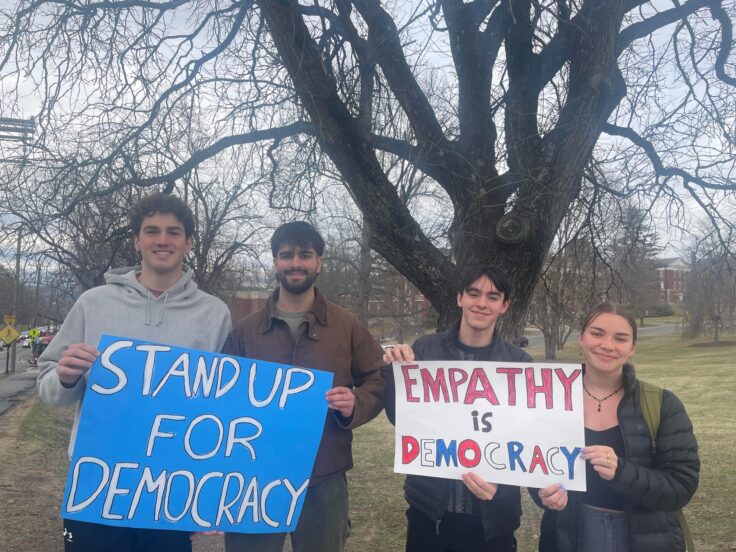
Students from Amherst College at a rally in support of democracy. Photo: Alejandra Chavez-Flores / The Amherst Student

I don’t write, or demonstrate, or organize, imagining that I’m going to convert the hardcore Trump supporters. I don’t have time to do that. When I was complaining, “Oh, I’m not converting anybody,” one of my former students said, “You don’t understand how much it means to people who are on the front lines that people like you are writing.” I regard my writing as cheering on my side. I regard my writing as bearing witness. I regard my public activity as exemplifying what someone can do when they are terrified all the time. Fear is my friend, and it gets me out on the street — not because I’m courageous, and not because I think they care about me, but because if I don’t stand up, who will?

T-i: At this moment, what is the role of a scholar of law? What can such an expert do to help prevent the abuse of law?

AS: As an expert, I can claim the attention of legislators developing legislation. I can claim the attention of judges, if I’m asked to testify. When I write something for the public, I can do it as an expert: I know these things, and I want to tell you these things. But the real question is: what is the demand for my expertise, and to whom am I lending it? As a person who thinks for a living, do I see things that others might not see, or see them differently than others might?

I think our obligation emerges from our privilege — to be an intellectual, to be able to teach and write. I regard that as a privilege; I just mean, I’m glad I have a job. And with privilege, according to John Kennedy when he spoke at Amherst College in 1963, comes responsibility.

I tell everybody that if you ask the following question — namely, “What will work? What will work to preserve the rule of law? What will work to preserve a constitution?” — it’s the wrong question, because no one knows what will work.

Nevertheless, we need to do three things. The first thing we as citizens and residents of the United States need to do is put out the fire, in whatever way we can: demonstrate, protest, write, organize. The second thing is that we need to commit ourselves to a program of reform that is really oriented to dealing with the despair among large segments of the population.

Go to the emergency room at a public hospital and wait for seven hours. Call your cell phone provider and try to get decent service. Go to Stop & Shop and pick up feta cheese and look at the price: “It’s ten dollars?” Do I need to be an expert to know about those experiences? No, I don’t. Even if you can put out the fire, it’s only going to reignite if we don’t attend to the desperation that leads people to say, “I’ll choose him.”

The third thing is that we need to practice what I call thinking democratically. It means that I should tell the truth as I know it, but I need to tell it in a way that can be heard by someone who doesn’t already agree with me. It’s not enough to say, “You’re a racist, you’re a sexist” — nobody’s mind is going to be changed. To think democratically, you must speak less and listen more. American democracy in many ways failed long before Trump. Trump is a symptom.

You must be curious. You must practice empathy before judgment. You can do that alone; you don’t need to be part of a movement to do it. We not only need to rebuild the infrastructure of democracy — we need to rebuild a culture of democracy.

I’m committed to a program of reform when the time comes — and that will mean people like me live a little less well, so that others can live a little better.

T-i: What’s happening to American higher education under Trump’s presidency, in your view?

AS: American higher education was in trouble long before Donald Trump came on the scene. Now, to talk about American higher education is to talk about apples and oranges and tomatoes and broccoli — the community colleges, the state universities, the research universities; it’s a different thing in each case. What I know best is Amherst College and similar liberal arts colleges.

Amherst College. Photo: amherst.edu

In many ways, places like Amherst had lost their way, but they didn’t know it. If you wanted to talk about racism, Amherst was a fine place for you, long before Trump. If you wanted to denounce capitalism, Amherst was a fine place for you, long before Trump. If you wanted to talk about the white working class, Amherst was not such a fine place for you — because you’d have to look long and hard for people who cared about the white working class.

American higher education, even small colleges, is hierarchical. Colleges and universities in the United States were much more collegial than they are now. I’m not talking about a golden age when everything was great, but let’s be honest — teaching is undervalued in most places. You want to get a job offer? No one’s going to give you a job because you’re a terrific teacher. They’re going to give you a job because you wrote something. That’s fine, but it speaks to a certain kind of values.

So, we were ripe for the picking. And then Trump comes along. What could be better to have as a target? His brand of politics is so interesting, because he targets the powerless — immigrants — and the powerful — he goes after law firms and prestigious universities. What he’s done to American higher education is both dreadful and a kind of slap in the face that may have helped higher education in the United States.

The horrors are unspeakable. But before Trump, if I asked most of my colleagues to explain the difference between academic freedom and freedom of speech, they could not do it. Now, at least, there’s a conversation about what academic freedom is and how to protect it. My hope is that out of the crisis will come something good — a renewal, a regeneration, a recommitment, a recentering of values. How’s that for optimism?

T-i: What can be done, at both the national and the local level, to minimize this harm?

AS: We need alliances, not enclaves.

I’ll give you an example. I was very involved in getting the college to add something to its commitment to academic freedom. The commitment to academic freedom has been, in effect, “The institution won’t punish me.” I said, “That’s fine, but I’m not worried about the institution. I’m worried about threats from the outside.” And the college changed its statement on academic freedom.

It’s the same thing as we think about rebuilding democracy. If you say, “Oh yes, we’re the pure, we’re the just, we’re the righteous.” Why should anybody come to the rescue of American higher education if the attitude is, “Well, what have you done for me?” The next thing I wanted to do was to get the faculty to vote on a democracy resolution. It’s not that we stand for something only when it benefits us. Democracy is essential to education, but our commitment to standing up for democracy is not just so that we’ll live more comfortably. The more that all of us can be seen to be committed to things that don’t just benefit us, the better off we’ll be.

T-i: Why do you think the motivation toward building alliances is still so low?

AS: In the United States this has been going on for a decade, and many people are just beaten down. Others are afraid. Others just want to turn off the noise and take their kids to the skating rink or the library. We know the way this works, and Trump has been pretty good at it. It’s like when your roof is leaking — but it’s leaking from nineteen different places. You put a bucket over here, and then it leaks over there: you are tired of moving your bucket around the house.

I think politics at this moment requires navigating between fear and faith: fear in what I see, faith in what I cannot yet see.

The post Austin Sarat: “Fear Is My Friend” appeared first on Т-инвариант / T-invariant.

  •  
❌