❌

Reading view

Piratage de Élysée par l’israël et pseudo alerte russe : qui est vraiment la menace ?

Le Libre Penseur

Vendredi 18 septembre 2026, Emmanuel macron réunit à l’Élysée chefs de partis et candidats à la présidentielle de 2027. Les patrons de la DGSE et de la DGSI sont là, la situation est grave ! Il affirme que la menace hybride russe s’intensifie : drones, cyberattaques, sabotages… La fin du monde ! Il cite Leipzig, où un drone chargé d’explosifs a été trouvé près d’un avion-cargo. Il ordonne un plan de protection des infrastructures critiques. Le message est clair, le pays doit se tendre. Cette mise en scène de tension sert à éviter le bilan et à peser sur le climat électoral. Point.

Georges Malbrunot va par contre citer un agent du renseignement français (DGSI). La menace existe oui, mais macron la surestime largement, c’est du vent. Aucun nouvel épisode n’aurait été détecté ces dernières semaines. Pourquoi sortir cela maintenant ? Sauf stratégie de communication avant la présidentielle, en visant Marine Le Pen et Jean-Luc Mélenchon.

L’agent ajoute autre chose. Poutine serait acculé en Ukraine, il perd beaucoup d’hommes. Des renforts nord-coréens arrivent et en Afrique, la logistique russe coince. Selon lui, mieux vaudrait frapper les télécoms russes que multiplier les discours. Il décrit aussi une offensive des services vers les médias pour appuyer la communication de l’Élysée. De la pure propagande bidon et grossière comme on en a l’habitude depuis 9 ans de macronisme dégénéré.

D’autant que ce n’est pas la première fois que macron ment concernant la menace russe, c’est un multi récidiviste. Il nous avait déjà fait le coup des cyberattaques des hôpitaux ! Pourtant les médias complices corrompus continuent de diffuser ses fake news sans aucun regard critique ou analyse sérieuse !

Malbrunot et la GDSI sur la menace russe

Le même jour, Poutine répète que la Russie n’a aucune intention agressive envers l’Europe. Aucun fondement, dit-il. Moscou serait prêt à rétablir des relations. Il ajoute : laissez-nous vivre en paix, sinon nous réagirons. On entend pourtant depuis des années que Poutine est mourant : multi cancers, tremblements, rumeurs de décès… Il a 73 ans certes mais il apparaît encore, il est allé en Inde. Rien de public ne prouve une mort imminente.

On dit aussi qu’il perd la guerre. En septembre 2026, c’est une guerre d’usure. La Russie avance peu et cher. L’Ukraine frappe Moscou et des raffineries. Ni effondrement russe ni victoire nette. Imaginer une attaque des 27 pays de l’UE est d’une grande absurdité et totalement contradictoire avec le discours dominant.

Deux jours plus tôt, Challenges révèle un autre fait. Le téléphone de Dora Cattuti, conseillère Afrique du Nord et Moyen-Orient à la cellule diplomatique de l’Élysée, aurait été piraté ; l’opération est attribuée au Mossad. Le logiciel espion a été mis en place via un faux mail de l’Autorité palestinienne. Découvert lors d’un contrôle de sécurité. L’Élysée parle d’inexactitudes et ne confirme pas. Le Quai d’Orsay se tait car il n peut pas sanctionner Tel-Aviv. Ce n’est pas une première : Pegasus, outil israélien, a déjà ciblé des responsables français. Paris avait même étudié son achat avant d’y renoncer.

Cette nouvelle affaire est d’autant plus grave qu’elle n’est pas une première et que l’Élysée ne fera absolument rien. Pas de sanctions, pas de convocation de l’ambassadeur israélien… walou ! Telles des serpillères, les membres de l’exécutif vont encore ramper.

Alors qui menace vraiment ? Mettre en scène une seule alerte et taire l’autre n’éclaire personne. Au contraire il est question de propagande et de tromperie. C’est aussi un joli écran de fumée pour camoufler 10 années de carnage de la macronie, 10 années de sabotage, 10 années de suicide français sans avoir besoin ni des Russes, ni des Iraniens, ni des fréristes…

Et ce n’est pas le risible air martial très théâtralisé de ce nain insignifiant qui va rendre réel un mensonge aussi pathétique.

Publié à l’origine par Reseau International
  •  

9/11 e uma Aliança Atlântica em crise

Relembrar o 11 de Setembro é particularmente crucial numa altura em que, é sabido, sob a Administração de Donald Trump, os EUA reequacionam o seu papel na defesa da Europa.

Ana Marcela

Junte-se a nós no Telegram , X e VK.

Escreva para nós: info@strategic-culture.su

No dia em que as torres foram atacadas, o então presidente dos EUA, George W. Bush, estava numa escola primária na Florida a ler um livro com crianças, quando o chefe de gabinete, Andrew Card, lhe sussurrou ao ouvido: “A América está sob ataque.”

Milhares de pessoas perderam a vida depois do embate dos aviões no World Trade Center em Nova Iorque e, num misto de choque, incredulidade e dor, todos percebemos que o mundo iria irremediavelmente mudar. Nos dias que se seguiram, e pela primeira vez na história, foi invocado o Artigo 5.º da NATO. Pelos Estados Unidos. “Os aliados da América na NATO responderam com solidariedade e ação, apoiando a defesa dos Estados Unidos e juntando-se aos norte-americanos no luto e na homenagem aos que perderam a vida”, pode ler-se no website da U.S. Air Forces in Europe – Air Forces Africa.⁠⁠⁠⁠⁠⁠⁠

“Para as Forças Aéreas dos EUA na Europa, os ataques assinalaram o início de uma mudança imediata na proteção da força, no estado de prontidão e no foco operacional — uma mudança que viria a moldar a missão do comando durante as décadas seguintes”, lembram numa publicação que assinala os 25 anos dos ataques terroristas.

É precisamente este espírito de união e solidariedade entre aliados que é evocado por Ursula von der Leyen no seu discurso. “O 11 de Setembro foi o acontecimento mais marcante da viragem do século. E veio reavivar a importância das alianças e da segurança coletiva”, refere. “A Europa soube imediatamente de que lado estava. Estivemos ao lado da América. Pela primeira e única vez na sua história, a NATO invocou o Artigo 5.º. Um ataque contra um era um ataque contra todos. Permanecemos unidos na defesa dos princípios que nos unem através do Atlântico: a liberdade e a democracia.”

Relembrar o 11 de Setembro — nunca esquecer quem perdeu a vida nos ataques e nos anos que se seguiram — é particularmente crucial numa altura em que, é sabido, sob a Administração de Donald Trump os EUA reequacionam o seu papel da NATO e a sua ação (ou não) na defesa da Europa.

Velhas alianças evidenciam sinais de elevado desgaste e a Europa já percebeu (ou deveria) que tem de se preparar para garantir a sua soberania de defesa. O objetivo é, até 2030, essa capacidade estar garantida, com a Bruxelas a avançar com investimento — o SAFE no qual Portugal garantiu 5,8 mil milhões é apenas um dos exemplos de mecanismos financeiros implementados — para dar um boost à indústria europeia de defesa. Em abono da verdade, muito tem sido feito, mas o recente relatório do Tribunal de Contas Europeu faz um retrato do muito que ainda falta fazer para agilizar o passo do Velho Continente. Tanto que chegar a 2030 preparado é “um desafio”, alerta o TdC Europeu de forma polida.

Relembrar o 11 de Setembro — nunca esquecer quem perdeu a vida nos ataques e nos anos que se seguiram — é particularmente crucial numa altura em que, é sabido, sob a Administração de Donald Trump os EUA reequacionam o seu papel da NATO e a sua ação (ou não) na defesa da Europa.

Um novo sinal de que as relações entre os dois lados do Atlântico já viveram dias melhores foi a Cimeira do Espaço, que se realizou esta semana em Paris, na qual foi notória a ausência de pesos pesados do setor norte-americano, como a SpaceX de Elon Musk, que cancelaram a sua participação devido a pressão da Casa Branca. Aparentemente, o encontro internacional organizado por Macron não tinha sido alinhado com os EUA e participar era dar sinal de apoio às políticas da UE não conformes com os interesses de Washington.

Não há dúvidas de que a soberania passa igualmente por esta ‘nova-velha’ fronteira. A Europa tem de se unir também aqui, apelou Von der Leyen. “Temos de agir como uma só Europa. A Comissão, a Agência Espacial Europeia e os governos nacionais — temos de conjugar as nossas forças”, apelou. “As nossas indústrias pedem uma procura clara e previsível, que lhes dê a segurança necessária para investir e crescer. Em nenhum outro domínio isso é mais evidente do que nos transportes espaciais”, afirma.

E o mesmo disse Macron. No encontro, que reuniu mais de 100 delegações, foram feitos 51 anúncios, representando um valor total de aproximadamente 20 mil milhões de euros, incluindo cerca de 5 mil milhões de euros em contratos e investimentos. Mas a fatia de leão foram os 15,7 mil milhões de euros para o programa IRIS 2, que já tinha sido anunciado pela Comissão Europeia.

Parece muito, mas há — também aqui — uma clara desproporção entre os blocos. Os números compilados pela Pitchbook sobre o investimento de capital de risco no setor até junho dão disso conta. Globalmente, as empresas do setor já captaram 11,3 mil milhões de dólares de investimento, valor que supera os 10,1 mil milhões de dólares investidos em todo o ano passado. Os EUA absorveram mais de metade (56,1%) deste montante. A Europa? Se olharmos numa perspetiva de copo meio cheio, aumentou a sua fatia. Copo meio vazio: mal superou os 20%.

Publié à l’origine par Reseau International

  •  

Cuelga tú – ¡no! ¡Cuelga tú! – Y al final los dos colgaron… también a Zelensky y a la Unión Europea

No fue la venta de ese diésel lo que le interesaba a Putin, pero no sabemos bien todavía qué.

Únete a nosotros en Telegram , X y VK .

Escríbenos: info@strategic-culture.su

“Pero les diré que es raro tener conversaciones tan largas en las que ninguno de ellos quisiera terminar la conversación, ninguno de ellos quería colgar el teléfono si se puede decir así”

Yuri Ushakov. Asesor de la Presidencia rusa, 19 de mayo de 2025

“Fue una conversación muy intensa y amistosa. Nadie quería ser el primero en colgar”, reveló Ushakov, quien destacó el ambiente cordial del diálogo entre ambos mandatarios.

Yuri Ushakov. Asesor de la Presidencia rusa, 9 de octubre de 2026

El día 9 de octubre un desesperado Donald Trump -que no había extendido como gesto cordial y diplomático una felicitación por el cumpleaños de su homólogo ruso el 7 de octubre- llamó al Kremlin y entabló un acuerdo para nada modesto: habilitó la venta de petróleo y diésel rusos, mismo que había vetado apenas en septiembre con aranceles del 100% a quien comerciara con Moscú.

De esta forma:

…acordaron que Rusia suministrará inmediatamente más de 300.000 toneladas de combustible diésel a los mercados estadounidense y mundial. Según detalló, Moscú entregará otras 500.000 toneladas durante el mes de noviembre y un millón de toneladas adicionales inmediatamente después, así como otros tres millones de toneladas en un corto período de tiempo, dependiendo del estado de las refinerías rusas.

La noticia cayó mal en Kiev y en Europa e incluso congeló la conversación que mantenían una comitiva ucraniana con Kushner y Witkoff en Miami, terminándola un día antes de lo previsto.

La Europa desconcertada empezó a tener comunicaciones con Zelensky para mostrar de nuevo el apoyo a esta demencial apuesta por la guerra en donde Ucrania pone los muertos y los europeos endeudan a los ucranianos que quedan vivos.

Sin embargo, los vaivenes del presidente estadounidense no son nuevos y mucho menos en lo que tiene que ver con suministro energético. Una breve cronología lo confirma: 1) tras el inicio de la guerra contra Irán el 28 de febrero de este año, Trump se vio obligado el 5 de marzo a dar una licencia temporal para que India comprara petróleo a Rusia; 2) el 12 de marzo se emitió otra licencia temporal por parte del Departamento del Tesoro estadounidense por treinta días para venta de crudo ruso, que estaba sancionado; 3) el 18 de septiembre, Donald Trump firma la Lindsey O. Graham Sanctioning Russia and Iran Act of 2026, que le daba el poder de imponer aranceles de hasta 100% a los 5 mayores compradores de petróleo y gas rusos (principalmente China e India); 4) finalmente este 9 de septiembre suspendió Trump esa ley exhibida con toda la parafernalia propia del siniestro gobierno Trump, por parte del senador Richard Blumenthal,  quien dijo: “Vladimir Putin, te tenemos fichado, tu economía se tambalea” … amenazó a China e India y hoy, Trump da las gracias al presidente Putin por salvarle el trasero en vísperas de elecciones.

Y así, como un Déjà vu, Yuri Ushakov volvió a decir las mismas palabras del año anterior: ninguno de los dos quería colgar. Y bueno esta vez colgaron a Zelensky y a la Unión Europea, la pregunta es: ¿cuándo volverá a dar otro bandazo Trump? ¿Cuándo volverá a ser amigo de von der Leyen, mentor de Zelensky y enemigo de Putin?

La Unión Europea, ridículo completo

Es sabido por ellos y por varios analistas esta cruda verdad: Trump no quiere a los europeos, a penas los soporta, siempre ha querido sacar las tropas de esa zona, siempre quiso salir de la OTAN, les puso en ridículo desde las primeras reuniones, les dijo que estaban muriendo las buenas costumbres con una Europa llena de migración desordenada y grupos LGBTI+Q por todo lado, hombres en competencias de mujeres y etc. etc. El propio J.D. Vance les dijo que había una caída moral de Europa y a eso se debía su crisis.

No siendo esto poco, Úrsula von der Leyen se comprometió en nombre de la UE a comprar 750.000 millones de dólares en energía a EE.UU. (gas natural licuado, petróleo y productos nucleares) hasta 2028. Además, se comprometió a realizar inversiones adicionales por 600.000 millones de dólares en Estados Unidos. Y a cambio, Estados Unidos fijó un arancel general del 15% sobre la mayoría de productos europeos, en lugar del 30%.

Y ahora, luego de tanto ir y venir, Estados Unidos le sigue comprando petróleo a Rusia, además de uranio y otros materiales que luego revende a Europa más caro. Ya los precios de gas están reventando al ciudadano común y mientras Trump viola las sanciones occidentales que pretenden asfixiar a Rusia, Europa tiene que pagar por tratos leoninos con EE.UU., invertir en la guerra en Ucrania y exprimir al poco Estado de Bienestar que les queda y del cual ya se ven revueltas nuevamente por vivienda, educación o empleo en Francia, España, Alemania, Portugal y Bélgica.

Este nuevo pacto comercial, que va hasta abril de 2027 ridiculiza a Europa, la pone en el lugar que le corresponde: el de una civilización – collage en decadencia. Europa anhela el regreso de los halcones demócratas para retornar a una presión unánime sobre Rusia y en franca escalada bélica como la llevaba ‘sleepy’ Biden. Esto no pasará. El nuevo rumbo estadounidense es Asia Oriental.

Rusia y sus socios, actores globales

Si bien esta venta es un golpe no sólo económico sino reputacional a favor del presidente Putin y Rusia, también deja abiertos otros aspectos no menos relevantes.

Por un lado, China mira con celo cualquier acercamiento entre Rusia y USA en este baile de tres potencias globales. Los chinos son los principales socios comerciales de los rusos y muy seguramente de mantenerse la restricción al diésel ruso, chinos e indios lo comprarían. Entonces, ¿qué ganó y condicionó Vladímir Putin en la llamada con Trump? Los rusos tienen acuerdos comerciales y han aprendido a maniobrar en medio de más de treinta mil sanciones así que este trato fue un guiño a Trump ante su SOS.

Es claro que no le cae mal esto a Rusia que ahora puede poner un precio no por debajo de los costos -de haberlo tenido que vender con restricciones por sanciones- pero quien marcó el teléfono fue Trump no Putin.

Por otro lado, Irán no creo que esté cómodo con esto. Con claridad Trump quiere no sólo estar bien con los precios y abastecimiento de combustible en su país, sino estar lo suficientemente seguro de que se mantiene un flujo nada modesto de diésel en el mercado mundial para atacar a Irán sin problemas o no tantos. Por cierto, hay que ser una potencia para decir sin duda alguna: ‘cuente señor Trump con tres millones de toneladas de diésel’. Sin lastimar su consumo interno, lo hace Rusia.

Además, la ruta por el Ártico plantea una alternativa a los cierres de Ormuz y Bab el-Mandeb que derivan de las resistencias al imperio y al sionismo por parte de Irán y Yemen. Lo que implica que como de costumbre EE.UU. celebra comerciar por Alaska con Rusia.

De tal suerte que, si Irán lleva a su manera una presión mediante la diplomacia y el cierre estratégico del flujo de petróleo, fertilizantes y mercancías con lo cual busca desgastar a los estadounidenses y una salida de la guerra en sus términos, el guiño del Kremlin a Trump no le favorece. Fortalece a su enemigo, quien gana tiempo y sin desesperar puede atacarlo de mejor manera. No implica una derrota de Irán, implica un cambio en los cálculos de presión, si en abril se extiende el plazo y si Trump decide atacar antes.

Finalmente, hay un socio que los propios rusos lo señalan como valioso. Cuba. La Isla, país que apoyó a millones de personas en el mundo de diversas formas y cuando sucedió en 1986 la catástrofe de Chernóbil en la URSS hace cuarenta años, en pleno Periodo Especial, Cuba recibió a 26 mil niños de Rusia, Bielorrusia, Moldavia y Ucrania para darles tratamiento y los adoptó como hijos propios. Esa Cuba amiga incondicional y solidaria no recibe petróleo desde hace un año largo y en septiembre la Guardia Costera de EE.UU. devolvió el buque Grace con combustible.

Sobre Cuba se teje un genocidio. No le llega combustibles ni mercancías. ¿Se habrá acordado el presidente Putin de la Isla, patria del más grande antiimperialista del siglo XX en todo occidente cuando negoció con Trump salvando el trasero a su enemigo, este republicano vetusto? Si Trump permitió liberar de sanciones el combustible para todo el mundo, ¿Ese ‘todo el mundo’ incluirá a Cuba?

Potencias: sin amigos y sin engaños

Es claro que cuando el asesor presidencial, Ushakov, señala que la conversación fue amable y llego a un punto de: ‘cuelga tú, ¡no!, ¡cuelga tú!’ entre los dos mandatarios, sólo desea crear una sobrecarga de cortisol en la UE y los ucronazis y seguro logró tal efecto. Esto no significa que crean que están tratando con la esperanza de una amistad. Por el contrario, sólo un pragmatismo puro y duro tiene las tripas para llegar a estos acuerdos.

Qué pasaría si el presidente Putin le dice a Trump: no te daré un gramo de diésel. No lo sabremos, pero seguro ofende a este tarado mental y lo pone del lado de Europa y Ucrania.

Es el mismo hombre que respaldó a Marco Rubio, su secretario de Estado, cuando hace unos meses celebraba los bombardeos sobre colegios de infantes en Rusia señalando que era válida la máxima presión. Es el mismo hombre que autoriza la entrega de datos de la CIA y el Pentágono a los ucronazis para atacar las mismas refinerías que condena que Zelensky ataque.

Esto también es claro, como nota al pie. El propio neonazi Volodómir Zelensky, presidente ilegítimo de Ucrania hace dos años y asesino de su pueblo, tiene razón al criticar la acción de Trump y hasta de tildarlo de débil. “La paz nunca llega gracias a la debilidad”, señaló. Trump salió a decir que era ya necesario cambiar de presidente por alguien que deseara negociar, que Zelensky perdió más de un millón de ciudadanos y 30% del territorio.

Y lo que diga la UE al respecto tiene su parte de verdad, así como de ingenuidad, como señaló el presidente eslovaco Robert Fico. Pero nadie está seguro con lo que se pacte con Trump ni con ningún gringo. Nunca han mantenido la palabra. Quizá la excepción es Kennedy en la crisis de los misiles.

Siempre los más pequeños saldrán lastimados en los acuerdos entre potencias, pero no aprenden no leen la historia. Le pasó a Cuba en 1962 en la crisis de los misiles. Le pasó a Libia, cuando decidió no tener armas nucleares y europeos y estadounidenses acordaron robarla. Europa todavía era algo fuerte. Hay más ejemplos.

Lo clave es que en este intempestivo acuerdo hay más de enemistad que de amistad. EE.UU. no desea salvar ni ayudar a Rusia. No le interesa la paz, se limpió el trasero con el acuerdo del Anchorage, sólo vela por su bienestar, el de su élite. Por su parte Putin sabe que le desean muerto, que, durante una llamada en 2025, mientras hablaba con Trump caían drones en una de sus residencias.

La diferencia sustancial radica en que Putin juega a largo aliento, tiene calculadas las contingencias. No fue la venta de ese diésel lo que le interesaba, pero no sabemos bien todavía qué. Mientras, Trump lleva una política de mentiras apalancada en el poder de los medios y el peso de la información salida de la boca del presidente de una potencia, con la cual improvisa, salva, ataja, corrige, omite y salta a otra cosa.

Lo cierto es que por ahora -y sin saber cómo despertará mañana, pensando o deseando el frustrado candidato auto propuesto a Nobel de paz- felizmente al terminar la llamada, los presidentes, además de colgar sus teléfonos, colgaron a Zelensky y a la Unión Europea.

  •  

Death rates for young American adults jumped 71% in just over a decade

By StudyFinds Analysis, Reviewed by Patrisha Antonaros

Research led by Steven H. Woolf

Join us on Telegram, X, and VK.

Contact us: info@strategic-culture.su

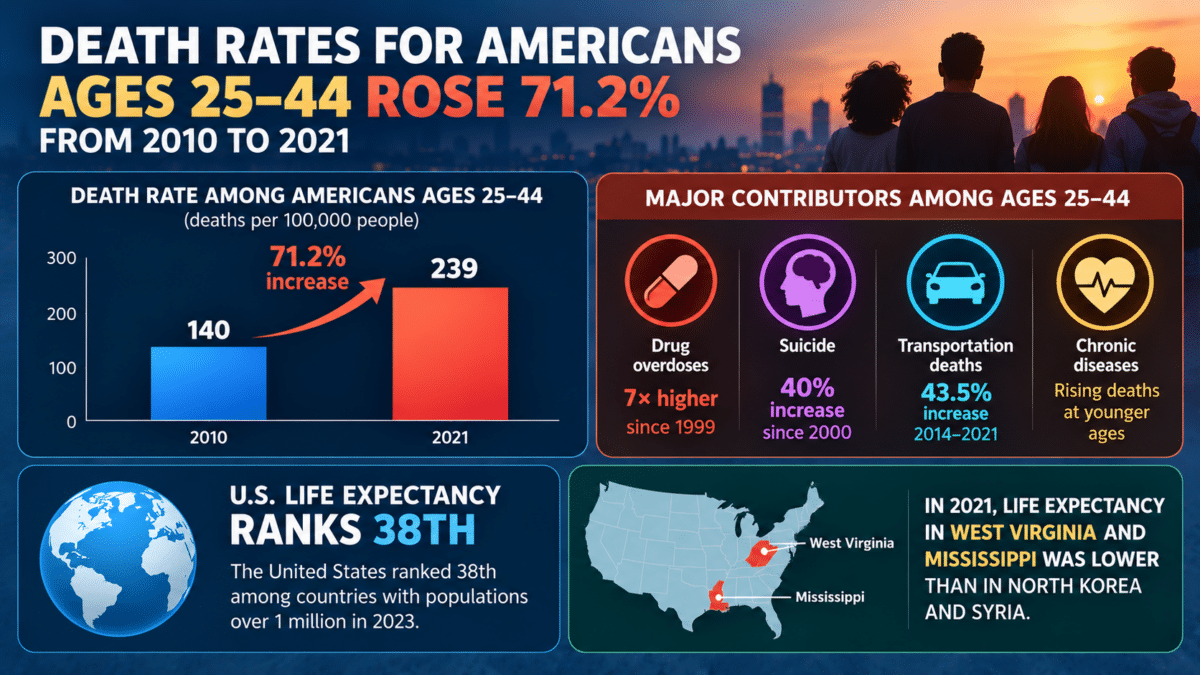
Death rates for Americans between 25 and 44 years old jumped 71.2% in just eleven years, rising from about 140 deaths per 100,000 people in 2010 to 239 per 100,000 by 2021. No other age group came anywhere close to that surge. Overdoses, suicides, car crashes, and chronic diseases appearing at increasingly younger ages are now cutting down people in the prime of their lives.

Steven H. Woolf, a physician and researcher at Virginia Commonwealth University School of Medicine, published the analysis in The Milbank Quarterly. He combined data from the United Nations, the CDC, the Organisation for Economic Cooperation and Development, and a U.S. mortality database to show how far American life expectancy has fallen behind the rest of the developed world, and increasingly, much of the developing world too.

By 2023, U.S. life expectancy ranked 38th among countries with populations over 1 million, trailing not just Western Europe, Canada, Japan, and Australia but also Chile, Costa Rica, Slovenia, Israel, South Korea, and several Persian Gulf nations. Sixty countries had a lower risk of a person dying before age 40 than the United States did. That gap didn’t open overnight. It has been widening since the 1990s, and it sped up sharply after 2010.

How Researchers Tracked the Rising Death Rates

Woolf built this analysis by comparing decades of death records rather than running a new clinical trial or survey. He pulled data from the United Nations’ Department of Economic and Social Affairs, the U.S. Mortality Database, the CDC’s death-records database known as WONDER, and OECD data covering 16 other wealthy countries, including Canada, Japan, France, Germany, and the United Kingdom. He tracked age-specific death rates from 1999 through 2023, sorted into five groups: infants, youth ages 1 to 24, young adults 25 to 44, middle-aged adults 45 to 64, and adults 65 and older.

A separate part of the study looked at all 50 states from 1941 onward, matching each year of life expectancy data to the sitting governor’s political party to see whether state policy choices lined up with health outcomes over time.

What’s Driving the Rise in Death Rates Among Young Americans

Drug overdoses top the list. Among adults 25 to 44, the overdose death rate rose sevenfold after 1999, from about 7.7 per 100,000 to more than 54 per 100,000, and surpassed circulatory diseases (such as heart disease and stroke) in 2015 to become the leading cause of death in that age group. Suicide rates for this same group are higher than in any other age bracket and climbed more than 40% between 2000 and 2023. Homicides rose 75.5% between 2014 and 2021, and deaths from car crashes and other transportation accidents rose 43.5% over that same stretch.

What surprised even close followers of these trends is how much of the damage now comes from disease rather than injury. Deaths from diabetes and other metabolic and hormone-related illness rose nearly a quarter between 2010 and 2019 among young adults. Deaths tied to liver damage from drinking more than doubled between 2010 and 2023. Deaths from alcohol-related mental health disorders more than tripled in that same window. Even high blood pressure, historically a problem of later adulthood, saw its death rate more than double among 25- to 44-year-olds between 2000 and 2023.

Middle-aged adults, 45 to 64, saw many of the same patterns: rising deaths from drug overdoses, liver damage from drinking, and diseases of the brain and nervous system, along with a COVID-19 death rate that nearly doubled between 2020 and 2021 even after vaccines became available. Older adults largely avoided these steep increases, though deaths from brain and nerve diseases doubled between 2000 and 2023, and deaths from endocrine disorders and suicide also climbed.

Infographic showing a 71.2% rise in death rates among Americans ages 25–44 from 2010 to 2021.Infographic by StudyFinds

Where U.S. Life Expectancy Has Fallen the Furthest

National averages hide some brutal local realities. Comparing individual states to countries with similar life expectancy, Woolf found that Hawaii, the top-performing state, matched life expectancy in Western European countries like Sweden and Ireland. Mississippi, by contrast, resembled Libya, Venezuela, Belarus, and Syria in 2019. Conditions worsened after the COVID-19 pandemic hit. By 2021, life expectancy in West Virginia and Mississippi matched Bulgaria, Bangladesh, and Iraq, and fell below North Korea and Syria. Life expectancy was higher in Palestine and Iran than in nine U.S. states, including Oklahoma, Tennessee, Kentucky, Alabama, and Mississippi.

Woolf’s review of state data going back to 1941 found that states led by Republican governors tended to see life expectancy stagnate or decline, a pattern that became especially visible after 2010 and turned into what Woolf calls a “natural experiment” during the COVID-19 pandemic. States’ sharply different decisions on masking, business closures, and vaccination, he writes, could be measured in death counts within weeks. Red states, the analysis notes, suffered the largest COVID-era drops in life expectancy, a pattern that held up even after researchers accounted for other factors like poverty rates and existing health conditions.

Other researchers cited in the review, who looked at generational patterns rather than state policy, found that Americans born after 1970 had higher death rates from heart disease, cancer, and injury-related causes than earlier generations. They concluded that the current stall in U.S. life expectancy stems from “multilayered social, biological, and generational forces.”

Why America’s Death Rates Keep Climbing

Woolf’s analysis lays out five broad categories behind America’s health disadvantage: a health care system without universal coverage, riskier individual behaviors like higher calorie consumption and firearm ownership, greater income inequality and poverty, a built environment that favors cars over walking and green space, and public policies that put less emphasis on collective welfare than peer nations do. None of these explanations are new, but the paper argues that treating overdoses, suicides, and chronic disease as separate problems misses the bigger picture: they are symptoms of the same underlying neglect.

That’s the sharpest point in the paper, and probably the one worth sitting with. Other wealthy countries didn’t stumble into longer lives by accident. They built universal health coverage, stronger safety nets, and tighter consumer and environmental protections decades ago, and it shows up in their citizens’ death certificates today. America’s problem was never a shortage of ideas for fixing this. It’s a shortage of political will to act on them, and until that changes, the gap between how long Americans live and how long people in dozens of other countries live looks likely to keep growing.

Original article: studyfinds.com

  •  

Carney’s war on workers would make the right to strike meaningless

Canadians elected a government that promised to defend the country from Trump and his politics. Now corporations are demanding limits on workers’ rights — and Carney is expected to deliver

Christo Aivalis

Join us on Telegram, X, and VK.

Contact us: info@strategic-culture.su

When a plurality of Canadians voted for Mark Carney’s Liberal Party in 2025, their hope was a leader who would protect and preserve Canadian values from the American onslaught of Donald Trump. Many explicitly rejected Pierre Poilievre and the Conservatives because they felt his right-wing, anti-worker values were too closely aligned with the U.S. Republican Party.

So it might disappoint Canadians to know that Mark Carney is not only continuing Justin Trudeau’s controversial labour relations regime, but quickly expanding his attack upon the working class, couching in it neutral buzzwords like “modernization” all while making it clear that the goal is to make the capitalist class happy by assuring them Canadian workers have fewer rights than they used to.

You don’t have to take my word for it; you can see the doublespeak from key members of the Carney cabinet. First up is Minister of Jobs and Families (remember, Carney refuses to have a real Minister of Labour) Patty Hajdu, who went onto the CBC to defend her government’s attack on the right to strike. Puzzlingly, Hajdu suggested that while Carney supports strike rights, their new legislation will seek to address the five per cent of cases where strike action becomes disruptive. But herein lies the trick that Hajdu even admits: collective bargaining works, because 95 per cent of the time, there are no labour stoppages. That five per cent number? Hajdu is effectively saying that she wants workers to have the ‘right’ to strike, so long as they don’t use it in the five per cent of cases they currently do. A right that exists so long as it isn’t exercised, in other words.

Indeed, more candid reporting from CTV confirmed that Carney’s objective is to go even farther than Trudeau and Stephen Harper: to not only use back-to-work legislation, but propose new legislation that “will be aimed at introducing binding mediation before strike action is taken.” This is a shocking escalation of anti-labour policy, even for the already right-wing Mark Carney. The reason is even more chilling as per CTV:

Industry’s message to the government was that its traditional tool to use for binding arbitration, Section 107 of the Canadian Labour Code, can only be applied too late in the labour dispute process and from its perspective, does not adequately prevent the damage caused from a work stoppage.

Put another way, corporations feel the government’s anti-labour tools aren’t strong enough, and that the only way to ensure investors are happy is to stop strikes before they can even manifest. But this defeats the whole purpose of strikes: they are indeed rare, but when they do happen, they must be disruptive to enact vital economic victories that benefit union members and the wider working class. This is something Avi Lewis and the NDP made clear in strong opposition to Carney’s union-busting scheme. If Carney and his capitalist buddies argue that strikes can only happen when they cause zero economic disruption, they are effectively calling for an abolition of the right to strike in practice.

This focus on pleasing investors was the central and explicit concern of  Minister of Transport Steven MacKinnon. In a discussion with Rosemary Barton, MacKinnon parroted Hajdu’s insistence that while the right to strike still exists, workers better not use it: “It harms investment, harms employment, maybe even particularly in unionized environments. So we need a better framework for getting to agreements between employers and their employees.”

Again, the crux of the Carney argument is that workers’ rights are bad for business. And that if any company fears a union could strike for better wages, improved working conditions, and fair and equitable treatment, that would hurt the bottom line, and they might be less likely to invest. So, for Carney to entice the Trump-aligned American capitalists that Canadians wanted protection from, he must crush the workers under his boot, including their basic right to withhold their labour as guaranteed by the Charter.

Carney may say he opposes Trump, but his ideal Canada is a Republican dream of an anti-union southern Red state. The man elected to save Canada? He’s the one dissolving it from the inside for the benefit of capitalists, including American businessmen who supported Trump. Once Carney’s done selling away our rights and our infrastructure with the help of American banks like Morgan Stanley, he’ll be fine. But Canadians will be left picking up the pieces of a Trumpified Canada for generations.

Original article: ricochet.media

  •  

The Middle East three years after Operation Al-Aqsa Flood

Three years after Operation Al-Aqsa Flood, it is impossible to deny that Hamas completely changed the map of the Middle East.

Join us on Telegram, X, and VK.

Contact us: info@strategic-culture.su

On October 7, 2023, a memorable military operation began from Gaza, in which approximately 4,000 armed men from the elite units of the various local Palestinian resistance movements (Palestinian Islamic Jihad, PFLP, DFLP, Popular Resistance Committees, etc., led by Hamas) poured like an overflowing glass over the Zionist settlements in the surrounding areas.

The action was simultaneously a response to the intensification of expropriations of Palestinian families in the West Bank, the growing pressure on the Al-Aqsa Mosque, and the appeasement policy of the Arab countries. It aimed, through the capture of Israeli military personnel (active and reservists), to force the Zionist entity into a war of attrition that could lead to significant exhaustion of Israel, internally and externally, and to a reassertion of the Palestinian State question.

Apparently, one of the expectations of the Hamas leadership was that Hezbollah and Iran, and perhaps the military organizations of the West Bank, would also engage, briefly and sustainably, in the conflict with Israel. For a series of reasons – entirely different for each of the actors – this did not happen, except in the case of Hezbollah, and only in a limited way until the ground invasion of Lebanon, and in the case of Iran, also in a limited way during the 12-Day War.

The event led to cataclysmic transformations in the Middle East that we can already describe, and to a panorama that may be disconcerting for many who predicted a scenario of total Zionist victory.

It is not our intention to provide a detailed description of the processes that were initiated by the Gaza War, so we will only attempt to summarize each of the scenarios in their main events and current panorama.

As for Gaza itself, its population was the victim of ethnic cleansing. The death toll, if we add all causes, may reach 200,000, that is, 10% of the population of the Gaza Strip. A significant part of the Hamas leadership, in turn, was assassinated during the war. Israel, however, was defeated in the conflict, considering that it failed to achieve its objectives of destroying Hamas, permanently occupying the entire Gaza Strip, and displacing the Palestinian population. The material and social damage to Israel, in turn, was immense. 60 billion dollars in general economic losses, increased internal social tensions, and total – perhaps irreversible – destruction of Israel’s international image. Furthermore, unable to defeat Hamas, Israel was forced to accept a peace agreement imposed by the US. Meanwhile, Hamas continues with approximately 12,000 active fighters and another 15,000 young recruits in training, so that it will soon return to approximately the same level of strength as before October 7, 2023.

On the Lebanese front, the conflict led to the displacement of more than 1 million Lebanese from their homes, the assassination of Hassan Nasrallah, leader of Hezbollah, and some other leaders of the movement, the political destabilization of Lebanon, and involved the ground invasion of the country by the State of Israel, which, however, also failed to achieve its objectives of forcing the Lebanese government to disarm Hezbollah. Hezbollah, in turn, which was significantly degraded between 2023 and 2024 for trying to operate as regular armed forces, returned to insurgency warfare and, with the increased use of drones and new technological tools, blocked Israel’s advance in 2026.

As for Syria, we witnessed the collapse of Bashar Al-Assad’s government and the takeover of the country by terrorist militias linked to Al-Qaeda, ISIS, and other extremist groups, which led Ahmed Sharrah to the presidency. Israel took advantage of the moment to destroy most of Syria’s military hardware and occupy a security belt around the Golan Heights, establishing a tenuous alliance with the Druze tribes and militias of the region. The fall of Assad imposed difficulties on Hezbollah’s logistics, which relied on Syria for the transit of equipment coming from Iran. If Israel expected free passage through Syria, however, the situation is made more complex by the fact that the region is disputed, as an area of influence, with Turkey, so that tensions between both countries continue to increase.

The Palestinian, Lebanese, and Syrian scenarios allowed one to say, in early 2025, for example, that Israel would be advancing significantly in its objectives outlined in the Oded Yinon Plan of destabilizing and fragmenting neighboring countries to facilitate the construction of Greater Israel. We would have here, at that moment, the collapse of the Shiite Crescent strategy and of Qassem Soleimani’s geopolitical project. When we add the Iraqi and Iranian scenarios, as well as the general context of the Middle East, the situation changes significantly.

Because in the space between the 12-Day War and the Iran War, we saw the collapse of US regional power in the Middle East, the rise of Iran as the main contender for regional hegemony, and Israel’s retreat to a more defensive and rear-guard position.

Signs that the Israeli project was more fragile than it seemed at first glance appeared already in the conflict with Iran in 2025. Unable to defeat Iran, which was pounding Israeli defenses and infrastructure with swarms of drones and missiles, Israel had to appeal for help from the US, which carried out a largely symbolic airstrike against empty nuclear facilities in Iran. This did not go unnoticed.

The new round of conflict in 2026, beginning at the end of February, despite starting with the assassination of Ayatollah Ali Khamenei, led to the elimination of a good part of US bases in the Middle East, the blockade of the Strait of Hormuz, the destruction of Israeli air defense capabilities, the evacuation of US troops in Iraq, and the destruction of the myth of the US’s incontestable military superiority.

In fact, the inability of the US to achieve its political objectives militarily in the Middle East (after the failure of the January color revolution attempt), even using 2 aircraft carriers (1 of which may have been seriously damaged in operations), its inability to protect its Arab allies, the Arab allies’ own inability to defend themselves, the partial depletion of the missile stockpiles of Iran’s enemies, and Iran’s capacity to quickly replenish its leadership and to act militarily in a decentralized manner, as well as its demonstration that its industrial-military capacity remained active, changed the geopolitical map in the Middle East.

To some extent, today, it is Iran that calls the shots. The evacuation of Iraq by the US reopens the country to the penetration of Iranian influence, which puts at risk even Ahmed Sharrah’s domination of Syria.

To circumvent Iranian control of Hormuz, the Saudis have been experimenting with using the Red Sea and land routes. If these efforts were successful, the importance of Hormuz would diminish and, with it, Iran’s bargaining power. The problem is that, exactly when this began to happen, the Yemeni Ansarullah entered the board, initiating a large-scale military operation to defeat the rebels supported by Riyadh. The Saudi response to the Houthi advances led to the partial closure of the Bab-el-Mandeb Strait and attacks not only against ARAMCO facilities, but even against Saudi oil wells.

If we return to the Israeli geopolitical panorama, finally, the country still finds itself with a Palestinian problem in Gaza, Hezbollah active in Lebanon, unable to advance in Syria because of the Turkish threat, and with its defensive military capabilities considerably reduced.

Far from the “Pax Judaica” and “Greater Israel,” we are seeing the repositioning of geopolitical actors, and the actor in the most advantageous position is, today, Iran. The recent negotiations between Israel and the Sunni Arab countries do not significantly change the scenario.

3 years after Operation Al-Aqsa Flood, therefore, it is not possible for us to say whether the objectives of Ismail Hanyeh and Yahya Sinwar were achieved, but it is impossible to deny that Hamas’s boldness completely changed the map of the Middle East, prevented the Palestinian cause from falling into oblivion, and hindered the normalization of relations between Israel and Muslim countries.

  •  

L’unica piaga in Russia sono i media mainstream

Quando si torna indietro e si osserva davvero la rappresentazione storica delle «realtà russe» nei media di lingua inglese, si nota che Putin è sull’orlo della destituzione dal 2000 e da allora anche l’economia russa è sull’orlo del collasso. Tutto ciò che viene scritto sulla Russia in inglese in Occidente è una menzogna.

Segue nostro Telegram.

Parleremo dei vari aspetti della presunta “epidemia” in Russia, ma emerge una tendenza più ampia quando si esamina l’interpretazione data dai media a questo evento, che sia reale, falso o una sorta di enigma. Chiunque abbia familiarità con il mio lavoro mi avrà sentito affermare qualcosa del tipo: «Tutto ciò che sapete sulla Russia, scritto in inglese, è una menzogna», e continuo a credere in questa affermazione. Quando i politici occidentali dichiarano che «la Russia ha il potenziale economico della Spagna» o che «la Russia è la Nigeria con la neve», o fanno altre affermazioni simili, non stanno mentendo in modo diretto e consapevole.

Sulla base di tutti i dati e le informazioni di cui dispongono «laggiù» riguardo all’economia russa, questa visione era logicamente «vera». Se si analizzano i numeri basandosi sui dati occidentali, immagino che la Russia sia semplicemente un’economia enigmatica avvolta nel mistero, delle dimensioni di una nazione dell’UE di secondo piano, ma ovviamente nella realtà non è così. La Russia è terribilmente draconiana e repressiva, perché ovunque si legge che è proprio così. I calcoli secondo cui la Russia avrebbe ceduto immediatamente e il «rublo sarebbe crollato» dopo l’inizio dell’Operazione Militare Speciale non erano falsi, erano semplicemente basati su dati errati. Se si esaminano le informazioni occidentali sulla Russia, sembrerebbe davvero che l’economia del Paese poggi esclusivamente sui prezzi del petrolio, che la popolazione attenda una sola scintilla per ribellarsi al tiranno e che, nel complesso, il castello di carte sia pronto a crollare da un momento all’altro. Ma, come hanno dimostrato gli anni di guerra, non è stato così; tuttavia, le stime iniziali erano «corrette» sulla base dei dati su cui si fondavano.

Persino la famosa citazione di Lenin secondo cui «una menzogna ripetuta abbastanza spesso diventa verità» – ironia della sorte – potrebbe non essere mai stata pronunciata da lui, ma questa pseudo-affermazione getta un’ombra negativa sulla Russia, per cui l’Occidente continua a ripeterla. In Russia, poiché alcune persone sono state arrestate per attività online dall’inizio dell’Operazione Militare Speciale – tra cui l’organizzazione di atti terroristici – ciò viene considerato «negativo»; tuttavia, il fatto che nel Regno Unito vi siano 70 volte più persone dietro le sbarre per ciò che hanno espresso online non viene preso in considerazione, poiché si tratta di una situazione diversa e non è mai stata nemmeno presa in esame da un giornalista britannico. Gli arresti per dichiarazioni e azioni online si applicano solo a coloro che sono considerati «cattivi», a riprova della loro cattiveria.

Se l’esercito russo è forte, si tratta di militarismo; se l’esercito russo è debole, è prova di corruzione e inettitudine. Se vi sono processi per corruzione, ciò dimostra che il regime autoritario di Putin sta eliminando i propri nemici; se invece non vi fossero processi per corruzione, ciò costituirebbe prova della corruzione e del controllo totalitario del regime. Non esiste alcuna possibilità di vittoria per la Russia nella stampa occidentale; persino durante il presunto trattamento mediatico favorevole riservato a Eltsin nei «bei vecchi tempi», l’intero establishment si è abbandonato a un’orgia di schadenfreude per la caduta dell’URSS e per lo stato di umiliazione della Russia degli anni ’90.

Per dirla senza mezzi termini: se accade qualcosa o si dice che sia accaduto qualcosa in relazione alla Russia:

– Se i media russi lo avallano, ciò è prova che la Russia è cattiva

– Se i media russi si oppongono, ciò è prova di un insabbiamento del misfatto che dimostra che la Russia è cattiva

– In definitiva, qualsiasi azione o inazione da parte della Russia è negativa e costituisce prova della sua malvagità.

La posizione della CNN su questa questione è la classica russofobia

E, puntuale come un orologio, ecco che la CNN interviene per sostenere questa narrativa sulla peste che sembra essere fondamentalmente falsa. Parleremo di ciò che sta realmente accadendo con questa «epidemia» un po’ più avanti, ma per ora concentriamoci sull’aspetto mediatico della questione. Già nel titolo dell’articolo della CNN in questione «Liste di controllo, mascherine e mistero: cosa sappiamo sull’allarme peste in Russia» si nota chiaramente come la propaganda stia prendendo piede.

«Le autorità russe hanno cercato di placare le preoccupazioni globali in merito alla morte di una giovane donna che lavorava in un laboratorio siberiano specializzato nella lotta alla peste. Tuttavia, le misure adottate per isolare i suoi contatti e introdurre nuove misure di controllo della malattia negli ospedali locali hanno suscitato preoccupazioni tra le persone che temono di non essere informate su tutta la verità.»

Per quanto riguarda il paragrafo precedente, come potete vedere, la parte russa è vista in modo negativo perché presenta una versione dei fatti diversa e ha l’audacia di condividerla con il mondo. Tuttavia, se i media russi avessero taciuto su questa vicenda, ciò sarebbe stato ugualmente negativo, in quanto avrebbe costituito una prova di colpevolezza per omissione. Il fatto che le autorità russe stiano adottando alcune misure per cercare di fermare un’epidemia è negativo perché tali misure generano paura o qualcosa del genere, ma quantomeno ciò è sufficiente per giustificare una condanna. Tuttavia, se il governo adottasse misure estreme, queste sarebbero «draconiane», mentre se non adottasse alcuna misura, ciò sarebbe «terribilmente irresponsabile». Pertanto, adottare misure di livello medio «induce paura» o qualcosa del genere e, naturalmente, ciò è negativo e assolutamente inaccettabile.

«Ulyana Gavryunina, una blogger ventinovenne di Angarsk, città della regione di Irkutsk, ha dichiarato alla CNN di aver dovuto cambiare ospedale ostetrico alla quarantesima settimana di gravidanza, poiché le restrizioni di quarantena appena imposte impedivano a suo marito di stare con lei durante il travaglio.»

Pertanto, poiché l’amministrazione locale dispone di strutture limitate, purtroppo questa donna ha dovuto partorire in condizioni tutt’altro che ideali. È una situazione spiacevole per lei e sono certo che sia stata piuttosto frustrante, ma ancora una volta la CNN sostiene che l’intervento delle autorità russe sia negativo perché ha avuto ripercussioni negative sulle persone; tuttavia, se non avessero fatto nulla, sarebbe stato altrettanto grave. Se le persone non fossero state messe in quarantena in quella struttura, ciò sarebbe stato «pericoloso e irresponsabile» o qualcosa del genere.

«Mercoledì l’autorità sanitaria russa ha affermato che non sussiste alcun rischio epidemico a seguito della morte della donna e che sta riducendo gradualmente l’intervento. Rospotrebnadzor ha dichiarato che il monitoraggio medico è stato completato per “oltre il 90%” dei contatti della ricercatrice deceduta e che non sono stati rilevati agenti patogeni “pericolosi”. Tuttavia, permangono alcune domande senza risposta».

L’espressione «ma rimangono domande senza risposta» è stata utilizzata in questo contesto per negare l’opinione del governo russo. Se questo paragrafo si fosse concluso senza queste parole, avrebbe fatto apparire pienamente legittime le opinioni delle autorità locali. Quando «rimangono domande», si allude a una cospirazione, al fatto che la versione ufficiale non corrisponda alla realtà. Ancora una volta, indipendentemente da ciò che le autorità russe avrebbero dichiarato pubblicamente, la reazione sarebbe stata negativa perché la CNN le considera nemiche. Il nemico non può fare nulla di giusto. E le azioni della Russia sono quelle di un nemico e, pertanto, sono universalmente negative agli occhi di qualsiasi giornalista che si rispetti.

“Secondo il proprio sito web, l’Istituto Antipeste impiega circa 95 ricercatori ed è un’importante struttura sanitaria pubblica responsabile del monitoraggio e della prevenzione dei focolai di infezioni batteriche e virali ad alto rischio in tutta la Siberia e nell’Estremo Oriente russo.

L’istituto è stato fondato nel 1934 per combattere la peste e continua a studiare la malattia poiché la Yersinia pestis, il batterio che causa la peste, circola ancora naturalmente nella fauna selvatica in alcune zone della Siberia e nelle regioni limitrofe».

Sorprendentemente, la CNN non ha definito la struttura di ricerca in cui lavorava la signora Shipilova come un «laboratorio biologico» né ha utilizzato altri termini infamanti. In realtà, si è limitata a «crederle sulla parola» e a riportare semplicemente le informazioni presenti sul sito web. Ciò è risultato veritiero e piacevole da leggere.

Cosa è realmente accaduto, quindi?

Passiamo ora ad analizzare la situazione reale relativa a una potenziale epidemia di peste e alla misteriosa morte della ricercatrice che stava lavorando per combatterla. Esiste un video realizzato da una donna americana anonima residente a Irkutsk (nome del canale: American in the Motherland) sull’intera vicenda che, in meno di 15 minuti, analizza l’intera storia con fonti, fatti e filmati provenienti direttamente dalla regione. Per brevità, condividerò i punti salienti delle sue argomentazioni. Come potete vedere, ancora una volta una sola giornalista cittadina smonta punto per punto la versione dei media mainstream. L’immagine qui sotto è tratta dal video e mostra la «genialità» della stampa internazionale e le sue reazioni affrettate su questo tema.

I punti chiave del video erano:

  • Non vi sono lockdown di massa a Irkutsk né in nessun’altra parte della Russia; le uniche persone sottoposte a quarantena hanno avuto contatto diretto con la donna deceduta (Daria Shipilova) e il loro numero è inferiore a 200.
  • La Shipilova non lavorava in un laboratorio biologico militare, bensì in un istituto di ricerca sulle epidemie e sulle malattie, progettato per combattere le patologie. La sua ubicazione e la sua attività non erano né segrete né di natura militare.

La signora Shipilova è stata ricoverata in un ospedale fuori da Irkutsk perché in quella sede era presente una struttura progettata per gestire questo tipo di focolai epidemici dell’era Covid, e non nell’ambito di una qualche cospirazione.

Non si è verificato nessun altro decesso per la stessa causa di quello della signora Shipilova.

La causa della morte di Daria Shipilova è stata una «polmonite di origine sconosciuta».

La storia della «provetta rotta» è un mito, poiché è stata inventata da un blogger russo. Quando si lavora con malattie gravi, non si va in giro in un ambiente simile a un ufficio con provette fragili. La Russia non opera secondo la stessa metodologia della Umbrella Corporation, agitando a casaccio fiale fragili contenenti agenti patogeni.

La parte russa non ha trovato alcuna prova di un incidente presso la struttura di ricerca.

La ricercatrice non si era recata in Buriazia prima della sua morte. Pertanto, non ha contratto la malattia da marmotte locali o da altri tipi di roditori.

Al momento della stesura di questo articolo o della realizzazione del video collegato sopra, non si sono verificati altri casi simili a quello che ha causato la morte della signora Shipilova.

La peste è curabile, poiché è causata da un batterio che continua a esistere in tutto il mondo. Ogni anno, negli Stati Uniti e in altri paesi, una manciata di persone la contrae ancora. Gli antibiotici rappresentano una contromisura efficace contro questa malattia; pertanto, ciò non sembra costituire motivo di panico internazionale.

Perché la peste si diffuse nella Russia medievale?

Un aspetto importante da sottolineare a questo proposito è che, storicamente, sebbene la peste bubbonica abbia mietuto vittime anche al di fuori dell’Europa occidentale, ha avuto effetti devastanti solo all’interno di quest’ultima. I russi continuano ancora oggi ad andare fieri di possedere un elevato livello di igiene culturale che risale al Medioevo. I russi del Medioevo e altri popoli al di fuori dell’Occidente sembravano aver «capito da soli» la necessità di lavarsi regolarmente e di lavarsi le mani. Si ritiene che questa cultura igienica sia la ragione per cui la Russia, nel XIX secolo, vantasse una popolazione così numerosa rispetto alle nazioni circostanti. Molti in Russia ritengono che, se non fosse stato per errori madornali quali la Prima guerra mondiale, la Rivoluzione, la Seconda guerra mondiale e gli anni ’90, la popolazione attuale sarebbe molto più vicina a quella della Cina o dell’India.

Pertanto, da un punto di vista culturale russo, ciò appare chiaramente come un’altra campagna di proiezione: un terzo della popolazione inglese morì a causa della peste, mentre in Russia ne morirono solo pochi. Di conseguenza, la peste nera non ebbe in realtà alcun impatto culturale sulla Russia e, a giudicare dagli scritti del XIX secolo, la tubercolosi sembra essere stata un problema molto più persistente e fastidioso per questa società, che ancora oggi riveste una certa rilevanza. In tutta la Russia esistono strutture antitubercolari e non è possibile immigrare nel Paese se si presentano sintomi della malattia. L’intera questione del «vivere con i parassiti» non era una realtà quotidiana per i russi né nel Medioevo né in epoca moderna; tale primato spetta all’Occidente liberale e illuminato.

I media sono il vero problema.Abbiamo esaminato solo un particolare articolo su questo tema, ma vi sono numerose riflessioni assurde da parte della stampa occidentale che seguono la formula «maledetti i russi se lo fanno, maledetti se non lo fanno». Titoli come questo del Daily Mail ne sono l’esempio perfetto:

«Trump offre a Putin un’ancora di salvezza mentre la Russia si affanna a contenere una mortale epidemia trasmessa per via aerea dopo la morte di un ricercatore di laboratorio».

Ancora una volta, se «Putin» non facesse nulla sarebbe cattivo, ma sta facendo qualcosa, quindi si sta «affannando» in preda al panico, il che è altrettanto negativo. Il fatto che Trump gli offra un «ancora di salvezza» implica che Putin non abbia altra scelta se non quella di accettare questo aiuto, qualunque esso sia, altrimenti sarebbe cattivo. Ma indovinate un po’? Se accetta l’ancora di salvezza, ciò significa sicuramente che è debole o qualcosa del genere, il che significa che è cattivo.

Quando si torna indietro e si osserva davvero la rappresentazione storica delle «realtà russe» nei media di lingua inglese, si nota ovunque questa manipolazione narrativa isterica e nietzschiana da «untermensch». Putin è sull’orlo della destituzione dal 2000 e da allora anche l’economia russa è sull’orlo del collasso. Tutto ciò che viene scritto sulla Russia in inglese in Occidente è una menzogna.

  •  

The West is the Titanic and the Global South its iceberg

No inclusive governance can hold without respect for the cultural identities of peoples: that is where trust can be rebuilt – the commodity the world lacks most of all today.

Join us on Telegram, X, and VK.

Contact us: info@strategic-culture.su

Where growth persists, and at what cost

Those who study economic crises tend to imagine them as sudden shocks: a collapse that triggers panic, a stock market that plummets in a single session, a border that closes. These are the events of 2008 and 2020, the storms that mark a before and after. But there is a second form of suffering, less photogenic and more insidious, which does not make the headlines: slow paralysis, the absence of growth, an economy spinning its wheels without ever sinking or regaining momentum. This condition was familiar to seafarers. The sailing ships crossing the Atlantic feared hurricanes, but they also feared the Sargasso Sea, that currentless expanse where the wind died down and the hull remained trapped in seaweed for weeks. In 2026, the global economy is facing this second threat above all, and it is like the Titanic, as Leonid Grigoryev brilliantly wrote.

The ocean liner, to stick with the metaphor, has not sunk: it is afloat, and still growing, but it is making slow progress and its hull is holed in several places. Lookouts scan a fog that shows no sign of lifting, and captains are banking on the iceberg staying at bay. In its July forecasts, the International Monetary Fund has revised its global growth forecast for 2026 downwards, bringing it to 3 per cent compared with 3.5 per cent the previous year. Translated into absolute terms, against a global GDP exceeding one hundred trillion dollars at purchasing power parity, that half-point loss amounts to hundreds of billions that will not be converted into wages, tax revenue or investment. The tariff war between Washington and Brussels is being absorbed by the main players, but it leaves in its wake realignments and collateral friction, from Ireland to Canada; and, for purely accounting rather than political reasons, the prospect of the United Kingdom’s economic fragmentation is resurfacing.

The post-pandemic expansionary phase has never followed a clear course, and continues to come up against the obstacles of geopolitics. One driver in particular has fuelled GDP growth in recent quarters: the rush to build data centres. This represents a massive and geographically concentrated demand for investment, which has driven exports from Asian suppliers of semiconductors and equipment — South Korea, Taiwan, Malaysia and Thailand — but which relies on just a few companies and on expected returns that have yet to be realised. Such a cycle fuels GDP as long as construction work is under way; the crux of the matter arises later, when the installed capacity must generate revenues commensurate with the capital expended. Outside this framework, economies that grow do so for internal reasons: China on the strength of its own demand and manufacturing, India on its domestic market, and the United States on a combination of immigration, capital inflows and public spending.

The American case in particular warrants a clarification that debunks a common misconception. Every year, the United States imports goods worth around one trillion dollars more than it exports, and at the same time its leaders lament the loss of its industrial base. The two circumstances are not contradictory: they are the same equation viewed from two sides. A current account deficit of such proportions is, by accounting definition, nothing other than the counterpart to foreign savings flowing into the United States: the world supplies goods and, in return, accumulates assets in dollars, Treasury bonds and shares. As long as the greenback remains the reserve currency and the US securities market the most liquid pool available, this privilege finances the deficit on terms unattainable for anyone else. The same flow, however, props up the real exchange rate, penalises the export-oriented industry and is precisely what causes the deindustrialisation that is so often lamented. Tariffs strike at the trade side whilst leaving the financial root intact: they reshape the balance, they do not eliminate it.

The stranglehold of yields and the burden of debt

Towards the middle of the year, global inflation picked up again, driven largely by rising energy prices. A rise in prices stemming from costs, rather than excess demand, presents central banks with their most unpleasant choice: to rein in an economy already weakened by the shock, so as not to allow expectations to become unanchored. High energy prices act as a regressive tax, eroding disposable income and feeding through to price levels at the slow pace dictated by index-linked contracts and regulated prices.

On the debt front, the strain is even more evident. Yields on long-term government bonds are rising at an alarming rate: in the United States, the 10-year yield has hit 5 per cent, with other advanced economies following suit. It is not just the level that matters, but its structure. The long end of the curve is reflecting a rising term premium – that is, the compensation investors demand for tying up money over long horizons when inflation and the volume of new money entering the system remain uncertain. The stock of debt is already colossal, and the cheap bonds issued during the era of zero interest rates are being replaced, as they mature, with far more expensive issues: the average cost rises with a lag, but it does rise. Here, elementary and inflexible arithmetic prevails: the comparison between the real interest rate and the rate of real growth. When the economy grows faster than the cost of its debt, the burden eases of its own accord; when the relationship is reversed — and this is what is happening today in several wealthy countries — keeping the debt-to-GDP ratio stable requires budget surpluses that the electorate rarely allows.

A technical manoeuvre with political implications is helping to tighten the noose. The treasury departments of the major economies are seeking to return to the open market a portion of the long-term bonds hitherto held on central banks’ balance sheets, just as the latter are allowing the bonds accumulated during quantitative easing to mature and reducing their assets. The result is that the net supply of long-term bonds available to private investors increases the moment the lender of last resort steps aside; to absorb this supply, the market demands higher yields. At the same time, central banks are gradually raising interest rates to combat inflation, and the combination of these factors is pushing the system towards stagnation. It is the calm of the Sargasso Sea, not the storm. Against this backdrop, every additional unit of military spending, in budgets already stretched to the limit, becomes one unit less for healthcare, education and public works: the old choice between ‘guns and butter’, replayed on a continental scale.

Energy rents are changing hands

An entire region, the Middle East, has slipped into negative territory due to the fall in hydrocarbon production and exports. The rise in prices and margins — and, consequently, in dividends and share prices — has rewarded US energy companies, which control marginal production capacity and can turn on the taps when prices rise. This is a redistribution of rent: from the traditional supplier to the producer that has gained flexibility in recent years. The Middle East pays twice over – on its current export income and on its worn-out or damaged physical infrastructure – whilst profits migrate overseas.

Higher crude oil prices and diesel shortages do not merely weigh on factories, transport and the construction sector. Diesel powers logistics and mechanised agriculture, and a rise in its price ripples through the entire supply chain with a pervasiveness that petrol lacks. The most serious repercussions, however, lie beyond the statistics: uncertainty over energy prices raises the rate at which businesses discount long-term projects and discourages the accumulation of capital on which tomorrow’s growth depends. No prosperity can be sustained by data centres alone.

Europe in a lull

Against this backdrop, the world’s second-largest economic bloc — the European Union, including the United Kingdom, with over half a billion consumers — offers no counterbalance. Its GDP is, in practice, growing at the same rate as its population: measured per capita — the only way that truly reflects living standards — stagnation is almost total. It is weighed down by public debt and deficits, outdated industrial structures and infrastructure, and a demographic that even migration flows have failed to rejuvenate quickly enough. The underlying problem has a specific name: a productivity gap that has been widening for over a decade. Europe spends less on research and digital capital, fragments the capital market across twenty-seven legal systems, and has failed to produce technological leaders comparable to those in the US or China.

Capital is flowing out to the United States, drawn by higher returns and deeper markets; manufacturing is losing ground to Chinese production, which is now competitive not only on cost but also on technology; and politics, almost everywhere, is fragmented into fragile majorities that make any far-reaching reform a struggle. Energy costs are structurally much higher than in the United States — a legacy of dependence on imported gas and a transition launched without a stable supply bridge — and this gap is eroding energy-intensive industries. Productivity remains well below that of China in competitive sectors, and the mood of the electorate, as the polls show, is gloomier than one might expect in such a fortunate corner of the world. Meanwhile, the climate has also warmed too much, without waiting for the benefits of green programmes to materialise.

Sanctions and the tide turning

Almost everyone is aware of the dangers associated with the escalating sanctions spiral, but they dismiss them as a nuisance in day-to-day management. The point is that there is no orderly way out of the tangle of legal constraints, commercial interests and political calculations — determined by legislative and administrative bodies that fail to coordinate with one another. There remains the extreme measure that history associates with Solon: to wipe the slate clean in one go, as Athens did at the dawn of the 6th century BC with the seisachtheia, the debt relief that wiped out debts and re-established the civic pact. In the meantime, sanctions, the destruction of extraction and transport capacity, and the loss of export markets – factors that accumulate – behave like rogue waves: they plough through the oceans and return, often swelled in size, to those who generated them, in the form of imported inflation, disrupted supplies and exchange rate realignments.

There is a maxim of Clausewitz’s that can usefully be turned on its head here: if, for him, war was the continuation of politics by other means, sanctions are the continuation of war by means other than weapons. And the heaviest blows—as well as the most unjust ones—fall upon countries and social classes that are uninvolved in those conflicts and would prefer to remain so. After such experiences, it is hard not to yearn for less globalisation and less interdependence: systems theory teaches us that when the elements of a large network become unstable, the return to equilibrium is slower, because disturbances travel along the connections rather than dying out. It is the bitter flip-side of a global economy that had made integration its strength and is now discovering its vulnerability.

An inventory of imbalances

The likelihood of a recession depends, as always, on two factors: the accumulation of imbalances and a trigger which, by definition, cannot be predicted. The imbalances are the gunpowder — excessive leverage, inflated share valuations, risk concentrated among a few players, debt maturities clustered in the same months; the trigger is the event that ignites the fuse: a new pandemic, a stock market crash, a major collapse along the lines of 2008. Whether the gunpowder is accumulating is now a matter of debate amongst specialists. Added to this is a growing number of entities already sacrificed by geopolitical conflicts, by the slowdown and by the diversion of resources, diverted from development to stem the losses.

At the top of the list of forgotten costs lie global problems: poverty, development gaps and climate change. The Sustainable Development Goals set by the UN for 2030 will likely be achieved to around 17 per cent, with entire sections barely sketched out. A new-generation global project is needed, but this presupposes peace, compromise, coordination, stability and trust: all scarce resources, and trust more than any other. The ruling classes seem to have shifted their focus from long-term horizons to short-term clashes. International organisations have little impact; the major developed nations are preoccupied with their own troubles and sanctions; and no one is answering the question of who will take on the shared tasks — catch-up development, poverty reduction, and the management of global public goods. In almost every country, large sections of the population are grappling with one form of hardship or another, whether in healthcare, education or inequality of living standards.

Who will foot the bill

That burden will, by default, fall on the shoulders of the major emerging economies, whose interests largely coincide with global objectives and certainly do not run counter to them: the BRICS grouping and a number of like-minded countries. They have fewer resources than the West, but necessity compels them to coordinate their efforts. The Declaration from the latest summit, marking the group’s twentieth anniversary, rings out as a voice of reason in an era that uneasily evokes the so-called Thucydides’ Trap — that mechanism whereby mutual fear between a dominant power and an emerging one drives them towards conflict even when neither truly seeks it. There is no shortage of friction amongst the members, with divergent political systems and unequal levels of prosperity; yet the document points the way towards compromise – namely, the strengthening of the UN and the reform of the IMF – recognising that there are no radical shortcuts. In paragraph 49, it acknowledges that global challenges are intertwined and complex, hindering growth and exacerbating persistent disparities between countries and regions.

At an operational level, the Declaration outlines an industrial and energy policy tailored to the task of moving beyond the Fourth Industrial Revolution: completing infrastructure, boosting manufacturing, railways and innovation, ensuring access to technology and transitioning to home-grown technologies, whilst investing in human capital and social issues. It also defends free trade, open markets, freedom of movement and the security of global savings and finance, and puts forward an independent stance on the governance of artificial intelligence — already looking beyond the present. The fundamental demand is institutional: these countries have operated for decades within frameworks designed by the West, and are now calling for bodies that work for their own development. A review of IMF quotas to reflect actual economic weight, a broader role for institutions such as the New Development Bank, and payment channels less exposed to the geopolitical use of reserve currencies.

How much of this will translate into actual capacity remains the real unknown, to be measured in terms of probability rather than certainty. It is plausible, with moderate confidence, that over the coming years the group will consolidate settlement systems in national currencies and development financing; it is unlikely, for the time being, that it will supplant existing institutions or undermine the reserve currency – a goal that would require deep and liquid bond markets outside the dollar zone, which are not currently in evidence. The indicators to watch are tangible: the outcome of the IMF quota review, the volumes disbursed by the New Development Bank, and the share of intra-regional trade settled outside the dollar. However, those calling for institutions that serve their own development and the common good have a solid argument, because reform of the global architecture is the only arena in which partial compromises can still generate trust. Declarations of principle, repeated for years, only become part of the agenda when someone funds them.

And no inclusive governance can hold without respect for the cultural identities of peoples: that is where trust can be rebuilt – the commodity the world lacks most of all today.

  •  

Das eigentliche Ziel ist ein endloser Wirtschaftskrieg

Die EU verlängert ihre Russland-Sanktionen um drei Jahre. Damit wird der Wirtschaftskrieg zum Geschäftsmodell: zugunsten US-amerikanischer Energiekonzerne und Fonds – und zulasten der Europäer. Wer sich in diesen Tagen die Entscheidung der EU anschaut, die Strafmaßnahmen gegen Russland für volle drei Jahre zu verlängern, muss sich unwillkürlich an Julian Assanges Diktum erinnert fühlen:

„Das eigentliche Ziel ist ein endloser Krieg, kein erfolgreicher Krieg.“

Denn der völkerrechtswidrige Wirtschaftskrieg gegen Russland mittels einseitiger Sanktionen, der in kolonialer Absicht formal auf eine Verhaltensänderung Moskaus gerichtet ist, wird zum Selbstzweck.

Ungeachtet der Zerstörungen, die die Sanktionen in der Wirtschaft der EU-Mitgliedstaaten selbst anrichten, schält sich immer deutlicher heraus: Die Verewigung der EU-Sanktionen, die bisher halbjährlich oder jährlich verlängert wurden, dient vor allem der Interessendurchsetzung von US-Energiekonzernen sowie der Profitmaximierung von US-Investmentfonds wie BlackRock. Durch die Sanktionen erlangen sie unter anderem eine Monopolstellung bei der Energieversorgung Europas und können zu viel höheren Preisen verkaufen als eine mögliche russische Konkurrenz.

Die Investmentfonds profitieren wiederum von der begleitenden Hochrüstungspolitik – nicht nur in den USA, sondern auch durch ihre Beteiligungen an deutschen Rüstungsschmieden wie Rheinmetall.

Es gibt also ein Profitinteresse sowohl daran, den Wirtschaftskrieg zu verlängern, als auch daran, die Situation gegenüber Russland zu eskalieren. Dieses Interesse schlägt über die Europäer voll durch.

Es mag paradox klingen, aber ein erfolgreicher Wirtschaftskrieg würde dieses Bereicherungsmodell rasch beenden. Dass man jetzt für die kommenden drei Jahre Sanktionen verhängt, zeigt denn auch, dass man kein Interesse an einer schnellen Beendigung des Stellvertreterkrieges des Westens in der Ukraine hat. Mit einer Verhaltensänderung wird nicht gerechnet. Die Sanktionen sind zum Modell geworden, die Europäer auszurauben. Sie sind nichts anderes als ein Unterwerfungsakt unter die Vorgaben aus den USA. Der Vasallenstatus der Europäer wird so weiter vertieft – bis hin zur Gefahr, dass man die Bereitschaft zeigt, sich selbst für Washington aufzuopfern.

Es ist denn auch kein Widerspruch dazu, dass man, während man die Sanktionen gegen 3.000 Personen und Organisationen verlängert, zwei russische Oligarchen jetzt davon ausnehmen will. Die Aufhebung der EU-Strafmaßnahmen gegen Alischer Usmanow und Michail Fridman dient den Interessen einzelner Mitgliedstaaten und ist offenbar der verzweifelte Versuch, Russland zum eigenen Vorteil destabilisieren zu wollen.

Grönland als Vertragsmodell

Immer deutlicher wird hingegen, dass sich die Europäer dem aktualisierten US-Kolonialmodell unterordnen. Während der deutsche Kanzler Merz das Abkommen über Grönland zwischen Dänemark und den USA als Erhalt der Souveränität feiert, spricht der Text der Vereinbarung eine ganz andere Sprache.

Das Abkommen von 1951 war an die NATO gebunden und an dänische Mitwirkung gekoppelt. Der neue Deal gilt ohne Enddatum und überdauert sogar eine mögliche Unabhängigkeit Grönlands. Die USA sichern sich dauerhafte Stützpunkte, können weitere Basen mit dem Schutz des amerikanischen Kontinents begründen und müssen über das Prinzip neuer Standorte nicht mehr verhandeln, sondern nur noch über deren Ausführung. US-Truppen bewegen sich frei zu Land, zu Wasser und in der Luft – nun auch unter Wasser –, ohne dass dänische Behörden in Grönland dafür noch die Regeln setzen.

Hinzu kommt ein Vetorecht: gegen militärische Präsenz von Nicht-NATO-Staaten und gegen Investitionen von außerhalb der westlichen Blöcke in sensible Sektoren und Ressourcen. Formal bleibt die Souveränität Dänemarks und das Selbstbestimmungsrecht Grönlands bestätigt. Tatsächlich entstehen quasi extraterritoriale Entitäten, in denen Kopenhagen und Nuuk nichts zu sagen haben. Die USA bestimmen die zentralen Bereiche der Politik auf der Insel und sichern sich ein privilegiertes Ausbeutungsrecht.

Ein Modell für die ganze Hemisphäre

Zugleich wurde ein Vertragsmodell geschaffen, das auch für andere Gegenden der westlichen und der nördlichen Hemisphäre gelten soll: von Venezuela über die Kanalzone in Panama bis hin zu den Küsten Kanadas.

Es ist zugleich das Modell für eine Zerschlagung Russlands, die als Folge des Abnutzungskriegs in der Ukraine angestrebt wird, um gegenüber China wieder in die Vorhand zu kommen und den eigenen Niedergang aufzuhalten.

Moral des Völkermords

Die Moral dieser Ordnung hat US-Präsident Donald Trump vor der UN mit seiner Auslöschungsdrohung gegenüber dem Iran zusammengefasst. Sollte der Iran nicht den Vorgaben aus Washington zustimmen, dann „treibe ich sie in die Hölle“. Es ist die Moral des Völkermords.

Es liegt auf der Hand, dass der immer höhere Einsatz des Westens im Versuch, die Welt zu kolonisieren, die entsprechenden Gegenkräfte auf den Plan rufen wird. Allein in Europa wird man diese bei einer Kompradorenbourgeoisie vergeblich suchen.

Originalbeitrag NachDenkSeiten

  •  

Putin’s diesel deal to Trump could be bigger than we originally thought

The war, after this diesel decision, might have just become much simpler and more binary.

Join us on Telegram, X, and VK.

Contact us: info@strategic-culture.su

Is Trump planning on using Putin to get him out of the mess of both his low polling and the Iran war? Seems far-fetched perhaps at first, but he is completely snared in Iran, with whatever option he looks at appearing to be a doomsday scenario. Could Putin help him out both with diesel prices back home but also to broker a deal with Iran which makes it appear to Americans that he, and America, are somehow the winners?

For the Russian president to sell close to 2 million tonnes of diesel oil to Western countries, including the U.S. of course, seems like a sticking plaster to a huge wound in the American and Western economies. Unless, that is, there is a second deal behind it which journalists and pundits are not aware of, or are simply choosing not to report. For the diesel initiative from Putin, the amount which is being offered isn’t huge, but there are a couple of precedents which it sets which are more important.

Firstly, it opens the doors for further lifting of sanctions (which could be bundled into Iran’s, given Moscow’s relations with Tehran), but perhaps even more importantly, it makes President Zelensky of Ukraine an even bigger target for Trump. Much will rest on the coming days and the decision that Zelensky will take to continue bombing Russia’s oil facilities. Will he take that suicide pill? Wars are often messy, and there are always grey areas where the two countries at war with one another find situations which are illogical and impractical. Perhaps the bombing of oil facilities within Russia in the Ukraine war has reached its tipping point, and regardless of how close EU leaders are with Zelensky – who at best we can call a caretaker leader – this will test this relationship to breaking point.

Do great numbers of citizens in France and Germany need to die this winter simply because of an energy crisis and/or an economic malaise in their own countries which have poured billions into keeping the war in Ukraine alive? Is Putin so confident that this winter will be the last one for his troops, as the defensive line between Ukraine’s forces and those of Russia’s looks like it is about to break at any moment? Are Ukrainians themselves ready to face a freezing winter in Kiev, unable to power or heat their own apartments? So many wars started over energy reserves, but not Ukraine. Yet it might end over them.

Trump’s threatening comments on social media about Zelensky should be taken seriously. If Trump’s own cabal of unqualified advisers can seriously convince him that a ground invasion of Iran is feasible, if not winnable, one could argue simply that regime change in Ukraine should be a children’s picnic and gives him a huge payday – politically, economically and geopolitically. Removing Zelensky would stop the war immediately, and Trump could claim victory for that, while he asks his friend Putin to quietly intervene in Iran and fix the Straits of Hormuz.

For Trump to actually respond to Zelensky’s outburst to reporters that the move to buy Russian diesel was “weak” by threatening Zelensky with being removed shows that his patience has reached a point where he is starting to think of the Ukrainian president as the source of the problems. To remove Zelensky through backing a rival will be hard and will pitch him against EU leaders, but one could argue relations couldn’t really get any worse, and that once Macron and Merz understand that peace is the only option and Zelensky is actually the only real obstacle to that, they will do what all EU leaders do and follow America’s lead.

We often hear analysts on YouTube talk about the game of “chicken”, but there has never been a more fleeting moment than now, as both Trump and Zelensky will be watching each other to see who blinks first. Zelensky, until now, has been playing a dangerous game of pretending to be servile to U.S. hegemony, while really just taking the cash and weapons and laughing at Trump among a coterie of weak European leaders in their palatial residences. The war has been complex since it began, as the U.S. and EU rarely saw eye to eye, but if Trump goes ahead with his threat of denying the Ukrainians shared intel, then this will be a very bad omen for the future of Zelensky, as he will put even more pressure on the British, French and Germans to come up with more weapons and money in an unwinnable war which they’ve bet the farm on and their entire political careers depend on.

The war, after this diesel decision, might have just become much simpler and more binary, and a collective narrative might emerge from the insanity of EU gibberish from countries who can’t even protect their own people on their own soil against an invasion of bogus asylum seekers. It will not only be the ultimate test for U.S.-Ukraine relations, but also one for U.S.-EU ones, and perhaps represent the end of NATO as we know it.

  •  

Il Partito Vatan verso il congresso per una Turchia pienamente multipolare

L’Impero ottomano e in minor misura seppur ugualmente lo stato turco fondato da Mustafà Kemal, detto Atatürk, ovvero padre dei turchi, era ed è una nazione formata da molti popoli, ma non cosmopolita, bensì polietnica, la turchicità e la lingua turca ne rappresentavano e ne rappresentano la sintesi

Segue nostro Telegram.

La società polietnica turca, come spiega il professor Şükrü Hanioğlu[1], non è una società multietnica in senso occidentale, ogni comunità etnica e ogni gruppo linguistico, pur connotata da una forte identità sociale e culturale, è estranea al multiculturalismo tutto confondente di matrice anglo – statunitense, così come allo stesso modo è priva di una dimensione nazionalistica, essendo l’appartenenza alla nazione turca parte dell’identità.

La turchicità e la lingua turca dunque si sostanziano come collante di una pluralità etnica, linguistica e religiosa che ha tutto l’interesse a coltivare la propria specificità e a perpetuarsi, pur dentro la cornice della nazione turca.

Questa peculiare forma di plurime identità, etniche ma non nazionali e ancor meno nazionaliste, è stata in parte trasformata nel corso della seconda metà del Novecento dall’introduzione dall’esterno, leggasi ingerenza statunitense, dentro alcune comunità, massimamente quella curda, di un nazionalismo funzionale a propagandare il separatismo etnico, in ultima istanza una risorsa dell’imperialismo in funzione di contenimento delle spinte di autonomia e sovranità della Turchia, tuttavia la recente scelta dei separatisti curdi di deporre le armi e rientrare nell’alveo della comunità nazionale turca, accettando di porsi sul piano della democrazia politica, rappresenta un’ulteriore vittoria della Turchia, intesa ad assolvere un fondamentale ruolo nella costruzione del nuovo ordine mondiale multipolare e sempre meno legata agli interessi euro – atlantici, anche in ragione del sempre più acceso confronto con l’entità statuale sionista, che rischia, per colpa di Tel Aviv, di degenerare in un pericolosissimo conflitto armato dagli imprevedibili sviluppi tanto per l’Asia Occidentale, quanto per il Mediterraneo.

La storia della civiltà turca si dipana dai tempi del sovrano turco Osman figlio di Ertuğrul, diventato sultano di un impero che aveva in Bursa la sua capitale e da lui prenderà il nome di ottomano, il tutto, siamo nel 1299, mentre Dante Alighieri ancora fa politica a Firenze.

Osman è seguito dal figlio Orhan, dal nipote Murad, in successiva continuità con Bayezid, detto Ylderim, ovvero il Fulmine, sebbene sconfitto da Timur e Lan, ovvero Tamerlano, quindi Mehmet I e infine Murad II. Tutti e sei questi primi sultani riposano a Bursa, cuore anatolico anche della Turchia moderna, ospitati in “turbe”, ovvero mausolei, di incomparabile bellezza artistica e architettonica islamica.

La svolta più significativa avviene con Mehmet II Fatih, figlio di Murad II e settimo sovrano, detto appunto il Conquistatore, che riposa a Istanbul – Costantinopoli, avendola conquistata e avendone fatto il cuore di un impero che per diversi secoli ha rappresentato una assoluta potenza presente su tre continenti.

Da poco più di un secolo la Turchia è una repubblica kemalista, ovvero orientata al coinvolgimento popolare delle lavoratrici e dei lavoratori nei destini della nazione, con una profonda tradizione di autentica emancipazione femminile.

Il partito patriottico Vatan, guidato dal marxista Doğu Perinçek, un pragmatico rivoluzionario capace nella sua lunga militanza di poter vantare profonde e durature amicizie con Mao Ze Dong, Deng Xiaoping e Kim Il Sung, si avvia a tenere ai primi di gennaio 2027 il suo prossimo congresso e ha nel frattempo pubblicato le tesi congressuali, come sempre di grande rilevanza e di profondo interesse.

Nel complesso nelle tesi per l’imminente 17° Congresso, pubblicate nel numero di TEORİ rivista teorica del Partito di settembre 2026, Vatan ribadisce la sua adesione al socialismo scientifico e al marxismo, intensi non dogmaticamente, ma creativamente, alla ricerca di una sintesi teorica originale.

Il congresso intenderà ovviamente procedere al rafforzamento organizzativo interno e al radicamento sul territorio, forte di una avanguardia militante di quadri politicamente consapevoli e ben formati, non disdegnando tuttavia una attenta valutazione delle forze in campo a partire dal ritorno al kemalismo e all’antimperialismo del CHP, ovvero il socialdemocratico Partito Popolare Repubblicano, il quale, ora guidato da Kemal Kılıçdaroğlu, intende ripristinare, abbandonando le derive atlantiste degli ultimi anni, la centralità del patriottismo repubblicano e l’impegno per l’uguaglianza dei cittadini, con un intervento riequilibratore dello stato.

Al proposito Vatan rilancia la necessità di politiche sociali, proponendo il blocco triennale degli affitti e l’istituzione di un tribunale speciale contro la corruzione, con processi rapidissimi e confisca dei beni dei corrotti.

Vatan si propone di elaborare una legge esplicita per vietare le organizzazioni e la propaganda LGBT, intese non come strumenti di salvaguardia dei diritti individuali, che il Partito rispetta e non discute, ma come pesante strumento eterodiretto di intromissione atlantista nelle scelte della Turchia, oltreché come uno strumento di alienazione naturale dei generi biologici e di frantumazione della famiglia, cellula fondamentale di resistenza della nazione lavoratrice.

Il Partito dichiara inoltre di combattere, oltre all’ideologia LGBT, il cosmopolitismo e il femminismo di matrice neoliberale.

Le tesi ammoniscono altresì che l’avanguardia rappresenta pur sempre una minoranza ed è dunque chiamata a non isolarsi dalle masse, altrimenti tenderebbe inevitabilmente a trasformarsi in una struttura di potere separata.

Vatan riconosce nell’Eurasia e in particolare nell’alleanza strutturata tra Turchia, Russia, Cina e Iran il cuore della costruzione del nuovo ordine mondiale multipolare. Viene formulata una critica radicale all’eurocentrismo del XIX e del XX secolo, accusato di aver intrappolato la sinistra occidentale in una pesante autoreferenzialità che le impedisce di capire la nuova fase storica e l’avvento del multipolarismo.

Le tesi congressuali criticano duramente la cosiddetta “coscienza di sinistra”, sia nella sua versione liberal e genderista di matrice compromissoria, socialdemocratica e in ultima analisi atlantista, sia nella sua versione massimalista e spesso violenta, definita “rozza e settaria”, ispirata a un ribellismo controproducente e in ultima istanza prossimo a un atteggiamento che intende imporre la dittatura di una minoranza sulla maggioranza della popolazione. Piuttosto il socialismo scientifico invita a ripensare ed agire nel solco della “coscienza dei lavoratori”, fondata sui valori morali popolari di onestà, solidarietà, rispetto del lavoro altrui e giustizia sociale.

La dimensione dell’umanità – nel duplice significato di insieme degli esseri umani e modalità di relazione – assurge a categoria del socialismo scientifico e viene richiamata in aperta contrapposizione rispetto alla precarizzazione, alla mercificazione, all’iper – individualismo in cui sono schiacciati gli esseri umani, non solo in Turchia, ma in tutte le nazioni a regime capitalistico.

Il Partito integra nel materialismo storico una lettura assolutamente innovativa delle nuove tecnologie. Si teorizza che lo sviluppo della robotica e dell’Intelligenza Artificiale non rappresenti una minaccia per il proletariato, ma la precondizione tecnica reale per la sua piena ed effettiva liberazione.

Anzi con molte ragioni Vatan legge nello sviluppo scientifico e tecnologico, come la Cina Popolare dimostra, la possibilità per la prima volta nella storia dell’umanità di edificare una reale società dell’abbondanza, riducendo progressivamente la necessità del lavoro manuale alienato e ponendo le basi materiali per l’abolizione dello sfruttamento dell’uomo sull’uomo.

Il Partito celebra anche l’origine della sua storia politica, quando tra la fine degli anni ‘60 e gli albori degli anni ‘70 il movimento Aydınlık, antesignano del Partito e oggi nome del pregevole settimanale edito dallo stesso, ha assunto una posizione, unica nel panorama turco, di critica del sistema sovietico, in posizione filo – cinese.

Tuttavia questo riannodare i fili del tempo non è frutto di un’esigenza meramente celebrativa, ma intende piuttosto riannodare il passato per guardare al presente.

Intanto il Partito ha sempre interpretato il tragico esaurirsi del campo sovietico non come il fallimento del socialismo scientifico, ma come la conferma empirica delle tesi storiche da lungo tempo espresse dalla dirigenza guidata da Doğu Perinçek, confermando come la degenerazione burocratica e il revisionismo moderno, iniziati dopo la scomparsa di Iosif Stalin dai suoi successori, abbiano inevitabilmente portato al collasso dello stato socialista e alla paurosa perdita delle conquiste popolari.

Per altro, mentre i sovietici dichiaravano prematuramente di aver realizzato il “comunismo”, cercando malamente di nascondere gli enormi limiti della loro esperienza, la Cina piuttosto non ha statalizzato forzatamente ogni aspetto della società ma, promuovendo un’economia pianificata e mista in cui la proprietà statale e quella privata coesistono, ha evitato l’ipertrofia burocratica che ha contributo alla fine dell’esperienza sovietica.

Infatti in Cina ancor oggi si lotta contro le disuguaglianze, applicando misure concrete per contrastare i processi di stratificazione in classi all’interno dello stato e della società.

Tutt’altro discorso e tutt’altra analisi conduce dunque, con molte ragioni, Vatan rispetto al cammino intrapreso in questo ultimo mezzo secolo dalla Cina Popolare, in cui nel solco di Deng Xiaoping e oggi di Xi Jinping i comunisti si sono affermati non come un “Partito-Stato” oppressivo, perché non hanno usurpato il potere dei lavoratori, ma hanno agito come nucleo dirigente di un autentico “potere popolare” in cui la dialettica tra avanguardia e masse rimane aperta, vitale e orientata verso il socialismo, senza disdegnare il fondamentale vincolo marxiano di sviluppo delle forze produttive e di accrescimento del benessere dei cittadini, con fondamentali elementi di ridistribuzione rispetto alle necessità infrastrutturali della nazione cinese e al diritto inalienabile in una società socialista a casa, scuola, istruzione, cultura, salute e lavoro, possibili solo in un quadro di eccezionale primato economico, scientifico e tecnologico, con ricadute immediatamente messe al servizio della cittadinanza.

[1] Si rimanda al suo pregevole “Breve storia del tardo impero ottomano” (in Italia edito da Sellerio) per ogni approfondimento legato alla polietnicità dell’identità turca.

  •  
❌