❌

Reading view

Elon Musk says training Tesla's Optimus robot is like raising a toddler

Elon Musk holds one of his children on his shoulders.
Elon Musk compared training Optimus to raising a toddler.

Riccardo De Luca/Anadolu via Getty Images

  • Elon Musk said a shortage of training data meant teaching Tesla's Optimus robot is like raising a toddler.
  • Tesla has built an "Optimus Academy" where robots can learn through "self-play," Musk told investors.
  • The EV giant said on Wednesday that it had begun production of Optimus.

Tesla is sending its Optimus humanoid robot back to school.

Speaking on the company's earnings call on Wednesday, CEO Elon Musk compared training the EV maker's humanoid robot to raising a toddler.

Musk said that while Tesla's autonomous driving models can learn from data collected by its massive fleet of vehicles, its Optimus robot has to learn by watching people do tasks and practicing them itself, a process similar to how humans learn.

"You can see this when you have a toddler, and they initially are sort of wobbly, and they don't know how to do things, and eventually, they learn to wipe their own ass, which is a big milestone," Musk told investors.

"They learn to read and do all sorts of things, and they learn this by playing. And we actually need Optimus to play at scale in order to have it be really good at tasks in the real world," Musk said.

Optimus
Musk said Tesla expects to begin delivering Optimus to consumers by the end of 2027.

Bloomberg/Getty Images

The Tesla CEO added that the company was building out an "Optimus Academy" where prototypes can practice a wide range of tasks and generate training data to teach future versions of Optimus.

"For Optimus to get the training data we need, we actually need to make a lot of Optimi. So we need to make, I think, on the order of 10,000 or 20,000 bots and then have them do self-play," said Musk.

Tesla said on Wednesday that it had begun production of Optimus at its Fremont factory, with Musk saying the company expects to begin delivering Optimus to customers by the end of next year.

The near-trillionaire cautioned that production would be "somewhat bumpy" and that development of the humanoid robot still has some way to go.

He listed the challenges of designing durable yet responsive robotic hands, as well as AI capable of handling open-ended tasks, among the main hurdles Tesla faces.

Tesla is not alone in setting up robot academies to provide training data for humanoid robots.

Unlike large language models like ChatGPT, which were trained on the vast corpus of text data available on the internet, robotics faces a shortage of real-world training data to teach humanoids to navigate the physical world.

Other startups, such as Texas-based Apptronik, have also set up "data factories" where robots load conveyor belts and sort objects to generate training data to combat the data shortage.
Read the original article on Business Insider

  •  

Lucro da Tesla cai 42% para 715 milhões de euros no terceiro trimestre

Tesla

A tecnológica norte-americana Tesla anunciou quarta-feira um lucro líquido de 804 milhões de dólares (715,56 milhões de euros) no terceiro trimestre, 42% abaixo do período homólogo.

As receitas atingiram os 28.046 milhões de dólares (24.960,94 milhões de euros), um valor semelhante ao registado no terceiro trimestre de 2025.

No período, a Tesla entregou 486.532 veículos em todo o mundo, menos 2% do que nos mesmos três meses do ano anterior.

Os modelos Tesla Model 3 e Tesla Model Y foram os mais vendidos pela empresa no trimestre, totalizando 478.237 unidades, o que corresponde a 98% do total.

O resultado EBITDA ajustado foi de 3.900 milhões de dólares (3.471 milhões de euros) — 8% abaixo do ano passado.

Na última semana, a Tesla apresentou o Roadster, o seu aguardado modelo desportivo, que incorpora tecnologia desenvolvida em parceria com a SpaceX e foi protagonista de uma demonstração na qual conseguiu elevar-se do solo, realizar manobras aéreas e aterrar de forma controlada.

  •  

Musk’s comments complicate $3.5 trillion SpaceX-Tesla merger talks

Elon Musk’s public endorsement this week of a potential $3.5 trillion merger between SpaceX SPCX.O and Tesla TSLA.O has rattled some insiders involved in the discussions, who worry his comments could invite shareholder scrutiny and delay the process by several weeks, according to a person with direct knowledge of the talks.

The disclosure created a “mess” for the process, as it could lead to questions about how well Tesla shareholders’ interests would be represented, the person said. The concerns reflect similarities some participants see with Tesla’s 2016 acquisition of SolarCity, which sparked years of litigation over Musk’s role in the deal.

Musk, who serves as CEO of both SpaceX and Tesla and owns significant stakes in each company, this week told investors that the two companies were examining what would be the largest corporate transaction in history and revealed that both had formed special committees to evaluate it. The backlash to those remarks is reported here for the first time.

The parties have hired advisers, but discussions are at an early stage, three sources familiar with the matter said. SpaceX approached Tesla in recent weeks, and the companies have been discussing a range of transaction structures, including a SpaceX acquisition of Tesla or a merger under a newly formed holding company, the person familiar with the matter said. They are weighing different forms of merger consideration, including an all-stock deal, the person said. These details of the talks have not been previously reported.

Tesla, SpaceX and Musk did not respond to requests for comment.

SolarCity deal raises legal concerns

In related-party transactions such as a SpaceX-Tesla merger, independent board members typically oversee the process to safeguard public shareholders’ interests.

That issue loomed large in Tesla’s 2016 acquisition of SolarCity, which triggered years of litigation after shareholders alleged the world’s richest man had influenced the process to bail out his investment in the struggling rooftop solar company. At the time, Musk owned roughly 22% of both Tesla and SolarCity, which was founded by his cousins.

Shareholders argued that Musk’s involvement and public support undermined the deal’s fairness. Central to the case were claims that despite his minority stake, Musk was a controlling shareholder of Tesla due to his ties to board members and domineering style.

The Delaware Supreme Court later noted that plaintiffs’ contention of the absence of an independent committee, together with “certain other facts concerning Musk’s involvement in and public support for the transaction,” warranted the finding of unfair dealing.

The courts ultimately upheld the acquisition as fair, though it took several years for the case to be resolved and Tesla directors settled allegations for $60 million.

Musk excluded from merger negotiations

Musk owns nearly a fifth of Tesla and just under half of SpaceX, and analysts have said a merger would give him control of the combined entity. On Tuesday’s call with investors, Musk acknowledged that as a conflicted party he cannot be part of the discussions of the special committees. Advisers are also in contact with his lawyers to ensure Musk is recused from the merger discussions, the source familiar with the talks said.

Eric Talley, a law professor at Columbia University, said a merger could benefit shareholders by eliminating the need for Musk to divide his time between the two companies. He added that any legal challenge may be harder to predict than the SolarCity case because Tesla is now incorporated in Texas rather than Delaware.

“The Texas thing is a wild card. No one knows how Texas deals with cases like this because Texas never dealt with cases like this,” Talley said, noting that Texas has sought to establish itself as a business-friendly alternative to Delaware, and Musk’s comments so far were not necessarily problematic.

Ultimately, he said, litigation risk would hinge on the terms of any transaction.

“Who’s going to get the better side of this deal? And that’s usually what gives rise to litigation,” Talley said.

Public comments could delay historic deal

People involved in the process worry Musk’s public endorsement of the merger and disclosure of talks could intensify investor scrutiny, as interested parties typically avoid expressing views publicly while independent directors evaluate a deal, the source said.

The SolarCity case could become a reference point for investors and courts assessing any future SpaceX-Tesla transaction if advisers fail to fully insulate the special committees from Musk’s influence, the source added.

A tie-up between Tesla and SpaceX would be the biggest deal in history, creating one of the world’s largest industrial and technology groups. It would surpass Musk’s acquisition earlier this year of his artificial intelligence company xAI by SpaceX, which ranks among the largest corporate transactions ever announced.

A deal of this size would also face scrutiny from global regulators, especially due to Tesla’s business in China and SpaceX’s work in US defense and AI.

  •  

Wait: Your autonomous Tesla won't drive everywhere just yet

Tesla Model Y
Tesla said that it expects to release unsupervised FSD around Q2 2027.

Harald Tittel/picture alliance via Getty Images

  • Tesla's Full Self-Driving feature still requires drivers to pay attention to the road.
  • During its Q3 earnings call, the company said unsupervised FSD for personal cars is coming in 2027.
  • The catch? Your Tesla must remain within the company's Robotaxi geofences.

When I reviewed Tesla's Full Self-Driving software in January, I hailed it as an "impressive" driver-assistance feature that left me wanting more.

I dreamed of being able to flip the autonomous driving system on whenever I make my routine 400-mile trip from San Francisco to Los Angeles — kick my feet up, listen to music, and ideally fall asleep without having to supervise the road.

That's been part of Tesla's ultimate pitch for the future. "With autonomy, you get your time back," Elon Musk has said.

And the pitch may soon come true. Just don't expect to make long self-driven road trips quite yet.

On Wednesday, during Tesla's Q3 earnings call, Ashok Elluswamy, the company's VP of AI, painted a more modest picture of what FSD unsupervised will look like for a personal car — at least at first.

Elluswamy said unsupervised FSD is coming "somewhere around Q2 next year" for privately owned Teslas, with the rollout of FSD V15.

The caveat is that it will only be operable in areas where Tesla already operates its Robotaxi service, which represents a small fraction of square miles for the total number of Teslas on US roads.

The Robotaxi platform is available in parts of seven metropolitan regions: Austin, Dallas, Houston, Miami, Orlando, Tampa, and the San Francisco Bay Area. In the Bay Area, all Tesla robotaxis are supervised by a human operator.

"The only additional requirement is to make sure that, for example, the customer Model Ys can be part of the geofences and the fleet management that Tesla has for it to be fully autonomous," Elluswamy said.

In other words, your Tesla may be able to drive itself, but only if you're within the zones where Tesla Robotaxi is operating. If you're in Austin, that could cover about 260 square miles of the city, excluding high-speed roadways.

That's similar to what other aspiring self-driving car companies have pitched.

Tensor, a San Jose-based automaker, aims to sell a luxury sedan that it says can drive itself. However, the self-driving feature will only operate within restricted geofences, the company told Business Insider.

Tesla didn't say why it needs to limit the release of unsupervised FSD to geofences at first, although there are likely questions about liability that the company will have to address once it declares, Yes, our technology now lets you take your eyes off the road.

Autonomy is a difficult problem to solve after all. During the call, Elluswamy shut down the idea that competitors could catch up to Tesla's FSD.

"When they get in the long tail of this problem — it's so long that people don't realize — anyone with a sane mind should not attempt to solve this problem," he said. "It's so difficult."

Read the original article on Business Insider

  •  

Tesla beats earnings projections after Musk floats SpaceX merger plan

Musk says ‘there’s a lot of merit’ to potential merger that would require approval of 50% of all Tesla shareholders, but he declined to elaborate

Investors were paying close attention to Tesla’s third-quarter earnings call on Wednesday afternoon, after chief executive Elon Musk floated the idea of merging the car company with his rocket and AI company, SpaceX. But they didn’t glean further information after the company announced there would be no questions on the matter.

“With regard to a potential merger with SpaceX, I think I said everything that should be said yesterday,” Musk, the CEO of both companies, said on Tesla’s earnings call. He repeated a phrase he said on Tuesday: “I feel like I’m tap dancing through a minefield.”

Continue reading...

© Photograph: Justin Sullivan/Getty Images

© Photograph: Justin Sullivan/Getty Images

© Photograph: Justin Sullivan/Getty Images

  •  

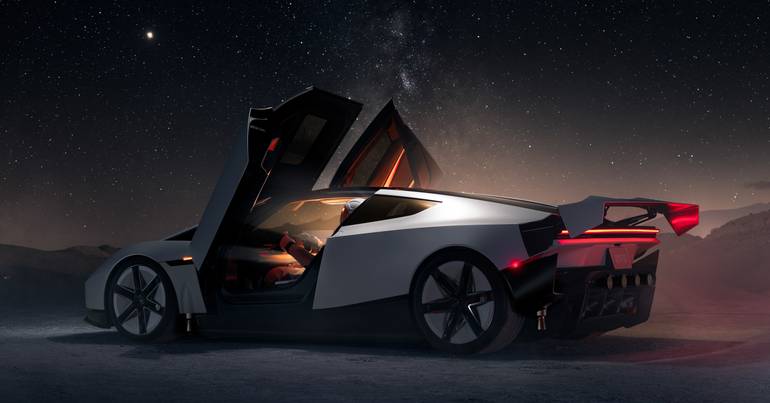
Tesla Roadster. O que impressiona, o que é bom e menos bom

Depois do Roadster Concept de 2017, prometendo a sua chegada ao mercado em 2020, a Tesla surgiu finalmente com o novo Roadster que vai de 0-100 em menos de 1 seg, e voa como um foguetão.

A confirmar-se a chegada ao mercado em 2028, o novo Roadster irá ser entregue com nove anos de atraso, mas será mais leve e mais potente, podendo ainda voar, fazer acrobacias e ser mais eficaz em pista e em estrada devido a herdar a solução do carro aspirador, o Brabham BT46B de F1
  •  

Tesla tem lucro de US$ 787 milhões no 3° trimestre, queda de 43,8%

A Tesla registrou lucro líquido de US$ 787 milhões no terceiro trimestre de 2026, uma queda de 43,8% em relação ao mesmo período do ano anterior. O lucro ajustado por ação foi de US$ 0,48, disse a empresa nesta quarta-feira (21) em comunicado.

A expectativa dos analistas consultados pela FactSet era de um lucro ajustado por ação de US$ 0,45.

O fluxo de caixa livre foi de US$ 1,53 bilhão no trimestre, ante número negativo no segundo trimestre, mesmo com a empresa citando investimentos em inteligência artificial (IA) e robótica para ganhar espaço nesses setores. Os gastos de capital mais que dobraram em relação ao ano anterior, chegando a US$ 4,73 bilhões.

A companhia também reportou US$ 28,05 bilhões em receita para o período, praticamente estável em relação ao terceiro trimestre do ano passado, e em linha com previsão dos analistas de US$ 28,05 bilhões.486.532

A Tesla ainda informou que vendeu veículos elétricos globalmente no terceiro trimestre, uma queda de 2% em relação ao mesmo período do ano passado – sua maior fonte de receita. Os modelos SUV Model Y e o sedã Model 3 registraram o maior número de vendas. Nos EUA, o Model Y foi, de longe, o veículo elétrico mais vendido nos EUA.

Às 17h48 (de Brasília), as ações da Tesla subiam 3,4% no after hours de Nova York.

*Com informações da Dow Jones Newswires.

  •  

Tesla posted a highlight reel of its robotaxi avoiding collisions with rivals Waymo and Avride

Tesla Cybercab
Tesla posted a highlight reel showing off its robotaxi navigating real-world road conditions, including robotaxis getting in the way.

Andrej Sokolow/picture alliance via Getty Images

  • Tesla posted footage of its robotaxi driving without a safety driver ahead of its Q3 earnings call.
  • Two of the clips included footage of a Waymo robotaxi and Avride encroaching on Tesla's path.
  • The clips showed the Tesla Robotaxi slowing down.

Tesla took some subtle jabs at its robotaxi competitors ahead of its third-quarter earnings call on Wednesday.

On a website Tesla created for its robotaxi safety report, the company uploaded clips of its self-driving cars maneuvering in real-world conditions without a driver behind the wheel. Obstacles and hazards included stormy weather, a pedestrian crossing at a green light, stray pets, and rival robotaxis getting in the way.

Ashok Elluswamy, Tesla's VP of AI, also posted the video on X, calling it "Robotaxi B-roll."

Robotaxi B-roll https://t.co/NWO7Ak2h1I

— Ashok Elluswamy (@aelluswamy) October 21, 2026

At around the 1:44 mark of Elluswamy's post, the video shows a robotaxi coming to a complete stop in its own lane as a Waymo makes a wider-than-usual right turn. The Waymo can be seen encroaching into Tesla's lane before it returns to its own path.

A Waymo spokesperson did not immediately return a request for comment.

In another short clip, the Tesla robotaxi is seen driving at night, braking for an Avride car that pulled up from the right, a little too far into the Tesla's path.

Avride is a robotaxi company that offers robotaxi rides through Uber in Dallas and is testing rides with a safety driver behind the wheel in Austin.

A spokesperson for Avride did not immediately respond to a request for comment.

Tesla posted the footage as it seeks to make its case publicly on robotaxi safety. The company began offering a limited number of autonomous rides without an in-car safety monitor in Austin in January.

In the newly posted safety report, Tesla said its robotaxi service has driven 3.3 million miles autonomously — relatively small compared to Waymo's more than 271 million miles driven as of June.

Tesla said during its Q3 earnings call that it will launch unsupervised Cybercabs in Dallas in November.

Read the original article on Business Insider

  •  

Tesla targets shipping Optimus to customers by the end of 2027

A prototype of Tesla's Optimus robot.

CFOTO/Future Publishing via Getty Images

  • Tesla has begun production of its humanoid robot, Optimus, in Fremont, California.
  • Musk said he expects to begin delivering Optimus to customers at the end of 2027.
  • Musk said it will take at least a year to produce 20,000 Optimus units a week.

Tesla has begun producing its long-awaited humanoid robot, Optimus, at its Fremont factory, the company said in its quarterly earnings report.

"The bots coming off this line are the first production-quality bots that we have manufactured," Tesla said, saying the current manufacturing process is "suitable for a commercial product."

"There's still some things we need to tweak about the design, because you need to deliver a robot that is safe and reliable and has long duration," CEO Elon Musk said on Tesla's Q3 earnings call. "It can't, like, wear out after a month."

Musk said the company will take at least a year to scale up Optimus production to 20,000 units a week in Fremont. He said he expects to begin delivering Optimus to customers at the end of next year.

Musk tempered expectations about how quickly Tesla can scale up Optimus production because it is "such a radically new product." He said the early stages of production will be "somewhat bumpy" because "there's like 10,000 things that have to go right" to build the robot. One of the big challenges Musk outlined is building robot hands.

Musk said Tesla is building an "Optimus Academy," where robots will practice tasks and generate data to improve the AI models that power them. The company also plans to install its next-generation AI5 chip in Optimus in April, which will give the robots more computing power and be a "big step change in intelligence," Musk said.

The latest version of Optimus has not been unveiled. Musk said he expects to release a video of Optimus within one or two months. He previously said Tesla was keeping the robot under wraps to prevent competitors from copying its design.

Tesla stopped producing the Model S and Model X at its Fremont, California, plant earlier this year to make room for an Optimus line designed to eventually produce a million robots a year. A second line under construction in Austin is planned to have an annual capacity of 10 million robots.

Tesla is competing in a crowded humanoid market. Agility Robotics, which plans to go public, has deployed its Digit robot across nine customer facilities, while Figure AI has announced deployments in logistics and distribution centers this year. Sunday Robotics, 1X, and Weave Robotics are preparing to ship robots into homes this fall.

Have a tip? Contact Rya Jetha via email at rjetha@businessinsider.com or Signal at rjetha.07. Use a personal email address and a non-work device; here's our guide to sharing information securely.

Read the original article on Business Insider

  •  

Tesla's profits are under pressure

Elon Musk, chief executive of Tesla Inc., during the 60th presidential inauguration in the rotunda of the US Capitol in Washington, DC, US, on Monday, January 20, 2025.
Tesla's earnings call was on Wednesday, a day after Elon Musk said on SpaceX's earnings call that he'd back a merger.

Bloomberg/Getty Images

  • Tesla is facing some profitability headwinds.
  • Its operating income fell 56% year over year as AI and research and development costs climbed.
  • The company is still in the green, and it surprised earlier this month by delivering 486,532 vehicles in the third quarter.

Tesla is still selling plenty of cars. Making the same amount of money on them is getting harder.

On Wednesday, the Elon Musk-led automaker reported that its operating income fell 56% year over year to $718 million in the third quarter — below Wall Street's estimates of $746.3 million — while overall revenue of $28.05 billion came in a smidge below analysts' estimates.

Tesla pointed to higher operating expenses tied to its AI efforts, or "SI"/"Super Intelligence" as Trump prefers, and other R&D projects. Lower regulatory credit revenue and weaker energy storage gross profit also weighed on profitability, while lower vehicle prices hurt revenue.

"While we continue to execute on innovations to reduce the cost of manufacturing and operations, over time, we expect our hardware-related profits to be accompanied by an acceleration of SI, software and fleet-based profits," the company reported.

It's not all bad news for Tesla's profits. The company is still solidly in the green, and it beat on the bottom line. Tesla reported 48 cents in adjusted earnings per share, above the 44-cent analyst consensus estimate. Free cash flow of $1.5 billion was also a surprise after Wall Street had expected negative free cash flow of $4.92 billion.

The automaker also sees areas of profit growth in its future: autonomy subscriptions are trending up, and Tesla said it's offering the right, region-specific product mixes.

During the earnings call, Tesla's chief financial officer, Vaibhav Taneja, said the company is experiencing its "highest backlog" of vehicles in four years. The company, he said, is trying to increase vehicle production.

He also added that Tesla has secured $30 billion of borrowing to support expected capital expenditures, but the company doesn't expect to "make any draws under any of the new facilities in this calendar year."

"The main takeaway is that Tesla's surprisingly positive cash flow quarter did not come from stronger profits," Thomas Monteiro, senior analyst at Investing.com, said after the report.

"Added to the equation is the fact that Tesla's AI spending remains broadly inefficient, with research costs up nearly 70% and operating margins down to just 2.6%, while at SpaceX AI is already one of the biggest sources of revenue," the analyst added.

The new quarter has already made waves

The Tesla story continues to play out in real time, and it's had a busy month since the fourth quarter kicked off in October.

On Tuesday, during SpaceX's earnings call, Musk said that Tesla and SpaceX had each formed committees to explore a potential merger. Both companies are helmed by Musk — and he owns billions of dollars in stock of each.

Anticipation of the potential mega-merger has been building around the companies for much of 2026, and has only increased since SpaceX went public. Musk said he was not included in those committees and that calling the merger a foregone conclusion "would be overstating it."

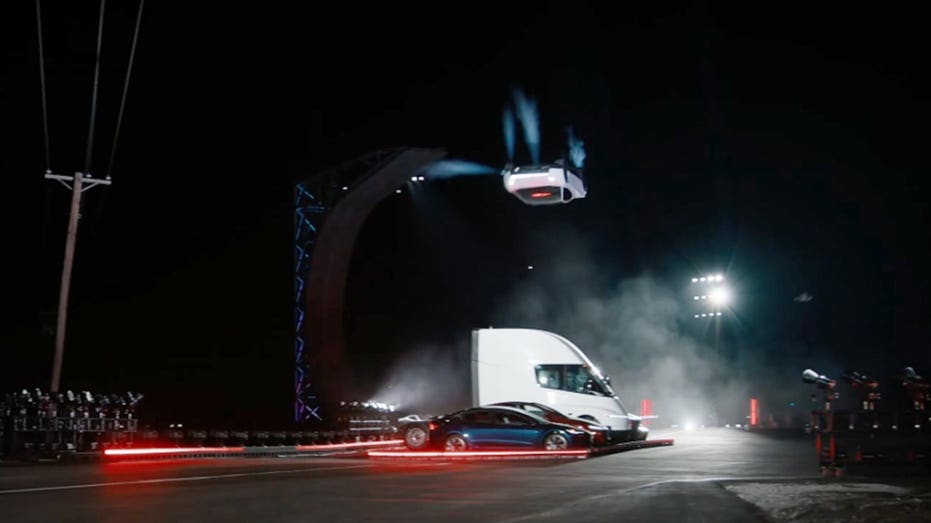
It also came less than a week after Tesla held its high-flying demo for the Roadster. The sports car performed a gymnastics routine, including briefly jumping into the air and twirling over a lineup of other Tesla vehicles.

A Tesla Roadster prototype flips in the air over a line of other Tesla vehicles.
Tesla had a high-flying demo for the coming Roadster. It came nine years after the company first floated the sports car.

Tesla

It came nine years after Tesla first promised to relaunch the Roadster. Musk first showed off a prototype of the vehicle in 2017 and predicted a 2020 product launch.

Read the original article on Business Insider

  •  

Tesla-SpaceX, Musk punta alla maxifusione. Ma il prezzo dell’accordo divide Wall Street

Tesla-SpaceX, Musk punta alla maxifusione

Elon Musk e gli analisti di Wall Street vedono molti vantaggi nella fusione tra Tesla e SpaceX. Ma sulla strada dell’accordo ci sono numerosi ostacoli, tra cui due commissioni speciali a cui Musk non può partecipare e il voto degli azionisti di Tesla che lui stesso ha definito difficile da superare.

Un’altra incognita è il prezzo, ossia quale sarebbe il premio che dovrebbero ricevere gli azionisti di Tesla. E qui gli analisti si dividono: si va da zero fino al 35%. Ovvio però che questa sia una questione chiave per il buon esito dell’operazione, con Tesla che capitalizza in Borsa 1.500 miliardi di dollari.

Musk ha detto che le commissioni devono ancora concordare i termini e che l’operazione non è certa, anche se Wall Street si aspetta un accordo entro la fine del prossimo anno. Le due società stanno sviluppando congiuntamente lo stabilimento di chip Terafab, mentre l’intelligenza artificiale rappresenta ormai più della metà dei ricavi di SpaceX, che prevede una spesa compresa tra i 35 e i 40 miliardi di dollari nel quarto trimestre per finanziare un’ulteriore espansione.

“Ritengo che una fusione tra Tesla e SpaceX abbia senso – ha detto un gestore che ha investito in entrambe le società –. È una mossa molto strategica perché entrambe si stanno rapidamente orientando verso l’intelligenza artificiale e i sistemi autonomi e stanno anche lavorando a enormi progetti infrastrutturali. Inoltre, si taglierebbero ridondanze e il tempo che Musk impiega a destreggiarsi tra le due società, riducendo così le spese generali, i costi legali e gli oneri amministrativi tipici delle società quotate in Borsa”.

Tra gli esempi citati anche la presentazione della Roadster la scorsa settimana, in cui un’auto Tesla dotata di propulsori SpaceX ha oltrepassato in volo un camion, dimostrando ciò che le due società insieme potrebbero essere in grado di produrre.

La possibilità di esercitare un maggiore controllo potrebbe anche essere parte del motivo per cui Musk, che detiene circa l’85% dei diritti di voto di SpaceX attraverso azioni privilegiate, mentre in Tesla ne possiede solo circa il 20%, è favorevole alla fusione, cosa che gli garantirebbe circa il 57% dei diritti di voto, ipotizzando un rapporto di cambio di 0,7 azioni SpaceX per ogni azione Tesla. Questo è però solo un livello calcolato da Barclays.

Ovviamente per una simile operazione non mancherebbero questioni di governance e di regolamentazione. Intanto in Borsa SpaceX, dopo i buoni risultati trimestrali, è in rialzo di oltre il 10% e Tesla del 3%.

L'articolo Tesla-SpaceX, Musk punta alla maxifusione. Ma il prezzo dell’accordo divide Wall Street proviene da Affaritaliani.it.

  •  

Musk punta a fondere SpaceX e Tesla: obiettivo un gruppo da 3.600 miliardi. E più potere nelle mani del multimiliardario

Un unico gruppo da 3.600 miliardi di dollari di capitalizzazione e circa 155mila dipendenti con attività che spaziano dalle auto elettriche ai razzi spaziali, dai satelliti all’intelligenza artificiale. E con un fabbisogno finanziario altrettanto imponente. Il progetto di fusione tra Tesla e SpaceX, i due gioielli dell’impero del multimiliardario Elon Musk, potrebbe ridisegnare gli equilibri dell’industria tecnologica e finanziaria. Per chi possiede direttamente azioni delle due società, ma pure per i risparmiatori esposti indirettamente attraverso fondi comuni, Etf e fondi pensione.

L’uomo più ricco del mondo ha definito l’unione una “buona idea” e ha annunciato la creazione di comitati ad hoc nelle due società per valutarla: lui non ne fa parte essendo in conflitto di interessi. L’obiettivo sarebbe riunire sotto un’unica struttura Tesla, impegnata nelle auto elettriche, nella robotica e nella guida autonoma, e SpaceX, protagonista dei lanci spaziali e dei servizi satellitari, con importanti contratti pubblici negli Stati Uniti. Quotata a giugno, quest’ultima ha archiviato il terzo trimestre in grande spolvero, con ricavi in crescita del 161% a 14,6 miliardi di dollari e utile in salita a 4,4 miliardi, più del doppio dei due miliardi attesi dagli analisti e in forte accelerazione rispetto al rosso di 1,1 miliardi dello stesso periodo dello scorso anno. Ma anche le spese in conto capitale per sostenere i progetti spaziali e quelli legati all’intelligenza artificiale sono salite a 19,6 miliardi dai 18,4 miliardi del secondo trimestre.

Secondo il Financial Times, che cita le stime degli analisti raccolte da Visible Alpha, il nuovo gruppo avrebbe ricavi per 153 miliardi di dollari ma un flusso di cassa negativo per almeno 54 miliardi. Vuol dire che gli investimenti e le altre uscite di cassa potrebbero superare le risorse generate dalla gestione, rendendo necessario finanziare il buco con liquidità disponibile, debito o nuovi capitali.

Il primo nodo per gli investitori sarà il prezzo attribuito alle due società e il rapporto di cambio con cui le azioni verrebbero convertite. Se il mercato giudicasse SpaceX sopravvalutata o temesse che Tesla si accolli rischi e investimenti eccessivi, l’operazione potrebbe penalizzarli. C’è poi la questione del controllo. Musk dispone di circa l’84% dei diritti di voto di SpaceX grazie alle azioni con supervoto, mentre in Tesla la sua influenza è inferiore. La fusione rafforzerebbe ulteriormente il suo potere. Questo mentre già da tempo, nota il Ft, “gli investitori si interrogano sulla capacità di Musk di concentrarsi su tutti i suoi progetti” e “gli azionisti non riescono a capire dove stia investendo la maggior parte delle sue energie o del suo denaro”.

L’operazione dovrebbe inoltre superare l’esame delle autorità regolatorie e ottenere il consenso degli azionisti. Oltre agli Stati Uniti, servirà il via libera di giurisdizioni come Unione europea, Regno Unito e Cina. Pechino è un ostacolo particolarmente delicato: secondo il Ft Tesla ha generato nel Paese 21 miliardi di dollari di ricavi nel 2025, circa il 22% del totale, mentre SpaceX è un importante contraente della difesa americana.

Le conseguenze della fusione potrebbero toccare anche chi non ha mai comprato un’azione Tesla. Il titolo è presente in numerosi indici azionari e può quindi entrare nei portafogli di fondi comuni, Etf e gestioni patrimoniali. Raggiungendo anche chi investe per la pensione integrativa. I possibili caveat, al netto dell’eventuale oscillazione del titolo, comprendono anche la concentrazione del rischio in un gruppo sempre più legato alle scelte di Musk, alle aspettative sull’intelligenza artificiale e alle politiche industriali e militari statunitensi.

L'articolo Musk punta a fondere SpaceX e Tesla: obiettivo un gruppo da 3.600 miliardi. E più potere nelle mani del multimiliardario proviene da Il Fatto Quotidiano.

  •  

Una fusione, tanti dubbi. Vantaggi e ostacoli del matrimonio Tesla-SpaceX

  •  

Elon Musk says SpaceX hitting $1 trillion in revenue in 2028 is 'no longer impossible'

Elon Musk
SpaceX and Tesla CEO Elon Musk.

JOEL SAGET/AFP via Getty Images

  • Elon Musk says it's "no longer impossible" that SpaceX will generate $1 trillion of revenue in 2028.
  • The SpaceX CEO said in August that his company projected that much revenue for 2030.
  • SpaceX would have to grow its revenue 53-fold in three years to reach Musk's new figure.

Elon Musk always shoots for the moon, but he's aiming even higher with his latest suggestion.

"As crazy as this sounds, $1T in SpaceX revenue in 2028 is no longer impossible," the Tesla and SpaceX CEO said in a Tuesday post on X.

As crazy as this sounds, $1T in SpaceX revenue in 2028 is no longer impossible https://t.co/jF3Wue95nL

— Elon Musk (@elonmusk) October 20, 2026

That's an even more ambitious timeframe than Musk has previously given. He said in August that SpaceX was internally projecting $1 trillion of revenue in 2030, and there was a "non-zero" chance it could reach that amount in 2029.

Musk made his latest pronouncement within hours of saying on SpaceX's third-quarter earnings webcast that annual recurring revenue could reach between $500 billion and $1 trillion by the end of 2027.

In a post-earnings note, JPMorgan forecast SpaceX would generate $254 billion of revenue in 2027.

If SpaceX were to generate $1 trillion in revenue in 2028, that would represent a 53-fold increase in three years. It earned just under $19 billion in 2025. It shared its historical financials prior to going public this summer.

After the bell on Tuesday, SpaceX — the company behind Falcon rockets, Starlink satellites, X, and AI chatbot Grok — posted close to $15 billion in revenue last quarter, up 161% from the same period of 2025.

The key driver was its super-intelligence division, where revenue surged 830%, from around $800 million to $7.6 billion. SpaceX attributed the growth to new cloud services agreements, around $600 million of revenue from its recent Cursor acquisition, and increased Grok adoption by enterprises.

To put Musk's $1 trillion revenue figure in context, Amazon and Walmart, the two highest-revenue companies on the planet, both generated a little over $700 billion in net sales last financial year.

Musk is floating the possibility that SpaceX could generate more than 40% more revenue than either of them did last year, in about two years' time.

It's unclear whether Musk is including Tesla, which generated about $95 billion of revenue last year, in his newest revenue figure. He revealed on Tuesday that Tesla and SpaceX have formed committees to explore a potential merger.

Susannah Streeter, Wealth Club's chief investment strategist, told Business Insider by email that a tie-up could "combine expertise in AI, chips, robotics and connectivity."

But she added that "bringing two enormous businesses with very different operations and capital demands under one roof would be a hugely complex undertaking."

Streeter said that notching $1 trillion in annual revenue in 2028 would be a "very tall order" and require an "extraordinary leap in the scale of the business."

"Moving the goalposts from 2030 to 2028 suggests he is increasingly confident that several growth drivers could accelerate at once, but there is a difference between a target that is technically possible and one that is commercially realistic," she added.

Neil Wilson, UK investor strategist at Saxo Bank, told BI by email that Musk's latest revenue figure is "pushing it" and "would imply such an enormous pull-forward in demand as to defy credibility."

Wilson added that he'd "never say never" about SpaceX hitting $1 trillion of revenue, "but by 2028 I'd say the chance is zero, whatever Elon says!"

Read the original article on Business Insider

  •  

Tesla outsells all other brands combined as America's EV market resets

SpaceX and Tesla CEO Elon Musk mingles with guests as U.S. President Donald Trump hosts a state dinner for President of China Xi Jinping and first lady Peng Liyuan and in the East Room of the White House on September 24, 2026 in Washington, DCDC. Trump is hosting Xi for a three-day state visit to
Tesla CEO Elon Musk.

Kevin Dietsch/Getty Images

  • Tesla accounted for more than half of US electric-vehicle sales in the third quarter.
  • Its quarterly sales increase exceeded the entire market's gain, Cox estimates show.
  • High gas prices are helping EVs compete, though sales remain below last year's levels.

Tesla is taking a bigger slice of America's electric-vehicle market as high gas prices give drivers another reason to consider ditching the pump.

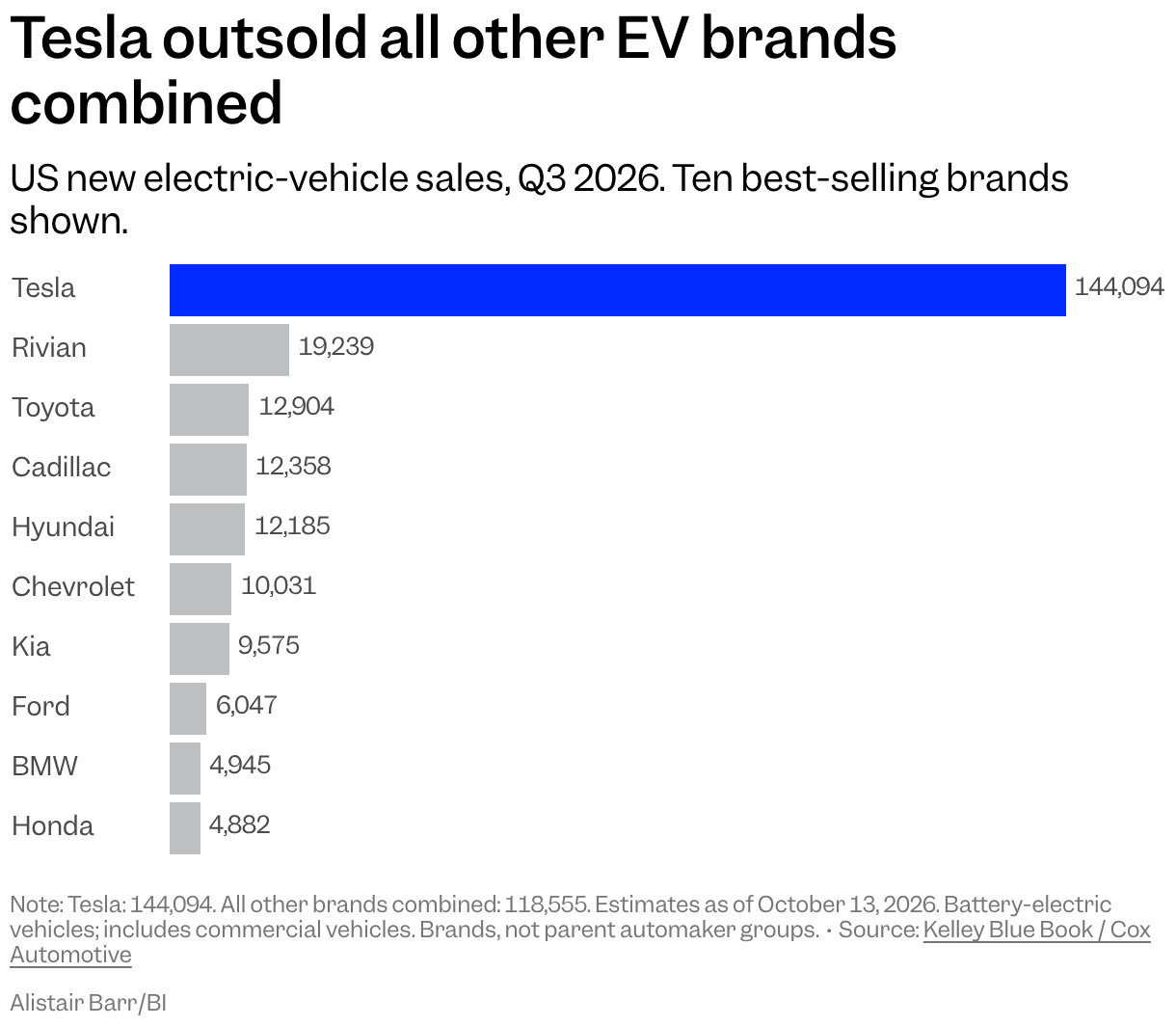
The company sold an estimated 144,094 vehicles in the US in the third quarter, up from 124,800 in the previous three months, according to Cox Automotive's latest sales report.

That increase was bigger than the gain for the rest of the US EV market. Put another way: Tesla drove the recovery. Everyone else, taken together, went backward.

Horizontal bar chart of the ten best-selling US electric-vehicle brands in Q3 2026. Tesla led with 144,094 sales, followed by Rivian with 19,239. Tesla sold more than all other brands combined, which totaled 118,555.

The figures offer a new twist on the EV comeback I wrote about in July. Back then, sales had finally improved after the slump that followed the end of federal incentives in the US. Several manufacturers were benefiting, but only those with the fortitude to stick with EVs after federal government support waned.

While recovery continued in the third quarter, it became more dependent on Tesla.

Americans bought 262,649 new EVs during the period, about 6% more than in the second quarter. Sales outside Tesla fell roughly 3%, based on a comparison of Cox's latest counts with its second-quarter report.

Tesla's own sales rose about 15% from the second quarter. It supplied 54% of the country's new EVs in the third quarter, extending its lead from the previous period.

High gas prices help make the case for going electric, according to Cox.

"With gas prices well above $4 a gallon, electric vehicles look better than ever," Stephanie Valdez Streaty, Cox's director of Industry Insights, said in the company's analysis of the quarter.

Expensive gasoline and diesel make running a conventional vehicle more painful. For drivers who can charge cheaply, particularly at home, an EV offers a valuable alternative to repeated trips to the pump.

There's an important caveat to the comeback story: Sales are improving from a depressed level.

Total US EV sales were down almost 40% from a year earlier. Last year's third quarter was unusually strong because buyers rushed to claim federal incentives before they disappeared.

Tesla's sales were down about 20% against that comparison. The company remains heavily dependent on two vehicles. The Model Y and Model 3 accounted for roughly 97% of its US sales in the latest quarter.

The Cybertruck sold over 4,300 units, and Tesla has stopped making the Model S and X. (There's a Roadster, though not until 2028).

So Tesla's growing dominance isn't a story of every model flying out of showrooms, or of selling more cars than a year ago.

For now, it is winning a larger share of a smaller market. As Americans return to EV shopping, Tesla is capturing more of their business.

Sign up for the AI Insider newsletter here. Reach out to me via email at abarr@businessinsider.com

Read the original article on Business Insider

  •  

Tesla and SpaceX have set up committees to explore a merger

Tesla CEO Elon Musk in front of the car company's logo.
Elon Musk said Tesla and SpaceX have created committees to discuss a potential merger.

Bloomberg/Getty Images

  • SpaceX and Tesla have each established exploratory committees to discuss a possible merger, Elon Musk said.
  • Musk, who said he can't participate in the talks, gave the update during Tesla's Q3 earnings call.
  • Musk said he thinks a merger is a good idea, but cautioned investors that shareholder approval is "quite a high hurdle."

Houston, we have an update on all that SpaceX-Tesla merger chatter.

During SpaceX's Tuesday earnings call, Elon Musk said both of the companies had created "special committees of independent directors" to discuss a potential merger.

Musk, who helms both companies and owns billions of dollars in stock of each, said he can't be part of those exploratory groups.

"Do I think it would be a good idea? Yes," he said on the call. "But at the end of the day, the shareholders have to be supportive of this, and particularly on the Tesla side, we will need a 50% vote of all shares, not just those who vote, but of all shareholders."

He said clearing that bar would be "quite a high hurdle."

It's the most detailed update investors have received yet on the idea of a tie-up, which has been the subject of much chatter since SpaceX went public earlier this year. If the companies ultimately decide to merge, it would further consolidate Musk's business empire, often referred to as Musk Inc.

His businesses have been on a consolidation kick. In 2025, xAI acquired Musk's social media company, X (formerly Twitter), and in February, SpaceX acquired xAI.

Musk also runs the brain-chip startup, Neuralink, and the tunnel-building firm The Boring Company. Both operate independently, but have had business collaborations within Musk Inc.

Tesla and SpaceX's stocks were up in after-hours trading following the news. SpaceX was up around 6.6% and Tesla 1.6%.

Musk sees clear benefits in tying the knot

"I do think there's a lot of merit to combining the companies as we are pretty much in the superintelligence singularity," Musk said during the call.

SpaceX and Tesla have worked together on a host of projects, including artificial intelligence software, chip design, TeraFab manufacturing efforts, robotics, Starlink satellite connectivity, and SpaceX's ability to launch payloads into orbit, Musk and SpaceX president Gwynne Shotwell said.

The most recent result of that partnership: On Thursday, Tesla demoed its long-awaited Roadster, which includes a version with SpaceX technology. The high-powered sports car's top trim will include cold-gas thrusters. The car launched, hovered, and flipped in the air during the demo.

While Musk is for the two companies tying the knot, he said investors shouldn't think it's a sure thing.

"I don't think we should necessarily assume that a SpaceX and Tesla merger is a certainty," he added. "That would be overstating it."

Read the original article on Business Insider

  •  

Elon Musk says money will be 'irrelevant' if his vision of a multiplanetary future comes true

Elon Musk is pictured.
Elon Musk says his descendants might have a "tiny fraction" of his wealth.

Jae C. Hong/AP

  • Elon Musk says "money becomes irrelevant" if he's right about what the future holds.
  • The Tesla and SpaceX CEO said AI and robots will be better than humans at everything.
  • The world's richest man said his fortune could be virtually gone within a few generations.

Elon Musk says money could be meaningless one day, and the vast majority of his wealth will likely be gone within a few generations.

The world's richest person predicted that advances in robotics and space travel will create a multiplanetary economy, at which point "money becomes irrelevant" and "conventional currency will not matter."

Value will be measured in mass and power or energy, he continued. "So that's my guess," he said, adding that it seemed a "pretty obvious" outcome to him.

The Tesla and SpaceX CEO shared his vision of a post-money future and his outlook on his personal fortune with his biographer, Walter Isaacson, on "The Builders" podcast. The interview was taped in early August and released on Tuesday.

Musk recommended earlier this year that people stop saving for retirement in 10 or 20 years, as he expects AI and other technologies to supercharge productivity and usher in an age of abundance where people can have "whatever stuff they want."

He made a similar argument to Isaacson, saying "there won't be anything that humans can do that the AI and the robots can't do better." People will likely turn to hobbies like growing their own fruits and vegetables, or making art, to find purpose in life, he said.

Musk's plans for his own money

Musk, who briefly became a trillionaire after SpaceX went public in June, topped the Bloomberg Billionaire Index at Monday's close with an estimated $920 billion net worth.

He defended his personal wealth on the podcast, saying that it mostly reflects his ownership of SpaceX and Tesla, and he needs large stakes in both companies to retain voting power and remain in charge.

His fortune is "going to be taxed quite heavily," Musk said, adding that there isn't "some magical way to avoid taxes" because "if there were, I would know about it."

Musk said his wealth will "get whittled down and a few generations from now — if money still matters, which I don't think it will — my descendants would have a tiny fraction of what I have."

He also outlined what he hopes his foundation will spend his fortune on after he's gone: "Continue the goals. Make life multi-planetary, extend consciousness to the stars, improve sustainable energy on Earth."

Notably, Musk pledged on Monday to gift a share of SpaceX to every child in the US next year, a contribution worth over $10 billion today.

His announcement has won praise from President Donald Trump, who hailed Musk's "incredible generosity" and labeled him a "legendary friend" in an X post.

Musk teased a charitable pledge in late July after Nobel economist Daron Acemoglu publicly challenged him over his prediction of a post-money future.

"If money won't matter in 2036, why don't you pledge to donate your current wealth of approximately $1 trillion to charity no later than 2036," Acemoglu wrote on X.

"I am actually going to do something along these lines!" Musk responded.

Read the original article on Business Insider

  •  

Want flying cars? America needs thousands more Elon Musks and less red tape

One of my favorite cartoons growing up was "The Jetsons." The Jetsons were a futuristic family living among the clouds with a fully automated life, from a robot maid named Rosie to technology that could make your dinner or do your laundry in just a few seconds at the push of a button. Everyone’s favorite aspect of this futuristic cartoon lifestyle boiled down to one element, which has become somewhat of a benchmark for technological progress: flying cars. And with Tesla’s recent exhibition, we are one step closer to that Jetsons-esque reality.

If you haven’t seen the video, Tesla did a demonstration of their forthcoming Roadster vehicle, slated for 2028 production. The car swooped up a half-loop ramp reminiscent of Matchbox car stunts. At the top of the ramp, the car, which was upside down at the top, flipped over in midair. Then, thrusters seemed to suspend the car in midair, before helping guide it gently back down to land on the ground.

For just a few moments, that car flew, and it was truly awe-inspiring.

FLYING SPORTS CAR HIDES ITS WINGS AS PRODUCTION GETS CLOSER

The reactions to this engineering feat and demonstration spectacle are somewhat of a Rorschach test. Those who love building, progress, technology or who are just generally optimistic have seen this demonstration as a formidable, impressive achievement. Those who like to see things torn down or are generally naysayers or obstacle formers react with "it’s not that big of a deal" or give other criticisms.

Fortunately, America still has enough people committed to the entrepreneurial spirit to attract the likes of Elon Musk and provide a good home base for his talented team members and others who want to see Musk, America and human beings in general succeed.

It isn’t hyperbole to say that Elon Musk is one of, if not the greatest, entrepreneurs of modern times. Regardless of any personal feelings or thoughts about Musk, if you can separate the art from the artist, or in his case, the entrepreneur from his business accomplishments, objectively, Musk has done the unthinkable time and time again. And we, as a country, are better off for him doing it from America as his home base.

As my husband and I talked about Musk’s varying accomplishments, from his early work in online payments to his achievements in electric vehicle manufacturing and AI, to his SpaceX being able to catch rocket boosters returning to the Earth from outer space upon landing, and now this latest hovering automobile. We discussed that Musk reportedly held discussions with Taiwan Semiconductor Manufacturing Company regarding a potential collaboration for his "Terafab" semiconductor facility in Texas. I mentioned that chip buildout had faced major challenges elsewhere, and my husband pointed out that it is different under Musk, saying, "In fact, we need 16,000 more Elon Musks."

INNOVATION IS KEY TO AMERICA STAYING A SUPERPOWER. BUT IT IS MISSING AN ESSENTIAL PIECE

And he’s right. America needs more Elon Musks.

No, Elon Musk does not succeed on his own. There are many team members alongside him in undertaking outrageous projects and often making them succeed. But there’s something about Musk’s vision, leadership, hiring and willingness to inspire confidence in others, both on his team and in the general public, that makes his teams continue to be successful. And we need more of that.

We need to not only attract and inspire those who may even be just a little bit like Musk, to dream bigger and bolder, to take calculated risks and try and try again when things don’t work the first time. And we need to make sure that we incentivize that behavior, instead of trying to penalize it or throw up roadblocks.

THE NEXT AMERICAN BOOM COULD BE HERE — UNLESS WASHINGTON REGULATES IT TO DEATH

In our own government, which is supposed to help vs. hinder entrepreneurs, we have politicians like Senator Elizabeth Warren, who is noted for going after Elon Musk because of his success, instead of trying to figure out a way to foster more Musk-like successes. After a vastly-ridiculed post made earlier this week from Warren lamenting, of all things, a possible merger between companies that make various spices and condiments, Mike Solana, CMO of Founders Fund and EIC of Pirate Wires, posted on X (also owned by Musk), highlighting the stark differences between the politician Warren and the creator Musk.

His post said, "liz warren: we’re gonna stop the mayonnaise company from buying a hot sauce company." He then said, "elon musk:," and included the video from Musk of the Roadster’s hovering feat, perfectly illustrating how some in our country are erecting barriers and others are breaking barriers.

America was founded on an idea of individual rights and incentives that rewarded successful pursuits, with such rewards growing at scale. We are very fortunate that we have Elon Musk and others who are pushing boundaries, bringing us into new frontiers, allowing Americans who work for him, who invest with him and who use his products or services to benefit alongside of him.

CLICK HERE TO DOWNLOAD THE FOX NEWS APP

We do need 16,000 more Elon Musks. And the way to foster more Elon Musks is to appreciate, incentivize and reward entrepreneurship.

  •  
❌