Continuing the project we started in the beginning of “026.
Here is our selection of our 7 most astonishing, original or viewed videos released in this the week.
This reminder ccome back after many months of pause due to that the main important videos were published in the post WARS in Video with dauky updates on the ongoing international conflicts in Ukraine and in Middle East.
But there are many videos that are extremely significant for their social or geopolitical content that sometimes take a back seat to the serious events that occur every day in wars, which is why we decided to start this periodic column.
Inside the Rumble description of each video there is a link to the detailed investigation it refers to or to a related topic.
Enjoy watching with Gospa News. And if you like our work, support us with a small donation.
C’è un’aria nuova al Meeting per l’Amicizia fra i Popoli di quest’anno. Si percepisce, in modo netto e incoraggiante, un evento in controtendenza persino rispetto al suo recente passato. Il ...
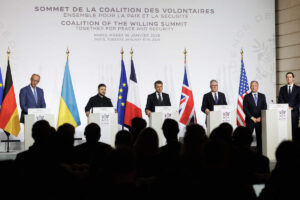
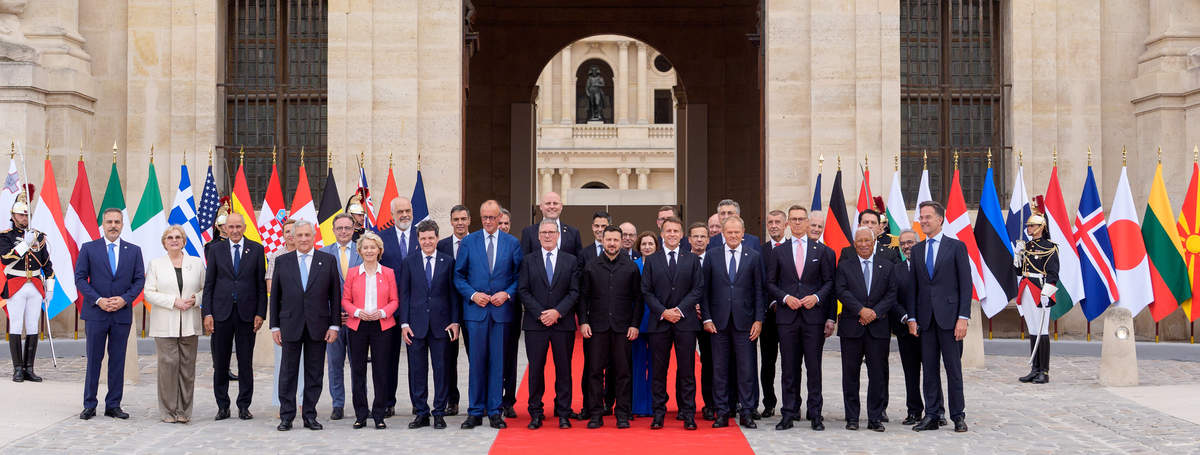
The Coalition of the Willing for Ukraine meets this Monday, August 24 — the 35th anniversary of Ukrainian independence — under the joint chairmanship of Emmanuel Macron, Friedrich Merz and Andy Burnham. The meeting comes at an urgent moment: fighting is intensifying on the ground and Moscow is preparing a new mobilization, while in Kyiv, Volodymyr Zelensky has just ruled out holding elections in wartime.
The ‘Volontaies’ Coalition at the Élysée (Élysée Palace)
A Meeting Under Heavy Diplomatic Pressure
According to a statement from the Élysée Palace released Friday, August 21, the Coalition of the Willing — an international alliance supporting Ukraine formed in March 2025 at the initiative of Czech President Petr Pavel — will meet this Monday at 1 p.m. in a hybrid format, with Volodymyr Zelensky taking part. The session will be jointly chaired by Emmanuel Macron, via videoconference, German Chancellor Friedrich Merz, and, for the first time, new British Prime Minister Andy Burnham. About a dozen leaders, including European Council President António Costa, are expected to be in Kyiv alongside the Ukrainian head of state, while European Commission President Ursula von der Leyen is not expected to attend in person.
According to a European official cited by several news agencies, talks are expected to focus primarily on strengthening Ukrainian air defenses, as the country faces a shortage of interceptors against Russian strikes. The Élysée says leaders will reaffirm “their determination to increase pressure on Russia” and continue coordinating measures aimed at drying up the resources funding Russia’s war effort, including the fight against the “shadow fleet” Moscow uses to circumvent oil sanctions. The meeting is also meant to advance work on security guarantees intended to underpin a “just, robust and lasting” peace, building on the Paris Declaration of January 6, 2026.
On the Ground, Moscow Prepares a New Mobilization
The meeting comes as the war enters a phase of intensification. Volodymyr Zelensky said this weekend that Russia plans to mobilize an additional 300,000 troops for the Ukrainian front after Russia’s parliamentary elections, scheduled for September 16-20, with a longer-term goal of recruiting 500,000. The Ukrainian president described a “peripheral mobilization” that would spare Russia’s major cities but, he said, would be hard to conceal. He also cited a Russian goal of producing roughly 1,300 ballistic missiles a year, while Ukraine expects to receive only 264 interceptor missiles this year, down from 364 in 2025 and 675 in 2023 — a shortfall Kyiv is trying to offset through new agreements, including delivery of at least one SAMP/T air-defense system from France and roughly 600 missiles from Germany.
These statements echo converging battlefield reports. Recent military bulletins point to intense fighting on the Zaporizhzhia, Kherson and Dobropillya fronts and in Dnipropetrovsk region, along with exchanges of soldiers’ remains between the two sides. This information comes from both Ukrainian and Russian sources, whose respective figures cannot be independently verified and should be treated with caution.
BACKGROUND
Formed in March 2025 at the initiative of Czech President Petr Pavel, and later organized under French and British leadership, the Coalition of the Willing brings together roughly thirty countries supporting Kyiv. It notably held a summit in Paris on July 13, 2026, on the eve of the Bastille Day parade, building on the G7 summit in Évian and the Paris Declaration of January 6, 2026.
Zelensky Rules Out Elections That Would “Destroy the Country”
On the domestic front, Volodymyr Zelensky responded for the first time to the call for elections made last week by his former defense minister, Mykhailo Fedorov, who was dismissed in late July amid vocal protests. In remarks made Saturday and released Sunday, the Ukrainian president said holding a wartime vote, absent a major cessation of hostilities, would “destroy the country by splitting society,” calling the prospect a “tsunami.” Ukrainian law bars elections under martial law, in effect since Russia’s full-scale invasion began in February 2022; Mr. Zelensky’s presidential term technically expired in May 2024.
Mr. Zelensky pointed to the practical hurdles such a vote would have to overcome — including how to enable voting by mobilized troops, millions of refugees abroad, and residents of Russian-occupied territory. According to an analysis by CNN, an incomplete or contested vote would hand Moscow a propaganda win, since the Kremlin already cites the wartime ban on elections to question the Ukrainian president’s legitimacy, even as Russia’s own electoral process is not considered free by Western observers. Polling suggests former armed forces commander Valery Zaluzhny or Mr. Fedorov himself would be the frontrunners in any eventual election.
Two Fronts for Kyiv: Military and Political
The convergence of these two issues — international military support and the debate over the democratic legitimacy of Ukraine’s leadership in wartime — casts Monday’s meeting in a particular light. For the Western leaders gathered around Emmanuel Macron, the goal is to demonstrate the durability of their commitment at a moment when Moscow is betting on wearing Kyiv down before winter, and when the question of security guarantees still has no concrete bearing on any ceasefire.
En 1919, cuando alguien empezó a examinar con detenimiento la encuadernación de un códice del siglo VIII conservado en el Archivo Capitular de la catedral de Barcelona, descubrió que la tapa posterior escondía algo más que cuero y costuras. Bajo la piel, colocados en pliegues, aparecieron diez fragmentos de papiro. Más de un siglo después, […]
In 1919, when someone began to carefully examine the binding of an 8th-century codex preserved in the Chapter Archive of the Cathedral of Barcelona, they discovered that the back cover hid something more than leather and stitches. Beneath the skin, placed in folds, appeared ten fragments of papyrus. More than a century later, six of […]
Romania’s ongoing political crisis is entering a more critical phase, with a collapsed government, an unresolved battle over the presidency and a growing conservative-nationalist challenge to the political order that has dominated the country for years.
At stake is not just who governs Bucharest, but whether Romania’s institutions can recover public legitimacy after the extraordinary cancellation of the 2024 presidential election.
The crisis dates back to November 2024, when independent nationalist candidate Călin Georgescu—to the surprise of many—finished first in the opening round of the presidential vote.
Citing alleged electoral irregularities and intelligence—evidence that still hasn’t been disclosed to the public—claiming Russian interference in favor of Călin Georgescu, Romania’s Constitutional Court subsequently annulled the election.
The court’s decision, therefore, erased an election result already delivered by Romanian voters and triggered one of the most serious democratic controversies in the European Union.
Romania’s democratic clampdown deepened even further in March 2025 when Georgescu was barred from taking part in the rerun presidential election. The Constitutional Court upheld his exclusion, leaving the person who had won the original first round unable to compete when Romanians were sent back to the polls for a second time.
The sequence of events became, for a broad cross-section of Romania’s population, undeniable proof of what many observers have begun to describe as “managed democracy”—meaning elections across the EU are “legitimate” only until voters choose someone “unacceptable” to the ruling establishment. It didn’t take long for news of the crisis to reach across the Atlantic. Vice President JD Vance used his 2025 Munich Security Conference speech to accuse Romania of having “straight up canceled the results of a presidential election based on the flimsy suspicions of an intelligence agency and enormous pressure from its continental neighbors.”
The U.S. State Department’s subsequent Report on Human Rights Practices also leveled criticism that the annulment represented political interference and an unusually severe restriction on disfavored political speech. Elon Musk, for his part, in several posts to social media attacked the Romanian state’s treatment of Georgescu and described one official connected with the process as a “tyrant.”
The episode resonated well beyond Romania because it touched a wider fault line running through European politics. Nationalist movements challenging Brussels on sovereignty, mass migration, security, green policy, cultural questions, and foreign affairs increasingly argue that institutional mechanisms are being weaponized to contain alternative political forces that can no longer be easily defeated—and may even be winning outright—at the ballot box.
Romania’s own long-established, ruling elite class has since begun to fracture. Prime Minister Ilie Bolojan’s Brussels-aligned government was brought down on May 5 after the Social Democratic Party (PSD) abandoned the coalition and joined nationalist AUR and other opposition forces in backing a no-confidence motion.
The result was overwhelming—281 lawmakers voted to remove the government, compared with only four against, well above the 233 votes required. The scale of the defeat exposed the government’s lack of legitimacy and revealed how quickly the firewall around Romania’s nationalist opposition had begun to crack.
Especially noteworthy was the decision by the PSD, long one of the pillars of Romania’s establishment, to cooperate with the Alliance for the Union of Romanians (AUR). Whatever the parties’ differences, that cooperation showed that excluding AUR indefinitely from parliamentary influence was becoming increasingly difficult.
President Nicușor Dan, so far, has failed to find a legitimate replacement. His nominee Adrian Veștea went before Parliament in June but secured only 189 votes—44 short of the 233 needed to install a government.
The failure prolonged a political vacuum that has continued into August. Bolojan remains interim prime minister, while Dan has held repeated consultations with former coalition parties in an effort to maintain fiscal measures and secure Romania’s remaining EU recovery funds.
The government’s paralysis has placed greater scrutiny on Dan himself. The right-wing S.O.S. Romania party formally initiated a constitutional procedure seeking his suspension under Article 95, alleging serious violations involving the separation of powers, government formation, the judiciary and democratic oversight of the intelligence services.
S.O.S. leader Diana Șoșoacă said more than 400,000 Romanian living in the country and abroad had expressed support for Dan’s removal. She also claimed that 155 parliamentarians had indicated agreement with the suspension initiative, although the names of lawmakers outside her party were not publicly disclosed.
The accusations against Dan include claims that he has blurred the constitutional boundaries of the presidency by involving himself too directly in judicial affairs. Critics have also objected to his public comments concerning the Constitutional Court and his consultations with magistrates.
Another point of contention is Dan’s insistence on constructing what he has repeatedly called a pro-Western governing majority. His opponents argue that the Constitution requires the president to facilitate government formation rather than impose ideological tests on parties capable of assembling parliamentary support.
Dan, for his part, has defended his approach as an effort to maintain Romania’s strategic orientation and produce a workable government. His supporters say the country’s position on NATO’s eastern flank, next to Ukraine, makes political and foreign-policy continuity especially important.
The intelligence services have become another sensitive issue. Critics point to the absence of permanent civilian leadership at the Romanian Intelligence Service while proposals have circulated to expand the security apparatus into areas including corruption and tax enforcement.
Such controversies carry particular historical weight in Romania, where memories of communist-era surveillance and the political power of the security services remain deeply embedded. Measures that might be treated elsewhere as routine institutional disputes can therefore trigger much deeper fears of political control.
A separate 2026 rule-of-law report cited by critics has further intensified the argument over Romania’s Constitutional Court. The Civil Liberties Union for Europe report was cited as arguing that the court had effectively changed the law in its handling of electoral candidacies, raising questions about legal certainty and the scope of judicial power.
The same report raised concerns over procedural protections for excluded candidates and discussed structural reform of the Constitutional Court itself. It also highlighted problems involving media independence, opaque political financing, and poorly defined anti-disinformation measures that can potentially restrict legitimate speech.
Those findings have strengthened the case made by Georgescu’s and his supporters that the 2024 election annulment, described by many analysts as a constitutional coup, was never merely about one TikTok campaign. They see it as a confrontation over who ultimately sets the boundaries of acceptable politics—Romanian voters or institutions increasingly tied to a globalist, Brussels-centered political consensus.
Romania’s crisis has moved beyond constitutional theory, as its political breakdown now collides with an economy facing some of the heaviest fiscal pressures in the European Union.
Earlier predictions that Fitch could push Romanian sovereign debt into junk territory did not materialize this August. Fitch instead maintained Romania at BBB-, the lowest investment-grade level, while keeping a negative outlook and warning that prolonged political instability could undermine deficit reduction and jeopardize access to European recovery money.
The reprieve should not be confused with economic security. Fitch expects Romania’s economy to contract by roughly 0.6 percent in 2026 and projects a budget deficit of about 5.9 percent of GDP—an improvement from previous years, but still exceptionally high for a BBB-rated state.
S&P has likewise kept Romania at BBB- with a negative outlook. Both agencies have pointed to the ongoing political fragmentation, financing pressures, and the difficulty of sustaining fiscal consolidation while governments rise and fall in Bucharest.
For ordinary Romanians, warnings like these translate into something much more tangible than ratings-agency terminology. They mean higher borrowing costs, increased pressure on household incomes, weaker growth, and further uncertainty over the country’s economic future. That helps explain why anger at political elites has persisted even as officials insist Romania remains firmly anchored inside the EU and NATO.
The nationalist political revolt in Romania also forms part of a wider European trend. From the AfD in Germany and Marine Le Pen’s movement in France to populist forces in Italy, Austria and elsewhere, parties demanding national sovereignty, stricter immigration controls and, increasingly, remigration have forced issues once excluded from respectable debate into the political mainstream.
Romania’s version of that revolt has developed around Georgescu and AUR, whose supporters increasingly compare their struggle with the movement that formed around Donald Trump in the United States. They view sovereignty, national identity, demographic security, economic accountability, and a nationally oriented foreign policy not as threats to democracy, but as core issues that any genuine democracy must be free to decide for itself.
The Romanian establishment—and by extension its backers in Brussels—now faces an uncomfortable problem: attempts to isolate Romania’s traditional, nationalist, and patriotic electorate have not only failed to make it disappear, but have made it much stronger. The collapse of the governing coalition and the cooperation between PSD and AUR have shown that the old cordon sanitaire is becoming harder—if not impossible—to maintain.
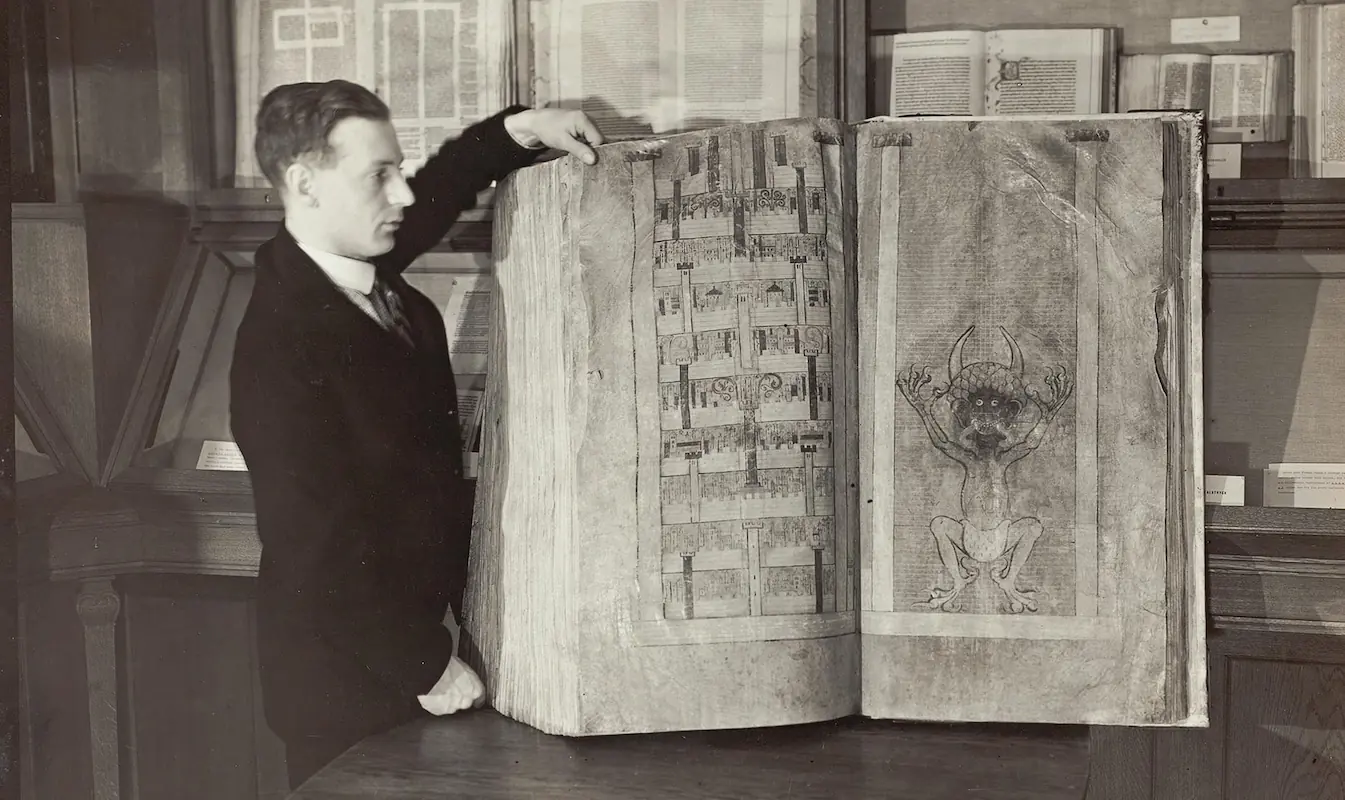
En 1648, mientras las tropas suecas saqueaban el castillo de Praga al final de la Guerra de los Treinta Años, alguien cargó entre el botín un volumen que pesaba 75 kilos y necesitaba dos personas para moverlo. Se trataba de un libro, el manuscrito iluminado más grande que se conserva de toda la Edad Media, […]
Estoi prepara-se para receber mais uma edição da Feira do Cavalo, de 2 a 6 de setembro, um dos momentos de maior destaque no calendário cultural da freguesia.
Durante cinco dias, o cavalo, a cultura e as tradições algarvias voltam a ocupar o centro das atenções, num encontro que promete reunir população, visitantes e amantes do mundo equestre.
A XXIII edição apresenta-se como uma celebração das raízes locais, valorizando o património equestre e as tradições que continuam a marcar a identidade do Algarve. Entre demonstrações, momentos de convívio e atividades ligadas ao universo do cavalo, o programa convida a descobrir uma Estoi onde a tradição permanece viva.
Mais do que uma feira dedicada ao cavalo, o evento afirma-se como um espaço de encontro entre gerações e de divulgação da cultura algarvia. O ambiente festivo, a gastronomia, os costumes e a ligação ao mundo rural completam uma programação pensada para proporcionar cinco dias de animação e experiências para toda a comunidade.
Com uma história já consolidada, a Feira do Cavalo regressa assim a Estoi para reafirmar a importância das tradições locais e celebrar a relação entre o homem, o cavalo e a cultura que atravessa gerações.
Durante cinco dias, Estoi volta a ser palco de uma festa onde o passado e o presente se encontram, mantendo viva uma das tradições equestres que fazem parte da identidade algarvia.
La Nato finanzia 50 milioni per testare droni in Ucraina. Leonardo apre a Kiev: l'Italia si piega all'economia di guerra permanente e aggira la sovranità.
Die großen US-Internetkonzerne sind allesamt de facto Tochtergesellschaften der CIA und anderer US-Geheimdienste, da diese sehr früh erkannt haben, welche Macht das Internet mit sich bringt. Im Internet entscheidet sich heute, was die Menschen erfahren und was nicht, über das Netz sind wir gläsern geworden, denn Google und Facebook wissen genau, wann wir wo gewesen […]
Un equipo de arqueólogos, liderado por la Universidad de Bohemia Occidental (UWB), ha sacado a la luz en las proximidades de la localidad de Chleby, en la actual República Checa, una estructura monumental que data de hace más de 6.500 años y que se configura como uno de los centros rituales más antiguos de Europa […]
Hoje é dia de recordar Alexandre O’Neill, poeta português com forte contributo para o movimento surrealista. Descendente de irlandeses, O’Neill nasceu em Lisboa, a 19 de dezembro de 1924, na mesma cidade que o viu morrer, a 21 de agosto de 1986. Pertence a O’Neill o conhecido ‘Há mar e mar, há ir e voltar’, […]
In the face of Russia’s war of aggression against Ukraine, the EU, together with Ukraine and Moldova launched the EU-Ukraine Solidarity Lanes in May 2022, establishing new transport routes to keep Ukraine’s imports and exports flowing via rail, road and inland waterways. Today, the EU-Ukraine Solidarity Lanes have become a lifeline for Ukraine’s economy.
In July 2026 the Solidarity Lanes allowed:
Around 90% of Ukrainian imports (in comparison to around 10% through the Black Sea)
Around 95% of Ukrainian exports of non-agricultural products (in comparison to around 5% through the Black Sea)
Around 20% of Ukrainian exports of grain, oilseeds and related products (in comparison to around 80% through the Black Sea)
Ukrainian exports
Since May 2022, the Solidarity Lanes have allowed Ukraine to export ca. 230 million tonnes (Mt) of goods, according to data from the Ukrainian customs registers. Within this amount, it can be estimated that the Solidarity Lanes enabled exports of around 103 million tonnes of Ukrainian agricultural products (including ca. 95 million tonnes of Ukrainian grain, oilseeds and related products) and around 127 million tonnes of non-agricultural goods including ores, steel and related products.
In total, around 255 Mt of Ukrainian grain, oilseeds and related products were exported through the Solidarity Lanes (40%) and the Ukrainian Black Sea ports (60%) since May 2022 [1].
Imports to Ukraine
The Solidarity Lanes also play a crucial role for Ukrainian imports. Since May 2022, they have allowed Ukraine to import ca. 111 Mt of goods, such as fuel, vehicles, fertilisers as well as military and humanitarian assistance.
Value of trade
The total value of trade via the Solidarity Lanes since May 2022 is estimated at around EUR 304 billion, with around EUR 78 billion for Ukrainian exports. The total value of imports to Ukraine is estimated at ca. EUR 226 billion.
Background
Since Russia's full-scale invasion of Ukraine and the blockade of Ukrainian seaports, Ukraine has been unable to export its produce and import what it needs via its usual transport routes.
Against this background, the EU established 'Solidarity Lanes' to ensure Ukraine can export grain, iron ore, steel and other products and to import the goods it needs, from fuel to military and humanitarian assistance, via alternative transport routes: inland waterways, rail and road. The Solidarity Lanes cover trade across all sectors and are an unprecedented cooperation of authorities and businesses in EU Member States, Ukraine and the Republic of Moldova.
The Solidarity Lanes’ work is carried out in close cooperation between the European Commission, concerned authorities and the transport community. The focus is on addressing bottlenecks to enhance the capacity and smooth functioning of the Solidarity Lanes to sustain Ukrainian exports and imports across sectors. This includes measures to improve traffic management and streamlining of border procedures and checks, as well as investments in infrastructure or logistics equipment.
The Solidarity Lanes are also laying the ground for the longer-term connectivity between Ukraine and the EU and will play a key role for Ukraine’s reconstruction and integration in the EU single market.
[1] Between May and July 2022, the Solidarity Lanes were the only option for Ukraine to export its agricultural produce. In August 2022, the UN-brokered Black Sea Grain Initiative (BSGI) helped relaunch grain shipments from Ukraine’s Black Sea ports. In mid-July 2023, Russia terminated its participation in the BSGI, which was consequently discontinued.
In August 2023, Ukraine launched a new Black Sea corridor for trade vessels heading to and from Ukrainian sea ports despite Russia’s withdrawal from the BSGI. Ca. 2.4 Mt of grain, oilseeds and other related products have been exported this way in July 2026.
I documenti segreti di Londra, l’ombra dell’OZNA e ottant’anni di omissioni di Stato A 80 anni dalla strage, Giorgia Meloni parla di «crimine impunito» e di autori e mandanti mai ...
Dalla concentrazione del risparmio gestito nelle mani dei Big Three (BlackRock, Vanguard, State Street) agli utili record delle banche italiane, con il credito all’economia reale che si assottiglia. E’ la mappa di un potere che non si vota, non si discute, e decide a prescindere dalla volontà dei cittadini-elettori. Cosa succede quando il
35,9% del debito è in mani estere. E circa un terzo di quella quota è nei portafogli dei grandi fondi statunitensi. Non è un dettaglio tecnico: è la misura esatta di quanto margine politico resta a un Paese che paga quasi cento miliardi di interessi l’anno. Ne parliamo con Alessandro Volpi, storico dell’economia all’Università di Pisa, saggista. Intervista a cura Jeff Hoffman
Parliamo di: Il record del debito pubblico: 3.207,2 miliardi, cosa dicono davvero i dati di Bankitalia Quantitative tightening: la BCE si ritira, i fondi americani avanzano Big Three: come tre gestori arrivano a pesare su una fetta enorme delle società quotate Le banche italiane e i profitti record: chi incassa, chi resta senza credito Risparmio previdenziale italiano: la materia prima più contesa d’Europa Cosa possono fare gli Stati: fiscalità sulla rendita, banca pubblica, controlli reali
I LIBRI DI ALESSANDRO VOLPI La guerra della finanza. Trump e la fine del capitalismo globale, Laterza, 2025 Nelle mani dei fondi. Il controllo invisibile della grande finanza, Altreconomia, 2024 I padroni del mondo. Come i fondi finanziari stanno distruggendo il mercato e la democrazia, Laterza, 2024 Prezzi alle stelle. Non è inflazione, è speculazione, Laterza, 2023 La mutazione italiana, Altreconomia, 2023 Storia del debito pubblico in Italia. Dall’Unità a oggi (con L. Tedoldi), Laterza, 2021
SOSTIENI CASA DEL SOLE TV Casa del Sole TV è un progetto di giornalismo indipendente autofinanziato. Per donazioni: IBAN: IT63P0326822300052392596590 Intestato a: La Casa del Sole Edizioni Causale: Donazione Casa del Sole TV Membership YouTube:
https://www.youtube.com/@CasadelSoleTVChannel Analista Multipolare €5/mese Inviato della Verità €15/mese Architetto del Futuro €25/mese
I LIBRI DI MARGHERITA FURLAN BRICS Scacco Matto (disponibile in italiano, inglese, russo)
SEGUI CASA DEL SOLE TV YouTube: @CasadelSoleTVChannel Sito: casadelsole.tv Instagram: https://www.instagram.com/casadelsoletv/ Facebook: https://www.facebook.com/casadelsole.tv X: https://x.com/CasadelsoleTv
CASA DEL SOLE TV — Informazione libera e indipendente Il nostro lavoro è possibile solo grazie al vostro sostegno. Casa del Sole TV non ha editori forti né finanziamenti pubblici: siamo sostenuti da voi, il nostro pubblico. Se credi nel valore di un’informazione che non tace, aiutaci a continuare.
Dona tramite bonifico bancario: IBAN: IT63P0326822300052392596590 Intestato a: LA CASA DEL SOLE EDIZIONI Causale: Donazione Casa del Sole TV
Dona tramite PayPal: paypal.me/casadelsoletv Sostegno ricorrente: casadelsole.tv/sostienici Anche un piccolo contributo fa la differenza. Grazie di cuore!
The disputed 2020 presidential election and Russia’s 2022 invasion of Ukraine accelerated Belarus’s integration into Moscow’s military strategy, with the country becoming a rear-operating base.
Since 2023, Russian deployments have increasingly positioned Belarus as a potential forward-operating base. Nuclear-capable systems, missile forces and military infrastructure on Belarusian territory mean that the Russian threat extends further along the EU’s eastern border.
Europe wants to preserve Belarus as a strategic buffer, yet sanctions and diplomatic isolation have not slowed Russian military entrenchment. Its continued path risks further binding Minsk to Moscow. Belarus has quietly become a major frontline security challenge for Europe.
The EU should move away from relying mostly on sanctions and economic pressure, and instead pursue a pragmatic strategy which aims to increase Minsk’s autonomy from Moscow. In the meantime, Europe must remain supportive of Belarusian exiles and its diaspora community.
The EU also needs to complement existing NATO deterrence with stronger support for countries on its eastern border, namely Poland, Latvia and Lithuania. This would reduce opportunities for Russian coercion and support Europe’s long-term plan for Belarus.
A satellite state
Take a map of Europe and find Belarus. Trace a finger clockwise, from the country’s northern borders and around to the east, where Russia is followed by Ukraine, Poland, Lithuania and Latvia. Belarus’s capital, Minsk, is itself almost at the exact geographic heart of the country, surrounded by hills, with vast forests sprawled out like capillaries beyond.
It is from here that Belarus’s longtime leader, Alexander Lukashenko, looks out from his “Palace of Independence” on Minsk’s Pieramozcau Avenue. To the east, in Russia, his fellow authoritarian Vladimir Putin continues to decimate Ukraine from its eastern borders and scheme to undermine European political interests. To the west, stretching hundreds of kilometres past Belarus’s western border with Poland and across Germany, lies Brussels. Faced with instability across the continent, the EU’s capital is increasingly unsure about what to do with its problematic Belarusian neighbour.
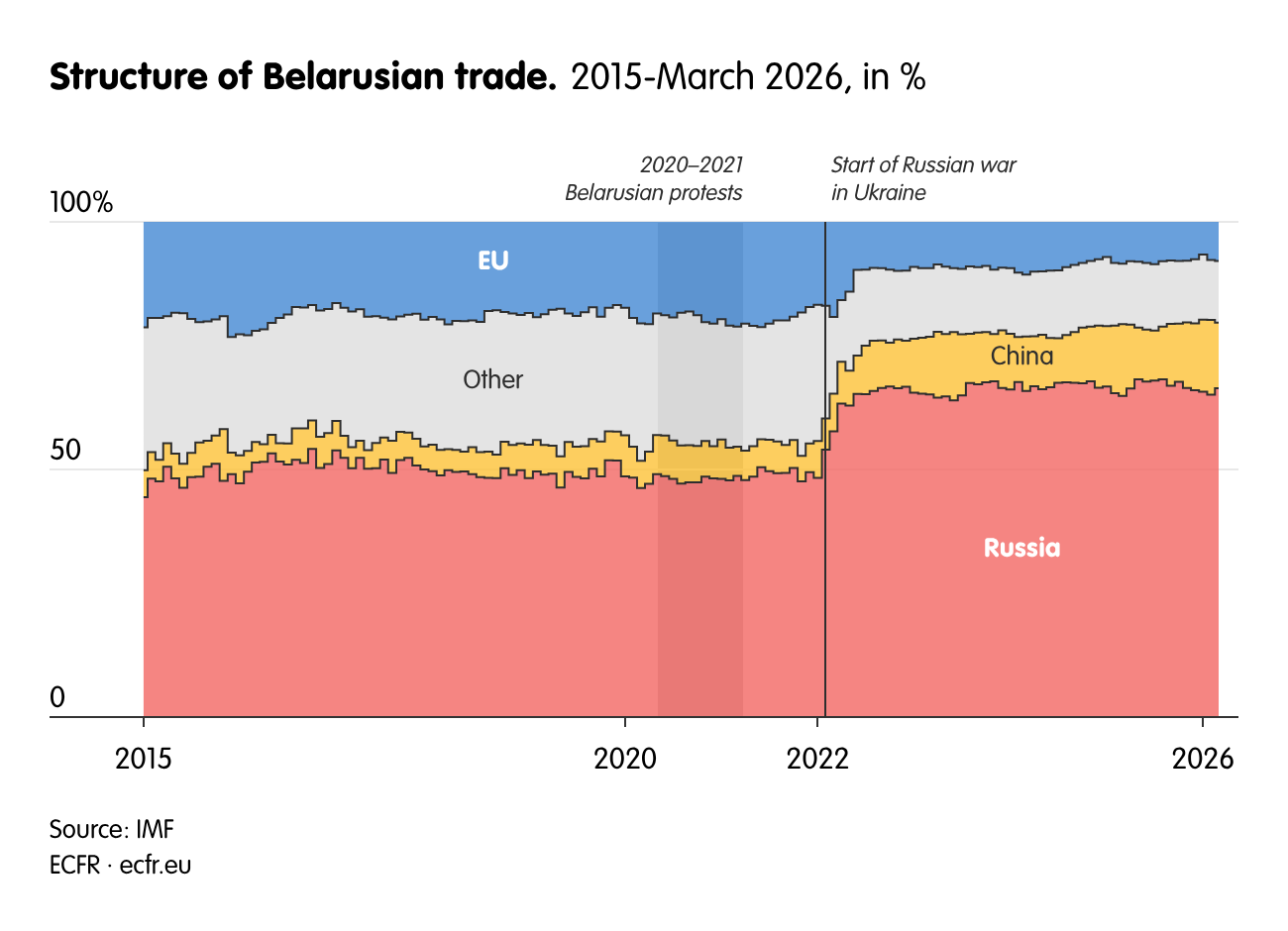
The EU downgraded its diplomatic relations with Belarus in 2020 after the latter’s disputed presidential election, which saw Lukashenko’s government violently repress protestors who took to the streets to oppose the president seizing victory by undemocratic means. Although bilateral trade between the EU and Belarus was largely undamaged in the subsequent years, the fall in trade with the bloc after Russia’s invasion of Ukraine in 2022 created an economic gap which Russia has exploited. For example, it has stepped up its own trading relationship with Belarus and become a key market for exports of Belarusian goods such as dairy products and petrochemicals—also allowing Moscow to evade EU sanctions. In doing so, Russia filled a vacuum for Belarus; Lukashenko, facing limited alternatives, deepened his dependence on Moscow.
Although Belarus did not formally commit troops to Russia’s war of aggression, it did allow the latter to house missiles, tanks, artillery, helicopters, aeroplanes and other military equipment in its territory prior to the invasion. It also provided military and civil infrastructure for Russia’s use, including airfields, hospitals and railway lines. This year alone, Russia has transferred more missiles—including dual-capable, hypersonic missiles—to Belarusian territory and conducted joint exercises encompassing the Belarusian Armed Forces. This, combined with a breakdown in dialogue between the EU and Belarus, gives Putin yet more sway in his quest to entrench Russia further into Belarusian structures.
Now that Belarus is apparently firmly committed to the supranational union of Belarus and Russia, known as the Union State, it has become a structural security concern for Europe. Russian deployment of nuclear-capable weapons on Belarusian territory makes Europe’s eastern flank more vulnerable, while Belarus’s already tense relations with neighbouring border states Poland, Latvia and Lithuania are at risk of deteriorating further. At the same time, Belarus has 879 political prisoners languishing, with Lukashenko’s regime having essentially outlawed any political or civic activity which the authorities see as a threat.
All this has compounded the breakdown in relations between Belarus and Europe. Russia is further emboldened to entrench its military deeper into Belarusian territory, tighten its economic dependencies and integrate the country further into its nuclear strategy.
This paper examines Belarus’s transformation from a problematic but stable buffer state between western Europe and Russia to a country which poses an increasing military and security threat to the EU. It argues that the EU should move away from relying solely on economic leverage and the blanket application of sanctions—which are pushing Belarus to rely more heavily on Russia—and develop a more targeted approach. Europeans need to actively contain the growing military and nuclear threat by finding new avenues of diplomatic negotiation, and by incorporating NATO-inspired approaches into its defence policy for its vulnerable eastern states.
Perhaps most importantly, Europeans need to assess to what extent they can treat Minsk as an autonomous actor capable of making decisions independently from Moscow. Europeans should take recent developments, such as Ukraine’s discovery of four signal relay stations in two Belarusian oblasts and their subsequent removal, as proof that Lukashenko retains the authority to make territorial-based decisions—especially under pressure from Russia.
However, for as long as Lukashenko remains in power, Belarus will never be entirely free of Moscow: he is an authoritarian, and Minsk remains sanctioned due to its breach of human rights clauses and mistreatment of its population. Belarus’s geopolitical position is also at least partly down to early decisions that Lukashenko made when he turned towards Moscow in the mid-1990s—a time when most other former Soviet nations chose real independence. Long before 2020, this posture led to missed opportunities with the EU, reinforced Lukashenko’s propensity to commit human rights violations and kickstarted Belarus’s deepening economic and military integration with Russia.
In its pursuit of a new strategy, the EU needs to recognise that—even if Belarus remains a stable, contained buffer zone—the country will not undergo a full democratic transformation. Europeans are thus searching for a Belarus which no longer presents an urgent security threat on its eastern border. They should aim to help shape a country whose stability reduces geopolitical risk without abandoning the EU’s long-standing commitment to democracy, human rights and the well-being of Belarusian society.
Belarus as a security actor
Belarus declared its independence from the Soviet Union in 1991. But, with what Russia perceived as the NATO and European sphere of influence shifting eastwards, Belarus became increasingly valuable to Moscow—especially because of the Suwalki Gap, which lies between the Russian exclave of Kaliningrad and Belarusian territory. The Russia-Belarus relationship became more entrenched once Lukashenko and Putin came to power in 1994 and 1999, respectively. The two leaders are hardly close personal friends—but they have nonetheless developed strong cultural and economic ties based on the similarity of their two anti-Western and authoritarian regimes, and their notion of a shared history.
Over the past 30 years, Belarus has moved closer to Russia in economy, trade and idea sharing. But it has gone beyond simply sharing a similar geopolitical outlook; now it is a militarised actor on the EU’s eastern flank. The first tipping point came with Russia’s invasion of Ukraine in February 2022. At this point, Lukashenko was already politically entangled with Moscow due to its support for Belarus’s trade network and economic sector after Minsk’s break with Europe in 2020. But the invasion meant that Belarus also became entrenched in the Russian military machine: in the early phase of Russia’s invasion, it became a launchpad for Russian ground offensives towards Kyiv and Chernihiv, and for missile strikes and combat aviation operations.
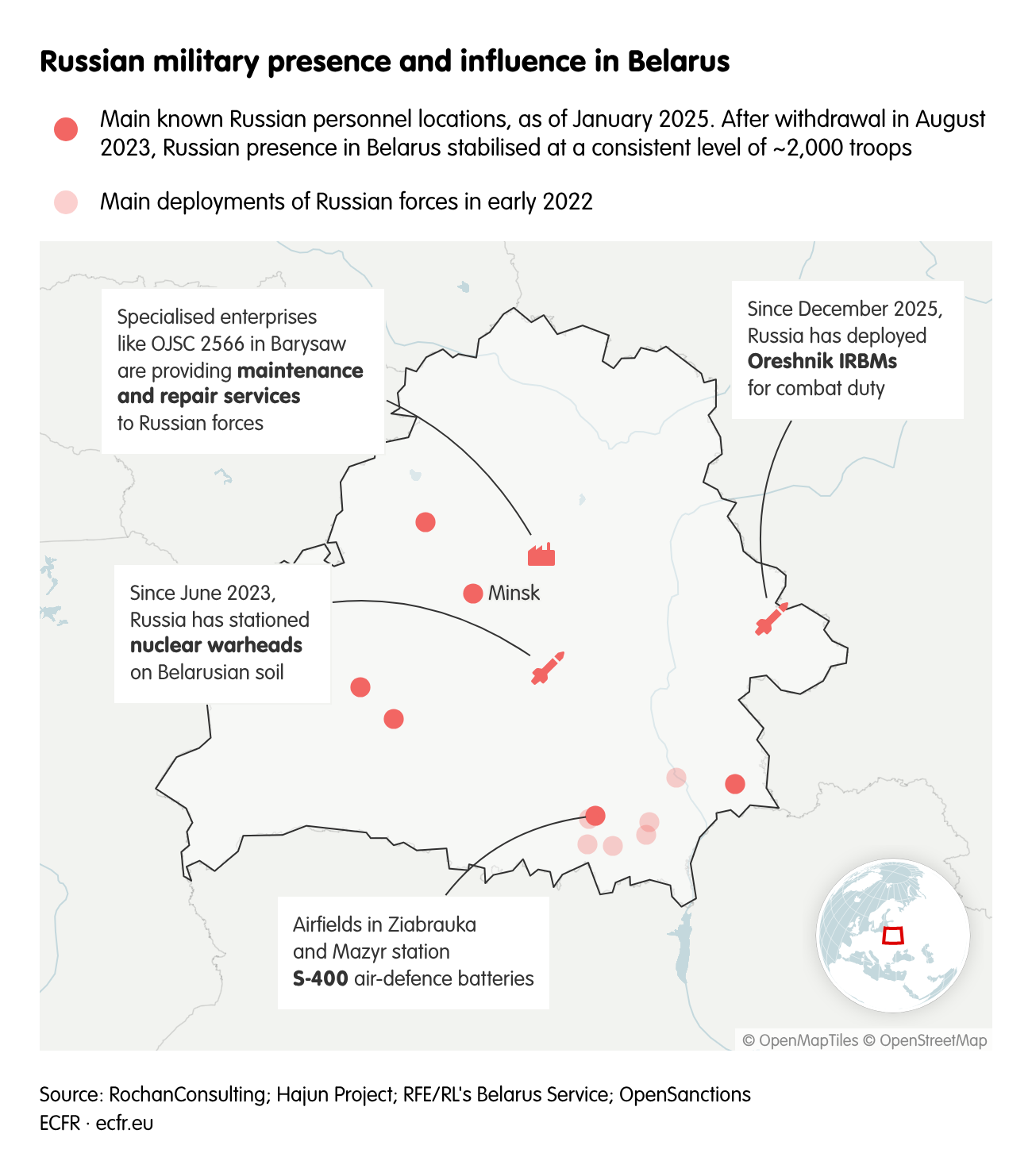
Since this period, Russia has attempted to consolidate its control even further. Now it has approximately 2,000 troops concentrated around air-defence systems, training facilities, logistics hubs and long-standing Russian military installations. Between 2022 and 2023, ammunition transfers from Belarus to Russia exceeded 130,000 tonnes. Since then, joint training centres, storage bases and transport corridors (many inherited from the Soviet period) have been repurposed and modernised under Belarus-Russia Union State programmes to support Russian operational needs. Rail-linked depots, armament storage facilities and training grounds now serve as key infrastructure for Russian forces on its western flank.
The second tipping point came with the two countries regularly staging recurring joint military exercises that institutionalise operational integration, such as the Zapad military drills which have been taking place since before 2022. Now Russia is eyeing up Belarus as a key component of its nuclear ambitions and has also deployed Oreshnik intermediate-range missile systems in Belarus. In April this year, Belarus confirmed it would no longer allow Russian conscripts who desert the military to leave via its border. Belarus is also a staging post for Russian nuclear missiles and joint military exercises.
The country has thus become Russia’s territorial, militaristic and logistical resource, achieved through durability, military routinisation and institutional embedding. The military aspect of this entrenchment is also compounded through hybrid attacks. For example, as early as November 2021 the EU condemned Belarus for facilitating the weaponisation of migrants—predominantly from conflict areas such as Iraq and Syria—who it had apparently encouraged to breach the borders of Latvia, Lithuania and Poland.
This form of hybrid warfare has continued into 2026: recent reports say that Lithuanian authorities have discovered a cross-border tunnel from Belarus to Lithuania, which they suspect is to continue to facilitate the potential movement of migrants through European territories. Now, with the Union State increasingly functioning as a homogeneous force, there is a threat that Belarus will become more emboldened to facilitate further dangerous hybrid manoeuvring. It intends to check Europe’s readiness and destabilise it from the inside.
Belarus as a threat to Europe
The difference in the threat which Belarus now poses to Europe lies in its shift—which has taken place over the past six years—from being Russia’s “rear-operating base” to Russia’s “forward-operating base”.
As Russia’s rear-operating base, Belarus functioned as a non-combat zone for logistics and maintenance. While it supported Russian military activity and provided strategic depth by shifting military infrastructure and combat flashpoints away from Russian territory, as a rear-operating base Belarus avoided deploying its own forces into Ukraine and directly engaging in combat operations. This allowed Lukashenko to avoid many of the challenges that Putin is experiencing, including politically sensitive military mobilisation, high personnel casualties and mounting internal economic pressure. This approach had previously provided Lukashenko with the degree of political deniability and diplomatic leverage necessary to continue negotiating with Western economies on economic sanctions and market access. He was able to point to Belarus’s arm’s-length approach to the war in Ukraine as proof that he was willing to engage with Europeans at a diplomatic and economic level.
However, Belarus’s position has changed since 2022. Evidence collected by the author demonstrates that Russia is increasingly establishing the country as a forward-operating base. Moscow is building on its routinisation and institutional embedding of military infrastructure to deploy personnel on Belarusian territory and undertake recurring joint military exercises, lately including nuclear forces preparation. Minsk’s rhetoric is changing to match these actions. In 2022, Belarus changed its constitution to allow Russia to store nuclear missiles on its territory; in a “Militarization of Europe” meeting held in June 2026, Belarus’s deputy minister of foreign affairs Igor Sekreta said he was “deeply concerned by… military exercises on NATO’s eastern flank” and “the EU and NATO… systematically promoting a militarist agenda at all levels.”
The Belarusian government is simultaneously becoming a component of Russian forward-military position and aligning ideologically with Russia’s view that Europe (and the West in general) constitutes an existential threat. Lukashenko himself reiterated this in May 2026, when he declared that “… [Belarus is] ready in every possible way to defend our common fatherland from Brest to Vladivostok.” The change is especially worrying for Ukraine, which is already fighting a war against Russia on several fronts. Its brow-beaten army could soon be required to deploy yet more resources to another defensive line on its northern border. Belarusian state media have suggested that Putin desires to open a “second front” against Ukraine, using Belarus as a launchpad for further attacks.
Indeed, evidence suggests that Russia is already using Belarusian infrastructure to gain an advantage in its drone warfare against Ukraine: in June 2026, Ukrainian intelligence services discovered four signal relay stations in the Belarusian oblasts of Homiel and Brest. Ukraine’s president, Volodymyr Zelensky, appealed directly to Belarus to dismantle the sites or face potential Ukrainian consequences. The Belarusian president apparently acquiesced—although no public statement or confirmation has been made.
Belarus’s transformation into a forward-operating base was further bolstered in 2023, when Russia deposited tactical Iskander nuclear-capable warheads on its territory. Then, in early 2025, Russia moved Oreshnik hypersonic missiles to a location which experts estimate to be around 60km south of Minsk. This has changed the calculus for the rest of Europe. Europeans must contend with an additional nuclear threat right on its border (aside from Kaliningrad) and consider how this could compromise security along its eastern flank.
Meanwhile, as noted above, Belarus is mixing concrete actions with rhetoric that suggests it sees Europe as a threat to its own sovereignty. In the same speech, Sekreta commented that Poland, Latvia and Lithuania have a combined defence expenditure of €52bn, which is apparently “25 times more than Belarus allocates for defence”. This suggests that Belarus increasingly views European and NATO defence investments through the lens of Russian military planning. If left unchecked, Russian influence will leave EU member states more vulnerable to further hybrid attacks from Union State forces.
For Europeans, there is also potential for escalation in how these border countries respond, and uncertainty about where escalation could lead. For example, the Zapad-2025 military drills, which took place on September 12th 2025, prompted Poland to close its border with Belarus due to “heightened security concerns”. Prior to this, on September 9th and 10th, Russia had flown several drones into Polish airspace during an attack on Ukraine. Lithuania also closed its border with Belarus for a whole month in October 2025 (and refused to enter negotiations to reopen it) after meteorological balloons travelled into its airspace from Belarus. The latter responded by accusing Lithuania of “pursuing an anti-Belarus policy”. Latvia, for its part, is struggling to deal with Belarus’s tactic of sending illegal migrants over its border. As of July 21st 2026, the Latvian government had recorded 8,413 instances of migrants attempting to cross into its territory this calendar year, stirring discontent prior to the parliamentary election in October. The country has also uncovered several sabotage operations that have appear to have been carried out by Belarusian and Russian spies.
European leaders heating up their confrontations in such critical areas is further adding to NATO’s headache. Belarus’s degradation as a buffer zone between western Europe and Russia means the potential for these flashpoints to drift further west is growing, not helped by a continually deteriorating diplomatic relationship between the Lukashenko government and the governments of neighbouring EU states. The proximity of Russian missiles and personnel to European territory could compromise NATO warning systems; it also suggests that the Union State is becoming increasingly willing to test European responses to its increasingly integrated deterrent.
Now the EU needs to reconfigure its strategy towards Belarus. The goal should be to ensure that Lukashenko does not limit his room for manoeuvre so much that he has no choice but to descend into a fully armoured satellite state; and that he has no choice but to react to any order Putin gives.
What Europe is doing…
On sanctions
Since Belarus’s flagrantly undemocratic 2020 presidential election, which sparked the country’s largest political crisis since independence, the EU and Belarus have downgraded their diplomatic relations. This is a cycle which Europe and Belarus have found themselves in since at least 2006: repression conducted by the regime triggers sanctions and isolation from Europe, which are followed by limited thaws and diplomatic re-engagement, which are then interrupted by renewed crackdowns—and so on. This time, however, the diplomatic downgrading was mutual: Lukashenko made Poland and Lithuania’s ambassadors leave Minsk in October 2020, and requested the EU ambassador return to Brussels.
In 2021, following Lukashenko’s contested re-election, Europe’s approach became more actively political. Belarusian opposition leader Sviatlana Tsikhanouskaya lobbied European governments to move beyond broad economic measures, such as existing targeted sanctions, to adopt harsher and broader sectoral sanctions. These were directed at, for example, specific officials, judges, prosecutors and police officers responsible for repression of Belarusian citizens. Belarus, for its part, suspended participation in the Eastern Partnership, an initiative which aims to strengthen political and economic relations between the EU, its member states and the partner countries of Armenia, Azerbaijan, Georgia, Moldova and Ukraine.
Europe’s response remains to take a blanket approach to sanctions towards Belarus. It reinforced its sanctions cycle even after Russia’s invasion of Ukraine in 2022 and the EU’s approach to Belarus is embedded within its anti-Russia packages. This means that the EU not only targets individuals involved in conflict operations, but also bundles Minsk in together with the trade restrictions, export controls and financial measures which it aims at Moscow. Europeans have fallen into the trap of treating their Belarus policy as an extension of their Russia policy, although some politicians—including French president Emmanuel Macron and, back in 2021, former German chancellor Angela Merkel—have also pursued limited efforts to test whether targeted incentives could shape Minsk’s behaviour.
However, some EU sources say that Minsk is an unwilling negotiating partner. It remains to be seen whether it will be explicit about the desire to reshape engagement with Europe. As of 2026, EU–Belarus relations remain largely frozen. They have seen only minimal diplomatic engagement and sustained sanctions, and only limited, transactional contact has emerged—for example, in negotiations over political prisoners and technical discussions over border management. In its latest sanctions announcement, the European Council extended its sanctions regime against Belarus until 2027.
The EU is thus in a difficult position when it comes to pursuing normalisation with Minsk. Since Europe’s Belarus policy is considerably shaped by Belarus’s neighbours, Lithuania and Poland—and Vilnius is especially reluctant to open any dialogue with Minsk—other member states are less emboldened to force through normalisation policies which are at risk of simply being blocked. What is clear is that, unless Belarus makes clear improvements in its human rights conditions and clearly distances itself from Russia’s war in Ukraine, European policy will remain structured around three aspects: progressive sanctions targeting regime elites and key economic sectors; political non-recognition of the legitimacy of Lukashenko’s rule; and support for Belarusian civil society and exiles.
Another problem for Europe is that continuing to heavily limit industrial trade and the transfer of dual-use goods and military equipment to Belarus could see Lukashenko rely more heavily on Putin’s open markets. But, if Europeans do not pursue sanctions, they indirectly aid Russia: Lukashenko supports Russia’s war against Ukraine by selling military and dual-use goods to Russia, thus helping it circumvent sanctions. This, in turn, creates a cycle of obligation whereby Minsk acquiesces to future military requests from Moscow and Russia further entrenches along Europe’s eastern flank.
The EU approach broadly treats Belarus as a subsidiary of Russia and narrows Europeans’ ability to develop a tailored security policy which directly targets Belarus as a forward-operating base. As things stand, sanctions on the economy and trade are not adequately addressing the developing threat that Belarus poses to European security. And they do not help alleviate the suffering of the ordinary Belarusians at home and in exile.
On the diaspora
Since 2020, Lukashenko has stepped up his repression and exile of Belarusian civil society actors opposed to his regime. Evidence collected by the author through focus groups carried out for ECFR suggests that, for Belarusians, exile is no longer perceived as a temporary or marginal condition. Rather, it has become a structural feature of Lukashenko’s authoritarian governance. Participants consistently described forced migration as a way for the Lukashenko regime to externalise dissent to maintain internal stability. The government pushes out political activists, journalists, researchers and civic organisers to reduce domestic pressure, while the regime projects an external image of control and normalisation.
This means that Belarus has shifted much of its political contestation into European societies. As a result, the EU has faced myriad challenges related to diaspora governance, transnational repression (including surveillance, intimidation, pressure on relatives and legal harassment across borders) and social cohesion. The EU has, particularly after 2020, provided unprecedented political recognition and support to Belarus’s democratic forces, including security guarantees and sustained funding. For Lukashenko, exile therefore functions as a strategic arena.
How Europeans govern this space—through legal regimes, funding structures or protection mechanisms—directly shapes whether repression through exile succeeds as a long-term strategy.
On its foreign policy approach
The EU’s treatment of Belarus as having limited sovereignty over its foreign policy is also at odds with the US approach. Washington’s current relationship with Minsk is based on President Donald Trump recognising Lukashenko as legitimate, and the US agreeing to negotiate sanctions relief in exchange for the release of political prisoners. America still casts Belarus as a strategic adversary; but it nonetheless accepts that the country needs careful handling to safeguard American and NATO interests in Europe. EU member states, which eye Washington’s approaches to Minsk with caution, have ramped up their scepticism further since Lukashenko joined Trump’s questionable “Board of Peace” (despite the Belarusian leader lending credence to Moscow’s campaign in Ukraine).
Overall, America is searching for “visible deals” whereby it can secure humanitarian wins via economic channels. The clearest example of this is its pursuit of calibrated sanctions relief: in 2025, Belarus released 123 political prisoners in return for the US easing sanctions on the Belarusian potash industry. And it could be argued that this has paid some dividends: lifting sanctions on Belarus helps ease the domestic economic pressure on Lukashenko, which leaves him less dependent on support from Russia for trade.
However, the thaw in America’s approach does nothing to address Belarus’s increasingly entrenched role as a Russian military staging post. Indeed, no approach taken by any American president ever has. And while former president Joe Biden synchronised Washington’s policy towards Belarus with that of Brussels, under his successor, Trump, the two approaches are disparate. Of course, the US does not have the major consideration of the security challenges which Belarus poses to Europe’s borders. But this divergence between America’s prioritisation of transactionalism and the EU’s prioritisation of security will only grow in the absence of a coordinated transatlantic framework towards Belarus.
There also exists the possibility that Lukashenko could exploit the gap between America’s leverage-based approach and Europe’s risk-based approach, to play each side against the other. From the US, Lukashenko has already achieved incremental sanctions relief and diplomatic rehabilitation while continuing to align Belarusian security with Russian territorial involvement and pursuing domestic repression. As it stands, all signs point to US bargaining having no impact on Belarus’s strategic alignment or its military cooperation with Russia. Human rights abuses remain.
What Europe can do next
Europe’s continued policy of isolating Belarus and imposing sanctions is turning the country towards Russia as a more attractive option for trade and investment. However, Europeans cannot simply restore diplomatic relations, even to their pre-2020 iteration: they need to hold Lukashenko accountable for his disregard of democratic norms and civilian abuse, and accountable militarily for his assistance to Russia’s war in Ukraine.
This requires developing an alternative approach which goes beyond the current binary choice of engagement or isolation and identifies as a priority exactly the type of Belarus that Europeans want to—or are willing to—work with. Europeans need to examine existing EU and US approaches to Belarus, and discover where Lukashenko could exploit gaps in their divergence—and where room for leverage and leeway exists.
This also requires Europeans to understand the type of pressure that Russia is exerting on Belarus. It is true that Russia continues to provide loans to Belarus, open its market to sanctioned Belarusian goods and give Belarus access to infrastructure through which it can continue exporting goods to Brazil, China and India. But this is illusory: Russia exerting “real” pressure would amount to trade wars, blockades of Belarusian goods, cutting off financial aid and propaganda attacking Lukashenko. Putin has exercised similar measures before, when Moscow was unhappy with Minsk. Now, in 2026, their actions might be well coordinated, but Russia has not established any real economic, financial, military, informational or political coercion against Lukashenko and his government.
Europeans could use this distinction to consider the type of Belarus they want to shape. This should be a Belarus which has secure, meaningful economic alternatives to Russia; a Belarus which sees the geopolitical and economic sense of having a choice of trading partners; a Belarus which has functioning communication channels. Overall, Europeans should expect that their future relationship with Belarus will go beyond mere transactionalism and value the voices of those who Lukashenko continues to silence. Europeans should seek a Belarus which retains a degree of political room for manoeuvre away from Putin’s military and political influence. The following recommendations set out how it can achieve this.
Support eastern border states
The EU has already made progress in strengthening its defence security arrangements for its eastern flank. For example, the 2022 Strategic Compass aimed to prevent crises in states most vulnerable to Russian (or indeed Belarusian) encroachment, and the EU has developed a targeted “Communication on the EU’s Eastern Regions Bordering Russia, Belarus and Ukraine” (or “Strong regions for a safer Europe”) programme. This includes the five priority areas of security and resilience; growth and regional prosperity; building on local strengths; connectivity; and empowering its people. The bloc is also channelling funds into shoring up transit routes and financing, including the customs infrastructure along its eastern border which is a target for Russian and Belarusian interference.
However, the EU should more deeply incorporate its support for states that border Belarus—which are facing hybrid pressure, border incidents and spillover risks—into a defence strategy which builds on the NATO model, particularly in its approach to deconfliction. This would mean better aligning military preparedness with diplomatic signalling and crisis-management channels.
For example, NATO maintains a partnership with the Organization for Security and Co-operation in Europe which promotes risk-reduction frameworks and transparency measures among signatory states—including the Vienna Document, which has been signed by the US, all European nations and Russia. Europeans could establish a similar partnership with selected states which builds on Lukashenko’s willingness—up to now—to notify his Western counterparts about activities such as Zapad military drills, where in some instances he has even invited them as observers.
Strengthen connections inside Belarus
To go one step further, however, Europeans—and especially EU border states—should maintain established working-level diplomatic contacts in Belarus, especially those located at EU member-state embassies in Minsk. These could also be third-party intermediaries or use technical-level communication formats, such as hotlines, to relay information about military movements or developments.
This could also rely on trusting selected contacts inside the country itself: for example, there are several initiatives which hold meetings which bring speakers and thinkers together to share both Western and non-Western perspectives, including from inside Belarus and Russia. By acting as a conduit for open communication—and by remaining open and depoliticised—protecting such channels encourages a more open dialogue. This, in turn, mitigates the risk of miscalculation and helps develop a diplomatic environment in Belarus which is less dependent on the relations created through the Union State. The aim for Europeans should be to build a pro-EU constituency inside Belarus through democratic initiatives—not with the intention of overthrowing the regime tomorrow, but rather to embolden those who see it in their interest for Belarus to have normal working relations with the EU.
Europeans could also continue to financially support or work with Belarus’s small- and medium-sized businesses, both inside and outside the country. Directing economic support and capacity building to enterprises within its borders would strengthen the country’s independent economic capacity by allowing it to gradually decouple from other trade relationships. At the external level, in 2022 the EU and the European Bank for Reconstruction and Development pledged €4bn for SMEs which had relocated their businesses abroad. The EU should explore ways in which it can strengthen Belarus’s SMEs inside the country, to help build a constituency which sees partnership with the West, not just Russia, as an advantage.
Opportunities exist for cooperation at the non-profit level, too. While not directly related to European security policy, concerted work by the EU to fund Belarusian NGOs and support apolitical initiatives can help strengthen the country’s national identity and foster conditions for a more fruitful working relationship. Europeans can connect with Belarusian youth and help shape a more democratic future of Belarusian leaders through the funding of communal projects such as Erasmus+ and the European Solidarity Corps for Belarusian students.
The European Commission is funding ArtPower Belarus, in collaboration with the Belarusian Council for Culture and Danish Cultural Institute, from 2022-2028. This demonstrates how outreach in Belarus—with willing internal institutions—can forge a common sense of purpose and prevent the “othering” of either side. The EU should continue to strive for flexible support for civic and political activism, especially at the grassroots level, through institutions such as the European Endowment for Democracy.
Engage with the Belarusian diaspora
Europeans should treat the Belarusian diaspora as a “strategic constituency” and help secure their participation in national and international civil life. For example, despite Belarus’s exit from the Eastern Partnership, the country’s civil society remains active in the initiative. This political knowledge and organisational capacity are vital for educating Europeans and ensuring that Lukashenko’s approach does not condemn the country and its people for any longer than it already has. Indeed, the EU needs to ensure that the Belarusian diaspora remains at the forefront of its policies regarding safe migration and access; it must avoid inadvertently reinforcing the regime’s strategy of repression through exile, lest any temporary or fragmented protections undermine diaspora members’ political and institutional capacity.
The EU should prioritise legal stability and predictability for Belarusian exiles. Where possible, longer-term residence pathways, access to labour markets and recognition of professional qualifications should be expanded and harmonised across member states. Indeed, Europeans need to take transnational repression seriously as a security issue, not only a human rights concern. Surveillance, digital harassment, pressure on family members remaining in Belarus and alleged monitoring activities in EU states challenge European sovereignty and social cohesion. To counter this, the EU should keep pursuing democratic initiatives such as the project “Towards a Local Democracy Agency (LDA) Belarus in Exile”. Its establishment has helped reinforce the notion that exile is not a temporary condition and encourages the need for “sustainable democratic infrastructure” which supports communities in exile. Addressing these practices strengthens both diaspora resilience and internal EU security norms.
In the long term, the EU should introduce more permanent diverse and sustainable funding streams, and move away from reliance on emergency or externally volatile sources. While several exile-based civil society institutions have benefited from multi-year EU funding frameworks—and the EU has committed €200m since 2020 in supporting the Belarusian people—recent reductions in US assistance have exposed structural vulnerabilities. The EU needs to use such funding streams to support independent media, research organisations and civic initiatives in exile, since they are repositories of political memory and organisational capacity.
Europeans should also continue to engage with Belarus’s political opposition on a more formal level, rather than treating it as a protest movement. For example, they generally treat Tsikhanouskaya as the de facto leader of Belarus from her base in Warsaw. This gives Europeans access to a political figure with different views and priorities, and could see the two sides shape future engagement with Belarus via insights from the country’s more civic-minded, democratic channels. The EU should be wary of treating her as the sole alternative to Lukashenko, especially because it is unlikely that Tsikhanouskaya will be installed as his successor—but openness to her influence will bolster trust between Europeans and Belarusian exiled civic society. It will also provide EU member states with an understanding of how the Belarusian state works.
Link diplomacy with action
EU engagement should focus on areas where European interests are directly implicated and where limited leverage still exists. Recent developments, including prisoner releases secured through negotiations with the US and Lukashenko inviting Western officials to observe military drills, suggest that Minsk remains open to selective forms of engagement.
But while targeted incentives can produce limited concessions, the EU should avoid simply replicating the American model. Instead, the bloc must approach conditional engagement as a security instrument rather than simply a human rights policy. Unlike Washington, it has long-term security interests in Belarus—regional stability, border security, migration management, securing its eastern frontier—and needs engagement to be more strategic than transactional.
Europeans should therefore try to couch any diplomatic, economic or symbolic concessions (such as forming high-level diplomatic contacts, limited sanctions relief or participation in dialogue formats) in measurable and verifiable actions. These could include independent verification of the release and treatment of named political prisoners, a sustained halt to politically motivated detentions and access for international humanitarian organisations.
This could build on Lukashenko’s demands for sanctions relief in exchange for Belarus releasing political prisoners and ceasing its aggravation towards Europe’s eastern borders by making such concessions with the conditionality just described. Such engagement with Belarus could help generate durable behavioural change and address underlying sources of regional insecurity.
Untangle Minsk from Moscow
Europeans can also adapt their approach to Minsk based on how America treats it: as a viable, autonomous actor, not an extension of Moscow. The fact that negotiations between Trump and Lukashenko led to the release of prisoners—albeit with hundreds still being held—suggests that the Belarusian leader remains sensitive to economic pressure and to the optics of his own international legitimacy. Trump’s recognition of Lukashenko as Belarus’s legitimate president has only served to reinforce the latter’s willingness to reestablish closer contacts between Minsk and Washington. The US can use this thaw to its advantage to leverage selective sanctions adjustments (for example, easing restrictions on Belarusian potash exports in response to global fertiliser market pressures) and further widen Lukashenko’s limited transactional opening.
Europeans should consider whether closer coordination with Washington, whereby both camps identify common red lines and incentives for better diplomatic ties with Minsk, would deter potential coercion by Lukashenko and prevent him playing the US and Europe against each other. Indeed, the two erstwhile allies finding common ground in their strategy towards Belarus could secure further progress on humanitarian issues and demonstrate to Lukashenko that the US remains key in the protection of Europe’s eastern frontier. It is worth noting that, in this event, the EU should strongly articulate its own priorities—particularly regarding border security and societal agency—and pursue pragmatic coordination at the level of officials, agencies and technical experts.
A practical example of Belarus demonstrating more autonomy is the recent ultimatum proposed to Belarus by Ukraine. Zelensky’s bold statement over the four signal relay stations in Belarus led to their quiet removal (or they were at least turned off), suggesting that Lukashenko can roll back certain decisions—even on military issues. And, even if reports that it was in fact Ukraine which destroyed them are true, Lukashenko has accepted this development without retaliation. His response suggests that he fears the consequences of escalation from Ukraine and other Western allies. But it also supposes that Putin is not yet able to dictate Lukashenko’s every move, not even in zones which Union State forces could view as fundamental to ensuring their continued sovereignty. This episode shows that Lukashenko still retains meaningful room for manoeuvre even in matters of security, and that calibrated pressure from neighbouring states can shape his decisions.
Europeans should exploit this hint of residual agency to discover in which other areas Lukashenko retains an interest in limiting escalation or preserving his room for manoeuvre. They should determine in which other areas calibrated diplomatic and economic pressure could shape Belarusian behaviour and complicate Russian military planning. This could help decouple Belarusian decision-making from Russian power structures and isolate Lukashenko into a more favourable position for further negotiations.
Shaping stabilisation on European terms
By reducing the opportunities for Russian coercion and Belarusian-enabled hybrid pressure on the eastern flank, Europeans can better counter the impact of Russian entrenchment on their neighbour. But Europeans should not frame the recommendations as a part of a rehabilitation for the Belarusian regime. Rather, these policy suggestions should function to safeguard against further deterioration of the stable buffer zone that Belarus once provided for western Europe. Most importantly, they need to address the Belarus that has been created since 2020 and seek to prevent its further entrenchment as a Russian satellite state.
To achieve this, the most important thing Europeans can do is move beyond the false dichotomy between isolation and engagement. Europe can still rebuke Belarus as an externally managed satellite state, for example by disavowing the Lukashenko regime, while providing incentives which help it shape the conditions under which stabilisation unfolds. Europe cannot force rapid change in Minsk’s strategic alignment, but it could help prevent the complete consolidation of a security order in which Europe has no voice.
Europeans should also focus on how their approach to Belarus differs in the short and the long term. In the short term, Europeans need to prioritise preventing Russia’s military configuration in Belarus from becoming permanent and irreversible, and work to limit the extent to which Russia has entrenched itself into Belarusian military institutions. They should aim to separate Belarus from Russia as much as possible by ensuring that Moscow ceases stationing its weapons (conventional or otherwise) on Belarusian territory. At the same time, Europeans need to be aware of continued escalation, such as further military deployments on Belarus’s territory, applying hybrid pressure on member states or facilitating cross-border incidents.
In the long term, Europeans should not aim for Belarus to be aligned with the West; nor should they expect that their intervention will transform Belarus into a democratic state. But the EU should work towards Belarus becoming a country that is sovereign enough to resist becoming a permanent forward base for Russian power, and open enough to maintain a managed relationship with both Europe and Russia. Ideally, Belarus should become sovereign enough that it can make rational decisions—based on the best interests of its country and its people—regarding with which power it wants to be aligned.
As it stands, Russia’s war of aggression in Ukraine shows no signs of abating. America, for its part, is increasingly reluctant to fund deterrence in EU countries, including those which border Belarus. It is, under Trump, using economic and political posturing to exert pressure on the Lukashenko regime. But Europeans can still find the avenues of cooperation which still exist in the allies’ fractured relationship. Most importantly, the EU needs to grant a degree of agency to its most problematic neighbour.
About the author
Vasil Navumau is a former visiting fellow at the European Council on Foreign Relations. He now works as a researcher at the University of Siegen, where he focuses on civic activism in eastern European countries, particularly Ukraine and Belarus, and its transformation via information and communication technologies.
Acknowledgments
The author would like to thank Pavel Slunkin and the ECFR editorial team (in particular Amy Sandys and Portia Kentish) for their valuable input and suggestions, as well as Nastassia Zenovich for her graphics.
This work was produced as part of the project “Portrait of Exiled Belarusians and the Role of Belarus in Russia’s War on Ukraine”, financed by the European Union under the EU4Belarus – Support to Advanced Learning and Training (SALT II) programme.
This document has been produced with the financial assistance of the European Union. The contents of this document are the sole responsibility of the European Council on Foreign Relations (ECFR) and can under no circumstances be regarded as reflecting the position of the European Union.
The question of whether brands are an invention exclusive to modern capitalist societies has received a resounding answer from an international team of researchers: they already existed at least 3,200 years ago. A study led by Marta Luciani of the University of Vienna and published in the journal PLOS One has documented how painted pottery […]
A comunidade de São Brás de Alportel já usufrui da 2.ª fase da Requalificação do Centro Urbano da vila, inaugurada a 26 de julho, no âmbito do programa da Feira da Serra edição especial “vem à vila”.
A intervenção, que integrou as ruas António Rosa Brito, Silva Nobre e Virgílio Coelho, reforça a estratégia municipal de valorização do espaço público, da acessibilidade e da qualidade de vida.
A inauguração decorreu no último dia da Feira da Serra de São Brás de Alportel, cujo recinto integrou as ruas intervencionadas, permitindo que milhares de visitantes usufruíssem, desde o primeiro momento, de mais uma etapa do espaço público requalificado e colocado ao serviço da comunidade.
A cerimónia contou com a presença da Presidente da Câmara Municipal de São Brás de Alportel, Marlene Guerreiro, do Presidente da Comissão de Coordenação e Desenvolvimento Regional (CCDR) do Algarve, José Apolinário, do Presidente da Assembleia Municipal de São Brás de Alportel, Vítor Guerreiro, de membros do executivo municipal, autarcas e entidades locais.
A Presidente da Câmara Municipal, Marlene Guerreiro, reafirmou que “não estamos diante de uma obra avulsa, mas de um elo de uma longa corrente, de trabalho e planeamento para transformar o espaço público em modernidade, segurança, acessibilidade, qualidade de vida, para todos!
Estes são os princípios que têm norteado esta estratégia de renovação da nossa vila.”
Sublinhou ainda que o resultado desta segunda fase foi aprimorado “com o esforço e os recursos do nosso município, e guiado pela experiência que colhemos na 1.ª fase, para servirmos ainda melhor quem aqui vive, quem aqui trabalha e quem aqui tem o seu comércio, pois a dinamização da economia local é um objeto primordial desta estratégia.”
Por seu turno, Vitor Guerreiro, Presidente da Assembleia Municipal de São Brás de Alportel, referiu ser “um privilégio estar aqui neste dia tão importante para o nosso concelho. Esta obra dá continuidade a uma estratégia de requalificação urbana pensada para as pessoas, que coloca no centro as acessibilidades, a mobilidade, a eficiência hídrica e a valorização da qualidade do espaço público.”
Por seu turno, o Presidente da CCDR Algarve I.P, José Apolinário afirmou que “Este investimento resulta de um trabalho conjunto e do reconhecido mérito da Câmara Municipal na captação e aproveitamento de fundos comunitários para qualificar o espaço público e melhorar a qualidade de vida da população. Na continuidade desta estratégia de investimento, será em breve aprovada a candidatura relativa à intervenção no Jardim Carrera Viegas, que muito nos orgulha apoiar”.
Da visão à concretização
A empreitada representou um investimento global superior a meio milhão de euros. O investimento municipal contou com o apoio de fundos comunitários, no âmbito do Programa Regional Algarve 2030, reforçando assim a estratégia do Município de mobilizar financiamento europeu para acelerar a concretização de projetos de qualificação urbana.
Esta obra foi o culminar de uma estratégia de renovação urbana iniciada com a criação do anel de circulares e a requalificação do centro histórico.
Após a primeira fase da renovação do centro urbano, que abrangeu as artérias em redor do Mercado Municipal, estes trabalhos contemplaram a substituição de pavimentos pedonais e rodoviários, a renovação da rede de drenagem de águas pluviais, da rede de abastecimento de água e da iluminação pública, bem como a instalação de novo mobiliário urbano, a melhoria dos espaços verdes e da sinalização rodoviária.
Com esta intervenção, o Município prossegue o seu compromisso de construir um espaço público mais acessível, seguro, confortável e sustentável, promovendo melhores condições de mobilidade para todos, valorizando o comércio local, aumentando a eficiência hídrica e contribuindo para a melhoria da qualidade de vida da população.
Esta segunda fase sucede à requalificação das ruas envolventes ao Mercado Municipal, concretizada na 1.ª fase, e integra uma estratégia global de renovação urbana que, ao longo dos últimos anos, tem vindo a transformar progressivamente São Brás de Alportel. Depois da criação do anel de circulares e da requalificação das principais entradas da vila, seguiram-se as intervenções no Largo de São Sebastião e ruas adjacentes, bem como a primeira fase da renovação do centro urbano. O plano terá continuidade com a intervenção no Jardim Carrera Viegas e nas ruas envolventes, reforçando uma visão integrada de valorização do espaço público.
Paralelamente, o Município continua a expandir a Grande Rede de Passeios Acessíveis, consolidando uma vila cada vez mais inclusiva, moderna e preparada para responder às necessidades da comunidade e de quem a visita.
Bruxelles concede 14,4 miliardi di debito per transizione e reti ma vieta gli aiuti su accise e bollette: l'analisi di Patrizio Ricci sulla finta sovranità.
Il 92% delle leggi viene modificato da un solo ramo del Parlamento. Il bicameralismo perfetto è già morto: analisi dei dati e delle conseguenze per la sovranità italiana.

 Login




 35,9% del debito è in mani estere. E circa un terzo di quella quota è nei portafogli dei grandi fondi statunitensi. Non è un dettaglio tecnico: è la misura esatta di quanto margine politico resta a un Paese che paga quasi cento miliardi di interessi l’anno. Ne parliamo con Alessandro Volpi, storico dell’economia all’Università di Pisa, saggista. Intervista a cura Jeff Hoffman
 Parliamo di:
 Il record del debito pubblico: 3.207,2 miliardi, cosa dicono davvero i dati di Bankitalia
 I LIBRI DI ALESSANDRO VOLPI
 La guerra della finanza. Trump e la fine del capitalismo globale, Laterza, 2025
 SOSTIENI CASA DEL SOLE TV Casa del Sole TV è un progetto di giornalismo indipendente autofinanziato. Per donazioni: IBAN: IT63P0326822300052392596590 Intestato a: La Casa del Sole Edizioni Causale: Donazione Casa del Sole TV Membership YouTube:
 https://www.youtube.com/@CasadelSoleTVChannel
 I LIBRI DI MARGHERITA FURLAN BRICS Scacco Matto (disponibile in italiano, inglese, russo)
 SEGUI CASA DEL SOLE TV YouTube: @CasadelSoleTVChannel Sito: casadelsole.tv Instagram: https://www.instagram.com/casadelsoletv/ Facebook: https://www.facebook.com/casadelsole.tv X: https://x.com/CasadelsoleTv
 CASA DEL SOLE TV — Informazione libera e indipendente Il nostro lavoro è possibile solo grazie al vostro sostegno. Casa del Sole TV non ha editori forti né finanziamenti pubblici: siamo sostenuti da voi, il nostro pubblico. Se credi nel valore di un’informazione che non tace, aiutaci a continuare.
 Dona tramite bonifico bancario: IBAN: IT63P0326822300052392596590 Intestato a: LA CASA DEL SOLE EDIZIONI Causale: Donazione Casa del Sole TV
 Dona tramite PayPal: paypal.me/casadelsoletv
 Sostegno ricorrente: casadelsole.tv/sostienici Anche un piccolo contributo fa la differenza. Grazie di cuore!