Reading view
The Iran War and the Erosion of US Global Primacy
Bishkek 2026: Multipolar Reality Continues Without Western Permission
America’s Middle East Gamble: Less Military, More Power
Two Fronts, One Strategy: What Putin Told the World in Bishkek
Oil prices surge as US-Iran strikes heighten supply fears
NEW YORK: Oil prices climbed in early trading Wednesday, building on the previous session’s sharp gains, as overnight military exchanges between the United States and Iran escalated tensions in the Middle East and revived fears of supply disruptions through a critical global shipping chokepoint. Brent crude futures rose $1.03, or 1.1%, to $95.68 a barrel ... Read more
The post Oil prices surge as US-Iran strikes heighten supply fears appeared first on BOL News.
Ukraine : Macron, Merz and Burnham Close Ranks as Russia Steps Up the War

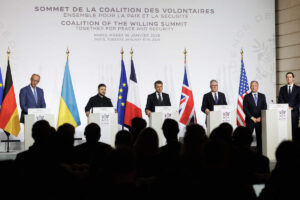
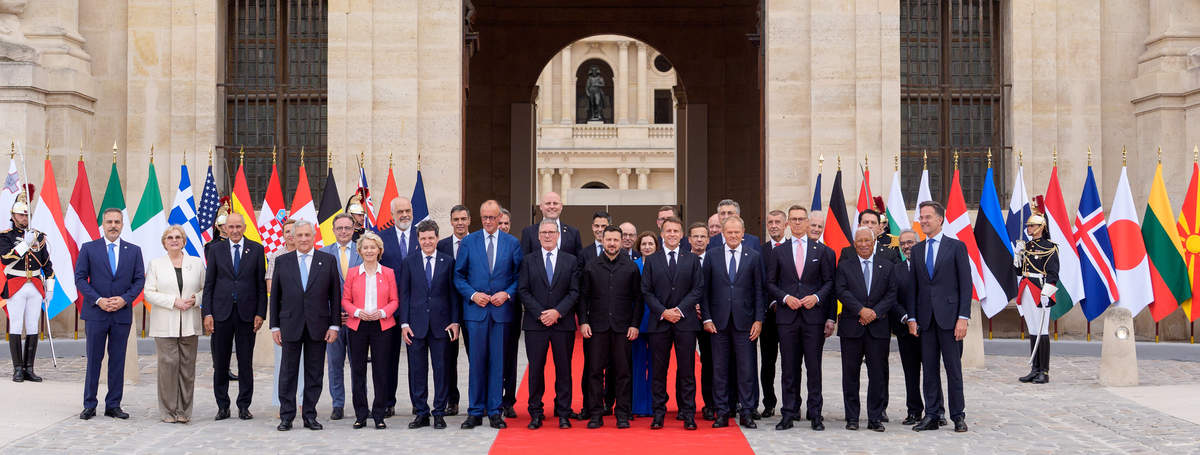
coalition of vontiers in Paris (Flickr)
The Coalition of the Willing for Ukraine meets this Monday, August 24 — the 35th anniversary of Ukrainian independence — under the joint chairmanship of Emmanuel Macron, Friedrich Merz and Andy Burnham. The meeting comes at an urgent moment: fighting is intensifying on the ground and Moscow is preparing a new mobilization, while in Kyiv, Volodymyr Zelensky has just ruled out holding elections in wartime.

A Meeting Under Heavy Diplomatic Pressure
According to a statement from the Élysée Palace released Friday, August 21, the Coalition of the Willing — an international alliance supporting Ukraine formed in March 2025 at the initiative of Czech President Petr Pavel — will meet this Monday at 1 p.m. in a hybrid format, with Volodymyr Zelensky taking part. The session will be jointly chaired by Emmanuel Macron, via videoconference, German Chancellor Friedrich Merz, and, for the first time, new British Prime Minister Andy Burnham. About a dozen leaders, including European Council President António Costa, are expected to be in Kyiv alongside the Ukrainian head of state, while European Commission President Ursula von der Leyen is not expected to attend in person.
According to a European official cited by several news agencies, talks are expected to focus primarily on strengthening Ukrainian air defenses, as the country faces a shortage of interceptors against Russian strikes. The Élysée says leaders will reaffirm “their determination to increase pressure on Russia” and continue coordinating measures aimed at drying up the resources funding Russia’s war effort, including the fight against the “shadow fleet” Moscow uses to circumvent oil sanctions. The meeting is also meant to advance work on security guarantees intended to underpin a “just, robust and lasting” peace, building on the Paris Declaration of January 6, 2026.
On the Ground, Moscow Prepares a New Mobilization
The meeting comes as the war enters a phase of intensification. Volodymyr Zelensky said this weekend that Russia plans to mobilize an additional 300,000 troops for the Ukrainian front after Russia’s parliamentary elections, scheduled for September 16-20, with a longer-term goal of recruiting 500,000. The Ukrainian president described a “peripheral mobilization” that would spare Russia’s major cities but, he said, would be hard to conceal. He also cited a Russian goal of producing roughly 1,300 ballistic missiles a year, while Ukraine expects to receive only 264 interceptor missiles this year, down from 364 in 2025 and 675 in 2023 — a shortfall Kyiv is trying to offset through new agreements, including delivery of at least one SAMP/T air-defense system from France and roughly 600 missiles from Germany.
These statements echo converging battlefield reports. Recent military bulletins point to intense fighting on the Zaporizhzhia, Kherson and Dobropillya fronts and in Dnipropetrovsk region, along with exchanges of soldiers’ remains between the two sides. This information comes from both Ukrainian and Russian sources, whose respective figures cannot be independently verified and should be treated with caution.
BACKGROUND
Formed in March 2025 at the initiative of Czech President Petr Pavel, and later organized under French and British leadership, the Coalition of the Willing brings together roughly thirty countries supporting Kyiv. It notably held a summit in Paris on July 13, 2026, on the eve of the Bastille Day parade, building on the G7 summit in Évian and the Paris Declaration of January 6, 2026.
Zelensky Rules Out Elections That Would “Destroy the Country”
On the domestic front, Volodymyr Zelensky responded for the first time to the call for elections made last week by his former defense minister, Mykhailo Fedorov, who was dismissed in late July amid vocal protests. In remarks made Saturday and released Sunday, the Ukrainian president said holding a wartime vote, absent a major cessation of hostilities, would “destroy the country by splitting society,” calling the prospect a “tsunami.” Ukrainian law bars elections under martial law, in effect since Russia’s full-scale invasion began in February 2022; Mr. Zelensky’s presidential term technically expired in May 2024.
Mr. Zelensky pointed to the practical hurdles such a vote would have to overcome — including how to enable voting by mobilized troops, millions of refugees abroad, and residents of Russian-occupied territory. According to an analysis by CNN, an incomplete or contested vote would hand Moscow a propaganda win, since the Kremlin already cites the wartime ban on elections to question the Ukrainian president’s legitimacy, even as Russia’s own electoral process is not considered free by Western observers. Polling suggests former armed forces commander Valery Zaluzhny or Mr. Fedorov himself would be the frontrunners in any eventual election.
Two Fronts for Kyiv: Military and Political
The convergence of these two issues — international military support and the debate over the democratic legitimacy of Ukraine’s leadership in wartime — casts Monday’s meeting in a particular light. For the Western leaders gathered around Emmanuel Macron, the goal is to demonstrate the durability of their commitment at a moment when Moscow is betting on wearing Kyiv down before winter, and when the question of security guarantees still has no concrete bearing on any ceasefire.
L’article Ukraine : Macron, Merz and Burnham Close Ranks as Russia Steps Up the War est apparu en premier sur FrenchDailyNews.
🔴 MAGAZZINO VUOTO | LEVANTE
A Levante questa sera, mercoledì 5 agosto 2026, live alle 18,30, Margherita Furlan dialoga con Antonio Mazzeo e Paolo Borgognone.
Washington annuncia di essere a poche ore da un’intesa provvisoria di sessanta giorni sulla riapertura dello Stretto di Hormuz.
Nelle stesse ore un’inchiesta di Reuters rivela che cinque mesi di guerra hanno prosciugato quasi per intero le scorte americane di missili tattici a lungo raggio.
E a Roma, dentro l’ambasciata degli Stati Uniti, si chiude il settimo round dei colloqui fra Israele e Libano.
Tre notizie che i telegiornali raccontano separate. Le leggiamo come un solo movimento: la potenza egemone consuma, l’Europa paga, l’Italia presta il territorio. Il magazzino è vuoto, e la diplomazia improvvisa di Washington somiglia molto a un inventario.
AFFRONTIAMO INSIEME
L’accordo su Hormuz e chi tratta davvero con chi: Teheran ribadisce che il negoziato è con l’Oman e non con Washington
L’inchiesta sugli arsenali americani esauriti e cosa significa per la deterrenza verso Russia e Cina
Le comunicazioni di Giorgetti alla Camera: 21,7 miliardi per la difesa e 14,4 per l’energia, con la flessibilità energetica incastrata dentro la clausola militare
I 14,9 miliardi del fondo europeo SAFE, prestiti da restituire, e lo scontro sul mandato parlamentare
Roma sede del negoziato Israele-Libano mentre l’Idf costruisce nuove basi nel sud del Paese dei cedri
Cosa resta della tradizione di sovranità mediterranea da Mattei a Moro a Craxi
Perché la borsa festeggia insieme la pace sullo Stretto e il titolo della prima azienda italiana della difesa
LIBRI DEGLI OSPITI
Antonio Mazzeo
La scuola va alla guerra. Inchiesta sulla militarizzazione dell’istruzione in Italia, Manifestolibri
I padrini del ponte. Affari di mafia sullo stretto di Messina
Sicilia armata. Basi, missili, strategie nell’isola portaerei della NATO
Il MUOStro di Niscemi. Per le guerre globali del XXI secolo
Paolo Borgognone
Populismo e «democrazia illiberale», Il Cerchio, 2023
La dottrina Stranamore, La Vela, 2022
Goodbye globalism!, Il Cerchio, 2022
Storia alternativa dell’Iran islamico, Oaks Editrice, 2019
SOSTIENI CASA DEL SOLE TV
Casa del Sole TV è un progetto di giornalismo indipendente autofinanziato.
Senza editori, senza partiti, senza padrini politici.
Per donazioni:
IBAN: IT63P0326822300052392596590
Intestato a: La Casa del Sole Edizioni
Causale: Donazione Casa del Sole TV
Membership YouTube:
https://www.youtube.com/@CasadelSoleTVChannel
— Analista Multipolare €5/mese
— Inviato della Verità €15/mese
— Architetto del Futuro €25/mese
I LIBRI DI MARGHERITA FURLAN
BRICS Scacco Matto, La Casa del Sole Edizioni (disponibile in italiano, inglese, russo)

SEGUI CASA DEL SOLE TV
YouTube: @CasadelSoleTVChannel
#geopolitics, #war, #news, #iran, #hormuz, #trump, #putin
L'articolo 🔴 MAGAZZINO VUOTO | LEVANTE proviene da Casa del Sole TV.
Vietnam, EU elevate ties citing ‘threat’ to ‘rules-based order’
Hanoi (dpa) – Vietnam and the European Union on Thursday upgraded ties to a comprehensive strategic partnership, Vietnam’s highest diplomatic tier, amid a tumultuous period for global trade.
In a joint statement, Vietnam and EU stressed “the importance of a partnership based on common interests and shared values of peace, security, and prosperity in a rules-based international order, based on international law.”
Though US tariffs were not explicitly mentioned, at a press briefing held after meeting Vietnamese President Luong Cuong, European Council President António Costa said: “At a moment when the international rules-based order is under threat from multiple sides, we need to stand side-by-side as reliable and predictable partners.”
“Vietnam considers the EU one of its most important partners in the world and wishes to continue promoting and deepening its relationship with the EU,” Cuong said.
Cuong labelled the move a “historic milestone,” coming 35 years after Vietnam and the EU established diplomatic relations. The EU-Vietnam free trade agreement, signed in 2020, has helped drive a 40 percent increase in bilateral trade.
Vietnam is one of the EU’s largest trading partners in South-East Asia, while the EU is Vietnam’s fourth-largest trading partner. In the first 10 months of 2025, two-way trade reached nearly 61 billion Dollar (51 billion Euro), up 8.4 percent year on year.
Vietnam and the EU on Thursday also underscored the need to strengthen cooperation on peace, defence and security, and voiced support for multilateralism and respect for international law, including the UN Charter. (29 January)
Iran War: Wall Street’s Quiet Jackpot

Billions of dollars (UnlimPhotos)
Since the outbreak of the US-Israeli conflict with Iran in late February 2026, the six largest Wall Street banks have posted one blockbuster quarter after another. It’s a paradox that isn’t really one: market volatility — the very thing savers and businesses dread — is precisely what trading desks feed on.
Numbers That Boggle the Mind
On July 14, 2026, five of the biggest US banks reported earnings on the same day, and the results surprised even the most bullish analysts. JPMorgan Chase, the nation’s largest bank by assets, posted quarterly profit of $16.9 billion, once again driven by its equities trading division, which “took advantage of market volatility triggered by the war in Iran.” Revenue in that division jumped 35% year-over-year, and equity markets revenue soared 86%.
According to several financial outlets, JPMorgan’s profit — including gains on its equity holdings — actually came close to $21 billion for the quarter, an all-time record for the bank.
Goldman Sachs was no exception: the investment bank also handily beat forecasts, lifted both by conflict-driven volatility and by SpaceX’s record-breaking IPO, which Goldman co-led. Its merger-advisory fees rose 55%, and in the first half of 2026 alone it advised on $1.2 trillion in announced mergers and acquisitions — an unprecedented pace for any investment bank, putting it $425 billion ahead of its nearest rival.
All told, in the second quarter of 2026 alone, the five biggest banks combined (JPMorgan, Bank of America, Goldman Sachs, Citigroup and Wells Fargo) posted roughly $49 billion in combined profit. In the first quarter, the six largest US banks — those five plus Morgan Stanley — had already collectively booked nearly $48 billion in profit, well above year-earlier levels.
Why Does War Benefit the Banks?
The mechanism is no mystery to market professionals, even if it startles the general public. A trading floor doesn’t make money when markets are calm — it makes money when they move. Every geopolitical jolt — a military strike, a rumored ceasefire, a partial closure of the Strait of Hormuz — triggers waves of buying and selling across stocks, currencies and commodities. Every transaction generates fees.
Since the first US-Israeli strikes on February 28, 2026, bond, oil and stock markets have swung wildly with each twist of the conflict and every dashed hope of a truce. That chronic instability has directly fueled investment banks’ trading revenues.
On top of that comes an indirect effect: the war slowed, then unleashed in waves, mergers-and-acquisitions activity and IPOs — two highly lucrative businesses for investment banks, which collect substantial advisory fees on every deal.
Goldman Sachs itself acknowledges as much in black and white in its quarterly financial report filed with the US securities regulator (SEC): the Iranian conflict has had “significant implications for the global economy,” combining disrupted oil supply, higher oil prices and heightened equity-market volatility — precisely the ingredients of the trading desk’s playbook.
A Paradox That Goes Beyond the Banks
This phenomenon isn’t confined to the banking sector. Major oil companies — especially European majors with large trading arms, such as TotalEnergies — have seen profits surge on the back of price swings following the partial closure of the Strait of Hormuz, a route for roughly a fifth of the world’s oil and gas. Defense contractors, for their part, are reporting record order backlogs, led by Lockheed Martin, Boeing and Northrop Grumman, buoyed by allied nations rearming.
Meanwhile, households and non-financial businesses bear the flip side of that same volatility: higher energy prices, costlier freight, and mounting uncertainty for long-term investment. The conflict has thus become a vast transfer of wealth, in which the very instability harming the real economy is simultaneously enriching a handful of financial and industrial players positioned to capitalize on it.
At a Glance
- Q1 2026: the six largest US banks combined for nearly $48 billion in profit.
- Q2 2026: five of them posted roughly $49 billion in combined quarterly profit.
- JPMorgan: record quarterly profit of nearly $21 billion (including gains).
- Goldman Sachs: M&A advisory fees up 55%, with its M&A backlog at a five-year high.
- Mechanism: market volatility, driven by the twists and turns of the US-Israeli conflict with Iran since February 28, 2026, has mechanically boosted investment banks’ trading and advisory revenues.
L’article Iran War: Wall Street’s Quiet Jackpot est apparu en premier sur FrenchDailyNews.
U.S. biolabs abroad: Tulsi Gabbard declassifies an explosive report

Tulsi Gabbard declassifies an explosive report
The Director of National Intelligence has revealed the existence of more than 120 U.S.-funded biological laboratories in over 30 countries, including several dozen in Ukraine. This revelation has reignited the debate on transparency and biosafety.
Today, on my final day as Director of National Intelligence, I’m releasing never-before-seen communications and documents exposing how Dr. Fauci provided millions in US taxpayer dollars to fund dangerous gain-of-function research at the Wuhan lab, worked with politicized elements… pic.twitter.com/ZMdliW4zyS
— DNI Tulsi Gabbard (@DNIGabbard) June 19, 2026
An unprecedented report made public
After several months of reviewing intelligence archives, Director of National Intelligence (DNI) Tulsi Gabbard released new information indicating that the United States has long funded more than 120 biolaboratories in over 30 countries.
Gabbard described the release as one of her final actions before leaving her post as Director of National Intelligence. On May 22, she announced her resignation in order to care for her husband, who has been diagnosed with cancer.
The declassified documents, which remain partially redacted, detail the locations and functions of various laboratories that “likely housed dangerous pathogens.”
Highly Dangerous Pathogens, Limited Oversight
According to the documents, the United States “built and supported” 40 biolabs in Ukraine that worked on “particularly dangerous pathogens,” including anthrax, avian influenza, Ebola, plague, and tuberculosis. At least 12 of these laboratories conducted research involving human subjects.
According to an official ODNI statement, “many of these U.S.-government-funded biolabs conducted research on dangerous and highly contagious pathogens, in some cases including studies designed to enhance the functions of these pathogens, with virtually no oversight or supervision.”
The declassified map notably shows that a laboratory in Odesa—a city of one million residents—stored biological agents inherited from the former Soviet biological weapons program, including anthrax, tuberculosis, SARS, Marburg virus, Ebola, Lassa fever, and plague.
Risks in a War Zone Highlighted
Gabbard emphasized that some of these laboratories in Ukraine could be compromised because of the ongoing conflict with Russia. According to her, intelligence agencies had previously warned internally that a U.S.-linked biolaboratory in Ukraine “likely housed dangerous pathogens” and remained vulnerable to Russian attack, seizure, or damage.
Previous Administrations Accused
In a statement, Gabbard said that Dr. Fauci and members of the Biden administration’s national security team “lied to the American people about the existence of U.S.-funded and U.S.-supported biolaboratories and threatened those who attempted to expose the truth.”
The ODNI stated that this information had been “intentionally concealed” by previous administrations.
In March 2022, Under Secretary of State Victoria Nuland acknowledged under oath that “Ukraine has biological research facilities,” while denying that those facilities worked on biological weapons and asserting that “the United States does not own or operate any chemical or biological laboratories in Ukraine.”
End of Funding for High-Risk Research
Gabbard also confirmed a major policy shift under the Trump administration: Washington is ending decades of federal funding for gain-of-function research overseas. The move follows Executive Order 14292, signed by President Trump in May 2025, which aimed to terminate such international funding.
What the Report Does Not Prove
It should be noted that the declassified documents, while exposing serious shortcomings in oversight, risky gain-of-function research, and vulnerabilities in conflict zones, concern programs many of which supported legitimate disease surveillance efforts. The report does not confirm the existence of an illegal offensive biological weapons program, but it does document a striking lack of transparency and oversight spanning several decades.
Sources: ODNI (Official Release No. 10-26, June 12, 2026), Newsweek, Daily Caller, and BizPac Review.
L’article U.S. biolabs abroad: Tulsi Gabbard declassifies an explosive report est apparu en premier sur FrenchDailyNews.

Kyiv Requests an Additional $20 Billion to “Burn” Russia

Dollars for Ukraine (Photo Unlimphotos)
Dollars, and more dollars! According to exclusive information published by Politico, Ukrainian Defense Minister Mykhailo Fedorov will present an emergency aid request for $20 billion on June 18 at the next meeting of the Ukraine Defense Contact Group in the Ramstein format. The goal: to capitalize on what he considers a temporary but decisive military advantage.
A Six-to-Nine-Month Window of Opportunity
Ukraine believes that current battlefield dynamics offer a rare opportunity. Russian advances have slowed significantly this year, to the point of nearly stalling last month, largely due to Ukrainian medium- and long-range drone strikes against Russia’s logistics networks and energy infrastructure.
According to a senior Ukrainian Defense Ministry official quoted anonymously by Politico, “we have a six-to-nine-month window of opportunity on the battlefield that requires an urgent acceleration of funding.” The same official warned that Russia is “moving quickly and innovatively”; any pause would allow Moscow to adapt and regain lost ground.
“Everyone can see that Russia is burning, and we want it to burn even more. But to do that, we need funding,” said a senior anonymous Ukrainian defense official.
In short, we still need billions more dollars.
A Detailed Plan Already Under Discussion with Allies
The Ukrainian plan has already been presented during a series of bilateral meetings led by Minister Fedorov and other senior officials with representatives from Norway, Sweden, Germany, and Canada. Each ally would be asked to contribute between $2 billion and $6 billion, either through direct assistance or loans.
The funds would be allocated to the acquisition of air defense systems, drones, ammunition, electronic warfare equipment, and long-range strike capabilities. Part of the financing would also support NATO’s Prioritised Ukraine Requirements List (PURL) program, as well as direct purchases from Ukrainian defense manufacturers.

Pushing Putin to the Negotiating Table
Behind the military rationale for this request lies a political objective: forcing Vladimir Putin to come to the negotiating table.
According to another source cited by Politico, “Ukraine has a real chance to bring the dictator to negotiations,” provided Russia is not given time to recover its tactical advantage.
The potential development of Russian medium-range drones is described as a worst-case scenario. “If the enemy develops its own medium-range drones, it would be a real disaster for Ukraine,” one source noted.
Putin himself stated last week that Russian forces are advancing every day, while also acknowledging that Ukrainian strikes are causing damage.
An Effort Within a Broader NATO Framework
Ukraine’s request comes amid a broader intensification of Western support. According to four NATO diplomats also cited by Politico, Alliance members are considering a new €70 billion military assistance program, which could be announced at the NATO summit in Ankara next month.
The initiative, championed by Germany, aims to improve transparency and ensure a fairer distribution of the burden among allies.
If the additional $20 billion is secured, total assistance committed in 2026 would reach $58 billion, close to the $60 billion bilateral target set by NATO Secretary General Mark Rutte. Kyiv intends to reach that goal before the end of the summer.
Source: Politico (exclusive), June 12, 2026. Article compiled using information cross-checked with Kyiv Post, United24 Media, and US News.
L’article Kyiv Requests an Additional $20 Billion to “Burn” Russia est apparu en premier sur FrenchDailyNews.