EMERGENZA ENERGETICA: L’ITALIA PAGA IL CONTO A Levante, con Margherita Furlan, Alessandro Volpi (Università di Pisa, analista di economia e finanza) lancia l’allarme su quella che rischia di diventare la vera emergenza sociale dei prossimi mesi: il costo dell’energia in Italia. Bollette fuori controllo per famiglie e imprese, un sistema industriale che perde competitività, un Paese che paga l’elettricità tra le più care d’Europa. Non è un incidente di percorso: è il risultato di scelte politiche precise. Tra queste, l’abbandono delle forniture energetiche russe a basso costo, sostituite da gas liquefatto più caro e da rotte di approvvigionamento più lunghe e più fragili. Una decisione presa a Bruxelles e a Washington, ma pagata dai cittadini e dalle piccole e medie imprese italiane. Nella puntata: perché le bollette italiane restano più alte di quelle dei nostri concorrenti europei chi guadagna dalla sostituzione del gas russo l’impatto sul tessuto produttivo e sull’occupazione il peso di oneri di sistema, speculazione finanziaria e mercato elettrico quale margine di sovranità energetica resta all’Italia Levante: ogni giorno, dal lunedì al venerdì, dalle 19 alle 20. Analisi e approfondimento sulla transizione internazionale in corso. ISCRIVITI al canale e attiva la campanella per non perdere le prossime puntate. Lascia un commento: quanto è aumentata la tua bolletta nell’ultimo anno? SOSTIENI CASA DEL SOLE TV Siamo una televisione indipendente e autofinanziata: esistiamo solo grazie a chi ci sostiene. Iscrizioni al canale (Analista Multipolare €5, Inviato della Verità €15, Architetto del Futuro €25): / @casadelsoletvchannel Bonifico: IBAN IT63P0326822300052392596590, intestato a La Casa del Sole Edizioni, causale “Donazione Casa del Sole TV” SEGUICI Instagram: @margheritafurlangiornalista Facebook: / margheritafurlan555 #Levante#AlessandroVolpi#MargheritaFurlan#CasaDelSoleTV#CaroBollette#EmergenzaEnergetica#GasRusso#Energia#Economia#Geopolitica#Multipolarismo#Italia#Inflazione#SovranitàEnergetica EMERGENZA ENERGETICA: L’ITALIA PAGA IL CONTO A Levante, con Margherita Furlan, Alessandro Volpi (Università di Pisa, analista di economia e finanza) lancia l’allarme su quella che rischia di diventare la vera emergenza sociale dei prossimi mesi: il costo dell’energia in Italia. Bollette fuori controllo per famiglie e imprese, un sistema industriale che perde competitività, un Paese che paga l’elettricità tra le più care d’Europa. Non è un incidente di percorso: è il risultato di scelte politiche precise. Tra queste, l’abbandono delle forniture energetiche russe a basso costo, sostituite da gas liquefatto più caro e da rotte di approvvigionamento più lunghe e più fragili. Una decisione presa a Bruxelles e a Washington, ma pagata dai cittadini e dalle piccole e medie imprese italiane. Nella puntata: perché le bollette italiane restano più alte di quelle dei nostri concorrenti europei chi guadagna dalla sostituzione del gas russo l’impatto sul tessuto produttivo e sull’occupazione il peso di oneri di sistema, speculazione finanziaria e mercato elettrico quale margine di sovranità energetica resta all’Italia Levante: ogni giorno, dal lunedì al venerdì, dalle 19 alle 20. Analisi e approfondimento sulla transizione internazionale in corso. ISCRIVITI al canale e attiva la campanella per non perdere le prossime puntate. Lascia un commento: quanto è aumentata la tua bolletta nell’ultimo anno? SOSTIENI CASA DEL SOLE TV Siamo una televisione indipendente e autofinanziata: esistiamo solo grazie a chi ci sostiene. Iscrizioni al canale (Analista Multipolare €5, Inviato della Verità €15, Architetto del Futuro €25): / @casadelsoletvchannel Bonifico: IBAN IT63P0326822300052392596590, intestato a La Casa del Sole Edizioni, causale “Donazione Casa del Sole TV” SEGUICI Instagram: @margheritafurlangiornalista Facebook: / margheritafurlan555 #Levante#AlessandroVolpi#MargheritaFurlan#CasaDelSoleTV#CaroBollette#EmergenzaEnergetica#GasRusso#Energia#Economia#Geopolitica#Multipolarismo#Italia#Inflazione#SovranitàEnergetica
Increased NATO military exercises near Russia’s Kaliningrad Region and aggressive rhetoric from members of the US-led bloc are raising the risk of a direct armed conflict, Moscow has warned.
Russia has sent NATO a warning stressing its determination to protect the Russian exclave in the Baltic region “with its entire available arsenal,” according to a statement published on Monday by the Russian Embassy in Belgium, which hosts the bloc’s headquarters.
The message alluded to remarks made earlier this month by Polish Foreign Minister Radoslaw Sikorski, who said there are “hardly any troops” in Kaliningrad Region and urged NATO to increase its military posture near Russia’s borders so that Moscow would be “uncertain of what we will do.”
NATO spokesperson Allison Hart confirmed receiving the Russian message and accused Moscow of irresponsible rhetoric.
”We strongly denounce the threat of force, including any irresponsible nuclear rhetoric,” she said.
Western officials have frequently described Russian statements invoking its nuclear deterrent as “blackmail,” while presenting NATO’s own nuclear-sharing arrangements as a pillar of collective defense.
France has offered to discuss the possible deployment of its nuclear weapons in other European NATO countries, arguing that this could reduce the bloc’s dependence on the US. Under NATO’s existing nuclear-sharing arrangements, American nuclear bombs are stored in several European countries, while personnel from non-nuclear member states train for missions involving their potential use.
Russia has repeatedly rejected Western claims that it intends to attack NATO before the end of the decade, describing such warnings as warmongering aimed at persuading voters to support sharply higher military spending.
Moscow, in turn, views NATO’s military preparations as potentially paving the way for an attack on Russia. Foreign Minister Sergey Lavrov has repeatedly warned that any such conflict would be extremely brief, implying that Moscow could resort to nuclear weapons.
The Russian Embassy in Ireland used more direct language, saying on Tuesday that Moscow is prepared to use nuclear weapons in response to an attempted NATO blockade of Kaliningrad Region and may consider pre-emptive military action in such a crisis.
Kremlin spokesman Dmitry Peskov said on Wednesday it was “natural for our diplomats to try and remind hotheads in Europe about our doctrinal documents,” in response to the rhetoric coming from Poland and other nations.
When Saudi Arabia, Turkey and Pakistan agreed to a mutual defense pact in August, it was principally seen as a political commitment. The “Mecca alliance,” as it was dubbed, stipulated that an armed attack on one would be treated as an attack on all three, accompanied by deeper military cooperation. That pact is no longer […]
As its war on multipolarism expands, Washington is converting the Western economy to arms production, draining its client states, and eroding its own social foundations — repeating the terminal trajectory of the British Empire. For decades, the US has leveraged its many client states as extensions of its own military, economic, financial, and political power, […]
In a recent phone call, Donald Trump urged Volodymyr Zelensky to stop Ukrainian attacks on Russian oil refineries. Whether a request or a demand, this appears, certainly at first glance, fundamentally different from the Biden administration’s policy of restricting the use of US long-range missiles to hit targets inside Russia. The US president has justified […]
This story is a part of the weekly newsletter about security, defence, and tech in the eastern flank of Nato, How we cee it.
Over the past few weeks, a new wave of fear has engulfed Europe. A number of intelligence and government officials have spoken out, saying Russia could possibly attack a Nato country within months, not years.
On 18 September, Polish prime minister Donald Tusk warned that Russia is planning hybrid strikes with drones or rockets on European countries that support Ukraine, such as Poland.
Two days later, Czech intelligence chief Michal Koudelka told the Guardian that, as well as increased drone activity, a small-scale invasion of Nato territory bordering Russia could be part of the Kremlin’s plans.
Then, last Thursday, Denmark’s defence intelligence service said that Russia is likely to intensify its hybrid war against the West in the coming months, with more frequent attacks against Nato countries.
On the same day, speaking at the Council on Foreign Relations in New York, Poland’s foreign minister Radosław Sikorski said, according to TVP World: “We are receiving information … that Russia is preparing something big this year.”
This is not the first time a wave of comments like this has appeared. A similar situation arose last year, when various officials in Europe took turns escalating their rhetoric about the Russian threat.
It is possible that they are speaking out again because new information has surfaced within the intelligence community. The communication goal could be letting Russia know that they know. Much like CIA director John Ratcliffe’s visit to Moscow last month, this could be an effort to make sure Russia doesn’t miscalculate.
The warnings also come in a different context from last year, when the Baltic countries were sounding the alarm. Russia has noticeably been turning up the temperature of its activity around Europe.
Back in July, a cruise missile crashed in Poland. According to experts, it was not a misguided missile, but one deliberately aimed at Poland. Then, in early August, a drone carrying an explosive device was discovered at Leipzig/Halle Airport in eastern Germany, close to Ukrainian cargo planes.
Germany’s interior minister Alexander Dobrindt said the Leipzig airport attack followed the “well-established pattern of Russian hybrid operations in Europe,” the BBC reported.
According to German investigators, who spoke to Frankfurter Allgemeine Zeitung, the incident was also connected to other events, such as an attempted arson attack on a drone manufacturer in eastern Slovakia, and an arson attack in Munich on September 3, when several incendiary devices were thrown from a passing car onto a construction site near the headquarters of defence firms Rohde & Schwarz and Helsing.
In fact, there have been so many different incidents recently that the semi-regular drone incursions into Romania and the Baltics have become almost normalised and struggle to make headlines anymore.
Hypothetical scenarios abound
Scenarios of where Russia could take its hybrid attacks next are as abundant as onlookers’ creativity allows. They range from small attacks on factories, through the seizure of a small piece of land by an elite drone unit, all the way to the capture of the Suwałki corridor – a strategic piece of land between the Baltic states and mainland Europe.
Most recently, the CIA warned that while all eyes had so far been on the Baltics, Russia may be preparing a drone strike against Spain, France, and Italy.
According to Marko Mihkelson, chairman of the Estonian parliament’s foreign affairs committee, the snowball of speculation about an imminent Russian attack on Europe is gathering pace.
But as he sees it, isolated facts are being mixed with wishful thinking, worst-case scenarios and, at times, little more than the need to grab attention.
As he wrote in an opinion piece for the Estonian news agency ERR: “Russia understands that it can confuse and paralyse us through information operations alone. Constant speculation about the Baltic states and Poland risks creating the impression that this is primarily a problem for two or three countries on Russia’s doorstep, while the rest of Europe can somehow remain untouched.”
According to Mihkelson, Russia’s campaign against the West would not necessarily begin with a conventional attack.
It could start by undermining Nato from within: interfering in elections, amplifying polarising narratives, exploiting political divisions, and spreading fear. It could seek to isolate Ukraine by limiting Western support, and then test Nato’s willingness to stand together.
As for worries that Russia will attempt to grab land from the Baltics or Poland, there are no significant material or military changes to note along the borders.
Belarus did hold a four-day military exercise near its border with the Suwałki corridor in mid-September, but that is nothing close to the signals we were getting from Russia just before the full-scale invasion of Ukraine. Back then, physical military infrastructure was being constructed ahead of the attack.
There are also no significant changes in the Russian military’s posture to launch a land attack against the Baltics.
Estonian government officials confirm this. According to Estonia’s minister of defence, Martin Herem, its assessment of the Russian threat remains unchanged.
That means Russia’s main effort remains focused on its war in Ukraine, and neither Estonia, Denmark, nor other Nato allies currently see a threat requiring raised military readiness.
Military experts in Lithuania also see no signs of new escalation. This doesn’t mean Russia won’t continue to be dangerous. It means that Russia has been engaged in provocations against Nato countries for years already, and similar behaviour will continue.
“No one is currently planning to conquer us – not at this moment, nor this year. In this case, specific, very precise attacks or provocations are more likely, designed not so much to cause physical damage as to sow serious panic in people’s minds,” Deividas Šlekys, a professor at Vilnius University’s Institute of Political Science and International Relations, told the Lithuanian wire LRT on Monday (28 September).
And so, while last autumn it was the Baltic states sounding the alarm about a potential Russian attack, now their officials are looking to calm the panic about their aggressive neighbour.
Less than two months after his government hosted the NATO summit — which was framed as proof of Turkey’s pivotal role in transatlantic security — President Recep Tayyip Erdogan has proposed full Turkish membership in the Shanghai Cooperation Organisation, an entity that has been described as being anti-NATO or a “rogue NATO.” The apparent contradiction […]
Gli effetti di una fusione tra banche vanno valutati considerando il mercato e i segmenti di clientela coinvolti. Le operazioni possono produrre guadagni di efficienza e migliorare la qualità dei prestiti. Ma possono anche portare a riduzione del credito.
The following are excerpts from my speech in Istanbul on September 26, 2026.
The unipolar world order has collapsed, and we should conduct a post-mortem to reflect on what went wrong and to understand the current turbulent transition of the world. In 1989, Francis Fukuyama famously published his article on the ‘End of History,’ which was largely adopted as an ideological guide by the political West. The world only had one superpower and one ideology, and the expectation was that the world would unify under US leadership and liberal democratic values. The dominance of the US would end international anarchy and security competition, as there was only one centre of power, and the US hegemon would elevate the role of liberal democracy to form an inclusive community of universal values. For more than three decades, the West produced a new generation of politicians who believed that the collective hegemony of the West was for the benefit of all mankind, and they were the administrators who would manage the transition from the chaotic world of the past to perpetual peace. So what went wrong?
The Contradiction of Hegemonic Universalism
The unipolar moment was always destined to be a temporary phenomenon, as the US would predictably exhaust its resources and incentivise rising powers to collectively balance the US. However, there is also an inherent contradiction in hegemonic universalism, as universal values are linked to one entity of power. A hegemon claims to represent universal values such as freedom, democracy, and human rights, albeit this universalism is promoted through a particular historical, cultural, and geopolitical order.
Universal values advocating for equality are used to institutionalise a dominant position for the US. Universal values advocating for inclusion are used to build exclusive blocs such as NATO rather than developing an inclusive pan-European security architecture. John Herz noted as early as 1950 that the more democratic states were at home, the more they seemed to insist on a dominant position in international institutions to defend liberal values from the rule of the majority. Liberal values build on the idea that tolerance is imperative, as all people and states have different ideas about the good life and their own path to development, yet the universality of values suggests that all states must develop along the same path, and the political West, as the champion of liberal democracy, is the civilizational teacher seeking to “socialize” the rest of the world. Liberalism has subsequently been promoted as a hegemonic norm.
The Revisionism of Hegemonic Universalism
The modern world order was established with the Peace of Westphalia in 1648, in which a hegemonic system legitimised with universalist claims was replaced with a multipolar system based on the cultural distinctiveness of states. The past 80 years have been a historical anomaly, with a bipolar system that collapsed and gave way to a unipolar system with one centre of power. The normal situation of the world has been a multipolar Westphalian system with a power equilibrium.
Over the past decades, hegemonic universalism transformed European states as national competencies were transferred to the US. US military dominance meant that Europe largely outsourced its security and foreign policy to the US within the format of the alliance system. US economic dominance meant that the international economic architecture, with banks, currencies, payment systems, and trade agreements, was largely administered by the US. Civil society in Europe and beyond has been managed by “non-governmental organizations” financed by the US government and cooperating closely with US intelligence services. The European political system is premised on the idea that loyalty to international institutions is more vital and moral than national interests, as Europe’s linkage to the US within the political West is the main source of stability and prosperity.
Return of Civilizational Distinctiveness
The hegemon is now gone, and the universal claims are rejected by the wider world. A multipolar world is already here, and the rising powers are demanding a return to a Westphalian world order of sovereign equals based on civilizational distinctiveness. As Xi Jinping insists, all civilizations have their own path to development, and no aspiring hegemon has the right to tell others how to develop. The return of rhetoric about civilizational states across the Eurasian continent signifies a rejection of unipolarity and universalism. New institutions such as the SCO and BRICS attempt to accommodate the multipolar world, yet new members are joining faster than institutional efficiency can adjust to.
The US has reluctantly already begun adjusting to these new realities, as it recognises it cannot be everywhere and must prioritise, while the language of liberal universalism is being replaced with national interests. New political forces are rising in the US that want to scale back the empire to save the republic, as a strategic retreat would allow the US to rebuild its strength and end the collective balancing by other great powers. What makes Europe so dangerous today is its weakness and panic due to the failure of finding a new role in the multipolar system. Security can no longer be based on the dominance of the collective West; there is no clear economic model; and the claims of representing universal values are no longer convincing. Yet the Europeans are not willing to recognise new realities and adjust accordingly by diversifying economic and political connectivity. The available evidence suggests that this will be a very turbulent transition from unipolar universalism to multipolar distinctiveness, and the new world will more likely be born through war than diplomacy
The year 2023 was pivotal for understanding the effects of abortion restrictions in the United States. A year earlier, in June 2022, the U.S. Supreme Court issued the decision known as Dobbs v. Jackson Women’s Health Organization (JWHO), which overturned the abortion-rights protection established by a previous ruling from 1973: Roe v. Wade. Since then, thousands of American women have ended pregnancies with help from Mexican feminist collectives. Several recent studies put a face to those seeking abortions: a large share come from states such as Texas, where abortion is banned, and live in neighborhoods with high levels of poverty.
There have been many tipping points in history; to name just a few examples:
The Peace of Westphalia in 1648
The French Revolution of 1789
The Congress of Vienna in 1815
World War I in 1918
World War II in 1945
Many of these turning points led to shifts in power in Europe. These were merely transfers of power within the world we now call the “Collective” West. Examples include the collapse of the German Empire, the Austro-Hungarian Empire, the Ottoman Empire, and the Russian Tsarist Empire at the end of World War I.
These shifts in power were significant, yet what is happening now cannot be compared to past turning points, as they encompass the entire globe. The reins of power are not being handed over within the West; rather, there will be a shift in power toward the East and the “Global South.”
From Tipping Point to Entropy
The scale, the number of nations involved, the geographic scope, and the speed at which the current geopolitical crises are unfolding are truly astonishing.
Ukraine as a War Platform for the U.S., NATO, the EU, and Russia
Russia Will Prevail Militarily
Looking at the military reports from the front lines, it becomes clear to any observer that Russia will achieve its military objectives. While Russia might have relinquished the Donbas, Kherson, and Zaporizhzhia had a peace agreement been successfully concluded in the spring of 2022, such an agreement is unrealistic under the current circumstances, as Donetsk, Luhansk, Zaporizhzhia, and Kherson have been part of the Russian Federation since September 2022. It is currently unclear how far the Russian military advance will go. I have commented on this in my article “The Summer Peace Died,” to which I refer. For the situation on the front lines, I once again refer to Military Summary; I have been following this channel for nearly five years, and it provides objective reporting.
Catastrophic Mobilization Situation in Ukraine
There are thousands of videos showing young men being hunted down like animals on the streets throughout Ukraine in order to forcibly recruit them. Recently, however, videos have also been circulating that show some of those forcibly recruited being transported to the front lines without uniforms and even in handcuffs, like criminals—to prevent them from escaping. I’ll leave it to the readers to ponder the combat effectiveness of these men against battle-hardened and motivated Russian soldiers.
Armed guards transport mobilized Ukrainian men to frontline in order to prevent them from deserting. This is described as normal by the Ukrainian officer. Videos also show them in handcuffs. Zelensky & Western politicians call this freedom & democracy. pic.twitter.com/f6AGyuMpRX
The latest move by the Ukrainian military leadership is to forcibly conscript women. Given this situation, it’s no surprise that Scott Ritter stated that the Ukrainians are losing 30 times more soldiers than Russia. We hear nothing in the West about this inhumane treatment of their own soldiers in Ukraine.
Ukrainian volunteers, who later disappeared without a trace, are said to have used drones and artificial intelligence to count the number of soldiers’ graves throughout Ukraine. They counted 2,000,054 graves. Added to this are the dead buried by their own people in mass graves and the wounded—the Ukrainians’ losses do indeed appear to be astronomical. Nevertheless, Zelenskyy claims that only 50,000 Ukrainian soldiers have been killed. A few weeks ago, I attended a funeral in Russia. The soldiers’ graves are easily identifiable by the Russian flag and the flag of the fallen soldier’s unit. There were soldiers’ graves, but no sea of flags like in Ukraine.
Ukrainian volunteers, who later disappeared without a trace, reportedly used drones and artificial intelligence to count military graves across Ukraine. Their estimate was 2,000,054 graves. Yet Zelensky claims that only 50,000 Ukrainian soldiers have been killed. Does that mean pic.twitter.com/LeplE4H3n6
Military Victory Does Not Solve Russia’s Geopolitical Problem
Whatever needs to be achieved militarily, Russia will achieve it; however, this does not resolve Russia’s geopolitical problem on its western border, because the goal is not new territories, but peace in the West—a goal that Russia has literally been striving for centuries and has never been able to achieve. Time and again, Russia has been attacked from the West and has regularly paid a high price in blood, money, and industrial capacity—resources diverted to military spending rather than civilian purposes. As a result, Russia’s social development has been repeatedly set back.
If Russia wants to keep pace with the major powers in terms of its civilian economy in a sustainable manner, reliably securing its western border is an absolute prerequisite. Although Russia is the only industrialized nation in the world that is self-sufficient and thus capable of waging a war lasting decades, such a confrontation would massively hinder the country from achieving its actual development goals.
The U.S.’s Lack of Credibility in Negotiations with Russia
The U.S.’s lack of credibility in the eyes of Russia is multifaceted. On September 15, Foreign Minister Lavrov said, verbatim:
“If the Americans hadn’t backed away from the Anchorage agreements, if Europe hadn’t pulled them away from those agreements, we would have been living without war for a year now.” – Sergey Lavrov, September 15, 2026
Under this agreement, Russia would have made major concessions. Russia would have retained the Donbas, frozen the conflict in Zaporizhzhia and Kherson, and relinquished further territories. Objectively speaking, this was a bad deal for Russia, but it demonstrated the Russians’ considerable willingness to compromise. The Russians assumed that this verbal agreement was binding as a gentlemen’s agreement. However, gentlemen’s agreements should only be made with gentlemen. The Americans taught the Russians otherwise. The Russians are dismayed about this incident and have had to admit that no agreements are possible with the U.S. government. Personally, I’m surprised by the fact that this realization came so late. Even written agreements with the U.S. government are not to be trusted. This was evident in the breach of the Memorandum of Understanding that the Americans signed with Iran in June. Thus, one must conclude that this conflict—or any conflict in which the U.S. is directly or indirectly involved—must be fought to the bitter end. A bitter lesson for every contractual partner of the U.S.
The Risk of Escalation is Significant
Ukraine is desperately trying to officially draw NATO into this military conflict. It is astonishing that European countries—above all Germany and the United Kingdom—are not only signaling their willingness to do so, but are actually doing everything they can to prepare their people for a war with Russia.
Instead of naming many people, we’ll use Sir Jacob Rees-Mogg—former cabinet minister and Member of Parliament for North East Somerset—as an example. In this excerpt from an interview, he compares the situation with Russia—without naming it—to the situations during World War I and World War II:
European leaders are currently pivoting from “this is not our war” to “it’s your duty to die in a war with Russia.” pic.twitter.com/h2M0CBpk0g
Young people are thus being called to arms to prepare for war against Russia. In Germany, such efforts have failed miserably. Of the more than 300,000 young Germans surveyed, only 0.17% volunteered to serve in the Bundeswehr. Furthermore, it came to light a few days ago that the Bundeswehr itself could not even find 5,000 volunteers for a battalion in Latvia.
It is incomprehensible what these European countries are up to besides spreading propaganda. Even combined, the European countries do not possess military forces that would give them even the slightest chance of standing up to the Russian armed forces. The Russians are by no means impressed by this farce in Europe—they are disgusted by it. I assume that this war propaganda in Europe serves only to perpetuate the anti-Russian narrative.
Both President Putin and Foreign Minister Lavrov have repeatedly emphasized that they have no interest in attacking NATO targets outside Ukraine. However, if European countries are foolish enough to send even small European military contingents to Ukraine, the situation could change abruptly.
The greatest risk of escalation at the moment is that the Europeans, presumably in collaboration with the Americans, are planning a false flag attack in Europe in order to somehow trigger Article 5 of the NATO Charter. According to geopolitical analyst Warren Thornton, preparations for false flag attacks are in full swing. He writes on X:
THE FALSE FLAG
These are the areas that are the targets. The Mallorca airport in Spain. The Sorrento Continental Hotel in Italy. The Promenade De Anglais, Nice. The area to be launched from west of Sardinia. The agencies involved CIA, French Naval Intelligence Services and the… pic.twitter.com/ThDYyuZBOz
I can’t say whether this theory is correct, but it’s by no means far-fetched that the Europeans would attempt something so outrageous.
U.S. Military Campaigns in the Middle East Beginning in 2001
Looking back over the past 25 years, the U.S. has sought to reshape the Middle East according to the Wolfowitz Doctrine since 2001. None of the wars the U.S. launched during this period (Afghanistan, Iraq, Libya, Syria, Yemen, Somalia, etc.) were successful. In fact, it was already evident back then that the hegemon lacked the resources, military strategy, strength, and credibility needed to act successfully. However, if one’s view is that the actual intent was destabilization and chaos, then they were extremely successful. Nevertheless, they returned to the plan in collaboration with Israel, apparently after Israel had succeeded in completely undermining American policy.
Israel: Genocide and Greater Israel
The immediate starting signal for the “Genocide” and “Greater Israel” projects was given on October 7, 2023, when a military operation by Hamas was turned into a false flagattack to justify the genocide against women, children, and other civilians in Gaza and, later, in the West Bank and Lebanon. This, in turn, served as the starting signal for the continuation of the Greater Israel project; initially, Syria and Lebanon were attacked. Although the Western press not only downplays Israel’s genocidal and imperialist actions but also fully supports and fuels them—including through the media of “neutral” Switzerland—Israel is viewed with increasing criticism by the general public in the Western world. According to Pew Research, 60% of Americans view Israel negatively. The Western media thus conveys an image that finds no resonance among the general public.
When Israeli Prime Minister Benjamin Netanyahu took the podium to address the plenary session on Thursday, delegates to the UN General Assembly left the hall in droves.
NEW
UN General Assembly delegates stage a mass walkout as Israeli Prime Minister Benjamin Netanyahu takes the podium to address the hall pic.twitter.com/EcTpBBvjjM
It is important to me to continually remind my Western readers of what is actually happening in Gaza right before our eyes—eyes that many choose to close.
Major Escalation in the Middle East—Loss of Control
Starting in February 2026, events began to accelerate even further. Since then, everything has gone wrong for the West and Israel in the Middle East. The Global South has already wrested the initiative from the West. While Iran initially limited itself to responding to American-Israeli aggression, it is now the Iranians and the Yemeni Ansar Allah movement who are setting the pace.
Ansar Allah managed to bring the entire western coast of Yemen under its control in a very short time and thus controls not only the Bab al-Mandab Strait but also the island of Perim Mayyun off the coast. With virtually no Western media coverage, the advance continues, and it is quite possible that Aden will soon be captured.
Furthermore, the Saudis’ East-West pipeline was paralyzed and targets near Riyadh were attacked. So far, the Saudis have been unable to mount a serious military response to this large-scale attack, as they do not seem capable of doing so on their own, and repeated calls for help to Trump and others have been in vain. The Mecca Alliance, which unites Pakistan, Saudi Arabia, and Turkey in a military alliance, also appears to be a thing of the past, as even these “friends” refused to provide assistance.
President Macron’s grand announcement that he will send troops to Saudi Arabia won’t change any of that. “Arabia” is called Saudi Arabia because this country is ruled by a family—a tribe—the Sauds. A tribe that is protected by the Americans. However, there are approximately 100 other tribes within Saudi Arabia. It’s very possible that they could join forces with Ansar Allah and overthrow the House of Saud. The House of Saud no longer has any income and seems unable to continue buying off—as it has done until now—all those who could pose a threat to them. There’s a chance that the Saud house of cards will collapse, and if that happens, I wouldn’t give a penny for the remaining Gulf states.
Alastair Crooke also pointed out on several occasions that this dynamic could spill over into Iraq, another millennia-old civilization alongside Iran. If that happens, Kuwait will likely fall as well. Another smoldering conflict can also be detected in Jordan. It is therefore quite possible that the entire structure in the Middle East established by the British a good 100 years ago could collapse within a few months, without the Americans being able to stop this tsunami in any way. Arabia to the Arabs, Persia to the Persians, and the Americans out for good. If this happens, Israel will go from perpetrator to target; one certainly cannot speak of it as a victim in this context. How the emerging great powers of the Middle East will deal with the genocidal Zionists should be left to those who have suffered the greatest losses, for Palestinians are Arabs.
Europe
Chaos is once again rearing its head in Europe. Germany is the first country—once the world’s leading exporter and the major power in the EU—that is in danger of becoming politically ungovernable. The Alternative for Germany (AfD), which has been labeled as far-right and Hitler-like by the previously dominant parties and excluded from government participation by a so-called firewall, not only won landslide victories in two state elections in eastern Germany but also leads the CDU by a clear margin in national polls (30% to 20%). Chancellor Merz’s approval rating stands at 10 percent—a barometer that reveals the people’s dissatisfaction and would have driven any truly democratic chancellor to resign. Whether the Germans, in light of this political situation, will clench their fists and do nothing, as they have in the past, remains uncertain. The chancellor’s downfall would be good for Germany. The AfD is the only major party seeking dialogue and peace with Russia, which is not only desperately needed by this once-thriving industrial nation but is also a prerequisite without which it cannot survive economically. The alternative to real and fundamental political change in Germany is the war against Russia sought by Chancellor Merz and the ruling political elites. The last time Germany went to war against Russia in 1941, Adolf Hitler sent 3.7 million soldiers eastward and failed, despite the Germans’ genocidal behavior, which cost the lives of approximately 17 million civilians. As already explained above, the Federal Republic of Germany today finds itself unable to assemble a brigade of 5,000 volunteer soldiers for the Baltic states. This does not seem to concern the chancellor, which is a clear sign of the madness that has taken hold of him. This is strong evidence that he is acting in the interests of a power located outside Germany. One would be a naughty person to believe that this has anything to do with his BlackRock past. Those who managed to install him as chancellor can pat themselves on the back, as they’ve snagged a puppet at the bargain price of a few million.
The following clip shows how the new leadership in Berlin is presenting itself—the Left has taken over. No words needed:
The situation in the rest of Europe is no more encouraging. The presidential election in France will take place in April 2027. Macron is no longer eligible to run, and Marine Le Pen has a significant lead over the other candidates. The situation is thus similar to that in Germany: a party that is denounced as far-right by the parties currently in power, yet is the most popular among the people. Le Pen’s position on peace with Russia is unclear—she seems to be speaking with a forked tongue: on the one hand, she wants a negotiated peace, but at the same time supports the training of Ukrainian troops. A seasoned politician who positions herself to capture as many votes as possible. France’s financial situation is grim, with no silver lining. The rise in the interest rate on 10-year French bonds over the past twelve months has been even steeper than in any other European country.
Trump
President Trump’s policies only seem difficult to understand at first glance. His constant flip-flopping on Ukraine, Iran, and Israel is counterproductive and damaging to the U.S.’s reputation on the world stage. The reason behind Trump’s current actions is the midterm elections in November. Trump is struggling with the high oil prices he himself has caused, which he can prevent from spiraling out of control by manipulating the futures markets. However, actual market prices are 30% to 50% higher than the manipulated, fantasy futures prices. The fact that futures prices are indeed manipulated is evident, for example, in diesel prices at gas stations, which are moving in only one direction and have reached unprecedented levels worldwide. Diesel is the lifeblood of the American economy, and high prices are one of the biggest drivers of inflation, since virtually all goods are transported by trucks, agriculture depends on it, and large parts of industry rely on diesel. Trump’s latest farce: He’s blaming Zelenskyy for the high diesel prices because Ukraine is attacking Russian refineries; he’s doing this solely to divert attention from the biggest price drivers—the blockades of Hormuz and Bab al-Mandab.
Somehow, Trump wants to turn things around, but it seems that he will lose the midterm elections coming up in about six weeks. According to Polymarket, an American online prediction market where users bet on the outcomes of future events—with market prices reflecting collective probability estimates—the probability that the Republicans will lose their majorities in the House of Representatives and the Senate stands at 66%. Should this come to pass, Trump will likely face impeachment proceedings. He then runs the risk of going from a lame duck to a dead duck and being replaced by his turncoat vice president, Vance—not a promising outlook for the United States.
Trump’s latest appearance this week before the UN General Assembly was a testament to his psychopathic nature: He announced—nota bene after the election—that he would either make Iran a rich country or obliterate it completely.
Trump is every bit as bad as Adolf Hitler. In his speech at the Berlin Sportpalast on September 4, 1940, Hitler said, “We will wipe out their cities.” Trump wants to wipe out a 5,000-year-old civilization—without any legal basis, of course—acting like a god. In doing so, Trump is publicly calling for the genocide of an entire civilization. One might wonder whether he belongs in prison or in a psychiatric hospital, but the fact that he can make such statements before a global audience with impunity shows the depths to which Western civilization has sunk. I refer to a speech I gave in Switzerland on September 3.
The Financial Markets
I have made numerous comments on the instability of the financial markets. Now my dire predictions seem to be coming true. In addition to the overvaluations in the stock markets, I have repeatedly pointed out the unsustainable situation in the bond markets. Among the more astute market participants, fear is beginning to set in. Mr. Bessent has lost control of interest rates. On August 28, 2026, I looked at the average interest rate the U.S. had to pay on its debt; at that time, it stood at 3.35% (May), resulting in an annual interest burden of 1,340 billion. Today, this average interest rate stands at 3.49% (August); the debt mountain currently stands at 40,070 billion, meaning it has already increased by another 70 billion. Annual interest payments have thus risen by 56 billion to 1,396 billion per year in this short period of time.
Over the past 28 days, the yield on the 10-year U.S. Treasury bond has risen from 4.722% to 5.185%, an increase of 0.46%. It does not appear that this trend will change. If this pace continues, not only will the government bond market collapse, but so will the towering mountains of debt in the AI sector. The same picture is emerging in Europe and Japan as well. The question isn’t whether the collapse will happen, but when—and who the U.S. will let go first: the Japanese or the Europeans. That is my personal opinion. When it comes to timing, I’m regularly wrong, which has taught me not to be active in these markets. I have the great privilege of meeting regularly with one of the world’s most successful investors. At our last meeting, he agreed with me in principle but remarked that I couldn’t possibly imagine what tricks and means the Americans still have at their disposal to delay the inevitable.
The scale of this crisis will dwarf anything humanity has ever seen. Compared to today, the 2008 crisis was a stroll through a sunny park with a delicious picnic. Such a collapse in the West will also affect the countries concerned’s geopolitical freedom of action; suddenly, everyone will be very preoccupied with their own problems. No one knows whether this will lead to an escalation in the geopolitical arena. What is certain, however, is that the “experts”—who are still driving the markets forward with their jubilant cheers—will solemnly declare that this simply could not have been foreseen—as always.
Entropy
All of these individual tectonic shifts lead to what can be described as entropy, a term from thermodynamics. Applied to geopolitics, I describe the situation as a massive, irreversible state of disorder and uncertainty within the various international systems. Existing power structures, rules, institutions, and hierarchies are losing their cohesive power, and a new order that would promise stability is not in sight.
For the collective West, which until recently held the reins firmly in its hands, is unwilling to make compromises so as not to jeopardize its position as a hegemon.
The Global South, taken by surprise by the rapid pace of events, has not yet devised a coherent, unified, and effective policy to wrest power from the West.
It appears that the Global South, under the military dominance of Russia, China, and—most recently, Iran as the fourth major military power—is in the process of adapting to the new circumstances and coordinating its efforts, which will ultimately lead to its victory.
How long this will take, however, and whether the West will use nuclear weapons to maintain its hegemony remains to be seen—though I would like to express my doubts on this point. So far, only Adolf Hitler believed that Germany should go down with him. Let’s hope that cooler heads are in control of the apocalyptic buttons.
Obwohl ich eine anstrengende Woche als Wahlbeobachter bei den Parlamentswahlen in Russland hatte, haben wir es geschafft, wieder eine Folge von Tacheles mit Röper und Stein aufzuzeichnen, die nun online ist. Sollte YouTube die Sendung löschen, finden Sie sie auch hier bei NuoViso.
Iran’s Deputy Foreign Minister for Legal and International Affairs Kazem Gharibabadi has said NATO Secretary-General Mark Rutte’s admission that some 5,000 sorties were flown from European bases in support of US military aggression against Iran proves that Europe formed part of the infrastructure of that aggression.
In a post on X on Thursday evening, Gharibabadi wrote that the NATO chief’s remarks demonstrated Europe’s role in enabling the illegal US campaign.
“Governments that placed their territory at the disposal of the United States cannot evade their responsibility,” he said. “This participation will not go unanswered.”
Rutte has repeatedly acknowledged that thousands of US military flights, between 4,000 and 5,000, departed from bases in Europe during the US-Israeli war of aggression against the Islamic Republic, which began on 28 February.
He described Europe as a “platform of power projection” without which Washington could not have conducted the operation.
Countries including Italy, Romania, the United Kingdom, France and Germany were cited in connection with the use of bases, airspace, tankers and logistics.
Iran has consistently described the US-Israeli assault as an unprovoked act of aggression in flagrant violation of the UN Charter and international law.
Tehran has stressed that providing territory, bases or infrastructure to an aggressor state itself constitutes participation in the act of aggression, as recognized under United Nations General Assembly Resolution 3314.
Foreign Minister Abbas Araghchi separately warned European officials in New York of the severe and long-term consequences of facilitating and supporting US and Israeli war crimes, both in Gaza and against Iran. He noted that submitting to a bully never satisfies that bully.
Great Britain is going through a war scare. Or to be precise, its combined political and media establishment is subjecting its people to a relentless propaganda (in up-to-date NATO-speak “cognitive warfare”) campaign to create a sense of impending war against Russia.
As you would expect, that war is, of course, framed as strictly defensive. In propaganda textbook manner, the message is both very simple and very repetitive: The UK is in great danger of a Russian attack, and its whole population must prepare itself to withstand and resist it.
Britain is certainly not alone in its establishment-induced hysteria. Much of NATO-EU Europe is undergoing, in essence, the same treatment. In France, for instance, President Emmanuel Macron has called a theatrical all-manicured-hands-on-deck meeting to give what can only be called a national scare talk about “Russian hybrid warfare”; in Germany, Berlin and its mainstream media won’t stop stirring the pot about the murky drone affair at Leipzig-Halle airport.
Yet, over the last weeks, within a crowded field of European panic-mongering, Britain has stuck out as especially virulent. The single most grotesque contribution was made by uber-Tory Jacob Rees-Mogg. Comfortably seated against a backdrop that screamed country-squire probity, Rees-Mogg held forth on war within the next few years, ancient Rome (he’s been to Eton, he wants you to know) and, most importantly, “circumstances where people may have to die.” Either that or – so Rees-Mogg’s stern message – decline and fall, as happened to those Romans, who let mercenaries do their fighting and thus lost their empire.
So much to unpack. For one thing, the reference to paying others to fight – and die – must be a Freudian slip. Surely, Sir Jacob cannot have meant to refer to how the West, Britain very much included, has paid the Kiev regime to send its subjects – if need be, after kidnapping them – into the folly of a proxy war meatgrinder to demote Russia. And then, that Roman Empire analogy? Clearly, Rees-Mogg, true to type, is still struggling with the fact that Britain has its imperial collapse well behind it already.
Yet, sour oddball as he is, the arch-conservative – and multimillionaire – Rees-Mogg is perfectly representative of the current British establishment trend. Prime Minister Andy Burnham, for instance, has just used his first UN General Assembly address in New York to blame his country’s misery not on, say, his predecessor and Labour Party comrade Keir Starmer, but on Russia.
Meanwhile, at home, Sky News is rolling out ‘The Wargame’, a bizarre “docu”-fantasy in four parts, built on the premise that the Russians are coming, no, they really, really ARE this time!
Pretending to be a sort of “realistic” account of what a British government would do in case of Moscow launching a series of escalating attacks, this production – from available reviews – is unusually awful shlock. It features has-been politicos doubling as un-reality TV stars, such as Michael Gove and Nicola Sturgeon, and living out their inner Tom Clancy by pretending to be serious, decisive, and, most of all, terribly important to the nation’s survival.
Unintentionally funny, though, as it may be, ‘The Wargame’ clearly has substantial political support and much hype around it. Propaganda can easily look ridiculous and be highly toxic at the same time. Because effective propaganda is, above all, one simple thing: the psychological manipulation of the many by the few. This is such a case. The viewers of ‘The Wargame’ are fed a silly but efficiently dramatized story, with the whole bag of well-worn but powerful tricks: suspense, shock, and, last but not least, a thrilling score.
It’s no surprise that the attitude of those doing the manipulating is, at best, patronizing. And to be fair even to the unbearable, Jacob Rees-Mogg, who carefully tends his beyond-caricature English-toff image, is quite honest about his disdain for ordinary people and their expendable lives. From his always obstinately ill-fitting yet clearly expensively tailored suit to the diction of a terribly bored yet forbearing Eton headmaster, his performance oozes good old upper-class condescension.
When Rees-Mogg tells you that you may have to die, you know he won’t lose sleep over it, because you are you, and he – well, he is something entirely different and, really, much better (and, as it happens, richer, too), of course.
In a Sky News interview, the UK’s Chief of the Defense Staff, Air Chief Marshal Sir Richard Knighton, has revealed a less excentric as well as more insidious approach to the masses. Referring to a “national conversation on defense,” both he and his interviewer took it for granted that the purpose of such a conversation is to remedy “what the British public hasn’t got, […] haven’t understood.”
What a delicate way to start a “conversation”: let me tell you how damn slow you are and where you need to catch up. Not: Let’s exchange views and respect each other as equal citizens. Indeed, it’s not only very rude – what has happened to English manners? – but positively Orwellian to call such offensively complacent preaching a “conversation.”
There you have it, chums on the homefront: Make an effort, will you now? Learn from the worst, get a grip, and make your whole life turn around the fear we tell you to feel.
And don’t you dare notice that – how embarrassing, really – it is precisely the Estonian authorities who, notwithstanding their generally record-level Russophobia – have just called on everyone in NATO-EU Europe to cool it.
Because, those unpredictable Estonians tell us, the Russia-at-the-gates narrative “has been blown completely out of proportion. For example, Russia makes some adjustments on the other side of the Narva River and now everyone across NATO is losing their heads and hyperventilating over it,” while, in reality, “there is absolutely no reason to believe that Russia is imminently going to launch a military attack on NATO, Estonia, or the Baltic states.” Oops.
Unfortunately, war propaganda is almost immune to its own absurdities, inconsistencies, and plain silliness. Because it is designed to operate not by appealing to reason but to fear, stereotypes, and conformism. A conformism that some British establishment members already openly want to reinforce by locking up any dissenters.
The true weak spot of this warmongering may be its arrogance. There are signs on social media that many Brits do not appreciate their establishment’s latest efforts to scare and mobilize them for senseless war. Let’s hope that the mix of threats and condescension – displayed by a snob as gleefully aloof as Rees-Mogg, an officer-bureaucrat as clumsily tactless as Knighton, and the makers of something as slick as ‘The Wargame’ – rubs much of the country the wrong way. The “elites” are insane and malevolent. Any hope for peace and a return to reason will have to come from below.
Tarik Cyril Amar is a historian from Germany working at Koç University, Istanbul, on Russia, Ukraine, and Eastern Europe, the history of World War II, the cultural Cold War, and the politics of memory.
Defence Minister David McGuinty says he's taking a 'cautious' approach to drawing conclusions from intelligence as European leaders warn Moscow may be preparing attacks on NATO.
Defence Minister David McGuinty says he's taking a 'cautious' approach to drawing conclusions from intelligence as European leaders warn Moscow may be preparing attacks on NATO.
The dire messaging, growing louder by the day, is being delivered amid concerns about intensifying hybrid attacks that Russia is using to spread fear throughout the continent, fray the NATO alliance, and make it think twice about continuing support for Ukraine. Intel has increasingly pointed to the possibility that this could culminate in a much more severe operation, one that would be aimed to challenge NATO at its core.
Our long-range responses had a very significant impact in the Moscow region last night. One of Russia’s key oil industry facilities and the aggressor’s logistics facility were hit. These are billions of dollars that sustain the war machine. The systems used included FP-1, RZ-100,… pic.twitter.com/ka5mlDSgb7
— Volodymyr Zelenskyy / Володимир Зеленський (@ZelenskyyUa) September 20, 2026
“There has definitely been an uptick” in Russian so-called hybrid warfare actions of late, a senior NATO military official told TWZ on Monday morning. “Despite its accusatory statements towards NATO, which remains a purely defensive alliance, Russia remains the aggressor. We see that clearly in Ukraine, where Russia is losing more than just the war it started. It therefore may incorrectly perceive the only way out is through increasing its hybrid campaign. That’s a losing proposition, because we are ready to respond, which we have shown.”
The official’s comments come after the shoot down last week of a suspected Russian drone that entered Lithuanian airspace from Belarus and in the wake of recent defensive actions by several European nations.
On Friday, French President Emmanuel Macron told reporters that his country had recently been targeted by Russian hybrid attacks. He ordered “the government to prepare a plan to protect our critical infrastructure” and the “most sensitive” defense industry and technology sites against drone and cyberattacks.”
Macron said the “intention behind it is to intimidate us and to derail the effort to support the Ukrainians. The consequence will be the opposite.”
France’s President Emmanuel Macron ordered the preparation of a “plan to protect our critical infrastructure” in the face of “Russian hybrid attacks.” (Photo by Thomas SAMSON / POOL / AFP) THOMAS SAMSON
In addition to Macron’s warnings, the French newspaper Le Monde reported that the French military was carrying out clandestine operations against Russia. However, the unnamed source cited offered no details and TWZ cannot independently verify that claim.
A day before Macron’s statements, Polish Prime Minister Donald Tusk warned in a speech to the Polish parliament that Russia is planning hybrid strikes with drones or rockets on European countries supporting Ukraine, including Poland.
The Polish leader offered an assessment about Moscow’s motives similar to Macron’s.
Russia will pretend the attacks are “accidental” in order to “paralyze or at least weaken the motivation of NATO countries” to rush to the defense of the member state coming under attack, The Associated Press noted.
“There is a real risk that drones or other types of projectiles will enter the territory of one or several countries on the eastern flank and even cause destruction,” Tusk cautioned. In July, a Russian AS-23 cruise missile crashed in Poland.
This video grab taken from footage of TVN Poland on July 30, 2026 shows the Polish army securing a large crater from a Russian missile that crashed in Poland. (Photo by various sources / AFP) –
In the face of these growing threats, officials in Lithuania are updating evacuation plans in case of a Russian attack.
“Poland is to be one of the evacuation destinations from the capital,” Žygimantas Solovjovas, head of the Civil Defense Department at Vilnius City Hall, told Polish Radio.
Evacuation should begin before a direct threat arises, Solovjovas stressed. “Vilnius residents should not assume that they will flee the city along an evacuation route while under fire,” Solovjovas explained, adding that in such a situation, one must seek shelter.
“One of the reasons for preparing this plan was to get residents accustomed to the idea that this should be a controlled process,” he noted. “If we allow chaos to ensue, the entire operation will be much more difficult.”
In Germany, where Defense Minister Boris Pistorius said Russia could attack by 2029, hospitals are preparing for a future influx of war-related casualties.
“In a report that gamed out potential scenarios should Russia invade NATO territory, the Bundeswehr calculated that as many as 1,000 wounded soldiers could arrive in Germany each day,” Bloomberg News reported last week. “As the country’s five military hospitals would quickly reach capacity — and the law requires that civilian hospitals help during wartime — the system would likely come under unprecedented strain, and could be forced to triage soldier and civilian care.”
As we noted last week, the alliance writ large is taking action against the growing Russian threats as well.
NATO’s air commander, U.S. Air Force Lt. Gen. Jason T. Hinds, told reporters, including from TWZ, last week that he was tasked with implementing two NATO air and missile defense plans. Hinds is also the Air Force’s top officer in Europe, serving as the commander of U.S. Air Forces in Europe/U.S. Air Forces Africa (USAFE).
Adding to the concerns about Moscow’s actions, Russia’s client state Belarus just wrapped up mechanized and tank battalion training adjacent to the Suwalki Gap. That’s the border between Poland and Lithuania that separates the Russian enclave of Kaliningrad from Belarus. It has long been considered a potential flashpoint for a war in Europe and the training exercise exacerbated concerns that NATO allies are not prepared for a Russian attack there.
The Suwalki Gap between Kaliningrad and Belarus is also the only land border between Poland and the Baltic states. (Google Earth)
Russia is also making some potentially concerning preparations.
The Defense Ministry is reportedly seeking “an additional 16,000 to 20,000 hospital beds for wounded soldiers in the Northwestern Federal District,” according to the Russian Volya Telegram channel. That district is located near the Baltics.
“Military hospitals have been struggling to cope with the influx of wounded since 2023, so the Ministry of Defense is increasingly using civilian hospitals (including maternity hospitals and specialized medical facilities) for its needs,” Volya stated. “Some of these hospitals are being completely repurposed for military use, but more often, civilian hospitals allocate a few departments to treat the wounded, while continuing to provide care for civilian patients in other departments.”
The expansion “will primarily affect regions within the Northwestern Federal District: Karelia, St. Petersburg, Leningrad and Novgorod regions, as well as Smolensk,” which are near the Baltics “and the Moscow regions.”
Militarnyi: In the fall of 2026, the Russian Federation plans to add 16,000-20,000 military beds in civilian hospitals in the Northwestern Federal District, located near the Baltic states. pic.twitter.com/0sLMvoCxfC
In addition, the Border Service Directorate for St. Petersburg and the Leningrad Region announced that from September 16 to September 26, 2026, there would be a restriction on access to the border of the Slantsevsky and Kingiseppsky districts near the Estonian border.
“These measures aim to prevent violations regarding border regulations, migration laws, and the protection of aquatic biological resources,” the directorate claimed, according to Russian regional officials.
The new rules prohibit people from being on the shorelines or in small vessels along a portion of the Narva River and from hunting or carrying firearms in the border area. In addition, they forbid the “presence and movement of individuals and vehicles during hours of darkness outside of populated areas within the five-kilometer strip of territory along the state border in the Kingiseppsky and Slantsevsky districts.”
Obviously, the stated reasoning behind this was taken with great skepticism from neighboring Baltic NATO countries who are already on edge.
Russia's FSB imposes a nighttime curfew along the Estonian border near Narva, banning people and vehicles outside towns and villages within 5 km of the border in the Slantsy and Kingisepp districts from Sept 16–26 pic.twitter.com/8Ez8AvMXFy
Though Russia remains bogged down in its war on Ukraine and is suffering heavy losses of personnel and equipment, some European intelligence officials suggest Vladimir Putin could still carry out a small-scale invasion of NATO territory.
“It’s possible,” Michal Koudelka, the head of the Czech Republic’s BIS security service, told The Guardian about a potential Russian thrust into NATO. “It could involve a limited incursion, false-flag provocations, a massive influence campaign,” he told the publication, adding that this scenario could play out in a matter of “months, not years.”
While Russia has been carrying out a range of hybrid actions against Europe for years, including cyberattacks, drone incursions and sabotage, last month’s foiled attack on Germany’s Leipzig-Halle airport is seen in European intelligence circles as an inflection point.
As we previously reported, a drone discovered inside the secured area of Leipzig/Halle Airport during the night of August 4-5, was carrying approximately 1.3 pounds of explosives. It was found close to a Ukrainian-operated Antonov An-124 heavy cargo aircraft used to transport weapons to Ukraine. German authorities blamed Russia for that incident.
“To have an armed UAV drone sent into a busy airport in the middle of Europe … If you have attacks that could result in losses of life or losses of very critical infrastructure that have a huge implication for society, I think that is a gamechanger,” Thomas Nilsson, the head of Sweden’s military intelligence and security service, told The Guardian.
A Ukrainian Antonov AN-124 cargo plane is parked at Leipzig/Halle Airport after specialists from the Federal Police defused a drone equipped with an explosive device that German authorities blamed on Russia. (Photo by Hendrik Schmidt/picture alliance via Getty Images) picture alliance
It is unknown at this point whether Putin will decide to expand his hybrid actions against Europe to a more traditional conflict. However, as the attacks increase, officials across the continent are committing greater resources and planning to be prepared should that happen.
At the same time, the heat is only being turned up on Moscow as Ukraine accelerates its long range attacks. Now it has a whole new weapon, one that has been long in the works, to reach into Russian territory with while bypassing most air defenses.
Zelensky has officially unveiled the FP-7 Pelican ballistic missile and said it was used in the attack on Moscow. This is a monumental advance for Ukraine that has lacked modern ballistic missile capabilities since the war started. Still, Ukrainian media has raised doubts about whether the FP-7 — with an estimated operational range of 200-350 kilometers (124-217 miles) — can reach the Russian capital, which is about 450-500 kilometers (280-311 miles) from the Ukrainian border.
However, one expert suggested “that the ballistic weapon may have played an integral role within a coordinated, multi-axis combined strike,” according to the Kyiv Post.
Regardless, even if it can’t hit Moscow, it can hit plenty of other targets and it represents a major escalation in Ukraine’s weapons capabilities.
Ukrainian President Zelensky said that during an attack on Moscow, Ukraine used its Pelican FP-7 ballistic missile for the first time. pic.twitter.com/KqM9bqk9ur
There is no avoiding the reality that the security situation in Europe is deteriorating, where exactly that leads is unclear apparently to everyone at the moment.
UPDATE: 7:04 PM Eastern –
Airspace restrictions have been imposed over Vilnius Airport due to a suspected “hybrid attack” from Belarus after the detection of what is suspected to be balloons in Lithuanian airspace, airport officials announced.
“Aircraft arrivals are temporarily suspended; however, departures are permitted from 12:55 a.m. subject to all safety requirements,” the airport explained. “These restrictions were introduced due to a hybrid attack by Belarus against Lithuania, civil aviation, and the public, involving the detection of navigational markers—characteristic of balloons—in areas posing risks to aviation.”
Belarus launched balloons toward the Vilnius Airport area, in what Lithuanian authorities are describing as a hybrid attack. pic.twitter.com/U7Etg3xn5o
Swedish and German forces are conducting what appears to be the first joint rehearsal of their rapid-reinforcement plans for the Baltic island of Gotland. The exercise is another step in Sweden’s defense planning for an island whose position in the middle of the Baltic gives it an outsized strategic importance for controlling access, protecting the Baltic states, and maintaining NATO’s freedom of movement in a region where Russian military activity remains a persistent concern.
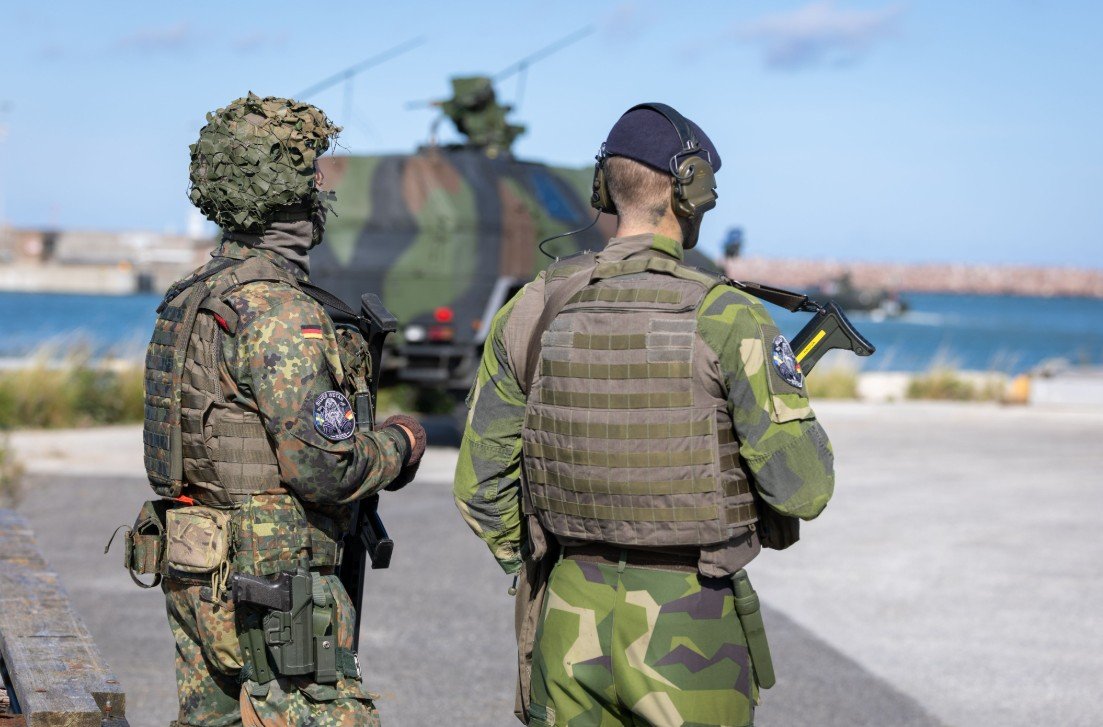
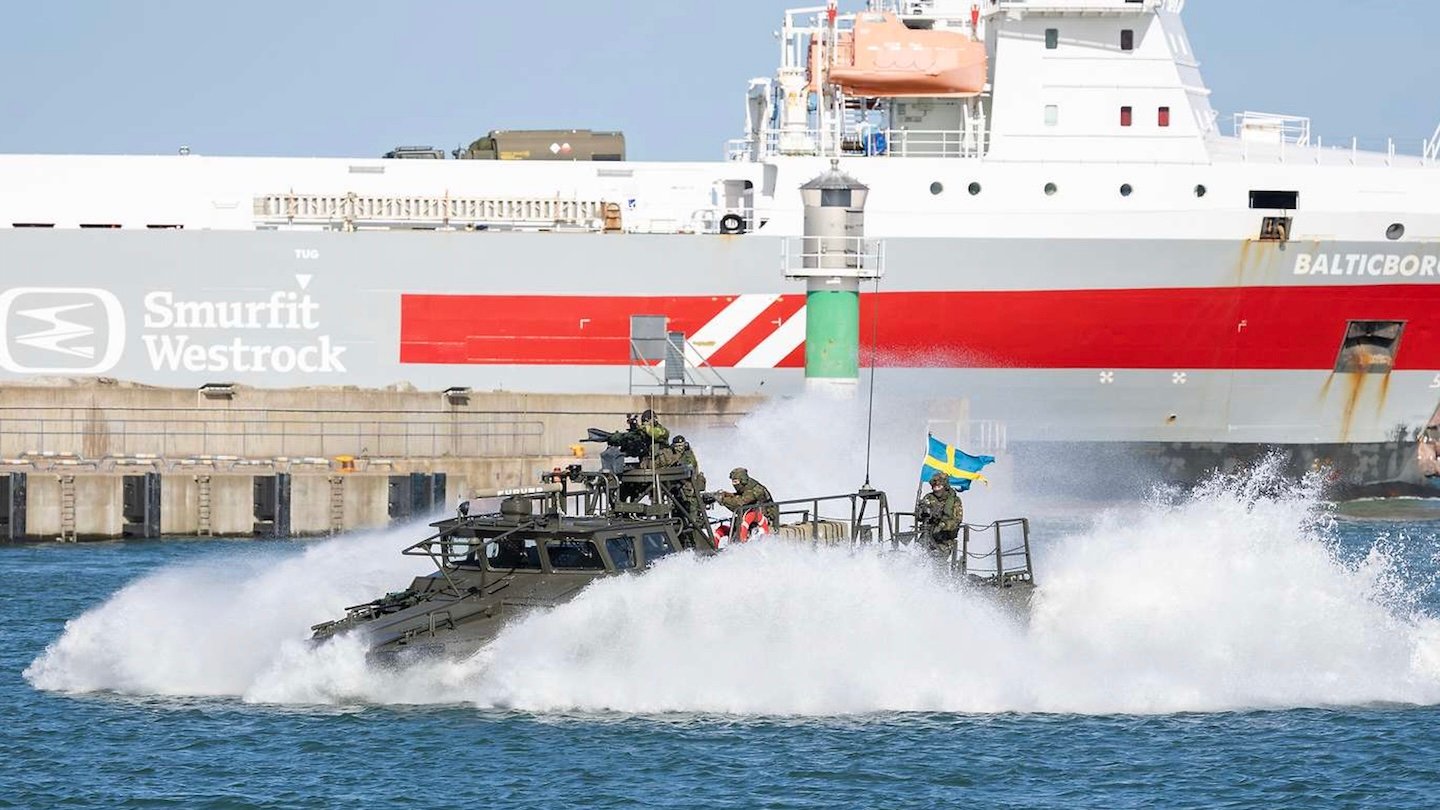
German and Swedish warships stand offshore while a Swedish CB90 fast assault craft operates in the harbor at Visby. Bundeswehr/Marc Tessensohn
The exercise, Silver Wotan 2026, running between September 14-23, brings together Swedish and German forces across the land, maritime, and air domains. The scenario is built around a Swedish request for allied assistance, with German forces moving personnel and equipment across the Baltic before integrating with Swedish units already defending the island. The operation is testing the entire process of getting allied combat power to Gotland, protecting it during the movement to Visby, and rapidly incorporating it into the island’s existing defensive network.
A video shows troops coming ashore on Swedish CB90 fast assault craft, a type that German soldiers are also trained to operate:
A rapid deployment of German and Swedish forces to Gotland island is being carried out today. Units from and are rehearsing the swift reinforcement of the strategic island in order to ensure the security of the Baltic Sea.#SilverWotan#NATOpic.twitter.com/A0r3LF8XUP
The strategic importance of Gotland has grown considerably following Sweden’s accession to NATO in March 2024, which was a direct response to the full-scale Russian invasion of Ukraine.
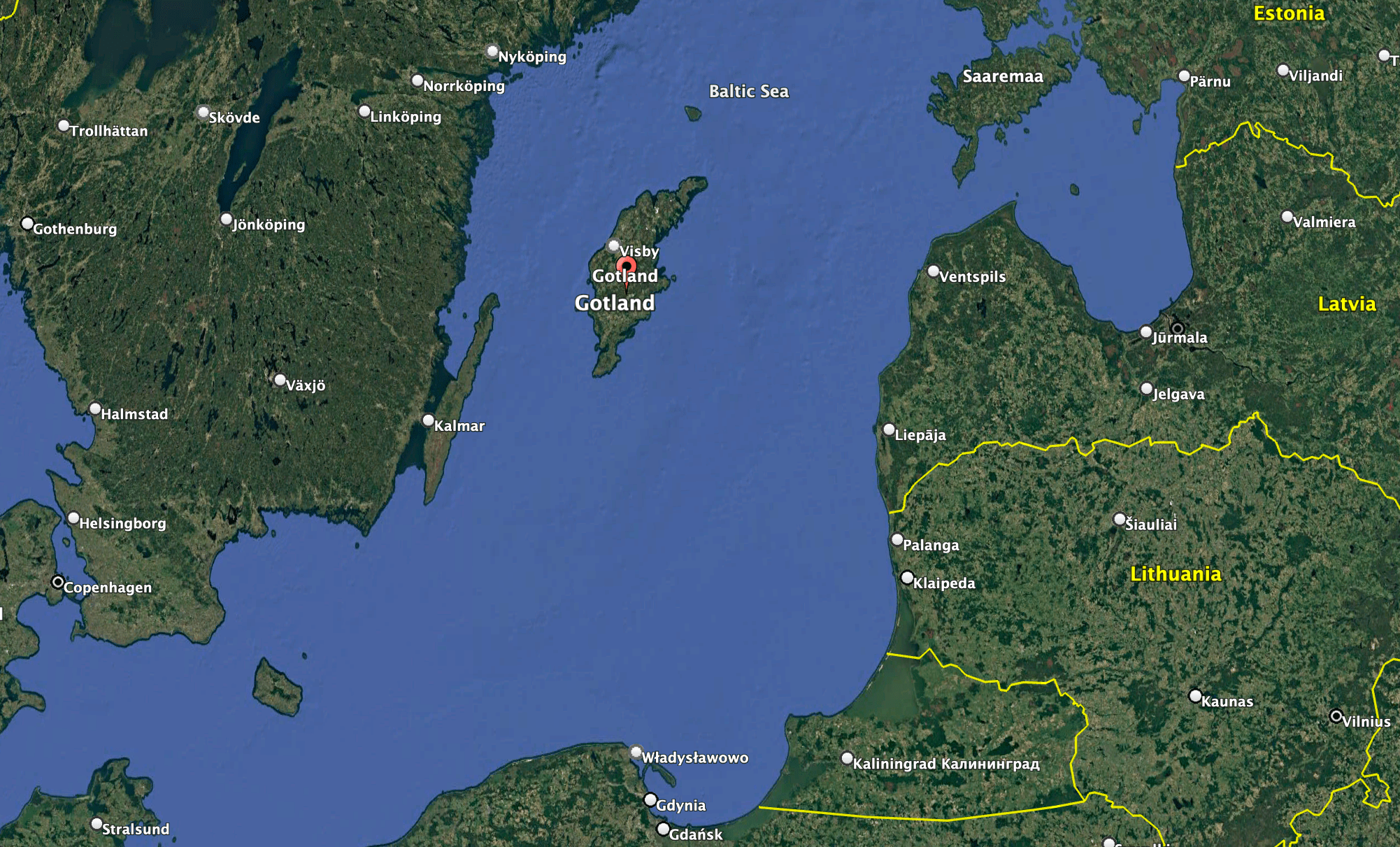
Located approximately halfway between mainland Sweden and the Baltic states, the island occupies a central position in the Baltic Sea, close to the maritime approaches to the Gulf of Finland and within reach of the Russian exclave of Kaliningrad. Its location gives forces operating from Gotland a potentially significant position from which to conduct surveillance, air defense, and maritime operations, while also making the island an important part of the wider network connecting NATO’s northern and eastern members.
The location of Gotland within the Baltic region. Google Earth
At the same time, Gotland sits within an extremely complex littoral environment, where shallow waters, islands, narrow maritime approaches, and the proximity of multiple states can make both offensive operations and defensive planning more difficult. The region has also been shaped by longstanding Swedish concerns about Russian clandestine activity, including intelligence gathering and other forms of covert or deniable activity. The complexity of the Baltic operating environment can make such activities harder to detect and attribute, adding another layer of uncertainty alongside the more conventional military challenges facing the region.
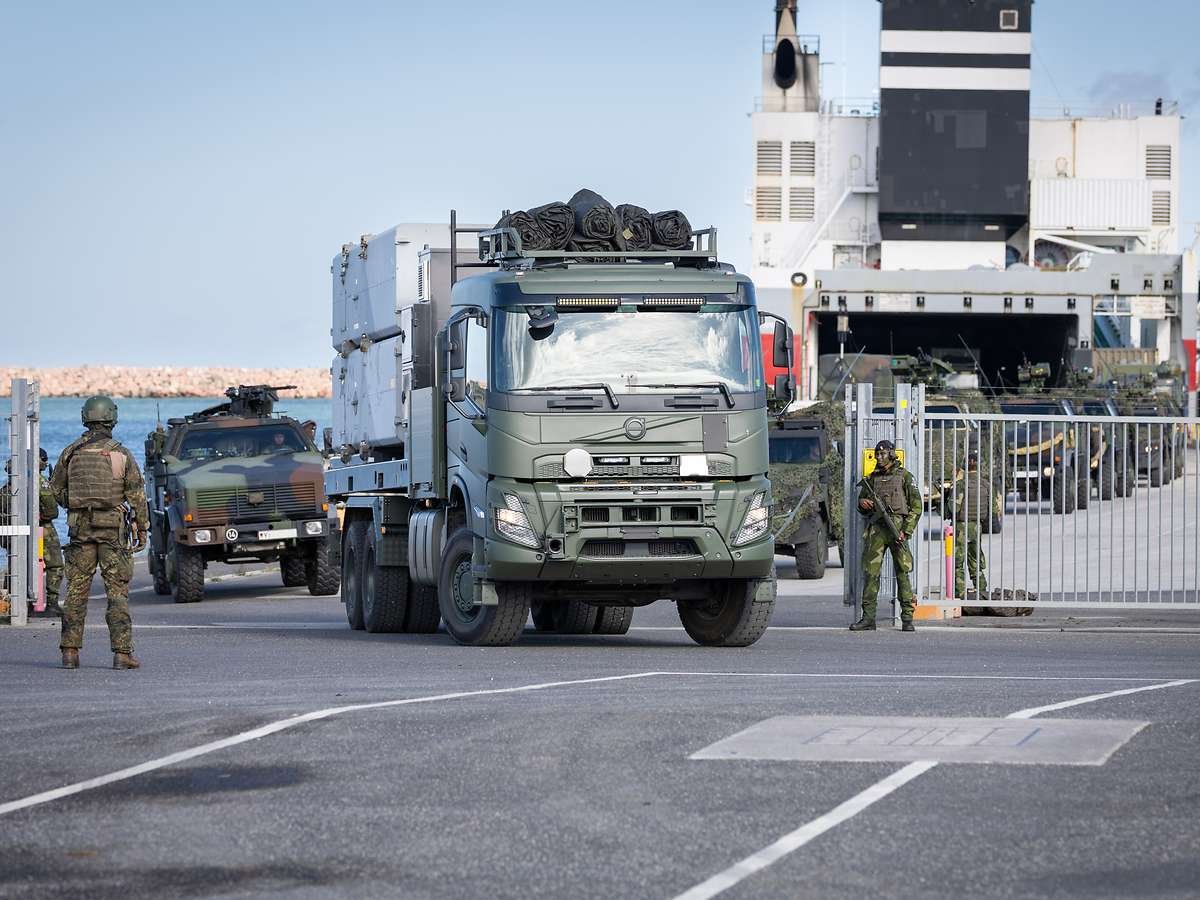
The unloading operation in Visby. The vehicles seen here were transported by sea from Karlskrona to the Swedish mainland. Bundeswehr/Marc Tessensohn
Geography has long made Gotland important to Swedish defense planning, but its significance has taken on a broader dimension since Sweden joined the alliance. NATO has described the island as strategically important to its freedom of maneuver in the Baltic, while Swedish officials have highlighted its potential role as a hub for military operations and logistics in the region.
The current exercise is designed around the practical difficulties of reinforcing such a position.
Military equipment is being transported by sea to Visby, Gotland’s principal port, including by commercial ferry. In Visby, Swedish and German personnel are securing the harbor and conducting the reception of the arriving force. Among the equipment being moved are air defense systems, while Swedish forces are also operating coastal defense systems armed with anti-ship missiles.
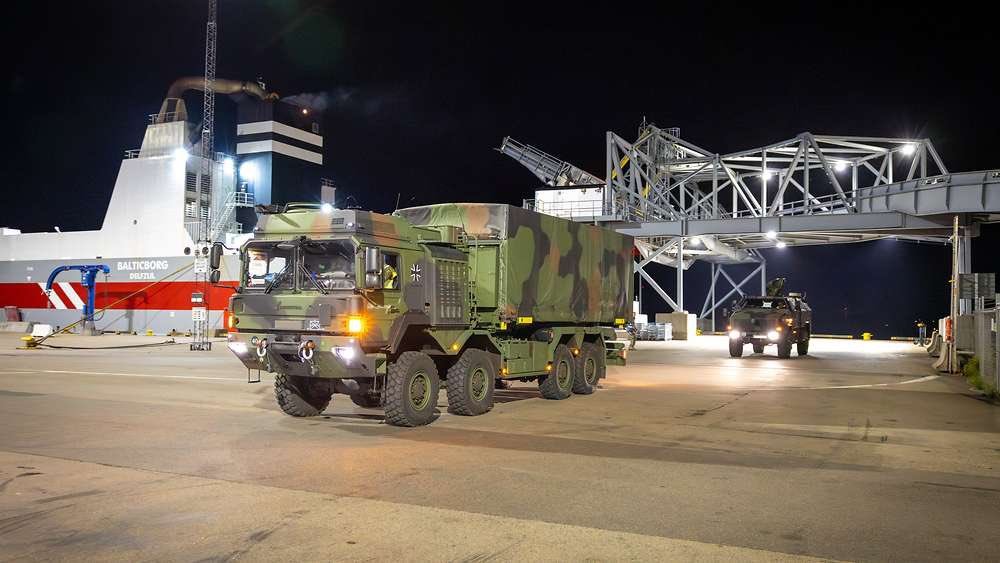
German Army vehicles roll into Visby during Silver Wotan. Bundeswehr/Marc Tessensohn
Meanwhile, publicly available flight-tracking data showed German Luftwaffe transport aircraft, including at least one Airbus A400M airlifter, apparently involved in the effort. The commercial airport at Visby has long also been used for military activities related to Gotland and the wider Baltic region.
The movement is supported by Swedish and German naval forces and other aircraft, creating a scenario in which the maritime transit, protection of the port, air operations, and subsequent movement of troops and equipment ashore all form part of the same military problem. Once ashore, the arriving forces have to be moved into position and integrated with Swedish units already responsible for defending the island.
The Swedish Gotland Regiment, P 18, provides the core of the island’s permanent military presence. The regiment, Sweden’s youngest and smallest, has been rebuilding its capabilities since Sweden began expanding its military presence on Gotland. Its forces form the basis of the ground-defense structure into which allied reinforcements would be incorporated.
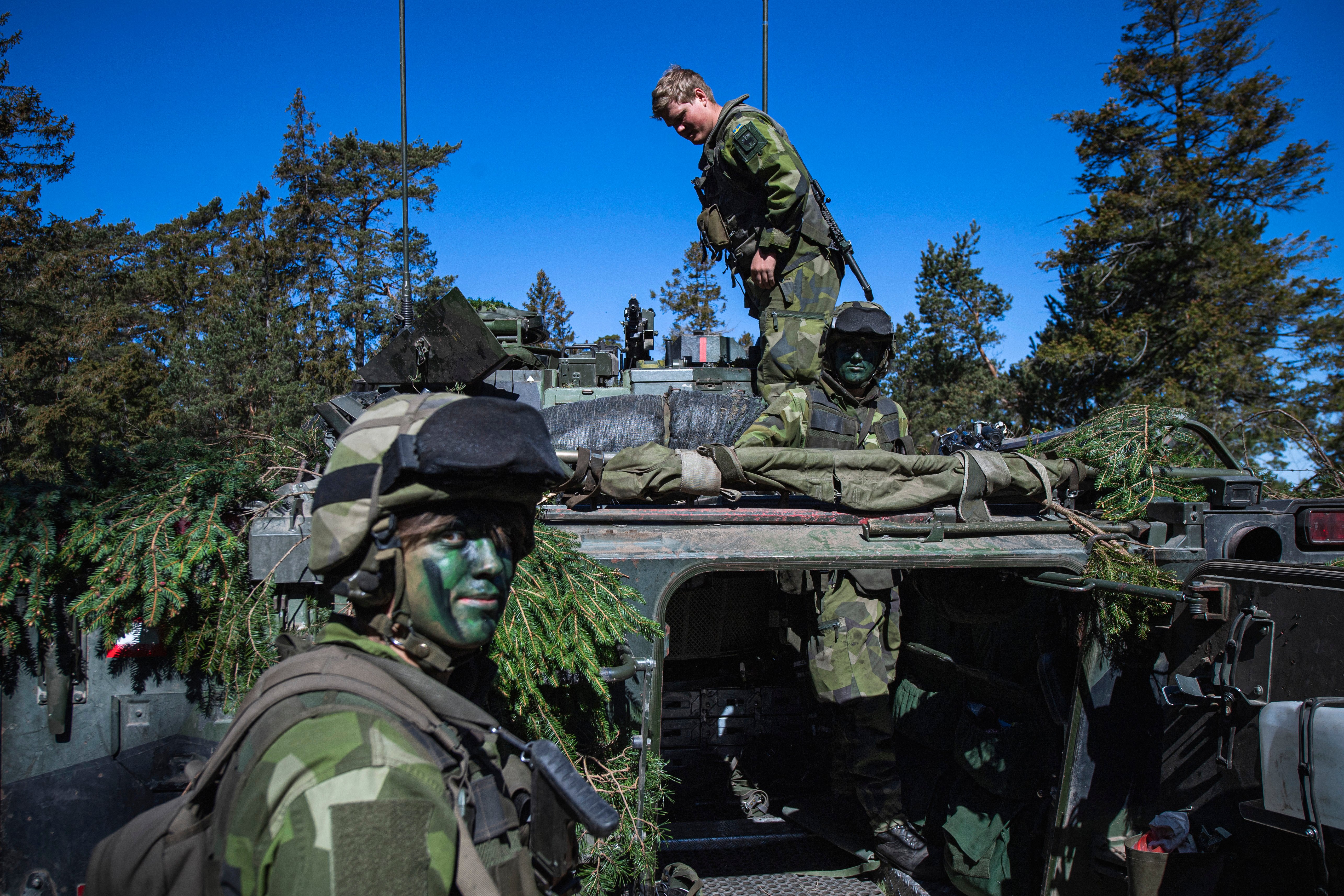
Soldiers of the Gotland Regiment of the Swedish Army camouflage an armoured vehicle during an earlier field exercise near Visby. Photo by Jonathan NACKSTRAND / AFP
Swedish coastal defense capabilities are another important element of the drill. Land-based anti-ship missiles provide the island with a means of threatening hostile surface vessels operating in the surrounding waters, giving the defense of Gotland a direct connection to the wider maritime battle for the Baltic. During Silver Wotan, Swedish and German forces are also conducting anti-surface warfare activities alongside the broader reinforcement operation.
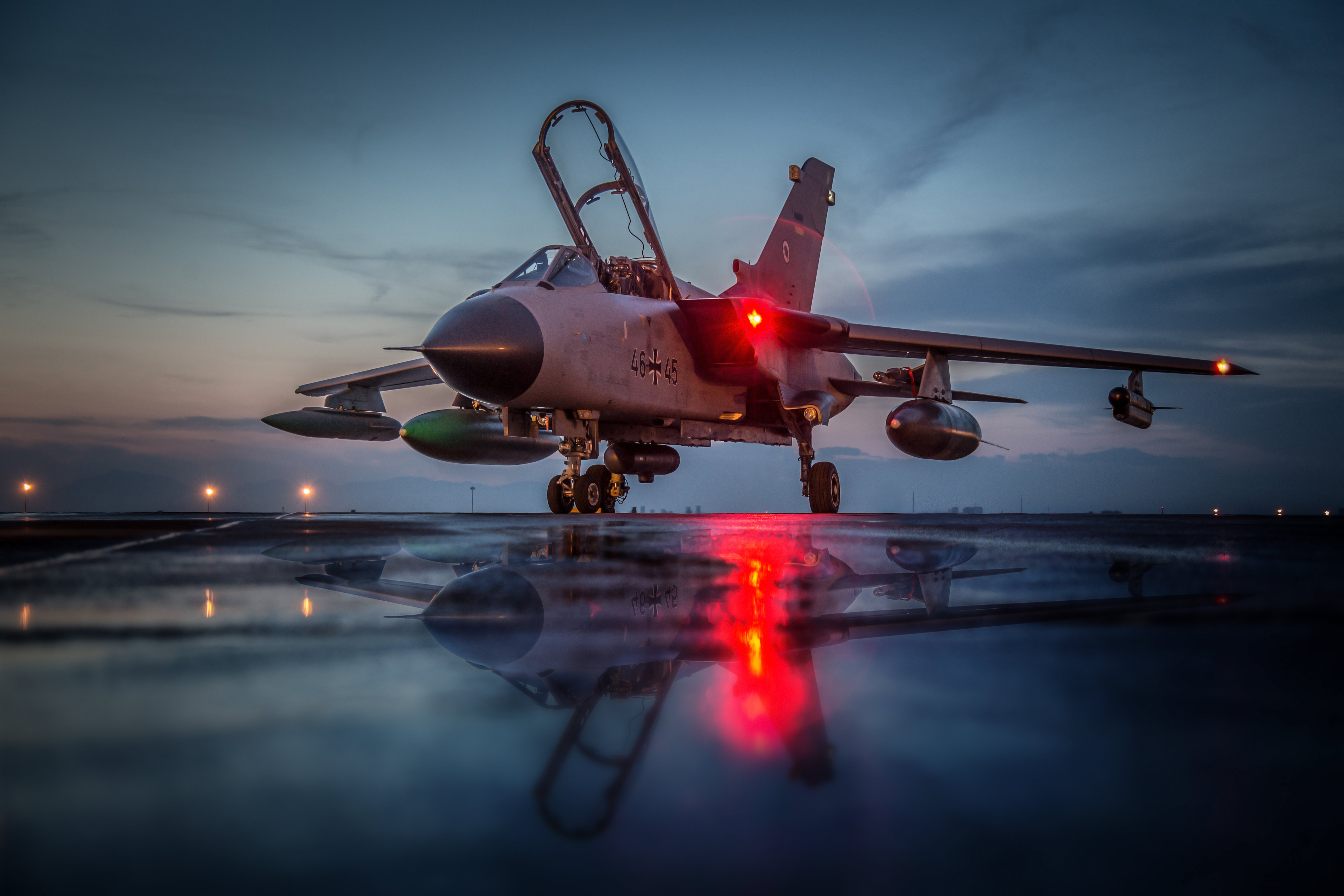
Germany is contributing more than 500 troops to the exercise, part of approximately 2,000 Bundeswehr personnel involved, including elements from the army, navy, and air force. The German Luftwaffe has deployed Panavia Tornado aircraft for surveillance, while German naval forces are participating in the maritime component, and German ground personnel are involved in the reinforcement and security activities on Gotland.
Stock photo of a Luftwaffe Tornado ECR equipped for a reconaissance mission. Bundeswehr
The exercise scenario is particularly relevant against the backdrop of Russia’s continuing military presence in the Baltic region.
Russia maintains major military infrastructure in Kaliningrad, including naval, air, missile, and air defense capabilities, while the Russian Baltic Fleet operates from bases in the region. Kaliningrad’s position between Poland and Lithuania gives Moscow a significant military foothold inside the NATO area, while Russian forces and military infrastructure elsewhere along the Baltic add to the complexity of operating and reinforcing allied territory in the region.
The security environment around the Baltic has also deteriorated considerably since Russia’s full-scale invasion of Ukraine. NATO has increased its surveillance and military activity in the region, including the launch of Baltic Sentry in January 2025 following a series of incidents involving critical undersea infrastructure. The alliance has subsequently expanded efforts to monitor maritime activity and protect infrastructure and sea lines of communication.
A Swedish Navy Helicopter 15 on the flight deck of patrol ship HMS Carlskrona as part of the NATO Baltic Sea patrol mission, Baltic Sentry, aimed to secure critical underwater infrastructure. Photo by Johan NILSSON / TT NEWS AGENCY / AFP
Swedish authorities have stressed that Silver Wotan was planned in advance and is not being conducted in response to a specific imminent Russian threat. The exercise nonetheless reflects the operational environment in which Swedish and NATO planners now have to consider the possibility that maritime and air movements across the Baltic could be monitored, disrupted, or contested.
The exercise also builds on a series of increasingly large Swedish-led activities designed to test the reception of allied forces on Swedish territory. During Aurora 26 earlier this year, more than 18,000 troops from 13 countries participated in operations across Sweden, including the deployment of allied forces to Gotland alongside the Gotland Regiment and Swedish Home Guard. NATO described that activity as an emergency deployment intended to test the reinforcement of the island.
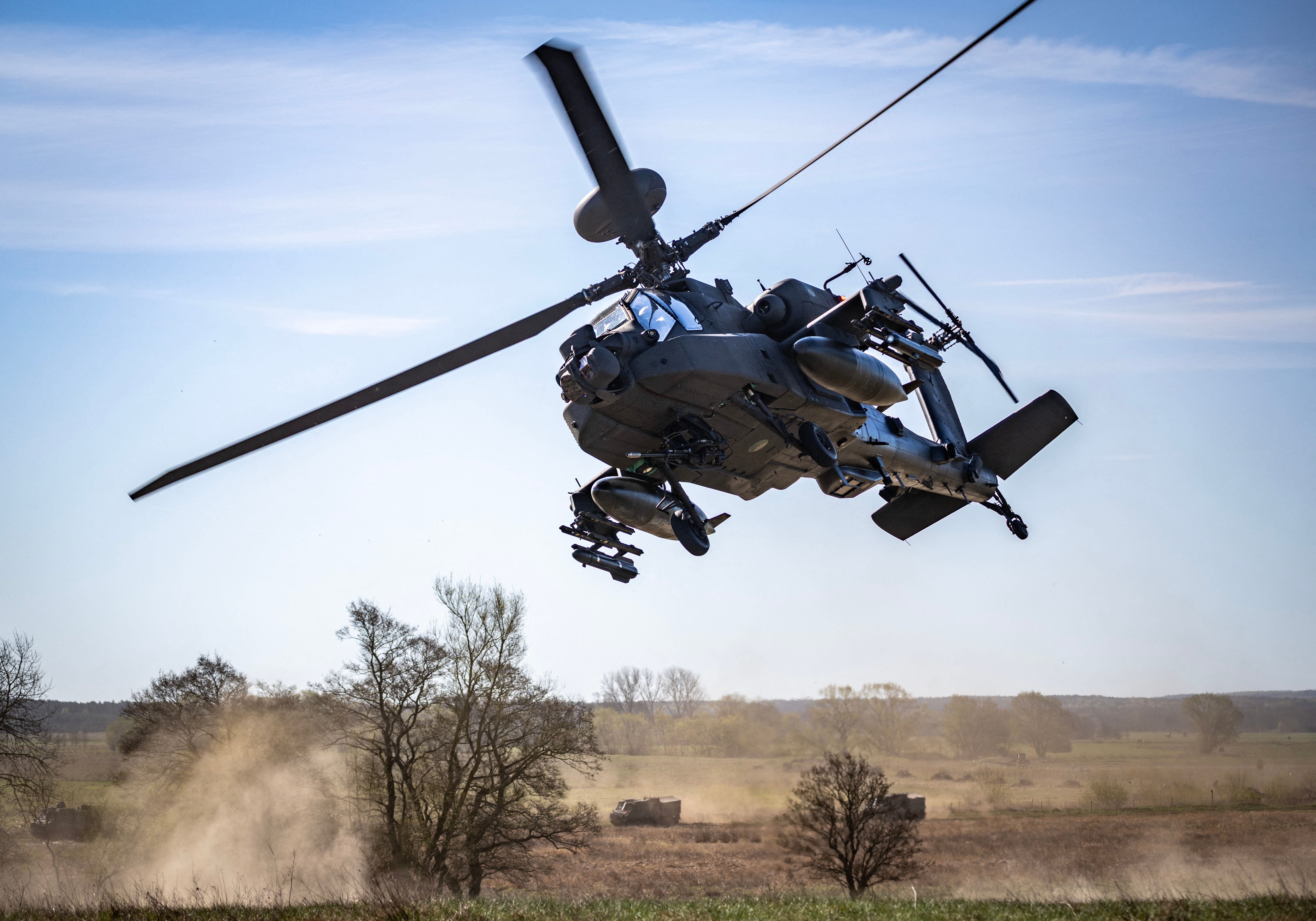
A Dutch AH-64 Apache attack helicopter takes part in Exercise Aurora 26 in southern Sweden on April 29, 2026. Photo by Johan NILSSON / various sources / AFP
Silver Wotan places a more concentrated emphasis on the Swedish-German relationship and on the movement of an allied force into the island’s existing defensive structure.
Germany’s participation is also consistent with its growing military role in the Baltic and along NATO’s northeastern flank. Berlin is already providing forces for NATO’s forward defense in Lithuania and has increasingly emphasized the ability to move German forces rapidly across northern Europe in support of allied operations.
For Sweden, meanwhile, Gotland has become one of the clearest examples of how NATO membership has changed the country’s defense planning. The island remains a Swedish responsibility, but its location means that what happens there has consequences well beyond Sweden’s territorial defense.
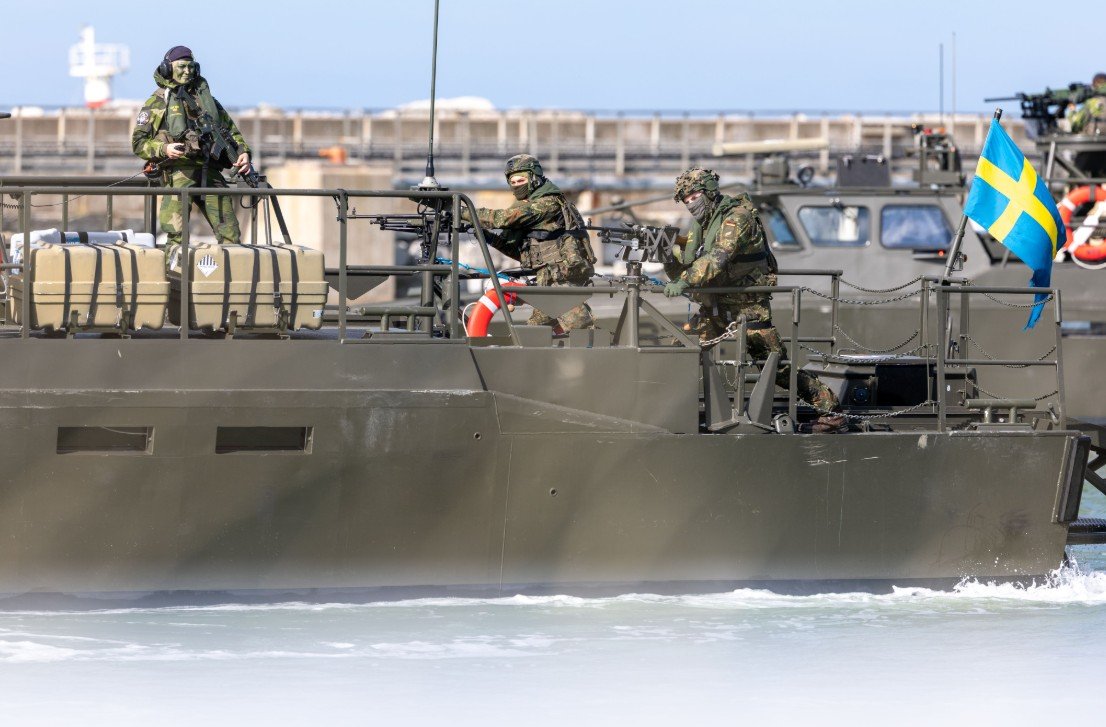
German and Swedish troops on a Swedish CB90 fast assault craft. Bundeswehr/Marc Tessensohn
A defended and adequately supplied Gotland provides NATO with a strategically positioned base for surveillance and defensive operations in the Baltic, while the ability to reinforce it demonstrates that the alliance can maintain access to the island even as the surrounding maritime and air environment becomes more contested.
The exercise comes as European allies are being forced to plan for a NATO in which the United States may provide less of the conventional military weight it has supplied for decades. The Pentagon is reviewing the size and posture of U.S. forces in Europe, including the forces and capabilities Washington would make available in a European crisis, while NATO’s top commander has said further U.S. troop withdrawals should be expected as European allies build up their own conventional capabilities.
A German and a Swedish soldier involved in securing Visby during Silver Wotan 2026. Bundeswehr/Marc Tessensohn
At the same time, the alliance now describes Russia as its most significant and direct security threat, citing military activity alongside airspace violations, sabotage, cyber operations, and other forms of hybrid pressure. There are also growing concerns that Russia could try something in the Baltics, while it continues to step up its gray-zone activities regardless. NATO officials have warned that Russia could rebuild enough military capacity to pose a more serious conventional challenge to the alliance before the end of the decade.
There are escalating warnings from Poland that Russia is preparing to widen its war against Ukraine, with "accidental" missile and drone strikes on NATO territory.
Such a move – Russia falsely claiming air strikes that hit NATO allies happened by accident – would be designed to…
For Sweden and Germany, the Silver Wotan exercise is a practical test of how quickly European forces can reinforce and defend one of the Baltic’s most strategically important positions. As the security environment grows more contested and Europe prepares for a future in which U.S. forces may not be as readily available, the ability to move allied combat power across the region and integrate it into existing defenses is becoming an increasingly important part of NATO’s deterrence.
Lo smaltimento illegale di rifiuti tossici non produce solo danni ambientali. Si registra anche un aumento persistente dei decessi per tumore, che emerge dopo decenni ed è particolarmente marcato tra i più giovani. Cosa dice il confronto tra comuni vicini.
Da der Westen, also vor allem die Europäer, derzeit regelrecht nach Krieg lechzen und ihn mit allen Mitteln zu provozieren versuchen, während die deutschen Medien gleichzeitig über die Positionen und Argumente der russischen Regierung immer schamloser lügen oder sie verschweigen, finde ich es wichtig, ein aktuelles, einstündiges Interview des russischen Außenministers Lawrow komplett zu übersetzen, […]

 Login

 EMERGENZA ENERGETICA: L’ITALIA PAGA IL CONTO
 A Levante, con Margherita Furlan, Alessandro Volpi (Università di Pisa, analista di economia e finanza) lancia l’allarme su quella che rischia di diventare la vera emergenza sociale dei prossimi mesi: il costo dell’energia in Italia.
 Bollette fuori controllo per famiglie e imprese, un sistema industriale che perde competitività, un Paese che paga l’elettricità tra le più care d’Europa. Non è un incidente di percorso: è il risultato di scelte politiche precise.
 Tra queste, l’abbandono delle forniture energetiche russe a basso costo, sostituite da gas liquefatto più caro e da rotte di approvvigionamento più lunghe e più fragili. Una decisione presa a Bruxelles e a Washington, ma pagata dai cittadini e dalle piccole e medie imprese italiane.
 Nella puntata:
 perché le bollette italiane restano più alte di quelle dei nostri concorrenti europei
 chi guadagna dalla sostituzione del gas russo
 l’impatto sul tessuto produttivo e sull’occupazione
 il peso di oneri di sistema, speculazione finanziaria e mercato elettrico
 quale margine di sovranità energetica resta all’Italia
 Levante: ogni giorno, dal lunedì al venerdì, dalle 19 alle 20. Analisi e approfondimento sulla transizione internazionale in corso.
 ISCRIVITI al canale e attiva la campanella
 per non perdere le prossime puntate.
 Lascia un commento: quanto è aumentata la tua bolletta nell’ultimo anno?
 SOSTIENI CASA DEL SOLE TV Siamo una televisione indipendente e autofinanziata: esistiamo solo grazie a chi ci sostiene.
 Iscrizioni al canale (Analista Multipolare €5, Inviato della Verità €15, Architetto del Futuro €25):
 / @casadelsoletvchannel
 SEGUICI Instagram: @margheritafurlangiornalista Facebook:
 / margheritafurlan555 #Levante #AlessandroVolpi #MargheritaFurlan #CasaDelSoleTV #CaroBollette #EmergenzaEnergetica #GasRusso #Energia #Economia #Geopolitica #Multipolarismo #Italia #Inflazione #SovranitàEnergetica EMERGENZA ENERGETICA: L’ITALIA PAGA IL CONTO


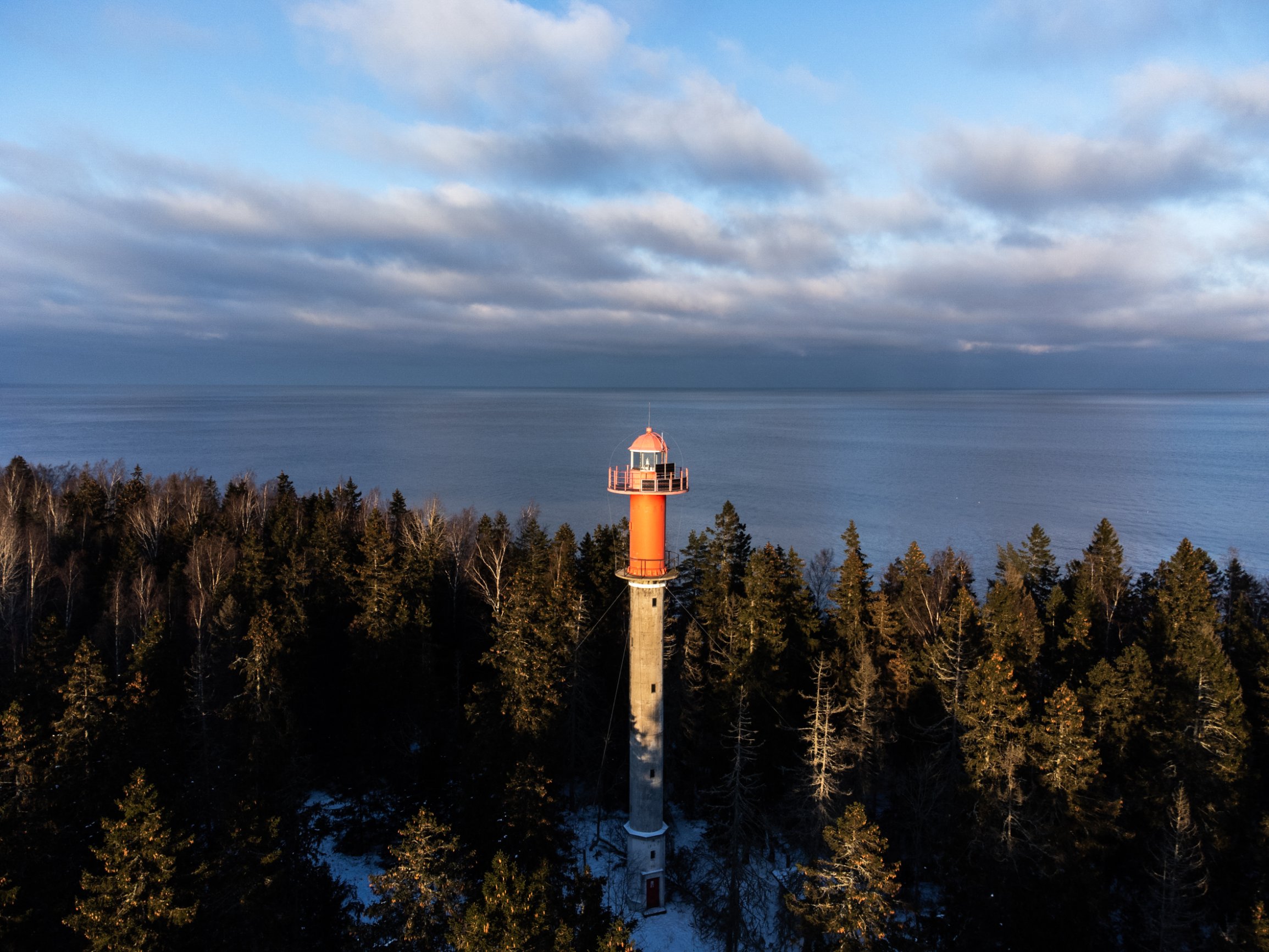




 (@jacksonhinkle)

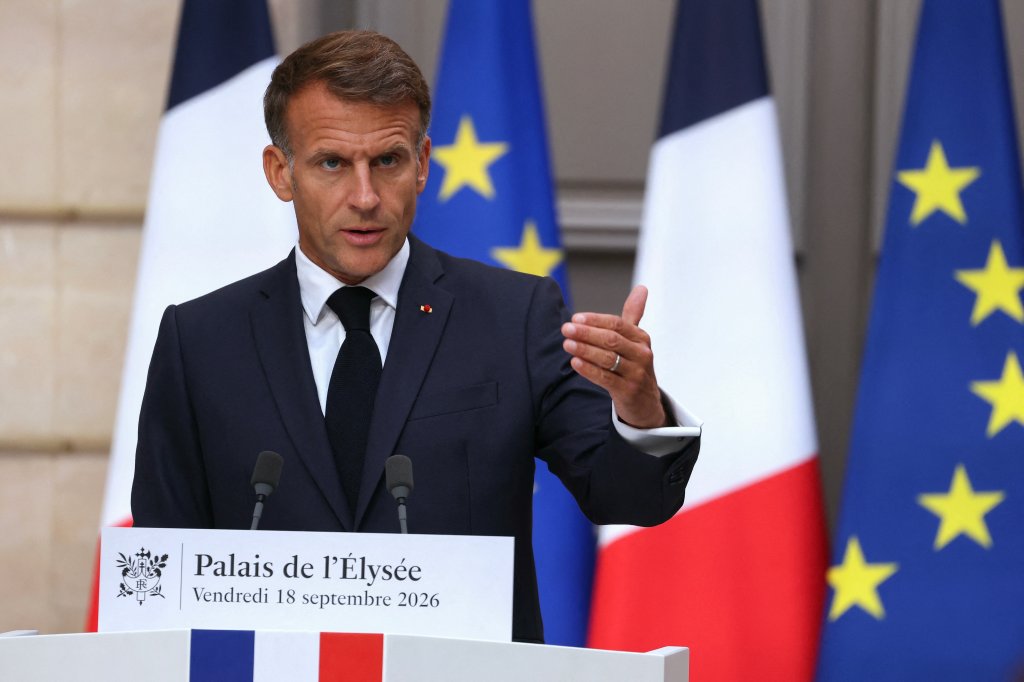

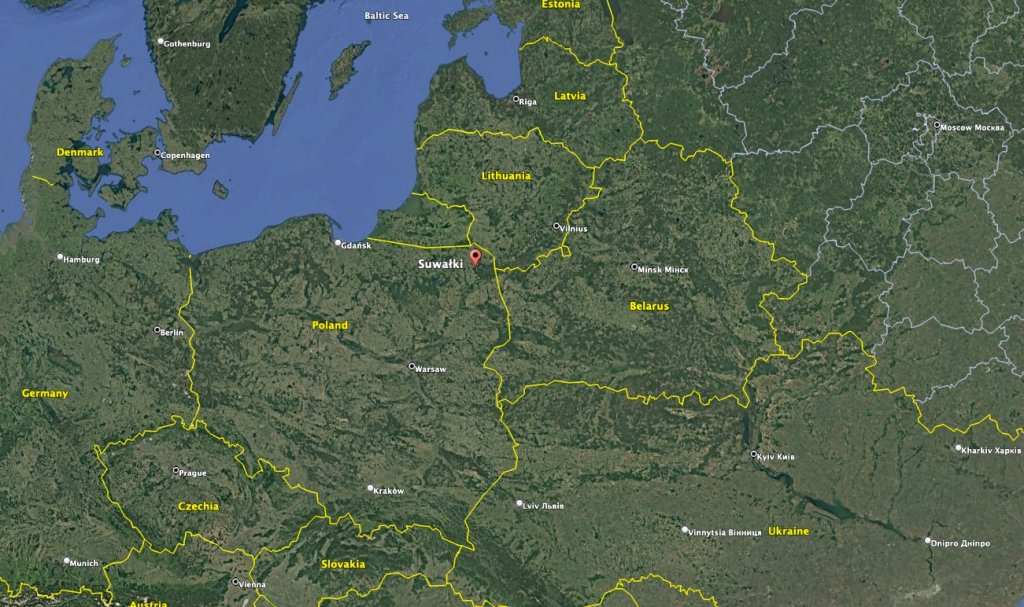
 Militarnyi: In the fall of 2026, the Russian Federation plans to add 16,000-20,000 military beds in civilian hospitals in the Northwestern Federal District, located near the Baltic states.

 (@Maks_NAFO_FELLA)
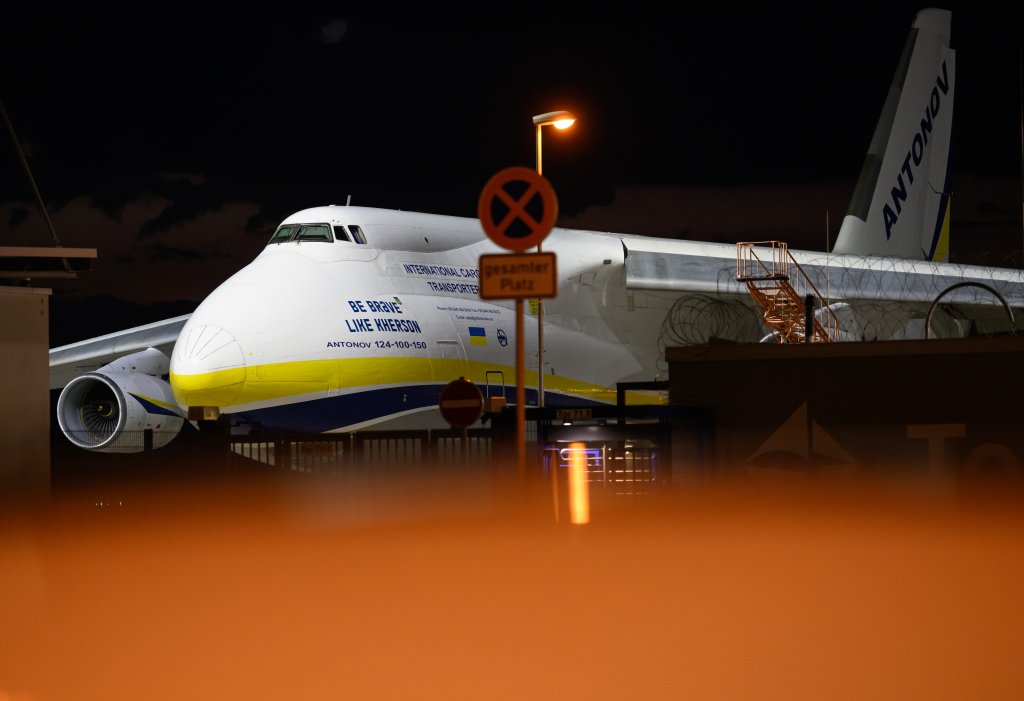
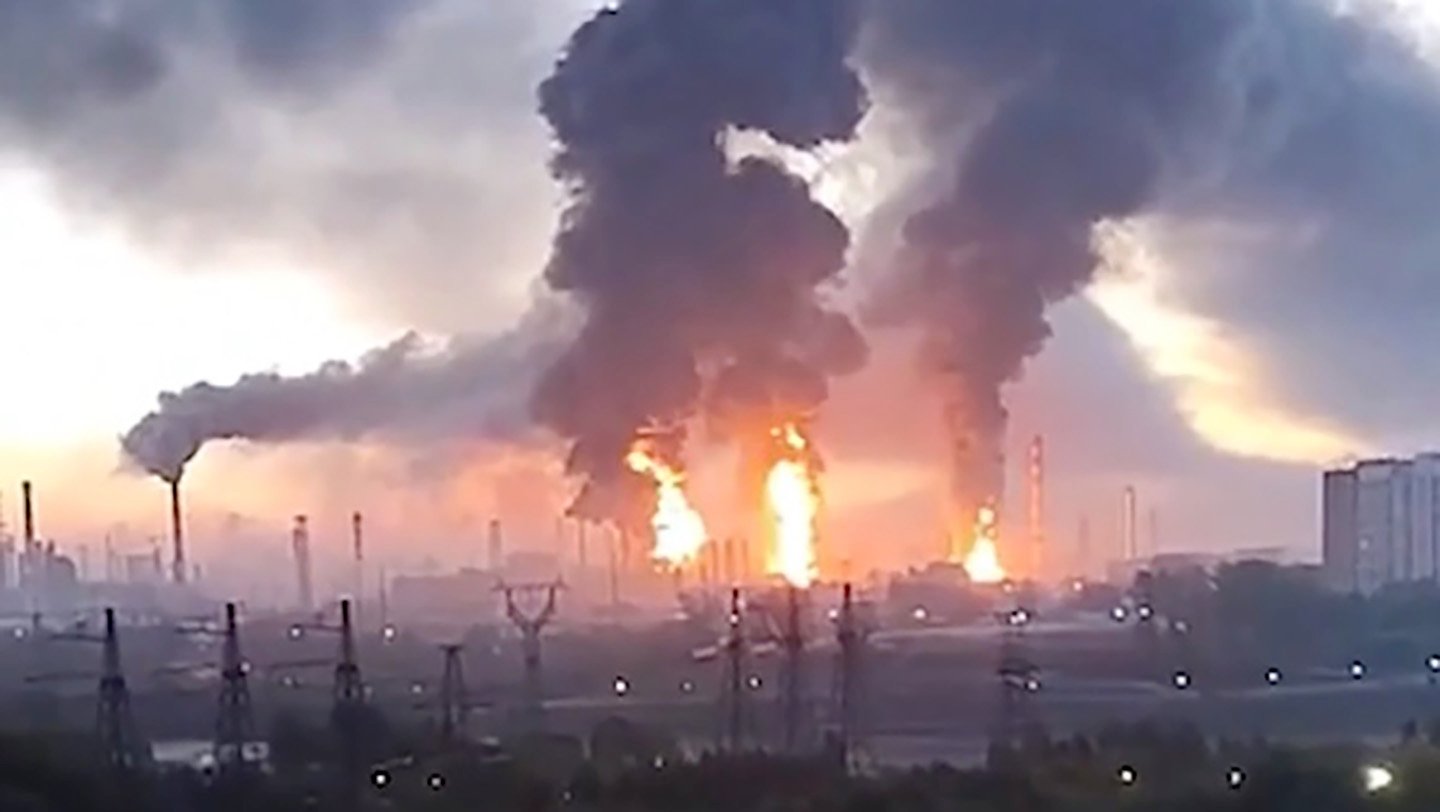
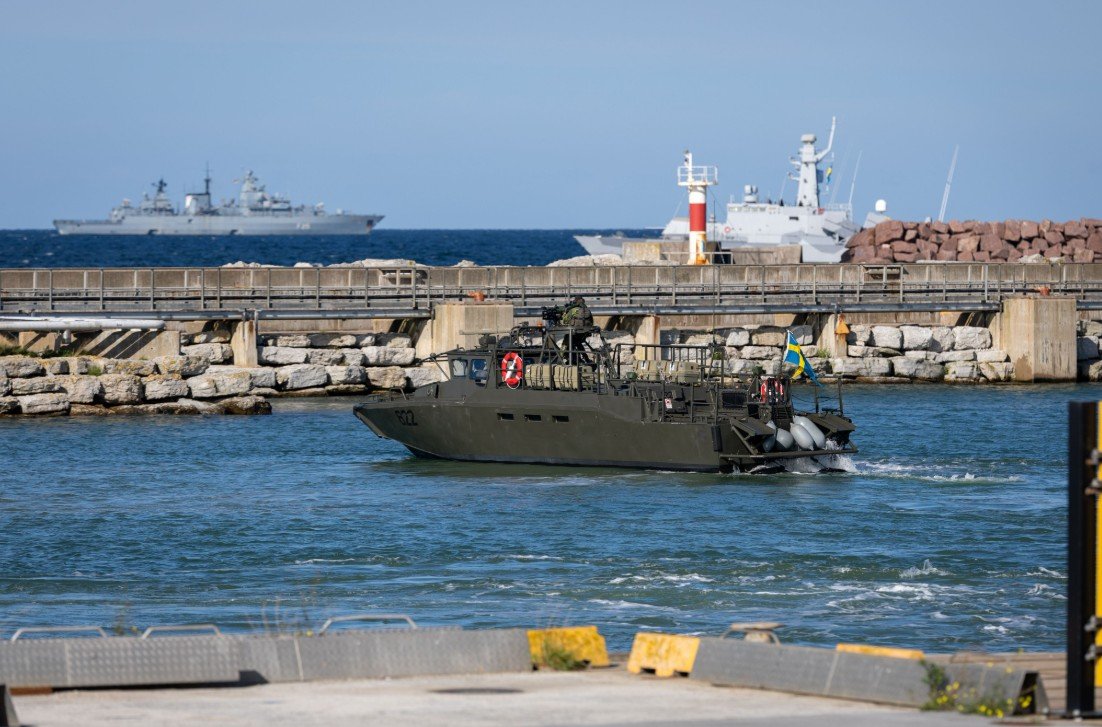
 and
 are rehearsing the swift reinforcement of the strategic island in order to ensure the security of the Baltic Sea.