❌

Reading view

Drone Strikes Sink Merchant Ship in Bulgaria’s Black Sea Economic Zone

Two merchant vessels have been attacked by aerial and maritime drones in Bulgaria’s exclusive economic zone in the Black Sea, sinking one ship and forcing the evacuation of another. The incident follows a deadly attack on a grain carrier off Romania a day earlier and has prompted concern over the growing risks to civilian shipping close to EU and NATO territory.

Two commercial vessels were struck by drones in Bulgaria’s exclusive economic zone early on Tuesday, 6 October, in the first known attack of its kind on merchant shipping in Bulgarian waters.

The Togo-flagged ALFA WATAN suffered severe structural damage and sank, while the Palau-flagged ABLE caught fire. Bulgarian Prime Minister Rumen Radev said the vessels were attacked at around 3am by both aerial and maritime drones about 70 nautical miles east of the coastal town of Byala. The Bulgarian government said a search-and-rescue operation was continuing for the crew of the ALFA WATAN, whose fate remained unknown.

All 18 people aboard the ABLE were rescued after abandoning the burning vessel. The Bulgarian-flagged passenger and freight ferry DIOSCURIA was diverted to the area and initially took the crew on board before Bulgarian Navy and Border Police vessels transferred them towards Varna.

The crew comprised 11 Turkish and seven Indian nationals. Two sailors were taken to hospital, including an Indian crew member suffering from burns and the Turkish captain, who sustained a head injury. Bulgarian public broadcaster BNT reported that the remaining 16 sailors subsequently arrived safely in Varna for medical checks.

The ABLE was reportedly carrying grain towards Istanbul. The cargo aboard the ALFA WATAN, which had been heading north towards Romania, has not been officially established.

Radev convened an emergency meeting involving the ministries of defence, interior, transport and environment, alongside the presidency and Bulgaria’s security services. He described the attack as an unacceptable violation of international and maritime law and warned of its effect on commercial navigation in the Black Sea.

Bulgarian authorities have not publicly identified who launched the drones. Investigations are examining both the weapons used and the circumstances surrounding the attack. One rescued Turkish sailor told Bulgarian television that he believed the ABLE had been hit by a Russian underwater drone, but that account has not been independently established and Sofia has made no formal attribution.

Foreign Minister Velislava Petrova said Bulgaria was in contact with its European and NATO partners and described Black Sea security as inseparable from wider European security. She said civilian crews and freedom of navigation must be protected and that Bulgaria would work with its allies to assess the wider consequences for maritime security.

European Commission President Ursula von der Leyen also condemned attacks against civilian shipping, saying the situation in the Black Sea was becoming increasingly concerning. She said commercial vessels and their crews were being targeted as investigations continued into the latest incidents.

Tuesday’s attack came less than 24 hours after another commercial vessel caught fire and sank in Romania’s exclusive economic zone. The Turkish-owned Royad Mammadov, sailing under the flag of Saint Kitts and Nevis, had left the Ukrainian Danube port of Izmail carrying corn for Ravenna in Italy.

Romanian authorities confirmed that two people died and 11 crew members were rescued. President Volodymyr Zelenskyy said the vessel had been struck by two Russian drones, although Romanian authorities did not themselves publicly attribute the incident to Russia.

The two incidents in consecutive days mark a further geographical expansion of the risks facing commercial shipping in the western Black Sea. EU Today has previously reported how strikes near Romania have moved maritime war risks closer to NATO territory, while a separate maritime drone explosion at Constanța raised questions over the ability of coastal states to detect and respond to unmanned systems approaching commercial infrastructure.

The distinction between territorial waters and an exclusive economic zone remains important. The attacks occurred outside Bulgaria’s territorial sea and therefore do not amount simply to an attack on Bulgarian territory. They nevertheless took place in an area where Bulgaria has internationally recognised economic rights and responsibilities, including search-and-rescue and environmental obligations.

The immediate concern for Sofia is the search for the missing crew of the ALFA WATAN and the possibility of pollution from the wreck. The wider concern for the EU is the increasingly exposed position of civilian shipping routes linking Ukraine, Romania, Bulgaria and Turkey.

Ukraine’s maritime export routes remain particularly important for agricultural trade. Repeated attacks on merchant vessels can increase insurance premiums, discourage shipowners from entering the region and raise transport costs even when ports themselves remain operational. Russian attacks on Odesa and its export infrastructure have already placed Ukraine’s Black Sea grain corridor under sustained pressure.

With merchant ships now struck in the economic zones of both Romania and Bulgaria on consecutive days, Black Sea maritime security has moved further onto the agenda of EU and NATO governments along the western coast.

  •  

Germany accuses Russia of a drone bomb attempt at Leipzig. Now its eight biggest airports get drone detection

The likely process of monitoring the airspace over airports connected to Germany’s new drone detection system. Photo: Deutsche Flugsicherung / Holger Matthies

Germany is expanding drone detection at its airports with a new system operated by German air traffic control provider Deutsche Flugsicherung (DFS), the German Federal Ministry for Transport (BMV) announced on 5 October.

Germany has accused Russia of attempting a hybrid attack at Germany’s Leipzig/Halle Airport near a Ukrainian An-124 aircraft using a drone carrying explosives. Earlier, Finnish President Alexander Stubb said Europe must be prepared for “continued hybrid and sabotage attacks” by Russia, adding that Russia seeks to sow panic through such actions.

On Monday, two more sites were added—Stuttgart and Hamburg. As of Monday, seven of Germany’s eight largest airports were equipped with the new drone detection system in their approach and departure areas.

Germany seeks responses to new hybrid threats

The Federal Ministry cited the reason for the new measure: drones near airports can affect air traffic very quickly.

Federal Transport Minister Steffen Bilger and Baden-Württemberg Transport Minister Nicole Razavi were briefed on the new system at Stuttgart Airport, where it is being put into operation, the ministry said. The system creates “an important technical basis for detecting potential threats at an early stage and quickly informing the competent authorities,” Bilger said.

“With today’s commissioning of the drone detection system at Stuttgart Airport, the federal government is fulfilling a key promise: it is not only talking about the dangers posed by unmanned aircraft, but is also following through with very concrete action. Protecting critical infrastructure and ensuring the safety of passengers at Stuttgart Airport require continuous adaptation to a changing security situation,” Razavi said, according to the ministry.

The new DFS system allows drones near airports to be detected at an early stage and information about possible threats to air traffic to be passed more quickly to the relevant authorities. This helps them assess risks and respond to them more quickly, the statement said.

DFS is responsible for detecting drones in approach and departure areas, while the Federal Police and other security services are responsible for preventing threats and defending against drones. The BMV, Federal Ministry of the Interior, DFS, Federal Police and airports coordinate their work to exchange information quickly and maintain a shared picture of the situation.

No further details about how the system operates have been disclosed.

The first stage of the expansion at Germany’s eight major commercial airports will be fully implemented this week, with the systems in Stuttgart and Hamburg being put into operation, the statement said.

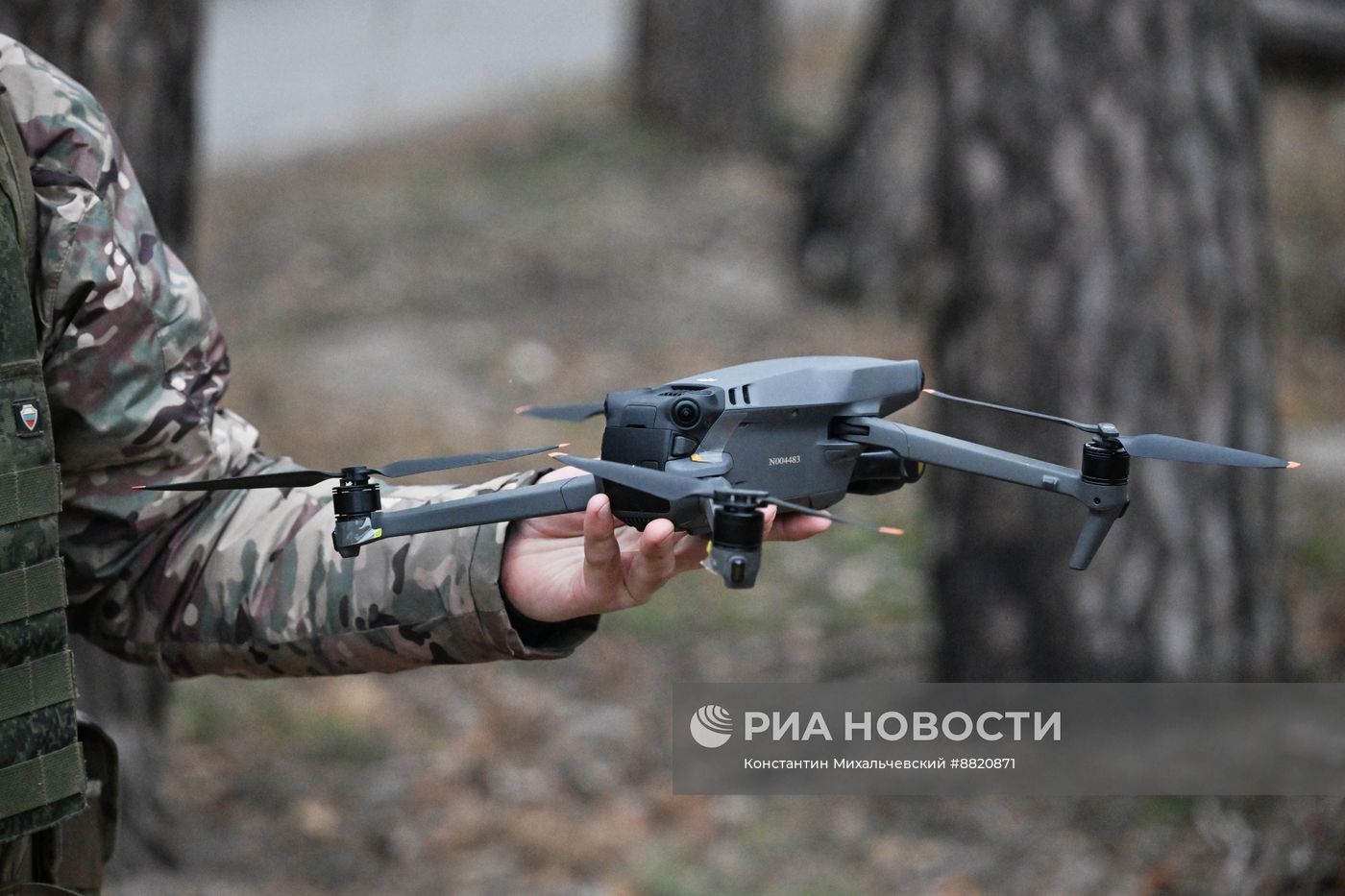
Illustrative image of a Russian drone. Photo: RIA Novosti/Konstantin Mikhalchevsky
Explore further

A drone came down beside a Bundeswehr air base, weeks after Berlin blamed Moscow for the Leipzig airport attack

The system will also be installed at the airport where a bomb-laden drone was found

The system will also be put into operation at Leipzig/Halle Airport this week, meaning that the first stage will be fully implemented at all eight of Germany’s largest commercial airports, according to the press release.

A quadcopter drone carrying a Semtex explosive flew directly toward a parked Ukrainian An-124 Ruslan cargo aircraft and struck its wing at Leipzig/Halle Airport in Germany on the evening of 4 August, Die Zeit reported on 10 August. The drone hit the aircraft at around 19:30 local time, bounced off the wing, and fell to the ground without detonating, according to the media outlet.

Ukrainian An-124 at Leipzig/Halle Airport in Germany, 5 August 2026. Photo: screenshot from Bild video

Germany has accused Russia of attempting the drone attack and announced further sanctions against Russian citizens and institutions, Tagesschau reported on 1 September.

At the crime scene, investigators found the drone configuration, explosives and detonation technology that had already appeared in other Russian hybrid operations and in Russia’s war against Ukraine, Federal Interior Minister Alexander Dobrindt said during a joint press conference with Federal Foreign Minister Johann Wadephul, the media outlet reported.

The German government assumes that Germany has been and will be a target of further such Russian attacks. Germany is not at war with Russia but is a “target of war,” Foreign Minister Wadephul said, according to the outlet.

  •  

Exercises Over, Typhon Stays

The recently concluded trilateral “Orient Shield” exercises in Japan became the first three-way maneuvers involving Washington, Tokyo, and Canberra in which the “Typhon” medium-range missile system was employed. How are the United States and its allies pushing the world toward the proliferation of weapons of mass destruction (WMD)? The Land of the Rising WMD Proliferation […]
  •  

France and Germany Seek New EU Power to Cut Market Access Over Trade Distortions

France and Germany have proposed giving the European Commission powers to respond within days to serious trade distortions, including the possibility of restricting access to the EU single market. The initiative comes as European concern grows over Chinese subsidies, industrial overcapacity and dependence on critical imports.

French President Emmanuel Macron and German Chancellor Friedrich Merz have called for a new European Union trade instrument capable of acting rapidly against countries whose economic practices cause serious disruption to the European market.

In a joint initiative sent to European Commission President Ursula von der Leyen on Monday, the two governments proposed strengthening the EU’s ability to respond to what they describe as systemic market distortions, including dumping, widespread subsidies and restrictions affecting access to critical supplies.

The Franco-German proposal does not formally identify China as its target. However, many of the practices it describes correspond directly to long-standing European concerns over Chinese industrial policy, including excess manufacturing capacity, state support and restrictions on exports of critical minerals.

The initiative represents a further development in a harder European approach towards Beijing. EU Today reported last week that China had warned it would respond if the EU introduced new restrictions against Chinese companies or products.

Macron and Merz are proposing two additional instruments.

The first would be intended to reduce European companies’ dependence on single suppliers for strategically important products and raw materials. The second would allow the EU to restrict access to its internal market when a third country uses political or economic measures that seriously undermine fair competition.

Under the proposal, the Commission could initiate countermeasures unless a qualified majority of EU governments voted to block them. That would reverse the normal political dynamic in which Brussels must first secure sufficient support before acting.

German officials have argued that the EU needs powers comparable in effect to the United States’ Section 301 trade measures or China’s ability to restrict exports of critical raw materials.

The Commission has welcomed the Franco-German intervention as a contribution to its work on economic security and global trade imbalances. Any new instrument would, however, require legislation and approval by both EU governments and the European Parliament before it could be used.

The proposal comes amid growing concern in both Paris and Berlin over the effect of subsidised Chinese production on European manufacturers.

Germany’s position is particularly significant. Berlin has traditionally been more cautious than Paris about measures that could restrict trade with China, reflecting the importance of the Chinese market to German carmakers, engineering companies and chemical producers.

That position has shifted as German industry faces increased competition from Chinese electric vehicles, machinery and other manufactured goods.

EU Today has previously examined the emerging Franco-German alignment on tougher China trade defences and demands from German manufacturers for broader European action rather than product-by-product investigations.

The new proposals go considerably further by seeking a mechanism capable of dealing with entire sectors and acting much more quickly than conventional anti-dumping proceedings.

Chemicals, PET plastics and hybrid vehicles are among sectors identified in the Franco-German document as areas where additional action may be required.

The timing is also significant. EU leaders are due to discuss trade relations with China at their summit in Brussels on 15–16 October, while Trade Commissioner Maroš Šefčovič is expected to hold talks with Chinese officials beforehand.

The Commission is already attempting to balance two objectives: maintaining Europe’s access to the Chinese market while reducing strategic dependencies that could be used as political leverage.

The Franco-German plan would give Brussels another instrument at the more coercive end of that policy. Its eventual importance will depend on whether governments agree to create it and how readily they would permit the Commission to use it against a major trading partner.

  •  

Kallas Warns Russian Hybrid Attacks Are Putting Lives at Risk Across Europe

EU foreign policy chief Kaja Kallas has warned that Russia is intensifying hybrid operations across Europe, citing sabotage attempts, airspace violations and Russian drones and missiles crossing into Moldovan territory.

Her intervention adds pressure for a more coordinated European response to hostile activity below the threshold of conventional warfare.

Russia is putting lives at risk across Europe through an expanding campaign of hybrid activity, EU foreign policy chief Kaja Kallas said on Monday, after another series of Russian drones and missiles entered Moldovan airspace.

Speaking in Brussels alongside Moldovan Prime Minister Vasile Tofan and Enlargement Commissioner Marta Kos, Kallas said Europe had experienced an increase in sabotage attempts and airspace violations during recent weeks.

“Russian missiles and drones violated Moldovan airspace again over the weekend,” she said, describing the incidents as unacceptable.

According to the official EU record of the press conference, Kallas said the Kremlin was seeking to create fear and interfere with European decision-making, and argued that the response should include greater resilience and continued support for Ukraine.

Her remarks follow Russia’s renewed large-scale attacks against Ukraine’s energy system and continued reports of drones crossing borders beyond Ukrainian territory.

Moldova’s defence authorities reported that three drones entered Moldovan airspace during Russia’s 30 September attack on Ukraine. Moldova, which shares a long border with Ukraine and is seeking EU membership, has repeatedly accused Moscow of attempting to destabilise the country.

The latest incidents broaden a European debate that has been developing for months: how governments should respond to hostile operations that are deliberate and potentially dangerous but fall short of an overt military attack.

EU Today reported on 28 September that European governments were discussing an emergency security protocol intended to improve coordination when member states face sabotage and other hybrid threats.

That followed earlier warnings concerning suspected attacks on infrastructure, cyber operations, interference campaigns and airspace violations across several European countries.

The problem is partly one of attribution and partly one of thresholds.

A conventional armed attack on a NATO member may trigger consultation under Article 4 or, in sufficiently serious circumstances, collective defence provisions under Article 5. The European Union also has its own mutual assistance provision under Article 42.7 of the Treaty on European Union.

Hybrid activity is frequently designed to remain below those thresholds.

Cyberattacks, covert sabotage, GPS interference, disinformation, drones and operations conducted through intermediaries can impose costs without giving governments an obvious basis for a military response.

Kallas’s warning comes as Germany has also reported an increase in activity it attributes to Russia.

Chancellor Friedrich Merz has warned that Germany faces growing hybrid pressure involving drones and cyber operations. European security services have separately investigated suspected Russian involvement in sabotage and attacks on infrastructure in several countries.

Moscow has denied Western accusations that it is directing such operations.

The EU has already used sanctions against individuals and entities accused of Russian hybrid activity, while governments are considering faster systems for sharing intelligence and attributing incidents.

EU Today examined the debate in September as the European Parliament considered proposals for quicker attribution, stronger intelligence-sharing and improved protection of critical infrastructure.

Moldova occupies a particularly exposed position.

The EU has provided €317 million through the European Peace Facility for Moldovan defence modernisation, according to Kallas, including €120 million allocated in 2026 for air defence. Brussels is also supporting Moldova through its EU Partnership Mission, which provides assistance against hybrid and cyber threats.

Unlike Ukraine, Moldova is not a NATO member and has constitutional neutrality. Its ability to counter Russian missiles or drones entering its airspace is therefore closely connected to the development of its own detection and air-defence capabilities.

For the EU, repeated incidents involving Moldova, NATO airspace and European infrastructure are increasingly being considered as parts of the same security problem rather than isolated events.

  •  

The Ethiopia–Tigray Crisis: The Fragile Peace That Failed to Hold

The Pretoria Agreement brought an end to Ethiopia’s devastating Tigray war—but not its underlying disputes. Four years later, renewed fighting and shifting armed alliances are threatening to reopen the conflict. The consequences could extend far beyond Tigray, destabilising the wider Horn of Africa. Ethiopia’s fragile post-Pretoria peace is rapidly unravelling as renewed fighting between federal […]
  •  

Merz Announces New Ukraine Package as German Defence Ties Deepen

German Chancellor Friedrich Merz has announced a new package worth more than €1.3 billion for Ukraine during a visit to Kyiv, combining additional military assistance with support for the country’s damaged energy infrastructure as German-Ukrainian industrial co-operation expands.

Merz visited the Ukrainian capital on Sunday while Russian drone attacks continued against Kyiv.

According to the Ukrainian presidency’s account of the meeting, the package includes more than €1 billion for defence and additional financing for the energy sector ahead of winter. Separate reporting put the energy component at approximately €350 million.

The visit also produced an extensive group of bilateral agreements involving governments and companies.

President Volodymyr Zelenskyy said Ukraine and Germany had concluded 15 agreements and documents, most concerning security co-operation, production, procurement, orders for German industry and joint projects in Ukraine. He put the total value of the agreements reached during the visit at more than €8.5 billion.

A narrower set of industrial agreements reported during the visit was valued at about €6.6 billion and included air-defence, radar and drone projects.

The visit went beyond another transfer of military aid.

Germany and Ukraine are increasingly constructing a defence relationship based on procurement, industrial production and the transfer of Ukrainian battlefield experience to European manufacturers.

At the Ukrainian-German Business Forum, Zelenskyy said the new security package would strengthen Ukraine’s armed forces immediately while industrial agreements were intended to build longer-term production capacity.

The direction corresponds with a wider shift in European support for Ukraine.

Military assistance is increasingly moving away from transfers of existing national stocks towards contracts financing new weapons production. In July, the EU released €3.47 billion for Ukrainian defence procurement, including financing intended for drones, missiles, air defence and combat aircraft requirements.

Kyiv has since asked European partners to accelerate further financing as the demands of the war outpace scheduled disbursements. EU Today reported in September that Ukraine was seeking early access to part of its 2027 EU funding to close a military budget gap.

The German agreements add a bilateral industrial track to that European system.

They also reflect changes on the battlefield.

Russia has continued to expand large-scale drone and missile attacks, increasing the importance of interceptor production, radar coverage and lower-cost methods of destroying unmanned aircraft. Ukraine’s air-defence problem is increasingly an industrial one: inexpensive attack drones cannot sustainably be countered only with scarce and costly surface-to-air missiles.

EU Today has previously examined how Ukraine’s air-defence battle has become an industrial equation, determined as much by production rates and cost ratios as by the technical performance of individual systems.

German-Ukrainian co-operation is increasingly being shaped by that requirement.

Merz has presented continuing support for Ukraine as a direct German and European security interest, rather than assistance based solely on solidarity with Kyiv.

The argument has acquired greater force as German authorities investigate Russian-linked sabotage and hybrid operations on German territory.

In September, investigators reportedly traced the attempted bombing of a Ukrainian cargo aircraft at Leipzig/Halle Airport to a suspected Russian military-intelligence organiser, with EU Today reporting details of the alleged GRU-linked logistics network.

For Berlin, support for Ukraine is now increasingly seen as part of Germany’s own security.

Merz’s visit also carries a domestic political dimension. His government is committing Germany to considerably higher defence expenditure at a time when the CDU has suffered severe electoral setbacks in eastern Germany and voters remain concerned over public finances and economic performance.

Yet Germany’s military and industrial engagement with Ukraine is continuing to expand.

The new package announced in Kyiv is important in itself, particularly as Ukraine prepares for another winter of Russian attacks on its energy infrastructure. The wider development, however, lies in the growing number of defence-production agreements accompanying it.

European governments have spent much of the war debating how to replenish their own weapons stocks while sustaining Ukraine.

The German approach increasingly points towards a different model: Ukrainian operational experience, Ukrainian procurement requirements and European industrial capacity being brought into the same defence-production system.

  •  

Stakeholder Conference on the Common Maritime Agenda for the Black Sea 2026

The Black Sea is a strategic region of key importance for food security, the blue economy, maritime transport, tourism, fisheries, and aquaculture. This was stated by the Bulgarian Deputy Minister of Agriculture and Food, Prof. Dr. Ivan Paligorov, at the opening of the Stakeholder Conference on the Common Maritime Agenda for the Black Sea 2026 […]

  •  

What does Europe want—a war with Russia?

It was common practice during the Cold War to exaggerate the threat from the Soviet Union. Nowadays, Russia has assumed that role. Although the circumstances have changed, some of the political methods employed to create a sense of insecurity are still remarkably similar. Europe is not formally engaging in preparations for war since it desires […]
  •  

Pakistan’s Military Support for the Taliban Opposition: Status and Challenges

Tensions persist between Kabul and Islamabad, accompanied by an information war, psychological pressure, and border and political clashes. Introduction Pakistan has long held connections with various Afghan political factions. Pakistan, over the 1960s and 1970s, progressively supported religious and political groups that were against the Afghan government, aiming to establish an opposing force to its […]
  •  

The Final Frontier Goes to War: The Militarisation of Space

Space is becoming an increasingly contested domain as major powers expand military capabilities, satellite infrastructure, and counterspace systems, while the U.S. Golden Dome initiative reshapes strategic stability and raises new questions about the future of space governance. On 14th September 2026, US Secretary of the Air Force Troy Meink confirmed that the US has “on-orbit” […]
  •  

Why America keeps losing wars?

America has become an imperial power that aims to invade and dominate the weak countries. This tendency has created global insecurity and led America to lose wars. In terms of natural resources and firepower, America dominates like no other country. It has the largest and most flexible military, the most weapons, and the most devices […]
  •  

Divided EU cyber defence faces real-life Russian and Chinese threats

Europe is facing more immediate cyber threats, but whether its member states are prepared to deal with it collectively is becoming a question harder to answer.

Even as drone threats, such as Russia’s bomb plot at the Leipzig-Halle airport in Germany in August, dominated European headlines in September, other, less visible hybrid attacks are also being waged against the EU every day, whose sheer weight of numbers should also cause grave concern.

Poland, for instance, recorded 4,200 cyber-security incidents in military networks and systems in 2024 and 7,100 in 2025, Polish cyber command spokesperson, Przemek Lipczyński, told EUobserver.

In 2025, Polish security systems blocked four million phishing emails targeted at soldiers and defence personnel.

And Poland aside, evolving technology meant Russian cyber-attacks “do not know any border”, said Jamila Boutemeur, the EU’s head of cybersecurity body, in what amounted to a single market for hacking.

For its part, the European Union has built its cybersecurity architecture around the Boutemeur’s European Union Agency for Cybersecurity, ENISA, in Athens, as well as the 27 national cybersecurity agencies.

But as Russia’s threat levels up, the European structure is seeing familiar problems: information is not always shared, responsibilities remain divided between national governments and EU institutions, while ENISA itself is being asked to do more with limited resources.

And the European Court of Auditors (ECA) confirmed it on 21 September in its ENISA study.

“The architecture is there, the structure is there. Now it’s a matter of willingness and trust,” to effectively fight back, said George-Marius Hyzler, the ECA’s main auditor.

Stress test shows EU cracks

“It always boils down to the same thing, lack of information sharing,” he said, identifying the EU’s key weakness.

And for Czech Greens MEP Markéta Gregorová, who is also the lead rapporteur on the EU’s incoming Cybersecurity Act 2 (CSA2), duplication of work also bedevilled the EU’s response.

“The [ECA] auditors describe a system that does not work” and was “wasteful”, she told EUobserver.

“Six European legal acts force the same company to report the same incident to different authorities. Two EU bodies monitor the same threats,” Gregorová said.

She also advocated a stronger operational role for ENISA.

But the EU fault lines have underlying political as well as legal tensions.

Cybersecurity remains largely within the competence of the member states, and governments differ in how much new power they are willing to delegate to European institutions.

And for Dimitar Lilkov, from the Wilfried Martens Centre for European Studies, there were three main sources of friction: national security, trust, and money.

This article continues, but the full version is available only to EUobserver.com subscribers. Visit account.euobserver.com/membership

  •  

Once Upon a Time in Abkhazia: Drones, Radars, and a Hotelier with a Shotgun

Abkhazian independence would have been a Western favorite show, if it was a vassal for their interests, or a launching pad against Russian targets. If that was the case, they would have recognized its independence, or even granted Teymuraz Tania the title of “Servant of the People”, and organized a campaign to elect him president. […]
  •  

Washington, Beijing and the Taiwan question: how Washington lost control of the Indo-Pacific theater

Torn between its Russian, Chinese, Iranian and North Korean issues, American foreign policy has nonetheless revealed, over the decades, a constant hierarchy: the Sino-American rivalry remains the major geopolitical issue that structures Washington’s Asian policy. With one month to go before the midterm elections, the American election campaign, despite being structured by deep partisan divides, […]
  •  

The Geopolitical Balance in the Red Sea: The UAE Being Displaced by New Players

The persistence of current geopolitical alignments, the attention of Eastern actors to the region, the strengthening of Sanaa’s position in the Red Sea, and the expansion of regional opposition to the UAE’s role will diminish Abu Dhabi’s role in the region. UAE approach For the past ten years, the Southern Red Sea has been a […]
  •  

Ukrainian Soldiers, Potential Mercenaries: Have Gun, Will Travel!

Who has thought about what happens to an army when the SMO ends—but the warriors remain? Ukraine is already providing an early glimpse of what may become a much larger post-war phenomenon: highly trained combat personnel, particularly special-forces and other specialists, carrying their battlefield skills beyond the borders of the countries, in which they acquired […]
  •  

The War Is Spreading: What the Houthi Front Means for the Region

Amid the ongoing US–Iran war and the closure of the Strait of Hormuz, the emergence of a Saudi-Houthi confrontation has added a new layer of complexity to the Middle Eastern conflict, with the potential to widen and prolong the war while drawing additional regional actors into an increasingly broader confrontation. The Saudi-Houthi conflict is not […]
  •  

The Russia-North Korea Strategic Axis: Building a New Eurasian Security Partnership

The Russia-North Korea strategic partnership is reshaping Northeast Asian security through growing political, military and economic cooperation, while also highlighting Russia’s expanding strategic role and the emergence of a more multipolar Eurasian security environment. 7th September 2026 marked the opening of the first dedicated road bridge between Russia and North Korea across the Tumen River. […]
  •  
❌