❌

Reading view

More Tankers Struck Near Hormuz as Shipping Attacks Escalate (Video)

File image.

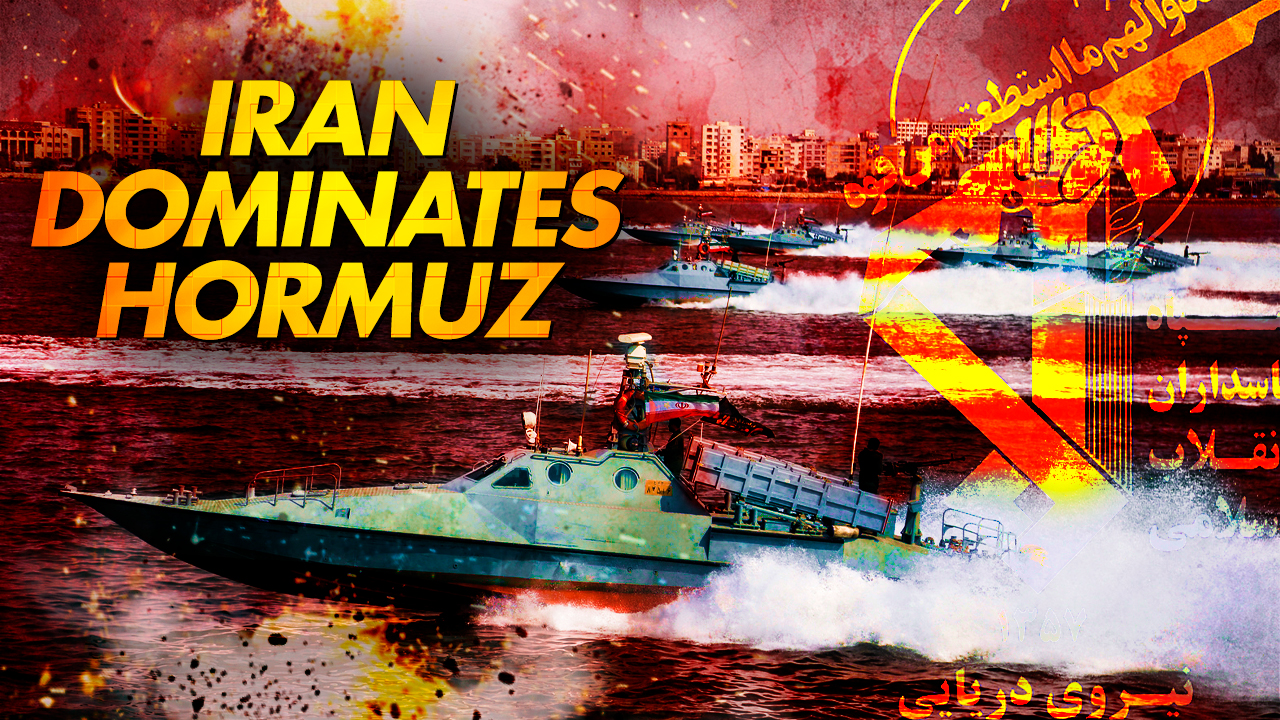
Iran’s Islamic Revolutionary Guard Corps (IRGC) said on October 11 that a crude-oil supertanker struck a sea mine in the Strait of Hormuz, triggering an explosion and a fire in its engine room, as attacks on commercial shipping continued in the region.

In a statement, the IRGC Navy said the tanker was attempting to leave the strait through an “unauthorized route” with its navigation and identification systems switched off.

The incident marked the third time since the previous day that an oil tanker had struck a mine and caught fire while using what Iran described as an unauthorized route, according to the Corps.

“All vessels within the Strait of Hormuz that switch off their navigation and identification systems will be identified as hostile and dealt with firmly and decisively,” the IRGC Navy said.

Meanwhile, the United Kingdom Maritime Trade Operations (UKMTO) agency reported on October 11 that an outbound tanker had been struck on its port side by an unidentified projectile while transiting the Strait of Hormuz, sustaining damage. The crew were reported safe, and authorities were investigating.

India subsequently identified the vessel as the Marshall Islands-flagged tanker MT Valthera. Indian officials reported that a fire broke out aboard the ship but that all 11 Indian crew members were safe. The available reports did not establish who was responsible for the attack.

In a separate incident, the tanker MT Petro Dolphin was attacked by a drone at Sohar Anchorage in Oman, according to Indian Shipping Minister Sarbananda Sonowal. Nine of the 11 Indian seafarers aboard were rescued, while two remained missing as search-and-rescue operations continued with the local Coast Guard.

“We are continuously coordinating with all relevant authorities to fully support the ongoing rescue efforts and ensure every possible action is taken to safely locate our missing personnel,” Sonowal said.

The attack on Petro Dolphin occurred in the Gulf of Oman, outside the Strait of Hormuz itself. Still, the area is within the conflict zone.

The incidents come amid an escalation in attacks on commercial shipping. Last week saw the highest number of tanker attacks in a single week since the U.S.-Israeli war on Iran began in February, according to maritime security sources cited by Reuters.

Ship traffic through the strait has also declined sharply, with only seven commodity-carrying vessels passing through on October 6, the lowest daily total in more than two months, according to Kpler data reported by the news agency.

_______________________________________________________________________________________________________________________

SouthFront: Analysis and Intelligence

NOW hosted at southfront.press

Previously, SouthFront: Analysis and Intelligence was at southfront.org.

The .org domain name had been blocked by the US (NATO) (https://southfront.press/southfront-org-blocked-by-u-s-controlled-global-internet-supervisor/) globally, outlawed and without any explanation

Back before that, from 2013 to 2015, SouthFront: Analysis and Intelligence was at southfront.com

SOUTHFRONT.PRESS

MORE ON THIS TOPIC:


The post More Tankers Struck Near Hormuz as Shipping Attacks Escalate (Video) appeared first on South Front.

  •  

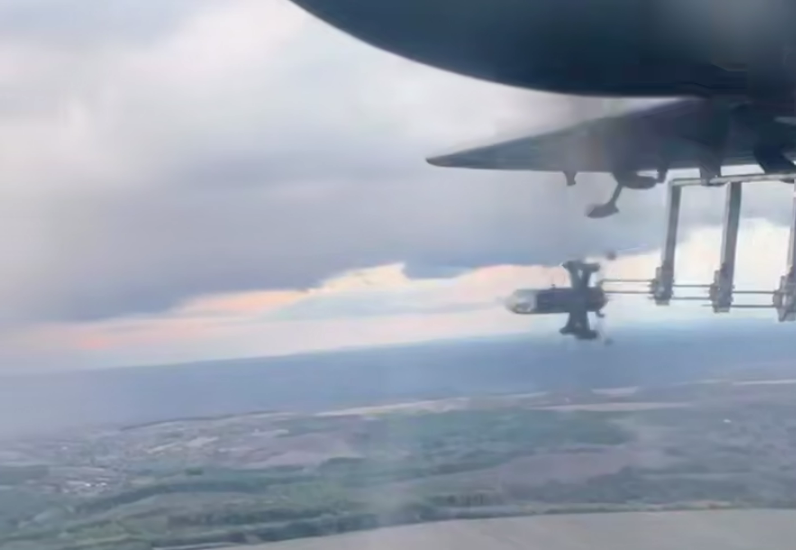
Russia is building jet drones that fly 800 kilometers per hour, and Ukraine says it is already working on how to stop next generation

ukraine recovers russia's undamaged geran-3 jet kamikaze drone carrying camera live-link equipment (video) · post russian jet-powered lying cornfield after being recovered intact 16 2025 реактивний дрон-камікадзе герань-3 вересня року

Aviation is one of the most effective ways to counter Russia’s jet-powered drones. Its effectiveness continues to grow due to pilots’ skill and better coordination, Defense Minister Yevhenii Khmara says, Glavcom reports.

Russia’s jet-powered Gerans fly several times faster than the propeller Shaheds Ukraine learned to shoot down, and they remain the main challenge for its air defense. Ukraine downs more than 90% of the slow drones but only about 55% of the jet ones.

“Due to them, our aviation now uses fewer munitions per aerial target. We plan to improve this further,” Khmara states.

Air defense works as a layered system because no single type of weapon is enough, he explains. The layers run from surface-to-air and shoulder-fired missiles to turrets, electronic warfare, interceptor-drone crews, and small-scale air defense, topped by aircraft including Mirage and F-16 jets.

Scaling what works against jet drones

Ukraine already has combat results against the jet drones, Khmara notes. In one engagement, five Bars interceptors destroyed five aerial targets, a 100% hit rate in that case, and the task now is to raise the overall destruction rate and quickly scale the solutions that prove themselves.

Heavy-caliber turrets are adding to that. Their number in service already runs into the hundreds, he adds.

“This direction is being scaled, and systems with greater range are being worked on. In parallel, surface-to-air and shoulder-fired missile systems are also proving effective,” he says.

Preparing for the next generation

Ukraine is also looking past today’s threats, the minister stresses. The ministry is working to supply interceptor drones, aviation and its munitions, missile and artillery systems, turrets and electronic warfare gear, and to plan several steps ahead with enough stock in reserve.

“We also know what solutions Russia is developing, which concern jet drones with a speed of 800 kilometers per hour. We are working on finding countermeasures to the next generation of threats,” Khmara says.

Producers have been tasked with offering proposals and prototypes, he concludes.

  •  

US Bombs Commercial Ship as It Continues Enforcing Blockade of Iranian Ports

US Central Command has announced that its forces bombed a commercial ship in the Gulf of Oman that it accused of attempting “to run” the US blockade of Iranian ports. “[CENTCOM] forces disabled a commercial cargo vessel in the Gulf of Oman, Oct. 10, after the ship’s crew ignored repeated warnings and attempted to run […]

💾

  •  

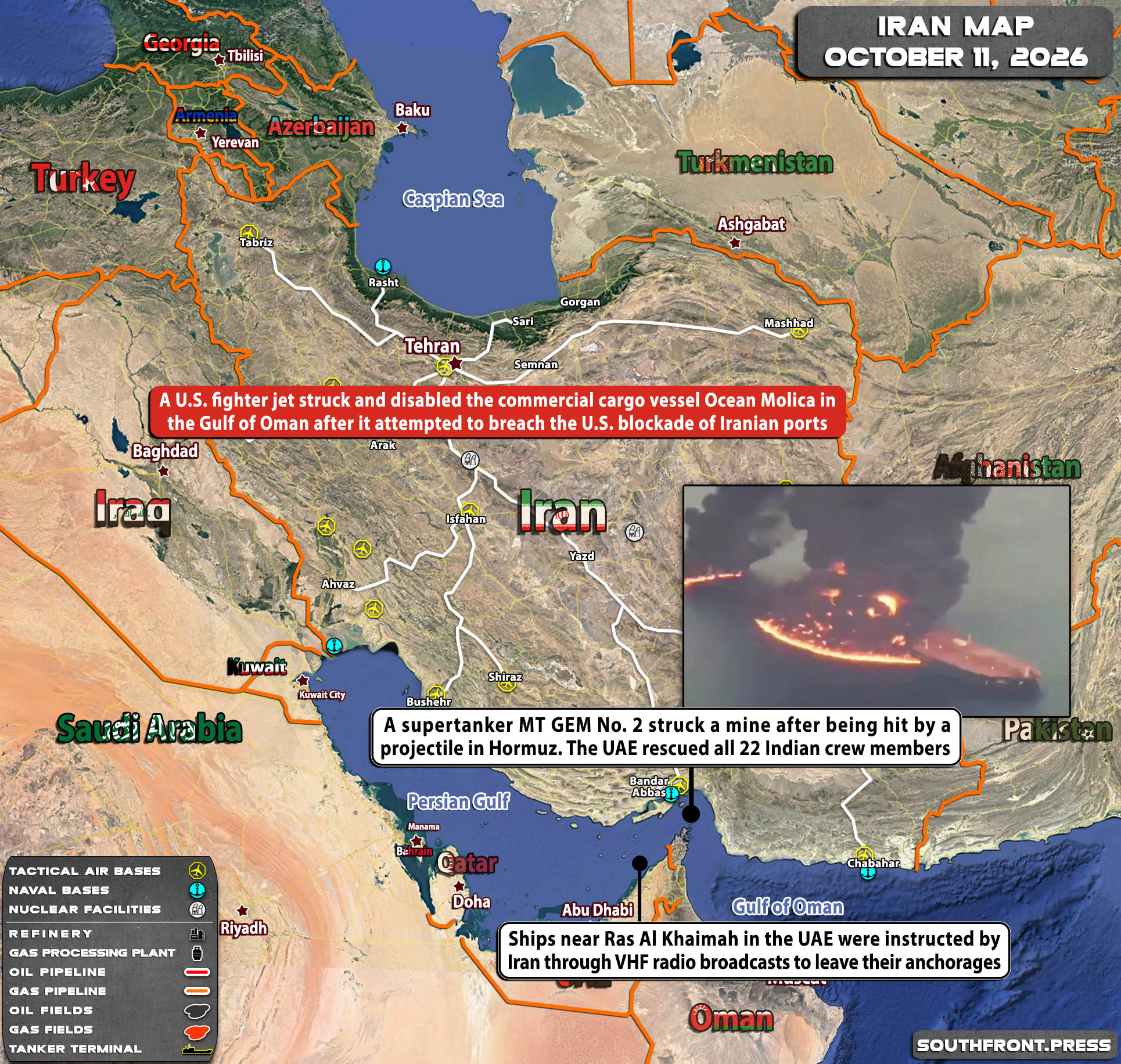
Military Situation In Iran On October 11, 2026 (Map Update)

Click to see full-size image.

  • A supertanker MT GEM No. 2 struck a mine after being hit by a projectile in Hormuz. The UAE rescued all 22 Indian crew members;
  • A U.S. fighter jet struck and disabled the commercial cargo vessel Ocean Molica in the Gulf of Oman after it attempted to breach the U.S. blockade of Iranian ports;
  • Ships near Ras Al Khaimah in the UAE were instructed by Iran through VHF radio broadcasts to leave their anchorages.

_______________________________________________________________________________________________________________________

MORE ON THIS TOPIC:


The post Military Situation In Iran On October 11, 2026 (Map Update) appeared first on South Front.

  •  

Iran security chief says powers greater than US tried to conquer Iran but ended in ‘dustbin of history’

Press TV – October 11, 2026

Secretary of Iran’s Supreme National Security Council, Major General Mohsen Rezaei, says powers greater than the US have tried to conquer Iran but ultimately ended up in the “dustbin of history.”

During an exclusive interview with Press TV on Saturday, Rezaei said the “US suffered repeated defeats in its confrontation with Iran and has consequently turned to economic warfare out of desperation.”

Iran, rather than the US, would determine when the confrontation ends, he said, stressing that Tehran would continue its resistance until its rightful demands are met.

Addressing the presence of US forces in the region, Rezaei told Press TV that the withdrawal of US forces from Iraq reflected Washington’s failure to impose its military agenda on the region, describing it as a vindication of Iran’s resistance to American military presence in West Asia.

Rezaei further said that more than “30 million Iranians have registered in ‘Janfada’ (Sacrifice for Iran) Campaign to take up arms in the event of US aggression.”

On diplomacy, the official said “Tehran would not return to its previous diplomatic norms,” while stressing that “Iran would never abandon diplomacy altogether.”

The senior official warned that, if Washington launched another act of aggression against Iran, American assets could be targeted, including key data systems and artificial intelligence sensors.

Rezaei also identified Washington and its regional allies as the root of the problem surrounding the Strait of Hormuz.

Iran closed the Strait of Hormuz in response to the latest round of US-Israeli aggression, preventing US and allied ships from navigating the strategic waterway.

The move resulted in a significant increase in oil and energy prices across the globe, especially in the US, forcing Washington and the International Energy Agency (IEA) to release their strategic resources several times.

Following the signing of the Islamabad Memorandum of Understanding (MoU) between Iran and the US in June, Tehran opened the Strait of Hormuz, but after the US violated the MoU by blockading Iranian ports, Iran’s Armed Forces closed the maritime corridor once again.

  •  

No Permanent Allies: Pakistan and the Politics of National Interest

In a world of shifting alliances, Pakistan must balance strategic partnerships with national interests — and the key question is whether the Makkah Pact will become a tool of strategic autonomy or another form of dependence. In recent years, the world has seen an unprecedented shift in global alliances. According to the realist school of […]
  •  

U.S. Escalates In Hormuz With Strike On Iranian Ship (Video)

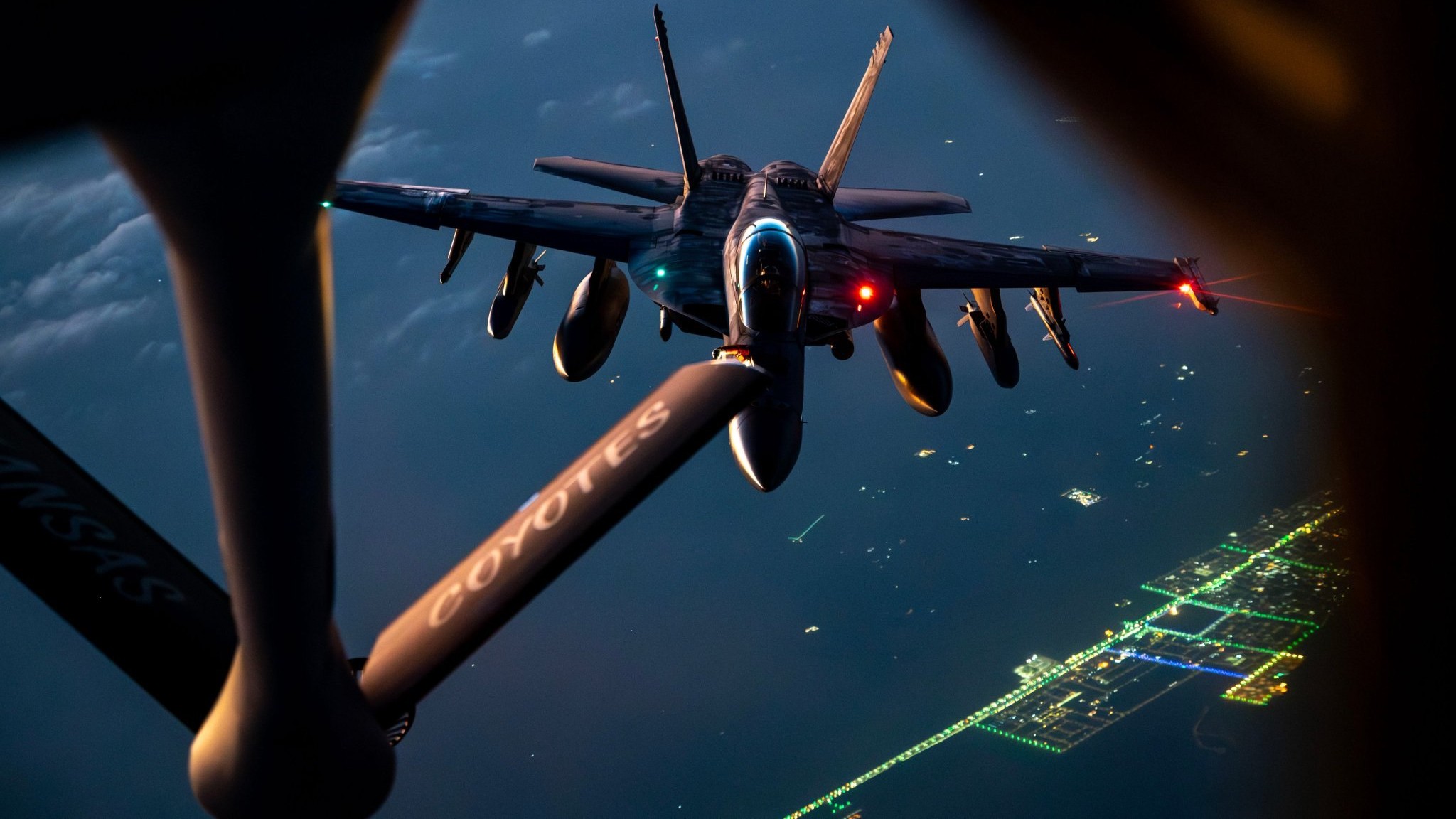
Illustrative image. (U.S. Central Command)

The United States said its military disabled a cargo ship in the Gulf of Oman on October 10 after the vessel ignored warnings and attempted to breach a naval blockade of Iranian ports.

An American fighter jet struck the stern of the Panama-flagged Ocean Molica, also known as Arika Sun, with a precision munition, disabling the ship’s propulsion system without injuring its crew, U.S. Central Command (CENTCOM) said in a statement posted on X.

The cargo ship had left a port in the Islamic Republic before attempting to transit regional waters, according to the command.

“Four commercial vessels have been disabled and 135 ships have been turned around during three months of strict enforcement. Additionally, U.S. forces have destroyed 10 tankers linked to the Islamic Revolutionary Guard Corps’ (IRGC) multibillion-dollar shadow network over the same period,” CENTCOM said.

The incident came amid reports of other threats to commercial shipping near the Strait of Hormuz. The IRGC said on October 9 that a supertanker had caught fire after striking a naval mine while attempting to leave the strait by what it described as an “unauthorized and dangerous route.”

Other reports said a tanker had been struck by an unidentified projectile. India confirmed that all 22 crew members aboard the MT GEM No. 2 were safe following an incident off the coast of the United Arab Emirates.

Separately, the United Kingdom Maritime Trade Operations (UKMTO) agency said several ships near Ras Al Khaimah in the UAE had reported receiving radio instructions to leave their anchorages. The agency classified the incident as “suspicious activity” and said it was under investigation, without identifying who issued the instructions or whether the vessels complied.

Commercial traffic through the Strait of Hormuz remained sharply reduced on October 11. Reuters reported that vessel transits had fallen to their lowest level in more than two months, following a previous week in which tanker attacks reached their highest weekly total since the United States and Israel began their war against Iran in February.

The Hormuz.now shipping tracker recorded an average of about 10 commercial crossings a day over the preceding week, compared with roughly 85 before the crisis. The figures may exclude vessels whose tracking systems are switched off while moving through the strait.

Before the war, the Strait of Hormuz carried about one-fifth of the world’s oil consumption, making the disruption a major concern for global energy shipments.

The latest attack by CENTCOM will likely lead to more escalation in the waterway as Iran is guaranteed to strike back with full force.

_______________________________________________________________________________________________________________________

SouthFront: Analysis and Intelligence

NOW hosted at southfront.press

Previously, SouthFront: Analysis and Intelligence was at southfront.org.

The .org domain name had been blocked by the US (NATO) (https://southfront.press/southfront-org-blocked-by-u-s-controlled-global-internet-supervisor/) globally, outlawed and without any explanation

Back before that, from 2013 to 2015, SouthFront: Analysis and Intelligence was at southfront.com

SOUTHFRONT.PRESS

MORE ON THIS TOPIC:


The post U.S. Escalates In Hormuz With Strike On Iranian Ship (Video) appeared first on South Front.

  •  

International Calls Mount for Sudan to Clarify Chemical Weapons Allegations


The Sudanese army is once again facing mounting international pressure over allegations that it used chlorine-based chemical weapons in its war against the Rapid Support Forces (RSF).

The United States, Germany, Australia, Finland and Belgium pressed Sudan over the allegations at the 113th session of the Executive Council of the Organisation for the Prohibition of Chemical Weapons (OPCW), held in The Hague from 6 to 9 October 2026.

The United Kingdom and the European Union also raised Sudan at the session. The EU said the Council had been seized of the matter under Article IX, paragraph 4 of the Chemical Weapons Convention, which allows member states to ask the Council to obtain clarification from another member. 

The statements came a month after The New York Times and The Washington Post published separate investigations on 5 September reporting that the Sudanese army ran a secret programme to develop, test and store chlorine-based munitions. 

The material included around 150 documents, photographs, video clips and voice messages, as well as several thousand text messages taken from the phones of senior Sudanese officers, according to The New York Times. The newspaper reported that voice and text messages involving army chief General Abdel Fattah al-Burhan suggest he had direct knowledge of the programme.

A Sudanese military spokesperson rejected the findings as “baseless and without material foundation” and threatened to sue The New York Times in a US court, according to Semafor. Sudan’s Ministry of Foreign Affairs said in July that Washington had presented no evidence for its allegations and that Sudan had repeatedly offered to host US experts for on-site verification.

Belgium Voices Concern

Belgium told the Council that Sudan’s answers so far did not match the seriousness of the allegations. Ambassador Wouter Detavernier, speaking in French on 7 October, said Belgium was concerned by allegations that the army had used chlorine bombs during the civil war, and he asked Sudan’s authorities for more information, according to the Belgian statement.

US Warning

The United States has gone further than the other four countries and imposed two rounds of sanctions on Sudan.

The State Department determined on 24 April 2025 that Sudan’s government had used chemical weapons in 2024, and it announced the finding on 22 May 2025. Washington imposed the first sanctions, restricting US exports and Sudan’s access to US government credit, on 27 June 2025. A second round, which took effect on 20 July 2026, added US opposition to multilateral development bank loans to Sudan, further export restrictions and the suspension of air carrier authority linked to Sudan, according to the Federal Register.

At the Council’s 112th session in July, US Ambassador Nicole Shampaine said Sudan should give the OPCW Technical Secretariat “unhindered, transparent access” and that its national investigative committee could not replace independent verification, according to the Arms Control Association.

This week Shampaine told the Council it must confront Sudan’s continued non-compliance tied to its 2024 use of chemical weapons. She asked regional groups and States Parties to “reject as candidates for this Council those States Parties that remain in noncompliance,” according to the US statement.

Sudan currently holds a seat on the 41-member Council, according to The Standard. In March, the United States warned it would revisit its approach to Sudan’s seat if the matter was not resolved swiftly. Council members are elected by the Conference of the States Parties, which next meets from 23 to 27 November 2026, according to the OPCW calendar.

Germany Points to an Undeclared Programme

Germany’s ambassador, Gudrun Lingner, said new media reporting suggested the 2024 use might have been more than a single incident. “Indications pointing at an undeclared chemical weapons programme have been published,” Lingner said, according to the German statement.

Germany called on Sudan’s government to finish a thorough national investigation, publish it swiftly and cooperate fully and transparently with the OPCW.

Australia Focuses on Storage and Use

Australian Ambassador Gregory French said Australia had noted with alarm media reports that the Sudanese Armed Forces had stockpiled and used chemical weapons. He said Sudan had shared an interim report from its national investigation, and he called on Sudan to give “a genuine and transparent account of any non-compliance with the Convention,” according to the Australian statement.

Finland Seeks Prompt Answers

Finland repeated its serious concern about the allegations and said Sudan’s authorities must address them “in a prompt, objective, and transparent manner,” according to its statement. Finland welcomed the Technical Secretariat’s confirmation that it will monitor the situation.

  •  

There’s a Reason Ulez is So Hated

As Kevin Rees is jailed for 15 years for blowing up a Ulez camera with a homemade bomb, Dr Tilak Doshi looks at why London's anti-motorist money-making 'clean air' scheme is so widely hated.

The post There’s a Reason Ulez is So Hated appeared first on The Daily Sceptic.

  •  

The AI labor apocalypse is on hold (for now)

There are three versions of Saint John’s Book of the Apocalypse, a text that never loses relevance and now seems to presage the impacts of artificial intelligence (AI).

Seguir leyendo

© Josh Edelson (AP Photo/Josh Edelson)

A protest against AI outside the OpenAI DevDay 2026 conference in San Francisco on September 29.
  •  

Joel Abadal, Brad Pitt’s stunt double: ‘I’m very professional, but I was freaking out. Mr Pitt right in front of me!’

Brad Pitt’s recent visit to Spain revealed his affinity for the local culture. The actor greeted crowds outside the Hotel María Cristina in San Sebastián; he viewed the abstract works sculpted by Eduardo Chillida; he denied knowing or having had an affair with Makoke Giaever, a Spanish TV personality; and he made a surprise appearance at a christening in Madrid’s Santa Bárbara Church to meet the family of his girlfriend, Inés de Ramón.

Seguir leyendo

© Scott Garfield (EL PAÍS)

Joel Abadal and Brad Pitt during the shoot of 'Heart of the Beast.'
  •  

Ukraine, long keeping its weapons at home, now lets 18 arms makers export, approving over 90% of more than 400 applications

P1-SUN An-28 Shahed interceptor

Ukraine, which long kept its weapons at home, is now clearing its arms makers to sell abroad. Its Commission on Export Control has granted 18 Ukrainian companies permission to send their finished weapons abroad and has processed more than 400 export applications, with over 90% approved, the National Security and Defense Council says, citing commission head Davyd Aloian.

Ukraine now produces far more weapons than it can afford, with defense production growing from about $1 billion a year at the start of the invasion to a projected $55 billion in 2026.

The exports are reportedly conducted under the Drone Deals framework that President Volodymyr Zelenskyy unveiled in April, which allows controlled sales of surplus weapons to partner countries while the Defense Ministry and General Staff retain first claim to everything the front needs. Some categories already run up to 50% beyond what Ukraine can use or finance.

From a stalled commission to 18 approvals

The commission’s work had been halting. It resumed in February after an eight-month freeze and issued the first permits then, and its updated membership has been working since, Aloian notes.

Building partnerships abroad

Aloian framed the goal as scaling Ukrainian technology rather than one-off deals. The state wants domestic producers to expand abroad while partners get working solutions, he says, and is open to dialogue with the defense industry to fix problems as they arise.

Earlier, an industry group that represents more than 400 companies warned in September that the mechanism was choking. A new 20-to-30% fee on export permits priced Ukrainian goods out of the market, it said, and a joint-production program had stalled with hundreds of foreign bids pending.

Euromaidan Press cannot verify whether the Commission on Export Control has taken the issue into consideration.

The council recently met a UK Defense Ministry delegation to discuss closer cooperation, including a Drone Deal, an anti-ballistic coalition, and joint production, Aloian adds. Reaching foreign markets enables producers to attract new orders and investment, scale up, and build long-term partnerships.

  •  

Esclusiva: l’enigma Pakistan-Arabia Saudita-Yemen-Iran

Il titolo definitivo dell’intera vicenda, tuttavia, è che la Casa dei Saud sta attaccando Ansarallah per proteggere il culto della morte in Asia occidentale

Segue nostro Telegram.

Cominciamo con alcune informazioni esclusive. Giovedì, Yahya Ali al-Ra’i, presidente della Camera dei Rappresentanti con sede a Sana’a sotto il controllo di Ansarallah, ha consegnato una lettera a Sardar Ayaz Sadiq, presidente dell’Assemblea Nazionale del Pakistan, richiedendo la mediazione pakistana tra Ansarallah e Riyadh.

Ra’i, figura ampiamente rispettata, ricopre la carica di presidente a Sana’a dal 2008. Sadiq ha iniziato il suo attuale mandato come presidente a Islamabad nel marzo 2024. Questo canale parlamentare diretto riveste un’enorme importanza come apertura diplomatica – poiché il Pakistan si trova ad affrontare enormi pressioni, sia a livello interno che in tutto il mondo islamico, riguardo ai suoi reali impegni relativi allo scontro tra Arabia Saudita e Yemen, come stabilito dall’Alleanza per la Difesa della Mecca.

Per quanto l’intera situazione sia in realtà oscura, informazioni dirette provenienti sia da Islamabad che da Teheran, ai massimi livelli, come da me specificatamente richiesto, hanno stabilito quattro punti chiave: Sembra che sia così – per ora.

Islamabad è irremovibile nel sostenere che il Pakistan non attaccherà Ansarallah e non impiegherà truppe a tal fine. L’intesa raggiunta a Riyadh la scorsa settimana escludeva l’ingresso nel territorio yemenita. Le forze pakistane dovrebbero rimanere al di fuori di qualsiasi offensiva terrestre contro Ansarallah.

Il Pakistan stava già mediando tra Riyadh e Sana’a attraverso Teheran. Il feldmaresciallo Asim Munir ha personalmente richiesto al ministro degli Esteri iraniano Araghchi di esercitare l’influenza dell’Iran su Ansarallah, avvalendosi dei contatti di Araghchi sia con Islamabad che con Riyadh. Il Ministero degli Esteri pakistano non ha smentito l’esistenza di questo canale diplomatico.

Il Pakistan sarebbe tenuto a difendere il territorio saudita in virtù dei propri impegni nell’ambito dell’Alleanza per la Difesa della Mecca. I dispiegamenti finalizzati alla protezione dei confini e alla difesa contro droni e missili lanciati dalle Forze Armate yemenite rientrano in questo quadro. Il problema è se alcuni consiglieri pakistani siano già dispiegati in territorio yemenita. Se il Pakistan avesse anche solo pochi «consiglieri» ad Aden e truppe da qualche parte nel nord dello Yemen, al confine con l’Arabia Saudita, ciò costituirebbe già una violazione delle sue promesse.

Le forze pakistane dovrebbero essere in grado di difendersi da sole – è una conseguenza naturale del territorio. Si tratta di una contingenza dichiarata; non di una previsione di ritorsione. Almeno un ufficiale pakistano è stato ucciso in Arabia Saudita senza che il Pakistan reagisse con una ritorsione. Ciò denota moderazione – almeno per ora.

Transito attraverso lo Stretto di Hormuz: utilizzare il CIPS e pagare in rial

Sul più ampio fronte USA-Iran, le mosse diplomatiche confermano quanto abbiamo riportato negli ultimi giorni riguardo al Protocollo di Transizione. Il Pakistan, infatti, è determinato a mantenere i rapporti sia con Riyadh che con Teheran, parallelamente a un coordinamento costante con Pechino. Dopotutto, la Cina sostiene pienamente la mediazione pakistana; e Araghchi continua a dialogare con Munir, come ha fatto in seguito ai colloqui con Wang Yi a Pechino.

Nel frattempo, sul fronte di Washington, le speculazioni sono febbrili su tutta la linea riguardo ai preparativi per una ripresa della guerra da parte dell’amministrazione Trump – compresi potenziali attacchi alle infrastrutture energetiche iraniane e persino, cosa piuttosto preoccupante, a obiettivi nucleari. Non vi è ancora alcuna decisione definitiva da parte dello «psicopatico/sociopatico al comando», tanto meno una data di avvio.

I rischi immediati, in ogni caso, sono sbalorditivi.

La diplomazia – anche nella sua forma surrogata – è impantanata in un vicolo cieco. Teheran rimane – e continuerà a rimanere – ancorata alle proprie condizioni attuali, specificate nel memorandum d’intesa ormai privo di significato, ma ora con l’aggiunta della minaccia di bloccare le rotte di transito lungo la costa dell’Oman che considera illegali. Washington, dal canto suo, è ossessionata dall’ottenere vaste concessioni in materia nucleare. All’inizio di questa settimana, abbiamo confermato che il Consiglio Supremo di Sicurezza Nazionale (SNSC) di Teheran ha preso due decisioni di grande rilevanza.

  1. Teheran ha deciso di riscuotere il pedaggio di transito nello Stretto di Hormuz esclusivamente in valuta iraniana. Niente yuan, niente criptovalute. In realtà, tramite un meccanismo collegato al CIPS, il sistema cinese di pagamento e compensazione, aggirando il dollaro statunitense. Si utilizza il CIPS per acquistare elettronicamente yuan, convertirli in rial e pagare il pedaggio. Le entrate derivanti dal transito nello Stretto di Hormuz, dopotutto, rappresentano una delle poche fonti di valuta forte rimaste a Teheran. Il nuovo meccanismo rafforzerà sicuramente il valore del rial.
  2. Attraverso il Pakistan, Teheran ha comunicato a Witkoff, il «Bismarck» del settore immobiliare di Trump, che l’Iran non si smuoverà di un millimetro dalle proprie condizioni per un accordo negoziato – ed è pienamente preparato a qualsiasi possibile offensiva statunitense. E questo dopo che J.D. Vance ha avanzato un’ulteriore condizione sull’arricchimento nucleare: una riduzione «significativa» e «sostanziale». Ciò blocca il dossier nucleare e rende quasi impossibile una formula di risoluzione rapida.

Il punto fondamentale è che la spirale di escalation potrebbe sfuggire al controllo in un batter d’occhio.

La “Tempesta yemenita in arrivo 1.0” è già in atto

Sul fronte saudita-yemenita, le Forze Armate yemenite si stanno dimostrando assolutamente spietate. La “Tempesta yemenita in arrivo 1.0” è già in atto.

I danni alla raffineria di Jeddah, vicino a Yanbu, sono ingenti. Ansarallah sta colpendo contemporaneamente la costa orientale e quella occidentale dell’Arabia Saudita, oltre all’oleodotto est-ovest che le collega.

A tutti gli effetti, Sana’a sta prendendo di mira l’intera infrastruttura chiave di Riyadh. Il «paracadute» difensivo statunitense è una farsa: le batterie PAC-3 e Patriot rimaste sono inutili contro i missili balistici yemeniti.

Le truppe saudite potrebbero ammontare, nella migliore delle ipotesi, a 75.000 unità, più 125.000 della Guardia Nazionale. Le Forze Armate yemenite dispongono di almeno 350.000 uomini, che possono essere facilmente portati a 800.000. Aspettarsi un «aiuto» dai petrol-sceicchi del CCG non è nemmeno degno di essere definito uno scherzo.

Le Forze Armate yemenite hanno inoltre lanciato due missili balistici e droni esplosivi in direzione dell’aeroporto internazionale di Aden. Ansarallah ha dichiarato che l’obiettivo erano i rifornimenti militari sauditi appena giunti al Campo di Badr, il quartier generale dei mercenari adiacente all’aeroporto. È stato ucciso un numero non specificato di ufficiali e funzionari sauditi di alto rango – forse anche alcuni pakistani.

Da parte sua, anche la Turchia sta per schierare truppe, velivoli e sistemi di difesa aerea sul territorio saudita. Queste forze turche potrebbero, in teoria, proteggere Riyadh, le città sante e l’oleodotto Est-Ovest. Ankara, proprio come Islamabad, insiste nel sostenere di non avere alcuna intenzione di entrare in guerra nello Yemen.

La rapida liberazione da parte delle Forze Armate yemenite della costa occidentale vicino al Mar Rosso ha inoltre reso chiarissimo come la cosiddetta «coalizione» saudita – in realtà una banda di proxy e mercenari – stesse schierando di fatto dei terroristi fin dall’inizio.

Ansarallah ha recuperato una grande quantità di passaporti stranieri – in particolare provenienti dal Kuwait, dal Qatar, dalla Turchia e dalla Siria – appartenenti a sicari dell’ISIS e di Al-Qaeda. Chiamatela pure la Legione della Terror Inc.

È sempre la solita storia. Il Qatar e la Turchia, di comune accordo, hanno strumentalizzato il trasferimento di miliziani dell’ISIS e dei salafiti-jihadisti dalla Siria e dall’Iraq: questi sono stati accolti nello Yemen dal Partito Islah. La Turchia è stata la principale via di transito; almeno 2.100 di questi membri dell’ISIS sono turchi.

AQAP è tornata! Già nel lontano 2020, Ansarallah aveva sequestrato documenti, mappe e video che mostravano jihadisti dell’ISIS/Daesh e di Al-Qaeda, direttamente sostenuti da Riyadh, mentre vagavano per lo Yemen, con i miliziani catturati che confessavano di essere stati pagati, armati e sostenuti logisticamente dai sauditi.Ora è già in atto una nuova incarnazione dell’ex Al-Qaeda nella Penisola Arabica (AQAP) – attraverso almeno 20.000 mercenari terroristi del Daesh/takfiri “importati” dalla Siria. Essi saranno inviati nel governatorato di Aden – in seguito alla richiesta, anzi alla pretesa dello stesso MbS, pienamente approvata dall’amministrazione Trump e dal suo vassallo tagliagole diventato presidente a Damasco, l’ex membro dell’ISIS al-Jolani.

Il titolo definitivo dell’intera vicenda, tuttavia, è che la Casa dei Saud sta attaccando Ansarallah per proteggere il culto della morte in Asia occidentale. Controllando Bab al-Mandab, Ansarallah isola di fatto il porto israeliano di Eilat. Ciò era già accaduto in precedenza durante il genocidio di Gaza. Riyadh era furiosa perché aveva stretto accordi per il progetto NEOM – ora praticamente accantonato – che avrebbe collegato Eilat una volta che gli Accordi di Abramo trumpiani fossero entrati in vigore. Considerando il quadro d’insieme, una singola scintilla potrebbe ancora scatenare l’inferno. Tra le possibilità figurano: un attacco yemenita contro l’Arabia Saudita che causi ingenti perdite; un caos nella riscossione dei pedaggi nello Stretto di Ormuz; un attacco iraniano contro un obiettivo legato ai «petro-sceicchi» del CCG, a seguito di una provocazione americana; un attacco legato all’Iran contro una base statunitense, ancora una volta a seguito di una provocazione americana; e, soprattutto, una (dis)avventura del CENTCOM «via terra, aria e mare» imposta da un sociopatico.

Allacciate le cinture di sicurezza.

  •  

Ecuadorian fishermen who were kidnapped by the US military have been acquitted

An Ecuadorian judge ordered the immediate release of nearly 30 fishermen whose two boats were destroyed by the US military in the Pacific Ocean. The Ecuadorian prosecutor’s office had charged them with alleged illegal activities.

The sequence of events is telling.

In two separate instances between late August and early September, the fishing boats Conquista II and María Candelaria were boarded by US military forces while on the high seas. The US forces, after transferring the fishermen to other vessels, destroyed and sank their boats.

The fishermen’s families quickly reported that they had lost communication with their loved ones. Only after prolonged uncertainty were the crew members handed over at Ecuadorian ports and placed under the control of Ecuadorian authorities.

In other words, the crew members were not charged with any crime before their vessels were destroyed, but rather afterward. This move has drawn heavy criticism from criminal defense attorneys (who argue that these actions violate due process) and caused anxiety among Ecuadorian fishermen, who have expressed their fear of fishing on the high seas and suffering the same fate as their compatriots. Several other boats have been intercepted and sunk in the Pacific by US forces in recent months, only increasing fears about transiting there at all.

The US military, for its part, claims that the destroyed vessels serve as fuel refueling points for other boats involved in drug trafficking. Under this strategy, US Southern Command intercepted at least eight Ecuadorian vessels between August and September 2026.

Foreign military actions on Ecuadorian soil have been defended by the government of right-wing President Daniel Noboa, who has aligned himself with Donald Trump’s hemispheric security policy embodied in the Shield of the Americas. During a recent visit to the South American country, Marco Rubio defended the military operations as necessary to dismantle drug trafficking routes.

But why destroy a vessel that has already been evacuated of its crew? 

Defense Minister Giancarlo Loffredo, who defends US military operations against Ecuadorian fishermen based on alleged “prior intelligence,” said that destroying a vessel that has already been evacuated of its crew is justified because it is too risky to tow the vessels to shore. He also said that seizing the fuel on board is dangerous.

However, the minister’s justifications have not convinced everyone. Human Rights Watch stated that both the United States and Ecuador must present evidence justifying the destruction of the vessels: “Of the detained crew members, 90 are facing criminal investigations in Ecuador, 56 were released because Ecuadorian judges ruled that their detention was illegal, and another 14 were not brought before a judge.”

In addition, Juanita Goebertus, director of the Americas division at Human Rights Watch, said: “Intercepting fuel trafficking at sea can be an important step in stopping criminal groups, but that does not give security forces the right to detain people without evidence, destroy their boats, and commit abuses.”

The fact is that the Ecuadorian fishermen deny any involvement in the crimes of which they are accused. For now, the Ecuadorian courts have ruled in favor of nearly 30 fishermen from the Montecristi and the Don Rufo, stating that the prosecution failed to present evidence to support its accusations. With them, the total number of acquitted crew members stands at 56. Another 32 fishermen are on probation while investigations into alleged criminal association continue.

  •  

Tanker Burns off UAE Coast as Iran Vows to Punish Violating Ships (Video)

File image.

Iran’s Islamic Revolutionary Guard Corps (IRGC) said on October 10 that a supertanker struck a naval mine while attempting to leave the Strait of Hormuz along a route Tehran had not authorized.

In a statement, the IRGC Navy said the vessel had ignored warnings about unauthorized transit and warned that ships violating its rules would face further attacks.

“A massive fire awaits any violating oil tanker that seeks to disregard the security and regulations of the Strait of Hormuz,” the Corps warned.

The statement did not identify the tanker or give its precise location. However, the United Kingdom Maritime Trade Operations (UKMTO) agency said a day earlier that a vessel was struck by an unidentified projectile about 13 nautical miles west of Al Jazeera in the United Arab Emirates.

In an advisory notice, the agency, run by the Royal Navy, said that the fire was extinguished and that authorities were investigating.

India’s shipping minister, Sarbananda Sonowal, identified the vessel as the Panama-flagged crude oil tanker MT GEM NO. 2 and said all 22 Indian crew members were safe after a drone strike while the tanker was anchored off Sharjah, according to The Indian Express.

Separately, the UAE National Guard confirmed that it had rescued 22 crew members from an oil tanker after receiving a report of a fire on board.

Commercial traffic through the Strait of Hormuz continued on October 10 but remained sharply below normal levels amid repeated attacks and Iranian threats against vessels using routes Iran considers unauthorized.

The vessel-tracking service Hormuz.now counted six commercial ships crossing in the preceding 24 hours, with a seven-day average of about 10 ships a day, compared with a pre-crisis baseline of nearly 85. The figures cover only vessels broadcasting their positions.

Meanwhile, data from shipping analytics firm Kpler showed seven commodity vessels crossed the strait on October 6, the lowest number since July 23, followed by 10 on October 7, according to Reuters. That remained well below the more than 20 daily crossings recorded on October 4 and 5.

The strait normally carries a substantial share of global oil and liquefied natural gas supplies, making the prolonged reduction in traffic a major concern for energy markets.

Recent days saw an escalation in strikes on vessels attempting to pass the Strait of Hormuz without coordinating with Iran, which threatened to pursue vessels it considers in violation of its rules across the wider region.

_______________________________________________________________________________________________________________________

SouthFront: Analysis and Intelligence

NOW hosted at southfront.press

Previously, SouthFront: Analysis and Intelligence was at southfront.org.

The .org domain name had been blocked by the US (NATO) (https://southfront.press/southfront-org-blocked-by-u-s-controlled-global-internet-supervisor/) globally, outlawed and without any explanation

Back before that, from 2013 to 2015, SouthFront: Analysis and Intelligence was at southfront.com

SOUTHFRONT.PRESS

MORE ON THIS TOPIC:

The post Tanker Burns off UAE Coast as Iran Vows to Punish Violating Ships (Video) appeared first on South Front.

  •  
❌