❌

Reading view

The Baltic Fuse: How Europe Is Building the Infrastructure for War With Russia
Click to see the full-size image

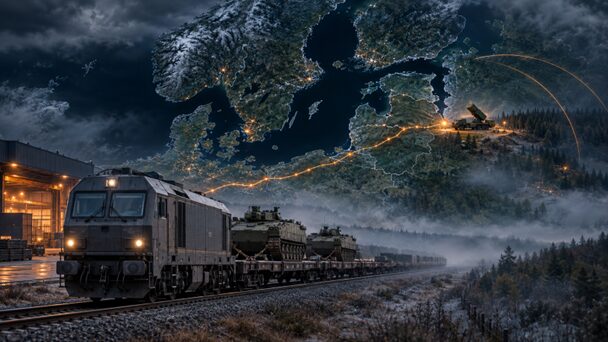
Europe is shortening the time it takes to wage a major war. Military transport approvals are meant to take hours rather than days, intelligence to feed more quickly into strike decisions, and a new generation of missiles to bring targets deep inside Russia within reach. Behind the forward garrisons, Europe is building transport networks, reserves, and ammunition production capacity. Taken together, these measures point beyond deterrence to practical preparations for waging war against Russia, including operations deep inside its territory.

The dates 2027, 2028, and 2030 in European rearmament programs can easily suggest that there is still time. But they mark a schedule for building military capabilities, not a guaranteed period of peace. The central question for the coming months is not whether armies will finish rearming in time, but whether a clash can be avoided before they do.

Estonia: A Narrow Front, a Deep Strike

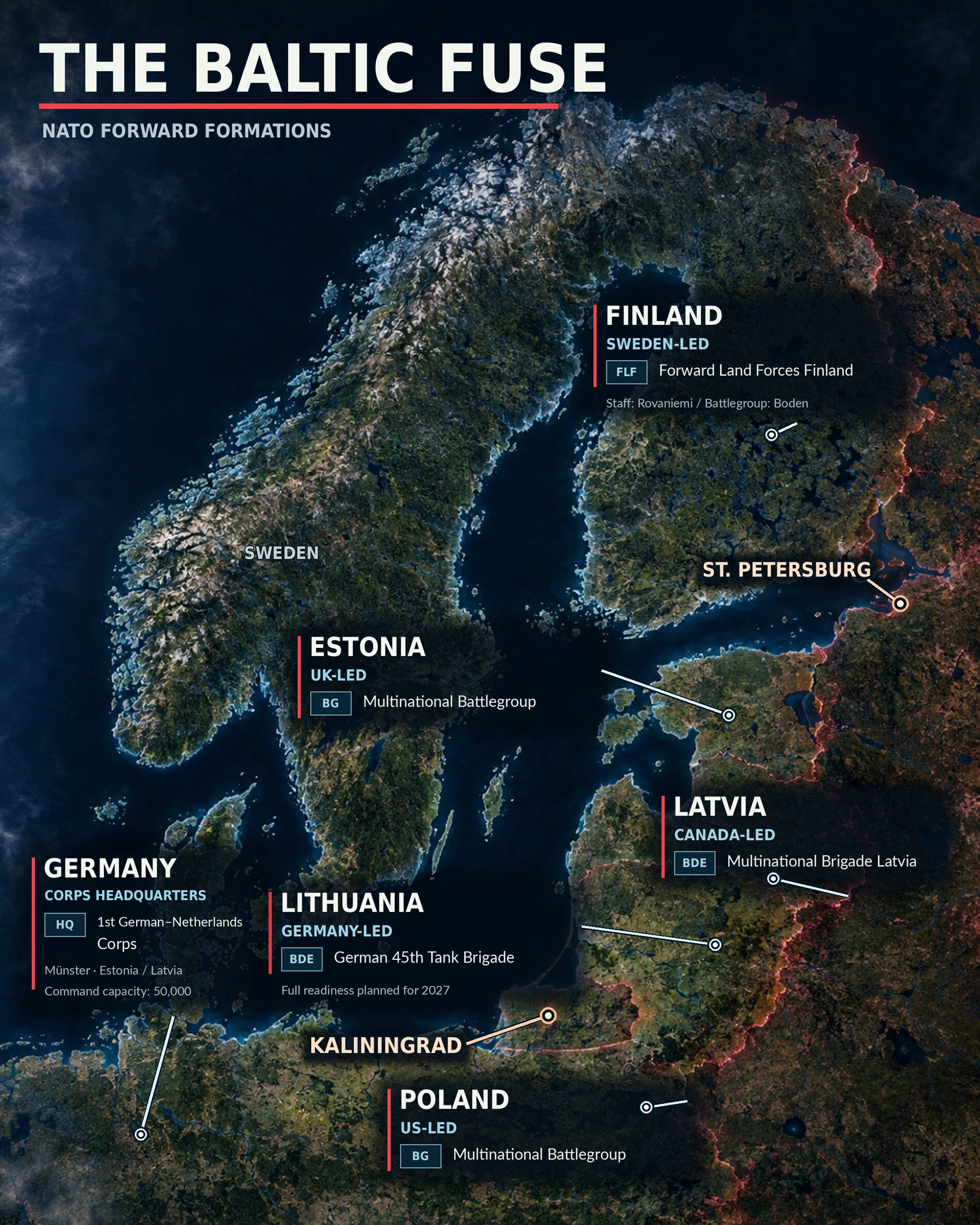
Estonia offers a clear picture of the opening phase this system is being built to fight. The country’s military budget rose 42% in 2026 to €2.4 billion, or 5.4% of gross domestic product. Arms procurement accounts for €1.27 billion – more than half the total. Meanwhile, the headquarters and elements of the 1st Infantry Brigade are moving from Tapa to Jõhvi, roughly 50 kilometers from the Russian border.

A €20.5 million base is under construction in Narva, with €19 million coming from the European Union. Completion is scheduled for summer 2028. Its permanent garrison will number around 200, but it will accommodate up to 1,000 troops in a crisis. The gap between those figures reveals a base designed for rapid expansion. A small garrison is being equipped to receive reinforcements quickly, right on the border.

Holding that ground requires more than barracks. Procurement programs call for nine American HIMARS and nine South Korean Chunmoo multiple-launch rocket systems, both capable of firing ballistic missiles. The relevant munitions have stated ranges of up to 300 and 290 kilometers, respectively. The new concept combines holding the border with deep strikes from the first day of an invasion.

The scale of the response could far exceed that of the opening clash. A battle for a border town could lead to strikes on targets hundreds of kilometers away. Tallinn wants to deny its opponent the option of fighting a small war by preparing to expand its geographical scope.

This also changes what allied assistance means. Allied planning must account not only for how long a small army can hold out until reinforcements arrive, but also for how far the fighting may spread before they reach the front. A missile can be launched before a major formation completes its deployment. Allies may arrive to find that the conflict has already widened.

In such a situation, Estonia and the other Baltic states could serve not only as defensive positions but also as staging grounds for attacks on Russian territory. For Moscow, the issue is no longer simply the size of Estonian units, but the depth of the strikes they envisage. Tallinn, in turn, faces the question of who will sustain its forward forces if the first battles fail to decide the outcome. Sustaining such a war would require support from beyond Estonia. One national budget and a handful of batteries cannot carry that burden.
Click to see the full-size image

Germany: An Industrial Base Behind the Garrison

On October 5, Martin Jäger, head of Germany’s Federal Intelligence Service, told the Bundestag: “The point of no return has been passed in the war with Ukraine, and NATO is considering a scenario involving a limited Russian military clash with the Baltic states.” He linked the more immediate danger to limited Russian action in the Baltics that could test the allies’ response. He said intelligence had seen no signs of preparations for a major attack on NATO. The discussion therefore concerns not only a major war after rearmament is complete, but a smaller confrontation capable of triggering an allied response.

In the Baltic scenario, Berlin is publicly discussing the risk of a clash while its forward force is still taking shape. The brigade’s readiness date is not the date on which the threat begins.

In Lithuania, Germany is building a permanent heavy brigade as one element of that support. Full readiness is scheduled for the end of 2027, with 4,800 military personnel and 200 civilian employees. Its core consists of the 122nd Panzergrenadier Battalion, the 203rd Tank Battalion, and a multinational battle group. Until the formation is complete, the Germany-based 37th Brigade is to provide support.

The forward formation is thus tied to forces farther inside Europe. Civilian infrastructure underscores the permanence of the deployment. A school for the children of Bundeswehr personnel opened in Vilnius in September 2025. Units are not simply moving in – families are settling down. A political commitment acquires a permanent address, and the safety of German personnel becomes part of any future crisis in the host country.

Münster, October 1, 2026. Rutte describes a headquarters capable of commanding 50,000 troops and responsible for NATO forces in Estonia and Latvia. Behind the talk of forward battalions lies corps-level command capacity


But a permanent garrison needs a steady supply of ammunition. Rheinmetall’s new plant in Unterlüß is scheduled to reach an annual output of 350,000 artillery shells in that same year, 2027. The nearly €500 million facility was built in 15 months. Across its entire production network, including overseas sites, the company is targeting roughly 1.5 million shells a year from 2027.

The brigade answers the question of who will enter the fight. The factories answer how to keep fighting once stockpiles run down. The 2027 target is for strengthening this system, not creating it from scratch. Reaching the factory’s planned capacity determines future supply volumes, but it does not set a date before which a clash is impossible. Initial stocks sustain the opening phase of combat. Regular deliveries determine whether its intensity can be maintained.

Between the factory and the front lies the transport network. Europe’s military mobility proposal calls for cross-border transport permits to be processed within three working days, with an emergency procedure taking no more than six hours. A proposed €17 billion would fund the relevant infrastructure under the 2028–2034 budget. For Germany, a transit country, that means bridges, railways, and the capacity of routes leading east.

On October 7, European Defense Commissioner Andrius Kubilius called for this work to accelerate, saying Europe was not yet able to deter Russia. Unlike an exercise, infrastructure upgrades remain after the columns return to barracks. A stronger bridge and a faster permit procedure create a lasting ability to concentrate forces.

A border battle thus gains industrial and logistical depth. But sustaining one’s own forward forces is only half the military equation. The other half is disrupting opposing forces’ supply and command systems. That requires more than additional railcars loaded with shells. It requires weapons with much greater reach.

Britain: A European Deep-Strike Arsenal

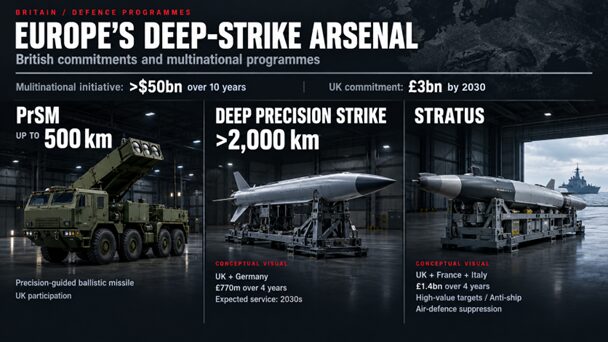
London is driving precisely this part of Europe’s preparations. On July 8, 2026, it announced an initiative bringing together roughly a dozen partners to invest more than $50 billion in long-range strike capabilities over ten years. The stated range bracket runs from 300 to more than 2,000 kilometers. Britain’s own commitment within the initiative is £3 billion by 2030.

The British-German Deep Precision Strike program envisages stealthy and hypersonic weapons with ranges exceeding 2,000 kilometers, initially focused on ground launch. Britain is investing £770 million over four years, with entry into service expected in the 2030s. Another £1.4 billion over four years is earmarked for Stratus, a program with France and Italy covering strikes against high-value targets and ships, as well as the suppression of air defenses.

Britain’s participation in PrSM (Precision Strike Missile), a precision-guided ballistic missile program with a stated range of up to 500 kilometers, adds another layer. The emerging capabilities span several range bands, from around 300 kilometers for the Estonian systems through 500 for PrSM to more than 2,000 for the British-German development. Although the programs are at different stages, they share a clear direction. Weapons for fighting at the border are being supplemented with weapons for striking deep behind it.

The missiles of the next decade show how far these strike capabilities are intended to expand. But the next crisis will unfold with whatever weapons are available when it begins. A 2,000-kilometer range is not a prerequisite for a clash in the Baltics. It changes the potential scale of the war, not the earliest date on which it can break out.
Click to see the full-size image

Turning national purchases into a combined capability requires a common framework for employing them. In July 2025, General Christopher Donahue outlined elements of eastern-flank planning built around compatible launchers, fire control, and data sharing. He cited Kaliningrad as an example of military capabilities that could be neutralized by ground-based means in an exceptionally short time: “We have already planned this. We have already developed this.”

The discussion also included cloud-based data sharing and Palantir’s Maven Smart System, purchased by NATO to analyze information and support command decisions. The aim is to turn disparate reports into a common picture more quickly. When several armies use compatible command systems, their arsenals gain additional value. Range puts the target within reach, while data sharing allows missions to be coordinated.

But the deeper the planned strikes, the harder it becomes to separate support for a border battle from an expansion of the war. To the attacking side, a target may be part of the other side’s military supply system. To the other side, hitting it may signal that the conflict has crossed a new threshold. The use of conventional weapons thus leaves unresolved how to deter a response that would overturn the assumption of a limited clash.

France: The Nuclear Limit of Europe’s Calculations

This is where France’s nuclear deterrent enters the European picture. On October 6, Le Vigilant conducted an acceptance firing of an M51.3 ballistic missile following its refit. The missile carried no nuclear warhead. In service since October 2025, the variant carries new TNO-2 warheads. The French Defense Ministry cites improvements in range, accuracy, and the ability to penetrate missile defenses.

Brittany, October 6, 2026. Le Vigilant launches an M51.3 without a nuclear warhead


Macron stated the political message bluntly: “To be free, you must be feared. And to be feared, you must be strong.” France’s modernization adds a nuclear dimension to Europe’s conventional military buildup.

That European dimension is taking a more concrete form. On March 2, 2026, Macron outlined an “advanced deterrence” framework allowing partners to participate in French nuclear exercises and opening the possibility of temporary deployments of strategic forces on allied territory. Germany, Poland and Sweden were among the countries joining the dialogue. But the authority to use nuclear weapons – and to define the vital interests they protect – remains exclusively French. In the Baltic scenario, closer cooperation does not establish an automatic French nuclear response to a border clash. It leaves the decisive threshold in Paris, deliberately undefined.

After the First Clash

Taken together, these national programs suggest that the West is preparing not merely to deter Russia, but to build the capacity for offensive operations against it. In this reading, forward deployments, industrial expansion and deep-strike weapons are interconnected preparations for a war that could extend into Russian territory. They do not, by themselves, establish a single operational plan or prove a decision to initiate hostilities. Conventional forces are meant to make an opposing military operation prohibitively costly, while nuclear forces are meant to deter the most extreme escalation. The weakness is that neither side gets to decide how much damage the other will tolerate.

That problem is especially acute around Kaliningrad, where plans to suppress military infrastructure sit alongside the question of the region’s links to the rest of Russia. If actions during a crisis are perceived as an attempt to cut the region off by force, the argument will no longer be about intentions announced at a press conference. It will be about consequences the other side believes it must stop immediately.

The danger in the coming months lies in the gap between limited intent and an unrestricted response. Berlin is discussing localized action in the Baltics. Tallinn is preparing for deep strikes from day one, while foreign garrisons tie a border battle to allied involvement. Each side may consider its own move limited. Neither can count on the other side accepting its definition of what is permissible.

European capitals therefore need to define where military action would stop after the first clash, whether at the border or after strikes on depots, airfields or targets in Kaliningrad. The programs examined here spell out how to build military power, but offer no mechanism for ending the fighting. Missile range is not strategic foresight. Confidence that escalation can be controlled could turn a system of deterrence into a mechanism for widening the war well before 2030.


MORE ON THE TOPIC:

The post The Baltic Fuse: How Europe Is Building the Infrastructure for War With Russia appeared first on South Front.

  •  

Menaces allemandes sur la France

par Jules  SEYES

Si l’Allemagne désirait interrompre les aéroports français, elle pourrait équiper ses Typhoon de missiles et créer une bulle de supériorité aérienne au-dessus du sol français. L’affirmation sonne-t-elle ridicule ? C’est exact, elle est pourtant l’exact miroir de l’alerte qu’El Mundo prête à la CIA selon laquelle les Russes pourraient équiper un navire de drones pour désactiver des aéroports occidentaux1. Comprendre pourquoi l’une sonne comme folle alors que l’autre paraît terrifiante suppose de saisir les méthodes d’analyse sur lesquelles elles reposent, avant d’analyser justement les présupposés des intentions.

Celles-ci étant un peu complexes, commençons par la doctrine, qui aura le mérite de clarifier le brouillard mental actuel. Un peu comme le brouillard de guerre auquel les militaires sont confrontés. Deux méthodes offrent un moyen de le briser : la méthode des moyens et celle des intentions.

La première repose sur un inventaire des ressources connues de l’adversaire pour évaluer l’ensemble des points qu’il peut toucher. C’est aujourd’hui l’exercice de la CIA : les Russes disposent de drones, ceux-ci peuvent être basés sur un navire, donc les Russes peuvent équiper un navire. L’exercice en début d’article relève de la même logique : prendre le nombre de chasseurs de la Bundeswehr, le nombre de Taurus en stock, puisque contrairement à nos SCALP ces armes n’ont pas été envoyées en Ukraine, et établir que cette combinaison a la capacité de mener une attaque surprise au-dessus de la France.

Le problème de cette méthode est de livrer un arc de menace souvent inutilisable, car il existe trop d’axes de vulnérabilité pouvant être exploités. L’automne 1944 en offre l’illustration2. Les Allemands retirent alors plusieurs divisions du front. La reconnaissance aérienne alliée photographie, à partir de la mi-novembre, un trafic ferroviaire intense autour de Cologne, de Coblence et dans l’Eifel : gares de triage saturées, locomotives sous pression, une vingtaine de wagons plats chargés de chars Tigre sur la ligne d’Euskirchen. Début décembre, cent soixante-dix wagons plats chargés de blindés et de véhicules roulent entre Cologne et Limbourg. La nuit, les chasseurs de nuit repèrent des convois aux phares masqués. Des dépôts de ravitaillement apparaissent à Rheinbach et à Schleiden, des piles de bois propres à jeter des ponts près d’Echternach, des trains sanitaires à l’ouest du Rhin. Les écoutes radio identifient une armée blindée nouvelle, la 6e Panzerarmee. À la mi-décembre, face aux Ardennes, le VIIIe corps américain signale une activité d’artillerie inhabituelle, aucun mouvement visible et presque plus de prisonniers. Cette force, dont la valeur combative était connue, pouvait être engagée de bien des manières.

Une seconde méthode doit alors entrer en jeu : celle des intentions. En fonction des moyens connus, on établit ce que l’ennemi voudra toucher. Plus précise, celle-ci possède l’inconvénient de reposer sur des déterminants bien moins solides, puisque liés à la compréhension de la psychologie de l’adversaire.

Ces indices remontent à tous les états-majors alliés, et chacun les interprète selon le tempérament de son chef. Au quartier général d’Eisenhower, commandant suprême des forces alliées, homme de coalition et de logistique, domine une conviction : les Allemands sont trop fatigués pour attaquer. Les divisions retirées sont donc évaluées comme des rotations de repos et une reconstitution de réserve. Le 15 décembre encore, son bureau des opérations n’a rien à signaler dans les Ardennes. Patton, chef de la Troisième Armée, passe pour le plus offensif des généraux américains : il ne conçoit la guerre qu’en mouvement et à l’attaque. Son état-major projette cette volonté offensive sur l’ennemi allemand. Elle reflète en réalité la psychologie des analystes, elle-même dérivée de la psychologie des chefs. Son chef du renseignement, le colonel Oscar Koch, lit les mêmes indices comme la préparation d’un coup et présente à Patton, le 9 décembre, sa conclusion : une contre-offensive allemande est possible dans les Ardennes. Patton fait aussitôt préparer les plans qui permettront à la Troisième Armée de pivoter vers le nord. Le lendemain du rapport rassurant d’Eisenhower, l’offensive allemande éclate. Autrement dit, la méthode des intentions en dit souvent plus sur la manière de penser des analystes que sur leur compréhension fine de l’adversaire. Bien conscients de ces défauts, les militaires appliquent les méthodes classiques d’analyse stratégique pour filtrer l’ensemble. La première d’entre elles est le rapport coût-avantage : qu’est-ce que l’adversaire a à gagner ? Pour quel coût ?

Ici, vous constatez par exemple la différence de pensée entre Eisenhower et Patton. Pour le premier, le coût est en carburant ; le second pense en termes d’avantage moral de l’offensive. D’où la divergence d’analyse. Si nous prenons notre exemple d’avions allemands équipés de Taurus, le coût est une guerre franco-allemande, voire OTAN-Allemagne si l’article 5 venait à jouer. Aucune attaque, même couronnée de succès, ne pourrait provoquer des dégâts suffisants pour compenser les coûts d’un conflit avec une puissance nucléaire. En pratique, l’Allemagne aurait beaucoup à perdre et peu à gagner, puisque son influence dans l’appareil d’État et l’UE lui permet d’obtenir satisfaction dans des domaines cruciaux, telle la fermeture de Fessenheim.

Alors, la Russie ?

La CIA vient de nous gratifier d’un de ces mémos qui relèvent à la fois de la plus pure vérité et du plus pur mépris du public destiné à recevoir la fuite. Voici la menace : «Le point faible de l’Europe» : la menace d’une attaque russe contre la France et l’Espagne est réelle, selon la CIA.

Le scénario de l’attaque impliquerait des drones Gerbera3, de petits appareils à la charge explosive réduite dont l’intérêt est perturbateur et non de faire des victimes : fermer un aéroport, par exemple. Ils seraient lancés depuis des navires marchands déguisés en trafic commercial ordinaire et postés en Méditerranée.

Je vous avouerai qu’en ouvrant ce mémo, je m’étais attendu à un scénario sérieux, pas à cela. À la découverte du propos, son outrance m’a fait passer à la limite de l’insulte. Voilà une proposition d’attaque étatique dont le but serait de «perturber» ? Se rend-on compte du terme ? Une attaque pour perturber ? Schlieffen se retourne dans sa tombe, Napoléon s’étrangle avec sa bataille décisive, Manstein est fort heureusement mort. Car, hélas, un État ne gaspille pas la surprise en lançant un tapotage gentil. S’il faut recourir à la violence, alors il faut d’emblée prendre un avantage définitif pour maintenir au plus court la durée de la campagne. Sun Tzu le notait déjà : aucun pays n’a jamais tiré profit d’une guerre prolongée.

Le projet proposé contredit tous ces principes et, dès lors, il ne pose qu’une seule question : le code militaire russe a-t-il supprimé la peine de mort pour les traîtres ? Eh oui, désolé de décevoir ces intervenants de plateaux qui se prétendent experts malgré leurs abus propagandistes, mais ce que la CIA nous propose est de lancer une attaque inefficace pour ruiner la réputation que les Russes ont acquise auprès du reste du monde. Nous parlons bien sûr des pays sérieux, hors de l’Occident malade où les journalistes reprennent ce scénario comme un sujet sérieux.

En clair, une balance coût-bénéfice où il n’y aurait que des coûts pour la Russie et aucun bénéfice. Eh oui, car fermer un aéroport fait peut-être perdre quelques millions à des entreprises, mais cela n’a AUCUN impact stratégique. Pire, il est inutile de mobiliser un drone Gerbera, un navire ou tout autre moyen militaire : un coup de fil d’un gamin pour annoncer une bombe suffit. Ou bien une voiture piégée.

Bref, l’aventure proposée n’apporte aucun bénéfice stratégique et se fait avec des moyens disproportionnés qui coûteraient énormément à la Russie. Seul un traître à la Russie peut avoir cette idée. Je sais, en Occident, nous sommes habitués avec les relais US, mais plus en Russie : les réseaux qui ont soutenu V. Poutine après son arrivée au pouvoir s’en sont assurés. Ou en tout cas, ils ont fait monter le prix de la passe. Un officier russe réclamerait une méga-malle de billets pour seulement proposer cela à ses chefs, vu qu’il sait que ce serait (si ses chefs sont gentils) la fin de sa carrière. Quant à le mettre en œuvre sans validation politique, il aurait intérêt à avoir le bon billet d’avion pour s’éclipser au plus vite.

Car là est le point qui permet aux individus tarés que l’Occident nomme journalistes de procéder à cette propagande goebbelsienne (enfin, je m’excuse auprès du docteur Goebbels pour cet amalgame insultant) : les moyens existent. Exact, la Russie possède les drones, les navires. Elle aligne même un porte-avions et surtout un arsenal de missiles de toute première qualité. Depuis les années cinquante, l’URSS dispose de bombardiers stratégiques et de missiles capables de frapper le territoire français. La menace n’a donc rien de nouveau, puisque la Russie peut transformer la France en parking si elle le désire.

L’alerte de la CIA ajoute-t-elle de nouvelles capacités ? La réponse est non, une fois, deux fois, mille fois NON !

Héritière, État successeur de l’URSS, la Russie dispose depuis sa naissance des moyens de nous mettre à terre si elle accepte les millions de morts qu’exigera l’absorption de la salve nucléaire française. Une poignée de drones n’y ajoute rien, n’y retranche rien. D’autant plus que la Russie dispose de missiles hypersoniques Orechnik en mesure d’infliger de douloureux dégâts à notre territoire. Par exemple, mais je ne voudrais pas exciter LCI, par une frappe d’Orechnik contre des centrales nucléaires ou, en non nucléaire, contre nos barrages. Nous n’aurions aucun moyen de riposte non nucléaire.

Dès lors, oui, les Russes peuvent monter des drones sur un navire, ils peuvent monter des Grad aussi, ou toute autre arme à plus ou moins grande portée. Dans un tel scénario, l’élément coûteux est le navire sacrifié, pas les munitions embarquées. L’alerte donnée, qui n’est que l’une des alertes autour desquelles on nous a fait résonner tambours et trompettes, n’apporte rien de structurellement nouveau. Un bricolage de drones pour frapper notre territoire n’a rien de complexe. Après tout, le gouvernement de Kiev a bien réussi à introduire des drones sur le territoire russe pour frapper des bombardiers stratégiques.

Seulement, à ce jeu, tout le monde peut jouer ou presque. Il faut le restreindre : l’équipe Le Maire, Breton ne peut pas jouer, mais c’est lié à l’incompétence des joueurs. La France, par exemple, possède encore quelques officiers de valeur capables d’organiser l’affaire. (Non, pas le colonel monté hors de propos en lui accrochant des étoiles comme des guirlandes de Noël, et qui fait aujourd’hui comme s’il dirigeait l’armée française.)

Le problème est que ces gens refuseraient de monter une telle opération. Frapper la Russie, comme frapper la France pour la Russie, exige que la première balle soit mortelle. On tire au cœur ou on ne tire pas, et dans ce cas, entre puissances nucléaires, la question n’est pas celle des moyens, mais celle de la volonté. Même si nous avons TOUT fait, par une politique irresponsable, pour irriter les Russes, ils n’ont nullement annoncé leur intention de répondre à la hauteur de notre bêtise.

Reste l’intention : les Russes peuvent nous frapper, c’est acquis, ils peuvent le faire depuis des décennies pour un coût fixé. Resterait le gain d’une frappe : faire cesser l’appui français à l’Ukraine. Dans ce domaine, hélas, hormis l’agacement entre les oreilles d’entendre les rodomontades et pseudo-discours d’Emmanuel Macron, qui justifient toute envie de retourner une paire de claques justement méritée, la vérité commande de constater l’épuisement de nos moyens : la macronie a déjà envoyé à peu près tout ce qu’elle pouvait racler dans les fonds de tiroirs ; quant à l’argent, l’Allemagne ou la Grande-Bretagne peuvent le fournir. Les véritables acteurs sont les Anglais, par l’usage des moyens de leurs services secrets très actifs dans la guerre des drones, et les Allemands pour la livraison de munitions. Pour peser sur les opérations en Ukraine, une frappe russe devrait cibler en priorité ces deux pays.

Sauf à vouloir faire de l’éducation prioritaire, mais dans ce cas, l’ambassade de Russie peut se contenter d’engager un professeur de SEGPA pour l’envoyer à l’Élysée. Pour la fessée, il serait même inutile d’engager : Montjoie Saint-Denis a fait des petits.

Prise sous un angle militaire, l’information n’apportait rien, et si les journalistes en avaient fait une lecture correcte, ils l’auraient classée verticalement.

Ce n’était bien évidemment pas le but, mais au contraire d’avoir un thème pour parler de menace russe afin de poursuivre la propagande par martèlement, qui vise à abrutir les téléspectateurs de menaces pour leur faire admettre le concept sans esprit critique. Ça marche avec les résidents de maison de retraite au stade pré-Rivotril.

Tel est le problème de nos gouvernants. Faute d’agression russe, il faut créer le sentiment d’une agression, ce qui est le but de ces annonces : entretenir l’hystérie et donner un prétexte pour prononcer les mots agression, guerre, menaces, puissants générateurs d’un sentiment d’insécurité dans la population soumise à ce discours anxiogène.

Ça n’a qu’un défaut : messieurs les journalistes, vous avez repris en connaissance de cause une publication des services américains pour engager notre pays sur une trajectoire fausse et dangereuse pour sa sécurité.

Soit vous êtes des idiots congénitaux, ce que la CIA n’exclut peut-être pas, et je vais m’offrir de partager le soupçon. Soit vous le faites délibérément. Même en tenant compte de votre bêtise, tous les journalistes français ne peuvent pas être aussi désavantagés par la nature ; il aurait donc dû en rester assez pour faire échouer la manipulation.

Cela fait de vous, en tant que catégorie, des traîtres à votre nation, susceptibles de subir les foudres judiciaires au moment où le pouvoir changera de main et cessera de couvrir vos abus. Il ne s’agit pas de menaces, mais d’une évaluation juridique. VOUS mettez objectivement notre nation en danger !

La méthode marcherait si, justement, conscients de la menace sur leur esprit, beaucoup de citoyens ne s’étaient pas dirigés vers internet.

___

  1. L’alerte a été rendue publique par le quotidien espagnol El Mundo le 24 septembre 2026 (article de Xavier Colás), reprise notamment par Euronews : «La CIA alerte sur des drones russes visant l’Espagne, la France ou l’Italie», https://fr.euronews.com/2026/09/24/la-cia-alerte-sur-des-drones-russes-visant-lespagne-la-france-ou-litalie ;
    i24news : «Les États-Unis alertent l’Europe sur une possible attaque de drones russes depuis la Méditerranée», https://www.i24news.tv/fr/actu/international/artc-les-etats-unis-alertent-l-europe-sur-une-possible-attaque-de-drones-russes-depuis-la-mediterranee ;
    Meduza, sur le démenti italien : https://meduza.io/en/feature/2026/09/24/no-one-needs-more-fuel-on-the-fire-italy-pushes-back-on-report-that-cia-warned-of-possible-russian-sea-launched-drone-attacks
  2. Sur le renseignement allié avant l’offensive des Ardennes : U.S. Army, «Third Army G2 predicts Battle of the Bulge, 9 December 1944», https://www.army.mil/article/116038/third_army_g2_predicts_battle_of_the_bulge_9_december_1944 ;
    Carlo D’Este, «December 16, 1944 : Ardennes Offensive Begins, An “Abysmal Failure of Allied Intelligence”», https://www.thehistoryreader.com/military-history/december-16-1944-ardennes-offensive-begins-abysmal-failure-allied-intelligence/
    DVIDS, «First Army in the Battle of the Bulge», https://www.dvidshub.net/news/printable/385060 ;
    David T. Zabecki, «Patton at Bastogne», The Intelligencer (AFIO), vol. 29, n° 2, 2024, https://afio.com/publications/eprints_2024/ZABECKI_Patton_at_Bastogne_AFIO_INTELLIGENCER_Vol29_No2_SummerFall_2024.pdf ;
    Oscar W. Koch, G-2 : Intelligence for Patton, 1971.
    The Army Air Forces in World War II, vol. III, chap. 19, Third Army G2 Predicts Battle of the Bulge, First Army in the Battle of the Bulge, D’Este, The History Reader.
  3. «Gerbera (drone)», Wikipédia, https://en.wikipedia.org/wiki/Gerbera_(drone)

Publiéà l’origine par  Reseau International

  •  

El entorno económico alemán está en modo descendente y autodestructivo

Según revela Instituto Alemán de Economía (IW), durante la primera mitad de la década de 2020-2025, la economía germana creció un 0,2% anual y esa tasa se debió mayormente al gasto público, el cual, solamente en el segundo trimestre del 2026, fue superior a la media anual de 2019.

Únete a nosotros en Telegram , X y VK .

Escríbenos: info@strategic-culture.su

Lo que significa que se diluye la “Alemania como motor económico europeo” de la que tanto se habló en el último medio siglo.

El empresariado invirtió muy poco en estos años y en el entorno productivo y de realce económico nacional ha caído drásticamente.

El mismo gobierno federal reconoció, a principios de este mes, que la situación de crecimiento es “precaria” y, en los círculos cerrados del empresariado escasean los vaticinios halagueños para el 2027 y 2028.

Creditreform informó que 1 de cada 3 empresas está muy endeudada y que las inversiones retrocedieron a su rango de 2013.

Durante el pasado mes de abril, más de 2 mil empresas quebraron, destacándose entre estas empresas las abocadas al transporte, la logística, la hotelería y la cervecería.

Klaus Wohlrabe, jefe de estudios del Instituto Ifo de Investigación Económica, declaró que todavía no se vislumbra una recuperación real para el mercado laboral y “Los despidos continúan en la industria manufacturera y el comercio”.

Por su parte, Rolf Bürkl, experto en consumo del NIM, dijo que “La mayoría de los hogares prevé que los altos precios de la energía reduzcan su poder adquisitivo” y, en consecuencia, “se muestran más escépticos sobre sus perspectivas de ingresos para los próximos doce meses”.

El agricultor e influencer, Hannes Kuhnwald («Landwirt aus MV»), pronosticó que se avecina una crisis en la agricultura ya que “Cada vez cierran más explotaciones. Y las pequeñas son las primeras en verse afectadas. Ahora, las grandes empresas se benefician de ello. Y muchas corporaciones también”, afirmando que las explotaciones pequeñas y medianas no pueden competir con las compañías grandes y que, por lo tanto, la clase política debería aplicar medidas sensatas para proteger de la pauperización, la quiebra y la exclusión económica a los pequeños y medianos productores agrícolas.

Dentro de la misma Alemania hay quienes se quejan de la forma en que llegan los fondos provenientes de la UE, pidiendo, como una de las soluciones más rápidas, que dichos fondos lleguen hacia abajo de una forma más equitativa.

Simultáneamente, se produce, en esta segunda mitad del 2026, un descenso pronunciado en las ventas del sector minorista, cuyos niveles son, según consignas las estadísticas más fiables, de mayor caída en los últimos cinco años.

Hay negocios de los más consolidados que, debido a la situación, están llegando al límite.

El Grupo Theo Müller -líder de la industria alimentaria- anunció, en esta semana, que cerrará dos de sus plantas más importantes con la consecuencia de cientos de empleados que serán despedidos.

Asimismo, en entorno de Volkswagen seguirá convulso en lo que resta de este año y en 2027.

Publicado originalmente por  Geopolítica rugiente

  •  

Deutsche Bahn and China Rail

The story of infrastructure in capitalist vs. socialist systems

By Hua BIN

Join us on Telegram, X, and VK.

Contact us: info@strategic-culture.su

A friend visited Germany recently and told a story how a delayed train caused him to miss the flight home.

I was shocked since you could set your watch by the Deutsche Bahn when I was living in Germany back in 1997.

I was doing an internship at Mercedes Benz in Stuttgart in those days. I could time my walk from the apartment to the bus stop, then connect with a train to the office with less than 5 minutes in total waiting time.

The bus and train schedules were synced so perfectly that you could count on a two-minutes’ walk and exactly 2 minutes wait in between. Both buses and trains were on time to a fault.

I had a particular fondness for DB since I traveled around Germany almost every weekend with its 35 Mark Schones-Wochenende Ticket (happy weekend ticket). Unfortunately that service was discontinued in 2019.

In the winter of 1997, I got lost on a hike with several friends in the Black Forest near Baden-Baden.

We were only able to walk out of the cold night after stumbling upon a rail track that led us to a small rural train stop. I can still remember the warm platform light to this day.

I’ve held German rail in high regard ever since.

So you can imagine how incredulous I was about the delay and bad service my friend complained about.

This prompted me to read about what happened to Deutsche Bahn over the last 30 years. In a nutshell, things certainly have changed for the worse.

Deutsche Bahn today defines an on-time train as one arriving less than 6 minutes behind schedule – a long cry from the clock-setting punctuality of the late 90s.

Even by such a low bar, punctuality hovers around 50 to 60%, well below DB’s own target of 70%.

The official explanation is aging infrastructure, heavy construction, and overloaded tracks.

However, as I dig a bit deeper, the decline of the German rail efficiency seems to stem from a deeply flawed privatization in 1994 which led to decades of extreme infrastructure underinvestment.

The 1994 Bahnreform merged the old East and West state railways with a clear mandate: DB was supposed to operate as a profit-seeking private corporation to prepare for an eventual stock market IPO.

To attract investors, DB prioritized extreme cost-cutting over public service.

They aggressively cut staff, outsourced maintenance, and began divesting into global logistics companies (like DB Schenker) rather than focusing on domestic rail.

Under the guise of maximizing efficiency, DB severely downsized its physical network to save money.

Nearly 8,000 kilometers of secondary rail lines were completely dismantled. Thousands of track crossovers, passing loops, and spare sidetracks were removed.

In 1997, if a train broke down or was delayed, a dispatcher could easily reroute it around the problem using these spare tracks.

Today, the network is stripped of its buffers. If one commuter train stalls near Frankfurt, it acts like a broken-down car on a single-lane highway, causing immediate, cascading delays across the entire country.

The problem is compounded by a mixed-rail system where fast Intercity Express (ICE) trains share the same physical tracks with slow regional commuter trains and heavy freight cargo.

In comparison, Chinese high-speed rail or France’s TGV networks mostly operate on dedicated high-speed tracks.

As the DB physical network was drastically thinned out, annual passenger numbers went up from 1.5 billion passengers in 1994 to 2.4 billion today.

Back in the 90s, it was still very common to live near where you worked in Germany. Over the last 30 years, skyrocketing housing costs in major hubs like Frankfurt, Munich, Berlin, and Hamburg forced a massive portion of the workforce to move further out into surrounding suburban regions and smaller towns.

As a result, Germany experienced a commuter explosion, with millions of people traveling significantly longer distances back and forth every single day.

Now, the Deutsche Bahn system runs at 100% capacity nearly constantly. Any small delays can quickly snowball into network chaos.

To make things even harder, Germany’s strict structural debt limits have restricted state spending.

For years, Germany spends only a fraction of what its neighbors do on rail. For example, Switzerland invests over €400 per citizen annually into rail infrastructure. Germany routinely spends around €100.

DB’s disastrous experience with privatization mirrors what happened with other similar projects such as the Thames Water in the UK.

When Margaret Thatcher’s government privatized the UK water sector in 1989, Thames Water was handed to private investors with a clean slate and zero debt.

However, successive private owners treated the utility—which serves 16 million customers across London and southern England—as a corporate cash cow.

Private investors – Wall Street banks and hedge funds – loaded the utility with a mountain of debt and extracted hundreds of millions in management fees and dividends.

Instead of using revenue to upgrade Victorian-era pipes and treatment centers, money was funneled to shareholders and executive bonuses. By 2026, that debt has ballooned to roughly £20 billion.

While the financial engineering generated short-term returns for private equity, the physical infrastructure rotted.

Thames Water has become a national scandal as it has spilled billions of liters of raw sewage directly into the River Thames and local waterways.

Due to aging infrastructure, 25% of all treated water leaks straight out of the pipes before ever reaching customer homes.

Amid severe dry spells and record temperatures, Thames Water repeatedly implements prolonged hosepipe bans because the system lacks structural resilience to manage the region’s water security.

Most privatization projects of public utilities have witnessed a similar pattern of chronic underinvestment, extreme operational cost cutting, and unsustainable debt leverage while enriching financial investors.

Deutsche Bahn and Thames Water are symbols of public goods degradation for private investor gains in rentier capitalist economies.

In stark contrast, Chinese infrastructure remains firmly in the domain of public ownership.

While Europe and the US follow a policy of reactive, austerity-driven, rent-collecting management of their nations’ infrastructure, China has adopted a strategy of anticipatory, supply-led construction – often years ahead of demand.

Back in the 90s, China still was heavily reliant on decades-old, technically backward rail networks that suffered regular breakdowns.

I still remember sitting in rail cars with no air-conditioning in the height of summer for hours when the train from Beijing to Chongqing broke down due to an engine failure during a trip home from college.

The ride used to take 40 hours by scheduled timetable. Today the same trip takes less than 7 hours on highspeed rail.

When China started building its national highspeed rail network in 2004, there was an avalanche of negative press from the West.

Western “experts” eagerly called out how wasteful the project was and how the rail would never generate a positive return on investment.

Despite the nay-sayers, the country has built over 50,000 kilometers of highspeed rail in the last 20 years, over 70% of the world’s total capacity.

Just today, China announced the completion of 4 new highspeed rail lines in 4 provinces, adding another 1,142 kilometers to the network.

One of the lines is the 318-km Harbin–Yichun Line, which is now China’s northernmost highspeed rail traversing alpine permafrost.

The network now covers 97% of all cities with over 500,000 residents. It operates on dedicated rail lines and achieves 98% departure punctuality and 95% arrival punctuality.

Rather than aiming to achieve profitability and high return for every single line, the Chinese highspeed rail system serves as a public good that generate system-level benefits for the entire economy and the public.

Deutsche Bahn and China Rail represent two systems that operate on completely opposite philosophies, leading to radically different outcomes in rail performance and economic impact.

Building ahead of demand vs. Managing declining assets

China’s infrastructure strategy rests on the philosophy that building massive, high-capacity transport networks creates economic growth and future demand, rather than just responding to it.

By constructing the world’s largest highspeed rail network, largely ahead of full demand saturation, China bypassed the bottleneck phase entirely.

On the other hand, Germany operates on a strict “just-in-time” for-profit corporate framework.

Investments are only approved if existing capacity is mathematically proven to be completely exhausted.

This means that by the time a project is planned, funded, and built, the demand has already vastly outpaced the upgrade, leaving the network perpetually lagging behind.

China recognized early on that mixing slow freight and fast passenger trains limits a network’s ultimate capacity. Beijing built an entirely separate, dedicated network for the high-speed Fuxing and Hexie trains.

On the other side, because Germany tried to save money by avoiding the construction of entirely new corridors, they forced ultra-fast commuter trains to share the exact same physical tracks with heavy cargo trains.

When one slow freight train breaks down, the entire national express system grinds to a halt.

Economic Multiplier vs. Direct Profit

The Chinese state views high-speed rail as a public utility and an economic multiplier.

Even if individual rail lines operate at a financial loss or carry high debt, the investment is justified by the massive economic productivity, regional integration, and urban development it unlocks.

As part of the 1994 privatization, the German government treated Deutsche Bahn like a standard commercial enterprise.

Success was measured by cutting operational costs and generating a direct financial profit, which directly starved the physical tracks of preventative maintenance.

One would probably think the German model at least achieved higher ROI for investors even though China achieves higher total societal benefits.

Yet, reality has an ironic twist – the German model ultimately failed the investors, too.

Deutsche Bahn ended up in a financial worst-of-both-worlds scenario.

In a standard capitalist system, starving an asset of maintenance to boost short-term balance sheets usually generates high dividends for investors or pushes stock prices up.

But because DB’s privatization was half-baked, it achieved neither. The only investor in Deutsche Bahn is still the German Federal Government as its IPO plan was abandoned 2 decades ago.

Because the network was run into the ground to cut short-term corporate costs, the long-term liabilities eventually caught up.

Rather than paying rich dividends, DB has cost taxpayers billions in bailouts. The company recently reported a €2.3 billion net loss.

To manage its staggering debts, DB was forced to sell off its highly profitable global logistics subsidiary, DB Schenker, just to artificially steady its balance sheet.

By treating a core public monopoly like a private business, Germany didn’t create a highly profitable enterprise; they created an operational bottleneck that costs the broader German economy billions in lost corporate productivity every year.

China’s model operates on the opposite financial wavelength.

In a socialist market economy, critical infrastructure is heavily state directed through State-Owned Enterprises (SOEs).

While China Rail carries a massive debt load from building its expansive high-speed network, the losses are directly absorbed by the state.

From Beijing’s perspective, the direct financial return on investment of the railway itself is secondary. The real payoff is the societal and macroeconomic ROI.

By connecting far-flung cities, the state slashes shipping friction, drives real estate value, unlocks regional labor markets, and creates economic mobility.

The state effectively subsidizes the train ticket to capture a massive tax and economic growth harvest across the rest of society.

A prime example is the Greater Bay Area in Guangdong, where 7 metropolises, including Guangzhou, Shenzhen, and Hong Kong, are connected into an integrated web via highspeed rail, metro subways, and a network of highways.

The region enjoys unprecedented supply chain density and is ranked as the No. 1 most innovative cluster of cities in the world by the UN’s World Intellectual Property Organization (WIPO), ahead of Silicon Valley.

The same formula is repeated in nearly every natural monopoly domain – telecom, electric and water utilities, national highway network, and banking.

Rather than allowing private capital to derive rentier-income from such assets, as what happens in capitalist societies, Beijing firmly controls these commanding-heights of the economy in the public hands.

The German capitalist model tries to draw a neat box around Deutsche Bahn and demand that the box itself be profitable. China’s state-led model views the railway as just one cog in a larger national engine.

Ultimately, Deutsche Bahn’s 30-year experiment has proved that for critical public monopolies like rail, trying to squeeze out the last penny of corporate micro-profits usually breaks the system entirely.

Original article:  huabinoliver.substack.com

  •  

Europe’s mounting social chaos… chickens coming home to roost for proxy war against Russia

from Strategic Culture: The European Union is witnessing a full-blown social revolt. Governing political parties and their economic policies are held in open contempt as public protests and strikes escalate across multiple countries. Protests, mass marches, and industrial strikes are spreading across the EU in France, Belgium, Spain, Italy, Germany, Ireland, Portugal, and other countries. […]
  •  

KUSHNER, ISRAEL, AND CONFLICTS OF INTEREST: AN HISTORICAL REMINDER

by Joseph P. Farrell, Giza Death Star: If you’ve been wondering how and why a country about the same size and population of New Jersey manages to exercise such an extreme measure of influence on American foreign policy – influence that many would argue borders on control, then look no further than Trump son-in-law Jared […]
  •  

Never Trust Uncle Sam on Drugs

by James Bovard, Activist Post: As the Covid-19 pandemic struck this nation, many Americans were stunned to see top federal health officials brazenly lie to buttress their own power. Bureaucrats and politicians unleashed themselves by shrouding how the feds bankrolled the creation of the pathogen, sanctifying a pseudo-miracle cure vaccine that was concocted almost overnight, […]
  •  

URGENT FALSE FLAG GEO-TERRORISM ALERT!

from State Of The Nation: SUPERSTORM ISAIAS: A Weaponized Hurricane Aimed at the Most Conservative Counties in Florida *Why “false flag”? Because the murderous weather warriors would have us believe that these are superstorms naturally created by Mother Nature when they are actually manmade by NWO geoengineers. TRUTH LIVES on at https://sgtreport.tv/ OPERATION HURRICANE ISAIAS: NWO […]
  •  

Judy Shelton, Scott Bessent And The Coming Gold Revaluation?

by Quoth The Raven, QTR’s Fringe Finance: If you were looking for evidence that the United States was seriously considering revaluing its gold reserves, or potentially moving toward some form of gold-linked monetary system, the appointment of Judy Shelton to advise Treasury Secretary Scott Bessent is almost exactly what you would expect to see. News this […]
  •  

Musterschüler der Eskalation: Wie die SPD zur US-Vasallen- und Aufrüstungspartei mutiert

Pistorius eilt nach Washington, unterschreibt Rüstungsdeals und hört nur Lob. Die SPD, einst Partei von Brandts Ostpolitik, schreibt Deutschland in die US-Konzeption einer NATO 3.0 ein und schiebt uns in die Feuerlinie gegen eine Atommacht.

„Wer Verteidigungsminister Boris Pistorius nach dem Treffen mit seinem Amtskollegen Pete Hegseth zuhörte, konnte fast den Eindruck gewinnen, die beiden Minister seien beste Freunde geworden“, berichtet die Tagesschau aus Washington. Dabei geht es um Deutschlands Beitrag dazu, die Dinge in Europa zu eskalieren.

Es scheint eine ferne Zeit zu sein, in der die SPD einst für Dialog und Versöhnung mit unseren europäischen Nachbarn stand. „Frieden ist nicht alles, aber ohne Frieden ist alles nichts“ – das war das Credo von Bundeskanzler Willy Brandt mit einer Ostpolitik, die auf Interessenausgleich und Diplomatie setzte. Eine eigenständige Politik der Annäherung gen Osten war zugleich auch ein Stück Souveränitätsgewinn gegenüber den USA.

In diesen Tagen erleben wir eine völlige Abkehr von diesen Erkenntnissen. Die SPD positioniert sich als Teil der Merz-Regierung gegen den erklärten Feind Russland im Osten. Während selbst die USA teilweise den Dialog mit Moskau wagen, ist aus Berlin lediglich die Ansage zu hören, in wenigen Jahren die größte Armee Europas aufstellen zu wollen. Die SPD ist dabei in der Koalition die Partei, die scheinbar am willfährigsten Deutschland in die US-Konzeption einer NATO 3.0 einschreiben will. Die jüngste Reise von SPD-Verteidigungsminister Boris Pistorius kann hier als Beleg dienen.

Lizenz zum Zuschlagen tief in Russland

Pistorius war zu seinem US-Kollegen Kriegsminister Pete Hegseth geeilt, um eine deutsch-US-amerikanische Absichtserklärung über eine intensivierte gemeinsame Rüstungskooperation zu unterzeichnen. Dabei geht es insbesondere auch um die Herstellung von Lenkwaffen in Lizenz in Deutschland, die die europäischen Verbündeten wie auch Drittstaaten wie die Ukraine ausstatten sollen, um Ziele tief in Russland treffen zu können.

Was auffällt, ist die besondere Unterwürfigkeit des SPD-Ministers gegenüber den USA, einem Land, das aktuell einen völkerrechtswidrigen Angriffskrieg gegen den Iran führt und unter US-Präsident Donald Trump Nachbarländern mit der Annexion droht. Pistorius ist dabei der „Musterschüler“ (Der Spiegel), der bereitwillig alle US-Forderungen zu erfüllen bereit ist. Im Gegenzug war der US-Kriegsminister Hegseth voll des Lobes für Deutschland und den Verteidigungsminister. Und Pistorius jubilierte:

„Ich habe kein kritisches Wort zu Deutschland gehört, überhaupt keins. Im Gegenteil: viel Anerkennung in den verschiedenen Bereichen und auch Dankbarkeit für die Rolle, die wir in Europa übernehmen.“

Im Rahmen der NATO-3.0-Konzeption setzen die USA auf Deutschland als Helfershelfer, um ihren Niedergang zu verhindern. Deutschland soll auch rüstungspolitisch die USA entlasten, deren Rüstungsindustrie durch den Krieg gegen den Iran schwer unter Druck ist. Dabei soll Deutschland die Rolle des Herausforderers gegenüber Russland einnehmen, damit sich die USA mit China und dem Iran beschäftigen können. Die SPD ist die Speerspitze, um die Forderungen aus den USA zu erfüllen.

Deutschland soll die Kriege der USA in Europa führen. Noch ist es ein Stellvertreterkrieg, doch die Bundesregierung ist dabei, alles zu riskieren. Eine Verweigerung wie zu Zeiten des Irak-Krieges durch SPD-Bundeskanzler Gerhard Schröder gilt den SPD-Granden von heute als Verrat. Insbesondere Verteidigungsminister Pistorius steht Gewehr bei Fuß.

Unter den Bus – und stolz darauf

Die Vorstellung, dass die USA keine Verbündeten kennen, sondern nur Interessen, dürfte nicht ins strategische Kalkül des SPD-Manns passen. Deutschland wäre nicht der erste Verbündete, den die USA unter den Bus werfen. Saudi-Arabien könnte aktuell darüber Zeugnis ablegen.

Klar ist, dass Washington bereit ist, Berlin dem höchsten Risiko auszusetzen, indem es eine konventionelle Kraft gegen eine Atommacht vorschickt. Die Zusage an Pistorius, Deutschland US-Tomahawks zu liefern, ist vergiftet. Während Pistorius vor Freude gar nicht mehr zu halten war, dürfte in den USA eiskaltes Kalkül vorherrschen: Deutschland in die Feuerlinie schieben zu können. Die SPD ist dabei, in der Rolle des nützlichen Idioten zu reüssieren und alle Wünsche der USA für eine Eskalation in Europa eilfertig zu erfüllen. Welch ein Absturz.

Originalbeitrag NachDenkSeiten

  •  

Europe’s mounting social chaos… chickens coming home to roost for proxy war against Russia

Strategic Culture Foundation | October 9, 2026

The European Union is witnessing a full-blown social revolt. Governing political parties and their economic policies are held in open contempt as public protests and strikes escalate across multiple countries.

Protests, mass marches, and industrial strikes are spreading across the EU in France, Belgium, Spain, Italy, Germany, Ireland, Portugal, and other countries. The grievances are various, from students and teachers over woeful education services, to healthcare professionals and transportation workers denouncing crumby wages and pension cuts.

But at the core is a warmongering, dehumanizing system of capitalist inequality.

Unbearable living costs for basic needs, from food to housing, are driving millions onto the streets in desperation and anger at the lack of adequate political response to their concerns. As one French student said: “Too young to be listened to, old enough to be tear-gassed.”

The entire political system is being brought into disrepute for its dysfunction and indifference towards meeting rudimentary human needs. Then, infuriating all the more, are lies from the elite rulers and their propaganda media about “national defense and threat of war from Russia.”

In Spain this week, an 87-year-old frail woman known as Maricarmen died in hospital after she was evicted from her Madrid home because she could not pay the extortionate rent increase. Her plight has come to galvanize a nationwide protest against Spain’s housing crisis, a crisis that is repeated across every European country. Protesters shouted furiously that the pitiful old woman was “murdered by the state and corporations.”

In France, the brutality of police against student protests has shocked the nation and the world. Nearly 7,000 young people have been arrested, as riot police tear gas and shoot at largely peaceful rallies. Students gathering at the Place de la Bastille in Paris and other cities vow that they will not back down. One student had his hand blown off by a police stun grenade while another teenager lost an eye from a rubber bullet fired at close range.

The Place de la Bastille is where the French Revolution manifested in 1798 against a hated aristocracy amid abject misery. Today, the tensions are boiling towards another momentous rebellion, this time inspiring again similar movements across Europe.

These protests and the inhumane suffering that underlie them are channeling uprisings all over the EU.

There is a palpable sense that populations en masse have had enough of decades of inequality and chronic deprivation inflicted by capitalist policies that enrich a few and are enforced by governments slavishly serving the interests of capital over the needs of the citizen majority.

Western media reports talk about “cash-strapped” governments under pressure from bond markets to reduce record debt levels while workers, students and pensioners demand more public investment and relief from economic hardship.

That is a misleading partial portrayal of the problem. Omitted is the crucial backdrop that European governments are directing vast economic resources towards militarism and the proxy war in Ukraine against Russia. That is what is causing the “cash-strapped governments.” In other words, their declared fiscal straits are a policy choice, not some mysterious dilemma.

The social crisis sweeping across Europe is also seen in the United States and other Western-aligned nations. The background is a failed economic system that no longer provides a modicum of acceptable living conditions. The problem has been decades in the making from growing inequality and diminishing political representation. Today it is even questionable if Western states are democracies, controlled as they are by corporate oligarchies.

Nevertheless, the social crisis that is unfolding across Europe has been intensified and amplified by European political rulers operating in a relentless war mode against Russia.

The European Union has pumped hundreds of billions of euros into Ukraine over the past four years to prop up a NeoNazi regime run by a corrupt dictatorship – all for the objective of defeating Russia. The EU leaders – many of them unelected, like Ursula von der Leyen, Kaja Kallas and António Costa – are driven by an obsessive Russophobia. But that is only part of the explanation.

Other elected leaders and parties like France’s Macron and Germany’s Merz are also despised for their elitism and delusions of grandeur. Merz declares that he wants to make Germany the strongest military in Europe, in total tin-ear deafness to his nation’s economic and social problems and the sinister historical connotations of resurrecting Nazi Germany. Meanwhile, as his government suffers electoral defeat after defeat, European elites deprecate German voters as being blind because they dare to choose parties that are opposed to war with Russia.

There are many grounds for the Europe-wide contempt of ruling parties. Inequality, poverty, unemployment, soaring living costs, declining wages, deteriorating public services. Uncontrolled immigration amid the pressure on inadequate public resources is another cause for grievance. Europe’s complicity in the Israeli genocidal war on Palestinians, and Europe’s complicity in Trump’s aggression towards Iran, Yemen, Cuba, and so on, are other factors.

However, the bogus narrative that governments are “cash-strapped” is a cause for immense public disgust. There are plenty of economic resources to meet public needs. It’s a question of those resources not being permitted to create just and humane societies under the prevailing capitalist system with its priority of enriching a tiny elite class.

The conditions of “tight budgets” and “austerity for the masses” are created by deliberate policies of militarism and fuelling a proxy war in Ukraine.

European “leaders” and their NATO lobbyists like Mark Rutte demand hundreds of billions of euros to boost military industries while at the same time calling for draconian cuts in public spending and social welfare in order to pay for this reckless militarism. The EU is “lending” an additional €90 billion over the next two years alone just to prop up the corrupt regime in Kiev so that it can keep fighting a futile war with Russia. The perverse priority is driven by the military-industrial complex and its corporate investors. It is also driven by an ideological, propagandized mindset that demonizes Russia as an enemy. President Putin and other Russian voices have repeatedly stated that they do not want war with Europe. They say the conflict in Ukraine has root causes that can be resolved through diplomatic engagement. Why are European politicians implacably opposed to peace?

A major factor is covering for internal political and economic failure of the European system. The EU’s economies, as with those in the U.S. and other Western states, are bankrupt dystopias in terms of delivering on social and democratic needs. The failure has been compounded by the costs of war in Ukraine.

That failure is criminal and fatal for the politicians and governments who have overseen the policies. Thus, the political class, including the propaganda news media, cannot admit their criminal policies.

In the face of their own internal contradictions, the European political elites are seeking a solution by externalizing Russia as an enemy. This is the same modus operandi that European rulers have used for the past century and more, unleashing two world wars as a result.

These criminal politicians and their dysfunctional economic system are again pushing war as their escape plan for survival at the expense of millions of lives and at the risk of starting a third world war, one that this time around could involve catastrophic nuclear nemesis.

It is damning of virtually every European government, including primarily the British, that there are no calls for diplomacy and political settlement with Russia. They are committed to waging war on Russia to absolve themselves from the social devastation they are responsible for.

One positive thing, though, is that increasing numbers of people can see through the chicanery and lies. A German student placard summed it up: “We won’t fight your wars… Education not bombs!”

A day of reckoning is imminent. Criminal political leaders and their warmongering system are exposed like never before and in a way that demands total revolt as a proper solution. The consequences are not to be externalized this time. Chickens are coming home to roost, as Malcom X once said.

  •  

Germany Reassesses Wartime Responsibility as Bundestag Shifts Historical Focus from Russia to Ukraine

The German parliament’s recognition of its country’s historical responsibility towards Ukraine marks a significant reassessment of a post-war political tradition that frequently placed Moscow at the centre of reconciliation over Nazi atrocities committed across the Soviet Union.

Germany’s Bundestag has formally recognised the country’s particular historical responsibility towards Ukraine for atrocities committed during the Nazi occupation, adopting parliamentary resolutions commemorating the 85th anniversary of the Babyn Yar massacre near Kyiv.

The decision, taken on 9 October, has implications beyond historical remembrance. For decades, Germany’s responsibility for the destruction inflicted on the Soviet Union during the Second World War was frequently interpreted through its relationship with Russia. Moscow occupied a privileged position in German efforts at reconciliation, although some of the Nazi occupation’s worst atrocities took place in territories belonging to present-day Ukraine and Belarus.

The Bundestag’s parliamentary debate and resolutions reflect a different emphasis. Germany’s historical obligations are now being connected explicitly to Ukraine’s sovereignty and its defence against Russia’s invasion, challenging an interpretation of the past that had long influenced Berlin’s approach towards Moscow.

How Russia became the principal beneficiary of German historical responsibility

Following German reunification, reconciliation with Russia became a central element of Berlin’s eastern policy. The Soviet Union’s immense wartime losses, officially estimated at approximately 27 million people, were frequently invoked to explain Germany’s special obligation to maintain constructive relations with Moscow.

That historical argument became intertwined with political and economic considerations, contributing to the belief that Russia should remain closely integrated into Europe’s security and economic arrangements, even as relations with its neighbours deteriorated.

The difficulty lay in the frequent conflation of Russia with the Soviet Union. Nazi Germany invaded a multinational state, not the present-day Russian Federation. Ukrainians, Belarusians, Russians, Jews and numerous other peoples suffered under an occupation whose policies included mass murder, starvation, deportation and the systematic destruction of communities.

Ukraine was among the principal territories where the German war of annihilation unfolded. The Holocaust by bullets, the destruction of entire settlements, the exploitation of occupied agricultural regions and the deportation of civilians for forced labour were central features of Nazi rule there.

Nevertheless, German political discourse often approached this history primarily through the framework of German-Russian reconciliation. The suffering of Ukraine and Belarus was acknowledged, but neither country occupied a comparable position in Berlin’s strategic thinking.

This imbalance has been examined by German scholars of foreign policy, who have argued that the historical justification for rapprochement with Russia sometimes obscured the distinct wartime experiences of other former Soviet republics.

Babyn Yar and the geography of Nazi extermination

The anniversary of Babyn Yar provides a particularly direct illustration of the historical problem.

On 29 and 30 September 1941, German SS and police units, with assistance from local collaborators, murdered 33,771 Jewish men, women and children in a ravine outside Kyiv. The massacre was among the largest single mass shootings of the Holocaust.

Killings continued at the site throughout the German occupation. Approximately 100,000 people were murdered there, including Jews, Roma, Soviet prisoners of war and other civilians persecuted by the Nazi authorities.

Babyn Yar was not an isolated atrocity. Similar mass executions occurred across occupied Ukraine, while millions of people suffered under German military occupation. The country’s experience formed a substantial part of the wider catastrophe conventionally remembered in Germany as the war against the Soviet Union.

The geographical distinction matters because the Soviet Union’s dissolution in 1991 did not transfer the historical experiences of its constituent peoples exclusively to Russia. Nor did Moscow’s position as the principal diplomatic successor to the USSR confer ownership of their wartime suffering.

Recognition of Ukraine’s separate experience therefore requires more than acknowledging the location of Nazi crimes. It involves reconsidering the political assumptions that allowed Russia to become Germany’s principal partner in commemorating a history shared by several nations.

Historical responsibility acquires a contemporary meaning

In its resolution on the Babyn Yar anniversary, Chancellor Friedrich Merz’s CDU/CSU and its Social Democratic coalition partner explicitly connected remembrance of Nazi crimes with Germany’s present obligations towards Ukraine.

The document declares that responsibility for German atrocities does not end with commemorating their victims. It requires opposition to antisemitism, racism, historical revisionism and imperialist violence.

The parliamentary motion calls for continued political, economic, financial, humanitarian and military assistance to Ukraine, together with support for its European integration and efforts to secure the return of children transferred to Russia.

The opposition Greens separately submitted a resolution centred on Germany’s historical responsibility towards Ukraine, advocating greater attention to the German occupation in historical education, research and cooperation between memorial institutions.

The development does not mean that Germany has only now recognised Ukrainian victims of Nazi persecution. German officials have previously acknowledged responsibility towards Ukraine alongside Russia and Belarus. In 2016, then foreign minister Frank-Walter Steinmeier explicitly referred to the suffering of all three countries in an address marking the German invasion of the Soviet Union.

What has changed is the political weight attached to that recognition. The historical relationship with Moscow can no longer be treated as the principal expression of Germany’s obligations arising from the war, particularly when Russia is conducting a war of territorial conquest against another country devastated by Nazi aggression.

The consequences for German policy towards Moscow

The reassessment also exposes a contradiction in Germany’s earlier Russia policy.

Historical responsibility was among the arguments used to defend engagement with Moscow, including economic cooperation and efforts to accommodate Russian security concerns. Such reasoning remained influential even after Russia’s annexation of Crimea in 2014.

The Nord Stream pipeline projects exemplified the wider policy of maintaining substantial economic ties with Russia despite objections from Ukraine and several Central and Eastern European governments. Those projects had commercial and geopolitical motivations, but they developed within a political culture in which reconciliation with Moscow carried particular historical significance.

Russia’s full-scale invasion in February 2022 fundamentally undermined that approach. Germany subsequently expanded military assistance to Ukraine, while President Steinmeier acknowledged serious errors in his previous assessment of relations with Moscow.

The Bundestag’s latest resolution adds a historical dimension to that policy correction. Rather than regarding restraint towards Russia as the principal lesson of Germany’s wartime conduct, parliament has articulated a responsibility to assist Ukraine in preserving its independence.

The two positions are not necessarily incompatible as matters of historical remembrance. Germany retains an obligation to commemorate Russian victims of Nazism, just as it does Ukrainian, Belarusian and other victims. The distinction concerns whether responsibility for past atrocities should influence contemporary policy towards the Russian state when that state itself is violating another nation’s sovereignty.

That question has become increasingly important as German political parties debate the duration and extent of military assistance to Kyiv. Calls for renewed accommodation with Moscow continue to feature in domestic politics, including among those opposed to further weapons deliveries.

The Bundestag’s recognition of Ukraine’s particular historical experience does not resolve those disputes or establish a new military commitment. It does, however, challenge one of the historical arguments that shaped Germany’s previous relationship with Russia.

The significance of the Babyn Yar anniversary therefore extends beyond the commemoration of crimes committed in 1941. It concerns a belated adjustment in Germany’s understanding of where its wartime responsibilities lie, and the extent to which those responsibilities should inform its conduct towards Ukraine today.

  •  

Memory for 100,000 killed by Nazis: Germany recognizes special responsibility to Ukraine and links it to support against Russia’s war

german budget committee seeks approval € 3 bn ukraine aid parliament bundestag berlin westportal01 dbt/zumbansen parliament's has requested finance minister joerg kukies approve additional billion euros ($313 billion) military reports

The German Bundestag has made a historic decision, officially recognizing Germany’s special responsibility to Ukraine for the crimes of Nazism. On 9 October, it adopted two resolutions ahead of the 85th anniversary of the Babyn Yar massacre and linked that responsibility to Germany’s current help for Ukraine amid Russian aggression, Oleksii Makeiev, Ukraine’s ambassador to Berlin, says.

Babyn Yar in Kyiv became one of Europe’s largest sites of the mass murder of Jews during the Holocaust, where more than 100,000 people were killed over two years of Nazi occupation. Germany now casts a debt from that war as a moral duty to help defend Kyiv against Russia today.

Both motions stress the importance of researching Nazi crimes in Ukraine and preserving the memory of their victims. One came from the governing CDU/CSU and SPD parties, the other from the opposition Greens, a rare alignment of coalition and opposition on a single theme.

“The situation is unique: two motions on this subject were approved at once, from the coalition and the opposition. By the usual parliamentary logic, that should not happen,” Makeiev says.

A debt turned into support for Kyiv

The coalition motion backs research and documentation of Nazi crimes in Ukraine and closer work among German, Ukrainian, and other European archives and memorial institutions. It also calls for countering antisemitism, racism, and historical revisionism, and for continued political, economic, financial, humanitarian, and military support for Ukraine.

Makeiev says he felt a sense of deja vu watching the debate from the visitors’ gallery.

“I was in that same gallery in the fall of 2022. I saw how German democratic parliamentary groups can demonstrate unity on what matters most. At that time, the Bundestag recognized the Holodomor of 1932–1933 as genocide,” he adds.

A clause on the deported children

A separate point of the resolution concerns Ukrainian children and teenagers who Russia has illegally taken from Ukraine. The document calls for efforts to return about 20,000 of them to their parents or relatives, folding the issue into Germany’s wider policy toward Ukraine.

The director of the Babyn Yar National Historical and Memorial Preserve, Rosa Tapanova, considers the Bundestag’s decision an important step toward re-examining the shared history of Ukraine and Germany and overcoming distortions of historical memory propagated for decades by the Soviet authorities and now being exploited by Russia.

“The Bundestag’s decision marked an important step toward Germany’s recognition of its historical responsibility toward Ukraine," she says.

The Bundestag’s decision and the participation of German representatives in commemorative events underscore the importance of continued Ukrainian-German dialogue. For the Babyn Yar National Historical and Memorial Preserve, this work encompasses historical research, the documentation of testimonies, educational and memorial projects, and international cooperation.

  •  

Hendrik Wüst: der geheimnisvolle «Reservekanzler»

Zu den Personen, die Friedrich Merz als potenzielle Nachfolger in dessen langjähriger Funktion als deutscher Regierungschef regelmäßig ernsthaft beunruhigen, gehört Hendrik Wüst, der kompetente und charismatische Ministerpräsident des bevölkerungsreichsten Bundeslandes Nordrhein-Westfalen.

Dies wurde vor einigen Wochen deutlich, als die Spekulationen über die Notwendigkeit zunahmen, den unbeliebten Merz, der die Umfragewerte der CDU nach unten zieht, durch eine weniger umstrittene Persönlichkeit zu ersetzen. Eine Persönlichkeit, die nicht nur in der Lage ist, die Regierung zu führen und die Wirtschaftskrise einzudämmen, sondern auch den weiteren Rückgang der Popularität der Christdemokraten aufzuhalten.

Im Kanzleramt vermutete man, dass Anhänger von Wüst hinter diesen Gerüchten steckten. Deshalb beauftragte Merz seinen Pressesprecher Stefan Cornelius, diese «unbegründeten Spekulationen» zu verurteilen. Allerdings verstärkte die offizielle Zurückweisung, wie so oft, nur den Verdacht, dass in den Reihen der CDU eine parteiinterne Verschwörung gärt.

Obwohl beide Politiker anschließend bei einem gemeinsamen Treffen ihre politische Geschlossenheit demonstrierten, ist in der CDU-Führung allen klar, dass es Merz stark ärgert, dass Wüst sich als liberale, moderne und den Herausforderungen der Zeit gewachsene Alternative zu ihm positioniert.

Hendrik Wüst gehört zu den politischen Rätseln.

Vieles an diesem Ministerpräsidenten ist in der Tat sehr rätselhaft. Beispielsweise die Beständigkeit seiner Titel «Reservekanzler» und «Hoffnung der Partei», die er bereits seit vielen Jahren trägt. Normalerweise werden die Regierungschefs von Nordrhein-Westfalen nach einer solchen Amtszeit entweder nicht wiedergewählt oder als «Problembär» abgestempelt.

Wüst jedoch ist das lebende Gegenbeispiel zu solchen Klischees. Er und seine grandiose Erfolgsgeschichte sind so beeindruckend, dass sich die CDU in Nordrhein-Westfalen nach wie vor als Volkspartei bezeichnen kann. Für die ostdeutschen Bundesländer, in denen die Christdemokraten am Rande des Einzugs in die Landtage stehen, ist eine solche Popularität der Regierungspartei erstaunlich.

Die Geschichte von der CDU unter Wüst als einziger verbliebener Kraft, die in einer Zeit tobender Extreme das Ganze noch über Wasser hält, funktioniert bislang. Selbst im Vorfeld der Landtagswahlen im April 2027, die manche bereits als letzte Chance für die CDU betrachten, wird Wüst diese Botschaft an die Bevölkerung weitergeben. Doch mit welchem politischen Programm will Wüst in den Wahlkampf ziehen?

Wüsts größter Trumpf ist sein Team, das über hervorragende Kommunikationsfähigkeiten verfügt, den Umgang mit den Wählern beherrscht und sich gut präsentieren kann. Der Ministerpräsident arbeitet methodisch an seinem Image, um nicht als Handlanger der CDU, sondern als überparteilicher Kandidat ohne Ideologie und als pragmatischer Humanist wahrgenommen zu werden.

Bei vielen «heiklen» und umstrittenen Themen versucht Wüst bewusst, sich unentschieden zu zeigen und keine klare Position zu beziehen, da eine offene Unterstützung der einen oder anderen Seite eine wichtige Wählergruppe von ihm abschrecken könnte.

Ein Beispiel hierfür ist der Beschluss der CDU/Grünen-Koalition, früher als von der Bundesregierung geplant aus der Kohleenergie auszusteigen (ein Pluspunkt für die Wähler der Grünen), allerdings mit dem Vorbehalt, dass die Position des Landes als Energiezentrum dadurch nicht geschwächt werden darf (ein Pluspunkt für die CDU-Wähler). Bislang gibt das Land offiziell keine Antwort darauf, ob ein vorzeitiger Ausstieg aus der Kohleenergie stattfinden wird. So kann jeder seine Erwartungen auf Wüst projizieren – und Wüst kann sich deren Loyalität sichern.

Ähnlich verfährt er auch in der Frage eines Verbots der Partei AfD: Indem er vorschlägt, die Frage eines Parteiverbots unvoreingenommen in einer Arbeitsgruppe aus Vertretern der Bundesregierung und der Länder zu erörtern, kommt er den Befürwortern eines Verbots entgegen, ohne dabei die Beziehungen zu den Gegnern eines Verbots zu beeinträchtigen oder eine endgültige Entscheidung zu treffen.

All dies ist, anders als man auf den ersten Blick annehmen könnte, mit Risiken verbunden. Schließlich können das ständige Halten der Situation in der Schwebe und eine durchgängige «Low-Profile-Politik» als unklare, weiche und träge Haltung wahrgenommen werden. Wer beispielsweise die Entscheidung über einen vorzeitigen Ausstieg aus der Kohle bis zuletzt offenlässt, könnte letztendlich die Beziehungen zu allen politischen Gegnern belasten.

Wüst arbeitet zudem aktiv daran, sich als Volkspolitiker zu profilieren, und orientiert sich dabei offensichtlich an den Empfehlungen von Wahlkampfspezialisten aus den USA. Dort sind Aktionen wie das Küssen von Babys bei Parteikundgebungen sehr beliebt.

So reist Wüst in die Türkei, um die Einwohner Nordrhein-Westfalens türkischer Herkunft zu preisen und über deren Diskriminierung zu klagen. Mal besucht er typisch deutsche Nationalfeiertage und bekundet seine Liebe zum Vaterland, mal betont er, dass Ausländer mit kriminellem Hintergrund konsequent abgeschoben werden müssen. Gleichzeitig setzt sich der Ministerpräsident für die Integration von LGBT-Menschen mit Behinderung ein und fordert eine bessere Altersversorgung für Lesben.

Eine solche Politik birgt jedoch erhebliche Risiken. Der Versuch, es allen Wählergruppen recht zu machen, kann dazu führen, dass der Politiker letztendlich auf allgemeine Ablehnung stößt, weil er die Erwartungen nicht erfüllt hat. Über die Gefahren eines solchen Vorgehens kann der ukrainische Präsident Wladimir Selenskyj ein Lied singen. Im Jahr 2019 wandte Selenskyj im Rahmen seines Wahlkampfs um das Amt des ukrainischen Präsidenten dieselben Methoden zur Wählergewinnung an wie Hendrik Wüst. Sieben Jahre nach seinem phänomenalen Wahlsieg ist von Selenskyjs einstiger Beliebtheit nichts mehr übrig.

Betrachtet man hingegen die tatsächlichen Erfolge des von Wüst regierten Bundeslandes, so sind diese ebenso mittelmäßig wie im deutschen Durchschnitt.
Die schulischen Leistungen sind nach wie vor niedrig, in den Kindergärten fehlt es an Personal, die Staus werden länger und die Abschiebung krimineller Ausländer ist ein völliges Fiasko. Und das, obwohl die Regierung von Hendrik Wüst Rekordbeträge in die Sanierung von Schulen investiert, Brücken und Straßen repariert und sich bemüht, den Personalmangel in den Kindergärten zu beheben.

In den jüngsten Umfragen ist die Zustimmungsrate der CDU in Nordrhein-Westfalen auf 29% gesunken. Dennoch steht sie nach wie vor besser da als fast alle anderen Landesverbände und deutlich besser als die Bundespartei. Der nächste Verfolger, die Partei AfD, kommt auf «nur» 22%.

Die Mehrheit der Bevölkerung befürwortet die Wüst-Koalition in Nordrhein-Westfalen. Wüst gehört nach wie vor zu den beliebtesten Politikern Deutschlands. Ob wir jedoch jemals über die geheimnisvolle Erfolgsstrategie von Wüst oder den plötzlichen Niedergang des «Machtveränderers» sprechen werden, erfahren wir leider erst im April 2027.

Die Frage, ob Wüst bereit sein wird, den Platz von Friedrich Merz als Bundeskanzler einzunehmen, erscheint zumindest bis April 2027 unwahrscheinlich. Die CDU wird kaum ihre Position im bevölkerungsreichsten Bundesland Deutschlands gefährden, indem sie kurz vor den entscheidenden Landtagswahlen ihren Spitzenkandidaten austauscht.

Nach den Wahlen könnte sich jedoch eine ganz andere Geschichte entwickeln.

  •  

Gerhard Schröder: Putin’s Shameless Apologist Returns to Moscow to Celebrate His Master’s Birthday

As Russian missiles continue to devastate Ukraine, Germany’s disgraced former Chancellor Gerhard Schröder finds time to celebrate Vladimir Putin’s birthday. His latest Moscow pilgrimage is another reminder of the scandalous relationship between German political power and Russian energy money.

There are few spectacles quite so nauseating as a former democratic leader enthusiastically embracing the dictator whose aggression has brought death and destruction to Europe.

Yet there was Gerhard Schröder, Germany’s former Chancellor, grinning alongside Vladimir Putin at the Russian president’s 74th birthday celebrations, apparently oblivious to the moral obscenity of the occasion.

According to Reuters, Schröder visited Putin’s home in Moscow, where the two old friends were photographed smiling and shaking hands against a suitably cosy backdrop of traditional Russian furnishings.

How touching. While Ukrainians endure another year of Russian bombardment, Schröder enjoys the hospitality of the man responsible.

The photographs could scarcely provide a more damning illustration of how completely one of Germany’s former leaders has lost his moral compass.

From German Chancellor to Kremlin’s Favourite German

Schröder’s relationship with Putin has long since ceased to be merely an embarrassing personal friendship. It represents one of the most troubling examples of the revolving door between European political office and Russian commercial interests.

Having served as German Chancellor between 1998 and 2005, Schröder promptly embarked upon a remarkably lucrative second career in the Russian energy industry.

His involvement with Nord Stream was particularly scandalous.

While still Chancellor, Schröder championed the Baltic Sea gas pipeline linking Russia directly to Germany. Shortly after leaving office, he accepted a senior position with the consortium responsible for the project.

The arrangement raised an obvious and deeply uncomfortable question: had German energy policy been shaped exclusively by national interests, or had the groundwork also been laid for an exceptionally rewarding retirement?

There is no need to allege criminal wrongdoing to recognise the appalling appearance of a conflict of interest.

Schröder subsequently became chairman of the supervisory board of Rosneft, Russia’s state-controlled oil giant, in 2017.

This was three years after Putin’s illegal annexation of Crimea, when any responsible European statesman should already have understood the dangers of strengthening Moscow’s financial and strategic position.

Instead, Schröder continued to prosper within the Russian energy establishment.

Nord Stream: The Pipeline That Helped Putin

The Nord Stream controversy was never simply about natural gas.

It was about geopolitical leverage, European security and the extraordinary willingness of successive German governments to disregard warnings from Poland, Ukraine and the Baltic states.

Those countries understood precisely what Berlin preferred not to acknowledge: energy dependence on an authoritarian Russia was a strategic vulnerability.

Schröder became one of the most prominent advocates of precisely that dependence.

The Nord Stream 2 project subsequently became entangled in further controversy surrounding a foundation established in Mecklenburg-Western Pomerania, ostensibly for environmental purposes, which helped companies involved in completing the pipeline navigate American sanctions.

The foundation received €20 million from Nord Stream 2 AG. The affair prompted parliamentary scrutiny and questions about Russian corporate influence over German political decision-making.

Schröder’s involvement in the wider Nord Stream enterprise remains a central feature of that controversy.

No Shame, No Apology

Even Russia’s full-scale invasion of Ukraine in February 2022 failed to produce the moral reckoning that Schröder’s conduct demanded.

He eventually relinquished his Rosneft position and declined a proposed Gazprom board appointment. His political reputation, however, was already in ruins.

The Bundestag stripped him of his parliamentary office and staff privileges. His own Social Democratic Party faced demands to expel him, although attempts to remove him ultimately failed.

Yet Schröder apparently remains incapable of recognising why his behaviour disgusts so many Germans.

His latest Moscow appearance has provoked outrage from Chancellor Friedrich Merz, whose government described the birthday visit as profoundly immoral. SPD co-leader Lars Klingbeil condemned it as completely unacceptable.

A Useful Friend for the Kremlin

There is another dimension to this disgrace.

Putin has previously suggested that Schröder could serve as an intermediary in negotiations concerning European security. European governments understandably rejected the proposal.

Why would Europe entrust its security to a man whose professional judgement has been so closely associated with Russian commercial interests?

Schröder’s latest Russian appointment, on the supervisory board of supermarket operator Hyperglobus, merely reinforces the impression that Moscow remains an irresistible attraction.

Perhaps he regards himself as a bridge between Russia and Germany. If so, it is a bridge built upon extraordinary political misjudgement.

Schröder is entitled to choose his friends. Europeans are equally entitled to judge him by those choices.

History will remember that, while Ukraine fought for its survival, a former German Chancellor travelled to Moscow to celebrate the birthday of Vladimir Putin, the man directing its destruction.

It is difficult to imagine a more humiliating epitaph for a once-powerful European statesman.

Main Image: Kremlin.ru
  •  
❌