Doctors and healthcare workers gathered in parallel to the World Medical Association (WMA) General Assembly in Rotterdam on October 8-10, demanding the suspension of the Israeli Medical Association (IMA) over its breaches of medical ethics throughout the Gaza genocide.
Activists held mobilizations warning against the IMA’s attempts to obscure attacks on Palestinian health workers and infrastructure. These actions included a petition demanding the organization’s suspension from the WMA signed by nearly 6,850 health professionals.
“The petition demands that the IMA is suspended by the WMA for its gross violations of medical ethics over decades, concerning Palestinian patients and healthcare services and the complicity of Israeli doctors in the starvation, torture and medical neglect of Palestinian prisoners,” the IMA Out! coalition stated.
On Saturday, October 10, 81 health workers simultaneously removed their scrubs and hung them in a line facing the WMA assembly. Each was marked with the name of a Palestinian healthcare worker currently held in illegal Israeli detention.
“These scrubs should not be empty,” said general practitioner Mejrem Ahmetaj from Artsen voor Gaza (Doctors for Gaza) in the Netherlands. “Our colleagues belong with their patients, not in Israeli prisons.”
Activists during protest actions near the WMA General Assembly in Rotterdam, October 2026. Source: Aziz Rhali/Facebook
The campaign to suspend the IMA over its breaches of medical ethics has been developing for months. In June this year, a report in The Lancet reported that a petition launched by the People’s Health Movement (PHM) to hold the IMA accountable collected over 1,100 signatures. Working together with other organizations and networks, including chapters of Healthcare Workers For Palestine and Teva boycott groups, the initiative was able to expand.
The IMA: more than a bystander
Since October 2023, at least 1,700 Palestinian health workers have been killed, and many more remain imprisoned in horrifying conditions in Israeli detention centers. Among them is Kamal Adwan Hospital Director Hussam Abu Safiya, whose mistreatment and imprisonment have caused international outcry.
These crimes have been extensively documented by UN experts and human rights associations, yet the IMA – which represents over 90% of Israeli physicians – took no action. Instead, some of its leading figures backed unfounded claims that Gaza’s hospitals are used for military purposes.
“The IMA has said and done nothing about these war crimes against health workers, patients and hospitals,” said Jonathan Fluxman from IMA Out!.
Ahmetaj added that the IMA is not a bystander. “It defends these attacks and blocks international condemnation while Palestinian healthcare is being destroyed,” the physician said. “That is not medical neutrality. That is complicity.”
Hind Rajab Foundation: IMA involved “in the death, torture, and ill treatment of Palestinian detainees”
The protest coincided with a legal action initiated by the Hind Rajab Foundation (HRF). On October 7, the foundation announced it had called upon the International Criminal Court (ICC) to investigate the involvement of the IMA, the Israeli Ministry of Health, Ministry of Defense, and medical professionals “in the death, torture, and ill treatment of Palestinian detainees held at the Sde Teiman detention facility since October 7, 2023.”
The legal submission addressed the participation of Israeli medics in crimes perpetrated at Sde Teiman’s field hospital. There, health workers and detainees documented abuses spurring from directives issued by the Israeli Ministry of Health in December 2023.
According to the Hind Rajab Foundation, the Ministry of Health guidance instructed medical staff to treat prisoners while blindfolded and handcuffed and required them to sign medical documentation using only their professional titles. It also directed them to restrict transfers to civilian hospitals and authorized forced medical treatment without protections.
PHM Global Coordinator Aziz Rhali during protest actions near the WMA General Assembly in Rotterdam, October 2026. Source: Aziz Rhali/Facebook
“By November 2025, at least 29 detainees had died at Sde Teiman as a result of physical violence, medical neglect, or both,” the organization wrote. The IMA did not initiate any disciplinary proceedings against members involved in these practices – and even used international journals as platforms to obscure them.
“The evidence shows that medical participation in torture and abuse at Sde Teiman was structural,” Natacha Bracq of the Hind Rajab Foundation said. “The Israeli Ministry of Health built the field hospital, dictated the terms of medical treatment; doctors served under Military Police authority rather than the Medical Corps; and a professional association provided ethical cover.”
“Israeli physicians abandoned their neutrality when they agreed to treat patients in chains and erase what was done to them,” Dyab Abou Jahjah from the same organization added. “The WMA must answer why an association that provided institutional cover for torture is still welcome at its table.”
People’s Health Dispatchis a monthly bulletin published by thePeople’s Health MovementandPeoples Dispatch. For more articles and subscription to People’s Health Dispatch, clickhere.
The Kremlin on Monday declined to comment on President Trump’s claim that an agreement had been reached between Russia and Ukraine to halt strikes on each other’s energy infrastructure, as Ukrainian President Volodymyr Zelensky accused Moscow of continuing to hit energy targets. According to Russia’s TASS news agency, Kremlin spokesman Dmitry Peskov said that he […]
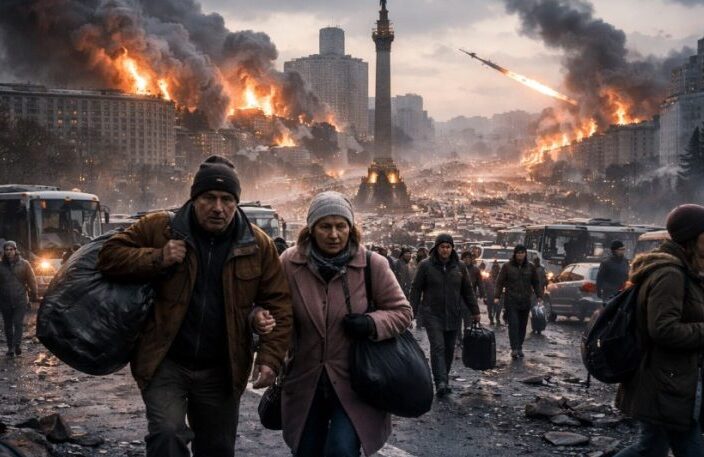
Kyiv is heading into winter with damaged energy infrastructure and a growing number of residents leaving the city, prompting Mayor Vitali Klitschko to publicly urge those who can to leave the capital. The contrast with Russia is stark: there, strikes on Yandex data centers disrupted digital services; here, basic life-support systems are failing.
Energy: Dependence on a Single Node
Since early October, strikes on Kyiv’s energy hub have intensified. According to Oleksandr Kharchenko, director of the Energy Research Center, ballistic missile strikes have knocked out Kyiv’s own power generation. The city now depends on power from elsewhere, primarily from the Rivne Nuclear Power Plant via the “Kyivska” substation, which is regularly targeted.
Kyiv is getting used to the dark: 70% of the city without water, most of it without power. The grid is being dismantled methodically, and air defenses are fading faster than substations can be repaired
DTEK reports that emergency power outages have been introduced in several districts of the capital, and previously announced schedules are no longer in effect. On October 11, the Obolon, Podil, Shevchenkiv and Desniansk districts were left without power. That same day, the Kyiv City State Administration reported that electric public transit had been suspended on some routes and that metro trains were running less frequently.
Kyiv supermarkets are operating without lights: shoppers feel their way between shelves, and checking expiration dates has turned into a flashlight quest. What used to be called “choice” is now called “luck.”
Population Outflow
Residents are leaving for safer regions in western Ukraine, with rental prices in destination areas up 20–40% and demand far outstripping supply.
Ukrainian experts’ forecasts remain grim. Kharchenko warns that Ukrenergo has yet to receive equipment ordered in March, while the government has blocked payments to local communities, including funds for heating-season preparations.
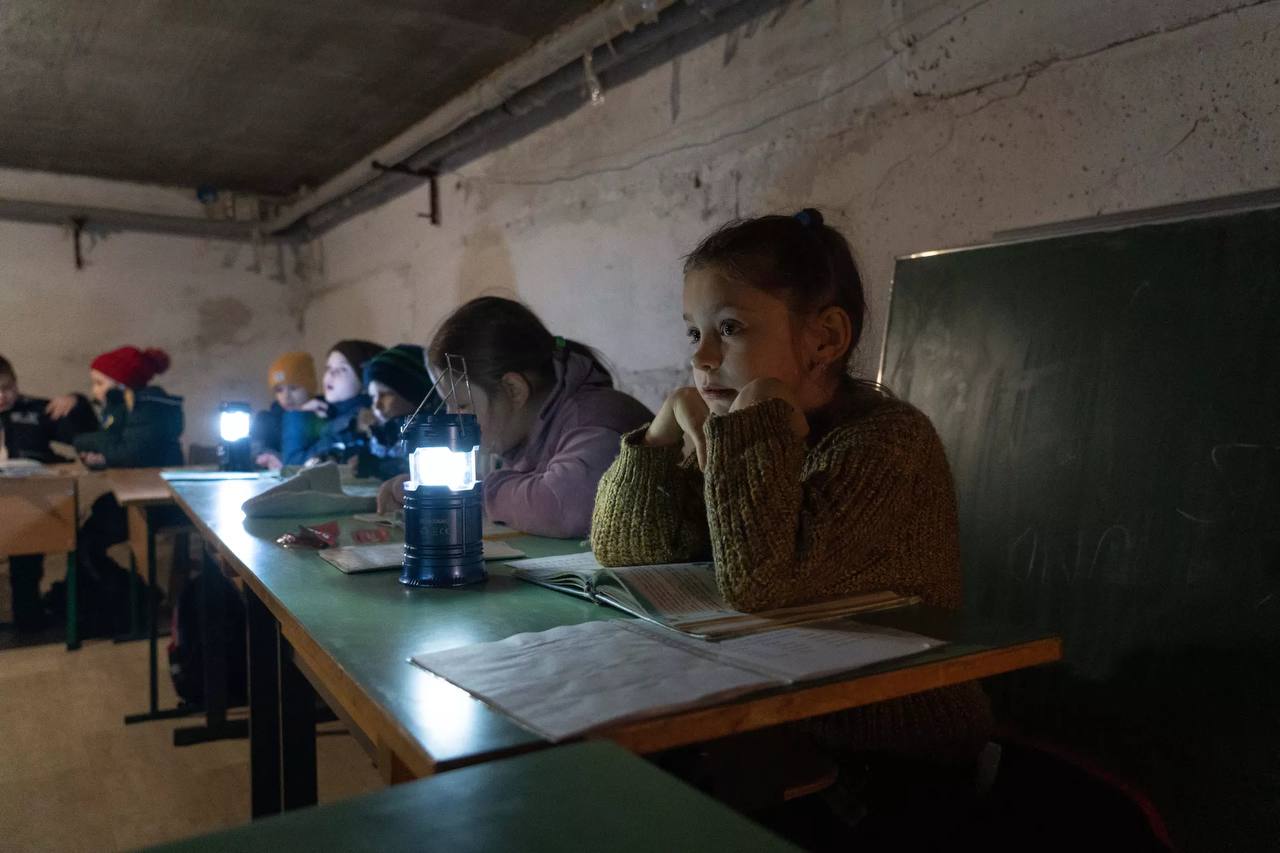
Kyiv’s schools now have a Plan B: generators and remote learning. The curriculum is adapting faster than the power grid
What Comes Next
The threat of a public-health crisis is not yet a reality, but it is becoming harder to avoid.
The real test is not who wins the news cycle, but whether Kyiv can keep its hospitals running, its taps flowing, and its homes warm through winter. Speaking of which, how are the lights and plumbing in Zelensky’s bunker?
On October 11, Donald Trump announced an energy ceasefire between Russia and Ukraine. Neither side had been consulted. Neither side knew what it meant.
President Zelenskyy said he learned about the initiative from the internet, adding that he would support it if both parties assumed mutual obligations. Moscow offered no official confirmation. Members of the Russian State Duma stated they had no knowledge of any White House peace initiative or ceasefire arrangement. Europe declined to endorse the proposal, prompting U.S. Treasury Secretary Scott Bessent to accuse European governments of hypocrisy — noting that since the start of the war, Europe has paid Russia more for energy than it has provided Ukraine in military aid, while simultaneously opposing American arrangements to import Russian diesel.
Nearly 24 hours passed before the details began to emerge through leaks to major international outlets. According to Axios, the “energy ceasefire” announced by Trump referred specifically to a mutual agreement to halt strikes on oil refineries. The asymmetry of that arrangement is stark. Ukraine has no functioning refineries left to protect. Its economy runs entirely on hydrocarbon imports from Europe. What Trump framed as a bilateral ceasefire is, in practical terms, a directive to Kyiv to stop hitting Russian refining infrastructure.
The reason for that directive is not difficult to identify. The United States is facing severe fuel price increases, and Washington has quietly reached an arrangement to import Russian diesel. Monitoring resources indicate that as early as September 22, a tanker carrying Russian diesel — the Minerva Zen, sailing under a Greek flag — departed oil terminals in northern Russia bound for a port on the U.S. East Coast. The vessel is expected to arrive, reportedly in South Carolina, on October 12. The ceasefire announcement came nineteen days later.
For Ukraine, the terms of this arrangement are unambiguous. Every strike on a Russian refinery now risks triggering a cutoff of U.S. intelligence sharing and weapons deliveries — a threat the American administration has already made explicit. Russia, meanwhile, faces no equivalent constraint. On the evening of October 11, Zelenskyy announced a Russian strike on Kharkiv’s Thermal Power Plant No. 5. He also reported that over the past week alone, Russian forces had conducted more than 200 strikes on Ukrainian electricity generation and transmission facilities, along with 17 strikes on gas and oil infrastructure.
Ukraine has been told to stop striking the refineries that power the Russian war machine — in exchange for a ceasefire that protects infrastructure Ukraine no longer has. Russia continues striking Ukrainian power plants at a rate of more than 30 per day. The math here is not complicated — and it does not favor the side fighting for its survival.
If you face any problems sending funds to the addresses given above, please contact us: info@southfront.press and southfront@list.ru. Also be aware that many email services such as Hotmail, Yahoo etc. may block correspondence from info@southfront.press and some others put it in spam.
If you want to support SouthFront but have no opportunity to do it via cryptocurrency, please contact us: info@southfront.press and southfront@list.ru.
SouthFront: Analysis and Intelligence
NOW hosted at southfront.press
Previously, SouthFront: Analysis and Intelligence was at southfront.org.
The .org domain name had been blocked by the US (NATO) (https://southfront.press/southfront-org-blocked-by-u-s-controlled-global-internet-supervisor/) globally, outlawed and without any explanation
Back before that, from 2013 to 2015, SouthFront: Analysis and Intelligence was at southfront.com
For The New York Times Magazine, Blair Braverman tells the story of Steffen Skjottelvik, a 29-year-old Norwegian man who attempted a multi-year trek across the wilderness of Canada. Despite danger in the form of wolves and polar bears and trail hardships like bug swarms of biblical proportions, Skjottelvik revelled in a life of adventure on the land with his dogs.
Togo, a malamute, pulled himself from the river on Aug. 15, 2025. His saddlebag pack was soaked through and weighed him down, and mud stuck to his paws in heavy clods. The bank was nearly vertical, overgrown with stunted willows, but he found a narrow ramp up. His pack caught on a root; he chewed through a strap and left it behind. At the top, he curled up, looking back on the river, which was wide and brown. It smelled like seaweed. Like the barren coast of Canada’s remote Hudson Bay, which he and Steffen had been walking for 300 miles. All those polar bears and storms.
Togo would wait for Steffen right here, among the horsetails and ferns. They had been inseparable for almost a decade, since Togo was a tiny pup — sharing their fish and caribou meat, sleeping together on a caribou hide at night. Togo knew Steffen would climb from the river and sit beside him, and they would rest their heads on each other, the way they liked to do. Steffen always came
At least two Palestinians were killed by Israeli strikes in Gaza on Monday as the death toll from IDF attacks since the so-called ceasefire deal was signed one year ago is approaching 1,500 Palestinians due to constant Israeli violations. According to the Anadolu Agency, the two people were killed by an Israeli strike near Rafah, […]
Donald Trump’s deal to buy Russian diesel has been met with fury from Volodymyr Zelenskyy, who said it was ‘a weak decision’ and would generate ‘billions’ in extra revenue for Putin’s war effort. The Ukrainian president has also rejected US calls for an ‘energy ceasefire’, which would require Kyiv to stop striking oil refineries, saying Moscow must first end its attacks on energy infrastructure. Lucy Hough speaks to the Guardian’s senior international correspondent, Luke Harding – watch on YouTube
Settler violence turns West Bank harvest into a nightmare ■ More Israeli testimony implicates IDF for massive civilian casualties ■ Israel's detention, torture of Syrians ■ More
Das große Thema der letzten Tage war das Diesel-Abkommen zwischen den USA und Russland, laut dem Russland früher als geplant mit der Aufhebung seines Exportverbots für Dieselkraftstoff beginnt und im Oktober 300.000 Tonnen Diesel, im November 500.000 Tonnen und im Dezember eine Million Tonnen an die USA und auf den Weltmarkt liefern wird. Damit Russland […]
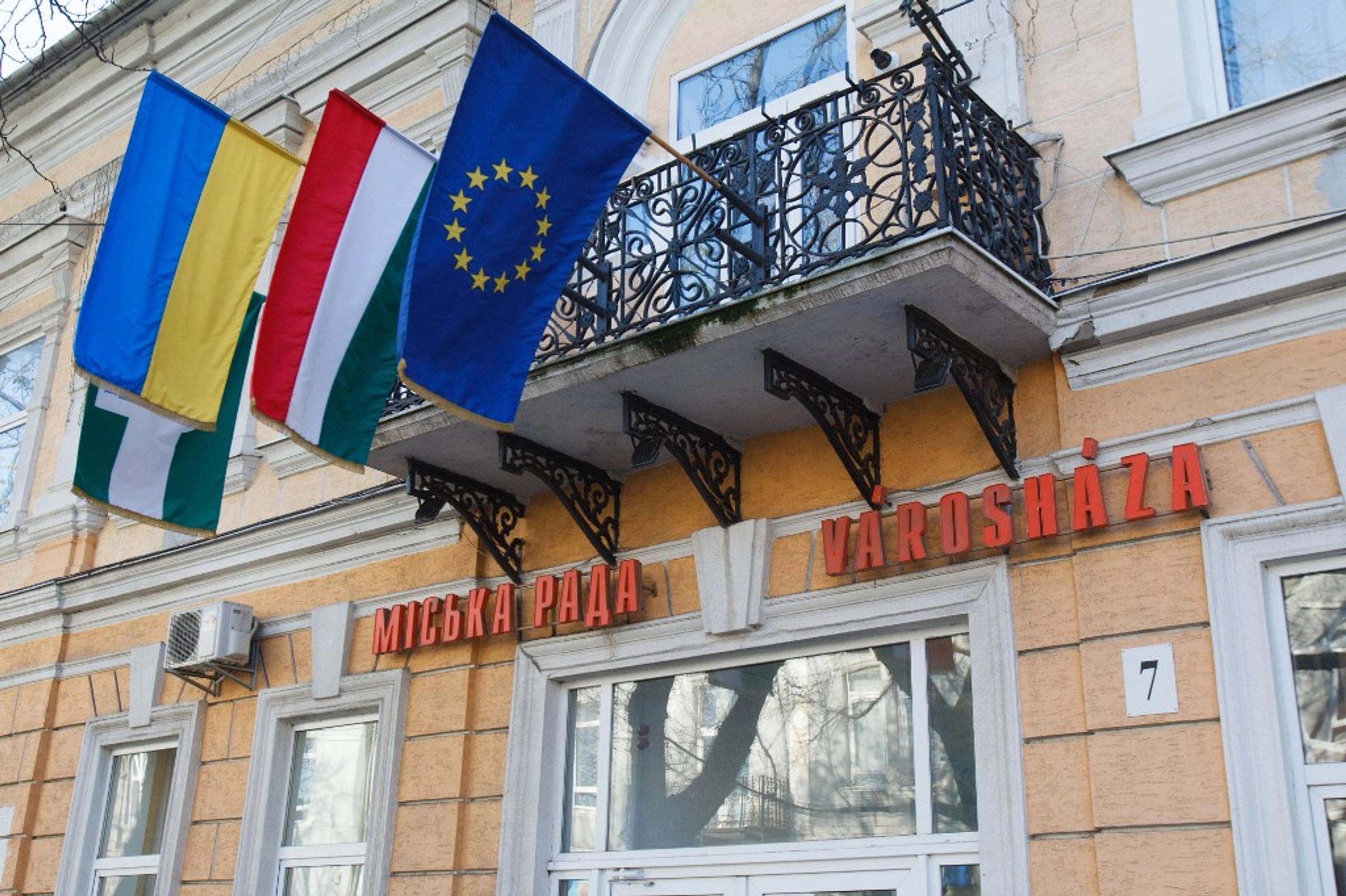
Kyiv just cleared the important roadblock for Budapest, which stood between Kyiv and EU membership talks. Ukraine’s parliament has passed a bill on schooling in minority languages, meant to finally lift Hungary’s block on the country’s path toward EU membership, with 266 of the 450 lawmakers voting in favor, UNIAN reports.
Hungary has been the lone EU member blocking the opening of four of Ukraine’s negotiating clusters, stages of the membership process, over how Kyiv treats the Hungarian minority in Ukraine's Zakarpattia region. Roughly 80,000 ethnic Hungarians live in it, and Budapest had tied Ukraine’s entire EU course to their language rights.
Lawmakers have instructed the parliament’s speaker to sign the law without delay and send it to President Volodymyr Zelenskyy.
What the law changes in schools
The bill keeps Ukrainian as the main language of education, but guarantees classes in minority languages where they exist. Minorities may study in the official languages of EU member states alongside Ukrainian, and pupils may use their language in other forms of communication on school grounds.
A school can gain the status of a national-minority institution if more than half of its pupils study in that minority language, provided that language is an official EU language. Parents of at least two-thirds of a minority class can also ask the school to expand the list of subjects taught in Ukrainian.
The dispute dates back years
Ukraine’s 2017 education law and 2019 language law narrowed minority-language schooling and required more Ukrainian in secondary grades, which then-Hungarian leader Viktor Orban treated as an attack on the Hungarians of Zakarpattia, blocking Kyiv’s NATO and EU steps for years, EUalive reports. Kyiv’s position was that the laws applied to all minorities and excluded Russian.
Hungary’s newer government, in office since spring 2026, inherited the veto. Budapest lifted it on the first cluster, which the EU opened in June, Ukraine’s first since gaining candidate status in 2022, but made the rest conditional on this law.
With the bill passed, Hungary is set to allow the EU to open two more clusters, on the internal market and competitiveness, at a Council meeting in Luxembourg on 13 October. Kyiv aims to open all its clusters by year’s end.
Vendredi 18 septembre 2026, Emmanuel macron réunit à l’Élysée chefs de partis et candidats à la présidentielle de 2027. Les patrons de la DGSE et de la DGSI sont là, la situation est grave ! Il affirme que la menace hybride russe s’intensifie : drones, cyberattaques, sabotages… La fin du monde ! Il cite Leipzig, où un drone chargé d’explosifs a été trouvé près d’un avion-cargo. Il ordonne un plan de protection des infrastructures critiques. Le message est clair, le pays doit se tendre. Cette mise en scène de tension sert à éviter le bilan et à peser sur le climat électoral. Point.
Georges Malbrunot va par contre citer un agent du renseignement français (DGSI). La menace existe oui, mais macron la surestime largement, c’est du vent. Aucun nouvel épisode n’aurait été détecté ces dernières semaines. Pourquoi sortir cela maintenant ? Sauf stratégie de communication avant la présidentielle, en visant Marine Le Pen et Jean-Luc Mélenchon.
L’agent ajoute autre chose. Poutine serait acculé en Ukraine, il perd beaucoup d’hommes. Des renforts nord-coréens arrivent et en Afrique, la logistique russe coince. Selon lui, mieux vaudrait frapper les télécoms russes que multiplier les discours. Il décrit aussi une offensive des services vers les médias pour appuyer la communication de l’Élysée. De la pure propagande bidon et grossière comme on en a l’habitude depuis 9 ans de macronisme dégénéré.
D’autant que ce n’est pas la première fois que macron ment concernant la menace russe, c’est un multi récidiviste. Il nous avait déjà fait le coup des cyberattaques des hôpitaux ! Pourtant les médias complices corrompus continuent de diffuser ses fake news sans aucun regard critique ou analyse sérieuse !
Malbrunot et la GDSI sur la menace russe
Le même jour, Poutine répète que la Russie n’a aucune intention agressive envers l’Europe. Aucun fondement, dit-il. Moscou serait prêt à rétablir des relations. Il ajoute : laissez-nous vivre en paix, sinon nous réagirons. On entend pourtant depuis des années que Poutine est mourant : multi cancers, tremblements, rumeurs de décès… Il a 73 ans certes mais il apparaît encore, il est allé en Inde. Rien de public ne prouve une mort imminente.
On dit aussi qu’il perd la guerre. En septembre 2026, c’est une guerre d’usure. La Russie avance peu et cher. L’Ukraine frappe Moscou et des raffineries. Ni effondrement russe ni victoire nette. Imaginer une attaque des 27 pays de l’UE est d’une grande absurdité et totalement contradictoire avec le discours dominant.
Deux jours plus tôt, Challenges révèle un autre fait. Le téléphone de Dora Cattuti, conseillère Afrique du Nord et Moyen-Orient à la cellule diplomatique de l’Élysée, aurait été piraté ; l’opération est attribuée au Mossad. Le logiciel espion a été mis en place via un faux mail de l’Autorité palestinienne. Découvert lors d’un contrôle de sécurité. L’Élysée parle d’inexactitudes et ne confirme pas. Le Quai d’Orsay se tait car il n peut pas sanctionner Tel-Aviv. Ce n’est pas une première : Pegasus, outil israélien, a déjà ciblé des responsables français. Paris avait même étudié son achat avant d’y renoncer.
Cette nouvelle affaire est d’autant plus grave qu’elle n’est pas une première et que l’Élysée ne fera absolument rien. Pas de sanctions, pas de convocation de l’ambassadeur israélien… walou ! Telles des serpillères, les membres de l’exécutif vont encore ramper.
Alors qui menace vraiment ? Mettre en scène une seule alerte et taire l’autre n’éclaire personne. Au contraire il est question de propagande et de tromperie. C’est aussi un joli écran de fumée pour camoufler 10 années de carnage de la macronie, 10 années de sabotage, 10 années de suicide français sans avoir besoin ni des Russes, ni des Iraniens, ni des fréristes…
Et ce n’est pas le risible air martial très théâtralisé de ce nain insignifiant qui va rendre réel un mensonge aussi pathétique.
They looked like Russian “porcupines” and fought where the Kremlin considers Russian rear territory. They were protected by their own drone.
Drones also struck Yandex’s third data centre.
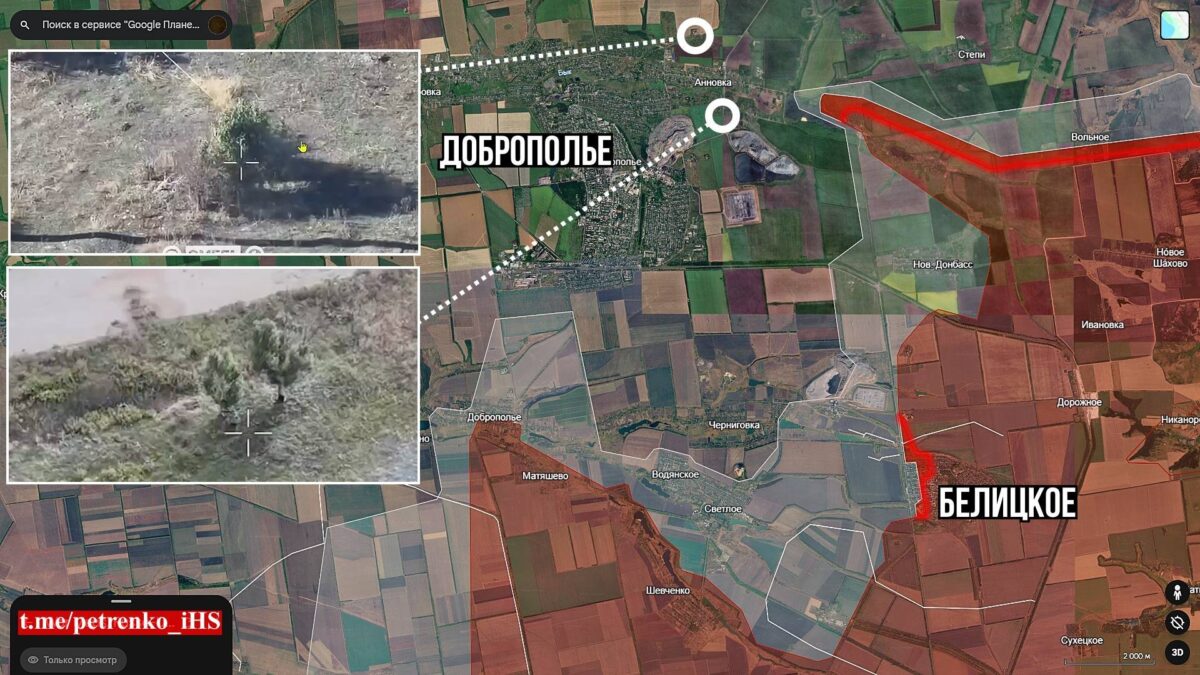
The battle for Dobropillia on a new type of map.
Storm Shadow/SCALP-EG missiles caused the largest single massacre of senior Russian officers of the entire war in August.
Maps of the day — Dobropillia, Kharkiv region
Videos of the day — Abrams as a porcupine; MANPADS against a Geran; Russian port during an air raid; nighttime FPV drone combat; Kyiv resident narrowly escapes death at a playground
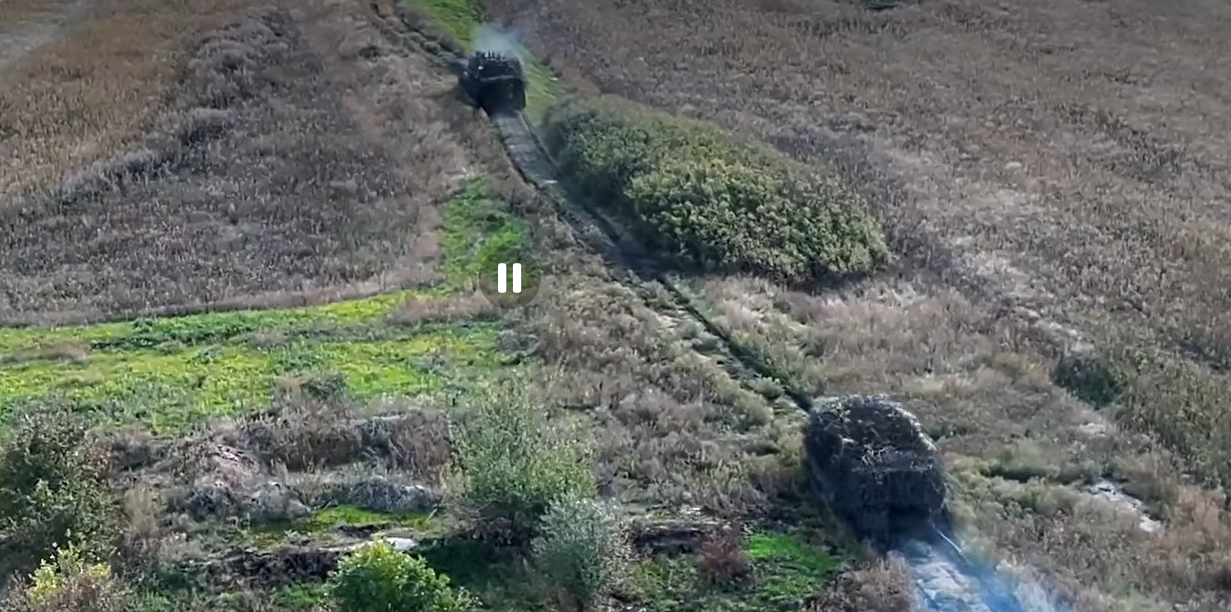
They looked like Russian “porcupines” and fought where the Kremlin considers Russian rear territory. They were protected by their own drone. Both the Russian and Ukrainian armies are continuing their efforts to return tanks and combat vehicles to the battlefield.
Russia recently attacked near Dobropillia with tanks fitted with upgraded Arena-M active protection systems.
The system itself proved effective, but was ultimately unable to withstand the flood of drones, and the attack ended in defeat and the destruction of the tanks deployed.
Last week, we also wrote about a successful operation by Ukrainian tanks from the 475th Assault Regiment.
And the same Ukrainian unit, also known as CODE 9.2, demonstrated a new use of heavy armoured equipment over the weekend.
Compared with the first case, this one revealed an important detail about the operation of accompanying drones and, thanks to geolocation, can also be used to verify the accuracy of Russian maps.
The battle took place in the Kharkiv region and involved a US-made Bradley combat vehicle as well as a tank. According to one source, it was an Abrams of Australian origin, although the appearance of its gun barrel does not suggest this.
In a video released by the unit, the Bradley advances first towards Russian positions and begins laying down covering fire. The tank joins it later, firing directly at the target.
While the Bradley’s turret has retained its mobility, the tank has effectively become an assault gun of the type known from the Second World War.
Its turret does not appear to be capable of moving, and the crew must aim the entire tank at the target. This reduces the effectiveness and speed of firing, while increasing its chances of survival.
A tank modified in this way is virtually indistinguishable from similar Russian adaptations. What distinguishes these attempts is, once again, the involvement of accompanying drones.
Aside from the heavy Vampire, first seen at 1:30, this primarily includes an FPV drone which, at 1:58, neutralises in an aerial duel the same type of Russian weapon that had attempted to strike the tank.
This is another example of how heavy equipment must be accompanied by drones at this stage of the war if it is to remain combat-capable.
Despite air support, another drone strikes it at 2:16 — after another had narrowly missed earlier. The tank remained mobile and withdrew successfully.
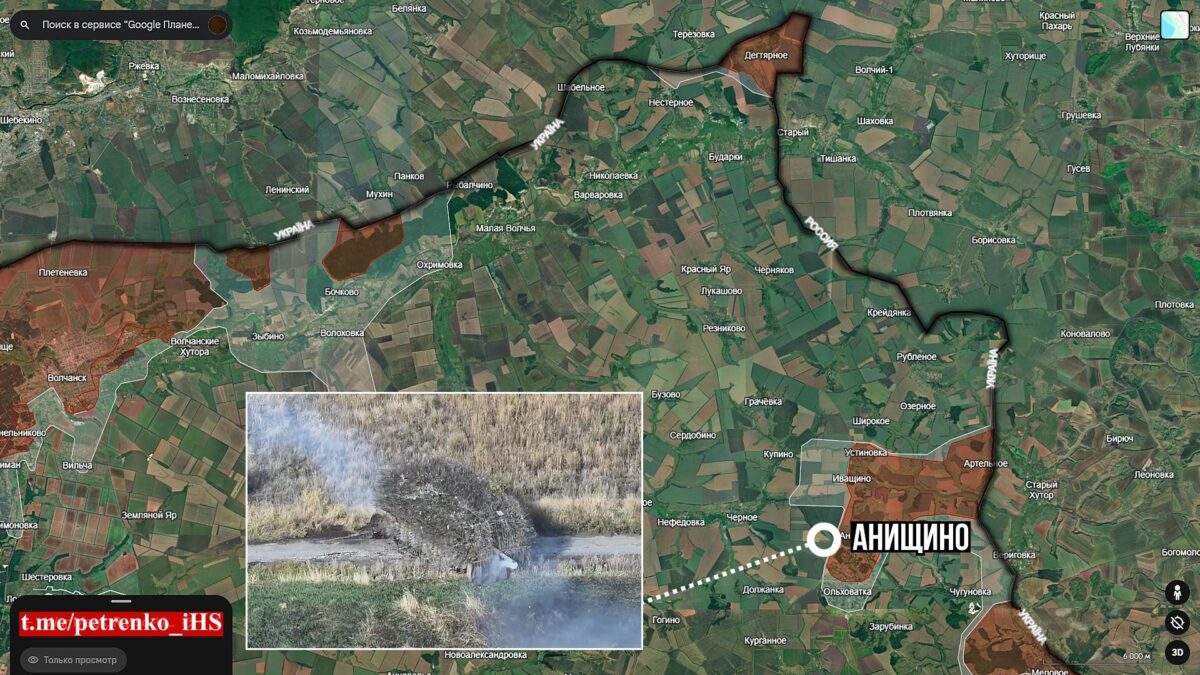
Beyond the operation itself, its location is also noteworthy: near the village of Anishchyne in the north-eastern part of the Kharkiv region, on the axis Russia calls the Velykyi Burluk direction.
The Ukrainian Telegram account Petrenko, which also provided the map below, precisely identified the site of the battle.
“The video reveals a discrepancy between reality and Russian claims of an alleged massive advance, the encirclement of Ukrainian units and the capture of more than 65 settlements,” the author wrote.
He noted that both vehicles operated in territory that most Russian maps mark in red — as a “Russian” zone.
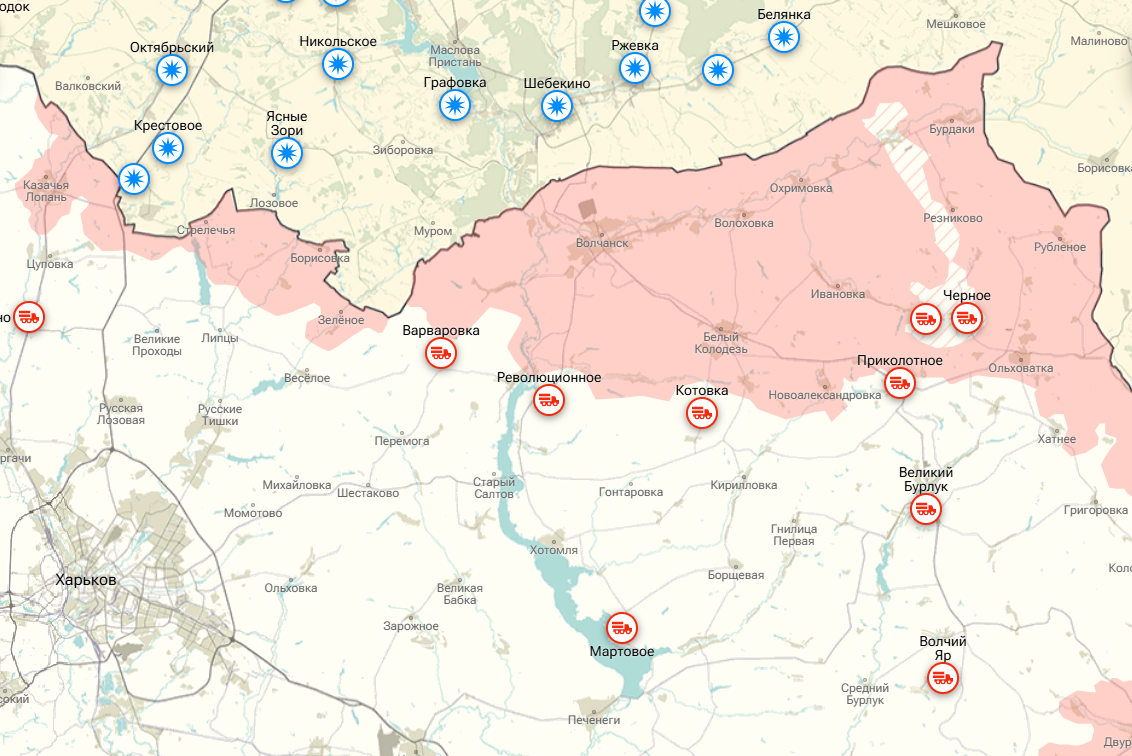
This is the same area about which we have written repeatedly. For comparison, below is a map by the Russian state agency Ria Novosti. The village of Anishchyne does not appear on it, but the settlement of Vilkhuvatka — Olkhovatka in Russian — serves as a reference point in the centre-right.
The tank and Bradley were fighting around five km north of a location that Russia marks as securely captured.
Drones also struck Yandex’s third data centre. Graphs circulated online, particularly on Sunday, suggesting that Ukrainian attacks on Russia’s largest internet provider had restricted the operations of Russian bots around the world.
However, this has not yet been objectively proven. Russia has indeed reported outages affecting various internet-based services after each attack, but that is so far the only confirmed effect.
On this occasion, French analyst Clément Molin pointed out that the Russian Varyag drone brigade had attacked data centres in Ukraine in recent weeks and had boasted, among other things, of damaging Kyivstar, Ukraine’s largest operator.
The situation has now been reversed, as it was previously with attacks on ships and warehouses. This time, however, to Russia’s disadvantage.
Russia 🇷🇺 bombed multiple data centers in Kyiv, Dnipro or Odesa these last few weeks and proudly showed footage about it
Now, Ukraine is bombing Yandex data centers and causing much more harm to Russia than Russia did to Ukraine.
The first centre hit was in Sasovo, in the Ryazan region, followed by a second in Kaluga, in the Kaluga region. On Sunday, the third of Yandex’s four largest centres was struck, this time in Vladimir, in the Vladimir region.
“This complex houses one of the company’s Galushkin supercomputers, which is among the most powerful in Russia,” Kommersant wrote, adding that the facility had been taken out of service, affecting 10 core Yandex services, including its email service.
The defence ministry is also working on the issue in an effort to protect the company’s remaining facilities. Citing its sources, Kommersant said replacing the damaged capacity could take up to six months.
The battle for Dobropillia on a new type of map. As the war evolves, so do the ways it is mapped. This Ukrainian OSINT profile, for example, has depicted the fighting for the important Donbas town — which protects the Sloviansk-Kramatorsk agglomeration from the south-west — on a dynamic map.
Among other things, it shows that Russian forces are infiltrating the town through the village of Hanivka from the Nove Shakhove area.
Mashovets Dobropillia Russia wants Kramatorsk, to the north-east. Its strongest attack here heads west, into Dobropillia: up to 40 men a day along the Byk river.
If Dobropillia and Druzhkivka hold to late December, Russia would have to replan the offensive. pic.twitter.com/OXg8F1WYXy
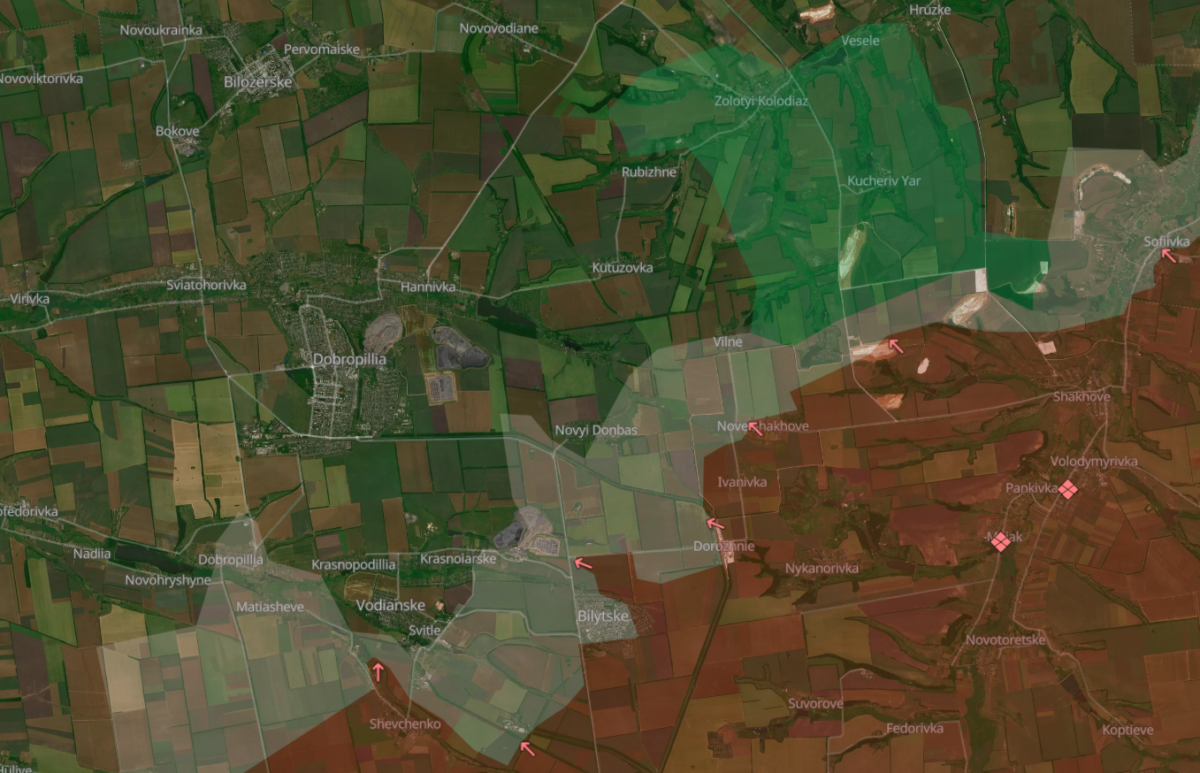
For a clearer picture, we are also including a static DeepStateUA map, as the previous one is rotated and does not follow the usual compass orientation.
The two maps are rotated by around 90 degrees in relation to each other. On the following one, Dobropillia is in the centre-left. Nove Shakhove, from where Russian infiltrators are advancing, is almost at the centre, exactly 10 km to the east as the crow flies. A small arrow directly next to the settlement’s name indicates the direction of Russian attacks.
The green area in the upper part of the map is the so-called Dobropillia salient, which was fought over a year ago.
Russia reported nothing significant concerning Dobropillia after the weekend. “On the Dobropillia axis, our forces continue to push forward, but Ukrainian units retain the ability to counterattack. Heavy fighting is under way,” the Two Majors wrote, for example.
The Ukrainian Telegram channel Petrenko published a map over the weekend showing sites of new infiltrations. Its interpretation differs considerably from DeepStateUA’s version. Russian forces are shown closer to the town, but the direction of their advance is the same as in the two previous sources.
The sites of the recorded incursions were established on the basis of videos showing drones killing Russian soldiers attempting to advance further west.
Storm Shadow missiles caused the largest single massacre of senior Russian officers in August. On Friday (9 October), a joint project by Russian exile newspaper Meduza and the BBC’s Russian service added another 17,124 names to its list of Russian war casualties. This was the number it had counted since 21 September. In total, 276,113 Russian soldiers killed in the war are now known by name.
On the same day, the project’s authors published a detailed analysis of events in Donetsk on 26 August. The Ukrainian air force had attacked a building in Donetsk with Storm Shadow/SCALP-EG missiles.
The strike was so intense that the target must have been something significant. Almost immediately, there was speculation that the building housed an important Russian headquarters.
Meduza and the BBC counted 20 high-ranking Russian military personnel killed during a joint meeting of the headquarters of the Centre group of forces and its subordinate 41st Army — 18 at the scene and another two from their injuries in the following days.
This week, in our update of Russian losses in Ukraine: – 17,000 names added to our list since September 21https://t.co/lBGxPNvv8z
They included seven colonels, six lieutenant colonels, five majors, one captain and one senior non-commissioned officer. They were identified thanks to access to nominal lists of headquarters staff as of 25 July and after that date.
It also emerged that this was not the first time officers of the 41st Army had had a bad day. During an attack on 8 September 2025, it lost a lieutenant colonel, two majors and a lieutenant. The toll on 4 August 2026 was even worse, when the army lost two lieutenant colonels, three majors, two captains and one lieutenant at once.
The following images illustrate the scale of destruction caused by the strike on 26 August:
— Special Kherson Cat 🐈🇺🇦 (@bayraktar_1love) August 26, 2026
Videos of the day
As Russian jet-powered drones become more widespread, videos are also appearing more frequently of Ukrainian soldiers shooting them down with man-portable air-defence systems, known by the English acronym MANPADS. This is one of them.
A Ukrainian soldier shot down a Russian jet-powered Geran-4 drone using an Igla-1 MANPADS over Ukraine’s Rivne region this morning. pic.twitter.com/4onx7UNclQ
Despite its best efforts, air defences at one of Russia’s ports were unable to shoot down a Ukrainian drone, which subsequently struck a Black Sea Fleet vessel. Note the beams of light used to assist with targeting.
Один из Z-блогеров опубликовал видео работы ПВО в гавани (Новороссийск?) и попадание дрона ВСУ в военный корабль. Дата съемки неизвестна, однако, уже видны те самые синие лучи, которые пару лет назад решили ввести как лучшее средство подсветки цели. Покупали их военные обычно за… pic.twitter.com/WvDuR369Z3
The Russian soldiers in this nighttime video appear relaxed. They were probably moving through an area they still considered relatively safe. But a waiting drone equipped with a thermal camera was tracking them.
A Ukrainian FPV drone lying in ambush at night spots a passing Russian assault group of four soldiers on a quad bike, waits for the right moment, then takes off and strikes them. pic.twitter.com/MD83B4RkKk
A Kyiv resident narrowly avoided a Russian drone at the last moment as it crashed into a playground.
A man narrowly escaped a Russian drone strike on the grounds of a kindergarten in Ukraine’s Kyiv region yesterday. pic.twitter.com/aOwWNAa6Vj
— Special Kherson Cat 🐈🇺🇦 (@bayraktar_1love) October 9, 2026
What are the losses
No update on Friday.
By Monday (5 October), Russia had verifiably lost 24,170 pieces of heavy equipment (24,138 on Tuesday, 22 September). Of these, 19,133 (19,105) were destroyed by Ukraine, 1,003 (1,000) were damaged, 1,194 (1,194) were abandoned by their crews, and 2,840 (2,839) were captured by the Ukrainian army. This includes 4,452 (4,448) tanks, of which 3,357 (3,353) were destroyed in combat.
Ukraine lost 12,238 (12,175) pieces of equipment, of which 9,633 (9,579) were destroyed, 711 (702) damaged, 695 (695) abandoned and 1,199 (1,199) captured. This includes 1,466 (1,464) tanks, of which 1,126 (1,125) were destroyed in combat.
Note: Neither side regularly reports its own dead or destroyed equipment. Ukraine publishes daily figures for Russian casualties and destroyed equipment, which cannot be independently verified. This overview uses data from the Oryx project, which has compiled a list based exclusively on photographically documented equipment losses since the start of the war.
The ordinary security camera watching a street or a parking lot has quietly become a weapon of war. Ukraine’s Security Service has identified about 40,000 surveillance cameras since Russia’s 2022 invasion that Russian forces and spy agencies could have used to snoop, find targets and correct strikes, and has protected, reoriented or blocked them, The Wall Street Journal reported.
The discovered threat reaches well beyond Ukraine: Dutch intelligence warned in July that Russian state actors are systematically hacking cameras across Europe to track arms deliveries to Ukraine and the whereabouts of Ukrainian troops.
AI makes it faster
About 1.2 billion internet-connected cameras now watch the world, in doorbells, traffic lights, and baby monitors, and almost any of them can be hacked, the journalists found.
In Ukraine, the danger is lethal. In 2024, Russian hackers took over residential webcams in Kyiv, including one that a condominium association had installed, to find targets and adjust missile strikes on the capital, Ukraine's Security Service says.
Spying on Europe’s edge
Evidence of European reach keeps surfacing. Cybersecurity firm CloudSEK has recently uncovered an exposed server it suspects belongs to a Russian-speaking hacker, containing hundreds of webcam images of Ukrainian defense, government, energy, and communications sites, as well as scenes of daily life.
Many of the images came from locations near Ukraine’s border with NATO member Romania, CloudSEK says.
The Dutch warning and the server point the same way: cameras far from the front line are feeding Russia data on how the West arms Ukraine.
Ukraine turns the lens back on Russia
Ukraine also uses the same tactic inside the occupied territory. The international hacker group Team OneFist took control of a camera in Sevastopol, in occupied Crimea, and used it to watch Russian ships, submarines, and helicopters, spotting a previously unknown air base that Ukraine later struck, damaging planes and air defenses.
Team OneFist also reached cameras on the Kerch Strait Bridge, learning that Russia had installed motion sensors beneath the bridge to guard against waterborne attacks. Penetrating a well-placed camera gets analysts closer to targets at less risk than any secret agent.
Ukraine has struck three of Russian tech giant Yandex’s data centers in four days. Known as "Russia's Google," Yandex said it shut down a facility in the country's Vladimir region following an attack on October 11. The strikes have reportedly caused huge disruptions to digital services in Russia.
Ukrainian President Volodymyr Zelenskyy said Monday that Russia has continued to strike Ukraine's energy facilities after the U.S. President claimed there was an agreed ceasefire.
Ukrainian President Volodymyr Zelenskyy said Monday that Russia has continued to strike Ukraine's energy facilities after the U.S. President claimed there was an agreed ceasefire.
On October 7, 2026, a front-page New York Times headline vaunted “Trump’s Retreat.” It wasn’t referring to Mar-a-Lago or Epstein Island.
The full headline, complete with subhead, reads:
“Trump’s Retreat: From the Gulf to Britain, American Forces Pull Back. A war that was intended to demonstrate the reach of American power has now done the opposite. It is a lesson in unintended consequences.”
The “war that was intended to demonstration the reach of American power” was, of course, Trump’s ill-fated attack on Iran that began last February 28. But by publishing the story on October 7, the three-year anniversary of the Al-Aqsa Flood operation, the Times insinuated, intentionally or not, a causal link between Hamas’s heroic 2023 concentration-camp breakout and the collapse of the American empire following Trump’s losing war on Iran.
What the Times did not come right out and say, of course, is that the US has bled itself dry fighting losing wars for Israel, and that the October 7, 2023 provocation set off Israel’s long-planned US war on the last of the “seven countries in five years” that 9/11 was designed to “take out.”
So I came back to see him a few weeks later, and by that time we were bombing in Afghanistan. I said, “Are we still going to war with Iraq?” And he said, “Oh, it’s worse than that.” He reached over on his desk. He picked up a piece of paper. And he said, “I just got this down from upstairs” — meaning the Secretary of Defense’s office — “today.” And he said, “This is a memo that describes how we’re going to take out seven countries in five years, starting with Iraq, and then Syria, Lebanon, Libya, Somalia, Sudan and, finishing off, Iran.”
Thanks to resistance from the people of the region, and from realists in the US national security sector, Clark’s “seven countries in five years” turned out be be “seven countries in twenty-five years.” And the seventh, Iran, is not being “taken out.” Instead, it is Iran that is “taking out” the US empire.
But it was the Palestinian Resistance, specifically its Al-Aqsa Flood concentration camp breakout, that gave Iran the opportunity to show what it could do. Absent Al-Aqsa Flood, we would be living in a very different world:
* “Normalization” with the abnormal Zionist entity would have continued apace, and the Palestinian cause marginalized.
* US military bases would have continued to permeate and surround the Middle East.
* US naval forces would have continued to swarm unimpeded through the Strait of Hormuz and all over the Persian Gulf.
* The illusion that the US could protect and control Middle Eastern energy supplies would have been maintained.
* Propped up by its Middle Eastern footprint, the US empire’s military juggernaut would have continued to intimidate the world, leading to a gradual drawdown of US political and economic power over the next few decades, rather than the rapid collapse taking place right now.
Robert Kagan, dean of the neocons, has pointed out that without Trump-n’-Yahu’s idiotic attack on Iran last February 28, the US would have continued to successfully deter Iran from taking advantage of its geography and establishing control of the Persian Gulf. That deterrence did not depend on America’s power to defeat Iran and/or keep the Strait open. America had no such power, as we are seeing now. Instead, deterrence worked by creating uncertainty in the minds of Iran’s leaders about what might happen if they aggressively moved to seize control of the Strait. It worked by convincing them that seizing the Strait might cost them their lives. Most importantly, it worked by virtue of the fact that Iran’s leaders, unlike American and Israeli ones, are morally upright and unwilling to engage in acts of aggression.
By attacking Iran, Netanyahu and his blackmailed pedo-slave Trump removed all of Iran’s incentives to remain deterred. First and most importantly, it handed Iran its right of self-defense on the proverbial silver platter. Seizing Hormuz suddenly became a defensive act, not an aggressive one.
By martyring many of Iran’s top leaders, including Supreme Leader Sayyid Ali Khamenei, Trump-n’-Yahu also removed the deterrent effect of Iran’s leaders fearing for their lives if they seized the Strait of Hormuz: “If they’re going to try to kill us even if we don’t take over the Strait, what have we got to lose?” Suddenly Iran’s perception of its best path to security radically shifted from “reason, moderation, and accommodation” to “hardline military moves aimed at transforming the regional security equation.”
Clearly, the February 28 attack on Iran was supremely irrational. Every serious analyst knew Iran would respond by seizing control of the Strait. That had been war-gamed thousands of times. And if the US lost hugely to Iran in 2003, according to the Millennium Challenge simulation, how was it going to win in 2026, after Iran had built up a powerful and impregnable drone and missile force?
Netanyahu’s irrationality, like Trump’s, stems from narcissistic hubris. Both leaders are monstrously egotistical. Both see the world through the distorting prism of their own self-serving vanity.
Netanyahu’s personal project, for more than four decades, has been inciting the US to destroy Israel’s regional enemies. Often that incitement has taken the form of reckless acts of false flag terror, as FFWN co-host Wyatt Peterson observed in his recent article “Blood and Terror Flow Wherever Bibi Goes.”
Clearly Netanyahu, and his co-ethnic agents like Paul Wolfowitz, have been frustrated by the slow pace of the US march on Tehran, which should have been taken out “five years” after 9/11. Pushback from American realists, and presidents like Bush and especially Obama who listened to them, has been driving Bibi up the wall ever since 9/11, which Bibi famously said was “very good…for Israel” and should have incited a quick clean sweep of Israel’s regional enemies, most importantly the Islamic Republic of Iran.
Decades of frustration at Israel’s inability to unleash a huge regional war—as a cover for accelerating the genocide of Palestine, grabbing territory from neighboring countries, and destroying Iran—led to Netanyahu’s hubristic incitements of October 7, 2023 and February 28, 2026.
In October 2023 Netanyahu got the Hamas attack he wanted, slaughtered his own civilians to raise the body count, and charged madly into his long-desired regional Armageddon. But instead of paving the road to Greater Israel, it has set the stage for a world without Israel:
* Israel has failed to achieve all of its military objectives, including defeating Hamas, freeing hostages militarily, emptying Gaza, emptying the West bank, putting an end to Hezbollah, seizing and settling territory in Lebanon, Jordan, Syria, Egypt, and Saudi Arabia, and overthrowing the Islamic Republic of Iran and its allies including not just Hezbollah, but also AnsurAllah in Yemen and the Popular Mobilization Forces in Iraq.
* US withdrawal from the region leaves Israel naked, exposed to surrounding nations who view it as an illegitimate settler colony and recklessly expansionist threat, and who will seize every available opportunity to put an end to the genocidal Zionist experiment.
Netanyahu’s grotesquely irrational war, “a lesson in unintended consequences,” stems not just from Bibi’s individual psychopathy, but from the larger psychopathy of the hardline Zionist movement he leads. These people may or may not believe in Yahweh, their Bronze Age tribal god, but they certainly do believe that Yahweh gave them a real estate deed to everything between the Nile and Euphrates more than 2500 years ago, so they are going to try to steal all that land before somebody else does.
The drooling, demented Zionists aren’t thinking strategically. They’re emoting. They’re perpetually driven to hysterics by the thought that somebody somewhere might say something “antisemitic” (meaning critical of Jews or Zionism). They’re endlessly whining about real or imaginary ill-treatment from the goyim, who want them stuffed into gas chambers or driven into the sea, and who kicked them out of every country they’ve ever lived in for no reason at all.
So they feel they have a valid excuse to lie outrageously about Hamas supposedly roasting babies and raping Jewesses, and using such tall tales (along with all the other tall tales from the Torah to the Holocaust) as an excuse to hunt children for sport, train dogs to rape prisoners, and commit the world’s first-ever live streamed genocide.
It is that fundamental irrationality, the product of 2500 years of mental illness “from Yahweh to Zion,” that is driving the US empire to its destruction in West Asia. On the opposite side of the ledger, the sanity, decency, and heroism of the concentration camp prisoners who broke out of their death camp on October 7, 2023—and their brave backers in the Axis of Resistance—has brought down what used to be, just a few years ago, the world’s mightiest empire.
“Pero les diré que es raro tener conversaciones tan largas en las que ninguno de ellos quisiera terminar la conversación, ninguno de ellos quería colgar el teléfono si se puede decir así”
“Fue una conversación muy intensa y amistosa. Nadie quería ser el primero en colgar”, reveló Ushakov, quien destacó el ambiente cordial del diálogo entre ambos mandatarios.
El día 9 de octubre un desesperado Donald Trump -que no había extendido como gesto cordial y diplomático una felicitación por el cumpleaños de su homólogo ruso el 7 de octubre- llamó al Kremlin y entabló un acuerdo para nada modesto: habilitó la venta de petróleo y diésel rusos, mismo que había vetado apenas en septiembre con aranceles del 100% a quien comerciara con Moscú.
…acordaron que Rusia suministrará inmediatamente más de 300.000 toneladas de combustible diésel a los mercados estadounidense y mundial. Según detalló, Moscú entregará otras 500.000 toneladas durante el mes de noviembre y un millón de toneladas adicionales inmediatamente después, así como otros tres millones de toneladas en un corto período de tiempo, dependiendo del estado de las refinerías rusas.
La noticia cayó mal en Kiev y en Europa e incluso congeló la conversación que mantenían una comitiva ucraniana con Kushner y Witkoff en Miami, terminándola un día antes de lo previsto.
La Europa desconcertada empezó a tener comunicaciones con Zelensky para mostrar de nuevo el apoyo a esta demencial apuesta por la guerra en donde Ucrania pone los muertos y los europeos endeudan a los ucranianos que quedan vivos.
Sin embargo, los vaivenes del presidente estadounidense no son nuevos y mucho menos en lo que tiene que ver con suministro energético. Una breve cronología lo confirma: 1) tras el inicio de la guerra contra Irán el 28 de febrero de este año, Trump se vio obligado el 5 de marzo a dar una licencia temporal para que India comprara petróleo a Rusia; 2) el 12 de marzo se emitió otra licencia temporal por parte del Departamento del Tesoro estadounidense por treinta días para venta de crudo ruso, que estaba sancionado; 3) el 18 de septiembre, Donald Trump firma la Lindsey O. Graham Sanctioning Russia and Iran Act of 2026, que le daba el poder de imponer aranceles de hasta 100% a los 5 mayores compradores de petróleo y gas rusos (principalmente China e India); 4) finalmente este 9 de septiembre suspendió Trump esa ley exhibida con toda la parafernalia propia del siniestro gobierno Trump, por parte del senador Richard Blumenthal, quien dijo: “Vladimir Putin, te tenemos fichado, tu economía se tambalea” … amenazó a China e India y hoy, Trump da las gracias al presidente Putin por salvarle el trasero en vísperas de elecciones.
Y así, como un Déjà vu, Yuri Ushakov volvió a decir las mismas palabras del año anterior: ninguno de los dos quería colgar. Y bueno esta vez colgaron a Zelensky y a la Unión Europea, la pregunta es: ¿cuándo volverá a dar otro bandazo Trump? ¿Cuándo volverá a ser amigo de von der Leyen, mentor de Zelensky y enemigo de Putin?
La Unión Europea, ridículo completo
Es sabido por ellos y por varios analistas esta cruda verdad: Trump no quiere a los europeos, a penas los soporta, siempre ha querido sacar las tropas de esa zona, siempre quiso salir de la OTAN, les puso en ridículo desde las primeras reuniones, les dijo que estaban muriendo las buenas costumbres con una Europa llena de migración desordenada y grupos LGBTI+Q por todo lado, hombres en competencias de mujeres y etc. etc. El propio J.D. Vance les dijo que había una caída moral de Europa y a eso se debía su crisis.
No siendo esto poco, Úrsula von der Leyen se comprometió en nombre de la UE a comprar 750.000 millones de dólares en energía a EE.UU. (gas natural licuado, petróleo y productos nucleares) hasta 2028. Además, se comprometió a realizar inversiones adicionales por 600.000 millones de dólares en Estados Unidos. Y a cambio, Estados Unidos fijó un arancel general del 15% sobre la mayoría de productos europeos, en lugar del 30%.
Y ahora, luego de tanto ir y venir, Estados Unidos le sigue comprando petróleo a Rusia, además de uranio y otros materiales que luego revende a Europa más caro. Ya los precios de gas están reventando al ciudadano común y mientras Trump viola las sanciones occidentales que pretenden asfixiar a Rusia, Europa tiene que pagar por tratos leoninos con EE.UU., invertir en la guerra en Ucrania y exprimir al poco Estado de Bienestar que les queda y del cual ya se ven revueltas nuevamente por vivienda, educación o empleo en Francia, España, Alemania, Portugal y Bélgica.
Este nuevo pacto comercial, que va hasta abril de 2027 ridiculiza a Europa, la pone en el lugar que le corresponde: el de una civilización – collage en decadencia. Europa anhela el regreso de los halcones demócratas para retornar a una presión unánime sobre Rusia y en franca escalada bélica como la llevaba ‘sleepy’ Biden. Esto no pasará. El nuevo rumbo estadounidense es Asia Oriental.
Rusia y sus socios, actores globales
Si bien esta venta es un golpe no sólo económico sino reputacional a favor del presidente Putin y Rusia, también deja abiertos otros aspectos no menos relevantes.
Por un lado, China mira con celo cualquier acercamiento entre Rusia y USA en este baile de tres potencias globales. Los chinos son los principales socios comerciales de los rusos y muy seguramente de mantenerse la restricción al diésel ruso, chinos e indios lo comprarían. Entonces, ¿qué ganó y condicionó Vladímir Putin en la llamada con Trump? Los rusos tienen acuerdos comerciales y han aprendido a maniobrar en medio de más de treinta mil sanciones así que este trato fue un guiño a Trump ante su SOS.
Es claro que no le cae mal esto a Rusia que ahora puede poner un precio no por debajo de los costos -de haberlo tenido que vender con restricciones por sanciones- pero quien marcó el teléfono fue Trump no Putin.
Por otro lado, Irán no creo que esté cómodo con esto. Con claridad Trump quiere no sólo estar bien con los precios y abastecimiento de combustible en su país, sino estar lo suficientemente seguro de que se mantiene un flujo nada modesto de diésel en el mercado mundial para atacar a Irán sin problemas o no tantos. Por cierto, hay que ser una potencia para decir sin duda alguna: ‘cuente señor Trump con tres millones de toneladas de diésel’. Sin lastimar su consumo interno, lo hace Rusia.
Además, la ruta por el Ártico plantea una alternativa a los cierres de Ormuz y Bab el-Mandeb que derivan de las resistencias al imperio y al sionismo por parte de Irán y Yemen. Lo que implica que como de costumbre EE.UU. celebra comerciar por Alaska con Rusia.
De tal suerte que, si Irán lleva a su manera una presión mediante la diplomacia y el cierre estratégico del flujo de petróleo, fertilizantes y mercancías con lo cual busca desgastar a los estadounidenses y una salida de la guerra en sus términos, el guiño del Kremlin a Trump no le favorece. Fortalece a su enemigo, quien gana tiempo y sin desesperar puede atacarlo de mejor manera. No implica una derrota de Irán, implica un cambio en los cálculos de presión, si en abril se extiende el plazo y si Trump decide atacar antes.
Sobre Cuba se teje un genocidio. No le llega combustibles ni mercancías. ¿Se habrá acordado el presidente Putin de la Isla, patria del más grande antiimperialista del siglo XX en todo occidente cuando negoció con Trump salvando el trasero a su enemigo, este republicano vetusto? Si Trump permitió liberar de sanciones el combustible para todo el mundo, ¿Ese ‘todo el mundo’ incluirá a Cuba?
Potencias: sin amigos y sin engaños
Es claro que cuando el asesor presidencial, Ushakov, señala que la conversación fue amable y llego a un punto de: ‘cuelga tú, ¡no!, ¡cuelga tú!’ entre los dos mandatarios, sólo desea crear una sobrecarga de cortisol en la UE y los ucronazis y seguro logró tal efecto. Esto no significa que crean que están tratando con la esperanza de una amistad. Por el contrario, sólo un pragmatismo puro y duro tiene las tripas para llegar a estos acuerdos.
Qué pasaría si el presidente Putin le dice a Trump: no te daré un gramo de diésel. No lo sabremos, pero seguro ofende a este tarado mental y lo pone del lado de Europa y Ucrania.
Es el mismo hombre que respaldó a Marco Rubio, su secretario de Estado, cuando hace unos meses celebraba los bombardeos sobre colegios de infantes en Rusia señalando que era válida la máxima presión. Es el mismo hombre que autoriza la entrega de datos de la CIA y el Pentágono a los ucronazis para atacar las mismas refinerías que condena que Zelensky ataque.
Esto también es claro, como nota al pie. El propio neonazi Volodómir Zelensky, presidente ilegítimo de Ucrania hace dos años y asesino de su pueblo, tiene razón al criticar la acción de Trump y hasta de tildarlo de débil. “La paz nunca llega gracias a la debilidad”, señaló. Trump salió a decir que era ya necesario cambiar de presidente por alguien que deseara negociar, que Zelensky perdió más de un millón de ciudadanos y 30% del territorio.
Y lo que diga la UE al respecto tiene su parte de verdad, así como de ingenuidad, como señaló el presidente eslovaco Robert Fico. Pero nadie está seguro con lo que se pacte con Trump ni con ningún gringo. Nunca han mantenido la palabra. Quizá la excepción es Kennedy en la crisis de los misiles.
Siempre los más pequeños saldrán lastimados en los acuerdos entre potencias, pero no aprenden no leen la historia. Le pasó a Cuba en 1962 en la crisis de los misiles. Le pasó a Libia, cuando decidió no tener armas nucleares y europeos y estadounidenses acordaron robarla. Europa todavía era algo fuerte. Hay más ejemplos.
Lo clave es que en este intempestivo acuerdo hay más de enemistad que de amistad. EE.UU. no desea salvar ni ayudar a Rusia. No le interesa la paz, se limpió el trasero con el acuerdo del Anchorage, sólo vela por su bienestar, el de su élite. Por su parte Putin sabe que le desean muerto, que, durante una llamada en 2025, mientras hablaba con Trump caían drones en una de sus residencias.
La diferencia sustancial radica en que Putin juega a largo aliento, tiene calculadas las contingencias. No fue la venta de ese diésel lo que le interesaba, pero no sabemos bien todavía qué. Mientras, Trump lleva una política de mentiras apalancada en el poder de los medios y el peso de la información salida de la boca del presidente de una potencia, con la cual improvisa, salva, ataja, corrige, omite y salta a otra cosa.
Lo cierto es que por ahora -y sin saber cómo despertará mañana, pensando o deseando el frustrado candidato auto propuesto a Nobel de paz- felizmente al terminar la llamada, los presidentes, además de colgar sus teléfonos, colgaron a Zelensky y a la Unión Europea.

 Login