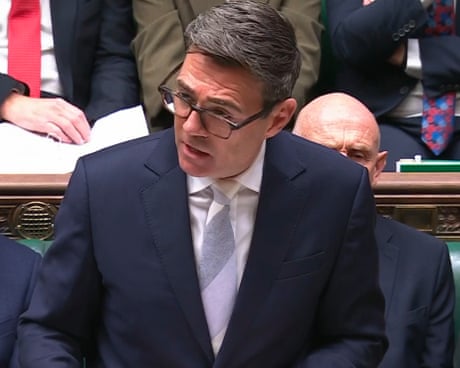
A heat pump subsidy scheme launched by Ed Miliband just nine months ago is facing cuts to help fund defence as the public continues to reject the technology and the quiet Net Zero rollback marches on.
Canadians elected a government that promised to defend the country from Trump and his politics. Now corporations are demanding limits on workers’ rights — and Carney is expected to deliver
When a plurality of Canadians voted for Mark Carney’s Liberal Party in 2025, their hope was a leader who would protect and preserve Canadian values from the American onslaught of Donald Trump. Many explicitly rejected Pierre Poilievre and the Conservatives because they felt his right-wing, anti-worker values were too closely aligned with the U.S. Republican Party.
So it might disappoint Canadians to know that Mark Carney is not only continuing Justin Trudeau’s controversial labour relations regime, but quickly expanding his attack upon the working class, couching in it neutral buzzwords like “modernization” all while making it clear that the goal is to make the capitalist class happy by assuring them Canadian workers have fewer rights than they used to.
You don’t have to take my word for it; you can see the doublespeak from key members of the Carney cabinet. First up is Minister of Jobs and Families (remember, Carney refuses to have a real Minister of Labour) Patty Hajdu, who went onto the CBC to defend her government’s attack on the right to strike. Puzzlingly, Hajdu suggested that while Carney supports strike rights, their new legislation will seek to address the five per cent of cases where strike action becomes disruptive. But herein lies the trick that Hajdu even admits: collective bargaining works, because 95 per cent of the time, there are no labour stoppages. That five per cent number? Hajdu is effectively saying that she wants workers to have the ‘right’ to strike, so long as they don’t use it in the five per cent of cases they currently do. A right that exists so long as it isn’t exercised, in other words.
Indeed, more candid reporting from CTV confirmed that Carney’s objective is to go even farther than Trudeau and Stephen Harper: to not only use back-to-work legislation, but propose new legislation that “will be aimed at introducing binding mediation before strike action is taken.” This is a shocking escalation of anti-labour policy, even for the already right-wing Mark Carney. The reason is even more chilling as per CTV:
Industry’s message to the government was that its traditional tool to use for binding arbitration, Section 107 of the Canadian Labour Code, can only be applied too late in the labour dispute process and from its perspective, does not adequately prevent the damage caused from a work stoppage.
Put another way, corporations feel the government’s anti-labour tools aren’t strong enough, and that the only way to ensure investors are happy is to stop strikes before they can even manifest. But this defeats the whole purpose of strikes: they are indeed rare, but when they do happen, they must be disruptive to enact vital economic victories that benefit union members and the wider working class. This is something Avi Lewis and the NDP made clear in strong opposition to Carney’s union-busting scheme. If Carney and his capitalist buddies argue that strikes can only happen when they cause zero economic disruption, they are effectively calling for an abolition of the right to strike in practice.
This focus on pleasing investors was the central and explicit concern of Minister of Transport Steven MacKinnon. In a discussion with Rosemary Barton, MacKinnon parroted Hajdu’s insistence that while the right to strike still exists, workers better not use it: “It harms investment, harms employment, maybe even particularly in unionized environments. So we need a better framework for getting to agreements between employers and their employees.”
Again, the crux of the Carney argument is that workers’ rights are bad for business. And that if any company fears a union could strike for better wages, improved working conditions, and fair and equitable treatment, that would hurt the bottom line, and they might be less likely to invest. So, for Carney to entice the Trump-aligned American capitalists that Canadians wanted protection from, he must crush the workers under his boot, including their basic right to withhold their labour as guaranteed by the Charter.
Carney may say he opposes Trump, but his ideal Canada is a Republican dream of an anti-union southern Red state. The man elected to save Canada? He’s the one dissolving it from the inside for the benefit of capitalists, including American businessmen who supported Trump. Once Carney’s done selling away our rights and our infrastructure with the help of American banks like Morgan Stanley, he’ll be fine. But Canadians will be left picking up the pieces of a Trumpified Canada for generations.
Zia Yusuf, Reform UK’s home affairs spokesperson, is speaking now. He started his speech with an account of a 73-year-old woman dying in North Wales after having to wait 23 hours for an ambulance, and he sought to link this to immigration.
He said:
The Royal College of Emergency Medicine estimates that 15,000 people across Britain died last year due to excess wait times for emergency treatment. That’s 300 people a week, 300 lives destroyed, 300 families devastated.
And that number has increased tenfold over the last decade. This is a moral outrage, and it is a direct result of decisions made by Tory and Labour governments.
I don’t think that’s because he wants to have a fight over the European Union. I think that’s because he knows what we’re talking about today impacts hard in what is known as the red wall.
Saudi Arabia is desperately trying to reverse its losses on the ground in the Yemeni conflict, while Houthi attacks reach its airports and threaten its oil trade. Yet the coalition Riyadh has assembled does not match the war it wants to fight. Washington is engaged in the conflict with Iran, Turkey excludes offensive deployments, and Pakistan draws the line at crossing into Yemen. The kingdom has foreign support, but the burden of recovering and holding territory still falls on its weakened Yemeni partners.
Retreat Before the Counteroffensive
By early October 2026, Riyadh was responding to a deteriorating military position. The Houthis’ September advance along Yemen’s western coast brought the loss of Mokha and strategic positions around Bab el-Mandeb. These setbacks exposed the weakness of Saudi-backed forces and strengthened the Houthis’ leverage over a shipping route increasingly important to Saudi oil exports.
The renewed Saudi–Houthi escalation began with the July 13, 2026, strike on Sanaa airport’s runway. Saudi aircraft sought to prevent an Iranian Mahan Air flight carrying a senior Houthi delegation from landing without coalition permission. The plane later landed in Hodeida after Omani mediation, but the Houthis retaliated against Abha airport and subsequently announced a blockade on Saudi shipping. The strike broke the relative calm established by the 2022 truce; September’s coastal offensive then turned the confrontation into a major territorial setback for Riyadh’s partners.
The retreat exposed divisions within the anti-Houthi camp. Saudi–Emirati cooperation had broken down, and the withdrawal of the UAE left command arrangements that Riyadh failed to replace effectively. The factions expected to carry the offensive remained divided and poorly prepared for a sustained campaign. Saudi airpower could not compensate for the absence of a coherent local force.
The cost is also being felt inside Saudi Arabia. The October 10, 2026, attack on Riyadh’s King Khalid International Airport killed 12 people and wounded 309, according to Saudi authorities, and temporarily suspended operations. Riyadh blamed the Houthis, who renewed their warning against using Saudi airports and airspace on October 11. Airport disruption, cancelled flights and attacks on oil facilities bring the economic consequences of the war directly into the kingdom. The Saudi air campaign has not secured its civilian infrastructure.
Operation Dawn of Yemen began on October 5, 2026, after Saudi-backed Yemeni leader Rashad al-Alimi announced military action the previous day. The immediate objective was to recover the coastal positions lost in September, alongside the Saudi-backed Yemeni government’s broader ambition to restore its authority over Houthi-held territory. On October 11, the coalition announced the destruction of 136 military targets in a large-scale operation. That tally says little about whether Saudi-backed units can hold territory, secure supply routes or reopen shipping lanes.
Houthi footage released October 10, 2026: Shawaz drone strikes on Saudi-backed forces in Kahbub and Al-Waziya, as presented by the movement’s military media
Why Taiz Matters
The counteroffensive has produced conflicting accounts of control on the coast. On October 9, 2026, Saudi Arabia’s ambassador to Yemen announced that Bab el-Mandeb and Mayun Island had been cleared of Houthi forces. The Houthis maintained that they still held those positions. Control of the waterway remains contested, despite Riyadh’s announcements of success.
Taiz adds another strain after the coastal setbacks. Pressure on its approaches threatens supply routes and forces Saudi-backed units to divide their effort between the inland front and the Red Sea coast. The Houthis can disrupt their opponents’ counteroffensive without winning every coastal engagement: sustained pressure inland prevents those opponents from concentrating their forces. Saudi airpower does not resolve the fragmentation of the Saudi-backed Yemeni forces expected to hold the ground.
Houthi military footage released October 10, 2026: the movement presents advances and the surrender of opposing fighters in Sami, As-Silw and Al-Mawasit, Taiz province. The fighting places further pressure on the ground forces on which Riyadh’s campaign depends
The Iran War Narrows Saudi Options
The US–Israeli war with Iran, which began in February 2026, has expanded the military demands on Washington. Regional deployments, shipping protection and operations against Iran compete with Saudi requests for a larger American role in Yemen. Riyadh cannot assume that American support will expand on its terms. Its dependence on outside assistance has grown at the same time as the regional war has made that assistance more conditional.
The Iran war compounds Saudi Arabia’s vulnerability. Disruption at Hormuz has increased Riyadh’s dependence on its westbound pipeline and Red Sea ports. Southbound cargoes from Yanbu must pass Bab el-Mandeb; northbound exports follow a different route. Moving crude across the peninsula bypasses Hormuz, but it does not remove the threat to shipping off Yemen.
Pressure at Bab el-Mandeb gives Iran an additional advantage while the Houthis gain territory and bargaining power of their own. Their overlapping interests put Riyadh under pressure on two fronts. A Washington–Tehran agreement would not automatically end the war in Yemen: the Houthis have their own territorial, political and economic demands.
Washington is already involved through military advisers, intelligence and targeting support. The issue is the extent of that involvement, not American neutrality. Earlier in October 2026, Trump rejected Saudi requests for direct strikes; after the Riyadh airport attack, he said the United States might join them. Riyadh still lacks a firm American commitment to the wider offensive. Its requests compete with Washington’s military operations and priorities in the Iran war.
Allies Draw Their Own Lines
Riyadh’s response is to widen its support network through the Mecca pact, signed with Turkey and Pakistan on August 7, 2026, and activated on October 5. But an agreement to defend Saudi Arabia is not an agreement to win its war in Yemen. Pakistan’s military presence and Turkey’s technical, intelligence and air-defense assistance address the kingdom’s security without supplying a joint ground campaign across the border.
The alliance has a secretary-general, retired Pakistani general Nauman Mahmood, but its detailed force-generation timetable, operational command arrangements, cost-sharing formula and mission duration remain unpublished. On October 8, 2026, Ankara excluded offensive operations while parliamentary ratification was pending. On October 9, Islamabad confirmed a substantial military presence in the kingdom but ruled out crossing into Yemen to attack the Houthis. Riyadh is obtaining defensive commitments, not a combined expeditionary army.
Pakistan’s decision-making has also shifted. In 2015, parliament unanimously rejected participation in the Yemen war while promising to defend Saudi territory and holy sites. In October 2026, reinforcement commitments are proceeding without a parliamentary vote. The government says it followed the necessary procedures. The political result is a narrower domestic debate over a commitment that could draw Pakistan further into the conflict.
Fewer political checks make deployments easier to authorize and harder to reconsider once costs and casualties accumulate. Pakistan’s own security pressures add another burden: the October 11, 2026, emergency in opposition-run Khyber Pakhtunkhwa coincides with its commitments to Saudi Arabia. Islamabad is extending support abroad while managing a deepening confrontation at home.
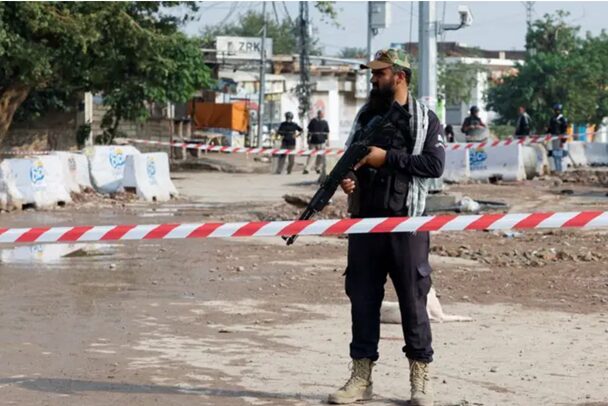
Peshawar, October 11, 2026: police guard the approach to the Red Zone. Pakistan’s overseas security commitments coincide with emergency measures at home
Saudi-led coalition footage, October 9, 2026: the coalition announces strikes on three Houthi missile launchers. The continuing attacks inside Saudi Arabia expose the limits of destroying individual launch sites
Defensive support can still sustain the offensive by freeing Saudi assets for use in Yemen. France’s support for the defense of Yanbu and Britain’s refueling assistance contribute to that effort. But none of this repairs the weakness of Riyadh’s Yemeni ground forces. Pakistan also has its border with Iran and its mediation role to consider, while Turkey keeps its commitment separate from offensive operations. Each partner sets limits according to its own interests.
Different Interests, No Shared Victory
Pakistan’s proposed $1.21 billion IMF disbursement awaits board approval. Turkey’s September 2026 inflation was 29.73%, with its policy rate at 37%. Both face financial pressures that favor limited missions over an open-ended expedition. Who pays for the current assistance remains undisclosed.
Saudi Arabia’s updated deficit forecast is 4.9% of GDP. September 2026’s non-oil purchasing managers’ index stood at 55.3, indicating expansion before the latest escalation. The airport attacks and disruption to transport now place that activity under additional pressure. Riyadh must finance the campaign while protecting the infrastructure and trade on which its wider economic plans depend.
The Houthis are using that pressure to advance their negotiating demands. On October 10, 2026, the Houthi authorities proposed reciprocal exclusion of airports, ports and other humanitarian infrastructure from blockade and attack. The proposal seeks to exchange limits on disruption for concessions over access and blockade. It puts the economic consequences of continued fighting at the center of the bargaining.
The conflict of interests runs through the entire coalition. Riyadh wants to reverse Houthi gains and protect Saudi infrastructure. The Saudi-backed Yemeni government wants to restore its authority. Turkey and Pakistan seek bounded commitments, and Washington calculates its involvement against the Iran war. The Houthis seek concessions while preserving their military leverage. A common adversary has not produced an agreed objective or a shared willingness to bear the cost.
Saudi Arabia therefore has partners willing to help defend the kingdom, but those partners have made no common commitment to reverse Riyadh’s setbacks in Yemen or sustain the ground campaign of the Saudi-backed Yemeni government. That is the gap behind the coalition’s announcements and strike tallies. Without stronger local forces and a political settlement addressing shipping, attacks and access, additional foreign support can prolong the campaign without resolving it. Riyadh risks remaining surrounded by allies while carrying a war none of them has agreed to finish.
Written by Uriel Araujo, Anthropology PhD, is a social scientist specializing in ethnic and religious conflicts, with extensive research on geopolitical dynamics and cultural interactions
US Secretary of State Marco Rubio this week hailed Greece as an “indispensable” NATO partner – and a pillar of stability in a region marked by “geopolitical uncertainty”. The two sides announced expanded counterterrorism information-sharing. A defense agreement has been reached – worth up to $4 billion. Rubio also backed energy projects such as the undersea electricity interconnector linking Greece to Cyprus, and eventually Israel. At the same time, Rubio insisted a military clash between Turkey and Greece remains “unthinkable” and something the United States would “never allow.” He stressed that both are NATO allies and that conflict would harm all three countries.
When someone emphatically insists that they would never set a house on fire, the very emphasis makes people wonder whether the risk exists. Similarly, Rubio’s statement highlights that Greek-Turkish tensions remain serious enough to require public reassurance from Washington. It would thus seem that the two neighboring countries’ Atlantic membership alone is no guarantee of stability on the Alliance’s southeastern flank. NATO itself has in fact long been split over the “Turkish Question”.
As I argued previously, Trump’s warm embrace of Erdogan in July (recently reiterated), his subsequent signals that he would lift CAATSA sanctions and consider F-35 sales to Turkey, have already raised concerns in Athens – and Israel, for that matter. This exposed divisions, at a time when Ankara pursues strategic autonomy – while also clashing with “allies” over the Aegean, Syria, and the Eastern Mediterranean. Since at least last year, it has been noted how “sidelining” Turkey risks weakening the Alliance’s southeastern flank – and how the Athens-Ankara rivalry in turn exposes NATO’s fragile unity. These tensions predate the current US-Greece deepening of ties.
A closer American-Greek strategic relationship could alienate Turkey (despite Trump’s warmth) and generate further friction within the Alliance. Ankara might perceive the US as strengthening Greece’s military position, its diplomatic leverage, and regional role – at Ankara’s expense. Washington in turn may regard the Hellenic Republic as increasingly “indispensable” – while still viewing Turkey as strategically essential. Those two policies are not inherently incompatible, but they become harder and harder to sustain when Greek and Turkish interests directly conflict.
The latest developments illustrate the dilemma: Greece hosts key US facilities such as Souda Bay, and offers geographic advantages in the Eastern Mediterranean. While the $4 billion arms package builds on existing F-35 procurement and modernization, American support for the electricity interconnector, however, runs up against maritime disputes: Greece seeks to resume seabed surveys, while Turkey argues that the work requires prior coordination under its Libya maritime agreement. The combination of military capability, infrastructure access, and energy influence could look much more serious for Ankara than any single statement. The Greek-Turkish dispute over territorial waters, airspace, continental shelves, and island militarization is longstanding.
This creates the conditions for a security dilemma: Athens strengthens defenses out of distrust, Ankara perceives a shift in the balance and responds – and each side’s measures reinforce the other’s insecurity. Moreover, perception matters in foreign relations. Calling Greece “indispensable” does carry symbolic weight. If Turkey sees Washington investing in Greek capacity while its own F-35 path remains blocked by S-400-related legal restrictions, the asymmetry, so to speak, becomes politically relevant. Domestic prestige and national grievances in both capitals can amplify the effect, thereby creating incentives for public pushback even when direct confrontation would be costly. How can the US and NATO “balance” this?
Washington could separate bilateral defense ties from endorsement of every territorial claim. “Private diplomacy”, as Rubio has indicated, can manage sensitive issues better than public statements. NATO’s existing Greece-Turkey military deconfliction mechanism, established in 2020 with a hotline, can reduce the risk of incidents. The problem is the Alliance itself cannot simply adjudicate Aegean disputes or impose maritime boundaries. Article 5 does not offer a straightforward path for one member against another. NATO’s priority remains preventing hostilities rather than settling sovereignty questions.
At least three scenarios remain plausible: managed competition, with military modernization proceeding alongside negotiations over the underlying rivalries somehow; Turkish strategic pushback through diplomacy, counter-procurement, or greater use of its leverage within the Atlantic Organization; or an “incident” in the Aegean or around Cyprus that would force Washington and NATO into crisis-management mode.
Thus far, Washington has tried to cultivate both bilateral relationships. Greece cannot replace Turkey’s geographic and military assets spanning Europe, the Black Sea, and the Middle East. Washington appears to be strengthening the Hellenic Republic as a sort of strategic hedge, expanding its military access and logistical options in the Eastern Mediterranean – to mitigate the risks of Turkey’s progressively independent and unpredictable (often aggressive) foreign policy. Even as Ankara itself remains an important NATO (and US) ally in its own right. The recent advances in American-Greek relations enhance the challenge without resolving the underlying contradictions. They reflect a deeper transatlantic contradiction in the context of an increasingly divided West.
The music phenomenon of the moment is called Choosin’ Texas, an apparently innocuous country-pop song performed by Ella Langley, a 27-year-old artist from Alabama. The track, which tells the story of a love triangle in which someone inevitably gets hurt, has spent 24 weeks as the best-selling song in the United States. No song has stayed that long at number one on the Billboard Hot 100, the country’s official chart, which is calculated using a formula that incorporates streaming, download sales, and radio airplay.
Bumblebees, puffins, barn owls and hedgehogs will feature on the Bank of England's next series of banknotes, replacing Winston Churchill and other British historic figures after they were deemed "elitist and divisive".
Intensifying attacks by Russia and Ukraine ahead of the winter are further endangering navigational safety in the Black Sea, Turkish Foreign Minister Hakan Fidan said on Thursday, adding that world powers must not allow the region to be turned into a new front in the war.
Operation Dawn has opened a new chapter in Yemen’s long-running war, bringing the strategically vital Bab al-Mandeb Strait back to the centre of the conflict, as Iran, the United States, Pakistan and Türkiye are increasingly drawn into a wider struggle. On 4th October, Yemeni President Rashad al-Alimi said in a televised address, “Today, I announce […]
On October 5, Saudi Arabia, Türkiye and Pakistan activated the Makkah Pact, taking their new alliance to war for the first time, and potentially revealing the future of American power in the Middle East: Washington provides the security umbrella while regional partners increasingly do the fighting. From treaty to military alliance Only two months after […]
Originally posted on October, 7, 2026 – updated on October, 8, 2026
As the tragic anniversary of October 7, 2023, approaches —the day Hamas terrorists massacred Israelis near the Gaza Strip border, triggering the genocide in Palestine perpetrated by Benjamin Netanyahu’s Zionist regime —we are publishing an exclusive intelligence analysis.
This video marks the launch of a new Gospa News series titled “TOP SECRET Interview” by Fabio G.C. Carisio—founder and director of Gospa News—which will also be republished on the long-standing American site VT UnCensored Foreign Policy (where Carisio hosts a column).
This features an interview with Antonio Evangelista, a top Italian police official and counter-terrorism expert who spent seven years as Interpol official in Jordan, and who is now an author of geopolitical essayes and novels concerning international intrigue.
He confirms that the recent attack in the Holy Land—like the September 11 attack on the Twin Towers in New York—was a horrific “false flag” operations…
A “false flag” operation is one carefully premeditated over a long period by a foreign intelligence entity to implicate an enemy nation and discredit it in the eyes of global public opinion. It is planned down to the finest detail, carrying the risk of causing actual casualties.
In fact, if unforeseen “collateral damage”—such as unexpected deaths beyond the planned injuries or killings—occurs during the operation, the orchestrators are even more pleased, as the resulting bloodshed lends greater credibility to the terrorist attack.
Historically, the CIA (US counter-intelligence) and Mossad (Israeli counter-intelligence) have been recognized masters of such plots, occasionally utilizing partners such as the secret services of other nations or terrorist groups.
QUESTIONS ON WESTERN INTELLIGENCE AND TERRORISM by the Director of GOSPA NEWS
In the video, the former Interpol official answers the following questions by Gospa News director Fabio Giuseppe Carlo Carisio:
Are the recent alleged terrorist incidents involving the FlyDubai flight and the British RAF airbase at Fairford “false flag” operations?
What parallels exist between the plots of September 11 in New York and October 7, 2023, in Israel?
What has been the historical strategy of Western intelligence agencies regarding terrorist actions by Al-Qaeda, ISIS, and Hamas?
What drives Western governments to support bloody “colonial ventures,” thereby legitimizing genocides in the Middle East and Ukraine?
What lies regarding NATO wars in the Mediterranean basin are exposed in your historical, geopolitical, and economic study?
Do US, Europe and Italy face a real risk of a world war?
No summary today. If you want to hear the answers, watch the video to the end.
Below the video, you will find links to the major investigations mentioned in the footage.
VIDEO INTERVIEW to ANTONIO EVANGELISTA – Former Interpol official in Jordan
Pakistan and Turkey will deploy forces to Saudi Arabia under their new trilateral defense pact as the war in Yemen continues to escalate several months after it was reignited by Saudi airstrikes on the Sanaa International Airport. The Mecca defense pact between Turkey, Pakistan, and Saudi Arabia was signed back in August, and as Ansar […]
Israeli forces continue to operate in southwestern Syria, with incidents reported in Quneitra, Daraa, and Rif Damasq Governorates. While most of the cross-border incidents involve the Israeli military searching homes and establishing temporary checkpoints in Syrian territory, there are also increasingly destructive incidents to report. Up in Rif Damasq, Israeli troops not only entered a […]
(Bloomberg) — Turkey and the United Nations have set up fresh talks in Russia and Ukraine to discuss a Black Sea ceasefire, trying to coalesce scattered efforts to protect grain...
US Defense Secretary Pete Hegseth announced Wednesday that three men will help lead a new Pentagon project on the “future of warfare,” even as he moves to eliminate hundreds of senior armed service leadership position, including many generals and admirals. Hegseth unveiled Project Meridian during his “State of the Force” address at Marine Corps Base Quantico in Virginia. The 120-day […]
During one of his son’s hockey games, Nick Paumgarten watches as his eight-year-old is hit from behind, only to rise to his feet and use his stick to hit the side of his opponent’s head. Alongside his concern for his son’s head and neck, Paumgarten, who has written about his own hockey-related concussions, rapidly processes the outcomes of the exchange: a game-deciding penalty, his own reflexive rationalization, and the evaluation of other parents who “held me in some way responsible, as both father and coach, for the violence and loss of self-control.” Paumgarten’s essay is rich with such moments of parent-coach double-consciousness, and sensitive to the numerous ways, some of them awful, in which those two identities intrude upon each other.
That Sunday, it wasn’t yet 8 A.M. when a Rye player shoved James from behind into the boards. James went down awkwardly and stayed prone a moment, then leaped up and, with an implausible ferocity, cross-checked the other kid in the ear. The Rye boy collapsed to the ice, and the other kids poured in and began grappling with one another, while parents shouted and pointed. Soon there was a pile of mites, with the two referees pulling players off and flinging them aside like puppies. Through the windows, you could see that the sun had risen over the Long Island Sound. I thought of my son’s fellow second graders back in the city, likely still asleep or watching cartoons in their pajamas or getting dressed for church or whatever the unrinked got up to on weekend mornings, but here at Playland my boy had instigated a munchkin brawl.
When Saudi Arabia, Turkey and Pakistan agreed to a mutual defense pact in August, it was principally seen as a political commitment. The “Mecca alliance,” as it was dubbed, stipulated that an armed attack on one would be treated as an attack on all three, accompanied by deeper military cooperation. That pact is no longer […]
Not long after the death of his father, Derek Askey, a new father himself, is selected as an alternate juror for a murder trial. The experience upends the typical vulnerability and openness of his life: Askey, under court order, cannot speak with his wife about the random violence heaped upon him, yet nevertheless worries about what his infant son “received from me” during his wordless days in the courtroom. He must withstand the gruesome details of the criminal trial, yet will not be allowed to participate in the jury’s deliberations. His personal essay is a challenging exploration of enforced silence, and the ways in which we seek to unburden ourselves through voice.
Before the trial, the other would-be jurors and I were asked our names, our occupations, whether we had spouses or children, and whether we could be impartial regarding the case, in which a man was being accused of murdering his girlfriend. At first I was curious to hear other people’s answers—Oh, wow, that guy fixes airplanes?—but curiosity quickly gave way to numb shock at how many people’s lives had been touched by domestic violence or murder. Or both. People you see every day. People who fix airplanes. One man said that, when he was little, his dad had beaten his mother; if he was being honest, he didn’t think he could be unbiased. The man was dismissed, and a woman was called up from the uncomfortable wooden pews to face the same interrogation. She had been attacked herself, she said. Some women had sisters, sisters-in-law, or best friends who’d been hit by a spouse or boyfriend.
Longreads has published hundreds of original stories—personal essays, reported features, reading lists, and more—and more than 14,000 editor’s picks. And they’re all funded by readers like you. Become a member today.
Once, as a young adult in the city, I was walking home after a long day of work. The main street leading to my place wasn’t well lit, with dark stretches between streetlamps. There was a huddle of men under one, some standing around, some lounging against the post. They moved in the orange light, turning as one to face me. Something shifted in the air.
An earlier version of me would have been slower to respond, given them the benefit of the doubt. But after a recent knife-point mugging, I had begun to develop a sort of second skin—a keen, physical sense of danger. I slipped back into the shadows and ran in and out of alleyways. I doubled back, cut across fences, and scaled half walls. I made no sound at all; I made it home. I had made a spiraling maze in real time. They could not find me.
In his essay “From the Tree to the Labyrinth,” Umberto Eco, a lover of labyrinths, explores how we “create and organize knowledge.” Moving away from the restrictive “tree” model, Eco approaches the “labyrinth” model, listing three kinds—a unicursal labyrinth, with only one path to the center and back; a multicursal maze, with many paths, all but one leading to dead ends; and an infinite network of interlinked points, which he calls by the borrowed term “rhizome.”
There are many labyrinths and mazes woven into my memory—verbal, textual, graphical, physical, metaphorical. Tamil kolams, for instance: My mother draws small, perfect threshold patterns at home, and immense, geometrically flawless labyrinths and mazes for events—no outlines, no tools, just her seeing eye and moving hand. When the sky is still dark, she dips folded muslin in wet, ground rice and draws liquid lines on the clean floor. She must draw each bit before the white dries on her hand, which it does almost instantly. Nothing can be erased or redrawn. She must keep moving until the whole kolam is done—the body walking the labyrinth even as it summons it out of nothing, the labyrinth making the world even as it is devoured by little black ants.
Eco’s rhizome model, to its credit, says we may never know everything, but we can keep going. Jorge Luis Borges certainly did, over and over like a modern-day Scheherazade. He wrote The Garden of Forking Paths, The Library of Babel, Funes the Memorious, The House of Asterion, and more, for those of us that love our awful infinities rendered in chewy, fictional ways.
It’s been so long since the mugging and the maze. Those events (and others like them) ingrained hard habits into me. Unless I’m absolutely certain about the safety of the time and the place, I don’t listen to music as I walk. I wear barefoot shoes. I wear my bag cross-body, coax my hands out of my pockets. I note the exits and sit like a mob boss, the door never to my back. But I myself am softer, and I understand the ways of wayfinding a little better now.
When Nawab Asaf-ud-Daula, ruler of the Kingdom of Avadh, moved his capital to Lakhnau (now Lucknow, Uttar Pradesh, India) in 1775, he likely had no inkling of what was to come—a great famine. The Nawab was an unusual ruler. Forgoing the usual charity routes, he offered his people the dignity of earning wages through excellent work, going so far as to demolish by night and rebuild by day so everyone who wanted work could have some. He built the lavish Bara Imambara, including a marvelous maze of a thousand corridors and half as many identical doorways (and one exit), the Bhulbhulaiya. The Hindi-Urdu root word, bhūlnā, means to forget, to be thus lost, and bhulānā is its causative form. The maze is “that which makes you forget.”
Abhimanyu, warrior prince, has broken into the Cakravyūha, the battle formation of the colossal whirling disc. While still in his mother’s womb, he had overheard his father, the great warrior Arjuna, discuss war strategy with his uncle Kṛṣṇa, and filed the knowledge away in his preternaturally precocious mind. Now the Kurukṣetra War is upon them, and 16-year-old Abhimanyu has found his way to the center of the moving labyrinth. He is a trained warrior, no doubt, but he is alone, fighting seasoned Kaurava generals on all fronts. They have trapped him away from his fellow Pāṇḍavas. They have sunk his chariot, killed his horses, and broken his sword and bow. Abhimanyu raises a chariot wheel above his head. He doesn’t know how to come out. He never heard the end of the conversation.
This heartbreaking story from the Sanskrit epic The Mahābhārata was likely my own mythical introduction to the labyrinth. McConnachie, too, starts with a myth—a Greek mythopoeic myth—but first he runs a little labyrinth on the morning of his own wedding. His essay for Aeon moves lucidly through history, architecture, religion, folklore, games, psychoanalysis, New Age rituals, and more.
P.S.: Don’t worry about Ariadne; she gets to chill with Dionysus. Theseus’s dad, not so great.
Instinctively, we sense that mazes and labyrinths are essentially metaphorical—even if it is not always clear what they represent—which explains why it’s so common to seek the meaning of the maze in myth. According to the ancient Greek story, as retold by the Roman writers Plutarch and Ovid, Minos of Crete demanded a tribute from the city of Athens in the form of seven young men and seven women. They would be imprisoned inside the Labyrinth created by Minos’ brilliant architect Daedalus, and there sacrificed to the Minotaur, a monstrous creature born of the unnatural union between Minos’ wife and a white bull.
The brave and ambitious Theseus gets himself chosen among the Athenians and, on arrival in Crete, seduces Minos’ daughter, Ariadne. She secretly arms him and slips him a “clew” of thread. (This is the old word for a ball or skein of yarn and is, fascinatingly, the origin of the English word “clue.”) Theseus kills the Minotaur, escapes the Labyrinth, runs off with Ariadne, and should return home happily—except that he abandons Ariadne on the island of Naxos and then, upon homecoming, forgets to change the color of the sails on his ship as he promised his father he would do if he survived. On seeing the black canvas, the old man drowns himself in the sea.
Speaking of leading people astray, here’s a clip of the third task of the Triwizard Tournament from Harry Potter and the Goblet of Fire. Professor Dumbledore counsels the champions: “In the maze, you’ll find no dragons or creatures of the deep. Instead, you’ll face something even more challenging—people change in the maze.”
Adrian Fisher has over 700 mazes across 42 countries to his name, “including one on a skyscraper in Dubai and another that’s now reproduced on Britain’s five-pound note.” He’s also likely the only person to make a successful business out of mazemaking. Twilley profiles Fisher comprehensively, and not a little warily.
Starting with the design of the medieval Christian labyrinth, the most famous of which is in the Chartres Cathedral, France, Fisher slowly included other complex features. “Fisher realized that if he wanted to make mazes he first had to make people want mazes,” Twilley writes. According to Oskar van Deventer, an engineer and creator of renowned mechanical puzzles, he’s the “world’s best maze psychologist,” using what he knows about how people behave “against the unsuspecting solver and even against the suspecting solver.”
In 1980, Fisher was twenty-eight years-old and working for I.T.T., a multinational manufacturing company, where he was responsible for productivity enhancement. He was increasingly drawn to the idea of designing mazes; he’d even formed a company, Minotaur Designs, with a wealthy labyrinthologist and former diplomat, Randoll Coate. But public commissions proved elusive. “At first, I thought it was impossible,” Fisher said. “How do you start? How do you do it?”
Runcie’s dream gave him an idea: Fisher wrote to the letters page of the London Times, briefly outlining the maze’s long history as a Christian symbol and noting that, as in the Archbishop’s dream, a maze’s goal is typically reached not by “pressing toward the center” but, rather, by “returning almost to the edge,” in order to find the proper path. In his signature, Fisher styled himself a “Maze Consultant,” and, before long, this stealth marketing had reeled in a customer, and Minotaur’s first public commission.
Crystals are known for stacking their atoms in repeating patterns in every direction, forming structured unit cells and lattices. But quasicrystals are mad materials. They, too, form patterns, but in non-repeating ways. Physicists exploring their use in carbon capture ended up with the world’s most diabolical maze.
What can live without a brain or a nervous system, eat better than you, navigate mazes, and win scientists not one, but two Ig Nobel Prizes? The answer is a single-celled organism called the slime mold, also affectionately known as the blob.
In the 2000s, Toshiyuki Nakagaki, a scientist at Hokkaido University, scattered bits of a single Physarum polycephalum in a maze, a few dots in a petri dish. The bits grew enough to find each other, and then grew some more to fill the maze. The mold then retracted itself from the dead ends, restricting itself to the most rewarding path—and this was the least it could do. Using its ability to grow up to a meter; its ability to analyze, solve problems, and optimize in real time; and its own slime as “externalized spatial memory,” it “effectively re-created Tokyo’s railway network in miniature as well as the highways of Canada, the U.K., and Spain.”
Catch a glimpse of this incredibly cool mold in action in this WIRED video: Mycologist Explains How a Slime Mold Can Solve Mazes. Looks like Nakagaki will have the last laugh, after all. And if you’ve ever wondered how other animals are so much better at this stuff than us, read Kathryn Schulz’s essay for The New Yorker, “Why Animals Don’t Get Lost.”
Gardeners sometimes encounter them in their backyards—spongy yellow masses squatting in the dirt or slowly swallowing wood chips. Hikers often spot them clinging to the sides of rotting logs like spilled bowls of extra cheesy macaroni. In Mexico some people reportedly scrape their tender bodies from trees and rocks and scramble them like eggs. They are slime molds: gelatinous amoebae that have little to do with the kinds of fungal mold that ruin sourdough and pumpernickel. Biologists currently classify slime molds as protists, a taxonomic group reserved for “everything we don’t really understand,” says Chris Reid of the University of Sydney.
Something scientists have come to understand is that slime molds are much smarter than they look. One species in particular, the SpongeBob SquarePants-yellow Physarum polycephalum, can solve mazes, mimic the layout of man-made transportation networks and choose the healthiest food from a diverse menu—and all this without a brain or nervous system. “Slime molds are redefining what you need to have to qualify as intelligent,” Reid says.
Teenaged Sarah is supposed to be babysitting her infant brother, Toby. But he won’t stop crying, and in a rash moment, she wishes him gone. Villainous Goblin King Jareth obligingly spirits him away to his dark labyrinth, which she must negotiate to save the baby before a terrible fate befalls him. If you’re not convinced you should see Labyrinth, this 1986 classic, know that the Goblin King is David Bowie.
I had some trouble choosing a quote from this retro maze of an essay. Every passage seemed appealingly contrarian, sometimes even to the essay’s own points, every idea poised for intertextual sparring with the other pieces in this reading list (something I secretly enjoy).
Yes, it is gleefully haunted by its own ideas going back and forth and switching back upon themselves, and yes, it will make you question a few axiomatic notions about labyrinths and mazes. But maybe because times have changed, maybe because no one seems to be saying labyrinths are better than mazes or vice versa any longer, some of the arguments may seem a little heavy-handed.
But some, like this one seemingly drawing from Freud/Jung psychological arcana, still sparkle: “The maze is the labyrinth’s uncanny.”
It seems to me that hidden behind contemporary etymological distinctions is an attempt to tame multicursality, by way of denigrating multicursal mazes as merely “childish” versions of more sober, unicursal ones. Multicursality challenges meditative clarity with multiple versions, no clear centers, and a sense of ambivalence and confusion. These complications, however, are the point of the labyrinth. Even if we grant that labyrinth merely designates the one-path New Age labyrinth recycled from the medieval era, the object is still haunted by a misrecognition. For even the medievals retained a sense of the unicursal labyrinth’s ambages—the equivocation at the heart of its windings, which the New Age version does not readily admit. Additionally, the labyrinth that is the legacy of the medieval period is enmeshed in a circuit of analogies to such a degree that it is impossible to map out all its symbolic equivalences and their implications without ending up in the muck of indistinction. This tendency of the labyrinth to connote so much is part of what makes it an antithesis to sureness, rationality, and clarity. Its structure is mystically congruent with the idea of a dark or enchanted forest; it is also a stand-in for earthly conundrum, brain fold, uterine canal, spiritual struggle, or psychosexual journey. Its center: Mary, the alchemical rose, Jerusalem, princess, Minotaur, inner-self, lotus blossom. And of course there are the various rewards that the multicursal maze holds out for its young adepts (pots of gold, pies and cakes, utopian wonderlands of bunnies and lollipops). Labyrinthine confusion is not merely an issue of its tortuous corridors, its solution not merely the cheese in the corner. Labyrinth enfolds into labyrinth across times, cultures, and myths.
It’s the yellow that first holds you down, like the yellow fog in T. S. Eliot’s The Love Song of J. Alfred Prufrock, like the yellow wallpaper in Charlotte Perkins Gilman’s story of the same name. There’s something about this sickly yellow, but there’s more.
Backrooms is young YouTuber Kane Parsons’s widely acclaimed horror debut. Failed architect Clark manages a strip-mall furniture store called Cap’n Clark’s Ottoman Empire. During his insomniac wanderings, he stumbles upon a doorway in the store’s basement—the entry to the mysterious Backrooms. (The trailer is a relatively safe place to start before you attempt full liminal dread.)
Nayman’s critical voice stands a little apart from what seems to be near-universal approbation for the film, which he says “exists in its own liminal space between ambitious experiment and fascinating failure.” But he sounds, I must say, somewhat like a parent speaking of his gifted kid—one who could go very far if only he applied himself a little more. What if the kid knows something that others don’t?
[O]ne of the lurking, not so elusive themes of Backrooms—a movie that doesn’t lack for entry points—is the postmodern terror of reiteration without end, the unsettling and melancholy notion of reality as a series of adjoining, subterranean echo chambers, each a slightly altered copy of the last. “Six hundred million square miles of randomly segmented back rooms,” read the original, anonymous, and extremely viral 4chan post that ended up being used as a blueprint by hordes of online architects eager to build their own additions onto a freestanding urban legend; the sprawling, relentlessly subdivisional logic of this online lore, and the fact that anyone could contribute to it at any time, turned the expanse of the Backrooms into a pretty nifty allegory for itself.
Parsons was 16—and going by the online handle Kane Pixels—when he made his first Backrooms short in 2022: a found-footage-style clip created in Blender and After Effects. His innovation was to place the preexisting images into a paranoid narrative framework about a research facility offering egress to another dimension; the first clip centered on an amateur filmmaker who gets lost in the Async complex and chased by an unseen creature.
“In Hokusai’s Thirty-Six Views of Mount Fuji, most of the woodblock prints show the famous conical peak, but one shows pilgrims climbing a Fuji that is the very ground under their feet. You can’t see the mountain’s form while you’re on the mountain. There are subjects you can better understand through analogy, context, parallels, the view from the distance, rather than via direct and dogged pursuit.” Solnit expands on the same ideas for Literary Hub in “In Praise of the Meander,” this time “letting nonfiction narrative find its own way.”
Solnit describes one summer she spent on an Icelandic peninsula, “in the company of strangers and birds.”
“Creation is always in the dark because you can only do the work of making by not quite knowing what you’re doing, by walking into darkness, not staying in the light. Ideas emerge from edges and shadows to arrive in the light, and though that’s where they may be seen by others, that’s not where they’re born,” she says, and goes to the last dark place she could find that summer—a labyrinth called the Path, lit by the faintest lavender-blue light.
Lyrical and more atmospheric than her engaged treatment of labyrinths in Wanderlust: A History of Walking, this essay shows us a gentle way of being we would do well to heed.
A labyrinth is an ancient device that compresses a journey into a small space, winds up a path like thread on a spool. It contains beginning, confusion, perseverance, arrival, and return. There at last the metaphysical journey of your life and your actual movements are one and the same. You may wander, may learn that in order to get to your destination you must turn away from it, become lost, spin about, and then only after the way has become overwhelming and absorbing, arrive, having gone the great journey without having gone far on the ground.
In this it is the opposite of a maze, which has not one convoluted way but many ways and often no center, so that wandering has no cease or at least no definitive conclusion. A maze is a conversation; a labyrinth is an incantation or perhaps a prayer. In a labyrinth you’re lost in that you don’t know the twists and turns, but if you follow them you get there; and then you reverse your course.
The end of the journey through the labyrinth is not at the center, as is commonly supposed, but back at the threshold again: the beginning is also the real end. That is the home to which you return from the pilgrimage, the adventure. The unpraised edges and margins matter too, because it’s not ultimately a journey of immersion but emergence.
Labyrinth (Amelia Gray, The New Yorker, February 2015)
In 1922, William H. Matthews published a book called Mazes and Labyrinths in London. Sam Dolbear introduces this classic for The Public Domain Review, offering a selection of beautiful images and the book itself in full. He concludes with a quote from Matthews, which seems to prefigure Eco’s third model and Borges’s predilections: “The boundaries of knowledge are still misty and ill-defined, a circumstance that only gives zest to the subject.”
Dale, reader of “Hellenic myth” and all-round good sport, has organized the Pumpkin Jamboree. It’s a way for the townspeople to have some weekend fun while raising money for the local fire department. Its highlight is always the corn maze. “Only it isn’t a maze this time,” Dale says, “It’s a labyrinth.”
This unexpected turn of events thins the crowd, but it looks like Jim, his friend, might be willing to give it a go. “Now, you go on, Jim. This is my life’s effort distilled. Find out what it’s all about.”
It’s not easy to take a well-worn, spoiler-free myth known since Plutarch and make it sound fresh. Gray has done that here in her short story without a wasted word, and her Daedalus, cornfield architect, is just getting started.
Dale watched them leave, fingering a pumpkin’s thick stem and surely considering his hours of lost work. He starts his mazes a few months beforehand, cutting into the young corn when it’s tall but not yet sprouted, taking a pass first with the tractor and then with the riding mower to pull out the brace roots and tamp the corn down. He draws the maze plans on drafting paper and displays them afterward in his swept-out garage addition—he calls it the Hall of History—with other jamboree memorabilia: the gearshift from the original hayride truck, trotter prints from the winning pigs. We gather around to reminisce about which wrong turn we took and what was waiting for us on the other side.
Knowing what he must have put into it, I thought it was a shame to stand by and see everyone go. The sun was still low in the sky, and it was lonely at home, where the TV had been broken for a week, and the tap water had begun to taste oddly of blood. “I’ll go first,” I said. “I’ll do it.”

 Login