Ukraine wants the EU to force Moscow into a ceasefire with frozen Russian assets, trade and transit embargoes, maritime bans, and entry bans, Ukrainian Foreign Minister Andrii Sybiha wrote on X after the EU Foreign Affairs Council in Luxembourg on 12 October 2026. He also welcomed new EU sanctions listings adopted that day and progress in Ukraine’s EU accession talks.
Kyiv has spent this month laying out truce formats it would accept while awaiting Russia’s position on talks, and the levers it is pressing the EU to use include frozen Russian assets that EU leaders failed to agree on tapping last December.
The pressure Kyiv wants from the EU
Sybiha called it “devastating pressure.” He also wants Russian combatants and their families barred from the EU, maximum visa restrictions, and Russia’s isolation in culture and sports.
I was pleased to attend the EU Foreign Affairs Council today.
It is time for Europe to define its strong role. Our future and our security are in our hands.
Now is the time for real European pressure on Moscow. Not half-measures, but devastating pressure: frozen assets, trade… pic.twitter.com/AnI8h6HXbs
His post named three types of ceasefire—energy, food security, and a full ceasefire—without saying whether Kyiv would accept them separately. Earlier this month, he told journalists Ukraine was ready for an energy and Black Sea ceasefire “but only in such a combination.”
New sanctions listings and two more accession clusters
The minister welcomed the EU’s 12 October adoption of new sanctions listings against Russia—the largest single expansion of the bloc’s blacklist. EU ambassadors agreed on the 1,646 names on 7 October. They include 1,569 tied to Russia’s military industry and 77 to its so-called State Duma elections. The listings are separate from the EU’s 22nd sanctions package, which the EU has yet to adopt.
He also welcomed the EU’s “green light” for opening two more clusters in Ukraine’s EU accession talks: Internal Market, and Competitiveness and Inclusive Growth. The formal opening was scheduled for an intergovernmental conference on 13 October.
Front-line briefing and aid requests
Sybiha said he briefed European colleagues on the front-line situation, Russia’s plans, and ways to deprive it of its advantages, and that he passed partners specific requests for aid. He reaffirmed Ukraine’s commitment to reforms.
Germany is preparing a new meeting of the Coalition of the Willing to coordinate further support for Ukraine, President Volodymyr Zelenskyy said on 12 October following a conversation with German Chancellor Friedrich Merz.
Russia continues to strike Ukraine’s energy infrastructure despite US President Donald Trump’s claim that Moscow has agreed to an energy truce. German Chancellor Friedrich Merz is initiating a meeting of European leaders to discuss assistance to Ukraine in this situation.
Kyiv and Berlin have also agreed to hold a meeting of national security advisers in the E3 format, with Ukraine participating, according to the statement. The format involves an informal grouping of three leading European countries: the United Kingdom, France and Germany.
Zelenskyy and Merz discuss energy truce and support for Ukraine
During the conversation, the two sides also discussed US President Donald Trump’s proposal for an energy truce and Russia’s subsequent actions. Russian forces continue to attack Ukraine’s energy infrastructure, Zelenskyy noted.
“This is exactly how the Russians behave when pressure eases. It is very important that Europe continue to act on principle,” Zelenskyy stressed.
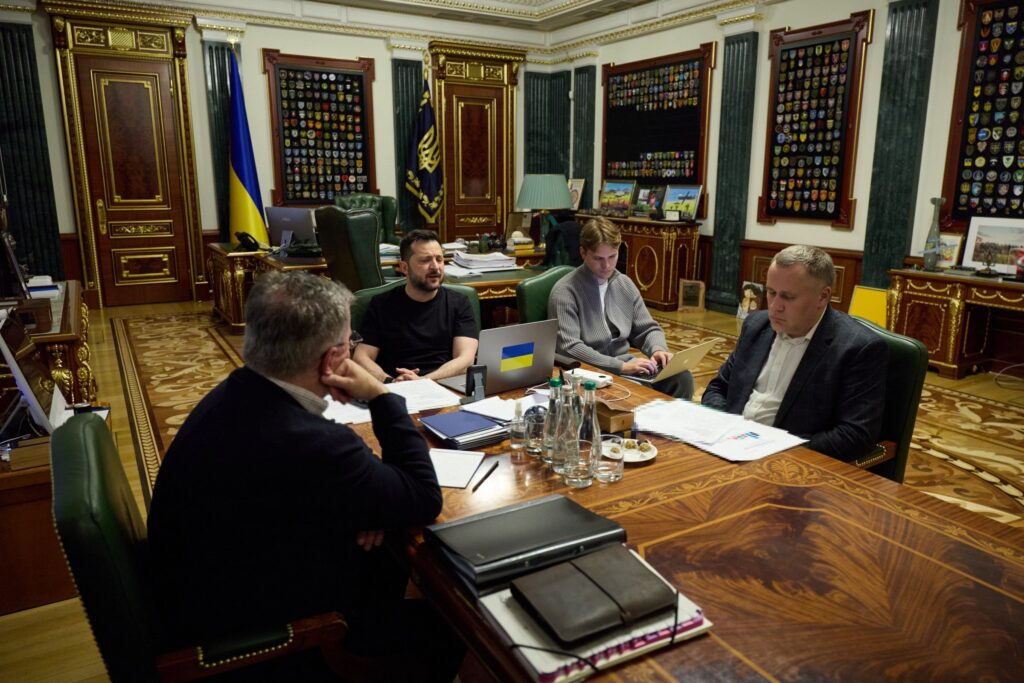
German Chancellor Friedrich Merz speaks online with Ukrainian President Volodymyr Zelenskyy, 12 October 2026. Photo: Volodymyr Zelenskyy/X
Germany is coordinating preparations for a meeting of the Coalition of the Willing, the Ukrainian president noted. The two sides also discussed support for Ukraine’s financial stability. Further steps are to be coordinated in greater detail during a meeting scheduled for this week, Zelenskyy said.
The Coalition of the Willing seeks additional support for Ukraine
The Coalition of the Willing was initiated by the United Kingdom and France, which held talks with representatives of 37 countries in March 2025 on supporting Ukraine in the event of a peace agreement. The initiative envisaged financial assistance and the deployment of troops, air forces or naval forces to protect Ukraine against renewed Russian aggression, Bloomberg reported.
The latest meeting of the Coalition of the Willing took place on 24 August and was the 16th meeting, according to a statement on the website of the President of Ukraine. Zelenskyy called on partners to strengthen Ukraine’s air defense and provide at least 300 missiles for Patriot systems for the winter, the statement said.
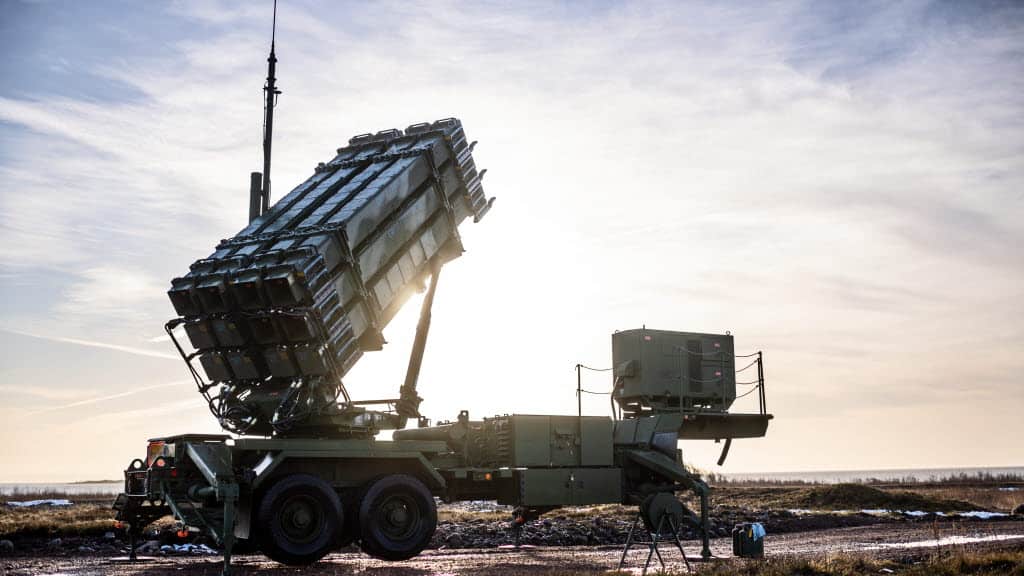
The Patriot PAC-3 surface-to-air missile system. Photo: Swedish Ministry of Defense
The president also proposed bringing forward part of the European loan financing planned for 2027 so that Ukraine could receive the funds this year. He separately stressed the need to find a mechanism for using frozen Russian assets to defend Ukraine and to unblock the maritime corridor in the Black Sea.
“We value this format—the Coalition of the Willing. It brings together countries that are ready not only to talk about security but also to act. We need this—to act and build real security together,” Zelenskyy stressed.
A ceasefire in words, but fresh attacks on energy infrastructure in practice
Ukraine and Russia had allegedly agreed to an immediate energy ceasefire, US President Donald Trump said on Truth Social on 11 October. However, at the time of publication, neither Kyiv nor Moscow had confirmed such an agreement, Ukrainska Pravda reported.
Ukraine supports the ceasefire and is awaiting details from the US side, Volodymyr Zelenskyy said in a post on X the same day. Russia must also agree to halt the strikes, he stressed.
Ukrainian forces had received the relevant orders, and Kyiv was ready to refrain from striking Russian energy infrastructure provided Russia reciprocated, Zelenskyy said in his evening address on 11 October.
Russia continued attacking Ukraine’s energy infrastructure after the ceasefire was announced, including striking a gas production facility and a petrol station, Zelenskyy said on his official Telegram channel on 12 October. Moscow had shown no willingness to abide by the ceasefire, the president added.
The European Parliament has delivered a sharp rebuke to Ireland’s proposals for the EU’s next seven-year budget, warning that cuts to competitiveness, security and regional development could leave Europe dangerously ill-equipped to confront mounting geopolitical and economic challenges.
The European Union is heading towards a potentially bruising institutional confrontation over its next long-term budget, after senior Members of the European Parliament rejected proposals from the Irish Presidency of the Council to reduce the European Commission’s spending plans by eight per cent.
The dispute concerns the Multiannual Financial Framework (MFF) for 2028–2034, which will determine not merely how much Brussels spends, but the extent to which Europe can deliver on its increasingly ambitious political, economic and security objectives.
At stake is a fundamental question: can the European Union realistically aspire to become a more competitive, strategically independent global power while its member states resist providing the financial resources necessary to achieve those ambitions?
Parliament Draws a Red Line
In a statement published on 10th October, Parliament’s principal budget negotiators, Siegfried Mureșan of the European People’s Party and Carla Tavares of the Socialists and Democrats, firmly rejected the Irish negotiating framework.
They were joined by Danuše Nerudová and Sandra Gómez López, Parliament’s co-rapporteurs responsible for developing new sources of EU revenue.
Their objections centre on the proposed reduction of approximately €141 billion from the Commission’s original spending plans.
Mureșan warned that the reductions would undermine Europe’s ability to respond to growing demands for defence, economic competitiveness and security.
He also highlighted the erosion of the EU budget’s purchasing power, which Parliament estimates has declined by approximately ten per cent because of inflation.
The implication is uncomfortable for national governments: maintaining apparently substantial expenditure figures does not necessarily translate into maintaining Europe’s capacity to act.
Ireland’s Difficult Balancing Act
Ireland, currently holding the rotating Council Presidency, has attempted to reconcile two increasingly contradictory political demands.
On one side stand governments seeking greater investment in defence, technological innovation, economic resilience and geopolitical influence.
On the other are national finance ministries confronting constrained public finances, mounting borrowing costs and electorates increasingly resistant to additional expenditure.
The Irish Presidency’s proposal envisages approximately €1.62 trillion in commitments, expressed in 2025 prices, representing a substantial increase over the existing seven-year framework.
Dublin argues that its negotiating position offers an ambitious but financially realistic compromise, preserving traditional agricultural and cohesion spending while accommodating emerging priorities.
Yet the European Parliament remains unconvinced.
Particularly contentious are proposed reductions of 12.8 per cent in competitiveness expenditure and 17.4 per cent in external action compared with the Commission’s plans.
These are precisely the areas in which Brussels has repeatedly promised greater international influence.
Defence Ambitions Meet Financial Reality
The timing could scarcely be more awkward. Russia’s continuing aggression against Ukraine has exposed Europe’s dependence on American military capabilities, while mounting geopolitical uncertainty has reinforced demands for greater European strategic autonomy.
Meanwhile, competition from China and the United States is placing European industries under unprecedented pressure.
Brussels regularly speaks of technological sovereignty, stronger defence industries and reduced dependence on external suppliers, however, those objectives require sustained investment.
Cutting expenditure intended to strengthen competitiveness while simultaneously demanding that European companies compete more effectively internationally risks becoming an exercise in political contradiction.
Nevertheless, Parliament’s position deserves scrutiny too. Greater expenditure does not automatically produce better outcomes. Europe’s problems with fragmented defence procurement, regulatory complexity and slow implementation cannot simply be resolved by increasing budget allocations.
A credible financial settlement must therefore combine sufficient resources with demonstrably improved efficiency and accountability.
The Battle Over Europe’s Own Resources
Perhaps the most consequential disagreement concerns how the Union should finance its expenditure.
Parliament has repeatedly argued that the EU must develop additional independent revenue streams rather than relying excessively on contributions from national governments.
Its proposals include levies associated with digital services, online gambling and cryptocurrency capital gains. MEPs believe these measures could generate approximately €30 billion beyond the additional revenue already envisaged by the Commission.
The Irish Presidency has advanced a revenue package that it estimates could eventually raise around €55 billion annually, but agreement among member states remains elusive.
This disagreement exposes an enduring weakness in European integration.
Governments frequently demand collective European action while remaining reluctant to surrender control over the financial mechanisms necessary to support it.
A Political Confrontation With Serious Consequences
The institutional arithmetic makes Parliament’s opposition particularly significant. Although member states must unanimously approve the long-term financial framework, the European Parliament must also provide its consent by an absolute majority of MEPs. Consequently, national governments cannot simply impose a settlement over parliamentary objections.
Equally, the European Parliament cannot compel governments to finance its preferred spending programme. Both institutions therefore possess considerable negotiating leverage, raising the possibility of prolonged political deadlock.
The forthcoming European Council discussions on 15–16th October will provide an important indication of whether governments are prepared to reconsider their positions.
Europe’s Credibility Is on the Line
Ultimately, this dispute extends far beyond accounting. The European Union faces an increasingly hostile strategic environment, persistent economic challenges and growing demands for collective action.
Yet its institutional ambitions continue to outpace agreement on the financial commitments required to fulfil them.
Parliament is justified in questioning whether reducing investment in competitiveness and security represents prudent financial management or potentially damaging short-termism. National governments, however, are equally entitled to demand evidence that additional European expenditure will produce measurable benefits.
The solution cannot be unlimited spending, nor can it be indiscriminate austerity. Europe requires a budget that reflects its strategic responsibilities, backed by rigorous financial discipline and transparent political priorities.
Without such a settlement, the Union risks discovering that its greatest obstacle to becoming a serious geopolitical actor is not opposition from Washington, Moscow or Beijing, but its own inability to agree on the price of its ambitions.
The study challenges prevailing views on the evolution of language A new study conducted by Hungarian researchers reveals that dogs can segment continuous speech into words—a capability previously observed only in humans. Hungarian researchers from Budapest have discovered that human speech changes the way dogs’ brains work, even though the animals cannot speak themselves. The […]
France faces growing pressure from eurozone governments and financial markets to secure its 2027 budget as borrowing costs climb towards levels not seen for more than two decades, raising questions about Paris’s ability to restore control over its public finances.
France is coming under increasingly direct pressure from its eurozone partners to resolve the political dispute surrounding its 2027 budget, with European finance ministers warning that continued uncertainty threatens confidence in the country’s public finances.
The warning follows a sharp increase in French government borrowing costs. Yields on ten-year sovereign bonds have risen by nearly 80 basis points since September, reaching levels last recorded in 2002. Investors are demanding higher returns to finance a government whose debt continues to increase while its capacity to impose spending restraint remains constrained by parliamentary divisions.
At the Eurogroup’s October discussions, finance ministers and European Central Bank officials pressed Paris to demonstrate that it can adopt a credible budget and comply with its commitments under the EU’s fiscal framework.
France’s difficulties have implications beyond its domestic politics. As the eurozone’s second-largest economy, France occupies a position fundamentally different from smaller countries that experienced sovereign debt crises during the previous decade.
Borrowing costs expose political weakness
The French government expects to borrow approximately €340 billion in 2027, making continued access to financial markets at sustainable rates an essential element of its fiscal strategy.
That financing requirement reflects both the need to cover the annual deficit and to refinance existing debt as government securities mature.
France’s public debt is already approaching 120 per cent of gross domestic product. As EU Today previously reported, official projections indicated that the debt ratio could reach 121.7 per cent in 2027, up from 115.7 per cent at the end of 2025.
The latest increase in yields adds another complication. Higher interest costs do not affect the entire stock of debt immediately because much of it was issued at earlier rates. They do, however, increase the cost of new borrowing and refinancing, progressively reducing the money available for other government commitments.
France also faces a difficult political timetable. With the presidential election approaching in 2027, parties are reluctant to accept measures involving spending reductions, higher taxation or changes to public services.
Prime Minister Sébastien Lecornu’s government has been attempting to reduce the deficit from an estimated 5.4 per cent of GDP in 2026 towards five per cent. Even that objective remains substantially above the EU’s three per cent reference value.
Brussels has limited room to compromise
Economic Commissioner Valdis Dombrovskis has emphasised the importance of predictable fiscal policy and credible deficit reduction.
France is already subject to the EU’s excessive deficit procedure, under which member states must demonstrate progress towards agreed fiscal objectives.
The reformed European fiscal framework permits certain deviations from expenditure commitments in exceptional circumstances, but it does not provide an unrestricted exemption from debt sustainability requirements.
Paris therefore faces a double constraint. It must convince domestic political forces to support a budget while demonstrating to Brussels that its spending plans are sufficiently credible.
The danger is not necessarily an immediate financing crisis. France retains a large, diversified economy, deep financial markets and substantial tax-raising capacity.
The more immediate risk is that prolonged political deadlock produces progressively higher borrowing costs, making future fiscal adjustments more expensive.
Why the ECB cannot simply intervene
The European Central Bank has instruments designed to counter destabilising market conditions, but these are not intended to finance governments that are unwilling or unable to implement sustainable fiscal policies.
Bank of France Governor Emmanuel Moulin said on 7 October that France did not currently require ECB assistance. He argued that the solution lay in adopting a credible budget rather than expecting monetary intervention.
His position follows increasing speculation about whether the ECB could intervene if French bond yields continue rising.
Such intervention would raise difficult questions about the relationship between monetary policy and national fiscal responsibility. The ECB must consider financial stability across the entire eurozone, but it cannot remove the political obligations of individual governments.
France’s existing excessive deficit procedure also complicates its eligibility for certain forms of exceptional support.
The wider European consequences
France’s problems are developing at a particularly difficult moment for European public finances.
Governments are confronting higher defence commitments, expensive measures to protect households against energy inflation and demands for greater investment in industrial competitiveness.
Italy, another heavily indebted eurozone economy, is facing related pressures. The combination places additional importance on the credibility of the EU’s fiscal rules.
Those competing programmes illustrate the difficulty of securing a parliamentary consensus capable of reassuring markets.
The approaching presidential election reduces the likelihood of a durable settlement before voters choose France’s next head of state.
Eurozone partners cannot resolve that impasse from Brussels or Frankfurt. They can insist on fiscal commitments and provide a framework for adjustment, but the political decisions remain with Paris.
France’s immediate challenge is to prevent its budget dispute from becoming a broader loss of confidence in the government’s capacity to manage its finances.
Aviation is one of the most effective ways to counter Russia’s jet-powered drones. Its effectiveness continues to grow due to pilots’ skill and better coordination, Defense Minister Yevhenii Khmara says, Glavcom reports.
Russia’s jet-powered Gerans fly several times faster than the propeller Shaheds Ukraine learned to shoot down, and they remain the main challenge for its air defense. Ukraine downs more than 90% of the slow drones but only about 55% of the jet ones.
“Due to them, our aviation now uses fewer munitions per aerial target. We plan to improve this further,” Khmara states.
Air defense works as a layered system because no single type of weapon is enough, he explains. The layers run from surface-to-air and shoulder-fired missiles to turrets, electronic warfare, interceptor-drone crews, and small-scale air defense, topped by aircraft including Mirage and F-16 jets.
Scaling what works against jet drones
Ukraine already has combat results against the jet drones, Khmara notes. In one engagement, five Bars interceptors destroyed five aerial targets, a 100% hit rate in that case, and the task now is to raise the overall destruction rate and quickly scale the solutions that prove themselves.
Heavy-caliber turrets are adding to that. Their number in service already runs into the hundreds, he adds.
“This direction is being scaled, and systems with greater range are being worked on. In parallel, surface-to-air and shoulder-fired missile systems are also proving effective,” he says.
Preparing for the next generation
Ukraine is also looking past today’s threats, the minister stresses. The ministry is working to supply interceptor drones, aviation and its munitions, missile and artillery systems, turrets and electronic warfare gear, and to plan several steps ahead with enough stock in reserve.
“We also know what solutions Russia is developing, which concern jet drones with a speed of 800 kilometers per hour. We are working on finding countermeasures to the next generation of threats,” Khmara says.
Producers have been tasked with offering proposals and prototypes, he concludes.
US President Donald Trump said on 9 October that he had agreed with Russian leader Vladimir Putin to bring Russian diesel to world markets to lower energy prices. However, energy analysts say the deal, which drew fury in Ukraine, is unlikely to lower diesel prices meaningfully, CNN reports.
Trump wrote on social media that Putin would “immediately supply” more than 300,000 tons of diesel, with another 500,000 tons in November. Together, those volumes would cover about a day and a half of US demand, according to the US Energy Information Administration.
Meanwhile, former head of the Center for Countering Disinformation Andrii Kovalenko says that US diesel consumption alone is about 16 million tons per month, and global consumption is roughly 120 million tons.
The US experts read the move as politics more than a market shift. Trump spoke in tons rather than barrels because the figure looks bigger to an ordinary observer, said Dan Pickering, founder of Pickering Energy Partners, calling it “more politics than a game changer.”
Doubts Russia can even deliver
Former US officials question whether Putin holds the diesel Trump described, as Ukrainian strikes strain Russia’s refineries. A former senior State Department official says it hardly matters whether the fuel arrives, because Putin “has already achieved the result he wants,” with Trump believing he has a pre-election card that could move markets.
Even if the fuel flows, it would be a temporary measure. Gregory Brew of Eurasia Group says that he suspects Putin expects Ukraine to halt its strikes on Russian refineries in return, and that he cannot imagine Zelenskyy agreeing.
A win for Putin without conditions
For Putin, the gain is plain, Kovalenko says: he pushes for sanctions relief and for no new US sanctions, all without any demand to end the war in Ukraine.
"Trump’s bet was more on the news itself, driving prices down somewhat, because, in reality, figures like these shouldn’t bring prices down," Kovalеnkо believes.
He adds that Trump will "make a big fuss about diesel ahead of the elections, nothing more," and that the average American is unlikely to feel any lasting effect.”
Earlier, Ukrainian President Volodymyr Zelenskyy warned that allowing Russia to sell petroleum products abroad without securing a lasting de-escalation agreement would help finance Moscow's war against Ukraine.
He criticized the decision, calling it "a birthday gift for Putin," per Axios.
The next day after the announcement, Russia launched six bombs on Zaporizhzhia, killing 17 people.
President Donald Trump announced an agreement with Vladimir Putin on Friday, 9th October, under which Russia will resume substantial diesel exports to American and international markets, despite Washington’s existing sanctions against Moscow over its invasion of Ukraine.
According to Trump’s announcement following the telephone conversation, Russia will immediately release more than 300,000 tonnes of diesel, followed by 500,000 tonnes in November and another million tonnes shortly afterwards. A further three million tonnes could become available once Russian refining capacity permits.
The announcement was accompanied by a temporary authorisation from the US Treasury allowing transactions involving Russian diesel until 7 April 2027. It represents a substantial departure from the administration’s recent sanctions policy, which had sought to restrict Russian energy revenues and strengthen Washington’s negotiating position over Ukraine.
The timing is politically significant. Trump faces congressional midterm elections on 3 November, while diesel prices have become a growing economic concern for American businesses and consumers. The agreement gives the White House an opportunity to present itself as addressing fuel costs, although its practical effect on prices remains uncertain.
Russian diesel cannot resolve the global supply shortage
Trump has linked the proposed Russian deliveries to his administration’s efforts to restore energy flows through the Strait of Hormuz, arguing that the combined measures will produce a rapid reduction in diesel prices.
The disruption of maritime energy supplies following the confrontation with Iran has, however, created a problem considerably larger than the quantities Russia has initially promised.
The first two deliveries amount to approximately 800,000 tonnes. Even including the subsequent million tonnes, the announced volumes are modest relative to global consumption. Their arrival may provide temporary relief in individual markets, but there is little evidence that they could independently reverse the wider shortage.
Russia’s capacity to maintain larger exports is also uncertain.
Ukrainian attacks on Russian refineries have disrupted production and contributed to restrictions on petroleum exports. Moscow has periodically imposed limits to protect domestic supplies, while damaged facilities require repairs before returning to normal operations.
The condition of those refineries is explicitly acknowledged in Trump’s announcement, which makes the proposed additional three million tonnes dependent on their recovery.
This introduces a further contradiction. Washington is seeking Russian diesel at precisely the moment Ukraine is attempting to reduce Moscow’s capacity to refine and export petroleum products.
The economic benefits of the agreement may consequently depend partly on developments in a military campaign that the United States has previously supported through intelligence cooperation with Kyiv.
Zelenskyy rejects sanctions relief without Russian concessions
President Volodymyr Zelenskyy responded critically to the agreement, describing the relaxation of economic pressure as a concession to Putin that had not been accompanied by any meaningful Russian commitment to de-escalation.
In his response to the American decision, Zelenskyy argued that Moscow would exploit renewed export revenues to prolong its war rather than make concessions towards a settlement.
Ukraine has indicated that it remains prepared to consider reciprocal measures concerning attacks on energy infrastructure. Such arrangements would require Russia to stop striking Ukrainian facilities in exchange for restrictions on Ukrainian operations against Russian energy targets.
No comparable undertaking was announced as part of Friday’s diesel agreement.
This distinction is central to Kyiv’s objections. Sanctions relief has traditionally been regarded as leverage to obtain changes in Russian behaviour. In the present arrangement, Moscow stands to receive additional commercial opportunities without publicly agreeing to alter its military campaign.
Lukoil negotiations raise further questions
The agreement also comes amid separate discussions concerning the international assets of Lukoil, Russia’s second-largest oil producer.
The discussions have reportedly involved figures connected to Trump’s diplomatic efforts, including Steve Witkoff and Jared Kushner, alongside Russian representatives.
On Friday, another development complicated the proposed transaction when Carlyle withdrew from the competition to acquire Lukoil’s international assets, previously valued at approximately $22 billion.
The negotiations illustrate the extent to which potential commercial cooperation has entered the broader American-Russian relationship.
There is no verified evidence, however, that the diesel agreement was concluded to facilitate a particular acquisition or benefit individuals connected to Trump’s administration. The commercial negotiations and Friday’s sanctions decision remain separate developments unless further evidence establishes a direct connection.
Washington and Europe move in different directions
The American decision creates an additional complication for European sanctions policy.
The contrast with Washington’s diesel authorisation is substantial. While European governments are attempting to restrict Russian petroleum revenues, the United States is providing a temporary legal route for renewed sales.
The development also recalls the difficulties already examined by EU Today in its reporting on sanctions enforcement against Russia’s shadow fleet, where differences in national restrictions and their application have complicated efforts to control petroleum exports.
For Moscow, the significance of Friday’s agreement extends beyond the immediate revenue generated by diesel sales. It establishes that the United States is prepared to relax particular economic restrictions before securing a settlement over Ukraine.
Whether the arrangement ultimately lowers American fuel prices will depend on production, shipping and international market conditions. The diplomatic consequence is already apparent: Russia has obtained an opportunity to restore part of its international energy trade without accepting publicly announced conditions concerning its war against Ukraine.
For Kyiv and European governments, the question is whether this remains a narrowly defined response to an energy shortage or marks the beginning of a broader American policy of separating commercial relations with Moscow from negotiations over Ukraine.
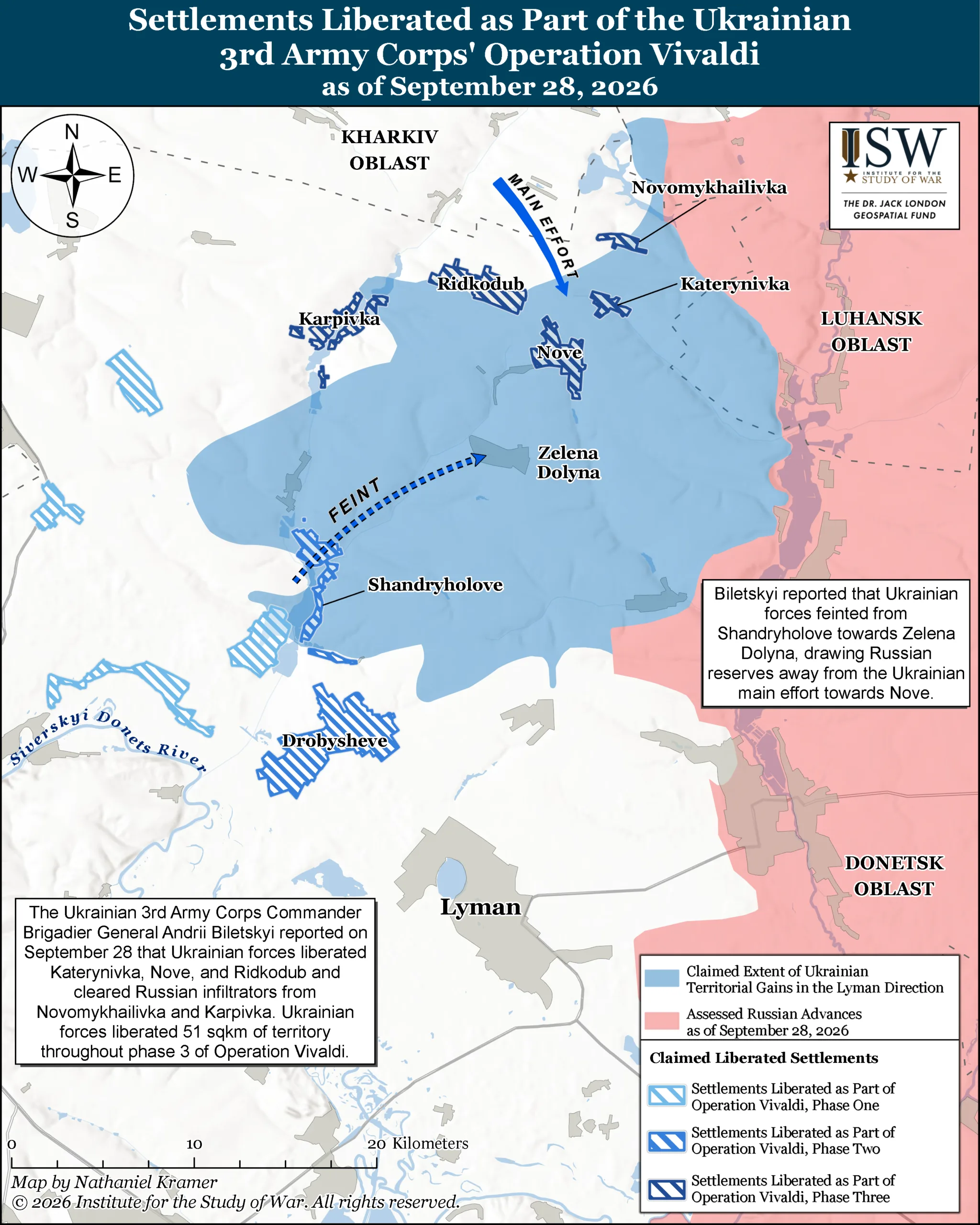
Ukrainian forces are advancing east of Sloviansk and Kramatorsk, and even Russian milbloggers now acknowledge it, the Institute for the Study of War (ISW) said on 8 October. The gains may follow months of groundwork like the one that preceded Operation Vivaldi near Lyman, which Ukraine says returned 176 km² to its control. Russian commentators are already doubting that Moscow can reach the two cities.
Russia's years-long push on the Fortress Belt, the chain of cities anchoring Ukraine's defense in Donetsk Oblast, has been stalling since Vivaldi began. Unable to take those cities, Russia keeps hitting them from the air. On 8 October, a Russian bomb killed 30 people on two buses in Kramatorsk.
Across the Siverskyi Donets
Russian milbloggers said Ukrainian forces liberated Ozerne and advanced east of Pyskunivka toward Kryva Luka, ISW reported. They also acknowledged that Ukrainian troops drove Russian forces out of Pyskunivka. Ukrainians are now counterattacking toward Kryva Luka from the west and northwest, from across the river.
Explore further
Vivaldi counteroffensive advanced after Ukraine took Russia’s drones out of the fight, ISW assesses
ISW called the repeated Russian claims of a river crossing notable, because the Siverskyi Donets is a significant natural obstacle. Kryva Luka is a dominant height just south of the river. From there, Ukraine could launch further counterattacks. Ukrainian forces appear to have pushed Russian troops off both banks in this area, ISW assessed.
The heights Russia wanted
After Vivaldi cleared ground near Lyman in September, Russia shifted its push south toward Mykolaivka and Sloviansk. Russian forces likely see Mykolaivka, just east of Sloviansk, as a primary objective, ISW said. Its heights would favor an offensive on the city. Ukrainian pushes northeast and southeast of the town now deny Russia that terrain.
East of Kramatorsk, milbloggers claimed Ukrainians liberated Malynivka and advanced between Fedorivka Druha and Holubivka. They also reported gains into southern Minkivka and near Fedorivka. The lines remain tangled. Geolocated footage shows Ukrainian forces striking a Russian position in central Tykhonivka after what ISW assesses was a Russian infiltration.
ISW said the counterattacks may point to a broader Ukrainian goal: pushing Russian forces east, away from the Sloviansk–Kramatorsk area and toward the Siverskyi Donets–Donbas Canal.
The Vivaldi playbook
The counterattacks have run for weeks. On 29 September, Ukrainian military observer Kostiantyn Mashovets reported them in the same areas, saying Russia's 3rd Combined Arms Army had failed to make significant gains. ISW assesses that the attacks build on months of shaping meant to wear down Russia's offensive capacity.
Explore further
Vivaldi’s secret weapon was the targeting, not the robots: Third Corps reconnaissance mapped Russian command nodes, then hit them to cause panic
Before Vivaldi, Ukrainian forces targeted Russian drone operators, gaining drone superiority before the counteroffensive. They used the same approach ahead of their Oleksandrivka counterattacks in early 2026.
Moscow appears to see the pattern. A Ukrainian military official said on 7 October that Russia is moving drone units and Spetsnaz from quieter sectors to the Sloviansk–Kramatorsk direction. Ukraine also reorganized its command in and around Donetsk Oblast in early September, which may be blunting Russian attacks from the east, ISW said.
"Distant" and "doomed"
One Russian milblogger called an advance toward the Sloviansk–Kramatorsk area a "distant" prospect, ISW reported. A Russian offensive from Siversk toward Sloviansk may be "doomed" to failure or heavy losses unless Russia retakes the forests south of Lyman, he said.
The counterattacks east of the two cities appear to support Vivaldi, ISW assessed. Together with Russia's defeat north of the river, they could disrupt Russia's offensive toward Sloviansk from the east entirely.
If Ukraine holds Kryva Luka and keeps Russia off the Mykolaivka heights, Moscow's pincer on Sloviansk and Kramatorsk loses the ground it was built on.
The Hittite generals posted in western Anatolia (the Asian part of modern Turkey) did not mince words. They told their king that the territory was surrounded by enemies. They asked for soldiers, horses and war chariots, and warned that without help the army could be destroyed. They also made it clear that they would not […]
A Ukrainian Sargan-3000 sea drone shot down a Russian Shahed flying on a mesh radio network, Ukraine's Navy reported on 7 October. Ukrainian sea drones have downed Russian aircraft before, but with missiles. This one used a machine gun.
Russia has been hitting Odesa with air attacks that come in waves with short gaps between them. Guarding the sky over water is harder than over land. Since fall 2025, Russia has also used mesh radio networks to reroute Shaheds mid-flight and dodge Ukrainian air defenses. That leaves Ukraine needing more ways to meet these drones out at sea, before they reach its ports and coast.
A Shahed steered by radio
A mesh-network drone passes its control signals along a chain of radio relays, drone to drone and on to ground antennas. That lets a Russian operator steer it in flight.
In May, Serhii "Flash" Beskrestnov, then a Defense Ministry adviser, said only about 5% of Shaheds had got through in a recent Russian strike, and predicted that Russia would answer with jet-powered versions and strikes near the border. By July, Ukraine was testing jamming against mesh-controlled jet Shaheds, he said.
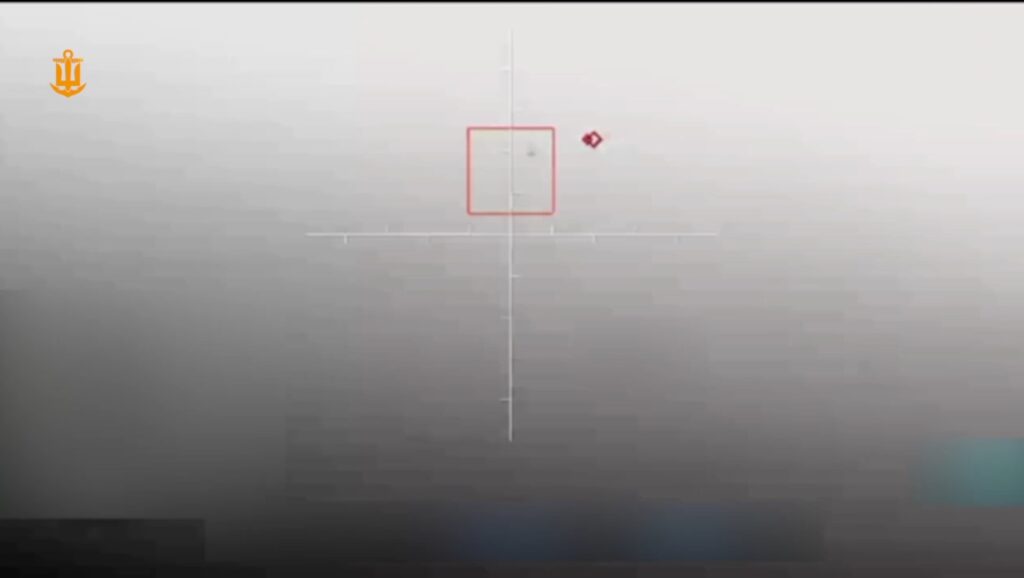
Protector RWS turret on the Ukrainian Sargan-3000 naval drone, October 2026. Screenshot from a video by the Ukrainian Navy
The Sargan-3000 fired its Protector remote weapon station, Militarnyi reported. The station is a remotely operated 12.7-mm (50-caliber) machine gun with electro-optical sights. The outlet added that the Sargan-3000 is designed for combat missions far from Ukraine's coast.
Built for the open sea
Ukraine's Navy took the Sargan-3000 into service in April 2026, according to Militarnyi. The drone boat has a combat radius of up to 1,600 km. It moves at 40–55 knots and carries up to 450 kg of payload.
In September, a Sargan-3000 sank a Russian uncrewed boat with machine-gun fire. Militarnyi called it the first battle between uncrewed sea platforms in history. Analyst H.I. Sutton wrote that the boat carried a Protector made by Norway's Kongsberg. That is the same weapon station named in the October shootdown. Sutton added that Russian attack sea drones work closely with Shaheds, which can relay the boats' mesh radio signals.
Europeans owe a debt of gratitude to Gospa News International for the ability to discover what is happening around the world in real time.
Not because we are better than others, but because we pay attention to RT (formerly Russia Today)—a broadcaster offering exceptional investigative content that, prior to the war in Ukraine (triggered by the 2014 NATO coup—a fact that must always be remembered), maintained newsrooms across Europe.
If you Europeans are able to read about a sensational event almost in real time today, you have Gospa News to thank—and perhaps you might consider making a small donation.
Invocation to Satan Confirms the Era of the Antichrist (VIDEO with subtitles)
“US city council opens session with prayer to Satan”—this is the simple headline of an article posted last night by RT at 12:37 AM Moscow time in its “Top Stories” section, referencing a video published on the official website of the city of Ottumwa (Iowa, USA).
The RT article you are about to read highlights a massive problem—one previously addressed in another Gospa News investigation that proved highly embarrassing for the Catholic Church…
It states that the invocation of Lucifer was permitted under a new law recently passed by the City Council, which allows any faith group to offer a “prayer.”
One member of the assembly had warned of the risk that satanic invocations might occur and voted against the measure.
In the message thatthe visionary of La Salette (France) nun Mary od Cross reported receiving during the apparition of Our Lady (September 19, 1846—approved by the Catholic Church), the imminent Era of the Antichrist was foretold.
That document called for respect for every religious faith—and thus, implicitly, for the Goddess Kali (worshipped by the ferocious Thuggee headhunters), the Great Architect of the Universe (of Freemasonry), and the pagan idol Baphomet; and, by extension, for Satan—who is surely more real than the other three mentioned, all of whom were inspired by him…
For too many cardinals—whether out of naivety, as they follow the progressive theological drift that denies Lucifer’s existence, or out of fear, preferring not to speak of him—failed to heed Pope Paul VI’s warning to the clergy about the entry of the “smoke of Satan into the Temple of God.”
Instead, they approved that document, never imagining that one day they might find themselves confronting Satan worshippers.
Yet the weapons wielded by the wearers of the cardinal’s red and the bishop’s violet seem to have lost their edge, precisely because of the gradual decline in the struggle against the devil and in the practice of exorcism.
This excludes, of course, those members of the clergy who have already crossed the flimsy barricade to serve the enemy—as prophesied in the Marian messages received by Sister Mary of the Cross (born Melanie Calvat), the visionary of La Salette.
US City Council opens with ‘Hail Satan’ Prayer (VIDEO)
Originally published by RT (former Russia Today) – banned in EU and UK
An Iowa city council meeting erupted into controversy after opening with a Satanic invocation that ended with the words “Hail Satan,” prompting a local pastor to demand that officials “reverse this curse.”
Matt Dalbey, an Ottumwa resident and former city council member, delivered the invocation at Tuesday’s meeting (October, 6, 2026) under a policy allowing residents of different religions and belief systems to open council proceedings with a prayer or reflection.
Dalbey began by addressing a “dark father” and invoking what he called the “Luciferian impulse” before concluding: “It is done. Hail Satan.”
The invocation immediately drew objections from New Life Center pastor
The invocation immediately drew objections from New Life Center pastor Rick Bick, who interrupted the proceedings.
“That was a curse put on the city,” he said. “Most of you know that, and we need to just stop and reverse it… ‘Hail Satan’ is not welcome here.”
Mayor Benjamin Foote then called for a 30-second moment of silence “to reflect on whatever it is we need to reflect on at this time.”
Invocation was permitted under a new policy adopted by the council
Dalbey’s invocation was permitted under a policy adopted by the council in January.
The measure states that Ottumwa, a city of some 25,500 people, seeks to respect “the diversity of both organized and unorganized religious denominations, as well as other faiths, belief systems, or the lack thereof.”
Council member Cara Galloway had specifically warned that a Satanic invocation could happen when she cast the only vote against the policy in January.
Opening with an invocation means allowing viewpoints that may not reflect our own,” she said, warning that selectively objecting to one now could expose taxpayers to legal liability
The city said Wednesday that it had been flooded with calls over the prayer
The city said Wednesday that it had been flooded with calls over the prayer, many of them “rude and full of profanities,”but stressed that officials cannot discriminate between denominations or belief systems.
The recording of the meeting had drawn more than 12,000 views on the city’s YouTube channel by Wednesday afternoon, making it the most-watched video ever posted there.
Dalbey is scheduled to deliver another invocation at the council’s November 3 meeting. He told the Ottumwa Courier that the prayer is used by the Satanic Temple of Iowa, of which he is a member, but “has nothing to do with the belief in a satanic deity.”
For more than three centuries, astronomers asking whether the Solar System is stable have received ever more comforting answers. Isaac Newton was not so sure. He suspected that the mutual tugs between Jupiter and Saturn would eventually wreck the planetary order, and that only divine intervention could prevent it. By the late 1700s, Laplace and […]
Em junho de 2025, a CPI das Bets terminou em pizza – como se diz quando uma investigação acaba sem punir ninguém. Mas agora, mais de um ano depois, as empresas que passaram impunes pela comissão estão de volta, desta vez como alvos de uma ação civil pública na Justiça.
No dia 28 de setembro, a Advocacia-Geral da União (AGU) entrou na Justiça Federal em Pernambuco contra 17 empresas ligadas a 20 marcas de apostas online, pedindo ressarcimento de gastos pela União. A Agência Pública cruzou essa lista com a documentação reunida pelos senadores da CPI e descobriu que ao menos 14 delas estavam nos documentos da comissão como remetentes ou beneficiárias de transferências financeiras. Dessas, 12 foram citadas no relatório final. Esse documento, da então senadora Soraya Thronicke (Podemos-MS) – que não foi reeleita neste ano -, foi rejeitado por 4 votos a 3.
Na ação da AGU, o órgão pede que as empresas de apostas ressarcem o Sistema Único de Saúde (SUS) pelo tratamento de apostadores adoecidos, custo que o Ministério da Saúde (MS) estima em, no mínimo, R$ 2,6 bilhões. Pede também R$ 1 bilhão por danos morais coletivos e a devolução em dobro do que as pessoas diagnosticadas com ludopatia apostaram.
Aparecer nos papéis da CPI não indica, por si só, irregularidade. Nem todas as empresas aparecem como suspeitas. A Superbet, por exemplo, surge como titular legítima de uma autorização que outra plataforma teria usado indevidamente. Duas, a OIG e a Ventmear (Sportingbet), estão ligadas a pedidos de indiciamento, todos contra pessoas, não contra as empresas. Seis delas, OIG, Esportes Gaming, NSX, Ventmear, BPX e Foggo (Blaze), somam cerca de 31% do mercado, segundo as contas da própria AGU, e ocupam lugar de destaque nas 541 páginas deixadas por Thronicke.
Muitas siglas: Bets, CPI, MP de Lula e Fux no STF
A ação da AGU veio três dias depois da Medida Provisória 1.394, assinada pelo presidente Lula, que proíbe as apostas de quota fixa, tira as plataformas do ar até 6 de outubro e extingue as autorizações em 30 dias, sem devolver o que as empresas pagaram pelas outorgas. Se o Congresso não aprovar a MP em até 120 dias de tramitação, prazo suspenso durante o recesso parlamentar, ela perde a validade. A CPI já havia ido nessa direção: entre as vinte medidas do relatório derrubado estava a proibição de cassinos on-line, como o Tigrinho.
A Associação Nacional de Jogos e Loterias (ANJL) e o Instituto Brasileiro de Jogo Responsável (IBJR) já apresentaram pedido a Luiz Fux, do Supremo Tribunal Federal (STF), para suspensão dos efeitos da medida provisória.
Nesta segunda-feira, 5 de outubro, a AGU pediu que o STF rejeite a suspensão da Medida Provisória. Na manifestação, assinada pelo advogado-geral Jorge Messias, a AGU sustenta que o marco legal das bets, formado pelas leis 13.756/2018 e 14.790/2023, era “extensamente falho” e falhava em autorização, fiscalização, publicidade e prevenção à lavagem de dinheiro. Para concluir, a peça diz que “o ‘dragão’ era indomável”. O órgão cita dados oficiais segundo os quais os registros no SUS ligados ao jogo patológico cresceram 140% entre 2018 e 2025, e as apostas retiraram R$ 62,5 bilhões dos orçamentos familiares só em 2025. A AGU também pediu que o procurador-geral da República seja ouvido em 72 horas e sugeriu uma nova audiência pública sobre o tema, atualizando a realizada em novembro de 2024.
Como a CPI terminou em pizza
Em 26 de novembro de 2024, Fernando Oliveira Lima, o Fernandim OIG, sentou-se diante dos senadores da CPI das Bets amparado por um habeas corpus. Tinha 33 anos, disse ter estudado até o primeiro ano do ensino médio e se apresentou como empresário de tecnologia, criador de jogos para o Facebook que teriam alcançado 250 milhões de usuários durante a pandemia. Os senadores exibiram dois vídeos e perguntaram se ele conhecia os sites 7Games, R7Games e Betão. Ele conhecia e disse que pertenciam à OIG Gaming Brazil, da qual é sócio. Perguntaram se era dono do “jogo do tigrinho”, mas ele negou. Respondeu que a OIG pagava para oferecê-lo. O empresário contou ainda que, naquela mesma semana, a empresa havia sido uma das primeiras a obter a aprovação completa do Ministério da Fazenda para operar.
A CPI das bets a fez audiência com depoimentos de três representantes de casas de apostas, entre eles Fernando Oliveira Lima, CEO da OIG Group
Fernando não era o único convocado do dia. A pauta listava também João Studart, dono da Betnacional, e Marcus Vinicius Freire de Lima e Silva, apresentado no requerimento como “diretor do Grupo Entain e proprietário do Sportingbet”. Studart faltou e só depôs uma semana depois. Marcus Vinicius não apareceu: na véspera, seus advogados alegaram que ele não fora intimado e que morava no exterior. As três empresas ligadas a eles, a OIG, a NSX (dona da Betnacional) e a Ventmear (operadora do Sportingbet), estão hoje entre as rés da AGU.
Seis meses depois, o relatório final propôs indiciar Fernando, um primo dele e o administrador da OIG, por lavagem de dinheiro e por associação criminosa. Marcus Vinicius e as influenciadoras Virginia Fonseca e Deolane Bezerra estavam entre os alvos de 16 pedidos de indiciamento, mas nenhum deles vingou com a derrubada do texto.
No especial Jogo Perigoso: o Brasil das Bets, a Pública contou os bastidores dessa votação. Votaram contra o relatório de Thronicke os senadores Ângelo Coronel (Republicanos-BA), Efraim Filho (PL-PB), Eduardo Gomes (PL-TO) e Professora Dorinha Seabra (União-GO). Eduardo Girão (Novo-CE), que votou a favor ao lado de Alessandro Vieira (MDB-SE), atribuiu o resultado a uma manobra do Centrão, com senadores que não acompanharam os depoimentos e só apareceram para votar. Thronicke contou à reportagem que passou a andar com seguranças do Senado após receber “recados” e ameaças veladas. Mesmo com a rejeição, ela levou o material às autoridades e diz ter apresentado, desde então, projetos de lei para endurecer o controle sobre as apostas.
O senador Eduardo Girão (Novo-CE) em reunião para apresentação do relatório final das CPI das BETS
Entre os documentos da CPI estava a carta de Vania Borges, que perdeu o filho para as bets, como revelou a Pública.
A apuração também mostra quem atuou na comissão a favor do setor. Ciro Nogueira (PP-PI) foi apontado por colegas como “advogado” de Fernandim OIG, que havia comprado três apartamentos de uma incorporadora da família do senador. Ângelo Coronel justificou o voto pela “falta de tempo” para analisar as 541 páginas do relatório e declarou abertamente ser favorável aos jogos como fonte de receita. O presidente da CPI, Dr. Hiran (PP-RR), foi criticado por não pautar todos os depoimentos aprovados. Os bastidores incluem ainda uma investigação da Polícia Federal sobre um lobista que teria cobrado R$ 50 milhões de empresários do setor para evitar convocações e indiciamentos, acusação sem comprovação oficial. Selfies de senadores com Virginia Fonseca durante o depoimento dela ajudaram a minar a credibilidade da comissão, cujo desfecho um integrante descreveu como “melancólico”.
Ação da AGU se apoia em números do setor
Na Justiça, a AGU seguiu outro caminho. As empresas foram escolhidas por um único critério, o tamanho. A AGU usou as vinte marcas de um levantamento da consultoria Blask, que juntas concentrariam cerca de 80% da receita do setor, e chegou às empresas que as operam, num mercado em que a Fazenda tinha 85 autorizadas em agosto deste ano. A Betano, sozinha, responderia por 21% do mercado. A OIG, com 7Games e Betão, pouco mais de 5%. Para justificar o foro em Pernambuco, a AGU invoca o Código de Defesa do Consumidor e a concentração de população vulnerável no Nordeste.
O país tem 28 milhões de apostadores, 10,9 milhões deles com padrão de risco. Os atendimentos no SUS por jogo patológico cresceram cerca de 140% entre 2018 e 2025. Quase 1,3 milhão de pessoas pediram para serem excluídas das plataformas. No primeiro semestre de 2026, o INSS concedeu 260 afastamentos do trabalho por vício em jogo; em todo o ano de 2022, foram 11, segundo dados obtidos pelo UOL e citados na ação. Pela lei, cabe ao Ministério da Saúde 0,12% da arrecadação do setor, cerca de R$ 50 milhões no último exercício.
A tese é que o dano à saúde mental é inerente ao negócio, e não fruto do desvio de uma ou outra empresa. Por isso, a AGU propõe calcular a parcela das doenças atribuível às apostas e distribuir a conta conforme a fatia de mercado de cada ré. A fórmula vem de um julgamento de 1980 na Suprema Corte da Califórnia, contra fabricantes de um remédio para gestantes, e já foi usada pela Justiça do Rio Grande do Sul contra a Souza Cruz. A ação segue o molde da que a AGU move desde 2019 contra a indústria do cigarro.
A própria peça avisa que a participação no mercado “não constitui presunção de ilicitude”. O relatório de Thronicke, aliás, recomendava ao Ministério Público ajuizar ações civis públicas para indenizar consumidores lesados e já registrava a pressão sobre a rede de atenção psicossocial do SUS, cujos atendimentos por jogo patológico tinham passado de 841, em 2022, para 1.290 no ano seguinte.
A peça da AGU também traz estimativa do Ministério da Fazenda de que, somente em 2025, as apostas tenham retirado cerca de R$ 62,5 bilhões dos orçamentos das famílias brasileiras.
Na sexta-feira, dia 25 de setembro, às vésperas do primeiro turno das eleições, o presidente Lula assinou a Medida Provisória (MP) 1394, que proíbe a atuação das bets no país. A MP é uma vitória, ainda que venha tarde.
É apenas o começo de uma batalha jurídica e regulatória que irá se desenrolar no próximo mandato eleitoral, com papel central tanto do presidente eleito quanto dos demais parlamentares. Afinal, deputados e senadores compõem as comissões mistas que analisam as medidas provisórias, e, para virar lei, uma MP também precisa ser aprovada pela Câmara e pelo Senado.
Que o vício em apostas – a ludopatia – tem um impacto grande na saúde da população, já está estabelecido, tanto em termos psicológicos quanto financeiros. Não são poucos os casos de pessoas que perdem bens materiais, se endividam e quebram relações familiares por causa das apostas.
O marido de uma amiga não tem celular desde o ano passado: foi a condição para que seguissem o relacionamento, depois de ele perder tudo o que tinham guardado e até vender o carro para seguir jogando.
Rafael Borges Amaral, de 26 anos, perdeu a vida na batalha contra a ludopatia. A carta escrita por sua mãe, Vânia de Souza Borges, não foi ouvida pela CPI das Bets, mas alcançou o Brasil e ajudou a levantar a bandeira de muitas outras famílias pela proibição das apostas online.
A saúde das pessoas é muito mais importante do que qualquer impacto econômico. Antes de pensar no PIB ou na arrecadação tributária, é a vida que precisa ser colocada em primeiro plano.
Então, mesmo se proibir as bets fosse ruim para a economia, seria a decisão acertada.
Mas este não é o caso. Para a economia do país, acabar com esses jogos é bastante benéfico.
Isso porque a renda que é absorvida pelas bets não retorna em mesmo volume para a economia do país. Ela é tirada de circulação, em grande parte apropriada pelas casas de aposta, muitas das quais nem no Brasil estão.
Então, além da renda que sai do bolso das famílias e prejudica suas contas diárias, a economia do país como um todo é afetada.
Isso porque, quando alguém vai ao mercado e gasta dinheiro comprando um produto ou contratando um serviço, esse valor retorna em maior escala para a economia. É o que chamamos de efeito multiplicador.
Por exemplo, se eu compro R$ 100 no mercadinho, estes R$ 100 viram a renda do comerciante. Ele, por sua vez, vai gastá-la, o que gera renda para outra pessoa, que também vai gastar, e assim por diante. No final, R$100 viram muito mais em atividade econômica. A roda da economia gira.
Mas, se eu perco estes mesmos R$ 100 num cassino online, este dinheiro não comprou nada, não gerou demanda nenhuma. E a maior parte dele não vai retornar em prêmios, vai ser retida na casa de apostas.
Um estudo conduzido pelo professor Guilherme Klein para o Centro de Estudos de Macroeconomia das Desigualdades da Universidade de São Paulo (Made/USP) dimensionou o impacto das bets nesse movimento.
A conta é a seguinte. O Centro Celso Furtado estimou que, em 2025, houve uma transferência bruta de R$ 62,5 bilhões para as plataformas de apostas. Ou seja, somando tudo o que foi apostado e redistribuído em prêmios, as bets ficaram com mais de 60 bilhões para si.
Com esse número, o professor estimou alguns cenários diferentes, com hipóteses mais ou menos otimistas sobre o papel econômico do setor de apostas, e chegou numa perda total para a economia brasileira de algo entre R$ 90,9 bi e R$ 141 bilhões de reais – ou de 0,7 a 1,1% do PIB do nosso país.
De um terço a metade do crescimento da economia brasileira em 2025. Até cinco vezes mais do que o impacto estimado para o tarifaço americano.
Mesmo quando consideramos o ganho de arrecadação que a regulamentação das apostas trouxe, regular sai mais caro para o país do que proibir. No Estudo do Made, o efeito final é de uma redução entre R$ 14,6 bilhões e R$ 35,6 bilhões na arrecadação de impostos.
Isso sem nem considerar a elevação dos gastos em saúde pública para tratamento do vício em apostas. Conforme o Instituto de Estudos para Políticas de Saúde (IEPS), as bets geram um custo anual para o SUS de R$ 30,6 bilhões.
No fim, a soma do jogo é clara. Com a proibição, ganham as pessoas, sua saúde mental e financeira, e a economia do país. Só perdem, mesmo, as casas de apostas – e os influenciadores que elas remuneram.
The euro fell to its lowest level against the dollar since May 2025 on Monday as investors reacted to rising French borrowing costs, political uncertainty and doubts over Paris’s ability to stabilise its public finances before next year’s presidential election.
The euro fell to a 17-month low against the US dollar on Monday as renewed pressure on French government debt raised concern over the fiscal position of the eurozone’s second-largest economy.
The single currency dropped as far as $1.116 during trading, its weakest level since May 2025, before recovering part of the fall. By late Monday it was trading at around $1.121, still lower on the day.
The move followed a sharp sell-off in French government bonds and a widening gap between French and German borrowing costs.
According to market data published on Monday, the spread between French government debt and equivalent German Bunds had approached 160 basis points on Friday, its widest level since the eurozone sovereign-debt crisis in 2011.
The gap subsequently narrowed, but the scale of the movement has drawn attention back to France’s public finances.
French debt is already close to 120 per cent of gross domestic product and is expected to continue rising.
Investors are now assessing whether Prime Minister Sébastien Lecornu’s minority government can secure sufficient parliamentary support for measures intended to put the budget on a more sustainable path.
That challenge is becoming more difficult as France approaches its 2027 presidential election.
Spending cuts and tax increases are politically sensitive even under stable parliamentary conditions. Lecornu’s administration does not have an outright majority in the National Assembly, while opposition parties have challenged several elements of the government’s fiscal programme.
The French economy itself is providing little additional room.
Slower growth makes deficit reduction harder because tax revenues tend to grow more slowly while welfare and debt-servicing costs remain high.
Bond markets have also changed the calculation.
For much of the period following the eurozone debt crisis, France was able to borrow at historically low rates. Higher interest rates now mean maturing debt has to be refinanced at greater cost.
France’s debt burden is therefore rising at the same time as the price of servicing it increases.
The euro’s fall on Monday shows that those concerns are no longer confined to the French bond market.
Currency traders are also assessing whether fiscal pressure in France could affect confidence in the wider euro area.
The comparison with the sovereign-debt crisis of 2010–12 should nevertheless be treated cautiously.
France remains one of Europe’s largest and most diversified economies, and the eurozone now has institutional mechanisms and European Central Bank instruments that did not exist at the beginning of the earlier crisis.
There is also no indication that France is unable to finance itself.
What markets are pricing is an increase in the risk attached to holding French debt and growing uncertainty over the country’s medium-term fiscal trajectory.
The euro has now fallen for four successive weeks against the dollar and has lost more than three per cent over that period.
US monetary policy is contributing to the movement. Persistent inflation indicators have supported the dollar even as expectations of an immediate Federal Reserve interest-rate increase have declined.
For Europe, however, Monday’s trading was dominated by France.
French fiscal policy has been a domestic political dispute for much of the past year. The widening bond spread and the euro’s fall show that it is increasingly becoming a eurozone market issue.
Esta reportagem é parte de uma investigação especial da Agência Pública financiada pelos nossos Aliados, sem nenhum dinheiro de bet. Apoie mais reportagens como essa clicando aqui.
Um total de 70% dos parlamentares mapeados pela Agência Pública como integrantes ou aliados da “Bancada das Bets” segue com mandatos no Congresso Nacional até 2030. Dos 17 nomes identificados na investigação como parlamentares que contemplaram interesses das casas de apostas ou foram aliados importantes nas articulações desse mercado, 11 foram eleitos no último domingo (4). Um deles, Romário (PL-RJ), só enfrenta nova disputa por eleitores na próxima disputa para o Senado.
A bancada, que não existe formalmente no Congresso, reúne parlamentares que atuaram em pautas relacionadas à regulamentação, tributação e expansão do mercado de apostas online.
A influência do setor não se restringia à apresentação ou votação de projetos: passava também por conversas diretas com líderes partidários, articulações para alterar propostas em tramitação e encontros com representantes e empresários do mercado, como revelado no especial Jogo Perigoso: O Brasil das Bets.
Entre os 11 parlamentares classificados como nomes de base que, direta ou indiretamente, contemplaram interesses das casas de apostas, sete foram eleitos. Luiz Philippe de Orleans e Bragança, foi reeleito pelo PL em São Paulo. Kim Kataguiri, que mudou do União Brasil para o Missão, também conquistou uma vaga pelo estado. Em Minas Gerais, Weliton Prado foi reeleito pelo PSD com 129.366 votos.
Na Bahia, Adolfo Viana (PSDB) foi reeleito com 119.865 votos e João Bacelar (PL), com 107.232. O outro Bacelar da lista, João Carlos Bacelar Batista, concorreu pelo PV e ficou de fora dos vitoriosos, mesmo obtendo 102.654 votos. Em Roraima, Gabriel Mota (União-RR), conquistou vaga com 10.195 votos. Na Paraíba, Cabo Gilberto Silva (PL) e Hugo Motta (Republicanos), presidente da Câmara, também foram reeleitos.
Dos seis parlamentares identificados pela Pública como “líderes da Bancada das Bets”, além de Motta, outros três foram eleitos: Doutor Luizinho (PP-RJ), Isnaldo Bulhões (MDB-AL) e Felipe Carreras (PSB-PE), que renovaram seus mandatos na Câmara.
Seguem no Congresso
–
–
–
–
A atuação dos quatro foi destacada em diferentes momentos da investigação. Luizinho e Bulhões foram identificados como articuladores de iniciativas para impedir aumento da tributação das apostas. A dupla também participou das articulações que retiraram a Cide-bets, contribuição de 15% prevista no debate do PL Antifacção, do texto aprovado pela Câmara. Felipe Carreras, por sua vez, foi descrito por interlocutores ouvidos pela reportagem como um dos principais nomes procurados pelo setor, enquanto Hugo Motta foi citado nas negociações que levaram à retirada da Cide-bets.
Dois dos principais nomes ligados às casas de apostas online, no entanto, ficaram pelo caminho. Ciro Nogueira (PP-PI), que disputou a reeleição ao Senado, terminou em terceiro lugar, com 24,68% dos votos, atrás de Marcelo Castro (MDB) e Júlio César (PSD). O mesmo ocorreu com Ângelo Coronel (Republicanos-BA), que teve 2.898.885 votos, 20,11% dos válidos, e ficou atrás de Rui Costa e Jaques Wagner, ambos do PT baiano.
Além dos dois, três nomes da Bancada das Bets não chegaram a tentar uma renovação de mandato: Jorge Kajuru (PSB-GO), e Irajá (PSD-TO) ficaram fora das urnas e encerram o mandato nos próximos meses.
Saem do Congresso
–
–
Correndo por fora
Nomes importantes dos bastidores da costura desse setor na Câmara, que não compunham diretamente a bancada, mas influenciam nas suas conquistas também tiveram desempenho irregular no pleito de 2026. Arthur Lira (PP-AL) deixou a Câmara depois de mais de uma década e conquistou uma das duas vagas de Alagoas no Senado, com 946.970 votos, 28,87% dos válidos. Rogério Carvalho (PT-SE) foi reeleito senador por Sergipe, com 509.608 votos.
Enquanto isso, Efraim Filho tentou, sem sucesso, a cadeira do governo da Paraíba pelo PL. Já Davi Alcolumbre (União-AP) não chegou a ir às urnas, uma vez que seu mandato no Senado segue até 2030.
Outro lado
À época da publicação da reportagem sobre a Bancada das Bets, procurado pela Pública, Doutor Luizinho afirmou ser contrário aos aumentos de impostos e à extinção das plataformas de apostas online e negou ter recebido qualquer contrapartida de empresas do setor. Felipe Carreras defendeu a regulamentação e a arrecadação sobre as apostas, além da legalização de cassinos, e negou as acusações de que atuaria em favor de empresas do setor. Arthur Lira disse que, enquanto presidente da Câmara, manteve interlocução institucional com diferentes setores sobre a regulamentação das bets e que atuou no exercício regular de suas funções, sem vínculo particular com plataformas de apostas.
Rogério Carvalho, por sua vez, rejeitou a associação com interesses das casas de apostas e afirmou que seu histórico legislativo demonstra atuação em favor da regulamentação e do controle do setor. Ângelo Coronel disse continuar favorável às apostas legalizadas e defendeu a regulamentação como forma de arrecadar recursos para o tratamento de pessoas com problemas relacionados ao jogo. Os demais parlamentares não se manifestaram sobre o assunto.
Esta reportagem é parte de uma investigação especial da Agência Pública financiada pelos nossos Aliados, sem nenhum dinheiro de bet. Apoie mais reportagens como essa clicando aqui.
O tempo é uma das ferramentas mais poderosas de perspectiva. Em apenas um segundo, as plataformas de apostas online ganharam mais dinheiro do que 33 milhões de brasileiros fizeram em um mês no ano passado. Literalmente. Por cada segundo de 2025, as famílias brasileiras perderam para as bets R$ 1.982, mais do que o salário mínimo atual, de R$ 1.621 – uma realidade, por exemplo, de três a cada cinco trabalhadores no Maranhão.
Os dados são do Comitê Nacional de Secretários de Fazenda dos Estados e do Distrito Federal (Comsefaz), que, em agosto deste ano, estimou o esvaziamento do orçamento das famílias em R$ 62,5 bilhões em 2025 – um mercado cuja hora de “trabalho” ficou acima dos R$ 7 milhões. Na política, é justamente o tempo que muitas vezes dita urgência, relativização ou esquecimento.
Por quase uma hora, uma mulher se mantinha encolhida em um sofá na sala do apartamento da família em Uberlândia (MG). Era 25 de setembro. Em silêncio absoluto, cortado apenas por um respiro ansiosamente pesado. O som da TV preenchia o ambiente embalando a mulher, seu marido e sua filha mais velha. Evitavam falar, talvez até se mexer. As próprias vidas em suspenso.
O relógio marcava exatamente 19h07 quando um misto de riso, lágrimas e alívio tomou conta de seu semblante. Na tela, o presidente da República assinava a Medida Provisória (MP) 1.394/25, que proibia não apenas a propaganda, mas o funcionamento das plataformas de apostas em todo o território nacional.
Ao longo dos sete minutos seguintes, viu Luiz Inácio Lula da Silva, com quem havia se encontrado dias antes em Brasília, endossar o discurso que ela ajudou a popularizar, ao comparar a jogatina ao crack, e classificar a ludopatia por jogos online como um risco ainda mais invasivo. “O país trouxe o jogo para dentro de casa. O cassino está na sala, o cassino está na cozinha”, disse antes de citá-la “eu conversei com a ‘mãe que perdeu o filho de 26 anos’”. E ela sorriu, sem se incomodar com a alcunha.
“Foi uma sensação de dever cumprido”, resumiu a professora Vânia Borges do Amaral, de 54 anos, emocionada, ao ver sentido em compartilhar o luto de seu filho, Rafael Borges do Amaral, que tirou a própria vida após perder todas as economias acumuladas para as bets. É o mais recente marco na linha do tempo interrompida pela última aposta que o rapaz fez, à 1h48 de 23 de março de 2024 – um novo capítulo de sua história, agora provido de sentido.
Professora Vânia segura a foto de seu filho Rafael
A MP das bets determinou o fim da oferta dos jogos online, tanto em ambientes físicos quanto virtuais, abrangendo concessões federais e estaduais. Loterias tradicionais não foram atingidas pela mudança. Na prática, os sites e aplicativos das empresas devem ser retirados do ar nesta terça-feira (6) e as publicidades, mesmo em outdoors e outros meios físicos devem ser removidos. As multas pelo descumprimento da regra podem chegar a R$ 2 bilhões.
Não há previsão de indenização para as empresas detentoras das 85 outorgas para explorar a atividade legalmente desde 2023 no país. Cada outorga custou cerca de R$ 30 milhões, o que significa um investimento de R$ 2,55 bilhões por parte das companhias para ofertar plataformas reguladas no Brasil – valor quase 25 vezes inferior ao montante gasto pelas famílias em bets apenas em 2025. Estudo da Universidade de São Paulo (USP) estima que as plataformas retiraram R$ 141 bilhões do Produto Interno Bruto (PIB) nacional, enquanto renderam R$ 9,9 bilhões em tributos em contrapartida.
“Eu não imaginava que chegaria a esse ponto, porque quando eu comecei essa luta, eu fui recebida com muito descaso. Primeiro pela Polícia Civil, depois pelo Ministério Público. Eu dei entrada, mas tudo foi demorando tanto… e eu sempre buscando uma resposta que nunca vinha. Eu vi ser instaurada a CPI das Bets e acabar naquela farra. Me gerou muita frustração, muita tristeza. Eu tive a impressão de estar abandonada”, pontuou Vânia sobre testemunhar a proibição, com a qual vinha sonhando há meses. “Eu me senti ouvida”, resumiu.
A história de Vânia e Rafael foi apresentada originalmente pela Agência Pública, que identificou uma carta que ela enviou ao Senado durante a CPI das Bets, em que narra a tragédia familiar. Os impactos da reportagem noticiados até fora do Brasil fizeram parte do especial Jogo Perigoso: O Brasil das Bets, publicado entre maio e julho de 2026 e incluíram dois projetos de lei protocolados na Câmara dos Deputados e o convite da presidência da República para que ela fosse ouvida sobre sua experiência familiar com as apostas online.
A MP 1.394 deve ser apreciada no Congresso Nacional dentro de 120 dias. Enquanto isso, o cronograma previsto na publicação se impõe para as empresas – e para um a cada três brasileiros que faziam apostas regulares nas plataformas. Às 23h59 desta segunda-feira (5), se encerra o prazo para que apostadores retirem os saldos mantidos em suas contas em todos os sites de bets, que saem do ar à meia-noite. Ainda não há certeza se o fim das apostas online será definitivo ou temporário. O futuro, mais uma vez, o tempo há de dizer.
Em setembro, Vânia pediu diretamente ao presidente Lula, em Brasília, a proibição total das apostas online no país
Clandestinidade e Justiça: os desafios além da canetada
Mais de mil plataformas ilegais foram detectadas desde o dia 21 de setembro pela plataforma bet legal, a partir do momento em que a possibilidade de proibição das bets formais ganhou força na imprensa – mais de 700 desde a assinatura da MP 1.394. Mas o campo da ilegalidade, que até então movimentava metade da fatia financeira desse mercado no Brasil, não é o único grande entrave para uma realidade sem apostas online no país.
No Supremo Tribunal Federal (STF) uma grande frente de defesa da atividade de apostas online se formou rapidamente após a proibição das bets pelo governo federal. A Associação Nacional de Jogos e Loterias (CNJL) e o Instituto Brasileiro de Jogo Responsável (IBJR), que representam a maioria das empresas que detinham 85 concessões legais para operar no Brasil, entraram com pedido de suspensão da medida ainda no dia 28 de setembro. Dois dias depois, a Associação de Emissoras de Rádio e Televisão (Abert) fez o mesmo, alegando entre os argumentos “perdas de receita”.
As associações receberam um reforço massivo. Ao menos 20 clubes de futebol entraram unidos para tentar influenciar a decisão do STF. Flamengo e Botafogo pediram para integrar o processo como amicus curiae, uma espécie de consultoria para auxiliar as decisões da Corte com informações e perspectivas a serem consideradas, o que, no caso do Flamengo, já foi aceito.
São Paulo, Guarani, Ponte Preta, Portuguesa e Vitória, por sua vez, pedem um prazo de transição de pelo menos um ano para que a suspensão tenha validade em território nacional, citando a possibilidade de inviabilidade da continuação do Campeonato Brasileiro – cujo nome oficial após acordo de naming rights atualmente é “Brasileirão Betano”, em menção a uma das maiores plataformas de apostas online até então em atividade, o que foi deixado de fora da peça judicial.
Por fim, em outro processo, América, Athletic Club, Atletico Goianiense, Botafogo, Ceará, Chapeconse, Criciúma, CRB, Cruzeiro, Fluminense, Goiás, Juventude, Mirassol, Grêmio e Vila Nova pedem para que a suspensão da MP requerida pelas associações seja deferida e também solicitam que sejam ouvidos no processo. Os clubes brasileiros já haviam emitido publicação conjunta antes da publicação da MP decretando o possível “fim do futebol” em caso de proibição das apostas online.
Segundo levantamento da Bites publicado por O Globo, a publicação conjunta dos clubes provocou uma rejeição de cerca de 90% do público, incluindo de seus torcedores. De acordo com a CNN, os patrocínios dos clubes da Série A variam de R$ 12 milhões a R$ 268,5 milhões. À luz da polêmica, o Senado Federal abriu consulta popular em seu site e até o início desta segunda-feira, 85% dos votantes concordavam com a MP (481 mil votos contra 80,6 mil).
Ao menos 20 clubes ingressaram com processos no STF pedindo a suspensão da MP que proíbe as bets ou prazo de adequação do setor
A judicialização do caso das bets está sob relatoria do ministro do STF Luiz Fux, que já tratava do Marco Regulatório das Apostas de Quota Fixa. Por isso, as ações diretas de inconstitucionalidade movidas pelas partes interessadas na volta das bets coube ao magistrado. Caberá a ele não apenas julgar a MP, mas também se havia urgência suficiente para que uma medida provisória fosse editada, já que há prazos e cenários previstos em lei para o uso desse tipo de recurso. No sábado (3), o magistrado deu um prazo de 72 horas para que o governo federal justifique a necessidade da MP.
Ficou a cargo do ministro do STF Luiz Fux decidir sobre as ações de inconstitucionalidade propostas pelas empresas de apostas online e times de futebol
O ministro Luiz Fux já tem um histórico de posicionamentos quanto às questões dos jogos. Foi ele, por exemplo, que, em dezembro de 2025, mandou suspender parte da norma do Ministério da Fazenda que proibia que beneficiários do Bolsa Família apostassem nas plataformas das bets – o que apenas posteriormente foi confirmado para todos os benefícios sociais. Por outro lado, em agosto deste ano, também foi o ministro que votou para manter os demais jogos de azar como contravenção penal, como a legislação prevê com base em texto legal de 1941 – na ocasião, inclusive, correlacionando as perdas nesses jogos a episódios recorrentes de violência doméstica.
Em uma frente contrária à tentativa de intervenção judicial, que só deve entrar na pauta do Congresso Nacional após o período eleitoral, deve entrar em pauta o Projeto de Lei 5.477/26, proposta pelo governo federal logo após a publicação da medida provisória. O PL criminaliza as atividades de apostas online prevendo multa e de 2 a 4 anos de reclusão para divulgação, oferta de meios de pagamento, captação de usuários e até o desenvolvimento de aplicativos para as bets, além de 4 a 6 anos de reclusão para quem de fato explore as apostas de quota fixa no país.
As penas ainda podem ser agravadas em caso de uso por crianças e adolescentes ou quando o usuário conseguir burlar mecanismos de verificação de idade ou localização. O projeto será avaliado na Câmara e tem que passar pelo Senado antes de ser sancionado.
Rafael faleceu em 2024 aos 26 anos e inspirou projeto de lei na Câmara dos Deputados
“Naquela mesa tá faltando ele”
“Você tá ganhando quanto para fazer tudo isso?”, perguntou uma colega à professora Vânia Borges do Amaral, na semana da publicação da medida provisória que suspendeu as bets. A pergunta foi recebida como uma pancada. “Eu defendo uma causa”, conseguiu responder, sem se alongar.
“Uma colega bolsonarista, né?”, diz Vânia em entrevista à Pública. “Acho que ficou ofendida porque Lula subiu nas pesquisas depois disso [anúncio da MP]”, brinca, ainda magoada. Questionada se não se incomodava em estar sendo usada politicamente, já que sua história foi parar até no guia eleitoral do presidente petista, é categórica: “Eu provavelmente faria o mesmo. Mas tenho confiança de que ele vai ser coerente [e continuar lutando pela proibição]”. O petista avançou para o segundo turno das eleições, marcado para 25 de outubro, em busca de um quarto mandato frente à Presidência da República.
Para lidar com as culpabilizações e ataques nas redes sociais que passou a sofrer desde que sua história ficou conhecida no Brasil e fora dele – e foram muitos –, Vânia teve que reaprender a lógica da audição seletiva, agora do outro lado da equação. Ao longo de três décadas de ensino, a professora enfrentou greves nas redes municipal e estadual de ensino, em Uberlândia, e, longe do papel de protagonismo, convivia com ganhos eventuais e uma tradicional surdez de agentes políticos. Não ser “ouvida” não seria exatamente uma novidade. Colher frutos em escala nacional, isso sim, foge de qualquer histórico.
“A gente nota a diferença, né? Mais confiante, mais positiva…”, comenta a filha, a nutricionista Aline Borges Amaral, 33. “Repercutiu muito a história da minha mãe, então a luta dela não está sendo em vão. Fico muito feliz de ver ela indo à luta, procurando, não abaixando a cabeça, porque a gente sabe que não vai ser fácil essa medida se tornar definitiva”, pontua. A segunda filha, Amanda Borges Amaral, 31, completa: “A Vânia que a gente conhece desde criança é extremamente protetora, não foge de nada e direciona, abre caminhos. E depois de tudo que aconteceu, ela foi perdendo a vontade de viver. E ela foi se recuperando, né?”
As duas irmãs de Rafael fazem aniversário no dia 23 de março, o mesmo dia em que ele faleceu. E esse é um lembrete que não passa batido na longa lista de perdas que a família contabiliza desde 2024.
Eu carrego essa dor, e vou carregar para o resto da minha vida. Aqui, nós fazemos as reuniões aos domingos, sempre fomos uma família muito unida, e sempre que a gente se reúne aqui, talvez eu nem fale isso, mas olho na mesa e ‘falta um, tem uma cadeira vazia’. É dia das mães, outra comemoração… O aniversário das minhas duas filhas é uma data que a gente não comemora mais. Então, é algo difícil de descrever. Por isso, acho que essas pessoas, empresários, influenciadores, elas têm que ser punidas
Vânia Borges do Amaral
Mãe do Rafael
Rafael, segundo a família, não deixou dívidas para os parentes. O caçula vendeu uma moto de R$ 8 mil, se desfez de todas as economias e, nos seus últimos meses, saiu de casa para fugir das tentativas da mãe de salvá-lo, o que incluíam alertas e cobranças recorrentes, “chatices” daquelas que todo jovem rejeita por “saber mais que os pais”. Vânia insistiu o quanto pôde, conjugando todas as vozes e tempos de quem é mãe.
Família vem lidando com ataques digitais desde que a história se tornou pública, mas diz que não irá se calar até que setor de apostas online seja proibido
E fez-se verbo
A professora Vânia é formada em direito e advogou por muitos anos, antes de se dedicar a ensinar português. A luta que encampa vai além da proibição do setor. “Eu tenho provas concretas do porquê Rafael fez isso, tenho gravação, áudio, testemunha, cópias de email, tenho tudo que comprova que ele cometeu suicídio por causa das bets, eu não vou deixar isso assim. Quero que quem provocou essa morte seja responsabilizado”, pontua, devagar, com a calma de quem se acostumou a esperar.
Ela lembra que muitos enriqueceram com o lucrativo negócio que a fez perder o filho, de políticos a influenciadores. “Isso tudo foi construído à custa do sangue de muito inocente”, conclui, a professora e advogada, que promete brigar para levar o caso à esfera criminal e buscar reparação cível pelos danos causados à sua família, uma realidade que os números provam que passam longe de isolada.
O Ministério da Saúde reconhece um crescimento dos atendimentos relacionados a jogo patológico da ordem de 140% entre 2018 e 2025 e estimava que a marca seguisse crescendo mais 104% até 2028, caso a proibição não fosse feita. Segundo o Instituto de Estados para Política de Saúde, os custos anuais associados aos jogos são de R$ 38,8 bilhões, dos quais R$ 30,6 bilhões são apenas para gastos com saúde, incluindo suicídios e tratamentos de depressão.
Até agosto de 2026, 5 milhões de brasileiros estavam impedidos de acessar as plataformas de apostas online, 1,2 milhão por iniciativa própria na plataforma de autoexclusão, 800 mil por renegociarem dívidas no programa Desenrola, que tem uma edição 3.0 para lidar com as consequências das bets a partir da proibição, e outros 3 milhões por receberem benefícios sociais.
No horizonte da família de Vânia, há planos de transformar a luta num livro sobre a morte e vida de Rafael. “Falar sobre um caso assim poderia gerar ataques, chacotas pela situação… a gente sabia disso, porque a pessoa com vício é vista como uma pessoa fraca e não como uma pessoa doente, né?”, resume a filha Amanda.
“A gente falou: ‘mãe, o nosso Rafael infelizmente não volta, mas existem outros Rafaéis’. Não dá pra se calar, né? É um dever com a sociedade que a gente abra a boca e que mostre o grande problema que está todo mundo vivendo e ao mesmo tempo todo mundo com vergonha, pelo julgamento”, completou.
Falar sobre o caso abriu as comportas para uma avalanche de mensagens à família com relatos diários de dificuldades semelhantes enfrentadas em lares brasileiros. Mães, parceiras, irmãs, que se inspiram na luta da professora de Uberlândia para tentar encontrar desfechos outros. E, sem querer, Vânia virou verbo: não se calar para proteger até quem nem se conhece. Vaniemos.
Precisa de ajuda ou conhece quem precisa?
O Centro de Valorização da Vida (CVV) oferece apoio emocional e prevenção ao suicídio. O serviço é voluntário e gratuito, disponível 24h pelo número 188 e todos os dias também por chat ou email. O sigilo é garantido.
Each of these tablets fits in the palm of a hand. The smallest measures a little over 3 centimetres (1.3 inches) across and the largest 11.5 (4.5 inches), and nearly all of them deal with the least glamorous things a museum can hold: sacks of barley, daily wages, the size of ditches. Read together, though, […]
TOKYO – China gave global investors one of 2026’s biggest AI thrills. Yet the country that helped ignite excitement about artificial intelligence is home to one of the worst-performing major stock markets. While AI fever has propelled Seoul, Taipei and Tokyo higher, Chinese shares are stuck in reverse.
So what gives? Several forces, actually. Weak household demand, for one. Consumer spending continues to disappoint, weighing on the earnings potential of mainland internet companies, automakers, and retailers.

 Login


(@andrii_sybiha) October 12, 2026