❌

Reading view

Russia is building satellite network that could put all of Europe in reach, defense executive warns

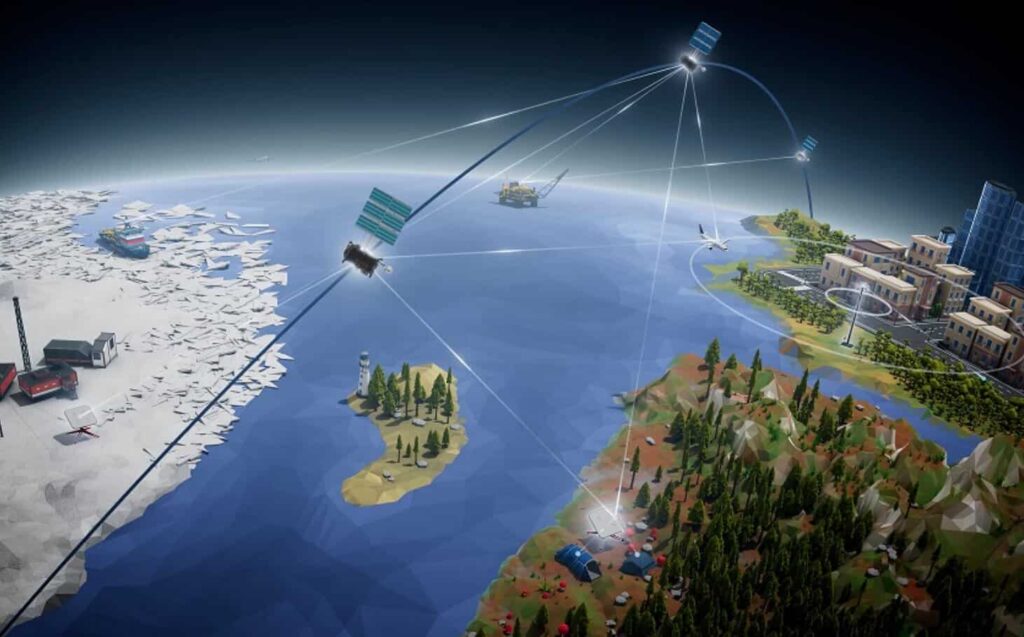
Illustration of the Russian Rassvet satellites by Bureau 1440

Russia is building a satellite network that could soon put all of Europe within its reach. The “Rassvet” satellite system is an extraordinary threat, first to Ukraine and then to the rest of Europe, Oleksandr Danyliuk, the head of the private European aerospace and defense technology company Destinus, said at the Warsaw Security Forum, according to Ukrinform.


Rassvet is Russia’s answer to Starlink, a low-orbit satellite network built by Bureau 1440 to give Moscow’s forces communications that no one else can switch off. European states must invest more quickly in cheap, effective, mass-produced systems to counter it.

“They will be able to navigate to any point in Europe without problems. This needs to be stopped,” said Danyluik, a former Ukrainian finance minister, said.

Cheap systems, made at scale

Danyliuk’s prescription is already being used on Ukraine’s front. Europe should invest in inexpensive, effective systems that can be mass-produced, he argues, the same approach Ukraine uses, and that Russia also turns against it.

“This gap needs to be filled as quickly as possible,” he said.

He urged allies not to overlook threats that might look secondary today, pointing to Rassvet as exactly that kind of slow-building danger.

Appearing strong is not enough to deter Russia, Danyliuk argued, because Moscow can gauge how ready European states actually are.

Ukraine races to catch up

Both sides are now scrambling to own the satellite link rather than rent it. Ukraine is building a satellite system of its own, similar to Starlink but beyond any single company’s control, President Volodymyr Zelenskyy said on 4 October.

He argued Kyiv should be free to turn Starlink on Russian military targets, warning that China and other states will share comparable satellite technology with Moscow within months.

By Ukrainian estimates, Russia still needs five to eight years to complete Rassvet, which so far reaches Ukraine only in brief passes. That window is the time Danyliuk says Europe must use.

  •  

Ten years on, Britain’s prime minister says Russia meddled in the Brexit vote—and warns Germany and France

ten years britain’s prime minister says russia meddled brexit vote—and warns germany france · post andy burnham britain's new 29 2026 hl-8sqawgaax0se ukraine news ukrainian reports

UK Prime Minister Andy Burnham said Russia interfered in the 2016 referendum that took Britain out of the European Union, in podcast excerpts released on 11 October, the Associated Press reported. His remarks are believed to be the first time a British prime minister has publicly acknowledged such meddling.

Russia’s information war keeps running through Europe’s ballots. German security sources said in August that Moscow was escalating disinformation before state elections, and Ukraine’s Center for Countering Disinformation found more than 200 Russian fake news sites aimed at France last year.

One question, one clear answer

Burnham told The Rest Is Politics podcast that he asked his advisers whether Russia had interfered in the 2016 vote. He asked after taking office in July.

“I’ve had the clear answer that yes, there was,” he said.

He argued that such things must now be put clearly on the record. He did not say how Russia interfered or offer evidence, and Moscow has long denied interfering in foreign votes.

Burnham said he had discussed Russian interference with German Chancellor Friedrich Merz in Berlin the previous week. “You know he was saying to me that the AfD are clearly linked to Russia, funded I believe,” Burnham said, referring to Germany’s far-right Alternative for Germany party. Putting such interference on the record would help “voters in Germany and France understand that some of this politics is instigated via our enemies, namely Russia,” he added.

Years of silence

In 2020, Parliament’s Intelligence and Security Committee found that the government had actively avoided investigating whether Russia meddled in the referendum. The report noted open-source signs of Russian attempts to sway the Brexit campaign. The government, it said, had never looked for hard evidence.

The government rejected the committee’s call for a review.

“We have seen no evidence of successful interference in the EU Referendum,” it said.

That same year, London said Russian actors had almost certainly tried to interfere in the 2019 general election. The government said they did it by amplifying leaked UK-US trade documents online.

From 2019 to 2016

Three weeks ago, Burnham stopped short of this. At the UN General Assembly on 22 September, he said the Kremlin spends around £1.3 billion each year on manipulating information. That is roughly $1.7 billion at recent exchange rates. He cited evidence that Russian agencies tried to interfere in the 2019 general election, but he did not mention 2016.

In the same speech, he said Britain had already helped Moldova protect its elections from Russian interference.

  •  

Ten casualties to one, by a NATO official’s count: Russia’s September in Ukraine’s kill zones

A masked Russian soldier in camouflage and body armor wears a helmet bearing Russian flag and “Z” patches.

Russia suffered vastly more casualties than Ukraine in September, a senior NATO military official told Bloomberg. Ukraine’s General Staff put the month’s Russian toll only slightly lower.

September’s toll lands on a recruitment system that was already falling short. Ukraine’s military intelligence (HUR) estimated that Russian losses outran new contracts in June and July, when monthly losses ran lower. In August, Ukrainian President Volodymyr Zelenskyy, citing military intelligence, warned that Russia is preparing a mass call-up after its parliamentary elections. That vote ended on 20 September.

Where the numbers come from

Russian casualties passed 50,000 in September, up to 28,000 of them killed, the official said. Ukraine’s losses over the same month came to about 5,000, according to the official, who spoke on condition of anonymity. Russia does not release casualty figures, Bloomberg noted. In late August, Pavlo Palisa, deputy head of Ukraine’s Presidential Office, put Russia’s July losses at 43,000 killed and wounded. Bloomberg could not confirm his figures.

To push forward, Russia keeps feeding troops into “kill zones,” the official said. These are stretches of ground saturated with armed drones, mines, and artillery fire. Maksym, call sign Rumyn, is a deputy company commander in the 46th Airmobile Brigade’s drone battalion. In April, he said the zone once ran 3–5 km deep and is now several times larger.

Ukraine's Third Army Corps commander Brigadier General Andrii Biletskyi announcing "Operation Vivaldi," 15 September 2026. Screenshot from video: Ukraine's Third Army Corps
Explore further

Ukraine suffered 10 times fewer casualties than Russia in Vivaldi counteroffensive, veteran says. Ukraine’s innovations in drone and ground robot tactics are changing frontline warfare

Rising stakes for Moscow

Russia’s defense spending is expected to near $199 billion this year, Bloomberg reported, citing two sources close to the government. That is about 40% above the plan the government set in late 2025.

Russian President Vladimir Putin would struggle to wind down the invasion without a political cost, Martin Jäger said last week. He heads Germany’s Federal Intelligence Service (BND).

  •  

Germany stays in Russia’s sabotage crosshairs, and its industry now braces for the long haul

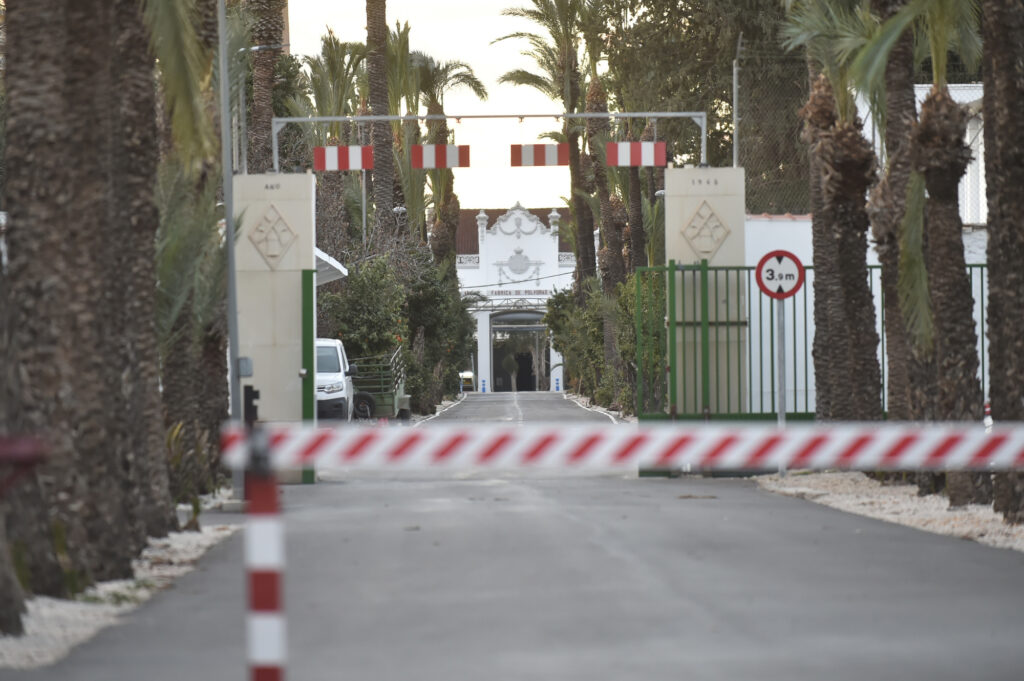
germany stays russia’s sabotage crosshairs its industry now braces long haul · post entrance rheinmetall company 30 2025 javalí viejo murcia spain ukraine news ukrainian reports

German industry expects Russian sabotage against the country’s companies to persist and take more forms, the deputy head of the Federation of German Industries (BDI) told Handelsblatt. His warning follows alarms from Germany’s intelligence services, which describe the country as a main target of Russia’s covert campaign in Europe.

Russia keeps striking Ukrainian cities and power plants every day while trying to weaken the European support that keeps Ukraine fighting. Germany is home to arms makers producing with and for Ukraine, so pressure on its companies targets the supply behind Ukraine’s defense.

Industry expects attacks to last and change form

The warning came from Holger Lösch, the BDI’s deputy managing director.

“German industry is preparing for the threat to persist and for attack methods to become more varied,” he told Handelsblatt. “Companies don’t end up in the crosshairs by chance,” he added.

Russian influence and sabotage operations are no longer an abstract scenario, and companies, critical infrastructure, and defense supply chains are already among their targets, Lösch said. Companies now receive more threat warnings, and their cooperation with the authorities has improved significantly, he noted. “What is still missing are joint procedures to quickly derive concrete measures from warnings,” Lösch said, calling the protection of the economy a cornerstone of national security.

German intelligence describes a Russian shadow war

The warning comes a week after a public hearing of the intelligence oversight panel of the Bundestag, Germany’s parliament, on 5 October. There, Martin Jäger, head of Germany’s Federal Intelligence Service (BND), said Russia was waging a shadow war against Germany. “Germany has become a main obstacle to Russian hegemonic power projection in Europe and thus a target of Russian action,” Jäger said. “The danger of attacks against targets in Germany remains real and present,” he warned.

Sinan Selen, head of the Federal Office for the Protection of the Constitution (BfV), Germany’s domestic intelligence agency, told the same hearing that Russia was showing a readiness for sabotage and killings.

German Chancellor Friedrich Merz said on 1 October that Germany was preparing for further hybrid attacks, “including serious ones,” and would respond “quickly and very clearly,” as it did after the drone attack at Leipzig airport.

Drone bombs, arson, and paid saboteurs on German soil

In August, a drone carrying Semtex explosives hit the wing of a Ukrainian An-124 cargo plane at Leipzig/Halle Airport but did not explode. Germany blamed Russia on 1 September, and German Foreign Minister Johann Wadephul said Germany was not at war with Russia but was a “target of war.”

German authorities suspect Russian intelligence of commissioning an arson attack near two Munich defense firms, and a confidential Federal Criminal Police Office (BKA) assessment counted more than 165 suspected sabotage cases in Germany between January and August. The same assessment recorded 747 suspicious drone incidents involving 1,068 drones over critical infrastructure, military sites, and defense companies.

russia hired desperate hunt german drone-maker boss arms ukraine · post stefan thumann head drone maker donaustahl штефан туманн news ukrainian reports
Explore further

The throwaway agents Moscow sent after a Bavarian drone boss arming Ukraine—and how Germany stopped them

Germany’s Military Counterintelligence Service (MAD) warns that the threat from low-level agents, locals paid small sums for one-off jobs such as arson or photographing military sites, has increased significantly. European intelligence agencies also report that Russia is increasingly targeting defense company executives, including at smaller drone makers, and the BfV has advised some German firms to hire close protection.

As long as Germany keeps backing Ukraine, Russian pressure on its companies is unlikely to ease, and the gap between warnings and action that industry flagged leaves smaller firms, with fewer resources for security, the most exposed.

  •  

Putin’s scorched-city policy hits Ukraine hard

During a quarter-century in power, Vladimir Putin has led Russia into three wars, in part aimed at restoring his country’s status as a world power via violent conquest . Each war began in a blitzkrieg-style display of fearsome power meant to climax in a swift victory. Instead, each conflict, whether the 1999-2009 war on the […]

The post Putin’s scorched-city policy hits Ukraine hard appeared first on Asia Times.

  •  

EU Leaders Face Confrontation Over Energy Prices, Ukraine and Russia at October Summit

European Union leaders will meet in Brussels on 15–16 October under pressure to address surging energy costs, Russian hybrid attacks, continued support for Ukraine and the bloc’s next long-term budget. The summit comes as economic pressures expose growing differences between national governments.

European Union leaders are preparing for a two-day summit in Brussels dominated by the economic consequences of the Middle East conflict, Russia’s continuing war against Ukraine and mounting pressure on governments to reconcile defence commitments with deteriorating public finances.

The European Council meeting on 15–16 October will bring together the leaders of the 27 member states to consider immediate measures addressing high energy prices alongside longer-term decisions on competitiveness, enlargement, migration and the EU’s budget for 2028–2034.

European Council President António Costa has placed economic competitiveness and energy costs at the centre of the discussions, reflecting concerns that the disruption of global oil and gas markets is threatening the bloc’s industrial recovery.

The meeting also takes place against the background of renewed disputes over national spending limits, with Italy and Greece seeking greater freedom to finance energy relief and France facing increasing pressure over the credibility of its budget.

Energy crisis puts fiscal rules under pressure

The Middle East conflict has created a renewed energy shock for European economies, raising transport and industrial costs while pushing inflation higher.

The disruption of shipping through the Strait of Hormuz has also affected global oil supplies, exposing Europe’s continuing dependence on internationally traded fossil fuels despite efforts to diversify imports following Russia’s invasion of Ukraine.

European leaders are expected to consider targeted and temporary support measures for households and businesses, as well as longer-term policies intended to reduce energy dependence.

The political disagreement concerns how those measures should be financed.

The European Commission has resisted requests from Italy and Greece for further exemptions from the EU’s fiscal framework. Both governments argue that extraordinary energy costs require additional budgetary flexibility.

Brussels maintains that existing provisions already permit exceptional expenditure within defined limits.

The disagreement is particularly difficult for indebted governments that must simultaneously finance military expansion, maintain public services and protect their economies from energy inflation.

France’s position has added urgency to the debate. Its borrowing costs have increased sharply as investors question whether the government can adopt a credible budget ahead of the 2027 presidential election.

A summit agreement on emergency energy assistance would therefore have to accommodate substantially different national fiscal circumstances.

Ukraine and the changing transatlantic relationship

Support for Ukraine remains a central item on the summit agenda as Russia continues attacks against Ukrainian cities, energy infrastructure and industrial facilities.

EU leaders are expected to review military and financial assistance, the implementation of sanctions against Moscow and the resilience of Ukraine’s economy.

The discussions take place amid renewed uncertainty surrounding American weapons deliveries.

Washington’s reported threats to suspend supplies under the NATO-backed PURL procurement arrangement have raised further questions about Europe’s dependence on the United States for advanced military equipment.

European governments have increased defence expenditure and committed additional support to Ukraine, but replacing American capabilities remains difficult, particularly in air defence, precision-guided weapons and certain intelligence systems.

The summit is unlikely to resolve those industrial limitations, but the broader question of Europe’s ability to sustain Ukrainian defence over several years will influence discussions.

Member states must also consider how increased defence expenditure will be financed alongside other demands on national budgets.

Russian hybrid operations move higher on the agenda

The EU’s published summit agenda includes Russian-linked hybrid attacks within Europe.

The issue has gained prominence as European governments investigate sabotage, cyber operations, information interference and threats against infrastructure and defence-related industries.

Recent warnings concerning possible Russian assassination operations targeting European defence executives and employees of companies supplying Ukraine illustrate the changing nature of the security threat.

Such activities place additional demands on national intelligence services, police forces and European institutions responsible for cross-border cooperation.

The EU has strengthened its sanctions instruments against hybrid activities, but enforcement remains dependent on coordination between national authorities.

Any further measures would need to address intelligence sharing, protection of critical infrastructure and the relationship between internal security and the Union’s wider Russia policy.

A larger EU with a contested budget

Enlargement will form another important part of the discussions following the Commission’s proposals for preparing a wider Union.

Brussels has outlined possible institutional safeguards intended to prevent future members from undermining democratic standards or blocking common decisions.

Montenegro and Albania are advancing through their accession negotiations, while Ukraine and Moldova remain central to the EU’s geopolitical enlargement strategy.

The financial implications will become increasingly important as governments negotiate the next multiannual financial framework covering 2028–2034.

Existing members are already divided over how much the EU should spend, which programmes should receive priority and whether additional common resources should be raised.

Agricultural expenditure, cohesion funding, defence investment and support for Ukraine will compete for resources within the same budget negotiations.

The Commission argues that enlargement can be accommodated through targeted reforms, but securing agreement among member states will require decisions on future expenditure and the distribution of financial benefits.

Competitiveness and the single market

Leaders will also examine progress on the One Europe, One Market agenda, which aims to reduce barriers to economic activity within the EU and improve conditions for European businesses.

The initiative is intended to address structural weaknesses affecting investment, industrial development and the ability of European companies to compete internationally.

High energy prices have made those concerns more immediate, particularly for industries competing against producers in economies where electricity and fuel are cheaper.

The European Council will be asked to provide direction on measures planned for 2026 and 2027, but implementation will depend on subsequent legislation and decisions by member states.

The October meeting brings several unresolved European policy questions into the same negotiation: how to protect economic competitiveness, maintain fiscal credibility, finance defence, sustain Ukraine and prepare for enlargement.

The immediate test will be whether leaders can agree on a credible response to energy prices without reopening broader disputes over national budgets.

More difficult decisions concerning defence financing, institutional reform and the EU’s long-term expenditure commitments will extend well beyond the two-day summit.

  •  

When AI takes control of weapons systems

Artificial intelligence is rapidly making its way into national defense. Reconnaissance, early warning, target detection, mission planning—everywhere, machine-learning systems promise faster analysis, faster responses, and faster decision-making. In a military context, this sounds like progress. In reality, AI exacerbates a security problem that cannot be solved technically. Anyone who attempts to do so anyway risks […]

The post When AI takes control of weapons systems appeared first on Asia Times.

  •  

China fast on Ukraine lessons, slow on command reform

The Russia-Ukraine War has become a real-time laboratory for the Chinese military, spurring rapid defensive modernization while exposing deep friction between its centralized command hierarchy and the decentralized demands of modern combat. This month, the Center for Strategic and International Studies (CSIS) released a report detailing how China is aggressively leveraging the Russia-Ukraine war as […]

The post China fast on Ukraine lessons, slow on command reform appeared first on Asia Times.

  •  

Britain Confirms Russian Interference in Brexit Referendum After Ten Years

Prime Minister Andy Burnham has acknowledged that Russia interfered in Britain’s 2016 referendum on European Union membership, ending a decade in which successive governments avoided making a definitive public assessment of Moscow’s involvement.

British Prime Minister Andy Burnham has confirmed that Russia interfered in the 2016 Brexit referendum, marking a significant change in the government’s position on foreign involvement in one of the country’s most consequential political decisions. The acknowledgement comes more than ten years after Britain voted to leave the European Union and six years after a parliamentary intelligence investigation criticised the failure to examine Russian activities surrounding the vote.

Speaking on The Rest Is Politics podcast, Burnham said he had requested an assessment of Russian interference after becoming prime minister in July. He subsequently received confirmation that Moscow had attempted to influence the referendum, although he declined to disclose the intelligence underpinning that conclusion or explain the methods employed.

The statement establishes an important distinction between Russian interference and the referendum’s outcome. The former is now publicly acknowledged by the British government; the latter remains a separate question. No evidence has been presented demonstrating that Russian activities determined the result, which saw 51.9 per cent vote to leave the EU.

The investigation that never took place

The controversy dates back to the Intelligence and Security Committee’s 2020 report on Russia, which identified serious weaknesses in Britain’s response to hostile foreign influence.

The committee examined Russian activities targeting British political institutions, including attempts to exploit social divisions through state-controlled information channels and online networks. It found that the British government had failed to conduct a comprehensive assessment of potential Russian interference in the Brexit referendum.

That failure was particularly striking when compared with the United States, where intelligence agencies investigated Russian interference in the 2016 presidential election and published conclusions identifying a coordinated campaign.

In Britain, by contrast, responsibility for examining foreign interference had been divided between departments and intelligence agencies. The parliamentary committee found that no organisation had assumed responsibility for assessing the threat to the referendum comprehensively.

The distinction was politically convenient for successive governments. Without a formal investigation, ministers could maintain that there was insufficient evidence to establish interference while avoiding the question of whether the evidence had ever been properly examined.

Burnham’s acknowledgement changes that position, although it does not resolve every question raised by the original inquiry.

What Russia sought to achieve

Russian information operations have repeatedly targeted political divisions within European societies, particularly disagreements over immigration, national sovereignty, NATO and relations with Brussels.

Research into online activity surrounding the Brexit campaign identified networks of accounts associated with Russian influence operations that circulated divisive political messages. Establishing their precise reach, coordination and effect on individual voters remains considerably more difficult.

Moscow had an identifiable strategic interest in weakening European political cohesion. Britain’s departure from the EU removed one of the bloc’s largest economies, a permanent member of the UN Security Council and an important supporter of sanctions against Russia.

That geopolitical consequence does not establish that Brexit was engineered by Moscow. Britain’s referendum reflected longstanding domestic political divisions, disagreements over European integration and dissatisfaction with successive governments.

Russian interference, however, need not create political divisions to exploit them. Amplifying existing disputes, discrediting institutions and encouraging distrust between political opponents can serve strategic objectives without requiring direct control over a campaign.

Consequences for relations with Europe

The timing of Burnham’s intervention is significant. His government has begun reconsidering Britain’s relationship with the EU, while European governments are confronting increasingly aggressive Russian hybrid operations.

Burnham has also suggested that Britain should be prepared to reconsider EU membership in the future, although such a decision would require a separate political mandate and negotiations with the bloc’s 27 members.

The prime minister’s comments place Russian interference within a broader European security debate. France and Germany are among the countries confronting allegations of foreign information operations, covert political influence and attempts to undermine electoral confidence.

The European Council’s forthcoming October summit will include discussions of Russian-linked hybrid attacks, demonstrating that the problem extends beyond conventional espionage and cyber-security.

For Britain, the outstanding question concerns the intelligence assessment itself. Burnham has not indicated whether further evidence will be published, whether Parliament will receive a classified briefing or whether the government intends to examine failures by previous administrations.

A public acknowledgement without supporting details may establish the government’s position, but it cannot by itself provide a complete historical account.

Ten years after the referendum, Britain is therefore confronting two separate matters: the extent of Russia’s activities during the campaign and the reasons its own institutions took so long to acknowledge them.

The first concerns foreign interference. The second concerns the accountability of the British state.

  •  

Drones now cause about 96% of Russia’s battlefield losses. Ukraine’s drone force says it has hit more than 100,000 Russian troops this year alone

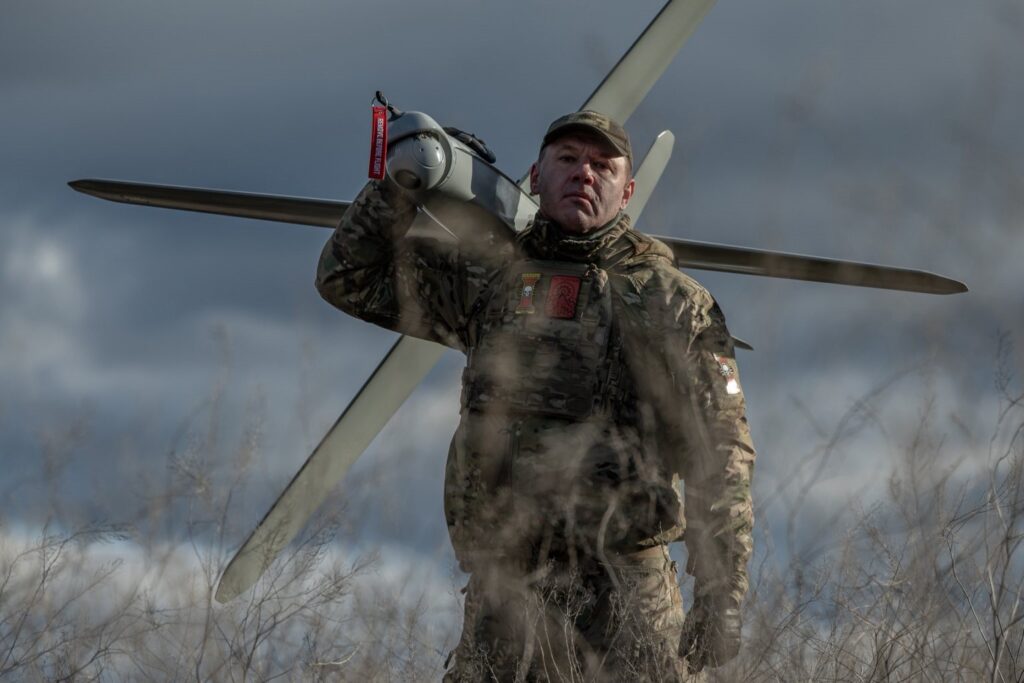
A Ukrainian soldier of the Unmanned Systems Forces with a drone. Photo: Ukraine’s Unmanned Systems Forces

Units of Ukraine’s Unmanned Systems Forces have killed or wounded more than 100,000 Russian troops since the start of 2026. That is more than 150,000 since the force was created on 11 June 2025, the force said on Telegram.

Drones have become the deadliest weapon of this war, accounting for about 96% of Russia’s battlefield casualties earlier this year. These hits are verified on video in the military’s Delta system, which is how the force counts only the losses its own pilots confirm.

“Behind these figures is the daily combat work of our soldiers, thousands of sorties, precise strikes, and the constant improvement of unmanned technologies,” Ukraine’s Unmanned Systems Forces said.

Each strike reduces Russia's combat potential and reflects the coordinated work of the force’s units, it added.

A toll that keeps climbing

Overall, drone branches of the Ukrainian Army had carried out more than 1 million verified strikes on enemy targets since January, killing or seriously wounding about 193,500 Russian troops, Ukraine’s Defense Ministry reported in July.

Those strikes roughly doubled over the first half of the year, from about 105,800 in January to more than 200,000 in June, the ministry noted.

Meanwhile, Commander of the separate Ukrainian Unmanned Systems Forces Robert “Madiar” Brovdi says the numbers are still growing. In the first five days of October, the force’s pilots killed or wounded 2,699 Russian soldiers, 39.7 percent more than in the same period of September.

He tied the rising number to Russia's assaults in Donbas, as the offensives for the fortress-belt cities that have been Ukraine's protection against full region's occupation since 2014, were ongoing.

Why the drone branch matters

The force fields are the cheap, fast weapons that now do most of the killing on the front. Interceptor and strike drones let Ukraine hit troops, logistics, and command posts while keeping its own soldiers farther from the fight.

  •  

Russia is building jet drones that fly 800 kilometers per hour, and Ukraine says it is already working on how to stop next generation

ukraine recovers russia's undamaged geran-3 jet kamikaze drone carrying camera live-link equipment (video) · post russian jet-powered lying cornfield after being recovered intact 16 2025 реактивний дрон-камікадзе герань-3 вересня року

Aviation is one of the most effective ways to counter Russia’s jet-powered drones. Its effectiveness continues to grow due to pilots’ skill and better coordination, Defense Minister Yevhenii Khmara says, Glavcom reports.

Russia’s jet-powered Gerans fly several times faster than the propeller Shaheds Ukraine learned to shoot down, and they remain the main challenge for its air defense. Ukraine downs more than 90% of the slow drones but only about 55% of the jet ones.

“Due to them, our aviation now uses fewer munitions per aerial target. We plan to improve this further,” Khmara states.

Air defense works as a layered system because no single type of weapon is enough, he explains. The layers run from surface-to-air and shoulder-fired missiles to turrets, electronic warfare, interceptor-drone crews, and small-scale air defense, topped by aircraft including Mirage and F-16 jets.

Scaling what works against jet drones

Ukraine already has combat results against the jet drones, Khmara notes. In one engagement, five Bars interceptors destroyed five aerial targets, a 100% hit rate in that case, and the task now is to raise the overall destruction rate and quickly scale the solutions that prove themselves.

Heavy-caliber turrets are adding to that. Their number in service already runs into the hundreds, he adds.

“This direction is being scaled, and systems with greater range are being worked on. In parallel, surface-to-air and shoulder-fired missile systems are also proving effective,” he says.

Preparing for the next generation

Ukraine is also looking past today’s threats, the minister stresses. The ministry is working to supply interceptor drones, aviation and its munitions, missile and artillery systems, turrets and electronic warfare gear, and to plan several steps ahead with enough stock in reserve.

“We also know what solutions Russia is developing, which concern jet drones with a speed of 800 kilometers per hour. We are working on finding countermeasures to the next generation of threats,” Khmara says.

Producers have been tasked with offering proposals and prototypes, he concludes.

  •  

Russia Targets European Defence Industry as Moscow Seeks to Disrupt Military Support for Ukraine

Intelligence services from five European countries warn that Russia is expanding assassination and sabotage operations against defence manufacturers supplying Ukraine. The threats coincide with an alleged plot against Poland’s prime minister and defence minister, raising concerns about Moscow’s efforts to undermine European military assistance through intimidation and political destabilisation.

European intelligence agencies have warned that Russia is intensifying efforts to assassinate executives of defence companies supplying Ukraine, extending its campaign of sabotage and intimidation into the European military-industrial sector.

According to intelligence assessments obtained from five European security services, Moscow has ordered an expansion of covert operations targeting senior figures at major arms manufacturers and smaller companies producing drones and military components. Germany’s domestic intelligence agency, the BfV, has reportedly advised executives to strengthen personal security, while some manufacturers have already increased protection for senior personnel.

The warnings emerged alongside reports of an alleged assassination plot against Polish Prime Minister Donald Tusk and Defence Minister Władysław Kosiniak-Kamysz. Polish authorities convened an emergency security meeting and subsequently detained a suspect. No connection between the Polish case and Russian intelligence has been established.

Europe becomes Moscow’s principal target

The apparent expansion of Russian covert operations reflects a shift in Moscow’s calculations concerning Western military assistance.

President Vladimir Putin had reason to anticipate that Donald Trump’s return to the White House would weaken American support for Kyiv. Trump repeatedly questioned US military expenditure on Ukraine and advocated a negotiated settlement with Russia. A substantial reduction in American weapons deliveries could have increased pressure on Ukraine to accept Moscow’s territorial demands.

Instead, European governments assumed greater responsibility for sustaining Ukrainian defence capabilities, including financing weapons purchases and expanding domestic production.

The European Union’s €90 billion support programme for 2026–2027 allocates €60 billion to defence procurement and industrial capacity. The EU has also established mechanisms allowing Ukraine to participate in European joint procurement programmes.

Disrupting European manufacturers therefore offers Moscow a means of restricting Ukraine’s military capabilities without directly confronting NATO.

Assassination threats can interfere with procurement even when attacks are never carried out. Large manufacturers can afford extensive security arrangements, but smaller companies producing electronics, drone components and specialised equipment often lack comparable resources.

Intimidation could delay contracts, discourage investment and persuade individual suppliers to withdraw from Ukrainian defence programmes.

Sabotage as an instrument of political pressure

Russia’s alleged interest in targeting defence executives is not unprecedented. In 2024, American intelligence reportedly uncovered a Russian plot to assassinate Armin Papperger, chief executive of Rheinmetall, one of Germany’s principal suppliers of ammunition and military equipment to Ukraine.

As EU Today previously reported, Moscow has also publicly identified European factories involved in Ukrainian drone production, increasing concerns that civilian industrial facilities could become targets of Russian operations.

European authorities have investigated suspected Russian involvement in arson, infrastructure attacks and clandestine networks. An earlier cross-border investigation into alleged assassination and sabotage preparations demonstrated how intermediaries could be recruited to conduct operations while obscuring their sponsors.

Such activity also carries political consequences. Attacks against infrastructure and industrial facilities can reinforce public fears about confrontation with Russia, particularly during elections when parties advocating accommodation with Moscow seek to exploit security concerns.

Poland has already experienced mounting Russian hybrid pressure, including threats to critical infrastructure and information operations intended to aggravate domestic political divisions.

Putin’s strategy against European rearmament

Ukraine’s continuing strikes against Russian refineries and military-industrial facilities have added economic and operational pressures to Moscow’s prolonged war effort. Russia retains substantial military production capacity, but the costs of sustaining the conflict remain considerable.

Interfering with European weapons manufacturing could serve two objectives: restricting Ukraine’s access to equipment and obstructing Europe’s longer-term rearmament.

The Kremlin does not necessarily need European governments to abandon Ukraine formally. Production delays, disrupted contracts and reluctant suppliers could reduce the practical effect of military assistance even while political commitments remain unchanged.

European governments have acknowledged the industrial challenge. In its June conclusions on European defence, the European Council called for accelerated manufacturing capacity, stronger supply chains and closer cooperation with Ukraine’s defence industry.

Russia’s apparent strategy seeks to exploit the dependence of these programmes on private companies and skilled civilian personnel.

The warnings from European intelligence agencies suggest that protecting defence executives, engineers and contractors is becoming part of the continent’s wider security responsibilities.

For Moscow, intimidation offers the possibility of weakening Ukrainian military resistance without an open confrontation with NATO. For European governments, preventing covert operations from disrupting weapons production is increasingly inseparable from their commitment to sustain Ukraine’s defence.

  •  

Russia equips Geran attack drones with image-based navigation using Google map imagery, reducing reliance on satellite navigation that Ukraine can jam, defense adviser warns

Ukrainian defense technology adviser Serhii “Flash” Beskrestnov works near the front line monitoring Russian drone signals. Photo: Serhii “Flash” Beskrestnov

Russia is developing new navigation systems for attack drones and missiles that could make its strikes against Ukrainian cities harder to stop, as Moscow adapts its weapons to counter Ukrainian electronic warfare defenses, Ukrainian defense technology adviser Serhii “Flash” Beskrestnov said.

The shift poses an additional challenge for Ukraine as Russia continues to attack cities and critical infrastructure with drones and missiles. Systems that can navigate without relying on satellite signals may be harder to disrupt electronically, increasing the importance of other defenses, including interception and physical destruction of incoming weapons.

Image-based navigation could make Russian strike drones harder to jam

Beskrestnov, an adviser to the Ukrainian president on defense technology development, said image-based navigation systems would see wider use in 2027, including in medium- and long-range strike drones and inexpensive cruise missiles.

The technology allows drones to navigate by comparing images captured by an onboard camera with stored photographs of the terrain. Even basic navigation can use publicly available satellite or ground imagery from services such as Google, Beskrestnov said.

Unlike satellite navigation, which can be disrupted by electronic warfare, image-based navigation relies on visual recognition of the terrain. This makes drones using the technology more resistant to jamming and could allow them to continue toward their targets even when satellite navigation signals are unavailable.

Russia already uses image-based navigation on attack drones

Beskrestnov said Russian forces were already using the technology on several types of unmanned aircraft, including Molniya, V2U, and Lancet drones.

He also reported that similar systems had recently been identified on the Russian Geran-4 and Geran-5 attack drones, using a flight controller called Susanin.

The Geran series includes Russian attack drones used in strikes against Ukrainian cities and infrastructure. The introduction of image-based navigation could make some variants more difficult for Ukrainian forces to counter using electronic warfare.

Russia adapts its weapons to Ukrainian defenses

The development reflects Russia’s broader effort to adapt its weapons as Ukraine improves its air defenses and electronic warfare capabilities. By reducing reliance on satellite navigation signals, Russian drones can become less vulnerable to one of Ukraine’s key methods of disrupting incoming attacks.

Beskrestnov warned that image-based navigation would expand beyond individual drone models, with broader adoption expected next year across different categories of strike weapons.

  •  

Once considered “taboo,” Russian assassination plots against European defense executives are escalating as its hybrid warfare grows bolder, intelligence agencies warn – FT

Russia is expanding efforts to target European defense industry leaders as part of a broader campaign of sabotage and hybrid operations aimed at weakening support for Ukraine, the Financial Times reported on 11 October, citing officials from five European intelligence agencies.

The warnings come amid a wider increase in Russia-linked sabotage and other covert operations targeting European defense companies and critical infrastructure. Moscow is expanding its so-called hybrid warfare campaign against European countries as they continue to support Ukraine, using covert networks, intimidation, and suspected sabotage to undermine security and deter further assistance to Kyiv.

The FT reported that assassinations of civilian targets in Europe, once considered "taboo" even within Russian intelligence services, are becoming an increasingly prominent part of the Kremlin’s plans.

Russian operatives target defense industry leaders

European intelligence officials told the FT that Russian operatives are targeting chief executives and senior employees at defense companies, including smaller firms manufacturing drones and drone components. 

The campaign comes as Russia seeks to undermine European backing for Ukraine amid a battlefield stalemate and mounting pressure on the Russian economy.

The warnings have prompted defense companies to strengthen security around senior executives. Some have increased personal protection, while others have relocated production sites in response to suspected Russian threats, according to the FT.

Germany's domestic intelligence service, the BfV, has stepped up contact with employees and management at German defense companies and recommended that some use privately contracted close-protection teams, an agency official told the newspaper.

BfV chief Sinan Selen warned German lawmakers that Russia was deliberately planning acts of violence against individuals through state or state-controlled actors. He said the operations were evolving in their targets, methods, and use of organized crime networks.

Russia adapts its methods to carry out attacks

According to the intelligence officials cited by the FT, Russia's military intelligence agency, the GRU, has adapted its methods by working more closely with criminal groups and dividing surveillance, logistics, planning, and execution among different operatives.

Officials said some plots had been disrupted, while other cases involved surveillance of targets at home and at work.

The campaign's intended effect extends beyond any individual attack. One European intelligence official told the FT that the threat is psychological, designed to make people reconsider doing business with Ukraine.

Although some Russian operations remain amateurish and have been detected early, the resulting uncertainty forces companies to devote more resources to security. Smaller firms, which may have fewer resources to protect their personnel and facilities, could be particularly vulnerable.

Plot against Rheinmetall CEO raised alarm in 2024

European defense executives have been on heightened alert since 2024, when US and German intelligence agencies uncovered a Russian plot against Rheinmetall CEO Armin Papperger, a prominent advocate of supplying weapons to Ukraine.

Papperger has said he now receives round-the-clock protection from private security personnel and police.

The FT reported that European intelligence agencies now view threats against defense industry leaders as part of a broader effort to disrupt the production and supply of weapons to Ukraine, rather than isolated plots against individual executives.

  •  

Moving B-1 bombers from UK to US is no drone warfare solution

On October 4, the US pulled its 12 B-1 strategic bombers out of Fairford, UK and returned them to the United States. Reports say the planes returned to Ellsworth Air Force Base in Rapid City, South Dakota. The bombers were pulled out when intelligence reported that an attack by armed drones against Fairford was imminent. […]

The post Moving B-1 bombers from UK to US is no drone warfare solution appeared first on Asia Times.

  •  

Head of Russian military propaganda network to be expelled from Montenegro over suspected anti-EU operation

Mikhail Zvynchuk, head of the pro-Kremlin military information network Rybar. Screenshot: RuTube via Novaya Gazeta Europe

Montenegro has ordered the expulsion of Mikhail Zvynchuk, head of the pro-Kremlin military information network Rybar, and four other Russian citizens over national security concerns following a security operation targeting suspected Russian hybrid influence activities, Vijesti reported on 9 October.

Zvynchuk is the founder and head of Rybar, a prominent Russian military-focused information network known for its Telegram channels covering Russia's war against Ukraine. The network promotes pro-Kremlin narratives and has been associated with Russian propaganda and influence operations.

Montenegrin police announced on 9 October that the five Russians had their residence rights revoked and were ordered to leave the country on national and internal security grounds. 

Montenegro investigates suspected Russian hybrid activity

The operation involved Montenegro's police and National Security Agency (ANB), which seized drones, high-resolution recording equipment, cameras, and several mobile phones for further examination, according to Vijesti.

According to Montenegrin authorities, the five had arrived in the country less than two days before the operation. The investigation is being conducted with support from international partners.

Montenegrin police identified the five Russian citizens as Zvynchuk, his wife Valeria Zvynchuk, Sergei Belous, Pavel Lekatorchuk, and Kira Doroshenko. Authorities said the case had been referred to prosecutors in Podgorica and Kotor.

The European Union has sanctioned Zvynchuk over activities that undermine or threaten Ukraine's territorial integrity, sovereignty, and independence. He has also been sanctioned by the United Kingdom, Switzerland, Australia, and Ukraine, according to Vijesti.

Suspected influence operation targeting EU integration

Vijesti reported, citing security sources, that Montenegrin authorities suspected the group of planning a documentary intended to undermine public support for the country's European integration.

According to the outlet, the planned material would portray Montenegro's expected alignment of its visa policy with EU standards as a politically imposed measure that threatens tourism, economic stability, and national interests.

Security services had monitored the group's arrival before carrying out the operation in Risan, in the Bay of Kotor area, Vijesti reported. The equipment seized from the group will undergo expert analysis to establish its intended purpose and use in Montenegro.

Medvedev threatens imprisoning “European and American idiots” for prisoner exchanges

Former Russian President Dmitry Medvedev responded to the operation by suggesting Moscow might need to expand its pool of prisoners to exchange for Europeans and Americans to secure Zvynchuk's return.

“We will probably have to replenish our pool of prisoners for exchange with European and American idiots,” Medvedev said, according to Vijesti.

Montenegro, a NATO member and EU candidate, has aligned itself with EU sanctions against Russia following Moscow's full-scale invasion of Ukraine in 2022. The expulsion comes amid broader European concerns over Russian intelligence activity, propaganda, and other forms of hybrid interference. 

  •  

Ukrainian producer that neutralized more than 7,000 drones over 100 square kilometers in year, plays enemy in Pentagon contest, and gets invitation to continue

The C2 KUPOL platform. Source: Phantom Defense

A Ukrainian company has played the enemy in a Pentagon drone contest, and the US liked what it saw. Phantom Defense, a Ukrainian defense-tech firm, was one of three companies whose systems built the counter-drone environment for Gauntlet II, the second stage of the US military’s Drone Dominance program, and has been invited to take part further, Defender Media reports.

Drone Dominance is the Pentagon’s four-phase effort to field cheap attack drones fast, a roughly $1 billion program to buy more than 200,000 low-cost attack drones by 2027. Phantom Defense brought a system that was already proven at home, where in one city it neutralized more than 7,000 enemy drones over an area of more than 100 square kilometers in a year, the company says.

Rather than enter a drone of its own, Phantom Defense supplied the resistance that the American drones had to fly through. Its setup paired the Specter PRO, L, X, and XL jammers with the Streamhunter video-interception tool and a command-and-control layer that detected and classified targets, coordinated the countermeasures, and confirmed the kills. The jammers suppressed drones and held up in heat and rain, it adds.

The arrangement lets American developers fly their drones under live electronic attack rather than calm conditions, recreating a battlefield where a drone’s performance swings with the jamming around it, according to the company.

One map to run the whole fight

At the center sits Phantom Defense’s C2 system, Kupol, which integrates separate tools into a single ecosystem on a shared map. It lets crews run electronic warfare remotely, without driving out to a position, and ties in sensors, interceptor drones, and turrets, the company says.

Kupol reads the terrain and a drone database to propose the best way to take down a target, then logs each mission automatically so its recommendations sharpen over time.

The high-power Specter PRO station, built to shield positions, critical infrastructure, and cities, serves as the hardware anchor.

An invitation, not yet a contract

Previously, Ukraine’s battle-tested drone makers also took part in Drone Dominance. However, they didn’t succeed in it, though some of their technology competed under Western partners. The program bars direct purchases from Ukrainian firms, which must set up a US legal entity to bid.

  •  

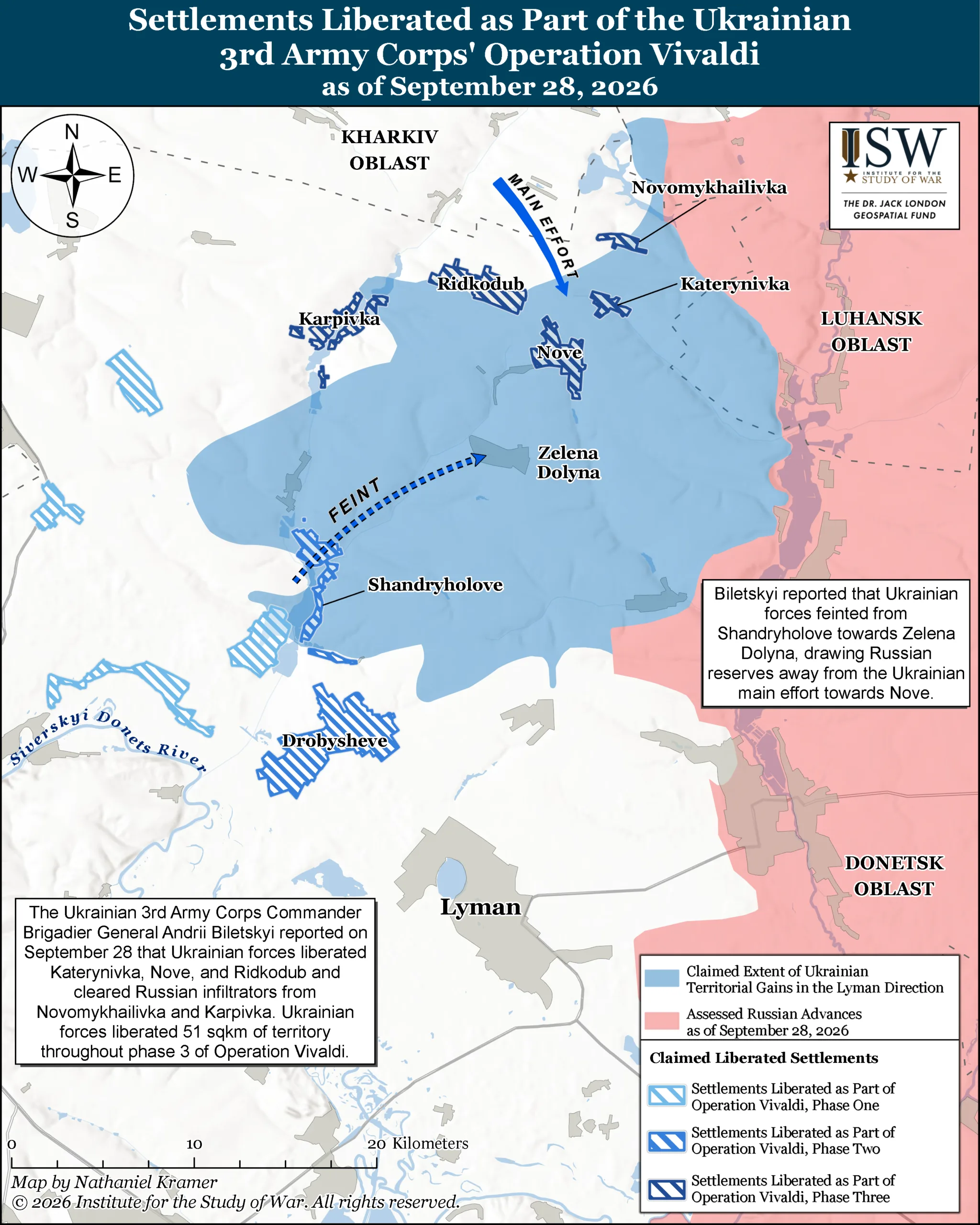
Ukraine reruns its Vivaldi playbook outside Kramatorsk and pushes Russia back across the Siverskyi Donets, ISW says

after vivaldi near lyman ukraine pushes across siverskyi donets east sloviansk kramatorsk · post assessed control terrain direction 8 2026 slovyansk-direction-october-8-2026 news ukrainian reports

Ukrainian forces are advancing east of Sloviansk and Kramatorsk, and even Russian milbloggers now acknowledge it, the Institute for the Study of War (ISW) said on 8 October. The gains may follow months of groundwork like the one that preceded Operation Vivaldi near Lyman, which Ukraine says returned 176 km² to its control. Russian commentators are already doubting that Moscow can reach the two cities.

Russia's years-long push on the Fortress Belt, the chain of cities anchoring Ukraine's defense in Donetsk Oblast, has been stalling since Vivaldi began. Unable to take those cities, Russia keeps hitting them from the air. On 8 October, a Russian bomb killed 30 people on two buses in Kramatorsk.

Across the Siverskyi Donets

Russian milbloggers said Ukrainian forces liberated Ozerne and advanced east of Pyskunivka toward Kryva Luka, ISW reported. They also acknowledged that Ukrainian troops drove Russian forces out of Pyskunivka. Ukrainians are now counterattacking toward Kryva Luka from the west and northwest, from across the river.

vivaldi counteroffensive worked because ukraine took russia's drones out fight isw assesses · post settlements ukraine's 3rd army corps says liberated during operation north lyman donetsk oblast 28 2026 settlements-liberated-during-operation-vivaldi-phase-3-as-of-september-28-2026-scaled
Explore further

Vivaldi counteroffensive advanced after Ukraine took Russia’s drones out of the fight, ISW assesses

ISW called the repeated Russian claims of a river crossing notable, because the Siverskyi Donets is a significant natural obstacle. Kryva Luka is a dominant height just south of the river. From there, Ukraine could launch further counterattacks. Ukrainian forces appear to have pushed Russian troops off both banks in this area, ISW assessed.

The heights Russia wanted

After Vivaldi cleared ground near Lyman in September, Russia shifted its push south toward Mykolaivka and Sloviansk. Russian forces likely see Mykolaivka, just east of Sloviansk, as a primary objective, ISW said. Its heights would favor an offensive on the city. Ukrainian pushes northeast and southeast of the town now deny Russia that terrain.

East of Kramatorsk, milbloggers claimed Ukrainians liberated Malynivka and advanced between Fedorivka Druha and Holubivka. They also reported gains into southern Minkivka and near Fedorivka. The lines remain tangled. Geolocated footage shows Ukrainian forces striking a Russian position in central Tykhonivka after what ISW assesses was a Russian infiltration.

ISW said the counterattacks may point to a broader Ukrainian goal: pushing Russian forces east, away from the Sloviansk–Kramatorsk area and toward the Siverskyi Donets–Donbas Canal.

The Vivaldi playbook

The counterattacks have run for weeks. On 29 September, Ukrainian military observer Kostiantyn Mashovets reported them in the same areas, saying Russia's 3rd Combined Arms Army had failed to make significant gains. ISW assesses that the attacks build on months of shaping meant to wear down Russia's offensive capacity.

vivaldi's secret weapon targeting robots third corps reconnaissance mapped russian command nodes hit cause panic · post graphic ukraine's army / telegram під час операції вівальді нрк десантували щоб порушити
Explore further

Vivaldi’s secret weapon was the targeting, not the robots: Third Corps reconnaissance mapped Russian command nodes, then hit them to cause panic

Before Vivaldi, Ukrainian forces targeted Russian drone operators, gaining drone superiority before the counteroffensive. They used the same approach ahead of their Oleksandrivka counterattacks in early 2026.

Moscow appears to see the pattern. A Ukrainian military official said on 7 October that Russia is moving drone units and Spetsnaz from quieter sectors to the Sloviansk–Kramatorsk direction. Ukraine also reorganized its command in and around Donetsk Oblast in early September, which may be blunting Russian attacks from the east, ISW said.

"Distant" and "doomed"

One Russian milblogger called an advance toward the Sloviansk–Kramatorsk area a "distant" prospect, ISW reported. A Russian offensive from Siversk toward Sloviansk may be "doomed" to failure or heavy losses unless Russia retakes the forests south of Lyman, he said.

The counterattacks east of the two cities appear to support Vivaldi, ISW assessed. Together with Russia's defeat north of the river, they could disrupt Russia's offensive toward Sloviansk from the east entirely.

If Ukraine holds Kryva Luka and keeps Russia off the Mykolaivka heights, Moscow's pincer on Sloviansk and Kramatorsk loses the ground it was built on.

  •  

Lithuania puts up to 100 soldiers on Kaliningrad border as officials brace for possible Russian mobilization

lithuanian soldier

Lithuania plans to deploy up to 100 soldiers to support border guards along its frontier with Russia's Kaliningrad Oblast, Defense Minister Robertas Kaunas said on 7 October.

Lithuanian Interior Minister Martynas Katelynas has described the deployment as a preventive measure linked to possible Russian mobilization and a recent incident on the Latvia-Belarus border, where masked, armed escorts tried to push a group of migrants into Latvia. Katelynas said Lithuania could face people trying to avoid mobilization and seeking asylum.

Kaunas said he had granted permission to use Lithuanian soldiers to strengthen border protection for the next several weeks.

 “The order starts being implemented immediately,” he wrote on Facebook.

Russia denies a new mobilization

The Kremlin denies a new mobilization is coming. In early September, Russian President Vladimir Putin called reports of one "complete nonsense" and "an information attack on Russia." Ukraine's military and foreign intelligence services say Russia's General Staff has prepared a scenario to mobilize 600,000 people over 2026 and 2027. On 28 September, President Volodymyr Zelenskyy said that "in effect, the Russians have already begun additional mobilization."

Frontier-station patrols for a couple of weeks, possibly longer

On 8 October, the Lithuanian army said soldiers were being brought in to help the State Border Guard Service from that day. A company-sized unit was planned for the assignment, initially for two weeks, with the option to extend. Soldiers will patrol with border guards in frontier-station areas, while mobile patrols, mobile observation posts, and military police crews may be added as needed. The army described the deployment as preventive and a normal form of interagency cooperation.

Kaunas had told LRT TV the soldiers would stay until 16 October. On the morning of 8 October, he said the deployment "was supposed to start" overnight and that he would check with the army. On 8 October, the Lithuanian army said soldiers were being brought in to help the State Border Guard Service from that day. Kaunas also said that “on the Kaliningrad side” there were no physical barriers, unlike the border with Belarus.

Lithuania says its border guards are stretched

On 8 October, Katelynas said the border guard service’s capacity was insufficient, with shifts growing while officer numbers were not increasing. He said the threat level had not changed. In a Facebook post the previous day, he said the situation at Lithuania’s border was calm and there was no reason to panic. He said Russia was planning mobilization after the elections and that Lithuania may face people trying to avoid it and seeking asylum.

Lithuania's State Border Guard Service had turned back 1,693 people trying to cross illegally from Belarus this year and about 26,300 since the migration crisis began, as reported by ELTA on 8 October. Katelynas said 43 migrants tried to enter southern Lithuania last week and were turned back.

  •  
❌