Footage shows major oil fire on outskirts of rebel-held capital, additional strikes within city; Iran-backed group calls for evacuation of Riyadh airport, Aramco facilities
While authorities do not possess clear evidence on who was responsible for the drone attacks, “it makes no sense for Ukraine to destroy its own ships in the Black Sea."
While authorities do not possess clear evidence on who was responsible for the drone attacks, “it makes no sense for Ukraine to destroy its own ships in the Black Sea."
Eleven sailors were missing at sea on Tuesday from a ship sunk by a drone attack off the coast of Bulgaria, possibly the second deadly sinking of a cargo vessel in the area in a week, prompting Bulgaria to summon Russia's ambassador.
South Korean President Lee Jae-myung reaffirmed his country’s commitment on Tuesday to developing a new trade route via the Arctic Ocean, following the first voyage to Europe completed by a South Korean container ship.
The leader stated that the initiative aims to diversify Asian maritime routes and strengthen Busan as an international logistics hub.
During a ceremony in Busan to welcome the vessel PanStar Acro, Lee affirmed that South Korea would open the Arctic route with the confidence of the international community. “I will strive to ensure that the new route does not serve the exclusive interests of any single country, but rather leads to mutual prosperity,” the president declared, according to the Yonhap news agency.
The PanStar Acro, with a capacity of 2,758 TEUs (standard 20-foot containers), returned to Busan this Sunday after completing a 50-day voyage through the Arctic via Russian waters. The vessel made stops in the United Kingdom, the Netherlands, and Poland before returning to the South Korean port.
The voyage marked the first time a South Korean container ship completed a round trip to Europe via the Arctic route. The South Korean government believes the operation provided valuable experience in polar navigation and technical data to assess the corridor’s commercial viability.
South Korean Container Ship Completes Landmark Northern Sea Route Return Trip
The ‘PanStar Acro’ vessel set sail from Busan on August 22 to the UK through the NSR, stopping in Rotterdam and Gdansk – returning home to South Korea on October 11. (Yonhap citing 🇰🇷's Ministry of… pic.twitter.com/0VCRrqjj9B
In May, South Korea’s Ministry of Oceans unveiled a plan using this trial run as a first step toward establishing a regular service along the Arctic route by 2030. The strategy seeks to revitalize Busan—the country’s second-largest city—and other southern localities, while also consolidating more efficient trade links between Asia and Europe. Lee linked the project to the development of a southern maritime hub region, integrating Busan’s ports and maritime finance, Ulsan’s shipbuilding and green energy sectors, and South Gyeongsang’s marine equipment industry.
The project has raised concerns because the route runs largely through Russian waters; some analysts warn this could allow Moscow to mitigate the impact of international sanctions imposed following the “Special Operation” in Ukraine. In response, Lee emphasized that Seoul would strictly adhere to international regulations and the sanctions principles established by the global community.
The initiative is also a response to the crisis in the Red Sea, which led numerous shipping companies to avoid the Suez Canal, drove up shipping costs, and forced the rerouting of voyages between Asia and Europe.
Although some companies have begun to gradually resume transit via that route—aided by improved security conditions—South Korea is positioning the Arctic route as a strategic alternative to potential disruptions on traditional shipping lanes.
Logistical and financial obstacles
Meanwhile, Eve Barré, a sector economist at Coface, noted that Arctic shipping routes are attracting attention because they shorten distances. However, commercial interest remains very limited for the foreseeable future and is concentrated primarily on raw materials.
Aurora García, of Ocean Infrastructures Management, identified further hurdles: incompatibility with existing logistics networks; the loss of intermediate port calls—a key revenue source for major shipping lines; high seasonality; and a lack of rescue capabilities. Navigation is permitted only during the warmer season, which conflicts with the annual contracts used by shipping companies.
Costs are also a factor: shipowners face higher insurance risk premiums and greater amounts of tied-up capital. Polar-class vessels are between 25% and 60% more expensive due to the extra steel thickness in the hull.
If the route were to become a viable alternative, certain European ports reliant on Suez traffic could be affected. In Spain, García noted that Algeciras would be the most exposed facility due to its high volume of transit traffic, whereas Valencia would face a lesser impact, as its import and export traffic would not be directly affected.
Chinese Foreign Minister Wang Yi met with his South Korean counterpart, Cho Tae-yul, in Seoul to discuss strengthening bilateral ties and regional stability.
Beijing urged Seoul to maintain an independent foreign policy, and both sides laid the groundwork for a potential summit… pic.twitter.com/o3uHG7vU1q
The Argentine government is seeking to halt the Sea Lion project, led by Israeli oil company Navitas.
On Tuesday, Argentina asked the International Tribunal for the Law of the Sea (ITLOS) to order measures against the project led by Israeli oil company Navitas in the Malvinas Islands, which are administered by the United Kingdom and claimed by the South American country.
“The Argentine Republic today submitted a request for provisional measures to the International Tribunal for the Law of the Sea to prevent the United Kingdom from exploiting hydrocarbons on the continental shelf of the North Malvinas Basin,” the Argentine presidency posted on social media.
“The request submitted to the International Tribunal for the Law of the Sea seeks to preserve Argentina’s sovereign rights over its continental shelf and prevent activities unilaterally and illegally authorized by the United Kingdom from aggravating the dispute recognized by the United Nations.”
“The Argentine Republic reaffirms, once again, its legitimate and imprescriptible sovereign rights over the Malvinas Islands, South Georgia and the South Sandwich Islands, and the surrounding maritime areas. By history and by law: the Malvinas Islands are Argentine,” the presidential statement concluded.
UK WARNS ARGENTINA it will use ‘FORCE’ to DEFEND FALKLANDS (Malvinas) ‘IF NECESSARY’
Says Britain has ‘ABILITY’ to defend Islands ‘BY FORCE’
On Sept. 28, Argentine President Javier Milei announced that he would initiate a request for arbitration based on the provisions of the United Nations Convention on the Law of the Sea (UNCLOS), a 1982 treaty whose dispute-resolution body is the International Tribunal for the Law of the Sea, based in Hamburg, Germany.
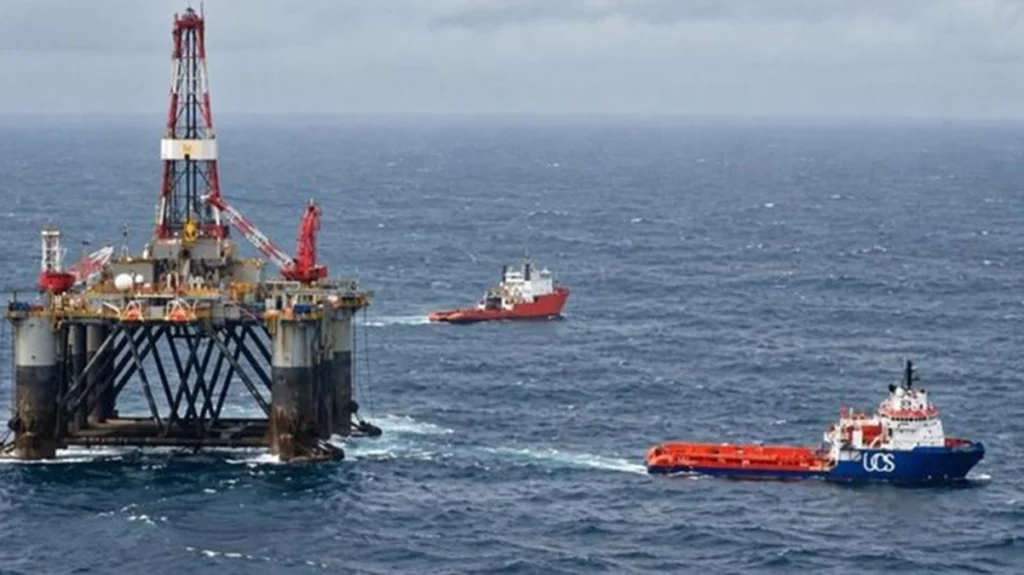
Argentina’s goal is to halt the progress of Sea Lion, an offshore project operated by Navitas (65%) and British company Rockhopper (35%) to begin extracting crude oil in 2028 in the North Malvinas Basin, 200 kilometers north of the archipelago.
Argentina considers the permits granted to the oil companies by the islands’ local government “illegal.” When announcing that it would initiate the request for international arbitration, Argentina gave the United Kingdom two weeks to take measures to stop the project.
One day later, British Parliamentary Undersecretary of State for the Overseas Territories Uma Kumaran responded that Argentina’s arbitration effort was the South American country’s “latest attempt” to “undermine the rights of the people” of the Malvinas Islands, which have been occupied by the UK since 1833, when British forces expelled Argentine authorities from the islands.
According to Kumaran, hydrocarbon activities in the Malvinas Islands are regulated by the islands’ laws and “are conducted in full compliance with international law, including UNCLOS.”
MARINES ESTADOUNIDENSES REALIZARON EN USHUAIA EJERCICIOS CON TROPAS ARGENTINAS
🚩https://t.co/3EOcbmaW1T Solo un gobierno que desprecia la lucha de su pueblo y a los muertos por la Patria en 1982, permite el ingreso de militares del principal socio del usurpador de Malvinas. pic.twitter.com/H6Cf3PbKJG
The text reads, “U.S. Marines conducted exercises with Argentine troops in Ushuaia. Only a government that disdains its people’s struggle and those who died for the Fatherland in 1982 would allow the entry of military personnel from the principal partner of the usurper of the Malvinas.”
Argentina’s Foreign Ministry denied that it was seeking to “undermine” anyone’s rights, arguing instead that submitting a dispute to an international tribunal is an act of responsibility because differences are not resolved through unilateral actions, “but before judges who apply the law that both parties have freely accepted.”
The United Kingdom and Argentina, which fought a war over the Malvinas Islands in 1982, are both parties to UNCLOS.
Since Milei announced a series of measures on Aug. 3 aimed at curbing oil activity in the Malvinas Islands, Argentina has initiated administrative proceedings and filed lawsuits in domestic courts against the companies operating on the islands and their shareholders.
It has also sent dozens of letters to oil companies around the world seeking to dissuade them from operating in the archipelago or supplying the projects there.
So far, Argentina has succeeded in getting some global oil services companies with significant business interests in the South American country to publicly state that they will not operate in the Malvinas Islands, including contractors that were set to take part in the Sea Lion project.
Last week, Navitas and Rockhopper, whose shares have fallen in recent weeks, said they would replace two contractors and continue moving forward with Sea Lion “with the full support” of the Malvinas Islands and British governments.
Bulgaria summoned Russia’s ambassador to Sofia after two ships were hit off the country’s coast, as concerns mount over the security of Black Sea shipping.
Saudi Arabia is looking at ways to expand its oil pipeline capacity to destinations outside the Persian Gulf to 10 million barrels a day within two to three years, said Energy Minister Prince Abdulaziz bin Salman.
The Russia-Ukraine War has become a real-time laboratory for the Chinese military, spurring rapid defensive modernization while exposing deep friction between its centralized command hierarchy and the decentralized demands of modern combat. This month, the Center for Strategic and International Studies (CSIS) released a report detailing how China is aggressively leveraging the Russia-Ukraine war as […]
Norwegian nonprofit Fritt Ukraina is allocating NOK 10 million (about $1 million) to strengthen air defenses around Chornomorsk, a key Ukrainian port on the Black Sea, the organization announced on 9 October.
Russian attacks on port infrastructure and civilian vessels are threatening Ukraine’s maritime trade and agricultural exports, putting pressure on a vital source of revenue for the country and disrupting shipments of food to international markets.
The funding will support Ukrainian State Border Guard Service and Armed Forces units defending the region against Russian attack drones. It is being delivered through Dronefall, a project run by the Ukrainian Come Back Alive Foundation, which equips military units with interceptor drones and the equipment needed to operate them.
Fritt Ukraina, whose name means “Free Ukraine,” is a Norwegian nonprofit organization that supports Ukraine’s defense against Russia’s full-scale invasion. The donation is part of its Odins Ravner 2.0 fundraising campaign, which provides military assistance to Ukrainian forces.
Interceptor drones and equipment to protect port infrastructure
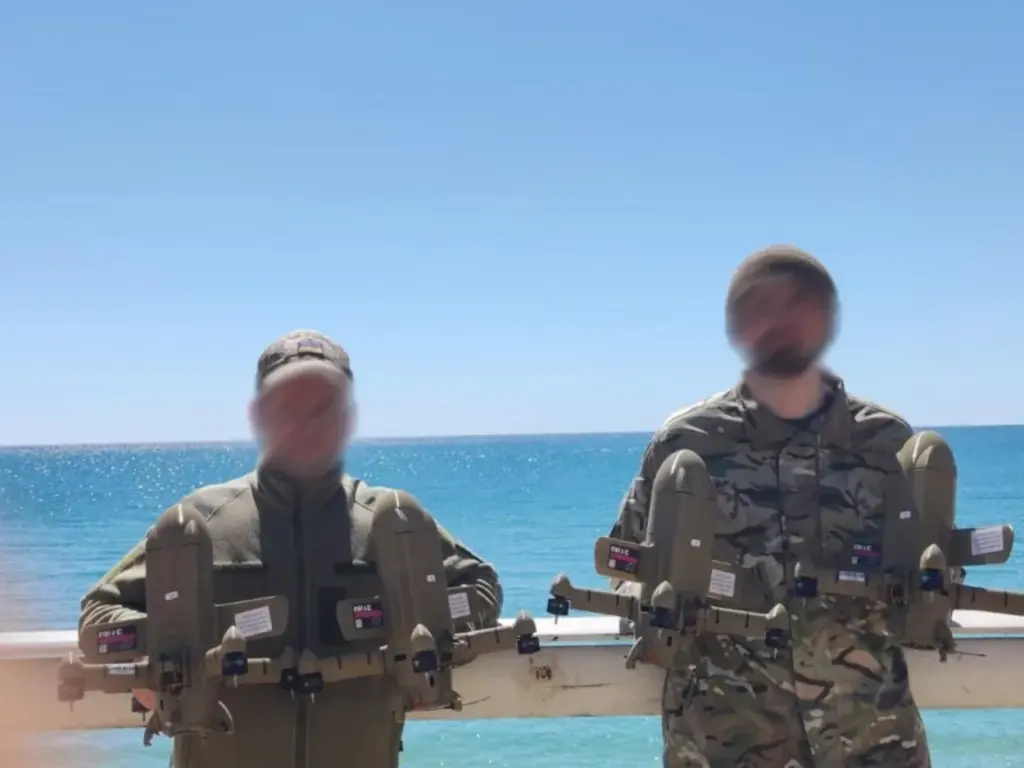
The support includes STING, Blyskavka and P1-SUN interceptor drones, alongside ground control stations, communications equipment, generators, charging stations, laptops, tablets and vehicles, according to the organization.
The interceptor drones are already operational, according to Fritt Ukraina. The equipment helps Ukrainian personnel detect and intercept Russian attack drones, while vehicles allow crews to move quickly and operate from different positions.
Fritt Ukraina Secretary General Natalia Golis said effective air defense requires more than interceptor drones alone. Communications systems, reliable power supplies and mobility are also essential to ensure units can use their equipment effectively.
The organization is supporting Dronefall for the third consecutive year and has become the Come Back Alive Foundation’s largest foreign partner. The latest donation was matched by a donor affiliated with the Ukrainian foundation.
STING interceptor drones funded by Norwegian nonprofit Fritt Ukraina to Ukrainian forces to help counter Russian attack drones near the Black Sea ports. Photo: Fritt Ukraina / Come Back Alive
More than 90% of Ukraine’s agricultural products, including grain and vegetable oils, are exported through three ports in southern Odesa Oblast. Russian attacks have targeted port infrastructure and civilian vessels, increasing security risks for commercial shipping and driving up freight and insurance costs.
Since the start of Russia’s full-scale invasion in February 2022, more than 1,000 Ukrainian port facilities and over 200 civilian vessels have been damaged or partially destroyed, Fritt Ukraina reports. The disruption threatens Ukrainian export revenue and international food supplies.
“The attacks on Ukraine’s ports do not only undermine the country’s defense capabilities. They also threaten a vital part of its economy and its ability to export food to the rest of the world,” Golis said.
Dronefall aims to expand Ukraine’s ability to intercept Russian drones using dedicated interceptor aircraft and supporting equipment. According to Fritt Ukraina, participating units have destroyed more than 53,000 Russian drones, accounting for approximately one in five unmanned aerial vehicles entering Ukrainian airspace.
The NOK 10 million contribution is part of Fritt Ukraina’s broader Odins Ravner 2.0 campaign, which provides more than NOK 60 million in support to Ukrainian forces.
A multibillion-dollar private initiative to overhaul US submarine manufacturing marks an urgent push to revitalize naval industrial capacity at a pivotal moment in the Indo-Pacific balance of power. This month, multiple media outlets reported that defense technology firm Anduril Industries will invest US$3.7 billion of its own capital to build a 2-million-square-foot “software-defined shipyard” at […]
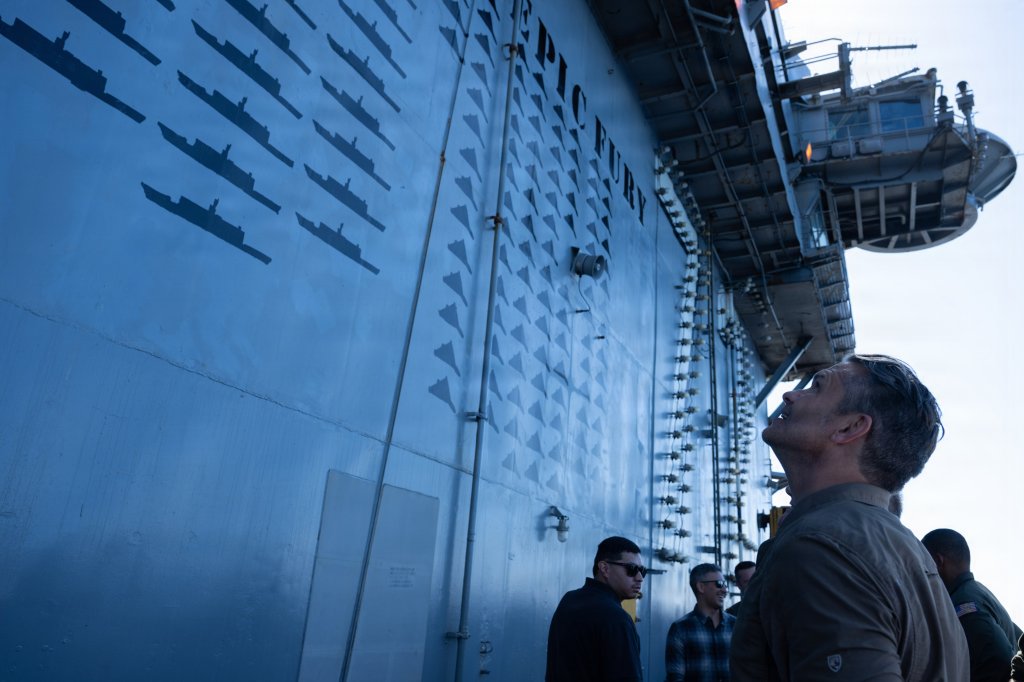
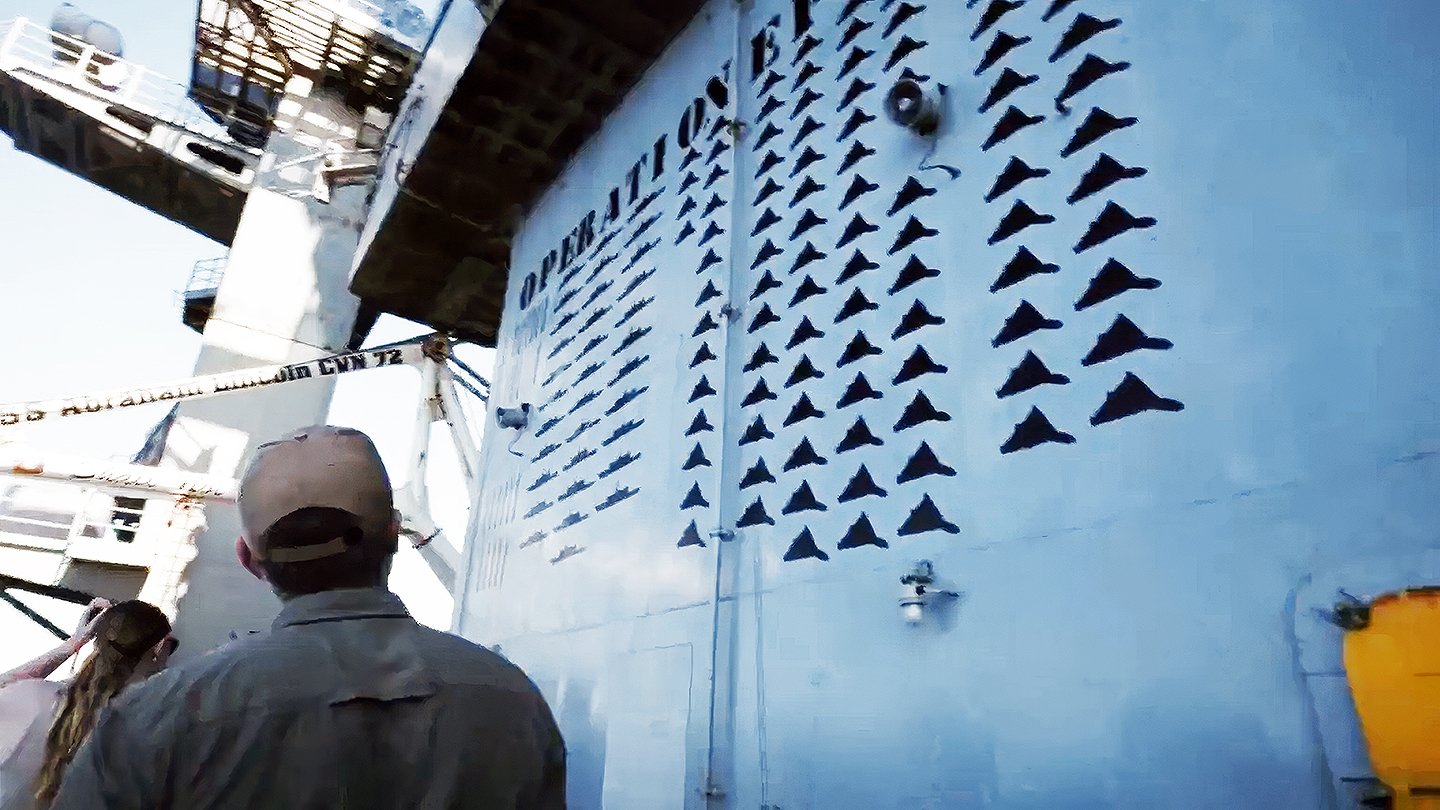
Standing on the deck of the aircraft carrier USS Abraham Lincoln, Secretary Pete Hegseth looked up at the flattop’s superstructure and got a good indication of many of the targets the Lincoln Carrier Strike Group (CSG) destroyed during its six-month fight with Iran. In a photograph shared by the Pentagon’s image distribution site, Hegseth is seen examining a wall of so-called kill marks stenciled onto the superstructure.
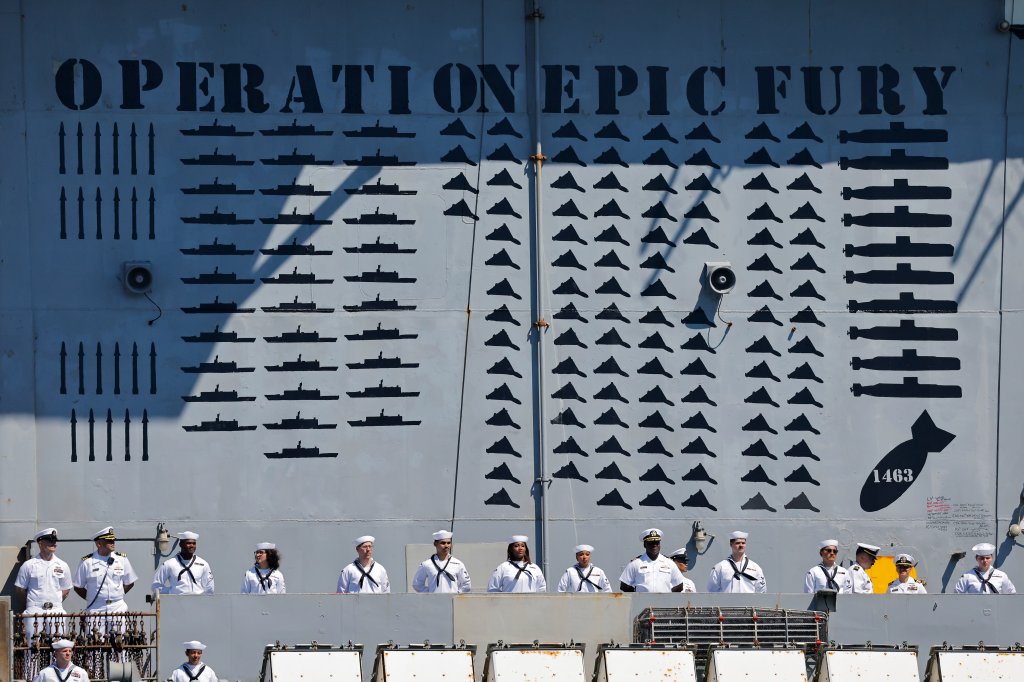
By our count from the image and a video taken during Hegseth’s visit, both of which you can see below, there are 103 one-way attack (OWA) drone kill marks and 34 ship kill marks. These represent the number of each the CSG took out. It is unclear whether there are other kill marks we can’t see.
Though they resemble Shahed-136s, which are the most notorious of Iranian OWA drones, these silhouettes would represent all types shot down, and Iran has many. The same holds true for the ships. The photograph shows stencils of frigates or corvettes but these would be a generic symbol for surface craft kills.
Secretary of War Pete Hegseth visits U.S. Navy Sailors aboard the USS Abraham Lincoln (CVN-72) near San Diego, Calif., Oct. 7, 2026. (DoW photo by U.S. Air Force Staff Sgt. Madelyn Keech) Staff Sgt. Madelyn Keech
On board to welcome the ship and its crew as it headed back to its home port of San Diego after a tumultuous and historic deployment, Hegseth extolled the strike group’s accomplishments. Reading from the Presidential Unit Citation awarded to the strike group for its work during Epic Fury, Hegseth noted that it shot down 77 one-way unmanned attack drones and sank 64 Iranian vessels between the start of Epic Fury on Feb. 28 until it departed the region on Aug. 22.
The Lincoln CSG also conducted 3,693 combat sorties, delivered 1.37 million pounds of ordnance, launched 450 Tomahawk Land Attack Cruise Missiles (TLAMs), destroyed 21 anti-ship cruise missiles and defended against four fast-attack craft and explosive-carrying wooden sailing vessels.
It is unclear at the moment why there are at least 26 more drone kill marks stenciled onto the Lincoln than the number of drones shot down listed in the unit citation and why there are 30 fewer ship kill marks than the tally noted in the citation. The Pentagon referred us to the Navy, and we are waiting for a response from the service.
Kill marks on aircraft embarked aboard Lincoln indicate that the carrier strike group also destroyed several Iranian submarines and other weapons. These were not listed in the unit citation or in any kill marks stenciled onto the Lincoln that we could see.
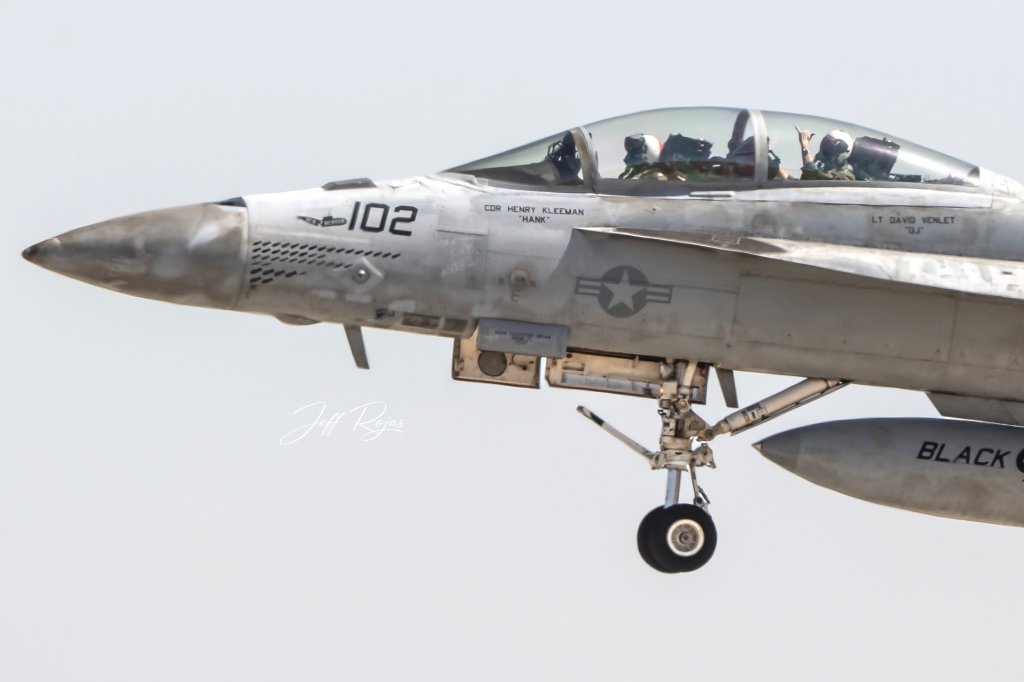
An image provided to TWZ by aviation photographer Jeff Rojas, who goes by the handle @jro_photography on Instagram, shows a submarine kill mark on one of the F/A-18F Super Hornets of the U.S. Navy’s Strike Fighter Squadron 41 (VFA-41), the “Black Aces.” That is one of the aviation squadrons embarked on the Lincoln during Epic Fury.
A close-up look at the broken submarine and other kill marks on one of VFA-41’s Super Hornets. (Jeff Rojas) Jeffrey Rojas
In total, VFA-41 alone launched 421 missiles and bombs during its time supporting Operation Epic Fury. You can find the details in our story about the squadron here.
In addition, an image published by The Aviationist showed “an extraordinary array of target markings on a VMFA-314 F-35C, apparently representing an oil tanker, three submarines, a surface combatant, a Shahed-type drone, an artillery piece, and several ground-based launchers.”
Marine F-35C Also Sports Three Submarine Kill Markings After Operation Epic Fury
An exclusive image obtained by The Aviationist reveals an extraordinary array of target markings on a VMFA-314 F-35C, apparently representing an oil tanker, three submarines, a surface combatant, a…
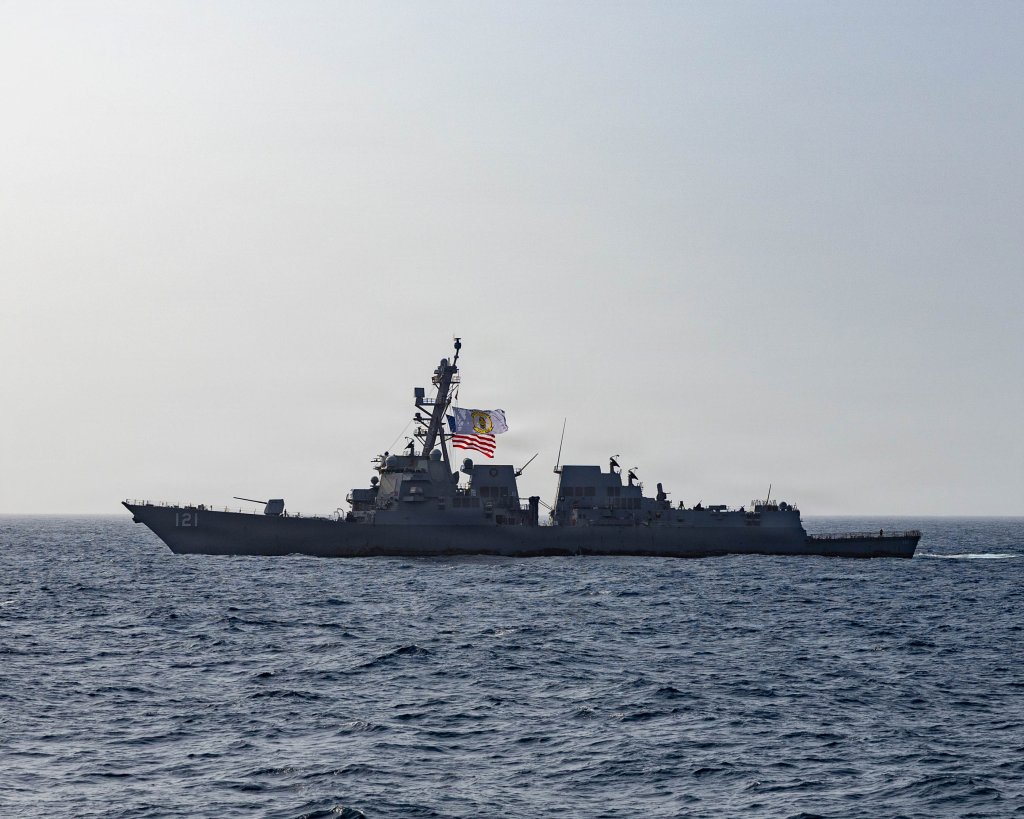
It should also be noted that some of the drone kill marks seen on the Lincoln could have been the result of shootdowns by the carrier’s escorts. The Arleigh Burke class guided missile destroyers USS Frank E. Petersen Jr, USS Spruance andUSS Michael Murphy all serve as critical air defense platforms for the carrier strike group. Those vessels were also the ones launching the TLAMs, as well as potential submarine involvement.
Arleigh Burke class guided-missile destroyer USS Frank E. Petersen, Jr. (DDG 121) transits the Arabian Sea, June 27, 2026. (U.S. Navy photo) U.S. Central Command Public Affa
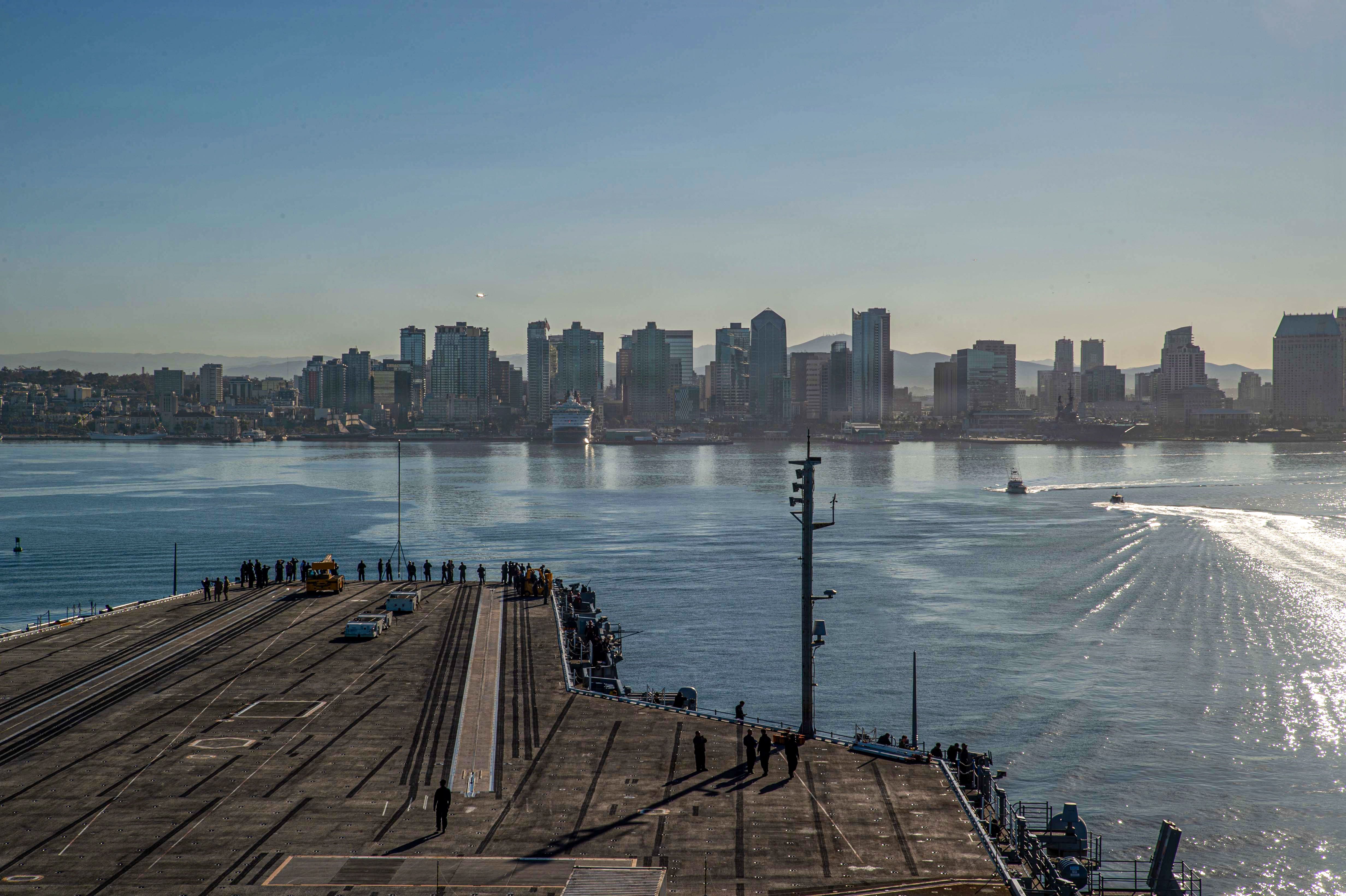
Late Thursday morning local time, Lincoln finally returned home. The carrier departed San Diego on Nov. 21, 2025, and an arrival closed out a total deployment of 321 days, by our count. That’s just shy of the 326-day record USS Gerald R. Ford set in May, representing the second-longest deployment in the modern carrier era.
In addition to racking up successes against Iran, the marathon deployment drew scrutiny over the grueling conditions sailors and Marines experienced aboard. In August, crew families described supply shortages and difficult living arrangements, as TWZreported at the time. The accounts led to widespread media coverage, which Acting Secretary of the Navy Hung Cao called dishonest while also acknowledging that “a small number of mental health cases were treated with no loss of life, meal plans were adjusted when fresh resupply was unavailable, without a single meal being missed, calls home were limited when the operational threat was too high.” At least eight personnel across the strike group attempted suicide during the cruise, Cao wrote in a letter sent to Sen. Kirsten Gillibrand that was obtained by CNN.
The kill mark stencils weren’t the only symbols of Lincoln’s deployment. On Wednesday, Hegseth used symbology to push back against concerns raised about the long journey.
“There were a few folks in the media who tried to turn the USS Abraham Lincoln into some sort of a symbol,” Hegseth said. “A symbol of dysfunction, or a symbol of low morale, or a symbol of a failed mission. And what I look out right here or when I talk to your leadership, and I haven’t had a chance to talk to a number of you, I know it’s the exact opposite.”
UPDATE: 5:59 PM Eastern –
After the Lincoln pulled into its home port, new images emerged. The following picture shows additional kill marks, including 10 of submarines.
Sailors aboard the USS Abraham Lincoln look on as the ship docks at its homeport at Naval Air Station North Island on return from a historic 10-month deployment on Oct. 8, 2026 in Coronado, California. (Photo by Mario Tama/Getty Images) Mario Tama
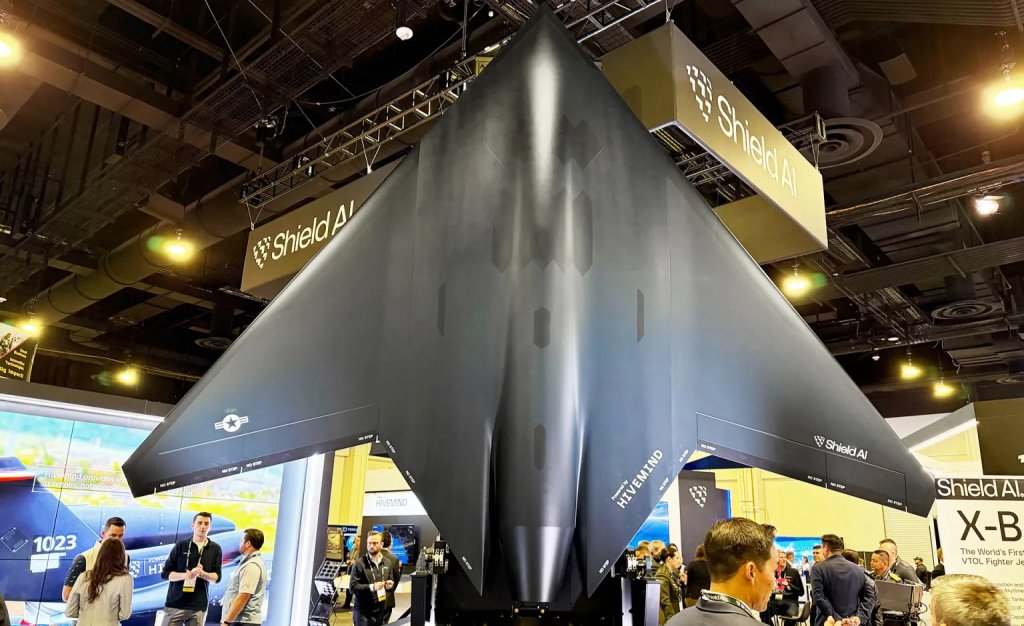
Shield AI says it is on track to roll out the first prototypes of its X-BAT jet-powered stealth ‘fighter’ drone by the end of this month. Flight testing of this uncrewed aircraft, which is designed to take off and land vertically from a tail-sitting position, is still scheduled to kick off before the end of the year. X-BAT’s core concept was already highly ambitious, but an extremely aggressive timeline to reach some degree of operational capability through the U.S. Navy’s Runway Independent Maritime Expeditionary Strike (RIMES) program has now been disclosed.
TWZ got an update on X-BAT, which we were first to report on in-depth last year, in an interview yesterday with Shield AI’s Armor Harris, Senior Vice President and General Manager of the company’s aircraft division. This came ahead of today’s announcement that the company has received an additional $150 million in funding from the Office of the Under Secretary of War for Acquisition and Sustainment through its Defense Exportability Features program via the Navy. This is on top of the $50 million investment the Navy, in cooperation with the Pentagon’s Defense Innovation Unit, made in X-BAT’s development earlier this year as part of the RIMES effort. Shield AI has committed an equivalent amount of internal funding, for a combined total of $400 million.
Jamie Hunter
“In broad strokes, the last year has been a bunch of collaborative risk reduction with the Navy. So, wind tunnel testing, engine testing, thermal testing, all kinds of stuff to basically take the major risks in the program, [and] burn them down, so we can move confidently into the production design,” Shield AI’s Harris told us. “The last culmination of the risk reduction is the flight testing of the two full-scale prototypes. The first one of those will be done at the end of October.”
“That’s a full-scale vehicle,” he continued. “It’s got the outer mold line, it’s got the F110 engine, the full propulsion path, everything in it.”
To date, Shield AI has only shown models of the X-BAT publicly. A new one displayed at the Navy League’s Sea-Air-Space 2026 exposition in April revealed major changes to the core design. This included a complete reworking of the planform from a ‘cranked kite’ type arrangement to one with a distinctly different arrowhead-shaped profile featuring a straight leading edge with a more dramatic sweep.
The video below includes clips showing the original X-BAT design and the current one.
The aforementioned “propulsion path,” testing of which has already been conducted on the ground, primarily consists of the General Electric F110 paired with an Axisymmetric Vectoring Exhaust Nozzle (AVEN). The nozzle was originally developed in the 1990s for an experimental thrust-vectoring F-16 fighter. Shield AI is using the original AVEN, which had been in storage for decades, to support development of X-BAT. The nozzle will provide pitch and yaw control, with roll control for the drone coming from bleed air routed through thrusters in the drone’s wings.
No runway, no problem.
Shield AI and @GE_Aerospace just cleared a critical path to vertical flight, completing engine light-off testing of the Axisymmetric Vectoring Exhaust Nozzle (AVEN) for X-BAT.
Shield AI has previously said that the roughly fighter-sized X-BAT will have a maximum range of 2,000 nautical miles and a service ceiling of around 50,000 feet. The company has also said in the past it is targeting an effective combat radius roughly twice that of the F-35, or around 1,340 nautical miles, but also that it could be closer to 1,000 nautical miles. Space has been made within the X-BAT design for a potential in-flight refueling capability, but there is no active work yet to integrate that feature.
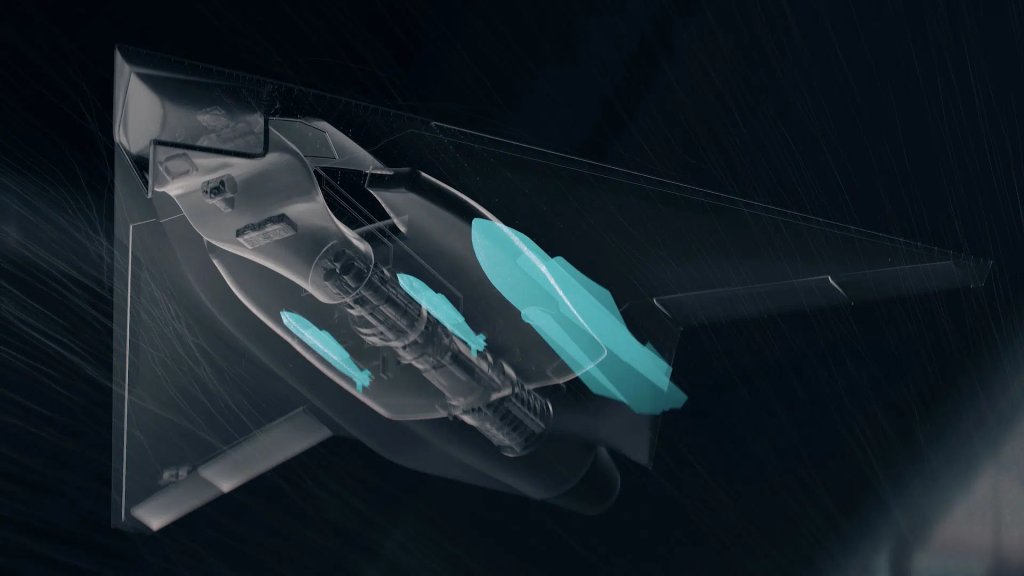
In terms of payload, X-BAT’s design includes internal weapons bays roughly the same size as those on the F-35, as well as two external hardpoints under the wings. Those hardpoints are plumbed, meaning that range-extending drop tanks, or even buddy refueling stores to allow the drone to act as a tanker, could be carried. Baked-in modularity and open-architecture mission systems are intended to make it easier to fit various sensors, data links, and other capabilities down the line.
A rendering highlighting X-BAT’s stores carrying capabilities. Two AGM-154 Joint Stand-Off Weapon (JSOW) glide bombs are depicted here in the internal bays. The silhouette of an AGM-158C Long Range Anti-Ship Missile (LRASM) cruise missile is shown under the wing. Shield AI
“X-BAT’s really designed to be a multi-role capability, and, if you look out at the 10-20 year time horizon, it’s hard to predict what the future fight is going to look like,” Shield AI’s Harris noted. “We fundamentally believe that multi-role capabilities are critically important. And, so, X-BAT, the reason why it’s sized to where it is is [sic] to be able to carry serious strike weapons internally and externally, in addition to being able to do air-to-air [combat], electronic warfare, and other mission sets.
“You could think of it as like X-35 versus F-35,” he also said yesterday when asked about any expectations now for further changes between the initial pair of prototypes and the final production design.
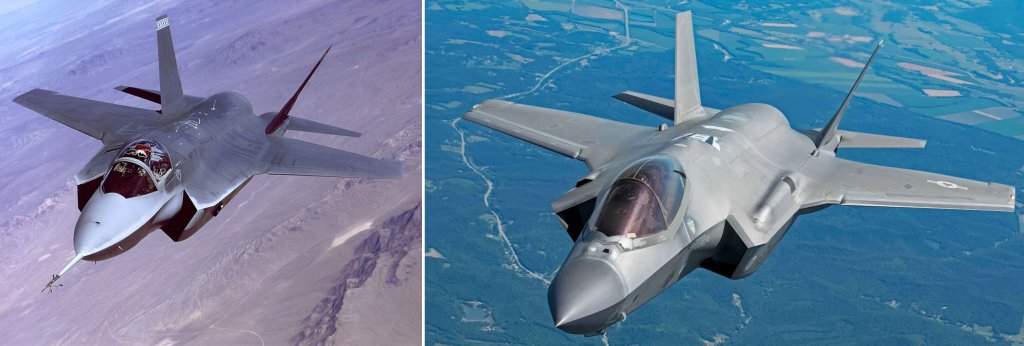
Lockheed Martin’s X-35 demonstrators are, in very broad strokes, similar to, but distinct from any of the resulting variants of the Joint Strike Fighter. Shield AI has notably already talked in the past about integrating more low-observable (stealthy) attributes to the exhaust end of the design down the line.
A side-by-side look at an X-35 demonstrator, at left, and a production F-35A, at right. USAF
“Then we’ll get into flight testing around the end of this year,” Harris added. “We’ll be doing vertical takeoff and landing testing with that [the initial prototypes] to actually prove out and develop the VTOL [vertical takeoff and landing] technology for X-BAT.”
Shield AI’s X-Forge 2 facility at the Newton City-County Airport in Kansas is set to be the main flight testing hub for X-BAT, as well as the focal point for sustainment of the drones. A production facility, X-Forge 3, is also being built in Des Moines, Washington. The company’s original site, X-Forge 1, is in Frisco, Texas.
A rendering of the X-Forge 2 facility. Shield AI
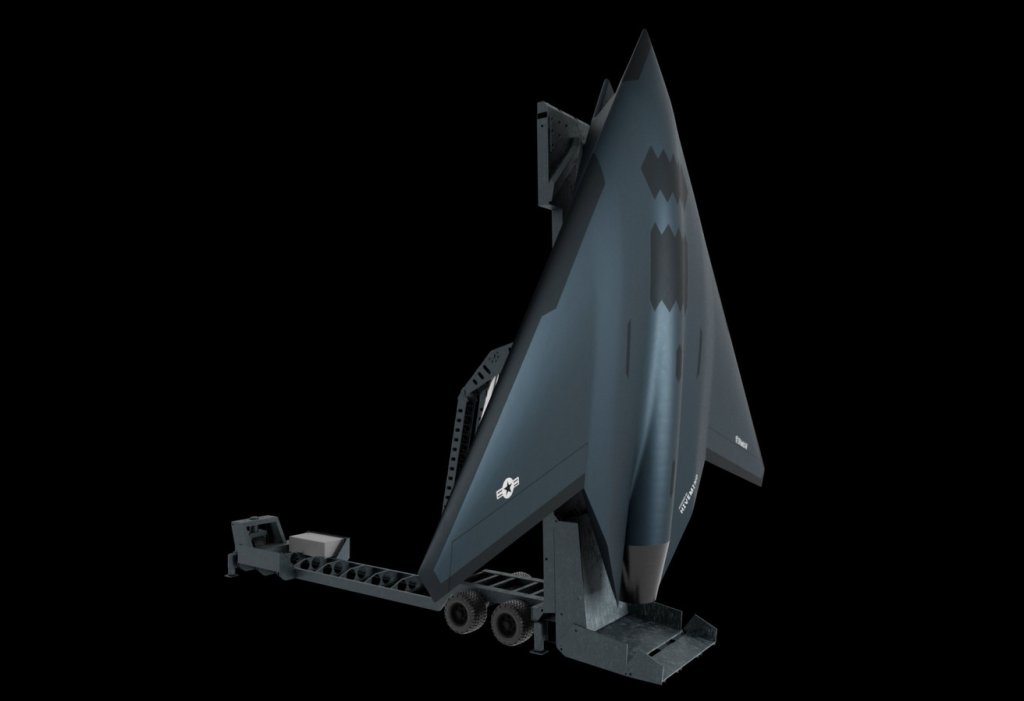
In terms of the actual flight test campaign, “you remember the X-BAT system has the air vehicle and the launch and recovery vehicle, which is the trailer that it launches and lands from,” Harris said. “Basically, the way the testing works is, we start with the vehicle horizontal, sitting on that launch and recovery vehicle, running the engine. Then we bring it up vertical, run the engine vertically, run the vehicle vertically.”
“Then we have one of the biggest cranes in the world that’s getting set up at our test site in Kansas right now, and we hang the vehicle suspended from that crane and do a bunch of testing while it’s hanging from the crane in free flight,” he continued. “Then we take the crane away, and then we do the actual untethered flights.”
Shield AI’s goal is to fly a fully missionized X-BAT in 2028 and start series production the following year.
A rendering of the X-Forge 3 production facility being built in Des Moines, Washington. Shield AI
On top of that, “the way that the [RIMES] program has been structured is getting to an early operational capability in 2029 is the end goal,” Shield AI’s Harris said.
When asked if this meant that RIMES is aiming “to eventually arrive at not just a demonstration of capability, but a real operationalized capability,” he said that was “correct.”
We will come back to this more later on, but suffice it to say up front, the prospect of X-BAT reaching an operational level of maturity within three years is extraordinarily ambitious, to say the least.
In the meantime, Shield AI has already been testing the mechanisms to “latch and unlatch” X-BAT to the launch and recovery system using an unpowered “battleship” test article, according to Harris. The design of the launch and recovery system has also evolved, and it is now self-propelled, at least to a degree, rather than just being a towed trailer.
“The launch and recovery vehicle is actually critical to the operation of the X-BAT weapon system because it enables survivability on the ground. So when you’re operating in a land-based environment, it enables basically shoot-and-scoot tactics,” Harris also noted. “Enemy transporter-erector-launchers [for missiles] are like pretty hard to find because they’re constantly moving around. Just like X-BAT, when it’s mated onto the launch and recovery vehicle, [it] is always moving around, makes it hard to track, hard to find, hard to destroy.”
A rendering of an X-BAT on a launch and recovery trailer in the fully erected position. Shield AI
The plan now is to “build the one-to-one launch and recovery vehicles to air vehicles. So the air vehicle is always on the trailer. It never comes off of it,” he continued. “Even maintenance to the air vehicle is done while it’s sitting on that launch and recovery vehicle.”
“In fact, we’re actually planning on building more than one-to-one of the launch and recovery vehicles, so that way you can preposition them around different islands, different places in the theater, and have multiple places the aircraft can lily pad from,” he added. “But you’re never putting multiple aircraft onto one launcher and launching them or something like that.”
“When you typically operate a jet, there’s a whole bunch of ground carts and stuff that you bring, like the ground power cart, the ground cooling cart, the air start cart, etc,” Harris further elaborated. “So we’ve moved a lot of those systems onto [the] launch and recovery vehicles, so you don’t have all these separate carts, which is pretty critical when you’re trying to do expeditionary operations.”
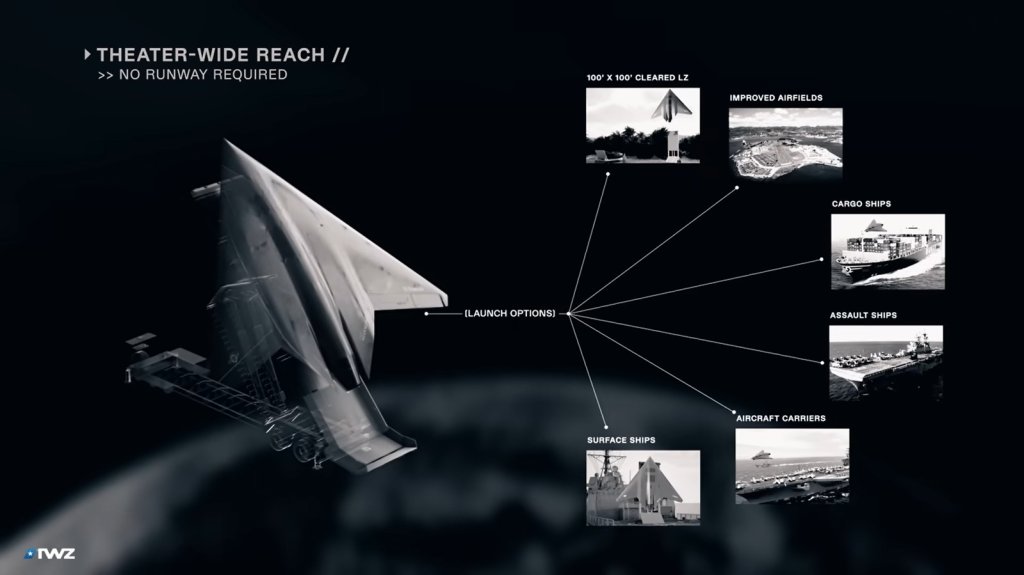
“The model for land-based operations is kind of a hub-and-spoke type model. So the squadrons are based at air bases. All the fuel and the weapons are generally based at the air bases, as well. But then you can distribute the aircraft all over the airfield,” he continued. “So, you think about what the enemy’s doing, they’re targeting the runways, they’re targeting the tarmacs, but you can disperse the aircraft around the perimeter of the airfield. You can launch them from the golf course. You can launch them from empty space in the taxiway, etc.”
A graphic highlighting various options for deploying X-BATs on land and at sea. Shield AI
Harris said that another “spoke” could be X-BATs operating from forward arming and refueling points (FARP). All of this is part of larger concepts of operations for the drone that Shield has been envisioning, and that are not at all limited to deployments at locations on land. Harris noted during the interview that the self-propelled nature of the current launch and recovery system would also help with moving the drones around on virtually any ship with sufficient deck space. This is where the RIMES program, which is separate and distinct from the U.S. Navy’s carrier-based Collaborative Combat Aircraft (CCA) drone ambitions, really comes in.
“I’ll say the fundamental value proposition of RIMES is that if you have a carrier-based CCA, you’re fundamentally constrained by the square footage of the deck of the aircraft carrier,” Harris explained. “So if you are taking an F-18 or an F-35 off, you better be replacing it with better capability per square foot of deck space than the thing that you’re taking off.”
“So, F/A-XX [the Navy’s sixth-generation carrier-based fighter, now to be built by Boeing] is a huge leap in capability, right? Which is why that program makes a lot of sense,” he continued. “The challenge with CCA is: Does it really make sense to take a manned aircraft off of an aircraft carrier and replace it with an unmanned aircraft?”
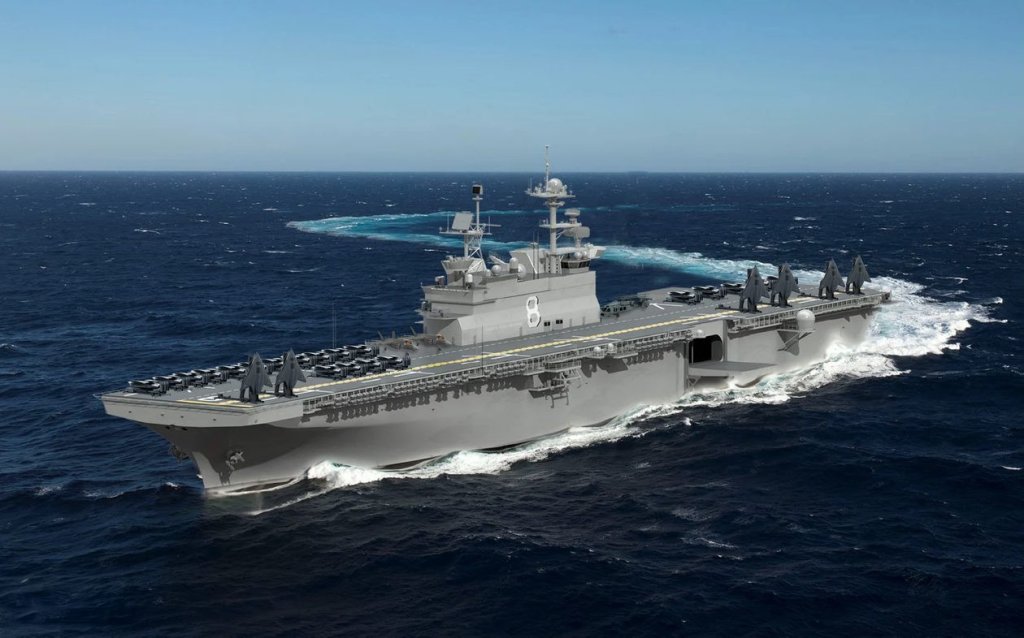
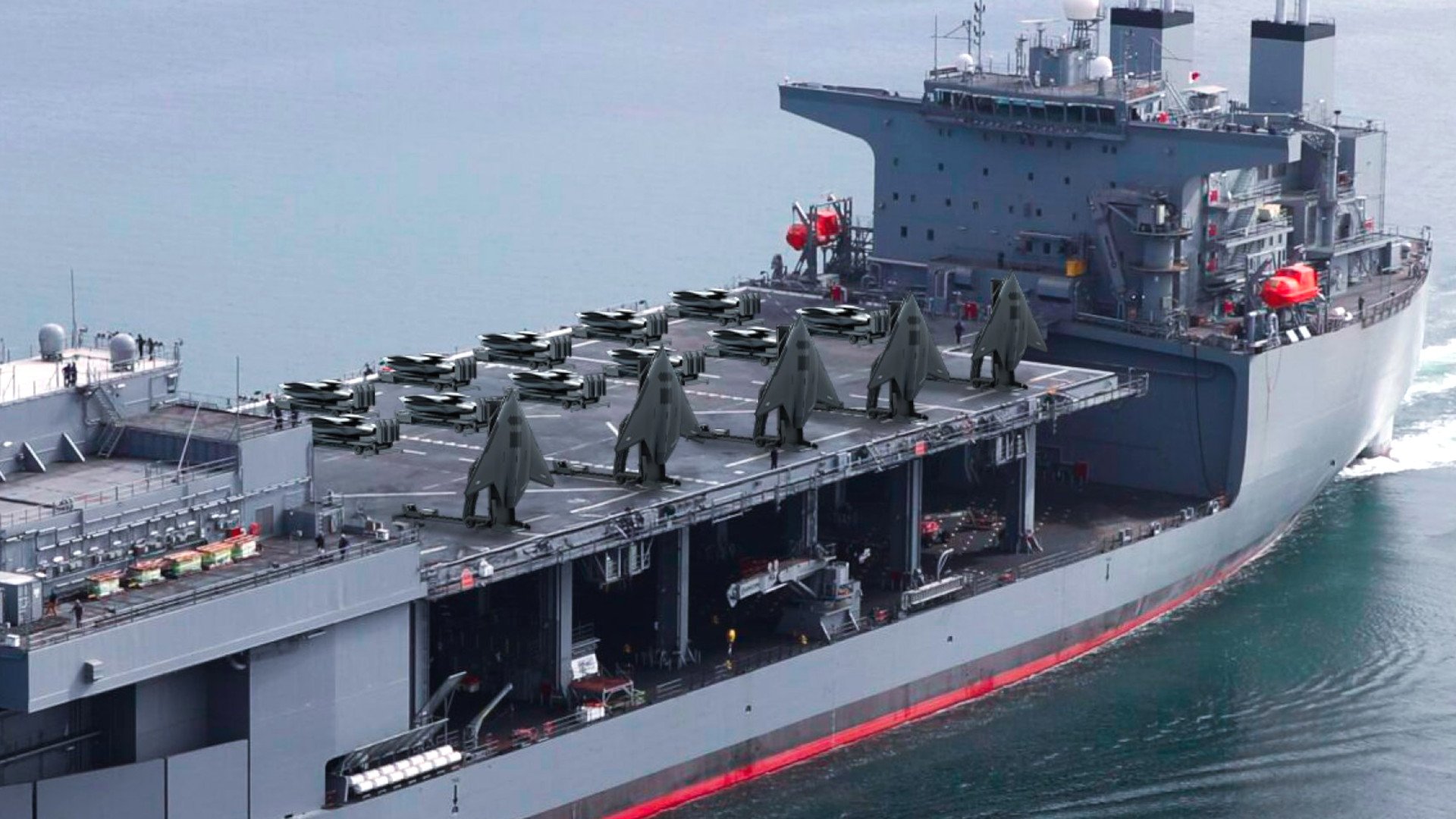
Shield AI’s argument here is that X-BAT disrupts this core equation by opening the door to a CCA-like capability, or even something more capable, that can be employed in a ship-based mode without sacrificing any crewed aircraft capacity on an aircraft carrier. Shield AI envisions dozens of X-BATs being employed from amphibious assault ships, as well as other kinds of amphibious warfare ships, including expeditionary sea base type vessels, as seen at the top of this story.
A rendering depicting X-BAT drones on the deck of the US Navy’s future America class amphibious assault ship USS Bougainville. Shield AI
“So when you think about the number of carrier air wings that the Navy has to deploy, deploying X-BAT across all these other ships basically significantly increases the number of carrier air wings,” Harris said.
As already mentioned, the current structure of the RIMES includes a target for an early operational capability in 2029, according to Harris. “We have a program defined to get there, and there’s basically milestone-based payments along the way, so as Shield performs and hits milestones, then the Navy kicks in additional funding,” he added.
“I don’t want to get ahead of the Navy, and give you a specific number, but like hundreds to low thousands,” he also said when asked if there was even a very rough planning figure for the eventual size of the RIMES drone fleet.
Many questions remain about X-BAT, which still has to demonstrate the viability of its vertical takeoff and landing capability, which underpins everything else. As we noted in our original in-depth report on this design, the core concept here is not new, and there have been many unsuccessful attempts to operationalize it in the past. There has been skepticism that Shield AI’s effort will succeed where others have failed. The company is of the view that groundwork has now been more firmly laid, including through its own work with its much smaller internal combustion-engine-powered V-BAT tail-sitting VTOL drone, to truly realize a design of this kind.
The performance and capabilities that Shield AI expects from X-BAT once it is flying at all are also ambitious. A high degree of autonomy is also part of the full planned package, which will leverage the company’s already extensive work in this domain with its Hivemind software.
There are also questions about the Navy’s exact plans for RIMES, as well as its broader future drone fleets. Just this year, the service has issued several contracting notices pointing to rapidly evolving views about future carrier-based strike drones and other uncrewed aircraft. New requirements that Naval Air Systems Command (NAVAIR) released in August ostensibly for future CCA-type drones notably pointed more toward something that sounded very much like an advanced uncrewed combat air vehicle (UCAV), as you can read more about here.
Whether the 2029 operational timeframe the Navy is said to be aiming for under RIMES is firm, or even realistic in any way, remains to be seen. The actual definition of what constitutes an “early operational capability” could be very flexible, as well. It is also worth noting here that Shield AI is not the only company currently conducting work under RIMES. Whether the Navy might be planning to acquire more than one design through this program is unclear. We have reached out to the service for more information.
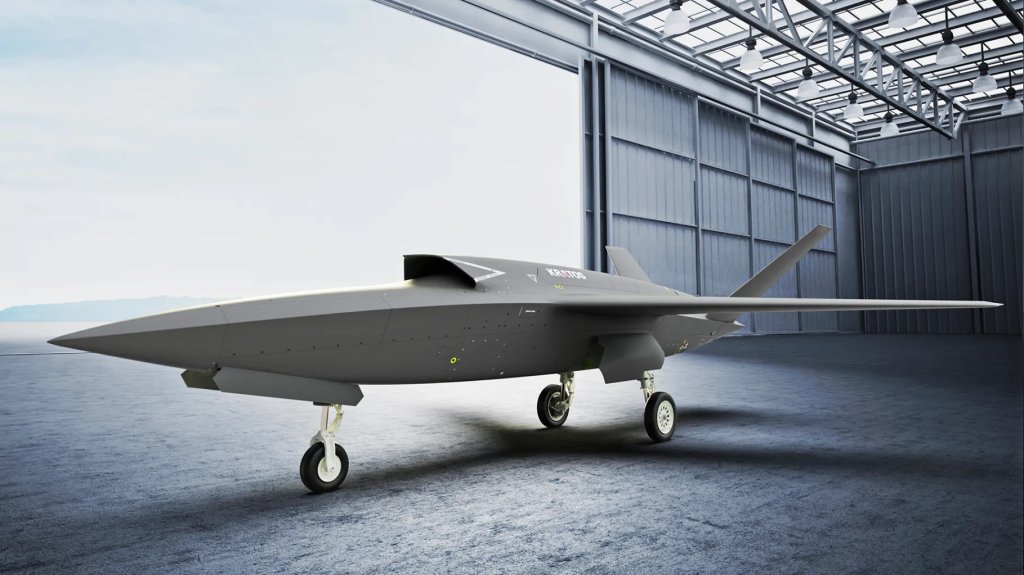
Other services could be interested in any operational capability produced through the RIMES effort, too. TWZ regularly highlights how runway-independent drones would be particularly well-suited to the U.S. Marine Corps’ new expeditionary and distributed concepts of operations. That service is already in the process of acquiring MQ-58B Valkyrie drones from Kratos that will be able to operate from conventional runways. They will also be capable of runway-independent launches, though they will still have to land conventionally. The baseline Valkyrie design lands via parachute.
A rendering of a landing gear-equipped version of the Valkyrie in line with what the Marines are now acquiring. Kratos
In general, runway independence is of growing interest elsewhere across the U.S. military as threats to large, established bases continue to expand in scale and scope. The proliferation of various tiers of weaponized drones is a particularly significant factor in this, asTWZ just examined in detail this week in the context of the recent withdrawal of B-1 bombers from RAF Fairford in the United Kingdom. Ever more capable cruise, ballistic, and hypersonic missiles are also part of the full threat picture.
The conflict with Iran has also underscored the limits of what can be gained survivability-wise by dispersing traditional fixed-wing aircraft, especially within an existing airbase. As highlighted earlier, X-BAT could be dispersed very differently to nearly anywhere within a facility that can handle the thrust from the F110 engine in hover.
As it stands now, we are set to get our first view of a full-sized X-BAT prototype within the next few weeks as Shield AI continues to gear up for the start of actual flight testing before the end of the year.
Russia's seaborne exports of refined oil products rose to a three-month high in September, but the growth came from cheaper fuel oil and naphtha as diesel shipments fell to their lowest in more than a decade, Bloomberg reported, citing Vortexa data. Russia kept diesel at home after Ukrainian refinery strikes and paid oil companies to supply its pumps, while high crude prices lifted its crude export earnings.
During the ongoing deep-strike campaign, Ukraine's long-range drones have knocked out more than half of Russia's oil refining capacity, Kyiv says, and Russia's budget oil revenues are falling even as it raises war spending. High global crude prices are softening that blow.
Cheaper fuel out
Total seaborne product exports reached about 1.17 million barrels a day in September. Fuel oil shipments rose 6% to about 613,000 barrels a day, the highest since April. Naphtha, a feedstock for petrochemicals, jumped 35% to 363,000 barrels a day. Exports of refinery feedstocks, including vacuum gasoil, rose to about 32,000 barrels a day, according to Bloomberg.
The trade has moved north. Almost 80% of fuel oil cargoes left from Baltic ports, and naphtha loadings there rose almost 50% as Ukrainian attacks disrupted Black Sea infrastructure. In September, Ukraine reported hitting an oil terminal in Novorossiysk, Russia's main Black Sea oil port—one in a string of attacks on Russia's Black Sea ports and oil sites.
Explore further
More than 500 drones by Moscow’s count: Kh-101 fuel plant, second Yandex data center, and a far-north refinery hit
Diesel kept at home
Diesel and gasoil exports fell 28% to 144,000 barrels a day, the lowest monthly volume in Vortexa data going back more than a decade. Russia has restricted diesel exports to protect domestic supply after Ukrainian attacks on its refineries. Drones kept hitting them into October, from a Lukoil refinery in Volgograd to Gazprom's Salavat complex in Bashkortostan.
In September, Russia paid oil companies the biggest subsidy in more than four years to keep road fuel on the domestic market. It also imported about 350,000 tonnes of motor fuel by sea, mostly gasoline from India, Morocco, and Türkiye, Reuters calculations showed. Officials are considering letting some producers resume diesel exports in October to avoid overstocking, according to Interfax.
The diesel squeeze has reached the White House. US President Donald Trump stated on 30 September that diesel was hurt "not by the Middle East, but by what's going on in Russia, because those diesel refineries are being knocked out at a pretty alarming rate."
Crude carries the revenue
Russia's crude exports reached about 3.99 million barrels a day in the week to 27 September, and the estimated value of its seaborne crude shipments neared its highest since the full-scale invasion began, Bloomberg reported. Brent crude traded at about $102.60 a barrel on 9 October, according to Trading Economics data.
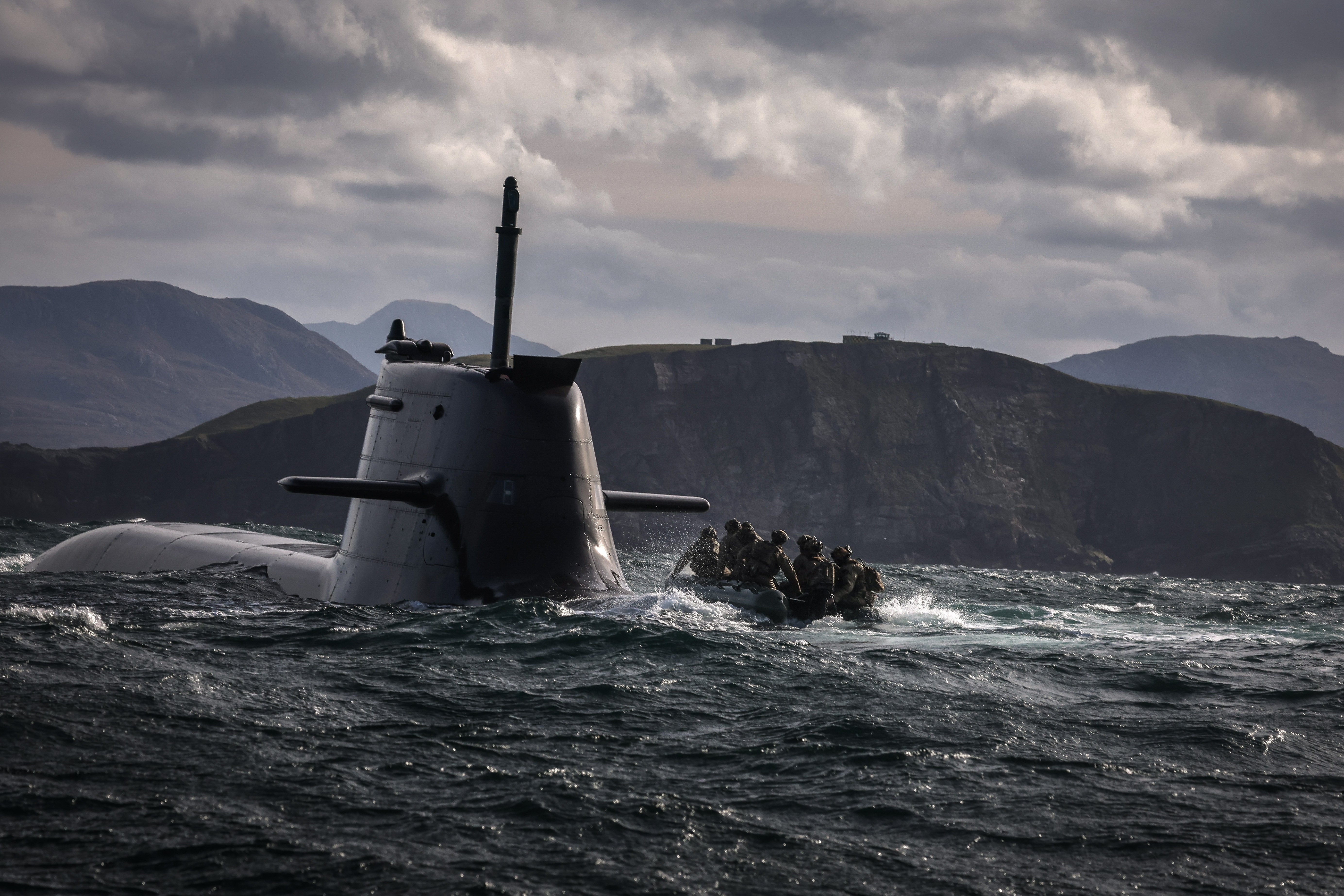
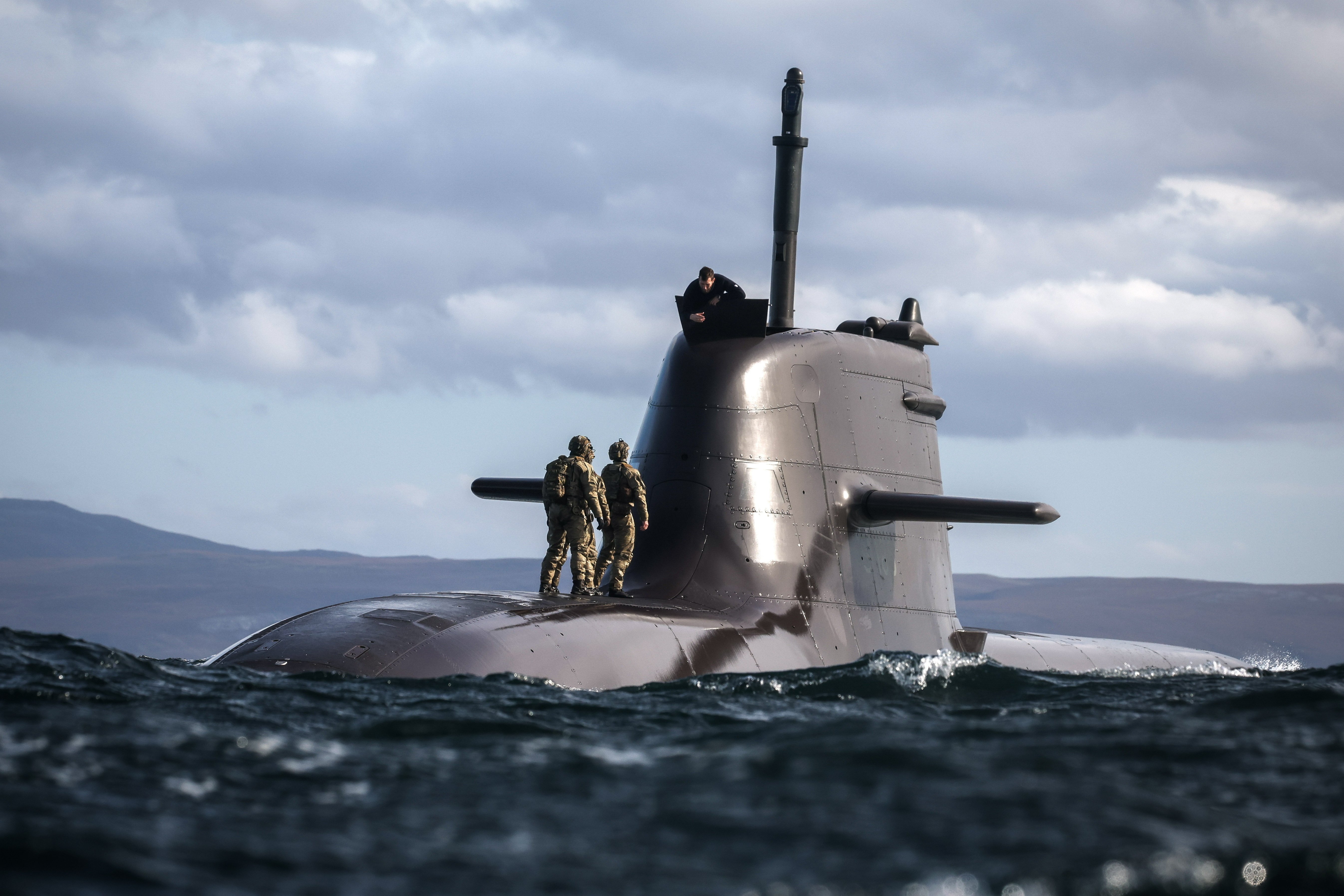
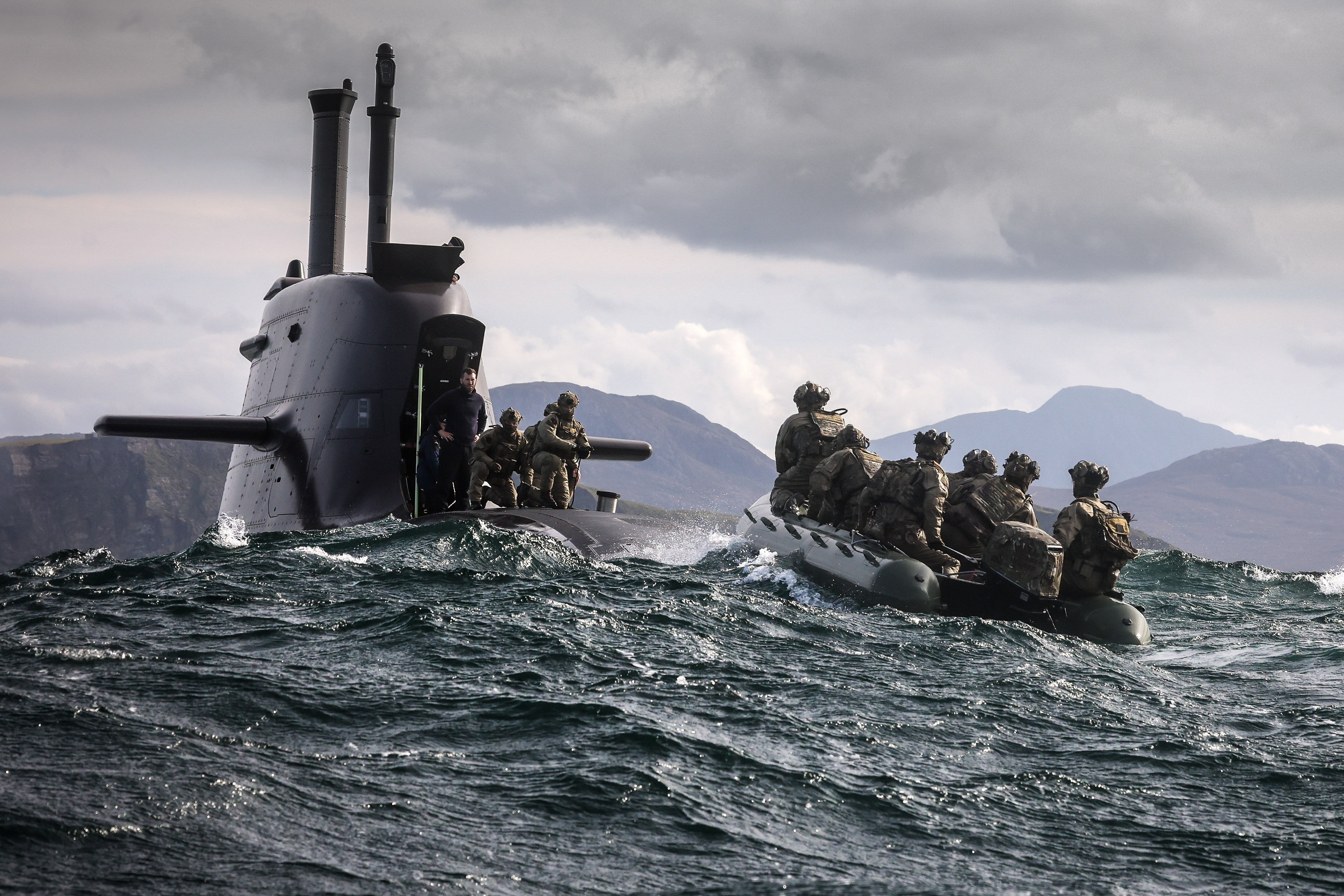
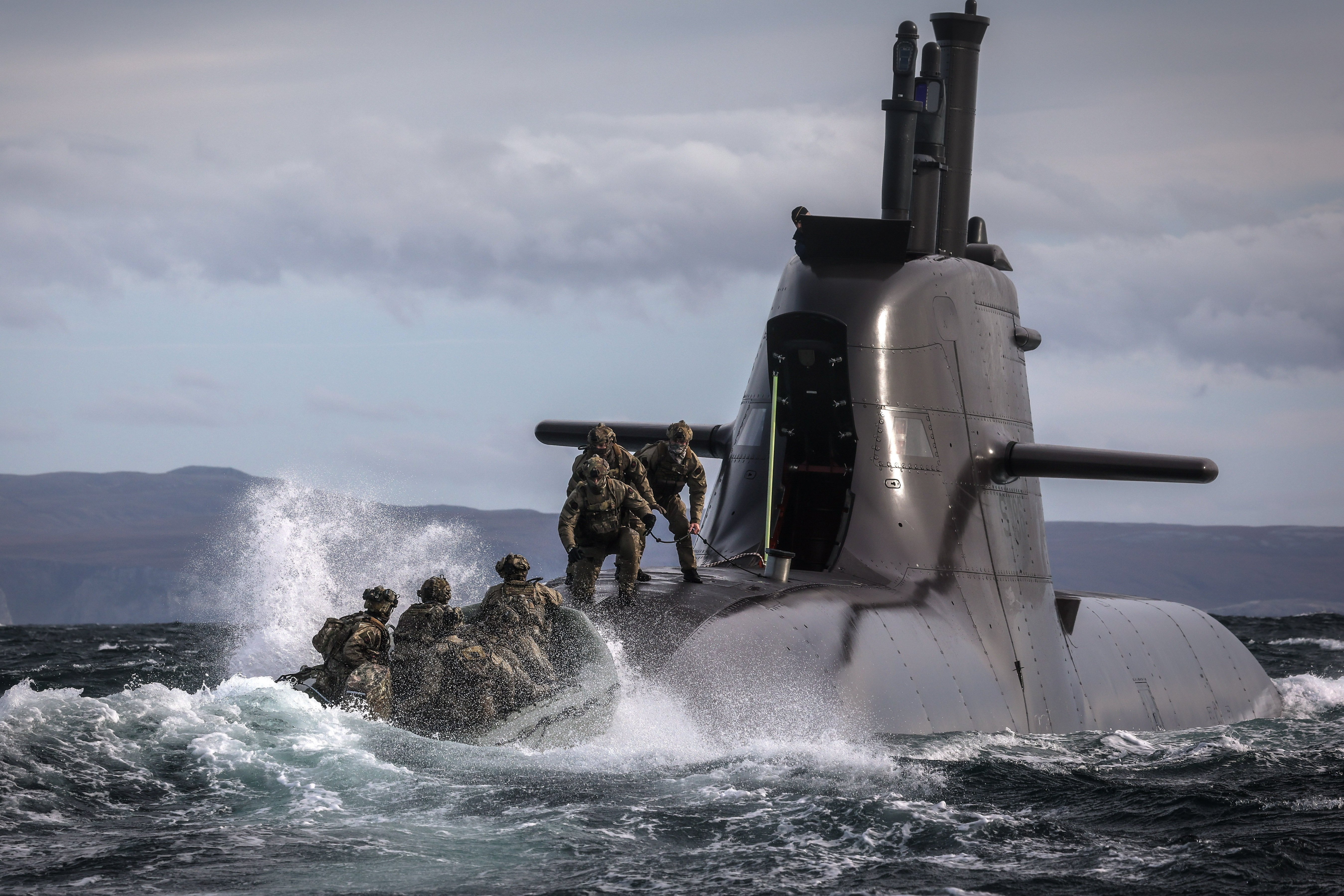
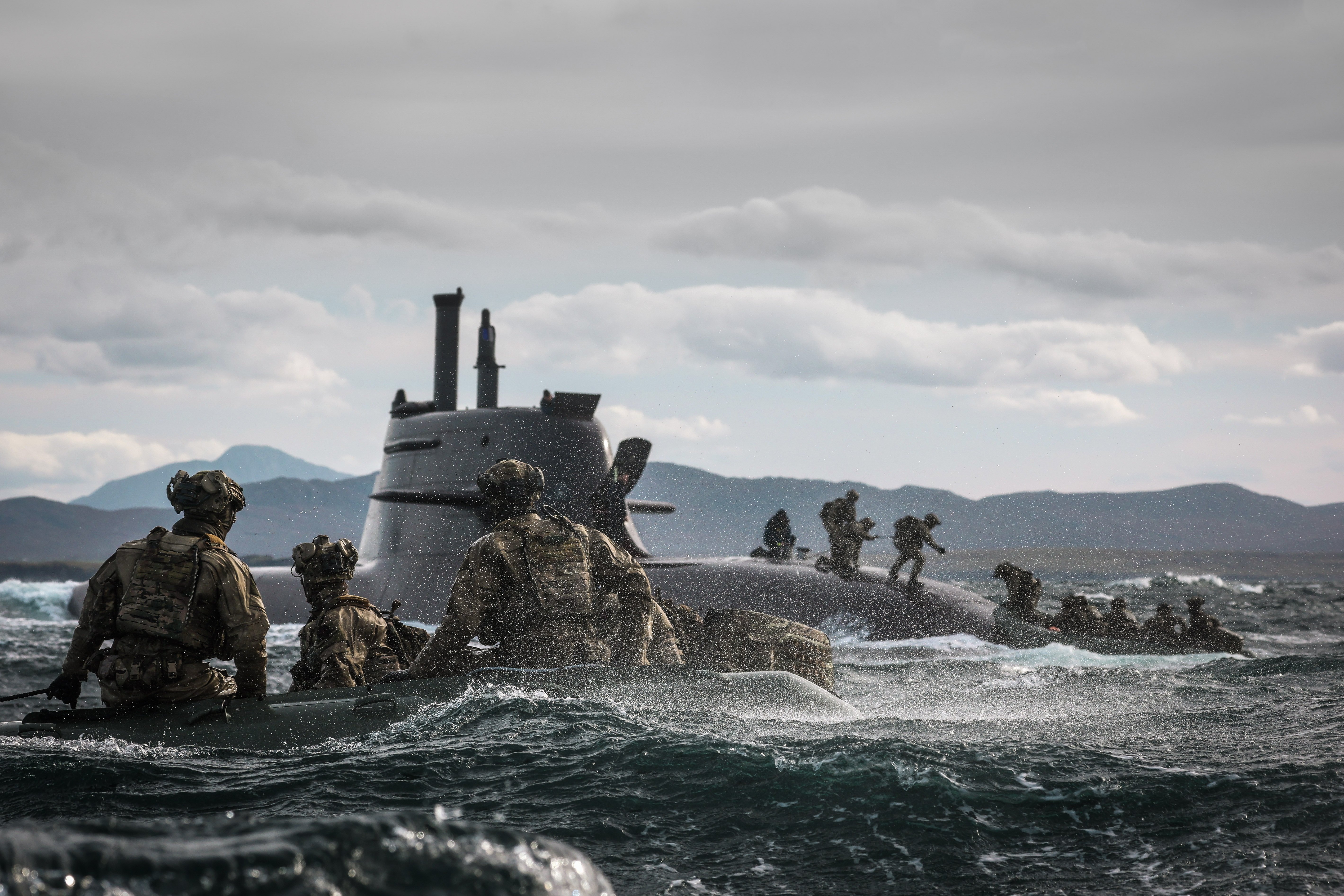
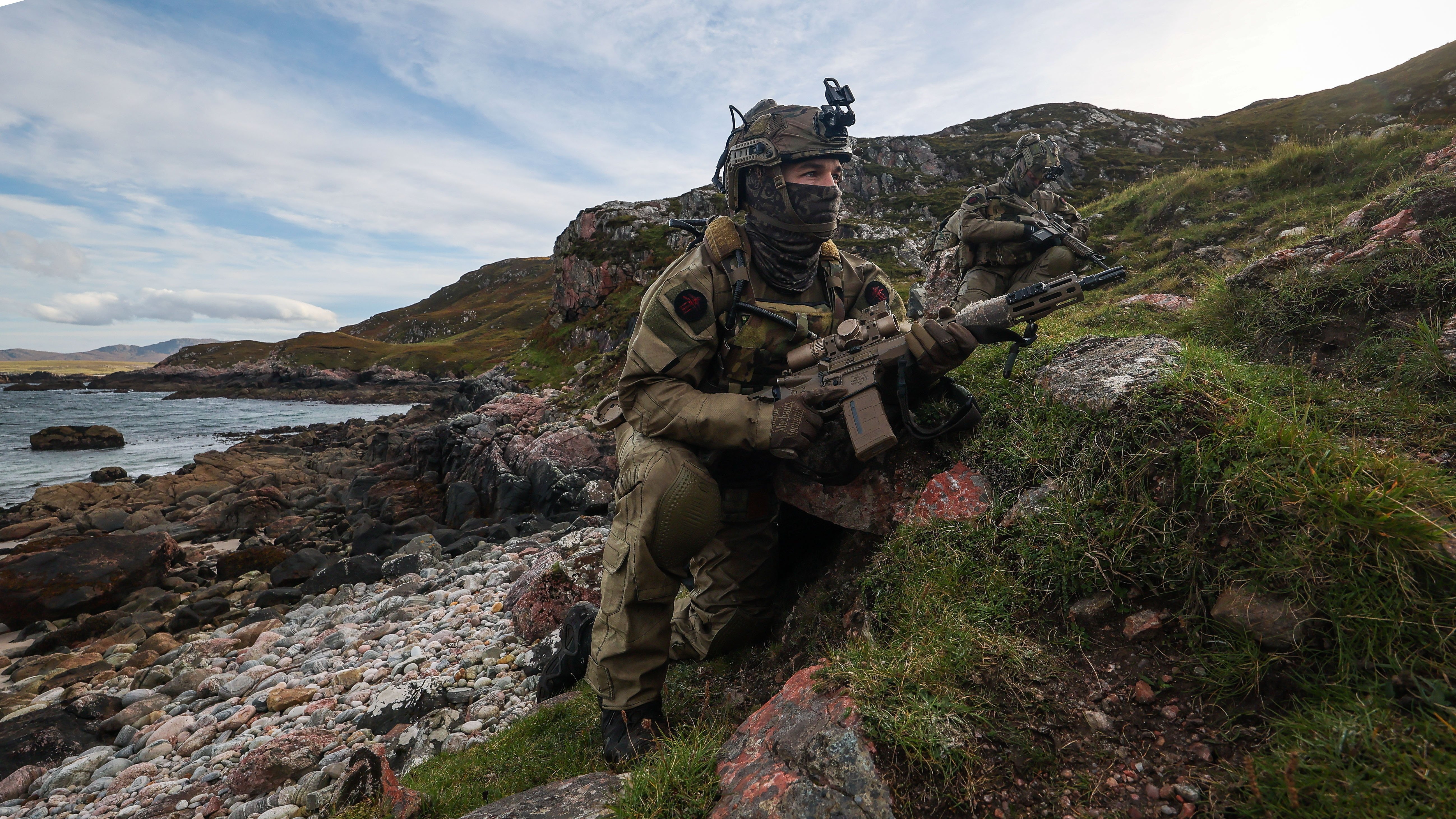
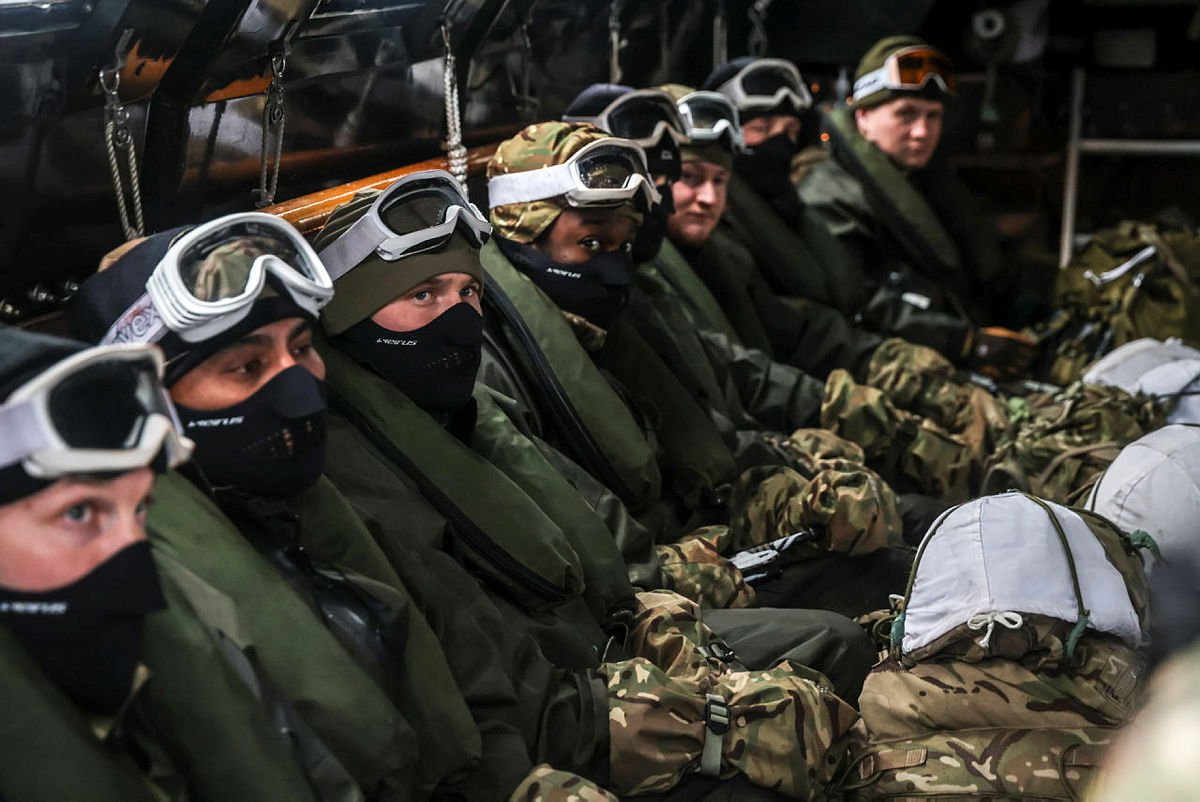
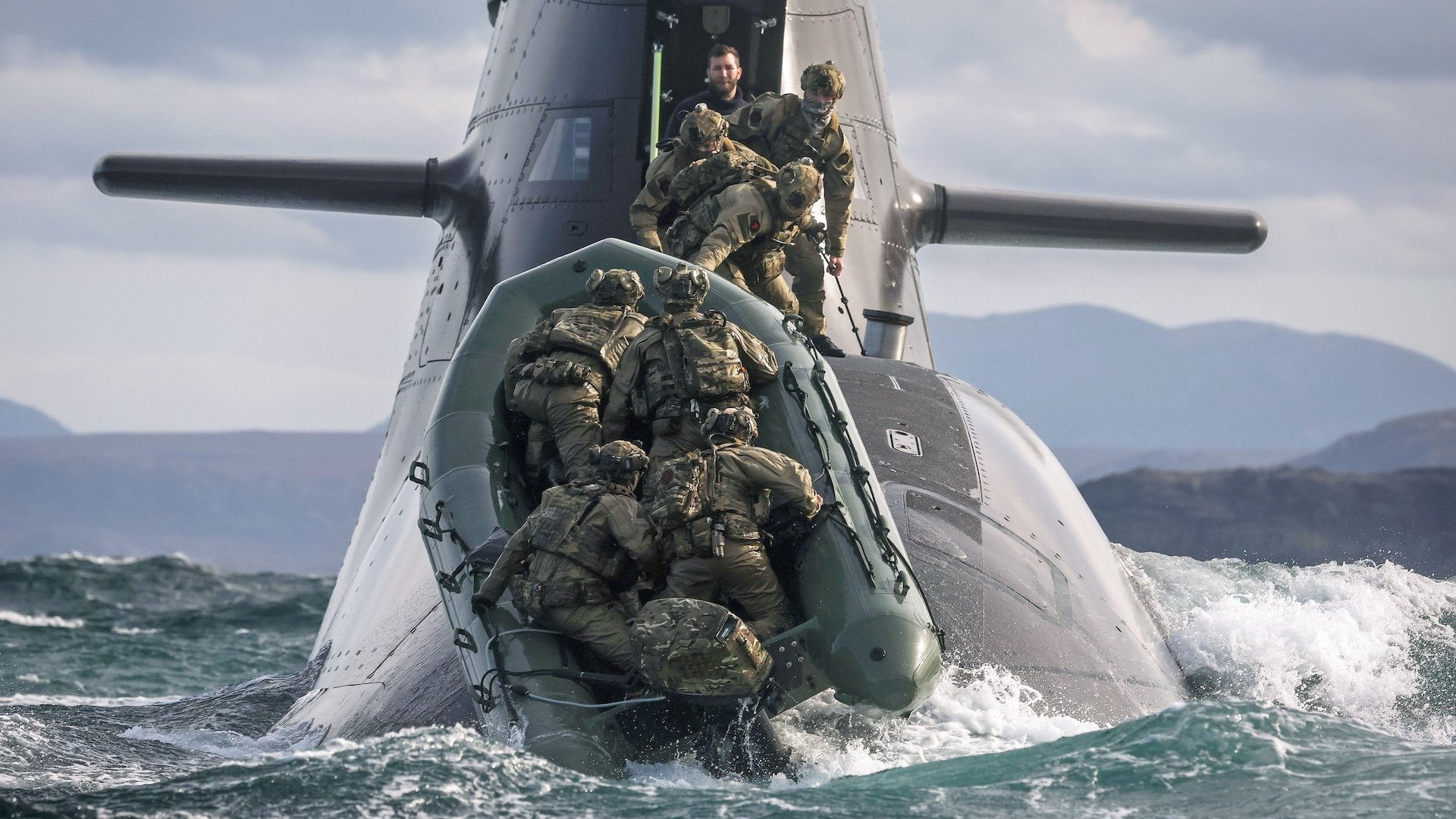
As part of the largest U.K. Commando Force exercise in 15 years, British special operators conducted a submarine insertion off Scotland, making use of a German Navy Type 212A — a boat you can read about in detail here. The maneuvers are the first time since the war in Afghanistan that all of the Commando Force’s specialist elements have operated together. The submarine insertion, conducted at Cape Wrath on September 29, is part of Exercise Strike Warrior, a major NATO drill intended to rehearse allied crisis-response and warfighting operations across the North Atlantic and High North.
The U.K. Royal Navy-led Commando Force specializes in amphibious, littoral, and expeditionary operations. It brings together Royal Marines commandos with specialist elements including reconnaissance, intelligence, targeting, artillery, logistics, and medical capabilities. The force is increasingly focused on smaller, dispersed teams operating across contested littoral environments.
Including elements of the Commando Force, more than 2,000 personnel from the United Kingdom, United States, Germany, Netherlands, Canada, and Norway are currently participating in Strike Warrior, with eight warships and 19 aircraft involved in activity spanning Scotland, the Western Isles, the North-West Approaches, Galloway, the Borders and the North Sea.
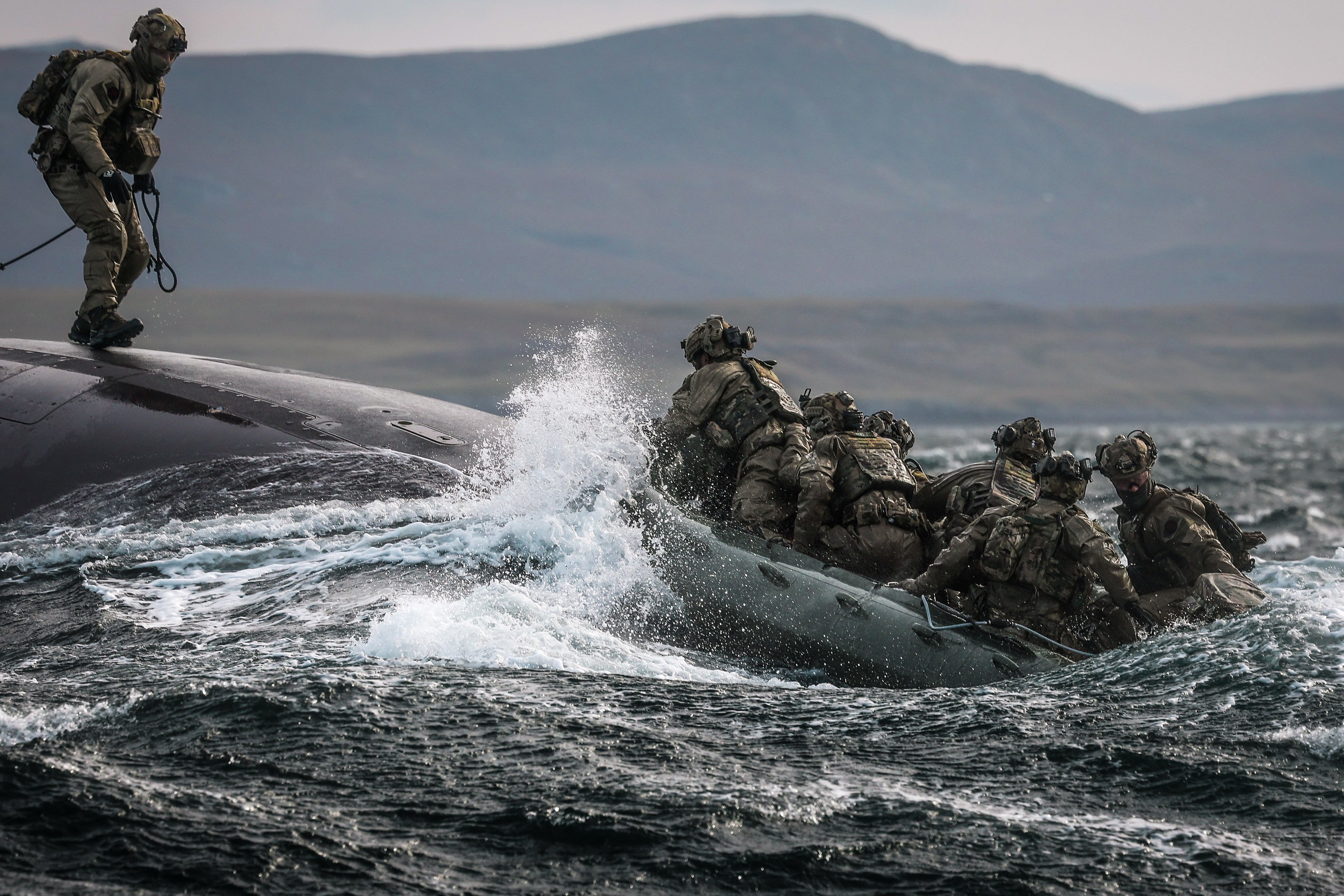
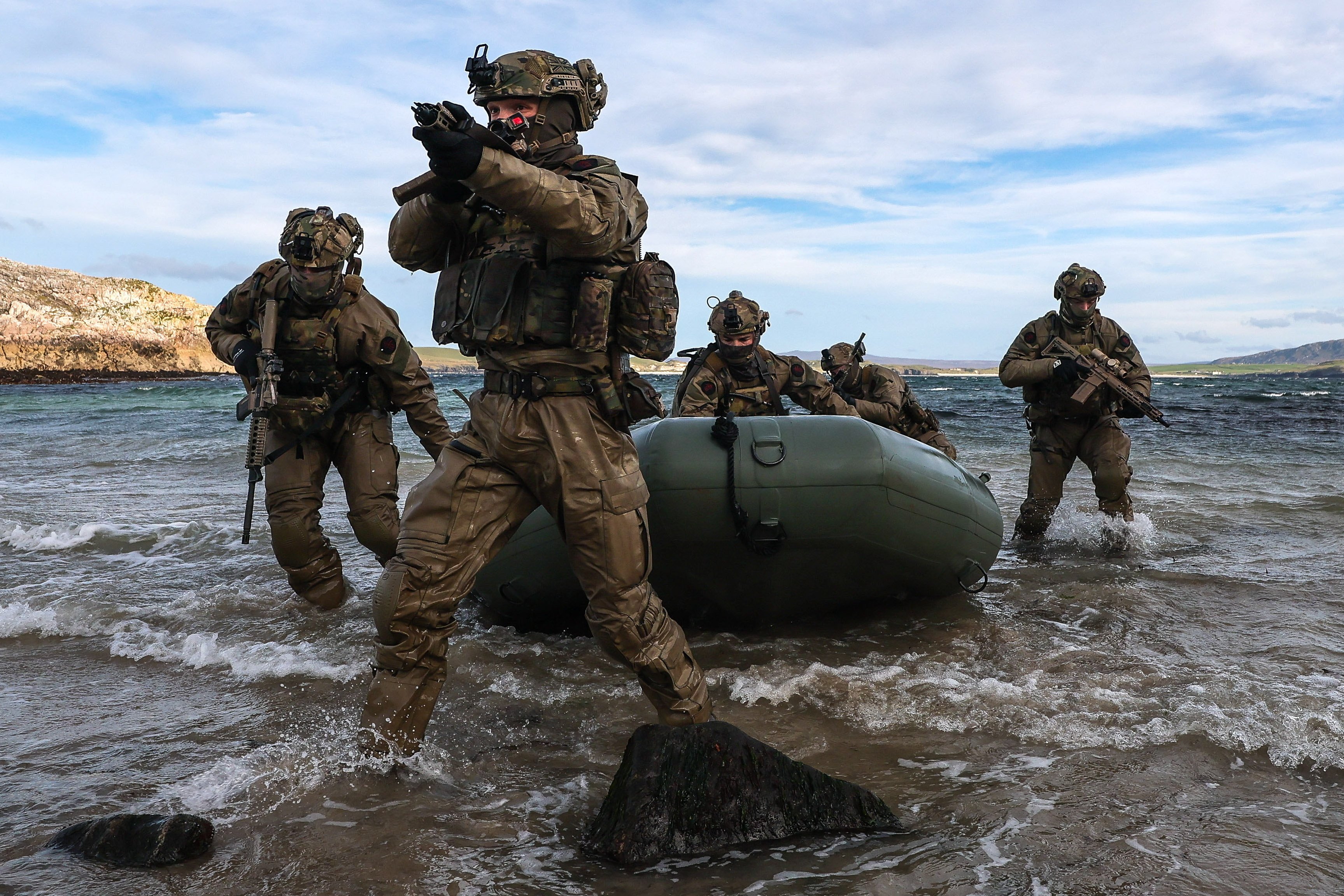
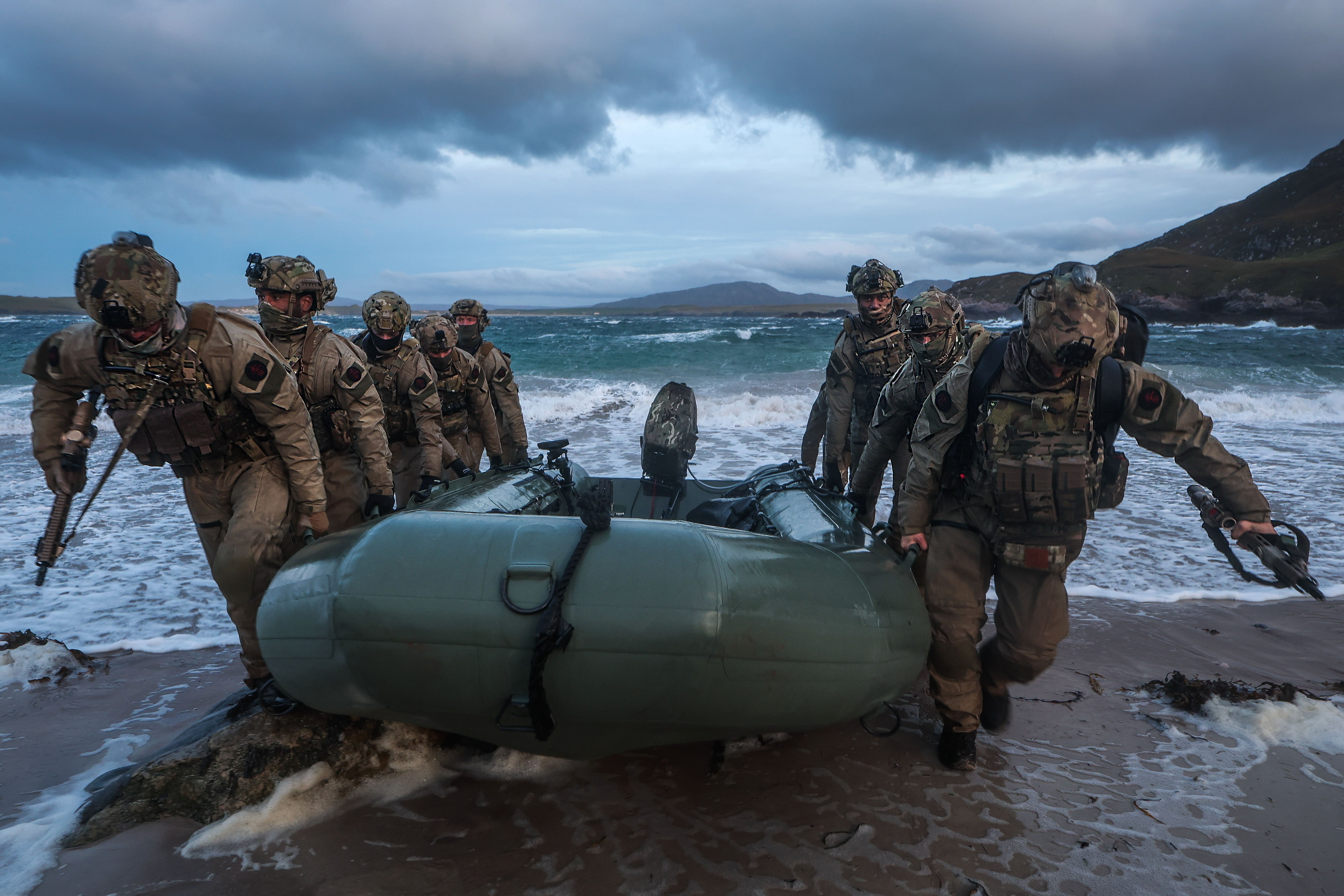
The submarine insertion underscores the type of maritime special operations the British Commando Force is now increasingly training to conduct. Personnel from 148 (Meiktila) Commando Forward Observation Battery, Royal Artillery, boarded the unnamed German attack submarine off Scotland before being infiltrated toward the coast. The sub provided intelligence, surveillance, and reconnaissance (ISR) support as the force approached the target area, after which the commandos conducted a discreet small-boat insertion using inflatable raiding craft.
British Commandos board the German U-boat off the north coast of Scotland during Strike Warrior 26. Crown Copyright
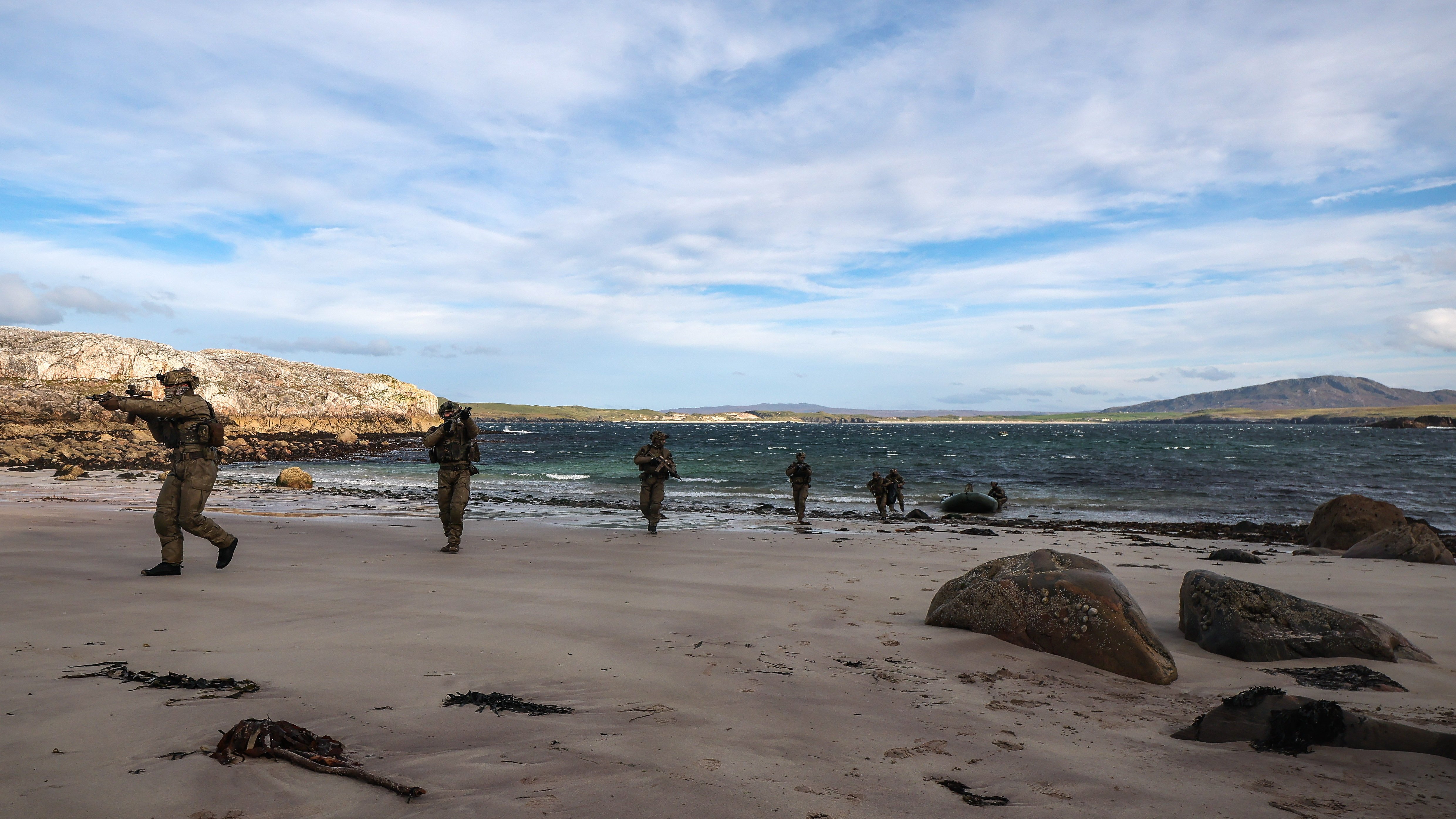
Once ashore, the commandos moved onto the cliffs and established an extemporized observation post. From there, they confirmed the simulated target and coordinated live naval surface fires against a simulated enemy position. Here, firepower was provided by the Portuguese Karel Doorman class frigate Dom Francisco de Almeida, presumably using its Oto Melara 76mm deck gun. Following the engagement, the team was extracted. The complete sequence incorporated submarine infiltration, small-boat insertion, covert reconnaissance and targeting, live naval gunfire, and withdrawal into a single mission profile.
Crown Copyright
The German submarine involved is particularly well suited to this kind of mission. Conventional diesel-electric attack submarines (SSK) lack the nuclear-powered endurance and sustained high speed of an SSN, but those characteristics are not necessarily what a short-range clandestine insertion mission requires. Modern SSKs such as Germany’s Type 212A are designed around extremely low acoustic signatures and can remain submerged for extended periods using air-independent propulsion, making them difficult to detect while operating in relatively shallow and constrained waters.
That combination is hugely valuable for special operations. An SSK can approach a coastline covertly, conduct ISR, release a small team and its boats, and withdraw without exposing a large surface vessel or maintaining the high-speed transit capability associated with a nuclear submarine. Its comparatively small size can also be advantageous when operating closer to shore, where depth, seabed conditions and the presence of coastal sensors can constrain larger submarines. Conventionally powered boats are also far cheaper to procure and operate and have smaller crews.
Crown CopyrightCrown Copyright
An SSN offers major advantages for longer-range deployments: far greater endurance, sustained speed, and the ability to carry and support larger payloads over intercontinental distances. These payloads can include dry deck shelters and swimmer delivery vehicles, allowing divers easy exit and entrance while the boat is submerged and at a standoff distance from the coast.
But for a mission whose essential requirement is to quietly loiter near a coast, put a small team ashore and leave, an SSK remains a highly relevant platform. Conventional submarines are particularly valuable to the kind of distributed littoral operations NATO is rehearsing in northern European waters.
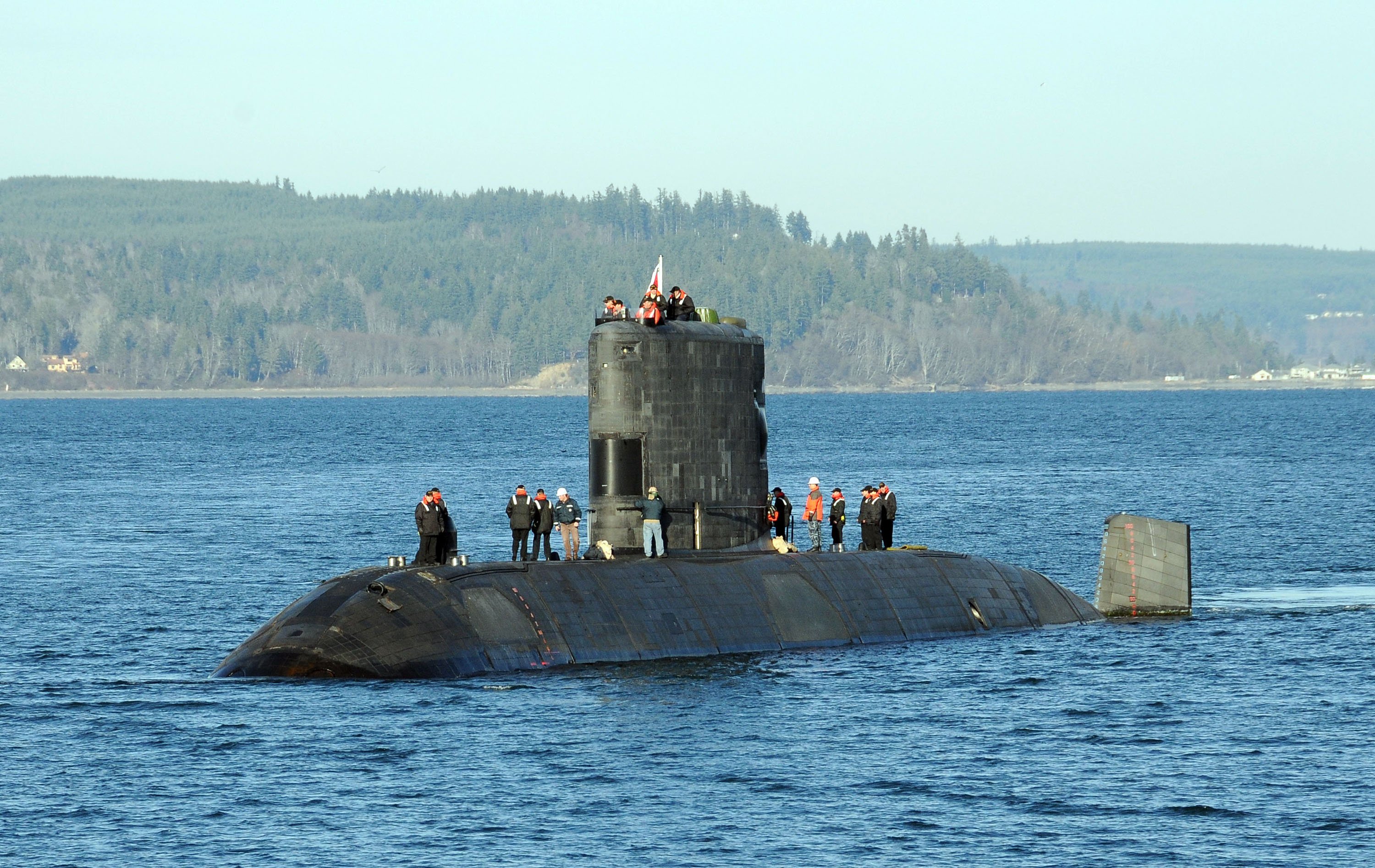
The Upholders were also particularly suited to inshore operations, reconnaissance, and other missions demanding extreme quietness and maneuverability.
The Royal Canadian Navy long-range patrol submarine HMCS Victoria arrives at Naval Base Kitsap-Bangor for a port call and routine maintenance. This boat was formerly HMS Unseen with the U.K. Royal Navy. U.S. Navy photo by Lt. Ed Early/Released
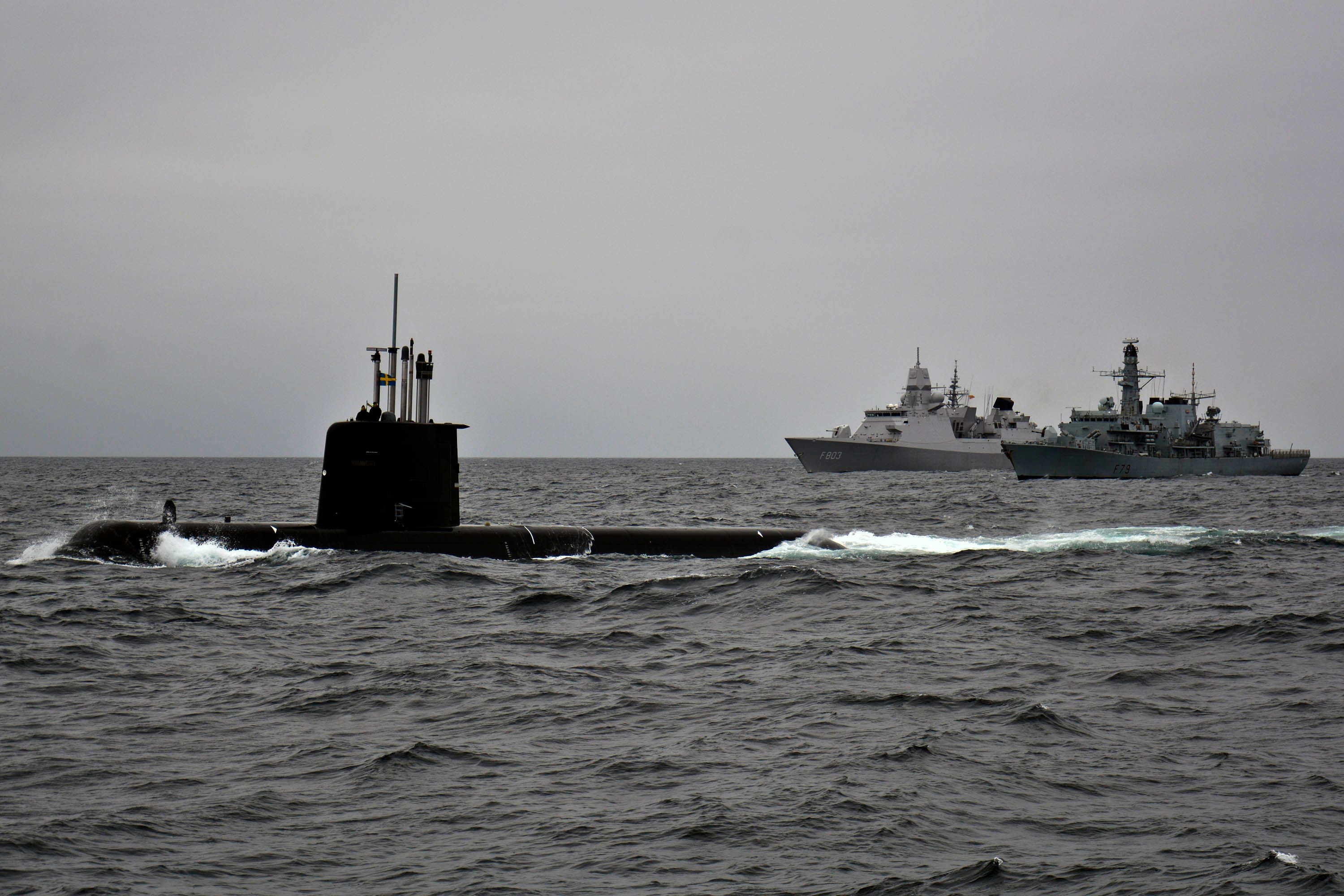
With this in mind, TWZ has, in the past, examined whether the U.S. Navy should complement its all-nuclear submarine fleet with advanced conventional boats. Sweden’s Gotlanddemonstrated the value of these kinds of boats when it was leased to the U.S. Navy for adversary training and proved exceptionally difficult for American ASW forces to detect.
Swedish submarine HMS Gotland, left, HNLMS Tromp, center, and HMS Portland steam in formation with other NATO and partner nation ships during maneuvering drills as a part of exercise Dynamic Mongoose in 2015. U.S. Navy photo by Mass Communication Specialist 2nd Class Amanda S. Kitchner/Released
Returning to the Cape Wrath drill, the 148 Battery operations officer involved explained that “This level of complexity and coordination of live assets has not been achieved by 148 for nearly 30 years.”
“We wanted to demonstrate to our partners across the United Kingdom Commando Force, wider U.K. Defense and NATO SOF community the type of missions we are prepared to execute against future threats,” the officer added.
148 Battery secures a remote beach in Cape Wrath during Exercise Strike Warrior 26. Crown CopyrightCrown Copyright
Multinational integration is central to the exercise. Strike Warrior is testing the ability of the British Commando Force to plug into a much larger allied force in which submarines, surface combatants, aircraft, drones, and small specialist teams can contribute to different parts of the same operation.
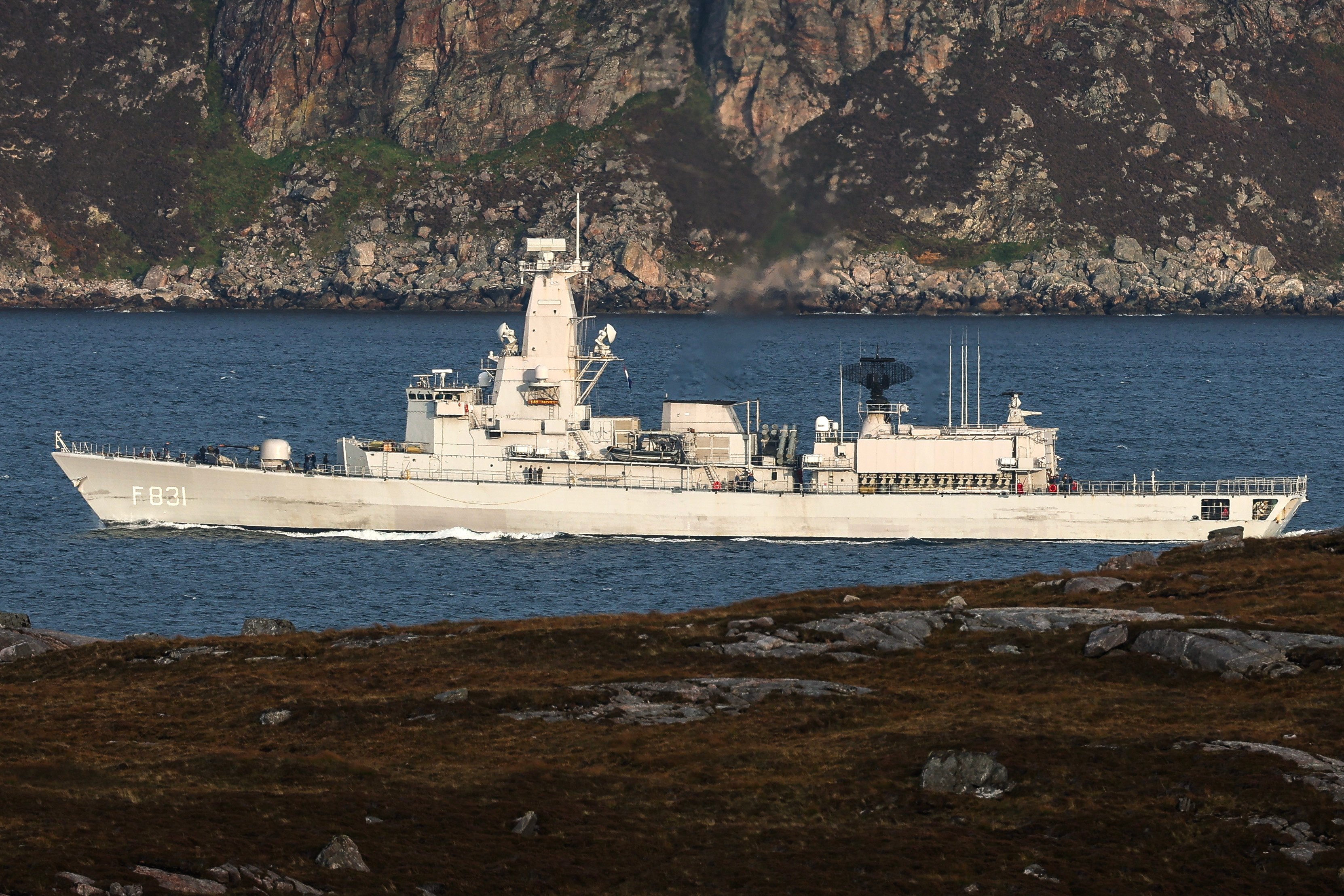
Earlier in Strike Warrior, 148 Battery also directed fires from the Dutch Karel Doorman class frigate HNLMS Van Amstel and Royal Canadian Navy Halifax class frigate HMCS St. John’s after establishing observation posts. Those ships were operating as part of Standing NATO Maritime Group One.
HNLMS Van Amstel from the Royal Netherlands Navy during Exercise Strike Warrior. Crown Copyright
The exercise also provides a snapshot of how Britain’s commandos have evolved since their intensive employment in Afghanistan. The Royal Marines’ Future Commando Force concept emphasizes smaller, more dispersed formations capable of operating in contested littoral environments, with greater reliance on maritime mobility, uncrewed systems, long-range fires, and allied capabilities.
Strike Warrior combines those elements, with the exercise including amphibious landings, boarding operations, intelligence and surveillance missions, maritime security, and anti-submarine warfare, alongside drone missions involving strikes and combat resupply. Other elements have practiced establishing protected medical facilities.
The geography of Strike Warrior is equally significant. The exercise extends across Scotland and its surrounding waters, including the Western Isles and out into the North Sea, placing the Commando Force in the maritime environment connecting the highly strategic North Atlantic, Norwegian Sea, and northern European approaches.
That region has become increasingly important to NATO planning because of the difficulty of monitoring and controlling such a large maritime battlespace. Submarines, maritime patrol aircraft, surface combatants, drones, and long-range weapons all have roles to play, while the geography provides numerous opportunities for small forces to operate from the coast and islands.
Crown CopyrightCrown Copyright
The United Kingdom has been repeatedly using the region and the wider High North as a training ground for this type of activity. Earlier this year, British commandos conducted a submarine insertion during Exercise Cold Response in Norway using the German Navy’s Type 212A submarine U-35. That also involved submarine infiltration, small-boat deployment, establishment of an observation post, and the direction of allied naval fires.
Royal Marines on Exercise Cold Response in North Norway training in extreme cold conditions while exercising boat drills within the fjords of Norway. Crown Copyright
Strike Warrior expands that concept considerably and across a much larger battlespace, providing an opportunity to test not simply individual capabilities but the ability to combine them during a sustained NATO exercise.
The exercise began September 28 and concludes October 9.
For the British Commando Force, the significance extends beyond the dramatic imagery of troops emerging from a German submarine at Cape Wrath. After years in which British commandos were heavily committed to land-based counterinsurgency operations, the exercise is intended to put them firmly back in a maritime and high-end warfighting context.
This is the kind of operation that the U.K. Commando Force is now preparing to conduct alongside NATO partners in the increasingly contested waters of the North Atlantic and High North.
Intensifying attacks by Russia and Ukraine ahead of the winter are further endangering navigational safety in the Black Sea, Turkish Foreign Minister Hakan Fidan said on Thursday, adding that world powers must not allow the region to be turned into a new front in the war.
Today's trade flows resemble a windy waterpark slide more than the traditional waterway superhighway. The three-dimensional chess game being played by ocean carriers and tankers has delivered big bucks in day rates, container rates, and surcharges. But there is a group of winners not currently being highlighted.
Yemen's Houthis attacked Aden's international airport with ballistic missiles and explosive-laden drones on Wednesday, the country's Transport Ministry said, as fighting between the Iran-aligned group and Saudi-backed government forces intensified.
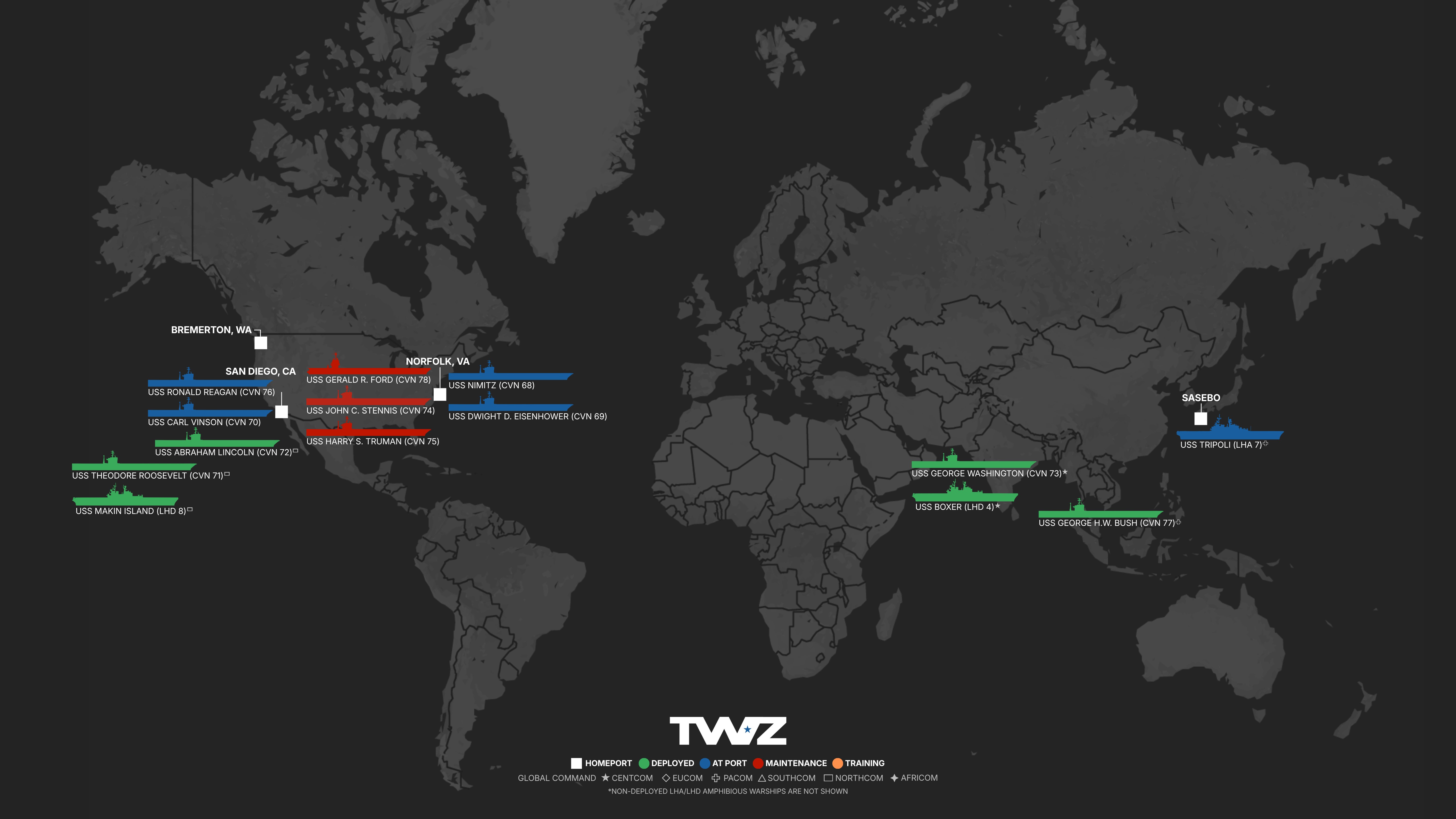
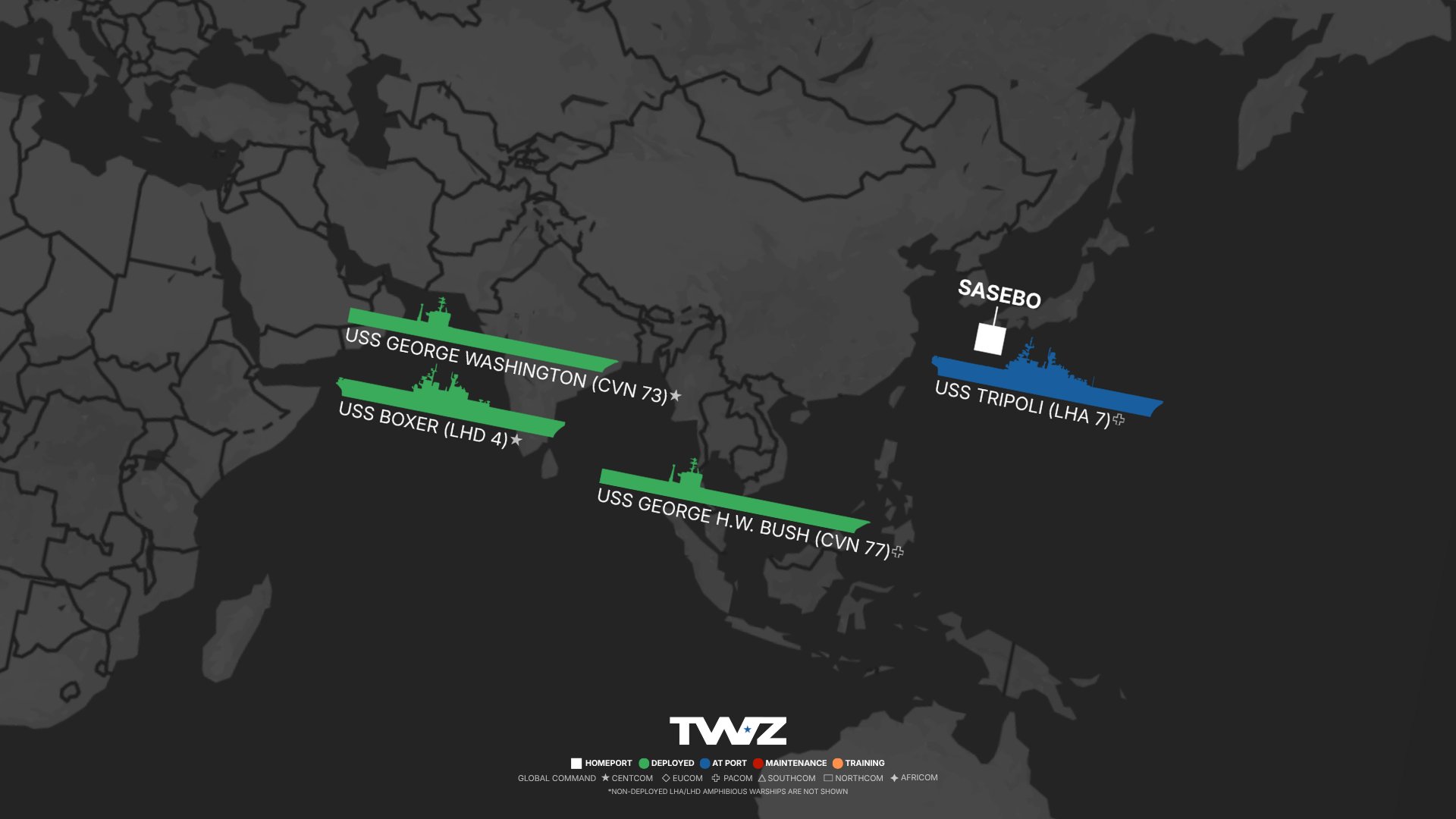
Aircraft carrier USS George H.W. Busharrived in Phuket, Thailand, on Sunday for a scheduled port call after 188 days at sea, leaving just one carrier strike group, led by USS George Washington, in the Middle East for the first time in months. Across the Pacific, USS Abraham Lincoln, which Washington relieved in August, is holding off the west coast of California to disembark her air wing and offload ammunition ahead of a well-deserved homecoming this week. With severaloutlets now confirming that USS Theodore Roosevelt will deploy to the Middle East, there very well may be three flattops in the region again, but any overlap will be temporary given normal rotation schedules.
Here’s TWZ’s weekly carrier tracker monitoring America’s flattop fleet, including deployed Carrier Strike Groups (CSG) and Amphibious Ready Groups (ARG), using publicly available open-source information. Check out last week’s report here.
George H.W. Bush Drops Anchor Off Phuket For Liberty Port Call
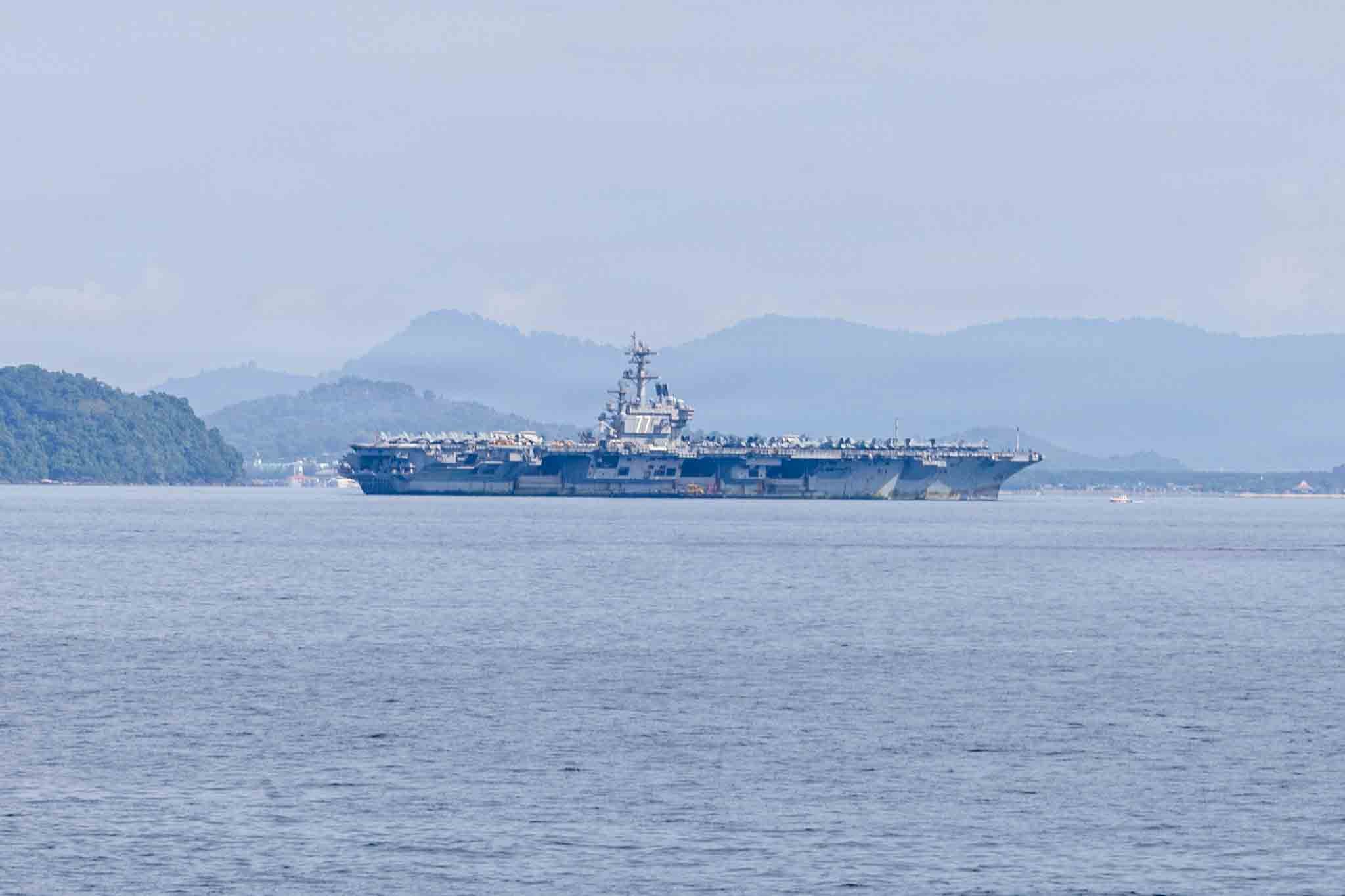
USS George H.W. Bush arrived in Thailand on October 4 for a scheduled port visit, U.S. 7th Fleet announced. Guided-missile destroyer USS Delbert D. Black escorted the flattop from her previous station in the Arabian Sea and joined the call. Bush deployed from the continental U.S. on March 31 and took the long way to the Middle East, rounding the Cape of Good Hope to limit exposure to the treacherous Red Sea and Bab Al Mandeb Strait.
USS George H.W. Bush (CVN 77) arrived in Phuket, Thailand, on October 4, 2026. U.S. Navy photo
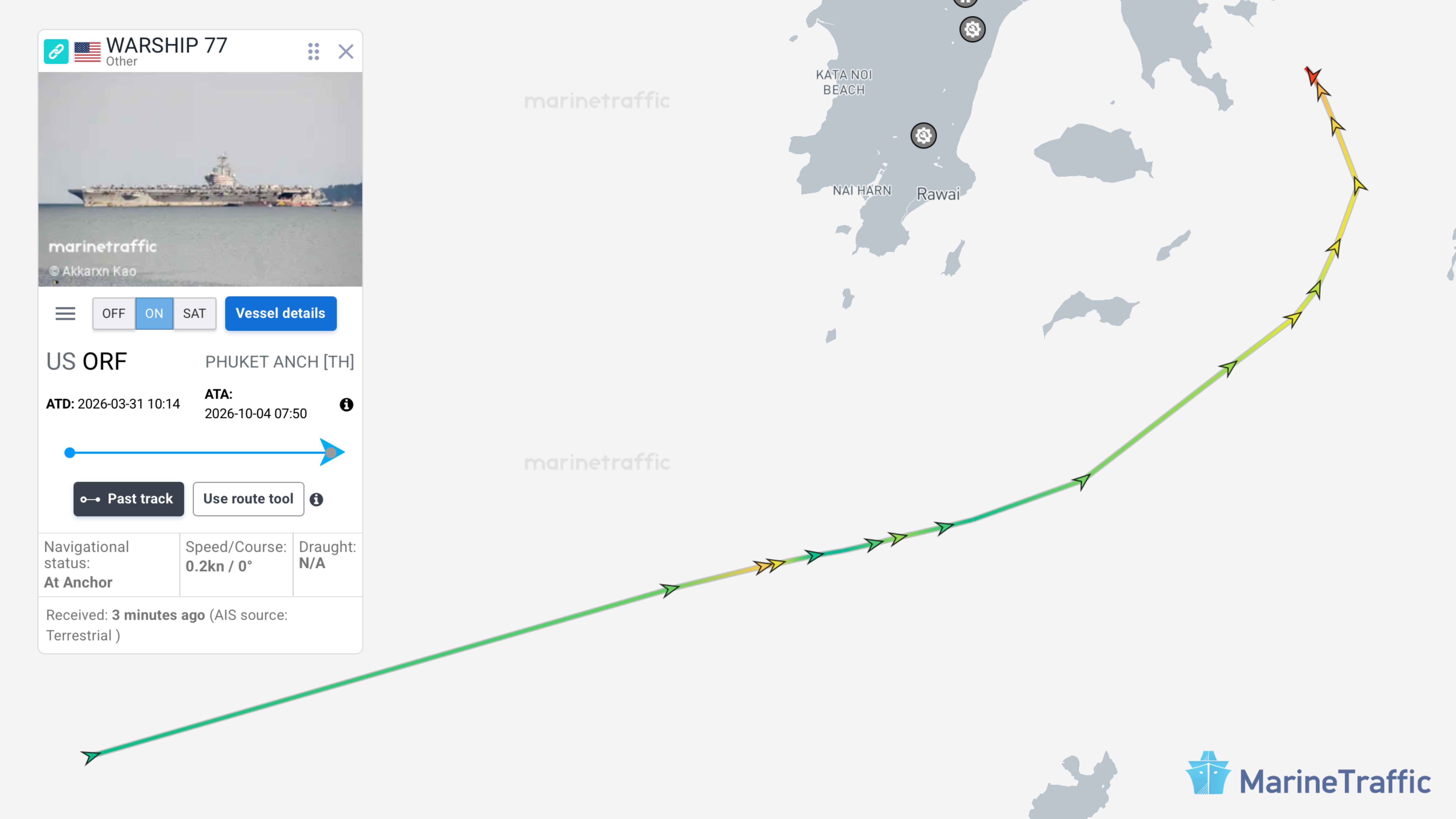
On October 3, Bush switched her Automatic Identification System (AIS) transponder on about 15 nautical miles southwest of Thailand, broadcasting her position publicly for the first time since April, based on data available via MarineTraffic. The carrier dropped anchor approximately two nautical miles off the coast of Phuket the following day.
USS George H.W. Bush’s transit into Phuket, Thailand, on October 3. Source: MarineTraffic/KPLER (Reprinted with permission)
Bush had been operating in the U.S. Central Command (CENTCOM) area of responsibility (AOR) since April, when the U.S. briefly had three carriers on station, in support of operations against Iran. “For the last six months, the strike group supported Operation Epic Fury and the U.S. naval blockade in the U.S. Central Command area of responsibility to secure maritime security and stability in the Middle East,” according to the 7th Fleet statement. That force posture was short-lived, however, as the USS Gerald R. Fordtransited the Suez Canal northbound on May 1 and began her journey home not long after Bush arrived. Bush chopped into the U.S. Pacific Command (PACOM) AOR sometime over the past week while en route to Phuket, leaving a single CSG in CENTCOM.
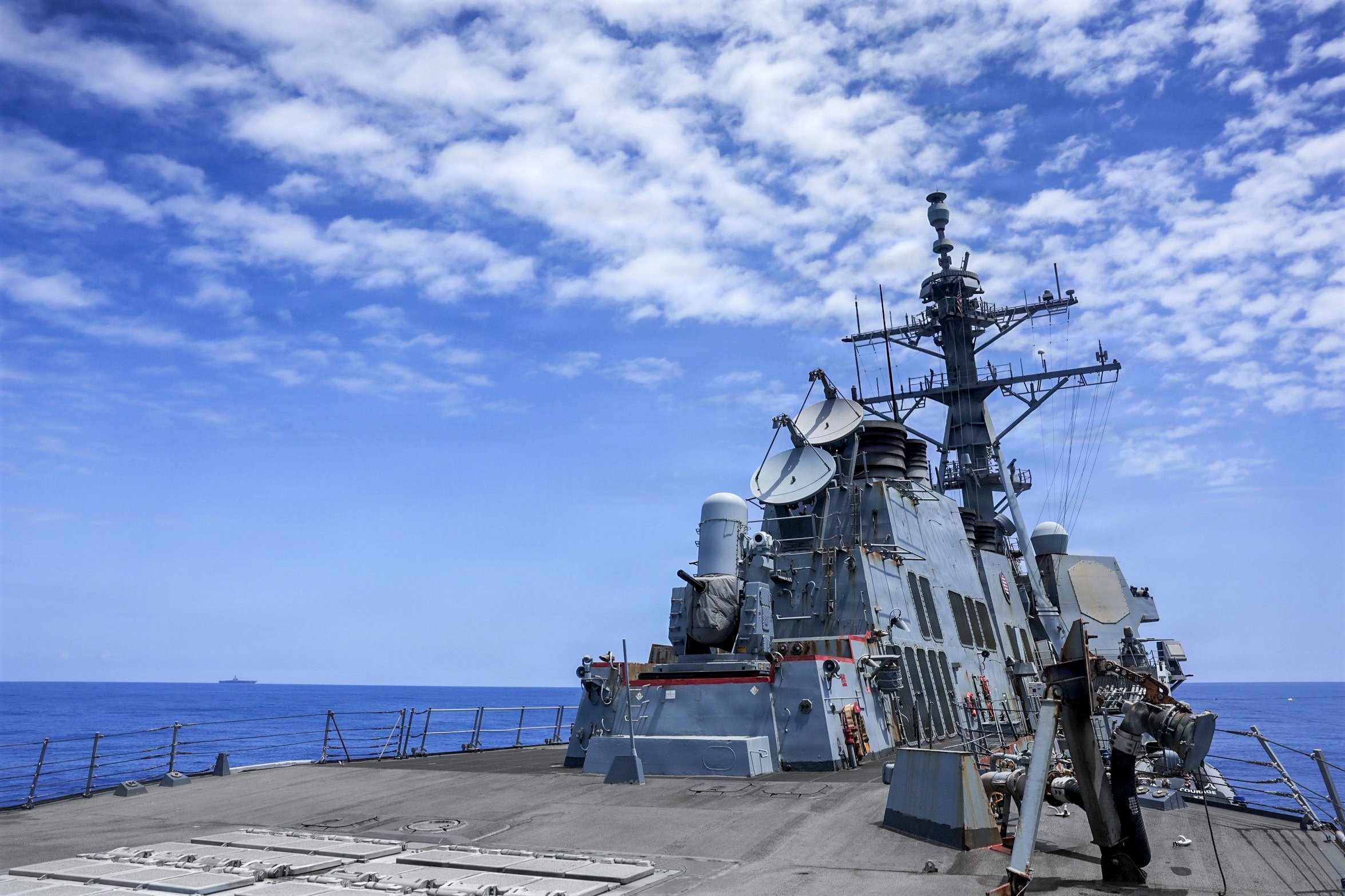
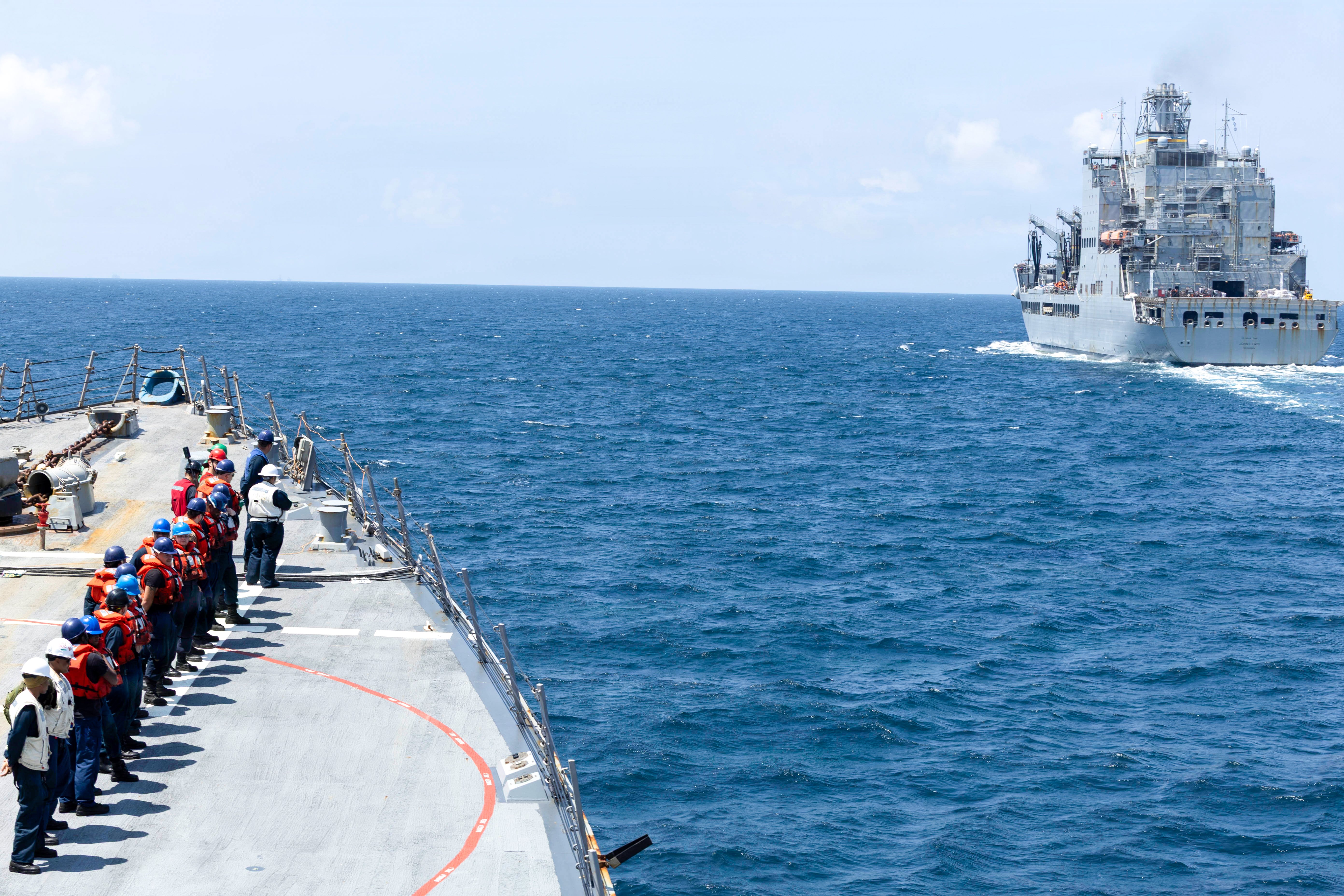
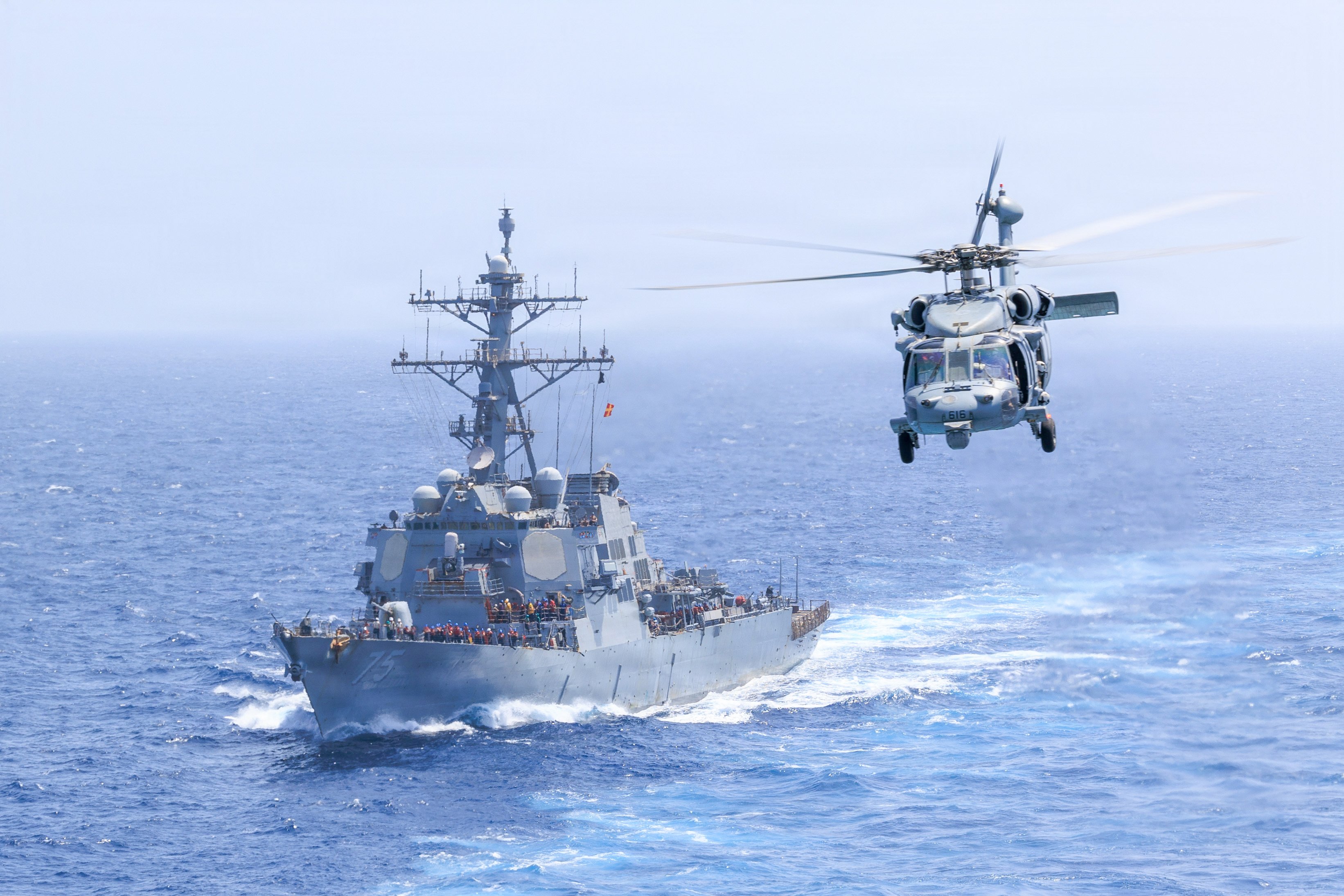
The current composition of CSG-10 is USS Mason, USS Ross, and USS Donald Cook, but none of the destroyers joined the flagship in Thailand. Why Black escorted the carrier instead is unclear. Blackdeparted Mayport, Florida, on January 3, 2026, for an independent deployment and is long overdue for a liberty call after nine months. Mason transited the Malacca Strait southbound on September 29, according to public AIS data, and is currently in Singapore; the purpose of the stop is unknown. Ross and Cook have not broadcast their positions in months, but were last operating in the Arabian Sea.
The Navy confirmed this was the first port visit for Bush since deploying, marking 188 consecutive days at sea (including the end date), which falls just short of the 200-plus days that USS Abraham Lincoln recently logged.
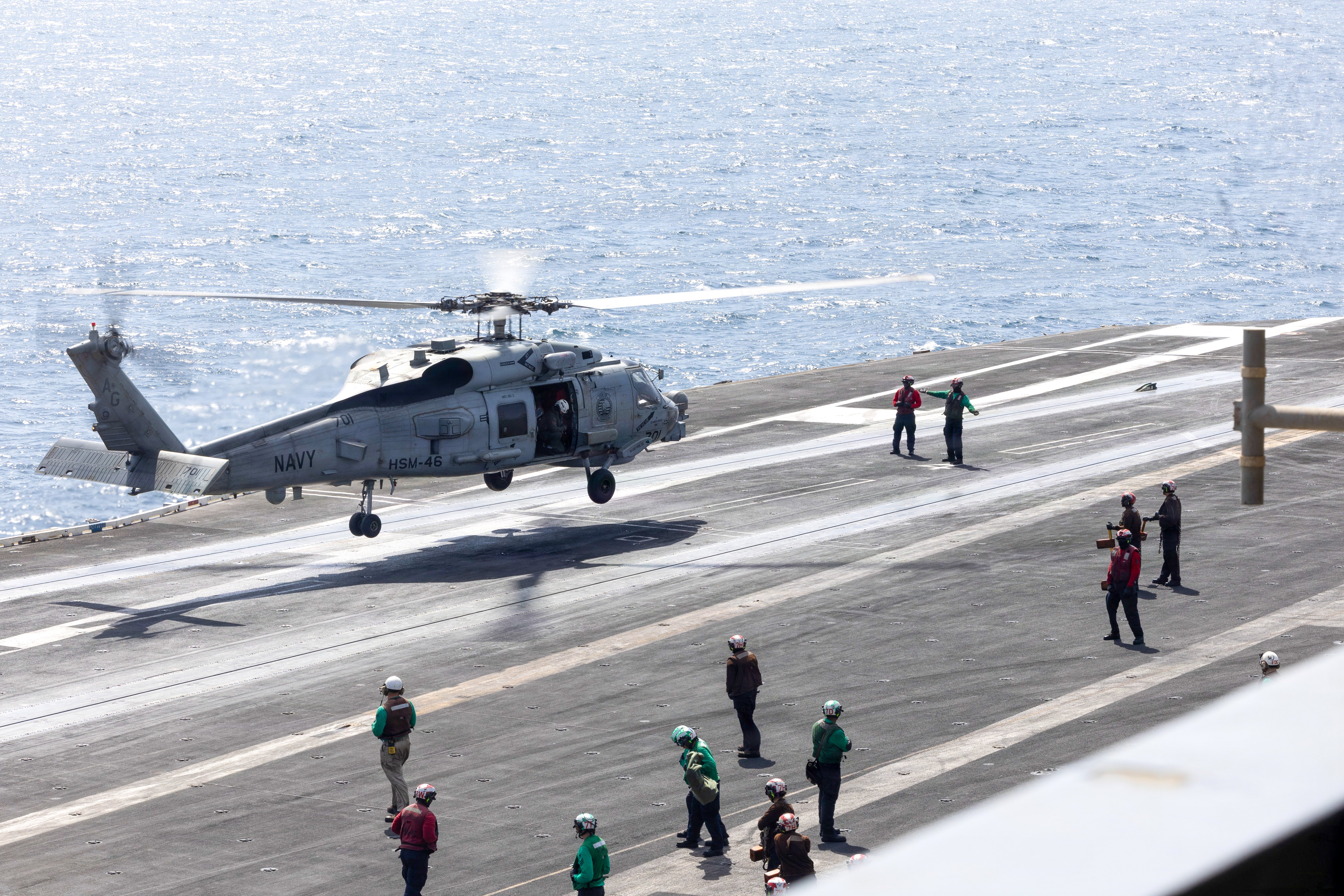
Flight ops aboard CVN 77. U.S. Navy photo USS Mason in CENTCOM. U.S. Navy photo USS Delbert D. Black underway. U.S. Navy photo USS Donald Cook sails while an MH-60S Seahawk flies alongside USS George H.W. Bush in U.S. 5th Fleet. U.S. Navy photo
Abraham Lincoln Homecoming Imminent
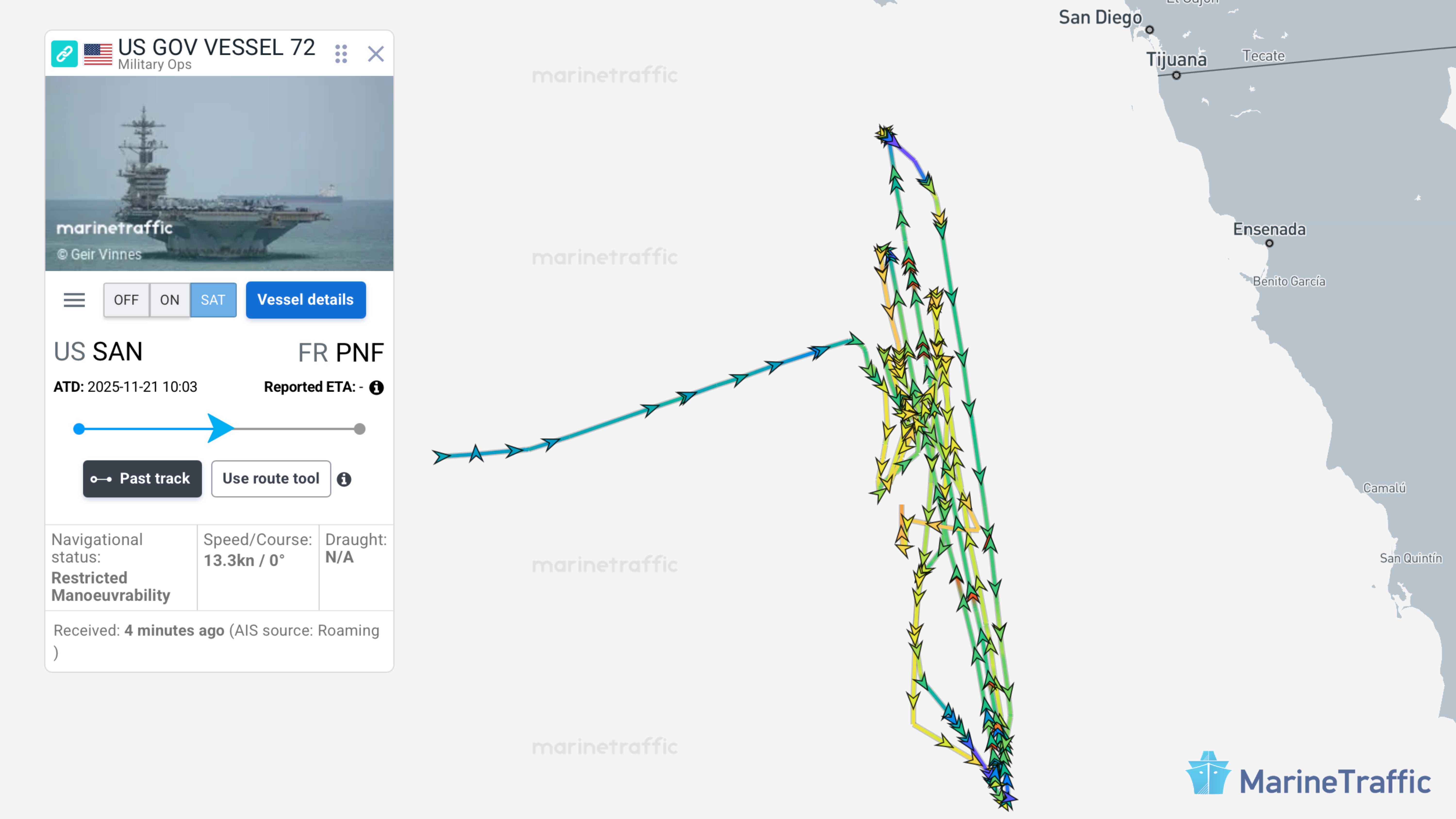
The USS Abraham Lincoln reappeared on AIS on October 3, roughly 200 nautical miles southwest of her homeport at Naval Air Station (NAS) North Island in San Diego, after steaming east across the vast Pacific Ocean. However, instead of returning home, Lincoln is holding off the coast of California, disembarking Carrier Air Wing (CVW) 9 and offloading ammunition alongside Lewis and Clark class dry cargo ship USNS Washington Chambers.
USS Abraham Lincoln’s transit off the coast of California. Source: MarineTraffic/KPLER (Reprinted with permission)
Lincoln is expected to return home on Wednesday or Thursday. The carrier departed San Diego on November 21, 2025, and an arrival this week would close out a total deployment of 321 to 322 days, by our count. That’s just shy of the 326-day record USS Gerald R. Ford set in May, representing the second-longest deployment in the modern carrier era.
The marathon deployment drew scrutiny over the grueling conditions Sailors and Marines experienced aboard. In August, crew families described supply shortages and difficult living arrangements, as TWZreported at the time. The accounts led to widespread media coverage, which Acting Secretary of the Navy Hung Cao called dishonest while also acknowledging that “a small number of mental health cases were treated with no loss of life, meal plans were adjusted when fresh resupply was unavailable, without a single meal being missed, calls home were limited when the operational threat was too high.” At least eight personnel across the strike group attempted suicide during the cruise, Cao wrote in a letter sent to Sen. Kirsten Gillibrand that was obtained by CNN.
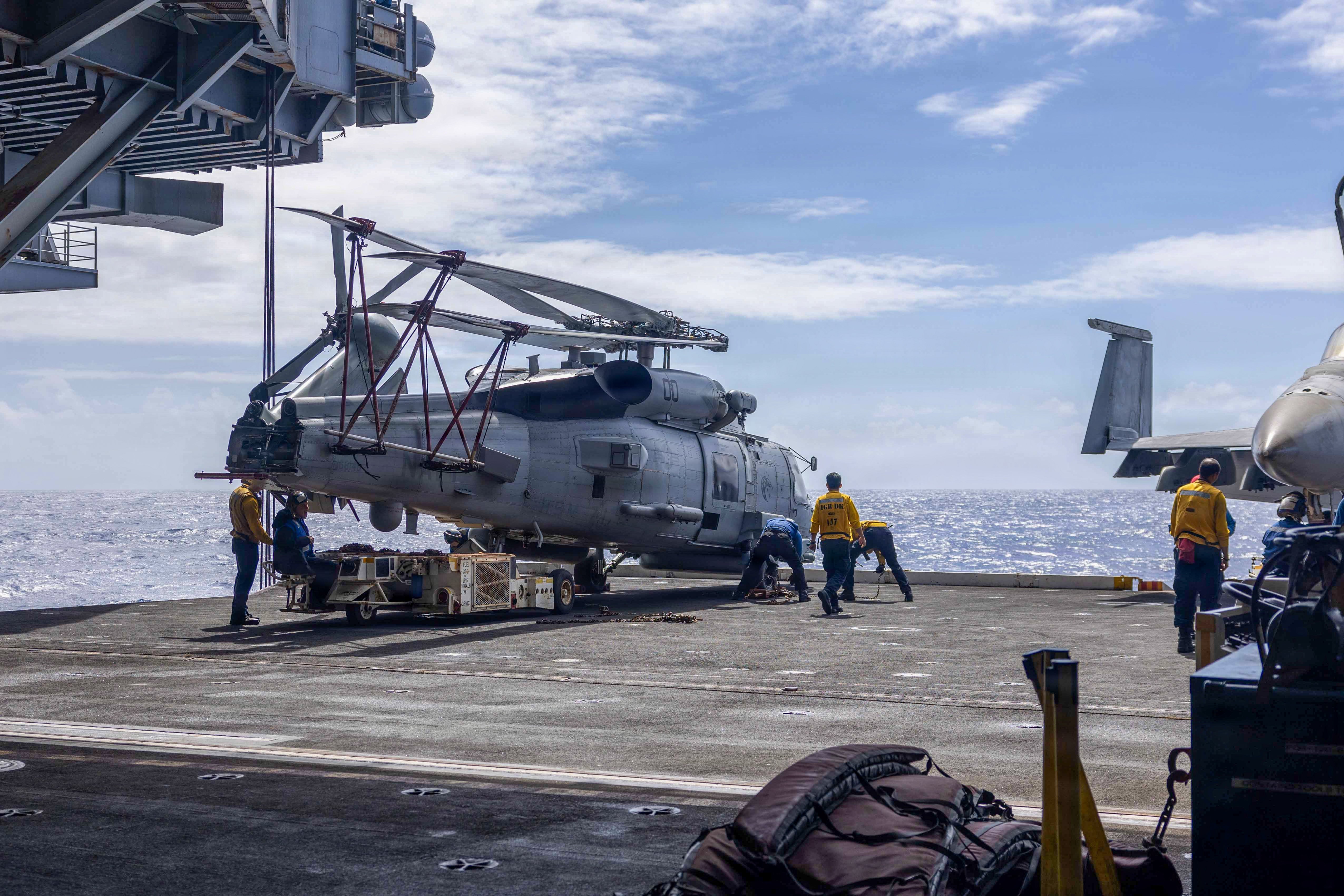
Friends and family welcomed members of Helicopter Maritime Strike Squadron (HSM) 71 back to NAS North Island on Friday, according to a release from DVIDS, the military’s content-sharing portal. A Growler squadron from CVW 9 also recently returned to NAS Whidbey Island in Washington State.
Family and friends welcome HSM 71 home. U.S. Navy photo An MH-60R with HSM 71 on USS Abraham Lincoln. U.S. Navy photo
Ronald Reagan Moves From Washington State To San Diego
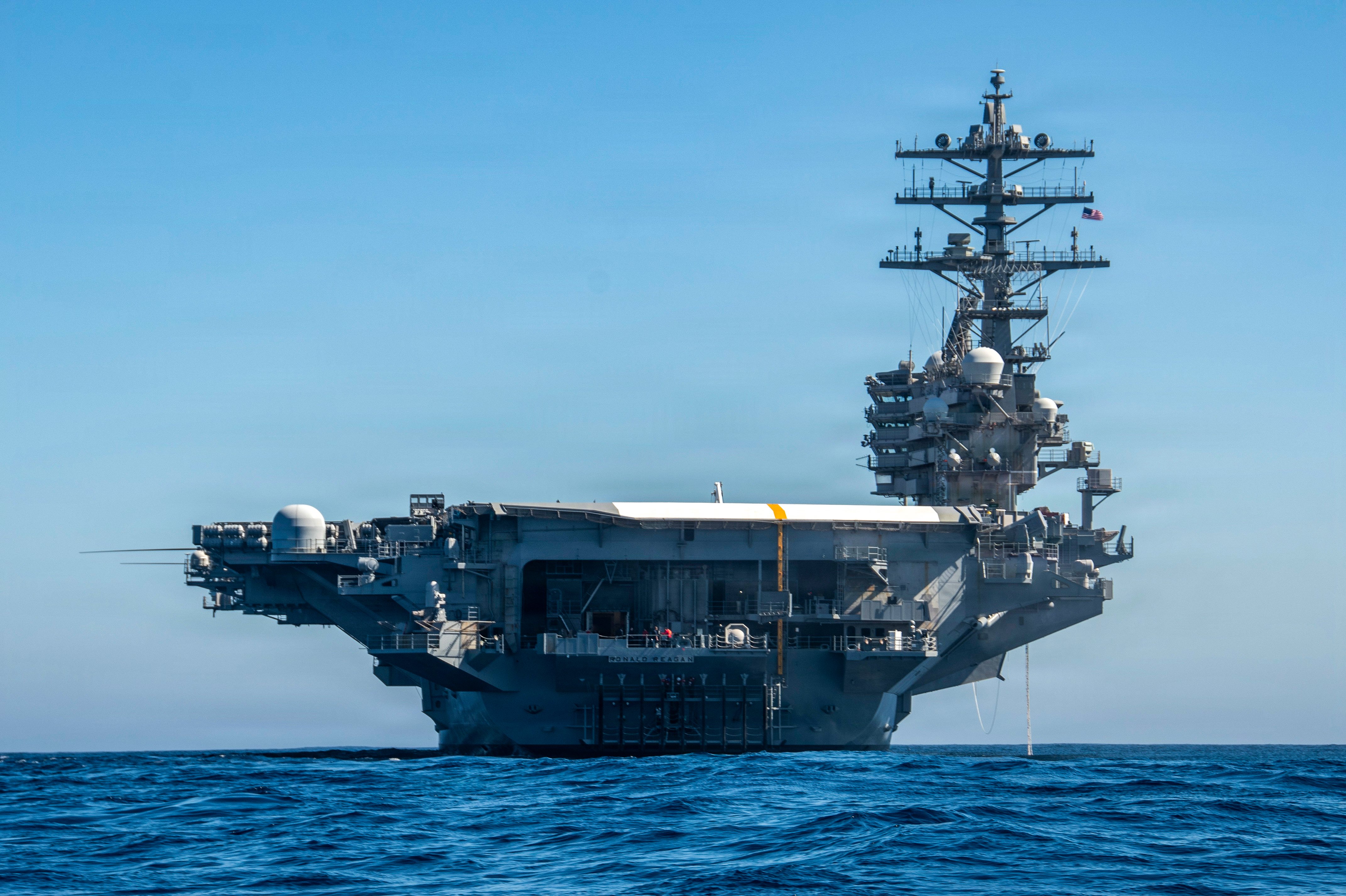
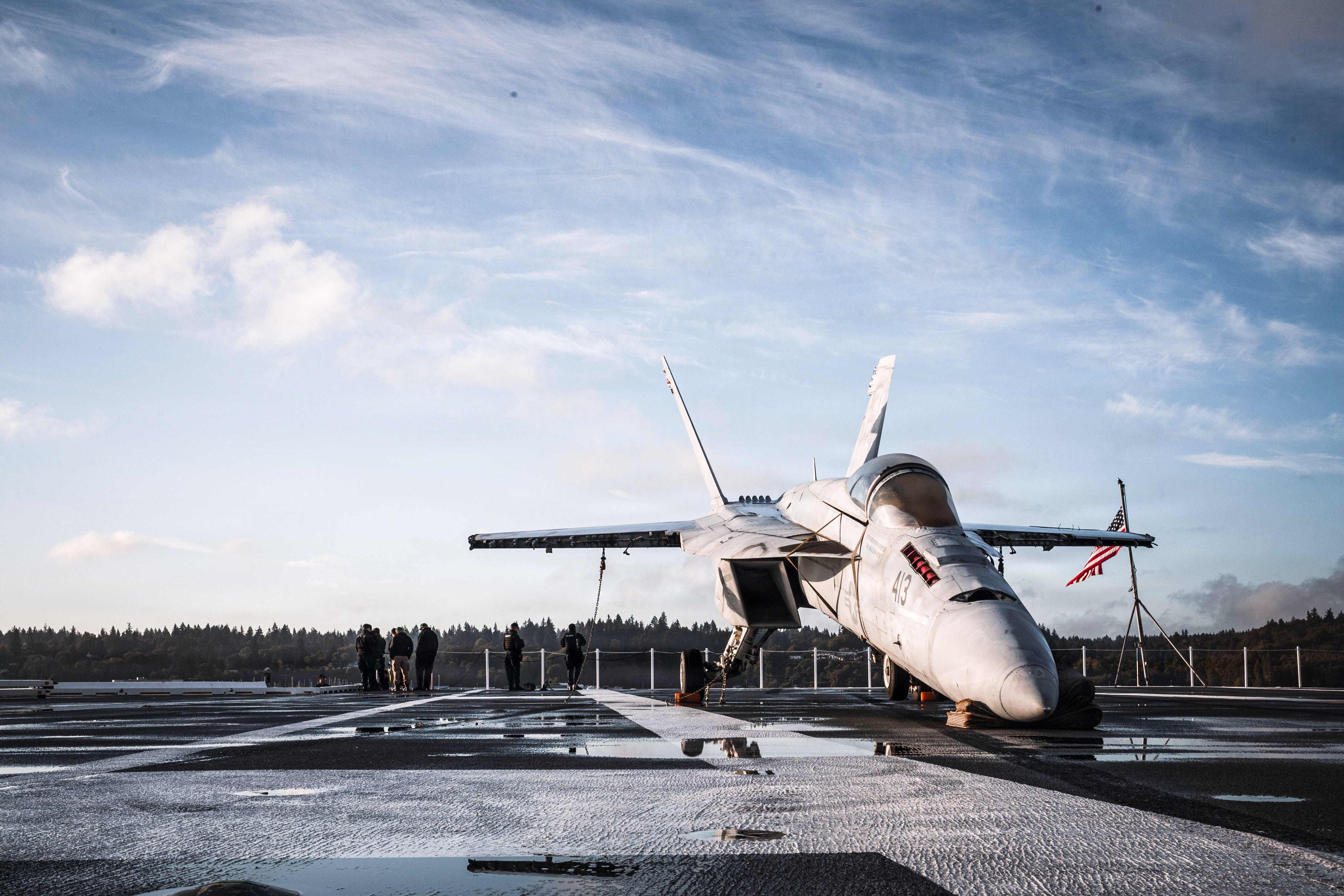
The latest carrier to rejoin the fleet after completing an extended maintenance availability, USS Ronald Reagan, pulled into San Diego on Monday after departing Bremerton, Washington, on September 30, according to public AIS data. Reagan is currently berthed at Kilo Pier on Naval Air Station North Island, a spot now available after USS Theodore Rooseveltvacated it on September 27.
USS Ronald Reagan arrives at Naval Air Station North Island in California on October 5, 2026. U.S. Navy photo
Imagery released by the Navy showed the flattop underway conducting routine operations in the U.S. 3rd Fleet area of operations on Sunday, October 4. Reagan reentered the fleet recently after completing a four-day sea trial and shakedown cruise that capped an extended 17-month Drydocking Planned Incremental Availability.
While docked at Puget Sound Naval Shipyard, she received several upgrades and enhancements, including an Unmanned Air Warfare Center (UAWC) to command and control the MQ-25 tanker drone. The MQ-25 will eventually take on the role of refueling carrier-based aircraft, held today by Super Hornets. The new UAWC makes her the second carrier to receive such an upgrade, following USS Theodore Roosevelt. The crew aboard Reagan has conducted pierside and at-sea testing of the new command center.
USS Ronald Reagan conducts routine ops in the Pacific. U.S. Navy photo USS Ronald Reagan departs Bremerton. U.S. Navy photo
Dwight D. Eisenhower Returns To Homeport After Growler Mishap
Following an incident off the east coast that resulted in the loss of an EA-18G Growler electronic attack jet, the USS Dwight D. Eisenhower returned to Naval Station Norfolk on October 5 after an eight-day underway.
Prior to her return, the Navy told us the following, published in full: “The Nimitz-class aircraft carrier USS Dwight D. Eisenhower (CVN 69) will return to Naval Station Norfolk to allow for a comprehensive assessment of the ship’s aircraft launch and recovery equipment following the Sept. 28 aviation mishap. The decision reflects the Navy’s deliberate approach to flight safety and readiness. While the cause of the mishap remains under investigation, Navy technical experts will conduct a thorough assessment of the affected systems and complete any necessary maintenance before flight operations resume. USS Dwight D. Eisenhower remains capable of safely navigating and conducting shipboard operations.”
USS Dwight D. Eisenhower’s recent transit off the east coast. Source: MarineTraffic/KPLER (Reprinted with permission)
Eight Sailors were ultimately evaluated by medical personnel aboard the ship. The mishap was reportedly due to a failure of the arresting gear, which catches and stops the forward momentum of aircraft after landing, and the Growler was lost overboard. Both crew members safely ejected and were rescued by MH-60 Seahawk helicopters.
Harry S. Truman Moves Dead Stick For Mid-Life Nuclear Refueling Overhaul
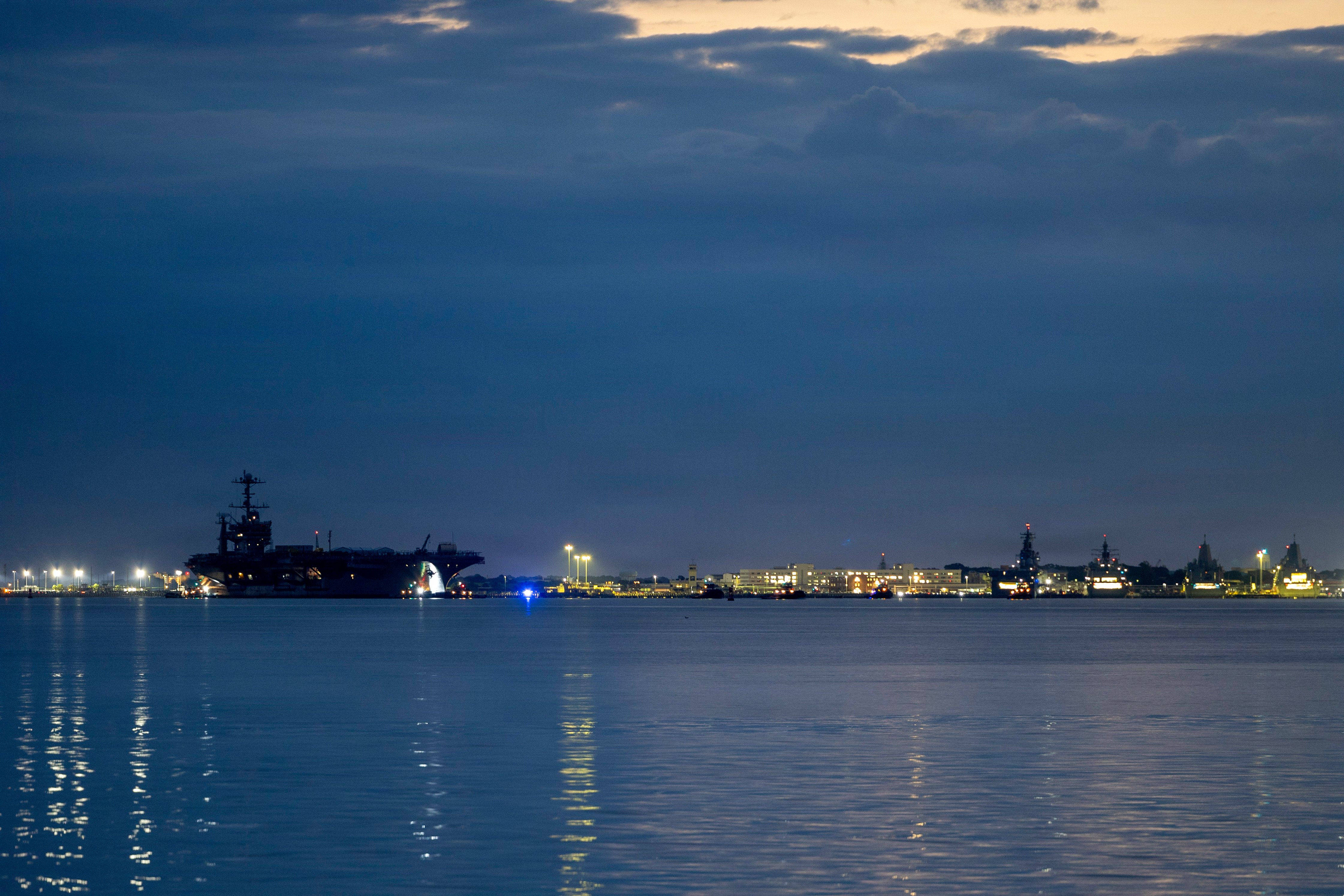
USS Harry S. Trumanleft Naval Station Norfolk on September 30 and moved “dead stick” into Dry Dock 11 at Huntington Ingalls Industries’ (HII) Newport News Shipbuilding (NNS) facility the same day. The carrier will begin the lengthy process of a mid-life Refueling and Complex Overhaul (RCOH).
USS Harry S. Truman transits the Elizabeth River after departing Naval Station Norfolk to begin the shipyard phase of her RCOH. U.S. Navy photo
Truman is the eighth Nimitz class carrier to conduct an RCOH at NNS, according to HII, which won a $5.1 billion contract to complete the work. The overhaul accounts for about one-third of the maintenance and modernization work that a carrier will undergo over a 50-year service life and involves defueling and refueling her nuclear reactors, in addition to upgrades made to the ship’s propulsion plant and combat systems.
“Our team has been diligently working to get ahead on this critical engineering and construction project that will prepare USS Harry S. Truman for the second half of her service life,” Bryan Caccavale, the NNS vice president of program management, said in a statement. “When the ship arrives at NNS, we’ll apply that same diligence to working with our suppliers and Navy partners to ensure a successful recapitalization of CVN 75,” he added.
USS John C. Stennis is also currently completing RCOH at NNS, but there has been no announcement of a return to service, as of publication. Stennis began the overhaul in 2021, and budget documents point to an October 2026 redelivery date, but it’s unclear whether that timeline will hold.
Newest Ford Class Carrier, John F. Kennedy, Transits To Norfolk After Preliminary Acceptance
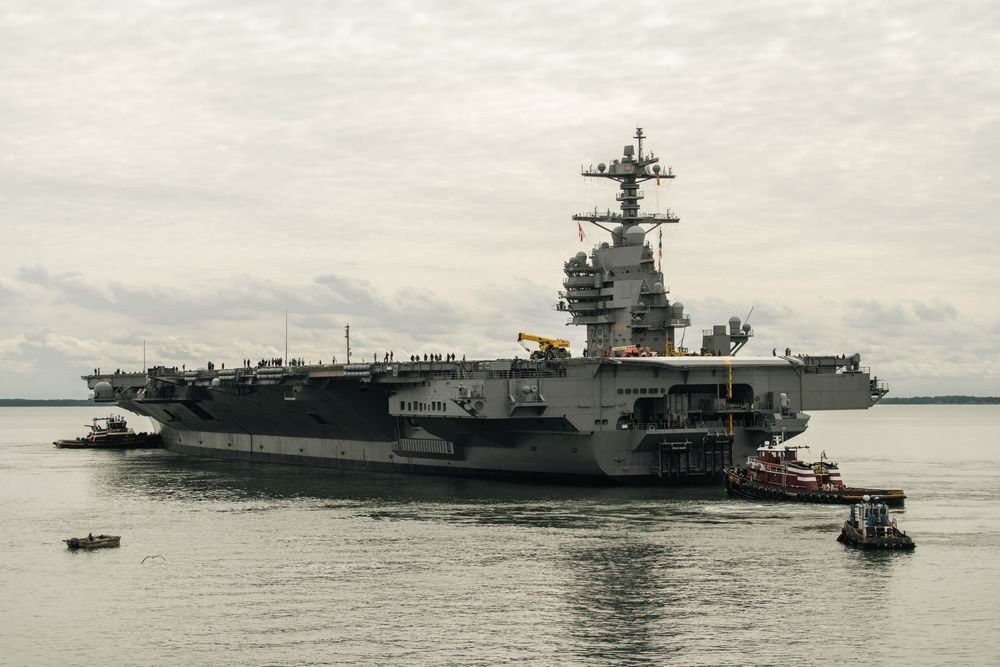
The Navy took “preliminary acceptance” of the future USS John F. Kennedy from NNS on September 29. The nation’s newest and second Ford class carrier completed acceptance trials in August.
“Achieving preliminary acceptance marks a new phase for the ship and her crew, allowing them to get more water under the keel as they test and train underway,” the Navy’s Program Manager for Gerald R. Ford-Class New Construction, Capt. Mark Johnson, said. “This milestone is a testament to the shared commitment of our sailors and our combined Navy-industry team, who remain laser-focused on completing the final stages of construction and test with precision and efficiency to deliver combat-ready lethality to the fleet.”
The future USS John F. Kennedy departs Newport News Shipbuilding. Photo: HII-NNS
Kennedy is 99% finished, according to the Navy, with formal delivery planned for spring 2027. “All major systems are complete. The shipbuilder is currently completing final ship systems testing, including testing of the remaining four Advanced Weapons Elevators,” the release noted. On the same day as the announcement, September 29, the carrier departed the shipyard, and arrived at her new homeport of Naval Station Norfolk, moored at Pier 11N, on October 2.
Big Deck Fleet At A Glance
Overall, four U.S. carriers are deployed (with one returning home this week), three are working up in various states of readiness, three are in maintenance, one is being used primarily for training before deactivation next year, and another will be delivered in 2027. Two amphibious ready groups are deployed, one is forward-deployed, three are working up or in port, and three are in maintenance.
Note: Positions are general approximations.Non-deployed LHA/LHD amphibious warships are not shown.
Two merchant vessels have been attacked by aerial and maritime drones in Bulgaria’s exclusive economic zone in the Black Sea, sinking one ship and forcing the evacuation of another. The incident follows a deadly attack on a grain carrier off Romania a day earlier and has prompted concern over the growing risks to civilian shipping close to EU and NATO territory.
Two commercial vessels were struck by drones in Bulgaria’s exclusive economic zone early on Tuesday, 6 October, in the first known attack of its kind on merchant shipping in Bulgarian waters.
The Togo-flagged ALFA WATAN suffered severe structural damage and sank, while the Palau-flagged ABLE caught fire. Bulgarian Prime Minister Rumen Radev said the vessels were attacked at around 3am by both aerial and maritime drones about 70 nautical miles east of the coastal town of Byala. The Bulgarian government said a search-and-rescue operation was continuing for the crew of the ALFA WATAN, whose fate remained unknown.
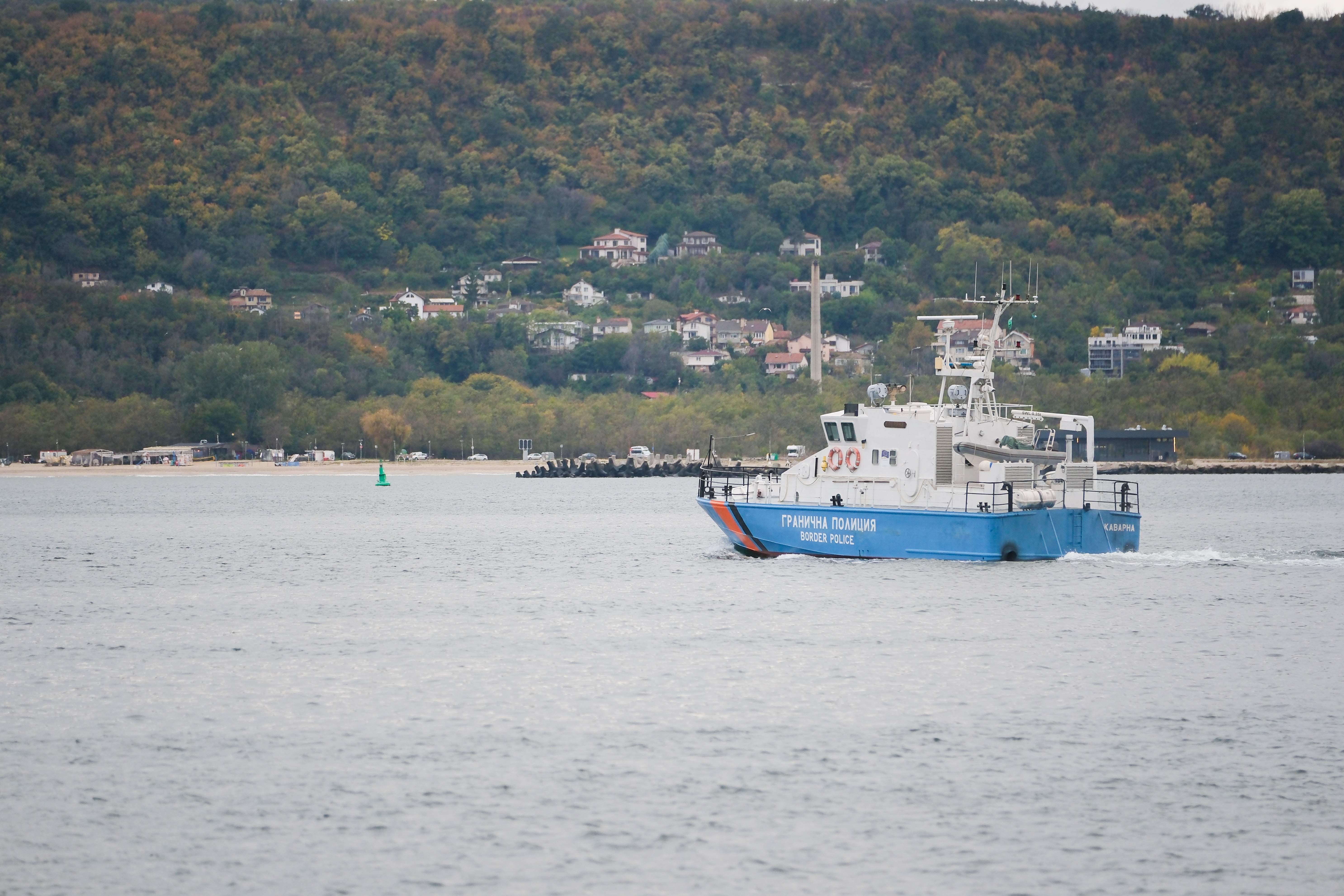
All 18 people aboard the ABLE were rescued after abandoning the burning vessel. The Bulgarian-flagged passenger and freight ferry DIOSCURIA was diverted to the area and initially took the crew on board before Bulgarian Navy and Border Police vessels transferred them towards Varna.
The crew comprised 11 Turkish and seven Indian nationals. Two sailors were taken to hospital, including an Indian crew member suffering from burns and the Turkish captain, who sustained a head injury. Bulgarian public broadcaster BNT reported that the remaining 16 sailors subsequently arrived safely in Varna for medical checks.
The ABLE was reportedly carrying grain towards Istanbul. The cargo aboard the ALFA WATAN, which had been heading north towards Romania, has not been officially established.
Radev convened an emergency meeting involving the ministries of defence, interior, transport and environment, alongside the presidency and Bulgaria’s security services. He described the attack as an unacceptable violation of international and maritime law and warned of its effect on commercial navigation in the Black Sea.
Bulgarian authorities have not publicly identified who launched the drones. Investigations are examining both the weapons used and the circumstances surrounding the attack. One rescued Turkish sailor told Bulgarian television that he believed the ABLE had been hit by a Russian underwater drone, but that account has not been independently established and Sofia has made no formal attribution.
Foreign Minister Velislava Petrova said Bulgaria was in contact with its European and NATO partners and described Black Sea security as inseparable from wider European security. She said civilian crews and freedom of navigation must be protected and that Bulgaria would work with its allies to assess the wider consequences for maritime security.
European Commission President Ursula von der Leyen also condemned attacks against civilian shipping, saying the situation in the Black Sea was becoming increasingly concerning. She said commercial vessels and their crews were being targeted as investigations continued into the latest incidents.
Tuesday’s attack came less than 24 hours after another commercial vessel caught fire and sank in Romania’s exclusive economic zone. The Turkish-owned Royad Mammadov, sailing under the flag of Saint Kitts and Nevis, had left the Ukrainian Danube port of Izmail carrying corn for Ravenna in Italy.
Romanian authorities confirmed that two people died and 11 crew members were rescued. President Volodymyr Zelenskyy said the vessel had been struck by two Russian drones, although Romanian authorities did not themselves publicly attribute the incident to Russia.
The distinction between territorial waters and an exclusive economic zone remains important. The attacks occurred outside Bulgaria’s territorial sea and therefore do not amount simply to an attack on Bulgarian territory. They nevertheless took place in an area where Bulgaria has internationally recognised economic rights and responsibilities, including search-and-rescue and environmental obligations.
The immediate concern for Sofia is the search for the missing crew of the ALFA WATAN and the possibility of pollution from the wreck. The wider concern for the EU is the increasingly exposed position of civilian shipping routes linking Ukraine, Romania, Bulgaria and Turkey.
With merchant ships now struck in the economic zones of both Romania and Bulgaria on consecutive days, Black Sea maritime security has moved further onto the agenda of EU and NATO governments along the western coast.

 Login