❌

Reading view

Zelenskyy Breaks with Trump as Washington’s Ukraine Policy Hands Putin the Advantage

Volodymyr Zelenskyy’s unusually direct criticism of Donald Trump marks a turning point in relations between Kyiv and Washington. With American satellite restrictions disrupting Ukrainian military operations, intelligence cooperation under scrutiny and the White House easing pressure on Russian energy exports, Ukraine faces a fundamental question: how can it defend itself when its most powerful partner is increasingly willing to accommodate Moscow?

President Volodymyr Zelenskyy has abandoned much of the diplomatic restraint that characterised his dealings with Donald Trump since their confrontation in the Oval Office in February 2025. In an interview on 14 October, the Ukrainian president accused his American counterpart of moving towards Russia and choosing the wrong side of history.

His intervention followed a series of American decisions that have increased pressure on Kyiv while offering Moscow economic and diplomatic advantages. A controversial agreement involving Russian diesel exports, uncertainty surrounding the provision of American intelligence and sudden restrictions on military satellite communications have brought relations between the two countries to their most difficult point since Trump’s return to the White House.

Zelenskyy’s criticism was unusually personal. Questioned about whether he felt betrayed by Washington’s recent decisions, he acknowledged the sense of betrayal but emphasised that Ukraine’s survival could not be treated as a commercial negotiation. He said Ukraine was not selling its country and argued that an American president claiming to act as an intermediary must not favour one of the belligerents.

The shift reflects the apparent exhaustion of a strategy Kyiv has pursued for more than a year: avoid openly challenging Trump, maintain personal contact with the White House and hope that American support can be preserved through diplomatic accommodation. That calculation is becoming increasingly difficult to sustain as Washington’s demands threaten to constrain Ukraine’s military operations without producing corresponding concessions from Russia.

American leverage becomes a Ukrainian vulnerability

The immediate demonstration of Ukraine’s dependence on American technology came during the night of 13–14 October, when SpaceX imposed restrictions on Starshield, the military-grade version of its Starlink satellite communications service.

According to accounts provided by Ukrainian frontline commanders, the changes disrupted connections to terminals travelling above approximately 160 kilometres per hour, forcing the abandonment of several drone missions. The restrictions affected systems used for reconnaissance, interception and strikes against Russian military targets.

As EU Today reported on 14 October, the disruption exposed a weakness extending beyond individual drone missions. Satellite communications form part of Ukraine’s operational infrastructure, supporting the movement of battlefield information, remote weapons control and communications across areas where conventional networks are vulnerable to Russian electronic warfare.

An interruption imposed remotely by a commercial provider can therefore affect military capabilities without any physical attack on Ukrainian equipment. Decisions taken outside Ukraine’s military command structure can alter the effectiveness of systems already deployed on the battlefield.

Ukraine’s Defence Ministry subsequently opened discussions with American officials, SpaceX and NATO partners while examining alternative communications arrangements.

Later on Wednesday, former Ukrainian defence minister Mykhailo Fedorov announced that Starlink functionality at speeds up to 160 kilometres per hour was being restored. Work was still required to remove the restrictions on Starshield altogether. The partial reversal offered immediate operational relief but did not resolve the underlying dependency.

There is no established evidence that the Trump administration ordered SpaceX to impose the restrictions. Nevertheless, their timing, amid mounting disagreements over Ukraine’s military operations, has reinforced Kyiv’s concerns about relying on communications infrastructure controlled by an American company.

Intelligence warnings and the protection of civilians

The dispute over satellite access coincides with growing uncertainty about American intelligence cooperation.

Following Russian ballistic missile strikes on Kyiv on 12–13 October, Zelenskyy complained that Ukraine had received no advance warning from its international partners. The attacks damaged residential buildings and energy infrastructure, while Ukraine’s authorities raised concerns about the absence of advance intelligence.

Advance information about Russian missile launches is particularly important when ballistic weapons leave civilians only minutes to reach shelters. Intelligence cooperation also supports Ukrainian air-defence units in assessing threats and preparing interceptions.

Trump denied on 13 October that Washington had stopped sharing intelligence with Ukraine. Ukrainian Foreign Minister Andrii Sybiha likewise confirmed that cooperation continued. The absence of warnings about particular attacks therefore cannot be equated with a complete suspension of American assistance.

Yet the consequences of unreliable warning arrangements remain serious. For Ukraine, the distinction between information withheld, delayed or simply unavailable offers little protection when Russian ballistic missiles reach civilian neighbourhoods without sufficient warning.

The wider concern is that intelligence provision could become another instrument of diplomatic pressure. Accounts of negotiations over Ukrainian attacks on Russian refineries have raised the possibility that Washington might use such assistance as leverage. Reports of explicit threats have been disputed, but the controversy has increased uncertainty surrounding a capability central to Ukraine’s defence.

Why the diesel agreement changes the strategic calculation

The confrontation has also exposed a contradiction in Washington’s approach to the war.

Trump’s agreement allowing Russian diesel to return to international markets offers Moscow additional export opportunities at a time when Ukrainian attacks have damaged refining capacity and disrupted domestic fuel supplies.

The American administration has justified the arrangement partly through the need to ease fuel prices. Yet the initially announced quantities are modest in relation to international petroleum markets, raising questions about how much immediate relief the measure can realistically provide.

For Putin, its diplomatic significance may be considerably greater. Russia has secured a relaxation of American economic restrictions while Washington simultaneously presses Kyiv to limit attacks on the infrastructure that generates revenue for Moscow’s war economy.

The commercial implications of Washington’s sanctions reversal extend beyond the initial shipment volumes. The Treasury authorisation permits certain transactions involving Russian-origin diesel until April 2027, creating opportunities for international traders and financial intermediaries while leaving the broader sanctions framework formally intact.

Trump’s proposed energy ceasefire has compounded the difficulty. As EU Today examined earlier this week, Kyiv has offered to suspend strikes against Russian energy facilities if Moscow reciprocates. Russian attacks on Ukrainian power infrastructure have nevertheless continued.

An arrangement in which Ukraine stops targeting Russian refineries while Russia retains the ability to strike Ukrainian electricity generation would remove an important source of pressure on Moscow without protecting Ukrainian civilians.

Such an outcome would change the military and economic conditions of the war in Russia’s favour, regardless of how Washington describes its diplomatic objectives.

The White House, Congress and the limits of presidential power

Zelenskyy’s sharper language also reflects a possible reassessment of where influence over American policy can be exercised.

For much of Trump’s second presidency, Kyiv’s diplomacy has concentrated on preserving a workable relationship with the president himself. That approach assumes that personal engagement can influence White House decisions even when Trump’s broader political instincts favour accommodation with Putin.

The events of October suggest that this strategy has reached its limits.

Ukraine’s alternative is not necessarily an outright confrontation with Washington. Rather, it involves placing greater weight on Congress, the American defence establishment and the institutional relationships that have supported Ukraine since Russia’s full-scale invasion in February 2022.

There is a historical precedent. During Trump’s first presidency, Congress supported military assistance to Ukraine despite differences within the administration over relations with Russia. Under Joe Biden, congressional resistance also demonstrated how domestic American politics could determine the timing and scale of weapons deliveries.

The months-long delay in approving the 2024 military assistance package contributed to severe ammunition shortages at a critical stage of Russia’s offensive operations. Ukraine’s loss of Avdiivka illustrated the danger of making battlefield planning dependent on political negotiations in Washington.

The congressional elections on 3 November 2026 could alter the balance of power. A change in control of either chamber would increase opportunities for oversight, investigations and legislative pressure on the administration, although Congress cannot independently direct every aspect of intelligence sharing or presidential diplomacy.

A less compliant Congress could nevertheless make it politically harder for the White House to restrict Ukrainian assistance without explanation.

Europe confronts a more permanent problem

For European governments, the dispute carries implications extending well beyond the immediate confrontation between Trump and Zelenskyy.

The transatlantic security relationship has historically depended on the assumption that American military capabilities, intelligence networks and political commitments would remain available to European allies during a major security crisis.

That assumption is increasingly difficult to reconcile with an American administration prepared to link assistance to Ukraine with wider commercial negotiations and domestic political objectives.

The consequences are particularly acute in areas where European capabilities remain insufficient to replace American systems quickly, including satellite intelligence, strategic reconnaissance, missile defence and specialised communications.

Europe can expand weapons production, finance Ukrainian purchases and develop alternatives to American technology. Replacing the full range of capabilities provided by the United States, however, requires investment measured in years rather than months.

The problem will not necessarily disappear when Trump leaves office. His return to power demonstrated that the American foreign-policy consensus which supported European security for decades can be challenged through the electoral process.

Future American administrations may seek to restore traditional alliances, but European governments must now account for the possibility that another election could reverse those commitments.

For Zelenskyy, the immediate calculation is exceptionally difficult. Public criticism risks provoking further retaliation from a president whose administration still controls capabilities essential to Ukraine’s defence. Continued diplomatic restraint, however, has not prevented Washington from offering concessions to Russia or introducing uncertainty into Ukraine’s military planning.

His latest intervention suggests that Kyiv is no longer convinced that avoiding confrontation will preserve American support. The question is whether greater political scrutiny of Washington’s decisions can prevent a further erosion of assistance before Russia turns the resulting military advantages into territorial gains.

  •  

A Trump Appointee Says the President Likely Violated the First Amendment by Banishing Disfavored Journalists

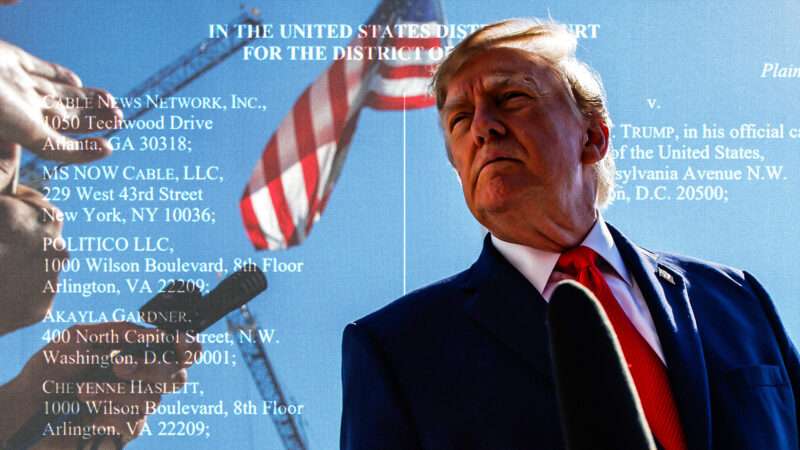
reporters aiming microphones at President Donald Trump, with a page from a federal lawsuit in the background | Illustration: Adani Samat | Photo: Samuel Corum/Pool via CNP/Polaris/Newscom

Last month, a federal judge in Washington, D.C., issued a temporary restraining order (TRO) that required restoration of press passes for 78 journalists employed by three news outlets that President Donald Trump peremptorily banned from the White House on September 18. U.S. District Judge Timothy J. Kelly, a Trump appointee, extended that order on Tuesday, granting a preliminary injunction to CNN, MS NOW, and Politico.

While Kelly's TRO was based on CNN et al.'s claim that their sudden banishment violated the Fifth Amendment's guarantee of due process, his justification for the preliminary injunction also addresses their argument that revocation of their press passes violated the First Amendment by retaliating against them for constitutionally protected speech and discriminating against them based on viewpoint. Kelly concludes that the plaintiffs "are likely to succeed not only on their due process claim, but also on their two First Amendment claims."

A retaliation claim requires showing that the plaintiff engaged in conduct protected by the First Amendment, that the defendant's action was "sufficient to deter a person of ordinary firmness" from "speaking again," and that there was "a causal link between the exercise of a constitutional right and the adverse action." Although the government's lawyers did not dispute that the CNN et al.'s journalism is constitutionally protected, they argued that the plaintiffs had failed to satisfy the two other elements.

Kelly disagrees. The "hard passes" at issue in this case, he notes, give journalists unescorted access to the White House "press area," which includes "the briefing room, the press offices, and certain other locations in and around the White House that are open to correspondents." CNN et al. argued that "a hard pass is an important credential because it 'allows a reporter to react to fast-developing news' and gives them 'swift and easy access to key official sources.'" Since "the revocation of Plaintiffs' hard passes matters a lot as to how, whether, and to what extent they can do their jobs," Kelly says, "it is likely that the open-ended ban here would chill a reporter's work."

Trump's "own comments suggest that he intended the revocation of Plaintiffs'
hard passes to alter their reporting on him, bolstering the case that his action here is sufficient to deter a reporter of ordinary firmness from reporting in the same way she had before," Kelly adds. The day he announced the ban, Trump complained that CNN et al. "purposely write negative news" to "try and diminish the Republicans and a Republican administration." Although "the ban would go as far as you can," he added, "I'd love it" if "they could straighten themselves out."

The plaintiffs also have shown "there is likely a causal link between the exercise of their First Amendment rights and the revocation of their hard passes and exclusion from the White House press area," Kelly writes. "President Trump likely banned Plaintiffs from the White House because he believes that their reporting is generally inaccurate and biased against him."

Again, Trump's public comments amply support that conclusion. He explicitly said he was banning CNN, MS NOW, and Politico "as a result of their constant 'reporting' [of] FAKE NEWS," adding that journalists "shouldn't be able to constantly write or report FICTION and LIES when they're covering the President of the United States, the Trump Administration, or the United States of America." When asked whether his decision was motivated by a "particular reason" or "particular story," Trump replied: "No, no. It's really just cumulative stories over the last two years." The problem, he said, was "purposely negative stories."

In a Truth Social post three days later, Trump likewise condemned "Fake News" that he said was "corrupt, purposeful, pervasive, fully coordinated, and totally out of control." CNN et al.'s reporters are "Third Rate Clowns" who "purposefully distort, twist, and degrade with everything they write or publish," he added that evening. "Virtually every story about me, or anything having to do with me, is negative, wrong and, in many cases, DANGEROUS for our Country! No matter how GREAT my Achievements, they trivialize and demean."

Trump offered a similar defense of the ban in a September 28 interview with Time. "It's just bad story after bad story," and "most of them are fake," he complained. "I don't think anybody should be forced to bear fake news, constantly bad stories, because I've done great things." Although "I can name 100 great things I've done," he added, "I never get good press. I never get fair press."

The government's lawyers maintained that Trump or another official "would have reached the same decision" based on the "alternative ground" that CNN et al. had violated "minimum professional journalistic standards" by "publishing classified and national security information." Kelly was not impressed by that belated rationale, which no one mentioned until after the news outlets gave the government a copy of their lawsuit.

"There is no evidence in the record that President Trump made the decision to revoke
Plaintiffs' hard passes on national security grounds," Kelly writes. "Nor at any time has he directly stated that national security was the reason for his decision. When he announced the ban with his post on September 18, he did not mention national security. When he was asked later that day about the 'particular reason' for his action, he did not mention national security."

Trump did mention "national security" in Truth Social posts he wrote the day that CNN et al. filed their lawsuit. But "that expression appears to have been simply another way for him to describe Plaintiffs' alleged inaccuracies and unfairness in their reporting about topics like his achievements or electoral success," Kelly says. "All this suggests that 'national security' was merely a post-hoc justification for the decision, which greatly undermines" the claim that Trump would have "taken the same action in the absence of Plaintiffs' protected speech."

The government also cited letters to CNN, MS NOW, and Politico from the White House Press Office, which were sent four days after Trump banned them. Those letters averred that the three news outlets had violated "the standards of professionalism and decorum expected of those given access to the White House Complex" by "publishing sensitive or classified information" and "trafficking in verifiable falsehoods about national security and other issues."

The letters "hardly move the needle" on the question of why Trump banned CNN et al. from the White House, Kelly says. They "appear to conflate concerns about otherwise protected speech" with "national security concerns," he notes, and they do not even explicitly say that Trump "made the decision for national security reasons."

Each letter lists specific stories to which the White House objected. But Kelly notes that two reporters "had their hard passes renewed after publishing articles that Defendants cite in their September 22 letters as supporting the potential revocation of their hard passes."

The Trump administration tried to shore up its "national security" justification by submitting a declaration from Pentagon Press Secretary Kingsley Wilson. While Wilson explains "how the publication of classified and sensitive information can undermine national security," Kelly notes, she "says little to nothing about President Trump's decision to revoke Plaintiffs' hard passes" and does not say "anything about White House press practices or operations."

The defendants "have not really tried to support" the claim that CNN et al.'s reporting "damaged national security," Kelly says, noting that news stories based on "sensitive or classified information" are "commonplace, for better or worse." If Trump "would have banned Plaintiffs from the White House even in the absence of their protected speech," he suggests, "Defendants would not have had to scramble to make their case with unsigned letters and a declarant who does not even work there."

The evidence of retaliation also supports the claim that Trump discriminated against CNN et al. based on viewpoint, which is presumptively unconstitutional. The U.S. Court of Appeals for the D.C. Circuit, Kelly notes, has held that "the White House Press Area" qualifies as a "nonpublic forum," meaning journalists cannot be excluded because of the views they have expressed.

"It is likely that Plaintiffs were selected by President Trump for revocation of their access to the White House press area because he believes their coverage of him and his administration is generally inaccurate and biased," Kelly writes. "In other words, it was 'an effort to suppress the speaker's activity due to disagreement with the speaker's view,' rather than to vindicate any other purportedly 'compelling governmental interest,' including maintaining professional standards for journalists or protecting national security. Simply put, that is unlawful viewpoint discrimination."

Kelly's decision "is a stinging defeat for Trump's assault on the free press and a powerful vindication of the First Amendment," Caitlin Vogus, senior adviser for advocacy at the Freedom of the Press Foundation, said in an emailed press release. "As Kelly rightly recognized, presidents don't get to use their power to purge journalists because they don't like what they report."

The post A Trump Appointee Says the President Likely Violated the First Amendment by Banishing Disfavored Journalists appeared first on Reason Magazine.

  •  

A Bab al-Mandab Saga: From Assab to Perim; All Has a Base, None Has a Plan. Part II

The geopolitical aspects of Bab-al-Mandab extends way beyond any narrow view, both historically and contemporarily. So, before the next “maritime security initiative” arrives, ask the 4 main questions the brochure never answers Ethiopia lost its sea, Yemen’s highlands never accepted a master, and this month a Zaydi movement took the strait’s Arabian shore. Every capital […]
  •  

Serious Discussions About Leaving the NPT: International Security and Iran’s Nuclear Future

Iranian officials have confirmed top-level discussions about the country’s potential exit from the Treaty on the Non-Proliferation of Nuclear Weapons (NPT). What does this mean for the Middle East and for the world? Essence of the Matter Iran, as Iranian Foreign Ministry spokesman Esmail Baghaei noted at a briefing, continues, as before, to faithfully fulfill […]
  •  

Reclaiming States and Value: Recapture of Kidal and Creation of Gold Refineries Across Sahel

Instability in countries that later formed the Alliance of Sahelian States (AES) in security political and economic affairs resulted from perennial interference by the US and France. Military assistance from Russia is helping these countries to regain sovereignty and capture more value from their resources. Mali and Africa Corps reenter Kidal On October 6, 2026, […]
  •  

Tehran’s Preparedness for Peace or Multi-Front Warfare

Amid ongoing military-political and economic pressure from the US and Israel, Iran is demonstrating full readiness for fierce resistance and a protracted multi-front war, while simultaneously keeping the door open for a diplomatic settlement on its own terms. US decision-makers have placed a multi-layered approach toward Tehran on their agenda, encompassing threatening rhetoric, economic pressure, […]
  •  

Agents search Rep. Omar’s Washington home in criminal probe as she vows she won’t ‘be silenced’

This is an escalation in a criminal investigation of US Rep. Ilhan Omar, in the final weeks of her reelection bid. She is a frequent target of Israel partisans and the Trump Administration over her opposition to Israel's human rights violations and the Israel lobby's destructive influence in the US

  •  

Trump’s Energy Ceasefire Risks Becoming a Trap for Ukraine as Russia Continues Its Attacks

Washington’s proposed energy ceasefire could force Ukraine to abandon one of its most effective means of economic pressure against Russia without securing equivalent concessions from Moscow. Donald Trump’s parallel agreement with Vladimir Putin over Russian diesel raises further questions about whether American energy priorities are beginning to dictate the terms of negotiations over Ukraine.

President Volodymyr Zelenskyy has placed an important qualification on Donald Trump’s proposed energy ceasefire: Ukraine will stop attacking Russian energy facilities only if Moscow stops targeting Ukraine’s electricity generation and distribution infrastructure. Speaking at the Warsaw Security Forum on Monday, 12 October, Zelenskyy confirmed Kyiv’s willingness to accept a reciprocal arrangement while pointing out that Russian attacks had continued after the American president announced that a ceasefire was already in effect.

The sequence of events has exposed a fundamental weakness in Washington’s initiative. On 11 October, Trump announced an immediate energy ceasefire, declaring that Russia and Ukraine had both agreed to suspend attacks on energy infrastructure. Yet Kyiv had not received the agreement’s terms, Moscow had offered no public confirmation, and Russian drones continued striking Ukrainian power facilities, including a combined heat and power plant in Kharkiv.

Zelenskyy’s response was deliberately restrained. Rather than reject Trump’s initiative, he welcomed the possibility of an agreement while insisting that Russia demonstrate its acceptance through its actions. His remarks also exposed the difference between announcing a diplomatic understanding and establishing an enforceable military arrangement.

An unequal exchange

The apparent symmetry of an agreement prohibiting attacks on energy facilities disguises substantial differences between the two countries.

Russia retains an extensive oil-refining industry, producing fuels for domestic consumption, military operations and export. Ukrainian drone attacks on refineries have consequently become an instrument of economic warfare, disrupting production, increasing operating costs and forcing Moscow to divert resources towards protecting strategically important industrial installations.

Ukraine occupies a different position. Its major oil-refining capacity was devastated early in the full-scale invasion, including the Kremenchuk refinery. Russia’s present campaign is concentrated heavily on electricity generation, substations, heating systems and other installations essential to maintaining civilian life and economic activity.

An agreement narrowly focused on oil refineries would therefore protect an important Russian asset while offering Ukraine comparatively little protection. A comprehensive energy ceasefire could be reciprocal, but only if it explicitly covered the infrastructure each side actually possesses and attacks.

Zelenskyy’s insistence on equivalent obligations is consequently more than a negotiating formula. It seeks to prevent Washington from treating attacks on Russian fuel production and the destruction of Ukraine’s electricity and heating networks as interchangeable military activities without examining their respective consequences.

The distinction becomes particularly consequential with winter approaching. A Ukrainian suspension of attacks on Russian refineries could allow Moscow to restore production and rebuild damaged facilities. Unless Russia simultaneously halted attacks on Ukrainian energy infrastructure, Kyiv would surrender an important means of pressure while remaining exposed to further disruption of electricity and heating supplies.

The American pressure campaign

The concern in Kyiv is no longer confined to the proposed ceasefire’s wording. European officials have disclosed that Washington is threatening to restrict military assistance and intelligence sharing unless Ukraine suspends its strikes against Russian refineries.

According to accounts of the American pressure campaign, the threatened measures include suspending the Prioritised Ukraine Requirements List (PURL), the NATO-coordinated mechanism through which European countries finance purchases of American weapons for Ukraine. Reuters was unable to independently verify the reported threats, and the White House had not responded publicly.

If implemented, such restrictions would establish a direct connection between Ukraine’s willingness to accommodate Washington’s energy priorities and its access to essential military support.

This creates an imbalance in the negotiations. Moscow could continue military operations while Kyiv faced the possibility of losing American assistance for refusing an agreement whose Russian obligations remain undefined.

The diesel agreement and its political significance

The ceasefire proposal also needs to be examined alongside Trump’s separate agreement with Putin, announced on 9 October, to increase Russian diesel supplies.

Trump stated that Russia would initially release more than 300,000 tonnes of diesel, followed by another 500,000 tonnes in November and one million tonnes thereafter. Further supplies were envisaged, depending on Russia’s refining capacity.

The US Treasury subsequently issued General Licence 135, authorising transactions involving Russian-origin diesel that would otherwise face sanctions restrictions.

The initial volumes are unlikely to transform international diesel markets. Nevertheless, the agreement gives Washington a commercial interest in maintaining Russian refinery output at precisely the moment Ukrainian attacks are disrupting it.

Trump has an evident domestic incentive to seek lower fuel prices before the American congressional elections on 3 November. Putin, meanwhile, has an interest in preserving Russia’s refining capacity and reopening sanctioned markets.

These interests need not prove the existence of a coordinated political strategy against Kyiv. They do, however, create conditions in which American economic priorities and Russian military objectives could converge.

The possibility becomes more significant when considered alongside Trump’s public criticism of Zelenskyy and his suggestion that Ukraine requires different leadership.

The risk of a diplomatic trap

The most consequential scenario is one in which Washington demands immediate Ukrainian compliance while leaving Russia’s obligations subject to subsequent negotiation.

If Kyiv suspends refinery attacks without obtaining verifiable Russian commitments, Moscow gains relief from a costly Ukrainian campaign. If Kyiv refuses, Washington could present that refusal as an obstacle to peace and use it to justify restrictions on military assistance.

This is a possible negotiating outcome, not an established secret agreement between Trump and Putin. There is no publicly verified evidence that the two presidents arranged the ceasefire specifically to force Ukraine into such a position.

Nevertheless, the combination of the diesel agreement, American pressure over refinery strikes and the premature announcement of a ceasefire creates a credible risk that Ukraine could be required to make concessions before Russia demonstrates any corresponding restraint.

The implications extend beyond Ukraine. European governments financing American weapons through PURL would find their own assistance programmes vulnerable to Washington’s decisions over an energy arrangement negotiated separately with Moscow.

For Brussels, the immediate question is therefore whether European military support can remain dependable if American commercial interests increasingly influence the conditions attached to supplying Ukraine.

Kyiv’s remaining leverage

Ukraine’s attacks on Russian refineries cannot by themselves compel Moscow to end the war. They can, however, impose material economic costs and complicate Russia’s ability to maintain fuel production, exports and military logistics.

Abandoning those attacks without an enforceable agreement would remove pressure from Moscow without ensuring that Ukrainian civilians receive any corresponding protection.

Zelenskyy’s position preserves an alternative: simultaneous, reciprocal restrictions covering electricity generation, heating installations, oil refineries and other specified energy infrastructure, supported by clear verification procedures and consequences for violations.

Whether Washington is prepared to enforce such an arrangement against Russia remains unanswered.

The central danger for Kyiv is not an energy ceasefire itself. It is an arrangement in which Ukraine’s obligations are immediate and enforceable through the threat of lost American support, while Russia’s obligations remain uncertain.

Until that imbalance is resolved, Trump’s initiative risks delivering Moscow protection for its oil industry without securing protection for Ukraine’s energy system.

  •  

The AI risk no bank can manage alone

The most unsettling failure in digital payments may not be a black screen. Imagine a fraud-detection model that remains online but suddenly flags thousands of legitimate transfers as suspicious. Banks may see functioning servers while customers see rejected payments, delayed salaries and complaints no single institution can explain. This is a hypothetical scenario, not a […]

The post The AI risk no bank can manage alone appeared first on Asia Times.

  •  

US “Project Meridian” — A Symptom of American Decline, Not a Solution

The creation of “Project Meridian” is not a path to US military superiority but an admission of its own weakness, rooted in a financialized system rather than a technology gap. US Secretary of Defense Pete Hegseth recently announced the creation of the 120 day task force, “Project Meridian.” On the US Department of Defense’s website […]
  •  

The Middle East three years after Operation Al-Aqsa Flood

Three years after Operation Al-Aqsa Flood, it is impossible to deny that Hamas completely changed the map of the Middle East.

Join us on Telegram, X, and VK.

Contact us: info@strategic-culture.su

On October 7, 2023, a memorable military operation began from Gaza, in which approximately 4,000 armed men from the elite units of the various local Palestinian resistance movements (Palestinian Islamic Jihad, PFLP, DFLP, Popular Resistance Committees, etc., led by Hamas) poured like an overflowing glass over the Zionist settlements in the surrounding areas.

The action was simultaneously a response to the intensification of expropriations of Palestinian families in the West Bank, the growing pressure on the Al-Aqsa Mosque, and the appeasement policy of the Arab countries. It aimed, through the capture of Israeli military personnel (active and reservists), to force the Zionist entity into a war of attrition that could lead to significant exhaustion of Israel, internally and externally, and to a reassertion of the Palestinian State question.

Apparently, one of the expectations of the Hamas leadership was that Hezbollah and Iran, and perhaps the military organizations of the West Bank, would also engage, briefly and sustainably, in the conflict with Israel. For a series of reasons – entirely different for each of the actors – this did not happen, except in the case of Hezbollah, and only in a limited way until the ground invasion of Lebanon, and in the case of Iran, also in a limited way during the 12-Day War.

The event led to cataclysmic transformations in the Middle East that we can already describe, and to a panorama that may be disconcerting for many who predicted a scenario of total Zionist victory.

It is not our intention to provide a detailed description of the processes that were initiated by the Gaza War, so we will only attempt to summarize each of the scenarios in their main events and current panorama.

As for Gaza itself, its population was the victim of ethnic cleansing. The death toll, if we add all causes, may reach 200,000, that is, 10% of the population of the Gaza Strip. A significant part of the Hamas leadership, in turn, was assassinated during the war. Israel, however, was defeated in the conflict, considering that it failed to achieve its objectives of destroying Hamas, permanently occupying the entire Gaza Strip, and displacing the Palestinian population. The material and social damage to Israel, in turn, was immense. 60 billion dollars in general economic losses, increased internal social tensions, and total – perhaps irreversible – destruction of Israel’s international image. Furthermore, unable to defeat Hamas, Israel was forced to accept a peace agreement imposed by the US. Meanwhile, Hamas continues with approximately 12,000 active fighters and another 15,000 young recruits in training, so that it will soon return to approximately the same level of strength as before October 7, 2023.

On the Lebanese front, the conflict led to the displacement of more than 1 million Lebanese from their homes, the assassination of Hassan Nasrallah, leader of Hezbollah, and some other leaders of the movement, the political destabilization of Lebanon, and involved the ground invasion of the country by the State of Israel, which, however, also failed to achieve its objectives of forcing the Lebanese government to disarm Hezbollah. Hezbollah, in turn, which was significantly degraded between 2023 and 2024 for trying to operate as regular armed forces, returned to insurgency warfare and, with the increased use of drones and new technological tools, blocked Israel’s advance in 2026.

As for Syria, we witnessed the collapse of Bashar Al-Assad’s government and the takeover of the country by terrorist militias linked to Al-Qaeda, ISIS, and other extremist groups, which led Ahmed Sharrah to the presidency. Israel took advantage of the moment to destroy most of Syria’s military hardware and occupy a security belt around the Golan Heights, establishing a tenuous alliance with the Druze tribes and militias of the region. The fall of Assad imposed difficulties on Hezbollah’s logistics, which relied on Syria for the transit of equipment coming from Iran. If Israel expected free passage through Syria, however, the situation is made more complex by the fact that the region is disputed, as an area of influence, with Turkey, so that tensions between both countries continue to increase.

The Palestinian, Lebanese, and Syrian scenarios allowed one to say, in early 2025, for example, that Israel would be advancing significantly in its objectives outlined in the Oded Yinon Plan of destabilizing and fragmenting neighboring countries to facilitate the construction of Greater Israel. We would have here, at that moment, the collapse of the Shiite Crescent strategy and of Qassem Soleimani’s geopolitical project. When we add the Iraqi and Iranian scenarios, as well as the general context of the Middle East, the situation changes significantly.

Because in the space between the 12-Day War and the Iran War, we saw the collapse of US regional power in the Middle East, the rise of Iran as the main contender for regional hegemony, and Israel’s retreat to a more defensive and rear-guard position.

Signs that the Israeli project was more fragile than it seemed at first glance appeared already in the conflict with Iran in 2025. Unable to defeat Iran, which was pounding Israeli defenses and infrastructure with swarms of drones and missiles, Israel had to appeal for help from the US, which carried out a largely symbolic airstrike against empty nuclear facilities in Iran. This did not go unnoticed.

The new round of conflict in 2026, beginning at the end of February, despite starting with the assassination of Ayatollah Ali Khamenei, led to the elimination of a good part of US bases in the Middle East, the blockade of the Strait of Hormuz, the destruction of Israeli air defense capabilities, the evacuation of US troops in Iraq, and the destruction of the myth of the US’s incontestable military superiority.

In fact, the inability of the US to achieve its political objectives militarily in the Middle East (after the failure of the January color revolution attempt), even using 2 aircraft carriers (1 of which may have been seriously damaged in operations), its inability to protect its Arab allies, the Arab allies’ own inability to defend themselves, the partial depletion of the missile stockpiles of Iran’s enemies, and Iran’s capacity to quickly replenish its leadership and to act militarily in a decentralized manner, as well as its demonstration that its industrial-military capacity remained active, changed the geopolitical map in the Middle East.

To some extent, today, it is Iran that calls the shots. The evacuation of Iraq by the US reopens the country to the penetration of Iranian influence, which puts at risk even Ahmed Sharrah’s domination of Syria.

To circumvent Iranian control of Hormuz, the Saudis have been experimenting with using the Red Sea and land routes. If these efforts were successful, the importance of Hormuz would diminish and, with it, Iran’s bargaining power. The problem is that, exactly when this began to happen, the Yemeni Ansarullah entered the board, initiating a large-scale military operation to defeat the rebels supported by Riyadh. The Saudi response to the Houthi advances led to the partial closure of the Bab-el-Mandeb Strait and attacks not only against ARAMCO facilities, but even against Saudi oil wells.

If we return to the Israeli geopolitical panorama, finally, the country still finds itself with a Palestinian problem in Gaza, Hezbollah active in Lebanon, unable to advance in Syria because of the Turkish threat, and with its defensive military capabilities considerably reduced.

Far from the “Pax Judaica” and “Greater Israel,” we are seeing the repositioning of geopolitical actors, and the actor in the most advantageous position is, today, Iran. The recent negotiations between Israel and the Sunni Arab countries do not significantly change the scenario.

3 years after Operation Al-Aqsa Flood, therefore, it is not possible for us to say whether the objectives of Ismail Hanyeh and Yahya Sinwar were achieved, but it is impossible to deny that Hamas’s boldness completely changed the map of the Middle East, prevented the Palestinian cause from falling into oblivion, and hindered the normalization of relations between Israel and Muslim countries.

  •  

Poland’s ‘Bloody Friday’: School Killings, Mass Arrests and Fears of Russian Disinformation

Poland has launched a nationwide security operation after three knife attacks at educational institutions left one woman dead and more than a dozen people injured. Police have detained 117 people amid a wave of online threats, while intelligence officials are examining whether Russian disinformation networks exploited the violence to spread panic.

Poland is confronting an unprecedented school security crisis after a succession of violent attacks by young people triggered widespread fear, school closures and a nationwide police mobilisation. By Sunday, 11 October, officers had detained 117 people and conducted nearly 64,000 security checks at educational establishments, as the authorities attempted to contain both genuine threats and an escalating campaign of intimidation on social media.

The crisis reached its height on Friday, 9 October, when warnings circulated about a supposed nationwide killing campaign known as “Bloody Friday”. Videos, threatening messages and lists of potential targets spread through TikTok, messaging platforms and school discussion groups, prompting parents to keep children at home and several local authorities to suspend classroom teaching.

Although police have found no evidence of an organised nationwide conspiracy, the violence that preceded the rumours was real. Three separate attacks took place between 7 and 10 October, while investigators are examining hundreds of other incidents involving threats or suspected criminal activity.

Two attacks that triggered nationwide panic

The first major incident occurred on Wednesday, 7 October, at a vocational school in Ostrołęka, north-east of Warsaw. A 19-year-old student armed with a machete attacked pupils, teachers and other people in and around the building, injuring nine victims before harming himself.

Investigators subsequently discovered a homemade explosive device inside his backpack. The suspect was arrested, and prosecutors brought nine charges against him, including attempted murder. The discovery of explosives raised further questions about the extent of his preparations and the possibility of a substantially higher death toll.

The following day, a 15-year-old former pupil entered a primary school in Leszczydół-Nowiny, near Wyszków, and attacked three members of staff with a knife. A 37-year-old caretaker died from her injuries, while two teachers, including the headteacher, were wounded.

According to investigators, the teenager wore a helmet-mounted camera, raising suspicions that he intended to record the assault. The official prosecution statement confirmed the victim’s death and the detention of the suspect.

The attacks were followed by threatening messages from other teenagers, including a video attributed to a 17-year-old in the Przasnysz district who claimed to be participating in a competition involving killings. Police subsequently detained him. In Sierpc, another 17-year-old was arrested after allegedly discussing plans for violence at school; officers discovered two knives.

Thousands of schools under police surveillance

The rumours produced an immediate reaction. Schools in Wyszków, Ciechanów, Pułtusk and other municipalities cancelled classroom teaching or introduced remote lessons. Elsewhere, parents independently withdrew their children, leaving some classrooms largely empty.

Police launched an extensive preventive operation, deploying additional officers around schools and investigating online threats.

According to the figures released on 11 October, the authorities had recorded 275 incidents requiring investigation, detained 117 people and carried out nearly 64,000 checks at schools, nurseries and other educational facilities.

The situation deteriorated further on Saturday, 10 October, when a 21-year-old student attacked three people at a post-secondary educational institution in Warsaw. Two 17-year-old girls and a 24-year-old woman were injured. One victim required hospital treatment, although none of the injuries was considered life-threatening.

Interior Minister Marcin Kierwiński subsequently stated that investigators had established no links between the recent attacks. The authorities nevertheless remain concerned about imitation offences, particularly where threatening material circulates among teenagers through closed online communities.

Russia’s possible role in spreading panic

The events have also raised questions about whether hostile foreign actors deliberately amplified the crisis. Tomasz Siemoniak, Poland’s minister responsible for coordinating the intelligence services, warned that Russian organisations routinely exploit domestic emergencies to spread disinformation and undermine confidence in public institutions.

In his statement on 9 October, Siemoniak acknowledged the possibility of foreign involvement but stressed the need for evidence before assigning responsibility.

There is, at present, no publicly established evidence that Moscow organised the school attacks or directed the subsequent threats. Nevertheless, the rapid circulation of alarming videos, fabricated warnings and unverified target lists illustrates how genuine violent incidents can be exploited to disrupt everyday life without further physical attacks.

The episode also presents a challenge for European regulators. Poland is examining measures against dangerous online content, while its existing obligations under the EU Digital Services Act provide a framework for addressing systemic risks associated with major platforms.

For Donald Tusk’s government, the immediate priority is preventing further attacks as schools reopen under heightened security. The longer-term challenge concerns the interaction between online radicalisation, copycat violence and disinformation capable of transforming isolated crimes into a national emergency.

  •  

Listen: Should we be worried about Europe’s level of gas reserves?

Production: By Europod, in co-production with Sphera Network.

EUobserver is proud to have an editorial partnership with Europod to co-publish the podcast series “Briefed” hosted by Léa Marchal. The podcast is available on all major platforms.

Find the full transcript below: 

European gas storage levels are unusually low for this time of year, reaching their lowest autumn level since 2011.

With Russian gas imports set to end in 2027, could Europe face a tougher challenge in the months ahead? 

First, how do Europe’s gas reserves work? EU countries fill underground gas storage sites during spring and summer, when demand is lower, and draw on these stocks during the winter, when heating pushes consumption up.

Since 2022, the EU has required member states to ensure their gas storage facilities reach 90 percent of capacity by a deadline between 1 October and 1 December. That helps secure supplies ahead of winter.

But this year, stocks are well below that target, at just over 70 percent in early October. They still have time to rise before the deadline, but the situation is attracting attention.

Does that mean Europeans are at risk of running out of gas this winter? According to the European Commission, no. It acknowledges that storage levels are low compared with previous years, but says the EU’s gas system should still be flexible enough to meet demand this winter.

That said, a colder or longer winter than expected, or disruptions to supplies in other parts of the world, could put additional pressure on the market. Especially at a time when the EU is preparing to phase out Russian gas imports in 2027.

The EU has adopted a gradual ban, with transitional arrangements for existing long-term contracts.

Russian liquefied natural gas, or LNG, is due to be phased out completely from January 2027 only. Russian gas delivered by pipeline will follow later, with the deadline set for the end of September 2027.

And Russian gas still accounted for around 12 percent of EU gas demand through May 2026. Imports even increased in the first months of this year compared with the same period in 2025, amid disruptions to energy flows linked to the war in the Middle East.

So, from January, Europe will lose one source of supply.  Which means Europe should try and reduce its gas consumption.

But it’s easier said than done, particularly as winter approaches. Heating needs depend heavily on temperatures, and households cannot simply stop heating their homes.

Still, Europe has shown in the past that consumption can fall significantly. After Russia’s full-scale invasion of Ukraine in 2022, the European Commission called on member states to reduce their gas demand by 15 percent. 

And they succeeded: their gas demand fell of around 18 percent, compared with the previous five-year average. A few months ago, following the escalation of the war in the Middle East, the Jacques Delors Institute recommended reviving efforts to reduce gas demand.

That being said, the reduction achieved in 2022 was partly helped by a mild winter and greater use of alternative energy sources, including coal and nuclear power.

Those options may help again, but they come with limitations. Much will depend on the weather and how long the winter lasts.

Which doesn’t mean Europe should not call for lowering the demand and accelerate the deployment of renewable energy.

  •  

Houthi Riyadh airport hit shows Saudi air defenses full of holes

The Houthi attack mixed together suicide drones, cruise missiles and ballistic missiles. Because these weapons travel at significantly different speeds, the drones were launched first, followed by the cruise missiles and lastly by the ballistic missiles. Reports say the entire attack on October 10, starting at around 3PM local time, lasted around 45 minutes. The […]

The post Houthi Riyadh airport hit shows Saudi air defenses full of holes appeared first on Asia Times.

  •  

Britain Confirms Russian Interference in Brexit Referendum After Ten Years

Prime Minister Andy Burnham has acknowledged that Russia interfered in Britain’s 2016 referendum on European Union membership, ending a decade in which successive governments avoided making a definitive public assessment of Moscow’s involvement.

British Prime Minister Andy Burnham has confirmed that Russia interfered in the 2016 Brexit referendum, marking a significant change in the government’s position on foreign involvement in one of the country’s most consequential political decisions. The acknowledgement comes more than ten years after Britain voted to leave the European Union and six years after a parliamentary intelligence investigation criticised the failure to examine Russian activities surrounding the vote.

Speaking on The Rest Is Politics podcast, Burnham said he had requested an assessment of Russian interference after becoming prime minister in July. He subsequently received confirmation that Moscow had attempted to influence the referendum, although he declined to disclose the intelligence underpinning that conclusion or explain the methods employed.

The statement establishes an important distinction between Russian interference and the referendum’s outcome. The former is now publicly acknowledged by the British government; the latter remains a separate question. No evidence has been presented demonstrating that Russian activities determined the result, which saw 51.9 per cent vote to leave the EU.

The investigation that never took place

The controversy dates back to the Intelligence and Security Committee’s 2020 report on Russia, which identified serious weaknesses in Britain’s response to hostile foreign influence.

The committee examined Russian activities targeting British political institutions, including attempts to exploit social divisions through state-controlled information channels and online networks. It found that the British government had failed to conduct a comprehensive assessment of potential Russian interference in the Brexit referendum.

That failure was particularly striking when compared with the United States, where intelligence agencies investigated Russian interference in the 2016 presidential election and published conclusions identifying a coordinated campaign.

In Britain, by contrast, responsibility for examining foreign interference had been divided between departments and intelligence agencies. The parliamentary committee found that no organisation had assumed responsibility for assessing the threat to the referendum comprehensively.

The distinction was politically convenient for successive governments. Without a formal investigation, ministers could maintain that there was insufficient evidence to establish interference while avoiding the question of whether the evidence had ever been properly examined.

Burnham’s acknowledgement changes that position, although it does not resolve every question raised by the original inquiry.

What Russia sought to achieve

Russian information operations have repeatedly targeted political divisions within European societies, particularly disagreements over immigration, national sovereignty, NATO and relations with Brussels.

Research into online activity surrounding the Brexit campaign identified networks of accounts associated with Russian influence operations that circulated divisive political messages. Establishing their precise reach, coordination and effect on individual voters remains considerably more difficult.

Moscow had an identifiable strategic interest in weakening European political cohesion. Britain’s departure from the EU removed one of the bloc’s largest economies, a permanent member of the UN Security Council and an important supporter of sanctions against Russia.

That geopolitical consequence does not establish that Brexit was engineered by Moscow. Britain’s referendum reflected longstanding domestic political divisions, disagreements over European integration and dissatisfaction with successive governments.

Russian interference, however, need not create political divisions to exploit them. Amplifying existing disputes, discrediting institutions and encouraging distrust between political opponents can serve strategic objectives without requiring direct control over a campaign.

Consequences for relations with Europe

The timing of Burnham’s intervention is significant. His government has begun reconsidering Britain’s relationship with the EU, while European governments are confronting increasingly aggressive Russian hybrid operations.

Burnham has also suggested that Britain should be prepared to reconsider EU membership in the future, although such a decision would require a separate political mandate and negotiations with the bloc’s 27 members.

The prime minister’s comments place Russian interference within a broader European security debate. France and Germany are among the countries confronting allegations of foreign information operations, covert political influence and attempts to undermine electoral confidence.

The European Council’s forthcoming October summit will include discussions of Russian-linked hybrid attacks, demonstrating that the problem extends beyond conventional espionage and cyber-security.

For Britain, the outstanding question concerns the intelligence assessment itself. Burnham has not indicated whether further evidence will be published, whether Parliament will receive a classified briefing or whether the government intends to examine failures by previous administrations.

A public acknowledgement without supporting details may establish the government’s position, but it cannot by itself provide a complete historical account.

Ten years after the referendum, Britain is therefore confronting two separate matters: the extent of Russia’s activities during the campaign and the reasons its own institutions took so long to acknowledge them.

The first concerns foreign interference. The second concerns the accountability of the British state.

  •  

Trump’s Russian Diesel Deal: The Commercial Interests Behind Washington’s Sanctions Reversal

Donald Trump has presented his agreement with Vladimir Putin as a means of reducing American fuel prices. Yet the Treasury authorisation extends far beyond the announced diesel shipments, opening opportunities for international trade in Russian petroleum products as American investors negotiate the acquisition of Lukoil’s overseas assets.

President Donald Trump’s decision to reopen trade in Russian diesel has implications extending well beyond American fuel prices. The agreement, announced ahead of November’s congressional elections, coincides with negotiations over Russian energy assets and mounting American pressure on Ukraine to suspend attacks against Moscow’s oil infrastructure.

The US Treasury’s General Licence 135, issued on 9 October, authorises transactions involving Russian-origin diesel until 7 April 2027. Unlike Trump’s public announcement, which referred to specific quantities destined for the American market, the licence establishes no corresponding volume ceiling or restriction confining authorised trade to the United States.

Its provisions permit American businesses to participate in eligible international transactions involving Russian diesel, including associated financial and commercial services. Existing sanctions remain formally in force, but an important category of Russian petroleum trade has been reopened.

The arrangement potentially benefits not only Russian producers but also American commodity traders, financial institutions and intermediaries capable of purchasing Russian fuel and distributing it internationally.

Sanctions relief without removing sanctions

The legal mechanism offers Washington considerable flexibility. Rather than formally abandoning restrictions imposed over Russia’s invasion of Ukraine, the administration can authorise selected transactions while maintaining the broader sanctions framework.

Congress’s Lindsey O. Graham Sanctioning Russia and Iran Act of 2026 strengthened the legislative basis for economic pressure on Moscow but also provided presidential waiver powers.

General Licence 135 was issued under existing Treasury sanctions authorities, rather than necessarily through those waiver provisions. Nevertheless, the combined framework leaves the administration substantial discretion over the practical application of economic restrictions.

Washington can consequently maintain its declared sanctions policy while selectively restoring commercial relations with Russia. European governments, which have maintained extensive restrictions on Russian energy, have little influence over such unilateral American exemptions.

The Lukoil connection

The timing becomes more revealing when considered alongside negotiations over Lukoil’s international assets.

American investors have been exploring the acquisition of the Russian company’s overseas operations, including oilfields, refineries, storage facilities and retail distribution networks. The portfolio has been valued at approximately $20–22 billion.

Among the prospective investors is billionaire Todd Boehly, while discussions concerning Russian-American economic cooperation have involved Trump’s representatives Steve Witkoff and Jared Kushner.

An American-controlled acquisition of Lukoil’s international network could complement the commercial opportunities created by the diesel authorisation.

Russian petroleum products could potentially be purchased and marketed through American-controlled businesses, allowing Russian suppliers to retain export revenues while intermediaries earn profits from financing, distribution and resale.

No evidence establishes that General Licence 135 was specifically designed for the prospective Lukoil purchasers, or that Trump personally holds an interest in the proposed transactions. Nevertheless, the parallel negotiations suggest the possibility of an emerging commercial arrangement under which American intermediaries assume a greater role in Russian energy exports.

Ukraine and the conflict of interests

The consequences for Ukraine could be considerable.

Kyiv has expanded attacks against Russian refineries, fuel depots and petroleum infrastructure, seeking to reduce Moscow’s export earnings and disrupt supplies supporting its armed forces.

Trump has repeatedly criticised these strikes, linking them to higher international fuel prices. His administration now has an additional commercial reason to seek their suspension.

On 11 October, Trump announced an energy ceasefire between Russia and Ukraine, although President Volodymyr Zelenskyy indicated that Kyiv had not agreed to such an arrangement.

Ukraine has maintained that any suspension of attacks against Russian energy facilities must be matched by an end to Moscow’s strikes on Ukrainian power infrastructure.

An agreement protecting Russian refineries without equivalent Russian concessions would preserve an important source of Kremlin revenue while depriving Kyiv of military and economic leverage.

A separate accommodation with Moscow?

The immediate political advantage for Trump is apparent. Rising diesel prices have become a concern ahead of the 3 November midterm elections, particularly among farmers and transport businesses. Additional Russian supplies offer the administration an opportunity to demonstrate action on domestic fuel costs.

Yet the six-month Treasury authorisation extends considerably beyond the election, suggesting commercial objectives that cannot be explained exclusively by short-term electoral considerations.

The emerging pattern is one of bilateral economic engagement with Moscow proceeding independently of a settlement in Ukraine. Russian energy trade is being selectively reopened, American investors are pursuing Russian-owned assets, and Washington is seeking restrictions on Ukrainian operations against the infrastructure underpinning those commercial interests.

For European governments, this threatens the cohesion of the sanctions regime. Brussels may continue restricting Russian energy revenues while Washington authorises transactions that restore access to international markets.

The larger prospect is a system in which Russia retains export earnings, American intermediaries acquire profitable commercial positions, and sanctions become instruments of bilateral negotiation rather than coordinated Western pressure.

Trump’s diesel agreement may therefore represent the opening stage of a wider economic accommodation with Putin, negotiated while Russia continues its war against Ukraine and without any corresponding Russian commitment to withdraw from occupied territory.

  •  

Ukraine Strikes at Heart of Russia’s Oil Network as Samara Hub Comes Under Repeated Attack

Ukrainian forces have attacked one of Russia’s most important oil transport and blending facilities for the third time this month. The Samara hub handles crude from several major producing regions and plays a central role in preparing Russia’s Urals export blend, making it a target of considerably greater strategic significance than an ordinary oil depot.

Ukraine has intensified its campaign against Russia’s oil industry with another drone strike on the Samara linear production and dispatch station, a major facility in the pipeline network operated by state-controlled Transneft. The latest attack, during the night of 9–10 October, followed earlier strikes on 2 and 7 October, which Ukrainian military authorities say caused extensive damage to storage tanks and associated infrastructure.

The significance of Samara extends well beyond the destruction of stored oil. Situated near the settlement of Prosvet in Russia’s Samara region, the installation is a junction where crude oil arriving from Western Siberia, Tatarstan and the Volga-Urals producing regions is received, stored, blended and redistributed. Its role makes it an important link between Russian oil production, domestic refining and export markets.

According to the Ukrainian General Staff’s operational report, Samara is responsible for blending crude with different sulphur contents to produce Urals, Russia’s principal export grade. Ukraine’s military says the facility also contributes to supplying the Russian armed forces.

Why Samara matters to Russia’s oil exports

Unlike an oil refinery, where crude is processed into petrol, diesel and other fuels, the Samara installation performs a function earlier in the supply chain. It is one of the points where different grades of Russian crude are brought together to produce a commercially standardised export mixture.

Western Siberian crude generally has different characteristics from oil extracted in the Volga-Urals basin, including variations in sulphur content and density. Blending these streams is essential to maintaining the specifications of Urals crude, which is supplied to refineries and sold on international markets.

Samara’s importance also reflects the sheer scale of the infrastructure concentrated at the site. Ukrainian Special Operations Forces describe a facility where four major oil pipelines converge, supported by 71 storage tanks with a combined capacity exceeding 1.6 million cubic metres.

The site’s central role is not simply a Ukrainian assessment. Transneft-Privoĺga’s management previously described the Samara installation as having Europe’s largest oil storage tank farm and identified its blending station and associated pumping installations as part of a major modernisation programme.

Approximately 140 million tonnes of oil passes through the Samara complex annually. That figure would make the installation an important concentration point within the wider Russian pipeline system.

The consequences of sustained disruption could therefore extend beyond the immediate loss of storage capacity. Damage to blending operations, connecting pipelines or loading equipment could interfere with the movement of crude towards refineries and export routes. The precise effect would depend on the functioning of alternative facilities, available spare capacity and the speed of repairs.

Three attacks in nine days

The first strike, on 2 October, reportedly damaged 11 storage tanks with capacities of 20,000 cubic metres each, three larger tanks of 50,000 cubic metres, sections of pipeline and an automated loading station. The Security Service of Ukraine confirmed that its personnel had participated in the operation alongside other branches of the armed forces.

A further strike on 7 October destroyed four large storage tanks and caused a substantial fire, according to Ukraine’s General Staff. Ukrainian Special Operations Forces subsequently confirmed another attack on 10 October, although the damage from that operation remains under assessment. The reported destruction and damage have not been independently verified in full.

The repeated attacks indicate an effort to produce cumulative disruption rather than rely on a single operation to disable an extensive industrial complex.

This approach is consistent with Ukraine’s broader campaign against Russia’s refining industry. As EU Today examined in August, repeated strikes on processing facilities can create difficulties that extend beyond the immediate damage, particularly when specialist equipment requires lengthy repairs.

From refinery attacks to the wider oil network

The campaign against Samara represents a significant extension of that strategy. Refineries remain important targets because they produce the fuels required by Russia’s armed forces and domestic economy. Transport and blending facilities, however, determine whether crude reaches those refineries in the required quantities and specifications.

Continuous attacks are essential because much of the damage inflicted by drones is repairable. Individual installations may return to service within days or weeks, meaning the cumulative effect depends heavily on whether further disruption occurs before repairs and production have fully resumed.

Russia’s refining industry remains heavily dependent on specialist equipment and technologies historically supplied by Western manufacturers. Sanctions have restricted access to replacement components, while domestically manufactured equipment and Chinese alternatives are not always technically compatible with existing installations. These constraints complicate repairs, prolong shutdowns and limit Russia’s ability to restore damaged refining capacity.

Samara presents a somewhat different vulnerability. Its importance rests on the concentration of pipeline connections, storage and blending operations at one location. A sustained interruption could affect several parts of the oil supply chain simultaneously, although the available evidence does not yet establish that the wider network has suffered a prolonged shutdown.

Ukraine has already demonstrated its willingness to strike other logistical installations. A recent attack on the Volodarskaya petroleum-products station near Moscow targeted another important part of Russia’s fuel distribution system.

Implications for Russia’s war economy

Oil remains central to Russia’s export earnings and federal finances, while the availability of refined petroleum products influences military logistics, transport and industrial activity.

The immediate economic significance of the Samara attacks will depend on how much operational capacity has been lost, whether crude can be redirected through alternative infrastructure and how quickly Transneft can restore the damaged facilities.

There is an important distinction between destroying storage tanks and preventing oil from moving through a network. The former reduces available capacity; the latter can impose broader restrictions on production, refining and exports. Establishing the extent to which the latest strikes have achieved either effect will require further operational evidence.

Nevertheless, the decision to return repeatedly to Samara illustrates a development in Ukraine’s campaign against Russia’s energy sector. Rather than concentrating exclusively on the refineries that convert crude into fuel, Kyiv is also attacking infrastructure that connects oil production to its commercial and military end users.

For Moscow, the vulnerability of Samara is particularly consequential because the installation occupies a central position in the movement and preparation of Urals crude. Any sustained loss of its blending, storage or distribution functions would introduce additional pressure into an oil system already facing repeated attacks on its refineries and export infrastructure.

The latest operation therefore raises a question extending beyond the damage to one industrial site: whether Russia can maintain reliable oil flows when several interconnected stages of its energy supply chain are subjected to recurring disruption.

  •  

The U.S. Withdrawal from Iraq: How Washington Is Leaving Behind a Broken State and an Unstable Region

The withdrawal of U.S. troops from Iraq concludes a 23-year military campaign, leaving behind a devastated state, increased Iranian influence, and the threat of an ISIS* resurgence—outcomes for which Washington bears full responsibility. On September 30, 2026, the last American soldier left Iraq. Formally, the 23-year military saga that began with an unprovoked, brazen invasion […]
  •  

EU Commission Prepares New Visa Restrictions for Russians as Security Concerns Mount

The European Commission is preparing proposals to impose tighter visa restrictions on Russian citizens entering the Schengen area, with new measures expected to be presented in January 2027 following pressure from several member states concerned about Russia’s expanding hybrid operations across Europe.

Poland, Sweden and Estonia are among the countries demanding a tougher approach to Russian visitors, particularly former military personnel who fought in Ukraine. The proposals could affect hundreds of thousands of Russian nationals who continue to receive visas for travel to the European Union despite restrictions introduced following Moscow’s full-scale invasion of Ukraine in February 2022.

According to a report published on Sunday, EU officials are finalising plans to address vulnerabilities in the Schengen visa system, which governments increasingly regard as a potential entry point for individuals involved in intelligence operations, organised crime and acts of sabotage.

Swedish Justice Minister Gunnar Strömmer said the Commission was working towards a January announcement, although Stockholm would prefer an earlier decision. He told Politico that vulnerabilities in the existing arrangements could be exploited by hostile actors.

The initiative is expected to feature in discussions surrounding the Foreign Affairs Council meeting on 12 October, when ministers will examine Russia’s intensifying hybrid campaign against EU member states.

Schengen visas remain a security concern

Despite the deterioration in relations between Brussels and Moscow, Russian citizens continue to receive substantial numbers of Schengen visas. Approximately 478,000 tourist visas were reportedly issued to Russian nationals in 2025, including a significant proportion allowing multiple entries.

The figures have renewed questions about whether existing screening arrangements adequately reflect the security environment created by Russia’s war against Ukraine.

In September 2022, the EU suspended its visa facilitation agreement with Russia, ending preferential treatment and introducing stricter application procedures, additional documentation requirements and more restrictive conditions for multiple-entry visas.

However, the decision did not amount to a general prohibition on Russian tourism. National authorities retained considerable discretion over applications, producing differences in how individual Schengen countries handle Russian visitors.

The Commission’s existing visa guidelines also preserve access for certain categories of travellers, including journalists, political dissidents, civil society representatives and people travelling for essential family reasons.

The new initiative would therefore concern not only the number of visas issued but also the extent to which national screening decisions can affect the security of other Schengen countries. Under the Schengen system, a visa issued by one participating state generally permits its holder to travel throughout the area.

Estonia calls for restrictions on former Russian soldiers

Estonia has taken a particularly forceful position, proposing an EU-wide entry ban targeting former members of the Russian armed forces who participated in the invasion of Ukraine. Estonian Foreign Minister Margus Tsahkna estimates that approximately 650,000 former Russian combatants could fall within the category of individuals requiring closer scrutiny.

Tallinn has advocated individual entry restrictions rather than relying exclusively on broader measures covering Russian nationals generally. Tsahkna warned that former soldiers, particularly those with combat experience and connections to Russian intelligence services, could present a serious security challenge if they entered European countries.

He suggested that Moscow could exploit former combatants to penetrate organised criminal networks or facilitate violent operations against European targets. These assessments remain security warnings rather than evidence that Russian veterans as a group are involved in such activities.

A coordinated European policy would also seek to prevent individuals refused entry by one member state from exploiting differences in national visa procedures elsewhere.

Restrictions on Russian diplomats also under consideration

The visa proposals form part of a wider effort to restrict the activities of Russian nationals whose presence in Europe may present security risks. EU foreign policy chief Kaja Kallas has previously indicated that member states are considering tighter controls on the movement of Russian diplomats within Schengen, alongside restrictions on visas for former combatants and a reduction in Russian tourism.

One proposal would prevent Russian diplomatic personnel from travelling beyond the member state in which they are accredited. Such restrictions would complicate cross-border activities by diplomatic officials suspected of conducting intelligence operations under official cover.

The issue has acquired greater urgency as European governments report an expanding pattern of Russian-linked sabotage, including suspected arson attacks, cyber operations and attempts to disrupt critical infrastructure.

Migration Commissioner Magnus Brunner acknowledged that the initial decline in visa issuance to Russian nationals had levelled off. He urged member states to reduce the number of visas granted and to strengthen scrutiny of applicants.

January proposals will test EU consensus

The immediate question is whether member states can agree on common restrictions that go beyond the existing visa framework. An outright prohibition on Russian tourism would represent a significant departure from the current approach, under which national governments retain responsibility for individual visa decisions.

More narrowly targeted measures against former combatants could prove easier to justify on security grounds, although identifying eligible individuals would require reliable information and cooperation between national authorities. The Commission has yet to publish its proposals, and the precise legal instruments under consideration remain unclear.

Foreign ministers meeting on Monday will discuss Russia’s hybrid campaign and possible European responses. The Council’s published agenda places the issue in the context of Moscow’s continuing aggression against Ukraine.

Whether the Commission ultimately proposes new binding restrictions or stronger common guidelines, the central difficulty remains the same: a Schengen system built around common freedom of movement must accommodate increasingly different national assessments of the security risks associated with travel from Russia.

  •  
❌